The Original Meaning of the Ninth Amendment

The enumeration in the Constitution of certain rights shall not be construed to deny or disparage others retained by the people.

I have quoted elsewhere the following passage from the U.S. Senate’s annotated Constitution:

It is clear from its text and from Madison’s statement [upon presenting the Bill of Rights to the House of Representatives] that the [Ninth] Amendment states but a rule of construction, making clear that a Bill of Rights might not by implication be taken to increase the powers of the national government in areas not enumerated, and that it does not contain within itself any guarantee of a right or a proscription of an infringement.

Today I received my copy of The Heritage Guide to the Constitution, which includes an article (pp. 366-371) about the Ninth Amendment by Thomas McAffee. According to McAffee,

. . . Madison . . . affirmed that the reason for the Ninth Amendment was not to expand the power of the Court to find new rights, but rather to restrict the ability of the Court to expand the legislative powers of Congress. Madison continued to maintain that that was the central meaning of the Ninth Amendment throughout his life, and his interpretation was seconded by most commentators of the time.

Related posts:

Notes on the State of Liberty in American Law
(01/01/05)
Law, Liberty, and Abortion (10/31/05)
Don’t Just Take My Word for It (11/07/05)

Some Thoughts about Liberty

I have been working on a long post about the meaning of liberty. In the course of looking for sources I came across a provocative article by Alain de Benoist, “Gemeinschaft and Gesellschaft: A sociological view of the decay of modern society” (originally published in The Mankind Quarterly, Vol. 34, No. 3, pp. 263-270). Here are some excerpts to ponder:

Peaceful modern societies which respect the individual evolved from age-old familistic ties. The transition from band-type societies, through clan and tribal organizations, into nation-states was peaceful only when accomplished without disruption of the basic ties which link the individual to the larger society by a sense of a common history, culture and kinship. The sense of “belonging” to a nation by virtue of such shared ties promotes cooperation, altruism and respect for other members. In modern times, traditional ties have been weakened by the rise of mass societies and rapid global communication, factors which bring with them rapid social change and new philosophies which deny the significance of the sense of nationhood, and emphasize individualism and individualistic goals. The cohesion of societies has consequently been threatened, and replaced by multicultural and multi-ethnic societies and the overwhelming sense of lost identity in the mass global society in which Western man, at least, has come to conceive himself as belonging. . . .

Fundamentally, classical liberalism was a doctrine which, out of an abstract individual, created the pivot of its survival. In its mildest form it merely emphasized individual freedom of action, and condemned excessive bureaucratic involvement by government. But praiseworthy though its defense of individual freedom was, its claim that the ideal system is that in which there is the least possible emphasis on nationhood leads to situations which in fact endanger the freedom of the individual. In its extreme form, classical liberalism has developed into universal libertarianism, and at this point it comes close to advocating anarchy.

From the sociological standpoint, in its extreme form, modern internationalist liberalism defines itself totally in terms of the gesellschaft society of Tonnies[*]. It denies the historical concept of the nation state by rejecting the notion of any common interest between individuals who traditionally shared a common heritage. In the place of nationhood it proposes to generate a new international social pattern centered on the individual’s quest for optimal personal and economic interest. Within the context of extreme liberalism, only the interplay of individual interests creates a functional society – a society in which the whole is viewed only as a chance aggregate of anonymous particles. The essence of modern liberal thought is that order is believed to be able to consolidate itself by means of all-out economic competition, that is, through the battle of all against all, requiring governments to do no more than set certain essential ground rules and provide certain services which the individual alone cannot adequately provide. Indeed, modern liberalism has gone so far along this path that it is today directly opposed to thee goals of classical liberalism and libertarianism in that it denies the individual any inalienable right to property, but still shares with modern liberalism and with libertarianism an antagonism toward the idea of nationhood. Shorn of the protection of a society which identifies with its members because of a shared national history and destiny, the individual is left to grasp struggle for his own survival, without the protective sense of community which his forebears enjoyed since the earliest of human history.

Decadence in modern mass multi-cultural societies begins at a moment when there is no longer any discernable meaning within society. Meaning is destroyed by raising individualism above all other values because rampant individualism encourages the anarchical proliferation of egotism at the expense of the values that were once part of the national heritage, values that give form to the concept of nationhood and the nation state, to a state which is more than just a political entity, and which corresponds to a particular people who are conscious of sharing a common heritage for the survival of which they are prepared to make personal sacrifices.

Man evolved in cooperating groups united by common cultural and genetic ties, and it is only in such a setting that the individual can feel truly free, and truly protected. Men cannot live happily alone and without values or any sense of identity: such a situation leads to nihilism, drug abuse, criminality and worse. With the spread of purely egotistic goals at the expense of the altruistic regard for family and nation, the individual begins to talk of his rights rather than his duties, for he no longer feels any sense of destiny, of belonging to and being a part of a greater and more enduring entity. He no longer rejoices in the secure belief that he shares in a heritage which it is part of his common duty to protect – he no longer feels that he has anything in common with those around him. In short, he feels lonely and oppressed. Since all values have become strictly personal, everything is now equal to everything; e.g., nothing equals nothing.

“A society without strong beliefs,” declared Regis Debray in his interview with J.P. Enthoven in Le Nouvel Observateur, (October 10, 1981), ” is a society about to die.” Modern liberalism is particularly critical of nationalism. Hence, the question needs to be raised: Can modern liberal society provide strong unifying communal beliefs in view of the fact that on the one hand it views communal life as nonessential, while on the other, it remains impotent to envision any belief – unless this belief is reducible to economic conduct? . . .

There are two ways of conceiving of man and society. The fundamental value may be placed on the individual, and when this is done the whole of mankind is conceived as the sum total of all individuals – a vast faceless proletariat – instead of as a rich fabric of diverse nations, cultures and races. It is this conception that is inherent in liberal and socialist thought. The other view, which appears to be more compatible with man’s evolutionary and socio-biological character, is when the individual is seen as enjoying a specific biological and culture legacy – a notion which recognizes the importance of kinship and nationhood. In the first instance, mankind, as a sum total of individuals, appears to be “contained” in each individual human being; that is, one becomes first a “human being,” and only then, as by accident, a member of a specific culture or a people. In the second instance, mankind comprises a complex phylogenetic and historic network, whereby the freedom of the individual is guaranteed by the protection of family by his nation, which provide him with a sense of identity and with a meaningful orientation to the entire world population. It is by virtue of their organic adherence to the society of which they are a part that men build their humanity. . . .

Furthermore, proponents of nationhood contend that a society or a people can survive only when: a) they remain aware of their cultural and historical origins; b) when they can assemble around a mediator, be it individual, or symbolic, who is capable of reassembling their energies and catalyzing their will to have a destiny; c) when they can retain the courage to designate their enemy. None of these conditions have been realized in societies that put economic gain above all other values, and which consequently: a) dissolve historical memories; b) extinguish the sublime and eliminate subliminal ideals; c) assume that it is possible not to have enemies.

The results of the rapid change from national or tribal-oriented societies to the modern, anti-national individualism prevalent in contemporary “advanced” societies have been very well described by Cornelius Castoriadis: “Western societies are in absolute decomposition. There is no longer a vision of the whole that could permit them to determine and apply any political action . . . Western societies have practically ceased to be [nation] states . . . Simply put, they have become agglomerations of lobbies which, in a myopic manner, tear the society apart; where nobody can propose a coherent policy, and where everybody is capable of blocking an action deemed hostile to his own interests.” (Liberation, 16 and 21 December, 1981).

Modern liberalism has suppressed patriotic nationhood into a situation in which politics has been reduced to a “delivery service” decisionmaking process resembling the economic “command post,” statesmen have been reduced to serving as tools for special interest groups, and nations have become little more than markets. The heads of modern liberal states have no options but to watch their citizenry being somatized by civilizational ills such as violence, delinquency, and drugs. . . .

Patriotic nationhood does not target the notion of “formal liberties, ” as some rigorous Marxists do. Rather, its purpose is to demonstrate that “collective liberty,” i.e., the liberty of peoples to be themselves and to continue to enjoy the privilege of having a destiny, does not result from the simple addition of individual liberties. Proponents of nationhood instead contend that the “liberties” granted to individuals by liberal societies are frequently nonexistent; they represent simulacra of what real liberties should be. It does not suffice to be free to do something. Rather, what is needed is one’s ability to participate in determining the course of historical events. Societies dominated by modern liberal traditions are “permissive” only in so far as their general macrostability strips the populace of any real participation in the actual decision-making process. As the sphere in which the citizenry is permitted to “do everything” becomes larger, the sense of nationhood becomes paralyzed and loses its direction.

Liberty cannot be reduced to the sentiment that one has about it. For that matter, both the slave and the robot could equally well perceive themselves as free. The meaning of liberty is inseparable from the founding anthropology of man, an individual sharing a common history and common culture in a common community. Decadence vaporizes peoples, frequently in the gentlest of manners. This is the reason why individuals acting as individuals can only hope to flee tyranny, but cooperating actively as a nation they can often defeat tyranny.

__________
* Editor’s note: The reference is to German sociologist Ferdinand Tönnies (1855-1936), who was best known for his theory of Gemeinshcaft and Gesellschaft. Wikipedia explains:

Tönnies distinguished between two types of social groupings. Gemeinschaft — often translated as community — refers to groupings based on a feeling of togetherness. Gesellschaft — often translated as society — on the other hand, refers to groups that are sustained by an instrumental goal. Gemeinschaft may by exemplified by a family or a neighbourhood; Gesellschaft by a joint-stock company or a state.

. . . Following his “essential will” (“Wesenwille“), an actor will see himself as a means to serve the goals of social grouping; very often it is an underlying, subconscious force. Groupings formed around an essential will are called a Gemeinschaft. The other will is the “arbitrary will” (“Kürwille“): An actor sees a social grouping as a means to further his individual goals; so it is purposive and future-oriented. Groupings around the latter are called Gesellschaft. Whereas the membership in a Gemeinschaft is self-fulfilling, a Gesellschaft is instrumental for its members. . . .

Oh, *That* Liberal Media

Suspect Arrested in Wash. Mall Shootings. So says the headline on the AP story, which tells us that

The gunman came out of the Sam Goody music store without a gun and surrendered to the SWAT team. . . .

Suspect, my foot. That’s like saying Mohammed Atta was a suspect in the 9/11 attacks, or that Osama bin Laden is suspected of having ordered the attacks. The headline should read Gunman Arrested in Wash. Mall Shootings.

The press plays nice with known criminals, then uses its headlines and editorials news stories to convict its political opponents (i.e., conservatives) of evil motives, malfeasance, and incompetence. All in a day’s work.

Red vs. Blue Charity

From Yahoo! News:

“We believe that generosity is a function of how much one gives to the ability one has to give,” said Martin Cohn, a spokesman for the Catalogue for Philanthropy, a Boston-based nonprofit that publishes a directory of nonprofit organizations.

Using that standard, the 10 most generous states were, in descending order, Mississippi, Arkansas, South Dakota, Oklahoma, Tennessee, Alabama, Louisiana, Utah, South Carolina and West Virginia.

The 10 stingiest, starting from the bottom, were New Hampshire, Massachusetts, New Jersey, Rhode Island, Wisconsin, Connecticut, Minnesota, Colorado, Hawaii and Michigan.

Some New Englanders, of course, don’t like the result, so they have concocted their own measures of charitableness. But the Catalogue’s method strikes me as right. And what does it tell us? This:

Most Generous States (ranked from most-to-less generous; percentage of popular vote for Bush in 2004 in parentheses)

Mississippi (60%)
Arkansas (54%)
South Dakota (60%)
Oklahoma (66%)
Tennessee (57%)
Alabama (63%)
Louisiana (57%)
Utah (71%)
South Carolina (58%)
West Virginia (56%)

Least Generous States (ranked from least-to-more generous; percentage of popular vote for Bush in 2004 in parentheses)

New Hampshire (49%)
Massachusetts (37%)
New Jersey (46%)
Rhode Island (39%)
Wisconsin (49%)
Connecticut (44%)
Minnesota (48%)
Colorado (53%)
Hawaii (45%)
Michigan (48%)

So much for those mean-spirited, Bible-thumping Republicans.

Abortion and the Slippery Slope

I differ with many of my fellow libertarians on several issues, most notably the origin of rights, abortion, same-sex marriage, and preemptive war. (Go here for my views on the origin of rights; go here and follow the links for my views on abortion and same-sex marriage; go here and follow the links for my views about war.) In spite of my unorthodox stance on those issues, my perspective is libertarian and I take my positions in the defense of liberty.

With that introduction, I quote from a comment I left recently at Catallarchy on the subject of “Abortion and Federalism”:

On the pro-abortion side there are (mostly) big-government “liberals” and “centrists” who hypocritically think that in the case of abortion (as well as a few other matters of personal interest to them) government should keep its hands off something. They are joined by many if not most libertarians, whose support for abortion seems to hinge on the notion that (a) a fetus doesn’t become a person with rights until it reaches a certain stage of development (as if there were not continuous development from conception to birth) or (b) a fetus (until some arbitrary stage of development) is its mother’s property to do with as she pleases (which, by extension, would vindicate Andrea Yates, who simply chose to murder her five sons at an arbitrary post-natal stage of development).

What few libertarians (unlike conservatives) seem to give any thought to is the possibility that abortion is of a piece with selective breeding and involuntary euthanasia, wherein the state fosters eugenic practices that aren’t far removed from those of the Third Reich. And when those practices become the norm, what and who will be next? Libertarians, of all people, should be alert to such possibilities. Instead of reflexively embracing “choice” they should be asking whether “choice” will end with fetuses.

And that leads me to an article in The New York Times, “The Problem With an Almost-Perfect Genetic World” (free registration required). I quote:

Heralded in the Nov. 10 issue of The New England Journal of Medicine, the new prenatal test [for Down syndrome] provides earlier, more reliable results for all women than the current test, which is routinely offered to only older women who are at higher risk. But for people with Down syndrome and the cluster of other conditions subject to prenatal screening, the new test comes with a certain chill. . . .

“We’re trying to make a place for ourselves in society at a time when science is trying to remove at least some of us,” said Andrew Imparato, president of the American Association of People With Disabilities, who suffers from bipolar disorder. “For me, it’s very scary.” . . .

Lisa Hedley, whose 10-year-old daughter has dwarfism, said the condition is usually not detected prenatally. It is so rare that it has traditionally not been considered worth the expense of the genetic test. Soon, though, pregnant women may be offered a gene-chip technology that can perform hundreds of tests at once for a few hundred dollars. . . .

Supporters of abortion are especially wary of wading into a discussion over the ethics of prenatal testing, lest they be seen as playing into the opposing side in the fraught national debate over abortion rights. But advocates for people with disabilities are troubled by how much faster the science of prenatal testing is advancing than the public discussion of how it ought to be used.

If no child is ever born again with the fatal childhood disease Tay-Sachs, many might see that as a medical triumph. But what about other conditions, including deafness, which some do not consider to be a disability, and Huntington’s Disease, an adult-onset neurological disorder?

Among the difficult choices facing prospective parents in coming years, genetics researchers say, will be the ability to predict the degree of severity in chromosomal abnormalities like Down syndrome, which can cause mild to moderate retardation.

“Where do you draw the line?” said Mark A. Rothstein, director of the Bioethics Institute at the University of Louisville School of Medicine. “On the one hand we have to view this as a positive in terms of preventing disability and illness. But at what point are we engaging in eugenics and not accepting the normal diversity within a population?” . . .

Of course, as more conditions are diagnosed in utero, many parents may simply decline testing, or use the information to prepare themselves. But studies have shown that women are considerably more likely to terminate their pregnancies if they know of fetal anomalies.

The slippery slope of eugenics is here and we are sliding down it.

The Faces of Appeasement

UPDATED TWICE, BELOW

Three members of the U.S. House of Representatives voted “yes” on H. Res. 571 (“Expressing the sense of the House of Representatives that the deployment of United States forces in Iraq be terminated immediately”):

U.S. Representative Cynthia McKinney, 4th District of Georgia

U.S. Representative José E. Serrano, 16th District of New York

U.S. Representative Robert Wexler, 19th District of Florida

Six other Democrats voted “present” — which I take to be “yes” in a whisper. Those Democrats are:

Michael Capuano, Massachusetts 8th
William Clay Jr., Missouri 1st
Maurice Hinchey, New York 22nd
James McDermott, Washington 7th
Jerrold Nadler, New York 8th
Major Owens, New York 11th

Many other Democrats — including one John Murtha (Pennsylvania 12th) — would like to have voted “yes” but claimed that they voted “no” because the resolution was a Republican “trap.” Well, yes, it was a trap. You could vote “yes” and reveal yourself as an appeaser or you could vote “no” and send the enemy the right message: America is not about to back away from the Middle East.

UPDATE: Professor Bainbridge, an avowed conservative and quasi-Republican, takes issue with what he calls the GOP’s “stunt”:

So the House GOP pulled off its little stunt last night, winning by havings its own proposal for immediate withdrawal from Iraq voted down 403-3. . . .

Alternatively, the House GOP could have been honest and given Murtha an up-or-down vote on what he actually proposed:

  • To immediately redeploy U.S. troops consistent with the safety of U.S. forces.
  • To create a quick reaction force in the region.
  • To create an over- the- horizon presence of Marines.
  • To diplomatically pursue security and stability in Iraq.

1. There’s no practical difference between immediate withdrawal and “redeployment” consistent with the safety of U.S. forces. We know what “redeployment” really means, and who would think that a withdrawal that might begin immediately would be accomplished without an effort to ensure the safety of the withdrawing forces?

2. A quick-reaction force to do what? If it isn’t necessary to have troops in Iraq, why would we need to have them elsewhere in the region?

3. Ditto for those over-the-horizon Marines.

4. Pursuing diplomacy with thugs is a pipe dream. Ask Neville Chamberlain. Ask Ariel Sharon. Diplomacy is best pursued by talking softly, carrying a big stick, and using it as necessary.

The enemy will have noticed that Murtha’s proposal would effectively withdraw American forces from combat with no assurance that they would return. The enemy will have noticed that Murtha’s proposal says nothing about actually ensuring the security of Iraq. It’s a poll-driven plea for the withdrawal of U.S. forces, whether or not the job is done and regardless of the consequences for Iraqis or for the rest of the Middle East.

Not only is Bainbridge naïve about Murtha’s proposal, he’s also naïve about the need for the GOP to do precisely what it did, given the din of defeatist rhetoric coming from Democrats and knee-jerk anti-war factions in the U.S. The House leadership cleverly delivered a message to the enemy: No matter what you hear to the contrary, we’re not bugging out of Iraq.

Some may call it a trap; some may call it a stunt; I call it a job well done.

UPDATE 2: Patterico and Dafydd ab Hugh agree with me.

Conservatism and Capitalism

From my second comment on a post at Right Reason:

Conservatism of the Burkean-Hayekian kind isn’t an ideology of the status quo, it’s an ideology of voluntary social evolution — and capitalism is one of the great manifestations of voluntary social evolution. Capitalism favors accomplishment rather than class, rank, and ritual (unlike European conservatism). Capitalism most decidedly does not exploit workers: it enables them to progress materially in ways that caste systems, socialism, and welfarism cannot because they stifle accomplishment and reward stupidity, incompetence, and ignorance.

Double Jeopardy, in Disguise

First it was O.J., now it’s Robert Blake: “a civil jury decided Friday the tough-guy actor was behind the slaying, and ordered him to pay her children $30 million in damages.” I have no sympathy for either of those low-lifes, but the actions taken against Simpson and Blake strike me as a form of double jeopardy. I thought so at the time of Simpson’s civil trial; I still think so, now that the same thing has happened to Blake.

Not coincidentally, here’s one of the provisions of my proposed Constitution:

A citizen of the United States of America may not be . . . brought before a criminal or civil court to answer for the same act or acts that had been judged previously, under any rubric of law, by any criminal or civil court of any State or the United States of America.

That provision dates from the first version of the proposed Constitution, which I published in the pre-blog version of Liberty Corner, five or six years ago.

It’s All Truman’s Fault

Harry Truman showed the world that America had lost its will to win. And so, we have gone from Korea, to Vietnam, to Lebanon, to Gulf War I, to Somalia, and — now, it seems — to Iraq. I must quote myself:

Vietnam was the wrong war, in the wrong place, at the wrong time. But once we had committed our forces there, we should have fought to win, regardless of the amount of force required for victory. Why? Because our ignominious withdrawal from Vietnam changed the national psyche — especially coming as it did within a generation of the stalemate in Korea. As a result of Vietnam, we went from believing that we could win any war we set our minds to win to believing that there wasn’t a war worth fighting.

Our (incomplete) victory in the Gulf War of 1991 came so quickly and at so little cost that it didn’t really reinvigorate America’s military self-confidence. Our 1999 bombing campaign in Kosovo succeeded only in showing our willingness to win a quick victory (if it was that) in a situation that posed little or no threat to American forces.

On the other hand, the new, defeatist American psyche — which most of the mainstream press has been striving for 30 years to perpetuate — manifested itself in our abrupt withdrawals from Lebanon (1983) and Somalia (1993) after the public saw “too many” body bags. Then there was our legalistic response to the 1993 World Trade Center bombing and our tepid military response to the 1998 bombings of the U.S. embassies in Kenya and Tanzania. The sum total of American actions in 1983, 1993, and 1998 — coupled with the obvious ascendancy of American defeatism — surely led Osama bin Laden to believe that he could accomplish his aims through a few spectacular terrorist attacks within the U.S., and the threat of more such attacks.

Thus, although we may be having a hard time in Iraq — and the hard time may continue for a while — we cannot back down. We must redouble our efforts to quell the insurgency and to build a stable Iraq. To do otherwise would be to admit that the American psyche remains defeatist. It would invite our enemies and potential enemies to take bold actions — if not directly against us, then against our interests around the world. We would find it harder and harder to fight back, diplomatically and militarily, against increasingly emboldened enemies and rivals — even if we had the will to fight back. Vital resources would become exorbitantly expensive to us, if we did not lose access to them altogether. America’s economic and military might would descend together, in a death spiral, and with them — very likely — the remnants of domestic civility.

And that is how bin Laden will destroy America, if he can. And that is why we must persevere in Iraq.

Oxymorons at Work

AP headline: Hawkish Democrat Calls for Iraq Pullout

Well, he (Rep. John Murtha, D-Pa.) might once have been hawkish about something. But when he called for a pullout he lost his standing as a putative hawk. The headline is an oxymoron, except to the morons at AP.

The correct headline: Formerly Reputed Hawk Revealed As Typical Democrat Appeaser

Workplace Whiners

I was thinking earlier today about the prevalance of whining in the workplace. Then I came across this, from Suits in the Workplace: An Employment Law Blog:

In this age of easily hurt feelings and heightened sensitivity to just about everything, it’s nice to see a common sense decision in an employment case. The Tenth Circuit just ruled – brace yourself – that a supervisor who “set goals and deadlines for an ongoing project, requested that [an employee] 1) keep track of her daily activities in fifteen-minute intervals for seven days, 2) work in her cubicle so [the supervisor] could more closely supervise her, and 3) inform [the supervisor] of dates she would be out of the office” did not constructively discharge the employee she was managing. Turnwall v. Trust Co. of America, No. 04-1303 (10th Cir. 2005). . . .

Thankfully, the Tenth Circuit held that the working conditions weren’t objectively intolerable, and that there was no outrageous conduct, so they got it right. But what does this lawsuit say about the average supervisor’s ability to manage an employee who admittedly had problems prioritizing her work? Goal setting and regular monitoring of progress are textbook management techniques, and were perfectly appropriate under these circumstances. Nevertheless, the employer here had to defend a federal lawsuit, and a subseqent appeal, at no small cost, essentially because somebody couldn’t handle criticism from a supervisor.

We are blessed with excellent Federal Judges here in the Eastern District of Virginia. . . .

Yes, you are blessed. I speak from experience. The experience of putting up with workplace whiners like Ms. Turnwall, and the experience of having been backed up by the Eastern District of Virigina whenever one of those whiners went to court.

Your Point Is?

Alex Tabarrok of Marginal Revolution seems to be straining for a point here:

In the late 1790s the US was having difficulty with Muslim pirates in the waters off Northern Africa. After some difficulty, a treaty was signed in 1796 with the Bey of Tripoli promising friendship, trade and an end to hostilities. The 11th article of the treaty provides a remarkable contrast between how these sorts of issues were handled by the founders and how they are handled today. It reads:

As the government of the United States of America is not in any sense founded on the Christian Religion; as it has in itself no character of enmity against the laws, religion or tranquility of Musselmen; and as the said States never have entered into any war or act of hostility against any Mehomitan nation, it is declared by the parties that no pretext arising from religious opinions shall ever produce an interruption of the harmony existing between the two countries.

The 11th article of the treaty provides no contrast between how “these sorts of issues” were handled then and now — by the government of the United States. President Bush and leaders of Congress have bent over backward to say that the war on terror has nothing to do with Islam per se. They have made the point that our enemy is radical Islam, not because it is a branch of Islam but because radical Islamists have made us their enemy. They have made us their enemy, in part, because Americans today — as in 1796 — are predominantly Christian. The fact that the government of the United States was not founded on Christianity has nothing to do with the case.

The UN and the Internet

It seems that the U.S. will remain in charge of the Internet:

By MATT MOORE, Associated Press Writer

TUNIS, Tunisia – A U.N. technology summit opened Wednesday after an 11th-hour agreement that leaves the United States with ultimate oversight of the main computers that direct the Internet’s flow of information, commerce and dissent.

A lingering and vocal struggle over the Internet’s plumbing and its addressing system has overshadowed the summit’s original intent: to address ways to expand communications technologies to poorer parts of the world.

Negotiators from more than 100 countries agreed late Tuesday to leave the United States in charge, through a quasi-independent body called the Internet Corporation for Assigned Names and Numbers. . . .

Libertarian purists will object that no government agency should be involved in the operation of the Internet. I would agree with that if the Internet weren’t an international phenomenon. But it is, and that opens the possibility of overt or covert control by foreign governments. Faced with that possibility, the second-best option is to retain the U.S. government’s oversight role.

It’s bad enough that some nations try to control the content of Internet traffic within their own borders. But imagine an Internet in which the likes of Canada, France, Russia, China, Syria, and Iran had a hand in controlling the “flow of information, commerce and dissent” within the U.S. and between the U.S. and the rest of the world. We would then have to create a separate, U.S.-and-free-speech-partners-only Internet that could connect to the UN-controlled system only through special protocols and filters. What a step backward that would be.

Then and Now

Give me liberty or give me death. — Patrick Henry, 1775

Give the enemy a timetable for our surrender. — U.S. Senate, 2005

Political Taxonomies

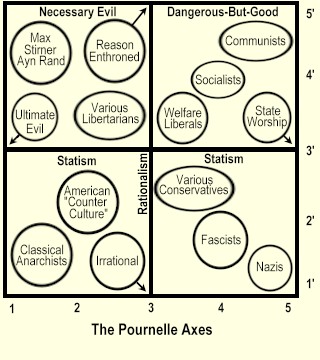
Thanks to a comment by Mr. Meval on a post at Catallarchy, I found this:

My own, simpler, taxonomy — which anarcho-capitalists will reject — looks like this:

• Anarchy — “might makes right” without an effective state to referee the fight

• Libertarianism — the minimal state for the protection of life, property, and liberty

• Communitiarianism — the regulation of private institutions to produce “desirable” outcomes in such realms as income distribution, health, safety, education, and the environment

• Statism — outright state control of most institutions, reached either as an extension of communitarianism or via post-statist anarchy or near-anarchy, as in Stalin’s Russia, Hitler’s Germany, and Mao’s China.

A Baseless Debate

Legal Affairs Debate Club is hosting a debate about the limits of presidential power. The premise of the debate:

Critics of the Bush Administration have attacked the president for a host of unilateral actions he has taken. The president, critics say, took the country into two wars without congressional approval, detained suspected terrorists without trials or even charges, and pulled the United States out of longstanding agreements like the Kyoto Accords.

Or, “when did you stop beating your wife?”

The debate is baseless because the answers to the critics’ charges are straightforward:

  • Military operations in Afghanistan and Iraq were — and are — expressly authorized by Congress.
  • Terrorists (as opposed to members of the Iraqi Army) who have fought against American forces abroad merit none of the protections of the Geneva Conventions and certainly none of the protections of the Bill of Rights — no matter what the Supreme Court says.
  • The U.S. Senate has never ratified the Kyoto Protocol and, therefore, the U.S. is not bound by it.

Perhaps the next debate should be about the greatest movie ever made. At least there would be something to debate, even if no one could win the debate.

Bad Law Makes for Bad Consequences

“Hard cases, it is said, make bad law” — John Campbell Argyll (Scottish, 1678-1743)

Difficult cases — cases in which the law must be twisted to achieve “desirable” results — can cause good laws to be changed, with bad consequences.

Metaphor du Jour

Groucho Marx is supposed to have said “I wouldn’t join any club that would have me as a member” — or something in that vein. In other words, when an exclusive club loses its exclusivity, membership in the club becomes less valuable, both to the members who joined it when it was still exclusive and to prospective members (if they are as astute as Groucho Marx).

But there’s more to it than that. Suppose that the exclusive club has stringent standards of conduct, which aren’t always observed but which most of its members strive to honor. Suppose that by changing its rules of admission — by admitting Groucho Marx, for instance — the club also seems to signal that it has lowered its standards of conduct. What is likely to happen as a result? At the margin, even some of those members who had joined the club when it was exclusive will adapt to the lower standards of conduct. Moreover, many persons who would have sought membership in the club when it was exclusive will simply decline to join it, with the result that, at the margin, some of them will not rise to the standards of conduct that they would have risen had they joined the club.

Human beings respond to social norms in ways that might seem “irrational” to those who think that humans are nothing but wealth-maximizing automata. Humans are much more complex than that, however, which is why it’s important to have exclusive “clubs” with high standards of conduct. If abstractions such as “honor” and “duty” were meaningless, soldiers wouldn’t join a “club” whose unwritten rules sometimes require them to throw themselves onto hand grenades; firemen wouldn’t join a “club” whose unwritten rules sometimes require them to risk almost-certain death on the slim odds of rescuing a person from an inferno.

There is a lesson in this for who are ineligible for certain exclusive clubs. They should — in the interest of society’s well-being — form their own exclusive clubs instead of trying to force their way into those clubs that already exist. They can call their clubs whatever they wish — and they can set very high standards for membership in those clubs — but they should not devalue the clubs that already exist by trying to change the rules of admission to those clubs.

Understanding Introverts

Jonathan Rauch understands. Just read it, please.

My thanks to A Constrained Vision, via Jujitsui Generis, for the pointer.

Related posts:

IQ and Personality (March 14, 2004)
IQ and Politics (March 14, 2004)
The Right is Smarter Than the Left (June 11, 2004)
The Advantages of Introversion (May 1, 2005)
“Thinking” vs. “Feeling” (June 8, 2005)

The Next Winner of the World Series?

UPDATED, 11/13/05, 11/14/05, AND 10/28/07
REVISED, 10/29/07

The Boston Red Sox won the World Series in 2004. That was the first WS win for a Red Sox team since 1918. The Chicago White Sox won the WS in 2005. That was the first WS win for a White Sox team since 1917. Who’s next? Who knows?

Now we know, the St. Louis Cardinals (2006) and the Red Sox, again (2007).

But to fuel offseason speculation, the following list ranks teams by the number of World Series that have been played since a team’s last WS win. The number after the “/” indicates a team’s longest drought (the consecutive number of WS played in which the team failed to win a WS). The year of a team’s last WS victory is shown parenthetically. The 16 pre-expansion teams are listed in bold; the 14 expansion teams, in italics. League designations are AL (American League), NL (National League).

98/98 – Chicago Cubs (1908) NL
58/58 – Cleveland Indians (1948) AL
52/52 – San Francisco Giants (1954) (New York Giants through 1957; San Francisco Giants, 1958-) NL
46/46 – Texas Rangers (1961 expansion team without WS victory; Washington Senators, 1961-71; Texas Rangers, 1972-) AL
45/45 – Houston Astros (1962 expansion team without WS victory) NL
38/38 – Milwaukee Brewers (1969 expansion team without WS victory; Seattle Pilots, 1969; Milwaukee Brewers, 1970-97) AL /(Milwaukee Brewers, 1998-) NL
38/38 – San Diego Padres (1969 expansion team without WS victory) NL
38/38 – Washington Senators (1969 expansion team without WS victory; Montreal Expos, 1969-2004; Washington Nationals, 2005-) NL
30/30 – Seattle Mariners (1977 expansion team without WS victory) AL
27/51 – Pittsburgh Pirates (1979) NL
26/76 – Philadelphia Phillies (1980) NL
23/40 – Baltimore Orioles (1983) (Milwaukee Brewers, 1901; St. Louis Browns, 1902-53: Baltimore Orioles, 1954-) AL
22/31 – Detroit Tigers (1984) AL
21/19 – Kansas City Royals (1977 expansion team, WS victory in 1985) AL
20/18 – New York Mets (1986) (1962 expansion team, last WS victory in 1986) AL
18/51 – Los Angeles Dodgers (1988) (Brooklyn Dodgers through 1957; Los Angeles Dodgers, 1958-) NL
17/41 – Oakland Athletics (1989) (Philadelphia A’s, 1901-54; Kansas City A’s, 1955-67; Oakland A’s 1968-) AL
16/34 – Cincinnati Reds (1990) NL
15/62 – Minnesota Twins (1991) (Washington Senators, 1901-60; Minnesota Twins, 1961-) AL
14/14 – Colorado Rockies (1993 expansion team without WS victory) NL
13/16 – Toronto Blue Jays (1977 expansion team, last WS victory in 1993) AL
12/42 – Atlanta Braves (1995) (Boston Braves through 1952; Milwaukee Braves, 1953-65; Atlanta Braves, 1966-) NL
10/10 – Tampa Bay Devil Rays (1998 expansion team without WS victory) AL
07/19 – New York Yankees (2000) (Baltimore Orioles, 1901-2; New York Highlanders/Yankees, 1903-) AL
06/06 – Arizona Diamondbacks (1998 expansion team, WS victory in 2001) NL
05/40 – Los Angeles Angels (2002) (1961 expansion team, WS victory in 2002) (known variously as Los Angeles Angels, California Angels, Anaheim Angels, and now Los Angeles Angels of Anaheim) AL
04/05 – Florida Marlins (2003) (1993 expansion team, last WS victory in 2003) AL
02/86 – Chicago White Sox (2005) AL
01/23 – St. Louis Cardinals (2006) NL
00/84 – Boston Red Sox (2007) AL

Notes and comments:

1. The Cubs are closing in on the century mark. Will 2006 be the “Year of the Cubs”? (No.) How about a World Series between the Cubs and Indians? The Cubs probably would lose it.

2. Nineteen different teams won the 28 World Series that were played from 1979 through 2007. Here’s the breakdown: Yankees, 4 wins; Cardinals, 2 wins; Red Sox, 2 wins; Marlins, 2; Blue Jays, 2; Twins, 2; Dodgers, 2; and 1 each for the White Sox, Angels, Diamondbacks, Braves, Reds, Athletics, Mets, Royals, Tigers, Orioles, Phillies, and Pirates. That’s a far cry from the 28 World Series played from, say, 1934 through 1959, which were won by only 8 different teams: Yankees, 14 wins; Cardinals, 4; Dodgers, 2; Tigers, 2; and 1 each for the Braves, Giants, Indians, and Reds.

3. And how about those Yankees? Of the 18 World Series played from 1936 through 1953, the Yankees played in 13 and won 12. The Yankees played in 22 of the 29 World Series from 1936 through 1964, winning 16 times. Of the 44 World Series played from 1921 through 1964, the Yankees played in 29 and won 20. Since 1964 — after expansion began and not too long before the era of free agency for players — the Yankees have appeared in 10 of 40 World Series, and have won 6 times. That’s the best record of any team for 1965-2005, but it’s a far cry from the Yankees’ glory days of 1921-64. Expansion and free agency do seem to have made a difference in the competitiveness of baseball (a statement corroborated by a post I wrote two years later).

4. Washington is now on its third franchise. The original Senators played in D.C. from 1901 through 1960, then became the Minnesota Twins. The expansion Senators lasted only from 1961 through 1971, when they became the Texas Rangers. The present Senators (oops, Nationals) were the Montreal Expos from 1969 through 2004. My money on another flop (see, also, this later post). After the novelty of major-league baseball wears off, residents of D.C. and environs will pay only to see a consistent winner, if then.