A Long Long Way

That’s the title of the novel I finished yesterday. A Long Long Way, by Irish writer Sebastian Barry, was shortlisted for the 2005 Man Booker Prize for Fiction, which went to John Banville for The Sea. Banville’s novel is on my to-read list, but it will have to be a masterpiece to top Barry’s novel.

A Long Long Way is the story of William (Willie) Dunne, an Southern Irish Catholic who volunteers for the British Army soon after the outbreak of the Great War. Willie, who is not yet 18 years old when he enlists, is motivated by the belief that a good showing by Southern Irish troops will be rewarded by Home Rule when the war is done.

The action follows wee Willie (who is just 5’6″ tall and naïve, if not simple-minded) through the mud, blood, and abject terror of trench warfare. If Barry meant to write an anti-war novel it doesn’t show. The gory fighting, rendered in a wholly believable way, is only a backdrop for Willie’s thoughts, loves, comradeships, and (most of all) his relationship with his towering figure of a father. All of that holds center stage.

What happens to Willie? Read A Long Long Way and find out.

Schelling and Segregation

Tyler Cowen of Marginal Revolution, who was mentored by Thomas Schelling at Harvard, praises Schelling’s Nobel prize by noting, among other things, Schelling’s analysis of the economics of segregation:

Tom showed how communities can end up segregated even when no single individual cares to live in a segregated neighborhood. Under the right conditions, it only need be the case that the person does not want to live as a minority in the neighborhood, and will move to a neighborhood where the family can be in the majority. Try playing this game with white and black chess pieces, I bet you will get to segregation pretty quickly.

True, but trivial. For, like many game-theoretic tricks, Schelling’s segregation gambit omits much important detail.

To begin with, blacks are not culturally homogeneous. Thomas Sowell argues, rather persuasively to this native of the North, that

[t]here have always been large disparities, even within the native black population of the U.S. Those blacks whose ancestors were “free persons of color” in 1850 have fared far better in income, occupation, and family stability than those blacks whose ancestors were freed in the next decade by Abraham Lincoln. . . .

The redneck culture [prevalent in the South] proved to be a major handicap for both whites and blacks who absorbed it. Today, the last remnants of that culture can still be found in the worst of the black ghettos, whether in the North or the South, for the ghettos of the North were settled by blacks from the South. The counterproductive and self-destructive culture of black rednecks in today’s ghettos is regarded by many as the only “authentic” black culture–and, for that reason, something not to be tampered with. Their talk, their attitudes, and their behavior are regarded as sacrosanct.

The people who take this view may think of themselves as friends of blacks. But they are the kinds of friends who can do more harm than enemies.

As Sowell explains more fully in his essay “Black Rednecks and White Liberals” (from the eponymous book) Northerners were rather accepting of the blacks in their midst until the great migrations of Southern blacks to the North from the 1930s onward. Then whites began to flee the neighborhoods into which Southern blacks were moving. The “old line” blacks sought to do the same, but they had less success than whites because the “old line” blacks became identified with the uncouth intruders from the South.

It is therefore meaningless to treat segregation as a game in which all whites are willing to live with black neighbors as long as they (the whites) aren’t in the minority. Most whites (including most liberals) do not want to live anywhere near any black rednecks if they can help it. Living in relatively safe, quiet, and attractive surroundings comes far ahead of whatever value there might be in “diversity.”

“Diversity” for its own sake is nevertheless a “good thing” in the liberal lexicon. The Houston Chronicle notes Schelling’s Nobel by saying that Schelling’s work

helps explain why housing segregation continues to be a problem, even in areas where residents say they have no extreme prejudice to another group.

Segregation isn’t a “problem,” it’s the solution to a potential problem. Segregation today is mainly a social phenomenon, not a legal one. It reflects a rational aversion on the part of whites to having neighbors whose culture breeds crime and other types of undesirable behavior.

As for what people say about their racial attitudes: Believe what they do, not what they say. Most well-to-do liberals choose to segregate themselves and their children from black rednecks. That kind of voluntary segregation, aside from demonstrating liberal hypocrisy about black redneck culture, also demonstrates the rationality of choosing to live in safer and more decorous surroundings.

Nor is segregation confined to cities. It has spread to the suburbs, as well, because black redneck culture has — too commonly — followed blacks there.

Related posts: Affirmative Action and Race (a collection of links)

Rich October Skies

I used the phrase “bright, blue, mid-October skies” in the preceding post. That reminds me of one of my favorite Carter Family songs,* A.P. Carter’s “School House on the Hill,” the third verse of which ends in the evocative phrase “rich October skies”:

Fond memory paints its scenes of other years
Bring me their memory still
And bright amid those joyous scenes of years
The schoolhouse on the hill

Oh, the schoolhouse that stands upon the hill
I never, never can forget
Dear happy days are gathered ’round me still
I never, no never can forget

There hangs the swing upon the maple tree
Where you and I once swung
There flows the spring, forever flowing free
As when we both were young

Oh, the schoolhouse that stands upon the hill
I never, never can forget
Dear happy days are gathered ’round me still
I never, no never can forget

There climbs the vines and there the berries grow
Which once would rise so high
And there the ripe nuts glistened in the grove
Of rich October skies

Oh, the schoolhouse that stands upon the hill
I never, never can forget
Dear happy days are gathered ’round me still
I never, no never can forget

The song was first recorded on June 17, 1933, in Camden, New Jersey, by A.P., Sara, and Maybelle Carter. And here they are:


Standing, A.P. and Sara; seated, Maybelle.

Here’s a snippet of the Carters’ original recording. And here’s a longer but, unfortunately, incomplete excerpt of a recording made by Jim Watson, Mike Craver, and the late Tommy Thompson of the original Red Clay Ramblers. The excerpt is from a 1980 album, Meeting in the Air, in which Watson, Craver, and Thompson performed 14 original Carter Family pieces. If the Ramblers’ rendition of “School House. . .” doesn’t bring a lump to your throat, you’re too young, too citified, or both.
__________
Lyrics of original Carter Family songs are available here and here.

Global Warming and the Liberal Agenda

So Mars is getting warmer, without human activity. It’s more evidence that the apparent warming of Earth’s climate is due mainly to phenomena over which humans have no control.

The rush by many scientists and all hair-shirted liberals, anti-capitalists, and inveterate doomsayers to blame global warming on human activity arises from a predisposition to think of economic motives as “greedy” and “evil.” But it is the “greedy” and “evil” pursuit of profit and self-interest that lifts individuals out of poverty, leads to cures for disease, and generally makes life more livable.

In sum, the pursuit of profit and self-interest advances liberals’ proclaimed agenda. But liberals have been blinded to that fact by their own guilt, ignorance, and anti-capiltalist rhetoric. That many liberals are also hypocritical beneficiaries of the system they claim to despise should not go unmentioned, either.

Related posts:

Climatology (07/16/04)
Global Warming: Realities and Benefits (07/18/04)
Scientists in a Snit (08/14/04)
Another Blow to Climatology? (08/21/04)
Bad News for Politically Correct Science (10/18/04)
Another Blow to Chicken-Little Science (10/27/04)
Bad News for Enviro-Nuts (11/27/04)
The Hockey Stick Is Broken (01/31/05)
Science in Politics, Politics in Science (05/11/05)
Hurricanes and Global Warming (09/24/05)

The Case of the (Happily) Missing Supreme Court Nominee(s)

A timely post by “Rice” at Southern Appeal assesses the happiness and unhappiness of party regulars with the Supreme Court picks of presidents since JFK’s day. Rice’s analysis reminds me of the happy fact that one James Earl (call me “Jimmy”) Carter had no picks. Given the ability of Democrats to pick stalwart Leftists — and the inability or unwillingness of Republicans to oppose them — imagine the Court’s current configuration had Carter been able to place one or more of his ilk on the Big Nine.

Rice’s post also convinces me that Senate Republicans should demand the withdrawal of Harriet Miers’s name in favor of a judge with a track record of “strict constructionism.” Given the strong possibility that a Democrat will win the 2008 election, Bush shouldn’t squander a single opportunity to point the Supreme Court in the right direction.

Further Erosion of the Employment Relationship

UPDATED TWICE BELOW

From the law firm of McGuireWoods:

The National Labor Relations Board recently held that an employee’s statements to a local newspaper and subsequent postings on an Internet message board in the context of labor organizing were protected activity under the National Labor Relations Act.

Following the purchase of a manufacturing facility and subsequent layoff of roughly 200 employees by the new owner, the union attempting to organize the facility’s employees approached a retained employee to talk to a newspaper about the firings. The newspaper quoted the employee that the layoffs “left gaping holes in this business”. The company warned the employee that such comments violated the employee handbook because they were disparaging to the company, and that the employee would be fired if he did it again. Two weeks later, the same employee responded to an anti-union posting on the newspaper’s internet message board. Among other statements, the employee stated in his post that the company was “being tanked by a group of people that have no ability to manage it.” He was fired soon after, and the union filed an unfair labor practice.

Affirming the statement that management “cannot be too thin-skinned,” the Board affirmed the ALJ’s decision that the activity was protected for three reasons. First, the newspaper quote and internet posting both involved employment matters. Second, there was a sufficient link between the statements and the ongoing controversy. Finally, the Board ruled that the comments were “not so egregious” as to fall outside the realm of protected activity.

Clearly, the NLRB remains in the grip of Left-wing doctrines, if not in the grip of Left-wing members. It takes a lot of specious reasoning to hold for the employee in the case cited by McGuireWoods. First, the newspaper quote and internet posting were statements by the employee, not the employer. Second, the employee made the link between the statements and the “ongoing controversy.” Finally, the employee’s statements could be found to be “not so egregious” only by a body that is already biased against employers. In sum, the employee bad-mouthed his employer and got away with it simply because of an “ongoing controversy” about unionization. It’s an invitation to disgruntled employees to incite unionization. Apparently almost anything goes under the cover of an effort to unionize a workplace.

Is there a free-speech issue involved? Not at all. The Constitution’s guarantee of freedom of speech is — or was intended to be — nothing more than a guarantee that government cannot suppress speech. Of course, that guarantee has been vitiated by restrictions on such things as commercial speech and campaign speech.

Nothing in the Constitution gives anyone the right to disparage an employer and duck the consequences. In fact, nothing in the Constitution gives government the right to legislate unionism, in particular, or to interfere in employment relationships, in general.

The NLRB’s ruling is another dreary reminder of the many unconstitutional excesses of the New Deal.

UPDATE: A reader objects to my opening comment on the NLRB decision: “Clearly, the NLRB remains in the grip of Left-wing doctrines, if not in the grip of Left-wing members.” He says:

Left-wing doctrines maybe, but to imply the current Board members are a bunch of left-wingers is an absurdity. Anybody who even casually follows Board decisions readily admits that the Board has moved sharply toward management-side on the whole in recent years. If you feel the statute is left-wing, then your gripe is with Congress, not the Board–unless you can point to an example of the Board interpreting the statute in a left-biased way, which I expect you can’t.

My reply:

Regardless of the Board’s current ideological composition, it’s clear that the Board acted in a Left-biased way in the case at hand. I need look no further. The Board chose to interpret the employer’s actions as an act of interference with an attempt to unionize. I would have interpreted the employer’s actions as a justifiable course of discipline against an employee who contravened the employer’s stated policies.

I have had dealings with a similar body (the EEOC), and I doubt very much that the problem is statutory. No statute can prescribe precisely how a body like the NLRB must judge the motivations of employer and employee in a particular case. The Board made a judgment call, which smacks of complaisant adherence to decades of Left-wing precedent. Perhaps the Board is too willing to accept the recommendations of its Regional Directors and their long-serving staff employees, many of whom are likely to be imbued with the “rightness” of Left-wing interpretations of the NLRA.

Anyway, the sentence to which you object . . . means this: “The NLRB remains in the grip of Left-wing doctrines (interpretations of statutory authority), even though its members may (or may not) be Leftists.” . . .

I might have written this: “Clearly, the NLRB remains in the grip of Left-wing precedents that the Board’s current membership is too gutless to reverse.” But I’ll leave it as it stands.

UPDATE 2: My correspondent rightly notes that the National Labor Relations Act (Wagner Act), which established the NLRB, “could have been an overwhelmingly destructive statute.” Although it has been destructive enough, I agree that things could have been worse had the anti-business (and therefore anti-growth) intentions of its framers been executed down the line. But in spite of the intentions of the Act’s framers, its words (in my opinion) give the NLRB leeway for pro-employer decisions. It’s a shame that the NLRB didn’t take advantage of that leeway in the case highlighted by McGuire Woods.

Liberty or Self-Indulgence?

Anarcho-capitalists would attain liberty by doing away with the state. They believe in

the Contractual Society; “[…] a society based purely on voluntary action, entirely un­hampered by violence or threats of violence.”[12] Because this system relies on voluntary agreements (contracts) between individuals as the only legal framework, it is difficult to predict precisely what the particulars of this society would look like. Those particulars are disputed both among anarcho-capitalists and between them and their critics.

Among the important particulars not accounted for by anarcho-capitalists is the method of resolving disputes between those who agree to settle their differences without resorting to violence and those persons (foreign as well as domestic) who simply refuse to be bound by such agreements. Anarcho-capitalists, in their blindness to that bit of reality, insist on applying the non-aggression principle to inter-state relations, thus effectively granting immunity to lawless states simply because they have not yet attacked us.

Anarcho-capitalists, in effect, have created a fantasy world in which the American state is unnecessary because anarcho-capitalists do not like what it sometimes does. Anarcho-capitalists believe that, somehow or other, the absence of the state will culminate in the advent of nirvana.

The state — or something worse — is inevitable, however. The real question, therefore, is how to channel the power of the American state toward the defense of liberty. The Constitution of the United States, in its original meaning, offers the best practical answer to that question. Anarcho-capitalists will object that the original Constitution was imperfect (e.g., it condoned slavery) and that its desirable provisions (e.g., the Bill of Rights) have been implemented imperfectly. Such arguments assume that perfection would have overtaken us in a stateless world.

Anarcho-capitalism, in sum, is a belief in the impossible. It is the wrong standard by which to judge the possible. The right standard, simply stated, is this: When faced with politically feasible policy options, support the ones that advance liberty rather than those which detract from it.

Incremental but real steps toward liberty are infinitely superior to the self-indulgent but politically irrelevant fantasies of anarcho-capitalism.

Related posts:
Libertarian Nay-Saying on Foreign and Defense Policy (06/29/04)
Libertarian Nay-Saying on Foreign and Defense Policy, Revisited (07/23/04)
An Aside about Libertarianism and War (08/02/04)
More about Libertarian Hawks and Doves (09/24/04)
Defense, Anarcho-Capitalist Style (09/26/04)
The State of Nature (12/05/04)
Getting Neolibertarianism Wrong (04/19/05)
Fundamentalist Libertarians, Anarcho-Capitalists, and Self-Defense (04/22/05)
The Legitimacy of the Constitution (05/09/05)
Another Thought about Anarchy (05/10/05)
Anarcho-Capitalism vs. the State (05/26/05)
Rights and the State (06/13/05)
The Essential Case for Consequentialist Libertarianism (07/10/05)
But Wouldn’t Warlords Take Over? (07/26/05)
Sorting Out the Libertarian Hawks and Doves (07/27/05)
A Paradox for Libertarians (08/04/05)
A Non-Paradox for Libertarians (08/15/05)

More Thoughts That Liberals Should Be Thinking

Continued from this post:

If pornography degrades women and discrimination demeans minorities, gay marriage must diminish heterosexual marriage and its civilizing influence.

Taxes are not the price we pay for civilization. Taxes are the price we pay because liberal policies undermine the natural order to be found in free markets and voluntary associations.

If the execution of criminals is “immoral,” what does that say about the execution of unborn innocents?

Consider the Children

I have written before about the hidden cost of government programs that encourage mothers to work outside the home:

The twentieth century was a time of great material progress. And we know that there would have been significantly greater progress had the hand of government not been laid so heavily on the economy. But what we don’t know is the immeasurable price we have paid — and will pay — for the exodus of mothers from the home. We can only name that price: greater incivility, mistrust, fear, property loss, injury, and death.

I focused on the economic evidence. But there’s direct evidence of the harm caused by pushing mothers out of the home. First, there’s this:

Researchers tracked the reaction of 70 toddlers in Berlin to their separation from their parents and homes.

They found stress levels were still raised months after beginning child care – even though outward signs of distress had stopped.

“For most toddlers the initiation of daycare is a major stress,” writes report co-author Michael Lamb.

The study of children’s reaction to leaving home casts light on a question that will have been asked by many working parents: “Do children really worry about being away from their parents?”

The answer from this study suggests that children do experience increased stress. . . .

And, more tellingly, there’s this:

A study, the results of which were reported in The [UK] Independent yesterday, indicates that toddlers who are looked after by their mothers develop significantly better than those cared for by nurseries, childminders or relatives.

The report, presented by Penelope Leach, president of the National Childminders’ Association and one of the co-authors, shows that toddlers given nursery care fared worst of all. According to The Independent these children “exhibited higher levels of aggression and were inclined to become more compliant, withdrawn or sad.” Those under the care of relatives fared somewhat better.

The research, which involved 1,200 children and their families in the London and Oxfordshire area, showed that “youngsters looked after by childminders and nannies came second in terms of their development to those who stayed at home with mother.”

The report confirms other studies that show that young children develop best when in the care of a parent, usually the mother, in a loving environment. The report also showed that institutionalized daycare, as proposed by many governments, is detrimental to the development of toddlers.

Society is nothing without civility. Government efforts to push mothers out of the home are nothing less than a crime against society.

(Thanks for my daughter-in-law for the lead.)

Related posts:

I Missed This One (08/12/04)
A Century of Progress? (01/30/05)
Feminist Balderdash (02/19/05)
Libertarianism, Marriage, and the True Meaning of Family Values (04/06/05)
Judge Roberts and Women (08/19/05)

Tom DeLay and James Madison

No, I do not mean to put DeLay on a par with Madison. Not by a very long shot. But I needed a catchy title. This is about DeLay’s current legal troubles, and why DeLay’s real “crime” isn’t what a Texas prosecutor claims it is.

Sure, Tom DeLay is a tough political cookie. Sure, he plays hardball, like everyone else in Washington — and elsewhere — who seeks to control the levers of power. Sure, in his zeal to wield power he might have broken some Texas law about political contributions (from CNN):

The indictment [handed down today] accused DeLay of a conspiracy to “knowingly make a political contribution” in violation of Texas law outlawing corporate contributions. It alleged that DeLay’s Texans for a Republican Majority political action committee accepted $155,000 from companies, including Sears Roebuck, and placed the money in an account.

The PAC then wrote a $190,000 check to an arm of the Republican National Committee and provided the committee a document with the names of Texas State House candidates and the amounts they were supposed to receive in donations.

Yes, a law is a law, and if DeLay broke it, he should be punished for breaking it. But campaign-finance laws are inherently repressive of free speech, so part of me wants DeLay to get off. And I’m hoping that McCain-Feingold and all of its ilk at the State level will be eviscerated in the 2005-6 term of the U.S. Supreme Court. The Court has granted certiorari in Vermont Republican State Committee v. Sorrell, described by SCOTUSblog as a “challenge[] to expenditure limits imposed by Vermont campaign finance laws.” (For more, go here.)

But I will not be sorry if the campaign-finance scandal ends DeLay’s political career. I have no sympathy for a senior Republican (or any other politican) who can say what DeLay said about funding disaster relief. This from The Washington Times:

House Majority Leader Tom DeLay said yesterday that Republicans have done so well in cutting spending that he declared an “ongoing victory,” and said there is simply no fat left to cut in the federal budget.
Mr. DeLay was defending Republicans’ choice to borrow money and add to this year’s expected $331 billion deficit to pay for Hurricane Katrina relief. Some Republicans have said Congress should make cuts in other areas, but Mr. DeLay said that doesn’t seem possible.
“My answer to those that want to offset the spending is sure, bring me the offsets, I’ll be glad to do it. But nobody has been able to come up with any yet,” the Texas Republican told reporters at his weekly briefing.
Asked if that meant the government was running at peak efficiency, Mr. DeLay said, “Yes, after 11 years of Republican majority we’ve pared it down pretty good.”

Balderdash! Hogwash! Bilge!

It’s time for Republicans to get back to basics: spending cuts to match tax cuts, then more tax cuts and more spending cuts, for as long as it takes to get Congress back to its enumerated powers under Article I, Section 8, of the Constitution of the United States.

And don’t be fooled by the “general welfare clause” in the first sentence of Section 8. Here’s why:

In his last act before leaving [the presidency], Madison vetoed a bill for “internal improvements,” including roads, bridges, and canals:

“Having considered the bill…I am constrained by the insuperable difficulty I feel in reconciling this bill with the Constitution of the United States…The legislative powers vested in Congress are specified…in the…Constitution, and it does not appear that the power proposed to be exercised by the bill is among the enumerated powers…” [1]

Madison rejected the view of Congress that the General Welfare Clause justified the bill, stating:

“Such a view of the Constitution would have the effect of giving to Congress a general power of legislation instead of the defined and limited one hitherto understood to belong to them, the terms ‘common defense and general welfare’ embracing every object and act within the purview of a legislative trust.”

(Source: Wikipedia)

Related posts:

The Erosion of the Constitutional Contract (03/23/04)
Unintended Irony from a Few Framers (06/05/04)
An Agenda for the Supreme Court (06/29/05)
What Is the “Living Constitution”? (08/23/05)

The Legality of Teaching Intelligent Design: Part II

A few days ago I wrote about a debate between Francis Beckwith and Douglas Laycock over at Legal Affairs Debate Club. Their topic: “Is Teaching Intelligent Design Illegal?” I concluded with this:

A fundamental illegality occurs when a public-school teacher is barred by law from teaching about a possible explanation for the existence of life. As it also says in the First Amendment: “Congress [and, by extension, all governmental bodies] . . . shall make no law abridging the freedom of speech. . . .” It seems to me that a general proscription by any legislative body or court of the teaching of intelligent design as a possibility would be in violation of the First Amendment.

Laycock’s latest entry in the debate nevertheless includes this observation:

Religious students can believe what they want about God’s role in directing or even bypassing natural explanations. The Constitution protects all such beliefs, but they are not scientific beliefs, and they are not beliefs that can be taught—or opposed—in the public schools. The science course can teach only the best available natural explanation; it must leave all questions about supernatural explanations to the private sector.

In sum, freedom of speech on the subject of evolution comes down to this: If it isn’t science, it can’t be taught. Says who? Several months ago, in “Going Too Far with the First Amendment,” I wrote this:

Think of the fine mess we’d be in if the courts were to rule against the teaching of intelligent design not because it amounts to an establishment of religion but because it’s unscientific. That would open the door to all sorts of judicial mischief. The precedent could — and would — be pulled out of context and used in limitless ways to justify government interference in matters where government has no right to interfere.

It’s bad enough that government is in the business of funding science — though I can accept such funding wheere it actually aids our defense effort. But, aside from that, government has no business deciding for the rest of us what’s scientific or unscientific. When it gets into that business, you had better be ready for a rerun of the genetic policies of the Third Reich.

Aside from advancing us down the slippery slope toward absolute statism, the argument that schools should be in the business of teaching only that which courts deem “scientific” is nothing short of fatuous. If schools were in the business of teaching only scientifically valid lessons in government, history, and economics, most of the textbooks that praise government intervention in the economic and social order would have to be burned, for there is abundant evidence of the wrongness of such teachings.

I’ll make a deal with Laycock and his band of merry pseudo-scientists: I’ll let you ban the teaching of ID in public schools if you’ll let me reciprocate by banning the teaching of socialism in public schools.

A Belated Anniversary

September 16 marked the 60th anniversary of the death of John McCormack:

John McCormack (14 June 1884 – 16 September 1945), was a world-famous Irish tenor in the fields of opera and popular music, and renowned for his flawless diction and superb breath control. . .

. . . and for his silvery, lyrical voice.

Here he is singing, appropriately, “Goodbye” by Francesco Paolo Tosti.

Thoughts That Liberals Should Be Thinking

If women are the same as men, except for certain anatomical features, there’s no reason to favor women candidates for office because they might possess more “compassion.”

If a woman’s place is outside the home, whose place is inside the home, where children need the kind of moral education best given by a parent?

Excluding the inculcation of immoral socialistic ideals, public schools cannot venture very far into moral guidance without offending someone’s “sensibilities.” Nor can public schools enforce moral guidance with a quick swat.

And what’s wrong with a quick swat as a way of imprinting a moral lesson? It’s a lot more effective than “Joshua, I’m telling you for the last (100th) time not to do that.”

If the black poor are poor because they’ve been “kept down” by discrimination, then affirmative action isn’t of much use to them, except as a way of victimizing whites. (Moral lesson: Two wrongs don’t make a right.)

If the black poor are poor in spite of generations of welfare programs aimed at them, perhaps the problem is that such programs have created a form of dependency that destroys initiative.

If, as Thomas Sowell argues, “black” (redneck) culture is largely responsible for both the perpetuation of black poverty and racial prejudice, doesn’t that make a strong case for “acting white” instead of clinging to a culture that isn’t even authentically “black”?

And where’s the “compassion” for poor, inner-city blacks when they cannot obtain a better education through school vouchers because of resistance to vouchers by their own “educators” and white “liberals” in adjacent suburbs?

If it’s good to have racial and ethnic diversity in housing and jobs, why isn’t it good to have intellectual diversity (a.k.a. free speech) on campuses?

Homosexuality has driven many Catholic priests to molest boys. The Church wants to protect boys by banning the ordination of homosexuals. Liberals must choose between their reflexive defense of homosexuals and their purported desire to protect children.

That purported desire should also cause them to rethink where they want mothers to spend their days and where they want children to go to school.

The Legality of Teaching Intelligent Design

Francis Beckwith of Right Reason has begun a debate with Douglas Laycock over at Legal Affairs Debate Club. Their topic: “Is Teaching Intelligent Design Illegal?” Laycock, in his reply to Beckwith’s opening salvo, says

[i]t is entirely lawful for public school teachers to say we know much less about a natural explanation for the origins of life than about a natural explanation for the evolution of different species once life begins. But it would be an important additional step, sounding more in religion than in science, for the teacher to say that therefore, an intelligent designer must have created the first living things.

I understand the First Amendment’s proscription of the establishment of religion. But I cannot for the life of me understand why it should be illegal for a public-school teacher to suggest that an intelligent designer might have created the first living things. Neither evolutionary theory nor any other branch of science can disprove the existence of an intelligent designer (or God, for that matter).

A fundamental illegality occurs when a public-school teacher is barred by law from teaching about a possible explanation for the existence of life. As it also says in the First Amendment: “Congress [and, by extension, all governmental bodies] . . . shall make no law abridging the freedom of speech. . . .” It seems to me that a general proscription by any legislative body or court of the teaching of intelligent design as a possibility would be in violation of the First Amendment.

Like a Fish in Water

A.O. Scott of The New York Times wants to prove that the myth of a liberal movie industry is dead. How? By citing two current box-office hits, Just Like Heaven and The Exorcism of Emily Rose, and a few other recent films that are putatively conservative or libertarian in outlook. In “Reading Hollywood, from Left to Right” (Sept. 25, 2005), Scott asserts that

the studios themselves, especially after the stunning success of Mel Gibson’s independently financed “The Passion of the Christ,” have tried to strengthen their connection with religious and social conservatives, who represent not only a political constituency but a large and powerful segment of the market.

All this tells me is that Hollywood is interested in making money, which is fair enough. (Unlike Hollywood hypocrites who make big money with movies that criticize making big money, I don’t begrudge the money Hollywood makes.) But Scott’s assertion says nothing about the determinedly Leftish politics of most Hollywood stars and big-wigs.

Scott’s evidence for the demise of Leftism in Hollywood is the supposed pro-life stance of Just Like Heaven, which apparently has a slapstick finale; an appeal to open-mindedness about religion, which is evidently the message to be taken from The Exorcism. . . ; Mel Gibson’s surprisingly successful The Passion of the Christ, which I recall being anathema to Hollywood before it became a hit; and a rather dumb action-hero animation known as The Incredibles, which I found to be an inferior version of Superman, Captain Marvel, and Batman comic books. And that’s about it, out of the hundreds of movies churned out by Hollywood and the so-called independent studios in the past few years.

Scott’s problem is that, like most liberals, he can’t see the liberalism that surrounds him because it’s his natural milieu. He’s like a fish in water who has been shocked by a small infusion of additional oxygen. It’s not enough to affect his environment significantly, but it causes a brief spasm of alarm.

The Pro-Peace Faction Answers Back

Christopher Hitchens unmasks phony peaceniks in an eloquent piece at Slate: “Anti-War, My Foot.” A widow of the war gets to to the heart of the matter:

“I would like to say to Cindy Sheehan and her supporters: Don’t be a group of unthinking lemmings,” said Mitzy Kenny of Ridgeley, W.Va., whose husband died in Iraq last year. She said the anti-war demonstrations “can affect the war in a really negative way. It gives the enemy hope.”

The road to peace, regrettably, is sometimes through war.

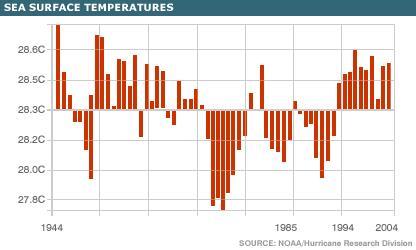
Hurricanes and Global Warming

Two charts to reckon with, from BBC News online:

The FEC and Bloggers: Stay Tuned

McQ of QandO says: “In between the bookend hurricanes, the FEC still has bloggers in its focus.” In the linked story, Federal Election Commission vice-chairman Michael Toner

argued that political activity on the Internet fails to meet the campaign finance law’s threshold to stop corruption or the appearance of corruption. Toner urged Congress to pass a law that pre-empts the court’s action and ensures that the Internet remains exempt from campaign finance rules.

But

Scott E. Thomas, the FEC [chairman], said his agency’s original exemption for the Internet was a mistake and the FEC should come up with rules for Internet campaign ads in light of the $14 million spent on Internet ads in the 2004 campaign.

Thomas said Congress should hold off on any legislation until the FEC acts.

Another commissioner, Ellen Weintraub, said the agency preferred a “less is more” approach.

“This is appropriate because the focus of the FEC is campaign finance,” she said. “We are not the speech police.”

Glad to hear it, but the FEC is currently acting under an order from U.S. District Court Judge Colleen Kollar-Kotelly, which struck down the FEC regulations that had allowed those advertising on the Internet to avoid many of the requirements of McCain-Feingold. And so, if the judge has her way and you say anything positive about a candidate, or negative about the candidate’s opponent, you might be found to have given a campaign contribution in kind to the candidate. Then the FEC could have its way with you.

Thanks a bunch, judge. Also thanks a bunch to U.S. Reps. Christopher Shays and Marty Meehan, who brought the suit against the FEC, and to those great defenders of freedom of speech, Sens. John McCain and Russ Feingold, who filed an amicus brief in support of Shays and Meehan. What those paragons of liberty and their brethren in Congress want is for all of us to shut up, because silence favors incumbents.

What should happen is this: When the U.S. Supreme Court has its full complement of justices, some persons with standing (bloggers among them) would file a challenge McCain-Feingold. The challenge by Senator Mitch McConnell failed in part because he was deemed to lack standing, but it failed mainly because of the Court’s balance. Chief Justice Rehnquist wasn’t a wholly reliable support of free speech; Justice O’Connor is even less so. Two new justices, Roberts and ?, could swing the balance back toward freedom of speech.

But no matter how it comes out, they’ll have to pry this blog from my cold, dead hands.

A Concession, of Sorts

I voted for George W. Bush in 2000 and again in 2004. I now conclude that my preference for Bush is vindicated by perhaps as few as five things, the first four of which haven’t panned out as well as expected:

  • the vigorous military response to 9/11, including the strategically wise if tactically flawed invasion of Iraq
  • the effort to reduce taxes, in the vain hope of choking off non-defense spending — a hope that he, himself, has helped to shatter
  • the effort to begin privatizing Social Security, which was strategically wise and tactically botched
  • some reduction in the rate of expansion of the Code of Federal Regulations.

The fifth thing is Bush’s nomination of John Roberts to be Chief Justice, because Roberts seems to be dedicated to the primacy of the Constitution, though he says bothersome things about the “respect” owed precedent.

I am hopeful about the choice of Roberts, but I had high hopes about Bush’s ability to prosecute the war in Iraq, his resolve to cut spending, his ability to sell some form of Social Security privatization, and his willingness to roll back the regulatory state.

I will therefore reserve judgment about the appointment of Roberts until it is certain that Roberts is dedicated to the Constitution and — in spite of his declarations to the Senate Judiciary Committee — can find ways to work around precedents that have undermined the Constitution.

That’s all I can find to say in Bush’s favor at this stage of his presidency. The man is smarter than his enemies like to portray him, but he is far more “political” and far less principled about the proper role of government than I had expected him to be. He is turning out to be his father’s son.

The Supreme Court: Our Last, Best Hope for a Semblance of Liberty

In the second postscript to this post I reaffirm my conviction that government “could not have done as well as private citizens and business owners, had they been allowed to keep their tax dollars and use them to prepare for and recover from Katrina.” I then list several related posts. All of which, if read by anyone from Center to Left, would draw a retort along these lines: “How is a bunch of individuals going to deal with something as massive as a natural disaster. Only government can do things like that, and do them efficiently.” Or “There are just some things that people can’t be trusted to do for themselves.”

It’s precisely that kind of thinking which has brought us to where we are today: in the grip of the regulatory-welfare state, which has made us immensely less prosperous than we could be. Free-market capitalism, which is how individuals cooperatively make wise and fruitful decisions — when they are allowed to do so — has been brought to heel by legislators, executives, judges, and regulators.

A central rationale for the regulatory-welfare state, of course, is the notion that government should do things people can’t be “trusted” to do for themselves. There is the paternalistic assumption that someone else knows better than you how you should run your life. Paternalists are blind to the opportunity cost of paternalism, which is that when someone else makes your decisions for you, you are less able and less likely to make good decisions for yourself.

The paternalistic assumption, in other words, becomes a self-fulfilling prophecy. When government makes certain decisions for you (e.g., by providing “free” education and a sort of retirement program) and then charges you for the privilege, you are in a double bind. You are herded toward or forced into certain government programs, which may fall far short of meeting your needs. But because of the taxes and fees you pay to support those government programs, you are left with less money. Thus you may be unable to afford the better alternatives provided by markets — where markets are allowed to provide alternatives, at all.

Paternalism on the part of the central government supposedly is curbed by the enumeration of Congress’s powers in the U.S. Constitution, which enumeration has long since become an irrelevancy. In any event, when it comes to paternalism, State and local governments are always ready to pick up any slack left by the central government. The end of Lochner-era substantive due process (defended quite nicely, here) effectively unshackled State and local governments, which can now justify almost anything as a “compelling governmental interest.” And, if they can’t, the U.S. Supreme Court can continue to manufacture other excuses for paternalism, as majorities of its members did this year in Raich and Kelo.

So, where does it all end? Unless the U.S. Supreme Court is turned around fairly quickly, I think it ends in the continued expansion of state control of what should be private conduct; for example:

  • Laws against certain “hateful” forms of expression.
  • Detailed regulation of Internet content, under the rubric of McCain-Feingold and the Commerce Clause.
  • More and more bans on the use of tobacco in so-called public places, and even in private clubs and homes.
  • Further reliance on regulation rather than property rights and free markets to control products and activities that might affect the environment.
  • Further interference with the actions of institutions that are private and voluntary (e.g., a holding that the Catholic Church’s impending ban on the ordination of gay priests violates “equal protection”).
  • More government interventions that undermine the shreds of our barely civil and self-regulating society (e.g., approval of involuntary euthanasia, requiring employers to put “partners” on a par with heterosexual spouses).
  • The creation of ever more massive bureaucracies to deal with “problems” that the central government (at least) shouldn’t be involved in (e.g., the creation of a “disaster czar”).

I could pile it on, as could many of you. But the drift is obvious. God save the U.S. Supreme Court, for it may be our last line of defense against total statism.