What Is the "Living Constitution"?

Dahlia Lithwick of Slate inveighs against opponents of the “Living Constitution” without explaining it. Here’s Dahlia:

To hear Tom DeLay and his cronies tell it, the only alternative to the interpretive theory of “Originalism” or “strict construction” is to have judges swinging like monkeys from the constitutional chandeliers, making up whatever they want, whenever they want. Here’s Jonah Goldberg on the allure of a dead Constitution: “A ‘living Constitution’ denies us our voice in this regard because it basically holds that whatever decisions we make—including the 13th, 14th, and 15th Amendments—can be thrown out by any five dyspeptic justices on the Supreme Court. In other words, the justices who claim the Constitution is a wild card didn’t take their oath to uphold and defend the Constitution in good faith because they couldn’t know what they were swearing to.”

Goldberg goes on to quote Justice Antonin Scalia’s dissent in the recent Ten Commandments cases: “What distinguishes the rule of law from the dictatorship of a shifting Supreme Court majority, is the absolutely indispensable requirement that judicial opinions be grounded in consistently applied principle. That is what prevents judges from ruling now this way, now that—thumbs up or thumbs down—as their personal preferences dictate.”

And here is Todd Gaziano from the Heritage Foundation: “If judges can essentially do whatever they want in the guise of updating the [C]onstitution … making it real for today or choosing whatever silly phrase you want, then we might as well have a completely unwritten Constitution.” . . .

A Nexis search for the words “living Constitution” turns up literally dozens of stories by conservatives bashing the premise into a hopeless pulp. But it’s hard to find a creditable recent defense of the Constitution as something greater than the span of its own four corners. And I wonder why.

Is it because the words “living Constitution,” like the words “feminist” or “liberal,” have become wholly appropriated by the Rush Limbaughs of the world? Or is it something deeper—a sense on the part of serious liberal thinkers that Roe v. Wade, with its kabbalistic talk of constitutional penumbras and emanations, really is indefensible? Is it, as I have argued before, that we are all secretly afraid that Scalia is right? That a living Constitution is nothing more than a bunch of monkeys on chandeliers?

Scalia is right. But let’s hear it directly from the Justice:

Well, let me first tell you how we got to the “Living Constitution.” You don’t have to be a lawyer to understand it. The road is not that complicated. Initially, the Court began giving terms in the text of the Constitution a meaning they didn’t have when they were adopted. For example, the First Amendment, which forbids Congress to abridge the freedom of speech. What does the freedom of speech mean? Well, it clearly did not mean that Congress or government could not impose any restrictions upon speech. Libel laws, for example, were clearly constitutional. Nobody thought the First Amendment was carte blanche to libel someone. But in the famous case of New York Times v. Sullivan, the Supreme Court said, “But the First Amendment does prevent you from suing for libel if you are a public figure and if the libel was not malicious” — that is, the person, a member of the press or otherwise, thought that what the person said was true. Well, that had never been the law. I mean, it might be a good law. And some states could amend their libel law. . . .

. . . There is no text in the Constitution that you could reinterpret to create a right to abortion. . . . So you need something else. The something else is called the doctrine of “Substantive Due Process.” Only lawyers can walk around talking about substantive process, in as much as it’s a contradiction in terms. . . .

What substantive due process is is quite simple — the Constitution has a Due Process Clause, which says that no person shall be deprived of life, liberty or property without due process of law. Now, what does this guarantee? Does it guarantee life, liberty or property? No, indeed! All three can be taken away. You can be fined, you can be incarcerated, you can even be executed, but not without due process of law. It’s a procedural guarantee. . . . [I]n fact the first case to do it was Dred Scott. But it became more popular in the 1920s. The Court said there are some liberties that are so important, that no process will suffice to take them away. Hence, substantive due process.

Now, what liberties are they? The Court will tell you. Be patient. When the doctrine of substantive due process was initially announced, it was limited in this way, the Court said it embraces only those liberties that are fundamental to a democratic society and rooted in the traditions of the American people.

Then . . . that limitation is eliminated. Within the last 20 years, we have found to be covered by due process the right to abortion, which was so little rooted in the traditions of the American people that it was criminal for 200 years; the right to homosexual sodomy, which was so little rooted in the traditions of the American people that it was criminal for 200 years. So it is literally true, and I don’t think this is an exaggeration, that the Court has essentially liberated itself from the text of the Constitution, from the text and even from the traditions of the American people. It is up to the Court to say what is covered by substantive due process.

What are the arguments usually made in favor of the Living Constitution? . . . The major argument is the Constitution is a living organism, it has to grow with the society that it governs or it will become brittle and snap.

This is . . . an anthropomorphism equivalent to what you hear from your stockbroker, when he tells you that the stock market is resting for an assault on the 11,000 level. The stock market panting at some base camp. The stock market is not a mountain climber and the Constitution is not a living organism for Pete’s sake; it’s a legal document, and like all legal documents, it says some things, and it doesn’t say other things. And if you think that the aficionados of the Living Constitution want to bring you flexibility, think again.

My Constitution is a very flexible Constitution. You think the death penalty is a good idea — persuade your fellow citizens and adopt it. You think it’s a bad idea — persuade them the other way and eliminate it. You want a right to abortion — create it the way most rights are created in a democratic society, persuade your fellow citizens it’s a good idea and enact it. You want the opposite — persuade them the other way. That’s flexibility. . . .

Some people are in favor of the Living Constitution because they think it always leads to greater freedom — there’s just nothing to lose, the evolving Constitution will always provide greater and greater freedom, more and more rights. Why would you think that? It’s a two-way street. And indeed, under the aegis of the Living Constitution, some freedoms have been taken away.

Recently, last term, we reversed a 15-year-old decision of the Court, which had held that the Confrontation Clause — which couldn’t be clearer, it says, “In all criminal prosecutions, the accused shall enjoy the right … to be confronted with the witness against him.” But a Living Constitution Court held that all that was necessary to comply with the Confrontation Clause was that the hearsay evidence which is introduced — hearsay evidence means you can’t cross-examine the person who said it because he’s not in the court — the hearsay evidence has to bear indicia of reliability. I’m happy to say that we reversed it last term with the votes of the two originalists on the Court. And the opinion said that the only indicium of reliability that the Confrontation Clause acknowledges is confrontation. You bring the witness in to testify and to be cross-examined. That’s just one example, there are others, of eliminating liberties.

So, I think another example is the right to jury trial. In a series of cases, the Court had seemingly acknowledged that you didn’t have to have trial by jury of the facts that increase your sentence. You can make the increased sentence a “sentencing factor” — you get 30 years for burglary, but if the burglary is committed with a gun, as a sentencing factor the judge can give you another 10 years. And the judge will decide whether you used a gun. And he will decide it, not beyond a reasonable doubt, but whether it’s more likely than not. Well, we held recently, I’m happy to say, that this violates the right to a trial by jury. The Living Constitution would not have produced that result. The Living Constitution, like the legislatures that enacted these laws would have allowed sentencing factors to be determined by the judge because all the Living Constitution assures you is that what will happen is what the majority wants to happen. And that’s not the purpose of constitutional guarantees.

Well, I’ve talked about some of the false virtues of the Living Constitution, let me tell you what I consider its principle vices are. Surely the greatest — you should always begin with principle — its greatest vice is its illegitimacy. The only reason federal courts sit in judgment of the constitutionality of federal legislation is not because they are explicitly authorized to do so in the Constitution. Some modern constitutions give the constitutional court explicit authority to review German legislation or French legislation for its constitutionality, our Constitution doesn’t say anything like that. But John Marshall says in Marbury v. Madison: Look, this is lawyers’ work. What you have here is an apparent conflict between the Constitution and the statute. And, all the time, lawyers and judges have to reconcile these conflicts — they try to read the two to comport with each other. If they can’t, it’s judges’ work to decide which ones prevail. When there are two statutes, the more recent one prevails. It implicitly repeals the older one. But when the Constitution is at issue, the Constitution prevails because it is a “superstatute.” I mean, that’s what Marshall says: It’s judges’ work. . . .

. . . If you don’t believe in originalism, then you need some other principle of interpretation. Being a non-originalist is not enough. You see, I have my rules that confine me. I know what I’m looking for. When I find it — the original meaning of the Constitution — I am handcuffed. If I believe that the First Amendment meant when it was adopted that you are entitled to burn the American flag, I have to come out that way even though I don’t like to come out that way. When I find that the original meaning of the jury trial guarantee is that any additional time you spend in prison which depends upon a fact must depend upon a fact found by a jury — once I find that’s what the jury trial guarantee means, I am handcuffed. Though I’m a law-and-order type, I cannot do all the mean conservative things I would like to do to this society. You got me.

Now, if you’re not going to control your judges that way, what other criterion are you going to place before them? What is the criterion that governs the Living Constitutional judge? What can you possibly use, besides original meaning? Think about that. Natural law? We all agree on that, don’t we? The philosophy of John Rawls? That’s easy. There really is nothing else. You either tell your judges, “Look, this is a law, like all laws, give it the meaning it had when it was adopted.” Or, you tell your judges, “Govern us. You tell us whether people under 18, who committed their crimes when they were under 18, should be executed. You tell us whether there ought to be an unlimited right to abortion or a partial right to abortion. You make these decisions for us.” I have put this question — you know I speak at law schools with some frequency just to make trouble — and I put this question to the faculty all the time, or incite the students to ask their Living Constitutional professors: “Okay professor, you are not an originalist, what is your criterion?” There is none other.

. . . What is a moderate interpretation of the text? Halfway between what it really means and what you’d like it to mean? There is no such thing as a moderate interpretation of the text. Would you ask a lawyer, “Draw me a moderate contract?” The only way the word has any meaning is if you are looking for someone to write a law, to write a constitution, rather than to interpret one. The moderate judge is the one who will devise the new constitution that most people would approve of. So, for example, we had a suicide case some terms ago, and the Court refused to hold that there is a constitutional right to assisted suicide. We said, “We’re not yet ready to say that. Stay tuned, in a few years, the time may come, but we’re not yet ready.” And that was a moderate decision, because I think most people would not want — if we had gone, looked into that and created a national right to assisted suicide, that would have been an immoderate and extremist decision.

[W]here we have arrived — [is] at the point of selecting [judges] to write a constitution, rather than [judges] to give us the fair meaning of one that has been democratically adopted. And when that happens, when the Senate interrogates nominees to the Supreme Court, or to the lower courts — you know, “Judge so-and-so, do you think there is a right to this in the Constitution? You don’t? Well, my constituents think there ought to be, and I’m not going to appoint to the court someone who is not going to find that” — when we are in that mode, you realize, we have rendered the Constitution useless, because the Constitution will mean what the majority wants it to mean. The senators are representing the majority, and they will be selecting justices who will devise a constitution that the majority wants. And that, of course, deprives the Constitution of its principle utility. The Bill of Rights is devised to protect you and me against, who do you think? The majority. My most important function on the Supreme Court is to tell the majority to take a walk. And the notion that the justices ought to be selected because of the positions that they will take, that are favored by the majority, is a recipe for destruction of what we have had for 200 years.

Give ’em hell, Nino.

You can’t always have all the rights you want; there’s nothing “natural” about rights. Sometimes you must fight for the rights you want, which, in this post-Revolutionary era, means — or should mean — fighting to have the Constitution amended or fighting to have legislatures adopt constitutional laws. As Justice Scalia says so eloquently, the “Living Constitution” isn’t about rights, it’s about the ability of the majority to impose its will on the minority, without going to the trouble of amending the Constitution or effecting constitutional legislation.

On a Lighter Note . . .

On learning of the impending 75th anniversary of Blondie, I checked Wikipedia to refresh my memory about comic strips that I read in my youth. Listed below are some of the other strips that began before 1950 and which, once upon a time, I read daily or weekly (links courtesy Don Markstein’s Toonpedia):

Abbie and Slats (1937-71) — A soaper on newsprint.
Alley Oop (1932-) — A caveman out of his time.
Archie (1947-) — High-school hijinx.
Brenda Starr (1940-) — About a reporter who never seemed to report anything.
Bringing Up Father (1913-2000) — Drank more than the father in Father Knows Best.
Buz Sawyer (1943-89) — Forgettable adventure stuff.
Dick Tracy (1931-) — B.O. Plenty was a fitting character for this strip.
Donald Duck (1937-?, as the main character in a comic strip) — Quacking good fun.
Felix the Cat (1923-66) — Had a lot more energy than Garfield.
Gasoline Alley (1918-) — A family saga that just won’t stop.
Flash Gordon (1934-) — Loved Dale Arden’s outfits.
The Gumps (1917-59) — Small town doin’s.
Henry (1932-) — The silent kid.
Joe Palooka (1930-84) — The great white hope, even before Joe Louis came along.
The Katzenjammer Kids (1897-) — Shtoopid kid stuff.
Li’l Abner (1934-77) — Worth it to see Daisy Mae.
Little Annie Rooney (1927-66) — Gloriosky!
The Little King (1931-75) — Did he inspire the short king in The Wizard of Id?
Little Iodine (1943-86) — Dennis the Menace could have taken lessons.
Little Lulu (1935-48, as a comic strip) — Wanna buy some Kleenex?
Little Orphan Annie (1925-74, by that name) — Daddy Warbucks to the rescue.
Mandrake the Magician (1934-) — Who knows what evil . . . no, that was The Shadow.
Mark Trail (1946-) — No jokes about his girlfriend Cherry.
Mary Worth (1938-) — The comic-strip soap of all time.
Mickey Mouse (1930-?, as a comic strip) — Squeaky clean.
Moon Mullins (1923-91) — Low-life with humor.
Mutt and Jeff (1907-82) — Clean, corny yuks from a bygone age.
Nancy (1933-) — Sluggo’s girlfriend. I read it for yummy Aunt Fritzi Ritz.
Out Our Way (1922-77) — Americana, from when America was a “real” place.
Our Boarding House (1921-81) — Starring the original Hoople (Maj. Amos, that is).
The Phantom (1936-) — The man in tights . . . oops, The Ghost Who Walks.
Pogo (1949-71) — High irony for campus radicals.
Popeye (1929-) — World’s greatest spinach salesman.
Prince Valiant (1937-) — Great haircut Val, still looks good after 68 years.
Rex Morgan, M.D. (1948-) — Finally married his nurse when they were about 80 years old.
Sad Sack (1946-5?) — Beetle Bailey‘s older brother.
Smilin’ Jack (1933-73) — ADDED 11/22/07, after suddenly recalling the character Fatstuff,

Jack’s Hawaiian friend who was always popping his shirt buttons (usually into the mouths of hungry chickens, so under-nourished from eating buttons instead of bugs that they were unable to grow feathers)….

Smokey Stover (1935-73) — Notary Sojac and Gravy Ain’t Wavy. (You had to be there.)
Snuffy Smith (1934-) — Got rid of his host Barney Google. Who’s next, his nephew Jughead?
Steve Canyon (1947-88) — How can a guy go wrong with Happy Easter for a sidekick?
Terry and the Pirates (1934-73) — Dig the Dragon Lady.
They’ll Do It Every Time (1929-) — Wisdom in one panel.
Winnie Winkle (1920-98) — Early and long-running soaper, with a seriously pre-PC character: Denny Dimwit.

See, I was paying attention. But I must admit that I no longer read any of the strips that are still running.

Where are Superman, Batman, and their ilk? They were only in comic books. That’s another post.

Foxhole Rats, Redux

In “Shall We All Hang Separately?” I observed that

those Americans who wish “to provide for the common defence” are forced to share a foxhole with those post-patriots who wish to undermine “the common defence.”

I was referring to the “post-patriots” on the American Left who openly side with the so-called insurgents in Iraq. In”Foxhole Rats” I said a bit about the not-quite-enemy in our midst. Now, from Wizbang, I offer you this:

Did you know that back in June of this year a “world tribunal” was held to put the United States and its allies in Iraq on trial for their actions in that country? . . .

You know what one of their findings were? That the terrorist insurgency in Iraq was and is justified in its murder of Iraqi civilians and coalition troops.

It was finding number eleven in the tribunal’s “overview of findings:”

11. There is widespread opposition to the occupation. Political, social, and civil resistance through peaceful means is subjected to repression by the occupying forces. It is the occupation and its brutality that has provoked a strong armed resistance and certain acts of desperation. By the principles embodied in the UN Charter and in international law, the popular national resistance to the occupation is legitimate and justified. It deserves the support of people everywhere who care for justice and freedom.

. . . .

And guess who was behind this tribunal and these findings? More than a few prominent U.S. anti-war groups, among them:

The Campus Anti-War Network

Code Pink (A group with close ties to Congressional Democrats and Cindy Sheehan)

International A.N.S.W.E.R. (Who’s founder is one of Saddam’s lawyers)

And a host of others.

These people are actively supporting the enemy, not to mention terrorism. These people are also behind most of the anti-war rallies and protests we hear about in the media. They are the loudest voices in the anti-war movement. Collectively, they garner more attention to the anti-war cause than anyone else.

And, collectively, they are on the other side.

As I wrote in “Foxhole Rats,” I’m not equating dissent with disloyalty but I am

equating decades of anti-defense, anti-war, and sometimes pro-enemy rhetoric with a willingness to abandon the common defense.

As the author of the Wizbang post says, in closing:

Reasoned opposition to America’s foreign policies decision with regard to the middle east are one thing, but openly supporting the enemy is quite another. And that is, without equivocation, what these people are doing.

Related posts:

Getting It Wrong: Civil Libertarians and the War on Terror (A Case Study) (05/18/04)
The Illogic of Knee-Jerk Privacy Adocates (10/06/04)
Treasonous Blogging? (03/05/05)
Absolutism (03/25/05)
Shall We All Hang Separately? (08/13/05)
Foxhole Rats (08/14/05)
Treasonous Speech? (08/18/05)

Words of Caution for Scientific Dogmatists

Remember the aether? Remember phlogiston? There may be more:

Einsten’s general relativity theory superseded Newton’s because Newton’s was less complete. It now seems that Einstein’s theory may need some work.

There may be something to Lamarck’s pre-Darwinian theory of evolution.

Global warming probably isn’t unique to our time.

I admire science, and scientists who practice science. But I don’t admire scientists who adhere to certain dogmas because they are predisposed to those dogmas, or because they neatly fit a preferred worldview.

Judge Roberts and Women

Oh, the hue and cry about Judge John Roberts’s writings of 20-plus years ago. In one instance,

he said that a controversial legal theory then in vogue — of directing employers to pay women the same as men for jobs of “comparable worth” — was “staggeringly pernicious” and “anti-capitalist.”

Well, he was right then, and he would be just as right today if he were to say the same thing. There is no such thing as “comparable worth,” a doctrine that would substitute someone’s subjective judgment about the “value” of work for the objective judgment of the market about the value of work.

In another instance,

Linda Chavez, then the White House’s director of public liaison . . . had proposed entering her deputy, Linda Arey, in a contest sponsored by the Clairol shampoo company to honor women who had changed their lives after age 30. Arey had been a schoolteacher who decided to change careers and went to law school.

In a July 31, 1985, memo, Roberts noted that, as an assistant dean at the University of Richmond law school before she joined the Reagan administration, Arey had “encouraged many former homemakers to enter law school and become lawyers.” Roberts said in his memo that he saw no legal objection to her taking part in the Clairol contest. Then he added a personal aside: “Some might question whether encouraging homemakers to become lawyers contributes to the common good, but I suppose that is for the judges to decide.”

That’s certainly not dogmatic opposition to the idea of married woment working outside the home, though the likes of Ted Kennedy and NOW (strange bedfellows, indeed) will portray it in that light.

Politically incorrect as it may be to say that encouraging homemakers to work outside the home may not be for the common good, there is reason to think that Roberts was right when he said as much. As I wrote here:

Because estimates of GDP don’t capture the value of child-rearing and other aspects of “household production” by stay-at-home mothers, the best way to put 1900 and 2000 on the same footing is to estimate GDP for 2000 at the labor-force participation rates of 1900. The picture then looks quite different: real GDP per capita of $4,300 in 1900, real GDP per capita of $25,300 in 2000 (a reduction of 28 percent), and an annualized growth rate of 1.8 percent, rather than 2.1 percent.

The adjusted rate of growth in GDP per capita still overstates the expansion of prosperity in the twentieth century because it includes government spending, which is demonstrably counterproductive. A further adjustment for the cost of government — which grew at an annualized rate of 7.5 [percent] during the century (excluding social transfer payments) — yields these estimates: real GDP per capita of $3,900 in 1900, real GDP per capita of $19,800 in 2000, . . . an annualized growth rate of 1.6 percent. (In Part V of “Practical Libertarianism for Americans,” I will [did] estimate how much greater growth we would have enjoyed in the absence of government intervention.)

The twentieth century was a time of great material progress. And we know that there would have been significantly greater progress had the hand of government not been laid so heavily on the economy. But what we don’t know is the immeasurable price we have paid — and will pay — for the exodus of mothers from the home. We can only name that price: greater incivility, mistrust, fear, property loss, injury, and death.

Most “liberal” programs have unintended negative consequences. The “liberal” effort to encourage mothers to work outside the home has vastly negative consequences. Unintended? Perhaps. But I doubt that many “liberals” would change their agenda, even if they were confronted with the consequences.

Should women be free to work outside the home? Absolutely. They must judge what’s best for themselves, in light of their obligations as parents — if they have such obligations.

Should government be in the business of encouraging women to work outside the home — perhaps even encouraging the breakup of families — by spending taxpayer dollars for that purpose? Absolutely not, because such encouragement is a form of paternalism that pushes people in the direction of making decisions that they wouldn’t otherwise make — in this case, decisions that undermine the kind of civil society that makes liberty possible. As Jennifer Roback Morse wrote,

[t]he libertarian approach to caring for the dependent is usually described in terse form as “let families and private charity take care of it, and get the government out of the way.” This position is sometimes ridiculed as unrealistic or attacked as harsh. But the libertarian position, once fully fleshed out, is both humane and realistic.

The libertarian preference for nongovernmental provision of care for dependents is based upon the realization that people take better care of those they know and love than of complete strangers. It is no secret that people take better care of their own stuff than of other people’s. Economists conclude that private property will produce better results than collectivization schemes. But a libertarian preference for stable married-couple families is built upon more than a simple analogy with private property. The ordinary rhythm of the family creates a cycle of dependence and independence that any sensible social order ought to harness rather than resist. . . .

But for this minimal government approach to work, there has to be a family in the first place. The family must sustain itself over the course of the life cycle of its members. If too many members spin off into complete isolation, if too many members are unwilling to cooperate with others, the family will not be able to support itself. A woman trying to raise children without their father is unlikely to contribute much to the care of her parents. In fact, unmarried parents are more likely to need help from their parents than to provide it.

In contrast to the libertarian approach, “progressives” view government provision of social services as the first resort, not the last. Describing marriage as a “privatization scheme” implies that the most desirable way to care for the dependent is for the state to provide care. An appreciation of voluntary cooperation between men and women, young and old, weak and strong, so natural to libertarians and economists, is completely absent from this statist worldview. . . .

Marriage is the socially preferred institution for sexual activity and childrearing in every known human society. The modern claim that there need not be and should not be any social or legal preference among sexual or childrearing contexts is, by definition, the abolition of marriage as an institution. This will be a disaster for the cause of limited government. Disputes that could be settled by custom will have to be settled in court. Support that could be provided by a stable family must be provided by taxpayers. Standards of good conduct that could be enforced informally must be enforced by law.

There I go again, questioning liberal (and sometimes libertarian) orthodoxy.

Related posts:

I Missed This One (08/12/04)
A Century of Progress? (01/30/05)
Feminist Balderdash (02/19/05)
Libertarianism, Marriage, and the True Meaning of Family Values (04/06/05)

Treasonous Speech?

Eugene Volokh considers treason and speech. He offers several candidate First Amendment rules:

  1. Speech is unprotected whenever the speaker knows that it’s likely to aid the enemy. . . .
  2. Speech is unprotected whenever the speaker has the purpose of aiding the enemy. . . .
  3. Speech is unprotected only when the speaker has the purpose of aiding the enemy, and is paid for such speech. . . .
  4. Speech is unprotected only when the speaker has the purpose of aiding the enemy, and is coordinating his speech with the enemy. . . .
  5. Speech is unprotected only when the speaker has the purpose of aiding the enemy, and is actually employed by the enemy. My friend and fellow lawprof Tom Bell takes this view.
  6. Speech is protected regardless of the speaker’s purpose of aiding the enemy or coordination with the enemy. . . .

I addressed Bell’s view (Volokh’s option 5) several months ago:

If it’s treason, it’s treason. An unpaid traitor can do just as much harm to the nation as can a paid traitor.

It would be better to do away with the law of treasonous expression altogether than to draw an arbitrary line between paid and unpaid traitors. If a person’s treachery goes no further than expressions of hatred for America or sympathy with America’s enemies, let that person suffer the consequences in the forum of public opinion.

I prefer Volokh’s option 2, an option that Volokh doesn’t like because

prohibiting all speech that intentionally helps the enemy risks punishing or deterring even speakers who intend only to protect American interests, but whose intentions are mistaken by prosecutors and juries — a serious risk, especially in wartime.

I suppose. But presumably an intention to aid the enemy would have to be proven in a court of law. I doubt very much that an unsubstantiated intention would survive an appeal. Why not give it a try and see how the Supreme Court rules on the issue — as surely it would be asked to do.

Just to be clear about it, I’m not suggesting charges of treason against those who sympathize with the enemy. The friend of our enemy is not our friend, but neither is he or she necessarily our enemy. Just don’t turn your back.

Related posts:

Getting It Wrong: Civil Libertarians and the War on Terror (A Case Study) (05/18/04)
The Illogic of Knee-Jerk Privacy Adocates (10/06/04)
Treasonous Blogging? (03/05/05)
Absolutism (03/25/05)
Shall We All Hang Separately? (08/13/05)
Foxhole Rats (08/14/05)

Silent Killer

The Food and Drug Administration.

Another Thought about Libertarian Paternalism

Every individual possesses a complex and unique, but ever-changing, set of tastes and preferences. The individual seeks to strike a balance among those tastes and preferences in a way that, very roughly, maximizes personal satisfaction (utility). The outcome of the balancing act depends on:

  • ability to acquire and evaluate information
  • cost of making and changing decisions
  • constraints of income and wealth (anticipated as well as current)
  • binding commitments from the past that may limit freedom of action (or which may be changed or abrogated at some psychic or pecuniary cost)
  • laws and social norms that may do the same (or which we may choose to flout, at some cost)

Paternalists — “libertarian” or otherwise — who claim that they want to improve the lot of their fellow humans, choose to do so in a peculiar way. They seek to further constrain personal choice through the adoption of policies that ignore the complex and evolving tastes and preferences of individuals. Those policies focus, instead, on a particular desideratum, such as wealth-maximization or the “well being” that arises from enjoying certain benefits (e.g., 6 weeks of vacation or “free” child care).

I understand why individuals who are deluded by the allure of a “free lunch” (e.g., a mandatory 6-week vacation) will demand paternalistic schemes. But I am here to tell you the following:

Do not presume to know what makes me happy. Do not seek to impose on me your scheme for maximizing my wealth or well-being. You don’t know and can never know what makes me tick. When I was 22 I wasn’t interested in accumulating wealth, I was interested in paying my bills. When I turned 24 I became interested in accumulating wealth, but I didn’t pursue it vigorously until I turned 38. In the meantime, I wasted some wealth in the pursuit of a dream; out of that pursuit came a lesson in how to run a business. But if I had wanted to convert that lesson into wealth maximization, I wouldn’t have chosen to return to the quasi-public sector and, eventually, to retire early. And if I had been forced to take six weeks’ vacation a year, I couldn’t have retired early.

I’m unique only in that my particular story is unique. We are all unique. None of us deserves paternalism — “libertarian” or otherwise.

Related posts:

The Rationality Fallacy
(08/16/04)
Socialist Calculation and the Turing Test (02/12/05)
Libertarian Paternalism (04/24/05)
A Libertarian Paternalist’s Dream World (05/23/05)
The Short Answer to Libertarian Paternalism (06/24/05)
Second-Guessing, Paternalism, Parentalism, and Choice (07/13/05)

The Problem with the News Biz

Here it is, in the words of a so-called journalist:

“That’s my job. I’m a newsman. That’s what I try to do, is make news. And you try to avoid news. That’s your job.”

CNN anchor Wolf Blitzer, to former president Bill Clinton. Clinton said Blitzer tried to get him to make news by saying the Iraq war was a mistake.

Well, at least he admits that he wants to “make news” rather (pun) than simply report news. Perhaps now he can begin the twelve-step program for recovering scandalmongers:

Step 1 — Admit to your liberal bias.

Steps 2-11 — Repeat Step 1 until you’ve convinced yourself that you really have a liberal bias.

Step 12 — Get an honest job.

Recent Reading

Recommended:

Garbo Laughs, by Elizabeth Hay

Hay’s second novel is not at all like her first (A Student of Weather), except that it, too, is beautifully written and thoroughly engaging.

The Hot Kid, by Elmore Leonard

Leonard changes his venue (from Detroit and Miami to Oklahoma) and his period (from the present to the 1920s and 1930s), but it’s the same old Elmore. That is to say, a ripping good read.

Lunch at the Picadilly, by Clyde Edgerton

The “dark side” of Clyde. A rather more realistic view of old people than than one gets in Edgerton’s earlier novels (as I remember them).

Case Histories, by Kate Atkinson

A funny, sad tale of interlocking mysteries, with a semi-hapless hero and a great supporting cast. Brits do it best.

Amsterdam, by Ian McEwan

Inferior to McEwan’s Atonement, but “inferior” is a relative thing. McEwan is such a good writer that I can still recommend this short romp through London’s music and journalistic scenes.

A Desert in Bohemia, by Jill Paton Walsh

A novel of ideas, which also features compelling characters and dramatic tension. Along the way, Walsh — who may be an idealistic socialist, for all I know — lays bare the hypocrisy and brutality of state socialism as it was practiced behind the Iron Curtain. Yet another brilliant Brit.

What Was She Thinking? (Notes on a Scandal), by Zoe Heller

A creepy, clinging narrator and a self-centered protagonist. A match made in a sadist’s heaven. More brilliant Brit prose.

A Non-Paradox for Libertarians

In “A Paradox for Libertarians” I said:

Some aspects of liberty must be circumscribed in order to preserve most aspects of liberty.

That statement pertains to such matters as freedom of speech (which can’t be absolute if society is to defend itself effectively) and the apparent (but debatable) necessity of taxation to defray the cost of defending liberty.

Glen Whitman, writing at Agoraphilia, raises a parallel issue, which I’ll state after quoting Whitman.

[T]ake Alex [Tabarrok]’s hypothetical, posed to him (and Robin Hanson) by a philosopher:

Suppose that you had a million children and you could give each of them a better life but only if one of them had a very, very terrible life. Would you do it?

Alex and Robin, both economists, said “yes” without hesitation. But to the philosopher who posed the question, the intuitively correct answer was clearly “no.” Who’s right? Alex suggests that we should simply overcome our gut intuitions and think logically here, and the logical answer is to favor the greatest good. Will [Wilkinson of The Fly Bottle] and Carina [Cilluffo of An Inclination to Criticize] both correctly reply that Alex, too, is relying on intuition – the utilitarian intuition that we can (in some rough-and-ready way) compare satisfaction across persons. So we can never fully escape the appeal to intuition.

But does that observation dispose of the matter? Can we just pick out our favorite intuition and run with it? Alex is still right that our intuitions are inconsistent. One intuition tells us that individuals have personal claims that should never be violated. Fine. But another intuition tells us it’s absurd to impose monstrous losses for miniscule gains. The lifeboat situation is a classic example of where this alternative intuition kicks in. . . .

Moreover, it turns out the intuition that answers “no” to Alex’s hypothetical is highly dependent on the frame of reference. . . .

. . . Take Alex’s original hypothetical, but add in some extra context:

The million children who stand to gain are the starving and oppressed people of an African nation. The one child who stands to lose is the son of the local tyrant.

Feel free to modify the context to explain why the tyrant’s son’s life will suck after his dad is dethroned. With the context filled in, I suspect most who said “no” before will say “yes” now. Why? Because we no longer think the status quo creates any rightful claims to its continuation. . . .

The parallel issue raised by Whitman is this: What if a society’s transition from a regulatory-welfare regime to a regime of liberty were to result in losers as well as winners? How could one then justify such a transition? Must the justification rest on an intuitive judgment about the superiority of liberty? Might the prospect of creating losers somehow nullify the promse of creating winners?

I argue here that my justification for libertarianism — although it is of the consequentialist-utilitarian variety — rests on a stronger foundation than an intuitive judgment about the superiority of liberty. As I wrote in Part III of “Practical Libertarianism“:

The virtue of libertarianism, as I will discuss in Parts IV and V [and its addendum], is not that it must be taken on faith but that, in practice, it yields superior consequences. Superior consequences for whom, you may ask. And I will answer: for all but those who don’t wish to play by the rules of libertarianism; that is, for all but predators and parasites.

By predators, I mean those who would take liberty from others, either directly (e.g., through murder and theft) or through the coercive power of the state (e.g., through smoking bans and licensing laws). By parasites, I mean those who seek to advance their self-interest through the coercive power of the state rather than through their own efforts (e.g., through corporate welfare and regulatory protection). There is, of course, a lot of collusion between predators and parasites. (See Bruce Yandle’s “Bootleggers and Baptists – The Education of a Regulatory Economist.”)

To borrow from Glen Whitman, why should we favor the status quo in order to give privileged status to predators and parasites? I dismiss them out of hand.

The only potential losers worth thinking about are those seemingly honest, hard-working individuals who might be made worse off by a transition to liberty. But who are those individuals? They are the unwitting predators and parasites who do not actively seek privilege but who nevertheless enjoy it as “free riders” on welfare programs, compulsory unionism, minimum-wage and “living wage” laws, reverse discrimination, special tax exemptions and deductions, tariff protection, and on and on. I dismiss them out of hand because, unwitting as they may be, they are predators and parasites who take from others. (I do not dismiss them out of hand as human beings. I dismiss out of hand any claim that they are privileged by the status quo, which is the product of overt predators and parasites.)

What about those individuals who are neither predators nor parasites but who might be worse off in a state of liberty, in spite of their diligent efforts not to be worse off? I submit that there could be no such individuals because anyone who isn’t a predator or parasite must, perforce, be a victim of predators and parasites.

A transition to liberty, as it turns out would benefit almost eveyone, including most predators and parasites. I say that because the likely gains from liberty are so great. First, as I said in Part IV of “Practical Libertarianism,”

think of yourself as a business. You are good at producing certain things — as a family member, friend, co-worker, employee, or employer — and you know how to go about producing those things. What you don’t know, you can learn through education, experience, and the voluntary counsel of family, friends, co-workers, and employers. But you are unique — no one but you knows your economic and social preferences. If you are left to your own devices you will make the best decisions about how to run the “business” of getting on with your life. When everyone is similarly empowered, a not-so-miraculous thing happens: As each person gets on with the “business” of his or her own of life, each person tends to make choices that others find congenial. As you reward others with what you produce for them, economically and socially, they reward you in return. If they reward you insufficiently, you can give your “business” to those who will reward you more handsomely. But when government meddles in your affairs — except to protect you from actual harm — it damages the network of voluntary associations upon which you depend in order to run your “business” most beneficially to yourself and others. The state can protect your ability to run the “business” of your life, but once you let it tell you how to run your life, you compromise your ability to make choices that are right for you.

In sum, when people are deprived of incentives through taxation, regulation, and welfare, they are less able and willing to strive for themselves. And it is self-striving that leads people to do things that are valued by others. Regulation and welfare impose costs where there otherwise would be no costs, and distort the free-market signals that tell people how they can do better for themselves by doing better for others.

Now, I suppose there are some persons who couldn’t handle liberty and who would want their lives shaped by others. If that’s the way they want to live, fine, just don’t use the state to impose restrictions on the way the rest of us run our lives. There’s no reason, in a state of liberty, that those who crave direction could not buy it from others. Given the economic gains from liberty (which I’m about to summarize), there would be a booming market in personal agents of various kinds, not to mention vastly improved information sources and decision tools for the rest of us.

In addition to the nonquantifiable psychic benefits of running one’s own life, there are quantifiable economic benefits. Here’s the bottom line, drawn from Part V and the addendum to Part V of “Practical Libertarianism”:

  • In 2004, real GDP (in year 2000 dollars) was about $10.7 trillion.
  • If government had grown no more meddlesome after 1906, real GDP might have been $18.7 trillion.
  • That is, real GDP per American would have been about $63,000 (in year 2000 dollars) instead of $36,000.
  • That’s a loss to the average American of more than 40 percent of the income that he or she might have enjoyed, absent the growth of the regulatory-welfare state in the past 100 years.
  • That loss is in addition to the 40-50 percent of current output which government drains from the productive sectors of the economy.

I submit that only predators and inveterate parasites could possibly be worse off were per capita GDP to rise by 75 percent (the increase from $36,000 to $63,000), and were government to exact a toll of only 10 percent (instead of 40-50 percent) on those who produce. Most of the poor would be rich, by today’s standards. And those who remain relatively poor or otherwise incapable of meeting their own needs — because of age, infirmity, and so on — would reap voluntary charity from their affluent compatriots. There’s a bit of a judgment call in that last statement, but just a bit.

To put it another way, a transition to liberty might not instantly make everyone better off economically, but everyone could be better off. That’s simply not the case with the regulatory-welfare state, which robs some for the benefit of others, and ends up making almost everyone poorer than they would be in a state of liberty.

Liberty is a win-win proposition for everyone except those who deserve to lose.

Foxhole Rats

Apropos the preceding post, there’s a sizable cheering section for the enemy, right here in the U.S. of A. David Kopel of The Volokh Conspiracy has more:

I just ran “support the Iraqi resistance” through Yahoo, and looked at some of the top hits. Among the supporters of the so-called “resistance” are James Petras (an emeritus professor at the State University of NY), . . . . comedienne Janeane Garafolo analogizing the Iraqi resistance to Americans resisting an illegitimate Russian-Chinese invasion of the United States, and Virginia Rodino (Green Party candidate for U.S. House in Maryland in 2004), who declares herself “in solidarity with the courageous Iraqi resistance.” This is obviously not a comprehensive list, just what was easy to find in a few minutes.

An interesting thread on Democratic Underground shows that among rank and file activists (not the more famous types that Eugene originally asked about), there is a substantial diversity of opinion about whether anti-war activists should support the “resistance.”

There may be a “diversity of opinion” at the Democratic Underground about support for the “resistance,” but one graphic is worth a bunch of words about the allegiance of the post-patriots who lurk in the Underground. Here’s the answer to the question “which country having ‘nukes’ concerns/scares your the most?”:

Poll result (42 votes)
Iran (3 votes, 7%)
North Korea (2 votes, 5%)
Pakistan (1 votes, 2%)
India (0 votes, 0%)
China (1 votes, 2%)
France (0 votes, 0%)
Russia (0 votes, 0%)
Israel (1 votes, 2%)
United States
(34 votes, 81%)


What scares me the most is that those people are breathing the same air as I am.

Now, some may say that I’m equating dissent with disloyalty. Not at all. I’m equating decades of anti-defense, anti-war, and sometimes pro-enemy rhetoric with a willingness to abandon the common defense.

You can call it what you like.

Shall We All Hang Separately?

I believe that the willingness of humans to come to each other’s defense has emotional and practical roots:

1. An individual is most willing to defend those who are emotionally closest to him because of love and empathy. (Obvious examples are the parent who risks life in an effort to save a child, and the soldier who throws himself on a grenade to protect his comrades.)

2. An individual is next most willing to defend those who are geographically closest to him because those persons, in turn, are the individual’s nearest allies. (This proposition is illustrated by the Union and the Confederacy in the American Civil War, and by the spirit of “we’re all in this together” that prevailed in the U.S. during World War I and World War II. This proposition is related to but does not depend on the notion that patriotism has evolutionary origins.)

3. If an individual is not willing to defend those who are emotionally or geographically closest to him, he cannot count on their willingness to defend him. In fact, he may be able to count on their enmity. (A case in point is Southerners’ antagonism toward the North for many decades after the Civil War, which arose from Southerners’ resentment toward the “War of Northern Aggresssion” and Reconstruction.)

The Constitution — in its pledge to “provide for the common defence” and its specific language enabling that “defence” — embodies the second and third observations. As Benjamin Franklin said to John Hancock at the signing of the Declaration of Independence, “We must indeed all hang together, or, most assuredly, we shall all hang separately.” A main impetus for the adoption of the Constitution, to replace the Articles of Confederation that first bound the States, was to ensure that the States and the people could indeed hang together. And so we did, in the main, through World War II (the Civil War being the exception that truly proves the rule about geographic cohesion).

What we have seen since the end of World War II is the dissipation of the spirit that “we’re all in this together.” Every American war has had its domestic opponents, even World War II — at least before America joined it. But the Leftish voices of opposition to war — and to preparedness for war — have become louder and more strident in recent decades.

Republicans who opposed LBJ’s handling of the war in Vietnam opposed it largely because they viewed LBJ’s incrementalism as self-defeating. And they were right. My own contemporary, non-Republican view of the Vietnam War was that it was the wrong war, in the wrong place, at the wrong time, but that we ought to try to win it or simply walk away from it. We did neither, opting instead for virtual defeat. That defeat emboldened and legitimated America’s anti-defense, anti-war Leftists, who came to dominate the Democrat Party even before that Party’s venture in Vietnam had ended in ignominy. And thus it came to pass that the Democrat Party’s presidential nominee in 2004 was a notorious anti-Vietnam War veteran of that war.

Congressional Democrats, who mainly opposed George H.W. Bush’s entry into Gulf War I, weren’t granted enough time in which to beat him about the head with his “mistakes.” The war ended too quickly for that. The senior Bush’s real mistake was to heed the advice of those who wanted to walk away with the job half done, that is, with Saddam Hussein defeated but not unseated.

The many congressional Democrats who ostensibly supported George W. Bush’s entry into Iraq felt they had little choice but to do so in the aftermath of 9/11. But many of them since have followed their instincts (and their constituents’ instincts) and reneged on their initial support of the war. They have reverted to the anti-defense, anti-war posture of the modern Democrat Party, reviling President Bush for his “mistakes” (i.e., lack of 100-percent foresight) and blaming him for a fictitious “climate of oppression” in which voices against the war are stifled. They are so stifled that it is hard to be heard above the din of anti-defense, anti-war talk in the media and on the Web.

The country is divided. An important reason for that division is that half the country is unsure, for good reason, that the other half understands the value of — or even wants — a “common defence.” It is apparent to many Americans that many other Americans (i.e., most Democrats and all unaffiliated Leftists) will not countenance the defense of a fellow American (except perhaps a loved one or a next-door neighbor) unless and until the enemy is within spitting distance — if then.

This isn’t about the Iraq War being “the wrong war, in the wrong place, at the wrong time.” That’s merely the latest excuse for the American Left’s long-standing allegiance to anti-defense, anti-war dogmas, under which lies the post-patriotic attitude that America is nothing special, just another place to live. Christopher Chantrill of The American Thinker explains:

Among the many things that our American liberals ask us to swallow in our own best interest is the idea that it is an act of lèse-majesté to call them unpatriotic even though they are utterly embarrassed by patriotism. Who has not heard the liberal across the dinner table dismissing nationalism as dangerous and aggressive? But we are not allowed to call them on it.

This power play began after World War II when it came to public knowledge that a number of people with first names that sounded like last names had been passing government secrets to the Soviet Union. We call this time the McCarthy Era.

The McCarthy Era taught liberals that their ideas of a post-nationalist world did not go down too well with the American people. By the skin of their teeth they managed to swim back into the mainstream through a successful counterattack upon Senator McCarthy. Ever since, when caught in a post-patriotic act, they have waved the bloody shirt of McCarthyism to cow their accusers into silence.

Alger Hiss and Dexter White were unpatriotic and proud of it, and so are today’’s liberals — in their hearts. Hiss and White believed in a world higher and better than nation states. From their experience in the 1930s they knew that the age of capitalism and fractious nation states was coming to an end, and they wanted to be part of the exciting and altruistic movement that would create a new world order to replace the old, failed system. There would be no place for atavisms like patriotism in the post-patriotic world that they wanted to build.

And so it goes today.

Well, I wonder how those anti-defense, anti-war, post-patriots would feel if there weren’t some pro-defense, willing-to-go-to-war patriots around to defend them before the enemy is at their throats? Would France save them? How about their precious enemy detainees at Gitmo?

The Left has, by its words and deeds over the decades, seceded from the mutual-defense pact of the Constitution. The Left has served notice that it will do everything in its power to weaken the ability of those Americans who aren’t post-patriotic to prepare for and execute an effective mutual defense.

Lincoln said, “A house divided against itself cannot stand.” And Lincoln was right, but he was able to reunite the “house” by force. That is not an option now. The Left has more effectively seceded from the Union than did the Confederacy, but the Left’s secession cannot be rectified by force.

And so, those Americans who wish “to provide for the common defence” are forced to share a foxhole with those post-patriots who wish to undermine “the common defence.”

If the Left’s agenda prevails, we shall indeed all hang separately.

Three More Cheers for the Great Political Divide

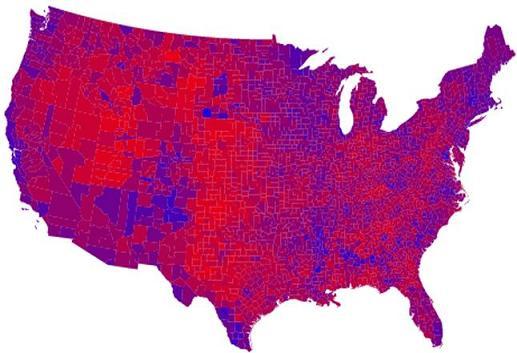
Remember the famous red-blue charts that appeared in the aftermath of the 2004 presidential election? Here’s one of them:


Shades of purple indicate the spectrum of election preferences within counties. The deeper the shade of purple the higher the proportion of votes cast for Kerry.

But too often overlooked is this companion chart:


Counties shaded pink, red, and purple have the highest population density.

In sum, we already knew about the high correlation of population density (i.e., large cities) with “blueness” (Democrat votes).

Now, an outfit that calls itself the Bay Area Center for Voting Research (BACVR) has published a list of America’s 237 most liberal and conservative cities. Buried in the fine print (in a paper that I didn’t find on the Center’s site), is this description of the Center’s “research method”:

The Bay Area Center for Voting Research identified every American city with a population greater than 100,000 according to the 2000 Census, and obtained the election returns in each of these cities. . . . The votes were tabulated by combining the voting returns from all of the precincts located in a particular city.

Following the gathering of city voting returns, BACVR analyzed the political leanings of third party candidates who received more than 0.1% of the votes cast in a city so that they could be tabulated as liberal, conservative, or neutral. Cities were ranked based upon the percentage of residents who voted for George Bush and John Kerry, and eligible third party Presidential candidates also had their support tabulated. When analyzing the voting returns, votes for George W. Bush or other third party right-wing presidential candidates contributed to the city’s conservative score, while votes for John Kerry or other left-wing presidential candidates contributed to the city’s liberal score.

In other words, given the paucity of votes for third-party candidates in 2004, BACVR does little more than replicate the red-blue (Republican-Democrat) split, but does so only for cities with a population of more than 100,000. Moreover, BACVR counts votes for the Libertarian Party’s Michael Badnarik as “conservative” votes; Badnarik — a vocally anti-war libertarian — received more than 40 percent of the third-party votes cast in the cities in BACVR’s sample. In sum, BACVR’s “research” subtracts from the sum of human knowledge. But I’ll let BACVR speak for itself:

Being Liberal Now Means Being African American

By Phil Reiff and Jason Alderman

. . . .

New research done by the Bay Area Center for Voting Research (BACVR) reveals who the real liberals in American are and the answer is not the tree-hugging, ponytail wearing ex-hippies you might expect. Instead, the new face of American liberalism is of a decidedly different hue. The nation’s remaining liberals are overwhelming African Americans.

The BACVR study that ranks the political ideology of every major city in the country shows that cities with large black populations dominate the list of liberal communities. The research finds that Detroit is the most liberal city in the United States and has one of the highest concentrations of African American residents of any major city. Over 81% of the population in Detroit is African American, compared to the national average of 12.3%. In fact, the average percentage of African American residents in the 25 most liberal cities in the country is 40.3%, more than three times the national rate.

The list of America’s most liberal cities reads like a who’s who of prominent African American communities. Gary, Washington D.C., Newark, Flint, Cleveland, Baltimore, Philadelphia, and Birmingham have long had prominent black populations. While most black voters have consistently supported Democrats since the 1960s, it is the white liberals that have slowly withered away over the decades, leaving African Americans as the sole standard bearers for the left.

Despite being the core of America’s liberal base, a major split exists between who the nation’s liberals are and who leads them politically. White politicians still control the levers of power within the Democratic Party, and black faces are rare around the decision making tables of America’s liberal advocacy groups.

While there are some noteworthy pockets of liberals who are not African American, these places end up being the exceptions. College towns like Berkeley and Cambridge have modest black populations, but remain bastions of upper middle-class, white, intellectual liberalism. These liberal communities, however, are more reminiscent of penguins clustering together around a shrinking iceberg, than of a vibrant growing political movement.

Further reinforcing this racial and ideological divide is BACVR research which shows that the most conservative city in America is the ultra white community of Provo, Utah, where less than 1% of the population is black.

Political pundits have noted the highly polarized nature of the American electorate, postulating that religion, age, education, wealth, and even the love of car racing are at the heart of the schism between liberals and conservatives. While these experts have identified some of the symptoms of our national rift, they have missed the root cause.

BACVR’s research gives us the real answer, disheartening as it may be. The great political divide in America today is not red vs. blue, north vs. south, costal vs. interior, or even rich vs. poor – it is now clearly black vs. white.

It seems to me that the piece should be titled “Being African American or an Academic Means Being a Democrat,” with this subhead: “Blacks Play into the Hands of White Liberal Elites.” But what else is new?

The real story isn’t that “white liberals that have slowly withered away over the decades, leaving African Americans as the sole standard bearers for the left.” The real story (a non-story, actually) is that larger cities have become increasingly black, and blacks have remained true to the Democrat Party. The real story is that blacks, on the whole, are less educated and less affluent than whites and therefore less likely to live in college towns like Berkeley and Cambridge (not to mention Madison and Ann Arbor) or high-tech centers like Provo (and nearby Orem).

Given BACVR’s less-than-candid description of its methods, I wasn’t surprised to read this in today’s Austin American-Statesman:

[BACVR] named Austin the 93rd most liberal city in the land, just slightly bluer on the electoral map than Virginia Beach and Salt Lake City.

Dallas was 32nd, two slots more liberal than Madison, Wis.

The study found that cities with large black populations tended to turn out for liberal candidates. Austin has a relatively small black population.

The rankings threaten to obliterate a tradition of snide remarks about [Austin] from less-liberal burgs such as Plano (fifth most conservative U.S. city, the study says), Abilene (third most conservative) and Lubbock (No. 2, trailing/leading only Provo, Utah).

Thus, the report was immediately dismissed by everyone.

“I would find it hard to believe that Austin is not in the top 25 or 30 liberal cities,” Travis County Republican Party Chairman Alan Sager said, not particularly complimentarily.

The unsurprising news is that the city of Dallas is more “liberal” than Austin because the city of Dallas has a proportionally larger black population. That’s about all there is to it. Metropolitan Dallas is another story. There are, for example, the suburbs and exurbs of Plano (number 5 on the “conservative” list), Arlington (number 10), Garland (number 29), Carrollton (number 34), and Mesquite (number 52).

Consider this map of the cities in the lower 48 States that voted more than 55 percent “conservative” (red) or more than 55 percent “liberal” (blue) in the 2004 presidential election:

What do you see? I see voluntary social, economic, and academic segregation. I see the “rust, snow, and mist belt” of the Northeast, upper Midwest, and Pacific Northwest vs. the “sun and farm belt” of the South (excluding its large cities) and “flyover country.” I see the “have nots” in the older cities (and close-in suburbs), teamed with college-town socialists, vs. the “haves” (but not the super-rich guilty ones) in the newer cities and exurbs. Birds of a feather do tend to flock together.

As I wrote in “The Great Divide Is a Great Thing,” a commentary on another fatuous piece of non-news from the local rag:

The Austin American Statesman, that great proponent of civic morality, has been running an occasional series called “The Great Divide.” It’s about the supposed polarization of American politics and American society. A sample from today’s installment (registration required, not worth the trouble):

In stories published this year, the Statesman has reported that since the late 1970s, Democrats and Republicans have been segregating, as people sift themselves into more politically homogeneous communities. . . .

People are less likely to live and vote among those with different political leanings, and the nation’s politics have grown bitter as a result. “Things get ugly when you have this kind of divergence,” California Institute of Technology political scientist Jonathan Katz says. “Each side thinks the other is wrong.”

Of course “each side thinks the other is wrong,” as the idiot from CalTech so pompously observes. (He probably analyzed a lot of data for a lot of years to figure that out.) It’s always been that way and always will be that way. That’s why the nation’s politics are so “ugly” and “bitter”. Actually they’re no more ugly and bitter than they’ve ever been, we’re just more aware of the ugliness and bitterness because (1) there are more screaming heads on TV and the internet than there used to be and (2) Democrats no longer rule the roost as they used to, which has caused them to scream louder than ever.

All this business with screaming heads just confirms one fact of life: Face-to-face political argument seldom ever changes a person’s mind, it usually hardens it.

So why should people with opposing views live near each other if they’re going to wind up fighting about politics? How many family dinners have been ruined by Uncle Joe called his nephew Fred a pinko, commie, hippie freeloader or a right-wing, fascist, capitalist exploiter of the working classes? Now, if you don’t like your family’s politics you move to where your family ain’t — and to where your can enjoy a peaceful meal with like-minded friends, chuckling over the idiocy of John Kerry or George Bush, as you prefer, without an Uncle Joe to spoil the fun.

The truly bad thing about the great political divide is that most blacks choose to remain with the party whose policies ensure their enslavement to and impoverishment by the welfare state.

Other related posts:
Is There Such a Thing as Legal Discrimination? (09/23/04)
More on the Legality of Discrimination (09/24/04)
Race and Acceptance (09/27/04)
Buckley Cuts Through the Cant (10/26/04)
The Case for Devolved Government (11/17/04)
Let ‘Em Secede (11/22/04)
Rich Voter, Poor Voter, and Academic Liberalism (04/13/05)
Tolerance and Poverty (04/19/05)
Class in America (05/17/05)

Why Not Marry Your Pet?

The “hot” story these days is the impending marriage of two Canadian men. Not because they’re homosexual, but because they’re not:

Two self-professed straight (that is, heterosexual) Canadian men have made public their decision to get ‘married’ to one another. It was only a matter of time, of course.

The Ottawa Citizen reported [. . .] that while sitting in a bar last week it occurred to Bill Dalrymple, 56, and Bryan Pinn, 65, that [. . .] with both of them being single, apparently without any serious opposite-sex marriage prospects on the line, it wouldn’t be such a bad tax-saving idea to get hitched . . . to each other. Thanks to the newly instated civil marriage act, extending “marriage” rights to same-sex couples, that’s not a problem. And since the new act doesn’t include any discriminatory restrictions on ‘sexual preference’ (as if that could be measured anyway) the two thoroughly straight men seem to have a clear path to the altar. . . .

[. . .] Bruce Walker, a Toronto area gay and lesbian rights activist, has [criticized Dalrymple and Pinn]. “Generally speaking, marriage should be for love,” he said. “People who don’t marry for love will find themselves in trouble.” . . .

“Marriage”, now, as Canada has defined it and the pro-gay activists have consistently defended it, has absolutely nothing to do with copulation or sexuality or procreation and everything to do with ‘love’—not erotic love, just . . . love, of whatever kind. . . .

Dalrymple and Pinn simply believe in the old-fashioned kind of brotherly love.

Well, why not marry a beloved pet? If you die before the pet does, the pet will inherit your home and have a comfy place in which to live out its days, without going through the fuss and bother of probate.

(Thanks to my son for pointing me to the story about Dalrymple and Pinn.)

Technorati tag:

PC Madness

Coyote Blog points to the NCAA’s latest venture into political correctness:

The presidents and chancellors who serve on the NCAA Executive Committee have adopted a new policy to prohibit NCAA colleges and universities from displaying hostile and abusive racial/ethnic/national origin mascots, nicknames or imagery at any of the 88 NCAA championships.

The Executive Committee, meeting Thursday in Indianapolis, also approved recommended best practices for schools who continue to use Native American mascots, nicknames and imagery in their intercollegiate athletic programs.

“Colleges and universities may adopt any mascot that they wish, as that is an institutional matter,” said Walter Harrison, chair of the Executive Committee and president at the University of Hartford. “But as a national association, we believe that mascots, nicknames or images deemed hostile or abusive in terms of race, ethnicity or national origin should not be visible at the championship events that we control.”

Obviously, no college or university in the U.S. is hostile toward Native Americans or any other group of persons that isn’t white, male, and heterosexual. So what’s the problem?

Why aren’t the Greeks and Turks upset about all those teams of Spartans and Trojans dotted around the country?

If livestock could vote, the NCAA certainly would be riding herd on Mustangs and Broncos, and all of those other rampaging animals. Though I doubt that anyone would stick up for the Mud Hens (the nickname of a minor league baseball team).

Speaking of baseball — my favorite sport — why aren’t New Englanders up in arms about the New York Yankees when most New Englanders (the original Yankees) are fans of the Boston Red Sox.

I guess it’s okay to call a team the Sox (the Red of Boston or White of Chicago) because there are few textile and hosiery manufacturers still operating in the U.S. We still have a lot of mountains, though, so I do have to wonder about the Colorado Rockies.

Why aren’t matched siblings and extra-large persons upset about the Minnesota Twins and San Francisco Giants?

Why aren’t professional groups of various sorts marching against the Houston Astros (for astronauts), Kansas City Royals, Los Angeles Angels, Los Angeles (trolley) Dodgers, Milwaukee Brewers, Oakland Athletics, Pittsburgh Pirates, San Diego Padres, Seattle Mariners, and Texas Rangers?

Birds should sue the Baltimore Orioles, St. Louis Cardinals, and Toronto Blue Jays. And there are the beasts of land and sea who must be offended by the likes of the Arizona Diamondbacks, Chicago Cubs, Detroit Tigers, Florida Marlins, and Tampa Bay Devil Rays.

Then there are those pesky Native American teams, the Atlanta Braves and Cleveland Indians. Why haven’t they wised up yet?

So we’re right back where we started. I guess what we need are more teams with innocuous names like the New York Mets, Philadelphia Phillies, and Washington Nationals.

Come to think of it, I doubt that any self-respecting PC policeperson would object to the Cincinnati Reds. I mean, aren’t socialism and communism far more enlightened systems than free-market capitalism?

Technorati tag:

Celebrity Twaddle

Sir (to some) Ian McKellen, interviewed in this week’s Newsweek, has this to say about his “coming out”:

I became a better actor, and my film career took off in a way that I couldn’t have expected. You can’t lie about something so central to yourself without harming yourself. Acting in my case is no longer about disguise—it’s about telling the truth, and my truth is that I’m gay. I’m very happy for people to know that, and then I can get on with telling the truth about the character that I’m playing. That’s why I can say to other actors: if you really want to be a good actor and a successful one, and you’re gay, let everybody know it.

It’s lucky for McKellen that he’s instinctively a good actor, for he doesn’t seem to understand what acting is all about. A character in a film or play has no “truth” because a character is, by definition, fictional. The actor’s job is to make the character believable to an audience. An actor can do that successfully and still be a liar, a cheat, a drunkard, a dope addict, or an adulterer (to name only a few traits common to actors) — as generations of actors have proved. Acting is acting. It has nothing to do with one’s “truth.”

But political correctness requires celebrities to utter twaddle such as that uttered by McKellen. One thing’s for sure: Successful acting doesn’t require a very high degree of intelligence, just good acting instincts and good scripts.

Technorati tag:

Defending My Right to Be Bombed

Now we learn this from The Times Online:

Mohammed Atta and three other men who hijacked aircraft on September 11, 2001 were identified by the US Government as possible members of an al-Qaeda cell more than a year before the attacks, it was reported today. . . .

The secret military team, known as Able Danger, recommended that the identities of the four men be shared with the FBI and other parts of the military, but the recommendation was never taken up, according to a Republican Congressman, Curt Weldon, quoted by the newspaper. . . .

The CIA tracked the men through 2000 before passing their information to the FBI in the spring of 2001.

According to Mr Weldon, who said he has tried to share this information since September 2001, when it first came to his notice, the risk posed by Atta and his cohorts never spread through America’a law enforcement agencies because of the uneasy co-operation between the FBI and the military. . . .

The classified military intelligence unit used sophisticated “data mining” techniques, which process huge amounts of data to find patterns, to identify Atta and the three other men as likely members of an al-Qaeda cell within two months of their arrival in America in 2000.

And from The International Herald Tribune:

. . . Able Danger, prepared a chart in the summer of 2000 that included visa photographs of the four men, including the ringleader, Mohammed Atta. The unit recommended to the military’s Special Operations Command that the information be shared with the FBI, the former official and the Republican congressman, Curt Weldon of Pennsylvania, said Monday.

The recommendation was rejected, and the information was not shared, they said, apparently at least in part because Atta and the others were in the United States on valid entry visas.

Under U.S. law, intelligence agencies may not collect intelligence on individual citizens and permanent residents. That protection does not extend to visa holders, but Weldon and the former official said it may have reinforced a sense of discomfort[*] common before Sept. 11 about sharing intelligence information with a law enforcement agency.

So we have here two lessons:

  • Data mining can actually detect bad guys.
  • Intelligence sharing might well have led to the capture of the bad guys before they did something terribly bad.

But knee-jerk civil libertarians won’t have any of it. They want to defend my right to be bombed.
__________
* There was more than “discomfort” about intelligence-sharing, there was a wall between criminal investigators and intelligence agents.

Technorati tag:

Moral Luck

I have just come across the philosophical concept known as moral luck, which is illustrated by this example from Wikipedia:

Suppose there are two truck drivers, Driver A, and Driver B. They are exactly alike in every single way, drive the same exact car, have the same driving schedule, have the same exact reaction time, and so forth. Let’s say that Driver A is driving down a road, following all legal driving requirements, when suddenly, a child runs out in the middle of the road to retrieve a lost ball. Driver A slams the brakes, swerves, in short, does everything to try to avoid hitting the child — alas, the inertia of the truck is too great, and the distance between the truck and the child is too short. Unfortunately, the child is killed as the result of the collision. Driver B, in the meantime, is following the exact same route, doing all the exact same things, and everything is quite exactly the same –– except for one important distinction. In his scenario, there is no child that appears on the road as if out of nowhere. He gets to his destination safely, and there no accident occurs.

If a bystander were asked to morally evaluate Drivers A and B, there is very good reason to expect him to say that Driver A is due more moral blame than Driver B. After all, his course of action resulted in the death of a child, whereas the course of action taken by Driver B was quite uneventful. However, there are absolutely no differences in the controllable actions performed by Drivers A and B. The only disparity is that in the case of Driver A, an external uncontrollable event occurred, whereas it did not in the case of Driver B. The external uncontrollable event, of course, is the child appearing on the road. In other words, there is no difference at all in what the two of them could have done –– however, one seems clearly more to blame than the other. How does this occur?

This is the problem of moral luck. If we agree that moral responsibility should only be relevant when the agent voluntarily performed or failed to perform some action, we should blame Drivers A and B equally, or praise them equally, as may be the case. At the same time, this seems to be at least intuitively problematic, as — whatever the external circumstances are –– one situation resulted in an unfortunate death, and the other did not.

My reaction: The example only shows that moral luck is an artificial philosophical construct. Specifically, Driver B’s experience is irrelevant because Driver B wasn’t placed in the same circumstances as Driver A. The example avoids the real issues, which are these:

  • Did Driver A in fact drive prudently? That isn’t the same thing as “following all legal driving requirements.” Driver A might have passed a breathalyzer test, but perhaps just barely. Or Driver A might have been talking on his cell phone in a jurisdiction that doesn’t forbid doing so while driving. Or Driver A might not have been paying full attention to his surroundings (an undetectable lapse) because he was thinking about where to make his next turn.
  • More fundamentally, the example fails to mention the actions of the child and the child’s parents. Was the child of an age to have known better than to dart into the street without looking? Why was the child allowed to play with a ball near the street? Why wasn’t someone keeping an eye on the child? Why hadn’t the child’s parents fenced the front yard and seen to it that the child couldn’t unlatch the gate?

If Driver A drove prudently, no blame can attach to Driver A. The blame, if any, must attach to the child or the child’s parents, an option that the example omits.

Wikipedia continues:

Moral luck entails two extreme outcomes, both of which seem intuitively unacceptable.

If, one hand, we accept moral luck as a real phenomenon and accept it as a valid restriction on personal responsibility (and, consequently, the assign[ment] of moral blame or praise), it is difficult to identify a situation where moral luck does not affect an event or an individual. Many, if not all, of the moral judgments that we engage in daily seem to become problematic, since any single action can be defended as having been affected by moral luck. Constitutive moral luck [pertaining to the personal character of the moral agent] especially highlights this problem –– after all, it is perfectly valid to argue that every single thing that we do relates in some way to our personal character disposition, and is not one hundred percent voluntary. Thus, if we do stick by our requirement of moral responsibility as needing complete volition, we cannot validly morally assess any action performed by an individual. As Nagel himself points out, if moral luck is accepted as a valid premise, the area of individual moral responsibility seems to ““shrink . . . to an extensionless point.”

On the other hand, if we deny the influence of moral luck and refuse to accept that it has anything to do with moral evaluation (as Kant most certainly would, for example), we are left with a single unappealing option: we are responsible for everything that we do, whether voluntarily or not, and for all the consequences, no matter how unforeseen or unlikely, that our actions entail. By this logic, the unlucky Driver A from our earlier example can take no solace in the fact that there was nothing he could have done to prevent the death of the child as the result of the accident –– he deserves the full amount of moral blame that can be assigned for such an outcome.

That is, moral luck either (1) negates personal responsibility or (2) places all responsibility on the individual actor to whom things happen. I reject the first premise because we have free will or must act as if we have it. (See this post.) I reject the second premise because, as I argued above, it fails to account for the freely chosen actions of others.

The concept of moral luck strikes me as useless philosophical casuistry. I’m sorry it came to my attention. I will now try to forget it.

Technorati tag:

The Consequences and Causes of Abstinence

A few weeks ago, in a comment thread at Catallarchy, I made this observation:

Less teen sex = less disease + fewer unwanted children + fewer early (and often unhappy) marriages

Parents who want to protect their children therefore try to teach them to eschew sex because of its potential consequences. Abstinence — by definition — works better than prophylaxis and contraception.

That evoked a response in a later comment thread that I had “list[ed] only the harm caused by sex and not the benefit.” Well, there were plenty of hedonistic voices arguing the benefit side. What was needed was someone to argue the cost side, and that’s what I did. Moreover, my point — which seems to have been missed in all the shouting — was about the responsibility of parents to teach their children about the cost side.

The usual argument goes like this: Kids will do it anyway. Well, kids are less likely to do it “anyway” if they’re brought up to believe that they shouldn’t do it “anyway.” And the bringing-up isn’t done in public schools, it’s done in the home by parents who teach their children not only about sex but also about responsible (i.e., moral) behavior.

The critics of abstinence education focus on the results of studies (e.g., here and here) about the sexual practices of groups of public-school students. They conclude that abstinence education in public schools is ineffective and perhaps even counterproductive in its effects on teen pregnancy and sexually transmitted diseases. But such studies aren’t above criticism; see this, from The Heritage Foundation, for instance. Moreover, what those studies don’t tell us is what happens to teens who are predisposed (by their parents) to eschew sex. Here’s one bit of relevant information (from a research paper published by The Heritage Foundation):

[T]aking a virginity pledge in adolescence…is associated with a substantial decline in STD rates in young adult years. Across a broad array of analysis, virginity pledging was found to be a better predictor of STD reduction than was condom use. Individuals who took a virginity pledge in adolescence are some 25 percent less likely to have an STD as young adults, when compared with non-pledgers who are identical in race, gender, and family background.

More tellingly, there’s this, from the National Institutes of Health:

Teens — particularly girls — with strong religious views are less likely to have sex than are less religious teens, largely because their religious views lead them to view the consequences of having sex negatively. According to a recent analysis of the NICHD-funded Add Health Survey, religion reduces the likelihood of adolescents engaging in early sex by shaping their attitudes and beliefs about sexual activity . . . .

Sexual intercourse places teens at risk for sexually transmitted diseases, including HIV, and unintended pregnancy. The information provided by the study may prove important for health researchers and planners devising programs that help prevent teens from engaging in sexual activity.

Hmm . . . isn’t that what I said at the outset?

I now turn to this story about a letter published in the British Medical Journal (available only by subscription):

A letter by Australian bioethicist Dr. Amin Abboud published in the July 30 edition of the British Medical Journal notes that “A regression analysis done on the HIV situation in Africa indicates that the greater the percentage of Catholics in any country, the lower the level of HIV.”

Dr. Abboud’s letter comes in response to an article published in the journal’s June 4 issue which wonders if newly elected Pope Benedict XVI will alter the Church’s teaching on condoms in light of the burgeoning HIV/AIDS epidemic. Abboud asserts that “On the basis of statistical evidence it would seem detrimental to the HIV situation in Africa if he did authorise such a change.”

“On the basis of data from the World Health Organization,” reports Abboud, “in Swaziland where 42.6% have HIV, only 5% of the population is Catholic. In Botswana, where 37% of the adult population is HIV infected, only 4% of the population is Catholic. In South Africa, 22% of the population is HIV infected, and only 6% is Catholic. In Uganda, with 43% of the population Catholic, the proportion of HIV infected adults is 4%.” . . .

Abboud concludes his letter stating, “The causes of the HIV crisis in Africa need to be found elsewhere. The solutions must go beyond latex. If anything, the holistic approach to sexuality that Catholicism advocates, based on the evidence at hand, seems to save lives. I would welcome an editorial on that or, as a minimum, some evidence based advice on HIV.”

It all boils down to personal responsibility, which is taught by parents (especially those who bring up their children in a traditional religion) and undermined by government programs. I thought libertarianism was all about personal responsibility, but for many libertarians it seems to be all about hedonism.

Technorati tag: