Rights and the State

For reasons detailed here, I deny that rights are innate to humans. Rights may arise from urges that are innate to humans, but a person possesses rights only to the extent that those rights are enforced or enforceable through self-defense, common consent, or state power.

Moreover, not all rights comport with liberty, which is the right to be left alone in return for leaving others alone. For liberty conflicts with the contrary desire to control others. That desire arises from instincts that are just as deeply seated in humans as the yearning for liberty — aggressiveness, avarice, envy, fear, mistrust, and sloth, for example.

Absent coercion, the conflicting desires for liberty and for control are reconciled through political bargaining. The term “political bargaining” does not connote the creation of a state or the use of state power to strike a balance between liberty and control. For politics is “the process and method of decision-making for groups of human beings [which is] observed in all human group interactions.” Each party to a political bargain acquires certain rights, that is, claims on the other parties to the bargain, which the other parties acknowledge and for which they receive reciprocal claims of one kind or another.

Political bargaining becomes more complex as a group’s numbers grow. Factions arise, with each faction preferring a package of rights that differs from the packages preferred by other factions. If the resulting centrifugal force is not great enough to cause the group to splinter, a shifting coalition of factions will dominate the group’s decision process. And from that shifting coalition will emerge a shifting package of rights.

As long as the then-dominant coalition operates through persuasion and without resort to force or the threat of force — and as long as no member of the group is compelled to remain in the group — the resulting package of rights is consensual. Each member of the group, by remaining a member of the group, effectively agrees to accept certain rights (e.g., mutual defense) as compensation for the loss or diminution of other rights (e.g., a reduction of personal autonomy because of the demands of mutual defense).

At some point, however, a state arises,

  • as the outcome of a struggle between competing coalitions, in which the coalitions resort to force to settle their differences,
  • as an antidote to violent anarchy, or
  • because the then-dominant coalition seeks to perpetuate its particular conception of rights.

Rights then lose their consensual basis; instead, they are determined by the coalition that controls the state’s decision process, which is backed by superior force. That coalition — not the community as a whole — decides the package of rights and the distribution of the cost of securing those rights. Members of the group may opt out only by leaving the geographic territory controlled by the state, that is, by leaving their homes, their jobs, and their friends and relatives.

The state may lack sufficient power to force all of its subjects to adhere to its dictates, but the state’s ability to discipline blatant violations of official norms keeps most of its subjects in line. Some small groups (e.g., polygamous communes) may form for the purpose of evading state control and adopting group-specific packages of rights to which their members give common consent. But the state, in an effort to deter such rebelliousness and to maintain its dominance, seeks to suppress or destroy such groups whenever they gain notoriety.

The state could create and enforce a package of rights that is biased toward liberty — if the proper coalition controls the state’s decision process. That is what happened in the American experience, for a time. But that time has passed, as the package of rights envisioned by the Founders and enshrined by the Framers has been discarded by power-seeking politicians who have pandered to avarice, envy, fear, mistrust, and sloth.

Would we be better off with anarchy? Only as long as it is non-violent and fosters consensual decision-making. But, given human nature, anarchy leads to violence and violence leads to the creation of a state.

The choice then, is not between anarchy and the state, but between a minimal state that is disposed toward liberty and a state that is more or less disposed toward control. History and current events suggest that a repetition of the American experience would be nothing more than temporary good luck.

"Giving Back to the Community"…

…rankles every time I read or hear it. Generally, a person whose income isn’t derived from tax dollars already has “given back” by providing goods and services that are valued by the persons who receive and pay for those goods and services.

It’s another story if a person works for a tax-supported institution, as did I for 30 years…

In the latter years of my employment at a defense think-tank, our CEO established a “community service” program so that we well-paid, mostly white, professionals could “give back to the community.” The “community” to which we gave “service” was not well-paid, mostly white, or professional, of course.

I am confident that the targets of our beneficence paid only a minuscule fraction of the taxes that funded our nicely appointed offices, high salaries, and generous benefits. “Giving back” to the “community” that actually supported us would have involved mowing lawns, tutoring, and babysitting for mostly white, middle- and upper-income Americans in other parts of the D.C. area than the one selected by our CEO as the “community” to which we would “give back.”

If the services we provided in exchange for our splendid offices, salaries, and benefits had been worth what taxpayers were paying for them, there would have been no need for us to “give back” to any community. Taxpayers would have received their money’s worth, and that would have been that.

Our CEO either felt guilty about his huge office, high salary, and princely benefits or he thought that our think-tank wasn’t giving taxpayers fair value for their money. As he would have been the last person in the United States to admit that we weren’t delivering fair value, I can only conclude that his yearning to “give back” to the community arose from feelings of guilt, which he projected onto his employees. For, even as he was pressing us to “give back,” he constantly sought to justify the spending of more tax dollars on better accommodations and higher compensation for himself and the rest of us.

Feelings of guilt aren’t confined to those who feed at the public trough, of course. CEOs and senior executives of large corporations have a good thing going for themselves — which they owe to their chummy relations with boards of directors — and they know it. Thus the impetus for private-sector “giving back.”

In summary, “giving back to the community” is either an unnecessary act — because “the community” already has received fair value for its money — or it is emblematic of guilt. In the first instance, “giving back” is really an act of charity. In the second instance, “giving back” is really a false act of contrition and an inadequate, misdirected form of compensation for executive avarice.

"Thinking" vs. "Feeling"

Arnold Kling, in n a recent Tech Central Station column, posits a correlation between libertarianism and the “thinking” aspect of personality:

In my experience, libertarians and collectivists often talk past one another. Libertarians believe that collectivists are not thinking, while collectivists believe that libertarians are not feeling.

There’s a lot to that. But a post by Alex Tabarrok at Marginal Revolution reminds me of my “feeling” side:

Here is a new interview with Milton Friedman. I liked this from the introduction:

San Francisco seems an unlikely home for the man who in 1962 first proposed the privatization of Social Security.

Asked why he dwells in liberalism’s den, Milton Friedman, 92, the Nobel laureate economist and father of modern conservatism, didn’t skip a beat.

“Not much competition here,” he quipped.

How does that remind me of my “feeling” side? Friedman’s quip is obviously just that, a quip. Friedman probably could live anywhere he wants to live. Why San Francisco, then? Why not? It has more than Lefties; it has “culture” — universities, museums, and the arts (of all kinds).

In fact, one tends to find “culture” where one finds a lot of Lefties. Moreover, many Lefties are actually nice people, as long as they can avoid talking about George W. Bush, a topic that seems to bring out the worst in their natures.

So, when I want to be a “feeling” person I hang out with Lefties and engage in pursuits that are more typical of Lefties than Righties. To tell the truth, with a few exceptions I avoid the company of Righties because I don’t share their tastes in music (the Nashville sound), sports (NASCAR), and media personalities (Limbaugh, O’Reilly, and Hannity), among other things.

Well, that’s enough “feeling” for today.

The Consequences of Roe v. Wade

From a post at Right Reason by Francis Beckwith (paragraph break and emphasis added by me):

A 1997 article in The New Republic, a magazine whose editorial position is generally supportive of abortion-choice, cites the work of Ruth Padawer, a staff writer for the local Bergen County, New Jersey, newspaper, The Record: “she called local clinics, asked how many [partial-birth abortions] they performed, did some math and wrote up her conclusions: `Interviews with physicians who use the method reveal that in New Jersey alone, at least 1,500 partial-birth abortions are performed each year, three times the supposed national rate. Moreover, doctors say only a minuscule amount are for medical reasons.'” (William Powers, “Partial Truths,” The New Republic [March 24, 1997]: 19)

Dr. Hakell’s practice and Ms. Padawer’s story were confirmed by a stunning confession by Ron Fitzsimmons, then-executive director of the National Coalition of Abortion Providers. Since 1995, when the debate over partial-birth abortion began, Fitzsimmons and his abortion-choice colleagues had claimed that partial-birth abortion was extremely rare (about 450 per year) and performed only in late-term pregnancy for serious reasons such as severe fetal deformity and to save the life of the mother. In 1997, Fitzsimmons, on an episode of ABC News’ “Nightline” admitted, in an answer to Ted Koppel’s question, “[W]hat were you lying through you teeth about?,”: “When I said that the procedures were performed only in about 450 cases and only in those severe circumstances. That was not accurate. But we have no apologies for this procedure.” (Ibid) According to The New Republic’s account, “Fitzsimmons tried, several times, to tell Koppel that, in fact, 3,000 to 5,000 partial-birth abortions were performed every year on fetuses twenty weeks or older; and, of course, only 500 to 750 were performed for reasons of maternal health in the third trimester.” (Ibid) Fitzsimmons told the New York Times that “in the vast majority of cases, the procedure is performed on a healthy mother with a healthy fetus that is 20 weeks or more along” and is “performed far more often than his colleagues have acknowledged.” (David Stout, “An Abortion Rights Advocate Says He Lied About Procedure,” New York Times [February 26, 1997]: A11)

A perfect illustration of the slippery slope down which Roe v. Wade has led us. For more about the dangers of state-sponsored eugenics, read this and follow the links.

Raich and the Rule of Law

Outrage abounds in liberal and libertarian circles as the U.S. Supreme Court decides Gozales v. Raich thusly:

California’s Compassionate Use Act authorizes limited marijuana use for medicinal purposes. Respondents Raich and Monson are California residents who both use doctor-recommended marijuana for serious medical conditions. After federal Drug Enforcement Administration (DEA) agents seized and destroyed all six of Monson’s cannabis plants, respondents brought this action seeking injunctive and declaratory relief prohibiting the enforcement of the federal Controlled Substances Act (CSA) to the extent it prevents them from possessing, obtaining, or manufacturing cannabis for their personal medical use. Respondents claim that enforcing the CSA against them would violate the Commerce Clause and other constitutional provisions. The District Court denied respondents’ motion for a preliminary injunction, but the Ninth Circuit reversed, finding that they had demonstrated a strong likelihood of success on the claim that the CSA is an unconstitutional exercise of Congress’ Commerce Clause authority as applied to the intrastate, noncommercial cultivation and possession of cannabis for personal medical purposes as recommended by a patient’s physician pursuant to valid California state law. The court relied heavily on United States v. Lopez, 514 U. S. 549, and United States v. Morrison, 529 U. S. 598, to hold that this separate class of purely local activities was beyond the reach of federal power.

Held: Congress’ Commerce Clause authority includes the power to prohibit the local cultivation and use of marijuana in compliance with California law….

Congress’ power to regulate purely local activities that are part of an economic “class of activities” that have a substantial effect on interstate commerce is firmly established. See, e.g., Perez v. United States, 402 U. S. 146, 151. If Congress decides that the ” ‘total incidence’ ” of a practice poses a threat to a national market, it may regulate the entire class….Of particular relevance here is Wickard v. Filburn, 317 U. S. 111, 127-128, where, in rejecting the appellee farmer’s contention that Congress’ admitted power to regulate the production of wheat for commerce did not authorize federal regulation of wheat production intended wholly for the appellee’s own consumption, the Court established that Congress can regulate purely intrastate activity that is not itself “commercial,” i.e., not produced for sale, if it concludes that failure to regulate that class of activity would undercut the regulation of the interstate market in that commodity….

[I]n both Lopez and Morrison, the parties asserted that a particular statute or provision fell outside Congress’ commerce power in its entirety. This distinction is pivotal for the Court has often reiterated that “[w]here the class of activities is regulated and that class is within the reach of federal power, the courts have no power ‘to excise, as trivial, individual instances’ of the class.” Perez, 402 U. S., at 154. Moreover, the Court emphasized that the laws at issue in Lopez and Morrison had nothing to do with “commerce” or any sort of economic enterprise. See Lopez, 514 U. S., at 561; Morrison, 529 U. S., at 610. In contrast, the CSA regulates quintessentially economic activities: the production, distribution, and consumption of commodities for which there is an established, and lucrative, interstate market. Prohibiting the intrastate possession or manufacture of an article of commerce is a rational means of regulating commerce in that product. The Ninth Circuit cast doubt on the CSA’s constitutionality by isolating a distinct class of activities that it held to be beyond the reach of federal power: the intrastate, noncommercial cultivation, possession, and use of marijuana for personal medical purposes on the advice of a physician and in accordance with state law. However, Congress clearly acted rationally in determining that this subdivided class of activities is an essential part of the larger regulatory scheme. The case comes down to the claim that a locally cultivated product that is used domestically rather than sold on the open market is not subject to federal regulation. Given the CSA’s findings and the undisputed magnitude of the commercial market for marijuana, Wickard and its progeny foreclose that claim….

Justice Thomas, in a strong dissent, gives the majority a lesson in constitutional law:

Respondents Diane Monson and Angel Raich use marijuana that has never been bought or sold, that has never crossed state lines, and that has had no demonstrable effect on the national market for marijuana. If Congress can regulate this under the Commerce Clause, then it can regulate virtually anything–and the Federal Government is no longer one of limited and enumerated powers….

As I explained at length in United States v. Lopez, 514 U. S. 549 (1995), the Commerce Clause empowers Congress to regulate the buying and selling of goods and services trafficked across state lines…. The Clause’s text, structure, and history all indicate that, at the time of the founding, the term ” ‘commerce’ consisted of selling, buying, and bartering, as well as transporting for these purposes.”Commerce, or trade, stood in contrast to productive activities like manufacturing and agriculture….Throughout founding-era dictionaries, Madison’s notes from the Constitutional Convention, The Federalist Papers, and the ratification debates, the term “commerce” is consistently used to mean trade or exchange–not all economic or gainful activity that has some attenuated connection to trade or exchange….The term “commerce” commonly meant trade or exchange (and shipping for these purposes) not simply to those involved in the drafting and ratification processes, but also to the general public….

Even the majority does not argue that respondents’ conduct is itself “Commerce among the several States.”…Monson and Raich neither buy nor sell the marijuana that they consume. They cultivate their cannabis entirely in the State of California–it never crosses state lines, much less as part of a commercial transaction. Certainly no evidence from the founding suggests that “commerce” included the mere possession of a good or some purely personal activity that did not involve trade or exchange for value. In the early days of the Republic, it would have been unthinkable that Congress could prohibit the local cultivation, possession, and consumption of marijuana.

On this traditional understanding of “commerce,” the Controlled Substances Act (CSA)…regulates a great deal of marijuana trafficking that is interstate and commercial in character. The CSA does not, however, criminalize only the interstate buying and selling of marijuana. Instead, it bans the entire market–intrastate or interstate, noncommercial or commercial–for marijuana. Respondents are correct that the CSA exceeds Congress’ commerce power as applied to their conduct, which is purely intrastate and noncommercial.

More difficult, however, is whether the CSA is a valid exercise of Congress’ power to enact laws that are “necessary and proper for carrying into Execution” its power to regulate interstate commerce….

In McCulloch v. Maryland,…this Court, speaking through Chief Justice Marshall, set forth a test for determining when an Act of Congress is permissible under the Necessary and Proper Clause:

“Let the end be legitimate, let it be within the scope of the constitution, and all means which are appropriate, which are plainly adapted to that end, which are not prohibited, but consist with the letter and spirit of the constitution, are constitutional.”

The Commerce Clause was meant to prevent the States from restricting or distorting the terms of trade across their borders. The Commerce Clause was not meant to give the central government the power to dictate what goods may be manufactured, how those goods should be made, or how businesses must be operated. Yet, in a long string of decisions leading up to Raich, the Supreme Court had granted those sweeping powers to the central government.*

Now, with its decision in Raich, the Supreme Court has handed the central government the power to regulate anything it wants to regulate — period. Congress can drop the pretense that it is regulating interstate commerce and simply tell us how to live our lives. As Justice Thomas puts it in his dissent, “the Federal Government may now regulate quilting bees, clothes drives, and potluck suppers throughout the 50 States.” Justice Thomas continues:

This makes a mockery of Madison’s assurance to the people of New York that the “powers delegated” to the Federal Government are “few and defined,” while those of the States are “numerous and indefinite.” The Federalist No. 45, at 313 (J. Madison).

A mockery wrapped in a travesty inside a tragedy.
__________
* For an analysis of Raich and its precedents, see this post by Lawrence Solum (Legal Theory Blog). Solum concludes by saying this:

It looks like Raich is a landmark decision that signals the end of the New Federalism [of Lopez and Morrison] as a significant limit on the powers of Congress.

Tragic, but true.

Much Food for Thought

Tyler Cowen of Marginal Revolution points to a paper by Harvard economist Roland G. Fryer Jr. and graduate student Paul Torelli, “An Empirical Analysis of ‘Acting White’.” The Washington Post‘s Richard Morin summarizes:

As commonly understood, acting white is a pejorative term used to describe black students who engage in behaviors viewed as characteristic of whites, such as making good grades, reading books or having an interest in the fine arts.

The phenomenon is one reason some social thinkers give to help explain at least a portion of the persistent black-white achievement gap in school and in later life. Popularity-conscious young blacks, afraid of being seen as acting white, steer clear of behaviors that could pay dividends in the future, including doing well in school, Fryer said. At the same time, the desire to be popular pushes many whites to excel in the classroom, enhancing their future prospects….

Among white teens, Fryer and Torelli found that better grades equaled greater popularity, with straight-A students having far more same-race friends than those who were B students, who in turn had more friends than C or D students. But among blacks and especially Hispanics who attend public schools with a mix of racial and ethnic groups, that pattern was reversed: The best and brightest academically were significantly less popular than classmates of their race or ethnic group with lower grade point averages [emphasis mine: ED].

“For blacks, higher achievement is associated with modestly higher popularity until a grade point average of 3.5 [a B+ average], then the slope turns negative,” Fryer and Torelli wrote in a new working paper published by the National Bureau of Economic Research. A black student who’s gotten all A’s has, on average, 1.5 fewer same-race friends than a straight-A white student. Among Hispanics, there is little change in popularity until a student’s average rises above a C+, at which point it plummets. A Hispanic student with all A’s is the least popular of all Hispanic students, and has three fewer friends than a typical white student with a 4.0 grade point average….

They also found that more blacks “acted white” [i.e., denigrated scholarly achievement: ED] in schools where less than 20 percent of the students were African American, while hardly any did in predominantly black schools or in private schools. “These findings suggest the achievement gap is not about cultural dysfunctionality,” Fryer said, and that contrary to conventional wisdom, the phenomenon may be more prevalent among blacks living in the more affluent suburbs than among those living in the inner city. (There were no majority-Hispanic schools in the study.)

Why is “acting white” absent in mostly black schools?

That’s easy, said Fryer, who is African American. He recalled his own experience growing up and attending predominantly black schools in Daytona Beach, Fla., and Dallas. “We didn’t act white — we didn’t know what that was,” he said, stressing that he prefers data to anecdote. “There were no white kids around.”

Now we turn to Randall Parker, writing at FuturePundit, who links to and discussesNatural History of Ashkenazi Intelligence,” by three researchers at the University of Utah, anthropologist Henry Harpending, Gregory Cochran (a Ph.D. physicist turned genetic theorist), and Jason Hardy. Parker’s take:

Ashkenazi Jews pose two mysteries for biological science. First, why do they have so many genetic diseases that fall into just a few categories of metabolic function….The second mystery is why are Jews so smart?…

Nicholas Wade of the New York Times has written one of the two news stories about [the University of Utah paper] to date. The proposed hypothesis holds that Jews developed their genetic diseases as a side effect of strong selective pressures for higher intelligence during the Middle Ages as they were forced to work mainly in occupations that required greater cognitive ability.

A team of scientists at the University of Utah has proposed that the unusual pattern of genetic diseases seen among Jews of central or northern European origin, or Ashkenazim, is the result of natural selection for enhanced intellectual ability.

The selective force was the restriction of Ashkenazim in medieval Europe to occupations that required more than usual mental agility, the researchers say in a paper that has been accepted by the Journal of Biosocial Science, published by Cambridge University Press in England.

The Economist has the other article about this research paper. The distribution of the Jewish genetic diseases is clustered too much into a few areas of genetic functionality This concentration of mutations argues for selective pressures as the logical expanation for rate of occurrence of these mutations in Ashkenazi Jews.

What can, however, be shown from the historical records is that European Jews at the top of their professions in the Middle Ages raised more children to adulthood than those at the bottom. Of course, that was true of successful gentiles as well. But in the Middle Ages, success in Christian society tended to be violently aristocratic (warfare and land), rather than peacefully meritocratic (banking and trade).

Put these two things together—a correlation of intelligence and success, and a correlation of success and fecundity—and you have circumstances that favour the spread of genes that enhance intelligence. The questions are, do such genes exist, and what are they if they do? Dr Cochran thinks they do exist, and that they are exactly the genes that cause the inherited diseases which afflict Ashkenazi society.

Cochran, Harpending, and Hardy claim higher intelligence increased reproductive fitness for Jews in medieval Europe who were legally prevented from performing in occupations that had lower need for intelligence. Simultaneously Jews were allowed to work in more cognitively demanding occupations involving money handling even as the Catholic Church banned Christians from many of those same occupations….

If this hypothesis is correct (and I believe it is) then it is problematic for efforts to raise human intelligence. How many of the intelligence raising genetic variants bring undesirable side effects? Some scientists speculate that assortive mating of high IQ people is contributing to a rising incidence of autism and Asperger’s Syndrome. As smart people become more likely to breed with other smart people the odds increase that pairs of autosomal recessives or other problematic combinations of intelligence boosting genes will given to offspring….

Step back and look at Jewish and European history from the context of this hypothesis. A few things come to mind. First off, Middle Ages bans on Christian money lending created an environmental niche in which high IQ was selected for in Jews. This led to a few important historical consequences. First off, it led to financial and reproductive success of urban Jews and hence resentment against them by both elites and masses in Europe. This resentment of course led to pogroms and Hitler’s “Final Solution”. There’s an old Japanese saying that comes to mind: “The nail that sticks up gets hammered down”. Well, smart Jews stood out and the response of jealousy and resentment against the more successful “other” is a recurring theme in human history….

The bottom line:

  • The second paper adds to the body of evidence that intelligence is strongly determined by genetic inheritance and, therefore, highly correlated with race.
  • Both papers underscore the destructive potential of envy. The less able — who too often seek the social, economic, and even corporal abasement of the more able — do so at their own expense. For it is the accomplishments of the more able that, by and large, fuel economic growth. And economic growth benefits the less able as well as the more able.

Trade Deficit Hysteria, Redux

Many bloggers have been pointing to Walter Williams’s fine dissection of trade deficit hysteria. I said it, in many fewer words, back on May 14, 2004:

Trade deficit hysteria is a psychological illness closely related to budget deficit hysteria (see Wednesday, April 21, 2004). Why do people (e.g., CNN’s Lou Dobbs) get all excited when the value of U.S. imports exceeds the value of U.S. exports? They think we’re shipping “our” money overseas.

Wrong. When the value of U.S. imports exceeds the value of U.S. exports, it means that we’re able to buy more things than we could in the absence of foreign trade.

But where does “our” money (the deficit) go? Well, our deficit is a surplus to foreigners. Guess what they do with their surplus. They invest it in U.S. Treasury bonds, the U.S. stock market, and U.S. real estate. That’s more good news for Americans.

So, if you’re suffering from trade deficit hysteria, calm down and quit watching CNN.

The Wrong Case for Judicial Review

I have defended judicial review, albeit reluctantly, on several occasions.* But I have never defended judicial review as a way to make law, which is the ground on which Erwin Chemerinsky stands in the current debate at the Legal Affairs Debate Club: Should We Get Rid of Judicial Review? For example, in one posting Chemerinsky responds to his opponent, Mark Tushnet, as follows:

I do have substantive value preferences. These include that the Supreme Court was right in ordering desegregation and striking down Jim Crow laws, in protecting reproductive privacy including abortion rights, in finding a right to privacy for consenting adults in their bedroom.

The catch is that the Supreme Court’s decisions ordering desegregation (Brown v. Board of Education), legalizing abortion (Roe v. Wade), and finding various zones of privacy (e.g., a right to buy contraceptives in Griswold v. Connecticut; a right to commit homosexual acts in Lawrence v. Texas) were based on extra-legal, sociological flim-flam and tortured readings of the Constitution. Why? Because the majority in each case wanted to make law, not apply the Constitution.

You may like the outcomes in Brown v. Board of Education, Roe v. Wade, Griswold v. Connecticut, and Lawrence v. Texas. But it should bother you that the Supreme Court can so blithely turn the law on its head to enact its own beliefs, on the pretext of finding rights in “penumbras, formed by emanations” of the Constitution. It all reminds me of this exchange from Act I, Scene 6, of Robert Bolt’s play about Sir Thomas More, A Man for All Seasons:

Roper: So now you’d give the Devil benefit of law.

More: Yes. What would you do? Cut a great road through the law to get after the Devil?

Roper: I’d cut down every law in England to do that.

More: Oh? And when the last law was down–and the Devil turned round on you–where would you hide? Yes, I’d give the Devil benefit of law, for my own safety’s sake.

Chemerinsky’s defense of judicial review is opportunistic. He wants a Court that will make his kind of law, not a court that will apply the meaning of the Constitution to the law. We need judicial review to hold legislatures and executives in check, but it must be judicial review that is grounded in the meaning of the Constitution. As I argued here:

Something resembling [liberty] will come about only if a Republican president, aided by a strongly Republican Senate, is able to stock the courts with judges who are committed to the restraint of government power — at all levels of government. (Janice Rogers Brown is that kind of judge.)

Certainly not all decisions by all Republican appointees to the bench will satisfy all libertarians, many of whom seem to focus on narrowly tailored “rights,” such as abortion and gay marriage (both of which are in fact threats to liberty, as I argue here and here). But by siding with the Left on such issues, libertarians effectively abjure more basic rights — rights that broadly affect the ability of most Americans to pursue happiness — such as freedom of speech, freedom of association, and freedom of contract.

In the real world there are real choices. The real choice for libertarians is between what seems “best” for a few and what is actually “better” for the many. I choose the latter, without hesitation.

__________
* Links to my previous posts about judicial review:

When Must the Executive Enforce the Law?

More on the Debate about Judicial Supremacy

Another Look at Judicial Supremacy

Judicial Interpretation

Is Nullification the Answer to Judicial Supremacy?

The Alternative to Nullification

No Way Out?

In the "So What?" Department

Slate‘s Timothy Noah thinks he’s onto something:

Here is what [Scott] Norvell[, London bureau chief for Fox News,] fessed up to in the May 20 Wall Street Journal Europe:

Even we at Fox News manage to get some lefties on the air occasionally, and often let them finish their sentences before we club them to death and feed the scraps to Karl Rove and Bill O’Reilly. And those who hate us can take solace in the fact that they aren’t subsidizing Bill’s bombast; we payers of the BBC license fee don’t enjoy that peace of mind.

Fox News is, after all, a private channel and our presenters are quite open about where they stand on particular stories. That’s our appeal. People watch us because they know what they are getting. The Beeb’s institutionalized leftism would be easier to tolerate if the corporation was a little more honest about it.

Norvell never says the word “conservative” in describing “where [Fox’s anchorpeople] stand on particular stories,” or what Fox’s viewers “know … they are getting.” But in context, Norvell clearly is using the example of Fox News to argue that political bias is acceptable when it isn’t subsidized by the public (as his op-ed’s target, the leftish BBC, is), and when the bias is acknowledged. Norvell’s little joke about clubbing lefties to death should satisfy even the most literal-minded that the bias Norvell describes is a conservative one.

That’s news?

If ABC, CBS, CNN, NBC (in its various incarnations), PBS, and most of the “newspapers” and “news magazines” of America fessed up to liberal bias, that would be news.

I Dare Call It Treason

The New York Times today reports on a CIA cover operation. Winds of Change summarizes:

Today’s New York Times provides intimate detail on the charter flights used by the CIA to ferry prisoners across the globe. The names of the charter companies are disclosed. The types of aircraft flown are revealed. The points of departure and destinations of these flights are stated. There is even a picture of one of the charter craft, with the identification number of the aircraft in full display.

All of this is extremely valuable to al Qaeda members who may have an interest in rescuing, or if deemed appropriate, conducting a suicide attack against suspected extraction flights. A successful attack resulting from this story can endanger the lives of CIA, security and civilian personnel involved in these missions, as well as deprive the intelligence and military communities of valuable information that can be gained from interrogations….

What exactly is the purpose of the New York Times in reporting on sensitive issues such as these? Do they even care about the consequences of making such information pubic? It appears the editors of the New York Times feel that breaking a titillating story about sensitive CIA operations is much more important than national security and the lives of those fighting in the war. All to our detriment.

If the Times‘s reporting isn’t “aid and comfort” to the enemy, I don’t know what is. As I wrote here:

The preservation of life and liberty necessarily requires a willingness to compromise on what — in the comfortable world of abstraction — seem to be inviolable principles. For example:

  • The First Amendment doesn’t grant anyone the right to go on the air to compromise a military operation by American forces…

The NYT article about a CIA operation being conducted in support of an authorized war amounts to the same thing. The right to publish cannot be absolute and should not exempt anyone from a charge of treason.

Eine Kleine Schadenfreude!

France Says No to EU Constitution

Two reasons to rejoice: (1) the prospect of something like self-rule for Europeans and (2) the rebuke to Jacques Chirac, le premier con de France.

War and Other Bad News

John Tierney’s latest NYT piece (“Give Peace a Chance“) puts war in perspective:*

You would never guess it from the news, but we’re living in a peculiarly tranquil world. The new edition of “Peace and Conflict,” a biennial global survey being published next week by the University of Maryland, shows that the number and intensity of wars and armed conflicts have fallen once again, continuing a steady 15-year decline that has halved the amount of organized violence around the world….

Meanwhile, the number of people fighting has plummeted, even though population has grown enormously….

These benign trends may be hard to believe, especially if you’ve been watching pictures from Iraq or listening to warnings about terrorists acquiring nuclear weapons. One explosion could indeed change everything.

But before you dismiss the optimists as hopeless naifs, you might ask yourself if you’re suffering from the malaise described in a book by [Gregg] Easterbrook called “The Progress Paradox”: the better life gets, the worse people feel. The more peaceful and wealthy the world becomes, the more time we all have to watch wars and warnings on television.

The only antidote is to look at long-term trends instead of daily horrors. For a really long-term trend, consider that of 59 skeletons found in a Stone Age graveyard, at least 24 died from violence. Or that a quarter of the male population died fighting in some pre-agricultural societies.

In the 20th century, despite two world wars, humans had less than a 2 percent chance of dying in war or a mass killing, according to John Mueller, a political scientist at Ohio State. Today the risk is lower still – about a quarter the chance of dying in a car accident.

Tierney focuses on war, but the same story applies to disease, nutrition, poverty, our ability to cope with bad weather, the quality of the products and services we buy, and on and on into the night.

Most of us are so busy making progress that we hardly notice it. Then we catch the news, where bad things are played up because they’re unusual, which is what sells advertising. And so, deluded by the media, we forget that progress is almost universal and constant.

I like to remember what I once told my boss’s secretary, who kept nagging me for my monthly progress report: “I’m making so much progress that I don’t have time to report it.” Think of that the next time you see a disaster headline.

Better yet, ignore the disaster headline. What can you do about it, anyway?
__________
* Tierney, as usual, appends a bibliography:

“The End of War?: Explaining Fifteen Years of Diminishing Violence”” by Gregg Easterbrook. The New Republic, pp. 18-21, May 30, 2005

The Progress Paradox : How Life Gets Better While People Feel Worse by Gregg Easterbrook (Random House. 400 pp., November 2003)

Why Isn’t There More Violence? By John Mueller. Security Studies 13, p. 191-203, Spring 2004

The Remnants of War by John Mueller. (Cornell University Press, 272 pp., September 2004)

The Ultimate Resource 2 by Julian L. Simon. (Princeton University Press, 778 pp., July 1998)

Peace and Conflict 2005: A Global Survey of Armed Conflicts, Self-Determination Movements, and Democracy by Monty G. Marshall and Ted Robert Gurr

Don’t Go South, Young Man

Zimran Ahmed (Winterspeak) joins James Lileks (The Bleat) in despairing of Northern weather. Here’s James, who was born in Fargo, N.D., and has lived in Minneapolis, Minn., since 1976 (minus 4 years in D.C.):

I should note that it rained today. All day. It’s cold, too. The time has come, perhaps, to plot the Great Move to Arizona. Not now; not soon. I just ordered a light fixture for the dining room, for heaven’s sake, and I don’t think I’ll be prying it off the ceiling anytime soon. But in five years? Sure. I can take five more winters, five miserable springs, five desperate summers, if I knew I was heading to my reward. I jumped once before, left in haste, and that was the move to DC. Can’’t do that again. I have to move up in every way. DC was a move sideways or down; from ease of mobility to living conditions to the aroma of the grocery stores to the weather to the civic services to the crime, it was all for the worse. It had its compensations, and had I been in my 20s it would have been a great adventure. But my life kept getting smaller and smaller, and after a point the promise of a new Tibetan / Peruvian fusion tapas restaurant in Adams-Morgan seemed to be insufficient compensation.

And here’s Zimran, who has lived in Chicago, New York, and New England:

Hear hear I’m with James. I’m tired of the cold. I’m tired of the rain. I’m tired of the high cost. I’m tired of having to run out at 8 in the morning and look for parking on street cleaning days, only to find none, and then having to decide whether to suck up the parking ticket (again) or feed a meter and run out at 10 to do it all over again.

Like the rest of New England, I’m moving South. And/or West.

I feel their pain. I grew up in Michigan, went to university there (and briefly in Cambridge, Mass.), lived for three years in upstate New York, and spent 37 “temporary” years in the D.C. area, “enjoying” it as little as did James Lileks. I moved to central Texas two years ago, where I finally have found almost all the heat and sunshine I can stand.

But take it from me, if you want to live in a Sun Belt city with a “cultural” ambience — a good selection of restaurants offering varied cuisines, live theatre, museums, plenty of live music (classical and otherwise), and nice places to hike and bike — you are going to put up with everything that’s bad about almost all mid-size and large cities: Leftist politics, high taxes, traffic congestion, crazy drivers, and rude people.

Don’t move to the Sun Belt unless you really crave sunshine and heat. I do, and so I’m happy in central Texas. Not because it offers any more ambience than the D.C. area (it doesn’t), but because it’s sunny and hot.

If sunshine and heat are all you crave, you might as well stay in the North. Who says global warming is bad?

Anarcho-Capitalism vs. the State

Anarcho-capitalism is a branch of libertarian political philosophy which calls for a free market, private property, and a society without a state. Anarcho-capitalists favor a completely private system of law and order based on common law and explicit contract. [Source: Wikipedia]

But who adjudicates the common law and enforces the contracts? The toughest anarcho-capitalist on the block? What if he doesn’t like free markets or private property (except for himself)?

Or has human nature evolved to the point where the toughest guy on the block can be counted on to prefer free markets and universal private property, and to refrain from imposing his will on others — unlike the state?

Anarcho-capitalism rests on invalid conceptions of human nature and the state. Contrary to the evidence of history, it presumes that no one would or could accrue and exercise enough power to flout the common law and treat other persons coercively. Contrary to the evidence of history — especially American history — it presumes that a properly constituted and governed state cannot increase the quotient of liberty.

There is no choice between anarchy and the state. Anarchy leads inexorably to coercion — except in a dreamworld. The real choice — for American anarcho-capitalists — is between the toughest guy on the block or a state whose actions are capable of redirection through our representative democracy.

The proper task at hand for American libertarians isn’t to do away with the state but to work toward a state that defends free markets, property rights, the common law, and freedom of contract.

OTHER POSTS ABOUT ANARCHY AND ANARCHO-CAPITALISM:

Defense, Anarcho-Capitalist Style
Fundamentalist Libertarians, Anarcho-Capitalists, and Self-Defense
The Legitimacy of the Constitution
Another Thought about Anarchy

Talk Is Cheap

Last month I commented on a post by Bryan Caplan at The Library of Economics and Liberty, in which he said:

One reaction to my recent piece in Econ Journal Watch is “economics isn’t about what people say or believe; it’s about what people DO.” The easy response is: Not anymore, it isn’t! Survey research has exploded in economics….

I know by introspection that my beliefs affect my behavior, and I know by experience that asking people what they are doing is often informative. So how did a doctrine so contrary to common sense ever become conventional wisdom?…

How can asking people be so useful for getting new ideas, but so useless for testing existing ideas? It’s not impossible, but highly implausible. If people have insightful new things to tell us, they probably have informative old things to tell us too….

I hate to speak ill of the dead, but duty calls. Behaviorism had a lot of smart adherents, but their arguments on its behalf were lame from the start. Furthermore, I strongly suspect that even in its heydey, a lot of economists didn’t believe it, but were too scared to say so.

I posted this comment:

“I know by introspection that my beliefs affect my behavior, and I know by experience that asking people what they are doing is often informative. So how did a doctrine so contrary to common sense ever become conventional wisdom?”

Yes “beliefs affect behavior” and “asking people what they are doing is often informative.” But stated beliefs don’t reliably affect behavior, and people often don’t give informative answers. Most people say, for example, that they oppose government spending, but most of those same people will scream like mad when the programs they favor are threatened.

The reliable prediction of economic choices on the basis of expressed beliefs or attitudes requires a degree of skill in posing questions that is beyond the ability of most surveyors. The rare, skillful survey is so intrusive or annoying as to deter all but the two-sigma cases who enjoy responding to surveys. That is to say, surveys are likely to produce either garbage or unrepresentative views.

Talk is cheap, inconsistent, and often at odds with behavior. The only reliable way to understand behavior is to observe behavior.

As the old saying goes (revised slightly to fit the occasion): Don’t believe a word I say, just watch what I do.

“…How can asking people be so useful for getting new ideas, but so useless for testing existing ideas? It’s not impossible, but highly implausible. If people have insightful new things to tell us, they probably have informative old things to tell us too.”

That’s sloppy reasoning. Here’s why: “Asking people” can suggest testable hypotheses, which can be tested only by collecting data about economic behavior. But, as I explain above, “asking people” isn’t a valid way of collecting data with which to test hypotheses.

Glen Whitman of Agoraphilia seems to be on my side of the argument:

[P]eople will say all kinds of things, but what they say means very little unless accompanied by real choices, with real sacrifices and trade-offs. “Actions speak louder than words,” goes the old cliché.

Of course, speech is also a form of action. In evaluating a speech act, the revealed preference approach would conclude that the subjective benefit of speaking must be greater than the subjective cost of speaking, and no more. It would not foolishly assume the meaningfulness of what’s been said. Saying “I want X” does not reveal that I want X; it reveals that I want someone to think I want X. If the behavioral objection to revealed preference is right, then the speech act may reveal even less – but it certainly doesn’t reveal more.

If lots of people say, “I want to quit smoking,” maybe they really do wish to quit, all things considered, including the pain and difficulty of quitting. Or maybe they just know the “right” answer to the question. Quitting smoking is hard; saying you’d like to quit is easy. Ask people if they’d like to visit Jamaica, and I’ll bet most of them say yes, and they won’t be lying. But tickets to Jamaica are expensive, and talk is cheap. The real test is whether they’re buying the tickets and boarding the plane.

I rest my case.

The State, a Creature of Love or Fear?

Robert Higgs and Daniel Klein offer complementary views about the state’s hold over us. Klein’s “The People’s Romance: Why People Love Government (as Much as They Do),” acknowledges several factors, then focuses on our communitarian impulse:

If government intervention creates an official and common frame of reference, a set of cultural focal points, a sense of togetherness and common experience, then almost any form of government intervention can help to ‚“make us Americans.‚” If people see government activism as a singular way of binding society together, then they may favor any particular government intervention for its own sake — whether it be government intervention in schooling, urban transit, postal services, Social Security, or anything else — because they love the way in which it makes them American.

Of course, love of government as a binding and collectivizing force does not exist in anyone’s sensibilities as an absolute. Everyone seeks other goals as well and understands that some government interventions are more costly than voluntary solutions, and people make their judgments according to their understanding.

People may favor government for other reasons: they fancy themselves part of the governing set; they yearn for an official system of validation; they want to avoid the burden of justifying a dissenting view; they fear, revere or worship power. All such factors work in conjunction with self-serving tendencies of less existential nature‚—privilege seeking, subsidy seeking, and so on‚—and with the rationalizations of these tendencies. Furthermore, people may be biased toward government because cultural institutions indoctrinate and cow them.

All such tendencies may be part of a general account of “collectivism‚”—in the sense of statism. In this article, I seek to expand our understanding of just one factor of collectivism that never operates in isolation from the others and not necessarily the most significant: people‚’s tendency to see and love government as a binding communitarian force.

Klein concludes, hopefully:

[B]arring major war, the prospects for deflating TPR [the people’s romance with government] are looking up (for this reason, I suspect the Democratic Party is in serious trouble). Correspondingly, the prospects for a libertarian enrichment of culture are also looking up. Even if policy isn’t fixed, even if the overall political culture is not improving, wealth and technology are increasingly enabling individuals to resist and withdraw from the dominant political culture. That culture does not engulf people as it did previously. We may look forward to diverse political cultures that accommodate vibrant communities of the mind wise to the statist quackeries and misadventures that surround us.

Higgs, some of whose writings are in Klein’s bibliography, focuses elsewhere in “Fear: The Foundation of Every Government’s Power?“:

All animals experience fear—human beings, perhaps, most of all. Any animal incapable of fear would have been hard pressed to survive, regardless of its size, speed, or other attributes. Fear alerts us to dangers that threaten our well-being and sometimes our very lives. Sensing fear, we respond by running away, by hiding, or by preparing to ward off the danger….

The people who have the effrontery to rule us, who call themselves our government, understand this basic fact of human nature. They exploit it, and they cultivate it. Whether they compose a warfare state or a welfare state, they depend on it to secure popular submission, compliance with official dictates, and, on some occasions, affirmative cooperation with the stateÂ’s enterprises and adventures. Without popular fear, no government could endure more than twenty-four hours. David Hume taught that all government rests on public opinion, but that opinion, I maintain, is not the bedrock of government. Public opinion itself rests on something deeper: fear.[1]

Higgs’s conclusion is more wistful than hopeful:

Were we ever to stop being afraid of the government itself and to cast off the phoney fears it has fostered, the government would shrivel and die, and the host would disappear for the tens of millions of parasites in the United States‚—not to speak of the vast number of others in the rest of the world‚—who now feed directly and indirectly off the public’s wealth and energies. On that glorious day, everyone who had been living at public expense would have to get an honest job, and the rest of us, recognizing government as the false god it has always been, could set about assuaging our remaining fears in more productive and morally defensible ways.

Human nature is complex; both Klein and Higgs’s explanations are therefore plausible: We look to government out of fear (or mistrust in others and in our own abilities) and out of a need for a social bond. Leviathan will wither — if ever it does — only as we become more competent and knowledgeable as individuals, therefore more skeptical about politicians’ motives and the state’s efficacy, and thus less dependent on the state.

Speaking of the Senate…

The Frank Capra classic, Mr. Smith Goes to Washington, was invoked often during the recent debate about filibusters. Mostly forgotten is the 1976 “remake,” Billy Jack Goes to Washington. Here’s a plot summary, courtesy iMDB:

After a senator suddenly dies after completing (and sealing) an investigation into the nuclear power industry, the remaining senator and the state governor must decide on a person who will play along with their shady deals and not cause any problems. They decide on Billy Jack, currently sitting in prison after being sent to jail at the end of his previous film, as they don’t expect him to be capable of much, and they think he will attract young voters to the party. Billy is pardoned, released and nominated, after which he begins his duties. He soon notices that things aren’t right, and starts trying to find out just what is going on.

Now, there’s a movie with everything Hollywood loves: sleazy corporations, sleazy politicians, a wronged “little guy,” vengeance, etc., etc. etc. I’m glad I missed it.

The director and star of the movie was Tom Laughlin. Other than making “B” movies, his claims to fame seem to be that he beat up Gene Wilder (when he and Wilder were in high school) and garnered 147 votes in the 2004 New Hampshire primary.

Oh, and the producer of the movie was none other than Frank Capra Jr. A rather little chip off the old block.

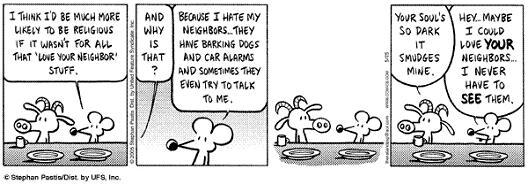
High Fences Make Good Neighbors

Here’s why:

The goat must be a sensitive soul. The rat is my kind of guy.

What Economics Isn’t

Economist Steven D. Levitt is co-author of Freakonomics and the Freakonomics blog with Stephen J. Dubner, a journalist who carries the writing burden. In an article at Slate, Levitt allows Dubner to say this:

What is economics, anyway? It’s not so much a subject matter as a sort of tool kit — one that, when set loose on a thicket of information, can determine the effect of any given factor.

Actually, that’s statistics, not economics. Economics is about understanding why and how resources are allocated among alternative uses, and why and how the course and level of economic activity is influenced by individuals, businesses, and governments. Statistics is but one tool in the economist’s tool kit.

Levitt’s confusion illustrates Arnold Kling’s point:

The most distinctive trend in economic research over the past hundred years has been the increased use of mathematics. In the wake of Paul Samuelson’s (Nobel 1970) Ph.D dissertation, published in 1948, calculus became a requirement for anyone wishing to obtain an economics degree. By 1980, every serious graduate student was expected to be able to understand the work of Kenneth Arrow (Nobel 1972) and Gerard Debreu (Nobel 1983), which required mathematics several semesters beyond first-year calculus….

The raising of the mathematical bar in graduate schools over the past several decades has driven many intelligent men and women (perhaps women especially) to pursue other fields. The graduate training process filters out students who might contribute from a perspective of anthropology, biology, psychology, history, or even intense curiosity about economic issues. Instead, the top graduate schools behave as if their goal were to produce a sort of idiot-savant, capable of appreciating and adding to the mathematical contributions of other idiot-savants, but not necessarily possessed of any interest in or ability to comprehend the world to which an economist ought to pay attention.

That is why I take most economists (Kling is an exception) with two grains of salt. One is for their dependence on mathematical techniques (including statistics). The second is for their belief that rationality is all about wealth maximization.

Reconciling the Reconcilable

UPDATED BELOW, AT 6:26 PM

Slate‘s Will Saletan accuses President Bush of hypocrisy and challenges him to reconcile his statements about stem-cell research and the death penalty; these statements, for example:

“The President is committed to medical research that does not violate the dignity of human life or exploit one human life for the benefit of another.”

—White House fact sheet, State of the Union, Feb. 2, 2005

“I happen to believe that the death penalty, when properly applied, saves lives of others. And so I’m comfortable with my beliefs that there’s no contradiction between the two.”

—Bush, April 14, 2005

Such statements are reconciled easily, by inserting the understood but unspoken word “innocent” in the proper places:

“The President is committed to medical research that does not violate the dignity of human life or exploit one innocent human life for the benefit of another.”

“I happen to believe that the death penalty, when properly applied, saves innocent lives….”

It’s easy to understand the President’s point, if you are willing to do so.

UPDATE: Eugene Volokh (he of the eponymous Conspiracy) points out that the White House and the President did make the point about innocence in the very transcripts linked to by Saletan. But Saletan selectively (and dishonestly) omitted those portions of the transcripts.