Analysis Paralysis

During the late presidential campaign I observed of John Kerry:

The difference between Kerry and Bush isn’t experience, it’s temperament. I worked for a Kerry-like CEO — always asking questions, probing answers, asking more questions, ad infinitum. He always postponed decisions as long as possible, not because he lacked the facts but because he had confused himself with the facts. He sought facts for their own sake, not because they would help him plot the best path toward a specific goal. He was almost purely inductive, hoping to find his principles in a morass of information.

That’s how Kerry, with his limitless flip-flopping, has struck me — a man without principles who hopes to discover them in the next piece of information that he receives….

To change metaphors: You don’t advance the ball down the field by counting the laces on it. You advance the ball down the field by knowing where the goal is and then choosing the plays that will help you reach it. Kerry knows how many laces there are. Bush figures out where to throw the ball, and all Kerry knows how to do is carp like an armchair quarterback when some of the passes aren’t caught.

I was reminded of that passage by this one, from an essay by Larry McMurtry:

A compulsion to over-informedness is most apt to occur in individuals who have been arrested at a graduate school level of development; it is an intellectual infirmity, rather than a sign of health, and is so common now that it perhaps deserves to be elevated to the status of a syndrome: the Star-Pupil syndrome. If the desire to shine as a pupil is sustained too long it can cause even the most committed worker to work badly. [Film Flam: Essays on Hollywood, “Movie Tripping: My Own Rotten Film Festival,” p. 204.]

That is why, in my experience, persons who have acquired a Ph.D. — or who lack one but work in a “learned institution” — tend to count the laces on the football instead of trying to advance it down the field.

Shakespeare said it best, in Hamlet (Act III, Scene 1):

And thus the native hue of resolution
Is sicklied o’er with the pale cast of thought,
And enterprises of great pith and moment
With this regard their currents turn awry,
And lose the name of action.

Bankruptcy Reform Update

I’ve updated an earlier post about the bankruptcy-reform bill that’s making its way through Congress. An e-mail from a reader prompted the update.

Oops. I remembered a point I meant to make in the first update, so now there’s a second update.

And a third one.

A Quasi-Jacksonian Solution

UPDATED BELOW

This:

The Pentagon is seeking to enlist help from the State Department and other agencies in a plan to cut by more than half the population at its detention facility in Guantánamo Bay, Cuba, in part by transferring hundreds of suspected terrorists to prisons in Saudi Arabia, Afghanistan and Yemen, according to senior administration officials….

The White House first embraced using Guantánamo as a holding place for terrorism suspects taken in Afghanistan, in part because the base was seen as beyond the jurisdiction of United States law. But recent court rulings have held that prisoners there may challenge their detentions in federal court.

Indeed, the Pentagon has halted, for the last six months, the flow of new terrorism suspects into the prison, Defense Department officials said. In January, a senior American official said in an interview that most prisoners at Guantánamo no longer had any intelligence value and were not being regularly interrogated.

The proposed transfers would represent a major acceleration of Pentagon efforts that have transferred 65 prisoners from Guantánamo to foreign countries.

Reminds me of this:

On March 3, 1832, Chief Justice Marshall handed down the unanimous opinion of the Court. The Cherokee Nation was sovereign. Georgia law no longer applied to the Cherokee. Justice Story wrote “The Court has done its duty. Now let the Nation do theirs.” At some point, Andrew Jackson supposedly said “Marshall made the ruling, let him enforce it.”

It seems that the White House has taken my advice, after a fashion.

UPDATE:

Judges are still getting into the act:

A federal judge on Saturday prohibited the government from transferring 13 Yemeni prisoners from the military’s detention facility at Guantánamo Bay, Cuba, until a hearing could be held on their lawyers’ fear that they might face torture if sent to another country.

With results like this:

Authorities have begun legal action against two Frenchmen for alleged terrorist-related activity following their release from the U.S. military prison at Guantanamo Bay, Cuba, judicial officials said Saturday.

Ugh! Is Right

I’ve written several times about the slippery slope of involuntary euthanasia and similar atrocities, but my hat’s off to the Hobbesian Conservative, who hits one out of the park in a post titled “Ugh!” Go read.

The Bankruptcy Bill in Perspective

UPDATED THRICE, BELOW

The bankruptcy-reform bill, as described in an article by Stephen Laboton of The New York Times:

The Senate assured final passage of the first major overhaul of the nation’s bankruptcy laws in 27 years on Tuesday….

The bill would disqualify many families from taking advantage of the more generous provisions of the current bankruptcy code that permit them to extinguish their debts for a “fresh start.” It would also impose significant new costs on those seeking bankruptcy protection and give lenders and businesses new legal tools for recovering debts.

…The senators…voted 69 to 31 to limit debate and cut off any effort to kill the legislation by filibuster.

Final passage of the measure is now an inevitable formality.

Good.

Of course, there’s the usual hand-wringing from the usual sources:

“This bankruptcy bill is mean-spirited and unfair,” said Senator Edward M. Kennedy, Democrat of Massachusetts. “In anything like its present form, it should and will be an embarrassment to anyone who votes for it. It’s a bonanza for the credit card companies, which made $30 billion in profits last year, and a nightmare for the poorest of the poor and the weakest of the weak.”

Hmmm….In other words, it’s okay for some people to rack up credit-card debt and then dishonor their obligation to repay that debt. (Think of it as a financial Chappaquiddick.) The result, of course, is that other people wind up subsidizing the deadbeats through higher prices and interest rates.

And how does Teddy K. know how much profit credit-card companies ought to make? The market should determine that, not Senator Stumblebum. If the profits of credit-card companies are “too high” it’s only because banking regulations restrict competition. But Teddy and his ilk never saw a regulation they didn’t like. Teddy has himself to blame for those “high” profits that he finds so offensive.

The bottom line: Bankruptcy reform will make goods, services, and credit somewhat cheaper for responsible citizens. And it will make responsible citizens out of many who otherwise would have racked up too much debt, knowing there was an easy way out it. Seems like a win-win situation to me.

UPDATE: And if you think otherwise, you’re just another addict of the regulatory-welfare state. As I have written:

Unless Americans become aware of the extremely high and largely hidden cost of the regulatory-welfare state, they will remain addicted to it. For reliance on government is an addictive drug — and a very expensive one. We swallow each dose in the hope that it will make us secure, and when that dose doesn’t make us secure we swallow another dose, in the hope that that dose will make us secure. And on and on. In the end, we are left with nothing but a costly addiction to government that impairs our liberty therefore ruins our economic health.

What Americans have failed to understand, is that there is less risk of coming to harm in a free-market economy — where individuals have an incentive to take care of themselves — than there is of coming to harm in the regulatory-welfare state. (See my series of posts on “Fear of the Free Market,” in three parts; my post on “Free Market Healthcare“; and my post on “Why Class Warfare Is Bad for Everyone.”) Free people do not stay mired in poverty and tend not to repeat their mistakes, if they are allowed to learn from those mistakes. (See my posts about income inequality.)

The price of addiction (from the same post):

  • Real GDP (in year 2000 dollars) was about $10.7 trillion in 2004.
  • If government had grown no more meddlesome after 1906, real GDP might have been $18.7 trillion (see first chart above).
  • That is, real GDP per American would have been about $63,000 (in year 2000 dollars) instead of $36,000.
  • That’s a deadweight loss to the average American of more than 40 percent of the income he or she might have enjoyed, absent the regulatory-welfare state.
  • That loss is in addition to the 40-50 percent of current output which government drains from the productive sectors of the economy.

And that is the price of privilege — of ceding liberty piecemeal in the mistaken belief that helping this interest group or imposing that regulation will do little harm to the general welfare, and might even increase it.

Those who favor the regulatory-welfare state — in any of its manifestations — effectively favor the ill fortune of all their fellow citizens. That is either grossly immoral, grossly ignorant, or grossly stupid — take your pick.

UPDATE II: Those who believe the canard that medical bills are a major cause of bankruptcy should read this post by Gail Heriot at The Right Coast, and follow the links. Even if medical bills were a major cause of bankruptcy (which they’re not), the cause of high medical costs in the United States is an artifact of the regulatory-welfare state:

  • High demand is fuelled by taxpayer-subsidized healthcare facilities, laws mandating access to emergency rooms, and government “insurance” programs (e.g., Medicare and Medicaid). “Free” care and subsidized premiums discourage self-rationing.
  • High demand is further fuelled by tax laws that encourage employers to offer subsidized health-insurance plans, many of which must render certain legally mandated benefits. Self-rationing is discouraged by the low premiums and co-payments that result from employer subsidies.
  • On the supply side, there’s restrictive licensing (favored by the various “unions”: doctors, hospitals, etc.) and slow FDA approval of new drugs.

Artificially high demand plus artificially low supply equals higher healthcare costs for all, including those persons who actually need healthcare.

The solution to the minuscule problem of bankruptcies caused by medical bills — and to the real problem of high medical costs — isn’t laxer bankruptcy laws, it’s less government interference in health care.

UPDATE III: The inestimable David Broder, reliable purveyor of leftish conventional wisdom, doesn’t like the bill (my comments bolded in brackets):

This “reform,” which parades as an effort to stop folks from spending lavishly on themselves and then stiffing their creditors by filing for bankruptcy protection, is a perfect illustration of how the political money system tilts the law against average Americans….[It is an effort to discourage deadbeat-itis, whatever else it may be. You can’t take that away, David. As for the “political money system,” money always talks; the answer to “money in politics” isn’t the impossible dream of less money, it’s less government power.]

Few policy battles draw enough public and press interest for the legislators to feel real scrutiny — Social Security being a current example. Most are in a netherworld, where media coverage is cursory and interest groups’ pressure determines the outcome. That’s how bankruptcy reform made it through the Senate, and why it will soon pass the House and be signed into law by President Bush. [Oh, do you really think so? Smacks of sour grapes to me. Lots of things get passed by Congress without a lot of media coverage. You win some, you lose some.]

The recent decade’s rise in the number of bankruptcy cases has been dramatic, and it is not difficult to find cases of abuse. But most bankruptcy petitions are filed by people with real financial problems, often the result of family illness, divorce or loss of jobs. [But “they hired the money,” as Silent Cal used to say. Personal responsibility implies prudent planning.] This bill will make it harder for everyone — chiselers and innocent victims alike — to get a clean start on their future without the overhang of mounting interest payments on unpaid credit cards and other debt…[As I said above: good. There’ll be one less moral hazard on the golf course of life.]

[W]hen an amendment was offered to restrict so-called “asset protection trusts,” used by wealthy individuals to shelter their portfolios from creditors, it was rejected. Five states — Alaska, Delaware, Nevada, Rhode Island and Utah — have changed their laws to let people who live anywhere in the country establish trusts of unlimited size that cannot be reached by federal bankruptcy proceedings. The amendment would have limited this “millionaires’ loophole” to $125,000.

But Sen. Charles Grassley of Iowa, the bill’s chief sponsor, intent on blocking any amendment that might prove indigestible in the House, said, “This is an issue that just needs more time for us to determine whether there is an abuse that needs to be corrected.” With no more debate, it was rejected.

These amendments came from the liberal camp — senators such as Edward Kennedy, Russ Feingold, Richard Durbin and Charles Schumer — and were easily dismissed by the Republican majority. Even more instructive was what happened when a conservative, Republican Sen. John Cornyn of Texas, tried to put a little balance into the bill.

As attorney general of Texas, Cornyn said the Enron bankruptcy case “opened my eyes to a very real abuse in the current bankruptcy system,” the loophole that allows corporations to go “judge-shopping” for jurisdictions with permissive standards. Enron, which had 7,500 employees in Houston, filed for bankruptcy in New York, where it had 57 workers, because New York, along with Delaware, is known as being lenient on big business.

Congress recently passed a law restricting plaintiffs in class-action suits from judge-shopping in the state courts, and Cornyn argued that it should also require corporate bankruptcy cases to be filed in their principal place of business. Citing cases of Polaroid, K-Mart, WorldCom and Enron, he said the judge-shopping loophole “serves to unfairly enable corporate debtors to evade their financial commitments.”

No one rose to dispute Cornyn. So what happened? He withdrew the amendment, without a vote, “out of respect to the managers of this bill who say that amendments to this bill would endanger its ultimate passage.” [I agree that no one should get a special break when it comes to honoring debt. Absolutely, no question. But let’s take half a loaf rather than none. The present version of bankruptcy reform may not be perfect, but it’s a step in the right direction. The alternative of no reform is worse, unless you’re a class-baiting liberal like Broder.]

Practical Libertarianism for Americans

I am posting this very long essay in parts (listed below). This is a work in progress. I welcome constructive criticisms and suggestions. Please send an e-mail to: libertycorner-at-sbcglobal-dot-net .

I. Introduction (excerpt here, full post here)

II. Terminology (excerpt here, full post here)

Addendum to Part II: Notes on the state of liberty in American law (excerpt here, full post here)

III. The origin and essence of rights (excerpt here, full post here and here)

IV. Liberty and its prerequisites (excerpt here, full post here)

Addendum to Part IV: More Hayek

V. The economic consequences of liberty (excerpt here, full post here)

VI. The road not taken in American law

VII. Regaining the road

VIII. Specific policy prescriptions

IX. Summary and conclusion

Practical Libertarianism for Americans: Part V

V. THE ECONOMIC CONSEQUENCES OF LIBERTY

This is an excerpt of Part V of a nine-part work in progress. I welcome constructive criticisms and suggestions. Please send an e-mail to: libertycorner-at-sbcglobal-dot-net .

Absent the welfare-regulatory state, most of the poor would be rich, by today’s standards. And those who remain relatively poor or otherwise incapable of meeting their own needs — because of age, infirmity, and so on — would reap voluntary charity from their affluent compatriots….

[A]t the onset of the Great Depression — Americans and American politicians lost their bearings and joined Germany, Italy, and Russia on the road to serfdom. Most Americans still believe that government intervention brought us out of the Depression. That bit of shopworn conventional wisdom has been debunked thoroughly by Jim Powell, in FDR’s Folly: How Roosevelt and His New Deal Prolonged the Great Depression, and Murray N. Rothbard, in America’s Great Depression. The bottom line of FDR’s Folly is stark:

The Great Depression was a government failure, brought on principally by Federal Reserve policies that abruptly cut the money supply; unit banking laws that made thousands of banks more vulnerable to failure; Hoover’s tariff’s, which throttled trade; Hoover’s taxes, which took unprecedented amounts of money out of people’s pockets at the worst possible time; and Hoover’s other policies, which made it more difficult for the economy to recover. High unemployment lasted as long as it did because of all the New Deal policies that took more money out of people’s pockets, disrupted the money supply, restricted production, harassed employers, destroyed jobs, discouraged investment, and subverted economic liberty needed for sustained business recovery [p. 167].

All we got out of the New Deal was an addiction to government intervention, as people were taught to fear the free market and to believe, perversely, that government intervention led to economic salvation. The inculcation of those attitudes set the stage for the vast regulatory-welfare state that has arisen in the United States since World War II….

You know the rest of the story: Spend, tax, redistribute, regulate, elect, spend, tax, redistribute, regulate, elect, ad infinitum. We became locked into the welfare state in the 1970s…, and the regulatory burden on Americans is huge and growing. The payoff:

  • Real GDP (in year 2000 dollars) was about $10.7 trillion in 2004.
  • If government had grown no more meddlesome after 1906, real GDP might have been $18.7 trillion (see first chart above).
  • That is, real GDP per American would have been about $63,000 (in year 2000 dollars) instead of $36,000.
  • That’s a deadweight loss to the average American of more than 40 percent of the income he or she might have enjoyed, absent the regulatory-welfare state.
  • That loss is in addition to the 40-50 percent of current output which government drains from the productive sectors of the economy.

And that is the price of…ceding liberty piecemeal in the mistaken belief that helping this interest group or imposing that regulation will do little harm to the general welfare, and might even increase it….

The next several years will see a showdown between the forces of darkness and the forces of progress in America. The forces of darkness — having already greatly diminished the general welfare in the name of improving it — will seek to tighten the shackles of the regulatory-welfare state in the name of environmentalism. The forces of progress will seek to tame the regulatory-welfare state — if not repeal it. But they will be labeled evil, greedy, know-nothings for trying to protect us generally from the predations of the welfare-regulatory state and particularly from the ravages of environmental hysteria. As Ludwig von Mises put it:

[I]f a revolution in public opinion could once more give capitalism free rein, the world will be able gradually to raise itself from the condition into which the policies of the combined anticapitalist factions have plunged it.14 [Quoted by Bryan Caplan.]

I am doubtful of a revolution in public opinion, especially because it would require a revolution in elite opinion and in the media — both of which are in thrall to the god of the regulatory-welfare state.

As I will argue in Part VI, we have come to our present state because public opinion, elite opinion, and the media have combined to undo the great work of the Framers, whose Constitution prevented tyranny by the majority. Unchecked democracy has become the enemy of liberty and, therefore, of material progress. As Michael Munger says, “The real key to freedom is to secure people from tyranny by the majority, or freedom from democracy.”

The last best hope for liberty and prosperity lies in the neutralization of public opinion through a renewal of constitutional principles. I’ll have more to say about that in Parts VII and VIII.

Click here for the full text of Part V.

A Leftist’s Lament

Lillian B. Rubin, writing in Dissent, laments the inability of the left to reach the “masses” (those recalcitrant Reagan Democrats):

I don’t take a backseat to anyone in my anger at the right, especially the radical religious right and its neocon partners. Their ideological inflexibility, the way they manipulate the facts to fit their preconceptions and sell their falsehoods to the American public, is both outrageous and frightening. But my concern here is to examine the political behavior of the millions of other Americans-those working-class and lower-middle-class women and men who are not driven by ideological rigor, who are not convinced that they speak the word of God, yet who listen appreciatively to the Rush Limbaughs, Sean Hannitys, and Bill O’Reillys as they rail against us as “liberal elites” who have lost touch with the people, and who went to the polls in our recent presidential election and voted accordingly. Why do they subscribe to a politics that in [Thomas] Frank’s words, “strangles their own life chances?”

She then goes on manipulate facts and manufacture falsehoods:

Why, in the face of exploding deficits, a war that has become increasingly unpopular, a three-year-long recession, millions of jobs lost and not replaced, a public education system that’s a national disgrace, prescription drugs made by American manufacturers that cost half or less in neighboring Canada, and a health-care system that’s the most expensive in the world yet fails to provide the most elementary care for tens of millions of Americans, why-when we’re on the people’s side of all these issues-don’t they listen to us?

Perhaps, Lillian, it’s because “they” are not always fooled by leftist rhetoric:

  • The left hates deficits only because they’ve been fueled by tax cuts rather than spending on leftist programs.
  • The recession — hardly unique or deep by historic standards — began in Clinton’s administration, though he’s not to be blamed for that. Recessions happen.
  • Public education is a disgrace because it’s public education, but the left won’t let parents take their tax money and spend it at private schools.
  • The creation of new “miracle” drugs depends on the prospect of earning sufficient profits to fund the necessary research. Reimportation therefore undermines advances in healthcare.
  • There’s much more to healthcare than drug prices, and America’s healthcare system is the best. Even Americans without health insurance have access to that system through emergency rooms, State and municipal public-assistance programs, and the support of charitable organizations.

The left is uncomfortable with facts, because facts get in the way of the left’s agenda, which is to remake the world to its liking. Thus, instead of blaming the “masses” for siding with what she calls “the right,” Rubin blames “the right”:

There’s much to do in the coming years to build a set of institutions that can begin to compete with the highly organized, enormously well-funded network of newspapers, periodicals, think tanks, publishing houses, and television and radio stations the right already has in place. But no institutions will save us until we find the way to reframe the debate so that it’s on our terms, not theirs. That means opening up discussion among ourselves to debate and develop positions and strategies that, while honoring our own beliefs and values, enable us to build bridges across which we can speak to those who now see us as an alien other.

It’s not enough to speak in another voice, however. We must learn to listen as well, to develop a third ear so that we can hear beneath their rage to the anguish it’s covering up. Only then will we find our way into the hearts and minds of those Americans who have been seduced and exploited by the radical right into “strangling their own life chances.” Only then will we be able to stop asking, “Why don’t they listen to us?”

Because “they” often intuit the facts, which the left ignores studiously, and because “they” often see through the left’s smug, elitist condescension. That’s why.

Rubin’s lament gives me renewed hope for the future of America.

Welcome to the Land of Oz

And I don’t mean Australia. I’ve been living in the Land of Oz, and I didn’t know it. But I do now, thanks to outfits like WING TV. For example, here’s the way the world works, according to Victor Thorn’s “The Real Dark Overlords“:

George Bush is an empty suit Manchurian creation of nepotistic fate who serves as a lightning-rod diversion to distract people’s attention away from the actual hidden evil daemon that are manipulating our planet through wars, finance, false religion, and a reconditioning of our mental faculties….

…George Bush is not enemies with Osama bin Laden, Saddam Hussein, or even Al Gore and John Kerry. It’s all a con-job because these individuals are all on the same team, and they’re all serving the same masters in one capacity or another. And what is their ultimate goal as they sell their souls? Answer: to preserve the controlling elite’s status quo, and subsequently their positions of subservient power within it.

George Bush is merely a puppet; a figurehead; and an implementer….if YOU were running the world, would you let George W. Bush be the CEO? Hell, the Bushes don’t even trust him enough to run their own family business! So, in this sense, he’s nothing more than a dangling carrot that is used as either a figure of adoration for the kool-aid conservatives, or a symbol of disdain for the lockstep liberals….Yet for some inexplicable reason, many people who should know better still allow themselves to be bamboozled by this illusory left/right paradigm….

Please, remember: George Bush, Bill & Hillary Clinton, Ronald Reagan, and John Kerry are not (and were not) the ultimate idols and demons. They’re simply conduit/actors on the public stage who are advancing the goals of those behind the veil…. “What is essential is invisible to the eye.” In other words, the true fiends that are destroying our world and feeding off their hosts (that means us – everyday people) like parasitical vampires are far-removed from the glare of public exposure….

The key to remember is this: George Bush and his ilk are merely SYMPTOMS of evil; not the true CAUSE. If we really want the truth, we have to insist on looking further than what is standing right before us.

Yup. That’s why WING TV is presenting “9/11 on Trial” this very day:

“9-11 on Trial”…will examine the government’s explanation of events following the terror attacks of September 11, 2001. Specifically, the focal point of these proceedings will be: did burning jet fuel cause the collapse of each World Trade Center tower? A subsequent trial in mid-to-late 2005 will take into consideration whether Flight 77 – a Boeing 757 – struck the Pentagon.

To prosecute this case, we are going to rely solely on verifiable scientific data of the highest order (as opposed to the obvious pitfalls associated with “theory”). In this sense, our focus will be exclusively directed at the CAUSE of the towers’ collapse, and not any peripheral SYMPTOMS.

We are engaging in this project for two primary reasons: (a) to counteract a “black hole” of sorts that has engulfed previous and/or current 9-11 lawsuits, all of which seem to be squashed, in limbo, or severely compromised; and (b) to show that this case can be proven in a court of law relying solely on verifiable scientific facts, physics, and the laws of nature.

At this point we have amassed mountains of data, but if anyone would like to submit material which fits the above-mentioned criteria, their contributions are most certainly welcome.

“9-11 on Trial” promises to be an historic event, for we will prove beyond a shadow of a doubt – in a courtroom setting for all the world to see – that the government’s explanation of events were nothing more than bold-faced lies.

Popular Mechanics disposes of crap like “9-11 on Trial” in “9/11: Debunking the Myths“:

FROM THE MOMENT the first airplane crashed into the World Trade Center on the morning of September 11, 2001, the world has asked one simple and compelling question: How could it happen?

Three and a half years later, not everyone is convinced we know the truth. Go to Google.com, type in the search phrase “World Trade Center conspiracy” and you’ll get links to an estimated 628,000 Web sites. More than 3000 books on 9/11 have been published; many of them reject the official consensus that hijackers associated with Osama bin Laden and Al Qaeda flew passenger planes into U.S. landmarks.

Healthy skepticism, it seems, has curdled into paranoia. Wild conspiracy tales are peddled daily on the Internet, talk radio and in other media. Blurry photos, quotes taken out of context and sketchy eyewitness accounts have inspired a slew of elaborate theories: The Pentagon was struck by a missile; the World Trade Center was razed by demolition-style bombs; Flight 93 was shot down by a mysterious white jet. As outlandish as these claims may sound, they are increasingly accepted abroad and among extremists here in the United States.

To investigate 16 of the most prevalent claims made by conspiracy theorists, POPULAR MECHANICS assembled a team of nine researchers and reporters who, together with PM editors, consulted more than 70 professionals in fields that form the core content of this magazine, including aviation, engineering and the military.

In the end, we were able to debunk each of these assertions with hard evidence and a healthy dose of common sense. We learned that a few theories are based on something as innocent as a reporting error on that chaotic day. Others are the byproducts of cynical imaginations that aim to inject suspicion and animosity into public debate. Only by confronting such poisonous claims with irrefutable facts can we understand what really happened on a day that is forever seared into world history.–THE EDITORS

Letsroll911.org, another conspiracy-mongering outfit,tries to debunk the debunking by using impeachable witnesses, fuzzy images (into which one can see anything one wishes to see), and such impeccable logic as this:

Did you know that: Popular Mechanics is owned by Hearst Publications, and that the term “Yellow Journalism” came from shoddy reporting from Hearst Newspapers, most notoriously Hearst’s promotion of the false claim that Spain had blown up the USS Maine in Havana harbor which was the pretext for the Spanish-American war…?

In other words, your grandfather was a horsethief, so you must be a wife-beater.

As PM‘s Jim Meigs notes:

“Everyone is entitled to his own opinion,” the great Sen. Daniel Patrick Moynihan of New York was fond of saying. “He is not entitled to his own facts.”…

These 9/11 conspiracy theories, long popular abroad, are gradually–though more quietly–seeping into mainstream America. Allegations of U.S. complicity in the attacks have become standard fare on talk radio and among activists on both the extreme left and the extreme right of the political spectrum.

Which brings me to the Republic Broadcasting Network, another purveyor of non-stop conspiracy theorizing, which offers tidbits like these:

What Was Dick Cheney Doing on the Morning of September 11, 2001?

Arnold Exposed/Save the Constitution

The Bush Doctrine is Israel’s Doctrine

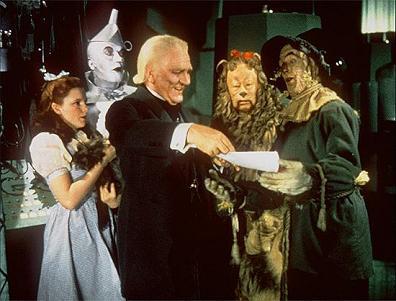
It’s obvious to me, now, that the “controlling elite” that stands “behind the veil” is a capitalist, neo-Nazi, Zionist cabal. And all these years I thought it was only Frank Morgan.


Dorothy (Judy Garland), the Tin Woodman (Jack Haley), the Cowardly Lion (Bert Lahr) and the Scarecrow (Ray Bolger) with the Wizard (Frank Morgan) in “The Wizard of Oz,” distributed by Warner Bros.

More about the Origin of Rights

Jon Henke of Q&O writes about the origin of rights:

Dean Esmay touches on something very important—something central to the evolution of my political philosophy past rigid Libertarian doctrine…

“You only have any rights because the rest of us pretty much agree that you have them.”

America was founded on an idea known as “natural rights,” at least as part of our founding myth. In truth not all the Founders believed in the concept, but most went along with the general idea. This concept of “natural rights” is helpful as a frame of reference, but really, it’s nothing but an intellectual tool. It’s a good way of getting people into the spirit of protecting each others’ rights, but ultimatey it’s nothing but sentiment.

As a matter of faith some may cleave to the notion that their rights come “ultimately” from God or some other higher source, or perhaps from an elaborately worked out system of rationalization. But as a matter of pragmatism that is all superfluous; unless you believe that your Creator is going to take a direct hand in everyday affairs for you, you are utterly dependent upon our fellow men to protect your rights. To get your fellow men to do that, you’re going to have to get most of them to agree on what your rights are or, failing that, get them to agree that the system of government which protects those rights should be obeyed—which is six of the one and half a dozen of the other.

Go on, try to get around it. Quote the Magna Carta at me; I don’t care. Quote Ayn Rand for me; I still don’t care. Quote Karl Marx or Rousseau for me; then I definitely don’t care. Indeed, take any political philosopher who has written at length about any of these issues, and consider: it only takes enough of us who say, “that’s a crock!” to expose any such intellectual edifices as castles made of sand.

Your rights do not exist unless your fellow men agree that they exist. You and I will live with that. Regardless of how we feel about it, it is empirical reality.

“Your rights do not exist unless your fellow men agree that they exist. … it is empirical reality”. Like Dean, I still await verifiable, physical proof of the existence of “rights”. If they are natural, surely there should be evidence, no?

There is not. Rights, as Max Borders wrote, “are not some Cartesian substance that animates the body in the manner of a soul. Rights are a human construct, just like money. The more we believe in them, the better they work“. And yet, objectivists—who are generally dismissive of unsupported claims of the supernatural—are perfectly willing to buy into the idea that the human race is exempt from the “survival of the fittest” – that we are somehow bound by other laws of nature….

A political philosophy should have ideals…but it should also be grounded in reality, else it is not really philosophy at all, merely wishful thinking. There are still many valid rationales for libertarianism, though, and they provide the basis of a more fundamentally healthy political philosophy.

In an update, Henke dismisses a reader’s argument for consequentialism as a proof of “natural rights”:

[H]is evidence comes down to “an irrefutable correlation” between the recognition of rights and successful outcomes, which indicates that “liberty is in everyone’s interest”.

And, in that, I absolutely agree with him. But that doesn’t prove the natural existence of a thing called “rights”, anymore than the productive cooperation that occurs between bees proves that insects have rights.

Precisely. As I have written:

I would like to be able to say, with fundamentalist [natural rights] libertarians, that liberty is an innate human right — and the only innate right. But that would be nothing more than an assertion, however cleverly I might clothe it in the language of philosophy.

I would like to be able to say that liberty is a paramount human instinct, honed through eons of human existence and experience. But we are surrounded by too much evidence to the contrary, both in recorded and natural history. The social and intellectual evolution of humankind has led us to a mixed bag of rights, acquired politically through cooperation and conflict resolution, often predating the creation of governments and the empowerment of states. The notion that we ought to enjoy the negative right of liberty is there among our instincts, of course, but it is at war with the positive right of privilege — the notion that we are “owed something” beyond what we earn (through voluntary exchange) for the use of our land, labor, or capital. Liberty is also at war with our instincts for control, aggression, and instant gratification.

I do not mean that the social and intellectual evolution of humankind is right — merely that it is what it is. Libertarians must accept this and learn to work with the grain of humanity, rather than against it….

There can be much profit in demonstrating, logically and factually, how illiberal laws and government actions make people worse off — often the same people who are supposed to benefit from those laws — and in offering superior alternatives. In other words, consequentialist libertarianism can make real gains for liberty by appealing successfully to self-interest.

The superior consequences of liberty argue for its acceptance, not for its inevitability. If the state of liberty were inevitable simply because of its demonstrable superiority, we would never have had to fight any wars to acquire and preserve it, nor would America have traveled as far down the road to serfdom as it has in the past 70 years.

Eternal vigilance is the price of liberty.

Treasonous Blogging?

Tom W. Bell of Agoraphilia posts about and links to an article he has submitted to several law reviews. The title is of the article is “Treason, Technology, and Freedom of Expression.” Here are some excerpts of the abstract and concluding section:

The power to punish treason against the U.S. conflicts with the First Amendment freedoms of speech and of the press. Far from a question of mere theory, that conflict threatens to chill public dissent to the War on Terrorism….After World War II, the United States won several prosecutions against citizens who had engaged in propaganda on behalf of the Axis powers. Today, critics of the War on Terrorism likewise face accusations of treason. Under the law of treasonous expression developed following World War II, those accusations could credibly support prosecutions. Any such prosecutions could win convictions, moreover, unless courts narrow the law of treasonous expression to satisfy the First Amendment….

In terms of abstract doctrine, the law of treason condemns anyone who owes allegiance to the U.S., who adheres to U.S. enemies, and who gives them aid and comfort by an overt act to which two witnesses testify. As courts have applied that doctrine, however, it threatens any citizen or resident of the U.S. who publicly expresses disloyal sentiments. The Internet has made it cheap, easy, and dangerous to publish such sentiments….Even if no prosecutions for treason arise, the alarmingly broad yet ill-defined reach of the law of treason threatens to unconstitutionally chill innocent dissent….

As courts have interpreted it, the law of treason allows for the punishment of an indeterminate but wide range of disloyal public expressions that help enemies of the U.S. That interpretation both subverts the original meaning of the constitution’s treason clause and violates the strict scrutiny test applied to content-based restrictions on expression. To save the law from unconstitutionality, courts should in cases of treasonous expression interpret the “adhering to [U.S.] enemies” element of treason as nothing broader than “being employed by enemies of the U.S.” Perhaps courts should demand a still less restrictive variation on the law of treason. Perhaps they should do away with the law of treasonous expression altogether. At the least, though, they should limit liability for treasonous expression to defendants employed by enemies of the U.S. Anything broader than that would, by wounding our First Amendment rights, do far more to harm the U.S. than disloyal expressions would.

I disagree with the compromise position Bell offers in the final sentence. If it’s treason, it’s treason. An unpaid traitor can do just as much harm to the nation as can a paid traitor.

It would be better to do away with the law of treasonous expression altogether than to draw an arbitrary line between paid and unpaid traitors. If a person’s treachery goes no further than expressions of hatred for America or sympathy with America’s enemies, let that person suffer the consequences in the forum of public opinion.

We bloggers are already facing enough trouble, given the strong possibility that our freedom of expression may be throttled by the strict application of the McCain-Feingold Act. The last thing that we (bloggers) need is an inquisition into our views about the War on Terrorism.

I do detest the extremists of the left and right who portray America as the villain of the piece. But I defend their right to do so — as long as they aren’t doing it on my dime.

Here We Go Again

Back on September 18, in “Time to Regulate the Blogosphere?,” I wrote that the thought of regulating the blogosphere

must have crossed the minds of some highly placed Democrat sympathizers in the “mainstream” media when the blogosphere started shredding the threadbare remnants of Dan Rather’s reputation for honest reporting. But the blogosphere is protected by the First Amendment, isn’t it?

There’s stark evidence that the blogosphere can be regulated, if the feds want to do it. Look at the airwaves, which the feds seized long ago, and which the feds censor by intimidation. Look at the ever-tightening federal control of political speech, which has brought us to McCain-Feingold. It’s all in the name of protecting us, of course.

I followed that with a post on October 13, in which I quoted from an AP story (link no longer works):

FEC May Regulate Web Political Activity

Oct 13, 7:55 AM (ET)

By SHARON THEIMER

WASHINGTON (AP) – With political fund raising, campaign advertising and organizing taking place in full swing over the Internet, it may just be a matter of time before the Federal Election Commission joins the action. Well, that time may be now.

A recent federal court ruling says the FEC must extend some of the nation’s new campaign finance and spending limits to political activity on the Internet.

Long reluctant to step into online political activity, the agency is considering whether to appeal.

But vice chairwoman Ellen Weintraub said the Internet may prove to be an unavoidable area for the six-member commission, regardless of what happens with the ruling.

“I don’t think anybody here wants to impede the free flow of information over the Internet,” Weintraub said. “The question then is, where do you draw the line?”…

LGF (via Freespace) now points to this (from CNET News.com):

The coming crackdown on blogging

March 3, 2005, 4:00 AM PT
By Declan McCullagh
Staff Writer, CNET News.com

Bradley Smith says that the freewheeling days of political blogging and online punditry are over.

In just a few months, he warns, bloggers and news organizations could risk the wrath of the federal government if they improperly link to a campaign’s Web site. Even forwarding a political candidate’s press release to a mailing list, depending on the details, could be punished by fines.

Smith should know. He’s one of the six commissioners at the Federal Election Commission, which is beginning the perilous process of extending a controversial 2002 campaign finance law to the Internet.

In 2002, the FEC exempted the Internet by a 4-2 vote, but U.S. District Judge Colleen Kollar-Kotelly last fall overturned that decision. “The commission’s exclusion of Internet communications from the coordinated communications regulation severely undermines” the campaign finance law’s purposes, Kollar-Kotelly wrote.

Smith and the other two Republican commissioners wanted to appeal the Internet-related sections. But because they couldn’t get the three Democrats to go along with them, what Smith describes as a “bizarre” regulatory process now is under way.

CNET News.com spoke with Smith about the Bipartisan Campaign Reform Act of 2002, better known as the McCain-Feingold law, and its forthcoming extrusion onto the Internet.

Q: What rules will apply to the Internet that did not before?
A: …Do we give bloggers the press exemption? If we don’t give bloggers the press exemption, we have the question of, do we extend this to online-only journals like CNET?

How can the government place a value on a blog that praises some politician?
…The FEC did an advisory opinion in the late 1990s (in the Leo Smith case) that I don’t think we’d hold to today, saying that if you owned a computer, you’d have to calculate what percentage of the computer cost and electricity went to political advocacy.

It seems absurd, but that’s what the commission did. And that’s the direction Judge Kollar-Kotelly would have us move in….

How about a hyperlink? Is it worth a penny, or a dollar, to a campaign?
I don’t know. But I’ll tell you this. One thing the commission has argued over, debated, wrestled with, is how to value assistance to a campaign….

Then what’s the real impact of the judge’s decision?
The judge’s decision is in no way limited to ads. She says that any coordinated activity over the Internet would need to be regulated, as a minimum….

(Editor’s note: federal law limits the press exemption to a “broadcasting station, newspaper, magazine or other periodical publication.” )

How do you see this playing out?
There’s sensitivity in the commission on this. But remember the commission’s decision to exempt the Internet only passed by a 4-2 vote.

This time, we couldn’t muster enough votes to appeal the judge’s decision. We appealed parts of her decision, but there were only three votes to appeal the Internet part (and we needed four). There seem to be at least three commissioners who like this.

Then this is a partisan issue?
Yes, it is at this time. But I always point out that partisan splits tend to reflect ideology rather than party. I don’t think the Democratic commissioners are sitting around saying that the Internet is working to the advantage of the Republicans.

One of the reasons it’s a good time to (fix this) now is you don’t know who’s benefiting. Both the Democrats and Republicans used the Internet very effectively in the last campaign.

What would you like to see happen?
I’d like someone to say that unpaid activity over the Internet is not an expenditure or contribution, or at least activity done by regular Internet journals, to cover sites like CNET, Slate and Salon. Otherwise, it’s very likely that the Internet is going to be regulated, and the FEC and Congress will be inundated with e-mails saying, “How dare you do this!”

What happens next?
It’s going to be a battle, and if nobody in Congress is willing to stand up and say, “Keep your hands off of this, and we’ll change the statute to make it clear,” then I think grassroots Internet activity is in danger….

Senators McCain and Feingold have argued that we have to regulate the Internet, that we have to regulate e-mail. They sued us in court over this and they won.

If Congress doesn’t change the law, what kind of activities will the FEC have to target?
We’re talking about any decision by an individual to put a link (to a political candidate) on their home page, set up a blog, send out mass e-mails, any kind of activity that can be done on the Internet….

Why wouldn’t the news exemption cover bloggers and online media?
Because the statute refers to periodicals or broadcast, and it’s not clear the Internet is either of those. Second, because there’s no standard for being a blogger, anyone can claim to be one, and we’re back to the deregulated Internet that the judge objected to. Also I think some of my colleagues on the commission would be uncomfortable with that kind of blanket exemption….

Imagine that: unregulated political speech. What a concept. Perhaps we need a constitutional amendment to protect it. We could even call it the First Amendment, because of its importance.

God damn McCain, Feingold, Congress, the President, and the U.S. Supreme Court! (Oops, am I allowed to say that?)

Favorite Posts: Academic Freedom and Freedom of Speech

The Population Mystery

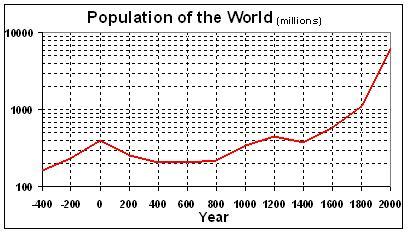
If a species that cannot provide for itself must decline, what does the following chart say about the ability of humans to provide for themselves?


Estimates for -400 through 1800 are from U.S. Census Bureau, “Historical Estimates of World Population“; estimate for 2000 is from U.S. Census Bureau, “Total Midyear Population for the World: 1950-2050.” Year 1 is plotted as Year 0 for ease of illustration. “Upper” estimates are used for -400 through 1800 (where given) because those estimates are taken from a series that extends from -10000 through 1950, and the upper estimate for 1950 in that series agrees with the estimate for 1950 in the series for 1950-2050.

Kill the Innocent, Save the Guilty

News headlines:

U.S. Supreme Court declines to hear Terry Schiavo Case

5-4 Supreme Court abolishes juvenile executions

Taking Exception

Aaron Margolis, a co-blogger at the late, unlamented Blogger News Network, once wrote:

The operative question in this case: should Michael Schiavo’s rights as a husband be reduced or eliminated because his wife’s parents do not agree with his legal right to make medical decisions on her behalf? The point of view of some conservatives on this issue is, I believe, incorrectly predicated. While we may argue Terri Schiavo’s right to live or die ad infinitum, the broader issue is being ignored; it is not our choice….

This is not a pro-life related issue; Terri Schiavo is not an unborn child. Therefore, this aspect should not be brought into the picture. The fundamental issue should be about who has the ultimate right to make a decision, medical or otherwise, of this nature….

Conservatives fight hard to preserve not only the sanctity of marriage, but the idea of individual responsibility and independence of action. However, it would appear that as concerns this matter, some of our number have forgotten these basic tenets. Where may this lead us, and what should conservatives being saying or doing, ultimately? As with our defense of the sacrosanct right of free speech, while we may not agree with Michael Schiavo, we should be willing to support his right to act in accordance with his rights and obligations.

But the Schiavo case is about life, not about marriage. As I have written, “think about the ‘progressive’ impulses that underlie abortion (especially selective abortion), involuntary euthanasia, and forced mental screening — all of them steps down a slippery slope toward state control of human destiny.” (See here, also.) If Michael Schiavo succeeds in his court-aided quest to end his wife’s life, the slope will become noticeably slicker.

I’m an ardent libertarian who’s a staunch conservative when it comes to protecting the lives of the innocent. Without life, there is no liberty, no pursuit of happiness.

How to Deal with Left-Wing Academic Blather

David French, over at FIRE’s The Torch, writes about a speech by Newt Gingrich (my comments bolded in brackets):

Gingrich asks, “What obligation does society have to fund its own sickness?” This is a good question—but it is constitutionally dangerous. One of the most common statements we hear at FIRE (in the context of both public and private schools—since almost every college and university in the United States receives significant government funding) is: “Sure, they have their right to free speech, but why do I have to fund it?” [Good question. It’s your tax dollars at work.]

In essence, what Gingrich (and others) wants is to attach viewpoint-related strings to public funds. We will “fund” speech, but only the speech we like. In the public university context, I can think of few ideas more catastrophic to free speech and open debate than the notion that the funding entity controls the political discourse of a university community. [But the funding entity can and should control a university’s academic emphasis.] Do we really want state legislators injecting themselves into tenure disputes? Deciding which English teachers deserve their salaries? The obligation of the funding entity should be viewpoint neutrality, not ideological conformity. [So, we leave ideological conformity in the hands of the left-wingers who dominate university faculties?]

Within the university setting, think of the state as funding not a point of view but a marketplace of ideas. [Balderdash! See previous comment.] The goal is to advance knowledge and freedom through public institutions that foster and support the free exchange of ideas. [The kind of blather espoused by academic left-wingers isn’t remotely related to knowledge.] The existence of a Ward Churchill is no more evidence that the marketplace is broken than the existence of the Edsel (or, even worse, the AMC Pacer) was evidence of fundamental problems in the American car market. [But the Edsel and Pacer were evidence of fundamental problems in the American car market, which have been cured to some extent by competition from Japanese makes.] Even in a perfectly functioning marketplace, Ward Churchills would exist, teach (sometimes to packed houses), and maybe even get tenure. [In a perfectly functioning academic marketplace there would be conservative and libertarian counterparts to Ward Churchill, who would also be heard.]

The real problem in our public universities is not that “bad ideas” are funded but that the marketplace of ideas itself has broken down. [As I was saying.] Through speech codes, mandatory diversity training, viewpoint discrimination in hiring and other mechanisms that violate basic constitutional protections, universities have closed the free marketplace and are often simply vendors for the prevailing political orthodoxy. If Newt wants to create positive change at our universities, he should be talking about opening them up to more ideas, not adding yet another “forbidden topic” to the long list that currently exists. [Agreed. But how does one open them to more (non-left-wing) ideas?]

How have we improved our universities if we add just one more “ism” to the long list of banned thoughts and words? Campuses have already banned subjectively defined expressions of racism, sexism, homophobia, and so on. Do we solve anything by including “anti-Americanism”? If the state and federal government have any role in this dispute, it is to take steps to restore the free marketplace, not to add further restrictions. [Perhaps restoring the free marketplace at universities requires the application of something like an intellectual anti-trust act, to break up the left’s stranglehold on most universities.]

Actually, although Ward Churchill and his ilk are despicable human beings, I don’t care what they say as much as I care that they represent what seems to pass for “thought” in large segments of the academic community. Clearly, universities are failing in their responsibility to uphold academic standards. Left-wing blather isn’t knowledge, it’s prejudice and hate and adolescent rebellion, all wrapped up in a slimy package of academic pretentiousness.

The larger marketplace of ideas counteracts much of what comes out of universities — in particular the idiocy that emanates from the so-called liberal arts and social sciences. But that’s no reason to continue wasting taxpayers’ money on ethnic studies, gender studies, and other such claptrap. State legislatures can and should tell State-funded universities to spend less on liberal arts and social sciences and spend more on the teaching of real knowledge: math, physics, chemistry, engineering, and the like. That strikes me as a reasonable and defensible stance.

It isn’t necessary for State legislatures to attack particular individuals who profess left-wing blather. All the legislatures have to do is insist that State-funded schools spend taxpayers’ money wisely, by focusing on those disciplines that advance the sum of human knowledge. Isn’t that what universities are supposed to do?

Favorite Posts: Academic Freedom and Freedom of Speech

Free Riders to the North

From the Associated Press:

Canada Opts Out of U.S. Defense Shield

TORONTO – Prime Minister Paul Martin said Thursday that Canada would opt out of the contentious U.S. missile defense program, a move that will further strain brittle relations between the neighbors but please Canadians who fear it could lead to an international arms race.

Martin, ending nearly two years of debate over whether Canada should participate in the development or operation of the multibillion-dollar program, said Ottawa would remain a close ally of Washington in the fight against global terrorism and continental security.

It’s the old “arms race” bugaboo. In other words, when we stop arming the bad guys will stop, too. Ha! As Reagan proved in the 1980s, when we continue to arm, the bad guys are (a) outmatched, (b) give up because they can’t afford to keep up with us, or both.

Actually, Martin’s decision smacks of an excuse to free-ride at the expense of American taxpayers. Martin and his advisers know full well that our defense shield must provide at least partial protection for Canada — especially for the most densely populated parts of Canada, which lie along or near the border with the U.S.

As for the rest of it, I’m not impressed by Canada’s politically correct stance on terrorism. Nor am I aware of any significant Canadian contributions to continental security.

The Canadian anthem is a parody of the political views now dominant in the land of my forbears.* Read it and weep:

O Canada!
Our home and native land!
True patriot love in all thy sons command.

With glowing hearts we see thee rise,
The True North strong and free!

From far and wide,
O Canada, we stand on guard for thee.

God keep our land glorious and free!
O Canada, we stand on guard for thee.

O Canada, we stand on guard for thee.

__________
* With the notable exception of the Red Ensign Bloggers:

Abraca-Pocus!
Absinthe & Cookies
All AgitProp, all the Time…
Angry in the Great White North
Anthroblogogy
Argghhh!
Babbling Brooks
bluetory.ca
bound by gravity
BumfOnline

canadiancomment
Candepundit
ChrisCam
doxology
dustmybroom
ESR | Musings…
Gen X at 40
Hammer into Anvil
Hypothesis.ca
John The Mad

Just Between Us Girls
Minority of One
Musing
Musings of a Canadian Slacker
myrick
Nathan’s Updates from Seoul
North Western Winds
OCCAM’S CARBUNCLE
Quotulatiousness
Raging Kraut

Ravishing Light
Rempelia Prime
Rightjab
SHINY HAPPY GULAG
Skeet Skeet Skeet
Stephen Taylor
Striving Against Opposition
Taylor & Company
The Freeway To Serfdom
The Green Baron

The Last Amazon
The London Fog
The Meatriarchy
The Monger
The Phantom Observer
The Tiger in Winter
tipperography
Trudeaupia
West Coast Chaos

The Stupid Party

Orin Judd, writing at Tech Central Station, observes of the Democrat Party’s suicidal behavior:

[W]e should be reluctant to label a whole political party “stupid.” But the only other description that seems to fit this behavior pattern is insanity: doing the same thing repeatedly and expecting a different result. So, take your pick, stupidity or insanity?

And the right answer is: stupidity. As I have shown, the right is smarter than the left.

See, People Can Think for Themselves

Craig William Perry and Harvey S. Rosen (both of Princeton) have published a paper that goes by this provocative title: “The Self-Employed are Less Likely to Have Health Insurance Than Wage Earners. So What?” Here’s the abstract:

There is considerable public policy concern over the relatively low rates of health insurance coverage among the self-employed in the United States. Presumably, the reason for the concern is that their low rates of insurance lead to worse health outcomes. We use data from the Medical Expenditure Panel Survey conducted in 1996 to analyze how the self-employed and wage-earners differ with respect to insurance coverage and health status. Using a variety of ways to measure health status, we find that the relative lack of health insurance among the self-employed does not affect their health. For virtually every subjective and objective measure of health status, the self-employed and wage earners are statistically indistinguishable from each other. Further, we present some evidence that this phenomenon is not due to the fact that individuals who select into self-employment are healthier than wage-earners, ceteris paribus. Thus, the public policy concern with the relative lack of health insurance among the self-employed may be somewhat misplaced.

In other words, the self-employed tend to make an informed calculation about the risks to their health and don’t waste money on unneeded health-insurance coverage. No doubt many persons who work for others make the same rational calculation.

But if the health-care hysterics on the left had their way, the U.S. government would force health insurance down the throats of everyone, driving up health-care costs and premiums. But it would be “free” because we (as taxpayers) would share the burden. Right.

(Thanks to Alex Tabarrok at Marginal Revolution for the pointer to the abstract.)

The Creation Model

In a post at The Panda’s Thumb, Timothy Sandefur says this:

[T]he reason many people complain about evolution education is because they believe that it is a kind of “religion” which is receiving preferable treatment over their own religions.There are three problems, however, with this argument. First, evolution, being science, differs from religion in that it is a testable, confirmable theory, which can be compared with observed results. The “creation model”—that is, a miracle story—is usually stated in an untestable way, and when it has been stated in a testable way (e.g., that the world was created in 4004 B.C.) such “models” have failed the tests.

Not so fast. Here’s some of what Wikipedia has to say in today’s featured article about the “Big Bang“:

The term “Big Bang” is used both in a narrow sense to refer to a point in time when the observed expansion of the universe (Hubble’s law) began, and in a more general sense to refer to the prevailing cosmological paradigm explaining the origin and evolution of the universe….

According to current physical models, 13.7 billion (13.7 × 10⁹) years ago the universe was in the form of a gravitational singularity, time and distance measurements were meaningless, and temperatures and pressures were infinite. As there are no models for systems with these characteristics, and in particular, no theory of quantum gravity, this period of the history of the universe remains an unsolved problem in physics.

In 1927, the Belgian priest Georges Lemaître was the first to propose that the universe began with the “explosion” of a “primeval atom“….

A number of Christian apologists, and the Roman Catholic Church in particular, have accepted the Big Bang as a description of the origin of the universe, interpreting it to allow for a philosophical first cause.

The “creation model” posited by Sandefur isn’t the only “creation model” put forth by religionists. Father Lemaître offered a testable model, one that seems to be holding up as fact and which is accepted by many religionists. And Father Lemaître wasn’t simply trying to evade the consequences of scientific thought:

He based his theory, published between 1927 and 1933, on the work of Einstein, among others. Einstein, however, believed in a steady-state model of the universe. Lemaître took cosmic rays to be the remnants of the event, although it is now known that they originate within the local galaxy. He estimated the age of the universe to be between 10 and 20 billion years ago, which agrees with modern opinion.

Einstein posited (and later renounced) a cosmological constant so that his equations for general relativity would yield a steady-state universe rather than a collapsing one. It now seems that there is a cosmological constant, but not of the kind envisioned by Einstein: The universe is expanding at an accelerating rate because of something called “dark energy,” the origins of which are unknown.

And it took a Belgian priest to point the scientific world in the right direction.

Sandefur is too anxious to paint all religionists as know-nothings. He should relent if he wants his ideas to resonate beyond the circle of ardent atheists, whose grasp of scientific rigor is tenuous, as I’ve explained here, here, and here.