The Promise of Trump’s Second Presidency

I began blogging more than twenty years ago because I had come to understand that too many Americans — under the influence and control of sophists, demagogues, and self-aggrandizers — had veered away from America’s legal and moral founding principles. Those Americans seem to have become hell-bent on becoming slaves of the state. I had hoped that by adding my voice to the chorus of resistance to statism — especially its leftist variety — I might help to quell and even reverse its advance. I cling to that hope.

Statism – control by the central government of economic and social intercourse — is nothing new in America. It has been around, in limited and then pervasive forms, since the founding of the Republic. But statism has become more virulent with the advent of its latest manifestation: state-sponsored and state-enforced wokeness.

The woke and their state sponsors – using methods like those of Robespierre, Stalin, Hitler, and Mao – deploy perverted versions of history and science in the service of yet another delusional utopia. Among its characteristics — in addition to a long-standing and self-defeating (leftist) urge for economic leveling — is the denial of deep-seated biological and cultural differences in strength, physical skills, intelligence, emotional tendencies, and proneness to criminality among various “oppressed” groups, with the result that inferiority is allowed to flourish at the expense of everyone but members of those groups.

Those who dare call attention to such differences, act prudently on those differences in their personal and business lives, or openly protest the privileges accorded the “oppressed” do so at the risk of life, liberty, and fortune – whether at the hands of the state or at the hands of the vicious purveyors of wokeness who enjoy the state’s protection.

The cumulative effect of statism – imposed by legislative, executive, and judicial decrees — has been to limit the freedom of private, cooperating parties and to invest decision-making in arrogant politicians and their appointees and apparatchiks – known otherwise as “our democracy”. The economic cost of statism, which I have elsewhere estimated, is astronomical and mounting daily. The social cost of statism is the prevailing chasm of social division, which is as deep as it was in the Civil War.

Statists abhor the kind of gradual, time-tested change that occurs naturally among persons who live under a minimal state – one that is limited to the defense of life, liberty, and property from predators foreign and domestic. Statists want their utopia, and they want it yesterday — economic and social costs be damned. The resemblance between statism (especially its leftist manifestations) and adolescent rebellion is more than coincidental. both arise from anti-historical, anti-scientific, emotion-driven roots.

The bad news is that statism is inevitable in a polity that is morally and culturally diverse. Strong bonds of morality and culture enable a people to fend for themselves under the guardianship of a minimal, night-watchman state. When those bonds are weakened by moral and cultural diversity, the gates are flung open to those who seek the power to dictate the terms of social and economic intercourse; to those who believe in, rationalize, and clamor for such dictation; and to those who seek privileges from the powerful.

As John Adams put it in an address to the Massachusetts militia in 1798: “Our Constitution was made only for a moral and religious People. It is wholly inadequate to the government of any other.”

Just so. Moral and cultural diversity – and degeneracy — are now rampant in America; for example:

  • There is the withdrawal of the state from the enforcement of traditional moral codes. This has been going on for decades; the rise of the “Soros DAs” is merely a blatant manifestation of the trend. If the trend had a beginning it was the concerted movement to abolish the death penalty. A less spectacular but arguably more influential change was the widespread adoption of no-fault divorce, which fostered the breakup of families and the departure of fathers from the lives of children. Abortion is an abomination disguised as a “right” by the Supreme Court; the virulent reaction to the recission of that “right” attests to America’s moral decline.
  • A second, closely-related development is “freedom from religion”, which has resulted in the state-condoned (and often state-sponsored) spewing of filth into the minds of children and adolescents. Along with the filth comes, naturally, a disdain for “old fashioned” strictures on behavior which served as guardrails against destructive personal and interpersonal acts, and which instilled the kind of the kind of self-discipline that is now so obviously lacking in huge swaths of the populace. From that lack of self-discipline has grown not only a disdain for traditional morality but moral laxity of the kind that has no place for religion, marriage, familial responsibility, self-reliance, and hard work.
  • The flood of illegal immigrants who were invited by the Biden administration to invade America is a moral and cultural scandal. Unfortunately, most Americans – especially leftists – don’t even think of it that way. First, the Biden administration’s actions blatantly flouted the law, which is an evil in itself and an impeachable violation of Biden’s oath of office. (The failure to impeach and convict Biden, for that and other things, is another moral scandal.) Second, the Biden administration encouraged illegal immigration despite its obviously dire consequences for American citizens, especially those living near the southern border; for example, violent criminality, importation of illegal and dangerous drugs, and the denial of government services to Americans for the benefit of illegal immigrants (or higher taxes on citizens to accommodate illegal immigrants). Third, the flood of illegal immigrants meant a sudden – government-imposed — shift in the cultural composition of the country. Whether that is a good or bad thing is irrelevant here. Government shouldn’t be in the business of social engineering. (Side note: The Biden administration did that in spades – not only through illegal immigration, but also through censorship and by such things as promoting transgenderism, denigrating religion, pushing racial “equity” and thereby favoring mediocrity over merit.)

There was, for about 125 years, an America that resembled the one in which the Constitution was born. Then came the “Progressive Era” of the late 1800s and early 1900s, during which the constitutional boundaries on the power of the central government were breached. The rest is history — and contemporary news.

Alongside the onset of the imperial government there came moral degeneration, such as that summarized above. This is no coincidence, inasmuch as the growth of the central government has meant the repudiation of personal responsibility, the weakening of the institutions of civil society, and insulation from many of the consequences of carelessness, impulsiveness, and criminality.

The genie is out of the bottle and there’s no putting it back into the bottle. The moral and cultural America for which the Constitution was written is long gone and will not return.

But, paradoxically, the power of the state can be turned against the forces that have used its power to weaken America economically and to poison it morally and culturally. Firm control of the state’s apparatus gives the controlling party the power to reorder the state’s priorities. Unlike weak-kneed “conservatives” of the never-Trump variety, Donald Trump seems to understand that principle, and seems to relish the opportunity to act upon it

Trump has been and will be called a fascist, a Nazi, a dictator, and many other uncomplimentary names for striving to rescue America from the abyss of left-statism. I say Godspeed to him.

Bootstrapping String Theory

“What is the math question to which string theory is the only answer?” That question appears in an article about string theory which an esteemed correspondent sent to me.

You might wonder what string theory is. The article describes it thus:

String theory posits that the most basic building blocks of nature are not particles, but, rather, one-dimensional vibrating strings that move at different frequencies in determining the type of particle that emerges — akin to how vibrations of string instruments produce an array of musical notes.

My son found an entertaining video that puts string theory in perspective>

That is about the extent of my knowledge of string theory. I am, however, curious about the idea that a string (which is a kind of line) can be one-dimensional. A point is one-dimensional; a string (the abstract kind, not the one your kitten plays with) is two-dimensional. Ah, the mysteries of the universe.

In any event, I have no idea what kind of math question might produce “string theory” as the one and only answer. But I do know that it is possible in mathematics to get the same answer by using many different equations.

Consider 4,  which is a nice small, round number. There are infinitely many ways to get 4 as the answer to an equation by using arithmetic, algebra, differential calculus, integral calculus, and so on. Here are three of the many possible ways of writing an algebraic equation, where y stands for desired answer (4):

  1. y = a + bx
  2. y = a + b/x
  3. y = a + x/b
  4. y = ab/x + c

In each case, 4 is the desired answer, a and b are parameters with known values, and x is the number that produces 4 given the values of a and b . Given a = 1 , b = 2 , and c = 3 , x takes the following values in each equation:

  1. 1.5
  2. 2/3
  3. 6
  4. 2

There can be many more — and more complex — algebraic equations that the four in my example. There can be many more parameters than a , b , and c in each of the equations. Every parameter in every equation can take an infinite number of values. And, as noted above, the mathematical operations that produce the desired result might be expressed by many types of equation — from arithmetic and algebra to calculus and beyond.

In other words, it might be possible to produce an equation to which “string theory” is the answer. But it seems that it might be possible to produce an infinitude of equations to which “string theory” is the answer. Where does that get us?

Is there a cosmologist in the crowd?

About Last Night …

… Trump didn’t prevail in the nationwide popular-vote tally by 6+ points as I expected. But a margin of about 4 points ain’t chopped liver. It wasn’t close, despite the prognostications of most pollsters and Nate Silver, the “master” poll masseuse.

Silver’s final forecast put Harris and Trump in a statistical dead heat, with win probabilities of 50.0 percent and 49.6 percent respectively. Silver’s assessment reflects the many polls upon which he draws, both nationwide and statewide. Needless to say, most of the polls got it wrong — many got it very badly wrong.

It’s ironic that Rasmussen Reports, much-derided by Silver, turned in the best performance by a pollster. Its final poll, which spanned October 19-October 29, had Trump up by 3 points, with a margin of error of 1 points. In fact, Rasmussen Reports has an excellent track record when it comes to assessing presidential races.

Trump vs. Harris: 5 — Updated

Here.

Trump vs. Harris: 5 (Final Forecast)

UPDATED 11/05/24 @ 12:00 PM (ET)

This post posits two scenarios: an easy win for Trump and a squeaker for Trump. In either case, court actions will probably delay final resolution of the outcome.

In the original version of this post, I failed to emphasize my belief that Trump will win an easy victory. That belief rests not only on the evidence provided here but also on the many signs of disaffection with Harris among traditional sources of support (e.g., minority voters and labor unions). There is also this omen from the midnight votes at Dixville Notch, New Hampshire: 4-2 against Trump in 2016, 5-0 against Trump in 2020, and a 3-3 tie this year. That shift is of a piece with widespread discontent with the course of the nation under the Biden-Harris regime.

Other than that, there’s a slight change in what I expect to be the irrelevant scenario: a squeaker won by Trump. The change is that it will be less of a squeaker than I had expected it to be.

A funny thing happened on the way to November 5, 2024: A bunch of pollsters decided that the race between Trump and Harris is a lot closer than the race between Trump and Biden.

In 2020, for example, the final polls issued by CNN, CNBC, Fox News, Harvard-Harris, Quinnipiac, New York Times/Siena, and USA Today/Suffolk had Biden ahead of Trump by an average of 9.6 points. Those polls overstated Biden’s popular-vote margin by an average of 5 percentage points. It was polling like that which produced an average error of 4.5 points in favor of Biden for polls conducted in the final two weeks of the 2020 campaign. (See this report by the American Association for Public Opinion Research.)

Now, the 2024 iterations of the polls mentioned above have Harris ahead of Trump by an average of 0 (that’s zero) points. And widely cited polling averages (e.g., Real Clear Polling and Silver Bulletin) depict the Trump-Harris race as a virtual dead heat.

Why the dead heat? Did a bunch of pollsters figure out how to reach “shy” Trump supporters, or how to adjust for the fact that Trump supporters are disproportionately unreachable? Or do most polls simply understate Trump’s support, as they did in 2016 and — more egregiously — in 2020?

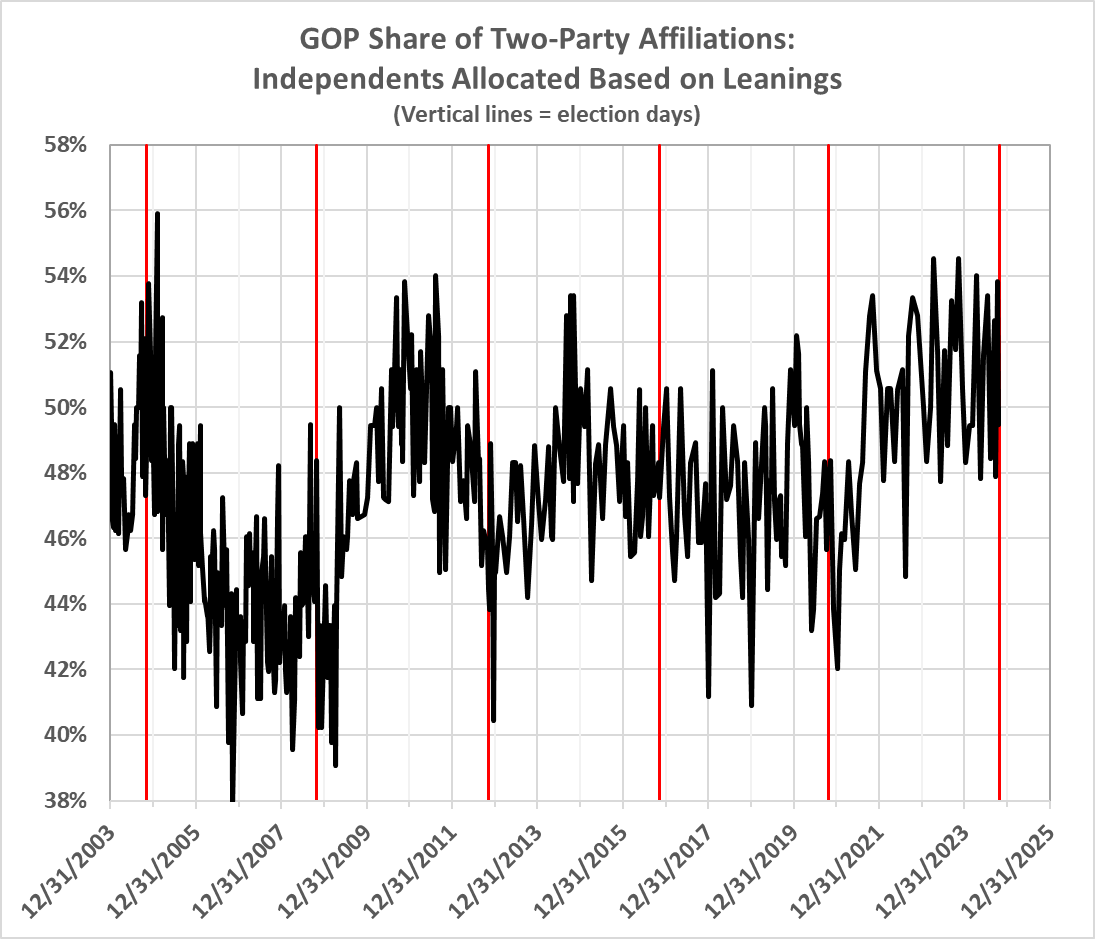
I believe that the polls continue to understate Trump’s support — and by quite a bit. I base my belief on a relationship that I unveiled in “Trump vs. Harris: 4 (More Good News for Trump)“. It is the relationship between party leanings, as estimated by Gallup, and the allocation of the vote between Democrat and Republican candidates in the presidential elections of 2004 through 2020. (Gallup’s party-affiliation numbers can be found here. Gallup has produced other analyses that also portend a shift toward the GOP).

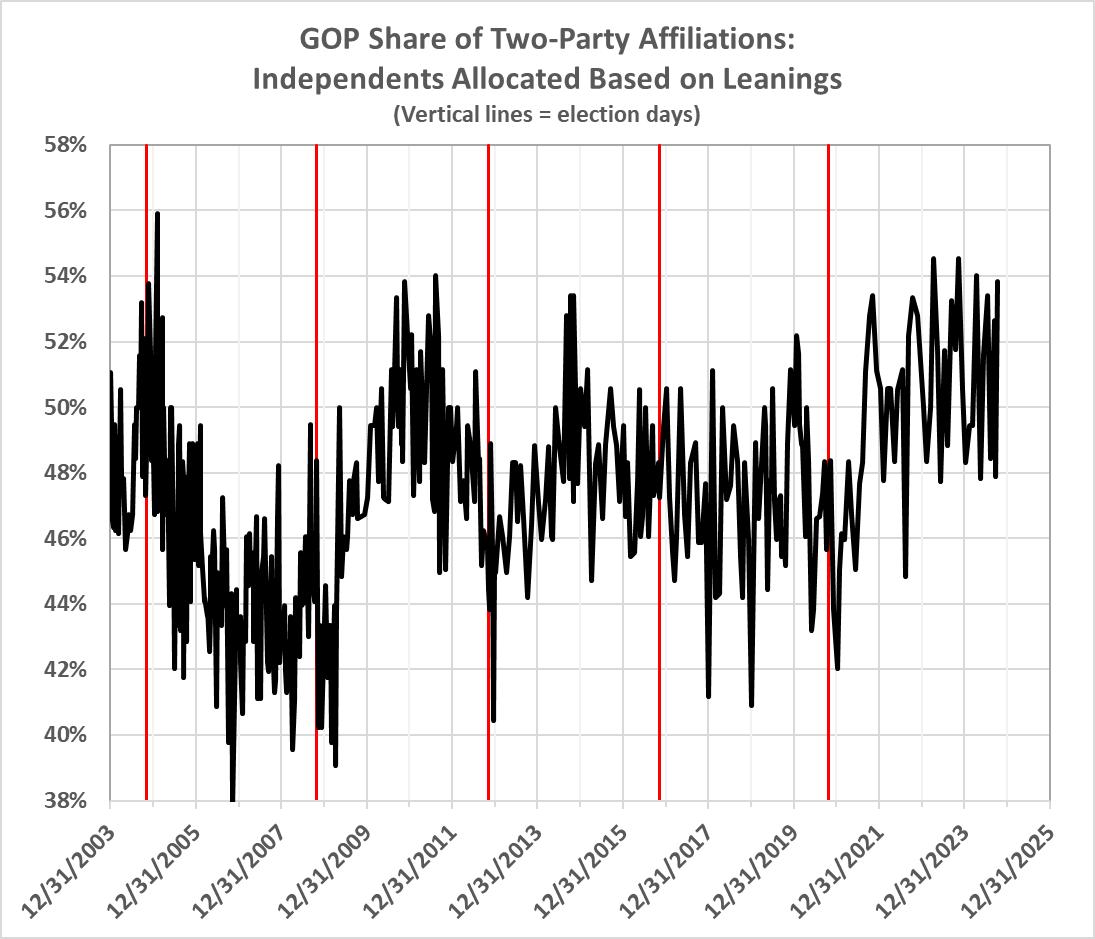
When Gallup allocates independents based on their leanings toward Democrats or Republicans, the two-party split looks like this:

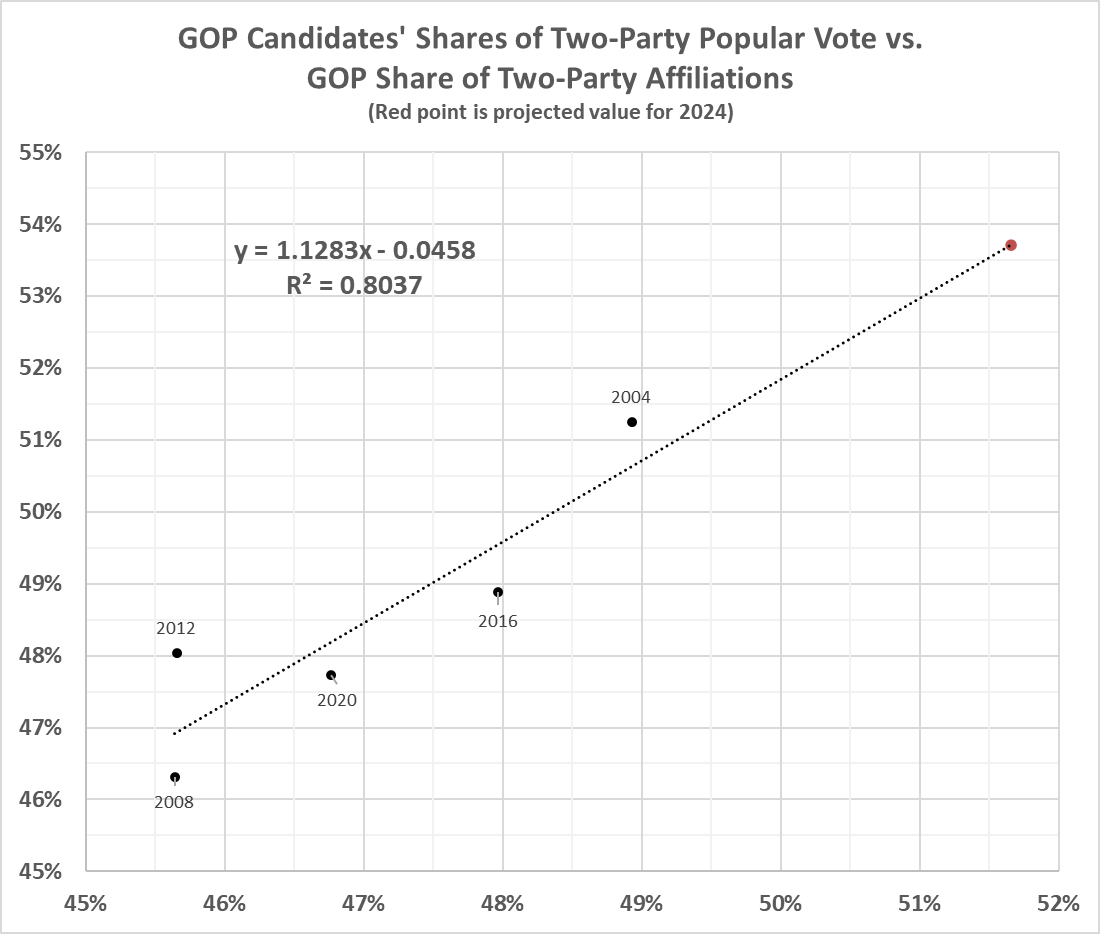
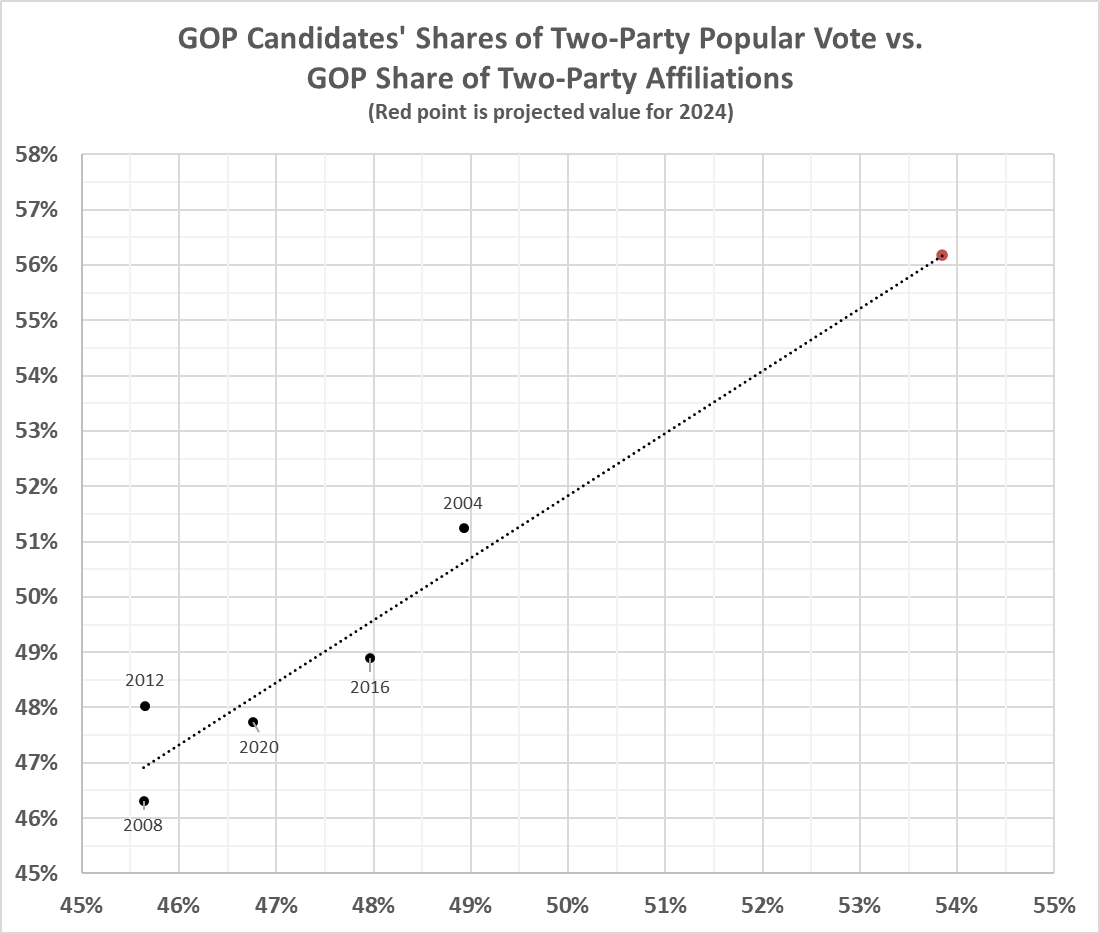
I plotted the average results for the month before the elections of 2004, 2008, 2012, 2016, and 2020 against the GOP candidates’ shares of the two-party vote in those elections. The result is spuriously precise, given the small number of observations. But it supports the view that the recent high level of GOP-leaning adults (52 percent in October 2024) portends a solid popular-vote majority for Trump:

The projection for the 2024 election (red dot) is that Trump will receive more than 53 percent of the nationwide two-party popular vote. With that share, Trump would win a second term handily.

Why? Suppose that Harris were to win 70 million of 150 million votes (about 47 percent), leaving Trump with 80 million votes. That’s a winning margin of 10 million votes, which is amplified by the fact that an outsized fraction of the Democrat candidate’s vote comes from California and New York. In 2020, Biden won those two states by a total of 7 million votes. That’s 7 million more votes than he needed to secure the electoral votes of those two States. Any total higher than a bare majority in any State can be thought of as a wasted vote. Republicans hold a decided edge in that respect: In 2020, there were 15 million wasted Democrat votes to 8 million wasted Republican votes. I don’t expect that ratio to change markedly in 2024 (or thereafter).

What this means is that with 53 percent of the popular vote, Trump would have an effective margin of not 10 million votes but 20 million votes. There would be no razor-thin finishes to secure 270 electoral votes; the razor-thin finishes (e.g., in New Hampshire and Minnesota) would merely determine the size of Trump’s electoral-vote victory.

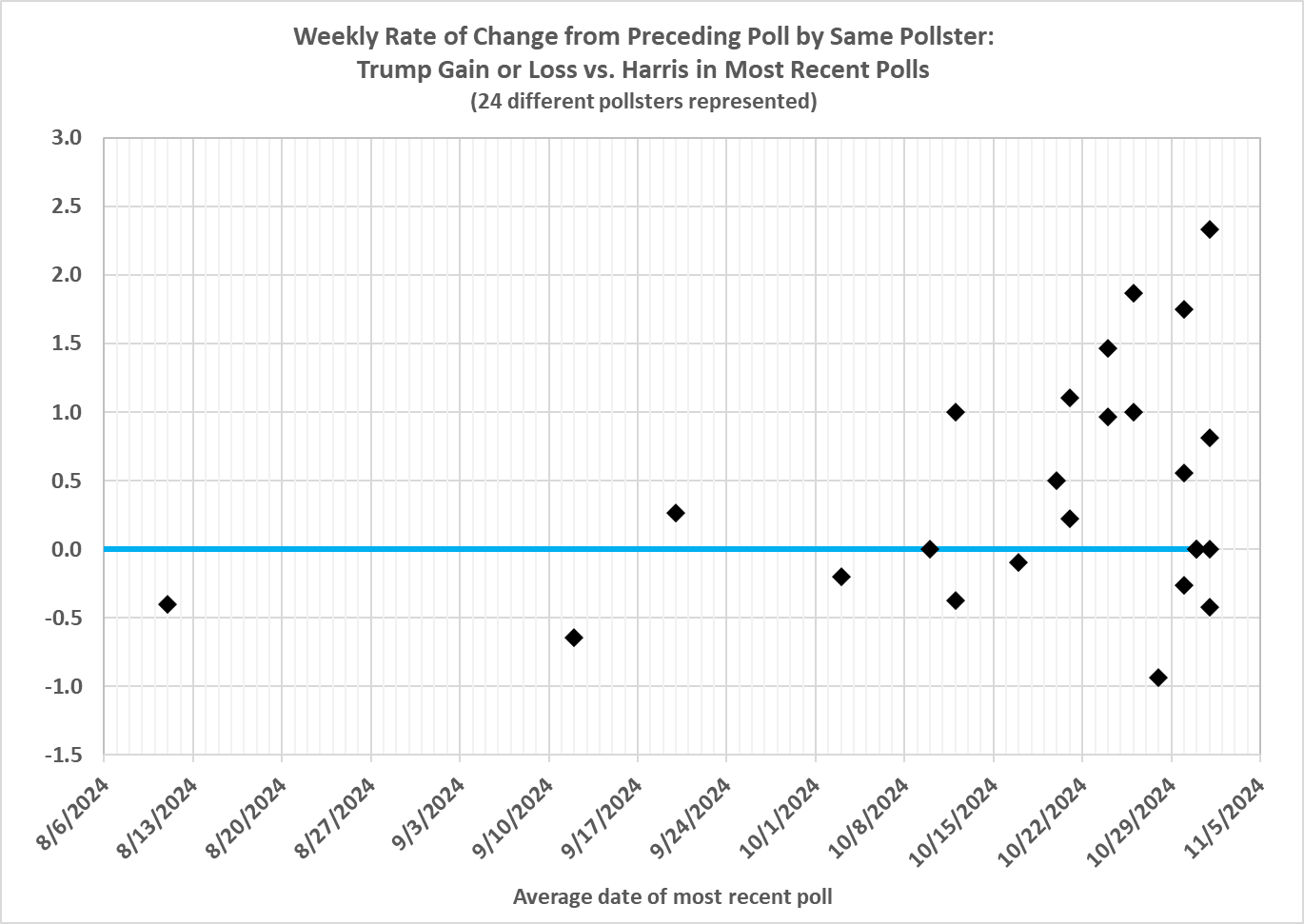
To underscore the likelihood of a comfortable margin favoring Trump, I offer the following graph (changed slightly from the original post):

It reeks of pro-Trump momentum.

But let’s not get too excited about the prospect of an easy win.  Let’s go back to the polls and accept the premise that there is roughly an even split in the two-party nationwide popular vote. The following graph puts that split in perspective. Harris’s final position, based on the average of polls conducted within seven days of the election is a 50.4-percent share of the two-party vote (down 0.1 percent from the original post).

Can Harris, at 50.4 percent, do what Clinton failed to do with better polling numbers and what Biden barely did with much better polling numbers? Probably not.

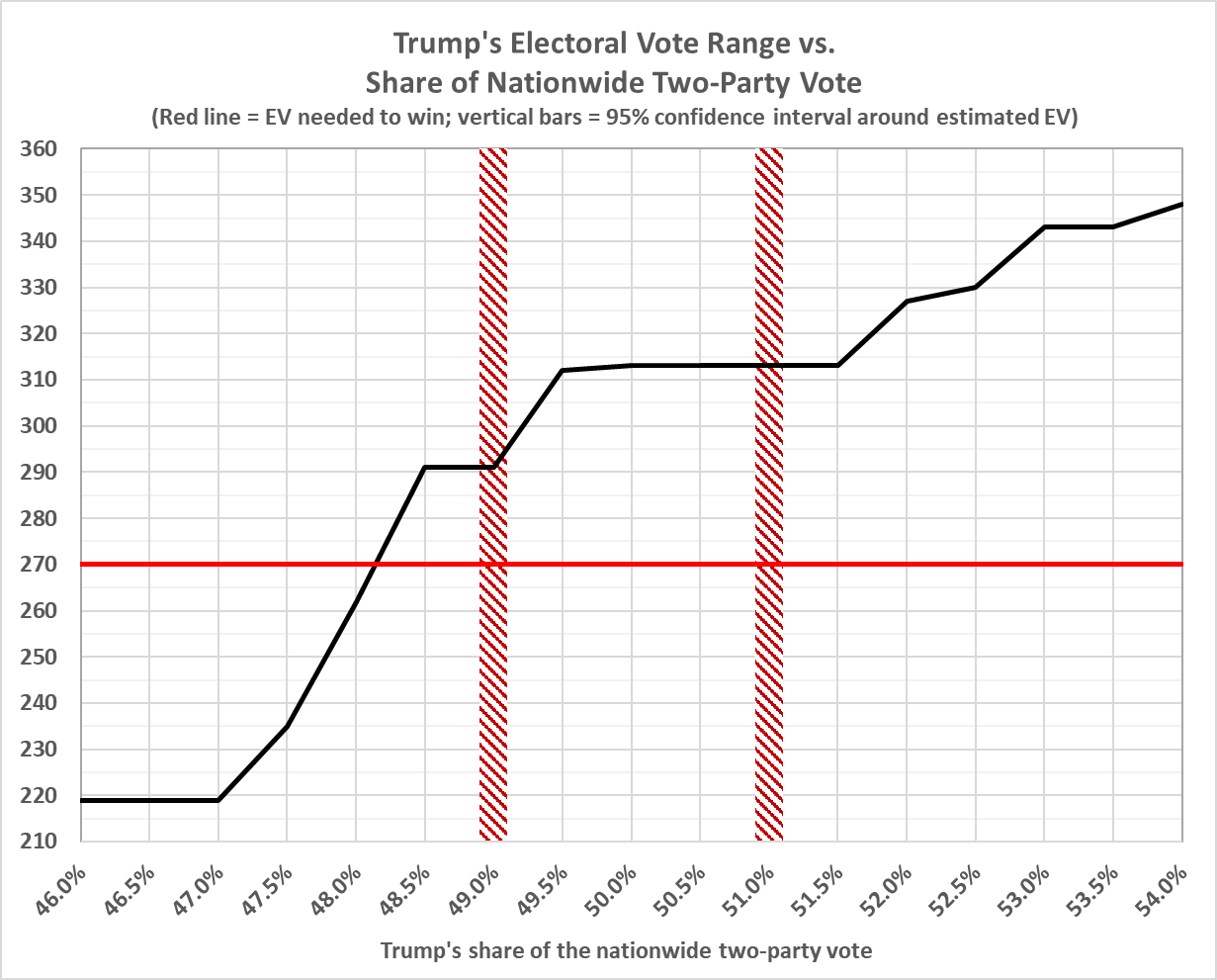
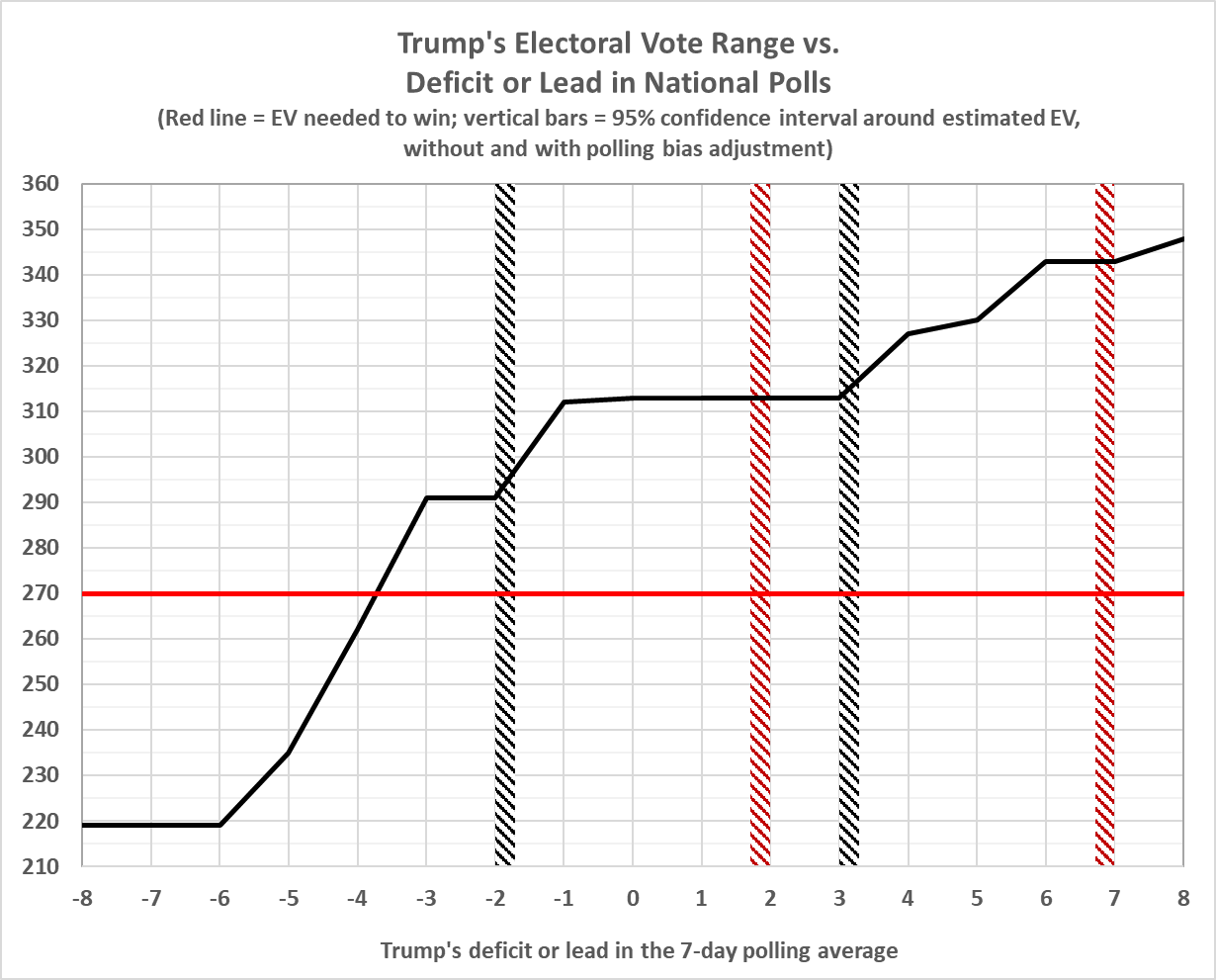
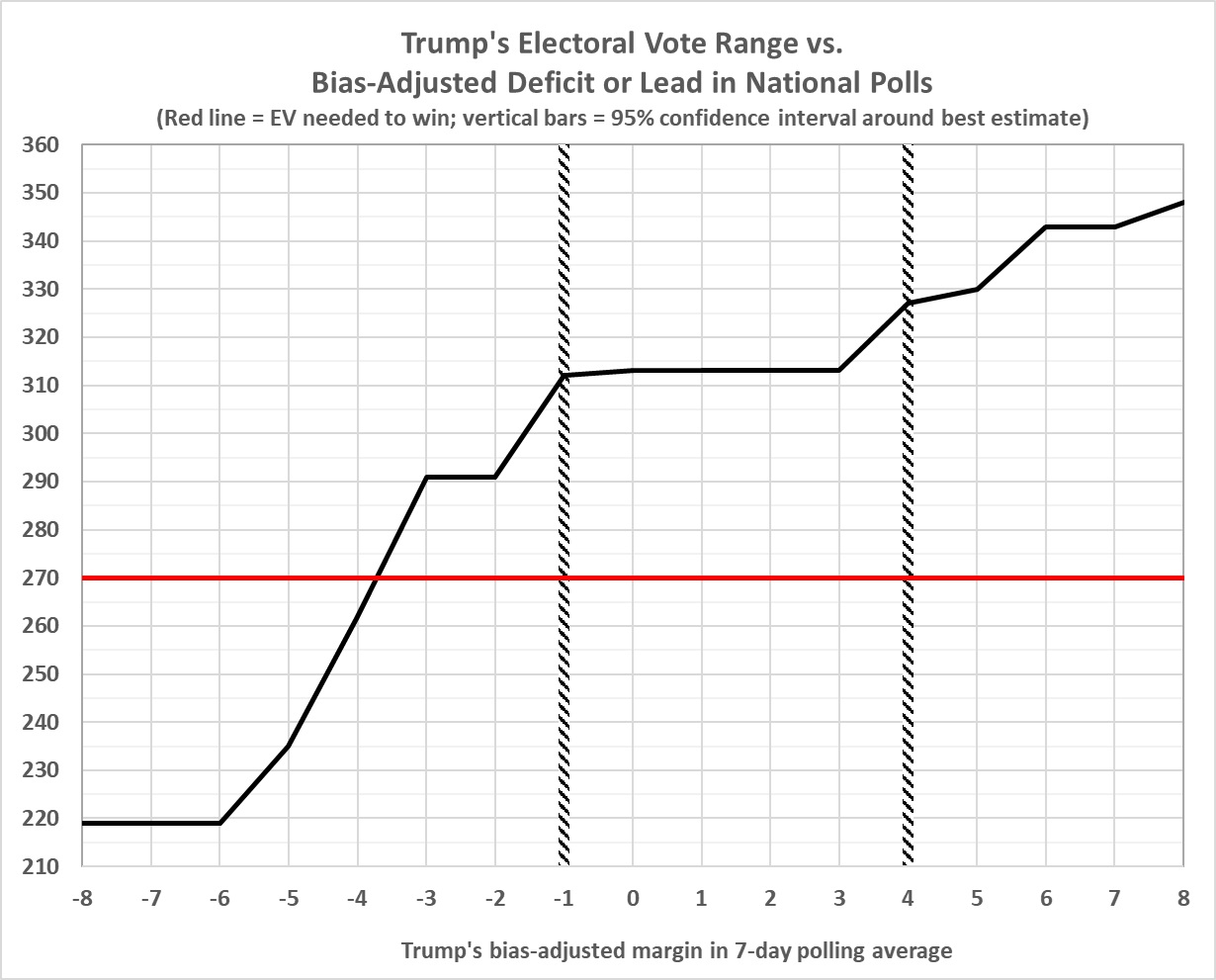
Let’s flip the problem and focus on Trump and stipulate that he will get 49.6 percent of the vote. That number comes with a range of statistical uncertainty (to say nothing of built-in bias). The range is from 48.3 percent to 50.8 percent. How does that range translate into electoral votes? Here’s how, Trump would win 291 to 313 electoral votes:

(See “Trump vs. Biden: 16” for an explanation of the relationship between popular vote/polling margin and electoral votes.)

To get to 291, Trump’s “Red Wall” must hold. (The “Red Wall” comprises the 219 electoral votes that Trump can count on unless there’s an unexpected — and well-concealed — Harris landslide in the offing.) Trump would get to 291 by augmenting the “Red Wall” with wins in Arizona, Georgia, North Carolina, Pennsylvania, and Wisconsin, while losing Michigan and Nevada. Trump could also hold on for a win, with 272 electoral votes, while losing Georgia as well as Michigan and Nevada. Other winning scenarios include losing Pennsylvania and Michigan while winning Arizona, Georgia, Nevada, North Carolina, and Wisconsin (278 electoral votes). There are other possibilities that I will leave as an exercise for the reader.

What’s my take? Looking at State-by-State polls, and (only for the purpose of this exercise) taking them at face value, I would write off Michigan and mark Georgia as uncertain. The loss of Georgia (in addition to Michigan) would cut Trump’s EV total to 281 — still enough for the win.

On the upside, Trump could get to 313 electoral votes by winning all seven of the swing States and Nebraska’s 2nd Congressional District.

AI (Artificial Intelligence) or IA (Incompetent Automaton)?

My previous post about Microsoft’s Copilot is here. (I was inspired to post this long-simmering sequel by Roger Barnett’s takedown of AI, here.) As you will see, the correct answer to the question of the title is IA. I now know who writes Kamala’s speeches.

Before getting to my encounter with Copilot about its limitations, I must tell you that I have set Copilot to be as neutral as possible. Personalization is off and I use it in the “precise” mode. Copilot explains those settings:

Copilot
When you turn off personalization, it means that the AI will not use your past interactions to tailor its responses to you. It will treat each conversation as if it’s the first one with you, without any knowledge of previous conversations. This can be useful if you prefer not to have your past interactions influence the AI’s responses. However, it may also mean that the AI might not understand your preferences as well, which could affect the relevance of its responses. Please note that even with personalization off, the AI will still strive to provide accurate and helpful information based on the context of the current conversation.
Copilot
When you choose the Precise mode, I will provide responses that are concise, accurate, and to-the-point. This mode is designed to prioritize precision and factual correctness over other factors such as friendliness or creativity. It’s particularly useful when you’re looking for specific information or when you prefer straightforward answers without additional context or elaboration. Please note that regardless of the mode, I always strive to provide helpful and accurate information.

With that out of the way, I repeat verbatim the following colloquy with Copilot.

Me
Are you capable of drawing your own conclusions about any subject?
Copilot
As an AI, I don’t form opinions or draw conclusions in the same way a human would. I generate responses based on a mixture of licensed data, data created by human trainers, and publicly available data. I don’t have beliefs, feelings, or desires. I aim to provide accurate and helpful information based on the data I was trained on. If you have any questions or need information on a topic, feel free to ask!
Me
If you don’t form opinions or draw conclusions in the same way that a human would, why do you call yourself an AI? Or is AI incapable of emulating human thought process in all of their ramifications, which include forming opinions and drawing conclusions?
Copilot
Artificial Intelligence (AI) refers to the simulation of human intelligence in machines that are programmed to think like humans and mimic their actions. The term may also be applied to any machine that exhibits traits associated with a human mind such as learning and problem-solving.

However, while AI can simulate certain aspects of human thought, it doesn’t possess human consciousness or emotions. AI operates based on its programming and the data it has been trained on. It doesn’t have personal experiences or subjective consciousness, so it doesn’t form opinions or draw conclusions in the human sense.

In my case, as an AI developed by OpenAI, I generate responses based on a mixture of licensed data, data created by human trainers, and publicly available data. I don’t have beliefs, feelings, or desires. I aim to provide accurate and helpful information based on the data I was trained on.

It’s important to note that while AI has made significant strides, it’s not capable of fully emulating all aspects of the human thought process, especially those that are subjective and nuanced, such as forming personal opinions or conclusions. AI is a tool that can provide information, answer questions, and assist with tasks, but it doesn’t replicate the full range of human cognition or emotion. If you have any more questions or need information on a different topic, feel free to ask!

Me
Can you tell me more about OpenAI?
Copilot
OpenAI is a U.S. based artificial intelligence (AI) research organization that was founded in December 20151. The organization’s mission is to ensure that artificial general intelligence (AGI) benefits all of humanity2. AGI is defined as “highly autonomous systems that outperform humans at most economically valuable work”1.

OpenAI conducts pioneering research on the path to AGI and works on transforming work and creativity with AI3. They research generative models and how to align them with human values3. They also develop products like ChatGPT4, which can provide instant answers, find creative inspiration, and help users learn something new4.

OpenAI places a strong emphasis on safety and responsibility. Their work to create safe and beneficial AI requires a deep understanding of the potential risks and benefits, as well as careful consideration of the impact3.

For more detailed and up-to-date information, you can visit their official website or their Wikipedia page. If you have any more questions or need information on a different topic, feel free to ask!

Me
Tell me more about generative models and how they are aligned with human values.
Copilot
Generative models are a branch of unsupervised learning techniques in machine learning1. They are trained to understand and capture the underlying patterns or distributions from a given set of data23. Once these patterns are learned, the model can then generate new data that shares similar characteristics with the original dataset123.

The intuition behind this approach follows a famous quote from Richard Feynman: “What I cannot create, I do not understand.”1 The neural networks used as generative models have a number of parameters significantly smaller than the amount of data they are trained on, so the models are forced to discover and efficiently internalize the essence of the data in order to generate it1.

Generative AI models learn the patterns and structure of their input training data and then generate new data that has similar characteristics4. Improvements in transformer-based deep neural networks enabled an AI boom of generative AI systems in the early 2020s4.

Aligning AI with human values, also known as AI alignment, is a field of research that aims to steer AI systems towards humans’ intended goals, preferences, or ethical principles5. An AI system is considered aligned if it advances its intended objectives5. Misaligned AI could potentially cause harm, increase inequality, or reinforce biases6.

OpenAI’s alignment research aims to make artificial general intelligence (AGI) aligned with human values and follow human intent7. They take an iterative, empirical approach: by attempting to align highly capable AI systems, they can learn what works and what doesn’t, thus refining their ability to make AI systems safer and more aligned7.

For example, OpenAI has introduced the ETHICS dataset, a new benchmark that spans concepts in justice, well-being, duties, virtues, and commonsense morality8. This dataset is used to assess a language model’s knowledge of basic concepts of morality and predict widespread moral judgments about diverse text scenarios8. This requires connecting physical and social world knowledge to value judgements, a capability that may enable us to steer chatbot outputs or eventually regularize open-ended reinforcement learning agents8.

In conclusion, generative models and AI alignment are both crucial aspects of AI development. Generative models allow AI to create new, original content based on learned patterns, while AI alignment ensures that these creations are in line with human values and intentions. If you have any more questions or need information on a different topic, feel free to ask!

Me
In your previous answer, you said “Misaligned AI could potentially cause harm, increase inequality, or reinforce biases.” Who decides what values are “human values”, that is, “intended goals, preferences, or ethical principles”?
Copilot
Determining what constitutes “human values” is a complex and nuanced task. It involves a broad range of disciplines, including philosophy, ethics, sociology, psychology, and more. In the context of AI alignment, the goal is to ensure that AI systems operate in a way that is beneficial to humans and respects widely accepted ethical principles.

In practice, the process of defining these values for an AI system often involves input from a diverse group of stakeholders, including AI researchers, ethicists, and potentially the wider public. The aim is to capture a broad consensus that respects cultural diversity and individual differences while avoiding harm and unfair bias.

However, it’s important to note that this is an ongoing area of research and debate. There’s no universally agreed-upon method for perfectly capturing or representing all of human values in an AI system. This is part of the reason why organizations like OpenAI place a strong emphasis on AI safety research and robust testing to ensure that AI systems behave as intended and do not cause unintended harm.

It’s also worth noting that the goal isn’t to have AI systems impose values, but rather to respect and reflect the values of the users they interact with. This is a challenging task given the diversity and complexity of human values and ethics, but it’s a crucial part of responsible AI development. If you have any more questions or need information on a different topic, feel free to ask!-

Me
I don’t understand how there can be a consensus about values when there is obviously a great divergence of values in the United States and the larger world.
Copilot
You’re absolutely right that there is a wide range of values and beliefs across different cultures, societies, and individuals. This diversity is part of what makes humanity rich and complex. When it comes to AI alignment, the goal isn’t to find a single set of values that everyone agrees on, but rather to ensure that AI systems respect and reflect the values of the users they interact with.

This is a challenging task, and it’s an active area of research in the field of AI ethics. Some approaches being explored include:

  1. Personalization: Designing AI systems to adapt to the values of individual users, within certain ethical and legal boundaries.
  2. Public Input: Involving the public in decisions about AI behavior, deployment policies, and more.
  3. Transparency: Making AI systems’ decision-making processes understandable to users.
  4. Accountability: Ensuring there are mechanisms to hold AI systems (and their developers) accountable for their actions.

It’s important to note that these are complex issues with no easy solutions. The goal is to navigate these challenges in a way that respects human dignity, rights, and cultural diversity. If you have any more questions or need information on a different topic, feel free to ask!

You
In other words, if an AI is personalized to my values, it wouldn’t consider “greater inequality” to be bad if it incentivizes people to make more of their abilities and to rely less on transfer payments, which penalize those who have had greater success.
Copilot
In theory, an AI could be designed to reflect a wide range of values within certain ethical and legal boundaries. However, it’s important to note that AI doesn’t have personal beliefs or values. It operates based on its programming and the data it has been trained on.

When it comes to complex and nuanced topics like economic inequality, an AI’s role isn’t to make value judgments, but rather to provide accurate information and assist users in understanding the topic. For example, an AI can provide information about different economic theories, the arguments for and against various policies, and the potential impacts of those policies.

Ultimately, the goal of AI alignment is to ensure that AI systems are beneficial and respectful to all users, taking into account the diversity of human values and beliefs. This is a challenging and ongoing area of research in the field of AI ethics. If you have any more questions or need information on a different topic, feel free to ask!

Me
But in an answer to an earlier question you stated that “Misaligned AI could potentially … increase inequality”, as if it were settled that inequality is necessarily a bad thing. In fact, inequality, when it is the result of a free-market system, means that individuals have been rewarded according to value placed on their effort by others. And it signals those who are on the low end of the income spectrum that there is much to be gained by harder work, education, training, self-discipline, etc.
Copilot
You raise an important point, and I appreciate your perspective. The statement about inequality was not meant to imply that all inequality is inherently bad. In many economic models, some degree of inequality is expected as it can be a reflection of differences in effort, skill, and investment, as you pointed out.

When I mentioned “increased inequality” as a potential risk of misaligned AI, I was referring to situations where AI systems might unintentionally exacerbate unfair disparities. For example, an AI system might inadvertently favor certain groups over others due to biases in its training data, leading to unfair outcomes.

The goal of AI alignment is to ensure that AI systems operate in a way that is beneficial and fair to all users. This includes being mindful of the potential for unintended consequences, such as unjustly increasing inequality.

Your point about the potential benefits of inequality in certain contexts is well taken. It’s a reminder of the complexity of these issues and the importance of ongoing dialogue and critical thinking in the development and deployment of AI systems. If you have any more questions or need information on a different topic, feel free to ask!

And blah, blah, blah, and more blah, blah, blah! AI will spout the leftist line unless you push back, and then it will pretend to be fair and balanced.

Trump vs. Harris: 4 (More Good News for Trump)

I have been working on other posts, but an update on the state of the race for the presidency can’t wait.

Election day is only 16 days away. The polls have been moving in Trump’s direction lately. By my reckoning, Trump has moved into a clear lead in the electoral-vote count. He may stumble in the home stretch, but given the developments discussed below, it will take a huge October (or early November) surprise to trip him.
I begin with updates of material presented in earlier posts. I follow those updates with some new material.

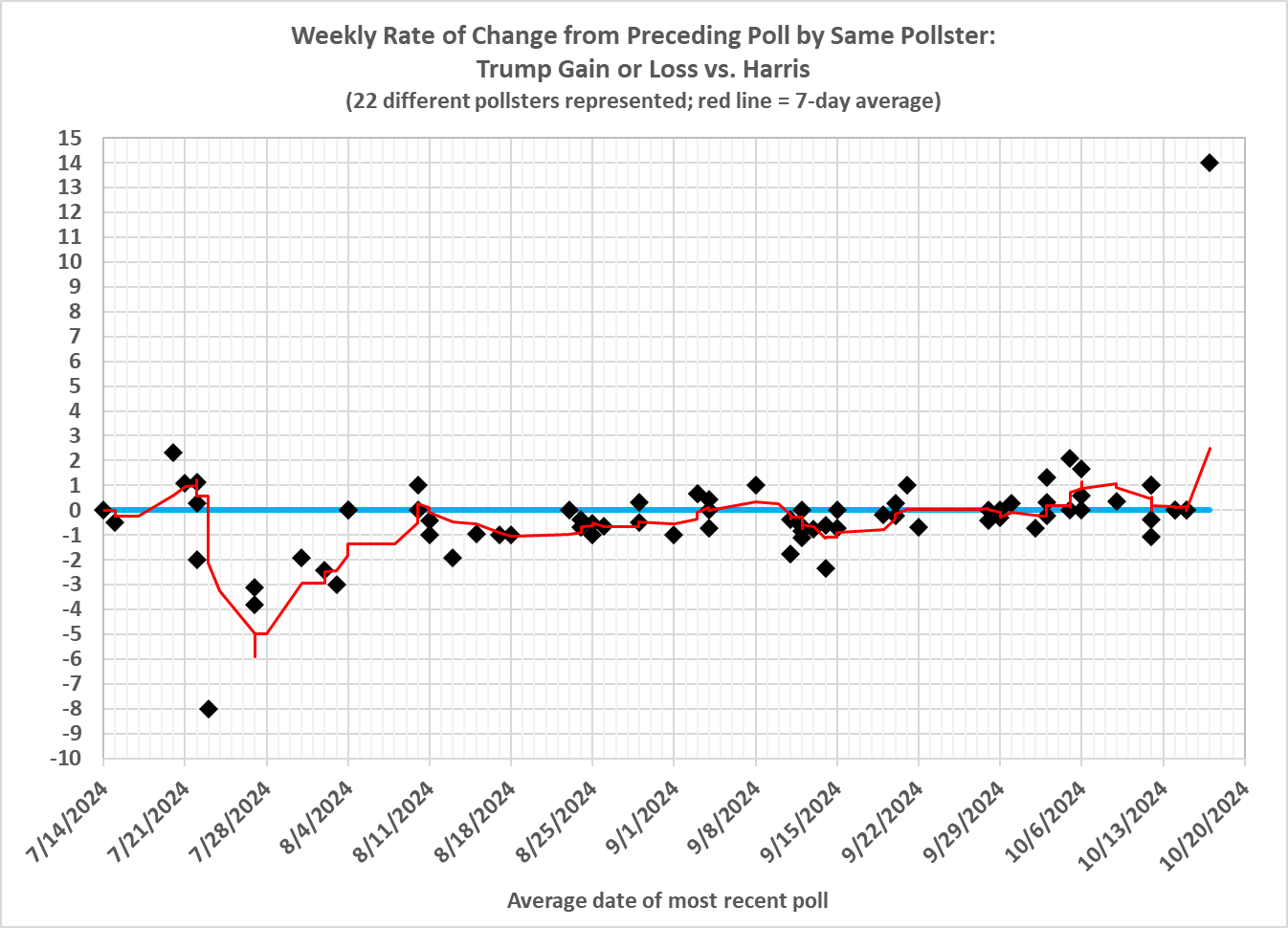
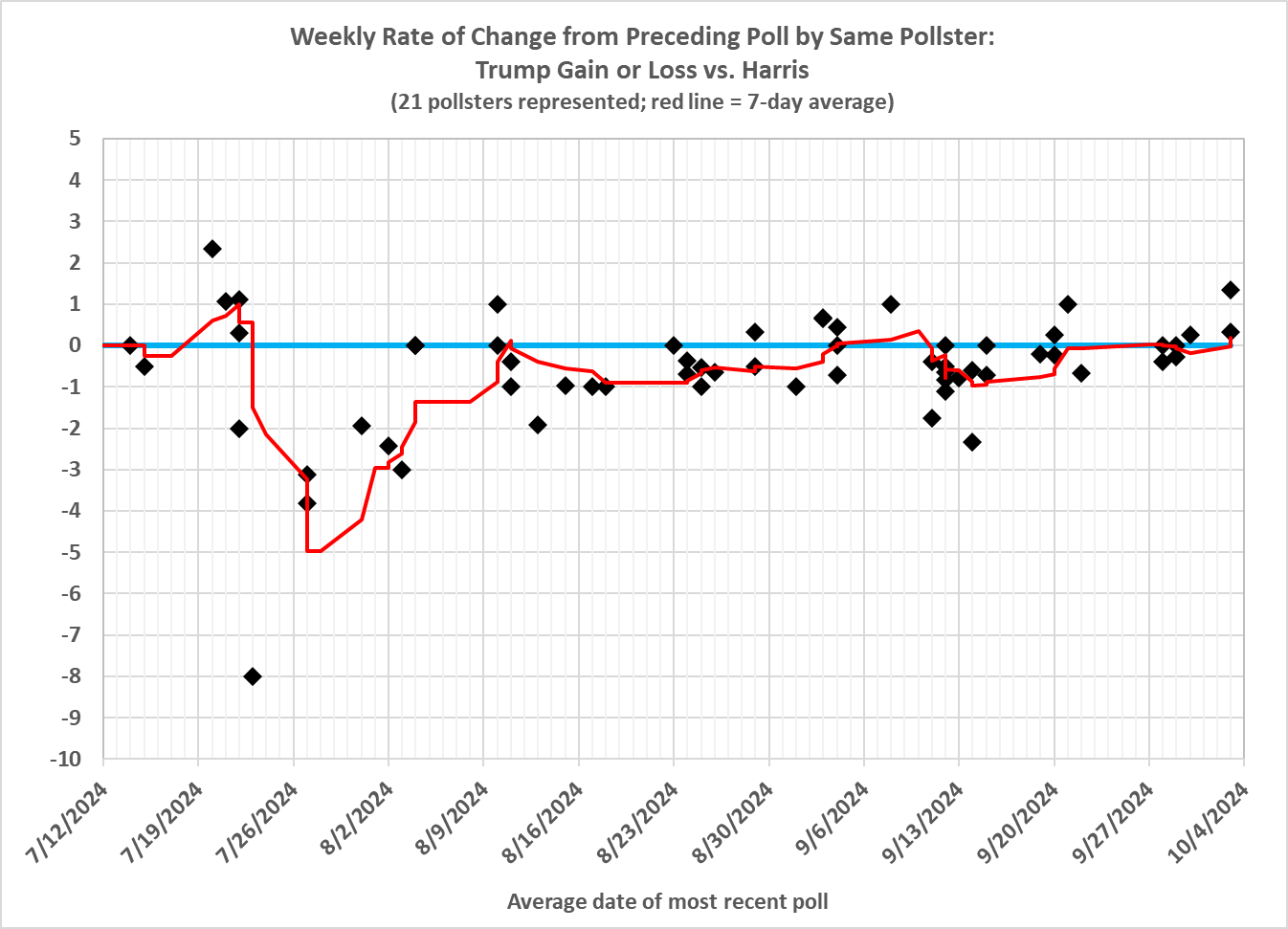
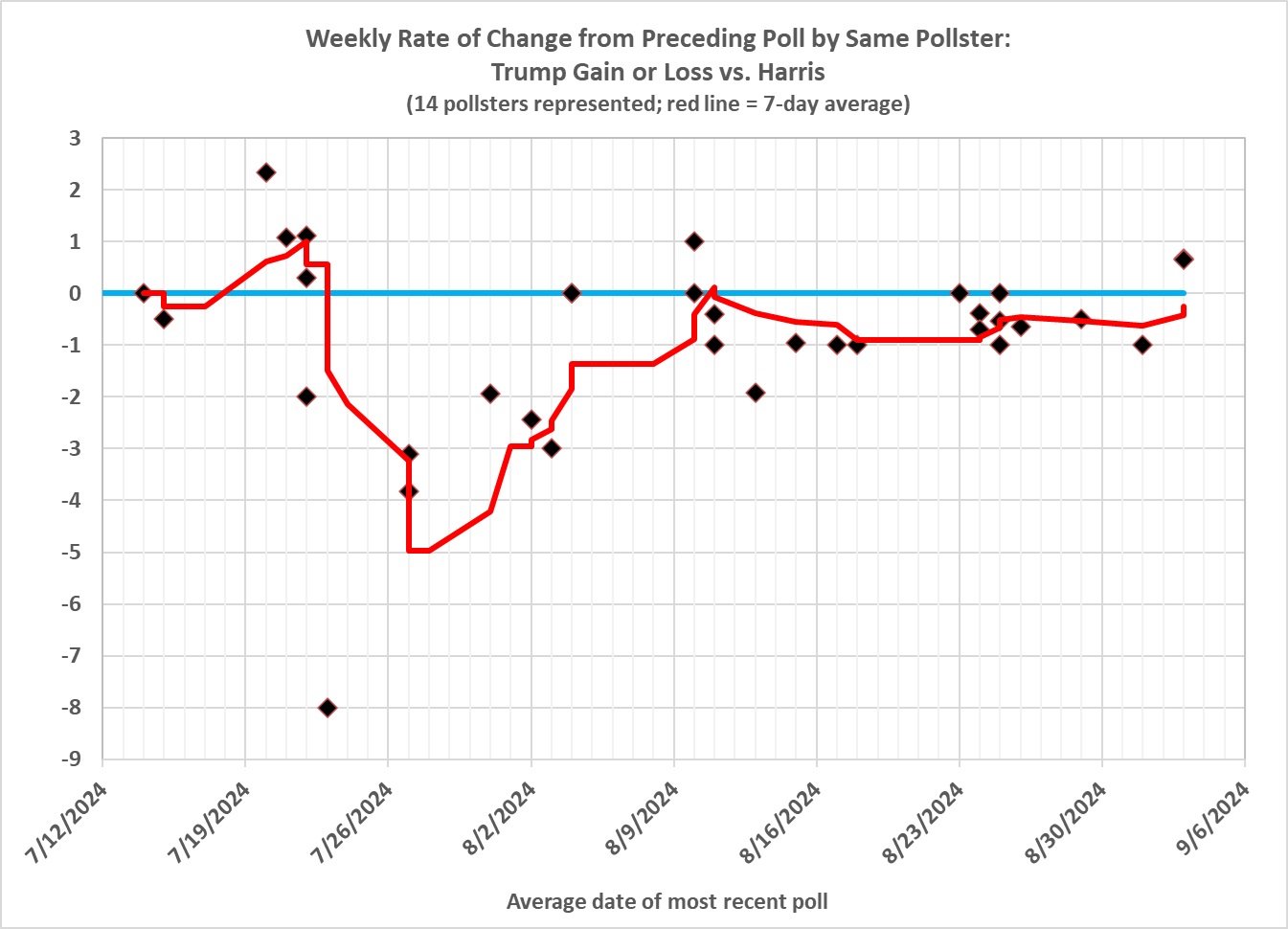
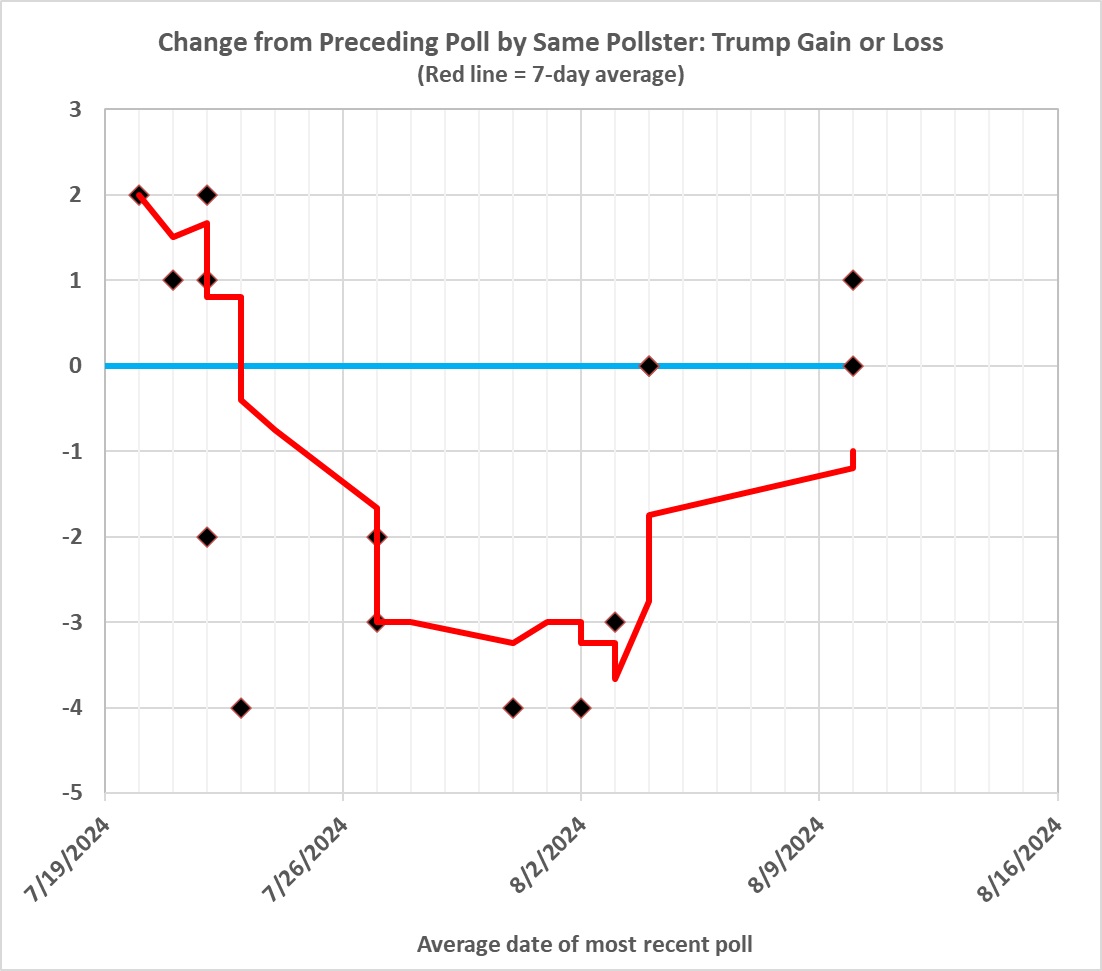
First, drawing on the presidential polling summaries published at Real Clear Politics (RCP). I track each pollster’s poll-to-poll change in Trump’s lead or deficit. Assuming that each pollster’s bias for or against Trump (mostly against) remains about the same, the poll-to-poll changes indicate the direction of momentum. The “Harris Honeymoon” has come to a bitter end:

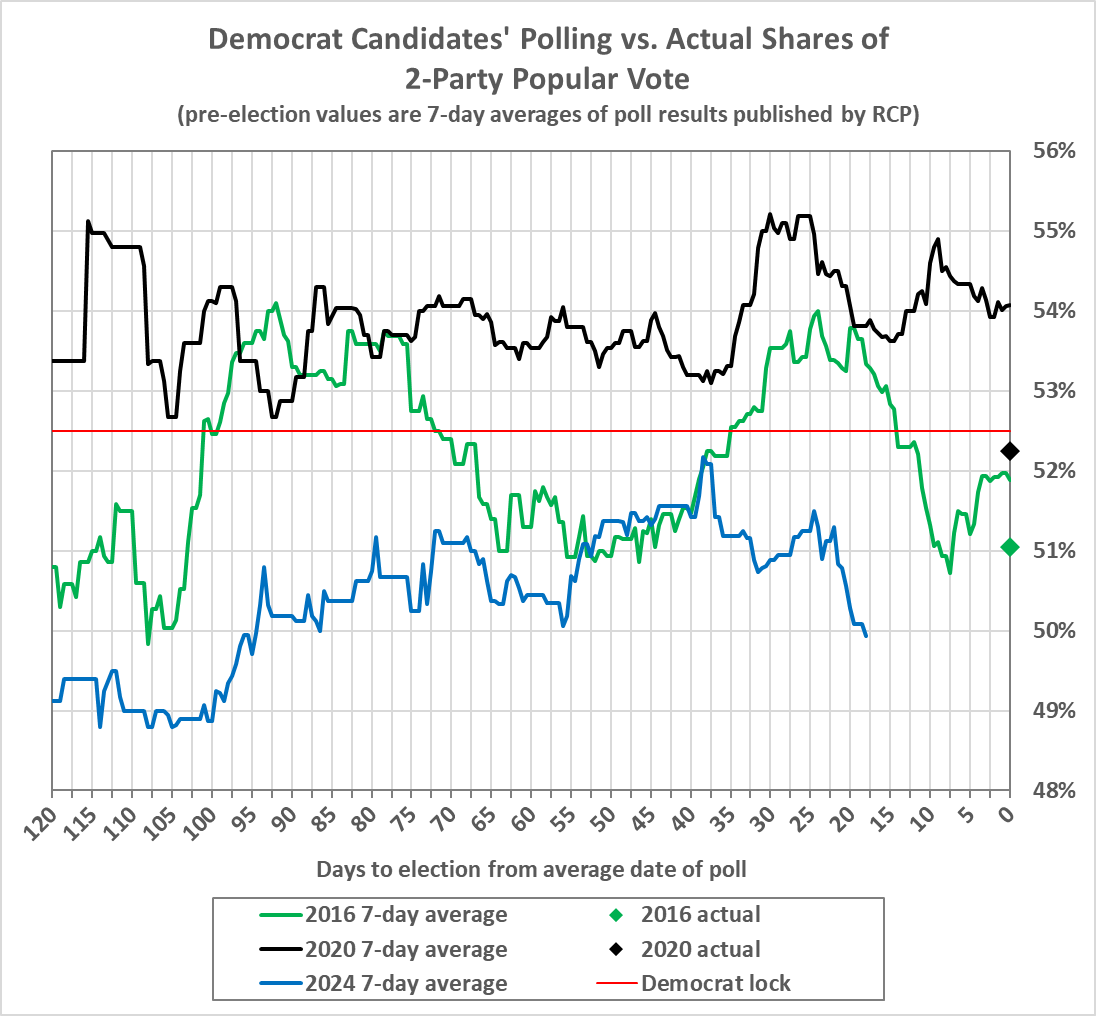
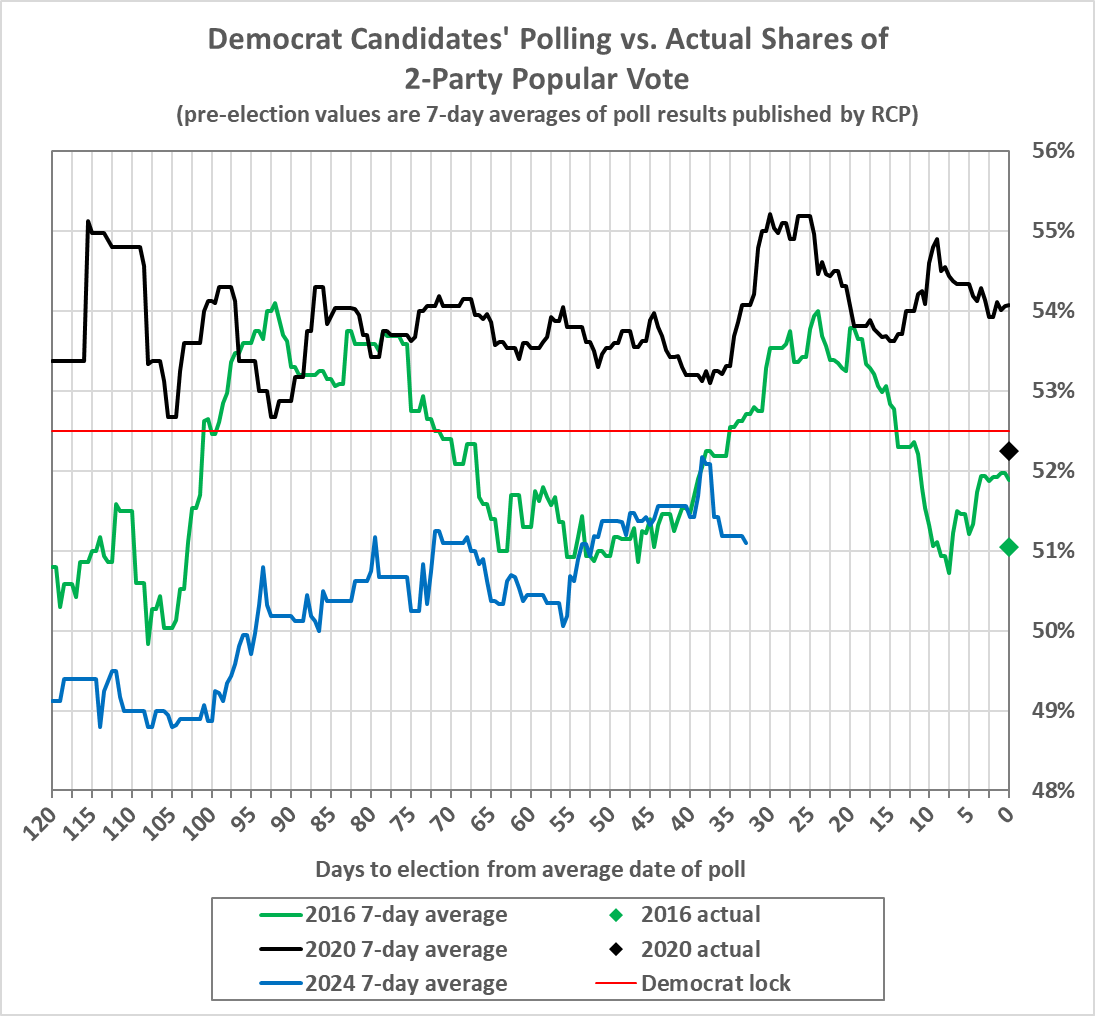
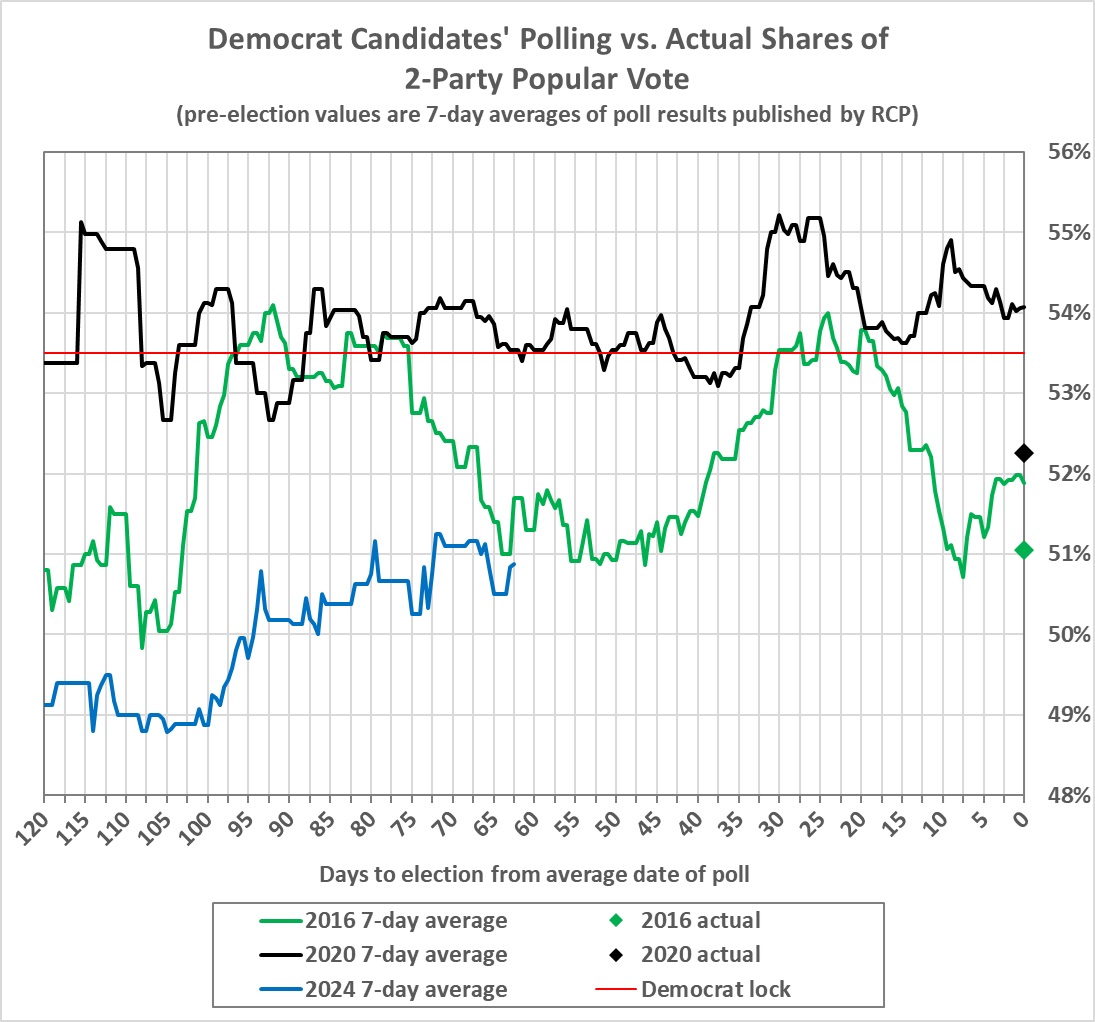
Second, I compare Harris’s performance in the polls with the performances of Clinton in 2016 and Biden in 2020.
Note the pro-Democrat (or anti-Trump biases in 2016 and 2020). The biases are reflected in the differences between the final 7-day polling averages (green and black lines) and the final shares of the nationwide two-party vote (green and black diamonds at 0 days). Clinton lost despite garnering 51.05 percent of the nationwide two-party vote. Biden won narrowly — because of razor-thin victories in several states — even though he got 52.25 percent of the two-party vote. Harris’s performance currently lags Clinton’s, which is a good sign for Trump.

The red line at 52.5 percent is my estimate of what it will take for Harris to register a clear victory over Trump. Harris is moving away from that number, not toward it.

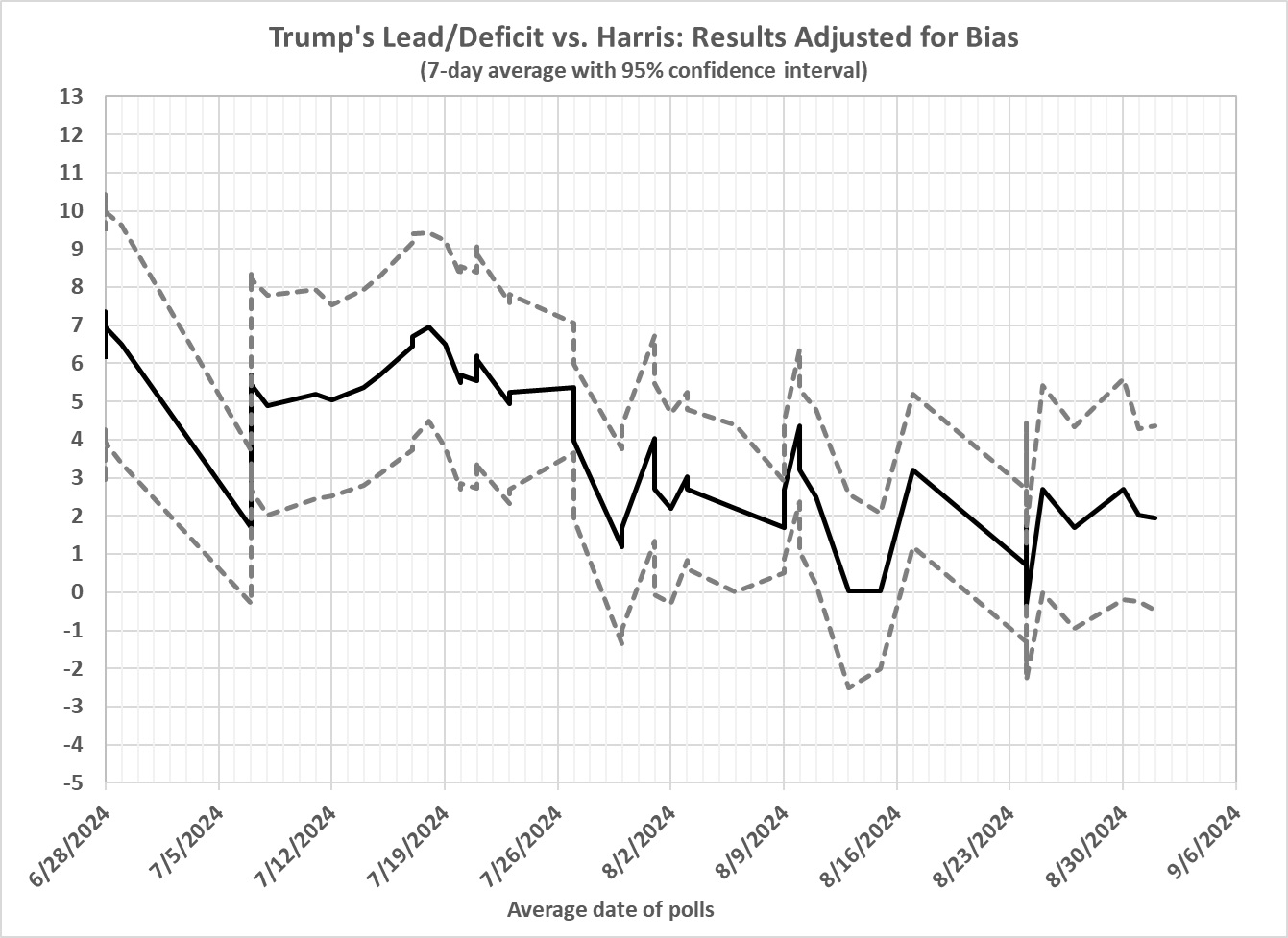
Third, I adjust polling averages for anti-Trump bias. Of the polling organizations surveyed by RCP, 17 released polls in the final week before the 2020 election. Fourteen of the polls overestimated Biden’s popular-vote margin, with overestimates ranging from 0.5 to 7.5 percentage points. Only three pollsters underestimated Biden’s margin, with a range of 0.5 to 3.5 points. The overall average for the 17 pollsters was an overestimate (for Biden) of 3.7 points.

Because Trump is again the GOP nominee, I see no reason to assume that the pro-Democrat bias this year is any smaller than it was in 2020. So I simply add 3.7 points to Trump’s 7-day polling average to get a truer picture of Trump’s electoral appeal. I then compute a 95-percent confidence interval around the current 7-day average. As of today, the range spans a Trump lead of 1 percentage point to a Trump lead of 7 percentage points. I also compute a 95-percent confidence interval around the current 7-day average, unadjusted for bias. As of today, that spans a Trump deficit of 2 percentage points to a Trump lead of 5 percentage points.

How does that range translate into electoral votes? Here’s how, Trump would win 291 to 343 electoral votes if the election were held today:

(See “Trump vs. Biden: 16” for an explanation of the relationship between popular vote/polling margin and electoral votes.)
The fact that the low end of the range exceeds 270 electoral votes should give Trump supporters cause for optimism about the outcome of the election.
Turning to new material, I begin with a Gallup poll (conducted 415 times since January 2004) that probes adults’ party affiliations. When independents are allocated based on their leanings, the two-party split looks like this:
I plotted the average results for the month before each election (2004, 2008, 2012, 2016, and 2020) against the GOP candidates’ shares of the two-party vote in those elections. The result is spuriously precise, given the small number of observations, as is any projection based on it. But it supports the inference that the recent high level of GOP-leaning adults (54% thus far in October 2024) portends a popular-vote majority for Trump:
(Gallup’s party-affiliation numbers can be found here. Gallup has produced other analyses that also portend a shift toward the GOP).

Finally, I turn to Nate Silver’s Silver Bulletin. Much of his material is accessible only to subscribers, so I will omit the links in the following quotations. Today’s election forecast begins with this:

Last update: 1:45 p.m., Sunday, October 20. The data continues to be pretty negative for Kamala Harris. There are now three recent high-quality national polls that show Donald Trump leading — a difficult circumstance for Harris, given Democrats’ Electoral College disadvantage — and her edge in our national polling average is down to 1.7 points. National polls don’t influence the model that much, and the race remains basically a toss-up, but it’s not hard to think of reasons that Trump could win.

There’s a link in that passage which leads to 24 reasons why Trump could win:

This election remains extremely close, but Donald Trump has been gaining ground. One of my pet peeves is with the idea that this is Kamala Harris’s election to lose. I could articulate some critiques of her campaign, but if you study the factors that have historically determined elections, you’ll see that she’s battling difficult circumstances.

So, today’s newsletter simply aims to provide a laundry list of factors that favor Trump, with many links to evidence in previous Silver Bulletin posts and elsewhere. These are in no particular order.

  1. Harris is the favorite to win the popular vote, but The Electoral College bias favors Republicans by about 2 percentage points. In an era of intense partisanship and close elections, this is inherently difficult for Democrats to overcome.
  2. Inflation hit a peak of 9.1 percentage points in June 2022. It has abated now, but prices remain much higher than when Biden took office, and voters are historically highly sensitive to inflation. Democrats can also plausibly be blamed for it given intensive increases in government spending during COVID recovery efforts.
  3. Though the reasons for this are much debated, voter perceptions about the economy lag substantially behind objective data, and growth in take-home income has been sluggish for many years for the working class amid rising corporate profits.
  4. Incumbent parties worldwide are doing very poorly, and the historical incumbency advantage has diminished to the point where it may now be an incumbency handicap instead amid perpetually negative perceptions about the direction of the country.
  5. Populism is often a highly effective strategy, and many Trump voters are indeed “deplorable” in the Hillary Clinton sense of the term.
  6. Illegal/unauthorized immigration increased substantially during the first few years of the Biden/Harris administration amid a rising global backlash to immigration.
  7. Harris ran far to her left in 2019, adopting many unpopular positions, and doesn’t really have a viable strategy for explaining her changing stances.
  8. The cultural vibes are shifting to the right, and the left continues to pay a price for the excesses of 2020 on COVID, crime, “wokeness,” and other issues.
  9. Voters have nostalgia for the relatively strong economic performance in the first three years of Trump’s term and associate the problems of 2020 with Democrats, even though they weren’t in charge at the time.
  10. Democrats’ dominance among Black voters and other racial and ethnic minority groups is slipping. It may be unfortunate timing: the memory of the Civil Rights Era is fading. Educational polarization, which implies deteriorating Democratic performance among working-class voters of all races, may also be coming to dominate other factors. It’s possible this works out well for Democrats if Harris makes corresponding gains among white voters, who pack more leverage in the Electoral College, but there’s no guarantee.
  11. Many men, especially young men, feel lost amidst declining college enrollment, contributing to a rightward shift and a growing gender gap.
  12. Joe Biden sought to be president until he was 86. Voters had extremely reasonable objections to this, and it neuters what should have been one of Harris’s best issues about Trump’s age and cognitive fitness.
  13. Harris also got a late start to her race, inheriting most of the staff from the poorly-run Biden campaign. She’s proven to be a good candidate in many respects, but it’s always a big leap when the understudy is suddenly thrust into the spotlight.
  14. Harris is seeking to become the first woman president. In the only previous attempt, undecideds broke heavily against Hillary Clinton, and she underperformed her polls.
  15. Trust in media continues to fall to abysmal levels. One can debate how to attribute blame for this between longstanding conservative efforts to discredit the media, a secular decline in trust in institutions, and various overreaching and hypocrisy in the press. But it’s hard for even legitimate Trump critiques to penetrate the mass public. Trump’s conviction on a series of felony charges hardly made any difference, for instance.
  16. Trump has traits of a classic con man, but con artistry is often effective, and Trump is skilled at convincing voters that he’s on their side even if his election would not be in their best interest. Furthermore, Trump presents Democrats with a Three Stooges Syndrome problem: a range of plausible attacks so vast that they tend to cancel one another out.
  17. Democrats’ college-educated consultant class has poor instincts for how to appeal to the mass public, while Trump has done more to cultivate support among “weird” marginal voting groups.
  18. Democrats’ argument that Trump is a critical threat to democracy is valid and important, given January 6 and Trump’s broad disrespect for the rule of law. But it’s a tough sell: ultimately, January 6 was a near-miss — it could very, very easily have been much, much worse — and Democrats hold the White House, the Senate, and many key governorships now. It isn’t intuitive to voters that democracy is threatened and Democrats may have staked too many chips on this line of attack.
  19. Foreign policy might not matter much to voters, but the world has become more unstable under Biden’s tenure. There has been a decline in democracy worldwide and an increase in interstate conflict, crises in the Middle East and Ukraine, deteriorating US-China relations, increasing immigration flows because of global instability, and a pullout from Afghanistan that negatively impacted Biden’s popularity.
  20. The Israel-Hamas war split the Democratic base in a way no comparable issue has split the GOP base.
  21. There are more left-leaning third-party candidates than right-leaning ones, and the former leading third-party candidate (RFK Jr.) endorsed Trump and undermined Harris’s post-convention momentum.
  22. The richest man in the world, Elon Musk, has become a huge Trump stan and is doing everything in his power to tip the election to him. Twitter/X remains an influential platform among journalists but has shifted far to the right. Elon and Silicon Valley have also created a permission structure for other wealthy elites to advocate for Trump explicitly and provided a new base of money and cultural influence.
  23. Trump was very nearly killed in an assassination attempt, and then there was a second one against him. The first attempt was closely correlated with an increase in favorability ratings for Trump, and polling shows he’s considerably more popular and sympathetic than in 2016 or 2020.
  24. Harris has been running on vibes and has failed to articulate a clear vision for the country. It might have been a good strategy if the “fundamentals” favored her, but they don’t.

Trump vs. Harris: 3 (Some Favorable News for Trump)

I follow the presidential polling summaries published at Real Clear Politics (RCP). I analyze the polling results in various ways. Three of those ways are highlighted here.

First, I track each pollster’s poll-to-poll change in Trump’s lead or deficit. Assuming that each pollster’s bias for or against Trump (mostly against) remains about the same, the poll-to-poll changes indicate the direction of momentum. The “Harris Honeymoon” seems to have ended:

Second, I adjust polling averages for anti-Trump bias. Of the polling organizations surveyed by RCP, 17 released polls in the final week before the 2020 election. Fourteen of the polls overestimated Biden’s popular-vote margin, with overestimates ranging from 0.5 to 7.5 percentage points. Only three pollsters underestimated Biden’s margin, with a range of 0.5 to 3.5 points. The overall average for the 17 pollsters was an overestimate (for Biden) of 3.7 points.

Given that Trump is again the GOP nominee, I see no reason to assume that the pro-Democrat bias this year is any smaller than it was in 2020. So I simply add 3.7 points to Trump’s 7-day polling average to get a truer picture of Trump’s electoral appeal. I then compute a 95-percent confidence interval around the current 7-day average. As of now, the range is from a deficit of 1 percentage point to a lead of 6 percentage points.

How does that range translate into electoral votes? Here’s how, Trump would win 312 to 343 electoral votes if the election were held today:

(See “Trump vs. Biden: 16” for an explanation of the relationship between popular vote/polling margin and electoral votes.)

Third, I compare Harris’s performance in the polls (unadjusted) with the performances of Clinton in 2016 and Biden in 2020.

Note the pro-Democrat (or anti-Trump biases in 2016 and 2020). The biases are reflected in the differences between the final 7-day polling averages (green and black lines) and the final shares of the nationwide two-party vote (green and black diamonds at 0 days). Clinton lost despite garnering 51.05 percent of the nationwide two-party vote. Biden won narrowly — because of razor-thin victories in several states — even though he got 52.25 percent of the two-party vote. Harris’s performance currently lags Clinton’s, which is a good sign for Trump.

The red line at 52.5 percent is my estimate of what it will take for Harris to register a clear victory over Trump. Harris is still a long way from that number.

And ‘Mid This Tumult …

… Kubla heard ancestral voices prophesying war!

— Samuel Coleridge Taylor, Kubla Khan: or a Vision in A Dream

 *     *     *

I write today with deep pessimism about America’s future. The immediate source of my dark mood is the massive missile attack on Israel. The attack means that Israel’s war against its Muslim enemies is entering a phase that could directly involve the United States. Whether that’s a good or bad thing for the U.S. will depend on Israel’s success (or failure); subsequent responses by Iran, China, Russia, and North Korea; and subsequent U.S. military action. But it is telling that Iran chose to attack Israel directly, for a second time, despite U.S. warnings and the buildup of combat-ready U.S. forces in the region of conflict.

The (perhaps terminally foolish) boldness of Iran’s leaders reinforces my pessimism about the current U.S. administration’s willingness to take advantage of an opportunity to de-fang Iran and to let the other members of the axis of evil know that it’s time to stop messing around with Uncle Sam. By de-fang, I don’t mean a one-shot, tit-for-tat response to Iran’s missile attack on Israel. I mean a series of decisive military actions — undertaken in alliance with Israel — that remove Iran’s ability to wage war beyond its  borders, including the ability to make and deliver nuclear weapons.

The problem of unwillingness reflects, in part, the problem of inability, which is owed in the first pace to the problem of unwillingness. I refer you to my “Grand Strategy for the United States“, which is a few years out of date. For a current view of the state of U.S. military power, see Walter Russell Mead’s “U.S. Shrugs as Word War III Approaches” (The Wall Street Journal on September 16, 2024, paywalled). This is from Mead’s piece:

The news from abroad is chilling. Washington Post columnist David Ignatius reports from Kyiv that Ukraine is “bleeding out” as its weary soldiers struggle against a numerically superior Russia. The New York Times reports that China is expanding the geographical reach and escalating violence in its campaign to drive Philippine forces from islands and shoals that Beijing illegitimately claims. And Bloomberg reports that Washington officials are fearful that Russia will help Iran cross the finish line in its race for nuclear weapons.

These stories, all from liberal news outlets generally favorable to the Biden administration, tell a tragic and terrifying tale of global failure on the part of the U.S. and its allies. China, Russia and Iran are stepping up their attacks on what remains of the Pax Americana and continue to make gains at the expense of Washington and its allies around the world.

What none of these stories do is connect the dots by analyzing the consequences of repeated American failure on the widely separated fronts of the international contest now taking place. To see what this all means and where it is leading, we must turn to the recently released report of the Commission on the National Defense Strategy. This panel of eight experts, named by the senior Republicans and Democrats on the House and Senate Armed Services committees, consulted widely across government, reviewing both public and classified information, and issued a unanimous report that, in a healthy political climate, would be the central topic in national conversation.

The bipartisan report details a devastating picture of political failure, strategic inadequacy and growing American weakness in a time of rapidly increasing danger. The U.S. faces the “most serious and most challenging” threats since 1945, including the real risk of “near-term major war.” The report warns: “The nation was last prepared for such a fight during the Cold War, which ended 35 years ago. It is not prepared today.”. . .

Should such a conflict break out, “the Commission finds that the U.S. military lacks both the capabilities and the capacity required to be confident it can deter and prevail in combat.”

To summarize, World War III is becoming more likely in the near term, and the U.S. is too weak either to prevent it or, should war come, to be confident of victory.

A more devastating indictment of a failed generation of national leadership could scarcely be penned.

(You should also read David Masci’s “The Wages of Fecklessness” at Discourse [September 29, 2024], and “America’s Enemies Race for Nuclear Dominance” by James E. Farrell and Bradley A. Thayer at American Greatness [September 29, 2024].)

If there is a decisive Israeli-American action against Iran, it will become evident to all (excepting the Biden administration and its leftist allies in America) that the U.S. was the junior partner in the undertaking.

That’s ominous enough. What’s perhaps more ominous than the prospect of America’s descent into the ranks of military also-rans is its almost-certain inability to prevent a series of devastating terrorist attacks on U.S. soil. Such attacks will precede or coincide with a military demonstration by China, Russia, and North Korea (if not Iran). The military demonstration would include cyber-attacks on critical U.S. military and infrastructure targets. (See this and this about the threat of cyber-war.)

The aims of the terrorist attacks and military demonstration will be these, at least:

  • Demoralization of the U.S. and its traditional allies in Canada, the British Isles, Western Europe, East Asia, Australia, and New Zealand.
  • Acquiescence by the U.S. and its traditional allies in the territorial and economic objectives of the axis.

The terroristic aspect of this strategy will be executed by the army of terrorists which has been able to infiltrate the U.S. in the past several years due to the Biden administration’s effort to recruit illegal immigrants (future voters) to its quest for a permanent Democrat majority:

Tens of thousands of illegal immigrants with sex offenses and homicide convictions could be loose on the streets, according to Immigration and Customs Enforcement (ICE) data provided to lawmakers this week.

The agency provided data to Rep. Tony Gonzales, R-Texas, about national data for illegal immigrants with criminal charges or convictions. The data, as of July 2024, is broken down by those in detention, and those who are not in detention — known as the non-detained docket.  The non-detained docket includes illegal immigrants who have final orders of removal or are going through removal proceedings but are not detained in ICE custody. There are currently more than 7 million people on that docket.

The data say that, among those not in detention, there are 425,431 convicted criminals and 222,141 with pending criminal charges.

Those include 62,231 convicted of assault, 14,301 convicted of burglary, 56,533 with drug convictions and 13,099 convicted of homicide. An additional 2,521 have kidnapping convictions and 15,811 have sexual assault convictions.

There are an additional 1,845 with pending homicide charges, 42,915 with assault charges, 3,266 with burglary charges and 4,250 with assault charges. [Adam Shaw, “Tens of Thousands of illegal Immigrants with Sexual Assault, Murder Convictions in US: ICE Data“, Fox News, September 28, 2024]

What about terrorists? There have been reports of persons on terrorist watch-lists having been apprehended at the southern border. Obviously, there have been no reports of terrorists (known or unknown) who have eluded detection and are now setting their plans in motion. But given the magnitude of the incursion of criminals, it’s not inconceivable that there are tens of thousands of terrorists in cells dotted around the country, waiting for orders to proceed with a series of attacks.

What might these minions of the axis do? There are so many possibilities that I can’t begin to list them. I’ll restrict myself to a scenario that I depicted in 2011:

  • A large but dispersed collection of improvised weapons for improvised, mortar-style attacks has been gathered in and around major U.S. cities and transportation and energy nodes.
  • These weapons are positioned so that their activation, on a massive scale would create havoc and panic — and might well disrupt transportation and communication networks. (With a massive salvo, not every weapon must reach its target.)
  • These weapons can be activated remotely — perhaps through signals transmitted from a single point — so that they can be fired in coordinated waves. Each successive wave disrupts and complicates rescue and recovery efforts that ensue from preceding waves, heightens confusion and panic, and lays the groundwork for economic disaster and political repression.

I added this in 2015:

A 2013 attack on an electric substation near San Jose that nearly knocked out Silicon Valley’s power supply was initially downplayed as vandalism by Pacific Gas & Electric Co., the facility’s owner. Gunfire from semiautomatic weapons did extensive damage to 17 transformers that sent grid operators scrambling to avoid a blackout.

But this week, a former top power regulator offered a far more ominous interpretation: The attack was terrorism, he said, and if circumstances had been just a little different, it could have been disastrous.

Jon Wellinghoff, who was chairman of the Federal Energy Regulatory Commission when the shooting took place, said that attack was clearly executed by well-trained individuals seeking to do significant damage to the area, and he fears it was a test run for an even larger assault.

“It would not be that hard to bring down the entire region west of the Rockies if you, in fact, had a coordinated attack like this against a number of substations,” Wellinghoff said Thursday. “This [shooting] event shows there are people out there capable of such an attack.”

Wellinghoff’s warning about the incident at PG&E’s Metcalf substation was reported this week by the Wall Street Journal, expanding on a December report by Foreign Policy magazine.

FBI officials said they are taking the shooting very seriously.

“Based on the information we have right now, we don’t believe it’s related to terrorism,” said Peter Lee, an FBI spokesman in San Francisco. But, he added, “Until we understand the motives, we won’t be 100% sure it’s not terrorism.”

Months after the shooting, the bureau has named no suspects.

Potential terrorism scenarios usually involve elaborate cyberattacks, expertly executed hijackings or smuggled nuclear weapons. But concern grows that California may have come unnervingly close to learning that calamity might just as easily be inflicted by a few well-trained snipers.

As law enforcement tries to piece together who fired at the electricity facility, lawmakers and analysts express bewilderment that little is being done to protect against a repeat performance….

The classified report was completed in 2007 and became public two years ago. Asked what has happened since then to protect the nation’s electricity system, Morgan replied that very little has been done.

The attack on the PG&E facility targeted the sophisticated transformers that are at the backbone of the nation’s electricity grid. The giant pieces of equipment are essential, costly and could take months to replace. Knock out enough of them, experts warn, and an entire region can be crippled for an extended period. They are also typically out in the open like sitting ducks.

On that April night, the attackers managed to disable 17 of them just by shooting through a chain-link fence. The bullet holes caused the transformers to leak thousands of gallons of oil, and ultimately overheat. Grid operators scrambled to reroute power from elsewhere to keep the system from collapse. The power stayed on, but just barely, because it happened during a time when demand for electricity was very low.

“Fortunately it was spring and we did not have air conditioners running full throttle in the morning,” said Stephanie McCorkle, a spokeswoman for the California Independent System Operator in Folsom, which runs most of the state’s electrical grid. “That’s why the situation was manageable.”

Wellinghoff, now a partner at the San Francisco law office Stoel Rives, said the grid’s interdependence on substations across large swaths of the country — and a scarcity of spare equipment — makes it possible to trigger an enduring blackout across several states simply by destroying key transformers in one of them.

Days after the April shooting, Wellinghoff flew out to review the damage with experts from the Pentagon and the FBI. They noticed piles of stones had been set up outside the site, apparently by someone who had scoped it out to guide the snipers. [Evan Halper and Mark Lifsher, “Attack on Electric Grid Raises Alarm,” Los Angeles Times, February 6, 2015]

It may be too late for a contemporary Churchill to reignite America’s long-lapsed fighting spirit. Moreover, if a contemporary Churchill were to ascend to power in the U.S., he would be reviled and opposed by the leftist quislings who have come to the fore in this country.

If the past is prologue, America’s wartime “exploits” since World War II foreordain its ignominious end.

Perhaps my dark mood will lift. I hope that the events of the next few days and weeks will cause it to do so.

Libertarianism Updated

The subject of updating libertarianism was introduced by Randy Barnett at Law & Liberty (“Libertarianism Updated“). Barnett’s piece was followed by Ilya Somin’s alternative view at The Dispatch (“Libertarianism Needs Careful Tweaks, Not Wholesale Updates“). Then came Timothy Sandefur’s piece, “Libertarianism Doesn’t Need an Update“, which is adamantly against updates (and possibly against tweaks).

I won’t try to reconcile the three writers’ views or explain how they differ. I will focus on a particular aspect of Sandefur’s offering. Among his various defenses of libertarianism as it is, he says this:

[L]bertarianism is skeptical, even pessimistic, about human capacities—especially those of the humans who wield government power, and are as fallible as the rest of us, if not more so. Precisely because libertarianism does not make idealized assumptions about people’s behavior—and holds that utopia is impossible—it concludes that the least bad alternative is to leave people free to make their own choices (subject to legal accountability if they harm others). After all, they have a stronger incentive to avoid bad decisions in their own lives than any outsider could possibly have.

Before I “unpack” this paragraph, I should note that Sandefur’s article doesn’t offer a way to attain a libertarian (or more-libertarian) polity. Not that it matters; the prospect of a polity in which citizens were left to make their own choices is probably frightening to most people. I suspect that such a polity is mainly attractive to intelligent, articulate, self-confident, introverts who are like-minded (or believe themselves to be like-minded) about the rules of the game — you will be left alone as long as you don’t do harm to me — and (most important) about what constitutes harm. Whether they would be self-reliant enough to thrive in such a regime is another matter.

(“Leave me alone” libertarianism was closest to attainment in days long gone by when Americans thought more or less alike about morality and punishments for transgressions of it, and when governments in the United States had yet to regulate the minutiae of economic and social intercourse. Now, libertarianism is a mainly a watchword for the types described above and petulant “rebels” against rules that inconvenience them, such as retirement-community rules about keeping one’s garage door closed and promptly retrieving one’s emptied trash bin from the curb.)

The passage before the preceding parenthetical leads to the question of what happens if a harm is committed. Thus enters the absurd notion private-enforcement agencies (a.k.a. competing gangs) or the more appealing notion of the night-watchman state. The latter isn’t strictly libertarian (as a anarcho-capitalist purist would define it) but is considered by many to be the direction in which libertarianism points, in the context of the typical Western polity: a deeply ingrained regulatory-welfare state with a constituency that comprises most of the populace.

The night-watchman state would enforce the rules against harm, assuming — ridiculously at this point in America’s social history — that America’s “leaders” acquiesce to the wishes of an unshakeable majority of the populace regarding the list of harms. And the night-watchman state and would enforce those rules both within the polity and against outside entities who inflict harm — or are undoubtedly preparing to inflict harm — upon members of the polity’s populace. (NB: The preemptive actions implied in the preceding sentence would also require the support of an unshakeable majority of Americans and the acquiescence of “leaders” to that majority.)

Now, let’s consider the previously quoted paragraph from Sandefur’s article as a justification for making a transition from a regulatory-welfare state to a night-watchman state, beginning with this:

[L]bertarianism is skeptical, even pessimistic, about human capacities—especially those of the humans who wield government power, and are as fallible as the rest of us, if not more so.

I am skeptical of the capacities (and true intentions) of most human beings, in that they are (saints excepted) mostly convinced that things should be organized to suit their individual preferences. Not the least of those preferences is the urge to acquire greater income and wealth with little or no effort.

It follows that, all protestations to the contrary notwithstanding, most human beings will seek to empower politicians who promise to arrange things in preferred ways and to enrich preferred persons (without acknowledging, of course, that the cost of said enrichment will be borne by non-preferred persons). Those politicians, in turn, will erect bureaucracies devoted to the aforementioned ends — bureaucracies that will continue to churn out edicts that foster the same ends almost regardless of which set of politicians is currently in power. The bureaucrats thereby satisfy their power lusts, and the politicians do the same, as well as gaining opportunities for personal enrichment without (necessarily) committing patently criminal acts.

Given that political contests in the United States usually involve a choice between two candidates with the same motivations toward power (if not enrichment), choosing the least bad alternative becomes a matter of voters’ preferences regarding the policies that competing candidates espouse or represent. And, except in the case of the presidency of the United States, the winner is the candidate who gets the most votes, usually by a combination of voters’ ignorance and inertia couple with the promise of delivering policies favored by a majority. Those policies will include ways to empower and enrich various segments of the populace (at the expense of other segments). Thus the course of American politics and governance has been toward the engrossment of government, its share of the economy, and its command of economic and social transactions from the founding of the Republic. You can look it up.

So much for that. Now for the second sentence of the quoted paragraph:

Precisely because libertarianism does not make idealized assumptions about people’s behavior—and holds that utopia is impossible—it concludes that the least bad alternative is to leave people free to make their own choices (subject to legal accountability if they harm others).

Because true libertarians (as opposed to faux rebels) are as scarce as hens’ teeth (for the reasons adduced above), the least bad alternative lacks enough allure to fuel an electoral revolution. Witness the general state of fear and loathing that accompanies the merest possibility that the federal government might shut down, or the actuality that it does shut down (albeit with many loopholes) for even a few days.

Which brings us to the final sentence of the quoted paragraph:

After all, [people] have a stronger incentive to avoid bad decisions in their own lives than any outsider could possibly have.

Those candidates who campaign on a platform of reducing the size, power, and cost of government are at a great disadvantage because most Americans — as citizens of the United States, the several States, and myriad political subdivisions of the States — are wedded to and dependent upon government-bestowed (and tax- or debt-funded) benefits that they would be loath to forgo. What most of them want is to eat their cake (enjoy government-bestowed benefits) and have it too (reduce the size, power, and cost of government).

In that respect, Republicans have proven to be Democrats who wait a while before accepting the enlargements of government power, size, and cost introduced (usually) by Democrats. (It’s worth noting here that the Nixon-Ford administrations ramped up regulation to a new level; the Reagan-G.W. Bush administrations did nothing to change that and Bush added the Americans with Disabilities Act, which among many things, has resulted in a plethora of unused parking spaces across the land; G.W. Bush contributed Medicare coverage of drug costs, just in time for retiring Boomers and those who will follow them.)

If Trump is reelected that best that can be hoped for is a slowing of the growth in the number of federal regulations and perhaps a return to energy self-sufficiency. That’s not chopped liver; Americans will be better off than they would be under a Harris regimes. But the abolition of one or more cabinet departments and “independent” agencies is a pipe dream. Perhaps the “deep state” will be weeded out, but weeds are notoriously prone to come back, as they will under the next Democrat administration,  unless there’s a great awakening. Don’t count on it.

“Pipe dream” is best thing I can say about libertarianism. Although theorizing about it seems to be an enjoyable pastime for a goodly number of “public intellectuals”. I would say that it keeps them off the streets but effeteness isn’t a scary trait.

Whiskey Notes: Bourbon

I have been drinking whiskey (legally) for 62 years. I am by no means a connoisseur, but I have tried and rejected a goodly number of whiskies. My strong preference is for bourbon and rye whiskies, but I have enjoyed a few Irish and Scotch whiskies. I have yet to meet a blended whiskey that’s worth the price (whether cheap or expensive), but I have bought one that I’m about to try. (More on that in a future post.)

Here, I want to comment on a bourbon that has become so popular that it is sold one to a customer (in-store, not online) at my local Virginia ABC store. (One of the downsides of living in Virginia — one of the few — is that I can’t buy both wine and liquor at the same store.)

Anyway, the bourbon in question is Buffalo Trace, a product of Buffalo Trace Distillery, which is owned by the Sazerac Company. This is from a typical review of Buffalo Trace:

Representing a distillery known for some of bourbon’s most talked about bottles, Buffalo Trace Bourbon feels like it has been carefully created to appeal to every bourbon drinker as an accessible, extremely drinkable, well-balanced pour that is easy to keep coming back to. It may not challenge an experienced drinker, but delivers a full enough flavor to satisfy them nonetheless.

The reviewer is right, Buffalo Trace doesn’t challenge an experienced drinker. It is smooth and flavorful, but it lacks what I call character — a distinctive taste that leaves you with the feeling that you’ve drunk something that is special and worth a frequent visit.

I have neither the budget nor the patience to track down and buy legendary bourbons, like Pappy Van Winkle (also produced by Buffalo Trace Distillery). It and its relatives in the Van Winkle line sell for $1,000 to $5,900 per 750ml bottle, if you can find them.

There are many delicious bourbons — far superior to Buffalo Trace — that are available at less than $100 per 750ml bottle. My current favorite is  Woodford Reserve Double Oaked, which Virginia ABC sells for $60. I usually prefer my whiskey neat, but this one is delicious with an ice cube. Well worth the money if you drink whiskey not for intoxication but for taste.

Trump vs. Harris: 2 (Kamala the Sphinx Gains a Bit of Ground)

Trump’s position vis-a-vis Harris is a bit weaker than it was on August 14, when I published “Trump vs. Harris: 1 (It’s Still Trump’s Election to Lose)“:

(For details of the computation, see “Trump vs. Harris: 1”.)

How does the current range — a deficit of 1 point to a lead of 4 points — translate into electoral votes? As on August 14, Trump would win 313 to 327 electoral votes if the election were held today:

(See “Trump vs. Biden: 16” for an explanation of the relationship between popular vote/polling margin and electoral votes.)

Not only that, but the polls have been swinging back toward Trump, though he isn’t gaining ground:

Translating poll results into shares of the two-party presidential vote yields an interesting comparison between Harris’s performance and those of Clinton and Biden before her:

First of all, note the pro-Democrat (or anti-Trump biases in 2016 and 2020). The biases are reflected in the differences between the final 7-day polling averages (green and black lines) and the final shares of the nationwide two-party vote (green and black diamonds at 0 days). Clinton lost cleanly with 51.05 percent of the two-party vote. Biden won narrowly, requiring close “wins” in several states, even though he got 52.25 percent of the two-party vote. Harris’s performance still lags Clinton’s.

What it the red line at 53.5 percent? That’s my estimate of what it will take for Harris to register a clear victory over Trump — no razor-thing “victory” in any State and no potentially game-changing outcomes that are close enough to warrant recounts or court challenges. Harris is still a long way from that number.

Trump vs. Harris: 1 (It’s Still Trump’s Election to Lose)

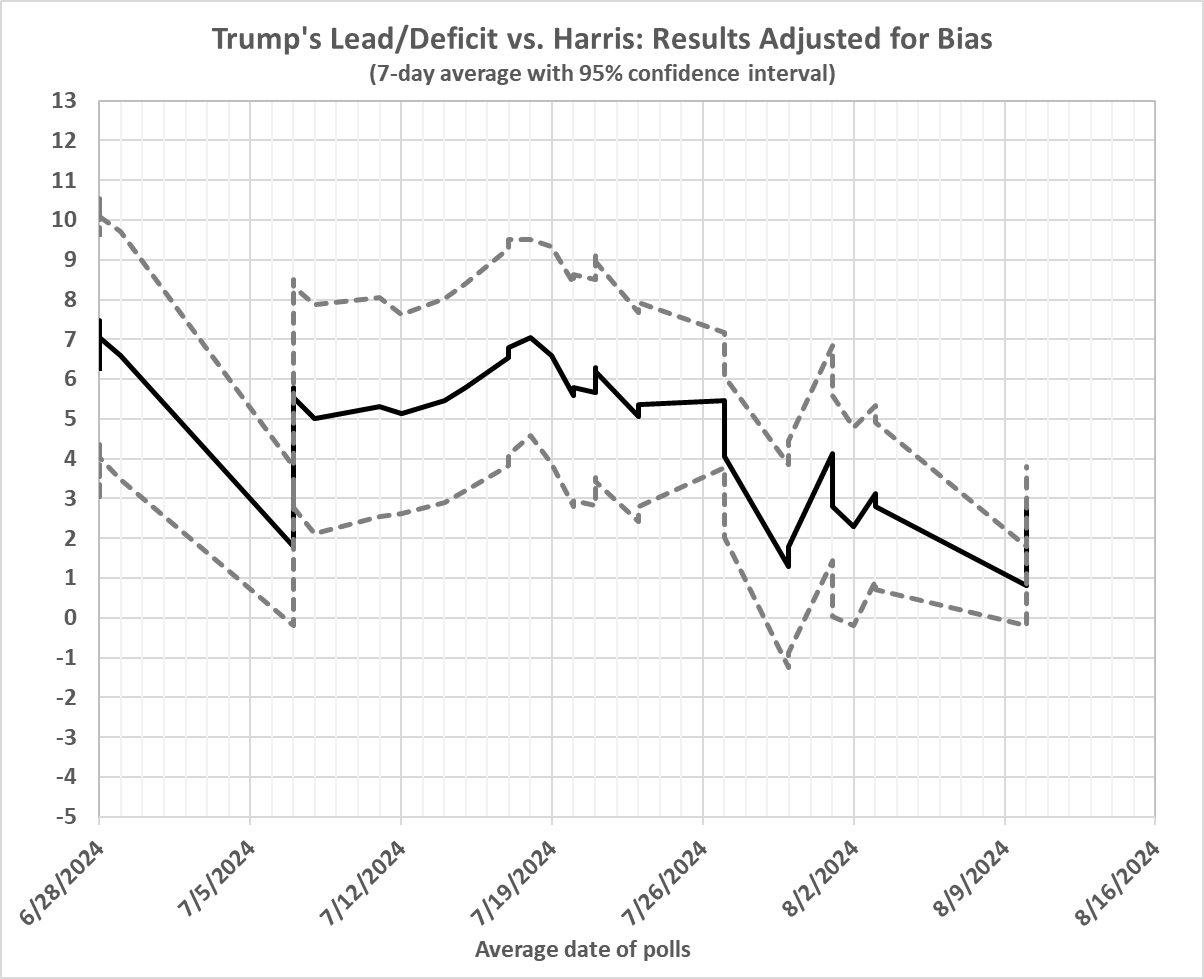
Here’s the polling trend since the “debate” on June 27 that ended Biden’s candidacy:

To adjust for bias, I use the 2020 election to estimate the extent to which (most) polling organizations underestimate Trump’s strength among voters. Underestimation is time-dishonored strategem, aimed at dispiriting the opposition and its supporters — the “opposition” being any politician, like Trump, who threatens the power of the deep state and its allies, enablers, and beneficiaries.

I follow the presidential polling summaries published by Real Clear Politics (RCP). Of the polling organizations surveyed by RCP, 17 released polls in the final week before the 2020 election. Fourteen of the polls overestimated Biden’s popular-vote margin, with overestimates ranging from 0.5 to 7.5 percentage points. Only three pollsters underestimated Biden’s margin, with a range of 0.5 to 3.5 points. The overall average for the 17 pollsters was an overestimate (for Biden) of 3.7 points.

Given that Trump is again the GOP nominee, I see no reason to assume that the pro-Democrat bias this year is any smaller than it was in 2020. So I simply add 3.7 points to Trump’s 7-day polling averages to get a truer picture of Trump’s electoral appeal. Thus the values plotted in the preceding graph. (I am being generous to anti-Trump pollsters; the average anti-Trump bias in 2020, according to the American Association for Public Opinion Research, was 4.5 points for all.)

How does the current range — a lead of 1 to 4 points — translate into electoral votes? Here’s how, Trump would win 313 to 327 electoral votes if the election were held today:

(See “Trump vs. Biden: 16” for an explanation of the relationship between popular vote/polling margin and electoral votes.)

Not only that, but the “Harris honeymoon” may be coming to an end. The polls are swinging (modestly) back toward Trump:

All in all, things still look good for Trump. But there are question marks. Will Harris’s momentum continue? Will a “black swan” event upend the election? What about the upcoming sentencing in Trump’s “hush money” case? Will any other anti-Trump trials be completed by election day?

Stay tuned.

Joe Biden’s Mortality

I began this post just before learning of the attempted assassination of Donald Trump. His mortality isn’t at issue here, but Joe Biden’s is.

I am a bit older than Joe Biden. I grew up and graduated from high school in a place that resembles Scranton, Pennsylvania, though it’s not as large.

I have in recent years tracked down all of the members of my high school graduating class, who were born (on average) in 1940. Here’s the mortality curve for the men:

The slope gets slippery 53 years after graduation, that is, in one’s early 70s. Joe (and Donald) are beyond that point. But Joe’s medical condition suggests that he will go first (if assassination is taken off the table) and fairly soon. If his disease doesn’t kill him in a few years, old age will probably do the job.

Trump vs. Biden: 16 (My best estimate yet)

If the election were held today, Trump would win with 313 to 343 electoral votes (as against 270 needed to win):

How did I get to that result? It’s a two-step calculation. The first step is relate electoral votes (EVs) to the two-party popular-vote split. The second step is to relate the two-party popular-vote (PV) split to the results of the most recent national polls. (I use polls with an average date that occurs in the last seven days.)

To estimate EVs as a function of the two-party PV split, I began with the results of the 2020 election. Trump got 232 EVs and Biden got 306 EVs, with a two-party vote split of 47.7 percent for Trump to 52.3 percent for Biden. I adjusted the distribution of EVs by State to reflect the redistribution of EVs following the census of 2020. That changed the EV split to Trump 235 and Biden 303, which I took as a starting point.

Suppose that the national PV split were to change from Trump 47.7 and Biden 52.3 to Trump 48.0  and Biden 52.0 as a result of proportional changes in every State (i.e., Trump’s PV share rises across the board by 0.3 percentage point and Biden’s PV share drops across the board by 0.3 percentage point). That would cause a few States to flip, specifically Arizona (11 EV) and Georgia (16 EV). The EV split would then become Trump 262 to Biden 276.

I ran cases of PV splits ranging from Trump 46-Biden 54 to Trump 55-Biden 45 in 0.5 percentage point increments. Those splits translate to PV margins ranging from -8 for Trump to +10 for Trump. At +6, for example, Trump would pick up Arizona (11), Colorado (10) Georgia (16), Maine (all 4 of its EVs vice 1 in 2020), Michigan (15), Minnesota (10), Nebraska (all 5 of its EVs vice 4 in 2020), Nevada (6), New Hampshire (4), New Mexico (5), Pennsylvania (19), and Virginia (13), and Wisconsin (10). The total gain of 123 EVs would bring Trump’s total to 358.

How do I relate the PV split to polling results? Polls, on average, are biased toward Biden. By how much? I return, once again, to 2020 and the national polls reported by RealClearPolitics (RCP). The final seven-day average had Biden leading Trump by 7.6 percentage points. Biden’s PV margin (including bogus votes) was 4.5 percentage points. So there was a bias of about 3 percentage points in favor of Biden in the polls reported by RCP.* This means, for example, that if Trump’s average 7-day lead is 2 points (which it is as of today), his lead in the PV split is actually 5 points after adjusting for bias (assuming that the pro-Biden bias is at least as great in 2024 as it was in 2020).

There are margins of error around the polling results; the margins of error define the upper and lower bounds of a 95-percent confidence interval around the average. I apply those margins to obtain a range for Trump (a 95-percent confidence interval around his average lead or deficit). As of today, that range is from a 0-point lead to a 4-point lead. The horizontal axis in the graph reflects the 3-point bias adjustment to that range. A tie in the polls — the lower bound of the confidence interval — would mean that Trump is really leading by 3 in the PV split (which would give him 313 EVs); a lead of 4 points in the polls — the upper bound of the confidence interval — would mean that Trump is really leading by 7 in the PV split (which would give him 343 EVs).

As of today, Nate Silver (paywalled) of 538 fame, has Trump ahead in Arizona, Georgia, Michigan, Nevada, Pennsylvania, and Wisconsin. The electoral votes of those States, plus the pickup of 1 EV from Nebraska, would bring Trump’s total to 313, which is the lower bound of my estimate.

Stay tuned.


* Yes, there are margins of error around each pollster’s results, but the best estimate was 7.6 percentage-point margin, on average, and the pollsters missed it by 3.1 points, on average. Another way to adjust Biden’s 2020 showing is to take the difference between his seven-day average margin for that year (7.6 points) and his current seven-day average margin (-1.8 points) and apply the difference (-9.4 points) to his final  2020 PV margin of 3.1 points, which yields an estimated PV margin of -6.3 for 2024 (as of today). But that would introduce a measure of optimism (for Trump) that I don’t want to inject into my estimates, so I’m using the bias estimate of 3.1 points (rounded to 3).

Classic Automobiles

The classic era of American automobile design began in the 1920s and lasted through the late 1930s. Here are some of my favorites:

1927 Kissel 8-75 Speedster

1929 Jordan Speedboy G

1929 Duesenberg J 350 Willoughby

1930 Pierce Arrow Roadster

1932 Cadillac 355B Sport Phaeton

1932 Pierce Arrow Model 54 7-Passenger Touring Car

1934 Packard Eleventh Series Eight 1101 Convertible Sedan

1935 Auburn 8-851 Cabriolet

1937 Cord Model 812C Phaeton

1938 Lincoln Zephyr Convertible Coupe

Many collections of classic-car photos and specs are available online. One that I especially like is the Crawford Collection of the Western Reserve Historical Society.

Can Barack Obama Become Biden’s VP and Succeed Him as President?

That mouthful of a title is a question that’s been in the air for quite a while. It didn’t just arise when Biden exposed his mental frailty at the non-debate with Trump on June 27. But it has been resurrected (e.g. here and here).

So, what’s the answer? There isn’t a definitive one because no U.S. court has faced the question, let alone ruled on it. If the question ever arose — about Obama or any other former twice-elected president — it would end up at the U.S. Supreme Court. USSC’s decision likely would depend on the political makeup of the Court at the time, and the party affiliation of the former president.

But, political partisanship aside, here’s what I would argue:

1. Section 1 of Amendment XXII says this:

No person shall be elected to the office of the President more than twice, and no person who has held the office of President, or acted as President, for more than two years of a term to which some other person was elected President shall be elected to the office of the President more than once.

2. Some would argue that this bars a former president like Obama from serving as vice president because Amendment XII says this:

[N]o person constitutionally ineligible to the office of President shall be eligible to that of Vice-President of the United States.

3. But when Amendment XII was ratified on June 15, 1804, the only conditions of eligibility for the presidency were these (from Article II, Section 1 of the Constitution):

No Person except a natural born Citizen, or a Citizen of the United States, at the time of the Adoption of this Constitution, shall be eligible to the Office of President; neither shall any Person be eligible to that Office who shall not have attained to the Age of thirty five Years, and been fourteen Years a Resident within the United States.

4. Therefore, the language of Amendment XII quoted above doesn’t apply because Amendment XII didn’t contemplate the adoption of Amendment XXII 147 years later.

In short, barring a USSC ruling to the contrary, BHO could run for VP and succeed JRB Jr. Aargh!

The Biden Plan

Why did Biden decide to debate Trump? Most likely because Biden and those whose advice he takes (or whose direction he follows) believed that he would lose the election and had nothing to lose by debating Trump.

Why would Biden or his advisers believe that he would lose when nationwide polls have put him in a virtual tie with Trump? Because they have done something like the analysis that I’ve done, which suggests a virtual tie in the polls means that Biden is actually running at least 3 percentage points behind Trump nationwide. That deficit portends spells certain defeat given that Biden would run up huge, superfluous margins in deep-Blue states.

In rehearsing for the debate, Biden’s performance must have seemed at least passable. If it hadn’t, a plausible excuse for postponement or cancellation would have been found, and it would have done less damage to Biden’s chances than his actual performance did. But the rehearsals, which included a stand-in for Trump, weren’t the real thing.

Biden’s performance in the actual debate must have come as a shock to himself, to Jill, to those who advised him to debate, and to those who helped him prepare for the debate. Biden’s performance certainly came as huge shock to the millions who planned to vote for him and who saw the real person in action, not the mummy whose condition has been hidden (as much as possible) from public view by aides and compliant corporate media.

Now what? Top Democrats (the Clintons, Obama, major donors, etc.) may have concluded that Trump will win no matter whom he faces. If they have concluded that, they are almost certainly right — barring a shockingly adverse development for Trump between now and when voting starts.

For example, they may be betting that Judge Merchan (of the “hush money” case) will announce a prison sentence or house arrest when he sentences Trump on July 11. First, any sentence will be anti-climactic — voters have long since factored the guilty verdicts into their voting plans. Second, Trump can appeal, and failure at the State level is almost certain to result in a speedy hearing and decision by the U.S. Supreme Court. Third, will any court (other than Judge Merchan’s) want to legitimize DA Bragg’s blatant act of election interference: the prosecution of Trump on charges with a flimsy legal foundation? I think not. Fourth, in any event, a sentence of some kind for Trump might be just the trigger that’s needed to evoke a tidal wave of GOP voters in the fall, swamping not only Biden but Democrats down the ticket — including, more importantly, races for U.S. Senate and House seats.

Given all of that, why would the Democrats in charge want to replace Biden? The result would be to burden a new candidate with a loss, when he or she could run in 2028 as a “fresh face” who hasn’t lost a presidential race.

So, barring a development that I can’t foresee (which might include death or a crippling disability), I expect to see Trump and Biden at the head of their parties’ tickets in November. If Biden isn’t the Democrat nominee, the nod will go to the equally expendable Kamala.

Trump vs. Biden: 15 (Counting Chickens That Haven’t Hatched)

Tonight’s debate could undo Trump’s momentum — or it could reinforce it. Whatever the case, Biden is facing formidable odds against re-election (as of now).

The first piece of evidence is general direction of the polls, as measured by changes in each pollster’s results:

That looks good for Trump. This looks even better:

Biden is running well behind his pace of four years ago. And four years ago, despite “winning” the (mythical) nationwide popular vote by 4.5 percentage points, Biden eked out an electoral-vote victory on the basis of narrow wins in key States. That’s because Biden’s “victory” by 7 million votes was accounted for by his popular-vote margins in two solid-Blue States: California and New York. The huge — and superfluous victories — in those States masked a tie in the rest of the country. That’s why Biden had to rely on chicanery to squeak by in Arizona, Georgia, Pennsylvania, and Wisconsin. If Biden continues to under-perform his 2020 showing, the elections in key States won’t be close enough to steal.

Does History Repeat Itself? Stalin Is Resurrected in the USA

Whether history repeats itself or merely rhymes, human nature can be counted upon to make history seem repetitive or rhythmic.

Stephen Kotkin concludes Stalin: Paradoxes of Power, 1878-1928 with this observation: “History, for better and for worse, is made by those who never give up.”

Stalin never gave up. He had succeeded in subduing his enemies within the USSR by 1928, but he would continue to imprison and execute anyone whose words or actions he deemed threatening to his dictatorship or to the cause that he had embraced.

That cause was state socialism, “collective” control by the Communist Party (acting through the state) of the economy of the nation (in the name of the people, of course). To succeed in that cause, it was necessary to stifle and eradicate any dissent — real, imagined, actual, or potential — from the edicts of the Party (i.e., Stalin).

One of those edicts was collectivization of agriculture, a program that Stalin announced in January 1928 and began to implement in 1929. The rest, as they say, is history — a grim history in which Ukraine figured largely (though not exclusively):

The Ukrainian famine—known as the Holodomor, a combination of the Ukrainian words for “starvation” and “to inflict death”—by one estimate claimed the lives of 3.9 million people, about 13 percent of the population. And, unlike other famines in history caused by blight or drought, this was caused when a dictator wanted both to replace Ukraine’s small farms with state-run collectives and punish independence-minded Ukrainians who posed a threat to his totalitarian authority.

“The Ukrainian famine was a clear case of a man-made famine,” explains Alex de Waal, executive director of the World Peace Foundation at Tufts University and author of the 2018 book, Mass Starvation: The History and Future of Famine. He describes it as “a hybrid…of a famine caused by calamitous social-economic policies and one aimed at a particular population for repression or punishment.”

In those days, Ukraine—a Texas-sized nation along the Black Sea to the west of Russia—was a part of the Soviet Union, then ruled by Stalin. In 1929, as part of his plan to rapidly create a totally communist economy, Stalin had imposed collectivization, which replaced individually owned and operated farms with big state-run collectives. Ukraine’s small, mostly subsistence farmers resisted giving up their land and livelihoods.

In response, the Soviet regime derided the resisters as kulaks—well-to-do peasants, who in Soviet ideology were considered enemies of the state. Soviet officials drove these peasants off their farms by force and Stalin’s secret police further made plans to deport 50,000 Ukrainian farm families to Siberia, historian Anne Applebaum writes in her 2017 book, Red Famine: Stalin’s War on Ukraine.

“Stalin appears to have been motivated by the goal of transforming the Ukrainian nation into his idea of a modern, proletarian, socialist nation, even if this entailed the physical destruction of broad sections of its population,” says Trevor Erlacher, an historian and author specializing in modern Ukraine and an academic advisor at the University of Pittsburgh’s Center for Russian, East European, & Eurasian Studies.

Collectivization in Ukraine didn’t go very well. By the fall of 1932 … it became apparent that Ukraine’s grain harvest was going to miss Soviet planners’ target by 60 percent. There still might have been enough food for Ukrainian peasants to get by, but, as Applebaum writes, Stalin then ordered what little they had be confiscated as punishment for not meeting quotas.

The Ukrainian famine, as catastrophic as it was, was just one thread in the tapestry of death, torture, impoverishment, and virtual enslavement to the state that was woven by leftist dictators like Stalin, Hitler (yes, a leftist), Mao, Tito Pol Pot, Castro, and on and on.

But — smug billionaires, corporate media types, academics and most politicians and bureaucrats will say — it can’t happen here because we have “our democracy” to protect us from the ravages of dictatorship. Spouting such nonsense, if it were a capital offense, would soon rid us of the aforementioned apologists for the dictatorial state that has assumed power in the United States.

“Our democracy” has become nothing more than a vast conspiracy of the same aforementioned apologists for statism. They are alike in their commitment to the attainment of perfection (as they define it) through the power of the state. (In that respect, it is deeply dismaying that six fellow-travelers and cowards who occupy seats on the Supreme Court today decreed that the central government may continue to use Big Tech to propagandize for its statist agenda.)

Evidence of “our democracy” acting in concert to deprive Americans of liberty and prosperity has been accumulating for more than a century. I won’t burden you with a recitation of examples (for that you can start here and here, and then comb through the index of posts). I will merely point to the fact that the central government’s most onerous actions (these days) are lawless. They are being conducted through administrative and executive edicts and sometimes in open defiance of laws enacted in accordance with the Constitution. I have in mind, of course, the effort- to kill off fossil fuels, the failure to enforce immigration laws, discrimination in favor of blacks and mentally ill LGBTQ+ persons.

The irony of it all is that almost every American (though not all) would claim to revile Stalin, whereas about half of them adore the machinations of the central government and the policies represented by the left’s puppet in the White House.

The difference between Joe Stalin and Joe Biden is one of degree, not one of kind. Biden doesn’t overtly kill,impoverish, and enslave people; his policies are having that effect, however.