What’s This about a Summit?

I didn’t watch the debate, for reasons explained here. But I did sample some of the live-blogging and post-debate posts. The best of the bunch — by 20 lengths — is James Lileks’s super-rant about Kerry’s summit idea. I have no idea exactly what Kerry said, nor do I think it matters exactly what he said, because Lileks has undoubtedly captured what I would have said had I heard exactly what Kerry said (got that?). Anyway, here’s a bit of Lileks:

…And another thing: the idea of a summit with the Muslim world doesn’t particularly billow my sails, either….

[D]o you think a summit in which the various satrapies of the Middle East and elsewhere convene for a marathon bitchfest about Gaza is going to make America beloved in Sadr City? They want us to extend a hand, yes, so they can lop it off. Ah, but what of the moderates. Those who have been turned against us because we threw out the Taliban and deposed Saddam – the relentlessly secular Saddam, as we’re often reminded. If it hasn’t occurred to these folks before, let me spell it out plainly: if you think there’s a war against Muslims now, you lack a certain sense of perspective. If tiptoeing around sacred sites and taking special care to pick off the snipers hiding in mosques so as not to disturb the plaster is a war against Islam, you will be looking for new terms when Putin drops a big bag of hammers somewhere someday….

So no, I’m not enthused about a summit, unless we get to set the agenda….Item three: we’re going to play a video of the events of 9/11. And then we’ll have a discussion. We’re willing to entertain all sorts of commentary, with one proviso: the moment you use the word “but,” you’re escorted from the building and put back on a plane home. You can never come to the US again. Your nice condo in the new Trump building will be sold for five dollars to a nice Jewish lesbian couple we met the other day at parent’s night at our school in Park Slope. One’s an artist, the other’s a lawyer….

Ask yourself this: you’re a dictator who has violated the terms of a peace treaty over and over again, and frequently shoots at the planes enforcing the treaties. Who do you fear the most? A) The magnificent concert of allies in the UN, some of whom you’ve bought off, who are desperate to prove their legitimacy by prolonging the process into the 22nd century

B) The United States, Britain and Australia, who have several hundred thousand troops on your border and frankly are in no mood to put up your crap any longer

What would you want in this situation? The answer starts with “S” and ends, five letters later, in “T.”

So, I get it. We are wrong and bad and stupid and stupidly wrong-bad. We failed to make France act as though it wasn’t, you know, France, a militarily insignificant nation that is understandably motivated by self-interest, and we haven’t convened a summit so we could be castigated for ignoring the extralegal use of Israeli helicopters to turn Hamas kingpins into indistinct red smears. You’d think we nuked Paris and converted everyone to Lutheranism.

Here’s the thing. I’d really like to live in John Kerry’s world. It seems like such a rational, sensible place, where handshakes and signatures have the power to change the face of the planet. If only the terrorists lived there as well….

That’s it — in a nutshell, wrapped in a glorious rant. One of these days someone’s really gonna p*** off James.

Election Projections, Explained

REVISED 11/18/04

In Method 1, I assign all of a State’s electoral votes to the expected winner in that State, according to TradeSports.com. A price of greater than 50 indicates a Bush win; a price of less than 50 indicates a Kerry win. (A winning bet of $50 on Bush at a price of 50 returns $100, for a $50 profit; a winning bet of $60 on Bush at a price of 60 also returns $100, for a $40 profit; a losing bet on Bush at a price of 60 pays off those who bet on Kerry; and so on.) If the price is exactly $50, I record the electoral votes as a tossup and don’t allocate them to either candidate.

In Method 2, I allocate all of a State’s electoral votes to Bush if the TradeSports.com price is 55 or greater, and all of a State’s electoral votes to Kerry if the Tradesports.com price is 45 or less. For prices between 45 and 55, I allocate a State’s electoral votes according to Method 2. Method 2 has no predictive power; it simply measures the uncertainty around the estimate yielded by method 1.

Method 3* translates the expected share of two-party popular vote into electoral votes, based on a statistical relationship for presidential elections from 1952 through 2000. I use two sources to estimate the leader’s share of the two-party vote: the popular vote-share share market at Iowa Electronic Markets; the leader’s share of the Bush-Kerry vote according to the Rasmussen tracking poll. I use those share estimates in the following regression equation:

Fraction of electoral vote going to the popular-vote leader =

– 8.327 (a constant term)

+ 29.249 x the leader’s fraction of the 2-party popular vote

– 23.161 x the square of the leader’s fraction of the 2-party popular vote

+ 0.0696 (if the leader is Republican, otherwise 0).

The r-squared of the equation is 0.95; the standard error of the estimate is 5.8 percent; and the t-stats on the coefficient and three variables are -2.908, 2.836, -2.509, and 2.507, respectively.

Electoral-vote percentages for the elections of 1952-2000 fell within or very close to the normal range of the estimates (mean, plus or minus standard error). However, Bush’s percentage in 2004 (53.2 percent) fell markedly below the normal range (62.4 to 70.2 percent). That result is consistent with a pattern that has emerged since 1980, when Reagan’s electoral-vote share was above the normal range of the estimate. Since then, the electoral-vote share of the popular-vote leader slipped steadily through the range, hitting bottom in 1996 and 2000, then dropping below the range in 2004.

Based on further analysis of the elections of 1952-2004, I have concluded that the Republican electoral-vote advantage applies only when the Republican candidate is winning decisively in the two-party popular vote (54 percent, or more). Thus, in tight races, method 1 is the best way to estimate the electoral vote. At any rate, it worked well this year.

I hereby retire methods 2 and 3. It’s method 1 for 2008.

__________

* Revised slightly on 11/18/04 to correct a minor data entry error.

A Profile of the Past

Drew Barrymore, in the first photo below, is a granddaughter of screen legend John Barrymore (1882-1942), shown in the second photo. She’s also a great-niece of another screen legend, Ethel Barrymore (1879-1959), shown in the third and fourth photos. Look at Drew’s profile, then at John’s and Ethel’s. Genetic inheritance at work.

Back to Baseball — Hyping the Heros

The big news of the moment: Ichiro is within one hit of George Sisler’s all-time, single-season record. Ichiro has 256 hits this season; Sisler had 257 in 1920. The difference is that Ichiro is batting .371, whereas Sisler batted .407 when he made his record. And he did it in 154 games, not the 159-plus it will take Ichiro to make the same number.

Remember when Hank Aaron broke Babe Ruth’s all-time home run record by hitting his 715th? Well, Ruth hit 714 in 8,399 official at-bats. By the time Aaron got to 714 home runs he already had more than 11,000 official at-bats.

Then there was Pete Rose eclipsing Ty Cobb’s all-time record for base hits. Rose surpassed Cobb’s record (4,191 hits) but it took him about 2,400 additional at-bats in which to do the trick. That’s why Rose’s lifetime batting average is only .303 to Cobb’s .367.

Wake me up when someone is about to break a real record, like Ty Cobb’s lifetime batting average. It’ll never happen. I’d better set my alarm clock.

Speaking of the New Washington Baseball Team…

…as I have been in recent posts, “Best of the Web Today” at OpinionJournal.com notes the latest D.C. mania — naming the new team:

…WTOP radio is inviting listeners to suggest a new name for the Washington team. Among the “most popular” suggestions are Senators, Nationals and Monuments; the “most interesting” include Gridlocks, Filibusters and Ex-Expos.

We got to thinking: There’s been a trend recently toward the use of abstract singular nouns as team names: Utah Jazz, Orlando Magic, Colorado Avalanche. This has mostly been a basketball and hockey phenomenon, though baseball does have the Tampa Bay Devilry. Why not click through to this link and cast your vote for calling the team the Washington Kerfuffle?

Not me. I’ll vote for the Washington Spend-and-Tax, and nothing less.

Subsidizing Multi-millionaires

I recently expressed some realism about the return of major league baseball to D.C.:

…To succeed financially, the new Washington team must draw well from the Maryland and Virginia suburbs. Attendance will be high for a few years, because the closeness of major-league baseball will be a novelty to fans who’ve had to trek to Baltimore to see the increasingly hapless Orioles. But suburbanites’ allegiance to the new Washington team won’t survive more than a few losing seasons — and more than a few seem likely, given the Expos’ track record. As the crowds wane, suburbanites will become increasingly reluctant to journey into the city. And, so, the taxpayers of D.C. (and perhaps the taxpayers of the nation) are likely to be stuck with an expensive memento of false civic pride.

Now, here’s Michelle Malkin:

THE MOTHER OF ALL STADIUM BOONDOGGLES

By Michelle Malkin · September 30, 2004 11:10 AM

The media cheerleading here in the D.C. area over the Expos deal is nauseating. I have nothing against baseball. I have everything against taxpayer-funded sports statism. (A commendable exception to the media slavering over this government rip-off is the Washington Times, whose scathing editorial today is dead-on.)….

And what did the WashTimes have to say? Among other things, this:

…To finance the $440 million project, the District would issue 30-year bonds. Annual debt-service costs would total more than $40 million. Those annual costs would be financed by $21 million to $24 million from a gross-receipts tax imposed on businesses with more than $3 million in annual revenues; $11 million to $14 million from taxes on tickets and stadium concessions; and $5.5 million in rent payments from the ballclub.

The team’s owners will receive all the income from ballpark naming rights, which can be quite substantial. The Redskins, whose stadium was privately financed, will receive more than $200 million over 27 years from Federal Express. It is outrageous for taxpayers to be on the hook for hundreds of millions of dollars over the next 30 years while the taxpayer-subsidized owners pocket perhaps hundreds of millions more for the naming rights of a ballpark they received as a gift. Should such a travesty come to pass, it would be the real legacy of Mayor Williams.

And just wait until fans start staying away in droves and the team’s owners lobby for better terms. Won’t the taxpayers of D.C. be happy then?

"Sick" Isn’t the Right Word…

…for the sub-species of the lowest form of life responsible for this:

Pair of Car Bombs in Iraq Kill Dozens, Including Many Children

By DEXTER FILKINS

Published: September 30, 2004

BAGHDAD, Iraq, Sept. 30 — In one of the most horrific attacks here since the fall of Saddam Hussein, a pair of car bombs tore through a street celebration today at the opening of a new government-built sewer plant, killing 41 Iraqi civilians, at least 34 of them children, and wounding 139 people.

The bombs exploded seconds apart, creating a chaotic scene of dying children and grieving parents, some of them holding up the blood-soaked clothes of their young, and howling in lament. Arms and legs lay amid pools of blood, with some survivors pointing to the walls of the sewer plant, now spattered with flesh….

Does anyone think there would be less of this if the U.S. were to cut and run from Iraq? Well, there might eventually be less of it if the Ba’athists who are behind it were to retake power. Then the atrocities would go on as before — behind the scenes, where the squeamish of the world could pretend that nothing is amiss.

To paraphrase President Bush: You’re either for decency or you’re against it. And if you’re for it you sometimes have to fight for it. And the fight often is unpleasant. But the alternative is surrender to the forces of evil. And I do mean evil — of the sort that was unleashed against the children of Baghdad today.

Thinking Ahead to ’08

UPDATED BELOW

Here’s a scenario: Bush is re-elected. Iraq slowly progresses economically and politically. Other rogue nations (Syria, Iran, N. Korea) are tamed by military action or the fear of it. The economic recovery looks like a replay of the 1990s (if not better). Deficits are no longer an issue because tax revenues rise with the recovery. Social Security reform is underway, and there are good prospects for Medicare reform.

Upon Bush’s re-election, Edwards and Clinton (of the female gender) instantly become the leading contenders to head the Democrat ticket in ’08. By ’08 they will have spent almost four years exposing their left-wing positions to the country and bashing each other. Out of that wreckage a less compelling nominee might crawl.

Thus, given my scenario, Republicans should be able to hold onto the White House simply by putting up someone — not named Bush — whose politics are to the right of the Democrat nominee’s.

Hold that thought.

UPDATE:

What about Barack Obama? Too young and inexperienced to be a candidate in ’08. But if Repubs hold the White House in ’08, look for Obama in ’12.

Dribble from Drabble

Margaret Drabble remains a favorite author, in spite of dribble like this:

My anti-Americanism has become almost uncontrollable. It has possessed me, like a disease. It rises up in my throat like acid reflux, that fashionable American sickness.

Unlike John the Square, Drabble has kept her anti-Americanism out of her fiction — except in mild, typically Brit-snob doses. My tolerance has limits, however. She goes off my list of favorite authors when her novels become hysterically anti-American, like John the Square’s Absolute Friends. So presposterous I couldn’t finish it. Nor will I link to it.

Kerry’s Slave-Labor Plan and Shell Game

Kerry’s website used to carry a statement about his position on national service. The statement was taken off the site, but intrepid (no doubt pajama-clad) bloggers have found a cached version. Here’s a bit of it, courtesy Say Anything:

As President, John Kerry will ensure that every high school student in America performs community service as a requirement for graduation. This service will be a rite of passage for our nation’s youth and will help foster a lifetime of service. States would design service programs that meet their community and educational needs. However, John Kerry does not believe in unfunded mandates. No state would be obligated to implement a service requirement if the federal government does not live up to its obligation to fund the program.

So, Kerry would make slave laborers of high-school students. But he wouldn’t make the States fund the slave-labor program. No, he’d simply ship the money to the States from Washington, D.C., where money grows on trees. Oops, no, that’s not it; Washington’s money comes from the citizens of the very States that he’d ship the money to. Nice try, John, but we’ve seen that move before.

I Demand a Recount

According to a story at news.telegraph.co.uk, everyone now alive on Earth — all six billion of us — is descended from a person who lived only 3,500 years ago:

We are all related to man who lived in Asia in 1,415BC

By David Derbyshire, Science Correspondent

(Filed: 30/09/2004)

Everyone in the world is descended from a single person who lived around 3,500 years ago, according to a new study.

Scientists have worked out the most recent common ancestor of all six billion people alive today probably dwelt in eastern Asia around 1,415BC.

Although the date may seem relatively recent, researchers say the findings should not come as a surprise.

Anyone trying to trace their family tree soon discovers that the number of direct ancestors doubles every 20 to 30 years. It takes only a few centuries to clock up thousands of direct ancestors.

Using a computer model, researchers from the Massachusetts Institute of Technology attempted to trace back the most recent common ancestor using estimated patterns of migration throughout history.

They calculated that the ancestor’s location in eastern Asia allowed his or her descendants to spread to Europe, Asia, remote Pacific Islands and the Americas. Going back a few thousand years more, the researchers found a time when a large fraction of people in the world were the common ancestors of everybody alive today – while the rest were ancestors of no one alive. That date was 5,353BC, the team reports in Nature….

Got that? Here’s what I take from it: There was a guy living 3,500 years ago who’s the common ancestor of everyone now living. (His mate should be our common ancestress, but maybe he had more than one mate.) Anyway, that guy was descended from a bunch of people who are, therefore, our common ancestors, too. But a big bunch of people — everyone else living 3,500 years ago, and all their ancestors — don’t have any living descendants. I guess you could say their genes faded.

(Thanks to Captain Ed for the tip.)

Reveries

Sleep rarely eludes me, but when it does I take a mental trip to the past…to the golden past of boyhood, where all the days are sunny and summery, or Christmas-y.

I stand on the sidewalk in front of the first house I lived in. There it is, a cream-colored, clapboard, two-story house with a small detached garage to the right. It sits on a corner lot of some size on a tree-lined street. An alley runs behind it. The street at the front and to the left side of the house are unpaved, as were many streets in that small city where I was a boy in the 1940s.

The porch runs the width of the house. I walk up the steps to the porch and enter the front door, which opens into the living room. With sunlight streaming through the windows, I wander through the living room to the dining room and kitchen. I go out the back door to the enclosed back porch, from which I can see the garage and the back yard.

I return to the house and venture to the basement, with its huge, coal-fired furnace, coal bin, and my father’s work shop. I go back up — and then up again, climbing the stairs to the second story — the stairs with a wrought-iron railing. I reach the upper hallway and visit, in turn, the three sunny bedrooms and the black-and-white tiled bathroom.

Yes, it was a modest house. But it was the first place I thought of as home, and it’s a place that still seems golden in my memories. By the time my mental tour is complete, I am ready for sleep.

At other times I remember my grandmother’s house in a small, lakeside village about 90 miles north of where I grew up. Her modest, two-story bungalow sat on a deep lot that backed up to open fields where doves cooed as I awoke on sunny, summer mornings to the smell of bacon frying. My favorite room was the kitchen, with its massive woodstove and huge, round, oak table, around which my grandmother, parents, and various aunts and uncles would sit after a meal, retelling and embellishing tales from the past.

We often visited my grandmother at Christmas, and I like to relive the Christmas eve when we made the 90-mile trip as feathery snow slowly piled deeper on the deserted, lakeside highway we traversed through quiet villages: Lexington, Port Sanilac, Forester, Richmondville, Forestville, White Rock, Harbor Beach, Port Hope, Huron City, and — at last — Port Austin. Many of the those villages were tiny: a scattering of houses, perhaps a church and a gas station, but not even a traffic light. The more substantial villages — those that had 1,000 or even 2,000 residents and a traffic light — boasted rows of well-kept and sometimes stately homes on shady streets, along with prosperous brick and white-frame churches, a few blocks of tidy stores and restaurants, and perhaps a lighthouse:

Light house, Port Sanilac

The lakeside highway (before it was “improved”) rode atop high bluffs overlooking the vastness of Lake Huron:

Looking down at the beach and the lake, Forestville

Many of the stately homes along the way have become inns:

Raymond House Inn, Port Sanilac

The State Street Inn, Harbor Beach

A short detour through the old part of Huron City would yield a view of the summer home of William Lyon Phelps (1865-1943; a professor of English literature at Yale and a popular lecturer and writer in the early decades of the 20th century):

Seven Gables, Huron City

The village of Port Austin didn’t have a quaint main street (seen here probably in the 1970s), but it was a place where a young boy could wander safely:

The rest of the village had more to offer. An elegant old inn . . .

The Garfield Inn, Port Austin

. . . these sights along the shoreline . . .


. . . and this view of the harbor at sunset:

Golden days, golden nights. Gone forever — but still alive in my reveries.

Reveries

Sleep rarely eludes me, but when it does I take a mental trip to the past…to the golden past of boyhood, where all the days are sunny and summery, or Christmas-y.

I stand on the sidewalk in front of the first house I lived in. There it is, a cream-colored, clapboard, two-story house with a small detached garage to the right. It sits on a corner lot of some size on a tree-lined street. An alley runs behind it. The street at the front and to the left side of the house are unpaved, as were many streets in that small city where I was a boy in the 1940s.

The porch runs the width of the house. I walk up the steps to the porch and enter the front door, which opens into the living room. With sunlight streaming through the windows, I wander through the living room to the dining room and kitchen. I go out the back door to the enclosed back porch, from which I can see the garage and the back yard.

I return to the house and venture to the basement, with its huge, coal-fired furnace, coal bin, and my father’s work shop. I go back up — and then up again, climbing the stairs to the second story — the stairs with a wrought-iron railing. I reach the upper hallway and visit, in turn, the three sunny bedrooms and the black-and-white tiled bathroom.

Yes, it was a modest house. But it was the first place I thought of as home, and it’s a place that still seems golden in my memories. By the time my mental tour is complete, I am ready for sleep.

At other times I remember my grandmother’s house in a small, lakeside village about 90 miles north of where I grew up. Her modest, two-story bungalow sat on a deep lot that backed up to open fields where doves cooed as I awoke on sunny, summer mornings to the smell of bacon frying. My favorite room was the kitchen, with its massive woodstove and huge, round, oak table, around which my grandmother, parents, and various aunts and uncles would sit after a meal, retelling and embellishing tales from the past.

Click here to read the full post.

On the Eve of the First Debate

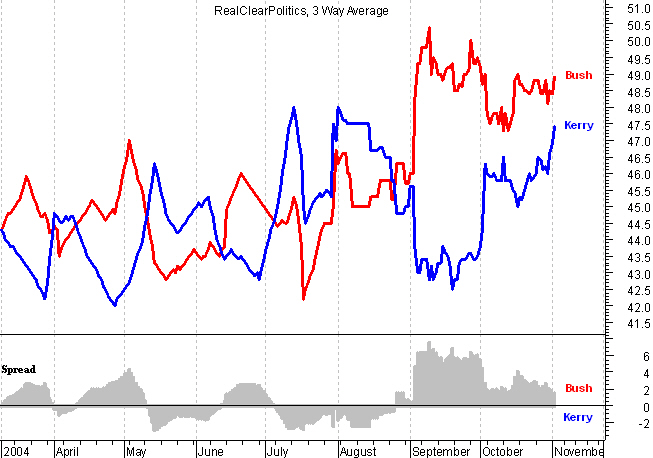
I think betting markets are better than polls at predicting election outcomes. Nevertheless, here’s a fairly accurate depiction of the state of the Bush-Kerry race (from realclearpolitics.com):

What’s Wrong with Canada?

The New York Times asks — and fails to answer — that question in “Canada’s Prophets of Pessimism (Is It the Weather?).” The article hints at the problem by noting that

The country…has seemingly come to define greatness by how much money it sinks into health care or day care. Even so, education budgets are shrinking and there is brain drain of doctors and other professionals to the United States.

And why? Because Canada has become something of a socialist paradise, along the lines of East Germany. Then, there’s rampant suppression of speech. And a lot more.

How to Write a Headline about Iraq

The New York Times loves to editorialize in its headlines. Here’s one from this morning: “Iraq Study Sees Rebels’ Attacks as Widespread.” I think the message we’re supposed to take from that selective bit of information is this:

Nyah-nyah-na-nyah-nyah.

Or this:

Cut and run.

Actually, the article goes on to attain a degree of balance:

…The number of attacks has risen and fallen over the months….[T]he highest numbers were in April, when there was major fighting in Falluja, with attacks averaging 120 a day. The average is now about 80 a day….

But it is a measure of both the fog of war and the fact that different analysts can look at the same numbers and come to opposite conclusions, that others see a nation in which most people are perfectly safe and elections can be held with clear legitimacy….

Indeed, no raw compilation of statistics on numbers of attacks can measure what is perhaps the most important political equation facing Prime Minister Ayad Allawi and the American military: how much of Iraq is under the firm control of the interim government. That will determine the likelihood – and quality – of elections in January.

For example, the number of attacks is not an accurate measure of control in Falluja; attacks have recently dropped there, but the town is controlled by insurgents and is a “no go” zone for the American military and Iraqi security forces. It is a place where elections could not be held without dramatic political or military intervention.

The statistics show that there have been just under 1,000 attacks in Baghdad during the past month; in fact, an American military spokesman said this week that since April, insurgents have fired nearly 3,000 mortar rounds in Baghdad alone. But those figures do not necessarily preclude having elections in the Iraqi capital.

Pentagon officials and military officers like to point to a separate list of statistics to counter the tally of attacks, including the number of schools and clinics opened. They cite statistics indicating that a growing number of Iraqi security forces are trained and fully equipped, and they note that applicants continue to line up at recruiting stations despite bombings of them.

But most of all, military officers argue that despite the rise in bloody attacks during the past 30 days, the insurgents have yet to win a single battle.

“We have had zero tactical losses; we have lost no battles,” said one senior American military officer. “The insurgency has had zero tactical victories. But that is not what this is about.

“We are at a very critical time,” the officer added. “The only way we can lose this battle is if the American people decide we don’t want to fight anymore.”…

It will be a Vietnam if we decide to make it a Vietnam. But not otherwise.

Think of the headline the Times might have run: “Iraq Progressing Despite Insurgency; Fate Hinges on Americans’ Resolve.” Now that is editorializing in a headline.

Baseball in the Nation’s Capital

The original Senators stuck it out from 1901 through 1960. (Washington: first in war, first in peace, last in the American League.) That team moved to Minnesota, where there was a long tradition of high-grade minor league baseball to sustain it. A pennant in 1965 also helped get the team off to a good start with local fans.

The expansion Senators started up in 1961 and lasted through the 1971 season. That team moved to Arlington, Texas, smack in the middle of the hugely populated Dallas-Fort Worth metropolitan area. The size of the fan base helped to sustain the Rangers until the team finally got into post-season play in 1996.

Now the failed Montreal Expos seem to be headed to D.C. The transplanted Expos will spend a few years in old D.C. Stadium, due east of the Capitol building (but far from the gentrified precincts of Capitol Hill). The team will then move to a new park on the Anacostia River in southeast D.C.

To succeed financially, the new Washington team must draw well from the Maryland and Virginia suburbs. Attendance will be high for a few years, because the closeness of major-league baseball will be a novelty to fans who’ve had to trek to Baltimore to see the increasingly hapless Orioles. But suburbanites’ allegiance to the new Washington team won’t survive more than a few losing seasons — and more than a few seem likely, given the Expos’ track record. As the crowds wane, suburbanites will become increasingly reluctant to journey into the city. And, so, the taxpayers of D.C. (and perhaps the taxpayers of the nation) are likely to be stuck with an expensive memento of false civic pride.

P.S. Baltimore Orioles owner Peter Angelos has to be bought off. He doesn’t want a National League team 40 miles from his American League team. Mmmm…remember when Boston, Chicago, New York, Philadelphia, and St. Louis had a team in each league? In fact, New York had two National League teams — one in Manhattan (the Giants) and one in Brooklyn (the Dodgers). Not only that, but for many years the teams in Philadelphia and St. Louis shared stadiums.

Junk-Food Addict

Bruce Springsteen: “I am a dedicated Times reader, and I’ve found enormous sustenance from Paul Krugman and Maureen Dowd on the op-ed page.”

I’ve always found his music boring. Now I know why. His idea of intellectual fulfillment is the equivalent of a quarter-pounder with greasy fries.

Democracy vs. Liberty

A point worth pondering, from a review by John B. Judis of Fareed Zakaria’s The Future of Freedom:

…Zakaria argues that the United States suffers from an excess of democracy, which is threatening liberty. The analysis appears to come full circle — liberty leads to democracy and democracy ends up undermining liberty, prompting him to call for “a restoration of balance” between them….

A return to constitutional principles would do the trick. But how to get there?

Fear of Corporate Power

Arnold Kling, writing at Tech Central Station, spells out the right way to deal with “corporate power”:

…One of the differences between Sweetwater and Saltwater economists concerns monopoly. On the left, saltwater economists tend to share [the] view that government is the logical check on corporate power. On the right, sweetwater economists believe that government naturally allies with large interests, so that more government involvement tends to strengthen the hand of the corporate giants and weaken the position of consumers and small businesses.

My own reading of history is that it supports the Sweetwater point of view. Once an industry becomes regulated, economic competition dries up, to be replaced by lobbyist infighting. The profit center moves from the market to Washington, and resources shift accordingly.

Corporate power is a bad thing. I like to see big corporations humbled by innovation and competition.

But fear of corporate power can be a worse thing. Politicians play up that fear, because they are eager to intervene. However, it seems to me that government interventions do not wind up reining in corporations, and the net result is to leave ordinary individuals less powerful than in a less-regulated environment….

No form of legislation has done more to harm consumers — and to shackle the economy — than anti-trust legislation.