
Bryan Caplan presents the following table:
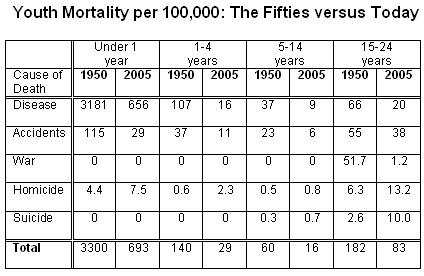
Caplan’s commentary:
Overall, today is much safer than 1950. That’s probably no surprise to anyone who knows basic economic history. What’s particularly interesting is that safety gains are especially large for younger kids. The mortality rate for kids under 5 was almost five times greater in 1950, 3.7 times greater for kids 5-14, and 2.2 times greater for 15-24 year olds.
I suspect that many people will object, “Yes, but if you break the results down by cause of death, modernity is worse in both homicide and suicide – two out of the five categories.” My reply: All modernity has done is roughly double two vivid near-zero risks. In exchange, we are vastly safer from the formerly quantitatively fearsome risks of disease, accidents, and war.
Bottom line: Modernity delivers the children’s paradise that the fifties only promised. Maybe the nation’s parents should try turning off their televisions for a minute of gratitude that they aren’t Ward and June Cleaver?
Caplan’s conclusions are foolish because he reifies “modernity” (an abstraction without causal or explanatory power) and aggregates mortality rates that, individually, stand for separate and distinct phenomena:
- advances in medical science (thus lower mortality from disease)
- safer household products, machinery, and automobiles (thus lower mortality from accidents)
- vastly different conditions of war (intense, head-to-head combat along “front lines” in Korea vs. sporadic operations against/attacks from guerrillas in Afghanistan and Iraq)
- greater lawlessness among teens and young adults (thus a higher death-from-homicide rate among 15-24 year olds)
- greater anomie among teens and young adults (thus a higher death-from suicide rate among 15-24 year olds)
War is a trendless phenomenon, and shouldn’t be included in Caplan’s statistics. For 15-24 year olds, then, the relevant mortality rate is 82 persons per 100,000 in 2005, as against 130 per 100,000 in 1950. But what we really see is a mix of change for the better and change for the worse, and the two can’t be combined to suggest overall change for the better. There is progress of one kind — scientific and engineering advancement — and regress of another kind — greater alienation of young adults from traditional moral strictures against violence to others and oneself.
Why have young adults become less respectful of others and themselves in the past half-century? Consider these influences:
- “Entertainment” has become more violent, and graphically so. Compare today’s films and TV shows with those of yesteryear, today’s rap “music” with the tepid tunes of the early 1950s, and today’s computer and video “games” with pinball.
- Under the onslaught of social engineering by government (e.g., sex education in schools, welfare “rights,” easy divorce, and day-care subsidies) family life has become less coherent and the role of parents has become less central in the guidance of children. Increasingly, mothers are absent (at work), and fathers are absent (period).
- Even in two-parent homes, parents have less time for their children because they (the parents) are caught up in the pursuit of material goods. Parents try to compensate for their physical and spiritual absence by spoiling their children with material goods, which merely signals to children the primacy of material things over humane values.
The predictable result of these influences is disregard for others and oneself. This disregard manifests itself not only in homicide and suicide but also in substance abuse, wanton sex, venereal disease, and abortion or — almost as bad — the bearing of “unwanted” children who then become targets of abuse.
Unlike Caplan, I see a less-than-half-full glass in the mortality-rate trends. Scientific and engineering advances are all very well, but they cannot prevent or offset the decline of America into hedonism and violence. As the descent becomes more obvious to politicians, they will seize the opportunity to “save” us through various draconian measures, just as they would save us from the pleasures of smoking, a natural cycle of “global warming,” the right to defend ourselves, and on and on.


You must be logged in to post a comment.