Mission Not Accomplished

From Walter Russell Mead’s “Al-Qaeda Is Alive and Well“:

Contrary to exclamations from the Obama administration and the mainstream press, Al-Qaeda is not dead, not gone, and not “on its last legs.” In fact, the regional groups that together make up “Al-Qaeda” have had different fortunes in recent months, as Daveed Gartenstein-Ross reports for Foreign Policy, but its fighters are still out there….

It seems that Al-Qaeda willingly hid from public view, regrouped, explored new areas of operation, trained, and gathered recruits, all before the 9/11/12 attack in Benghazi—and all amid repeated spiking of the football in Washington over the killings of Osama bin Laden and Abu Yahya al-Libi, among others….

Americans have a pattern of prematurely declaring victory in these kinds of long, drawn-out struggles. Think back to Lyndon Johnson’s “light at the end of the tunnel” in Vietnam, the “death throes” of the Iraqi insurgency that Vice President Cheney thought he saw, and the triumphal crowing after bin Laden’s death that Al-Qaeda was on the verge of strategic defeat. We ought to be more careful declaring victory, especially when we aren’t exactly sure to begin with what victory would even look like.

As if to underscore Mead’s warning, here is a tidbit from The Telegraph:

Al-Qaeda has been blamed for a recent series of forest fires across Europe, as the head of Russia’s Federal Security Service claimed they were set by arsonists as part of the group’s low-cost attack strategy.

“One should note that setting fires to forests in the countries of the European Union is a new tendency in al-Qaeda’s strategy of a ‘thousand cuts’,” Alexander Bortnikov said, according to state news agency RIA Novosti, at a meeting of heads of security agencies.

“This method allows (al-Qaeda) to inflict significant economic and moral damage without serious preliminary preparations, technical equipment or significant expenses.”

In linking al-Qaeda to the deadly wildfires, Mr Bortnikov pointed to calls to launch a “forest jihad” by various extremist websites which he said also publish detailed instructions about how and where to best carry out arson.

He said it was very difficult for special services to find and prosecute such arsonists.

Deadly fires have swept through forest land in EU countries such as Portugal and Spain over the past few months, killing scores of people and forcing thousands to evacuate. (“Al-Qaeda blamed for Europe-wide forest fires,” October 4, 2012)

It seems to me that someone ought to be taking seriously the kind of scenario that I laid out in “The Next 9/11?”:

…I challenge the [Obama] administration to tell me that the following has not happened and cannot happen in the United States:

  • A large but dispersed collection of improvised weapons for improvised, mortar-style attacks has been gathered in and around major U.S. cities and transportation and energy nodes.
  • These weapons are positioned so that their activation, on a massive scale would create havoc and panic — and might well disrupt transportation and communication networks. (With a massive salvo, not every weapon must reach its target.)
  • These weapons can be activated remotely — perhaps through signals transmitted from a single point — so that they can be fired in coordinated waves. Each successive wave disrupts and complicates rescue and recovery efforts that ensue from preceding waves, heightens confusion and panic, and lays the groundwork for economic disaster and political repression.

Obama’s political correctness, I fear, goes hand-in-hand with his demonstrated fecklessness in matters of national security. The intelligence and special operations forces of the United States should be capable of detecting and dismantling a threat of the kind outlined above. But will they be given the necessary resources and leeway? I doubt it.

I wrote that more than a year before the murders of the U.S. ambassador to Libya and three other Americans. Murders that underscore Obama’s insouciant incompetence in the face of a determined enemy.

Barack Channels Princess SummerFall WinterSpring

The princess of the title is Elizabeth Warren, self-reputed to be of Cherokee descent. And, as Native Americans go, Warren is about as authentic as Princess SummerFall WinterSpring of Howdy Doody.

You may remember Warren’s bleat of last September, in support of Obama’s plan to soak “the rich.” It caused ripples in the blogosphere (here and here, for example). The bleat? It goes like this:

I hear all this, you know, Well, this is class warfare, this is whatever. No. There is nobody in this country who got rich on his own — nobody.

You built a factory out there? Good for you. But I want to be clear. You moved your goods to market on the roads the rest of us paid for. You hired workers the rest of us paid to educate. You were safe in your factory because of police-forces and fire-forces that the rest of us paid for. You didn’t have to worry that marauding bands would come and seize everything at your factory — and hire someone to protect against this — because of the work the rest of us did.

Now look, you built a factory and it turned into something terrific, or a great idea. God bless — keep a big hunk of it. But part of the underlying social contract is, you take a hunk of that and pay forward for the next kid who comes along.

Last week, in Virgina, The Mighty O said the same thing in slightly different words:

There are a lot of wealthy, successful Americans who agree with me — because they want to give something back.  They know they didn’t — look, if you’ve been successful, you didn’t get there on your own.  You didn’t get there on your own.  I’m always struck by people who think, well, it must be because I was just so smart.  There are a lot of smart people out there.  It must be because I worked harder than everybody else.  Let me tell you something — there are a whole bunch of hardworking people out there.

I repeat what I said in response to Warren’s bleat:

Who said anything about anyone getting rich on his own? But didn’t the factory owner — and other “malefactors of great wealth” — pay a “fair share”of the taxes that support roads, education, and police and fire forces? Yes.* Didn’t the factory owner pay his workers for their labor? Yes, and sometimes (in the case of union workers) at the expense of consumers and those workers who couldn’t find employment because unions effectively limit entry to the labor market.

If anyone owes “the rest of us” anything, it’s the workers who received subsidized educations that enabled them to earn good wages at factories that were built because factory owners, shareholders, bond holders, and (sometimes) venture capitalists put their own money at risk.

Workers and others (including Elizabeth Warren) ought to be grateful to the “malefactors of great wealth” who have — against heavy odds — enabled America’s prosperity.

Tom Smith of The Right Coast weighs in with this:

…{H]ow many more successful businesses, inventions, products, services, toys, tools, insights, and just plain fun would there be, if government did not in the first place make it so ridiculously difficult to start a business and keep it going? I don’t see our young president taking credit on behalf of the state for all the failures it help cause, all the ideas that never got off the ground because the regulatory hurdles were so high, or all the established companies that never had to face competition because they had managed to get their rents written into law. This is part of the seen and not seen insight of Bastiat. What you see is a successful business when it manages to survive, and then people run up, the same people who taxed and regulated it nearly to death, and say I helped! I helped! What you don’t see are all the businesses that perished or never got started because of the heavy hand of the state. And it’s a very heavy hand….

I started a business, commercially unsuccessful, sadly, but we created some great technology. I was a libertarian before that, but I was really a libertarian afterwards. It’s difficult to even explain how pervasive, expensive, frustrating and sometimes just plain insuperable the regulatory and taxation burden of the state is. It’s not what did our venture in, but it helped….

It’s obvious, but still worth saying — for our young President to suggest that government deserves some large part of the credit for the achievements of business founders who manage, in spite of it all, to start a business and make of a go of it, is deeply, deeply perverse. What it ought to get credit for are all the unseen businesses, no longer here or never to be, that it is responsible for.

I can tell you, from bitter experience as a business owner and corporate officer, that Smith is exactly right. The burdens that government imposes on the creation, expansion, and operation of businesses are myriad and onerous. Most Americans aren’t aware of just how much government does to discourage the creation of jobs, income, and wealth because most Americans — even those who are employed — are not exposed to the ugliness of the business-government interface. If business-government transactions were rated like movies, they would be rated XXX.

There is one more thing to be said about the Warren-Obama attack on industriousness. It’s wrong, as any economist worth his salt could tell you. (That excludes Paul Krugman and his fellow worshipers at the altar of big government.) Despite the pretensions of bleeding heart libertarians and their brethren on the left, no one on Earth is qualified to say how much a person deserves to earn. Aside from thieves and others who coerce their earnings from others (e.g., government officials, members of compulsory unions), Americans earn what they are able to command for their services, on the basis of the value of those services to others.

The factory owner who makes a lot of money does so — after having taken the considerable risk of owning a factory and putting up with a lot of crap from government — because what he produces is valuable to others. He is being rewarded more than his employees because he is taking  risks and putting up with harassment. He is, in other words, being rewarded for his contributions to the success of his enterprise. (Did Barack or Elizabeth do anything to help him create it? Did the workers do more than they were paid to do? No, to both questions.)

And if the factory owner loses a lot of money and goes out of business, is it the fault of those who failed to buy his products? Would Barack Obama and Elizabeth Warren say that everyone let him down? They should, because by their “logic” the failed factory owner was failed by everyone who didn’t buy his products, and so they owe him something.

But most American business owners are not whiny brats like Barack Obama, Elizabeth Warren, and the freeloaders whose votes they depend on to stay in power.

Related posts:
The Causes of Economic Growth
A Short Course in Economics
Addendum to a Short Course in Economics
The Price of Government
Asymmetrical (Ideological) Warfare
“Buy Local”
Giving Back, Again
Taxing the Rich
More about Taxing the Rich
Luck-Egalitarianism and Moral Luck
Union-Busting
In Defense of Wal-Mart
Union Thuggery
Estimating the Rahn Curve: Or, How Government Inhibits Economic Growth

Don’t Use the “S” Word When the “F” Word Will Do

Every once in a while, Bill Vallicella (Maverick Philosopher) warns against calling Obama a socialist. Here’s a sample:

It is a tactical mistake for libertarians and conservatives to label Obama a socialist. For what will happen, has happened: liberals will revert to a strict definition and point out that Obama is not a socialist by this strict definition. Robert Heilbroner defines socialism in terms of “a centrally planned economy in which the government controls all means of production.” To my knowledge, Obama has never advocated such a thing. So when the libertarian or conservative accuses Obama of socialism he lets himself in for a fruitless and wholly unnecessary verbal dispute from which he will emerge the loser.

It is enough to point out that the policies of Obama and the Democrat Party lead us toward bigger government and away from self-reliance, individual responsibility, individual liberty, and sound fiscal policy.  If you want to use the ‘S’ word, you can say that Obama & Co. are pushing us in the direction of socialism.  But calling him a socialist is tactically inadvisable.  Never forget that the whole point is to remove him and his gang from positions of power.  To achieve that goal we need to persuade large numbers of fence-sitters that  that he is leading us down the wrong path.  That persuasion is less likely to happen if we come across as extremists who misuse language….

It’s good advice, and not just for the reasons given by Vallicella. It seems to me that persons of the left — and I mean to include so-called left-of-center “liberal” moderates as well as their “bomb-throwing” brethren on the hard left — suffer a not-fully requited passion for government control of almost everything. As long as it’s their kind of government and as long as their livelihoods are unaffected by what that government controls, of course.

How can so-called “liberal” moderates and “bomb-throwers” be brothers under the political skin? Simple. The so-called moderates like to say that they are against socialism — saying that is what makes them so-called moderates. Yet, whenever a something comes to their attention that they consider unjust, unfair, inequitable, and so on, their knee-jerk response is that government ought to “do something” about it, or to endorse (without thought) the usual and inevitable call for government to “do something” about it. In sum, so-called moderates differ from “bomb-throwers” mainly in being less honest with themselves and others about the depth of their attachment to socialism.

As Vallicella says, leftists will argue that Obama isn’t a socialist. But they will do so only because they know “socialist” is a scare word. And they don’t want their “boy” tainted by a scare word. So they will get technical and defend him (and themselves) by denying that he is in favor of something scary

But, really, they don’t care. To be a socialist is a good thing, even for the so-called left-of-center moderate who tries to conceal his true feelings from himself.

And that is the real reason why it is counterproductive to call Obama a socialist. To be thought of as a socialist (i.e., a lover of big, all-powerful government) is high praise to a large chunk of the citizenry. Daniel B. Klein explains:

Government creates common, effectively permanent institutions, such as the streets and roads, utility grids, the postal service, and the school system. In doing so, it determines and enforces the setting for an encompassing shared experience—or at least the myth of such experience. The business of politics creates an unfolding series of battles and dramas whose outcomes few can dismiss as unimportant. National and international news media invite citizens to envision themselves as part of an encompassing coordination of sentiments—whether the focal point is election-day results, the latest effort in the war on drugs, or emergency relief to hurricane victims — and encourage a corresponding regard for the state as a romantic force. I call the yearning for encompassing coordination of sentiment The People’s Romance (henceforth TPR)….

TPR helps us to understand how authoritarians and totalitarians think. If TPR is a principal value, with each person’s well-being thought to depend on everyone else’s proper participation, then it authorizes a kind of joint, though not necessarily absolute, ownership of everyone by everyone, which means, of course, by the government. One person’s conspicuous opting out of the romance really does damage the others’ interests….

TPR lives off coercion—which not only serves as a means of clamping down on discoordination, but also gives context for the sentiment coordination to be achieved….

[N]ested within the conventional view that government is not a mammoth apparatus of coercion is the tenet that society is an organization to which we belong. Either on the view that we constitute and control the government (“we are the government”) or on the view that by deciding to live in the polity we choose voluntarily to abide by the government’s rules (“no one is forcing you to stay here”), the social democrat holds that taxation and interventions such as a minimum wage law are not coercive. The government-rule structure, as they see it, is a matter of “social contract” persisting through time and binding on the complete collection of citizens. The implication is that the whole of society is a club, a collectively owned property, administered by the government…. [“The People’s Romance: Why People Love Government (as Much as They Do),” The Independent Review, v. X, n. 1, Summer 2005, pp. 5–37]

Which brings me to the “f” word: fascism. This is the core meaning of fascism:

Fascism is a system in which the government leaves nominal ownership of the means of production in the hands of private individuals but exercises control by means of regulatory legislation and reaps most of the profit by means of heavy taxation. In effect, fascism is simply a more subtle form of government ownership than is socialism. [Morris and Linda Tannehil, The Market for Liberty, p. 18]

That is a proper definition of fascism. It is proper because it is devoid of the emotional baggage that the word carries because of its association with the (rightly) despised regimes of Hitler, Mussolini, and lesser figures of the past and present. (That Hitler’s party was the National Socialist German Workers’ Party — Nationalsozialistische Deutsche Arbeiterpartei — is an inconvenient fact, and therefore one that is ignored by the left.) Fascism is not — I repeat — not synonymous with such things as concentration camps and the Holocaust. Those were vile  aspects of Hitler’s regime, but they were not fascistic as such. But — and this is a big “but” — it is the lingering memory of concentration camps and the Holocaust that invests “fascism” with its emotional baggage.

The emotional baggage carried by “fascism” can be very useful to libertarians and conservatives who want to see the back of Obama and his crew of brown-shirts. Why? Because, the Tannehills’ definition of fascism fits Obama’s regime (and that of his spiritual predecessors) like a bespoke suit.

If only Romney could find copywriters who had the skills to connect Obama and fascism — subtly but convincingly.  The evidence is there, it’s just a matter of connecting the dots. The word “fascism” couldn’t be used, of course, because it’s a smear word, and its overt use would backfire. But the word could be implied by factually describing the thrust of Obama’s policies, then adding punchlines like these: “Policies that were disgraced long ago”; “Is this the America you want your grandchildren to inherit?”;  “Utopia comes at a high price.” The punch lines would be accompanied by newsreel clips that do not show Hitler, Nazis, or Nazi rallies, but which unmistakeably depict the Germany of the 1930s. Let viewers connect the dots.

Am I going too far in calling Obama a fascist? I think not. Fascism is simply another manifestation of The People’s Romance:

Notwithstanding the arguments of political scientists – who would distinguish fascism from other collectivist –isms such as communism, socialism, or national socialism (Nazism) – these distinctions are really irrelevant because all these forms of collectivism are equally pernicious to, and destructive of, individual rights and freedom. Leftists like to use the terms fascism or fascist as pejoratives because they naively believe that socialism is somehow less evil than collectivism of “the right” – that the murder of millions of people killed by Lenin and Stalin in the Soviet Union, by Mao in Red China, or by Pol Pot in communist Cambodia somehow was less evil than the murder of millions of people killed by Hitler’s regime in Nazi Germany or Mussolini’s regime in fascist Italy. Leftists have no legitimate claim on the truth, and neither do they have any monopoly on use of the terms fascism or fascist as pejoratives. [David N. Mayer, “2008: Prospects for Liberty,” MayerBlog, January 11, 2008]

*   *   *

…B.C. Forbes, the founder of the eponymous magazine, denounced “rampant Fascism” in 1933. In 1935 former President Herbert Hoover was using phrases like “Fascist regimentation” in discussing the New Deal. A decade later, he wrote in his memoirs that “the New Deal introduced to Americans the spectacle of Fascist dictation to business, labor and agriculture,” and that measures such as the Agricultural Adjustment Act, “in their consequences of control of products and markets, set up an uncanny Americanized parallel with the agricultural regime of Mussolini and Hitler.” In 1944, in The Road to Serfdom, the economist F.A. Hayek warned that economic planning could lead to totalitarianism. He cautioned Americans and Britons not to think that there was something uniquely evil about the German soul. National Socialism, he said, drew on collectivist ideas that had permeated the Western world for a generation or more.

In 1973 one of the most distinguished American historians, John A. Garraty of Columbia University, created a stir with his article “The New Deal, National Socialism, and the Great Depression.” Garraty was an admirer of Roosevelt but couldn’t help noticing, for instance, the parallels between the Civilian Conservation Corps and similar programs in Germany. Both, he wrote, “were essentially designed to keep young men out of the labor market. Roosevelt described work camps as a means for getting youth ‘off the city street corners,’ Hitler as a way of keeping them from ‘rotting helplessly in the streets.’ In both countries much was made of the beneficial social results of mixing thousands of young people from different walks of life in the camps. Furthermore, both were organized on semimilitary lines with the subsidiary purposes of improving the physical fitness of potential soldiers and stimulating public commitment to national service in an emergency.”

And in 1976, presidential candidate Ronald Reagan incurred the ire of Sen. Edward Kennedy (D-Mass.), pro-Roosevelt historian Arthur M. Schlesinger Jr., and The New York Times when he told reporters that “fascism was really the basis of the New Deal.” [from David Boaz’s “Hitler, Mussolini, Roosevelt: What FDR had in common with the other charismatic collectivists of the 30s,” a review of Wolfgang Schivelbusch’s Three New Deals: Reflections on Roosevelt’s America, Mussolini’s Italy, and Hitler’s Germany, 1933–1939]

Obama’s regime is nothing less than a new New Deal — on steroids.

Related posts:
FDR and Fascism
Fascism
The People’s Romance
Fascism with a “Friendly” Face
Fascism and the Future of America

Obama: Not Bailed out by CJ Roberts

UPDATED 07/03/12

Chief Justice Roberts’s bailout of Obama care — a.k.a. CJ Roberts’s sellout — may have brought some wavering believers in big government back into the corral, but probably not enough of them to rescue Obama from defeat at the hands of Mitt Romney. I continue to forecast a Romney win over Obama, the strong possibility of a GOP takeover of the Senate, and approximately no change in the GOP’s large House majority (see left sidebar).

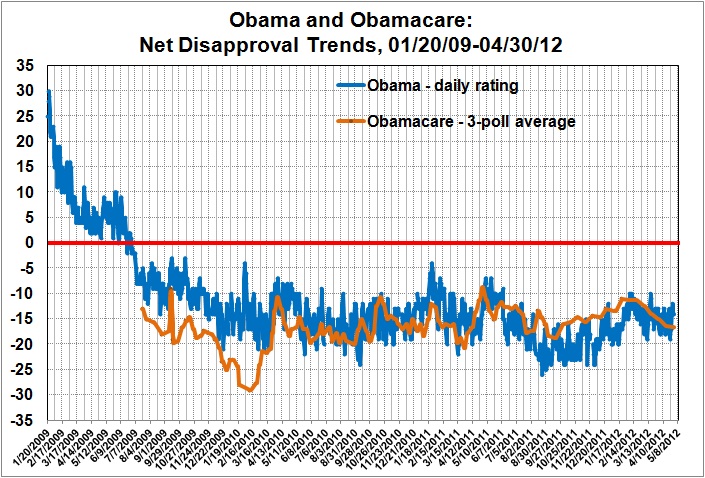
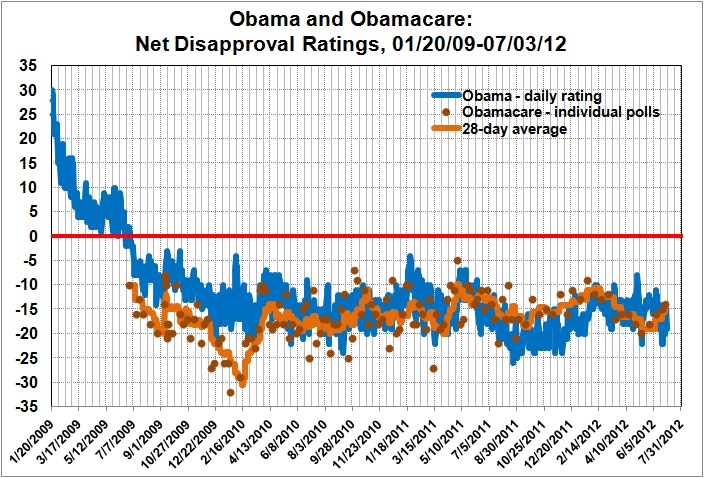
Further evidence for my forecasts, is found in Scott Rasmussen’s polls about the “popularity” (i.e., unpopularity) of Obama and Obamacare:


Sources: Rasmussen Reports, Obama Approval Index History and Health Care Law.

The latest poll results show a net disapproval rating of -18 for Obama (as of July 3) and a net disapproval rating of -14 for Obamacare (as of June 29-30, the two days immediately following CJ Roberts’s bombshell).

Obama’s net disapproval rating measures the percentage of respondents who strongly approve of his performance, minus the percentage of respondents who strongly disapprove of his performance. It has been three years since the arithmetic yielded a positive number, which is why I usually refer to the poll results as Obama’s disapproval or unpopularity rating.

The ratings for Obamacare are constructed as follows: For the period before Obamacare was signed into law on March 23, 2010, the numbers represent the percentage of respondents who strongly favored the passage of Obamacare, less the percentage of respondents who strongly opposed the passage of Obamacare. From the enactment of Obamacare to the present, the numbers represent the percentage of respondents who have strongly opposed the repeal of Obamacare, minus the percentage of respondents who have strongly favored the repeal of Obamacare.

Needless to say, Obamacare has always been in negative territory. In the latest poll (June 29-30) it gained only one percentage point from the poll conducted a week earlier. The recent uptick began in May, probably as a result of the intense p.r. campaign conducted by Obama and other Democrats (most notably Sen. Patrick Leahy, chairman of the Senate Judiciary Committee).

The save-Obamacare campaign may have worked on CJ Roberts, but its overall effect has been small. In fact, the recent gain in popularity is minuscule in comparison to the bandwagon-effect gain that began in January 2010 — when it became clear that Obamacare would become law — and continued until the eve of enactment on March 23, 2010.

The real silver lining in the Supreme Court’s Obamacare decision — if there is any silver lining — is that the Obamacare target still hangs from Obama’s neck.

Leaks, What Leaks?

Victor Davis Hanson is in a justifiable state of stratospheric dudgeon about the leaks that clearly are meant to portray Barack Obama as a steely, anti-terrorist warrior:

Recent leaks — the cyberwar secrets, the drone methodology, the double agent in Yemen, the details of the bin Laden mission, and the trove of information that accrued from it — juxtaposed with polls that have consistently shown uncertainty about Obama’s natural-security fides (cf. the serial boasting of Joe Biden that Obama’s decision is the most significant accomplishment in recent military history) are a time bomb.

Unlike the terrible Fast and Furious scandal, the Secret Service fiasco, the Solyndra boondoggle and solar con, or the GSA mess, we are talking about endangerment to the collective security of the entire United States — and not just due to laxity or incompetence but apparently due to calibrated political advantage. These targeted leaks seem to be part of a larger culture of narrowly defined and opportunistic access and political imaging. For is there not something terribly wrong when, to take just two examples, a David Sanger is apparently given access to such top-secret information, or when a David Ignatius, chest-thumps “exclusive,” as he offers his own analyses of once classified al-Qaeda documents seized from the bin Laden compound, for which he alone apparently was selected as gatekeeper to examine and analyze what he thinks is and is not important for Americans to know?…

This scandal will not go away, because it is so reckless that it will go well beyond Republican efforts to score political points, as it equally enrages congressional Democrats, Defense Department non-political officials, the CIA, and the intelligence community at large, whose careers and lives are jeopardized by such serial leaking. There is a toxic relationship now between high members of this administration, and favored marquee reporters such as those at the New York Times and Washington Post, who have crafted a hand-washes-hand relationship that, whether inadvertent or not, has put all our safety at risk. Obama himself seems not so much angry that his own are leaking to form favorable narratives, but angry that anyone would dare suggest to him that they are. That, too, is an untenable position and will change.

This will not stand, and until those who are doing these terrible things to the country are fired, the story will not go away. [“Court Journalism and the National Interest,” The Corner at National Review Online, June 12, 2012]

Update (06/13/12): Today, Hanson writes:

Securitygate has Nixonian trademarks all over it and is far more injurious to the republic than all the previous Obama administration–era scandals combined. Attorney General Holder simply cannot select an attorney to investigate key players in the administration who was both a recent appointee of Obama and a campaign contributor to and political supporter of him….

That the result was lives endangered and national policy imperiled makes an outside investigator essential. Even more chilling is that unlike prior leaking during past administrations when the media was at odds with the executive branch, in this case the administration apparently welcomed the leaks. The reporters involved were assumed to operate, not as self-proclaimed auditors trying to enhance their careers purportedly by keeping government honest, but rather more as court toadies determined to make their sources look good as payback for “exclusives.”…

At some point, watch the journalistic community: Typically they rally around the leaky reporter and law breaker as some sort of wounded fawn punished for trying to speak truth to power, but now what? Are they to close ranks with Ministry of Truth careerists who may well have been used as stooges of a government that serially broke the law for partisan advantage? [“Securitygate Is Not Going Away,” The Corner at National Review Online, June 13, 2012]

Here are links to some of the leak-ticles that prompted Hanson’s [continued] sub-orbital flight:

Secret ‘Kill List’ Proves a Test of Obama’s Principles and Will,” Jo Becker and Scott Shane, The New York Times, May 29, 2012

Obama Order Sped Up Wave of Cyberattacks Against Iran,” David Sanger, The New York Times, June 1, 2012

Stuxnet was work of U.S. and Israeli experts, officials say,” Ellen Nakashima and Joby Warwick, The Washington Post, June 1, 2012

And here links to some relevant commentary (in addition to Hanson’s):

Covert Wars, Waged Virally: ‘Confront and Conceal’,” a review by Thomas Ricks of David Sanger’s book about cyberwar against Iran and various anti-terrorist action, The New York Times, June 5, 2012

For U.S. Inquiries on Leaks, a Difficult Road to Prosecution,” Charlie Savage, The New York Times, June 9, 2012

Obama loses veneer of deniabilty with intelligence leaks,” Richard Cohen, The Washington Post, June 11, 2012

Ricks, an erstwhile Pentagon correspondent of some note, seems unfazed by leakage — an indifference that must have served him well in the day. He notes, without irony, that

Mr. Sanger clearly has enjoyed great access to senior White House officials, most notably to Thomas Donilon, the national security adviser.

Well, the moral code of Washington is encapsulated in “go along to get along” and “give something to get something.” (A former colleague — now a late and (by me) unlamented one — of no firm convictions, who fancied himself politically astute, was fond of spouting those feeble justifications of his sleaziness.) Thus Ricks’s next sentences should come as no shock to anyone but a pre-schooler:

Mr. Donilon, in effect, is the hero of the book, as well as the commenter of record on events. He leads the team that goes to Israel and spends “five hours wading through the intelligence in the basement of the prime minister’s residence.” He is shown studying the nettlesome problems of foreign relations, working closely with the president, and fending off the villains of this story— which in Mr. Sanger’s account tend to be the government of Pakistan and, surprisingly, the generals of the American military.

Yes, there is righteous outrage in Washington. Savage’s piece opens with this:

Anger over leaks of government secrets and calls for prosecution have once again engulfed the nation’s capital. Under bipartisan pressure for a crackdown, Attorney General Eric H. Holder Jr. on Friday announced the appointment of two top prosecutors to lead investigations into recent disclosures.

But

the prospects for those efforts are murky. Historically, the vast majority of leak-related investigations have turned up nothing conclusive, and several of the nine that have been prosecuted — six already under the Obama administration, and just three more under all previous presidents — collapsed.

“These cases are very difficult to pursue,” said Kenneth L. Wainstein, a former assistant attorney general for national security under President George W. Bush.

Why?

Many people are surprised to learn that there is no law against disclosing classified information, in and of itself. The classification system was established for the executive branch by presidential order, not by statute, to control access to information and how it must be handled. While officials who break those rules may be admonished or fired, the system covers far more information than it is a crime to leak.

Instead, leak prosecutions rely on a 1917 espionage statute whose principal provision makes it a crime to disclose, to persons not authorized to receive it, national defense information with knowledge that its dissemination could harm the United States or help a foreign power.

The statute should be changed to make it a criminal act to knowingly disclose classified information to anyone not authorized to receive it. But that would not suit the leak-happy mentality of Washington. Nor would it suit the primary beneficiaries of that mentality, namely, the major media outlets. So, the leaks will continue apace and every once in a while they will be condemned — even by the leakers, if not the leakees.

Cue Lefty Cohen, who makes sport of the whole thing:

Pity the poor Obama administration leakers. They impart their much-cherished secrets to make their man look good and then, at the first chirp of criticism, are ordered to confess their (possible) crimes by the very same president they were seeking to please. In this, they are a bit like the male praying mantis. He does as asked, and then the female bites his head off.

What is remarkable about the recent leaks is the coincidence — it can only be that — that they all made the president look good, heroic, decisive, strong and even a touch cruel; born, as the birthers long suspected, not in Hawaii — but possibly on the lost planet Krypton. The leak that displayed all these Obamian attributes was the one that said the president personally approves the assassinations of terrorists abroad. He gives his okay, and the bad guys are dispatched via missiles from drones.

Cohen is not worried so much about leaks, which are potage to the Post, as he is about those terrorists who refuse to surrender to American justice and so are dispatched at long distance:

The leak that troubles me concerns the killing of suspected or actual terrorists. The triumphalist tone of the leaks — the Tarzan-like chest-beating of various leakers — not only is in poor taste but also shreds a long-standing convention that, in these matters, the president has deniability. The president of the United States is not the Godfather.

But he is commander-in-chief, and if he has performed any constitutionally legitimate act during his presidency, it has been to advance the common defense by terrorizing terrorists.

But that does not excuse the acts of leakage, which are morally if not legally criminal. They have been committed on behalf of Barack Obama, and — I cannot doubt — at his behest.

Not-So-Random Thoughts (III)

Links to the other posts in this occasional series may be found at “Favorite Posts,” just below the list of topics.

Apropos Science

In the vein of “Something from Nothing?” there is this:

[Stephen] Meyer also argued [in a a recent talk at the University Club in D.C.] that biological evolutionary theory, which “attempts to explain how new forms of life evolved from simpler pre-existing forms,” faces formidable difficulties. In particular, the modern version of Darwin’s theory, neo-Darwinism, also has an information problem.

Mutations, or copying errors in the DNA, are analogous to copying errors in digital code, and they supposedly provide the grist for natural selection. But, Meyer said: “What we know from all codes and languages is that when specificity of sequence is a condition of function, random changes degrade function much faster than they come up with something new.”…

The problem is comparable to opening a big combination lock. He asked the audience to imagine a bike lock with ten dials and ten digits per dial. Such a lock would have 10 billion possibilities with only one that works. But the protein alphabet has 20 possibilities at each site, and the average protein has about 300 amino acids in sequence….

Remember: Not just any old jumble of amino acids makes a protein. Chimps typing at keyboards will have to type for a very long time before they get an error-free, meaningful sentence of 150 characters. “We have a small needle in a huge haystack.” Neo-Darwinism has not solved this problem, Meyer said. “There’s a mathematical rigor to this which has not been a part of the so-called evolution-creation debate.”…

“[L]eading U.S. biologists, including evolutionary biologists, are saying we need a new theory of evolution,” Meyer said. Many increasingly criticize Darwinism, even if they don’t accept design. One is the cell biologist James Shapiro of the University of Chicago. His new book is Evolution: A View From the 21st Century. He’s “looking for a new evolutionary theory.” David Depew (Iowa) and Bruce Weber (Cal State) recently wrote in Biological Theory that Darwinism “can no longer serve as a general framework for evolutionary theory.” Such criticisms have mounted in the technical literature. (Tom Bethell, “Intelligent Design at the University Club,” American Spectator, May 2012)

And this:

[I]t is startling to realize that the entire brief for demoting human beings, and organisms in general, to meaningless scraps of molecular machinery — a demotion that fuels the long-running science-religion wars and that, as “shocking” revelation, supposedly stands on a par with Copernicus’s heliocentric proposal — rests on the vague conjunction of two scarcely creditable concepts: the randomness of mutations and the fitness of organisms. And, strangely, this shocking revelation has been sold to us in the context of a descriptive biological literature that, from the molecular level on up, remains almost nothing buta documentation of the meaningfully organized, goal-directed stories of living creatures.

Here, then, is what the advocates of evolutionary mindlessness and meaninglessness would have us overlook. We must overlook, first of all, the fact that organisms are masterful participants in, and revisers of, their own genomes, taking a leading position in the most intricate, subtle, and intentional genomic “dance” one could possibly imagine. And then we must overlook the way the organism responds intelligently, and in accord with its own purposes, to whatever it encounters in its environment, including the environment of its own body, and including what we may prefer to view as “accidents.” Then, too, we are asked to ignore not only the living, reproducing creatures whose intensely directed lives provide the only basis we have ever known for the dynamic processes of evolution, but also all the meaning of the larger environment in which these creatures participate — an environment compounded of all the infinitely complex ecological interactions that play out in significant balances, imbalances, competition, cooperation, symbioses, and all the rest, yielding the marvelously varied and interwoven living communities we find in savannah and rainforest, desert and meadow, stream and ocean, mountain and valley. And then, finally, we must be sure to pay no heed to the fact that the fitness, against which we have assumed our notion of randomness could be defined, is one of the most obscure, ill-formed concepts in all of science.

Overlooking all this, we are supposed to see — somewhere — blind, mindless, random, purposeless automatisms at the ultimate explanatory root of all genetic variation leading to evolutionary change. (Stephen L. Talbott, “Evolution and the Illusion of Randomness,” The New Atlantis, Fall 2011)

My point is not to suggest that that the writers are correct in their conjectures. Rather, the force of their conjectures shows that supposedly “settled” science is (a) always far from settled (on big questions, at least) and (b) necessarily incomplete because it can never reach ultimate truths.

Trayvon, George, and Barack

Recent revelations about the case of Trayvon Martin and George Zimmerman suggest the following:

  • Martin was acting suspiciously and smelled of marijuana.
  • Zimmerman was rightly concerned about Martin’s behavior, given the history of break-ins in Zimmerman’s neighborhood.
  • Martin attacked Zimmerman, had him on the ground, was punching his face, and had broken his nose.
  • Zimmerman shot Martin in self-defense.

Whether the encounter was “ultimately avoidable,” as a police report asserts, is beside the point.  Zimmerman acted in self-defense, and the case against him should be dismissed. The special prosecutor should be admonished by the court for having succumbed to media and mob pressure in bringing a charge of second-degree murder against Zimmerman.

What we have here is the same old story: Black “victim”–>media frenzy to blame whites (or a “white Hispanic”), without benefit of all relevant facts–>facts exonerate whites. To paraphrase Shakespeare: The first thing we should do after the revolution is kill all the pundits (along with the lawyers).

Obama famously said, “”If I had a son, he would look like Trayvon.” Given the thuggish similarity between Trayvon and Obama (small sample here), it is more accurate to say that if Obama had a son, he would be like Trayvon.

Creepy People

Exhibit A is Richard Thaler, a self-proclaimed libertarian who is nothing of the kind. Thaler defends the individual mandate that is at the heart of Obamacare (by implication, at least), when he attacks the “slippery slope” argument against it. Annon Simon nails Thaler:

Richard Thaler’s NYT piece from a few days ago, Slippery-Slope Logic, Applied to Health Care, takes conservatives to task for relying on a “slippery slope” fallacy to argue that Obamacare’s individual mandate should be invalidated. Thaler believes that the hypothetical broccoli mandate — used by opponents of Obamacare to show that upholding the mandate would require the Court to acknowledge congressional authority to do all sorts of other things — would never be adopted by Congress or upheld by a federal court. This simplistic view of the Obamacare litigation obscures legitimate concerns over the amount of power that the Obama administration is claiming for the federal government. It also ignores the way creative judges can use previous cases as building blocks to justify outcomes that were perhaps unimaginable when those building blocks were initially formed….

[N]ot all slippery-slope claims are fallacious. The Supreme Court’s decisions are often informed by precedent, and, as every law student learned when studying the Court’s privacy cases, a decision today could be used by a judge ten years from now to justify outcomes no one had in mind.

In 1965, the Supreme Court in Griswold v. Connecticut, referencing penumbras and emanations, recognized a right to privacy in marriage that mandated striking down an anti-contraception law.

Seven years later, in Eisenstadt v. Baird, this right expanded to individual privacy, because after all, a marriage is made of individuals, and “[i]f the right of privacy means anything, it is the right of the individual . . . to be free from unwarranted governmental intrusion into matters so fundamentally affecting a person as the decision whether to bear or beget a child.”

By 1973 in Roe v. Wade, this precedent, which had started out as a right recognized in marriage, had mutated into a right to abortion that no one could really trace to any specific textual provision in the Constitution. Slippery slope anyone?

This also happened in Lawrence v. Texas in 2003, where the Supreme Court struck down an anti-sodomy law. The Court explained that the case did not involve gay marriage, and Justice O’Connor’s concurrence went further, distinguishing gay marriage from the case at hand. Despite those pronouncements, later decisions enshrining gay marriage as a constitutionally protected right have relied upon Lawrence. For instance, Goodridge v. Department of Public Health (Mass. 2003) cited Lawrence 9 times, Varnum v. Brien (Iowa 2009) cited Lawrence 4 times, and Perry v. Brown (N.D. Cal, 2010) cited Lawrence 9 times.

However the Court ultimately rules, there is no question that this case will serve as a major inflection point in our nation’s debate about the size and scope of the federal government. I hope it serves to clarify the limits on congressional power, and not as another stepping stone on the path away from limited, constitutional government. (“The Supreme Court’s Slippery Slope,” National Review Online, May 17, 2012)

Simon could have mentioned Wickard v. Filburn (1942), in which the Supreme Court brought purely private, intrastate activity within the reach of Congress’s power to regulate interstate commerce. The downward slope from Wickard v. Filburn to today’s intrusive regulatory regime has been been not merely slippery but precipitous.

Then there is Brian Leiter, some of whose statist musings I have addressed in the past. It seems that Leiter has taken to defending the idiotic Elizabeth Warren for her convenient adoption of a Native American identity. Todd Zywicki tears a new one for Leiter:

I was out of town most of last week and I wasn’t planning on blogging any more on the increasingly bizarre saga of Elizabeth Warren’s claim to Native American ancestry, which as of the current moment appears to be entirely unsubstantiated.  But I was surprised to see Brian Leiter’s post doubling-down in his defense of Warren–and calling me a “Stalinist” to boot (although I confess it is not clear why or how he is using that term).  So I hope you will indulge me while I respond.

First, let me say again what I expressed at the outset–I have known from highly-credible sources for a decade that in the past Warren identified herself as a Native American in order to put herself in a position to benefit from hiring preferences (I am certain that Brian knows this now too).  She was quite outspoken about it at times in the past and, as her current defenses have suggested, she believed that she was entitled to claim it.  So there would have been no reason for her to not identify as such and in fact she was apparently quite unapologetic about it at the time….

Second, Brian seems to believe for some reason that the issue here is whether Warren actually benefited from a hiring preference.  Of course it is not (as my post makes eminently clear).  The issue I raised is whether Warren made assertions as part of the law school hiring process in order to put herself in a position to benefit from a hiring preference for which she had no foundation….

Third, regardless of why she did it, Warren herself actually had no verifiable basis for her self-identification as Native American.  At the very least her initial claim was grossly reckless and with no objective foundation–it appears that she herself has never had any foundation for the claim beyond “family lore” and her “high cheekbones.”… Now it turns out that the New England Historical Genealogical Society, which had been the source for the widely-reported claim that she might be 1/32 Cherokee, has rescinded its earlier conclusion and now says “We have no proof that Elizabeth Warren’s great great great grandmother O.C. Sarah Smith either is or is not of Cherokee descent.”  The story adds, “Their announcement came in the wake of an official report from an Oklahoma county clerk that said a document purporting to prove Warren’s Cherokee roots — her great great great grandmother’s marriage license application — does not exist.”  A Cherokee genealogist has similarly stated that she can find no evidence to support Warren’s claim.  At this point her claim appears to be entirely unsupported as an objective matter and it appears that she herself had no basis for it originally.

Fourth, Brian’s post also states the obvious–that there is plenty of bad blood between Elizabeth and myself.  But, of course, the only reason that this issue is interesting and relevant today is because Warren is running for the U.S. Senate and is the most prominent law professor in America at this moment.

So, I guess I’ll conclude by asking the obvious question: if a very prominent conservative law professor (say, for example, John Yoo) had misrepresented himself throughout his professorial career in the manner that Elizabeth Warren has would Brian still consider it to be “the non-issue du jour“?  Really?

I’m not sure what a “Stalinist” is.  But I would think that ignoring a prominent person’s misdeeds just because you like her politics, and attacking the messenger instead, just might fit the bill. (“New England Genealogical Historical Society Rescinds Conclusion that Elizabeth Warren Might Be Cherokee,” The Volokh Conspiracy, May 17, 2012)

For another insight into Leiter’s character, read this and weep not for him.

Tea Party Sell-Outs

Business as usual in Washington:

This week the Club for Growth released a study of votes cast in 2011 by the 87 Republicans elected to the House in November 2010. The Club found that “In many cases, the rhetoric of the so-called “Tea Party” freshmen simply didn’t match their records.” Particularly disconcerting is the fact that so many GOP newcomers cast votes against spending cuts.

The study comes on the heels of three telling votes taken last week in the House that should have been slam-dunks for members who possess the slightest regard for limited government and free markets. Alas, only 26 of the 87 members of the “Tea Party class” voted to defund both the Economic Development Administration and the president’s new Advanced Manufacturing Technology Consortia program (see my previous discussion of these votes here) and against reauthorizing the Export-Import Bank (see my colleague Sallie James’s excoriation of that vote here).

I assembled the following table, which shows how each of the 87 freshman voted. The 26 who voted for liberty in all three cases are highlighted. Only 49 percent voted to defund the EDA. Only 56 percent voted to defund a new corporate welfare program requested by the Obama administration. And only a dismal 44 percent voted against reauthorizing “Boeing’s bank.” That’s pathetic. (Tad DeHaven, “Freshman Republicans Switch from Tea to Kool-Aid,” Cato@Liberty, May 17, 2012)

Lesson: Never trust a politician who seeks a position of power, unless that person earns trust by divesting the position of power.

PCness

Just a few of the recent outbreaks of PCness that enraged me:

Michigan Mayor Calls Pro-Lifers ‘Forces of Darkness’” (reported by LifeNews.com on May 11, 2012)

US Class Suspended for Its View on Islam” (reported by CourierMail.com.au, May 11, 2012)

House Democrats Politicize Trayvon Martin” (posted at Powerline, May 8, 2012)

Chronicle of Higher Education Fires Blogger for Questioning Seriousness of Black Studies Depts.” (posted at Reason.com/hit & run, May 8, 2012)

Technocracy, Externalities, and Statism

From a review of Robert Frank’s The Darwin Economy:

In many ways, economics is the discipline best suited to the technocratic mindset. This has nothing to do with its traditional subject matter. It is not about debating how to produce goods and services or how to distribute them. Instead, it relates to how economics has emerged as an approach that distances itself from democratic politics and provides little room for human agency.

Anyone who has done a high-school course in economics is likely to have learned the basics of its technocratic approach from the start. Students have long been taught that economics is a ‘positive science’ – one based on facts rather than values. Politicians are entitled to their preferences, so the argument went, but economists are supposed to give them impartial advice based on an objective examination of the facts.

More recently this approach has been taken even further. The supposedly objective role of the technocrat-economist has become supreme, while the role of politics has been sidelined….

The starting point of The Darwin Economy is what economists call the collective action problem: the divergence between individual and collective interests. A simple example is a fishermen fishing in a lake. For each individual, it might be rational to catch as many fish as possible, but if all fishermen follow the same path the lake will eventually be empty. It is therefore deemed necessary to find ways to negotiate this tension between individual and group interests.

Those who have followed the discussion of behavioural economics will recognise that this is an alternative way of viewing humans as irrational. Behavioural economists focus on individuals behaving in supposedly irrational ways. For example, they argue that people often do not invest enough to secure themselves a reasonable pension. For Frank, in contrast, individuals may behave rationally but the net result of group behaviour can still be irrational….

…From Frank’s premises, any activity considered harmful by experts could be deemed illegitimate and subjected to punitive measures….

…[I]t is … wrong to assume that there is no more scope for economic growth to be beneficial. Even in the West, there is a long way to go before scarcity is limited. This is not just a question of individuals having as many consumer goods as they desire – although that has a role. It also means having the resources to provide as many airports, art galleries, hospitals, power stations, roads, schools, universities and other facilities as are needed. There is still ample scope for absolute improvements in living standards…. (Daniel Ben-ami, “Delving into the Mind of the Technocrat,” The Spiked Review of Books, February 2012)

There is much to disagree with in the review, but the quoted material is right on. It leads me to quote myself:

…[L]ife is full of externalities — positive and negative. They often emanate from the same event, and cannot be separated. State action that attempts to undo negative externalities usually results in the negation or curtailment of positive ones. In terms of the preceding example, state action often is aimed at forcing the attractive woman to be less attractive, thus depriving quietly appreciative men of a positive externality, rather than penalizing the crude man if his actions cross the line from mere rudeness to assault.

The main argument against externalities is that they somehow result in something other than a “social optimum.” This argument is pure, economistic hokum. It rests on the unsupportable belief in a social-welfare function, which requires the balancing (by an omniscient being, I suppose) of the happiness and unhappiness that results from every action that affects another person, either directly or indirectly….

A believer in externalities might respond by saying that they are of “economic” importance only as they are imposed on bystanders as a spillover from economic transactions, as in the case of emissions from a power plant that can cause lung damage in susceptible persons. Such a reply is of a kind that only an omniscient being could make with impunity. What privileges an economistic thinker to say that the line of demarcation between relevant and irrelevant acts should be drawn in a certain place? The authors of campus speech codes evidently prefer to draw the line in such a way as to penalize the behavior of the crude man in the above example. Who is the economistic thinker to say that the authors of campus speech codes have it wrong? And who is the legalistic thinker to say that speech should be regulated by deferring to the “feelings” that it arouses in persons who may hear or read it?

Despite the intricacies that I have sketched, negative externalities are singled out for attention and rectification, to the detriment of social and economic intercourse. Remove the negative externalities of electric-power generation and you make more costly (and even inaccessible) a (perhaps the) key factor in America’s economic growth in the past century. Try to limit the supposed negative externality of human activity known as “greenhouse gases” and you limit the ability of humans to cope with that externality (if it exists) through invention, innovation, and entrepreneurship. Limit the supposed negative externality of “offensive” speech and you quickly limit the range of ideas that may be expressed in political discourse. Limit the supposed externalities of suburban sprawl and you, in effect, sentence people to suffer the crime, filth, crowding, contentiousness, heat-island effects, and other externalities of urban living.

The real problem is not externalities but economistic and legalistic reactions to them….

The main result of rationalistic thinking — because it yields vote-worthy slogans and empty promises to fix this and that “problem” — is the aggrandizement of the state, to the detriment of civil society.

The fundamental error of rationalists is to believe that “problems” call for collective action, and to identify collective action with state action. They lack the insight and imagination to understand that the social beings whose voluntary, cooperative efforts are responsible for mankind’s vast material progress are perfectly capable of adapting to and solving “problems,” and that the intrusions of the state simply complicate matters, when not making them worse. True collective action is found in voluntary social and economic intercourse, the complex, information-rich content of which rationalists cannot fathom. They are as useless as a blind man who is shouting directions to an Indy 500 driver….

Theodore Dalrymple

If you do not know of Theodore Dalrymple, you should. His book, In Praise of Prejudice: The Necessity of Preconceived Ideas, inspired  “On Liberty,” the first post at this blog. Without further ado, I commend these recent items by and about Dalrymple:

Rotting from the Head Down” (an article by Dalrymple about the social collapse of Britain, City Journal, March 8, 2012)

Symposium: Why Do Progressives Love Criminals?” (Dalrymple and others, FrontPageMag.com, March 9, 2012)

Doctors Should Not Vote for Industrial Action,” a strike, in American parlance (a post by Dalrymple, The Social Affairs Unit, March 22, 2012)

The third item ends with this:

The fact is that there has never been, is never, and never will be any industrial action over the manifold failures of the public service to provide what it is supposed to provide. Whoever heard of teachers going on strike because a fifth of our children emerge from 11 years of compulsory education unable to read fluently, despite large increases in expenditure on education?

If the doctors vote for industrial action, they will enter a downward spiral of public mistrust of their motives. They should think twice before doing so.

Amen.

The Higher-Eduction Bubble

The title of a post at The Right Coast tells the tale: “Under 25 College Educated More Unemployed than Non-college Educated for First Time.” As I wrote here,

When I entered college [in 1958], I was among the 28 percent of high-school graduates then attending college. It was evident to me that about half of my college classmates didn’t belong in an institution of higher learning. Despite that, the college-enrollment rate among high-school graduates has since doubled.

(Also see this.)

American taxpayers should be up in arms over the subsidization of an industry that wastes their money on the useless education of masses of indeducable persons. Then there is the fact that taxpayers are forced to subsidize the enemies of liberty who populate university faculties.

The news about unemployment among college grads may hasten the bursting of the higher-ed bubble. It cannot happen too soon.

Obama and Obamacare: Twin Disasters

A picture worth 2,000 words:


Sources: Rasmussen Reports, Obama Approval Index History and Health Care Law.

I could have added graphs about the unemployment rate  (2 percentage points above the peak reached during GWB’s administration), the employment/population ratio (5 percentage points below the GWB peak), and the federal debt (which has grown almost 50 percent in the 3 years and 3 months of Obama’s presidency, as against a 25-percent rise in the first 3 years and 3 months of GWB’s presidency) — but why rub it in?

Obama’s Latest Act of Racism

UPDATED 03/26/12, 03/27/12

The despicably distorted mind of Barack Obama at work:

[O]bviously, this is a tragedy.  I can only imagine what these parents are going through.  And when I think about this boy, I think about my own kids.  And I think every parent in America should be able to understand why it is absolutely imperative that we investigate every aspect of this, and that everybody pulls together — federal, state and local — to figure out exactly how this tragedy happened.

So I’m glad that not only is the Justice Department looking into it, I understand now that the governor of the state of Florida has formed a task force to investigate what’s taking place.  I think all of us have to do some soul searching to figure out how does something like this happen.  And that means that examine the laws and the context for what happened, as well as the specifics of the incident.

But my main message is to the parents of Trayvon Martin.  If I had a son, he’d look like Trayvon.  And I think they are right to expect that all of us as Americans are going to take this with the seriousness it deserves, and that we’re going to get to the bottom of exactly what happened. (Said at the White House, on March 23, 2012, in answer to a reporter’s question about the killing of Trayvon Martin.)

So, Barry singles out one killing of a young black man, among the many such that were committed on or about February 26, 2012. You can be sure than Barry’s thug-in-chief, Eric Holder, will do his best to paint the killing as a racist violation of Trayvon Martin’s civil rights, thus making it a federal case and enabling Democrats to keep the race card in play well into the election cycle. Why? Because Republicans are racists, don’t you know, and the Martin case can be used as a reminder that to vote Republican (i.e., against Obama) is an act of racism.

Never mind that such a strategem is both racist and a cynical abuse of the central government’s power.

Never mind that George Zimmerman —  who is accused of killing Trayvon Martin — has a Latina mother, and that George (despite his name) looks more like a target for racists than a racist white yahoo.

Never mind that many who voted for Obama in 2008, to prove they aren’t racists, will vote against Obama in 2012, to prove they aren’t idiots. Obama’s deployment of the Trayvon Martin card is a blatant attempt to keep the idiots in his camp.

UPDATE: Trayvon Martin’s mother proves to be Obama’s equal in cynicism. From stltoday.com:

The mother of slain Florida teenager Trayvon Martin has filed papers seeking to trademark two slogans based on his name.

The U.S. Patent and Trademark Office filings by Sybrina Fulton are for the sayings “I Am Trayvon” and “Justice For Trayvon.” The applications were filed last week.

The applications say the trademarks could be used for such things as DVDs and CDs. An attorney who filed the papers says Fulton wants to protect intellectual property rights for use in projects to help other families in similar situations.

Sick.

UPDATE2: Victor Davis Hanson has more.

Three Inglorious Years


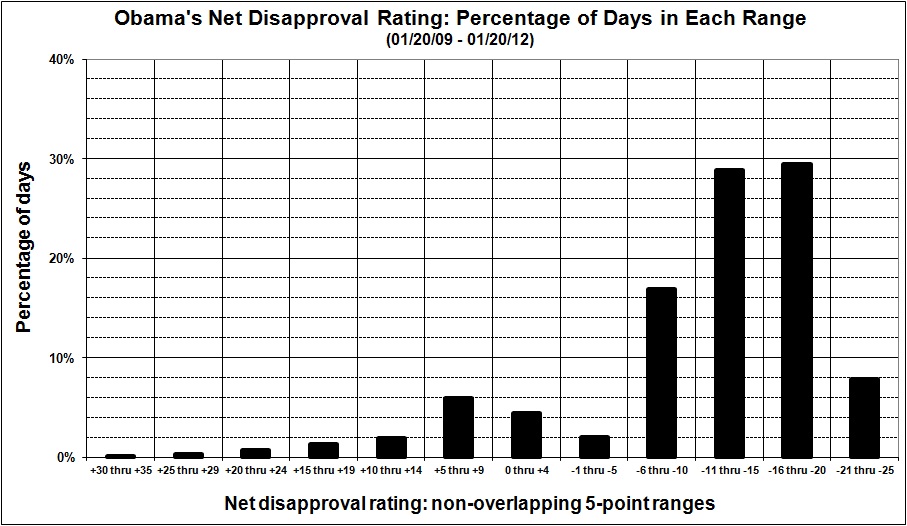
Net disapproval rating: percentage of likely voters strongly disapproving of BO, minus percentage of likely voters strongly approving of BO. Derived from Rasmussen Reports’ Daily Presidential Tracking Poll.

Preemptive War and Iran

My post, “Preemptive War,” is mainly a general argument for preemption, where American’s vital interests are at stake. But it was prompted by ” the imminent acquisition by Iran of material with which to produce nuclear weapons.”

The authors of “Why Obama Should Take Out Iran’s Nuclear Program” (Foreign Affairs, November 9, 2011) see the wisdom of preemption:

The November 8 International Atomic Energy Agency (IAEA) report casts further doubt on Iran’s continual claims that its nuclear program is intended solely for peaceful use….

…[T]he Obama administration has downplayed the findings of the new IAEA report, suggesting that a change in U.S. policy is unlikely. Yet this view underestimates the challenges that the United States would confront once Iran acquired nuclear weapons.

For example, the Obama administration should not discount the possibility of an Israeli-Iranian nuclear conflict….

Beyond regional nuclear war, Tehran’s acquisition of these weapons could be a catalyst for additional proliferation throughout the Middle East and beyond….

…Iran’s rivals for regional dominance, such as Turkey, Egypt, and Saudi Arabia, might seek their own nuclear devices to counterbalance Tehran. The road to acquiring nuclear weapons is generally a long and difficult one, but these nations might have shortcuts. Riyadh, for example, could exploit its close ties to Islamabad — which has a history of illicit proliferation and a rapidly expanding nuclear arsenal — to become a nuclear power almost overnight….

The closer Iran gets to acquiring nuclear weapons, the fewer options will be available to stop its progress. At the same time, Iran’s incentives to back down will only decrease as it approaches the nuclear threshold. Given these trends, the United States faces the difficult decision of using military force soon to prevent Iran from going nuclear, or living with a nuclear Iran and the regional fallout.

But the Obama administration — more accurately, Barack Obama — seems committed to a perverse foreign policy in the Middle East. This is from “Panetta Assures Iran It Has Little to Worry About” (Commentary, November 11, 2011):

If the leaders of the Iranian regime were worried about Jeffrey Goldberg’s prediction that Barack Obama would confound the world and launch a U.S. military strike designed to save Israel from nuclear destruction, they can now calm down. Secretary of Defense Leon Panetta made it crystal clear at a Pentagon news conference yesterday he has no intention of supporting an American attack on Iran’s nuclear facilities….

…But by publicly throwing cold water on the idea the United States is ready and able to militarily squash Iran’s nuclear ambitions, Panetta has sent a dangerous signal to Tehran that the Pentagon intends to veto any use of force against them. Combined with Russia’s pledge to block any further sanctions on Iran, the statement should leave the Khameini/Ahmadinejad regime feeling entirely secure as they push ahead to the moment when they can announce their first successful nuclear test.

This — combined with Obama’s dubious support of Israel, his unseemly withdrawal from Iraq, and his reluctant and easily reversed decision to “surge” in Afghanistan — confirms Obama’s position as the Jimmy Carter of the 21st century. Where is the next Ronald Reagan when we need him?

The “loss” of the Middle East and its relatively cheap oil would be a disaster for America’s economy. Further, it would leave an opening for an ambitious and increasingly powerful China.

Does Obama care about such things? Evidently not. He is too busy trying to remake the U.S. in the image of Europe: defenseless, bankrupt, and hostage to enviro-nuts.

See also “Some Thoughts and Questions about Preemptive War.”

Hank Williams Jr. and Hitler

Better late than never. This is the about equating Obama with Hitler, as Hank Williams Jr. did earlier this month.

Aaron Goldstein of The American Spectator doesn’t like Hitler analogies:

[C]omparing anyone to Hitler who hasn’t committed genocide (or aspires to do so) only serves to trivialize the evil committed in his name and ideology.

I must disagree with Mr. Goldstein. Specifically, Hitler was not only a genocidal maniac but also a despot who commandeered Germany’s economy and society and molded them to suit his ends.

My money says that Obama — like FDR, his presidential role model — is greatly inclined in the same direction. Consider, for example, the evident willingness of a senior administration official to curb speech critical of Islam as a form of racial discrimination, the administration’s overt attack on freedom of religion, and Obama’s attack on bullying as another way of curbing speech. Obama’s attempt to seize the health-care industry — along with the auto and financial industries — may generate more headlines, but his insidious efforts to stifle Americans’ basic freedoms says volumes about his fascistic mindset.

Related posts:
Calling a Nazi a Nazi
FDR and Fascism
The People’s Romance
Fascism
Fascism with a “Friendly” Face
Fascism and the Future of America
Tocqueville’s Prescience
Invoking Hitler
The State of the Union: 2010
The Shape of Things to Come
I Want My Country Back

More Fool He

David Brooks, The New York Times‘s ersatz conservative, writes:

When the president unveiled the second half of his stimulus it became clear that this package has nothing to do with helping people right away or averting a double dip. This is a campaign marker, not a jobs bill….

This wasn’t a speech to get something done. This was the sort of speech that sounded better when Ted Kennedy was delivering it. The result is that we will get neither short-term stimulus nor long-term debt reduction anytime soon, and I’m a sap for thinking it was possible.

Yes, I’m a sap. I believed Obama when he said he wanted to move beyond the stale ideological debates that have paralyzed this country. I always believe that Obama is on the verge of breaking out of the conventional categories and embracing one of the many bipartisan reform packages that are floating around….

Being a sap, I still believe that the president’s soul would like to do something about the country’s structural problems. I keep thinking he’s a few weeks away from proposing serious tax reform and entitlement reform. But each time he gets close, he rips the football away.

No s***, Sherlock. Being a bit smarter than Charlie Brown isn’t exactly a mark of distinction.

Welcome to the party David, even if it has taken you three years to get here.

Oh, but wait…

The White House has decided to wage the campaign as fighting liberals. I guess I understand the choice, but I still believe in the governing style Obama talked about in 2008. I may be the last one. I’m a sap.

Fool David once, Obama’s to blame. Fool David twice, David’s to blame. Fool David thrice (at least), and you know that David’s no sap — he’s a fool.

Can Obama Erase the Deficit?

I don’t mean the federal government’s deficit or the jobs deficit. I mean Obama’s popularity deficit, which is s-o-o big:


Derived from Rasmussen Reports, Daily Presidential Tracking Poll.

When it comes to jobs, Don Boudreaux pegs it:

The problem isn’t that consumers aren’t spending; it’s that businesses aren’t investing.  And businesses aren’t investing because Congress and, especially, the administration exhibit a ceaseless fetish for top-down, command-and-control, debt-financed ‘governance’ of the economy – an enterprise-quashing recipe made only more poisonous by Mr. Obama’s soak-the-rich speechifying.

But that won’t keep the O from speechifying about “the rich” and trying to spend and regulate his way out of a recession that he has made worse by enlarging government and its reach, instead of shrinking both.

Related posts:
Taxing the Rich
More about Taxing the Rich
A Keynesian Fantasy Land
The Keynesian Fallacy and Regime Uncertainty
The Great Recession Is Not Over
Why the “Stimulus” Failed to Stimulate

Today’s Revealing Quotation

It comes from Rebecca Traister’s article in today’s NYT, “What Would Hillary Clinton Have Done?“:

There simply was never going to be a liberal messiah whose powers could transcend the limits set by a democracy this packed with regressive obstructionists.

Democracy is good only if everyone agrees with you. That seems to be a common view among leftists.

Related posts:
FDR and Fascism
Fascism with a “Friendly” Face
Democracy and Liberty
Parsing Political Philosophy
Is Statism Inevitable?
Inventing “Liberalism”
Utilitarianism, “Liberalism,” and Omniscience
Utilitarianism vs. Liberty
Are We All Fascists Now?
Fascism and the Future of America
The Indivisibility of Economic and Social Liberty
Beware of Libertarian Paternalists
Tocqueville’s Prescience
The Mind of a Paternalist
Accountants of the Soul
Invoking Hitler
The Psychologist Who Played God
Rawls Meets Bentham
Is Liberty Possible?
The Left
Down with “We”
The Divine Right of the Majority
An Encounter with a Marxist
Our Enemy, the State
The Left’s Agenda
The Left and Its Delusions

A Sign of the Times


Derived from Rasmussen Reports, Daily Presidential Tracking Poll.

The Most Effective Stimulus…

…would be the replacement of Obama and Congress’s Democrats by free-market Republicans. See this and this.

Was There a “bin Laden bump” for Obama?

I was tempted to ask if there was an “Osama bump” for Obama. Ah well, mustn’t be snarky about our “gutsy” leader, who did no more than he should have done, though he had to “sleep on it” before he approved the Abbottabad operation.

The first graph below gives Obama’s unpopularity ratings for the ten weeks surrounding the date on which Osama’s demise was announced: May 1, 2011. The blue shading spans polls that preceded the announcement. (The May 1 results were released in the morning; Obama announced Osama’s death later that day.) The green shading spans the two days (May 2 and 3) for which Obama’s disapproval rating reflected, in part, the results of polling conducted before the May 1 announcement.

It is evident that Obama was gaining ground, even before the May 1 announcement. We may take his rating of -11 on May 1 as a baseline for the evaluation of the effect of bin Laden’s death. Generously, Obama gained 4 points, and held that gain from May 7 through May 18. So much for the “bin Laden bump.”

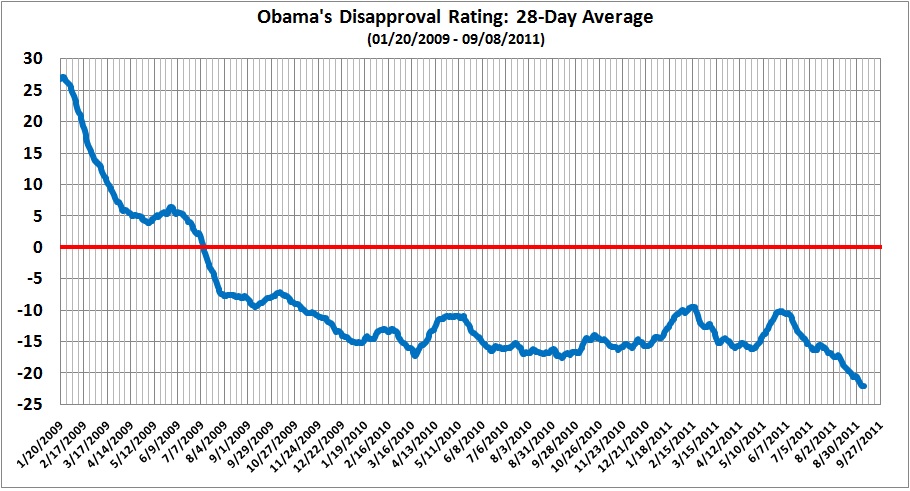
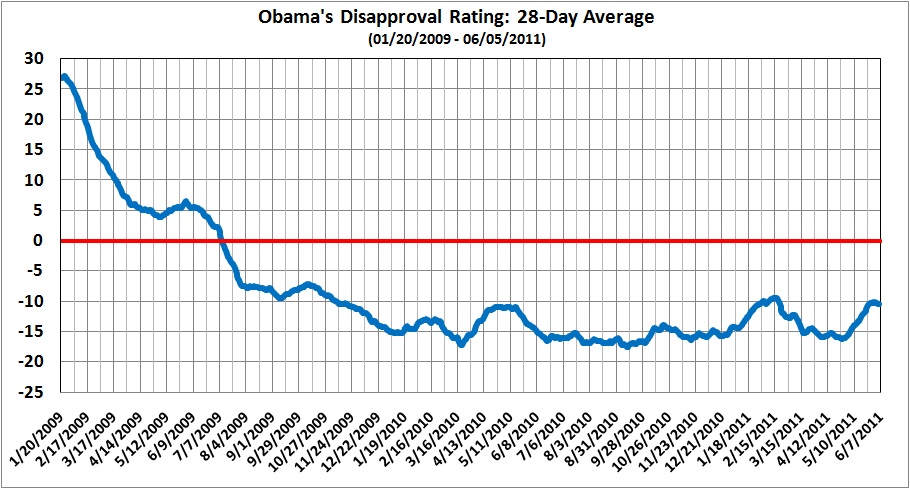
It appears that Obama’s unpopularity was already returning to its core level of about -10 — a level that it had reached in the aftermath of the enactment of Obamacare. (See the second and third graphs.) And Obama’s unpopularity has stayed around its core level since the end of the modest “bin Laden bump.”

Why has Obama’s unpopularity returned to its core level? Here is my surmise: The battle lines are being drawn for election 2012, and those independents who enjoyed deriding Obama (for many legitimate reasons) are “coming home to roost” because they fear that if Obama loses in 2012 they will have abetted the demise of “free lunch” governance. They are of the ilk that decries the deficit while resisting the necessary (and inevitable) reductions in “entitlements.”


Net unpopularity is measured as the percentage of likely voters who strongly approve of BO, minus the percentage of likely voters who strongly disapprove of BO. The approval and disapproval statistics are derived from Rasmussen Reports’ Daily Presidential Tracking Poll. There is a gap in the 7-day trend because no poll was released on May 9. I use Rasmussen’s polling results because Rasmussen has a good track record with respect to presidential-election polling. The following graphs are derived from the same source.

Osama, Obama, and 2012

Obama did what any president should have done. However, because Osama was killed by U.S. forces on Obama’s watch, much of the glory will redound to Obama. But the glory really belongs to the team of Americans who conducted the raid on Osama’s lair, to the intelligence apparatus that led the team there, and to everyone directly involved in command and support of the operation.

The killing of Osama, at this late date, probably will have little or no effect on the operations of al-Qaeda and other terrorist organizations. The killing of Obama is a symbolic act of justice, and that’s about all it is. But that, in itself, is worth a lot to any American who abhors the 9/11 attacks for what they were: murderous attacks on innocent persons by cold-blooded fanatics. Anyone who is celebrating today but who said ten years ago that “we asked for it” is a hypocrite who should be wearing sackcloth instead of celebrating.

It remains to be seen whether the almost-certain surge in Obama’s popularity will last. There is much about the man and his policies that deserves deep unpopularity. Yesterday’s events will recede from view before long, and Americans will return to their struggles with unemployment, inflation, intrusive government, and mounting debt. It is those things that most likely will occupy Americans’ minds when they cast their votes in November 2012.

A case in point: Bush senior enjoyed a surge of popularity following the decisive (but incomplete) victory in the Gulf War of 1990-91, but he was nevertheless unable to win re-election in 1992. The third-party candidacy of Ross Perot had a lot to do with Bush’s unseating. But had the election taken place right after the defeat of Saddam’s forces, Bush probably would have won handily. Unfortunately for Bush — and the country — the election took place 20 months later, by which time Americans’ discontent with their economic lot led too many of them to vote for Perot and Clinton.

As Yogi says, “It ain’t over ’til it’s over.”

Why We Should (and Should Not) Fight

G.W. Bush’s decision to invade Iraq and overthrow Saddam Hussein — a decision that was approved by Congress — was justified on several grounds. One of those grounds was a humanitarian consideration: Saddam’s record as a brutally oppressive dictator.

But humanitarian acts have nothing to do with the interests of Americans, except for the mistaken belief that the “rest of the world” (presumably including our enemies and potential enemies) will think better of the United States for such acts. The belief, as I say, is mistaken. Our foreign enemies and potential enemies see such things as evidence of American softness, when they do not see them as ways of obtaining U.S. weapons for future use against American interests. Our foreign “friends” (the sneer is well-advised) see the humanitarian acts of the U.S. government as one, two, or all of the following: (a) substitutes for their own humanitarian acts, which may accordingly be curtailed or withheld, (b) evidence of America’s “imperial” aims, and (c) evidence of the willingness of Americans to expend lives and treasure, sometimes in vain, for elusive or illusory objectives.

From the point of view of American taxpayers, the commission of humanitarian acts by the U.S. government is almost always and certainly a waste of money. (I have elsewhere discussed and dismissed the proposition that such acts are morally superior to the alternative of letting taxpayers decide how best to use their money.)  It follows that now military operation can or should be justified solely on the basis of humanitarianism. And yet, that is the essential justification of Obama’s adventure in Libya.

Were Obama to come right out and say that our military involvement in Libya is really aimed at ensuring a continuous flow of petroleum from that country’s wells, refineries, and ports, he would be accused of waging a campaign of “blood for oil.” That, of course, was a leftist rallying cry against Bush’s invasion of Iraq, and Obama — as a man of the left and opponent of the Iraq war — does not want to be painted with the same brush.

Bush, too, sought to avoid the taint of “blood for oil.” But, in reality, it was in the interest of the U.S. (and other nations) to restore the flow of Iraqi oil to (or above) the rate attained before the imposition of UN sanctions.

Nevertheless, political discourse has become so mealy-mouthed since the end of World War II that no American politician dare speak of an economic motivation for the use of military force. And so, American politicians must adopt the language of hypocrisy, cant, and political correctness to justify acts that are either (a) unjustifiable because they are purely humanitarian or (b) fully justifiable as being in the interest of Americans, period.

In sum, American armed forces should be used only to preserve, protect, and defend the interests of Americans. To that end, American armed forces certainly may be used preemptively as well as reactively. And as long as it remains economically advantageous for Americans to import oil from other countries, it will be a legitimate use of American armed forces to defend those imports — at the source and every step of the way to this country. I would say the same about any resource whose importation is vital to the well-being of Americans.

The decision whether to use force to protect Americans and their interests, in any given instance, requires a judgment as to the likely costs, benefits, and success of the venture. For practical purposes, it is the president who makes that judgment, but he is ill-advised to commit armed forces without the backing of Congress. When armed forces have been committed, they should remain committed until the objective has been met, unless it becomes clear — to the president and Congress, the media and protesters to the contrary — that the objective cannot be met without incurring unacceptable costs.

A reversal of course sends a very strong signal to our enemies and potential enemies that America’s leadership is unwilling to do what it takes to protect Americans and their interests. Such a signal, of course, makes all the more likely that someone will act against Americans and their interests.

All of that said, I come to the following conclusions about current military engagements involving American armed forces:

  • Iraq was worth the effort, assuming that a post-withdrawal Iraq remains a relatively stable, oil-producing nation in the midst of surrounding turmoil.
  • Afghanistan is worth only the effort required to destroy its usefulness as an al Qaeda base. If that cannot be achieved, the large-scale U.S. presence in Afghanistan should be scaled back to a special operations force dedicated solely to the detection and destruction of al Qaeda facilities and personnel.
  • Libya is worth only the effort required to ensure that it remains a major oil-exporting nation. Aiding the Libyan rebels is likely to backfire because of the strong possibility that al Qaeda or its ilk will emerge triumphant in a rebel-led post-Gaddifi regime (as seems to be the case in Egypt’s post-Mubarak regime). Given that possibility, the U.S. government should withdraw all support of the NATO operation, with the aim of (a) bringing about the end of that operation or (b) forcing a “willing coalition” of European nations to do what it takes to ensure that a post-Gaddafi regime is no worse than neutral toward the West.

Earlier wars are treated here.

Related posts:
Libertarian Nay-Saying on Foreign and Defense Policy
Libertarianism and Preemptive War: Part I
Right On! For Libertarian Hawks Only
Understanding Libertarian Hawks
More about Libertarian Hawks and Doves
Sorting Out the Libertarian Hawks and Doves
Libertarianism and Preemptive War: Part II
Give Me Liberty or Give Me Non-Aggression?
More Final(?) Words about Preemption and the Constitution
Thomas Woods and War
“Peace for Our Time”
How to View Defense Spending
More Stupidity from Cato
Anarchistic Balderdash
Cato’s Usual Casuistry on Matters of War and Peace
A Point of Agreement
The Unreality of Objectivism
A Grand Strategy for the United States
The Folly of Pacifism