The Media, the Left, and War

Ralph Peters writes:

The phenomenon of Western and world journalists championing the “rights” and causes of blood-drenched butchers who, given the opportunity, would torture and slaughter them, disproves the notion—were any additional proof required—that human beings are rational creatures. Indeed, the passionate belief of so much of the intelligentsia that our civilization is evil and only the savage is noble looks rather like an anemic version of the self-delusions of the terrorists themselves. And, of course, there is a penalty for the intellectual’s dismissal of religion: humans need to believe in something greater than themselves, even if they have a degree from Harvard. Rejecting the god of their fathers, the neo-pagans who dominate the media serve as lackeys at the terrorists’ bloody altar. (“Wishful Thinking and Indecisive Wars,” Journal of International Security Affairs, Spring 2009.)

Seems about right to me. As I once said of an American “intellectual,”

He and his ilk cannot satisfy their power-lust in the real world, so they retaliate by imagining a theoretical world of doom. It is as if they walk around under a thought balloon which reads “Take that!”

It is the politics of adolescent rebelliousness:

The Left is in an arrested state of adolescent rebellion: “Daddy” doesn’t want me to smoke, so I’m going to smoke; “Daddy” doesn’t want me to drink, so I’m going to drink; “Daddy” doesn’t want me to have sex, so I’m going to have sex. But, regardless of my behavior, I expect “Daddy” to give me an allowance, and birthday presents, and cell phones, and so on….

Persons of the Left simply are simply unthinking, selfish adolescents who want what they want, regardless of the consequences for others.

And now that they are “in charge,” that’s precisely what they’re doing. Where will it all end? I reflected here on the following passage from an essay by Thomas Sowell:

When I see the worsening degeneracy in our politicians, our media, our educators, and our intelligentsia, I can’t help wondering if the day may yet come when the only thing that can save this country is a military coup.

Peters has a similar thought:

Although it seems unthinkable now, future wars may require censorship, news blackouts and, ultimately, military attacks on the partisan media. [Emphasis added, with glee.] Perceiving themselves as superior beings, journalists have positioned themselves as protected-species combatants. But freedom of the press stops when its abuse kills our soldiers and strengthens our enemies. Such a view arouses disdain today, but a media establishment that has forgotten any sense of sober patriotism may find that it has become tomorrow’s conventional wisdom….

He concludes:

The point of all this is simple: Win. In warfare, nothing else matters. If you cannot win clean, win dirty. But win. Our victories are ultimately in humanity’s interests, while our failures nourish monsters.

In closing, we must dispose of one last mantra that has been too broadly and uncritically accepted: the nonsense that, if we win by fighting as fiercely as our enemies, we will “become just like them.” To convince Imperial Japan of its defeat, we not only had to fire-bomb Japanese cities, but drop two atomic bombs. Did we then become like the Japanese of the Greater East Asia Co-Prosperity Sphere? Did we subsequently invade other lands with the goal of permanent conquest, enslaving their populations? Did our destruction of German cities—also necessary for victory—turn us into Nazis? Of course, you can find a few campus leftists who think so, but they have yet to reveal the location of our death camps….

Of all the enemies we face today and may face tomorrow, the most dangerous is our own wishful thinking.

The wishful thinking is for quick, clean wars, and preferably, no wars at all — because we can avoid wars through “dialogue” and “understanding.” Bosh! As Peters says,

The violent, like the poor, will always be with us, and we must be willing to kill those who would kill others.

Moreover, we must be prepared for long, dirty wars. With whom? It doesn’t much matter, as Peters suggests:

It may not be China that challenges us, after all, but the unexpected rise of a dormant power. The precedent is there: in 1929, Germany had a playground military limited to 100,000 men. Ten years later, a re-armed Germany had embarked on the most destructive campaign of aggression in history, its killing power and savagery exceeding that of the Mongols.

Which nation or stateless power will be the next Germany or Japan? We don’t know and can’t know. All we can do — and must do — is prepare for the inevitable rise of the next butcher state.

The question is whether we can survive a political regime that is hell-bent on bread, circuses, and surrender.

Toward a Constitutional “Monarchy”

As I happened across The Monarchist (via Occam’s Carbuncle*), I remembered that I hadn’t staked out a place for monarchism in my post, “Parsing Political Philosophy.” I had meant to do so, but had second thoughts.

The place for monarchism is found in what I call radical-right-minarchism (R-R-M),

where “radical” means favoring the restoration of the Constitution to its original meaning. What sets R-R-M apart from other types of [minarchists] is their understanding that it is no longer possible to slay or tame Leviathan through electoral politics-as-usual, that the Constitution itself must be reinvigorated. (There are more radical alternatives, a military coup and secession, neither of which has much chance of success, and both of which could backfire. [Randy] Barnetts’s and my proposals would not, if adopted in the way outlined in the third through fifth paragraphs of Barnett’s article.)

Monarchism would be consistent with my idea of a new constitution, which includes, among many things, an Article VIII, Conventions of the States, which opens with this:

Delegations of the States shall convene every four years for the purpose of considering revisions to and revocations of acts of the government established by this Constitution. Such conventions (hereinafter “Convention of the States”) may revise and/or revoke any act or acts and/or any holding or holdings, in the sole discretion of a majority of State delegations present and voting.

Perhaps, instead of unreliable quadrennial conventions, we should have a constitutional “monarch,” to be called (more palatably) “Keeper of the Constitution.” The Keeper’s sole power and duty would be to veto unconstitutional acts of Congress, the executive branch (including “independent” regulatory agencies), and the Supreme Court — as and when such acts occur.

The Keeper, in other words, would be a fourth branch of the federal government — a sorely needed check on the other three branches, which have failed miserably to protect, preserve, and defend the Constitution.

The creation of a Keeper would do much the same thing as the establishment of quadrennial conventions: Push the federal government toward constitutional rectitude with the threat of embarrassing it by very publicly undoing its unconstitutional deeds.

The idea of adding a negatively omnipotent fourth branch raises several tough questions:

  • How should the Keeper be chosen?
  • How long should the Keeper be allowed to serve?
  • What if the Keeper vetoes an act that was in fact constitutional? In other words, who (or what) defends us against an errant or arrogant Keeper?

In answer, I conjure the following constitutional language, beginning with the duties and powers of the Keeper:

1. a. The responsibility for ensuring that the legislative, executive, and judicial branches adhere to this constitution in the exercise of their respective powers shall be vested in a Keeper of the Constitution. The Keeper may review acts of Congress, the executive branch, and judicial branch that have the effect of making law and appropriating monies. The term “making law” includes — but is not limited to — a legislative, executive, or judicial interpretation of an existing law or laws. Covered acts of the judicial branch include — but are not limited to — denials of appeals or writs of certiorari. The Keeper’s purview does not extend to declarations of war; statutes, appropriations, regulations, or orders pertaining directly to the armed forces and intelligence services of the United States; or the employment of the armed forces and intelligence services of the United States. Nor does the Keeper’s purview extend to appointments made by or with the consent of the legislative, executive, or judicial branches.

1. b. The Keeper may nullify any act that lies within his purview, as defined in section 1.a, provided that the act occurred no more than one year before the date on which he nullifies it. The Keeper shall signify each nullification by informing the speaker of the House of Representatives, president pro-tempore of the Senate, president of the United States, and chief justice of the Supreme Court of the United States of his decision and the reason(s) therefor. The Keeper shall, at the same time, issue a public notice of his decision and the reason(s) therefor. The affected branch(es) of government shall, in each case, act promptly to implement the Keeper’s decision. Each implementing act shall be subject to review, as specified in sub-section 1.a.

As for choosing the Keeper:

2. a. The speaker of the House of Representatives and president of the United States, acting jointly, shall nominate a Keeper of the Constitution to the Supreme Court of the United States. The Supreme Court shall vote on a nominee no later than thirty days after receiving notice of a nomination. A nominee shall become Keeper upon the approval by three-fourths of the then-sitting justices of the Supreme Court.

2.b. If a nominee is rejected by the Supreme Court, the speaker and president, acting jointly, shall nominate a different person as Keeper, and shall send this second nomination to the House of Representatives and Senate. The House of Representatives and Senate shall, within thirty days of receiving notice of the nomination, meet as a single body to vote on the nominee. The nominee shall become Keeper upon approval by two-thirds of the total number of Representatives and Senators then present and voting.

2.c. If a nominee is rejected by both the Supreme Court and combined membership of the House of Representatives and Senate, the speaker and president, acting jointly, shall nominate a different person as Keeper, and shall send this third nomination to the Senate. The Senate shall, within thirty days of receiving notice of the nomination, meet to vote on the nominee. The nominee shall become Keeper upon approval by a majority of Senators then present and voting.

2.d. If the Keeper shall resign, die in office, or become unable to hold office because of a physical or mental condition attested to in writing by a unanimous panel of three doctors of medicine appointed jointly by the speaker of the House of Representatives, the president pro-tempore of the Senate, the president of the United States, and three-fourths of the then-sitting justices of the Supreme Court, a successor shall be appointed in accordance with the preceding sub-sections of this section 2.

The progressively easier method of choosing the Keeper provides an incentive for the Supreme Court to confirm the first nominee, rather than let the choice fall to the legislative branch. The provision for a third nomination is designed to ensure that the office won’t stand vacant.

I next address the term of office and related ways of keeping the Keeper “honest”:

3. a. The Keeper shall hold office during good behavior for a term of three years. The same person may not hold the office of Keeper more than once.

3.b. The Keeper may be removed from office only as follows: The speaker of the House of Representatives and president of the United States shall jointly apply to the Supreme Court of the United States for removal of the Keeper, specifying the instance(s) of official misfeasance or malfeasance that prompted their application. The Supreme Court, upon the receipt of such an application, and with due deliberation, shall vote on its merits. If  three-fourths of the then-sitting justices of the Supreme Court approve the application, the Keeper shall thereupon forfeit his office; otherwise, the Keeper then in office shall retain his position until a proper application for his removal is approved by three fourths of the then-sitting justices of the Supreme Court, or his term of office expires.

3.c. Upon removal of the Keeper from office by the foregoing procedure, a new Keeper shall be appointed, in accordance with the procedures of sub-sections 2.a, 2.b, and 2.c. Upon the appointment of a new Keeper, he shall enter upon a three-year term of office, which he may hold during good behavior.

Finally, some “housekeeping” details:

4. The Keeper shall be paid a salary of $1 per annum, but may be reimbursed for reasonable, personal expenses related to the execution of his duties. Congress shall appropriate monies for the reimbursement of the Keeper’s reasonable, personal expenses; for the reasonable compensation of the Keeper’s staff; and for the procurement, operation, and maintenance of  those facilities, equipment, and services that the Keeper and his staff may require for the execution of the Keeper’s responsibilities. The total cost of the foregoing shall not exceed $100 million per annum, which amount shall increase on the anniversary of the date of the adoption of this amendment by the same percentage as the most recent increase (if any) in cost-of-living adjustments to the pensions of veterans of the armed forces.

That’s my idea of a constitutional “monarchy” — one with real but limited power. Imagine the kind of person it would take to gain acceptance (or banishment) by three-fourths of the sitting justices of the Supreme Court (i.e., by seven of the nine). Even at the worst of times, constitutionally, I would expect there to be three or four justices on hand to ensure against the appointment of a pushover for the “living Constitution” —  which is not the Framer’s Constitution.

__________

* Now defunct and sorely missed.

The “Big Five” and Economic Performance

The “Big Five” doesn’t comprise Honda, Toyota, Ford, GM, and Chrysler (soon to become the become the “Big Four”: Honda, Toyota, Ford, and GM-Chrysler-Obama Inc.). The “Big Five” refers to the Big Five personality traits: Openness, Conscientiousness, Extraversion, Agreeableness, and Neuroticism.

I discussed the Big Five at length here, and touched on them here. Now comes Arnold Kling, with an economic analysis of the Big Five, which draws on Daniel Nettle’s Personality: What Makes You the Way You Are. Kling, in the course of his post, discusses Nettle’s interpretations of the Big Five.

Regarding Openness, Kling quotes Nettle thusly:

Some people are keen on reading and galleries and theatre and music, whilst others are not particularly interested in any of them. This tendency towards greater exploration of all complex recreational practices is uniquely predicted by Openness….

High Openness scorers are strongly drawn to artistic and investigative professions, and will often schew traditional institutional structure and progression in order to pursue them.

Precisely. For example,  a high Openness scorer (93rd percentile) progressed from low-paid analyst (with a BA in economics) to well-paid VP for finance and administration (with nothing more than the same BA in economics), stopping along the way to own and run a business and manage groups of PhDs. The underlying lesson: Education is far less important to material success than intellectual flexibility (high Openness), combined with drive (high Conscientiusness and Neuroticism), and focus (low Extraversion and Agreeableness).

Kling says this about Conscientiousness (self-discipline and will power):

I think that people with low Conscientiousness annoy me more than just about any other type of people.

Me, too (Conscientiousness score: 99th percentile). I find it hard to be around individuals who always put off until tomorrow what they could do in a minute, who never read or return the books and DVDs you lend them, who are always ready to excuse failings (theirs and others), and who then try to cast their lack of organization (and resulting lack of personal accomplishment) as a virtue: “Life is too short to sweat the small stuff.” Yeah, but you never sweat the big stuff, either; look at the state of your house and your bank account. The small stuff and big stuff come in a single package.

According to Kling, “Nettle thinks of Extraversion as something like lust for life, sensation-seeking, and ambition.” More from Nettle:

We should be careful in equating Extraversion with sociability… shyness is most often due to … high Neuroticism and anxiety….

…The introvert is, in a way, aloof from the rewards of the world, which gives him tremendous strength and independence from them.

Right on, says this introvert (Extraversion score: 4th percentile).

Kling says this about Agreeableness:

To be agreeable, you have to be able to “mentalize” (read the feelings of others, which autistic people have trouble doing) and empathize (that is, care about others’ feelings, given that you can read them. Sociopaths can read you, but they don’t mind making you feel bad.)

On average, women are more agreeable than men. That is why Peter Thiel may have been onto something when he said that our country changed when women got the right to vote. If people project their personalities onto politics, and if agreeability goes along with more socialist policies, then giving women the right to vote should make countries more socialist.

Thiel is on to something. Although socialism gained a foothold in the U.S. during TR’s reign (i.e., long before the passage of Amendment XIX to the Constitution), it’s important to note that women were prominent agitators and muck-rakers in the early 1900s. Among other things, women were the driving force behind Prohibition. That failed experiment can now be seen as an extremely socialistic policy; it attempted to dictate a “lifestyle” choice, just as today’s socialists try to dictate  “lifestyle” choices about what we smoke, eat, drive, say, etc. — and with too-frequent success. If socialism isn’t a “motherly” attitude, I don’t know what is. (Full disclosure, my Agreeableness score is 4th percentile. Just leave me alone and I’ll live my life quite well, without any help from government, thank you.)

Finally, there’s Neuroticism, about which Nettle says:

There are motivational advantages of Neuroticism. There may be cognitive ones too. It has long been known that, on average, people are over-optimistic about the outcomes of their behaviour, especially once they have a plan… This is well documented in the business world, with its over-optimistic growth plans, and also in military leadership, where it is clear that generals are routinely over-sanguine about their likely progress and under-reflective about the complexities….

…Professional occupations are those that mainly involve thinking, and it is illuminating that Neuroticism tended to be advantageous in these fields and not in, say, sales.

Neuroticism (also known as Emotional Stability) is explained this way by an organization that administers the “Big Five” test:

People low in emotional stability are emotionally reactive. They respond emotionally to events that would not affect most people, and their reactions tend to be more intense than normal. They are more likely to interpret ordinary situations as threatening, and minor frustrations as hopelessly difficult. Their negative emotional reactions tend to persist for unusually long periods of time, which means they are often in a bad mood. These problems in emotional regulation can diminish a ones ability to think clearly, make decisions, and cope effectively with stress.

Take a person who is low in Emotional Stability (my score: 12th percentile), low in Extraversion, but high in Conscientiousness and Openness. Such a person is willing and able to tune out the distractions of the outside world, and to channel his drive and intellectual acumen in productive, creative ways — until he finally says “enough,” and quits the world of work to enjoy the better things in life.

What Is Conservatism?

The essence of conservatism, according to the iconic Russell Kirk, is found in six “canons” of conservatism (summarized here):

(1) Belief that a divine intent rules society as well as conscience…. Political problems, at bottom, are religious and moral problems… (2) Affection for the proliferating variety and mystery of traditional life, as distinguished from the narrowing uniformity and equilitarianism and utilitarian aims of most radical systems. (3) Conviction that civilized society requires orders and classes…. Society longs for leadership…. (4) Persuasion that property and freedom are inseparably connected, and that economic levelling is not economic progress…. (5) Faith in prescription and distrust of “sophisters and calculators.” Man must put a control upon his will and his appetite…. Tradition and sound prejudice provide checks upon man’s anarchic impulse. (6) Recognition that change and reform are not identical….

My own view of conservatism, as it is understood in America, has gone through a transformation. Once upon a time, I thought of it as a trichotomy:

True-Blue Traditionalist: This type simply loves and revels in family, community, club, church, alma mater, and the idea of America — which includes American government, with all its faults. If government enacts truly popular policies, those policies are (by and large) legitimate in the eyes of a true-blue. Thus a true-blue may be a Democrat or a Republican, though almost certainly not a libertarian.

Libertarian of the Classical Liberal School: This type may (or may not) love and revel in most of the institutions revered by a true-blue traditionalist, but takes a different line when it comes to government. Voluntary institutions are good, but government tends to undermine them. Government’s proper role is to protect the citizenry and the citizenry’s voluntary institutions, not to dictate the terms and conditions of their existence. The classical liberal favors government only when it observes its proper role, and not for its own sake.

Rightist: The rightist differs from the true-blue traditionalist and classical liberal in three key respects. First, he is hostile toward those persons and voluntary institutions that are not in the “American tradition” of white, northern Europeanism. Second, his disdain for things outside the “American tradition” is so great that he is likely to be either an “America firster” or a reincarnation of Curtis “bomb them back to the stone age” LeMay. Third, he is willing to use the power of government to enforce the observance of those values that he favors, and to do other things that he sees as necessary.

I would now call the “true blue” a left-statist or right-statist, depending on the direction of his preferences for government action (e.g., anti-defense or pro-defense); the “classical liberal,” a minarchist, most likely a right-minarchist; and the “rightist,” a totalitarian-right-statist. My new political lexicon lacks the word “conservative,” which has too many meanings to be meaningful.

But I do find in minarchism, especially right-minarchism, much of what Kirk finds in conservatism. What do I mean by right-minarchism? To quote myself:

To a minarchist … rights are limited to those that can be exercised without requiring something of others (e.g., transfers of income and property). The one necessary exception is the cost of providing a government to ensure the exercise of rights. That cost must be borne, in some arbitrary way, by citizens who, on the one hand, see no need for government (i.e., anarchists) and by citizens who, on the other hand, have differing conceptions of rights and how the cost of protecting those rights should be shared….

Minarchists … are fierce defenders of property rights. Minarchists hold that we own what we earn (or what is given to us, freely, by others who have earned it). The right to property is a negative right, in that the enjoyment and use of that which is ours need not deny anyone else the right to enjoy and use that which is theirs. (Acts of enjoyment and use, however, must not infringe on the negative rights of others.) The denial of property rights (in whole or in part) is theft, whether committed by a private party or government. (The “public use” clause of the Fifth Amendment is applied legitimately only when government must take property, with “just compensation” in order to execute one of the few legitimate functions of government.)…

There can be more to minarchy than the protection of negative rights. In the view of some minarchists [right-minarchists], government legitimately serves the broader (but related) purpose of protecting civil society. Other minarchists [left-minarchists] have no use for what they see as the strictures of civil society; they wish only to be left alone. In their introverted myopia they fail to see that the liberty to live a peaceful, happy, and even prosperous life depends on civil society: the daily observance of person X’s negative rights by persons W, Y, and Z — and vice versa. That is so because it is impossible and — more importantly — undesirable for government to police everyone’s behavior. Liberty depends, therefore, on the institutions of society — family, church, club, and the like — through which individuals learn to treat one another with respect, through which individuals often come to the aid of one another, and through which instances of disrespect can be noted, publicized, and even punished (e.g., by criticism and ostracism)….

More specifically, right-minarchists (R-M)

reject the non-aggression principle with respect to national defense. They do so not because they favor aggression but because the principle, in its standard interpretation, is a non-action principle. It would not allow a preemptive attack on an antagonistic state that is armed, capable of striking us at any time, and known to be contemplating a strike. R-M, in other words, tend toward hawkishness when it comes to national defense.

R-M also tend toward a hawkish stance on crime. For example, some R-M have no sympathy for journalists who protect anonymous sources where those sources obtain their information by breaking the law. Other R-M reject the idea that the press should be allowed to print whatever information it may obtain about America’s defense forces, plans, and operation. R-M understand that liberty and the prosperity it brings are unattainable in a lawless, defenseless society.

R-M are unsympathetic to “political correctness,” arguing that government must not do anything to quell impolite speech or to compensate blacks, women, etc., for the past behavior of those who discriminated against them, because to do so penalizes persons now living who are innocent of discrimination. But more than that, R-M would give individuals and businesses broad latitude in their affairs, penalizing only acts traditionally understood as harmful (e.g., murder, rape, and theft).

R-M see “rights” like abortion and homosexual “marriage” as government-imposed social innovations with potentially harmful consequences for civil society. If social custom, as embodied in legislative acts, rejects such things as abortion and homosexual “marriage,” it does so because those things undermine the fabric of society — the bonds of mutual respect, mutual trust, and mutual restraint that enable a people to live and work together in peace.

Finally,

[t]here are R-M (like me) … who are … worried … by the extent to which the franchise has been broadened. This has nothing to do with gender or race … and much to do with keeping government on the straight-and-narrow. A good way to do that is to restrict the franchise to those persons who have acquired sufficient maturity, and who have a vested interest in the protection of property rights (which are central to economic well-being)….

Having said all that, I redact Kirk’s six “canons” to conform to my “canons” of right-minarchism:

(1) Belief that a divine intent rules society as well as conscience…. Political problems, at bottom, are religious and moral problems… (2) Affection for the proliferating variety and mystery of traditional life, as distinguished from the narrowing uniformity and equilitarianism and utilitarian aims of most radical systems. (3) Conviction that civilized society requires orders and classes…. Society longs for leadership…. (4) Persuasion that property and freedom are inseparably connected, and that economic levelling is not economic progress…. (5) Faith in prescription [traditional mores] and distrust of “sophisters and calculators.” Man must put a control upon his will and his appetite…. Tradition and sound prejudice provide checks upon man’s anarchic impulse. (6) Recognition that change and reform are not identical….

Religion isn’t necessary to right-minarchism, though neither is it ruled out. Basic religious precepts (as in the Ten Commandments) form the moral foundation of civil society, which depends not so much on orders and classes as it does on order (as opposed to lawlessness) and respect for the persons and property of others. There is little else on which to differ with Kirk.

Therefore, in my taxonomy of politics, Kirk’s conservatism is located in right-minarchism — which is a distinct branch of libertarianism. Right-minarchism rejects the nihilism and strident anti-religionism which are rampant in strains of libertarianism, namely, anarchism and left-minarchism. Anarchists and left-minarchists believe, foolishly, that liberty is to be found in the rejection of order and social norms. Liberty would be the first victim of the brave new disorder that they wish for.

So, here’s to right-minarchism, the nexus of true conservatism and true libertarianism.

Related posts:
Libertarian Conservative or Conservative Libertarian?
Where Conservatism and (Sensible) Libertarianism Come Together
Common Ground for Conservatives and Libertarians?
The Nexus of Conservatism and Libertariansim

The Price of Government

UPDATED on 04/17/10, to include GDP estimates for 2009 and slight revisions to GDP estimates for earlier years. The bottom line remains the same: The price of government is exorbitant.

he federal government is mounting an economic intervention on a scale unseen since World War II. The excuse for this intervention is that without it the present recession will turn into a full-blown depression. Yet, with the Democrats’ and RINOs’ “stimulus” barely underway, the economy already shows signs of rebounding from an economic dip that bears no comparison with the calamitous gulch that was the Great Depression.

Despite the horror stories about a financial meltdown, what we have experienced since late 2007 is not much more than the downside of a typical, post-World War II business cycle. (For more on that score, see this post — especially the third graph and related discussion.) Would it have been worse were all failing financial institutions allowed to fail? I doubt it. Hard, fast failure leaves in its wake opportunities for the organization of new ventures by investors who still have money (and there are plenty of them). But those same investors are being shouldered out and scared off by Obama’s schemes for nationalization, taxation, regulation, and redistribution.

What we are seeing is the continuation of a death-spiral that began in the early 1900s. Do-gooders, worry-warts, control freaks, and economic ignoramuses see something “bad” and — in their misguided efforts to control natural economic forces (which include business cycles) — make things worse. The most striking event in the death-spiral is the much-cited Great Depression, which was caused by government action, specifically the loose-tight policies of the Federal Reserve, Herbert Hoover’s efforts to engineer the economy, and — of course — FDR’s benighted New Deal. (For details, see this, and this.)

But, of course, the worse things get, the greater the urge to rely on government. Now, we have “stimulus,” which is nothing more than an excuse to greatly expand government’s intervention in the economy. Where will it lead us? To a larger, more intrusive government that absorbs an ever larger share of resources that could be put to productive use, and counteracts the causes of economic growth.

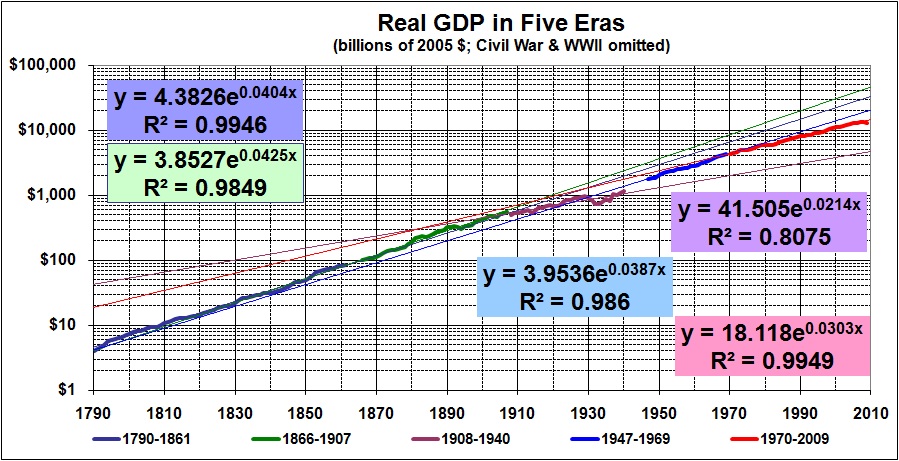
Can we measure the price of government intervention? I believe that we can do so, and quite easily. The tale can be told in three graphs, all derived from constant-dollar GDP estimates available here. The numbers plotted in each graph exclude GDP estimates for the years in which the U.S. was involved in or demobilizing from major wars, namely, 1861-65, 1918-19, and 1941-46. GDP values for those years — especially for the peak years of World War II — present a distorted picture of economic output. Without further ado, here are the three graphs:

The trend line in the first graph indicates annual growth of about 3.7 percent over the long run, with obviously large deviations around the trend. The second graph contrasts economic growth through 1907 with economic growth since: 4.2 percent vs. 3.6 percent. But lest you believe that the economy of the U.S. somehow began to “age” in the early 1900s, consider the story implicit in the third graph:

  • 1790-1861 — annual growth of 4.1 percent — a booming young economy, probably at its freest
  • 1866-1907 — annual growth of 4.3 percent — a robust economy, fueled by (mostly) laissez-faire policies and the concomitant rise of technological innovation and entrepreneurship
  • 1908-1929 — annual growth of 2.2 percent — a dispirited economy, shackled by the fruits of “progressivism” (e.g., trust-busting, regulation, the income tax, the Fed) and the government interventions that provoked and prolonged the Great Depression (see links in third paragraph)
  • 1970-2008 — annual growth of 3.1 percent —  an economy sagging under the cumulative weight of “progressivism,” New Deal legislation, LBJ’s “Great Society” (with its legacy of the ever-expanding and oppressive welfare/transfer-payment schemes: Medicare, Medicaid, a more generous package of Social Security benefits), and an ever-growing mountain of regulatory restrictions.

Had the economy of the U.S. not been deflected from its post-Civil War course, GDP would now be about three times its present level. (Compare the trend lines for 1866-1907 and 1970-2008.) If that seems unbelievable to you, it shouldn’t: $100 compounded for 100 years at 4.3 percent amounts to $6,700; $100 compounded for 100 years at 3.1 percent amounts to $2,100. Nothing other than government intervention (or a catastrophe greater than any we have known) could have kept the economy from growing at more than 4 percent.

What’s next? Unless Obama’s megalomaniacal plans are aborted by a reversal of the Republican Party’s fortunes, the U.S. will enter a new phase of economic growth — something close to stagnation. We will look back on the period from 1970 to 2008 with longing, as we plod along at a growth rate similar to that of 1908-1940, that is, about 2.2 percent. Thus:

  • If GDP grows at 2.2 percent through 2109, it will be 58 percent lower than if we plod on at 3.1 percent.
  • If GDP grows at 2.2 percent for through 2109, it will be only 4 percent of what it would have been had it continued to grow at 4.3 percent after 1907.

The latter disparity may seem incredible, but scan the lists here and you will find even greater cross-national disparities in per capita GDP. Go here and you will find that real, per capita GDP in 1790 was only 4.6 percent of the value it had attained 218 years later. Our present level of output seems incredible to citizens of impoverished nations, and it would seem no less incredible to an American of 1790. In sum, vast disparities can and do exist, across nations and time. We have every reason to believe in the possibility of a sustained growth rate of 4.4 percent, as against one of 2.2 percent, because we have experienced both.

We should look on the periods 1908-1940 and 1970-2009 as aberrations, and take this lesson from those periods: Big government inflicts great harm on almost everyone (politicians and bureaucrats being the main exceptions), including its intended beneficiaries. Such is the price of government when it does more than “establish Justice, insure domestic Tranquility, [and] provide for the common defence” in order to “promote the general Welfare, and secure the Blessings of Liberty to ourselves and our Posterity.”

Obama’s Law

Obama seems bent on nominating a woman (preferably a black or Hispanic one) to succeed Justice Souter. (See, for example, the top-10 list of likely nominees, at The Ninth Justice.) There’s nothing wrong with having a woman on the Supreme Court. But Obama’s evident zeal to nominate a woman  speaks volumes about his approach to the law.

The law, to Obama, isn’t a set of rules to protect the honest and — most importantly — limit government. Obama’s law know no constitutional bounds; it is a recipe that combines “empathy” (i.e., cheap compassion), political payoff, and power-lust.

Penalizing “Thought Crimes”

Nat Hentoff, writing at RealClearPolitics, observes with dismay that

the press remain[s] mostly silent about the so-called “hate crimes law” that passed in the House on April 29[.] The Local Law Enforcement Hate Crimes Prevention Act passed in a 249-175 vote (17 Republicans joined with 231 Democrats). These Democrats should have been tested on their knowledge of the First Amendment, equal protection of the laws (14th Amendment), and the prohibition of double jeopardy (no American can be prosecuted twice for the same crime or offense). If they had been, they would have known that this proposal, now headed for a Senate vote, violates all these constitutional provisions.

This bill would make it a federal crime to willfully cause bodily injury (or try to) because of the victim’s actual or perceived “race, color, religion, national origin, gender, sexual orientation, gender identity or disability” – as explained on the White House Web site, signaling the president’s approval. A defendant convicted on these grounds would be charged with a “hate crime” in addition to the original crime, and would get extra prison time.

The extra punishment applies only to these “protected classes.” As Denver criminal defense lawyer Robert J Corry Jr. asked (Denver Post April 28): “Isn’t every criminal act that harms another person a ‘hate crime’?” Then, regarding a Colorado “hate crime” law, one of 45 such state laws, Corry wrote: “When a Colorado gang engaged in an initiation ritual of specifically seeking out a “white woman” to rape, the Boulder prosecutor declined to pursue ‘hate crime’ charges.” She was not enough of one of its protected classes.

Corey adds that the state “hate crime” law – like the newly expanded House of Representatives federal bill – “does not apply equally” (as the 14th Amendment requires), essentially instead “criminalizing only politically incorrect thoughts directed against politically incorrect victim categories.”

Whether you’re a Republican or Democrat, think hard about what Corry adds: “A government powerful enough to pick and choose which thoughts to prosecute is a government too powerful.”

But James Madison, who initially introduced the First Amendment to the Constitution, had previously written to Thomas Jefferson on the passage of the Virginia Statute on Religious Freedom: “We have in this country extinguished forever … making laws for the human mind.” No American, he emphasized later, would be punished for his “thoughts.”

However, doesn’t the House “Hate Crimes Bill” state that nothing in the legislation shall “prohibit any expressive conduct protected from legal prohibition” – or speech “protected by the free speech or free exercise clauses in the First Amendment”?…

This legislation, certain to be passed by the Senate, will come to the Supreme Court….

[The justices] should … remember that the Fifth Amendment makes clear: “nor shall any person be subject for the same offence to be twice put in jeopardy.” But the House “hate crime” bill allows defendants found innocent of that offense in a state court to be tried again in federal court because of insufficiently diligent prosecutors; or, as Attorney General Eric Holder says, when state prosecutors claim lack of evidence. It must be tried again in federal court!

Imagine Holder as the state prosecutor in the long early stages of the Duke University Lacrosse rape case!…

Consider the infamous murder of Matthew Shepard by Russell Henderson and Aaron McKinney. It is evident that Matthew Shepard’s murder — like the mass slayings at Columbine and elsewhere — has been used cynically by advocates of one agenda or another. The agenda is gay rights in the Shepard case; it is gun confiscation in the school-shooting cases.

Those who are rushing to legislate against “thought crimes” should confront these questions: Would Henderson and McKinney’s crime be less heinous if Shepard wasn’t killed because of his homosexuality (a strong possibility)? In other words, why should it more wrong to kill a homosexual because he’s a homosexual than to kill a homosexual for some other reason, or to kill a straight, white male for any reason? Dead is dead, and therein lies the real crime.

If it is more wrong to kill a person because of a personal characteristic than simply to kill a person, consider the case where A kills his neighbor, B, because A dislikes having B as a neighbor. Should neighbor-killing be declared a hate crime? If so, then why not declare all crimes against persons to be hate crimes, and be done with it? That, at least, would comply with the Constitution‘s guarantee of equal-protection, assuming (wrongly, no doubt) even-handed application of the law.

The law should penalize crime, and not presume to read the minds of perpetrators, or — as Nat Hentoff reminds us — grant greater protection to some classes of persons than to others.

Is Statism Inevitable?

In “Parsing Political Philosophy” I suggest that our descent into statism may continue indefinitely. The suggestion is based on years of observing American politics, which have brought me to the understanding that voters are profoundly irrational. They prefer statism to liberty, regardless of what they say. They (most of them) believe statism to be benign because it often wears a friendly face. But statism is not benign; it is dehumanizing, impoverishing, and — at bottom — destructive of the social fabric upon which liberty depends.

If statism — and perhaps something worse — is an inevitable product of our representative democracy, why is that so? One explanation invokes the slippery slope, which is

an argument for the likelihood of one event or trend given another. Invoking the “slippery slope” means arguing that one action will initiate a chain of events that will lead to a (generally undesirable) event later. The argument is sometimes referred to as the thin end of the wedge or the camel’s nose.

That is to say, once a polity becomes accustomed to relying on the state for a particular thing that should be left to private action, it becomes easier to rely on the state for other things that should be left to private action.

Another metaphor for the rising path of state power is the ratchet effect,

the commonly observed phenomenon that some processes cannot go backwards once certain things have happened, by analogy with the mechanical ratchet that holds the spring tight as a clock is wound up.

As people become accustomed to a certain level of state action, they take that level as a given. Those who question it are labeled “radical thinkers” and “out of the mainstream.” The “mainstream” — having taken it for granted that the state should “do something” — argues mainly about how much more it should do and how it should do it, with cost as an afterthought.

Perhaps the best metaphor for our quandary is the death spiral. Reliance on the state creates more problems than it solves. But, having become accustomed to relying on the state, the polity relies on the state to deal with the problems caused by its previous decisions to rely on the state. That only makes matters worse, which leads to further reliance on the state, etc., etc. etc.

More specifically, unleashing the power of the state to deal with matters best left to private action diminishes the ability of private actors to deal with problems and to make progress, thereby fostering the false perception that state action is inherently superior. At the same time, the accretion of power by the state creates dependencies and constituencies, leading to support for state action in the service of particular interests. Coalitions of such interests resist efforts to diminish state action and support efforts to increase it. Thus the death spiral.

Can we pull out of the spiral? Not unless and until resistance to state action becomes much stronger than it is. Nor can can it be merely intellectual resistance; it must be conjoined to political power. The only source of political power toward which anti-statists — and disillusioned statists — can turn is the Republican Party. And if the GOP does not return to its limited-government roots, all may be lost.

How can the GOP succeed in divesting itself of more of its Specters, while adding new blood in sufficient quantity so as to become, once again, a potent political force? Fred Barnes, writing in The Weekly Standard (“Be the Party of No,” vol. 14, issue 33, 05/18/09) is on the right track:

Many Republicans recoil from being combative adversaries of a popular president. They shouldn’t. Opposing Obama across-the-board on his sweeping domestic initiatives makes sense on substance and politics. His policies–on spending, taxes, health care, energy, intervention in the economy, etc.–would change the country in ways most Americans don’t believe in. That’s the substance. And a year or 18 months from now, after those policies have been picked apart and exposed and possibly defeated, the political momentum is likely to have shifted away from Obama and Democrats.

This scenario has occurred time and again. Why do you think Democrats won the House and Senate in 2006 and bolstered their majorities in 2008? It wasn’t because they were more thoughtful, offered compelling alternatives, or had improved their brand. They won because they opposed unpopular policies of President Bush and exploited Republican scandals in Congress. They were highly partisan and not very nice about it.

If Republicans scan their history, they’ll discover unbridled opposition to bad Democratic policies pays off. Those two factors, unattractive policies plus strong opposition, were responsible for the Republican landslides in 1938, 1946, 1966, 1980, and 1994. A similar blowout may be beyond the reach of Republicans in 2010, but stranger things have happened in electoral politics. They’ll lose nothing by trying….

Republican efforts to escape being tagged the party of no are understandable…. But no matter how restrained and sensible Republicans sound or how many useful ideas they develop, they’re probably stuck with the party of no label. They have more to gain by actually accepting the role and taking on Obama vigorously. If they come to be dubbed the party of no, no, no, a thousand times no, all the better. It will mean they’re succeeding.

In other words, Republicans might make some headway against the forces of statism if they will simply live up to their reputation for “meanness,” instead of apologizing for it — as they have been doing for decades. (Here’s how not to do it.) In order for that to happen, the Cheney wing of the party must prevail over the Powell wing. The good news is that the Powell wing — as represented by RINOs like Susan Collins and Olympia Snowe — may simply choose to follow Arlen Specter’s cynical conversion to the party of statism.

If the GOP fails to revert to its small-government stance, all may be lost. Democrats will be free to spend and spend, elect and elect, until — somewhere down the road — voters finally rebel. But until that distant day, Democrats will have enacted so many more crippling laws and regulations, and appointed so many more lawless judges, that nothing short of a constitutional revolution could rescue us from our political and economic hell.

Having had one constitutional revolution, I doubt that we will be lucky enough to have another one. Only a wise (and rare) élite can establish and maintain the somewhat minarchistic state we enjoyed until the early 1900s. The existence of such an élite — and its success in establishing a lasting minarchy — depends on serendipity, determination, and (yes) even force. That we, in the United States, came close (for a time) to living in a minarchy was due to historical accident (luck). We had just about the right élite at just about the right time, and the élite’s wisdom managed to prevail for a while.

That we have moved on to something worse than minarchy does not prove the superiority of statism. It simply suggests that our luck ran out because statism was (and remains) inevitable in a representative democracy, where irrational voters fuel the power-lust of politicians, and politicians gull irrational voters.

But I have not lost all hope (because of this, in part). And so, I await with interest (and some hope) the outcome of the struggle for the Republican Party’s soul.

Related reading: Peter Ferrara’s The Strategy of Not-So-Smart Surrender

Parsing Political Philosophy

A revised version of this post, expanded in scope but somewhat shorter, is here.

This is a work in progress. It is my attempt to replace vague terms like “conservative” and “liberal” with a more precise delineation of political viewpoints in the United States. Accurate as this taxonomy may be, it is not impartial, nor is it meant to be. I favor a particular branch of minarchism — and it shows.

TWO BASIC POLITICAL ISSUES

Politics, correctly understood, refers to the means by which human beings govern interpersonal behavior of various kinds (including commerce), and — in some cases — behavior that might be considered strictly personal (e.g., the kinds of material one chooses to read or view). There are two basic political issues:

  • who should govern (if anyone)
  • what they should govern (i.e., government’s proper role, if any, in the regulation of human affairs).

My purpose here is to classify the range of views about those issues in terms more meaningful than “Democrat,” “Republican,” “liberal,” “conservative,” and the like. Such terms no longer convey accurate information about a person’s stance on the basic issues (if they ever did).

THREE BASIC PHILOSOPHIES OF POLITICS

I begin with a rough sorting of political preferences:

  • Anarchism is a fairly coherent (if implausible) philosophy of non-government, propounded by persons who usually call themselves anarcho-capitalists (probably because it seems a more respectable label than “anarchist”).
  • Minarchism is a somewhat more diffuse but still coherent philosophy of minimal government, propounded by persons who usually call themselves libertarians, over the objection of anarchists, who claim to be the only true libertarians.
  • Anarchists and minarchists dwell in the big tent of libertarianism.  Where anarchists are fairly monolithic in their views (government is evil because it must always be based on coercion), minarchists are of varied stripes, which I delineate below. My analyses of anarchism and minarchism span the range of libertarian ideas, so there is nothing more for me to say in this post about libertarianism as a political philosophy.
  • Statism lives not in a big tent but in a  colossal coliseum. It comprises a broad set of attitudes about government’s role, propounded by “types” ranging from redneck yahoos to campus radicals, each type proclaiming itself benign (for some, if not for others). But each type would — in thought and word, if not deed — set loose the dogs of the state upon its political opponents and the vast, hapless majority. Statism, because it is so powerful and pervasive a force, merits further analysis — more aptly, dissection — into its main types.

Thus the three broad philosophies that I parse in this post are anarchism, minarchism, and statism. Here’s a bit more about each of them:

Anarchism

Anarchists believe that no one should govern others; rather, all human interactions and joint functions (e.g., a group’s efforts to defend itself against predators and enemies) should be undertaken through voluntary agreements, including contracts with private defense agencies.

Central to anarchism is the dual principle of non-coercion and non-aggression: conjoined prohibitions against the imposition of one’s will upon others and, therefore, the use of force except in self-defense or the defense of others. (Are there loopholes for dealing with imminent, predatory threats and teaching children to behave? Only an anarchist knows for sure.) Government, by definition, imposes its will by exerting superior force. Government, therefore, is illegitimate.

The non-aggression principle is the undoing of anarchism. Anarchy (purely consensual anarchy) cannot prevail. Non-aggression often is met with aggression. Anarchists (were there a viable group of them) would fall prey to well-armed aggressors (both from within the group and outside it). This inconvenient fact is of no account to doctrinaire anarchists. They are focused on the world as they would like it to be, and have little time for the world as it is, except to object when it isn’t to their liking — which is all of the time.

Minarchism

The Central Tenet: Limited Government

Minarchists are united in but one respect: Government, being inevitable if not necessary, must be kept within strict bounds. Given the inevitabliity of government, it is better to control it than to be controlled by it. It is therefore better to design an accountable one that can be kept within its bounds (or so minarchists hope) than to suffer an imposed regime, most likely an oppressive one.

Why do minarchists prefer strictly limited government? There are two reasons. The first reason is a desire to be left alone, or more elegantly, a deontological belief in the natural right to be left alone. (Most anarchists are deontologists.) The second, consequentalist, reason is that voluntary social and economic transactions yield better results than government-directed ones. Friedrich Hayek makes that argument, at length and succesfully, in his essay, “The Use of Knowledge in Society.” Here is a small sample:

As Alfred Whitehead has said in another connection, “It is a profoundly erroneous truism, repeated by all copy-books and by eminent people when they are making speeches, that we should cultivate the habit of thinking what we are doing. The precise opposite is the case. Civilization advances by extending the number of important operations which we can perform without thinking about them.” This is of profound significance in the social field. We make constant use of formulas, symbols, and rules whose meaning we do not understand and through the use of which we avail ourselves of the assistance of knowledge which individually we do not possess. We have developed these practices and institutions by building upon habits and institutions which have proved successful in their own sphere and which have in turn become the foundation of the civilization we have built up.

What Hayek says is true not only of economic institutions but also of social ones. The seemingly uncoordinated price “system” guides economic actors toward better ways of meeting ever-changing human wants with limited resources. The social “system” accrues behavioral norms that guide individuals toward peaceful, constructive coexistence with their compatriots.

The Protection of Negative Rights

Whether deontological or consequentialist, minarchism holds that the central role of government is to protect citizens from predators, domestic and foreign. Such protection cannot be absolute, but government’s evident ability and willingness to dispense justice and defend the nation are meant, in part, to deter predators.

More generally, the ideal government is restricted to the protection of negative rights. Such rights, as opposed to positive rights, do not involve claims against others; instead, they involve the right to be left alone by others. Negative rights include the right to conduct one’s affairs without being killed, maimed, or forced or tricked into doing something against one’s will; the right to own property, as against the right of others to abscond with property or claim it as their own; the right to work for a wage and not as a slave to an “owner” who claims the product of one’s labor; and the right to move and transact business freely within government’s sphere of sovereignty (which can include overseas movements and transactions, given a government strong enough to protect them).

To a minarchist, then, rights are limited to those that can be exercised without requiring something of others (e.g., transfers of income and property). The one necessary exception is the cost of providing a government to ensure the exercise of rights. That cost must be borne, in some arbitrary way, by citizens who, on the one hand, see no need for government (i.e., anarchists) and by citizens who, on the other hand, have differing conceptions of rights and how the cost of protecting those rights should be shared.

More about Property Rights

Minarchists (like anarchists) are fierce defenders of property rights. Minarchists hold that we own what we earn (or what is given to us, freely, by others who have earned it). The right to property is a negative right, in that the enjoyment and use of that which is ours need not deny anyone else the right to enjoy and use that which is theirs. (Acts of enjoyment and use, however, must not infringe on the negative rights of others.) The denial of property rights (in whole or in part) is theft, whether committed by a private party or government. (The “public use” clause of the Fifth Amendment is applied legitimately only when government must take property, with “just compensation” in order to execute one of the few legitimate functions of government.)

There is an economic justification, as well, for minarchists’ defense of property rights. People generally use that which they own more carefully and more productively than that which they do not own. This tendency — which springs from the same psychological source as the tendency of individuals to care more for those who are closest to them — yields less waste and greater output. That outcome benefits everyone, not just the owners of economic resources.

The Role of Civil Society

There can be more to minarchy than the protection of negative rights. In the view of some minarchists, government legitimately serves the broader (but related) purpose of protecting civil society. Other minarchists have no use for what they see as the strictures of civil society; they wish only to be left alone. In their introverted myopia they fail to see that the liberty to live a peaceful, happy, and even prosperous life depends on civil society: the daily observance of person X’s negative rights by persons W, Y, and Z — and vice versa. That is so because it is impossible and — more importantly — undesirable for government to police everyone’s behavior. Liberty depends, therefore, on the institutions of society — family, church, club, and the like — through which individuals learn to treat one another with respect, through which individuals often come to the aid of one another, and through which instances of disrespect can be noted, publicized, and even punished (e.g., by criticism and ostracism).

That is civil society. And it is civil society which, many minarchists aver, government ought to protect instead of usurping and destroying as it establishes its own agencies (e.g., public schools, welfare), gives them primary and even sole jurisdiction in many matters, and funds them with tax money that could have gone to private institutions. Moreover, some minarchists aver that government ought to tolerate a broad range of accepted behaviors across the various institutions of civil society, as long as government also protects the negative rights of association and exit: the right to associate with persons of one’s choosing, and the right to live and work where one prefers.

The centrality of family, church, club, and the like, to civil society reflects a fundamental fact of the human condition: We tend to care more for those who are close to us than we do for those who are unrelated to us by blood or a direct social bond of some kind. Charity and civilization begin at home.

Statism

We come now to statism, about which less need be said than about minarchism. Statism is notable mainly for its failure to understand, respect, or protect negative rights and civil society.

The Essence of Statism: Control

Statism boils down to one thing: the use of government’s power to direct resources and people toward outcomes dictated by government. Statism is orthogonal to the libertarian worldview of anarchists and minarchists.

The particular set of outcomes toward which government should strive depends on the statist who happens to be expounding his views. But all of them are essentially alike in their desire to control the destiny of others. (Two excellent posts that spell out the essential sameness of statism, whether it comes from the “left” or the “right,” are John Ray’s “The American Roots of Fascism” and Eric Scheie’s “Rule by the Freest.”)

“Hard” statists thrive on the idea of a powerful state; control is their religion, pure and simple. “Soft” statists profess offense at the size, scope, and cost of government, but will go on to say “government should do such-and-such,” where “such-and such” usually consists of:

  • government grants of particular positive rights, either to the statist, to an entity or group to which he is beholden, or to a group with which he sympathizes
  • government interventions in business and personal affairs, in the belief that government can do certain things better than private actors, or simply should do many things other than — and sometimes in lieu of — dispensing justice and defending the nation.

The distinctions between “hard” and “soft” are, for my purposes, less important than the particular kinds of positive rights and interventions preferred by statists of various stripes. I parse the variety of statists later in this post.

Feeble Excuses for Statism

Statists give various excuses for their statism. Here are three, the second and third of which are mentioned above:

  • Government is the community. (This is an odd thing to say, given that politicians elected by a minority of the populace, and often a bare majority of voters, are able to dictate to the non-voting majority. The main virtue of  many an appointed official is that he represents a particular interest group, which is a far cry from “the community.”)
  • People (or certain kinds of people) can’t do such-and-such for themselves. (This claim is credible only because government has destroyed much of civil society by fostering dependency instead of personal responsibility; by blunting entrepreneurship, business formation, and economic growth through taxation and regulation; by breaking up families through various welfare programs; by usurping many of civil society’s functions (education, care of the elderly, and charity being the three most obvious); and by heavily taxing those who would have the means to underwrite the educational and charitable institutions of civil society.)
  • Certain kinds of activities and industries must be regulated because we can’t trust certain so-an-so’s to do the right thing. (This claim is tantamount to saying that (a) only certain outcomes are acceptable, (b) risk — which is necessary to progress — can be controlled by politicians and bureaucrats, and (c) the superficial knowledge and judgments of those same politicians and bureaucrats are adequate substitutes for the vast amounts of knowledge resident in free markets and free social institutions.

The reality from which statists avert their eyes is this: Even in a “democracy” such as ours, where government is supposed to be the people’s servant, it is in fact operated by power-hungry politicians and their often-arrogant minions. The arrogant attitudes of elected and appointed officials toward the “communities” they supposedly serve are revealed by the lavish offices and perquisites they arrange for themselves. The higher they rise on the scale of political power, the more god-like they become, to themselves at least. Constituent service is a means of garnering votes — a necessary evil, handled by staffers whenever possible, and paid for by taxpayers. (A politician naturally take a more personal interest in big contributors seeking attention and favors.)

The Bottom Line

No recitation of the character and limitations of government really matters to a statist. Government is at once a statist’s god and bully of first resort.

It is evident that we have come to statism as the ruling philosophy in America, for reasons I will detail in a future post.

REFINING THE TRIPARTITE TAXONOMY

To further distinguish anarchists, minarchists, and statists, and to delineate the varieties of minarchism and statism, I apply the following questions:

  1. Is there a need for government, that is, an institution empowered to impose rules of behavior on the populace? Or should human affairs be regulated (entirely or mainly) by voluntary agreements among individuals (say, adult individuals for the sake of simplicity)?
  2. If government is necessary, what control should it have of the affairs of citizens, with respect to (a) the types of affairs and (b) the degree of control?
  3. How should government be chosen?
  4. How should it be controlled?

The answers follow. For the sake of brevity, I generally use the following notation: A = anarchist(s), M = minarchist(s), S = statist(s).

1. Need for Government

Anarchists

A say “no” to government because, in their view, essential functions (e.g., justice and defense) can be accomplished through contracts with private agencies. Similarly, all other matters involving human interactions should be resolved by consenting individuals through voluntary agreements.

Given that A do not believe in the necessity of government, I have only one more thing to say about anarchists until the summing up: No anarchist who strives for consistency in his beliefs should have any views about the three questions yet to be addressed.

Minarchists and Statists

M and S say “yes” to government. M do so out of necessity (anarchy being impossible, in their view), or in the belief that it is possible and desirable to have a minimal government which only protects negative rights (including property rights) and civil society.

S say “yes” to government out of a desire to harness the power of government to their will. But the answers to questions 2 through 4 are fundamentally different as between M and S, and among S.

2. Government Control of the Affairs of Citizens

Minarchists

Somewhere on the political scale the must be a little room for those M who are anarchists at heart, but who accept the inevitability of government or flinch at the thought of anarchy. These tepid minarchists have little to contribute to political discourse. Their stock in trade is to point out that government always does the wrong thing, no matter what it does. I call them A-M, for anarcho-minarchists. And that is the end of them, for purposes of this post.

I turn now to those M who actually have ideas about what government should do within its proper sphere.

The main arguments among M have to do with defining negative rights and delineating government’s role in protecting those rights. The protection of negative rights requires that certain kinds of actions be prevented or punished. But there are gray areas, the most significant of which involve defense, crime, discrimination (on the basis of race, gender, or sexual orientation), and matters that come under the heading of self-ownership (e.g., abortion and homosexual “marriage”).

Some M are to the “left.” These  L-M (left-minarchists), as I call them, usually cluster around the following positions:

  • L-M embrace the non-aggression principle with respect to national defense, not because they believe in anarchy but because they simply wish that it weren’t necessary for America to be at war with anyone. They might consider it necessary to strike first at a potential enemy who is poised to strike us, but they would have to think long and hard about it.
  • For much the same reason, L-M tend toward a “soft on crime” stance and near-absolutism with respect to things like freedom of speech, freedom from warrantless searches and seizures, and freedom from self-incrimination. As with defense, L-M will admit the need for government action, but they mistrust the government that has the power to act.
  • L-M are sympathetic to “political correctness,” arguing that someone (perhaps government) must do something to quell impolite speech or to compensate blacks, women, etc., for the past behavior of those who discriminated against them. More generally, they are all for liberty, except when it is exercised in ways of which they disapprove.
  • Reverting to their embrace of the non-aggression principle, which they abandon when it comes to “political correctness,” L-M tend toward absolutism on such matters as abortion (“it’s a woman’s choice”) and homosexual “marriage” (“what’s different about it?”).

With respect to the first two points, L-M come very close to being anarchists. Government may be necessary, but it is very definitely an evil to be tolerated and restrained, perhaps even to the point of ineffectiveness in combating predators. As for the last two points, L-M come very close to being left-statists (who are discussed below). L-M fall in the M column mainly because of their general views about government: Less is better, and the only rights it should protect (with perhaps a few exceptions having to do with discrimination) are negative ones. Of course, in order to say that, you must count among negative rights the right to kill an unborn child.

It may come as a surprise to L-M, but it is possible to be a minarchist and hold views nearly opposite those of an L-M. The right-minarchists (R-M) who hold such views tend to cluster around these positions:

  • R-M reject the non-aggression principle with respect to national defense. They do so not because they favor aggression but because the principle, in its standard interpretation, is a non-action principle. It would not allow a preemptive attack on an antagonistic state that is armed, capable of striking us at any time, and known to be contemplating a strike. R-M, in other words, tend toward hawkishness when it comes to national defense.
  • R-M also tend toward a hawkish stance on crime. For example, some R-M have no sympathy for journalists who protect anonymous sources where those sources obtain their information by breaking the law. Other R-M reject the idea that the press should be allowed to print whatever information it may obtain about America’s defense forces, plans, and operation. R-M understand that liberty and the prosperity it brings are unattainable in a lawless, defenseless society.
  • R-M are unsympathetic to “political correctness,” arguing that government must not do anything to quell impolite speech or to compensate blacks, women, etc., for the past behavior of those who discriminated against them, because to do so penalizes persons now living who are innocent of discrimination. But more than that, R-M would give individuals and businesses broad latitude in their affairs, penalizing only acts traditionally understood as harmful (e.g., murder, rape, and theft).
  • R-M see “rights” like abortion and homosexual “marriage” as government-imposed social innovations with potentially harmful consequences for civil society. If social custom, as embodied in legislative acts, rejects such things as abortion and homosexual “marriage,” it does so because those things undermine the fabric of society — the bonds of mutual respect, mutual trust, and mutual restraint that enable a people to live and work together in peace.

Obviously, there are other shades of M lying between L-M and R-M. I focus on those two varieties to illustrate the broad range of positions that can be encompassed in minarchism: from the radical posturings of L-M to the true conservativism (and true libertarianism) of R-M.

Statists

S are either to the left (L-S) or the right (R-S), depending on the the kinds of positive rights they want government to bestow, the kinds of property rights they would allow government to flout, and the ways in which they would use government to usurp and trample civil society.

L-S and R-S generally clamor for their own negative rights, but they are eager to deny the negative rights of others. L-S, for example, would like to muzzle global-warming skeptics and impose penalties for “hate crimes”; R-S would quell protests, even orderly, non-disruptive ones. (A minarchist would point out that there would be far fewer protests if protesters knew that government wouldn’t do anything about the matters being protested.)  The general point is that both L-S and R-S tend to be so intolerant of views they oppose that they would use government to quell those views. The use of government in that way bestows (or would bestow) a  positive right on S, in that it takes (or would take) something (e.g., freedom of speech) from some persons for the satisfaction of others (statists). (The use of government in that way, as in other illegitimate ways, merely authorizes reciprocal treatment from one’s opponents.)

Both L-S and R-S are  proponents of overtly positive rights, as well. L-S prefer such things as income redistribution, affirmative action, and the legitimation of gay marriage, whereas R-S are reliably on the opposing side of such issues. It other words, where L-S generally support positive rights for particular classes of individuals (e.g., the poor, blacks, homosexuals), R-S generally oppose such rights. The problem (from a minarchist’s standpoint) is that R-S often seem oblivious to the principle that government shouldn’t be in the business of granting positive rights; the R-S position too often seems based on animus toward the groups favored by L-S. That said, many R-S oppose the granting of positive rights for the perfectly valid reason that they (among others) will bear the costs associated with such rights. (It is consoling to an R-M when an R-S votes against L-S candidates for office, whatever his reasons for doing so.)

L-S prefer government intervention in the economy, not only for the purpose of redistributing income but also to provide goods and services that can be provided more efficiently by the private sector, to regulate what remains of the private sector, and to engage aggressively in monetary and fiscal measure to maintain “full employment.” It should be evident that L-S have no respect for property rights, given their willingness to allow government to tax and regulate at will.

R-S oppose government interventions, unless they stand to benefit from them, or happen to view them through the lens of nationalism (e.g., “protecting American jobs”).

The best-known differences between L-S and R-S are found in their attitudes toward crime, defense, and abortion. L-S tend toward leniency and forgiveness of criminals (unless the L-S or those close to him are the victims); R-S tend toward swift and sure punishment. On defense, L-S act as if they prefer Chamberlain to Churchill, their protestations to the contrary; R-S prefer Churchill to Chamberlain, and make no bones about it. Abortion (and kindred issues involving life and death) find L-S siding with L-M and R-S siding with R-M.

L-S have no room in their minds for civil society; government is their idea of “community.” R-S defend civil society, and would push government to the background — except when they want government to do something. Their willingness to allow more than a minimal government, for certain purposes, leads R-S into the trap of arguing about what government should do instead of arguing that it should do no more than protect negative rights (including property rights) and civil society.

3. How to Choose Government

The question of choosing government subsumes two issues:

  • the breadth of the franchise (assuming that something like representative democracy is the preferred form of government)
  • whether those who govern should be chosen or should choose themselves.

On the first issue, L-M generally align with L-S; R-M, with R-S. The first pairing usually opposes efforts to restrict voting (e.g., by requiring photo ID) that might restrain voting by certain groups (mainly poor blacks and Latinos). The second pairing is more vigilant against voter fraud (usually because the fraud usually cuts against their interests).

There are R-M (like me) and R-S who are less worried by voting fraud than by the extent to which the franchise has been broadened. This has nothing to do with gender or race (except perhaps in the part of some R-S) and much to do with keeping government on the straight-and-narrow. A good way to do that is to restrict the franchise to those persons who have acquired sufficient maturity, and who have a vested interest in the protection of property rights (which are central to economic well-being). My own modest proposal is to raise the voting age 30, and to restrict voting to persons who own their principal residence.

All of the preceding variations on the issue of franchise are minor when compared with the stark truths surrounding the issue whether those who govern should be chosen or should choose themselves. There are S who prefer dictatorship, even if they don’t call it that. I am referring to those L-S who have become shrill in their insistence on regulating the minutiae of our lives and livelihoods (from smoking to banking), suppressing dissent about certain issues (e.g., global warming and gay rights), and suppressing religious expression in the (spurious) cause of separating church and state. These L-S prefer to exercise their will through regulators and judges, inasmuch as we have come to think of powerful regulatory agencies and law-making judges as manifestations of representative democracy. But these are not proper manifestations of representative democracy, and should not be thought of as such. Regulatory agencies and judges (not to mention those many elected officials who seem to hold office for life) are not chosen by voters; they are foisted upon voters. (There is a strong case to be made for appointed judges, but appointed judges who make law instead of applying it are on the side of statism.)

Unfortunately, it is only in rare instances (as in the case of I.F. Stone) that these L-S are revealed for what they really are: tyrants cloaked in the language of democracy and compassion. L-S of the kind I have been discussing (which, unfortunately seems to be most of them), belong in a category by themselves. I hereby dub them and their branch of political thought T-L-S (for totalitarian-left-statists and totalitarian-left-statism).

Certainly, there are some T-R-S to be found among the ranks of white nationalists and their ilk. But T-R-S constitute a platoon, as against a legion of T-L-S.

4. How to Control Government

This question overlaps the previous question in one respect, it involves the right to vote, namely, who has it. Two other issues are the degree to which power is centralized, and how the central government’s power is checked. Casual observation suggests that the expansion of the franchise, the centralization of government power, and the expansion of the central government’s power are closely related. The more “democratic” we are, the less liberty we enjoy, thanks in part to the interest-group paradox, which has been a major cause of the death spiral of liberty.

The views of most M and S about centralization and checks on power are unsurprising:

  • L-M prefer less centralization and weak government all around.
  • R-M prefer less centralization and generally weak government, except in the areas of justice and defense.
  • L-S and T-L-S prefer more centralization and strong government all around, excepting defense and justice — criminal justice, that is. The laws and regulations that cabin our lives warrant strong enforcement, these statists would aver.
  • R-S and T-L-S prefer less centralization and strong government only in certain areas (e.g., justice, defense, immigration).

With respect to centralization and power, most M have been reduced to hoping for miracles from the U.S. Supreme Court and the lower federal courts. But those miracles hinge on many things:

  • the election of Republican presidents (they do make a difference, when it comes to judges);
  • retirements of judges, especially Democrat appointees;
  • the ability of Republican presidents to select judges who would roll back the central government’s mandates and powers;
  • the willingness of the (usually) Democrat-controlled Senate to approve a Republican president’s nominees;
  • and the ability of those nominees (if they prove reliable) to make a difference, given the number of judges who seem to favor governmental power, of one kind or another, over private action.

That is a very high mountain of hope to climb. But there is another way, which involves the use of the Article V of the Constitution:

The Congress, whenever two thirds of both Houses shall deem it necessary, shall propose Amendments to this Constitution, or, on the Application of the Legislatures of two thirds of the several States, shall call a Convention for proposing Amendments, which, in either Case, shall be valid to all Intents and Purposes, as Part of this Constitution, when ratified by the Legislatures of three fourths of the several States, or by Conventions in three fourths thereof, as the one or the other Mode of Ratification may be proposed by the Congress….

When the damage inflicted by statists upon this nation finally reaches the point of being unbearable, even by many statists, it might become possible to amend the Constitution to ameliorate the damage. In my decade of reading blogs and the like I have encountered only two serious proposals for using Article V to undo the mess we are in. Both are by persons whom I consider to be R-M: Profesor Randy Barnett and me.

Barnett proposes a “federalism amendment.” I propose something even more radical: a new constitution that includes, among many things, an Article VIII, Conventions of the States, which opens with this:

Delegations of the States shall convene every four years for the purpose of considering revisions to and revocations of acts of the government established by this Constitution. Such conventions (hereinafter “Convention of the States”) may revise and/or revoke any act or acts and/or any holding or holdings, in the sole discretion of a majority of State delegations present and voting.

These proposals, I believe, qualify Barnett and me as radical-right-minarchists (R-R-M), where “radical” means favoring the restoration of the Constitution to its original meaning. What sets R-R-M apart from other types of M is their understanding that it is no longer possible to slay or tame Leviathan through electoral politics-as-usual, that the Constitution itself must be reinvigorated. (There are more radical alternatives, a military coup and <a href=”https://politicsandprosperity.wordpress.com/2009/04/17/secession/, neither of which has much chance of success, and both of which could backfire. Barnetts’s and my proposals would not, if adopted in the way outlined in the third through fifth paragraphs of Barnett’s article.)

A SUMMARY OF THE REFINED TAXONOMY

Regardless of the political label you apply to yourself, you probably are one of these:

Anarchist (A) – no government; justice and defense provided through contractual arrangements with private agencies, all other social and economic arrangements entirely consensual.

Minarchist (M) – limited government for the dispensation of justice and national defense, and the protection of negative rights (including property rights) and civil society; specifically:

Anarcho-minarchist (A-M) – a minarchist only because government seems inevitable; otherwise, a nay-saying anarchist.

Left-minarchist (L-M) – a quasi-anarchist on justice and defense; strong on negative rights and positive rights, but weak on civil society (leans toward “politically correct” statist views).

Right-minarchist (R-M) – strong on justice, defense, negative rights, property rights, and civil society.

Radical-right-minarchist (R-R-M) – same as a right-minarchist, but seeks a “constitutional revolution” to decentralize and weaken government.

Statist (S):

Left-statist (L-S) – weak on justice and defense, negative rights, property rights, and civil society.

Totalitarian-left-statist (T-L-S) – same as a left-statist, but prefers dictatorial ways of imposing his policy preferences.

Right-statist (R-S) – much like a right-minarchist in many respects, but over the top with respect to justice and defense and favors some positive rights and some degree of political repression (though never as much as a left- or totalitarian-left-statist).

Totalitarian-right statist (T-R-S) – the mirror image of T-L-S, but far fewer in numbers and relatively impotent, politically.

Which of the political philosophies represented by these types aligns most closely with liberty? Which is most inimical to liberty? I rank them as follows (the higher, the better):

R-R-M

R-M

R-S

L-M

A-M/A

L-S

T-L-S/T-R-S

R-R-M and R-M stand at the top of the class for their stalwart defense of liberty, up and down the line — from justice and defense to the protection of negative rights, property rights, and civil society. R-S rank above L-M because L-M, unlike R-S, disdain justice and defense — the bulwarks of liberty — though they might not neglect them altogether; both have their quirks when it comes to rights. M-M and A simply would leave us at the mercy of predators, which is a prescription for the opposite of liberty. But M-M and A are better than L-S and T-L-S because the former would not — in principle — subject others to the discipline of the state. L-S and especially T-L-S deserve a special place in my imaginary hell because their every political thought stands in opposition to liberty. Thankfully, T-R-S are impotent blowhards.

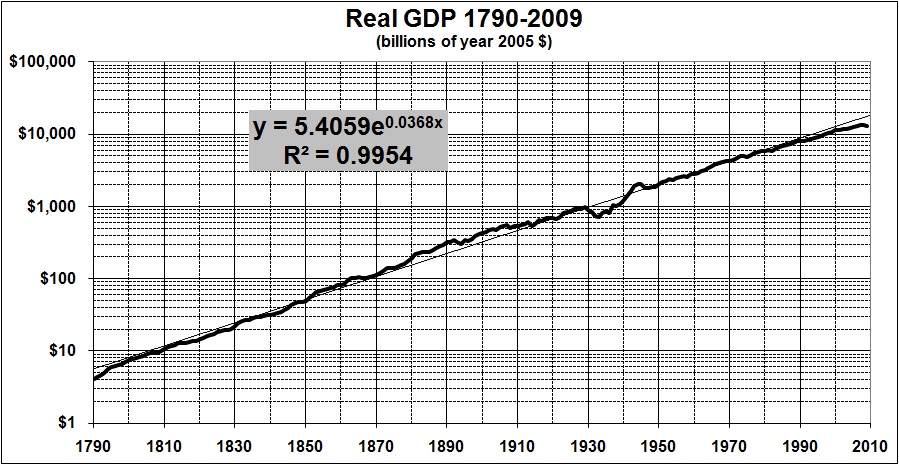
The Interest-Group Paradox

The interest-group paradox is a paradox of mass action (my own coinage). In this post, I illustrate the concept of mass-action paradox with two examples, then turn to the interest-group paradox.

The paradox of thrift is probably the best-known paradox of mass action. According to an article at Wikipedia, the paradox (propounded by John Maynard Keynes) states that if, in the face of an economic downturn, large numbers of individuals try to save more money, the attempt to do so will worsen the downturn. That, in turn, will cause reductions in the incomes of large numbers of individuals, who will then be able to save less, not more. (The article continues with an explanation of the mechanism behind the paradox. The criticisms summarized in the article are unconvincing.)

Another familiar paradox of mass action has to do with the behavior of panicked crowds. If someone shouts “fire” in a crowded theater, many members of the audience may rush madly toward the exits instead of walking calmly, in lines. The mad rush likely will cause pileups at the exits, leading to more panic and worse pileups. As a result, many (perhaps most) of the theater-goers will die, if not from fire and smoke inhalation, then from being trampled and suffocated in a pileup. The paradox here is that the (panicked) effort by members of the crowd to save themselves may well result in their deaths. I call this the paradox of panic.

The paradox of thrift and the paradox of panic are paradoxes of mass action because, in both instances, large numbers of individuals come to harm when each of them tries to do something that he believes to be in his best interest.

I now turn to the main subject of this post: the paradox of mass action that I call the interest-group paradox. Pork-barrel legislation exemplifies the interest-group paradox in action, though the paradox encompasses much more than pork-barrel legislation. There are myriad government programs that — like pork-barrel projects — are intended to favor particular classes of individuals. Here is a minute sample:

  • Social Security, Medicare, and Medicaid, for the benefit of the elderly (including the indigent elderly)
  • Tax credits and deductions, for the benefit of low-income families, charitable and other non-profit institutions, and home buyers (with mortgages)
  • Progressive income-tax rates, for the benefit of persons in the mid-to-low income brackets
  • Subsidies for various kinds of “essential” or “distressed” industries, such as agriculture and automobile manufacturing
  • Import quotas, tariffs, and other restrictions on trade, for the benefit of particular industries and/or labor unions
  • Pro-union laws (in many States), for the benefit of unions and unionized workers
  • Non-smoking ordinances, for the benefit of bar and restaurant employees and non-smoking patrons.

What do each of these examples have in common? Answer: Each comes with costs. There are direct costs (e.g., higher taxes for some persons, higher prices for imported goods), which the intended beneficiaries and their proponents hope to impose on non-beneficiaries. Just as importantly, there are indirect costs of various kinds (e.g., disincentives to work and save, disincentives to make investments that spur economic growth). (Exercise for the reader: Describe the indirect costs of each of the examples listed above.)

You may believe that a particular program is worth what it costs — given that you probably have little idea of its direct costs and no idea of its indirect costs. The problem is millions of your fellow Americans believe the same thing about each of their favorite programs. Because there are thousands of government programs (federal, State, and local), each intended to help a particular class of citizens at the expense of others, the net result is that almost no one in this fair land enjoys a “free lunch.” Even the relatively few persons who might seem to have obtained a “free lunch” — homeless persons taking advantage of a government-provided shelter — often are victims of the “free lunch” syndrome. Some homeless persons may be homeless because they have lost their jobs and can’t afford to own or rent housing. But they may have lost their jobs because of pro-union laws, minimum-wage laws, or progressive tax rates (which caused “the rich” to create fewer jobs through business start-ups and expansions).

The paradox that arises from the “free lunch” syndrome is much like the other two paradoxes discussed here. It is like the paradox of thrift, in that large numbers of individuals are trying to do something that makes certain classes of persons better off, but which in the final analysis makes those classes of persons worse off. It is like the paradox of panic, in that there is a  crowd of interest groups rushing toward a goal — a “pot of gold” — and (figuratively) crushing each other in the attempt to snatch the pot of gold before another group is able to grasp it. The gold that any group happens to snatch is a kind of fool’s gold: It passes from one fool to another in a game of beggar-thy-neighbor, and as it passes much of it falls into the maw of bureaucracy.

I call this third, insidious, paradox the interest-group paradox. It is the costliest of the three — by a long shot. It has dominated American politics since the advent of “progressivism” in the late 1800s. Today, most Americans are either “progressives” (whatever they may call themselves) or victims of “progressivism.” All too often they are both.

(Related concepts: tragedy of the commons, ratchet effect. Related post: “Slopes, Ratchets, and the Death Spiral of Liberty.”)

Democracy and Liberty

In an update to yesterday’s post, “A Prediction,” I quote Arnold Kling, who quotes Peter Thiel, who says (among other things) that he “no longer believe[s] that democracy and freedom are compatible.”

I have said, for years, that democracy is an enemy of liberty. You could read the ten posts to that effect at my old blog (here, here, here, here, here, here, here, here, here, and here). But I will save you the trouble of doing that by restating, here, the core of my argument against democracy. (What would I replace it with? I’ll answer that question in a future post.)

DEMOCRACY FORCES CONSENSUS WHERE INDEPENDENCE IS NEEDED

Where better to begin that with Friedrich Hayek? Fritz Machlup wrote this summary of a 1961 article (in German) by Friedrich Hayek:

[Hayek] asks why it is that personal liberty is in continual jeopardy and why the trend is toward its being increasingly restricted. The cause of liberty, he finds, rests on our awareness that our knowledge is inevitably limited. The purpose of liberty is to afford us an opportunity to obtain something unforeseeable; since it cannot be known what individuals will make of their freedom, it is all the more important to grant freedom to everybody…. Liberty can endure only if it is defended not just when it is recognized to be useful in particular instances but rather continuously as a fundamental principle which may not be breached for the sake of any definite advantages obtainable at the cost of its suspension…. It is not easy to convince the masses that they should sacrifice foreseeable benefits for unforeseeable ones. [From “Hayek’s Contribution to Economics,” in Essays on Hayek (1976), p. 41.]

James Surowiecki makes a related point in his book, The Wisdom of Crowds, which is a flawed masterpiece. Surowiecki seems to understand how unregulated markets make people better off, but in the end he succumbs to the notion that we can regulate our way to “the common good” through democracy. Surowiecki nevertheless gets it right when he says this:

[A] group of people…is far more likely to come up with a good decision if the people i the group are independent of each other….

Independence is important to intelligent decision making for two reasons. First, it keeps the mistakes that people make from becoming correlated. Errors in individual judgment won’t wreck the group’s collective judgment as long as those errors aren’t pointing systematically in the same direction….Second, independent individuals are more likely to have new information rather than the same old data everyone is already familiar with. The smartest groups, then, are made up of people with diverse perspectives who are able to stay independent of each other. Independence doesn’t imply rationality or impartiality, though. You can be biased and irrational, but as long as you’re independent, you won’t make the group any dumber.

If only Surowiecki had stopped there, on page 41. The point he makes (which he seems to ignore later in the book) is simple but profound: Democracy undoes independence. It imposes on everyone the mistakes and mistaken beliefs of a controlling faction. It defeats learning. It defeats the sublime rationality of markets, which enable independent individuals to benefit each other through the pursuit of self-interest.

What should be private, such as the voluntary exchange of goods and services for mutual gain, democracy has made public by insisting (with help from interested parties) on the burdensome regulation of almost every aspect of commerce. Such massive intervention undermines the general good on the pretext of serving the general good.

All would be well if voters were rational when it comes to voting, but they aren’t.

THE TENDENCY TO VOTE IRRATIONALLY

It is well understood that voters, by and large, vote irrationally, that is, emotionally, on the basis of “buzz” instead of facts, and inconsistently. (See this, this, and this, for example.) Voters are prone to vote against their own long-run interests because they do not understand the consequences of the sound-bite policies advocated by politicians (nor do politicians, for that matter). American democracy, by indiscriminately granting the franchise — as opposed to limiting it to, say, married property owners over the age of 30 who have children — empowers the run-of-the-mill politician who seeks office (for the sake of prestige, power, and perks) by pandering to the standard, irrational voter.

Rationality is the application of sound reasoning and pertinent facts to the pursuit of a realistic objective (one that does not contradict the laws of nature or human nature). I daresay that most voters are guilty of voting irrationally because they believe in such claptrap as peace through diplomacy, “social justice” through high marginal tax rates, or better health care through government regulation.

To be perfectly clear, the irrationality lies not in favoring peace, “social justice” (whatever that is), health care, and the like. The irrationality lies in uninformed beliefs in such contradictions as peace through unpreparedness for war, “social justice” through soak-the-rich schemes, better health care through greater government control of medicine, etc., etc., etc. Voters whose objectives incorporate such beliefs simply haven’t taken the relatively little time it requires to process what they may already know or have experienced about history, human nature, and social and economic realities.

Another way to put it is this: Voters too often are rationally irrational. They make their voting decisions “rationally,” in a formal sense (i.e., not “wasting” time in order to make correct judgments). But those decisions are irrational because they are intended to advance perverse objectives (e.g., peace through unpreparedness for war).

Voters of the kind I describe are guilty of suboptimization, which is “optimizing some chosen objective which is an integral part of a broader objective; usually the broad objective and lower-level objective are different.”

I will come back to suboptimal voting. But, first, this about optimization: If you aren’t familiar with the concept, here’s good non-technical definition: “to do things best under the given circumstances.” To optimize, then, is to achieve the best result one can, given a constraint or constraints. On a personal level, for example, a rational person tries to be as happy as he can be, given his present income and prospects for future income. (Note that I do not define happiness as the maximization of wealth.) A person is not rational who allows, say, his alcoholism to destroy his happiness (if not also the income that contributes to it). He is suboptimizing on his addiction instead of optimizing on his happiness.

By the same token, a person who votes irrationally also suboptimizes. A vote may “make sense” at the moment (just as another drink “makes sense” to an alcoholic), but it is an irrational vote if the voter does not (a) vote as if he were willing to live by the consequences if his vote were decisive and/or (b) take the time to understand those consequences.

In some cases, a voter’s irrationality is signaled by the voter’s (inner) reason for voting; for example: to feel smug about having voted, to “protest” or to “send a message” (without being able to explain coherently the purpose of the protest or message), or simply to reinforce unexamined biases by voting for someone who seems to share them. More common (I suspect) are the irrational votes that are cast deliberately for candidates who espouse the kinds of perverse objectives that I cite above (e.g., peace without preparedness for war).

THE HIGH COST OF IRRATIONALITY

Why is voters’ irrationality important? Does voting really matter? Well, it’s easy to say that an individual’s vote makes very little difference. But those individual votes add up. Every vote cast for a winning political candidate enhances his supposed mandate, which usually is (in his mind) some scheme (or a lot of them) to regulated our lives more than they are already regulated.

That is to say, voters (not to mention those who profess to understand voters) overlook the slippery slope effects of voting for those who promise to “deliver” certain benefits. It is true that the benefits, if delivered, would temporarily increase the well-being of certain voters. But if one group of voters reaps benefits, then another group of voters also must reap them. Why? Because votes are not won, nor offices held, by placating a particular class of voter; many other classes of them must be placated as well.

The “benefits” sought by voters (and delivered by politicians) are regulatory as well as monetary. Many voters (especially wealthy, paternalistic ones) are more interested in controlling others than they are in reaping government handouts (though they don’t object to that either). And if one group of voters reaps certain regulatory benefits, it follows (as night from day) that other groups also will seek (and reap) regulatory benefits. (Must one be a trained economist to understand this? Obviously not, because most trained economists don’t seem to understand it.)

And then there is the “peaceat-any-priceone-worldcrowd, which is hard to distinguish from the crowd that demands (and delivers) monetary and regulatory “benefits.”

So, here we are:

  • Many particular benefits are bestowed and many regulations are imposed, to the detriment of investors, entrepreneurs, innovators, inventors, and people who simply are willing to work hard to advance themselves. And it is they who are responsible for the economic growth that bestows (or would bestow) more jobs and higher incomes on everyone, from the poorest to the richest.
  • A generation from now, the average American will “enjoy” about one-fourth the real output that would be his absent the advent of the regulatory-welfare state about a century ago.

CONCLUSION

Americans have, since 1932, voted heavily against their own economic and security interests, and the economic and security interests of their progeny. But what else can you expect when — for those same 77 years — voters have been manipulated into voting against their own interests by politicians, media, “educators,” and “intelligentsia”? What else can you expect when the courts have all too often ratified the malfeasance of those same politicians?

If this is democracy, give me monarchy.

A Prediction

It seems likely that General Motors will become a vassal of the United Auto Workers union and the federal government. Which means that GM will survive only because U.S. taxpayers pick up the tab in order to preserve the pensions of UAW members and keep them employed at above-market compensation. Similar arrangements may come to pass in other (effectively) nationalized industries — banking and health care, most notably (but not exclusively).

Nationalization of the auto, banking, and health-care industries (among others) will prove to be the straw that — when piled on Social Security and Medicare/Medicaid — breaks the back of the American economy. How so? The effective tax rate — the true cost of supporting Social Security, Medicare/Medicaid, nationalized industries, and the ever-growing panoply of government “services”  — will further (and fatally) deter work, saving, capital investment, innovation, and entrepreneurship. (See, for example, this piece by Lawrence Kudlow.)

The economy, if we are lucky, will muddle along at a rate of growth that is barely positive. And that growth will be phony because it will be attributable to the expansion of the public sector (i.e., government and its wholly controlled subsidiaries). We will then have achieved the Left’s Nirvana: Europeanism.

God help us. It’s unlikely that anyone else will.

UPDATE: Arnold Kling makes a related and equally gloomy prediction:

Cato Unbound this month deals with a core issue. Peter Thiel writes,

I no longer believe that freedom and democracy are compatible…

As one fast-forwards to 2009, the prospects for a libertarian politics appear grim indeed. Exhibit A is a financial crisis caused by too much debt and leverage, facilitated by a government that insured against all sorts of moral hazards — and we know that the response to this crisis involves way more debt and leverage, and way more government. Those who have argued for free markets have been screaming into a hurricane. The events of recent months shatter any remaining hopes of politically minded libertarians. For those of us who are libertarian in 2009, our education culminates with the knowledge that the broader education of the body politic has become a fool’s errand.

I think that perhaps the best positive approach for libertarians right now is to support institutions that compete with government. That means charities, churches, charter schools, clubs, consumer information services, and other sources of public goods. I would count the traditional family as an institution that competes with government.

You are likely to see Democrats under President Obama launch assaults against all of the institutions of civil society. Already, the Washington DC school voucher program is under attack, as is the tax deduction for charitable contributions. As libertarians, our electoral voice is worth little. Our threat to exit is probably too costly to carry out. Promoting institutions that compete with government is the best strategy I can come up with.

I tend to agree that for libertarians the “voice” option is looking bleak. I prefer exit options. But by the same token, I do not want to move to New Hampshire (see Jason Sorens) or to a seastead (see Patri Friedman).

UPDATE 2: The Supreme Court will be of no help to us, if Ed Whelan and I are right about its likely direction. I focus on the long run; Whelan, on the near future. Sadly, I must agree with his assessment:

Don’t be fooled by the false claims that we have a conservative Supreme Court. The Court has a working majority of five living-constitutionalists. Four of them—Stevens, Souter, Ginsburg, and Breyer—consistently engage in liberal judicial activism, and a fifth, Kennedy, frequently does. As a result, the Court is markedly to the left of the American public on a broad range of issues. Indeed, in coming years, Souter’s replacement may well provide the fifth vote for

  • the imposition of a federal constitutional right to same-sex marriage;
  • stripping “under God” out of the Pledge of Allegiance and completely secularizing the public square;
  • the continued abolition of the death penalty on the installment plan;
  • selectively importing into the Court’s interpretation of the American Constitution the favored policies of Europe’s leftist elites;
  • further judicial micromanagement of the government’s war powers; and
  • the invention of a constitutional right to human cloning.

American citizens have various policy positions on all these issues, but everyone ought to agree that they are to be addressed and decided through the processes of representative government, not by judicial usurpation.

Sizing Up Obama

On the one hand, we have FDR II, replete with schemes for managing our lives and fortunes.

On the other hand, we have Carter-Clinton II, ready to: kowtow to those who would bury us, create the illusion that peace will reign perforce, and act on that illusion by slashing the defense budget (thereby giving aid and comfort to our enemies).

Through the haze of smoke and glare of mirrors I see a youngish president exhorting us to “fear nothing but fear itself” while proclaiming “peace for our time,” as we “follow the yellow-brick road” to impotent serfdom.

Fascism with a “Friendly” Face

This is the core meaning of fascism:

Fascism is a system in which the government leaves nominal ownership of the means of production in the hands of private individuals but exercises control by means of regulatory legislation and reaps most of the profit by means of heavy taxation. In effect, fascism is simply a more subtle form of government ownership than is socialism.

A fascistic government  — even a totalitarian one — will try to secure broad political support for itself. Scapegoating is a common technique for developing political support. Scapegoating, when successful, fosters the belief that the country’s economic and/or social problems — the ones that the fascistic regime promises to cure — are due to the actions of particular, identifiable groups of citizens. Another common technique is the suppression of dissent, which stifles critical commentary while imparting to the timid masses a lesson in the value of submissiveness to the regime.

Successful scapegoating serves two purposes. First, it turns public scrutiny away from the regime’s mistakes and misdeeds and toward the supposed misdeeds of the scapegoated groups. Second, scapegoating helps to build public support for the regime by identifying it as a force for good, as opposed to the scapegoated groups, which are painted as sources of evil.

Fascism, despite its prevailing image in the popular mind, need not come about through the efforts of black- or brown-shirted thugs. If you will re-read the opening definition of fascism, it should remind you of the present state of affairs in the United States, given that the federal government has assumed de facto control of two leading industries — financial services and automobile manufacturing — the first of which is central to the operations of America’s businesses.*

How did the United States get to this point? Through the “democratic” process, that’s how — without a shot, without a coup, without a foaming-at-the-mouth dictator. The citizens of the United States — enough of them, anyway — have, over the past eight decades, elected the members of Congress and the presidents (and, indirectly, their judicial appointees) who have brought us to our present state. The grinning FDR was a fascist; the smiling Obama is acting like one (see first footnote). Thus “Fascism with a ‘Friendly’ Face” (alternative title: “Bread and Circuses Redux“).

I now turn to the unfriendly face of fascism, that is, to scapegoating and the suppression of dissent. There was scapegoating a-plenty under FDR, as exemplified by his attacks on “economic royalists.” According to FDR, among many other rabble-rousers of the time, “the rich” were to blame for the Depression and were standing in the way of recovery. That FDR’s demonization of “the rich” and his schemes for centralizing power in Washington were the real obstacles to recovery is a fact that eluded his second-rate mind and which still eludes most Americans (even  a Nobel laureate). (For much more, you should buy and read FDR’s Folly: How Roosevelt and His New Deal Prolonged the Great Depression, which I own and have read critically. It’s repetitive and a somewhat dumbed-down, but generally on the mark.)

We are seeing, under Obama, a renewal of scapegoating. It is evident in his plans to soak “the rich,” which would (among other things) lead to income redistribution. As if the the recession could be cured by raising taxes on the very group that is most responsible for economic growth. As if very high incomes were the result of some kind of conspiracy and not symptomatic of a dynamic, growing economy. (For more about income inequality, see this, this, this, this, this, this, and this.) Scapegoating also is evident in Obama’s attack on hedge-fund managers who refused (how dare they!) to roll over and allow the holders of Chrysler bonds to suffer for the benefit of the UAW, to which Chrysler owes its (hoped for) demise. (One hedge-fund manager’s brisk and appropriate response to Obama’s attack is here.)

Then there is Obama’s decision to join the Left’s campaign to pin the “torturer” label on the Bush administration, thereby legitimating that campaign. We might yet witness the unprecedented spectacle of an incoming U.S. administration trying members of the previous administration for what amount to political “crimes” against Leftist sensibilities.

Obama’s ascendancy, though achieved by a fairly narrow popular-vote margin, has emboldened the Left (in and out of government) in other efforts to scapegoat conservatives and suppress conservative views; viz.:

  • this report from the Department of Homeland Security (especially the footnote on page 2) and related commentary (e.g., here, here, here, and here), all reminiscent of 1964, when Barry Goldwater was vilified (successfully) as an extremist because he stood against the concentration of power in Washington;
  • denunciations of the “tea party” movement (e.g. here and here);
  • efforts by universities and public officials to suppress dissent (e.g., here, here, here, and here), most notably Sen. Jay Rockefeller’s proposal to give the president authority to shut down the internet; and

Regarding the suppression of dissent, it is noteworthy that Obama’s has tagged Cass Sunstein (a Chicago crony) to head the Office of Information and Regulatory Affairs in the White House. (See this article for more about the likely direction of OIRA under Sunstein.) My biggest concern about Sunstein, who figures to be a strong influence on Obama, is his embrace of the oxymoronical thing known as “libertarian paternalism.” (For an exposition of its flaws, see this post and its predecessors, linked therein.)

“Libertarian paternalism” is nothing more than a dressed-up version of paternalism, in which the government is used to “nudge” people toward making the kinds of decisions that Sunstein and his ilk would make. That is to say, Sunstein (like too many other bright individuals) likes to believe that he knows what’s best for others. (That conceit is demolished in the posts mentioned at the end of the preceding paragraph and in these posts by an avowed utilitarian.)

“Libertarian paternalism” may seem innocuous, but there’s more to it than a bit of “nudging” (hah!) by the one-ton gorilla in the room (i.e., the federal government). Perhaps the most frightening item on Sunstein’s paternalistic agenda ties into Sen. Rockefeller’s proposal to give the president the power to shut down the internet — which amounts to the power to control the content of the internet. And make no mistake about it, Sunstein would like to control the content of the internet — for our own good, of course. I refer specifically to Sunstein’s “The Future of Free Speech,” in which he advances several policy proposals, including these:

4. . . . [T]he government might impose “must carry” rules on the most popular Websites, designed to ensure more exposure to substantive questions. Under such a program, viewers of especially popular sites would see an icon for sites that deal with substantive issues in a serious way. They would not be required to click on them. But it is reasonable to expect that many viewers would do so, if only to satisfy their curiosity. The result would be to create a kind of Internet sidewalk, promoting some of the purposes of the public forum doctrine. Ideally, those who create Websites might move in this direction on their own. If they do not, government should explore possibilities of imposing requirements of this kind, making sure that no program draws invidious lines in selecting the sites whose icons will be favoured. Perhaps a lottery system of some kind could be used to reduce this risk.

5. The government might impose “must carry” rules on highly partisan Websites, designed to ensure that viewers learn about sites containing opposing views. This policy would be designed to make it less likely for people to simply hear echoes of their own voices. Of course, many people would not click on the icons of sites whose views seem objectionable; but some people would, and in that sense the system would not operate so differently from general interest intermediaries and public forums. Here too the ideal situation would be voluntary action. But if this proves impossible, it is worth considering regulatory alternatives. [Emphasis added.]

A Left-libertarian defends Sunstein’s foray into thought control, concluding that

Sunstein once thought some profoundly dumb policies might be worth considering, but realized years ago he was wrong about that… The idea was a tentative, speculative suggestion he now condemns in pretty strong terms.

Alternatively, in the face of severe criticism of his immodest proposal, Sunstein merely went underground, to await an opportunity to revive his proposal. I somehow doubt that Sunstein, as a confirmed paternalist, truly abandoned it. The proposal certainly was not off-the-cuff, running to 11 longish web pages.  Now, judging by the bulleted list above, the time is right for a revival of Sunstein’s proposal. And there he is, heading the Office of Information and Regulatory Affairs. The powers of that office supposedly are constrained by the executive order that established it. But it is evident that the Obama adminstration isn’t bothered by legal niceties when it comes to the exercise of power. Only a few pen strokes stand between Obama and a new, sweeping executive order, the unconstitutionality of which would be of no import to our latter-day FDR.

Where will it all end? As I argue here, the United States already has descended into statism. The further descent into ingrained fascism is but a fine-tuning exercise for the vast, Left-wing alliance, which consists of public-school “educators,” liberal-arts academics, and their sycophantic students; Hollywood and New York celebrities and their hangers-on; “artists” and “intellectual workers” of most stripes; well-educated, upper-income, professionals who live in and around major metropolitan areas; and hordes of politicians (local, State, and national), who foster and benefit from the prejudices of the alliance. This broad alliance patronizes idealistic twenty-somethings, blacks, Latins, and labor-union members — the four groups from which its favored political candidates draw decisive support at the polls.

The Leftist alliance scorns America and its traditional (but largely abandoned) values of personal responsibility and respect for the persons and property of others. The alliance exalts, instead, the politics of entitlement and envy, of class, ethnic, racial, and gender conflict. As a result, the alliance has succeeded in demolishing the long-standing consensus that the main constitutional functions of the federal government are “to establish Justice, provide for the common defence,” and ensure the free movement of goods and persons among the States.**

Where will it all end? Unless we are roused from our Leftist idyll by some-one or some-thing, it will end in an Orwellian nightmare. The state will control our lives, in minute detail, from conception (and the prevention thereof) to death (and the means thereof).
__________
* For some views about our descent into fascism (even where it isn’t called that), see these posts of mine:
Things to Come
Reclaiming Liberty Throughout the Land
Are We All Fascists Now?

See  also these posts and articles by other writers:
Fundamentally Different
Obama the Planner
Obama: The Grand Strategy
The Death of Democratic Capitalism?
Tarred by TARP
Elizabeth Warren’s Holy Crusade
Pay Limits May Apply to Toxic-Asset Relief Program, Report Says
Environmentalists Are Funny. Right?
EPA’s Endangerment Finding
EPA Says Greenhouse Gases are Threat to Public

** The preamble to the Constitution also mentions “insur[ing] domestic Tranquillity,” “provid[ing] for the general Welfare,” and “secur[ing] the Blessings of Liberty to ourselves and our Posterity.” These injunctions — aside from a few specific, textual grants of power for dealing with insurrections — merely reflect the Framers’ hopes for the nation’s future under the auspices of the new Constitution.

Secession

Rick Perry, governor of Texas, has expressed sympathy for proponents of the secession of Texas from the United States. “Liberal” commentary to the contrary, current secessionist sentiment arises not from a desire to own slaves, or otherwise to deprive certain groups of their constitutional rights, but from righteous and rightful opposition to the hell-bent-for-fascism-regime now ascendant in Washington.

The question then arises whether Texas could secede peacefully, under the Constitution of the United States. An argument for secession can be found in the Treaty of Annexation between the people of Texas and the United States of America (1844). Article II of the treaty reads as follows:

The citizens of Texas shall be incorporated into the Union of the United States, maintained and protected in the free enjoyment of their liberty and property and admitted, as soon as may be consistent with the principles of the federal constitution, to the enjoyment of all the rights, privileges and immunities of citizens of the United States.

A case can be made (if not won) that the federal government has abridged the “rights, privileges and immunities of citizens of the United States,” including Texans, through various unconstitutional actions. (I will not attempt to detail those actions here, for they are legion. I have written about some of them in many of the posts listed here. Robert Levy and William Mellor have analyzed the most egregious unconstitutional actions of the U.S. Supreme Court in their book, The Dirty Dozen: How Twelve Supreme Court Cases Radically Expanded Government and Eroded Freedom.)

There is, moreover, a general case for secession as a constitutional act. I begin by referring to an anti-secessionist, one Timothy Sandefur of the blog Freespace. Sandefur — a lawyer of wide-ranging abilities and interests — has written “How Libertarians Ought to Think about the U.S. Civil War,” which also instructs us how to think about secession. He avers that “the Constitution does prohibit secession.”

Sandefur’s argument that the Constitution prohibits secession is an inferential one that rests on his conclusion that the action of a State (qua State)

cannot change the nature of the federal Constitution as adopted in 1787: it is a binding government of the whole people of the United States. No [S]tate may unilaterally leave the union.

Actually, Sandefur (and other federalists) to the contrary notwithstanding, the people of each State adopted the Constitution, not the whole people of the United States. And the people of each State were at liberty not to adopt the Constitution. In evidence, I introduce Article VII of the Constitution:

The ratification of the conventions of nine [S]tates, shall be sufficient for the establishment of this constitution between the [S]tates so ratifying the same.

Note, first, that ratification was accomplished State-by-State, not by the people of the United States as a whole. Note, second, that although the Constitution could have gone into effect upon being ratified by the conventions of only nine of the thirteen States, it would have been binding only upon the States whose people ratified it, that is, “between the [S]tates so ratifying the same.”

That all thirteen States did, eventually, ratify the Constitution is beside the point. Four of the States could have remained outside the Union; that is, they could have “seceded” preemptively. I therefore draw the following inference: If a State has the right to decline membership in the Union, it must have the right to withdraw from membership in the Union, inasmuch as the Constitution nowhere proclaims membership to be perpetual.

My inference, unlike Sandefur’s, finds support in the Constitution. I begin with the Tenth Amendment (ratified only three years after the original Constitution), which says:

The powers not delegated to the United States by the Constitution, nor prohibited by it to the States, are reserved to the States respectively, or to the people.

The original Constitution contemplates that the government of the United States might have to suppress insurrections and rebellions (see Article I, Section 8), but it nowhere addresses secession. Secession, in and of itself, is not an act of insurrection or rebellion, both of which imply the use of force. Force is not a requirement of secession, which can be accomplished peacefully.

Therefore, given that the Constitution does not require a subscribing State to pledge perpetual membership in the Union, and given that the Constitution does not delegate to the central government a power to suppress secession, the question of secession is one for each State, or the people thereof, to determine, in accordance with the Tenth Amendment. The grounds for secession could be, as stated above, the abridgment by the United States of the “rights, privileges and immunities”of its citizens.

What about Texas v. White (U.S. Supreme Court, 1868), in which a 5-3 majority anticipated Sandefur’s arguments for a mystical bond of Union; for example:

When…Texas became one of the United States, she entered into an indissoluble relation. All the obligations of perpetual union, and all the guaranties of republican government in the Union, attached at once to the State. The act which consummated her admission into the Union was something more than a compact; it was the incorporation of a new member into the political body. And it was final. The union between Texas and the other States was as complete, as perpetual, and as indissoluble as the union between the original States. There was no place for reconsideration, or revocation, except through revolution, or through consent of the States.

Considered therefore as transactions under the Constitution, the ordinance of secession, adopted by the convention and ratified by a majority of the citizens of Texas, and all the acts of her legislature intended to give effect to that ordinance, were absolutely null. They were utterly without operation in law. The obligations of the State, as a member of the Union, and of every citizen of the State, as a citizen of the United States, remained perfect and unimpaired. It certainly follows that the State did not cease to be a State, nor her citizens to be citizens of the Union.

It would have been bad — bad for slaves, bad for the defense of a diminished Union — had the South prevailed in its effort to withdraw from the Union. But the failure of the South’s effort, in the end, was owed to the superior armed forces of the United States, not to the intentions of the Framers of the Constitution.

In any event, the real jurisprudential issue in Texas v. White was not the constitutionality of secession; it was the right of the post-Civil War government of Texas to recover bonds sold by the secessionist government of Texas. Moreover, as Justice Grier noted in his dissent,

Whether [Texas is] a State de facto or de jure, she is estopped from denying her identity in disputes with her own citizens. If they have not fulfilled their contract, she can have her legal remedy for the breach of it in her own courts.

The majority’s ruling about the constitutionality of secession can be read as obiter dictum and, therefore, not precedential.

Perhaps the good people of Texas, if sufficiently riled, will give the Court something more substantial to chew on.

See “The Constitution: Myths and Realities“.

A Short Course in Economics

In which I begin with pithy statements of principles and work my way toward more complex (but brief) explorations of selected economic issues.

1. Self-interest drives us to do good things for others while striving to do well for ourselves.

2. Profit is good because it entices invention, innovation, and investments that yield new and better products and services.

3. Incentives matter: Just as self-interest and profit drive progress, taxation and regulation stifle it.

4. Only slaves and dupes can be exploited. (Wal-Mart employees are not exploited; they are not forced to work at Wal-Mart. Anti-Wal-Mart activists are exploited; they’re dupes of the anti-business Left.)

5. There is no free lunch, all costs (including taxes) must be covered by someone, somewhere, at some time.

6. The appearance of a free lunch (e.g., Social Security, tax-subsidized health insurance) leads individuals to make bad decisions (e.g., not saving enough for old age, overspending on health care).

7. Paternalism is for children: When adults aren’t allowed to make economic decisions for themselves they don’t learn from mistakes and can’t pass that learning on to their children.

8. All costs matter; one cannot make good economic decisions by focusing on one type of cost, such as the cost of energy.

9. The best way to deal with pollution and the “depletion” of natural resources is to assign property rights in resources now held in common. The owners of a resource have a vested interest (a) in caring for it so that it remains profitable, and (b) in raising its price as it becomes harder to obtain, thus encouraging the development of alternatives.

10. Discrimination is inevitable in a free society; to choose is to discriminate. In free and competitive markets — unfettered by Jim Crow, affirmative action, or other intrusions by the state — discrimination is most likely to be based on the value of one’s contributions.

11. Voluntary exchange is a win-win game for workers, consumers, and businesses. When exchange is distorted by taxation and constrained by regulation, the losers are workers (fewer jobs and lower wages) and consumers (higher prices and fewer choices).

12. Absent force or fraud, we earn what we deserve, and we deserve what we earn.

13. The economy isn’t a zero-sum game; for example:

Bill Gates is immensely wealthy because he took a risk to start a company that has created things that are of value to others. His creations (criticized as they may be) have led to increases in productivity. As a result, many people earn more than they would have otherwise earned; Microsoft has made profits; Microsoft’s share price rose considerably for a long time; Bill Gates became the wealthiest American (someone has to be). That’s win-win.

14. Externalities are everywhere.

Like the butterfly effect, everything we do affects everyone else. But with property rights those externalities (e.g., pollution) are compensated instead of being legislated against or fought over in courts. Relatedly . . .

15 . There is no such thing as a “public good.”

Public goods are thought to exist because certain services benefit “free riders” (persons who enjoy a service without paying for it). It is argued that, because of free riders, services like national defense be provided by government because it would be unprofitable for private firms to offer such services.

But that analysis overlooks the possibility that those who stand to gain the most from the production of a service such as defense may, in fact, value that service so highly that they would be willing to pay a price high enough to bring forth private suppliers, free riders notwithstanding. The free-rider problem isn’t really a problem unless the producer of a “public good” responds to requests for additional services from persons who don’t pay for those services. But private providers would not be obliged to respond to such requests.

Moreover, given the present arrangement of the tax burden, those who have the most to gain from defense and justice (classic examples of “public goods”) already support a lot of free riders and “cheap riders.” Given the value of defense and justice to the orderly operation of the economy, it is likely that affluent Americans and large corporations — if they weren’t already heavily taxed — would willingly form syndicates to provide defense and justice. Most of them, after all, are willing to buy private security services, despite the taxes they already pay.

I conclude that there is no “public good” case for the government provision of services. It may nevertheless be desirable to have a state monopoly on police and justice — but only on police and justice, and only because the alternatives are a private monopoly of force, on the one hand, or a clash of warlords, on the other hand. (See this post, for instance, which also links to related posts.)

You may ask: What about environmental protection? Isn’t it a public good that must be provided by government? No. Read this and this. Which leads me to “market failure.”

16. There is no such thing as “market failure.

The concept of market failure is closely related to the notion of a public good. When the market “fails” to do or prevent something that someone thinks should be done or prevented, the “failure” is invoked as an excuse for government action.

Except where there is crime (which should be treated as crime), there is no such thing as market failure. Rather, there is only the failure of the market to provide what some persons think it should provide.

Those who invoke market failure are asserting that certain social and economic outcomes should be “fixed” (as in a “fixed” boxing match) to correct the “mistakes” and “oversights” of the market. Those who seek certain outcomes then use the political process to compel those outcomes, regardless of whether those outcomes are, on the whole, beneficial. The proponents of compulsion succeed (most of the time) because the benefits of government intervention are focused and therefore garner support from organized constituencies (i.e. interest groups and voting blocs), whereas the costs of government intervention are spread among taxpayers and/or buyers of government debt.

There are so many examples of so-called public goods that arise from putative market failures that I won’t essay anything like a comprehensive list. There are, of course, protective services and environmental “protection,” both of which I mentioned in No. 15. Then there is public education, Social Security, Medicare, Medicaid, Affirmative Action, among the myriad federal, State, and local programs that perversely make most people worse off, including their intended beneficiaries. Arnold Kling explains:

[T]he Welfare State makes losers out of people who want to get ahead through hard work, thrift, or education. Those are precisely the activities that produce economic growth and social wealth, and they are hit particularly hard by Welfare State redistribution.

The Welfare State certainly has well-organized constituencies. The winners, such as the AARP and the teachers’ unions, know who they are. The losers — the working poor, children stuck in low-quality school districts — have much less political clout. The Welfare State has friends in both parties, as evidenced by the move to add a prescription drug benefit to Medicare.

As the Baby Boomers age, longevity increases, and new medical technology is developed, the cost of the Welfare State is going to rise. Economists agree that in another generation the share of GDP required by the Welfare State will exceed the share of GDP of total tax revenues today. The outlook for the working poor and other Welfare State losers is decidedly grim.

17. Borders are irrelevant, except for defense.

It is not “bad” or un-American to “send jobs overseas” or to buy goods and services that happen to originate in other countries. In fact, it is good to do such things because it means that available resources can be more fully employed and put to their best uses. Opponents of outsourcing and those who decry trade deficits want less to be produced; that is, they want to shelter the jobs of some Americans at the expense of making many more Americans worse off through higher prices.

For example, when Indian computer geeks operate call centers for lower salaries than the going rate for American computer geeks, it makes both Indians and Americans better off. Few Americans are computer geeks, but many Americans are computer users who benefit when they pay less for geek services (or the products with which geek services are bundled). Those who want to save the jobs of American computer geeks assume that (a) American computer geeks “deserve” their jobs (but Indians don’t) and (b) American computer geeks “deserve” their jobs at the expense of American consumers.

See also this, and this, and this.

18. Government budget deficits aren’t bad for the reason you think they’re bad.

Government spending is mostly bad (see No. 15) because it results in the misallocation of resources (and it’s inherently inflationary). Government spending — whether it is financed by taxes or borrowing — takes resources from productive uses and applies them to mostly unproductive and counterproductive uses. Government budget deficits are bad in that they reflect that misallocation — though they reflect only a portion of it. Getting hysterical about the government’s budget deficit (and the resulting pile of government debt) is like getting hysterical about a hangnail on an arm that has been amputated.

There’s no particular reason the federal government can’t keep on making the pile of debt bigger — it has been doing so continuously since 1839. As long as there are willing lenders out there, the amount the amount of debt the government can accumulate is virtually unlimited, as long as government spending does not grow to the point that its counterproductive effects bring the economy to its knees.

For more, see this, this, this, and this.

19. Monopoly (absent force, fraud, or government franchise) beats regulation, every time.

Regulators live in a dream world. They believe that they can emulate — and even improve on — the outcomes that would be produced by competitive markets. And that’s precisely where regulation fails: Bureaucratic rules cannot be devised to respond to consumers’ preferences and technological opportunities in the same ways that markets respond to those things. The main purpose of regulation (as even most regulators would admit) is to impose preferred outcomes, regardless of the immense (but mostly hidden) cost of regulation.

There should be a place of honor in regulatory hell for those who pursue “monopolists,” even though the only true monopolies are run by governments or exist with the connivance of governments (think of courts and cable franchises, for example). The opponents of “monopoly” really believe that success is bad. Those who agitate for antitrust actions against successful companies — branding them “monopolistic” — are stuck in a zero-sum view of the economic universe (see No. 13), in which “winners” must be balanced by “losers.” Antitrusters forget (if they ever knew) that (1) successful companies become successful by satisfying consumers; (2) consumers wouldn’t buy the damned stuff if they didn’t think it was worth the price; (3) “immense” profits invite competition (direct and indirect), which benefits consumers; and (4) the kind of innovation and risk-taking that (sometimes) leads to wealth for a few also benefits the many by fueling economic growth.

What about those “immense” monopoly profits? They don’t just disappear into thin air. Monopoly profits (“rent” in economists’ jargon) have to go somewhere, and so they do: into consumption, investment (which fuels economic growth), and taxes (which should make liberals happy). It’s just a question of who gets the money.

But isn’t output restricted, thus making people generally worse off? That may be what you learned in Econ 101, but that’s based on a static model which assumes that there’s a choice between monopoly and competition. I must expand on some of the points I made in the original portion of this commandment:

  • Monopoly (except when it’s gained by force, fraud, or government license) usually is a transitory state of affairs resulting from invention, innovation, and/or entrepreneurial skill.
  • Transitory? Why? Because monopoly profits invite competition — if not directly, then from substitutes.
  • Transitory monopolies arise as part of economic growth. Therefore, such monopolies exist as a “bonus” alongside competitive markets, not as alternatives to them.
  • The prospect of monopoly profits entices more invention, innovation, and entrepreneurship, which fuels more economic growth.

20. Stay tuned to this blog.

Are We All Fascists Now?

David Henderson of EconLog thinks so; that is, he thinks we’ve become the subjects of a fascist regime:

[President Obama] has already, in less than 100 days, moved the U.S. economy further towards fascism. Sean Hannity and other critics keep criticizing Obama for his socialist leanings. But the more accurate term for many of his measures, especially in the financial markets and the auto market, is fascism.

Here’s what Sheldon Richman writes about “Fascism” in The Concise Encyclopedia of Economics:

Where socialism sought totalitarian control of a society’s economic processes through direct state operation of the means of production, fascism sought that control indirectly, through domination of nominally private owners. Where socialism nationalized property explicitly, fascism did so implicitly, by requiring owners to use their property in the “national interest”–that is, as the autocratic authority conceived it. (Nevertheless, a few industries were operated by the state.) Where socialism abolished all market relations outright, fascism left the appearance of market relations while planning all economic activities. Where socialism abolished money and prices, fascism controlled the monetary system and set all prices and wages politically. In doing all this, fascism denatured the marketplace. Entrepreneurship was abolished. State ministries, rather than consumers, determined what was produced and under what conditions.

I agree wholeheartedly with Henderson and Richman. But I must say that Obama’s latest moves only confirm our long drift to fascism, which is a particular form of statism. As I wrote about 18 months ago:

We were, for decades, poised on the brink of the abyss of statism, which is outright state control of most social and economic institutions (e.g., medicine, notably but far from exclusively). I have concluded that we have gone over the brink and slid, silently and docilely, into the abyss.

Statism may be reached either as an extension of communitarianism or via post-statist anarchy or near-anarchy, as in Stalin’s Russia, Hitler’s Germany, and Mao’s China. We have come to statism via communitarianism, which leads inevitably to statism because the appetite for largesse is insatiable, as is the desire (in certain circles) to foster “social (or cosmic) justice.”

I was once optimistic that our transition to all-out statism would lead, in turn, to overthrow of statism:

[S]tatism is an easier target for reform than communitarianism. The high price of statism becomes obvious to more voters as more facets of economic and personal behavior are controlled by the state. In other words, statism’s inherent weakness is that it creates more enemies than communitarianism.

That weakness becomes libertarians’ opportunity. Persistent, reasoned eloquence in the cause of liberty may, at last, slow the rise of statism and hasten its rollback. And who knows, perhaps libertarianism will gain adherents as the rollback gains momentum.

My optimism has vanished, as I have come to understand that politicians their enablers (voters and contributors) are profoundly irrational. They prefer statism to liberty, regardless of what they say. They (most of them) mean to be benign, but statism is not benign. Statism may seem benign — as it does to Europeans, for example — but it is dehumanizing, impoverishing, and — at bottom — destructive of the social fabric upon which liberty depends.

UPDATE

Megan McArdle takes exception to David Henderson’s observations. She writes:

How is this helpful?  Has clarifying the distinction between fascism and socialism really added to most peoples’ understanding of what the Obama administration is doing?  All this does is drag the specter of Hitler into the conversation.  And the problem with Hitler was not his industrial policy–I mean, okay, fine, Hitler’s industrial policy bad, right, but I could forgive him for that, you know?  The thing that really bothers me about Hitler was the genocide.  And I’m about as sure as I can be that Obama has no plans to round up millions of people, put them in camps, and find various creative ways to torture them to death.

If he does, look, I take it all back.  Use the F-word freely.  Hell, I’ll hide you in our spare bedroom when the state police squads come looking for you.  But until then, can we stick to less inflammatory terms? Surely creative and intelligent adults can find ways to critique Obama without pointing out that Hitler was also a very effective speaker.

It is helpful. Anything that might cause Americans to reject Obama’s policies is helpful. If it takes scaring them by invoking the F-word, I’m all for it. After all, it is fair to say that Obama is a fascist (e.g. this and this), just as it is fair to say that FDR was one, in spades. (Does “Obama youth” ring a bell?)

Fascism is a bad thing. Therefore, why should anyone refrain from calling a fascist a fascist, when the target is a fascist? Leftists and outraged adolescents (much the same thing) like to pin the fascist label on libertarians and conservatives, but in doing so they merely demonstrate their petulance and ignorance of the word’s meaning.

Yes, Hitler was malign compared with Obama, but that doesn’t make Obama benign. In fact, Obama’s policies with respect to embryonic stem-cell research and abortion are steps in the direction of Hitlerian eugenics. If you don’t agree, read this post and all the posts listed at the end of it, plus these:
Singer Said It
The Case against Genetic Engineering
A “Person” or a “Life”?
A Wrong-Headed Take on Abortion

Liberalism and Sovereignty

Don Boudreaux of Cafe Hayek writes about liberalism:

One of the great tenets of liberalism — the true sort of liberalism, not the dirigiste ignorance that today, in English-speaking countries, flatters itself unjustifiably with that term — is that no human being is less worthy just because he or she is outside of a particular group. Any randomly chosen stranger from Cairo or Cancun has as much claim on my sympathies and my respect and my regard as does any randomly chosen person from Charlottesville or Chicago.

Boudreaux is correct in saying that what is now called “liberalism” is not liberalism; it is a virulent strain of statism. Boudreaux’s strain of old-fashioned or “classical” liberalism is nowadays called libertarianism. But Boudreaux is one of those holdouts who insists that he is a liberal. There is much error in libertarianism but it is on the side of the angels by comparison with the modern, left-statist jumble of dogmas that goes by the names “liberalism” and “progressivism”.

Returning to Boudreaux’s post: He also states a (truly) liberal value, namely, that respect for others should not depend on where they happen to live. But it is prudent to put more trust in those who have proven their affection and support for you, than it is to trust those not-so-close to you — whether they live next door, in the inner city, or in Timbuktu.

And that is where Boudreaux, most self-styled libertarians, and all pacifists go off the rails. As Boudreaux says later in the same post:

[L]iberalism rejects the notion that there is anything much special or compelling about political relationships. It is tribalistic, atavistic, to regard those who look more like you to be more worthy of your regard than are those who look less like you. It is tribalistic, atavistic, to regard those who speak your native tongue to be more worthy of your affection and concern than are those whose native tongues differ from yours.

For the true liberal, the human race is the human race.  The struggle is to cast off as much as possible primitive sentiments about “us” being different from “them.”

The problem with such sentiments is the implication that we have nothing more to fear from people of foreign lands than we have to fear from our own friends and neighbors. Yet, as Boudreaux himself acknowledges,

[t]he liberal is fully aware that such sentiments [about “us” being different from “them”] are rooted in humans’ evolved psychology, and so are not easily cast off.  But the liberal does his or her best to rise above those atavistic sentiments,

Yes, the Boudreaux-like liberal does strive to rise above such sentiments, but not everyone else makes the same effort, as Boudreaux admits. Therein lies the problem.

Americans, as a mostly undifferentiated mass, are disdained and hated by many foreigners. (Aside: Conservative Americans, whether “deplorable” or not, are hated as a mostly undifferentiated mass by leftists, who are extreme tribalists.) The disdain and hatred arise from a variety of sources, ranging from pseudo-intellectual snobbery to nationalistic rivalry to anti-Western fanaticism. When the hatred leads to aggression, that aggression is aimed at all Americans: liberal, “liberal,” conservative, libertarian, bellicose, pacifistic, tribal, or whatever.

Leftists like to deploy the slogan “We’re all in this together” to justify their economically and socially destructive schemes. But when it comes to defense against foreign aggression, Americans truly are “all in this together”. The bitter irony is that leftists are generally uninterested in that crucial aspect of togetherness.

The Framers of the Constitution, being both smart and realistic, “did ordain and establish” a new form of government “in Order to . . . provide for the common defence” (and a few other things). That is to say, the Framers recognized the importance of establishing the United States as a sovereign state for limited and specified purposes, while preserving the sovereignty of the several States and their inhabitants for all other purposes.

If Americans do not mutually defend themselves through the sovereign state which was established for that purpose, who will do so? That is the question which liberals (both true and false) often fail to ask. Instead, they tend to propound internationalism for its own sake. It is a mindless internationalism, one that often disdains America’s sovereignty, and the defense thereof.

One manifestation of mindless internationalism is “transnationalism”:

“Transnationalism” challenges the traditional American understanding that (in the summary, which I slightly adapt, of Duke law professor Curtis A. Bradley) “international and domestic law are distinct, [the United States] determines for itself [through its political branches] when and to what extent international law is incorporated into its legal system, and the status of international law in the domestic system is determined by domestic law.”Transnationalists aim in particular to use American courts to import international law to override the policies adopted through the processes of representative government. [Ed Whelan, “Harold Koh’s Transnationalism“, National Review (The Corner), April 6, 2009]

Mindless internationalism equates sovereignty with  jingoism, protectionism, militarism, and other deplorable “isms”. It ignores or denies the hard reality that Americans and their legitimate overseas interests are threatened by nationalistic rivalries and anti-Western fanaticism. “Transnationalism” is just a “soft” form of aggression; it would erode American values from the inside out, though American leftists hardly need any help from their foreign allies.

In the real world of powerful international rivals and determined, resourceful fanatics, the benefits afforded Americans by our (somewhat eroded) constitutional contract — most notably the enjoyment of civil liberties, the blessings of  free markets, and the protections of a common defense — are inseparable from and dependent upon the sovereignty of the United States.  To cede that sovereignty for the sake of mindless internationalism is to risk the complete loss of the benefits promised by the Constitution.


Substantive Due Process, Liberty of Contract, and the States’ Police Power

Judge Raymond Randolph, in a speech to the Federalist Society’s National Lawyer’s Convention on November 11, 2005, had much to say about substantive due process:

. . . Substantive due process is the idea that the Due Process Clause of the 14th Amendment protects rights even if they are not set out specifically in the Constitution.

The Due Process Clause states simply that ““nor shall any State deprive any person of life, liberty, or property, without due process of law.”” Given the theme of this conference, one must ask about the original meaning of these words. The 14th Amendment due process clause is identical to the due process clause in the Fifth Amendment, applicable to the federal government. Two current Justices — you may guess who they are –– think the phrase ““substantive due process”” is an oxymoron. Process means procedure, not substance –– and that is what it meant historically. That the due process clause ever came to apply to legislation, as it did for the first time in the infamous Dred Scott case, is strange enough. What is the process due from a legislature? A quorum? An accurate vote count? There is something else I find quite odd about this concept. In many of the substantive due process cases the Court has stated that ““fundamental liberties”” are protected. Roe v. Wade is an example. Freedom of religion is, by all accounts, a fundamental liberty. Are we to suppose that freedom of religion is a right the state can take away so long as it does so with due process? That would be protecting a civil right in one amendment, the First, only to allow it to be taken away through another.

The Framers were smart people; they could not have intended such an absurdity. And they did not. History shows that the meaning of ““liberty”” as used in the 5th and 14th Amendments is simply freedom from restraint — that is, imprisonment. This explains why the Framers placed the due process clause in the Fifth Amendment, which deals almost entirely with criminal proceedings. Learned Hand, found the historical evidence supporting this interpretation clear beyond — in his words –– any ““reasonable doubt.” Yet the chances of the Supreme Court going back to the original understanding are, I think, slim to none.

But the Fifth Amendment does not deal exclusively with criminal proceedings, the Fourteenth Amendment has nothing to do with criminal proceedings, and both do explicitly prohibit the taking of life, liberty, or property without due process of law. Given the Due Process Clauses of the Fifth and Fourteenth Amendments, it is unconstitutional for a legislature to enact a law that allows a “taking” of liberty or property, unless such a “taking” is specifically authorized by the Constitution.

By the same token, it is unconstitutional for a legislature to enact a law that the Constitution specifically prohibits. Article I, Section 9, of the Constitution says explicitly that “No Bill of Attainder or ex post facto Law shall be passed” by Congress. That’s why the Constitution in Article I, Section 10, says explicitly that “No State shall . . . pass any Bill of Attainder, ex post facto Law, or Law impairing the Obligation of Contracts. . . .”

The Framers (who were very smart people, indeed) understood that obligation of contracts (a.k.a. liberty of contract or freedom of contract) is both a matter of liberty and a matter of property. The Framers understood that legislative interference in contractual arrangements is a deprivation of due process because such interference prevents willing parties from employing their labor or property in the pursuit of otherwise lawful ends. That is, the legislature finds them “guilty” of otherwise lawful actions by forbidding and penalizing those actions.

The concept of substantive due process is in bad odor, in large part (as Wikipedia explains) because it

was first applied by the Supreme Court in a subsection of Dred Scott v. Sandford (1856), though it can be argued that the doctrine dates back to Calder v. Bull (1798). Dred Scott was a slave who claimed that passing into territory where slavery was prohibited destroyed his owner’s property rights over him. The court ruled in three parts. First, it argued that Dred Scott was not a citizen of the United States and therefore he had no right to liberty under the Constitution of 1856 — this argument, now harshly repudiated, is not based on the Due Process clause but did establish that the Court considered Dred Scott to be property. Second, the court argued that no Federal law could exist which per se appropriated property without advance notice and opportunity for judicial review — —this was a Due Process argument. Thus, the decision established lack of procedure violates Due Process just as much an unfair procedure. After the Fourteenth Amendment applied due process restrictions to states, the Supreme Court used this same doctrine to protect a liberty of contract by routinely striking down (such as in Lochner v. New York) those economic and labor regulations which restricted particular economic activities per se without opportunity for judicial review.

Lochner v. New York is the 1905 case in which the Supreme Court struck down a State statute that attempted to impose a maximum-hours limitation on bakers. Lochner is a bête noire to liberals because it triggered a wave of Supreme Court decisions deemed “pro-business” (as if business were an enemy). But Lochner and its offspring were decided rightly because they upheld, as a matter of due process, the Constitution’s explicit guarantee of liberty of contract. As Justice Peckham wrote for the Lochner majority,

[t]he [New York] statute . . . interferes with the right of contract between the employer and employees, concerning the number of hours in which the latter may labor in the bakery of the employer. The general right to make a contract in relation to his business is part of the liberty of the individual protected by the 14th Amendment of the Federal Constitution. Allgeyer v. Louisiana, 165 U.S. 578 , 41 L. ed. 832, 17 Sup. Ct. Rep. 427. Under that provision no state can deprive any person of life, liberty, or property without due process of law. The right to purchase or to sell labor is part of the liberty protected by this amendment. . . .This is not a question of substituting the judgment of the court for that of the legislature. If the act be within the power of the state it is valid, although the judgment of the court might be totally opposed to the enactment of such a law. But the question would still remain: Is it within the police power of the state? and that question must be answered by the court.

The question whether this act is valid as a labor law, pure and simple, may be dismissed in a few words. There is no reasonable ground for interfering with the liberty of person or the right of free contract, by determining the hours of labor, in the occupation of a baker. . . .

It is a question of which of two powers or rights shall prevail,-the power of the state to legislate or the right of the individual to liberty of person and freedom of contract. The mere assertion that the subject relates, though but in a remote degree, to the public health, does not necessarily render the enactment valid. The act must have a more direct relation, as a means to an end, and the end itself must be appropriate and legitimate, before an act can be held to be valid which interferes with the general right of an individual to be free in his person and in his power to contract in relation to his own labor.

Justice Holmes, in his famous dissent in Lochner, said that “[t]he 14th Amendment does not enact Mr. Herbert Spencer’s Social Statics.” Social Statics (as Wikipedia explains) is a “conception of social justice, which emphasized the responsibility of the individual for their [sic] nature and actions.” Holmes, in other words, preferred a paternalistic government, as opposed to the government of liberty and individual responsibility clearly intended by the Framers.

But Lochner — properly understood — is not about enacting Mr. Spencer’s Social Statics, nor (as usually charged) is it about achieving a certain “pro-business” result through “judicial activism.” Lochner is about honoring the Constitution’s explicit guarantee of liberty of contract, and about ensuring that that guarantee is not vitiated by legislative overreaching. It is a violation of due process when a legislature deprives citizens of liberty or property by enacting laws forbidden by the Constitution. And that, in essence, is what the Lochner Court said.

To underscore my point, I quote from an article by Richard Epstein in The Heritage Guide to the Constitution (pp. 171-5):

What is clear . . . is that in the antebellum period the Obligation of Contract Clause was the only open-ended federal constitutional guarantee that applied to the states. . . .

Everyone conceded that the clause applied to ordinary contracts between private persons, including partnerships and corporations. . . .

. . . At this point, one way to read the clause is to hold that its prohibitions are prospective but are not absolute. The state may later the rules governing future contracts only in ways that offer just compensation to all contracting parties in the form of greater and stability in their contractual obligations. The three legislative reforms that arose most frequently in the early debates — a statute of frauds, a statute of limitations, and recording acts — are all measures that meet this standard.

By refusing to give the clause any prospective role, Ogden [1827] opened the gateway to partisan legislation that limited the ability of some parties to contract without imposing similar restrictions on their economic competitors. . . .

Liberty of contract nevertheless survived Ogden, for 107 years. The Court upheld it in Bronson v. Kinzie (1843). According to The Oxford Guide to United States Supreme Court Decisions (Oxford University Press, 1999, p. 33),

Chief Justice Roger B. Taney held that [a] legislative attempt to modify the terms of [an] existing mortgage was an unconstitutional impairment of the obligation of contract. Taney agreed that a state could alter the remedies available to enforce past as well as future contracts. He nonetheless emphasized that such changes could not materially impair the rights of creditors. In broad language Taney extolled the virtue of the Contract Clause: “It was undoubtedly adopted as part of the Constitution for a great and useful purpose. It was to maintain the integrity of contracts, and to secure their faithful execution throughout this Union.”

The Oxford Guide continues, however, by outlining the death of liberty of contract:

The Court long adhered to the Bronson rule, invalidating state laws that interfered with contractual rights in the guise of regulating remedies. The decision was effectively superseded, however, by Home Building and Loan Association v. Blaisdell (1934), in which the justices ruled that contracts were subject to the reasonable exercise of state police power.

Just what is “reasonable exercise of state police power”? In Home Building and Loan Association, according to Chief Justice Hughes, writing for the Court, it is this:

We come back, then, directly, to the question of impairment. As to that, the conclusion reached by the court here seems to be that the relief [from mortgage foreclosures] afforded by the [Minnesota] statute does not contravene the constitutional provision because it is of a character appropriate to the emergency and allowed upon what are said to be reasonable conditions.

That is, the Court simply decided to uphold a Minnesota statute that altered the terms of a contract because it wanted to do so, not because it had constitutional authority for doing so. The Constitution doesn’t forbid States to impair contracts except in emergencies or to exercise their “policing power.” No, the Constitution flatly forbids States to impair contracts.

As for States’ so-called police power, an article at FindLaw tells this tale:

[I]deas embodying the social compact and natural rights, which had been espoused by Justice Bradley in his dissent in the Slaughter-House Cases, 43 had been transformed tentatively into constitutionally enforceable limitations upon government. 44 The consequence was that the States in exercising their police powers could foster only those purposes of health, morals, and safety which the Court had enumerated, and could employ only such means as would not unreasonably interfere with the fundamentally natural rights of liberty and property, which Justice Bradley had equated with freedom to pursue a lawful calling and to make contracts for that purpose. 45

So having narrowed the scope of the state’s police power in deference to the natural rights of liberty and property, the Court next proceeded to read into the concepts currently accepted theories of laissez faire economics, reinforced by the doctrine of Social Darwinism as elaborated by Herbert Spencer, to the end that ”liberty,” in particular, became synonymous with governmental hands-off in the field of private economic relations. In Budd v. New York, 46 Justice Brewer in dictum declared: ”The paternal theory of government is to me odious. The utmost possible liberty to the individual, and the fullest possible protection to him and his property, is both the limitation and duty of government.” …

To the State was transferred the task of demonstrating that a statute interfering with the natural right of liberty or property was in fact ”authorized” by the Constitution, and not merely that the latter did not expressly prohibit enactment of the same.

In 1934 the Court in Nebbia v. New York 52 discarded this approach to economic legislation, and has not since returned to it. The modern approach was evidenced in a 1955 decision reversing a lower court’s judgment invalidating a state statutory scheme regulating the sale of eyeglasses to the advantage of ophthalmologists and optometrists in private professional practice and adversely to opticians and to those employed by or using space in business establishments.

In a single year (1934) the Supreme Court demolished liberty of contract and created out of whole cloth what amounts to an unlimited “police power” for the States — liberty and property be damned.

It is long past time for a return to the substantive due process epitomized by Lochner, that is, a defense of constitutionally guaranteed liberties against legislative usurpations of those liberties.

Reclaiming Liberty throughout the Land

Revised version here.