Sprawl

A few days ago I left a comment on a post whose author bemoaned sprawl in the Atlanta area. I wrote:

How awful. Tasteless people want to live in the exurbs of Atlanta in houses that may be faux mansions but are probably good value, compared with the prices they’d pay for the same space and features in or near Atlanta. The developers have the county commissioners in their pockets, eh? How awful that owners of land are “allowed” to build houses on that land to meet the needs of consumers. If you and the crunchy cons don’t want to live amongst the “unwashed” don’t. I wouldn’t want to live amongst them either, but I don’t begrudge their their right to live where it suits them. I certainly don’t begrudge them the right to flee the big city, even if it’s for a McMansion. What’s your alternative? Force people to live cheek-to-jowl in the “friendly confines” of Atlanta — just so you drive through the countryside without being offended by their abysmal taste in architecture? Or perhaps you’d like to make birth control and abortion mandatory so the population stops growing. There’s lots of countryside out there. If you don’t like what you see in one spot, go to another spot. Better yet, buy some for yourself and set up covenants that will preserve it in its natural state, for your enjoyment and that of your heirs. Nothing wrong with that, either.

Today, at The Weekly Standard, I find a review by Vincent J. Cannato of Robert Bruegmann’s Sprawl: A Compact History. Toward the end of the review, Cannato says this:

While suburban sprawl might not be everyone’s cup of tea, (including mine) sprawl-like communities seem to afford a large number of people the kinds of lives they wish to lead. Sprawl critics have yet to convince large numbers of Americans that their solutions for engineering private choices about how and where to live and work will result in greater social benefits or happiness.

Sprawl is messy, chaotic, and sometimes annoying. In short, it is everything one expects from a free and democratic society. Leave the neat and clean societies for totalitarian regimes. Sprawl creates problems, just like every other social trend; but to damn it for its problems is akin to outlawing the sun for causing skin cancer.

Robert Bruegmann reminds us that much of the anti-sprawl crusade is a result of a rising level of prosperity, and the complexity of millions of individual decisions made on a daily basis by millions of citizens. Better to have to deal with long commutes and strained infrastructure than malaria, cholera, or declining life expectancy.

In terms of problems, I’d take sprawl any day.

Me, too.

Trade, Government Spending, and Economic Growth

That’s the title of a new and very long post I’ve put up at Liberty Corner II. Here’s the executive summary:

One reason for continued economic growth and the resurgence of productivity is the trade deficit, which is not a form of debt. A trade deficit offsets government spending and therefore alleviates the “crowding out” effect that government spending has on private-sector consumption and investment. American consumers and businesses are better off than they would be in the absence of a trade deficit. For the trade deficit is nothing more than a manifestation of voluntary exchange, which — by definition — benefits both parties. In the case of international trade, foreigners (on net) are selling us goods and services while we are selling them a combination of goods, services, stocks, bonds, and mortgages. The so-called deficit, then, is nothing more than foreigners’ purchases of U.S. stocks, bonds, and mortgages.

Thus, instead of using resources to produce goods and services and sending them overseas in exchange for goods and services of equal value, some resources remain in the U.S. And some of those resources are then converted into capital investments that help make American businesses more productive and profitable. In effect, some foreigners are using the income they receive from Americans to “invest in America,” just as some Americans use some of their income to “invest in America.” There is no difference.

Nevertheless, when there is a trade deficit we are treated to gloom-and-doom-saying about “foreign “ownership” of U.S. assets and the “exportation” of American jobs. But foreign ownership of U.S. assets is not a threat to Americans; rather, it gives foreigners a stake in America’s economic growth. The threat of job “exportation” is just as bogus; when foreigners “do jobs that Americans could be doing” they are enabling Americans to make more productive use of their abilities. If you don’t care (and you shouldn’t) whether your car in made in Detroit or Tennessee, why should you care whether a computer technician works in the U.S. or overseas? What you should care about is the value you receive when you buy a car or use a computer help line.

The real villain of the piece is government spending, not government deficits. Government deficits are simply the result of government spending. It is government spending — not government borrowing — that threatens Americans’ prosperity.Through spending (whether it is financed by taxes or borrowing), government confiscates resources and puts them to generally wasteful and counterproductive uses.

Where does the trade deficit fit in? It doesn’t create government spending or government deficits. To the contrary, the trade deficit helps to offset the essential wastefulness of government spending by enabling Americans to enjoy and benefit from goods and services that government spending deprives them of.

CLICK HERE TO READ THE ENTIRE POST.

Trade, Government Spending, and Economic Growth

Executive Summary

One reason for continued economic growth and the resurgence of productivity is the trade deficit, which is not a form of debt. A trade deficit offsets government spending and therefore alleviates the “crowding out” effect that government spending has on private-sector consumption and investment. American consumers and businesses are better off than they would be in the absence of a trade deficit. For the trade deficit is nothing more than a manifestation of voluntary exchange, which — by definition — benefits both parties. In the case of international trade, foreigners (on net) are selling us goods and services while we are selling them a combination of goods, services, stocks, bonds, and mortgages. The so-called deficit, then, is nothing more than foreigners’ purchases of U.S. stocks, bonds, and mortgages.

Thus, instead of using resources to produce goods and services and sending them overseas in exchange for goods and services of equal value, some resources remain in the U.S. And some of those resources are then converted into capital investments that help make American businesses more productive and profitable. In effect, some foreigners are using the income they receive from Americans to “invest in America,” just as some Americans use some of their income to “invest in America.” There is no difference.

Nevertheless, when there is a trade deficit we are treated to gloom-and-doom-saying about “foreign “ownership” of U.S. assets and the “exportation” of American jobs. But foreign ownership of U.S. assets is not a threat to Americans; rather, it gives foreigners a stake in America’s economic growth. The threat of job “exportation” is just as bogus; when foreigners “do jobs that Americans could be doing” they are enabling Americans to make more productive use of their abilities. If you don’t care (and you shouldn’t) whether your car in made in Detroit or Tennessee, why should you care whether a computer technician works in the U.S. or overseas? What you should care about is the value you receive when you buy a car or use a computer help line.

The real villain of the piece is government spending, not government deficits. Government deficits are simply the result of government spending. It is government spending — not government borrowing — that threatens Americans’ prosperity.Through spending (whether it is financed by taxes or borrowing), government confiscates resources and puts them to generally wasteful and counterproductive uses.

Where does the trade deficit fit in? It doesn’t create government spending or government deficits. To the contrary, the trade deficit helps to offset the essential wastefulness of government spending by enabling Americans to enjoy and benefit from goods and services that government spending deprives them of.

You will come to understand the logic of these conclusions if you can bear with the bit of simple algebra that lies ahead. But first . . .

Some Background

The “real” economy — the economy that produces and uses goods and services — is healthy (though not as robust as it could be) in spite of (and not because of) government spending and regulatory activity. Although real GDP continues to grow at a lower rate than it did before the advent of the regulatory-welfare state about 100 years ago (Figure 1), the resurgence of productivity (Figure 2) offers hope for the future.

Figure 1

Source and explanation: “The Destruction of Income and Wealth by the State.”

Figure 2

Source and explanation: “Productivity Growth and Tax Cuts.”

As Figure 2 suggests, the so-called boom of the 1990s really began in the early 1980s, as inflation was tamed and Reagan’s tax cuts and pro-business attitude gave new hope to inventors, innovators, and entrerpreneurs — and to those who finance them. It is those economic actors, not government, who are responsible for economic growth. The best thing government can do, when it comes to the economy, is to get out of the way.

When I say “get out of the way” I am not talking about reducing government deficits. Nor am I talking about eliminating the so-called trade (or current-account) deficit, which many commentators see (wrongly) as a cause of government budget deficits. Government spending is the real obstacle to robust economic growth. It is a drag on the economy because it diverts resources to what are mainly nonproductive activities. Moreover, government regulatory programs have a cumulative, counterproductive effect that is out of proportion to their cost because the regulatory burden on business activity keeps piling up. (Refer again to Figure 1, and go to the source for the depressing details.)

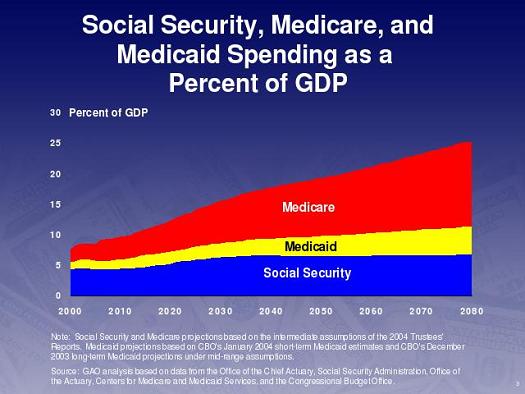
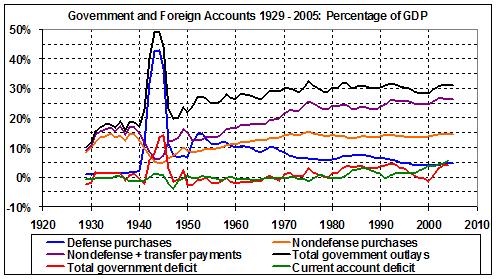
Figure 3 (which encompasses spending and deficits at all levels of government) provides some needed perspective. Notice the historical disconnect between the government deficit and the current-account deficit. The fact that both have been rising in recent years is a coincidence, about which many commentators have drawn the wrong inference. The “500-pound gorilla” in Figure 3 is government spending, in particular, the growing burden of transfer payments (e.g., Social Security, Medicare, and Medicaid), which take from those who produce and give to those who do not, and which discourage saving and encourage consumption. The rise in transfer payments has kept total government outlays above 30 percent of GDP since 1970. Figure 4 indicates that the situation is likely to worsen considerably, given current “commitments” to Social Security, Medicare, and Medicaid.

Figure 3

Sources: Bureau of Economic Analysis, National Economic Accounts, Table 1.1.5. Gross Domestic Product (lines 1, 20-24), Table 3.1. Government Current Receipts and Expenditures (lines 17, 29), Table 4.1 Foreign Transactions in the National Income and Product Accounts (line 29).

Figure 4

Source: Government Accounting Office (see also “Funding the Welfare State“).

This recitation of dreary facts sets the stage for the rest of this post, which focuses on the real problem, which is government spending — not government deficits (per se), and certainly not the so-called trade deficit.

The “Real” Economy in Simple Formulae

The following formulations depict the “real” economy at a given time. (See this article for a more complex but equivalent depiction.) These formulations do not, by themselves, depict the dynamics of economic growth or the cause-and-effect relationships among the various parameters of the real economy. I supply some of those missing ingredients in the commentary that follows.

The totality of real economic activity can be expressed as an identity:

(1) Income ≡ Output

That is, aggregate income (the claims on or distribution of output) must be equal to the aggregate of all types of output.

Income and output can be expressed in terms of certain parameters:

(2.a) Income = C + S + T + M

(2.b) Output = C + I + G + X ,

where the parameters are defined as follows:

C = consumption (private-sector consumption of goods and services produced domestically, excluding consumption that is subsidized by government transfer payments to the beneficiaries of such programs Social Security and Medicare)

S = saving (private-sector income not consumed, taxed, or spent on imports)

I = private-sector investment (output invested by non-governmental entities in technology, buildings, equipment, etc., for the purpose of increasing the future output of goods and services)

M = items imported for private-sector consumption or investment from other countries

X = private-sector output exported to other countries

T = taxes, including transfer-payment taxes for Social Security, etc.

G = government spending (including spending that is subsidized by transfer payments for such programs as Social Security and Medicare)

and:

(X – M) or (M – X) = trade surplus or deficit

(T – G) or (G – T) = government surplus or deficit.

These definitions vary from the standard version in that any spending subsidized by government transfer payments for such programs as Social Security and Medicare is included in G rather than C . These definitions also implicitly reject a role for government in saving and investment, for reasons spelled out in my post, “Joe Stiglitz, Ig-Nobelist.”

Key Relationships

Because Income ≡ Output, it follows that:

(3) C + S + T + M = C + I + G + X

In a closed economy without government the Income ≡ Output identity reduces to this:

(3′) C + S = C + I

Given that C ≡ C, it follows that S = I in a closed economy without government.That is, absent government (which usurps saving through taxation), the backbone of private-sector investment is private-sector saving.

In an open economy without government the Income ≡ Output identity becomes this:

(3”) C + S + M = C + I + X

Given that C ≡ C, it follows that (S + M) = (I + X) in an open economy without government. That is, given a level of exports, the backbone of private-sector investment is the combination of private-sector saving and imports that are not consumed. It therefore follows that . . .

The Trade Deficit Is Good

Solving 3 for (M – X), the trade deficit, we get:

(4) (M – X) = (I – S) + (G – T)

What (4) tells us is that a trade deficit is a boon to economic growth. That is, an increase in M (or a decrease in X) supports an increase in I , even when T reduces S .

Consider, for example, an exogenous increase in M (e.g., because of economic growth or a drop in the prices of imported goods relative to the prices of domestic substitutes). An exogenous increase in M means that more resources become available for I (as well as C). By the same token, an exogenous decrease in X (e.g., because a rise in U.S. interest rates attracts foreign money away from U.S. exports and toward U.S. bonds and mortgages) means that more resources become available for I (as well as C).

In sum, the causality runs from trade. Trade is an enabler. Foreign trade is just another form of voluntary exchange, which benefits all parties. In the case of foreign trade, Americans stand to capture real resources that can be invested in growth-producing capital. The so-called trade deficit isn’t the “bad” side of trade, it’s the good side of trade.

The catch is that government may confiscate some of the potential gains from a trade deficit by adding to its debt when G is greater than T . Which leads me to this . . .

A Trade Deficit Is Not a Form of Debt

Solving (3) for (G – T), we get:

(5) (G – T) = (S – I) + (M – X).

It is apparent that a trade deficit can finance a portion of the government deficit. That is why government-deficit and trade-deficit hysterics liken the trade deficit to a form of debt — which it is not. The trade deficit does not create the government deficit. The government deficit arises mainly from exogenous decisions about the size of G and the various taxes that result in T .

To repeat and elaborate: The trade deficit — when there is one — merely helps to finance the government deficit — when there is one. The two are essentially independent of each other. Consider an increase in the trade deficit, which enables an increase in private investment and/or consumption (see the preceding section). The government may (through taxing or borrowing) confiscate some or all of the increase in the trade deficit. Thus a trade deficit, which is potentially beneficial because it enables an increase in private investment, simply “soaks up” some of the government deficit. But the trade deficit is merely coincidental with the government deficit, and is not created by it.

In the absence of a trade deficit, the burden of a government deficit would fall entirely on the domestic private sector. For example, referring to (5), in the absence of a trade deficit, an increase in G would require an offsetting reduction in I (as well as C). (It would be ludicrous to interpret (5) as saying that an increase in G leads to an increase in S .)

In other words, a trade deficit makes things better for the private sector — not worse — and the trade deficit has nothing to do with the size of the government deficit. The coincidental rise of the government deficit and the trade deficit in recent years (Figure 3) is just that: coincidental. Anyone who says that the trade deficit is a form of debt is guilty of (a) mistaking coincidence for causality, and (b) misunderstanding the meaning of “deficit” in the term “trade deficit.”

There is no trade deficit. The things foreigners buy from us have exactly the same value as the things we buy from them. The mix of things foreigners buy from us simply happens to include a higher proportion of stocks, bonds, and mortgages than the mix of things Americans buy from foreigners.

Bogus “Threats”: Foreign “Ownership” and “Job Exportation”

There is the notion that the holding of U.S. stocks, bonds, and mortgages gives foreigners a “hold” over us. How so? It hurts foreign holders of U.S. equities, securities, and real estate if those things lose value. Foreigners have absolutely no incentive to “dump” their holdings of U.S. financial instruments unless financial markets already have signaled that those instruments are losing value for reasons unrelated to the ownership of financial assets. Foreign “dumping” in a panic is no different than “dumping” by domestic holders of financial assets. Anyone can panic; Americans have no monopoly on steadfastness when it comes to financial markets.

A foreign investor who “dumps” U.S. paper simply out of pique would be the loser because the investor would be driving down the value of the very holdings it wishes to “dump.” The value of the “dumped” holdings would return to something like their former levels once the investor had finished “dumping,” thus rewarding the buyers with windfall profits.

As for “job exportation,” I must quote from a post I wrote several months ago:

Outsourcing, which is really the same thing as international trade, creates jobs, creates wealth, and raises real incomes — for all. Economics is a positive-sum “game.”

If you’re not convinced, think of it this way: If product X is a good value, does it matter to you whether it was made in Poughkeepsie or Burbank? Well, then, there’s nothing wrong with Laredo, Texas, or Calais, Maine, is there?

Now imagine that the Rio Grande River shifts course and, poof, Nuevo Laredo, Mexico, becomes Nuevo Laredo, Texas. Or suppose that the Saint Croix River between Maine and New Brunswick, shifts course and the former St. Stephen, New Brunswick, becomes St. Stephen, Maine. Juan and Pierre are now Americans. Feel better?

What’s in a border? A border is something to be defended against an enemy. But do you want a border to stand between you and lower prices, more jobs, and economic growth? I thought not.

Taxes Always Hurt

Solving (3) for I , we get:

(6) I = S + (T – G) + (M – X)

That is, private-sector investment is equal to private-sector saving, plus the government surplus (or minus the government deficit), plus the trade deficit (or minus the trade surplus). I re-emphasize: plus the trade deficit (see “The Trade Deficit Is Good,” above).

Equation (6) might be (and has been) taken to mean that a tax increase would lead to an increase in private-sector investment. (That ludicrous assertion is owed to “Rubinomics” — the true “voodo economics.”) Remember, however, that a tax increase must be financed by a decrease in C, S, or M (or some combination of them). A tax increase almost certainly will cause a decrease in I because I depends largely on S and (M – X). Equation (6) is best understood this way: Given the level of T and G , I rises (or falls) with S and the trade deficit (M – X).

When the economy continues to grow in the wake of a tax increase it is because the forces underlying private-sector growth (e.g., returns on prior investments) are sufficiently strong to overcome the inhibiting effects of the tax increase. Think of the economy as a healthy child. Think of a tax increase as a common cold. The cold will cause the child to have less energy than usual, but it will not cause the child to stop growing. On the other hand, too many colds — like too much taxation — can take their toll and turn a healthy child into a sickly one who never fulfills his potential. (See Figure 1 again, and visit the source for it, if you haven’t already done so.)

Government Spending Always Hurts (with a Few Exceptions)

Recall (2.b)? This is what follows from it:

If G goes up, C, I, or X — or a combination of them — must go down.

The key parameter is I , which represents new technology, buildings, equipment, software, etc. — all of which yield more jobs and higher incomes. (By the way, G is not a viable alternative to I ; don’t even consider it.) But X is important, too, because exports enable us to exchange goods and services with foreigners, to our mutual benefit. In sum, G confiscates resources that could have gone into I and X (not to mention C). G also supports the accretion of burdensome regulations.

G is good only when it supports defense and justice. Defense is an insurance policy for our lives, liberty, and property. Justice is that, too, and it also promotes the kind of orderly environment that enables economic activity to thrive.

It follows that the real threat to the well-being of Americans isn’t government deficits (per se) or trade deficits or foreign holdings of U.S. stocks and bonds. The real threat is government spending. Whether government spending is financed by debt or taxes, it is a generally destructive force. Government spending (with exceptions for defense and justice) results in the gross misuse of resources. Beyond that, government spending on regulatory activities inhibits growth-producing investments and blunts the productivity of those investments that are made. And the ways in which Americans are taxed to fund government spending (most of it is funded by taxes) tends to penalize, and thus discourage, invention, innovation, and entrepreneurship. I once estimated the cost to Americans of the regulatory-welfare state that has become dominant over the past 100 years:

  • Real GDP (in year 2000 dollars) was about $10.7 trillion in 2004.
  • If government had grown no more meddlesome after 1906, real GDP might have been $18.7 trillion [Figure 1].
  • That is, real GDP per American would have been about $63,000 (in year 2000 dollars) instead of $36,000.
  • That’s a deadweight loss to the average American of more than 40 percent of the income he or she might have enjoyed, absent the regulatory-welfare state.

That loss is in addition to the 40-50 percent of current output which government drains from the productive sectors of the economy [the direct burden of taxes, plus the direct costs of regulatory compliance].

Those vast losses of income have resulted in vast losses of wealth; for example (from the same post):

[T]he stocks of corporations in the S&P 500 are currently undervalued by one-third because of the depradations of the regulatory-welfare state, which have lowered investors’ expectations for future earnings. . . .

And that’s only the portion of wealth that’s represented in the S&P 500. Think of all the other forms in which wealth is stored: stocks not included in the S&P 500, corporate bonds, mortgages, home equity, and so on.

If government had left its grubby hands off the economy, there never would have been a Great Depression, Social Security, Medicare, Medicaid, and the myriad regulations that have us tied in knots.

And we would be vastly better off.

Our “leaders” in Washington obviously don’t want to do much of anything to cope with the real threat to our well-being. They’re like terminal alcoholics who keep ordering triple shots.

“Crowding Out” in Perspective

What about the notion that government deficits “crowd out” private-sector investment? In a growing economy — both national and global — government spending rises alongside private-sector investment because there is room for both to grow. We would be better off with decreases in most kinds of government spending (excepting defense and justice). But we would be better off because government would be confiscating fewer resources that could go into consumption and growth-producing investments. It’s not government deficits (per se) that matter; it’s government spending that matters. Government deficits are a drop in the proverbial bucket of global liquidity. To quote myself again:

The crowding-out hypothesis . . . is based on a static analysis — a mere truism — which says that a given level of national output can be reallocated, but not changed. But the crowding-out hypothesis, which has reputable critics and doubters (see here, here, here, and here, for instance) doesn’t apply to a dynamic economy. The actual effect of government borrowing on interest rates — and thus on the cost of private capital formation — is minuscule, and perhaps nonexistent, as Brian S. Westbury explains:

The theory [that deficits drive up interest rates] suggests that deficits “crowd out” private investment, putting upward pressure on interest rates. In other words, government borrowing eats up the available pool of capital. But today’s forecasted deficits of $300 to $500 billion are just a small drop in the pool of global capital markets. In the U.S. alone, capital markets are $30 trillion dollars deep, for the world as a whole they approach $100 trillion. Deficits of the size projected in the years ahead cannot possibly have the impact on interest rates that many fear. . . .

The trade deficit — fortunately — blunts the confiscatory effects of government spending. Why? Because if foreigners aren’t spending all the dollars they earn on U.S. produced goods and services, it means that they are buying U.S securities, equities, and mortgages. That is, they are enabling private-sector investments that help to make American businesses more productive and profitable.

Net foreign buying of U.S. securities, equities, and mortgages also has been a major cause of the decade-long decline in U.S. interest rates. (See, for example this, this, and this.) American stockholders and homebuyers are therefore “indebted” to foreigners who buy U.S. stocks and bonds. American bondholders (on the whole) also have gained because rising bond prices have more than offset the decline in interest rates.

What Does the Future Hold?

There is no reason to believe that rising interest rates will cause the net inflow of foreign funds to dry up. Rising interest rates might cause foreigners to shift from stocks to bonds, but rising interest rates will attract money from abroad, not repel it. Even if the net inflow of foreign funds were to slow down for some reason, it is not going to suddenly dry up. And even if it dries up eventually, it won’t dry up forever because — in the world of economics — nothing is forever. A trend usually creates the conditions for its reversal:

We’ve been through periods of high inflation, high interest rates, large trade deficits, and low exchange rates at varying times, and we’ll go through them again. Today we have relatively low (but rising) inflation, and relatively low (but rising) interest rates, a persistently large trade deficit (willingly financed by foreigners), and therefore a falling exchange rate. But all of that can and will change as higher interest rates and lower exchange rates work their way through the economy, dampening investment and consumption spending and, therefore, imports.

Today is not forever. Doomsaying is an ancient and long-discredited profession. Remember the ten years between the “oil shocks” of the early 1970s and the end of double-digit inflation in the early 1980s? Remember the next 20 years of almost unmitigated economic growth with low inflation? Extrapolating from current economic conditions is a sucker’s game, unless you bet on the underlying trend in the U.S., which is long-term economic growth.

In any event, future changes in the net inflow of foreign funds cannot undo the benefits that have accrued to Americans because of past inflows. Those who fear a “drying up” of the inflow are like bums who have been getting free meals and then complain when the soup kitchen shuts down. You take what you can get, when you can get it, and invest it wisely. That’s evidently what Americans have been doing, thanks to the trade deficit — and no thanks to government spending.

Related posts:

The Destruction of Income and Wealth by the State
Why Outsourcing Is Good: A Simple Lesson for Liberal Yuppies
Curing Debt Hysteria in One Easy Lesson
Trade Deficit Hysteria
Brains Sans Borders
Understanding Economic Growth
The Real Meaning of the National Debt
Debt Hysteria, Revisited
Why Government Spending Is Inherently Inflationary
Understanding Outsourcing
Joe Stiglitz, Ig-Nobelist
Professor Buchanan Makes a Slight Mistake
More Commandments of Economics
Productivity Growth and Tax Cuts
Do Future Generations Pay for Deficits?
Liberty, General Welfare, and the State
Starving the Beast, Updated

The Cultural Divide

In Chicago, “Diversity lacking in crowds at large museums.” And blah, blah, blah. The museums — operating in their liberal-guilt mode — are shouldering the blame for low attendance by minorities:

At the Museum of Science and Industry, officials already have a name for the phenomenon — “the Glenview effect,” after the largely white suburb that represents its highest single ZIP code attendance, said Valerie Waller, the museum’s vice president of marketing.

“We see it on the floor — our audience is not as diverse as what we see in the city of Chicago or the surrounding area,” said Waller.

Speaking Wednesday at the Cultural Center, where the study was unveiled, Waller said, “The number of people not engaged in our institutions, with all the variety of programming and opportunities we have for them, is shocking.”

Waller wondered if minorities and the poor aren’t aware of the institutions or not interested. “Is price a factor? Many of our institutions were free 15 years ago,” she said. “Is it the hours we’re open? [Are people] overscheduled with soccer practices and everything else?”

The real culprit — which dare not speak its name — is the bias within minority cultures against “acting white.”

(Thanks to Tongue Tied for the pointer to the article about attendance at Chicago’s museums.)

Progress on Iraq

Now that the al Qaeda-Saddam link has been revealed, can the truth about Saddam’s WMD be far behind?

For more, see Malkin.

A Test of Morality

Anyone who opposes the death penalty for terrorist scum and favors euthanizing innocent life is depraved.

Dealing with Moussouai

Almost a year ago

Zacarias Moussaoui pleaded guilty . . . to taking part in a broad al Qaeda conspiracy that resulted in the Sept. 11, 2001, attacks, saying Osama bin Laden personally instructed him to fly an airplane into the White House.

It now seems possible that Moussaoui may not be sentenced to death. (You can follow all the action here.) There must be options; for example:

1. Imprison Moussaoui but do not sequester him.

2. Drop him off outside the gate of a U.S. military encampment in Iraq, armed with an empty Uzi — and wearing his orange jump suit.

3. Announce that he will be released from custody at Ground Zero at a certain time, and that he will be wearing his orange jump suit (with leg-iron accessories).

It would only be fair to let Moussaoui choose from among the options.

The Slippery Slope in England

All I have to do is repeat “The Slippery Slope in Holland,” but change one link:

I once ended a post with this comment: “The slippery slope of eugenics is here and we are sliding down it.”

Indeed we are: Holland to Allow Infant Euthanasia.

The parents of a terminally-ill little boy at the heart of a unique court case have expressed their delight after a judge decided their son should be kept alive.

Why should a judge be involved in that decision?

Related posts:
I’ve Changed My Mind (08/15/04)
Next Stop, Legal Genocide? (09/05/04)
Here’s Something All Libertarians Can Agree On
(09/10/04)
It Can Happen Here: Eugenics, Abortion, Euthanasia, and Mental Screening (09/11/04)
Creeping Euthanasia (09/21/04)
PETA, NARAL, and Roe v. Wade (11/17/04)
Flooding the Moral Low Ground (11/19/04)
The Beginning of the End? (11/21/04)
Peter Singer’s Fallacy (11/26/04)
Taking Exception (03/01/05)
Protecting Your Civil Liberties
(03/22/05)
Where Conservatism and (Sensible) Libertarianism Come Together (04/14/05)
Conservatism, Libertarianism, and Public Morality (04/25/25)
The Threat of the Anti-Theocracy (05/03/05)
The Consequences of Roe v. Wade (06/08/05)
The Old Eugenics in a New Guise (07/14/05)
The Left, Abortion, and Adolescence (07/21/05)
Law, Liberty, and Abortion (10/31/05)
Oh, *That* Slippery Slope (11/09/05)
Abortion and the Slippery Slope (11/20/05)
The Cynics Debate While Babies Die (11/29/05)

Weather Wisdom

Earlier today I read this subjective (and incorrect) assertion at Wired News:

The scientific evidence is now overwhelming that unchecked growth in fossil fuel use throughout the next half-century will produce a global climate catastrophe.

I was thinking about writing a post that lists all the debunking of the “evidence” of which I am aware. But World Climate Report comes to the rescue with data:

For over a century, a national network of “weather nerds” (for lack of a better term) have monitored backyard weather stations where they kept track of daily maximum and minimum temperature and precipitation using standardized instruments and measurement techniques. Called the U.S. Cooperative Observer Network (co-op for short), these data, which were submitted monthly for many decades on paper logs, were often used to fill in gaps from the more comprehensive observations taken by trained weather service employees at far fewer locations. But the utility of the co-op records to climate analysis was limited by their cumbersome, paper format. However, recently the interest in climate change spurred the government to digitize these paper records, thus adding many new stations to the existing network. With the addition of the co-op data, the number of stations from roughly 1890 to 1947 doubled or tripled relative to the previous baseline.

These updated records shed new light on the behavior of U.S. extremes. . . . The data since 1950 shows a clear positive trend that seems to be getting more extreme later in the record, with the last few years showing the greatest extremes. This fits very nicely with common journalistic sentiments that our climate is obviously in never-been-to-before territory. But inclusion of the pre-1950 data paints quite a different picture. Not only did the frequency of extremes vary markedly in the early 20th century days of very low greenhouse gas levels, but the frequency of extreme events in the late 1890s was at least comparable to that in our current climate. . . . [S]tatistical tests demonstrat[e] that the most recent period (1983-2004) was not statistically different from the earliest period (1895-1916) for many combinations of event severity and return period, although a few were significantly different. The bottom line here? The assumption that U.S. rainfall is clearly getting more extreme because of global warming is hardly obvious based on the new and improved record. . . .

The heat wave record . . . is dominated by the huge spike during the 1930s “Dust Bowl” era. In fact, the recent period is hardly noticeable in the longer-term context, even though the number of heat waves has increased recently compared to the cool summers of the 1960s and 1970s. . . .

If more cold waves are harbingers of global warming, then the peaks that dominated that 1980s have completely disappeared. And if we should expect fewer cold outbreaks, then how does one account for all the cold air outbreaks 1980s when the atmosphere had plenty of greenhouse gases? The cold wave record shows some interesting long-term variability but no obvious trend. . . .

The post at World Climate Report is much longer and includes some excellent charts. Read the whole thing.

Related posts:

Climatology
Global Warming: Realities and Benefits
Words of Caution for the Cautious
Scientists in a Snit
Another Blow to Climatology?
Bad News for Politically Correct Science
Another Blow to Chicken-Little Science
Bad News for Enviro-nuts
The Hockey Stick Is Broken
Science in Politics, Politics in Science
Global Warming and Life
Words of Caution for Scientific Dogmatists
Hurricanes and Global Warming
Global Warming and the Liberal Agenda
Debunking “Scientific Objectivity”
Hurricanes and Glaciers

Book Beat

For unremittingly clever wordplay and a tantalizingly tortuous plot, you must read Reginald Hill’s Dialogues of the Dead. It’s another Dalziel and Pascoe mystery — the best of the many I’ve read. The bonus: Dalziel’s hilarious, politically incorrect ruminations and interjections.

The Heart of the Matter

From Mark Steyn’s appreciation of the late Eugene McCarthy (1916-2005):

Forty years after McCarthy’s swift brutal destruction of the most powerful Democrat in the second half of the 20th century [LBJ], it remains unclear whether his party will ever again support a political figure committed to waging serious war, any war: Carter confined himself to a disastrous helicopter rescue mission in Iran; Clinton bombed more countries in a little over six months than the supposed warmonger Bush has hit in six years, but, unless you happened to be in that Sudanese aspirin factory or Belgrade embassy, it was always desultory and uncommitted. Even though the first Gulf War was everything they now claim to support – UN-sanctioned, massive French contribution, etc – John Kerry and most of his colleagues voted against it. Joe Lieberman is the lonesomest gal in town as an unashamedly pro-war Democrat, and even Hillary Clinton’s finding there are parts of the Democratic body politic which are immune to the restorative marvels of triangulation. Gene McCarthy’s brief moment in the spotlight redefined the party’s relationship with the projection of military force. That’s quite an accomplishment. Whether it was in the long-term strategic interests of either the party or American liberalism is another question. Yet those few months in the snows of New Hampshire linger over the Democratic landscape like an eternal winter.

As I once put it, the

Democrat Party began its veer to the hard left in 1968, with Eugene McCarthy’s anti-war candidacy. McCarthy didn’t win the party’s nomination that year, but his strong showing made reflexive anti-war rhetoric a respectable staple of Democrat discourse.

The Democrats proceeded in 1972 to nominate George McGovern, who seems moderate only by contrast with Ramsey Clark and Michael Moore. Since McGovern’s ascendancy, the left-wing nuts generally have dominated the party — in voice if not in numbers. Nominees since McGovern: Carter (a latter-day Tokyo Rose), Mondale (Carter’s one-term accomplice), Dukakis, Clinton, Gore, and Kerry — all well to the left of the mainstream (to borrow some Democrat rhetoric). Bill Clinton (of the failed plan to socialize health care) became a moderate only because he faced Republican majorities in Congress. Clinton lately [in his comments about the war in Iraq] has been showing his true colors.

(Thanks to Ed Driscoll for the pointer to Steyn’s piece.)

True Confessions

One of my favorite passages from W. Somerset Maugham’s The Summing Up:

From time to time I have asked myself whether I should have been a better writer if I had devoted my whole life to literature. Somewhat early, but at what age I cannot remember, I made up my mind that, having but one life, I should like to get the most I could out of it. It did not seem to me enough merely to write. I wanted to make a pattern of my life, in which writing would be an essential element, but which would include all the other activities proper to man, and which death would in the end round off in complete fulfillment. . . . I had . . . an instinctive shrinking from my fellow men that has made it difficult for me to enter into any familiarity with them. I have loved individuals; I have never much cared for men in the mass. I have none of that engaging come-hitherness that makes people take to one another on first acquaintance. Though in the course of years I have learnt to assume an air of heartiness when forced into contact with a stranger, I have never liked anyone at first sight. I do not think I have ever addressed someone I did not know . . . unless he first spoke to me. (Pocket Book edition, 1967, pp. 34-5)

Related post: IQ and Personality

Calling a Nazi a Nazi

UPDATED, 03/18/06

Steven Pinker (quoted by AnalPhilosopher) says:

The ideological connection between Marxist socialism and National Socialism is not fanciful. Hitler read Marx carefully while living in Munich in 1913, and may have picked up from him a fateful postulate that the two ideologies would share. It is the belief that history is a preordained succession of conflicts between groups of people and that improvement in the human condition can come only from the victory of one group over the others. . . . It doesn’t matter whether the groups are thought to be defined by their biology or by their history. Psychologists have found that they can create instant intergroup hostility by sorting people on just about any pretext, including the flip of a coin.

So say I:

Hitler was “conservative.” The canard that will not die. Hitler was a statist Leftist who would have been at home in today’s Democrat Party.

Do I exaggerate about Nazism’s affinity with the Democrat Party? The common ground between Nazism and Democrats spans eugenics (Democrats: abortion and euthanasia), class/race warfare (Dems: reverse racism, “soak the rich”), state control of business (Dems: if it moves, regulate it; if it doesn’t move, tax it), the suppression of opposing views (Dems: campus speech codes, disruption of conservative speakers, efforts to muzzle the blogosphere). Those strike me as rather fundamental similarities.

Consider this quotation about the founder of the modern Democrat Party and today’s regulatory-welfare state:

Franklin D. Roosevelt was elected President in 1932. Faced with the Great Depression — a depression which had been caused by government itself — Roosevelt’s “solution” was to implement the socialist-fascist economic system under which Americans now suffer. Under the banner of “saving America’s free-enterprise system,” FDR was directly responsible for the abandonment of America’s 150-year history of free enterprise.

Arguing that the American people could no longer be trusted to be charitable to others, FDR claimed that government — the organized means of coercion and compulsion — was needed to help those in need. And to effect this claim, he secured the passage of his New Deal for Americans. Roosevelt used the disastrous results of one governmental intervention — political manipulation of money — to justify another — the socialist ideal of using government to steal from those who have in order to give the loot to those who need. . . .

[I]t was through the income tax and the power to expand money and credit that Roosevelt was able to accomplish effectively his political plundering and looting, not only from the rich but from everyone in all walks of life.

But Roosevelt did more than just enshrine into the American political and economic system the ideas of Karl Marx and Joseph Stalin (the mass murderer FDR affectionately referred to as “Uncle Joe”). Greatly admiring Benito Mussolini’s fascist system in Italy, Roosevelt proceeded to implement the same type of economic system in the U.S. For example, his National Recovery Act gave him virtually unlimited dictatorial powers over American business and industry. And any American citizen who did not do his “patriotic” duty by supporting the NRA and its “Blue Eagle” soon found himself at the receiving end of FDR’s vengeance and retaliation.

And it was during this period of time that such alien schemes as the Social Security Act, the FDIC, the Agricultural Adjustment Act, the Emergency Banking Relief Act the Tennessee Valley Authority, the Federal Securities Act, and the National Labor Relations Act came into existence — all with the aim of taking control of people’s lives as well as absolving them from responsibility for errors and foolhardiness by giving them the political loot that had been stolen from others. . . .

And what was the reaction of the American people to the evil, immoral, and tyrannical acts of FDR? Like people in other parts of the world who were suffering under dictatorial rule — Russians, Germans, and Italians — most of them reacted like sheep — meekly going along with their own slaughter and, in many instances, ardently supporting it. . . .

For several years, the U.S. Supreme Court, led by four justices — Sutherland, Butter, Van Devanter, and McReynolds — declared FDR’s socialist and fascist New Deal policies in violation of the United States Constitution — in violation of every principle of individual liberty and limited government on which this nation was founded.

But the end came in 1937. In what many judicial scholars say was a result of Roosevelt’s disgraceful and pathetic attempt to pack the court with some of his cronies, a fifth justice — Owen J. Roberts, whose vote had helped to invalidate much of the New Deal — shifted his vote in favor of Roosevelt’s policies. And with Roosevelt thereafter being able to replace dying and retiring justices with ones who would do his bidding, the era of American economic liberty came to a sad and tragic end.

More than economic liberty came to a sad and tragic end under FDR:

[E]conomic and personal liberty are inseparable: We engage in economic activity to serve our personal values, and our personal values are reflected in our economic activity. When the state restricts economic liberty, it necessarily restricts personal liberty, and vice versa. The state simply cannot make personal and economic decisions more effectively than individuals operating freely within an ever-evolving socio-economic network.

FDR didn’t believe that. Neither did Hitler or Stalin. Neither do a lot of Democrats.

I am sick and tired of hearing Leftists (i.e., a lot of Democrats) call conservatives and libertarians “fascists” and “Nazis.” It’s time to call Democrats what they (or a lot of them) are: Hitler’s (and Stalin’s) brothers and sisters under the skin. Fascist, Socialist, Communist, Nazi, Leftist — they’re all pretty much the same thing as far as I’m concerned. Different in degree, perhaps, but not in kind.

UPDATE: David N. Mayer says that

those people on the left-side of the traditional left-right political spectrum who call themselves and their policies “progressive” are abusing the word. Progressive, according to most dictionaries, means “favoring or advocating progress, change, improvement, or reform, as opposed to wishing to maintain things as they are,” “making progress toward better conditions, employing or advocating more enlightened ideas,” or “going forward or onward.” Rather than being truly “progressive,” those who label themselves by that word are, in fact, reactionaries: they adhere to, and they advocate a continuation and expansion, of the failed policies of the 20th-century regulatory/welfare state.

There’s nothing “progressive” about the socialist, paternalistic policies that American leftists advocate. The 20th-century regulatory/welfare state they want to expand was itself based on the 19th-century statist policies of Germany’s Otto von Bismarck; and Bismarck’s statism was the old European wine – the paternalism that for centuries had been the dominant public policy of the feudal monarchies of Europe – rebottled in 19th-century packaging. Like the conservatives (those on the right side of the traditional left-right political spectrum) whom they claim to oppose, left-liberal “progressives” are really advocates of paternalism and collectivism. Left-liberals and conservatives differ only in the type of 19th-century paternalism they want to continue or expand. Conservatives (paternalists/collectivists of the right) seek generally to use the coercive power of government to impose Victorian-era morals, while their brethren on the left seek generally to use the coercive power of the government to redistribute wealth. Both sides would willingly sacrifice individual freedom and self-responsibility in order to advance their collectivist agenda, their notion of the so-called “common good” of society.

That’s just the beginning. There’s a long bill of particulars. I don’t agree with all of it, but it’s mostly on target. Go read it.

Liberty and Federalism

This post is a continuation of “Liberty as a Social Compact,” “Social Norms and Liberty,” and “A Footnote about Liberty and the Social Compact.”

The Centralization of Social Norms Undermines Liberty

Liberty can never be perfect in the real world of emotions, prejudices, stupidity, and ignorance. But liberty is most attainable when societies and polities must compete with one another for the allegiance of members and prospective members.

Legislation and judge-made laws are especially destructive of liberty when they emanate from a central government because they dilute the effectiveness of “exit” — the ability to vote with one’s feet. Local and regional differences become hard to detect when the central government encroaches into issues ranging from elementary education to working hours to speed limits, not to mention abortion. When all places become subject to the same set of imposed norms they tend to become almost uniformly unattractive. The forceful imposition of norms compounds the risk to liberty, for people are less likely to value and defend that which is not of their own making.

There is a “race to the top” — toward liberty, that is — when societies or polities must compete for adherents, based on the attractiveness of the norms of those societies and polities. For example, the Freedom Forum offers this relevant bit of history:

Although early Americans built on their English heritage when developing rights in the new land, many colonies before 1689 had laws that far exceeded the scope of the English Bill of Rights. Rhode Island, established in 1636, was the first American colony to recognize freedom of conscience. In 1641, Massachusetts Bay enacted the Massachusetts Body of Liberties, the first detailed protection of rights in America. Maryland was founded as a haven for Catholics, but its citizens extended the right of religious toleration (1649) to other Christians as well.

In June 1776, Virginia adopted a new constitution, prefaced by a declaration of rights including many that would later appear in the U.S. Bill of Rights. The Virginia Declaration of Rights, served as a model for eight of the 12 other states that adopted new constitutions during the revolutionary period.

While the new state governments protected individual rights, the Articles of Confederation, the first constitution of the United States, did not. The weak national government under the Articles of Confederation created many problems. In 1787, these problems finally led to a convention to draft a new charter for the national government, the Constitution of the United States. Lack of a bill of rights became the main reason many people opposed the Constitution.

The Framers understood that the decentralization of governmental power is essential to liberty. They wanted to leave the bulk of governmental power in the hands of the States. (A reasonable prospect at the time; the average population of a State in 1790 was about 1/25 the average population of a State today.) And the Framers saw the multiplicity of States as a bulwark against tyranny in the nation as a whole. Here, for example, are excerpts of James Madison’s entries in The Federalist Papers:

The influence of factious leaders may kindle a flame within their particular States, but will be unable to spread a general conflagration through the other States. A religious sect may degenerate into a political faction in a part of the Confederacy; but the variety of sects dispersed over the entire face of it must secure the national councils against any danger from that source. A rage for paper money, for an abolition of debts, for an equal division of property, or for any other improper or wicked project, will be less apt to pervade the whole body of the Union than a particular member of it; in the same proportion as such a malady is more likely to taint a particular county or district, than an entire State. (Federalist No. 10)

* * *

The powers delegated by the proposed Constitution to the federal government are few and defined. Those which are to remain in the State governments are numerous and indefinite. The former will be exercised principally on external objects, as war, peace, negotiation, and foreign commerce; with which last the power of taxation will, for the most part, be connected.

The powers reserved to the several States will extend to all the objects which, in the ordinary course of affairs, concern the lives, liberties, and properties of the people, and the internal order, improvement, and prosperity of the State. The operations of the federal government will be most extensive and important in times of war and danger; those of the State governments, in times of peace and security. As the former periods will probably bear a small proportion to the latter, the State governments will here enjoy another advantage over the federal government. The more adequate, indeed, the federal powers may be rendered to the national defense, the less frequent will be those scenes of danger which might favor their ascendancy over the governments of the particular States. If the new Constitution be examined with accuracy and candor, it will be found that the change which it proposes consists much less in the addition of NEW POWERS to the Union, than in the invigoration of its ORIGINAL POWERS. The regulation of commerce, it is true, is a new power; but that seems to be an addition which few oppose, and from which no apprehensions are entertained. . . . (Federalist No. 45)

* * *

. . . If an act of a particular State, though unfriendly to the national government, be generally popular in that State and should not too grossly violate the oaths of the State officers, it is executed immediately and, of course, by means on the spot and depending on the State alone. The opposition of the federal government, or the interposition of federal officers, would but inflame the zeal of all parties on the side of the State, and the evil could not be prevented or repaired, if at all, without the employment of means which must always be resorted to with reluctance and difficulty.

On the other hand, should an unwarrantable measure of the federal government be unpopular in particular States, which would seldom fail to be the case, or even a warrantable measure be so, which may sometimes be the case, the means of opposition to it are powerful and at hand. The disquietude of the people; their repugnance and, perhaps, refusal to co-operate with the officers of the Union; the frowns of the executive magistracy of the State; the embarrassments created by legislative devices, which would often be added on such occasions, would oppose, in any State, difficulties not to be despised; would form, in a large State, very serious impediments; and where the sentiments of several adjoining States happened to be in unison, would present obstructions which the federal government would hardly be willing to encounter. But ambitious encroachments of the federal government, on the authority of the State governments, would not excite the opposition of a single State, or of a few States only. They would be signals of general alarm. Every government would espouse the common cause. A correspondence would be opened. Plans of resistance would be concerted. One spirit would animate and conduct the whole. The same combinations, in short, would result from an apprehension of the federal, as was produced by the dread of a foreign, yoke; and unless the projected innovations should be voluntarily renounced, the same appeal to a trial of force would be made in the one case as was made in the other. But what degree of madness could ever drive the federal government to such an extremity. In the contest with Great Britain, one part of the empire was employed against the other. The more numerous part invaded the rights of the less numerous part. The attempt was unjust and unwise; but it was not in speculation absolutely chimerical. But what would be the contest in the case we are supposing? Who would be the parties? A few representatives of the people would be opposed to the people themselves; or rather one set of representatives would be contending against thirteen sets of representatives, with the whole body of their common constituents on the side of the latter. (Federalist No. 46)

Ironically — and tragically — the Commerce Clause, touted by Madison in Federalist No. 45, has been the foundation for much of the undoing of the Framers’ plan. In fact, it is hard to imagine a facet of social and economic life that is no longer touched by the central government, as the Supreme Court and Congress have acted, especially since the 1930s, to nationalize and homogenize Americans’ mores. David F. Forte offers a leading example of this in his article about the Commerce Clause in The Heritage Guide to the Constitution (pp. 101-7):

. . . By 1941, in United States v. Darby, it was clear that the new majority [of the Supreme Court] had embraced a very expansive [view of the Commerce Clause] and, as events were to show, these Justices were able to find that any local activity, taken either separately or in the aggregate, Wichard v. Filburn (1942), always had a sufficiently substantial effect on interstate commerce to justify congressional legislation. By these means, the Court turned the commerce power into the equivalent of a general regulatory power and undid the Framers’ original structure of limited and delegated powers . . . .

The Framers’ Fatal Error

The Framers underestimated the will to power that animates office-holders. The Constitution’s wonderful design — horizontal and vertical separation of powers — which worked rather well until the late 1800s, cracked under the strain of populism, as the central government began to impose national economic regulation at the behest of muckrakers and do-gooders. The Framers’ design then broke under the burden of the Great Depression, as the Supreme Court of the 1930s (and since) has enabled the central government to impose its will at will. The Framers’ fundamental error can be found in Madison’s Federalist No. 51. Madison was correct in this:

. . . It is of great importance in a republic not only to guard the society against the oppression of its rulers, but to guard one part of the society against the injustice of the other part. Different interests necessarily exist in different classes of citizens. If a majority be united by a common interest, the rights of the minority will be insecure. . . .

But Madison then made the error of assuming that, under a central government, liberty is guarded by a diversity of interests:

[One method] of providing against this evil [is] . . . by comprehending in the society so many separate descriptions of citizens as will render an unjust combination of a majority of the whole very improbable, if not impracticable. . . . [This] method will be exemplified in the federal republic of the United States. Whilst all authority in it will be derived from and dependent on the society, the society itself will be broken into so many parts, interests, and classes of citizens, that the rights of individuals, or of the minority, will be in little danger from interested combinations of the majority.

In a free government the security for civil rights must be the same as that for religious rights. It consists in the one case in the multiplicity of interests, and in the other in the multiplicity of sects. The degree of security in both cases will depend on the number of interests and sects; and this may be presumed to depend on the extent of country and number of people comprehended under the same government. This view of the subject must particularly recommend a proper federal system to all the sincere and considerate friends of republican government, since it shows that in exact proportion as the territory of the Union may be formed into more circumscribed Confederacies, or States oppressive combinations of a majority will be facilitated: the best security, under the republican forms, for the rights of every class of citizens, will be diminished: and consequently the stability and independence of some member of the government, the only other security, must be proportionately increased. . . .

Madison then went on to contradict what he said in Federalist No. 46 about the States being a bulwark of liberty:

It can be little doubted that if the State of Rhode Island was separated from the Confederacy and left to itself, the insecurity of rights under the popular form of government within such narrow limits would be displayed by such reiterated oppressions of factious majorities that some power altogether independent of the people would soon be called for by the voice of the very factions whose misrule had proved the necessity of it. In the extended republic of the United States, and among the great variety of interests, parties, and sects which it embraces, a coalition of a majority of the whole society could seldom take place on any other principles than those of justice and the general good; whilst there being thus less danger to a minor from the will of a major party, there must be less pretext, also, to provide for the security of the former, by introducing into the government a will not dependent on the latter, or, in other words, a will independent of the society itself. It is no less certain than it is important, notwithstanding the contrary opinions which have been entertained, that the larger the society, provided it lie within a practical sphere, the more duly capable it will be of self-government. And happily for the REPUBLICAN CAUSE, the practicable sphere may be carried to a very great extent, by a judicious modification and mixture of the FEDERAL PRINCIPLE.

Madison understood that a majority can tyrranize a minority. He understood that the States are better able to prevent the rise of tyranny if the powers of the central government are circumscribed. But he then assumed — in spite of the race to the top that I noted above — that the States themselves could not resist tyranny within their own borders. Madison overlooked the importance of exit as the ultimate check on tyranny. He assumed (or asserted) that, in creating a new central government with powers greatly exceeding those of the Confederacy, a majority of States would not tyrannize the minority and that minorities with overlapping interests would not concert to tyrannize the majority. Madison was so anxious to see the Constitution ratified that he oversold himself (possibly) and the States’ ratifiying conventions (certainly) on the ability of the central government to hold itself in check. Thus the Constitution was lamentably silent on nullification and secession.

What has been done by presidents, Congresses, and courts will be very hard to undo. Too many interests are vested in the regulatory-welfare state that has usurped the Framers’ noble vision. Democracy (that is, vote-selling) and log-rolling are more powerful than words on paper. Even a Supreme Court majority of “strict constructionists” probably would decline to roll back the New Deal and most of what has come in its wake.

About That "Final Showdown"

I wrote about it here. Today’s relevant postings include these:

Michael Barone on “What to do about Iran?” at Barone Blog

An address on “The Perils We Face” by U.S. Rep. Curt Weldon (reprinted at frontpagemag.com)

David Limbaugh at townhall.com — “In WoT, perfect must not be enemy of good

For Muslim [Dr. Wafta Sultan] Who Says Violence Destroys Islam, Violent Threats” (transcript of interview here)

Purported “last warning to American people,” courtesy of MEMRI

I close with this apt comment by my son:

If there are crimes in a higher culture, there are also remedies and efforts to combat them. No one has ever heard of barbarians “reforming” themselves. Only the civilized man can condemn savagery.

The Adolescent Rebellion Syndrome

AnalPhilosopher makes a good point in “Childishness on Campus“:

Academics are in a state of arrested emotional development. They have no real-world responsibilities, so they can—and do—revert to childishness. Their students, who are in adolescent rebellion against their parents and other authority figures, are all too happy to emulate them. They absorb the jargon, the modes of thought and feeling, and the attitudes of disrespectfulness and incivility. These students are in for a rude awakening when they enter the working world, where seriousness, respectfulness, discipline, and civility are not just encouraged but required.

In fact, he echoes my thoughts about adolescent rebellion and other forms of intellectual immaturity, which are to be found mainly — but not exclusively — among “artists,” academicians, and the Left generally:

The truth is that in art — as in “serious” music — the best work that could be done had been done by about 1900. That left Picasso, Braque, and their ilk — like Schoenberg, Berg, and their ilk — with two options: Create new works using the tools that had been perfected by the masters who came before them, or disown the tools in a fit of adolescent rebellion. The artists and “serious” composers of the 20th century, in the main, took the second option. (07/24/04)

* * *

If you can’t defend Clinton on his own merits, make up an absolutely silly reason to discredit his opponents [as Paul Fussell does:]

“Conservatives know that I cannot be trusted… I hate them in general, I grew up in that atmosphere, my father was a corporate lawyer and always voted Republican — that’s one reason I decided not to. It’s a standard boy’s reaction. If your father’s a dentist you either become a dentist or you ridicule dentists for the rest of your life.”

At least he admits that his liberalism arose from adolescent rebelliousness, which I have contended is a primary source of liberalism. (08/04/04)

* * *

There’s surprisingly little chatter in the libertarian-conservative segment of the blogosphere about this:

About 70% of voters agreed to add this sentence to the Missouri Constitution: “To be valid and recognized in this state, a marriage shall exist only between a man and a woman.”

. . . Stanley Kurtz at The Corner adds this:

Apparently, …Democrats outnumbered Republicans at the polls. That makes the already dramatic 71 percent vote in favor of the Missouri marriage amendment all the more impressive. The Post-Dispatch also notes that gay marriage advocates outspent opponents, and launched a major television ad campaign to boot….

In a post that predates the Missouri vote, the usually sensible Virginia Postrel opines that:

People support abortion rights out of fear. They support gay marriage out of love.

A lot of “people” support abortion rights and gay marriage simply because it’s the politically correct thing to do — a litmus test of one’s open-mindedness and liberality — and a form of delayed adolescent rebellion against moldy reactionaries and religious fundamentalists. (08/04/04)

* * *

It’s obvious that Osama favors a Kerry victory. Why else would he go to such lengths to try to discredit Bush and remind American voters that the “choice” is ours?

Does that equate Osama and the American left? It would by the left’s vilely strident, anti-war, anti-Bush rhetoric. But I won’t stoop to the left’s level of illogic. I’ll say only that some on the left sympathize with Osama’s ends and means because they’re essentially acting out a form of adolescent rebellion. (10/30/04)

* * *

[A]lthough Ward Churchill and his ilk are despicable human beings, I don’t care what they say as much as I care that they represent what seems to pass for “thought” in large segments of the academic community. Clearly, universities are failing in their responsibility to uphold academic standards. Left-wing blather isn’t knowledge, it’s prejudice and hate and adolescent rebellion, all wrapped up in a slimy package of academic pretentiousness. (02/28/05)

* * *

The Left will bitterly oppose any nominee for the Supreme Court if the Left finds in that nominee a scintilla of opposition to legal abortion.

What I want to know is why that issue is of such great importance to the Left. What is it about abortion (or the “right” to have one) that seizes the passions of the Left? Is it the notion of self-ownership, that is, the “right” to do with “one’s body” as one will? If the Left were consistent about self-ownership it wouldn’t also encourage government to take money from others in order to provide “free” programs, ranging from health care to bike trails.

The Left’s selective embrace of self-ownership indicates that its elevation of abortion to sacramental status has deeper, more psychological roots. The Left is in an arrested state of adolescent rebellion: “Daddy” doesn’t want me to smoke, so I’m going to smoke; “Daddy” doesn’t want me to drink, so I’m going to drink; “Daddy” doesn’t want me to have sex, so I’m going to have sex. But, regardless of my behavior, I expect “Daddy” to give me an allowance, and birthday presents, and cell phones, and so on.

“Daddy,” in the case of abortion, is government, which had banned abortion in many places. If it’s banned, the Left wants it. But the Left — like an adolescent — also expects government to cough up money (others’ money, of course) to quench its material desires.

Persons of the Left simply are simply unthinking, selfish adolescents who want what they want, regardless of the consequences for others. The Left’s stance on abortion should be viewed as just one more adolescent tantrum in a vast repertoire of tantrums. (07/21/05)

* * *

The effort to portray conservativism as an aberrant psychological disorder goes back to the publication in 1950 of The Authoritarian Personality, about which I was instructed by Prof. Milton Rokeach, author of The Open and Closed Mind (related links). Here is how Alan Wolfe, who is sympathetic to the thesis of The Authoritarian Personality, describes its principal author:

Theodor Adorno, the senior author, was a member of the influential Frankfurt school of “critical theory,” a Marxist-inspired effort to diagnose the cultural deformities of late capitalism.

Hmm. . . . Very interesting. . . .

How does Rokeach’s work relate to Adorno’s? Here’s Rokeach, in his own words:

The Open and Closed Mind grew out of my need to better understand and thus to better resist continuing pressures during my earlier years on my intellectual independence, on the one side from orthodox religion and on the other side from orthodox Marxism-Leninism.

Research as a continuation of adolescent rebellion? Hmm. . . . I wonder what Dr. Freud would make of that? (02/01/06)

* * *

The point is that liberty and happiness cannot be found in the abstract; they must be found in the real world, among real people (or totally apart from them, if you’re inclined to reclusiveness). Finding an acceptable degree of liberty and happiness in the real world means contending with many subsets of humankind, each with different sets of social norms. It is unlikely that any of those sets of social norms affords perfect liberty for any one person. So, in the end, one picks the place that suits one best, imperfect as it may be, and makes the most of it. . . .

[But t]here is a kind of pseudo-anarcho-libertarian who asserts that he can pick and choose his associates, so that his interactions with others need consist only of voluntary transactions. Very few people can do that, and to the extent they can do it, they are able to do it because they live in a polity that is made orderly by the existence of the state (like it or not). In other words, anarcho-libertarian attitudes are bought on the cheap, at the expense of one’s fellow citizens. (03/02/06)

Yes, radical libertarians tend to be just as jejune as their counterparts on the Left.

An Appropriate Award

Headline:

Murtha to Receive JFK Profile in Courage Award

Lede:

(CNSNews.com) – Rep. John Murtha (D-Pa.), who was the subject of a recent Cybercast News Service investigation of his military and political record, will receive the John F. Kennedy Profile in Courage Award for his stance against the Iraq war.

A pertinent analysis of JFK’s Pulitzer prize-winning book, Profiles in Courage, for which the award is named:

The book was published on January 1, 1956, to lavish praise. It became a best seller and in 1957 was awarded the Pulitzer prize for biography. It established Kennedy, till then considered promising but lacking in gravitas, as one of the Democratic party’s leading lights, setting the stage for his presidential nomination in 1960.

But doubts about the book’s authorship surfaced early. In December 1957 syndicated columnist Drew Pearson, interviewed on TV by Mike Wallace, said, “Jack Kennedy is . . . the only man in history that I know who won a Pulitzer prize on a book which was ghostwritten for him.” Outraged, Kennedy hired lawyer Clark Clifford, who collected the senator’s handwritten notes and rounded up statements from people who said they’d seen him working on the book, then persuaded Wallace’s bosses at ABC to read a retraction on the air.

Kennedy made no secret of Sorensen’s involvement in Profiles, crediting him in the preface as “my research associate,” and likewise acknowledged the contributions of Davids and others. But he insisted that he was the book’s author and bristled even at teasing suggestions to the contrary. Sorensen and other Kennedy loyalists backed him up then and have done so since.

The most thorough analysis of who did what has come from historian Herbert Parmet in Jack: The Struggles of John F. Kennedy (1980). Parmet interviewed the participants and reviewed a crateful of papers in the Kennedy Library. He found that Kennedy contributed some notes, mostly on John Quincy Adams, but little that made it into the finished product. “There is no evidence of a Kennedy draft for the overwhelming bulk of the book,” Parmet writes. While “the choices, message, and tone of the volume are unmistakably Kennedy’s,” the actual work was “left to committee labor.” The “literary craftsmanship [was] clearly Sorensen’s, and he gave the book both the drama and flow that made for readability.” Parmet, like everyone else, shrinks from saying Sorensen was the book’s ghostwriter, but clearly he was.

Murtha’s “courage” with respect to Iraq is as bogus as JFK’s Pulitzer. Murtha’s “heroism” in Vietnam — his bona fides for attacking the war in Iraq — may also be bogus.

On Income Inequality

UPDATE: See also this post by Donald Boudreaux and this EconBlog debate.

Over at EconLog, Arnold Kling observes and asks:

My view of [income] inequality is that it is one of those issues that gets trotted out when everything in the economy seems to be going so well that we have nothing else to complain about. When you have serious bad news, such as high unemployment or a financial meltdown, the media forget about inequality.

The question I have for people on both sides of the debate is this: what would the data have to look like to get you to consider changing your position? That is, if you think inequality is a big deal, what would the data on relative consumption or wealth or income have to look like to make you think it is not a big deal? Conversely, if you think inequality is not a big deal, what would the data have to look like to make you think that it is a big deal?

I think inequality is not a big deal. Here’s my comment:

It would take three things to convince me that inequality is a big deal: (1) low inter-generational mobility up and down the distribution of household incomes (e.g., a majority of the households in the bottom quintile are still in the bottom quintile 25 years later); (2) little or no inter-generational increase in real income for those in the bottom quintile or two, as against relatively large increases for the other quintiles; (3) evidence that persons in the lower quintiles are unable to exploit their abilities because of legal barriers (e.g., Jim Crow laws). Absent the third condition, I would conclude that the first two conditions are evidence of endogenous hereditary/cultural biases that thwart advancement.

Related posts:

Why Class Warfare Is Bad for Everyone
Fighting Myths with Facts
Debunking More Myths of Income Inequality

The End of Women’s "Liberation" and the Return of Patriarchy?

UPDATE: See also this excellent post at Eternity Road.

Amanda Platell, a British “[e]ditor, TV pundit, political guru, . . . has been a high-flying career woman. But no, she says, she (and countless others like her) haven’t had it all. And it’s taboo to ask why.” Platell continues, in “The Silent Conspiracy“:

My mother’s generation – the ones we pitied for a life of domestic and marital servitude – must look at us and wonder whether all they have missed out on is the right to make themselves miserable. Theirs was a world where men earned the crust and women made the sandwiches. It was a world that had to change. And it did. . . .

So why do I find myself now as among a growing band of one-time feminists looking back on our own lives and wondering whether the world we helped create is the one we want to bequeath to the next generation?

On the surface, I’ve had a glamorous life, I’ve edited a national newspaper, been spin doctor to the leader of the Tory Opposition, and co-presented a primetime political TV show. I’ve earned big money and travelled the world – all from pretty humble beginnings. But have I really had it all, as we promised ourselves we would? . . .

It’s only now , as we start to look back, that we can see just how much we’ve scorched the social landscape around us. In our rush to embrace the new, we have systematically rejected much that, for centuries past, had brought women stability and happiness. Is it any wonder that the younger generation aren’t sure what to think, and instead allow the thrill of youthful hedonism to drown out the conflicting signals around them. . . .

Far too often, it seems to me, the unwitting price of female emancipation has been heartache, stress and a life spent chasing false promises. But if we women are ever to feel truly happy with our lot, I believe we have to stop whingeing, stop blaming men and society, stop playing the victim and stand up and ask the unthinkable; are we ruining for ourselves? Could it be that the freedom we now enjoy is part of the problem? . . .

Even those who led the feminist crusade were ready to admit that their idealism had laid waste to much that had made women happy in previous generations. For as long as I can remember Fay Weldon has been a feminist icon of mine. She reached me through literature in a way that other feminists never did through lecturing. If anyone could explain feminism’s legacy, it would be her. But when I went to meet her, at the start of my research, what I got instead was an apology.

“Women like you should be cursing women of my generation”, she told me. “All we did was make you go out to work and earn money and have children and completely exhaust yourselves. I’m sorry”. She called women like me ‘the lost generation’ – the ones who had inherited a barren landscape after the revolution had marched through.

“If you want to be like a man, then feminism hasn’t gone far enough”, she said, “if you want to be like a woman, it has gone too far.

And there, straight away, was the kernel of the matter: feminism was supposed to about equality, not sameness. We wanted to better our sex, not obliterate it. But that is what has happened. In striving to be the same as men, the only things we were guaranteed were the exhaustion and stress and guilt that came with the effort of labouring to become something we never were and never could be. . . .

This . . . has led to another unintended consequence – this time biological. The principled and often pathological belief that men and women have to be treated the same has led women to believe they can have kids whenever they want and with whomever they want – or even by themselves if they choose. The principle legacy of that belief is not more contented mothers, but more women putting money in the pockets of a booming fertility industry as they discover the hard way that nature doesn’t perform to order and pays no regard to social idealism.

Yet when two highly esteemed doctors had the temerity to point out this simple truth, they were pilloried. To howls of derision from the feminist lobby, Susan Bewley and Melanie Davies – consultants in obstetrics and gynaecology – wrote an article for the British Medical Journal stating that the “the most secure age of childbearing remains 20-35”. . . .

Women, even when they work full-time, are still the primary carers of children and elderly relatives, still do most of the housework, cooking and shopping. Only a fraction of men have taken up paternity leave. . . .

Yet unequal though the share of domestic duties may be, marriage is still the most successful way to raise a family. So why, then, has the Labour Government done so much to remove any recognition of, or incentive for, marriage? Perhaps in part because we women haven’t taken it seriously enough ourselves. I certainly didn’t when I got married 22 years ago. I spent more time thinking about the frock than the future I was embarking on. The result? The dress was great; the marriage a disaster.

And there are plenty of other women like me still making that same mistake today. Indeed, the law makes it easier to get married than to buy a used car. But it’s not just the ease of marriage that has brought the institution down; it’s the ease of divorce and the way women increasingly see men as meal tickets for life. . . .

[B]y supporting and perpetuating an increasingly unfair divorce system, we are in effect putting men off marriage – the institution most women still believe makes them happier and more secure than any other. How sad. . . .

And so my journey had brought me full circle, from the past generation to the future one, and the thread running through it all was a startling realisation that women are covertly contributing to our own unhappiness. So why had we put up with it for so long? Because to tell the truth felt like a betrayal of the core promise of feminism, an admission of failure.

But women haven’t failed: it’s just that our expectations were unrealistic. We set the bar too high and so have spent our lives crashing into it. The simple truth is that we can’t have it all. We can’t have everything we want, when we want.

For decades it has been a crime against our sex even to say these things. Perhaps now we can start to admit that the real crime has been the conspiracy of silence.

Meanwhile, over at Foreign Policy, Philip Langman sees “The Return of Patriarchy“:

Across the globe, people are choosing to have fewer children or none at all. . . . Are some societies destined to become extinct? Hardly. It’s more likely that conservatives will inherit the Earth. Like it or not, a growing proportion of the next generation will be born into families who believe that father knows best. . . .

Patriarchy does not simply mean that men rule. Indeed, it is a particular value system that not only requires men to marry but to marry a woman of proper station. It competes with many other male visions of the good life, and for that reason alone is prone to come in cycles. Yet before it degenerates, it is a cultural regime that serves to keep birthrates high among the affluent, while also maximizing parents’ investments in their children. No advanced civilization has yet learned how to endure without it.

Through a process of cultural evolution, societies that adopted this particular social system—which involves far more than simple male domination—maximized their population and therefore their power, whereas those that didn’t were either overrun or absorbed. This cycle in human history may be obnoxious to the enlightened, but it is set to make a comeback. . . .

Under patriarchy, maternal investment in children also increases. As feminist economist Nancy Folbre has observed, “Patriarchal control over women tends to increase their specialization in reproductive labor, with important consequences for both the quantity and the quality of their investments in the next generation.” Those consequences arguably include: more children receiving more attention from their mothers, who, having few other ways of finding meaning in their lives, become more skilled at keeping their children safe and healthy. . . .

[D]uring the post-World War II era, nearly all segments of modern societies married and had children. Some had more than others, but the disparity in family size between the religious and the secular was not so large, and childlessness was rare. Today, by contrast, childlessness is common, and even couples who have children typically have just one. Tomorrow’s children, therefore, unlike members of the postwar baby boom generation, will be for the most part descendants of a comparatively narrow and culturally conservative segment of society. To be sure, some members of the rising generation may reject their parents’ values, as always happens. But when they look around for fellow secularists and counterculturalists with whom to make common cause, they will find that most of their would-be fellow travelers were quite literally never born.

Advanced societies are growing more patriarchal, whether they like it or not. In addition to the greater fertility of conservative segments of society, the rollback of the welfare state forced by population aging and decline will give these elements an additional survival advantage, and therefore spur even higher fertility. As governments hand back functions they once appropriated from the family, notably support in old age, people will find that they need more children to insure their golden years, and they will seek to bind their children to them through inculcating traditional religious values akin to the Bible’s injunction to honor thy mother and father.

(Thanks to my daughter-in-law for the link to “The Return of Patriarchy.”)

Related posts:
I Missed This One
Feminist Balderdash

A Century of Progress?
Libertarianism, Marriage, and the True Meaning of Family Values

Consider the Children
Equal Time: The Sequel
Marriage and Children

The U.S. to Europe’s Rescue . . .

. . . again? Probably.