Observations on the Clinton Incumbency

  • Gore characterizes Clinton’s record of rape and serial infidelity as “mistakes.” Just what you’d expect from someone who couldn’t resist illegal campaign contributions.
  • Through the liberal looking-glass with Clinton: Washington knows best, so it’s going to tax us in order to send us cops and teachers we could have paid for through local taxes if we had needed them.
  • A textbookexample of hypocrisy: having callously bombed Serbian civilians, the Clinton administration deplores Russia’s bombing of Chechnyan civilians.
  • Gore calls Bradley a big spender. Next thing you know, Clinton will be calling Trump a womanizer.
  • Note to BJ Clinton: Isn’t it a conflict of interest to obtain a mortgage from a federally regulated bank?
  • Clinton, Kennedy and their ilk oppose the Republican tax-cut plan because it would “favor” the people who are taxed the most heavily. Get over it, guys, it’s not your damned money. Keep your hands out of my pocket, even if you can’t keep your hands off women who aren’t your wives.
  • The Arkansas fellow-traveler and defiler of women just exudes “chutzpah” when he excoriates the evil Slobo. Takes one to know one?
  • If the chief law-enforcement officer of the United States won’t admit that he is the chief law enforcement officer why should we admit that he is President?
  • Marx was right about one thing when he said that history repeated is farce. The trial of Andrew Johnson was history; the trial of Bill Clinton was a farce. Never has so many Senators looks facts in the eye and blinked.
  • If there’s a God, She must be laughing her head off at the thought of Bill Clinton as a protector of women’s rights — as he was portrayed by defense counsel Cheryl Mills. But Juanita Broaddrick wasn’t laughing.
  • Your civil liberties are safe while Bubba’s in the White House — or so said one of his defense lawyers. Just hope your civil liberties don’t hinge on Clinton’s version of the truth.
  • It wasn’t the sex, it was the stupidity.
  • Evidently the “women’s movement” has the President of its desires.
  • In l’affaire Lewinsky, never were so many lies been deployed in the defense of the indefensible.
  • Clinton’s ultimate line of defense (if it had been necessary): I was just exercising my right to pursue happiness. Isn’t that what the Revolution was about?
  • The vehemence with which welfare-state “liberals” supported Clinton shows how desparate they are to preserve big government, and the moral price they’re willing to pay for it.
  • Having survived the impeachment trial, Clinton should have pardoned everyone convicted of perjury or obstruction of justice. Fair’s fair.
  • Clinton and his defenders wanted us to forget his crimes and focus on the “real problems” of education, health care, Social Security, etc. Why would they settle for the mere subversion of justice when there’s so much else to subvert?
  • Kindred professions: priest of the occult, courtier to a “divine” king, and zealous defender of a demonstrably corrupt President.
  • Now I get it: Clinton didn’t commit perjury and obstruct justice, he merely used his office to establish new legal defenses for suspects in criminal cases: “Miranda 1999” if you will.
  • And another thing: Clinton’s high job-approval ratings must refer to the job he did of evading justice.
  • Did we need to see the videotape of Clinton’s performance before the grand jury? Yes, for yet another look at how easily the man lies and shifts blame. What a sociopathic performance. If he hadn’t become a serial liar and adulterer he might well have become a serial killer — an uncaught one, at that.
  • The laundry lobby should have given Clinton a special award for having aired the dirtiest presidential linen. The cigar lobby was right to let the affair pass without further ado.
  • The “people” steadfastly gave Clinton high marks for job performance and didn’t want his resignation or removal from office. So much for the image of Americans as logical, literate, and lawful. (We knew what to expect, of course, from foreign “sophisticates” who viewed the Lewinsky matter through the prism of sex; they’re the same bunch who thought Nixon was unfairly railroaded out of Washington.)
  • Clinton’s defenders noted that FDR (maybe), JFK, and LBJ had sexual liaisons while in office and weren’t hounded by the press for their sexual behavior. Of course, FDR, JFK, and LBJ didn’t lie under oath or obstruct justice as defendants in legal proceedings or subjects of criminal investigations. When it comes to provable crimes, Clinton is to FDR, JFK, and LBJ as John Gotti is to the Fonz.
  • Perhaps the Clinton Administration will propose new sentencing guidelines:
  • Misdemeanor — Say “sorry” 10 times and fake a good act of contrition.
  • Felony — Say “sorry” 20 times, fake a good act of contrition, and make a campaign contribution to the Democratic party.
  • Impeachable offense — Say “sorry” 100 times, fake a good act of contrition every time the TV cameras are on, and use the campaign contribution to pay your legal bills.
  • Clinton kept saying “sorry.” He’s “sorry” all right — a sorry specimen of mankind. Yeah, he’s sorry: sorry that he got caught, sorry that he ran up huge legal bills, and sorry that Hillary has shut off his supply of interns.
  • Clinton’s salami strategy:
  • First he said “I didn’t do it.”
  • Then he said “Okay, I lied, but only to protect my family and save myself from embarrassment, and I didn’t do anything illegal.”
  • The he said “Well, it doesn’t matter that I did anything illegal because it was about my private life and not about my conduct as President.”
  • Then his supporters and defenders said for him “You aren’t going to use that oath to “take care that the laws be faithfully executed” against me are you?”
  • If push had come to shove he would have said “Hey, if you remove me from office you’ll be stuck with Al Gore, and I can tell you a thing or two about his campaign-finance activities.”
  • And if that had failed: “Pardon me, Al…I wouldn’t have to step on your feet if they’d given us a bigger cell.”
  • In the midst of it all, Hillary let it be known that she is “committed” to her marriage, as is Bill. Of course; a divorce would have meant that each of them could be compelled to testify against the other one. Now that it’s over, keep your cell phone handy, Monica.
  • Bill “George Washington” Clinton’s physical and psychological similarities to our first President:
  • from a southern State
  • height about 6′ 2-1/2″
  • weight about 225 pounds
  • broad butt (George’s from straddling horses, Bill’s from straddling fences)
  • prominent nose (George’s like an eagle’s, Bill’s like Pinocchio’s)
  • first in the hearts of his country(wo)men
  • cannot (not) not tell a lie.
  • The Clintons adopted the O.J. line: “They’re picking on me because I’m [fill in the blank].” O.J. said it was because he was black. The Clintons said it was because they’re Democrats from Arkansas. But that’s not true. It’s because they’re lawyers who happen to be Democrats from Arkansas. After all, it was lawyers who got O.J. off the hook for murder, and someone has to pay for it.
  • The Bible says “the truth shall set you free,” to which Clinton would add “but not if you’re in my shoes.”
  • Clinton successfully impeded a criminal investigation of his personal conduct by asserting bogus privileges related to his public office. Didn’t the Founders reject a monarchical presidency?
  • Clinton morality: Extra-marital sex is okay — and it’s okay to lie about it under oath — just don’t smoke a cigarette after the act. Well, it’s okay if you don’t inhale.
  • If a man is known by the company he keeps, what do we make of Clinton’s company: bimbos, Chinese murderers, Hollywood liberals, and lawyers who can’t be compelled to testify against him? The man is a walking advertisement for the corruption of power. Luckily, he doesn’t hold absolute power.
  • When Clinton took his oath of office, did he cross his fingers when he came to the part about faithfully executing the laws? Check the video tape.
  • What will Clinton do after he leaves the Presidency? Tougher question: What will all those reporters, pundits, and lawyers do when Clinton leaves the Presidency.?
  • Nixon gave us crooks, lies, and audio tape. Clinton gives us sex, lies, and video tape. Not much progess in 25 years.
  • Do the Amerian people have the President they deserve? That’s what the polls kept telling us.
  • Criminal and constitutional justice by public opinion is like music by monkeys.
  • Q. How many lawyers would it take to remove a President from office? A. Only two — Bill and Hillary — all the others are just collecting fees for talking about it on television.
  • What did the producers of “Wag the Dog” know, and when did they know it?
  • Does POTUS (President of the United States) + FLOTUS (First Lady of the United States) = PFLOTUS (Principal Felons and Liars of the United States)?
  • That Clinton’s approval ratings rose and remained high in the aftermath of l’affaire Lewinsky validates the Framers’ desire to thwart tyranny by the majority.
  • In swearing that he would “faithfully execute the Office of President,” Clinton obliged himself to “take care that the laws be faithfully executed” — not excepting the laws against sexual harassment in the workplace, perjury, subornation of perjury, and obstruction of justice. Even lacking evidence of indictable violations of those laws, there is ample evidence of indifference to them, and that alone should have been grounds for removing Clinton from office.

Miscellany, Potpourri, and Other Stuff That Comes to Mind

  • If there’s welfare for devastated foreigners, farmers, and owners of beachfront property, why not welfare for the devastated taxpayer? Give us a break — a tax break.
  • Re the “patients’ bill of rights”: The doctors have made their bargain with the devil — and we’ll all pay the bill.
  • Taxes and regulations drain almost half of the output of the U.S. economy. Where’s the outrage?
  • It’s time for the annual installment of “As the Fiscal Year Turns.” Stay tuned as the media foment fear and loathing of the Republican-controlled Congress — the evil-doer in this annual budget drama. Will the evil Congress shut down the government? Will the good guys in the White House come to the rescue and keep the government running? Frankly, my dears, who gives a damn? Does the federal government run our lives or are “we the people” in charge of ourselves? Shut it down. Let them eat red tape in Washington.
  • Truth is to government as daylight is to vampires.
  • Kansas is to science as a gorilla is to tapdancing.
  • If a nation must draft its soldiers, is it a nation worth fighting for?
  • Democrats — having embraced balanced budgets as a sign of “fiscal responsibility” — must keep taxes high to keep the welfare state intact. They know where their votes come from.
  • The latest liberal bogeyman is “urban sprawl.” Of course there’s urban sprawl. Not everyone wants to live in the hot, crowded, noisy, filthy confines of downtown Washington, D.C. — and its ilk — and pay twice what it costs to live in the suburbs. Unlike the rest of us, Al Bore and his fellow limousine liberals can live in the city and remain well-insulated from the “joys” of city life.
  • Patients already have the right to pay for uninsured medical expenses. The so-called “patients’ bill of rights” is merely a way of forcing everyone else to chip in. But some people still believe in free lunches — or free-loading.
  • The government’s so-called budget surplus is merely the difference between extortionate taxes and extravagant spending.
  • Instead of government of the people, by the people, for the people, we have government of the people, by the politicians, for the special interests.
  • GOP = Groveling Over-the-hill Party.
  • The GOP in 1994 was the “party of ideas”; the GOP in 1999 is the “party of pushovers” (for big-government liberals). What more proof do we need that a “principled politician” is a rare beast if not an oxymoron?
  • Given the events of the last year, it would be a good idea to limit politicians to a total of one term of office, any office, per lifetime.
  • Isn’t it odd that the draft-dodgers of the Vietnam era — who are now safely out of harm’s way — favor foreign adventures?
  • There’s really little difference between conservatives — who like government when it gives the “right” answers — and liberals — who like government when it gives the “left” answers. Both like government as long as they’re in charge of it.
  • In the best of all worlds, the end of the impeachment trial would mean the end of news from Washington.
  • Arguing about what to do with the budget surplus is like arguing about how to split the loot from a bank robbery.
  • The government that wants to invest your Social Security “contributions” for you is the same government that sued Microsoft for being “too” successful.
  • If the President is responsible for peace in the world and prosperity at home, he must be responsible for good weather and low golf scores as well.
  • Could Republicans and Democrats follow the NBA’s example and delay the start of the 2000 campaign until, say, after November 7, 2000?
  • If we’re truly lucky the Y2K bug will shut down TV for the duration of the next presidential campaign.
  • A race between Gore and Bush seems likely, which means that we’ll have another four-letter President.
  • If the Founding Fathers had been guided by polls we would be known as the Undecided States of America.
  • A politician is often a lawyer who has to hire other lawyers to keep himself out of jail.
  • Those who say that the era of big government is over he must be talking about the Soviet Union.
  • Here’s a success strategy for the Republicans: Drive the religious right out of the party and into the arms of the Democrats.
  • Old saying: “If you need a friend in Washington, buy a dog.” New corollary: “Check the dog for a wire before taking it home.”

The Tortured Constitution

The “rule of law” is a joke when the President make laws by Executive Order, when Congress tries to outdo the President by making laws that are not within its power to make, and when the Supreme Court turns a blind eye to both forms of lawlessness.

Government today: a small minority of the populace which presumes to tell the vast majority how to live.

The Constitution’s promise of a federal government with limited powers has been broken by extra-constitutional means. Congress and the President have asserted powers not granted by the Constitution; the courts have changed the meaning of the Constitution instead of applying its intended meaning.

Legislation: the usually misguided effort to deal with uncertainty by dictating to nature and human nature.

Most government programs are founded on two illusions: first, that the voluntary transactions of individuals and businesses often yield “bad results”; second, that the government can reverse those “bad results” without also undoing all the “good results” that seem to go unnoticed by the proponents of government action.

It is a short — very short — step from “hate crimes” to “thought crimes.”

Laws against such instruments of abuse as alcohol, cigarettes, drugs, and guns arise from legislative pandering to moral zealots, closet dictators, and those who are frightened easily by media hype. Such laws undermine respect for the law by penalizing the vast majority for the anti-social acts of small minorities. The only laws we should have to rely on for our self-protection are those that hold each and every one of us — young or old, sane or insane, non-white or white, female or male, heterosexual or homosexual — individually responsible for the consequences of our actions. Acceptance of individual responsibility cannot be imposed by the law; it must be learned within the family circle.

The government that was formed to protect citizens from the tyranny of arbitrary power has become the embodiment of arbitrary power.

Old saying: Those who can, do; those who can’t, teach. New saying: Those who “can’t do” make laws so those who “can do” have to work harder to make less money.

Twentieth Century American statism — the concentration of vast power in the hands of the federal government in the name of “good” — is authoritarianism in a Santa Claus suit.

Political Parlance

Perhaps the Republic will be saved as the very ooze that emanates from Washington inundates those who exude it. But let us not hope for too much; rather, let us enable the citizenry to detect and deflect bull-bleep, and to deflate bull-bleepers. Thus the following lexicography of political parlance, dedicated to the suffering citizenry which pays — and pays! — to be mocked and deceived.

Anti-
Derogatory label. Anyone who is anti-something (e.g., anti-abortion, anti-war) is against “good” and for “evil.” Clever politicians are for things (e.g., pro-life, pro-peace).

Armed forces
Something for which politician Clinton had little use until he saw “Wag the Dog.”

Balanced budget
Everyone in Washington is now for a balanced budget, especially big-government liberals whose version of a balanced budget requires higher taxes.

Censure
Washington-style wrist-slapping, censure carries less opprobrium than the routinely ignored parking ticket.

Christian conservative
Politician or political activist who wants government out of our wallets and in our bedrooms.

Citizen
Person forgotten by politicians, who pay attention only to “voters” and “public opinion” (not necessarily in that order).

Civil liberties
People’s rights, stolen by the government bit by by bit to “protect” the people.

Comity
State of congressional harmony in which open hostility is replaced by back-stabbing.

Communism
Defunct, foreign, political movement founded on the principle of “to each according to his needs, from each according to his ability.” Its principles thrive in the United States, thanks to “progressive” taxation and “protective” regulation.

Comparative politics
A liberal wants to keep government out of your bedroom but let it into your wallet in the name of compassion. A conservative wants to keep government out of your wallet but let it into your bedroom in the name of God. A communist will tax your wallet at 100 percent and occupy your bedroom in the name of the people. An anarchist will steal your wallet and bomb your bedroom just because he feels like it.

Congress
See “Zoo.”

Conservative
Dismissive adjective, applied to persons who adhere to a broad range of ideologies from neo-Ku Klux Klan to libertarian and share only one view: the government shouldn’t be doing most of what it is doing now.

Constitution
Archaic document viewed by politicians on the left as an impediment to progress by Executive fiat and by politicians on the right as subversive in its insistence on civil liberties.

Crime
The “Red Scare” of the 1980s and 1990s. Something about which the federal government has (or should have) little to say, but upon which almost every candidate for federal office feels compelled to pronounce.

Education
Like crime, something about which the federal government has (or should have) little to say. A politician who admits to such a view might as well admit to pedophilia.

Enemy
There are no enemies in Congress, merely esteemed colleagues whom one loathes.

Entitlement
Legislative word for handout.

Executive Branch
One of three co-equal branches of the federal government, according to the Constitution, but not according to the media. In their view, Congress — a co-equal branch — is supposed to enact laws proposed by the Executive Branch. Otherwise, Congress is in gridlock and not attending to the people’s business.

Fascism
Form of government in which a dictator or oligarchy makes up the rules at whim, untrammelled by a constitution or laws. Hmmm…hits close to home, doesn’t it?

Filibuster
Parliamentary device useful for stalling “progress” in the Senate. Should be adopted by the House.

Finding of Fact
Oxymoronical term for a way out of the impeachment morass. Enables Senators who refuse to face facts to pretend they’ve done something noble and decisive.

Friend
Anyone a politician has met or heard of. Not to be confused with “personal friend” (formerly known as “friend”).

Gentleman, gentlelady, or gentleperson
Insincere (facetious?) reference to another Member of Congress. See “Enemy.”

Gridlock
Something we could use less of on streets and more of in Washington.

Government
In the United States a creation of the sovereign people, now mistakenly thought of as the sovereign.

Honor
Something which may abound among thieves but which has little to do with politics.

Honorable
Title assumed by and conferred upon self-important personages in Washington (e.g., Deputy Assistant Secretaries of Something-or-Other) in spite of the constitutional ban on titles of nobility.

Humanitarian action
Vietnam reprised: We must kill the (Iraqis, Serbians, Sudanese, Afghanis, etc., etc.) in order to (save them from tyranny/protect American lives, etc., etc.).

Impeachment
Constitutionally authorized act of Congress, the performance of which, not surprisingly, seems to frighten the very groups who view the Constitution as a historical curiosity.

Interest group
Coalition bent on extracting tribute from the public treasury.

Justice
Formerly personnified by a blind-folded woman weighing evidence in the pursuit of truth. Now personnified by a high-priced lawyer weighing gold — and to hell with truth.

Labor union
Instrument for enabling organized gangs to rob business owners of profits and property. Legalized by Congress and the Supreme Court on what may have been those institutions’ worst days. Cost to American workers — yes, workers — is untold, but few politicians dare speak the truth. Premier example of the law of unintended consequences in action (see below).

Law
An inconvenience to be suffered by zealots of the left and right, and by office-holders generally.

Law of unintended consequences
Laws and regulations intended to “fix” specific problems invariably cause other problems — often worse than the original problems — because legislatures and regulators cannot possibly anticipate the complexities of social and economic intercourse. Corollary: legislators and regulators focus on the supposed failings of the market economy and neglect the vast benefits that it confers.

Leak
Usual method of communicating with others or testing half-baked ideas. Instead of point, counterpoint, it’s leak, counterleak.

Liberal
Someone who wants the best of everything for everyone, at the expense of those who have achieved more than mediocrity.

Liberty
A word that is imprinted on U.S. currency and coins out of habit. Analagous to attendance at church on Christmas or Easter.

Nay-sayer
Someone who doesn’t reflexively fall for the latest scheme to give away money or liberty.

Opinion
Something that never ceases to flow from the lips of pundits who have no experience whereof they speak.

Partisanship
That which the majority party is always guilty of, as in the partisanship of Republicans who voted to impeach Clinton. The minority party cannot be partisan; thus Democrats could claim to be non-partisan in their obdurate ignorance of Clinton’s crimes.

People’s business
Something which, it seems, cannot be conducted without imposing more taxes and regulations upon the people.

Policy
Grandiose statement of principle ungrounded in fact and intended to make the public swallow whole a prescription for bankruptcy or disaster.

Poll
The late-Twentieth Century version of crystal-ball gazing, with politicians as the entranced victims of the con, hoping to be told what they want to hear and believing whatever they’re told.

Pork
“Public works” projects doled out by Members of Congress to curry the favor of their constituents. Pork is the modern version of loaves and fishes, except that those who feed on pork also pay for it.

President
Head of the Executive Branch of the government of the United States. Principal duties are to enforce the laws of the United States, and to conduct foreign diplomacy and serve as commander-in-chief of the armed forces in accordance with the laws of the United States. Contrary to rampant desires and misconceptions, the President is not a wise sovereign, the head of state, a moral exemplar, or Santa Claus.

Pro-
Laudatory label. Anyone who is pro-something (e.g., pro-life, pro-defense) is for “good” and against “evil.” Inept politicians are against things (e.g., anti-choice, anti-Santa).

Public opinion
Mystical emanation of pollsters, sought avidly by timid politicians. Thought to be more important than the Constitution or the principles of duly elected legislators.

Quagmire
Archaic appellation for the Vietnam war (a.k.a. the wrong war in the wrong place at the wrong time). Could be applied to the fixation on Clinton’s sex life when his betrayal of his oath of office should be the issue.

Regulations
Adjunct laws written by miserable bureaucrats, with little heed to actual laws, to make the rest of us miserable — and to make us pay for the privilege.

Reinventing government
Public-relations gimmick, invented by proponents of big government on the theory that it is more endurable if can be depicted as “efficient.”

Rights
Whatever any interest group seeks, at the expense of everyone else, by mustering enough votes and/or money.

Right-winger
Derogatory label applied wrongly (on purpose) to libertarians committed to the Constitution and the rule of law.

Socialism
Triumphal political movement in the United States, practiced by many politicians who avow “self reliance” and “rugged independence.” (See “Communism.”)

Social Security
Welfare program disguised as pension plan. It robs otherwise hard-working individuals of the incentive and ability to invest wisely toward retirement.

Supreme Court
Highest court of the third, co-equal branch of the federal government: the Judicial Branch. Its power to interpret the Constitution effectively makes it the most powerful — and dangerous — of the three branches. Report card for its first 210 years of existence: “A” for stateliness of building, “C” for quality of writing, “F” for failure to stem the tide of federal statism. (Note to Supremes: Quit following election returns and start studying the Constitution.)

Tax
Fee extracted from the people in the name of the people for unnecessary, inefficient services.

Terrorism
Latest “Red Scare.” Acts against U.S. citizens and property will be used to justify more involvement in overseas affairs that are none of our business, which will result in more acts against U.S. citizens and property, ad infinitum. Likely to become a new, deadly quagmire for the U.S.

Truth
Foundation of our system of justice. Badly eroded by defense lawyers who put acquittal above truth, and by government officials who put self above sworn duty.

Unfinished business
Whatever it is that Congress hasn’t done lately to impede the economy and trammel liberty.

Voter
Politician’s evident view: a mindless couch-potato, spellbound by glib speeches and 10-second sound bites signifying nothing.

Welfare
Handouts for services not performed. Usually thought of in association with jobless persons, but — as evidenced by the multi-billion dollar lobbying industry — much more prevalent among corporations, business coalitions, and white-collar interest groups.

Youth
Segment of the populace in bad odor (often literally) during the 1960s and early 1970s. Female portion recently popular, in certain circles, as the source of nubile interns.

Zoo
Place where visitors are entertained by the bizarre actions and outcries of ill-mannered beasts.

Why Do We Have Government?

Government is just another means of getting things done, but it is seldom the best means. All governmental functions could be performed by private institutions — in most cases, if not all, with better results for society at large.

Much of what government does it is able to do because of its coercive power — not because it offers the best deal in town. Goverment either commands resources that could be put to other uses or tells us how to act. Private institutions, by contrast, thrive only to the extent that they provide goods and services we want and are willing to pay for. And, whereas we are compelled to support government, like it or not, we are not compelled to support businesses whose products, services, and rules we may not like.

Are there, nevertheless, gunctions that should be entrusted to government, even where private institutions could perform those functions more efficiently? The answer is “yes,” but to get to it I must first give the general argument against government.

The General Case against Government

Every governmental act — from taxation by local authorities to fighting a foreign war — disrupts our private affairs and results in the redistribution of wealth and income. Governmental acts therefore make some persons better off and some persons worse off.

Apologists for government argue from the Benthamite principle of “the greatest good for the greatest number” — as if the individual gains and losses from a governmental act could be summed to show that the act has a “net positive effect on the social welfare function.” But there is no such thing as “social welfare”; there are only individual states of well-being, which cannot be summed. To put it another way, one person’s happiness is incommensurate with another person’s sadness. No matter how much money one person has, it is presumptious of government to take some of that person’s money and give it to another person. But that is exactly what government does whenever it acts — often, quite deliberately and openly.

The Special Case for Government

The proper role of government is to enable each of us to strive to maximize his or her well-being, as long as we don’t forcefully or fraudulently diminish the well-being of other persons in our striving.

Protection from force and fraud may be a public good. I say “may” because I’m not sure, but I suppose the following argument can be made: Government is the only resort for “insurance” against force and fraud. Some forms of private insurance can be bought (e.g., bodyguards), but private insurance is “unenforceable” unless government is there to back it up. I would be willing to stipulate that adequate defense forces and criminal-justice systems can be raised through “user fees” (voluntary taxation at a flat rate or amount), the free-rider problem notwithstanding.

Government interference is therefore illegitimate (except in cases of force or fraud) because it presumes to make society as a whole better off when it cannot do so. As long as there are any losers, society as a whole cannot be better off.

There is no way government can compensate the losers without creating other losers. True, but speaking “Paretally” wouldn’t the compensation have to be arranged in such a way that only those taxpayers who want to compensate transit users are required to pay compensation, and then only in amounts they are willing to pay? Here, of course, it seems unlikely that the free-rider problem could be overcome, which suggests that public roads, rights of way, and transportation systems ought to be sold at auction to private operators.

Therefore, government should not interfere in private affairs, except in cases of force or fraud. Tough public-policy questions remain; for example: Should government interfere before the fact to prevent force or fraud, or should government wait until there is evidence of force or fraud? How much government interference is “enough” and who should finance it? Can the failure to disclose information be fraudulent? What about the failure to disclose things that some consumers may consider harmful (e.g., the presence of gene-spliced foods) but which the producer does not (a) know about or (b) consider harmful?

Combating Constitutional Cancer

Rhetoric about an end to “big government” is clearly just that, rhetoric. The federal government remains able and more than willing to intrude into the business of the States and the lives of the people. Because of the cancerous growth of big government, whatever liberty and prosperity we enjoy is a pale shadow of the ideals and promises of the Declaration of Independence and Constitution.

Some of the cancer can be excised simply by repealing two Twentieth-Century amendments to the Constitution. Anything approaching a cure will require delicate surgery to the text of the Constitution, to preserve its spirit while making its meaning clearer and thus more difficult to abrogate in future generations.

Promises Blighted

James Madison and Alexander Hamilton — who with John Jay propounded the new Constitution in The Federalist Papers — would be chagrined by the present state of federalism:

“It will always be far more easy for the State governments to encroach upon the national authorities than for the national government to encroach upon the State authorities, ” wrote Hamilton in Number 17. He wrote not idly, for he said again in Number 31 that “there is greater probability of encroachments by the members upon the federal head than by the federal head upon the members.”

Madison took up the refrain in Number 45:

The State governments will have the advantage of the federal government, whether we compare them in respect to the immediate dependence of the one on the other; to the weight of personal influence which each side will possess; to the powers respectively vested in them; to the predeliction and probable support of the people; to the disposition and faculty of resisting and frustrating the measures of each other.

He continued in Number 45:

The powers delegated by the proposed Constitution to the federal government are few and defined. Those which are to remain in the State governments are numerous and indefinite. The former will be exercised principally on external objects, as war, peace, negotiation, and foreign commerce; with which last the power of taxation will, for the most part, be connected. The powers reserved to the several States will extend to all the objects which, in the ordinary course of affairs, concern the lives, liberties, and properties of the people, and the internal order, improvement, and prosperity of the State.

And he concluded Number 46 by saying that

the powers proposed to be lodged in the federal government are as little formidable to those reserved to the individual States as they are indispensably necessary to accomplish the purposes of the Union….

The ironies are great, and bitter.

And so it is that the authors of the Declaration of Independence, if they were writing it today, would be able to list “a long train of abuses and usurpations” by the federal government against the States and the people. Their list could rightly include these charges, once levelled against the British monarch:

…erected a multitude of new offices, and sent hither swarms of officers to harrass our people and eat out their substance….

…combined with others to subject us to a jurisdiction foreign to our Constitution and unacknowledged by our laws….

…[took] away our [State] charters…and alter[ed] fundamentally the forms of our governments….

Two Causes and a Partial Cure

Although it flared sporadically in the Nineteenth Century, the cancer of federal statism spread virulently in the Twentieth Century, feeding on misplaced faith in the federal government and distorted readings of the Constitution. (See Restoring the Constitutional Contract for a detailed analysis.) The cancer spread all the more rapidly because Amendments XVI and XVII — both ratified in 1913 — destroyed two vital constitutional anti-bodies.

Amendment XVI enabled the federal government to tax incomes, that is, to feed directly on the nation’s life-blood. Per-capita federal receipts, in dollars of constant purchasing power, grew about 1.5 times between the abolition of the Civil War income tax and the ratification of Amendment XVI. Since the ratification of Amendment XVI, per-capita, constant-dollar federal receipts have grown more than 200 times. The absolute power to tax is absolutely addictive.

Amendment XVII eliminated an important check on federal power by requiring the direct election of Senators instead of their appointment by State legislatures. Before Amendment XVII, Senators were more tightly bound to the interests of their respective States and thus more likely to resist encroachments on the States’ constitutional prerogatives. And because Senators were further removed than Representatives from the passions of the day, they were better able to resist legislative fads and follies.

Clearly, the passions of the day were too much even for the Senators who collaborated in the passage of Amendments XVI and XVII. (A lesson here is that the Constitution should be amended to make it more difficult to amend.)

In any event, the prescription for Amendments XVI and XVII is simple: Excise them from the constitutional body by repealing them.

Radical Surgery Required

But we mustn’t stop there, for the constitutional body is riddled with a more virulent cancer, namely, the blatantly unconstitutional and extra-constitutional aggrandizement of federal power that has persisted for generations. This insidious malignancy has taken root and spread in spite of the language of the Constitution and the intentions of the Framers, and with the complicity of Congress and the courts. (Again, see Restoring the Constitutional Contract for a detailed analysis of the Framers’ intentions and the bases of federal aggrandizement.)

The cure — if there is a cure — will require radical surgery: revising the Constitution to preserve its spirit while sharpening its meaning and making it more difficult to abrogate. A Restored Constitutional Contract offers such a revision. Article V of the Constitution tells us how to proceed:

The Congress,…on the application of the legislatures of two-thirds of the several States, shall call a convention for proposing amendments, which,…shall be valid to all intents and purposes, as part of this Constitution, when ratified by the legislatures of three-fourths of the several States, or by conventions in three-fourths thereof, as the one or the other mode of ratification may be proposed by Congress….

The way would be tortuous and treacherous, but so was the the way to the Constitution that we have nearly lost to federal aggrandizement. Let us begin before it is too late.

Crime and Punishment

Crime, like charity, begins at home, and home is therefore the first line of defense against crime.

A second line of defense is necessary and — in these times — essential to the general welfare. That line of defense is justice, administered by the community through the state.

The linch-pin of justice is punishment by law. The operative word is “punishment” — not “correction” or rehabilitation.” Crime is not deterred or prevented by the promise of rehabilitation. (Who commits a crime in the hope or fear of being rehabilitated?)

What if deterrence does not always work, as those who are opposed to capital punishment like to point out? For sociopaths and psychopaths who are undeterred by the concept of punishment, the answer is punishment of a kind that will ensure that they can no longer do harm to others: life in prison or death at the hands of the state.

There are those who equate death at the hands of the state with murder. This is nonsense and sentimental clap-trap on a par with counseling unilateral disarmament or pacifism in the face of an invading horde. By such reasoning, we would not have (finally) risen to the task of removing Herr Hitler from the scene. How many sob-sisters (of whatever gender) would wish that we had stayed on the sidelines while Hitler applied the “final solution”?

Justice — when served — serves civilization and social solidarity. First, of course, it deters and prevents wrong-doing. Second, it meets the deep, common need for catharsis through vengeance, while protecting the innocent (and all of us) by replacing mob rule with due process of law.

Ethics and Everyday Leadership

What Is Leadership?

Leaders inspire groups — groups as small as a two persons or as large as nations — and guide them toward exalted aims. Such aims may be, for example, winning instead of losing, turning out excellent products instead of mediocre ones, or adopting a more effective form of government.

Leadership bestows a legacy of accomplishment or continued striving, or both.

We often inappropriately call a person a leader because he or she has leadership responsibilities (e.g., supervisor of a work group, manager of an enterprise, pastor of a church, elected official, coach or quarterback of a football team). But a formal title does not bestow leadership, just as the lack of a formal title does not deny it.

Leading is not managing, preaching, or speech-making, though such activities may play a part in leadership. Leading is not commanding, bullying or manipulating, though leaders sometimes resort to such actions, and risk of losing their followers. Leadership is not a perquisite of high position, celebrity, or wealth, though these may be useful springboards to leadership.

The Importance of Example

Enduring leadership requires respect, respect for the leader’s aims and respect for the leader. Thus the importance of leading by example.

It may be trite to say “lead by example,” but there is no better way to lead than by example, that is, to follow a code of conduct that is not only true to one’s stated aims but also worthy of respect.

Consider the Jesus of Matthew, Mark, and Luke, who preached that bliss was to be found in the hereafter, not on earth. He forswore possessions and gave his life rather than deny his beliefs. He practiced what he preached, as the saying goes. His ethics — demonstrated in his deeds — buttressed the message upon which the Christian church was built.

In sum, Jesus was believed not just because his message was compelling but because his behavior was compelling. His behavior compelled trust which carried over from his person to the message he preached.

The Ethical Elements of Everyday Leadership

In today’s world, a person who would lead for longer than a day or a week must lead by example. The essential traits of leadership by example in the everyday worlds of business and politics are these: personal integrity — first and foremost — followed by fair and consistent behavior toward others, the instillation of institutional ethics, and a candid respect for the rule of law. Let us consider these traits in reverse order.

Candid Respect for the Rule of Law

We confront the law at almost every turn in the everyday world of business and politics. An ethical leader will insist on obedience to the law while openly questioning particular laws that seem unjust.

Take, for example, the obligation of most businesses to practice affirmative action. A business-person may legitimately believe that the mandate to practice affirmative action is unjust to those it disfavors, demeaning to those it is intended to favor, and economically unwise. That person has a dual obligation: to state his reservations about affirmative action and to insist on strict adherence to it for as long as it is the law.

To flout the law invokes disrespect for the rule of law. To obey an unjust law without voicing reasoned objections to it is an act of moral negligence.

Institutional Ethics

Leadership usually takes place within or gives rise to an institution — a business, a volunteer organization, an elective body. The ethics of an institution must be consistent with its aims. A profit-seeking business, for example, might have an ethic of honesty and craftsmanship; a volunteer organization, an ethic of respect for persons of all abilities; an elective body, an ethic of adherence to the Constitution regardless of transitory opinion.

A leader will articulate and personnify the institution’s ethics. A leader will take every opportunity to inculcate in its members the institution’s ethics and will resist staunchly any efforts to subvert or pervert those ethics.

Giving lip service to ethics but not practicing them is not leadership. Giving lip service to ethics but subverting or perverting them is moral fraud.

Fair and Consistent Behavior Toward Others

There may be “different strokes for different folks” but “different rules are for fools.” Nothing — nothing — breeds deeper disrespect for a would-be leader than special treatment of individuals based on their status rather than their performance.

Consider, for example, a senior manager who lets subordinate managers break the rules while enforcing them against the rank-and-file, who fires the rank-and-file while overlooking the failures of managers, or who hires or promote on the basis of “political correctness” instead of merit. That manager can forget leadership because he will not command the respect of anyone whom he can trust as a follower.

Personal Integrity

American history is littered with the husks of would-be leaders who thought they were above the law and above common decency. Bill Clinton is but the current, notorious specimen of the ilk.

A person cannot command respect who habitually lies, dissembles, or cuts corners with the truth; who takes advantage of his position for personal gain beyond reasonable compensation; who insists on and flaunts the privileges of rank; or who flouts the rules that others must obey. Neither President nor preacher — no-one.

Law and Society

The Social Contract

Laws tend to reflect social standards of civility, that is, the tenets of acceptable behavior or ethics, if you prefer. Social standards of civility foster the general welfare of a society by creating a “social contract” or understanding among its members that encourages constructive behavior and discourages destructive behavior.

The essence of the social contract is captured in the admonition to “do unto others as you would have them do unto you” (the Golden Rule) and its corollary to “mind your own business.”

Erosion of the Social Contract

Laws that violate the social contract breed contempt for the rule of law, and thus undermine social cohesion, in three ways. First, such laws are often flouted or not enforced consistently (e.g., Prohibition and euthanasia). Second, when such laws are enforced rigidly (e.g., affirmative action) the result is heightened tension between those who stand to gain from their enforcement and those who stand to lose from it. And, third, such laws conflict with and undermine the moral force of accepted social standards.

The written Constitution embodies the social contract. It does not, for example, favor a particular race, gender, or economic class. Rather, it gives individuals enough room in which to pursue their own aims without trampling on the hopes of others.

In spite of the written Constitution, we have come to live under governments — federal and State — that do unto us what we would not do unto others and which mind our business for us. The price of such paternalism is paid not only in high taxes and intrusive regulations but also in the loss of social cohesion and civility. Laws made in Washington and the State capitals through the collusion of special interests undermine the Golden Rule, breed contempt for the rule of law, contempt for lawmakers, and contempt for the special interests they favor. Contempt spills over into incivility and, from there, into unlawfulness.

The Consequences

Is it not mere coincidence that life in this century has become less civil and more dangerous as “activist” governments have sundered the social fabric. We have gone from double-entendres on radio to explicit sex on TV; from dirty election campaigns to perpetual political rancor; from the law as a last resort in disputes to the law as the first resort; from welfare as a disgraceful state to the welfare state; from fifteen minutes of sanitized news to twenty-four hours of salacious speculation; from lyrics you could sing to noise that hurts your ears; from suits, ties, and polished oxfords to tank-tops, shorts, and no shoes at all; from Sunday dinners after church to lost Mondays after drug- and booze-filled weekends; from juvenile delinquency to “routine” rape and murder by juveniles….

And, oh yes, how are racial relations today compared with what they were, say, fifty years ago?

Is There No Balm in the Law?

There are some who believe that government can impose civility, or that it should do so in some circumstances, without heed for the social cost. Well, if government could impose civility, the Civil War and the Civil War amendments would have done the job. As Mr. Lincoln might have said, you can impose civility on some of the people, some of the time, but you can’t impose civility on all of the people all of the time.

Isn’t involuntary civility (e.g., affirmative action) better than voluntary barbarity? The question overlooks the proper role of law, which is not to impose a certain type of civility (e.g., “equality” of the races) but to deter and, if necessary, to punish specific acts of wrongdoing (e.g., murder). The question also overlooks the corrosive effects of coercive laws on the social order.

But isn’t it wrong and uncivil, for example, to refuse a person “a place at the inn” because of his or her color? Answer: It is no more wrong than the refusal to grant a person a place at the inn because he or she is “improperly” attired. The government that may dictate the color of the inn-keeper’s guests and employees is a government that may force the inn-keeper to admit the unkempt and unshod. Discrimination solely on the basis of race is, and was, uncivil and shameful, but the inn is the inn-keeper’s, not society’s and certainly not the government’s.

It is right and civil for the law to say that one person may not kill another person with impunity. Period. Any reference to the color of the victim is gratuitous. Murder is murder. Why should the punishment for murder be tied to the characteristics of the victim? Is it somehow less of a crime to murder a white male than, say, a black female? If it is a capital offense, in some States, to kill a police officer, why is it not a capital offense to kill an “ordinary” citizen?

Re-declaring Independence

When the law was based on social standards of civility, we understood it and respected it. Turning the law on its head by attempting to dictate social standards has had the doubly destructive effect of corrupting our standards and eroding our respect for the law.

This diagnosis points to the remedy, which many have already adopted: a re-declaration of independence. Instead of violently overthrowing the existing order, there is a growing tendency to opt out of it by become less dependent on those institutions that have been corrupted by government. Thus we see more home schooling and private schools in lieu of public schools, just as we see more law-abiding citizens flock to enclaves where they find security and traditional values: rural communities where crime remains relatively rare, “magnet” communities that attract persons who share certain religious or social views, and gated communities with their own security forces.

Government tries to thwart such efforts because they are a threat to its legitimacy and, more importantly, to its ability to collect taxes. Without tax revenues, government cannot support its bloated bureaucracies and the welfare-state junkies (of all economic classes) who cling to it because they have nothing else in which to believe.

The official argument against re-declarations of independence is that they undermine society. The truth is that government has undermined society by undoing the terms of the social contract. Declarations of re-independence are our best hope for restoring the social contract and rebuilding society.

Let us take heart from the closing words of Lincoln’s first inaugural address:


We are not enemies, but friends. We must not be enemies. Though passion may have strained it must not break our bonds of affection. The mystic chords of memory, stretching from every battlefield and patriot grave to every living heart and hearthstone all over this broad land, will yet swell the chorus of the Union, when again touched, as surely they will be, by the better angels of our nature.


Gender, Race, and Envy

Critical Distinctions

Gender and race are distinctions that cut across all other ways of discriminating among human beings: class, religion, region, nation, and so on. Class blends into class; individuals change religions, regions, and even nations. And religions and nations change over time. But in the United States, gender and race distinctions are the most prominent and divisive.

The combatants are the principals — “threatened” white males, females who are striving for success (or merely frustrated by the lack of it), and persons of color (particularly blacks and Latinos) who by and large find themselves at the bottom of the economic and social pecking orders — and the principals’ various mentors, supporters, and opponents. These latter are borne to the field of battle on the four horses of emotion, financial interest, ideological fervor, and political advantage.

The Stuff of Strife

Why does this strife persist in spite of laws that seem to mandate “equality” among races and genders? (Or does it persist because of such laws?) There is, of course, the notion that “equality” should mean equality of outcome rather than equality of opportunity. Many enraged white males, strident women, and militant minorities view the laws on civil rights and sexual harassment in that light.

Enraged white males tend to see the laws as giving females and minorities (especially blacks) unearned advantages in the competition for jobs, contracts, and government largesse. Strident women and militant blacks tend to see the laws as mere tokens of white male condescension, knowing that the “elite-white-boys club” will always manage to keep them “in their place.” Enraged white males, of course, are not elite white boys.

About the “Elite-White-Boys Club”

The club doesn’t exist, not even in the minds of its supposed members. Yes, there are elite clubs, formal and informal, which are not always made up of white boys, in whole or in part. But elite white boys are too egotistical, back-biting, and sharp-elbowed to have even a mental tie that binds them in an unselfish way to the mass of other elite white boys.

Moreover, if you think that the typical elite white boy — that is, a white male who seems to have some amount of money and success — has got it “made,” you’re in Ozzie-and-Harriet land. What do you think drives most such white males? It’s massive insecurity. Their need to “get ahead” and stay ahead is built on their fear that failure lurks beyond every sunrise. They don’t show it? Of course not; a guy with a so-called “big ego” is usually a guy with a small ego whose effort to overcome it makes him a jerk.

White-male rage, female stridency, and minority militancy flourish, nevertheless. Why? All three are symptoms of envy, the off-shoot of frustration.

Envy as the Source of Strife

Consider the child who covets another child’s toy. The envious child is frustrated by its inability to have the same toy right then and there. The envious child may then strike or lash out at the other child in rage, stridently voice its envy at high volume and in irrelevant terms (It’s not fair that Johnny has a new toy!), or militantly seize the other child’s toy as if it were its own by right.

The envious child doesn’t care that the toy belongs to the other child. The envious child is bent on expressing its own frustration in the way, or ways, that he believes will garner the toy or an acceptable substitute for it. The envious child might fleetingly consider the idea of earning its own toy by some means but it finds rage, stridency, or militancy too emotionally rewarding to forgo, even if ineffective.

Then there are the envious child’s supporters and mentors: those who are so fraught with their own envy that they foment rage, stridency, and militancy.

Putting Away Childish Emotions

Envious children and their mentors and supporters tend to ask this rhetorical question or its logical equivalent: Is it fair that some other children have more or newer toys than me or my favorite child? But that’s the wrong question: One may as well ask whether it is fair for summers to be milder in Maine than in Florida, or whether it is fair that you were born in the United States in the Twentieth Century and not, say, in Mongolia in the Tenth Century. Here is the right question: How can I (or my favorite child) get better toys of my (its) own?

Grow up, children of rage, stridency, and militancy. Don’t blame “society” or the “system” or the mythical “elite-white-boys club” if you feel deprived of “rights” or material goods or dignity. You have legal rights, and you should exercise them, but those rights do not include the right to pick others’ pockets. You have as much dignity as you allow yourself to have.

Rage, stridency, and militancy are not only undignified but also ill-advised. You cannot advance yourselves by behaving badly toward others. In fact, your vile manners (or worse) will only hamper you.

If you do achieve some degree of success in spite of your vile behavior toward others, you will be all the more susceptible to the rage, stridency, and militancy of those who come to envy you. What goes around comes around.

The Constitution and the Role of the Federal Government

The Constitution’s Purpose Perverted

The Constitution of the United States of America is a contract in which the States establish a federal government with clearly delineated powers, for specified purposes: “…to form a more perfect union, establish justice, insure domestic tranquillity, provide for the common defence, promote the general welfare, and secure the blessings of liberty to ourselves and our posterity….” These are desired ends, not promised outcomes.

In the constitutional contract, the States cede certain of their own powers and grant limited powers to the federal government. In Section 10 of Article I, for example, the States voluntarily deny themselves certain powers that in Section 9 they vest in Congress — creation of money, regulation of trade among the States and between the States and other nations, conduct of foreign relations, and conduct of war.

The Constitution, in turn, authorizes the federal government to enact, execute, and adjudicate laws within a limited sphere of authority. The Constitution not only limits the federal government’s authority but also diffuses it by dividing it among the federal government’s legislative, executive, and judicial branches.

The federal government is the creature of the States, not their master. And the creature, like Frankenstein’s monster, has taken on a destructive life of its own.

Beginning at the Beginning: the Terms of the Constitutional Contract

The limited scope of the constitutional contract provides for:

  • primacy of the federal Constitution and of constitutional laws over those of the States (This primacy applies only within the limited sphere of authority that the Constitution grants to the federal government. The federal government is not, and was not intended to be, a national government that supersedes the States.)
  • collective obligations of the States, as the united States, and individual obligations of the States to each other
  • structure of the federal government–the three branches, elections and appointments to their offices, and basic legislative procedures
  • powers of the three branches
  • division of powers between the States and federal government
  • rights and privileges of citizens
  • process for amending the Constitution.

The principles embodied in the details of the contract are few and simple:

  • The Constitution and constitutional laws are the supreme law of the land, within the clearly limited scope of the Constitution.
  • The federal government has no powers other than those provided by the Constitution.
  • The rights of citizens include not only those rights specified in the Constitution but also any unspecified rights that do not conflict with powers expressly granted the federal government or reserved by the States in the creation of the federal government.

In sum, the constitutional contract charges the federal government with keeping peace among the States, ensuring uniformity in the rules of inter-State and international commerce, facing the world with a single foreign policy and a national armed force, and assuring the even-handed application of the Constitution and of constitutional laws. That is all.

Federal Aggrandizement and Its Consequences

But the great national crises of the Twentieth Century — especially the Depression and World War II — fostered the habit of giving illegitimate power (and money) to the federal government. Thus the constitutional contract and the pillars of the Constitution — the States and citizens — have been undermined.

The immense, illegitimate power that has accrued to the federal government cannot be found in the Constitution. It arises from the cumulative effect of generations of laws, regulations, and court rulings — each ostensibly well-meant by its perpetrators

The habit of recourse to the federal government has become a destructive cycle of dependency. Elected representatives and unelected elites have vested unwarranted power in the federal government to deal with problems “we” face — problems the federal government cannot, for the most part, begin to solve and which it demonstrably fails to solve many more times than not. The conditioned response to failure has been to cede more power (and money) to the federal government in the false hope that the next increment will get the job done.

There has been much bold talk in recent times about making the federal government smaller and devolving federal power to the States. The bottom line is that the executive branch still regulates beyond its constitutional license, Congress still passes laws that give unwarranted power to the federal government, and federal spending still consumes about the same fraction of economic output that it did two decades ago.

The Unconstitutional Bases of Federal Aggrandizement

To break out of this cycle of addiction, we must restore the constitutional contract and thus free the States and citizens — especially citizens — to realize their economic, social, and spiritual potential.

The Constitution may be the “supreme law of the land” (Article VI), but as the ardent federalist Alexander Hamilton explained, the Constitution

…expressly confines this supremacy to laws made pursuant to the Constitution…[Federalist number 33].

Thus the authority of the federal government — that creature of the States — enables the States to pursue common objectives. But that authority is limited so that it does not usurp the authority of States or the rights of citizens.

Moreover, the “checks and balances” in the Constitution limit the federal government’s ability to act, even within its sphere of authority. In the legislative branch neither the House of Representatives nor the Senate can pass a law unilaterally. In his sole constitutional role–as head of the executive branch–the President of the United States must, with specified exceptions, sign acts of Congress before they become law, and may veto acts of Congress–which may, in turn, override his vetoes. >From its position atop the judicial branch, the Supreme Court is supposed to decide cases “arising under” (within the scope of) the Constitution, not to change the Constitution without benefit of convention or amendment.

The Constitution itself defines the sphere of authority of the federal government and balances that authority against the authority of the States and the rights of citizens. Although the Constitution specifies certain powers of the federal executive and judiciary (e.g., commanding the armed forces and judging cases arising under the Constitution), federal power rests squarely and solely upon the legislative authority of Congress, as defined in Article I, Sections 8, 9, and 10. The intentionally limited scope of federal authority is underscored by Amendments IX and X; to repeat, in plain words:

The rights of citizens include not only those rights specified in the Constitution but also any unspecified rights that do not conflict with powers expressly granted the federal government or reserved by the States in the creation of the federal government.

The generations of laws and regulations that have seized the powers and rights of States and citizens are, to put it plainly, unconstitutional. Most such laws and regulations rest on these weak foundations:

  • the phrase “promote the general welfare” in the Preamble. This was a desired result of the adoption of the Constitution, not an edict to redistribute income and wealth.
  • the power of Congress “to regulate commerce…among the several states [Article I, Section 8].” This power was meant to prevent the States from restricting or distorting the terms of trade across their borders, not to enable the federal government to dictate what is traded, how it is made, or how businesses operate.
  • the authority of Congress

[t]o make all Laws which shall be necessary and proper for carrying into execution the foregoing powers, and all other powers vested by this Constitution in the Government of the United States, or in any department or officer thereof [Article I, Section 8].

The words “necessary and proper” have been wrenched out of their context and used to turn the meaning of this clause upside down. It was meant to limit Congress to the enactment of constitutional legislation, not to give it unlimited legislative authority.

  • the “equal protection” clause of Amendment XIV:

…nor shall any State…deny to any person within its jurisdiction the equal protection of the laws.

Amendment XIV was meant to secure the legal equality of those former slaves whose freedom had been secured by Amendment XIII. Amendment XIV became, instead, the basis for Supreme Court decisions and federal laws and regulations that have given special “rights” to specific, “protected” groups by curtailing the constitutional rights of the many who cannot claim affiliation with one or another of the “protected” groups. As the proponents of such groups might ask, is it fair?

The Price of Federal Aggrandizement

It is fitting that today’s “liberals” — who invoke unreasoning fear of less government — are the intellectual descendants of Franklin Roosevelt, the architect and progenitor of policies that have eroded civility, stifled initiative, and bled the nation’s wealth. Yes, the federal government — as it has become — incubates incivility, suppresses individual initiative, and brings about more economic distress than it can ever hope to alleviate.

The incivility of racial tension, for example, has been heightened by the affirmative-action policies of the federal government, which favor classes of people because of their race and gender. It is right, and constitutional, for blacks to have the same access to the ballot box as whites. It is wrong, and unconstitutional, for blacks to be favored over whites because of their color.

The tax code that punishes initiative, to take a second example, rests on the presumption that a person who makes more money should pay not only more taxes than a person who makes less money, but pay disproportionately more taxes. Who is to say that Ms. X, who put herself through graduate school, deserves to pay a higher fraction of her income in taxes than Mr. Y, who chose to drop out of high school and pursue a career in the fast-food business?

Finally, the intervention of the federal government is responsible for exacerbating, if not causing, the great economic disasters of the Twentieth Century — including the Great Depression of the 1930s and the double-digit inflation of the late 1970s and early 1980s. The great bull market of 1974 to 1998 will come to an end — if it hasn’t already — regardless of (if not because of) the great god Greenspan. Expecting the federal government to contain and control fundamental economic forces is like expecting a surfer to tame a tsunami.

It becomes increasingly evident that the Framers knew what we have been re-learning in recent years: A government, even a representative government, is a power-hungry beast. More power in the hands of government means less power for individuals.

Restoring the True Constitution: The Only Thing We Have to Fear Is Fear Itself

The constitutional contract has been breached. Only by restoring it and reversing generations of federal encroachment on the rights and powers of the States and people can we “secure the Blessings of Liberty to ourselves and our posterity.”

The Constitution itself contains the restorative remedy:

[O]n the application of the legislatures of two thirds of the several States, [Congress] shall call a convention for proposing amendments, which …shall be valid to all intents and purposes, as part of this Constitution, when ratified by the legislatures of three fourths of the several States, or by the conventions in three fourths thereof…

Congress has in hand the requisite number of applications for a constitutional convention but has resisted calling one. If pressed, the leaders of Congress would invoke the specter of the rabble rescinding the Bill of Rights. But what the professional politicians in Congress (and their allies in the executive branch and community of special-interest groups) truly fear is the reassertion by the citizens and States of their constitutional rights and powers.

What would happen? Would “society” disintegrate and incivility reign? Would the rich get richer as the poor get poorer? Would we experience wild swings of prosperity and poverty? To ask these questions is to acquiesce in the “liberal” myth that it is government — in particular, the federal government as it has become — that stands between us and a state of incivility, that enables the skilled and determined to get ahead in our positive-sum economy (your gain is not my loss), and that stands between all of us and the specter of another Great Depression.

We are paying (and paying and paying) dearly for our pact with the devil — the promise of an eternal “free lunch” in exchange for control of our own lives and livelihoods. Do we have the collective guts to tear up the pact and reclaim our liberty? Or, as FDR said, will we be bound by “nameless, unreasoning, unjustified terror which paralyzes needed efforts to convert retreat into advance”?

First Principles

The Constitution is for “we the people,” not “we the politicians” or “we the bureaucrats.”

A society is formed by the voluntary bonding of individuals into overlapping, ever-changing groups whose members strive to serve each others’ emotional and material needs. Government — regardless of its rhetoric — is an outside force that cannot possibly replicate societal bonding, or even foster it. At best, government can help preserve society — as it does when it deters aggression from abroad or administers justice. But in the main, government corrodes society by destroying bonds between individuals and dictating the terms of social and economic intercourse — as it does through countless laws, regulations, and programs, from Social Security to farm subsidies, from corporate welfare to the hapless “war” on drugs, from the minimum wage to affirmative action. On balance, the greatest threat to society is government itself.

The promises made in America’s Constitution are valid only within the United States, not across international borders. Even with the benefit of a common Constitution, we Americans find it harder every year to honor and respect each other’s lives, fortunes, and honor. Expecting other nations to behave as if they were bound by our Constitution is like trusting Hitler in the 1930s — an exercise in false hope and self-delusion.>Free speech is a right. A free pass based on gender, race, religion, or any other incidental characteristic is extortion.

Liberty is not anarchy, nor is it the government dictating how we may live our lives and pursue happiness.

Liberty: the right to make mistakes, to pay for them, and to profit by learning from them.

The best government is that which walks the fine line between the tyranny of anarchy and the tyranny of special interests.

The constitutional contract charges the federal government with keeping peace among the States, ensuring uniformity in the rules of inter-State and international commerce, facing the world with a single foreign policy and a national armed force, and assuring the even-handed application of the Constitution and of constitutional laws. That is all.

The business of government is to protect the lawful pursuit and enjoyment of income and wealth, not to redistribute them.

Each citizen is a unique minority of one who should enjoy the same rights as all other minorities.

The most precious right these days is the right to be left alone.

Presidential Chutzpah

Barack Obama — having pushed for and signed into law the thing known as Health Reform — which contains a phony promise to reduce the government’s budget deficit* — met yesterday with his self-created Bipartisan Fiscal Commission. The commission is to recommend ways of reducing future federal deficits. In the course of the meeting, Obama

spoke about the work he has done already towards trying to restore a stable fiscal path, from asking Congress to restore the “pay as you go” rule, to going line by line through the budget for more than $20 billion in savings, to challenging long-entrenched but outdated defense projects, to proposing a freeze in most of the discretionary budget for the next three years.

Wow! $20 billion in savings, as against a deficit of hundreds of billions of dollars — a deficit that would be exacerbated by the spending plans of our “parsimonious” president:


“An Analysis of the President’s Budgetary Proposals for Fiscal Year 2011,” March 2010, Figure 1-1.

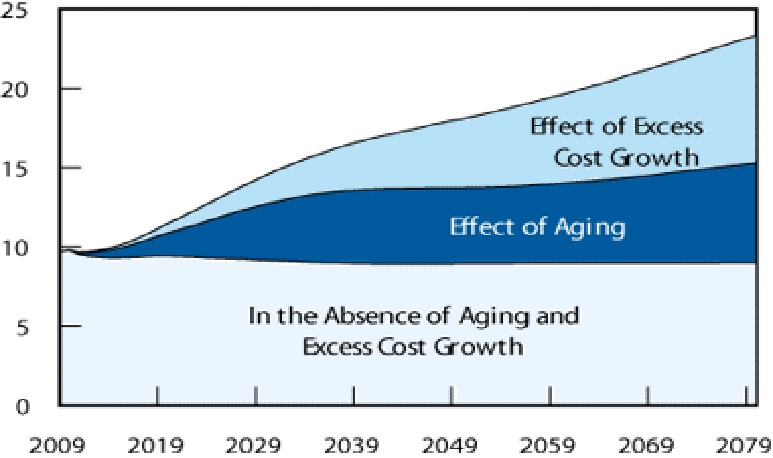
There are only two ways to reduce future deficits significantly: raise taxes or cut Social Security, Medicare, and Medicaid. The total bill for those programs (excluding the hidden costs of Obamacare) will rise from 10 percent of GDP to 23 percent of GDP when our grandchildren are in their “golden years”:


Source: Congressional Budget Office, “The Long-Term Budget Outlook,” June 2009, Box 1-2.

If the commissioners have any courage, they will recommend the gradual phase-out of Social Security, Medicare, and Medicaid — along the lines of my proposed solution:

1. Abolish Social Security payroll taxes as of a date certain (Abolition Day).

2. Pay normal benefits (those implicitly promised under the present system) to persons who are then collecting Social Security and to all other qualifying persons who have then reached the age of 62.

3. Persons who are 55 to 61 years old would receive normal benefits, pro-rated according to their contributions as of Abolition Day.

4. The retirement age for full benefits would be raised for all persons who are younger than 55 as of Abolition Day. The full retirement age is now scheduled to rise to 67 in 2027; it should rise to 73 by, say, 2020. Moreover, partial benefits would no longer be available to persons between the age of 62 and full-retirement age.

4. Persons who are 45 to 54 years old also would receive pro-rata benefits based on their contributions as of Abolition Day. But their initial benefits would be reduced on a sliding scale, so that the benefits of those persons who are 45 as of Abolition Day would be linked entirely to the CPI rather than the wage index.

5. Persons who are younger than 45 would receive a lump-sum repayment of their contributions (plus accrued interest) at full retirement age, in lieu of future benefits. That payment would automatically go to a surviving spouse or next-of-kin if the recipient dies intestate. Otherwise, the recipient could bequeath, transfer, or sell his interest in the payment at any time before it comes due.

6. The residual obligations outlined in points 2-5 would be funded by a payroll tax, which would diminish as those obligations are paid off.

Repeat, with appropriate variations, for Medicare and Medicaid [and Obamacare].

The alternative is to burden the productive sectors of the economy, thus further reducing the rate of economic growth and making Social Security, Medicare, Medicaid, and Obamacare even less affordable. Is that the future we want for our descendants?
__________
* The head of the Congressional Budget Office acknowledges that Obamacare

maintains and puts into effect a number of policies that might be difficult to sustain over a long period of time. For example, the legislation:

– Reduces the growth rate of Medicare spending (per beneficiary, adjusting for overall inflation) from about 4 percent per year for the past two decades to about 2 percent per year for the next two decades. It is unclear whether such a reduction can be achieved, and, if so, whether it would be through greater efficiencies in the delivery of health care or through reductions in access to care or the quality of care. . . .

– Establishes a tax on insurance plans with relatively high premiums in 2018 and (beginning in 2020) indexes the tax thresholds to general inflation.

Whither Inflation?

Who knows? My only observations: The recent up-tick is consistent with price behavior during an economic recovery. And, even with the up-tick, the current year-over-year rate of inflation is in line with the down-trend that began in 1980.


Derived from U.S. Department Of Labor, Bureau of Labor Statistics: Consumer Price Index, All Urban Consumers – (CPI-U), U.S. city average, All items, 1982-84=100.

UPDATED 05/27/10: See this post for an alternative estimate of the rate of inflation.

Tocqueville’s Prescience

I have added Joseph Epstein’s new book, Alexis de Tocqueville: Democracy’s Guide, to my Amazon.com wish list. My urge to own the book arises from a review in The American Spectator. The reviewer (Larry Thornberry) observes that

Tocqueville understood the constant conflict in democracies between liberty and equality, and the threat too much emphasis on the latter poses to the former. He recognized the emotion of envy behind much of the high-minded talk about equality, which he once described as “generally the wish that no one should be better off than oneself.”

Tocqueville saw the soft tyranny of the smothering paternalism that democracies can impose, and the bureaucracies they can build. He understood that too much centralization of government is a one-way street to despotism.

So true. So prescient.

With respect to “soft tyranny” or “soft despotism,” as it is generally called, I can only repeat myself:

Soft despotism is “soft” only in that citizens aren’t dragged from their houses at night and executed for imaginary crimes against the state — though they are hauled into court for not wearing seatbelts, for smoking in bars, and for various other niggling offenses to the sensibilities of nanny-staters.

Despite the absence of arbitrary physical punishment, soft despotism is despotism, period. It can be nothing but despotism when the state holds sway over your paycheck, your retirement plan, your medical care, your choice of associates, and thousands of other details of your life — from the drugs you may not buy to the kind of car you can’t drive, from where you can build a house to the features that your house must include.

“Soft despotism,” in other words, is too soft a term for the regime under which we live. I therefore agree with Tom Smith: “Fascism” is a good descriptor of our present condition, so I’ll continue to use it.

The Once and Future Ration Book

Our children and grandchildren will need ration books for medical services if Obamacare isn’t repealed. How else will medical services be acquired when providers exit in the face of arbitrary fee caps, when demand soars because of universal access to “cheap” or “free” medical services, and when private insurance companies have been squeezed out of business by government?

In anticipation of that bleak future, I dug out one of my World War II ration books and updated it. Here’s the revised cover (“health” replaces “war”), followed by a page of ration coupons:

The howitzer motif is appropriate, given that Obamcare is a war on medicine and liberty. Other coupon pages feature equally appropriate symbols: tanks, aircraft carriers, and dive bombers.

Abortion and Crime

In several posts at my old blog, I examined the causes of crime and ways to combat it. Among other things, I debunked the proposition that more abortion means less crime. (See this post and follow the links therein.) Abortion, if it does anything, leads to more crime by women because it “frees” them from child-rearing:


Derived from Statistical Abstracts of the United States: Table HS-24. Federal and State Prisoners by Jurisdiction and Sex: 1925 to 2001; and Table 338. Prisoners Under Federal or State Jurisdiction by Sex.

It’s women’s lib at work!

How’s “He” Doing?

“He” is Barack Obama (BO), who presides over the left half of the nation and dictates to the right half. In an early post about BO’s popularity — or lack thereof — I observed that his “approval rating may have dropped for the wrong reasons; that is, voters expect him to “do something” about jobs, health care, etc.”

And, sure enough, when BO used his first state of the union address to reiterate his allegiance to the New Deal, his unpopularity dwindled a bit. And when he and his co-conspirators — Reid and Pelosi — rammed their health-care bill through Congress, his unpopularity again dwindled.

The good news is that BO remains generally unpopular:

Net approval rating: percentage of likely voters strongly approving of BO, minus percentage of likely voters strongly disapproving of BO. Derived from Rasmussen Reports’ Daily Presidential Tracking Poll. I use Rasmussen’s polling results because Rasmussen has a good track record with respect to presidential-election polling.

In polls there is hope.

A Nation of Sheep

The mail participation rate for Census 2010 has reached 72 percent, matching the Census 2000 rate. By the time the census-takers are done with their canvassing and re-canvassing in July, the vast majority of American households will succumb to the Census Bureau’s unconstitutional prying by divulging information that is none of the government’s business.

Bah! Or, I should say, b-a-a-a!

Clinton the Conspirator

Bill Clinton is back on the job. Thanks to a large assist from CNN, Clinton is once again painting those who oppose oppressive government as potentially violent extremists in the mold of Timothy McVeigh. Byron York has this take on Clinton’s latest foray into fear-mongering:

With the 15th anniversary of the Oklahoma City bombing Monday, former President Bill Clinton is playing a starring role in the liberal effort to draw what the New York Times calls “parallels between the antigovernment tone that preceded that devastating attack and the political tumult of today.” The short version of the narrative is: Today’s Tea Partiers are tomorrow’s right-wing bombers. . . .

At a White House meeting four days [after the bombing], [Dick] Morris presented Clinton with a comeback strategy based on his polling.  Morris prepared an extensive agenda for the session, a copy of which he would include in the paperback version of his 1999 memoir, Behind the Oval Office.  This is how the April 27 agenda began:

AFTERMATH OF OKLAHOMA CITY BOMBING

A. Temporary gain: boost in ratings — here today, gone tomorrow

B. More permanent gain: Improvements in character/personality attributes — remedies weakness, incompetence, ineffectiveness found in recent poll

C. Permanent possible gain: sets up Extremist Issue vs. Republicans . . .

It was a political strategy crafted while rescue and recovery efforts were still underway in Oklahoma City.  And it worked better than Clinton or Morris could have predicted.  In the months after the bombing, Clinton regained the upper hand over Republicans, eventually winning battles over issues far removed from the attack.  The next year, 1996, he went on to re-election.  None of that might have happened had Clinton, along with Morris, not found a way to wring as much political advantage as possible out of the deaths in Oklahoma City.  And that is the story you’re not hearing in all the anniversary discussions.

And here is Debra J. Saunders:

Clinton wrote that while criticism is “part of the lifeblood of democracy … we should remember that there is a big difference between criticizing a policy or a politician and demonizing the government that guarantees our freedom and public servants who enforce our laws.”

What I want to know is: Other than the twisted McVeigh and company, who is not clear on this difference? Does Clinton think his all his critics are stupid, or is he playing stupid?

But wait, there’s more. Clinton continued, “We must all assume responsibility for our words and actions before they enter a vast echo chamber and reach those both serious and delirious, connected and unhinged.”

Think about that for a minute: If anyone were to cast blame for the Fort Hood shootings that left 13 dead, or any other attacks within American military bases, on the antiwar movement, then that assertion would be followed by howls of outrage, and deservedly so. It would be absurd to suggest that opposition to the war be misconstrued as promoting violence against U.S. troops.

Yet somehow arguing against President Obama’s health care plan can be construed as practically an incitement to violence.

It all boils down to this: Clinton spearheads a left-wing conspiracy to discredit Americans who legitimately protest the unconstitutional and fiscally destructive acts of the federal government. One of the conspiracy’s tactics is to charge that Tea-Partiers and other critics of Barack Obama’s policies are “racist” — as if Obama’s policies weren’t, in and of themselves, deserving of opprobrium. (See, for example, the decidedly non-racist “Contract from America,” which reflects the true concerns of the Tea-Partiers and millions of silent Americans who are with them in spirit.)

Clinton’s moral standing is on a par with Teddy Kennedy’s. That is to say, Clinton has no moral standing. (A small, non-sexual sample of Clinton’s morality can be found in the use of CS gas against the 25 children who were present in the Branch Davidian compound at Waco.)  To call Clinton a snake would be an insult to snakes.