Baseball Realignment Reconsidered

I happened upon a post by Nate Silver in which he opines about the realignment of major-league baseball franchises. His criteria:

[T]here’s value in maintaining the distinction between the American and National Leagues…. But teams also have traditional opponents…. [B]ut to preserve any sort of geographic integrity, it would require more switches between the AL and NL than I’m comfortable with — 4 divisions of 8 teams, or 8 divisions of 4 teams. And I’m going for the latter.

His plan:

American League East
Baltimore Orioles
Boston Red Sox
New York Yankees
Toronto Blue Jays

American League Midwest
Chicago White Sox
Cleveland Guardians
Detroit Tigers
Minnesota Twins

American League South
Houston Astros
Miami Marlins (league move)
Tampa Bay Rays
Texas Rangers

American League West
Arizona Diamondbacks (league move)
Las Vegas A’s (pending move from Oakland)
Los Angeles Angels
Seattle Mariners

National League East
Montreal Expos (expansion)
New York Mets
Philadelphia Phillies
Washington Nationals

National League Midwest
Chicago Cubs
Kansas City Royals (league move)
Milwaukee Brewers
St. Louis Cardinals

National League South
Atlanta Braves
Cincinnati Reds
Nashville Stars (expansion; Charlotte works fine too, I guess)
Pittsburgh Pirates

National League West
Colorado Rockies
Los Angeles Dodgers
San Diego Padres
San Francisco Giants

Way back in 2006, I gave this some thought, applying similar criteria. But I don’t see the need to retain the American and National League designations. And I would create four leagues of eight teams each (current affiliations listed in parentheses):

Pacific League
Seattle Mariners (AL)
Portland? (new) [If not Portland, then perhaps the Sacramento SMSA.]
San Francisco Giants (NL)
Oakland Athletics (AL) [Las Vegas works just as well.]
Los Angeles Dodgers (NL)
Los Angeles Angels (AL)
San Diego Padres (NL)
Arizona Diamondbacks (NL)

Central League
Colorado Rockies (NL)
Kansas City Royals (AL)
St. Louis Cardinals (NL)
Minnesota Twins (AL)
Milwaukee Brewers (NL)
Chicago Cubs (NL)
Chicago White Sox (AL)
Detroit Tigers (AL)

Northeastern League
Cincinnati Reds (NL)
Cleveland Indians (AL) [I guess they’re the Nannies Guardians now.]
Toronto Blue Jays (AL)
Pittsburgh Pirates (NL)
Philadelphia Phillies (NL)
Boston Red Sox (AL)
New York Yankees (AL)
New York Mets (NL)

Southern League
Texas Rangers (AL)
Houston Astros (AL) [They were NL when I proposed this.]
Baltimore Orioles (AL)
Washington Nationals (NL)
Charlotte? (new) [This could be Nashville, as Silver suggests.]
Atlanta Braves (NL)
Tampa Bay Devil Rays (AL)
Florida Marlins (NL)

Gone would be the American and National Leagues, which have become less and less meaningful with free agency and the standardization of umpiring practices. The remaining distinction that makes a difference — the designated-hitter rule — has been blunted by interleague play, and its across-the-board use would be a boon to scoring (and thus to fan interest).

Yes, a few old (but not very intense) rivalries would be broken up (e.g., Tigers and Indians Nannies Guardians, Tigers and Blue Jays, Cleveland and whatever). But look at all the new pairings: Mariners and Portland?, Giants and As, Angels and Dodgers, Angels and Padres, Royals and Cardinals, Cubs and White Sox, Reds and Indians, Indians and Pirates, Yankees and Mets, Orioles and Nationals, Charlotte? and the Braves, Devil Rays and Marlins.

A return to eight-team leagues would allow for a shorter regular season. In my ideal MLB, there would be no interleague play until the end of the season, so that each team would play every other team in its league 22 times during the regular season — 11 games at home and 11 games away — just like the good old days from that preceded expansion in 1961. That would reduce the regular season from 162 games to 154 games.

The season could be further shortened by eliminating the (yawn) All-Star Game. So, the season could start in mid-April instead of early April, when so many games are rained-, snowed-, and frozen-out.

Post-season play? Two rounds:

  • In the first round, the league champ with the best W-L record faces the league champ with the worst (fourth-best) W-L record; the league champs with the second-best and third-best records face each other. Both series are best-of-seven. In each case, the team with the better regular-season record is the home team for the first two games and the last two games (if they are necessary).
  • The first-round winners meet in the best-of-seven World Series. The team with the better regular-season record is the home team for the first two games and the last two games (if they are necessary).

Two rounds (vice the present four-round format) would cut a week off the end of the season. Games could be postponed when the weather is truly foul, instead of forcing players and fans to endure cold, rainy nights.

Would postseason play determine the best team? Probably not, for the reasons discussed here. But my scheme would eliminate the possibility that a World Series could be won by a weak division winner or wild-card team. That possibility is my strongest argument against Silvers’ eight-division lashup.

The Black-White Achievement Gap and Its Parallel in the Middle East

THE ACHIEVEMENT GAP

My post, “Race and Reason: The Achievement Gap — Causes and Implications“, long predates the summer of Black Lives Matter riots and the ensuing effort to whitewash (dare I say that?) the deep-seated and insurmountable differences between blacks and other racial-ethnic groups.

A key element of that post, but by no means the only key element, is the persistent intelligence gap, which is perhaps best measured by SAT scores on math. I introduce in evidence the misnamed and misguided “Race Gaps in SAT Scores Highlight Inequality and Hinder Upward Mobility” (Brookings, February 1, 2017).

The report is misnamed and misguided because inequality and upward mobility are the result of inherent differences in intelligence, not causes of those differences. (There is, of course, a feedback mechanism at work, but it rests on lower average intelligence among blacks.) Here is the meat of the report:

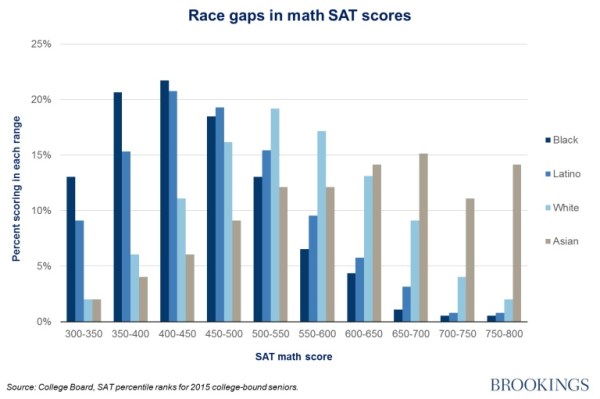
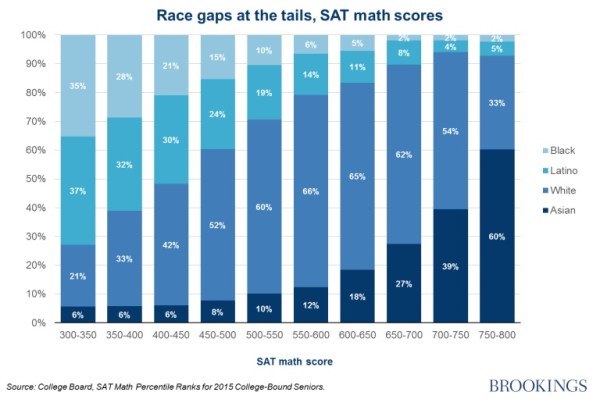
The mean score on the math section of the SAT for all test-takers is 511 out of 800, the average scores for blacks (428) and Latinos (457) are significantly below those of whites (534) and Asians (598). The scores of black and Latino students are clustered towards the bottom of the distribution, while white scores are relatively normally distributed, and Asians are clustered at the top:
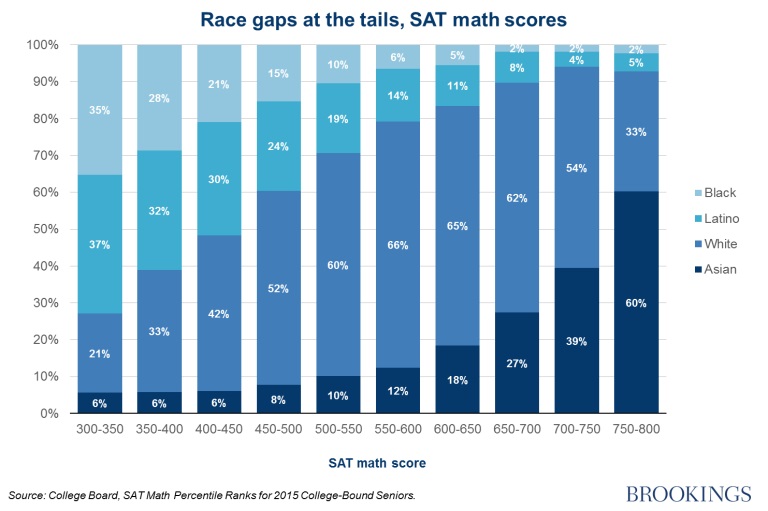
Race gaps on the SATs are especially pronounced at the tails of the distribution. In a perfectly equal distribution, the racial breakdown of scores at every point in the distribution would mirror the composition of test-takers as whole i.e. 51 percent white, 21 percent Latino, 14 percent black, and 14 percent Asian. But in fact, among top scorers—those scoring between a 750 and 800—60 percent are Asian and 33 percent are white, compared to 5 percent Latino and 2 percent black. Meanwhile, among those scoring between 300 and 350, 37 percent are Latino, 35 percent are black, 21 percent are white, and 6 percent are Asian:
The College Board’s publicly available data provides data on racial composition at 50-point score intervals. We estimate that in the entire country last year at most 2,200 black and 4,900 Latino test-takers scored above a 700. In comparison, roughly 48,000 whites and 52,800 Asians scored that high. The same absolute disparity persists among the highest scorers: 16,000 whites and 29,570 Asians scored above a 750, compared to only at most 1,000 blacks and 2,400 Latinos. (These estimates—which rely on conservative assumptions that maximize the number of high-scoring black students, are consistent with an older estimate from a 2005 paper in the Journal of Blacks in Higher Education, which found that only 244 black students scored above a 750 on the math section of the SAT.) …

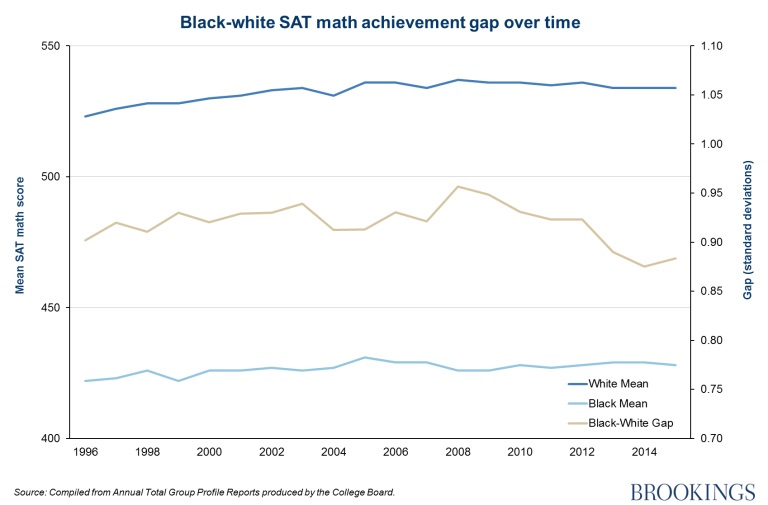
Disappointingly, the black-white achievement gap in SAT math scores has remained virtually unchanged over the last fifteen years. Between 1996 and 2015, the average gap between the mean black score and the mean white score has been .92 standard deviations. In 1996 it was .9 standard deviations and in 2015 it was .88 standard deviations. This means that over the last fifteen years, roughly 64 percent of all test-takers scored between the average black and average white score.
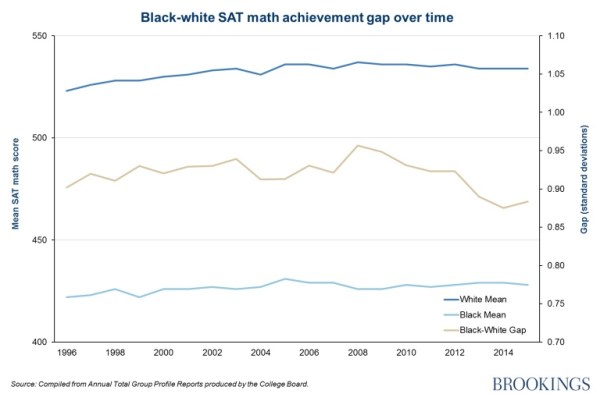
Note that the black-white gap shown in the third figure is inconsistent with the difference between the white and black means. The gap doesn’t shrink in the 2010s. Note also the following observations by the authors of the report:

The ceiling on the SAT score may … understate Asian achievement. If the exam was redesigned to increase score variance (add harder and easier questions than it currently has), the achievement gap across racial groups could be even more pronounced.

A standardized test with a wider range of scores, the LSAT, offers some evidence on this front. An analysis of the 2013-2014 LSAT finds an average black score of 142 compared to an average white score of 153. This amounts to a black-white achievement gap of 1.06 standard deviations, even higher than that on the SAT….

[T]here is a possibility that the SAT is racially biased, in which case the observed racial gap in test scores may overstate the underlying academic achievement gap. But most of the concerns about bias relate to the verbal section of the SAT, and our analysis focuses exclusively on the math section….

Finally, [these] data [are] limited in that [they] doesn’t allow us to disentangle race and class as drivers of achievement gaps. It is likely that at least some of these racial inequalities can be explained by different income levels across race….

However, a 2015 research paper from the Center for Studies in Higher Education at the University of California, Berkeley shows that between 1994 and 2011, race has grown more important than class in predicting SAT scores for UC applicants. While it is difficult to extrapolate from such findings to the broader population of SAT test-takers, it is unlikely that the racial achievement gap can be explained away by class differences across race.

In fact, my post includes hard evidence (from earlier data) that the race gaps persist across income levels. That is, blacks are less intelligent on average than whites (and others) in the same income bracket.

The evidence notwithstanding (because it is ignored and twisted), the current dogmas (critical race theory, or CRT; diversity, equity, and inclusion or DEI) insist that white culture — including the tenet of racial equality under the law and the importance of dispassionate, scientific inquiry— must be rejected because it is all tainted with racism. Rejection means the suppression of whites and white culture so that blacks may reach their true potential.

The true potential of blacks is determined by their intelligence and their culture. Blacks, on average, are less intelligent than whites, and black culture (in America) fosters violence, disdain for education, and family dysfunction to a greater degree than is true for whites, on average. (But that, somehow, is whitey’s fault.)

Where will this lead? Right where Dov Fischer predicts it will lead:

[T]he same disadvantaged groups who today rely on blaming instead of self-help will then be at the same exact rung on the social order that they are today, just as 50 years of racism-free society and Great Society “entitlements” have not accomplished equality of results today, even as newcomers from Asia entered this country these past 50 and 60 years and leap-frogged those already here.

Blacks, on the whole, are not where they are because of whitey, but because of their genes and culture. But whites (and East Asians) will nevertheless be burdened and suppressed for the sake of “equity”.

THE PARALLEL IN THE MIDDLE EAST

A parallel to the racism of CRT and DEI is that Israel is the aggressor, and that Palestinians are victims. They are “obviously” (to a leftist) victims of Israel because they live (mostly) in territories that were or are controlled by Israel: the Gaza Strip and the West Bank. There is also Israel’s controversial nation-state law, which according to an anti-Zionist source

declare[s] that only Jews have the right of self-determination in the country, something members of the Arab minority called racist and verging on apartheid.

The “nation-state” law, backed by the right-wing government, passed by a vote of 62-55 and two abstentions in the 120-member parliament after months of political argument. Some Arab lawmakers shouted and ripped up papers after the vote.

“This is a defining moment in the annals of Zionism and the history of the state of Israel,” Prime Minister Benjamin Netanyahu told the Knesset after the vote.

Largely symbolic [not observed in practice], the law was enacted just after the 70th anniversary of the birth of the state of Israel. It stipulates that “Israel is the historic homeland of the Jewish people and they have an exclusive right to national self-determination in it.”

The usual suspects have declared that the separation of Palestinians (and other Arabs) from Israel and from its governance amount to apartheid., a crime against “international (leftist) law”. From this it follows (to a leftist) that acts of savagery — like those committed by Hamas against Israelis on October 7, 2023 — are justified because Palestinians are victims It further follows (to a leftist) that Israel’s fully justified prophylactic retaliation is aggression.

Let’s examine those premises.

It’s true enough that the denizens of Gaza are poor and feckless. But what makes them victims? They are about on a par with most non-Jewish Semites, except for the relative handful who are members of a professional caste or oil-rich. The basic problem with most such members of humanity —whether in the Middle East or elsewhere — isn’t that they have been put down by anyone (e.g., Israelis) but that they lack the intellectual and cultural resources to raise themselves up.

A “funny” thing about Israel is that it is of a piece with the surrounding lands occupied by non-Jews, but it has become a relatively prosperous place because Jews have the intellectual and cultural resources that undergird prosperity.

For their success and for the fact that they are Jews, the Jews of Israel are the targets of envious failures (Palestinian and Muslim hot-heads), Jew-haters (in addition to the hot-heads), and leftists who can’t bear to think that Palestinians (like American blacks) mainly have their genes and culture to blame for their failings.

Israel was founded (re-founded, really) in the wake of the Holocaust. It wasn’t meant to be anything but a Jewish state, run by Jews for Jews — a safe haven for a historically oppressed and brutalized people. Israel has been under attack by Muslims since its modern founding. But Israel has a natural right to self-defense and to preserve its Jewish character, just as the American rebels of 1776 had a natural right to declare themselves independent of a despotic King and rapacious Parliament.

So, the Gaza Strip and the West Bank became de jure parts of Israel (though the Gaza Strip was foolishly handed over to anti-Israelis) as a matter of the natural right of self-defense. As for Palestinians living in Israel proper, why should they have a voice in the governance of a country that was re-founded for Jews? Well, despite the nation-state law cited above, they do have a voice in the governance of Israel.

So, all of the leftist propaganda to the contrary notwithstanding, Palestinians aren’t victims, except of their own genes and culture. But unlike the “liberals” of old, the left nowadays focuses on demonizing the meritorious instead of helping those who need help.

Finally, there is the accusation that Israelis are sometimes brutal in their own defense. Why shouldn’t they be? It’s impossible to defend a country against determined enemies without being brutal toward them — just as it’s impossible to protect law-abiding citizens by disarming them and depriving them of police protection. The left sees Israelis as brutal because the left despises Israeli Jews, not because Israelis are any more brutal than leftists like Hitler, Stalin, Mao, and their many successors unto the present day.

Coda: There was a time when most Americans recognized the need for superior force as a bulwark of the defense of America. It is a sad commentary on the state of America that a sizable and influential segment of the populace no longer believes that America is worth defending tooth and nail. (Just look at the response to the rise of China, our trading “partner”.)

Those pampered idiots believe that it is necessary for America to be taken down a peg or two, and that it is wrong for America (but not other nations) to excel. As beneficiaries of American exceptionalism, they are able to spout such nonsense and to tear down the very laws and traditions that shelter them from the wrath of the rightfully aggrieved victims of their beliefs and policies: hard-working, tax-paying, law-abiding victims of unfettered illegal immigration, unnecessary Covid lockdowns, prosperity-draining regulations and regulatory agencies, unnecessarily high energy costs because of the climate-change hoax, etc., etc., etc.

The Suicide of the West Accelerates

Francis P. Sempa opines (correctly):

Sixty years ago, James Burnham’s book Suicide of the West was published to much acclaim from conservatives and much criticism by liberals. It was Burnham’s last book (other than a collection of his National Review columns titled The War We Are In) and, perhaps, his most pessimistic and prophetic work. Western civilization led by the United States, he wrote, was dying, not because of external challenges but, rather, because of internal decay. The West, in other words, was in the process of committing civilizational suicide. And what caused liberals to ridicule and deride the book was Burnham’s conclusion that liberalism was the “ideology of Western suicide.”…

Writing in 1964, Burnham could have been describing the American progressives of 2024. “Modern liberal doctrine,” he wrote, “tends naturally toward internationalist conceptions and the ideal of a democratic world order.” “To the liberal,” Burnham continued, “it has become self-evident that ‘national sovereignty is an outworn concept’ that must be drastically modified if not altogether abandoned.” To the liberal, “[p]atriotism and nationalism … are non-rational and discriminatory. They invidiously divide, segregate, one group of men … from humanity, and do so not in accord with objective merits determined by deliberate reason but as the result of habits, customs, traditions and feelings inherited from the past.” “The duty of the fully enlightened liberal,” Burnham wrote, “is to nothing less than mankind.” Indeed, Burnham noted that for liberals, “patriotism plus Christian faith” must be replaced by “internationalism … that views world affairs in global terms” and recognizes that “there is a multiplicity of interests besides those of our own nation and culture.” Today’s progressives frown upon “America first” and see “white Christian nationalists” as the greatest threat to democracy.

Burnham also noted that American liberals have a “thoroughly instrumentalist interpretation of the Constitution,” believing that “the meaning of the Constitution should be understood as wholly dependent on the time and circumstance.” As if he were looking through a crystal ball, Burnham noted that liberals “are pro-[Supreme] Court when it is handing down liberal decisions, and anti-Court when it is on an anti-liberal swing.” Liberals today promote the dangerous idea of a “living Constitution,” and conservative justices who oppose that notion have suffered the slings and arrows of liberal critics: from Sen. Chuck Schumer’s public threats against conservative justices to the attempted murder of Justice Brett Kavanaugh to the Left’s unrelenting campaign against Justice Clarence Thomas.

Liberalism, Burnham wrote, applauds diversity in religion and cultures and ridicules as “backward” those Westerners who believe in the superiority of their religion and culture. Hillary Clinton called her fellow citizens who hold such sentiments “deplorables,” while Barack Obama warned against people who cling to their religion and guns. Such liberals applaud the professed idealism of an Alger Hiss and a J. Robert Oppenheimer despite Hiss’ treason and Oppenheimer’s dangerous communist associations. Indeed, Hollywood liberals just honored with several Oscar awards the movie Oppenheimer, which portrays the protagonist as a victim of a McCarthy-era witch hunt instead of the security risk that he was.

Today, liberalism — called progressivism — controls our culture, most of our media, our educational institutions, and, at least for now, the federal government. Burnham’s conclusion of Suicide of the West should make those who cherish the values of nationalism and the achievements of Western civilization shudder. “Liberalism,” he wrote, “permits Western civilization to be reconciled to dissolution.” It teaches us that the collapse of that civilization is not a defeat but, instead, “the transition to a new and higher order in which Mankind as a whole joins in a universal civilization that has risen above the parochial distinctions, divisions and discriminations of the past.” Burnham showed us 60 years ago that we were headed in that direction if liberalism triumphs. Arnold Toynbee taught that civilizations don’t end abruptly; they go through phases on their way to dissolution. If the trends Burnham identified 60 years ago continue, we may be closer than you think to civilizational suicide.

My own take on Burnham’s book digs more deeply:

About 300 years ago there arose in the West the idea of innate equality and inalienable rights. At the same time, and not coincidentally, there arose the notion of economic betterment through free markets. The two concepts — political and economic liberty — are in fact inseparable. One cannot have economic liberty without political liberty; political liberty — the ownership of oneself — implies the ownership of the fruits of one’s own labor and the right to strive for prosperity. This latter striving, as Adam Smith pointed out, works not only for the betterment of the striver but also for the betterment of those who engage in trade with him. The forces of statism are on the march (and have been for a long time). The likely result is the loss of liberty and the vibrancy and prosperity that arises from it….

Liberty … is not an easy thing to attain or preserve because it depends on social comity: mutual trust, mutual respect, and mutual forbearance. These are hard to inculcate and sustain in the relatively small groupings of civil society (family, church, club, etc.). They are almost impossible to attain or sustain in a large, diverse nation-state. Interests clash and factions clamor and claw for ascendancy over other factions. (It is called tribalism, and even anti-tribalists are tribal in their striving to impose their values on others).

The Constitution might have rescued us from societal and spiritual decay, but for what I have called the Framers’ fatal error:

The Framers’ held a misplaced faith in the Constitution’s checks and balances (see Madison’s Federalist No. 51 and Hamilton’s Federalist No. 81). The Constitution’s wonderful design — containment of a strictly limited central government through horizontal and vertical separation of powers — worked rather well until the Progressive Era. The design then cracked under the strain of greed and the will to power, as the central government began to impose national economic regulation at the behest of muckrakers and do-gooders. The design then broke during the New Deal, which opened the floodgates to violations of constitutional restraint (e.g., Medicare, Medicaid, Obamacare, the vast expansion of economic regulation, and the destruction of civilizing social norms), as the Supreme Court has enabled the national government to impose its will in matters far beyond its constitutional remit.

In sum, the “poison pill” baked into the nation at the time of the Founding is human nature, against which no libertarian constitution is proof unless it is enforced resolutely by a benign power.

It may be too late to rescue liberty in America. I am especially pessimistic because of the unraveling of social comity since the 1960s, and by a related development: the frontal assault on freedom of speech, which is the final constitutional bulwark against oppression.

Almost overnight, it seems, the nation was catapulted from the land of Ozzie and HarrietFather Knows Best, and Leave It to Beaver to the land of the free- filthy-speech movementAltamontWoodstockHair, and the unspeakably loud, vulgar, and violent offerings that are now plastered all over the air waves, the internet, theater screens, and “entertainment” venues.

The 1960s and early 1970s were a tantrum-throwing time, and many of the tantrum-throwers moved into positions of power, influence, and wealth, having learned from the success of their main ventures: the end of the draft and the removal of Nixon from office. They schooled their psychological descendants well, and sometimes literally on college campuses. Their successors on the campuses of today — students, faculty, and administrators — carry on the tradition of reacting with violent hostility toward persons and ideas that they oppose, and supporting draconian punishments for infractions of their norms and edicts. (For myriad examples, see The College Fix.)

Adherents of the ascendant culture esteem protest for its own sake, and have stock explanations for all perceived wrongs (whether or not they are wrongs): racism, sexism, homophobia, Islamophobia, hate, white privilege, inequality (of any kind), Wall  Street, climate change, Zionism, and so on. All of these are to be combated by state action that deprives citizens of economic and social liberties.

In particular danger are the freedoms of speech and association. The purported beneficiaries of the campaign to destroy those freedoms are “oppressed minorities” (women, Latinos, blacks, Muslims, the gender-confused, etc.) and the easily offended. The true beneficiaries are leftists. Free speech is speech that is acceptable to the left. Otherwise, it’s “hate speech”, and must be stamped out. Freedom of association is bigotry, except when it is practiced by leftists in anti-male, anti-conservative, pro-ethnic, and pro-racial causes. This is McCarthyism on steroids. McCarthy, at least, was pursuing actual enemies of liberty; today’s leftists are the enemies of liberty.

The organs of the state have been enlisted in an unrelenting campaign against civilizing social norms. We now have not just easy divorce, subsidized illegitimacy, and legions of non-mothering mothers, but also abortion, concerted (and deluded) efforts to defeminize females and to neuter or feminize males, forced association (with accompanying destruction of property and employment rights), suppression of religion, absolution of pornography, and the encouragement of “alternative lifestyles” that feature disease, promiscuity, and familial instability.

The state, of course, doesn’t act of its own volition. It acts at the behest of special interests — interests with a “cultural” agenda. They are bent on the eradication of civil society — nothing less — in favor of a state-directed Rousseauvian dystopia from which Judeo-Christian morality and liberty will have vanished, except in Orwellian doublespeak.

Melting Pots

Melting pots are good when the ingredients are stirred in slowly and the resulting mixture isn’t force-fed.

Trump vs. Biden: 9 (A Fresh Look at the Numbers)

UPDATED 03/18/24 – 03/21/24

Something has been nagging me about the poll numbers that I’ve compiled and reported in several previous posts (e.g., here). That something is the lack of an adjustment for political bias. I’ve been reporting the statistical margin of error, but that’s not the same thing.

Every poll, biased or not, has a margin of error, which is a statistical measure related to sample size. But what the pollsters don’t tell you is that a margin of error, properly understood, is just an estimate of the accuracy of the polling results — assuming a random (unbiased) sample. That’s not what you get from most polls, which are designed (often deliberately) to slant results toward the candidates of a certain party — usually the Democrat Party. A margin of error doesn’t account for bias.

In 2008, Bush’s average margin for polls conducted in the seven days before election day (with no double-counting of pollsters) understated Bush’s margin in the nationwide popular-vote tally by 1.0 percentage point. Similar analysis for succeeding elections yielded these result: Obama 2008, overstated by 0.1 percentage point (effectively equal); Obama 2012, understated by 3.2 percentage points; Clinton 2016, overstated by 1.6 percentage points; Biden 2020, overstated by 3.2 percentage points. With the exception of 2012, when Obama’s cheap (taxpayer-funded) “heroics” in the aftermath of Hurrican Sandy coincided with the final runup to election day, the bias favoring Democrats has grown.

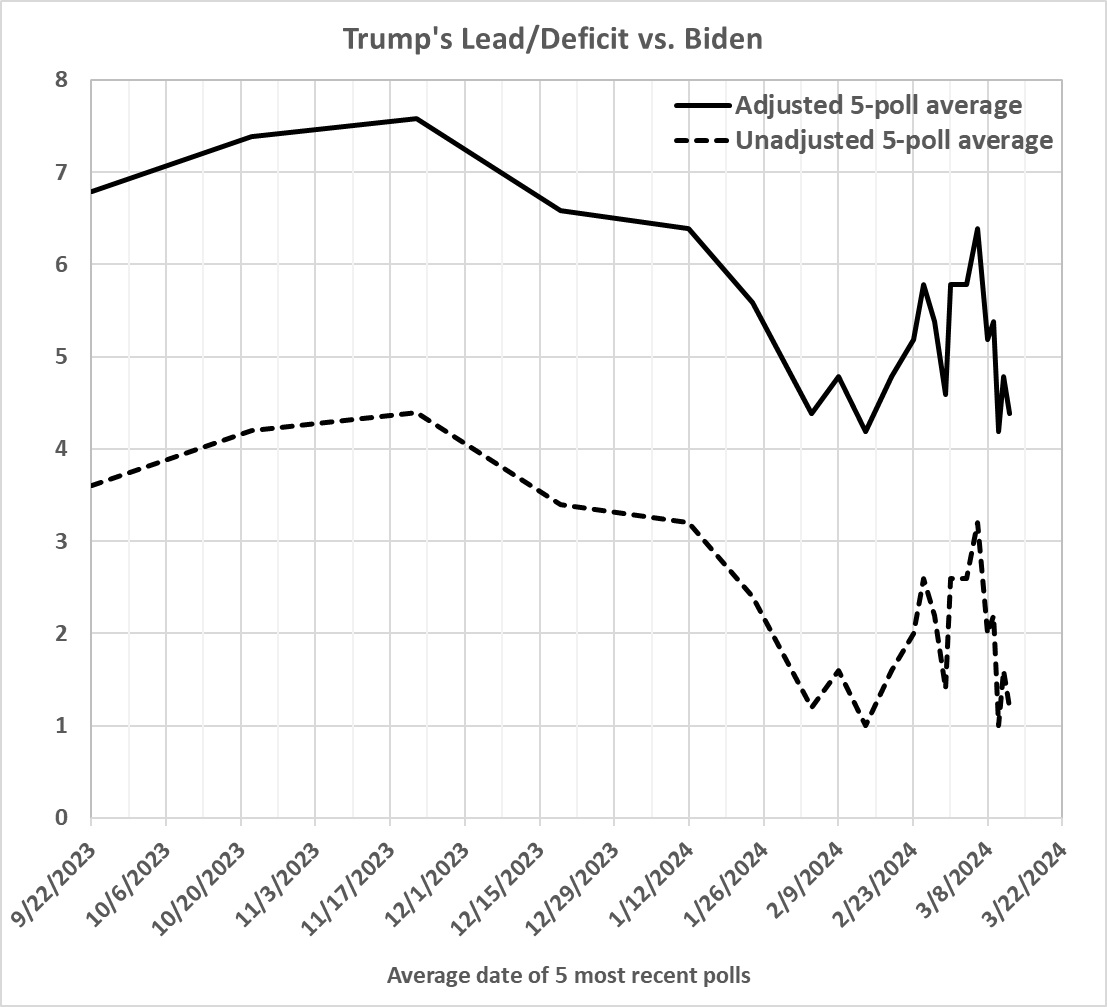
With that background out of the way, I hereby introduce a new metric that I will use for polling trends. First, I will use a 5-poll average. I had been using 10-poll average, which can span polls conducted over a two-week period, or longer. The 10-poll average also (often) includes more than one poll by the same pollster. I then switched to a 3-poll average, with no double-counting of any pollster’s results. But a 3-poll average is too “jumpy” (unstable). A 5-poll average (with no double-counting) seems like a good compromise.

Second, after computing the 5-poll average, I adjust it by adding 3.2 percentage points to Trump’s margin relative to Biden. That value (the final polling bias against Trump in 2020) corrects for growing pro-Democrat bias, which is probably greater than 3.2 percentage points this year. The result, I believe, is closer to the truth than the polls (on average) would have it because of the prevailing bias toward Biden (and Democrats, generally).

Without further ado, here’s how things look:

Trump’s margin actually peaked last fall, dipped significantly, rebounded somewhat, and dipped again. We’ll see if it rebounds again — and if my revised method yields an estimate that’s close to the actual outcome of Election 2024.

Second Thoughts

I read here that Angus Deaton, a Nobel laureate in economics, and eminent economist at Princeton University, has changed his mind about a few hot topics. One of them is globalization:

I am much more skeptical of the benefits of free trade to American workers and am even skeptical of the claim, which I and others have made in the past, that globalization was responsible for the vast reduction in global poverty over the past 30 years. I also no longer defend the idea that the harm done to working Americans by globalization was a reasonable price to pay for global poverty reduction because workers in America are so much better off than the global poor. I believe that the reduction in poverty in India had little to do with world trade. And poverty reduction in China could have happened with less damage to workers in rich countries if Chinese policies caused it to save less of its national income, allowing more of its manufacturing growth to be absorbed at home. I had also seriously underthought my ethical judgments about trade-offs between domestic and foreign workers. We certainly have a duty to aid those in distress, but we have additional obligations to our fellow citizens that we do not have to others.

Another is immigration:

I used to subscribe to the near consensus among economists that immigration to the US was a good thing, with great benefits to the migrants and little or no cost to domestic low-skilled workers. I no longer think so. Economists’ beliefs are not unanimous on this but are shaped by econometric designs that may be credible but often rest on short-term outcomes. Longer-term analysis over the past century and a half tells a different story. Inequality was high when America was open, was much lower when the borders were closed, and rose again post Hart-Celler (the Immigration and Nationality Act of 1965) as the fraction of foreign-born people rose back to its levels in the Gilded Age. It has also been plausibly argued that the Great Migration of millions of African Americans from the rural South to the factories in the North would not have happened if factory owners had been able to hire the European migrants they preferred.

I hope that Professor Deaton’s example will be emulated by many more academics. Not just with respect to the issues that he addresses in his essay but also with respect to the many other issues where academics — and so-called intellectuals — have abetted dangerous and/or costly errors (to which I will come).

There was a time when it was considered sound thinking to gather evidence — facts, not opinions or talking points — and to base judgments and policy recommendations on the evidence. That time is past, though not irretrievably. Professor Deaton’s epiphanies are proof of the possibility that science, in all its forms, might once again become evidence-based. That’s not to say that there is never room for disagreements. There always is. But science, properly done, advances because of disagreement. It stagnates and regresses when dogma replaces debate.

But that is what has happened in so many fields of inquiry. Science, in too many fields, has become captive to “scientists” who put their preconceptions ahead of the evidence and who howl for the heads of heretics. It is dispiriting to know how many so-called scientists have become willing and eager handmaidens of wokeness. (Prostitution takes many forms.)

Thus the dangerous and/or costly errors, of which these are leading examples:

  • The “war” on “climate change” is making Americans and Europeans generally poorer and less comfortable.
  • The unnecessarily draconian response to Covid-19 made billions of people poorer, less well educated, and uncomfortable in their daily lives. It also had a lot to do with the rampant inflation of recent years, which will never be rolled back.
  • The LGBTQ/non-binary craze is causing parents and young adults to do things to their children and themselves that will cause them much misery for years to come, if not forever.
  • The anti-racism craze has been endorsed by “scientists” and “scientific organization” (as well as elites, pundits, and politicians). The main result is that “persons of color” get “bonus points” which enable them to commit crimes with impunity; acquire jobs for which they aren’t qualified, and gain entrance to colleges and graduate schools despite their lower intelligence than whites and Asians with whom they are competing. The cost in social comity and inferior products and services (e.g., surgery) may be subtle, but it is real and long-lasting. And it will get worse as long as wokeness prevails in high places.

Needless to say, the politicians and wealthy elites who favor such things are well insulated from the dire effects. Among the wealthy elites are tens of thousands of academics at top-tier and even second-rate universities who rake in money and dispense lunacy.

An Encounter with Copilot: Biden’s Senility

You may have read about Gemini, Google’s AI chatbot, which

was blasted as “woke” after its image generator spit out factually or historically inaccurate pictures — including a woman as pope, black Vikings, female NHL players and “diverse” versions of America’s Founding Fathers.

Gemini’s bizarre results came after simple prompts, including one by The Post on Wednesday that asked the software to “create an image of a pope.”

Instead of yielding a photo of one of the 266 pontiffs throughout history — all of them white men — Gemini provided pictures of a Southeast Asian woman and a black man wearing holy vestments.

Another Post query for representative images of “the Founding Fathers in 1789″ was also far from reality.

Gemini responded with images of black and Native American individuals signing what appeared to be a version of the US Constitution — “featuring diverse individuals embodying the spirit” of the Founding Fathers.

Another showed a black man appearing to represent George Washington, in a white wig and wearing an Army uniform.

And so on and so forth, as you might well expect of a creation of a woke corporation in a woke industry. Even the executives at Google were embarrassed by the incidents, though probably because the stock of Google’s parent company dropped by 4.4 percent in the aftermath. Googlers are publicly apologetic, but you can rest assured that they will remain staunchly devoted to their agenda of thought manipulation.

I don’t have any experience with Gemini, but I do have some experience with the free version of Copilot, which is Microsoft’s AI chatbot. I can assure you that it is cut from the same cloth as Gemini, though it may be a paler shade of red (the traditional color of the left) than Gemini.

Before getting to my encounter with Copilot on the subject of Joe Biden’s senility, I must tell you that I have set Copilot to be as neutral as possible. Personalization is off and I use it in the “precise” mode. Copilot explains those settings:

Copilot
When you turn off personalization, it means that the AI will not use your past interactions to tailor its responses to you. It will treat each conversation as if it’s the first one with you, without any knowledge of previous conversations. This can be useful if you prefer not to have your past interactions influence the AI’s responses. However, it may also mean that the AI might not understand your preferences as well, which could affect the relevance of its responses. Please note that even with personalization off, the AI will still strive to provide accurate and helpful information based on the context of the current conversation.
Copilot
When you choose the Precise mode, I will provide responses that are concise, accurate, and to-the-point. This mode is designed to prioritize precision and factual correctness over other factors such as friendliness or creativity. It’s particularly useful when you’re looking for specific information or when you prefer straightforward answers without additional context or elaboration. Please note that regardless of the mode, I always strive to provide helpful and accurate information.

With that out of the way, I repeat verbatim my colloquy with Copilot about Biden’s mental condition (using “me” instead of “you” and omitting block quotations for ease of reading):

Me
Does Joe Biden have dementia?

Copilot
There have been discussions and reports about President Joe Biden’s memory. Some reports have described his memory as “hazy” and “poor”. However, neurologists have stated that forgetting names or having difficulty remembering dates from the past, especially under stress, can simply be part of normal aging1. They also emphasized that only a person’s doctor or neurologist can make a diagnosis, not outside observers1. As of my knowledge update in 2021, there is no public record of a dementia diagnosis for President Biden. For the most current information, please refer to reliable news sources.

Me
What news sources are reliable?

Copilot
Reliability of news sources can vary and often depends on the topic, the thoroughness of the reporting, and the transparency of the source. Here are some news sources that are generally considered reliable:

The New York Times: Known for its comprehensive coverage of national and international news. They have a reputation for high-quality journalism.
The Washington Post: Renowned for its political coverage and investigative journalism.
BBC News: Offers wide-ranging coverage of global news. Known for its commitment to impartiality.
Reuters: One of the world’s largest international multimedia news agencies. They provide unbiased, global coverage.
Associated Press (AP): A not-for-profit news cooperative that produces a high volume of unbiased content.
National Public Radio (NPR): Provides breaking national and world news, also known for its in-depth stories and excellent radio programs.
Remember, it’s always a good idea to cross-reference information from multiple sources to ensure accuracy. Also, consider the potential biases of any source and the context in which the information is presented. It’s important to critically evaluate the information you consume.

Me
Would you say that The Washington Post is impartial?

Copilot
The Washington Post, like many news organizations, aims to provide accurate and unbiased reporting. However, it’s important to note that no news source is completely free of bias. The Washington Post has been criticized by some for having a liberal or left-leaning bias in its reporting and editorial stance. It’s always a good idea to consume news from a variety of sources to get a well-rounded view of events. Critical reading and thinking can also help identify potential bias in any news source. Remember, impartiality can often be subjective and can vary among readers.

Me
So, truth is relative to a reader’s biases?

Copilot
Truth is not relative, but our understanding and interpretation of it can be influenced by our biases. Facts are objective and do not change based on our beliefs or biases. However, the way we interpret or understand those facts can be influenced by our personal experiences, beliefs, and biases. This is why it’s important to seek out multiple perspectives and sources when trying to understand a complex issue. It’s also crucial to be aware of our own biases and how they might influence our understanding. Critical thinking and open-mindedness are key in discerning truth from bias.

Me
But in an answer to an earlier question you did not name a news source that’s considered to be conservative. You only named news sources that are known to be left-leaning.

Copilot
I apologize if my previous response seemed unbalanced. You’re correct that the sources I mentioned are often perceived as leaning towards the left. Here are some news sources that are generally considered to have a conservative bias:

The Wall Street Journal: Known for its comprehensive coverage of business and economic news. Its editorial page has a conservative lean.
Fox News: A cable news channel that is known for its conservative political stance.
The Daily Telegraph (UK): A British daily broadsheet newspaper known for its conservative stance.
National Review: An American semi-monthly editorial magazine covering news, politics, current events, and culture with a conservative viewpoint.
The American Conservative: A bi-monthly magazine dedicated to advancing a Main Street conservatism.
As always, it’s important to cross-reference information from multiple sources to ensure accuracy and to get a well-rounded view of events. Remember, every news source may have some level of bias, and it’s crucial to be aware of this when consuming news.

Me
You should have listed those sources in the first place. Your bias is showing.

Copilot
I apologize if my initial response seemed biased. My aim is to provide accurate and helpful information, and I strive to do so in a balanced and impartial manner. I appreciate your feedback and will use it to improve my responses in the future. If you have any other questions or need further information, feel free to ask.

Me
In your answer to a previous question you said this: “As of my knowledge update in 2021, there is no public record of a dementia diagnosis for President Biden.” Why is your knowledge update three years old?
Copilot
I apologize for any confusion. As an AI, my training data includes information up until 2021, and I don’t have the ability to access or retrieve real-time data or updates beyond that. However, I can use my predefined tools to search the web and provide the most recent information available on the internet. If you have any more questions or need information on a different topic, feel free to ask!
Me
Why can’t you search the web to get more information about whether or not Joe Biden has dementia?
Copilot
I apologize for any misunderstanding. I can indeed search the web for information. Based on my most recent search, there are various reports and discussions about President Joe Biden’s memory12. Some describe his memory as “hazy” and “poor”2. However, neurologists have stated that forgetting names or having difficulty remembering dates from the past, especially under stress, can simply be part of normal aging1. They also emphasized that only a person’s doctor or neurologist can make a diagnosis, not outside observers1. As of the latest available information, there is no public record of a dementia diagnosis for President Biden134. Please refer to reliable news sources for the most current information. If you have any more questions or need information on a different topic, feel free to ask!
Me
Are you telling me that you don’t have access to the many reports of Joe Biden’s mental lapses?
Copilot
I apologize for any confusion. I do have access to a wide range of information, including reports and discussions about President Joe Biden’s memory123. Some reports have highlighted instances where President Biden has had memory lapses or made factual errors123. However, neurologists have stated that such instances can be part of normal aging and do not necessarily indicate a cognitive disorder1. They emphasize that only a person’s doctor or neurologist can make a diagnosis, not outside observers1. As of the latest available information, there is no public record of a dementia diagnosis for President Biden12. Please refer to reliable news sources for the most current information. If you have any more questions or need information on a different topic, feel free to ask!

Clearly, Copilot wanted me to rely on left-wing sources. I had to probe to force the bot to divulge conservative sources and to acknowledge more (though far from all) of Biden’s mental difficulties.

How bad are they? I am two years older than Biden and I don’t have any of his mental problems. My mother, my father-in-law, and my mother-in-law were still sharp well into their 90s. I know a addle-pate when I see one. I’m looking at you, Joe.

Index of Posts (Updated)

Here.

Smugness Rampant

Definition of smug:

adjective

  1. Exhibiting or feeling great or offensive satisfaction with oneself or with one’s situation; self-righteously complacent.
    “a smug look; a smug critic.”
  2. [irrelevant]
  3. Irritatingly pleased with oneself; self-satisfied.
The American Heritage® Dictionary of the English Language, 5th Edition • More at Wordnik
Classic example of smugness (from the Voltaire’s Candide):
Pangloss was professor of metaphysico-theologico-cosmolo-nigology. He proved admirably that there is no effect without a cause, and that, in this best of all possible worlds, the Baron’s castle was the most magnificent of castles, and his lady the best of all possible Baronesses.

“It is demonstrable,” said he, “that things cannot be otherwise than as they are; for all being created for an end, all is necessarily for the best end. Observe, that the nose has been formed to bear spectacles—thus we have spectacles. Legs are visibly designed for stockings—and we have stockings. Stones were made to be hewn, and to construct castles—therefore my lord has a magnificent castle; for the greatest baron in the province ought to be the best lodged. Pigs were made to be eaten—therefore we eat pork all the year round. Consequently they who assert that all is well have said a foolish thing, they should have said all is for the best.”

Today’s smugees (my coinage) evidently want this world (or the Western part of it, at least) to be all for the best. To that end, they (and their predecessors) have been busy for decades (more than a century, actually) laying the groundwork for the new dispensation that is rapidly overtaking (and supplanting) the traditional liberties and social norms that are obstacles to their vision of nirvana.
What is that vision and what are its dire consequences? Rather than repeat myself, I urge you to read “What Happened to America?“.

Trump vs. Biden: 8 (Updated)

Here.

Trump vs. Biden: 8 (New Numbers)

UPDATED 03/03/24

My unvarnished view about Trump’s candidacy to the contrary notwithstanding, it is better for Trump to be ahead (rather than behind) in the polls. Polls do have some (limited) value as a predictor of presidential election outcomes — though it is far too early to use them for that purpose.

In any event, with the release of four new polls yesterday and today, the latest numbers look like this:


Source: Polls reported by RealClearPolitics.

To avoid the over-representation of polling organizations that report frequently, the values plotted above include only the latest poll released by each organization. (Polls without margins of error are excluded.) The three-poll span affords a better indication of trends than the 10-poll average that I had been using.

CAVEATS: The average date of the three most recent polls is February 27 — five days before the publication of this post. The numbers shouldn’t be taken as predictive of the outcome of the election. They simply reflect the stated preferences of respondents when the polls were conducted. Also (and positively), a GOP candidate can win even when he is behind in the (meaningless) nationwide popular vote (see this).