Election 2010: Post-Mortem

UPDATED 11/05/10

This is a followup on my election-morning predictions, a prognosis about the next two years, and a diagnosis of the “progressive” disease.

I expected the GOP to gain eight seats in the Senate. But that prediction ran aground on the narrow wins by Democrats Michael Bennet and Harry Reid in Colorado and Nevada. The race in Washington hasn’t been decided, but it seems that Patty Murray will retain her seat.  The Alaska seat will wind up in GOP hands — it’s just a question of whose hands. So, when the dust settles, the GOP will have gained 6 seats and the Dems will retain a majority. That’s as good as it was likely to get. And it’s good enough, because with 47 seats (and only two or three RINOs in the mix) the GOP will command a cloture-proof minority.

Things turned out better in the House. I expected the GOP to end up with 237 seats. But when the dust settles on 10 9 undecided races, the GOP probably will hold between 239 seats (the current count) and 242 seats (adding 3 races now led by GOP candidates). Needless to say, the GOP will command the agenda in the House. The incoming tide of new Republican members will put a lot of pressure on GOP leaders to undo what Pelosi and company wrought. The stumbling blocks will be the Democrat-controlled Senate and the veto pen of BHO.

Republicans gained a lot of ground in the States, as indicated by the pickup of 12 governorships. (The Democrat pickup in California makes little difference in cloud-cuckoo-land, where the main difference between Arnold Schwarzenegger and his successor, Moonbeam Brown, is their accents.) Greater GOP strength at the State level will mean two things: more resistance to the expansion of federal power, and redistricting of the House in ways favorable to future Republican prospects.

The next two years at the “seat of government” (SOG) in D.C. will be filled with GOP initiatives to roll back the Obama agenda, name-calling by Democrats, and (I hope) gridlock combined with some rollback of Obamacare.

The next two years also will be filled with rationalizations by “progressives,” who — in so many words — will blame the backwardness of the American electorate for the events of November 2. “Progressives,” like their putative leader in the White House, already have adopted the myth that things would have turned out differently if only they had found a way to get their “message” across. Well, they did get their “message” across:

  • Pork disguised as stimulus, which did not and will not stimulate because the economy isn’t a hydraulic mechanism that responds automatically to pump-priming.
  • Financial regulations that will make it harder for Americans to borrow money.
  • A Rube Goldberg plan for reforming the health care “system” that will make it harder for Americans to obtain insurance and less rewarding for doctors and other providers to deliver medical services.

Such is “progressivism” at work: Good intentions (to put the best face on it) thwarted by unintended consequences because “progressives” believe that “hope and change” trump the realities of economic (and social behavior) — realities that “the masses” are able to grasp, if only viscerally.

Moreover, there was — and is — the disdain in which “progressives” hold “the masses,” who exist (in the “progressive” imagination) to be talked down to and led by the hand to the promised land of economic and social bliss — as it is envisioned by “progressives.”

I have news for “progressives.” When you talk down to most adults — and even to a lot of children — they quickly perceive three things: (a) you don’t respect their intelligence and (b) you are therefore trying to do something that’s against their interest. You really lose them when you promise things that they know (or suspect) will cost them liberty as well as money.

“Progressives” seem to believe in economic stability at any price, including the price of liberty and prosperity. A lot of “the masses” aren’t buying it. Good for them.

We’re from the Government, and We’re Here to Help You

I once said this:

Think of yourself as a business. You are good at producing certain things — as a family member, friend, co-worker, employee, or employer — and you know how to go about producing those things. What you don’t know, you can learn through education, experience, and the voluntary counsel of family, friends, co-workers, and employers. But you are unique — no one but you knows your economic and social preferences. If you are left to your own devices you will make the best decisions about how to run the “business” of getting on with your life. When everyone is similarly empowered, a not-so-miraculous thing happens: As each person gets on with the “business” of his or her own of life, each person tends to make choices that others find congenial. As you reward others with what you produce for them, economically and socially, they reward you in return. If they reward you insufficiently, you can give your “business” to those who will reward you more handsomely. But when government meddles in your affairs — except to protect you from actual harm[*] — it damages the network of voluntary associations upon which you depend in order to run your “business” most beneficially to yourself and others. The state can protect your ability to run the “business” of your life, but once you let it tell you how to run your life, you compromise your ability to make choices that are right for you.
__________
* “Actual harm” consists of actions (force, verbal and physical intimidation, fraud, theft) against persons and/or their legitimate interests (family, property, business). It is the proper business of the state to defend citizens from harm, and to deter harm. The state may preemptively defend citizens from predators (foreign and domestic) who clearly intend to inflict harm, and who possess or are in the process of obtaining the means of inflicting it.

A key shortcoming of statutes and regulations is that they impose one-size-fits-all rules on the behavior of individuals and businesses. Thus “helpful” statutes and regulations turn out to be unhelpful because they substitute rigid rules for the application of local knowledge and on-scene judgment to unique circumstances.

Here’s a simple but not far-fetched illustration of how legal rigidity causes much unseen harm. Suppose that a regulator in Washington D.C. reads a study which “proves” that left turns are more dangerous than right turns. The regulator then proposes a safety measure forbidding left turns. The measure, which applies to the States as a condition of federal funding, is approved by the regulatory agency following an outpouring of support from “public safety” advocates. The result:

The “better” way of making a left turn requires additional travel distance, and thus additional risk; two additional turns, each of which involves risk; and crossing traffic, which involves further risk (especially if the crossing is unaided by a traffic signal). Then there are the additional costs in fuel, tire wear, and time that the owners and drivers of vehicles must bear.

Such is the “helpful” nature of government. For more, see this post and follow the links therein.

Today, the Battle Begins

The GOP will win big, but that’s only the beginning.

Republicans in Congress must prove their commitment to limited, fiscally conservative government. And the Republican Party must make a compelling case to Americans that limited, fiscally conservative government is the only sure route to liberty and prosperity. If those conditions aren’t met, today’s resounding victory at the polls will be a hollow one.

Here are my final predictions.

  • Based on current Intrade odds on individual Senate races, it looks like the GOP will gain seats in Arkansas, Colorado, Illinois, Indiana, North Dakota, Nevada, Pennsylvania, and Wisconsin. This will cut the Democrat majority in the Senate from 59-41 to 51-49, and leave that body in gridlock.
  • In the House, the GOP will gain about 60 seats and a majority of 39 seats (237-198) to 41 seats (238-197). (For details of my sources and methods, see “One Week Hence” and “Will the GOP Take the House?“)

Tomorrow

UPDATED AND REVISED 11:00 PM (CT)

Rasmussen’s net unpopularity rating of Obama was -11 as of this morning, which is about as good as it gets these days. If that number were to hold on election morning, it would point to a GOP majority of 232-203 in the House.* That would represent a net gain of 53 seats for the GOP.**

HOWEVER, Rasmussen has just released the result of his generic congressional ballot for 10/31/10, which gives GOP House candidates a 12-percentage-point edge over their Democrat rivals. Allowing for some backsliding (10 percent of respondents remain noncommittal), I forecast a GOP edge of 7.4 percentage points. That translates into a 237-198 majority for the GOP — a net gain of 58 seats.

Over in the Senate, the Intrade odds on individual races indicate a 50-50 split, with a few races hanging in the balance. That would be a gain of 9 seats for the GOP.

I will issue my final predictions tomorrow morning.
__________
* For details about sources and methods, see “One Week Hence” and “Will the GOP Take the House?

** Republicans currently hold 178 seats. In addition, a seat that had been held by a Republican is vacant. I therefore use 179 as a baseline for computing GOP gains.

Scare Tactics at Work

First, there’s the well-timed al Qaeda plot. Then, there’s the Stewart-Colbert “Sanity” rally.  Both are efforts to scare independent voters away from GOP candidates on November 2.

Al Qaeda’s leaders evidently assume that America’s independent voters will emulate Spain’s voters, and rally to the party of appeasement. There may be some truth in that. With a full day to absorb the news of the aborted terror plot, Obama’s unpopularity index suddenly improved from -17 to -13 — a swing that is well outside the normal range. (For the electoral implications of this shift, see the updated version of “One Week Hence…“.) Or it could be that some independent voters are having second thoughts as election day approaches. In any event, the bomb plot was well-timed and almost certainly pushed some voters in the direction preferred by al  Qaeda.

The transparent aim of the “Sanity” rally was to shame independent voters away from an association-by-ballot with those “hate-filled, racist, fear-mongering” Tea Partiers.

How will it all turn out? We’ll know the answer to that question in less than 72 hours.

The Recession Still Lingers

UPDATED 10/30/10

The latest release from the Bureau of Economic Analysis, which includes the “advance” estimate of real GDP for the third quarter of 2010, indicates that the recession isn’t over, by my definition of a recession:

  • two or more consecutive quarters in which real GDP (annualized) is below real GDP (annualized) for an earlier quarter, during which
  • the annual (year-over-year) change in real GDP is negative in at least one quarter.

Real GDP for the third quarter was $13,260.7 billion (annualized rate, chained 2005 dollars). Although that’s better than the second quarter, it remains below the peak of $13,359.0, which was reached in the second quarter of 2008.

Here’s how real GDP has fared from the first quarter of 1947 through the third quarter of 2010 (recessions are denoted by vertical bars):

(In this version of the graph I have eliminated the 1947 recession, for lack of complete statistics, and pushed the beginning of the current recession to an earlier quarter.)

(I have added the following sentence and related graph.) Here’s a closer look at the depth and duration of post-war recessions:

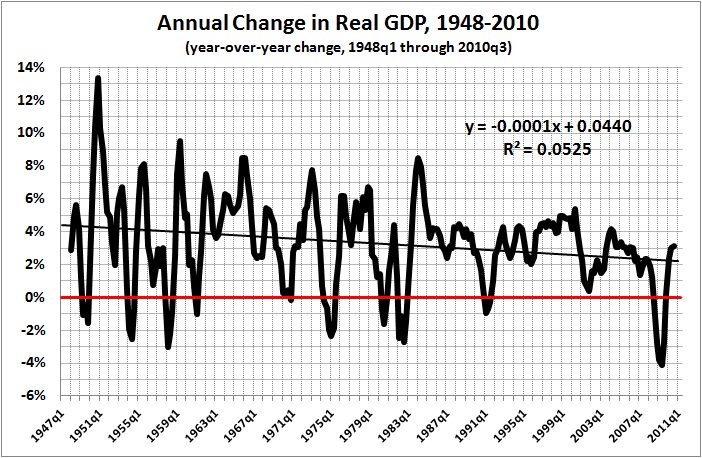
Finally, here are year-over-year changes in real GDP, from the first quarter of 1948 through the third quarter of 2010:

This graph, by the way, updates the one I used in “The Price of Government: More Evidence,” where I say:

You will notice two things about the graph. First, the economy is cyclical, thanks in part to the actions of government (e.g., the low-interest, housing-bubble recession). Second, economic growth has declined from an annual rate of around 4 percent to an annual rate of about 2 percent, because of government.

Related posts:
Economics – Growth & Decline
The Economic and Social Consequences of Government

I Want My Country Back

When a Tea Partier says something like “I want my county back,” leftists reliably label the sentiment as racist, sexist, homophobic, mean-spirited, and a lot of other things that are meant to be uncomplimentary. Well, I’m not an active member of the Tea Party movement, but I am sympathetic to it. And if I were to say “I want my country back,” here’s what I would mean by it:

Let’s start with the unlawfulness of government. The Constitution of the United States creates a “national” government of limited and enumerated powers, to act on behalf of the States and their citizens in certain matters. This “national” government has nevertheless blatantly and persistently exceeded its rightful powers. Moreover, much of what is done by all governments — not just the “national” government — is in fact unlawful at its core. There is a fundamental tenet of law — one that precedes and informs the Constitution — which is that “law” is law only when it serves the general welfare, regardless of its official status as an legislative, executive, or judicial act. Therefore, it is truly unlawful for the  “national” government or any other government in the United States to interfere with the lives, liberty, or property of Americans for the purpose of promoting special interests, however laudable those interests may seem. And yet, the “laws” under which Americans labor are, in the main, enactments that serve special interests and the power-lust of politicians, bureaucrats, and judges. In sum, I want my country (and its various parts) to return to the true “rule of law,” which is to promote the general welfare by

  • protecting all Americans from their enemies within and without
  • ensuring the free movement of all Americans
  • ensuring the free exchange of goods and services
  • and nothing more.

One of the most insidious ways in which government interferes with our liberty is by exercising a subtle but powerful form of thought control. It  is not the business of government to tell us what to believe or how we must arrive at our beliefs. But government — which puts it imprimatur on the vast majority of educational institutions and much of the “factual” information in many fields of endeavor — does all of those things. Thus, contrary to the intentions of the Founders, we have become a nation imbued with official beliefs about matters ranging from the origins of the universe to the goodness of our enemies to the climatic effects of (puny) human endeavors.

One of the key beliefs instilled by government — directly and through those who are in its thrall — is its beneficent role in our economic and social affairs. It never seems to occur to the proponents of governmental interference — or to its relatively few of its opponents — that there is a living, breathing case study which disproves the beneficence of economic meddling. When government spending and regulation played a tiny role in the economic affairs of the United States — from the 1790s to around 1900 — GDP grew at an annual rate of 4.2 percent. Now, with the regulatory-welfare state fully upon us, GDP grows at an annual rate of 3.1 percent (and falling). The difference between those two rates — when compounded over a generation, a lifetime, or a century —  ranges from significantly large to enormous. The road to economic lassitude is paved by the good intentions of regulation and spending by government. Liberty — part of which is the right to make mistakes and benefit from the resulting lessons — is a collateral victim of regulatory zeal. Liberty is a victim of government spending, as well, because it deprives individuals of some portion of the rewards for their labor and capital, and the full enjoyment of those rewards.

With respect to social matters, there is only one way to put it: Government is an enemy of society. Its main mission, when you think about it for more than a minute, is to supplant voluntary and beneficial social arrangements with schemes hatched in the vacuum of intellectualism. It is as if there were nothing to the eons-long learning that is expressed in the Ten Commandments and Golden Rule, and embodied in churches, clubs, and other voluntary, private associations. We must, instead, take our social marching orders from elites, who have their own peculiar views of what is right and just: serial polygamy, pederasty, and infanticide, to name just a few things. The social engineering favored by intellectualoids arises not from the wisdom of tradition, which fosters stable, trusting, and supportive social relationships, but from idle theorizing and a large dose of adolescent and post-adolescent rebellion.

Now, after a more than a century of “progressive” destruction of the Constitution and its restraints on government, Americans no longer enjoy the protection of government and the self-policing restraints of social custom. Instead, Americans suffer the fads and whims of the self-anointed, whose legacy lingers after their departure from the scene.

Now, after more than a century of “progressive” interference in the economic affairs of Americans, our progeny face unaffordable financial commitments, which they will be expected to honor even as their standard of living withers under the assault of taxation and regulation.

Now, after more than a century of social experimentation in which anti-social behavior has been exalted and long-standing voluntary social arrangements and institutions have been stripped of their authority, too many of our progeny are hooked on hard drugs, casual sex, and gratuitous violence as forms of “entertainment” and as “lifestyles.”

I want my country back.

The Politically Correct Cancer: Another Weapon in the War on Straight White Males

Breast cancer is by no means a matter for ridicule. But it has become the politically correct cancer, without a doubt.

There is a time during the baseball season when players wear pink caps and pink armbands, and when some of them even wield pink bats. There may be similar occurrences in basketball and football, but I don’t follow those sports, so I wouldn’t know.

The clincher came this morning, in the form of a special 24-page supplement to the Austin American-Statesman (known only as the Statesman in lefty Austin). The supplement not only contains articles about breast cancer and everything possibly related to it, but it is printed on pink newsprint. (NB: Newsprint is the kind of paper on which newspapers are printed; the impressions on the paper are made with printer’s ink.)

This latest evidence of enlightened concern about breast cancer led me to wonder if the disease really is quite the threat it’s made out to be — statistically, that is. (I know that it’s a devastating, life-threatening scourge to those who contract it.) Well the answer is “yes and no.” According to statistics for 2002-2006 (the most recent statistics published by the Centers for Disease Control and Prevention), female breast cancer is by far the most prevalent type of cancer among women in the United States. Here are the stats (annual incidence per 100,000 women):

Female Breast 121.7
Lung and Bronchus 55.8
Colon and Rectum 43.6
Corpus and Uterus, NOS 23.7
Non-Hodgkin Lymphoma 16.3
Melanomas of the Skin 14.7
Thyroid 14.2
Ovary 13.0
Kidney and Renal Pelvis 10.2
Pancreas 10.2

*     *     *

But look at this comparison of the top 10 cancers among females (left) and males (right):

Female Breast 121.7 Prostate 155.1
Lung and Bronchus 55.8 Lung and Bronchus 86.8
Colon and Rectum 43.6 Colon and Rectum 59.1
Corpus and Uterus, NOS 23.7 Urinary Bladder 37.9
Non-Hodgkin Lymphoma 16.3 Non-Hodgkin Lymphoma 23.1
Melanomas of the Skin 14.7 Melanomas of the Skin 22.6
Thyroid 14.2 Kidney and Renal Pelvis 19.6
Ovary 13.0 Oral Cavity and Pharynx 15.9
Kidney and Renal Pelvis 10.2 Leukemias 15.9
Pancreas 10.2 Pancreas 13.1
 

Total – top 10
323.4  

Total – top 10
449.1

*     *     *

Why does breast cancer get so much attention relative to prostate cancer? And why isn’t the greater overall vulnerability of males a big issue? In fact, Table B on page 5 of this official publication indicates that males are not only more vulnerable to cancer, but are generally more vulnerable to just about everything that causes death. Why isn’t there a national crusade against premature male demise?

I’ll tell you why males get short shrift. It’s the old story of opinion-and-media elites adopting the causes of groups they favor. Why are those groups favored? Because they were, at one time, oppressed by the straight-white-male-dominated “system.” (Though women — in America, at least — were neither as oppressed nor as powerless as elites like to imagine.)

And what happens when oppressed groups are no longer oppressed? Well, they remain favored by elites, who have it in their minds that an oppressed group is, by definition, morally superior to the group that had oppressed it. Thus “black” crime is somehow less blameworthy than “white” crime; the requirement to present a photo ID when voting is anti-Hispanic, not a precaution against voting fraud; AIDS is an “epidemic” to be fought by government, not a preventable disease transmitted by irresponsible sexual conduct; and so on.

Whatever happened to equality? Elites like to proclaim it as an ideal, but they choose not to practice it. (Or, if they do, it is to favor equality of outcome over neutrality of process.) The political correctness of breast cancer is just one point in evidence of elite hypocrisy.

Experts and the Economy

In “Socialist Calculation and the Turing Test,” I wrote about the

suggestion … that one can emulate the outcomes that would be produced by competitive markets — if not something “better” — by writing rules that, if followed, would mimic the behavior of competitive markets.The problem with that suggestion … is that someone outside the system must make the rules to be followed by those inside the system.

And that’s precisely where socialist planning and regulation always fail. At some point not very far down the road, the rules will not yield the outcomes that spontaneous behavior would yield. Why? Because better rules cannot emerge spontaneously from rule-driven behavior….

Where, for instance, is there room in the socialist or regulatory calculus for a rule that allows for unregulated monopoly? Yet such an “undesirable” phenomenon can yield desirable results by creating “exorbitant” profits that invite competition (sometimes from substitutes) and entice innovation. (By “unregulated” I don’t mean that a monopoly should be immune from laws against force and fraud, which must apply to all economic actors.)

I suppose exogenous rules are all right if you want economic outcomes that accord with those rules. But such rules aren’t all right if you want economic outcomes that actually reflect the wants of consumers….

Of course, the whole point of socialist planning is to produce outcomes that are desired by planners. Those desires reflect planners’ preferences, as influenced by their perceptions of the outcomes desired by certain subsets of the populace. The immediate result may be to make some of those subsets happier, but at a great cost to everyone else and, in the end, to the favored subsets as well. A hampered economy produces less for everyone.

Socialism — a.k.a. “liberalism” — is all about reliance on experts. As Don Boudreaux says,

modern “liberalism’s” ideas are about replacing an unimaginably large multitude of diverse and competing ideas – each one individually chosen, practiced, assessed, and modified in light of what F.A. Hayek called “the particular circumstances of time and place” – with a relatively paltry set of ‘Big Ideas’ that are politically selected, centrally imposed, and enforced not by the natural give, take, and compromise of the everyday interactions of millions of people but, rather, by guns wielded by those whose overriding ‘idea’ is among the most simple-minded and antediluvian notions in history, namely, that those with the power of the sword are anointed to lord it over the rest of us.

Megan McArdle puts it this way:

So we get [from central planning] what most interests wordsmiths:  a succession of enormous plans (health care exchanges! privatize social security!), most of which fail….
But all this makes me very skeptical of handing elites more power, particularly when they are given that power in order to reduce the autonomy of some other group.  (And somehow, that usually is what it’s for–you haven’t seen much lobbying for better regulation of university professor quality, even though a bad idea is probably more dangerous than a bad apple.)
J.M. Keynes — the experts’ expert — said that “Practical men, who believe themselves to be quite exempt from any intellectual influence, are usually the slaves of some defunct economist.” Keynes is the quintessential defunct economist, and mindless politicians (among others) are his slaves.

The “Forthcoming Financial Collapse”

I have written before about my membership in a Google Group

whose active members are retired scientists, engineers, mathematicians, and economists — some in their upper 80s — who worked on defense issues from the 1940s to the 2000s….

Most members of the group were government employees and/or employees of government contractors. Their attraction to government service — and its steady and rather handsome paychecks — derives, in good part, from their belief in the power of government to “solve problems,” and in the need for government to do just that. It is only natural, then, that many members of the group hold an unrealistically exalted view of the power of quantitative methods to “solve problems,” while holding naive views about the machinations of government, human nature, and history. (The pioneers of military operations research in the United States, by contrast, were realistic about the relative impotence of quantitative analysis of complex, dynamic processes.)

Here, for example, is a recent communication from one of the group’s older members:

A political scientist and former Foreign Service Officer friend proposes the following which, if valid, may complicate the U.S.’s capability to handle the forthcoming financial collapse of our country.

His formulation is as follows: (1) The World Trade Center attacks grievously damaged our self-confidence but did little but material damage. (2) On the other hand, the collapse of Lehman Brothers had impacts across the financial world and among the Central Banks of many countries. In effect, the U.S. was the instrument inflicting damage and loss on both trading partners and creditors.

Do we agree that the second is the more serious. What may be the dimensions of the impact?

If I were to reply, this is what I would say:

Your message is provocative in more than one respect. I won’t get into the material effect of the 9/11 attacks, except to say that the assessment that they caused “little material damage” seems to ignore the economic after-shock and the value of 3,000 lives lost. But I am more concerned with the policy implications of your friend’s formulation, and with what you call “the forthcoming financial collapse of our country.”

I have trouble with your friend’s formulation because it involves an irrelevant comparison. On the one hand, there was a deliberate attack on the U.S. by a foreign enemy. On the other hand, a major investment bank failed, in large part because of investments in bad securities that were issued pursuant to policies of the U.S. government (sub-prime mortgage loans and low interest rates). These are not mutually exclusive events, and should be considered separately in devising appropriate government policies (including a hands-off policy). I am sure that your friend would prefer fewer bank failures, but not at the cost of more terrorist attacks.

I turn now to government’s role (or lack thereof) in securing our economic future. Let’s begin with the collapse of Lehman Brothers. Lehman was allowed to fail because government officials didn’t want to send a “signal” that a bailout would be an automatic reward for failure. But those same officials, in their panic, reversed course with respect to other financial institutions and bailed them out. The bailouts didn’t really help credit markets (as they were supposed to) because — quite reasonably in the aftermath of a government-caused financial panic and recession — the bailed-out institutions (and others) have been slow to lend, while individuals and businesses have been slow to borrow. What the bailouts mainly did was to reinforce the view that government (i.e., taxpayers) will bear the costs of foolish endeavors — which only encourages banks (and other businesses) to undertake more foolish endeavors. The price for those endeavors will come due at the bursting of the next bubble, whatever it is and whenever it occurs.

If there is any lesson to be taken from the comparison offered by your friend, it is an old one that most Americans seem not to have learned: The real job of government is to protect citizens from foreign and domestic predators. Government does that badly enough (though I would rather have it done by government than by private parties, namely, warlords). Government is even worse at other things, like intervening in economic affairs, the unseen cost of which — in forgone economic output — dwarfs the amount spent by governments (at all levels) on defense and law-enforcement. This comparison is apt because we could better afford to pay for the protective services of government, were it to butt out of our economic affairs.

This brings me to “the forthcoming financial collapse of our country.” I assume that you refer to the huge obligations incurred by the federal government in the form of Social Security, Medicare, Medicaid — and the promised expansion of these by what has become known as Obamacare. These obligations, which now consume about 10 percent of GDP, will consume 25 percent of GDP before the end of this century. Add to them the cost of other governmental functions and the regulatory obstacles that government throws into the path of economic growth, and you do have something like an economic disaster in the making — but it may occur in slow motion (as it has for the past century), rather than in the form of a dramatic collapse.

One result of the slow-motion disaster could be a “sovereign debt crisis,” namely, the inability of the U.S. government to sell its debt except, perhaps, at very high rates of interest. In the alternative, the government, acting through the Fed, would simply “print money” in an effort to inflate its way out of the problem. But that would only make government debt less marketable while further stifling economic growth by creating great uncertainty in capital markets. The bottom line is that the “forthcoming financial collapse” — or its slow-motion equivalent — is of the government’s making, and can be averted only by getting government out of the business of running the inter-generational Ponzi schemes that we know as Social Security, Medicare, and Medicaid.

The real strength of the “country” is its people and their voluntary social and business arrangements. It is not government, which — contrary to the views of “progressives” — stands in the way of progress and prosperity.

Related posts:
The Commandeered Economy
The Price of Government
The Mega-Depression
Does the CPI Understate Inflation?
Ricardian Equivalence Reconsidered
The Real Burden of Government
Toward a Risk-Free Economy
The Rahn Curve at Work
How the Great Depression Ended
A Moral Dilemma
Our Miss Brooks
The Illusion of Prosperity and Stability
Society and the State
The Price of Government: More Evidence
Experts and the Economy
I Want My Country Back

One Week Hence . . .

The outlook for November 2, as of today (UPDATED 10/31/10):

  • (Not updated since 10/26/10.) Based on current Intrade odds on individual Senate races, it looks like the GOP will gain seats in Arkansas, Colorado, Illinois, Indiana, North Dakota, Nevada, Pennsylvania, and Wisconsin. This will cut the Democrat majority in the Senate from 59-41 to 51-49, thus enabling the GOP to block legislation despite the lingering presence of a few RINOs.
  • (Updated 10/31/10.) Over in the House, it looks like the GOP will gain about 60 seats, to re-take the House with a majority of 33 seats (234-201) to 35 seats (235-200). (Only the latter projection has been updated since 10/26/10.)
  • (Added 10/30/10; revised 10/31/10.) The well-timed discovery of a terrorist plot, combined with the “Sanity” rallies, may have helped to push some independent voters away from the GOP. Obama’s unpopularity index (as reported by Rasmussen) has improved by 6 percentage points in two days, from -19 to -17 to -13. Today’s  4-point swing is outside the normal range of day-to-day changes in the index.

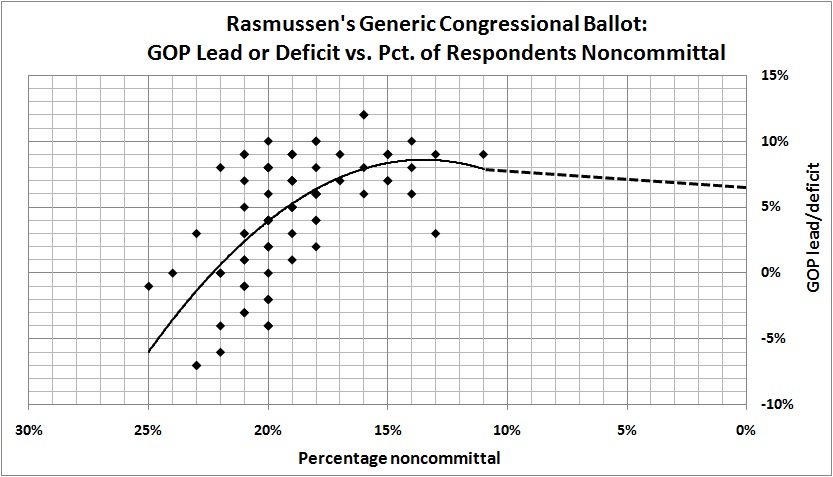
My forecast of Republican gains in the House is based on two indicators. The first is Scott Rasmussen’s generic congressional ballot, which has been polled weekly since January 11, 2009. The data points in the graph below represent the results of the poll, to date. Although the GOP enjoys a lead of 9 percentage points in the latest poll (10/24/10), my analysis indicates that there will be a slight reversal of GOP gains as more noncommittal voters choose sides. The solid black line, which is fitted to the data points, shows that the downward trend has begun. A separate statistical analysis yields the dashed black line, which indicates a GOP lead of 6.5 percentage points (a 234-201 majority) when the polls close on November 2.

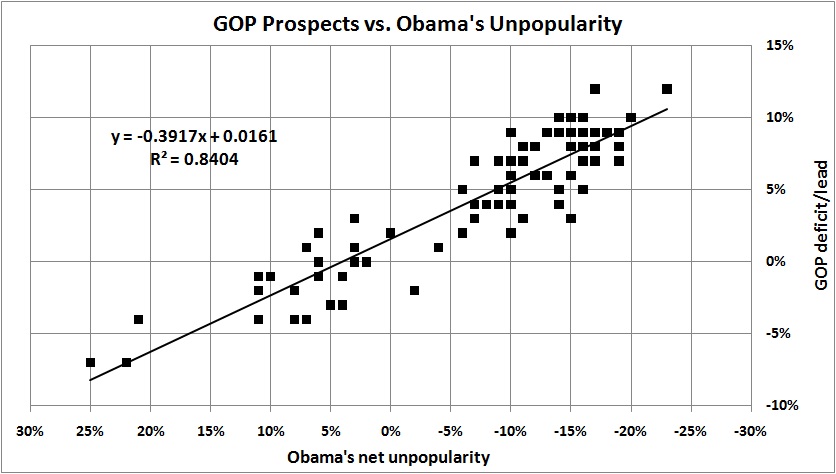
The second indicator of GOP prospects in the House is the degree of Obama’s unpopularity. The following graph depicts the relationship between Obama’s net unpopularity (percentage strongly disapproving less percentage strongly approving) and the number of percentage points by which votes cast for GOP House candidates will exceed votes cast for Democrat candidates.

This graph is derived from the results of Rasmussen’s generic congressional ballot and presidential tracking poll. The points on the graph represent the weekly results of the two Rasmussen polls for January 8, 2009, through October 24, 2010. The equation in the graph indicates that if Obama’s unpopularity index stays at its current level of -13 percentage points, GOP candidates for House seats will outpoll their Democrat opponents by6.7 percentage points on election day. That translates into a majority of 235-200.

(Added 10/31/10.) As I said in “Two Weeks Hence“:

All of this assumes no major shocks between now and election day — nothing on the order of a terror attack, a specific terror threat, a scandal involving a major political figure, and so on.

The Price of Government: More Evidence

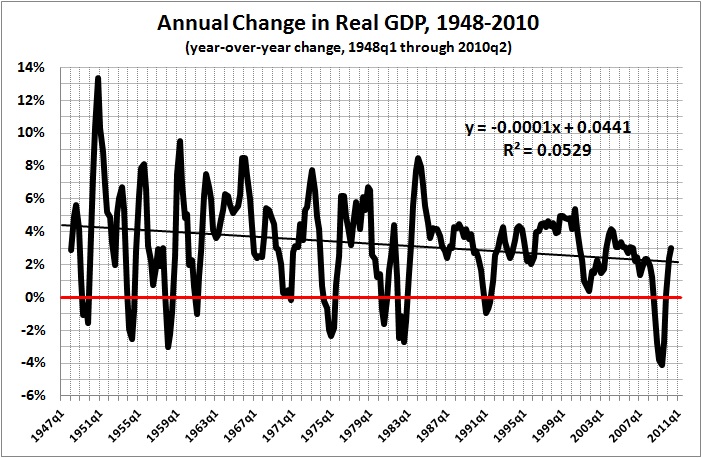
It is time to remind everyone of the economic toll that has been exacted by the growth of the regulatory-welfare state since the end of World War II:


Source: Bureau of Economic Analysis.

You will notice two things about the graph. First, the economy is cyclical, thanks in part to the actions of government (e.g., the low-interest, housing-bubble recession). Second, economic growth has declined from an annual rate of around 4 percent to an annual rate of about 2 percent, because of government.

Related posts:
Economics – Growth & Decline
The Economic and Social Consequences of Government

The Firing of Juan Williams

The firing of Juan Williams by NPR isn’t surprising, given NPR’s political “sensitivity” (i.e., tendency toward craven appeasement). But I suspect that NPR had been waiting for a convenient excuse to fire Williams for consorting with the folks at Fox News.

In any event, Williams is to be commended for his candor, not condemned as a bigot.

Leave it to Andrew Sullivan to take the low road:

What if someone said that they saw a black man walking down the street in classic thug get-up. Would a white person be a bigot of he assumed he was going to mug him?

No! The white person would be prudently fearful, as would any respectable and sensible person of color.

Sullivan continues:

What percentage of traditionally garbed Muslims – I assume wearing a covered veil or some other indicator and being of darker skin – have committed acts of terror? And, of course, the 9/11 mass-murderers were in everyday attire, to blend in. So was the Christmas Day undie-bomber. The Fort Hood murderer was in US military uniform, for Pete’s sake.

The percentage of terrorist acts committed by Muslims in traditional garb is irrelevant. What is relevant is that Muslims are the most likely perpetrators of terrorist acts. Sullivan makes the dangerous assumption that a traditionally garbed Muslim is above suspicion. But a traditionally garbed Muslim who has acquired a seat on a plane — thanks to screening of dubious quality and the politically correct prohibition of profiling — is no less suspect than a Muslim wearing “everyday attire” or an Army uniform.

Two Weeks Hence . . .

This post combines and updates the analyses and forecasts I presented in “Three Weeks Hence . . .” and “Another Election Indicator.”

As of today (UPDATED 10/23/10):

  • The GOP will gain 8 Senate seats, leaving the Democrats with a 51-49 majority in the Senate. (This estimate is based on the Intrade odds on individual Senate races.)
  • Over in the House, it looks like the GOP will re-take the House, with a majority ranging from 25 seats (230-205) to 33 seats (234-201) 53 seats (244-191).

My forecast of Republican gains in the House is based on two indicators. The first is Scott Rasmussen’s generic congressional ballot, which has been polled weekly since January 11, 2009. The data points in the graph below represent the results of the poll, to date. Although the GOP enjoys a lead of 9 percentage points in the latest poll, my analysis indicates that there will be a slight reversal of GOP gains as more noncommittal voters choose sides. The solid black line, which is fitted to the data points, shows that the downward trend has begun. A separate statistical analysis yields the dashed black line, which points to a GOP lead of 6.7 percentage points (a 234-201 majority) when the polls close on November 2.

The second indicator of GOP prospects in the House is Obama’s degree of unpopularity. The following graph depicts the relationship between Obama’s net unpopularity (percentage strongly disapproving less percentage strongly approving) and the number of percentage points by which votes cast for GOP House candidates will exceed votes cast for Democrat candidates.

This graph is derived from the results of Rasmussen’s generic congressional ballot and presidential tracking poll. The points on the graph represent the weekly results of the two Rasmussen polls for January 8, 2009, through October 17, 2010. If Obama’s unpopularity index stays at its current level of -10 -19 percentage points, the equation for the regression line in the graph yields a GOP advantage of 5.5 9.0 percentage points in the popular vote for House candidates. That translates into a majority of 230-205 244-191.

All of this assumes no major shocks between now and election day — nothing on the order of a terror attack, a specific terror threat, a scandal involving a major political figure, and so on.

Democrat Office-Holders = Faithful Nazis?

You may not be old enough to remember Adolf Eichmann, so here’s a thumbnail history lesson, courtesy of Wikipedia:

Otto Adolf Eichmann … , sometimes referred to as “the architect of the Holocaust”, was a German Nazi and SS-Obersturmbannführer (equivalent to Lieutenant Colonel). Because of his organizational talents and ideological reliability, he was charged by Obergruppenführer (General) Reinhard Heydrich with the task of facilitating and managing the logistics of mass deportation of Jews to ghettos and extermination camps in German-occupied Eastern Europe.

After the war, he fled to Argentina using a fraudulently obtained laissez-passer issued by the International Red Cross and lived there under a false identity working for Mercedes-Benz until 1960. He was captured by Israeli Mossad operatives in Argentina and abducted to Israel to face trial in an Israeli court on 15 criminal charges, including crimes against humanity and war crimes. He was found guilty and executed by hanging in 1962, and is the only person to have been executed in Israel on conviction by a civilian court.

Eichmann’s defense:

Eichmann, speaking in his own defense, said that he did not dispute the facts of what happened during the Holocaust. During the whole trial, Eichmann insisted that he was only “following orders”—the same Nuremberg Defense used by some of the Nazi war criminals during the 1945–1946 Nuremberg Trials. He explicitly declared that he had abdicated his conscience in order to follow the Führerprinzip. Eichmann claimed that he was merely a “transmitter” with very little power. He testified that: “I never did anything, great or small, without obtaining in advance express instructions from Adolf Hitler or any of my superiors.”

The “only following orders” defense reminds me of the meme that’s popular in “progressive” circles. A commenter at Daily Kos captures it well:

If you believe “A job worth doing is worth doing well,” you probably also believe a job that’s not worth doing is not worth doing well.  A classic conservative belief is that the government that governs least governs best, and it seems a lot of Republicans honestly believe that some things our government does it shouldn’t be doing at all….

If you’re a top-level Republican patronage recipient, you probably got a job doing something you still think the government should do.  But if you’re a B team talent who took a political patronage job, there’s a good chance it’s in a program or agency you don’t even think should exist.  If it’s a program you’d like to cancel but you know cancellation is a legislative impossibility, it almost makes sense to do the worst possible job you can get away with….

In other words, it doesn’t matter whether the function is constitutional. Nor does it matter that you took an oath of office in which you swore to uphold the Constitution. What matters is following orders. And if your job is to follow the “orders” enshrined in unconstitutional laws, regulations, and executive edicts, you’d better follow those “orders,” by gum.

S*** H***!

(I have replaced the letters i-e-g and e-i-l with asterisks because it seems that the filters on some public computers blocked this blog because it contained the verboten words. It is beyond the ability of  filtering software to put the words in context. The mock salute is to the fascisti in D.C.; it is by no means an homage to one of the most evil regimes of the twentieth century.)

Another Election Indicator

The GOP’s prospects for re-taking the House of Representatives track nicely with the course of Obama’s unpopularity. The following graph depicts the relationship between Obama’s net unpopularity (percentage strongly disapproving less percentage strongly approving) and the number of percentage points by which votes cast for GOP House candidates will exceed votes cast for Democrat candidates.


Derived from the results of Rasmussen’s generic congressional ballot and presidential tracking poll.

The points on the graph represent weekly results of the two Rasmussen polls from January 8, 2009, through October 10, 2010. I will update the graph following the release of congressional ballot results for October 17, 24, and 31.

Obama’s current unpopularity rating is -14 percentage points. If it stays around that level, the GOP will do as well as I forecast in “Three Weeks Hence“: a 37-seat majority in the House. Even if Obama enjoys a sudden resurgence to -10 — which is his standing when his “base” flocks to him — the GOP will enjoy a 5 percentage point advantage in the popular vote for House candidates. That translates into a 21-seat majority.

All of this assumes no major shocks between now and election day — nothing on the order of a terror attack, a specific terror threat, a scandal involving a major political figure, and so on.

The Improbability of Us

An argument often used against the belief in a Creator who designed the universe runs like this:

The existence of humans is indeed improbable. The laws of nature that govern our existence are but one set out of infinitely many possible sets of laws of nature. Ad had they differed only slightly the universe would be a mere swirl of subatomic particles, free from medium-sized objects like rocks, trees and humans. And even given the actual laws of nature, evolutionary history would have taken different twists and turns and failed to deliver human beings. (Jamie Whyte, Bad Thoughts – A Guide to Clear Thinking, p. 125)

Embedded in that seemingly reasonable statement is an unwarranted — but critical — assumption: that there are infinitely many (or even a large number) of possible sets of laws of nature. But there is no way of knowing such a thing. There is only one observable universe, and one set of observable and (mostly*) consistent laws of nature within it. It is impossible for the human mind to conjure an alternative set of consistent natural laws that could, in fact, coexist in a possible universe. Any such conjuring would be mere speculation, not a falsifiable hypothesis.

Given that, it is impossible to deny that a grand design lies behind the universe. But it is also impossible to prove, by the methods of science, the existence of a grand design. The fact of the universe’s existence is, as I have called it, the greatest mystery.

Related posts:
Atheism, Religion, and Science
The Limits of Science
Three Perspectives on Life: A Parable
Beware of Irrational Atheism
The Creation Model
The Thing about Science
Evolution and Religion
Words of Caution for Scientific Dogmatists
Science, Evolution, Religion, and Liberty
The Legality of Teaching Intelligent Design
Science, Logic, and God
Capitalism, Liberty, and Christianity
Is “Nothing” Possible?
A Dissonant Vision
Debunking “Scientific Objectivity”
Science’s Anti-Scientific Bent
Science, Axioms, and Economics
The Big Bang and Atheism
The Universe . . . Four Possibilities
Einstein, Science, and God
Atheism, Religion, and Science Redux
Pascal’s Wager, Morality, and the State
Evolution as God?
The Greatest Mystery
What Is Truth?
__________
* The exception is quantum mechanics, the science of the sub-atomic world. Sub-atomic particles do not seem to behave according to the same physical laws that describe the actions of the visible universe; their behavior is discontinuous (“jumpy”) and described probabilistically, not by the kinds of continuous (“smooth”) mathematical formulae that apply to the macroscopic world.

Three Weeks Hence . . .

. . . the GOP will retake the House and possibly the Senate. If the election were held today, Republicans would capture a 45-seat majority in the House (240-195) and a 51-49 majority in the Senate.

What will happen in the next three weeks? Some voters (mainly independents) will be unable to resist the allure of “something for nothing” (e.g., Obamacare) and will vote for Democrats in the end.

My fearless prediction (which I may change at any time):

  • 37-seat GOP majority in the House (236-199)
  • 50-50 split in the Senate (with Dem VP breaking ties in favor of Dem positions)

It won’t be possible for Republicans to repeal Obamacare. But with absolute control of the House and a cloture-proof voting bloc in the Senate, the GOP will be able to impede the implementation of Obamacare, while blocking other statist initiatives.

It remains to be seen whether congressional Republicans (or enough of them) can resist the urge to seem “compassionate” rather than “mean.”

*     *     *

My forecast of Republican gains in the House is based on Scott Rasmussen’s generic congressional ballot, which has been polled weekly since January 11, 2009. The data points in the graph below represent the results of the poll, to date. The blue point represents last week’s anomalous dip in the GOP’s fortunes; the red point represents this week’s results, which are in keeping with the long-term trend. My analysis indicates that there will be a slight reversal of GOP gains, as more noncommittal voters choose sides. The slowing of GOP gains is indicated by the shape of the solid black line, which is fitted to the data points. My statistical projection of the trend between now and election day is indicated by the dashed black line.  The odds in favor of a GOP majority are about 9-1.

Society and the State

Updated and revised, here.


Clear Thinking about the Death Penalty

Here’s my position:

The econometric evidence is there, for those who are open to it: Capital punishment does deter homicide. See, for example, the careful analysis by Hashem Dezhbaksh, Paul Robin, and Joanna Shepherd, “Does capital punishment have a deterrent effect? New evidence from post-moratorium panel data,” American Law and Economics Review 5(2): 344–376 (available in PDF format here). Dezhbaksh, Rubin, and Shepherd argue that each execution deters eighteen murders. That number may be high, but the analysis is rigorous and it accounts for relevant variables, such as income, age, race, gender, population density, and use of the death penalty where it is legal. It’s hard to read that analysis and believe that capital punishment doesn’t deter homicide — unless you want to believe it. I certainly wouldn’t take “Ouija Board” Goertzel’s opinion over that of careful econometricians like Dezhbaksh, Rubin, and Shepherd.

Now, I must say that I don’t care whether or not capital punishment deters homicide. Capital punishment is the capstone of a system of justice that used to work quite well in this country because it was certain and harsh. There must be a hierarchy of certain penalties for crime, and that hierarchy must culminate in the ultimate penalty if criminals and potential criminals are to believe that crime will be punished. When punishment is made less severe and less certain — as it was for a long time after World War II — crime flourishes and law-abiding citizens become less secure in their lives and property.

John McAdams, a professor of political science at Marquette University, makes a succinct case for the death penalty, regardless of its deterrent effect:

I’m a bit surprised . . . [by the] claim that “the burden of empirical proof would seem to lie with the pro-death penalty scholar.” If we execute murderers and there is in fact no deterrent effect, we have killed a bunch of murderers. If we fail to execute murderers, and doing so would in fact have deterred other murders, we have allowed the killing of a bunch of innocent victims. I would much rather risk the former. This, to me, is not a tough call.

I wish I’d said that.

Related posts:
Does Capital Punishment Deter Homicide?
Libertarian Twaddle about the Death Penalty
Crime and Punishment
Abortion and Crime
Saving the Innocent?
Saving the Innocent?: Part II
More on Abortion and Crime
More Punishment Means Less Crime
More About Crime and Punishment
More Punishment Means Less Crime: A Footnote
Let the Punishment Fit the Crime
Another Argument for the Death Penalty
Less Punishment Means More Crime
Crime, Explained
Abortion and Crime (from a different angle than the earlier post of the same name)