Dribble from Drabble

Margaret Drabble remains a favorite author, in spite of dribble like this:

My anti-Americanism has become almost uncontrollable. It has possessed me, like a disease. It rises up in my throat like acid reflux, that fashionable American sickness.

Unlike John the Square, Drabble has kept her anti-Americanism out of her fiction — except in mild, typically Brit-snob doses. My tolerance has limits, however. She goes off my list of favorite authors when her novels become hysterically anti-American, like John the Square’s Absolute Friends. So presposterous I couldn’t finish it. Nor will I link to it.

Kerry’s Slave-Labor Plan and Shell Game

Kerry’s website used to carry a statement about his position on national service. The statement was taken off the site, but intrepid (no doubt pajama-clad) bloggers have found a cached version. Here’s a bit of it, courtesy Say Anything:

As President, John Kerry will ensure that every high school student in America performs community service as a requirement for graduation. This service will be a rite of passage for our nation’s youth and will help foster a lifetime of service. States would design service programs that meet their community and educational needs. However, John Kerry does not believe in unfunded mandates. No state would be obligated to implement a service requirement if the federal government does not live up to its obligation to fund the program.

So, Kerry would make slave laborers of high-school students. But he wouldn’t make the States fund the slave-labor program. No, he’d simply ship the money to the States from Washington, D.C., where money grows on trees. Oops, no, that’s not it; Washington’s money comes from the citizens of the very States that he’d ship the money to. Nice try, John, but we’ve seen that move before.

I Demand a Recount

According to a story at news.telegraph.co.uk, everyone now alive on Earth — all six billion of us — is descended from a person who lived only 3,500 years ago:

We are all related to man who lived in Asia in 1,415BC

By David Derbyshire, Science Correspondent

(Filed: 30/09/2004)

Everyone in the world is descended from a single person who lived around 3,500 years ago, according to a new study.

Scientists have worked out the most recent common ancestor of all six billion people alive today probably dwelt in eastern Asia around 1,415BC.

Although the date may seem relatively recent, researchers say the findings should not come as a surprise.

Anyone trying to trace their family tree soon discovers that the number of direct ancestors doubles every 20 to 30 years. It takes only a few centuries to clock up thousands of direct ancestors.

Using a computer model, researchers from the Massachusetts Institute of Technology attempted to trace back the most recent common ancestor using estimated patterns of migration throughout history.

They calculated that the ancestor’s location in eastern Asia allowed his or her descendants to spread to Europe, Asia, remote Pacific Islands and the Americas. Going back a few thousand years more, the researchers found a time when a large fraction of people in the world were the common ancestors of everybody alive today – while the rest were ancestors of no one alive. That date was 5,353BC, the team reports in Nature….

Got that? Here’s what I take from it: There was a guy living 3,500 years ago who’s the common ancestor of everyone now living. (His mate should be our common ancestress, but maybe he had more than one mate.) Anyway, that guy was descended from a bunch of people who are, therefore, our common ancestors, too. But a big bunch of people — everyone else living 3,500 years ago, and all their ancestors — don’t have any living descendants. I guess you could say their genes faded.

(Thanks to Captain Ed for the tip.)

Reveries

Sleep rarely eludes me, but when it does I take a mental trip to the past…to the golden past of boyhood, where all the days are sunny and summery, or Christmas-y.

I stand on the sidewalk in front of the first house I lived in. There it is, a cream-colored, clapboard, two-story house with a small detached garage to the right. It sits on a corner lot of some size on a tree-lined street. An alley runs behind it. The street at the front and to the left side of the house are unpaved, as were many streets in that small city where I was a boy in the 1940s.

The porch runs the width of the house. I walk up the steps to the porch and enter the front door, which opens into the living room. With sunlight streaming through the windows, I wander through the living room to the dining room and kitchen. I go out the back door to the enclosed back porch, from which I can see the garage and the back yard.

I return to the house and venture to the basement, with its huge, coal-fired furnace, coal bin, and my father’s work shop. I go back up — and then up again, climbing the stairs to the second story — the stairs with a wrought-iron railing. I reach the upper hallway and visit, in turn, the three sunny bedrooms and the black-and-white tiled bathroom.

Yes, it was a modest house. But it was the first place I thought of as home, and it’s a place that still seems golden in my memories. By the time my mental tour is complete, I am ready for sleep.

At other times I remember my grandmother’s house in a small, lakeside village about 90 miles north of where I grew up. Her modest, two-story bungalow sat on a deep lot that backed up to open fields where doves cooed as I awoke on sunny, summer mornings to the smell of bacon frying. My favorite room was the kitchen, with its massive woodstove and huge, round, oak table, around which my grandmother, parents, and various aunts and uncles would sit after a meal, retelling and embellishing tales from the past.

We often visited my grandmother at Christmas, and I like to relive the Christmas eve when we made the 90-mile trip as feathery snow slowly piled deeper on the deserted, lakeside highway we traversed through quiet villages: Lexington, Port Sanilac, Forester, Richmondville, Forestville, White Rock, Harbor Beach, Port Hope, Huron City, and — at last — Port Austin. Many of the those villages were tiny: a scattering of houses, perhaps a church and a gas station, but not even a traffic light. The more substantial villages — those that had 1,000 or even 2,000 residents and a traffic light — boasted rows of well-kept and sometimes stately homes on shady streets, along with prosperous brick and white-frame churches, a few blocks of tidy stores and restaurants, and perhaps a lighthouse:

Light house, Port Sanilac

The lakeside highway (before it was “improved”) rode atop high bluffs overlooking the vastness of Lake Huron:

Looking down at the beach and the lake, Forestville

Many of the stately homes along the way have become inns:

Raymond House Inn, Port Sanilac

The State Street Inn, Harbor Beach

A short detour through the old part of Huron City would yield a view of the summer home of William Lyon Phelps (1865-1943; a professor of English literature at Yale and a popular lecturer and writer in the early decades of the 20th century):

Seven Gables, Huron City

The village of Port Austin didn’t have a quaint main street (seen here probably in the 1970s), but it was a place where a young boy could wander safely:

The rest of the village had more to offer. An elegant old inn . . .

The Garfield Inn, Port Austin

. . . these sights along the shoreline . . .


. . . and this view of the harbor at sunset:

Golden days, golden nights. Gone forever — but still alive in my reveries.

Reveries

Sleep rarely eludes me, but when it does I take a mental trip to the past…to the golden past of boyhood, where all the days are sunny and summery, or Christmas-y.

I stand on the sidewalk in front of the first house I lived in. There it is, a cream-colored, clapboard, two-story house with a small detached garage to the right. It sits on a corner lot of some size on a tree-lined street. An alley runs behind it. The street at the front and to the left side of the house are unpaved, as were many streets in that small city where I was a boy in the 1940s.

The porch runs the width of the house. I walk up the steps to the porch and enter the front door, which opens into the living room. With sunlight streaming through the windows, I wander through the living room to the dining room and kitchen. I go out the back door to the enclosed back porch, from which I can see the garage and the back yard.

I return to the house and venture to the basement, with its huge, coal-fired furnace, coal bin, and my father’s work shop. I go back up — and then up again, climbing the stairs to the second story — the stairs with a wrought-iron railing. I reach the upper hallway and visit, in turn, the three sunny bedrooms and the black-and-white tiled bathroom.

Yes, it was a modest house. But it was the first place I thought of as home, and it’s a place that still seems golden in my memories. By the time my mental tour is complete, I am ready for sleep.

At other times I remember my grandmother’s house in a small, lakeside village about 90 miles north of where I grew up. Her modest, two-story bungalow sat on a deep lot that backed up to open fields where doves cooed as I awoke on sunny, summer mornings to the smell of bacon frying. My favorite room was the kitchen, with its massive woodstove and huge, round, oak table, around which my grandmother, parents, and various aunts and uncles would sit after a meal, retelling and embellishing tales from the past.

Click here to read the full post.

On the Eve of the First Debate

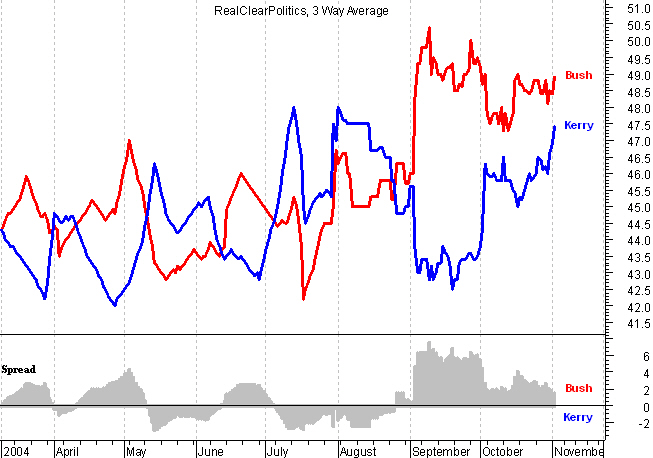
I think betting markets are better than polls at predicting election outcomes. Nevertheless, here’s a fairly accurate depiction of the state of the Bush-Kerry race (from realclearpolitics.com):

What’s Wrong with Canada?

The New York Times asks — and fails to answer — that question in “Canada’s Prophets of Pessimism (Is It the Weather?).” The article hints at the problem by noting that

The country…has seemingly come to define greatness by how much money it sinks into health care or day care. Even so, education budgets are shrinking and there is brain drain of doctors and other professionals to the United States.

And why? Because Canada has become something of a socialist paradise, along the lines of East Germany. Then, there’s rampant suppression of speech. And a lot more.

How to Write a Headline about Iraq

The New York Times loves to editorialize in its headlines. Here’s one from this morning: “Iraq Study Sees Rebels’ Attacks as Widespread.” I think the message we’re supposed to take from that selective bit of information is this:

Nyah-nyah-na-nyah-nyah.

Or this:

Cut and run.

Actually, the article goes on to attain a degree of balance:

…The number of attacks has risen and fallen over the months….[T]he highest numbers were in April, when there was major fighting in Falluja, with attacks averaging 120 a day. The average is now about 80 a day….

But it is a measure of both the fog of war and the fact that different analysts can look at the same numbers and come to opposite conclusions, that others see a nation in which most people are perfectly safe and elections can be held with clear legitimacy….

Indeed, no raw compilation of statistics on numbers of attacks can measure what is perhaps the most important political equation facing Prime Minister Ayad Allawi and the American military: how much of Iraq is under the firm control of the interim government. That will determine the likelihood – and quality – of elections in January.

For example, the number of attacks is not an accurate measure of control in Falluja; attacks have recently dropped there, but the town is controlled by insurgents and is a “no go” zone for the American military and Iraqi security forces. It is a place where elections could not be held without dramatic political or military intervention.

The statistics show that there have been just under 1,000 attacks in Baghdad during the past month; in fact, an American military spokesman said this week that since April, insurgents have fired nearly 3,000 mortar rounds in Baghdad alone. But those figures do not necessarily preclude having elections in the Iraqi capital.

Pentagon officials and military officers like to point to a separate list of statistics to counter the tally of attacks, including the number of schools and clinics opened. They cite statistics indicating that a growing number of Iraqi security forces are trained and fully equipped, and they note that applicants continue to line up at recruiting stations despite bombings of them.

But most of all, military officers argue that despite the rise in bloody attacks during the past 30 days, the insurgents have yet to win a single battle.

“We have had zero tactical losses; we have lost no battles,” said one senior American military officer. “The insurgency has had zero tactical victories. But that is not what this is about.

“We are at a very critical time,” the officer added. “The only way we can lose this battle is if the American people decide we don’t want to fight anymore.”…

It will be a Vietnam if we decide to make it a Vietnam. But not otherwise.

Think of the headline the Times might have run: “Iraq Progressing Despite Insurgency; Fate Hinges on Americans’ Resolve.” Now that is editorializing in a headline.

Baseball in the Nation’s Capital

The original Senators stuck it out from 1901 through 1960. (Washington: first in war, first in peace, last in the American League.) That team moved to Minnesota, where there was a long tradition of high-grade minor league baseball to sustain it. A pennant in 1965 also helped get the team off to a good start with local fans.

The expansion Senators started up in 1961 and lasted through the 1971 season. That team moved to Arlington, Texas, smack in the middle of the hugely populated Dallas-Fort Worth metropolitan area. The size of the fan base helped to sustain the Rangers until the team finally got into post-season play in 1996.

Now the failed Montreal Expos seem to be headed to D.C. The transplanted Expos will spend a few years in old D.C. Stadium, due east of the Capitol building (but far from the gentrified precincts of Capitol Hill). The team will then move to a new park on the Anacostia River in southeast D.C.

To succeed financially, the new Washington team must draw well from the Maryland and Virginia suburbs. Attendance will be high for a few years, because the closeness of major-league baseball will be a novelty to fans who’ve had to trek to Baltimore to see the increasingly hapless Orioles. But suburbanites’ allegiance to the new Washington team won’t survive more than a few losing seasons — and more than a few seem likely, given the Expos’ track record. As the crowds wane, suburbanites will become increasingly reluctant to journey into the city. And, so, the taxpayers of D.C. (and perhaps the taxpayers of the nation) are likely to be stuck with an expensive memento of false civic pride.

P.S. Baltimore Orioles owner Peter Angelos has to be bought off. He doesn’t want a National League team 40 miles from his American League team. Mmmm…remember when Boston, Chicago, New York, Philadelphia, and St. Louis had a team in each league? In fact, New York had two National League teams — one in Manhattan (the Giants) and one in Brooklyn (the Dodgers). Not only that, but for many years the teams in Philadelphia and St. Louis shared stadiums.

Junk-Food Addict

Bruce Springsteen: “I am a dedicated Times reader, and I’ve found enormous sustenance from Paul Krugman and Maureen Dowd on the op-ed page.”

I’ve always found his music boring. Now I know why. His idea of intellectual fulfillment is the equivalent of a quarter-pounder with greasy fries.

Democracy vs. Liberty

A point worth pondering, from a review by John B. Judis of Fareed Zakaria’s The Future of Freedom:

…Zakaria argues that the United States suffers from an excess of democracy, which is threatening liberty. The analysis appears to come full circle — liberty leads to democracy and democracy ends up undermining liberty, prompting him to call for “a restoration of balance” between them….

A return to constitutional principles would do the trick. But how to get there?

Fear of Corporate Power

Arnold Kling, writing at Tech Central Station, spells out the right way to deal with “corporate power”:

…One of the differences between Sweetwater and Saltwater economists concerns monopoly. On the left, saltwater economists tend to share [the] view that government is the logical check on corporate power. On the right, sweetwater economists believe that government naturally allies with large interests, so that more government involvement tends to strengthen the hand of the corporate giants and weaken the position of consumers and small businesses.

My own reading of history is that it supports the Sweetwater point of view. Once an industry becomes regulated, economic competition dries up, to be replaced by lobbyist infighting. The profit center moves from the market to Washington, and resources shift accordingly.

Corporate power is a bad thing. I like to see big corporations humbled by innovation and competition.

But fear of corporate power can be a worse thing. Politicians play up that fear, because they are eager to intervene. However, it seems to me that government interventions do not wind up reining in corporations, and the net result is to leave ordinary individuals less powerful than in a less-regulated environment….

No form of legislation has done more to harm consumers — and to shackle the economy — than anti-trust legislation.

Libertarians and Individualism

Tom G. Palmer of the Cato Institute — neither being at the top of my libertarian hit parade — actually says something I can endorse:

…Libertarians recognize the inevitable pluralism of the modern world and for that reason assert that individual liberty is at least part of the common good. They also understand the absolute necessity of cooperation for the attainment of one’s ends; a solitary individual could never actually be “self-sufficient,” which is precisely why we must have rules–governing property and contracts, for example–to make peaceful cooperation possible and we institute government to enforce those rules. The common good is a system of justice that allows all to live together in harmony and peace; a common good more extensive than that tends to be, not a common good for “all of us,” but a common good for some of us at the expense of others of us….

The issue of the common good is related to the beliefs of communitarians regarding the personality or the separate existence of groups. Both are part and parcel of a fundamentally unscientific and irrational view of politics that tends to personalize institutions and groups, such as the state or nation or society….

Group personification obscures, rather than illuminates, important political questions. Those questions, centering mostly around the explanation of complex political phenomena and moral responsibility, simply cannot be addressed within the confines of group personification, which drapes a cloak of mysticism around the actions of policymakers, thus allowing some to use “philosophy”–and mystical philosophy, at that–to harm others.

Libertarians are separated from communitarians by differences on important issues, notably whether coercion is necessary to maintain community, solidarity, friendship, love, and the other things that make life worth living and that can be enjoyed only in common with others. Those differences cannot be swept away a priori; their resolution is not furthered by shameless distortion, absurd characterizations, or petty name-calling.

Perfect Understanding

Melana Zyla Vickers writes “About That National Intelligence Estimate…” at Tech Central Station:

The important thing about the now infamous National Intelligence Estimate on Iraq is not so much what it says, but rather what it reveals about how different politicians might use it.

On Sunday, Secretary of State Colin Powell told TV watchers that the estimate that appeared in the press almost two weeks ago “wasn’t a terribly shocking assessment. It was something that I could have written myself.” …

Here’s a reminder of how the New York Times first described it:

The estimate outlines three possibilities for Iraq through the end of 2005, with the worst case being developments that could lead to civil war, the officials said. The most favorable outcome described is an Iraq whose stability would remain tenuous in political, economic and security terms.

The ‘one hand, other hand’ analysis is what one would expect from an institution that has been pilloried lately for drawing firm but incorrect conclusions about weapons of mass destruction in Iraq. And from an institution that was pilloried in the past for other errors in judgment: The CIA got the size of the Soviet economy wrong. It got the fall of the Shah of Iran wrong. It failed to predict India’s detonation of a nuclear weapon.

Indeed, intelligence analysis more often than not has a heavy quotient of C-Y-A. The ambivalence isn’t motivated only by analysts’ self-preservation instincts. It’s also motivated by the fact that predicting world events with certainty is impossibly hard.

As I said, here, “The CIA is…trying to lower expectations about the future of Iraq. Thus its new — “pessimistic” — intelligence estimate.” Vickers continues:

Which is why it’s not enough for a president to make foreign policy based on “hard evidence,” to quote John Kerry’s Democratic convention speech. Rather, a president has to make foreign policy based on his convictions, his judgment, and his will.

Kerry doesn’t agree with that: “As President, I will ask hard questions and demand hard evidence. I will immediately reform the intelligence system — so policy is guided by facts, and facts are never distorted by politics. And as President, I will bring back this nation’s time-honored tradition: the United States of America never goes to war because we want to, we only go to war because we have to.”

To complete Kerry’s thought, the U.S. would “have to” go to war if and only if the president had “hard evidence” of such a need.

Kind of like the hard evidence Kerry’s foreign-policy brains trust — Sandy Berger, Madeleine Albright, Bill Cohen — wanted to have before going after Osama bin Laden. In their 9/11 Commission testimony, those officials regularly cited the lack of actionable intelligence as their reason for doing nothing.

Consider that the Clinton administration never launched a military attack against the terrorist group after it bombed the U.S.S. Cole on Oct. 12, 2000, killing 17 U.S. sailors. CENTCOM commander Gen. Tommy Franks presented the administration with 14 military options, according to the commission staff report. But Clinton’s SecDef Cohen said that “we did not have specific information that this was bin Laden” (attacking the Cole) and that military retaliation against Al Qaeda targets in Afghanistan “would not have been effective.” The administration also resisted sending special forces to Afghanistan.

In another instance, Clinton administration NSC Adviser Samuel Berger and counterterrorism group chair Richard Clarke decided in 1996 not to bring Bin Laden to the U.S. from his hideout in Sudan. There was no legal basis for bringing him to the U.S. nor holding him here, Berger told the commission. Berger, a lawyer, said he was not aware of any intelligence that bin Laden was responsible for any act against a U.S. citizen, and consequently bin Laden could not be indicted.

There’s no reason to believe that John Kerry — ambivalent about his own personal likes and dislikes, let alone questions of war — would be any less paralyzed than these pols were.

The Iraq National Intelligence Estimate gives Americans a pretty good illustration of the limits of intelligence. And Kerry’s foreign-policy philosophy gives Americans a pretty good illustration of how, armed with such intelligence, he and his advisors would do absolutely nothing.

I discussed Kerry’s analysis paralysis recently. It’s pathological.

Carter’s Election Strategy

It’s simple: Preemptively discredit the outcome in Florida. From BBC News:

Florida officials stand by ballot

Election officials in Florida have rejected a suggestion that the state’s preparations for the presidential election are seriously flawed.

Jimmy Carter, the former US president and veteran election monitor, predicted polling in the key state would be neither free nor fair….

Mr Carter said that Florida’s top election official in 2004, Glenda Hood, showed “strong bias”.

He accused of her of favouring Republicans by trying to get the name of independent presidential candidate Ralph Nader included on the state ballot, knowing he might divert Democrat votes.

The former president also alleged that an attempt had been made to disqualify black Americans more likely to vote Democrat on the basis of criminal records….

Hey, Jimmy, even the Florida Supreme Court, not known as a mouthpiece for the Republican Party, said that Nader should be on the ballot. But I guess it’s “un-Democratic” to offer citizens too many choices.

As for the charge about disqualifying black Americans with criminal records. You don’t want to open that bucket of worms, do you, Jimmy?

Race and Acceptance

In some recent posts I have touched on racial discrimination and the law (here, here, here, and here). Now comes an article by Richard Dawkins (“Race and creation,” Prospect Magazine, October 2004), noted ethologist (a biologist who explores and explains the nature of animal behavior). Dawkins writes:

…It is genuinely true that, if you measure the total variation in the human species and then partition it into a between-race component and a within-race component, the between-race component is a very small fraction of the total. Only a small admixture of extra variation distinguishes races from each other. That is all correct. What is not correct is the inference that race is therefore a meaningless concept….

Interobserver agreement suggests that racial classification is not totally uninformative, but what does it inform about? About things like eye shape and hair curliness. For some reason it seems to be the superficial, external, trivial characteristics that are correlated with race – perhaps especially facial characteristics. But why are human races so different in just these superficially conspicuous characteristics? Or is it just that we, as observers, are predisposed to notice them? Why do other species look comparatively uniform whereas humans show differences that, were we to encounter them elsewhere in the animal kingdom, might make us suspect we were dealing with a number of separate species?

The most politically acceptable explanation is that the members of any species have a heightened sensitivity to differences among their own kind. On this view, it is just that we notice human differences more readily than differences within other species….

…We are indeed a very uniform species if you count the totality of genes, or if you take a truly random sample of genes, but perhaps there are special reasons for a disproportionate amount of variation in those very genes that make it easy for us to notice variation, and to distinguish our own kind from others. These would include the genes responsible for externally visible “labels” like skin colour. I want to suggest that this heightened discriminability has evolved by sexual selection, specifically in humans because we are such a culture-bound species. Because our mating decisions are so heavily influenced by cultural tradition, and because our cultures, and sometimes our religions, encourage us to discriminate against outsiders, especially in choosing mates, those superficial differences that helped our ancestors to prefer insiders over outsiders have been enhanced out of all proportion to the real genetic differences between us….

…Different languages, religions and social customs can serve as barriers to gene flow. From here,…random genetic differences simply accumulate on opposite sides of a language or religion barrier, just as they might on opposite sides of a mountain range. Subsequently,…the genetic differences that build up are reinforced as people use conspicuous differences in appearance as additional labels of discrimination in mate choice, supplementing the cultural barriers that provided the original separation….

And here we are, locked into differences that took eons to mature and are now deeply seated in human nature. Those differences will not disappear quickly or easily, as long as physically identifiable groups persist in clinging, overtly and defiantly, to their own languages and social customs. Asians have been quicker to assimilate the language and social customs of white America than have blacks and Hispanics. But all who have chosen to assimilate — Asian, black, and Hispanic — have been more readily accepted into the mainstream of American society, to their social and economic benefit.

There is only so much the white majority in America can do to erode racial barriers through the law. The minority, if it wants social acceptance, has to move closer to the mainstream in its languages and customs.

Favorite Posts: Affirmative Action and Race

Epstein’s Freedom, Revisited

Yesterday, in response to a post by Tim Sandefur at Freespace, I posed five questions about Richard Epstein’s new book, Skepticism and Freedom. Sandefur and Jonathan Rowe, writing at jonrowe.blogspot.com, have addressed the questions, here and here. Herewith, the five questions (italicized), followed by excerpts of Sandefur’s and Rowe’s responses:

1. In light of Epstein’s belief that we ought to be highly skeptical of the idea that an outside party has better knowledge about the choices (and the benefits from them) that a person makes, how does Epstein reckon that the state, as an outside party, is able to determine that the parties to a forced exchange will be better off as a result of the exchange?

Sandefur:

The issue is one of valuation—if third parties can’t compute value for the two contracting parties, how can the state know that a forced exchange will leave them worse off? This challenge echoes Randy Barnett’s challenge to Epstein in their recent debate in the pages of Reason magazine. Although Epstein didn’t really answer, I think one answer would be that the value isn’t always indecipherable. People are often able to put a money value on their losses, including the loss of their rights. In theory, just compensation would leave parties no worse off, even in their own eyes. (One major problem in eminent domain is that the erosion of the public use clause necessarily undercompensates, in addition to its other negative effects.) Epstein would probably say that in many cases people can tell you whether they’re worse off or not. True, this subjectivism could exacerbate holdout problems, but it’s at least a partial answer. Also, suppose everyone in the state agrees to the proposition that dollars shall be legal tender for subjective losses. If they do that, then it might be perfectly fine for the state to measure people’s losses in money values, and decide that they’re better off when those money values rise, even in the face of a person claiming that he’s been wronged.

2. What happens to the transactions costs that (presumably) keep the parties from undertaking an exchange that the state decides to force? Do the costs simply vanish or does the state (that is, taxpayers) defray them?

Sandefur:

[J]ust compensation would make up the transaction costs (which, presumably, would be lower anyway for the state than for the parties themselves, since in Epstein’s view, the lower transaction costs for the state are a primary justification for state action to begin with), and that compensation would come from flat taxation.

3. Is Epstein’s concept of forced exchange a justification of the integration of commerce (e.g., forcing whites to accommodate blacks at hotels, restaurants, etc., and forcing whites to offer houses to black as well as white buyers)?

Sandefur:

[See no. 4: ED.]

4. If Epstein’s concept of forced exchange justifies the integration of commerce, how does the state account for the preference of whites not to trade with blacks, or does the state simply regard that preference as illegitimate?

Sandefur:

Epstein doesn’t, so far as I know, use his forced exchange principle to justify curbs on private racial discrimination—but, as I said, I haven’t read Forbidden Grounds, so perhaps Jonathan Rowe knows better than I….

Rowe:

Let me note two points that Epstein makes in Forbidden Grounds (a polemic against anti-discrimination laws). First, like me, Epstein doesn’t believe that the pattern of segregation that we saw in the Jim Crow south could have persisted absent enforcement by state and local governments. He notes the efforts of segregationists to restrict the black vote as powerful evidence of this. “Without ironclad white political control, someone, somewhere would have tried to gain entry into local markets, given the supra competitive returns.” (Epstein, Postscript, 8 Yale Law & Policy Rev. at 331).

In those areas of life where explicit ordinances demanding segregation weren’t present, private violence enforced the color line and the Jim Crow governments let that violence go by refusing, in violation of the 14th Amendment, to enforce the “equal protection of the laws.” Moreover, Epstein points outs that state governments could also enforce collateral restrictions against such firms that bucked the color line—taxes, zoning permits, health inspections, and the like, “could be brought to bear on firms that did not toe the line set by Jim Crow.” (Epstein, Forbidden Grounds, at 246.)

Yet, Epstein would indeed be willing to allow for the existence of anti-discrimination laws in the private sector so long as they were Pareto justified. But the problem is, according to Epstein, they clearly aren’t. Much of Forbidden Grounds and his law review articles on the subject were written to demonstrate this….

5. If the state chooses to treat the preference of whites as illegitimate, by what criterion does the state judge the legitimacy of the preferences of parties to a forced exchange being contemplated by the state?

Sandefur:

[This] question confuses me a bit. I think one problem is that Epstein’s not arguing that these preferences are illegitimate, or even that the state should ignore them. He’s saying that the state could adopt a forced exchange: that is, force a new state of affairs on the world while compensating those who would prefer otherwise, in most cases. But this raises the spectre of the protection racket—that is, people will demand compensation for refraining from doing things they had no right to do. Epstein sees this problem, but I don’t think he has sufficiently answered it, at least, not in Skepticism And Freedom….

The best solution that Epstein offers in his context is to “den[y] the monopolist the absolute right to exclude by requiring him to supply his goods or services, not at whatever price he [can] fetch, but only at reasonable prices”—that is, he introduces a notoriously vague term which brings up all sorts of extra problems. Are those problems so bad that the cure is worse than the disease? I don’t think so, in the context of segregation, but as [the author of Liberty Corner] says, it’s awfully hard to draw the line, once we’ve conceded the state’s authority to force whites to accommodate blacks. Good intentions can then go terribly awry, as we all know.

Both Sandefur’s and Rowe’s posts are worth reading in their entirety. Again, they’re here and here.

Favorite Posts: Affirmative Action and Race

Time Out for Baseball

I first paid attention to a radio broadcast of a major league baseball game in about 1947. My grandmother, who was a die-hard fan of the Detroit Tigers, would tune in the Tigers’ games when she could pick up the signal of WXYZ, a Detroit station about 150 miles distant from her small lakeside village atop Michigan’s “thumb”. (If you didn’t know that Michigan has a thumb, look at a map.)

Anyway, at that time Detroit’s play-by-play announcer and baseball analyst, rolled into one, was Harry Heilmann — not a household name these days, but a former Detroit great who was a four-time American League batting champ in the 1920s. The Tigers, by default, became the team I rooted for until I switched my allegiance to the (gasp!) New York Yankees about 30 years later. (That’s another story.)

I’m reciting this bit of personal trivia just to let you know how long I’ve been a baseball fan. Because…when I opened the sports section of today’s paper to the baseball standings, I was struck by this fact: Each of the teams that now lead baseball’s six divisions (three in the American League, three in the National League) represents a franchise that was established before major league baseball began to expand after the 1960 season. From 1901 through 1960, there were 16 major league baseball teams (that number has since grown to 30). In fact, from 1903 through 1952 those 16 teams stayed put. And they stayed put in relatively few cities: Boston (one American League team, one National League team), New York (one AL team, two NL teams, including Brooklyn), Philadelphia (one AL, one NL), Pittsburgh (one NL), Washington (one AL), Cleveland (one AL), Cincinnati (one NL), Detroit (one AL), Chicago (one AL, one NL), and St. Louis (one AL, one NL).

Now, the six division-leading teams are:

AMERICAN LEAGUE
New York Yankees (what a surprise!), representing a franchise that has been in New York City since 1903. (The New York franchise replaced an original American League team known as the…Baltimore Orioles.)

Minnesota Twins, formerly the Washington Senators (1901-60).

Oakland Athletics, formerly the Philadelphia Athletics (1901-54) and the Kansas City Athletics (1955-68).

NATIONAL LEAGUE
Atlanta Braves, formerly the Boston Braves (1876-1952) and the Milwaukee Braves (1953-65).

St. Louis Cardinals, in business since 1892.

Los Angeles Dodgers, formerly (of course) the Brooklyn Dodgers (1890-1957). And here’s where the Dodgers played, from 1913 through 1957 — famed Ebbets Field:

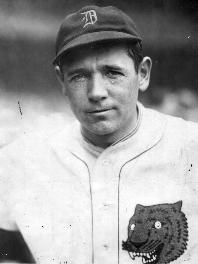
Oh, and here’s Harry Heilmann, in his playing days:

Lileks Nails the Sunday Times Set

I used to subscribe to the Sunday edition of The New York Times. I quit when I got tired of being pounded by a point of view, in every damned section (even Sports). I hung on until I found that I no longer enjoyed the Magazine. Then I quit taking the Sunday Times and did my bit to prevent deforestation. James Lileks knows whereof I speak:

The Sunday Times is the weekly sermon: let us reinforce your world view, your sense of belonging to the Thinking Class, the Special Ones….Anyway, it’s a sunny fall morning – well, noonish. Now comes the capstone moment when you lay the slab of the Times in your lap and begin the autoposy of the week. Scan the A section headlines – yes, yes, yes, appalling. Scan the metro: your eyes glaze. The arts section – later. Travel – Greece again? Good for Greece….No comics . . . there was always comics on Sunday back home. But that was IOWA, for heaven’s sake, what else would you expect but Blondie and Ziggy and the rest . . . ah.

The Magazine.

Let’s begin! A little humorous piece – not funny haha funny, but, you know, arch, which is very urbane. Then there’s an essay on words, which is wonderful because you love words, and then a big serious piece about that horrible situation the administration isn’t doing anything about. You’ll read it later – skim the pull quotes for now. Best of all are the ads, because you really wouldn’t want to wear any of that stuff but it’s fun to look at….

(The New York Times Sunday Magazine is placed on the top of the toilet tank)

(The New York Times Sunday Magazine slides off the toilet tank, reminding you why you don’t put it there)

(The New York Times Sunday Magazine is strategically placed on the coffee table to alert anyone who comes into your flat that you read the New York Times Sunday Magazine)

(One week later, unread and unobserved, it is replaced by another edition. Cover story: global climate change and tourism threatens biodiversity in Antarctica. But you suspected as much. The whole world is going to hell. Except for New York. New York is fabulous. It just has to be.)

(Two weeks later: none of your friends are bloggers and none of your friends read blogs. So nevermind.)

But then there was the Book Review, which I kept taking (by mail) for a few more years. Then the Book Review began to get ever more serious — less fiction, more “relevance” — and ever more stridently left-wing — with a few libertarian-conservatives thrown into the mix, just for fun, in the spirit of “let’s show our compassion to the masses by inviting some anti-globalist protesters to our black-tie party.” Well, I quit taking the Book Review, too.

So, I’ve kicked the Times habit, and I wake up every morning feeling better about myself.

Fighting Myths with Facts

REVISED AND RE-DATED

Liberals and deluded economists (the same thing) constantly decry the fact that one-fifth of the nation’s households are in the lowest 20 percent of the income distribution. (A quasi-intellectual joke — get it?)

Anyway, there’s this clamor for someone (namely taxpayers) to do something (namely redistribute income or simply tax higher earners to provide expensive and needless training, healthcare, and daycare programs for low earners). Many sensible economists (a rare breed) know better. They know two important facts:

1. There’s a lot of up and down movement in the distribution of incomes.

2. Even those who stay near the bottom of the income distribution are a lot better off than they used to be.

The first pont is illustrated by these data* from a panel of families surveyed in 1975 and again in 1991 (income quintile in 1975 and percentage that had moved to the top two quintiles in 1991):

Lowest Fifth – 59% moved to the top two quintiles

Second Fifth – 52% “

Middle Fifth – 49% “

Fourth Fifth – 70% remained in the top two quintiles

Highest Fifth – 86% “

The second point is illustrated by this** graphic:


__________
* Source: Myths of Rich & Poor, W. Michael Cox and Richard Alm, via Arnold Kling, writing at Tech Central Station.)

** Source: The Washington Post, via Wizbang.