“It’s Tough to Make Predictions, Especially about the Future”

A lot of people have said it, or something like it, though probably not Yogi Berra, to whom it’s often attributed.

Here’s another saying, which is also apt here: History does not repeat itself. The historians repeat one another.

I am accordingly amused by something called cliodynamics, which is discussed at length by Amanda Rees in “Are There Laws of History?” (Aeon, May 2020). The Wikipedia article about cliodynamics describes it as

a transdisciplinary area of research integrating cultural evolution, economic history/cliometrics, macrosociology, the mathematical modeling of historical processes during the longue durée [the long term], and the construction and analysis of historical databases. Cliodynamics treats history as science. Its practitioners develop theories that explain such dynamical processes as the rise and fall of empires, population booms and busts, spread and disappearance of religions. These theories are translated into mathematical models. Finally, model predictions are tested against data. Thus, building and analyzing massive databases of historical and archaeological information is one of the most important goals of cliodynamics.

I won’t dwell on the methods of cliodynamics, which involve making up numbers about various kinds of phenomena and then making up models which purport to describe, mathematically, the interactions among the phenomena. Underlying it all is the practitioner’s broad knowledge of historical events, which he converts (with the proper selection of numerical values and mathematical relationships) into such things as the Kondratiev wave, a post-hoc explanation of a series of arbitrarily denominated and subjectively measured economic eras.

In sum, if you seek patterns you will find them, but pattern-making (modeling) is not science. (There’s a lot more here.)

Here’s a simple demonstration of what’s going on with cliodynamics. Using the RANDBETWEEN function of Excel, I generated two columns of random numbers ranging in value from 0 to 1,000, with 1,000 numbers in each column. I designated the values in the left column as x variables and the numbers in the right column as y variables. I then arbitrarily chose the first 10 pairs of numbers and plotted them:

As it turns out, the relationship, even though it seems rather loose, has only a 21-percent chance of being due to chance. In the language of statistics, two-tailed p=0.21.

Of course, the relationship is due entirely to chance because it’s the relationship between two sets of random numbers. So much for statistical tests of “significance”.

Moreover, I could have found “more significant” relationships had I combed carefully through the 1,000 pairs of random number with my pattern-seeking brain.

But being an honest person with scientific integrity, I will show you the plot of all 1,000 pairs of random numbers:

I didn’t bother to find a correlation between the x and y values because there is none. And that’s the messy reality of human history. Yes, there have been many determined (i.e., sought-for) outcomes  — such as America’s independence from Great Britain and Hitler’s rise to power. But they are not predetermined outcomes. Their realization depended on the surrounding circumstances of the moment, which were myriad, non-quantifiable, and largely random in relation to the event under examination (the revolution, the putsch, etc.). The outcomes only seem inevitable and predictable in hindsight.

Cliodynamics is a variant of the anthropic principle, which is that he laws of physics appear to be fine-tuned to support human life because we humans happen to be here to observe the laws of physics. In the case of cliodynamics, the past seems to consist of inevitable events because we are here in the present looking back (rather hazily) at the events that occurred in the past.

Cliodynametricians, meet Nostradamus. He “foresaw” the future long before you did.

Obamagate

In case you haven’t seen my page “Obamagate (a.k.a. Spygate and Russiagate)“, which I’ve just updated, I’m reproducing it below. But you should go there from time to time because the list of related reading at the bottom of the page keeps growing, and is certain to expand greatly in the coming weeks and months.


I have added to the list of related reading at the bottom of this page many times since publishing it on August 31, 2018. There have, however, been only two substantive revisions (noted by boldface), neither of which has altered my original thesis about the origin and purposes of the conspiracy. On 05/03/20 I included former FBI director James Comey as a full-fledged member of the post-election phase of the conspiracy, based on Andrew McCarthy’s article of 05/02/20 (see “related reading”). On 05/12/20 I limited former deputy AG Sally Yates’s role to the post-election phase (based on McCarthy’s article), and (based on Francis Menton’s article of 5/11/20) I acknowledged the possibility that the post-election phase of the conspiracy was really meant to be a coverup of the pre-election attempt to discredit Trump with the Steele dossier. Also, in view of the confirmation of Obama’s central role in the conspirace, which I had posited from the beginning, I began on 05/11/20 to refer to the affair as Obamagate.

The persecution of General Flynn, as it turns out, was an essential element of the post-election coverup attempt. See McCarthy’s article of 05/20/20 for a complete explanation.

Neither Donald Trump nor anyone acting on his behalf colluded with Russia to influence the outcome of the 2016 presidential election.

The original story about collusion, the Steele Dossier, was cooked up by the White House and the Clinton campaign. The story was then used to launch a three-pronged attack on Trump and the Trump campaign. The first prong was to infiltrate and spy on the campaign, seeking (a) to compromise campaign officials and (b) learn what “dirt” the campaign had on Clinton. The second prong was to boost Clinton’s candidacy by casting Trump as a dupe of Putin. The third prong was to discredit Trump, should he somehow win the election, in furtherance of the already-planned resistance to a Trump administration. (According to Menton, the effort to discredit Trump may have been just a welcome side effect of the underlying effort to deflect attention from Obama’s role in the pre-election conspiracy to defeat Trump.)

The  investigation led by Robert Mueller is a continuation and expansion of FBI investigations that had been aimed at “proving” a conspiracy between the Trump campaign and Russia. Mueller’s investigation was expanded to include the possibility that Trump obstructed justice by attempting to interfere with the FBI investigations. All of this investigatory activity was and is intended to provide ammunition for Trump’s impeachment and removal from office. That would leave a Republican in the White House, but — as with the forced resignation of Nixon — it would weaken the GOP, cause a “Blue wave” election in 2018, and result in the election of a Democrat president in 2020.

(Aside: The effort to brand Trump as a dupe of Russia is ironic, given the anti-anti-communist history of the Democrat party, Barack Obama’s fecklessness in his dealings with Russia, and his stated willingness to advance Russia’s interests while abandoning traditional European allies. Then there was FDR, who was surrounded and guided by Soviet agents.)

Why was it important to defeat Trump if possible, and to discredit or remove him if — by some quirk of fate — he won the election?

  • First, Obama wanted to protect his “legacy”, which included the fraudulent trifecta of Obamacare, the Iran nuclear deal, and the Paris climate accord. The massive increase in the number of federal regulations under Obama was also at risk, along with his tax increase, embrace of Islam, and encouragement of illegal immigration (and millions of potential Democrat voters).
  • Second, members of the Obama administration, including Obama himself, were anxious to thwart efforts by the Trump campaign to obtain derogatory information about Hillary Clinton. Such information included, but was not limited to, incriminating e-mails that Russians had retrieved from the illegal private server set up for Clinton’s use. That Obama knew about the private server implicated him in the illegality.

In sum, helping Hillary win — with the aid of the CIA, Justice Department, and FBI — was supposed to protect Obama and his “legacy”. One way of doing that was to ensure a victory by Hillary. (The Obama-directed whitewash of her illegal e-mail operation was meant to defuse that issue.) The other way of protecting Obama’s “legacy” was to cripple Trump’s presidency, should he somehow manage to win, and thus hinder Trump’s effectiveness. The media could be counted out to fan the flames of resistance, as they have done with great vigor.

The entire Obamate operation is reminiscent of Obama’s role in the IRS’s persecution of conservative non-profit groups. Obama spoke out against “hate groups” and Lois Lerner et al. got the message. Lerner’s loyalty to Obama was rewarded with a whitewash by Obama’s. Department of Justice and FBI.

In the case of Obamagate, Obama expressed his “concern” about Russia’s attempt to influence the election. Obama’s “concern” was eagerly seized upon by hyper-partisan members of his administration, including (but not limited to):

Valerie Jarrett, Obama’s confidante and chief strategist

CIA Director John (the Red) Brennan (probably Obama’s action officer for the operation)

Director of National Intelligence James Clapper

National Security Adviser Susan Rice

Attorney General Loretta Lynch

Deputy Attorney General Sally Yates, who became Acting Attorney General in the first weeks of the Trump administration, and who was fired for refusing to defend Trump’s “travel ban” (which the Supreme Court ultimately upheld). (Yates didn’t become involved in the conspiracy until after the election, as indicated by Susan Rice’s memo of January 20, 2017, in which she notes that Obama asked Yates and Comey to stay behind after the end of a meeting of January 5, 2020, presumably so that he could fill them in on the effort to frame General Flynn and discuss how they were to deal with the incoming administration. Again, see Menton’s piece dated May 11, 2020 in “related reading”.)

Deputy Associate Attorney General Bruce Ohr, a subordinate of Sally Yates and Christopher Steele’s contact in the Department of Justice

Nelli Ohr, wife of Bruce Ohr, who was hired by Fusion GPS to do opposition research for the Clinton campaign

Deputy FBI Director Andrew McCabe

FBI General Counsel James Baker, in charge of FISA requests and leaker of the Steele Dossier (possibly a dupe)

Peter Strzok, chief of the FBI’s counterintelligence section;

Lisa Page, the FBI attorney (and Strzok’s paramour), who (with Strzok) was assigned to the Mueller investigation.

What about FBI Director James Comey? He was initially an outsider, a nominal Republican in a Democrat administration, and possibly a willing dupe at first (see the pieces by VDH dated August 7, 2018, and Margot Cleveland dated December 20, 2019.  But if he was initially a willing dupe with his own agenda, it seems that he had became a full-fledged conspirator by the time of Trump’s inauguration (see the piece by Andrew McCarthy dated May 2, 2020).


Related reading, in chronological order:

National Sentinel: “The Spygate Files: Timeline to the Biggest Political Scandal in American History

Paul Roderick Gregory, “The Timeline of IRS Targeting of Conservative Groups“, Forbes, June 25, 2013

Jay Sukelow, “Obama’s Fingerprints All Over IRS Tea Party Scandal“, Fox News Opinion, October 20, 2013

Andrew C. McCarthy, “Obama’s Growing Conflict of Interest in the Clinton E-mail Scandal“, National Review, February 3, 2016

Miles Terry, “President Obama’s IRS Scandal: Seven Years & Counting“, ACLJ, August 2016

Andrew C. McCarthy, “Obama’s Conflict Tanked the Clinton E-mail Investigation — As Predicted“, National Review, September 26, 2016

Andrew C. McCarthy, “The Obama Administration’s Uranium One Scandal“, National Review, October 21, 2017

Andrew C. McCarthy, “Was the Steele Dossier the FBI’s ‘Insurance Policy’?“, National Review, December 23, 2017

Andrew C. McCarthy, “Clinton-Obama E-mails: The Key to Understanding Why Hillary Wasn’t Indicted“, National Review, January 23, 2018

George Parry, “Did Fusion GPS’s Anti-Trump Researcher Avoid Surveillance With A Ham Radio?“, The Federalist, March 2, 2018

Andrew C. McCarthy, “In Politicized Justice Desperate Times Call For Desperate Measures“, National Review, May 19, 2018

Andrew C. McCarthy, “The Real Origination Story of the Trump-Russia Investigation“, National Review, May 22, 2018

Sharyl Atkisson, “8 Signs Pointing to a Counterintelligence Operation Deployed Against Trump’s Campaign“, The Hill, May 23, 2018

Julie Kelly, “The Open Secret of the FBI’s Investigation of Trump’s Campaign“, American Greatness, May 25, 2018

Roger Kimball, “For Your Eyes Only: A Short History of Democrat-Spy Collusion“, Spectator USA, May 25, 2018

Daniel John Sobieski, “Jarrett and Obama Are Behind Spygate“, American Thinker, May 26, 2018

Francis Menton, “‘Russia’: Bona Fide Basis for Investigation or Preposterous Cover Story?“, Manhattan Contrarian, May 27, 2018

Michael Barone, “Obama’s Spying Scandal Is Starting to Look a Lot Like Watergate“, New York Post, May 27, 2018

C. Michael Shaw, “Spygate Is a Bigger Scandal Than Watergate“, The New American, May 28, 2018

David Harsanyi, “Obama Says ‘I Didn’t Have Scandals.’ So What Are All These?“, The Federalist, May 29, 2018

Andrew C. McCarthy, “The Obama Administration’s Hypocritical Pretext for Spying on the Trump Campaign“, National Review, May 29, 2018

Andrew C. McCarthy, “Yes, the FBI Was Investigating the Trump Campaign When It Spied“, National Review, May 30, 2018

Scott Johnson, “The Curious Case of Mr. Downer“, Power Line, June 1, 2018

C. Michael Shaw, “FBI’s Violation of Rules in Spying on Trump Campaign Further Exposes Deep State“, The New American, June 1, 2018

Jason Veley, “Confirmed: Barack Obama Was Running the Entire Spygate Operation That Violated Federal Law to Spy on Trump Campaign Officials“, Natural News, June 1,  2018

MJA, “Peter Strzok Asks Lisa Page: ‘You Get All Your OCONUS Lures Approved?’“, iOTWReport.com, June 5, 2018

Andrew C. McCarthy, “Clinton E-mails: What the IG Report Refuses to Admit“, National Review, June 19, 2018

George Neumayr, “Mueller Has Strzok Out“, The American Spectator, June 20, 2018

Alex Swoyer, “Sen. Lindsey Graham Quizzes Inspector General over Peter Strzok’s ‘Insurance Policy’ Text“, The Washington Times, June 21, 2018

George Neumayr, “Hillary’s Fiends in High Places“, The American Spectator, June 22, 2018

Lee Smith, “Seven Mysterious Preludes to the FBI’s Trump-Russia Probe“, RealClearInvestigations, June 26, 2018

John Solomon, “Memos Detail FBI’s ‘Hurry the F Up Pressure’ to Probe Trump Campaign“, The Hill, July 6, 2018

Scott Johnson, “The Brennan Factor Revisited“, Power Line, July 20, 2018

John Hinderaker, “First Thoughts on the Carter Page FISA Application“, Power Line, July 21, 2018

John Hinderaker, “The Associated Press Lies about the FISA Application“, Power Line, July 22, 2018

Michael Ledeen, “Why Are the Democrats and the Spooks Suddenly So Ferociously Anti-Putin?PJ Media, July 22, 2018

Thomas Lifson, “Ten Problems with the Release of the Heavily Redacted FISA Warrants on Carter Page“, American Thinker, July 22, 2018

Hans A. von Spakovsky, “The Clinton State Department Major Security Breach That Everyone Is Ignoring“, The Heritage Foundation, July 22, 2018

Steve Byas, “Does Strzok Have a Perjury Problem?“, The New American, July 23, 2018

Daniel J. Flynn, “Did the FBI Lie to the FISA Court?“, The American Spectator, July 23, 2018

Victor Davis Hanson, “Just How Far Will the Left Go?“, American Greatness, July 23, 2018

Scott Johnson, “Devin Nunes Vindicated“, Power Line, July 23, 2018

Andrew C. McCarthy, “FISA Applications Confirm: The FBI Relied on the Unverified Steele Dossier“, National Review, July 23, 2018

Ed Morrissey, “Reuters: Butina Met with Two ‘Senior’ Government Officials — in 2015“, Hot Air, July 23, 2015

Jason Beale, “James Comey’s Own Words Suggest FBI, DOJ Hid Dossier Funding From The FISA Judge“, The Federalist, July 24, 2018

Victor Davis Hanson, “Russianism“, National Review, July 24, 2018

Dennis Prager, “The Greatest Hysteria in American History“, RealClearPolitics, July 24, 2018

Ned Ryun, “None Dared Call It Treason … When It Was a Democrat“, American Greatness, July 24, 2018

Katarina Trinko, “What the Carter Page FISA Warrant Reveals about the Trump-Russia Investigation“, The Daily Signal, July 24, 2018

Jason Beale, “It’s Suspicious That The FBI And DOJ Didn’t Check Into Christopher Steele’s Leaks To The Press“, The Federalist, July 25, 2018

Julie Kelly, “Vindication for Carter Page“, American Greatness, July 25, 2018

Mollie Hemingway, “Media Gaslighting Can’t Hide Fact Trump Campaign Was Spied On“, The Federalist, July 26, 2018

Paul Mirengoff, “What the FBI Didn’t Tell the FISA Court“, Power Line, July 27, 2018

Scott Johnson, “The Story So Far“, Power Line, July 29, 2018

Willis Krumholz, “The Facts Behind The Trump Tower Meeting Are Incriminating, But Not For Trump“, The Federalist, July 30, 2018

Dan Perkins, “The FBI, Hillary’s Computers, and the Russians“, American Thinker, July 30, 2018

Ned Ryun, “Americans Need Clear Answers on FISA Abuse“, American Greatness, July 30, 2018

Scott Johnson, “Contra the Dross of Doss (3)“, Power Line, July 31, 2018

Margot Cleveland, “If You Inspect The FISA Applications Closely, More Mysteries Arise About Joseph Mifsud“, The Federalist, August 2, 2018

George Neumayr, “Never Forget the Brennan-Brit Plot to Nail Trump“, The American Spectator, August 3, 2018

Byron York, “!2 Times Christopher Steel Fed Trump-Russia Allegations to the FBI after the Election“, Washington Examiner, August 3, 2018

Victor Davis Hanson, “The Police Were Not Policed“, National Review, August 7, 2018

Byron York, “Emails Show 2016 Links among Steele, Ohr, Simpson — with Russian Oligarch in Background“, Washington Examiner, August 8, 2016

John Solomon, “The Handwritten Notes Exposing What Fusion GPS Told DOJ About Trump“, The Hill, August 9, 2018

George Neumayr, “Strzok Out, Ohr In“, The American Spectator, August 13, 2018

Lee Smith, “2016 Trump Tower Meeting Looks Increasingly Like a Setup by Russian and Clinton Operatives“, RealClearInvestigations, August 13, 2018

Margot Cleveland, “New Info Indicates Clinton-Funded Oppo Research Launched FBI’s Trump Investigation“, The Federalist, August 14, 2018

Margot Cleveland, “Notes Suggest FBI Employees Plotted To Keep Using Steele After He Broke FBI Rules“, The Federalist, August 14, 2018

Chuck Ross, “Fusion GPS Founder Shared ‘False Story’ About GOP Lawyer In Meeting With DOJ’s Bruce Ohr“, The Daily Caller, August 14, 2018

Margot Cleveland, “How Bruce Ohr Could Implicate High-Ranking Obama Officials In Spygate“, The Federalist, August 15, 2018

Margot Cleveland, “New Details Show Firing Strzok Didn’t Remove All The Compromised FBI Agents Involved In Russiagate“, The Federalist, August 15, 2018

Adam Mill, “Bruce Ohr May Have Broken More Than The Law By Pushing His Wife’s Opposition Research To The FBI“, The Federalist, August 16, 2018

Steve Baldwin, “Did Trump Really Save America from Socialism?“, The American Spectator, August 16, 2018

Kimberley Strassel, “What Was Bruce Ohr Doing?“, The Wall Street Journal, August 16, 2018

Catherine Herridge, “DOJ’s Bruce Ohr Wrote Christopher Steele Was ‘very concerned about Comey’s firing — afraid they will be exposed’“, Fox News, August 17, 2018

George Neumayr, “John Brennan, a Security Risk from the Start“, The American Spectator, August 17, 2018

u/lonestarbeliever, “Connecting Some Dots“, Reddit, August 21, 2018 (This illustrates the ease with which conspiracy theories can be constructed, which isn’t to say that it’s wrong.)

Scott Johnson, “The Weiner Laptop Revisited“, Power Line, August 23, 2018

Paul Sperry, “Despite Comey Assurances, FBI Failed To Examine Vast Bulk Of Weiner Laptop Emails“, The Federalist, August 24, 2018

Bre Payton, “FBI Agent Says DOJ Used Leaked Stories It Planted To Get FISA Warrants“, The Federalist, August 28, 2018

Jay Greenberg, “Bruce Ohr Testimony Exposes Even Deeper Cesspit of FBI Corruption“, Neon Nettle, August 29, 2018

Thomas Lifson, “Ohr Speaks! (Behind Closed Doors“, American Thinker, August 29, 2018

Aaron Klein, “Email Logs Reveal Correspondence Between Clinton Associate, Fusion GPS, and Russians at Trump Tower Meeting“, Breitbart.com, August 31, 2018

Laura Barrón-López, “Bruce Ohr, FBI Together Attempted to Flip Russian Oligarchs to Gather Information on Trump Campaign: Report“, Washington Examiner, September 1, 2018

Paul Mirengoff, “The FBI’s Anti-Trump Leak Strategy“, Power Line, September 10, 2018

Thomas Lifson, “Newly Revealed Texts Reveal Strzok and Page Conspired to Release Information Intended to Damage Trump on Russiagate“, American Thinker, September 11, 2018

Paul Minrengoff, “The FBI’s Anti-Trump Leak Strategy, Part Two“, Power Line, September 12, 2018

Andrew C. McCarthy, “Reading the FISA Redactions“, National Review, September 14, 2018

Andrew C. McCarthy, “In the Russia Probe, It’s ‘Qui S’excuse S’accuse’“, National Review, September 15, 2018

Scott Johnson, “Whose Stuff Did Steele Shovel?“, Power Line, September 18, 2018

Michael Barone, “The Air Has Seeped Out of the Russia/Collusion Balloon“, Washington Examiner, September 19, 2018

John Solomon, “Collusion Bombshell: DNC Lawyers Met with FBI on Russia Allegations before Surveillance Warrant“, The Hill, October 3, 2018

John Solomon, “FBI’s Smoking Gun: Redactions Protected Political Embarrassment, Not ‘National Security’“, The Hill, October 7, 2018

Scott Johnson, “What We Have Learned So Far“, Power Line, October 30, 2018

Scott Johnson, “What We Have Learned So Far” [2], Power Line, November 11, 2018

John Hinderaker, “The Ultimate Fake News”, Power Line, November 18, 2018

George Neumayr, “Why Britain Doesn’t Want Trump to Declassify Obamagate Docs“, The American Spectator, November 27, 2018

Margot Cleveland, “New Details Reinforce That The FBI Used Fake Pretexts To Start Investigating Trump“, The Federalist, November 30, 2018

John Solomon, “Trump, Russia and Lessons from the Mob: Did ‘Godfathers’ Steer Collusion Probe?“, The Hill, November 30, 2018

Sidney Powell, “New Facts Indicate Mueller Destroyed Evidence, Obstructed Justice“, The Daily Caller, December 16, 2018

Fuzzy Slippers, “IG Report: Strzok, Page iPhones Wiped Clean, Thousands of Texts Destroyed Before IG Could Review Them“, Legal Insurrection, December 16, 2018

Lee Smith, “New Documents Suggest the Steele Dossier Was a Deliberate Setup for Trump“, The Federalist, January 2, 2019

Jed Babbin, “The Most Successful Coverup“, The American Spectator, January 7, 2019

Paul Mirengoff, “Report: FBI Opened Inquiry into Whether Trump Was Working for the Russians“, Power Line, January 11, 2019

Scott Johnson, “More Mueller Madmess“, Power Line, January 12, 2019

C. Michael Shaw, “Whistleblowr: Obama-era Deep State Surveillance Program Spied on Trump, Judges, Others“, The New American, January 12, 2019

Andrew C. McCarthy, “FBI Russia Investigation Was Always about Trump“, Fox News, January 13, 2019

Gregg Jarrett, “An FBI That Is Corrupt and Dishonest — Latest Reports Offer Only More Proof“, Fox News, January 14, 2019

Mollie Hemingway, “Top Mueller Officials Coordinated with Fusion GPS Spouse in 2016“, The Federalist, January 17, 2019

Catherine Herridge and Cyd Upson, “New Details of 2016 Meeting with Trump Dossier Author Conflict with Dems’ Timeline“, Fox News, January 28, 2019

Scott Johnson, “Coup’s Next“, Power Line, February 16, 2019 (a roundup of links to commentary about Andrew McCabe’s admission of the FBI’s attempt to remove Trump from office)

Andrew McCarthy, “McCabe, Rosenstein, and the Real Truth about the 25th Amendment Coup Attempt“, Fox News, February 16, 2019

Francis Menton, “Comments on Andrew McCabe and the FBI Coup Plotters“, Manhattan Contrarian, February 16, 2019

Victor Davis Hanson, “Autopsy of a Dead Coup“, American Greatness, February 17, 2019

Greg Re, “Lisa Page Admitted Obama DOJ Ordered Stand-Down on Clinton Email Prosecution, GOP Rep Says“, Fox News, March 12, 2019

Greg Re, ” DOJ Reached Agreement with Clinton Lawyers to Block FBI  Access to Clinton Foundation Emails, Strzok Says“, Fox News, March 14, 2019

Margot Cleveland, “Did Peter Strzok Lie, Or Was There A Spy Targeting The Trump Campaign? “, The Federalist, March 19, 2019

Dan Mills, “Lisa Page Transcripts Reveal Huge Preferences For Clinton During Email Scandal Investigation“, The Federalist, March 19, 2019

Andrew C. McCarthy, “After Mueller’s Exoneration of Trump, Full Disclosure“, National Review, March 23, 2019

Sharyl Atkisson (eponymous blog), “— Media Mistakes in the Trump Era: The Definitive List“, as of March 24, 2019

William P. Barr, Letter to the Chairmen and Ranking Members of the Senate and House Judiciary Committees, March 24, 2019

Sean Davis, “In Letter To Congress, Attorney General Confirms Mueller Found No Evidence Of Collusion By Trump“, The Federalist, March 24, 2019

Margot Cleveland, “Who Launched An Investigation Into Trump’s Campaign Before Crossfire Hurricane?“, The Federalist, March 25, 2019

William L. Krumholz, “Russiagate’s Damage To The Country Will Take Years To Realize“, The Federalist, March 25, 2019

Jeffrey Lord, “What Did Obama Know and When Did He Know It?“, The American Spectator, March 25, 2019

Adam Mill, “In New York, Deputy U.S. Attorney Jumps Sinking Russiagate Ship“, The Federalist, March 25, 2019

Adam Mill, “No, Barr’s Summary Of The Mueller Report Does Not Support Trump’s Alleged Obstruction“, The Federalist, March 25, 2019

Andrew C. McCarthy, “How Long Has Mueller Known There Was No Trump-Russia Collusion?“, Fox News, March 26, 2019

Sean Davis, “The Only 2016 Campaign That Deliberately Colluded With Russians Was Hillary Clinton’s“, The Federalist, March 28, 2019

Melissa Mackenzie, “Mueller Russia Hoax: Keep Yer Eye on the Ball“, The American Spectator, March 28, 2019

George Parry, “Was Mueller’s Investigation a Cover Up?“, The American Spectator, March 28, 2019

Victor Davis Hanson, “The Tables Turn in Russian Collusion Hunt“, American Greatness, March 31, 2019

Victor Davis Hanson, “All the Progressive Plotters“, American Greatness, April 8, 2019

Mollie Hemingway, “AG Barr Confirms Multiple Intel Agencies Implicated in Anti-Trump Spying Operation“, The Federalist, March 10, 2019

Madeline Osburn, “Top FBI Lawyer Testified Rosenstein Discussed Removing Trump from Office“, The Federalist, April 10, 2019

Mollie Hemingway, “New York Times Admits Obama Admin Deployed Multiple Spies Against Trump Campaign In 2016“, The Federalist, May 2, 2019

Joseph DiGenova (interview), “Obama Knew about CIA Chief John Brennan’s Illicit Anti-Trump Targeting Scheme!“, YouTube, May 14, 2019

John Solomon, “State Department’s Red Flag on Steele Went to a Senior FBI Man Well before FISA Warrant“, The Hill, May 14. 2019

Andrew C. McCarthy, “The Steele Dossier and the ‘VERIFIED APPLICATION’ That Wasn’t“, National Review, May 18, 2019

Victor Davis Hanson, “He Did It, Not Me!“, American Greatness, May 19, 2019

Thomas Lifson, “Joe DiGenova Blows the Lid off the Real Scandal: The Russia Hoax Was a Cover-up Effort for Obama’s Political Spying since 2012“, American Thinker, May 28, 2019

Stephen F. Cohen, “How Did Russiagate Begin?“, The Nation, May 30, 2019

Jed Babbin, “Who Ran Crossfire Hurricane?“, The American Spectator, June 3, 2019

Margot Cleveland, “Why Did The Obama Administration Ignore Reports Of Russian Election Meddling?“, The Federalist, June 4, 2019

Jay Sekulow, “Obama Administration’s Anti-Trump Actions Revealed in Newly Disclosed Documents“, Fox News, June 25, 2019

Paul Sperry, “Justice Dept. Watchdog Has Evidence Comey Probed Trump, on the Sly“, RealClearInvestigations, July 22, 2019 (This supports my view that Comey was acting on his own, for his own reasons, and was at most a “useful idiot” for the concerted, Brennan-led effort to frame Trump.)

Jed Babbin, “The Comey-Brennan Conspiracy to Violate Trump’s Civil Rights“, The American Spectator, September 2, 2019 (Did Comey and Brennan conspire knowingly, or did Comey happen to act in ways that served Brennan’s conspiracy? We shall see — maybe.)

George Parry, “Michael Flynn Graymails the Government“, The American Spectator, September 16, 2019 (Will the FBI risk disclosure of its dirty tactics in its persecution of Michael Flynn? Flynn’s new lawyer thinks it won’t.)

Krystina Skurk, “Andrew McCarthy Unveils the Real Russia Collusion Narrative“, The Federalist, October 11, 2019

Michael Horowitz, Inspector General of the Department of Justice, “Review of Four FISA Applications and Other Aspects of the FBI’s Crossfire Hurricane Investigation“, December 9, 2019

Margot Cleveland, “IG Report Hints James Comey Was In On FBI’s FISA Misconduct“, The Federalist, December 20, 2019

Alan J. Favish, “The Horowitz Report: Yes, It Gets Worse“, American Thinker, December 22, 2019

Victor Davis Hanson, “Impeachment Fallouts“, National Review, December 31, 2019

James Re, “James Comey Focus of FBI Leak Investigation, Report Says“, Fox News, January 16, 2020 (This report, about which I have no doubts, doesn’t contradict my view that Comey was a useful idiot of the conspirators, who happened to advance the conspiracy while trying (a) to stay on Trump’s good side and (b) trying to undermine him after (a) failed.)

Paul R. Gregory, “Why Was the Steele Dossier Not Dismissed As a Fake?“, Defining Ideas, February 3, 2020

David Krayden, “Former NSC Chief: John Brennan Buried Evidence That Putin Actually Favored Hillary in 2016“, The Daily Caller, April 23, 2020

Susan Davis, “Explosive New Flynn Documents Show FBI’s Goal Was ‘To Get Him Fired’“, The Federalist, April 29, 2020

Chrissy Clark, “Christopher Steele Testifies Hillary Clinton, Susan Rice Knew about Anti-Trump Research“, The Federalist, April 29, 2020

Sean Davis, “BREAKING: FBI Closed Flynn Case, Dubbed ‘Crossfire Razor,’ In Early 2017, Until Strzok Ordered It To Stay Open“, The Federalist, April 30, 2020

Chuck Ross, “Text Messages Reveal Peter Strzok Intervened FBI’s Planned Closure of Michael Flynn Investigation“, The Daily Signal, April 30, 2020

Tristan Justice, “Comey Bragged About Violating FBI Policy To Ambush Flynn In Corrupt Setup“, The Federalist, April 30, 2020

Andrew C. McCarthy, “The FBI Set Flynn Up to Preserve the Trump–Russia Probe“, National Review, May 2, 2020

Neo, “John Brennan Again“, The New Neo, May 4, 2020

Margot Cleveland, “Your Guide to the Obama Administration’s Hit on Michael Flynn“, The Federalist, May 4, 2020

Mary Chastain, “DOJ Documents: Rosenstein Expanded Russia Probe Beyond Scope, Obama and Biden Knew Details From Flynn’s Wire-Tapped Calls“, Legal Insurrection, May 8, 2020

Mollie Hemingway, “Obama, Biden Oval Office Meeting On January 5 Was Key To Entire Anti-Trump Operation“, The Federalist, May 8, 2020

Margot Cleveland, “Why Did Obama Tell the FBI to Hide Its Activities from the Trump Administration?“, The Federalist, May 11, 2020

Francis Menton, “So What Was the Russia Hoax Really About?“, Manhattan Contrarian, May 11, 2020

Jeffrey Lord, “Obamagate“, The American Spectator, May 12, 2020

“Give Me Liberty or Give Me Death”

Most Americans who graduated from high school before the mid-1960s —  when patriotism was still a permissible attitude — would know that the man who said, famously, “give me liberty or give me death” was Patrick Henry. Henry said it at the end of his speech to the Second Virginia Convention on March 23, 1775. The speech convinced the convention to pass a resolution to provide troops for the Revolutionary War.

What Henry said applies with full force in today’s crucial moment, when the fearful are being goaded and coerced by state-worshipers into abandoning what is left of their liberty. The final sentences of Henry’s speech put today’s choice starkly:

What is it that gentlemen wish? What would they have? Is life so dear, or peace so sweet, as to be purchased at the price of chains and slavery? Forbid it, Almighty God! I know not what course others may take; but as for me, give me liberty or give me death!

The difference between then and now is that the citizens of Virginia had on their side — the side of liberty — the stalwarts who adopted the resolution and put it into effect. Those stalwarts, in addition to Patrick Henry, included Richard Henry Lee (grandfather of “Light Horse Harry” Lee and great-grandfather of Robert E. Lee), Benjamin Harrison (father of future president William Henry Harrison and great-grandfather of future president Benjamin Harrison), Thomas Jefferson, and George Washington.

Where are their spiritual descendants today? I ask because there is much truth in a piece that is making its way around the internet:

When the State tells you it’s safe to go to The Home Depot to buy a sponge but it’s too dangerous to go to a florist and buy flowers—it’s not about your health.

When the State shuts down millions of private businesses but doesn’t lay off a single government employee—it’s not about your health.

When the State bans dentists because it’s unsafe, but deems abortion visits safe—it’s not about your health.

When the State prevents you from buying cucumber seeds because it’s too dangerous, but allows in-person lottery ticket sales—it’s not about your health.

When the State tells you it’s too dangerous to go golf alone, fish alone or be in a motorboat alone, but the Governor can get his stage make up done, and hair done for 5 TV appearances a week—it’s not about your health.

When the state puts you IN a jail cell for walking in a park with your child because it’s too dangerous but lets criminals OUT of jail cells for their health—it’s not about YOUR health!

When the state tells you it’s too dangerous to get treated by a doctor of chiropractic or physical therapy treatments yet deems a liquor store essential—it’s not about your health!

When the State lets you go to the grocery store or hardware store but is demanding mail-in voting, IT’S NOT ABOUT YOUR HEALTH.

Yes, there’s a good deal of conspiracy-minded paranoia behind sentiments like that. But the screed also points to a truth: Governments across this once-free nation are making dictatorial decisions that are harming tens of millions of Americans, socially and economically, instead of letting those Americans decide for themselves what risks to take. That is to say, Americans are being deprived of (more of) their liberty because of the possibility that a small fraction of them might die.

Reducing the small fraction to an even smaller one is the official excuse for inflicting economic and social devastation on Americans. What’s the truth of the matter? There are many truths:

1. Elected officials prefer to err on the side of caution — in the guise of “caring” for the health of their constituents — to guard against second-wave effects. Rightly or wrongly — and mostly wrongly — they suffer electoral consequences for things that go wrong when they are in office, even those things are unavoidable or have nothing to do with official actions.

2. Elected officials (and government employees generally) are insulated from the economic effects of lockdowns, and have no skin in the game. Moreover, most of them — especially in the central government, State governments, and governments of cities — mingle with and take their cues from information, media, and academic elites who likewise have no skin in the game. Thus their focus, according to #1, is keeping the death toll low.

3. The personal consequences of economic devastation, for the tens of millions of Americans who aren’t insulated from it, aren’t big news. The media instead plays up the consequences of the disease — debilitation and death — in keeping with its age-old tradition: If it bleeds, it leads.

4. The tens of millions of Americans who are suffering economically are represented by demonstrators (often armed) who are portrayed as “selfish” Walmartians. They are the present equivalent (for elite snobs) of Hillary Clinton’s “deplorables”. And Trump is the leading “deplorable” because of his “racist” insistence on calling a virus that originated in China the “China virus”.

5. To the extent that the destruction of small businesses and the nation’s soaring unemployment rate are news, they stand (somehow, in the mind of smug elites) as proof that the “Trump economy” was somehow phony.

6. Therefore, Trump is discredited and doesn’t deserve reelection. Especially because his early, optimistic pronouncements about COVID-19 somehow caused the federal bureaucracy (a.k.a. the deep state) and many State and local governments (mostly those run by Democrats) to respond inadequately to the pandemic.

All of this plays well, not only to the insiders who perpetrate it but also — and importantly — to the tens of millions of Americans who haven’t a clue about what it means to lose a business or a job because they are economically secure thanks to a government job (or other sinecure), retirement income (especially from a government source), parental support, or ample savings. Fear wins with them because they might die but aren’t going to suffer financially.

To look at it another way, in America the COVID-19 pandemic is another front in the culture war between “cosmopolitan elites” (and their cosseted sycophants) and “real people“.

It is also another way for the ruling classes (for that is what they are) to secure their economic and social dominance, as Joel Kotkin explains in “The Pandemic Road to Serfdom” (The American Mind, May 1, 2020):

Even before the outbreak of the Covid-19 pandemic, America, like most higher-income countries, was already heading toward a neo-feudal future: massive inequality, ever-greater concentrations of power, and increasingly widespread embrace of a uniform (albeit secular) religion. The pandemic, all too reminiscent of the great plagues of the Middle Ages, seems destined to accelerate this process….

[A]s jobs are destroyed on Main Street, others, like those at well-positioned Amazon, are created by the hundreds of thousands. It is also a rosy new dawn for online collaboration applications like Zoom, Google Hangouts, Facebook Rooms, Microsoft Teams, and Slack, the fastest-growing business app on record. Also greatly enhanced will be those who provide the infrastructure for the conquering digital economy, including chipmakers like Intel and cloud-computing behemoths like (yet again) Amazon and Microsoft.

The pandemic seems likely to further consolidate the tech industry shift from its garage-based startup past, with firms like Google, Facebook, Microsoft, and Amazon increasingly resembling Japan’s long-dominant keiretsu. The pandemic may have squashed many new companies that are now short on capital. In contrast, the oligarchic firms, which control upwards of 80% of such key markets as search, social media, cloud computing, and computer operating systems, now enjoy an even greater edge in garnering ever more of the nation’s technical talent.

Ultimately the pandemic will provide the new elite with opportunities to gain control of a whole set of coveted industries, from entertainment and media to finance and space travel. Perhaps most concerning will be their ability to control all aspects of information as the last vestiges of local and small-town journalism face Covid-driven “extinction level” events. What is now left of the “legacy” media—the Atlantic, Time, the Washington Post, and the Los Angeles Times—has fallen increasingly under their control. Nine of the 13 richest people under age 40 are in the tech industry: the odds are favorable that the new elite will maintain their control over information for generations….

In contrast, the pandemic has proven an utter disaster for much of the Third Estate [the “commoners”]. The most evident damage can be seen at the malls, or on Main Street, where millions of small firms have been forced to close and, at least in some locations, may be forced to stay locked down for many more months….

In the aftermath of the lockdowns, small independent firms will be harder-pressed to compete against larger competitors with better access to capital and better positioning to wait out the pandemic. In the coming months, we might see many of our favorite local gyms and bars, or taco stands and family-owned Chinese restaurants, replaced by either online options or larger chains….

With the yeomanry thundering mostly from the Right, the protests of “essential” blue-collar workers could help boost the socialist cause. Roughly half of American households have no emergency savings and face an uncertain future as jobs disappear. A new class of ex-workers now finds the dole a more amenable or viable option than hard and dangerous work for relatively low pay. Bernie Sanders may have lost the nomination, but the message he ran on is amplified at a time when soup kitchens, as during the Depression, are now serving New York artists, writers, and musicians. The pandemic will likely increase the strong socialist tendency among both millennials and the successor Z generation….

Ultimately … disorder [born of joblessness] threatens the power of both the oligarchs and the clerisy. Their likely response may be embracing what I call “oligarchal socialism,” where the very notion of work disappears in favor of a regime of cash allotments. This notion of providing what Marx called “proletarian alms,” widely supported in Silicon Valley, could prove a lasting legacy of the pandemic. This is how Rome, as slaves replaced the middle orders, kept its citizenry in line, and how the Medieval order in times of economic stress relied on the charitable efforts of the Church.

The virus that now dominates our daily lives may soon begin to slowly fade, but it will have a deep, protracted impact on our society and class structure. Covid-19 will likely leave us with conditions that more resemble feudalism than anyone could have imagined just a few years ago.

As Rahm Emanuel, then Obama’s chief-of-staff-in-waiting, said during the financial crisis of late 2008,

You never let a serious crisis go to waste. And what I mean by that it’s an opportunity to do things you think you could not do before.

What that means now, in addition to the entrenchment of the ruling oligarchy, is probably a permanent expansion of governmental power. As with the New Deal and Great Society, the current wave of handouts has engorged the rolls of those who depend on government and look to it (mostly in vain) for “solutions” to whatever problems seem beyond their (government-enfeebled) ability to solve through private action. And, “deplorables” aside, government’s role as nagging nanny (however incompetent) has been reinforced, and will be exploited to a fare-thee-well.

That’s what the mere possibility of death has done to liberty in the year 2020 A.D.


Other related reading:

F.H. Buckley, “What’s at Risk in Redivided America?“, The American Spectator, May 9, 2020

Wendell Cox, “Majority of COVID-19 Deaths in Nursing Homes: New Report“, newgeography, May 12, 2020

Dov Fischer, “A Time to Hate“, The American Spectator, May 11, 2020

Daniel Horowitz, “Simple Arithmetic Demonstrates that the Epidemic, outside Nursing Homes, Is Essentially Over“, Conservative Review, May 7, 2020

Arnold Kling, “The Future That We Won’t Have“, askblog, May 10, 2020

Francis Menton, “Why Are Government Employees Supposedly Immune to Layoffs?“, Manhattan Contrarian, May 6, 2020

Norbert Michel, “1% of Counties Home to Half of COVID-19 Cases, Over Half of Deaths“, The Daily Signal, May 12, 2020

Dave Middleton, “‘Predictive Models’ Rarely Are Predictive“, Watts Up With That?, May 8, 2020

Dave Middleton, “Lockdown Fail in One Easy Graph“, Watts Up With That?, May 12, 2020

Wilfred Reilly, “The Lockdowns Still Aren’t Working“, Spiked, May 8, 2020

Believe Some Persons

Democrats don’t really “believe all women”, at least insofar as the women in question are claiming that they have been sexually assaulted by Democrat politicians. First, there was Bill Clinton. Now, there is Joe Biden. It follows that women are to be believed only when they accuse Republican office-seekers, or persons nominated to office by Republicans.

The foregoing is obvious and has been noted many times by conservative writers. So I won’t dwell on it here.

What I want to know is why women should be believed automatically in the first place. Is there something about women that causes them to utter the truth unfailingly? Are women in fact less prone to lying than men? The evidence is mixed — if you can call psychological studies “evidence”. And we know what such studies are worth, which is to say not much.

There are some reasons to believe a person unreservedly; for example:

The person isn’t trying to sell you something, where the something might be a used car, a house, or a story that will advance that person’s interest (including revenge against particular person of class of persons).

You have known that person for a very long time and have never known the person to attempt deception, other than to tell a “white lie” to spare another person’s feelings (e.g., you’re not fat) or to get a child to do the right thing (e.g., Santa Claus is watching you).

You are engaged in a business relationship with the person and it is a sure thing that he will suffer financially if he is being less than honest about his side of the deal.

Accusations of sexual assault don’t fit the bill, unless you know have known the accuser for a long time and trust her (or him) because of her (or his) record of veracity. But accusations should be taken seriously and investigated.

As for Christine Blasey Ford: Her story was incredible from the beginning because of its vagueness, lack of corroboration, her known animus toward conservatives, and Brett Kavanaugh’s track record with respect to women.

As for Tara Reade: Her story isn’t incredible because of its specificity, partial corroboration, Read’s long-standing political views (a rather left-wing Democrat), and Joe Biden’s track record with respect to women.

But I am withholding judgement about Reade’s story — unlike most Democrats (who refuse to credit it) and too many Republicans (who are eager to believe it).

Is a Perfect Electoral Storm Brewing?

The storm that I have in mind is one that sweeps the board for the GOP in November. What might its ingredients be? Here’s my non-exhaustive list:

THE ECONOMY

An economic recovery that is largely limited to States governed by Republicans, while States controlled by Democrats continue to flounder.

OR

A quick, nationwide economic recovery, including a stock-market rally and the rehiring of millions of workers.

DEMOCRAT POLITICS

Solid evidence supporting Tara Reade’s claims about Joe Biden.

AND/OR

A rancorous Democrat convention which, at least, leaves Biden badly damaged and results in the abstention of Bernie supporters in November, and which saddles Biden with a VP candidate who will drive away independent voters (e.g., Stacey Abrams).

OR

A pre-convention deal that allows Biden to withdraw gracefully (though not without shame) and substitutes a more dynamic and less tainted candidate who has his own baggage (e.g., Cuomo and his failure to protect nursing homes from COVID-19).

SPYGATE (A.K.A. RUSSIAGATE)

The indictment of senior officials (e.g., John Brennan, Susan Rice, James Comey) of the Obama administration on charges related to Spygate (e.g., obstruction of justice, conspiracy to obstruct justice, filing false claims with the FISA court, perjury).

AND A CLINCHER

The inclusion of a thinly disguised Barack Obama as an “unnamed” conspirator in the indictment.

INTERNATIONAL AFFAIRS

The collapse of Iran’s regime.

AND/OR

An attempt by Iran’s regime to disrupt the flow of oil from the Middle East that is met with prompt, devastating, and decisive action by the U.S.

AND/OR

The death or overthrow of Kim.

AND/OR

Conclusive evidence of China’s malfeasance in the COVID-19 pandemic.

There must be a lot more, but that will do for a start.


Lockdown or Re-open?

UPDATED 05/03/20

Why are governments forcing businesses to close, costing tens of millions of jobs at least temporarily (and millions permanently), thus causing unemployment compensation claims to soar while tax revenues drop, and therefore causing some states to verge on bankruptcy, while also inflating unemployment compensation payouts and thereby making many workers reluctant to return to work even if they could? Nowhere mentioned in that breathless litany are the social and economic effects of lockdowns and job losses on families, friendships, social circles, etc., etc., etc.

The comfortable and fearful — a set that contains mostly leftists, who tend to be more affluent and more neurotic than the “deplorables” whom they disdain — are wont to worry about the consequence of re-opening “too soon” (i.e., before they are personally affected by lockdowns). That consequence, of course, is the possibility that the rate of COVID-19 infections and deaths will rise rather than fall to zero.

But so what? Suppose that a doctor — of all people — were to reopen his practice, tell patients that he will take every reasonable precaution to shield them from infection, require them to take similar precautions, have them sign releases holding him harmless should they later be found to have contracted COVID-19. Wouldn’t you go to that doctor if you needed to, rather than have him try to diagnose you telemedically? I would.

The same kinds of protocols could be followed by businesses of all kinds, and followed not only with respect to customers but also employees. Aren’t there tens of millions of citizens who would rather shop and work in the real world rather than in the virtual world? There certainly are tens of millions who would rather go to work instead of collecting unemployment compensation and watching their savings dwindle (if they have any to begin with). Moreover, the protocols could be backed by State governments granting to employers immunity from criminal and civil prosecutions if they follow specified procedures and all parties execute standard forms.

Why are governments preventing citizens from taking reasonable, informed risks so that the affluent and neurotic can sleep more easily — and enjoy watching frustrated “deplorables” protest in vain? Oh, that’s it. The suffering of “deplorables” given pleasure to leftists (e.g., this), and they’re in charge in too many places.

Which just goes to show, once again, that there’s no such thing as a social-welfare function. How can the pleasure gained by leftists possibly offset the pain they are causing to tens of millions of real Americans?

P.S. Jay Cost elaborates on the tension between the “haves” and the rest of us. The “haves” keep lecturing the rest of us to think of others. But it’s they who aren’t thinking of others; they’re only thinking of themselves. Well, if they don’t want to be exposed to COVID-19, they can just shelter in place while everyone else makes the economy work for the benefit of them (i.e., the “haves”).

My blue-collar roots are showing.

Oh, That Deep State

Andrew McCarthy argues, convincingly, that General Flynn was set up so that the plot to remove Trump from office could proceed unimpeded:

The objective of the Obama administration and its FBI hierarchy was to continue the Trump–Russia investigation, even after President Trump took office, and even though President Trump was the quarry. The investigation would hamstring Trump’s capacity to govern and reverse Obama policies. Continuing it would allow the FBI to keep digging until it finally came up with a crime or impeachable offense that they were then confident they would find. Remember, even then, the bureau was telling the FISA court that Trump’s campaign was suspected of collaborating in Russia’s election interference. FBI brass had also pushed for the intelligence community to include the Steele dossier — the bogus compendium of Trump–Russia collusion allegations — in its report assessing Russia’s meddling in the campaign.

But how could the FBI sustain an investigation targeting the president when the president would have the power to shut the investigation down?

The only way the bureau could pull that off would be to conceal from the president the fullness of the Russia investigation — in particular, the fact that Trump was the target.

That is why Flynn had to go….

… The former head of the Defense Intelligence Agency knew how the spy agencies worked. He knew where and how they kept secrets. He had enough scars from tangles with the intelligence bureaucracy that he knew how the game was played — how intelligence officials exploited information, or selectively withheld it.

… After 33 years in the Army chain of command, the decorated former combat commander grasped that the FBI, like other executive-branch components, worked for the president. As NSA, Flynn would ensure that Trump ran the intelligence agencies, not be run by them. If Flynn wanted to know what was going on in intelligence investigations, he’d be able to find out — he wouldn’t take Jim Comey’s “no” for an answer. He was loyal to Trump, not to the intelligence establishment or the “policy community.” And he was White House staff, not a cabinet appointee — i.e., he did not have to wait interminably on an iffy Senate confirmation; he would be on the job from the very first moments of the new administration, getting his arms around what the executive branch intelligence apparatus was up to….If no way could be found to sideline Flynn (the way Attorney General Jeff Sessions would later be sidelined), then Flynn was going to find out about Crossfire Hurricane. He was going to be a hands-on NSA, so that was a given.

From there, McCarthy explains in detail how Flynn was set up. Here’s the bottom line:

In sum, the FBI could create a scenario in which (a) Flynn might be subject to prosecution, (b) there could be grounds for terminating him, and (c) he would surely be seen as too conflicted about Russia to be made privy to details of the bureau’s Trump–Russia investigation.

The text messages and notes disclosed in the last week show that not everyone was comfortable with this plan. Bill Priestap, the counterintelligence chief, expressed deep misgivings. The objective of the plan seemed unclear, even improper: Were they trying to advance an investigation in good faith, or just “get [Flynn] to lie so we can prosecute him or get him fired?” Why were they not going to refresh Flynn’s recollection with the recording or a transcript, as the FBI would do with similarly situated interviewees? Why did the bureau think it needed to be so “aggressive” with Flynn?

Strzok and Page fretted in text messages on Monday, January 23, that Priestap was not getting the picture. His protests were irking McCabe. By Tuesday morning, a few hours before the January 24 interview, the deputy director was even more frustrated because Priestap had repeated his concerns to Director Comey. If Comey wavered, the plan could be scotched.

The director did not waver. The FBI’s top officials met at headquarters. Comey approved the plan to have Strzok and agent Joe Pientka visit Flynn at his office — no heads-up to others at the White House would be provided. McCabe was to call Flynn to arrange the meeting, assisted by Strzok in thinking through what to tell the NSA. The idea was to put Flynn at ease — make him feel like it would just be a chat between veteran national-security guys, not a criminal investigation; discourage Flynn from getting a lawyer; disabuse him of any thought of involving the White House counsel or chief-of-staff. Just a quick meeting so they could put to rest all this Russia noise in the media. No big deal.

The rest is history.

There’s only one aspect of this narrative that changes my view of the conspiracy: Comey’s role as a co-conspirator. I had maintained that he was merely a useful tool who was pursuing his own vindictive agenda. I am now prepared to include him as full partner in the conspiracy, at least in its post-election phase.

At any rate, see “Obamagate (a.k.a. Spygate and Russiagate)” for a concise summary of the plot and a long list of related reading.

Contagion Nation?

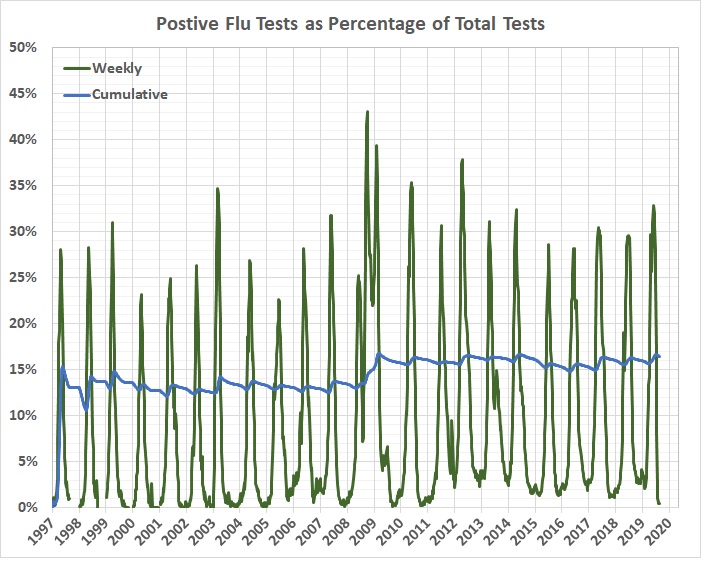
The coronavirus outbreak in the United States is of a piece with the steady rise in influenza cases over the past 13 years, which is the period for which CDC maintains tallies of flu tests and test results.

Here are some raw statistics, representing weekly results since the 40th week of 1997:

The rate of positive tests has remained steady since 1997, with a slight upward bump coincident with the swine flu epidemic of 2009-2010:

The steadiness of the positive-test percentage suggests that the presence of flu-like symptoms was just as likely to have prompted testing in 1997 as in 2020. Another way to put it is that the first graph accurately represents a steady rise in the occurrence of flu-like symptoms in the population.

This can be seen in the following graph:

Despite the fairly stable incidence of positive tests, the number of positive tests has grown far more rapidly than the population of the U.S.

The bottom line: Americans have become increasingly prone to contract flu-like illnesses. Though the increase can’t be explained by the overall rise in the country’s population, it is probably due in part to greater population density in urban areas. It is probably also due in part to the weakening of immune systems relative to the ability of viruses to mutate.

It is possible that influenza won’t be as prevalent in the future as more Americans take precautions against contagion in the wake of COVID-19. But memories are short, and precautions are easily cast aside when the world seems to have returned to normal. So I expect that in a few years the incidence of flu will resume its long-term rise.

Ain’t It the Truth?

I’m reading Charles Murray’s Human Diversity, which I mention here. (It’s a book that leftists will hate, even though they won’t read it, just as they hated The Bell Curve without having read it.)

The following passage is consistent with my up-close and personal observations of women, which span more than six decades:

In the psychological literature, rumination refers to thoughts, typically autobiographical, that a person mentally rehearses over and over, usually not productively. When they are negative thoughts, rumination amounts to brooding. Taken to an extreme, rumination can become depression. In the 1990s, Susan Nolen-Hoeksema led several studies establishing that women were more likely than men to ruminate, particularly in response to negative events. In the early 2000s, two studies using brain imaging established a biological basis for those findings…. The finding in both studies was that males quickly became habituated to a stimulus—the response in the amygdala decreased rapidly after the first few exposures—whereas it persisted among women. In 2013, researchers at the Harvard Medical School (Joseph Andreano was the first author) tested whether this pattern replicated for both positive and negative stimuli. It did not. As in previous studies, men showed higher amygdala activity for novel stimuli than women no matter whether the stimulus was negative, neutral, or positive. For familiar positive stimuli, men again had a higher response than women. But when it came to negative stimuli, men quickly habituated while women continued to show substantial amygdala activity even after repeated exposure. The difference was large enough that it reached statistical significance despite the small sample size.

Now recall the table in chapter 2 that showed the prevalence of personality disorders by sex. Men had higher incidence rates on the autism spectrum, conduct disorders, ADHD, and schizophrenia, among others. Women had higher prevalence on another set, including three that involve rumination: major depression, generalized anxiety, and post-traumatic stress disorder. The findings I have just summarized point to a sex difference both in the intensity of initial reaction to negative stimuli and in the persistence of that reaction, which in turn point to a difference in rumination.

Amen. The world-class worriers-brooders-haters whom I have known were (and are) women.

Why the UBI Is a Bad Idea

There are many reasons to oppose a universal basic income — a guaranteed stipend to be granted to every adult American citizen (or person regardless of age, or resident regardless of citizenship). I won’t enumerate all of the reasons, when one should be enough:

1. Almost every adult citizen (even including many with sever mental or physical handicaps) is capable of producing something of value for others.

2. A UBI is a disincentive to work, that is, to produce.

3. A UBI would nevertheless given its recipients a claim on the output of others.

4. Ergo: a smaller “pie” (total output), shares of which would be given to persons who had no hand in making the “pie” (or less of a hand than would otherwise be the case), and shares of which would therefore be taken from persons who actually had a hand in making the “pie”.

UBI is just another kind of government-enforced form of charity, which — like other forms — disincentivizes work (among beneficiaries and taxpayers alike) and reduces economic output. It also disincentivizes private charity.

Private charity actually incentivizes work (on the part of givers) because it is one of the ends that is served by work, along with affording the necessities and luxuries of life for oneself and one’s family. Private charity is also less likely to disincentivize work by its beneficiaries because it can be more easily aimed at those who need it in order to be capable of work (basic shelter, food, clothing, etc.), and can be tied to the actual performance of work (e.g., Goodwill Industries).

Scrooge, before his conversion to soft-headedness, was right about workhouses. Ironically, they were government-run institutions that had it right: charity in the form of gainful, productive employment. But then charity became a right, and the rest is history.

As the old saying goes, a hand up is better than a handout. Or, as another one goes, give a man a fish, and you feed him for a day; teach a man to fish, and you feed him for a lifetime.

The Economic Damage of COVID-19: A Preliminary Assessment

The Bureau of Economic Analysis today released its advance (first) estimate of GDP for the first quarter of 2020, which is now almost a month in the past. The year-over-year change in real GDP was 0.3 percent (a slight increase). The annualized decline in quarterly GDP was 4.8 percent, the worst since the 8.4 percent decline in the fourth quarter of 2008 (the year of the financial meltdown).

Here’s how the first quarter of 2020 looks in the context of post-World War II changes in GDP:

If, as I expect, the incipient COVID-19 recession of 2020 ends quickly (perhaps in the third or fourth quarter of the year), it will prove to be less damaging (economically) than previous post-war recessions. That won’t be of solace to those who have suffered through the disease, lost loved ones,  lost their jobs and businesses, and seen their investments decline in value.

But (economically) it is better than the alternative, which is something on the order of the Great Recession or Great Depression. The former spanned 3-1/2 years, from the time of its onset until real GDP finally rose above the pre-recession level. The latter spanned 1929-1936, was followed by a recession in 1937-1938, and didn’t end decisively until after World War II.

Trump’s Polling and Re-election Watch

The bottom line of this post is an an assessment of the prospects for Trump’s re-election, which have declined markedly since coronavirus began to do real damage to the economy.

To reach that assessment, I review Trump’s poll numbers and the economic outlook as reflected in the stock market. I derive the poll numbers from a reliable source: Rasmussen Reports:

Polling

Trump’s approval ratings have dropped steadily in the past 8 weeks:

FIGURE 1

Derived from Rasmussen Reports approval ratings for Trump.

Trump’s standing, relative to Obama’s, has slipped considerably:

FIGURE 2

Derived from Rasmussen Reports approval ratings for Obama and Trump.

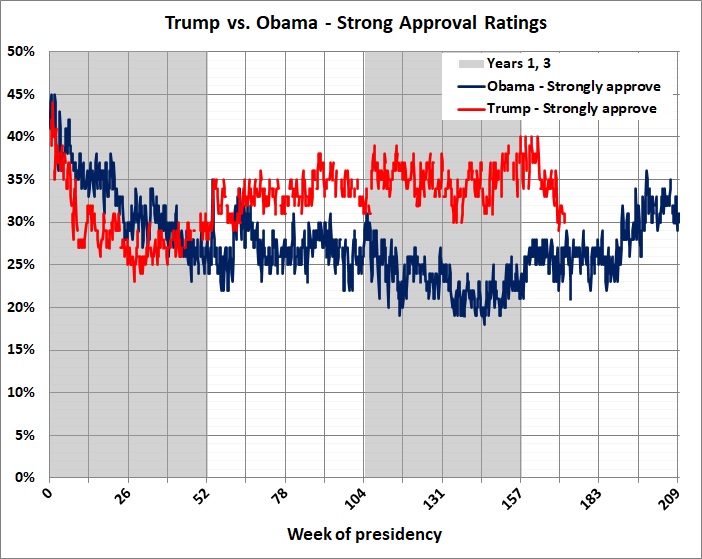
Trump’s slippage is also obvious in a straightforward comparison of strong-approval ratings, averaged over 7 days. It is now almost as low as Obama’s was at this stage 8 years ago, when Obama’s was holding steady before a sharp pre-election rise:

FIGURE 3

Source: Same as figure 2.

I also compute an enthusiasm ratio, which is the 7-day average of the following ratio: the fraction of likely voters expressing strong approval divided by the fraction of likely voters responding. The same pattern is evident in that ratio:

FIGURE 4

Source: Same as figure 2.

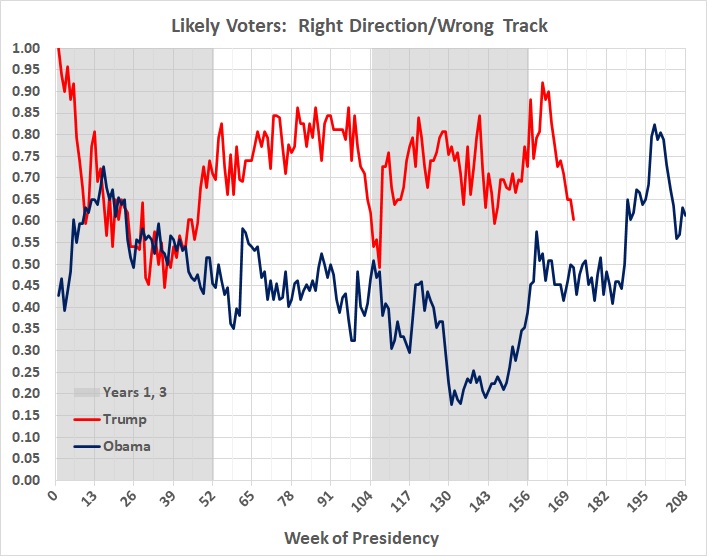
Every week since the first inauguration of Obama, Rasmussen Reports has asked 2,500 likely voters whether they see the country as going in the right direction or being on the wrong track. Figure 5 shows the ratios of right direction/wrong track for Trump and Obama. Here, again, the mood of the voters has turned starkly gloomy, a bad sign for Trump:

FIGURE 5

Source: Rasmussen Reports, “Right Direction or Wrong Track“.

Economic Outlook

Meanwhile, despite the largest quarter-to-quarter decline in real GDP (-4.8 percent) since the crash of 2008, the stock market has begun a tentative recovery from a steep decline:

FIGURE 6

Re-election Watch

Minuses:

Trump’s popularity, relative to Obama’s 8 years ago, is in decline. (See figure 2.)

Trump’s hard-core support is also declining. (See figures 3 and 4.)

Voters currently have a much gloomier view of the state of the nation than they did when Obama was re-elected. (See figure 5.)

Potential pluses:

The tentative stock-market recovery (Figure 6) may signal an economic recovery, which could lead to a recovery in Trump’s popularity.

The possibility that U.S. Attorney John Durham’s criminal investigation of the origins of Spygate will yield revelations damaging to Democrats.

Stay tuned.

COVID-19: Public Service Announcement

It has become obvious that COVID-19 stats are unreliable; see this, this, and this, for example. I am therefore withdrawing from the business of reporting official stats and making projections based on them. I leave that endeavor with this thought.

UHI in Austin Revisited

See “Climate Hysteria: An Update” for the background of this post.

The average annual temperature in the city of Austin, Texas, rose by 3.7 degrees F between 1960 and 2019, that is, from 67.2 degrees to 70.9 degrees. The increase in Austin’s population from 187,000 in 1960 to 930,000 in 2019 accounts for all of the increase. (The population estimate for 2019 reflects a downward adjustment to compensate for an annexation in 1998 that significantly enlarged Austin’s territory and population.)

My estimate of the effect of Austin’s population increase on temperature is based on the equation for North American cities in T.R. Oke’s “City Size and the Urban Heat Island”. The equation (simplified for ease of reproduction) is

T’ = 2.96 log P – 6.41

Where,

T’ = change in temperature, degrees C

P = population, holding area constant

The author reports r-squared = 0.92 and SE = 0.7 degrees C (1.26 degrees F).

I plugged the values for Austin’s population in 1960 and 2019 into the equation, took the difference between the results, and converted that difference to degrees Fahrenheit, with this result: The effect of Austin’s population growth from 1960 to 2019 was to increase Austin’s temperature by 3.7 degrees F. What an amazing non-coincidence.

Austin’s soup weather nazi should now shut up about the purported effect of “climate change” on Austin’s temperature.

A Few Thoughts about Anarchy

This light-hearted post is inspired by comments on “Extreme Libertarianism and the Accountable State“. I considered a long disquisition on the subject but decided that it (the subject) isn’t worth the effort.

Anarchy is a pipe dream. A state of one kind or another always exists or emerges, on a scale that ranges from the family unit to the globe-spanning empire.

If you are looking for a life in which you aren’t subject to another person — even one — you must be prepared to strike out on your own, go off the grid, and live entirely by your own wits and physical skills. If you want to take with you some things that you have acquired — things that were made by corporations that you might otherwise disdain because they are in bed with their regulators — be my guest. Sunk costs are sunk.

What about taking along a significant other or a close friend? Well, that might work if the person is your identical twin (assuming that an identical twin would share your psychological makeup). But, otherwise, you are setting yourself up for conflict. And if you value the other person emotionally or rely on his or her help to make your way through life, you will find yourself necessarily (and fairly often) acquiescing to that person; that is, being ruled by him or her in a way. Unless, of course, you are domineering and make the other person bow to your every wish, though that’s hardly in the spirit of anarchy, is it?

Oh, you’re not that kind of anarchist. You just want conflicts to be resolved and rules to be made locally rather than at some remove, so that you are a full participant in the resolution of conflicts and the making of rules. You can live with decisions with which you disagree as long as you have a direct hand in the making of them.

Well, I hate to break it to you, but that is no longer possible, and hasn’t been possible (in what is now the United States) since 1585. Yes, there is the occasional commune, and a few of them have lasted for more than 50 years. But they are the rare exceptions that prove the rule.

Small towns and villages? Well, they’re really in the same boat as the rare commune that doesn’t collapse like a soufflé after a few years. There’s nothing like the tyranny of small-town mores and ostracism. Even those (mythical) small towns and villages that are actually run in a participatory way — and not by local élites and power-mongers — are no more than microscopic nodes in the vast network of statutes, regulations, ordinances, codes, and judicial decrees that govern almost every economic transaction and far too many social transactions in the United States of America.

So, even a true believer in anarchy who actually wants to attain it must strive realistically. That means working hard just to contain (and occasionally curtail) the powers of the central government, State governments, and local governments. You won’t get far, but you will do more good than you will by preaching anarchy, which ain’t gonna happen and which only kooks like you believe in.

But maybe preaching anarchy gives you a lot of pleasure. So do other fruitless pursuits (e.g., this one), and they’re less frustrating.

P.S. If anarchy were a viable option, it would have long since thrived. If it seems to have eked out a tenuous existence in isolated cases because of state sponsorship, isn’t that evidence of its inviability? And if it hasn’t thrived because statists of one kind and another have suppressed it, isn’t that also proof of its inviability? Call it a non-existence proof. Case closed.

COVID-19 in the United States: Updated Statistics and Projections

Details here.

It is noteworthy that the 2019-2020 flu season was taking a much heavier than normal toll until COVID-19 came along. That alone should cast a lot of doubt on the COVID-19 figures being reported by the States and D.C. Then there is the problem of comorbidity, especially among older persons. In sum, there won’t be a good estimate of the actual death toll of COVID-19  until it’s possible to compute “excess” deaths — taking all other causes into account — when the final tally of deaths in 2020 becomes available a few years hence.

There is also the looming possibility that (1) the COVID-19 infection rate is vastly understated; (2) the COVID-19 fatality rate is therefore vastly overstated; and (3) millions of persons who are already immune to COVID-19 because they have already (unknowingly) recovered from it (believing that they had a cold, the flu, or allergies) and are being held hostage by lockdown orders that are killing the economy. (See this for example.)

Insidious Algorithms

Michael Anton inveighs against Big Tech and pseudo-libertarian collaborators in “Dear Avengers of the Free Market” (Law & Liberty, October 5, 2018):

Beyond the snarky attacks on me personally and insinuations of my “racism”—cut-and-paste obligatory for the “Right” these days—the responses by James Pethokoukis and (especially) John Tamny to my Liberty Forum essay on Silicon Valley are the usual sorts of press releases that are written to butter up the industry and its leaders in hopes of . . . what?…

… I am accused of having “a fundamental problem with capitalism itself.” Guilty, if by that is meant the reservations about mammon-worship first voiced by Plato and Aristotle and reinforced by the godfather of capitalism, Adam Smith, in his Theory of Moral Sentiments (the book that Smith himself indicates is the indispensable foundation for his praise of capitalism in the Wealth of Nations). Wealth is equipment, a means to higher ends. In the middle of the last century, the Right rightly focused on unjust impediments to the creation and acquisition of wealth. But conservatism, lacking a deeper understanding of the virtues and of human nature—of what wealth is for—eventually ossified into a defense of wealth as an end in itself. Many, including apparently Pethokoukis and Tamny, remain stuck in that rut to this day and mistake it for conservatism.

Both critics were especially appalled by my daring to criticize modern tech’s latest innovations. Who am I to judge what people want to sell or buy? From a libertarian standpoint, of course, no one may pass judgment. Under this view, commerce has no moral content…. To homo economicus any choice that does not inflict direct harm is ipso facto not subject to moral scrutiny, yet morality is defined as the efficient, non-coercive, undistorted operation of the market.

Naturally, then, Pethokoukis and Tamny scoff at my claim that Silicon Valley has not produced anything truly good or useful in a long time, but has instead turned to creating and selling things that are actively harmful to society and the soul. Not that they deny the claim, exactly. They simply rule it irrelevant. Capitalism has nothing to do with the soul (assuming the latter even exists). To which I again say: When you elevate a means into an end, that end—in not being the thing it ought to be—corrupts its intended beneficiaries.

There are morally neutral economic goods, like guns, which can be used for self-defense or murder. But there are economic goods that undermine morality (e.g., abortion, “entertainment” that glamorizes casual sex) and fray the bonds of mutual trust and respect that are necessary to civil society. (How does one trust a person who treats life and marriage as if they were unworthy of respect?)

There’s a particular aspect of Anton’s piece that I want to emphasize here: Big Tech’s alliance with the left in its skewing of information.

Continuing with Anton:

The modern tech information monopoly is a threat to self-government in at least three ways. First its … consolidation of monopoly power, which the techies are using to guarantee the outcome they want and to suppress dissent. It’s working….

Second, and related, is the way that social media digitizes pitchforked mobs. Aristocrats used to have to fear the masses; now they enable, weaponize, and deploy them…. The grandees of Professorville and Sand Hill Road and Outer Broadway can and routinely do use social justice warriors to their advantage. Come to that, hundreds of thousands of whom, like modern Red Guards, don’t have to be mobilized or even paid. They seek to stifle dissent and destroy lives and careers for the sheer joy of it.

Third and most important, tech-as-time-sucking-frivolity is infantilizing and enstupefying society—corroding the reason-based public discourse without which no republic can exist….

But all the dynamism and innovation Tamny and Pethokoukis praise only emerge from a bedrock of republican virtue. This is the core truth that libertarians seem unable to appreciate. Silicon Valley is undermining that virtue—with its products, with its tightening grip on power, and with its attempt to reengineer society, the economy, and human life.

I am especially concerned here with the practice of tinkering with AI algorithms to perpetuate bias in the name of  eliminating it (e.g., here). The bias to be perpetuated, in this case, is blank-slate bias: the mistaken belief that there are no inborn differences between blacks and whites or men and women. It is that belief which underpins affirmative action in employment, which penalizes the innocent and reduces the quality of products and services, and incurs heavy enforcement costs; “head start” programs, which waste taxpayers’ money; and “diversity” programs at universities, which penalize the innocent and set blacks up for failure. Those programs and many more of their ilk are generally responsible for heightening social discord rather than reducing it.

In the upside-down world of “social justice” an algorithm is considered biased if it is unbiased; that is, if it reflects the real correlations between race, sex, and ability in certain kinds of endeavors. Charles Murray’s Human Diversity demolishes the blank-slate theory with reams and reams of facts. Social-justice warriors will hate it, just as they hated The Bell Curve, even though they won’t read the later book, just as they didn’t read the earlier one.

Not-So-Random Thoughts (XXVI)

“Not-So-Random Thoughts” is an occasional series in which I highlight writings by other commentators on varied subjects that I have addressed in the past. Other entries in the series can be found at these links: I, II, III, IV, V, VI, VII, VIII, IX, X, XI, XII, XIII, XIV, XV, XVI, XVII, XVIII, XIX, XX, XXI, XXII, XXIII, XXIV, and XXV. For more in the same style, see “The Tenor of the Times” and “Roundup: Civil War, Solitude, Transgenderism, Academic Enemies, and Immigration“.

CONTENTS

Free Trade Rethought

The Death Penalty

State Actors in Action

Red vs. Blue

Serfdom in Our Future?


FREE TRADE RETHOUGHT

My position on so-called free trade:

  • Estimate the amount by which the price of a foreign product or service is reduced by the actions of foreign governments or their proxies.
  • Add that amount to the price as a tariff.
  • Regularly review and adjust the schedule of tariffs.

All other trade would be unencumbered, excepting:

  • the importation of products and services otherwise restricted by U.S. law (e.g., tanks, artillery pieces)
  • the exportation of products and services that are used directly in the development, manufacture, and operation of sensitive military systems (e.g., fighter aircraft, anti-missile defenses).

Selective tariffs, based on actual costs of production, would encourage the efficient use of resources and protect American workers who would otherwise be victimized by unfair trade. But that’s it. Sweeping tariffs on imports — just to “protect” American workers — do more than protect them. They also penalize American consumers, most of whom are also workers.

William Upton, writing in light of current events (“Make America Autarkic Again“, The American Mind, March 13, 2020), would go a lot further:

In our over-globalized world, a policy of total autarky is infeasible. But a degree of autarky should be recognized as self-evidently in America’s national interest.

Autarky, for those unfamiliar, was an economic and industrial policy of self-reliance wherein a nation need not rely on international trade for its economic survival. This is not to say that said nation rejected international trade or isolated itself from the global economic order, rather that it merely could survive on its own if necessary….

[Oren] Cass notes that sound industrial policy has allowed nations like Germany and Japan to retain strong manufacturing sectors. Cass also emphasizes the pivotal importance of manufacturing, not just for the economy, but for American communities:

[M]anufacturing is unique for the complexity of its supply chains and the interaction between innovation and production. One of the most infuriating face-palms of modern economics is the two-step that goes like this: First, wave away concern as other countries with aggressive industrial policies … attract our critical supply chains overseas, explaining that it doesn’t matter where things get made. Second, wait for people to ask “why can’t we make this or that here,” and explain that of course we can’t because all of the supply chains and expertise are entrenched elsewhere. It’s enough to make one slam one’s head into the podium.

There may be something to it.


THE DEATH PENALTY

I was surprised to read the assessment by Theodore Dalrymple, a former prison doctor, of the death penalty (“The Death Penalty’s Demise and the Withering of Authority“, Law & Liberty, February 11, 2020). On the one hand:

If I had been a prison doctor while the death penalty was still imposed in Britain, I should have had the somewhat awkward task of certifying murderers fit for execution….  It was not permitted to execute madmen even if they had been sane at the time of their crime; but with the ever-widening and loosening of psychiatric diagnosis, I should no doubt have been tempted always to find a medical reason to postpone the execution sine die. I would have found it hard to sign what would have amounted to a medical death warrant, all the more so with the man before my very eyes. Nor would I have much relished attending the execution itself, to certify that the execution had worked….

But while I should not have wanted to participate in an execution, I was nevertheless viscerally in favour of the death penalty because it seemed to me that there were crimes (though by no means all of them murder) so heinous, so despicable, that no other penalty was adequate to express society’s outrage at, or repudiation of, them. Moreover — though quite late in my career — I discovered evidence that suggested that the death penalty did in fact act as a deterrent to murder, something which has long been contested or outright denied by abolitionists.

But on the other hand:

Does its deterrent effect, then, establish the case for the death penalty, at least in Britain? No, for two reasons. First, effectiveness of a punishment is not a sufficient justification for it. For example, it might well be that the death penalty would deter people from parking in the wrong place, but we would not therefore advocate it. Second, the fact is that in all jurisdictions, no matter how scrupulously fair they try to be, errors are sometime made, and innocent people have been put to death. This seems to me the strongest, and perhaps decisive, argument against the death penalty.

And on the third hand:

Although, on balance, I am against the death penalty, I do not assume that those who are in favour of it are necessarily moral primitives, which abolitionists often give the impression of believing. For most of our history, the rightness of the death penalty has been taken for granted, and it cannot be that we are the first decent, reflective people ever to have existed. The self-righteousness of the Europeans in this respect disgusts me when they set themselves up to judge others. France, for example, abolished the death penalty only in 1981 – AD 1981, that is, not 1981 BC. When the death penalty in Britain was abolished in 1965 after many decades of campaigning by abolitionists, more than 90 per cent of the population was still in favour of it. Almost certainly it believed, if not necessarily in a fully coherent way, that to abolish the death penalty was to weaken the authority of society and to lessen the majesty of the law. It was also to weaken the prohibition against killing and, though involving the taking of a life (the murderer’s), also lessened the sanctity of life….

In Britain, one of the effects of the abolition of the death penalty, the downward pressure on all prison sentences, has been little remarked. Punishment has to be roughly proportional to the gravity of the crime (exact proportionality cannot be achieved), but if murder attracts only 15 years’ imprisonment de facto, what sentences can be meted out to those who commit lesser, but still serious, crimes? Moreover, the charge of murder is often reduced to the lesser crime of manslaughter, in which sentences – as a consequence – are often derisory….

It is scarcely any wonder that in the years since the abolition of the death sentence, Britain has gone from being a well-ordered, non-violent, law-abiding society to being a society with the highest rate of violent crime in Western Europe. Of course, the abolition of the death penalty was not the only cause, for crime was rising in any case, but it brought its contribution to the festival of disorder that followed.

It seems to me that Dalrymple ends up arguing in favor of the death penalty. He is correct about its deterrent effect (same post). He is wrong to give heavy weight to the possibility of error. And he overlooks a conclusive argument in its favor: there is one less criminal who might be let loose to commit more crimes. All of those points and more are covered in these posts:

Does Capital Punishment Deter Homicide?
Libertarian Twaddle about the Death Penalty
A Crime Is a Crime
Crime and Punishment
Saving the Innocent?
Saving the Innocent?: Part II
More Punishment Means Less Crime
More About Crime and Punishment
More Punishment Means Less Crime: A Footnote
Clear Thinking about the Death Penalty
Let the Punishment Fit the Crime
Another Argument for the Death Penalty
Less Punishment Means More Crime
Crime, Explained
Why Stop at the Death Penalty?
Crime Revisited


STATE ACTORS IN ACTION

Once upon a time I made a case for rescuing the First Amendment from its enemies in

the telecommunications, news, entertainment, and education industries [which] have exerted their power to suppress speech because of its content….  The collective actions of these entities — many of them government- licensed and government-funded — effectively constitute a governmental violation of the Constitution’s guarantee of freedom of speech (See Smith v. Allwright, 321 U.S. 649 (1944) and Marsh v. Alabama, 326 U.S. 501 (1946).)

Leo Goldstein (“Google and YouTube Are State Actors“, American Thinker, March 9, 2020) finds a smoking gun

in the FCC Obamanet orders of 2010 and 2015. The 2015 Obamanet Order, officially called Open Internet Order, has explicitly obligated all internet users to pay a tax to Google and YouTube in their ISP and wireless data fees. The Order even mentions Google and YouTube by name. The tax incurs tens of billions of dollars per year. More specifically, the Order said that by paying ISP fees (including mobile wireless), each user also pays for the services that ISP gives to platforms and content providers like YouTube, even if the user doesn’t use them….

Platforms and content providers are misleadingly called “edge providers” here. Thus, every ISP customer in the US is obligated to pay for the traffic generated by Google, Netflix, Facebook, and Twitter, even if he used none of them!

Off with their heads.


RED VS. BLUE

The prolific Joel Kotkin weighs in on the Red States’ economic and electoral advantages:

Even in a state as deeply blue as [California}, Democrats’ disdain for the basic values and interests of their own base could unravel their now seemingly unbridgeable majority. At some point, parents, artists, minorities, small businesspeople and even sex workers will not be mollified sufficiently by a fulsome expression of good intentions. If more voters begin to realize that many of the policies being adopted are injurious, they may even begin to look again at the Republicans, particularly once the toxic President Trump is no longer on the ballot scaring the masses to toe the line. [“Democrats Risk Blowback with Leftward Turn“, newgeography, March 1, 2020]

* * *

The political and cultural war between red and blue America may not be settled in our lifetimes, but it’s clear which side is gaining ground in economic and demographic terms. In everything from new jobs—including new technology employment—fertility rates, population growth, and migration, it’s the red states that increasingly hold the advantage.

Perhaps the most surprising development is on the economic front. Over the past decade, the national media, and much of academia, have embraced the notion that the future belonged to the high-tax, high-regulation economies clustered on the East and West Coasts. The red states have been widely dismissed, in the words of the New York Times, as the land of the “left behind.”

Yet the left-behind are catching up, as economic momentum shifts away from coastal redoubts toward traditionally GOP-leaning states. Just a few years ago, states like California, Massachusetts, and New York held their own, and then some, in measurements of income growth from the Bureau of Economic Analysis. Now the fastest growth is concentrated in the Sunbelt and Great Plains. Texans’ income in the latest 2019 BEA estimates was up 4.2 percent, well above California’s 3.6 percent and twice New York’s 2.1 percent. The largest jumps—and this may matter a lot in 2020—took place in the Dakotas, Nebraska, and Iowa. [“Red v. Blue“, City Journal, February 7, 2020]

But:

[S]ocialism is gaining adherents even in the upper middle-class and among the oligarchy. One critical component lies in detestation of all things Trump even among CEOs, most of whom, according to a recent Chief Executive survey, want him impeached. Corporate America is increasingly embracing the notion of a guaranteed income and is adopting politically correct positions on such things as immigration, particularly in tech and on Wall Street.

But the most important driver for socialism comes from the burgeoning green movement. Long dominated by the elite classes, environmentalists are openly showing themselves as watermelons — green on the outside, red on the inside. For example, the so called “Green New Deal” — embraced by Sanders, Warren and numerous oligarchs — represents, its author Saikat Chakrabarti suggests, not so much a climate as “a how-do-you-change-the entire-economy thing”. Increasingly greens look at powerful government not to grow the economy, but to slow it down, eliminating highly paid blue-collar jobs in fields like manufacturing and energy. The call to provide subsidies and make work jobs appeals to greens worried about blowback from displaced workers and communities.

Combined with the confused and vacillating nature of our business elites, and the economic stagnation felt by many Americans, socialism in the West is on the rise. An ideology that history would seem to have consigned to Leon Trotsky’s “dustbin of history”, could turn the land that once embraced Adam Smith closer to the vision of Karl Marx. [“The West Turns Red?“, newgeography, February 25, 2020]

I have shown the economic superiority of the Red State model. But that isn’t enough to rescue the country from the perpetual allure of socialism. As I say here,

… States and municipalities governed by Democrats will ever more boldly pursue policies that undermine traditional American culture (e.g., unabated encouragement of illegal immigration, accelerated favoritism toward “identity groups”) and which are broadly destructive of the economic and social fabric; for example: persisting in costly, money-losing recycling and composting programs that do nothing for the environment (taking into account the environmental effects of the vehicles and equipment involved); the replacement of fossil-fuel sources of electricity by unreliable and expensive “renewable” sources; encouragement of homelessness by subsidizing it and making it socially acceptable; discouragement of family formation and stability through the continuation and expansion of long-discredited vote-buying welfare programs; openly persecuting conservatives and conservative institutions.

All of that will intensify the divisions between Red and Blue States, and the divisions between Red State governments and the Blue cities within them. But that is a first-order effect.

The second-order effect is to make living in Blue States and cities more onerous for middle-to-low-income earners (and even some among the affluent), who will seek greener (Redder) pastures outside Blue cities and Blue States. But many (most?) of those refugees will not flee because they have come to believe that big government is the cause of their problems. Rather, they (especially the younger, more mobile, and more “socialistic” ones) will flee because they don’t want to suffer the consequences of big government (high taxes, high housing costs, etc.). But, being addicted to the idea that big government is good, and ignorant of the connection between big government and their woes, they will continue to vote for big-government politicians and policies. Thus will Blue States and Blue cites gradually turn Purple and, in many cases, Blue.

You read it here.


SERFDOM IN OUR FUTURE?

I recently mused about Walter Scheidel’s book, The Great Leveler. Kotkin addresses the thesis of that book in “Who Will Prosper After the Plague?” (Tablet, April 13, 2020):

[T]he wreckage [caused by the Black Plague of the 14th century] created new opportunities for those left standing. Abandoned tracts of land could be consolidated by rich nobles, or, in some cases, enterprising peasants, who took advantage of sudden opportunities to buy property or use chronic labor shortages to demand higher wages. “In an age where social conditions were considered fixed,” historian Barbara Tuchman has suggested, the new adjustments seemed “revolutionary.”

What might such “revolutionary” changes look like in our post-plague society? In the immediate future the monied classes in America will take a big hit, as their stock portfolios shrink, both acquisitions and new IPOs get sidetracked and the value of their properties drop. But vast opportunities for tremendous profit available to those with the financial wherewithal to absorb the initial shocks and capitalize on the disruption they cause….

Over time, the crisis is likely to further bolster the global oligarchal class. The wealthiest 1% already own as much as 50% of the world’s assets, and according to a recent British parliamentary study, by 2030, will expand their share to two-thirds of the world’s wealth with the biggest gains overwhelmingly concentrated at the top 0.01%….

The biggest long-term winner of the stay-at-home trend may well be Amazon, which is hiring 100,000 new workers. But other digital industries will profit as well, including food delivery services, streaming entertainment services, telemedicine, biomedicine, cloud computing, and online education. The shift to remote work has created an enormous market for applications, which facilitate video conferencing and digital collaboration like Slack—the fastest growing business application on record—as well as Google Hangouts, Zoom, and Microsoft Teams. Other tech firms, such as Facebook, game makers like Activision Blizzard and online retailers like Chewy, suggests Morgan Stanley, also can expect to see their stock prices soar as the pandemic fades and public acceptance of online commerce and at-home entertainment grows with enforced familiarity.

Growing corporate concentration in the technology sector, both in the United States and Europe, will enhance the power of these companies to dominate commerce and information flows….

The modern-day clerisy consisting of academics, media, scientists, nonprofit activists, and other members of the country’s credentialed bureaucracy also stand to benefit from the pandemic. The clerisy operate as what the great German sociologist Max Weber called “the new legitimizers,” bestowing an air of moral and technocratic authority on the enterprises of their choosing….

Members of the clerisy are likely to be part of the one-quarter of workers in the United States who can largely work at home. Barely 3% of low-wage workers can telecommute but nearly 50% of those in the upper middle class can. While workers at most restaurants and retail outlets face hard times, professors and teachers will continue their work online, as will senior bureaucrats….

The biggest winners in the fallout from the coronavirus are likely to be large corporations, Wall Street, Silicon Valley, and government institutions with strong lobbies. The experience from recent recessions indicates that big banks, whose prosperity is largely asset-based, will do well along with major corporations, while Main Street businesses and ordinary homeowners will fare poorly….

In the Middle Ages, many former citizens, facing a series of disasters from plagues to barbarian invasions, willingly became serfs. Today, the class of permanently propertyless citizens seems likely to grow as the traditional middle class shrinks, and the role of labor is further diminished relative to that of technology and capital.

In contrast to the old unionized workers, many people today, whether their employment is full-time or part-time, have descended into the precariat, a group of laborers with limited control over how long they can work, who often live on barely subsistence wages. Nearly half of gig workers in California live under the poverty line.

Now comes the payoff:

Historically, pandemics have tended to spark class conflict. The plague-ravaged landscape of medieval Europe opened the door to numerous “peasant rebellions.” This in turn led the aristocracy and the church to restrict the movements of peasants to limit their ability to use the new depopulated countryside to their own advantage. Attempts to constrain the ambitions of the commoners often led to open revolts—including against the church and the aristocracy.

… As steady and well-paying jobs disappear, the demands for an ever more extensive welfare state, funded by the upper classes, will multiply.

Like their counterparts in the late 19th century, the lower-class workforce will demand changes. We already see this in the protests by workers at Instacart delivery service, and in Amazon warehouse workers concerned about limited health insurance, low wages, and exposure to the virus.

As the virus threatens to concentrate wealth and power even more, there’s likely to be some sort of reckoning, including from the increasingly hard-pressed yeomanry.

In the years before the great working-class rebellions of the mid-19th century, Alexis de Tocqueville warned that the ruling orders were “sleeping on a volcano.” The same might be seen now as well, with contagion pushing the lava into the streets, and causing new disruptions on a scale of which we can’t predict.

Something like socialism (for non-elites) may emerge for the rubble. It will be the 21th century equivalent of bread and circuses: share just enough of the wealth to keep the proletariat in line.

Extreme Libertarianism vs. the Accountable State

I left the following comment on a post at Policy of Truth:

[Another commenter] says “Most libertarians have their entire identity tied up in an a priori commitment to its never, ever being necessary or justified for the state to do anything like issuing and enforcing stay-at-home orders.” That nails it. Error and corruption are human traits, not just government traits. There is a fine line between too much government and not enough of it, and the line has been crossed in the wrong direction (too much) in many, many ways. But that doesn’t mean that there are no cases in which there isn’t enough government.

There’s a history behind my comment. It reflects a position that I staked out long ago (in blog time), and which I stated at length thirteen years ago, in “A Critique of Extreme Libertarianism“. The position is a rejection of the extreme libertarian (anarcho-capitalist) idea that the police and defense functions of government can be and should be provided by private defense agencies (i.e., security contractors). Here are some relevant excerpts (which include links to earlier posts in the same vein):

THE “GOOD” THAT ONLY A STATE CAN PROVIDE

… I have addressed that pipe-dream [private defense agencies] in several posts, including this one, in which I commented on an article by one Robert Murphy, who

assumes that if the vast majority of people agree that it’s wrong to use violence to settle disputes, then that won’t happen. Do the vast majority of people believe that it’s wrong to use violence to settle disputes? Perhaps, but it doesn’t take a vast majority to inject violence into a society; it takes only a relatively small number of renegades, who may be then be able to coerce others into condoning or supporting their criminal activities. . . .

What Murphy doesn’t entertain is the possibility that a small but very rich cabal could create a dominant defense agency that simply refuses to recongize other defense agences, except as enemies. In other words, there’s nothing in Murphy’s loose logic to prove that warlords wouldn’t arise. In fact, he soon gives away the game:

Imagine a bustling city, such as New York, that is initially a free market paradise. Is it really plausible that over time rival gangs would constantly grow, and eventually terrorize the general public? Remember, these would be admittedly criminal organizations; unlike the city government of New York, there would be no ideological support for these gangs.

We must consider that in such an environment, the law-abiding majority would have all sorts of mechanisms at their [sic] disposal, beyond physical confrontation. Once private judges had ruled against a particular rogue agency, the private banks could freeze its assets (up to the amount of fines levied by the arbitrators). In addition, the private utility companies could shut down electricity and water to the agency’’s headquarters, in accordance with standard provisions in their contracts.

Pardon me while I laugh at the notion that lack of “ideological support” for the gangs of New York would make it impossible for gangs to grow and terrorize the general public. That’s precisely what has happened at various times during the history of New York, even though the “law-abiding majority [had] all sorts of mechanisms at [its] disposal.” Murphy insists on hewing to the assumption that the existence of a law-abiding majority somehow prevents the rise a powerful, law-breaking minorities, capable of terrorizing the general public. Wait a minute; now he admits the converse:

Of course, it is theoretically possible that a rogue agency could overcome these obstacles, either through intimidation or division of the spoils, and take over enough banks, power companies, grocery stores, etc. that only full-scale military assault would conquer it. But the point is, from an initial position of market anarchy, these would-be rulers would have to start from scratch. In contrast, under even a limited government, the machinery of mass subjugation is ready and waiting to be seized.

Huh? It’s certainly more than theoretically possible for a “rogue agency” to wreak havoc. A “rogue agency” is nothing more than a fancy term for a street gang, the Mafia, or al Qaeda cells operating in the U.S. A “rogue agency” run by and on behalf of rich and powerful criminals — for their own purposes — would somehow be preferable to police forces and courts operated by a limited government that is accountable to the general public, rich and poor alike? I don’t think so. However much the American state engages in “mass subjugation” — and it does, to a degree — it is also held in check by its accountability to the general public under American law and tradition. A “rogue agency,” by definition, would be unbound by law and tradition.

Murphy’s analysis takes place in a land called “Erewhon.” He chooses to ignore the fact that he lives in the United States because he wasn’t a party to the Constitution. Yet that Constitution provides for a limited government, which in more than 200 years has yet to engage in systematic, mass subjugation of the kind practiced in the Third Reich and the Soviet Union, except in the case of slavery. And guess what? The American state ended slavery. How’s that for mass subjugation?

Anyone can conjure a Utopia, as Murphy has. But no one can guarantee that it will work. Murphy certainly hasn’t made the case that his Utopia would work.

In any event, by focusing on intra-societal violence Murphy ignores completely two crucial questions: (1) Can an anarchistic society effectively defend itself against an outside force? (2) Can it do so better than a society in which the state has a monopoly on the use of force with respect to outside entities? Murphy implies that the answer to both questions is “yes,” though he fails to explore those questions. Here is my brief answer: The cost of mounting a credible defense of the United States from foreign enemies probably would support only one supplier; that is, national defense is a natural monopoly. It is better for the American state — given its accountability to the general public — to be that supplier. . . .

A wasteful, accountable, American state is certainly preferable to an efficient, private, defense agency in possession of the same military might. Hitler and Stalin, in effect, ran private defense agencies, and look where that landed the Germans and Russians. Talk about subjugation.

THE STATE: AN INEVITABLE CREATURE OF SOCIETY

Contrary to Murphy and his ilk, there is no such thing as statelessness, at least not for groups larger than, say, hunter-gatherer bands or Hutterite colonies. Why? Because it is impossible for a group of more than a few dozen or a dozen-dozen persons to live together in pure consensus. In the end, a faction will dominate the group (a shifting faction, perhaps). And that faction will define harms that may be punished, punish those harms (i.e., administer justice), and take responsibility for the group’s defense.

The state is not a “thing” to be kept at bay; it is the mechanism by which a people enforces justice and defends itself against outsiders.The questions facing a group always are these: Upon what principles shall we found and guide the state, and to whom shall we entrust the the functions of the state?

Consider this:

A group of persons may be said to live in anarchy only if all of the rules that affect everyone in the group (e.g., where to live, how best to defend the group against predators) are made by unanimous, informed consent, which might be tacit. It follows, then, that a group might — by unanimous, informed consent — give a subset of its members the authority to make such decisions. The group’s members might delegate such authority, willingly and unanimously, because each member believes it to be in his or her best interest to do so. (The reasons for that belief might vary, but they probably would include the notion of comparative advantage; that is, those who are not in the governing subset would have time to pursue those activities at which they are most productive.) With a governing subset — or government — the group would no longer live in anarchy, even if the group remains harmonious and membership in it remains voluntary.

The government becomes illegitimate only when it exceeds its grant of authority and resists efforts to curb those excesses or to redefine the grant of authority. The passage of time, during which there are changes in the group’s membership, does not deligitimate the government as long as the group’s new members voluntarily assent to governance. Voluntary assent, as discussed above, may consist simply in choosing to remain a member of the group.

Now, ask yourself how likely it is that a group larger than, say, a nuclear family or a band of hunter-gatherers might choose to go without a government. Self-interest dictates that even relatively small groups will choose — for reasons of economy, if nothing else — to place certain decisions in the hands of a government.

All talk of anarchy as a viable option to limited government is nothing more than talk. Empty talk, at that.

EXTREME LIBERTARIANISM’S FATAL FLAW: THE “ANNE FRANK SYNDROME”

The political view that there should not be a state, if followed to its logical conclusion, would leave most Americans prey to the very real predators who lurk at home and abroad. Those very real predators care not one whit about non-aggression principles and contractual obligations, contrary to the assertions of Gustave de Molinari, a favorite of anarcho-capitalists, who wrote this:

Under a regime of liberty, the natural organization of the security industry would not be different from that of other industries. In small districts a single entrepreneur could suffice. This entrepreneur might leave his business to his son, or sell it to another entrepreneur. In larger districts, one company by itself would bring together enough resources adequately to carry on this important and difficult business. If it were well managed, this company could easily last, and security would last with it. In the security industry, just as in most of the other branches of production, the latter mode of organization will probably replace the former, in the end.

The “customers would not allow themselves to be conquered”? Tell that to those who pay gangsters for “protection,” and to the residents of gang-ridden areas. Molinari conveniently forgets that the ranks of “competitors” are open to those who, in their viciousness, will and do attack the persons and property of their rivals. If not everyone is honorable, as Molinari admits elsewhere in his essay, why would we expect private providers of security be honorable? Why would they not extort their customers while fighting each other? The result is bound to be something worse than life under an accountable state monopoly (such as we have in the U.S.) — something fraught with violence and fear. Think of The Roaring Twenties without the glossy coat of Hollywood glamour.

Molinari and his anarcho-libertarian descendants exhibit the Anne Frank syndrome. About three weeks before Frank and her family were betrayed and arrested, she wrote:

It’’s a wonder I haven’’t abandoned all my ideals, they seem so absurd and impractical. Yet I cling to them because I still believe, in spite of everything, that people are truly good at heart.

… Murphy, Molinari, and their ilk do not proclaim the jejune belief that all “people are truly good at heart,” yet they persist in the belief that the security can be achieved in the absence of an accountable state. That is, like Anne Frank, they assume — contrary to all evidence — that “people are truly good at heart.” But competition, by itself, does not and cannot prevent criminal acts.

Competition, to be beneficial, must be conducted within the framework of a rule of law. That rule of law must be enforced by a state which is accountable to its citizens for the preservation of their liberty. The present rule of law in the United States is far from perfect, but it is far more perfect than the alternative that is dreamt of by extreme libertarians.

THE PROPER LIBERTARIAN AGENDA

As I wrote here, extreme libertarianism

rests on invalid conceptions of human nature and the state. Contrary to the evidence of history, it presumes that no one would or could accrue and exercise enough power to flout the common law and treat other persons coercively. Contrary to the evidence of history — especially American history — it presumes that a properly constituted and governed state cannot increase the quotient of liberty.

There is no choice between anarchy and the state. Anarchy leads inexorably to coercion — except in a dreamworld. The real choice … is between the toughest guy on the block or a state whose actions are capable of redirection through our representative democracy.

The proper task at hand for American libertarians isn’t to do away with the state but to work toward a state that defends free markets, property rights, the common law, and freedom of contract.

Another task for American libertarians is to work toward devolution of power back to the individual States and, within the States, to the lowest possible level. The key to liberty is the ability of the individual to pick and choose among a variety of “experiments” in government. That is true federalism.

Anarcho-capitalism exemplifies a nirvana fallacy, in that it posits an unrealistic, unattainable alternative to the inevitable imperfections that accompany state rule. Anarchists have offered examples of “successful anarchies”, but the ones that I have seen have one thing in common: state sponsorship and protection (e.g., here).

Which leads me to an alternative (whose realism and attainability I will discuss) — a central government that is constrained to do the following:

  • Defend Americans and their overseas interests against foreign predators.
  • Ensure the free flow of trade among Americans without intervention, except to bar the sale or disclosure of products, service, or information detrimental to defense.
  • Guarantee due process of law, property rights, freedom of association, freedom of political speech, and free exercise of religion (consistent with the foregoing) throughout the United States.
  • Leave the rest to the States and their political subdivisions, provided that they do not interfere with or violate the preceding constraints.

That’s not an exact description of the state of affairs in the U.S. from 1789 to the late 1800s, but with a few significant (and since remedied) exceptions it is an approximate description. There was, of course, slavery and then injustice toward blacks on a vast scale. And there were many lesser failures, too, including the denial of suffrage to women.

A more perfect state of affairs would be one in which “the clock is turned back” on the central government’s myriad interventions since the late 1800s, except for those that are obviously just (e.g., the abolition of slavery, the end of Jim Crow, voting rights for blacks and women). I describe turning back the clock in that way because big-government advocates like to claim that those of us who wish to roll back the central government’s power also long for a replication of the 19th century. Balderdash!

At any rate, turning back the clock would be difficult, as evidenced by the continued growth of government power since the days of Teddy Roosevelt’s imperial presidency, despite not inconsiderable resistance and brief periods of abatement. Why is that? Because the growth of government is always rationalized as doing what’s necessary to “help” X, Y, and Z (sometimes by penalizing A, B, and C) — even though X, Y, Z, and their progeny are made the poorer for it.

But if the history of the past several decades shows anything, it shows that unremitting pressure to roll back the central government’s power can succeed in slowing its growth and even, in some areas, reversing it. The successes are due to two developments:

  • The election of Republican presidents and majorities in Congress. (Not all Republicans are devoted to smaller government, despite the lip-service most of them pay to that objective, but all Democrats, as far as I can tell, are devoted to the enlargement of government.)
  • The taming of the administrative state — the conglomeration of agencies that wields discretionary power to interpret and elaborate the broad powers entrusted to it, and then to execute and adjudicate its own interpretations and elaborations. (The taming will be done by Republicans it is done by anyone.)

The second development is as crucial than the first, because the administrative state cannot be regrown overnight, even with Democrats in charge.

A government in which the administrative state has been subdued is bound to act more like an accountable government. The acts of elected officials — and the consequence of those acts — will be more visible to the electorate if they take place in the spotlights that shine on Congress and the White House than if they are concealed in the shadows of the bureaucracy.

That’s the best that I can offer. It’s realistic and attainable, unlike the nirvana offered by libertarians.

Flattening the Curve

What does it mean to “flatten the curve”, in the context of an epidemic? Here is Willis Eschenbach’s interpretation:

What does “flattening the curve” mean? It is based on the hope that our interventions will slow the progress of the disease. By doing so, we won’t get as many deaths on any given day. And this means less strain on a city or a country’s medical system.

Be clear, however, that this is just a delaying tactic. Flattening the curve does not reduce the total number of cases or deaths. It just spreads out the same amount over a longer time period. Valuable indeed, critical at times, but keep in mind that these delaying interventions do not reduce the reach of the infection. Unless your health system is so overloaded that people are needlessly dying, the final numbers stay the same.

I beg to differ. Or, at least, to offer a different interpretation: Flattening the curve — reducing its peak — can also reduce the total number of persons who are potentially exposed to the disease, thereby reducing the total number of persons who contract it. How does that work? It requires not only reducing the peak of the curve — the maximum number of active cases — but also reducing the length of the curve — the span of time in which a population is potentially exposed to the contagion.

Consider someone who has randomly contracted a virus from a non-human source. If that person is a hermit, the virus may kill him, or he may recover from whatever illness it causes him, but he can’t infect anyone else. Low peak, short duration.

Here’s an example of a higher peak but a relatively short duration: A person who randomly contracts a virus from a non-human source then infects many other persons in quick succession by breathing near them, sneezing on them, touching them, etc., in a short span of time (e.g., meeting and greeting at a business function). But … if the originator of the contagion and those whom he initially infects are identified and quarantined quickly enough, the contagion will spread no further.

In both cases, the “curve” will peak at some number lower than the number that would have been reached without isolation or quarantine. Moreover, and more important, the curve will terminate (go to zero) more quickly than it would have without isolation or quarantine.

The real world is more complicated than either of my examples because almost all humans aren’t hermits, and infections usually aren’t detected until after an infected person has had many encounters with uninfected persons. But the principle remains the same: The total number of persons who contract a contagious disease can be reduced through isolation and quarantine — and the sooner isolation and quarantine take effect, the lower the total number of infected persons.