God-Like Minds

I write today about the mindset of so-called liberals and many of their emotional brethren of the bleeding-heart-libertarian-left (a compound oxymoron of the first order). They view the world from a lofty perch, in judgment of all and sundry; for example:

  • The redistribution of income and wealth increases global (or national) well-being.
  • Free migration of people across borders increases global well-being.
  • War is a bad thing because so many people are killed.

What’s missing from such statements? The particular instances of bad or good that cut in the opposite direction: the harm to those whose income and wealth are redistributed; the harm to those whose jobs are lost, and whose taxes rise to support indigent immigrants; the lives and livelihoods of family, friends, and countrymen that are saved by defeating foreign enemies.

The same mindset also operates on a smaller scale. Consider this, from reason.com:

Wages too low? Force employers to pay more.

Too many uninsured? Force Americans to buy coverage.

Not enough parental leave? Force companies to provide it.

Rich people speaking too freely about politics? Rewrite the First Amendment so you can stop them.

A horrific school shooting? Take guns away from people who didn’t do it.

People drinking too much soda? Ban big servings or tax the stuff.

Fantasy sports gambling getting too popular? Shut it down.

I would add: Some people not saving enough for retirement? Force others to subsidize them. That’s just a start; the list could go on and on.

All of this omniscience gives me a headache. It is my devout wish that liberals and liberaltarians would SHUT UP! No one died and made you God.

*       *      *

Related posts:

Liberalism and Sovereignty

Positive Rights and Cosmic Justice

Cato’s Usual Casuistry on Matters of War and Peace

Lay My (Regulatory) Burden Down

The Pseudo-Libertarian Temperament

Romanticizing the State

Libertarianism and the State

The Rahn Curve Revisited

My Defense of the A-Bomb

Can Trump Win in November?

Standing back (way back) from Donald Trump — the physically repellent, serial adulterer, misogynist, liar, braggart, flip-flopper, xenophobic race-panderer, economic illiterate Donald Trump — I will here attempt to assess Trump’s electability.

For both major parties, 2016 is somewhat of a rerun of 2008, with hotly contested primaries and no incumbent in the race. It’s due to Trump that the total popular vote in GOP primaries is up by about 50 percent over 2008; whereas, the total popular vote in Democrat primaries is down by about a third over 2008. So, Trump has that going for him, out of the gate.

A lot of the extra GOP votes probably have been cast by disenchanted working-class Democrats in search of “equal treatment.” But so what? There are a lot more of them than there are disenchanted middle-and-upper-middle-class-small-government Republicans. And will all of those disenchanted middle-and-upper-middle-class-small-government Republicans vote for Hillary? A few might, but most of them will hold their noses, vote for Trump, and hope for the best. Those who don’t do that will just skip the top of the ticket and vote for down-ticket GOP candidates.

What about Bernie’s supporters, many of whom will be royally ticked-off by the Democrat Party’s cornonation of Queen Hillary? Bernie’s bunch will divide this way (though in what proportions I can’t say): Stay home, vote for Hillary, vote for Trump. This will prove to be a net gain for Trump.

What about women? Trump has lost the Democrat women’s vote, and maybe some of the GOP women’s vote. But the former doesn’t change anything, and the latter is probably small change relative to Trump’s gains  among working-class and middle-class men who are aggrieved about something (e.g., illegal immigration, same-sex “marriage,” higher health-insurance premiums due to Obamacare, Obama’s spineless foreign policy, and favoritism toward various “protected” groups, including feminazis).

Do those men care especially about Trump’s actual (if elusive) positions on various issues? Not really. He’s already shaped his image as the protest candidate who doesn’t like whiners (that’s what his “anti-protestor’ stance signifies). That image will stick to him for the next six months. And, to repeat, he’ll attract a goodly number of Bernie’s supporters, those who simply want to register their protest about something. (UPDATE 05/10/16: See “Over Four in 10 Sanders Voters in West Virginia Would Vote for Trump.”)

Perceptions: That’s what this election — like most others — is about. Trump has proved himself a master of the perception that he’s for the neglected “little guy.” A lot of people see themselves as the neglected “little guy” these days.

I used to expect Trump to lose in a landslide. I’m less certain of that now. (See these plausible scenarios for a Trump win, and this summary of anti-GOP bias in some prominent polls.) I’ll be keeping an eye on Rasmussen’s poll and the trend at RealClearPolitics.com.

Understanding Probability: Pascal’s Wager and Catastrophic Global Warming

I love it when someone issues a well-constructed argument that supports my position on an issue. (It happens often, of course.) The latest case in point is a post by Robert Tracinski, “Pascal’s Wager for the Global Warming Religion” (The Federalist, May 3, 2016). Tracinski address this claim by some global-warming zealots:

Across the span of their lives, the average American is more than five times likelier to die during a human-extinction event than in a car crash.

There’s a lot more wrong with that statement than the egregious use of plural (“their lives”) and singular (“is”) constructions with respect to “the average American” (singular). Here’s what’s really wrong, in Tracinski’s words:

There is something that sounded familiar to me about this argument, and I realized that it borrows the basic form of Pascal’s Wager, an old and spectacularly unconvincing argument for belief in God. (Go here if you want to give the idea more thought than it probably deserves.) Blaise Pascal’s argument was that even if the existence of God is only a very small probability, the consequences are so spectacularly huge — eternal life if you follow the rules, eternal punishment if you don’t — that it makes even a very small probability seem overwhelmingly important. In effect, Pascal realized that you can make anything look big if you multiply it by infinity. Similarly, this new environmentalist argument assumes that you can make anything look big if you multiply it by extinction….

If Pascal’s probabilistic argument works for Christianity, then it also works for Islam, or for secular versions like Roko’s Basilisk. (And yes, an “all-seeing artificial intelligence” is included in this report as a catastrophic possibility, which gives you an idea of how seriously you should take it.) Or it works for global warming, which is exactly how it’s being used here.

Pascal was a great mathematician, but this was an awful abuse of the nascent science of probabilities. (I suspect it’s no great shakes from a religious perspective, either.) First of all, a “probability” is not just anything that you sort of think might happen. Imagination and speculation are not probability. In any mathematical or scientific sense of the word, a probability is something for which you have a real basis to measure its likelihood. Saying you are “95 percent certain” about a scientific theory, as global warming alarmists are apt to do, might make for an eye-catching turn of phrase in press headlines. But it is not an actual number that measures something.

Indeed.

Tracinski later hits a verbal home run with this:

This kind of Pascal’s-Wager-for-global-warming is part of a larger environmentalist program: a perverse attempt to take our sense of the actual risks and benefits for human life and turn it upside down.

If we’re concerned about the actual dangers to human life, we don’t have to assume a bunch of bizarre probabilities. The big dangers are known quantities: poverty, squalor, disease, famine, dictatorship, war. And the solutions are also known quantities: technology, industrialization, economic growth, freedom.

Repeat after me:

A probability is a statement about a very large number of like events, each of which has an unpredictable (random) outcome. Probability, properly understood, says nothing about the outcome of an individual event. It certainly says nothing about what will happen next.

*      *      *

Related posts:

Pascal’s Wager, Morality, and the State

Some Thoughts about Probability

My War on the Misuse of Probability

Bubbling Along

There’s been a spate of commentary about the (supposedly) growing class divide in America. It all builds on Charles Murray’s four-year-old book, Coming Apart: The State of White America, 1960-2010. Murray continues to write about it. His latest entry is a blog post at AEI.org, “Why Should I Have All the Fun? More from the Bubble Quiz.”

The Bubble Quiz, which Murray introduced in Chapter 4 of his book, is meant to measure a person’s distance from working-norms; the lower one’s score, the more one is immersed in an upper-class “bubble,” that is, unattuned to working-class cultural and social norms.

Others have recently joined Murray’s lamentation about the supposedly growing class divide in America. Mark Pulliam, writing at the Library of Law and Liberty (“Horatio Alger Matters“), comments on a new book by George Mason University law school professor Frank Buckley, The Way Back: Restoring the Promise of America:

American society, Buckley argues, is trending toward a caste system, in which one’s future economic prospects are largely dictated by the status of one’s parents…. Buckley—who in his Acknowledgments section makes clear his grounding on the political Right— advocates an agenda to restore upward mobility with sensible free-market reforms, which he drolly calls “socialist ends through capitalist means.”

Buckley believes the current sclerosis is largely caused by government policies, not technological change. Specifically, he sees a de facto aristocracy having struck an unholy bargain with the lumpenproletariat to conspire against the middle class…. Buckley posits that America’s wealthy (and mostly liberal) elites support “policies that preserve their privileges and those of their children at the expense of a rising middle class.”…

As surely as contract law spelled the end of feudal serfdom, the rule of law is indispensable to upward mobility. But the rule of law has been hobbled by an overly-complicated legal system that empowers unscrupulous prosecutors, enriches elite lawyers, and reduces the certainty and predictability of everyday commerce.

…The New Class cynically “buys” the acquiescence of the “peasants” (and their leaders) with generous welfare benefits, plentiful government jobs, affirmative action, and Progressive policies that wreak havoc on the middle class, but which largely spare the New Class, ensconced in its gated enclaves, cloistered communities, and private schools.  In Buckley’s telling, stagnant mobility in the United States relative to the rest of the developed countries has produced a “Legacy Nation, a society of inherited privilege and frozen classes.”

The thesis explains many things, including why Goldman Sachs and other Wall Street financiers so lavishly support Hillary Clinton’s candidacy, and why the political leadership of both parties is so indifferent to the interests of middle class Americans. (Opinion polls show, for example, that the public overwhelmingly favors significant reductions—if not outright cessation—of immigration levels, yet Congress refuses to act.) The solutions Buckley offers—reforming education (mainly by adopting school choice), paring back government regulation, simplifying the tax code, adopting a Canadian model of immigration (focusing primarily on the skills of the immigrant and the needs of the host country), tort reform, and so forth—are sensible whether or not they would solve the problem of inequality and immobility.

Thomas Edsall of The New York Times comes at the issue from the left in “How the Other Fifth Lives,” citing research that seems to have been inspired by Murray’s work, though Edsall never mentions Murray, who is libetarianish. Edsall is nevertheless in sync with Murray and Buckley:

[Bernie] Sanders’s extraordinary performance to date … points to the vulnerability of a liberal alliance in which the economic interests of those on the top — often empowered to make policy — diverge ever more sharply from those in the middle and on the bottom.

As the influence of affluent Democratic voters and donors grows, the leverage of the poor declines. This was evident in the days leading up to the New York primary when, as Ginia Bellafante of The Times reported, both Clinton and Sanders, under strong pressure from local activists, agreed to tour local housing projects. Bellafante noted that their reluctance reflects how “liberal candidates on the national stage view public housing as a malady from which it is safest to maintain a distance.”

The lack of leverage of those on the bottom rungs can be seen in a recent Pew survey in which dealing with the problems of the poor and needy ranked 10th on a list of public priorities, well behind terrorism, education, Social Security and the deficit. This 10th place ranking is likely to drop further as the gap widens between the bottom and the top fifth of voters in the country.

It turns out that the United States has a double-edged problem — the parallel isolation of the top and bottom fifths of its population. For the top, the separation from the middle and lower classes means less understanding and sympathy for the majority of the electorate, combined with the comfort of living in a cocoon.

For those at the bottom, especially the families who are concentrated in extremely high poverty neighborhoods, isolation means bad schools, high crime, high unemployment and high government dependency.

The trends at the top and the bottom are undermining cohesive politics, but more important they are undermining social interconnection as they fracture the United States more and more into a class and race hierarchy

Before I tell you what I think of these quasi-apocalyptic mutterings, I must quote from a four-year-old post of mine, in which I reported my bubble score:

I am proud to say that I do not live in the upper-middle-class bubble, even though my career, income history, and tastes qualify me as a resident of the bubble. My upbringing (outlined here) inoculated me from elitism. The effects of that inoculation are reflected in my score of 51 on the quiz that Murray presents in Chapter 4 of his book…. Murray gives the following interpretation of scores:

  • A lifelong resident of a working-class neighborhood with average television and moviegoing habits. Range: 48–99. Typical: 77.
  • A first- generation middle-class person with working-class parents and  average television and moviegoing habits. Range: 42–100. Typical: 66.
  • A first- generation upper-middle- class person with middle-class parents. Range: 11–80. Typical: 33.
  • A second- generation (or more) upper-middle-class person who has made a point of getting out a lot. Range: 0–43. Typical: 9.
  • A second- generation (or more) upper-middle-class person with the television and moviegoing habits of the upper middle class. Range: 0–20.Typical: 2.The scoring of the archetypes reflects a few realities about socioeconomic background and the bubble

I defy Murray’s categorization, for I am a first-generation upper-middle-class person with working-class parents and the television and moviegoing habits of the upper middle class. But no matter. My quiz score indicates my comprehension of the “real world” and the “real people” who inhabit it. They are not faceless game pieces to be shunted about in the name of “society” for the sake of my ego or power cravings. That is why I am neither a “liberal” nor a pseudo-libertarian like this fellow and this bunch.

Having said that, I don’t put much stock in the bubble score or in the scare-mongering of Murray, Buckley, Edsall, and others. First, there’s a lot of mobility between income groups — persons who are in the bottom-fifth aren’t doomed to stay there, just as persons who are in the top-fifth (and higher) often fail to stay there. See, for example, my post “Mass (Economic) Hysteria: Income Inequality and Related Themes,” which gives many links to supporting material.

Second, the illusion of a greater gap between “rich” and “poor” is fostered, in part, by what some call the disappearance of the middle class. Well, the middle class is shrinking, if one measures the middle class by the fraction of persons or households with incomes in a certain income range. But the reason for that shrinkage is simple: a general upward migration toward the upper-income classes. Mark Perry neatly summarizes the state of affairs in “Yes, America’s Middle Class Has Been Disappearing…into Higher Income Groups.” (There’s more here: “Sorry, Everyone: The American Middle Class Is Winning.”)

Third, there just aren’t the kind of sharp class divisions that Murray et al. like to moan about. Murray himself (unwittingly) offers evidence to support my point. It’s found in a spreadsheet that that gives SES percentiles and bubble scores by ZIP (https://www.aei.org/wp-content/uploads/2016/04/Public-Use-Zip-Code-File.xlsx), to which Murray links in the AEI.org piece mentioned in the first paragraph of this post. I derived the following graph from Murray’s spreadsheet:
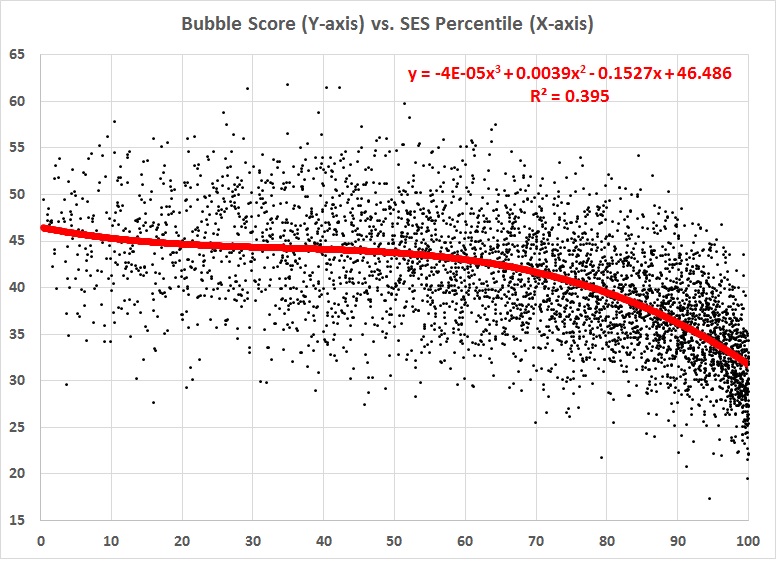
Bubble score vs. SES percentile
SES percentile refers to a measure of socioeconomic status that takes into account a person’s income, education, and occupation.

Where’s the dividing line — the “knee of the curve” in pseudo-scientific parlance? There’s isn’t one: As a brilliant former colleague put it, curves don’t have knees. In fact, there’s a lot of overlap in bubble scores across the full range of SES values. That overlap is consistent with the r-squared of the polynomial fit, which means that SES explains only 40 percent of the bubble score.

The real problem with American “society” is a kind of moral decay, brought on in great part by dependency on government. Working-class people of my father’s generation didn’t look to government for betterment; they just went out and worked, and usually bettered themselves.

Moreover, working-class people and upper-class “liberals” weren’t inundated by a lot of envy-inducing media blather about “crony capitalism” and “assortive mating.” (See the articles by Buckley and Edsall.) Crony capitalists (a relative handful among 320 million Americans) are the kind of people who would do well under any system — even including Soviet-style communism, which rewards ambition and intelligence, just in different ways than capitalism.

The whining about assortive mating is pointless and hypocritical. Those who engage in such whining would be appalled if government required mating across income levels — a kind of social engineering on a par with China’s one-baby policy. I doubt that affluent left-wing graduates of prestigious universities would countenance such a policy. And if they wouldn’t, what are they whining about?

And what about the obvious fact that high-income persons live in areas that poor people can’t afford. That’s hardly a new thing. But thanks to (relatively) free markets that reward the combination of intelligence-education-effort, there are proportionally more people who are in a position to live in areas that poor people can’t afford. Isn’t that exactly what most striving poor and middle-income persons want? What’s the problem?

I can understand Edsall’s preoccupation with social distancing; he’s a left-leaner who probably wants government to “do something” about it. Murray’s motivation is harder to understand given his libertarianish politics. But it’s evident that he’s been playing into the hands of do-something leftists, albeit unintentionally.

What will happen if government tries to “do something,” that is, more than it has already done (in vain) about supposed social distancing? The “something” is unlikely to be deregulation, tax-code reform, or anything that reduces government’s economic role. The “something” is more likely to be more preferences and handouts that reinforce and expand the cycle of dependency, thus lessening the urge to strive. The spreading rot will bring calls for yet more government action, which will further spread the rot, and so on into America’s dark, dystopian, “European” future.

*      *      *

Related posts:

In Defense of the 1%

Race and Reason: The Achievement Gap — Causes and Implications

IQ, Political Correctness, and America’s Present Condition

Alienation

Income Inequality and Economic Growth

A Case for Redistribution, Not Made

Greed, Conscience, and Big Government

The Rahn Curve Revisited

The Slow-Motion Collapse of the Economy

Nature, Nurture, and Inequality

How to Eradicate the Welfare State, and How Not to Do It

Diminishing Marginal Utility and the Redistributive Urge

Tolerance

Privilege, Power, and Hypocrisy

Capitalism, Competition, Prosperity, and Happiness

American Express Scores an “Own Goal”

Looking for a cash-back rewards card? Enticed by the offerings of American Express? Think twice. I’ve had an American Express cash-back card for 15 years, but I’m no longer using it. Why? Because American Express owes me three months’ worth of rewards. American Express keeps promising to bring my account up to date, but the promises have been empty ones.

I’ve switched to two other cards that offer cash-back rewards, at a slightly lower rate than I used to earn at American Express. (You can find such cards by going to this page at Bankrate.com.) But the two cards offer generous bonuses ($150 and $100) for charging $500 to them in the first 90 days of use, so in the course of a year, that will more than make up for American Express’s slightly higher but unreliable cash-back rate.

Will I go back to American Express? Probably not. Even in the unlikely event that the issuers of both cards that I’m now using prove as unreliable as American Express, I’ll just try other cards with similar cash-back rates.

American Express has scored an “own goal“; that is, its own actions have prompted me to give my business to its competitors.

There’s More to It Than Religious Liberty

Many opponents of ordinances and statutes that mandate things like gay-wedding cake-baking cast their opposition as a matter of religious liberty. But such opposition isn’t just about religious liberty, it’s about liberty — period. The liberty of free people to choose with whom they will associate and do business.

What about ordinances and statutes that grant restroom choice to gender-confused persons, voyeurs, and predators. Isn’t that a matter of freedom of association? Only for the gender-confused, the voyeurs, and the predators. Most people don’t relish the invasion of a very private space by those who wish to “make a statement,” or worse.

Law-makers of various stripes — from the justices of the U.S. Supreme Court to the city council of Charlotte — seem to have lost sight of the deep wisdom that’s embedded in long-standing social norms. Whether the norm is the definition of marriage as a union of one man and one woman or the segregation of restrooms by (visible) gender, it serves a socially valuable function by encouraging constructive behavior (e.g., the rearing of children in a stable home environment with role models of both sexes) and discouraging destructive behavior (e.g., uninvited intimacy).

As I say, there’s more to it than religious liberty.

*     *     *

Related posts:

Two-Percent Tyranny

How to Protect Property Rights and Freedom of Association and Expression

How Government Subverts Social Norms

Identity and Crime

Ty Cobb and the State of Science

This post was inspired by “Layman’s Guide to Understanding Scientific Research” at bluebird of bitterness.

The thing about history is that it’s chock full of lies. Well, a lot of the lies are just incomplete statements of the truth. Think of history as an artificially smooth surface, where gaps in knowledge have been filled by assumptions and guesses, and where facts that don’t match the surrounding terrain have been sanded down. Charles Leershen offers an excellent example of the lies that became “history” in his essay “Who Was Ty Cobb? The History We Know That’s Wrong.” (I’m now reading the book on which the essay is based, and it tells the same tale, at length.)

Science is much like history in its illusory certainty. Stand back from things far enough and you see a smooth, mathematical relationship. Look closer, however, and you find rough patches. A classic example is found in physics, where the big picture of general relativity doesn’t mesh with the small picture of quantum mechanics.

Science is based on guesses, also known as hypotheses. The guesses are usually informed by observation, but they are guesses nonetheless. Even when a guess has been lent credence by tests and observations, it only becomes a theory — a working model of a limited aspect of physical reality. A theory is never proven; it can only be disproved.

Science, in other words, is never “settled.” Napoleon is supposed to have said “What is history but a fable agreed upon?” It seems, increasingly, that so-called scientific facts are nothing but a fable that some agree upon because they wish to use those “facts” as a weapon with which to advance their careers and political agendas. Or they simply wish to align themselves with the majority, just as Barack Obama’s popularity soared (for a few months) after he was re-elected.

*     *     *

Related reading:

Wikipedia, “Replication Crisis

John P.A. Ionnidis, “Why Most Published Research Findings Are False,” PLOS Medicine, August 30, 2005

Liberty Corner, “Science’s Anti-Scientific Bent,” April 12, 2006

Politics & Prosperity, “Modeling Is Not Science,” April 8, 2009

Politics & Prosperity, “Physics Envy,” May 26, 2010

Politics & Prosperity, “Demystifying Science,” October 5, 2011 (also see the long list of related posts at the bottom)

Politics & Prosperity, “The Science Is Settled,” May 25, 2014

Politics & Prosperity, “The Limits of Science, Illustrated by Scientists,” July 28, 2014

Steven E. Koonin, “Climate Science Is Not Settled,” WSJ.com, September 19, 2014

Joel Achenbach, “No, Science’s Reproducibility Problem Is Not Limited to Psychology,” The Washington Post, August 28, 2015

William A. Wilson, “Scientific Regress,” First Things, May 2016

Jonah Goldberg, “Who Are the Real Deniers of Science?AEI.org, May 20, 2016

Steven Hayward, “The Crisis of Scientific Credibility,” Power Line, May 25, 2016

There’s a lot more here.

Untimely Deaths

The late Prince Rogers Nelson (a.k.a. Prince), a late-20th and early-21st century “musician,” seems to have died of the usual causes. Some will call his death untimely because of the relatively early age at which he succumbed. I can easily think of many real musicians who died before or at the age of 57. The following eclectic list of names (with biographical links), gives the age at which each musician died and a link to a representative recording of his or her work:

Russ Columbo, 26, “Goodnight Sweetheart” (1931)

Bix Beiderbecke, 28, “Somebody Stole My Gal” (1928)

Jimmie Rodgers, 35, “Blue Yodel Number 1 (T for Texas)” (ca. 1930)

Fritz Wunderlich, 35, “Dein ist mein ganzes Herz“* (ca. 1965)

Joseph Schmidt, 38, “Dein ist mein ganzes Herz“* (1930s)

Glenn Miller, 40, “Chattanooga Choo Choo,” (1941)

Kathleen Ferrier, 41, “Ombra mai fù“** (1949)

Helen Morgan, 41, “Body and Soul” (1930)

Al Bowlly, 43, “Did You Ever See a Dream Walking?” (1933)

Django Reinhardt, 43, “Ain’t Misbehavin’” (with the Quintette of the Hot Club of France, 1937)

Bessie Smith, 43, “St. Louis Blues” (1925)

Mildred Bailey, 44, “Georgia on My Mind” (1931)

Franklyn Baur, 47, “When My Dreams Come True” (1929)

Enrico Caruso, 48, “Questo o quella” (1908)

Leonard Warren, 48, “Largo al factotum” (1940s or 1950s)

Jussi Björling, 49, “Duet” (from Bizet’s The Pearl Fishers, 1940s or 1950s, with Robert Merrill)

Tommy Dorsey, 51, “Daddy Change Your Mind” (1929)

Jimmy Dorsey, 53, “Oodles of Noodles” (1932)

Ma Rainey, 53, “Farewell Daddy Blues” (1924)

Richard Tauber, 56, “Dein ist mein ganzes Herz“* (1920s or 1930s)

James Melton, 57, “Make Believe” (1932)

__________
* I chose the same song for Wunderlich, Schmidt, and Tauber just for the fun of it. “Dein ist mein ganzes Herz” is from Franz Lehár‘s The Land of Smiles (1929). The song, like many of Lehár’s, was written for Tauber, who had the perfect voice for Lehár’s lushly romantic melodies.

** If Ferrier’s rendition doesn’t send a chill up your spine and cause you to choke up, you had better check yourself for a pulse.

A Thought for Earth Day

This is an old one, and I don’t remember where I first saw or heard it:

NUKE THE WHALES.

Identity and Crime

“transgender” people aren’t: they’re just crazy.

Gregory Cochran, physicist and anthropological geneticist,
writing at West Hunter

*     *     *

The current craze for self-definition suggests a cure for crime: Deny its existence.

If a biological male (female) can claim to be a female (male), and his (her) claim can be upheld by a court and given credence by major corporations,* it follows that a criminal can simply deny that he is a criminal.

End of crime problem. Police forces and courts can be disbanded, and the savings passed on to taxpayers.

Oh wait, that won’t happen. The savings will be used to subsidize the purchase of gender-appropriate clothing, sex-change operations, hormone treatments, voice coaching, and other trappings of terminal gender confusion.

_________
* Recent examples are Target’s decision to allow self-declared transsexuals to enter the fitting rooms and restrooms of their choice, and ESPN’s firing of Curt Shilling for openly stating his opposition to such lunacy.

Turning Points

American Revolution — 1775-1783. The Colonies became sovereign States, bound by a compact (the Articles of Confederation) in which each State clearly retained its sovereignty. And yet, those sovereign States, bound by a common language and culture, successfully banded together to defeat a stronger enemy.

Drafting and ratification of the U.S. Constitution — 1787-1790. The States, relying on the hopes of the Framers, entered into a compact which created a national government that, inevitably, would subsume the power and authority of the States.

Nullification Crisis — 1832-1833. An attempt by South Carolina to reject an unconstitutional act of Congress was stifled by a threat of military intervention by the national government. This set the stage for…

Civil War and Texas v. White — 1861-1865 and 1869. Regardless of the motivation for secession, the Southern States acted legally in seceding. Mr. Lincoln’s romantic (if not power-hungry) quest for perpetual union led not only to the bloodiest conflict ever likely to be fought on American soil, but also undoubtedly deterred any future attempt to secede. The majority opinion in Texas v. White essentially ruled that might makes right when it converted a military victory into an (invalid) holding against the constitutionality of secession.

The assassination of William McKinley — 1901. This elevated Theodore Roosevelt to the presidency. Roosevelt’s extra-constitutional activism    became the exemplar for most of the presidents who followed him — especially (though not exclusively) the Democrats.

Ratification of the 16th and 17th Amendments to the Constitution, and creation of the Federal Reserve system — 1913. The amendments enabled the national income tax and wrested control of U.S. Senate seats from State legislatures, thus ensuring the aggrandizement of the national government and the subjugation of the States. The creation of the Fed gave the national government yet another tool for exercising central control of the economy — a tool that has often been used with disastrous results for Americans.

The stock-market crash of 1929. The Fed’s policies contributed to the crash and helped turn what would have been a transitory financial crisis into the Great Depression. This one-off series of events set the stage for an unprecedented power grab by the national government — the New Deal — which was aided by several spineless Supreme Court rulings. Thus empowered, the national government has spent most of the past 80 years enlarging on the New Deal, with additional help from the Supreme Court along the way.

The assassination of John F. Kennedy — 1963. This assassination, like that of McKinley, led to the elevation of a hyper-active politician whose twin legacies were the expansion of the New Deal and the eventual demise of the ultimate guarantee of America’s security: military supremacy and the will to use it. Kennedy’s assassination also marked a cultural turning point that I have addressed elsewhere.

The Vietnam War — 1965-1973. The Korean War was a warmup for this one. The losing strategy of gradualism, and a (predictable) loss dictated by the media and academe was followed, as day follows night, by a wave of unilateral disarmament. Reagan’s rearmament and a quick (but incomplete) victory in the Gulf War merely set the stage for the next wave of unilateral disarmament, which was reversed, briefly, by the shock of 9/11. The wars that followed in Iraq and Afghanistan were fought with the same vacillation and vituperation (from media and academe) as the Vietnam War. Unilateral disarmament continues, even as Russia and China become militarily stronger and bolder in their international gestures.

The demise of economic and social liberty in the United States, which is the predictable result of the growth of the national government’s power, will matter not one whit when the U.S. is surrounded by and effectively dictated to by the great powers to its east and west.

As the world turns: from Colonies to colonies.


Amen to That

Paul Mirengoff offers “More Evidence of Our Under-Incarceration Problem“:

I’ve argued that America has an under-incarceration problem. Criminals whose records clearly show they should be in jail have, instead, been released and are on the streets committing violent crimes, including some very bloody, high-profile ones.

Here’s another example. Samuel Harviley, paroled from prison less than three months ago, is being held without bond for shooting an off-duty Chicago police officer outside his home earlier this week. In withholding bond, the local judge said that Harviley “poses an extreme danger to the rest of us out in public.”

Indeed, he does. And he did three months ago when he was released early from jail….

Sentencing reform is, indeed, called for. The system should be reformed so that criminals like Harviley don’t get out of prison after serving less than their half of their sentence. As Chicago Patrol Chief Eddie Johnson says, the Harviley shooting illustrates that the criminal justice system “is broken.” He added:

Until we get real criminal justice reform, the cycle will continue. We have the laws here. We just need to make sure that these criminals are held accountable for their actions.

What a quaint notion.

None of this is news to me. See, for example, “Crime Explained” (fifth item) at this post. The bottom line:

Incarceration has a strong, statistically significant, negative effect on the violent-property crime rate. In other words, more prisoners = less crime against persons and their property.

An Unsolicited Endorsement

I’ve tried many feed readers (a.k.a. RSS aggregators). The best of the bunch, so far, is NewsBlur (newsblur.com). The things I like about it:

It’s web-based rather than a stand-alone program.

A free subscription allows for 64 feeds, which is a generous number. (I currently have 42 feeds, most of them blogs.)

The layout is clean. The default layout is three panes: feeds (sources) on the left; links (with summaries) in the center, grouped by feed; link content (e.g., a blog post) on the right, with images and internal links displayed in web-page format.

Unread left-pane links are highlighted in bold. They’re automatically “read” as the user scrolls through them, and the content automatically displays in the right pane as the user scrolls through them.

I’m not sure how long “read” links remain available, but I began to scroll through the links of a prolific blog and finally quit when I was 8 days into the past.

It’s easy to open a link in a new tab for viewing at full size, thought the right-pane views are good for short articles.

I’m sure there are other worthwhile features. But I’ve only been using NewsBlur for a few days and haven’t had time to fully explore and exploit its design.


My Defense of the A-Bomb

The word is that Obama plans to stop by Hiroshima and apologize for the dropping of an A-bomb on that city. That dropping of A-bombs on Hiroshima and Nagasaki (three days later) ended World War II. Like many others, I have defended the decision by President Truman to drop the bombs on utilitarian grounds. In this post, for example, I quote Richard B. Frank:

The critics [of the use of the A-bomb to defeat Japan] share three fundamental premises. The first is that Japan’s situation in 1945 was catastrophically hopeless. The second is that Japan’s leaders recognized that fact and were seeking to surrender in the summer of 1945. The third is that thanks to decoded Japanese diplomatic messages, American leaders knew that Japan was about to surrender when they unleashed needless nuclear devastation. The critics divide over what prompted the decision to drop the bombs in spite of the impending surrender, with the most provocative arguments focusing on Washington’s desire to intimidate the Kremlin. Among an important stratum of American society–and still more perhaps abroad–the critics’ interpretation displaced the traditionalist view….

[I]t is clear [from a review of the evidence now available] that all three of the critics’ central premises are wrong. The Japanese did not see their situation as catastrophically hopeless. They were not seeking to surrender, but pursuing a negotiated end to the war that preserved the old order in Japan, not just a figurehead emperor. Finally, thanks to radio intelligence, American leaders, far from knowing that peace was at hand, understood–as one analytical piece in the “Magic” Far East Summary stated in July 1945, after a review of both the military and diplomatic intercepts–that “until the Japanese leaders realize that an invasion can not be repelled, there is little likelihood that they will accept any peace terms satisfactory to the Allies.” This cannot be improved upon as a succinct and accurate summary of the military and diplomatic realities of the summer of 1945. [“Why Truman Dropped the Bomb,” The Weekly Standard, August 8, 2005]

Among the “countless lives” saved were those of Japanese as well as American nationals. I have in the past defended the dropping of the A-bombs because of the saving of “countless lives.” As a convert to the ranks of anti-utilitarianism, I now reject that argument. I cannot, in good conscience, assert with god-like authority that the killing of X people was worth the saving of Y lives, even where Y is vastly greater than X.

But I am nevertheless content to defend the dropping of the A-bombs because doing so very possibly saved certain lives. Six of my mother’s seven brothers served in the Navy during World War II. (The seventh had been in the Coast Guard several years before the war, and was ineligible for service because his skull was fractured in a civilian accident in 1941.) Had the war continued, a long and bloody invasion of Japan would have ensued. One or more of my uncles might have been killed or injured seriously. My grandmother, to whom I was greatly attached, would have suffered great emotional distress, as would have my aunts and many of my cousins. Their emotional distress and sadness would have become my emotional distress and sadness.

Beyond that, many Americans who had fought to defend the United States from the militaristic, authoritarian regimes in Tokyo and Berlin would have died. Their deaths would have affected many of my friends and their families, and would have made America a sadder and poorer place in which to live.

I empathize with the Japanese victims of the bombings of Hiroshima and Nagasaki, and with the Japanese victims of other attacks by U.S. armed forces. I hate the thought of death and suffering, unless they are deserved as punishment for wrong-doing, regardless of the nationality, religion, race, ethnicity, social class, or political views of the victim. But I do not equate the lives of those nearest and dearest to me with the lives of those distant from me. Liberals and left-libertarians like to pretend that they do, but they are either fools or liars when they say such things.

Today’s Driving Tips

Plan your trip. In this day of Google Maps and GPS, there’s no excuse for a sudden swerve across lanes of traffic to an exit.

If you fail to plan your trip — or if you’ve been daydreaming — and your exit suddenly looms, remember that a sudden swerve across lanes of traffic may have fatal consequences for you. (This is a possibility that doesn’t seem to occur to sudden swervers.)

A sudden swerve is not excused by the mere flick of a turn signal. A turn signal is given to indicate the driver’s intention. It is not a license to execute an illegal and dangerous maneuver. The signaler who intends to change lanes (or two or three of them) doesn’t have the right of way. It’s his responsibility to yield to the drivers whose lane(s) he intends to move into. And if he misses his exit, tough luck. That’s the price of failure to plan and/or inattention.

This message is brought to you as a public service by a driver who braves the wild and woolly highways of Austin, which are dominated by drivers whose practices mirror their (left-wing) politics.

Immigration and Crime

UPDATED 11/18/16 AND 01/25/19

Some all-out “open the floodgates” champions of unfettered immigration have averred that a further influx of Central Americans won’t raise the rate of crime in the United States. (I can’t cite sources, but I’m sure that I’ve read such pronouncements in the pseudo-libertarian sector of the blogosphere.) I’ve even been guilty of giving aid and comfort to the pseudo-libertarian position by posting “Hispanics and Crime,” wherein I cite the work of La Griffe du Lion.

Griffe (if I may be familiar) says this in “Crime and the Hispanic Effect“:

It has been conjectured that the contribution of Hispanics to violent crime is on the point of advancing to the standing enjoyed by blacks. This, however, is not confirmed by our evidence, at least in our largest cities. Whoever thinks or has thought this to be so has come to this determination from evidence not directly related to what is happening on the street, but rather from incarceration records, court appearances or sentencing data. When crimes rather than criminals are counted, and the Hispanic effect is appropriately removed, the data show that violent crime rates for Hispanics and non-Hispanic whites, though a bit higher for Hispanics, are in actual fact quite similar. As for blacks, their crime rate remains by any measure uniquely high.

And he has the numbers to prove it.

UPDATED BELOW — NEW NUMBERS, NEW CONCLUSIONS

For the sake of argument, I assume the following:

  • Whites and Hispanics already in the U.S. commit crimes at the same rate.
  • Hispanic immigrants (new ones, that is) are no more or less crime-prone than Hispanics already here.

It would seem to follow that Hispanic immigration hasn’t caused and won’t cause a rise in the rate at which crimes are committed in the U.S. But it ain’t necessarily so:

  1. Crime rates are computed for a given population, with a given density and demographic makeup. Immigration changes the density and demographic makeup of a population.
  2. If the rate of crime rises with the density of population, immigration will cause the rate of crime to rise, ceteris paribus.
  3. If immigration leads to more interactions between resentful whites and Hispanics — as it almost surely will — the rate of white-on-Hispanic crime will rise further.
  4. If immigration leads to more opportunities for Hispanics to attack whites because they’re white and to steal from more affluent persons (usually whites) — as it almost surely will — the rate of Hispanic-on-white crime will rise further.

My money’s on propositions 2, 3, and 4. Can anyone cite research pro or con?

Jared Taylor writes:

The Bureau of Justice Statistics (BJS) of the Department of Justice (DOJ) has released its annual “Crime in the US” report for 2015, and as has been widely noted, arrests for violent crime were up 3.7 percent over the previous year. Murder–up 11.8 percent–showed a sharper rise than at any time in the last 25 years. This rise in violent crime is a reversal of a steady, almost continuous decline since 1994….

…[S]ome agencies distinguished whites from Hispanics, but many just lumped Hispanics in with whites. The BJS reports the Hispanic/non-Hispanic information it gets from local agencies, but the information is so incomplete that most of the time it is impossible to calculate separate crime rates for whites and Hispanics. They have to be treated as a single group….

There are two groups–blacks and Asians–for whom BJS figures are clear and consistent. It is therefore possible to calculate accurate arrest rates for these groups and compare them to everyone else in the American population. The following table shows the multiples of arrest rates for blacks and Asians compared to non-blacks and non-Asians, respectively.

Black and Asian Multiples Compared to Non-Black and Non-Asian Offenders
Black Asian
Violent crime 3.7 0.26
Property crime 2.5 0.20

….

If we treat whites and Hispanics as a single group, we know that any individual black is 14 times more likely to kill a white or a Hispanic than the other way around. Again, the multiple would be higher if we were comparing blacks only to whites. We can also say with some confidence that a Hispanic is 2.7 times more likely than a white to kill a black person, and it appears that in this partial sample, more whites are killed by Hispanics (633) than by blacks (500). When a black is killed, 89.3 percent of killers are black. The BJS is mum on race in cases of murders involving multiple victims or killers.

The dramatic 11.8 percent rise in murders reported for 2015 has received a lot of attention, but is any particular racial group responsible for the increase? Both the BJS figures and press reports are silent on this question.

To arrive at the 11.8 percent increase, BJS–using data and estimates for the whole country and not simply passing on the partial data officially reported to it–says there were 15,192 murders in 2015, up from 13,594 in 2014. We can compare this increase to reported changes in the number of people of different races arrested for murder. BJS reported only 8,508 murder arrests for 2015. This low figure reflects not just that many murderers were not caught but also the limited reporting from police agencies that cover only 77.2 of the US population. But within this partial sample, there are race differences in the increase in arrests for murder. Compared to the total 2014 arrest figures, black arrests for 2015 were up by 123, Hispanic arrests by 62, “Others” (including American Indians and Pacific Islanders) by 54, and whites by only 39. Blacks therefore accounted for 44 percent of the increase from 2014 to 2015, Hispanics for 23 percent, and whites for only 14 percent. (These figures are based on BJS’s very partial reporting on Hispanics that certainly understates the number of Hispanic arrests for murder)….

A different calculation is possible based on BJS reports on race of murder offenders. Obviously the police don’t know the races of offenders they have not caught, and the proportion of “race unknown” rose from 29.7 percent in 2014 to 31.2 percent in 2015. For offenders whose race was known, the black increase was 447, as opposed a white increase of 221 and a Hispanic increase of 48. By this calculation as well, it is blacks–who were only 13.3 percent of the population–who accounted for the bulk of the rise in murders from 2014 to 2015.

There is an important BJS table that most people ignore. It is a supplemental table that lists arrests by race for criminals under the age of 18. This is one set of data for which the Hispanic/non-Hispanic data appear to be reliable, and the results are dramatic. The following table lists the multiple of the white arrest rate for blacks, Hispanics, and Asians for various crimes, along with the number of such crimes.

Multiples of White Arrest Rates for Offenders Under Age 18
Number Black X Hisp X Asian X
Violent crime 39,323 9.34 1.96 0.43
Property crime 160,234 4.28 1.11 0.41

….

Juveniles committed 601 murders, for example, and blacks were arrested for 361 of them, Hispanics for 118, and whites for only 116. When these figures are compared to the under-18 population (whites: 37.8 million, blacks: 9 million, Hispanics: 18.1 million, Asians: 3.5 million) black juveniles are arrested for murder at nearly 19 times the white rate, with Hispanics at 3.6 times the white rate. The arrest multiples for robbery are even more extreme: 35.8 times for blacks and 5 times for Hispanics. Whites were arrested for only 11.8 percent of the 14,142 robberies committed by juveniles in 2015….

Besides the serious deficiencies in federal crime data noted above, the 2015 National Crime Victimization Survey failed to report the data on the race of perpetrators. The NCVS survey of violent crime victims always asks for the race of the perpetrator, so the BJS has this information. However, since taking office, the Obama administration has almost never released it. Heather Mac Donald of the Manhattan Institute managed to get and publish the data for 2013, but the 2015 data are still locked up somewhere at DOJ.

Our analysis of the 2013 data found that of the 650,000 acts of violence involving blacks and whites, blacks were the attackers 85 percent of the time, which meant any given black was 27 times more likely to attack a white than the other way around. It is no doubt because of these dramatic race differences that Attorney General Loretta Lynch and her predecessor Eric Holder have refused to release these data. [“Murders Shot Up in 2015,” American Renaissance, November 18, 2016]

It would seem to follow that Hispanic immigration has caused and will cause a rise in the rate at which crimes are committed in the U.S. Moreover,

  1. Crime rates are computed for a given population, with a given density and demographic makeup. Immigration changes the density and demographic makeup of a population.
  2. If the rate of crime rises with the density of population, immigration will cause the rate of crime to rise, ceteris paribus.
  3. If immigration leads to more interactions between resentful whites and Hispanics — as it almost surely will — the rate of white-on-Hispanic crime will rise further.
  4. If immigration leads to more opportunities for Hispanics to attack whites because they’re white and to steal from more affluent persons (usually whites) — as it almost surely will — the rate of Hispanic-on-white crime will rise further.

ADDED 01/25/19:

Guess what? I was right.

Pedro Gonzalez writes about

[Alex] Nowrasteh [who] claims to have “found that undocumented immigrants still committed crimes at a rate “32 percent below that of native-born Americans.”

Nowrasteh came to this conclusion by ignoring data and details that would have challenged his findings. Nowrasteh, moreover, engages in some sleight of hand. If we consider that, in California, for example, the number of U.S.-born children of illegal aliens is twice the entire population of Wyoming, the question becomes, who are those “native-born” criminals?

Barry Latzer clinches it:

Among all arrests for selected offenses over the period 2012 to 2017, illegal aliens were taken into custody for homicide (which includes murder and manslaughter) in numbers greater than their population size would predict. They accounted for nearly 10 percent of all apprehended killers, whereas, using the high-end DHS estimate, they make up 7.3 percent of the Texas population….

The crime of homicide provides the most accurate measure … because a much higher proportion of murders are solved by police—around 70 percent—than for any other crime; by contrast, fewer than 15 percent of property offenses lead to an arrest. As a result, we have much more accurate demographics for murderers than for, say, burglars. The indication that illegal aliens commit disproportionate numbers of murders is corroborated by crime rates, shaky though they may be, for 2014 and 2015—the two years for which we have population estimates from Pew and DHS. In 2014, Texas illegal-alien murder-arrest rates were 4.99 per 100,000—56 percent higher than the rates for all other apprehended murderers (3.2 per 100,000). In 2015, the rates were 35 percent higher for illegal aliens (4.2 per 100,000, versus 3.1 per 100,000).

Granted, neither the rates nor the percentages of illegal aliens arrested are overwhelmingly high. And the rates and percentages for other crimes that they commit are below those of the arrested citizen and legal-alien populations. Still, illegal aliens account for nearly 10 percent of the apprehended murderers in Texas, and over 39,000 of the annual arrests for crime overall. These figures are significant, reflecting crime in a single state with an outsize number of illegal aliens—a small part of the nationwide picture.

No amount of crime by those who enter this country unlawfully should be acceptable, because it is “extra” crime that wouldn’t occur if our border security were effective. [Emphasis added.]

Case closed.

How Government Subverts Social Norms

Arnold Kling observes that

humans have a fundamental rule of social morality, which is: Reward cooperators; punish defectors. The use of this rule is what enables humans to work effectively with strangers, making possible sophisticated economies and civilizations….

Generally, a cooperator is someone who obeys social norms without requiring coercion. A defector is someone who takes advantage of others by disobeying social norms.

Along come “activists”: persons who seek to advance a particular cause or group of persons, usually without regard for the effects on social comity and often for the sheer pleasure of “sticking it to the man,” Obama-like. Through the use of courts and legislatures, these “activists” reshape legal norms — welfare as a right, capital punishment (for murder) as a wrong, abortion (murder) as a right, wealth accumulation as (somehow) anti-social, homosexual “marriage” as just another form of marriage, and on and on.

The vast, wishy-washy middle is easily influenced. Ensconced in the relative comfort of the nanny-welfare state, the middle too often acquiesces in the edicts of the state to which it (falsely) attributes its relative comfort. When the minions of the state speak, the wishy-washy middle listens.

The sole exception of which I am aware has been widespread resistance to legalized abortion, a movement that has found backing in the GOP-controlled legislatures of several States. Dislike of Obamacare, on the other hand, has resulted in only some minor victories for religious freedom, while public opinion slowly warms to the prospect of “free” medical care and more generous drug benefits.

The general wishy-washiness that greets governmental subversion of long-standing, civilizing norms is a symptom of the capitalist paradox: The successes of capitalism separate people from the lessons that served them well when life was more fraught and survival depended more heavily on social comity. (The idea that “social media” bonds mere acquaintances and total strangers is laughable.)

Britain is the model for social disintegration and the economic stagnation that accompanies it. A polite, hardworking, law-abiding “nation of shopkeepers” has been transformed into a nation of loud, dole-demanding, beer-swilling, rib-kicking yobs — male and female.

On the evidence of news reports and what passes for entertainment these days, the U.S. is following in Britain’s footsteps. And most of the blame belongs to the “activists” and elites who have worked so hard to subvert long-standing social norms.


Assuming a Pretzel-Like Shape

Will Wilkinson — of whom I’ve written many times (e.g., here) — twists his brain into a pretzel-like shape while trying to reconcile libertarianism with what he calls neoclassical liberalism. In essence, Wilkinson and his ideological allies have concocted an after-the-fact justification for the past 80 years of governance in the United States. That is to say, they prefer a fascistic nanny state to a truly libertarian regime, but can’t bring themselves to admit it. So they concoct “libertarian” arguments for “positive liberty” and “social justice,” which necessarily require the state to shrink the zone of true liberty — negative liberty — until it vanishes.

My War on the Misuse of Probability

In the preceding post I say that “the problem with history is that the future isn’t part of it.” That is subtle criticism of the too-frequent practice of attributing a probability to the occurrence of a future event — especially a unique event, such as a war here or a terrorist attack there.

A probability is a statement about a very large number of like events, each of which has an unpredictable (random) outcome. Probability, properly understood, says nothing about the outcome of an individual event. It certainly says nothing about what will happen next.

A fair coin comes up heads with a probability of 0.5, and comes up tails with the same probability. But those aren’t statements about the outcome of the next coin toss. No, they’re statements about the approximate frequencies of the occurrence of heads and tails in a large number of tosses. The next coin toss will eventuate in heads or tails, but not 0.5 heads and 0.5 tails (except in the rare and unpredictable case of a coin landing on edge and staying there).

There’s a vast gap between routine processes of the kind to which probabilities attach — coin tosses, for example — and the complexities of human activity. Human activity is too complex and dependent on intentions and willful actions to be characterized (properly) by statements about the probability of this or that action.

It is fatuous to say, for example, that a war on the scale of World War II is improbable because such a war has occurred only once in human history. By that reasoning, one could have said confidently in 1938 that a war on the scale of World War II could never occur because there had been no such war in human history.

(Inspired by Bryan Caplan’s fatuous post, “So Far.”)

The Old Normal

The recent terrorist attacks in Brussels and Lahore might lead the impressionable to conclude that the world is falling apart. I submit that terrorist attacks shock because they occur against a backdrop of relative peacefulness. Yes, there are wars here and there, but they are mere skirmishes — albeit with tragic consequences for many — compared with what happened in the twentieth century.

From 1914 to 1973 — a span of two generations — World War I, World War II, the Korean War, the Vietnam War, and the genocides presided over by Stalin, Hitler, and Mao produced casualties on a scale never attained before or since.  Despite subsequent events — the Soviet invasion of Afghanistan, the Gulf War, the wars in Afghanistan and Iraq, and dozens of terror attacks, large and small in scale — the world today is more quiescent than it has been in more than a century.

But the problem with history is that the future isn’t part of it. It is fatuous to suggest, as some have, that the better angels of our nature have conquered violence on a twentieth-century scale. That was the prevailing view in Europe for several years before the outbreak of World War I.

Violence is in fact an essential, ineradicable component of human nature. There will always be armed conflict, and sometimes it will involve the forces of many nations. The proximate causes and timing of war are unpredictable. Conciliatory gestures can be just as provocative as saber-rattling; the former can be taken as as sign of weakness and unpreparedness, the latter as a sign of resolve and preparedness.

If history holds any lesson regarding war, it is this one: Hope for the best but prepare for the worst. This is a lesson that American leftists seem dead set on ignoring.