Restoring Constitutional Government: The Way Ahead

See “The Constitution: Myths and Realities“.

Good news …

… for a change.

Despite my pessimism about America, the pathway to the future sometimes rises.

First:

The Texas Senate late Friday passed tough new abortion restrictions after weeks of protests, sending them to Gov. Rick Perry to sign into law. (Source)

George Zimmerman has been acquitted of all charges in the February 2012 shooting death of 17-year-old Trayvon Martin in Sanford, Fla.

Thus my week ends on a high note.

Not-So-Random Thoughts (VII)

Links to the other posts in this occasional series may be found at “Favorite Posts,” just below the list of topics.

UPDATED 07/14/13

In “The Reality of the Wartime Economy,” Steven Horwitz and Michael J. McPhillips bang the drum for Robert Higgs’s account of the role of World War II in ending the Great Depression. Horwitz and McPhillips conclude:

The debate over World War II’s role in ending the Great Depression has enormous relevance in connection with the current anemic recovery from the Great Recession. We have offered evidence to support Robert Higgs’s argument that the wartime macroeconomic data significantly overstated the degree of genuine economic recovery. Higgs’s evidence rests on his reinterpretation of several traditional macroeconomic indicators to compensate for the distinct features of a wartime economy. We show that if one digs below the aggregates and looks at how American households lived during the war, as shown in the media, letters, and journals, Higgs’s case appears to be even stronger. Whatever the war’s effects on seemingly booming conventional macroeconomic aggregates, it entailed a retrogression in the average American’s living standards, and that disconnect should alert us to those aggregates’ limitations. Whenever government commands resources, those who finance this acquisition, whether through taxation or purchase of government bonds, incur opportunity costs. Whether the diverted resources go toward building tanks and guns or toward repairing bridges and roads does not alter this fact. As we continue to debate the effectiveness of large-scale government expenditure to speed recovery from the Great Recession, we should not be looking at the wartime experience of the 1940s as a guide.

I quite agree with the bottom line. (See especially my posts “A Keynesian Fantasy Land” and “The Keynesian Fallacy and Regime Uncertainty.”) But there is reason to believe that the glut of saving during World War II helped to fuel the post-war recovery. (See my posts “How the Great Depression Ended” and “Does ‘Pent Up’ Demand Explain the Post-War Recovery?“)

*     *     *

Highly recommended: “What Difference Would Banning Guns Make?” at Political Calculations. The answer is “not much, if any.” Violence will out, especially when the demographics are right (or wrong, if you will). Which leads to my post “Crime, Explained.”

*     *    *

A Bipartisan Nation of Beneficiaries” (The Pew Report, December 18, 2012) suggests (unsurprisingly) that

a majority of Americans (55%) have received government benefits from at least one of the six best-known federal entitlement programs.

The survey also finds that most Democrats (60%) and Republicans (52%) say they have benefited from a major entitlement program at some point in their lives. So have nearly equal shares of self-identifying conservatives (57%), liberals (53%) and moderates (53%).

What choice is there when the state (a) robs us blind and (b) penalizes initiative and success? In those conditions, most of us respond as one would expect — by feeding at the public trough. See, for example, “The Interest-Group Paradox.”

*     *     *

An increasingly regulated economy, that’s what we have, according to “Counting All the U.S. Government’s Regulations” (Political Calculations, October 18, 2012). And a heavy price we pay for it, as I’ve documented in “The Price of Government, Once More,” and the many posts linked to therein.

*     *     *

UPDATES:

Rich Lowry of National Review, famous mainly for having fired John Derbyshire, continues his attack on what Timothy Sandefur calls “Doughface libertarians”:

… Lincoln said, “I have no purpose to introduce political and social equality between the white and black races.” How could he say such a thing? Well, he said it in his debates with Stephen Douglas, when he was playing defense…. (“The Rancid Abraham Lincoln-Haters of the Libertarian Right,” The Daily Beast, June 17, 2013)

Not so fast, Mr. Lowry. Lincoln wasn’t just playing defense. See “The Hidden Tragedy of the Assassination of Abraham Lincoln,” wherein Lincoln’s plan for the colonization of blacks is discussed.

*     *     *

From Michael Ruse’s “Does Life Have a Purpose?” (Aeon, June 24, 2013):

… Today’s scientists are pretty certain that the problem of teleology at the individual organism level has been licked. Darwin really was right. Natural selection explains the design-like nature of organisms and their characteristics, without any need to talk about final causes. On the other hand, no natural selection lies behind mountains and rivers and whole planets. They are not design-like. That is why teleological talk is inappropriate….

This reminds me of Sandefur’s post, “Teleology without God,” which I addressed in “Evolution, Human Nature, and ‘Natural Rights’” and “More Thoughts about Evolutionary Teleology.”

America: Past, Present, and Future

This post (promised here) is my assessment of the past 50 years of life in America. I have opted for brevity instead of essaying a detailed analysis of cultural, political, and economic changes of the past 50 years. There is, after all, nothing fundamentally unique about the events of the past 50 years, which — in most respects — merely extend and amplify trends that began earlier.

The present condition of America owes much, for example, to the struggle between the proponents of limited government and the proponents of statism — a struggle that began in earnest with the onset of the “progressive” movement in the latter part of the 19th century. The Great Depression and World War II solidified the devotion of most Americans — and especially over-educated elites — to the cult of the state. Relief from the privations of the Great Depression, when it finally came after World War II, fostered the cult of the child and financed the growth of institutions whose denizens (politicians, bureaucrats, professors, and purveyors of entertainment) grew increasingly detached from the vicissitudes of daily life and increasingly attached to utopian schemes for the betterment of the unwashed masses from who they eagerly distance themselves.

I could go on (and on) in that vein, but I promised to be brief, and I shall be. The America of the past 50 years was shaped largely by the following, interwoven trends:

  • state-sponsored and state-imposed abandonment of personal responsibility (with special dispensations for criminals, incompetents, and “protected” groups, accompanied by penalties for private initiative and success)
  • usurpation and negation of private social and economic arrangements by the state (from charity to marriage, and much in between, most notably free markets)
  • state sponsorship of socially and economically subversive institutions, and the related growth of the “technocratic” class (unions, “educators,” and bureaucracies, for a start)
  • technocratic control of the state, in the service of “progressivism” (from the ICC in 1887 to today’s plethora of regulatory agencies and their hired guns)
  • denial of human nature and the limits it imposes on the effectiveness of technocratic “solutions” (magical thinking about the perfectibility of humans and the wonderfulness of government action)
  • growing gap between “real people” and their technocratic masters (third item in “Related Reading,” below)
  • cult of the child and prolongation of childhood (too little discipline, too much dependency — poor lessons for living with others)
  • decline of decorum and civility (as mirrored in and encouraged by “entertainment” that is loud, lewd, and crude in the nth degree).

If America was ever close to being a nation united and free, it has drifted far from that condition — arguably, almost as far as it  had by 1861. And America’s condition will only worsen unless leaders emerge who will set the nation (or a large, independent portion of it) back on course. Barring the emergence of such leaders, America will continue to slide into baseness, divisiveness, and servitude.

That is my view of America’s past 50 years, its present condition, and its future — barring drastic remedial action.

*     *     *

Related reading:
Arnold Kling, “Our New Technocratic Masters,” Askblog, February 3, 2013
Victor Davis Hanson, “The Glue Holding America Together,” RealClearPolitics, June 28, 2013
Victor Davis Hanson,”Liberal Apartheid,” RealClearPolitics, July 8, 2013

*     *     *

Related posts:
The Shape of Things to Come
Intellectuals and Capitalism
“Intellectuals and Society”: A Review
The Left’s Agenda
The Left and Its Delusions
The Spoiled Children of Capitalism
Politics, Sophistry, and the Academy
Subsidizing the Enemies of Liberty
Are You in the Bubble?
Race and Reason: The Victims of Affirmative Action
Race and Reason: The Achievement Gap — Causes and Implications
Secession
A New, New Constitution
Secession Redux
A New Cold War or Secession?
The Real Constitution and Civil Disobedience
A Declaration of Independence
First Principles
The Constitution: Original Meaning, Corruption, and Restoration
Reclaiming Liberty throughout the Land
Secession for All Seasons
Government in Macroeconomic Perspective
Where We Are, Economically
Keynesianism: Upside-Down Economics in the Collectivist Cause
The Economic Outlook in Brief
Obamanomics: A Report Card
The 80-20 Rule, Illustrated
Lock ‘Em Up
Legislating Morality
Legislating Morality (II)
Free Will, Crime, and Punishment
Liberty and Society
Tolerance on the Left
The Eclipse of “Old America”
Genetic Kinship and Society
A Contrarian View of Universal Suffrage
Well-Founded Pessimism
The Hidden Tragedy of the Assassination of Lincoln
A Wrong-Headed Take on Abortion
“Family Values,” Liberty, and the State
Is There Such a Thing as Society
Crimes against Humanity
Abortion and Logic
The Myth That Same-Sex “Marriage” Causes No Harm
Abortion, Doublethink, and Left-Wing Blather
Abortion, “Gay Rights,” and Liberty
Dan Quayle Was (Almost) Right
Defense as an Investment in Liberty and Prosperity

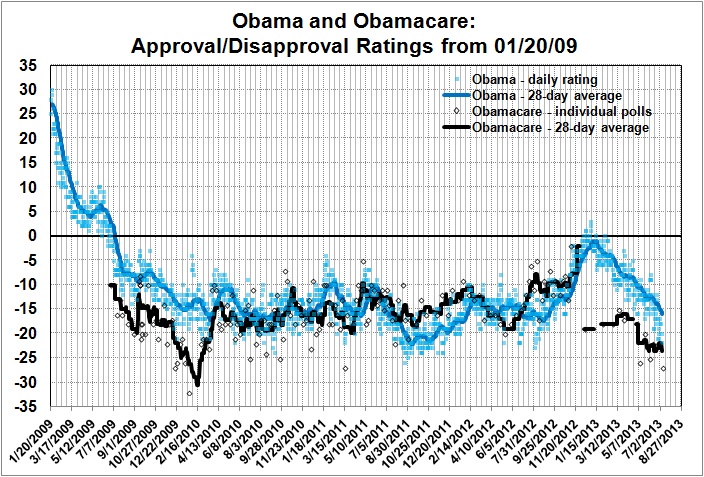
Obama and Obamacare, Back in the Dumps

Were it not for the fickleness of voters, we would be rid of Obama and Obamacare. Rasmussen’s latest poll results yield a net rating of -22 for Obama and a net rating of -27 for Obamacare. Compare those numbers with the ratings that prevailed from mid-2009 until late summer of 2012; contrast those numbers with Obama’s pre-election surge and short-lived post-election honeymoon:
Obama and Obamacare_approval-disapproval ratings
Sources: Rasmussen Reports, Obama Approval Index History and Health Care Law. Obama’s net disapproval rating measures the percentage of respondents who strongly approve of his performance, minus the percentage of respondents who strongly disapprove of his performance. The ratings for Obamacare are constructed as follows: For the period before Obamacare was signed into law on March 23, 2010, the numbers represent the percentage of respondents who strongly favored the passage of Obamacare, less the percentage of respondents who strongly opposed the passage of Obamacare. From the enactment of Obamacare to the present, the numbers represent the percentage of respondents who have strongly opposed the repeal of Obamacare, minus the percentage of respondents who have strongly favored the repeal of Obamacare.

A Golden Anniversary

I started my first “real” job on this date in 1963. It was a real job because, for the first time in my life, I became fully responsible for my fate and no longer dependent on parents and institutions of learning.

The job was in the D.C. area, a 600-mile drive from the university where I had recently ended my schooling. I had been to the D.C. area only once before, when I interviewed for the job. Though I was naturally anxious about “making it” in the big city, I exulted in my independence and the rich variety of experiences that could be mine.

What have I learned about life, love, and humanity in the past fifty years? I will essay an answer in a future post.

Obamanomics: A Report Card (Updated 07/06/13)

Here.

The Price of Government, Once More

I was pleased to read a recent post by Mark Perry, “Federal regulations have lowered real GDP growth by 2% per year since 1949 and made America 72% poorer.” It wasn’t the message that pleased me; it was the corroboration of what I have been saying for several years.

Regulation is one of the many counterproductive activities that is financed by government spending. The main economic effect of government spending, aside from regulation, is the deadweight loss it imposes on the economy; that is, it moves resources from productive uses to less productive, unproductive, and counterproductive ones. And then there is taxation (progressive and otherwise), which penalizes success and deters growth-producing investment.

All in all, the price of government is extremely high. But most voters are unaware of the price, and so they continue to elect and support the very “free lunch” politicians who are, in fact, robbing them blind.

Consider, for example, these posts by James Pethokoukis:
Is the Era of Fast U.S. Economic Growth Coming to an End?AEIdeas, July 13, 2013
My Counter: Why U.S. Economic Growth Doesn’t Have to Come to an End,” AEIdeas, August 23, 2012

Pethokoukis’s thesis, with which I agree, is that government — not lack of opportunity — is the main obstacle to the resumption of a high rate of growth.

For much more, see:
The Price of Government
The Price of Government Redux
The Mega-Depression
Ricardian Equivalence Reconsidered
The Real Burden of Government
The Rahn Curve at Work
The “Forthcoming Financial Collapse”
Estimating the Rahn Curve: Or, How Government Inhibits Economic Growth
The Deficit Commission’s Deficit of Understanding
The Bowles-Simpson Report
The Bowles-Simpson Band-Aid
The Stagnation Thesis
America’s Financial Crisis Is Now
Estimating the Rahn Curve: A Sequel
Lay My (Regulatory) Burden Down
More Evidence for the Rahn Curve


Socialist Romanticism

Jean-Jacques Rousseau:

If then we discard from the social compact what is not of its essence, we shall find that it reduces itself to the following terms—

“Each of us puts his person and all his power in common under the supreme direction of the general will, and, in our corporate capacity, we receive each member as an indivisible part of the whole.”

Barack Obama, echoing Jean-Jacques Rousseau (and his progeny, from Marx to Castro):

Together, we determined that a modern economy requires railroads and highways to speed travel and commerce, schools and colleges to train our workers.

Together, we discovered that a free market only thrives when there are rules to ensure competition and fair play.

Together, we resolved that a great nation must care for the vulnerable, and protect its people from life’s worst hazards and misfortune.

Max Eastman, deflating Rousseauvian-Obamian romanticism:

A false and undeliberated conception of what man is lies at the bottom … of the whole bubble-castle of socialist theory. Although few seem to realize it, Marxism rests on the romantic notion of Rousseau that nature endows men with the qualities necessary to be a free, equal, fraternal, family-like living together…. (Quoted in The Great Quotations, p. 876.)

State-imposed “togetherness” is a kind of imprisonment in which the inmates suffer the illusion of freedom.

I’ve Got a Little List …

… of irritating persons to be taken out and shot,
And who never would be missed–who never would be missed!
There’s the pestilential nuisances who shout into their phones,
Baring inner secrets at the volume of  trombones –
All people who wear stubbly beards and iridescent tats –
All children who are petulant and whiny little brats –
All drivers who in changing lanes do so without a glance –
And others who stare at green lights as if in lost a trance –
They’d none of ‘em be missed–they’d none of ‘em be missed!

CHORUS. He’s got ‘em on the list–he’s got ‘em on the list;
And they’ll none of ‘em be missed–they’ll none of
‘em be missed.

There’s the rap and hip-hop devotee, and the others of his ilk,
And the break-dance enthusiast–I’ve got him on the list!
And the people who eat a sushi roll and puff it in your face,
They never would be missed–they never would be missed!
Then the idiot who praises, with enthusiastic tone,
Films that don’t have endings, and all races but his own;
And the “lady” in the leotard, who looks just like a guy,
And who doesn’t need to marry, but would rather like to
try;
And that singular anomaly, the wealthy socialist–
I don’t think he’d be missed–I’m sure he’d not he missed!

CHORUS. He’s got him on the list–he’s got him on the list;
And I don’t think he’ll be missed–I’m sure
he’ll not be missed!

And that jurisprudential malcontent, who just now is rather rife,
The loose constructionist–I’ve got him on the list!
All perfumed fellows, girly men, and dykes who seek a “wife”–
They’d none of ‘em be missed–they’d none of ‘em be missed.
And apologetic statesmen of a compromising kind,
Such as–What d’ye call him–Thing’em-bob, and
likewise–Never-mind,
And ‘St–’st–’st–and What’s-his-name, and also You-know-who–
The task of filling up the blanks I’d rather leave to you.
But it really doesn’t matter whom you put upon the list,
For they’d none of ‘em be missed–they’d none of ‘em be
missed!

CHORUS. You may put ‘em on the list–you may put ‘em on the list;
And they’ll none of ‘em be missed–they’ll none of
‘em be missed!
__________
Adapted from W.S. Gilbert’s lyrics for “I’ve Got a Little List,” which is sung by the character Ko-Ko in Gilbert and Sullivan’s The Mikado (1885).  The original lyrics, with annotations, may be found here. The last seven lines of the final verse are unchanged, Gilbert’s remarks about “statesmen” being timeless.

The 80-20 Rule, Illustrated

The 80-20 rule “states that, for many events, roughly 80% of the effects come from 20% of the causes.” This rule seems to hold with respect to wealth; that is, about 20 percent of individuals own about 80 percent of the wealth of the world. It’s not that the 20 percent “claim” 80 percent of the wealth (as some would have it), but that the 20 percent have earned 80 percent of the wealth. (The extent of inherited wealth is vastly overstated. And, besides, the prospect of leaving money to one’s heirs — and to charities — stimulates the accumulation of wealth and the beneficial economic activities that give rise to it.)

A good illustration of the 80-20 rule is found in baseball statistics. In the past 50 seasons (1963-2012), there were 1,370 baseball players who compiled one or more seasons in which they appeared at the plate often enough to qualify for a batting championship. Of those 1,370 players, it took only 19.2 percent (264 of them) to compile 80 percent of the single-season batting averages of .300 or higher. (For those of you who live on a remote planet, a batting average of .300 or more — 3 or more hits in every 10 times at bat — has long been considered an outstanding performance in baseball.)

Further, the 1,370 players compiled a total of 6,724 seasons in which they qualified for a batting title. But only 21.4 percent of those seasons resulted in a batting average of .300 or higher. The 19.2 percent of players who accounted for 80 percent of the .300-plus seasons compiled them while playing a total of 1,153 championship-qualifying seasons — 17.4 percent of the 6,724 championship-qualifying seasons played.

Excellence really is a relatively rare (and non-random) commodity. It should be celebrated and emulated. “Progressive” levelers, however, envy those who attain excellence, and use the power of government (i.e., taxation and regulation) to discourage it and penalize its fruits.

Lexicon

Activist. A person who

  • puts one desideratum above all others;
  • cares not how much it costs to achieve the desideratum;
  • cares not about the costs imposed on others;
  • or believes that government spending is “free.”

Anniversary.Anniversary” means “the annually recurring date of a past event.” To write or say “x-year anniversary” is redundant as well as graceless. To write or say “x-month anniversary” is nonsensical; what is meant is that such-and-such happened “x” months ago.

Compassion. A trait that an activistliberal (progressive) claims to possess, which is measured by the cost (to others) of achieving their desiderata.

Data. The most offensive of the many abhorrent usages now current is the treatment of “data” as a singular noun. A person who says “data is” is at best an ignoramus and at worst a Philistine.

Language, above all else, should be used to make one’s thoughts clear to others. The pairing of a plural noun and a singular verb form is distracting, if not confusing. Even though datum is seldom used by Americans, it remains the singular foundation of data, which is the plural form. Data, therefore, never “is”; they always “are.

Fowler says:

Latin plurals sometimes become singular English words (e.g., agenda, stamina) and data is often so treated in U.S.; in Britain this is still considered a solecism…. (H.W. Fowler, A Dictionary of Modern English Usage, second edition, p.119)

But Follett is better on the subject:

Those who treat data as a singular doubtless think of it as a generic noun, comparable to knowledge or information…. [A generous interpretation: ED.] The rationale of agenda as a singular is its use to mean a collective program of action, rather than separate items to be acted on. But there is as yet no obligation to change the number of data under the influence of error mixed with innovation. (Wilson Follett, Modern American Usage, pp. 130-1)

To say “data are” is to present oneself as a learned person of high standards. That, unfortunately, is an “old fashioned” attitude in this day of dumbed-down vulgarity.

He. It has become fashionable for academicians and pseudo-serious writers (e.g., those who spill pixels at The New Republic) to use “she” where “he” long served as the generic (and sexless) reference to a singular third-person. Here is an especially grating passage:

What is a historian of ideas to do? A pessimist would say she is faced with two options. She could continue to research the Enlightenment on its own terms, and wait for those who fight over its legacy—who are somehow confident in their definitions of what “it” was—to take notice. Or, as [Jonathan] Israel has done, she could pick a side, and mobilise an immense archive for the cause of liberal modernity or for the cause of its enemies. In other words, she could join Moses Herzog, with his letters that never get read and his questions that never get answered, or she could join Sandor Himmelstein and the loud, ignorant bastards. (Ollie Cussen, “The trouble with the enlightenment,” Prospect, May 5, 2013).

I don’t know about you, but am distracted by the use of “she.” First, because it’s not the norm, my first reaction to reading it in place of “he” is to wonder who this “she” is; whereas,  the function of “he” a a stand-in for anyone (regardless of gender) was well understood. Second, the usage is so obviously meant to mark the writer as politically correct, that it colors the reader’s assessment of the writer’s authority, for good or ill (and definitely for ill, as I see it).

Liberal (or progressive). Same as activist, but with a long list of desiderata.

Man. Here’s another word (like “he”) that was for ages perfectly understood (in the proper context) as referring to persons in general, not to male persons in particular. (“Mankind” merely adds a superfluous syllable.)

The short, serviceable “man” has been replaced, for the most part, by “humankind.” I am baffled by the need to replaced one syllable with three. I am baffled further by the persistence of “man” — a sexist term — in the three-syllable substitute. But it gets worse when writers strain to avoid the solo use of “man” by resorting to “human beings” and the “human species.” These are longer than “humankind,” and both retain the accursed “man.”

The political-correctness feminazi brigade needs to invent a better replacement for “man.” “Huwomynkind” perhaps?

The feminazi brigade’s fondest wish, of course, is to replace men, or simply to eradicate them. Luckily, those of their number who come early to the feminist religion are unlikely to reproduce. This is a blessing to the children they will not have and to the future of man — the species known as homo sapiens.

Niggardly. Some years ago, I met with a group of employees to discuss the state of the company’s budget. In the course of the discussion I used the word “niggardly” (meaning stingy or penny-pinching). The next day a fellow vice president informed me that some of the black employees in her division of the company had been offended by “niggardly.” I suggested that the correct response to their objection was not to abandon a serviceable word, but to offer remedial training in English vocabulary.

The Price of Civilization

The price of civilization isn’t the taxes extorted from you and me to support bread, circuses, and other foolishness. Nay, the price of civilization is the taxes that sensible citizens pay to enjoy (no-longer) swift and sure enforcement of criminal codes and the (increasingly unsure) defense of Americans’ interests abroad.

It is the second of these lacunae that I here address:

1. If government exists for any legitimate purpose, it is to defend citizens against aggression at home and abroad.

2. Thanks to foreign trade and investments overseas, Americans are much better off than they would otherwise be. (Note to labor unions, other protectionists, and the Weeping Willies who cry “exploitation” — get stuffed.)

3. If  the federal government doesn’t afford American armed forces the wherewithal and political support necessary to defend Americans’ overseas interests, that government is illegitimate. (See #1.)

4. It follows that a price of civilization is not only the taxes required to mount a vigorous and effective defense of American’s overseas interests, but also the elimination (by peaceful means, of course) of any American government that refuses to mount such a defense.

5. It also follows that anyone — “liberal” or “libertarian” — who clamors for lower defense spending is a borderline traitor. (BHO has already crossed the line with his crass embrace of internationalism and willingness to abandon Americans’ overseas interests.)

It’s Not My Problem If …

…you chose to live in an area known to breed wildfires.

…you chose to live in an area prone to flooding.

…you chose to live in Tornado Alley.

…you bought a house that lacks a driveway, carport, or garage and don’t have a place to park because tax-paying strangers park on the public street in front of your house.

…you chose to live in area that’s frequently hit by tropical storms and hurricanes.

…you chose not to save money because you assumed that you could live on Social Security.

…you hooked up with a ne’er-do-well and had children out of wedlock.

…you have health problems because you drink, smoke, or eat too much.

Those things become my problem only when government actions make them so. And why do we have the kind of government that turns your problems into my problems?

The answer to that question is a long, sad tale, but mostly recently, it’s because…

…you voted for Barack Obama because you hated George Bush, and Barack Obama turned out to be Bush with better teleprompter skills.

…you voted for Barack Obama because you feel guilty about your high income, and Barack Obama actually wants to raise your taxes.

…you voted for Barack Obama because you believed that he would “fix” health care, and his is “fixing” it — but good.

The Circularity of “Racism”


Wherever blacks fail to attain a “fair” outcome, as defined by a leftist, the leftist immediately blames the failure on “racism.” The “logic” runs like this:


The failure of blacks to do as well as whites in any endeavor is evidence of racism.


Blacks do not fare as well as whites in ________.


Therefore, the failure of blacks in ________ arises from racism.


The second premise is superfluous to the “argument,” and fails to address causes of failure (e.g., the generally lower intelligence of blacks). The conclusion simply restates the first premise. The “argument” is circular; that is, it begs the question of why blacks do not fare as well as whites in a particular endeavor.

Life in Austin (3)

To fully appreciate this post, you should read “Life in Austin (1)” and “Life in Austin (2).”

A combination of leftist whites, blacks, and Hispanics is in charge of Austin. That is not about to change, although leftist whites may find themselves coaching their protégés from the sidelines.

Why and how? Last November, Austin’s voters approved a change in the composition of the city council. The current scheme provides for 6 at-large members (plus an at-large mayor). The new scheme (which takes effect with the election of November 2014) calls for 10 members, each representing a particular geographic district. The 10 districts are to be decided by a 14-member commission consisting of volunteers from the electorate. The initial response to the call for volunteers was insufficiently “diverse,” so there was a great effort to enlist “minorities.”

From the expanded and suitably “diverse” pool of applicants emerged a leftist white’s dream team. The present council chose the first 8 members of the commission (allegedly by random draw): 6 Hispanics, 1 black, and 1 Asian. (It should be noted here that Austin is 48-percent white.) Further, not one of the 8 is from the west (more affluent) side of Austin. These unrepresentative 8 commissioners will select the other 6 commissioners from the applicant pool. What this means, of course, is that Austin’s council districts will be drawn by a completely unrepresentative commission.

I fully expect that those of us who pay most of Austin’s taxes will have no more than token representation on the new city council.

That’s “diversity” in Austin, folks.

Rum, Romanism, and Rebellion — Updated

The Reverend Dr. Samuel Burchard, a supporter of James G. Blaine, Republican candidate for president in 1884, characterized the Democrat Party as “the party whose antecedents have been rum, Romanism, and rebellion.” There is no record that, contrary to current practice, the Reverend Dr. turned weasel and retracted his accurate characterization with fulsome apologies.

Nor will I apologize for calling today’s Democrat Party the party of butchery, buggery, and blasphemy.

“Butchery” refers to the party’s vigorous advocacy of abortion, which barbarous practice is an article of faith (pun) among many prominent (but nominal) Catholics of the Democrat persuasion.

“Buggery” refers to the party’s wholehearted embrace (pun) of the mockery of true marriage that is known as “same-sex marriage. A salient aspect of “same-sex marriage” is … buggery.

Blasphemy” might refer to the anti-religious stance that dominates the Democrat Party: “impious utterance or action concerning God or sacred things.” But the greater blasphemy is the party’s presumption to god-like power in its zeal to dictate the terms of every citizen’s existence through legislation, regulation, and judicial fiat.

Anti-Americanism

As I say in “Americanism … from the Left,”

the left holds an unbounded view of Americanism: Everyone who wants to be an American, and to enjoy the privileges attaching thereto, should be considered one. How else could leftists — the enemies of the Constitution, the common defense, justice, and private property — claim to be my fellow citizens?

What a laughable claim. Leftists are no more American than their heroes, from Stalin and Mao to Castro and Chavez.

Now comes Olen Steinhauer, a novelist who is associated with Austin, Texas — a.k.a., the San Francisco of Texas — to affirm my observation. In a review of John le Carré’s latest outpouring, A Delicate Truth, Steinhauer writes about a character whose

appearance among the sophisticates of the Foreign Ministry is like a slap in the face, and while she’s ushered offstage quickly, you’d be forgiven for seeing in her caricature evidence of the accusation leveled at le Carré regularly these days: anti-Americanism.

Having lived in Europe for the last decade, I’m particular about how to use that label. To me, “anti-American” means just that: to be contemptuous of Americans, one and all. I’ve met those people. Blinded by their ignorance, they’re to be scorned. But then there is John le Carré, whose January 2003 argument against the Iraq war, printed in The Times of London, was called “The United States of America Has Gone Mad.” He made his ire plain: he was against the foreign policy of an American administration he despised. If this is what qualifies him, then half of our own population is anti-American.

This passage reveals Steinhauer as a sophist of the first order. Anyone who has read very much of le Carré’s oeuvre (as I have) knows that there is much more to his anti-Americanism than his dislike of a particular administration’s foreign policy. Anyone who knows American politics (as I do) knows that much of the opposition to G.W. Bush’s foreign policy was reflexive opposition to a president who was perceived as a defender of traditional American values. To be blunt about it, Bush’s greatest sin (in the left’s view of things) was to attack America’s enemies instead of “understanding” them and “respecting” their (twisted) values.

Based on the evidence of the last presidential election, it is not unreasonable to say that half of our own population is anti-American.

The Hidden Tragedy of the Assassination of Lincoln

Two quotations set the stage:

Left out in Steven Spielberg’s cinematic work of hagiography, Lincoln, is the fact that, as scholar Phil Magness continues to show us, the sixteenth president was devoted until his dying day to a program of African colonization as a component of any scheme of black emancipation. In this, of course, Lincoln was hardly alone. Most of those nineteenth-century Americans–North and South–who condemned slavery believed in white superiority and the inability of the black race to co-exist with the white race in America. Lincoln believed this, as did Thomas Jefferson, as did many lesser known Americans…. [Stephen M. Klugewicz, “Emancipate But Colonize: Abe Lincoln, Matthew Carey, Robert Walsh, and the Antislavery Consensus”, The Imaginative Conservative, April 28, 2013]

In June of 1863 Abraham Lincoln entered into an agreement with the government of Great Britain to colonize recently freed African Americans in its West Indian colonies of Guiana and British Honduras (modern day Belize). [A document discovered in Belize] bears Lincoln’s endorsement of the project and was produced for Frederick Seymour, the colonial governor of British Honduras. It is one of four known first-generation copies. [From an entry at “Current Scholarship by Phillip W. Magness“; see also “New Revelations as the Emancipation Proclamation Turns 150“.]

Imagine life in America had Lincoln lived to finish his second term. A Republican Party less zealous to wreak vengeance on the South might have turned its attention to the colonization project, with these results:

  • Southern blacks would have been spared the cruelty, indignity, and privation that was their lot for a century after the end of the Civil War.
  • The black ghettos of the North — and all that goes with them — probably wouldn’t have been formed.
  • There would be far less crime; far less money spent on police, prosecutors, and courts; and far less money spent on prisons.
  • There would be far fewer illegitimate children and welfare mothers dependent on the dole.
  • Whites and Asians wouldn’t be punished for their non-existent sins by being deprived of jobs, promotions, and college admissions in favor of less-qualified blacks.
  • Honest, hard-working taxpayers wouldn’t be burdened with nearly as much “affordable” housing.
  • The kinds of low-down-payment, low-initial-interest loans that triggered the Great Recession probably wouldn’t have been pushed by members of Congress and federal agencies.
  • There wouldn’t be a powerful voting bloc that supports big government and the welfare state.
  • Congress and State legislatures wouldn’t be cluttered by big-government-pro-welfare-state black lawmakers who owe their seats to the dictates of the Voting Rights Act.
  • “Racism” wouldn’t be an issue; thus, Americans wouldn’t waste their time in “conversations” about race, and “white guilt” would be a nullity — as it should be.

Skewering Modern Idolatry

My first reaction upon learning of the death of Princess Diana, who had become a celebrity’s celebrity and an (unfortunate) fashion model for legions of young women, was to blurt out “Princess Die.” I envisioned it as a pithy headline suitable for a tabloid. My guess is that it didn’t appear in print anywhere.

Weeping Willie (“I feel your pain”) Clinton has been for more than twenty years the idol of impressionable women of a certain age and connoisseurs of political tradecraft. The Lewinsky affair and other instances of his exploitation of women didn’t loosen his grip on the heartstrings of the impressionable because — we were assured — his heart was in the right place. (Just ignore the fact that his hands and other body parts were in the wrong places.) As for Clinton’s vaunted political tradecraft: (1) it somehow never translated to a majority of the popular vote, and (2) the GOP took control of the House and Senate midway through Clinton’s first term and held on to the end of his presidency. It was pressure from the GOP, not Clinton’s “magic,” that led to welfare reform and budget surpluses. The political genius of Weeping Willie is a figment of his — and the media’s — imagination.

Albert Gore Jr., the bloated buffoon who was once a wonderkind of the Democrat Party, owes a lavish (and heavily carbonated) lifestyle to his bogus expertise about “global warming” and his ability to acquire government funding for “green” enterprises in which he has invested. There is little more to be said about the man, except that his 45-year romance/marriage dissolved because he and Tipper had “grown apart.” How could they not, given Al’s burgeoning girth and blatant, profitable hypocrisy?

Finally, for now, I come to the coronation of Barack Hussein Obama on January 20, 2009, which was attended by a huge throng on the National Mall. The evident hysteria of the mob resembled nothing less than the Nuremburg Rallies. These, for the benefit of the historically disadvantaged, were assemblies dedicated to the adulation of Adolf Hitler. History repeats itself as farce — if we’re lucky.