Americanism … from the Left

The surviving Boston Marathon bomber is not an enemy combatant, according to the White House, because he is an American citizen. Ah so! All that a terrorist must do to be accorded his Miranda rights is to slip behind the veil of citizenship. He will then be treated like a common criminal (murderers being no more than common criminals in the left’s taxonomy of crime) and afforded the luxury of years of trials and appeals before he receives anything remotely resembling justice. He certainly will not be subjected to interrogation of the kind that could reveal other terrorists and terrorist plots.

This is of a piece with the left’s embrace of illegal (oops!) undocumented immigrants, who — in the left’s view — are just Americans who happen to be citizens of other countries. Not to mention that they are also prospective voters who will help the left to sustain and expand the welfare state upon which illegal immigrants feed.

It seems that the left holds an unbounded view of Americanism: Everyone who wants to be an American, and to enjoy the privileges attaching thereto, should be considered one. How else could leftists — the enemies of the Constitution, the common defense, justice, and private property — claim to be my fellow citizens?

What a laughable claim. Leftists are no more American than their heroes, from Stalin and Mao to Castro and Chavez.

Buy Loco

It is loco to buy local, as so-called local merchants urge us to do.

What is the point of buying local? More to the point: How does one decide whether a business is local?

The ultimate in local buying is to buy from oneself, that is, to make with one’s own brain and hands everything that one consumes and uses, and to do so by drawing only on the resources that are available on one’s property. Absurd, you say? Of course.

But if we admit the absurdity of self-sufficiency (except for the rare bird who is willing to dress in animal skins, live in a lean-to without electricity, and subsist on a limited diet), we must admit that trade is necessary. And once we admit the necessity of trade, we are hard-pressed to say how far it can reach.

In terms of the buy-local movement (if it may be called that), are we to boycott a locally owned hardware store because most of what it sells is made elsewhere — and most of that in far-flung places, even including Asia? What makes the locally owned hardware store any more local than a Lowe’s or Home Depot? Certainly not the source of its goods. Certainly not the source of its labor.

Ah, but, there are all those employees (some of them extremely well-paid) who work and live elsewhere. And there are of those shareholders and bondholders, who live as far away as China. How dare they “suck” money out of the local economy.

But they are not “sucking” money out of the local economy. They, along with local employees and suppliers far and wide, are providing items of value to the local economy, in return for which they are paid in dollars that they often spend on products and services of local origin.

The moral of this tale: If you are not willing and able to be truly self-sufficient, you cannot in good conscience subscribe to the buy-local movement.

Life in Austin (2)

Life in Austin (1)” introduces some of the themes on which I will here elaborate. But there is more to say about Austin than greenness for its own sake, growth to stoke the egos of elected officials and other smug Austinites, the horrendous traffic that ensues, and the diversion of precious road space to Austin’s powerful (though minuscule) cadre of bicyclists.

The last-mentioned are not content to stay in their lanes. When they are not riding abreast and riding the white line to force drivers to swerve around them, they are waiting for lights to change (when they do wait, that is) by parking themselves square in the middle of traffic. The purpose of this maneuver, of course, is an ill-advised attempt to irritate drivers. Ill-advised because many drivers, who have a distinct weight advantage, make it a point to harass cyclists. I would not be surprised to learn that the occasional cyclist who is picked off by a never-discovered driver was a casualty of a poorly calculated near miss.

Austin’s self-designated status as the “Live Music Capital of the World,” to which I adverted in part one, is a matter of misguided opinion. How does one determine the “most musical” city and, more fundamentally, what counts as music? My idea of music isn’t a lot of twenty-somethings making a lot of noise that is heard mostly by other twenty-somethings. (Nor is it the corny trash for thirty-to-ninety somethings that seems to be Nashville’s staple.) Give me a first-rate symphony orchestra that plays (mostly) music composed before 1900 and a bevy of chamber ensembles that do the same. By that (correct) standard, there are dozens of cities that could claim the title of “Live Music Capital of the World,” but Austin wouldn’t be among them.

You may also have heard that Austin is a “beautiful” city. And that would be true, if only its parks and tonier residential areas are considered. But most of Austin — that part of it which hasn’t been paved over in a vain attempt to move traffic — is flat, brown much of the year (because of a continuing drought), and occupied by ugly houses and commercial buildings. Austin’s downtown area, which once was dominated by the beautiful Capitol of Texas, is now dominated by the random and graceless spires of high-rise buildings, to which the more affluent denizens of Austin have fled so that they have a place to park when they are conducting business in downtown Austin.

Getting back to Austin’s drivers, I can only say that they are, on the whole, the worst that I have encountered in my 56 years behind the wheel. Without further ado, I give you my essay on “Driving in Austin”:

It begins with (1) driving in the middle of unstriped, residential streets, even as other vehicles approache. This practice might be excused as a precautionary because (2) Austinites often exit parked cars by opening doors and stepping out, heedless of traffic. But middle-of-the-road driving occurs spontaneously and is of a piece with the following self-centered habits.

(3) Waiting until the last split-second to turn onto a street.  This practice — which prevails along Florida’s Gulf Coast because of the age of the population there — is indulged in by drivers of all ages in Austin. It is closely related to (4) the habit of ignoring stop signs, not just by failing to stop at them but also (and quite typically) failing to look before not stopping. Ditto — and more dangerously — (5) red lights.

Not quite as dangerous, but mightily annoying, is the Austin habit of (6) turning abruptly without giving a signal. And when the turn is to the right, it often is accompanied by (7) a loop to the left, which thoroughly confuses the driver of the following vehicle and can cause him to veer into danger.

Loopy driving reaches new heights when an Austiner (8) changes lanes or crosses lanes of traffic without looking. A signal, rarely given, occurs after the driver has made his or her move, and it means “I’m changing/crossing lanes because it’s my God-given right to do so whenever I feel like it, and it’s up to other drivers to avoid hitting my vehicle.”

The imperial prerogative — I drive where I please — also manifests itself in the form of (9) crossing the center line while taking a curve. That this is done by drivers of all types of vehicle, from itsy-bitsy cars to hulking SUVs, indicates that the problem is sloppy driving habits, not unresponsive steering mechanisms. Other, closely related practices are (10) taking a corner by cutting across the oncoming lane of traffic and (11) zipping through a parking lot as if no child, other pedestrian, or vehicle might suddenly appear in the driving lane.

At the other end of the spectrum, but just as indicative of thoughtlessness is the practice of (12) yielding the right of way when it’s yours. This perverse courtesy only confuses the driver who doesn’t have the right of way and causes traffic to back up (needlessly) behind the yielding driver.

Then there is (13) the seeming inability of most Austiners to park approximately in the middle of a head-in parking space and parallel to the stripes that delineate it.  The ranks of the parking-challenged seem to be filled with yuppie women in small BMWs, Infinitis, and Lexi; older women in almost any kind of vehicle; and (worst of all) drivers of SUVs –(14) of which “green” Austin has far more than its share on its antiquated street grid. It should go without saying that most of Austin’s SUV drivers are (15) obnoxious, tail-gating jerks when they are on the road.

Contributing to the preceding practices — and compounding the dangers of the many dangerous ones — is (16) the evidently inalienable right of an Austinite to talk on a cell phone while driving, everywhere and (it seems) always. Yuppie women in SUVs are the worst offenders, and the most dangerous of the lot because of their self-absorption and the number of tons they wield with consummate lack of skill. Austin, it should also go without saying, has more than its share of yuppie women.

None of the above is unique to Austin. But inconsiderate and dangerous driving habits seem much more prevalent in Austin than in other places where I have driven — even including the D.C. area, where I spent 37 years.

My theory is that the prevalence of bad-driving behavior in Austin — where liberalism dominates — reflects the essentially anti-social character of liberalism Despite the lip-service that liberals give to such things as compassion, community, and society, they worship the state and use its power to do their will — without thought or care for the lives and livelihoods thus twisted and damaged.

It should be unnecessary to add that the 16 egregious practices described above are especially prevalent among Austin’s self-important, SUV-driving, guilt-trip-Democrat-voting yuppies.

What is the cost of living in Austin’s smug, raucous, clogged, irritating, and (mostly) ugly environs? It isn’t cheap, because Austin levies the highest sales-tax rate permitted by Texas (8.25%), and routinely raises property assessments by 10% a year (the maximum allowable by law), while also raising property-tax rates (just enough to evade approval at the ballot box).

So, if you’re thinking of living in (or near) Austin, consider yourself warned.

As for me, I’m out of here as soon as my 90-something in-laws see fit to quit their earthly abode.

People with Special Needs

That phrase occurs in a news story that I read yesterday. The story itself is irrelevant here. What struck me is that the phrase was used without an explanation of those special needs. A lot is left to the reader’s imagination. The special needs could be fast cars, wild women, and kinky sex for all I know.

Of course, that’s not what the phrase is intended to convey. It is yet another euphemism that applies to persons with mental and physical handicaps. Persons (not people) with special needs are, most likely, mentally retarded or crippled in some way.

To refer to such persons as having “special needs” is on a par with references to the “differently abled” and the “_____-challenged” (insert the appropriate adverb). All of this euphemistic blather arises from the liberal conceit that handicapped persons are just as capable as persons without handicaps. And they may well be the same, in many ways, but they are also different, in significant ways. Simply put, they are less capable, physically or mentally, and therefore unable to perform in ways that “normal” people can perform.

It is this liberal refusal to face facts — or, rather, to distort them — that underlies affirmative action and “diversity” programs. When these are mandatory, the result is that persons who are brighter or more physically able are shoved aside — in the workplace, in the academy, on police forces, in the armed forces, and so on — so that the less bright and less physically able may take their place.

It is this liberal refusal to face facts that leads to the toleration of crime and criminals — especially if they are from “disadvantaged” groups. How many innocent persons have suffered at the hands of criminals who were not executed or kept behind bars for murder, rape, and child molestation? Who knows for sure? The liberal press certainly will not tell us.

“Special needs” may be an amusing example of the liberal penchant for sugar-coating reality. But that penchant has many un-amusing consequences.

Liberals are “people with special needs” — well, one special need: to be mugged by reality.

The Death of Francis Urquhart

I have just finished watching the original House of Cards trilogy, a BBC production that originally aired in three four-episode series (1990, 1993, 1995). The protagonist is Francis Urquhart (pronounced urk-ert, and played by the late Ian Richardson). Urquhart is meant to be a caricature of a callous, mendacious conservative. Thus he is portrayed as having murdered and ordered the murders of several persons who posed threats to his advancement and possession of power.

Despite that portrayal — or, rather, because of its implausibility — I sympathized with Urquhart because he served as a stand-in for Margaret Thatcher. His supposed loathing for Thatcher did not conceal the purpose of the producers of House of Cards, which  was to discredit Thatcher’s espousal of personal responsibility and the rule of law.

In the end, Urquhart’s wife — a Lady Macbeth in modern guise — has him killed. She does this ostensibly in order to save him from political disgrace. But her real purpose is to hold onto power by elevating a new surrogate. She is the very model of a modern, amoral politican.

House of Cards, is a good example of an old liberal device: Erect a strawman; label it conservative; and then attack it with inflammatory rhetoric. Truth be told, the real Francis Urquharts of the world — the non-murderous defenders of personal responsibility and the rule of law — are to be commended, not caricatured and castigated.

So, three cheers for Francis Urquhart, whose moral certainty is sadly lacking in politics — American as well as British.

The Iron Lady

Thus endeth the earthly career of another of our heroes, Margaret Thatcher.

To say that she epitomized Great Britain at its greatest will offend her opponents: layabouts, takers, dewy-eyed leftists, and opportunistic leftists who use the aforementioned to slake their power-lust. I welcome this opportunity to offend them.

What Britain and the U.S. need — now, more than ever — are no-nonsense, no-holds-barred leaders cast in Margaret Thatcher’s mold. She was sometimes compared with Ronald Reagan, but that comparison fails scrutiny because Reagan was too kind and too accommodating. Her closest peer among American presidents of the 20th century was Calvin Coolidge.

It is unlikely that the U.S. will ever again see Coolidge’s ilk in the White House. It is equally unlikely that Britain will ever again see Thatcher’s ilk in residence at 10 Downing Street.

The Best-Looking Attorney General

Barack Obama,* the hemi-demi-semi-great communicator, stands accused of sexism for calling Kamala Harris, California’s toothsome attorney general, “by far, the best looking attorney general in the country.”

BO’s remark is not only sexist but also lookist. But what’s the big deal? It could be the truth, and there’s nothing wrong with the truth, is there? So, let’s line up the AGs of the 50 States (or is it 57?) and let the people decide if BO told the truth. (Eric Holder, BO’s AG, is disqualified from consideration because he is just plain butt-ugly.)

I must admit that the outrage stirred by BO’s remark — even on the left — is a refreshing departure from the treatment of Slick Willy Clinton.** SW’s exploitative aggression toward women (Paula Jones, Monica Lewinsky, Juanita Broaddrick, et al.) was excused during SW’s impeachment trial (by a female lawyer, of all things) on the ground that his heart was in the right place.  That is, he paid lip service to the supremacy of the female race, which therefore excused his abominable treatment of that species.
__________
* Hereinafter BO.

** Hereinafter SW.

Life in Austin (1)

You may have heard that Austin, Texas, is the “Live Music Capital of the World.” That dubious, self-promoting title points to only one of Austin’s many noteworthy characteristics. Most of them, unfortunately, make Austin an unsuitable locale for those of you who may be in search of a better place in which to live and work.

If you haven’t been keeping track of such things, let me tell you that Austin ranks among the worst cities in the nation for traffic congestion. There are four contributing factors worth mentioning here:

  • There is a powerful cycling lobby that represents (at most) 2 percent of Austin’s residents but which has gobbled (and continues to gobble) road space for bike lanes.
  • Then there is the foolish belief (common among Austin’s green-hued elites) that an urban rail system will somehow absorb the influx of new residents, despite the fact that the system (as it stands) is mainly a means of subsidizing businesses and yuppies by transporting low-wage workers from outlying (low-rent) areas. And, like the city’s bus system, it does this by running almost-empty coaches most of time. The proposed expansion of the system will do more of the same, while also compounding traffic problems during construction (as roads are torn up and blocked) and afterwards (as more almost-empty coaches cause traffic backups at grade crossings).
  • Austin’s rapid growth has been spurred by the insistence of its elites on promoting growth (often through tax breaks that rebound onto current residents). Austin’s elites may be green-hued lefties, but they are just as irrationally attached to the idea of a “greater Austin” as any jingo is attached to the idea of “national greatness” and protectionism.
  • The preceding factors militate against clear thinking and the expenditure of tax monies in ways that would actually relieve traffic congestion. One such way, which seems never to have occurred to Austin’s elites, is the conversion of existing, stop-and-go east-west thoroughfares into high-speed, controlled access highways. The lack of such highways undoubtedly accounts for a goodly share of Austin’s ungodly traffic mess.

All of this is lost on Austin’s multitude of guilt-ridden, SUV-driving yuppies who — together with Latinos and blacks — represent Austin’s Democrat super-majority.  That super-majority, which takes its intellectual cues from the leftist academics at the University of Texas (UT), consistently elects a Democrat mayor and city council, whose adherence to political correctness trumps every tenet of economic sensibility. In addition to the aforementioned bike lanes, dysfunctional transit system, and growth for its own sake, Austinites “enjoy” (and pay through the nose for) a recycling program that loses millions of dollars a year; electricity that (in obeisance to the prevailing, antiscientific religion of “warmism”) is generated in significant part by high-cost “sustainable” resources; a health-care agency that, in a few years, has expanded its mission from the administration of tax-funded medial services for the poor and lazy to the extortionate, tax-funded subsidization of a medical school for football-rich UT.

You will, by now, be unsurprised to learn that a recent revenue windfall (higher sales tax revenues arising from economic recovery) led Austin’s rulers to ask for ideas about how to spend the additional money. Was a tax reduction considered? Ask a stupid question. This is, after all, the Peoples Republic of Austin, with government of the left, by the left, and for the left and its dependents.

If all of that isn’t enough to deter you from moving to Austin, stay tuned.

Death Panels

Obamacare is an obama-nation — no doubt about it. The addition of many millions of persons to the rolls of the insured, at little or no cost to them, will cause the vast majority of Americans to receive worse medical care, and to pay more for it.

The federal government’s takeover of the health-care industry will lead, inevitably, to rationing of the constricted supply of medical products and services (limited by government action, that is). And one aspect of rationing, which was widely predicted years ago, is the establishment of death panels. They won’t be called that, of course, but whatever they are called, their function will be to determine who gets health care and who doesn’t. But that’s all right (isn’t it?) because everyone will be in the same, leaky boat (well, everyone but politicians and the “rich” whom they claim to disdain).

I must admit that I have mixed feelings about death panels. They are abhorrent in principle. But I have three parents and parents-in-law in their doddering, whining, inflexible, troublesome 90s, and I am beginning to think of death panels as a plus. (Though I may change my mind in about 20 years.)

The Obama Effect: Disguised Unemployment (Updated)

Here.

A Zone of Liberty in the Making?

I am breaking my silence — for the moment, at least — because I see a faint ray of hope for liberty. The source is not electoral politics, which has become liberty’s burial ground.

The source is an initiative that seems to be modeled on a proposal that I made almost almost seven years ago, in this post. There, I proposed an arrangement that I call the “zone of liberty.” What is it? As I explain here, it

would be something like a “new city” — with a big difference. Uninhabited land would be acquired by a wealthy lover (or lovers) of liberty, who would establish a development authority for the sole purpose of selling the land in the zone. The zone would be populated initially by immigrants from other parts of the United States. The immigrants would buy parcels of land from the development authority, and on those parcels they could build homes or businesses of their choosing. Buyers of parcels would be allowed to attach perpetual covenants to the parcels they acquire, and to subdivide their parcels with (or without) the covenants attached. All homes and businesses would have to be owned by residents of the zone, in order to ensure a close connection between property interests and governance of the zone.

Infrastructure would be provided by competing vendors of energy, telecommunications, and transportation services (including roads and their appurtenances). Rights-of-way would be created through negotiations between vendors and property owners. All other goods and services — including education and medical care — would be provided by competing vendors. No vendor, whether or not a resident of the zone, would be subject to any regulation, save the threat of civil suits and prosecution for criminal acts (e.g., fraud). Any homeowner or business owner could import or export any article or service from or to any place, including another country; there would be no import controls, duties, or tariffs on imported or exported goods and services.

The zone’s government would comprise an elected council, a police force, and a court (all paid for by assessments based on the last sale price of each parcel in the zone). The police force would be empowered to keep the peace among the residents of the zone, and to protect the residents from outsiders, who would be allowed to enter the zone only with the specific consent of resident homeowners or business owners. Breaches of the peace (including criminal acts) would be defined by the development of a common law through the court. The elected council (whose members would serve single, four-year terms) would oversee the police force and court, and would impose the assessments necessary to defray the costs of government. The council would have no other powers, and it would be able to exercise its limited powers only by agreement among three-fourths of the members of the council. The members, who would not be salaried, would annually submit a proposed budget to the electorate, which would have to approve the budget by a three-fourths majority. The electorate would consist of every resident who is an owner or joint owner of a residence or business (not undeveloped land), and who has attained the age of 30.

A zone of liberty would not be bound by the laws (statutory and otherwise) of the United States, the individual States, or any of political subdivision of a State. (The federal government could impose a per-capita tax on residents of the zone, in order to defray the zone’s per-capita share of the national budget for defense and foreign affairs.) The actions of the zone’s government would be reviewable only by the U.S. Supreme Court, and then only following the passage of a bill of particulars by two-thirds of each house of Congress, and with  the concurrence the president. (A zone could be abolished only with the approval of four-fifths of each house of Congress, and with the concurrence of the president.)

Now comes a proposal for the establishment of the Commonwealth of Belle Isle, which seems to be modeled on my zone of liberty. The following explanatory material is from the FAQ page for the Commonwealth:

Where is Belle Isle?

Belle Isle is a 982 acre island located in the Detroit River, which separates the cities of Detroit, Michigan and Windsor, Ontario.

What is Belle Isle used for currently?

It is owned by the City of Detroit.  It is uninhabited and functions as a public park.

What happens to Belle Isle … ?

Belle Isle is sold by the City of Detroit to a group of investors for $1 billion.  The island is then developed into a city-state of 35,000 people, with its own laws and customs, under United States supervision as a Commonwealth.  Set 29 years into the future, the book is a fictional, although the main characters are based on real people.

Is it possible to put 35,000 people on Belle Isle?

Yes.  The city-state of Monaco has 33,000 people on land half the size of Belle Isle.

What are expected to be the primary industries of Belle Isle?

The primary industries are expected to be finance, insurance and investments.  As land is very limited, no large plants will be built on Belle Isle.  However, it is highly likely plants will be built across the Detroit River in Detroit, with the engineering and management functions on Belle Isle.  Companies from all over the world will locate on Belle Isle, bringing massive amounts of capital and GDP to the area.  Detroit, the State of Michigan and the U.S. will benefit from this influx of capital and ongoing GDP growth.

How will someone become a citizen of Belle Isle?

There will be an application process which will be reviewed by a citizenship board.  Applicants will have to post a citizenship fee, which will probably be in the $300,000 range, plus have a working command of English.  The citizenship fees will repay the investors who funded the purchase of the island from the City of Detroit, plus built the infrastructure such as sewer, water, paving, electric and gas utilities and the monorail.

Will the citizenship fee pay for the purchase of any land for homes or businesses on Belle Isle?

No- that will be an additional cost.

What are the main principles of the Belle Isle society?

There are three:

1)      Government is limited in its scope and provides only services required for the benefit of all citizens.  This is the fundamental enabler of low taxation, itself a key factor in competitiveness.  Competitiveness in turn drives the economy, providing both job and wage growth.  Also, the government is highly transparent and overseen by an active “Anti-Corruption Group”, which employs strict measures to prevent, as opposed to catch after the fact, corruption.  The government operates at or below 10% of GDP, by constitutional dictate.  The social safety net is operated by charities, which are highly encouraged and supported by the government.

2)       Belle Isle has exceptional aesthetics.  It is a walking community without motor vehicles, except service vehicles in the middle of the night.  A monorail provides the primary transportation, both around the island and to the Transportation Center located on the Detroit side of the river.  The buildings conform to high architectural standards, overseen by a talented planning director, who is advised by the best architects and planners from around the world.

3)      One of the core values is respect for all its citizens, no matter their station in life.  Belle Isle doesn’t encourage anything which might cause divisiveness or envy among its citizens, by segmenting people into groups.  The culture is one of bringing people together, not dividing them.  Also, a command of English is required to be an immigrant, as a common language fosters common understandings.  Probably the most important personal value we like to see is that of “Self-Reliance.”  It is so important to individual freedom and a sense of worth, and is the key to limited government (55% of U. S. government spending is for entitlements).  It was one of the key principles on which America was based and has gradually been forgotten over the years.

What is the tax system of Belle Isle?

Taxes have to conform to three basic principles.  They need to be transparent, never levied on what is encouraged, and the costs of collection low.  Importantly, there are no income taxes on individuals or companies, and no taxes on interest, dividends, capital gains or estates.

There are three sources of revenue.  The first is user fees, which apply primarily to the monorail.  A 10% sales tax provides a second source.  Importantly, sales taxes encourage thrift and are collected outside the cost structure of the products. Real estate taxes provide the third, but the system is radically different than that employed in the U.S.  Only the raw land value is taxed, not what the owner builds on it.  This follows the principle of government only receiving compensation for what it provides.  Government didn’t pay to construct buildings on the owner’s land, nor does it bear the risk of loss.  We encourage development of property, not discourage it.

The goal, which is very achievable, is to have total tax expense limited to 10% of GDP of Belle Isle, compared to the 40% of GDP government expense in America.

Do Belle Isle citizens pay taxes to the United States?

Yes.  As a Commonwealth of the United States, Belle Isle relies upon the United States for its defense.  Belle Isle pays its share of the U.S. defense budget, based on its population.  It amounts to about $2,000 per person per year.

How does Belle Isle achieve a spending level of only 10% of GDP?

Belle Isle achieves 10% in substantial measure because people here are able to take care of themselves throughout their lives.  That’s where self-reliance begins.  Self-reliance will be possible as a result of the  abundance of jobs and strong wages arising from Belle Isle’s economic advantages.  The question Washington should ask every morning is “what can we do to permit our people to become more competitive?”  Small government, , low levels of taxation and taxing the right things, and competitive levels of regulation are where the conversation should start.  This is the question we asked when we envisioned Belle Isle with high levels of efficiency and a minimal governmental burden on her people.

There is much more that I will not reproduce here. But I must include this:

What are the chances this vision could become reality?

That is the $64 dollar question!  The hurdle is entirely political.  Will the U.S. allow this experiment to happen?  There are other commonwealths of the United States- namely Northern Marianas and Puerto Rico, so there is existing precedent.  The compelling political argument in favor of letting this happen is the benefit of Belle Isle being a game-changer for Detroit, which many will argue is the city in the U.S. most in need of a turnaround.  The influx of capital and jobs will be staggering.  The author [of the book on which the Commonwealth is based] estimates 200,000 job years will be created in the construction phase alone…. The author has no doubt, if allowed, it will happen as the book describes.  And once the discussion turns to the feasibility of the ideas in the book, rather than the politics of permitting it, the “impossible” will become the “inevitable.”  Detroiters will see this vision as the answer to their prayers, and how could the federal government deny Detroit a chance to turn itself around, accelerate its re-birth, all at no cost to the taxpayer?  How could they deny this long suffering population of over 700,000 their first real shot at the American dream.

Leftists will oppose the Commonwealth of Belle Isle for fear of its success, which would undercut their claim that a people cannot prosper and coexist peacefully absent heavy-handed government. Invoking”compassion” and “fairness,” the left will agree to the establishment of the Commonwealth only if it is subject to all of the laws and regulations of the United States — the same laws and regulations that now stifle Americans’ liberty and prosperity. Leftists will begin by insisting that the citizenship fee and language requirement are discriminatory and should not be imposed. They will go from there to demand acceptance of affirmative action, recognition of labor unions, conformance with edicts of the U.S. Treasury and Federal Reserve, and compliance with the myriad regulations and tariffs that burden America’s social and economic liberty — and prosperity — in the name of the children, the environment, fairness, consumerism, and the bogus threat du jour (e.g., anthropgenic global warming).

That said, any step toward a libertarian regime within the United States would be a step in the right direction. Let us hope that the developers of the Commonwealth have the political savvy and connections required to take that step successfully. Their success would be a step toward the establishment of a New Republic.

Related posts about Big Government and how to escape it (listed chronologically):
Finding Liberty
The Laffer Curve, “Fiscal Responsibility,” and Economic Growth
How to Think about Secession
The Causes of Economic Growth
In the Long Run We Are All Poorer
A Short Course in Economics
Secession
Addendum to a Short Course in Economics
The Price of Government
Is Statism Inevitable?
The Interest-Group Paradox
Utilitarianism vs. Liberty
Greed, Cosmic Justice, and Social Welfare
Positive Rights and Cosmic Justice
Fascism and the Future of America
Secession Redux
Negative Rights, Social Norms, and the Constitution
A New Cold War or Secession?
Rights, Liberty, the Golden Rule, and the Legitimate State
The Price of Government Redux
The Real Constitution and Civil Disobedience
The Near-Victory of Communism
A Declaration of Independence
The Mega-Depression
Tocqueville’s Prescience
State of the Union: 2010
The Shape of Things to Come
As Goes Greece
Ricardian Equivalence Reconsidered
The Real Burden of Government
Zones of Liberty
The Constitution: Original Meaning, Corruption, and Restoration
A Conversation with Uncle Sam
The Illusion of Prosperity and Stability
Estimating the Rahn Curve: Or, How Government Inhibits Economic Growth
Taxing the Rich
More about Taxing the Rich
America’s Financial Crisis Is Now
The Southern Secession Reconsidered
A Declaration of Civil Disobedience
A Keynesian Fantasy Land
The Keynesian Fallacy and Regime Uncertainty
Why the “Stimulus” Failed to Stimulate
The “Jobs Speech” That Obama Should Have Given
Say’s Law, Government, and Unemployment
Re-Forming the United States
Unemployment and Economic Growth
Regime Uncertainty and the Great Recession
Regulation as Wishful Thinking
The Real Multiplier
Vulgar Keynesianism and Capitalism
Why Are Interest Rates So Low?
The Commandeered Economy
Stocks for the Long Run?
We Owe It to Ourselves
Stocks for the Long Run? (Part II)
Estimating the Rahn Curve: A Sequel
In Defense of the 1%
Bonds for the Long Run?
The Real Multiplier (II)
Lay My (Regulatory) Burden Down
Our Perfect, Perfect Constitution
The Burden of Government
Reclaiming Liberty throughout the Land
Economic Growth Since World War II
Race and Reason: The Victims of Affirmative Action
More Evidence for the Rahn Curve
Secession, Anyone?
Race and Reason: The Achievement Gap — Causes and Implications
The Economy Slogs Along
The Obama Effect: Disguised Unemployment
The Stock Market as a Leading Indicator of GDP
Government in Macroeconomic Perspective
Where We Are, Economically
Keynesianism: Upside-Down Economics in the Collectivist Cause
Secession for All Seasons
The Economic Outlook in Brief
A New Constitution for a New Republic
Is Taxation Slavery? (yes)
A Contrarian View of Universal Suffrage
Obamanomics: A Report Card

Obamanomics: A Report Card (Updated)

Here. Read it and weep.

The Fourth Stage of Grief

My absence from blogging (except for a few brief notes) approaches two month. Why the absence? My self-diagnosis is that I am in the fourth stage of Elisabeth Kübler-Ross’s Five Stages of Grief:

  • Denial
  • Anger
  • Bargaining
  • Depression
  • Acceptance

I am, of course, grieving about the re-election of Barack Obama, the failure of Republicans to gain control of the Senate, and the resurgence of Obama’s popularity in the wake of his re-election. All of this bodes ill for the nation’s political and economic future — higher taxes, more spending, more regulation, quasi-socialized medicine, and on and on.

My denial came just before the election, when I clung to the hope — despite polling evidence to the contrary — that Obama would lose and the GOP would gain at least a tie in the Senate.

My anger was evident in my first post-election offering: “Secession for All Seasons.”

Bargaining followed, as I began writing about how to arrange a division of the United States between “Reds” and “Blues,” so that those of us who love liberty might be able to have it.

Depression (of a kind) overcame me, however, and I have been unable to muster the energy required to lay out a workable plan for division.

But whatever happens — even if I never post again — I will not advance to the stage of acceptance. Never, never, never. If I must revert to anger, I will, and happily.

The Obama Effect: Disguised Unemployment (Updated)

Here.

Taxes Matter

A recent story in The Telegraph (UK) leads with this:

Almost two-thirds of the country’s million-pound earners disappeared from Britain after the introduction of the 50 [percent] top rate of tax, figures have disclosed.

Surprise, surprise!

It happens here, too. For example, the net flow of persons among States (i.e., pattern of inter-State migration) is strongly determined by the relative tax burdens of the States (including taxes imposed by local governments).

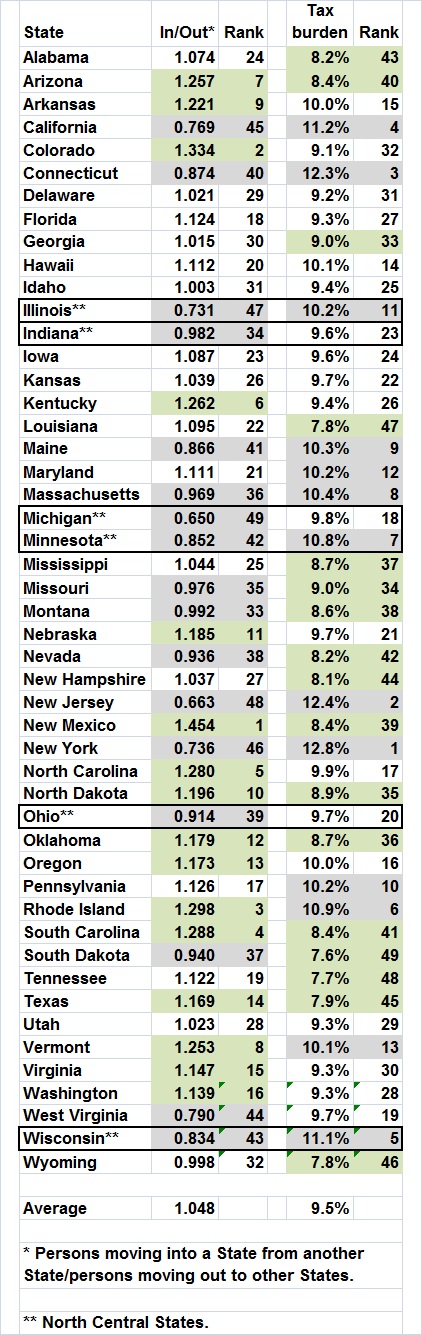
The table below gives a hint of the strong relationship between tax burdens and inter-State migration. “In/Out represents the number of residents who moved into a State from another State, divided by the number of residents who moved out of the State to another State. The tax burden represents total State and local taxes levied on residents of a State, divided by income earned by residents of the State. (Sources and methods are discussed in the footnote to this post.)

In-out ratios and tax burdens of States

Green shading indicates States in the top (best) one-third of each distribution; gray shading indicates States in the bottom (worst) one-third. Alaska and the District of Columbia are omitted for reasons discussed in the footnote.  As it turns out, statistical analysis yields two significant determinants of a State’s In/Out ratio:

  • whether it is situated in the “Blue,” heavily unionized, North Central region of the United States, with its relatively high unemployment rate; and
  • the State’s tax burden.

Take California (please). In 2010 alone, the Golden State’s heavy tax burden — 11.2 percent vs. the national average of 9.5 percent — cost it 54,000 residents. And California is not the most repulsive of States (“tax-wise”). That “honor” goes to New York, with a burden of 12.8 percent in 2010 — a burden that cost the Empire State 66,000 residents in that year. Then there is Wisconsin — with only 1/6 the population of California — which lost 33,000 current and prospective residents because it is in the North Central region and has a tax burden of 11.1 percent.

When low In/Out ratios persist for years — as they have in California, New York, and most of the North Central States — the result is a massive reduction in the number of taxpaying citizens and businesses. Persistently low In/Out ratios lead to fiscal death-spirals:

  • Current and prospective residents and businesses are driven away by high taxes and other unfavorable conditions (e.g. unionization).
  • Instead of paring government and taking other steps to make the State more attractive (e.g., playing tough with public-sector unions), taxes are raised on remaining residents and businesses.
  • More residents and business are driven away.
  • Some amount of paring may eventually occur, but taxes remain disproportionately high (and other unfavorable conditions usually persist), so more residents and businesses are driven away.
  • And so on.

Detroit — which lost more than 60 percent of its population between 1950 and 2010 — is a prime example of a jurisdiction in a death-spiral, but it is far from the only one.

But voting with one’s feet, which works on the municipal and State levels, does not work on the national level. And the proponents of Big Government understand that. It is a sad fact that, for most citizens, the cost of fleeing the country for a better place (if one can be found) would far outweigh the additional burden of higher marginal tax rates, higher rates on capital gains, the perpetuation and expansion of “entitlements,” and the ever-growing volume of regulations (which are taxes in a different guise).

What the proponents of Big Government do not understand — or do not care about — is that they are killing the goose that lays the golden eggs. When people cannot reap the hard-won rewards of their labors and their investments, they labor and invest less. The result is slower and slower economic growth, and the imminent Europeannirvana” so devoutly wished by proponents of Big Government.

Related posts:
The Laffer Curve, “Fiscal Responsibility,” and Economic Growth
The Causes of Economic Growth
In the Long Run We Are All Poorer
A Short Course in Economics
Addendum to a Short Course in Economics
The Price of Government
The Price of Government Redux
The Mega-Depression
As Goes Greece
Ricardian Equivalence Reconsidered
The Real Burden of Government
The Illusion of Prosperity and Stability
Estimating the Rahn Curve: Or, How Government Inhibits Economic Growth
Taxing the Rich
More about Taxing the Rich
America’s Financial Crisis Is Now
A Keynesian Fantasy Land
The Keynesian Fallacy and Regime Uncertainty
Why the “Stimulus” Failed to Stimulate
The “Jobs Speech” That Obama Should Have Given
Say’s Law, Government, and Unemployment
Unemployment and Economic Growth
Regime Uncertainty and the Great Recession
Regulation as Wishful Thinking
The Real Multiplier
Vulgar Keynesianism and Capitalism
Why Are Interest Rates So Low?
The Commandeered Economy
Stocks for the Long Run?
We Owe It to Ourselves
Stocks for the Long Run? (Part II)
Estimating the Rahn Curve: A Sequel
In Defense of the 1%
Bonds for the Long Run?
The Real Multiplier (II)
Lay My (Regulatory) Burden Down
The Burden of Government
Economic Growth Since World War II
More Evidence for the Rahn Curve
The Economy Slogs Along
The Obama Effect: Disguised Unemployment
The Stock Market as a Leading Indicator of GDP
Government in Macroeconomic Perspective
Where We Are, Economically
Keynesianism: Upside-Down Economics in the Collectivist Cause
The Economic Outlook in Brief
Is Taxation Slavery? (yes)

__________
EXPLANATORY NOTE AND REFERENCES:

I began with Census Bureau estimates of State-to-State migrations in 2010. I derived estimates of in- and out-migration for each State and the District of Columbia. The “turnover” rates for Alaska and the District of Columbia proved to be much higher than the rates for the other 49 States. Preliminary analyses of the relationship between In/Out ratio and key variables (e.g., tax burden) confirmed that the inclusion of Alaska and D.C. in the analysis would bias the results, so I dropped those two entities from the analysis.

For the other 49 States, I considered the relationship between In/Out ratio and several variables:

  • population (from the same source as migration statistics);
  • regional effects, represented by dummy variables for Northeast & Mid-Atlantic (CT, DE, ME, MA, NH, NJ, NY, PA, RI, VT); North Central (IL, IN, MI, MN, OH, WI); South & Southeast (AL, AR, FL, GA, KY, LA, MD, MS, MO, NC, OK, SC, TN, TX, VA, WV); Plains & Mountain States (AZ, CO, IA, ID, KS, MT, NE, NV, NM, ND, SD, UT, WY); and West (CA, HI, OR, WA). (The statistical results are unaffected by reasonable variations in assignments — MD and VA to Northeast & Mid-Atlantic, TX to Plains & Mountain States, for example.)

Regressions on various combinations of explanatory variables yielded one statistically significant equation:

In/Out = 1.60 – 0.21NC – 5.58TB

where NC is 1 if a State is in the North Central region (otherwise it is 0), and TB is the State’s tax burden (expressed as a decimal fraction). Each State’s tax burden includes local taxes and taxes imposed on the State’s residents by other States. (A person who lives in New Jersey and works in New York knows that one price of living in New Jersey is the payment of New York’s income taxes.)

The equation and its constant and coefficients are significant at the 1-percent level, and better. The standard error of the estimate is 0.15, against a mean for In/Out of 1.048. The residuals are randomly distributed with respect to the estimated values.)

According to the equation, a North Central State with a tax burden of 10.2 percent (the average for North Central States) would have an In/Out ratio of 0.82; the average for North Central States is 0.83. A State in another region with a tax burden of 9.4 percent (the average for all other States) would have an In/Out ratio of 1.08; the  average for States not in the North Central region is 1.08.

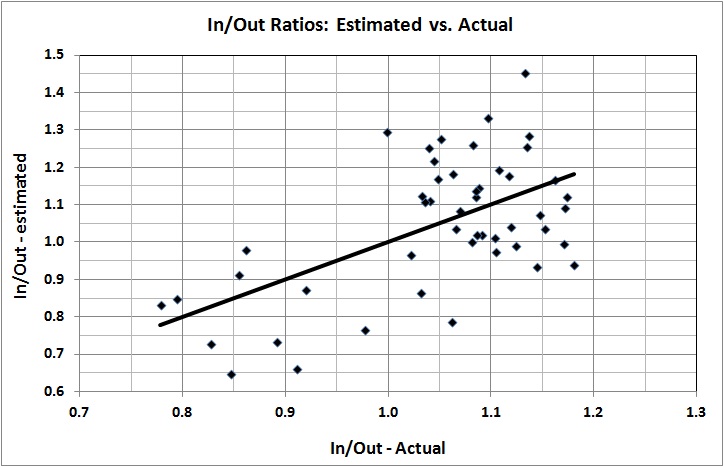
Here is a plot of estimated vs. actual In/Out ratios:

In-out ratios_estimated vs actual

The outliers — States with residuals greater than 1 standard error — are indicated by the green shading (good) and gray shading (bad):

Residuals for estimate of In-out ratio vs Ncent and tax burden

The top 6 States have something extra going for them; the bottom 9 States have something extra going against them. The extras could be an especially hospitable or inhospitable business climate, climatic and/or geographical allure (or lack thereof), cost of living, unemployment well above or below the national average, the political climate (“Blue” to “Red” shifts prevail), or something else. Whatever the case, I am easily persuaded that New York (where I have lived and run a business), Michigan (my home State), California (a well-known basket case), Nevada (ditto), New Jersey (ditto), and West Virginia (with which I am all too familiar) have a lot going against them, even when it is not an excessive tax burden.

Well-Founded Pessimism

I have never been more pessimistic than I am now about the future of the United States. Not even in the aftermath of 9/11, when the enemy was without and could be defeated, with persistence and resolve.

Patrick Buchanan observes that

Americans are already seceding from one another—ethnically, culturally, politically. Middle-class folks flee high-tax California, as Third World immigrants, legal and illegal, pour in to partake of the cornucopia of social welfare benefits the Golden Land dispenses.

High-tax states like New York now send tens of thousands of pension checks to Empire State retirees in tax-free Florida. Communities of seniors are rising that look like replicas of the suburbs of the 1950s. People gravitate toward their own kind. Call it divorce, American-style.

What author William Bishop called “The Big Sort”—the sorting out of people by political beliefs—proceeds. Eighteen states have gone Democratic in six straight presidential elections. A similar number have gone Republican.

“Can we all just get along?” asked Rodney King during the Los Angeles riot of 1992. Well, if we can’t, we can at least dwell apart.

After all, it’s a big country.

Buchanan has it right — until he counsels voluntary segregation as an antidote to statism. Liberty lovers cannot escape the dictatorial grip of the central government simply by living in a Red locale in a Red State. Big Brother is everywhere: carting off chunks of our income; dictating the manufacture of products that we use; dictating the wages and benefits that must be paid to the employees of companies that we patronize; driving up the cost of the health care that we need while driving providers and insurers out of the market for health care; subsidizing the follies of State and local governments through grants of “federal” (taxpayer) money; setting standards for education at local public schools; undermining the quality of the products and services we buy, locally and on the web, by dictating the racial and gender composition of workforces; driving the economy into stagnation (if not outright decline) through profligate spending on “entitlements”; and on an on.

The country is not big enough — not by a long shot — for voluntary segregation to work. Something has to give, and give soon, or those of us who prefer liberty to slavery will never escape the serfdom into which our “leaders” are marching us. What has to give, of course, is our attachment to the union that was preserved by the force of arms in 1865. As long as we cling to that union we remain subject to its now-irreversible statist commitments. At best, the election of conservative presidents and legislators will slow our descent into total statism, but it will not halt that descent.

Finally (for now), I am rightly pessimistic about the willingness of the left to allow a return to the true federalism that was supposed to have been ensured by the Constitution. The left’s mantra is control, control, control — and it will not relinquish its control of the machinery of government. The left’s idea of liberty is the “liberty” to follow its dictates. I will continue to point out the follies and fallacies of leftist policies, but I will not waste my time by dissecting the left’s specious arguments for its policies. Enough!

More to come.

Obamanomics: A Report Card

A revised and updated version is here.

A Contrarian View of Universal Suffrage

Timothy Sandefur, in the course of a commentary about Steven Spielberg’s Lincoln, quotes the man himself:

The doctrine of self government is right–absolutely and eternally right–but it has no just application, as here attempted. Or perhaps I should rather say that whether it has such just application depends upon whether a negro is not or is a man. If he is not a man, why in that case, he who is a man may, as a matter of self-government, do just as he pleases with him. But if the negro is a man, is it not to that extent, a total destruction of self-government, to say that he too shall not govern himself? When the white man governs himself that is self-government; but when he governs himself, and also governs another man, that is more than self-government–that is despotism. If the negro is a man, why then my ancient faith teaches me that ‘all men are created equal;’ and that there can be no moral right in connection with one man’s making a slave of another…. I say this is the leading principle–the sheet anchor of American republicanism. [Peoria, Illinois: October 16, 1854]

But there is a good case to be made that the votes of American blacks are responsible for the growth of oppressive government. Take the elections of 2008 and 2012, for example, which enabled the birth of Obamacare, and quite possibly its continued existence.

According to a report issued by the Census Bureau, about 16 million blacks voted in 2008. There is no similar report for 2012, but it is reasonable to assume that about the same number of blacks voted this year, with a somewhat lower voting rate being offset by somewhat larger numbers of voting-age blacks. Of the 16 million or so black votes in each election, 95 percent went to  Obama in 2008 and 93 percent went to Obama in 2012 (according to The New York Times exit polls).

Given the preceding information, and armed with a Census Bureau tally of the distribution of blacks by State, I estimated:

  • the number of votes in each State for the Democrat and Republican candidates in 2008 and 2012, had blacks not voted, and
  • the resulting distribution of electoral votes (EVs) in each election.

Obama might have edged out McCain in 2008, despite losing the popular vote by 54 million to 59 million. Nevertheless, McCain almost certainly would have gained the District of Columbia (yes!), with 3 EVs, Florida (27), Indiana (11), North Carolina (15), Ohio (20), and Virgina (13). Those wins would have brought McCain’s total to 266 — just 3 EVs short of a tie.

There is no doubt that Romney would have won in 2012 but for the black vote. With the addition of DC (3), Florida (29), Michigan (16), Nevada (6), Ohio (18), Pennsylvania (20), and Virginia (13), Romney would have taken a total of 311 EVs. Also, he would have won the popular vote by 59 million to 49 million.

So, I beg to differ with Sandefur and Lincoln. To paraphrase Lincoln, when the black man governs himself and also governs whites by voting almost exclusively for the Democrat-welfare state, that is despotism.

Much Ado about the Price-Earnings Ratio

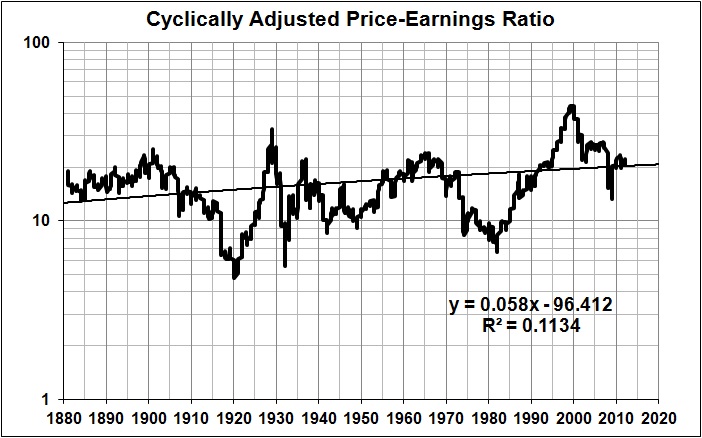
Does the long-term trend of the price-earnings ratio have an upward tilt? You might think so, if you encounter Robert Shiller’s Cyclically Adjusted Price-Earnings (CAPE) ratio for the S&P Composite. It looks like this:


Derived from Robert Shiller’s data set at http://www.econ.yale.edu/~shiller/data/ie_data.xls.

The plot begins in January 1881 and extends through October 2012. As explained here, CAPE is supposed to more accurately reflect the value of stocks:

Legendary economist and value investor Benjamin Graham noticed the … bizarre P/E behavior during the Roaring Twenties and subsequent market crash. Graham collaborated with David Dodd to devise a more accurate way to calculate the market’s value, which they discussed in their 1934 classic book, Security Analysis. They attributed the illogical P/E ratios to temporary and sometimes extreme fluctuations in the business cycle. Their solution was to divide the price by a multi-year average of earnings and suggested 5, 7 or 10-years. In recent years, Yale professor Robert Shiller, the author of Irrational Exuberance, has reintroduced the concept to a wider audience of investors and has selected the 10-year average of “real” (inflation-adjusted) earnings as the denominator. As the accompanying chart illustrates, this ratio closely tracks the real (inflation-adjusted) price of the S&P Composite. The historic average is 16.4. Shiller refers to this ratio as the Cyclically Adjusted Price Earnings Ratio, abbreviated as CAPE….

CAPE can be quite misleading, however:

The problem with [the 10-year moving average of earnings] is that the typical or average business cycle has been significantly shorter than 10 years. According to data compiled by the National Bureau of Economic Research, economic contractions have become shorter and expansions longer in recent years. Furthermore, while the business cycle has lengthened in recent years, it is still considerably shorter than 10 years. Measured trough to trough, the average business cycle has been six years and one month for the most recent 11 cycles. Measured peak to peak, the average is five years and six months.

The problem with using a moving average that is longer than the business cycle is that it will overestimate “true” average earnings during a contraction and underestimate “true” average earnings during an expansion. According to the National Bureau of Economic Research, the last recession ended in June 2009 and the U.S. economy is now in an expansion phase. Thus, the average earnings estimate used by the July 2011 CAPE is too low and produces a bearishly biased estimate of value.

Using Shiller’s data, a July 2011 CAPE based on the average of six years of real earnings is 21.26 and the long-term average CAPE based on the average of six years of real earnings is 15.78. Comparison to this average indicates that stocks are overvalued by 34.7%. While still signaling that stocks are overvalued, the degree of overvaluation is much less than the 42.3% estimate provided by the July 2011 CAPE based on a 10-year average of real earnings.

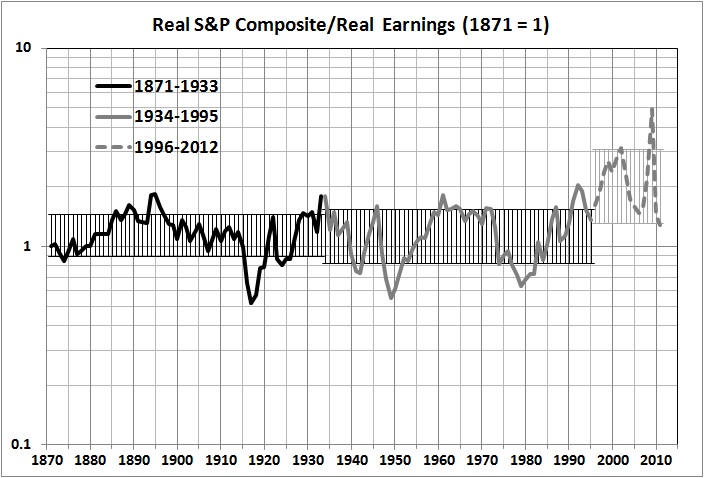
When viewed correctly, then, the long-term P-E ratio for the S&P Composite (based on current earnings) looks like this:


Derived from Shiller’s data set. The vertical bars show variations of 1 standard error around the means for each of the three eras.

If I had fitted a long-term trend line through the entire series, it would tilt upward, as it does for CAPE. But that trend would be misleading because it would give undue weight to the stock-market bubble of the late 1990s and the artificially high P-E ratios resulting from the earnings crash during the Great Recession.

In fact, a trend line for the period 1871-1995 would be perfectly flat. Moreover, as shown in the graph immediately above, there is little difference between the first half of that period (1871-1933) and second half (1934-1995). The standard-error bars for both eras are almost the same height and vertically centered at almost the same value. The second era is just slightly (but insignificantly) more volatile than the first era.

As indicated by the standard-error bars, the P-E ratio for 1996-2012 is markedly higher than for the earlier eras. But, of late, the P-E ratio shows signs of returning to the normal range for 1871-1995.

In sum — and contrary to the story that is peddled by “bulls” — I doubt that the real long-term trend of the P-E ratio is upward. Rather, the apparent upward trend reflects bizarre happenings in the past 16 years: an unprecedented price bubble and a brief but steep earnings crash. I would therefore caution investors not to buy stocks in the belief that the P-E trend is upward. For reasons discussed here, the long-term trend of stock prices is more likely downward.

Related posts:
The Price of Government
The Price of Government Redux
The Mega-Depression
Ricardian Equivalence Reconsidered
The Real Burden of Government
The Rahn Curve at Work
The “Forthcoming Financial Collapse”
Estimating the Rahn Curve: Or, How Government Inhibits Economic Growth
The Deficit Commission’s Deficit of Understanding
The Bowles-Simpson Report
The Bowles-Simpson Band-Aid
The Stagnation Thesis
America’s Financial Crisis Is Now
Stocks for the Long Run?
Estimating the Rahn Curve: A Sequel
Bonds for the Long Run?
The Real Multiplier (II)
Lay My (Regulatory) Burden Down
Economic Growth Since World War II
More Evidence for the Rahn Curve
Progressive Taxation Is Alive and Well in the U.S. of A.
The Economy Slogs Along
The Obama Effect: Disguised Unemployment
The Stock Market as a Leading Indicator of GDP
Where We Are, Economically

Is Taxation Slavery?

Thomas Nagel writes:

Some would describe taxation as a form of theft and conscription as a form of slavery — in fact some would prefer to describe taxation as slavery too, or at least as forced labor. Much might be said against these descriptions, but that is beside the point. For within proper limits, such practices when engaged in by governments are acceptable, whatever they are called. If someone with an income of $2000 a year trains a gun on someone with an income of $100000 a year and makes him hand over his wallet, that is robbery. If the federal government withholds a portion of the second person’s salary (enforcing the laws against tax evasion with threats of imprisonment under armed guard) and gives some of it to the first person in the form of welfare payments, food stamps, or free health care, that is taxation. In the first case it is (in my opinion) an impermissible use of coercive means to achieve a worthwhile end. In the second case the means are legitimate, because they are impersonally imposed by an institution designed to promote certain results. Such general methods of distribution are preferable to theft as a form of private initiative and also to individual charity. This is true not only for reasons of fairness and efficiency, but also because both theft and charity are disturbances of the relations (or lack of them) between individuals and involve their individual wills in a way that an automatic, officially imposed system of taxation does not. [Mortal Questions, “Ruthlessness in Public Life,” pp. 87-88]

How many logical and epistemic errors can a supposedly brilliant philosopher make in one (long) paragraph? Too many:

  • “For within proper limits” means that Nagel is about to beg the question by shaping an answer that fits his idea of proper limits.
  • Nagel then asserts that the use by government of coercive means to achieve the same end as robbery is “legitimate, because [those means] are impersonally imposed by an institution designed to promote certain results.” Balderdash! Nagel’s vision of government as some kind of omniscient, benevolent arbiter is completely at odds with reality.  The “certain results” (redistribution of income) are achieved by functionaries, armed or backed with the force of arms, who themselves share in the spoils of coercive redistribution. Those functionaries act under the authority of bare majorities of elected representatives, who are chosen by bare majorities of voters. And those bare majorities are themselves coalitions of interested parties — hopeful beneficiaries of redistributionist policies, government employees, government contractors, and arrogant statists — who believe, without justification, that forced redistribution is a proper function of government.
  • On the last point, Nagel ignores the sordid history of the unconstitutional expansion of the powers of government. Without justification, he aligns himself with proponents of the “living Constitution.”
  • Nagel’s moral obtuseness is fully revealed when he equates coercive redistribution with “fairness and efficiency,” as if property rights and liberty were of no account.
  • The idea that coercive redistribution fosters efficiency is laughable. It does quite the opposite because it removes resources from productive uses — including job-creating investments. The poor are harmed by coercive redistribution because it drastically curtails economic growth, from which they would benefit as job-holders and (where necessary) recipients of private charity (the resources for which would be vastly greater in the absence of coercive redistribution).
  • Finally (though not exhaustively), Nagel’s characterization of private charity as a “disturbance of the relations … among individuals” is so wrong-headed that it leaves me dumbstruck. Private charity arises from real relations among individuals — from a sense of community and feelings of empathy. It is the “automatic, officially imposed system of taxation” that distorts and thwarts (“disturbs”) the social fabric.

In any event, the answer to the question posed in the title of this post is “yes”; taxation for the purpose of redistribution is slavery (see number 2 in the second set of definitions). It amounts to the subjection of one person (the taxpayer) to other persons: deadbeats, do-gooders, and  demagogues. If “slavery” is too strong a word, “theft” will do quite well.