The Value of Experience

UPDATED BELOW

Does experience count? You bet.

But experience is not an undifferentiated quality. Experience as a “community organizer” — which means “professional rabble rouser” — hardly qualifies someone for the responsibility of heading the executive branch of the U.S. government. As millions of Americans have learned (and other millions have not).

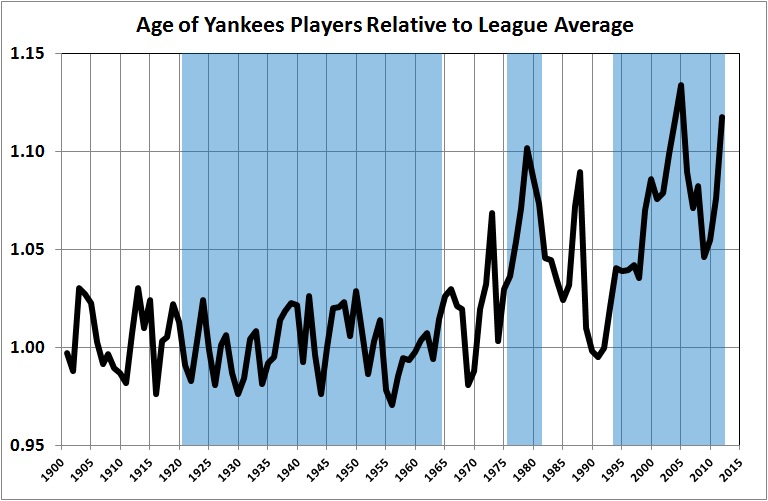
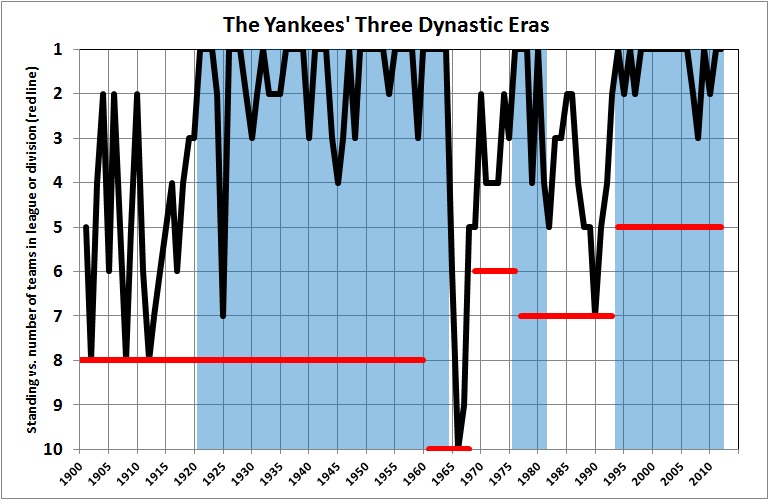
Relevant experience, on the other hand, counts for a lot. Consider the following graphs:


The New York Yankees have enjoyed three “dynastic” eras of dominance in the American League: 1921-1964, 1976-1981, and 1994-2012.

In the first era, which predates free agency, the Yankees relied mainly on the allure of the team’s initial successes  to attract talented young prospects. (Those initial successes were due in large part to the acquisition of Babe Ruth in a trade that Boston Red Sox fans have ever since rued.) The best of the young prospects were then tested in the Yankees’ farm system, advanced (selectively) as they proved worthy, and brought up to the “big time” when they were deemed ready.

The second and third eras of  the Yankees’ dominance followed and coincided with the dwindling of the minor leagues, the expansion of the major leagues, and the advent of free agency. Because of the first two developments, major-league teams have been providing on-the-job training to players who, in earlier decades, might never have made it to the big leagues. The Yankees adapted to this change by picking up proven players through trades and free-agent signings — after those players had acquired polish and displayed their skills while in the pay of other teams. Thus it is that the Yankees faded after 1981, as their teams became younger, and became successful again in the mid-1990s, as their teams became older (i.e., more experienced).

UPDATE 08/20/13:

I’ve taken a closer look at the relationships discussed above, and they hold up well.

The following equation applies to 1901-1976 (the years before free agency was in full force):

WL = 0.258 + 0.458xWLP + 0.010xBHO, where

WL = won-lost record in a season

WLP = won-lost record in the previous season

BHO = batting holdovers (the number of batters who appeared in 100 or more games in both the current and preceding seasons)

It makes sense for WL to be strongly correlated with WLP (continuity of players, playing conditions, opposition, etc.). The interesting wrinkle is the presence of BHO in the equation, at a high level of significance (0.07), given the strong cross-correlations between WL and WLP (0.61) and WLP and BHO (0.66).

Since, 1976, however, only WLP explains WL with any degree of significance. This is consistent with my hypothesis that after the advent of free agency the Yankees (unsurprisingly) became more dependent on free agents (i.e., veteran players).

In fact, there was a significant change in the correlation between WL and the relative age of players. For 1901-1976, the correlation is effectively zero (an insignificant -0.11). For 1977-2012, the correlation is a highly significant 0.50. Moreover, the correlation between WLP and BHO drops significantly after the advent of free agency, from 0.66 to 0.22.

To summarize: Before free agency, the Yankees’ depended largely on the retention of proved veterans, but the team remained relatively young (on average) because of the constant acquisition and cultivation of young players, some of whom became valuable veterans. Since free agency, the team has relied less on “growing its own” and more on veteran players who had proved themselves elsewhere.

In any event, experience is valuable. It’s just that it’s acquired in a different way than it was before free agency.

Related posts:
Moral Luck
The Residue of Choice
Can Money Buy Excellence in Baseball?
Inventing “Liberalism”
Randomness Is Over-Rated
Fooled by Non-Randomness
Accountants of the Soul
Rawls Meets Bentham
Social Justice
Positive Liberty vs. Liberty
More Social Justice
Luck-Egalitarianism and Moral Luck
Nature Is Unfair
Elizabeth Warren Is All Wet
Luck and Baseball, One More Time
The Candle Problem: Balderdash Masquerading as Science
More about Luck and Baseball
Barack Channels Princess SummerFall WinterSpring
Obama’s Big Lie
Pseudoscience, “Moneyball,” and Luck

A New Constitution for a New Republic

INTRODUCTION

Secession is much in the air. I have said much about it during the past four years. (See this post and the posts listed at the bottom of it.) I will have more to say about the separation of liberty-loving States from the United States. However, I will not counsel secession, which probably is fruitless even though it is legal, Justice Scalia’s dictum to the contrary notwithstanding.

Instead, a future post will propose a treaty of division. I will make the case that secession is legal, offer (in detail) a treaty of division as a beneficial alternative to secession, address practical and ideological objections to division, and discuss its advantages to all parties.

Left-wing opponents of division are likely to charge that the New Republic, as I like to think of it, would be inimical to the rights that Americans now enjoy under the Constitution, as amended and interpreted. I would answer that charge by offering the following new constitution, which would more than adequately safeguards the liberty rights of all who live under it. The most cynical (i.e., left-wing) opponents of division will not acknowledge the sincerity of a commitment to liberty, of course, but nothing will sway them, in any case. The new constitution, along with my proposal, will be aimed at persons of good will who are prepared to act in good faith for the good of all Americans.

The main problem with the Constitution of the United States is not its meaning; it is the fact that inappropriate meanings have been imputed to it because it is too often vague and ambiguous. The following Constitution for the New Republic of America is not only far more specific than the present Constitution of the United States — and more restrictive of the powers of government — but it also includes more checks on those powers. For example, there are these provisions in Article V:

Congress may, by a majority of three-fifths of the members of each House present, when there is a quorum consisting of three-fourths of the number of persons then holding office in each House…. provide for the collection of revenues in order to pay the debts and expenses of the New Republic…. [emphasis added]

*   *   *

A judgment of any court of the New Republic may be revised or revoked by an act of Congress, provided that such any revision or revocation is approved by two-thirds of the members of each house and leads to a result that conforms to this Constitution.

Then there are Articles VII and VIII, Keeper of the Constitution and Conventions of the States, which open thusly:

The responsibility for ensuring that the legislative, executive, and judicial branches adhere to this constitution in the exercise of their respective powers shall be vested in a Keeper of the Constitution. The Keeper may review acts of Congress, the executive branch, and judicial branch that have the effect of making law and appropriating monies.

*    *    *

Delegations of the States shall convene every four years for the purpose of considering revisions to and revocations of acts of the government that is established by this constitution. Such conventions (hereinafter “convention of the States”) may revise and/or revoke any act or acts and/or any holding or holdings, in the sole discretion of a majority of State delegations present and voting.

On top of that, there is Article IX, which authorizes petitions and subsequent elections for the revocation of a broad range of governmental acts and the expulsion of members of Congress, the President, Vice President and justices of the Supreme Court. Also, a constitutional convention may be called pursuant to a successful petition.

To the extent that Articles VII, VIII, and IX would inhibit presidential and congressional ventures into unconstitutional territory, so much the better.

This new Constitution also provides for secession, the threat of which might further help to preserve its original meaning.

The new Constitution is below the fold. Continue reading “A New Constitution for a New Republic”

How High Should Taxes Be?

Steven Landsburg correctly observes that taxes should be high enough

to cover expected outlays going forward — but no higher.

That’s because any additional revenue would be used to pay down the federal debt, which is a bad idea. It was almost surely a mistake to run up this much debt in the first place, but now that we’ve got it, the best thing to do is to keep it forever….

The right policy, then, is to estimate future outlays including interest on the existing debt but not including any principal payments on that debt, and to set tax rates so that revenues match those outlays in a typical year. Insofar as Mr. Obama asks for more than that, he’s either a) planning higher future spending than he’s admitting to or b) embarking on a reckless policy of debt reduction.

The following discussion is for the benefit of readers who may remain unenlightened by Landsburg’s explanation.

I begin with the parties to the spending-lending-taxing triangle:

A — beneficiaries of government programs who provide no products or services in return (i.e., recipients of “entitlement” spending, the largest and fastest growing aspect of U.S. government spending)

B — lenders who are willing to underwrite that spending in return for interest payments of 3 percent on the amounts lent (the principal)

C — taxpayers who are “responsible” for the payment of the interest on the loan and who would also bear the cost of repaying the principal if government decided to retire the debt.

Take it as given, for the purpose of this example, that there is little overlap between A, B, and C. A‘s tax payments are either zero or de minimis — because A (mainly) represents the non-taxpaying 47 percent invoked by Mitt Romney during the recent presidential race. B represents a mix of foreign lenders and a relatively small contingent of American entities. C stands for the millions of taxpayers who bear the burden of U.S. government spending — the other 53 percent — especially those in the upper reaches of the income distribution.

Now suppose that in year 1 the government gives A $100 and finances the expenditure by borrowing the sum from B. If the loan is for 10 years at 3 percent, the transaction could be structured in one of two ways:

  1. annual interest payments of 3 percent ($3), with a “balloon” of $100, which can be paid off by finding a new lender (a debt roll-over); or
  2. annual payments of $12.84, which would reduce the debt to zero after 10 years, while giving the lender a return of 3 percent on the unpaid balance.

Option 1 burdens C with annual payments of $3. Option 2 raises the annual burden by $9.84. That is a deadweight loss to C — a burden that is imposed on C without a compensating benefit.

But what about the benefit that C will reap in the future, when C becomes A and takes his turn at the public trough? Well, because the taxes imposed on C force him to forgo remunerative investments, C would be made whole only if his future benefits are somewhat larger than A‘s current benefits, and only then to the extent that his valuation of those benefits matches their nominal valuation. (A healthy C, for example, would place little value on Medicare.) Further, there is reasonable doubt that the A of the future will be as well-fed as the A of today.

No matter how you slice it, A‘s “free lunch” is a bad deal for C. A deadweight loss, to be sure.

The Economic Outlook in Brief

I have elsewhere quantified the connection between government spending and economic growth (e.g., here and here).* I have also shown that stock prices indicate the direction of economic growth. It should not surprise you if I say that

  • the re-election of Obama portends further growth of government spending — specifically, the uncontrolled growth of entitlement spending, as accelerated by Obamacare;
  • the rate of economic growth will continue to decline for as long as entitlements grow as a percentage of GDP; and
  • in anticipation of slower economic growth, stock prices will continue to decline, in real terms.

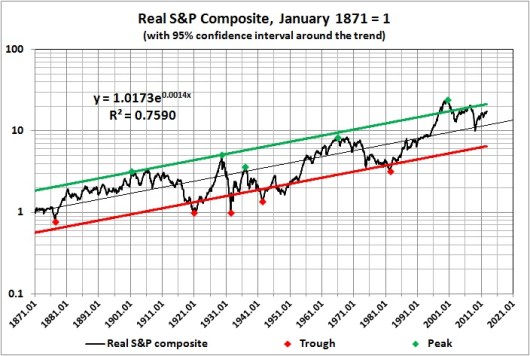
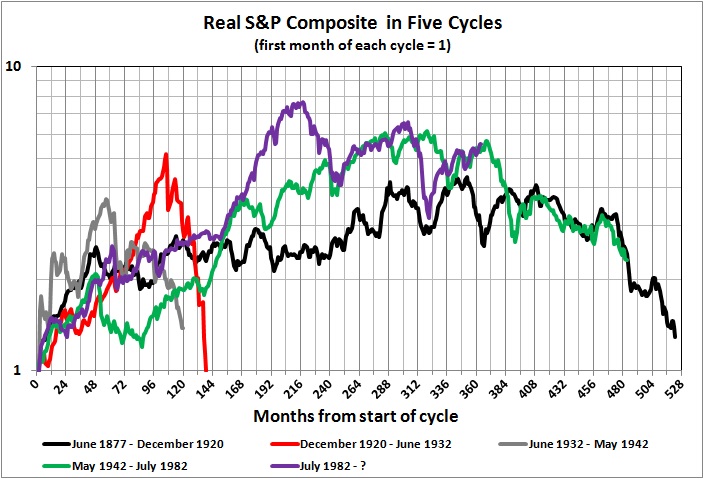
You can follow the links in the first paragraph if you wish to learn more. Here is a bit of additional evidence for my gloomy outlook. The real value of the S&P Composite Index has fluctuated in trough-to peak-to trough cycles, four of which have been completed since the 1870s:


Derived from Robert Shiller’s data set at http://www.econ.yale.edu/~shiller/data/ie_data.xls.

We are now on the downside of the fifth cycle, which began in July 1982 and peaked in August 2000. If the present cycle follows the pattern of the other two long cycles, it may not bottom out until sometime after 2020  (though it may never end if economic growth continues to decline). And if it does bottom out then, the real value of the S&P composite will have risen only about two-fold from where its value at the start of the cycle in July 1982. In nominal terms, the S&P Composite will have dropped to about half its current level by 2020.

But, as I say, the stock market merely anticipates underlying economic conditions. Those conditions seem destined to worsen because the entitlements mess will not be dealt with for as long as there is gridlock in Washington.

__________
* See also the second graph in this post by James Pethokoukis of the American Enterprise Institute. The graph highlights the inverse relationship between entitlement spending and growth-producing innovation. Entitlement spending diminishes investments in innovation by (a) diverting resources from productive to unproductive uses and (b) penalizing (taxing) productive activities that fund innovation and its implementation.

Related posts:
The Laffer Curve, “Fiscal Responsibility,” and Economic Growth
The Causes of Economic Growth
In the Long Run We Are All Poorer
A Short Course in Economics
Addendum to a Short Course in Economics
The Price of Government
The Price of Government Redux
The Mega-Depression
As Goes Greece
Ricardian Equivalence Reconsidered
The Real Burden of Government
The Illusion of Prosperity and Stability
Estimating the Rahn Curve: Or, How Government Inhibits Economic Growth
Taxing the Rich
More about Taxing the Rich
America’s Financial Crisis Is Now
A Keynesian Fantasy Land
The Keynesian Fallacy and Regime Uncertainty
Why the “Stimulus” Failed to Stimulate
The “Jobs Speech” That Obama Should Have Given
Say’s Law, Government, and Unemployment
Unemployment and Economic Growth
Regime Uncertainty and the Great Recession
Regulation as Wishful Thinking
The Real Multiplier
Vulgar Keynesianism and Capitalism
Why Are Interest Rates So Low?
The Commandeered Economy
Stocks for the Long Run?
We Owe It to Ourselves
Stocks for the Long Run? (Part II)
Estimating the Rahn Curve: A Sequel
In Defense of the 1%
Bonds for the Long Run?
The Real Multiplier (II)
Lay My (Regulatory) Burden Down
The Burden of Government
Economic Growth Since World War II
More Evidence for the Rahn Curve
The Economy Slogs Along
The Obama Effect: Disguised Unemployment
The Stock Market as a Leading Indicator of GDP
Government in Macroeconomic Perspective
Where We Are, Economically
Keynesianism: Upside-Down Economics in the Collectivist Cause

Secession for All Seasons

REVISED 11/07/12

I do not want my liberty (or yours) to depend on the preferences of voters in places like California, Massachusetts, New York, and Vermont. Nor should my liberty (or yours) be hostage to the outcome of a presidential election, to the vagaries of Supreme Court rulings, or to a filibuster-proof cabal of leftists in the U.S. Senate.

It is not supposed to be that way. (See the The Federalist Papers and the Constitution of the United States.) The last time that the presidency of the United States was in the hands of someone who gave a damn about liberty (Ronald Reagan), he did not have enough support in Congress to do more than chisel at the edges of federal power. Now, the GOP-controlled House of Representatives can only try to block Barack Obama’s statist initiatives — and he will go around the House, by issuing unconstitutional executive orders.

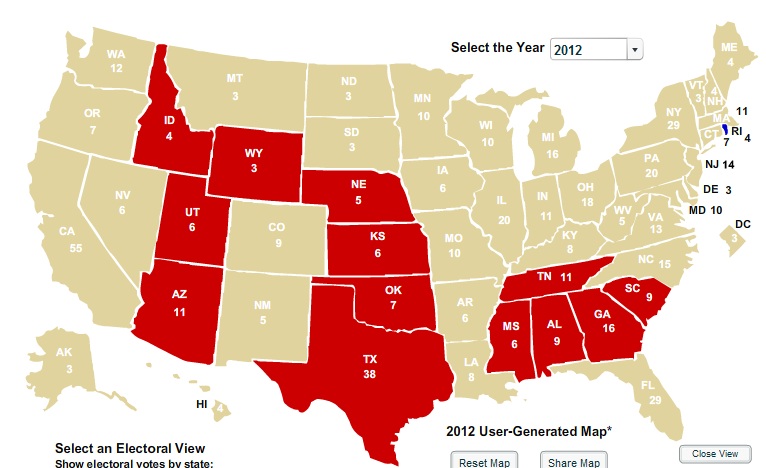
In “Secession, Anyone?” I suggested the formation of the Free States of America. The FSA could be built upon Red-Red States. A Red-Red State meets three criteria: (1) its electoral votes have gone to the Republican presidential candidate in the last four elections; (2) its governorship and its legislature will remain in the hands of Republicans for at least two more years (Nebraska’s “nonpartisan” legislature is here counted as Republican); and both of its U.S. Senate seats are held by Republicans (and will be for at least the next two years).  There are 13 Red-Red States:

(If the southeast quadrant of that map resembles an earlier union of disaffected States, so be it. Secession and slavery are separate and separable issues.)

With the fertile ground afforded by those 13 States, it should be possible to create a new republic — one that is bound by a restored Constitution.

When? Sooner rather than later. Sooner because with Democrats in control of the White House and the Senate, the egregious governmental acts of the past four years will not be reversed. Therefore, all who remain subjects of the United States will suffer the consequences of those egregious acts: economic stagnation and rationed health care being two of the more salient consequences.

How? By insisting on the constitutional right of every State to withdraw from the union known as the United States.

Getting out would not be a simple thing, by any means, and there would be a price to pay (e.g., less-free trade between the USA and the FSA; a more costly defense, per capita). But it seems to me that the left ought to be ecstatic about the prospect of controlling a nation — even a somewhat diminished one — while meeting less resistance. Not only would the Red-Red States be gone, but surely a lot of conservatives in Blue States would emigrate to the FSA. What could be more enticing to a leftist than the opportunity to issue edicts at will?

What I am suggesting, of course, is a negotiated secession — a treaty of division, if you will. Do not rule it out. The alternative is worse.

See also “The Constitution: Myths and Realities“.

Economists and Voting

It is the time of year when economists like to remind the unwashed that voting is a waste of time. A classic of the genre appeared seven years ago, in the form of  “Why Vote?,” by Stephen J. Dubner and Steven D. Levitt (of Freakonomics fame). Here are some relevant passages:

The odds that your vote will actually affect the outcome of a given election are very, very, very slim. This was documented by the economists Casey Mulligan and Charles Hunter, who analyzed more than 56,000 Congressional and state-legislative elections since 1898. For all the attention paid in the media to close elections, it turns out that they are exceedingly rare. The median margin of victory in the Congressional elections was 22 percent; in the state-legislature elections, it was 25 percent. Even in the closest elections, it is almost never the case that a single vote is pivotal. Of the more than 40,000 elections for state legislator that Mulligan and Hunter analyzed, comprising nearly 1 billion votes, only 7 elections were decided by a single vote, with 2 others tied. Of the more than 16,000 Congressional elections, in which many more people vote, only one election in the past 100 years – a 1910 race in Buffalo – was decided by a single vote….

Still, people do continue to vote, in the millions. Why? Here are three possibilities:

1. Perhaps we are just not very bright and therefore wrongly believe that our votes will affect the outcome.

2. Perhaps we vote in the same spirit in which we buy lottery tickets. After all, your chances of winning a lottery and of affecting an election are pretty similar. From a financial perspective, playing the lottery is a bad investment. But it’s fun and relatively cheap: for the price of a ticket, you buy the right to fantasize how you’d spend the winnings – much as you get to fantasize that your vote will have some impact on policy.

3. Perhaps we have been socialized into the voting-as-civic-duty idea, believing that it’s a good thing for society if people vote, even if it’s not particularly good for the individual. And thus we feel guilty for not voting. [The New York Times Magazine, November 6, 2005]

In true economistic fashion, Dubner and Levitt omit a key reason for voting: It makes a person feel good. Even if one’s vote will not change the outcome of an election, one attains a degree of satisfaction from taking an official (even if secret) stand in favor of or in opposition to a certain candidate, bond issue, or other item on a ballot.

Dubner and Levitt (and their ilk) seem to inhabit a world in which a thing is not worth doing unless the payoff can be measured with some precision and compared with other, similarly quantifiable, uses of one’s time and money. I doubt they govern their own lives accordingly. If they do, they must be missing out on a lot of life’s pleasures: sex and ice cream, to name only two.

Their article continues on a different tack:

But wait a minute, you say. If everyone thought about voting the way economists do, we might have no elections at all. No voter goes to the polls actually believing that her single vote will affect the outcome, does she? And isn’t it cruel to even suggest that her vote is not worth casting?

This is indeed a slippery slope – the seemingly meaningless behavior of an individual, which, in aggregate, becomes quite meaningful. Here’s a similar example in reverse. Imagine that you and your 8-year-old daughter are taking a walk through a botanical garden when she suddenly pulls a bright blossom off a tree.

“You shouldn’t do that,” you find yourself saying.

“Why not?” she asks.

“Well,” you reason, “because if everyone picked one, there wouldn’t be any flowers left at all.”

“Yeah, but everybody isn’t picking them,” she says with a look. “Only me.”

Clever, what? Too clever by half. This argument overlooks the powerful effect of exemplary behavior — where “exemplary,” as used here, does not imply “laudable.” By Dubner and Levitt’s account, allowing a vandal to deface a public building would not encourage other vandals to do the same thing, and would not lead to the widespread defacement of buildings and other anti-social acts. (I refer, of course, to James Q. Wilson’s widely accepted Broken Windows Theory, which Levitt and Dubner tried to cast doubt on in Freakonomics. They wrongly suggested that the onset of legalized abortion was instrumental in the reduction of crime rates.)

Dubner and Levitt’s argument also overlooks the key fact that when economists preach against voting, they are not just preaching to themselves. Dubner and Levitt’s sermon appeared in the pages of one of the country’s most widely read and influential publications. It was not addressed to an individual, but to thousands and thousands of individuals. And I doubt that they would have objected if the article had appeared in every newspaper and magazine in the country. In effect, the Dubner-Levitt argument is not just an argument that the marginal vote makes little difference — it is advice to millions of Americans that they should abstain from voting.

In that respect, Levitt and Dubner are guilty of paternalism as well as economism. Thus the many links to posts about paternalism in the following list of related posts:
The Rationality Fallacy
Libertarian Paternalism
A Libertarian Paternalist’s Dream World
The Short Answer to Libertarian Paternalism
Second-Guessing, Paternalism, Parentalism, and Choice
Another Thought about Libertarian Paternalism
Back-Door Paternalism
Another Voice Against the New Paternalism
Slippery Paternalists
A Further Note about “Libertarian” Paternalism
Apropos Paternalism
Beware of Libertarian Paternalists
Externalities and Statism
Extreme Economism
Irrational Rationality
Not-So-Random Thoughts (III) (third item)
Obesity and Statism

Further Thoughts about Metaphysical Cosmology

I have stated my metaphysical cosmology:

1. There is necessarily a creator of the universe, which comprises all that exists in “nature.”

2. The creator is not part of nature; that is, he stands apart from his creation and is neither of its substance nor governed by its laws. (I use “he” as a term of convenience, not to suggest that the creator is some kind of human or animate being, as we know such beings.)

3. The creator designed the universe, if not in detail then in its parameters. The parameters are what we know as matter-energy (substance) and its various forms, motions, and combinations (the laws that govern the behavior of matter-energy).

4. The parameters determine everything that is possible in the universe. But they do not necessarily dictate precisely the unfolding of events in the universe. Randomness and free will are evidently part of the creator’s design.

5. The human mind and its ability to “do science” — to comprehend the laws of nature through observation and calculation — are artifacts of the creator’s design.

6. Two things probably cannot be known through science: the creator’s involvement in the unfolding of natural events; the essential character of the substance on which the laws of nature operate.

It follows that science can neither prove nor disprove the preceding statements. If that is so, why can I not say, with equal certainty, that the universe is made of pea soup and supported by undetectable green giants?

There are two answers to that question. The first answer is that my cosmology is based on logical necessity; there is nothing of logic or necessity in the claims about pea soup and undetectable green giants. The second and related answer is that claims about pea soup and green giants — and their ilk — are obviously outlandish. There is an essential difference between (a) positing a creator and making limited but reasonable claims about his role and (b) engaging in obviously outlandish speculation.

What about various mythologies (e.g., Norse and Greek) and creation legends, which nowadays seem outlandish even to persons who believe in a creator? Professional atheists (e.g., Richard Dawkins, Daniel Dennett, Christopher Hitchens, and Lawrence Krauss) point to the crudeness of those mythologies and legends as a reason to reject the idea of a creator who set the universe and its laws in motion. (See, for example, “Russell’s Teapot,” discussed here.) But logic is not on the side of the professional atheists. The crudeness of a myth or legend, when viewed through the lens of contemporary knowledge, cannot be taken as evidence against creation. The crudeness of a myth or legend merely reflects the crudeness of the state of knowledge when the myth or legend arose.

Related posts:
Atheism, Religion, and Science
The Limits of Science
Beware of Irrational Atheism
The Creation Model
The Thing about Science
Free Will: A Proof by Example?
A Theory of Everything, Occam’s Razor, and Baseball
Words of Caution for Scientific Dogmatists
Science, Evolution, Religion, and Liberty
Science, Logic, and God
Is “Nothing” Possible?
Debunking “Scientific Objectivity”
What Is Time?
Science’s Anti-Scientific Bent
The Tenth Dimension
The Big Bang and Atheism
Einstein, Science, and God
Atheism, Religion, and Science Redux
The Greatest Mystery
What Is Truth?
The Improbability of Us
A Digression about Probability and Existence
More about Probability and Existence
Existence and Creation
Probability, Existence, and Creation
The Atheism of the Gaps
Demystifying Science
Scientism, Evolution, and the Meaning of Life
Not-So-Random Thoughts (II) (first item)
Mysteries: Sacred and Profane
Something from Nothing?
Something or Nothing
My Metaphysical Cosmology

Katrina and Sandy

I will not discuss Sandy or the lessons of Sandy. Instead, I will post links to what I wrote about Katrina:

Katrina’s Aftermath: Who’s to Blame? (09/01/05)
“The Private Sector Isn’t Perfect” (09/02/05)
A Modest Proposal for Disaster Preparedness (09/07/05)
No Mention of Opportunity Costs (09/08/05)
Whose Incompetence Do You Trust? (09/10/05)
An Open Letter to Michael Moore (09/13/05)
Enough of Amateur Critics (09/13/05)

Enough said.

My Metaphysical Cosmology

This post is a work in progress. It draws on and extends the posts listed at the bottom.

1. There is necessarily a creator of the universe, which comprises all that exists in “nature.”

2. The creator is not part of nature; that is, he stands apart from his creation and is neither of its substance nor governed by its laws. (I use “he” as a term of convenience, not to suggest that the creator is some kind of human or animate being, as we know such beings.)

3. The creator designed the universe, if not in detail then in its parameters. The parameters are what we know as matter-energy (substance) and its various forms, motions, and combinations (the laws that govern the behavior of matter-energy).

4. The parameters determine everything that is possible in the universe. But they do not necessarily dictate precisely the unfolding of events in the universe. Randomness and free will are evidently part of the creator’s design.

5. The human mind and its ability to “do science” — to comprehend the laws of nature through observation and calculation — are artifacts of the creator’s design.

6. Two things probably cannot be known through science: the creator’s involvement in the unfolding of natural events; the essential character of the substance on which the laws of nature operate.

Related posts:
Atheism, Religion, and Science
The Limits of Science
Beware of Irrational Atheism
The Creation Model
The Thing about Science
Free Will: A Proof by Example?
A Theory of Everything, Occam’s Razor, and Baseball
Words of Caution for Scientific Dogmatists
Science, Evolution, Religion, and Liberty
Science, Logic, and God
Is “Nothing” Possible?
Debunking “Scientific Objectivity”
What Is Time?
Science’s Anti-Scientific Bent
The Tenth Dimension
The Big Bang and Atheism
Einstein, Science, and God
Atheism, Religion, and Science Redux
The Greatest Mystery
What Is Truth?
The Improbability of Us
A Digression about Probability and Existence
More about Probability and Existence
Existence and Creation
Probability, Existence, and Creation
The Atheism of the Gaps
Demystifying Science
Scientism, Evolution, and the Meaning of Life
Not-So-Random Thoughts (II) (first item)
Mysteries: Sacred and Profane
Something from Nothing?
Something or Nothing

Where We Are, Economically (Updated)

Here. The bottom line: still stuck in a rut, thanks to Obama-nomics.

“Redness,” Unemployment, and the Election

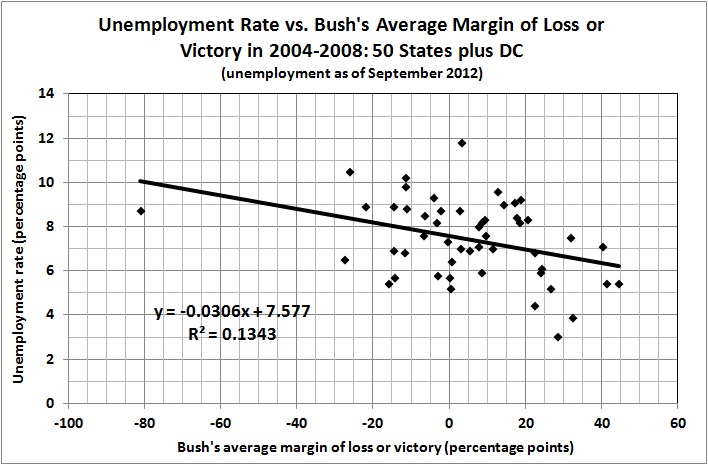
“Redder” is better, generally speaking. For many reasons, including economic health. Using Bush’s average margin of loss or victory in 2004 and 2008 as an index of “redness” (and disregarding the anomalous 2008 race), here is the relationship between unemployment and a State’s degree of “redness”:


Derived from Bureau of Labor Statistics, Unemployment Rates for States (preliminary September estimates, issued 10/19/12), and official tabulations of popular votes by State. The correlation, though not strong, is statistically significant (less than 1-percent probability of occurring by chance).

The “outlier” on the left is the District of Columbia. DC, despite its predominantly black population, does not have an exceedingly high unemployment rate because the federal government and its contractors are havens of patronage and reverse discrimination. In any event, the omission of DC would strengthen the correlation, and would yield a more pronounced negative relationship between “redness” and unemployment: y = -0.0386x + 7.6566; R² = 0.1434.

I have seen some “news” stories which suggest that lower unemployment in swing States will help Obama. Such speculation strikes me as wishful thinking by left-biased media. In fact, of the  four States that seem to have swung to Romney — Florida, Missouri, North Carolina, and Virginia — the first three experienced better-than-average improvements in unemployment from a year earlier. A possible reason for this apparent anomaly is that voters know that there has been little change in the real rate of unemployment. Further, they also know that unless Obama is kicked out, things will not get better very soon, if ever.

Making a Worse “Mess”

Obama and his pet grinning baboon VP like to claim that the economy is still in bad shape because of the “horrific mess” that they inherited from Bush. That the mess wasn’t Bush’s is lie number 1. That Obama’s policies would have “worked” but for Republican intransigence is lie number 2. There are many more lies lying around the Obama White House, but a distaste for nausea prevents me from detailing them.

I will give Obama the benefit of the doubt by measuring the effectiveness of his “stimulus” not by the current state of the economy, but by how far it has advanced the economy since the depth of the Great Recession. As it happens, the Great Recession bottomed in the second quarter of 2009. The latest estimates of real GDP, 12 quarters later, indicate real growth since the bottom of 2.2 percent a year. How does that stack up against previous post-WWII recessions? Here’s how:

Even the short-lived recoveries from the 1958 and 1980 recessions were more robust than the Obama recovery of 2009-2012. Enough said.

Related posts:
Economic Growth Since World War II
The Economy Slogs Along
The Obama Effect: Disguised Unemployment
Obama’s Economic Record in Perspective
Where We Are, Economically
Keynesianism: Upside-Down Economics in the Collectivist Cause

Keynesianism: Upside-Down Economics in the Collectivist Cause

A recent post, “Government in Macroeconomic Perspective,” is dauntingly long and replete with equations. The equations are simple ones, but may be off-putting to readers who are allergic to mathematical notation. Herewith is an abridged version of the post. Please refer to the original for details of the argument and references to supporting material.

A nation’s aggregate economic activity usually is measured by its Gross Domestic Product (GDP). I accept GDP as an aggregate, monetary measure of national output. But it is impossible to sum the true value of the myriad economic transactions that GDP is supposed to represent because each transaction means something different to the participants in the transaction; that is, the true value of economic goods is subjective.

GDP, nevertheless, affords a rough measure of the general level of a nation’s material output, that is, the rate at which goods and services are being produced (exclusive of such important things as “household production”). All things being the same, a large fraction of a nation’s citizens — but certainly not all of them — will be better off materially if GDP is growing and worse off if it is shrinking. Governmental activities have led to an economy that produces a small fraction of its potential output. And yet, the true believers in big government seek to make it larger and ever more destructive.

Government spending – beyond a certain level — does not increase GDP, but generally redistributes and decreases it. Government spending is beneficial up to the point where it becomes a drain on GDP; that is, at the point where government exceeds a minimal, protective role and acts in ways that discourage productive effort.

Government spending enables governmental activities of five types:

  1. transfer payments to individuals (e.g., Social Security), which impose costs because the payments transfer income to those who did not earn from those who did;
  2. de facto transfer payments, namely, the compensation of government employees, and the compensation that flows to the employees, shareholders, and creditors of government contractors – all of which must be financed by private-sector entitites;
  3. purchases of consumables and capital that are used directly by government in the provision of government services (e.g., fuel for government vehicles, electricity for government buildings, government vehicles, and government buildings);
  4. the continuation, initiation, modification, and enforcement of tax codes, regulations, administrative procedures, statutes, ordinances, executive orders, and judicial decrees; and
  5. the financing of items 1 – 4.

The net effect of items 1 and 2 is almost certainly a reduction of GDP. Why? The diversion of income to the unproductive (e.g., persons on Social Security) and counterproductive (e.g., government employees who write and enforce regulations) – by whatever means (taxing or borrowing) is bound to disincentivize work, saving, innovation, and investment. That causes GDP to be lower than it otherwise would be, but the effect is multiplicative, not merely a matter of addition or subtraction. (A Keynesian would argue that the actions encompassed in item 1 tend to raise GDP because the recipients of nominal transfer payments probably have higher marginal propensities to consume than do the persons from whom the transfer payments are exacted. This facile claim overlooks the disincentivizing effects of taxation on the more productive components of an economy, and on the resulting reduction in work effort and growth-producing investment.)

Similarly, the diversion of resources to items 3 and 4 cannot be thought of as additions to or subtractions from GDP, but as multiplicative, because of the same kind of disincentivizing leverage. For example, one effect of item 4 is the unobserved but very real burden placed on the private sector by federal regulations. It has been estimated, reliably, that those regulations impose a hidden cost greater than 15 percent of GDP.

Then there is item 5: financing. In the end, it matters not whether governmental activities are financed by borrowing or taxation, and if by borrowing, whether the lenders are domestic or foreign. This is because it is government spending that diverts resources from private uses, and it is government spending that enables destructive governmental activities (e.g., the writing and enforcement of regulations).

Government long ago became larger than necessary to perform its minimal protective functions. Consider what has happened since 1890, when the early legislative “accomplishments” of the Progressive Era – the establishment of the Interstate Commerce Commission in 1887 and the passage of the Sherman Antitrust Act in 1890 – began to weigh on the economy.

Real GDP (in year 2005 dollars) was $319 billion in 1890; it had risen to $13.3 trillion in 2011 — a compound growth rate of about 3.1 percent. But real GDP in 2011 would have been more than $104 trillion had growth continued at an annual rate of 4.9 percent after 1890 (the rate of growth from 1866 through 1890). What happened? The heavy hand of government (at all levels) — especially after 1929 — made itself felt by discouraging work, discouraging the saving that makes investment possible, discouraging innovation, and (even to the extent that innovation persists) discouraging the investments required to bring innovation on line. How? It begins with the diversion of resources to governmental activities, and is compounded by the cumulative disincentivizing effects of taxes, regulations, administrative procedures, statutes, ordinances, executive orders, and judicial decrees.

Defenders of big government will say that the rate of growth could not have been sustained at something like 5 percent. But such an assertion, if it is based on anything other than ignorance, is based on a simple, sub-exponential model of growth, where returns on investment are diminishing. This model overlooks the effects of innovation and recombination (the use of previous innovations in new ways). If the model of ever-diminishing growth were correct, the U.S. economy would not have experienced rising growth in the first 20 to 25 years after the end of World War II. No, the defenders of sub-exponential growth must look to the Great Society — and to the continuous expansion of the regulatory-welfare state — if they wish to understand the artificially low rate at which the economy is growing: currently about 2 percent a year.

Despite what I have said here about the deleterious effects of bigger-than-minimal government, there are true believers who maintain that the greater the scope and scale of government, the better and richer America will be. These true believers evidently have not considered the cumulative effect  of big government on the incomes and wealth of Americans. As the preceding analysis suggests, those relatively few Americans who would not be better off with minimal government would be the beneficiaries of a pool of charitable giving that is vastly greater than the present pool.

That big government might be harmful, even to the “little people” who are its supposed beneficiaries, is of no account to its worshipers – as long as they run it, advise in the running of it, profit by it, or simply enjoy watching it run roughshod over the lives and fortunes of others. Power and the vicarious enjoyment of power are habit-forming drugs.

The ranks of true believers are peopled such left-wing economists as Brad DeLong, James K. Galbraith, and Paul Krugman. They adhere to and popularize two major rationalizations of big government — the Keynesian fallacy and the myth that government is the same as community.

In “A Keynesian Fantasy Land” I discuss six reasons for the ineffectiveness of Keynesian “stimulus”; in summary:

1. The “leakage” to imports

“Part of the extra spending stimulus fails to stimulate domestic income because as much as 0.3 of the multiplier might leak out through extra imports.” (Anthony de Jasay, “Micro, Macro, and Fantasy Economics,” Library of Economics and Liberty, December 6, 2010)

2. The disincentivizing effects of government borrowing and spending

Even if additional debt does not crowd out private-sector borrowing to finance business expansion, it will nevertheless inhibit investments in business expansion. This inhibiting effect is compounded by the reasonable expectation that many items in a “stimulus” package will become permanent fixtures in the government’s budget

3. The timing-targeting problem

The lag between the initial agitation for “stimulus” and its realization. In the extreme, the lag can be so great as to have no effect other than to divert employed resources from private to government uses. But even where there is a relatively brief lag, “stimulus” spending is essentially wasted if the result is simply to divert already employed resources from private to government uses.

4. Inadequate Aggregate Demand (AD) is a symptom, not a cause

A drop in AD usually is caused by an exogenous event, and that exogenous event usually is a credit crisis. Pumping money into the economy — especially when it results in the bidding up the prices of already employed resources — does not reinflate the punctured credit bubble that caused the slowdown.

5. Inequity, moral hazard, and their consequences

Favorable treatment of defaulters and failing companies generates considerable popular resentment, which — in the present instance — has found a vocal and politically potent outlet in the Tea Party movement. Favorable treatment of defaulters and failing companies also creates moral hazard; that is, it encourage unwise risk-taking that can (and probably will) spark future crises, leading the government to assume more obligations and impose more regulations, in a futile effort to change human nature.

6. The human factor

Those who cling to the Keynesian multiplier would like the world to comply with it. But the world does not because it is filled with people, whose behavior is not determined (or described) by a simplistic model but by their responses to incentives, their political predispositions, their informed and reasonable skepticism about the consequences of government intervention in economic matters, and — above all else — their fallibility.

In truth, the Keynesian multiplier is a mathematical fiction, as explained here, and government spending is in fact destructive of economic growth, as discussed here and in some of the posts listed at the end.

“We owe it to ourselves” is a phrase used by Paul Krugman (among others on the left). It is a variant of the stock rationale for socializing gains and losses: “We’re all in this together.” As if the citizens of the United States were members of an extraordinarily large community, with a perpetual town-hall meeting conducted by the government of the United States.

Consider the intellectual dishonesty of Krugman’s claim that “we” owe the debt of the U.S. government to “ourselves.” Who are “we”? If government borrows money and spends it on goodies for Congressman X, Y, and Z’s districts, how do I get my cut? Or does the happiness generated in Congressman X, Y, and Z’s districts simply radiate in waves across the country, eventually reaching me and making me feel better?

If the borrowed money makes (some) people in Congressman X, Y, and Z’s districts better off, why is it that “we” (i.e. the rest of us and/or our descendants) end up repaying the debt that made those others better off? I do not understand how I “owe it to myself” when (a) I didn’t ask to borrow the money and (b) I gained nothing as a result of the borrowing.

You might claim that my personal wishes are of no account because Congress and the president are duly elected by majorities of voters. But that is tantamount to saying that Congress and the president possess a kind of omniscient super-consciousness that somehow overrides the harm, hate, and discontent that flow from their acts.

The left succeeds, in large part, because apologists for big government — from Krugman to Obama — are skillful practitioners of slippery logic. An assumption here, an assumption there, and government spending is made out to be a source of enrichment. The hard truth is that government spending — and the big government that it supports — is the source of America’s impending impoverishment.

Related posts:
Trade Deficit Hysteria
Trade, Government Spending, and Economic Growth
The Causes of Economic Growth
In the Long Run We Are All Poorer
A Short Course in Economics
Addendum to a Short Course in Economics
The Price of Government
Gains from Trade
The Price of Government Redux
The Indivisibility of Economic and Social Liberty
Trade
The Mega-Depression
As Goes Greece
Ricardian Equivalence Reconsidered
The Real Burden of Government
Toward a Risk-Free Economy
Enough of “Social Welfare”
Subjective Value: A Proof by Example
Microeconomics and Macroeconomics
The Illusion of Prosperity and Stability
Society and the State
I Want My Country Back
Estimating the Rahn Curve: Or, How Government Inhibits Economic Growth
Our Enemy, the State
“Intellectuals and Society”: A Review
Subjective Value: A Proof by Example
The Stagnation Thesis
Taxing the Rich
More about Taxing the Rich
Does World War II “Prove” Keynesianism?
Money, Credit, and Economic Fluctuations
A Keynesian Fantasy Land
The Keynesian Fallacy and Regime Uncertainty
Creative Destruction, Reification, and Social Welfare
Why the “Stimulus” Failed to Stimulate
The “Jobs Speech” That Obama Should Have Given
Say’s Law, Government, and Unemployment
Regime Uncertainty and the Great Recession
Regulation as Wishful Thinking
The Real Multiplier
Vulgar Keynesianism and Capitalism
Why Are Interest Rates So Low?
Merit Goods, Positive Rights, and Cosmic Justice
The Commandeered Economy
We Owe It to Ourselves
Estimating the Rahn Curve: A Sequel
The Real Multiplier (II)
Lay My (Regulatory) Burden Down
The Burden of Government
Economic Growth Since World War II
More Evidence for the Rahn Curve
“Big SIS”: A Review
The Capitalist Paradox Meets the Interest-Group Paradox
Progressive Taxation Is Alive and Well in the U.S. of A.
The Obama Effect: Disguised Unemployment
Some Thoughts about Leftist Hypocrisy
The State as Jailer
Where We Are, Economically

Where We Are, Economically

UPDATED (10/26/12)

The advance estimate of GDP for the third quarter of 2012 has been released. Real growth continues to slog along at about 2 percent. I have updated the graph, but the text needs no revision.

*  *   *

It occurred to me that the trend line in the second graph of “The Economy Slogs Along” is misleading. It is linear, when it should be curvilinear. Here is a better version:


Derived from the October 26, 2012 release of GDP estimates by the Bureau of Economic Analysis. (Contrary to the position of the National Bureau of Economic Research, there was no recession in 2000-2001. For my definition of a recession, see “Economic Growth Since World War II.”)

The more descriptive regression line underscores the moral of “Obama’s Economic Record in Perspective,” which is this:

The claims by Obama and his retinue about O’s supposed “rescue” of the economy from the abyss of depression are ludicrous. (See, for example, “A Keynesian Fantasy Land,” “The Keynesian Fallacy and Regime Uncertainty,” “Why the “Stimulus” Failed to Stimulate,” “Regime Uncertainty and the Great Recession,” The Real Multiplier,” “The Real Multiplier (II),”The Economy Slogs Along,” and “The Obama Effect: Disguised Unemployment.”) Nevertheless our flannel-mouthed president his sycophants insist that he has done great things for the country, though the only great thing that he could do is to leave it alone.

Obama is not to blame for the Great Recession, but the sluggish recovery is due to his anti-business rhetoric and policies (including Obamacare, among others). All that Obama can rightly take “credit” for is an acceleration of the downward trend of economic growth.

Related posts:
Are We Mortgaging Our Children’s Future?
In the Long Run We Are All Poorer
Mr. Greenspan Doth Protest Too Much
The Price of Government
Fascism and the Future of America
The Indivisibility of Economic and Social Liberty
Rationing and Health Care
The Fed and Business Cycles
The Commandeered Economy
The Perils of Nannyism: The Case of Obamacare
The Price of Government Redux
As Goes Greece
The State of the Union: 2010
The Shape of Things to Come
Ricardian Equivalence Reconsidered
The Real Burden of Government
Toward a Risk-Free Economy
The Rahn Curve at Work
The Illusion of Prosperity and Stability
More about the Perils of Obamacare
Health Care “Reform”: The Short of It
The Mega-Depression
I Want My Country Back
The “Forthcoming Financial Collapse”
Estimating the Rahn Curve: Or, How Government Inhibits Economic Growth
The Deficit Commission’s Deficit of Understanding
The Bowles-Simpson Report
The Bowles-Simpson Band-Aid
The Stagnation Thesis
America’s Financial Crisis Is Now
Understanding Hayek
Money, Credit, and Economic Fluctuations
A Keynesian Fantasy Land
The Keynesian Fallacy and Regime Uncertainty
Why the “Stimulus” Failed to Stimulate
The “Jobs Speech” That Obama Should Have Given
Say’s Law, Government, and Unemployment
Regime Uncertainty and the Great Recession
Regulation as Wishful Thinking
Vulgar Keynesianism and Capitalism
Why Are Interest Rates So Low?
Don’t Just Stand There, “Do Something”
The Commandeered Economy
Stocks for the Long Run?
We Owe It to Ourselves
Stocks for the Long Run? (Part II)
Bonds for the Long Run?
The Real Multiplier (II)
The Burden of Government
Economic Growth Since World War II
More Evidence for the Rahn Curve
The Economy Slogs Along
The Obama Effect: Disguised Unemployment
Obama’s Economic Record in Perspective

Not-So-Random Thoughts (VI)

Links to the other posts in this occasional series may be found at “Favorite Posts,” just below the list of topics.

Arnold Kling reprises and expands on a point that I have made in “Liberty and Society” (among other posts, linked therein):

My inclination is to approve of organizations that promote group objectives and attempt to limit individual choices, as long as participation in these organizations is voluntary….

I read Adam Smith as approving of social pressure….

In Smith’s psychology, we imagine ourselves being regarded by others, and this imaginative exercise strongly influences our self-regard. Smith seems to me to suggest that this is good for mankind as a whole, because it encourages moral behavior.

Along these lines, there is a tradition within libertarian thought that champions the institutions of civil society as an alternative to statism….

In Hayek’s view, social norms are not the product of one person’s design; rather, they are the outcome of an evolutionary process….

Social norms, like the market, embody knowledge that is beyond the capability of any one individual to possess. I believe that for Hayek, trying to arrive at moral decisions solely on the basis of objective reasoning would be as futile a project as attempting to centrally plan an economy. Either project discards too much useful information to be successful….

I believe that modern research offers support for the views of Smith and Hayek on the nature of human psychology. For example, Jonathan Haidt, in The Righteous Mind, says that we have evolved to care about our status within groups. An important way to achieve status within a group is to adhere to and defend its norms.

One view is that systems of social norms are a necessary ingredient in human progress. For example, Haidt writes,

Moral systems are interlocking sets of values, virtues, norms, practices, identities, institutions, technologies, and evolved psychological mechanisms that work together to suppress or regulate self-interest and make cooperative societies possible.

…[W]e live in a world that demands enormous levels of trust among strangers. We want to be able to use credit cards in remote villages in underdeveloped countries, to be able to buy and sell used goods on eBay, to hire contractors and service workers on Craigslist, and so on. We could not live the way we do if our trust circles were limited to something like a Dunbar number (the 150 or so people we can know well enough personally)….

What I am saying is that we should not become wedded to the view that the world we want is one in which irrational group attachments have been completely eradicated from the human psyche. Yes, this capacity for group attachment is manifest in state-worship that we find troubling. But group norms are a fundamental component of human nature. We probably owe a debt of gratitude to the part of human behavior that becomes irrationally attached to groups and to group norm enforcement.

It may be that the role of libertarians is to point out that political demagogues are exploiting the tribal loyalty instincts of citizens against their better interests, as is typically the case. But it may be neither realistic nor desirable to “educate” people in order that they should lose all sense of group attachment, including attachment to the state. (“Libertarians and Group Norms,” Library of Economics and Liberty)

Kling’s academic even-handedness aside, he is on exactly the right track. Liberty is a social construct, not a Platonic ideal.

*   *   *

Call it selection bias, if you will, but The Hockey Schtick posts a seemingly endless stream of academic papers that refute “warmism” and support natural explanations of the brief period of warming during the final quarter of the 20th century. Go there, and then go to “Anthropogenic Global Warming Is Dead, Just Not Buried Yet, ” and follow the links therein.

*   *   *

Theodore Dalrymple addresses Britain’s National Health Service and rationing:

Traditionally, the NHS has been inexpensive compared with most health-care systems, Britain spending less on its health care per head and as a proportion of GDP than any other developed country. But this reality is changing quickly. The NHS was inexpensive because it rationed care by means of long waiting lists; it also neglected to spend money on new hospitals and equipment. I once had a patient who had been waiting seven years for his hernia operation. The surgery was repeatedly postponed so that a more urgent one might be performed. When he wrote to complain, he was told to wait his turn.

Such rationing has become increasingly unacceptable to the population, aware that it does not occur elsewhere in the developed world. This was the ostensible reason for the Labour government’s doubling of health-care spending between 1997 and 2007. To achieve this end, the government used borrowed money and thereby helped bring about our current economic crisis. Waiting times for operations and other procedures fell, but they will probably rise again as economic necessity forces the government to retrench.

But the principal damage that the NHS inflicts is intangible. Like any centralized health-care system, it spreads the notion of entitlement, a powerful solvent of human solidarity. Moreover, the entitlement mentality has a tendency to spread over the whole of human life, creating a substantial number of disgruntled ingrates.

And while the British government long refrained from interfering too strongly in the affairs of the medical profession, no government can forever resist the temptation to exercise its latent powers. Eventually, it will dictate—because that is what governments and their associated bureaucracies, left to their own devices, and of whatever political complexion, do. The government’s hold over medical practice in Britain is becoming ever firmer; it now dictates conditions of work and employment, the number of hours worked, the drugs and other treatments that may be prescribed, the way in which doctors must be trained, and even what should be contained in applicants’ references for jobs. Doctors are less and less members of a profession; instead, they are production workers under strict bureaucratic control, paid not so much by result as by degree of conformity to directives. (“Universal Mediocrity,” City Journal, Summer 2012)

Rationing? It can’t happen here, right? Wrong. For more, see my “Rationing and Health Care.” “The Perils of Nannyism: The Case of Obamacare,” “More about the Perils of Obamacare.” and “The Rationing Fallacy.”

*   *   *

Cato’s loony libertarians (on matters of defense) once again trot out Herr Doktor Professor John Mueller. He writes:

We have calculated that, for the 12-year period from 1999 through 2010 (which includes 9/11, of course), there was one chance in 22 million that an airplane flight would be hijacked or otherwise attacked by terrorists. (“Serial Innumeracy on Homeland Security,” Cato@Liberty, July 24, 2012)

Mueller’s “calculation” consists of an recitation of known terrorist attacks pre-Benghazi and speculation about the status of Al-Qaeda. Note to Mueller: It is the unknown unknowns that kill you. I refer Herr Doktor Professor to “Riots, Culture, and the Final Showdown” and “Mission Not Accomplished.”

Government in Macroeconomic Perspective

 I. INTRODUCTION

A nation’s aggregate economic activity usually is measured by its Gross Domestic Product (GDP). I accept GDP as an aggregate, monetary measure of national output. But it is impossible to sum the true value of the myriad economic transactions that GDP is supposed to represent because each transaction means something different to the participants in the transaction; that is, the true value of economic goods is subjective. (See, for example, Peter Boettke’s “Austrian School of Economics,” at The Concise Encyclopedia of Economics., and my posts, “Subjective Value: A Proof by Example” and “Microeconomics and Macroeconomics.”)

GDP, nevertheless, affords a rough measure of the general level of a nation’s material well-being. All things being the same, a large fraction of a nation’s citizens — but certainly not all of them — will be better off materially if GDP is growing and worse off if it is shrinking. But no one who is paying attention to the state of the nation should mistake material progress for real progress. (See, for example, “I Want My Country Back.”)

The usual way of representing GDP is called the expenditure method. In simple form, it expresses GDP this way:

GDP = private consumption + gross investment + government spending + (exportsimports), or

GDP = C + I + G + (X – M)

Note: “Gross” means that GDP measures production regardless of the various uses to which that production can be put. Production can be used for immediate consumption, for investment in new fixed assets or inventories, or for replacing depreciated fixed assets. “Domestic” means that GDP measures production that takes place within the country’s borders. In the expenditure-method equation given above, the exports-minus-imports term is necessary in order to null out expenditures on things not produced in the country (imports) and add in things produced but not sold in the country (exports). (Taken from “Gross domestic product” at Wikipedia. See also Mack Ott’s “National Income Accounts” at The Concise Encyclopedia of Economics.)

This equation has become so familiar that its correctness is taken for granted. But a bit of reflection reveals it as a model of inconsistency. The dichotomy between consumption and investment is sensible. But the goods acquired and sold in international trade are of the same two types; there is no reason to segregate them from consumption and investment. This is especially true because the sum of consumption and investment is greater than it would be in the absence of international trade. Government, on the other hand, is a net consumer of economic output, not a net producer of it, as the “+ G” term might suggest.

With that background, I will offer an alternative to the standard expenditure method of describing GDP. The journey is step-wise: from a closed economy without international trade or government to an economy with international trade, but without government, to an economy with both international trade and government. Along the way, I fully acknowledge the importance of government as a contributor to GDP, as long as its role is to foster beneficial exchange by maintaining the rule of law and defending Americans from predators, at home and abroad.

That said, government activities (as reflected in total government spending) have led to an economy that produces a small fraction of its potential output. And yet, the true believers in big government seek to make it larger and ever more destructive. I expand on these points at length in Part II, An Alternative Expenditure Model; Part III, The High Cost of Big Government; and Part IV, The Heart of the Problem: Big-Government Worship and Pseudo-Intellectualism. (Continued below the fold.) Continue reading “Government in Macroeconomic Perspective”

The Name Game

With the Social Security baby-name database, one can find the popularity* of a newborn’s name in any year from 1880 through 2011. Armed with the database, I set out to determine whether the relative popularity of presidential candidates’ names had any bearing on the outcome of the 33 elections of 1880-2008. Here is what I learned from an analysis of the names of the two leading candidates** in each of the 33 elections:

  • The candidate with the more popular name — in the year of the election — won only 15 times out of 33.
  • Ten of the winners with the more popular name were Republicans.
  • Ten of the 18 winners with the less popular name were Democrats.
  • The Democrat had the less popular name in 20 of the 33 elections.

The moral of the story: It is a slight disadvantage to have a popular name. Democrats are more likely than Republicans to have weird names. This latter tendency confers a slight advantage on Democrat candidates.

What about 2012? Willard (Mitt Romney’s first name) has not been in the top 1,000 since 1989, but it was in the top 1,000 in every year before that — ranking as high as 58th in 1915. Barack, needless to say, has never been in the top 1,000. It seems likely that Willard is somewhat more popular than Barack, even now.***

But Mitt — like Grover, Woodrow, and Calvin — is the name in the political arena. And I have no reason to believe that Mitt is any more popular than Barack. If Barack is the less-popular name, that might count as an advantage for Obama. But a less-than-dismal performance in a debate would do him more good than his weird name.

__________
* Restricted to the top 1,000 boys’ names and the top 1,000 girls’ names in each year.

** All of them Republicans and Democrats, except in 1912, when Theodore Roosevelt ran on the Progressive ticket and was the runner-up to Woodrow Wilson.

*** It does not seem that presidents’ first names become more popular during their time in office. The rank of Grover (Cleveland) went from 20 in 1884 (when Cleveland was first elected) to 47 in 1892 (the year of Cleveland’s second victory). Benjamin (Harrison) dropped from 25 in 1888 to 42 in 1892. Woodrow (Wilson) barely budged, going from 192 in 1912 to 190th in 1916. Herbert (Hoover) was 25 in 1928 and 44 in 1932 (another victim of the Great Depression, no doubt). Franklin (Roosevelt) went from 66 to 65 to 87 to 112 (in 1932, 1936, 1940, and 1944, respectively). Dwight (Eisenhower) was 123 in 1952 and 139 in 1956. (And, lest you think that Dwight should have been a Democrat, remember that his opponent was the more weirdly named Adlai — or Adelaide, as some wags called him.) Richard (Nixon) fell from 8 in 1968 to 14 in 1972 (and, unsurprisingly, kept falling steadily thereafter, to 127 in 2010-2011). Ronald (Reagan) went from 58 in 1980 to 67 in 1984. George (Bush I and II) declined from 78 (1988) to 95 (1992) to 130 (2000) to 146 (2004). George has come a long way (down) since Washington was first in the hearts of his countrymen.

The Obama Effect: Disguised Unemployment (Updated)

Here.

Mission Not Accomplished

From Walter Russell Mead’s “Al-Qaeda Is Alive and Well“:

Contrary to exclamations from the Obama administration and the mainstream press, Al-Qaeda is not dead, not gone, and not “on its last legs.” In fact, the regional groups that together make up “Al-Qaeda” have had different fortunes in recent months, as Daveed Gartenstein-Ross reports for Foreign Policy, but its fighters are still out there….

It seems that Al-Qaeda willingly hid from public view, regrouped, explored new areas of operation, trained, and gathered recruits, all before the 9/11/12 attack in Benghazi—and all amid repeated spiking of the football in Washington over the killings of Osama bin Laden and Abu Yahya al-Libi, among others….

Americans have a pattern of prematurely declaring victory in these kinds of long, drawn-out struggles. Think back to Lyndon Johnson’s “light at the end of the tunnel” in Vietnam, the “death throes” of the Iraqi insurgency that Vice President Cheney thought he saw, and the triumphal crowing after bin Laden’s death that Al-Qaeda was on the verge of strategic defeat. We ought to be more careful declaring victory, especially when we aren’t exactly sure to begin with what victory would even look like.

As if to underscore Mead’s warning, here is a tidbit from The Telegraph:

Al-Qaeda has been blamed for a recent series of forest fires across Europe, as the head of Russia’s Federal Security Service claimed they were set by arsonists as part of the group’s low-cost attack strategy.

“One should note that setting fires to forests in the countries of the European Union is a new tendency in al-Qaeda’s strategy of a ‘thousand cuts’,” Alexander Bortnikov said, according to state news agency RIA Novosti, at a meeting of heads of security agencies.

“This method allows (al-Qaeda) to inflict significant economic and moral damage without serious preliminary preparations, technical equipment or significant expenses.”

In linking al-Qaeda to the deadly wildfires, Mr Bortnikov pointed to calls to launch a “forest jihad” by various extremist websites which he said also publish detailed instructions about how and where to best carry out arson.

He said it was very difficult for special services to find and prosecute such arsonists.

Deadly fires have swept through forest land in EU countries such as Portugal and Spain over the past few months, killing scores of people and forcing thousands to evacuate. (“Al-Qaeda blamed for Europe-wide forest fires,” October 4, 2012)

It seems to me that someone ought to be taking seriously the kind of scenario that I laid out in “The Next 9/11?”:

…I challenge the [Obama] administration to tell me that the following has not happened and cannot happen in the United States:

  • A large but dispersed collection of improvised weapons for improvised, mortar-style attacks has been gathered in and around major U.S. cities and transportation and energy nodes.
  • These weapons are positioned so that their activation, on a massive scale would create havoc and panic — and might well disrupt transportation and communication networks. (With a massive salvo, not every weapon must reach its target.)
  • These weapons can be activated remotely — perhaps through signals transmitted from a single point — so that they can be fired in coordinated waves. Each successive wave disrupts and complicates rescue and recovery efforts that ensue from preceding waves, heightens confusion and panic, and lays the groundwork for economic disaster and political repression.

Obama’s political correctness, I fear, goes hand-in-hand with his demonstrated fecklessness in matters of national security. The intelligence and special operations forces of the United States should be capable of detecting and dismantling a threat of the kind outlined above. But will they be given the necessary resources and leeway? I doubt it.

I wrote that more than a year before the murders of the U.S. ambassador to Libya and three other Americans. Murders that underscore Obama’s insouciant incompetence in the face of a determined enemy.

Happy Anniversary to Me

Patience as a Tool of Strategy,” from 10/03/11, with one obvious change:

Today is the 14th 15th anniversary of my retirement from full-time employment. I take special delight in this annual observance because my retirement capped a subtle campaign to arrange the end of my employment on terms very favorable to me. The success of the campaign brought a profitable end to my tense relationship with my boss.

I liken the campaign to fly-fishing: I reeled in a big fish by accurately casting an irresistible lure then playing the fish into my net. I have long wondered if my boss ever grasped what I had done and how I had done it. The key was patience; more than a year passed between my casting of the lure and the netting of the fish (early retirement with a financial sweetener).

Without going into the details of my “fishing expedition,” I can translate them into the elements of success in any major undertaking:

  • strategy — a broad and feasible outline of a campaign to attain a major objective;
  • intelligence — knowledge of the opposition’s objectives, resources, and tactical repertoire, supplemented by timely reporting of his actual moves (especially unanticipated ones);
  • resources — the physical and intellectual wherewithal to accomplish the strategic objective while coping with unforeseen moves by the opposition and strokes of bad luck;
  • tactical flexibility — a willingness and ability to adjust the outline of the campaign, to fill in the outline with maneuvers that take advantage of the opposition’s errors, and to compensate for one’s own mistakes and bad luck;
  • and — as mentioned — a large measure of patience, especially when one is tempted either to quit or escalate blindly.

Patience is not a virtue that accrues to amorphous masses, like nations. It can be found only in individuals or groups of individuals who share the same objectives and are able to work together long enough to attain those objectives. Whether such individuals or groups lead nations — and lead them wisely — is another matter.

Related posts:
A Grand Strategy for the United States
Not-So-Random Thoughts (V) (first entry)