A New Constitution for a New Republic

INTRODUCTION

Secession is much in the air. I have said much about it during the past four years. (See this post and the posts listed at the bottom of it.) I will have more to say about the separation of liberty-loving States from the United States. However, I will not counsel secession, which probably is fruitless even though it is legal, Justice Scalia’s dictum to the contrary notwithstanding.

Instead, a future post will propose a treaty of division. I will make the case that secession is legal, offer (in detail) a treaty of division as a beneficial alternative to secession, address practical and ideological objections to division, and discuss its advantages to all parties.

Left-wing opponents of division are likely to charge that the New Republic, as I like to think of it, would be inimical to the rights that Americans now enjoy under the Constitution, as amended and interpreted. I would answer that charge by offering the following new constitution, which would more than adequately safeguards the liberty rights of all who live under it. The most cynical (i.e., left-wing) opponents of division will not acknowledge the sincerity of a commitment to liberty, of course, but nothing will sway them, in any case. The new constitution, along with my proposal, will be aimed at persons of good will who are prepared to act in good faith for the good of all Americans.

The main problem with the Constitution of the United States is not its meaning; it is the fact that inappropriate meanings have been imputed to it because it is too often vague and ambiguous. The following Constitution for the New Republic of America is not only far more specific than the present Constitution of the United States — and more restrictive of the powers of government — but it also includes more checks on those powers. For example, there are these provisions in Article V:

Congress may, by a majority of three-fifths of the members of each House present, when there is a quorum consisting of three-fourths of the number of persons then holding office in each House…. provide for the collection of revenues in order to pay the debts and expenses of the New Republic…. [emphasis added]

*   *   *

A judgment of any court of the New Republic may be revised or revoked by an act of Congress, provided that such any revision or revocation is approved by two-thirds of the members of each house and leads to a result that conforms to this Constitution.

Then there are Articles VII and VIII, Keeper of the Constitution and Conventions of the States, which open thusly:

The responsibility for ensuring that the legislative, executive, and judicial branches adhere to this constitution in the exercise of their respective powers shall be vested in a Keeper of the Constitution. The Keeper may review acts of Congress, the executive branch, and judicial branch that have the effect of making law and appropriating monies.

*    *    *

Delegations of the States shall convene every four years for the purpose of considering revisions to and revocations of acts of the government that is established by this constitution. Such conventions (hereinafter “convention of the States”) may revise and/or revoke any act or acts and/or any holding or holdings, in the sole discretion of a majority of State delegations present and voting.

On top of that, there is Article IX, which authorizes petitions and subsequent elections for the revocation of a broad range of governmental acts and the expulsion of members of Congress, the President, Vice President and justices of the Supreme Court. Also, a constitutional convention may be called pursuant to a successful petition.

To the extent that Articles VII, VIII, and IX would inhibit presidential and congressional ventures into unconstitutional territory, so much the better.

This new Constitution also provides for secession, the threat of which might further help to preserve its original meaning.

The new Constitution is below the fold. Continue reading “A New Constitution for a New Republic”

Secession for All Seasons

REVISED 11/07/12

I do not want my liberty (or yours) to depend on the preferences of voters in places like California, Massachusetts, New York, and Vermont. Nor should my liberty (or yours) be hostage to the outcome of a presidential election, to the vagaries of Supreme Court rulings, or to a filibuster-proof cabal of leftists in the U.S. Senate.

It is not supposed to be that way. (See the The Federalist Papers and the Constitution of the United States.) The last time that the presidency of the United States was in the hands of someone who gave a damn about liberty (Ronald Reagan), he did not have enough support in Congress to do more than chisel at the edges of federal power. Now, the GOP-controlled House of Representatives can only try to block Barack Obama’s statist initiatives — and he will go around the House, by issuing unconstitutional executive orders.

In “Secession, Anyone?” I suggested the formation of the Free States of America. The FSA could be built upon Red-Red States. A Red-Red State meets three criteria: (1) its electoral votes have gone to the Republican presidential candidate in the last four elections; (2) its governorship and its legislature will remain in the hands of Republicans for at least two more years (Nebraska’s “nonpartisan” legislature is here counted as Republican); and both of its U.S. Senate seats are held by Republicans (and will be for at least the next two years).  There are 13 Red-Red States:

(If the southeast quadrant of that map resembles an earlier union of disaffected States, so be it. Secession and slavery are separate and separable issues.)

With the fertile ground afforded by those 13 States, it should be possible to create a new republic — one that is bound by a restored Constitution.

When? Sooner rather than later. Sooner because with Democrats in control of the White House and the Senate, the egregious governmental acts of the past four years will not be reversed. Therefore, all who remain subjects of the United States will suffer the consequences of those egregious acts: economic stagnation and rationed health care being two of the more salient consequences.

How? By insisting on the constitutional right of every State to withdraw from the union known as the United States.

Getting out would not be a simple thing, by any means, and there would be a price to pay (e.g., less-free trade between the USA and the FSA; a more costly defense, per capita). But it seems to me that the left ought to be ecstatic about the prospect of controlling a nation — even a somewhat diminished one — while meeting less resistance. Not only would the Red-Red States be gone, but surely a lot of conservatives in Blue States would emigrate to the FSA. What could be more enticing to a leftist than the opportunity to issue edicts at will?

What I am suggesting, of course, is a negotiated secession — a treaty of division, if you will. Do not rule it out. The alternative is worse.

See also “The Constitution: Myths and Realities“.

Dispatches from the Front

I correspond almost daily with a friend of 40 years: B. He initiates a lot of our exchanges by sending links to articles in The New York Times and comments that he has received from others about those articles. In the last few days, B and I have had three exchanges that are worth noting here.

*   *   *

Another correspondent, D, sent this to B:

Obama has been pictured as having many negative qualities by the Right Wing.    Three things are especially repugnant to many on the right.  He’s black, he’s a Socialist or Communist and lately (including this latest one) he is thought to be like Hitler.  Do they see some inconsistency for Obama being thought of as both Fascist and a Communist?

B replied (with copy to me):

You could bend your mind like a pretzel trying to portray Obama as both a Fascist and a Communist.

My response to B:

There is a fairly easy way to reconcile Fascism and Communism. Both are (in practice) forms of statism, wherein the power of the state is marshaled to attain certain ends that are proclaimed to serve the “common interest.”

I think of political ideologies as compass points. Placing anarchism arbitrarily at 0, hard statism (whatever its label) is at 90, “social democracy” (including the U.S. variety) is at 180, and at 270 is libertarianism (the minimal state for defense of life, property, and liberty — close to the spirit of the Constitution).

*   *   *

B forwarded some quotations culled by another friend, marking the 106th anniversary of the birth of Dmitri Shostakovich. Two of the quotations:

The Fifth Symphony of Shostakovich always has been singularly irritating to this  chronicler… Whenever I hear one of his marches, my imagination fastens upon a picture of the parades in Red Square and the banners of Uncle Joe, and my irritation becomes powerful.

– Cyrus Durgin, The Boston Globe (25 October 1952)

The composer apparently does not set himself the task of listening to the desires and expectations of the Soviet public.  He scrambles sounds to make them interesting to formalist elements who have lost all taste…  The power of good music to affect the masses has been sacrificed to a petty-bourgeois, “formalist” attempt to create originality through cheap clowning.  It is a game of clever ingenuity that may end very badly.*

Pravda (on the Shostakovich opera Lady MacBeth of Mtsensk,
“Muddle Instead of Music,” January 1936)

B called out Durgin’s commentary. I replied:

I like Durgin’s statement and share his irritation. In this case, I am also in sync with Pravda, which homes in on the truth about “modern” music: “scrambles sounds to make them interesting to formalist elements who have lost all taste.”

“Modern” music is an “inside” game, played by composers for their own benefit and for the benefit of effete critics and certain audiences who place a high value on being au courant. The latter are the kind of people who applaud Occupy from the safety of their Park Avenue penthouses (radical chic). The practitioners of radical chic are (I suspect) the major source of private funding for the “arts,” which would explain the otherwise inexplicable degree to which modernism permeates not only formal music but also formal dance and the visual arts.

I was a faithful listener of WETA-FM, in the days when it carried classical music in the morning, afternoon, and evening — before the intrusion of “relevant,” consciousness-raising news and blather (e.g., Fresh Air). There was (and probably still is) a 5-minute feature that ran in the afternoon, called Composers Datebook. Every segment closed with “reminding you that all music was once new.” Yes, it was all new (what a blindingly obvious statement) — just as a lot of formal dance and visual art was once new — but was it good?

The foregoing is adapted from a short post of mine: “The Arts: Where Regress Is Progress.”

*   *   *

B often links to something written by David (faux conservative) Brooks. Today, he linked to a piece titled “The Conservative Mind,” wherein Brooks tries to drive a wedge between what he calls economic conservatives (i.e., free-marketeers) and traditional conservatives (i.e., Edmund Burke, Russell Kirk, and — in his later years — Friedrich Hayek):

There are very few willing to use government to actively intervene in chaotic neighborhoods, even when 40 percent of American kids are born out of wedlock.

Another of B’s correspondent’s said, quite sensibly:

I would suggest that it is because of government intervention in the neighborhood that we have 40% of American kids born out of wedlock.  If the government didn’t make it economically affordable and in some cases beneficial to have children out of wedlock, the rate would be much lower.

This was my reaction to Brooks’s muddled attempt to discredit economic conservatives:

The kind of social conservatism that Brooks rightly praises cannot flourish when government distorts social relationships, as it has done through various welfare schemes that created dependencies on government, and through ham-handed egalitarianism (e.g., affirmative action as I have seen it in action, first hand). All such efforts are divisive, not unifying, because they disrupt traditional social relationships and create suspicions, animosities, and rivalries (e.g., who gets to be first in line at the public trough).

Where Brooks goes badly wrong (as I read him) is to place economic and social conservatism in opposition to each other. Economic liberty, where it is allowed, requires and fosters mutual trust and respect. It is, in other words, a unifying instrument of social comity and law-abidingness. Economic liberty requires government, to be sure, but it is a government that is concerned with enforcing the rules of the game (no stealing or cheating), not with enforcing certain outcomes.

A Victory Blog

I hereby designate Politics & Prosperity a victory blog.

Victory over aggressors, oppressors, and collaborators — foreign and domestic, savage and pseudo-compassionate. You are Islamists and Europeanists, terrorists and traitors with printing presses and call letters, appeasers and moral relativists. You are the easily aggrieved and readily offended, the perpetually adolescent rebel and the hypocrite who basks in wealth and power. You prefer criminals to victims, takers to makers, and chaos to social norms. A pox on all of you.

The Sunstein Effect Is Alive and Well in the White House

Although Cass Sunstein, Obama’s erstwhile “czar” for regulatory matters, has returned to academe, his spirit lives on in the White House. Sunstein is infamous for at least two things. One of them is his advocacy of something known as “libertarian paternalism,” which is the antithesis of libertarianism. The other is his advocacy of censorship.

For more about the latter, see (for example) this post, where I say this:

Perhaps the most frightening item on Sunstein’s paternalistic agenda ties into Sen. Rockefeller’s proposal to give the president the power to shut down the internet — which amounts to the power to control the content of the internet. And make no mistake about it, Sunstein would like to control the content of the internet — for our own good, of course. I refer specifically to Sunstein’s “The Future of Free Speech,” in which he advances several policy proposals, including these:

4. . . . [T]he government might impose “must carry” rules on the most popular Websites, designed to ensure more exposure to substantive questions. Under such a program, viewers of especially popular sites would see an icon for sites that deal with substantive issues in a serious way. They would not be required to click on them. But it is reasonable to expect that many viewers would do so, if only to satisfy their curiosity. The result would be to create a kind of Internet sidewalk, promoting some of the purposes of the public forum doctrine. Ideally, those who create Websites might move in this direction on their own. If they do not, government should explore possibilities of imposing requirements of this kind, making sure that no program draws invidious lines in selecting the sites whose icons will be favoured. Perhaps a lottery system of some kind could be used to reduce this risk.

5. The government might impose “must carry” rules on highly partisan Websites, designed to ensure that viewers learn about sites containing opposing views. This policy would be designed to make it less likely for people to simply hear echoes of their own voices. Of course, many people would not click on the icons of sites whose views seem objectionable; but some people would, and in that sense the system would not operate so differently from general interest intermediaries and public forums. Here too the ideal situation would be voluntary action. But if this proves impossible, it is worth considering regulatory alternatives. [Emphasis added.]

There is more in a later post:

Alec Rawls, writing at his blog, Error Theory:

As Congress considers vastly expanding the power of copyright holders to shut down fair use of their intellectual property, this is a good time to remember the other activities that Obama’s “regulatory czar” Cass Sunstein wants to shut down using the tools of copyright protection. For a couple of years now, Sunstein has been advocating that the “notice and take down” model from copyright law should be used against rumors and conspiracy theories, “to achieve the optimal chilling effect.”

Why?

Sunstein seems most intent on suppressing is the accusation, leveled during the 2008 election campaign, that Barack Obama “pals around with terrorists.” (“Look Inside” page 3.) Sunstein fails to note that the “palling around with terrorists” language was introduced by the opposing vice presidential candidate, Governor Sarah Palin (who was implicating Obama’s relationship with domestic terrorist Bill Ayers). Instead Sunstein focuses his ire on “right wing websites” that make “hateful remarks about the alleged relationship between Barack Obama and the former radical Bill Ayers,” singling out Sean Hannity for making hay out of Obama’s “alleged associations” (pages 13-14).

What could possibly be more important than whether a candidate for president does indeed “pal around with terrorists”? Of all the subjects to declare off limits, this one is right up there with whether the anti-CO2 alarmists who are trying to unplug the modern world are telling the truth. And Sunstein’s own bias on the matter could hardly be more blatant. Bill Ayers is a “former” radical? Bill “I don’t regret setting bombs” Ayers? Bill “we didn’t do enough” Ayers?

For the facts of the Obama-Ayers relationship, Sunstein apparently accepts Obama’s campaign dismissal of Ayers as just “a guy who lives in my neighborhood.” In fact their relationship was long and deep. Obama’s political career was launched via a fundraiser in Bill Ayers’ living room; Obama was appointed the first chairman of the Ayers-founded Annenberg Challenge, almost certainly at Ayers’ request; Ayers and Obama served together on the board of the Woods Foundation, distributing money to radical left-wing causes; and it has now been reported by full-access White House biographer Christopher Andersen (and confirmed by Bill Ayers) that Ayers actually ghost wrote Obama’s first book Dreams from My Father.

Whenever free speech is attacked, the real purpose is to cover up the truth. Not that Sunstein himself knows the truth about anything. He just knows what he wants to suppress, which is exactly why government must never have this power.

As Rawls notes, Sunstein also wants to protect “warmists” from their critics, that is, to suppress science in the name of science:

In climate science, there is no avoiding “reference to the machinations of powerful people, who have also managed to conceal their role.” The Team has always been sloppy about concealing its machinations, but that doesn’t stop Sunstein from using climate skepticism as an exemplar of pernicious conspiracy theorizing, and his goal is perfectly obvious: he wants the state to take aggressive action that will make it easier for our powerful government funded scientists to conceal their machinations.

Now, in response to the recent, deadly, and continuing anti-American violence in the Middle East — the excuse for which is “Innocence of Muslims” — we read this of the Obama administration:

Administration officials have asked YouTube to review a controversial video that many blame for spurring a wave of anti-American violence in the Middle East.

The administration flagged the 14-minute “Innocence of Muslims” video and asked that YouTube evaluate it to determine whether it violates the site’s terms of service, officials said Thursday. The video, which has been viewed by nearly 1.7 million users, depicts Muhammad as a child molester, womanizer and murderer — and has been decried as blasphemous and Islamophobic.

“Review” it, or else. When the 500-pound gorilla speaks, you say “yes, sir.”

Way to go, O-blame-a. Do not stand up for Americans. Suppress them instead. It’s the Sunstein way.

Related reading:
Mary Katherine Ham, “The Eight Dumbest Things Said about Free Speech This Week,” Hot Air, September 14, 2012
Eugene Volokh, “Why Punishing Blasphemous Speech That Triggers Murderous Reactions Would Likely Lead to More Deaths,” The Volokh Conspiracy, September 15, 2012

Related posts:
Sunstein at the Volokh Conspiracy
More from Sunstein
Cass Sunstein’s Truly Dangerous Mind
An (Imaginary) Interview with Cass Sunstein
Libertarian Paternalism
Slippery Sunstein
A Libertarian Paternalist’s Dream World
The Short Answer to Libertarian Paternalism
Second-Guessing, Paternalism, Parentalism, and Choice
Another Thought about Libertarian Paternalism
Back-Door Paternalism
Another Voice Against the New Paternalism
Sunstein and Executive Power
The Feds and “Libertarian Paternalism”
A Further Note about “Libertarian” Paternalism
Apropos Paternalism
FDR and Fascism
Fascism
Are We All Fascists Now?
Fascism with a “Friendly” Face
Fascism and the Future of America
Discounting and Libertarian Paternalism
The Mind of a Paternalist
Another Entry in the Sunstein Saga

Hispanics and Crime

See the updated version of “Immigration and Crime.”

Not-So-Random Thoughts (V)

Links to the other posts in this occasional series may be found at “Favorite Posts,” just below the list of topics.

Added 08/13/12: Patience as a Tool of Strategy

I wrote about this a while ago. My closing thoughts:

Patience is not a virtue that accrues to amorphous masses, like nations. It can be found only in individuals or groups of individuals who share the same objectives and are able to work together long enough to attain those objectives. Whether such individuals or groups lead nations — and lead them wisely — is another matter.

Imlac’s Journal has a relevant post, about Roman consul and general Fabius Maximus (280 – 203 B.C.),

exemplary in terms of his patience, endurance and self-sacrifice.  He reminds one in many ways of George Washington. Both men lost battles, but in the long run their steady and sensible strategies won wars.

It is possible to be impatient in small things — to have a hair-trigger temper — and yet to be patient in the quest for a major goal. Impatience in small things may even serve the strategy of patience, if impatience (deployed sparingly and selectively) helps to maintain discipline among the ranks.

Added 08/13/12: Beauty-ism

I was amused to find that my post “How to Combat Beauty-ism” has been linked to in the opening paragraph of “Beauty and the Beast: The ‘Othering’ of Women by the Beauty Industry.” This post is on the website of something called The South African Civil Society Information Service: A nonprofit news agency promoting social justice. Seeking answers to the question: How do we make democracy work for the poor?

The author, one Gillian Schutte, who seems to be a regular contributor, is styled “an award winning independent filmmaker, writer and social justice activist.” Ms. Schutte (if “Ms.” is the proper appellation for a South African) appears to be a well-groomed, passably attractive (but not beautiful) person of middle age. She writes:

Beautyism is an assumption that physical appeal prevails [sic] knowledge, value, or anything personable [sic]. It is the inherent bias that bestows all sorts of unproved talents and privileges onto a person simply because she is beautiful.

And it could be, as Ms. Schutte’s writing demonstrates, that a lack of beauty is no guarantee of intelligence. In fact, it might be a source of bitterness, which surfaces as rage against the West and those who dare to be civilized and prosperous. Thus, according to Schutte, the beauty industry

along with the mainstream media, is premised on beautyism and has employed a very effective tool of “othering” those who do not fit into the idealised picture of what is pleasing to the male gaze….

“[O]thering” is a tactic that is used in the marginalisation of many groups of people by the moneyed mainstream. These include the LGBTI sector, the poor, Muslims, and Blacks – and they are marginalised so that those doing the marginalisation can use them as a means to an end. An example is the demonization of Islam in order to push the imperialist oil grabbing agenda of the West.

Wow! From beauty-ism (my preferred spelling) to oil-grabbing in a single post.

I have not seen any oil-grabbing recently, unless it is considered oil-grabbing when Westerners choose to buy the oil that Islamic nations deign to offer for sale. If Islam has been demonized, chalk it up to Islamic extremists, who — among many things — have committed acts of terror against innocents, have punished and murdered persons of the “LGBTI sector,” and are not known for their appreciation of the social value of women, except as bed-partners, bearers of children, and domestic slaves. Such is the selective outrage of the professional “social justice activist.” I could not have written a better parody of “social justice activism” than the one that Ms. Schutte has unwittingly produced.

Income Inequality — The Pseudo-Problem That Will Not Die

The Mismeasure of Inequality” (Kip Hagopian and Lee Ohaian, Policy Review, August 1, 2012) is as thorough a primer on the pseudo-problem of inequality as anyone is likely to find, anywhere. The authors’ facts and logic will not convince hard-leftists who believe in income redistribution and are blind and deaf to its dire consequences for low-income persons. But reasonable people might be swayed.

Closely related are Deirdre McCloskey’s powerful defense of free markets: “Actual Free Market Fairness” (Bleeding Heart Libertarians, June 26 2012) and authoritative demolition of MIchael Sandel’s anti-market screed, “What Money Can’t Buy: The Moral Limit of Markets” (Prudentia, August 1, 2012).

Related posts:
The Causes of Economic Growth
Positive Rights and Cosmic Justice
A Short Course in Economics
Democracy and Liberty
Addendum to a Short Course in Economics
Utilitarianism, “Liberalism,” and Omniscience
Utilitarianism vs. Liberty
The Near-Victory of Communism
Accountants of the Soul
Rawls Meets Bentham
The Left
Enough of “Social Welfare”
A True Flat Tax
A True Flat Tax
Taxing the Rich
More about Taxing the Rich
Positive Liberty vs. Liberty
More Social Justice
Luck-Egalitarianism and Moral Luck
Nature Is Unfair
Elizabeth Warren Is All Wet
“Occupy Wall Street” and Religion
Merit Goods, Positive Rights, and Cosmic Justice
More about Merit Goods
What Is Bleeding-Heart Libertarianism?
The Morality of Occupying Private Property
In Defense of the 1%

Cass Sunstein

Ken Masugi’s “Missing the Significance of Cass Sunstein” (Library of Law and Liberty, August 7, 2012) is a just indictment of Sunstein’s anti-libertarian agenda. For example:

Sunstein has written among the most radical critiques of the American Constitution ever espoused. While not a Marxist revolutionary, his criticism is scarcely less transformative. His project of radicalizing the New Deal and the work of Progressives is captured in the subtitle to his book The Second Bill of Rights: FDR’s Unfinished Revolution and Why We Need It More than Ever. But the book that is even more explicit is After the Rights Revolution: Reconceiving the Regulatory State (1993).

Sunstein claims to present the regulatory measures of bureaucratic government “in a way that is fundamentally faithful” to the American Constitution. The book’s second sentence acknowledges that “Modern regulation has profoundly affected constitutional democracy, by renovating the original commitments to checks and balances, federalism, and individual rights.” That transformation of basic constitutional principles “culminated in the rights revolution of the 1960s and 1970s”—meaning the Great Society and post-Watergate programs. Sunstein’s task is to reinterpret the regulatory regime “in a way that is fundamentally faithful to constitutional commitments and promotes, in a dramatically different environment, the central goals of the constitutional system—freedom and welfare.”

Sunstein weaves three “more particular goals” throughout the book: 1.) the practical one of combating the Reagan and Thatcher reforms, which were based on market principles and “private right,” 2.) defending the history of government regulation in America, and 3.) proposing “a theory of interpretation that courts (and administrative agencies) …. might invoke in order to improve the performance of modern government.” Sunstein emphasizes that he wishes to save the “basic commitments of the American constitutional system,” not the text of the Constitution or the structure it sets forth. Of course the “rights revolution” has transformed the meaning of those commitments, so we are left in a universe that is open to Sunstein’s creative interpretation. As Postell observes, “The final triumph of postmodernism is to avail itself of modern or pre-modern justifications whenever they come in handy, and disparage them when they don’t.”

This post-modern perspective is richly abundant throughout After the Rights Revolution. If you thought freedom of speech is a “basic commitment” of America, think again: The “fairness doctrine” and even more extreme measures are justified to protect citizens from injuries to their “character, beliefs, and even conduct.” (For Sunstein’s regulatory schemes for the internet, including schemes for requiring links and pop-ups to alternative points of view, see Edward Erler’s Claremont Review of Books  essay, “Liberalchic.gov”)  In a regime of equal opportunity, racial preferences remedy market failures that permit employment discrimination. Of course property rights yield to the common good, as determined by political arrangements on behalf of the general welfare. Thus, the Civil War was fought not to affirm the founding principle of self-government (not to mention the quaint notion that each man owns himself) but to herald the regulatory regime of the New Deal.

With “friends” like Sunstein, liberty and the Constitution need no enemies.

Related posts:
Sunstein at the Volokh Conspiracy
More from Sunstein
Cass Sunstein’s Truly Dangerous Mind
An (Imaginary) Interview with Cass Sunstein
Libertarian Paternalism
Slippery Sunstein
A Libertarian Paternalist’s Dream World
The Short Answer to Libertarian Paternalism
Second-Guessing, Paternalism, Parentalism, and Choice
Another Thought about Libertarian Paternalism
Back-Door Paternalism
Another Voice Against the New Paternalism
Sunstein and Executive Power
The Feds and “Libertarian Paternalism”
A Further Note about “Libertarian” Paternalism
Apropos Paternalism
FDR and Fascism
Fascism
Are We All Fascists Now?
Fascism with a “Friendly” Face
Fascism and the Future of America
Discounting and Libertarian Paternalism
The Mind of a Paternalist
Another Entry in the Sunstein Saga
Don’t Use the “S” Word When the “F” Word Will Do

Free Will

This perennial subject of philosophical and psychological debate gets another going-over by Steven Landsburg, in “Free to Choose” (The Big Questions, July 18, 2012). Landsburg defends the idea of free will. I prefer my defense (from “Free Will: A Proof by Example?“):

Is there such a thing as free will, or is our every choice predetermined? Here’s a thought experiment:

Suppose I think that I might want to eat some ice cream. I go to the freezer compartment and pull out an unopened half-gallon of vanilla ice cream and an unopened half-gallon of chocolate ice cream. I can’t decide between vanilla, chocolate, some of each, or none. I ask a friend to decide for me by using his random-number generator, according to rules of his creation. He chooses the following rules:

  • If the random number begins in an odd digit and ends in an odd digit, I will eat vanilla.
  • If the random number begins in an even digit and ends in an even digit, I will eat chocolate.
  • If the random number begins in an odd digit and ends in an even digit, I will eat some of each flavor.
  • If the random number begins in an even digit and ends in an odd digit, I will not eat ice cream.

Suppose that the number generated by my friend begins in an even digit and ends in an even digit: the choice is chocolate. I act accordingly.

I didn’t inevitably choose chocolate because of events that led to the present state of my body’s chemistry, which might otherwise have dictated my choice. That is, I broke any link between my past and my choice about a future action.

I call that free will.

I suspect that our brains are constructed in such a way as to produce the same kind of result in many situations, though certainly not in all situations. That is, we have within us the equivalent of an impartial friend and an (informed) decision-making routine, which together enable us to exercise something we can call free will….

Even if our future behavior is tightly linked to our past and present states of being — and to events outside of us that have their roots in the past and present — those linkages are so complex that they are safely beyond our comprehension and control.

If nothing else, we know that purposive human behavior can make a difference in the course of human events. Given that, and given how little we know about the complexities of existence, we might as well have free will.

See also “Is Free Will an Illusion?” (a virtual colloquium at The Chronicle of Higher Education), “Brain might not stand in the way of free will” (New Scientist, August 9, 2012), and my post, “Free Will, Crime, and Punishment.”

Liberty and Society

This is the first installment of a series that explores the true nature of liberty, how liberty depends on society, how society (properly understood) has been eclipsed by statism and its artifacts, and how society — and therefore liberty — might re-emerge in the United States.

The typical libertarian — like the one who commented on my post “Not Guilty of Libertarian Purism” — will say something like this:

Liberty is simply defined as “do what you want, constrained only by the harm to others.”

This is just a restatement of John Stuart Mill’s “harm principle,” which first appears in Chapter I, paragraph 9, of Mill’s On Liberty:

[T]he only purpose for which power can be rightfully exercised over any member of a civilized community, against his will, is to prevent harm to others.

Mill himself reveals the emptiness of his formulation in paragraphs 11 through 13:

[11] …I regard utility as the ultimate appeal on all ethical questions; but it must be utility in the largest sense, grounded on the permanent interests of man as a progressive being. Those interests, I contend, authorize the subjection of individual spontaneity to external control, only in respect to those actions of each, which concern the interest of other people. If any one does an act hurtful to others, there is a primâ facie case for punishing him, by law, or, where legal penalties are not safely applicable, by general disapprobation. There are also many positive acts for the benefit of others, which he may rightfully be compelled to perform; such as, to give evidence in a court of justice; to bear his fair share in the common defence, or in any other joint work necessary to the interest of the society of which he enjoys the protection; and to perform certain acts of individual beneficence, such as saving a fellow-creature’s life, or interposing to protect the defenceless against ill-usage, things which whenever it is obviously a man’s duty to do, he may rightfully be made responsible to society for not doing. A person may cause evil to others not only by his actions but by his inaction, and in either case he is justly accountable to them for the injury….

[12] But there is a sphere of action in which society, as distinguished from the individual, has, if any, only an indirect interest; comprehending all that portion of a person’s life and conduct which affects only himself, or if it also affects others, only with their free, voluntary, and undeceived consent and participation. When I say only himself, I mean directly, and in the first instance: for whatever affects himself, may affect others through himself; and the objection which may be grounded on this contingency, will receive consideration in the sequel. This, then, is the appropriate region of human liberty. It comprises, first, the inward domain of consciousness; demanding liberty of conscience, in the most comprehensive sense; liberty of thought and feeling; absolute freedom of opinion and sentiment on all subjects, practical or speculative, scientific, moral, or theological. The liberty of expressing and publishing opinions may seem to fall under a different principle, since it belongs to that part of the conduct of an individual which concerns other people; but, being almost of as much importance as the liberty of thought itself, and resting in great part on the same reasons, is practically inseparable from it. Secondly, the principle requires liberty of tastes and pursuits; of framing the plan of our life to suit our own character; of doing as we like, subject to such consequences as may follow: without impediment from our fellow-creatures, so long as what we do does not harm them, even though they should think our conduct foolish, perverse, or wrong. Thirdly, from this liberty of each individual, follows the liberty, within the same limits, of combination among individuals; freedom to unite, for any purpose not involving harm to others: the persons combining being supposed to be of full age, and not forced or deceived.

[13] No society in which these liberties are not, on the whole, respected, is free, whatever may be its form of government; and none is completely free in which they do not exist absolute and unqualified. The only freedom which deserves the name, is that of pursuing our own good in our own way, so long as we do not attempt to deprive others of theirs, or impede their efforts to obtain it. Each is the proper guardian of his own health, whether bodily, or mental and spiritual. Mankind are greater gainers by suffering each other to live as seems good to themselves, than by compelling each to live as seems good to the rest.

The latter two paragraphs (12 and 13) would seem to satisfy the typical libertarian. But they are as empty of content as the bald statement of the harm principle in paragraph 9. What Mill does in paragraph 11 is to pour content into the harm principle — content that the typical libertarian would find abhorrent, for its statism if not for its utilitarianism. The discussion of liberty in paragraphs 12 and 13 cannot be understood without reference to Mill’s restrictive definition of harm in paragraph 11.

To put it another way, liberty — “do what you want, constrained only by the harm to others” — is an empty concept unless it rests on a specific definition of harm. Why? Because harm is not a fixed thing — like the number 1 or your house — it is a vague concept that has meaning only when it refers to specific types of act, which then may be judged as harmful by some and unharmful by others. But until harm is defined and agreed through mutual consent (explicit or implicit), liberty lacks real meaning.

My goal in this post is to outline the social conditions that conduce to actual liberty, that is, a kind of liberty that could be found in the real world, given the nature of human beings as self-centered, quarrelsome, often aggressive individuals, as well as loving, cooperative, and generous ones. (Social behavior, in this context, includes what is usually called economic behavior, which is just a kind of social behavior.) I will try to be realistic (rather than pessimistic) about the degree to which liberty is attainable.

I begin with my definition of liberty, which is

peaceful, willing coexistence and its concomitant: beneficially cooperative behavior.

That may seem just as vague as the harm principle, but it is not. The harm principle is meaningless without an agreed definition of harm. My definition is operationally meaningful, in itself. It says that liberty is found wherever there is peaceful, willing coexistence and beneficially cooperative behavior. Why? Because a society which meets those conditions is a free society to its members, who (by definition) prefer it to alternative conditions of existence. Among other things, they must be agreed about what constitutes harm and how it should be treated.

It is now only(!) a matter of describing the kind of society in which there can be peaceful, willing coexistence and beneficially cooperative behavior. Going from broad characteristics to narrow ones, this is such a society:

1. “Society” has many meanings. This one rings truest:

an enduring and cooperating social group whose members have developed organized patterns of relationships through interaction with one another.

The “organized patterns of relationships” will include rules about behavior (a moral code). On the negative side, the rules will specify (if only tacitly) what is allowed, what is not allowed, how transgressions should be treated, and how certain mitigating circumstances figure into judgments about and the treatment of transgressions. On the positive side, the rules will specify (if only tacitly) expectations about how certain members of society should treat others (e.g., respect for elders, voluntary aid to those in need, mannerly behavior of certain kinds). A society, in other words, is inseparable from its moral code.

2. Mutual trust, respect, and forbearance allow differences within a society to be resolved through voluntary means, according to its moral code (1).

The means will include compromise; not every member of a society will agree with every rule, the way in which rules are enforced, or every resolution of differences, but every member of society will accept them. When a member of society can no longer compromise his preferences with the enactments of society, and has voiced his discontent to no avail, exit is his only option. Exit, at this stage, is exit from a society, as defined in 1. Unlike the situation that pertains when a person can no longer abide the rules imposed on him by a distant and unrepresentative government that controls a large geographic area, exit from a society need not require physical exile.

3. Mutual trust, respect, and forbearance (2) depend, in turn, on genetic kinship and cultural similarity.

Human beings are, at bottom, tribal creatures. This is a fact of life that cannot be erased by wishful thinking: “Why can’t we just all get along with each other?”

4.  The voluntary institutions of society (civil society) inculcate and enforce a society’s moral code (1), foster mutual trust and respect (2), and help to preserve cultural similarity (3).

The institutions of civil society include families, friendships, neighborhoods, churches, clubs, markets — and interconnected circles of them. Enforcement of the moral code, up to a point, is by voluntary observance (for fear of the social and physical consequences of non-observance. Where unacceptable behavior persists or is egregious, it is dealt with by civil institutions, including ad hoc groups organized for the purpose of controlling, confining, and punishing behavior is uncontrollable through the usual means. Those means include intra-familial punishment, physical retaliation, social signalling (ranging from expressions of approval and disapproval to ostracism, at the extreme). The means, themselves, are encompassed in the moral code.

5. A society’s moral code (1) and culture (3) evolve by trial and error, through the operation of the institutions of civil society (4).

The members of a society perceive that certain behaviors enable the society to thrive, and that others do not. Thriving is a matter of social and economic success, of the attainment of outcomes that the members of society find pleasing, and which they seek to promote by encouraging the behaviors that are consistent with pleasing outcomes and discouraging the behaviors that work against those outcomes. These signals — pro and con — are transmitted through the institutions of civil society (4) and thus become part of the society’s culture (3). Observance of the signals is essential to the maintenance of mutual trust and respect (2).

To summarize: A society coheres around genetic kinship, and is defined by its common culture, which includes its moral code. The culture is developed, transmitted through, and enforced by the voluntary institutions of society (civil society). The culture is the product of trial and error, where those elements that become part of received culture serve societal coherence and — in the best case — help it to thrive. Coherence and success depend also on the maintenance of mutual respect, trust, and forbearance among society’s members. Those traits arise in part from the sharing of a common culture (which is an artifact of societal interaction) and from genetic kinship, which is indispensable to societal coherence.

If the foregoing description is correct, there is one aspect of society — and one only — that a society cannot “manufacture” through its social processes. That aspect is genetic-cultural kinship. To put it another way, it is unlikely that a society’s membership can be drawn from more than one genetic grouping (or cluster), of which there may be dozens. Throw in cultural differences, originating in the geographic separation of otherwise genetically close populations, and the number of distinct genetic-cultural groupings must be very large indeed.

Though it is possible that an occasional outsider can be accepted into a society through acculturation and acceptance, because of bonds that develop between the outsider and insiders, it is far less likely that a society will welcome significant numbers of outsiders. This contention is borne out by the checkerboard and tipping models of voluntary racial segregation:

[E]ven when every agent prefers to live in a mixed-race neighborhood, almost complete segregation of neighborhoods emerges as individual decisions accumulate. In [Thomas Schelling’s]  “tipping model”, he demonstrated the effects which emerge when people have varying levels of perception as to acceptable levels for other ethnic groups in the neighborhood. The model shows that members of an ethnic group do not move out of a neighborhood as long as the proportion of other ethnic groups is relatively low, but if a critical level of other ethnicities is exceeded, the original residents may make rapid decisions and take action to leave. This tipping point is viewed as simply the end-result of domino effect originating when the threshold of the majority ethnicity members with the highest sensitivity to sameness is exceeded. If these people leave and are either not replaced or replaced by other ethnicities, then this in turn raises the level of mixing of neighbours, exceeding the departure threshold for additional people. Domino and tipping models were suggested to be explanatory factors for white flight in the 1960s US. Schelling also noted that in different societies, people have residential preferences, for factors other than ethnicity, such as age, gender, income levels.[41] In 2010 Junfu Zhang found support for both the checkerboard model of residential segregation as the only stable spatial arrangement (arrangement not subject to tipping effects), and for tipping effects, showing how these lead to integrated residential areas being irreversibly tipped into complete segregation.[40]

This is “wrong,” in the “liberal” and left-libertarian view of the world.  That view is not based on what can be, given the nature of human beings, but on what ought to be: a desirable but unattainable ideal (see nirvana fallacy).

I will next consider several possible objections to my model of a society’s essence and workings. This series will close with a blueprint for the restoration of society and liberty. The first sequel is “The Eclipse of ‘Old America’ “; the second is “Genetic Kinship and Society“; the third is “Liberty as a Social Construct: Moral Relativism?

Related posts:
On Liberty
Rights, Liberty, the Golden Rule, and the Legitimate State
What Is Conservatism?
Zones of Liberty
Society and the State
I Want My Country Back
The Golden Rule and the State
Government vs. Community
Evolution, Human Nature, and “Natural Rights”
More about Conservative Governance
The Meaning of Liberty
Evolution and the Golden Rule
Understanding Hayek
The Golden Rule as Beneficial Learning
True Libertarianism, One More Time
Human Nature, Liberty, and Rationalism
Why Conservatism Works
Reclaiming Liberty throughout the Land
Rush to Judgment
Secession, Anyone?

Don’t Use the “S” Word When the “F” Word Will Do

Every once in a while, Bill Vallicella (Maverick Philosopher) warns against calling Obama a socialist. Here’s a sample:

It is a tactical mistake for libertarians and conservatives to label Obama a socialist. For what will happen, has happened: liberals will revert to a strict definition and point out that Obama is not a socialist by this strict definition. Robert Heilbroner defines socialism in terms of “a centrally planned economy in which the government controls all means of production.” To my knowledge, Obama has never advocated such a thing. So when the libertarian or conservative accuses Obama of socialism he lets himself in for a fruitless and wholly unnecessary verbal dispute from which he will emerge the loser.

It is enough to point out that the policies of Obama and the Democrat Party lead us toward bigger government and away from self-reliance, individual responsibility, individual liberty, and sound fiscal policy.  If you want to use the ‘S’ word, you can say that Obama & Co. are pushing us in the direction of socialism.  But calling him a socialist is tactically inadvisable.  Never forget that the whole point is to remove him and his gang from positions of power.  To achieve that goal we need to persuade large numbers of fence-sitters that  that he is leading us down the wrong path.  That persuasion is less likely to happen if we come across as extremists who misuse language….

It’s good advice, and not just for the reasons given by Vallicella. It seems to me that persons of the left — and I mean to include so-called left-of-center “liberal” moderates as well as their “bomb-throwing” brethren on the hard left — suffer a not-fully requited passion for government control of almost everything. As long as it’s their kind of government and as long as their livelihoods are unaffected by what that government controls, of course.

How can so-called “liberal” moderates and “bomb-throwers” be brothers under the political skin? Simple. The so-called moderates like to say that they are against socialism — saying that is what makes them so-called moderates. Yet, whenever a something comes to their attention that they consider unjust, unfair, inequitable, and so on, their knee-jerk response is that government ought to “do something” about it, or to endorse (without thought) the usual and inevitable call for government to “do something” about it. In sum, so-called moderates differ from “bomb-throwers” mainly in being less honest with themselves and others about the depth of their attachment to socialism.

As Vallicella says, leftists will argue that Obama isn’t a socialist. But they will do so only because they know “socialist” is a scare word. And they don’t want their “boy” tainted by a scare word. So they will get technical and defend him (and themselves) by denying that he is in favor of something scary

But, really, they don’t care. To be a socialist is a good thing, even for the so-called left-of-center moderate who tries to conceal his true feelings from himself.

And that is the real reason why it is counterproductive to call Obama a socialist. To be thought of as a socialist (i.e., a lover of big, all-powerful government) is high praise to a large chunk of the citizenry. Daniel B. Klein explains:

Government creates common, effectively permanent institutions, such as the streets and roads, utility grids, the postal service, and the school system. In doing so, it determines and enforces the setting for an encompassing shared experience—or at least the myth of such experience. The business of politics creates an unfolding series of battles and dramas whose outcomes few can dismiss as unimportant. National and international news media invite citizens to envision themselves as part of an encompassing coordination of sentiments—whether the focal point is election-day results, the latest effort in the war on drugs, or emergency relief to hurricane victims — and encourage a corresponding regard for the state as a romantic force. I call the yearning for encompassing coordination of sentiment The People’s Romance (henceforth TPR)….

TPR helps us to understand how authoritarians and totalitarians think. If TPR is a principal value, with each person’s well-being thought to depend on everyone else’s proper participation, then it authorizes a kind of joint, though not necessarily absolute, ownership of everyone by everyone, which means, of course, by the government. One person’s conspicuous opting out of the romance really does damage the others’ interests….

TPR lives off coercion—which not only serves as a means of clamping down on discoordination, but also gives context for the sentiment coordination to be achieved….

[N]ested within the conventional view that government is not a mammoth apparatus of coercion is the tenet that society is an organization to which we belong. Either on the view that we constitute and control the government (“we are the government”) or on the view that by deciding to live in the polity we choose voluntarily to abide by the government’s rules (“no one is forcing you to stay here”), the social democrat holds that taxation and interventions such as a minimum wage law are not coercive. The government-rule structure, as they see it, is a matter of “social contract” persisting through time and binding on the complete collection of citizens. The implication is that the whole of society is a club, a collectively owned property, administered by the government…. [“The People’s Romance: Why People Love Government (as Much as They Do),” The Independent Review, v. X, n. 1, Summer 2005, pp. 5–37]

Which brings me to the “f” word: fascism. This is the core meaning of fascism:

Fascism is a system in which the government leaves nominal ownership of the means of production in the hands of private individuals but exercises control by means of regulatory legislation and reaps most of the profit by means of heavy taxation. In effect, fascism is simply a more subtle form of government ownership than is socialism. [Morris and Linda Tannehil, The Market for Liberty, p. 18]

That is a proper definition of fascism. It is proper because it is devoid of the emotional baggage that the word carries because of its association with the (rightly) despised regimes of Hitler, Mussolini, and lesser figures of the past and present. (That Hitler’s party was the National Socialist German Workers’ Party — Nationalsozialistische Deutsche Arbeiterpartei — is an inconvenient fact, and therefore one that is ignored by the left.) Fascism is not — I repeat — not synonymous with such things as concentration camps and the Holocaust. Those were vile  aspects of Hitler’s regime, but they were not fascistic as such. But — and this is a big “but” — it is the lingering memory of concentration camps and the Holocaust that invests “fascism” with its emotional baggage.

The emotional baggage carried by “fascism” can be very useful to libertarians and conservatives who want to see the back of Obama and his crew of brown-shirts. Why? Because, the Tannehills’ definition of fascism fits Obama’s regime (and that of his spiritual predecessors) like a bespoke suit.

If only Romney could find copywriters who had the skills to connect Obama and fascism — subtly but convincingly.  The evidence is there, it’s just a matter of connecting the dots. The word “fascism” couldn’t be used, of course, because it’s a smear word, and its overt use would backfire. But the word could be implied by factually describing the thrust of Obama’s policies, then adding punchlines like these: “Policies that were disgraced long ago”; “Is this the America you want your grandchildren to inherit?”;  “Utopia comes at a high price.” The punch lines would be accompanied by newsreel clips that do not show Hitler, Nazis, or Nazi rallies, but which unmistakeably depict the Germany of the 1930s. Let viewers connect the dots.

Am I going too far in calling Obama a fascist? I think not. Fascism is simply another manifestation of The People’s Romance:

Notwithstanding the arguments of political scientists – who would distinguish fascism from other collectivist –isms such as communism, socialism, or national socialism (Nazism) – these distinctions are really irrelevant because all these forms of collectivism are equally pernicious to, and destructive of, individual rights and freedom. Leftists like to use the terms fascism or fascist as pejoratives because they naively believe that socialism is somehow less evil than collectivism of “the right” – that the murder of millions of people killed by Lenin and Stalin in the Soviet Union, by Mao in Red China, or by Pol Pot in communist Cambodia somehow was less evil than the murder of millions of people killed by Hitler’s regime in Nazi Germany or Mussolini’s regime in fascist Italy. Leftists have no legitimate claim on the truth, and neither do they have any monopoly on use of the terms fascism or fascist as pejoratives. [David N. Mayer, “2008: Prospects for Liberty,” MayerBlog, January 11, 2008]

*   *   *

…B.C. Forbes, the founder of the eponymous magazine, denounced “rampant Fascism” in 1933. In 1935 former President Herbert Hoover was using phrases like “Fascist regimentation” in discussing the New Deal. A decade later, he wrote in his memoirs that “the New Deal introduced to Americans the spectacle of Fascist dictation to business, labor and agriculture,” and that measures such as the Agricultural Adjustment Act, “in their consequences of control of products and markets, set up an uncanny Americanized parallel with the agricultural regime of Mussolini and Hitler.” In 1944, in The Road to Serfdom, the economist F.A. Hayek warned that economic planning could lead to totalitarianism. He cautioned Americans and Britons not to think that there was something uniquely evil about the German soul. National Socialism, he said, drew on collectivist ideas that had permeated the Western world for a generation or more.

In 1973 one of the most distinguished American historians, John A. Garraty of Columbia University, created a stir with his article “The New Deal, National Socialism, and the Great Depression.” Garraty was an admirer of Roosevelt but couldn’t help noticing, for instance, the parallels between the Civilian Conservation Corps and similar programs in Germany. Both, he wrote, “were essentially designed to keep young men out of the labor market. Roosevelt described work camps as a means for getting youth ‘off the city street corners,’ Hitler as a way of keeping them from ‘rotting helplessly in the streets.’ In both countries much was made of the beneficial social results of mixing thousands of young people from different walks of life in the camps. Furthermore, both were organized on semimilitary lines with the subsidiary purposes of improving the physical fitness of potential soldiers and stimulating public commitment to national service in an emergency.”

And in 1976, presidential candidate Ronald Reagan incurred the ire of Sen. Edward Kennedy (D-Mass.), pro-Roosevelt historian Arthur M. Schlesinger Jr., and The New York Times when he told reporters that “fascism was really the basis of the New Deal.” [from David Boaz’s “Hitler, Mussolini, Roosevelt: What FDR had in common with the other charismatic collectivists of the 30s,” a review of Wolfgang Schivelbusch’s Three New Deals: Reflections on Roosevelt’s America, Mussolini’s Italy, and Hitler’s Germany, 1933–1939]

Obama’s regime is nothing less than a new New Deal — on steroids.

Related posts:
FDR and Fascism
Fascism
The People’s Romance
Fascism with a “Friendly” Face
Fascism and the Future of America

The U.S. Supreme Court: Lines of Succession

I have added a page of that title to this blog. Readers may access it through a link near the top of the left sidebar. The page includes a large table that gives the dates of service and lines of succession for every person who has served on the U.S. Supreme Court. This is the text that accompanies the table:

Though there are now only nine justices and nine seats on the Supreme Court, this table lists eleven lines of succession. There is one for the chief justiceship and ten for the associate justiceships that Congress has created at one time an another by changing the size of the Court. In other words, two associate justiceships have “died out” in the course of the Court’s history. The present members of the Court, in addition to the chief justice, hold the first, second, third, fourth, sixth, eighth, ninth, and tenth associate justiceships created by Congress.

The name of every justice is associated with the name of the president who nominated that person to a justiceship (chief or associate). The first date under a justice’s name is the date on which he or she took the oath of office (or was appointed in a recess of the Senate). There is a second date below the name of every justice (except for the nine now serving). That date is the date on which the person left the Court, by death or resignation, and that date may be (and usually is) associated with a president other than one who nominated the justice. The date of a justice’s departure from the Court usually appears directly above the name of the next justice in the line of succession for the same seat on the Court.

Because there is a separate line of succession for the chief justiceship, persons who were already on the Court and then elevated to the chief justiceship are listed in two different places. Also, the names of a few justices appear in more than one place because they served non-consecutive terms on the Court.

Obamacare and Zones of Liberty

Uwe Reinhardt, a professor of economics at Princeton, offers this tantalizing idea:

Let us set up two distinct systems for health care within our nation. Call one the Social Solidarity system and the other the Libertarian system. Ask young people — at age 25 or so — to choose one or the other.

People joining the Social Solidarity system would know that they will be asked to subsidize their less fortunate fellow citizens in health care through taxes or premiums or both. They would also know, however, that the community will take care of them, and they will not go broke, should serious illness befall them.

People choosing the Libertarian system would not have to pay taxes to subsidize other people’s health care, and they would pay actuarially fair health insurance premiums — low for healthy people and high for sicker people.

Libertarians, however, would not be allowed to come into the Social Solidarity system, unless they were so pauperized as to qualify for Medicaid. Hospitals would have every right to use tough measures to make them pay their medical bills in full, to prevent freeloading at the expense of others.

Furthermore, care would have to be taken to prohibit the kind of estate planning that now often permits well-to-do individuals to take advantage of Medicaid benefits. [“Health Care: Solidarity vs. Rugged Individualism,” in Economix, The New York Times, June 29, 2012]

Reinhardt’s suggestion has much merit — his loaded labels aside. The “social solidarity” model really amounts to freeloading, or the futile attempt to freeload. The “rugged individualism” model really amounts to a preference for making one’s own decisions instead of having decisions rammed down one’s throat by government — in other words, a preference for liberty.

But, as I say, the suggestion has merit. And the merit extends far beyond the matter of health care. As John Goodman puts it, “why restrict the choice to health care?”

Which leads to my immodest proposal for zones of liberty:

The 50 States (and their constituent municipalities) are incompatible with the kind of federalism envisioned by the Framers. Today’s State and municipal governments are too bureaucratic and too beholden to special interests; they have become smaller versions of the federal government. For, in today’s populous States and municipalities, coalitions of minority interests are able to tyrannize the populace. (The average State today controls the destinies of 25 times as many persons as did the average State of 1790.) Those Americans who “vote with their feet” through internal migration do not escape to regimes of liberty so much as they escape to regimes that are less tyrannical than the ones in which they had been living.

The kind of federalism envisioned by the Framers — and the kind of federalism necessary to liberty — would require the devolution to small communities and neighborhoods of all but a few powers: war-making, the conduct of foreign affairs, and the regulation of inter-community commerce for the sole purpose of ensuring against the erection of barriers to trade. With that kind of federalism, the free markets of ideas and commerce would enable individuals to live in those communities and neighborhoods that best serve their particular conceptions of liberty.

What do I have in mind? A zone of liberty would be something like a “new city” — with a big difference. Uninhabited land would be acquired by a wealthy lover (or lovers) of liberty, who would establish a development authority for the sole purpose of selling the land in the zone. The zone would be populated initially by immigrants from other parts of the United States. The immigrants would buy parcels of land from the development authority, and on those parcels they could build homes or businesses of their choosing. Buyers of parcels would be allowed to attach perpetual covenants to the parcels they acquire, and to subdivide their parcels with (or without) the covenants attached. All homes and businesses would have to be owned by residents of the zone, in order to ensure a close connection between property interests and governance of the zone.

Infrastructure would be provided by competing vendors of energy, telecommunications, and transportation services (including roads and their appurtenances). Rights-of-way would be created through negotiations between vendors and property owners. All other goods and services — including education and medical care — would be provided by competing vendors. No vendor, whether or not a resident of the zone, would be subject to any regulation, save the threat of civil suits and prosecution for criminal acts (e.g., fraud). Any homeowner or business owner could import or export any article or service from or to any place, including another country; there would be no import controls, duties, or tariffs on imported or exported goods and services.

The zone’s government would comprise an elected council, a police force, and a court (all paid for by assessments based on the last sale price of each parcel in the zone). The police force would be empowered to keep the peace among the residents of the zone, and to protect the residents from outsiders, who would be allowed to enter the zone only with the specific consent of resident homeowners or business owners. Breaches of the peace (including criminal acts) would be defined by the development of a common law through the court. The elected council (whose members would serve single, four-year terms) would oversee the police force and court, and would impose the assessments necessary to defray the costs of government. The council would have no other powers, and it would be able to exercise its limited powers only by agreement among three-fourths of the members of the council. The members, who would not be salaried, would annually submit a proposed budget to the electorate, which would have to approve the budget by a three-fourths majority. The electorate would consist of every resident who is an owner or joint owner of a residence or business (not undeveloped land), and who has attained the age of 30.

A zone of liberty would not be bound by the laws (statutory and otherwise) of the United States, the individual States, or any of political subdivision of a State. (The federal government could impose a per-capita tax on residents of the zone, in order to defray the zone’s per-capita share of the national budget for defense and foreign affairs.) The actions of the zone’s government would be reviewable only by the U.S. Supreme Court, and then only following the passage of a bill of particulars by two-thirds of each house of Congress, and with  the concurrence the president. (A zone could be abolished only with the approval of four-fifths of each house of Congress, and with the concurrence of the president.)

Absent such an experiment, I see only one hope for liberty — albeit a slim one — a Supreme Court that revives the Constitution. Politics as usual will only take us further down the road to serfdom.

I wrote that two years ago, and it is based on a post that is now more than six years old. Much has happened since, almost all of it to the detriment of liberty. Would our rulers dare allow at least a few of us to undertake an experiment in liberty? It is doubtful, because they fear the possibility that the experiment would succeed. And if it did, they would face the prospect of demands for more of the same. And where would that leave them? Without vast power. Scratch the idea of asking the federal government or any State government for a zone of liberty.

But maybe it isn’t necessary to ask. Suppose that a new (unincorporated) city were to spring up in, say, an isolated county with a friendly government. Suppose, further, that the new city’s citizens were to do nothing to organize themselves but (a) set up a police department and (b) hire legal counsel to ensure that the residents obey those State and federal laws that they must obey. And suppose that the city were to be an economic and social success, despite the absence of all of the codes and ordinances that ensnare the residents and businesses of today’s typical city.

Isn’t it worth a try? And doesn’t it beat trying to entice libertarians to move to New Hampshire (brrr!) or to live in international waters (pirates off the bow)?

Obama: Not Bailed out by CJ Roberts

UPDATED 07/03/12

Chief Justice Roberts’s bailout of Obama care — a.k.a. CJ Roberts’s sellout — may have brought some wavering believers in big government back into the corral, but probably not enough of them to rescue Obama from defeat at the hands of Mitt Romney. I continue to forecast a Romney win over Obama, the strong possibility of a GOP takeover of the Senate, and approximately no change in the GOP’s large House majority (see left sidebar).

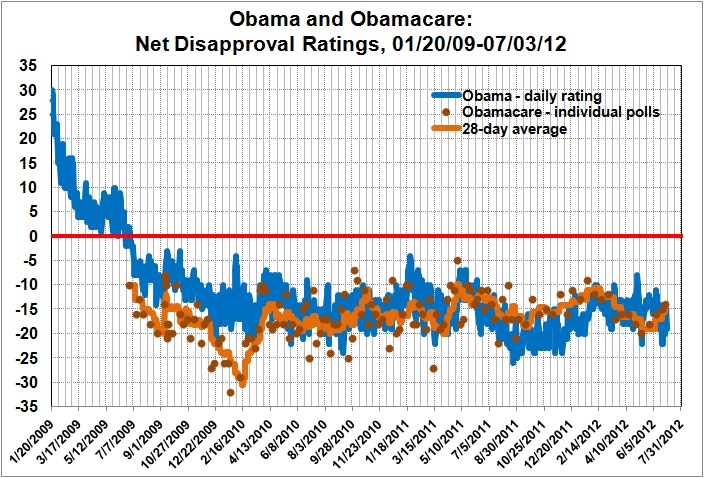
Further evidence for my forecasts, is found in Scott Rasmussen’s polls about the “popularity” (i.e., unpopularity) of Obama and Obamacare:


Sources: Rasmussen Reports, Obama Approval Index History and Health Care Law.

The latest poll results show a net disapproval rating of -18 for Obama (as of July 3) and a net disapproval rating of -14 for Obamacare (as of June 29-30, the two days immediately following CJ Roberts’s bombshell).

Obama’s net disapproval rating measures the percentage of respondents who strongly approve of his performance, minus the percentage of respondents who strongly disapprove of his performance. It has been three years since the arithmetic yielded a positive number, which is why I usually refer to the poll results as Obama’s disapproval or unpopularity rating.

The ratings for Obamacare are constructed as follows: For the period before Obamacare was signed into law on March 23, 2010, the numbers represent the percentage of respondents who strongly favored the passage of Obamacare, less the percentage of respondents who strongly opposed the passage of Obamacare. From the enactment of Obamacare to the present, the numbers represent the percentage of respondents who have strongly opposed the repeal of Obamacare, minus the percentage of respondents who have strongly favored the repeal of Obamacare.

Needless to say, Obamacare has always been in negative territory. In the latest poll (June 29-30) it gained only one percentage point from the poll conducted a week earlier. The recent uptick began in May, probably as a result of the intense p.r. campaign conducted by Obama and other Democrats (most notably Sen. Patrick Leahy, chairman of the Senate Judiciary Committee).

The save-Obamacare campaign may have worked on CJ Roberts, but its overall effect has been small. In fact, the recent gain in popularity is minuscule in comparison to the bandwagon-effect gain that began in January 2010 — when it became clear that Obamacare would become law — and continued until the eve of enactment on March 23, 2010.

The real silver lining in the Supreme Court’s Obamacare decision — if there is any silver lining — is that the Obamacare target still hangs from Obama’s neck.

Another Thought or Two about the Obamacare Decision

In the preceding post, I alluded to commentators who found silver linings in Chief Justice Roberts’s alignment with the Court’s liberal wing in upholding the individual mandate. I feel compelled to say more about the supposed silver linings.

I begin with Ilya Somin, writing at The Volokh Conspiracy:

Although the Supreme Court upheld the individual mandate as an exercise of the Tax Power, a majority of the justices also ruled that it is not a legitimate exercise of Congress’ powers under the Commerce Clause. In doing so, they endorsed the plaintiffs’ argument that the individual mandate exceeds the scope of the Commerce power because it does not regulate “economic activity,” but instead targets inactivity.

But, as Somin points out:

The problem is that Roberts then proceeds to “empower Congress to make those decisions [to buy health insurance]” for us under the guise of imposing taxes.

Why did Roberts not simply join the four dissenting justices and throw out Obamacare while making clear the limits on Congress’s Commerce Clause power? The same (hypothetical) majority opinion also would have found unconstitutional the feds’ expansion of Medicaid.

Sean Trende, writing at RealClearPolitics, has much to say in Roberts’s defense, including this:

Thursday’s health care ruling shocked most observers. It upheld the health care law as constitutional. But rather than find that the law was justified under Congress’ authority to regulate commerce, it instead found it was justified only under Congress’ power to tax. It also imposed limits upon Congress’ ability to condition spending grants to the states upon those states taking certain steps. To my knowledge, former Solicitor General Walter Dellinger was the only person who thought that the court would ultimately rule on those grounds. I certainly was surprised.

Even more surprising, the decision was 5-4, and Chief Justice John Roberts authored the majority opinion upholding the law, rather than Anthony Kennedy. Conservatives are flabbergasted by the chief’s decision (or, in their view, betrayal)….

But I think if you scratch the surface here, Roberts embarked upon a gambit much like [Chief Justice John] Marshall did 200 years ago [in Marbury v. Madison]

Let’s start with Roberts’ presumed crass political considerations. Namely, as a conservative Republican, he would not want the health care law implemented….

If Republicans win the Senate and presidency, the law is doomed. They will use reconciliation to repeal it, or to gut it….

And the decision may help to ensure a GOP sweep in November by energizing unenthusiastic conservatives and fiscally prudent independents.

Trende continues:

Five justices just signaled to lower courts that, but for the unique taxation power argument, they were prepared to rule that a major act of Congress that plainly touched upon economic activity exceeded Congress’ commerce powers….

The most important aspect of the ruling, however, comes with respect to the spending clause. Seven justices just agreed to real limits on Congress’ ability to attach strings to legislation. This is significant. Until today, these limits were hypothetical, and it was believed that Congress could, for example, remove all Medicaid funding as a punishment for a state’s refusal to comply with the Medicaid expansion. I did not expect the court to rule the way it did here, much less to do so by a 7-2 vote….

Roberts has basically … [i]nsulate[d] the court from criticism of bald partisan bias and infidelity to, as he once put it, calling balls and strikes. He’s earning plaudits from the left. Though the right is grumbling, I suspect they won’t be doing so for long.

This is not the last battle to be fought on the Roberts Court. It might not even be the most significant. In the next term, for example, the court is being asked to reconsider its affirmative action jurisprudence. There are almost certainly five votes to overturn court rulings from a decade ago upholding some forms of affirmative action.

Following that, the court will face a variety of tough decisions. There are probably five votes to uproot the entire campaign finance system, a decision that would make Citizens United look like small fry. And there are probably five votes to invalidate Section 5 of the Voting Rights Act.

I don’t think invalidating the ACA would have affected the court’s legitimacy that much, at least outside of liberals in the legal academy. But taken as a whole, this series of decisions really might have irrevocably hurt the court’s reputation for independence.

But Roberts has something of an ace up his sleeve now. Accusations of hyper-partisanship are much harder to make against him, and he has more freedom to move on these issues….

Yes, but Roberts and his conservative brethren have life tenure, and what the public thinks about the Court surely is less important that what the Court does. Giving ground to seem “nice” is a classic conservative blunder.

Perhaps I can find solace in a column by Tom Socca, writing at Slate:

There were two battles being fought in the Supreme Court over the Affordable Care Act. Chief Justice John Roberts—and Justice Anthony Kennedy—delivered victory to the right in the one that mattered….

The scholars expected to see the court gut existing Commerce Clause precedent and overturn the individual mandate in a partisan decision: Five Republican-appointed justices voting to rewrite doctrine and reject Obamacare; four Democratic-appointed justices dissenting.

Roberts was smarter than that. By ruling that the individual mandate was permissible as a tax, he joined the Democratic appointees to uphold the law—while joining the Republican wing to gut the Commerce Clause (and push back against the necessary-and-proper clause as well)….

This is a substantial rollback of Congress’ regulatory powers, and the chief justice knows it. It is what Roberts has been pursuing ever since he signed up with the Federalist Society. In 2005, Sen. Barack Obama spoke in opposition to Roberts’ nomination, saying he did not trust his political philosophy on tough questions such as “whether the Commerce Clause empowers Congress to speak on those issues of broad national concern that may be only tangentially related to what is easily defined as interstate commerce.” Today, Roberts did what Obama predicted he would do.

Roberts’ genius was in pushing this health care decision through without attaching it to the coattails of an ugly, narrow partisan victory. Obama wins on policy, this time. And Roberts rewrites Congress’ power to regulate, opening the door for countless future challenges. In the long term, supporters of curtailing the federal government should be glad to have made that trade.

This strikes me as more of the same. But perhaps Trende and Socca are on to something. Roberts, by reaching out the the Court’s left, may have gained useful allies for future fights. Kennedy, despite his surprising (to me) absolute opposition to Obamacare, can and will stray off the conservative reservation without warning.

There is also the important and still-to-be-decided issue of Obamacare’s effects on religious freedom. This is from a post by Sarah Marshall and Jennifer Torre at The Foundry:

…The Court’s ruling to uphold Obamacare doesn’t mean the law has cleared its legal challenges, however. Twenty-three federal lawsuits against Obamacare’s Health and Human Services (HHS) mandate—which goes into effect on August 1—now take on added urgency….

The HHS anti-conscience mandate is a completely separate rule from the individual mandate, and its constitutionality was not considered by the Supreme Court in the cases decided today. The HHS mandate, along with the individual mandate and the rest of Obamacare, still presents a clear threat to individual and religious liberty. Nothing short of full repeal of the statute will adequately protect our freedoms from this federal overreach.

The next legal battleground against Obamacare resides in the fight to protect employers from the coercive requirement to provide coverage of abortion-inducing drugs, contraception, and sterilization under the HHS mandate….

Obamacare’s anti-conscience mandate affords the narrowest religious exemption in federal law, effectively covering only formal houses of worship. Countless other religious employers, like schools, hospitals, and religious charities, are forced to provide coverage for the mandated services despite moral or religious objections—simply because they step outside the four walls of a church to serve others.

Creating the choice to violate conscience or forgo providing health insurance entirely—and risk hefty fines under Obamacare—the HHS mandate profoundly and adversely affects many employers and the people they serve….

Perhaps this is one of the fights anticipated by Roberts. And perhaps he wants to win it by more than 5-4 (or to ensure that he wins it). Robert John Araujo of Mirror of Justice has some related thoughts:

[The following observation of Justice Ginsburg and her colleagues in their partial concurrence and dissent might suggest that the debate and probably the litigation involving the legality of this legislation will continue for some time to come. As she says about the provisions of the Constitution that exist to check Congressional overreaching:

A mandate to purchase a particular product would be unconstitutional if, for example, the edict impermissibly abridged the freedom of speech, interfered with the free exercise of religion, or infringed on a liberty interest protected by the Due Process Clause.

…[I]t would appear that this subject which Justice Ginsburg, and those who agree with her, has identified may well be in the courts in the not-too-distant future [as discussed in the preceding quotation].

Could Roberts be angling to enlist Ginsburg as an ally in the looming freedom-of-conscience cases? That strikes me as a long shot because Ginsburg — “good” statist that she is, will no doubt find a way to wiggle out of her implied commitment to the free exercise of religion. But Roberts’s real targets may be Justices Breyer and Kagan, who joined his opinion — including the ruling that the expansion of Medicaid was unduly coercive of the States.

If Roberts has made the political calculations attributed to him — and I wouldn’t be surprised if he has — my only wish is that his calculations prove correct. If they are not, he simply will have wasted what would have been a perfectly good majority opinion, namely, the dissent of Justices Scalia, Kennedy, Thomas, and Alito.

Obamacare, Slopes, Ratchets, and the Death Spiral of Liberty

Today’s ruling by the U.S. Supreme Court in the matter of Obamacare (National Federation of Business et al. v. Sebelius, Secretary of Health and Human Services, et al.) is portrayed by some commentators as a victory of sorts for limited government. Consider the following excerpts of the Syllabus:

[T]he individual mandate is not a valid exercise of Congress’s power under the Commerce Clause and the Necessary and Proper Clause….

The power to regulate commerce presupposes the existence of commercial activity to be regulated. This Court’s precedent reflects this understanding: As expansive as this Court’s cases construing the scope of the commerce power have been, they uniformly describe the power as reaching “activity.”…  The individual mandate, however, does not regulate existing commercial activity. It instead compels individuals to become active in commerce by purchasing a product, on the ground that their failure to do so affects interstate commerce.

Construing the Commerce Clause to permit Congress to regulate individuals precisely because they are doing nothing would open a new and potentially vast domain to congressional authority. Congress already possesses expansive power to regulate what people do. Upholding the Affordable Care Act under the Commerce Clause would give Congress the same license to regulate what people do not do. The Framers knew the difference between doing something and doing nothing. They gave Congress the power to regulate commerce, not to compel it. Ignoring that distinction would undermine the principle that the Federal Government is a government of limited and enumerated powers. The individual mandate thus cannot be sustained under Congress’s power to “regulate Commerce.”…

Nor can the individual mandate be sustained under the Necessary and Proper Clause as an integral part of the Affordable Care Act’s other reforms. Each of this Court’s prior cases upholding laws under that Clause involved exercises of authority derivative of, and in service to, a granted power…. The individual mandate, by contrast, vests Congress with the extraordinary ability to create the necessary predicate to the exercise of an enumerated power and draw within its regulatory scope those who would otherwise be outside of it. Even if the individual mandate is “necessary” to the Affordable Care Act’s other reforms, such an expansion of federal power is not a “proper” means for making those reforms effective.

So far, so good, but

for the reasons explained, the Commerce Clause does not give Congress that power.It is therefore necessary to turn to the Government’s alternative argument: that the mandate may be upheld as within Congress’s power to “lay and collect Taxes.”… In pressing its taxing power argument, the Government asks the Court to view the mandate as imposing a tax on those who do not buy that product. Because “every reasonable construction must be resorted to, in order to save a statute from unconstitutionality,”… the question is whether it is “fairly possible” to interpret the mandate as imposing such a tax….

The Affordable Care Act describes the “[s]hared responsibility payment” as a “penalty,” not a “tax.” That label is fatal to the application of the Anti-Injunction Act. It does not, however, control whether an exaction is within Congress’s power to tax. In answering that constitutional question, this Court follows a functional approach,“[d]isregarding the designation of the exaction, and viewing its substance and application.”…

Such an analysis suggests that the shared responsibility payment may for constitutional purposes be considered a tax.

What a strange tax it is that must be paid to the government in order to breathe life into a program for which there is no constitutional remit in the “limited and enumerated powers” of the government. The government’s powers to tax and spend are not open-ended; they must serve a constitutional purpose.

There is more:

[T]he Medicaid expansion violates the Constitution by threatening States with the loss of their existing Medicaid funding if they decline to comply with the expansion….

The Spending Clause grants Congress the power “to pay the Debts and provide for the . . . general Welfare of the United States.”… Congress may use this power to establish cooperative state-federal Spending Clause programs. The legitimacy of Spending Clause legislation, however, depends on whether a State voluntarily and knowingly accepts the terms of such programs…. When Congress threatens to terminate other grants as a means of pressuring the States to accept a Spending Clause program, the legislation runs counter to this Nation’s system of federalism….

Under the Affordable Care Act, Medicaid is transformed into a program to meet the health care needs of the entire nonelderly population with income below 133 percent of the poverty level. A State could hardly anticipate that Congress’s reservation of the right to “alter” or “amend” the Medicaid program included the power to transform it so dramatically. The Medicaid expansion thus violates the Constitution by threatening States with the loss of their existing Medicaid funding if they decline to comply with the expansion….

The constitutional violation is fully remedied by precluding the Secretary from … withdraw[ing] existing Medicaid funds for failure to comply with the requirements set out in the expansion.

Again, gratifying as the holding may be to some parties, it assumes (and therefore affirms) the constitutionality of an act that “meet[s] he health care needs of the entire nonelderly population with income below 133 percent of the poverty level.” Where does the Constitution set forth Congress’s power to do any such thing?

My outrage is echoed in the dissent by Justices Scalia, Kennedy, Thomas, and Alito; for example:

The striking case of Wickard v. Filburn, … , which held that the economic activity of growing wheat, even for one’s own consumption, affected commerce sufficiently that it could be regulated, always has been regarded as the ne plus ultra of expansive Commerce Clause jurisprudence. To go beyond that, and to say the failure to grow wheat (which is not an economic activity, or any activity at all) nonetheless affects commerce and therefore can be federally regulated, is to make mere breathing in and out the basis for federal prescription and to extend federal power to virtually all human activity.

As for the constitutional power to tax and spend for the general welfare: The Court has long since expanded that beyond (what Madison thought it meant) taxing and spending for those aspects of the general welfare that were within the Federal Government’s enumerated powers… Thus, we now have sizable federal Departments devoted to subjects not mentioned among Congress’ enumerated powers, and only marginally related to commerce: the Department of Education, the Department of Health and Human Services, the Department of Housing and Urban Development. The principal practical obstacle that prevents Congress from using the tax-and-spend power to assume all the general-welfare responsibilities traditionally exercised by the States is the sheer impossibility of managing a Federal Government large enough to administer such a system. That obstacle can be overcome by granting funds to the States, allowing them to administer the program. That is fair and constitutional enough when the States freely agree to have their powers employed and their employees enlisted in the federal scheme. But it is a blatant violation of the constitutional structure when the States have no choice.

The Act before us here exceeds federal power both in mandating the purchase of health insurance and in denying nonconsenting States all Medicaid funding. These parts of the Act are central to its design and operation, and all the Act’s other provisions would not have been enacted without them. In our view it must follow that the entire statute is inoperative.

Amen to that. And the same goes for Social Security and Medicare. (My words, not the words of the dissenting justices, unfortunately.)

Where does today’s ruling leave Americans? Further down the slippery slope to serfdom. The “slippery slope” is

an argument for the likelihood of one event or trend given another. Invoking the “slippery slope” means arguing that one action will initiate a chain of events that will lead to a (generally undesirable) event later. The argument is sometimes referred to as the thin end of the wedge or the camel’s nose.

That is to say, once it became accepted that the federal government could establish programs like Social Security, Medicare, and Medicaid, it became relatively easy to expand those programs to encompass the “national emergency” of the day. And so, the stage has been set for  government-run health care in the United States, with all that goes with it: long queues, worse care, rationing, and death panels, and more.

Another metaphor for the inexorable engrossment of state power is the ratchet effect,

the commonly observed phenomenon that some processes cannot go backwards once certain things have happened, by analogy with the mechanical ratchet that holds the spring tight as a clock is wound up.

The acceptance of the status quo (Social Security, Medicare, and Medicaid) as a baseline sets the stage for a ratcheting up to a new, more expansive and expensive status quo (Obamacare), on the ground that if X is good, X+ will be better. That X is good and X+ will be better are articles of faith, which become widely accepted without serious consideration of the burden they impose on the most productive citizens, the negative effect of that burden on the nation’s economy, or the liberty of the people. It has been heartening that most Americans have opposed Obamacare, in the main because of the perceived insult to liberty known as the individual mandate. But, alas, a majority of the Supreme Court has found a legalistic way in which to ratchet up the mainspring of government power.

Perhaps the best metaphor for today’s ruling is the death spiral. Reliance on government usually creates more problems than it solves. But, having become accustomed to relying on government, most Americans rely on government to deal with the problems caused by government’s previous enactments. That only makes matters worse, which causes Americans to rely further on government, etc., etc. etc.

In the case of Obamacare, what we have is a reaction to the high costs of medical services and the presumed failure of markets to provide adequate health care for large chunks of the population. It escapes the notice of most Americans — and is of no interest to most politicians — that the high costs and supposed “market failures” are due to government action: tax subsidies for employer-provided insurance (which results in an artificially high demand for medical services); mandated insurance coverages; barriers to interstate competition in insurance markets; the FDA’s long, death-inducing approval process for new drugs; the AMA’s government-sponsored stranglehold on the training and licensing of doctors; a similar stranglehold on the establishment of health-care facilities; and on and on.This is the real “national emergency,” which today’s majority blithely ignored in its quest to find an extra-constitutional (i.e., precedential) basis for the further expansion of government power.

It is long past time for Americans to declare their independence from the legislative, executive, and judicial tyranny under which we labor for the benefit of politicians, bureaucrats, and freeloaders.

Directly related posts:
Fear of the Free Market — Part I
Fear of the Free Market — Part II
Fear of the Free Market — Part III
Free-Market Healthcare
Social Security Is Unconstitutional
Rationing and Health Care
The Perils of Nannyism: The Case of Obamacare
More about the Perils of Obamacare
Health-Care Reform: The Short of It
The Unconstitutionality of the Individual Mandate
Does the Power to Tax Give Congress Unlimited Power?
Does Congress Have the Power to Regulate Inactivity?

Posts about government power, its effects, and ways to combat it:
FDR and Fascism
The People’s Romance
Fascism
Fascism with a “Friendly” Face
Secession
Democracy and Liberty
The Interest-Group Paradox
Is Statism Inevitable?
Inventing “Liberalism”
The Price of Government
A New, New Constitution
Zones of Liberty
Fascism and the Future of America
Secession Redux
A New Cold War or Secession?
The Price of Government Redux
The Real Constitution and Civil Disobedience
The Near-Victory of Communism
A Declaration of Independence
The Mega-Depression
Tocqueville’s Prescience
First Principles
As Goes Greece
Accountants of the Soul
Ricardian Equivalence Reconsidered
Zones of Liberty
The Constitution: Original Meaning, Corruption, and Restoration
Society and the State
I Want My Country Back
Estimating the Rahn Curve: Or, How Government Inhibits Economic Growth
The Bowles-Simpson Report
The Bowles-Simpson Band-Aid
Regime Uncertainty and the Great Recession
Re-Forming the United States
The Stagnation Thesis
Taxing the Rich
More about Taxing the Rich
America’s Financial Crisis Is Now
The Southern Secession Reconsidered
A Declaration of Civil Disobedience
The Repealer
Regulation as Wishful Thinking
The Real Multiplier
Vulgar Keynesianism and Capitalism
Why Are Interest Rates So Low?
The Commandeered Economy
Estimating the Rahn Curve: A Sequel
In Defense of the 1%
The Real Multiplier (II)
Lay My (Regulatory) Burden Down
The Burden of Government
Constitutional Confusion
Reclaiming Liberty throughout the Land
Economic Growth Since World War II
More Evidence for the Rahn Curve

In Mourning

I am in mourning for liberty in the United States, which has been killed by today’s ruling by the U.S. Supreme Court. Thus the black band at the top of this blog.

More to come.

UPDATE (09/06/13)

I’ve gone back to red because I’m fighting mad, and plan to stay that way.

“Big SIS”: A Review

“Big SIS” is the special-interest state, of which James V. DeLong writes in Ending “Big SIS” (The Special Interest State) and Renewing the American Republic.It is a non-fiction horror story, one that should outrage every reader. A reader must be impervious facts and logic if he gets very far into “Big SIS” without grasping the direness of America’s present condition.

What is that condition? It is enslavement (not too strong a word) to the regulatory state. DeLong does an admirable job of describing the growth and entrenchment of the regulatory state (chapter 2). But the most compelling parts of his thoroughly factual narrative arrive with his documentation of the costs of the regulatory state and his enumeration of example after example of its lunacies. If you have a visceral feeling that government in the United States has become entirely too intrusive in its methods and perverse in its results, DeLong’s book will confirm that feeling and give you plenty of weapons with which to refute those who believe in government as a disinterested, omniscient force for good.

If chapters 2 and 3 outrage you, as they should, surely chapter 4 will depress you. There, DeLong enumerates and explicates the many reasons that the regulatory state’s death grip on America is unlikely to be loosened. DeLong holds out some hope for change in chapter 5, where he discusses many ways in which the death-grip might be loosened.

But I am less sanguine than DeLong seems to be about the possible efficacy of his proposed counter-measures. The forces that DeLong describes in chapter 4 are likely to prove too strong to be defeated in gentlemanly fashion. In the end, it may well come to non-gentlemanly counter-measures, something along the lines of a new Declaration of Independence from the imperial state that has arisen in Washington.

If it does come to that, DeLong’s catalog of imperial acts and their vile consequences would serve splendidly as a replacement for the original Declaration’s enumeration of King George III’s “repeated injuries and usurpations, all having in direct object the establishment of an absolute Tyranny.”

Related posts:
FDR and Fascism
The People’s Romance
Fascism
Fascism with a “Friendly” Face
Secession
Democracy and Liberty
The Interest-Group Paradox
Is Statism Inevitable?
Inventing “Liberalism”
The Price of Government
A New, New Constitution
Zones of Liberty
Fascism and the Future of America
Secession Redux
The Indivisibility of Economic and Social Liberty
A New Cold War or Secession?
The Price of Government Redux
The Real Constitution and Civil Disobedience
The Near-Victory of Communism
A Declaration of Independence
The Mega-Depression
Tocqueville’s Prescience
First Principles
As Goes Greece
Accountants of the Soul
Ricardian Equivalence Reconsidered
Zones of Liberty
The Constitution: Original Meaning, Corruption, and Restoration
Estimating the Rahn Curve: Or, How Government Inhibits Economic Growth
The Bowles-Simpson Report
The Bowles-Simpson Band-Aid
Regime Uncertainty and the Great Recession
Re-Forming the United States
More about Taxing the Rich
America’s Financial Crisis Is Now
The Southern Secession Reconsidered
A Declaration of Civil Disobedience
The Repealer
Regulation as Wishful Thinking
The Real Multiplier
Vulgar Keynesianism and Capitalism
Why Are Interest Rates So Low?
The Commandeered Economy
Estimating the Rahn Curve: A Sequel
In Defense of the 1%
The Real Multiplier (II)
Lay My (Regulatory) Burden Down
The Burden of Government
Constitutional Confusion
Reclaiming Liberty throughout the Land
Economic Growth Since World War II
More Evidence for the Rahn Curve

Obesity and Statism

Richard Posner, a leader of the law and economics movement, exposes himself as an out-and-out statist:

I am not particularly interested in saving the obese from themselves. I am concerned about the negative externalities of obesity—the costs that the obese impose on others. Some of the others are the purchasers of health insurance and the taxpayers who pay for Medicaid and Medicare and social security disability benefits…. Obesity kills, but slowly, and en route to dying the obese run up heavy bills that, to a great extent, others pay.

Even more serious are the harmful effects of obesity, and of the food habits that contribute to it, on children…. Children who grow up in a household of obese parents (often there is just one parent, and she is obese) very often acquire the same bad habits.

One might think that since most parents are altruistic toward their children, parents would strive to prevent their children from acquiring their bad habits. But if they don’t know how to avoid becoming obese themselves, it is unlikely that they know how to prevent their children from becoming obese.

Then too, the more people in one’s family or circle of friends or coworkers who are obese, the more obesity seems normal. This is an implication of the fact that homo sapiens is a social animal. We want to blend in with our social peers….

Bloomberg’s proposal is widely criticized, not only on the shallow ground that it interferes with freedom of choice, but on the more substantial ground that it can’t have much effect, since the same sugared drinks can be sold in smaller containers…. [I]f the sale of sugared drinks in big containers is forbidden, there will be at least a slight drop in the purchase of those drinks and hence in their consumption….

More important is the symbolic significance of Bloomberg’s proposal (if it is adopted and enforced). It is an attention getter! It tells New Yorkers that obesity is a social problem warranting government intervention, and not just a personal choice.

Think of the history of cigarette regulation…. Cigarette smoking fell, from an average of 40 percent of the adult population in the 1970s to 19 percent today. There is some grumbling about this massive governmental intrusion into consumer choice, but very little. I certainly am not grumbling about it.

If there is to be a parallel movement to reduce obesity, it has to start somewhere. Maybe it will start with Bloomberg’s container proposal—an attention getter. Maybe it will grow. Maybe someday it will be as effective, and receive as much public approbation, as the anti-smoking movement. [From Posner’s post about “Bloomberg, Sugar, and Obesity,” at The Becker-Posner Blog, June 18, 2012.]

There you have a reputedly keen “legal mind” in the throes of economistic thinking. It perfectly illustrates a phenomenon about which I write in “A Man for No Seasons“:

[T]oo many economists justify free markets on utilitarian grounds, that is, because free markets produce more (i.e., are more efficient) than regulated markets. This happens to be true, but free markets can and should be justified mainly because they are free, that is, because they allow individuals to pursue otherwise lawful aims through voluntary, mutually beneficial exchanges of products and services. Liberty is a principle, a deep value; economic efficiency is merely a byproduct of adherence to that value.

It is evident that Posner cares not a jot about liberty; efficiency is his god.

Posner’s facile analysis of the costs of obesity is obviously grounded in an aversion to obese persons. He gives his game away by lauding the anti-cigarette campaign, which is really based on two things:

  • an esthetic revulsion
  • the snobbishness of the middle and upper-middle classes toward their “inferiors.”

The parallels to the anti-obesity campaign are so evident that I need say nothing more on this point.

In any event, the real problem is not obesity. It is that Americans have been forced to accept responsibility for other persons’ health. Posner almost grasps this when he writes about “the purchasers of health insurance and the taxpayers who pay for Medicaid and Medicare and social security disability benefits.” These problems would largely disappear if government did not distort the cost of health insurance through mandates and barriers to entry, and did not force some Americans to subsidize the health care of others through Medicare, Medicaid, and various State and local programs. The consumption of junk food, which Posner correctly indicts as a cause of obesity, is undoubtedly subsidized (indirectly) by welfare payments and food stamps.

The growing fraction of Americans who are considered obese is, in fact, a symptom of the ability of competitive markets to deliver more nourishment at a lower real cost. If obesity is concentrated among low-income groups — and I believe that it is — it means that low-income groups, on the whole, are better nourished than they were in the past. But, in typical fashion, paternalists like Posner focus on the aspects of progress that they find distasteful, while ignoring the larger picture.

If Posner were really serious about saving Americans from the consequences of their own behavior, he would be agitating for a ban on automobiles and the prohibition of alcoholic beverages. Oh, prohibition was tried and it failed because of its unintended consequences? My, my, what a surprise.

The unintended consequences of a war on obesity should be obvious to Posner — or would be if he were not blinded by paternalism. Regulators, armed with the power to limit what Americans can consume, would inevitably do great mischief to the health and enjoyment that Americans derive from the preparation and consumption of foodstuffs. Regulators love to impose one-size-fits all restrictions on everyone, instead of allowing individuals and firms to choose those courses of action that best suit them. And so — in the name of health and under the influence of various food-Nazis — regulators would move beyond Bloomberg’s simplistic “solution” to truly draconian measures. Almost anything that is believed to be harmful to some persons (e.g., salt, fat, nuts) would be strictly metered if not banned for all persons. (I have no taste for raw fish, but I would be aghast if those who like sashimi were unable to buy it because of the health risk that accompanies its consumption.) Then there are the opportunities for various interest groups (e.g., American cheese manufacturers) to rig the regulatory game in their favor. In short, it is not far down the regulatory slope from a ban on super-size drinks to a ban on foods that most of us find enjoyable, and even healthful.

But Mrs. Grundy — er, Judge Posner and his ilk — will not be deterred. And if the Grundy-Posners succeed in their paternalistic crusade, they will have turned America into a land of grim, granola-crunching Zombies. For that is liberty, Posner-style.

Related posts:
How to Combat Beauty-ism
The Mind of a Paternalist, Revisited
Utilitarianism and Psychopathy
Externalities and Statism

The Clemens Verdict

This does not surprise me:

Roger Clemens, who intimidated even the toughest batters while becoming one of the best pitchers in baseball history, was acquitted Monday of all charges that he lied to Congress in 2008 when he insisted he never used steroids or human growth hormone during his long career. [Juliet Macur, “Clemens Found Not Guilty of Lying About Drug Use,” The New York Times, June 18, 2012]

I did not follow the trial closely, and cannot recite details of the evidence presented by the government or the defense’s response to the evidence. I am unsurprised by the verdict because there is no statistical case that Clemens used (or derived benefit from) steroids or human growth hormone (HGH). The statistical evidence — or lack of it — is spelled out in my post of February 18, 2008, “Did Roger Do It?

Abortion, “Gay Rights,” and Liberty

Among the items that drew my attention today is “A Prime Instance of Political Correctness: The Blackballing of Nat Hentoff,” by Maverick Philosopher.

My opposition to abortion on libertarian grounds is of long standing, with this being the most recent of many posts on the subject. As it turns out, Nat Hentoff, who on many issues might be considered a leftist, holds views similar to mine. This, for example, is from his “Indivisible Fight for Life“:

I’ll begin by indicating how I became aware, very belatedly, of the “indivisibility of life.” I mention this fragment of autobiography only be cause I think it may be useful to those who are interested in bringing others like me – some people are not interested in making the ranks more heterogeneous, but others are, as I’ve been finding out – to a realization that the “slippery slope” is far more than a metaphor.

When I say “like me,” I suppose in some respects I’m regarded as a “liberal,” although I often stray from that category, and certainly a civil libertarian – though the ACLU and I are in profound disagreement on the matters of abortion, handicapped infants and euthanasia, because I think they have forsaken basic civil liberties in dealing with these issues. I’m considered a liberal except for that unaccountable heresy of recent years that has to do with pro-life matters.

It’s all the more unaccountable to a lot of people because I remain an atheist, a Jewish atheist. (That’s a special branch of the division.) I think the question I’m most often asked from both sides is, “How do you presume to have this kind of moral conception without a belief in God?” And the answer is, “It’s harder.” But it’s not impossible….

Now, I had not been thinking about abortion at all. I had not thought about it for years. I had what W. H. Auden called in another context a “rehearsed response.” You mentioned abortion and I would say, “Oh yeah, that’s a fundamental part of women’s liberation,” and that was the end of it.

But then I started hearing about “late abortion.” The simple “fact” that the infant had been born, proponents suggest, should not get in the way of mercifully saving him or her from a life hardly worth living. At the same time, the parents are saved from the financial and emotional burden of caring for an imperfect child.

And then I heard the head of the Reproductive Freedom Rights unit of the ACLU saying – this was at the same time as the Baby Jane Doe story was developing on Long Island – at a forum, “I don’t know what all this fuss is about. Dealing with these handicapped infants is really an extension of women’s reproductive freedom rights, women’s right to control their own bodies.”

That stopped me. It seemed to me we were not talking about Roe v. Wade. These infants were born. And having been born, as persons under the Constitution, they were entitled to at least the same rights as people on death row – due process, equal protection of the law. So for the first time, I began to pay attention to the “slippery slope” warnings of pro-lifers I read about or had seen on television. Because abortion had become legal and easily available, that argument ran – as you well know – infanticide would eventually become openly permissible, to be followed by euthanasia for infirm, expensive senior citizens….

Recently, I was interviewing Dr. Norman Levinsky, Chief of Medicine of Boston University Medical Center and a medical ethicist. He is one of those rare medical ethicists who really is concerned with nurturing life, as contrasted with those of his peers who see death as a form of treatment. He told me that he is much disturbed by the extent to which medical decisions are made according to the patient’s age. He says there are those physicians who believe that life is worth less if you’re over 80 than if you’re 28.

So this is capsulizing an incremental learning process. I was beginning to learn about the indivisibility of life. I began to interview people, to read, and I read Dr. Leo Alexander. Joe Stanton, who must be the greatest single resource of information, at least to beginners – and, I think, non-beginners – in this field, sent me a whole lot of stuff, including Dr. Leo Alexander’s piece in the New England Journal of Medicine in the 1940s. And then I thought of Dr. Alexander when I saw an April 1984 piece in the New England Journal of Medicine by 10 physicians defending the withdrawal of food and water from certain “hopelessly ill” patients. And I found out that Dr. Alexander was still alive then but didn’t have much longer to live. And he said to Patrick Duff, who is a professor of philosophy at Clarke University and who testified in the Brophy case, about that article, “It is much like Germany in the 20s and 30s. The barriers against killing are coming down.”…

Back to Dr. Norman Levinsky. This is all part of this learning process. It is not a huge step, he said, from stopping the feeding to giving the patient a little more morphine to speed his end. I mean it is not a big step from passive to active euthanasia.

Well, in time, a rather short period of time, I became pro-life across the board, which led to certain social problems, starting at home. My wife’s most recurrent attack begins with, “You are creating social mischief,” and there are people at my paper who do not speak to me anymore. In most cases, that’s no loss.

Which leads to “Blackballing Nat Hentoff,” by Mark Judge (writing at RealClearReligion):

Hentoff’s conversion from pro-choice to pro-life, and the fallout that resulted, is explained in an essay in the new book, The Debate Since Roe: Making the Case Against Abortion 1975-2010. It’s a compendium of essays from the journal Human Life Review….

Hentoff’s liberal friends didn’t appreciate his conversion: “They were saying, ‘What’s the big fuss about? If the parents had known she was going to come in this way, they would have had an abortion. So why don’t you consider it a late abortion and go on to something else? Here were liberals, decent people, fully convinced themselves that they were for individual rights and liberties but willing to send into eternity these infants because they were imperfect, inconvenient, costly. I saw the same attitude on the part of the same kinds of people toward abortion, and I thought it was pretty horrifying.”

The reaction from America’s corrupt fourth estate was instant. Hentoff, a Guggenheim fellow and author of dozens of books, was a pariah. Several of his colleagues at the Village Voice, which had run his column since the 1950s, stopped talking to him. When the National Press Foundation wanted to give him a lifetime achievement award, there was a bitter debate amongst members whether Hentoff should even be honored (he was). Then they stopped running his columns. You heard his name less and less. In December 2008, the Village Voice officially let him go.

The blackballing of Hentoff, reprehensible and revealing of the left’s moral bankruptcy as it may be, has one positive aspect: It seems to have been accomplished by private action; that is, the power of the state has not been wielded against Hentoff. (As far as I know.)

The power of the state has been wielded against those who dare to resist the “gay rights” movement and its ancillary activities. Here is Hentoff, writing in September 2000 (“Media Ignores Far-Ranging Gag Order“) about one such instance:

On March 30, the Boston chapter of the national Gay, Lesbian, and Straight Education Network (GLSEN) held a conference at Tufts  University. Present, from around the state, were teen-agers and some children as young as 12, as well as teachers who received state ‘professional development credits’ for being there.

One of the sessions was titled, ‘What They Don’t Tell You About Queer Sex & Sexuality in Health Class: A Workshop for Youth Only, Ages 14-21.’ Instructing the students were two employees of the state Department of Education and a consultant from the Department of Public Health.

Scott Whiteman of the conservative Parents Rights Coalition attended  that class and secretly taped it. I have a copy of the transcript.  When a youngster asked, ‘What’s fisting?’ in gay sex, a woman from the Education Department explained how to do it. There might be some pain, she said, but it’s an ‘experience of letting somebody into your body that you want to be that close and intimate with.’

Among other lessons, there was a ‘hand diagram’ to show how lesbians have sex. Another workshop was: ‘Early Child Educators: How to Decide Whether to Come Out at Work or Not.’

Part of the tape was played on Boston talk-radio station WTKK-FM by the host, Jeanine Graf, whom I’ve known for years as a vigorous advocate for free speech.

The Parents Rights Coalition made the tape available to others, and GLSEN sued to have it and any transcripts suppressed. On May 17, Suffolk County Superior Court Judge Allan van Gestel, who moonlights as a lecturer at Harvard Law School, issued one of the most  far-ranging prior-restraint orders in American judicial history….

It included not only the Parents Rights Coalition but anyone, including  lawyers, who tried ‘to disclose or use such tape in any forum’ or its contents. That included the press, electronic and print….

The … media [other than the Boston Herald] was silent, except for WTKK’s Graf. She kept playing the tape. And, on her program, Harvard law professor Alan Dershowitz and Harvey Silverglate – a civil-rights and civil-liberties lawyer as well as a national columnist – attacked the prior restraint as a violation of a series of U.S. Supreme Court decisions.

I went on Graf’s show to violate the gag order. I discussed what was on the tape and underlined the judge’s contempt for settled First Amendment law. Also criticizing the prior restraint was Jay Severin, a WTKK commentator.

The Massachusetts affiliate of the American Civil Liberties Union was silent….

On May 25, van Gestel modified his gag rule, saying, ‘Nothing in this preliminary injunction shall be deemed to apply in any way to the print or electronic news media.’ But the rest of the prior restraint continued….

Subsequently, there has been some coverage of this assault on the First Amendment and the acquiescence of most of the Boston media. Rod Dreher, a New York Post columnist, wrote an indignant ‘Banned in Boston’ article in the July 3-10 issue of The Weekly Standard….

Aside from Dreher’s piece, I’ve seen no mention in the national press of this gag order that should go into the Guinness Book of World Records. If a similar suppression of speech had been handed down by a judge against a secret taping of a David Duke-sponsored conference by the National Association for the Advancement of Colored People, would there have been such media silence?

Fast forward to 2012, where the leftist-statist conspiracy to advance “gay rights” (i.e., gay privileges) is alive and well. A case in point is described in “Wedding Photographer May Be Required (on Pain of Legal Liability) to Photograph Same-Sex Commitment Ceremonies,” at The Volokh Conspiracy:

So the New Mexico Court of Appeals held last week in the long-pending Elane Photography v. Willock (N.M. Ct. App. May 31, 2012). The court began by holding that the state law that bans sexual orientation discrimination in places of public accommodation applies to professional wedding photographers’ decisions not to photograph same-sex commitment ceremonies: Such photography businesses are “places of public accommodation” under the language of the law, and the discrimination between legally recognized opposite-sex marriages (New Mexico only recognizes such marriages) and same-sex commitment ceremonies constitutes discrimination based on sexual orientation.

The court then rejected the argument of the photographer (Elane Huguenin, the co-owner and principal photographer for Elane Photography) that penalizing her for not photographing such same-sex ceremonies was an unconstitutional “speech compulsion.” The First Amendment, Huguenin argued, has been repeatedly held to protect the right to speak as well as the right not to speak; and the right not to speak includes the right not to create artistic expression that one doesn’t want to create. And just as the First Amendment protects speech that is said for money (indeed, most books, newspapers, movies, and the like are created and distributed commercially), so it protects the right not to create certain artistic works for money, even if one is in that line of business. But the court disagreed….

I don’t think this [ruling] is right, for reasons that I discussed in my earlier posts about earlier stages of this case. It seems to me that the right to be free from compelled speech includes the right not to create First-Amendment-protected expression — photographs, paintings, songs, press releases, or what have you — that you disagree with, even if no-one would perceive you as endorsing that expression….

Amen to that.

Not that I am surprised by the court’s action. This is from “Civil Society and Homosexual “Marriage,” a post that I wrote three years ago:

[A]s sure as the sun sets in the west, the state will begin to apply the equal protection clause of the Fourteenth Amendment in order to protect homosexual “marriage” from its critics. Acting under the rubric of “civil rights” — and  in keeping with the way that anti-discrimination laws have been applied to date — the state will deal harshly with employers, landlords, and clergy who seem to discriminate against homosexual “marriage” and its participants.

The post concludes with this:

Many will dismiss consequential arguments against homosexual “marriage” by asserting that the state’s refusal to legitimate homosexual marriage simply isn’t “fair.” In return, I will ask this:

Unfair to whom, to the relatively small number of persons who seek to assuage their pride or avoid paying a lawyer to document the terms of their relationship, or generally unfair to members of society (of all sexual proclivities), whose well-being is bound to suffer for the sake of homosexual pride or cost-avoidance?

As a practicing minarchist, I would rather have the state stay out of “the marriage business.”  But given that the state is already in that business — and is unlikely to get out of it — the next-best outcome is for the state to uphold societal norms instead of bowing to the preferences of the gay lobby and its influential supporters.

Faced with a choice between libertarian shibboleth and libertarian substance, I have chosen substance. I now say: Ban homosexual marriage and avoid another step down the slippery slope toward incivility and bigger government.

And, while we are striking blows for liberty, let us ban abortion, too.

Related posts (abortion):
Law, Liberty, and Abortion
Substantive Due Process and the Limits of Privacy
Crimes against Humanity
Abortion and Logic
Abortion, Doublethink, and Left-Wing Blather

Related posts (homosexual “marriage”):
Libertarianism, Marriage, and the True Meaning of Family Values
Same-Sex Marriage
“Equal Protection” and Homosexual Marriage
“Family Values,” Liberty, and the State
Civil Society and Homosexual “Marriage”
Perry v. Schwarzenegger, Due Process, and Equal Protection
Rationalism, Social Norms, and Same-Sex “Marriage”
Pseudo-Libertarian Sophistry vs. True Libertarianism
Bounded Liberty: A Thought Experiment
More Pseudo-Libertarianism
The Meaning of Liberty
In Defense of Marriage
The Myth That Same-Sex “Marriage” Causes No Harm

Not Guilty of Libertarian Purism

I highly recommend “Understanding Hayek” as a companion-piece to this post.

UPDATED (BELOW), 06/01/12

This post is in response to Jason Brennan’s post of May 30, “We Are Statists in Classical Liberal Clothing.” Brennan’s post was triggered ” by “Bleeding Heart Libertarians = Left-Statists,” which I posted on May 10.

I must say, first, that I am grateful to Brennan for linking to my blog, my bio, and the post that offends him. Today, the number of page views at Politics & Prosperity is about double the usual total for a Wednesday.

Now, what is right and what is wrong in Brennan’s reaction to my (admittedly and intentionally) provocative post? The first thing that is wrong with it is that I am not a libertarian, at least not of a kind that Brennan and company would recognize as such. I call myself a Burkean libertarian because (a) I am a Burkean conservative and (b) true libertarianism is found in Burkean conservatism; to wit:

A “true” libertarian respects socially evolved norms because those norms evidence and sustain the mutual trust, respect, forbearance, and voluntary aid that — taken together — foster willing, peaceful coexistence and beneficially cooperative behavior. And what is liberty but willing peaceful coexistence and beneficially cooperative behavior?

If socially evolved norms include the condemnation of abortion (because it involves the murder of a living human being) and the rejection of same-sex “marriage” (because it mocks and undermines the institution through which children are born and raised by an adult of each gender, fate willing), the “true” libertarian will accept those norms as part and parcel of the larger social order — as long as it is a peaceful, voluntary order.

The “pseudo” libertarian — in my observation — will reject those norms because they interfere with the “natural rights” (or some such thing) of the individuals who want to abort fetuses and/or grant same-sex “marriage” the same status as heterosexual marriage. But to reject and reverse norms as fundamental as the condemnation of abortion and same-sex “marriage”  is to create strife and distrust, therefore undermining the conditions upon which liberty depends….

The pseudo-libertarian … is afraid to admit that the long evolution of rules of conduct by human beings who must coexist  might just be superior to the rules that he would arbitrarily impose, reflecting as they do his “superior” sensibilities. I say “arbitrarily” because pseudo-libertarians have not been notably critical of the judicial impositions that have legalized abortion and same-sex marriage, or of the legislative impositions that have corrupted property rights in the pursuit of “social justice.”

All in all, it seems that pseudo-libertarians believe in the possibility of separating the warp and woof of society without causing the disintegration of the social fabric. The pseudo-libertarian, in that respect, mimics the doctrinaire socialist who wants prosperity but rejects one of its foundation stones: property rights.

A true libertarian will eschew the temptation to prescribe the details of social conduct. He will, instead, take the following positions:

  • The role of the state is to protect individuals from deceit, coercion, and force.
  • The rules of social conduct are adopted voluntarily within that framework are legitimate and libertarian.

There is much more to it than that, of course. So, before anyone challenges my view of what truly constitutes libertarianism, he or she should first read the many posts that I link to at the bottom of this one.

Brennan’s second mistake is to assume that I am interested in libertarian purity. The original title of his post was “Libertarian Purity: Statists in Classical Liberal Clothing”; he calls me a hardcore libertarian; and — following a flawed reconstruction of my argument (about which more, below) — he links to an “antidote,” which is a piece by Alexander McCubin called “Let’s Reject the Purity Test.” But, as a non-libertarian, I am uninterested in libertarian purity.

What I am interested in, in the case of Brennan, many of his co-authors at Bleeding Heart Libertarians, and others of their ilk, is how they can call themselves libertarians when they are willing to invoke the power of the state to bring the social and economic order into compliance with their preconceptions of its proper shape. It is not as if I suddenly arrived at that assessment. Here is a list of fourteen earlier posts in which I address various aspects of the contorted libertarianism of BHLs:

The Meaning of Liberty” (03/09/11)
Positive Liberty vs. Liberty” (03/25/11)
More Social Justice” (03/30/11)
On Self-Ownership and Desert” (04/22/11)
Corporations, Unions, and the State” (06/30/11)
In Defense of Subjectivism” (08/02/11)
The Folly of Pacifism, Again” (08/28/11)
What Is Libertarianism?” (09/06/11)
Why Stop at the Death Penalty?” (09/22/11)
Regulation as Wishful Thinking” (10/13/11)
What Is Bleeding-Heart Libertarianism?” (12/17/11)
The Morality of Occupying Private Property” (12/21/11)
The Equal-Protection Scam and Same-Sex ‘Marriage’” (01/03/12)
Liberty, Negative Rights, and Bleeding Hearts” (02/13/12)

A third, arguably wrong thing in Brennan’s post is his statement that “Hayek was more ‘statist’ than Zwolinski or I.” I do not know how to measure degrees of statism (perhaps Brennan can tell me), but I respect Hayek and his memory because, for one thing, he did not pretend to be a libertarian. This passage from the Wikipedia article about Hayek comports with what I know of him and his ideas:

Hayek wrote an essay, “Why I Am Not a Conservative”[94] (included as an appendix to The Constitution of Liberty), in which he disparaged conservatism for its inability to adapt to changing human realities or to offer a positive political program, remarking, “Conservatism is only as good as what it conserves”. Although he noted that modern day conservatism shares many opinions on economics with classic liberals, particularly a belief in the free market, he believed it’s because conservatism wants to “stand still,” whereas liberalism embraces the free market because it “wants to go somewhere”. Hayek identified himself as a classical liberal but noted that in the United States it had become almost impossible to use “liberal” in its original definition, and the term “libertarian” has been used instead.

However, for his part, Hayek found this term “singularly unattractive” and offered the term “Old Whig” (a phrase borrowed from Edmund Burke) instead. In his later life, he said, “I am becoming a Burkean Whig.” However, Whiggery as a political doctrine had little affinity for classical political economy, the tabernacle of the Manchester School and William Gladstone.[95] His essay has served as an inspiration to other liberal-minded economists wishing to distinguish themselves from conservative thinkers, for example James M. Buchanan‘s essay “Why I, Too, Am Not a Conservative: The Normative Vision of Classical Liberalism”.

A common term in much of the world for what Hayek espoused is “neoliberalism“. A British scholar, Samuel Brittan, concluded in 2010, “Hayek’s book [The Constitution of Liberty] is still probably the most comprehensive statement of the underlying ideas of the moderate free market philosophy espoused by neoliberals.”[96]

In Why F A Hayek is a Conservative,[97] British policy analyst Madsen Pirie believes Hayek mistakes the nature of the conservative outlook. Conservatives, he says, are not averse to change – but like Hayek, they are highly averse to change being imposed on the social order by people in authority who think they know how to run things better. They wish to allow the market to function smoothly and give it the freedom to change and develop. It is an outlook, says Pirie, that Hayek and conservatives both share.

If Hayek was, in some respects, more statist than Brennan and company, his essential program was nevertheless more libertarian — by my lights — because it was more grounded in an understanding of and respect for society as a complex organism. That is why I dedicate this blog to Hayek’s memory.

BHLs, in contrast to Hayek, strike me as shallow and naive. They seem to believe that their proposed interventions in the name of “social justice” would (a) work as intended and (b) not invite further interventions from entrenched (and more powerful) interests. Interventions are to the state what raw meat is to a beast. Libertarians should be proposing ways to tame the beast, not feed it.

Which brings me to my final point: Brennan’s reconstruction of an argument (my argument?) that he attributes to “hardcore libertarians”:

  1. Most of the BHLers think that the consequences of different kinds of institutions matter sufficiently that, under at least some hypothetical circumstances, they would not advocate anarcho-capitalism or minimal statism.
  2. If 1, then BHLers are left-statists.
  3. Therefore, BHLers are left-statists.
  4. Either the BHLers are stupid and don’t know they are left-statists, or they are conniving and know they are left-statists.
  5. The BHLers are not stupid. [Thanks for the bone!]
  6. Therefore, the BHLers are conniving and know they are left-statists.

My argument was rather more complex and nuanced than that. I will not replicate or summarize it here; you can read it for yourself. Brennan focuses on one (non-essential) aspect of my argument, the one that offends him — namely, that BHLs are conniving left-statists. Brennan’s post convinces me that I was wrong to imply that BHLs are connivers; they (or too many of them) are just arrogant in their judgments about “social justice” and naive when they presume that the state can enact it. It follows that (most) BHLs are not witting left-statists; they are (too often) just unwitting accomplices of left-statism.

Accordingly, if I were to re-title the offending post I would call it “Bleeding-Heart Libertarians: Crypto-Statists or Dupes for Statism?”.

UPDATE (06/01/12):

I will not respond to every commentary about this post, but I will say some things about “Saving Liberty from the ‘True Libertarians’,” by “dL” of Libérale et libertaire. First, though, I want to thank dL for using an attractive WordPress theme, Suburbia, I liked the look of dL’s blog so much that I switched to Suburbia almost as soon as I had finished reading dL’s post. [06/08/12: I later found and switched to DePo Masthead. It is another multi-column theme, but unlike Suburbia, the front page of DePo Masthead displays complete, properly formatted posts.] [06/12/12: DePo Masthead had drawbacks that were not evident when I previewed it. I am now using NotesIL, which is much like Enterprise, the theme I had used for at least a few years, but with a brighter look and a sidebar on the left.]

Now, for the serious stuff. It would seem that dL did not heed what I say in the original post:

[B]efore anyone challenges my view of what truly constitutes libertarianism, he or she should first read the many posts that I link to at the bottom of this one.

Had dL done what I suggest, he or she would have learned that I do, in fact, accept Hayek’s “evolutionary social framework methodology.” I repeatedly invoke “voluntarily evolved social norms” as the bedrock of a truly libertarian social order.

And why is such a social order “truly libertarian”? Well, it is easy to say, as dL does, that

Liberty is simply defined as “do what you want, constrained only by the harm to others.”

This is an empty formulation that is nowhere close to an operational definition of liberty. Real liberty — what I call “true liberty” — is not a string of words on paper, it is a feasible social order. It is — as I say in several of the posts that dL evidently did not read — a modus vivendi. To spare dL (and others) the trouble of digging through my posts, I quote at length from “The Meaning of Liberty“:

[A]t least one of the bloggers at Bleeding Heart Libertarians — a new group blog whose eight contributors (thus far) are professors of law and/or philosophy — advances the proposition that “liberty” means whatever non-philosophers think it means. The contributor in question, Jason Brennan, justifies his preference by saying  that liberty “is a concept philosophers are interested in, but it’s a not a philosopher’s technical term.”

That may be so, but I would think that philosophers who are going to use a term that is central to the theme of their blog — the connection of libertarianism to social justice — would begin by searching for a relevant and logically consistent definition of liberty. Brennan, instead, casts a wide net and hauls in a list of seven popular definitions, one of which (negative liberty) has three sub-definitions. That may be a useful starting point, but Brennan leaves it there, thus implying that liberty is whatever anyone thinks it is….

I am struck by the fact that none of the definitions offered by Brennan is a good definition of liberty (about which, more below)…. I therefore humbly suggest that the next order of business at Bleeding Heart Libertarianism ought to be a concerted effort to define the concept that is part of the blog’s raison d’etre.

To help Brennan & Co. in their quest, I offer the following definition of liberty, which is from the first post at this blog, “On Liberty“:

peaceful, willing coexistence and its concomitant: beneficially cooperative behavior

The problem with the definitions listed by Brennan should now be obvious. Those definitions focus on the individual, whereas the relevant definition of liberty is a social one. That is to say, one cannot address social justice and its connection to liberty unless liberty is viewed as a modus vivendi for a group of individuals. There is no such thing as the ability to do as one pleases — the dominant motif of Brennan’s list — unless

  • one lives in complete isolation from others, or
  • one lives in the company of others who are of identical minds, or
  • one rules others.

The first condition is irrelevant to the matter of social justice. The second is implausible. The third takes the point of view of a dictator, and omits the point of view of his subjects.

The implausibility of the second condition is critical to a proper understanding of liberty. Brennan says (in “Positive Liberty and Legal Guarantees“) that “[w]e often equate freedom with an absence of constraints, impediments, or interference.” In a political context (i.e., where two or more persons coexist), there are always constraints on the behavior of at least one person, even in the absence of coercion or force. Coexistence requires compromise because (I daresay) no two humans are alike in their abilities, tastes, and preferences. And compromise necessitates constraints on behavior; that is, compromise means that the parties involved do not do what they would do if they were isolated from each other or of like minds about everything.

In sum, “peaceful, willing coexistence” does not imply “an absence of constraints, impediments, or interference.” Rather, it implies that there is necessarily a degree of compromise (voluntary constraint) for the sake of “beneficially cooperative behavior.” Even happy marriages are replete with voluntary constraints on behavior, constraints that enable the partners to enjoy the blessings of union.

The specific landscape of liberty — the rights and obligations of individuals with respect to one another — depends on the size and composition of the social group in question. It is there that the question of positive vs. negative liberty (really positive vs. negative rights) takes on importance. I will tackle that question in a future post.

I would expect dL (and many others) to protest that I hold a morally relative view of what constitutes liberty. I might let that assertion bother me if morality existed as an ideal (Platonic) form, visible to superior beings like dL, but not to mere mortals like me. But morality, itself, arises from the nature of human beings as social animals, a nature that is widely (though not universally) shared across races, ethnicities, and cultures. (On this point, see my posts “Libertarianism and Morality” and “Libertarianism and Morality: A Footnote.”) Unlike dL and his or her ilk, I prefer to ground political theory in the possible, not the imaginary ideal.

It seems that dL is especially vexed by what he or she calls my “byline.” This is a slogan that appears near the title of this blog, a slogan that I change from time to time. The current slogan is “Gay ‘marriage’: a tyranny of a minuscule minority.” This, to dL, is evidence that I am a defender of a “’tradition’ is not the actual tradition”; that is, I am anxious to defend a particular status quo instead of allowing social norms to evolve, as a good Hayekian would do.

I do not see how it is unfaithful to conservatism of the Burkean-Hayekian kind to oppose gay “marriage” in the current circumstances. Put simply, we have on the one hand a long-standing social institution that pre-dates the state, and on the other hand a “movement” to redefine that institution through the use of state power: legislative, executive, and judicial. If popular opinion is swinging toward support for gay “marriage,” as has been reported, we can chalk up a good deal of the swing to the influence of state action on popular opinion, and not vice versa. Is that dL’s idea of “actual tradition”?

The “About” page at dL’s blog opens with this quotation:

Liberty is the mother, not the daughter, of order Pierre-Joseph Proudhon

This is exactly 180 degrees from what is true and feasible in the real world. It is order (of a socially agreed kind) that fosters liberty and defines its precise contours.