More about Names

In “The Names, They Are A-Changin‘,” I looked at the popularity of baby names in 1940 (the modal birth year of members of my high-school graduating class) and the popularity of the same names in 2011. For a more sweeping view of the subject, I returned to the Social Security Administration’s baby-name database, which spans the years 1880-2011. and constructed the following table:

On average, the top 20 male names of 1880 dropped at least 220 places from 1880 to 2011; whereas, the top 20 male names of 2011 rose at least 271 places, on average.

Female names are far more volatile: On average, names among the top 20 in 1880 were ranked at least 418 places lower in 2011; whereas, the top 20 in 2011 rose at least 457 places, on average. The greater volatility of females names is also indicated by the number of them that are not in the top 1000 in both 1880 and 2011, namely, twelve. Only four of the male names are not in the top 1000 in both years.

I must admit that, on the whole, I prefer the top 20 names of 2011 to the top 20 names of 1880. The male names reflect a trend toward the Biblical, and only the ersatz Jayden grates on me. (I would prefer Aidan to Aiden because the former is a better transliteration of the Gaelic original.)

The popular female names of 2011 tend to be more euphonious than their counterparts of 1880. I do not miss Minnie, Ida (curt), Bertha, Florence, or Nellie — though I do miss Carrie. On the other hand, we have the ersatz Madison, and unisex-sounding Addison, and two names that once were almost exclusively assigned to males: Avery and Aubrey. I do hope that the trend toward the feminization of male names does not extend to Homer, Humphrey, and Oscar.

LIberty as a Social Construct: Moral Relativism?

This is the fourth installment of a series that explores the true nature of liberty, how liberty depends on society, how society (properly understood) has been eclipsed by statism and its artifacts, and how society — and therefore liberty — might re-emerge in the United States. In this installment, I take up the second of several possible objections to my model of a society’s essence and workings. This series will close with a blueprint for the restoration of society and liberty in America.

If you have not read the first three installments, “Liberty and Society,” “The Eclipse of ‘Old America’,” and “Genetic Kinship and Society,” I recommend that you do so before you continue. This post addresses the following question: Am I Endorsing Moral Relativism?

In “Liberty and Society,” I argue that

liberty — “do what you want, constrained only by the harm to others” — is an empty concept unless it rests on a specific definition of harm. Why? Because harm is not a fixed thing — like the number 1 or your house — it is a vague concept that has meaning only when it refers to specific types of act, which then may be judged as harmful by some and unharmful by others. But until harm is defined and agreed through mutual consent (explicit or implicit), liberty lacks real meaning.

Liberty, in other words, is a social construct, without a fixed meaning. Further, harm is not a single thing; it is many things, each of which is socially defined. Each harm refers to a right; the right not to be killed without (specified) cause, for example. The collection of rights (anti-harms) defines the scope of liberty in a particular society. Liberty is therefore divisible, to some extent; that is, a person might enjoy most of his socially agreed rights, but not all of them, because of this action by government or that action by a compatriot or enemy. (It is wrong, however, to assume that one can divide rights between social and economic categories; what is called economic activity is nothing more than a particular aspect of social activity, and the denial of certain economic rights is also a denial of social rights.)

Before you accuse me of moral relativism, consider the following. I am not endorsing a particular social construct, merely describing reality. The ugly reality is that in some societies there are barbarous acts which are considered to be moral, or to be justified because they are committed to enforce a moral code. One need look no further than certain Islamic sects, which endorse acts of terror against infidels, the stoning to death of adulterous women, and the imprisonment of homosexuals just because they are homosexuals. Are those acts justified by their broad acceptance within the Islamic sects that preach and practice them? Not in my view, certainly. But abhorrence of such acts does not negate the fact that they are accepted as normal within certain societies.

These facts will not dissuade moral absolutists, among whose number are deontological libertarians. Such libertarians like to believe that there is a “correct” moral code, and that it is known to them. This is a rather priestly pretension for a sect whose ranks are populated mainly by atheists. Persons who come to moral absolutism through religious conviction have the advantage of intellectual consistency.

By the deontological account, every human being is endowed with certain inalienable rights — “natural rights.”  What are those rights? One might assume that deontologists agree unanimously about them, inasmuch as deontologists accept the non-aggression principle and self-ownership as axiomatic. But the devil, as always, is in the details. Does the non-aggression principle preclude abortion? Some deontologists say that it does; others, that it does not. Does the non-aggression principle preclude a preemptive strike when it is evident that an enemy is about to attack? Again, it depends on which deontologist answers the question. I could go on, but that should be enough to tell you that deontology is no guarantee of moral certainty. In fact, deontology is nothing more than Mill’s harm principle in fancy dress And it has the same fatal flaw: It is a general statement into which one may pour a variety of specific meanings. (See “Liberty and Society.”) Efforts by deontologists to ground “natural rights” in evolutionary biology are equally fatuous. (See “Evolution, Human Nature, and ‘Natural Rights’,” and “More Thoughts about Evolutionary Teleology.”)

Then there are consequentialist libertarians, who claim that a regime of negative rights is best because it yields the greatest good for the greatest number. But the problem with that stance is its utilitarianism, that is, its presumption that the welfare of one person can be weighed against that of another person. (See “Enough of Social Welfare.”)

What about “progressives,” who are like deontological libertarians in the certainty with which they proclaim “natural rights,” which they (“progressives”) like to call “universal rights” and “human rights.” Unsurprisingly, “progressive” conceptions of rights are unlike those of most libertarians, who recognize only negative rights (“bleeding hearts” excepted). “Progressives” are champions of positive rights, that is, claims against the produce and property of others.

Who is to say that the “progressives” are wrong and hard-core libertarians are right? In other words, if there is a moral high ground, who decides who is standing on it? If a group of “progressives” were to form a cohesive society in which certain positive rights were agreed and accepted by all, without resort to coercion, would that not be a legitimate state of affairs? I have to admit that it would be.

That said, there is among “progressives” broad resistance to a pure share-and-share-alike ethos. In fact, “progressives” adhere to a share-this-much-but-no-more ethos. Though the “sharing” is not true sharing but redistribution by government edict. And the proper amount of “sharing” is always an idiosyncratic product of “progressive” attitudes du jour.

If you seek a good example of moral relativism, you can always find it in “progressivism,” with its ad hoc morality. Consequentialist libertarianism is no better, in principle, though when it comes to policy, consequentialists tend to be indistinguishable from deontologists. The latter, if they are nothing else, are demi-paragons of moral absolutism. If they were paragons, they would all discover the same operational code — one that goes deeper than an invocation of “natural rights.”

But I have wandered from the main point, which is whether variations in moral codes necessarily denote significant differences as to the nature of morality. Moral codes have two types of component: core values and instrumental values. Core values usually are expressed as absolutes: You shall not kill; you shall not steal; and so on. And those values may be held in common by many societies, even though those societies may have markedly different instrumental values.

The Amish, for example, subscribe to the core values that are enunciated in the Ten Commandments. But their instrumental values vary from sect to sect; thus:

Amish lifestyle is dictated by the Ordnung (German, meaning: order), which differs slightly from community to community, and, within a community, from district to district. What is acceptable in one community may not be acceptable in another. No summary of Amish lifestyle and culture can be totally adequate, because there are few generalities that are true for all Amish. Groups may separate over matters such as the width of a hat-brim, the color of buggies, or other issues.

The last sentence of the quotation will cause “sophisticates” to smirk, though secular “sophisticates” are loathe to associate with persons who hold “mistaken” views about abortion, child-rearing, capital punishment, and the proper role of government — to name but a few examples. And yet, those same “sophisticates” will agree with their ideological enemies that murder, theft, and several other acts are wrong. The devil, as I say, is in the details.

Instrumental values may be as trivial (to the non-Amish) as the width of a hat-brim, or as consequential (to a large number of persons on the left and right) as the proper punishment for premeditated murder (i.e., whether it should be incarceration, perhaps with a rehabilitative aim, or execution).

Why are instrumental values so important? And do differences about instrumental values preclude common cause with respect to core values?

A society is much more than its core values, As I have said,

[a] society coheres around genetic kinship, and is defined by its common culture, which includes its moral code. The culture is developed, transmitted through, and enforced by the voluntary institutions of society (civil society). The culture is the product of trial and error, where those elements that become part of received culture serve societal coherence and — in the best case — help it to thrive. Coherence and success depend also on the maintenance of mutual respect, trust, and forbearance among society’s members. Those traits arise in part from the sharing of a common culture (which is an artifact of societal interaction) and from genetic kinship, which is indispensable to societal coherence.

(On the importance of genetic kinship, see Genetic Kinship and Society.”)

But genetic kinship stretches only so far as a bonding material. When a person — even a person of the “right” race and ethnicity — flouts a society’s instrumental values, he signals disrespect for all of that society values, not just disrespect for the instrumental values in question. Take the predominantly white, flag-burning, rampaging, long-haired, bearded war-protestors of the 1960s and early 1970s, for example. Even though the United States is not a society and never has been one, it cohered in Old America because of commonalities among the societies of which it was composed. To be long-haired and bearded in the 1960s and early 1970s was (rightly) taken not just as a sign of one’s anti-war views but as a sign of one’s rejection of the values common to the societies of Old America. And so it was that to wear one’s hair long and to sport a beard (especially if the hair and beard were unkempt) was to risk a beating at the hands of white “good old boys.” (That the “good old boys” later adopted long hair and shaggy beards only underscores the role of signaling in social solidarity.)

It is nevertheless possible for societies that differ in their instrumental values to find common cause — as long as the differences are not too great:

Old America‘s core constituents, undeniably, were white, and they had much else in common: observance of the Judeo-Christian tradition; British and north-central European roots; hard work and self-reliance as badges of honor; family, church, and club as cultural transmitters, social anchors, and focal points for voluntary mutual aid. The inhabitants of Old America were against “entitlements” (charity was real and not accepted lightly); for punishment (as opposed to excuses about poverty, etc.); overtly religious or respectful of religion (and, in either case, generally respectful of the Ten Commandments, especially the last six of them); personally responsible (stuff happens, and it is rarely someone else’s fault); polite, respectful, and helpful to strangers (who are polite and respectful); patriotic (the U.S. was better than other countries and not beholden to international organizations, wars were fought to victory); and anti-statist (even if communitarian in a voluntary way). Living on the dole, weirdness for its own sake, open hostility to religion, habitual criminality, “shacking up,” and homosexuality were disgraceful aberrations, not “lifestyles” to be tolerated, celebrated, or privileged.

Old America was a large and richly diverse nation, united as much as it could be — and as much as it needed to be for mutual self-defense. Much of that unity has been undone by the purveyors of “diversity” (i.e., state-imposed preferences), who are also the purveyors of “equality” (i.e., unearned entitlements). Those same purveyors are moral relativists who cannot bring themselves to keep Americans safe from violent sub-cultures, at home and abroad.

Which brings me to my criteria for judging moral codes:

1. A code must be socially evolved, not imposed by the state. (Though the state may enforce a moral code that reflects social norms.)

2. A code that fosters beneficent behavior must conform to the Ten Commandments, or to the last six of them, at least.

3. Those who dissent from the code must be able to voice their dissent; otherwise, the code ceases to be socially evolved. (Dissent does not encompass treason.)

4. Those who cannot abide the code must be able to exit society’s jurisdiction, without penalty.

There is more, if a society is part of a larger polity.

5. That polity is illegitimate if it overrides the otherwise legitimate moral codes of its constituent societies.

6. That polity is illegitimate if it honors inimical moral codes, either overtly or by making acts of obeisance to them. (A case in point: Obama’s support for uprisings in the Middle East — uprisings led by Muslim extremists, as Obama must surely have known.)

7. That polity is illegitimate if, in overriding those moral codes, it effectively negates voice and exit. (This has happened in America, where we are hostages in our own land.)

In closing, it is true that liberty is a social construct. But that is a realistic position, not a morally relativistic one. I am quite prepared to be judgmental of societies and polities. There is a “best” morality. It was widely practiced in Old America. Though it is still practiced in the remnants of Old America, it is vanishing from the United States, mainly because government has sundered social bonds and usurped the role of  society as the arbiter of morality. The government of the United States and the governments of most of its political subdivisions are illegitimate because their legal impositions are, for the most part, rooted in envy and power-lust — and not in Judeo-Christian morality.

Related posts:
On Liberty
Rights, Liberty, the Golden Rule, and the Legitimate State
What Is Conservatism?
Law and Liberty
Zones of Liberty
Society and the State
I Want My Country Back
The Golden Rule and the State
Government vs. Community
Evolution, Human Nature, and “Natural Rights”
More about Conservative Governance
The Meaning of Liberty
Evolution and the Golden Rule
Understanding Hayek
The Golden Rule as Beneficial Learning
Facets of Liberty
True Libertarianism, One More Time
Human Nature, Liberty, and Rationalism
Why Conservatism Works
Reclaiming Liberty throughout the Land
Rush to Judgment
Secession, Anyone?
Race and Reason: The Achievement Gap — Causes and Implications
Liberty and Society
The Eclipse of “Old America”
Genetic Kinship and Society

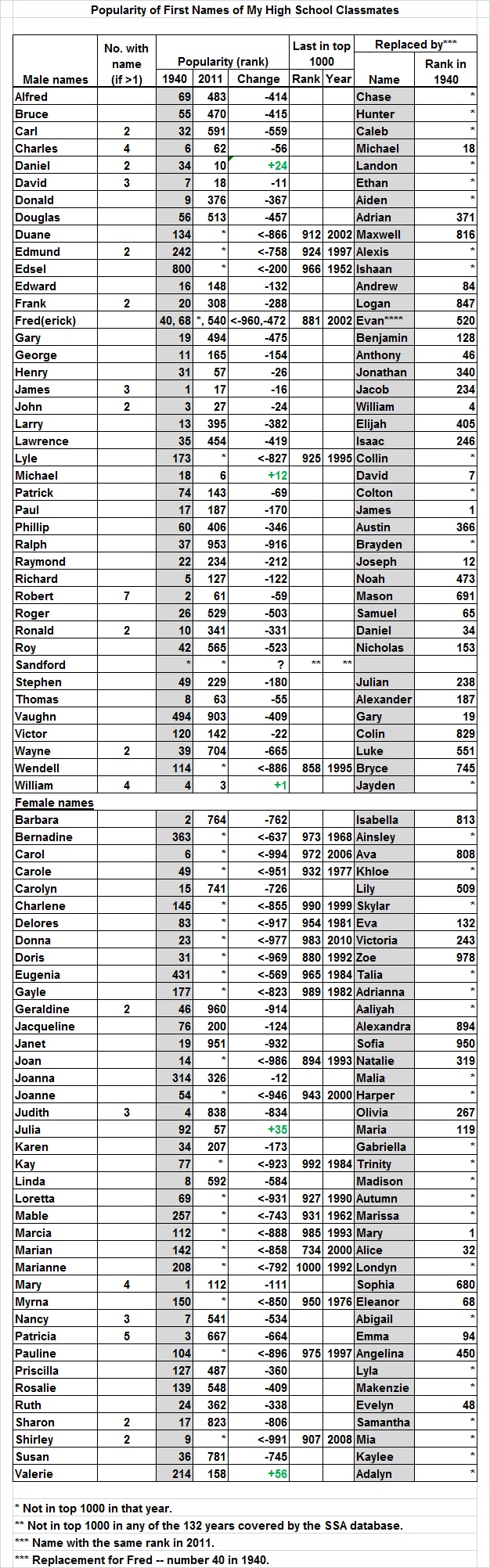
The Names, They Are A-Changin’

In the table below, I offer a morsel of cultural history. The table compares the popularity of baby names in 1940 (the modal birth year of members of my high-school graduating class) with the popularity of the same names in 2011.

Also shown are the names that have replaced the names of my classmates in popularity. Michael, for example, is number 6 in 2011, replacing Charles, the number 6 of 1940. Michael, as it happens, was number 18 in 1940.

As might be expected, the turnover among female names is greater than the turnover among male names. For example, 6 of 40 male names dropped out of the top 1000 between 1940 and 2011, as against 20 of 39 female names. And 11 of 40 replacement names for males were not in the top 1000 in 1940, as against 21 of the 39 replacement female names.


Source: This search tool at the website of the Social Security Administration.

Hispanics and Crime

See the updated version of “Immigration and Crime.”

Genetic Kinship and Society

UPDATED (08/18/12) BELOW

This is the third installment of a series that explores the true nature of liberty, how liberty depends on society, how society (properly understood) has been eclipsed by statism and its artifacts, and how society — and therefore liberty — might re-emerge in the United States. In this installment, I take up the second of several possible objections to my model of a society’s essence and workings. This series will close with a blueprint for the restoration of society and liberty in America.

If you have not read the first two installments, “Liberty and Society” and “The Eclipse of ‘Old America’,” I recommend that you do so before you continue. This post addresses the following question: Is Genetic Kinship an Indispensable Aspect of Society?

In “Liberty and Society,” I define society as “an enduring and cooperating social group whose members have developed organized patterns of relationships through interaction with one another.” Near the end of the post, I say this:

A society coheres around genetic kinship, and is defined by its common culture, which includes its moral code. The culture is developed, transmitted through, and enforced by the voluntary institutions of society (civil society). The culture is the product of trial and error, where those elements that become part of received culture serve societal coherence and — in the best case — help it to thrive. Coherence and success depend also on the maintenance of mutual respect, trust, and forbearance among society’s members. Those traits arise in part from the sharing of a common culture (which is an artifact of societal interaction) and from genetic kinship, which is indispensable to societal coherence. If the foregoing description is correct, there is one aspect of society — and one only — that a society cannot “manufacture” through its social processes. That aspect is genetic-cultural kinship.

In the sequel, “The Eclipse of ‘Old America’,” there is this:

The United States, for a very long time, was a polity whose disparate parts cohered, regionally if not nationally, because the experience of living in the kind of small community sketched above was a common one. Long after the majority of Americans came to live in urban complexes, a large fraction of the residents of those complexes had grown up in small communities.

This was Old America — and it was predominant for almost 200 years after America won its independence from Britain. Old America‘s core constituents, undeniably, were white, and they had much else in common: observance of the Judeo-Christian tradition; British and north-central European roots; hard work and self-reliance as badges of honor; family, church, and club as cultural transmitters, social anchors, and focal points for voluntary mutual aid.

The focus of this post is the indispensable contribution of genetic kinship to society. Before I continue, I want to make it clear that I do not use “society” in the loose way that politicians do, that  is, as a feel-good word for “nation.” The United States, as a nation, may comprise societies of the kind defined above, but the United States is not a society. It is a political convenience, held together by force, not by mutual trust, respect, and forbearance — which are the operational characteristics of a society.

Mutual trust, respect, and forbearance arise from the emotional force of genetic kinship. They may be mimicked in arrangements of convenience, such as economic ones. But those arrangements last only as long as they are profitable to all parties.

Arrangements of convenience may be facilitated by social bonding, but they cannot replace social bonding. For example, disparate peoples may trade with each other, to their mutual advantage, but they are not bound to each other emotionally. History is replete with examples of peoples who have turned against each other, despite their economic ties. Diplomatic ties are even less binding, because of their superficiality.

Whence the emotional bonds of genetic kinship? Are they found only in the nuclear family? (No.) Do they encompass the extended family? (Yes.) Are they enhanced by social relationships (e.g., church and club)? (Yes.) Do they extend to broad racial-ethnic groupings? (Yes.)

Emotional bonds may be reinforced (or not) by familial and social relationships, but they begin with racial-ethnic (genetic) kinship:

[S]tudies have demonstrated that relatedness is often important for human altruism in that humans are inclined to behave more altruistically toward kin than toward unrelated individuals.[22] Many people choose to live near relatives, exchange sizable gifts with relatives, and favor relatives in wills in proportion to their relatedness.[22]

A study interviewed several hundred women in Los Angeles to study patterns of helping between kin versus non-kin. While non-kin friends were willing to help one another, their assistance was far more likely to be reciprocal. The largest amounts of non-reciprocal help, however, were reportedly provided by kin. Additionally, more closely related kin were considered more likely sources of assistance than distant kin.[23] Similarly, several surveys of American college students found that individuals were more likely to incur the cost of assisting kin when a high probability that relatedness and benefit would be greater than cost existed. Participants’ feelings of helpfulness were stronger toward family members than non-kin. Additionally, participants were found to be most willing to help those individuals most closely related to them. Interpersonal relationships between kin in general were more supportive and less Machiavellian than those between non-kin.[24]….

A study of food-sharing practices on the West Caroline islets of Ifaluk determined that food-sharing was more common among people from the same islet, possibly because the degree of relatedness between inhabitants of the same islet would be higher than relatedness between inhabitants of different islets. When food was shared between islets, the distance the sharer was required to travel correlated with the relatedness of the recipient—a greater distance meant that the recipient needed to be a closer relative. The relatedness of the individual and the potential inclusive fitness benefit needed to outweigh the energy cost of transporting the food over distance.[26]

Humans may use the inheritance of material goods and wealth to maximize their inclusive fitness. By providing close kin with inherited wealth, an individual may improve his or her kin’s reproductive opportunities and thus increase his or her own inclusive fitness even after death. A study of a thousand wills found that the beneficiaries who received the most inheritance were generally those most closely related to the will’s writer. Distant kin received proportionally less inheritance, with the least amount of inheritance going to non-kin.[27]

A study of childcare practices among Canadian women found that respondents with children provide childcare reciprocally with non-kin. The cost of caring for non-kin was balanced by the benefit a woman received—having her own offspring cared for in return. However, respondents without children were significantly more likely to offer childcare to kin. For individuals without their own offspring, the inclusive fitness benefits of providing care to closely related children might outweigh the time and energy costs of childcare.[28]

Family investment in offspring among black South African households also appears consistent with an inclusive fitness model.[29] A higher degree of relatedness between children and their caregivers frequently correlated with a higher degree of investment in the children, with more food, health care, and clothing being provided. Relatedness between the child and the rest of the household also positively associated with the regularity of a child’s visits to local medical practitioners and with the highest grade the child had completed in school. Additionally, relatedness negatively associated with a child’s being behind in school for his or her age.

Observation of the Dolgan hunter-gatherers of northern Russia suggested that, while reciprocal food-sharing occurs between both kin and non-kin, there are larger and more frequent asymmetrical transfers of food to kin. Kin are also more likely to be welcomed to non-reciprocal meals, while non-kin are discouraged from attending. Finally, even when reciprocal food-sharing occurs between families, these families are often very closely related, and the primary beneficiaries are the offspring.[30]

Other research indicates that violence in families is more likely to occur when step-parents are present and that “genetic relationship is associated with a softening of conflict, and people’s evident valuations of themselves and of others are systematically related to the parties’ reproductive values”.[31]

Numerous other studies pertaining to kin selection exist, suggesting how inclusive fitness may work amongst peoples from the Ye’kwana of southern Venezuela to the Gypsies of Hungary to even the doomed Donner Party of the United States.[32][33][34] Various secondary sources provide compilations of kin selection studies.[35][36] [from Wikipedia, “Kin selection,” as of 08/14/12]

*   *   *

[E.O.] Wilson used sociobiology and evolutionary principles to explain the behavior of the social insects and then to understand the social behavior of other animals, including humans, thus established sociobiology as a new scientific field. He argued that all animal behavior, including that of humans, is the product of heredity, environmental stimuli, and past experiences, and that free will is an illusion. He has referred to the biological basis of behaviour as the “genetic leash.”[17] The sociobiological view is that all animal social behavior is governed by epigenetic rules worked out by the laws of evolution. This theory and research proved to be seminal, controversial, and influential.[18]

The controversy of sociobiological research is in how it applies to humans. The theory established a scientific argument for rejecting the common doctrine of tabula rasa, which holds that human beings are born without any innate mental content and that culture functions to increase human knowledge and aid in survival and success. In the final chapter of the book Sociobiology and in the full text of his Pulitzer Prize-winning On Human Nature, Wilson argues that the human mind is shaped as much by genetic inheritance as it is by culture (if not more). There are limits on just how much influence social and environmental factors can have in altering human behavior….

Wilson has argued that the unit of selection is a gene, the basic element of heredity. The target of selection is normally the individual who carries an ensemble of genes of certain kinds.” With regard to the use of kin selection in explaining the behavior of eusocial insects, Wilson said to Discover magazine, the “new view that I’m proposing is that it was group selection all along, an idea first roughly formulated by Darwin.”[22] [from Wikipedia, “E.O. Wilson,” as of 08/14/12]

*   *   *

Wilson suggests the equation for Hamilton’s rule:[19]

rb > c

(where b represents the benefit to the recipient of altruism, c the cost to the altruist, and r their degree of relatedness) should be replaced by the more general equation

(rbk + be) > c

in which bk is the benefit to kin (b in the original equation) and be is the benefit accruing to the group as a whole. He then argues that, in the present state of the evidence in relation to social insects, it appears that be>rbk, so that altruism needs to be explained in terms of selection at the colony level rather than at the kin level. However, it is well understood in social evolution theory that kin selection and group selection are not distinct processes, and that the effects of multi-level selection are already fully accounted for in Hamilton’s original rule, rb>c.[20] [from Wikipedia, “Group selection,” as 0f 08/14/12]

The idea that social bonding has a deep, genetic basis is beyond the ken of leftists and pseudo-libertarian rationalists. Both prefer to deny reality, though for different reasons. Leftists like to depict the state as society. Pseudo-libertarian rationalists seem to believe that social bonding is irrelevant to cooperative, mutually beneficial behavior; life, to them, is an economic arrangement.

Leftists and libertarians like to slander the mutual attraction of genetic kin by calling it “tribalism.” On that subject, the author of Foseti writes:

People are – in general – tribal. Let’s take it for granted that we all wish that this were not so. Further, let’s take it for granted that some individual people are much more tribal than others.

The fact remains, however, that people are tribal. It’s one thing to suggest that people should not be tribal in their daily dealings with others. Let’s stipulate that this is moral. It does not, however, follow that it would be moral to organize society around the principle the people will in fact act anti-tribally….

Lots of progressives (especially those of the libertarian sort) are fond of saying that restricting immigration is tribal. They simply can’t support immigration restrictions because they oppose tribalism.

There is no better way of demonstrating your high-status in today’s society than proclaiming your anti-tribalism. You should therefore be skeptical of these proclamations. However, many people are indeed not particularly tribal.

Your humble blogger is not a tribal person. There is no sort of person that I see on the street and say to myself, “wow, I bet he and I have a lot in common – we should look out for each other.” Temperamentally, I’m very much an individualist type. But it’s wishful thinking to generalize from my personal preferences to population-wide-shoulds.

Tribalism is, has always been, and likely always will be a feature of human societies.

Occasionally, we get not-so-gentle reminders that people are tribal. We would do well to learn. Here’s a more light-hearted example. Here’s a reminder that democratic politics is always tribal.

You’re free, of course, to consider yourself above tribalism. However, if you do so, you’ll be an idiot when you try to describe geopolitics, local politics, national politics, and public policies in general. By all means, bury your head in the sand, just don’t preach while you’re down there.

James_G makes a nice analogy in this post. He likens anti-tribal beliefs to communist beliefs. It’s true that some groups of humans can function reasonably well under communistic conditions. It’s similarly true that many human beings are not particularly tribal. However, it’s dangerously immoral to generalize from these exceptions to the general conclusions that communism works on a large scale or that all countries should be rainbow nations…. [from “The immorality of anti-tribalism,” July 25, 2012]

In America, the pursuit of happiness in the form of money has sundered many a tribal community. (See “The Eclipse of ‘Old America’,” especially the 11th and 12th paragraphs.) But tribalism nevertheless remains a potent force in America:


Source: Census.gov, Ancestry: 2000 — Census 2000 Brief, Figure 3. (Right-click to open in a new tab, then click to enlarge.)

I venture to say that the “Americans” who predominate in large swaths of the South are the descendants of the English and Scots-Irish settlers of the colonial and early post-colonial era. They are “Americans” because their ancestors were (for the most part) the Americans of yore.

Not represented in the graph, because it is based on county-level statistics, are the high concentrations of Jews in many urban areas (especially in and around New York City and Miami), the coalescence of Arabs in the Detroit area, and the numerous ethnic enclaves (e.g., Chinese, Czech, Greek, Korean, Polish, Swedish, and Thai) — urban, semi-rural, and rural — that persist long after the original waves of immigration that led to their formation.

If genetic kinship is such a binding force, why is the closest kind of genetic kinship — the nuclear family — so often dysfunctional? Nuclear families are notoriously prone to strife, or so it would seem if one were to count novels and screenplays in evidence. Novels and screenplays are not dispositive, of course, because they emphasize strife for dramatic purposes. That said, there is a lot of evidence to suggest that the American nuclear family is a less binding force than it used to be. But that is to be expected, given the interventions by the state that have eased divorce and lured women out of the home (e.g., affirmative action, subsidies for day care, mandated coverages for employer-provided health insurance).

There are other reasons to reject the (exaggerated) dysfunctionality of the nuclear family as evidence against the importance of genetic kinship to social bonding:

1. Strife is inevitable where humans interact, and family life affords a disproportionate number of opportunities for interaction. (For example, conflicts between the members of a nuclear family — parent vs. child, sibling vs. sibling — often begin during the childhood or adolescence of one or all parties to the conflict.)

2. Blood ties have a way of overcoming “bad blood” when a family member is in need of help. (Thus, for example, children of middle-age and older often are supportive of needful siblings and aged parents out of duty, not love.)

3. Many a person compensates for tense or distant relations with parents and siblings by maintaining close ties to grandparents, aunts, uncles, and cousins.

This is not to say that the bonds of genetic kinship in America are everywhere as strong as in years past. The state’s interventions, the search for greener pastures, and the inexorable force of cross-racial and cross-ethnic sexual attraction have led to a more homogenized America.

But genetic kinship will always be a strong binding force, even where the kinship is primarily racial. Racial kinship boundaries, by the way, are not always and necessarily the broad ones suggested by the classic trichotomy of Caucasoid, Mongoloid, Negroid. (If you want to read for yourself about the long, convoluted, diffuse, and still controversial evolutionary chains that eventuated in the sub-species homo sapiens sapiens, to which all humans are assigned arbitrarily, without regard for their distinctive differences, begin here, here, here, and here.)

The obverse of of genetic kinship is “diversity,” which often is touted as a good thing by anti-tribalist social engineers. But “diversity” is not a good thing when it comes to social bonding. Michael Jonas reports on a study by Harvard political scientist Robert Putnam, “E Pluribus Unum: Diversity and Community in the Twenty-first Century“:

It has become increasingly popular to speak of racial and ethnic diversity as a civic strength. From multicultural festivals to pronouncements from political leaders, the message is the same: our differences make us stronger.

But a massive new study, based on detailed interviews of nearly 30,000 people across America, has concluded just the opposite. Harvard political scientist Robert Putnam — famous for “Bowling Alone,” his 2000 book on declining civic engagement — has found that the greater the diversity in a community, the fewer people vote and the less they volunteer, the less they give to charity and work on community projects. In the most diverse communities, neighbors trust one another about half as much as they do in the most homogenous settings. The study, the largest ever on civic engagement in America, found that virtually all measures of civic health are lower in more diverse settings….

…Putnam’s work adds to a growing body of research indicating that more diverse populations seem to extend themselves less on behalf of collective needs and goals.

His findings on the downsides of diversity have also posed a challenge for Putnam, a liberal academic whose own values put him squarely in the pro-diversity camp. Suddenly finding himself the bearer of bad news, Putnam has struggled with how to present his work. He gathered the initial raw data in 2000 and issued a press release the following year outlining the results. He then spent several years testing other possible explanations.

When he finally published a detailed scholarly analysis in June in the journal Scandinavian Political Studies, he faced criticism for straying from data into advocacy. His paper argues strongly that the negative effects of diversity can be remedied, and says history suggests that ethnic diversity may eventually fade as a sharp line of social demarcation.

“Having aligned himself with the central planners intent on sustaining such social engineering, Putnam concludes the facts with a stern pep talk,” wrote conservative commentator Ilana Mercer, in a recent Orange County Register op-ed titled “Greater diversity equals more misery.”….

The results of his new study come from a survey Putnam directed among residents in 41 US communities, including Boston. Residents were sorted into the four principal categories used by the US Census: black, white, Hispanic, and Asian. They were asked how much they trusted their neighbors and those of each racial category, and questioned about a long list of civic attitudes and practices, including their views on local government, their involvement in community projects, and their friendships. What emerged in more diverse communities was a bleak picture of civic desolation, affecting everything from political engagement to the state of social ties….

After releasing the initial results in 2001, Putnam says he spent time “kicking the tires really hard” to be sure the study had it right. Putnam realized, for instance, that more diverse communities tended to be larger, have greater income ranges, higher crime rates, and more mobility among their residents — all factors that could depress social capital independent of any impact ethnic diversity might have.

“People would say, ‘I bet you forgot about X,'” Putnam says of the string of suggestions from colleagues. “There were 20 or 30 X’s.”

But even after statistically taking them all into account, the connection remained strong: Higher diversity meant lower social capital. In his findings, Putnam writes that those in more diverse communities tend to “distrust their neighbors, regardless of the color of their skin, to withdraw even from close friends, to expect the worst from their community and its leaders, to volunteer less, give less to charity and work on community projects less often, to register to vote less, to agitate for social reform more but have less faith that they can actually make a difference, and to huddle unhappily in front of the television.”

“People living in ethnically diverse settings appear to ‘hunker down’ — that is, to pull in like a turtle,” Putnam writes….

In a recent study, [Harvard economist Edward] Glaeser and colleague Alberto Alesina demonstrated that roughly half the difference in social welfare spending between the US and Europe — Europe spends far more — can be attributed to the greater ethnic diversity of the US population. Glaeser says lower national social welfare spending in the US is a “macro” version of the decreased civic engagement Putnam found in more diverse communities within the country.

Economists Matthew Kahn of UCLA and Dora Costa of MIT reviewed 15 recent studies in a 2003 paper, all of which linked diversity with lower levels of social capital. Greater ethnic diversity was linked, for example, to lower school funding, census response rates, and trust in others. Kahn and Costa’s own research documented higher desertion rates in the Civil War among Union Army soldiers serving in companies whose soldiers varied more by age, occupation, and birthplace.

Birds of different feathers may sometimes flock together, but they are also less likely to look out for one another. “Everyone is a little self-conscious that this is not politically correct stuff,” says Kahn….

In his paper, Putnam cites the work done by Page and others, and uses it to help frame his conclusion that increasing diversity in America is not only inevitable, but ultimately valuable and enriching. As for smoothing over the divisions that hinder civic engagement, Putnam argues that Americans can help that process along through targeted efforts. He suggests expanding support for English-language instruction and investing in community centers and other places that allow for “meaningful interaction across ethnic lines.”

Some critics have found his prescriptions underwhelming. And in offering ideas for mitigating his findings, Putnam has drawn scorn for stepping out of the role of dispassionate researcher. “You’re just supposed to tell your peers what you found,” says John Leo, senior fellow at the Manhattan Institute, a conservative think tank…. [from “The downside of diversity,” The Boston Globe (boston.com), August 5, 2007]

Putnam’s reluctance about releasing the study and his attempt to soften its implications say much about the relationship that anti-tribalist social engineers (like Putnam) have with truth. Here is more from John Leo:

Putnam’s study reveals that immigration and diversity not only reduce social capital between ethnic groups, but also within the groups themselves. Trust, even for members of one’s own race, is lower, altruism and community cooperation rarer, friendships fewer. The problem isn’t ethnic conflict or troubled racial relations, but withdrawal and isolation. Putnam writes: “In colloquial language, people living in ethnically diverse settings appear to ‘hunker down’—that is, to pull in like a turtle.”…

Neither age nor disparities of wealth explain this result. “Americans raised in the 1970s,” he writes, “seem fully as unnerved by diversity as those raised in the 1920s.” And the “hunkering down” occurred no matter whether the communities were relatively egalitarian or showed great differences in personal income. Even when communities are equally poor or rich, equally safe or crime-ridden, diversity correlates with less trust of neighbors, lower confidence in local politicians and news media, less charitable giving and volunteering, fewer close friends, and less happiness….

Putnam has long been aware that his findings could have a big effect on the immigration debate. Last October, he told the Financial Times that “he had delayed publishing his research until he could develop proposals to compensate for the negative effects of diversity.” He said it “would have been irresponsible to publish without that,” a quote that should raise eyebrows. Academics aren’t supposed to withhold negative data until they can suggest antidotes to their findings…

Though Putnam is wary of what right-wing politicians might do with his findings, the data might give pause to those on the left, and in the center as well. If he’s right, heavy immigration will inflict social deterioration for decades to come, harming immigrants as well as the native-born. Putnam is hopeful that eventually America will forge a new solidarity based on a “new, broader sense of we.” The problem is how to do that in an era of multiculturalism and disdain for assimilation…. [from “Bowling with Our Own,” City Journal, June 25, 2007]

*   *   *

UPDATE (08/18/12):

I can do no better at this point than inject some passages from Byron M. Roth’s The Perils of Diversity: Immigration and Human Nature. The following observations, taken from Chapter I, are supported by the rich detail that Roth delivers in the following several hundred pages of the book:

…Multiculturalists … ignore the historical record that suggests that social harmony among different ethnic and language groups is at best rare, and where it exists, tenuous. The history of Europe, whatever else it is, is one long tale of religious and ethnic conflict, almost ceaseless war, and the slaughter and the destruction it entails. The enlightenment, and the scientific advances it engendered, did nothing to mitigate this tale of horrific and bloody conflict, with the twentieth century exhibiting the most lethal and unsparing carnage in European history. In addition, in the twentieth century, class conflict was raised to a level in Europe and Asia never seen before. Communist rulers in Europe and Asia effectively divided their societies along economic lines and managed over the century to slaughter even more people than the ethnically based World Wars I and II.

The breakup of the British Empire led to bloody civil strife throughout the former colonies among the disparate peoples held together by British force of arms. The civil war that led to the partition of India and Pakistan left an estimated one million dead in its wake. Similar terrible and murderous turmoil in Southeast Asia, in for example Cambodia and Vietnam, followed the withdrawal of the European Colonial powers. Among the former European colonies in Africa, even today, civil strife is rampant.

In the wake of the fall of Communism those multiethnic societies that had been held together by authoritarian dictators quickly fell asunder. Czechoslovakia divided in a peaceful and largely amiable way. Yugoslavia, on the other hand, was torn by vicious civil war and genocidal ethnic cleansing. Iraq, after the fall of Saddam Hussein, presents a similar case. The ongoing Israeli-Palestinian conflict is a different and bloody example of the difficulties of establishing harmony among groups of differing cultures and religions. Even Belgium, (the seat of the European Union Parliament) is in danger of splitting into its Dutch-speaking and French-speaking halves.8 Canadians of French and English ancestry are grappling with similar problems. In addition, there is a fundamental inconsistency at the base of the multiculturalist program, in that it applauds ethnic minorities who maintain their cultural traditions, but looks askance at majority populations who wish to do the same. Political elites in all Western societies take a negative view of those who wish to preserve their traditional values and patterns of living and question whether those patterns can be sustained in the face of large numbers of newcomers who do not share those values or are actually hostile to them….

…[T]he social science evidence that a harmonious society composed of identifiable ethnic groups with different cultural and religious backgrounds can be arranged is, almost without exception, negative. Has some new type of social engineering appeared which would allow this historic pattern to be broken? Has some new sort of human being been born who will not repeat the follies of his ancestors? Will the world find a way to emulate the example of the Swiss? Policy makers should be trying to understand how the Swiss have managed to preserve their experiment in multicultural harmony for so long, when so many others have failed so utterly. Perhaps Switzerland can be a model for the new multicultural societies? On the other hand, maybe Switzerland is a special case that cannot be copied. Switzerland, for all its ethnic harmony, is, in effect, a confederation of separate but closely related European ethnicities who reside in different cantons, who speak their own languages (French, German, Italian, and Native Swiss), and maintain their ethnic customs and tastes. It would be reasonable to ask if such an arrangement could be widely duplicated in very different settings, but few in the multicultural camp appear interested in such a question.

Similarly, the assimilationists who support mass immigration seem equally nonchalant about the evidence for their position. Clearly, the history of immigration to the United States has been fortunate and largely successful. But in the past virtually all successful immigration was from European cultures very similar to that of the original English settlers. In addition, those settlers usually came with similar skills and abilities, often better than those of the earlier settlers, and generally had little difficulty in competing with them. Once in America, they could easily blend in, there being few physical or social features which set them apart. Usually they came in small numbers over an extended period of time and were forced to acquire the language of their host country if they expected to thrive. This was because (except for German and French speakers in some areas) no one group could sustain communities sufficiently large as to be economically independent and thereby sustain their native language for general commerce. As a counterexample, the French community in Quebec did possess sufficient size and was therefore able to maintain its language as well as its ethnic identity.

The United States was so vast and the opportunities it offered so generous that group conflict was generally muted. Conflict among immigrant Europeans was generally limited to the crowded multiethnic coastal cities, and those who wished to avoid those conflicts could migrate to the interior, often gravitating to ethnic enclaves. Even in those less crowded settings, however, conflict was not uncommon, though it usually took the form of political differences over the place of religion in society and the nature of education. Is this an immigration pattern that could be replicated today in modern societies when the immigrant groups come in large numbers from vastly different cultural and ethnic backgrounds compared to the residents of their host countries? Can this model work in crowded Western Europe where land for housing is limited and where unemployment remains at chronically high levels? In other words, is the American immigration experience prior to 1965 an exceptional one? Can it be the model for future immigration cycles or are the conditions today so different as to make the model inapplicable? These are questions that need to asked, but rarely are.

A clear implication of Roth’s analysis is that conflict — political, if not violent — is bound to result from racial-ethnic-cultural commingling — unless the disparate groups are geographically separated and politically autonomous in all respects (except, perhaps, that they each bear a “fair share” of the cost of a common defense).

*   *   *

The idea that society– properly defined and understood — requires genetic kinship is nevertheless anathema to anti-tribalist social tinkerers of Putnam’s ilk. It is ironic (but not surprising) that anti-tribalists often seek connections with “kindred” souls. The leftist groves of academe are notorious for their exclusion of libertarians and conservatives, but an academic mistakes his like-minded colleagues for altruistic kinsmen at his own peril. (I speak from the experience of years in a quasi-academic think-tank, and as a former “friend” in many a work-based “friendship.”)

Libertarians, who are notoriously individualistic and aloof, also seek to bond with like-minded persons. Libertarians are responsible for the less-than-successful Free State Project and for seasteading (formally neutral in its ideology, but mainly attractive to libertarians). I expect such experiments in coexistence, if they get off the ground, to be as inconsequential as their anti-libertarian equivalent: the commune. Communes have been around for a while, of course, though none of them has lasted long or attracted many adherents. They are, after all, nothing more than economic arrangements with some “Kumbaya” thrown in.

So, yes, genetic kinship is indispensable to society, where society is properly understood as “an enduring and cooperating social group whose members have developed organized patterns of relationships through interaction with one another.” But, as I discuss here, not all societies based on genetic kinship are created equal. Trying to make them equal is a fool’s errand.

The fourth installment is here.

Related posts:
On Liberty
Rights, Liberty, the Golden Rule, and the Legitimate State
What Is Conservatism?
Zones of Liberty
Society and the State
I Want My Country Back
The Golden Rule and the State
Government vs. Community
Evolution, Human Nature, and “Natural Rights”
More about Conservative Governance
The Meaning of Liberty
Evolution and the Golden Rule
Understanding Hayek
The Golden Rule as Beneficial Learning
True Libertarianism, One More Time
Human Nature, Liberty, and Rationalism
Why Conservatism Works
Reclaiming Liberty throughout the Land
Rush to Judgment
Secession, Anyone?
Race and Reason: The Achievement Gap — Causes and Implications
Liberty and Society
The Eclipse of “Old America”

Why Prescriptivism?

I often read Wilson Follett’s Modern American Usage: A Guide, both as a guide to good writing and as a source of wisdom. It is also an antidote to Language Log, whose contributors often (mostly?) deride prescriptivism in language.

When I read Follett’s book for its wisdom, I open it randomly. Recent explorations have led me to these passages:

It is … one of the striking features of the libertarian position [with respect to language] that it preaches an unbuttoned grammar in a prose style that is fashioned with the utmost grammatical rigor. H.L. Mencken’s two thousand pages on the vagaries of the American language are written in the fastidious syntax of a precisian. If we go by what these men do instead of by what they say, we conclude that they all believe in conventional grammar, practice it against their own preaching, and continue to cultivate the elegance they despise in theory….

[T]he artist and the user of language for practical ends share an obligation to preserve against confusion and dissipation the powers that over the centuries the mother tongue has acquired. It is a duty to maintain the continuity of speech that makes the thought of our ancestors easily understood, to conquer Babel every day against the illiterate and the heedless, and to resist the pernicious and lulling dogma that in language … whatever is is right and doing nothing is for the best. [pp. 30-31]

*   *   *

IThis book] accept[s] the long-established conventions of prescriptive grammar … on the theory that freedom from confusion is more desirable than freedom from rule…. [p. 243]

Related posts:
Remedial Vocabulary Training
One Small Step for Literacy
Punctuation
Unsplit Infinitives
Data Are
“Hopefully” Arrives
Hopefully, This Post Will Be Widely Read
Why Conservatism Works

The Eclipse of “Old America”

This is the second installment of a series that explores the true nature of liberty, how liberty depends on society, how society (properly understood) has been eclipsed by statism and its artifacts, and how society — and therefore liberty — might re-emerge in the United States. In this installment, I take up the first of several possible objections to my model of a society’s essence and workings. This series will close with a blueprint for the restoration of society and liberty.

If you have not read the first installment, “Liberty and Society,” I recommend that you do so before you continue. This post addresses the following question: Is Society, as I define It, Impossible? Or, Isn’t This All Rather Romantic?

The answers are “no” and “no.” All that the existence of a society requires is the general observance of the Golden Rule. This is not difficult in relatively small communities.

You will have known such a community if you have ever lived or spent much time in a rural or semi-rural village, or in an urban enclave consisting of persons bound by ethnic or religious affiliation. Everyone may not know everyone else in such a community, but the circles formed by common bonds (family, church, etc.) are interlocking. (And a lot of the community’s members will “know of” almost everyone in the community.)

One result of this kind of living is less anti-social behavior and outright crime, but without a lot of formal rules and regulations or more than a token police presence. (Anonymity not only fosters crime but also rudeness, as is evident in comment threads, e-mail exchanges, and behavior on the highway.) Another result is genuine charity, based on direct knowledge of persons who are in need, or a sense of community with them.

Do such communities know unkindness, conflict, and crime? Of course, but to suggest or demand otherwise is to be deluded or to demand impossible perfection. It should be good enough that such communities — where they still exist — are better places in which to live than the mostly anonymous urban complexes that now dominate America.

The United States, for a very long time, was a polity whose disparate parts cohered, regionally if not nationally, because the experience of living in the kind of small community sketched above was a common one. Long after the majority of Americans came to live in urban complexes, a large fraction of the residents of those complexes had grown up in small communities.

This was Old America — and it was predominant for almost 200 years after America won its independence from Britain. Old America‘s core constituents, undeniably, were white, and they had much else in common: observance of the Judeo-Christian tradition; British and north-central European roots; hard work and self-reliance as badges of honor; family, church, and club as cultural transmitters, social anchors, and focal points for voluntary mutual aid. The inhabitants of Old America were against “entitlements” (charity was real and not accepted lightly); for punishment (as opposed to excuses about poverty, etc.); overtly religious or respectful of religion (and, in either case, generally respectful of the Ten Commandments, especially the last six of them); personally responsible (stuff happens, and it is rarely someone else’s fault); polite, respectful, and helpful to strangers (who are polite and respectful); patriotic (the U.S. was better than other countries and not beholden to international organizations, wars were fought to victory); and anti-statist (even if communitarian in a voluntary way). Living on the dole, weirdness for its own sake, open hostility to religion, habitual criminality, “shacking up,” and homosexuality were disgraceful aberrations, not “lifestyles” to be tolerated, celebrated, or privileged.

It is now de rigeur to deride the culture of Old America, and to call its constituents greedy, insensitive, hidebound, culturally retrograde, and — above all — intolerant.  But what does that make the proponents and practitioners of the counter-culture of the ’60s and ’70s (many of whom have long-since risen to positions of prominence and power), of the LGBT counter-culture that is now so active and adamant about its “rights,” and of recently imported cultures that seek dominance rather than assimilation (certain Latins and Muslims, I am looking at you)?

These various counter-culturalists and incomers have not been content to establish their own communities; rather, they have sought to overthrow Old America. Intolerance is their essence. They are not merely reacting to the intolerance that may be directed at them. No, they are intolerant, and militantly so. They seek to destroy what is left of Old America. — and they have enlisted the power of the state in that effort.

Has Old America receded just because its enemies have enlisted the power of the state? Not entirely. There was (and is) also a collective-action phenomenon at work, and it began while Old America was dominant. Americans prospered with the rise of industrialization after the Civil War. But industrialization led to greater productivity in agriculture (thus fewer farm workers per unit of output) while demanding more workers in factories, and thus putting in motion America’s long march toward urban anonymity and away from rural and semi-rural communities. That march led to the New America, where governmental power, geographic displacement, and cultural intermarriage have diluted (and often destroyed) the social norms that bound Old America.

These changes, once put in motion, were bound to continue (unless interrupted by a shock or massive social change) because of path dependence: decisions made in the present are constrained by decisions made in the past. Quite simply, the possibility of quitting the urban scene for rural splendor — however attractive in theory — was closed to most Americans by economic reality, that is, the necessity of making a living and the perceived necessity of doing as well as the urban Joneses. And, worse, the values of Old America simply could not (and cannot) be replicated in New America, given its reliance on governmental power and widespread rejection of the values of Old America.

On that point, I interject a personal note: I have, in my adult life, lived in semi-rural splendor. And I can tell you that it has much to commend it as a way of life, especially as a way of life for one’s children. And I can tell you, also, that living in semi-rural splendor — despite the generally lower cost of living — does require the acceptance of a lower standard of living than that enjoyed by the urban Joneses. Most Americans who recognize and pine for the virtues of rural and semi-rural life, cannot realize those virtues except vicariously on vacation trips or upon retirement, when small towns, small cities, and retirement enclaves beckon.

At any rate, the eclipse of Old America owes much to the bad guys — especially leftist “educators,” so-called intellectuals, and politicians who have conspired with intolerant minorities in the effort to overthrow Old America. But Americans who long for the Old America must also blame themselves and their forbears for its eclipse because of urbanization — a (mostly) voluntary movement. Nothing could demonstrate more starkly the saying that “There ain’t no such thing as a free lunch.”

All of the foregoing might lead you to think that I am incurably pessimistic about the possibility of a resurgence of Old America. I am not. For what I have said, up to this point, is merely prologue. For one thing, somewhere between 20 and 30 percent of Americans still live in rural and semi-rural places. (See the statistics and definitions on this page of Census.gov.) Nor has the core of Old America has shrunk; it is relatively smaller than it was in, say, 1900 — but it is absolutely larger. In fact, the number of persons living in a rural place (defined by the Census Bureau as having a population of less than 2,500), grew from 46 million in 1900 to 59 million in 2010. And in 2010, another 30 million persons lived in a so-called urban cluster (a place with a population of at least 2,500 and less than 50,000).

Of course, not all of the 59 to 89 million persons represent Old America. But surely a lot of them do; and a lot of urban dwellers long for Old America. Just look at the number of States that are Red and getting Redder, despite predictions of a permanent Democrat (i.e., leftist) majority. Have adherents of Old America been let down by Republicans? Of course they have. Have some adherents of Old America been tempted to join the statist brigade, and sometimes succumbed to temptation? Of course they have. But would Old America prevail, and attract new followers were those who preach its values to hold sway in Washington long enough and securely enough to stay true to those values? Of course it would.

Before I leave this topic, I must address the fallacy, propounded by “liberals” and libertarians, that a return to Old America would mean a return to the bad old days of Jim Crow and subservient women. Such a claim is nothing more than a smear on liberty-lovers. “Liberal” fascists have no shame and will resort to any distortion of truth and logic that might help them to retain their hold on power. Libertarians — I should say, pseudo-libertarians — have proved themselves no better. But they, at least, are powerless.

Would the resurgence of Old America transform America into a society? Of course not. A society, as I have described it, cannot be as extensive as a nation the size of the United States. But the resurgence of Old America would enable societies to flourish again in America, and those societies — with their many common values — would form the backbone of a nation that is far less fragmented and far freer than the America that arose in the 20th century.

The third installment is here; the fourth installment is here.

Related reading:
Arnold Kling, “Enrico Moretti on Mobility,” EconLog, July 28, 2012
Bill Vallicella, “Systematic Deracination,” Maverick Philosopher, August 5, 2012
Russell Nieli, “Religion as a Public-Bonding Fiction,” The Public Discourse, August 9, 2012
John Derbyshire, “Si Jeunesse Svait, Si Viellesse Pouvait,” Taki’s Magazine, August 9, 2012

Related posts:
On Liberty
Rights, Liberty, the Golden Rule, and the Legitimate State
What Is Conservatism?
Zones of Liberty
Society and the State
I Want My Country Back
The Golden Rule and the State
Government vs. Community
Evolution, Human Nature, and “Natural Rights”
More about Conservative Governance
The Meaning of Liberty
Evolution and the Golden Rule
Understanding Hayek
The Golden Rule as Beneficial Learning
True Libertarianism, One More Time
Human Nature, Liberty, and Rationalism
Why Conservatism Works
Reclaiming Liberty throughout the Land
Rush to Judgment
Secession, Anyone?

Tolerance on the Left

UPDATED (BELOW), 08/10/12

I begin with the Chick-fil-A controversy. If you know more about it than is good for your mental health, jump to the text that follows the  second row of asterisks.

*   *   *   *   *

For the benefit of anyone who has just returned to the U.S. after spending six weeks in Tierra del Fuego, the Chick-fil-A controversy began when the company’s president and COO, Dan Cathy,

made what was seen as an inflammatory statement. Cathy stated: “I think we are inviting God’s judgment on our nation when we shake our fist at Him and say, ‘We know better than you as to what constitutes a marriage’. I pray God’s mercy on our generation that has such a prideful, arrogant attitude to think that we have the audacity to define what marriage is about.”[43][44][45]

And it took off from there:

On July 2, 2012, the LGBT watchdog group Equality Matters published a report with details of donations given by Chick-fil-A to organizations that are opposed to same-sex marriage, such as the Marriage & Family Foundation and the Family Research Council.[46][47][48] Also, on July 2, Biblical Recorder published an interview with Dan Cathy, who was asked about opposition to his company’s “support of the traditional family.” He replied: “Well, guilty as charged.”[49][50] Cathy continued:

“We are very much supportive of the family – the biblical definition of the family unit. We are a family-owned business, a family-led business, and we are married to our first wives. We give God thanks for that. … We want to do anything we possibly can to strengthen families. We are very much committed to that,” Cathy emphasized. “We intend to stay the course,” he said. “We know that it might not be popular with everyone, but thank the Lord, we live in a country where we can share our values and operate on biblical principles.”[49]

In the wake of this interview, Thomas Menino, the Mayor of Boston, stated that he would not allow the company to open franchises in the city “unless they open up their policies.”[51] Menino subsequently wrote a letter to Dan Cathy, citing Cathy’s earlier statement on The Ken Coleman Show and responding: “We are indeed full of pride for our support of same sex marriage and our work to expand freedom for all people.”[52] In Chicago alderman Proco “Joe” Moreno announced his determination to block Chick-fil-A’s bid to build a second store in the city: “They’d have to do a complete 180,” Moreno said in outlining conditions under which he would retract the block. “They’d have to work with LGBT groups in terms of hiring, and there would have to be a public apology from [Cathy].”[53] Moreno received backing from Chicago’s Mayor, Rahm Emanuel: “Chick-fil-A values are not Chicago values,” Emanuel said in a statement. “They disrespect our fellow neighbors and residents. This would be a bad investment, since it would be empty.”[53] San Francisco soon followed suit on July 26 when mayor Edwin M. Lee tweeted, “Very disappointed #ChickFilA doesn’t share San Francisco’s values & strong commitment to equality for everyone.” Lee followed that tweet with “Closest #ChickFilA to San Francisco is 40 miles away & I strongly recommend that they not try to come any closer.”[54]

In the wake of this interview, Thomas Menino, the Mayor of Boston, stated that he would not allow the company to open franchises in the city “unless they open up their policies.”[51] Menino subsequently wrote a letter to Dan Cathy, citing Cathy’s earlier statement on The Ken Coleman Show and responding: “We are indeed full of pride for our support of same sex marriage and our work to expand freedom for all people.”[52] In Chicago alderman Proco “Joe” Moreno announced his determination to block Chick-fil-A’s bid to build a second store in the city: “They’d have to do a complete 180,” Moreno said in outlining conditions under which he would retract the block. “They’d have to work with LGBT groups in terms of hiring, and there would have to be a public apology from [Cathy].”[53] Moreno received backing from Chicago’s Mayor, Rahm Emanuel: “Chick-fil-A values are not Chicago values,” Emanuel said in a statement. “They disrespect our fellow neighbors and residents. This would be a bad investment, since it would be empty.”[53] San Francisco soon followed suit on July 26 when mayor Edwin M. Lee tweeted, “Very disappointed #ChickFilA doesn’t share San Francisco’s values & strong commitment to equality for everyone.” Lee followed that tweet with “Closest #ChickFilA to San Francisco is 40 miles away & I strongly recommend that they not try to come any closer.”[54]

The proposed bans in Boston and Chicago drew criticism from liberal pundits, legal experts and the American Civil Liberties Union. Kevin Drum of Mother Jones magazine said “[T]here’s really no excuse for Emanuel’s and Menino’s actions… you don’t hand out business licenses based on whether you agree with the political views of the executives. Not in America, anyway.”[55] UCLA law professor and blogger Eugene Volokh observed, “[D]enying a private business permits because of such speech by its owner is a blatant First Amendment violation.”[56] Echoing those views were Glenn Greenwald of Salon, professor [Jonathan] Turley of George Washington University, and Adam Schwartz, a senior attorney with the ACLU.[57]

The city of New York is heard from, as well:

A powerful New York politician claims she was just speaking as a private citizen when she tried to run Chick-fil-A out of town, but she used her official letterhead and even invoked her position as City Council speaker to apply pressure on the embattled chicken chain.

New York City Council Speaker Christine Quinn, who has mayoral aspirations, sent a letter to New York University president John Sexton on Saturday asking the school to immediately end their contract with the fast food restaurant. The Atlanta-based company’s sole New York City outlet is in the school’s food court.

“I write as the Speaker of the NYC Council, and on behalf of my family. NYC is a place where we celebrate diversity. We do not believe in denigrating others. We revel in the diversity of all our citizens and their families,” the letter begins….

New York City Mayor Michael Bloomberg said last week that he would not follow the lead of his counterparts in Chicago, San Francisco and Boston, who all said Chick-fil-A was not welcome in their cities. Bloomberg said it was “inappropriate” for any government to decide if a business can or cannot operate in a city because of someone’s political views.

(The first two block quotations are from Wikipedia, as of July 30, 2012. I note the date because history and interpretations of history are notably unstable elements in the hands of Wikipedia’s contributors and editors.)

*   *   *   *   *

It is good to know that there are those on the left (the ACLU, Kevin Drum, and Glenn Greenwald, RINO Bloomberg) who defend Chick-fil-A’s right to exist. But those few voices do not cancel or diminish the left’s general stance of vitriolic disrespect toward persons who oppose the LGBT agenda. That agenda includes legal recognition of same-sex “marriage” (of course), the legalization of adoption by same-sex couples, and a laundry list of other “rights.” All would be secured by depriving non-believers in the LGBT agenda of  freedom of conscience, freedom of association, and property rights.

Tolerance in America — left-wing style — has become a one-way street: Conservatives must succumb to the left’s social agenda, but the left need not tolerate the beliefs of conservatives. Conservatives who oppose the left’s social agenda are not viewed as mere political opponents. Nay, they are — depending on the issue at hand — hate-filled racists or hate-filled gay-bashers.

In a lifetime that now surpasses the number of years prescribed in Psalms 90, I have heard, read, and witnessed much hate. But for sustained, high-volume hate, nothing in my experience exceeds that which pours from the lips and keyboards of left-wingers. As a group, they are intolerant of truth, where it contradicts their cherished beliefs , and hateful toward those whose values conflict with theirs. For example:

  • Skeptics of the flimsy evidence for anthropogenic global warming, and who offer ample evidence against AGW, are flat-earth-global-warming-deniers.
  • Those who believe that governmental interference in economic affairs leads to slower growth and more poverty are not merely drawing out the implications of economic logic and empirical analysis. No, they are the hand-servants of greedy, exploitative corporations and super-rich fat cats (who, oddly enough, bankroll many left-wing causes).
  • Persons who object to the killing of human beings at the fetal stage are not merely principled defenders of life, they are meddling moralists who seek to deny women the convenience of abortion.
  • Those who understand that marriage is a long-standing social institution which cannot be redefined by statute are hate-filled, bigoted troglodytes, not defenders of an essential, civilizing institution.

Left-wingers march in lockstep like wind-up toy soldiers. And all it takes to wind them up is to propose a governmental intervention in social or economic affairs — preferably one that flouts a social tradition that is based on decades and centuries of of experience. Why do leftists have so little respect for the wisdom that accrues in social norms?  Because leftism is rooted in two psychological tendencies. One of them is adolescent rebellion, which can persist for decades past adolescence. This explains the left’s hatred of conventional authority figures who (usually) represent conservative (civilizing) values (e.g., parents, police officers, military officers, members of the clergy).  The other psychological tendency is the urge to dominate others, an urge that leftists project onto conservatives. (See this, this, and this.) In that regard, I have observed, at first hand, that vociferous leftists are fiercely defensive of their autonomy, despite their willingness to deny autonomy to others. (Think “liberal” fascism; more here and here.)

In the face of incessant propagandizing for LBGT causes by the left’s vast academic-entertainment-opinion-cum-news conspiracy,  those who dare to be different are not lesbian, gay, bisexual, and transgendered persons. No, the LGBTers are figuratively ensconced in the left’s sheltering arms, where their outré “lifestyles” are celebrated, promoted, and proclaimed to be normal — or, at least, The New Normal. Those who dare to be different, these days, are the defenders of traditional sexuality, traditional marriage, and traditional families — the core of civilized society. UPDATE: It fact, it is now possible to be accused of a crime for the mere act of stating a preference for traditional sexuality, traditional marriage, and traditional families. This is not surprising, given the growth of the thought hate-crime industry.

And so it has come to pass that heads of hugely influential corporations (e.g., Google and Amazon) lend their names and money to the LGBT cause. Having become “the thing to do,” the LGBT cause is joined by lesser corporations. That cause is today’s version of affirmative action; it is embraced by boards of directors and senior executives who do not have to live with the consequences of their politically correct policy edicts. The consequences include the reduction of corporate income (which belongs to shareholders) by the  hiring, retention, and promotion of otherwise unqualified persons — so that the directors and senior officers can feel good about their commitment to “inclusiveness.”

But that is nothing to the destruction of liberty that is sought in the name of LBGT “rights.” Consider the case of same-sex “marriage”:

It was only yesterday, was it not, that we were being assured that the redefinition of marriage to include same-sex partnerships would have no impact on persons and institutions that hold to the traditional view of marriage as a conjugal union? Such persons and institutions would simply be untouched by the change. It won’t affect your marriage or your life, we were told, if the law recognizes Henry and Herman or Sally and Sheila as “married.”

Those offering these assurances were also claiming that the redefinition of marriage would have no impact on the public understanding of marriage as a monogamous and sexually exclusive partnership. No one, they insisted, wanted to alter those traditional marital norms. On the contrary, the redefinition of marriage would promote and spread those norms more broadly.

When some of us warned that all of this was nonsense, and pointed out the myriad ways that Catholics, Evangelicals, Mormons, Eastern Orthodox Christians, Orthodox Jews, Muslims, and others would be affected, and their opportunities and liberties restricted, the proponents of marriage redefinition accused us of “fearmongering.” When we observed that reducing marriage to a merely emotional union (which is what happens when sexual reproductive complementarity is banished from the definition) removes all principled grounds for understanding marriage as a sexually exclusive and faithful union of two persons, and not an “open” partnership or a relationship of three or more persons in a polyamorous sexual ensemble, we were charged with invalid slippery-slope reasoning. Remember?

No one, they assured us, would require Catholic or other foster care and adoption services to place children in same-sex headed households. No one, they said, would require religiously affiliated schools and social-service agencies to treat same-sex partners as spouses, or impose penalties or disabilities on those that dissent. No one would be fired from his or her job (or suffer employment discrimination) for voicing support for conjugal marriage or criticizing same-sex sexual conduct and relationships. And no one was proposing to recognize polyamorous relationships or normalize “open marriages,” nor would redefinition undermine the norms of sexual exclusivity and monogamy in theory or practice.

That was then; this is now….

…[A]dvocates of redefinition are increasingly open in saying that they do not see these disputes about sex and marriage as honest disagreements among reasonable people of goodwill. They are, rather, battles between the forces of reason, enlightenment, and equality—those who would “expand the circle of inclusion”—on one side, and those of ignorance, bigotry, and discrimination—those who would exclude people out of “animus”—on the other. The “excluders” are to be treated just as racists are treated—since they are the equivalent of racists. Of course, we (in the United States, at least) don’t put racists in jail for expressing their opinions—we respect the First Amendment; but we don’t hesitate to stigmatize them and impose various forms of social and even civil disability upon them and their institutions. In the name of “marriage equality” and “non-discrimination,” liberty—especially religious liberty and the liberty of conscience—and genuine equality are undermined.The fundamental error made by some supporters of conjugal marriage was and is, I believe, to imagine that a grand bargain could be struck with their opponents: “We will accept the legal redefinition of marriage; you will respect our right to act on our consciences without penalty, discrimination, or civil disabilities of any type. Same-sex partners will get marriage licenses, but no one will be forced for any reason to recognize those marriages or suffer discrimination or disabilities for declining to recognize them.” There was never any hope of such a bargain being accepted. Perhaps parts of such a bargain would be accepted by liberal forces temporarily for strategic or tactical reasons, as part of the political project of getting marriage redefined; but guarantees of religious liberty and non-discrimination for people who cannot in conscience accept same-sex marriage could then be eroded and eventually removed. After all, “full equality” requires that no quarter be given to the “bigots” who want to engage in “discrimination” (people with a “separate but equal” mindset) in the name of their retrograde religious beliefs. “Dignitarian” harm must be opposed as resolutely as more palpable forms of harm….

The lesson, it seems to me, for those of us who believe that the conjugal conception of marriage is true and good, and who wish to protect the rights of our faithful and of our institutions to honor that belief in carrying out their vocations and missions, is that there is no alternative to winning the battle in the public square over the legal definition of marriage. The “grand bargain” is an illusion we should dismiss from our minds…. [Robert P. George, “Marriage, Religious Liberty, and the ‘Grand Bargain’,” Public Discourse, July 19, 2012]

The battle over the legal definition of marriage (and other items on the LGBT agenda) will be won through the exercise of political power, abetted by lies and chicanery, and not by sweet reason. Conservatives will (and should) eschew lies and chicanery, leaving them to the LGBT crowed and its allies. But conservatives should not flinch from the use of political power; their cause is liberty, and it is just.

*   *   *

Related reading:
Michael Brown, “The Rise of the Intolerance Brigade,” Townhall.com, August 2, 2012
Matthew J. Franck, “Truth and Lies, Nature and Convention: The Debate Over Same-Sex Marriage,” Public Discourse, July 30, 2012
Christian Smith, “An Academic Auto-da-Fé, The Chronicle of Higher Education, July 23, 2012
Michael Barone, “Supporters of Ted Cruz and Chick-fil-A Break News,” The Examiner, August 4, 2012

Related posts:
Libertarianism, Marriage, and the True Meaning of Family Values
Same-Sex Marriage
“Equal Protection” and Homosexual Marriage
Conservatism, Libertarianism, and “The Authoritarian Personality”
Parenting, Religion, Culture, and Liberty
“Family Values,” Liberty, and the State
The F Scale, Revisited
Civil Society and Homosexual “Marriage”
The Psychologist Who Played God
The Left
Perry v. Schwarzenegger, Due Process, and Equal Protection
Rationalism, Social Norms, and Same-Sex “Marriage”
The Left’s Agenda
In Defense of Marriage
The Myth That Same-Sex “Marriage” Causes No Harm
Abortion, “Gay Rights,” and Liberty

That’s Life … Expectancy

UPDATED (BELOW) 07/24/12

For no particular reason, I looked up the most recent U.S. life tables issued by … are you ready? … the National Vital Statistics System of the National Center for Health Statistics of the Centers for Disease Control and Prevention of the U.S. Department of Health and Human Services. The full citation is Arias, Elizabeth; “United States life tables, 2007“; National vital statistics reports, vol. 59, no. 9; Hyattsville, Maryland: National Center for Health Statistics, September 28, 2011.

Relevant quotations from the report:

There are two types of life tables—the cohort (or generation) and the period (or current). The cohort life table presents the mortality experience of a particular birth cohort—all persons born in the year 1900, for example—from the moment of birth through consecutive ages in successive calendar years….

…[The] period life table for 2007 [the type presented in the report[ assumes a hypothetical cohort subject throughout its lifetime to the age-specific death rates prevailing for the actual population in 2007. The period life table may thus be characterized as rendering a ‘‘snapshot’’ of current mortality experience, and shows the long-range implications of a set of age-specific death rates that prevailed in a given year…..

…Hispanic females continued to have the highest life expectancy at birth (83.4 years), followed by non-Hispanic white
females (80.6 years), Hispanic males (78.2 years), non-Hispanic black females (76.5 years), non-Hispanic white males (75.8 years), and non-Hispanic black males (69.6 years)….

I constructed a couple of graphs from tables 11, 12, 14, 15, 17, and 18 of the report. The first depicts the additional number of years that a person of a given age (in 2007) could expect to live:

The second graph is self-explanatory:

Mortality rates bottom out at around age 11. Then rates then rise sharply, especially among males. The dangerous years for males extend from age 12 to about age 22. Male mortality then levels off or declines slightly before embarking on its long, steady, inexorable rise.

Hispanic females are the longest-lived of the groups, and have the lowest mortality rate at almost every age. But the pattern of the Hispanic-female mortality rate resembles that of male mortality from age 12 to age 22. Perhaps a lot of Hispanic female are exposed to the risks that beset males in their teens and early twenties. Nevertheless, Hispanic females in that age group fare better than other females.

Non-Hispanic black females fare as well as Non-Hispanic white females until age 20. But in the age range of 35 to 60, Non-Hispanic black females experience mortality rates that are second only to those of Non-Hispanic black males.

UPDATE

The statistics in the tables cited above include estimates of person-years attained for 100,000 live births. The disparities are striking:

Person-years Index*
Hispanic females 8,337,374 1.00
Non-Hispanic white females 8,061,655 0.97
Hispanic males 7,823,786 0.94
Non-Hispanic black females 7,654,925 0.92
Non-Hispanic white males 7,580,601 0.91
Non-Hispanic black males 6,963,840 0.84
* As a fraction of the number for Hispanic females.

Dan Quayle Was (Almost) Right

Regarding The New York Times piece by Jason DeParle, called “Two Classes in America, Divided by ‘I Do,'” Rick Garnett says, “Maybe the piece should be called “Dan Quayle was right”? There’s no “maybe” about it. Dan Quayle was right when he said this in 1992:

Right now the failure of our families is hurting America deeply. When families fall, society falls. The anarchy and lack of structure in our inner cities are testament to how quickly civilization falls apart when the family foundation cracks. Children need love and discipline. A welfare check is not a husband. The state is not a father. It is from parents that children come to understand values and themselves as men and women, mothers and fathers.

And for those concerned about children growing up in poverty, we should know this: marriage is probably the best anti-poverty program of them all. Among families headed by married couples today, there is a poverty rate of 5.7 percent. But 33.4 percent of families are headed by a single mother are in poverty today.

Nature abhors a vacuum. Where there are no mature, responsible men around to teach boys how to become good men, gangs serve in their place. In fact, gangs have become a surrogate family for much of a generation of inner-city boys….

The system perpetuates itself as these young men father children whom they have no intention of caring for, by women whose welfare checks support them. Teenage girls, mired in the same hopelessness, lack sufficient motive to say no to this trap….

Ultimately, however, marriage is a moral issue that requires cultural consensus, and the use of social sanctions. Bearing babies irresponsibly is, simply, wrong. Failure to support children one has fathered is wrong. We must be unequivocal about this.

It doesn’t help matters when prime time TV has Murphy Brown – a character who supposedly epitomizes today’s intelligent, highly paid, professional woman – mocking the importance of a father, by bearing a child alone, and calling it just another “lifestyle choice.”

I know it is not fashionable to talk about moral values, but we need to do it. Even though our cultural leaders in Hollywood, network TV, the national newspapers routinely jeer at them, I think that most of us in this room know that some things are good, and other things are wrong. Now it’s time to make the discussion public….

Quayle’s message was derided by the usual suspects, of course. But Quayle’s remarks now apply just as much to whites as to the inner-city blacks whose behavior Quayle cites.

Indeed, DeParle focuses on the example of two white women, Jessica Schairer and her boss, Chris Faulkner:

They are both friendly white women from modest Midwestern backgrounds who left for college with conventional hopes of marriage, motherhood and career. They both have children in elementary school. They pass their days in similar ways: juggling toddlers, coaching teachers and swapping small secrets that mark them as friends. They even got tattoos together. Though Ms. Faulkner, as the boss, earns more money, the difference is a gap, not a chasm.

But a friendship that evokes parity by day becomes a study of inequality at night and a testament to the way family structure deepens class divides. Ms. Faulkner is married and living on two paychecks, while Ms. Schairer is raising her children by herself. That gives the Faulkner family a profound advantage in income and nurturing time, and makes their children statistically more likely to finish college, find good jobs and form stable marriages.

Ms. Faulkner goes home to a trim subdivision and weekends crowded with children’s events. Ms. Schairer’s rent consumes more than half her income, and she scrapes by on food stamps.

DeParle also hammers at inequality in a companion piece to the article quoted above:

An interesting pattern over the last four decades is that inequality has grown much faster for households with children than it has for households over all — an indication that changes in family structure (as opposed to wages and employment alone) have increased inequality….

While the decline of two-parent families is most striking in the bottom quarter, that is a familiar story and had largely occurred by 1990. Much of the recent growth has occurred in the second-lowest quarter, sometimes called the working class. In that group, the share of households with children headed by unmarried parents has soared to nearly 40 percent and the growth has continued in recent years:

The focus on inequality is perverse but predictable, inasmuch as DeParle is writing for The New York Times. Yes, DeParle eventually gets around to mentioning the choices made by the women in question:

College-educated Americans like the Faulkners…

Less-educated women like Ms. Schairer, who left college without finishing her degree….

[Ms. Schairer] got pregnant during her first year of college, left school and stayed in a troubled relationship that left her with three children when it finally collapsed six years ago. She has had little contact with the children’s father and receives no child support. With an annual income of just under $25,000, Ms. Schairer barely lifts her children out of poverty, but she is not one to complain. “I’m in this position because of decisions I made,” she said.

Why, then, the focus on economic inequality, which is an unsurprising consequence of the kinds of decisions made by Ms. Schairer and growing numbers of white women? DeParle eventually acknowledges the latter point:

Long concentrated among minorities, motherhood outside marriage now varies by class about as much as it does by race. It is growing fastest in the lower reaches of the white middle class — among women like Ms. Schairer who have some postsecondary schooling but no four-year degree.

But Ms. Schairer finds herself in “the lower reaches of the white middle class” because of her decisions — not because of a mysterious force called inequality, which has become the left’s all-purpose excuse for social ills.

The focus on inequality is surely meant to suggest that there is a “problem” about which government should do something. But the real problem is not economic inequality, which (though inevitable) is exacerbated by the rising trend toward broken families and one-parent homes. And that is the real problem, because its victims are innocent bystanders: the children of broken families and one-parent homes.

Rick Garnett asks, what “[c]an can law [i.e., government] do, if anything, about the challenges identified in [DeParle’s] piece?” The correct answer is that government should not compensate women like Ms. Schairer for the consequences of their bad decisions. Where government, through various welfare schemes, does compensate the Ms. Schairers for the consequences of their bad decisions, the result is to encourage more such bad decisions. (Economists call it moral hazard.)

The most that government can and should do is to cancel the perverse incentives that it has created in the past several decades: lax divorce laws; favoritism in employment and child-care subsidies that lure women into the working world, away from their children;  and, of course, the welfare programs that reward bad decisions.

Government can’t do anything about the real problem, which is the decline of Judeo-Christian values as a guiding force in the affairs of Americans. Government has hastened that decline, but anything that it might do in an effort to reverse the decline is sure to be counterproductive.

Dan Quayle was almost right when he closed his infamous speech with this:

So I think the time has come to renew our public commitment to our Judeo-Christian values – in our churches and synagogues, our civic organizations and our schools. We are, as our children recite each morning, “one nation under God.” That’s a useful framework for acknowledging a duty and an authority higher than our own pleasures and personal ambitions.

Quayle’s counsel is one of lip-service and, strangely, reliance on government.

Judeo-Christian values, to be vital and effective in the affairs of society, must be inculcated within the family circle. Only when government stops breaking up families will there be hope for a broad resurgence of Judeo-Christian values in America.

I am a realist, however. And so I must close by paraphrasing the conclusion of a recent post. I do not believe that America can recover from its descent into hedonism. Therefore, the “single-parent problem” will not go away, and the dwindling fraction of Americans who conduct their lives conscientiously will subsidize an ever-growing fraction of Americans who make bad “life choices.” America is becoming (has become?) a moral wasteland, replete with one-parent “families,” broken families, and children who suffer spiritual neglect.

Given this state of affairs, it is prudent and desirable for traditional families to insulate themselves, as much as possible, from “mainstream” America. This can be done by limiting one’s social relationships (other than superficial ones) to those persons who share one’s values (even to the exclusion of family members, if necessary), and by home-schooling one’s children or sending them to private schools  that can be relied on to transmit Judeo-Christian values.

Related posts:
Facets of Liberty
Burkean Libertarianism
Nature Is Unfair
A Declaration and Defense of My Prejudices about Governance
Why Conservatism Works

Homage to a Former Blogger

I learned recently, and belatedly, that Ilkka Kokkarinen — late of Sixteen Volts, The Fourth Checkraise, and The Wingnut Musings — has retired from blogging. Earlier this year, Kokkarinen published The Wingnut Musings, a no-longer-available book that seems to be drawn from his blog posts.

It is Kokkarinen’s misfortune (in my view) to live and work in uber-politically-correct Canada. (He teaches computer science at Ryerson University in Toronto.) A sad fate for someone like him, who seems born to coin politically incorrect mots justes by the bucketful. It was, evidently, political incorrectness that led to the shutting down of Sixteen Volts in 2006.

In 2007, however, Kokkarinen returned to blogging with The Fourth Checkraise. He took a brief break in 2010. At some point he renamed his blog The Wingnut Musings. That blog ended its run earlier this year. It is possible to find many snippets and chunks of Kokkarinen’s writings — just Google on Ilkka Kokkarinen or the names of his blogs (especially the last two). I cannot choose a favorite insight among his many incisive ones, but I can give you a typical one:

If national borders are bad and everyone should be allowed to live wherever they want regardless of their citizenship status and ethnic heritage… why do you think that it so wrong for some international corporation to move its factory (or some fat Western retiree to move his ass) to some poor Third World country?

You can find much more by Googling (e.g.,  this, this, and this).

It is fitting to close this homage to Kokkarinen by hoping that he will return to blogging (if he may), and by quoting the Amazon.com description of his book (a description that only he could have written):

Do you ever wonder how it is possible for all smart people to know that there is no such thing as intelligence? Or why the most progressive areas tend to have the highest levels of poverty, inequality and distrust, and even the progressives themselves do their best to insulate themselves and their loved ones from their ideas? Or why those eager to get the government out of our bedrooms seem to be equally adamant in giving the government the complete power over living rooms, kitchens, boardrooms, shop floors, classrooms and sports arenas? Or why the ideology that preaches environmentalism and localism but only when it comes to food can proudly extol its frequent flyer cosmopolitanism in all other things, while its twin ideology that preaches sustainability can barely sustain even itself more than one generation? Or how Wal-Mart, fast food, nuclear power, industrial farming and fishing, shopping malls, automobiles, suburbs, drug companies, oil, cheap airline travel and mass tourism can be targets to so much of intellectual disdain even though they have achieved more than all intellectuals together in making the average person wealthier, healthier and more free than the richest emperors of the past? This collection of short but all the more provocative essays throws rocks at many ideas that dominate the modern discourse but ultimately boil down to nothing but narrow group shibboleths for the social class that is anxious of its status, its position ever more precarious due to societal changes that have already made it obsolete. Their ideas are not meant to inform but to enforce conformity and groupthink, and to distinguish the anointed from the lower orders that they are not wealthy enough to avoid being mistaken for. They tolerate no competition or criticism, but form a pervasive and suffocating bubble that always provides the default answer for everything. Even worse, intentionally advocating policies that are harmful for weaker people serves as an imaginary status signal that has detrimental effects on society and those unable to escape their very real consequences… and this group will include many who blithely assumed that they would not be part of it, but will learn differently soon enough. A vaccination against many mind viruses that people believe not because they have thought through the facts and logic but merely because all nice people they know proclaim to believe these things, this book is guaranteed to annoy those on the left side of the political spectrum, and with its spirit of raucous zingers sprinkled amidst blunt observations, both educate and entertain those on the right side of ideas and history.

The force be with you, Ilkka.

Life’s Lessons: Part One

It is good to be trusting, as long as you first verify the trustworthiness of those in whom you place your trust.

Perseverance yields many rewards, not the least of which is the satisfaction of getting things done, and done well.

Impatience often results in making decisions based on too little information, which is to say that impatience usually leads to mistakes.

Rage can be useful, if it is well controlled and carefully targeted. That rules out spontaneous rage as a useful emotion.

Emotion is more powerful than reason. Emotion is more easily communicated and is often more persuasive than reason. Those who try to rely solely on reason usually overlook the power of emotion, and they fail to see it at work in themselves.

Making a commitment and honoring it is good practice for marriage.

Love changes as one grows older. It becomes less self-centered and more truly reciprocal; that is, it becomes less fragile.

It is good to admit mistakes, if only to oneself. Those who acknowledge their mistakes — inwardly, at least — are able to learn from them.

A deliberate offense against another person is not a “mistake,” and should never be excused as one. The number of such “mistakes” seems to mount as the years pass and Americans grow more self-centered and less aware or caring about the effects of their actions on others.

Caring is a personal virtue, and it is demonstrated by a person’s voluntary behavior toward others, away from the glare of publicity. The advocacy of  “compassionate” schemes that involve coercion by government is a demonstration of self-centeredness, not caring.

Everything that makes government stronger weakens its subjects, even those who are the purported beneficiaries of its largesse. This is a lesson that I did not begin to learn until I was in my 30s. It is, unfortunately, a lesson that most Americans seem unable or unwilling to learn.

A mind that has not been stretched by constant learning and hard thinking becomes flabby and betrays its owner. It becomes a warehouse of unreliable memories instead of a machine that produces rational thoughts and feasible plans.

Sometimes I wish I had known in my 20s what I know in my 70s. Then it occurs to me that one of the joys of growing older is the learning of life’s lessons.

The Clemens Verdict

This does not surprise me:

Roger Clemens, who intimidated even the toughest batters while becoming one of the best pitchers in baseball history, was acquitted Monday of all charges that he lied to Congress in 2008 when he insisted he never used steroids or human growth hormone during his long career. [Juliet Macur, “Clemens Found Not Guilty of Lying About Drug Use,” The New York Times, June 18, 2012]

I did not follow the trial closely, and cannot recite details of the evidence presented by the government or the defense’s response to the evidence. I am unsurprised by the verdict because there is no statistical case that Clemens used (or derived benefit from) steroids or human growth hormone (HGH). The statistical evidence — or lack of it — is spelled out in my post of February 18, 2008, “Did Roger Do It?

Abortion, “Gay Rights,” and Liberty

Among the items that drew my attention today is “A Prime Instance of Political Correctness: The Blackballing of Nat Hentoff,” by Maverick Philosopher.

My opposition to abortion on libertarian grounds is of long standing, with this being the most recent of many posts on the subject. As it turns out, Nat Hentoff, who on many issues might be considered a leftist, holds views similar to mine. This, for example, is from his “Indivisible Fight for Life“:

I’ll begin by indicating how I became aware, very belatedly, of the “indivisibility of life.” I mention this fragment of autobiography only be cause I think it may be useful to those who are interested in bringing others like me – some people are not interested in making the ranks more heterogeneous, but others are, as I’ve been finding out – to a realization that the “slippery slope” is far more than a metaphor.

When I say “like me,” I suppose in some respects I’m regarded as a “liberal,” although I often stray from that category, and certainly a civil libertarian – though the ACLU and I are in profound disagreement on the matters of abortion, handicapped infants and euthanasia, because I think they have forsaken basic civil liberties in dealing with these issues. I’m considered a liberal except for that unaccountable heresy of recent years that has to do with pro-life matters.

It’s all the more unaccountable to a lot of people because I remain an atheist, a Jewish atheist. (That’s a special branch of the division.) I think the question I’m most often asked from both sides is, “How do you presume to have this kind of moral conception without a belief in God?” And the answer is, “It’s harder.” But it’s not impossible….

Now, I had not been thinking about abortion at all. I had not thought about it for years. I had what W. H. Auden called in another context a “rehearsed response.” You mentioned abortion and I would say, “Oh yeah, that’s a fundamental part of women’s liberation,” and that was the end of it.

But then I started hearing about “late abortion.” The simple “fact” that the infant had been born, proponents suggest, should not get in the way of mercifully saving him or her from a life hardly worth living. At the same time, the parents are saved from the financial and emotional burden of caring for an imperfect child.

And then I heard the head of the Reproductive Freedom Rights unit of the ACLU saying – this was at the same time as the Baby Jane Doe story was developing on Long Island – at a forum, “I don’t know what all this fuss is about. Dealing with these handicapped infants is really an extension of women’s reproductive freedom rights, women’s right to control their own bodies.”

That stopped me. It seemed to me we were not talking about Roe v. Wade. These infants were born. And having been born, as persons under the Constitution, they were entitled to at least the same rights as people on death row – due process, equal protection of the law. So for the first time, I began to pay attention to the “slippery slope” warnings of pro-lifers I read about or had seen on television. Because abortion had become legal and easily available, that argument ran – as you well know – infanticide would eventually become openly permissible, to be followed by euthanasia for infirm, expensive senior citizens….

Recently, I was interviewing Dr. Norman Levinsky, Chief of Medicine of Boston University Medical Center and a medical ethicist. He is one of those rare medical ethicists who really is concerned with nurturing life, as contrasted with those of his peers who see death as a form of treatment. He told me that he is much disturbed by the extent to which medical decisions are made according to the patient’s age. He says there are those physicians who believe that life is worth less if you’re over 80 than if you’re 28.

So this is capsulizing an incremental learning process. I was beginning to learn about the indivisibility of life. I began to interview people, to read, and I read Dr. Leo Alexander. Joe Stanton, who must be the greatest single resource of information, at least to beginners – and, I think, non-beginners – in this field, sent me a whole lot of stuff, including Dr. Leo Alexander’s piece in the New England Journal of Medicine in the 1940s. And then I thought of Dr. Alexander when I saw an April 1984 piece in the New England Journal of Medicine by 10 physicians defending the withdrawal of food and water from certain “hopelessly ill” patients. And I found out that Dr. Alexander was still alive then but didn’t have much longer to live. And he said to Patrick Duff, who is a professor of philosophy at Clarke University and who testified in the Brophy case, about that article, “It is much like Germany in the 20s and 30s. The barriers against killing are coming down.”…

Back to Dr. Norman Levinsky. This is all part of this learning process. It is not a huge step, he said, from stopping the feeding to giving the patient a little more morphine to speed his end. I mean it is not a big step from passive to active euthanasia.

Well, in time, a rather short period of time, I became pro-life across the board, which led to certain social problems, starting at home. My wife’s most recurrent attack begins with, “You are creating social mischief,” and there are people at my paper who do not speak to me anymore. In most cases, that’s no loss.

Which leads to “Blackballing Nat Hentoff,” by Mark Judge (writing at RealClearReligion):

Hentoff’s conversion from pro-choice to pro-life, and the fallout that resulted, is explained in an essay in the new book, The Debate Since Roe: Making the Case Against Abortion 1975-2010. It’s a compendium of essays from the journal Human Life Review….

Hentoff’s liberal friends didn’t appreciate his conversion: “They were saying, ‘What’s the big fuss about? If the parents had known she was going to come in this way, they would have had an abortion. So why don’t you consider it a late abortion and go on to something else? Here were liberals, decent people, fully convinced themselves that they were for individual rights and liberties but willing to send into eternity these infants because they were imperfect, inconvenient, costly. I saw the same attitude on the part of the same kinds of people toward abortion, and I thought it was pretty horrifying.”

The reaction from America’s corrupt fourth estate was instant. Hentoff, a Guggenheim fellow and author of dozens of books, was a pariah. Several of his colleagues at the Village Voice, which had run his column since the 1950s, stopped talking to him. When the National Press Foundation wanted to give him a lifetime achievement award, there was a bitter debate amongst members whether Hentoff should even be honored (he was). Then they stopped running his columns. You heard his name less and less. In December 2008, the Village Voice officially let him go.

The blackballing of Hentoff, reprehensible and revealing of the left’s moral bankruptcy as it may be, has one positive aspect: It seems to have been accomplished by private action; that is, the power of the state has not been wielded against Hentoff. (As far as I know.)

The power of the state has been wielded against those who dare to resist the “gay rights” movement and its ancillary activities. Here is Hentoff, writing in September 2000 (“Media Ignores Far-Ranging Gag Order“) about one such instance:

On March 30, the Boston chapter of the national Gay, Lesbian, and Straight Education Network (GLSEN) held a conference at Tufts  University. Present, from around the state, were teen-agers and some children as young as 12, as well as teachers who received state ‘professional development credits’ for being there.

One of the sessions was titled, ‘What They Don’t Tell You About Queer Sex & Sexuality in Health Class: A Workshop for Youth Only, Ages 14-21.’ Instructing the students were two employees of the state Department of Education and a consultant from the Department of Public Health.

Scott Whiteman of the conservative Parents Rights Coalition attended  that class and secretly taped it. I have a copy of the transcript.  When a youngster asked, ‘What’s fisting?’ in gay sex, a woman from the Education Department explained how to do it. There might be some pain, she said, but it’s an ‘experience of letting somebody into your body that you want to be that close and intimate with.’

Among other lessons, there was a ‘hand diagram’ to show how lesbians have sex. Another workshop was: ‘Early Child Educators: How to Decide Whether to Come Out at Work or Not.’

Part of the tape was played on Boston talk-radio station WTKK-FM by the host, Jeanine Graf, whom I’ve known for years as a vigorous advocate for free speech.

The Parents Rights Coalition made the tape available to others, and GLSEN sued to have it and any transcripts suppressed. On May 17, Suffolk County Superior Court Judge Allan van Gestel, who moonlights as a lecturer at Harvard Law School, issued one of the most  far-ranging prior-restraint orders in American judicial history….

It included not only the Parents Rights Coalition but anyone, including  lawyers, who tried ‘to disclose or use such tape in any forum’ or its contents. That included the press, electronic and print….

The … media [other than the Boston Herald] was silent, except for WTKK’s Graf. She kept playing the tape. And, on her program, Harvard law professor Alan Dershowitz and Harvey Silverglate – a civil-rights and civil-liberties lawyer as well as a national columnist – attacked the prior restraint as a violation of a series of U.S. Supreme Court decisions.

I went on Graf’s show to violate the gag order. I discussed what was on the tape and underlined the judge’s contempt for settled First Amendment law. Also criticizing the prior restraint was Jay Severin, a WTKK commentator.

The Massachusetts affiliate of the American Civil Liberties Union was silent….

On May 25, van Gestel modified his gag rule, saying, ‘Nothing in this preliminary injunction shall be deemed to apply in any way to the print or electronic news media.’ But the rest of the prior restraint continued….

Subsequently, there has been some coverage of this assault on the First Amendment and the acquiescence of most of the Boston media. Rod Dreher, a New York Post columnist, wrote an indignant ‘Banned in Boston’ article in the July 3-10 issue of The Weekly Standard….

Aside from Dreher’s piece, I’ve seen no mention in the national press of this gag order that should go into the Guinness Book of World Records. If a similar suppression of speech had been handed down by a judge against a secret taping of a David Duke-sponsored conference by the National Association for the Advancement of Colored People, would there have been such media silence?

Fast forward to 2012, where the leftist-statist conspiracy to advance “gay rights” (i.e., gay privileges) is alive and well. A case in point is described in “Wedding Photographer May Be Required (on Pain of Legal Liability) to Photograph Same-Sex Commitment Ceremonies,” at The Volokh Conspiracy:

So the New Mexico Court of Appeals held last week in the long-pending Elane Photography v. Willock (N.M. Ct. App. May 31, 2012). The court began by holding that the state law that bans sexual orientation discrimination in places of public accommodation applies to professional wedding photographers’ decisions not to photograph same-sex commitment ceremonies: Such photography businesses are “places of public accommodation” under the language of the law, and the discrimination between legally recognized opposite-sex marriages (New Mexico only recognizes such marriages) and same-sex commitment ceremonies constitutes discrimination based on sexual orientation.

The court then rejected the argument of the photographer (Elane Huguenin, the co-owner and principal photographer for Elane Photography) that penalizing her for not photographing such same-sex ceremonies was an unconstitutional “speech compulsion.” The First Amendment, Huguenin argued, has been repeatedly held to protect the right to speak as well as the right not to speak; and the right not to speak includes the right not to create artistic expression that one doesn’t want to create. And just as the First Amendment protects speech that is said for money (indeed, most books, newspapers, movies, and the like are created and distributed commercially), so it protects the right not to create certain artistic works for money, even if one is in that line of business. But the court disagreed….

I don’t think this [ruling] is right, for reasons that I discussed in my earlier posts about earlier stages of this case. It seems to me that the right to be free from compelled speech includes the right not to create First-Amendment-protected expression — photographs, paintings, songs, press releases, or what have you — that you disagree with, even if no-one would perceive you as endorsing that expression….

Amen to that.

Not that I am surprised by the court’s action. This is from “Civil Society and Homosexual “Marriage,” a post that I wrote three years ago:

[A]s sure as the sun sets in the west, the state will begin to apply the equal protection clause of the Fourteenth Amendment in order to protect homosexual “marriage” from its critics. Acting under the rubric of “civil rights” — and  in keeping with the way that anti-discrimination laws have been applied to date — the state will deal harshly with employers, landlords, and clergy who seem to discriminate against homosexual “marriage” and its participants.

The post concludes with this:

Many will dismiss consequential arguments against homosexual “marriage” by asserting that the state’s refusal to legitimate homosexual marriage simply isn’t “fair.” In return, I will ask this:

Unfair to whom, to the relatively small number of persons who seek to assuage their pride or avoid paying a lawyer to document the terms of their relationship, or generally unfair to members of society (of all sexual proclivities), whose well-being is bound to suffer for the sake of homosexual pride or cost-avoidance?

As a practicing minarchist, I would rather have the state stay out of “the marriage business.”  But given that the state is already in that business — and is unlikely to get out of it — the next-best outcome is for the state to uphold societal norms instead of bowing to the preferences of the gay lobby and its influential supporters.

Faced with a choice between libertarian shibboleth and libertarian substance, I have chosen substance. I now say: Ban homosexual marriage and avoid another step down the slippery slope toward incivility and bigger government.

And, while we are striking blows for liberty, let us ban abortion, too.

Related posts (abortion):
Law, Liberty, and Abortion
Substantive Due Process and the Limits of Privacy
Crimes against Humanity
Abortion and Logic
Abortion, Doublethink, and Left-Wing Blather

Related posts (homosexual “marriage”):
Libertarianism, Marriage, and the True Meaning of Family Values
Same-Sex Marriage
“Equal Protection” and Homosexual Marriage
“Family Values,” Liberty, and the State
Civil Society and Homosexual “Marriage”
Perry v. Schwarzenegger, Due Process, and Equal Protection
Rationalism, Social Norms, and Same-Sex “Marriage”
Pseudo-Libertarian Sophistry vs. True Libertarianism
Bounded Liberty: A Thought Experiment
More Pseudo-Libertarianism
The Meaning of Liberty
In Defense of Marriage
The Myth That Same-Sex “Marriage” Causes No Harm

Hopefully, This Post Will Be Widely Read

Geoff Nunberg rushes to the defense of “hopefully,” in “The Word ‘Hopefully’ Is Here to Stay, Hopefully,” which appears at npr.org. Numberg (or the headline writer) may be right in saying that “hopefully” is here to stay. But that does not excuse the widespread use of the word in ways that are imprecise and meaningless.

The crux of Nunberg’s defense is that “hopefully” conveys a nuance that “language snobs” (like me) are unable to grasp:

Some critics object that [“hopefully” is] a free-floating modifier (a Flying Dutchman adverb, James Kirkpatrick called it) that isn’t attached to the verb of the sentence but rather describes the speaker’s attitude. But floating modifiers are mother’s milk to English grammar — nobody objects to using “sadly,” “mercifully,” “thankfully” or “frankly” in exactly the same way.

Or people complain that “hopefully” doesn’t specifically indicate who’s doing the hoping. But neither does “It is to be hoped that,” which is the phrase that critics like Wilson Follett offer as a “natural” substitute. That’s what usage fetishism can drive you to — you cross out an adverb and replace it with a six-word impersonal passive construction, and you tell yourself you’ve improved your writing.

But the real problem with these objections is their tone-deafness. People get so worked up about the word that they can’t hear what it’s really saying. The fact is that “I hope that” doesn’t mean the same thing that “hopefully” does. The first just expresses a desire; the second makes a hopeful prediction. I’m comfortable saying, “I hope I survive to 105” — it isn’t likely, but hey, you never know. But it would be pushing my luck to say, “Hopefully, I’ll survive to 105,” since that suggests it might actually be in the cards.

Floating modifiers may be common in English, but that does not excuse them. Given Numberg’s evident attachment to them, I am unsurprised by his assertion that “nobody objects to using ‘sadly,’ ‘mercifully,’ ‘thankfully’ or ‘frankly’ in exactly the same way.”

Nobody, Mr. Nunberg? Hardly. Anyone who cares about clarity and precision in the expression of ideas will object to such usages. A good editor would rewrite any sentence that begins with a free-floating modifier — no matter which one of them it is.

Nunberg’s defense against such rewriting is that Wilson Follet offers “It is to be hoped that” as a cumbersome, wordy substitute for “hopefully.” I assume that Nunberg refers to Follett’s discussion of “hopefully” in Modern American Usage: A Guide, a book that I have owned and consulted often, for several decades, and which remains authoritative on the many points of language that it addresses. Nunberg, once again, proves himself an adherent of imprecision, for this is what Follett actually says about “hopefully”:

The German language is blessed with an adverb, hoffentlich, that affirms the desirability of an occurrence that may or may not come to pass. It is generally to be translated by some such periphrasis as it is to be hoped that; but hack translators and persons more at home in German than in English persistently render it as hopefully. Now, hopefully and hopeful can indeed apply to either persons or affairs. A man in difficulty is hopeful of the outcome, or a situation looks hopeful; we face the future hopefully, or events develop hopefully. What hopefully refuses to convey in idiomatic English is the desirability of the hoped-for event. College, we read, is a place for the development of habits of inquiry, the acquisition of knowledge and, hopefully, the establishment of foundations of wisdom. Such a hopefully is un-English and eccentric; it is to be hoped is the natural way to express what is meant. The underlying mentality is the same—and, hopefully, the prescription for cure is the same (let us hope) / With its enlarged circulation–and hopefully also increased readership–[a periodical] will seek to … (we hope) / Party leaders had looked confidently to Senator L. to win . . . by a wide margin and thus, hopefully, to lead the way to victory for. . . the Presidential ticket (they hoped) / Unfortunately–or hopefully, as you prefer it–it is none too soon to formulate the problems as swiftly as we can foresee them. In the last example, hopefully needs replacing by one of the true antonyms of unfortunately–e.g. providentially.

The special badness of hopefully is not alone that it strains the sense of -ly to the breaking point, but that appeals to speakers and writers who do not think about what they are saying and pick up VOGUE WORDS [another entry in Modern American Usage] by reflex action. This peculiar charm of hopefully accounts for its tiresome frequency. How readily the rotten apple will corrupt the barrel is seen in the similar use of transferred meaning in other adverbs denoting an attitude of mind. For example: Sorrowfully (regrettably), the officials charged with wording such propositions for ballot presentation don’t say it that way / the “suicide needle” which–thankfully–he didn’t see fit to use (we are thankful to say). Adverbs so used lack point of view; they fail to tell us who does the hoping, the sorrowing, or the being thankful. Writers who feel the insistent need of an English equivalent for hoffentlich might try to popularize hopingly, but must attach it to a subject capable of hoping.

Follett, contrary to Nunberg’s assertion, does not offer “It is to be hoped that” as a substitute for “hopefully,” which would “cross out an adverb and replace it with a six-word impersonal passive construction.” Follett gives “it is to be hoped for” as the sense of “hopefully.” But, as the preceding quotation attests, Follett is able to replace “hopefully” (where it is misused) with a few short words that take no longer to write or say than “hopefully,” and which convey the writer’s or speaker’s intended meaning more clearly. And if it does take a few extra words to say something clearly, why begrudge those words?

What about the other floating modifiers — such as “sadly,” “mercifully,” “thankfully” and “frankly” — which Nunberg defends with much passion and no logic? Follett addresses those others in the third paragraph quoted above, but he does not dispose of them properly. For example, I would not simply substitute “regrettably” for “sorrowfully”; neither is adequate. What is wanted is something like this: “The officials who write propositions for ballots should not have said … , which is misleading (vague/ambiguous).” More words? Yes, but so what? (See above.)

In any event, a writer or speaker who is serious about expressing himself clearly to an audience will never say things like “Sadly (regrettably), the old man died,” when he means either “I am (we are/they are/everyone who knew him) is saddened by (regrets) the old man’s dying,” or (less probably) “The old man grew sad as he died” or “The old man regretted dying.” I leave “mercifully,” “thankfully,” “frankly” and the rest of the over-used “-ly” words as an exercise for the reader.

The aims of a writer or speaker ought to be clarity and precision, not a stubborn, pseudo-logical insistence on using a word or phrase merely because it is in vogue or (more likely) because it irritates so-called language snobs. I doubt that even the pseudo-logical “language slobs” of Nunberg’s ilk condone “like” and “you know” as interjections. But, by Nunberg’s “logic,” those interjections should be condoned — nay, encouraged — because “everyone” knows what someone who uses them is “really saying”: “I am too stupid or lazy to express myself clearly and precisely.”

Related posts:
Remedial Vocabulary Training
One Small Step for Literacy
Punctuation
Unsplit Infinitives
Data Are
“Hopefully” Arrives

“Hopefully” Arrives

Mark Liberman of Language Log discusses

the AP Style Guide’s decision to allow the use of hopefully as a sentence adverb, announced on Twitterat 6:22 a.m. on 17 April 2012:

Hopefully, you will appreciate this style update, announced at ‪#aces2012‬. We now support the modern usage of hopefully: it’s hoped, we hope.

Ugh!

Liberman, who is a grammar anarchist (see below), defends AP’s egregious decision. His defense consists mainly of citing noted writers who have used “hopefully” where they meant “it is to be hoped.” I suppose that if those same noted writers had chosen to endanger others by driving on the wrong side of the road, Liberman would praise them for their “enlightened” approach to driving.

Liberman’s grammar anarchy is nothing new for him or for Language Log. Here are two posts that I wrote about Liberman and Language Log in March 2008:

Missing the Point

Mark Liberman of Language Log has devoted at least three posts to James J. Kilpatrick’s supposed linguistic socialism. Kilpatrick stands accused (gasp!) of trying to propound rules of English grammar. Given that Kilpatrick can’t enforce such rules, except in the case of his own writing, it seems to me that Liberman is overreacting to Kilpatrick’s dicta.

I am not surprised by Liberman’s reaction to Kilpatrick, given that Liberman seems to be a defender of gramma[r] anarchy. Liberman tries to justify his anarchistic approach to grammar by quoting from Friedrich Hayek’s Law, Legislation and Liberty, Volume 1: Rules and Order; for example:

Man … is successful not because he knows why he ought to observe the rules which he does observe, or is even capable of stating all these rules in words, but because his thinking and acting are governed by rules which have by a process of selection been evolved in the society in which he lives, and which are thus the product of the experience of generations.

All of which is true, but misinterpreted by Liberman.

First, given that Kilpatrick cannot dictate the rules of grammar, he is a mere participant in the “process of selection” which shapes those rules. In a world that valued effective communication, Kilpatrick’s views would be given more weight than those of, say, a twenty-something who injects “like, you know,” into every sentence. But whether or not Kilpatrick’s views are given more weight isn’t up to Kilpatrick. However much Kilpatrick might like to be a linguistic authoritarian, he is not one.

Second, Hayek’s observation has nothing to do with anarchy, although Liberman wants to read into the passage an endorsement of anarchy. Hayek’s real point is that rules which survive, or survive with incremental modifications, do so because they are more efficient (i.e., more effective, given a resource constraint) than rules that fall by the wayside.

Kilpatrick, and other “strict constructionists” like him, can’t dictate the course of the English language, but they can strive to make it more efficient. Certainly the thought that they give to making English a more efficient language (or forestalling its devolution toward utter inefficiency) should be praised, not scorned.

Language games can be fun, but language is much more than a game, contra Liberman’s approach to it. Language is for communicating ideas — the more efficiently, the better. But, in the three posts linked here, Liberman (strangely) has nothing to say about the efficiency of language. He seems more concerned about James J. Kilpatrick’s “linguistic socialism” than about the ability of writers and speakers to deploy a version of English that communicates ideas clearly.

Well, at least Liberman recognizes socialism as a form of authoritarianism.

More Gramma[r] Anarchy

I noted in the previous post that Mark Liberman of Language Log is a gramma[r] anarchist. Perhaps gramma[r] anarchism is a condition of blogging at Language Log. Arnold Zwicky of that blog corrects a writer who refers to the subjunctive mood as the “subjective tense.” So far, so good. But Zwicky then goes on to excuse those who insist on using

the ordinary past rather than a special counterfactual form (often called “the subjunctive” or “the past subjunctive”) for expressing conditions contrary to fact….

…There’s absolutely nothing wrong with using the special counterfactual form — I do so myself — but there’s also nothing wrong with using the ordinary past to express counterfactuality. It’s a matter of style and personal choice, and no matter which form you use, people will understand what you are trying to say.

But somehow preserving the last vestige of a special counterfactual form has become a crusade for some people. There are surely better causes.

There may be “better causes,” but Zwicky’s ceding of grammatical ground to “personal choice” leads me to doubt that he will fight for those causes.

*   *   *

Related posts:
Remedial Vocabulary Training
One Small Step for Literacy
Punctuation
Unsplit Infinitives
Data Are

Not-So-Random Thoughts (III)

Links to the other posts in this occasional series may be found at “Favorite Posts,” just below the list of topics.

Apropos Science

In the vein of “Something from Nothing?” there is this:

[Stephen] Meyer also argued [in a a recent talk at the University Club in D.C.] that biological evolutionary theory, which “attempts to explain how new forms of life evolved from simpler pre-existing forms,” faces formidable difficulties. In particular, the modern version of Darwin’s theory, neo-Darwinism, also has an information problem.

Mutations, or copying errors in the DNA, are analogous to copying errors in digital code, and they supposedly provide the grist for natural selection. But, Meyer said: “What we know from all codes and languages is that when specificity of sequence is a condition of function, random changes degrade function much faster than they come up with something new.”…

The problem is comparable to opening a big combination lock. He asked the audience to imagine a bike lock with ten dials and ten digits per dial. Such a lock would have 10 billion possibilities with only one that works. But the protein alphabet has 20 possibilities at each site, and the average protein has about 300 amino acids in sequence….

Remember: Not just any old jumble of amino acids makes a protein. Chimps typing at keyboards will have to type for a very long time before they get an error-free, meaningful sentence of 150 characters. “We have a small needle in a huge haystack.” Neo-Darwinism has not solved this problem, Meyer said. “There’s a mathematical rigor to this which has not been a part of the so-called evolution-creation debate.”…

“[L]eading U.S. biologists, including evolutionary biologists, are saying we need a new theory of evolution,” Meyer said. Many increasingly criticize Darwinism, even if they don’t accept design. One is the cell biologist James Shapiro of the University of Chicago. His new book is Evolution: A View From the 21st Century. He’s “looking for a new evolutionary theory.” David Depew (Iowa) and Bruce Weber (Cal State) recently wrote in Biological Theory that Darwinism “can no longer serve as a general framework for evolutionary theory.” Such criticisms have mounted in the technical literature. (Tom Bethell, “Intelligent Design at the University Club,” American Spectator, May 2012)

And this:

[I]t is startling to realize that the entire brief for demoting human beings, and organisms in general, to meaningless scraps of molecular machinery — a demotion that fuels the long-running science-religion wars and that, as “shocking” revelation, supposedly stands on a par with Copernicus’s heliocentric proposal — rests on the vague conjunction of two scarcely creditable concepts: the randomness of mutations and the fitness of organisms. And, strangely, this shocking revelation has been sold to us in the context of a descriptive biological literature that, from the molecular level on up, remains almost nothing buta documentation of the meaningfully organized, goal-directed stories of living creatures.

Here, then, is what the advocates of evolutionary mindlessness and meaninglessness would have us overlook. We must overlook, first of all, the fact that organisms are masterful participants in, and revisers of, their own genomes, taking a leading position in the most intricate, subtle, and intentional genomic “dance” one could possibly imagine. And then we must overlook the way the organism responds intelligently, and in accord with its own purposes, to whatever it encounters in its environment, including the environment of its own body, and including what we may prefer to view as “accidents.” Then, too, we are asked to ignore not only the living, reproducing creatures whose intensely directed lives provide the only basis we have ever known for the dynamic processes of evolution, but also all the meaning of the larger environment in which these creatures participate — an environment compounded of all the infinitely complex ecological interactions that play out in significant balances, imbalances, competition, cooperation, symbioses, and all the rest, yielding the marvelously varied and interwoven living communities we find in savannah and rainforest, desert and meadow, stream and ocean, mountain and valley. And then, finally, we must be sure to pay no heed to the fact that the fitness, against which we have assumed our notion of randomness could be defined, is one of the most obscure, ill-formed concepts in all of science.

Overlooking all this, we are supposed to see — somewhere — blind, mindless, random, purposeless automatisms at the ultimate explanatory root of all genetic variation leading to evolutionary change. (Stephen L. Talbott, “Evolution and the Illusion of Randomness,” The New Atlantis, Fall 2011)

My point is not to suggest that that the writers are correct in their conjectures. Rather, the force of their conjectures shows that supposedly “settled” science is (a) always far from settled (on big questions, at least) and (b) necessarily incomplete because it can never reach ultimate truths.

Trayvon, George, and Barack

Recent revelations about the case of Trayvon Martin and George Zimmerman suggest the following:

  • Martin was acting suspiciously and smelled of marijuana.
  • Zimmerman was rightly concerned about Martin’s behavior, given the history of break-ins in Zimmerman’s neighborhood.
  • Martin attacked Zimmerman, had him on the ground, was punching his face, and had broken his nose.
  • Zimmerman shot Martin in self-defense.

Whether the encounter was “ultimately avoidable,” as a police report asserts, is beside the point.  Zimmerman acted in self-defense, and the case against him should be dismissed. The special prosecutor should be admonished by the court for having succumbed to media and mob pressure in bringing a charge of second-degree murder against Zimmerman.

What we have here is the same old story: Black “victim”–>media frenzy to blame whites (or a “white Hispanic”), without benefit of all relevant facts–>facts exonerate whites. To paraphrase Shakespeare: The first thing we should do after the revolution is kill all the pundits (along with the lawyers).

Obama famously said, “”If I had a son, he would look like Trayvon.” Given the thuggish similarity between Trayvon and Obama (small sample here), it is more accurate to say that if Obama had a son, he would be like Trayvon.

Creepy People

Exhibit A is Richard Thaler, a self-proclaimed libertarian who is nothing of the kind. Thaler defends the individual mandate that is at the heart of Obamacare (by implication, at least), when he attacks the “slippery slope” argument against it. Annon Simon nails Thaler:

Richard Thaler’s NYT piece from a few days ago, Slippery-Slope Logic, Applied to Health Care, takes conservatives to task for relying on a “slippery slope” fallacy to argue that Obamacare’s individual mandate should be invalidated. Thaler believes that the hypothetical broccoli mandate — used by opponents of Obamacare to show that upholding the mandate would require the Court to acknowledge congressional authority to do all sorts of other things — would never be adopted by Congress or upheld by a federal court. This simplistic view of the Obamacare litigation obscures legitimate concerns over the amount of power that the Obama administration is claiming for the federal government. It also ignores the way creative judges can use previous cases as building blocks to justify outcomes that were perhaps unimaginable when those building blocks were initially formed….

[N]ot all slippery-slope claims are fallacious. The Supreme Court’s decisions are often informed by precedent, and, as every law student learned when studying the Court’s privacy cases, a decision today could be used by a judge ten years from now to justify outcomes no one had in mind.

In 1965, the Supreme Court in Griswold v. Connecticut, referencing penumbras and emanations, recognized a right to privacy in marriage that mandated striking down an anti-contraception law.

Seven years later, in Eisenstadt v. Baird, this right expanded to individual privacy, because after all, a marriage is made of individuals, and “[i]f the right of privacy means anything, it is the right of the individual . . . to be free from unwarranted governmental intrusion into matters so fundamentally affecting a person as the decision whether to bear or beget a child.”

By 1973 in Roe v. Wade, this precedent, which had started out as a right recognized in marriage, had mutated into a right to abortion that no one could really trace to any specific textual provision in the Constitution. Slippery slope anyone?

This also happened in Lawrence v. Texas in 2003, where the Supreme Court struck down an anti-sodomy law. The Court explained that the case did not involve gay marriage, and Justice O’Connor’s concurrence went further, distinguishing gay marriage from the case at hand. Despite those pronouncements, later decisions enshrining gay marriage as a constitutionally protected right have relied upon Lawrence. For instance, Goodridge v. Department of Public Health (Mass. 2003) cited Lawrence 9 times, Varnum v. Brien (Iowa 2009) cited Lawrence 4 times, and Perry v. Brown (N.D. Cal, 2010) cited Lawrence 9 times.

However the Court ultimately rules, there is no question that this case will serve as a major inflection point in our nation’s debate about the size and scope of the federal government. I hope it serves to clarify the limits on congressional power, and not as another stepping stone on the path away from limited, constitutional government. (“The Supreme Court’s Slippery Slope,” National Review Online, May 17, 2012)

Simon could have mentioned Wickard v. Filburn (1942), in which the Supreme Court brought purely private, intrastate activity within the reach of Congress’s power to regulate interstate commerce. The downward slope from Wickard v. Filburn to today’s intrusive regulatory regime has been been not merely slippery but precipitous.

Then there is Brian Leiter, some of whose statist musings I have addressed in the past. It seems that Leiter has taken to defending the idiotic Elizabeth Warren for her convenient adoption of a Native American identity. Todd Zywicki tears a new one for Leiter:

I was out of town most of last week and I wasn’t planning on blogging any more on the increasingly bizarre saga of Elizabeth Warren’s claim to Native American ancestry, which as of the current moment appears to be entirely unsubstantiated.  But I was surprised to see Brian Leiter’s post doubling-down in his defense of Warren–and calling me a “Stalinist” to boot (although I confess it is not clear why or how he is using that term).  So I hope you will indulge me while I respond.

First, let me say again what I expressed at the outset–I have known from highly-credible sources for a decade that in the past Warren identified herself as a Native American in order to put herself in a position to benefit from hiring preferences (I am certain that Brian knows this now too).  She was quite outspoken about it at times in the past and, as her current defenses have suggested, she believed that she was entitled to claim it.  So there would have been no reason for her to not identify as such and in fact she was apparently quite unapologetic about it at the time….

Second, Brian seems to believe for some reason that the issue here is whether Warren actually benefited from a hiring preference.  Of course it is not (as my post makes eminently clear).  The issue I raised is whether Warren made assertions as part of the law school hiring process in order to put herself in a position to benefit from a hiring preference for which she had no foundation….

Third, regardless of why she did it, Warren herself actually had no verifiable basis for her self-identification as Native American.  At the very least her initial claim was grossly reckless and with no objective foundation–it appears that she herself has never had any foundation for the claim beyond “family lore” and her “high cheekbones.”… Now it turns out that the New England Historical Genealogical Society, which had been the source for the widely-reported claim that she might be 1/32 Cherokee, has rescinded its earlier conclusion and now says “We have no proof that Elizabeth Warren’s great great great grandmother O.C. Sarah Smith either is or is not of Cherokee descent.”  The story adds, “Their announcement came in the wake of an official report from an Oklahoma county clerk that said a document purporting to prove Warren’s Cherokee roots — her great great great grandmother’s marriage license application — does not exist.”  A Cherokee genealogist has similarly stated that she can find no evidence to support Warren’s claim.  At this point her claim appears to be entirely unsupported as an objective matter and it appears that she herself had no basis for it originally.

Fourth, Brian’s post also states the obvious–that there is plenty of bad blood between Elizabeth and myself.  But, of course, the only reason that this issue is interesting and relevant today is because Warren is running for the U.S. Senate and is the most prominent law professor in America at this moment.

So, I guess I’ll conclude by asking the obvious question: if a very prominent conservative law professor (say, for example, John Yoo) had misrepresented himself throughout his professorial career in the manner that Elizabeth Warren has would Brian still consider it to be “the non-issue du jour“?  Really?

I’m not sure what a “Stalinist” is.  But I would think that ignoring a prominent person’s misdeeds just because you like her politics, and attacking the messenger instead, just might fit the bill. (“New England Genealogical Historical Society Rescinds Conclusion that Elizabeth Warren Might Be Cherokee,” The Volokh Conspiracy, May 17, 2012)

For another insight into Leiter’s character, read this and weep not for him.

Tea Party Sell-Outs

Business as usual in Washington:

This week the Club for Growth released a study of votes cast in 2011 by the 87 Republicans elected to the House in November 2010. The Club found that “In many cases, the rhetoric of the so-called “Tea Party” freshmen simply didn’t match their records.” Particularly disconcerting is the fact that so many GOP newcomers cast votes against spending cuts.

The study comes on the heels of three telling votes taken last week in the House that should have been slam-dunks for members who possess the slightest regard for limited government and free markets. Alas, only 26 of the 87 members of the “Tea Party class” voted to defund both the Economic Development Administration and the president’s new Advanced Manufacturing Technology Consortia program (see my previous discussion of these votes here) and against reauthorizing the Export-Import Bank (see my colleague Sallie James’s excoriation of that vote here).

I assembled the following table, which shows how each of the 87 freshman voted. The 26 who voted for liberty in all three cases are highlighted. Only 49 percent voted to defund the EDA. Only 56 percent voted to defund a new corporate welfare program requested by the Obama administration. And only a dismal 44 percent voted against reauthorizing “Boeing’s bank.” That’s pathetic. (Tad DeHaven, “Freshman Republicans Switch from Tea to Kool-Aid,” Cato@Liberty, May 17, 2012)

Lesson: Never trust a politician who seeks a position of power, unless that person earns trust by divesting the position of power.

PCness

Just a few of the recent outbreaks of PCness that enraged me:

Michigan Mayor Calls Pro-Lifers ‘Forces of Darkness’” (reported by LifeNews.com on May 11, 2012)

US Class Suspended for Its View on Islam” (reported by CourierMail.com.au, May 11, 2012)

House Democrats Politicize Trayvon Martin” (posted at Powerline, May 8, 2012)

Chronicle of Higher Education Fires Blogger for Questioning Seriousness of Black Studies Depts.” (posted at Reason.com/hit & run, May 8, 2012)

Technocracy, Externalities, and Statism

From a review of Robert Frank’s The Darwin Economy:

In many ways, economics is the discipline best suited to the technocratic mindset. This has nothing to do with its traditional subject matter. It is not about debating how to produce goods and services or how to distribute them. Instead, it relates to how economics has emerged as an approach that distances itself from democratic politics and provides little room for human agency.

Anyone who has done a high-school course in economics is likely to have learned the basics of its technocratic approach from the start. Students have long been taught that economics is a ‘positive science’ – one based on facts rather than values. Politicians are entitled to their preferences, so the argument went, but economists are supposed to give them impartial advice based on an objective examination of the facts.

More recently this approach has been taken even further. The supposedly objective role of the technocrat-economist has become supreme, while the role of politics has been sidelined….

The starting point of The Darwin Economy is what economists call the collective action problem: the divergence between individual and collective interests. A simple example is a fishermen fishing in a lake. For each individual, it might be rational to catch as many fish as possible, but if all fishermen follow the same path the lake will eventually be empty. It is therefore deemed necessary to find ways to negotiate this tension between individual and group interests.

Those who have followed the discussion of behavioural economics will recognise that this is an alternative way of viewing humans as irrational. Behavioural economists focus on individuals behaving in supposedly irrational ways. For example, they argue that people often do not invest enough to secure themselves a reasonable pension. For Frank, in contrast, individuals may behave rationally but the net result of group behaviour can still be irrational….

…From Frank’s premises, any activity considered harmful by experts could be deemed illegitimate and subjected to punitive measures….

…[I]t is … wrong to assume that there is no more scope for economic growth to be beneficial. Even in the West, there is a long way to go before scarcity is limited. This is not just a question of individuals having as many consumer goods as they desire – although that has a role. It also means having the resources to provide as many airports, art galleries, hospitals, power stations, roads, schools, universities and other facilities as are needed. There is still ample scope for absolute improvements in living standards…. (Daniel Ben-ami, “Delving into the Mind of the Technocrat,” The Spiked Review of Books, February 2012)

There is much to disagree with in the review, but the quoted material is right on. It leads me to quote myself:

…[L]ife is full of externalities — positive and negative. They often emanate from the same event, and cannot be separated. State action that attempts to undo negative externalities usually results in the negation or curtailment of positive ones. In terms of the preceding example, state action often is aimed at forcing the attractive woman to be less attractive, thus depriving quietly appreciative men of a positive externality, rather than penalizing the crude man if his actions cross the line from mere rudeness to assault.

The main argument against externalities is that they somehow result in something other than a “social optimum.” This argument is pure, economistic hokum. It rests on the unsupportable belief in a social-welfare function, which requires the balancing (by an omniscient being, I suppose) of the happiness and unhappiness that results from every action that affects another person, either directly or indirectly….

A believer in externalities might respond by saying that they are of “economic” importance only as they are imposed on bystanders as a spillover from economic transactions, as in the case of emissions from a power plant that can cause lung damage in susceptible persons. Such a reply is of a kind that only an omniscient being could make with impunity. What privileges an economistic thinker to say that the line of demarcation between relevant and irrelevant acts should be drawn in a certain place? The authors of campus speech codes evidently prefer to draw the line in such a way as to penalize the behavior of the crude man in the above example. Who is the economistic thinker to say that the authors of campus speech codes have it wrong? And who is the legalistic thinker to say that speech should be regulated by deferring to the “feelings” that it arouses in persons who may hear or read it?

Despite the intricacies that I have sketched, negative externalities are singled out for attention and rectification, to the detriment of social and economic intercourse. Remove the negative externalities of electric-power generation and you make more costly (and even inaccessible) a (perhaps the) key factor in America’s economic growth in the past century. Try to limit the supposed negative externality of human activity known as “greenhouse gases” and you limit the ability of humans to cope with that externality (if it exists) through invention, innovation, and entrepreneurship. Limit the supposed negative externality of “offensive” speech and you quickly limit the range of ideas that may be expressed in political discourse. Limit the supposed externalities of suburban sprawl and you, in effect, sentence people to suffer the crime, filth, crowding, contentiousness, heat-island effects, and other externalities of urban living.

The real problem is not externalities but economistic and legalistic reactions to them….

The main result of rationalistic thinking — because it yields vote-worthy slogans and empty promises to fix this and that “problem” — is the aggrandizement of the state, to the detriment of civil society.

The fundamental error of rationalists is to believe that “problems” call for collective action, and to identify collective action with state action. They lack the insight and imagination to understand that the social beings whose voluntary, cooperative efforts are responsible for mankind’s vast material progress are perfectly capable of adapting to and solving “problems,” and that the intrusions of the state simply complicate matters, when not making them worse. True collective action is found in voluntary social and economic intercourse, the complex, information-rich content of which rationalists cannot fathom. They are as useless as a blind man who is shouting directions to an Indy 500 driver….

Theodore Dalrymple

If you do not know of Theodore Dalrymple, you should. His book, In Praise of Prejudice: The Necessity of Preconceived Ideas, inspired  “On Liberty,” the first post at this blog. Without further ado, I commend these recent items by and about Dalrymple:

Rotting from the Head Down” (an article by Dalrymple about the social collapse of Britain, City Journal, March 8, 2012)

Symposium: Why Do Progressives Love Criminals?” (Dalrymple and others, FrontPageMag.com, March 9, 2012)

Doctors Should Not Vote for Industrial Action,” a strike, in American parlance (a post by Dalrymple, The Social Affairs Unit, March 22, 2012)

The third item ends with this:

The fact is that there has never been, is never, and never will be any industrial action over the manifold failures of the public service to provide what it is supposed to provide. Whoever heard of teachers going on strike because a fifth of our children emerge from 11 years of compulsory education unable to read fluently, despite large increases in expenditure on education?

If the doctors vote for industrial action, they will enter a downward spiral of public mistrust of their motives. They should think twice before doing so.

Amen.

The Higher-Eduction Bubble

The title of a post at The Right Coast tells the tale: “Under 25 College Educated More Unemployed than Non-college Educated for First Time.” As I wrote here,

When I entered college [in 1958], I was among the 28 percent of high-school graduates then attending college. It was evident to me that about half of my college classmates didn’t belong in an institution of higher learning. Despite that, the college-enrollment rate among high-school graduates has since doubled.

(Also see this.)

American taxpayers should be up in arms over the subsidization of an industry that wastes their money on the useless education of masses of indeducable persons. Then there is the fact that taxpayers are forced to subsidize the enemies of liberty who populate university faculties.

The news about unemployment among college grads may hasten the bursting of the higher-ed bubble. It cannot happen too soon.

Race and Reason: The Victims of Affirmative Action

Race and Reason: The Derbyshire Debacle” was this blog’s first serious venture into the sociology and politics of race in America. This second venture addresses the ways in which the state usurps the liberty and property of white Americans for the benefit of black ones.

It all adds up to gross injustice: placing the blame on the blameless. As I say in “Luck-Egalitarianism and Moral Luck“:

  • There is a “right” set of life outcomes …, which luck-egalitarians are qualified to choose and evaluate because of their [self-assessed] superior moral character.
  • Therefore, it is wrong if some persons are worse off than others in terms of the “right” set of outcomes….
  • Those who are better off (by the selective standards of the luck-egalitarian) owe aid to those who are worse off, even if those who are better off did nothing that made others worse off. The better-off simply do not deserve all that they have because, surely, they must owe much of it to luck.

Thus blameless Americans have been burdened with equal employment opportunity (EEO), about which more below; minority lending preferences, which contributed to the Great Recession by encouraging mortgage loans to low-income borrowers; public-accommodations laws, a.k.a. theft of property rights and denial of freedom of association; the expansion of the welfare state, which led to welfare dependency, broken families, and crime; and the prosecution and persecution of politically incorrect views as “hate crimes” and “inappropriate” expressions of thought.

Of those burdens, I am most familiar with EEO (a.k.a. affirmative action) because I had to contend with its enforcement and consequences in my job as the chief financial and administrative officer of a private, federally funded, research organization. What EEO (affirmative action) means in practice is this: If a member of a “protected” (i.e., favored) identity-group seems to have something like the minimum qualifications for a job, and if that person’s work record and interviews aren’t off-putting, the identity-group person is likely to be hired or promoted ahead of equally or better-qualified whites. Why?

  • Pressure from government EEO offices, which focus on percentages of identity groups hired and promoted, not on the qualifications of applicants for hiring and promotion.
  • The ability of those EEO offices to put government agencies and private employers through the pain and expense of extensive audits, backed by the threat of adverse reports to higher ups (in the case of government agencies) and fines and the loss of contracts (in the case of private employers).
  • The ever-present threat of complaints to the EEOC (or its local counterpart) by rejected identity-group candidates for hiring and promotion. Those complaints can then be followed by costly litigation, settlements, and court judgments.
  • Boards of directors and senior managers who (a) fear the adverse publicity that can accompany employment-related litigation and (b) push for special treatment of identity groups because they think it’s “the right thing to do.”
  • Managers down the line who practice reverse discrimination against better-qualified but “unprotected” identity groups, to keep EEO offices and upper management happy.

(UPDATE 08/14/12: See Roger Clegg’s “Big Business Weighs In, Unconvincingly, in Fisher v. Texas” for more in the vein of the last two points.)

Blacks constitute the identity group most likely to seek “protection” under the rubric of  EEO.  On balance, the (effectively) forced hiring of under-qualified blacks causes significant economic damage — as well as resentment of and condescension toward blacks as “affirmative action hires.”

Universities long ago began to use the term “diversity” in place of “affirmative action.” This euphemistic shift was meant to reduce resentment and condescension toward under-qualified blacks who were (and are) admitted in place of better-qualified whites, and to deflect legal challenges of reverse discrimination by disguising it as an element of a policy of “mixing” for the betterment of social solidarity — or some such bullshit. Many businesses — especially large corporations — have adopted “diversity” as a corporate “value” because doing so reflects the “social responsibility” of boards and top executives.

Reverse discrimination in favor of blacks has victimized millions of Americans, in at least three ways:

  • The aforementioned combination of resentment and condescension has undoubtedly impeded the advance of racial harmony.
  • Many whites have suffered the loss of opportunities and income in the workplace — opportunities and income that would have been theirs if blacks were held to the same standards as whites with respect to hiring and promotion.
  • Many blacks have suffered, in the not-so-long run, because reverse discrimination has set them up for failure.

Victim 1: Social Comity

Reverse discrimination may have fostered harmony — in isolated instances. But, on balance, the country (as represented by the racial composition of public schools) has become more polarized along racial lines than it was in the 1960s and 1970s. Some critics of this phenomenon — which is called resegregation — blame court rulings that have undone much of the forced mixing that ensued from Brown v. Board of Education. But those rulings have only enabled many whites to avoid the mixing that they did not want in the first place. Further, resegregation owes much to “white flight” from old cities to suburbs and then to exurbs. Crime and culture are real and valid reasons for an aversion to mixing — reasons that cosseted politicians, academicians, and corporate executives cannot bring themselves to recognize or avow. America will never be a land of sweet racial harmony — nor will any other country — but more whites would willingly accept blacks as neighbors and classmates, were it not for the resentment and condescension caused by affirmative action.

Victim 2: Low-Income Whites

It is hard to come by good estimates of the cost to whites of pro-black discrimination in the workplace. The best one that I have found is here, where the author says this:

In 1997, because of affirmative action, about $192 billion in income [2.3 percent of GDP] was transferred from whites to preferred minorities. If we perform precisely the same calculation for blacks and Hispanics, we can break down the $192 billion into the amounts gained by each group. We find that $144.3 billion [1.7 percent of GDP] was transferred to blacks and $47.5 billion to Hispanics. Dividing these gains by the respective numbers of black and Hispanic workers, we can compute their average annual income enhancement. In 1997, on average a black was subsidized to the tune of about $9,400; a Hispanic gained an average of about $3,900. The cost of these subsidies was spread over 98,782,000 white workers who suffered an average loss of about $1,900 to pay the bill.

The cascade effect. The net displacement of whites by minorities is not uniformly spread across the quintiles. When high-earning whites are displaced down the employment ladder, they displace other whites downward by exerting pressure on the rung below. The effect is like a cascade. At the bottom there is no rung left. Low IQ whites, who in an affirmative action-free marketplace would be competitive in the $10,000 to $20,000 bracket, now pile up in the lowest-income quintile. Although affirmative action affects every white, the largest number affected are the least intelligent and competitive….

In sum, low-income whites — who are thought to be strongly anti-black, as a group — have a valid economic reason for their resentment of blacks. Although blacks, on the whole, are not to blame for affirmative action, they are its beneficiaries and they vote in disproportionate numbers for politicians who favor affirmative action and the other programs that are listed in the third paragraph of this post. The attachment of blacks to the tit of the state has not escaped the attention of whites, and a large fraction of them — the political left-academic complex aside — see that attachment as a moral failing.

Victim 3: Aspiring Blacks

Now to the issue of pro-black discrimination in the academy, which is the crux of Fisher v. University of Texas, a case that will be heard later this year by the U.S. Supreme Court. There is much to say about the harm done to whites and Asians in the name of “diversity,” but it has been said often and sometimes to good effect (e.g., Gratz v. Bollinger). The damage done to blacks has received far less attention, and Rick Sander, the main expositor of that harm, is one of a small number of academicians who has had the courage to call attention to it.

I first wrote about Sander seven years ago:

[N]ow comes Richard Sander…. a professor of law at UCLA who has published “A Systematic Analysis of Affirmative Action in American Law Schools[.]” [Samder] is without a doubt a liberal of the modern persuasion and a proponent of diversity. He is nevertheless critical of affirmative action as it is practiced at law schools. Here’s the gist of his analysis, as reported at FindLaw:

The Heavy Weight Placed on Race in Admissions in Virtually All Schools – the Cascade Effect
Professor Sander lays the foundation for his critique by describing the kind of race-based affirmative action that law schools use today. Under the Bakke and Grutter Supreme Court precedents, public (as well as private) law schools are prohibited from making use of quotas, two-track admissions schemes, or fixed points added to the numerical indices of minorities….

Professor Sander argues that, in fact, the Michigan law school program, despite its seeming flexibility and inscrutability, employs race in just as ambitious (critics would say aggressive) a way as did the Michigan undergraduate plan [which the U.S. Supreme Court found unconstitutional in Gratz]….

Moreover, and more important, Sander argues, the way race is used at the Michigan law school is the same way race is used in many if not most law school affirmative action programs. Indeed, Sander says that he has “been unable to find a single law school in the United States whose admissions operate the way Justice O’Connor describes in Grutter” – that is, where race is used as a flexible plus factor that does not effectively dominate over all other diversity criteria. The system of aggressive racial preferences is not, Sander says, confined to the “elite” law schools. Rather, “it is a characteristic of legal education as a whole.”

According to Sander, law school affirmative action across law schools is characterized by a “cascade” effect. As the elite schools “snap up” the blacks who otherwise would have been admitted to and have attended the next tier of schools, that next tier of schools snaps up the blacks who would have otherwise attended the tier below. And so forth.

The Mismatch Effect

This systematic cascade phenomenon is important, because when race is being used so weightily in schools all the way down the ladder, the result is that the African Americans who are admitted to each school under an affirmative action program are significantly less numerically qualified than are their white competitor students at that school, who were admitted outside the affirmative action plan. Sander calls this phenomenon the “mismatch” effect – black beneficiaries of affirmative action are “mismatched” at schools whose non-affirmative action students possess better credentials and skills.

Because of the pronounced mismatch effect that extends down the law school hierarchy, blacks tend to suffer poor grades in law school. According to the data Sander adduces, the median black law student’s GPA at the end of the first year of law school places him at the 7th or 8th percentile of his class. Put another way, more than 50% of black law students are in the bottom one-tenth of their law school class (in terms of grades) at the end of the first year.

The Long-Term Costs of the Mismatch Effect – Bar Passage and Job Placement

This poor academic performance in law school, in turn, creates two distinct costs for African Americans. First, Sander argues, the poor grades lead to a very poor bar passage rate. As he points out, “only 45% of black law students in the 1991 cohort completed law school and passed the bar on their first attempt.” That number is far worse than the comparable number for whites.

Sander goes on to argue that many of these blacks with poor grades would have had better grades – and have ended up with a higher chance of passing the bar – if they had been at law schools more commensurate with their academic skills. Sander’s data suggests to him that black students at any law school who have the same law school grades as white students at that school pass the bar in the same percentages. In other words, blacks with good law school grades don’t fail the bar any more than whites with the same grades.

The problem, Sander suggests, is that law schools have “mismatched” blacks in schools where they are unlikely to get good grades. By placing black students in environments where their grades will be higher – less competitive law schools — the system could improve their overall bar pass rate….

From all this, Sander argues that if race-based law school affirmative action were eliminated or reduced, the black bar passage rate would actually go up. According to his calculations, in the absence of preferential admissions, this rate would rise to 74% from the 45% he observed….

If affirmative action were eliminated, most black law students wouldn’t be ousted from law school entirely – they would simply attend law schools that “match” their numerical credentials more tightly. In other words, elimination of affirmative action would simply eliminate the mismatch effect – blacks would simply be attending less competitive and less prestigious schools than they are currently attending. And of those blacks who would be displaced from the bottom of the legal academic system altogether (i.e., those who need affirmative action simply to get into the least competitive schools), many of them today do not end up passing the bar and entering the legal profession in any event….

Sander says that blacks at better schools, but with poor grades, get worse jobs than they would if they were at lesser schools and had better grades. In other words, Sander argues, at all but the most elite schools, grades matter more than the school from which one graduates for black law job applicants. The upside of attending a better school is more than outweighed – in terms of employment options – by the downside of getting weak grades at that school, compared to the better grades that could have been obtained at a less competitive school….

So whether one focuses on passing the bar, or getting a good job, Sander says, there is a case that race-based affirmative action hurts, rather than helps, black law students.

Two years later, I added this:

Gail Heriot of The Right Coast, who is a professor at the University of San Diego School of Law and a commissioner of the U.S. Commission on Civil Rights, pens an update:

No one claims Sander’s findings are the last word on the subject. Although so far his work has held up to scrutiny as least as well as the work of his critics, all fair-minded scholars agree that more research is necessary before the “mismatch thesis” can be definitively accepted or rejected.

Unfortunately, fair-minded scholars are hard to come by when the issue is affirmative action. Some of the same people who argue Sander’s data are inconclusive are now actively trying to prevent him from conducting follow-up research that might yield definitive answers. If racial preferences really are causing more harm than good, these thinly-disguised political operatives don’t want anyone to know.

Take William Kidder, a University of California staff member and co-author of a frequently-cited attack of Sander’s study. When Sander and his ideologically-diverse co-investigators sought bar passage data from the State Bar of California, Kidder passionately argued that access should be denied, because disclosure “risks stigmatizing African American attorneys.” At the same time, the Society of American Law Teachers, which leans so heavily to the left it risks falling over sideways, subtly threatened future litigation against the State Bar. Coincidentally, one of Kidder’s co-authors, University of Michigan law professor David Chambers, is a former SALT president.

Sadly, the State Bar’s Committee of Bar Examiners caved under the pressure. The committee members didn’t formally explain their decision to deny Sander’s request for the non-personally-identifiable data, but the root cause is clear: Over the last forty years, many distinguished citizens–university presidents, judges, philanthropists, and other leaders–have built their reputations on their support for race-based admissions. Ordinary citizens have found secure jobs as part of the resulting diversity bureaucracy. If it’s not working, they too don’t want anyone to know.

The U.S. Commission on Civil Rights hopes that it can persuade the State Bar to reconsider. Its newly-released report on affirmative action in law schools specifically calls for state bar authorities to cooperate with qualified scholars studying the mismatch issue. Its recommendation is thus modest. It doesn’t claim that Sander is right or his critics wrong. It simply seeks to encourage and facilitate important research.

Its deeper purpose is to remind those who support and administer affirmative action polices of something that ought to be obvious: The good intentions of one’s predecessors do not give anyone a permanent moral free ride. Good faith requires a willingness to re-examine the consequences of one’s actions from time to time. Deliberate ignorance is not an option….

Sander doesn’t need to be proven 100% correct for his research to be devastating news for affirmative action supporters. Suppose the consequences of race-based admissions turn out to be simply a wash–neither increasing nor decreasing the number of minority attorneys. In that case, few people would think it worth the costs, not least among them the human cost that results from the failure of the supposed affirmative action beneficiaries to graduate and pass the bar. Under current practices, only 45% of blacks who enter law school pass the bar on their first attempt as opposed to over 78% of whites. Even after multiple tries, only 57% of blacks succeed. The rest are often saddled with student debt, routinely running as high as $160,000, not counting undergraduate debt. The real question therefore is how great an increase in the number of black attorneys is needed to justify this. If it is decreasing the number, it can hardly be defended.

Sander has returned to the fray, with more evidence about “mismatch” — this time about “scientific mismatch.” His three posts on the subject, at The Volokh Conspiracy,  merit extensive excerpting. In his first post, he writes:

As some readers will recall, a little more than seven years ago I published an analysis of law school affirmative action in the Stanford Law Review. The article was the first to present detailed data on the operation and effects of racial preferences in law schools (focusing on blacks)….

The article generated intense interest, debate, and criticism, though even most critics conceded that I had gotten the facts right. Several well-known empirical scholars in law schools published essays that purported to disprove the mismatch hypothesis. For awhile, many defenders of affirmative action seemed to assume that the article would inevitably provoke a crisis in legal academia, and while attempting to seize the moral high ground in the debate, they attracted even more publicity to the article.

After several months, however, it became clear there would be no widespread calls, among either law students or law faculty, for further inquiry and reform, and things died down. Those unhappy with the “mismatch” article – and that included the vast majority of law school and university administrators – decided the best strategy was to (a) ignore the issue and (b) use their best efforts to prevent the further release of data such as I had used in the original article. There was another, smaller burst of attention when I published a follow-up article  about affirmative action in law firms, and its similar tendency to boomerang on the intended beneficiaries; but otherwise, public debate about mismatch faded away.

It is about to come back.

Over the past few years, there has been a steadily growing stream of empirical research on affirmative action, much of it taking up the mismatch question.  Some social scientists, like Peter Arcidiacono at Duke University and Frederick Smyth at the University of Virginia, were interested in this subject and producing valuable research well before my Stanford article appeared.  Others, like Doug Williams at Sewanee University or Robert Zelnick at Boston University, were intrigued by some of the issues that arose out of the public mismatch debate and the questions raised in the debate.  Still others have been attracted by the “natural experiments” in affirmative action created by the bans on racial preferences adopted in half-a-dozen states.  I have worked closely with Jane Yakowitz (soon to join the law faculty at the University of Arizona) and public-spirited lawyers to pry loose data relevant for studying affirmative action.

Cumulatively, these scholars have produced a remarkable body of research (some of which can be found here) on the workings and effects of affirmative action. And the Supreme Court’s decision (by granting cert to Fisher v. University of Texas) to revisit the subject of racial admissions preferences in higher education will undoubtedly fuel interest in this work.

This is from Sander’s second post:

Some of the most significant recent work on affirmative action concerns a phenomenon called “science mismatch”. The idea behind science mismatch is very intuitive: if you are a high school senior interested in becoming, for example, a chemist, you may seriously harm your chances of success by attending a school where most of the other would-be chemists have stronger academic preparation than you do. Professors will tend to pitch their class at the median student, not you; and if you struggle or fall behind in the first semester of inorganic chemistry, you will be in even worse shape in the second semester, and in very serious trouble when you hit organic chemistry. You are likely to get bad grades and to either transfer out of chemistry or fail to graduate altogether….

Duke economists Peter Arcidiacono, Esteban Aucejo, and Ken Spenner last year completed a study that looked at a number of ways that differences in admissions standards at Duke affected academic outcomes. In one of many useful analyses they did, they found that 54% of black men at Duke who, as freshmen, had been interested in STEM fields or economics, had switched out of those fields before graduation; the comparative rate for white men was 8%. Importantly, they found that “these cross-race differences in switching patterns can be fully explained by differences in academic background.” In other words, preferences – not race – was the culprit.

In research conducted by FTC economist Marc Luppino and me, using data from the University of California, we have found important peer effects and mismatch effects that affect students of all races; our results show that one’s chances of completing a science degree fall sharply, at a given level of academic preparation, as one attends more and more elite schools within the UC system. At Berkeley, there is a seven-fold difference in STEM degree completion between students with high and low pre-college credentials.

As is always the case with affirmative action, ironies abound. Although young blacks are about one-seventh as likely as young whites to eventually earn a Ph.D. in STEM fields, academically strong blacks in high school are more likely than similar whites to aspire to science careers. And although a U.S. Civil Rights Commission report in 2010 documented the “science mismatch” phenomenon in some detail, President Obama’s new initiative to improve the nation’s production of scientists neither recognizes nor addresses mismatch….

Science mismatch is, of course, relevant to the general affirmative action debate in showing that preferences can boomerang on their intended beneficiaries. But it also has a special relevance to Fisher v. University of Texas. The university’s main announced purpose in reintroducing racial preferences in 2004 was to increase “classroom” diversity. The university contended that, even though over a fifth of its undergraduates were black or Hispanic, many classrooms had no underrepresented minorities. It sought to use direct (and very large) racial preferences to increase campus URM numbers and thus increase the number of URMs in classes that lacked them. But science mismatch shows that this strategy, too, can be self-defeating. The larger a university’s preferences, the more likely it is that preferenced students will have trouble competing in STEM fields and other majors that are demanding and grade sternly. These students will tend to drop out of the tough fields and congregate in comparatively less demanding ones. Large preferences, in other words, can increase racial segregation across majors and courses within a university, and thus hurt classroom diversity.

And this is from Sander’s third post:

[In the previous post] I discussed a body of research – all of it uncontroverted – that documents a serious flaw in affirmative action programs pursued by elite colleges. Students who receive large preferences and arrive on campus hoping to major in STEM fields (e.g., Science, Technology, Engineering and Math) tend to migrate out of those fields at very high rates, or, if they remain in those fields, often either fail to graduate or graduate with very low GPAs. There is thus a strong tension between receiving a large admissions preference to a more elite school, and one’s ability to pursue a STEM career.

Is it possible for contemporary American universities to engage constructively with this type of research? Recent events at Duke University suggest not.

The Duke study … (by economists Peter Arcidiacono and Esteban Aucejo, and by sociologist Ken Spenner, all of Duke) was motivated by an important question: do students who receive large admissions preferences “catch up” with their peers over their college years? This ties into an important premise of many preference programs – i.e., that the rich resources of an elite university will help to phase out prior preparation gaps between students of different races. Aggregate data at Duke suggested that the GPA gap across racial groups was, indeed, narrowing as college progressed, from over half-a-point black/white GPA gap in the first semester, to less than three-tenths of a point by the eighth semester.

Using data gathered by the university, Arcidiacono et al found that this narrowing was illusory. Courses taken by juniors and seniors were graded very leniently, and, more importantly, students who had bad grades in their freshmen year migrated in large numbers from STEM fields and economics to other majors, which generally had easier grading. When one adjusted for these effects, the relative achievement level of different groups was unchanged over the course of college. Thus, there was no silver lining to offset the science mismatch effect.

Importantly, the authors found that these patterns had nothing to do with race, but rather with a student’s level of academic preparation upon entry into Duke. White legacies admitted with large preferences showed the same patterns as blacks admitted with large preferences.

The paper offered no policy recommendations; like a large body of Arcidiacono’s earlier research on other social and educational issues, it simply presented intriguing results researched and analyzed in a conceptually clear and empirically careful way.

In mid-January 2012, the Chronicle of Higher Education ran a story on the article. Although the reporter, Peter Schmidt, was characteristically fair in summarizing the article’s findings, once the news reached Duke, the reaction was extreme. The Black Student Alliance denounced the research and staged a protest, suggesting that the research was actually an attack on black students and that data they had provided to the university had been misused. Seventeen black alumni wrote an open letter attacking the research as “misguided scholarship” whose results and methodology were “both flawed and incorrect”, though they provided no specifics. “We cannot sit idly by and allow this slander to be (mis)labeled as truth.” Duke faculty got into the act as well, sending angry, indignant emails to the authors and to the economics department.

The President of Duke, Richard Brodhead, finally weighed in on the controversy on March 22nd, at the Annual Meeting of University Faculty. He said he had decided to devote his talk to the issue of race in part because of the controversy generated by the study. He extolled the university’s progress in moving from exclusionary policies in the 1950s and before, to today having among the highest proportion of enrolled blacks of any elite university. He then went on:

“With respect to this January’s controversy I would say the following. I hope all members of this community recognize that it is not the proper function of the university to block expression from its faculty or enforce a correct view. Universities live through free and open debate; when someone thinks someone else has come to an erroneous conclusion, the remedy is to criticize it and offer a better account. On the other hand, I can see why students took offense at what was reported of a professor’s work. Generalizations about academic choices by racial category can renew the primal insult of the world we are trying to leave behind – the implication that persons can be known through a group identity that associates them with inferior powers. A further insult was that the paper had been included in an amicus brief submitted by opponents of affirmative action urging the Supreme Court to hear [Fisher v. University of Texas]….”

Brodhead’s remarks neatly stood reality on its head. The university’s policy of giving large preferences based on race had created a large academic preparation gap across racial lines (e.g., an average 150-point SAT gap, on the old 1600-point scale, between blacks and whites) and thus large differences in academic outcomes across racial lines; but careful research on the effect of academic preparation on these outcomes was offensive? Academic freedom was vital to the university’s life, but factually baseless slander against accurate research was understandable? And it was especially “insulting” to use such research in an amicus brief – i.e., a debate about public policy?

(As it happens, I know about the amicus brief mentioned by President Brodhead, because I coauthored the brief with Stuart Taylor. Both of us are, to be sure, critics of affirmative action, but neither of us are “opponents”, as I will discuss in a coming post. We cited Arcidiacono et al’s research in the brief pretty much in the same spirit that I discussed it in Friday’s post.)

Brodhead’s message was pretty clear: we won’t try to fire people who engage in honest research that identifies problems in affirmative action; but we will ostracize them, and thus strongly discourage such research. Other parts of the record suggest that Duke’s substantive response to the controversy will consist of providing additional funding to race-based student groups, and showing greater “sensitivity” to student complaints.

One might be tempted to put this behavior down to a particularly high level of intolerance at Duke or on Brodhead’s part (many Duke officials and faculty, including Brodhead, took political correctness to disgraceful lengths during the “lacrosse” scandal several years ago, when a number of white students were falsely accused of raping a black woman and Duke officials led the invidious attacks against them, even long after the prosecution had been discredited). But all of the facts of this latest episode at Duke, including Brodhead’s behavior, actually capture perfectly the dynamics of affirmative action discussions at all major universities.

Colleges and universities are committed to the mythology that diversity happens merely because they want it and put resources into it, and that all admitted students arrive with all the prerequisites necessary to flourish in any way they choose. Administrators work hard to conceal the actual differences in academic preparation that almost invariably accompany the aggressive use of preferences. Any research that documents the operation and effects of affirmative action therefore violates this “color-blind” mythology and accompanying norms; minority students are upset, correctly realizing that either the research is wrong or that administrators have misled them. In this scenario, administrators invariably resort to the same strategy: dismiss the research without actually lying about it; reassure the students that the researchers are misguided, but that the university can’t actually punish the researchers because of “academic freedom”. Note that in this dynamic, “academic freedom” becomes a device to protect the administration, not the faculty doing the research!…

But leftists — academic and other — cannot abide the truth when it refutes their prejudices. Affirmative action, as it turns out, is harmful to aspiring blacks, and so is the minimum wage, whose main beneficiaries are supposed to be young blacks. Most leftists will deny those facts because their leftist faith is more important to them than the well-being of those whose cause they claim to champion. They have no concern for the well-being of those whom they evidently despise — non-leftist whites, Asians, taxpayers, heterosexuals, legal immigrants, persons of religion, and the many other targets of left-academic scorn.

Related posts — leftists and academicians:
What Is the Point of Academic Freedom?
How to Deal with Left-Wing Academic Blather
It’s Not Anti-Intellectualism, Stupid
The Case Against Campus Speech Codes
Lefty Profs
Apropos Academic Freedom and Western Values
Why So Few Free-Market Economists?
Affirmative Action for Conservatives and Libertarians?
Academic Bias
Intellectuals and Capitalism
“Intellectuals and Society”: A Review
The Left’s Agenda
The Left and Its Delusions
The Spoiled Children of Capitalism
Politics, Sophistry, and the Academy
Subsidizing the Enemies of Liberty
Are You in the Bubble?

Related posts — race:
Diversity
Putting Hate Crimes in Perspective
The Cost of Affirmative Action
Why Not Just Use SAT Scores?
The Face of America
Is There Such a Thing as Legal Discrimination?
More on the Legality of Discrimination
Epstein’s Freedom
Epstein’s Freedom, Revisited
Race and Acceptance
Affirmative Action: A Modest Proposal
Race, Intelligence, and Affirmative Action
Affirmative Action: Two Views from the Academy
Lamm (Soft of) Lays It on the Line
Affirmative Action, One More Time
A Contrarian View of Segregation
Much Food for Thought
A Law Professor to Admire
Guilty Until Proven Innocent
After the Bell Curve
A Footnote . . .
Schelling and Segregation
Time on the Cross, Re-revisited
A Black Bigot Speaks
More Anti-Black Bigotry from the Left
Societal Suicide
A “Taste” for Segregation
Don’t Tar My Nationalism with the Racism Brush
Black Terrorists and “White Flight”
Timely Material
Affirmative Action: Two Views from the Academy, Revisited

It’s the Little Things That Count
A Footnote to a Footnote
Let Me Be Perfectly Clear…
Racism among the Deracinated
“The War”: A Second Reaction
The “Southern Strategy”
Conspicuous Consumption and Race
An Honest Woman Speaks Out
The End of Slavery in the United States
Luck-Egalitarianism and Moral Luck
Race and Reason: The Derbyshire Debacle

A Man for No Seasons

A Man for All Seasons, originally a play by Robert Bolt and later an acclaimed film, is about Sir Thomas More (or Saint Thomas More, if you prefer),

the 16th-century Chancellor of England, who refused to endorse King Henry VIII‘s wish to divorce his ageing wife Catherine of Aragon, who could not bear him a son, so that he could marry Anne Boleyn, the sister of his former mistress.

Thomas More

opposed Henry [VIII]’s separation from the Catholic Church [because it forbade divorce] and refused to accept the King as Supreme Head of the Church of England…. In 1535, [More] was tried for treason, convicted on perjured testimony and beheaded.

The title of the play

reflects … Bolt’s portrayal of More as the ultimate man of conscience. As one who remains true to himself and his beliefs under all circumstances and at all times, despite external pressure or influence, More represents “a man for all seasons”.

More’s constancy to principle stands in high relief against the amorality and immorality of normal political practices, past and present. These range from opportunism, flip-flopping, and log-rolling to deceit and lying to theft (disguised as “compassion”) and back-stabbing (both figurative and literal).

More’s constancy to principle also stands in high relief against the practice of tailoring one’s principles to fit the data at hand — or the data that one selects to justify one’s prejudices. I have found economists to be especially prone to such tailoring. For example, too many economists justify free markets on utilitarian grounds, that is, because free markets produce more (i.e., are more efficient) than regulated markets. This happens to be true, but free markets can and should be justified mainly because they are free, that is, because they allow individuals to pursue otherwise lawful aims through voluntary, mutually beneficial exchanges of products and services. Liberty is a principle, a deep value; economic efficiency is merely a byproduct of adherence to that value.

Economists are by no means the only practitioners of utilitarianism. It is rampant in the ranks of public intellectuals, and is exemplified in “Empiricism in politics: On opinions beyond the reach of data,” a piece by Will Wilkinson (hereinafter WW), which begins with this:

DAVID FRUM quotes the following passage of Charles Murray’s new book, “Coming Apart: The State of White America, 1960 – 2010”, in the midst of a long, scathing review (about which I here enter no opinion):

Data can bear on policy issues, but many of our opinions about policy are grounded on premises about the nature of human life and human society that are beyond the reach of data. Try to think of any new data that would change your position on abortion, the death penalty, legalization of marijuana, same-sex marriage or the inheritance tax. If you cannot, you are not necessarily being unreasonable.

I found this exceedingly odd. I can easily imagine what evidence would cause me to change my position on any of these issues. How about you? It’s a fun exercise, let’s try.

I will address, in turn, WW’s views on abortion, the death penalty, legalization of marijuana, same-sex marriage, and the inheritance tax.

Abortion. This is far and away the hardest one. I favour legal abortion…. I would seriously weigh this moral benefit ]a “culture of life”, which pays off in terms of greater general humanity and diminished cruelty] against the moral cost of reducing women’s control over their bodies….

Clearly, WW is a man in search of a principle upon which to hang his preference to allow persons “control over their bodies.” This– as a principle — would justify many immoral acts. For if one’s use of one’s body is not to be interfered with, on what basis could WW condemn murder, for example? And yet he does condemn it, implicitly, when he quibbles about the death penalty as a punishment for murder.

WW (I strongly suspect) might respond that he is talking only about control over what one does to oneself, as in the use of marijuana (to which I will come). But WW is unconvincing with respect to abortion. He is willing to recognize “robust moral rights” for children at birth because that is “the convention.” But before the U.S. Supreme Court overturned long-standing State laws rooted in moral tradition, it was the convention (in most States) to recognize robust moral rights for children at conception. (By contrast, the convention of slavery, which was recognized and fostered by several States, stood on flimsy moral ground.)

The lack of a firm principle (e.g., abortion is murder) leads WW into sophistry and hair-splitting. These abound in the elided portions of the preceding quotation:

…I don’t think embryos or fetuses are persons, and I don’t think it’s wrong to kill them. I also don’t think infants are persons, but I do think laws that prohibit infanticide are wise. Birth is a metaphysically arbitrary line, but it’s a supremely salient socio-psychological one. A general abhorrence of the taking of human life is something any healthy culture will inculcate in its members. It’s easier to cultivate the appropriate moral sentiments within a society that has adopted the convention of conferring robust moral rights on infants upon birth than it would be in a society that had adopted the convention of conferring the same rights on children only after they’ve reached some significant developmental milestone, such as the onset of intelligible speech. The latter society, I suspect, would tend to be more generally cruel and less humane. This is just an empirical hunch, though I feel fairly confident about it. But I could be wrong. And I could be wrong in the other direction as well. If it were shown that societies which ban abortion, or which ban abortion beyond a certain point, exceed societies which don’t ban abortion in cultivating a “culture of life”, which pays off in terms of greater general humanity and diminished cruelty, I would seriously weigh this moral benefit against the moral cost of reducing women’s control over their bodies. Also, if it were shown that abortion tended to damage women’s mental and physical health more than forcing women to carry unwanted pregnancies to term, I would tend to look more favourably on restrictions on abortion, especially for minors.

Fetuses may not be persons, in WW’s view, but fetuses are human life. WW’s defense of abortion amounts to a defense of taking blameless, defenseless humans. He cannot bring himself to admit that, so he adopts the language of Roe v. Wade (a fetus is not “a person within the meaning of the Fourteenth Amendment”). But, as WW acknowledges, there is no specific point at which a human being becomes a “person.” The fetus-person distinction is an entirely arbitrary one, concocted for the purpose of justifying abortion.

If WW is willing to accept birth as the point at which the taking of innocent life becomes unacceptable, why not seven or eight months into a pregnancy, when the chances of survival outside the womb are high, especially given the life-sustaining technologies that are now available? And if a fetus is “viable” at seven or eight months, it is “viable” at earlier stages of development, as long its life is not ended artificially. The “logic” of abortion based on “viability” is circular because a fetus is (almost always) “viable” unless it is aborted.

And why is it not even “easier to cultivate the appropriate moral sentiments within a society that has adopted the convention of conferring robust moral rights on infants” upon conception? Such a society, I believe, would tend to be less cruel and more humane than the one that allows abortion at every stage of fetal development.

WW’s next suggestion is fatuous in the extreme. It need not be shown that societies which ban abortion, or which ban abortion beyond a certain point, exceed societies which do not ban abortion in cultivating a “culture of life.” Societies that ban abortion, ceteris paribus, have a culture of life, by definition. By the same token, societies that encourage or acquiesce in atrocities against humanity on a par with abortion (e.g., the Third Reich) have a culture of death. One very good reason for resisting the practice of abortion is to avert the next steps down the slippery slope toward that culture.

Looking unfavorably upon abortion if it tended to damage women’s mental and physical health is putting a possible side effect of abortion above its abhorrent moral status. But that should come as no surprise because, on this issue, WW clearly betrays a lack of moral sense.

This brings me to WW’s next moral test:

Death penalty. This is a lot easier. I oppose the death penalty. But if the death penalty were shown to be (1) a very effective deterrent of murder and violent crime, (2) non-prejudicially applied, and (3) very rarely applied to the innocent, I would support it in especially heinous cases of murder.

This is a lot easier for me, too. You are either for the death penalty as a matter of justice (taking its deterrent value as a bonus), or you are against it because, say, you cannot condone the taking of life by the state. WW, as an advocate of abortion, cannot take the latter position, so he dances around the death penalty — treating it entirely as an exercise in utilitarian calculation. In reality, he takes no position at all because he uses wiggle-words like “very effective,” “non-prejudicially,” “very rarely,” and “especially heinous.”

Thirdly:

Legalisation of marijuana. I support legal weed! If it were shown that marijuana is super-addictive, impossible to use responsibly, and that its users predictably harm others and/or egregiously harm themselves, I’d support something in the neighbourhood of status quo prohibition.

I have a strong suspicion that only a small fraction of the users of marijuana are detected and prosecuted for their use. That is to say, I view legalization as a bogus issue. But the purported harmlessness of marijuana allows libertarians to replay the pro-abortion theme: control over one’s body. However, WW (unlike most libertarians who write about drug use) seems willing to concede that the use of marijuana ought to be made illegal if it would “egregiously harm” the user. This suggests that control over one’s body is not sacrosanct.

But what is the deeper principle that determines where and when one has control over one’s body? I find no clue in WW’s article. There is no “moral there” there. Being pro-abortion, anti-death penalty, pro-marijuana, and pro-same-sex marriage are attitudes, the possession of which marks one as “liberal” and “open-minded.” But bottomless.

And so on:

Same-sex marriage. I’m so pro, I almost wish I were gay so I could have one. If compelling evidence were unearthed that showed that widespread same-sex marriage really would precipitate the unraveling of the traditional family and subsequently the stability of society and the ruin of us all, I suppose I’d settle for the right of same-sex couples to shack up.

“Compelling evidence” about the effects of same-sex “marriage” on society can be had only by the widespread legalization of same-sex “marriage” over a long period, by which time it would be impossible to undo the damage caused by same-sex “marriage.” Would it not be better to exercise one’s moral judgment about the effects of state action before that action is taken?

In the case of same-sex “marriage” the judgment goes like this: Marriage, as the union of a man and a woman, is a social-religious convention, which (until modern times) had a legitimacy and standing that did not depend on state action. State involvement in marriage — as in other social arrangements — undermines its significance as a deep and socially beneficial commitment. The undermining process began in earnest with state action that eased divorce. Widespread governmental recognition of same-sex “marriage” would accelerate the undermining process. The state would effectively convert marriage from a social-religious commitment to a licensed arrangement devoid of social-religious meaning. This would reinforce the trend toward cohabitation, with all that it implies: convenience rather than commitment, greater ease of breakup, temporary couplings where one partner (usually the man) has no stake in the proper upbringing of  the other partner’s children, psychologically and (all-too-often) physically damaged children who are more prone than their “traditional” counterparts to economically unproductive and socially destructive behaviors.

Why not think things through instead making a show of demanding “evidence” that can be obtained only when it is too late to do any good? Well, the answer to that question is obvious: WW wants same-sex “marriage” — the evidence be damned.

Finally:

Inheritance tax. I don’t have an especially strong opinion about this, other than that the “death tax” tends not to be very efficient and that large bequests aren’t an especially important source of inequality or the reproduction of class. So, I guess I’d need to learn that inheritance taxes don’t create a lot of wasteful, evasive resource shuffling, and do significantly contribute to class mobility if I were to develop a more favourable opinion of them.

That is about as clueless as it gets. Where is the right to do with one’s property as one likes, as long as the doing is not harmful to others? What a strange oversight by WW,  given his commitment to the control of one’s own body. If a person cannot control the legitimate produce of his bodily labors, he lacks effective control of his body.

If consequences were all, as they seem to be for WW, the ability to leave an inheritance is an incentive to do productive things, either directly or by making loans and investments that enable others to do productive things. For what earthly reason would anyone want to blunt or cancel that incentive? Out of a sense of “fairness”? What gives the likes of WW and Barack Obama the ability to reach into the minds and souls of millions of Americans and judge their relative worthiness to make and receive bequests? The inheritance tax is an exercise in social engineering that any self-respecting libertarian ought to reject categorically, not provisionally, as WW does.

WW often posts sensible things at his various outlets. But “Empiricism in politics” is a sign that WW should take a break from punditry, as he has said he might. On the basis of “Empiricism,” I would characterize WW as a man who knows the price of everything and the value of nothing. He pays lip-service — but nothing more — to the value of social traditions. He stands ready to jettison them at the drop of a statistic. As I have said, he is far from the sole possessor of that trait. I single him out here because “Empiricism” is an exemplar of utilitarian amorality.

*   *   *

Related reading: Jay W. Richards, “Should Libertarians Be Conservatives?: The Tough Cases of Abortion and Marriage

Related posts (with many more linked therein):
Libertarian Twaddle about the Death Penalty
Law, Liberty, and Abortion
Clear Thinking about the Death Penalty
Another Argument for the Death Penalty
Crime, Explained
A Wrong-Headed Take on Abortion
“Family Values,” Liberty, and the State
Is There Such a Thing as Society
Greed, Cosmic Justice, and Social Welfare
Enough of “Social Welfare”
The Case of the Purblind Economist
Pseudo-Libertarian Sophistry vs. True Libertarianism
Positivism, “Natural Rights,” and Libertarianism
The Golden Rule and the State
Libertarian Conservative or Conservative Libertarian?
Bounded Liberty: A Thought Experiment
Evolution, Human Nature, and “Natural Rights”
More Pseudo-Libertarianism
More about Conservative Governance
The Meaning of Liberty
Substantive Due Process and the Limits of Privacy
Positive Liberty vs. Liberty
On Self-Ownership and Desert
In Defense of Marriage
What Is Justice?
Myopic Moaning about the War on Drugs
Creative Destruction, Reification, and Social Welfare
Burkean Libertarianism
Crimes against Humanity
Abortion and Logic
What Is Libertarianism?
True Libertarianism, One More Time
Human Nature, Liberty, and Rationalism
Utilitarianism and Psychopathy
The Myth That Same-Sex “Marriage” Causes No Harm
The Libertarian-Conservative Fusion Is Alive and Well
Cato, the Kochs, and a Fluke
Why Conservatism Works
Abortion, Doublethink, and Left-Wing Blather

More about Luck and Baseball

In “Luck and Baseball, One More Time,” I make the point that

it takes a lot more than luck to succeed at almost anything, from winning high office to making millions of dollars to painting a masterpiece to building a house to cutting hair properly. To denigrate the rich and famous by calling them lucky is to denigrate every person who strives, with some success, to overmaster whatever bad luck happens to come his way.

The backdrop for that claim is some statistical evidence from the history of major-league baseball:

In the 111-year history of the American League, 60 different players have led the league in batting. Those 60 players have recorded a total of 367 top-10 finishes in American League batting races over the years — an average of 6 top-10 finishes for each of the players. It is not surprising, therefore, that most of the 60 players also compiled excellent career batting averages. Specifically, through 2010, 57 of the 60 had made at least 5,000 plate appearance in the American League, and 43 of the 57 are among the top 120 hitters (for average) — out of the thousands of players with at least 5,000 plate appearances in the American League. Were those 43 players merely “lucky”? It takes a lot more than luck to hit so well, so consistently, and for so many years.

Here is more evidence to the same effect. Two days ago, a young pitcher for the Chicago White Sox named Philip Humber threw a perfect game against the Seattle Mariners. Humber’s was the 19th perfect game since 1893, when the distance from the pitcher’s plate (rubber) to the back point of home plate (where the foul lines intersect) was increased to 60 feet, 6 inches. The 19 perfect games were pitched by 19 different men. And the total number of major league games played from 1893 through today numbers well above 300,000, which means that the potential number of perfect games (if thrown by both teams’ pitchers) is well above 600,000.

Aha, you might say, a perfect game is a matter of luck. Well, it may be partly a matter of luck, but baseball (despite some elements of randomness) is a game of skill, applied intentionally. A perfect game, like many other aspects of baseball, is the residue of the applied skills of pitchers and fielders, just as (the prevalent) imperfect game is the residue of the applied skills of batters and base runners.

The element of skill involved in pitching a perfect game is evidenced by the fact that most of the players who have pitched perfect games are the holders of above-average to exceptional pitching records:

Career Record*
Year of perfect game Pitcher Seasons played Wins Losses W-L % ERA+** Hall of Fame?***
1904 Cy Young 1890-1911 511 316 .618 138 Yes
1908 Addie Joss 1902-1910 160 97 .623 142 Yes
1922 Charlie Robertson 1919-1928 49 80 .380 90 No
1956 Don Larsen 1953-1967 81 91 .471 99 No
1964 Jim Bunning 1955-1971 224 184 .549 114 Yes
1965 Sandy Koufax 1955-1966 165 87 .655 131 Yes
1968 Catfish Hunter 1965-1979 224 166 .574 105 Yes
1981 Len Barker 1976-1987 74 76 .493 94 No
1984 Mike Witt 1981-1993 117 116 .502 105 No
1988 Tom Browning 1984-1995 123 90 .577 98 No
1991 Dennis Martinez 1976-1998 245 193 .559 106 No
1994 Kenny Rogers 1989-2008 219 156 .584 108 Not yet eligible
1998 David Wells 1987-2007 239 157 .604 108 Not yet eligible
1999 David Cone 1986-2003 194 126 .606 121 No
2004 Randy Johnson 1988-2009 303 166 .646 136 Not yet eligible
2009 Mark Buehrle 2000- 162 121 .572 120 Active player
2010 Dallas Braden 2007- 26 36 .419 102 Active player
2010 Roy Halladay 1998- 191 93 .673 139 Active player
2012 Philip Humber 2006- 12 10 .545 110 Active player
Combined W-L 3319 2361 .584
* Through April 22, 2012.
** Earned run average adjusted for ballpark and the league’s mean ERA in each season. An ERA+ of 100 is therefore an average performance over a career; ERA+ >100 is above average; ERA+ <100 is below average. (Details here: http://en.wikipedia.org/wiki/ERA%2B.)
*** Membership in the Hall of Fame is noted for the sake of completeness, though it is not conclusive proof of greatness. (See: http://libertycorner.blogspot.com/2006/10/anti-hall-of-fame-and-baseball.html; http://libertycorner.blogspot.com/2007/12/hall-of-famers.html.)

The point of this excursion into baseball is stated in an old post of mine:

A bit of unpredictability (or “luck”) here and there does not make for a random universe, random lives, or random markets. If a bit of unpredictability here and there dominated our actions, we wouldn’t be here to talk about randomness….

Human beings are not “designed” for randomness. Human endeavors can yield unpredictable results, but those results do not arise from random processes, they derive from skill or the lack therof, knowledge or the lack thereof … , and conflicting objectives…

In baseball, as in life, “luck” is mainly an excuse and rarely an explanation….

Related posts:
Fooled by Non-Randomness
Randomness Is Over-Rated
Luck-Egalitarianism and Moral Luck
Luck and Baseball, One More Time