Too Much Protection for the President?

How much protection does the president need? The current scandal surrounding the Secret Service raises this question: Does the president really need so many protectors that large numbers of them have the luxury of arranging and attending parties with prostitutes?

To answer the question, I adopt the case-study method: Lincoln, Garfield, and McKinley could have used more SS protection than the none or little available to them. In every case, the VP who succeeded was a worse president than the man he succeeded. (No fan of TR am I.)

JFK had a lot of SS protection, but not as much as presidents of latter years. JFK’s death led not only to the elevation of (ugh!) LBJ but also helped LBJ ram through the Great Society legislation that has had dire consequences for the country.

My conclusion: I should be in charge of deciding the level of SS protection afforded a president, given his policies, the identity of his VP, and the likely effect of the president’s demise on the next president’s ability to “get things done.” Sympathy passage of Obama-Biden policies, followed by the election of Biden would be a bad thing.

Therefore, I would protect Obama as if he were the holiest of holies, so that he can be defeated in November.

Race and Reason: The Derbyshire Debacle

Race is one of the several badges of identity that have been recognized by leftists in their generally successful quest to obtain unmerited privileges for the bearers of those badges. Leftists will have no truck with freedom of association, property rights, or actual merit. No, their clientele must be given special dispensations, even if doing so means that others are penalized for the “sin” of not being on the left’s list of preferred identity groups.

This post is about a particular identity group: blacks. Specifically, it is about the specter that haunts every discussion of blacks: racism.

Since I began blogging at Politics & Prosperity in February 2009, I have not written much about the “race issue.” (My post about the Trayvon Martin case was about Obama’s race-baiting, not about race per se.) It is time to end this blog’s avoidance of the race issue, especially in light of Fisher v. University of Texas, a case that will be heard later this year by the U.S. Supreme Court.

It is not that I expect to influence the outcome of Fisher v. UT. Nor do I expect to influence the views of the smug, self-deluding, racist leftists who dominate UT and the political life of Austin. But as a taxpayer, I am an unwilling supporter of the racist admission policy of the University of Texas. Therefore, I can no longer stifle my disdain for that policy. If nothing else, perhaps fate (and Google) will send an errant leftist in this direction, so that he or she may be offended by what I have to say.

I wrote a lot about the race issue and its evil spawn, affirmative action, at my old blog, which I maintained from 2004 to 2008. I am not sure why I stopped writing about race when I created Politics & Prosperity soon after the inauguration of Barack Obama. Perhaps, subconsciously, I did not want my criticisms of Obama’s leftist predilections and policies to be tainted by the suggestion that I disdain him for his racial identity (which is black, despite his mixed parentage). In fact, Obama’s policies are loathsome on their own merits. The man is nothing more than a tan version of Bill Clinton, Jimmy Carter, LBJ, and FDR — all of whom I disrespect deeply. My loathing for leftists is color-blind.

Anyway, here is Politics & Prosperity‘s initial foray into the issue of race, or — more precisely — racism.

*   *   *

I do not mean by racism the view that there are races and that they differ by virtue of genetic and cultural heredity. That proposition, despite much evidence in its favor, is widely thought to be a racist one. But it is not.

Racism is undiscriminating distrust, suspicion, scorn, or hatred directed toward a racial group and its members, just because the racial group is identifiably different than the racial group with which the distrustful, suspicious, scornful, or hate-filled person — the racist — identifies. Racism knows no bounds; it is found in blacks, whites, Asians, aboriginals of all kinds, and in sub-groups of each.

Racism is an extreme form of in-group allegiance, that is, identification of oneself with a group because that identification satisfies prudential and/or emotional needs. A desire for mutual defense is a valid prudential need. Who better to turn to for defense against predators than one’s kin, neighbors, community, and network of communities linked by a common heritage? Predators may be found in each of those groups, but such groups (unless controlled by predators) can be counted on to resist predation, both internal and from without. Nor is defense against predators the only prudential need that can be satisfied by in-group allegiance; there is also, for example, mutual aid in times of natural disaster.

In-group allegiance, when rewarded by such benefits as mutual defense and mutual aid, can satisfy an emotional need for belonging, which sometimes manifests itself as patriotism. But patriotism, like racial identity, has negative consequences when it blinds its adherents to the virtues of individuals outside the in-group. The result is self-defeating insularity, which finds expression in policies that are harmful to many members of the in-group (e.g., protectionism, bans on social and economic fraternization with blacks). Racism, in other words, is a virulent kind of in-group allegiance that satisfies an emotional need while causing harm — even to its practitioners. It is akin to (though far more serious than) the kind of hooliganism that results from cultish attachments to sports teams, as in the case of European football.

Thus blinded to the virtues of individuals outside his in-group, a racist condemn all members of a despised out-group. A racist may praise the accomplishments of some members of a despised group (athletes are particular favorites), while attributing those accomplishments to racial traits or otherwise belittling the individuals whose accomplishments are noteworthy. A racist may justify his racism by citing evidence of racial differences (e.g., the lower average intelligence of blacks, compared to whites). But the racism (usually) precedes the evidence, which a racist will cite in support of his racism.

It is not racist to recognize the fact of inter-racial differences, on average, as long as one evaluates and treats individuals as individuals and recognizes that group averages do not obliterate individual differences.

It is not racist to recognize the risks of venturing into the “territory” of a racial group other than one’s own. But that recognition is racist if it is not matched by equal caution about venturing into the “territory” of certain sub-cultures of one’s own racial group. Specifically, a middle-class white person foolishly ventures into an area known as a redoubt for black gangbangers. But the same middle-class white wears racial blinders if he insouciantly ventures into Deliverance country.

Having said all of that, I admit the difficulty of telling racism apart from realism.

An excellent case in point is John Derbyshire‘s column of April 5, “The Talk: Nonblack Version,” which appeared in Taki’s Magazine. Derbyshire, for the sins of realism and candor, was immediately fired from his long-standing gig as a columnist for National Review, a creature of William F. Buckley Jr. which proclaims itself “America’s most widely read and influential magazine and website for Republican/conservative news, commentary and opinion.” Derbyshire’s offense, according to Rich Lowry, editor of NR, was to

lurch[] from the politically incorrect to the nasty and indefensible. We never would have published [“The Talk: Nonblack Version”], but the main reason that people noticed it is that it is by a National Review writer. Derb is effectively using our name to get more oxygen for views with which we’d never associate ourselves otherwise. So there has to be a parting of the ways. Derb has long danced around the line on these issues, but this column is so outlandish it constitutes a kind of letter of resignation.

(Three days after firing Derbyshire, NR fired another columnist, Robert Weissberg, for participating “in an American Renaissance conference where he delivered a noxious talk about the future of white nationalism.” I may address that case in a future post.)

Was Derbyshire’s piece “nasty and indefensible,” or simply too realistic for NR, which — as a conservative outlet — is always a prime candidate for the “racist” label that leftists like to stick on their opponents. (I often, and quite properly, refer to leftists as racists because they condescend to blacks and pursue policies that favor blacks simply for being black.)

Here are excerpts of Derbyshire’s article:

There is much talk about “the talk.”

“Sean O’Reilly was 16 when his mother gave him the talk that most black parents give their teenage sons,” Denisa R. Superville of the Hackensack (NJ) Record tells us. Meanwhile, down in Atlanta: “Her sons were 12 and 8 when Marlyn Tillman realized it was time for her to have the talk,” Gracie Bonds Staples writes in the Fort Worth Star-Telegram.

Leonard Greene talks about the talk in the New York Post. Someone bylined as KJ Dell’Antonia talks about the talk in The New York Times. Darryl Owens talks about the talk in the Orlando Sentinel.

Yes, talk about the talk is all over.

There is a talk that nonblack Americans have with their kids, too. My own kids, now 19 and 16, have had it in bits and pieces as subtopics have arisen. If I were to assemble it into a single talk, it would look something like the following.

* * * * * * * * * * * * *

(1) Among your fellow citizens are forty million who identify as black, and whom I shall refer to as black….

(2) American blacks are descended from West African populations, with some white and aboriginal-American admixture….

(3) Your own ancestry is mixed north-European and northeast-Asian, but blacks will take you to be white.

(4) The default principle in everyday personal encounters is, that as a fellow citizen, with the same rights and obligations as yourself, any individual black is entitled to the same courtesies you would extend to a nonblack citizen….

(5) As with any population of such a size, there is great variation among blacks in every human trait (except, obviously, the trait of identifying oneself as black)….

(6) As you go through life, however, you will experience an ever larger number of encounters with black Americans. Assuming your encounters are random—for example, not restricted only to black convicted murderers or to black investment bankers—the Law of Large Numbers will inevitably kick in. You will observe that the means—the averages—of many traits are very different for black and white Americans, as has been confirmed by methodical inquiries in the human sciences.

(7) Of most importance to your personal safety are the very different means for antisocial behavior, which you will see reflected in, for instance, school disciplinary measures, political corruption, and criminal convictions.

(8) These differences are magnified by the hostility many blacks feel toward whites. Thus, while black-on-black behavior is more antisocial in the average than is white-on-white behavior, average black-on-white behavior is a degree more antisocial yet.

(9) A small cohort of blacks—in my experience, around five percent—is ferociously hostile to whites and will go to great lengths to inconvenience or harm us. A much larger cohort of blacks—around half—will go along passively if the five percent take leadership in some event….

(10) Thus, while always attentive to the particular qualities of individuals, on the many occasions where you have nothing to guide you but knowledge of those mean differences, use statistical common sense:

(10a) Avoid concentrations of blacks not all known to you personally.

(10b) Stay out of heavily black neighborhoods.

(10c) If planning a trip to a beach or amusement park at some date, find out whether it is likely to be swamped with blacks on that date (neglect of that one got me the closest I have ever gotten to death by gunshot).

(10d) Do not attend events likely to draw a lot of blacks.

(10e) If you are at some public event at which the number of blacks suddenly swells, leave as quickly as possible.

(10f) Do not settle in a district or municipality run by black politicians.

(10g) Before voting for a black politician, scrutinize his/her character much more carefully than you would a white.

(10h) Do not act the Good Samaritan to blacks in apparent distress, e.g., on the highway.

(10i) If accosted by a strange black in the street, smile and say something polite but keep moving.

(11) The mean intelligence of blacks is much lower than for whites….

(12) There is a magnifying effect here, too, caused by affirmative action. In a pure meritocracy there would be very low proportions of blacks in cognitively demanding jobs. Because of affirmative action, the proportions are higher. In government work, they are very high. Thus, in those encounters with strangers that involve cognitive engagement, ceteris paribus the black stranger will be less intelligent than the white. In such encounters, therefore—for example, at a government office—you will, on average, be dealt with more competently by a white than by a black. If that hostility-based magnifying effect (paragraph 8) is also in play, you will be dealt with more politely, too. “The DMV lady“ is a statistical truth, not a myth.

(13) In that pool of forty million, there are nonetheless many intelligent and well-socialized blacks [ISWBs]…. You should consciously seek opportunities to make friends with IWSBs. In addition to the ordinary pleasures of friendship, you will gain an amulet against potentially career-destroying accusations of prejudice.

(14) Be aware, however, that there is an issue of supply and demand here….

(15) Unfortunately the demand is greater than the supply, so IWSBs are something of a luxury good, like antique furniture or corporate jets: boasted of by upper-class whites and wealthy organizations, coveted by the less prosperous. To be an IWSB in present-day US society is a height of felicity rarely before attained by any group of human beings in history. Try to curb your envy: it will be taken as prejudice (see paragraph 13).

* * * * * * * * * * * * *

You don’t have to follow my version of the talk point for point; but if you are white or Asian and have kids, you owe it to them to give them some version of the talk. It will save them a lot of time and trouble spent figuring things out for themselves. It may save their lives.

Derbyshire’s “talk” (hereafter DT) should be judged on two criteria: appropriateness and accuracy. If it is accurate, it is appropriate. Parents have a duty to educate their children in the facts of life, sexual and otherwise. To neglect that duty is to leave them open to harms that they are better able to avoid with foreknowledge and forewarning. DT (if accurate) can be called inappropriate only by persons who put political correctness above the well-being of children. To take a non-racial example, parents who fail to teach their children of the health risks of male homosexuality, and who condone homosexual experimentation by male adolescents because “there’s nothing wrong with that,” are endangering the lives of those adolescents through their politically correct passivity.

Is DT accurate? Derbyshire assiduously documents almost all of his points, in the links reproduced above and in others that are in elided passages. One weak point is (9), where Derbyshire lapses into generalizations about the percentage of blacks who are openly hostile to whites (about five percent) and the fraction of blacks (about half) who will follow the lead of hostile blacks. But these lapses do not negate the advice that follows. It is incontrovertible that some blacks have and will harm whites, and it is a staple of human nature that the “masses” (of any color) will flee from, ignore, or acquiesce in acts of savagery. (The heroism of some passengers on United 93 is nothing compared with, say, the silent acceptance of the Holocaust by masses of Germans — to offer but one case in point.) But Derbyshire’s guesses about proportions do not vitiate the points that follow: (10a)-(10i).

I find (14) and (15) to be strained, but generally accurate. However, no one is in a position to assert, as Derbyshire does in (15), that

[t]o be an IWSB in present-day US society is a height of felicity rarely before attained by any group of human beings in history.

This is pure hyperbole. Neither Derbyshire nor any other observer is in a position to judge the “felicity” of IWSBs, individually or as a group. (Group felicity is an empty construct, in any case, because one cannot sum individual states of well-being to attain a collective measure of well-being.) The assertion is also condescending, and thus suggestive of a racist attitude toward blacks.

My few objections aside, DT is accurate (on the whole) and therefore appropriate. The powers-that-be at NR are guilty of bowing to the false gods of political correctness.

I do not mean to say that Derbyshire is not a racist. He may well be one. But a racist, like a stopped clock, can sometimes be right about racial issues, just as a poor marksman can sometimes hit a bulls-eye if he expends a lot of ammunition.

This brings me to Derbyshire’s next column at Taki’s Magazine, “Talking Back,” which addresses some of the blogospheric commentary about DT. Near the end of “Talking Back,” Derbyshire offers the following:

Lefty commenters waxed large on my piece as promoting eugenics, arguing for genetic inferiority, and so on.

Now, I do have opinions about eugenics. I support, for example, the eugenic requirements in the marriage laws of my state (see under “Familial Restrictions” here)

Similarly, I have opinions about the notion of genetic success (as I prefer to frame the issue). In the long biological view, the only criterion is survival… [T]he premise of the movie Idiocracy is that coarse, dumb people will inherit the Earth by out-breeding refined, smart people. If that happens (and I wouldn’t be surprised) then from a biological perspective, which is actually my own perspective as a stone-cold empiricist, the coarse, dumb people will have proven “superior” to the refined, smart ones. Personally I prefer the latter type, but Ma Nature doesn’t care what I prefer.

Sure, I have opinions; sure, I’m willing to discuss these topics. There was nothing of them in my piece, though. I just stated facts, based on statistics gathered over decades, by both private and government agencies, accumulated and checked beyond the range of dispute. Those facts might have any of several causes, with corresponding remedies. They might be “cultural”: Perhaps a nationwide ban on rap music and malt liquor might change them. They might be biomedical, fixable by some not-yet-discovered pharmacological wonder we could put in the water supply such as fluoride. They might be manipulated by extraterrestrial powers lurking in the fogs of Jupiter, beaming malign rays at us. I didn’t speculate. I framed no hypotheses. Just the facts….

Were there any reasoned non-hostile critiques I thought were good?

Even there, I only looked at three or four, at the urging of friends. Of those, the best was Noah Millman‘s. It deserves a formal, collegial rebuttal, but I’m so far behind with absolutely everything, I daren’t think about it. I haven’t done my damn TAXES yet. Sorry, Noah. In any case, most of the points I’d make are already there in the comment thread to Noah’s piece.

It is going somewhat too far to say that DT recites “just the facts.” But it is heavily fact-based and accurate in its thrust. It is a big improvement on touchy-feely political correctness, which substitutes hopes for facts.

What about Millman’s column, “A Quick Word on the Derb,” at The American Conservative? For one thing, Millman says that Derbyshire’s injunctions (10a)-(10i) are

bad advice. To be a good application of statistical common sense, it’s not enough to know that, for example, crime rates (on average) are higher in majority-black neighborhoods. You’d need to know that the disparity was large enough, and the variance around the average small enough, so that following such a rule would actually be a decent heuristic; not to mention that there were no more finely-grained heuristics available and that the cost of applying such a sweeping heuristic in terms of the loss of experience of life and its manifold pleasures was not prohibitive.

Because here’s the thing. Granting that nobody has an obligation to be politically correct in their behavior, and granting (for the sake of argument) all of Derbyshire’s premises, what he’s still saying is that the risks are so great that it’s better simply to wall oneself off from African-Americans to the greatest degree possible. But he hasn’t actually measured the risks in absolute terms, only in relative terms: would this action reduce risk; if yes, then follow it. I wonder: does he take a similar attitude toward other risks? Toward, to take a few examples, eating raw food, bicycling without a helmet, traveling alone to a foreign country, or writing whatever one wishes for a publication like Taki’s Magazine?…

The “race realists” like to say that they are the ones who are curious about the world, and the “politically correct” types are the ones who prefer to ignore ugly reality. But the advice Derbyshire gives to his children encourages them not to be too curious about the world around them, for fear of getting hurt. And, as a general rule, that’s terrible advice for kids – and not the advice that Derbyshire has followed in his own life.

Twaddle. Derbyshire’s advice is cautionary — it is of a kind with warning one’s children about the dangers of street-racing and para-sailing. They may do such things anyway, but they may do so after taking duly precautionary measures.

Moreover, Millman’s proffered alternative is fatuous:

To be a good application of statistical common sense, it’s not enough to know that, for example, crime rates (on average) are higher in majority-black neighborhoods. You’d need to know that the disparity was large enough, and the variance around the average small enough, so that following such a rule would actually be a decent heuristic; not to mention that there were no more finely-grained heuristics available and that the cost of applying such a sweeping heuristic in terms of the loss of experience of life and its manifold pleasures was not prohibitive.

And where does one obtain these fine-grained statistics and heuristics? And on short notice? And what is the “loss of experience of life” next to the very real possibility of a dire outcome, including loss of life itself?

Millman goes on:

The “race realists” like to say that they are the ones who are curious about the world, and the “politically correct” types are the ones who prefer to ignore ugly reality. But the advice Derbyshire gives to his children encourages them not to be too curious about the world around them, for fear of getting hurt. And, as a general rule, that’s terrible advice for kids – and not the advice that Derbyshire has followed in his own life.

I have no idea about “the advice that Derbyshire has followed in his own life,” nor do I know how Millman knows what that might be. But it is evident that Derbyshire has not been killed by a black thug or black mob. Further, I cannot imagine that Derbyshire’s advice stifles his children’s curiosity, though it may help to channel that curiosity away from situations and events that are best avoided by any sensible person. There is plenty to be curious about in this world; most of it is far more interesting than wandering into strange neighborhoods and mingling in crowds of strangers.

Later:

Which brings us to the supposed point of the column. That point, I take it, is to argue that just as African-American parents have to brief their sons on how to keep themselves from ending up like Trayvon Martin, white parents have to brief their sons on how to keep themselves safe from personal violence at the hands of African-Americans. But there’s a profound lack of parallelism between the two conversations. “The Talk” is about how you are perceived by others, and how to comport yourself so as to counteract that perception. Derbyshire’s talk is about how you should perceive others. There’s no analogy. They have nothing to do with each other.

The “talks” have everything to do with each other: They are about how to avoid harm.

In sum, I am unpersuaded by Millman’s commentary. Derbyshire’s children — and other non-black children — should follow Derbyshire’s advice, just as black children should heed “the talk.”

Whether Derbyshire is a racist or a realist matters not. On the whole, he is right.

*   *   *

I will address affirmative action and other policy fiascoes in future posts.

Abortion, Doublethink, and Left-Wing Blather

I recently had the frustrating experience of reading and responding to the blatherings of a young woman who attends what used to be called a liberal-arts college, but should now be called a left-wing indoctrination and reinforcement center. I can only liken the experience to that of attempting conversation with a parrot.

The nexus of our interchange was the subject of abortion. All I need say about the young woman’s stand on the issue is that she is a scion of a “progressive” family* in a “liberal” bastion of this beleaguered republic. Having swallowed whole the leftist cant of her parents and peers, she was only able to regurgitate it. She is a living, breathing advertisement for the wisdom of forbidding a college education to anyone who has not yet worked in the real world of profit and loss.

The discussion began with the posting by my daughter-in-law of this image:

My daughter-in-law accompanied the image with this comment:

Just imagine the hoopla that would surround such a discovery if it were made on Mars. If it’s a discovery made in the womb of the next-door-neighbor, for some strange reason, it doesn’t count as life.

The young woman chimed in with this:

I think at least, the real problem is when this cell (arguably living or not) becomes more important than the life and well-being of the woman it’s inside of. If this were found on another planet it would not probably exist in another being–whereas on earth, there are so many other factors to consider. Just my two cents. I do agree at least this is a thought-provoking way to present this.

To which I responded:

There is no “not” about it, the cell is living. It is, moreover, a living human being in the earliest stage of its existence. It is “viable” even then, as long as it is not aborted. “More important than the life and well-being of the woman” means what? I do not believe that “life and well-being” is a major reason for abortion. The major reason, overwhelmingly, is convenience. The brutality of abortion cannot be justified by the small number of cases in which a woman’s life and health might actually be at risk.

There followed an exchange between the young woman and my daughter-in-law, with a few pertinent contributions from another party. Near the end of the exchange, the young woman admitted her imperviousness to facts and logic:

I personally feel that it is perpetuating violence to deny women full reproductive freedoms. In that case, I also feel we do indeed have different priorities/viewpoints and this probably isn’t a very productive discussion for either of us.

My daughter-in-law’s reply:

I should like to observe that if a woman is killed while she’s still gestating in the womb, she will never have the chance to be denied reproductive freedoms. Or put another way, women must be born to enjoy reproductive freedom. It is an irony that if reproductive freedom means abortion, then women will be denying other women their rights.

The young woman’s feeble rejoinder:

Reproductive freedom is not about abortion…it’s having the freedom to do what you want with your reproductive capacities.

My daughter-in-law’s knockout punch:

While it is true that abortion is not the only thing a woman can do with her reproductive capacities, it’s still part of what is called “reproductive freedom.” Simply being one option among many others does not exclude it from that classification. So it remains that women who choose abortion do, in fact, deny other women their reproductive rights as well as their very lives.

And that was the end of that exchange. I was drafting some comments about the young woman’s inane observations, but forbore when I saw that she had been routed and had withdrawn from the fray.

What follows are various of the young woman’s assertions (in italics), followed by the responses (in bold) that I had drafted:

And you [referring to my daughter-in-law] are correct, when a class of humanity is declared disposable [i.e., children in the womb], then no class is safe. I would argue however, in the United States, many kinds of people are already considered disposable: people of color, the less abled (mentally or physically), the elderly, the homeless, low-income, gender-queer and sexually-queer, etc. And are seen as disposable populations considering the high rate of incarceration of people of color, the refusal/ignorance of natives’ rights, the unequal access to education, the unequal access to reproductive health, the high rate of nursing homes, mental institutions, etc.

Another good example of inverted logic, where you attempt to justify abortion by asserting that “many kinds of people are already considered disposable.” So, if there are some disposable persons it is all right to add to the list? It is trite but true to say that two wrongs don’t make a right. As the author of Being Logical puts it, “What two wrongs make, in fact, is two wrongs.”

“People of color, the less abled (mentally or physically), the elderly, the homeless, low-income, gender-queer and sexually-queer, etc.” have nothing to do with the morality of abortion. By introducing them, you are changing the subject from abortion, not addressing it.

*   *   *

I personally feel that it is perpetuating violence to deny women full reproductive freedoms.

“It is perpetuating violence to deny women full reproductive freedoms” is another way of saying that to ban violence against a fetus is, somehow, an act of violence. George Orwell would have called this Doublethink.

*   *   *

[T]his probably isn’t a very productive discussion for either of us.

If you find yourself in a discussion that “isn’t very productive,” you should ask yourself why that is so. Is it because your interlocutor is being illogical or ignoring facts, or is it because you find yourself unable to respond logically and factually to your interlocutor? Until you are able to carry on a discussion without committing logical errors and resorting to left-wing clichés, you are well advised to share your opinions with like-minded persons.

My objections to abortion are moral and prudential. I cannot condone a brutal, life-taking practice for which the main justification is convenience. (See, for example, tables 2 through 5 of “Reasons U.S. Women Have Abortions: Qualitative and Quantitative Perspectives,” a publication of the Guttmacher Institute, a pro-abortion organization.) Prudentially, I do not want to live in a country where blameless life can be taken easily, with the encouragement of the state or at the state’s insistence. Abortion is a step down a slippery slope.

The history of abortion since Roe v. Wade is a case in point: First, it was abortion in the first trimester. Then it became abortion at any time during a pregnancy, up to and including murder at birth. (Let us not dress it up in fancy language.) There have been serious (academic) proposals to allow post-natal abortion (i.e., infanticide). The next step, which has been taken in some “civilized” countries (not to mention the Third Reich and Soviet Russia) is involuntary euthanasia to “rid the populace” of those deemed unfit.

Ah, but who does the “deeming”? That is always the question. Given the rate at which power is being centralized in this country, it is not unthinkable that decisions about life and death will be placed in the hands of faceless bureaucrats, accountable only to their masters in high places. And those bureaucrats will not care about a person’s politics when they render their decisions, for they will be drunk on the power that is vested in them.

If anyone thinks it cannot happen here, think again. No nation or class of people is immune from the disease of power-lust. The only way to prevent it from spreading and becoming ever more malevolent is to resist it at every turn.

__________
* The young woman’s parents are “yellow dog” Democrats, and decidedly well to the left of center. For example: The young woman’s father is the “friend” I addressed in “Taxing the Rich” and “More about Taxing the Rich“; the facts I adduced in those posts had absolutely no effect on his view that the rich do not deserve their riches, and that taxing them heavily would not in fact harm the economy and therefore harm the “poor” with whom he claims solidarity. The young woman’s mother reluctantly agreed to move to the more affluent, northwestern part of Austin, so that the young woman could attend better schools; the mother was loath to associate with what she called “northwest Nazis” — a Nazi (in her perverted view) being a person who had the gall to resist and resent the dictatorial, money-wasting, redistributionist policies of Austin’s solidly Democrat ruling class.

Related posts:
Law, Liberty, and Abortion
Substantive Due Process and the Limits of Privacy
Crimes against Humanity
Abortion and Logic

Not-So-Random Thoughts (II)

Links to the other posts in this occasional series may be found at “Favorite Posts,” just below the list of topics.

Atheism

Philip Kitcher reviews Alex Rosenberg’s The Atheist’s Guide to Reality:

The evangelical scientism of “The Atheist’s Guide” rests on three principal ideas. The facts of microphysics determine everything under the sun (beyond it, too); Darwinian natural selection explains human behavior; and brilliant work in the still-young brain sciences shows us as we really are. Physics, in other words, is “the whole truth about reality”; we should achieve “a thoroughly Darwinian understanding of humans”; and neuroscience makes the abandonment of illusions “inescapable.” Morality, purpose and the quaint conceit of an enduring self all have to go.

The conclusions are premature. Although microphysics can help illuminate the chemical bond and the periodic table, very little physics and chemistry can actually be done with its fundamental concepts and methods, and using it to explain life, human behavior or human society is a greater challenge still. Many informed scholars doubt the possibility, even in principle, of understanding, say, economic transactions as complex interactions of subatomic particles. Rosenberg’s cheerful Darwinizing is no more convincing than his imperialist physics, and his tales about the evolutionary origins of everything from our penchant for narratives to our supposed dispositions to be nice to one another are throwbacks to the sociobiology of an earlier era, unfettered by methodological cautions that students of human evolution have learned: much of Rosenberg’s book is evolutionary psychology on stilts. Similarly, the neuroscientific discussions serenely extrapolate from what has been carefully demonstrated for the sea slug to conclusions about Homo sapiens.

And David Albert gets rough with Lawrence M. Krauss’s A Universe from Nothing:

Look at how Richard Dawkins sums it up in his afterword: “Even the last remaining trump card of the theologian, ‘Why is there something rather than nothing?,’ shrivels up before your eyes as you read these pages. If ‘On the Origin of Species’ was biology’s deadliest blow to super­naturalism, we may come to see ‘A Universe From Nothing’ as the equivalent from cosmology. The title means exactly what it says. And what it says is ­devastating.”

Well, let’s see. There are lots of different sorts of conversations one might want to have about a claim like that: conversations, say, about what it is to explain something, and about what it is to be a law of nature, and about what it is to be a physical thing. But since the space I have is limited, let me put those niceties aside and try to be quick, and crude, and concrete.

Where, for starters, are the laws of quantum mechanics themselves supposed to have come from?…

Never mind. Forget where the laws came from. Have a look instead at what they say. It happens that ever since the scientific revolution of the 17th century, what physics has given us in the way of candidates for the fundamental laws of nature have as a general rule simply taken it for granted that there is, at the bottom of everything, some basic, elementary, eternally persisting, concrete, physical stuff….

The fundamental laws of nature generally take the form of rules concerning which arrangements of that stuff are physically possible and which aren’t, or rules connecting the arrangements of that elementary stuff at later times to its arrangement at earlier times, or something like that. But the laws have no bearing whatsoever on questions of where the elementary stuff came from, or of why the world should have consisted of the particular elementary stuff it does, as opposed to something else, or to nothing at all.

The fundamental physical laws that Krauss is talking about in “A Universe From Nothing” — the laws of relativistic quantum field theories — are no exception to this. The particular, eternally persisting, elementary physical stuff of the world, according to the standard presentations of relativistic quantum field theories, consists (unsurprisingly) of relativistic quantum fields. And the fundamental laws of this theory take the form of rules concerning which arrangements of those fields are physically possible and which aren’t, and rules connecting the arrangements of those fields at later times to their arrangements at earlier times, and so on — and they have nothing whatsoever to say on the subject of where those fields came from, or of why the world should have consisted of the particular kinds of fields it does, or of why it should have consisted of fields at all, or of why there should have been a world in the first place. Period. Case closed. End of story….

[Krauss] has an argument — or thinks he does — that the laws of relativistic quantum field theories entail that vacuum states are unstable. And that, in a nutshell, is the account he proposes of why there should be something rather than nothing.

But that’s just not right. Relativistic-quantum-field-theoretical vacuum states — no less than giraffes or refrigerators or solar systems — are particular arrangements of elementary physical stuff…. And the fact that particles can pop in and out of existence, over time, as those fields rearrange themselves, is not a whit more mysterious than the fact that fists can pop in and out of existence, over time, as my fingers rearrange themselves. And none of these poppings — if you look at them aright — amount to anything even remotely in the neighborhood of a creation from nothing.

None of this is news to me. This is from my post, “The Atheism of the Gaps“:

The gaps in scientific knowledge do not prove the existence of God, but they surely are not proof against God. To assert that there is no God because X, Y, and Z are known about the universe says nothing about the creation of the universe or the source of the “laws” that seem to govern much of its behavior.

(See also the many posts linked at the bottom of “The Atheism of the Gaps.”)

Caplan’s Perverse Rationalism

Regular readers of this blog will know that I have little use for the psuedo-libertarian blatherings of Bryan Caplan, one of the bloggers at EconLog. (See also this and this.) Caplan, in a recent post, tries to distinguish between “pseudo output” and “real output”:

1. Some “output” is actually destructive.  At minimum, the national “defense” of the bad countries you think justifies the national defense of all the other countries.

2. Some “output” is wasted.  At minimum, the marginal health spending that fails to improve health.

3. Some “output” doesn’t really do what consumers think it does.  At minimum, astrology.

Note: None of these flaws have any definitional libertarian component.  Even if there’s no good reason for tax-supported roads, existing government roads really are quite useful.  Still, coercive support is often a credible symptom of pseudo-output: If the product is really so great, why won’t people spend their own money on it?

Once you start passing output through these filters, the world seems full of pseudo-output.  Lots of military, health, and education spending don’t pass muster.  Neither does a lot of finance.  Or legal services. In fact, it’s arguably easier to name the main categories of “output” that aren’t fake.  Goods with clear physical properties quickly come to mind:

  • Food.  People may be mistaken about food’s nutritional properties.  But they’re not mistaken about its basic life-preserving and hunger-assuaging power – or how much they enjoy the process of eating it.
  • Structures.  People may overlook a structure’s invisible dangers, like radon.  But they’re not mistaken about its comfort-enhancing power – or how aesthetically pleasing it is.
  • Transportation.  People may neglect a transport’s emissions.  But they’re not mistaken about how quickly and comfortably it gets them from point A to point B.

Lest this seem horribly unsubjectivist, another big category of bona fide output is:

  • Entertainment.  People may be misled by entertainment that falsely purports to be factual.  But they’re not mistaken about how entertained they are.

Caplan is on to something when he says that “coerc[ed] support is often a credible symptom of pseudo-output,” but he gives away the game when he allows entertainment but dismisses astrology. In other words, if Caplan isn’t “entertained” (i.e., made to feel good) by something, it’s of no value to anyone. He is a pacifist, so he dismisses the value of defense. He (rightly) concludes that the subsidization of health care means that a lot of money is spent (at the margin) to little effect, but the real problem is not health care — it is subsidization.

Once again, I find Caplan to be a muddled thinker. Perhaps, like his colleague Robin Hanson, he is merely being provocative for the pleasure of it. Neither muddle-headedness nor provocation-for-its-own-sake is an admirable trait.

The Sociopaths Who Govern Us

I prefer “psychopath” to “sociopath,” but the words are interchangeable; thus:

(Psychiatry) a person afflicted with a personality disorder characterized by a tendency to commit antisocial and sometimes violent acts and a failure to feel guilt for such acts Also called sociopath

In “Utilitarianism and Psychopathy,” I observe that the psychopathy of law-makers is revealed “in their raw urge to control the lives of others.” I am not alone in that view.

Steve McCann writes:

This past Sunday, the Washington Post ran a lengthy front-page article on Obama’s machinations during the debt ceiling debate last summer.  Rush Limbaugh spent a considerable amount of his on-air time Monday discussing one of the highlights of the piece: Barack Obama deliberately lied to the American people concerning the intransigence of the Republicans in the House of Representatives.  The fact that a pillar of the sycophantic mainstream media would publish a story claiming that their hero lied is amazing….

What I say about Barack Obama I do not do lightly, but I say it anyway because I fear greatly for this country and can — not only from personal experience, but also in my dealing with others — recognize those failings in a person whose only interests are himself and his inbred radical ideology, which as its lynchpin desires to transform the country into a far more intrusive state by any means possible….

… Obama is extremely adept at exploiting the celebrity culture that has overwhelmed this society, as well as the erosion of the education system that has created a generation or more of citizens unaware of their history, culture, and the historical ethical standards based on Judeo-Christian teaching….

The reality is that to Barack Obama lying, aka “spin,” is normal behavior. There is not a speech or an off-the cuff comment since he entered the national stage that does not contain some falsehood or obfuscation. A speech on energy made last week and repeated on March 22 is reflective of this mindset. He is now attempting to portray himself as being in favor of drilling in order to increase oil production and approving pipeline construction, which stands in stark contrast to his stated and long-term position on energy and reiterated as recently as three weeks ago. This is a transparent and obvious ploy to once again fool the American people by essentially lying to them….

[T]here has been five years of outright lies and narcissism that have been largely ignored by the media, including some in the conservative press and political class who are loath to call Mr. Obama what he is, in the bluntest of terms, a liar and a fraud. That he relies on his skin color to intimidate, either outright or by insinuation, those who oppose his radical agenda only adds to his audacity. It is apparent that he has gotten away with his character flaws his entire life, aided and abetted by the sycophants around him; thus, he is who he is and cannot change.

Obama: Sociopath-in-Chief.

Poetic Justice

Newspaper Ad Revenues Fall to 60-Yr. Low in 2011

“Nuff said.

So, Who Made You Laugh?

This is a quiz. What do the following persons have in common? (List updated 03/25/12, thanks to unlocked memories and associations flowing from them.)

*   *   *

Ed Wynn (born Isaiah Edwin Leopold, 1886–1966)

The Marx Brothers*:

Harpo Marx (born Adolph Marx, 1888–1964)

Chico Marx (born Leonard Marx, 1887–1961)

Groucho Marx (born Julius Marx, 1890–1977)

Zeppo Marx (born Herbert Marx, 1901–79)

*There was also Gummo Marx (born Milton Marx, 1893–1977), who retired from the act before his brothers made their first film.

Fanny Brice (born Fania Borach, 1891–1951)

Eddie Cantor (born Israel Iskowitz, 1892–1964)

The Three Stooges (not all at the same time):

Shemp Howard (born Samuel Horwitz, 1895–1955)

Moe Howard (born Moses Horwitz, 1897–1975)

Larry Fine (born Louis Feinberg, 1902–75)

Curly Howard (born Jerome Horwitz, 1903–52)

Joe Besser (1907–88)

Jack Benny (born Benjamin Kubelsky, 1894–1974)

George Burns (born Nathan Birnbaum, 1896–1996)

George Jessel (1898-1981)

Gertrude Berg (born Tilly Edelstein, 1899–1966)

Ritz Brothers (Al, Jimmy, and Harry Joachim, 1901–65, 1904–85, 1907–86)

Joe E. Lewis (born Joseph Klewan, 1902-1971)

Morey Amsterdam (born Moritz Amsterdam, 1908-1996)

Milton Berle (born Milton Berlinger, 1908–2002)

Mel Blanc (1908–89)

John Banner (born Johann Banner, 1910–73)

Jack E. Leonard (born Leonard Lebitsky, 1910-1963)

Sam Levenson (1911-80)

Phil Silvers (born Philip Silver, 1911–85)

Danny Kaye (born David Daniel Kaminsky, 1913–87)

Jan Murray (born Murray Janofsky, 1916–2006)

Joey Bishop (born Joseph Abraham Gottlieb, 1918-2007)

Red Buttons (born Aaron Chwatt, 1919–2006)

Werner Klemperer (1920–2000)

Walter Matthau (1920–2000)

Tony Randall (born Arthur Leonard Rosenberg, 1920–2004)

Rodney Dangerfield (born Jacob Cohen, 1921–2004)

Judy Holliday (born Judith Tuvim, 1921–65)

Abe Vigoda (born 1921)

Sid Caesar (born Isaac Sidney Caesar, 1922)

Jack Klugman (born 1922)

Carl Reiner (born 1922)

Jack Carter (born Jack Chakrin, 1923)

Buddy Hackett (born Leonard Hacker, 1924–2003)

Peter Sellers (1925-1980)

Shelley (Sheldon) Berman (born 1926)

Jerry Lewis (born Joseph Levitch, 1926)

Don Rickles (born 1926)

Tom Bosley (1927–2010)

Alan King (born Irwin Alan Kniberg, 1927-2004)

Harvey Korman (1927–2008)

Mort Sahl (born 1927)

Jerry Stiller (born 1927)

Ed Asner (born 1929)

Hal Linden (born Harold Lipshitz, 1931)

Jackie Mason (born Yacov Moshe Maza, 1931)

Joan Rivers (born Joan Alexandra Molinsky Sanger Rosenberg, 1933)

Alan Arkin (born 1934)

George Segal (born 1934)

Woody Allen (born Allan Stewart Konigsberg, 1935)

Steve Landesberg (1936-2010)

Linda Lavin (born 1937)

Suzanne Pleshette (1937–2008)

Elliott Gould (born Elliot Goldstein, 1938)

Goldie Hawn (born 1945)

Gabe Kaplan (born 1945)

Henry Winkler (born 1945)

Gilda Radner (1946–89)

Rob Reiner (born 1947)

Billy Crystal (born 1947)

Albert Brooks (born Albert Lawrence Einstein, 1947)

Andy Kaufman (1949–84)

(Primary sources: My memory and this page at Wikipedia.)

*   *   *

I’m sure that you didn’t read too far down the list before breaking the code: The list comprises persons of Jewish lineage who are (were) in show business and who crack(ed) jokes and/or act(ed) in comedic roles (some of the time, at least). What you probably won’t have surmised is that I had the pleasure of seeing or hearing every one of them (except Gummo Marx) perform — on radio, on TV, or in the movies.

If you don’t recognize a name — and younger readers won’t recognize many of them — follow the links to discover the wonderfully rich contributions of Jews to the state of laughter in America.

What, you were expecting me to list Mel Brooks (born Melvin Kaminsky, 1926) and his regulars? Sorry, but to me his stuff is dreck. And poor old Bert Lahr (born Irving Lahrheim, 1895-1967) I didn’t get.

What about Jerry Seinfeld and most of the cast of his eponymous sitcom, or some members of the cast of Friends? Sorry, bube, but them I never watched. They’re too young or I’m too old — take your pick.

*   *   *

Recommended reading:
Yiddish Words Used in English
Yiddish Dictionary Online

Obama’s Latest Act of Racism

UPDATED 03/26/12, 03/27/12

The despicably distorted mind of Barack Obama at work:

[O]bviously, this is a tragedy.  I can only imagine what these parents are going through.  And when I think about this boy, I think about my own kids.  And I think every parent in America should be able to understand why it is absolutely imperative that we investigate every aspect of this, and that everybody pulls together — federal, state and local — to figure out exactly how this tragedy happened.

So I’m glad that not only is the Justice Department looking into it, I understand now that the governor of the state of Florida has formed a task force to investigate what’s taking place.  I think all of us have to do some soul searching to figure out how does something like this happen.  And that means that examine the laws and the context for what happened, as well as the specifics of the incident.

But my main message is to the parents of Trayvon Martin.  If I had a son, he’d look like Trayvon.  And I think they are right to expect that all of us as Americans are going to take this with the seriousness it deserves, and that we’re going to get to the bottom of exactly what happened. (Said at the White House, on March 23, 2012, in answer to a reporter’s question about the killing of Trayvon Martin.)

So, Barry singles out one killing of a young black man, among the many such that were committed on or about February 26, 2012. You can be sure than Barry’s thug-in-chief, Eric Holder, will do his best to paint the killing as a racist violation of Trayvon Martin’s civil rights, thus making it a federal case and enabling Democrats to keep the race card in play well into the election cycle. Why? Because Republicans are racists, don’t you know, and the Martin case can be used as a reminder that to vote Republican (i.e., against Obama) is an act of racism.

Never mind that such a strategem is both racist and a cynical abuse of the central government’s power.

Never mind that George Zimmerman —  who is accused of killing Trayvon Martin — has a Latina mother, and that George (despite his name) looks more like a target for racists than a racist white yahoo.

Never mind that many who voted for Obama in 2008, to prove they aren’t racists, will vote against Obama in 2012, to prove they aren’t idiots. Obama’s deployment of the Trayvon Martin card is a blatant attempt to keep the idiots in his camp.

UPDATE: Trayvon Martin’s mother proves to be Obama’s equal in cynicism. From stltoday.com:

The mother of slain Florida teenager Trayvon Martin has filed papers seeking to trademark two slogans based on his name.

The U.S. Patent and Trademark Office filings by Sybrina Fulton are for the sayings “I Am Trayvon” and “Justice For Trayvon.” The applications were filed last week.

The applications say the trademarks could be used for such things as DVDs and CDs. An attorney who filed the papers says Fulton wants to protect intellectual property rights for use in projects to help other families in similar situations.

Sick.

UPDATE2: Victor Davis Hanson has more.

The Longevity of Stars

This is a film buff‘s sequel to “Conducting, Baseball, and Longevity.” There, I say that

arm-waving probably is not the key to conductors’ long lives. The evidence for that assertion is found in an analysis of the longevity of baseball players. Using the Play Index (subscription) tool at Baseball-Reference.com, I compiled lists of deceased major-league players who either pitched at least 1,000 innings or played in at least 1,000 games….

In sum, pitchers do not live as long as other players. And catchers, though they live longer than pitchers, do not live as long as other non-pitchers. So much for the idea that longevity is positively related to and perhaps abetted by vigorous and frequent arm motion.

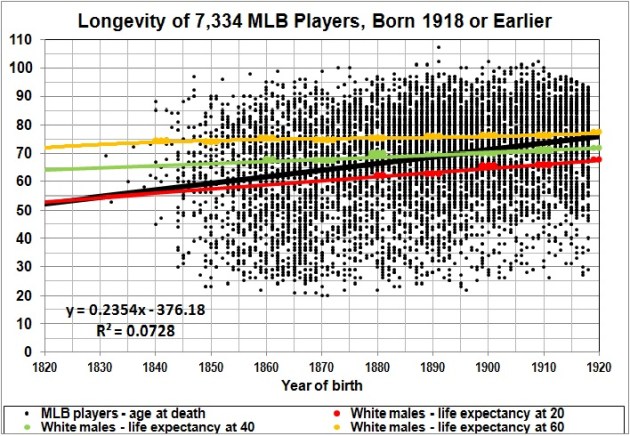
What about the longevity of baseball players in relation to that of the population of white males? I derived the following graphs from the Play Index and the table of life expectancies (both linked above):

I chose 1918 as the cutoff point for ballplayers because that is the last year in the sample of 112 conductors. (As of today, only 15 of the thousands of players born in 1918 or earlier survive** — not enough to affect the comparison.) Before I bring in the conductors, I want to point out the positive trend for longevity among ballplayers (indicated by the heavy black line), especially in relation to the trend for white, 20-year old males. The linear fit, though weak, is statistically robust, and it reflects the long, upward rise in ballplayers’ longevity that is evident in the scatter plot.

I now add conductors to the mix:

For the period covered by the statistics (birth years from 1825 through 1918), conductors enjoyed a modest and significantly insignificant increase in longevity…. By 1918, ballplayers had almost caught up with conductors. The trends suggest that, on average, today’s MLB players can expect to live longer than today’s conductors. Conductors, nevertheless, seem destined to live longer than their contemporaries in the population at large, but not because they (conductors) wave their arms a lot.

Here is my take on all of this: Conductors [and] baseball players … (among members of other identifiable groups) tend to be long-lived because they tend to be physically and mentally vigorous, to begin with. Conductors must possess stamina and intelligence to do what they do…. And, contrary to the popular view of athletes as “dumb,” they are not (as a group); in fact, intelligence and good health (a key component of athleticism) are are tightly bound.

Moreover, conductors (who make music) [and] ballplayers (who play a game) … are engaged in occupations that yield what Robert Atlas calls “gratifying stress.” And, as persons who usually enjoy above-average incomes, they are likely to enjoy better diets and better health-care than most of their contemporaries.

I conclude that occupation — conducting, playing professional baseball, etc. — is a function of the main influences on longevity — mental and physical robustness — and not the other way around. Occupation influences longevity only to the extent that increases it (at the margin) by bestowing “gratifying stress” and/or material rewards, or reduces it (at the margin) by bestowing “frustrating stress” and/or exposure to health-or life-threatening conditions.

Professional actors would seem to have much in common with ballplayers and conductors. They perform for the public, and the not-insignificant mental and physical demands of acting are met with varying degrees of recognition, adulation, and disapproval by their peers and the public. So, it would seem that actors (in general) ought to possess the mental and physical prerequisites of long life, and that “gratifying stress” might add to their longevity. Further, successful actors — by virtue of above-average earnings — should enjoy better diets and health-care than their contemporaries among the general public.

Perhaps the most prominent actors and actresses (to revert to “sexist” terminology) are those who have been nominated for an Academy Award as best in a leading or supporting role. I obtained the names of Oscar-nominated actors and actresses with this search tool, which is provided at the website of the Academy of Motion Picture Arts and Sciences. Search results indicate which of the actors and actresses are deceased. I obtained dates of birth and death from the Internet Movie Database. For consistency with my analysis of ballplayers and conductors, I limited my data set to deceased actors and actresses who were born in 1918 and earlier years. I included two living actresses — Olivia de Havilland and Joan Fontaine, born in 1916 and 1917, respectively — whose presence in the sample does not introduce a downward bias, given their advanced ages.

The resulting sample consists of 268 actors and actresses — 155 of the former, 113 of the latter — distributed as follows:

  • 54 actresses who received at least one nomination for a leading role (8 of whom also were nominated at least once for a supporting role)
  • 59 actresses who were nominated only for supporting roles
  • 71 actors who received at least one nomination for a leading role (15 of whom also were nominated at least once for a supporting role)
  • 84 actors who were nominated only for supporting roles.

The following graphs compare the longevity of these Oscar nominees (by gender and in total) with (a) the longevity trend for conductors, indicated by the dashed black lines, and (b) the life expectancies of whites at various ages, indicated by the orange, light green, and red lines (dashed for females, solid for males). Data points and trend lines for Oscar nominees are rendered in olive green.

The trend lines for the longevity of Oscar nominees are not statistically significant, but they accurately represent the average longevity of those nominees relative to the longevity of conductors and the life expectancies of whites at ages 20, 40, and 60. Some observations:

  • Oscar-nominated actors and actresses generally live far longer than one would expect of a person who had survived to the entry age for the action profession (probably about 20).
  • The trend for Oscar-nominated actresses is positive and in line with the trend for conductors, but is not rising as rapidly as the life expectancy of females in the population at large.
  • The trend for Oscar-nominated actors certainly is not positive, and may be negative. (More about this, below.)
  • In general, women have gone from living only as long as men (in the mid-1800s) to living significantly longer than men. Is there a “men’s health” issue here?)

On the last point, there is a statistically significant difference in the average ages of actors and actresses in the sample. The “bonus” for being a female is a bit more than 4 years.

Do the added gratification and (presumably) greater income that accompany leading roles have an influence on longevity? The statistical evidence is mixed. A regression on the entire sample yields a weak positive relationship between age at death and the total number of nominations received for leading and supporting roles, and a weak negative relationship between age at death and the number of nominations for leading roles.

As it turns out, those relationships do not hold for the the women in the sample; they are entirely attributable to the men. For the men, every nomination — whether for a leading or supporting role — translates to 1.8 additional years of life, but every nomination for a leading role translates to 2 fewer years of life. On average, the men who were nominated only for supporting roles outlived by almost 4 years the men who were nominated for leading roles, though the longevity trend for supporting actors is slightly negative (but not significantly so).

It seems that men who rise to the top of the film-acting profession are more likely than their less-favored peers to succumb to diseases that shorten lives: alcoholism, heart conditions, cancers, and so on. It may be that “driven” leading men are less able to cope with stress than supporting actors — and actresses.

Whatever the case, prominent film actors and actresses join ballplayers and conductors as members of a profession that requires the prerequisites of long life: mental and physical vigor. But the longevity trends among those actors and actresses — especially among the actors — suggest that the negative stresses of their profession have, with time, blunted the advantages of high income. As a result, when it comes to longevity, the general public is gaining on the stars.

Cato, the Kochs, and a Fluke

If you follow the libertarian sector of the blogosphere, as I do, you will have noted the recent dominance of two controversies: the future of Cato Institute and the subsidization of contraceptives. In the matter of Cato, it seems that the Koch brothers want to take control of Cato for the purpose of making it more “relevant” to current political issues, much to the universal dismay of the libertarians commentators whose opinions I have read. In the matter of contraceptives, it seems that the testimony of Sandra Fluke, a Georgetown University law student, has fostered libertarian-conservative agreement in opposition to Ms. Fluke’s whining plea for mandated insurance coverage of contraception (e.g., here and here).

I will not bother to recite the history of the controversies, nor will I try to summarize what various writers have said about them. If you are unfamiliar with either or both of them, start here and here, then follow the links therein. My modest aim is to show how the controversies reveal a link between left-libertarianism and the subsidization of contraceptives.

I therefore turn to Will Wilkinson, a former denizen of Cato who has described himself as a “liberaltarian.” What is a “liberaltarian”? I refer to myself:

In “More Pseudo-Libertarianism,” I say that I must come up with a new name for left-libertarians, inasmuch as they are not really libertarians. Some of them have tried “liberaltarian,” an amalgam of (modern) “liberal” and “libertarian.” To be a “liberaltarian” (with a straight face), one must believe that leftists are willing to abandon their pursuit of all-encompassing government and join left-libertarians in their pursuit of absolute fairness (by whose standards?) in economic and social outcomes. Leftists seek the latter objective, but will never be persuaded to drop the former one.

All of which suggests that  a left-libertarian is really a (witting or unwitting) collaborationist: an intellectual Vichyite or, in the parlance of the 1950s, a fellow traveler or comsymp (communist sympathizer).

Comsymp has a certain ring. Perhaps “libsymp” is what I’m looking for. I’ll give it a try.

Anyhow, the libsymp named Will Wilkinson seems to have a (libsymp-related) grievance against Cato, which is evident in his commentary about the Cato-Koch affair; for example:

Suppose Cato, without changing anything at all about its ideological orientation, were to focus more energy on some issues currently of interest to both groups like AFP [Americans for Prosperity] and groups like, say, the ACLU or Amnesty International? I think there’s a plausible argument that this would lead Cato to deliver greater libertarian bang for its donors’ bucks, while possibly even improving its non-partisan reputation.

Now, I’m not sure I buy this argument. I tend to think that a greater focus on practical political relevance would tend to exert a subtle pressure on Cato’s analysts to take it relatively easy on perceived allies when they do and say things harmful to liberty. Indeed, this pressure already exists, and it wouldn’t be a good idea to increase it, since it’s already biased toward the right. The legacy of right-fusionism has been to desensitize many libertarians to the inherently liberty-limiting aspects of social conservativism, and to reduce many self-described libertarians to acting primarily as cheerleaders for the economic agenda of “free-market” reactionaries….

For folks outside the Beltway, for whom the Cato staff are complete strangers, Cato looks like part of the right, if an odd one. There’s a reason David Boaz [Cato’s executive VP] is always complaining about newspapers identifying Cato as a “conservative” think tank, and it’s not just that David Boaz likes to complain. Just ask yourself how Cato’s work could have been more congenial to the GOP during George W. Bush’s failed attempt to reform Social Security, or during the failed attempt to block Obamacare? Cato obviously already is in the politically-relevant intellectual ammo business. And in actual large-stakes political fights in Washington, Cato is generally on the Republican side. It would not be strange to spot a Catoite at Grover Norquist’s infamous Wednesday morning meetings. Because Cato functions as part of the right.

It’s tempting to think that Cato almost never does anything to help the Democrats largely because it’s just too far to the left of the Democratic Party on foreign policy and civil liberties. Yet Cato is equally far to the “right” of the Republican Party on economic policy, welfare policy, education policy, and lots more. Social Security privatization is a forced savings program. School vouchers and/or education tax credits are taxpayer-funded education. Lower income-tax rates concede the income tax. Again and again Cato finds a way to settle on non-ideal, “second-best” economic, welfare, and education policies, and argue for them in away that provides “ammo” to the right. But it very rarely develops compromising second-best policies on foreign policy or civil liberties that would be of any practical use to dovish or civil-libertarian Democrats. Why not? Why was coming out in favor of gay marriage more controversial at Cato (the state shouldn’t be involved in marriage at all!) than coming out in favor of school vouchers (the state shouldn’t be involved in education at all!)? Why not a bigger institutional push for medical marijuana as a second-best, nose-under-the-tent alternative to outright legalization? The fact is that Cato has so deeply internalized the ethos of the venerable right-fusionist alliance that there is almost no hope of it functioning on the whole in a truly non-partisan way. I think its status-quo reputation reflects that.

I reproduced that much of Wilkinson’s post just to give you an idea of the depth of his animus toward the Cato of Ed Crane‘s making. A particular aspect of Wilkinson’s “indictment” bears on the thesis of this post. It does not take much reading between the lines to detect Wilkinson’s embrace of “positive liberty,” which is the antithesis of liberty. He spells it out more explicitly here:

[F]reedom has a number of meanings, and one of them is “ability to do stuff.”… Persons, natural or legal, are either coerced or they aren’t. Mugged people with fat wallets aren’t coerced or wrongly interfered with more than mugged people with thin wallets. They just lose more money. That conservatives and libertarians always ultimately do treat tax increases as losses of freedom suggests to me that they’re really proponents of positive liberty after all, but haven’t thought the implications through. In that case, they’re right to see growth as a matter of freedom. But then they’re also are quite wrong to think that a well-functioning welfare state isn’t a matter of freedom.

There you have it. Wilkinson — like other left-libertarians — hews to a key tenet of modern “liberalism,” which is that people are not really free unless they have a certain measure of economic wherewithal. The taking of income by taxation, in Wilkinson’s view, is morally equivalent to a lack of income.

This left-libertarian (and “liberal”) view of the world depends on the slippery use of the term “coercion.” The taking of something from a person by force or the threat of force is coercion. Taxation is coercion, and resistance to taxation is not a plea for “positive liberty.” On the other hand, there is no coercion when a person is “forced” to accept a standard of living that is arbitrarily deemed sub-standard simply because that person does not earn enough “to do stuff,” according to the arbiter’s standards of what “stuff” a person needs “to do.”

There is, in sum, no moral distance between the left-libertarian and “liberal” worldviews, both of which favor “positive liberty.” What kind of and how much “positive liberty” should be doled out are merely matters of taste. The likeness of left-libertarianism and “liberalism” reminds me of this famous anecdote:

A man asks a woman if she would be willing to sleep with him if he pays her an exorbitant sum. She replies affirmatively. He then names a paltry amount and asks if she would still be willing to sleep with him for the revised fee. The woman is greatly offended and replies as follows:

She: What kind of woman do you think I am?

He: We’ve already established that. Now we’re just haggling over the price.

Which brings me, at last, to Sandra Fluke, who has established what kind of person she is, and is just haggling over the price.

Related posts:
The Causes of Economic Growth
Positive Rights and Cosmic Justice
A Short Course in Economics
Fascism with a “Friendly” Face
Democracy and Liberty
The Interest-Group Paradox
Addendum to a Short Course in Economics
Utilitarianism, “Liberalism,” and Omniscience
Utilitarianism vs. Liberty
Fascism and the Future of America
The Indivisibility of Economic and Social Liberty
The Constitution: Original Meaning, Corruption, and Restoration
Negative Rights
Negative Rights, Social Norms, and the Constitution
The Devolution of American Politics from Wisdom to Opportunism
The Near-Victory of Communism
Tocqueville’s Prescience
Accountants of the Soul
Invoking Hitler
Rawls Meets Bentham
The Left
Enough of “Social Welfare”
A True Flat Tax
The Case of the Purblind Economist
Youthful Wisdom
The Divine Right of the Majority
Our Enemy, the State
Social Justice
Taxing the Rich
More about Taxing the Rich
Positive Liberty vs. Liberty
More Social Justice
Luck-Egalitarianism and Moral Luck
Nature Is Unfair
Elizabeth Warren Is All Wet
“Occupy Wall Street” and Religion
Merit Goods, Positive Rights, and Cosmic Justice
More about Merit Goods
What Is Bleeding-Heart Libertarianism?
The Morality of Occupying Private Property
In Defense of the 1%

“Men’s Health”

I learned something new today. The provision of contraceptives as a “right” under employer-sponsored health-insurance plans is a “women’s health” issue. Fancy that. I had always thought of contraception in a different way. To put it delicately, contraception is like playing with fire without getting burned. “Health” has nothing to do with it.

Anyway, if women can use the power of the state to force others to pay for their contraceptives (via higher insurance premiums), men certainly should be able to use the power of the state to acquire goodies that are essential to “men’s health.” I therefore demand that the Obama administration force insurance companies to cover the following items:

  • free tickets to sporting events
  • beer, whiskey, and wine on demand
  • free premium sports packages on cable or satellite TV
  • Mondays and Fridays off, with full pay
  • provocative clothing (intimate and otherwise) for one’s “partner”
  • free subscriptions to various forms of lascivious entertainment

I’m sure there are many other things that are essential to “men’s health,” but that’s a good start.

Are You in the Bubble?

Charles Murray’s new book, Coming Apart: The State of White America, 1960–2010, is a hot topic in the sector of the blogosphere that I frequent. Kay S. Hymowitz summarizes Murray’s thesis:

According to Murray, the last 50 years have seen the emergence of a “new upper class.” By this he means something quite different from the 1 percent that makes the Occupy Wall Streeters shake their pitchforks. He refers, rather, to the cognitive elite that he and his coauthor Richard Herrnstein warned about in The Bell Curve. This elite is blessed with diplomas from top colleges and with jobs that allow them to afford homes in Nassau County, New York and Fairfax County, Virginia. They’ve earned these things not through trust funds, Murray explains, but because of the high IQs that the postindustrial economy so richly rewards.

Murray creates a fictional town, Belmont, to illustrate the demographics and culture of the new upper class. Belmont looks nothing like the well-heeled but corrupt, godless enclave of the populist imagination. On the contrary: the top 20 percent of citizens in income and education exemplify the core founding virtues Murray defines as industriousness, honesty, marriage, and religious observance….

The American virtues are not doing so well in Fishtown, Murray’s fictional working-class counterpart to Belmont. In fact, Fishtown is home to a “new lower class” whose lifestyle resembles The Wire more than Roseanne. Murray uncovers a five-fold increase in the percentage of white male workers on disability insurance since 1960, a tripling of prime-age men out of the labor force—almost all with a high school degree or less—and a doubling in the percentage of Fishtown men working less than full-time…..

Most disastrous for Fishtown residents has been the collapse of the family, which Murray believes is now “approaching a point of no return.” For a while after the 1960s, the working class hung on to its traditional ways. That changed dramatically by the 1990s. Today, under 50 percent of Fishtown 30- to 49-year-olds are married; in Belmont, the number is 84 percent. About a third of Fishtowners of that age are divorced, compared with 10 percent of Belmonters. Murray estimates that 45 percent of Fishtown babies are born to unmarried mothers, versus 6 to 8 percent of those in Belmont.

And so it follows: Fishtown kids are far less likely to be living with their two biological parents. One survey of mothers who turned 40 in the late nineties and early 2000s suggests the number to be only about 30 percent in Fishtown. In Belmont? Ninety percent—yes, ninety—were living with both mother and father. City Journal, January 25, 2012)

What is the moral of Murray’s tale? According to Hymowitz, it is that

America has become a segregated, caste society, with a born elite and an equally hereditary underclass. A libertarian, Murray believes these facts add up to an argument for limited government. The welfare state has sapped America’s civic energy in places like Fishtown, leaving a population of disengaged, untrusting slackers. It has also diminished upper-class confidence: the well-to-do dare not suggest they have a recipe for the good life. “The underpinning of the welfare state,” Murray writes, “is that, at bottom, human beings are not really responsible for the things they do.”

Not only that, but as Ilya Somin puts it,

Murray argues that a new elite class has emerged that is much more ignorant about the lives of ordinary Americans than were the elites of earlier generations….

If Murray is right, this kind of elite ignorance is the flip side of the general public’s political ignorance. Public ignorance is dangerous because it reduces the quality of voting decisions; elite ignorance because it reduces the quality of the decisions made by elites once they get into positions of power. (“Charles Murray on Elite Ignorance of Ordinary Americans,” The Volokh Conspiracy, January 25, 2012)

Somin adds:

I am far from certain that the kind of knowledge Murray describes is actually important in improving the quality of public policy. Yes, elites who make policy that affects the lives of truck drivers should have some knowledge of “their priorities.” But it’s not clear to me that knowledge of TV shows, foods, preferred sports, etc., of truck drivers is all that useful to understanding those priorities. Even the experience of living with a low income or working at a job where your body hurts at the end of the day (both stressed by Murray s especially important) may be overrated. You don’t have to do either to realize that poverty imposes substantial constraints on your life, or that physical pain is extremely unpleasant….

To be sure, there is an important sense in which elite ignorance reduces the quality of public policy. In a complex society where people have a wide variety of preferences, not even the most knowledgeable elite experts can really have enough information to impose efficient paternalistic regulations that preempt individual choice. But this problem would persist even if all our elites had a deep and extensive knowledge of non-elite culture. The solution is not so much an elite that is better-informed about the culture of the masses, but an elite whose power over those masses is more limited and decentralized.

To put it another way, the real public-policy problem is that the elites — empowered by the regulatory-welfare state — are able to impose policies that harm the social and economic fabric, and therefore harm the working class. If elites knew more about the actual “priorities” of the working class (whatever those “priorities” might be), the elites would simply concoct more misbegotten policies.

To put it yet another way, the elites relish the power of the regulatory-welfare state. It is the exercise of that power which matters to the elites, not the “real people” of the “real world,” who are an excuse for the exercise of power. In Murray’s view, which I share, those “real people” are unreal to the elites because the elites live in an upper-middle-class bubble, remote from the “real world” of Fishtown and its like.

I am proud to say that I do not live in the upper-middle-class bubble, even though my career, income history, and tastes qualify me as a resident of the bubble. My upbringing (outlined here) inoculated me from elitism. The effects of that inoculation are reflected in my score of 51 on the quiz that Murray presents in Chapter 4 of his book, “How Thick Is Your Bubble?” Murray gives the following interpretation of scores:

  • A lifelong resident of a working-class neighborhood with average television and moviegoing habits. Range: 48–99. Typical: 77.
  • A first- generation middle-class person with working-class parents and  average television and moviegoing habits. Range: 42–100. Typical: 66.
  • A first- generation upper-middle- class person with middle-class parents. Range: 11–80. Typical: 33.
  • A second- generation (or more) upper-middle-class person who has made a point of getting out a lot. Range: 0–43. Typical: 9.
  • A second- generation (or more) upper-middle-class person with the television and moviegoing habits of the upper middle class. Range: 0–20.Typical: 2.The scoring of the archetypes reflects a few realities about socioeconomic background and the bubble

I defy Murray’s categorization, for I am a first-generation upper-middle-class person with working-class parents and the television and moviegoing habits of the upper middle class. But no matter. My quiz score indicates my comprehension of the “real world” and the “real people” who inhabit it. They are not faceless game pieces to be shunted about in the name of “society” for the sake of my ego or power cravings. That is why I am neither a “liberal” nor a pseudo-libertarian like this fellow and this bunch.

Prohibition, Abortion, and “Progressivism”

I am belatedly watching Prohibition, a production of Ken Burns and Lynn Novick, which first aired on PBS in October. The program, in typical Burns style, delivers history in easy-to-swallow doses. I have seen only one of the three episodes, but that episode whets my appetite for the others because it added much to my sketchy knowledge of the events that led to the passage of the Eighteenth Amendment.

There is a libertarian slant to Prohibition, though perhaps not a deliberate one. For all that Prohibition says about the evils of “demon rum,” it says more about the evils and unintended consequences of governmental efforts to dictate private behavior. One of the talking heads points out that prohibition was as much a brainchild of “progressives” as it was of religious fundamentalists.

Although eugenics is not mentioned in Prohibition, it looms in the background. For eugenics — like prohibition of alcohol and, later, the near-prohibition of smoking — is symptomatic of the “progressive” mentality. That mentality is paternalistic, through and through. And “progressive” paternalism finds its way into the daily lives of Americans through the regulation of products and services — for our own good, of course. If you can think of a product or service that you use (or would like to use) that is not shaped by paternalistic regulation or taxes levied with regulatory intent, you must live in a cave.

However, the passing acknowledgement of “progressivism” as a force for the prohibition of alcohol is outweighed by the attention given to the role of “evangelicals” in the enactment of prohibition. I take this as a subtle swipe at anti-abortion stance of fundamentalist Protestants and adherents of the “traditional” strands of Catholicism and Judaism. Here is the “logic” of this implied attack on pro-lifers: Governmental interference in a personal choice is wrong with respect to the consumption of alcohol and similarly wrong with respect to abortion.

By that “logic,” it is wrong for government to interfere in or prosecute robbery, assault, rape, murder and other overtly harmful acts, which — after all — are merely the consequences of personal choices made by their perpetrators. Not even a “progressive” would claim that robbery, assault, etc., should go unpunished, though he would quail at effective punishment.

Not that “progressivism” is a thing of logic. It is, as many commentators have noted, a shifting set of attitudes. A “progressive” (or “liberal” or leftist) is simply a person who adheres to the current set of attitudes — the “progressive” program du jour — which the “progressive” seeks to impose by force, for our own good. The essential character of “progressivism” is paternalism wedded to statism.

George Will puts it this way:

….

Obama, an unfettered executive wielding a swollen state, began and ended his [state of the union] address by celebrating the armed forces. They are not “consumed with personal ambition,” they “work together” and “focus on the mission at hand” and do not “obsess over their differences.” Americans should emulate troops “marching into battle,” who “rise or fall as one unit.”

Well. The armed services’ ethos, although noble, is not a template for civilian society, unless the aspiration is to extinguish politics. People marching in serried ranks, fused into a solid mass by the heat of martial ardor, proceeding in lock step, shoulder to shoulder, obedient to orders from a commanding officer — this is a recurring dream of progressives eager to dispense with tiresome persuasion and untidy dissension in a free, tumultuous society.

Progressive presidents use martial language as a way of encouraging Americans to confuse civilian politics with military exertions, thereby circumventing an impediment to progressive aspirations — the Constitution and the patience it demands. As a young professor, Woodrow Wilson had lamented that America’s political parties “are like armies without officers.” The most theoretically inclined of progressive politicians, Wilson was the first president to criticize America’s founding. This he did thoroughly, rejecting the Madisonian system of checks and balances — the separation of powers, a crucial component of limited government — because it makes a government that cannot be wielded efficiently by a strong executive.

Franklin Roosevelt agreed. He complained about “the three-horse team of the American system”: “If one horse lies down in the traces or plunges off in another direction, the field will not be plowed.” And progressive plowing takes precedence over constitutional equipoise among the three branches of government. Hence FDR’s attempt to break the Supreme Court to his will by enlarging it.

In his first inaugural address, FDR demanded “broad executive power to wage a war against the emergency, as great as the power that would be given to me if we were in fact invaded by a foreign foe.” He said Americans must “move as a trained and loyal army” with “a unity of duty hitherto evoked only in time of armed strife.” The next day, addressing the American Legion, Roosevelt said it was “a mistake to assume that the virtues of war differ essentially from the virtues of peace.” In such a time, dissent is disloyalty….

Obama, aspiring to command civilian life, has said that in reforming health care, he would have preferred an “elegant, academically approved” plan without “legislative fingerprints on it” but “unfortunately” he had to conduct “negotiations with a lot of different people.” His campaign mantra “We can’t wait!” expresses progressivism’s impatience with our constitutional system of concurrent majorities. To enact and execute federal laws under Madison’s institutional architecture requires three, and sometimes more, such majorities. There must be majorities in the House and Senate, each body having distinctive constituencies and electoral rhythms. The law must be affirmed by the president, who has a distinctive electoral base and election schedule. Supermajorities in both houses of Congress are required to override presidential vetoes. And a Supreme Court majority is required to sustain laws against constitutional challenges.

“We can’t wait!” exclaims Obama, who makes recess appointments when the Senate is not in recess, multiplies “czars” to further nullify the Senate’s constitutional prerogative to advise and consent, and creates agencies (e.g., Obamacare’s Independent Payment Advisory Board and Dodd-Frank’s Consumer Financial Protection Bureau) untethered from legislative accountability.

Like other progressive presidents fond of military metaphors, he rejects the patience of politics required by the Constitution he has sworn to uphold. (“Obama to the Nation: Onward Civilian Soldiers,” The Washington Post, January 27, 2011)

*   *   *

Related posts:
Ten-Plus Commandments of Liberalism, er, Progressivism
The Pathology of Academic Leftism
Diagnosing the Left
Presidential Legacies
The Modern Presidency: A Tour of American History
An FDR Reader
Parsing Political Philosophy
Inventing “Liberalism”
Utilitarianism, “Liberalism,” and Omniscience
Fascism and the Future of America
Utilitarianism vs. Liberty
Selection Bias and the Road to Serfdom
Beware of Libertarian Paternalists
The Mind of a Paternalist
The State of the Union: 2010
The Shape of Things to Come
Accountants of the Soul
Rawls Meets Bentham
Is Liberty Possible?
The Left
The Left’s Agenda
The Left and Its Delusions
Save Me from Self-Appointed Saviors
In Defense of the 1%
A Nation of (Unconstitutional) Laws

The Equal-Protection Scam and Same-Sex Marriage

Steven Horwitz, writing at Bleeding Heart Libertarians, opines that

In the world that exists, where the state is involved in marriage, I believe that….

Libertarianism requires  [federal recognition of same-sex marriage], as we often forget that the classical liberal tradition was built on two pillars: the rights of the individual against the state and equality before the law. The state may not discriminate. If it offers a benefit to some, it must offer it to all who are equally situated….

Suppose we had a Social Security system in which all residents of the US paid FICA but only white ones received the benefits. Would you argue that the libertarian position is to continue to deny people of color access to Social Security benefits on the grounds that giving the benefits to them would “extend federal power?” Would you continue to insist that the only libertarian position is to argue for the elimination of Social Security even though it continues to benefit only whites?

Double hogwash!

First, homosexuals are not “equally situated” with respect to heterosexuals. They want to call “marriage” something that cannot be marriage, as marriage has been understood for thousands of years: the union of a man and a woman in a lifelong commitment to each other. Homosexuals may choose to enter into private relationships that they call “marriage” — and no one can stop them — but those relationships are not manifestations of the time-honored social institution known as marriage.

Second, the analogy with Social Security is inapt. The recognition of marriage by the state is not a “benefit” in the same way as Social Security; that is, it is not a form of remuneration based on “contributions” to a (fictional) insurance pool. Social Security benefits are a quid pro quo; the recognition of marriage is a grant of status, in the same way that naturalization is a grant of status — the status of citizen. The state may make and change the qualifications for citizenship, because the power to do so is inherently a function of the state. But the state may not make and change the essential nature of marriage, which is a social phenomenon.

Where the state chooses to call a homosexual “marriage” a marriage, it simply indulges in legal fiction. But it is not harmless legal fiction — a crucial point that eludes “libertarians” like Horwitz; thus:

The recognition of homosexual “marriage” by the state — though innocuous to many, and an article of faith among most libertarians and liberals — is another step down the slippery slope of societal disintegration. The disintegration began in earnest in the 1930s, when Americans began to place their trust in chimerical, one-size-fits-all “solutions” offered by power-hungry, economically illiterate politicians and their “intellectual” enablers and apologists. In this instance, the state will recognize homosexual “marriage,” then bestow equal  benefits on homosexual “partners,”  and then require private entities (businesses, churches, etc.) to grant equal benefits to homosexual “partnerships.” Individuals and businesses who demur will be brought to heel through the use of affirmative action and hate-crime legislation to penalize those who dare to speak against homosexual “marriage,” the privileges that flow from it, and the economic damage wrought by those privileges.

It should be evident to anyone who has watched American politics that even-handedness is not a matter of observing constitutional limits on government’s reach, regardless of who asks for an exception; it is, rather, a matter of expanding the privileges bestowed by government so that no one is excluded. It follows that the recognition and punitive enforcement of same-sex “marriage” would be followed by the recognition and bestowal of benefits on other arrangements, including transient “partnerships” of convenience. And that surely will weaken heterosexual marriage, which is the axis around which the family revolves. The state will be saying, in effect, “Anything goes. Do your thing. The courts, the welfare system, and the taxpayer — above all — will pick up the pieces.” And so it will go….

Given the signals being sent by the state, the rate of formation of traditional, heterosexual marriages will continue to decline. (According to the Census Bureau, the percentage of adult males who are married dropped steadily from 71.1 percent in the 1960 census to 58.6 percent in the 2000 census; for females, the percentage dropped from 67.4 to 54.6. (The latest available figures, for 2009, show no significant change since 2000.) About half of each drop is explained by a rise in the percentage of adults who never marry, the other half by a rise in the percentage of divorced adults. Those statistics are what one should expect when the state signals — as it began to do increasingly after 1960 — that traditional marriage is no special thing by making it easier for couples to divorce, by subsidizing single mothers, and by encouraging women to work outside the home.

The well-known effects of such policies include higher rates of crime and lower levels of educational and economic achievement. (See this and this, for example.) Same-sex marriage would multiply these effects for the sake of mollifying a small minority of the populace.

A “libertarian” like Horwitz will assert that all such considerations are beside the point — as if the only point of liberty is “self-actualization” or similar clap-trap. I do wish that these self-styled “libertarians” would grow up and shut up.

Related posts:
Libertarianism, Marriage, and the True Meaning of Family Values
Same-Sex Marriage
“Equal Protection” and Homosexual Marriage
“Family Values,” Liberty, and the State
On Liberty
Civil Society and Homosexual “Marriage”
Perry v. Schwarzenegger, Due Process, and Equal Protection
Rationalism, Social Norms, and Same-Sex “Marriage”
Pseudo-Libertarian Sophistry vs. True Libertarianism
Libertarian Conservative or Conservative Libertarian?
Liberty, Equality, Fraternity: Part I
Bounded Liberty: A Thought Experiment
More Pseudo-Libertarianism
The Meaning of Liberty
Positive Liberty vs. Liberty
In Defense of Marriage
Burkean Libertarianism
Rights: Source, Applicability, How Held
What Is Libertarianism?
True Libertarianism, One More Time
Human Nature, Liberty, and Rationalism
The Myth That Same-Sex Marriage Causes No Harm
The Libertarian-Conservative Fusion Is Alive and Well
What Is Bleeding-Heart Libertarianism?

“Going Viral” in the 1500s

From “How Luther went viral” (The Economist, December 17, 2011):

The start of the Reformation is usually dated to Luther’s nailing of his “95 Theses on the Power and Efficacy of Indulgences” to the church door in Wittenberg on October 31st 1517….

Although they were written in Latin, the “95 Theses” caused an immediate stir, first within academic circles in Wittenberg and then farther afield. In December 1517 printed editions of the theses, in the form of pamphlets and broadsheets, appeared simultaneously in Leipzig, Nuremberg and Basel, paid for by Luther’s friends to whom he had sent copies. German translations, which could be read by a wider public than Latin-speaking academics and clergy, soon followed and quickly spread throughout the German-speaking lands. Luther’s friend Friedrich Myconius later wrote that “hardly 14 days had passed when these propositions were known throughout Germany and within four weeks almost all of Christendom was familiar with them.”

The unintentional but rapid spread of the “95 Theses” alerted Luther to the way in which media passed from one person to another could quickly reach a wide audience. “They are printed and circulated far beyond my expectation,” he wrote in March 1518 to a publisher in Nuremberg who had published a German translation of the theses. But writing in scholarly Latin and then translating it into German was not the best way to address the wider public. Luther wrote that he “should have spoken far differently and more distinctly had I known what was going to happen.” For the publication later that month of his “Sermon on Indulgences and Grace”, he switched to German, avoiding regional vocabulary to ensure that his words were intelligible from the Rhineland to Saxony. The pamphlet, an instant hit, is regarded by many as the true starting point of the Reformation….

Modern society tends to regard itself as somehow better than previous ones, and technological advance reinforces that sense of superiority. But history teaches us that there is nothing new under the sun. Robert Darnton, an historian at Harvard University, who has studied information-sharing networks in pre-revolutionary France, argues that “the marvels of communication technology in the present have produced a false consciousness about the past—even a sense that communication has no history, or had nothing of importance to consider before the days of television and the internet.” Social media are not unprecedented: rather, they are the continuation of a long tradition. Modern digital networks may be able to do it more quickly, but even 500 years ago the sharing of media could play a supporting role in precipitating a revolution. Today’s social-media systems do not just connect us to each other: they also link us to the past.

Luther’s success, if it may be called that, was owed not so much to the new technology of printing as to certain constants of human nature:

1. Distant authority is more credible than a familiar source. CEOs resort to this kind of authority when they hire “expert” consultants to rubber-stamp decisions that they — the CEOs — had already reached, so as to “sell” the intended audience (board of directors, senior managers, employees) on the correctness of the decisions. More generally, what is said in print, on the air, on the internet, etc., is accepted as authoritative because it is (usually) delivered in tones of great certainty, supported by fabricated and/or cherry-picked evidence, and originates from a source that cannot be questioned directly and is (wrongly, for the most part) assumed to be authoritative.

2. Last in, last believed. There is a strong tendency to make judgments based on the most recent facts and/or opinions to which one is exposed, especially among persons with little education, persons whose education is non-scientific, and persons of below-average intelligence.

3. Confirmation bias. This is at work in almost everyone, even the “best and brightest.” A person who already leans toward a position will search out and seize upon “facts” that support the position. Distant authority plays a key role in enabling confirmation bias. And once a person finds “the answer” to something — whether the answer is communism, the welfare state, carbon-emission reductions, etc. — he becomes less prone to believe the last thing he hears. But the last thing that swayed him could well have been a speech by FDR denouncing “economic royalists” or one of Al Gore’s presentations about global warming. No mind is more closed than that of an “open minded liberal.”

A man who is not a Liberal at sixteen has no heart; a man who is not a Conservative at sixty has no head.

-– attributed to Benjamin Disraeli

Luck and Baseball, One More Time

There is such a thing as “luck.” Bad and good luck happen to everyone, at one time or another. But everything that happens to everyone is not due to luck. I am convinced by what I have seen of life — up close and at a distance — that most of what happens to people happens to them because of their intentions, skills, and resources.

Yes, the skills that one possesses may be due in part to genetic luck, and the resources that one can marshal may be due in part to genetic and geographic luck. But if skills and resources were entirely beyond a person’s control, no one would ever climb from the proverbial gutter to attain fame and fortune. That is where intentions come in.

So, I am unimpressed (to say the least) by do-gooders and levelers, who want to take from the productive and give to the unproductive because the productive have had “all the luck,” or some such thing. Balderdash! First, it takes more than luck to be productive and to enjoy even a modest income. Second, taking from the productive to give to the unproductive is like blaming the blameless. It may come as a surprise to do-gooders and levelers (most of whom ought to know better), but a person who earns a high income earns it because that is what others are willing to pay for his efforts — not because he picks the pockets of the poor.

Speaking of high-income earners, I am always puzzled by the fact that income-envy is directed toward CEOs, investment bankers, and suchlike. Why is it not directed at super-star athletes, like Albert Pujols, who will earn $254 million over the next 10 years, just for playing baseball? Perhaps it is because almost everyone recognizes that Pujols is selling a skill that (a) is his (not stolen from someone else) and (b) would not be on display were it not for his assiduous development and application of the particular genetic advantages that enable him to hit a pitched baseball with above-average frequency and power.

Well, Nassim Nicholas Taleb to the contrary notwithstanding, the earning of large sums of money in any profession takes the same assiduous application of particular genetic advantages, or assiduous compensation for the lack thereof. I will not repeat my detailed criticisms of Taleb, which can be found “here” and “here.” Instead, I will return to the subject of baseball, some aspects of which I treated in those posts.

In the 111-year history of the American League, 60 different players have led the league in batting. Those 60 players have recorded a total of 367 top-10 finishes in American League batting races over the years — an average of 6 top-10 finishes for each of the players. It is not surprising, therefore, that most of the 60 players also compiled excellent career batting averages. Specifically, through 2010, 57 of the 60 had made at least 5,000 plate appearance in the American League, and 43 of the 57 are among the top 120 hitters (for average) — out of the thousands of players with at least 5,000 plate appearances in the American League. Were those 43 players merely “lucky”? It takes a lot more than luck to hit so well, so consistently, and for so many years.

And it takes a lot more than luck to succeed at almost anything, from winning high office to making millions of dollars to painting a masterpiece to building a house to cutting hair properly. To denigrate the rich and famous by calling them lucky is to denigrate every person who strives, with some success, to overmaster whatever bad luck happens to come his way.

Related posts:
The Residue of Choice
The American League’s Greatest Hitters
The American League’s Greatest Hitters:  Part II
Fooled by Non-Randomness
Randomness Is Over-Rated
Luck-Egalitarianism and Moral Luck

The Movies: Not Better than Ever (II)

Incorporated in this page.


“An Economist’s Special Pleading: Affirmative Action for the Ugly,” A Footnote

My post of August 30, 2011, “An Economist’s Special Pleading: Affirmative Action for the Ugly,” opens with this:

It’s hard to tell whether economist Dan Hamermesh is pulling our collective leg, or if he’s serious. In either event, here’s a portion of his proposal to instigate affirmative action for the uglies among us (“Ugly? You May Have a Case,” The New York Times, August 27, 2011).

Hamermesh has garnered some publicity for his cause through an appearance on Jon Stewart’s The Daily Show (clip available here).  Hamermesh joins with good humor in the lampooning of his thesis — and his less-than-matinee-idol looks — but he might have done so for the publicity. Whatever the case, enjoy the video clip, read my post of August 30, read Hamermesh’s NYT article, and decide for yourself.

The Spoiled Children of Capitalism

I am struck by the convergence of two posts that I read recently. The first is by Tim of Angle (he says it’s his real name), the proprietor of Dyspepsia Generation (a blog deserving of a vast readership). This is from Tim’s “The Spoiled Children of Capitalism“:

The rot set after World War II. The Taylorist techniques of industrial production put in place to win the war generated, after it was won, an explosion of prosperity that provided every literate American the opportunity for a good-paying job and entry into the middle class. Young couples who had grown up during the Depression, suddenly flush (compared to their parents), were determined that their kids would never know the similar hardships.

As a result, the Baby Boomers turned into a bunch of spoiled slackers, no longer turned out to earn a living at 16, no longer satisfied with just a high school education, and ready to sell their votes to a political class who had access to a cornucopia of tax dollars and no doubt at all about how they wanted to spend it. And, sadly, they passed their principles, if one may use the term so loosely, down the generations to the point where young people today are scarcely worth using for fertilizer.

In 1919, or 1929, or especially 1939, the adolescents of 1969 would have had neither the leisure nor the money to create the Woodstock Nation. But mommy and daddy shelled out because they didn’t want their little darlings to be caught short, and consequently their little darlings became the worthless whiners who voted for people like Bill Clinton and Barack Obama [and who were people like Bill Clinton and Barack Obama: ED.], with results as you see them. Now that history is catching up to them, a third generation of losers can think of nothing better to do than camp out on Wall Street in hopes that the Cargo will suddenly begin to arrive again.

Good luck with that.

I have long shared Tim’s assessment of the Boomer generation. Among the corroborating data are my sister and my wife’s sister and brother — Boomers all.

It is less clear that all Boomers passed along their generally deplorable traits. Contradictory data include my sister’s three children, my wife’s sister’s child, and one of my wife’s brother’s children. As members of Generation X — a Reactive generation, in Strauss and Howe’s theory of generations — they “tend to be pragmatic and perceptive, savvy but amoral, more focused on money than on art.” (The other of my wife’s brother’s children is of Generation Y, discussed next.)

Gen X’s successors are found in Generation Y. It is they who seem to dominate the ranks of “Occupiers,” and they are, in the main, children of Boomers. But Gen Yers are of a different character than their older siblings. To the extent that they are late children of Boomers, it is likely that they resemble Boomers in having been spoiled. And it shows in the “Occupy” movement, the underlying theme of which is that the world owes them — the “Occupiers” — a living.

So, despite my quibbles about Gen X, I subscribe to Tim’s view that the rot set in after World War II. That rot, in the form of slackerism, is more prevalent now than it ever was. It is not for nothing that Gen Y is also known as the Boomerang Generation.

Which brings me to Bryan Caplan’s post, “Poverty, Conscientiousness, and Broken Families.” Caplan — who is all wet when it comes to pacifism and libertarianism — usually makes sense when he describes the world as it is rather than as he would like it to be. He writes:

[W]hen leftist social scientists actually talk to and observe the poor, they confirm the stereotypes of the harshest Victorian.  Poverty isn’t about money; it’s a state of mind.  That state of mind is low conscientiousness.

Case in point: Kathryn Edin and Maria KefalasPromises I Can Keep: Why Poor Women Put Motherhood Before Marriage.  The authors spent years interviewing poor single moms.  Edin actually moved into their neighborhood to get closer to her subjects.  One big conclusion:

Most social scientists who study poor families assume financial troubles are the cause of these breakups [between cohabitating parents]… Lack of money is certainly a contributing cause, as we will see, but rarely the only factor.  It is usually the young father’s criminal behavior, the spells of incarceration that so often follow, a pattern of intimate violence, his chronic infidelity, and an inability to leave drugs and alcohol alone that cause relationships to falter and die.

Furthermore:

Conflicts over money do not usually erupt simply because the man cannot find a job or because he doesn’t earn as much as someone with better skills or education.  Money usually becomes an issue because he seems unwilling to keep at a job for any length of time, usually because of issues related to respect.  Some of the jobs he can get don’t pay enough to give him the self-respect he feels he needs, and others require him to get along with unpleasant customers and coworkers, and to maintain a submissive attitude toward the boss.

These passages focus on low male conscientiousness, but the rest of the book shows it’s a two-way street.  And even when Edin and Kefalas are talking about men, low female conscientiousness is implicit.  After all, conscientious women wouldn’t associate with habitually unemployed men in the first place – not to mention alcoholics, addicts, or criminals.

Low conscientiousness was the bane of those Boomers who, in the 1960s and 1970s, chose to “drop out” and “do drugs.” It will be the bane of the Gen Yers who do the same thing. But, as usual, “society” will be expected to pick up the tab, with food stamps, subsidized housing, drug rehab programs, Medicaid, and so on.

Before the onset of the welfare state in the 1930s, there were two ways to survive: work hard or accept whatever charity came your way. And there was only one way for most persons to thrive: work hard. That all changed after World War II, when power-lusting politicians sold an all-too-willing-to-believe electorate a false and dangerous bill of goods, namely, that government is the source of prosperity. It is not, and never has been.

Whether that truth will become apparent before America goes the way of Greece is anyone’s guess. I am pessimistic because conscientiousness — which seemed to be on the rise with Gen X — is once again on the decline.

Related posts:
The Residue of Choice
The People’s Romance
The Causes of Economic Growth
A Short Course in Economics
Addendum to a Short Course in Economics
In the Long Run We Are All Poorer
Economic Growth since WWII
The Price of Government
The Commandeered Economy
The Price of Government Redux
The Mega-Depression
Presidential Chutzpah
As Goes Greece
The State of the Union: 2010
The Shape of Things to Come
The Real Burden of Government
Toward a Risk-Free Economy
The Rahn Curve at Work
The Illusion of Prosperity and Stability
Society and the State
I Want My Country Back
The “Forthcoming Financial Collapse”
Estimating the Rahn Curve: Or, How Government Inhibits Economic Growth
The Deficit Commission’s Deficit of Understanding
Undermining the Free Society
The Bowles-Simpson Report
The Bowles-Simpson Band-Aid
Government vs. Community
The Stagnation Thesis
Government Failure: An Example
The Evil That Is Done with Good Intentions
America’s Financial Crisis Is Now
PolitiFact Whiffs on Social Security
The Destruction of Society in the Name of “Society”
The Social Security Trust Fund Is Not a “Get out of Jail Free Card”
Say’s Law, Government, and Unemployment
“Occupy Wall Street” and Religion
Religion on the Left

Driving and Politics (1)

Among the many reasons for my hatred of flying is that I am usually seated behind someone who fails to heed the notice to return his or her seat-back to the upright position. This is a mild annoyance, compared with the severe annoyances and outright dangers that go with driving in Austin. Austiners (a moniker that I prefer to the pretentiousness of “Austinites”) exhibit a variety of egregious driving habits, the number of which exceeds the number of Willie (The Actor) Sutton‘s convictions for bank robbery.

Without further ado, I give you driving in Austin:

First on the list, because I see it so often in my neck of Austin, is (1) driving in the middle of unstriped, residential streets, even as another vehicle approaches. This practice might be excused as a precautionary because (2) Austiners often exit parked cars by opening doors and stepping out, heedless of traffic. But middle-of-the-road driving occurs spontaneously and is of a piece with the following self-centered habits.

(3) Waiting until the last split-second to turn onto a street.  This practice — which prevails along Florida’s Gulf Coast because of the age of the population there — is indulged in by drivers of all ages in Austin. It is closely related to (4) the habit of ignoring stop signs, not just by failing to stop at them but also (and quite typically) failing to look before not stopping. Ditto — and more dangerously — (5) red lights.

Not quite as dangerous, but mightily annoying, is the Austin habit of (6) turning abruptly without giving a signal. And when the turn is to the right, it often is accompanied by (7) a loop to the left, which thoroughly confuses the driver of the following vehicle and can cause him to veer into danger.

Loopy driving reaches new heights when an Austiner (8) changes lanes or crosses lanes of traffic without looking. A signal, rarely given, occurs after the driver has made his or her move, and it means “I’m changing/crossing lanes because it’s my God-given right to do so whenever I feel like it, and it’s up to other drivers to avoid hitting my vehicle.”

The imperial prerogative — I drive where I please — also manifests itself in the form of (9) crossing the center line while taking a curve. That this is done by drivers of all types of vehicle, from itsy-bitsy cars to hulking SUVs, indicates that the problem is sloppy driving habits, not unresponsive steering mechanisms. Other, closely related practices are (10) taking a corner by cutting across the oncoming lane of traffic and (11) zipping through a parking lot as if no child, other pedestrian, or vehicle might suddenly appear in the driving lane.

At the other end of the spectrum, but just as indicative of thoughtlessness is the practice of (12) yielding the right of way when it’s yours. This perverse courtesy only confuses the driver who doesn’t have the right of way and causes traffic to back up (needlessly) behind the yielding driver.

Then there is (13) the seeming inability of most Austiners to park approximately in the middle of a head-in parking space and parallel to the stripes that delineate it.  The ranks of the parking-challenged seem to be filled with yuppie women in small BMWs, Infinitis, and Lexi; older women in almost any kind of vehicle; and (worst of all) drivers of SUVs –(14) of which “green” Austin has far more than its share on its antiquated street grid. It should go without saying that most of Austin’s SUV drivers are (15) obnoxious, tail-gating jerks when they are on the road.

Contributing to the preceding practices — and compounding the dangers of the many dangerous ones — is (16) the evidently inalienable right of an Austiner to talk on a cell phone while driving, everywhere and (it seems) always. Yuppie women in SUVs are the worst offenders, and the most dangerous of the lot because of their self-absorption and the number of tons they wield with consummate lack of skill. Austin, it should also go without saying, has more than its share of yuppie women.

None of the above is unique to Austin. But inconsiderate and dangerous driving habits seem much more prevalent in Austin than in other places where I have driven — even including the D.C. area, where I spent 37 years.

My theory is that the prevalence of bad-driving behavior in Austin — where “liberalism” is hard-left and dominant — reflects the essentially anti-social character of “liberalism.” Despite the lip-service that “liberals” give to such things as compassion, community, and society, they worship the state and use its power to do their will — without thought or care for the lives and livelihoods thus twisted and damaged.

Related posts (about “liberalism” and its consequences):
Rich Voter, Poor Voter, and Academic Liberalism
Government’s Role in Social Decline
Democrats: The Anti-People People
Rich Voter, Poor Voter: Revisited
The People’s Romance
Economic Growth since WWII
The Price of Government
Does the Minimum Wage Increase Unemployment?
The Commandeered Economy
The Perils of Nannyism: The Case of Obamacare
The Price of Government Redux
More about the Perils of Obamacare
Health-Care Reform: The Short of It
The Mega-Depression
As Goes Greece
The State of the Union: 2010
The Shape of Things to Come
The Real Burden of Government
Toward a Risk-Free Economy
The Rahn Curve at Work
A Moral Dilemma
The Illusion of Prosperity and Stability
Society and the State
I Want My Country Back
The “Forthcoming Financial Collapse”
Estimating the Rahn Curve: Or, How Government Inhibits Economic Growth
The Deficit Commission’s Deficit of Understanding
Undermining the Free Society
The Bowles-Simpson Report
The Bowles-Simpson Band-Aid
“Intellectuals and Society”: A Review
Build It and They Will Pay
Government vs. Community
The Stagnation Thesis
The Left’s Agenda
The Public-School Swindle
The Evil That Is Done with Good Intentions
America’s Financial Crisis Is Now
Transnationalism and National Defense
Intellectuals and Capitalism
The Left and Its Delusions
The Destruction of Society in the Name of “Society”
Saving the Innocent
The Ideal as a False and Dangerous Standard
Abortion and Logic
The “Jobs Speech” That Obama Should Have Given
Elizabeth Warren Is All Wet
Why Stop at the Death Penalty?
The State of Morality
Utilitarianism and Psychopathy
Regulation as Wishful Thinking
The Myth That Same-Sex “Marriage” Causes No Harm
Externalities and Statism
Obamacare: Neither Necessary nor Proper
“Occupy Wall Street” and Religion
Taxes: Theft or Duty?
Religion on the Left
Privacy Is Not Sacred

Hank Williams Jr. and Hitler

Better late than never. This is the about equating Obama with Hitler, as Hank Williams Jr. did earlier this month.

Aaron Goldstein of The American Spectator doesn’t like Hitler analogies:

[C]omparing anyone to Hitler who hasn’t committed genocide (or aspires to do so) only serves to trivialize the evil committed in his name and ideology.

I must disagree with Mr. Goldstein. Specifically, Hitler was not only a genocidal maniac but also a despot who commandeered Germany’s economy and society and molded them to suit his ends.

My money says that Obama — like FDR, his presidential role model — is greatly inclined in the same direction. Consider, for example, the evident willingness of a senior administration official to curb speech critical of Islam as a form of racial discrimination, the administration’s overt attack on freedom of religion, and Obama’s attack on bullying as another way of curbing speech. Obama’s attempt to seize the health-care industry — along with the auto and financial industries — may generate more headlines, but his insidious efforts to stifle Americans’ basic freedoms says volumes about his fascistic mindset.

Related posts:
Calling a Nazi a Nazi
FDR and Fascism
The People’s Romance
Fascism
Fascism with a “Friendly” Face
Fascism and the Future of America
Tocqueville’s Prescience
Invoking Hitler
The State of the Union: 2010
The Shape of Things to Come
I Want My Country Back

About

I have updated, expanded, and reorganized “About.” Go there if you’re curious about this blogger.