Left-Libertarians, Obama, and the Zimmerman Case

I’ll begin with some samples of loony left-libertarianism (to which I will not link lest I inflame a loon). This one, for example, is simply loaded with misstatements of fact and interpretation, all of which I’ve bolded:

I am appalled to see that some of my fellow Libertarians are supporting accused murderer George Zimmerman, in the wake of the end of his trial for the killing of teenager Trayvon Martin.

As Libertarians we should be advancing the cause of civil rights and standing up against the racists in this country. The last thing we should do is echo the Republicans who are praising Zimmerman.

Facebook and Twitter continue to urge citizens to stand up for Trayvon Martin through protest: Sunday marks the National Blackout Day in angry response to Zimmerman’s freedom, according to Policymic.

Here are some of the demonstrations taking place around the country today, in opposition to the court ruling that freed Zimerman – and made it legal to sta[l]k and accost unarmed teens and shoot them to death[.]

Zimmerman isn’t a racist. Some Republicans may be pleased by the outcome of the trial because Zimmerman was unjustly prosecuted, but they aren’t “praising” Zimmerman for having shot Martin. And just how does acquittal for an obvious act of self-defense make it “legal to stalk and accost unarmed teens and shoot them to death”?

Another left-libertarian is coherent, up to a point, but then:

The fact is far too many black men fail in our country, being raised in dysfunction households, attending dysfunctional schools, and living in dysfunctional communities. Prior to the expansion of the welfare state during the 1960s, blacks had about the same unemployment rate and about the same level of family instability as whites. They just earned less. But, even with regard to earnings, blacks – with hardly any outside help – moved from 30 percent of white earnings at the time of emancipation to 85 percent by the 1960s. Since then, there has been no further progress in narrowing the income gap, and the black family and community, the inner city public schools and the inner city economy have all fallen apart.

What does any of that have to do with the essential facts of the case, which are that Trayvon Martin attacked George Zimmerman, who justifiably felt that his life was in danger?  The foregoing sociological recitation may (may, I say) have something to do with Martin’s actions, but it doesn’t contain a glimmer of an excuse for those actions.

The painful fact is that the rampant dysfunctionality among young black men, in black households, and in black communities is the predictable product of black genes, black culture, and government meddling. (For much more, go here, and scroll down to “Affirmative Action, Race, and Immigration.” See also Maverick Philosopher‘s “The Importance of Self-Control,” and item 3 at “A Declaration and Defense of My Prejudices about Governance.”)

Then there is Will Wilkinson, whose penchant for wrong-headedness I have often addressed (e.g., here, here, here, here, here, here, here, here, here, and here). In a post at The Economist (“Getting Away With It“), Wilkinson writes:

Now, I don’t know it, but I seriously doubt Mr Zimmerman needed to shoot Mr Martin, even if Mr Martin did attack him. And I seriously doubt Mr Martin would have been shot if he hadn’t been a black kid. In my heart of hearts, I too think Mr Zimmerman did something terribly wrong, and that this misdeed reflects a number of things that are terribly wrong in our culture.

The only supportable statement in that passage is Wilkinson’s admission that he doesn’t know that Zimmerman didn’t need to shoot Martin. The rest is knee-jerk. leftist. second-guessing. When Zimmerman’s head was being pounded on concrete and his face was being pummeled, do you suppose that he had a good reason to believe that Martin would relent before his (Zimmerman’s) jaw or skull had been fractured or he had suffered a debilitating concussion, if not worse?

Given the circumstances, the only reason that Martin wouldn’t have been shot if he hadn’t been black (“kid” is a bit of misdirection) is that if he had been white it is less likely that Zimmerman would have been suspicious of his behavior. Therefore, if Martin had been white, Zimmerman would less likely have followed him and been confronted by him. But Martin’s blackness — coupled with his age, dress, and demeanor — would matter to a bona-fide member of a neighborhood watch patrol, as Zimmerman was, and one with no discernible animus toward blacks. Zimmerman was doing his job, and for his pains was attacked by a violent, drug-ingesting punk who — unsurprisingly — was a young, black male.

Last — and least, in merit — is today’s performance by Barack Obama, wherein he plays not just one race card but a whole deck of them; for example:

There are very few African American men in this country who haven’t had the experience of being followed when they were shopping in a department store.  That includes me.  There are very few African American men who haven’t had the experience of walking across the street and hearing the locks click on the doors of cars.  That happens to me — at least before I was a senator.  There are very few African Americans who haven’t had the experience of getting on an elevator and a woman clutching her purse nervously and holding her breath until she had a chance to get off.  That happens often.

Well, it’s no wonder, is it? Who’s to blame (if blame is the right word), whites who don’t want to be victims or the dysfunctional, government-abetted, culture of violence that pervades black communities?

Obama almost acknowledges the fact of pervasive violence:

Now, this isn’t to say that the African American community is naïve about the fact that African American young men are disproportionately involved in the criminal justice system; that they’re disproportionately both victims and perpetrators of violence.  It’s not to make excuses for that fact — although black folks do interpret the reasons for that in a historical context.  They understand that some of the violence that takes place in poor black neighborhoods around the country is born out of a very violent past in this country, and that the poverty and dysfunction that we see in those communities can be traced to a very difficult history.

But guess where the blame for that violence lands? On long-dead Southern bigots, of course. It’s as if the white-on-black violence of 50 to 250 years ago was somehow imprinted indelibly on blacks. Come again? Why is it that black-on-white violence — now far more common that its opposite — hasn’t caused whites to become more violent?

I am just plain sick and tired of leftists (“libertarian” and otherwise) and black race-baiters (Obama, Holder, Jackson, Sharpton, etc.) who cannot and will not honestly face up to the dysfunctionality of black culture and the role of government in compounding that dysfunctionality. A pox on all of you.

The only (potentially) good news to come out of Obama’s performance is the hint that Gauleiter Holder will not instigate a federal civil-rights charge against Zimmerman:

I know that Eric Holder is reviewing what happened down there, but I think it’s important for people to have some clear expectations here.  Traditionally, these are issues of state and local government, the criminal code.  And law enforcement is traditionally done at the state and local levels, not at the federal levels.

But I’m not holding my breath waiting for Obama and his minions to do the right thing.

Related page: My Moral Profile (See especially the final section, “Implicit Racial Preferences,” to know that I write about blacks without bias or animus toward them.)

Related reading: Heather Mac Donald, “Obama Strikes Out,” City Journal, July 22, 2013

Related posts:
Diversity
Putting Hate Crimes in Perspective
The Cost of Affirmative Action
The Face of America
Race and Acceptance
Affirmative Action: A Modest Proposal
Race, Intelligence, and Affirmative Action
Affirmative Action: Two Views from the Academy
Affirmative Action, One More Time
A Contrarian View of Segregation
Much Food for Thought
A Law Professor to Admire
Guilty Until Proven Innocent
After the Bell Curve
A Footnote . . .
Schelling and Segregation
A Black Bigot Speaks
More Anti-Black Bigotry from the Left
Societal Suicide
A “Taste” for Segregation
Black Terrorists and “White Flight”
Affirmative Action: Two Views from the Academy, Revisited

It’s the Little Things That Count
A Footnote to a Footnote
Let Me Be Perfectly Clear…
Racism among the Deracinated
Crime, Explained
Lock ‘Em Up
Conspicuous Consumption and Race
I Want My Country Back
A Declaration and Defense of My Prejudices about Governance (item 3)
Legislating Morality
Legislating Morality (II)
Free Will, Crime, and Punishment
Race and Reason: The Derbyshire Debacle
Race and Reason: The Victims of Affirmative Action
Not-So-Random Thoughts (III) (second item)
Race and Reason: The Achievement Gap — Causes and Implications
The Hidden Tragedy of the Assassination of Lincoln

Coming Out

I blogged under my own name some years ago. As my blogging became more provocative, I adopted the pseudonym of Fritz (nickname for Friedrich, as in Friedrich Hayek, an intellectual hero). I then switched, briefly, to HLM, for Henry Louis Mencken (another intellectual hero).

Anonymity is impossible given the ubiquity of the NSA. I have therefore posted my own picture on this blog, and identified myself by my true initials (TEA). Anyone with more than an ounce of sleuthing skill will discover my full name and where I live. The NSA certainly has done so, or will do so after reading my earlier post of today (see #8).

That’s all there is to the title of this post. It has nothing to do with my sexuality, which is decidedly and happily orthodox.

Not-So-Random Thoughts (VII)

Links to the other posts in this occasional series may be found at “Favorite Posts,” just below the list of topics.

UPDATED 07/14/13

In “The Reality of the Wartime Economy,” Steven Horwitz and Michael J. McPhillips bang the drum for Robert Higgs’s account of the role of World War II in ending the Great Depression. Horwitz and McPhillips conclude:

The debate over World War II’s role in ending the Great Depression has enormous relevance in connection with the current anemic recovery from the Great Recession. We have offered evidence to support Robert Higgs’s argument that the wartime macroeconomic data significantly overstated the degree of genuine economic recovery. Higgs’s evidence rests on his reinterpretation of several traditional macroeconomic indicators to compensate for the distinct features of a wartime economy. We show that if one digs below the aggregates and looks at how American households lived during the war, as shown in the media, letters, and journals, Higgs’s case appears to be even stronger. Whatever the war’s effects on seemingly booming conventional macroeconomic aggregates, it entailed a retrogression in the average American’s living standards, and that disconnect should alert us to those aggregates’ limitations. Whenever government commands resources, those who finance this acquisition, whether through taxation or purchase of government bonds, incur opportunity costs. Whether the diverted resources go toward building tanks and guns or toward repairing bridges and roads does not alter this fact. As we continue to debate the effectiveness of large-scale government expenditure to speed recovery from the Great Recession, we should not be looking at the wartime experience of the 1940s as a guide.

I quite agree with the bottom line. (See especially my posts “A Keynesian Fantasy Land” and “The Keynesian Fallacy and Regime Uncertainty.”) But there is reason to believe that the glut of saving during World War II helped to fuel the post-war recovery. (See my posts “How the Great Depression Ended” and “Does ‘Pent Up’ Demand Explain the Post-War Recovery?“)

*     *     *

Highly recommended: “What Difference Would Banning Guns Make?” at Political Calculations. The answer is “not much, if any.” Violence will out, especially when the demographics are right (or wrong, if you will). Which leads to my post “Crime, Explained.”

*     *    *

A Bipartisan Nation of Beneficiaries” (The Pew Report, December 18, 2012) suggests (unsurprisingly) that

a majority of Americans (55%) have received government benefits from at least one of the six best-known federal entitlement programs.

The survey also finds that most Democrats (60%) and Republicans (52%) say they have benefited from a major entitlement program at some point in their lives. So have nearly equal shares of self-identifying conservatives (57%), liberals (53%) and moderates (53%).

What choice is there when the state (a) robs us blind and (b) penalizes initiative and success? In those conditions, most of us respond as one would expect — by feeding at the public trough. See, for example, “The Interest-Group Paradox.”

*     *     *

An increasingly regulated economy, that’s what we have, according to “Counting All the U.S. Government’s Regulations” (Political Calculations, October 18, 2012). And a heavy price we pay for it, as I’ve documented in “The Price of Government, Once More,” and the many posts linked to therein.

*     *     *

UPDATES:

Rich Lowry of National Review, famous mainly for having fired John Derbyshire, continues his attack on what Timothy Sandefur calls “Doughface libertarians”:

… Lincoln said, “I have no purpose to introduce political and social equality between the white and black races.” How could he say such a thing? Well, he said it in his debates with Stephen Douglas, when he was playing defense…. (“The Rancid Abraham Lincoln-Haters of the Libertarian Right,” The Daily Beast, June 17, 2013)

Not so fast, Mr. Lowry. Lincoln wasn’t just playing defense. See “The Hidden Tragedy of the Assassination of Abraham Lincoln,” wherein Lincoln’s plan for the colonization of blacks is discussed.

*     *     *

From Michael Ruse’s “Does Life Have a Purpose?” (Aeon, June 24, 2013):

… Today’s scientists are pretty certain that the problem of teleology at the individual organism level has been licked. Darwin really was right. Natural selection explains the design-like nature of organisms and their characteristics, without any need to talk about final causes. On the other hand, no natural selection lies behind mountains and rivers and whole planets. They are not design-like. That is why teleological talk is inappropriate….

This reminds me of Sandefur’s post, “Teleology without God,” which I addressed in “Evolution, Human Nature, and ‘Natural Rights’” and “More Thoughts about Evolutionary Teleology.”

America: Past, Present, and Future

This post (promised here) is my assessment of the past 50 years of life in America. I have opted for brevity instead of essaying a detailed analysis of cultural, political, and economic changes of the past 50 years. There is, after all, nothing fundamentally unique about the events of the past 50 years, which — in most respects — merely extend and amplify trends that began earlier.

The present condition of America owes much, for example, to the struggle between the proponents of limited government and the proponents of statism — a struggle that began in earnest with the onset of the “progressive” movement in the latter part of the 19th century. The Great Depression and World War II solidified the devotion of most Americans — and especially over-educated elites — to the cult of the state. Relief from the privations of the Great Depression, when it finally came after World War II, fostered the cult of the child and financed the growth of institutions whose denizens (politicians, bureaucrats, professors, and purveyors of entertainment) grew increasingly detached from the vicissitudes of daily life and increasingly attached to utopian schemes for the betterment of the unwashed masses from who they eagerly distance themselves.

I could go on (and on) in that vein, but I promised to be brief, and I shall be. The America of the past 50 years was shaped largely by the following, interwoven trends:

  • state-sponsored and state-imposed abandonment of personal responsibility (with special dispensations for criminals, incompetents, and “protected” groups, accompanied by penalties for private initiative and success)
  • usurpation and negation of private social and economic arrangements by the state (from charity to marriage, and much in between, most notably free markets)
  • state sponsorship of socially and economically subversive institutions, and the related growth of the “technocratic” class (unions, “educators,” and bureaucracies, for a start)
  • technocratic control of the state, in the service of “progressivism” (from the ICC in 1887 to today’s plethora of regulatory agencies and their hired guns)
  • denial of human nature and the limits it imposes on the effectiveness of technocratic “solutions” (magical thinking about the perfectibility of humans and the wonderfulness of government action)
  • growing gap between “real people” and their technocratic masters (third item in “Related Reading,” below)
  • cult of the child and prolongation of childhood (too little discipline, too much dependency — poor lessons for living with others)
  • decline of decorum and civility (as mirrored in and encouraged by “entertainment” that is loud, lewd, and crude in the nth degree).

If America was ever close to being a nation united and free, it has drifted far from that condition — arguably, almost as far as it  had by 1861. And America’s condition will only worsen unless leaders emerge who will set the nation (or a large, independent portion of it) back on course. Barring the emergence of such leaders, America will continue to slide into baseness, divisiveness, and servitude.

That is my view of America’s past 50 years, its present condition, and its future — barring drastic remedial action.

*     *     *

Related reading:
Arnold Kling, “Our New Technocratic Masters,” Askblog, February 3, 2013
Victor Davis Hanson, “The Glue Holding America Together,” RealClearPolitics, June 28, 2013
Victor Davis Hanson,”Liberal Apartheid,” RealClearPolitics, July 8, 2013

*     *     *

Related posts:
The Shape of Things to Come
Intellectuals and Capitalism
“Intellectuals and Society”: A Review
The Left’s Agenda
The Left and Its Delusions
The Spoiled Children of Capitalism
Politics, Sophistry, and the Academy
Subsidizing the Enemies of Liberty
Are You in the Bubble?
Race and Reason: The Victims of Affirmative Action
Race and Reason: The Achievement Gap — Causes and Implications
Secession
A New, New Constitution
Secession Redux
A New Cold War or Secession?
The Real Constitution and Civil Disobedience
A Declaration of Independence
First Principles
The Constitution: Original Meaning, Corruption, and Restoration
Reclaiming Liberty throughout the Land
Secession for All Seasons
Government in Macroeconomic Perspective
Where We Are, Economically
Keynesianism: Upside-Down Economics in the Collectivist Cause
The Economic Outlook in Brief
Obamanomics: A Report Card
The 80-20 Rule, Illustrated
Lock ‘Em Up
Legislating Morality
Legislating Morality (II)
Free Will, Crime, and Punishment
Liberty and Society
Tolerance on the Left
The Eclipse of “Old America”
Genetic Kinship and Society
A Contrarian View of Universal Suffrage
Well-Founded Pessimism
The Hidden Tragedy of the Assassination of Lincoln
A Wrong-Headed Take on Abortion
“Family Values,” Liberty, and the State
Is There Such a Thing as Society
Crimes against Humanity
Abortion and Logic
The Myth That Same-Sex “Marriage” Causes No Harm
Abortion, Doublethink, and Left-Wing Blather
Abortion, “Gay Rights,” and Liberty
Dan Quayle Was (Almost) Right
Defense as an Investment in Liberty and Prosperity

A Golden Anniversary

I started my first “real” job on this date in 1963. It was a real job because, for the first time in my life, I became fully responsible for my fate and no longer dependent on parents and institutions of learning.

The job was in the D.C. area, a 600-mile drive from the university where I had recently ended my schooling. I had been to the D.C. area only once before, when I interviewed for the job. Though I was naturally anxious about “making it” in the big city, I exulted in my independence and the rich variety of experiences that could be mine.

What have I learned about life, love, and humanity in the past fifty years? I will essay an answer in a future post.

I’ve Got a Little List …

… of irritating persons to be taken out and shot,
And who never would be missed–who never would be missed!
There’s the pestilential nuisances who shout into their phones,
Baring inner secrets at the volume of  trombones –
All people who wear stubbly beards and iridescent tats –
All children who are petulant and whiny little brats –
All drivers who in changing lanes do so without a glance –
And others who stare at green lights as if in lost a trance –
They’d none of ‘em be missed–they’d none of ‘em be missed!

CHORUS. He’s got ‘em on the list–he’s got ‘em on the list;
And they’ll none of ‘em be missed–they’ll none of
‘em be missed.

There’s the rap and hip-hop devotee, and the others of his ilk,
And the break-dance enthusiast–I’ve got him on the list!
And the people who eat a sushi roll and puff it in your face,
They never would be missed–they never would be missed!
Then the idiot who praises, with enthusiastic tone,
Films that don’t have endings, and all races but his own;
And the “lady” in the leotard, who looks just like a guy,
And who doesn’t need to marry, but would rather like to
try;
And that singular anomaly, the wealthy socialist–
I don’t think he’d be missed–I’m sure he’d not he missed!

CHORUS. He’s got him on the list–he’s got him on the list;
And I don’t think he’ll be missed–I’m sure
he’ll not be missed!

And that jurisprudential malcontent, who just now is rather rife,
The loose constructionist–I’ve got him on the list!
All perfumed fellows, girly men, and dykes who seek a “wife”–
They’d none of ‘em be missed–they’d none of ‘em be missed.
And apologetic statesmen of a compromising kind,
Such as–What d’ye call him–Thing’em-bob, and
likewise–Never-mind,
And ‘St–’st–’st–and What’s-his-name, and also You-know-who–
The task of filling up the blanks I’d rather leave to you.
But it really doesn’t matter whom you put upon the list,
For they’d none of ‘em be missed–they’d none of ‘em be
missed!

CHORUS. You may put ‘em on the list–you may put ‘em on the list;
And they’ll none of ‘em be missed–they’ll none of
‘em be missed!
__________
Adapted from W.S. Gilbert’s lyrics for “I’ve Got a Little List,” which is sung by the character Ko-Ko in Gilbert and Sullivan’s The Mikado (1885).  The original lyrics, with annotations, may be found here. The last seven lines of the final verse are unchanged, Gilbert’s remarks about “statesmen” being timeless.

Lexicon

Activist. A person who

  • puts one desideratum above all others;
  • cares not how much it costs to achieve the desideratum;
  • cares not about the costs imposed on others;
  • or believes that government spending is “free.”

Anniversary.Anniversary” means “the annually recurring date of a past event.” To write or say “x-year anniversary” is redundant as well as graceless. To write or say “x-month anniversary” is nonsensical; what is meant is that such-and-such happened “x” months ago.

Compassion. A trait that an activistliberal (progressive) claims to possess, which is measured by the cost (to others) of achieving their desiderata.

Data. The most offensive of the many abhorrent usages now current is the treatment of “data” as a singular noun. A person who says “data is” is at best an ignoramus and at worst a Philistine.

Language, above all else, should be used to make one’s thoughts clear to others. The pairing of a plural noun and a singular verb form is distracting, if not confusing. Even though datum is seldom used by Americans, it remains the singular foundation of data, which is the plural form. Data, therefore, never “is”; they always “are.

Fowler says:

Latin plurals sometimes become singular English words (e.g., agenda, stamina) and data is often so treated in U.S.; in Britain this is still considered a solecism…. (H.W. Fowler, A Dictionary of Modern English Usage, second edition, p.119)

But Follett is better on the subject:

Those who treat data as a singular doubtless think of it as a generic noun, comparable to knowledge or information…. [A generous interpretation: ED.] The rationale of agenda as a singular is its use to mean a collective program of action, rather than separate items to be acted on. But there is as yet no obligation to change the number of data under the influence of error mixed with innovation. (Wilson Follett, Modern American Usage, pp. 130-1)

To say “data are” is to present oneself as a learned person of high standards. That, unfortunately, is an “old fashioned” attitude in this day of dumbed-down vulgarity.

He. It has become fashionable for academicians and pseudo-serious writers (e.g., those who spill pixels at The New Republic) to use “she” where “he” long served as the generic (and sexless) reference to a singular third-person. Here is an especially grating passage:

What is a historian of ideas to do? A pessimist would say she is faced with two options. She could continue to research the Enlightenment on its own terms, and wait for those who fight over its legacy—who are somehow confident in their definitions of what “it” was—to take notice. Or, as [Jonathan] Israel has done, she could pick a side, and mobilise an immense archive for the cause of liberal modernity or for the cause of its enemies. In other words, she could join Moses Herzog, with his letters that never get read and his questions that never get answered, or she could join Sandor Himmelstein and the loud, ignorant bastards. (Ollie Cussen, “The trouble with the enlightenment,” Prospect, May 5, 2013).

I don’t know about you, but am distracted by the use of “she.” First, because it’s not the norm, my first reaction to reading it in place of “he” is to wonder who this “she” is; whereas,  the function of “he” a a stand-in for anyone (regardless of gender) was well understood. Second, the usage is so obviously meant to mark the writer as politically correct, that it colors the reader’s assessment of the writer’s authority, for good or ill (and definitely for ill, as I see it).

Liberal (or progressive). Same as activist, but with a long list of desiderata.

Man. Here’s another word (like “he”) that was for ages perfectly understood (in the proper context) as referring to persons in general, not to male persons in particular. (“Mankind” merely adds a superfluous syllable.)

The short, serviceable “man” has been replaced, for the most part, by “humankind.” I am baffled by the need to replaced one syllable with three. I am baffled further by the persistence of “man” — a sexist term — in the three-syllable substitute. But it gets worse when writers strain to avoid the solo use of “man” by resorting to “human beings” and the “human species.” These are longer than “humankind,” and both retain the accursed “man.”

The political-correctness feminazi brigade needs to invent a better replacement for “man.” “Huwomynkind” perhaps?

The feminazi brigade’s fondest wish, of course, is to replace men, or simply to eradicate them. Luckily, those of their number who come early to the feminist religion are unlikely to reproduce. This is a blessing to the children they will not have and to the future of man — the species known as homo sapiens.

Niggardly. Some years ago, I met with a group of employees to discuss the state of the company’s budget. In the course of the discussion I used the word “niggardly” (meaning stingy or penny-pinching). The next day a fellow vice president informed me that some of the black employees in her division of the company had been offended by “niggardly.” I suggested that the correct response to their objection was not to abandon a serviceable word, but to offer remedial training in English vocabulary.

Life in Austin (3)

To fully appreciate this post, you should read “Life in Austin (1)” and “Life in Austin (2).”

A combination of leftist whites, blacks, and Hispanics is in charge of Austin. That is not about to change, although leftist whites may find themselves coaching their protégés from the sidelines.

Why and how? Last November, Austin’s voters approved a change in the composition of the city council. The current scheme provides for 6 at-large members (plus an at-large mayor). The new scheme (which takes effect with the election of November 2014) calls for 10 members, each representing a particular geographic district. The 10 districts are to be decided by a 14-member commission consisting of volunteers from the electorate. The initial response to the call for volunteers was insufficiently “diverse,” so there was a great effort to enlist “minorities.”

From the expanded and suitably “diverse” pool of applicants emerged a leftist white’s dream team. The present council chose the first 8 members of the commission (allegedly by random draw): 6 Hispanics, 1 black, and 1 Asian. (It should be noted here that Austin is 48-percent white.) Further, not one of the 8 is from the west (more affluent) side of Austin. These unrepresentative 8 commissioners will select the other 6 commissioners from the applicant pool. What this means, of course, is that Austin’s council districts will be drawn by a completely unrepresentative commission.

I fully expect that those of us who pay most of Austin’s taxes will have no more than token representation on the new city council.

That’s “diversity” in Austin, folks.

Anti-Americanism

As I say in “Americanism … from the Left,”

the left holds an unbounded view of Americanism: Everyone who wants to be an American, and to enjoy the privileges attaching thereto, should be considered one. How else could leftists — the enemies of the Constitution, the common defense, justice, and private property — claim to be my fellow citizens?

What a laughable claim. Leftists are no more American than their heroes, from Stalin and Mao to Castro and Chavez.

Now comes Olen Steinhauer, a novelist who is associated with Austin, Texas — a.k.a., the San Francisco of Texas — to affirm my observation. In a review of John le Carré’s latest outpouring, A Delicate Truth, Steinhauer writes about a character whose

appearance among the sophisticates of the Foreign Ministry is like a slap in the face, and while she’s ushered offstage quickly, you’d be forgiven for seeing in her caricature evidence of the accusation leveled at le Carré regularly these days: anti-Americanism.

Having lived in Europe for the last decade, I’m particular about how to use that label. To me, “anti-American” means just that: to be contemptuous of Americans, one and all. I’ve met those people. Blinded by their ignorance, they’re to be scorned. But then there is John le Carré, whose January 2003 argument against the Iraq war, printed in The Times of London, was called “The United States of America Has Gone Mad.” He made his ire plain: he was against the foreign policy of an American administration he despised. If this is what qualifies him, then half of our own population is anti-American.

This passage reveals Steinhauer as a sophist of the first order. Anyone who has read very much of le Carré’s oeuvre (as I have) knows that there is much more to his anti-Americanism than his dislike of a particular administration’s foreign policy. Anyone who knows American politics (as I do) knows that much of the opposition to G.W. Bush’s foreign policy was reflexive opposition to a president who was perceived as a defender of traditional American values. To be blunt about it, Bush’s greatest sin (in the left’s view of things) was to attack America’s enemies instead of “understanding” them and “respecting” their (twisted) values.

Based on the evidence of the last presidential election, it is not unreasonable to say that half of our own population is anti-American.

Skewering Modern Idolatry

My first reaction upon learning of the death of Princess Diana, who had become a celebrity’s celebrity and an (unfortunate) fashion model for legions of young women, was to blurt out “Princess Die.” I envisioned it as a pithy headline suitable for a tabloid. My guess is that it didn’t appear in print anywhere.

Weeping Willie (“I feel your pain”) Clinton has been for more than twenty years the idol of impressionable women of a certain age and connoisseurs of political tradecraft. The Lewinsky affair and other instances of his exploitation of women didn’t loosen his grip on the heartstrings of the impressionable because — we were assured — his heart was in the right place. (Just ignore the fact that his hands and other body parts were in the wrong places.) As for Clinton’s vaunted political tradecraft: (1) it somehow never translated to a majority of the popular vote, and (2) the GOP took control of the House and Senate midway through Clinton’s first term and held on to the end of his presidency. It was pressure from the GOP, not Clinton’s “magic,” that led to welfare reform and budget surpluses. The political genius of Weeping Willie is a figment of his — and the media’s — imagination.

Albert Gore Jr., the bloated buffoon who was once a wonderkind of the Democrat Party, owes a lavish (and heavily carbonated) lifestyle to his bogus expertise about “global warming” and his ability to acquire government funding for “green” enterprises in which he has invested. There is little more to be said about the man, except that his 45-year romance/marriage dissolved because he and Tipper had “grown apart.” How could they not, given Al’s burgeoning girth and blatant, profitable hypocrisy?

Finally, for now, I come to the coronation of Barack Hussein Obama on January 20, 2009, which was attended by a huge throng on the National Mall. The evident hysteria of the mob resembled nothing less than the Nuremburg Rallies. These, for the benefit of the historically disadvantaged, were assemblies dedicated to the adulation of Adolf Hitler. History repeats itself as farce — if we’re lucky.

Americanism … from the Left

The surviving Boston Marathon bomber is not an enemy combatant, according to the White House, because he is an American citizen. Ah so! All that a terrorist must do to be accorded his Miranda rights is to slip behind the veil of citizenship. He will then be treated like a common criminal (murderers being no more than common criminals in the left’s taxonomy of crime) and afforded the luxury of years of trials and appeals before he receives anything remotely resembling justice. He certainly will not be subjected to interrogation of the kind that could reveal other terrorists and terrorist plots.

This is of a piece with the left’s embrace of illegal (oops!) undocumented immigrants, who — in the left’s view — are just Americans who happen to be citizens of other countries. Not to mention that they are also prospective voters who will help the left to sustain and expand the welfare state upon which illegal immigrants feed.

It seems that the left holds an unbounded view of Americanism: Everyone who wants to be an American, and to enjoy the privileges attaching thereto, should be considered one. How else could leftists — the enemies of the Constitution, the common defense, justice, and private property — claim to be my fellow citizens?

What a laughable claim. Leftists are no more American than their heroes, from Stalin and Mao to Castro and Chavez.

Life in Austin (2)

Life in Austin (1)” introduces some of the themes on which I will here elaborate. But there is more to say about Austin than greenness for its own sake, growth to stoke the egos of elected officials and other smug Austinites, the horrendous traffic that ensues, and the diversion of precious road space to Austin’s powerful (though minuscule) cadre of bicyclists.

The last-mentioned are not content to stay in their lanes. When they are not riding abreast and riding the white line to force drivers to swerve around them, they are waiting for lights to change (when they do wait, that is) by parking themselves square in the middle of traffic. The purpose of this maneuver, of course, is an ill-advised attempt to irritate drivers. Ill-advised because many drivers, who have a distinct weight advantage, make it a point to harass cyclists. I would not be surprised to learn that the occasional cyclist who is picked off by a never-discovered driver was a casualty of a poorly calculated near miss.

Austin’s self-designated status as the “Live Music Capital of the World,” to which I adverted in part one, is a matter of misguided opinion. How does one determine the “most musical” city and, more fundamentally, what counts as music? My idea of music isn’t a lot of twenty-somethings making a lot of noise that is heard mostly by other twenty-somethings. (Nor is it the corny trash for thirty-to-ninety somethings that seems to be Nashville’s staple.) Give me a first-rate symphony orchestra that plays (mostly) music composed before 1900 and a bevy of chamber ensembles that do the same. By that (correct) standard, there are dozens of cities that could claim the title of “Live Music Capital of the World,” but Austin wouldn’t be among them.

You may also have heard that Austin is a “beautiful” city. And that would be true, if only its parks and tonier residential areas are considered. But most of Austin — that part of it which hasn’t been paved over in a vain attempt to move traffic — is flat, brown much of the year (because of a continuing drought), and occupied by ugly houses and commercial buildings. Austin’s downtown area, which once was dominated by the beautiful Capitol of Texas, is now dominated by the random and graceless spires of high-rise buildings, to which the more affluent denizens of Austin have fled so that they have a place to park when they are conducting business in downtown Austin.

Getting back to Austin’s drivers, I can only say that they are, on the whole, the worst that I have encountered in my 56 years behind the wheel. Without further ado, I give you my essay on “Driving in Austin”:

It begins with (1) driving in the middle of unstriped, residential streets, even as other vehicles approache. This practice might be excused as a precautionary because (2) Austinites often exit parked cars by opening doors and stepping out, heedless of traffic. But middle-of-the-road driving occurs spontaneously and is of a piece with the following self-centered habits.

(3) Waiting until the last split-second to turn onto a street.  This practice — which prevails along Florida’s Gulf Coast because of the age of the population there — is indulged in by drivers of all ages in Austin. It is closely related to (4) the habit of ignoring stop signs, not just by failing to stop at them but also (and quite typically) failing to look before not stopping. Ditto — and more dangerously — (5) red lights.

Not quite as dangerous, but mightily annoying, is the Austin habit of (6) turning abruptly without giving a signal. And when the turn is to the right, it often is accompanied by (7) a loop to the left, which thoroughly confuses the driver of the following vehicle and can cause him to veer into danger.

Loopy driving reaches new heights when an Austiner (8) changes lanes or crosses lanes of traffic without looking. A signal, rarely given, occurs after the driver has made his or her move, and it means “I’m changing/crossing lanes because it’s my God-given right to do so whenever I feel like it, and it’s up to other drivers to avoid hitting my vehicle.”

The imperial prerogative — I drive where I please — also manifests itself in the form of (9) crossing the center line while taking a curve. That this is done by drivers of all types of vehicle, from itsy-bitsy cars to hulking SUVs, indicates that the problem is sloppy driving habits, not unresponsive steering mechanisms. Other, closely related practices are (10) taking a corner by cutting across the oncoming lane of traffic and (11) zipping through a parking lot as if no child, other pedestrian, or vehicle might suddenly appear in the driving lane.

At the other end of the spectrum, but just as indicative of thoughtlessness is the practice of (12) yielding the right of way when it’s yours. This perverse courtesy only confuses the driver who doesn’t have the right of way and causes traffic to back up (needlessly) behind the yielding driver.

Then there is (13) the seeming inability of most Austiners to park approximately in the middle of a head-in parking space and parallel to the stripes that delineate it.  The ranks of the parking-challenged seem to be filled with yuppie women in small BMWs, Infinitis, and Lexi; older women in almost any kind of vehicle; and (worst of all) drivers of SUVs –(14) of which “green” Austin has far more than its share on its antiquated street grid. It should go without saying that most of Austin’s SUV drivers are (15) obnoxious, tail-gating jerks when they are on the road.

Contributing to the preceding practices — and compounding the dangers of the many dangerous ones — is (16) the evidently inalienable right of an Austinite to talk on a cell phone while driving, everywhere and (it seems) always. Yuppie women in SUVs are the worst offenders, and the most dangerous of the lot because of their self-absorption and the number of tons they wield with consummate lack of skill. Austin, it should also go without saying, has more than its share of yuppie women.

None of the above is unique to Austin. But inconsiderate and dangerous driving habits seem much more prevalent in Austin than in other places where I have driven — even including the D.C. area, where I spent 37 years.

My theory is that the prevalence of bad-driving behavior in Austin — where liberalism dominates — reflects the essentially anti-social character of liberalism Despite the lip-service that liberals give to such things as compassion, community, and society, they worship the state and use its power to do their will — without thought or care for the lives and livelihoods thus twisted and damaged.

It should be unnecessary to add that the 16 egregious practices described above are especially prevalent among Austin’s self-important, SUV-driving, guilt-trip-Democrat-voting yuppies.

What is the cost of living in Austin’s smug, raucous, clogged, irritating, and (mostly) ugly environs? It isn’t cheap, because Austin levies the highest sales-tax rate permitted by Texas (8.25%), and routinely raises property assessments by 10% a year (the maximum allowable by law), while also raising property-tax rates (just enough to evade approval at the ballot box).

So, if you’re thinking of living in (or near) Austin, consider yourself warned.

As for me, I’m out of here as soon as my 90-something in-laws see fit to quit their earthly abode.

People with Special Needs

That phrase occurs in a news story that I read yesterday. The story itself is irrelevant here. What struck me is that the phrase was used without an explanation of those special needs. A lot is left to the reader’s imagination. The special needs could be fast cars, wild women, and kinky sex for all I know.

Of course, that’s not what the phrase is intended to convey. It is yet another euphemism that applies to persons with mental and physical handicaps. Persons (not people) with special needs are, most likely, mentally retarded or crippled in some way.

To refer to such persons as having “special needs” is on a par with references to the “differently abled” and the “_____-challenged” (insert the appropriate adverb). All of this euphemistic blather arises from the liberal conceit that handicapped persons are just as capable as persons without handicaps. And they may well be the same, in many ways, but they are also different, in significant ways. Simply put, they are less capable, physically or mentally, and therefore unable to perform in ways that “normal” people can perform.

It is this liberal refusal to face facts — or, rather, to distort them — that underlies affirmative action and “diversity” programs. When these are mandatory, the result is that persons who are brighter or more physically able are shoved aside — in the workplace, in the academy, on police forces, in the armed forces, and so on — so that the less bright and less physically able may take their place.

It is this liberal refusal to face facts that leads to the toleration of crime and criminals — especially if they are from “disadvantaged” groups. How many innocent persons have suffered at the hands of criminals who were not executed or kept behind bars for murder, rape, and child molestation? Who knows for sure? The liberal press certainly will not tell us.

“Special needs” may be an amusing example of the liberal penchant for sugar-coating reality. But that penchant has many un-amusing consequences.

Liberals are “people with special needs” — well, one special need: to be mugged by reality.

The Best-Looking Attorney General

Barack Obama,* the hemi-demi-semi-great communicator, stands accused of sexism for calling Kamala Harris, California’s toothsome attorney general, “by far, the best looking attorney general in the country.”

BO’s remark is not only sexist but also lookist. But what’s the big deal? It could be the truth, and there’s nothing wrong with the truth, is there? So, let’s line up the AGs of the 50 States (or is it 57?) and let the people decide if BO told the truth. (Eric Holder, BO’s AG, is disqualified from consideration because he is just plain butt-ugly.)

I must admit that the outrage stirred by BO’s remark — even on the left — is a refreshing departure from the treatment of Slick Willy Clinton.** SW’s exploitative aggression toward women (Paula Jones, Monica Lewinsky, Juanita Broaddrick, et al.) was excused during SW’s impeachment trial (by a female lawyer, of all things) on the ground that his heart was in the right place.  That is, he paid lip service to the supremacy of the female race, which therefore excused his abominable treatment of that species.
__________
* Hereinafter BO.

** Hereinafter SW.

Well-Founded Pessimism

I have never been more pessimistic than I am now about the future of the United States. Not even in the aftermath of 9/11, when the enemy was without and could be defeated, with persistence and resolve.

Patrick Buchanan observes that

Americans are already seceding from one another—ethnically, culturally, politically. Middle-class folks flee high-tax California, as Third World immigrants, legal and illegal, pour in to partake of the cornucopia of social welfare benefits the Golden Land dispenses.

High-tax states like New York now send tens of thousands of pension checks to Empire State retirees in tax-free Florida. Communities of seniors are rising that look like replicas of the suburbs of the 1950s. People gravitate toward their own kind. Call it divorce, American-style.

What author William Bishop called “The Big Sort”—the sorting out of people by political beliefs—proceeds. Eighteen states have gone Democratic in six straight presidential elections. A similar number have gone Republican.

“Can we all just get along?” asked Rodney King during the Los Angeles riot of 1992. Well, if we can’t, we can at least dwell apart.

After all, it’s a big country.

Buchanan has it right — until he counsels voluntary segregation as an antidote to statism. Liberty lovers cannot escape the dictatorial grip of the central government simply by living in a Red locale in a Red State. Big Brother is everywhere: carting off chunks of our income; dictating the manufacture of products that we use; dictating the wages and benefits that must be paid to the employees of companies that we patronize; driving up the cost of the health care that we need while driving providers and insurers out of the market for health care; subsidizing the follies of State and local governments through grants of “federal” (taxpayer) money; setting standards for education at local public schools; undermining the quality of the products and services we buy, locally and on the web, by dictating the racial and gender composition of workforces; driving the economy into stagnation (if not outright decline) through profligate spending on “entitlements”; and on an on.

The country is not big enough — not by a long shot — for voluntary segregation to work. Something has to give, and give soon, or those of us who prefer liberty to slavery will never escape the serfdom into which our “leaders” are marching us. What has to give, of course, is our attachment to the union that was preserved by the force of arms in 1865. As long as we cling to that union we remain subject to its now-irreversible statist commitments. At best, the election of conservative presidents and legislators will slow our descent into total statism, but it will not halt that descent.

Finally (for now), I am rightly pessimistic about the willingness of the left to allow a return to the true federalism that was supposed to have been ensured by the Constitution. The left’s mantra is control, control, control — and it will not relinquish its control of the machinery of government. The left’s idea of liberty is the “liberty” to follow its dictates. I will continue to point out the follies and fallacies of leftist policies, but I will not waste my time by dissecting the left’s specious arguments for its policies. Enough!

More to come.

A Contrarian View of Universal Suffrage

Timothy Sandefur, in the course of a commentary about Steven Spielberg’s Lincoln, quotes the man himself:

The doctrine of self government is right–absolutely and eternally right–but it has no just application, as here attempted. Or perhaps I should rather say that whether it has such just application depends upon whether a negro is not or is a man. If he is not a man, why in that case, he who is a man may, as a matter of self-government, do just as he pleases with him. But if the negro is a man, is it not to that extent, a total destruction of self-government, to say that he too shall not govern himself? When the white man governs himself that is self-government; but when he governs himself, and also governs another man, that is more than self-government–that is despotism. If the negro is a man, why then my ancient faith teaches me that ‘all men are created equal;’ and that there can be no moral right in connection with one man’s making a slave of another…. I say this is the leading principle–the sheet anchor of American republicanism. [Peoria, Illinois: October 16, 1854]

But there is a good case to be made that the votes of American blacks are responsible for the growth of oppressive government. Take the elections of 2008 and 2012, for example, which enabled the birth of Obamacare, and quite possibly its continued existence.

According to a report issued by the Census Bureau, about 16 million blacks voted in 2008. There is no similar report for 2012, but it is reasonable to assume that about the same number of blacks voted this year, with a somewhat lower voting rate being offset by somewhat larger numbers of voting-age blacks. Of the 16 million or so black votes in each election, 95 percent went to  Obama in 2008 and 93 percent went to Obama in 2012 (according to The New York Times exit polls).

Given the preceding information, and armed with a Census Bureau tally of the distribution of blacks by State, I estimated:

  • the number of votes in each State for the Democrat and Republican candidates in 2008 and 2012, had blacks not voted, and
  • the resulting distribution of electoral votes (EVs) in each election.

Obama might have edged out McCain in 2008, despite losing the popular vote by 54 million to 59 million. Nevertheless, McCain almost certainly would have gained the District of Columbia (yes!), with 3 EVs, Florida (27), Indiana (11), North Carolina (15), Ohio (20), and Virgina (13). Those wins would have brought McCain’s total to 266 — just 3 EVs short of a tie.

There is no doubt that Romney would have won in 2012 but for the black vote. With the addition of DC (3), Florida (29), Michigan (16), Nevada (6), Ohio (18), Pennsylvania (20), and Virginia (13), Romney would have taken a total of 311 EVs. Also, he would have won the popular vote by 59 million to 49 million.

So, I beg to differ with Sandefur and Lincoln. To paraphrase Lincoln, when the black man governs himself and also governs whites by voting almost exclusively for the Democrat-welfare state, that is despotism.

The Value of Experience

UPDATED BELOW

Does experience count? You bet.

But experience is not an undifferentiated quality. Experience as a “community organizer” — which means “professional rabble rouser” — hardly qualifies someone for the responsibility of heading the executive branch of the U.S. government. As millions of Americans have learned (and other millions have not).

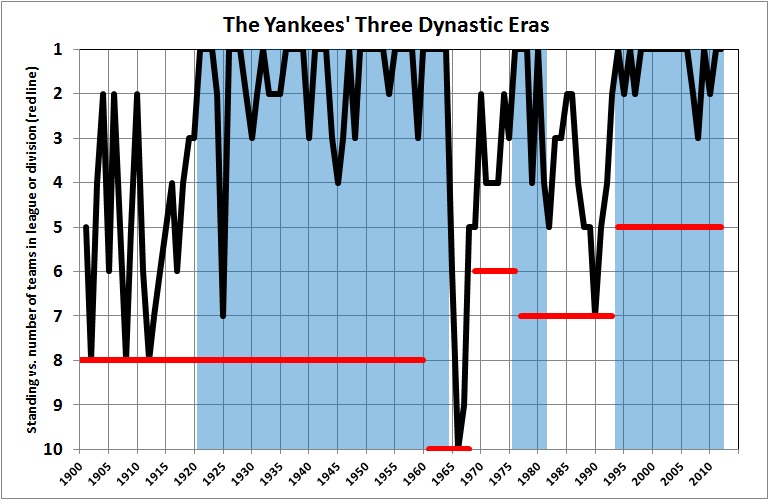
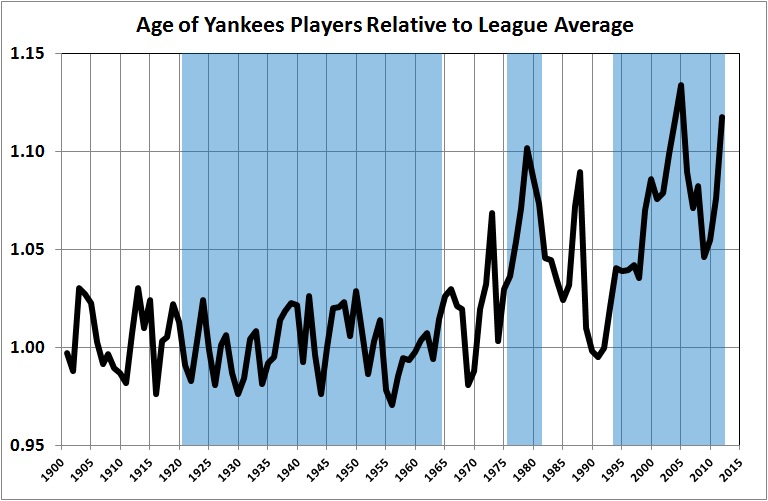
Relevant experience, on the other hand, counts for a lot. Consider the following graphs:


The New York Yankees have enjoyed three “dynastic” eras of dominance in the American League: 1921-1964, 1976-1981, and 1994-2012.

In the first era, which predates free agency, the Yankees relied mainly on the allure of the team’s initial successes  to attract talented young prospects. (Those initial successes were due in large part to the acquisition of Babe Ruth in a trade that Boston Red Sox fans have ever since rued.) The best of the young prospects were then tested in the Yankees’ farm system, advanced (selectively) as they proved worthy, and brought up to the “big time” when they were deemed ready.

The second and third eras of  the Yankees’ dominance followed and coincided with the dwindling of the minor leagues, the expansion of the major leagues, and the advent of free agency. Because of the first two developments, major-league teams have been providing on-the-job training to players who, in earlier decades, might never have made it to the big leagues. The Yankees adapted to this change by picking up proven players through trades and free-agent signings — after those players had acquired polish and displayed their skills while in the pay of other teams. Thus it is that the Yankees faded after 1981, as their teams became younger, and became successful again in the mid-1990s, as their teams became older (i.e., more experienced).

UPDATE 08/20/13:

I’ve taken a closer look at the relationships discussed above, and they hold up well.

The following equation applies to 1901-1976 (the years before free agency was in full force):

WL = 0.258 + 0.458xWLP + 0.010xBHO, where

WL = won-lost record in a season

WLP = won-lost record in the previous season

BHO = batting holdovers (the number of batters who appeared in 100 or more games in both the current and preceding seasons)

It makes sense for WL to be strongly correlated with WLP (continuity of players, playing conditions, opposition, etc.). The interesting wrinkle is the presence of BHO in the equation, at a high level of significance (0.07), given the strong cross-correlations between WL and WLP (0.61) and WLP and BHO (0.66).

Since, 1976, however, only WLP explains WL with any degree of significance. This is consistent with my hypothesis that after the advent of free agency the Yankees (unsurprisingly) became more dependent on free agents (i.e., veteran players).

In fact, there was a significant change in the correlation between WL and the relative age of players. For 1901-1976, the correlation is effectively zero (an insignificant -0.11). For 1977-2012, the correlation is a highly significant 0.50. Moreover, the correlation between WLP and BHO drops significantly after the advent of free agency, from 0.66 to 0.22.

To summarize: Before free agency, the Yankees’ depended largely on the retention of proved veterans, but the team remained relatively young (on average) because of the constant acquisition and cultivation of young players, some of whom became valuable veterans. Since free agency, the team has relied less on “growing its own” and more on veteran players who had proved themselves elsewhere.

In any event, experience is valuable. It’s just that it’s acquired in a different way than it was before free agency.

Related posts:
Moral Luck
The Residue of Choice
Can Money Buy Excellence in Baseball?
Inventing “Liberalism”
Randomness Is Over-Rated
Fooled by Non-Randomness
Accountants of the Soul
Rawls Meets Bentham
Social Justice
Positive Liberty vs. Liberty
More Social Justice
Luck-Egalitarianism and Moral Luck
Nature Is Unfair
Elizabeth Warren Is All Wet
Luck and Baseball, One More Time
The Candle Problem: Balderdash Masquerading as Science
More about Luck and Baseball
Barack Channels Princess SummerFall WinterSpring
Obama’s Big Lie
Pseudoscience, “Moneyball,” and Luck

The Name Game

With the Social Security baby-name database, one can find the popularity* of a newborn’s name in any year from 1880 through 2011. Armed with the database, I set out to determine whether the relative popularity of presidential candidates’ names had any bearing on the outcome of the 33 elections of 1880-2008. Here is what I learned from an analysis of the names of the two leading candidates** in each of the 33 elections:

  • The candidate with the more popular name — in the year of the election — won only 15 times out of 33.
  • Ten of the winners with the more popular name were Republicans.
  • Ten of the 18 winners with the less popular name were Democrats.
  • The Democrat had the less popular name in 20 of the 33 elections.

The moral of the story: It is a slight disadvantage to have a popular name. Democrats are more likely than Republicans to have weird names. This latter tendency confers a slight advantage on Democrat candidates.

What about 2012? Willard (Mitt Romney’s first name) has not been in the top 1,000 since 1989, but it was in the top 1,000 in every year before that — ranking as high as 58th in 1915. Barack, needless to say, has never been in the top 1,000. It seems likely that Willard is somewhat more popular than Barack, even now.***

But Mitt — like Grover, Woodrow, and Calvin — is the name in the political arena. And I have no reason to believe that Mitt is any more popular than Barack. If Barack is the less-popular name, that might count as an advantage for Obama. But a less-than-dismal performance in a debate would do him more good than his weird name.

__________
* Restricted to the top 1,000 boys’ names and the top 1,000 girls’ names in each year.

** All of them Republicans and Democrats, except in 1912, when Theodore Roosevelt ran on the Progressive ticket and was the runner-up to Woodrow Wilson.

*** It does not seem that presidents’ first names become more popular during their time in office. The rank of Grover (Cleveland) went from 20 in 1884 (when Cleveland was first elected) to 47 in 1892 (the year of Cleveland’s second victory). Benjamin (Harrison) dropped from 25 in 1888 to 42 in 1892. Woodrow (Wilson) barely budged, going from 192 in 1912 to 190th in 1916. Herbert (Hoover) was 25 in 1928 and 44 in 1932 (another victim of the Great Depression, no doubt). Franklin (Roosevelt) went from 66 to 65 to 87 to 112 (in 1932, 1936, 1940, and 1944, respectively). Dwight (Eisenhower) was 123 in 1952 and 139 in 1956. (And, lest you think that Dwight should have been a Democrat, remember that his opponent was the more weirdly named Adlai — or Adelaide, as some wags called him.) Richard (Nixon) fell from 8 in 1968 to 14 in 1972 (and, unsurprisingly, kept falling steadily thereafter, to 127 in 2010-2011). Ronald (Reagan) went from 58 in 1980 to 67 in 1984. George (Bush I and II) declined from 78 (1988) to 95 (1992) to 130 (2000) to 146 (2004). George has come a long way (down) since Washington was first in the hearts of his countrymen.

Dispatches from the Front

I correspond almost daily with a friend of 40 years: B. He initiates a lot of our exchanges by sending links to articles in The New York Times and comments that he has received from others about those articles. In the last few days, B and I have had three exchanges that are worth noting here.

*   *   *

Another correspondent, D, sent this to B:

Obama has been pictured as having many negative qualities by the Right Wing.    Three things are especially repugnant to many on the right.  He’s black, he’s a Socialist or Communist and lately (including this latest one) he is thought to be like Hitler.  Do they see some inconsistency for Obama being thought of as both Fascist and a Communist?

B replied (with copy to me):

You could bend your mind like a pretzel trying to portray Obama as both a Fascist and a Communist.

My response to B:

There is a fairly easy way to reconcile Fascism and Communism. Both are (in practice) forms of statism, wherein the power of the state is marshaled to attain certain ends that are proclaimed to serve the “common interest.”

I think of political ideologies as compass points. Placing anarchism arbitrarily at 0, hard statism (whatever its label) is at 90, “social democracy” (including the U.S. variety) is at 180, and at 270 is libertarianism (the minimal state for defense of life, property, and liberty — close to the spirit of the Constitution).

*   *   *

B forwarded some quotations culled by another friend, marking the 106th anniversary of the birth of Dmitri Shostakovich. Two of the quotations:

The Fifth Symphony of Shostakovich always has been singularly irritating to this  chronicler… Whenever I hear one of his marches, my imagination fastens upon a picture of the parades in Red Square and the banners of Uncle Joe, and my irritation becomes powerful.

– Cyrus Durgin, The Boston Globe (25 October 1952)

The composer apparently does not set himself the task of listening to the desires and expectations of the Soviet public.  He scrambles sounds to make them interesting to formalist elements who have lost all taste…  The power of good music to affect the masses has been sacrificed to a petty-bourgeois, “formalist” attempt to create originality through cheap clowning.  It is a game of clever ingenuity that may end very badly.*

Pravda (on the Shostakovich opera Lady MacBeth of Mtsensk,
“Muddle Instead of Music,” January 1936)

B called out Durgin’s commentary. I replied:

I like Durgin’s statement and share his irritation. In this case, I am also in sync with Pravda, which homes in on the truth about “modern” music: “scrambles sounds to make them interesting to formalist elements who have lost all taste.”

“Modern” music is an “inside” game, played by composers for their own benefit and for the benefit of effete critics and certain audiences who place a high value on being au courant. The latter are the kind of people who applaud Occupy from the safety of their Park Avenue penthouses (radical chic). The practitioners of radical chic are (I suspect) the major source of private funding for the “arts,” which would explain the otherwise inexplicable degree to which modernism permeates not only formal music but also formal dance and the visual arts.

I was a faithful listener of WETA-FM, in the days when it carried classical music in the morning, afternoon, and evening — before the intrusion of “relevant,” consciousness-raising news and blather (e.g., Fresh Air). There was (and probably still is) a 5-minute feature that ran in the afternoon, called Composers Datebook. Every segment closed with “reminding you that all music was once new.” Yes, it was all new (what a blindingly obvious statement) — just as a lot of formal dance and visual art was once new — but was it good?

The foregoing is adapted from a short post of mine: “The Arts: Where Regress Is Progress.”

*   *   *

B often links to something written by David (faux conservative) Brooks. Today, he linked to a piece titled “The Conservative Mind,” wherein Brooks tries to drive a wedge between what he calls economic conservatives (i.e., free-marketeers) and traditional conservatives (i.e., Edmund Burke, Russell Kirk, and — in his later years — Friedrich Hayek):

There are very few willing to use government to actively intervene in chaotic neighborhoods, even when 40 percent of American kids are born out of wedlock.

Another of B’s correspondent’s said, quite sensibly:

I would suggest that it is because of government intervention in the neighborhood that we have 40% of American kids born out of wedlock.  If the government didn’t make it economically affordable and in some cases beneficial to have children out of wedlock, the rate would be much lower.

This was my reaction to Brooks’s muddled attempt to discredit economic conservatives:

The kind of social conservatism that Brooks rightly praises cannot flourish when government distorts social relationships, as it has done through various welfare schemes that created dependencies on government, and through ham-handed egalitarianism (e.g., affirmative action as I have seen it in action, first hand). All such efforts are divisive, not unifying, because they disrupt traditional social relationships and create suspicions, animosities, and rivalries (e.g., who gets to be first in line at the public trough).

Where Brooks goes badly wrong (as I read him) is to place economic and social conservatism in opposition to each other. Economic liberty, where it is allowed, requires and fosters mutual trust and respect. It is, in other words, a unifying instrument of social comity and law-abidingness. Economic liberty requires government, to be sure, but it is a government that is concerned with enforcing the rules of the game (no stealing or cheating), not with enforcing certain outcomes.

Riots, Culture, and the Final Showdown

I posted “Riots, Culture, and the Final Showdown” at my old blog in February 2006. The post addressed the riots that followed the publication of the drawings of Muhammed by a Danish cartoonist. What I said then applies equally to the deadly and continuing anti-American violence in the Middle East — the excuse for which is the YouTube video, “Innocence of Muslims.” I therefore reproduce the earlier post, with minimal editing. I have included the original links, many of which may now be broken.

Prologue

This is about the broader implications of the riotous reaction of Muslims to cartoons that ran in a Danish newspaper last October. For the full story, with commentary and plenty of relevant links, go to Michelle Malkin’s blog and start with her post of January 30, “Support Denmark: Why the Forbidden Cartoons Matter,” then read on to the present.

My jumping-off point is this kind of news:

Protesters in Pakistan Target West

LAHORE, Pakistan – Thousands of protesters rampaged through two cities Tuesday, storming into a diplomatic district and torching Western businesses and a provincial assembly in Pakistan’s worst violence against the Prophet Muhammad drawings, officials said. At least two people were killed and 11 injured.

Three Killed in Massive Cartoon Protests

PESHAWAR, Pakistan – Gunfire and rioting erupted Wednesday as tens of thousands of people took to the streets in Pakistan’s third straight day of violent protests over the Prophet Muhammad cartoons. Three people were killed, including an 8-year-old boy.

The second story continues with this:

The European Union condemned both the cartoons, first printed in a Danish newspaper in September, and what it called “systematic incitement to violence” against European diplomatic missions by some unidentified governments.

Bruce Bawer has more about European groveling, and isolated acts of courage, here. Michelle Malkin has plenty to say about the groveling of major American media outlets at her blog (e.g., here). A recent story from the zone of political correctness the academy, reports the suspension of the editors of the Daily Illini (the “independent” student newspaper of the University of Illinois) for having reproduced the cartoons.

The reactions on the part of the EU, much of America’s press, and (I safely assert) most of academia are manifestations of a widespread urge to appease fanatical Islam, about which appeasement I will say more later in this post.

I write here without animus toward Islam, as a religion. My attitude toward Islam as a cultural amalgam of the religious and the social is expressed ably by Occam’s Carbuncle:

. . . What little I know of [Islam] isn’t very appealing at all. It’s rather medieval if you ask me. Not that I hate Muslims. . . . I just don’t care. . . . I don’t believe what they believe and I’m not about to start. Ever. More importantly, I will read what I want to read and I will express myself as I see fit, not within the strictures of Sharia [the code of law based on the Koran], but according to my rights as a citizen of a liberal democracy. That means Muslims do not have the right to impose upon me their own views of what is or is not proper, what is or is not sacrilege or blasphemy. . . . They may not damage my property or my person as reprisal for anything I might say or write. They may express themselves as freely as I. They may insult me. They may shun me. They might even consider ignoring me. But they may not threaten me. They may not do harm in furtherance of the precepts of their religion, just as I may not do harm to show my objection to their dogma.

The following concepts are central to my analysis of Islamic culture, as a force in the affairs of the world:

Despair: To be overcome by a sense of futility or defeat.

Paranoia: Extreme, irrational distrust of others.

Now, on with the post.

Executive Summary

A sense of futility or defeat can be inflicted upon a people by its enemies, or it can be self-inflicted by the culture of the people. A mass culture that prizes mysticism at the expense of rationality and industriousness will, if only subconsciously, come to envy cultures that profit from rationality and industriousness. But the people of the mystical culture will disavow their envy, because to do so would be to admit the inferiority of their culture. They will, instead, take the paranoid view that their backwardness is somehow caused by other cultures — cultures that are “out to get them.” This paranoia focuses the despair of the backward culture, so that its emerges in the form of rage against the culture’s supposed enemies.

The paranoid leaders of a paranoid culture pose an especial danger because of their ability to marshal weapons of mass destruction, and to deploy those weapons in a “righteous” war. In the case of Islamic paranoia, the handwriting is on the wall — and writ in blood.

The West can either act to prevent repetitions of 9/11, Madrid, and London — on a larger scale — or it can do nothing and, in doing nothing, invite the conflagration. The choice is nigh. The will to act is in doubt.

Islam: A Culture of Despair and Paranoia

I am struck by the similarity of the Muslim riots — in France last year and in the Middle East this year — to the riots in the “ghettos” of Detroit, Los Angeles, etc. Those riots, like the Muslim ones, were sparked by specific events (e.g., the murder of MLK Jr. and the beating of Rodney King). But those sparks caused explosions because they touched the volatile fuel of desperation.

Whence that fuel? It is created by the chronic illness of the underlying culture. A chronically ill person experiences stress because of his inability to function normally. Prolonged stress can lead to frustration, anger, hopelessness, and, at times, depression. The chronic, self-generated illness of the Muslim culture is similar to that of the black and white “redneck” culture:

There have always been large disparities, even within the native black population of the U.S. Those blacks whose ancestors were “free persons of color” in 1850 have fared far better in income, occupation, and family stability than those blacks whose ancestors were freed in the next decade by Abraham Lincoln.

What is not nearly as widely known is that there were also very large disparities within the white population of the pre-Civil War South and the white population of the Northern states. Although Southern whites were only about one-third of the white population of the U.S., an absolute majority of all the illiterate whites in the country were in the South. . . .

Disparities between Southern whites and Northern whites extended across the board from rates of violence to rates of illegitimacy. American writers from both the antebellum South and the North commented on the great differences between the white people in the two regions. So did famed French visitor Alexis de Tocqueville.

None of these disparities can be attributed to either race or racism. . . . The people who settled in the South came from different regions of Britain than the people who settled in the North–and they differed as radically on the other side of the Atlantic as they did here–that is, before they had ever seen a black slave.

Slavery also cannot explain the difference between American blacks and West Indian blacks living in the United States because the ancestors of both were enslaved. When race, racism, and slavery all fail the empirical test, what is left?

Culture is left.

The culture of the people who were called “rednecks” and “crackers” before they ever got on the boats to cross the Atlantic was a culture that produced far lower levels of intellectual and economic achievement, as well as far higher levels of violence and sexual promiscuity. That culture had its own way of talking, not only in the pronunciation of particular words but also in a loud, dramatic style of oratory with vivid imagery, repetitive phrases and repetitive cadences.

Although that style originated on the other side of the Atlantic in centuries past, it became for generations the style of both religious oratory and political oratory among Southern whites and among Southern blacks–not only in the South but in the Northern ghettos in which Southern blacks settled. . . .

The redneck culture proved to be a major handicap for both whites and blacks who absorbed it. Today, the last remnants of that culture can still be found in the worst of the black ghettos, whether in the North or the South, for the ghettos of the North were settled by blacks from the South. The counterproductive and self-destructive culture of black rednecks in today’s ghettos is regarded by many as the only “authentic” black culture–and, for that reason, something not to be tampered with. Their talk, their attitudes, and their behavior are regarded as sacrosanct. [Thomas Sowell, at OpinionJournal, paraphrasing his essay “Black Rednecks and White Liberals,” from the eponymous book. Sowell’s analysis of the roots of “black redneck” culture may be incomplete, but he rightly emphasizes the key role of a dysfunctional culture in the making of a dysfunctional society.]

Islamic culture, broadly speaking, seems much like redneck culture in its preference for mysticism or ritual over rationality and industriousness — as well as in its attitude toward women. The adherents of an irrational, indolent culture who have any exposure to other cultures must know that their culture holds them back materially, and that they would be better off if they were to adopt the rational and industrious ways of other cultures. (The closely held wealth of the oil sheikhs has nothing to do with Islam; it is a fortuitous artifact of the geology of the Middle East and the industry of the West.) But to adopt the ways of wealthier cultures is to admit the shortcomings of one’s own culture — and to break with one’s family, friends, and authority figures.

Thus the adherents of the backward culture remain mired in their self-inflicted despair and, instead of blaming themselves and their culture for their backwardness, they blame the outsiders whose relative success they envy. And when their despair erupts in rage it is (in the paranoid view) legitimate to attack the blameworthy — “city folk,” “honkies,” Korean and Jewish merchants, “infidels,” and so on — because they are responsible for keeping us down.

Islamic Paranoia Writ Large

Paranoia is bad enough when it motivates (sometimes organized) mobs to kill, plunder, and destroy. Paranoia is far worse when it motivates leaders who command (or seek to command) the technology of mass destruction — leaders such as Hitler, Stalin, bin Laden, and Iran’s Mahmoud Ahmadinejad. Ahmadinejad is perhaps best known to Americans for his “alleged” involvement in the Iran Hostage Crisis of 1979 and for his utterances about the United States and Israel; for example:

The establishment of the occupying regime of Qods [Jerusalem]was a major move by the world oppressor [the United States] against the Islamic world. . . .

The Palestinian nation represents the Islamic nation [Umma] against a system of oppression, and thank God, the Palestinian nation adopted Islamic behavior in an Islamic environment in their struggle and so we have witnessed their progress and success. . . .

Our dear Imam [Ayatollah Khomeini] said that the occupying regime [Israel] must be wiped off the map and this was a very wise statement. We cannot compromise over the issue of Palestine. Is it possible to create a new front in the heart of an old front. This would be a defeat and whoever accepts the legitimacy of this regime [Israel] has in fact, signed the defeat of the Islamic world. Our dear Imam targeted the heart of the world oppressor in his struggle, meaning the occupying regime. I have no doubt that the new wave that has started in Palestine, and we witness it in the Islamic world too, will eliminate this disgraceful stain from the Islamic world. But we must be aware of tricks.

For over 50 years the world oppressor tried to give legitimacy to the occupying regime and it has taken measures in this direction to stabilize it. . . .

Recently they [the Israelis] tried a new trick. They want to show the evacuation from the Gaza strip, which was imposed on them by Palestinians [oh, really?], as a final victory for the Palestinians and end the issue of Palestine. . . .

I warn all leaders of the Islamic world that they should be aware of this trick. Anyone who recognizes this regime [Israel] because of the pressure of the World oppressor, or because of naiveté or selfishness, will be eternally disgraced and will burn in the fury of the Islamic nations. (From a speech given in Tehran, Iran, on October 16, 2005, to an Islamic Student Associations conference on “The World Without Zionism.”)

The Culture Clash and the Final Showdown

Ahmadinejad, like bin Laden, whips despair into rage, a rage that is aimed at the imagined “enemies” of Islam. Bin Laden, of course, has succeeded in turning some of those imagined enemies into real ones by attacking them. Ahmadinejad seems bent on following bin Laden’s lead, but on a larger scale.

It is too late to appease such fanatics — much as some Westerners would like to try appeasement — because The West (the United States, in particular) has “insulted” Islamic fanatics in three fundamental ways: by the creation of Israel, by the “exploitation” of the Middle East’s geology, and by the defense of Israel and those Middle Eastern governments that permit the “exploitation.” Given that history, the only way to appease paranoid Islamists is for Americans to don the raiment of mystical asceticism, which might appeal to a select circle of self-flagellants, but to very few others of us.

What I am saying, really, is that a final showdown with fundamentalist Islam is inevitable. Most Americans did not understand the inevitability of that showdown until September 11, 2001 — and many Americans (including most “intellectuals” and many politicians who should know better) still refuse to acknowledge the significance of that day’s events. The doubters seem to be trapped in 1938, waiting for the UN or a Democrat president to announce “peace in our time,” or in 1939-40, unwilling to believe that America could be the target of a fanatical ideology.

It is futile to hope that hard-core Islam can be deflected through political correctness (e.g., banning speech that might offend Muslims), diplomatic maneuverings, support for dissidents, or other such transparently weak responses to aggression, terrorism, and the accumulation of weapons of mass destruction. In fact, such responses are worse than futile; they encourge what they seek to discourage because they display weakness — just as displays of weakness on the part of the United States from 1979 onward encouraged the events of September 11, 2001.

The next stage of the showdown, if it is allowed to happen, will come when al Qaeda (or one of its ilk) acquires and uses weapons of mass destruction in Europe or the United States. The following stage of the showdown, if it is allowed to come to that, will come when Iran acquires nuclear weapons.

I repeat: The question is not whether those events will happen, but when they will happen if they are not thwarted by intelligence-gathering, clandestine operations, conventional military operations, and massive strikes against hard military targets (including nuclear “power” facilities). Force is the only thing that will stop Islamic fanatics; force is the only response that they will heed — just as the Japanese, fanatical as they were, had no choice in the end but to abandon their fanatical ways.

It Is a Question of Will

We had better get used to that idea that war is the answer, and see to it that adequate force is used, sooner rather than later. Those who would use force against us will heed only force. Whether, in defeat, they will respect us or “merely” fear us is irrelevant. We are not engaged in a popularity contest, we are engaged in a clash of civilizations, which Norman Podhoretz rightly calls World War IV.

On our present political course, however, we will suffer grave losses before we get serious about winning that war. The Left (or the Opposition, as I also call it), seems insensitive to the danger that faces us. The voices of doubt and division are many and loud. They range from librarians, academicians and celebrities (too numerous to link), and hypocrites in the media to former vice president Gore and many current members of Congress (e.g., these), some of whom would prefer to impeach President Bush for defending us through a constitutional surveillance program than face up to the enemy without. Their preferred vision of government — strength at home and weakness in foreign affairs — is precisely opposite the vision of the Framers of the Constitution.

Ben Shapiro goes too far in suggesting “that Congress ought to revivify sedition prosecutions,” but he is right about the likely effect of the Opposition’s outpourings; for example:

Let us consider . . . the probable consequences of Gore’s mea culpa [before a Saudi audience] on behalf of the “majority” of his countrymen. No doubt his words will fuel the massive tide of propaganda spewing forth from Muslim dictatorships around the globe. No doubt his words will be used to bolster the credibility of horrific disinformation like the Turkish-made, Gary-Busey-and-Billy Zane-starring monstrosity “Valley of the Wolves: Iraq,” which accuses American troops of war atrocities and depicts a Jewish-American doctor (Busey) slicing organs out of Arab victims and shipping the body parts off to New York, London and Israel. No doubt Gore’s speech will precipitate additional violence against Americans in Iraq and around the globe.

(Not to mention the media’s constant re-hashing of Abu Ghraib.)

Thomas Sowell, as usual, gets to the heart of the matter:

With Iran advancing step by step toward nuclear weapons, while the Europeans wring their hands and the United Nations engages in leisurely discussion, this squeamishness about tapping terrorists’ phone contacts in the United States is grotesque.

Has anyone been paying attention to the audacity of the terrorists? Some in the media seem mildly amused that Palestinian terrorists are threatening Denmark because of editorial cartoons that they found offensive.

Back in the 1930s, some people were amused by Hitler, whose ideas were indeed ridiculous, but by no means funny.

This was not the first threat against a Western country for exercising their freedom in a way that the Islamic fanatics did not like. Osama bin Laden threatened the United States on the eve of our 2004 elections, if we didn’t vote the way he wanted.

When he has nuclear weapons, such threats cannot be ignored, when the choice is between knuckling under or seeing American cities blasted off the face of the earth.

That is the point of no return — and we are drifting towards it, chattering away about legalisms and politics.

Which leads me to the ultimate question, which James Q. Wilson addresses in “Divided We Stand: Can a Polarized Nation Win a Protracted War?” Wilson concludes:

A final drawback of polarization is more profound. Sharpened debate is arguably helpful with respect to domestic issues, but not for the management of important foreign and military matters. The United States, an unrivaled superpower with unparalleled responsibilities for protecting the peace and defeating terrorists, is now forced to discharge those duties with its own political house in disarray.

We fought World War II as a united nation, even against two enemies (Germany and Italy) that had not attacked us. We began the wars in Korea and Vietnam with some degree of unity, too, although it was eventually whittled away. By the early 1990s, when we expelled Iraq from Kuwait, we had to do so over the objections of congressional critics. In 2003 we toppled Saddam Hussein in the face of catcalls from many domestic leaders and opinion-makers. Now, in stabilizing Iraq and helping that country create a new free government, we have proceeded despite intense and mounting criticism, much of it voiced by politicians who before the war agreed that Saddam Hussein was an evil menace in possession of weapons of mass destruction and that we had to remove him.

Denmark or Luxembourg can afford to exhibit domestic anguish and uncertainty over military policy; the United States cannot. A divided America encourages our enemies, disheartens our allies, and saps our resolve–potentially to fatal effect. What Gen. Giap of North Vietnam once said of us is even truer today: America cannot be defeated on the battlefield, but it can be defeated at home. Polarization is a force that can defeat us.

Let us hope — against hope, I fear — that the Opposition comes to its senses before it is too late.

Six years and seven months later, the Opposition remains firmly attached to its deluded belief that one can reason with and appease our enemies. Or, perhaps, it is simply the case that the Opposition does not see our enemies for what they are. In any event, the Opposition (not Loyal, by any means) is just another enemy of America and the ideals of the Declaration of Independence and the Constitution.