Trump’s Challenge to China — and Europe

I will post a more complete analysis of Trump’s “Liberation Day” tariffs and their implications for America’s (and the world’s) economic and political future. For the moment, I will focus on the implications of Trump’s challenge to China, which now faces a tariff of 34 percent on goods and services exported to the United States. China has announced that it would reciprocate. Trump announced, in turn, that if China reciprocates he will up the ante to a tariff of 104 percent on imports from China.

What Trump is saying, in effect, that the United States will no longer subsidize China’s industrial and military ambitions. Trump, rightly, sees China as the “main enemy” and wants to put it out of the business of draining America’s ability to prepare for and fight a massive, prolonged war, and thus to deter China from threatening just that. By putting China out of business, he will have de-fanged it and eliminated it as a threat to America — and Europe.

If the Europeans are smart, they will respond to Trump’s tariffs by reducing theirs on U.S. goods and services. And they will treat China a harshly as Trump seems willing to do.

If what’s left of Western Civilization has a future, it is in Trump’s hands. Will Europe go along or continue its slide into economic catastrophe and subservience to China (and its self-inflicted Muslim invasion)?

My guess is that some European nations will break from the EU and unilaterally reduce tariffs on U.S. imports.  Others (e.g., France and Germany) will not, just to spite Trump. One result will be the breakup of the EU. Another will be the effective breakup of NATO. A third will be Putin’s agreement to a settlement with Ukraine, given the removal of the NATO spectre from Russia’s vision. A fourth will be the de-fanging of China, as its sources of funding in America and (part of) Europe wither away — either through acquiescence to Trump or because they defy him.

How Not to Think about Tariffs

Tyler Cowen — The Free Press‘s new eminence grise — thinks about tariffs like the economist that he is; for example:

Like a game show host, Trump announced a series of tariff rates on many of America’s major trading partners.

How did he come up with the rates?

It seems by a crude formula: A given nation’s trade deficit with the U.S. divided by that nation’s exports to the U.S.

There is a base rate of 10 percent, to be applied to the UK, Costa Rica, and some other friendly nations. For India, it is 26 percent For Japan, it is 24 percent. For the European Union, it is 20 percent.

The most incomprehensible are those on Vietnam (the new tariff rate is 46 percent); Sri Lanka (44 percent); South Korea (25 percent); Cambodia (49 percent); and Taiwan (32 percent)….

Cowen goes on and on, citing seemingly authoritative statistics and ending up where a “good” economist should: tarrifs bad (like Orange Man). The upshot, according to Cowen, is that

we will be moving into a future with higher prices, less product choice, and much weaker foreign alliances. The tanking of the stock market, and other possible asset price repercussions, may tip America into recession and increase joblessness.

What really matters — and Cowen has no more insight into this than the Man in the Moon — is how foreign governments react to Trump’s announced tariffs, and what Trump does in response to those reactions.

Cowen’s doom-saying merely reveals his anti-Trump bias. In that respect, his eminence is just another pundit.

Economics: The Bad News about Economic Growth

I have updated the page, “Economics: The Bad News about Economic Growth“.

Inflating GDP

There are five ways to do it:

  • “Print” money.
  • Make businesses less efficient through regulation.
  • Enlarge government, thus drawing productive resources from private use.
  • Pay people to do nothing.
  • Encourage destructive behavior — rioting, illegal immigration, crime in general — and count remedial spending as part of GDP.

The first four items got liftoff in the 1930s and have been getting bigger and “better” since then. The fifth item has reached critical mass under Biden.

The Growing Age-Based Income Gap

It has been said often that today’s young adults have a harder time of it, economically (and probably in other ways), than the young adults of yesteryear. Is that true? If so, is a new phenomenon?

To shed some light on those questions, I turned to the Census Bureau and found Table P-10. Age–All People (Both Sexes Combined) by Median and Mean Income: 1974 to 2022. I plotted mean income by year for six age groups, with this result:

You can readily see that the rate of income growth for the youngest workers (15 to 24-year-olds) has been slower than that of the older age groups. In fact, the rate of income growth is inversely related to age group. Here are the coefficients of the linear fits to each of the lines in the graph:

  • 15 – 24: 132
  • 25 – 34: 346
  • 35 – 44: 539
  • 45 – 54: 625
  • 55 – 64: 683
  • 65 – 74: 750

Thus, for example, the mean income for the 15 – 24 age group increased, on average, by $132 per year, and so on for each group. (The r2 values are — from the youngest to oldest age group — 0.69, 0.76, 0.88, 0.87, 0.92, 0.95.)

In sum, the incomes of younger workers — on average and most of the time — have lagged further and further behind the incomes of older workers since at least 1974.

I am unsurprised by that. It has often been remarked that those of us who entered the labor force around 1960 had it better than those who followed us. I am certain that the observation would be borne out if there were data going back to 1960 or earlier.

Why is this so? An important reason, but not the only one, is the “law of supply and demand”. Economic growth in the U.S. has long been positive (though at a declining rate in the 20th and 21st centuries). Yes, there have been brief episodes of negative growth during recessions and longer episodes during the Great Recession and Great Depression. But the demand for labor of various kinds has grown over the long haul.

The supply of labor, on the other hand, hasn’t grown consistently (see table here). The population of the U.S. grew by only 7.3 percent from 1930 to 1940, as against 16.2 percent in the preceding decade, 15.0 percent in the decade before that, and much higher percentages before that.

The Great Depression of the 1930s was the main cause of slow population growth in that decade. World War II was the main cause of slow population growth from 1940 to 1950 — only 14.5 percent (slower than all preceding decades but one). Ant the growth in the 1940s came mainly in the latter half of the decade, when the post-war “baby boom” started.

The short of it is that younger persons who entered the labor force during, say, 1955 to 1965 didn’t face as much competition from their peers as did earlier generations. That happenstance served most of them well all the way to retirement.

Younger workers of later years have had it tougher — despite declining population growth since 1960 — because of the sharply declining rate of economic growth after 1970. Each regression line in the graph below reflects the rate of growth for the associated business cycle (the flatter the slope the lower the rate of growth). The 1949-1954 and 1960-1970 cycles generated much higher growth rates than those that followed. Further, the growth rates have generally declined over time; the rate for the 2009-2020 cycle (and beyond) is the lowest of the lot.

Today’s young adults, and those who follow them will be up against a lethargic economy — which will be made even more lethargic by the continued piling-on of regulations and the growth of government. The full amount of damage due to higher energy costs — because of the senseless war on “climate change” — is yet to be felt.

Youngsters should be leading the charge for regime change. But too many of them have been brainwashed in the belief that government (under Democrats) knows best. What it knows best is how to impoverish Americans and make nice to our worst enemies.

Paradoxes Abound

I have written several posts about political and economic paradoxes in the past 18 years. Here are the highlights (with some commentary).

The paradox of libertarianism:

 Liberty rests on an agreed definition of harm, and on an accompanying agreement to act with mutual restraint and in mutual defense. Given the variety of human wants and preferences, the price of mutual restraint and mutual defense is necessarily some loss of liberty. That is, each person must accept, and abide by, a definition of harm that is not the definition by which he would abide were he able to do so. But, in return for mutual restraint and mutual defense, he must abide by that compromise definition.

That insight carries important implications for the “anything goes” or “do your own thing” school of pseudo-libertarianism. That school consists of those libertarians who believe that harm is in the mind of the doer, or who believe that they can define harm while standing on the outside of society looking in. Thus they proclaim abortion and same-sex “marriage” (among other things) to be harmless — just because they favor abortion and same-sex “marriage” or cannot see the harm in them.

I am therefore a conservative libertarian.

  • Conservative because voluntarily evolved social norms are binding and civilizing, and therefore should not be dismissed out of hand or altered peremptorily.
  • Libertarian in a minarchistic way. The urge to power makes a state inevitable; the best state is therefore the one that only defends its citizens from predators, domestic and foreign.

A non-paradox for libertarians:

What if a society’s transition from a regulatory-welfare regime to a regime of liberty were to result in losers as well as winners? How could one then justify such a transition? Must the justification rest on an intuitive judgment about the superiority of liberty? Might the prospect of creating losers somehow nullify the promise of creating winners?

I argue … that my justification for libertarianism — although it is of the consequentialist-utilitarian variety — rests on a stronger foundation than an intuitive judgment about the superiority of liberty…. The virtue of libertarianism … is not that it must be taken on faith but that, in practice, it yields superior consequences. Superior consequences for whom, you may ask. And I will answer: for all but those who don’t wish to play by the rules of libertarianism; that is, for all but predators and parasites.

By predators, I mean those who would take liberty from others, either directly (e.g., through murder and theft) or through the coercive power of the state (e.g., through smoking bans and licensing laws). By parasites, I mean those who seek to advance their self-interest through the coercive power of the state rather than through their own efforts (e.g., through corporate welfare and regulatory protection)….

[A] transition to liberty might not instantly make everyone better off … but everyone could be better off. That’s simply not the case with the regulatory-welfare state, which robs some for the benefit of others, and ends up making almost everyone poorer than they would be in a state of liberty.

Liberty is a win-win proposition for everyone except those who deserve to lose.

The interest-group paradox:

 Pork-barrel legislation exemplifies the interest-group paradox in action, though the paradox encompasses much more than pork-barrel legislation. There are myriad government programs that — like pork-barrel projects — are intended to favor particular classes of individuals. Here is a minute sample:

    • Social Security, Medicare, and Medicaid, for the benefit of the elderly (including the indigent elderly)
    • Tax credits and deductions, for the benefit of low-income families, charitable and other non-profit institutions, and home buyers (with mortgages)
    • Progressive income-tax rates, for the benefit of persons in the mid-to-low income brackets
    • Subsidies for various kinds of “essential” or “distressed” industries, such as agriculture and automobile manufacturing
    • Import quotas, tariffs, and other restrictions on trade, for the benefit of particular industries and/or labor unions
    • Pro-union laws (in many States), for the benefit of unions and unionized workers
    • Non-smoking ordinances, for the benefit of bar and restaurant employees and non-smoking patrons.

What do each of these examples have in common? Answer: Each comes with costs. There are direct costs (e.g., higher taxes for some persons, higher prices for imported goods), which the intended beneficiaries and their proponents hope to impose on non-beneficiaries. Just as importantly, there are indirect costs of various kinds (e.g., disincentives to work and save, disincentives to make investments that spur economic growth). (Exercise for the reader: Describe the indirect costs of each of the examples listed above.)

You may believe that a particular program is worth what it costs… The problem is millions of your fellow Americans believe the same thing about each of their favorite programs. Because there are thousands of government programs (federal, State, and local), each intended to help a particular class of citizens at the expense of others, the net result is that almost no one in this fair land enjoys a “free lunch.” Even the relatively few persons who might seem to have obtained a “free lunch” — homeless persons taking advantage of a government-provided shelter — often are victims of the “free lunch” syndrome….

The paradox that arises from the “free lunch” syndrome is much … like the paradox of panic, in that there is a crowd of interest groups rushing toward a goal — a “pot of gold” — and (figuratively) crushing each other in the attempt to snatch the pot of gold before another group is able to grasp it. The gold that any group happens to snatch is a kind of fool’s gold: It passes from one fool to another in a game of beggar-thy-neighbor, and as it passes much of it falls into the maw of bureaucracy.

The interest-group paradox has dominated American politics since the advent of “Progressivism” in the late 1800s. Today, most Americans are either “progressives” or victims of “progressivism”. All too often they are both.

The capitalist paradox meets the interest-group paradox:

An insightful post at Imlac’s Journal includes this quotation:

Schumpeter argued the economic systems that encourage entrepreneurship and development will eventually produce enough wealth to support large classes of individuals who have no involvement in the wealth-creation process. This generates apathy or even disgust for market institutions, which leads to the gradual takeover of business by bureaucracy, and eventually to full-blown socialism. [Matt McCaffrey, “Entrepreneurs and Investment: Past, Present, … Future?,” International Business Times, December 9, 2011]

This, of course, is the capitalist paradox, of which the author of Imlac’s Journal writes. He concludes with these observations:

[U]nder statist regimes, people’s choices are limited or predetermined. This may, in theory, obviate certain evils. But as McCaffrey points out, “the regime uncertainty” of onerous and ever changing regulations imposed on entrepreneurs is, ironically, much worse than the uncertainties of the normal market, to which individuals can respond more rapidly and flexibly when unhampered by unnecessary governmental intervention.

The capitalist paradox is made possible by the “comfort factor” invoked by Schumpeter. (See this, for example.) It is of a kind with the foolishness of extreme libertarians who decry defense spending and America’s “too high” rate of incarceration, when it is such things that keep them free to utter their foolishness.

The capitalist paradox also arises from the inability and unwillingness of politicians and voters to see beyond the superficial aspects of legislation and regulation. In Bastiat‘s words,

a law produces not only one effect, but a series of effects. Of these effects, the first alone is immediate; it appears simultaneously with its cause; it is seen. The other effects emerge only subsequently; they are not seen; we are fortunate if we foresee them.

The unseen effects — the theft of Americans’ liberty and prosperity — had been foreseen by some (e.g., Tocqueville and Hayek). But their wise words have been overwhelmed by ignorance and power-lust. The masses and their masters are willfully blind and deaf to the dire consequences of the capitalist paradox because of what I have called the interest-group paradox [see above].

The paradox that is Western civilization:

The main weakness of Western civilization is a propensity to tolerate ideas and actions that would undermine it. The paradox is that the main strength of Western civilization is a propensity to tolerate ideas and actions that would strengthen it. The survival and improvement of Western civilization requires carefully balancing the two propensities. It has long been evident in continental Europe and the British Isles that the balance has swung toward destructive toleration. The United States is rapidly catching up to Europe. At the present rate the intricate network of social relationships and norms that has made America great will be destroyed within a decade. Israel, if it remains staunchly defensive of its heritage, will be the only Western nation still worthy of the name.

I wrote that almost five years ago. America network of social relationships and norms is (sadly) on schedule for destruction — unless there is a sharp and lasting turnaround in the governance of the country.

A paradox for (old-fashioned) liberals:

[A definition of old-fashioned liberalism is] given here by one Zack Beauchamp:

[L]iberalism refers to a school of thought that takes freedom, consent, and autonomy as foundational moral values. Liberals agree that it is generally wrong to coerce people, to seize control of their bodies or force them to act against their will….

Beauchamp, in the next paragraph, highlights the paradox inherent in liberalism:

Given that people will always disagree about politics, liberalism’s core aim is to create a generally acceptable mechanism for settling political disputes without undue coercion — to give everyone a say in government through fair procedures, so that citizens consent to the state’s authority even when they disagree with its decisions.

Which is to say that liberalism does entail coercion [how much is “undue” depends on whose ox is being gored]. Thus the paradox. (What is now called “liberalism” in America is so rife with coercion [link added] that only a person who is ignorant of the meaning of liberalism can call it that with a straight face.)

Socialism, communism, and three paradoxes:

The only substantive difference between socialism and communism, in theory, is that communism somehow manages to do away with the state. This, of course, never happens, except in real communes, most of which were and are tiny, short-lived arrangements. (In what follows, I therefore put communism in “sneer quotes”.)

The common thread of socialism and “communism” is collective ownership of “equity”, that is, assets (including the means of production). But that kind of ownership eliminates an important incentive to invest in the development and acquisition of capital improvements that yield more and better output and therefore raise the general standard of living. The incentive, of course, is the opportunity to reap a substantial reward for taking a substantial risk. Absent that incentive, as has been amply demonstrated by the tragic history of socialist and “communist” regimes, the general standard of living is low and economic growth is practically (if not actually) stagnant.

So here’s the first paradox: Systems that, by magical thinking, are supposed to make people better off do just the opposite: They make people worse off than they would otherwise be.

All of this because of class envy. Misplaced class envy, at that. “Capitalism” (a smear word) is really the voluntary and relatively unfettered exchange of products and services, including labor. Its ascendancy in the West is just a happy accident of the movement toward the kind of liberalism exemplified in the Declaration of Independence and Constitution. People were liberated from traditional economic roles and allowed to put their talents to more productive uses, which included investing their time and money in capital that yielded more and better products and services.

Most “capitalists” in America were and still are workers who make risky investments to start and build businesses. Those businesses employ other workers and offer things of value that consumers can take or leave, as they wish (unlike the typical socialist or “communist” system).

So here’s the second paradox: Socialism and “communism” actually suppress the very workers whom they are meant to benefit, in theory and rhetoric.

The third paradox is that socialist and “communist” regimes like to portray themselves as “democratic”, even though they are quite the opposite: ruled by party bosses who bestow favors on their protegees. Free markets are in fact truly democratic, in that their outcomes are determined directly by the participants in those markets.

The paradoxes and consequences of liberty and prosperity:

The soil in which the seeds of [America’s] decline were to be planted was broken in the Progressive Era of the late 19th and early 20th centuries. The seeds were planted and nourished by “leaders”, “intellectuals”, and “activists” from TR’s time to the present. The poisonous crop burst blossomed brightly in the 1930s and again in the 1960s, but it had not yet engulfed the land. It continued to spread slowly (and often unheeded) for several decades before racing across the land in recent years. Its poisonous vines are now strangling liberty and prosperity.

These are the paradoxes of liberty and prosperity: Without a moral foundation they lead to their own destruction.

If you value liberty, you do not countenance speech and actions that subvert it. If you value prosperity, you must be careful not to let it breed the kind of idleness (of mind and body) that gives rise to speech and actions that subvert liberty — and thus prosperity.

The Founders understood those things. They believed that the Constitution would preserve liberty and foster prosperity because they believed that Americans would remain religious and moral. They did not believe that Americans would undermine liberty by being soft on crime, by feeding masses (and elites) at the public trough (and at the expense of taxpayers), or by accommodating foreign aggression. They did not believe that Americans would countenance such things, nor that political leaders would suborn and join efforts to ostracize, suppress, and oppress those Americans who oppose such things.

The Founders, sadly, were wrong. The did not and could not foresee these events (and many more not mentioned):

    • A goodly fraction of Americans would spurn religion and become morally slack and complacent about the preservation of liberty.
    • Freedom of speech and assembly would be turned against liberty, to foster crime, lack of personal responsibility, and the accommodation of deadly enemies, within and without.
    • Firearms, always omnipresent in America for useful purposes, would become violent, murderous extensions of a growing tendency to toward psychological instability in a morally rootless populace.
    • Governments, political “elites”, and corporations would celebrate and reward (or fail to punish) persons based on the color of their skin (as long as it isn’t white or “yellow”)*, their pro-constitutional political views (which “exonerate” many whites), and their sex (preferably female or confused).
    • Abortion would become legal and support for abortion would be openly and boastfully proclaimed by political leaders and “elites”. Unborn human beings would be disposed of as inconveniences and treated like garbage.
    • Parents would lose control of the upbringing of their children, who might be cajoled into psychologically devastating treatments and surgeries by teachers and others under the rubric of “gender-affirming care”.
    • Women and girls would be forced to room with, shower with, and compete against males who “identify” as females (or “other”).
    • Intelligence and superior (non-athletic) skills would be denounced as unfair and “white supremacist” (with Asians counting as white).
    • Lawlessness and pathological deviancy would be rewarded (or not punished).
    • Leading politicians and “activists” would bay and howl for the confiscation of arms, under the rubric of “gun control”, when the underlying problem isn’t gun ownership by moral and mental depravity.
    • Political “leaders” would enable and allow a virtual invasion of the country, despite its negative consequences for the “little people” whom those “leaders” and other “elites” claim to champion.
    • The national government (and many others) would ignore science and invoke pseudo-science to force Americans into isolation, disrupt the economy, and burden the poorest Americans because of a virus that would have run its course naturally and less destructively than had it been combated scientifically.
    • The national government (and many others) would ignore science and invoke pseudo science to make Americans (especially poor Americans) poorer in an unnecessary and futile quest to “save the planet” from the use of fossil fuels, fertilizers, and other productive substances that the majority of the world’s populace will not refrain from using. (Regarding the state of science, see Maggie Kelly’s, “Professors Publish ‘Controversial’ Paper Defending Merit in Science”, The College Fix, May 2, 2023.)
    • Prosperity — a fruit of liberty — would foster the moral softness and the mental laxity that gives rise to addle-pated schemes such as those outlined above.
    • Vast numbers of Americans — having been indoctrinated in public schools, in left-dominated universities, and by the Democrat-allied media — would believe and subscribe to such schemes, which are made palatable by the application of double-speak labels to them (e.g., “defense of the homeland”, “combating misinformation”, “following the science”).
    • Government officials, including law-enforcement officers, would collude with and encourage the press and other purveyors of “information” to distort and suppress facts about much that is alluded to above, to discredit and hound a president (Trump) who opposed them, and to help elect and protect possibly the most corrupt president in America’s history (Biden) because it is through him that the left’s agenda is being implemented.
    • All of this (and more) would occur because almost-absolute power would accrue to the morally (and sometimes venally) corrupt politicians and their powerful enablers who advance and enforce such schemes.

….

In the best of possible worlds, there would be a voluntary return to something much closer to the America that the Founders envisioned. (Even a return to the post-New Deal 1940s and 1950s would do.) …

I don’t mean something like the turnaround in the House of Representatives following the elections of 1994 and 2010 (GOP gains of 12 and 15 percent). I mean something like the turnaround of 1930-1932 (total Democrat gains of 91 percent). In the wake of that turnaround, Democrats went on to control the House for the next 60 years (except for a post-World War II reaction of two years).

But the mass rejection of the GOP in 1930 and 1932 was a consequence of an economic upheaval, the Great Depression, that hit vast numbers of Americans and hit them suddenly and hard where it hurts: in the pocketbook. The policies that are now engulfing the land, onerous as they may be, are insidious by comparison — and are practically ignored or touted as “good things” by most media (including “entertainment” media).

Moreover, “woke” America is the laughing-stock of its enemies. And too weak [under the present regime] to stare them down. The growing unwillingness and inability of America’s “leaders” to deter and fight enemies really doesn’t matter to those enemies. In the end, the will to resist aggression and to accede to the wishes of aggressors depends on the will of the populace to stand together against aggression. That will, in turn, depends on broad (if not unanimous) allegiance to the survival and success of the nation.

There is no longer such an allegiance. The left hates what America long was and will not relent until that America is destroyed. The right hates what America is rapidly becoming at the hands of the left. A house divided against itself cannot stand.

I used to believe that an event that threatened the lives and livelihoods of all Americans would re-unite them. I no longer believe that.

I now believe that a national divorce — a negotiated partition of the nation — is a dire necessity. (Its precursor, a concerted secession, is legal under the Constitution.) It would allow a large fraction of Americans, perhaps half of them, to break free of the economic and social oppressions that emanate from Washington. It would also allow those same Americans to defend themselves against invaders from the south and overseas enemies instead of wasting their treasure on the left’s destructive agenda.

Absent a national divorce, everyone will go down with a sinking ship. Across the land there will be declining material comfort, rising criminality, rampant social acrimony, the suppression of views that threaten the grip of the ruling class, the oppression of persons who express those views, and a fascistic arrangement between politicians and favored corporations — those that subscribe to the quasi-religion of “climate change” and the “wokeness” that propels schemes that put skin color, sex (or lack of it), and other personal characteristics above truth, above merit, and above the rule of law.

Which leads me to promote “Can America Be Saved?“, if you haven’t yet read it.

Compromise Leads to Tyranny

Seventy-four years ago yesterday, Ludwig von Mises addressed the University Club of New York. He ended his speech with this:

Even in this country which owes to a century of “rugged individualism” the highest standard of living ever attained by any nation, public opinion condemns laissez-faire. In the last fifty years [and in the seventy-four years since], thousands of books have been published to indict capitalism and to advocate radical interventionism, the welfare state, and socialism. The few books which tried to explain adequately the working of the free-market economy were hardly noticed by the public. Their authors remained obscure, while such authors as Veblen, Commons, John Dewey, and Laski were exuberantly praised. It is a well-known fact [still true] that the legitimate stage as well as the Hollywood industry are no less radically critical of free enterprise than are many novels. There are in this country many periodicals which in every issue furiously attack economic freedom. There is hardly any magazine of opinion that would plead for the system that supplied the immense majority of the people with good food and shelter, with cars, refrigerators, radio sets, and other things which the subjects of other countries call luxuries.

The impact of this state of affairs is that practically very little is done to preserve the system of private enterprise. There are only middle-of-the-roaders who think they have been successful when they have delayed for some time an especially ruinous measure. They are always in retreat. They put up today with measures which only ten or twenty years ago they would have considered as undiscussable. They will [and did] in a few years [and several decades] acquiesce in other measures which they today consider as simply out of the question. What can prevent the coming of totalitarian socialism is only a thorough change in ideologies.

The title of Mises’s speech is “Middle-of-the-Road Policies Lead to Socialism”. But in fact (as Mises knew well) compromise (a better descriptor than middle-of-the-road) leads to tyranny. His student and later colleague, Friedrich A. (von) Hayek, argued at length against inevitability of tyranny through economic micro-management in “Freedom and the Economic System” (1938) and The Road to Serfdom (1944). Hayek put it this way in part 16 of Liberalism (1973):

There is, however, yet another reason why freedom of action, especially in the economic field that is so often represented as being of minor importance, is in fact as important as the freedom of the mind. If it is the mind which chooses the ends of human action, their realization depends on the availability of the required means, and any economic control which gives power over the means also gives power over the ends. There can be no freedom of the press if the instruments of printing are under the control of government, no freedom of assembly if the needed rooms are so controlled, no freedom of movement if the means of transport are a government monopoly, etc. This is the reason why governmental direction of all economic activity, often undertaken in the vain hope of providing more ample means for all purposes, has invariably brought severe restrictions of the ends which the individuals can pursue. It is probably the most significant lesson of the political developments of the twentieth century that control of the material part of life has given government, in what we have learnt to call totalitarian systems, far‑reaching powers over the intellectual life.

Where’s the compromise in that? In the United States, it began in earnest two lifetimes ago, in 1887, with the establishment of the Interstate Commerce Commission. The ICC was abolished in 1996, but by then (and since) its originally limited regulatory powers were (and have since been) expanded upon through the aggrandizement of the original cabinet-level departments of the federal government, the creation of new cabinet-level departments, the creation of a multitude of “independent” regulatory agencies, and the emulation of federal regulatory power by the States and their subsidiary jurisdictions.

None of that would have happened had the three branches of the federal government not collaborated to expand the powers of the federal government beyond their clear constitutional limits and enabled the various departments and agencies to exercise unconstitutional legislative, executive, and judicial authority. Every bit of that represents compromise — unconstitutionally altering the Constitution or allowing it to be altered — for various personal reasons: feeling good by spending other people’s money, power-lust, getting along by going along, wanting to not seem “mean”, and getting elected or re-elected by assuaging the masses.

Consider Obamacare, for example. A key provision of Obamacare — the camel’s nose, head, and shoulders in the tent of universal health care (a.k.a., socialized medicine) — is the vast expansion of eligibility for Medicaid. In the 30-some States that have opted to participate in the expanded program, persons with incomes up to 133 percent of the poverty line are eligible, including adults without dependent children.

It would seem that only a Simon Legree or Ebenezer Scrooge would deny Medicaid coverage to those millions who have obtained it by way of Obamacare. Or it would until the following considerations come to mind:

  • The poverty line is a misleading metric. It’s a relative measure of income, not an absolute one. Most “poor” persons in today’s America are anything but poor in relation the truly poor of the world, and they live far above a subsistence level. The poverty line is nothing but an arbitrary standard that justifies income redistribution.
  • Other persons, with their own problems, are paying for the government’s generous “gift” to the semi-poor. But who is really in a position to say that the problems of Medicaid recipients are more deserving of subsidization than the problems facing those who defray the subsidy?
  • If expanded Medicaid coverage were withdrawn, those now covered would be no worse off than they had been before taxpayers were forced to subsidize them.
  • Being relatively poor used to be a good reason for a person to work his way up the ladder of success. Perhaps not far up the ladder, but in an upward direction. It meant learning skills — on the job, if necessary — and using those skills to move on to more-demanding and higher-paying jobs. Redistributive measures — Medicaid subsidies, food stamps, extended unemployment benefits, etc. — blunt the incentive to better oneself and, instead, reinforce dependency on government.

I will underscore the last point. The lack of something, if it’s truly important to a person, is an incentive for that person to find a way to afford the something. That’s what my parents’ generation did, even in the depths of the Great Depression, without going on the dole. There’s no reason why later generations can’t do it; it’s merely assumed that they can’t. But lots of people do it. I did it; my children did it; my grandchildren are doing it.

Republicans used to say such things openly and with conviction, before they became afraid of seeming “mean” or losing the perks and powers of office. Principled conservatives should still be thinking and saying such things. When conservatives compromise their principles because they don’t want to seem “mean” or lose perks and powers they are complicit in the country’s march down the road to serfdom — dependency on and obeisance to the central government.

Every advance in the direction of serfdom becomes harder and harder to reverse. The abolition of Social Security, Medicare, and Medicaid is now unthinkable, even though those programs have caused hundreds of millions of Americans to become addicted to government handouts.

And how does government pay for those handouts? In part, it taxes many of the people who receive them. It also pays generous salaries and benefits of the army of drones who administer them. It’s a Ponzi scheme enforced at gunpoint. Despite the seeming benevolence of it all, it’s tyranny. The examples multiply, just as the size, scope, and cost of the federal government (at all levels) multiplies. And the price is liberty.

The best time — usually the only time — to kill a government program is before it starts. That’s why conservatives shouldn’t compromise.

Second Thoughts

I read here that Angus Deaton, a Nobel laureate in economics, and eminent economist at Princeton University, has changed his mind about a few hot topics. One of them is globalization:

I am much more skeptical of the benefits of free trade to American workers and am even skeptical of the claim, which I and others have made in the past, that globalization was responsible for the vast reduction in global poverty over the past 30 years. I also no longer defend the idea that the harm done to working Americans by globalization was a reasonable price to pay for global poverty reduction because workers in America are so much better off than the global poor. I believe that the reduction in poverty in India had little to do with world trade. And poverty reduction in China could have happened with less damage to workers in rich countries if Chinese policies caused it to save less of its national income, allowing more of its manufacturing growth to be absorbed at home. I had also seriously underthought my ethical judgments about trade-offs between domestic and foreign workers. We certainly have a duty to aid those in distress, but we have additional obligations to our fellow citizens that we do not have to others.

Another is immigration:

I used to subscribe to the near consensus among economists that immigration to the US was a good thing, with great benefits to the migrants and little or no cost to domestic low-skilled workers. I no longer think so. Economists’ beliefs are not unanimous on this but are shaped by econometric designs that may be credible but often rest on short-term outcomes. Longer-term analysis over the past century and a half tells a different story. Inequality was high when America was open, was much lower when the borders were closed, and rose again post Hart-Celler (the Immigration and Nationality Act of 1965) as the fraction of foreign-born people rose back to its levels in the Gilded Age. It has also been plausibly argued that the Great Migration of millions of African Americans from the rural South to the factories in the North would not have happened if factory owners had been able to hire the European migrants they preferred.

I hope that Professor Deaton’s example will be emulated by many more academics. Not just with respect to the issues that he addresses in his essay but also with respect to the many other issues where academics — and so-called intellectuals — have abetted dangerous and/or costly errors (to which I will come).

There was a time when it was considered sound thinking to gather evidence — facts, not opinions or talking points — and to base judgments and policy recommendations on the evidence. That time is past, though not irretrievably. Professor Deaton’s epiphanies are proof of the possibility that science, in all its forms, might once again become evidence-based. That’s not to say that there is never room for disagreements. There always is. But science, properly done, advances because of disagreement. It stagnates and regresses when dogma replaces debate.

But that is what has happened in so many fields of inquiry. Science, in too many fields, has become captive to “scientists” who put their preconceptions ahead of the evidence and who howl for the heads of heretics. It is dispiriting to know how many so-called scientists have become willing and eager handmaidens of wokeness. (Prostitution takes many forms.)

Thus the dangerous and/or costly errors, of which these are leading examples:

  • The “war” on “climate change” is making Americans and Europeans generally poorer and less comfortable.
  • The unnecessarily draconian response to Covid-19 made billions of people poorer, less well educated, and uncomfortable in their daily lives. It also had a lot to do with the rampant inflation of recent years, which will never be rolled back.
  • The LGBTQ/non-binary craze is causing parents and young adults to do things to their children and themselves that will cause them much misery for years to come, if not forever.
  • The anti-racism craze has been endorsed by “scientists” and “scientific organization” (as well as elites, pundits, and politicians). The main result is that “persons of color” get “bonus points” which enable them to commit crimes with impunity; acquire jobs for which they aren’t qualified, and gain entrance to colleges and graduate schools despite their lower intelligence than whites and Asians with whom they are competing. The cost in social comity and inferior products and services (e.g., surgery) may be subtle, but it is real and long-lasting. And it will get worse as long as wokeness prevails in high places.

Needless to say, the politicians and wealthy elites who favor such things are well insulated from the dire effects. Among the wealthy elites are tens of thousands of academics at top-tier and even second-rate universities who rake in money and dispense lunacy.

Why Trade Doesn’t Deter Aggression

Opponents of war (and corporate opportunists) like to believe (or claim) that it can be forestalled by trade. The reasoning goes like this:

If nation X and nation Y are trading partners, nation X will not attack nation Y (despite ideological differences) because nation X would lose its remunerative access to nation Y’s buyers of nation X’s products.

But why is X trading with Y? One reason is to fund the growth of X’s armed forces while also improving the health of its populace — including, not least of all, the health of its men of fighting age.

Unlike Y, which views trade only through the lens of economic advantage, X views trade as a means to its ultimate objective: dominance of other nations in order to dictate exploit their economic strengths and to obtain their acquiescence (if not outright submission) to X’s ideology.

There will come a time when the leaders of X believe that they have acquired the military might needed to attain the ultimate objective. When that time comes, X will leverage its might to dictate trade on its terms and cow its trading “partners” into ideological acquiescence, followed by submission. (Acquiescence having already been attained de facto, submission will follow given the venal and amoral character of Y’s leaders.)

Ideological zealots put dominance above all else. (Their true ideology is often the attainment of power for its own sake.) They should not be treated as if they were merely rational trading “partners”. But they are so treated by the avaricious “globalists” whose wealth and influence dazzle and dictate to Y’s leaders.

The Minimum Wage Revisited

A post by Arnold Kling (askblog) reminds me of a post of mine from 2009. Kling begins noting the Nobel prize that was awarded to David Card and two others. It was Card and his late collaborator, Alan Krueger, who “proved” that the minimum wage doesn’t cause unemployment.

Kling notes that

Noah Smith goes way overboard in praise of the new laureates. He makes it sound as though the results that David Card and Alan Krueger claimed about the minimum wage were only controversial because they were surprising. But they were also controversial because they were wrong.

Here is the abstract of the paper to which the second link in the block quotation leads:

We re-evaluate the evidence from Card and Krueger’s (1994) New Jersey-Pennsylvania minimum wage experiment, using new data based on actual payroll records from 230 Burger King, KFC, Wendy’s, and Roy Rogers restaurants in New Jersey and Pennsylvania. We compare results using these payroll data to those using CK’s data, which were collected by telephone surveys. We have two findings to report. First, the data collected by CK appear to indicate greater employment variation over the eight-month period between their surveys than do the payroll data. For example, in the full sample the standard deviation of employment change in CK’s data is three times as large as that in the payroll data. Second, estimates of the employment effect of the New Jersey minimum wage increase from the payroll data lead to the opposite conclusion from that reached by CK. For comparable sets of restaurants, differences-in-differences estimates using CK’s data imply that the New Jersey minimum wage increase (of 18.8 percent) resulted in an employment increase of 17.6 percent relative to the Pennsylvania control group, an elasticity of 0.93. In contrast, estimates based on the payroll data suggest that the New Jersey minimum wage increase led to a 4.6 percent decrease in employment in New Jersey relative to the Pennsylvania control group. This decrease is statistically significant at the five-percent level and implies an elasticity of employment with respect to the minimum wage of -0.24.

That’s far from the only time that Card and Krueger’s “proof” has been demolished.

I joined the bandwagon in 2009, with an analysis documented in this post, which ends thus:

On the basis of the robust results [derived from data for 1959 – 2009,] I draw the following conclusions:

  • The baseline unemployment rate for 16-19 YO [year-olds] is about 9 percent.
  • Unemployment around the baseline changes by about 1.5 percentage points for every percentage-point change in the unemployment rate for 20+ YO.
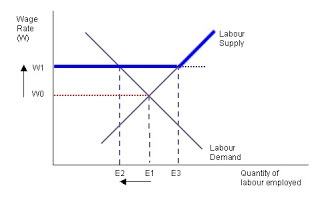
  • The minimum wage, when effective, raises the unemployment rate for 16-19 YO by 0.6 percentage points.

Therefore, given the current number of 16 to 19 year old males in the labor force (about 3.3 million), some 20,000 will lose or fail to find jobs because of yesterday’s boost in the minimum wage. Yes, 20,000 is a small fraction of 3.3 million (0.6 percent), but it is a real, heartbreaking number — 20,000 young men for whom almost any hourly wage would be a blessing.

But the “bleeding hearts” who insist on setting a minimum wage, and raising it periodically, don’t care about those 20,000 young men — they only care about their cheaply won reputation for “compassion.”

The minimum wage is just another blow to liberty and prosperity from the left, which holds that Americans must be impoverished to battle the chimera of anthropogenic global warming, that police (who protect the poor as well as the rich) must be defunded, that people should be paid not to work, that the expression of views contrary to leftist dogma is criminal, and that human life may be disposed of like garbage.

The False Promise of the Fiscal Multiplier

With a bit of trickery that is hard to spot, it is possible to “prove” that 1 + 1 = 3. (Watch this video and look carefully at the fourth and fifth lines of the “proof”, neither of which follows from the preceding line.)

Building on the logical and empirical analyses of some notable economists, I (and many others) have found the trickery in the “proof” that there is a fiscal multiplier: an additional dollar of government spending, not financed by borrowing or taxes) generates more than a dollar’s worth of additional GDP. The multiplier is both logically unsound and empirically invalid.

I urge you to read my page, “Keynesian Multiplier: Fiction vs. Fact“, for the details of my disproof. (For a recent discussion of the empirical invalidity of the multiplier, see this post by Veronique de Rugy.) I won’t repeat the details here, but I will focus on a particular aspect of the disproof. It exposes the logical trickery that underlies belief in the multiplier.

It used to be (and perhaps still is) the case that courses in the principles of macroeconomics began with a circular-flow model of a static economy. If everyone did the same thing, year after year, the same economic units would produce the same things. Each economic unit’s output would be valued in the marketplace, and that value would give the economic unit a claim on a slice of the total production of goods and services. The division of output between consumption (goods and services enjoyed here and now) and investment (replacement of the stock of capital as it deteriorates) would be determined by the willingness of producers (earners of income) to forgo consumption in favor of saving. (It is saving, non-consumption, that allows the diversion of resources to the production of capital goods.) The rate of investment would be just enough to sustain the output of goods and services at constant rates.

The circular flow could be perturbed for many reasons (e.g., population growth, a natural disaster, technological innovation). But what would happen to the circular flow in the event of such a perturbation? The output of goods and services would be increased or decreased by the immediate effect of the perturbation and by its secondary effects on the economy.

Take a simple two-producer economy, for example, where Joan makes guns and Ralph makes butter. Joan and Ralph exchange some of their output of guns and butter, so that during the year each of them earns a combination of guns and butter. If Ralph dies, and Joan is unable to make guns, the only output will be butter. And if Joan doesn’t need as much butter as she used to produce (some of which she traded to Ralph for guns), she will produce less butter — just enough for her own consumption. So there is the immediate effect of Ralph’s death (no guns) and the secondary effect of Ralph’s death (Joan produces less butter but consumes the same amount as before).

The multiplier doesn’t work that way. According to the multiplier, the reduction in Ralph’s spending on butter would affect Joan’s spending according to her marginal propensity to consume (the rate at which each increment of her income is translated into more or less spending on consumption goods). But it doesn’t. Joan, quite sensibly, simply consumes as much butter as before, though she produces less of it. There is no multiplier effect. There is just a reduction in the economy’s total output: no guns, and just enough butter for Joan’s needs.

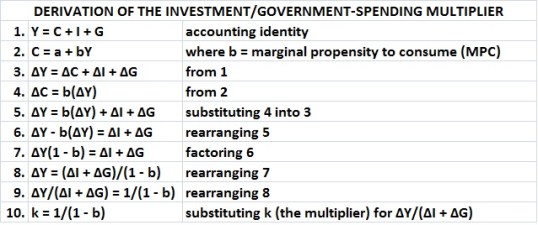
A defender of the multiplier would respond that my economy doesn’t represent an advanced economy like that of the United States, in which most transactions don’t take place at arms length (through barter) but, rather, through a medium of exchange (U.S. dollars). In such an economy, the defenders would argue, an exogenous reduction or increase in the demand for goods and services would cascade through the economy. Less demand for A would reduce the income of the producer of A, who would spend less on B through Z; the producer of B would spend less on A and C through Z; etc. In the end, the economy would shrink by the sum of each producer’s reduced spending — the multiplier effect. Here is the standard derivation of that effect, which I explain here:

Derivation of investment-govt spending multiplier

Y is GDP, C is consumption spending, I is investment spending, G is government spending (all in “real” terms), and b (as stated) is the marginal propensity to consume.)

Because b is less than 1, the expression 1/(1-b) must be greater than 1 — thus the “multiplier” on an exogenous change in spending. And despite the heading, the multiplier effect, in theory, applies to any exogenous change in the amount or rate of spending or saving. It could be a consumption or saving multiplier, for example. That is one of the tricks of the multiplier: If it exists, it isn’t just a government-spending multiplier, much as the proponents of bigger government would like you to believe.

Another trick is the mysterious mechanism by which an exogenous change in the rate of spending results in even more spending. It’s time to expose the mechanism.

What is Y but the sum of the dollar values (adjusted for inflation) of the output of all “final” goods and services (including changes in inventory) during a given period? What does Y therefore represent? As long as we’re using the terminology of macroeconomics, in which everything is implicitly homogeneous, Y represents the familiar (to some) equation of exchange:

MV = PQ, where, for a given period,

M is the total nominal amount of money supply in circulation on average in an economy.

V is the velocity of money, that is the average frequency with which a unit of money is spent.

P is the price level.

Q is an index of real expenditures (on newly produced goods and services).

The multiplier implies that, everything else being the same, a change in Q will result in proportional changes in PQ and MV. If there are unemployed resources and an exogenous increase in government spending employs them (and does nothing to prices), an increase in M (deficit spending) is exactly matched by an increase in Q (real output), so that the equation MV = PQ isn’t violated.

But how does an increase in Q (the initial burst of additional output) result in further additions to Q, as the multiplier implies? If P doesn’t increase (and it shouldn’t if the multiplier is “real”), then MV must rise. There is an increase in M — the jolt of exogenous government spending. But there is no further increase in M. So MV must rise because V increases as a result of the initial jolt of government spending. The multiplier, however, says nothing about V, unless increases in spending that result from the initial jolt in Q can be construed as increases in V and Q.

Let’s step back from this conundrum and consider the situation of a static economy with unemployed resources. An increase in M (deficit spending), of targeted perfectly, resulting in a proportional increase in Q. The persons who earn income from that increase spend some of it (that is, their rate of spending rises temporarily). There is no new M, but V rises (that is, the rate of spending rises) in proportion to the rise Q. So, temporarily, MV’ = PQ’.

This is the only sensible way of explaining the multiplier. But look at how many things must happen if an exogenous increase in government spending is to result in an actual increase real output:

The additional spending must be targeted so that it elicits additional production from unemployed resources.

The addition production must, somehow, be delivered to persons who actually benefit from it.

The recipients of additional spending must at least some of their new income into spending that results in the employment of hitherto unemployed resources, and the result must be the production of additional things that are delivered to persons who benefit from the production.

And so on and so forth.

What happens in practice, of course, is that deficit spending results in the production of things that politicians and bureaucrats favor (e.g., economically useless bullet trains and bridges to nowhere). but which have little or no economic value. And the spending often crowds out the production of other things because many (most?) of the resources involved are already in use (e.g., engineers and trained mechanics, not unemployed high-school dropouts from inner cities). Those are among that many things that are skipped over in the “proof” that the multiplier is real and positive. (See my page about the multiplier for much more.)

The bottom line is that the multiplier might well be positive, in nominal terms. That is, GDP might seem to rise, at least temporarily, but real GDP — the actual output of things valued by consumers — is another matter entirely. As I suggest here — and as is pointed out in my page about the multiplier and the article by Veronique de Rugy — the actual output of things valued by consumers may not rise at all, and probably will be crowded out by additional government spending.

Things valued by consumers certainly will be crowded out by additional government spending, because — in the long run — temporary additions usually become permanent ones. Which is just what the proponents of the multiplier want to happen. The multiplier isn’t just phony, it’s an excuse to boost government spending, that is, the share of the economy that is directly controlled by government.

Have you noticed lately what a great job government is doing for the citizenry, especially in Blue States and cities?

Why I “Heart” My HOA Neighborhood

Yesterday I came across one of the dumbest pieces that I have encountered in more than 20 years of blogging — and that’s saying a lot about the dumbness of the piece. I’m referring specifically to this post, in which the author cites and quotes from an attack on homeowners’ associations (HOAs). He appends this comment:

They [HOAs] give you a very good look at America under Communism, with Karens in charge. You don’t want that.

Until 2003 I hadn’t owned a home in an HOA neighborhood. I have now lived in an HOA neighborhood for the past 18 years. I’m here to tell you that I’d rather live in an HOA neighborhood than not — at least the kind of HOA that I’ve experienced.

First, living in an HOA neighborhood is nothing like living under Communism. It’s voluntary; Communism isn’t. If you don’t like the idea of living in an HOA neighborhood, you shouldn’t, but you’ll be giving up a lot of things:

A neighborhood where homeowners take pride in their homes, keep attractive yards, and spend what it takes to keep their homes well-maintained.

A quiet neighborhood where homeowners respect each others’ privacy and do not bombard their neighbors with loud music or inflict drunken parties on them.

A neighborhood where homeowners can band together under the aegis of the HOA when the peace of the neighborhood or property values are threatened by bad actors.

A neighborhood whose residents are predominantly white-collar professionals whose wide-ranging tastes overlap considerably (to the benefit of social comity) but which aren’t in lockstep.

In sum, a neighborhood that is much like a loose-knit social club where members pay dues to enjoy the amenities of the club but without forced socialization.

What about those Karens? (overbearing scolds). I have yet to meet one or hear of one in my neighborhood. Why not? Probably because the people who live here do so because they like the neighborhood the way it is and wouldn’t do anything to change its character. And if they did, and a Karen swooped down on them, good for the Karen. Most peple who live in HOAs do so for the reasons listed above. Renegades who create eyesores and cause property values to drop aren’t welcome.

And there’s nothing wrong with protecting the value of one’s property, as long as one’s neighbors are of the same mind about how to protect it. An HOA makes that possible.

If you don’t like an.HOA neighborhood, sell and move out. And reap the handsome profit that accrues to a well-maintained home in a pleasant, attractive neughborhood.

All of which seems rather American and pro-liberty to me.

Natural Experiments in the Effect of Party Politics on Economic Performance

As “Tyler Durden” puts it at ZeroHedge, “US Set For Epic Labor Market Experiment: Red States Vs Blue States“. The experiment has to do with the effect of the cessation of extended unemployment benefits on unemployment rates:

According to JPMorgan’s Daniel Silver, as of this moment some 23 – all republican – states have announced at least some form of early reduction in pandemic-related unemployment insurance benefits ahead of the September expiration at the federal level. These programs, he suggests, are likely limiting labor supply, generating a potential economic argument for ending these programs early….

So, while the left are desperately gaslighting that this is a skills or geographic mismatch, the chart above makes it clear that paying people to stay home is not good for growth (or social stability).

Which is why 23 (Republican) states have listened to their business owners and started to cut those benefits. In fact, as Mike Shedlock notes, that means around 3.5 million Americans will come off Pandemic emergency benefits in the next few weeks….

And since Democrats will likely not end UI benefits any time soon – or ever, if they could –  this sets up the US economy to become an epic real-time economic experiment, one where everyone can keep track of the unemployment across in Red states (most of which have ended their UI benefits), and blue states where claims will keep potential workers at home, pressuring unemployment rates….

By way of early confirmation of our thesis that government handouts are repressing the recovery by encouraging people not to work, according to an analysis published this week … job searches jumped by 5% the day each state announced its intent to pull out of the federal programs.

I have compiled some statistics from another natural experiment. They support the thesis that Republican-controlled States outperform Democrat-controlled ones economically.

Although the central government’s tentacles reach deep into every State’s economy, there is still latitude for State and local action — or lack thereof. Republican-controlled States should have somewhat freer economies than Democrat-controlled ones. (See, for example, the Tax Foundation’s 2020 Business Climate Tax Index.) Republican-controlled States should therefore be more growth-prone than Democrat-controlled ones. Regional statistics support this hypothesis:


Constructed from the regional data tool of the Bureau of Economic Analysis, starting here.

The red lines represent regions that are dominated by Republican-controlled States; the blue lines, regions dominated by Democrat-controlled States. The constituent States of each region are as follows:

Far West — Alaska, California, Hawaii, Nevada, Oregon, Washington

Southwest — Arizona, New Mexico, Oklahoma, Texas

Rocky Mountain — Colorado, Idaho, Montana, Utah, Wyoming

Southeast — Alabama, Arkansas, Florida, Georgia, Kentucky, Louisiana, Mississippi, North Carolina, South Carolina, Tennessee, Virginia, West Virginia

New England — Connecticut, Maine, Massachusetts, New Hampshire, Rhode Island, Vermont

Plains — Iowa, Kansas, Minnesota, Missouri, Nebraska, North Dakota, South Dakota

Mideast — Delaware, DC, Maryland, New Jersey, New York, Pennsylvania

Great Lakes — Illinois, Indiana, Michigan, Ohio, Wisconsin

Despite the Far West’s slight lead over the Rocky Mountain and Southwest regions, it is obvious that, on the whole, Republican-dominated regions have enjoyed much higher rates of growth than Democrat-dominated ones.

What Do Wokesters Want?

I am using “wokesters” as a convenient handle for persons who subscribe to a range of closely related movements, which include but are not limited to wokeness, racial justice, equity, gender equality, transgenderism, social justice, cancel culture, environmental justice, and climate-change activism. It is fair to say that the following views, which might be associated with one or another of the movements, are held widely by members of all the movements (despite the truths noted parenthetically):

Race is a social construct. (Despite strong scientific evidence to the contrary.)

Racism is a foundational and systemic aspect of American history. (Which is a convenient excuse for much of what follows.)

Racism explains every bad thing that has befallen people of color in America. (Ditto.)

America’s history must be repudiated by eradicating all vestiges of it that glorify straight white males of European descent. (Because wokesters are intolerant of brilliance and success of it comes from straight white males of European descent.)

The central government (when it is run by wokesters and their political pawns) should be the sole arbiter of human relations. (Replacing smaller units of government, voluntary contractual arrangements, families, churches, clubs, and other elements of civil society through which essential services are provided, economic wants are satisfied efficiently, and civilizing norms are inculcated and enforced), except for those institutions that are dominated by wokesters or their proteges, of course.)

[You name it] is a human right. (Which — unlike true rights, which all can enjoy without cost to others — must be provided at cost to others.)

Economics is a zero-sum game; the rich get rich at the expense of the poor. (Though the economic history of the United States — and the Western world — says otherwise. The rich get rich — often rising from poverty and middling circumstances — by dint of effort risk-taking, and in the process produce things of value for others while also enabling them to advance economically.)

Profit is a dirty word. (But I — the elite lefty who makes seven figures a year, thank you, deserve every penny of my hard-earned income.)

Sex gender is assigned arbitrarily at birth. (Ludicrous).

Men can bear children. (Ditto.)

Women can have penises. (Ditto.)

Gender dysphoria in some children proves the preceding poiXXXX

Children can have two mommies, two daddies, or any combination of parents in any number and any gender. And, no, they won’t grow up anti-social for lack of traditional father (male) and mother (female) parents. (Just ask blacks who are unemployed for lack of education and serving prison time after having been raised without bread-winning fathers.)

Blacks, on average, are at the bottom of income and wealth distributions and at the top of the incarceration distribution — despite affirmative action, subsidized housing, welfare payments, etc. — because of racism. (Not because blacks, on average, are at the bottom of the intelligence distribution and have in many black communities adopted and enforced a culture the promotes violence and denigrates education?)

Black lives matter. (More than other lives? Despite the facts adduced above?)

Police are racist Nazis and ought to be de-funded. (So that law abiding blacks and other Americans can become easier targets for rape, murder, and theft.)

Grades, advanced placement courses, aptitude tests, and intelligence tests are racist devices. (Which happen to enable the best and brightest — regardless of race, sex, or socioeconomic class — to lead the country forward scientifically and economically, to the benefit of all.)

The warming of the planet by a couple of degrees in the past half-century (for reasons that aren’t well understood but which are attributed by latter-day Puritans to human activity) is a sign of things to come: Earth will warm to the point that it becomes almost uninhabitable. (Which is a case of undue extrapolation from demonstrably erroneous models and a failure to credit the ability of capitalism — gasp! — to adapt successfully to truly significant climatic changes.)

Science is real. (Though we don’t know what science is, and believe things that are labeled scientific if we agree with them. We don’t understand, or care, that science is a process that sometimes yields useful knowledge, or that the “knowledge” is always provisional, always in doubt, and sometimes wrong. We support the movement of recent decades to label some things as scientific that are really driven by a puritanical, anti-humanistic agenda, and which don’t hold up against rigorous, scientific examination, such as the debunked “science” of “climate change”; the essential equality of the races and sexes, despite their scientifically demonstrable differences; and the belief that a man can become a woman, and vice versa.)

Illegal immigrants migrants are just seeking a better life and should be allowed free entry into the United States. (Because borders are arbitrary — except when it comes to my property — and it doesn’t matter if the unfettered enty ro illegal immigrants burdens tax-paying Americans and takes jobs from working-class Americans.)

The United States spends too much on national defense because (a) borders are arbitrary (except when they delineate my property), (b) there’s no real threat to this country (except for cyberattacks and terrorism sponsored by other states, and growing Chinese and Russian aggression that imperils the economic interests of Americans), (c) America is the aggressor (except in World War I, World War II, the Korean War, the Vietnam War, Gulf War I, the terrorist attacks on 9/11, and in the future if America significantly reduces its defense forces), and (d) peace is preferable to war (except that it is preparedness for war that ensures peace, either through deterrence or victory).

What wokesters want is to see that these views, and many others of their ilk, are enforced by the central government. To that end, steps will be taken to ensure that the Democrat Party is permanently in control of the central government and is able to control most State governments. Accordingly, voting laws will be “reformed” to enable everyone, regardless of citizenship status or other qualification (perhaps excepting age, or perhaps not) to receive a mail-in ballot that will be harvested and cast for Democrat candidates; the District of Columbia and Puerto Rico (with their iron-clad Democrat super-majorities) will be added to the Union; the filibuster will be abolished; the Supreme Court and lower courts will be expanded and new seats will be filled by Democrat nominees; and on, and on.

Why do wokesters want what they want? Here’s my take:

  • They reject personal responsibility.
  • They don’t like the sense of real community that is represented in the traditional institutions of civil society.
  • They don’t like the truth if it contradicts their view of what the world should be like.
  • They are devoid of true compassion.
  • They are — in sum — alienated, hate-filled nihilists, the produce of decades of left-wing indoctrination by public schools, universities, and the media.

What will wokesters (and all of us) get?

At best, what they will get is a European Union on steroids, a Kafka-esque existence in a world run by bureaucratic whims from which entrepreneurial initiative and deeply rooted, socially binding cultures have been erased.

Somewhere between best and worst, they will get an impoverished, violent, drug-addled dystopia which is effectively a police state run for the benefit of cosseted political-media-corprate-academic elites.

At worst (as if it could get worse), what they will get is life under the hob-nailed boots of Russia and China:; for example:

Russians are building a military focused on killing people and breaking things. We’re apparently building a military focused on being capable of explaining microaggressions and critical race theory to Afghan Tribesmen.

A country whose political leaders oppose the execution of murderers, support riots and looting by BLM, will not back Israel in it’s life-or-death struggle with Islamic terrorists, and use the military to advance “wokeism” isn’t a country that you can count on to face down Russia and China.

Wokesters are nothing but useful idiots to the Russians and Chinese. And if wokesterst succeed in weakening the U.S. to the point that it becomes a Sino-Soviet vassal, they will be among the first to learn what life under an all-powerful central government is really like. Though, useful idiots that they are, they won’t survive long enough to savor the biter fruits of their labors.

The Real Unemployment Rate

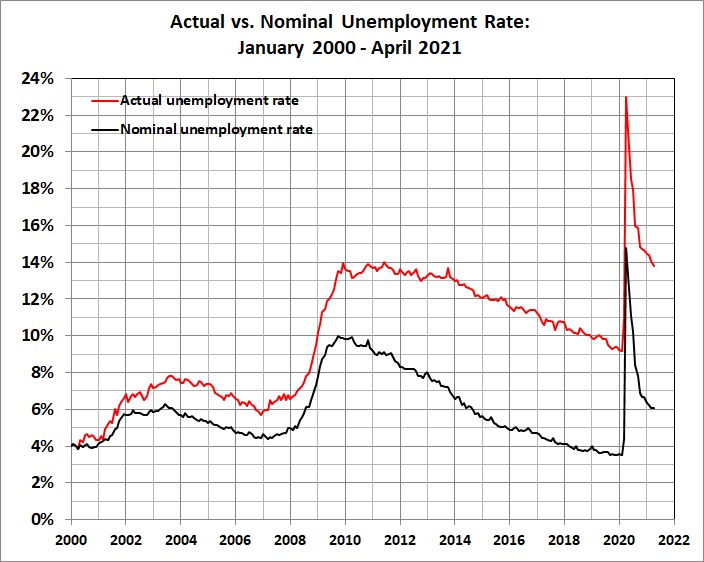
It’s bad. How bad? Here is the newly updated Part VI of “Economic Growth Since World War II“.

The real unemployment rate is several percentage points above the nominal rate. Officially, the unemployment rate stood at 6.1 percent as of April 2021. Unofficially — but in reality — the unemployment rate was 13.8 percent.

How can I say that the real unemployment rate was 13.8 percent, even though the official rate was 6.1 percent? Easily. Just follow this trail of definitions, provided by the official purveyor of unemployment statistics, the Bureau of Labor Statistics:

Unemployed persons (Current Population Survey)
Persons aged 16 years and older who had no employment during the reference week, were available for work, except for temporary illness, and had made specific efforts to find employment sometime during the 4-week period ending with the reference week. Persons who were waiting to be recalled to a job from which they had been laid off need not have been looking for work to be classified as unemployed.

Unemployment rate
The unemployment rate represents the number unemployed as a percent of the labor force.

Labor force (Current Population Survey)
The labor force includes all persons classified as employed or unemployed in accordance with the definitions contained in this glossary.

Labor force participation rate
The labor force as a percent of the civilian noninstitutional population.

Civilian noninstitutional population (Current Population Survey)
Included are persons 16 years of age and older residing in the 50 States and the District of Columbia who are not inmates of institutions (for example, penal and mental facilities, homes for the aged), and who are not on active duty in the Armed Forces.

In short, if you are 16 years of age and older, not confined to an institution or on active duty in the armed forces, but have not recently made specific efforts to find employment, you are not (officially) a member of the labor force. And if you are not (officially) a member of the labor force because you have given up looking for work, you are not (officially) unemployed — according to the BLS. Of course, you are really unemployed, but your unemployment is well disguised by the BLS’s contorted definition of unemployment.

What has happened is this: Since the first four months of 2000, when the labor-force participation rate peaked at 67.3 percent, it declined to 62.3 percent in 2015 before rising to 63.4 percent just before the pandemic wreaked havoc on the economy. Then, the participation rate dropped to 60.2 percent before recovering to 61.7 percent in April 2021:

FIGURE 9

Source: See figure 10.

The decline that began in 2000 came to a halt in 2005, but resumed in late 2008. The economic slowdown in 2001 (which followed the bursting of the dot-com bubble) can account for the decline through 2005, as workers chose to withdraw from the labor force when faced with dimmer employment prospects. But what about the sharper decline that began near the end of Bush’s second term?

There we see not only the demoralizing effects of the Great Recession but also the growing allure of incentives to refrain from work, namely, disability payments, extended unemployment benefits, the relaxation of welfare rules, the aggressive distribution of food stamps, and “free” healthcare” for an expanded Medicaid enrollment base and 20-somethings who live in their parents’ basements*. That’s on the supply side. On the demand side, there are the phony and even negative effects of “stimulus” spending; the chilling effects of regime uncertainty, persisted beyond the official end of the Great Recession; and the expansion of government spending and regulation (e.g., Dodd-Frank), as discussed in Part III.

More recently, COVID caused many workers to withdraw from the labor force out of an abundance of caution or because they couldn’t work from home. The recovery has stalled, in large part because of “free” money and extended unemployment benefits. The effects are being felt by employers who are unable to fill job openings, thus refueling a resurgence of inflation.

Another factor, though of less significance, is a decline in the percentage of employed persons who are working full-time. It dropped from 83.3 percent in 2000 — its highest level since 1989 — to 79.9 percent in 2010 before rising jaggedly to 83.5 percent in April 2021. A shift from full-time to part-time work is really a form of disemployment, and ought to be reflected in the unemployment rate.

I constructed the actual unemployment rate by adjusting the nominal rate for (a) the change in the labor-force participation rate and (b) the change in the percentage of workers in full-time status. The disparity between the actual and nominal unemployment rates is evident in this graph:

FIGURE 10

Derived from SeriesLNS12000000, Seasonally Adjusted Employment Level; SeriesLNS11000000, Seasonally Adjusted Civilian Labor Force Level; Series LNS11300000, Seasonally Adjusted Civilian labor force participation rate; and Series LNS12500000, Employed, Usually Work Full Time. All are available at BLS, Labor Force Statistics from the Current Population Survey.

The bad news — which the stock market has chosen to ignore (as of 05/07/2 1)  — is that the real unemployment rate is where it was in the darkest days of the Great Recession.
_________
* Contrary to some speculation, the labor-force participation rate is not declining because older workers are retiring earlier. The participation rate among workers 55 and older rose between 2002 and 2012. The decline is concentrated among workers under the age of 55, and especially workers in the 16-24 age bracket. (See this table at BLS.gov.) Why? My conjecture: The Great Recession caused a shakeout of marginal (low-skill) workers, many of whom simply dropped out of the labor market. And it became easier for them to drop out because, under Obamacare, many of them became eligible for Medicaid and many others enjoy prolonged coverage (until age 26) under their parents’ health plans. For more on this point, see Salim Furth’s “In the Obama Economy, a Decline in Teen Workers” (The Daily Signal, April 11, 2015), and Stephen Moore’s “Why Are So Many Employers Unable to Fill Jobs?” (The Daily Signal, April 6, 2015). On the general issue of declining participation among males aged 25-54, see Timothy Taylor’s “Why Are Men Detaching from the Labor Force?“, (The Conversible Economist, January 16, 2020), and follow the links therein. See also Scott Winship’s “Declining Prime-Age Male Labor Force Participation” (The Bridge, Mercatus Center, September 26, 2017).

Is a Reckoning at Hand?

If it is, it will arrive on two fronts: political and economic.

On the political front, Conrad Black and Victor Davis Hanson are (sort of) optimistic that the left’s audacious power-grab will fail. A recent op-ed by Black at Epoch Times ends with this:

But we are almost at the point where this administration’s attempt to revolutionize American elections by practically abolishing any verification process for ballots and turning election day into a weeks-long orgy of ballot-harvesting, while packing the Senate and the Supreme Court and gagging congressional minorities, will collide with public opposition to all of these measures.

In those circumstances, the Supreme Court, its attempt at appeasement of the Democrats by abdicating as head of a co-equal third branch of government having failed, might also reassert the legitimacy of the Constitution.

A turning in the road is almost at hand.

Hanson’s view complements Black’s:

We are becoming cynical 1980s Eastern Europeans who quietly scoffed at their daily government news. And this is step one to a repudiation of the lies we have been living with—that masks were necessary outdoors even for those fully vaccinated; that derelict, sexual harasser Andrew Cuomo is a noted author, Emmy-winner and national icon rather than a reckless sexual-harasser and responsible for needless death and misery by his unhinged long-term facilities policies; that Oprah, LeBron, and the Obamas are genuine voices of what it is like to be oppressed in America, and all the subsidiary untruths: the “brave” former intelligence officials who signed campaign-sensitive affidavits seconding Joe Biden’s insistence that Hunter’s laptop was a Russian disinformation trick; that Trump scoffed at “proof” that Russians put bounties on Americans in Afghanistan as they were appease;, and that Joe Biden has no cognitive issues and never did, at least of the sort that prompted his predecessor to take cognitive tests and draw the attention of a Yale psychiatry professor to diagnose him as unhinged in absentia.

In sum, the woke movement daily, hourly, second-by-second hinges on untruth, from the 1619 canard to America is systemically racist. And the number who spot the lies is beginning to outnumber the number who lives by them—which means the Revolution is likely to follow the Jacobin rather than Bolshevik fate.

On the economic front, the huge increase in government spending over the past two years — which Biden wants to perpetuate — will bear rotten fruit.

Here is the increase, in perspective:


Derived from Bureau of Economic Affairs, Table 1.1.5 Gross Domestic Product (billions of dollars, seasonally adjusted at annual rates) and Table 3.1. Government Current Receipts and Expenditures (billions of dollars, seasonally adjusted at annual rates)

As I have amply documented, government spending doesn’t “multiply”. If fact, it “divides”; that is, it causes real GDP to decline because government spending (and the regulatory activities funded by it) result in the transfer of resources from productive private uses to unproductive and counterproductive government uses, while also discouraging business expansion and productive investments in capital formation.

The bottom line is that a sustained increase in the share of GDP spent by government from about 33 percent (the average for the 10 years before the recent surge) to about 45 percent (the average for the recent surge) would cause a long-term reduction 4 percent of real GDP. If that doesn’t seem like a lot, consider that it would be the equivalent of a Great Recession that lasts for years on end instead of two or three years.

Voters flocked to the Democrat Party in the 1930s because they believed (mistakenly) that it — and especially FDR’s “New Deal” — would rescue them from the Great Depression. Voters will flock the the GOP in the 2020s if the Democrat Party remains stubbornly “woke” and persists in economic policies that impoverish them.

And if voters fail to switch in droves, it will prove the wisdom of the Framers’ (long-abandoned) Constitution, which was designed to prevent demagogues from pillaging the nation.


Related reading:

Victor Davis Hanson, “Are Americans Becoming Sovietized?“, The Daily Signal, May 6, 2021
Patricia McCarthy, “Aldous Huxley Foresaw Our Despots — Fauci, Gates, and Their Vaccine Crusaders“, American Thinker, May 5, 2021
Jeffrey A. Tucker, “Is the U.S. Economy a Virtual Reality?“, AIER, May 2, 2021

Related post: Turning Points

The Fed and Business Cycles, Revisited

This post updates “The Fed and Business Cycles” of June 11, 2011.

The following graphs depict the length of expansions and contractions (and the trends in both), before and since the creation of the Federal Reserve System in December 1913.


Source: “Business Cycle Expansions and Contractions,” National Bureau of Economic Research.
Note: The logarithmic scale on the vertical highlights proportional changes in the lengths of business cycles.

The creation of the Fed might have had a hand in the lengthening of expansions and the shortening of contractions, but many other factors have been at work.

What the graphs don’t depict is the relative severity of the various contractions. It is worth noting that the worst of them all — the Great Depression — occurred after the creation of the Fed and, in part, because of actions taken by the Fed. (A note to the history-challenged: The Great Depression began in September 1929 and ended only because of America’s entry into World War II.) Moreover, the worst downturn since the Great Depression — the Great Recession — was clearly the work of the Fed, in unwitting(?) complicity with the politicians who insisted on expanding home ownership through subprime loans.

In any event, the long-run cost of economic stability has been high. (See this, this, and this, for example.)

A 100-Day Scorecard

On January 6, 2021, in “Here We Go … “, I essayed 17 predictions about changes Democrats would attempt to consolidate their grip on America and make it over into a European-style “social democracy” with the added feature of subservience to China and Russia. As I said in the original post, not every item on the list will be adopted, but it won’t be for want of trying.

How are my predictions panning out? Quite well, sadly.

Judge for yourself. Here they are:

1. Abolition of the Senate filibuster.

2. An increase of at least two seats on the U.S. Supreme Court (USSC), though there may be some vacancies to be filled.

3. Adoption of an interstate compact by states controlling a total of at least 270 electoral votes, committing each member state’s electoral votes to the presidential candidate who compiles the most popular votes nationwide, regardless of the outcome of the popular vote in each state that is a party to the compact. (This may seem unnecessary if Biden wins, but it will be a bit of insurance against the possibility of a Republican victor in a future election.)

4. Statehood for either the District of Columbia or Puerto Rico, or for both of them. (Each would then have two senators and a requisite number of representatives with full voting privileges in their respective bodies. All of them will be Democrats, of course.)

5. Empowerment of the executive branch to do at least three of the following things:

a. Regulate personal and business activity (in new ways) with the expressed aim of reducing CO2 emissions.

b. Commit at least $500 billion in new obligational authority for research into and/or funding of methods of reducing and mitigating CO2 emissions.

c. Issue new kinds of tax rebates and credits to persons/households and businesses that spend money on any item on a list of programs/technologies that are supposed to reduce CO2 emissions.

d. Impose tax penalties on persons/households and businesses for their failure to spend money on any item in the list mentioned above (shades of the Obamacare tax penalty).

e. Impose penalties on persons/households and businesses for failing to adhere to prescribed caps on CO2 emissions.

f. Establish a cap-and-trade program for CO2 emissions (to soften the blow of the previous item). (Needless to say, the overall effect of such initiatives would deal a devastating blow to economic activity – meaning massive job losses and lower real incomes for large swaths of the populace.)

6. Authorization for an agency or agencies of the federal government to define and penalize written or spoken utterances that the agency or agencies declare “unprotected” by the First Amendment, and to require media enforcement of bans on “unprotected” utterances and prosecution of violators (e.g., here). (This can be accomplished by cynically adopting the supportable position that the First Amendment protects only political speech. The purported aim would be to curb so-called hate speech, but when censorship is in full swing — which would take only a few years — it will be illegal to criticize or question, even by implication, such things as illegal immigration, same-sex marriage, transgenderism, anthropogenic global warming, the confiscation of firearms, or the policies of the federal government. Violations will be enforced by fines and prison sentences — the latter sometimes called “sensitivity training”, “citizenship education”, or some other euphemistic term. Candidates for public office will be prime targets of the enforcers, which will suppress open discussion of such matters.)

7. Imposition of requirements for organizations of all kinds — businesses, universities, charitable organizations, clubs, and even churches — to favor anyone who isn’t a straight, white male of European descent. (The “protections” will be enacted, upheld, and enforced vigorously by federal agencies, regardless of their adverse economic and social effects.)

8. Effective nullification of the Second Amendment through orders/regulations/legislation, to enable gun confiscation (though there will be exemptions for private security services used by favored elites).

9. Use of law-enforcement agencies to enforce “hate speech” bans, mandates for reverse discrimination, and gun-confiscation edicts. (These things will happen regardless of the consequences; e.g., a rising crime rate, greater violence against whites and Asians, and flight from the cities and near-in suburbs. The latter will be futile, anyway, because suburban and exurban police departments will also be co-opted.)

10. Criminalization of “sexual misconduct”, as it is defined by the alleged victim, de facto if not de jure. (Investigations and prosecutions will be selective, and aimed mainly at straight, white males of European descent and dissidents who openly criticize this and other measures listed here.)

11. Parallel treatment for the “crimes” of racism, anti-Islamism, nativism, and genderism. (This will be in addition to the measures discussed in #7.)

12. Centralization in the federal government of complete control of all health care and health-care related products and services, such as drug research, accompanied by “Medicare and Medicaid for All” mandates. (Private health care will be forbidden or strictly limited, though — Soviet-style — there will be exceptions for high officials and other favored persons. Drug research – and medical research, generally – will dwindle in quality and quantity. There will be fewer doctors and nurses who are willing to work in a regimented system. The resulting health-care catastrophe that befalls most of the populace will be shrugged off as necessary to ensure equality of treatment, while ignoring the special treatment accorded favored elites.)

13. Revitalization of the regulatory regime (which already imposes a deadweight loss of 10 percent of GDP). A quantitative measure of revitalization is an increase in the number of new rules published annually in the Federal Register by at least 10 percent above the average for 2017-2020.

14. Proposals for at least least two of the following tax-related initiatives:

a. Reversal of the tax-rate cuts enacted during Trump’s administration.

b. Increases in marginal tax rates for the top 2 or 3 income brackets.

c. Imposition of new taxes on wealth.

15. Dramatic enlargement of domestic welfare programs. Specifically, in addition to the creation of “Medicare and Medicaid for All” programs, there would be a “fix” for Social Security that mandates the payment of full benefits in the future, regardless of the status of the Social Security Trust Fund (which will probably be abolished). (Initiatives discussed in #5, #7, #9, #10, #11, #12, #13, #14, and #15 would suppress investment in business formation and expansion, and would disincentivize professional education and training, not to mention work itself. All of that would combine to push the real rate of economic growth toward a negative value.)

16. Reduction of the defense budget by at least 25 percent, in constant dollars, by 2031 or sooner. (Eventually, the armed forces will be maintained mainly for the purpose of suppressing domestic uprisings. Russia and China will emerge as superpowers, but won’t threaten the U.S. militarily as long as the U.S. government acquiesces in their increasing dominance and plays by their economic rules.)

17. Legalization of all immigration from south of the border, and the granting of citizenship to new immigrants and the illegals who came before them. (The right to vote, of course, is the right that Democrats most dearly want to bestow because most of the newly-minted citizens can be counted on to vote for Democrats. The permanent Democrat majority will ensure permanent Democrat control of the White House and both houses of Congress.)


If you’re keeping up with the news, you will know that almost all of those actions are underway or clearly telegraphed by official statements. It’s hard to chosse the most chilling of those statements, but the one that clearly reveals Biden’s totalitarian urge is his campaign against “white supremacy as domestic terrorism”. This will morph into the suppression of anyone who dares question the doctrine that blacks are where they are because of white racism, and not because of their generally inferior intelligence and cultural traits, or anyone who questions the justice of racial discrimination when it favors blacks. Stay tuned.

Which Labor-Supply Curve?

A labor-supply curve, in economics, is a graphical or mathematical representation of the number of units of labor (work) of a specified kind that will be offered in a specified period of time (hour, day, week, etc.) at various rates of compensation (hourly wage or periodic salary or expected earnings from self-employment, plus the monetary value of benefits such as vacation time, pension contributions, etc.). A supply curve (like a demand curve) is ephemeral, in that it consists of the summation of the supply curves of many persons (or firms), each of which varies widely at a given time and shifts over time.

A person’s labor-supply curve is said to represent the choices that the person would make between work and leisure at various rates of compensation. On the assumption that leisure becomes more attractive than work at some point (i.e., a relatively high wage rate or salary that affords the person more than “enough” on which to live), the labor-supply curve is depicted as backward-bending after that point; that is, the worker will work less as his wage rate rises above the critical point. Graphically:

Figure 1

There are also complications due to unionization and minimum wage laws, both of which tend to set a wage rate that is above the wage that most workers would accept in a one-on-one transaction with an employer or prospective employer. (If unions or governments don’t mean to bargain for or dictate a wage above that which an individual worker could obtain on his own, that would vitiate the main justification for unionization and minimum-wage laws.) In any event, the effect of unionization and minimum wage laws is to deprive many workers of employment; thus:

Figure 2

The preceding relationships, interesting as they are, don’t paint a complete picture of the determinants of a person’s labor-supply curve. They are, perforce, inadequate to the task of explaining how various conglomerations of workers (e.g., unskilled laborers in Texas, pipefitters in Michigan, plastic surgeons in Malibu) will respond to compensation incentives.

For one thing, leisure — in the standard treatment — is a catchall for non-work activities: eating, sleeping, recreation, etc. It is simplistic to bundle those disparate activities. For another thing, most workers these days aren’t affected (directly, at least) by unionization or minimum wage laws. In general, the standard treatments fail to account adequately for other factors that may influence a person’s willingness to work for a give rate of compensation; for example, the perceived need to sustain a certain standard of living by working more to offset a reduction in one’s rate of compensation. I therefore submit the following step-by-step analysis of the labor-supply function, which is more complete and accordingly more complex than the standard treatments.

I will begin at the beginning, though I will refer to Figures 1 and 2 where they apply.

A person’s willingness and ability to perform a certain amount of work (L) of a particular kind is a function of several parameters: C, U, B, X, T, N, S, and E, each of which is defined below. I begin with the basic relationship between L and C, and then introduce the variations due to the other parameters.

C = total net compensation for work. This is the product of net compensation per unit of work (c) and the number of units of work (L). Net compensation is the after-tax, discounted present value of wages/salary and benefits (as perceived by the worker), for a given set of government policies that affect net compensation, directly or indirectly. In a simple labor-supply function, L = f(c), in which W responds positively and monotonically to increases in c; that is, the function is represented by an upward-sloping line (L), where c is measured on the vertical axis and L is measured on the horizontal axis:

Figure 3

(The rectangle bounded by the horizontal and vertical axes and the dashed lines that represent specific numbers of units of work, L1, and net compensation per unit, c1, has an area equal to the total compensation for that combination of c and L, which in this case is C1.)

U = utility or satisfaction derived from consumption and wealth accumulation resulting from work. This is usually depicted as a positive and rising relationship of the kind shown in the preceding graph. That is to say, the standard labor-supply curve is upward-rising because U generally increases as c rises (that is, as L rises) because of improvements in the quantity and quality of goods consumed and the accumulation of wealth (which provides even more access to goods of high quality, greater social standing, etc.). The following parameters complicate this seemingly simple relationship between c and L.

B = the effect of meeting basic necessities on the amount of labor that a worker is willing to offer. One factor that complicates a worker’s labor-supply function is the need to earn enough to cover basic necessities (e.g., minimal food, clothing, and shelter). The worker may be willing to work as much as required to pay for those necessities. For example, if his necessities cost him $100 a week and he can earn $10 an hour, he will be willing to work at least 10 hours a week, but if he can earn only $5 an hour, he will have to work at least 20 hours a week to pay for his basic necessities. It is entirely possible that a person who earns $500,000 a year will consider that amount necessary to meet his basic necessities, and that a change in his earning power or government policies will induce him to work more in order to net $500,000 a year. In any event, here is a depiction of the relevant portion of a labor-supply curve where B prevails:

Figure 4

If the worker is willing and able to deliver his labor beyond L3, his supply function would extend upward and to the right from that point. That is, having satisfied his basic needs, he would then be able to increase his utility by working more hours for higher rates of compensation.

X = the effect of changes in government policies on net compensation per unit of work, and therefore on the number of units of work that a worker will offer at a given rate of net compensation. If a worker has certain basic necessities (e.g., minimal food, clothing, and shelter), he will offer to work at least as much as required to meet those necessities, and may therefore offer to increase the number of units worked in response to X. For example, if the necessities have a cost to him $500 per week, he will offer to work as many hours as necessary to earn net compensation of $500 per week. And if his taxes increase by, say, $50 per week, he will seek additional work in order to offset the tax increase. But, if he is earning more than is required to cover his basic necessities, a tax increase of $50 a week — an effective reduction in his  compensation — will cause him to work less.

In this case, the graph of the relevant portion of the worker’s supply curve would look like Figure 3 or Figure 4, but c would be higher at each point along L; that is, the new supply curve would be above and parallel to the old supply curve.

T = taste for work of a particular kind. T is positive and rising with L if the work itself offers some pleasure to the worker (e.g., a doctor who enjoys helping the sick, an athlete who enjoys his sport for its own sake, a lawyer who revels in argumentation), or negative and declining with L if the worker works only for the compensation because of his distaste for the work (e.g., cleaning toilets, babysitting brats, working for pointy-haired bosses). This “psychic income” or “psychic penalty” raises or lowers the amount of work that the worker is willing to perform for a given rate of compensation (c).

Imagine a person who is capable of performing two different kinds of labor, X and Y. If Figure 3 or Figure 4 refers to X, and if the person has a “taste” for Y, his supply curve will for Y lie below the ones depicted in Figure 3 and 4; that is, he will require less compensation to do Y rather than X.

N = preference for non-work time (which includes leisure and time spent on personal functions such as meeting familial obligations, eating, and sleeping). This is the backward-bending relationship depicted in Figure 1. The portion of the supply curve that runs upward and to the right incorporates the tradeoff between compensation and leisure. But at some threshold value of C, the worker responds to higher c by reducing L. It seems to me that this effect should be depicted in this way:

Figure 5

That is, the worker reaches his “saturation” point at L3 and reduces the amount of work that he does as c rises past c3. In this case, he reduces his work time so that his total compensation remains the same as it was at L3.

S = subsidies that discourage work (e.g., unemployment benefits, “disability” payments, food stamps, subsidized housing). Where these are available to a worker, they reduce the amount of work that he is willing to do because they enable him to attain a given U without working. T may be positive and offsetting, but this is unlikely among workers who qualify for subsidies. The S effect pushes the supply curve upward; that is, less labor is offered for a given rate of compensation.

E = external forces that limit the amount of labor that a person is able to offer. There are at least two significant forces of this kind. One is the effect of laws and regulations that dictate the maximum amount of work that may be performed (e.g., zero in the case of most children under the age of 16) or the rate of compensation that must be paid (e.g., the minimum wage, overtime pay for persons in certain occupations). The other major force is the effect of employer-union contracts that dictate rates of compensation and hours of work that cannot possibly reflect the uncoerced preferences of many (or most) individual workers. (E, in its various manifestations, is treated in standard economics by overlaying “floors” or “ceilings” on the labor-supply curve.)

Figure 2 depicts this effect.

In conclusion, a labor-supply curve — even that of one person — can be a complex function, and one that responds in various ways to parameters other than the utility that is gained (or lost) by working more (or less). It is hard to imagine that a meaningful supply curve can be drawn for whole classes of workers. To draw such a curve, the workers must be rather homogeneous in their skills, their tastes (for leisure and other things), their wealth (which can strongly influence one’s willingness to perform certain kinds of work), and their exposure to various governmental policies (unionization, minimum wage laws, etc.). The fluidity of the labor market in the age of the “gig economy” supports my view.

Presidents as Regulators: From Ike to The Donald

According to the Regulatory Studies Center of George Washington University,

the number of total pages published in the CFR [Code of Federal Regulations] annually provides a sense of the volume of existing regulations with which American businesses, workers, consumers, and other regulated entities must comply.

The dataset published by the Center provides a consistent measure of the total number of CFR pages for each year from 1950 through 2019, and for 2020 through July 9. Armed with those numbers, I computed the annual rate of increase in the size of the CFR under each administration, from Eisenhower’s to Trump’s (as of July 9, 2020). The result is shown below.

It is no surprise that Trump’s administration was the least heavy-handed. Nor is it surprising that each Democrat administration was generally more heavy-handed than its GOP predecessor. The surprising exception is Clinton’s regime, which was better than Bush I’s, and was second only to Trump’s in its regulatory austerity.