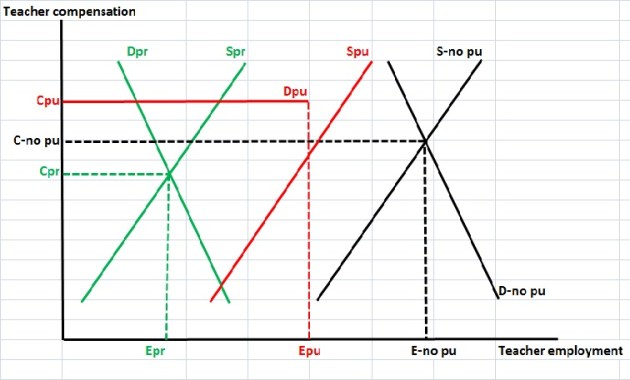
The Keynesian Fallacy and Regime Uncertainty

In “A Keynesian Fantasy Land,” I gave six reasons for the failure of “stimulus” spending to stimulate the economy, despite the insistence of leftists and left-wing economists that economic salvation is to be found in bigger government. The reasons, which I elaborate in the earlier post, are these:

1. “leakage” to imports

2. disincentivizing effects of government borrowing and spending (regime uncertainty)

3. timing and targeting problems (spending that is too late and misdirected)

4. reversed causality (lower aggregate demand as symptom, not cause)

5. the negative consequences of bail-outs

6. the unaccounted for complexity of human behavior

An article by Casey B. Mulligan, “Simple Analytics and Empirics of the Government Spending Multiplier and Other ‘Keynesian’ Paradoxes,” underscores the futility of “stimulus” spending. These are among Mulligan’s conclusions:

From a partial equilibrium perspective, it would be surprising if government purchases did not crowd out at least some private consumption, and that a reduction in factor supply did not result in less output. Yet some “New Keynesian” models, not to mention much public policy commentary, claim that today’s economy has turned this partial equilibrium reasoning on its head, even while it might have been historically valid. Among other things, individual firms and the aggregate private sector are alleged to leave their production invariant to changes in factor supply conditions during this recession. This paper shows how the government spending multiplier and the “paradox of toil” are related in theory, and examines evidence from this recession on the output effects of factor supply…

This paper does not contain a numerical estimate of the government purchases multiplier. However, its examination of data exclusively from the 2008-9 recession suggests that sectoral and aggregate employment and output vary with supply conditions in much the same way they did before the recession. The results contradict Keynesian claims that the government purchases multiplier would be significantly greater during the recession than it was before 2008, suggesting instead that historical estimates of the effects of fiscal policies are informative about fiscal policy effects in more recent years. Moreover, the supply incentives created by government spending cannot be ignored merely because 2008 and 2009 were recession years; rather incentives mattered as much as ever. Government purchases likely moved factors away from activities that would have supported private purchases. Unemployment insurance, food stamps, and other expanding means-tested government programs likely reduced employment and output during this recession, in much the same way they did in years past.

Compounding the futility of “stimulus” spending is the general climate of economic fear that Obama’s policies have engendered; for example:

Thanks to Regulatory Burdens, We’ve Got Both A Creditless Recovery and A Jobless Recovery (at Carpe Diem)

Why aren’t we seeing a jobs recovery? Maybe it’s ObamaCare’s fault (at Questions and Observations)

Home Depot Founder: Obama’s Regulations Are Killing Businesses (at Commentary)

As John Steele Gordon points out,

[t]he greatest periods of American economic growth came when taxes were very low—such as in the 19th century—or being lowered and simplified, as in the 1920s, 60s, and 80s. Inescapably, to tax wealth creation is to discourage it. But there is a large and politically potent segment of the population that, because its interests are now aligned with those of the government, seek to promote dependency through entitlements. This segment favors ever higher taxes (although they disguise the fact by demanding that only “the rich” pay their “fair share.”) But, as with regulation, high taxes inevitably produce low growth—and low growth threatens entitlements in the long term. If the United States remains in the doldrums for several more years without hope of a real turnaround, Medicare as it is currently constituted will go bankrupt in 2019. Raising taxes to prevent that will only slow overall growth, and that will actually defeat the purpose of saving Medicare.

So there is really no alternative to pursuing policies that encourage economic growth through private action by liberating the forces of the free market. A presidential candidate who finds a way to ground his economic policies in this core truth—and harnesses the idea to a larger and more optimistic understanding of the United States, both past and future, and resists the take-your-medicine tone that dominates the conservative policy discussion of the present moment—will be able to draw a sharp and effective contrast with the failures of the Obama years. (“Growth: The Only Way out of This Mess,” Commentary, July 2011)

But there is no point in cutting taxes unless government spending is cut — and cut drastically — for government spending, along with regulation, is the real drag on the economy. Only in the left’s magical thinking is government spending a good thing. In reality, it is a destructive force — even during recessions and depressions.

Related posts:
The Causes of Economic Growth
A Short Course in Economics
Addendum to a Short Course in Economics
The Indivisibility of Economic and Social Liberty
The Price of Government
The Fed and Business Cycles
The Price of Government Redux
The Mega-Depression
Ricardian Equivalence Reconsidered
The Real Burden of Government
Toward a Risk-Free Economy
The Rahn Curve at Work
How the Great Depression Ended
Microeconomics and Macroeconomics
The Illusion of Prosperity and Stability
Experts and the Economy
We’re from the Government and We’re Here to Help You
Estimating the Rahn Curve: Or, How Government Inhibits Economic Growth
Our Enemy, the State
Competition Shouldn’t Be a Dirty Word
The Stagnation Thesis
The Evil That Is Done with Good Intentions
Money, Credit, and Economic Fluctuations

“Tax Expenditures” Are Not Expenditures

Greg Mankiw makes a provocative point:

The blue line is total discretionary outlays of the federal government, and the brown line is the sum of tax expenditures.  Both are in constant dollars.  Note that these two categories of spending are about equal in magnitude.  It is just as important to focus on stealth spending implemented through the tax code as on explicit spending.

Source.

Addendum: David Leonhardt has a related article in the Times today.

What are “tax expenditures”? According to Mankiw’s source they are

a measure of the government revenue losses resulting from provisions in the tax code that allow people or businesses to reduce their tax burden by taking certain deductions, exemptions, exclusions, preferential rates, deferrals or credits. By reducing the revenue that would otherwise have been collected by the government, tax expenditures are similar to government spending.

“Tax expenditures” are not “similar to government spending,” nor are they a form of government spending, as “liberals” would have it.

Taxes are governmental claims on economic output. If tax revenues from all sources amount to 20 percent of GDP, given the kinds of “loopholes” listed above, the effective tax rate is 20 percent of GDP. If loopholes are closed and tax revenues rise, government isn’t spending less money, it’s collecting more taxes. If loopholes are closed and, at the same time, nominal tax rates are reduced so that revenues remain constant, government isn’t spending less money, it’s simply redistributing the tax burden.

“Tax expenditures” could be expenditures only if:

  • All output is owned by government.
  • Government “spends” (distributes) output through the provisions of the tax code.
  • Therefore, if government “spends” more on person A (by creating a loophole that favors A) and less on person B (because the loophole doesn’t apply to him), A is the beneficiary of a “tax expenditure.”

Such is left’s the upside-down, Alice-in-Wonderland worldview: Everything is owned by government, and citizens are mere supplicants.

I am surprised by Mankiw’s apparent endorsement of this view.

A Keynesian Fantasy Land

This post examines practical reasons for the failure of “stimulus” to stimulate and the “multiplier” to multiply. The deeper truth is that the Keynesian multiplier is a mathematical fiction, as explained here, and government spending is in fact destructive of economic growth, as discussed here and in some of the posts listed at the end.

“Liberal” economists and pundits complain incessantly that the recovery from the Great Recession is weak, and in jeopardy, because the federal government hasn’t spent “enough” money. (See this for some examples of the “liberal” view.) How much is “enough” for Paul Krugman et al.? It is always more than the government spends, of course.

Why should that be? The blindingly obvious answer — but not obvious to Krugman and company — is that demand-side fiscal policy (i.e., government “stimulus” spending) is ineffective. If the economy depends on government spending, how does one explain the decades after the Civil War, when government spent less than 10 percent of GDP (vs. today’s 40 percent), while America’s economy grew faster than at any time in its history? It took World War II and regime change (the disruption of the New Deal by the war) to end the Great Depression. Mr. Roosevelt’s adoption of Mr. Keynes’s hole-digging prescription (the Civilian Conservation Corps and similar make-work projects) had nothing to do with it. Mr. Roosevelt may have been an excellent marketeer, but he was a dismal economic engineer.

This is not to reject supply-side fiscal policy: tax-rate reductions. When tax-rate reductions are prospectively permanent — as opposed to one-time tax rebates and “holidays” — they can and do spur economic growth. Christina Romer, former chair of Obama’s Council of Economic Advisers, once proved it — though she developed a convenient case of amnesia when she became a proponent of “stimulus.”

As any reputable economist will tell you, however, the best that one can expect of a temporary increase in government spending is a temporary increase in economic activity; it is a stop-gap until the economy recovers on its own. (And a reputable economist, unlike Krugman, will also tell you that a permanent increase in government spending diverts resources from productive uses — uses that yield economic growth and satisfy actual economic wants — toward less-productive and counter-productive ones, including the creation of paper-shuffling, regulatory bureaucracies.)

Despite the promises of Obama, Romer, and company, the “stimulus” has evidently failed to do much — if anything — to alleviate the Great Recession and its lingering aftermath. (See this, this, and this, for example.) Thus the wailing and gnashing of teeth by Krugman and company — who want to replicate the failure on a grander scale.

WHY THE “STIMULUS” FAILED TO STIMULATE: GENERAL OBSERVATIONS

What went wrong? Anthony de Jasay offers a piece of the explanation:

…In Keynesian parlance there is the multiplier effect and it is greater than 1. As long as there is spare capacity (unemployment) in the economy, the government ought to go on spending more, working through the multiplier, because the extra private saving takes care of the government dissaving and the extra consumption is, so to speak, a welcome windfall gain. Timidly refusing to generate it is criminal waste.

Despite truculent voices to the contrary, the Keynesian logic is faultless in that the conclusions do follow from the assumptions. Why it does not really work and why it singularly failed to work in 2009-2010 and maybe beyond, is that other things do not remain equal. Part of the extra spending stimulus fails to stimulate domestic income because as much as 0.3 of the multiplier might leak out through extra imports. Much of the rest may be offset by industry taking fright of the rising budget deficit and reducing investment, and consumers striving to reduce their indebtedness producing some saving to balance the government’s dissaving. The total effect of higher imports and lower investment might be a multiplier barely higher, or maybe even lower, than 1 and the stimulus stimulating nothing except the national debt. This is not the fault of Keynes but of those whose macro-economics exist in a fantasy land. (Library of Economics and Liberty, “Micro, Macro, and Fantasy Economics,” December 6, 2010)

Generally,

[t]he available empirical evidence does not support the idea that spending multipliers typically exceed one, and thus spending stimulus programs will likely raise GDP by less than the increase in government spending. (Robert J. Barro and Charles J. Redlick, “Stimulus Spending Doesn’t Work,” WSJ Online, October 1, 2009)

(For more on the subject see Barro’s “Government Spending Is No Free Lunch,” WSJ Online, January 22, 2009.)

WHY “STIMULUS” FAILS: SPECIFIC REASONS

Altogether, there are six reasons for the ineffectiveness of Keynsesian “stimulus.”

1. The “leakage” to imports, as indicated by de Jasay.

2. The disincentivizing effects of government borrowing and spending, to which de Jasay alludes.

As de Jasay suggests, industry (and the high-income earners who finance it) are being cautious about the implications of additional government debt. As I say here,

the sophisticat[ed] … institutions and persons who have the greatest interest in government’s actions [are] large corporations and persons in high-income brackets. They will react to government borrowing as if it would affect them and their heirs (corporate and individual).

That is to say, even if additional debt does not crowd out private-sector borrowing to finance business expansion, it will nevertheless inhibit investments in business expansion. This inhibiting effect is compounded by the reasonable expectation that many items in a “stimulus” package will become permanent fixtures in the government’s budget.

3. The timing-targeting problem.

The lag between the initial agitation for “stimulus” and its realization. In the extreme, the lag can be so great as to have no effect other than to divert employed resources from private to government uses. But even where there is a relatively brief lag, “stimulus” spending is essentially wasted if the result is simply to divert already employed resources from private to government uses.

The timing-targeting problem is one that strident Keynesians and their unsophisticated disciples in the media seem not to understand or care about. (They are happy as long as government “does something,” regardless of the cost.) The problem arises from the fundamental flaw in the Keynesian analysis: Economic output is portrayed as a homogeneous commodity, one that can be characterized  in terms of aggregate demand (AD) and aggregate supply (AS). Accordingly, in the Keynesian orthodoxy, all it takes to stimulate AD is to pump in some additional government spending (dG), and the rest takes care of itself.

Arnold Kling calls it “hydraulic” macroeconomics:

Once upon a time, Joe lived in Keynesiana, where he was a representative agent.

Joe worked in a GDP factory, making GDP. Every Monday morning, he went to work, and he worked five days a week. He was paid $1 for every 24-minute segment he worked, and he worked 100 segments (40 hours), so he earned $100 a week. Every Friday afternoon, Joe cashed his paycheck and went to the GDP factory outlet, where he spent it all on GDP.

One day, Joe decided that he needed to accumulate some savings. He made up a rule for himself. Knowing that he needed to consume at least $40 of GDP each week, he decided that his rule would be to save 20 percent of everything he earned over and above that $40. So the first week, that meant saving 20 percent of $60, or $12. So he cashed his $100 paycheck, but that Friday afternoon he only spent $88.

Next Monday, morning, Joe’s boss had some news. “A funny thing happened last week. We sold 12 percent less GDP than usual. So this week, we’re gonna put you on a short week. You work 88 segments, instead of 100.”

Joe was disappointed, because this meant he would only be paid $88 this week. Sticking to his new rule, he resolved to save 20 percent of $48, or $9.60. So that Friday afternoon, he cashed his $88 paycheck and spent $78.40.

Next Monday morning, Joe’s boss said. “Well, golly, it looks like we sold even less GDP last week. I’m afraid we’ll have to cut you back to 78.40 segments this week.” Still following his rule, Joe resolved to save 20 percent of $38.40, or $7.68. So he spent only $70.72 at the GDP factory outlet that Friday.

Seeing where this was going, the country asked Krug Paulman, the famous economist, what to do. He said, “The stupid people are saving too much. We need government to spend what the idiots are not spending.” So the government borrowed $29.28 from Joe and spent it at the GDP factory outlet.

Now, when Joe came to work on Monday morning, his boss said, “Good news, we sold 100 percent of what we used to sell, so you can work 100 segments this week.” Sticking to his rule, Joe saved $12 on Friday afternoon. But the government borrowed the $12 and spent it at the GDP factory outlet. They all lived happily ever after. (Library of Economics and Liberty, “Hydraulic Macro: A Fable,” August 30, 2009)

But in reality, economic activity is far more complex than that. One very important part of that reality the vast variety of goods and services changing hands, in response to constantly shifting tastes, preferences, technologies, and costs. The real economy bears no resemblance to the “hydraulic” one in which the homogeneous “fluid” is units of GDP. For “stimulus” — an increase in government spending (dG) — to generate an real increase GDP significantly greater than dG, several stringent conditions must be met:

a. dG must lead directly to the employment of resources that had been idled by a downturn in economic activity (or newly available resources that otherwise would lay idle), therefore eliciting the production of additional goods for delivery to consumers and businesses.

b. Accordingly, government functionaries must be able to distinguish between unemployment that occurs as a result of normal (and continuous) structural changes in the economy and unemployment that occurs because of a general slowdown in economic activity.

c. To the extent that the preceding conditions are satisfied, dG may be used to restore employment if government functionaries do the following things:

  • Ensure that dG is used to purchase goods and services that would have been produced in the absence of a general slowdown in economic activity.
  • Ensure that dG is used by those persons, businesses, and governmental units that have become unable to buy those goods and services because of a general slowdown in economic activity.
  • Allowing for shifts in tastes, preferences, technologies, etc., adjust the issuance, allocation, and use of dG so that goods and services are produced in accordance with those shifts in taste, etc.
  • Reduce dG as the demand for unemployed resources rises, in order to avoid the distorting and disincentivizing effects of inflation.

To the extent that dG is less than on-time and on-target, there is “leakage,” which causes the multiplier to recede toward a value of 1. It can easily slide below 1 — as Barro has found — because of the “leakage” to imports and the disincentivizing effects of government borrowing and spending.

4. Causality: Inadequate AD as symptom, not cause.

The fourth reason for the failure of the “stimulus” to stimulate is that it is does not address the cause of the drop in AD. A drop in AD usually is caused by an exogenous event, and that exogenous event usually is a credit crisis. Pumping money into the economy — especially when it results in the bidding up the prices of already employed resources — does not reinflate the punctured credit bubble that caused the slowdown.

If a credit crunch arises from a sharp rise in the rate of home-mortgage defaults — as in the case of the Great Recession — the obvious way to “solve” the problem is to prop up the defaulting borrowers and their lenders, and to do so quickly.

But, in practice, the propping up is hit-and-miss, and the misses have drastic consequences. Consider, for example, the decision not to bail out Lehman Brothers and the effects of that decision on financial markets.

Which leads into the fifth reason…

5. Inequity, moral hazard, and their consequences.

Any kind of “stimulus” that targets particular individuals and firms, in an effort to rectify their failures of judgment, has adverse political and economic effects.

Favorable treatment of defaulters and failing companies generates considerable popular resentment, which — in the present instance — has found a vocal and politically potent outlet in the Tea Party movement. Favorable treatment of defaulters and failing companies also creates moral hazard; that is, it encourage unwise risk-taking that can (and probably will) spark future crises, leading the government to assume more obligations and impose more regulations, in a futile effort to change human nature.

All of this adds up to a climate of political contention and financial pessimism — conditions that militate against consumer confidence and business expansion.

6. The human factor.

The preceding five reasons for the ineffectiveness of Keynesian “stimulus” point to a sixth, fundamental reason: the human factor.

Models are supposed to mirror reality, not the other way around. Those who cling to the Keynesian multiplier would like the world to comply with it. But the world does not because it is filled with people, whose behavior is not determined (or described) by a simplistic model but by their responses to incentives, their political predispositions, their informed and reasonable skepticism about the consequences of government intervention in economic matters, and — above all else — their fallibility. And, believe or not, government officials and bureaucrats are no less fallible than the “ordinary” citizens whose lives they would like to organize.

The human factor is an inconvenient truth. But “liberals,” in their usual arrogance and ignorance prefer magical thinking to reality. Belief in the Keynesian multiplier is a prime example of magical thinking.

Related posts:
The Causes of Economic Growth
A Short Course in Economics
Addendum to a Short Course in Economics
The Indivisibility of Economic and Social Liberty
The Price of Government
The Fed and Business Cycles
The Price of Government Redux
The Mega-Depression
Ricardian Equivalence Reconsidered
The Real Burden of Government
Toward a Risk-Free Economy
The Rahn Curve at Work
How the Great Depression Ended
Microeconomics and Macroeconomics
The Illusion of Prosperity and Stability
Experts and the Economy
We’re from the Government and We’re Here to Help You
Estimating the Rahn Curve: Or, How Government Inhibits Economic Growth
Our Enemy, the State
Competition Shouldn’t Be a Dirty Word
The Stagnation Thesis
The Evil That Is Done with Good Intentions
Money, Credit, and Economic Fluctuations

PolitiFact Whiffs on Social Security

PolitiFact has a habit of missing the point, usually in a way that favors the left’s agenda. A good example is found in PolitiFact’s recent assessment of statements made by Herman Cain about privatizing Social Security:

During Monday’s Republican presidential debate in Manchester, N.H., former pizza executive Herman Cain touted an alternative to Social Security that has been operating for three decades in Galveston County, Texas.

“The city of Galveston, they opted out of the Social Security system way back in the ’70s,” Cain said. “And now, they retire with a whole lot more money. Why? For a real simple reason — they have an account with their money on it. What I’m simply saying is we’ve got to restructure the program using a personal retirement account option in order to eventually make it solvent.”

We’ll give Cain a pass on a pair of minor errors — it’s Galveston County, not city, and the program launched in 1981, not in the 1970s. Instead, we’ll cut to the bottom line: Has the program meant that participants “retire with a whole lot more money” than they would under Social Security?…

In 1981, employees of Galveston County — as well as those in two adjoining Texas counties, Matagorda and Brazoria — voted, after lengthy presentations and discussions, to withdraw from Social Security and initiate a system of individual accounts to provide retirement, survivor and disability benefits. Participants would contribute to their retirement accounts, supplemented by an amount from their employers, and those funds would be invested in annuities through a financial-services company chosen by a county-run bidding process….

…The Galveston plan is somewhat analogous to a 401(k) plan — that is, a plan designed to encourage workers to save for retirement — rather than a social insurance, or safety-net, program like Social Security….

Keith Brainard, the research director for the National Association of State Retirement Administrators, agreed that the Galveston plan is better for some types of workers, including those with long tenures.

But the “problem,” he said, “lies in Cain’s implication that Social Security should be a wealth-producing vehicle, when that’s not what it’s supposed to be. Social Security is supposed to be old-age insurance. That should be the emphasis of the program, not ‘retiring with a lot more money.’”…

…[T]here are some advantages to the Galveston plan — not just to the higher earners who get more out of the program, but also to the government entity running them. The Alternate Plan doesn’t face the same kind of long-term fiscal challenges that Social Security does, because it only promises participants the investment returns for the money they pay in to the system.

The downside, of course, is that the investments may not perform well enough to exceed what Social Security would have provided….

This is all misguided hogwash. I rate PolitiFact’s analysis as “wide of the mark.”

Social Security (SS) is neither a retirement plan nor insurance (as one interviewee calls it). Social Security is a transfer-payment scheme — some, rightly, call it a kind of Ponzi-scheme. It’s not fraudulent in intent, but it’s fraudulent in effect.

Today’s SS beneficiaries are not reaping returns from investments made by SS with their “contributions.” Their benefits come from the paychecks of today’s workers. And future SS benefits will come from the paychecks of future workers. (If you believe in the SS trust fund, which is nothing but a pile of IOUs, you must believe in the tooth fairy.)

Private retirement plans (and the occasional government plan, like Galveston’s) reap real returns and support economic growth through the purchase of corporate equities and securities. SS, on the other hand, inhibits economic growth by depriving workers of money that they could invest in equities and securities. Comparing real returns on private plans with the “returns” that Social Security extracts from workers is as meaningful as the proverbial comparison of apples and oranges.

There just ain’t no “returns” on SS, so it can’t be compared with a retirement plan that reaps real returns and contributes to economic growth in the process. SS can generate any kind of “return” that its political masters desire — because they have the power to extract the “returns” from workers’ paychecks.

Related posts:
Social Security Is Unconstitutional
Why It Makes Sense to Privatize Social Security
P.S. on Privatizing Social Security
That Mythical, Magical Social Security Trust Fund
The Real Social Security Issue
Social Security — Myth and Reality
Nonsense and Sense about Social Security
More about Social Security
Social Security Privatization and the Stock Market
Social Security: The Permanent Solution
Social Security Transition Costs, in a Nutshell
A Market Solution to the Social Security Mess?
Saving Social Security
The Bowles-Simpson Report
The Bowles-Simpson Band-Aid

Money, Credit, and Economic Fluctuations

Wherein the author finds money, banking, and credit to be good, not evil — as long as government keeps its hands off them.

MONEY LUBRICATES EXCHANGE

The important role of money as a lubricant of economic activity has been understood for a long time. Indeed, it must have been understood by the ancients who first devised money of one kind or another and used it to broaden the range of goods they could buy, sell, and use. For a less-than-ancient but venerable account of the role of money, I turn to Adam Smith:

When the division of labour has been once thoroughly established, it is but a very small part of a man’s wants which the produce of his own labour can supply. He supplies the far greater part of them by exchanging that surplus part of the produce of his own labour, which is over and above his own consumption, for such parts of the produce of other men’s labour as he has occasion for. Every man thus lives by exchanging, or becomes, in some measure, a merchant, and the society itself grows to be what is properly a commercial society.

But when the division of labour first began to take place, this power of exchanging must frequently have been very much clogged and embarrassed in its operations. One man, we shall suppose, has more of a certain commodity than he himself has occasion for, while another has less. The former, consequently, would be glad to dispose of; and the latter to purchase, a part of this superfluity. But if this latter should chance to have nothing that the former stands in need of, no exchange can be made between them. The butcher has more meat in his shop than he himself can consume, and the brewer and the baker would each of them be willing to purchase a part of it. But they have nothing to offer in exchange, except the different productions of their respective trades, and the butcher is already provided with all the bread and beer which he has immediate occasion for. No exchange can, in this case, be made between them. He cannot be their merchant, nor they his customers; and they are all of them thus mutually less serviceable to one another. In order to avoid the inconveniency of such situations, every prudent man in every period of society, after the first establishment of the division of labour, must naturally have endeavoured to manage his affairs in such a manner, as to have at all times by him, besides the peculiar produce of his own industry, a certain quantity of some one commodity or other, such as he imagined few people would be likely to refuse in exchange for the produce of their industry. Many different commodities, it is probable, were successively both thought of and employed for this purpose. In the rude ages of society, cattle are said to have been the common instrument of commerce; and, though they must have been a most inconvenient one, yet, in old times, we find things were frequently valued according to the number of cattle which had been given in exchange for them. The armour of Diomede, says Homer, cost only nine oxen; but that of Glaucus cost a hundred oxen. Salt is said to be the common instrument of commerce and exchanges in Abyssinia; a species of shells in some parts of the coast of India; dried cod at Newfoundland; tobacco in Virginia; sugar in some of our West India colonies; hides or dressed leather in some other countries; and there is at this day a village In Scotland, where it is not uncommon, I am told, for a workman to carry nails instead of money to the baker’s shop or the ale-house. (From An Inquiry into the Nature and Causes of the Wealth of Nations, Chapter IV, “Of the Origin and the Use of Money.)

And so it went, until institutions of standing (banks, governments) began to issue money in standard, convenient forms, and which individuals would readily accept and use — within a particular region, principality, kingdom or nation, at least.

MONEY FACILITATES CREDIT, AND CREDIT CAN CREATE MONEY

Even in the absence of money, of course, there can be credit: the lending of products and services (i.e., economic goods or, simply, goods) for consumption or investment (i.e., capital formation: the creation of tools, facilities, and the like that can be used to produce goods in greater abundance, of higher quality, or of new kinds). Money facilitates credit because the borrower can use money to choose from a greater variety of consumption or investment goods; money, in effect, expands the time and space available to a buyer for the selection of goods.

Credit represents a kind of exchange, where the commodity involved is money, itself. The borrower and lender must agree to the terms of exchange, and the borrower (unless he is swayed by personal considerations and inclined to forgive a debt) will want some kind of assurance that his money will be repaid, at a rate of interest that he (the lender) is willing to accept, given the risk he assumes. Credit can underwrite the following activities:

  • Consumption (meeting daily wants, from shelter to food and clothing to such “frills” as internet service, faddish toys and clothing, etc.)
  • Purchases of durable consumer goods (e.g., automobiles, major appliances, and — for this purpose — residential dwellings)
  • Capital formation to enable the production of more, better, and new kinds of goods, including production goods (e.g., farm equipment) as well as final goods (e.g., home computers).

For purposes of this exposition, I consider stock purchases to be a form of credit. The purchaser is not making a loan to be repaid on a schedule, but he is hoping to participate in the dividends and/or capital gains that will be generated by the business that issues the stock. In other words, to buy stock is really to grant an unsecured loan, in the expectation of a high return and with the knowledge that a lot of risk attaches to that expectation.

CREDIT AND THE MONEY-MULTIPLIER

What is the source of credit? That is, who — if anyone — is relinquishing a claim on resources in order to lend that claim to someone else? The obvious answer to the question is: the lender. But that is not the whole story, because of fractional-reserve banking (FR, to distinguish it from FRB, or Federal Reserve Board). FR has a long history, which predates the involvement of governments in banking. With FR, the cash held in reserve by a bank (or private lender) can be parlayed into loans (and thus money) having a face value many times that of the original lender’s reserve. In what follows, I will use examples that assume a “money multiplier” of 10; that is, a cash reserve of a given amount may be used to generate loans with a total face value equal to 10 times that of the reserve. (This article explains the process and the formula  for determining  potential value of the loans, and money, that can be generated by a given cash reserve.) It should be  obvious that FR can be practiced only in a monetary economy; 100 head of cattle, for instance, cannot be parlayed into 1,000 head of cattle, because cattle cannot be created by the proverbial stroke of a pen, whereas money can — if others are willing to accept it.

Without FR, then, credit is created only when a lender forgoes spending that directly benefits him. For example, a lender who has just received $1,000 dollars for services rendered has a claim on the value of the goods he created by rendering those services. He could spend that $1,000 on some combination of consumption (e.g., groceries), durable consumer goods (e.g., a PC), or capital formation (e.g., new software for use in his tax-preparation business). Alternatively, he could lend the $1,000 (or some part of it) to someone else, who could put it to an analogous use or uses. Without FR, however, the growth of economic output depends (almost) entirely on the amount that individuals spend on capital formation or lend to others for capital formation. (I say “almost” because certain kinds of consumption and durable goods can also lead to future increases in output; for example, better nutrition and the use of refrigeration to prevent the contamination of food.)

THE MONEY-MULTIPLIER AND ECONOMIC GROWTH

FR can induce a higher rate of economic growth, if the following several conditions are satisfied:

  • Lenders lend additional sums as a result of FR.
  • The lending is not offset by reduced spending on the part of borrowers.
  • The money that is borrowed indistinguishable from money that is already in use. That is to say, the borrowed money is treated like “real” money when borrowers put it into circulation by spending it.
  • If it is “real” money, it give borrowers a claim on resources that they can exercise for the various reasons outlined above. But the resources that borrowers seek to command must be in addition to the resources that are already in use or that would have been in use in the absence of FR. (There may be some lags, as producers respond to additional spending with increases in output, and those lags will have an inflationary effect, but it may be offset by efficiencies of scale and/or greater productivity that results when some borrowers invest in capital formation.)

In summary: If enough additional money is created, if its expenditure calls forth enough additional production, and if enough that production flows into growth-inducing outlays, the result will be an acceleration of economic growth, relative to the growth that would have been attained without FR.

The biggest question mark attaches to the amount of lending that results when additional credit becomes available (potentially) because of FR. Potential increases in credit become actual increases only to the extent that particular lenders and prospective borrowers are willing to lend and borrow, respectively, at prevailing rates of interest, in light of their expectations of future economic conditions and the returns on particular uses of borrowed money. There is no mechanical or hydraulic process at work. (I am skirting a discussion of monetary policy, its shortcomings, and its merits relative to fiscal policy. For those who are interested in learning more about those matters, start here, here. here, and especially here.)

The essential point is that FR — like money — can foster the growth of economic activity. If there is nothing “artificial” about using money to expand economic activity — in the range of participants, their geographic scope, and the variety of goods they offer — there is nothing “artificial” using FR to further expand economic activity along the same lines.

THE “PROBLEM” WITH CREDIT-FUELED ECONOMIC EXPANSION

The perceptual problem is that people are unable to know just how much worse off they would be in the absence of credit. Credit-related downturns occur at a relatively high level of economic activity — a level that would not have been attained in the first place had it not been for credit.

When economic expansion is credit-based, it can be halted and reversed by a tightening of credit. In other words, credit-tightening supplements and magnifies the usual causes of economic retractions: natural disasters, epidemics, wars, technological shifts, overly ambitious capital and business formation, and so on. It is no coincidence that most of the economic downturns in American history have been initiated or deepened by the onset of a credit crisis.

Michael D. Bordo and Joseph G. Haubrich essay a rigorous historical and quantitative analysis of the relationship between credit crises and economic downturns in “Credit Crises, Money, and Contractions: A Historical View.” This is from the abstract:

Using a combination of historical narrative and econometric techniques, we identify major periods of credit distress from 1875 to 2007, examine the extent to which credit distress arises as part of the transmission of monetary policy, and document the subsequent effect on output…. [W[e identify and compare the timing, duration, amplitude, and comovement of cycles in money, credit, and output. Regressions show that fi nancial distress events exacerbate business cycle downturns both in the nineteenth and twentieth centuries and that a confluence of such events makes recessions even worse.

And this is from the concluding section:

[T]he narrative evidence strongly suggests, and the empirical work is at least consistent with, the claim that credit turmoil worsens recessions. The timing of cycles is likewise consistent with the work of Gilchrist, Yankov and Zakrajsek (2008) and others on the ability of corporate bond spreads to predictrecession in more recent periods.

The results are consistent with work, such as Barro and Ursua (2009), who find a high association between stock market crashes and large contractions, and Claessens Kose, and Terrones, who find an interaction between stock market crashes and tight money and credit….

The current episode combines elements of a credit crunch, asset price bust and banking crisis. It is consistent with the patterns we find using 140 years of US data. How does the current crisis measure up? Between August, 2007, and April, 2009, the difference between the yield on Baa bonds and long‐term Treasuries has moved up 342 basis points, a larger increase than seen in the 1929 contraction, and approaching the combined increase of 436 bp over both the Depression contractions. The percentage drop in S and P index of 42% is second only to the 78% of the Great Contraction…. Zarnowitz (1992) shows that business cycles downturns with panics are much more severe than others. Today because of deposit insurance, financial turmoil does not lead to panics and collapses in the money multiplier, and credit turmoil is less likely to feed into the money supply. The credit disturbance thus becomes relatively more important, given that disturbances on the asset side of the balance sheet no longer have as strong an influence on the money supply.

But there is nothing illusory about the relatively high level of economic activity from which a descent begins. It is real, and due in no small part to the availability of credit.

THE “HANGOVER” NARRATIVE AS A FALSE ANALOGY

A leading explanation of the Great Depression — and one that echoes today, in the aftermath of the Great Recession — is that Americans imbibed too much easy credit. Frederick Lewis Allen put it this way in his popular treatment of the Roaring Twenties and Great Crash, Only Yesterday (1931):

Prosperity was assisted … by two new stimulants to purchasing, each of which mortgaged the future but kept the factories roaring while it was being injected. The first was the increase in the installment buying. People were getting to consider it old-fashioned to limit their purchases to the amount of their cash balance; the thing to do was to “exercise their credit.” By the latter part of the decade, economists figured that 15 per cent of all retail sales were on an installment basis, and that there were some six billions of “easy payment” paper outstanding. The other stimulant was stock-market speculation. When stocks were skyrocketing in 1928 and 1929 it is probable that hundreds of thousands of people were buying goods with money which represented, essentially, a gamble on the business profits of the nineteen-thirties. It was fun while it lasted. (From Chapter 7, “Coolidge Prosperity.”

Thus:

Under the impact of the shock of panic, a multitude of ills which hitherto had passed unnoticed or had been offset by stock-market optimism began to beset the body economic, as poisons seep through the human system when a vital organ has ceased to function normally. Although the liquidation of nearly three billion dollars of brokers’ loans contracted credit, and the Reserve Banks lowered the rediscount rate, and the way in which the larger banks and corporations of the country had survived the emergency without a single failure of large proportions offered real encouragement, nevertheless the poisons were there; overproduction of capital; overambitious (expansion of business concerns; overproduction of commodities under the stimulus of installment buying and buying with stock-market profits… (From Chapter 13, “Crash!“)

And, finally:

Soon the mists of distance would soften the outlines of the nineteen- twenties, and men and women, looking over the pages of a book such as this, would smile at the memory of those charming, crazy days when the radio was a thrilling novelty, and girls wore bobbed hair and knee- length skirts, and a trans-Atlantic flyer became a god overnight, and common stocks were about to bring us all to a lavish Utopia. They would forget, perhaps, the frustrated hopes that followed the war, the aching disillusionment of the hard-boiled era, its oily scandals, its spiritual paralysis, the harshness of its gaiety; they would talk about the good old days …. (From Chapter 14, “Aftermath: 1930-1931.”)

The clear moral — in the view of Allen and many others, unto this day — is that America had overindulged in the Roaring Twenties and paid for it with a hangover, in the form of the Great Crash and subsequent Great Depression, which was in evidence by the time Only Yesterday was published.

The true story is that government caused the financial excesses of the Roaring Twenties, the evolution of the Great Crash into the Great Depression, and a deep recession that prolonged the Great Depression. This long, dismal story has been told many times; there is a fact-filled but concise retelling in the Mackinac Center’s “Great Myth of the Great Depression.” Jumping to the bottom line:

The genesis of the Great Depression lay in the irresponsible monetary and fiscal policies of the U.S. government in the late 1920s and early 1930s. These policies included a litany of political missteps: central bank mismanagement, trade-crushing tariffs, incentive-sapping taxes, mind-numbing controls on production and competition, senseless destruction of crops and cattle and coercive labor laws, to recount just a few. It was not the free market that
produced 12 years of agony; rather, it was political bungling on a grand scale.

The story ends with an assessment of the financial crisis that sparked the Great Recession:

The financial crisis that gripped America in 2008 ought to be a wake-up call. The fingerprints of government meddling are all over it. From 2001 to 2005, the Federal Reserve revved up the money supply, expanding it at a feverish double-digit rate. The dollar plunged in overseas markets and commodity prices soared. With the banks flush with liquidity from the Fed, interest rates plummeted and risky loans to borrowers of dubious merit ballooned. Politicians threw more fuel on the fire by jawboning banks to lend hundreds of billions of dollars for subprime mortgages. When the bubble burst, some of the very culprits who promoted the policies that caused it postured as our rescuers while endorsing new interventions, bigger government, more inflation of money and credit and massive taxpayer bailouts of failing firms. Many of them are also calling for higher taxes and tariffs, the very nonsense that took a recession in 1930 and made it a long and deep depression.

Just how bad is the government-caused Great Recession? It is the worst recession since the end of World War II and, therefore, the worst downturn since the Great Depression:
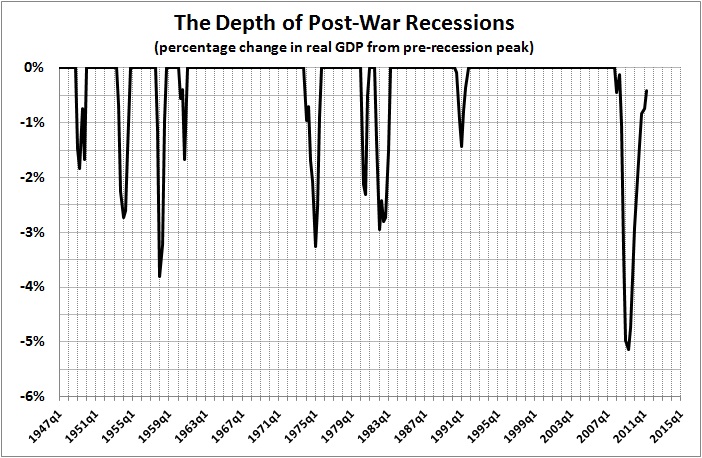

Derived from quarterly estimates of real GDP provided by the Bureau of Economic Analysis.

To paraphrase Ronald Reagan: Money and credit are not the problem. Government policies — including the mismanagement of money and credit — are the problem.

FREE FINANCIAL MARKETS ARE THE SOLUTION

Government control and monopolization of money, banking, and credit has been the norm for so long that it is taken for granted by almost everyone. But the record of government misfeasance and malfeasance with respect to economic activity (barely touched on above) is such that the proponents of governmental interventions should bear the burden of proving that those interventions are warranted.

I will close with another paraphrase, this time of Winston Churchill: the free market is the least effective means of making resource-allocation decisions that foster material progress, except for all the rest.

Read on:
Mr. Greenspan Doth Protest Too Much
Economic Growth since WWII
The Price of Government
The Fed and Business Cycles
The Commandeered Economy
The Price of Government Redux
The Mega-Depression
Does the CPI Understate Inflation?
Ricardian Equivalence Reconsidered
The Real Burden of Government
Toward a Risk-Free Economy
The Rahn Curve at Work
How the Great Depression Ended
The Illusion of Prosperity and Stability
The “Forthcoming Financial Collapse”
Experts and the Economy
Estimating the Rahn Curve: Or, How Government Inhibits Economic Growth
The Deficit Commission’s Deficit of Understanding
The Bowles-Simpson Report
The Bowles-Simpson Band-Aid
The Great Recession is Over
The Stagnation Thesis
Government Failure: An Example
The Evil That Is Done with Good Intentions
America’s Financial Crisis Is Now
The Great Recession Is Not Over

Understanding Hayek

In an earlier post, I deployed the following statement by Michael Oakeshott:

How deeply the rationalist disposition of mind has invaded our political thought and practice is illustrated by the extent to which traditions of behaviour have given place to ideologies, the extent to which the politics of destruction and creation have been substituted for the politics of repair, the consciously planned and deliberately executed being considered (for that reason) better than what has grown up and established itself unselfconsciously over a period of time…. This is, perhaps, the main significance of Hayek’s Road to Serfdom — not the cogency of his doctrine, but the fact that it is a doctrine. A plan to resist all planning may be better than its opposite, but it belongs to the same style of politics. And only in a society already deeply infected with Rationalism will the conversion of the traditional resources of resistance to the tyranny of Rationalism into a self-conscious ideology be considered a strengthening of those resources. (From “Rationalism in Politics,” in Rationalism in Politics and Other Essays, new and expanded edition, pp. 26-7.)

I hereby retract my implied endorsement of Oakeshott’s view of Hayek as a rationalist. Hayek’s “doctrine” consisted of a reasoned, well-founded warning against central planning. That is no more a doctrine than a highway sign that warns of sharp curves ahead.

Hayek was very much an anti-rationalist. (The use of reason, in itself, is not rationalism, which values only reason and the ordering of socio-economic relationships by the use of reason.) For example, Peter G. Klein writes that

…Hayek’s later emphasis on group selection and spontaneous order is not shared by Mises…. A clue to this difference is in Hayek’s … statement that “Mises himself was still much more a child of the rationalist tradition of the Enlightenment and of continental, rather than of English, liberalism . . . than I am myself.” This is a reference to the “two types of liberalism” to which Hayek frequently refers: the continental rationalist or utilitarian tradition, which emphasizes reason and man’s ability to shape his surroundings, and the English common-law tradition, which stresses the limits to reason and the “spontaneous” forces of evolution. (“Biography of F.A. Hayek,” at Ludwig von Mises Institute)

As for The Road to Serfdom, Peter Boettke explains that it

was conceived of as part of Hayek’s Abuse of Reason project.  It was a political tract for its time, but it was also much more than that.  A careful reader can see in the book both where Hayek attempts to move beyond the political issues of his day to address more timeless issues of social cooperation….

Hayek’s basic thesis in The Road to Serfdom is that the lure of socialist ideology has the unintended and undesirable consequence of economic depravation and political tyranny when countries follow its policy agenda.  The reason for this is that the task of socialist planning requires economic planners to assume a level of responsibility for economic life in a country which is both cumbersome to the point of impossible, and powerful beyond any reasonable limit that could be safely trusted to any one individual or group of individuals….

Hayek’s book was not a deterministic one, but rather a warning to those countries of the West who were enamored with socialist ideology, that the implementation of socialism would tend to undermine the beliefs that were at the core of Western civilization….

…[S]ixty years on, we are still celebrating Hayek’s achievement with The Road to Serfdom.

Most of this celebration of Hayek, admittedly, is ideological in nature and confirms Hayek’s status as an iconic figure for the world-wide conservative and libertarian movement. I do not deny the importance of this in explaining the popularity of Hayek’s work, but I also think those who rely on this explanation exclusively relegate Hayek’s work to the status of a “coffee-table book” — a work to be seen as in one’s possession among the intelligentsia but not read.  Rather, I want to stress the analytical contribution that Hayek makes in his work….

Hayek sought to demonstrate in a manner persuasive to the public and the intellectual elite that the consequences of the policy choice of socialism would lead them down a path that they themselves would never want to go if they made their choices in full knowledge of the consequences of their choice.  It is a tragic tale he is telling in The Road to Serfdom, not one of determinism or even opportunism.  “Is there a greater tragedy imaginable,” Hayek asks, “than that, in our endeavor consciously to shape our future in accordance with our highest ideals, we should in fact unwittingly produce the very opposite of what we have been striving for?” (“On reading Hayek: choice, consequences, and The Road to Serfdom“)

Hayek was out to slay the rationalistic dragon of market socialism:

economic systems where the means of production are publicly owned, managed and operated for a profit in a market economy…. Theoretically, the fundamental difference between a traditional socialist economy and a market socialist economy is the existence of a market for the means of production and capital goods under market socialism.

On that point, Boettke writes:

[Hayek] never impugns the character of those he is arguing with, instead he points out how their intellectual error leads to results that would make these individuals shudder with fear. To reiterate …, the market socialists thought their model of socialist planning could be reconciled with consumer sovereignty, but their position was untenable due to the organizational problems of socialism in terms of aligning incentives, utilizing information, and discovering knowledge.  Neither Lerner nor Durbin [two leading market socialists] ever admitted that Hayek had refuted their claim to have squared the circle.  Of course, they believe in individualism and not authoritarian government. But their theory if put into practice would have resulted in a march toward serfdom as special interest forces would be unleashed to agitate for greater and greater government control over resources and the allocation of labor. Either consumer sovereignty would be suppressed, or planning would have to be abandoned — but the two could not be reconciled. (Id.)

Boettke concludes:

Hayek wrote The Road to Serfdom at a crucial stage in the 20th century. The Nazi threat to western civilization had just been defeated, but the Communist system had grown in legitimacy in the process.  Communism had avoided the Great Depression, and whatever problems might exist, Stalin did mobilize the resources in the Soviet Union to transform a peasant society into an industrial power in a generation and effectively enough to help the allies defeat Hitler.  Hayek’s argument was that our fascination with the Communist ideal will prove to be our undoing unless we recognize the warning signs.  He stood there and could do no other, but to pen this warning.

The Road to Serfdom made Hayek a famous man, but it also partially discredited him among his fellow academics and the intellectual elites in the west.  But he was not deterred and his career post-1944 focused increasingly on the issues of social philosophy and political economy….

…Hayek’s emphasis [was] on how alternative institutional arrangements, through their properties to align incentives and utilize dispersed information, impact the choices people make…. (Id.)

(For more by Boettke, see “Hayek’s the Road to Serfdom Revisited: Government Failure in the Argument Against Socialism,” and “Hayek and Market Socialism: Science, Ideology, and Public Policy.”)

Hayek, in short, was prescriptive only to the extent that his understanding of human nature and social relationships enabled him to issue well-founded warnings about the unintended and undesirable consequences of rationalistic schemes — like socialism.

As for Hayek’s Abuse of Reason project, here is Bruce Caldwell’s outline:

In late August 1939 Hayek sent a letter to his friend Fritz Machlup saying that … he would begin work on a new project, tracing the decline of reason from Saint-Simon to Hitler. The plan of the work was contained in an outline prepared in the summer of 1940, titled “The Abuse and Decline of Reason: The Reflections of an Economist on the Self- Destructive Tendencies of Our Scientific Civilization.” The introduction was to be titled “The Humility of Individualism.” Part 1, called “The Collectivist Hybris,” would trace the topic through French, German, English, and American phases. Part 2 was to be called “The Totalitarian Nemesis.” In a slightly later outline, the first chapter of part 1 was to be “Scientism.”

The Abuse of Reason project would tell a very different story from that of the steady side-by-side progress of socialism and democracy that Webb and others espoused. In Hayek’s alternative tale, the steady growth of scientism and of the planning mentality engendered the (in Hayek’s view, false) hope that scientific advances would allow the creation of a new planned socialist society. Scientism and socialism grew up together. Hayek would trace out the pedigree and history of the ideas that he felt had led the western world to totalitarianism. (“Hayek on Mill”)

In sum, Hayek’s work is anti-doctrinal. Its implications for policy are negative ones. As Francis Fukuyama writes,

Hayek’s skepticism about the effects of “big government” are rooted in an epistemological observation summarized in a 1945 article called “The Uses of Knowledge in Society.” There he argued that most of the knowledge in a modern economy was local in nature, and hence unavailable to central planners. The brilliance of a market economy was that it allocated resources through the decentralized decisions of a myriad of buyers and sellers who interacted on the basis of their own particular knowledge. The market was a form of “spontaneous order,” which was far superior to planned societies based on the hubris of Cartesian rationalism. (“Friedrich A. Hayek, Big Government Skeptic,” The New York Times, May 6, 2011)

So far, so good. But Fukuyama later discusses “two major critiques of Hayek’s arguments”:

The first comes from the left. Hayek provides a very minimalist definition of freedom as freedom from coercion, and particularly coercion by a central government. But as the economist Amartya Sen has argued, the ability to actually take advantage of freedom depends on other things like resources, health and education that many people in a typical society do not possess. (Id.)

Sen is talking about “positive liberty,” which I have addressed here (among other places):

In other words, it is not enough to have “peaceful, willing coexistence and its concomitant: beneficially cooperative behavior.” That kind of liberty — liberty in the fullest sense — encompasses the acts of love, affection, friendship, neighborliness, and voluntary obligation that help individuals acquire the “power and resources” with which they may strive to attain the fruits of liberty, insofar as they are willing and able to do so.

That should be enough to satisfy the proponents of positive liberty … but I suspect otherwise. I would be more sanguine were they proponents of a proper definition of liberty, but they are not. Thus, armed with an inchoate definition of liberty, they are prepared to do battle for positive liberty and, I fear, the positive rights that are easily claimed as necessary to it; to wit:

  • A lack of “power” entitles certain groups to be represented, as groups, in the councils of government (a right that is not extended to other groups).
  • A lack of “resources” becomes the welfare entitlements of various kinds — for personal characteristics ranging from low intelligence to old age — which threaten to suck ever more resources out the productive, growth-producing sectors of the economy.
  • The exercise of “free will” becomes the attainment of certain “willed” outcomes, regardless of one’s ability or effort, which then justifies such things as an affirmative-action job, admission to a university, a tax-subsidized house, etc.
  • “Classism,” “sexism,” “racism,” and now “beauty-ism” become excuses for discriminating against vast swaths of the populace who practice none of those things.

With respect to the final point, a certain degree of unpleasantness inevitably accompanies liberty. Legal attempts to stifle that unpleasantness simply spread injustice by fomenting resentment and covert resistance, while creating new, innocent victims who are deemed guilty until they can prove their innocence.

In sum, the line between positive liberty and positive rights is so fine that the advocacy of positive liberty, however well meant, easily becomes the basis for preserving and extending the burden of positive rights that Americans now carry. (“Positive Liberty vs. Liberty”)

Positive liberty and positive rights are aspects of social justice, a concept that Hayek rightly rejected. If some are granted positive rights in the name of positive liberty or social justice, others must perforce be denied liberty — at the whim of the state. Those who presume to decide who is deserving and who is not are arrogant accountants of the soul.

Fukuyama, ends by echoing (unwittingly, I suspect) Oakeshott’s critique:

In the end, there is a deep contradiction in Hayek’s thought. His great insight is that individual human beings muddle along, making progress by planning, experimenting, trying, failing and trying again. They never have as much clarity about the future as they think they do. But Hayek somehow knows with great certainty that when governments, as opposed to individuals, engage in a similar process of innovation and discovery, they will fail. He insists that the dividing line between state and society must be drawn according to a strict abstract principle rather than through empirical adaptation. In so doing, he proves himself to be far more of a hubristic Cartesian than a true Hayekian. (Fukuyama, op. cit.)

William Easterly responds:

To say Hayek’s skepticism about government was based on “great certainty” is not just wrong, it is so much the opposite of  Hayek, it’s like accusing Michele Bachmann of excessive belief in the Koran.

Hayek’s view of knowledge was that it was partial and dispersed among many. The market gave individuals the incentives to apply this knowledge, and coordinated the uses of this local knowledge in a way that rewards each of us who knows best about any particular narrow area…. Government usually lacks both the incentives and the coordination mechanism. In government we don’t know who knows best, so which knowledge wins the argument could often be wrong. (“Saving Private Hayek”)

A good summation is found in a blog post by Peter Boettke:

Hayek [in The Road to Serfdom] was not diagnosing the situation in Russia and Germany, but offering a warningto the countries of the West that they could in fact go down the same path as Russia and Germany if they didn’t resist the lure of socialist ideology.  And critical to his argument was that democratic institutions were not a robust bulwark against the excesses that logically result from socialist planning.  In short, even a civilized attempt at democratic socialism will have unintended and undesirable consequences.

Another way to think about this is that Hayek begins his work with full knowledge (and acceptance) of Mises’s critique of socialism, but he is examining a world where political leaders and intellectuals do not accept that critique and so they will pursue the socialist plans anyway.  They think the problem with Soviet Russia or Nazi Germany is the non-democratic nature of the political systems, and not the economic planning being pursued.  So planning advocates in the West, wanted to pursue economic planning within the context of a democratic political system.  Hayek is just pursuing the logic of what results given the nature of economic planning….

Critical to the current discussion on Hayek, Keynes and Planning is not the liberal credentials of the two thinkers, nor their intentions, but the logical tracing out of the intended and unintended consequences of economic planning.  As Keynes’s letter to Hayek about The Road to Serfdom reveals, he believed that he and Hayek were in essential agreement about the horrors of Soviet and Nazi planning, but in disagreement about the question of whether planning is the problem.  Instead, Keynes argues we want more, not less, planning provided that the planning was being done by men of high character.  In essence, Keynes didn’t get the point about the Mises-Hayek critique of socialism. (“What Was the Argument in The Road to Serfdom?“)

And so it goes. In the 67 years since the first publication of The Road to Serfdom, Americans have been herded (often willingly) down that road. Why? Because of economic illiteracy (a widespread belief in the “free lunch,” for example), the interest-group paradox (the belief that I can have my “free lunch” but I will not have to pay for the “free lunches” of others), and the kind of “soft despotism” (fascism’s friendly face) that was foreseen by Alexis de Tocqueville.

Hayek was not a rationalist. He was a profound realist and, unfortunately, a prescient one.

*   *   *

Related posts (most of the posts listed at the following links):
Liberty and Rights in Principle and Practice
Basic Economics
The Economic and Social Consequences of Government
Political Incorrectness — Antidotes to “Liberal” Cant

Voluntary Taxation

Will Wilkinson, writing at The Economist, quotes Ayn Rand and begs to differ with her:

Ayn Rand’s position on government finance is unusual, to say the least. Rand was not an anarchist and believed in the possibility of a legitimate state, but did not believe in taxation. This left her in the odd and almost certainly untenable position of advocating a minimal state financed voluntarily. In her essay “Government Financing in a Free Society”, Rand wrote:

In a fully free society, taxation—or, to be exact, payment for governmental services—would be voluntary. Since the proper services of a government—the police, the armed forces, the law courts—are demonstrably needed by individual citizens and affect their interests directly, the citizens would (and should) be willing to pay for such services, as they pay for insurance.

This is faintly ridiculous. From one side, the libertarian anarchist will agree that people are willing to pay for these services, but that a government monopoly in their provision will lead only to inefficiency and abuse. From the other side, the liberal statist will defend the government provision of the public goods Rand mentions, but will quite rightly argue that Rand seems not to grasp perhaps the main reason government coercion is needed, especially if one believes, as Rand does, that individuals ought to act in their rational self-interest.

It’s true that we each benefit from the availability of genuinely public goods, but we benefit most if we are able to enjoy them without paying for them. A rationally self-interested individual will not voluntarily pay for public goods if she believes others will pay and she can get a free ride. But if we’re all rationally self-interested, and we know we’re all rationally self-interested, we know everyone else will also try to get a free ride, in which case it is doubly irrational to voluntarily pitch in. (from “Ayn Rand on Tax Day,” free registration required)

Wilkinson’s analysis is more than faintly wrong. A rationally self-interested individual will voluntarily pay for something if his expected benefit is worth (to him) the price he pays. The fact that a purchase might yield uncompensated benefits to third parties (i.e., positive externalities) is beside the point. Individuals do many things with their money that benefit others, without expecting to be repaid by those others. Individuals also do things that benefit others, in more than the ordinary way of voluntary exchange — sometimes for money, sometimes not, and sometimes at the risk of life and limb.

In addition to the obvious but signifcant case of philanthropy, there are subtle things like building an elegant house with beautifully landscaped grounds. Clusters of such houses on upscale streets yield satisfaction not only to their owners but also to drivers, joggers, and strollers who pass through the neighborhood — often with the main purpose of enjoying the elegance and beauty that surrounds them.

A similar case in point is the practice observed in many neighborhoods of creating elaborate displays of Christmas lights. Such displays not only please the homeowners who create them (or pay someone to create them) but also the flocks of sightseers who are drawn to such displays. Homeowners (for the most part) do this without compensation from sightseers. (Some homeowners in a less-affluent neighborhood in Austin, which is known for its over-the-top lighting concoctions, have been known to invite voluntary donations to help defray the cost of their displays.)

Finally, on this point, there are not-so-subtle examples of doing good for others as a habit and even a way of life. Many persons devote many hours a week to voluntary work in schools, hospitals, and the like. Then there are firefighters, police officers, and a goodly fraction of the members of the armed forces who perform jobs that put them in harm’s way, and do so not only for the money they earn but often because they feel a duty to make their towns, cities, and nation safer for the inhabitants thereof.

In any event, a rationally self-interested person who values national defense or the justice system would be a good candidate for making voluntary contributions to support those kinds of governmental functions. It would be a simple thing for influential and very wealthy individuals and major corporations to parlay their self-interest into the creation of organizations that raise money from like-minded individuals and corporations. Imagine a version of the American Heart Association called the American Defense Association; imagine a version of the Junior League called the Justice League. If anything, it should be easier to entice “voluntary taxes” in support of essential functions like defense and justice than it is to entice contributions to charitable organizations, which seldom yield more than “feel good” benefits to donors.

Not all fund-raising efforts for charities succeed in obtaining donations from everyone they solicit, but fund-raisers neither expect nor require 100-percent success. Similarly, an American Defense Association or Justice League would not require 100-percent success in its efforts to raise enough money to defray the costs of national defense and domestic justice. It is enough that the prospect of being “taxed voluntarily” to support such causes would appeal to a large number of affluent taxpayers.

Of particular interest to fund-raisers would be those individuals and couples with adjusted gross incomes in the top 50 percent of the AGI distribution. For tax year 2008, the top 50 percent paid 97 percent of federal income taxes collected by the federal government. Before the Great Recession and associated “stimulus” spending, when the federal budget was nearly in balance, spending on national defense and justice (at all levels of government) accounted for about 20 percent of all government spending. It seems to me that the a rationally self-interested person or couple in the top 50 percent would leap at the chance to eliminate all of his or their taxes if the alternative were to donate a smaller amount to the causes of defense and justice. There would be holdouts — especially among affluent leftists, of course — but there would also be the usual donors who give far more than their “fair share.”

Consider, for example, the persons in the top 1 percent of the AGI distribution, who paid 38 percent of the federal income taxes collected for 2008, or the persons in the top 10 percent, who paid 70 percent of the taxes. Members of those groups (as well as others in the top 50 percent) would have a strong incentive to ensure the provision of defense and justice, understanding (as most of them do) the importance of order and stability to their livelihoods.

Further, I expect that many of top income-earners would lead example (as they do for charities) with their contributions. Additionally, I would expect them to be leading contributors to advertising campaigns that explain the economic benefits of maintaining a robust defense and vigilant system of justice while, at the same time, paying a lot less for government services. Chief among the benefits would be stronger economic growth — as money is saved and invested instead of being poured down so many rat-holes and into counterproductive regulatory agencies. In the end, there would be more jobs, higher incomes, less need for charity, and more money with which to dispense charity to truly needy individuals.

In summary, Wilkinson’s analysis seems rooted in a sterile conception of rational self-interest. It seems to assume that bright, hard-working, high-earning individuals cannot perceive the real benefits that would flow from “voluntary taxation” for certain purposes, namely, national defense and domestic justice.

America’s Financial Crisis Is Now

Reissued here.

The Evil That Is Done with Good Intentions

Social Security, Medicare, and Medicaid do several bad things at once:

They crowd out prospective providers of retirement funds, medical insurance, and medical care.

They create “moral hazard” by lulling people into the false belief that they will be well-taken-care of in their old age, thereby making it less likely that they will put aside money for their old age.

They therefore cause under-saving and, thus, under-investment in those things upon which economic growth depends: innovation and business creation.

If growth were not hobbled, there would be far fewer people in need of welfare programs and far more money available for voluntary assistance to those who truly cannot care for themselves.

Related posts:
Economic Growth since WWII
A Social Security Reader
The Price of Government
The Commandeered Economy
Rationing and Health Care
The Perils of Nannyism: The Case of Obamacare
The Price of Government Redux
More about the Perils of Obamacare
Health-Care Reform: The Short of It
The Mega-Depression
Presidential Chutzpah
As Goes Greece
The Real Burden of Government
Toward a Risk-Free Economy
The Rahn Curve at Work
The Illusion of Prosperity and Stability
The “Forthcoming Financial Collapse”
Estimating the Rahn Curve: Or, How Government Inhibits Economic Growth
The Deficit Commission’s Deficit of Understanding
Undermining the Free Society
The Bowles-Simpson Report
The Bowles-Simpson Band-Aid
Build It and They Will Pay
Government vs. Community
The Stagnation Thesis

Does World War II “Prove” Keynesianism?

In “How the Great Depression Ended,” I say that

World War II did bring about the end of the Great Depression, not directly by full employment during the war but because that full employment created a “glut” of saving. After the war that “glut” jump-started

  • capital spending by businesses, which — because of FDR’s demise — invested more than they otherwise would have; and
  • private consumption spending, which — because of the privations of the Great Depression and the war years — would have risen sharply regardless of the political climate.

That analysis is by no means an endorsement of simple-minded Keynesianism (as propounded by Paul Krugman, for example), which holds that the government can spend the economy out of a recession or depression, if only it spends “enough” (which is always more than it actually spends). But there is no point in pumping additional money into an economy unless the money elicits productive endeavors: business creation and expansion, leading to net capital formation and job creation.

Pumping additional money into government programs results in the misdirection of resources, at best, and in the discouragement of productive private activity, at worst. Discouragement takes two forms: crowding-out and active interference (usually through regulatory inhibitions).

The answer to the question of this post’s title is that World War II has nothing to do with Keynes or Keynesianism, as it is widely understood. Employment and output (measured in dollars) rose sharply during World War II, but most of the additional output was devoted to the war effort. Huge increases in government spending did not lead to huge increases in the material well-being of Americans, most of whom were working harder while being deprived of the fruits of their labors, through rationing.

If anything, the post-war recovery “proves” the folly and wastefulness of efforts to stimulate an economy through government spending. It was not government spending that re-started the U.S. economy after World War II, it was private spending on capital investments and consumer goods. Some of that private spending was encouraged by the end of regime uncertainty. That end was brought about by the curtailment of New Deal initiatives (until the 1960s) because of the war and FDR’s death. Private spending — which was boosted by wartime saving — would have been purely inflationary had businesses not been willing and able to create jobs and expand output.

Joe Stiglitz, Ig-Nobelist

This reminds me of these:

Joe Stiglitz, Ig-Nobelist

Taxing the Rich

More about Taxing the Rich

Social Justice

More Social Justice

The Public-School Swindle

I have a relative by marriage who’s a retired public-school teacher. She loved to moan about her “low” pay. She wasn’t alone, of course. Her refrain has been heard throughout the land for decade. Truth be told, however, she and her ilk were and are overpaid, as several commentators have explained (e.g., here, here, and here). The following diagram illustrates the machinations that yield above-market compensation for public-school teachers (and other) “public servants”.

Here’s a step-step-explanation:

1. The diagonal, solid-black lines represent the demand for teachers in the absence of tax-funded (public) schools (D-no pu) and the supply of teachers in the absence of tax-funded schools (S-no pu). The intersection of the S and D curves yields the level of teacher compensation (C-no pu) and employment (E-no pu) that would result were there nothing but private schools. (I am, for now, putting aside the question whether government should require school attendance through a certain age or grade, or dictate what is taught in schools.)

2. The picture changes dramatically with the introduction of tax-funded schools (indicated by the red lines). The supply of teachers for public schools (Spu) is to the left of S-no pu because (a) not all teachers are willing to work in public schools and (b) not all teachers are “qualified” to teach in public schools. The second condition arises when potential teachers have learned too much about the subjects they would teach, at the expense of taking too few (or none) of the “education” courses that enable fairly dim education majors to compile inflated grade-point averages.

3. The horizontal, solid red line indicates the inflated compensation (Cpu) that is offered by tax-funded school systems. This above-market rate of compensation is the product of an inter-scholastic “arms race”, in which school systems — goaded by administrators, teachers, parents, and (often) local businesspersons — seek to outdo the lavishness of other school systems, not only in the compensation of teachers and administrators but also in the number and kinds of non-essential courses and activities, and the lavishness and modernity of facilities and equipment. All of which is paid for (in the main) by taxpayers and consumers who have no say in the matter, but whose income and property can be seized for failure to pay the requisite taxes.

5. Not surprisingly, there are more teachers who are willing to work at public-school rates of compensation than public schools can hire (Epu), even with their inflated budgets. That is why some teachers turn to private schools, others accept substitute-teaching jobs, and some end up doing things like selling used cars. The green lines represent the supply of (Spr) and demand for (Dpr) private-school teachers. and the corresponding compensation of (Cpr) and number of teachers employed by (Epr) private schools.

6. The supply of teachers to private schools consists of (a) those teachers who cannot get jobs with public schools but are willing to teach in private schools and (b) those teachers who abhor the thought of teaching in public schools and are therefore willing to accept lower compensation for the privilege of teaching in private schools. The compensation of private-school teachers is lower than that of public-school teachers because

  • the compensation of public-school teachers is artificially inflated by the vast amounts of tax money extracted from persons who would not otherwise be in the market for education, let alone public-school education, and
  • the vastness of the tax burden limits the ability of persons who are in the market for education to pay for private schooling, that it, it artificially reduces the demand for private schooling.

Because the subsidization of public schools, there are far more teachers than would be the case in an entirely private system. Advocates of tax-funded education would count that as a plus, as they would the above-market wages of public-school teachers. In fact, it is a minus, because it means that resources are being diverted to less productive uses than they would be were education an entirely private matter. Moreover, mediocre teachers and administrators — often outfitted with lavish facilities and equipment — are being paid more than necessary to “educate” children in useless subjects, at the expense of taxpayers who could put that money to work providing better homes, relevant training, and more jobs for those same children.

This analysis undoubtedly applies to higher education as well as K-12 education. The presence of tax-funded colleges and universities unnecessarily drives up the cost of higher education and burdens many persons who derive no benefit from it.

In summary, public “education” — at all levels — is not just a rip-off of taxpayers, it is also an employment scheme for incompetents (especially at the K-12 level) and a paternalistic redirection of resources to second- and third-best uses. And, to top it off, public education has led to the creation of an army of left-wing zealots who, for many decades, have inculcated America’s children and young adults in the advantages of collective, non-market, anti-libertarian institutions, where paternalistic “empathy” supplants personal responsibility.


Related reading:
Mark J. Perry, “The Public-Sector Premium for School Teachers“, Carpe Diem, March 3, 2011
Ironman, “How Much Do Public-School Teachers Really Make Compared to Private-School Teachers?“, Political Calculations, March 30, 2017
Andrew J. Biggs, “No, Teachers Are Not Underpaid“, City Journal, April 26, 2018

Related posts:
School Vouchers and Teachers’ Unions
Whining about Teachers’ Pay: Another Lesson about the Evils of Public Education
I Used to Be Too Smart to Understand This
International Law vs. Homeschooling
GIGO
Religion in Public Schools: The Wrong and Right of It
The Home Schooler Threat?
The Real Burden of Government
The Higher Education Bubble
Our Miss Brooks
“Intellectuals and Society”: A Review

More Social Justice

Matt Zwolinksi has a post at Bleeding Heart Libertarians in which he asks “What Is Social Justice?” He offers a couple of specific answers and alludes to others. One of his offerings is something he calls prioritarianism.

Prioritarianism, as I understand it from Zwolinski’s explanation, assumes that (a) the welfare of an individual can be quantified, (b) the welfare of individuals can be summed, (c) the welfare-value of a marginal dollar is inversely proportional to the initial welfare state of the recipient, (d) the inverse relationship is stronger at lower initial welfare-values, and (e) most importantly, in accordance with (b), the welfare gained by the person to whom a marginal dollar is given somehow cancels the welfare lost by the person from whom that dollar is taken.

If this is a valid prescription for “social justice,” it must be capable of implementation. Otherwise, it is no more useful than a map of the Kingdom of Oz.

And who should be in charge of measuring welfare, summing it, and weighing the gains and losses in order to arrive at a socially “just” distribution of income, whatever that is? Well, we know the answer to that question: It has to be the state — or more accurately — elected officials and bureaucrats: people not known for their perspicacity, objectivity, and even-handedness.

In the alternative, a just society could be one where individuals engage in voluntary, cooperative exchanges of goods and services for their mutual betterment, and from the fruits of which they voluntarily aid those whom they know to be in need of aid.

The alternative is inevitably attacked as “unjust.” But it should be noted that such attacks come from individuals (philosophers, politicians, do-gooders, etc.) who would impose their own views of “social justice” on everyone. How any such imposition can be considered more “just” than a regime of voluntary, cooperative, mutually beneficial behavior is beyond me.

I submit that what we now have in the United States is a statist, “prioritarian” regime, with all of real-life arbitrariness, scheming, and graft that inexorably accompanies statism. What we need badly is a reversion to the kind of constitutional order that would allow the alternative to flourish.

Related posts:
Economic Growth since WWII
The Price of Government
The Commandeered Economy
The Price of Government Redux
The Mega-Depression
The Real Burden of Government
Toward a Risk-Free Economy
The Rahn Curve at Work
The Illusion of Prosperity and Stability
Estimating the Rahn Curve: Or, How Government Inhibits Economic Growth

Soros the Bootlegger

In the preceding post I summarized Bruce Yandle’s theory of regulation, which Yandle calls “Baptists and Bootleggers.” The “Baptists” are well-meaning parties who want to protect the public from something that they, the “Baptists,” consider harmful. The “bootleggers” are parties (usually incumbent producers of a product or service) who stand to benefit from regulations that put make it difficult or impossible for competition to arise.

The “bootleggers” side of the equation is known as regulatory capture, which “occurs when a … regulatory agency created to act in the public interest instead advances the commercial or special interests that dominate the industry or sector it is charged with regulating.” Regulatory capture is a common phenomenon, and it should be a telling argument for deregulation. It isn’t, of course, because of the all-too-human tendency to believe that with the right people or party in charge of things, capture would vanish. Good luck with that.

Anyway, it seems that George Soros, in addition to his other sins, is a “bootlegger” par excellence. Michael Knox Beran, writing in City Journal (“Exposing the Elites“), begins with this:

In 1997 George Soros, writing in The Atlantic, declared: “The main enemy of the open society, I believe, is no longer the communist but the capitalist threat.”

The words marked the beginning of a decade and a half of plutocratic progressivism. In July 2003, AFL-CIO political director Steven Rosenthal conferred with some of America’s richest tycoons at El Mirador, Soros’s estate in Southampton, to figure out how to defeat George W. Bush. In August 2004, the president of the Service Employees International Union, Andy Stern—the “most important labor boss in America”—traveled to Aspen to plot strategy in a moneyed conclave that included savings and loan moguls Herbert and Marion Sandler, Progressive Insurance founder Peter Lewis, and businessman John Sperling. Warren Buffett, de facto chairman of the country’s billionaires’ club, endorsed the candidacy of presidential aspirant Barack Obama, while the Democracy Alliance, which Matthew Vadum and James Dellinger dub “Billionaires for Big Government,” bankrolled progressive groups like ACORN and the Center for American Progress.

Beran then explains this odd alliance of plutocrats and “progressives”:

Is there something novel in these alliances which, Demos scholar David Callahan observes, have brought some of the nation’s most notable elites together during the last decade to make common cause with some of the country’s most progressive leaders? Hardly: pacts between munificent plutocrats and progressive reformers are one of the oldest tricks in oligarchy’s playbook….

[Henry] James’s and [Lionel] Trilling’s belief that social pity conceals an unacknowledged desire for power finds corroboration in the behavior of today’s elites, who in promoting the ostensibly virtuous cause of social reform are making a shrewd investment in their own continued dominance. Much of today’s big money was made during the extraordinary period of market liberalization that began around 1980 and came to an end with the crash of 2008. In pushing for a revival of the social state, tycoons who benefited from freer markets seek to limit market competition. If they succeed, they will forestall the emergence of a new generation of innovators, young Turks who would otherwise push the old Croesuses aside.

Classic “bootlegger” behavior. And Soros is a classic “bootlegger.” Ed Lasky, writing at American Thinker (“Soros Wins under Obama’s Energy Policies“), makes a good case that Soros is engaged in an act of massive “bootlegging”:

Are Barack Obama’s energy policies influenced by hedge fund billionaire and political patron, George Soros?

Abby Wisse Schacter, in the New York Post, notes that the Obama administration is clamping down on oil and gas development in America (both onshore and offshore) but is hell-bent on helping other nation’s tap their resources and points out that such help is being showered specifically in New Guinea, of all places.

It is starting to look obvious that the administration doesn’t want oil exploration and extraction at home while it is promoting the same exploration and extraction elsewhere — specifically Brazil and New Guinea….

Others have commented on Obama’s generosity regarding Brazil’s oil wealth and how those actions might help George Soros.

But focus should now turn towards the exotic land of New Guinea.

New Guinea? Why there? Why is he using our taxpayer dollars to help energy development in New Guinea? Hasn’t Secretary of the Interior Salazar bemoaned that his budget is just not large enough to process all the drilling permits submitted for tapping America’s oil and gas wealth? Why are he and the President devoting staff and money to help that undeveloped island nation?

Perhaps, he just wants to pay back George Soros, who was so instrumental in helping his election and the election of fellow Democrats across America. George Soros is the Patron Saint of the Democratic Party and was a very early and generous supporter of Barack Obama’s.  Soros even used a loophole in Federal campaign laws that allowed him and his family to give outsized donations to Barack Obama; he also fielded his army of so-called 527 groups (such as MoveOn.Org) to help Obama win the Oval Office.

Soros also stands to massively benefit if New Guinea becomes an energy power, especially if the American taxpayer subsidizes this development….

We won’t be the beneficiaries from the spending of tax dollars in New Guinea? We may actually be the losers from all that spending.

We have an abundance of natural gas (due to the tapping of our own shale gas reserves); we don’t need LNG. We have such vast amounts of natural gas that ports that were built to import LNG are being reconfigured to export LNG. Why is Obama spending our tax dollars to help a foreign competitor while increasing taxes exponentially on  American oil and gas companies? Why encourage New Guinea to develop its LNG capability to export to China, Japan, and other nations when we can and should export our own LNG to them?

But helping America’s oil and gas industry (and helping lower the energy bills for Americans) is not and never has been on the agenda of Barack Obama.

Obama’s rewarding his friends and donors, who no doubt will reciprocate by supporting him in 2012, is Cook County Politics writ large. That modus operandi has always guided him.

Does his agenda include helping further enrich George Soros, sugar daddy of the Democratic Party?

The “Baptists” in this case are environmentalists and their allies, who’d rather have Americans pay $10 for a gallon of gasoline than run the slightest risk of environmental damage. Well, that’s the excuse, anyway. The fact of the matter is that they’ve been duped into supporting a party that prizes power above all else, and multi-billionaires like George Soros, who profit from that power.

P.S. It’s also possible — and not unlikely — that Soros also has a bigger objective than making himself richer: http://www.newsrealblog.com/2011/03/28/communism-loving-george-soros-wants-to-kill-capitalism/

Bootleggers, Baptists, and Pornography

Bruce Yandle’s “Bootleggers and Baptists–The Education of a Regulatory Economist” appeared 28 years ago in Cato Institute’s Regulation (vol 7, no. 3). Yandle explains how he came to the evocative phrase “Bootleggers and Baptists”:

I joined the Council on Wage and Price Stability in 1976. There my assignment was to review proposed regulations from the Environmental Protection Agency (EPA), the Federal Trade Commission (FTC), the Department of Transportation (DOT), and parts of the Department of Health, Education, and Welfare (HEW)…. I was ready to educate the regulators. But then I began to talk with some of them, and I began to hear from people in the industries affected by the rules. To my surprise, many regulators knew quite a bit about economics. Even more surprising was that industry representatives were not always opposed to the costly rules and occasionally were even fearful that we would succeed in getting rid of some of them. It was in considerable confusion that I returned later to my university post, still unable to explain what I had observed and square it with the economics I thought I understood.

That marked the beginning of a new approach to my research on regulation. First, instead of assuming that regulators really intended to minimize costs but somehow proceeded to make crazy mistakes, I began to assume that they were not trying to minimize costs at all — at least not the costs I had been concerned with. They were trying to minimize their costs, just as most sensible people do….

Second, I asked myself, what do industry and labor want from the regulators? They want protection from competition, from technological change, and from losses that threaten profits and jobs. A carefully constructed regulation can accomplish all kinds of anticompetitive goals of this sort, while giving the citizenry the impression that the only goal is to serve the public interest.

Indeed, the pages of history are full of episodes best explained by a theory of regulation I call “bootleggers and Baptists.” Bootleggers, you will remember, support Sunday closing laws that shut down all the local bars and liquor stores. Baptists support the same laws and lobby vigorously for them. Both parties gain, while the regulators are content because the law is easy to administer. Of course, this theory is not new. In a democratic society, economic forces will always play through the political mechanism in ways determined by the voting mechanism employed. Politicians need resources in order to get elected. Selected members of the public can gain resources through the political process, and highly organized groups can do that quite handily. The most successful ventures of this sort occur where there is an overarching public concern to be addressed (like the problem of alcohol) whose “solution” allows resources to be distributed from the public purse to particular groups or from one group to another (as from bartenders to bootleggers).-

Where does pornography come in? For a long time, pornography was prohibited, just as alcoholic beverages were (for the most part) during Prohibition. That didn’t stop the production of pornography, of course, but it did reduce the flow of output, making pornography more lucrative  — for those willing to buck the law —  than it would have been in the absence of prohibition.

It should come as no surprise that — even in this day of government-approved licentiousness — there are members of the port industry who are critical of the approval of the .xxx domain. According to NewsLime.com,

Internet Corp. for Assigned Names and Numbers (ICNN), the group that supervises the naming system of the Internet, approved .xxx domain for use in pornographic sites. This decision was made amid opposition from porn stars and other people in the industry who contended that the approval will just lead to censorship.

Religious groups also argued that web content of pornographic sites will be legitimized when they are given their own corner of the Internet….

Critics that [sic] include Vivid Entertainment, producer of adult video, and Free Speech Coalition contended that the triple x suffix of the domain would make a virtual section of the Internet that would undermine speech and would eventually lead to censorship.

What the “bootleggers” in the porn industry mean, of course, is that their commercial products will lose value because the .xxx domain will encourage entry into the porn market. Some of the entrants undoubtedly will provide “free samples” in the hope of getting viewers to pay for the more “tantalizing” material that is locked behind paywalls.

The  “Baptists” are the religious groups, of course. And they are sincere in their opposition to .xxx, whereas the “bootleggers” are merely cynical in their opposition.

So, there you have it. Another case study in “Bootleggers and Baptists.” For more, read Yandle’s article in its entirety. Also, read Yandle’s “Bootleggers and Baptists in Retrospect (Regulation, vol. 22, no. 3),” which appeared 15 years later.

More about Taxing the Rich

This is a sequel to “Taxing the Rich,” which reproduces my correspondence with a correspondent who laments the unequal “distribution” of income and wealth. This installment is heavily edited, for the sake of brevity. And, for the sake of clarity, I have reorganized our exchange so that each of his points (in italics) is followed immediately by my response (in bold type).

My correspondent opens by referring to a link that I sent him about the distribution of wealth in the United States:

Granted 25% owning 87%  is a lot better than 2% owning 90% like in S. America, but satisfactory? Warren Buffett doesn’t think so. Nor George Soros. Nor do I. So certainly not revolution, but reformation seems in order.

It may be that George Soros and Warren Buffet don’t like the way things are, but their own wealth merely proves that they’re good at making money, not at setting economic policy for the country. Experts who venture outside their own fields of expertise remind me of the doctors who used to endorse Camel cigarettes.

I’m not sure why it’s “bad” that one-fourth of the people in this country own a relatively large fraction of the wealth in this country. The composition of the one-fourth has changed greatly over time, and will continue to change greatly. There’s no entrenched aristocracy that somehow controls the country or determines who gets how much income, except to the extent that money buys a certain amount of political influence. But you will have noticed that the left has been far more influential than the right for a long time, and that a lot of the very rich (perhaps most of them) tend to favor government welfare programs, highly progressive taxes, and other things associated with your party.

In any event, big fortunes are (usually) made by people who did something for their money — invented computer software, picked good businesses in which to invest — and so on. They don’t steal their money from anyone. (The same is true of John D. Rockefeller and the other so-called robber barons of the late 1800s and early 1900s, popular mythology to the contrary.) What they really do is make a lot of money from their investments while — and this is important — also creating better jobs and higher incomes for a lot of Americans. It’s a win-win thing. And it’s been going on for more than 200 years.

So, I can’t understand why it’s thought of as “bad” that some people earn large fortunes in the process of contributing to the growth of the country’s economy. The “concentration” of wealth in a fraction of the populace is just something that happens — it’s not part of a plot. And it means that the wealthy are doing something good, for their own benefit and the benefit of a lot of other people, not that they’ve stolen from others or are somehow oppressing them.

I do understand why this theme is popular now, in a time of economic stress and concerted efforts to reduce the size of government. But, as I’ve said before, I don’t think those efforts can be pinned on “the rich,” though some of them are sympathetic and supportive — just as some of them, like Soros, are unsympathetic and opposed. There are millions of taxpayers who are also feeling the pinch, and they are fed up with the inexorable rise of government spending. The push to cut the size and cost of government is about as “grass roots” as anything I’ve seen in my lifetime.

I do think experts can develop more than one field, especially when they can afford to, and weren’t the doctors endorsing camels paid to do so? Probably not your best example.

And it may not be so bad that 25% own 87%, may be the inevitable Darwinian sort out as you suggest, and it’s not ownership I find so objectionable if I felt they paid their fair share.

I agree that it’s possible for someone to be expert in more than one field, but I haven’t yet read any utterances by Buffet or Soros on economic policy that go beyond pushing their political views. Perhaps I’m not paying enough attention to them, but I doubt that they have anything to offer that I don’t get from reading a variety of “real” economists. It’s probably true that the doctors were paid for endorsing Camels, but the analogy holds true: doctors aren’t necessarily experts in all aspects of medicine. I wouldn’t ask a thoracic surgeon for advice about how to deal with allergies, for example. But that’s beside the main point, which is the question of economic policy and whether there’s something “wrong” with a skewed distribution of income and wealth, and whether high-income people are paying a “fair share” of taxes” (given that they’re already paying the lion’s share).  Bear with me to the end, because you’ll find out that my objective is to defend all taxpayers, and to promote growth that benefits all Americans. My defense of high rollers is merely incidental.

My thoughts about “fair share” and “Darwinism” are given below.

Is it not true that real wages/earnings of middle class or those less than or = $250,000/yr have shrunk or remained stagnant over last 30 years while income of top 2-3% (say, over $1,000,000/yr?) has grown exponentially? I’ve certainly seen studies re CEO pay.

The income of households in all quintiles of the income distribution has been rising, with some bumps along the way. This graph covers 1967-2003: http://en.wikipedia.org/wiki/File:United_States_Income_Distribution_1967-2003.svg. There’s been no significant change since 2003, as indicated by this Excel spreadsheet from the Census Bureau: http://www.census.gov/compendia/statab/2011/tables/11s0689.xls.
Also, it’s important to keep in mind that people aren’t “stuck” in a particular quintile; there’s a general tendency to move up as one ages, and then to drop down a bit after retiring. For more, see this: http://mjperry.blogspot.com/2008/02/rich-getting-richer-and-poor-are.html.

My thoughts about CEO compensation are given below.

Isn’t the Tea Party focus on cutting government budgets just months after another unneeded/unwarranted huge tax break for the wealthiest a bit disingenuous? There will always be tug between those of us who think wealthy should pay more because they can afford to as either a Judeo/Christian responsibility or just self protection from violence, but…

Although there’s nothing new about organized efforts to cut government spending (it was a main theme of the GOP from the 1920s to the early 1950s), the current Tea Party movement began in February 2009. It had been gaining ground as an anti-spending movement well before the extension of the Bush tax cuts late in 2010.

Anyway, I don’t think of the two things — spending cuts and tax cuts — as contradictory. They are really complementary. If you see them as contradictory because tax cuts can exacerbate deficits, that may be because you don’t want to see the spending cuts. (I don’t know that for sure, it’s just a guess.) I, on the other hand, see tax cuts as putting more pressure on the folks in Washington to make some spending cuts. The serious problem with the looming deficits isn’t so much the mounting pile of government debt and high interest payments (though those are problems). The serious problem is that government spending absorbs resources that could be put to work building the economy through the operation of the market mechanism — which is how this country’s economic progress has been achieved. (Economic “Darwinism” is a matter of offering things that people value in their daily lives and business operations. If you’re good at it, you’ll prosper; if you’re not, you won’t. I can’t think of a fairer system; any alternative rewards people for doing the wrong things or doing them badly. In that respect, corporate welfare is no better than the other kind.)

As you know from our earlier exchange, high-income people already are paying the lion’s share of taxes in this country. (And, surprisingly, more than their peers in the other industrialized nations: http://www.taxfoundation.org/blog/show/27134.html.) I don’t think it has much (or anything) to do with Judeo-Christian ethics or protecting themselves from violence. It’s the law, and governments have a lot of power when it comes to enforcing the law. Some would gladly pay more, which they can do by sending a donation to the U.S. Treasury. But it isn’t their place to speak for all high-income people, which is gross presumption. A mega-millionaire or billionaire who invests his money in new technologies is doing more for working people than a billionaire who sends the same amount of money to D.C.

The U.S. was prosperous resulting in surplus under Clinton, so we couldn’t go back to the higher tax rates of the Clinton years?

The prosperity under Clinton was a continuation of the growth that began with Reagan’s tax cuts and the success of the Fed’s anti-inflationary efforts in the early 1980s. There was a minor recession in 1990-91, but growth had resumed before Clinton took office. The surpluses that he eventually realized had a lot to do with the fact the his spending proclivities were reined in by the GOP-controlled Congress. So, no, I don’t see any magic in the higher tax rates of the Clinton years. The real magic is a combination of reduced government spending and more incentives for people to do things that create wealth for themselves and jobs and higher incomes for others — that is, lower tax rates across the board.

I know that you’d call this “trickle down economics,” but it’s not really. I’m not just trying to defend high-income earners from ill-advised taxation, I’m trying to defend everyone from it. Economic growth requires not only big investments by high rollers but also small investments by “little people.” Why? Because (a) most new jobs are created in smaller businesses (http://www.sba.gov/advocacy/847; http://www.sba.gov/advocacy/7495/8424), and (b) from acorns do mighty oaks grow (think Ford, Microsoft, and the like). And growth benefits working people generally, and everyone who has a spare dollar to invest in a mutual fund (stocks for the risk-takers, bonds for the risk-averse).

Mega millionaires & billionaires continue to make off with a disproportionate share have pitted us against each other.

I’m not sure what you mean when you refer to “disproportionate share.” Let’s take highly paid athletes. The top-100 single-season salaries in baseball (through 2010) range from A-Rod’s $33 million in 2009 to Richie Sexson’s $16 million in 2008. The average major-league player’s salary in 2010 was $3.3 million (http://baseball.about.com/od/newsrumors/a/2010baseballteampayrolls.htm). Are those multi-millionaires making off with a “disproportionate share,” relative to (say) a member of the grounds crew? Or are they simply being paid a requisite amount for their expected contributions to their teams’ bottom lines?

Is the case of CEOs vs. floor sweepers any different? If so, why? In any event, high CEO compensation is mainly a symbolic thing that’s a handy target for griping. Top CEOs don’t make any more than baseball players (http://www.theglobeopinion.com/section/business/executive-compensation), and they’re on the line for the performance of companies that are vastly larger than baseball clubs.

Related posts:
The Causes of Economic Growth
A Short Course in Economics
Addendum to a Short Course in Economics
Enough of “Social Welfare”
The Case of the Purblind Economist
Economic Growth since WWII
The Price of Government
Does the Minimum Wage Increase Unemployment?
The Price of Government Redux
The Mega-Depression
The Real Burden of Government
Toward a Risk-Free Economy
The Rahn Curve at Work
The Illusion of Prosperity and Stability
Society and the State
The “Forthcoming Financial Collapse”
Estimating the Rahn Curve: Or, How Government Inhibits Economic Growth
The Deficit Commission’s Deficit of Understanding
Undermining the Free Society
The Bowles-Simpson Report
The Bowles-Simpson Band-Aid
Build It and They Will Pay
Government vs. Community
The Stagnation Thesis
Government Failure: An Example

Taxing the Rich

UPDATED 03/20/11

The quotation below is the text of a private message I sent to a friend who laments the unequal “distribution” of income and wealth. (I use sneer quotes around “distribution” because the use of the word suggests that there is a pie to be divided; a fallacy that I address later.) The friend likens the United States to corrupt Latin American regimes of yore, where wealth and political power were concentrated in the hands of land owners. He then attributes this mythical situation to Reagan’s “trickle down economics.” Emotion trumps facts, as usual on the left.

I’m sending this for your private consideration, in view of your latest post. I’m not sure what prompted that post, or what it’s based on, but there are a lot of misconceptions about income distribution and tax burdens in the United States. First, income rises across the board; it isn’t just “the rich” who get richer (http://mjperry.blogspot.com/2008/02/rich-getting-richer-and-poor-are.html).Second, unlike Latin America, there is a lot of mobility across income groups; “the rich” are not the same set of people from year to year and decade to decade (http://mjperry.blogspot.com/2007/11/despite-mythology-income-mobility-is.html). Third, most of “the rich” in the U.S. got that way by earning their incomes (http://mjperry.blogspot.com/2008/04/inheritance-is-not-main-driver-of.html), unlike Latin American aristocrats. Fourth, “the rich” already pay the lion’s share of income taxes (http://www.taxfoundation.org/news/show/250.html#Data).

Although most people in the United States deserve what they earn, because they’re not stealing it from other people, I agree that there are a lot of high rollers who earn more than they would if they weren’t granted special privileges by government. The giveaways to the financial industry are a notorious example. But bankers are only the tip of the iceberg, which extends down through many income levels. Not far from the top are members of Congress, who have one of the best self-created pension rackets going. (A cushy, guaranteed, taxpayer-funded pension amounts to a substantial, untaxed bonus.) Further down the ladder, but still worthy of note, are government employees — whether unionized or not — whose low quit-rates attest to the fact that their compensation (which usually includes generous pension benefits) is above what they could earn in the private sector. It is only in the past few years that public-sector employees have begun the feel the effects of tight budgets. Which is to say that they’ve had a free ride for a long time, at taxpayers’ expense.

Bottom line: A high income isn’t necessarily a sign of political corruption or special privileges. Nor is it clear that high-income earners are paying less than their “share.” A good case can be made that they’re paying too much, because it’s high-income earners whose investments fund growth-producing, job-creating technology and business start-ups. What bothers me is people — at all income levels — who are given special privileges by government, which the rest of us pay for in taxes and higher prices for certain goods and services.

UPDATE:

My friend replies:

Thanks for offering your views, but I can’t see how 2% essentially owning 90% is good for the country, nor do I think it will stand.

My response:

I don’t know what you mean by 2% “owning 90%” of the country. It’s true that wealth is concentrated, but that has been true since the birth of the Republic, and it’s to be expected because wealth is strongly (but not perfectly) correlated with income. And except where government grants the kinds of privileges I mentioned earlier, one’s income depends on talent and effort. Further, as I pointed out earlier, income disparities aren’t permanent; there’s plenty of mobility in the U.S., up and down the ladder.

The U.S. isn’t a feudal aristocracy, ripe for revolution because of actual oppression. Some people make it, and some don’t; those who make it (excepting the beneficiaries of government privileges) are able to do so because, in this country, they’re free to reap the fruits of their effort and ability.

Moreover, there’s no fixed “pie” of wealth that’s jealously guarded by a ruling clique. There’s a (usually) growing pie, to which each able person adds as he or she is willing and able. And it belongs to those who produce it — not to “the country.”

If you’re interested in actual facts (as opposed to myths and slogans), you should read the links I sent previously (if you haven’t already) and also this one: http://en.wikipedia.org/wiki/Wealth_in_the_United_States.

The China Syndrome

Many (most?) “deficit hawks” invoke China as a reason to reduce government debt. The hawks say something like this: “China holds a lot of our debt and, presumably, will buy more of it, which means that ‘we’ are beholden to China.”

By that logic, China is beholden to “us” because China’s purchases of U.S. government debt are financed by Americans’ purchases of Chinese products. Moreover, there is not (as far as I know) a provision in U.S. securities that enables the holder to demand payment before the securities mature.

The real “threat” is that U.S. securities will become unattractive to China (and others), and so China (and others) will quit buying them. But that possibility has nothing to do with China (or any other foreign nation), and everything to do with prospective debt-buyers’ views about the soundness of U.S. government securities. A case in point is PIMCO, a huge investment company. Bloomberg News reports:

Bill Gross, who runs the world’s biggest bond fund at Pacific Investment Management Co., eliminated government-related debt from his flagship fund last month as the U.S. projected record budget deficits.

The economic threat to the U.S. doesn’t come from China, it comes from the U.S. government.

How Many Fallacies?

How many fallacies can you find in this Facebook post by a firefighter in a small Colorado town?

I’m a public employee. I am NOT the problem. The rich who created this crisis are putting middle class families against each other. Teachers, police officers, paramedics, firefighters, road workers etc. are NOT the enemy. If you’re jealous of our benefits, FIGHT FOR YOUR OWN, not against ours! We live here, pay taxes, work hard & try ……to support our families too.

Here’s my tally:

1. I assume that “this crisis” is the Great Recession, which has led to reductions in tax revenues, thus pushing some governments into the red. Well the Great Recession wasn’t created by “the rich.” It followed from the housing bubble, which was created by the Fed’s loose-money policy and lax mortgage-lending policies pushed by Democrat politicians and their pet agencies: Fannie & Freddie. Moreover, as far as “this crisis” has made it harder for governments to pay their bills, it is because (in part) they have had open-handed policies toward the compensation of government employees.

2. “The rich” aren’t pitting families against each other. Public employees are doing it by their greedy insistence on being paid above-market compensation at the expense of other workers.

3. “Teachers, police officers,” etc. ARE the enemy of taxpayers because they are able to extract above-market compensation from taxpayers with the help of politicians who are, in fact, counting on those teachers, etc., for votes.

4. Jealousy is not the issue. The issue is that teachers, etc., are extracting above-market compensation from taxpayers at the point of a gun, that is, through the government-run system of tax, spend, and elect. In other words, theft is the issue.

5. Public employees aren’t the only ones who work hard to support their families. Taxpayers also work hard to support their families — and to support public employees and their families.

The Stagnation Thesis

There’s a rather strange debate in progress about Tyler Cowen’s new book, The Great Stagnation: How America Ate All The Low-Hanging Fruit of Modern History, Got Sick, and Will (Eventually) Feel Better. I say “strange” because the debate seems to be about whether Americans (for the most part) are more prosperous, in real terms, now than in the early 1970s. The fact is that Americans (for the most part) are better off now, but not nearly as prosperous as they could be. The reason is that governmental interventions — spending and regulation — have stifled innovative activity by depriving it of funds, restricting its scope, and reducing its potential profitability. And it is innovative activity that drives economic growth.

Of the economist-bloggers I read, only Don Boudreaux seems to have cottoned to this fundamental fact. The others — including Cowen — seem to be arguing about trivialities and irrelevancies (e.g., here, here, here, here, here, here, here, here, and here). The entire discussion, beginning with Cowen’s thesis, diverts the reader’s attention from government’s economic destructiveness to the (futile) search for a price index that properly accounts for temporal changes in the kinds and quality of products and services.

My assessments of government’s destructiveness are given in these posts:

Economic Growth since WWII
The Price of Government
The Commandeered Economy
The Price of Government Redux
The Mega-Depression
The Real Burden of Government
Toward a Risk-Free Economy
The Rahn Curve at Work
The Illusion of Prosperity and Stability
Estimating the Rahn Curve: Or, How Government Inhibits Economic Growth

The last four decades, of which Cowen writes, are simply a continuation of a government-caused Mega-Depression, which began in the early 1900s. Here’s the bottom line: