The Price of Government Redux

In “The Price of Government,” I assess the staggering cost of government intervention in economic affairs:

Had the economy of the U.S. not been deflected from its post-Civil War course, GDP would now be more than three times its present level.

I should have referred in “The Price of Government” to an earlier post, “The Laffer Curve, ‘Fiscal Responsibility,’ and Economic Growth,” where I argue that an optimally sized government is one that

divert[s] a minimal fraction of economic output to government (about 15 percent, nowadays), for the purpose of protecting ourselves and our economic activities from predators, foreign and domestic. Any diversion beyond that is pure waste.

Fifteen percent of GDP represents the pre-1929 level (10 percent) plus an allowance for the additional cost of defending the nation in these more perilous times.

I should note that my assessments are consistent with the analysis that is summarized in The Empirical Evidence against Big Government, a presentation of the Center for Freedom and Prosperity. The presentation is based on two Heritage Foundation Papers: “The Impact of Government Spending on Economic Growth” and its “Supplement.”

P.S. In case you’re wondering how government interventions could have cost as much as three-fourths of GDP, consider the cost of just one pending legislative proposal. The cap-and-trade law, aimed at reducing carbon dioxide emissions, would cost between $800 and $3,100 per year, per family. If you think it’s a good idea to impose that cost on your fellow Americans, you have been hoodwinked into believing the myth of man-made global warming, the main supporters of which (surprise! surprise!) are the tax-and-regulate crowd.

Or consider Obamacare, with an advertised cost of about $900 billion over the next 10 years — and that’s before it really starts to get expensive. Moreover, none of the cost estimates for Obamacare reflects an important hidden cost: the damage it would do to the quantity and quality of medical care in the U.S. as drug research diminishes and prospective caregivers seek other, less regulated, occupations.

The Commandeered Economy

Revised and updated, here.


The Fed and Business Cycles

UPDATED 06/11/11

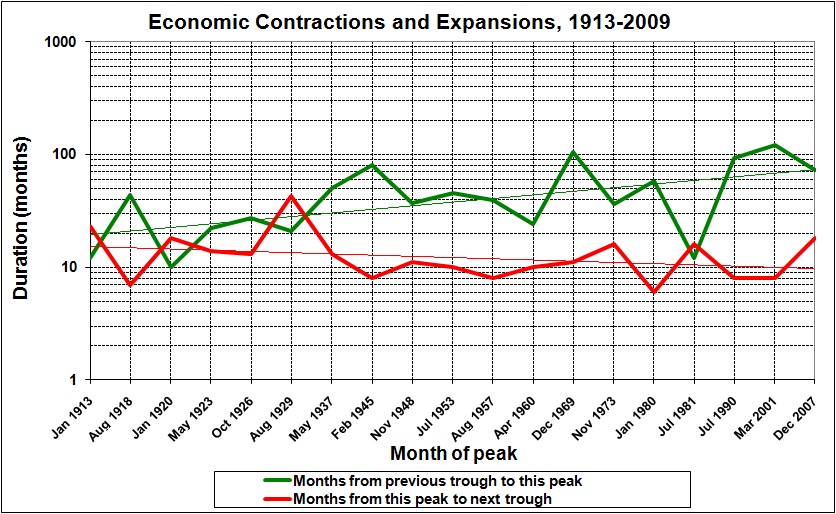
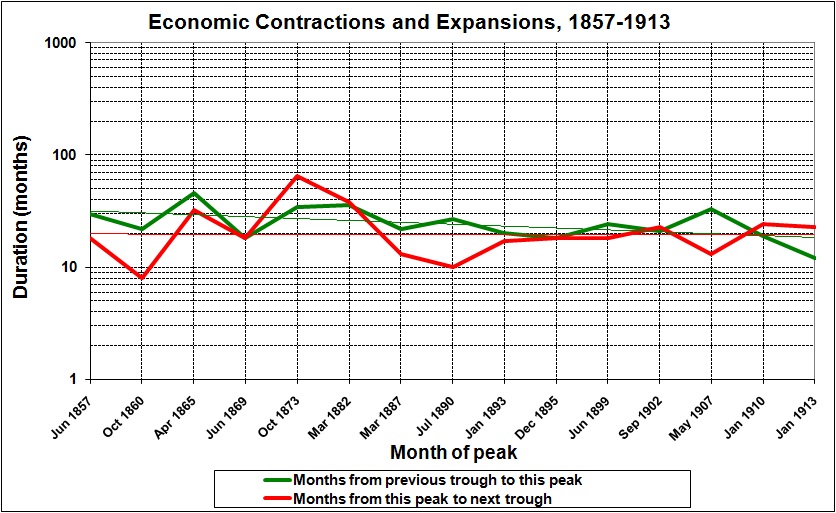
The following graphs depict the length of expansions and contractions (and the trends in both), before and since the creation of the Federal Reserve System in 1913.


Source: “Business Cycle Expansions and Contractions,” National Bureau of Economic Research.

The creation of the Fed might have had a hand in the lengthening of expansions and the shortening of contractions, but many other factors have been at work.

What the graphs don’t depict is the relative severity of the various contractions. It is worth noting that the worst of them all — the Great Depression — occurred after the creation of the Fed and, in part, because of actions taken by the Fed. (A note to the history-challenged: The Great Depression began in September 1929 and ended only because of America’s entry into World War II.) Moreover, the worst downturn since the Great Depression — the Great Recession — was clearly the work of the Fed, in unwitting(?) complicity with the politicians who insisted on expanding home ownership through subprime loans.

In any event, the long-run cost of economic stability has been high. (See this, this, and this, for example.)

*     *     *

Related reading: Scott Sumner, “In the 1930s It Seemed “Obvious” That Financial Turmoil Had Caused the Great Depression,” EconLog, February 17, 2014

Related post: Mr. Greenspan Doth Protest Too Much

Does the Minimum Wage Increase Unemployment?

Yes!

I have not a shred of doubt that the minimum wage increases unemployment, especially among the most vulnerable group of workers: males aged 16 to 19.

Anyone who claims that the minimum wage does not affect unemployment among that vulnerable group is guilty of (a) ingesting a controlled substance,  (b) wishing upon a star, or — most likely — (c) indulging in a mindless display of vicarious “compassion.”

Economists have waged a spirited mini-war over the minimum-wage issue, to no conclusive end. But anyone who tells you that a wage increase that is forced on businesses by government will not lead to a rise in unemployment is one of three things: an economist with an agenda, a politician with an agenda, a person who has never run a business. There is considerable overlap among the three categories.

I have run a business, and I have worked for the minimum wage (and less). On behalf of business owners and young male workers, I am here to protest further increases in the minimum wage. My protest is entirely evidence-based — no marching, shouting, or singing for me. Facts are my friends, even if they are inimical to Left-wing economists, politicians, and other members of the reality-challenged camp.

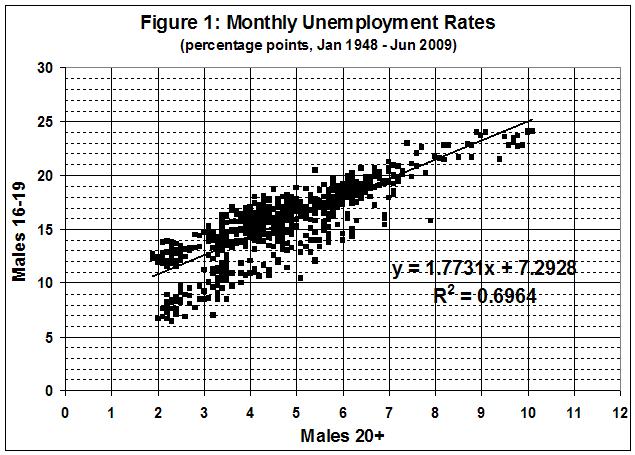
I begin with  time series on unemployment among males — ages 16 to 19 and 20 and older — for the period January 1948 through June 2009. (These time series are available via this page on the BLS website.) If it is true that the minimum wage targets younger males, the unemployment rate for 16 to 19 year-old males (16-19 YO) will rise faster or decrease less quickly than the unemployment rate for 20+ year-old males (20+ YO) whenever the minimum wage is increased. The precise change will depend on such factors as the propensity of young males to attend college — which has risen over time — and the value of the minimum wage in relation to prevailing wage rates for the industries which typically employ low-skilled workers. But those factors should have little influence on observed month-to-month changes in unemployment rates.

I use two methods to estimate the effects of minimum wage on the unemployment rate of 16-19 YO: graphical analysis and linear regression.

I begin by finding the long-term relationship between the unemployment rates for 16-19 YO and 20+ YO. As it turns out, there is a statistical artifact in the unemployment data, an artifact that is unexplained by this BLS document, which outlines changes in methods of data collection and analysis over the years. The relationship between the two time series is stable through March 1959, when it shifts abruptly. The markedness of the shift can be seen in the contrast between figure 1, which covers the entire period, and figures 2 and 3, which subdivide the entire period into two sub-periods.

090725_Minimum wage and unemployment_fig 1

090725_Minimum wage and unemployment_fig 2

090725_Minimum wage and unemployment_fig 3

For the graphical analysis, I use the equations shown in figures 2 and 3 to determine a baseline relationship between the unemployment rate for 20+ YO (“x”) and the unemployment rate for 16-19 YO (“y”). The equation in figure 2 yields a baseline unemployment rate for 16-19 YO for each month from January 1948 through March 1959; the equation in figure 3, a baseline unemployment rate for 16-19 YO for each month from April 1959 through June 2009. Combining the results, I obtain a baseline estimate for the entire period, January 1948 through June 2009.

I then find, for each month, a residual value for unemployment among 16-19 YO. The residual (actual value minus baseline estimate) is positive when unemployment among 16-19 YO is higher than expected, and negative when 16-19 YO unemployment is lower than expected. Again, this is unemployment of 16-19 YO relative to 20+ YO. Given the stable baseline relationships between the two unemployment rates (when the time series are subdivided as described above), the values of the residuals (month-to-month deviations from the baseline) can reasonably be attributed to changes in the minimum wage.

For purposes of my analysis, I adopt the following conventions:

  • A change in the minimum wage  begins to affect unemployment among 16-19 YO in the month it becomes law, when the legally effective date falls near the start of the month. A change becomes effective in the month following its legally effective date when that date falls near the end of the month. (All of the effective dates have thus far been on the 1st, 3rd, 24th, and 25th of a month.)
  • In either event, the change in the minimum wage affects unemployment among 16-19 YO for 6 months, including the month in which it becomes effective, as reckoned above.

In other words, I assume that employers (by and large) do not anticipate the minimum wage and begin to fire employees before the effective date of an increase. I assume, rather, that employers (by and large) respond to the minimum wage by failing to hire 16-19 YO who are new to the labor force. Finally, I assume that the non-hiring effect lasts about 6 months — in which time prevailing wage rates for 16-19 YO move toward toward (and perhaps exceed) the minimum wage, thus eventually blunting the effect of the minimum wage on unemployment.

I relax the 6-month rule during eras when the minimum wage rises annually, or nearly so. I assume that during such eras employers anticipate scheduled increases in the minimum wage by continuously suppressing their demand for 16-19 YO labor. (There are four such eras: the first runs from September 1963 through July 1971; the second, from May 1974 through June 1981; the third, from May 1996 through February 1998; the fourth, from July 2007 to the present, and presumably beyond.)

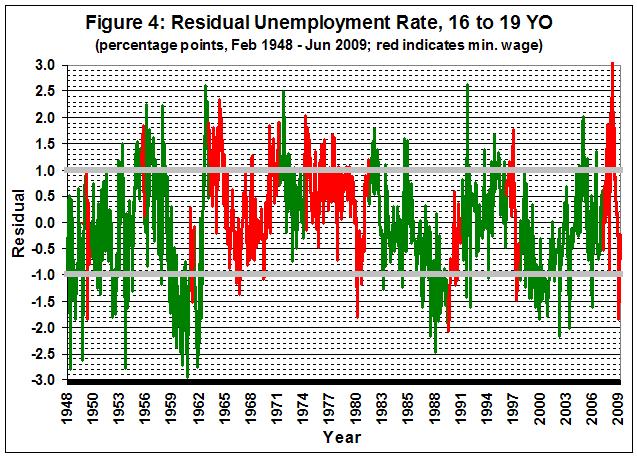
With that prelude, I present the following graph of the relationship between residual unemployment among 16-19 YO and the effective periods of minimum wage increases.

090725_Minimum wage and unemployment_fig 4

The jagged, green and red line represents the residual unemployment rate for 16-19 YO. The green portions of the line denote periods in which the minimum wage is ineffective; the red portions of the line denote periods in which the minimum wage is effective. The horizontal gray bands at +1 and -1 denote the normal range of the residuals, one standard deviation above and below the mean, which is zero.

It is obvious that higher residuals (greater unemployment) are generally associated with periods in which the minimum wage is effective; that is, most portions of the line that lie above the normal range are red. Conversely, lower residuals (less unemployment) are generally associated with periods in which the minimum wage is ineffective; that is, most portions of the line that lie below the normal range are green. (Similar results obtain for variations in which employers anticipate the minimum wage increase, for example, by firing or reduced hiring in the preceding 3 months, while the increase affects employment for only 3 months after it becomes law.)

Having shown that there is an obvious relationship between 16-19 YO unemployment and the minimum wage, I now quantify it. Because of the distinctly different relationships between 16-19 YO unemployment and 20+ YO unemployment in the two sub-periods (January 1948 – March 1959, April 1959 – June 2009), I estimate a separate regression equation for each sub-period.

For the first sub-period, I find the following relationship:

Unemployment rate for 16-19 YO (in percentage points) = 3.913 + 1.828 x unemployment rate for 20+ YO + 0.501 x dummy variable for minimum wage (1 if in effect, 0 if not)

Adjusted R-squared: 0.858; standard error of the estimate: 9 percent of the mean value of 16-19 YO unemployment rate; t-statistics on the intercept and coefficients: 14.663, 28.222, 1.635.

Here is the result for the second sub-period:

Unemployment rate for 16-19 YO (in percentage points) = 8.940 + 1.528 x unemployment rate for 20+ YO + 0.610 x dummy variable for minimum wage (1 if in effect, 0 if not)

Adjusted R-squared: 0.855; standard error of the estimate: 6 percent of the mean value of 16-19 YO unemployment rate; t-statistics on the intercept and coefficients: 62.592, 59.289, 7.495.

On the basis of the robust results for the second sub-period, which is much longer and current, I draw the following conclusions:

  • The baseline unemployment rate for 16-19 YO is about 9 percent.
  • Unemployment around the baseline changes by about 1.5 percentage points for every percentage-point change in the unemployment rate for 20+ YO.
  • The minimum wage, when effective, raises the unemployment rate for 16-19 YO by 0.6 percentage points.

Therefore, given the current number of 16 to 19 year old males in the labor force (about 3.3 million), some 20,000 will lose or fail to find jobs because of yesterday’s boost in the minimum wage. Yes, 20,000 is a small fraction of 3.3 million (0.6 percent), but it is a real, heartbreaking number — 20,000 young men for whom almost any hourly wage would be a blessing.

But the “bleeding hearts” who insist on setting a minimum wage, and raising it periodically, don’t care about those 20,000 young men — they only care about their cheaply won reputation for “compassion.”

UPDATE (09/08/09):

A relevant post by Don Boudreaux:

Here’s a second letter that I sent today to the New York Times:

Gary Chaison misses the real, if unintended, lesson of the Russell Sage Foundation study that finds that low-skilled workers routinely keep working for employers who violate statutory employment regulations such as the minimum-wage (Letters, September 8).  This real lesson is that economists’ conventional wisdom about the negative consequences of the minimum-wage likely is true after all.

Fifteen years ago, David Card and Alan Krueger made headlines by purporting to show that a higher minimum-wage, contrary to economists’ conventional wisdom, doesn’t reduce employment of low-skilled workers.  The RSF study casts significant doubt on Card-Krueger.  First, because the minimum-wage itself is circumvented in practice, its negative effect on employment is muted, perhaps to the point of becoming statistically imperceptible.  Second, employers’ and employees’ success at evading other employment regulations – such as mandatory overtime pay – counteracts the minimum-wage’s effect of pricing many low-skilled workers out of the job market.

Sincerely,
Donald J. Boudreaux

Why Is Entrepreneurship Declining?

Jonathan Adler of The Volokh Conspiracy addresses evidence that entrepreneurial activity is declining in the United States, noting that

The number of employer firms created annually has declined significantly since 1990, and the numbers of businesses created and those claiming to be self-employed have declined as well.

Adler continues:

What accounts for this trend? [The author of the cited analysis] thinks one reason is “the Wal-Mart effect.”

Large, efficient companies are able to out-compete small start-ups, replacing the independent businesses in many markets. Multiply across the entire economy the effect of a Wal-Mart replacing the independent restaurant, grocery store, clothing store, florist, etc., in a town, and you can see how we end up with a downward trend in entrepreneurship over time.

That may be true. It seems to me that another likely contributor is the increased regulatory burden. It is well documented that regulation can increase industry concentration. Smaller firms typically bear significantly greater regulatory costs per employee than larger firms (see, e.g., this study), and regulatory costs can also increase start-up costs and serve as a barrier to entry. While the rate at which new regulations were adopted slowed somewhat in recent years at the federal level (see here), so long as the cumulative regulatory burden increases, I would expect it to depress small business creation and growth.

Going further than Adler, I attribute the whole sorry mess to the growth of government over the past century. And I fully expect the increased regulatory and tax burdens of Obamanomics to depress innovation, business expansion, business creation, job creation, and the rate of economic growth. As I say here,

Had the economy of the U.S. not been deflected from its post-Civil War course [by the advent of the regulatory-welfare state around 1900], GDP would now be more than three times its present level…. If that seems unbelievable to you, it shouldn’t: $100 compounded for 100 years at 4.4 percent amounts to $7,400; $100 compounded for 100 years at 3.1 percent amounts to $2,100. Nothing other than government intervention (or a catastrophe greater than any we have known) could have kept the economy from growing at more than 4 percent.

What’s next? Unless Obama’s megalomaniac plans are aborted by a reversal of the Republican Party’s fortunes, the U.S. will enter a new phase of economic growth — something close to stagnation. We will look back on the period from 1970 to 2008 [when GDP rose at an annual rate of 3.1 percent] with longing, as we plod along at a growth rate similar to that of 1908-1940, that is, about 2.2 percent. Thus:

  • If GDP grows at 2.2 percent through 2108, it will be 58 percent lower than if we plod on at 3.1 percent.
  • If GDP grows at 2.2 percent for through 2108, it will be only 4 percent of what it would have been had it continued to grow at 4.4 percent after 1907.

The latter disparity may seem incredible, but scan the lists here and you will find even greater cross-national disparities in per capita GDP. Go here and you will find that real, per capita GDP in 1790 was only 3.3 percent of the value it had attained 201 years later. Our present level of output seems incredible to citizens of impoverished nations, and it would seem no less incredible to an American of 201 years ago. But vast disparities can and do exist, across nations and time. We have every reason to believe in a sustained growth rate of 4.4 percent, as against one of 2.2 percent, because we have experienced both.

Utilitarianism, “Liberalism,” and Omniscience

Utilitarianism is sort of under debate in the blogosphere (see here). But all the hifalutin’ philosophising misses the main point about utilitarianism: Those who practice it are arrogant pretenders to omniscience.

The appeal of utilitarianism rests on two mistaken beliefs:

  • There is such a thing as social welfare.
  • Transferring income and wealth from the richer to the poorer enhances social welfare because redistribution helps the poorer more than it hurts the richer.

Having disposed elsewhere of the second belief, I here address the first one.

The notion of a social welfare function arises from John Stuart Mill’s utilitarianism, which is best captured in the phrase “the greatest good for the greatest number” or, more precisely “the greatest amount of happiness altogether.” From this facile philosophy grew the patently ludicrous idea that it might be possible to quantify each person’s happiness, sum those values, and arrive at an aggregate measure of total happiness for everyone.

Utilitarianism, as a philosophy, has gone the way of Communism: It is discredited, but many people still cling to it under other names — “social welfare” and “social justice” being perennial favorites among the “liberal” intelligentsia.

How can supposedly rational “liberals” imagine that the benefits accruing to some persons (unionized employees of GM and Chrysler, urban developers, etc.) cancel the losses of other persons (taxpayers, property owners, etc.)? There is no realistic worldview in which A’s greater happiness cancels B’s greater unhappiness; never the twain shall meet.  The only way to “know” that A’s happiness cancels B’s unhappiness is to put oneself in the place of an omniscient deity — to become, in other words, an accountant of the soul.

It seems to me that “liberals” (most of them, anyway) reject God because to acknowledge Him would be to admit their own puniness and venality.

The “Big Five” and Economic Performance

The “Big Five” doesn’t comprise Honda, Toyota, Ford, GM, and Chrysler (soon to become the become the “Big Four”: Honda, Toyota, Ford, and GM-Chrysler-Obama Inc.). The “Big Five” refers to the Big Five personality traits: Openness, Conscientiousness, Extraversion, Agreeableness, and Neuroticism.

I discussed the Big Five at length here, and touched on them here. Now comes Arnold Kling, with an economic analysis of the Big Five, which draws on Daniel Nettle’s Personality: What Makes You the Way You Are. Kling, in the course of his post, discusses Nettle’s interpretations of the Big Five.

Regarding Openness, Kling quotes Nettle thusly:

Some people are keen on reading and galleries and theatre and music, whilst others are not particularly interested in any of them. This tendency towards greater exploration of all complex recreational practices is uniquely predicted by Openness….

High Openness scorers are strongly drawn to artistic and investigative professions, and will often schew traditional institutional structure and progression in order to pursue them.

Precisely. For example,  a high Openness scorer (93rd percentile) progressed from low-paid analyst (with a BA in economics) to well-paid VP for finance and administration (with nothing more than the same BA in economics), stopping along the way to own and run a business and manage groups of PhDs. The underlying lesson: Education is far less important to material success than intellectual flexibility (high Openness), combined with drive (high Conscientiusness and Neuroticism), and focus (low Extraversion and Agreeableness).

Kling says this about Conscientiousness (self-discipline and will power):

I think that people with low Conscientiousness annoy me more than just about any other type of people.

Me, too (Conscientiousness score: 99th percentile). I find it hard to be around individuals who always put off until tomorrow what they could do in a minute, who never read or return the books and DVDs you lend them, who are always ready to excuse failings (theirs and others), and who then try to cast their lack of organization (and resulting lack of personal accomplishment) as a virtue: “Life is too short to sweat the small stuff.” Yeah, but you never sweat the big stuff, either; look at the state of your house and your bank account. The small stuff and big stuff come in a single package.

According to Kling, “Nettle thinks of Extraversion as something like lust for life, sensation-seeking, and ambition.” More from Nettle:

We should be careful in equating Extraversion with sociability… shyness is most often due to … high Neuroticism and anxiety….

…The introvert is, in a way, aloof from the rewards of the world, which gives him tremendous strength and independence from them.

Right on, says this introvert (Extraversion score: 4th percentile).

Kling says this about Agreeableness:

To be agreeable, you have to be able to “mentalize” (read the feelings of others, which autistic people have trouble doing) and empathize (that is, care about others’ feelings, given that you can read them. Sociopaths can read you, but they don’t mind making you feel bad.)

On average, women are more agreeable than men. That is why Peter Thiel may have been onto something when he said that our country changed when women got the right to vote. If people project their personalities onto politics, and if agreeability goes along with more socialist policies, then giving women the right to vote should make countries more socialist.

Thiel is on to something. Although socialism gained a foothold in the U.S. during TR’s reign (i.e., long before the passage of Amendment XIX to the Constitution), it’s important to note that women were prominent agitators and muck-rakers in the early 1900s. Among other things, women were the driving force behind Prohibition. That failed experiment can now be seen as an extremely socialistic policy; it attempted to dictate a “lifestyle” choice, just as today’s socialists try to dictate  “lifestyle” choices about what we smoke, eat, drive, say, etc. — and with too-frequent success. If socialism isn’t a “motherly” attitude, I don’t know what is. (Full disclosure, my Agreeableness score is 4th percentile. Just leave me alone and I’ll live my life quite well, without any help from government, thank you.)

Finally, there’s Neuroticism, about which Nettle says:

There are motivational advantages of Neuroticism. There may be cognitive ones too. It has long been known that, on average, people are over-optimistic about the outcomes of their behaviour, especially once they have a plan… This is well documented in the business world, with its over-optimistic growth plans, and also in military leadership, where it is clear that generals are routinely over-sanguine about their likely progress and under-reflective about the complexities….

…Professional occupations are those that mainly involve thinking, and it is illuminating that Neuroticism tended to be advantageous in these fields and not in, say, sales.

Neuroticism (also known as Emotional Stability) is explained this way by an organization that administers the “Big Five” test:

People low in emotional stability are emotionally reactive. They respond emotionally to events that would not affect most people, and their reactions tend to be more intense than normal. They are more likely to interpret ordinary situations as threatening, and minor frustrations as hopelessly difficult. Their negative emotional reactions tend to persist for unusually long periods of time, which means they are often in a bad mood. These problems in emotional regulation can diminish a ones ability to think clearly, make decisions, and cope effectively with stress.

Take a person who is low in Emotional Stability (my score: 12th percentile), low in Extraversion, but high in Conscientiousness and Openness. Such a person is willing and able to tune out the distractions of the outside world, and to channel his drive and intellectual acumen in productive, creative ways — until he finally says “enough,” and quits the world of work to enjoy the better things in life.

Monopoly: Private Is Better than Public

In this discursive post, I use the economic concept of perfect competition as a starting point from which to defend monopoly and to expose the folly and futility of governmental intervention in markets.

PERFECT COMPETITION AS A BOGUS STANDARD

I learned, in the standard microeconomics of my college days, that perfect competition is preferred to these three alternatives:

  • imperfect competition, where there is some degree of product differentiation (real or perceived)
  • oligopoly, where a particular product or service is sold by only a few firms (“product or service” is hereafter called “good,” in keeping with economic jargon)
  • monopoly, where there is only one seller of a particular good.

The theoretical superiority of perfect competition rests on the belief that, compared with the alternatives, it yields the greatest output of goods and, therefore, the greatest degree of satisfaction to consumers; that is, perfect competition maximizes “social welfare.”

The standard analysis has many problems, the most fundamental of which is the observation selection effect. The observer, in this case, is the economist who views the world through the lenses of economic efficiency and “social welfare.”

The construct of economic efficiency involves gross generalizations about economic reality, which are based on ideal firms in an ideal world, not on the behavior of real firms in the messy world of reality. The construct, in other words, sets up an ideal world of perfect competition, divergences from which are judged less than optimal — as if unavoidable, real-world divergences are less valid than the perfections of an imaginary construct. (This is an instance of a Nirvana fallacy, “the logical error of comparing actual things with unrealistic, idealized alternatives.”)

Then there is “social welfare,” which perfect competition is purported to maximize. “Social welfare” is in fact a fictitious device whereby the person who invokes it assumes (implicitly if not explicitly) that the happiness of individuals can be summed, and that he knows just how to do it. The predictable result of “social arithmetic” is a call for some kind of governmental action that effectively redistributes income; for example:

  • Affirmative action, on balance, redistributes income from shareholders, consumers, and more-qualified workers to less-qualified workers.
  • Progressive taxation redistributes income from persons who earn a lot of money (the job-creators of the economy) to persons who earn less money. It also drives out high earners, to the detriment of the rest of us.
  • Trust-busting (which is of particular interest here) amounts to a redistribution of income from the owners of a oligopolistic or monopolistic firm to consumers.

“Social welfare,” in other words, is a phony excuse for playing God — a variant of the Nirvana fallacy. (For more, see this, this, and this.)

HOW GOVERNMENT INTERVENTION DOES MORE HARM THAN GOOD

Why is it not a good thing for government to act in ways that redistribute income from the owners of firms to consumers? There are several reasons, beginning with the artificiality of perfect competition (or something like it) as a model of how markets ought to be organized.

Then, there is the arrogance of a mindset that judges consumers to be more deserving that the owners of businesses — owners who staked a lot of money (and created jobs) on business ventures that might have gone sour (and often do). Is it possible that trust-busting discourages business (and job) formation? You can bet on it.

Related to that, it is necessary to remember that business owners are humans, too — 160 years of communist-populist-“progressive“-“liberal” rhetoric to the contrary notwithstanding. Business owners’ desire for profit is no less legitimate than consumers’ desire for low prices. Government is in the business of penalizing oligopolistic and monopolistic business owners not only because economists have set up a false standard (perfect competition or something like it), but also because the act of penalizing appeals to the envy of many voters and interest groups toward persons with legitimately high incomes. Trust-busting is neither logically nor morally admirable.

It is true that not all industries lend themselves to perfect competition or something like it, but it is neither necessary nor desirable to regulate firms in industries that are characterized by oligopoly and monopoly. (pace Paul Krugman). Oligopoly and monopoly are not iron-clad. Consumers have alternatives: If the price of X is “too high” they can (and will) buy more of Y and Z; if the price of X rises a lot, relative to the prices of Y and Z, the producer of X is likely to find himself with a direct competitor. In the alternative, more consumers will abandon X in favor of Y and Z.

TWO EMOTION-LADEN CASES

What about situations in which there seem to be no ready substitutes for a particular good? Lurking behind this question are fears of private monopolies controlling the supplis of water and medical goods. The case of medical goods is more straightforward, so I will deal with it before considering the supply of water.

Medicine

The supply of medical goods already is artificially low because of government, not in spite of it. Who licenses doctors and grants the A.M.A. a near-monopoly on the accreditation of medical schools? Who licenses and regulates hospitals? Who approves drugs and licenses pharmacists? The list of questions could go on and on, but the answer is always the same: government.

The average person will react along these lines: “Government has to be involved in the provision of medical goods, otherwise we would be taking our lives in our hands every time we go to a doctor or a hospital, and every time we use a drug.” I respond as follows:

The main effect of government regulation of certain goods (including medical ones) is to raise the cost of those goods by imposing costs on their providers and effectively barring additional providers from setting up shop. This unseen cost means that Americans consumer fewer medical goods than they would if government weren’t imposing costs on providers and barring prospective providers. (There is an argument that Americans, on balance, consume more medical goods than necessary because of Medicare, Medicaid, and tax-exempt, employer-subsidized health insurance. But given those distortions, it is true that regulation raises costs and restricts entry.) Is it possible that the net effect of regulations is to make Americans worse off rather than better off? A good case can be made for that proposition. (See this, this, and this.) The case of medical goods exemplifies Bastiat’s axiom that

a law produces not only one effect, but a series of effects. Of these effects, the first alone is immediate; it appears simultaneously with its cause; it is seen. The other effects emerge only subsequently; they are not seen; we are fortunate if we foresee them.

Water: The Hardest Case

No Inherent Need for Government Intervention

If the debate about government’s role in medicine evokes much emotion and little reason, any discussion of privatizing the water supply is certain to elicit the rawest of emotions: fear. A typical reaction goes like this: “If government doesn’t provide our water, greedy speculators will corner the market and we’ll all be at their mercy.” It is hard to imagine such a reaction in the 1800s, when a large fraction of the population lived in rural areas, where most water came from privately owned wells or was taken, by private means, from rivers and lakes. Government doesn’t have to provide water, and if it couldn’t stop a you from drilling a well in your backyard (which it can, thanks to its “police power”) many urbanites and suburbanites might be able to supply their own water.

In any event, there is no inherent reason for government to supply water. The simple fact is that “municipal water works” has acquired the totemic status of “public schools.” Both institutions have become so embedded that private alternatives (on a large scale) were unthinkable, until (in the case of public schools) failure became so obvious that it could no longer be ignored. (That the dominant solution to the failure of public schools is to throw more money at them is neither a negation of their failure nor of the widespread perception of failure.)

Scenario 1: “Accidental” Private Monopoly

Given that there is no inherent reason for government to provide water, I begin the analysis of water monopolies with the following hypothetical:

We have with a small, settled community of 25 homes, in which every home has a well (and has had one for generations). It is accepted by all members of the community that each homeowner is the owner of his well; that is, wells are not communal property. Further, every well provides an ample amount of water for such purposes as drinking, bathing, cooking, watering lawns and gardens, washing cars, etc.

Suddenly, because of some unforeseeable geological change, every well but one runs dry. And the owners of the  24 homes without functioning wells (the unlucky 24″) have no immediate or easy recourse to another source of water — a spring, stream, or lake — because there are none within a day’s drive of the community. The only convenient source of water is the 25th  home (“lucky 25”), whose well  seems to provide more than enough water for its owner — enough, in fact, to meet the drinking, bathing, and cooking needs of the “unlucky 24.”

Issues Arising from Scenario 1

How should the “unlucky 24” cope with the near-term problem of obtaining water for drinking, bathing, and cooking? Suppose that they have two practical options:

  • Appeal to “lucky 25” by offering him a price for water that would just cover the cost of providing it (electricity, pump repairs/replacements, etc.).
  • Buy water in large quantities from an out-of-area vendor — at a much higher price than they would offer “lucky 25.”

“Lucky 25,” the accidental water monopolist, has the following options:

  • Accept the offer made by the “unlucky 24.”
  • Make a counter-offer by setting a price that is somewhere between the offer made by the “unlucky 24” and the cost, to them, of buying water from an out-of-area vendor.
  • Refuse to sell water to the “unlucky 24,” for one of the following reasons: (1) It is his right to do so. (2) He doesn’t want to be in the water-selling business, with its attendant distractions. (3) He fears that drawing significantly greater amounts of water from his well will cause it to run dry.

(You should understand that this is a law-abiding community whose residents are respectful of  property rights — unlike the typical government — so that the water monopolist doesn’t have to worry about defending his well and himself against a mob.)

I daresay that the average reader would expect “lucky 25” to accept the offer made by the “unlucky 24.” But why should the accidental water monopolist accept the offer? He might, out of compassion, help the “unlucky 24” while they make other arrangements. But his help would be given out of compassion, not obligation.

The Permissibility of “Good Luck”

Yes, the water monopolist may have been “lucky” with respect to water, but perhaps he has been “unlucky” in other respects. Why, if “luck” determines one’s obligations to others, shouldn’t the water monopolist’s neighbors compensate him for his episodes of “bad luck” — the dog that was hit by a car, the underground stream which provides him ample water but threatens to undermine the foundation of his house, an errant wife, incorrigible children, etc.? Must “good luck” be penalized or paid for, as an act of “social justice”?

The answer is “no.” Anthony de Jasay explains, in “Economic Theories of Social Justice: Risk, Value, and Externality“:

Stripped of rhetoric, an act of social justice (a) deliberately increases the relative share … of the worse-off in total income, and (b) in achieving (a) it redresses part or all of an injustice…. This implies that some people being worse off than others is an injustice and that it must be redressed. However, redress can only be effected at the expense of the better-off; but it is not evident that they have committed the injustice in the first place. Consequently, nor is it clear why the better-off should be under an obligation to redress it….

Since Nature never stops throwing good luck at some and bad luck at others, no sooner are [social] injustices redressed than some people are again better off than others. An economy of voluntary exchanges is inherently inegalitarian…. Striving for social justice, then, turns out to be a ceaseless combat against luck, a striving for the unattainable, sterilized economy that has built-in mechanisms…for offsetting the misdeeds of Nature.

Scenario 2: Deliberate Water Monopoly

Suppose, now, that our water monopolist came by his monopoly in an entirely different way — a way that (to most of us) seems to draw on entrepreneurship, not “luck.” Suppose that he (and he alone) drilled a well for the purpose of selling water to his neighbors, whom (he knows and they know) cannot (and never could) find water under their properties. What should the water monopolist charge his neighbors for water? Just as much as they are willing to pay, of course. Is there anything immoral in that? If there is, why is it not immoral for an auto dealer to sell you a car for just as much as you are willing to pay, even if you need that car in order to earn a living?

Why should the water monopolist (or car dealer or anyone else) be forced by a legalized mob (i.e., government) to sell his product for a prescribed price, when he is the person who took the financial risk of drilling a well, not knowing for certain that he would strike water, at what rate it would flow, how long it would flow at that rate, and whether another source of water might materialize because of unforeseeable geological or climatological changes?

The answer to the question is found in emotion, not reason. Emotionally, we hold water to be more precious than, say, automobiles. Yet, many persons consume a lot of water for what might be called non-essential reasons (e.g., watering lawns, washing cars, filling swimming pools), and many persons need cars in order to earn a living. Water, stripped of its emotional baggage, isn’t a sacred commodity; it is merely a commodity that has different prices in different places.

Which brings us to the essential question: Who should supply water?

Why a Government Monopoly Is Worse

Perhaps government should be in the business of telling everyone what kind of cars they can have (or not have). (Not far-fetched, admittedly.) Well, then, perhaps government should be in the business of telling us whom to marry, how many children to have, where to live, etc., etc., etc. If that’s an unappealing prospect, why step down the slippery slope toward it by allowing government to dictate the price of water, as it does by controlling most of the nation’s water supply through municipal and regional water authorities?

What can government do that entrepreneurs cannot? The answer is nothing, except to set prices for water that are unlikely to correspond to the prices that would be set by voluntary transactions between private sellers and their customers. Government monopolies prohibit entry where entry would be possible, for example, along large rivers and around large lakes.

Government monopolies cannot respond quickly, if at all, to changes in costs and variations in demand. The prices set by government monopolies must therefore result in the subsidization of some consumers who would be willing to pay more for their water by taxpayers and/or other consumers who are paying more than they would pay if there were private, competing suppliers of water.

What about the poor persons who, without subsidization, could not afford water for drinking, bathing, and cooking, unless they were to forgo other necessities (e.g., medical care)? So, the market for water should be monopolized by government and the price of water should be distorted for the sake of a relatively small fraction of the population? It would be better to rely on (a) private charity and (if you insist) (b) tax-funded vouchers for the purchase of water.

Scenario 3: Government vs. Private Pricing

Which leads to the next objection to the privatization of the water supply (which was mostly private for a long time in the United States). It goes like this: “Water monopolists would bleed their customers dry; they would conspire to control the supply of water and charge whatever the market will bear.”

To test those assertions, let us consider the extreme case in which the residents of a mountainous area have only one potential source of water (other than rain), which is a river that flows through the area. Suppose “greedy speculator” buys the land surround the river’s source and dams the river, at a place on his land. (I am  ignoring, for purposes of this post, the state of the law regarding such a practice.) “Greedy speculator” then pays for the installation of water pipes to various of his customers, meters their use of water, and charges them (perhaps at different rates) in such a way as to maximize his profit.

If you have been following along, you will have realized that there’ is no difference between “greedy speculator” and government, where it declares a local monopoly on the supply of water. There is, of course, a degree of (misplaced) trust in government, that is, trust that will “do the right thing,” which means robbing Peter to pay Paul. That trust amounts to nothing more than wishful thinking about government and misconceptions about the benefits of private action, spurred by the prospects of profit.

In the case of water, for example, government may not build enough capacity (to the detriment of consumers), it may build too much capacity (at the expense of taxpayers), or it may fail to keep its system in good repair (to the detriment of consumers). Private, unregulated providers, in the more usual instances where some degree of competition is possible, can respond more quickly than government to rises in demand, are less likely than government to overbuild, and are more likely than government to keep their systems in good repair.

But the provision of water a natural monopoly, is it not? That question (with its the implied answer: “yes”) arises from the belief that there is no room in a market for more than one supplier where an extensive infrastructure must be duplicated (as in the case of water plants and supply pipes). There are market solutions to such seemingly insurmountable problems, although — in the cases of electricity, natural gas, and cable TV — their implementation generally has been botched by regulatory incompetence and intent.

How could there be competition in a market for water? Consider the extreme case of “greedy speculator” who buy the land from which a river rises, and dams the river. If he sets the price of water too high, three things could happen:

  • Some residents self-ration, reducing or eliminating the use of water for such things as watering lawns, washing cars, and filling swimming pools. (Remember, my example involves a “speculator” who is interested in making a reasonable return on a large investment, which requires that he set up shop in place that isn’t destitute.)
  • Some residents leave the area for places where their total cost of living, relative to income, is lower than it becomes after “greedy speculator” sets up shop.
  • Competition arrives in the form of a supplier who hauls water in large tank trucks and installs a water storage tank for each of the homes and businesses that subscribe to his service.

Lo and behold, “greedy speculator” forestalls competition, and perhaps some departures from the area, by setting his price “just high enough.” Is that fair?

Still No Role for Government

Well, ask yourself if it’s fair of government to keep a private individual from earning a profit by providing a product of value to consumers, or to restrict that profit in the “public interest.” Ask yourself if it is fair that such practices on the part of government lead to a general reduction in the willingness of entrepreneurs to establish and expand job- and growth-producing businesses of all kinds. (Remember “that which is not seen.”) Ask yourself if it is fair of government to circumvent the private sector and provide taxpayer-subsidized goods and services to the residents of an area, just because it lacks “good” supplies of water or electricity, or just because it is frequently and predictably devastated by fires, floods, hurricanes, or tornadoes. Ask yourself if it is fair of government to provide taxpayer-funded insurance against predictable natural disasters when private insurers won’t do so — with the result that the areas prone to natural disasters remain heavily inhabited, at taxpayers’ expense.

In other words, private action — however competitive or uncompetitive — alleviates a host of problems. Government action tends to exacerbate those problems, and to create unforeseen (and unseen) ones.

CONCLUSION

It is written nowhere (but in the imaginations of statists) that government owes us a green lawn, a residence on a flood plain, or anything else but protection from predators, foreign and domestic. As soon as government strays beyond its proper role, it begins to corrupt civil society and its essential mechanisms, which include free markets.

One of the ways in which government strays is to interfere in markets and to provide services that can be and should be provided through markets. Government — at the behest of politicians, bureaucrats, academicians, and meddlers-at-large — interferes in markets and sometimes becomes a provider on the pretext that certain markets (most of them, it seems) are insufficiently competitive or otherwise have “failed” because they fall short of measures of perfection devised by — you guessed it — politicians, bureaucrats, academicians, and meddlers-at-large.

Government intervention in markets exacts a very high price, in liberty and material goods. It strips us of the ability to do for ourselves what we think needs to be done — as opposed to what some politician, other meddler, or “aggrieved” group believes we ought to do or have done to us. It strips us — even the poorest among us — of the means to do for ourselves that which we need to do. It strips us — even the poorest among us — of the fruits of those labors which are permitted to us.  The degree of theft is so vast as to be unimaginable, but unseen and therefore (mostly) unlamented.

The bottom line: Private monopolies are superior to public ones, and should not be persecuted or prosecuted. Government monopolies are for the benefit of politicians, bureaucrats, academicians, meddlers-at-large, and the the majority of citizens who have been conned into believing that government action is preferable to private action.

The Price of Government

UPDATED on 04/17/10, to include GDP estimates for 2009 and slight revisions to GDP estimates for earlier years. The bottom line remains the same: The price of government is exorbitant.

he federal government is mounting an economic intervention on a scale unseen since World War II. The excuse for this intervention is that without it the present recession will turn into a full-blown depression. Yet, with the Democrats’ and RINOs’ “stimulus” barely underway, the economy already shows signs of rebounding from an economic dip that bears no comparison with the calamitous gulch that was the Great Depression.

Despite the horror stories about a financial meltdown, what we have experienced since late 2007 is not much more than the downside of a typical, post-World War II business cycle. (For more on that score, see this post — especially the third graph and related discussion.) Would it have been worse were all failing financial institutions allowed to fail? I doubt it. Hard, fast failure leaves in its wake opportunities for the organization of new ventures by investors who still have money (and there are plenty of them). But those same investors are being shouldered out and scared off by Obama’s schemes for nationalization, taxation, regulation, and redistribution.

What we are seeing is the continuation of a death-spiral that began in the early 1900s. Do-gooders, worry-warts, control freaks, and economic ignoramuses see something “bad” and — in their misguided efforts to control natural economic forces (which include business cycles) — make things worse. The most striking event in the death-spiral is the much-cited Great Depression, which was caused by government action, specifically the loose-tight policies of the Federal Reserve, Herbert Hoover’s efforts to engineer the economy, and — of course — FDR’s benighted New Deal. (For details, see this, and this.)

But, of course, the worse things get, the greater the urge to rely on government. Now, we have “stimulus,” which is nothing more than an excuse to greatly expand government’s intervention in the economy. Where will it lead us? To a larger, more intrusive government that absorbs an ever larger share of resources that could be put to productive use, and counteracts the causes of economic growth.

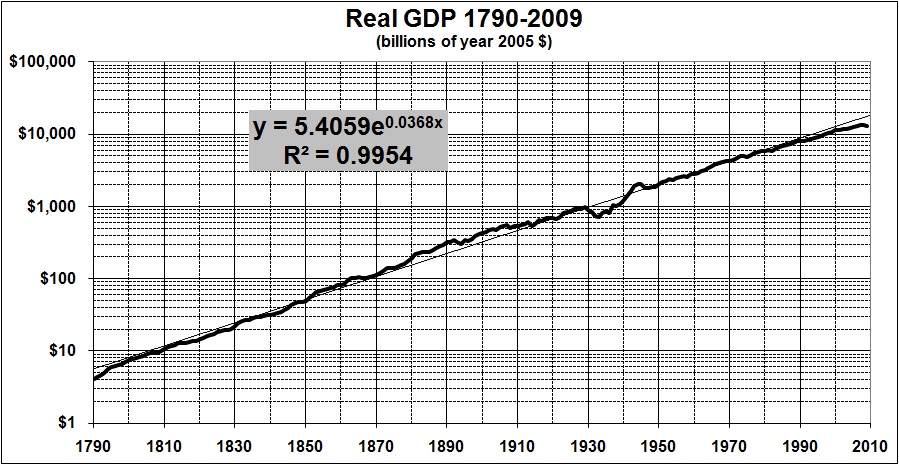
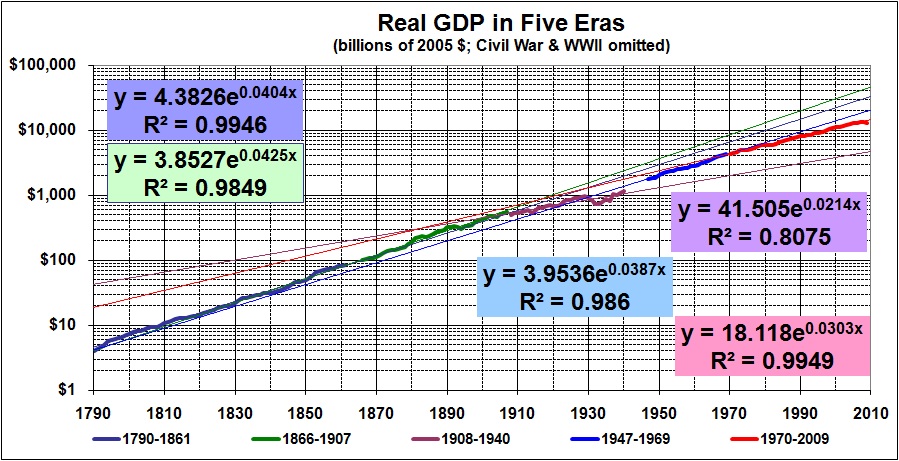
Can we measure the price of government intervention? I believe that we can do so, and quite easily. The tale can be told in three graphs, all derived from constant-dollar GDP estimates available here. The numbers plotted in each graph exclude GDP estimates for the years in which the U.S. was involved in or demobilizing from major wars, namely, 1861-65, 1918-19, and 1941-46. GDP values for those years — especially for the peak years of World War II — present a distorted picture of economic output. Without further ado, here are the three graphs:

The trend line in the first graph indicates annual growth of about 3.7 percent over the long run, with obviously large deviations around the trend. The second graph contrasts economic growth through 1907 with economic growth since: 4.2 percent vs. 3.6 percent. But lest you believe that the economy of the U.S. somehow began to “age” in the early 1900s, consider the story implicit in the third graph:

  • 1790-1861 — annual growth of 4.1 percent — a booming young economy, probably at its freest
  • 1866-1907 — annual growth of 4.3 percent — a robust economy, fueled by (mostly) laissez-faire policies and the concomitant rise of technological innovation and entrepreneurship
  • 1908-1929 — annual growth of 2.2 percent — a dispirited economy, shackled by the fruits of “progressivism” (e.g., trust-busting, regulation, the income tax, the Fed) and the government interventions that provoked and prolonged the Great Depression (see links in third paragraph)
  • 1970-2008 — annual growth of 3.1 percent —  an economy sagging under the cumulative weight of “progressivism,” New Deal legislation, LBJ’s “Great Society” (with its legacy of the ever-expanding and oppressive welfare/transfer-payment schemes: Medicare, Medicaid, a more generous package of Social Security benefits), and an ever-growing mountain of regulatory restrictions.

Had the economy of the U.S. not been deflected from its post-Civil War course, GDP would now be about three times its present level. (Compare the trend lines for 1866-1907 and 1970-2008.) If that seems unbelievable to you, it shouldn’t: $100 compounded for 100 years at 4.3 percent amounts to $6,700; $100 compounded for 100 years at 3.1 percent amounts to $2,100. Nothing other than government intervention (or a catastrophe greater than any we have known) could have kept the economy from growing at more than 4 percent.

What’s next? Unless Obama’s megalomaniacal plans are aborted by a reversal of the Republican Party’s fortunes, the U.S. will enter a new phase of economic growth — something close to stagnation. We will look back on the period from 1970 to 2008 with longing, as we plod along at a growth rate similar to that of 1908-1940, that is, about 2.2 percent. Thus:

  • If GDP grows at 2.2 percent through 2109, it will be 58 percent lower than if we plod on at 3.1 percent.
  • If GDP grows at 2.2 percent for through 2109, it will be only 4 percent of what it would have been had it continued to grow at 4.3 percent after 1907.

The latter disparity may seem incredible, but scan the lists here and you will find even greater cross-national disparities in per capita GDP. Go here and you will find that real, per capita GDP in 1790 was only 4.6 percent of the value it had attained 218 years later. Our present level of output seems incredible to citizens of impoverished nations, and it would seem no less incredible to an American of 1790. In sum, vast disparities can and do exist, across nations and time. We have every reason to believe in the possibility of a sustained growth rate of 4.4 percent, as against one of 2.2 percent, because we have experienced both.

We should look on the periods 1908-1940 and 1970-2009 as aberrations, and take this lesson from those periods: Big government inflicts great harm on almost everyone (politicians and bureaucrats being the main exceptions), including its intended beneficiaries. Such is the price of government when it does more than “establish Justice, insure domestic Tranquility, [and] provide for the common defence” in order to “promote the general Welfare, and secure the Blessings of Liberty to ourselves and our Posterity.”

Addendum to “A Short Course in Economics”

The first 19 points appear in “A Short Course in Economics.”

20. The interest-group paradox is a variant of the paradox of thrift. Many Americans (perhaps most of them) favor certain government programs because (they believe) those programs will benefit the class of persons to which they belong, or a class of persons for which they have sympathy. Each such program then becomes a “free lunch,” and you know that there’s no such thing as a free lunch — someone must pay for it, somehow. In the case of government programs, most of us wind up paying for a lot of free lunches because there are thousands of government programs (federal, State, and local), each intended to help a particular class of citizens at the expense of others. And there goes your free lunch.

Wait, it’s worse than that. Picture a row of beer-drinkers at a bar. Each of them is determined to get a bigger free lunch, so each of them eats more. Result? A rise in the price of the beer. Some free lunch.

Even the relatively few persons who might seem to have obtained a free lunch — homeless persons taking advantage of a government-provided shelter — often are victims of the free lunch syndrome. Some homeless persons may be homeless because they have lost their jobs and can’t afford to own or rent housing. But they may have lost their jobs because of pro-union laws, minimum-wage laws, or progressive tax rates (which caused “the rich” to create fewer jobs through business start-ups and expansions).

21. The interest-group paradox is closely related to the fallacy described by Frédéric Bastiat in his essay “What Is Seen and What Is Not Seen“:

In the economic sphere an act, a habit, an institution, a law produces not only one effect, but a series of effects. Of these effects, the first alone is immediate; it appears simultaneously with its cause; it is seen. The other effects emerge only subsequently; they are not seen; we are fortunate if we foresee them.

There is only one difference between a bad economist and a good one: the bad economist confines himself to the visible effect; the good economist takes into account both the effect that can be seen and those effects that must be foreseen.

Yet this difference is tremendous; for it almost always happens that when the immediate consequence is favorable, the later consequences are disastrous, and vice versa….

The pursuer of the free lunch grasps the free lunch but fails to grasp the unintended and costly consequences of his pursuit.

22. Perhaps the gravest of economic fallacies is the belief that regulated economic activity produces better results than unregulated economic activity. This fallacy stems from the fallacy pointed out by Bastiat. Most of us take comfort in plans of one kind or another because we can “see” what the plan intends. What we fail to grasp is that plans — all plans — have unforeseen, unintended, and undesirable consequences. It is those consequences — what is not seen — that undo economic plans and turn hoped-for benefits into actual costs.

By the same token, most of us fail to grasp the fact that unregulated economic activity yields positive results because it involves willing actors engaged in mutually beneficial exchanges of goods and services. Adam Smith was never more correct when he wrote that every individual

[b]y pursuing his own interest he frequently promotes that of the society more effectually than when he really intends to promote it. I have never known much good done by those who affected to trade for the public good.

That which is produced and consumed voluntarily benefits both its producers and consumers. That which is produced through government fiat may benefit those who dictate its production, while harming consumers by (a) failing to produce that meets their needs and/or (b) producing something that partially meets their needs, but at a higher cost than necessary.

23. Moreover, to quote Wilhelm von Humbolt:

“If men were left to their own deeds and devices, deprived of all outside help that did not manage to obtain themselves, they would also frequently run into difficulty and misfortune whether through their own fault or not. But the happiness for which a man is destined is none other than that which he achieves by his own energies. And it is these very situations which sharpen a man’s mind and develop his character.” (The Limits of State Action [1792]).

A sense of self-worth is important to us; it has economic value of its own. Economics isn’t (or shouldn’t be) the “science” of wealth or output maximization; it is (or ought to be) the “science” of happiness-seeking.

A Prediction

It seems likely that General Motors will become a vassal of the United Auto Workers union and the federal government. Which means that GM will survive only because U.S. taxpayers pick up the tab in order to preserve the pensions of UAW members and keep them employed at above-market compensation. Similar arrangements may come to pass in other (effectively) nationalized industries — banking and health care, most notably (but not exclusively).

Nationalization of the auto, banking, and health-care industries (among others) will prove to be the straw that — when piled on Social Security and Medicare/Medicaid — breaks the back of the American economy. How so? The effective tax rate — the true cost of supporting Social Security, Medicare/Medicaid, nationalized industries, and the ever-growing panoply of government “services”  — will further (and fatally) deter work, saving, capital investment, innovation, and entrepreneurship. (See, for example, this piece by Lawrence Kudlow.)

The economy, if we are lucky, will muddle along at a rate of growth that is barely positive. And that growth will be phony because it will be attributable to the expansion of the public sector (i.e., government and its wholly controlled subsidiaries). We will then have achieved the Left’s Nirvana: Europeanism.

God help us. It’s unlikely that anyone else will.

UPDATE: Arnold Kling makes a related and equally gloomy prediction:

Cato Unbound this month deals with a core issue. Peter Thiel writes,

I no longer believe that freedom and democracy are compatible…

As one fast-forwards to 2009, the prospects for a libertarian politics appear grim indeed. Exhibit A is a financial crisis caused by too much debt and leverage, facilitated by a government that insured against all sorts of moral hazards — and we know that the response to this crisis involves way more debt and leverage, and way more government. Those who have argued for free markets have been screaming into a hurricane. The events of recent months shatter any remaining hopes of politically minded libertarians. For those of us who are libertarian in 2009, our education culminates with the knowledge that the broader education of the body politic has become a fool’s errand.

I think that perhaps the best positive approach for libertarians right now is to support institutions that compete with government. That means charities, churches, charter schools, clubs, consumer information services, and other sources of public goods. I would count the traditional family as an institution that competes with government.

You are likely to see Democrats under President Obama launch assaults against all of the institutions of civil society. Already, the Washington DC school voucher program is under attack, as is the tax deduction for charitable contributions. As libertarians, our electoral voice is worth little. Our threat to exit is probably too costly to carry out. Promoting institutions that compete with government is the best strategy I can come up with.

I tend to agree that for libertarians the “voice” option is looking bleak. I prefer exit options. But by the same token, I do not want to move to New Hampshire (see Jason Sorens) or to a seastead (see Patri Friedman).

UPDATE 2: The Supreme Court will be of no help to us, if Ed Whelan and I are right about its likely direction. I focus on the long run; Whelan, on the near future. Sadly, I must agree with his assessment:

Don’t be fooled by the false claims that we have a conservative Supreme Court. The Court has a working majority of five living-constitutionalists. Four of them—Stevens, Souter, Ginsburg, and Breyer—consistently engage in liberal judicial activism, and a fifth, Kennedy, frequently does. As a result, the Court is markedly to the left of the American public on a broad range of issues. Indeed, in coming years, Souter’s replacement may well provide the fifth vote for

  • the imposition of a federal constitutional right to same-sex marriage;
  • stripping “under God” out of the Pledge of Allegiance and completely secularizing the public square;
  • the continued abolition of the death penalty on the installment plan;
  • selectively importing into the Court’s interpretation of the American Constitution the favored policies of Europe’s leftist elites;
  • further judicial micromanagement of the government’s war powers; and
  • the invention of a constitutional right to human cloning.

American citizens have various policy positions on all these issues, but everyone ought to agree that they are to be addressed and decided through the processes of representative government, not by judicial usurpation.

Saving Social Security

Given that Social Security is unconstitutional, regardless of the U.S. Supreme Court’s ruling in Helvering v. Davis (1937), my interest in saving Social Security is merely pragmatic. I would prefer its abolition through a reversal of Helvering v. Davis. Because of the extreme unlikelihood of that event, I will settle for a legislative solution, one that preserves Social Security as a mandatory program, but converts it to a system of private accounts invested in private-sector securities and equities.

Die-hard defenders of Social Security want to preserve its essential character — a mechanism for transferring income from workers to retirees — and will resist any move in the direction of privatization. In fact, I expect the looming deficit in Social Security receipts to elicit calls for the following measures:

  • Elimination of the cap on the amount of income subject to Social Security taxes.
  • Reduction of benefits paid to retirees according to the amount of income they receive from other sources.
  • Increases in the taxes paid on benefits by retirees with income from other sources.

That these measures will cause slower economic growth and therefore yield lower-than-expected Social Security receipts will be of no consequence to welfare-state zealots. Their response will be to redouble the pain, ad infinitum. (We can expect to see a parallel treatment of health-care goods and services, as government control of those markets approaches 100 percent.)

Unlikely as privatization of Social Security may be — especially in light of today’s rush to nationalize anything and everything that involves risk and uncertainty — there are good arguments for privatization, and they must be made on the chance that they will be heeded when the present hysteria subsides. Accordingly, the rest of this post addresses the three  main objections to privatization:

  • The existence of the Social Security trust fund, which (on paper) will not be exhausted for perhaps another 30 years.
  • The transition cost, that is, the cost of funding private accounts. (It should be noted that the idea of a transition cost suggests, rightly, that the trust fund is not a real asset from which benefits can be paid.)
  • The uncertain returns to private accounts invested in private-sector securities and equities, given the gyrations of stock and bond markets, as compared with the manufactured “certainty” of returns to traditional Social Security accounts.

These rebuttable objections reflect an underlying bias toward a tax-funded system, especially a “fair” one (i.e., one that does not allow  some retirees to enjoy greater benefits “just because” they made better investment decisions). That bias, unfortunately, cannot be overcome by facts or logic. One can only hope that it does not decide the issue of privatization.

The Trust Fund

The Social Security trust fund exists because, for many years, receipts from workers outran payments to retirees. What happened to those surpluses? They were spent by other branches of the federal government. The trust fund, in other words, consists of IOUs issued by government to itself. Therefore, there is no trust fund, that is, no stock of unencumbered assets from which benefits can be paid when outlays begin to exceed receipts. There is only worthless paper or, more accurately, worthless accounting entries.

To understand why this is so, consider the following question. How much wealthier are you when you issue an IOU to yourself? Not a bit — nada, zero, zilch, zip. The same goes for Uncle Sam — a fact of life that not even Congress or the Supreme Court can repeal.

Digging deeper, let us consider the means by which the federal government could convert the IOUs held by the trust fund into benefits for retirees:

  • Borrow money from willing, private lenders.
  • Enlist the Federal Reserve in what amounts to a money-printing operation.
  • Increase Social Security taxes on workers and/or other kinds of taxes (e.g., income taxes).
  • Sell government assets to private buyers until the sum of such sales equals the nominal value of the trust fund.

This list of options simply underscores the chimerical nature of the trust fund. It can be redeemed only by passing the fiscal buck in one way or another:

  • Government borrowing from private lenders may crowd out private-sector borrowing and, in any event, has no net effect on governmental indebtedness — it just moves it around. (If your wife is in debt by $1,000 and you borrow $1,000 in order to pay her debt, your family is still $1,000 in debt.)
  • Printing money fuels inflation, which is a tax on consumers. It’s just a subtle way of shifting the burden.
  • Tax increases simply push the burden of Social Security onto taxpayers, some of whom are retirees on Social Security.
  • Government assets, unlike wholly-owned private ones, are encumbered by obligations to perform governmental services — even passive ones, such as conserving land. To the extent that government assets are sold in order to replenish the trust fund, some governmental functions must be curtailed, inflicting material and/or psychic losses on a substantial cross-section of Americans.

The trust fund would be a real, unencumbered asset only if it had been used to buy privately issued securities and equities, thus participating in the real returns that flow from economic growth.

A final defense of the trust fund goes like this: If a government bond (IOU) is a real asset to the individual who holds the bond, why isn’t it a real asset to the branch of government (Social Security Administration) that holds the bond? There are two answers, one of which I’ve already given: As you cannot make yourself wealthier by giving yourself an IOU, so government cannot make itself wealthier by giving itself an IOU. Spent money is gone.

The second answer is more shocking, but nevertheless true: A government-issued IOU is not a real asset, no matter who holds it. Private ownership of a government-issued IOU does not represent a claim on real wealth that has been accumulated by government through the provision of economically useful goods and services. A government-issued IOU merely represents the taking by government of resources that could have been used by the private sector to generate economically useful goods and services. As discussed above, the taking occurs when government borrows (crowds out private borrowers), inflates the money supply, or imposes taxes.

Oh, yes, government could confiscate private businesses and (with luck) run them at a profit, but that is simply the ultimate form of taking: socialism. Government, by its very nature as a taxpayer-funded institution with superior coercive power, can perform only one kind of service that  enables economic growth (among other things): defense of the citizenry against predators, foreign and domestic. But such defense is a negative service, one which preserves value and does not enhance it. Moreover, the returns to that service (the prevention of losses to liberty, life, limb, and dignity) cannot be quantified because the service is “purchased” by taxes (i.e., coerced), not freely purchased in market transactions. (Whether it could be and why it should not be are matters for discussion elsewhere — here, for example.)

Transition Costs

Given the foregoing, it should be obvious that there is no free lunch when it comes to Social Security, as it now stands. As long as Social Security remains a transfer-payment scheme backed by phony assets, retirees’ benefits will be extracted from their fellow citizens (and themselves), in one way or another.

One thing is true: If private accounts were established, made mandatory (to satisfy paternalists), and funded by investing workers’ Social Security taxes in stocks and bonds (that is, in ways that contribute to economic growth and yield real returns), there would be a (temporarily) larger gap between receipts and outlays. This larger gap — the so-called transition cost — would have to be filled by higher taxes (or the equivalent in borrowing or inflation). The so-called transition cost would continue until taxpayers are contributing no more to retirees’ benefits than they would have been contributing under the present system. At that point, the transition cost would become increasingly negative, that is, it would be a benefit to taxpayers. That benefit would reach its zenith when there is no longer anyone drawing Social Security benefits under the present system.

It should now be obvious that the so-called transition cost isn’t a cost. Rather, it’s a down payment on a better financial future for retirees and taxpayers. The only real issue is one of timing: how to spread the tax burden so that it doesn’t fall disproportionately on those who pay taxes in the years immediately following the establishment of private accounts.

Here, borrowing becomes a legitimate tool of government policy. The tax burden can be spread more evenly across generations if government arranges to borrow some of the down payment on privatization from willing lenders, who are then repaid with taxes levied mainly after the transition cost has becomes negative.

Returns on Private Accounts

Every time the stock market takes a dive, the die-hard defenders of Social Security point with glee to the negative returns implicit in the recent direction of the Dow Jones Industrial Average, S&P 500, and other prominent stock-market indices. The die-hards conveniently overlook three salient facts (of which most of them are probably ignorant):

  • Private accounts could be invested in a mix of stocks and bonds, at the discretion of each account owner.
  • Over the relevant time period (i.e., a working career of 30 years and longer), stocks and bonds have positive returns. For example, the inflation-adjusted return on the Wilshire 5000 (a total-market index of U.S. stocks) was 6.1 percent from February 1979 through February 2009 (when the index hit a low from which it has rebounded). For another example, the inflation-adjusted interest rate on Aaa corporate bonds has been hovering around 5 percent for the past several months.
  • There is no real return on taxes paid into Social Security, claims to the contrary notwithstanding. Those taxes are either paid out immediately to retirees or spent on unremunerative government programs. The so-called returns on Social Security taxes are illusory — they are nothing more than transfers of money coerced from current workers and other taxpayers (including retirees) and handed to current retirees.

Final score: Private accounts, 5 to 6 percent; tax- and transfer-funded accounts, 0.

Conclusion

Assuming that Americans, in the main, will not stand for complete self-reliance when it comes to retirement planning, the second-best solution is a mandatory system of private accounts invested in securities and equities. It is doubtful whether such a system can be established in the face of the perpetual fear-mongering and disinformation campaign against it. But there should be no doubt that such a system would be superior in every way to the present one.

Another Perspective on “Social Justice”

Here is a sample of Barry A. Liebling’s “Irreconcilable Differences,” from today’s edition of TCS Daily:

[T]he assumption of the interventionist is that society and the state take precedence over the individual. It is the group that counts and has rights. Thus, interventionists focus their attention on “social justice” which is different from genuine justice. They have antipathy for “unfettered” individual freedom because they realize that when people act according to their own judgement [sic] and preferences the outcome may not be to the interventionist’s liking. Interventionists see wealth redistribution as a key function of government. Money should be taken from those they despise and given to those they favor.

Liebling’s seekers of social justice (interventionists) are what Thomas Sowell calls seekers of cosmic justice — the same thing by different names. For more about cosmic justice and surrounding fallacies, see my post, “Greed, Cosmic Justice, and Social Welfare.”

A Short Course in Economics

In which I begin with pithy statements of principles and work my way toward more complex (but brief) explorations of selected economic issues.

1. Self-interest drives us to do good things for others while striving to do well for ourselves.

2. Profit is good because it entices invention, innovation, and investments that yield new and better products and services.

3. Incentives matter: Just as self-interest and profit drive progress, taxation and regulation stifle it.

4. Only slaves and dupes can be exploited. (Wal-Mart employees are not exploited; they are not forced to work at Wal-Mart. Anti-Wal-Mart activists are exploited; they’re dupes of the anti-business Left.)

5. There is no free lunch, all costs (including taxes) must be covered by someone, somewhere, at some time.

6. The appearance of a free lunch (e.g., Social Security, tax-subsidized health insurance) leads individuals to make bad decisions (e.g., not saving enough for old age, overspending on health care).

7. Paternalism is for children: When adults aren’t allowed to make economic decisions for themselves they don’t learn from mistakes and can’t pass that learning on to their children.

8. All costs matter; one cannot make good economic decisions by focusing on one type of cost, such as the cost of energy.

9. The best way to deal with pollution and the “depletion” of natural resources is to assign property rights in resources now held in common. The owners of a resource have a vested interest (a) in caring for it so that it remains profitable, and (b) in raising its price as it becomes harder to obtain, thus encouraging the development of alternatives.

10. Discrimination is inevitable in a free society; to choose is to discriminate. In free and competitive markets — unfettered by Jim Crow, affirmative action, or other intrusions by the state — discrimination is most likely to be based on the value of one’s contributions.

11. Voluntary exchange is a win-win game for workers, consumers, and businesses. When exchange is distorted by taxation and constrained by regulation, the losers are workers (fewer jobs and lower wages) and consumers (higher prices and fewer choices).

12. Absent force or fraud, we earn what we deserve, and we deserve what we earn.

13. The economy isn’t a zero-sum game; for example:

Bill Gates is immensely wealthy because he took a risk to start a company that has created things that are of value to others. His creations (criticized as they may be) have led to increases in productivity. As a result, many people earn more than they would have otherwise earned; Microsoft has made profits; Microsoft’s share price rose considerably for a long time; Bill Gates became the wealthiest American (someone has to be). That’s win-win.

14. Externalities are everywhere.

Like the butterfly effect, everything we do affects everyone else. But with property rights those externalities (e.g., pollution) are compensated instead of being legislated against or fought over in courts. Relatedly . . .

15 . There is no such thing as a “public good.”

Public goods are thought to exist because certain services benefit “free riders” (persons who enjoy a service without paying for it). It is argued that, because of free riders, services like national defense be provided by government because it would be unprofitable for private firms to offer such services.

But that analysis overlooks the possibility that those who stand to gain the most from the production of a service such as defense may, in fact, value that service so highly that they would be willing to pay a price high enough to bring forth private suppliers, free riders notwithstanding. The free-rider problem isn’t really a problem unless the producer of a “public good” responds to requests for additional services from persons who don’t pay for those services. But private providers would not be obliged to respond to such requests.

Moreover, given the present arrangement of the tax burden, those who have the most to gain from defense and justice (classic examples of “public goods”) already support a lot of free riders and “cheap riders.” Given the value of defense and justice to the orderly operation of the economy, it is likely that affluent Americans and large corporations — if they weren’t already heavily taxed — would willingly form syndicates to provide defense and justice. Most of them, after all, are willing to buy private security services, despite the taxes they already pay.

I conclude that there is no “public good” case for the government provision of services. It may nevertheless be desirable to have a state monopoly on police and justice — but only on police and justice, and only because the alternatives are a private monopoly of force, on the one hand, or a clash of warlords, on the other hand. (See this post, for instance, which also links to related posts.)

You may ask: What about environmental protection? Isn’t it a public good that must be provided by government? No. Read this and this. Which leads me to “market failure.”

16. There is no such thing as “market failure.

The concept of market failure is closely related to the notion of a public good. When the market “fails” to do or prevent something that someone thinks should be done or prevented, the “failure” is invoked as an excuse for government action.

Except where there is crime (which should be treated as crime), there is no such thing as market failure. Rather, there is only the failure of the market to provide what some persons think it should provide.

Those who invoke market failure are asserting that certain social and economic outcomes should be “fixed” (as in a “fixed” boxing match) to correct the “mistakes” and “oversights” of the market. Those who seek certain outcomes then use the political process to compel those outcomes, regardless of whether those outcomes are, on the whole, beneficial. The proponents of compulsion succeed (most of the time) because the benefits of government intervention are focused and therefore garner support from organized constituencies (i.e. interest groups and voting blocs), whereas the costs of government intervention are spread among taxpayers and/or buyers of government debt.

There are so many examples of so-called public goods that arise from putative market failures that I won’t essay anything like a comprehensive list. There are, of course, protective services and environmental “protection,” both of which I mentioned in No. 15. Then there is public education, Social Security, Medicare, Medicaid, Affirmative Action, among the myriad federal, State, and local programs that perversely make most people worse off, including their intended beneficiaries. Arnold Kling explains:

[T]he Welfare State makes losers out of people who want to get ahead through hard work, thrift, or education. Those are precisely the activities that produce economic growth and social wealth, and they are hit particularly hard by Welfare State redistribution.

The Welfare State certainly has well-organized constituencies. The winners, such as the AARP and the teachers’ unions, know who they are. The losers — the working poor, children stuck in low-quality school districts — have much less political clout. The Welfare State has friends in both parties, as evidenced by the move to add a prescription drug benefit to Medicare.

As the Baby Boomers age, longevity increases, and new medical technology is developed, the cost of the Welfare State is going to rise. Economists agree that in another generation the share of GDP required by the Welfare State will exceed the share of GDP of total tax revenues today. The outlook for the working poor and other Welfare State losers is decidedly grim.

17. Borders are irrelevant, except for defense.

It is not “bad” or un-American to “send jobs overseas” or to buy goods and services that happen to originate in other countries. In fact, it is good to do such things because it means that available resources can be more fully employed and put to their best uses. Opponents of outsourcing and those who decry trade deficits want less to be produced; that is, they want to shelter the jobs of some Americans at the expense of making many more Americans worse off through higher prices.

For example, when Indian computer geeks operate call centers for lower salaries than the going rate for American computer geeks, it makes both Indians and Americans better off. Few Americans are computer geeks, but many Americans are computer users who benefit when they pay less for geek services (or the products with which geek services are bundled). Those who want to save the jobs of American computer geeks assume that (a) American computer geeks “deserve” their jobs (but Indians don’t) and (b) American computer geeks “deserve” their jobs at the expense of American consumers.

See also this, and this, and this.

18. Government budget deficits aren’t bad for the reason you think they’re bad.

Government spending is mostly bad (see No. 15) because it results in the misallocation of resources (and it’s inherently inflationary). Government spending — whether it is financed by taxes or borrowing — takes resources from productive uses and applies them to mostly unproductive and counterproductive uses. Government budget deficits are bad in that they reflect that misallocation — though they reflect only a portion of it. Getting hysterical about the government’s budget deficit (and the resulting pile of government debt) is like getting hysterical about a hangnail on an arm that has been amputated.

There’s no particular reason the federal government can’t keep on making the pile of debt bigger — it has been doing so continuously since 1839. As long as there are willing lenders out there, the amount the amount of debt the government can accumulate is virtually unlimited, as long as government spending does not grow to the point that its counterproductive effects bring the economy to its knees.

For more, see this, this, this, and this.

19. Monopoly (absent force, fraud, or government franchise) beats regulation, every time.

Regulators live in a dream world. They believe that they can emulate — and even improve on — the outcomes that would be produced by competitive markets. And that’s precisely where regulation fails: Bureaucratic rules cannot be devised to respond to consumers’ preferences and technological opportunities in the same ways that markets respond to those things. The main purpose of regulation (as even most regulators would admit) is to impose preferred outcomes, regardless of the immense (but mostly hidden) cost of regulation.

There should be a place of honor in regulatory hell for those who pursue “monopolists,” even though the only true monopolies are run by governments or exist with the connivance of governments (think of courts and cable franchises, for example). The opponents of “monopoly” really believe that success is bad. Those who agitate for antitrust actions against successful companies — branding them “monopolistic” — are stuck in a zero-sum view of the economic universe (see No. 13), in which “winners” must be balanced by “losers.” Antitrusters forget (if they ever knew) that (1) successful companies become successful by satisfying consumers; (2) consumers wouldn’t buy the damned stuff if they didn’t think it was worth the price; (3) “immense” profits invite competition (direct and indirect), which benefits consumers; and (4) the kind of innovation and risk-taking that (sometimes) leads to wealth for a few also benefits the many by fueling economic growth.

What about those “immense” monopoly profits? They don’t just disappear into thin air. Monopoly profits (“rent” in economists’ jargon) have to go somewhere, and so they do: into consumption, investment (which fuels economic growth), and taxes (which should make liberals happy). It’s just a question of who gets the money.

But isn’t output restricted, thus making people generally worse off? That may be what you learned in Econ 101, but that’s based on a static model which assumes that there’s a choice between monopoly and competition. I must expand on some of the points I made in the original portion of this commandment:

  • Monopoly (except when it’s gained by force, fraud, or government license) usually is a transitory state of affairs resulting from invention, innovation, and/or entrepreneurial skill.
  • Transitory? Why? Because monopoly profits invite competition — if not directly, then from substitutes.
  • Transitory monopolies arise as part of economic growth. Therefore, such monopolies exist as a “bonus” alongside competitive markets, not as alternatives to them.
  • The prospect of monopoly profits entices more invention, innovation, and entrepreneurship, which fuels more economic growth.

20. Stay tuned to this blog.

A Social Security Reader

The good folks at Cato Institute weigh in today with this:

For years, opponents of Social Security reform have told us that there is no need to rush into changing the program because, after all, Social Security is running a surplus today. Well, according to a new report by the Congressional Budget Office, not so much.

CBO reports that the Social Security surplus, originally expected to be $80-90 billion this year and next will shrink to $16 billion this year and just $3 billion next year (essentially a rounding error) as a result of the recession and rising unemployment. And those estimates may be far too optimistic. In February of this year, for example, Social Security actually ran a deficit—spending more than it took in through taxes and interest combined.

And, while CBO expects a return to modest surpluses after 2010, as the recession ends and unemployment falls, that is betting on the success of the unproven Obama economic program. If unemployment stays at current levels, Social Security will begin running permanent cash flow deficits in 2011 (eight years earlier than previously predicted).

Opponents of personal accounts have pointed out recent declines in the stock market as a reason why private investment should no longer be considered an option for Social Security reform. The evidence suggests that, even with recent market declines, private investment would still produce higher returns than Social Security. The new surplus numbers provide yet another lesson: if the economy is in such a mess that it hurts private investment, traditional Social Security isn’t going to be in any better shape.

The case for personal accounts remains as strong as ever.

It does indeed.

To top it off, I (among many others) opine that Social Security is unconstitutional. To find out why, go here.

Here are some other related readings from my old blog:
Why It Makes Sense to Privatize Social Security
P.S. on Privatizing Social Security
That Mythical, Magical Social Security Trust Fund
The Real Social Security Issue
Social Security — Myth and Reality
Nonsense and Sense about Social Security
More about Social Security
Social Security Privatization and the Stock Market
Social Security: The Permanent Solution
Social Security Transition Costs, in a Nutshell
A Market Solution to the Social Security Mess?

Economic Growth since WWII

Revised and updated, here.

Mr. Greenspan Doth Protest Too Much

UPDATED BELOW

Alan Greenspan, former chairman of the Federal Reserve, disputes the assertion — made by many, including John Taylor of Stanford University — that

had the Federal Reserve from 2003-2005 kept short-term interest rates at the levels implied by [the] “Taylor Rule,” “it would have prevented this housing boom and bust. “

Mr. Greenspan continues:

Given the decoupling of monetary policy from long-term mortgage rates, accelerating the path of monetary tightening that the Fed pursued in 2004-2005 could not have “prevented” the housing bubble. All things considered, I personally prefer Milton Friedman’s performance appraisal of the Federal Reserve. In evaluating the period of 1987 to 2005, he wrote on this page in early 2006: “There is no other period of comparable length in which the Federal Reserve System has performed so well. It is more than a difference of degree; it approaches a difference of kind.”

It is unseemly for Mr. Greenspan to invoke Milton Friedman in this matter, given that Mr. Friedman died in 2006 and, therefore, did not live to see the debacle in the mortgage market.

More to the point, it is impossible to “decouple” financial markets from one another. Imagine trying to decouple the price of gasoline from the price of crude oil. The federal funds rate is determined by the Fed’s open market operations, that is, through the Fed’s expansion or contraction of the money supply. It is true that the only immediate effect of the federal funds rate is on the rate of interest at which banks borrow from and lend to each other. But those rate changes and the underlying changes in the money supply have ripple effects throughout financial markets.

Rates on long-term instruments, such as mortgages, “decouple” from the federal funds rate only when there is a shock to the market for those long-term instruments. The shock, in the case of the mortgage market, was a drop in the value of real-estate, followed by a squeeze on borrowers (primarily on sub-prime borrowers), followed by a jump in the incidence of defaults, followed by a sudden drop in the value of sub-prime mortgages and the derivatives created from them, etc., etc., etc.

But before that shock, the mortgage rate (like the rates of other financial instruments) had tracked the ups and downs of the federal funds rate:

Selected interest rates
Source: Federal Reserve Statistical Release H.15, Selected Interest Rates (annual data)

The recent divergence between the federal funds rate and the mortgage rate did not occur until 2008, that is, until after the collapse of the real-estate bubble — a bubble that was caused in large part by the Fed’s easing of interest rates from January 2001 to June 2004.

UPDATE: For corroboration of my analysis, see Robert Murphy’s “Greenspan’s Bogus Defense” (published April 8, 2009).

UPDATE 2: Now, Secretary of the Treasury Geithner avers that “monetary policy around the world was too loose too long.” Notice how Geithner tries to take the heat off the Fed by focusing on “the world.” But, as the WSJ piece (linked above) points out, Geithner is

still too quick to pass the buck from the Fed to other central banks. The European Central Bank was much tighter than the Fed throughout this period. The Fed was by far the major monetary player because much of the world was on a dollar standard, with its monetary policy linked to the Fed’s. That was true of China, most of Asia and the Middle East.

The Fed’s loose policy from 2003 to 2005 created the commodity and credit bubbles that made these countries flush with dollars. Given their low domestic propensity to consume, these countries then recycled those dollars back into dollar-denominated assets, such as Treasurys and real-estate-related assets such as Fannie Mae securities. The Fed itself had created the surplus dollars that kept long rates low and undermined for a substantial period its belated attempts to tighten.

Mr. Geithner’s concession is important nonetheless because before he moved to Treasury he was vice chairman of the Fed’s Open Market Committee that sets monetary policy. His comments mark a break with the steadfast refusal of Fed Chairmen Alan Greenspan and Ben Bernanke to admit any responsibility. They prefer to blame bankers and what they call the “global savings glut,” as if the Fed had nothing to do with creating that glut.

UPDATE 3: John Taylor links to more evidence for the Fed’s influence on interest rates.

In the Long Run We Are All Poorer

The title of this post is a play on John Maynard Keynes’s famous line, “in the long run we are all dead,” which was not a defense of government spending during the Great Depression. The line comes from  Keynes’s Tract on Monetary Reform, which he published in 1923, years before the Depression. Keynes was in fact writing about the need for government action against inflation.

This post, as its title may suggest, complements an earlier post, “Are We Mortgaging Our Children’s Future?” As I say there, Obama’s economic plan (if it can be called that)

doesn’t simply “mortgage our children’s future.”  It does a lot more than that. Like all government spending that isn’t undertaken for the protection of Americans from foreign and domestic predators, the [Obama plan] mortgages our present, our future, our children’s future, and their children’s future, ad infinitum. The real problem isn’t the size of the national debt, it’s the size of government….

…Obama[‘s] initiatives…will stimulate a massive growth in the size and intrusiveness of government.

Here, I begin with links to three papers about the multiplier effect of government spending:

Is Government Spending Too Easy an Answer?” (N. Gregory Mankiw)

Government Spending Is No Free Lunch” (Robert J. Barro)

New Keynsian versus Old Keynsian Government Spending Multipliers” (John F. Cogan, et al.)

The bottom line: Increases in government spending probably have a much smaller multiplier (stimulative) effect than claimed by the administration; the effect may well be negative. That is, increases in government spending probably will crowd out private consumption and investment, both in the near term (when spending increases are supposed to spur private consumption and investment) and in the long run (as the increases become permanent).

Next, I offer a baker’s dozen links to commentary about Obama’s economic policies and their implications:

Stocks Hate Obeynomics” (Forbes.com)

The Left’s Grip on the American Economy” (Forbes.com)

Obama’s $646 Billion Cap-and-Trade Green Tax” (James Pethokoukis)

The Obama Revolution: Paid for by the people” (Opinion Journal)

The 2% Illusion: Take everything they earn and it still won’t be enough” (Opinion Journal)

Obama Proposes a European U.S.” (Charles Krauthammer)

Federal Outlays as a Percentage of GDP” (N. Gregory Mankiw)

Obama Lied; the Economy Died” (Tony Blankley)

The Great Non Sequitur: The sleight of Hand behind Obama’s Agenda” (Charles Krauthammer)

Neither Moderate Nor Centrist” (Peter Robinson)

Obama’s Radicalism Is Killing the Dow” (Michael J. Boskin)

Even Worse than the Great Depression” (Donald Luskin)

Obama’s Left Turn” (Stuart Taylor)

Taylor sums it up, thusly:

…I now worry that [Obama] may be deepening what looks more and more like a depression and may engineer so much spending, debt, and government control of the economy as to leave most Americans permanently less prosperous and less free.

Precisely.

There is a bit of hope, in the unlikely form of public opinion. Obama’s approval index (percentage of respondents strongly approving minus percentage strongly disapproving) has gone from a high of +30 on January 22 to a low of +6 (as of March 9). If economic logic doesn’t sway Obama, perhaps he can be swayed by public opinion — though I very much doubt it, given his long-standing adherence to economic and political extremism. (For example, his voting record as a senator placed him among the most “liberal,” i.e., statist, members of the U.S. Senate.)

Where are we headed then? The stock market — for all of its exaggerated swings — does a pretty good job of reflecting expectations about the country’s future economic performance. Witness the performance of the S&P 500:

Real S&P 500, updatedReal S&P price index derived from annual closing prices of the S&P 500 Composite Index, as reconstructed by Global Financial Data, Inc. (no longer publicly available), and GDP deflator (Louis D. Johnston and Samuel H. Williamson, “What Was the U.S. GDP Then?” MeasuringWorth, 2008. URL: http://www.measuringworth.org/usgdp/).

The now-enviably stable post-Civil War trend was broken in the early 1900s, when the “progressive” agenda began to take hold — most notably with the passage of the Food and Drug Act and the vindictive application of the Sherman Antitrust Act by Theodore Roosevelt. It has been all downhill since, with the ratification of the Sixteenth Amendment (enabling the federal government to tax incomes); the passage of the Clayton Antitrust Act (a more draconian version of the Sherman Act, which also set the stage for unionism); World War I (a high-taxing, big-spending, command-economy operation that whet the appetite of future New Dealers); a respite (the boom of the 1920s, which was owed to the Harding-Coolidge laissez-faire policy toward the economy); and the Great Depression and World War II (truly tragic events that imbued in the nation a false belief in the efficacy of the big-spending, high-taxing, regulating, welfare state that we now “enjoy”).

Yes, stock prices have continued to rise, on the whole, but they have fluctuated wildly around a trend that is about 50 percent below the trend that prevailed from 1870 to the early 1900s. Such is the destructive power of the regulatory-welfare state.

The reaction of the stock market to Obama’s ascendancy since May 2008 — when he locked up the Democrat nomination — suggests that we have entered an era of even-lower stock prices. I have indicated the onset of this new era by plotting the values for 2008 and 2009 (to date) in red. Lower stock prices would be bad enough, in and of themselves, but what they betoken is the looming economic catastrophe that surely will result if Obama and his ilk persist in their oppressive program of spending, taxing, and regulating.

Eugene Fama and Kenneth French (distinguished financial economists at the University of Chicago) get it almost right:

Government intervention affects the market in two ways. First, it affects the level of expected future profitability, which has direct effects on stock prices. Second, government intervention and uncertainty about the government’s future actions change the risk of expected future profits, which affects stock prices by raising or lowering the discount rates for expected future profits, and thus raising or lowering expected stock returns. Our view is that the rhetoric and sweeping initiatives of the new administration have lowered market expectations of future profitability, and the uncertainty about government policies has increased the risk of expected future profits. Both effects have contributed to the lower stock prices we have seen as the policies of the new administration have unfolded. If the market has it right (that is, if the market is efficient) all this is built into current stock prices, and expected returns are higher going forward.

Future returns may be positive, over the long run, but those returns — and economic output — will be lower than they would have been, absent Obamanomics.

Greed, Cosmic Justice, and Social Welfare

GREED

We have heard much about “greed” in connection with the current financial crisis and recession. It seems that “greedy” lenders and financial intermediaries granted sub-prime mortgages to persons of low credit-worthiness and then infected the financial system by securitizing those risky mortgages and peddling them around to investors.

Why don’t we hear about the “greed” of the borrowers who entered into those sub-prime mortgages, and who enjoyed (and still enjoy, in most cases) better housing than they would otherwise have occupied. Why don’t we hear about the “greed” of the politicians who (seeking to curry favor and votes from certain groups) pressured Fannie Mae and Freddie Mac (and through them, mortgage lenders) to make mortgages more readily available to low-income borrowers (i.e., to make riskier loans)?

When does the desire to have more (e.g., a bigger house, a higher income) stop being the “American Dream” and become “greed”? Why is it good for a low-income person to inhabit a house that he can’t really afford but bad for a high-income person to inhabit a house that he can afford, and whose investments and entrepreneurship have helped the low-income person strive toward the “American Dream”?

The answer, of course, is that “greed” is whatever a politician, pundit, or other purveyor of economic envy says it is. “Greed” is invoked not to explain financial success but to denigrate those who have attained it (only to lose it, in some cases), as if they had attained it at the expense of those who have failed to attain it (thus far, at least). Except in the (relatively rare) cases of outright theft and fraud, financial success is not attained at anyone else’s expense; economics is not a zero-sum game.

COSMIC JUSTICE

The habit of castigating the motives of the financially successful and then penalizing their success by taxing them disproportionately appeals not only to envy and economic ignorance but also to what Thomas Sowell calls cosmic justice. The seekers of cosmic justice are not content to allow individuals to accomplish what they can, given their genes, their acquired traits, their parents’ wealth (or lack of it), where they were born, when they live, and so on. Rather, those who seek cosmic justice cling to the Rawlsian notion that no one “deserves” better “luck” than anyone else. But “deserves” and “luck” (like “greed”) are emotive, value-laden terms. Those terms suggest (as they are meant to) that there is some kind of great lottery in the sky, in which each of us participates, and that some of us hold winning tickets — which equally “deserving” others might just have well held, were it not for “luck.”

This is not what happens, of course. Humankind simply is varied in its genetic composition, personality traits, accumulated wealth, geographic distribution, etc. Consider a person who is born in the United States of brilliant, wealthy parents — and who inherits their brilliance, cultivates his inheritance (genetic and financial), and goes on to live a life of accomplishment and wealth, while doing no harm and great good to others. Such a person is neither “lucky” nor less “deserving” than anyone else. He merely is who he is, and he does what he does. There is no question of desert or luck.

Such reasoning does not dissuade those who seek cosmic justice. Many of the seekers are found among the “80 percent,” and it is their chosen lot to envy the other “20 percent,” that is, those persons whose brains, talent, money, and/or drive yield them a disproportionate — but not undeserved — degree of fortune, fame, and power. The influential seekers of cosmic justice are to be found among the  “20 percent.” It is they who use their wealth, fame, and position to enforce cosmic justice in the service (variously) of misplaced guilt, economic ignorance, and power-lust. (Altruism — another emotive, value-laden term — does not come into play, for reasons discussed here and here.)

Some combination of misplaced guilt, economic ignorance, and power-lust motivates our law-makers. (Their self-proclaimed “compassion” is bought on the cheap, with taxpayers’ money.) They accrue power by pandering to their fellow seekers of cosmic justice. Thus they have saddled us with progressive taxation, affirmative action, and a plethora of other disincentivizing, relationship-shattering, market-distorting policies. It is supremely ironic that those policies have made all of us (except perhaps politicians, bureaucrats, and thieves) far worse off than we would be if government were to get out of the cosmic-justice business. (See this, for example.)

SOCIAL WELFARE

Some proponents of cosmic justice appeal to the notion of social welfare (even some economists, who should know better) . Their appeal rests on two mistaken beliefs:

  • There is such a thing as social welfare.
  • Transferring income and wealth from the richer to the poorer enhances social welfare because redistribution helps the poorer more than it hurts the richer.

Having disposed elsewhere of the second belief, I now address the first one. I begin with a question posed by Arnold Kling:

Does the usefulness of the concept of a social welfare function stand or fall on its mathematical properties?

My answer: One can write equations until kingdom come, but no equation can make one person’s happiness cancel another person’s unhappiness.

The notion of a social welfare function arises from John Stuart Mill’s utilitarianism, which is best captured in the phrase “the greatest good for the greatest number” or, more precisely “the greatest amount of happiness altogether.” (See “Adler on Mill’s Utilitarianism” at the Adler Archive of The Radical Academy.)

From this facile philosophy (not Mill’s only one) grew the ludicrous idea that it might be possible to quantify each person’s happiness and, then, to arrive at an aggregate measure of total happiness for everyone (or at least everyone in England). Utilitarianism, as a philosophy, has gone the way of Communism: It is discredited but many people still cling to it, under other names.

Today’s usual name for utilitarianism is cost-benefit analysis. Governments often subject proposed projects and regulations (e.g., new highway construction, automobile safety requirements) to cost-benefit analysis. The theory of cost-benefit analysis is simple: If the expected benefits from a government project or regulation are greater than its expected costs, the project or regulation is economically justified.

Here is the problem with cost-benefit analysis — which is the problem with utilitarianism: One person’s benefit cannot be compared with another person’s cost. Suppose, for example, the City of Los Angeles were to conduct a cost-benefit analysis that “proved” the wisdom of constructing yet another freeway through the city in order to reduce the commuting time of workers who drive into the city from the suburbs. In order to construct the freeway, the city must exercise its power of eminent domain and take residential and commercial property, paying “just compensation,” of course. But “just compensation” for a forced taking cannot be “just” — not when property is being wrenched from often-unwilling “sellers” at prices they would not accept voluntarily. Not when those “sellers” (or their lessees) must face the additional financial and psychic costs of relocating their homes and businesses, of losing (in some cases) decades-old connections with friends, neighbors, customers, and suppliers.

How can a supposedly rational economist, politician, pundit, or “liberal” imagine that the benefits accruing to some persons (commuters, welfare recipients, etc.) somehow cancel the losses of other persons (taxpayers, property owners, etc.)? There is no valid mathematics in which A’s greater happiness cancels B’s greater unhappiness.

Yet, that is how cost-benefit analysis (utilitarianism) works, if not explcitly then implicitly. It is the spirit of utilitarianism (not to mention power-lust, arrogance, and ignorance) which enables Barack Obama and his ilk throughout the land to impose their will upon us — to our lasting detriment.

The Causes of Economic Growth

President Obama proposes (unsurprisingly) to “soak the rich,” which is a flawed prescription for making the government’s ends meet, and yet another insult to the body economic.

The well-being of all Americans is best assured by a vibrant and growing economy, a necessary condition of which is the prospect of ever-greater rewards at the top end of the income scale. Leftists, in their zeal to redistribute income, aim to penalize “the rich” for being richer than the rest of us; the result is to penalize all of us by thwarting economic growth, which has these several causes:

1. Hard work

The tradeoff here is with “non-work” activities, and the tradeoff can be costly. But those who choose wisely in sacrificing non-work activities then acquire additional cash income, which can be used to offset the loss of non-work time and/or to improve the tools of one’s trade.

2. Smart work

Working smarter requires education, specialized training, and on-the-job learning. Today’s workers are (on the whole) more productive than their predecessors because the education, training, and on-the-job learning of today’s workers incorporates lessons learned by their predecessors.

3. Saving and investment

Resources that are saved (not used to produce consumption goods) can flow into investment (services and goods such as pharmaceutical research and development, advanced computer and telecommunications technologies). It is investment that enables the production of new, more, and better consumer goods with a given amount of labor. (Government investment is an inferior alternative to private investment.)

4. Invention, innovation, and entrepreneurship

These are the primary activities through which saving becomes investment, usually via the medium of financial institutions. Inventors, innovators, and entrepreneurs (along with shareholders, creditors, and financial intermediaries) accept the risks associated with failure and the rewards of success. It is the prospect of rewards that encourages invention, innovation, and entrepreneurship — and the benefits they bestow on workers and consumers. (Invention, innovation, and entrepreneurship — like work — are “socially responsible” activities because the pursuit of gain is motivated by the satisfaction of wants.)

5. Trading

If A makes bread and B makes butter — and if both prefer buttered bread — both benefit from trade. Where they produce bread and butter matters not; A and B could be neighbors, live in different parts of the United States, or one of them could live in a different country. In any event, both are made better off through voluntary exchange.

6. Population growth

Given the foregoing, a larger population means more people to work “hard” and “smart”; more output that can be saved and invested; more inventors, innovators, and entrepreneurs whose activities can be leveraged into greater per-capita output; and a multiplication of opportunities for beneficial voluntary exchange.

7. The rule of law under a minimal state

Predation — whether by individuals, mobs, or government — discourages everything that fosters economic growth. The more that government tries to direct the economy, the less it will grow and satisfy human wants.

Further reading:
Why Outsourcing Is Good: A Simple Lesson for Liberal Yuppies
Trade Deficit Hysteria
Brains Sans Borders
The Main Causes of Prosperity
Straight Thinking about Business Cycles
Understanding Economic Growth
The Population Mystery
The Economy Works, in Spite of Zany Economists
What Economics Isn’t
Why Government Spending Is Inherently Inflationary
Understanding Outsourcing
A Simple Fallacy
Ten Commandments of Economics
More Commandments of Economics
Three Truths for Central Planners
Bits of Economic Wisdom
Productivity Growth and Tax Cuts
Zero-Sum Thinking
Economist, Heal Thyself
Liberty, General Welfare, and the State
Monopoly and the General Welfare
Trade, Government Spending, and Economic Growth
Toward a Capital Theory of Value
Things to Come
And much more, here.