The Causes of Economic Growth

There are several reasons that the real value of aggregate and per-capita economic output increases with time, in a (more-or-less) free-market economy:

1. Hard work

The tradeoff here is with “non-work” activities, and the tradeoff can be costly. But those who choose wisely in sacrificing non-work activities then acquire additional cash income, which can be used to offset the loss of non-work time and/or to improve the tools of one’s trade.

2. Smart work

Working smarter requires education, specialized training, and on-the-job learning. Today’s workers are (on the whole) more productive than their predecessors because the education, training, and on-the-job learning of today’s workers incorporates lessons learned by their predecessors.

3. Saving and investment

Resources that are saved (not used to produce consumption goods) can flow into investment (services and goods such as pharmaceutical research and development, advanced computer and telecommunications technologies). It is investment that enables the production of new, more, and better consumer goods with a given amount of labor. (Government investment is an inferior alternative to private investment.)

4. Invention, innovation, and entrepreneurship

These are the primary activities through which saving becomes investment, usually via the medium of financial institutions. Inventors, innovators, and entrepreneurs (along with shareholders, debtholders, and financial intermediaries) accept the risks associated with failure and the rewards of success. It is the prospect of rewards that encourages invention, innovation, and entrepreneurship — and the benefits they bestow on workers and consumers. (Invention, innovation, and entrepreneurship — like work — are “socially responsible” activities because the pursuit of gain is motivated by the satisfaction of wants.)

5. Trading

If A makes bread and B makes butter — and if both prefer buttered bread — both benefit from trade. Where they produce bread and butter matters not; A and B could be neighbors, live in different parts of the United States, or one of them could live in a different country. In any event, both are made better off through voluntary exchange.

6. Population growth

Given the foregoing, a larger population means more people to work “hard” and “smart”; more output that can be saved and invested; more inventors, innovators, and entrepreneurs whose activities can be leveraged into greater per-capita output; and a multiplication of opportunities for beneficial voluntary exchange.

7. The rule of law under a minimal state

Predation — whether by individuals, mobs, or government — discourages everything that fosters economic growth. The more that government tries to direct the economy, the less it will grow and satisfy human wants.

Other related posts:
Why Outsourcing Is Good: A Simple Lesson for Liberal Yuppies
Trade Deficit Hysteria
Brains Sans Borders
The Main Causes of Prosperity
Straight Thinking about Business Cycles
Understanding Economic Growth
The Population Mystery
The Economy Works, in Spite of Zany Economists
What Economics Isn’t
Why Government Spending Is Inherently Inflationary
Understanding Outsourcing
A Simple Fallacy
Ten Commandments of Economics
More Commandments of Economics
Three Truths for Central Planners
Bits of Economic Wisdom
Productivity Growth and Tax Cuts
Zero-Sum Thinking
Economist, Heal Thyself
Liberty, General Welfare, and the State
Monopoly and the General Welfare
Trade, Government Spending, and Economic Growth

There’s No Such Thing As a Business Tax

I cringe whenever someone proposes a business tax (or tax increase). Businesses don’t pay taxes; we all pay business taxes, one way or another.

It is true that a static, microeconomic analysis can “prove” that a particular kind of tax falls on business owners, under certain circumstances. But that is a first-order effect; it overlooks the dynamic, long-run effects of business taxes.

Even if a business tax can be contrived so as to fall (immediately) on the owners of certain kinds of businesses, the result is to drive up the costs of operating those businesses. Some businesses may be able to recoup higher costs by increasing prices, which means that the consumer is able to buy fewer units of a good or service, thus reducing the demand for the labor and capital used in the production of that good or service.

To the extent that a business tax can’t be passed along to consumers (and, indirectly, employees), the affected businesses experience lower profits. That makes business formation and expansion less attractive, thus reducing economic growth and job creation.

In any event, it should be clear that business taxes are “bad business” for consumers, workers, and business owners (who happen also to be human). A business tax has many victims, most of them unintended.

Government executives and legislators resort to business taxes because (a) they don’t understand who really pays those taxes or (b) they do understand and don’t care because their constituents don’t understand. And it makes their constituents feel good when a politician “sticks it to business.” (It’s sort of like rooting for the executioner when you’re next in line for the guillotine.)

So, when your mayor, city council, governor, or State legislature proposes a business tax (or an increase in a business tax), shout “no!” and hold onto your wallet.

The Gist of It

A good portion of my post on “Trade, Government Spending, and Economic Growth” is about the meaning of the trade deficit. This post, by Donald Boudreaux of Cafe Hayek, gives the gist of my argument:

My friend Jack Wenders, Emeritus Professor of Economics at the University of Idaho, notes this passage in a recent AP report:

The U.S. must borrow more than $2 billion per day from foreigners to finance its huge trade deficits.

Jack’s reaction to this typical way of framing the so-called ‘trade deficit’ is noteworthy:

Maybe a better way of putting this would be to say: “Foreigners must sell the U. S. more than $2 billion per day in goods and services to finance their huge purchases of U.S. assets.”

Exactly correct.

Exactly.

Sprawl

A few days ago I left a comment on a post whose author bemoaned sprawl in the Atlanta area. I wrote:

How awful. Tasteless people want to live in the exurbs of Atlanta in houses that may be faux mansions but are probably good value, compared with the prices they’d pay for the same space and features in or near Atlanta. The developers have the county commissioners in their pockets, eh? How awful that owners of land are “allowed” to build houses on that land to meet the needs of consumers. If you and the crunchy cons don’t want to live amongst the “unwashed” don’t. I wouldn’t want to live amongst them either, but I don’t begrudge their their right to live where it suits them. I certainly don’t begrudge them the right to flee the big city, even if it’s for a McMansion. What’s your alternative? Force people to live cheek-to-jowl in the “friendly confines” of Atlanta — just so you drive through the countryside without being offended by their abysmal taste in architecture? Or perhaps you’d like to make birth control and abortion mandatory so the population stops growing. There’s lots of countryside out there. If you don’t like what you see in one spot, go to another spot. Better yet, buy some for yourself and set up covenants that will preserve it in its natural state, for your enjoyment and that of your heirs. Nothing wrong with that, either.

Today, at The Weekly Standard, I find a review by Vincent J. Cannato of Robert Bruegmann’s Sprawl: A Compact History. Toward the end of the review, Cannato says this:

While suburban sprawl might not be everyone’s cup of tea, (including mine) sprawl-like communities seem to afford a large number of people the kinds of lives they wish to lead. Sprawl critics have yet to convince large numbers of Americans that their solutions for engineering private choices about how and where to live and work will result in greater social benefits or happiness.

Sprawl is messy, chaotic, and sometimes annoying. In short, it is everything one expects from a free and democratic society. Leave the neat and clean societies for totalitarian regimes. Sprawl creates problems, just like every other social trend; but to damn it for its problems is akin to outlawing the sun for causing skin cancer.

Robert Bruegmann reminds us that much of the anti-sprawl crusade is a result of a rising level of prosperity, and the complexity of millions of individual decisions made on a daily basis by millions of citizens. Better to have to deal with long commutes and strained infrastructure than malaria, cholera, or declining life expectancy.

In terms of problems, I’d take sprawl any day.

Me, too.

Trade, Government Spending, and Economic Growth

That’s the title of a new and very long post I’ve put up at Liberty Corner II. Here’s the executive summary:

One reason for continued economic growth and the resurgence of productivity is the trade deficit, which is not a form of debt. A trade deficit offsets government spending and therefore alleviates the “crowding out” effect that government spending has on private-sector consumption and investment. American consumers and businesses are better off than they would be in the absence of a trade deficit. For the trade deficit is nothing more than a manifestation of voluntary exchange, which — by definition — benefits both parties. In the case of international trade, foreigners (on net) are selling us goods and services while we are selling them a combination of goods, services, stocks, bonds, and mortgages. The so-called deficit, then, is nothing more than foreigners’ purchases of U.S. stocks, bonds, and mortgages.

Thus, instead of using resources to produce goods and services and sending them overseas in exchange for goods and services of equal value, some resources remain in the U.S. And some of those resources are then converted into capital investments that help make American businesses more productive and profitable. In effect, some foreigners are using the income they receive from Americans to “invest in America,” just as some Americans use some of their income to “invest in America.” There is no difference.

Nevertheless, when there is a trade deficit we are treated to gloom-and-doom-saying about “foreign “ownership” of U.S. assets and the “exportation” of American jobs. But foreign ownership of U.S. assets is not a threat to Americans; rather, it gives foreigners a stake in America’s economic growth. The threat of job “exportation” is just as bogus; when foreigners “do jobs that Americans could be doing” they are enabling Americans to make more productive use of their abilities. If you don’t care (and you shouldn’t) whether your car in made in Detroit or Tennessee, why should you care whether a computer technician works in the U.S. or overseas? What you should care about is the value you receive when you buy a car or use a computer help line.

The real villain of the piece is government spending, not government deficits. Government deficits are simply the result of government spending. It is government spending — not government borrowing — that threatens Americans’ prosperity.Through spending (whether it is financed by taxes or borrowing), government confiscates resources and puts them to generally wasteful and counterproductive uses.

Where does the trade deficit fit in? It doesn’t create government spending or government deficits. To the contrary, the trade deficit helps to offset the essential wastefulness of government spending by enabling Americans to enjoy and benefit from goods and services that government spending deprives them of.

CLICK HERE TO READ THE ENTIRE POST.

Trade, Government Spending, and Economic Growth

Executive Summary

One reason for continued economic growth and the resurgence of productivity is the trade deficit, which is not a form of debt. A trade deficit offsets government spending and therefore alleviates the “crowding out” effect that government spending has on private-sector consumption and investment. American consumers and businesses are better off than they would be in the absence of a trade deficit. For the trade deficit is nothing more than a manifestation of voluntary exchange, which — by definition — benefits both parties. In the case of international trade, foreigners (on net) are selling us goods and services while we are selling them a combination of goods, services, stocks, bonds, and mortgages. The so-called deficit, then, is nothing more than foreigners’ purchases of U.S. stocks, bonds, and mortgages.

Thus, instead of using resources to produce goods and services and sending them overseas in exchange for goods and services of equal value, some resources remain in the U.S. And some of those resources are then converted into capital investments that help make American businesses more productive and profitable. In effect, some foreigners are using the income they receive from Americans to “invest in America,” just as some Americans use some of their income to “invest in America.” There is no difference.

Nevertheless, when there is a trade deficit we are treated to gloom-and-doom-saying about “foreign “ownership” of U.S. assets and the “exportation” of American jobs. But foreign ownership of U.S. assets is not a threat to Americans; rather, it gives foreigners a stake in America’s economic growth. The threat of job “exportation” is just as bogus; when foreigners “do jobs that Americans could be doing” they are enabling Americans to make more productive use of their abilities. If you don’t care (and you shouldn’t) whether your car in made in Detroit or Tennessee, why should you care whether a computer technician works in the U.S. or overseas? What you should care about is the value you receive when you buy a car or use a computer help line.

The real villain of the piece is government spending, not government deficits. Government deficits are simply the result of government spending. It is government spending — not government borrowing — that threatens Americans’ prosperity.Through spending (whether it is financed by taxes or borrowing), government confiscates resources and puts them to generally wasteful and counterproductive uses.

Where does the trade deficit fit in? It doesn’t create government spending or government deficits. To the contrary, the trade deficit helps to offset the essential wastefulness of government spending by enabling Americans to enjoy and benefit from goods and services that government spending deprives them of.

You will come to understand the logic of these conclusions if you can bear with the bit of simple algebra that lies ahead. But first . . .

Some Background

The “real” economy — the economy that produces and uses goods and services — is healthy (though not as robust as it could be) in spite of (and not because of) government spending and regulatory activity. Although real GDP continues to grow at a lower rate than it did before the advent of the regulatory-welfare state about 100 years ago (Figure 1), the resurgence of productivity (Figure 2) offers hope for the future.

Figure 1

Source and explanation: “The Destruction of Income and Wealth by the State.”

Figure 2

Source and explanation: “Productivity Growth and Tax Cuts.”

As Figure 2 suggests, the so-called boom of the 1990s really began in the early 1980s, as inflation was tamed and Reagan’s tax cuts and pro-business attitude gave new hope to inventors, innovators, and entrerpreneurs — and to those who finance them. It is those economic actors, not government, who are responsible for economic growth. The best thing government can do, when it comes to the economy, is to get out of the way.

When I say “get out of the way” I am not talking about reducing government deficits. Nor am I talking about eliminating the so-called trade (or current-account) deficit, which many commentators see (wrongly) as a cause of government budget deficits. Government spending is the real obstacle to robust economic growth. It is a drag on the economy because it diverts resources to what are mainly nonproductive activities. Moreover, government regulatory programs have a cumulative, counterproductive effect that is out of proportion to their cost because the regulatory burden on business activity keeps piling up. (Refer again to Figure 1, and go to the source for the depressing details.)

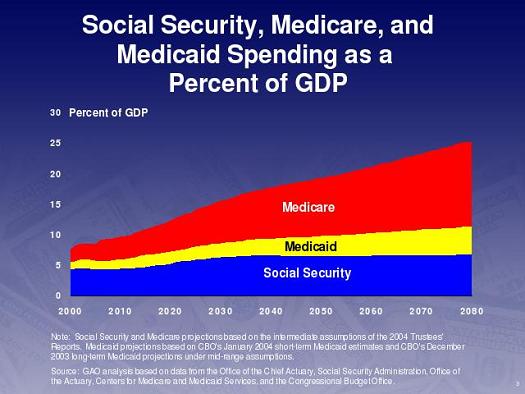
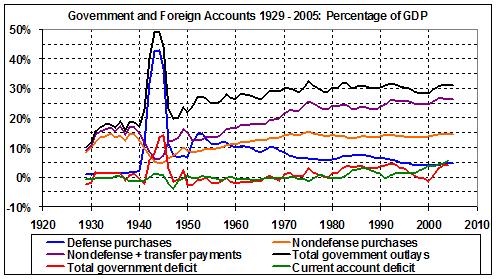
Figure 3 (which encompasses spending and deficits at all levels of government) provides some needed perspective. Notice the historical disconnect between the government deficit and the current-account deficit. The fact that both have been rising in recent years is a coincidence, about which many commentators have drawn the wrong inference. The “500-pound gorilla” in Figure 3 is government spending, in particular, the growing burden of transfer payments (e.g., Social Security, Medicare, and Medicaid), which take from those who produce and give to those who do not, and which discourage saving and encourage consumption. The rise in transfer payments has kept total government outlays above 30 percent of GDP since 1970. Figure 4 indicates that the situation is likely to worsen considerably, given current “commitments” to Social Security, Medicare, and Medicaid.

Figure 3

Sources: Bureau of Economic Analysis, National Economic Accounts, Table 1.1.5. Gross Domestic Product (lines 1, 20-24), Table 3.1. Government Current Receipts and Expenditures (lines 17, 29), Table 4.1 Foreign Transactions in the National Income and Product Accounts (line 29).

Figure 4

Source: Government Accounting Office (see also “Funding the Welfare State“).

This recitation of dreary facts sets the stage for the rest of this post, which focuses on the real problem, which is government spending — not government deficits (per se), and certainly not the so-called trade deficit.

The “Real” Economy in Simple Formulae

The following formulations depict the “real” economy at a given time. (See this article for a more complex but equivalent depiction.) These formulations do not, by themselves, depict the dynamics of economic growth or the cause-and-effect relationships among the various parameters of the real economy. I supply some of those missing ingredients in the commentary that follows.

The totality of real economic activity can be expressed as an identity:

(1) Income ≡ Output

That is, aggregate income (the claims on or distribution of output) must be equal to the aggregate of all types of output.

Income and output can be expressed in terms of certain parameters:

(2.a) Income = C + S + T + M

(2.b) Output = C + I + G + X ,

where the parameters are defined as follows:

C = consumption (private-sector consumption of goods and services produced domestically, excluding consumption that is subsidized by government transfer payments to the beneficiaries of such programs Social Security and Medicare)

S = saving (private-sector income not consumed, taxed, or spent on imports)

I = private-sector investment (output invested by non-governmental entities in technology, buildings, equipment, etc., for the purpose of increasing the future output of goods and services)

M = items imported for private-sector consumption or investment from other countries

X = private-sector output exported to other countries

T = taxes, including transfer-payment taxes for Social Security, etc.

G = government spending (including spending that is subsidized by transfer payments for such programs as Social Security and Medicare)

and:

(X – M) or (M – X) = trade surplus or deficit

(T – G) or (G – T) = government surplus or deficit.

These definitions vary from the standard version in that any spending subsidized by government transfer payments for such programs as Social Security and Medicare is included in G rather than C . These definitions also implicitly reject a role for government in saving and investment, for reasons spelled out in my post, “Joe Stiglitz, Ig-Nobelist.”

Key Relationships

Because Income ≡ Output, it follows that:

(3) C + S + T + M = C + I + G + X

In a closed economy without government the Income ≡ Output identity reduces to this:

(3′) C + S = C + I

Given that C ≡ C, it follows that S = I in a closed economy without government.That is, absent government (which usurps saving through taxation), the backbone of private-sector investment is private-sector saving.

In an open economy without government the Income ≡ Output identity becomes this:

(3”) C + S + M = C + I + X

Given that C ≡ C, it follows that (S + M) = (I + X) in an open economy without government. That is, given a level of exports, the backbone of private-sector investment is the combination of private-sector saving and imports that are not consumed. It therefore follows that . . .

The Trade Deficit Is Good

Solving 3 for (M – X), the trade deficit, we get:

(4) (M – X) = (I – S) + (G – T)

What (4) tells us is that a trade deficit is a boon to economic growth. That is, an increase in M (or a decrease in X) supports an increase in I , even when T reduces S .

Consider, for example, an exogenous increase in M (e.g., because of economic growth or a drop in the prices of imported goods relative to the prices of domestic substitutes). An exogenous increase in M means that more resources become available for I (as well as C). By the same token, an exogenous decrease in X (e.g., because a rise in U.S. interest rates attracts foreign money away from U.S. exports and toward U.S. bonds and mortgages) means that more resources become available for I (as well as C).

In sum, the causality runs from trade. Trade is an enabler. Foreign trade is just another form of voluntary exchange, which benefits all parties. In the case of foreign trade, Americans stand to capture real resources that can be invested in growth-producing capital. The so-called trade deficit isn’t the “bad” side of trade, it’s the good side of trade.

The catch is that government may confiscate some of the potential gains from a trade deficit by adding to its debt when G is greater than T . Which leads me to this . . .

A Trade Deficit Is Not a Form of Debt

Solving (3) for (G – T), we get:

(5) (G – T) = (S – I) + (M – X).

It is apparent that a trade deficit can finance a portion of the government deficit. That is why government-deficit and trade-deficit hysterics liken the trade deficit to a form of debt — which it is not. The trade deficit does not create the government deficit. The government deficit arises mainly from exogenous decisions about the size of G and the various taxes that result in T .

To repeat and elaborate: The trade deficit — when there is one — merely helps to finance the government deficit — when there is one. The two are essentially independent of each other. Consider an increase in the trade deficit, which enables an increase in private investment and/or consumption (see the preceding section). The government may (through taxing or borrowing) confiscate some or all of the increase in the trade deficit. Thus a trade deficit, which is potentially beneficial because it enables an increase in private investment, simply “soaks up” some of the government deficit. But the trade deficit is merely coincidental with the government deficit, and is not created by it.

In the absence of a trade deficit, the burden of a government deficit would fall entirely on the domestic private sector. For example, referring to (5), in the absence of a trade deficit, an increase in G would require an offsetting reduction in I (as well as C). (It would be ludicrous to interpret (5) as saying that an increase in G leads to an increase in S .)

In other words, a trade deficit makes things better for the private sector — not worse — and the trade deficit has nothing to do with the size of the government deficit. The coincidental rise of the government deficit and the trade deficit in recent years (Figure 3) is just that: coincidental. Anyone who says that the trade deficit is a form of debt is guilty of (a) mistaking coincidence for causality, and (b) misunderstanding the meaning of “deficit” in the term “trade deficit.”

There is no trade deficit. The things foreigners buy from us have exactly the same value as the things we buy from them. The mix of things foreigners buy from us simply happens to include a higher proportion of stocks, bonds, and mortgages than the mix of things Americans buy from foreigners.

Bogus “Threats”: Foreign “Ownership” and “Job Exportation”

There is the notion that the holding of U.S. stocks, bonds, and mortgages gives foreigners a “hold” over us. How so? It hurts foreign holders of U.S. equities, securities, and real estate if those things lose value. Foreigners have absolutely no incentive to “dump” their holdings of U.S. financial instruments unless financial markets already have signaled that those instruments are losing value for reasons unrelated to the ownership of financial assets. Foreign “dumping” in a panic is no different than “dumping” by domestic holders of financial assets. Anyone can panic; Americans have no monopoly on steadfastness when it comes to financial markets.

A foreign investor who “dumps” U.S. paper simply out of pique would be the loser because the investor would be driving down the value of the very holdings it wishes to “dump.” The value of the “dumped” holdings would return to something like their former levels once the investor had finished “dumping,” thus rewarding the buyers with windfall profits.

As for “job exportation,” I must quote from a post I wrote several months ago:

Outsourcing, which is really the same thing as international trade, creates jobs, creates wealth, and raises real incomes — for all. Economics is a positive-sum “game.”

If you’re not convinced, think of it this way: If product X is a good value, does it matter to you whether it was made in Poughkeepsie or Burbank? Well, then, there’s nothing wrong with Laredo, Texas, or Calais, Maine, is there?

Now imagine that the Rio Grande River shifts course and, poof, Nuevo Laredo, Mexico, becomes Nuevo Laredo, Texas. Or suppose that the Saint Croix River between Maine and New Brunswick, shifts course and the former St. Stephen, New Brunswick, becomes St. Stephen, Maine. Juan and Pierre are now Americans. Feel better?

What’s in a border? A border is something to be defended against an enemy. But do you want a border to stand between you and lower prices, more jobs, and economic growth? I thought not.

Taxes Always Hurt

Solving (3) for I , we get:

(6) I = S + (T – G) + (M – X)

That is, private-sector investment is equal to private-sector saving, plus the government surplus (or minus the government deficit), plus the trade deficit (or minus the trade surplus). I re-emphasize: plus the trade deficit (see “The Trade Deficit Is Good,” above).

Equation (6) might be (and has been) taken to mean that a tax increase would lead to an increase in private-sector investment. (That ludicrous assertion is owed to “Rubinomics” — the true “voodo economics.”) Remember, however, that a tax increase must be financed by a decrease in C, S, or M (or some combination of them). A tax increase almost certainly will cause a decrease in I because I depends largely on S and (M – X). Equation (6) is best understood this way: Given the level of T and G , I rises (or falls) with S and the trade deficit (M – X).

When the economy continues to grow in the wake of a tax increase it is because the forces underlying private-sector growth (e.g., returns on prior investments) are sufficiently strong to overcome the inhibiting effects of the tax increase. Think of the economy as a healthy child. Think of a tax increase as a common cold. The cold will cause the child to have less energy than usual, but it will not cause the child to stop growing. On the other hand, too many colds — like too much taxation — can take their toll and turn a healthy child into a sickly one who never fulfills his potential. (See Figure 1 again, and visit the source for it, if you haven’t already done so.)

Government Spending Always Hurts (with a Few Exceptions)

Recall (2.b)? This is what follows from it:

If G goes up, C, I, or X — or a combination of them — must go down.

The key parameter is I , which represents new technology, buildings, equipment, software, etc. — all of which yield more jobs and higher incomes. (By the way, G is not a viable alternative to I ; don’t even consider it.) But X is important, too, because exports enable us to exchange goods and services with foreigners, to our mutual benefit. In sum, G confiscates resources that could have gone into I and X (not to mention C). G also supports the accretion of burdensome regulations.

G is good only when it supports defense and justice. Defense is an insurance policy for our lives, liberty, and property. Justice is that, too, and it also promotes the kind of orderly environment that enables economic activity to thrive.

It follows that the real threat to the well-being of Americans isn’t government deficits (per se) or trade deficits or foreign holdings of U.S. stocks and bonds. The real threat is government spending. Whether government spending is financed by debt or taxes, it is a generally destructive force. Government spending (with exceptions for defense and justice) results in the gross misuse of resources. Beyond that, government spending on regulatory activities inhibits growth-producing investments and blunts the productivity of those investments that are made. And the ways in which Americans are taxed to fund government spending (most of it is funded by taxes) tends to penalize, and thus discourage, invention, innovation, and entrepreneurship. I once estimated the cost to Americans of the regulatory-welfare state that has become dominant over the past 100 years:

  • Real GDP (in year 2000 dollars) was about $10.7 trillion in 2004.
  • If government had grown no more meddlesome after 1906, real GDP might have been $18.7 trillion [Figure 1].
  • That is, real GDP per American would have been about $63,000 (in year 2000 dollars) instead of $36,000.
  • That’s a deadweight loss to the average American of more than 40 percent of the income he or she might have enjoyed, absent the regulatory-welfare state.

That loss is in addition to the 40-50 percent of current output which government drains from the productive sectors of the economy [the direct burden of taxes, plus the direct costs of regulatory compliance].

Those vast losses of income have resulted in vast losses of wealth; for example (from the same post):

[T]he stocks of corporations in the S&P 500 are currently undervalued by one-third because of the depradations of the regulatory-welfare state, which have lowered investors’ expectations for future earnings. . . .

And that’s only the portion of wealth that’s represented in the S&P 500. Think of all the other forms in which wealth is stored: stocks not included in the S&P 500, corporate bonds, mortgages, home equity, and so on.

If government had left its grubby hands off the economy, there never would have been a Great Depression, Social Security, Medicare, Medicaid, and the myriad regulations that have us tied in knots.

And we would be vastly better off.

Our “leaders” in Washington obviously don’t want to do much of anything to cope with the real threat to our well-being. They’re like terminal alcoholics who keep ordering triple shots.

“Crowding Out” in Perspective

What about the notion that government deficits “crowd out” private-sector investment? In a growing economy — both national and global — government spending rises alongside private-sector investment because there is room for both to grow. We would be better off with decreases in most kinds of government spending (excepting defense and justice). But we would be better off because government would be confiscating fewer resources that could go into consumption and growth-producing investments. It’s not government deficits (per se) that matter; it’s government spending that matters. Government deficits are a drop in the proverbial bucket of global liquidity. To quote myself again:

The crowding-out hypothesis . . . is based on a static analysis — a mere truism — which says that a given level of national output can be reallocated, but not changed. But the crowding-out hypothesis, which has reputable critics and doubters (see here, here, here, and here, for instance) doesn’t apply to a dynamic economy. The actual effect of government borrowing on interest rates — and thus on the cost of private capital formation — is minuscule, and perhaps nonexistent, as Brian S. Westbury explains:

The theory [that deficits drive up interest rates] suggests that deficits “crowd out” private investment, putting upward pressure on interest rates. In other words, government borrowing eats up the available pool of capital. But today’s forecasted deficits of $300 to $500 billion are just a small drop in the pool of global capital markets. In the U.S. alone, capital markets are $30 trillion dollars deep, for the world as a whole they approach $100 trillion. Deficits of the size projected in the years ahead cannot possibly have the impact on interest rates that many fear. . . .

The trade deficit — fortunately — blunts the confiscatory effects of government spending. Why? Because if foreigners aren’t spending all the dollars they earn on U.S. produced goods and services, it means that they are buying U.S securities, equities, and mortgages. That is, they are enabling private-sector investments that help to make American businesses more productive and profitable.

Net foreign buying of U.S. securities, equities, and mortgages also has been a major cause of the decade-long decline in U.S. interest rates. (See, for example this, this, and this.) American stockholders and homebuyers are therefore “indebted” to foreigners who buy U.S. stocks and bonds. American bondholders (on the whole) also have gained because rising bond prices have more than offset the decline in interest rates.

What Does the Future Hold?

There is no reason to believe that rising interest rates will cause the net inflow of foreign funds to dry up. Rising interest rates might cause foreigners to shift from stocks to bonds, but rising interest rates will attract money from abroad, not repel it. Even if the net inflow of foreign funds were to slow down for some reason, it is not going to suddenly dry up. And even if it dries up eventually, it won’t dry up forever because — in the world of economics — nothing is forever. A trend usually creates the conditions for its reversal:

We’ve been through periods of high inflation, high interest rates, large trade deficits, and low exchange rates at varying times, and we’ll go through them again. Today we have relatively low (but rising) inflation, and relatively low (but rising) interest rates, a persistently large trade deficit (willingly financed by foreigners), and therefore a falling exchange rate. But all of that can and will change as higher interest rates and lower exchange rates work their way through the economy, dampening investment and consumption spending and, therefore, imports.

Today is not forever. Doomsaying is an ancient and long-discredited profession. Remember the ten years between the “oil shocks” of the early 1970s and the end of double-digit inflation in the early 1980s? Remember the next 20 years of almost unmitigated economic growth with low inflation? Extrapolating from current economic conditions is a sucker’s game, unless you bet on the underlying trend in the U.S., which is long-term economic growth.

In any event, future changes in the net inflow of foreign funds cannot undo the benefits that have accrued to Americans because of past inflows. Those who fear a “drying up” of the inflow are like bums who have been getting free meals and then complain when the soup kitchen shuts down. You take what you can get, when you can get it, and invest it wisely. That’s evidently what Americans have been doing, thanks to the trade deficit — and no thanks to government spending.

Related posts:

The Destruction of Income and Wealth by the State
Why Outsourcing Is Good: A Simple Lesson for Liberal Yuppies
Curing Debt Hysteria in One Easy Lesson
Trade Deficit Hysteria
Brains Sans Borders
Understanding Economic Growth
The Real Meaning of the National Debt
Debt Hysteria, Revisited
Why Government Spending Is Inherently Inflationary
Understanding Outsourcing
Joe Stiglitz, Ig-Nobelist
Professor Buchanan Makes a Slight Mistake
More Commandments of Economics
Productivity Growth and Tax Cuts
Do Future Generations Pay for Deficits?
Liberty, General Welfare, and the State
Starving the Beast, Updated

On Income Inequality

UPDATE: See also this post by Donald Boudreaux and this EconBlog debate.

Over at EconLog, Arnold Kling observes and asks:

My view of [income] inequality is that it is one of those issues that gets trotted out when everything in the economy seems to be going so well that we have nothing else to complain about. When you have serious bad news, such as high unemployment or a financial meltdown, the media forget about inequality.

The question I have for people on both sides of the debate is this: what would the data have to look like to get you to consider changing your position? That is, if you think inequality is a big deal, what would the data on relative consumption or wealth or income have to look like to make you think it is not a big deal? Conversely, if you think inequality is not a big deal, what would the data have to look like to make you think that it is a big deal?

I think inequality is not a big deal. Here’s my comment:

It would take three things to convince me that inequality is a big deal: (1) low inter-generational mobility up and down the distribution of household incomes (e.g., a majority of the households in the bottom quintile are still in the bottom quintile 25 years later); (2) little or no inter-generational increase in real income for those in the bottom quintile or two, as against relatively large increases for the other quintiles; (3) evidence that persons in the lower quintiles are unable to exploit their abilities because of legal barriers (e.g., Jim Crow laws). Absent the third condition, I would conclude that the first two conditions are evidence of endogenous hereditary/cultural biases that thwart advancement.

Related posts:

Why Class Warfare Is Bad for Everyone
Fighting Myths with Facts
Debunking More Myths of Income Inequality

Quick Takes

Attempted murder or terrorism? You decide. But I will not call it a “hate crime.”

Why we must steadfastly reject economic interventions by the state. (The price of interventionism? Read this.)

More good reasons to reject hostility to religion, which are consistent with my reasons.

It is hard to fight a war while you’re carrying a lawyer on your back. It’s even harder when you’re carrying the Left, the press, the punditocracy, many members of Congress, and a bunch of cosseted anarcho-capitalists on your back.

Contrary to nit-picking statisticians and pseudo-libertarians, a community is what it expects and enforces.

Speaking of pseudo-libertarians, it is wise to reject the tempting tenets of Objectivism, saith he. And so say I.

Occupational Licensing

From Tyler Cowen at Marginal Revolution:

Do we need occupational licensing?

Alan Krueger writes:

In a new book, “Licensing Occupations: Ensuring Quality or Restricting Competition?” (Upjohn Institute, 2006), Morris M. Kleiner, an economist at the University of Minnesota, questions whether occupational licensing has gone too far. He provides much evidence that the balance of occupational licensing has shifted away from protecting consumers and toward limiting the supply of workers in various professions. A result is that services provided by licensed workers are more expensive than necessary and that quality is not noticeably affected.

Read more here. . . . Here is a pdf of part of the book. Here is a home page for the book.

Darn straight. Read these:

Fear of the Free Market — Part I
Fear of the Free Market — Part II
Fear of the Free Market — Part III

The Joys of Sole Proprietorship

Glen Whitman, in a post at Agoraphilia, says that

[l]oosely speaking, accounting profit considers only expenditures as costs, whereas economic profit counts both expenditures and forgone income as costs. The classic example is a sole proprietor who works 60 hours/week running his store. On paper, he might appear to be making a large (accounting) profit. But if you subtracted the income he could have received had he taken a job working the same number of hours for someone else, his (economic) profit would be smaller, maybe even negative.

I think Whitman omits an important aspect of economic income, which is sometimes called “psychic income.” The sole proprietor gains a non-pecuniary benefit by working for himself: being his own boss. That’s why many persons choose the long hours and greater risks of sole proprietorship to the generally shorter hours and more stable income of salaried employment.

Then, too, there’s always the possiblity that one’s sole proprietorship will be bought out by a larger company for millions of dollars. That’s a potential pecuniary benefit that usually isn’t available to a salaried employee. But I think that potential benefit is secondary to the psychic income derived from being one’s own boss.

Somthing to Ponder

A traveler in the desert who has run out of water comes upon a well that is enclosed by a high chain-link fence, in which there is a locked gate. The fence demarcates the property of the well’s owner, who has plenty of water for his own needs and could give some away at no loss to himself. The traveler shouts until he is heard by the owner of the property, who comes to the gate and asks the traveler what he wants. The traveler says that he would like to fill his canteen so that he can continue his journey and not die of thirst before he reaches his destination. The fence and gate are so high that the traveler cannot give his canteen to the property owner by throwing it; the property owner must unlock the gate and, thus, give the traveler an opportunity to force his way in.

The property owner either gives water to the traveler or refuses to give any water to the traveler. The property owner’s reasons for giving or refusing water are unknown to us. It is possible, for example, that the property owner is torn between (a) empathy for a human being in distress and (b) a suspicion (based on knowledgea and/or experience) that the traveler might try to rob him. It is possible, also, that the property owner is misanthropic, which is why he lives behind a very high fence in the middle of a desert. There may be other explanations for the property owner’s decision to give or refuse water to the traveler. All we know is the property owner’s decision.

How do you react if the property owner refuses to give water to the traveler?

1. He had to make a judgment. No one is in a position to second-guess that judgment.

2. The property owner doesn’t owe water to the traveler. The traveler should have been better prepared for his journey and brought more water. It was happenstance that brought him to a property on which there was a well. What would he have done if a property with a well hadn’t been on his route? Think of the kinds of behavior a property owner might encourage and invite if he were to succumb to the blandishments of an imprudent traveler or a criminal masquerading as one.

3. The property owner has a moral duty to aid the traveler, even at some risk to himself (the property owner). But, if the property owner refuses to help the traveler, the consequences of the refusal are on the property owner’s conscience. It is no one else’s business.

4. There should be a law that requires property owners to give water to travelers, even though such a law: (a) might encourage some travelers to go forth with inadequate supplies of water even though they might not come across a well, and (b) might make it easier for criminals to attack and rob property owners.

I am content with reaction 1. Reaction 2 isn’t inconsistent with reaction 1, but I find reaction 2 unnecessarily defensive of the owner’s decision. (Reaction 2 may be politically necessary, however, because of reactions 3 and 4.) Reaction 3 substitutes a third party’s judgment for that of the owner. And the “moral duty” part of reaction 3 forms the basis for reaction 4, which then translates the third party’s judgment into a legal stricture. The legal stricture on voluntary behavior has the usual results: It creates a moral hazard for travelers and has (negative) unintended consequences for property owners.

Monopoly and the General Welfare

UPDATED, 02/26/06

I began an earlier post by illustrating (with a “Jack and Jill” example”) how a regime of liberty fosters prosperity. I concluded:

In sum, liberty — which includes the right to engage in voluntary exchange — makes both Jack and Jill better off. Moreover, because they are better off they can convert some of their gains from trade into investments that yield even more output in the future. For example, to continue with this homely metaphor, imagine that Jill — fueled by additional food — is able to produce the usual amount of butter in less time, giving her time in which to design and build a churn that can produce butter at a faster rate.

Liberty advances the general welfare, which means the general well-being — not handouts.

You may have noticed that I did not argue that Jack and Jill’s well-being can somehow be aggregated into a “social welfare function.” As I wrote here, there is no such thing:

Suppose . . . that a faction of US citizens (call it LW) is unhappy because of certain actions being taken to prevent an attack by AQ. The actions that make LW unhappy don’t make me unhappy. In fact, they add to my happiness because I despise LW; anything that makes LW unhappy makes me happier. Thus, I’ll continue to be happy, despite LW’s unhappiness, unless and until (a) LW’s unhappiness leads to a political decision to stop defending US against AQ or (b) AQ attacks US successfully.

I could go on, but I think you get the idea. My happiness (or unhappiness) is mine, and yours is yours. The best we can say is that voluntary exchange in free markets, protected by strict enforcement of laws against force and fraud, would make almost everyone happier — and wealthier. So much wealthier that there’d be plenty of money with which to buy off the free-loaders. But that’s another story.

(See also this post.)

In yet another post I defended monopoly:

Where, for instance, is there room in the socialist or regulatory calculus for a rule that allows for unregulated monopoly? Yet such an “undesirable” phenomenon can yield desirable results by creating “exorbitant” profits that invite competition (sometimes from substitutes) and entice innovation. (By “unregulated” I don’t mean that a monopoly should be immune from laws against force and fraud, which must apply to all economic actors.

(There’s more here.) And in this post, on the subject of monopoly (scroll to item 19), I opened by saying, “Monopoly (absent force, fraud, or government franchise) beats regulation, every time.” This follows:

Regulators live in a dream world. They believe that they can emulate — and even improve on — the outcomes that would be produced by competitive markets. And that’s precisely where regulation fails: Bureaucratic rules cannot be devised to respond to consumers’ preferences and technological opportunities in the same ways that markets respond to those things. The main purpose of regulation (as even most regulators would admit) is to impose preferred outcomes, regardless of the immense (but mostly hidden) cost of regulation.

There should be a place of honor in regulatory hell for those who pursue “monopolists,” even though the only true monopolies are run by governments or exist with the connivance of governments (think of courts and cable franchises, for example). The opponents of “monopoly” really believe that success is bad. Those who agitate for antitrust actions against successful companies — branding them “monopolistic” — are stuck in a zero-sum view of the economic universe (see No. 13), in which “winners” must be balanced by “losers.” Antitrusters forget (if they ever knew) that (1) successful companies become successful by satisfying consumers; (2) consumers wouldn’t buy the damned stuff if they didn’t think it was worth the price; (3) “immense” profits invite competition (direct and indirect), which benefits consumers; and (4) the kind of innovation and risk-taking that (sometimes) leads to wealth for a few also benefits the many by fueling economic growth.

. . . What about those “immense” profits? They don’t just disappear into thin air. Monopoly profits (“rent” in economists’ jargon) have to go somewhere, and so they do: into consumption, investment (which fuels economic growth), and taxes (which should make liberals happy). It’s just a question of who gets the money.

But isn’t output restricted, thus making people generally worse off? That may be what you learned in Econ 101, but that’s based on a static model which assumes that there’s a choice between monopoly and competition. I must expand on some of the points I made in the original portion of this commandment:

  • Monopoly (except when it’s gained by force, fraud, or government license) usually is a transitory state of affairs resulting from invention, innovation, and/or entrepreneurial skill.
  • Transitory? Why? Because monopoly profits invite competition — if not directly, then from substitutes.
  • Transitory monopolies arise as part of economic growth. Therefore, such monopolies exist as a “bonus” alongside competitive markets, not as alternatives to them.
  • The prospect of monopoly profits entices more invention, innovation, and entrepreneurship, which fuels more economic growth.

I will now try to braid these strands into a rope fit for hanging trust-busters. Returning to Jack and Jill, suppose this:

  • Jack can make 1 loaf of bread a day; he does not know how to make butter.
  • Jill and June each can make 1 pound of butter a day; neither knows how to make bread.
  • Jack is a “natural monopolist” in bread; Jill and June must bid against each other to buy Jack’s bread, and must compete with each other in selling butter to Jack.

Now, the question for Jack, Jill, and June is this: At what rate should they exchange bread and butter? Contrary to the anti-trust mentality, there is no right answer to that question. The answer depends on Jack, Jill, and June’s respective preferences for bread and butter, and on their respective negotiating skills. But of one thing we can be certain, Jack, Jill, and June will strike bargains that makes all of them better off than they would be in the absence of trade — if they are left alone by government.

How can that be so if Jack is a “monopolist”? Doesn’t he have an “unfair” advantage in his dealings with Jill and June? No. Consider:

  • Suppose that Jack and Jill (and June, as well) prefer bread and butter in the ratio 1/3 loaf: 2/3 pound. Before June enters the picture, Jack and Jill cannot both have their preferred combination of bread and butter. Jack would like to trade 1/3 loaf to Jill in return for 2/3 pound, and Jill would like to trade 1/3 pound to Jack in return for 1/3 loaf. Neither trade will fully satisfy both parties, so they must strike a compromise that leaves both of them better off than if they did not trade, but not as well off as they would like to be (with respect to the ratio of bread and butter).
  • When June enters the picture, all parties can have their preferred combination of bread and butter, and they will (if no one interferes). Jack, as the only breadmaker, is not in a superior position with respect to Jill and June. He makes something that they want, but they also make something that he wants. (A “natural monopolist” does not live by bread alone.) And so, Jack must bargain with Jill and June in order to maximize his satisfaction.
  • If Jack tries to bargain with Jill and June by withholding all of his bread, he must accept the fact that he will not have any butter to put on it. If Jack tries to charge Jill and/or June more for his bread than they are willing to pay, they simply will not pay it.
  • What’s likely to happen if Jack withholds bread or demands more than Jill and June are willing to pay? Jill and June will learn to make bread for themselves, as if Jack doesn’t exist. They will have some bread with their butter; Jack will have no butter with his bread. Who’s worse off now, Jack?
  • If Jack persists in his holdout, he isn’t guilty of a crime, he’s merely guilty of choosing to accept a reduced standard of living. That’s a personal preference, not a crime. The same result (for Jill and June) would obtain if Jack were dead. No crime there. Jack is guilty of a “crime” only if he prevents Jill and June from making bread, or if he forces them to give him butter on terms they wouldn’t accept voluntarily.

(UPDATE: Have I stacked the deck by the example I used? No. See the addendum, below.)

The only kind of monopoly that harms consumers is a legal monopoly, one that is operated or regulated by government. Such a monopoly isn’t harmful per se, it’s harmful because the government’s operation or regulation of the monopoly ensures that it cannot and will not respond to price signals. A natural monopolist (like Jack the breadmaker) must bargain with his customers, and must be alert to the possibility that his customers will turn to substitutes and near-substitutes if he doesn’t bargain with them. But when government operates and regulates whole sectors of the economy (e.g., telecommunications and health care), price signals are practically meaningless — there is no bargaining — and substitutes are hard to come by (near-substitutes will be regulated, of course).

The only real monopoly, then, is one that is operated or regulated by government. It is that kind of monopoly — not Microsoft or Wal-Mart (for example) — which ought to be broken up or fenced in by the trust-busters.
__________
ADDENDUM: I contrived a special case to illustrate the general point that “the consumer always prefers more to less.” That is, the introduction of June, who brings additional butter to the table (so to speak), gives everyone the option of enjoying more butter. No one can be worse off than before, and at least one person can be better off. But suppose that instead of the outcome I sketched above (Jack, Jill, and June each end up with 1/3 loaf of bread and 2/3 pound of butter) June is willing to give Jack 2/3 of her pound of butter in exchange for 1/3 loaf of bread, a deal with which Jill chooses not to compete. The result: Jack (who starts with 1 loaf of bread) has 2/3 loaf of bread and 2/3 pound of better (extra bread for a rainy day), Jill (who starts with 1 pound of butter) has no bread and 1 pound of butter, and June (who starts with one pound of butter) has 1/3 loaf of bread and 1/3 pound of butter (a light eater). Jack and June are, by definition, happy with the outcome of the trade (June wouldn’t make the deal with Jack if that weren’t the case), but Jill is unhappy because she’d prefer to have 1/3 loaf of bread and 2/3 pound of butter, as before. Three points:

1. The new result has everything to do with differences of taste between Jill and June — and nothing to do with Jack’s so-called monopoly power.

2. To say that Jill has somehow become a “victim” of Jack’s so-called monopoly power is to give a privileged postition to Jill. Why are Jill’s preferences any more important than Jack’s or June’s? There’s no way to assign values to Jack, Jill, and June’s satisifaction, let alone to sum such values and determine that “society” is somehow better or worse off if Jill doesn’t get her way.

3. If June’s entry into the butter-bartering market leaves Jill hankering for bread, Jill might be able to earn some bread by making jam instead of butter. She would then have something to offer both Jack and June. In other words, the price system is sending a signal to Jill; it’s up to her to interpret and act on that signal. That signal would not be sent if a “benevolent” government, acting at the behest of Jill’s political action committee, were to step in and dictate the terms of trade between Jack, Jill, and June (according to Jill’s preferences). The result would be to make Jill better off while making Jack and June worse off. That’s what happens when interest groups are able to use the power of government to satisfy their preferences.

Starving the Beast, Updated

Out-of-control spending is a hot topic of conversation in the blogosphere, especially among those who are disappointed in President Bush’s failure to curb the federal government’s appetite. Bill Niskanen and Peter Van Doren, former colleagues of mine at Cato Institute, published a paper a few years ago (which no longer seems to be available on the web), in which they said this:

For nearly three decades, many conservatives and libertarians have argued that reducing federal tax rates, in addition to increasing long-term economic growth, would reduce the growth of federal spending by “starving the beast.” This position has recently been endorsed, for example, by Nobel laureates Milton Friedman and Gary Becker in separate Wall Street Journal columns in 2003.

It seems to me that the notion of starving the beast is really an outgrowth of an older, simpler notion that could have been called “strangle the beast.” The notion was (and still is, in some quarters) that the intrusive civilian agencies of the federal government, which have grown rampantly since the 1930s, ought to be slashed, if not abolished. There’s no need for fancy tricks like cutting taxes first, just grab the beast by the budget and choke it. There’s more than money at stake, of course — there’s liberty and economic growth. (I have shown here the extent to which the beast of government has strangled economic growth.)

Anyway, Niskanen and Van Doren argue that the “starve the beast” strategy has failed, which is true, but I have serious reservations about their analysis. Their figure of merit is spending as a share of GDP. But it’s the absolute, real size of the beast’s budget that matters. Bigger is bigger — and bigger agencies can cause more mischief than smaller ones. So, my figure of merit is real growth in nondefense spending.

What about defense spending, which Niskanen and Van Doren lump with nondefense spending in their analysis? Real nondefense spending has risen almost without interruption since 1932, with the only significant exception coming in 1940-5, when World War II cured the Depression and drastically changed our spending priorities. Real defense spending, on the other hand, has risen and fallen several times since 1932, in response to exogenous factors, namely, the need to fight hot wars and win a cold one. Niskanen and Van Doren glibly dismissed the essentially exogenous nature of defense spending by saying

that the prospect for a major war has been substantially higher under a unified government. American participation in every war in which the ground combat lasted more than a few days — from the war of 1812 to the current war in Iraq — was initiated by a unified government. One general reason is that each party in a divided government has the opportunity to block the most divisive measures proposed by the other party.

First, defense outlays increased markedly through most of Reagan’s presidency, even though a major war was never imminent. The buildup served a strategy that led to the eventual downfall of the USSR. Reagan, by the way, lived with divided government throughout his presidency. Second, wars are usually (not always, but usually) broadly popular when they begin. Can you imagine a Republican Congress trying to block a declaration of war after the Japanese had bombed Pearl Harbor? Can you imagine a Democrat Congress trying to block Bush II’s foray into Afghanistan after 9/11? For that matter, can you imagine a Democrat-controlled Congress blocking Bush I’s Gulf War Resolution? Well, Congress was then in the hands of Democrats and Congress nevertheless authorized the Gulf War. Niskanen and Van Doren seem to dismiss this counter-example because the ground war lasted only 100 hours. But we fielded a massive force for the Gulf War (it was no Grenada), and we certainly didn’t expect the ground war to end so quickly.

As I was saying, domestic spending is the beast to be strangled. (I’m putting aside here the “sacred beasts” that are financed by transfer payments: Social Security, Medicare, etc.) How has the domestic beast fared over past 70-odd years? Quite well, thank you. It fared best from 1933 through 1969, but it hasn’t done badly since 1969.

The beast — a creature of the New Deal — grew four-fold from 1932 through 1940. Preparations for war, and war itself, brought an end to the Great Depression and stifled nondefense spending: It actually dropped by more than 50 percent (in real terms) from 1940 through 1945.

After World War II, Truman and the Democrats in control of Congress were still under the spell of their Depression-inspired belief in the efficacy of big government and counter-cyclical fiscal policy. The post-war recession helped their cause, because most Americans feared a return of the Great Depression, which was still a vivid memory. Real nondefense spending increased by 180 percent during the Truman years.

The excesses of the Truman years caused a backlash against “big government” that the popular Eisenhower was able to exploit, to a degree, in spite of divided government. Real domestic spending went up by only 9 percent during Ike’s presidency.

The last burst of the New Deal came in the emotional aftermath of Kennedy’s assassination and Lyndon Johnson’s subsequent landslide victory in the election of 1964. Real nondefense spending in the Kennedy-Johnson years rose by 56 percent. The decades-long war over domestic spending really ended with the enactment of LBJ’s Great Society. The big spenders won that war — big time. Real nondenfense spending grew at an annual rate of 5.9 percent from 1932 through 1969.

Real nondefense spending has continued to grow since 1969, but at the lower rate of 2.5 percent per annum. What has changed is that nondefense spending has grown more steadily than it did from 1932 to 1969. Each administration since 1969 (aided and abetted by Congress, of course) has increased nondefense spending by following an implicit formula. That formula has two parts. First, there is the steady increase that is required to feed the beast that came to maturity with the Great Society. Second, there is countercyclical spending which is triggered by recessions and unemployment. As a result, there is a very strong — almost perfect — relationship between real nondefense spending and the unemployment rate for the years 1969 through 2005. Using a linear regression with six pairs of observations, one pair for each administration, I find that the percentage change in real nondefense spending is a linear function of the change in the unemployment rate. Specifically:

S = 1.0277 + 0.11346U

where S = real nondefense spending at end of a presidency/real nondefense spending at beginning of a presidency

U = unemployment rate at end of a presidency/unemployment rate at beginning of a presidency.

The adjusted R-squared for the regression is .979. The t-stats are 112.17 for the constant term and 15.26 for U.

What about divided government, of which Niskanen and Van Doren are so fond? Divided government certainly hampered the ability of Republican administrations (Nixon-Ford, Reagan, Bush I, and Bush II) to strangle the beast, had they wanted to. But it’s not clear that they wanted to very badly. Nixon was, above all, a pragmatist. Moreover, he was preoccupied by foreign affairs (including the extrication of the U.S. from Vietnam), and then by Watergate. Ford was only a caretaker president, and too “nice” into the bargain. Reagan talked a good game, but he had to swallow increases in nondefense spending as the price of his defense buildup. Bush I simply lacked the will and the power to strangle the beast. Bush II may have had the power (at one time), but he spent it on support for his foreign policy and in an effort to buy votes for the GOP.

Bureaucratic politics (rather than party politics) is the key to the steady growth of nondefense spending. It’s hard to strangle a domestic agency once it has been established. Most domestic agencies have vocal and influential constituencies, in Congress and amongst the populace. Then there are the presidential appointees who run the bureaucracies. Even Republican appointees usually come to feel “ownership” of the bureaucracies they’re tapped to lead. Real nondefense spending therefore has risen steadily from the Great Society baseline, fluctuating slightly in countercyclical response to recessions and unemployment.

Having said all that, how do the presidents from Nixon through Bush II stack up? In spite of all the blather about Bush II’s big-spending ways, there’s not a dime’s worth of difference among the post-Great Society administrations — Democrat or Republican. Using the above regression equation, I estimated the expected growth of real nondefense spending for each administration. I then used that estimate to compute an actual-to-estimated ratio (how much nondefense spending actually rose divided by how much it “should” have risen, according to the equation).* The results:

Nixon-Ford — 1.00
Carter — 1.00
Reagan — 1.00
Bush I — 1.00
Clinton — 1.01
Bush II — 0.99

The lesson is clear: Tax cuts won’t starve the beast — Friedman, Becker, and other eminent economists to the contrary. But tax increases, on the other hand, would only stimulate the beast’s appetite. The best way to cut spending is . . . to cut spending.

In any event, the truly vicious beast isn’t federal nondefense spending, it’s state and local spending. Spending by state and local governments in the United States is five times as large as the federal government’s nondefense spending. Real spending by state and local governments increased by a multiple of 11 from 1945 to 2005. The population of the United States merely doubled in that same period. Thus the average American’s real tax bill for state and local government is more than five times larger today than it was in 1945.

It’s evident that not enough of the loot has been spent on courts and police. No, our modern, “relevant” state and local governments have seen fit to waste our money on such things as free bike trails for yuppies, free concerts that mainly attract people who can afford to pay for their own entertainment, all kinds of health services, housing subsidies, support for the “arts,” public access channels on cable TV, grandiose edifices in which our state and local governments hatch and oversee their grandiose schemes, and much, much, more.

Then there are those public schools . . .

The good news about state and local spending is that its real rate of growth has dropped in the past few years. The bad news is that the slowdown coincided with a recession and period of slow economic recovery. The good news is that state and local spending is a beast with thousands of necks, and each of them can be throttled at the state and local level, given the will to do so.
__________
* By the standards of 1969-2005, here’s how earlier administrations stack up:

Hoover — 0.68
Roosevelt — 3.29 (through 1940)
Truman — 2.30
Eisenhower — 0.85
Kennedy-Johnson — 1.43

There used to be a real difference between Republicans and Democrats. Now there isn’t. That doesn’t make Democrats any better, it just confirms my version of the old adage: The pursuit of power corrupts.

Another Voice Against the New Paternalism

Glen Whitman of Agoraphilia weighs in:

If we think of a person as consisting of multiple selves—the present self who wishes to indulge in transient pleasures versus the future self who wishes to be healthy—then arguably the present self’s choices can force externalities on the future self. Those within-person externalities have been dubbed “internalities.” And just as we might impose a pollution tax on a factory to control the externality problem, we mightimpose a sin tax on items like cigarettes, alcohol, and fatty foods to control the internality problem.

The concept of internalities, although not yet a part of mainstream economics, is gaining attention. It is one among many novel economic models recently deployed by a new generation of paternalists. Paternalistic arguments advocate forcing or manipulating individuals to change their behavior for their own good, as distinct from the good of others. At one time paternalists argued that adults, like children, don’t really know what’s best for them. Some preferences, they argued, such as those for unhealthy food or casual sex, are just wrong. But such arguments hold little sway in a free society, where most people believe they should be able to pursue their own values and preferences even if others don’t share them. So the “new” paternalists have wisely chosen not to question people’s preferences directly; instead, they argue that internalities (and other sources of error in decisionmaking) can lead people to make decisions that are unwise even according to their own values and preferences.

In short, the old paternalism said, “We know what’s best for you, and we’ll make you do it.” The new paternalism says, “You know what’s best for you, and we’ll make you do it.”. . .

First, the new paternalism blithely assumes that, when your present self can impose costs on your future self, the outcome is necessarily bad. But preventing harm to the future self might involve even greater harm to the present self. There’s no valid reason to assume, when there is an inconsistency between present and future interests, that the latter must trump the former.

Second, the new paternalism ignores the fact that harms can be avoided in multiple ways. Restricting present behavior is one way to reduce future harms, but that doesn’t make it the best way. The future self might be capable of mitigating the harm at lower cost by other means.

Third, the new paternalism neglects the possibility of internal bargains and private solutions. All of us face self-control problems from time to time. But we also find ways to solve, or at least mitigate, those problems. We make deals with ourselves. We reward ourselves for good behavior and punish ourselves for bad. We make promises and resolutions, and we advertise them to our friends and families. We make commitments to change our own behavior. Internality theorists point to these behaviors as evidence that the internality problem exists. But they are actually evidence of the internality problem being solved, at least to some degree.

People are not perfect, so we should not expect real people’s actions to mimic those of perfectly rational and perfectly consistent beings. Mistakes will occur; self-control problems will persist. But paternalist solutions will solve them no better than personal solutions. What is really at stake is how self-control problems will be addressed—through private, voluntary means or through the force of government.

The new paternalists would have us believe that benevolent government can—through taxes, subsidies, restrictions on the availability of products, and so on—make us happier according to our own preferences. But even if we place little or no value on freedom of choice for its own sake, the paternalists’ recommendations simply don’t follow. Public officials lack the information and incentives necessary to craft paternalist policies that will help the people who most need help, while not harming those who don’t need the help or who need help of a different kind. Individuals, on the other hand, have every reason to understand their own needs and find suitable means of solving their own problems.

That’s just what I’ve been saying:

The Rationality Fallacy
Libertarian Paternalism
A Libertarian Paternalist’s Dream World
The Short Answer to Libertarian Paternalism
Second-Guessing, Paternalism, Parentalism, and Choice
Another Thought about Libertarian Paternalism
Back-Door Paternalism

Do Future Generations Pay for Deficits?

Tyler Cowen at Marginal Revolution asks and (sort of) answers the question. Here’s my take:

1. Government spending, however it is financed, commandeers resources that could have been used to produce goods and services.

2. Some of those goods and services might have gone into current consumption, others into growth-producing capital investments.

3. The financing of government spending through taxes and borrowing determines precisely who forfeits their claims on the production of goods and services and, therefore, how much and what kinds of private consumption and investment are forgone because of government spending.

4. It is safe to say that government spending reduces economic growth to the extent that it reduces private-sector investment. (Read this post for a debunking of the notion that government spending on R&D is more productive than private spending on R&D.)

5. Given the difficulty of determining the incidence of government spending on investment (as opposed to consumption), the marginal effect of government spending can be approximated by the real, long-term rate of growth of GDP. That rate — which reflects the growth-producing effects of investment spending on total output — was 3.8 percent for the period 1790-2004. (Derived from estimates of real GDP available here.)

7. The real, long-term growth rate undoubtedly is lower than it would otherwise have been, because of government regulations and other growth-inhibiting activites of government. That is to say, government inhibits growth not only by commandeering resources from the private sector but also by dictating how the private sector may conduct its business.

8. Until the onset of the regulatory-welfare state around 1906 (explained here), real GDP had been growing at a rate of about 4.6 percent. Since the onset of the regulatory-welfare state, real GDP has grown at a rate of about 3.3 percent. (Derived from estimates of real GDP available here.)

9. In sum, the regulatory-welfare state has robbed Americans of untold trillions of dollars worth of consumption and wealth. I once estimated the current GDP gap to be about $8 trillion; that is, real GDP in 2004 was $10.7 trillion (year 2000 dollars), but could have been $18.7 trillion were it not for the regulatory-welfare state. Considering the apparent effect of the regulatory-welfare state on the rate of economic growth, the actual GDP gap is probably much greater than $8 trillion.

The answer to the question about who pays for deficits is this: All generations pay for government spending, however it is financed. And the cost just keeps piling up. It’s not the deficits that matter — future generations inherent the bonds as well as the interest payments — it’s the spending that matters.

Other related posts:

Curing Debt Hysteria in One Easy Lesson
The Real Meaning of the National Debt
Debt Hysteria, Revisited
Why Government Spending Is Inherently Inflationary
A Simple Fallacy
Ten Commandments of Economics
Professor Buchanan Makes a Slight Mistake
More Commandments of Economics
Productivity Growth and Tax Cuts
Risk and Regulation
Liberty, General Welfare, and the State

Time on the Cross, Re-revisited

There has been endless debate as to whether or not the American Civil War was fought over slavery. My own view is that the Civil War was about slavery, in a roundabout way:

  • The mainly agrarian South wanted low tariffs on manufactured goods because high tariffs meant that Southerners had to pay higher prices for manufactured goods. The North wanted high tariffs to protect its new manufacturing industries.
  • Slave labor was fundamental to Southern agrarianism. Abolition was largely a Northern phenomenon.
  • Anti-Northern feelings among Southern elites had been running high for decades. With the rise of the Republican Party, Southerners faced not only the continued prospect of Northern economic dominance but also the prospect that slavery would be abolished. In sum, the election of Abraham Lincoln posed an imminent threat to the Southern “way of life.”
  • War then was inevitable, given the South’s aversion to the North’s economic and abolitionist agenda, on the one hand, and Lincoln’s determination to preserve the Union, on the other hand.

The North’s victory in the Civil War meant an end to slavery in the United States, even though ending slavery was, in Lincoln’s view, secondary to preserving the Union. According to one account of a failed peace parley in January 1865 — an account that is somewhat disingenuous about the South’s interest in preserving slavery — Lincoln

stated that it was never his intention to interfere with slavery in the states where it already existed and he would not have done so during the war, except that it became a military necessity. He had always been in favor of prohibiting the extension of slavery into the territories but never thought immediate emancipation in the states where it already existed was practical. He thought there would be “many evils attending” the immediate ending of slavery in those states.

Be that as it may, the government of the United States did take advantage of the Civil War to eradicate slavery, first partially through the Emancipation Proclamation, then fully through the Thirteenth, Fourteenth, and Fifteenth Amendments to the Constitution.

Slavery’s demise, as a byproduct of the Civil War, raises two questions:

  • Would slavery have been ended peacefully?
  • Is slavery an indelible stain on American history?

Would Slavery Have Been Ended Peacefully?

There are those who argue that if the North had fought the Civil War over slavery, it had fought an unnecessary war because economic forces would eventually have put an end to slavery. There are others who argue that slavery would not have succumbed to economic forces. Crucial to the debate between the two camps is the validity (or invalidity) of Robert Fogel and Stanley Engerman’s cliometric study, Time on the Cross: The Economics of American Negro Slavery (1974), which makes a case that slavery would not have succumbed to economic forces. Fogel and Engerman’s study, however, is fraught with errors. Thomas J. DiLorenzo explains some of those errors:

. . . Fogel and Engerman’s . . . reliance on . . . the price of slaves . . . as “evidence” that slavery could not have been ended peacefully is poor economics. . . . For one thing, the Fugitive Slave Act socialized the enforcement costs of slavery, thereby artificially inflating slave prices. Abolition of the Act, as would have been the reality had the Southern states been allowed to leave in peace would have caused slave prices to plummet and quickened the institution’s demise. That, coupled with a serious effort to do what every nation on the face of the earth did to end slavery during the nineteenth century – compensated emancipation – could have ended slavery peacefully. Great Britain did it in just six years time, and Americans could have followed their lead.. . .

[T]he high price of slaves . . . in 1860 created strong incentives for Southern farmers to find substitutes in the form of free labor and mechanized agriculture. It also increased the expected profitability of mechanized agriculture, so that the producers of that equipment were motivated to develop and market it in the South. This is what happens in any industry where there are rapidly-rising prices of factors of production of any kind. As Mark Thornton wrote in “Slavery, Profitability, and the Market Process” (Review of Austrian Economics, vol. 7, No. 2, 1994), by 1860 “slavery was fleeing from both the competition of free labor and urbanization towards the isolated virgin lands of the Southwest.” Gunderson does not cite any literature past 1974 on this point, so he is probably unaware of such facts.

[T]here is a difference between slave labor being “efficient” for the slave owner and its effect on society as a whole. Of course slavery was profitable to slave owners. This government-supported system helped them confiscate the fruits of the slaves’ labor. But since slave labor is inherently less efficient than free labor, and since so many resources had to be devoted to enforcing the system — most of which were the result of government interventions such as the Fugitive Slave Act, mandatory slave patrol laws, and laws that prohibited manumission — the system imposed huge burdens (“dead weight loss,” in the language of economics) on the rest of society. Free laborers and non-slave owners in the South (at least 80 percent of the adult population) were the primary victims of these government-imposed costs, and would have been a natural political constituency for their eventual abolition. As Hummel concluded, “In real terms, the entire southern economy, including both whites and blacks, was less prosperous” overall because of slavery.

There was net internal migration from South to North, confirming the fact that free laborers in the South were also indirectly exploited by the slave system which forced them into lower-paying jobs. . . .

DiLorenzo — an anarcho-libertarian who despises Abraham Lincoln and is rabidly pro-secession (column archive) — may strike you as a biased source, even though he seems to have facts and logic on his side, in this instance. But we need not rely on DiLorenzo. Fogel and Engerman’s thesis has been attacked, on its merits, from many quarters. Here, for example, are excerpts of a review essay by Thomas L. Haskell, “The True and Tragical History of ‘Time on the Cross’ ” (fee required), from The New York Review of Books (October 2, 1975):

The flaws of Time on the Cross are not confined to its parts but extend to its conceptual heart: the efficiency calculation. No finding raised more eyebrows than the dramatic claim that slaves, through their personal diligence and enthusiastic commitment to the work ethic, made southern agriculture 35 percent more efficient than the family farms of the North. My own nonspecialist’s doubts about this contention . . . have been amply confirmed (and superseded in expertise and weight of evidence) by the work of a half-dozen economic historians.

Fogel and Engerman should have known from the beginning that any comparison of regional efficiency in the antebellum period was fraught with breathtaking difficulties. The basis for their comparison, a rather controversial economist’s tool known as the “geometric index of total factor productivity,” gives results whose interpretation is debatable in even the most conventional applications. . . .

Since the index is based on market value it reflects not only the performance of producers (which is what we have in mind when we talk about productive efficiency) but also the behavior of consumers, whose eagerness for the product helps to determine its market value. Consumer behavior is clearly irrelevant to productive efficiency and the index is misleading to the extent that it is influenced by this factor.

In short, the index is sensitive to demand: if two producers organize their work in equally rational ways, work equally hard, and even produce equal amounts of physical output, the so-called “efficiency” index may nonetheless rank one producer more “efficient” than the other because his product is in greater demand. As David and Temin observe, this is not the accepted meaning of “efficiency.”

Given the sensitivity of the index to demand and the heavy demand for the South’s principal crop, cotton, the index by itself is utterly incapable of justifying the chief inference that Fogel and Engerman drew from it—that slaves must have been hard-working Horatio Alger types and their masters skilled scientific managers. Gavin Wright confirms that the efficiency gap has more to do with voracious consumer demand for cotton than with any Herculean feats of productivity by southern producers. . . .

The bias introduced by cotton demand is only the most obvious of the flaws in the efficiency calculation. Even apart from the inherent frailties of the index in this especially difficult application, Fogel and Engerman’s use of it rests on some extremely dubious assumptions. The choice of 1860 as a typical year for measurement has been sharply questioned. So has the authors’ proposition that an acre of northern farmland was on average 2.5 times better in quality than southern farmland. This extraordinary assumption alone is enough to guarantee a finding of southern superiority in productivity. . . .

Lance Davis of the California Institute of Technology, a prominent cliometrician, singled out the efficiency calculation as the least plausible argument of a generally unpersuasive book. He estimated that Fogel and Engerman’s chances of successfully defending the efficiency finding were about one in ten. This is a telling judgment from the man who introduced the term “New Economic History,” who once called Fogel’s railroad study a “great book,” and who even crowned Fogel himself as “the best” of the cliometricians nine years ago. The efficiency calculation has been closely scrutinized not only by Davis, Wright, Temin, and Paul David, but also by Stanley Lebergott of Wesleyan, Harold Woodman of Purdue, Jay Mandle of Temple, and Frank B. Tipton, Jr. and Clarence E. Walker, both of Wesleyan. No one has a kind word to say for it.

Haskell certainly wasn’t offering an apology for slavery or for any other form of oppression. Nor am I. Slavery was evil, but it existed. The question facing our forbears was how best to eradicate it and then improve the lot of those who had been enslaved. With the advantage of hindsight a case can be made that America’s blacks would be better off today if their ancestors had been freed and integrated into society voluntarily — through economic forces if not social ones. But that is merely hindsight. Regardless of Lincoln’s motivation for prosecuting the Civil War, that war brought an end to slavery. And that — thankfully — is that.

Moreover, Lincoln-hater DiLorenzo gives us good reason to believe that slavery would have died hard in the South. DiLorenzo wants the best of both worlds. He wants to prove that the Civil War was not fought (by the North) because of slavery, and also to prove that the Civil War was fought (by the North) unnecessarily because economic forces would have put an (eventual) end to slavery. The second proposition is inconsistent with the first. DiLorenzo’s inconsistency arises because he is a pro-secessionist who also has the good grace to oppose slavery. He must therefore resort to alternative history in order to justify his secessionist views. His alternative history (sampled above) is that economic forces would have brought an end to slavery in the South, absent the Civil War. But would they have done so? Perhaps eventually, but not for an unconscionably long time.

Economic forces arise from human nature. One facet of human nature is a “taste” that manifests itself in the oppression of “inferior” races (e.g., blacks, Jews, Tutsis, Hutus). Such a “taste” can override “rational” (i.e., wealth-maximizing) forces. The post-Civil War history of race in the South suggests very strongly that slavery would have died hard in the South. Thomas Sowell examines a slice of that history:

The death of Rosa Parks has reminded us of her place in history, as the black woman whose refusal to give up her seat on a bus to a white man, in accordance with the Jim Crow laws of Alabama, became the spark that ignited the civil rights movement of the 1950s and 1960s.

Most people do not know the rest of the story, however. Why was there racially segregated seating on public transportation in the first place? “Racism” some will say — and there was certainly plenty of racism in the South, going back for centuries. But racially segregated seating on streetcars and buses in the South did not go back for centuries.

Far from existing from time immemorial, as many have assumed, racially segregated seating in public transportation began in the South in the late 19th and early 20th centuries.

Those who see government as the solution to social problems may be surprised to learn that it was government which created this problem. Many, if not most, municipal transit systems were privately owned in the 19th century and the private owners of these systems had no incentive to segregate the races.

These owners may have been racists themselves but they were in business to make a profit — and you don’t make a profit by alienating a lot of your customers. There was not enough market demand for Jim Crow seating on municipal transit to bring it about.

It was politics that segregated the races because the incentives of the political process are different from the incentives of the economic process. Both blacks and whites spent money to ride the buses but, after the disenfranchisement of black voters in the late 19th and early 20th century, only whites counted in the political process.

It was not necessary for an overwhelming majority of the white voters to demand racial segregation. If some did and the others didn’t care, that was sufficient politically, because what blacks wanted did not count politically after they lost the vote.

The incentives of the economic system and the incentives of the political system were not only different, they clashed. . . .

The “incentives of the political system” — a “taste” for racial oppression, in other words — dominated Southern politics until the 1960s. And that was in a defeated South. The determination of Southern political leaders to defend slavery in the first place, and then to salvage the remnants of slavery through Jim Crow, is strong evidence that economic forces might not have been allowed to operate freely in the South, at least not for a long time. The evil (take note, Mr. DiLorenzo) was to be found in Southern political leaders, not in the White House.

Opponents of slavery, unarmed as they were with “sophisticated” (and flawed) cliometric techniques, saw the evil in slavery and eradicated it when they had the opportunity to do so. Uncertain gradualism in the defense of liberty is no virtue. Opportunistic abolitionism in the defense of liberty is far from a vice.

The Stain of Slavery

The fact that slavery existed in the United States for so long is taken by some — especially those of the Left, here and abroad — as evidence that white-male-capitalist-dominated-America is evil incarnate. But slavery in the United States was ended when white, male capitalists still dominated America, whereas slavery still exists in non-white areas of the world.

Strident critics of the United States nevertheless persist in saying that the existence in the United States of slavery (or any other “evil,” real or imagined) means that the U.S. was and is no better than, say, the fascistic Third Reich. (Leftists don’t like to remind us about the longer-lived and equally fascistic USSR.) Such assertions studiously ignore the fact that most Americans always have been freer than the subjects of Hitler and Stalin. The economic forces that could eventually have brought an end to slavery in the United States would not have been allowed to operate in Nazi Germany or the Soviet Union — or in Communist China, Cuba, Saddam’s Iraq, North Korea, and other dictatorial regimes of the kind that Leftists often have defended and even idealized as “progressive” and even “freedom-loving.” Nor should it go without notice that Nazi Germany and the USSR met their demise at the hands of the “militaristic” United States.

It is supremely ironic that Leftists — who like to attack the United States as “fascistic” and “militaristic” — are proponents of government interventions in private affairs that are confiscatory and stultifying in their effects on economic output. All working persons in the United States — and all who depend on them — are in thrall to the “plantation owners” who run our affairs from the Capitol in Washington, the various State capitols, and sundry municipal buildings. The Left applauds that thralldom and agitates for its intensification.

Yes, the fact that slavery existed in the United States for so long is a stain on the history of the United States, but it is not an indelible stain. To err is human, which must come as news to the Left, with its penchant for judging its enemies (mainly conservative, white, American males) by superhuman standards of conduct, while seeking to impose its utopian social and economic order through the power of the state. The Left’s cynicism stands in stark contrast to the vision of the Framers, who sought “a more perfect Union” by enabling the free exchange of ideas and goods.

Liberty, General Welfare, and the State

In an earlier post I said that “the economy isn’t a zero-sum game.” That assertion warrants explanation and elaboration. Here it is.

Gains from Specialization and Trade

Imagine a very simple economy in which Jack makes bread and Jill makes butter. Jack also could make butter and Jill also could make bread, but both of them have learned that they are better off if they specialize. Thus:

  • Jack can make 1 loaf of bread or 0.5 pound of butter a day. (The “rate of transformation” is linear; e.g., in Jill’s absence Jack would make 0.5 loaf of bread and 0.25 pound of butter daily.)
  • Jill can make 0.5 loaf of bread or 1 pound of butter a day. (Again, the rate of transformation is linear; e.g., in Jack’s absence Jill would make 0.25 loaf of bread and 0.5 pound of butter daily.)
  • If both Jack and Jill make bread and butter their total daily output might be, to continue the example, 0.75 loaf and 0.75 pounds.
  • Alternatively, if Jack specializes in bread and Jill specializes in butter their total daily output is 1 loaf and 1 pound.

Now, the question for Jack and Jill is this: At what rate should they exchange bread and butter so that both are better off than they would be in the absence of specialization and trade? There is no right answer to that question. The answer depends on Jack and Jill’s respective preferences for bread and butter, and on their respective negotiating skills. But of one thing we can be certain, Jack and Jill will strike a bargain that makes both of them better off than they would be in the absence of specialization and trade.

Consider some possibilities:

  • Jack makes 1 loaf of bread, keeps 0.5 loaf, and trades the other 0.5 loaf to Jill in exchange for 0.25 pound of butter. Jack, with 0.5 loaf and 0.25 pound, is where he would be in the absence of specialization and trade. Jill makes 1 pound of butter and trades 0.25 pound to Jack for 0.5 loaf of bread. Jill, with 0.5 loaf and 0.75 pound, is better off than she would be in the absence of specialization and trade (+0.25 loaf and +0.25 pound). This outcome is unlikely because Jack, seeing his lot unimproved, would have no incentive to specialize in bread and trade with Jill. Jill, therefore, would have an incentive to strike a bargain with Jack that makes both of them better off than they would be in the absence of specialization and trade.
  • At the other end of the spectrum of possible trades, Jill could end up no better off while Jack reaps all the gains to specialization and trade. But this outcome, too, is unlikely because Jill, seeing her lot unimproved, would have no incentive to specialize in butter and trade with Jack. Jack, therefore, would have an incentive to strike a bargain with Jill that makes both of them better off than they would be in the absence of specialization and trade.
  • More realistically, then, Jack and Jill make a trade that leaves both of them better off. For example, Jack trades 0.5 loaf to Jill for 0.5 pound of butter, leaving him ahead by 0.25 pound of butter. Jilll ends up with 0.5 loaf and 0.5 pound of butter, leaving her ahead by 0.25 loaf of bread.

In sum, liberty — which includes the right to engage in voluntary exchange — makes both Jack and Jill better off. Moreover, because they are better off they can convert some of their gains from trade into investments that yield even more output in the future. For example, to continue with this homely metaphor, imagine that Jill — fueled by additional food — is able to produce the usual amount of butter in less time, giving her time in which to design and build a churn that can produce butter at a faster rate.

Liberty advances the general welfare, which means the general well-being — not handouts.

Enter the State

Under a regime of liberty there is no “exploitation” of Jack by Jill, or vice versa, unless one of them cheats or robs the other. In the naïve libertarian view of the world, cheating and theft are irrational. If Jack cheats or steals from Jill, Jill refuses to trade with Jack until he made things right. If he refuses to do so he would face a lifetime of living less well than he could by trading honestly with Jill. Alternatively, Jack would come to understand that this thievery or cheating will weaken Jill and diminish her ability to produce 1 pound of butter a day. That understanding should cause Jack to desist from cheating or thievery.

But Jack would not desist from cheating or thievery if he had a taste for such things, nor would Jill if she had a taste for such things. (Wealth-maximization, contrary to many economists and all naïve libertarians, isn’t necessarily the be-all and end-all of human existence.) Even if neither Jack nor Jill has a taste for cheating or thievery, they must beware predators who have such tastes.

The Delusion of Statelessness (or Anarcho-Libertarianism)

An anarcho-capitalist (or anarcho-libertarian) would have Jack and Jill protect themselves (from each other and outside predators) by hiring a third party to enforce their trading contract and deal with predators. An anarcho-libertarian would call such a third party a private defense agency. But an entity that has the power to enforce contracts and keep the peace is the state, no matter what you call it.

In an effort to avoid the necessity of the state, the anarcho-libertarian posits competing private defense agencies. But if a generally peaceful and cooperative people cannot control one state (or private defense agency), such a people surely cannot control competing states — or warlords — all of them armed and many of them having a taste for dominance.

For a sample of the consequences of warlordism in the American experience, consider the Civil War. An anarcho-libertarian would be quick to call Abraham Lincoln a warlord. But it takes two warlords to foment a war. And so — with the creation of a rival warlord in the South — there was a civil war: a war that resulted in 50 percent more military deaths than did World War II (twice as many deaths per capita); a war with dire, long-lasting consequences for race relations in America (e.g., Jim Crow and “black redneck” culture); a war that would not have happened if the South had not chosen to form a “competing defense agency.” (For more about anarcho-libertarianism and defense, read this post and the posts linked at the bottom.)

The Busybody State

The lesson here is simple, the best way to reap the benefits of liberty is to create a single, accountable state with limited powers — and to be vigilant about enforcing the limits. When vigilance fails, those who control the levers of power will use that power to interfere with the lives, liberty, and property that they were hired to protect. The Framers of the Constitution knew that well, and so they designed a system of checks and balances to circumscribe the power of the state. (The design is still there, on paper, and — with time and the right Supreme Court — can be re-applied.)

The fact of the matter is that the state has no moral standing with respect to its citizens. For example, a person who “fails” to give money or assistance to a fellow citizen owes an apology to no one, especially not to the busybodies who happen to control the state. The state’s moral judgment in such matters is “superior” only in that it is enforceable through the power of the state. Let us not lose sight of this fact: Edward Kennedy and his ilk (of all political stripes) have no claim whatever to moral superiority.

To return to Jack and Jill, suppose that Jill becomes ill and incapable of producing anything. As a result, Jill has no income and Jack is reduced to providing for himself. It isn’t Jack’s fault that Jill is incapable of working; Jack is worse off because Jill isn’t working. It isn’t Jack’s fault if Jill has not somehow insured herself against illness (e.g., by stockpiling bread and butter). Is Jack nevertheless compelled to give Jill some of his reduce income?

Jack, out of empathy for a fellow human being, may wish to give Jill some of his bread and butter. (In fact, absent the busybody state, Jack would be more willing and able to do just that.) Jack may even make an economic calculation and decide that if he gives some of his bread and butter to Jill she will recover and return to work, making both of them better off. But when the state — namely, the controlling faction of busybodies — is empowered to dictate the terms of Jack’s chartity toward Jill, here’s what happens:

  • The busybody state taxes Jack by taking away some of the bread and butter he produces, which is less than he had when Jill was capable of working (a fact that never occurs to the busybody state).
  • The tax (whether it’s an income tax or a consumption tax) makes work less attractive to Jack, assuming that he is producing more than he needs for subsistence.
  • When work becomes less attractive in relation to leisure, Jack chooses more leisure and therefore produces less.
  • As a result, Jack has less “excess” food to stockpile against misfortune or to sustain himself in efforts to improve his bread-and-butter-making technology (which would enable him to give more aid to Jill).

In sum, when the state becomes Jack’s conscience, it is far more likely to make matters worse than it is to make them better. Jill’s plight is unfortunate, but Jack is the only person who is in a position to make the right decision about how to respond to Jill’s plight. It is false and cheap compassion for the busybody state to tell Jack what to do about Jill.

Moreover, the state’s patent willingness to extort aid from Jack has the effect of (a) blunting Jill’s incentive to build a stockpile of food for a “rainy day” and (b) blunting Jill’s incentive to return to work when she is able to do so.

The state’s busybody ways make both Jack and Jill worse off, in the end.

There’s much more to be said for an economic order of voluntary exchange, in which the state’s only role is to enforce contracts and keep the peace. Here’s some of it:

The Destruction of Income and Wealth by the State (start here)
Why Outsourcing Is Good: A Simple Lesson for Liberal Yuppies
Fear of the Free Market — Part I
Fear of the Free Market — Part II
Fear of the Free Market — Part III
Trade Deficit Hysteria
Social Injustice
The Sentinel: A Tragic Parable of Economic Reality
Why We Deserve What We Earn
Who Decides Who’s Deserving?
The Rationality Fallacy
Brains Sans Borders
Why Class Warfare Is Bad for Everyone
Fighting Myths with Facts
Debunking More Myths of Income Inequality
Free-Market Healthcare
Understanding Economic Growth
Socialist Calculation and the Turing Test
The Social Welfare Function
Funding the Welfare State
A Mathematician’s Insight
Giving Back to the Community
Computer Technology Will Replace Concrete
Second-Guessing, Paternalism, Parentalism, and Choice
A Non-Paradox for Libertarians
“The Private Sector Isn’t Perfect”
Whose Incompetence Do You Trust?
Understanding Outsourcing
Much Ado about Donning
Joe Stiglitz, Ig-Nobelist
A Simple Fallacy
Ten Commandments of Economics
More Commandments of Economics
Three Truths for Central Planners
Bits of Economic Wisdom
Productivity Growth and Tax Cuts
Zero-Sum Thinking
Risk and Regulation
Wal-Mart and Jobs
Economist, Heal Thyself

Liberty and "Fairness"

Todd Zywicki at The Volokh Conspiracy posts a question from a student:

I consider myself to be a classical liberal (free trade, freedom of expression, freedom of religion …)with an exceptionally large bleeding heart (there is no excuse for having hungry kids or the mentally ill out on the streets), but I am trying to understand what it means to be a libertarian.

My advice: I recommend Arnold Kling’s Learning Economics, which is available on the web, here. But I would like to deal directly with the student’s implied question, which seems to be how the “less fortunate” would cope under a regime of liberty.

The student implies that there is a tension between liberty and what he or she might call “fairness.” The idea seems to be that some kids are hungry and some mentally ill persons are homeless because . . . because what? Because persons who are not hungry or homeless have taken food and health care from the hungry and homeless? No, that can’t be the answer, if you understand that the economy isn’t a zero-sum game.

Perhaps the hungry are hungry and the homeless are homeless because those who are “more fortunate” aren’t paying enough taxes to provide for our “less fortunate” fellow citizens? On the contrary, taxes (and regulations) stifle economic growth, which benefits everyone who is willing and able to work. That includes the parents of children who might otherwise go hungry. That includes persons who are prone to mental illness but who would have greater access to health care, given a job and/or health-care benefits.

So, a regime of liberty would actually be to the advantage of most of the “less fortunate” among us. The “least fortunate” would benefit from private charity, which is stifled by the present regime, which I call the regulatory-welfare state.

For more about the effects of the regulatory-welfare state on the general welfare, go here. For evidence that taxation suppresses private charity, go here and read to the end.

"Addicted to Oil"

Are Americans “addicted to oil” as President Bush — borrowing a line from environmental extremists — said in his State of the Union message last night? We are “addicted” to many things, for example breathing, eating, and sleeping — which are unavoidable aspects of living. So, let’s boil it down to an “addiction” to living.

President Bush presumably would not deny us the right to live, so he must want to deny us the right to live as well as we can. Of course, living as well as we can should not encompass cheating, lying, fraud, deception, theft, or murder. (I will resist the urge to pronounce here on politicians and the parasites upon whose votes they depend.) Assuming for the moment that Americans generally do not do such things in order to live, it seems that President Bush is telling us that there must be a limit on how well we should live. Moreover, that limit would seem to apply indiscriminately. The relatively poor person who relies on oil (or its derivative forms of energy) for transportation to work, enough light to read by, and enough fuel to cook with is just as “addicted” as the very rich person who relies on oil for jetting about the globe, projecting motion pictures on a home theater screen the size of Rhode Island, and eating food prepared and served by a small army of servants. (Oops, they’re not called “servants” anymore, are they?)

Thus government, in its wisdom, shall punish poor and rich alike for their “addiction” to living — or at least to living as well as they are able. How will it do that? By taxing us all for research into and development of alternative sources of energy. Isn’t it strange that government should have to do that when the “obscene profits” garnered by oil companies will surely call forth from the private sector the very same kinds of research and development?

Not only would private research and development be funded voluntarily, but it would more assuredly pay off. Private actors who have put their own money at risk do not make perfect decisions, but they make better decisions than politicians, lobbyists, and bureaucrats who get to play with taxpayers’ money. It’s not “real” money to politicians, lobbyists, and bureaucrats — but it’s real money to the rest of us.

And most of the rest of us are not very rich. We’re addicted to living, and trying to live as well as we can. President Bush’s program would punish our addiction and make it harder for us to live as well as we can.

Economist, Heal Thyself

Bryan Caplan (EconLog) “proves” that comparative advantage makes people better off, even if some of the people are less capable than others:

Trade between two people or groups increases total production even if one person or group is worse at everything. Suppose, for example, that Brains can make 5 Computer Programs or 10 Bushels of Wheat per day, and Brawns can make .1 Computer Programs or 5 Bushels of Wheat per day.

Computer Programs Bushets of Wheat
Brains 5 10
Brawns .1 5

Brains and Brawns can still trade to mutual benefit: Just have one Brain switch from farming to programming (+5 Programs, -10 Bushels of Wheat), and three Brawns switch from programming to farming (-.3 Programs, +15 Bushels of Wheat), and total production rises by 4.7 Programs and 5 Bushels of Wheat.

What Caplan has shown is that, for a given population, it makes economic sense for individuals to specialize in those occupations in which they have a comparative advantage. In Caplan’s example, the Brains’ comparative advantage lies in the writing of computer programs (20:1) over the growing of wheat (2:1), whereas the Brawns’ comparative advantage lies in the growing of wheat (1:2) over the writing of computer programs (1:20).

So far, so good. But in a later post Caplan tries to apply the same principle to the question of population growth, specifically, the relative rate of growth among Brains as compared with Brawns:

What happens when low IQ people have more kids? It encourages greater specialization and trade. High-IQ people have a stronger incentive to focus on brainy work, because there are more low-IQ people to handle the non-brainy work.

The implication is that it doesn’t matter if population growth is faster among Brawns than among Brains. Not so. To continue with the example from Caplan’s earlier post, the addition of a Brain increases total output by 5 programs or 10 bushels of wheat, whereas the addition of a Brawn increases total output by only .1 program or 5 bushels of wheat. On the economic dimension, then, I would always prefer the addition of a Brain to the addition of a Brawn.

I’m not making an argument for eugenics — just an observation about the mathematics of the issue. The only lesson to be drawn from this is that economists often tend to misapply the principles of static analysis to dynamic situations.

Related posts:

More about Social Security
Understanding Economic Growth
Wal-Mart and Jobs