Katrina’s Aftermath: Who’s to Blame?

My heart goes out to those who are injured, sick, homeless, jobless, and hungry in the aftermath of Hurricane Katrina. My heart does not go out to those who helped to make the disaster as vast as it is turning out to be. And who are those culprits?

Let’s start with government, which made it possible for people to live in low-lying areas by erecting dikes, levees, and pumping stations — not at the expense of the direct “beneficiaries” of such facilities but at the expense of taxpayers.

Let’s continue with government, which insists on taxing the rest of us so that the victims of disasters such as Katrina can “rebuild their lives and businesses” in the very same vulnerable places.

Let’s continue some more with government, which insists on taxing the rest of us to entice residents and businesses to remain in vulnerable areas — in the name of urban pride and “job creation” — through various forms of personal and corporate welfare.

And let’s end with voters, business owners, labor unions, and others who support the politicians who perpetuate all such government programs because those programs are “humane,” “compassionate,” or “essential.” Those voters, business owners, workers, and others who are victims of Katrina are, in fact, victims of their own willingness to extort taxpayers to pay for inadequate protection against foreseeable disasters, such as major hurricanes along the Gulf Coast. They would make better decisions if they had, instead, to choose between spending their own money for adequate protection from foreseeable disasters or exerting themselves to make a life or run a business out of the reach of such disasters.

Programs such as those I mention above create an expectation that government will take care of people who expose themselves to danger, thus making it likely that people will make decisions that do indeed expose them to danger. The price? Death, disease, homelessness, joblessness, and hunger. And the waste of billiions of dollars of taxpayers’ money.

Katrina is just one of the many natural disasters that government, acting at the prompting of voters and other interested parties, has converted to a vast human tragedy. And there will be many more such tragedies, I fear.

Fuel for Thought

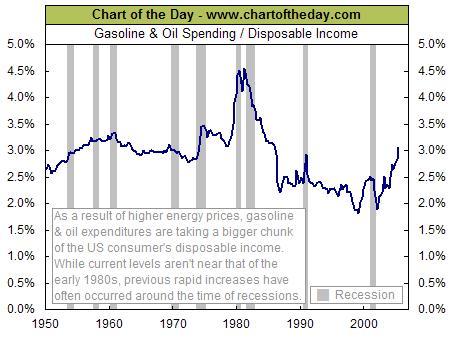
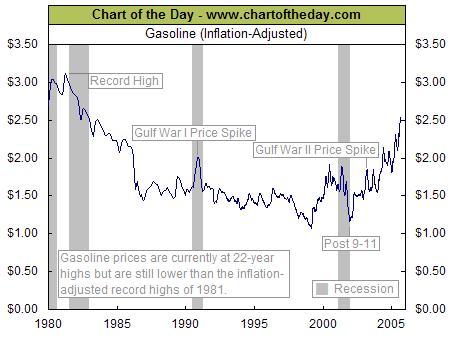
The charts below come from Chart of the Day. Ignore the rather strained effort to correlate spikes in the indices with recessions; focus on the fact that things have been “worse” and the world hasn’t come to an end.

Then ask yourself if there’s any reason believe that market forces will allow the real price of a particular item to rise indefinitely. The correct answer: of course not. Substitutes will become available at attractive prices, without government subsidiization of those substitutes. And people will buy the substitutes.

Another Thought about Libertarian Paternalism

Every individual possesses a complex and unique, but ever-changing, set of tastes and preferences. The individual seeks to strike a balance among those tastes and preferences in a way that, very roughly, maximizes personal satisfaction (utility). The outcome of the balancing act depends on:

  • ability to acquire and evaluate information
  • cost of making and changing decisions
  • constraints of income and wealth (anticipated as well as current)
  • binding commitments from the past that may limit freedom of action (or which may be changed or abrogated at some psychic or pecuniary cost)
  • laws and social norms that may do the same (or which we may choose to flout, at some cost)

Paternalists — “libertarian” or otherwise — who claim that they want to improve the lot of their fellow humans, choose to do so in a peculiar way. They seek to further constrain personal choice through the adoption of policies that ignore the complex and evolving tastes and preferences of individuals. Those policies focus, instead, on a particular desideratum, such as wealth-maximization or the “well being” that arises from enjoying certain benefits (e.g., 6 weeks of vacation or “free” child care).

I understand why individuals who are deluded by the allure of a “free lunch” (e.g., a mandatory 6-week vacation) will demand paternalistic schemes. But I am here to tell you the following:

Do not presume to know what makes me happy. Do not seek to impose on me your scheme for maximizing my wealth or well-being. You don’t know and can never know what makes me tick. When I was 22 I wasn’t interested in accumulating wealth, I was interested in paying my bills. When I turned 24 I became interested in accumulating wealth, but I didn’t pursue it vigorously until I turned 38. In the meantime, I wasted some wealth in the pursuit of a dream; out of that pursuit came a lesson in how to run a business. But if I had wanted to convert that lesson into wealth maximization, I wouldn’t have chosen to return to the quasi-public sector and, eventually, to retire early. And if I had been forced to take six weeks’ vacation a year, I couldn’t have retired early.

I’m unique only in that my particular story is unique. We are all unique. None of us deserves paternalism — “libertarian” or otherwise.

Related posts:

The Rationality Fallacy
(08/16/04)
Socialist Calculation and the Turing Test (02/12/05)
Libertarian Paternalism (04/24/05)
A Libertarian Paternalist’s Dream World (05/23/05)
The Short Answer to Libertarian Paternalism (06/24/05)
Second-Guessing, Paternalism, Parentalism, and Choice (07/13/05)

A Non-Paradox for Libertarians

In “A Paradox for Libertarians” I said:

Some aspects of liberty must be circumscribed in order to preserve most aspects of liberty.

That statement pertains to such matters as freedom of speech (which can’t be absolute if society is to defend itself effectively) and the apparent (but debatable) necessity of taxation to defray the cost of defending liberty.

Glen Whitman, writing at Agoraphilia, raises a parallel issue, which I’ll state after quoting Whitman.

[T]ake Alex [Tabarrok]’s hypothetical, posed to him (and Robin Hanson) by a philosopher:

Suppose that you had a million children and you could give each of them a better life but only if one of them had a very, very terrible life. Would you do it?

Alex and Robin, both economists, said “yes” without hesitation. But to the philosopher who posed the question, the intuitively correct answer was clearly “no.” Who’s right? Alex suggests that we should simply overcome our gut intuitions and think logically here, and the logical answer is to favor the greatest good. Will [Wilkinson of The Fly Bottle] and Carina [Cilluffo of An Inclination to Criticize] both correctly reply that Alex, too, is relying on intuition – the utilitarian intuition that we can (in some rough-and-ready way) compare satisfaction across persons. So we can never fully escape the appeal to intuition.

But does that observation dispose of the matter? Can we just pick out our favorite intuition and run with it? Alex is still right that our intuitions are inconsistent. One intuition tells us that individuals have personal claims that should never be violated. Fine. But another intuition tells us it’s absurd to impose monstrous losses for miniscule gains. The lifeboat situation is a classic example of where this alternative intuition kicks in. . . .

Moreover, it turns out the intuition that answers “no” to Alex’s hypothetical is highly dependent on the frame of reference. . . .

. . . Take Alex’s original hypothetical, but add in some extra context:

The million children who stand to gain are the starving and oppressed people of an African nation. The one child who stands to lose is the son of the local tyrant.

Feel free to modify the context to explain why the tyrant’s son’s life will suck after his dad is dethroned. With the context filled in, I suspect most who said “no” before will say “yes” now. Why? Because we no longer think the status quo creates any rightful claims to its continuation. . . .

The parallel issue raised by Whitman is this: What if a society’s transition from a regulatory-welfare regime to a regime of liberty were to result in losers as well as winners? How could one then justify such a transition? Must the justification rest on an intuitive judgment about the superiority of liberty? Might the prospect of creating losers somehow nullify the promse of creating winners?

I argue here that my justification for libertarianism — although it is of the consequentialist-utilitarian variety — rests on a stronger foundation than an intuitive judgment about the superiority of liberty. As I wrote in Part III of “Practical Libertarianism“:

The virtue of libertarianism, as I will discuss in Parts IV and V [and its addendum], is not that it must be taken on faith but that, in practice, it yields superior consequences. Superior consequences for whom, you may ask. And I will answer: for all but those who don’t wish to play by the rules of libertarianism; that is, for all but predators and parasites.

By predators, I mean those who would take liberty from others, either directly (e.g., through murder and theft) or through the coercive power of the state (e.g., through smoking bans and licensing laws). By parasites, I mean those who seek to advance their self-interest through the coercive power of the state rather than through their own efforts (e.g., through corporate welfare and regulatory protection). There is, of course, a lot of collusion between predators and parasites. (See Bruce Yandle’s “Bootleggers and Baptists – The Education of a Regulatory Economist.”)

To borrow from Glen Whitman, why should we favor the status quo in order to give privileged status to predators and parasites? I dismiss them out of hand.

The only potential losers worth thinking about are those seemingly honest, hard-working individuals who might be made worse off by a transition to liberty. But who are those individuals? They are the unwitting predators and parasites who do not actively seek privilege but who nevertheless enjoy it as “free riders” on welfare programs, compulsory unionism, minimum-wage and “living wage” laws, reverse discrimination, special tax exemptions and deductions, tariff protection, and on and on. I dismiss them out of hand because, unwitting as they may be, they are predators and parasites who take from others. (I do not dismiss them out of hand as human beings. I dismiss out of hand any claim that they are privileged by the status quo, which is the product of overt predators and parasites.)

What about those individuals who are neither predators nor parasites but who might be worse off in a state of liberty, in spite of their diligent efforts not to be worse off? I submit that there could be no such individuals because anyone who isn’t a predator or parasite must, perforce, be a victim of predators and parasites.

A transition to liberty, as it turns out would benefit almost eveyone, including most predators and parasites. I say that because the likely gains from liberty are so great. First, as I said in Part IV of “Practical Libertarianism,”

think of yourself as a business. You are good at producing certain things — as a family member, friend, co-worker, employee, or employer — and you know how to go about producing those things. What you don’t know, you can learn through education, experience, and the voluntary counsel of family, friends, co-workers, and employers. But you are unique — no one but you knows your economic and social preferences. If you are left to your own devices you will make the best decisions about how to run the “business” of getting on with your life. When everyone is similarly empowered, a not-so-miraculous thing happens: As each person gets on with the “business” of his or her own of life, each person tends to make choices that others find congenial. As you reward others with what you produce for them, economically and socially, they reward you in return. If they reward you insufficiently, you can give your “business” to those who will reward you more handsomely. But when government meddles in your affairs — except to protect you from actual harm — it damages the network of voluntary associations upon which you depend in order to run your “business” most beneficially to yourself and others. The state can protect your ability to run the “business” of your life, but once you let it tell you how to run your life, you compromise your ability to make choices that are right for you.

In sum, when people are deprived of incentives through taxation, regulation, and welfare, they are less able and willing to strive for themselves. And it is self-striving that leads people to do things that are valued by others. Regulation and welfare impose costs where there otherwise would be no costs, and distort the free-market signals that tell people how they can do better for themselves by doing better for others.

Now, I suppose there are some persons who couldn’t handle liberty and who would want their lives shaped by others. If that’s the way they want to live, fine, just don’t use the state to impose restrictions on the way the rest of us run our lives. There’s no reason, in a state of liberty, that those who crave direction could not buy it from others. Given the economic gains from liberty (which I’m about to summarize), there would be a booming market in personal agents of various kinds, not to mention vastly improved information sources and decision tools for the rest of us.

In addition to the nonquantifiable psychic benefits of running one’s own life, there are quantifiable economic benefits. Here’s the bottom line, drawn from Part V and the addendum to Part V of “Practical Libertarianism”:

  • In 2004, real GDP (in year 2000 dollars) was about $10.7 trillion.
  • If government had grown no more meddlesome after 1906, real GDP might have been $18.7 trillion.
  • That is, real GDP per American would have been about $63,000 (in year 2000 dollars) instead of $36,000.
  • That’s a loss to the average American of more than 40 percent of the income that he or she might have enjoyed, absent the growth of the regulatory-welfare state in the past 100 years.
  • That loss is in addition to the 40-50 percent of current output which government drains from the productive sectors of the economy.

I submit that only predators and inveterate parasites could possibly be worse off were per capita GDP to rise by 75 percent (the increase from $36,000 to $63,000), and were government to exact a toll of only 10 percent (instead of 40-50 percent) on those who produce. Most of the poor would be rich, by today’s standards. And those who remain relatively poor or otherwise incapable of meeting their own needs — because of age, infirmity, and so on — would reap voluntary charity from their affluent compatriots. There’s a bit of a judgment call in that last statement, but just a bit.

To put it another way, a transition to liberty might not instantly make everyone better off economically, but everyone could be better off. That’s simply not the case with the regulatory-welfare state, which robs some for the benefit of others, and ends up making almost everyone poorer than they would be in a state of liberty.

Liberty is a win-win proposition for everyone except those who deserve to lose.

Too "Right" for a Leftist

Bob Rowthorn, who professes economics at the University of Cambridge, reviews Paul Ormerod’s Why Most Things Fail:

…Ormerod concentrates on failure and extinction in biology and economics. In the biological sphere, mutations lead to species that out-compete other species which eventually become extinct or retreat to some marginal niche. Extraneous events such as climate change may lead to the same outcome because some species are better able to survive in the new environment than others. Ormerod argues that failure and extinction are also pervasive in the economic sphere. Mutations and external events play a role in business life just as they do in biology. The counterparts to biological mutations are new technologies, new forms of organisation and new types of product….

In the biological sphere, most mutations are harmful and reduce the ability of the organism to survive. Some mutations linger on, but many are driven out entirely by competition from incumbent genes. Many potentially beneficial mutations are also driven out by competition before they have time to establish themselves, or before a complementary mutation occurs which allows them to achieve their full potential. The same is true in the economic sphere. Many innovations are harmful, and even potentially beneficial innovations may fail to establish themselves in the face of competition from powerful incumbents….

Ormerod’s alternative vision of economics lays great stress on social interaction. Individuals and organisations have only a very limited ability to obtain and process information, so they rely heavily on the information they acquire from encounters with those around them. This leads to herd behaviour and unpredictable consequences. It can make it very difficult for firms to plan their investment and innovation strategies because success or failure may depend on huge swings of fortune that are impossible to anticipate.

So far, so good. Ormerod’s not really saying anything new, but perhaps it seems new to Rowthorn, whose weak grasp of economics is reflected in Democracy and Efficiency in the Economic Enterprise, of which he is co-editor. A reading of the sample pages (available at the link) brings Rowthorn’s idealistic socialism into view, as does the rest of Rowthorn’s review of Ormerod; viz.:

Ormerod gives many examples of social interaction leading to outcomes which are impossible to predict. The most striking example is Schelling’s model of residential segregation. In the US, there are few racially mixed communities and most blacks and whites live in neighbourhoods which are populated almost entirely by their own kind. This might suggest that there is a strong antipathy between the two groups. Yet a large amount of evidence suggests that this is not the case. Most blacks and whites would like to live in neighbourhoods where their racial group is in a majority, but they are perfectly happy to have a large minority of people from the other group as neighbours.

In sum, the “fact” that blacks and whites would prefer some degree of residential integration (whose fact?) trumps the reality that blacks and whites segregate themselves. Why?

To explore the implication of such preferences, Schelling ran a number of simulations in which individuals were allowed to move house if they found themselves surrounded by too many of the other racial group. These simulations demonstrated two things. In the course of time, the typical result was that blacks and whites spontaneously relocated themselves into highly segregated neighbourhoods. It was impossible to predict where the boundaries of these neighbourhoods would lie or where any particular individual would end up. But it was a safe bet that the bulk of people would end up surrounded largely by people of their own race. This outcome showed clearly that social interaction may magnify small variations into very large differences. It also showed the limitations of the conventional approach to social phenomena, which assumes that large differences must have large causes.

Schelling’s results simply show that simulation sometimes mimics reality. The results offer no insight into causation. As for the “conventional approach to social phenomena,” I’ve never heard or read anything which suggests “that large differences must have large causes” (terms that are meaninglessly vague). The “conventional approach” is to find relationships in the data, and to let those relationships speak for themselves. Rowthorn goes on to praise Ormerod’s embrace of “non-linearity” as if Ormerod had discovered gravitation. Non-linearity is no news to economists, which tells you something about Rowthorn’s credentials as an economist.

Rowthorn finally unveils his agenda:

Ormerod, despite being a man of the left, is sceptical of human ability to predict and plan. If this is true, what is the role for government? Should it be merely a nightwatchman, defending the polity against internal and external threats, enforcing property rights and preventing crime, or should its role be much wider? Can the state intervene effectively to achieve aims that commend widespread support? Ormerod does not discuss this issue explicitly, although his stress on failure would suggest that most state intervention is pointless. For example, he argues that government attempts to alter the distribution of income have had little long-term impact. Yet surely this is an exaggeration. Human nature and market forces limit what governments can do about inequality, but that does not mean they are powerless. The existence of a strong welfare state in Sweden, for example, clearly helps explain why it is a far more equal society than Brazil. More generally, there are many examples of grand projects which governments have undertaken with conspicuous success, such as the TGV network in France or the D-day landings in the second world war. Ormerod’s book is concerned with failure. But what is surprising is not that governments fail, but how often they succeed. The same goes for large corporations, which also perform amazing feats of planning and co-ordination. Successful planning by large public and private organisations, in tandem with markets, have created an environment that is more stable and predictable for many people in advanced economies than at any time in history.

Rowthorn has his politics mixed up with his economics:

1. Sweden may be a “far more equal society than Brazil” (whatever that means), but the real question is how much better off Swedes might be if they weren’t so blasted “equal” with each other. (It’s a hot topic in Sweden these days.)

2. Yes, it’s true that goverments can do a lot of things, but Rowthorn ignores the crucial considerations: whether those things are worth doing, and whether government can do them best. Governments “succeed” only to the extent that they do something, but not to the extent that they do the right things or do them as well as they would be done by competitive markets.

3. Rowthorn tries to equate large corporations with government, as if government were nothing more than a special type of large corporation. He tellingly omits the point that large corporations — to the extent that they’re not protected from competition by government — must respond to the needs of consumers and the pressures of competition in order to survive and thrive. When’s the last time the government of the United States went out of business? There was a close call in the early 1860s, and that’s about it.

4. Corporatism — “[s]uccessful planning by large public and private organisations, in tandem with markets” — substitutes “stability and predictability” for dynamism and prosperity. It’s the triumph of bureaucracy over humanity.

What I really learned from Rowthorn’s review is that Ormerod — the “man of the left” — is too right (and too “right”) for Rowthorn.

Technorati tag:

Get a Job

These guys want to do what the market is already doing rather well:

The mission of the Free Culture movement is to build a bottom-up, participatory structure to society and culture, rather than a top-down, closed, proprietary structure. Through the democratizing power of digital technology and the Internet, we can place the tools of creation and distribution, communication and collaboration, teaching and learning into the hands of the common person — and with a truly active, connected, informed citizenry, injustice and oppression will slowly but surely vanish from the earth.

Well it’s a “student movement,” so what do you expect. In five or ten years most of them will be telling the next generation of idealists to get a job.

Second-Guessing, Paternalism, Parentalism, and Choice

You make the best decision you can, at the time you make it, in light of your preferences and knowledge at that time. Then someone (sometimes yourself) comes along to tell you that you would would have made a “more rational” decision if only you had had different knowledge or different preferences at the time you made the decision.

Persons with a compulsion to second-guess the decisions of others are paternalists; they want to use the power of the state to force others to make “rational” (i.e., different) decisions. Persons with a compulsion to second-guess themselves are parentalists; they want the state to make “rational” decisions for them. Paternalism and parentalism have the same effect: loss of liberty.

Glen Whitman explains:

Julian [Sanchez has] written up an excellent piece on “parentalism” – the desire of some people to have their own freedom restricted for their own good. He cites a forthcoming Cato Policy Analysis by yours truly on the subject of “internalities,” a term of art for within-person externalities that people impose on themselves. In so doing, he helpfully saves me the trouble of having to summarize my own argument:

There are plenty of practical problems with the parentalist impulse. As economist Glen Whitman notes in a forthcoming Cato Institute paper, we cannot assume we always help people by giving preference to their “long term” over their “short term” interests. Imagine an aging man in ill-health lamenting his sybaritic youth. We are tempted to say that his younger self, seeing the pleasures immediately available to him and giving short shrift to their long term consequences, exhibited a foolish bias toward the present. But surely it’s also possible that his older self, faced with the proximate pains and inconveniences of poor health, discounts the pleasures past he’d have forsaken had he been more health-conscious. If we’re prone to the first form of cognitive bias, why not the second?

Whitman also argues that, just as simple Pigovian taxes on pollution may be less efficient than allowing market negotiation to determine how much pollution will be produced in what location, sin taxes, smoking bans, and other parentalist attempts to spare our future selves the costs of our present choices may displace a rich variety of mechanisms for self-restraint that would match the rich variety of risk profiles and time-discount rates we find among members of a pluralistic society. And as the young man interviewed by the Village Voice demonstrated, we can be ingenious at outwitting imposed restraints—even those we welcome in principle. We may find ourselves running up bigger credit card bills to buy more sin-taxed Twinkies and cigarettes, or traveling inconvenient distances to find a smoke friendly bar.

So what’s the difference between parentalism and paternalism? Paternalism involves other people favoring restrictions for a person’s own good, whereas parentalism involves people favoring restrictions on themselves. While this distinction is clear in principle, in practice the latter quickly shades into the former. True paternalists will seize upon the (possibly idle) statements of parentalists to justify their favored policies. Indeed, the whole thrust of the “new paternalism” is that restrictions on personal liberty will help people to better achieve their own preferences, not externally imposed preferences. As I put it in my article, “[T]he old paternalism said, ‘We know what’s best for you, and we’ll make you do it.’ The new paternalism says, ‘You know what’s best for you, and we’ll make you do it.’” The problem is that the policymakers, who cannot possibly know the “true” preferences of all those affected by their policies, ultimately have to impose an external set of preferences via their regulatory choices.

Giving the state the power to make your choices for you is like handing the remote control to a stranger who can force you to sit and watch the TV programs he chooses.

Related posts:

The Rationality Fallacy (08/16/04)

Socialist Calculation and the Turing Test (02/13/05)

Libertarian Paternalism (04/24/05)

Aid for Africa: Wishful Thinking vs. the Facts of Life

Wishful thinking (from Sarah Vowell, writing in The New York Times):

That fact, that every three seconds an African human being dies from hunger or AIDS or, honestly, mosquito bites in this day and age, is literally the dumbest thing I’ve ever heard…That every-three-seconds statistic is so moronic, and having the richest countries in the world do something about it is such a total no-brainer….

The facts of life (from a Spiegel interview of Kenyan economics expert James Shikwati):

SPIEGEL: Mr. Shikwati, the G8 summit at Gleneagles is about to beef up the development aid for Africa…

Shikwati: … for God’s sake, please just stop.

SPIEGEL: Stop? The industrialized nations of the West want to eliminate hunger and poverty.

Shikwati: Such intentions have been damaging our continent for the past 40 years. If the industrial nations really want to help the Africans, they should finally terminate this awful aid. The countries that have collected the most development aid are also the ones that are in the worst shape. Despite the billions that have poured in to Africa, the continent remains poor.

SPIEGEL: Do you have an explanation for this paradox?

Shikwati: Huge bureaucracies are financed (with the aid money), corruption and complacency are promoted, Africans are taught to be beggars and not to be independent. In addition, development aid weakens the local markets everywhere and dampens the spirit of entrepreneurship that we so desperately need. As absurd as it may sound: Development aid is one of the reasons for Africa’s problems. If the West were to cancel these payments, normal Africans wouldn’t even notice. Only the functionaries would be hard hit. Which is why they maintain that the world would stop turning without this development aid.

SPIEGEL: Even in a country like Kenya, people are starving to death each year. Someone has got to help them.

Shikwati: But it has to be the Kenyans themselves who help these people. When there’s a drought in a region of Kenya, our corrupt politicians reflexively cry out for more help. This call then reaches the United Nations World Food Program — which is a massive agency of apparatchiks who are in the absurd situation of, on the one hand, being dedicated to the fight against hunger while, on the other hand, being faced with unemployment were hunger actually eliminated. It’s only natural that they willingly accept the plea for more help. And it’s not uncommon that they demand a little more money than the respective African government originally requested. They then forward that request to their headquarters, and before long, several thousands tons of corn are shipped to Africa …

and at some point, this corn ends up in the harbor of Mombasa. A portion of the corn often goes directly into the hands of unsrupulous politicians who then pass it on to their own tribe to boost their next election campaign. Another portion of the shipment ends up on the black market where the corn is dumped at extremely low prices. Local farmers may as well put down their hoes right away; no one can compete with the UN’s World Food Program. And because the farmers go under in the face of this pressure, Kenya would have no reserves to draw on if there actually were a famine next year. It’s a simple but fatal cycle.

SPIEGEL: If the World Food Program didn’t do anything, the people would starve.

Shikwati: I don’t think so. In such a case, the Kenyans, for a change, would be forced to initiate trade relations with Uganda or Tanzania, and buy their food there. This type of trade is vital for Africa. It would force us to improve our own infrastructure, while making national borders — drawn by the Europeans by the way — more permeable. It would also force us to establish laws favoring market economy.

SPIEGEL: Would Africa actually be able to solve these problems on its own?

Shikwati: Of course. Hunger should not be a problem in most of the countries south of the Sahara. In addition, there are vast natural resources: oil, gold, diamonds. Africa is always only portrayed as a continent of suffering, but most figures are vastly exaggerated. In the industrial nations, there’s a sense that Africa would go under without development aid. But believe me, Africa existed before you Europeans came along. And we didn’t do all that poorly either.

SPIEGEL: But AIDS didn’t exist at that time.

Shikwati: If one were to believe all the horrorifying reports, then all Kenyans should actually be dead by now. But now, tests are being carried out everywhere, and it turns out that the figures were vastly exaggerated. It’s not three million Kenyans that are infected. All of the sudden, it’s only about one million. Malaria is just as much of a problem, but people rarely talk about that.

SPIEGEL: And why’s that?

Shikwati: AIDS is big business, maybe Africa’s biggest business. There’s nothing else that can generate as much aid money as shocking figures on AIDS. AIDS is a political disease here, and we should be very skeptical.

SPIEGEL: The Americans and Europeans have frozen funds previously pledged to Kenya. The country is too corrupt, they say.

Shikwati: I am afraid, though, that the money will still be transfered before long. After all, it has to go somewhere. Unfortunately, the Europeans’ devastating urge to do good can no longer be countered with reason. It makes no sense whatsoever that directly after the new Kenyan government was elected — a leadership change that ended the dictatorship of Daniel arap Mois — the faucets were suddenly opened and streams of money poured into the country.

SPIEGEL: Such aid is usually earmarked for a specific objective, though.

Shikwati: That doesn’t change anything. Millions of dollars earmarked for the fight against AIDS are still stashed away in Kenyan bank accounts and have not been spent. Our politicians were overwhelmed with money, and they try to siphon off as much as possible. The late tyrant of the Central African Republic, Jean Bedel Bokassa, cynically summed it up by saying: “The French government pays for everything in our country. We ask the French for money. We get it, and then we waste it.”…

SPIEGEL: The German government takes pride in precisely monitoring the recipients of its funds.

Shikwati: And what’s the result? A disaster. The German government threw money right at Rwanda’s president Paul Kagame. This is a man who has the deaths of a million people on his conscience — people that his army killed in the neighboring country of Congo.

SPIEGEL: What are the Germans supposed to do?

Shikwati: If they really want to fight poverty, they should completely halt development aid and give Africa the opportunity to ensure its own survival. Currently, Africa is like a child that immediately cries for its babysitter when something goes wrong. Africa should stand on its own two feet.

Interview conducted by Thilo Thielke

Translated from the German by Patrick Kessler

An Agenda for the Supreme Court

I argued in Part VII of “Practical Libertarianism for Americans” that the practical way to redeem the promise of liberty is through a renaissance (or nascence) of pro-libertarian federalism — under the guidance of Republican appointees to the U.S. Supreme Court. In light of the Court’s anti-libertarian majorities in Gonzales v. Raich and Kelo v. City of New London (my commentary here, here, and here), it would take many years — if not decades — to see the Court safely into the hands of a pro-libertarian, federalist majority. I now almost despair of the possibility of such a sea change in the Court’s composition. But with candidates like Janice Rogers Brown in the wings, hope is not dead.

Therefore, I will from time to time offer my agenda for a more libertarian Court. It is an admittedly ambitious agenda that would advance liberty, which must be understood as the negative right to be left alone — in one’s person, pursuits, and property — as long as one leaves others alone. Liberty, in that sense, encompasses what the Founders intended by “life, liberty, and the pursuit of happiness” in the Declaration of Independence. In sum, the liberty right is a triune concept, with life as its basis and the pursuit of happiness (personal satisfaction or self-interest) as its end.

I begin with life, without which liberty is a nullity.

Defend Life

The Court should do three things under this heading: reverse the majority in Roe v. Wade, ensure that a person cannot — unlike Terri Schiavo — be euthanized at the whim of an interested party, and put a stop to forced mental screening. Abortion (especially selective abortion), involuntary euthanasia, and forced mental screening are steps down a slippery slope toward complete state control of human destiny.

Eugenics was considered “progressive” a century ago, and it is considered “progressive” today. After all, the state controls our economic and social destiny, why shouldn’t it control our biological destiny as well? It’s all for the best, isn’t it? Ah, the banality of evil.

Defend American Sovereignty

In another post I stipulated the following:

1. “Life, liberty, and the pursuit of happiness” summarizes the American ideal.

2. America’s sovereignty provides a shield behind which Americans may pursue the American ideal.

3. Americans’ ability to pursue the American ideal therefore depends on the successful defense of American interests and America’s sovereignty.

4. Americans, acting through the state, should defend American interests and America’s sovereignty.

The sovereignty of the United States is a shield for the benefits afforded Americans by the U.S. Constitution, most notably the enjoyment of civil liberties, the blessings of more-or-less free markets and free trade, and the protections of a common defense. To cede sovereignty is to risk the loss of those benefits. That is why we must always be cautious in our commitments to international organizations and laws.

We can and should work to make the U.S. more benign, that is, more libertarian. But if we didn’t have our somewhat benign state to protect us it’s quite likely that we’d live under one that’s entirely evil. Remember Hitler and Stalin? Those bad guys were really bad — and there are plenty more where they came from. Just look around you at the world we live in.

The warmaking power of the United States government is essential to the preservation of America’s sovereignty and Americans’ liberty. Yet the present Court has cavalierly undermined that warmaking power in its handling of the cases of detainees captured by American armed forces operating lawfully in Afghanistan and Iraq. (See this post and follow the links.) A future Court would do well to heed Justice Felix Frankfurter, who in the case of Korematsu v. United States (1944) said this:

The provisions of the Constitution which confer on the Congress and the President powers to enable this country to wage war are as much part of the Constitution as provisions looking to a nation at peace. And we have had recent occasion to quote approvingly the statement of former Chief Justice Hughes that the war power of the Government is ‘the power to wage war successfully.’… Therefore, the validity of action under the war power must be judged wholly in the context of war. That action is not to be stigmatized as lawless because like action in times of peace would be lawless. To talk about a military order that expresses an allowable judgment of war needs by those entrusted with the duty of conducting war as ‘an unconstitutional order’ is to suffuse a part of the Constitution with an atmosphere of unconstitutionality. The respective spheres of action of military authorities and of judges are of course very different. But within their sphere, military authorities are no more outside the bounds of obedience to the Constitution than are judges within theirs. ‘The war power of the United States, like its other powers … is subject to applicable constitutional limitations’,….To recognize that military orders are ‘reasonably expedient military precautions’ in time of war and yet to deny them constitutional legitimacy makes of the Constitution an instrument for dialectic subtleties not reasonably to be attributed to the hard-headed Framers, of whom a majority had had actual participation in war.

Amen.

Restore Economic Liberty

The Supreme Court has long since given the States and the central government almost unlimited authority to dictate economic activity. In the wake of Raich and Kelo there is ample commentary about the Court’s abuse of the Commerce Clause and the Takings Clause. So, I will turn here to other aspects of economic liberty that future Courts should restore.

I begin with the loss of freedom of contract. The Court upheld that freedom in Bronson v. Kinzie (1843). According to The Oxford Guide to United States Supreme Court Decisions (Oxford University Press, 1999, p. 33),

Chief Justice Roger B. Taney held that [a] legislative attempt to modify the terms of [an] existing mortgage was an unconstitutional impairment of the obligation of contract. Taney agreed that a state could alter the remedies available to enforce past as well as future contracts. He nonetheless emphasized that such changes could not materially impair the rights of creditors. In broad language Taney extolled the virtue of the Contract Clause: “It was undoubtedly adopted as part of the Constitution for a great and useful purpose. It was to maintain the integrity of contracts, and to secure their faithful execution throughout this Union.”

The Oxford Guide continues :

The Court long adhered to the Bronson rule, invalidating state laws that interfered with contractual rights in the guise of regulating remedies. The decision was effectively superseded, however, by Home Building and Loan Association v. Blaisdell (1934), in which the justices ruled that contracts were subject to the reasonable exercise of state police power.

Just what is “reasonable exercise of state police power”? In Home Building and Loan Association, according to Chief Justice Hughes, writing for the Court, it is this:

We come back, then, directly, to the question of impairment. As to that, the conclusion reached by the court here seems to be that the relief [from mortgage foreclosures] afforded by the [Minnesota] statute does not contravene the constitutional provision because it is of a character appropriate to the emergency and allowed upon what are said to be reasonable conditions.

That is, the Court simply decided to uphold a Minnesota statute that altered the terms of a contract because it wanted to do so, not because it had constitutional authority for doing so. The Constitution doesn’t forbid States to impair contracts except in emergencies or to exercise their “policing power”; the Constitution flatly forbids States to impair contracts. A libertarian Court would begin to restore freedom of contract by reversing Home Building and Loan Association v. Blaisdell.

It would take more than that, however, to restore freedom of contract in employment relationships, which long ago gave away to mandatory unionism, the minimum wage, and various other impediments to employment-at-will. A libertarian Court would do the right thing by throwing out the Wagner Act and its various offshoots, including the minimum wage, then turn its sights on affirmative action.

As for States’ so-called policing power, an article at FindLaw tells this tale:

[I]deas embodying the social compact and natural rights, which had been espoused by Justice Bradley in his dissent in the Slaughter-House Cases, 43 had been transformed tentatively into constitutionally enforceable limitations upon government. 44 The consequence was that the States in exercising their police powers could foster only those purposes of health, morals, and safety which the Court had enumerated, and could employ only such means as would not unreasonably interfere with the fundamentally natural rights of liberty and property, which Justice Bradley had equated with freedom to pursue a lawful calling and to make contracts for that purpose. 45

So having narrowed the scope of the state’s police power in deference to the natural rights of liberty and property, the Court next proceeded to read into the concepts currently accepted theories of laissez faire economics, reinforced by the doctrine of Social Darwinism as elaborated by Herbert Spencer, to the end that ”liberty,” in particular, became synonymous with governmental hands-off in the field of private economic relations. In Budd v. New York, 46 Justice Brewer in dictum declared: ”The paternal theory of government is to me odious. The utmost possible liberty to the individual, and the fullest possible protection to him and his property, is both the limitation and duty of government.” …

To the State was transferred the task of demonstrating that a statute interfering with the natural right of liberty or property was in fact ”authorized” by the Constitution, and not merely that the latter did not expressly prohibit enactment of the same.

In 1934 the Court in Nebbia v. New York 52 discarded this approach to economic legislation, and has not since returned to it. The modern approach was evidenced in a 1955 decision reversing a lower court’s judgment invalidating a state statutory scheme regulating the sale of eyeglasses to the advantage of ophthalmologists and optometrists in private professional practice and adversely to opticians and to those employed by or using space in business establishments.

Nebbia has got to go. The reversal of Nebbia, accompanied by the reversal of Kelo, would prevent much of the economic harm that is done by State and local governments.

Also under this head, there is the anti-trust movement. It waxes and wanes, but when it waxes it does great harm to invention, innovation, and entrepreneurship — the engines of economic progress. The prospect of earning inordinate profits entices inventors, innovators, and entrepreneurs to take financial risks in an effort to develop and market goods and services that enrich lives. The realization of large profits encourages competition — direct competition by offerors of equivalent goods and services, and indirect competition by offerors of substitutes. A libertarian Court would agree with my analysis and vitiate the Sherman Antitrust Act and the Clayton Antitrust Act as invalid extensions of federal power.

Finally — for now — a truly bold and principled Court would enforce the Constitution’s express limitation of Congress’s power in Article I, Section 8, by striking down or reining in the regulatory-welfare state, which is embodied in such institutions as the Social Security Administration, Federal Trade Commission, Federal Communications Commission, and Food and Drug Administration, to name but a few. (For much more, read this, this, this, this, this, this, this, this, this, this, this, this, and this, and follow the links and sources cited therein.)

To be continued.

Practical Libertarianism — A Summary

I have posted “Practical Libertarianism — A Summary” at Liberty Corner II. That post completes and summarizes the series of essays entitled “Practical Libertarianism for Americans.” Supporting details and links to additional sources can be found in the preceding posts of the series.

Some of my favorite bits:

My focus is on American libertarianism because the Constitution of the United States of America holds the promise of liberty. Building on that promise, Americans can strive to perfect liberty in the United States. But the rest of the world isn’t bound by our Constitution, and it is foolish to think that the rest of the world prizes America’s liberty. America’s sovereignty and strength is the shield of America’s liberty, imperfect as it may be.

What is libertarianism, and why should you embrace it? Here is a formal definition of libertarianism…:

Libertarianism is a political philosophy which advocates individual rights and a limited government. Libertarians believe that individuals should be free to do anything they want, so long as they do not infringe upon what they believe to be the equal rights of others. In this respect they agree with many other modern political ideologies. The difference arises from the definition of “rights”. For libertarians, there are no “positive rights” (such as to food, shelter, or health care), only “negative rights” (such as to not be assaulted, abused or robbed). Libertarians further believe that the only legitimate use of force, whether public or private, is to protect these rights.

Here’s my rendition:

If you are doing no harm to anyone, no one should harm you physically, coerce you, defraud or deceive you, steal from you, or tell you how to live your life. “No one” includes government, except to the extent that government is empowered — by the people — to defend life, liberty, and property through the circumscribed use of police, courts, and armed forces….

Fundamentalist libertarians argue that the only right is liberty, and that it is a natural right with which human beings are endowed a priori. In one rendition, liberty is immanent — something that simply is in human nature, perhaps as a gift from God. In another rendition, humans are endowed with liberty as a logical necessity, because humans own themselves.

But appeals to immanence and self-ownership are no more meaningful than appeals to faith. Such appeals fail because they take liberty as a first principle. Liberty, which is a condition of existence, cannot be a first principle, it can only serve the first principle of existence, which is self-interest….

Rights — though they can exist without the sanction of government and the protection of a state — are political. That is, although rights may arise from human nature, they have no essence until they are recognized through interpersonal bargaining (politics), in the service of self-interest. It is bargaining that determines whether we recognize only the negative right of liberty, or the positive right of privilege as well. The preference of human beings — revealed over eons of coexistence — is to recognize both liberty (usually constrained to some degree) and privilege (which necessitates constraints on liberty).

The problem for libertarians, therefore, is to convince the body politic of two complementary truths: Self-interest dictates that liberty should be the paramount right. The recognition of privilege as a co-equal right undermines the benefits that flow from liberty….

The logical incompatibility of liberty and privilege doesn’t keep most people from wanting both. People want to be left alone, but it seems that almost everyone also yearns for some version of the welfare-regulatory state. People seem to believe that government does things that are more valuable than the freedom of action they forego because government does things. Most Americans simply don’t understand the true costs and illusory benefits of the welfare-regulatory state.

Absent the welfare-regulatory state, most of the poor would be rich, by today’s standards. And those who remain relatively poor or otherwise incapable of meeting their own needs — because of age, infirmity, and so on — would reap voluntary charity from their affluent compatriots….

[T]he bottom line:

  • Real GDP (in year 2000 dollars) was about $10.7 trillion in 2004.
  • If government had grown no more meddlesome after 1906, real GDP might have been $18.7 trillion (from the chart entitled “Real GDP: 1870-1906, 1907-2004”).
  • That is, real GDP per American would have been about $63,000 (in year 2000 dollars) instead of $36,000.
  • That’s a deadweight loss to the average American of more than 40 percent of the income he or she might have enjoyed, absent the regulatory-welfare state.
  • That loss is in addition to the 40-50 percent of current output which government drains from the productive sectors of the economy.
  • Moreover, the stocks of corporations in the S&P 500 are currently undervalued by one-third because of the depradations of the regulatory-welfare state, which have lowered investors’ expectations for future earnings. (The effect of those lowered expectations is shown in the chart entitled “Real S&P Index vs. Real GDP.”) And that’s only the portion of wealth that’s represented in the S&P 500. Think of all the other forms in which wealth is stored: stocks not included in the S&P 500, corporate bonds, mortgages, home equity, and so on.

That is the measurable price of privilege — of ceding liberty piecemeal in the mistaken belief that one more government program, a bit more income redistribution, or yet another regulation will do little harm to the general welfare, and might even increase it….

When people are deprived of incentives through taxation, regulation, and welfare, they are less able and willing to strive for themselves. And it is self-striving that leads people to do things that are valued by others. Regulation and welfare (the “free lunch”) impose costs (bureaucratic overhead), where there otherwise would be no costs, and distort the free-market signals that tell people how they can do better for themselves by doing better for others….

If liberty is so bounteous, why don’t we enjoy it in full? Why are our lives so heavily regulated and legislated by so many federal, State, and local agencies at such a high cost? What happened to the promise of liberty given in the Declaration of Independence and Constitution? The answers to those questions are bound up in human nature and the nature of governance in a democracy….

It is easy to endorse liberty in principle and yet be its enemy in practice. Our need for control and our baser instincts lead many of us to become politicians and cause most of us to succumb to political rhetoric. Most of us simply lack the requisite temperament, or vision, for libertarianism.

Thomas Sowell, in A Conflict of Visions: Ideological Origins of Political Struggles, posits two opposing visions: the unconstrained vision (I would call it the idealistic vision) and the constrained vision (which I would call the realistic vision)….

In sum, it’s all about trust and its opposite: control. You can trust others to do the right thing because it’s to their benefit to do so, as it is in free markets and free societies. Or you can control others, economically and socially, through a morass of statutes, regulations, and judge-made law.

Trust doesn’t mean an absence of rules, but the rules have only to be minimal, socially evolved rules of acceptable conduct, such as the Golden Rule or the last six of the Ten Commandments. The clearer and more intuitive the rules, the more likely they are to be enforced by self-interest, by fear of social opprobrium, and by pride in reputation — with swift, sure, and hard justice as a backup.

But none of that goes down well with those who think that the road to happiness must be paved with hard-and-fast rules for everything and everyone. Otherwise, how would people know what to do?

The demand for control is fed by economic illiteracy, the prevalent failure to grasp such simple principles as these:

  • Incentives matter. Taxation, redistribution, and regulation result in the reduction and misdirection of economic activity and social trust.
  • There’s no free lunch. Government can’t provide something for nothing. It never could, it never will. Every governmental action has an opportunity cost: that which the private sector could do with the same resources. There’s no such thing as “federal money” or “government money”; there’s only “our money.”
  • Government doesn’t add value. At best it protects what we value, by defending us at home and abroad.
  • The economy isn’t a zero-sum game. Bill Gates is immensely wealthy because he has created things that are of value to others. When Indian computer geeks man call centers for lower salaries than those of American computer geeks, it makes both Indians and Americans better off.
  • There’s no such thing as “market failure.” Rather, there is only failure of the market to provide what some people think it should provide. Even defense and justice (both classic examples of a “public good“) could be provided by the market, as anarcho-capitalists aver, but minarchists (as I am) fear the consequences (warlord rivalry) and reluctantly trust in the state for those essential underpinnings of a free society.

Most people simply don’t understand the consequences of the rules that they so fervently seek to impose on others. They have little idea of the measurable costs of intervention — the 40-to-50 percent of GDP that goes into government programs, for instance — and they have no idea of the hidden costs of that intervention — the additionale of an additonal 40 percent of income and untold amounts of wealth. They simply cannot comprehend the indivisibility of economic and social liberty (though the Supreme Court’s recent decisions in Raich and Kelo may open some eyes).

Control-seeking politicians — most of whom also suffer from economic illiteracy — are able to draw power from the masses by appealing to the insecurity and economic illiteracy of the masses. Once having drawn that power, they seek always to aggrandize it. What happens, then, is a ratcheting of government power, in response to never-ending demands for government to “do something” — because government’s previous efforts to “do something” have inevitably failed to achieve nirvana.

Thus we have been following a piecemeal route to serfdom — adding link to link and chain to chain — in spite of the Framers’ best intentions and careful drafting. Why? Because the governed — or dominant coalitions of them — have donned willingly the chains that they have implored their governors to forge. Their bondage is voluntary, though certainly not informed. But their bondage is everyone’s bondage….

Unchecked democracy undermines liberty and its blessings. Unchecked democracy imposes on everyone the mistakes and mistaken beliefs of the controlling faction. It defeats learning. It undoes the social fabric that underlies civility. It defeats the sublime rationality of free markets, which enable independent individuals to benefit each other through the pursuit of self-interest. As “anonymous” says, with brutal accuracy, “Democracy is two wolves and a lamb voting on lunch.”…

[A] not-so-funny thing has happened on the way to the state of liberty foreseen by Madison and the other Framers: Human nature has overcame constitutional obstacles. The governed and their governors have conspired to undermine the Constitution’s checks and balances. People, given their mistrustful and ignorant nature, have turned to government for “solutions” to their “problems.” Government, in its turn, has seized whatever power is necessary to go through the motions of providing “solutions.” For rare is the legislator who doesn’t want to legislate, the executive who doesn’t want to act, and the judge who doesn’t want to exercise his judgment by interpreting the law rather than simply apply it….

[T]he “checks and balances” in the Constitution are there to limit the federal government’s ability to act, even within its sphere of authority. In the legislative branch neither the House of Representatives nor the Senate can pass a law unilaterally. In his sole constitutional role — as head of the executive branch — the President of the United States must sign acts of Congress before they become law, and may veto acts of Congress — which may, in turn, override his vetoes. From its position atop the judicial branch, the Supreme Court is supposed to decide cases “arising under” (within the scope of) the Constitution, not to change the Constitution without benefit of convention or amendment.

The Constitution itself defines the sphere of authority of the federal government and balances that authority against the authority of the States and the rights of citizens. Although the Constitution specifies certain powers of the federal executive and judiciary (e.g., commanding the armed forces and judging cases arising under the Constitution), federal power rests squarely and solely upon the legislative authority of Congress, as defined in Article I, Sections 8, 9, and 10. The intentionally limited scope of federal authority is underscored by Amendments IX and X.

In spite of all that, we now have myriad statutes, regulations, and court rulings through which the federal government — acting at the people’s behest and in their name — has arrogated unconstitutional power to itself (and sometimes to the States). And the people suffer….

At this moment in history, federalism seems the most promising option because the Left is now beginning to understand that the power of the federal government may be used not only to advance its agenda but also to thwart that agenda. Leftists, like conservatives and pragmatic libertarians, may be willing to settle for a “good” solution rather than hold out for the “best” of all possible worlds. But, as I will explain, the way to federalism isn’t through a collaboration between Left and Right….

In summary, the Left’s vision of federalism is to devolve the central government’s acquired anti-libertarian powers to somewhat less remote commissars at the State and local level. The Left simply isn’t to be trusted as a partner in the shaping of a new federalism. A pro-libertarian federalism would not only limit the power of the central government but would also limit the power of State and local governments to advance the Left’s anti-libertarian agenda.

The only way to advance pro-libertarian federalism is to ensure that the Left neither controls the central government nor has little influence over its policies. This is especially true of the U.S. Supreme Court. For the surest way to return to a form of federalism that, in the main, advances liberty and prosperity is through Court rulings of the kind so feared by publius and his ilk: “the overruling of the post-New Deal regulatory state.”

Something resembling pro-libertarian federalism will come about only if a Republican president, aided by a strongly Republican Senate, is able to stock the courts with judges who are committed to the restraint of government power — at all levels of government. (Janice Rogers Brown is that kind of judge.)

Certainly not all decisions by all Republican appointees to the bench will satisfy all libertarians, many of whom seem to focus on narrowly tailored “rights,” such as abortion and gay marriage. But by siding with the Left on such issues, libertarians effectively abjure more basic rights — rights that broadly affect the ability of most Americans to pursue happiness — such as freedom of speech, freedom of association, and freedom of contract.

In the real world there are real choices. The real choice for libertarians is between what seems “best” for a few and what is actually “better” for the many. I choose the latter, without hesitation.

Pro-libertarian federalism is the best practical way to redeem the promise of liberty. The surest route to pro-libertarian federalism, it seems to me, can be found through the Republican Party. The GOP may not be reliably anti-statist, but it is less statist than the Left. And it is more likely to defend our basic rights — in the courts, in the streets, and in foreign fields.

Nicholas Kristof Is an Idiot

Nicholas D. Kristof, a Lefty columnist for The New York Times, today succumbs to budget-deficit hysteria. Here’s a sample:

[T]hree-fourths of our new debt is now being purchased by foreigners, with China the biggest buyer of all. That gives China leverage over us, and it undermines our national security.

Let’s see here: We have China’s money; the Chinese would like to get it back from us, with interest. Who has leverage over whom?

I wonder what Kristof would have to say about government debt if Clinton were still in the White House and the debt had been incurred to buy out America’s health-care system and give flying lessons to members of al Qaeda?

Kristof, like most debt-hysterics (or pseudo-hysterics) misunderstands the true significance of the central government’s debt. I summarized it here:

The debt really is a measure of the extent to which spending by the U.S. government has exceeded taxes collected by the U.S. government since 1789. In other words, the damage has already been done: first, by government spending, which on balance diverts resources from productive uses; second, by the inflationary effects of government spending, which deficits merely aggravate.

…and explained it more fully here:

Government spending, however it is financed, is a way of commandeering resources that otherwise would flow to private consumption and investment (i.e., capital formation). To the extent that government activities fail to pay their own way by yielding goods and services of equivalent value — and they don’t (a) — the resources used by government are simply wasted — thrown down a rat hole (b).

Government nevertheless goes through the charade of taxing and borrowing to finance its activities, instead of simply sending goon squads to impress those resources into government service. Thus the total amount of money in circulation remains more or less unaffected by government spending, while the total output of real goods and services (including capital assets) is reduced as government commandeers resources. The result, of course, is inflationary (c).

In particular, the injection of government bonds into financial markets, with the help of the Federal Reserve’s authority to create money, means that the total nominal value of financial assets is at least the same as it would have been in the absence of government borrowing, and probably higher (d). At the same time, government spending reduces the output of real assets, thus diluting the value of financial assets. Financial assets are fungible, so the holder of a government bond has the same claim on real assets as the holder of, say, a share of Berkshire Hathaway stock.

Think of it this way: Every time the government issues a new bond because it’s spending more money, your real share of stock in America’s economy becomes worth less, even if the nominal price of the stock rises. Depressing, isn’t it?
__________
a. An official estimate of the annual benefits flowing from federal regulations places the value of those benefits at less than $200 billion. But the annual cost of those regulations — including the hidden costs not included in the government estimate — is approaching or has exceeded $1 trillion, as discussed here, here, here, and here. But that’s just the tip of the iceberg that rammed into the American economy about 100 years ago, as I [have shown] in Part V [and the addendum to Part V] of “Practical Libertarianism for Americans.”

b. I exclude most expenditures on defense and justice from that indictment.

c. That is, government spending causes prices to be higher than they otherwise would be because total spending remains about the same as it would have been, whereas real output is reduced. Whether or not those nominal prices rise (the usual meaning of inflation) depends on the rate at which government spending grows relative to the growth of output of real consumer goods, services, and assets.

d. The total nominal value of financial assets is approximately unaffected by government borrowing, if you accept the crowding-out theory. The total nominal value of financial assets rises with government borrowing if you don’t, if you don’t accept the crowding-out theory. I don’t.

The Short Answer to Libertarian Paternalism

Here’s the fatal flaw in “libertarian paternalism” and all other forms of statism:

If we are systematically flawed in our efforts to see what is good for ourselves, how much worse must we be at seeing what is good for others, about whom we can know far less and with whose interests we can have at best partial empathy!

— Nick Weininger, writing at Catallarchy

Free Markets, Free People, and Utter Disgust with Government

The societal value of a good or service — its value to persons other than its producer — is neither intrinsic nor determined by, say, the amount of labor that goes into its production. The societal value of a good or service can be determined only when a free market establishes a price for that good or service. This simple assertion, which I will prove below, explains why government intervention in the economy — through spending, redistribution, and regulation — causes the economy to underperform and creates general harm, as I have shown here, for instance.

Consider this: I may labor skillfully for days on end to carve a miniature portrait of John Stuart Mill on the shell of a walnut, but if no one wants to buy that portrait, it has no value to others. Does it still have a value? Well, if I decide — before setting out on my quixotic carving task — that I would want the carving for myself, whether or not anyone will buy it, then I am ascribing a personal value to the work. My personal value is the market value of the labor I forbore to sell to a willing buyer so that I could carve the likeness of John Stuart Mill. But that value is my value, not a societal value, which is zero because I cannot turn around and sell the carving for the value of the labor that I forbore to sell to a willing buyer.

Some will say “So what?” If I derive value from a carving I can’t sell, at least I have something of value to show for my labor. Here’s “what”: Suppose I do nothing with my time but make carvings that no one will buy. Suppose, further, that a powerful clique of persons wants to encourage me in my artistic endeavors and therefore forces others to buy my carvings at a price and frequency that enables me to feed, clothe, and shelter myself. If you are one of the persons who is forced to buy one of my carvings, you receive nothing of value for yourself, but — thanks to the powerful clique — I deprive you of some portion of the food, clothing, or shelter you might have been able to buy from income you earned from willing buyers of your product or service.

The same powerful clique might as well force you and others to give me money in exchange for nothing. It would amount to the same thing, inasmuch as no one places any value on my walnut carvings. If it happens that your neighbor comes to acquire a taste for walnut carvings, he may be happy with the exchange. But that does you no good; cost-benefit analysis to the contrary, you neighbor’s happiness and yours are incommensurable. If your neighbor wants walnut carvings, let him buy his own; if he wants to give money to indigent walnut carvers, let him give his own. Why should you help subsidize his acquired taste for walnut carvings?

The powerful clique of my metaphor stands for government, of course. The powerful clique’s decisions are analogous to government spending, redistribution, and regulation, which:

  • Deprive you of a portion of your earnings in order to subsidize the production of government services that you may not want.
  • Force you to donate some of your earnings to persons who produce nothing for the money they receive.
  • Effectively dictate the kinds of goods and services that may or may not be produced. (It is but a small further step to dictate how goods and services must be produced.)

Free markets, by contrast, call forth only those goods and services that are of value to you. Unless you are a net beneficiary of government intervention — and relatively few of us are — the powerful clique that is government invariably makes you worse off through spending, redistribution, and regulation.

But, you may ask, what about providing for the aged, the poor, the handicapped, and the elderly; what about protecting the environment, ensuring the safety of drugs, assuring that medical doctors are properly trained, providing for the common defense, and all the other functions that have been assigned to government?

The short answer is this: Read this blog, starting with this, this, this, this, this, this, this, this, this, this, this, this, and this, and following the links and sources cited therein.

The slightly longer answer is this: There is almost nothing government can do for you that you can’t do for yourself, or that you can’t buy in a truly free market, including environmental protection (to name but one supposedly indispensable function of government). With government out of the way we would be so much more prosperous that there would be few needy persons and ample private charity for those who cannot fend for themselves. Asking government to “solve problems” is somewhat like gambling at a casino; the odds are against you because the house takes its cut. But it’s worse than that, because government cannot know what you know about what you want and how to produce what others want. As I wrote here,

think of yourself as a business. You are good at producing certain things — as a family member, friend, co-worker, employee, or employer — and you know how to go about producing those things. What you don’t know, you can learn through education, experience, and the voluntary counsel of family, friends, co-workers, and employers. But you are unique — no one but you knows your economic and social preferences. If you are left to your own devices you will make the best decisions about how to run the “business” of getting on with your life. When everyone is similarly empowered, a not-so-miraculous thing happens: As each person gets on with the “business” of his or her own of life, each person tends to make choices that others find congenial. As you reward others with what you produce for them, economically and socially, they reward you in return. If they reward you insufficiently, you can give your “business” to those who will reward you more handsomely. But when government meddles in your affairs — except to protect you from actual harm — it damages the network of voluntary associations upon which you depend in order to run your “business” most beneficially to yourself and others. The state can protect your ability to run the “business” of your life, but once you let it tell you how to run your life, you compromise your ability to make choices that are right for you.

The government that forbids you to raise cannabis for your own use and that can seize your property at will is the same government that’s here to “help” you “solve” your problems. It’s “help” like that which makes us less free and less prosperous, day by day.

As the character Howard Beale said in Network, “I’m mad as hell, and I’m not going to take it anymore.” Well, I won’t take it quietly. In fact, I am close to changing my mind about defense, which I have long argued is a legitimate function of government. Look what happens: We create a government for self-defense and the next thing we know it’s telling us how to run our lives. Enough is more than enough. We are careening down the slippery slope toward serfdom.

An Alternative to Death and Taxes?

The tragic death of Jeffrey Yu-Chang Kao in Houston, Tex., on November 5, 2003, at the hands of a Houston Metro bus driver, could lead to the removal of a layer of immunity from local governments in Texas. That’s good news for the victims of negligent government employees and bad news for the taxpayers of Texas. A better alternative, for everyone, would be to privatize public transit, as well as other pseudo-governmental functions.

Because Houston Metro is operated by the Transit Authority of Harris County, Texas, claims against it are capped under the Texas Tort Claims Act. Judicial interpretation of the act (scroll to I.B.7) has resulted in a $100,000 cap on the damages payable in a death caused by the actions of an employee of the State or one of its political subdivisions. Metro, as an arm of Harris County, is sheltered by the cap. If it weren’t it might by now be out of business, given its track record.

Jeffrey Kao’s widow, Loan-Anh Tran Kao, has since November 2004 publicized the case through a statement at a website, which links to an on-line petition addressed to the Texas State Legislature. Ms. Kao closes her statement by saying:

After Jeff’s accident, for the first time in my life, I felt powerless. I wanted to empower myself. I did not know where to start. I had been told time and time again that any efforts to force METRO to be held accountable for its actions would be futile and that the prudent action was to accept the $100,000 liability limit. However, I refused to believe that an entity set up to serve the public and funded by the public is not and cannot be held accountable to the public. Thus, I am doing the only thing I know to do right now and that is to work to change a law that makes METRO value a person’s life at only $100,000. This limit was established in 1973, was not indexed for inflation or cost of living and has not been changed since 1973. It is time for a change.

In the petition she adds:

I cannot undo the damage that has been inflicted upon my family. I can, however, with your help, make sure that, to the extent humanly possible, no one else will have to lose a love one. Metro must be held accountable for not putting safety first. Metro should not be protected by a $100,000 liability cap when it does not put safety first.

The $100,000 cap would be $330,000 if inflated to keep pace with the rise in the CPI since 1973. That’s not much money for a life. Removal of the cap makes more sense, from a claimant’s point of view. And that’s exactly what a Texas legislator has proposed.

On March 16, 2005, State Rep. Corbin Van Arsdale (R-Houston), placed before the Texas House of Representatives a bill (H.B. No. 2588) that would, among other things, remove the cap on the damages for which a political subdivision of the State of Texas may be liable:

(b) Notwithstanding any other law, sovereign immunity of a political subdivision described by Sections 101.001(3)(B) and (C) to suit and from liability is waived, and the political subdivision is liable to a claimant to the same extent as a private person according to Texas law.

The bill is still in committee, and the Texas Legislature has adjourned until 2007. (Gov. Rick Perry has called a special session, but that session will focus on public-school finance.) Perhaps the Legislature will take up the bill two years from now. If it does, my heart wants the bill to become law, for the sake of Ms. Kao and other victims of negligence by public employees. My mind tells me that the removal of the cap would harm the taxpayers of Texas, with little effect on the behavior of public employees. My libertarianism tells me that there must be a way to save lives and taxpayers’ money.

I’m entirely in sympathy with anyone who has suffered at the hands of a negligent person or entity — especially a government entity that is able to evade the consequences of its negligence by hiding behind its shield of sovereign immunity. After all, the true sovereign in the United States is — or is supposed to be — the people, not government. That’s the best argument for removing the shield of sovereign immunity from all political subdivisions of the State of Texas, not to mention all political entities in the United States. But…

Tort lawyers and irresponsible juries are (unwittingly) working hand-in-glove with tax-spend-and-regulate governments (federal, State, and local) to drive the American economy to its knees. Taking the lid off tort claims may seem just when viewed in the context of a particular case, but it could have dire long-term consequences for the taxpayers of Texas, and other States.

Why should we expect government employees to be any less negligent just because a change in the law uncaps tort claims against government entities? If criminal prosecutions won’t deter negligence, nothing will. Government employees can and will continue to act irresponsibly because their bosses — unlike the owners of private businesses — have no bottom-line incentive to enforce responsible behavior. After all, who will end up paying the claims allowed by a change in the law? Not government employees or their bosses. No sir, tort lawyers will go where the money is: in the pockets of taxpayers.

The real, long-term solution to the twin problems of negligence and liability is to get government out of the transit business — and all the other businesses that it’s in, namely, providing roads, schools, recreation, health care, social services, etc. Government, at all levels, should focus on its few legitimate lines of work, principally, defense and criminal justice.

But let’s start with the transit business. If transit systems were truly private — neither operated by a government entity nor in an agency relationship with a government entity — there’d be no cap on claims and the cost of claims would be passed on to users of the system, not to taxpayers (as taxpayers). The right course of action for the Texas legislature isn’t to remove the cap on liability claims but to remove the counties and cities of Texas from the transit business.

It says on Houston Metro’s own website that the “Texas State Legislature authorized the creation of local transit authorities in 1973.” Well, that was back in the bad old days when “socially responsible” Democrats controlled the Texas legislature. It seems to me that the current, Republican-controlled legislature should do the Republican thing and order the privatization of local transit systems in Texas.

That would accomplish three things at a stroke:

1. There’d be no cap on damages caused by negligent government employees.

2. There’d be a compelling (profit) incentive to ensure the safe operation of transit vehicles. For example, in 2004 the U.S. Postal Service’s motor-vehicle accident rate was 10.4 per million miles (see p. 12), whereas UPS’s rate was less than one accident per million miles.

3. The users of transit systems would pay for those systems — not the general public. (The users might cry “unfair” because of the existence of “free” public roads, but that’s changing in Texas.)

Houston Metro’s total operating expense in fiscal year 2003 was $395.6 million (including depreciation and amortization). Fares covered only $47.3 million (12 percent) of that total. The deficit was covered by sales taxes collected by the city and county on behalf of the transit authority. In other words, many taxpayers who don’t ride Metro subsidize those who do. And taxpayers who do ride Metro are simply subsidizing themselves. There’s no such thing as a free ride.

That’s not to say private entities couldn’t be lured into the business, if they were allowed to raise fares and eliminate unprofitable routes. A Houstonite who absolutely can’t bear the thought of paying for his own commute can always move to Los Angeles, a.k.a. Houston-on-the-Pacific.

So here’s my suggestion for the Texas State Legislature:

1. Remove the liability cap, as proposed by Rep. Van Arsdale.

2. Rescind the statutory authority for public transit systems and set a date certain for privatization.

3. Require municipalities to contract-out their transit systems during the transition period. That transition period would enable contractors to test the market to determine the most profitable combination of routes, schedules, and fares. The transition period also would give transit riders and entrepreneurs time to test and implement alternatives, such as carpooling, commercial van services, etc.

4. Municipalities would be required to contract-out to several operators, whose territories would overlap in high-density areas, to encourage competition.

5. The operators would acquire public-transit facilities and equipment through long-term lease-purchase arrangements at favorable terms. (After all, an asset that produces negative earnings is worthless to its owner — taxpayers, in this case.)

The privatization of transit systems in Texas might start a trend toward the privatization of other government-run businesses that aren’t properly the business of government.

If it did nothing else, privatization would reduce incidents of lethal negligence and keep tort lawyers out of taxpayers’ pockets.

This post is also available at Blogger News Network.

Computer Technology Will Replace Concrete

Glenn Reynolds, writing at Tech Central Station, observes that

the growth of cheap computing power has…undercut the importance of big organizations in many, many areas. That cheap computing power is now being coupled with cheap manufacturing — including, increasingly, what Neal Gershenfeld calls “personal fabrication,” in his book, Fab: The Coming Revolution on Your Desktop – From Personal Computers to Personal Fabrication….

For activities that, ultimately, are about processing information, the computer revolution itself has drastically reduced the minimum efficient scale. A laptop, a cheap videocamera, and the free iMovie or Windows Movie Maker software (plus an Internet connection) will let one person do things that the Big Three television networks could only dream of in [John Kenneth] Galbraith’s day, at a tiny fraction of the cost. The same laptop with a soundcard, a couple of microphones, and software like Acid, Cubase, or Audition can replace an expensive recording studio. Change the software and it can replace an office full of Galbraith-era accountants with calculators, pencils and paper, or even with access to big 1960s mainframe computers….It’s not just that fewer people can do the same work, it’s that they don’t need a big company to provide the infrastructure to do the work, and, in fact, they may be far more efficient without the big company and all the inefficiencies and stumbling blocks that its bureaucracy and “technostructure” tend to produce.

Those inefficiencies were present in Galbraith’s day, too, of course. People have been making jokes about office politics and bureaucratic idiocies since long before Dilbert. But in the old days, you had to put up with those problems because you needed the big organization to do the job. Now, increasingly, you don’t. Goliath’s clumsiness used to be made up for by the fact that he was strong. But now the Davids are muscling up without bulking up. So why be a Goliath?

That is the question that many people are asking themselves, and as technology moves toward smaller, faster, and cheaper approaches in man, many areas we’re likely to see an army of Davids taking the place of those slow, shuffling Goliaths. This won’t be the end of big enterprises, or big bureaucracies (especially, alas, the latter) but it will represent a dramatic reversal of recent history, toward more cottage industry, more small enterprises and ventures, and more empowerment for individuals willing to take advantage of the tools that become available. In some ways, the future may look more like the distant past than the recent past. It’s not surprising that it may also seem to operate on a more human scale.

The trend toward the decentralization of work will be hastened by traffic congestion. People put up with it only to the extent that the jobs they struggle to arrive at and return home from are worth the time, expense, and aggravation. Those who worry about the seemingly endless spiral of road-building and traffic congestion should worry less and have faith in the power of technology and markets. As I wrote here,

[i]nstead of paving America — at vast expense — we should simply let the market solve the problem. When commuters have truly had enough they will turn to alternatives that will arise to meet the demand. Those alternatives — if government will stay out of the way — will be offered by private transportation companies, automobile manufacturers, employers (who may finally get serious about telecommuting, for example), and workers (some of whom will opt for simpler lives or forms of employment that don’t require commuting).

"Giving Back to the Community"…

…rankles every time I read or hear it. Generally, a person whose income isn’t derived from tax dollars already has “given back” by providing goods and services that are valued by the persons who receive and pay for those goods and services.

It’s another story if a person works for a tax-supported institution, as did I for 30 years…

In the latter years of my employment at a defense think-tank, our CEO established a “community service” program so that we well-paid, mostly white, professionals could “give back to the community.” The “community” to which we gave “service” was not well-paid, mostly white, or professional, of course.

I am confident that the targets of our beneficence paid only a minuscule fraction of the taxes that funded our nicely appointed offices, high salaries, and generous benefits. “Giving back” to the “community” that actually supported us would have involved mowing lawns, tutoring, and babysitting for mostly white, middle- and upper-income Americans in other parts of the D.C. area than the one selected by our CEO as the “community” to which we would “give back.”

If the services we provided in exchange for our splendid offices, salaries, and benefits had been worth what taxpayers were paying for them, there would have been no need for us to “give back” to any community. Taxpayers would have received their money’s worth, and that would have been that.

Our CEO either felt guilty about his huge office, high salary, and princely benefits or he thought that our think-tank wasn’t giving taxpayers fair value for their money. As he would have been the last person in the United States to admit that we weren’t delivering fair value, I can only conclude that his yearning to “give back” to the community arose from feelings of guilt, which he projected onto his employees. For, even as he was pressing us to “give back,” he constantly sought to justify the spending of more tax dollars on better accommodations and higher compensation for himself and the rest of us.

Feelings of guilt aren’t confined to those who feed at the public trough, of course. CEOs and senior executives of large corporations have a good thing going for themselves — which they owe to their chummy relations with boards of directors — and they know it. Thus the impetus for private-sector “giving back.”

In summary, “giving back to the community” is either an unnecessary act — because “the community” already has received fair value for its money — or it is emblematic of guilt. In the first instance, “giving back” is really an act of charity. In the second instance, “giving back” is really a false act of contrition and an inadequate, misdirected form of compensation for executive avarice.

Trade Deficit Hysteria, Redux

Many bloggers have been pointing to Walter Williams’s fine dissection of trade deficit hysteria. I said it, in many fewer words, back on May 14, 2004:

Trade deficit hysteria is a psychological illness closely related to budget deficit hysteria (see Wednesday, April 21, 2004). Why do people (e.g., CNN’s Lou Dobbs) get all excited when the value of U.S. imports exceeds the value of U.S. exports? They think we’re shipping “our” money overseas.

Wrong. When the value of U.S. imports exceeds the value of U.S. exports, it means that we’re able to buy more things than we could in the absence of foreign trade.

But where does “our” money (the deficit) go? Well, our deficit is a surplus to foreigners. Guess what they do with their surplus. They invest it in U.S. Treasury bonds, the U.S. stock market, and U.S. real estate. That’s more good news for Americans.

So, if you’re suffering from trade deficit hysteria, calm down and quit watching CNN.

Talk Is Cheap

Last month I commented on a post by Bryan Caplan at The Library of Economics and Liberty, in which he said:

One reaction to my recent piece in Econ Journal Watch is “economics isn’t about what people say or believe; it’s about what people DO.” The easy response is: Not anymore, it isn’t! Survey research has exploded in economics….

I know by introspection that my beliefs affect my behavior, and I know by experience that asking people what they are doing is often informative. So how did a doctrine so contrary to common sense ever become conventional wisdom?…

How can asking people be so useful for getting new ideas, but so useless for testing existing ideas? It’s not impossible, but highly implausible. If people have insightful new things to tell us, they probably have informative old things to tell us too….

I hate to speak ill of the dead, but duty calls. Behaviorism had a lot of smart adherents, but their arguments on its behalf were lame from the start. Furthermore, I strongly suspect that even in its heydey, a lot of economists didn’t believe it, but were too scared to say so.

I posted this comment:

“I know by introspection that my beliefs affect my behavior, and I know by experience that asking people what they are doing is often informative. So how did a doctrine so contrary to common sense ever become conventional wisdom?”

Yes “beliefs affect behavior” and “asking people what they are doing is often informative.” But stated beliefs don’t reliably affect behavior, and people often don’t give informative answers. Most people say, for example, that they oppose government spending, but most of those same people will scream like mad when the programs they favor are threatened.

The reliable prediction of economic choices on the basis of expressed beliefs or attitudes requires a degree of skill in posing questions that is beyond the ability of most surveyors. The rare, skillful survey is so intrusive or annoying as to deter all but the two-sigma cases who enjoy responding to surveys. That is to say, surveys are likely to produce either garbage or unrepresentative views.

Talk is cheap, inconsistent, and often at odds with behavior. The only reliable way to understand behavior is to observe behavior.

As the old saying goes (revised slightly to fit the occasion): Don’t believe a word I say, just watch what I do.

“…How can asking people be so useful for getting new ideas, but so useless for testing existing ideas? It’s not impossible, but highly implausible. If people have insightful new things to tell us, they probably have informative old things to tell us too.”

That’s sloppy reasoning. Here’s why: “Asking people” can suggest testable hypotheses, which can be tested only by collecting data about economic behavior. But, as I explain above, “asking people” isn’t a valid way of collecting data with which to test hypotheses.

Glen Whitman of Agoraphilia seems to be on my side of the argument:

[P]eople will say all kinds of things, but what they say means very little unless accompanied by real choices, with real sacrifices and trade-offs. “Actions speak louder than words,” goes the old cliché.

Of course, speech is also a form of action. In evaluating a speech act, the revealed preference approach would conclude that the subjective benefit of speaking must be greater than the subjective cost of speaking, and no more. It would not foolishly assume the meaningfulness of what’s been said. Saying “I want X” does not reveal that I want X; it reveals that I want someone to think I want X. If the behavioral objection to revealed preference is right, then the speech act may reveal even less – but it certainly doesn’t reveal more.

If lots of people say, “I want to quit smoking,” maybe they really do wish to quit, all things considered, including the pain and difficulty of quitting. Or maybe they just know the “right” answer to the question. Quitting smoking is hard; saying you’d like to quit is easy. Ask people if they’d like to visit Jamaica, and I’ll bet most of them say yes, and they won’t be lying. But tickets to Jamaica are expensive, and talk is cheap. The real test is whether they’re buying the tickets and boarding the plane.

I rest my case.

What Economics Isn’t

Economist Steven D. Levitt is co-author of Freakonomics and the Freakonomics blog with Stephen J. Dubner, a journalist who carries the writing burden. In an article at Slate, Levitt allows Dubner to say this:

What is economics, anyway? It’s not so much a subject matter as a sort of tool kit — one that, when set loose on a thicket of information, can determine the effect of any given factor.

Actually, that’s statistics, not economics. Economics is about understanding why and how resources are allocated among alternative uses, and why and how the course and level of economic activity is influenced by individuals, businesses, and governments. Statistics is but one tool in the economist’s tool kit.

Levitt’s confusion illustrates Arnold Kling’s point:

The most distinctive trend in economic research over the past hundred years has been the increased use of mathematics. In the wake of Paul Samuelson’s (Nobel 1970) Ph.D dissertation, published in 1948, calculus became a requirement for anyone wishing to obtain an economics degree. By 1980, every serious graduate student was expected to be able to understand the work of Kenneth Arrow (Nobel 1972) and Gerard Debreu (Nobel 1983), which required mathematics several semesters beyond first-year calculus….

The raising of the mathematical bar in graduate schools over the past several decades has driven many intelligent men and women (perhaps women especially) to pursue other fields. The graduate training process filters out students who might contribute from a perspective of anthropology, biology, psychology, history, or even intense curiosity about economic issues. Instead, the top graduate schools behave as if their goal were to produce a sort of idiot-savant, capable of appreciating and adding to the mathematical contributions of other idiot-savants, but not necessarily possessed of any interest in or ability to comprehend the world to which an economist ought to pay attention.

That is why I take most economists (Kling is an exception) with two grains of salt. One is for their dependence on mathematical techniques (including statistics). The second is for their belief that rationality is all about wealth maximization.

A Libertarian Paternalist’s Dream World

I wrote recently — and unadmiringly — of libertarian paternalism. What is it? It’s a “brave new world” in which corporations, acting at the behest of the state, dictate our choices — for our own good of course:

The underlying notion is that people don’t always choose what’s “best” for themselves. Best according to whom? According to libertarian paternalists, of course, who tend to equate “best” with wealth maximization. They simply disregard or dismiss the truly rational preferences of those who must live with the consequences of their decisions. Richard Thaler [an economist who is a leading proponent of libertarian paternalism] may want you to save your money when you’re only 22, but you may have other things to do with your money, such as paying off a college loan.

A libertarian paternalist who isn’t fixated on wealth maximization might prefer the European model, in which the state dictates the amount of leisure one should enjoy. As Chris Bickerton, writing at spiked, explains:

The ‘European social model’ serves to rationalise low growth through the prism of individual wellbeing. In reality, this means that the cost of low growth is paid by Europe’s working population. Governments that find it politically expedient to promote policies for tackling unemployment do so by reducing working hours by diktat and forcing through moderated wage claims or even wage freezes. They get away with this because of the demonisation of growth and productivity as social goals.

Faced with this situation, we should refuse to accept that work can only be conceived of as a limitation to the development of human capabilities. We should also refuse to accept the idea that the path to human happiness is through idleness. Contrary to what Jeremy Rifkin [author of the wrongheaded The European Dream: How Europe’s Vision of the Future Is Quietly Eclipsing the American Dream] might think, our modern world is about something more than the number of weeks’ holiday we get each year.

Bickerton, a PhD student in international politics at St John’s College, Oxford, has a much firmer grasp of reality than do economics professor Richard Thaler and his statist collaborator, law professor Cass Sunstein.

It’s true that happiness, for many of us, is about more than wealth maximization. But if wealth maximization makes you happy, you have a better chance of attaining nirvana in the U.S. than in Europe. Not because of libertarian paternalists, but because the choice between wealth and leisure is yours to make (for now). Liberty is all about choice, not about being forced to make the “right” choice by libertarian paternalists.