Asymmetrical (Ideological) Warfare

Leftists are  kind, caring, and generous — because they say they are. Conservatives and libertarians are none of those things — because the possession of such traits is a question of behavior, not rhetoric.

Leftists dismiss human imperfection, while finding perfection in their vision of the world as they want it to be. Conservatives and libertarians understand human imperfection and offer only a vision of betterment through striving.

The rhetoric of leftism — when it is not downright hateful toward non-leftists — has wide appeal because to adopt it for one’s own and to echo it is to make oneself feel kind, caring, generous — and powerful — at a stroke. It matters not whether the policies that flow from leftist rhetoric actually make others better off. The important things, to a leftist, are how he feels about himself and how others perceive him.

It is easy for a leftist to seem kinder, more caring, and more generous than his conservative and libertarian brethren because a leftist focuses on intentions rather than consequences. No matter that the consequences of leftist dogma could match their stated intentions only if Santa Claus or the Tooth Fairy ruled the world.

In the leftist’s imagination, of course, government is Santa Claus or the Tooth Fairy. Government, despite the fact that it consists of venal and fallible humans, somehow (in the leftist’s imagination) wields powers that enable it to make “good” things happen with the stroke of a pen and at no cost.

Or if there is a cost, it is to be borne by those despised “rich,” who dare to acquire more than their “fair share” of income and wealth. Leftists seem know who is “too rich” and what is a “fair share” by mysterious intuitions that are inaccessible to mere mortals. Leftists seem to have acquired a fine knowledge of what others deserve to earn, though that knowledge seems not to have kept many a leftist from scrambling up the ladder of material prosperity. It’s all right to be “rich” if you proclaim your heart to be in the right place.

By the same token, it is all right to dictate the terms and conditions of human striving– what is made, how it is made, whether it is made, how much of it is made, how much of it may be consumed, etc. — as long as one’s heart is in the right place. The leftist, you see, is compelled to protect mere mortals (the unwashed masses) from themselves. That is because the leftist cannot grasp the the concepts of personal responsibility and betterment through (sometimes) bitter experience.

Such realities have no meaning for the leftist. For him, human progress is attained by the magical powers of government, which can raise up the impoverished, cure the stricken, and banish strife from the land. It is up to government to do such things because, in the view of a leftist, nothing that happens to anyone (or to anyone who is on the left’s list of favored groups) is his fault — it is the fault of “society” or the uncaring, unkind, ungenerous exploiters who (in the left’s imagination) control society. (The ultimate irony is that the uncaring, unkind, and ungenerous exploiters are the leftists who, when not held in check, write the rules by which we mortals live.)

In sum, the true nature of leftism is a blend of Utopianism and power-lust. Thus, in the left’s view of things, human wants can be met, but only without mussing the face of the Earth; people can live and work wherever they choose, as long as it is in compact cities in which government owns the only means of transportation; people can say what they want and associate with whom they please, as long as they say nothing to offend certain kinds of persons and are forced to associate with them, like it or not. (The list goes on, but that is more than enough to make my point.)

The idea of allowing individuals to make their own way (and sometimes to fail in the process of trying), to become sick and die because of the “lifestyles” they prefer, and to avoid one another (usually for very good reasons) is beyond the ken of the leftist. Imperfection — in the mind of a leftist — is impermissible. Individuals must not be allowed to fail, to become ill, or to harbor ill feelings (except toward the enemies of leftism). The antidote to failure is to arrange our lives and business affairs as the leftist would like to see them arranged. All in the name of kindness, compassion, and generosity, of course.

The ideal person — to a leftist — is not a human being but a cog in the left’s design for the world.

Related posts:
Fascism with a “Friendly” Face
Penalizing “Thought Crimes”
Parsing Political Philosophy
Utilitarianism vs. Liberty
The Near-Victory of Communism
Tocqueville’s Prescience
Accountants of the Soul
Rawls Meets Bentham
The Left
The Divine Right of the Majority
I Want My Country Back

The Deficit Commission’s Deficit of Understanding

There are only three problems with the work of the Deficit Commission to date, as it has been revealed to us in the co-chairs’ briefing slides:

  • It will not survive the onslaught of special interests because it contains something to offend almost everyone, from homeowners, lenders, builders, and realtors (kill the mortgage interest deduction, indeed) to affluent retirees (bend the SS benefits curve downward, indeed).
  • It proposes higher taxes.
  • It aims at too many spending targets, and misses the elephant in the room: “entitelment” commitments, namely, Social Security, Medicare, and Medicaid (and their promised expansion via Obamacare).

The looming debt crisis and the cycle of dependency on government can be solved and broken, respectively, through the straightforward act of announcing that Social Security, Medicare, and Medicaid benefits will shrink steadily toward zero. The degree and rate of shrinkage would vary according to the age of the prospective recipient; for example:

  • Everyone now over the age of 55 would receive their current or currently promised benefits, as adjusted for inflation but not for wage growth (see next item).
  • The costly wage-parity feature of Social Security would be abolished. (Why should we subsidize retirees to keep up with the Joneses?)
  • Future benefits for persons aged 25 to 55 would be reduced on a sliding scale: from 95 percent for 55-year-olds to 5 percent for 25-year olds.
  • There would be no future benefits for persons under the age of 25.

The costs would be defrayed by a unified payroll tax, which would rise (initially) to cover persons who are older than 55 when the plan is adopted. The tax would decline — by law — as persons who are 55 and younger when the plan is adopted become eligible for benefits (or not, as the case may be).

How would individuals fund retirement and pay for health care when they have retired? A plan like the one I’ve outlined would be a great inducement to save more — and individuals could save more without sacrificing consumption as the payroll tax declines. Unlike the Social Security Ponzi scheme — where one’s “contributions’ merely pay off those who got in earlier — the higher rate of saving would generate economic growth and, thus, real returns on saving (as opposed to the phony returns on SS “contributions”). As for health care, insurance companies could get back into the business of competing to insure older Americans. And I have no doubt that joint ventures by insurance companies and health-care providers would lead to innovative and less costly ways of delivering medical care.

Following the tradition of William of Ockham, I shun the turgid, Rube-Goldbergish proposal of the Deficit Commission in favor of a frontal attack on the main cause of the deficit problem: “entitlement” commitments.

Related posts:
Economics – Growth & Decline
The Economic and Social Consequences of Government

More about the “Permanent Democrat Majority”

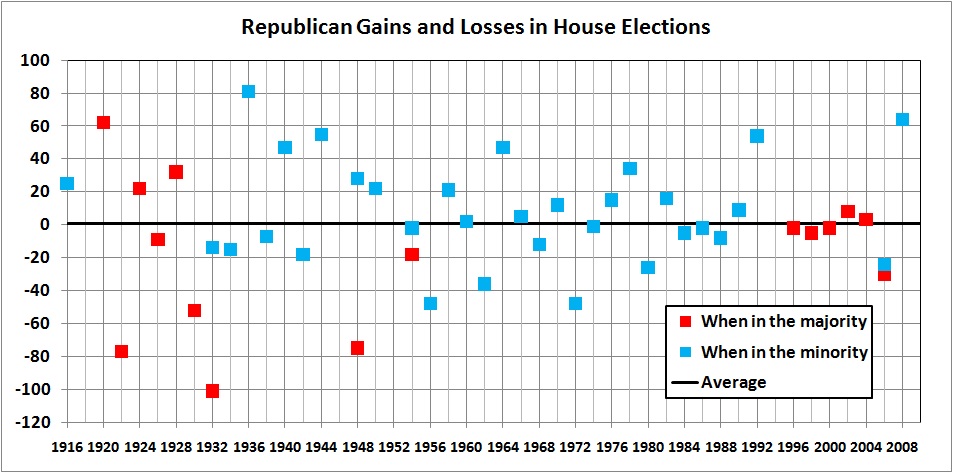
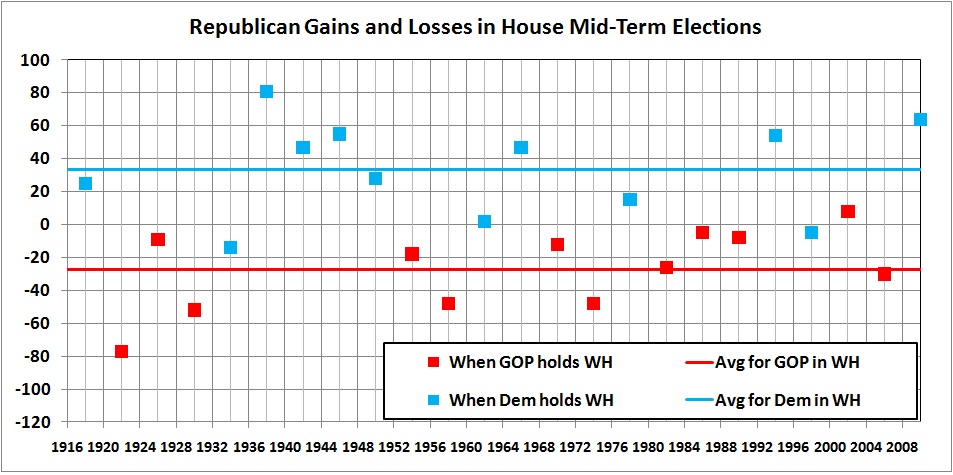
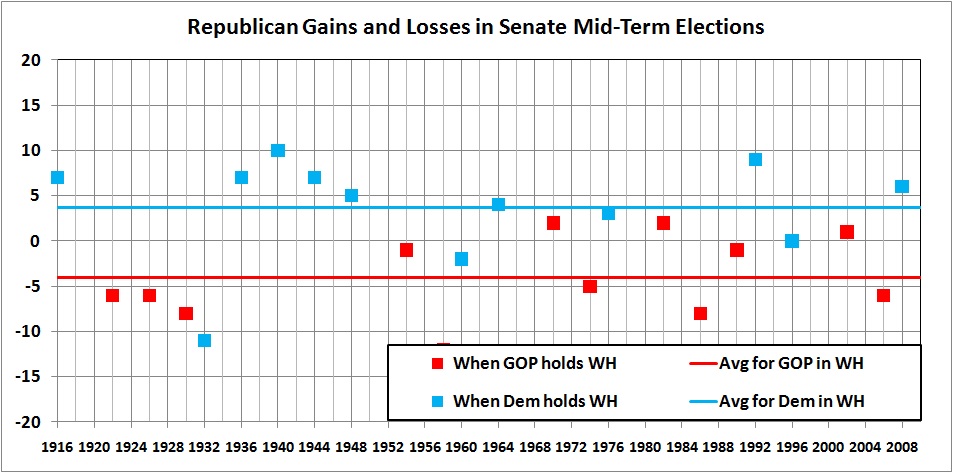
The following graphs underscore the point of the preceding post: Wishful thinking on the part of reality-based “progressives” to the contrary, there is no long-term trend toward a “permanent Democratic majority.” There is, if anything, a trend toward the GOP, which began in the 1950s.

What Happened to the Permanent Democrat Majority?

The election returns on November 2 tell a bigger story than massive disaffection with big government. They also point to a rising Republican majority. Consider, for example, the trend in the GOP’s percentage of House seats since the post-Depression lows of 1964 and 1974-76:

The 1964 low was an aberration, caused by LBJ’s landslide win over Barry Goldwater — a candidate whose then-“extreme” views went mainstream only 16 years later, with the election of Ronald Reagan. The backlash from Watergate led to the routs of 1974-76. And my trained eye tells me that 2008 was another aberration — a pause in a swing toward the GOP that began in the 1950s. So much for the “permanent Democratic majority” of which reality-based “progressives” love to boast.

Will the GOP’s fortunes rise indefinitely? Of course not — only a reality-based “progressive” would make that kind of claim. But the GOP will do well if it truly becomes — and remains — the party of limited government. It is the promise of government-light that propelled the GOP to a majority in 1994 and kept it there most of the time since.

That is the message of November 2. I urge Republican members of Congress to heed it.

Election 2010: Post-Mortem

UPDATED 11/05/10

This is a followup on my election-morning predictions, a prognosis about the next two years, and a diagnosis of the “progressive” disease.

I expected the GOP to gain eight seats in the Senate. But that prediction ran aground on the narrow wins by Democrats Michael Bennet and Harry Reid in Colorado and Nevada. The race in Washington hasn’t been decided, but it seems that Patty Murray will retain her seat.  The Alaska seat will wind up in GOP hands — it’s just a question of whose hands. So, when the dust settles, the GOP will have gained 6 seats and the Dems will retain a majority. That’s as good as it was likely to get. And it’s good enough, because with 47 seats (and only two or three RINOs in the mix) the GOP will command a cloture-proof minority.

Things turned out better in the House. I expected the GOP to end up with 237 seats. But when the dust settles on 10 9 undecided races, the GOP probably will hold between 239 seats (the current count) and 242 seats (adding 3 races now led by GOP candidates). Needless to say, the GOP will command the agenda in the House. The incoming tide of new Republican members will put a lot of pressure on GOP leaders to undo what Pelosi and company wrought. The stumbling blocks will be the Democrat-controlled Senate and the veto pen of BHO.

Republicans gained a lot of ground in the States, as indicated by the pickup of 12 governorships. (The Democrat pickup in California makes little difference in cloud-cuckoo-land, where the main difference between Arnold Schwarzenegger and his successor, Moonbeam Brown, is their accents.) Greater GOP strength at the State level will mean two things: more resistance to the expansion of federal power, and redistricting of the House in ways favorable to future Republican prospects.

The next two years at the “seat of government” (SOG) in D.C. will be filled with GOP initiatives to roll back the Obama agenda, name-calling by Democrats, and (I hope) gridlock combined with some rollback of Obamacare.

The next two years also will be filled with rationalizations by “progressives,” who — in so many words — will blame the backwardness of the American electorate for the events of November 2. “Progressives,” like their putative leader in the White House, already have adopted the myth that things would have turned out differently if only they had found a way to get their “message” across. Well, they did get their “message” across:

  • Pork disguised as stimulus, which did not and will not stimulate because the economy isn’t a hydraulic mechanism that responds automatically to pump-priming.
  • Financial regulations that will make it harder for Americans to borrow money.
  • A Rube Goldberg plan for reforming the health care “system” that will make it harder for Americans to obtain insurance and less rewarding for doctors and other providers to deliver medical services.

Such is “progressivism” at work: Good intentions (to put the best face on it) thwarted by unintended consequences because “progressives” believe that “hope and change” trump the realities of economic (and social behavior) — realities that “the masses” are able to grasp, if only viscerally.

Moreover, there was — and is — the disdain in which “progressives” hold “the masses,” who exist (in the “progressive” imagination) to be talked down to and led by the hand to the promised land of economic and social bliss — as it is envisioned by “progressives.”

I have news for “progressives.” When you talk down to most adults — and even to a lot of children — they quickly perceive three things: (a) you don’t respect their intelligence and (b) you are therefore trying to do something that’s against their interest. You really lose them when you promise things that they know (or suspect) will cost them liberty as well as money.

“Progressives” seem to believe in economic stability at any price, including the price of liberty and prosperity. A lot of “the masses” aren’t buying it. Good for them.

Today, the Battle Begins

The GOP will win big, but that’s only the beginning.

Republicans in Congress must prove their commitment to limited, fiscally conservative government. And the Republican Party must make a compelling case to Americans that limited, fiscally conservative government is the only sure route to liberty and prosperity. If those conditions aren’t met, today’s resounding victory at the polls will be a hollow one.

Here are my final predictions.

  • Based on current Intrade odds on individual Senate races, it looks like the GOP will gain seats in Arkansas, Colorado, Illinois, Indiana, North Dakota, Nevada, Pennsylvania, and Wisconsin. This will cut the Democrat majority in the Senate from 59-41 to 51-49, and leave that body in gridlock.
  • In the House, the GOP will gain about 60 seats and a majority of 39 seats (237-198) to 41 seats (238-197). (For details of my sources and methods, see “One Week Hence” and “Will the GOP Take the House?“)

Tomorrow

UPDATED AND REVISED 11:00 PM (CT)

Rasmussen’s net unpopularity rating of Obama was -11 as of this morning, which is about as good as it gets these days. If that number were to hold on election morning, it would point to a GOP majority of 232-203 in the House.* That would represent a net gain of 53 seats for the GOP.**

HOWEVER, Rasmussen has just released the result of his generic congressional ballot for 10/31/10, which gives GOP House candidates a 12-percentage-point edge over their Democrat rivals. Allowing for some backsliding (10 percent of respondents remain noncommittal), I forecast a GOP edge of 7.4 percentage points. That translates into a 237-198 majority for the GOP — a net gain of 58 seats.

Over in the Senate, the Intrade odds on individual races indicate a 50-50 split, with a few races hanging in the balance. That would be a gain of 9 seats for the GOP.

I will issue my final predictions tomorrow morning.
__________
* For details about sources and methods, see “One Week Hence” and “Will the GOP Take the House?

** Republicans currently hold 178 seats. In addition, a seat that had been held by a Republican is vacant. I therefore use 179 as a baseline for computing GOP gains.

Scare Tactics at Work

First, there’s the well-timed al Qaeda plot. Then, there’s the Stewart-Colbert “Sanity” rally.  Both are efforts to scare independent voters away from GOP candidates on November 2.

Al Qaeda’s leaders evidently assume that America’s independent voters will emulate Spain’s voters, and rally to the party of appeasement. There may be some truth in that. With a full day to absorb the news of the aborted terror plot, Obama’s unpopularity index suddenly improved from -17 to -13 — a swing that is well outside the normal range. (For the electoral implications of this shift, see the updated version of “One Week Hence…“.) Or it could be that some independent voters are having second thoughts as election day approaches. In any event, the bomb plot was well-timed and almost certainly pushed some voters in the direction preferred by al  Qaeda.

The transparent aim of the “Sanity” rally was to shame independent voters away from an association-by-ballot with those “hate-filled, racist, fear-mongering” Tea Partiers.

How will it all turn out? We’ll know the answer to that question in less than 72 hours.

I Want My Country Back

When a Tea Partier says something like “I want my county back,” leftists reliably label the sentiment as racist, sexist, homophobic, mean-spirited, and a lot of other things that are meant to be uncomplimentary. Well, I’m not an active member of the Tea Party movement, but I am sympathetic to it. And if I were to say “I want my country back,” here’s what I would mean by it:

Let’s start with the unlawfulness of government. The Constitution of the United States creates a “national” government of limited and enumerated powers, to act on behalf of the States and their citizens in certain matters. This “national” government has nevertheless blatantly and persistently exceeded its rightful powers. Moreover, much of what is done by all governments — not just the “national” government — is in fact unlawful at its core. There is a fundamental tenet of law — one that precedes and informs the Constitution — which is that “law” is law only when it serves the general welfare, regardless of its official status as an legislative, executive, or judicial act. Therefore, it is truly unlawful for the  “national” government or any other government in the United States to interfere with the lives, liberty, or property of Americans for the purpose of promoting special interests, however laudable those interests may seem. And yet, the “laws” under which Americans labor are, in the main, enactments that serve special interests and the power-lust of politicians, bureaucrats, and judges. In sum, I want my country (and its various parts) to return to the true “rule of law,” which is to promote the general welfare by

  • protecting all Americans from their enemies within and without
  • ensuring the free movement of all Americans
  • ensuring the free exchange of goods and services
  • and nothing more.

One of the most insidious ways in which government interferes with our liberty is by exercising a subtle but powerful form of thought control. It  is not the business of government to tell us what to believe or how we must arrive at our beliefs. But government — which puts it imprimatur on the vast majority of educational institutions and much of the “factual” information in many fields of endeavor — does all of those things. Thus, contrary to the intentions of the Founders, we have become a nation imbued with official beliefs about matters ranging from the origins of the universe to the goodness of our enemies to the climatic effects of (puny) human endeavors.

One of the key beliefs instilled by government — directly and through those who are in its thrall — is its beneficent role in our economic and social affairs. It never seems to occur to the proponents of governmental interference — or to its relatively few of its opponents — that there is a living, breathing case study which disproves the beneficence of economic meddling. When government spending and regulation played a tiny role in the economic affairs of the United States — from the 1790s to around 1900 — GDP grew at an annual rate of 4.2 percent. Now, with the regulatory-welfare state fully upon us, GDP grows at an annual rate of 3.1 percent (and falling). The difference between those two rates — when compounded over a generation, a lifetime, or a century —  ranges from significantly large to enormous. The road to economic lassitude is paved by the good intentions of regulation and spending by government. Liberty — part of which is the right to make mistakes and benefit from the resulting lessons — is a collateral victim of regulatory zeal. Liberty is a victim of government spending, as well, because it deprives individuals of some portion of the rewards for their labor and capital, and the full enjoyment of those rewards.

With respect to social matters, there is only one way to put it: Government is an enemy of society. Its main mission, when you think about it for more than a minute, is to supplant voluntary and beneficial social arrangements with schemes hatched in the vacuum of intellectualism. It is as if there were nothing to the eons-long learning that is expressed in the Ten Commandments and Golden Rule, and embodied in churches, clubs, and other voluntary, private associations. We must, instead, take our social marching orders from elites, who have their own peculiar views of what is right and just: serial polygamy, pederasty, and infanticide, to name just a few things. The social engineering favored by intellectualoids arises not from the wisdom of tradition, which fosters stable, trusting, and supportive social relationships, but from idle theorizing and a large dose of adolescent and post-adolescent rebellion.

Now, after a more than a century of “progressive” destruction of the Constitution and its restraints on government, Americans no longer enjoy the protection of government and the self-policing restraints of social custom. Instead, Americans suffer the fads and whims of the self-anointed, whose legacy lingers after their departure from the scene.

Now, after more than a century of “progressive” interference in the economic affairs of Americans, our progeny face unaffordable financial commitments, which they will be expected to honor even as their standard of living withers under the assault of taxation and regulation.

Now, after more than a century of social experimentation in which anti-social behavior has been exalted and long-standing voluntary social arrangements and institutions have been stripped of their authority, too many of our progeny are hooked on hard drugs, casual sex, and gratuitous violence as forms of “entertainment” and as “lifestyles.”

I want my country back.

One Week Hence . . .

The outlook for November 2, as of today (UPDATED 10/31/10):

  • (Not updated since 10/26/10.) Based on current Intrade odds on individual Senate races, it looks like the GOP will gain seats in Arkansas, Colorado, Illinois, Indiana, North Dakota, Nevada, Pennsylvania, and Wisconsin. This will cut the Democrat majority in the Senate from 59-41 to 51-49, thus enabling the GOP to block legislation despite the lingering presence of a few RINOs.
  • (Updated 10/31/10.) Over in the House, it looks like the GOP will gain about 60 seats, to re-take the House with a majority of 33 seats (234-201) to 35 seats (235-200). (Only the latter projection has been updated since 10/26/10.)
  • (Added 10/30/10; revised 10/31/10.) The well-timed discovery of a terrorist plot, combined with the “Sanity” rallies, may have helped to push some independent voters away from the GOP. Obama’s unpopularity index (as reported by Rasmussen) has improved by 6 percentage points in two days, from -19 to -17 to -13. Today’s  4-point swing is outside the normal range of day-to-day changes in the index.

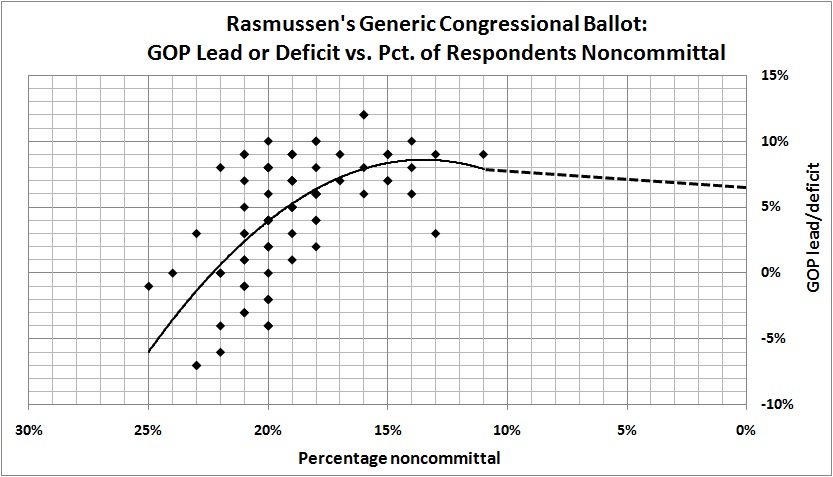
My forecast of Republican gains in the House is based on two indicators. The first is Scott Rasmussen’s generic congressional ballot, which has been polled weekly since January 11, 2009. The data points in the graph below represent the results of the poll, to date. Although the GOP enjoys a lead of 9 percentage points in the latest poll (10/24/10), my analysis indicates that there will be a slight reversal of GOP gains as more noncommittal voters choose sides. The solid black line, which is fitted to the data points, shows that the downward trend has begun. A separate statistical analysis yields the dashed black line, which indicates a GOP lead of 6.5 percentage points (a 234-201 majority) when the polls close on November 2.

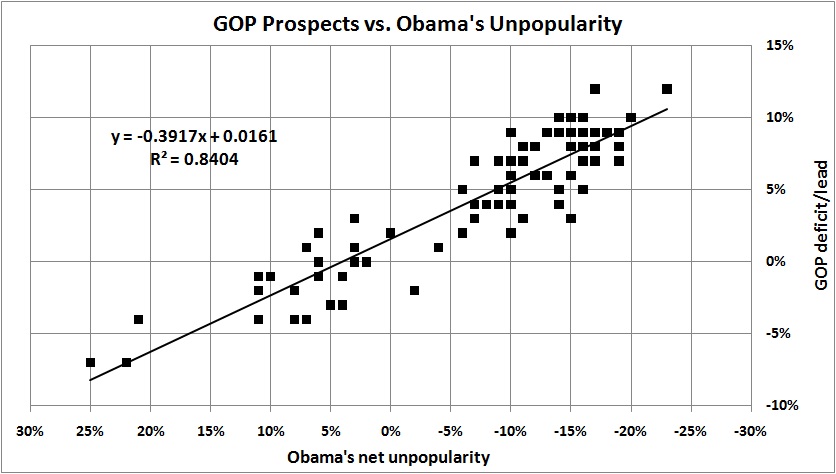
The second indicator of GOP prospects in the House is the degree of Obama’s unpopularity. The following graph depicts the relationship between Obama’s net unpopularity (percentage strongly disapproving less percentage strongly approving) and the number of percentage points by which votes cast for GOP House candidates will exceed votes cast for Democrat candidates.

This graph is derived from the results of Rasmussen’s generic congressional ballot and presidential tracking poll. The points on the graph represent the weekly results of the two Rasmussen polls for January 8, 2009, through October 24, 2010. The equation in the graph indicates that if Obama’s unpopularity index stays at its current level of -13 percentage points, GOP candidates for House seats will outpoll their Democrat opponents by6.7 percentage points on election day. That translates into a majority of 235-200.

(Added 10/31/10.) As I said in “Two Weeks Hence“:

All of this assumes no major shocks between now and election day — nothing on the order of a terror attack, a specific terror threat, a scandal involving a major political figure, and so on.

Two Weeks Hence . . .

This post combines and updates the analyses and forecasts I presented in “Three Weeks Hence . . .” and “Another Election Indicator.”

As of today (UPDATED 10/23/10):

  • The GOP will gain 8 Senate seats, leaving the Democrats with a 51-49 majority in the Senate. (This estimate is based on the Intrade odds on individual Senate races.)
  • Over in the House, it looks like the GOP will re-take the House, with a majority ranging from 25 seats (230-205) to 33 seats (234-201) 53 seats (244-191).

My forecast of Republican gains in the House is based on two indicators. The first is Scott Rasmussen’s generic congressional ballot, which has been polled weekly since January 11, 2009. The data points in the graph below represent the results of the poll, to date. Although the GOP enjoys a lead of 9 percentage points in the latest poll, my analysis indicates that there will be a slight reversal of GOP gains as more noncommittal voters choose sides. The solid black line, which is fitted to the data points, shows that the downward trend has begun. A separate statistical analysis yields the dashed black line, which points to a GOP lead of 6.7 percentage points (a 234-201 majority) when the polls close on November 2.

The second indicator of GOP prospects in the House is Obama’s degree of unpopularity. The following graph depicts the relationship between Obama’s net unpopularity (percentage strongly disapproving less percentage strongly approving) and the number of percentage points by which votes cast for GOP House candidates will exceed votes cast for Democrat candidates.

This graph is derived from the results of Rasmussen’s generic congressional ballot and presidential tracking poll. The points on the graph represent the weekly results of the two Rasmussen polls for January 8, 2009, through October 17, 2010. If Obama’s unpopularity index stays at its current level of -10 -19 percentage points, the equation for the regression line in the graph yields a GOP advantage of 5.5 9.0 percentage points in the popular vote for House candidates. That translates into a majority of 230-205 244-191.

All of this assumes no major shocks between now and election day — nothing on the order of a terror attack, a specific terror threat, a scandal involving a major political figure, and so on.

Another Election Indicator

The GOP’s prospects for re-taking the House of Representatives track nicely with the course of Obama’s unpopularity. The following graph depicts the relationship between Obama’s net unpopularity (percentage strongly disapproving less percentage strongly approving) and the number of percentage points by which votes cast for GOP House candidates will exceed votes cast for Democrat candidates.


Derived from the results of Rasmussen’s generic congressional ballot and presidential tracking poll.

The points on the graph represent weekly results of the two Rasmussen polls from January 8, 2009, through October 10, 2010. I will update the graph following the release of congressional ballot results for October 17, 24, and 31.

Obama’s current unpopularity rating is -14 percentage points. If it stays around that level, the GOP will do as well as I forecast in “Three Weeks Hence“: a 37-seat majority in the House. Even if Obama enjoys a sudden resurgence to -10 — which is his standing when his “base” flocks to him — the GOP will enjoy a 5 percentage point advantage in the popular vote for House candidates. That translates into a 21-seat majority.

All of this assumes no major shocks between now and election day — nothing on the order of a terror attack, a specific terror threat, a scandal involving a major political figure, and so on.

Three Weeks Hence . . .

. . . the GOP will retake the House and possibly the Senate. If the election were held today, Republicans would capture a 45-seat majority in the House (240-195) and a 51-49 majority in the Senate.

What will happen in the next three weeks? Some voters (mainly independents) will be unable to resist the allure of “something for nothing” (e.g., Obamacare) and will vote for Democrats in the end.

My fearless prediction (which I may change at any time):

  • 37-seat GOP majority in the House (236-199)
  • 50-50 split in the Senate (with Dem VP breaking ties in favor of Dem positions)

It won’t be possible for Republicans to repeal Obamacare. But with absolute control of the House and a cloture-proof voting bloc in the Senate, the GOP will be able to impede the implementation of Obamacare, while blocking other statist initiatives.

It remains to be seen whether congressional Republicans (or enough of them) can resist the urge to seem “compassionate” rather than “mean.”

*     *     *

My forecast of Republican gains in the House is based on Scott Rasmussen’s generic congressional ballot, which has been polled weekly since January 11, 2009. The data points in the graph below represent the results of the poll, to date. The blue point represents last week’s anomalous dip in the GOP’s fortunes; the red point represents this week’s results, which are in keeping with the long-term trend. My analysis indicates that there will be a slight reversal of GOP gains, as more noncommittal voters choose sides. The slowing of GOP gains is indicated by the shape of the solid black line, which is fitted to the data points. My statistical projection of the trend between now and election day is indicated by the dashed black line.  The odds in favor of a GOP majority are about 9-1.

The Resurgence of Obamacare

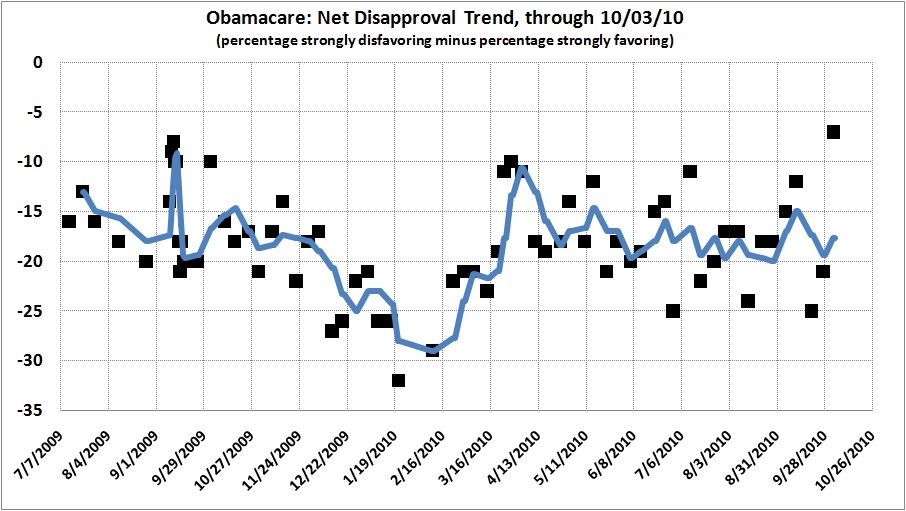
Rasmussen’s weekly poll of likely voters’ views of Obamacare reveals a sharp turnaround in attitudes. Here’s what has happened in the last three polls:

  • September 18-19 — 25 percent strongly oppose repeal of Obamacare; 50 percent strongly favor repeal; net disapproval index = -25 (not far from the all-time low of -32 recorded in January 2010)
  • September 24-25 — 25 percent strongly oppose repeal; 46 percent strongly favor it; net disapproval index = -21.
  • October 2-3 — 34 percent strongly oppose repeal; 41 percent strongly favor it; net disapproval index = -7 (the highest value yet recorded).

What is going on? In a word: bribery.

Millions of $250 checks have been sent to Medicare beneficiaries in recent weeks — and more will be sent in the four weeks remaining until election day.

There’s more to the bribery than $250 checks. Here are excerpts of the letter that accompanies the checks:

The Affordable Care Act, a new law passed by Congress and signed by President Obama on March 30, 2010, provides a one-time rebate to help with your drug cots. The rebate is sent automatically to most people enrolled in Medicare Part D who reach the Medicare drug plans coverage gap (“doughnut hole”) in 2010….

As part of this new law, starting next year, you will get a 50% discount on covered brand name drugs if you reach the coverage gap. On top of this, Medicare will add even more savings over the next several years until the coverage gap is closed by 2020.

The Affordable Care Act has many other provisions that protect and strengthen your Medicare, reduce your costs, and give you and your familymore control over health care….

It’s the old “something for nothing” trick. In this case, millions of old folks are getting something for nothing, while millions of younger folks will be getting nothing for something — their tax dollars. But the tax bill hasn’t come due yet because the federal government is still able to borrow money from abroad. And so, most of the people have been fooled — for the time being. By the time they understand what’s happening, it will be too late for them to do anything about it.

Republicans face a daunting challenge, if they return to power. They must repeal Obamacare while convincing the electorate that the result will be more, better, and cheaper health care.  This, I fear, is a task well beyond the power of today’s GOP, or the GOP of any day. “Something for nothing” wins every time.

*     *     *

The following graph gives a longer view of the unpopularity of Obamacare. Individual polls are represented by black squares; the blue line indicates the average for the three most recent polls.


Derived from this article and its predecessors at Rasmussen Reports. Poll results before passage of Obamacare represent strong approval minus strong disapproval. Poll results after passage of Obamacare represent strong approval of repeal minus strong disapproval of repeal.

Related posts:
Rationing and Health Care
The Perils of Nannyism: The Case of Obamacare
More about the Perils of Obamacare
Health-Care Reform: The Short of It
Presidential Chutzpah
Can Markets Force Financial Discipline?
As Goes Greece…
A Moral Dilemma

Our Miss Brooks

Some time back, Tom Smith referred to the NYT columnist and pseudo-conservative David Brooks as “prissy little Miss Brooks.” Smith’s recycling of the appellation has not diminished its satirical effect — or its substantive accuracy.

Miss Brooks recently cringed when she contemplated an America without government, in the aftermath of a victorious Tea Party movement. Miss Brooks, it seems, is besotted with the manliness of limited-but-energetic governments

that used aggressive [emphasis added] federal power to promote growth and social mobility. George Washington used industrial policy, trade policy and federal research dollars to build a manufacturing economy alongside the agricultural one. The Whig Party used federal dollars to promote a development project called the American System.

Abraham Lincoln supported state-sponsored banks to encourage development, lavish infrastructure projects, increased spending on public education. Franklin Roosevelt provided basic security so people were freer to move and dare. The Republican sponsors of welfare reform increased regulations and government spending — demanding work in exchange for dollars.

Throughout American history, in other words, there have been leaders who regarded government like fire — a useful tool when used judiciously and a dangerous menace when it gets out of control. They didn’t build their political philosophy on whether government was big or not. Government is a means, not an end. They built their philosophy on making America virtuous, dynamic and great. They supported government action when it furthered those ends and opposed it when it didn’t.

I am surprised that Miss Brooks was able to recover from her swoon and finish writing the column in question. I am less surprised that Miss Brooks omitted to mention Thomas “Louisiana Purchase” Jefferson and Theodore “I Can Do Whatever I Please” Roosevelt, given that Jefferson was an effete Francophile and Roosevelt was a squeaky-voiced nutcase.

Other than that, there are only two problems with Brooks’s prescription for beneficent government: The first is the impossibility of electing only those leaders who know how to use government power judiciously. The second problem is the assumption that the things wrought by Washington, Lincoln, et al. were judicious uses of government power.

As to the first problem, all I can do is note the number of times that a majority of Americans has been convinced of the goodness of a candidate, only to be disappointed — when not outraged — by his performance in office. Take LBJ, Nixon, Carter, G.H.W. Bush, Clinton, G.W. Bush, and Obama — please take them! –not to mention myriad Congress-critters and State and local office-holders.

The second problem is a problem for reasons that are evidentlybeyond Miss Brooks’s comprehension:

  • Government action isn’t cost-less. It absorbs resources that the private sector could have put to use.
  • Government officials, despite their (occasional) great deeds, are not gifted with superior knowledge about how to put those resources to use.
  • Private firms — when not shielded from competition and failure by governments — put resources to uses that satisfy the actual needs of consumers, as opposed to the whims (however high-minded) of politicians.
  • Private firms — when not shielded from competition and failure by government — use resources more efficiently than government.

In short, Miss Brooks, Washington may have been a great man for having led a rag-tag army to victory over the British, and Lincoln may have been a great man for having preserved the Union and (incidentally) freed the slaves, but neither man — and certainly no other man or collection of men exercising the arbitrary power of government — was or ever will be equal to the task of simulating the irreproducibly complex set of signals and decisions that are embedded in free markets.

In the end, Miss Brooks works herself into hysterics at the prospect of less government:

The social fabric is fraying. Human capital is being squandered. Society is segmenting. The labor markets are ill. Wages are lagging. Inequality is increasing. The nation is overconsuming and underinnovating. China and India are surging. Not all of these challenges can be addressed by the spontaneous healing powers of the market.

The social fabric is fraying precisely because government has pushed social institutions aside and made millions of Americans its dependents. Society is segmenting for the same reason, and also because millions of Americans are fed up with government and its dominance of their lives. Labor markets are ill and wages are lagging (compared to what?) because of various government actions that have slowed economic growth and caused (not for the first time) a deep recession. The nation is overconsuming (i.e., underinvesting) and underinnovating because of the aforesaid government-caused economic malaise, which (among other things) has reduced the demand for money (seen in the form of low interest rates) and the potential returns on innovative investments. That China and India are surging is no skin off our teeth; the more productive they are the less Americans have to pay for the goods and services they produce, and the more Americans can produce of other things — if government will only get off the back of American business.

None of these “challenges” would be challenges were it not for governmental interference in private social institutions and markets. As Ronald Reagan said in his first inaugural address, “In this present crisis, government is not the solution to our problem, government is the problem.” Amen.

So, Miss Brooks, I advise you to take two Valium and read Friedrich Hayek’s Nobel Prize lecture, “The Pretence of Knowledge.” Then pass it on to your politician friends.

Related posts:
Columnist, Heal Thyself
The Economic and Social Consequences of Government

The Mood of the Country

UPDATED 09/25/10

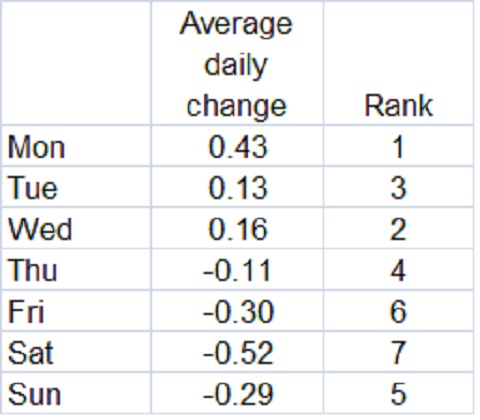
From the morning of January 21, 2009, through this morning, Obama’s net popularity rating has dropped from +28 to -13 (according to Rasmussen Reports). That’s an average daily decline of 0.07 rating points. But how Obama’s rating fares on a given day depends, in part, on the day of the week; thus:

As the week wears on, the likely voters polled by Rasmussen become less satisfied — or more dissatisfied — with Obama’s performance in office. Irascibility peaks on Saturday, then begins to recede on Sunday. Blue Monday, oddly enough, is Obama’s best day in the eyes of Rasmussen’s survey group. Conversely, the first day of the weekend — a day eagerly anticipated by most working persons — is Obama’s worst day. Go figure.

UPDATE: Saturday continues to be Obama’s blue polling day. With today’s 2-point drop, Saturday’s average change is now -0.54.

A Mere Coincidence?

UPDATED 09/10/10

On this morning after Barack Obama indulged in the politics of envy and class warfare by rejecting the continuation of the “Bush tax cuts” for high-income individuals, his unpopularity rating fell to a new low: -24.

By my estimate, rejection of Obama by conservative-libertarian-independent voters gives him a baseline unpopularity rating of -10. Ratings lower than that require the disapproval of Obama by disaffected Democrats who think he isn’t “doing enough.”

Well, if this morning’s poll results are any indication, there are some well-to-do and aspiring-to-do-well Democrats out there who think Obama would be “doing too much” if he succeeds in raising their marginal tax rates.

UPDATE: Despite today’s slight improvement, from -24 to -21, Obama’s unpopularity rating has hit new lows: 28-day average = -17.4; 7-day average = -20.7.

Obama’s Short-Lived “Peace Dividend”

UPDATED 09/05/10

On August 31, BHO declared an end to U.S. combat operations in Iraq. In anticipation of that declaration, and for a few days following it, BHO enjoyed what (for him) is a surge in popularity. His approval index (per Rasmussen Reports) went from -20 on August 25 to -12 on August 28. It dropped to -14 on August 31, but returned to -12 on September 1 (the morning after BHO’s declaration). It has been all downhill since: -13 on September 2, -16 on September 3, -21 on September 4, -23 on September 5.

Our boy president has recorded an unpopularity rating of -20 or lower only33 times in the 579 polling days that began with his inauguration. Nine of those low marks (more than a fourth of them) have come in the most recent 10 weeks of BHO’s 85 weeks in office.

In fact, Obama has earned a zero or positive rating 27 percent of the time; a negative rating, 73 percent of the time. More than half of his ratings have been -10 and lower. His last zero or positive rating came on June 29, 2009 — 62 weeks ago. That shouldn’t be surprising, given that he peaked two days after his inauguration. It has been mostly downhill and in a negative trough since then. Obama’s 28-day average rating hit -10 on November 7, 2009, and has stayed below -10 (usually well below) for the past 10 months.

It seems that BHO will have to keep looking for a way to become popular. Resignation might do the trick.

If Today Were Election Day…

…the GOP would gain 7 seats in the Senate, bringing its total there to 48 seats. Over in the House, the GOP would win 264 seats, giving it a 93-seat majority.

In any event, the GOP is likely to gain in the Senate, thus enabling it to filibuster almost anything, despite the lingering presence of a few RINOs.

Whatever happens in the Senate, the GOP seems assured of a large majority in the House — barring an “October surprise.”

In sum, the GOP will control the legislative agenda for the final two years of Obama’s term.

Gridlock, here we come — I hope.

The Republican Party will then have to articulate and sell its own vision for America. Lack of success in that department will enable Obama to campaign against a “do nothing” Congress, just as Truman did (successfully) in 1948.

So, in addition to gridlock in D.C., the next two years will see a battle for the soul of the Republican Party. Will small-government conservatism emerge triumphant, or will the GOP continue to be the “Democrat Lite” party? Stay tuned.

The Death of the Democrat Party?

Democracy is incompatible with liberty. But democracy is nevertheless considered a “good thing.” To call a political party “Democratic” imparts to that party an unwarranted veneer of beneficence. I refuse to lend this blog to that bit of moral confusion. Thus, on these pages, the “Democratic Party” is and always will be the “Democrat Party. End of mini-rant.

“Liberalism,” “progressivism,” and their variants are incompatible with liberty and progress. That is why I always enclose those terms in quotation marks.

If you see opposition to same-sex marriage as anti-libertarian, I suggest that you re-think your position, beginning with this.

James Taranto, of WSJ‘s Opinion Journal, opines:

If the Ninth Circuit upholds Walker’s decision [for same-sex marriage, in Perry v. Schwarzenegger], the Supreme Court would almost certainly agree to hear an appeal….

…When the Supreme Court takes up Perry v. Schwarzenegger … the justices will rule 5-4, in a decision written by Justice Kennedy, that there is a constitutional right to same-sex marriage.

This accepts the conventional assumption that the court’s “liberal” and “conservative” wings will split predictably, 4-4. Yet while Kennedy cannot be pigeonholed in terms of “ideology,” on this specific topic, he has been consistent in taking a very broad view of the rights of homosexuals. He not only voted with the majority but wrote the majority opinions in two crucial cases: Romer v. Evans (1996) and Lawrence v. Texas (2003).

Romer struck down an amendment to the Colorado Constitution that nullified state or local ordinances barring discrimination on the basis of “homosexual, lesbian or bisexual orientation, conduct, practices or relationships.” This provision, adopted by ballot initiative, violated the Equal Protection Clause of the 14th Amendment, Justice Kennedy wrote for the court….

In Lawrence, the court overturned a 1986 ruling and held that state laws criminalizing consensual homosexual sodomy violated the constitutional right of privacy….

Proposition 8 was adopted in “liberal” California by a margin of 52-48.  This is the same California that has preferred the Democrat candidate over his Republican opponent in the last five presidential elections, culminating in an Obama-slide of 61 percent vs. 39 percent for McCain and assorted wing-nuts.

Clearly, same-sex marriage is not beloved by all Democrats, or even an overwhelming majority of them. Voters in 31 States have blocked same-sex marriage in their States by rejecting proposals to allow it or (in most cases) approving constitutional amendments banning it. Only five States and the District of Columbia recognizes same-sex marriage. Needless to say, the deeds were done in those six jurisdictions by legislative or judicial fiat, and not by consulting voters about one of the rare issues that merits “democratic” consultation because it impinges directly on deep-rooted social norms.

If/when Judge Vaughn Walker’s judicial abomination is upheld by Justice Kennedy, voters will know where the blame lies: with the left wing of the Democrat Party and the gay-rights lobby, which is one of the Democrat Party’s favored constituencies. The resulting backlash among not-so-leftish Democrats would spell electoral disaster for the Democrat Party. Party leaders would then have two options:

  • Overtly move the party back from the extreme edge of American political opinion, in the hope that enough voters are taken in by such a cynical ploy to avert long-term disaster for the party.
  • Remain on the left edge of American political opinion, in the hope and belief that voters will (before too long) slide toward that edge.

My money is on the second option, because the leaders of the Democrat Party are deeply committed, in thought and word, to the “progressive” agenda: the cultivation of radical ideas and constituencies. (Why? Read this exquisite rant by Tom Smith.) And that, in the face of growing discontent about the power and cost of government, is a recipe for political suicide.

One can only hope.

Related posts:
Civil Society and Homosexual “Marriage”
Perry v. Schwarzenegger, Due Process, and Equal Protection