Money, Credit, and Economic Fluctuations

Wherein the author finds money, banking, and credit to be good, not evil — as long as government keeps its hands off them.

MONEY LUBRICATES EXCHANGE

The important role of money as a lubricant of economic activity has been understood for a long time. Indeed, it must have been understood by the ancients who first devised money of one kind or another and used it to broaden the range of goods they could buy, sell, and use. For a less-than-ancient but venerable account of the role of money, I turn to Adam Smith:

When the division of labour has been once thoroughly established, it is but a very small part of a man’s wants which the produce of his own labour can supply. He supplies the far greater part of them by exchanging that surplus part of the produce of his own labour, which is over and above his own consumption, for such parts of the produce of other men’s labour as he has occasion for. Every man thus lives by exchanging, or becomes, in some measure, a merchant, and the society itself grows to be what is properly a commercial society.

But when the division of labour first began to take place, this power of exchanging must frequently have been very much clogged and embarrassed in its operations. One man, we shall suppose, has more of a certain commodity than he himself has occasion for, while another has less. The former, consequently, would be glad to dispose of; and the latter to purchase, a part of this superfluity. But if this latter should chance to have nothing that the former stands in need of, no exchange can be made between them. The butcher has more meat in his shop than he himself can consume, and the brewer and the baker would each of them be willing to purchase a part of it. But they have nothing to offer in exchange, except the different productions of their respective trades, and the butcher is already provided with all the bread and beer which he has immediate occasion for. No exchange can, in this case, be made between them. He cannot be their merchant, nor they his customers; and they are all of them thus mutually less serviceable to one another. In order to avoid the inconveniency of such situations, every prudent man in every period of society, after the first establishment of the division of labour, must naturally have endeavoured to manage his affairs in such a manner, as to have at all times by him, besides the peculiar produce of his own industry, a certain quantity of some one commodity or other, such as he imagined few people would be likely to refuse in exchange for the produce of their industry. Many different commodities, it is probable, were successively both thought of and employed for this purpose. In the rude ages of society, cattle are said to have been the common instrument of commerce; and, though they must have been a most inconvenient one, yet, in old times, we find things were frequently valued according to the number of cattle which had been given in exchange for them. The armour of Diomede, says Homer, cost only nine oxen; but that of Glaucus cost a hundred oxen. Salt is said to be the common instrument of commerce and exchanges in Abyssinia; a species of shells in some parts of the coast of India; dried cod at Newfoundland; tobacco in Virginia; sugar in some of our West India colonies; hides or dressed leather in some other countries; and there is at this day a village In Scotland, where it is not uncommon, I am told, for a workman to carry nails instead of money to the baker’s shop or the ale-house. (From An Inquiry into the Nature and Causes of the Wealth of Nations, Chapter IV, “Of the Origin and the Use of Money.)

And so it went, until institutions of standing (banks, governments) began to issue money in standard, convenient forms, and which individuals would readily accept and use — within a particular region, principality, kingdom or nation, at least.

MONEY FACILITATES CREDIT, AND CREDIT CAN CREATE MONEY

Even in the absence of money, of course, there can be credit: the lending of products and services (i.e., economic goods or, simply, goods) for consumption or investment (i.e., capital formation: the creation of tools, facilities, and the like that can be used to produce goods in greater abundance, of higher quality, or of new kinds). Money facilitates credit because the borrower can use money to choose from a greater variety of consumption or investment goods; money, in effect, expands the time and space available to a buyer for the selection of goods.

Credit represents a kind of exchange, where the commodity involved is money, itself. The borrower and lender must agree to the terms of exchange, and the borrower (unless he is swayed by personal considerations and inclined to forgive a debt) will want some kind of assurance that his money will be repaid, at a rate of interest that he (the lender) is willing to accept, given the risk he assumes. Credit can underwrite the following activities:

  • Consumption (meeting daily wants, from shelter to food and clothing to such “frills” as internet service, faddish toys and clothing, etc.)
  • Purchases of durable consumer goods (e.g., automobiles, major appliances, and — for this purpose — residential dwellings)
  • Capital formation to enable the production of more, better, and new kinds of goods, including production goods (e.g., farm equipment) as well as final goods (e.g., home computers).

For purposes of this exposition, I consider stock purchases to be a form of credit. The purchaser is not making a loan to be repaid on a schedule, but he is hoping to participate in the dividends and/or capital gains that will be generated by the business that issues the stock. In other words, to buy stock is really to grant an unsecured loan, in the expectation of a high return and with the knowledge that a lot of risk attaches to that expectation.

CREDIT AND THE MONEY-MULTIPLIER

What is the source of credit? That is, who — if anyone — is relinquishing a claim on resources in order to lend that claim to someone else? The obvious answer to the question is: the lender. But that is not the whole story, because of fractional-reserve banking (FR, to distinguish it from FRB, or Federal Reserve Board). FR has a long history, which predates the involvement of governments in banking. With FR, the cash held in reserve by a bank (or private lender) can be parlayed into loans (and thus money) having a face value many times that of the original lender’s reserve. In what follows, I will use examples that assume a “money multiplier” of 10; that is, a cash reserve of a given amount may be used to generate loans with a total face value equal to 10 times that of the reserve. (This article explains the process and the formula  for determining  potential value of the loans, and money, that can be generated by a given cash reserve.) It should be  obvious that FR can be practiced only in a monetary economy; 100 head of cattle, for instance, cannot be parlayed into 1,000 head of cattle, because cattle cannot be created by the proverbial stroke of a pen, whereas money can — if others are willing to accept it.

Without FR, then, credit is created only when a lender forgoes spending that directly benefits him. For example, a lender who has just received $1,000 dollars for services rendered has a claim on the value of the goods he created by rendering those services. He could spend that $1,000 on some combination of consumption (e.g., groceries), durable consumer goods (e.g., a PC), or capital formation (e.g., new software for use in his tax-preparation business). Alternatively, he could lend the $1,000 (or some part of it) to someone else, who could put it to an analogous use or uses. Without FR, however, the growth of economic output depends (almost) entirely on the amount that individuals spend on capital formation or lend to others for capital formation. (I say “almost” because certain kinds of consumption and durable goods can also lead to future increases in output; for example, better nutrition and the use of refrigeration to prevent the contamination of food.)

THE MONEY-MULTIPLIER AND ECONOMIC GROWTH

FR can induce a higher rate of economic growth, if the following several conditions are satisfied:

  • Lenders lend additional sums as a result of FR.
  • The lending is not offset by reduced spending on the part of borrowers.
  • The money that is borrowed indistinguishable from money that is already in use. That is to say, the borrowed money is treated like “real” money when borrowers put it into circulation by spending it.
  • If it is “real” money, it give borrowers a claim on resources that they can exercise for the various reasons outlined above. But the resources that borrowers seek to command must be in addition to the resources that are already in use or that would have been in use in the absence of FR. (There may be some lags, as producers respond to additional spending with increases in output, and those lags will have an inflationary effect, but it may be offset by efficiencies of scale and/or greater productivity that results when some borrowers invest in capital formation.)

In summary: If enough additional money is created, if its expenditure calls forth enough additional production, and if enough that production flows into growth-inducing outlays, the result will be an acceleration of economic growth, relative to the growth that would have been attained without FR.

The biggest question mark attaches to the amount of lending that results when additional credit becomes available (potentially) because of FR. Potential increases in credit become actual increases only to the extent that particular lenders and prospective borrowers are willing to lend and borrow, respectively, at prevailing rates of interest, in light of their expectations of future economic conditions and the returns on particular uses of borrowed money. There is no mechanical or hydraulic process at work. (I am skirting a discussion of monetary policy, its shortcomings, and its merits relative to fiscal policy. For those who are interested in learning more about those matters, start here, here. here, and especially here.)

The essential point is that FR — like money — can foster the growth of economic activity. If there is nothing “artificial” about using money to expand economic activity — in the range of participants, their geographic scope, and the variety of goods they offer — there is nothing “artificial” using FR to further expand economic activity along the same lines.

THE “PROBLEM” WITH CREDIT-FUELED ECONOMIC EXPANSION

The perceptual problem is that people are unable to know just how much worse off they would be in the absence of credit. Credit-related downturns occur at a relatively high level of economic activity — a level that would not have been attained in the first place had it not been for credit.

When economic expansion is credit-based, it can be halted and reversed by a tightening of credit. In other words, credit-tightening supplements and magnifies the usual causes of economic retractions: natural disasters, epidemics, wars, technological shifts, overly ambitious capital and business formation, and so on. It is no coincidence that most of the economic downturns in American history have been initiated or deepened by the onset of a credit crisis.

Michael D. Bordo and Joseph G. Haubrich essay a rigorous historical and quantitative analysis of the relationship between credit crises and economic downturns in “Credit Crises, Money, and Contractions: A Historical View.” This is from the abstract:

Using a combination of historical narrative and econometric techniques, we identify major periods of credit distress from 1875 to 2007, examine the extent to which credit distress arises as part of the transmission of monetary policy, and document the subsequent effect on output…. [W[e identify and compare the timing, duration, amplitude, and comovement of cycles in money, credit, and output. Regressions show that fi nancial distress events exacerbate business cycle downturns both in the nineteenth and twentieth centuries and that a confluence of such events makes recessions even worse.

And this is from the concluding section:

[T]he narrative evidence strongly suggests, and the empirical work is at least consistent with, the claim that credit turmoil worsens recessions. The timing of cycles is likewise consistent with the work of Gilchrist, Yankov and Zakrajsek (2008) and others on the ability of corporate bond spreads to predictrecession in more recent periods.

The results are consistent with work, such as Barro and Ursua (2009), who find a high association between stock market crashes and large contractions, and Claessens Kose, and Terrones, who find an interaction between stock market crashes and tight money and credit….

The current episode combines elements of a credit crunch, asset price bust and banking crisis. It is consistent with the patterns we find using 140 years of US data. How does the current crisis measure up? Between August, 2007, and April, 2009, the difference between the yield on Baa bonds and long‐term Treasuries has moved up 342 basis points, a larger increase than seen in the 1929 contraction, and approaching the combined increase of 436 bp over both the Depression contractions. The percentage drop in S and P index of 42% is second only to the 78% of the Great Contraction…. Zarnowitz (1992) shows that business cycles downturns with panics are much more severe than others. Today because of deposit insurance, financial turmoil does not lead to panics and collapses in the money multiplier, and credit turmoil is less likely to feed into the money supply. The credit disturbance thus becomes relatively more important, given that disturbances on the asset side of the balance sheet no longer have as strong an influence on the money supply.

But there is nothing illusory about the relatively high level of economic activity from which a descent begins. It is real, and due in no small part to the availability of credit.

THE “HANGOVER” NARRATIVE AS A FALSE ANALOGY

A leading explanation of the Great Depression — and one that echoes today, in the aftermath of the Great Recession — is that Americans imbibed too much easy credit. Frederick Lewis Allen put it this way in his popular treatment of the Roaring Twenties and Great Crash, Only Yesterday (1931):

Prosperity was assisted … by two new stimulants to purchasing, each of which mortgaged the future but kept the factories roaring while it was being injected. The first was the increase in the installment buying. People were getting to consider it old-fashioned to limit their purchases to the amount of their cash balance; the thing to do was to “exercise their credit.” By the latter part of the decade, economists figured that 15 per cent of all retail sales were on an installment basis, and that there were some six billions of “easy payment” paper outstanding. The other stimulant was stock-market speculation. When stocks were skyrocketing in 1928 and 1929 it is probable that hundreds of thousands of people were buying goods with money which represented, essentially, a gamble on the business profits of the nineteen-thirties. It was fun while it lasted. (From Chapter 7, “Coolidge Prosperity.”

Thus:

Under the impact of the shock of panic, a multitude of ills which hitherto had passed unnoticed or had been offset by stock-market optimism began to beset the body economic, as poisons seep through the human system when a vital organ has ceased to function normally. Although the liquidation of nearly three billion dollars of brokers’ loans contracted credit, and the Reserve Banks lowered the rediscount rate, and the way in which the larger banks and corporations of the country had survived the emergency without a single failure of large proportions offered real encouragement, nevertheless the poisons were there; overproduction of capital; overambitious (expansion of business concerns; overproduction of commodities under the stimulus of installment buying and buying with stock-market profits… (From Chapter 13, “Crash!“)

And, finally:

Soon the mists of distance would soften the outlines of the nineteen- twenties, and men and women, looking over the pages of a book such as this, would smile at the memory of those charming, crazy days when the radio was a thrilling novelty, and girls wore bobbed hair and knee- length skirts, and a trans-Atlantic flyer became a god overnight, and common stocks were about to bring us all to a lavish Utopia. They would forget, perhaps, the frustrated hopes that followed the war, the aching disillusionment of the hard-boiled era, its oily scandals, its spiritual paralysis, the harshness of its gaiety; they would talk about the good old days …. (From Chapter 14, “Aftermath: 1930-1931.”)

The clear moral — in the view of Allen and many others, unto this day — is that America had overindulged in the Roaring Twenties and paid for it with a hangover, in the form of the Great Crash and subsequent Great Depression, which was in evidence by the time Only Yesterday was published.

The true story is that government caused the financial excesses of the Roaring Twenties, the evolution of the Great Crash into the Great Depression, and a deep recession that prolonged the Great Depression. This long, dismal story has been told many times; there is a fact-filled but concise retelling in the Mackinac Center’s “Great Myth of the Great Depression.” Jumping to the bottom line:

The genesis of the Great Depression lay in the irresponsible monetary and fiscal policies of the U.S. government in the late 1920s and early 1930s. These policies included a litany of political missteps: central bank mismanagement, trade-crushing tariffs, incentive-sapping taxes, mind-numbing controls on production and competition, senseless destruction of crops and cattle and coercive labor laws, to recount just a few. It was not the free market that
produced 12 years of agony; rather, it was political bungling on a grand scale.

The story ends with an assessment of the financial crisis that sparked the Great Recession:

The financial crisis that gripped America in 2008 ought to be a wake-up call. The fingerprints of government meddling are all over it. From 2001 to 2005, the Federal Reserve revved up the money supply, expanding it at a feverish double-digit rate. The dollar plunged in overseas markets and commodity prices soared. With the banks flush with liquidity from the Fed, interest rates plummeted and risky loans to borrowers of dubious merit ballooned. Politicians threw more fuel on the fire by jawboning banks to lend hundreds of billions of dollars for subprime mortgages. When the bubble burst, some of the very culprits who promoted the policies that caused it postured as our rescuers while endorsing new interventions, bigger government, more inflation of money and credit and massive taxpayer bailouts of failing firms. Many of them are also calling for higher taxes and tariffs, the very nonsense that took a recession in 1930 and made it a long and deep depression.

Just how bad is the government-caused Great Recession? It is the worst recession since the end of World War II and, therefore, the worst downturn since the Great Depression:
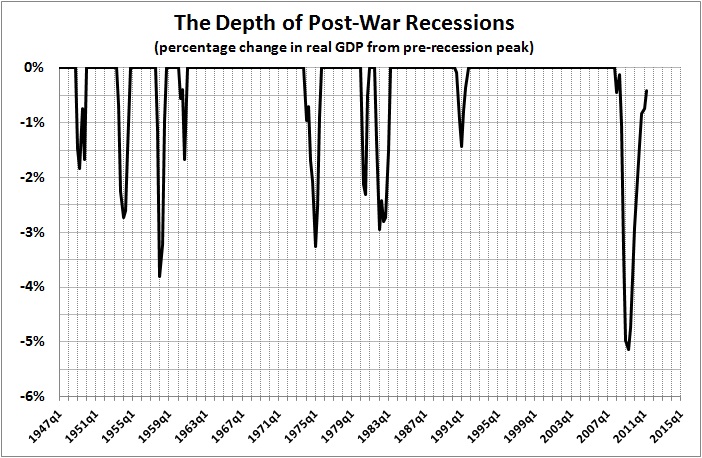

Derived from quarterly estimates of real GDP provided by the Bureau of Economic Analysis.

To paraphrase Ronald Reagan: Money and credit are not the problem. Government policies — including the mismanagement of money and credit — are the problem.

FREE FINANCIAL MARKETS ARE THE SOLUTION

Government control and monopolization of money, banking, and credit has been the norm for so long that it is taken for granted by almost everyone. But the record of government misfeasance and malfeasance with respect to economic activity (barely touched on above) is such that the proponents of governmental interventions should bear the burden of proving that those interventions are warranted.

I will close with another paraphrase, this time of Winston Churchill: the free market is the least effective means of making resource-allocation decisions that foster material progress, except for all the rest.

Read on:
Mr. Greenspan Doth Protest Too Much
Economic Growth since WWII
The Price of Government
The Fed and Business Cycles
The Commandeered Economy
The Price of Government Redux
The Mega-Depression
Does the CPI Understate Inflation?
Ricardian Equivalence Reconsidered
The Real Burden of Government
Toward a Risk-Free Economy
The Rahn Curve at Work
How the Great Depression Ended
The Illusion of Prosperity and Stability
The “Forthcoming Financial Collapse”
Experts and the Economy
Estimating the Rahn Curve: Or, How Government Inhibits Economic Growth
The Deficit Commission’s Deficit of Understanding
The Bowles-Simpson Report
The Bowles-Simpson Band-Aid
The Great Recession is Over
The Stagnation Thesis
Government Failure: An Example
The Evil That Is Done with Good Intentions
America’s Financial Crisis Is Now
The Great Recession Is Not Over
We, the Children of the Enlightenement…

…are lost in it. Roger Scruton explains:

…Ferdinand Tönnies … formulated a distinction between two kinds of society — Gemeinschaft and Gesellschaft — the first based in affection, kinship and historic attachment, the second in division of labour, self-interest and free association by contract and exchange. Traditional societies, he argued, are of the first kind, and construe obligations and loyalties in terms of a non-negotiable destiny. Modern societies are of the second kind, and therefore regard all institutions and practices as provisional, to be revised in the light of our changing requirements. The transition from Gemeinschaft to Gesellschaft is part of what happened at the Enlightenment, and one explanation for the vast cultural changes, as people learned to view their obligations in contractual terms, and so envisage a way to escape them.

Max Weber wrote, in the same connection, of a transition from traditional to “legal-rational” forms of authority, the first sanctioned by immemorial usage, the second by impartial law. To these two distinctions can be added yet another, du to Ser Henry Maine, who described the transition from traditional to modern societies as a shift from status to contract — i.e., a shift from inherited social position, to a position conferred by, and earned through, consent.

These sociological ideas are attempts to understand changes whose effect has been so profound that we have not yet come to terms with them. Still less had people come to terms with them in the late eighteenth century, when the French Revolution sent shock waves through the elites of Europe. The social contract seemed to lead of its own accord to a tyranny far darker than any monarchical excess: the contract between each of us became an enslavement of all. Enlightenment and the fear of Enlightenment were henceforth inseparable. Burke’s attack on the [French] Revolution illustrates this new state of mind. His argument is a sustained defence of “prejudice” — by which he meant the inherited store of human wisdom, whose value lasts only so long as we don not question it — against the “reason” of Enlightenment thinking. But people have prejudices only when they see no need to defend them. Only an enlightened person could think as Burke did, and the paradox of his position is now a familiar sub-text of modern culture — the sub-text of conservatism….

It was Marx who developed the most popular explanation of the Enlightenment. The Enlightenment saw itself as the triumph of reason over superstition. But the real triumph, Marx argued, lay not in the sphere of ideas but in the sphere of economics. The aristocratic order had been destroyed, and with it the feudal relations which bound the producers to the land and the consumers to the court. In place of the old order came the “bourgeois” economy, based on the wage contract, the division of labour and private capital. The contractual view of society, the emphasis on individual freedom, the belief in impartial law, the attack on superstition in the name of reason — all these cultural phenomena are part of the “ideology” of the new bourgeois order, contributions to the self-image whereby the capitalist class ratifies its usurpation.

The Marxist theory is a form of economic determinism, distinguished by the belief that fundamental changes in economic relations are invariably revolutionary, involving a violent overthrow of the old order, and a collapse of the political “superstructure” which had been built on it. The theory is almost certainly false: nevertheless, there is something about the Marxian picture which elicits, in enlightened people, the will to believe. By explaining culture as a by-product of material forces, Marx endorses the Enlightenment view, that material forces are the only forces there are. The old culture, with its gods and traditions and authorities, is made to seem like a web of illusions — “the opiate of the people”, which quietens their distress….

…Thanks to Marx, debunking theories of culture have become a part of culture. And these theories have the structure pioneered by Marx: they identify power as the reality, and culture as the mask; they also foretell some future “liberation” from the lies that have been spun by our oppressors.

Debunking theories of culture are popular for two reasons: because they are linked to a political agenda, and because they provide us with an overview. If we are to understand the Enlightenment, then we need such an overview. But ought it to be couched in these external terms? After all, the Enlightenment is part of us; people who have not responded to its appeal are only half awake to their condition. It is not enough to explain the Enlightenment; we must also understand it….

[A]s I noted in discussing Burke, Enlightenment goes hand in hand with the fear of it. From the very beginning hope and doubt have been intertwined. What if men needed those old authorities, needed the habit of obedience and the sense of the sacred? What if, without them, they should jettison all loyalties, and give themselves to a life of godless pleasure?… [T]he very aim for a universal culture, without time or place, brought a new kind of loneliness. Communities depend upon the force of which Burke called prejudice; they are essential local, bound to a place, a history, a language and a common culture. The Enlightened individualist, by forgoing such things, lives increasingly as a stranger among strangers, consumed by a helpless longing for an attachment which his own cold thinking has destroyed.

These conflicts within Enlightenment culture are part of its legacy to us. We too are individualists, believers in the sovereign right of human freedom, living as strangers in a society of strangers. And we too are beset by those ancient and ineradicable yearnings for something else — for a homecoming to our true community…. But … there is no going back, … we must live with our enlightened condition and endure the inner tension to which it condemns us. And it is in terms of this tension, I believe, the we should understand both the splendours and the miseries of modern culture. (An Intelligent Person’s Guide to Modern Culture, pp. 24-9)

Religion, community, and common culture have been displaced by the regulatory-welfare state, anthropogenic global warming, feminism, “choice,” and myriad other totems, beliefs, “movements,” and “leaders,” both religious and secular.  Are our minds less troubled, do we sleep better, are we happier in our relationships, is our destiny more secure? Something tells me that the answer to each of those questions is “no.”

The tale was told long ago:

[1] Now the serpent was more subtle than any of the beasts of the earth which the Lord God had made. And he said to the woman: Why hath God commanded you, that you should not eat of every tree of paradise? [2] And the woman answered him, saying: Of the fruit of the trees that are in paradise we do eat: [3] But of the fruit of the tree which is in the midst of paradise, God hath commanded us that we should not eat; and that we should not touch it, lest perhaps we die. [4] And the serpent said to the woman: No, you shall not die the death. [5] For God doth know that in what day soever you shall eat thereof, your eyes shall be opened: and you shall be as Gods, knowing good and evil.

[6] And the woman saw that the tree was good to eat, and fair to the eyes, and delightful to behold: and she took of the fruit thereof, and did eat, and gave to her husband who did eat. [7] And the eyes of them both were opened: and when they perceived themselves to be naked, they sewed together fig leaves, and made themselves aprons. [8] And when they heard the voice of the Lord God walking in paradise at the afternoon air, Adam and his wife hid themselves from the face of the Lord God, amidst the trees of paradise. [9] And the Lord God called Adam, and said to him: Where art thou? [10] And he said: I heard thy voice in paradise; and I was afraid, because I was naked, and I hid myself.

[11] And he said to him: And who hath told thee that thou wast naked, but that thou hast eaten of the tree whereof I commanded thee that thou shouldst not eat? [12] And Adam said: The woman, whom thou gavest me to be my companion, gave me of the tree, and I did eat. [13] And the Lord God said to the woman: Why hast thou done this? And she answered: The serpent deceived me, and I did eat. [14] And the Lord God said to the serpent: Because thou hast done this thing, thou art cursed among all cattle, and beasts of the earth: upon thy breast shalt thou go, and earth shalt thou eat all the days of thy life. [15] I will put enmities between thee and the woman, and thy seed and her seed: she shall crush thy head, and thou shalt lie in wait for her heel.

[16] To the woman also he said: I will multiply thy sorrows, and thy conceptions: in sorrow shalt thou bring forth children, and thou shalt be under thy husband’s power, and he shall have dominion over thee. [17] And to Adam he said: Because thou hast hearkened to the voice of thy wife, and hast eaten of the tree, whereof I commanded thee that thou shouldst not eat, cursed is the earth in thy work; with labour and toil shalt thou eat thereof all the days of thy life. [18] Thorns and thistles shall it bring forth to thee; and thou shalt eat the herbs of the earth. [19] In the sweat of thy face shalt thou eat bread till thou return to the earth, out of which thou wast taken: for dust thou art, and into dust thou shalt return. [20] And Adam called the name of his wife Eve: because she was the mother of all the living.

[21] And the Lord God made for Adam and his wife, garments of skins, and clothed them. [22] And he said: Behold Adam is become as one of us, knowing good and evil: now, therefore, lest perhaps he put forth his hand, and take also of the tree of life, and eat, and live for ever. [23] And the Lord God sent him out of the paradise of pleasure, to till the earth from which he was taken. [24] And he cast out Adam; and placed before the paradise of pleasure Cherubims, and a flaming sword, turning every way, to keep the way of the tree of life. (Book of Genesis, Chapter 3)

A particular feature of the Enlightenment was that its rationalism gave rise to leftism. Thomas Sowell writes about the wages of leftist “intellectualism” in Intellectuals and Society:

One of the things intellectuals have been doing for a long time is loosening the bonds that hold a society together. They have sought to replace the groups into which people have sorted themselves with groupings created and imposed by the intelligentsia. Ties of family, religion, and patriotism, for example, hav long been treated as suspect or detrimental by the intelligentsia, and new ties that intellectuals have created, such as class — and more recently “gender” — have been projected as either more real or more important. (p. 303)

In my view, the

left’s essential agenda  is the repudiation of ordered liberty of the kind that arises from evolved social norms, and the replacement of that liberty by sugar-coated oppression. The bread and circuses of imperial Rome have nothing on Social Security, Medicaid, Medicare, Obamacare, and the many other forms of personal and corporate welfare that are draining America of its wealth and élan. All of that “welfare” has been bought at the price of economic and social liberty (which are indivisible).

Freedom from social bonds and social norms is not liberty. Freedom from religion, which seems to be the objective of American courts, is bound to yield less liberty and more crime, which further erodes liberty.

Related posts:
Our Enemy, the State
Pseudo-Libertarian Sophistry vs. True Libertarianism
Positivism, “Natural Rights,” and Libertarianism
What Are “Natural Rights”?
The Golden Rule and the State
Libertarian Conservative or Conservative Libertarian?
Liberty, Equality, Fraternity: Part I
Bounded Liberty: A Thought Experiment
Evolution, Human Nature, and “Natural Rights”
More Pseudo-Libertarianism
More about Conservative Governance
The Meaning of Liberty
Positive Liberty vs. Liberty
Understanding Hayek

Understanding Hayek

In an earlier post, I deployed the following statement by Michael Oakeshott:

How deeply the rationalist disposition of mind has invaded our political thought and practice is illustrated by the extent to which traditions of behaviour have given place to ideologies, the extent to which the politics of destruction and creation have been substituted for the politics of repair, the consciously planned and deliberately executed being considered (for that reason) better than what has grown up and established itself unselfconsciously over a period of time…. This is, perhaps, the main significance of Hayek’s Road to Serfdom — not the cogency of his doctrine, but the fact that it is a doctrine. A plan to resist all planning may be better than its opposite, but it belongs to the same style of politics. And only in a society already deeply infected with Rationalism will the conversion of the traditional resources of resistance to the tyranny of Rationalism into a self-conscious ideology be considered a strengthening of those resources. (From “Rationalism in Politics,” in Rationalism in Politics and Other Essays, new and expanded edition, pp. 26-7.)

I hereby retract my implied endorsement of Oakeshott’s view of Hayek as a rationalist. Hayek’s “doctrine” consisted of a reasoned, well-founded warning against central planning. That is no more a doctrine than a highway sign that warns of sharp curves ahead.

Hayek was very much an anti-rationalist. (The use of reason, in itself, is not rationalism, which values only reason and the ordering of socio-economic relationships by the use of reason.) For example, Peter G. Klein writes that

…Hayek’s later emphasis on group selection and spontaneous order is not shared by Mises…. A clue to this difference is in Hayek’s … statement that “Mises himself was still much more a child of the rationalist tradition of the Enlightenment and of continental, rather than of English, liberalism . . . than I am myself.” This is a reference to the “two types of liberalism” to which Hayek frequently refers: the continental rationalist or utilitarian tradition, which emphasizes reason and man’s ability to shape his surroundings, and the English common-law tradition, which stresses the limits to reason and the “spontaneous” forces of evolution. (“Biography of F.A. Hayek,” at Ludwig von Mises Institute)

As for The Road to Serfdom, Peter Boettke explains that it

was conceived of as part of Hayek’s Abuse of Reason project.  It was a political tract for its time, but it was also much more than that.  A careful reader can see in the book both where Hayek attempts to move beyond the political issues of his day to address more timeless issues of social cooperation….

Hayek’s basic thesis in The Road to Serfdom is that the lure of socialist ideology has the unintended and undesirable consequence of economic depravation and political tyranny when countries follow its policy agenda.  The reason for this is that the task of socialist planning requires economic planners to assume a level of responsibility for economic life in a country which is both cumbersome to the point of impossible, and powerful beyond any reasonable limit that could be safely trusted to any one individual or group of individuals….

Hayek’s book was not a deterministic one, but rather a warning to those countries of the West who were enamored with socialist ideology, that the implementation of socialism would tend to undermine the beliefs that were at the core of Western civilization….

…[S]ixty years on, we are still celebrating Hayek’s achievement with The Road to Serfdom.

Most of this celebration of Hayek, admittedly, is ideological in nature and confirms Hayek’s status as an iconic figure for the world-wide conservative and libertarian movement. I do not deny the importance of this in explaining the popularity of Hayek’s work, but I also think those who rely on this explanation exclusively relegate Hayek’s work to the status of a “coffee-table book” — a work to be seen as in one’s possession among the intelligentsia but not read.  Rather, I want to stress the analytical contribution that Hayek makes in his work….

Hayek sought to demonstrate in a manner persuasive to the public and the intellectual elite that the consequences of the policy choice of socialism would lead them down a path that they themselves would never want to go if they made their choices in full knowledge of the consequences of their choice.  It is a tragic tale he is telling in The Road to Serfdom, not one of determinism or even opportunism.  “Is there a greater tragedy imaginable,” Hayek asks, “than that, in our endeavor consciously to shape our future in accordance with our highest ideals, we should in fact unwittingly produce the very opposite of what we have been striving for?” (“On reading Hayek: choice, consequences, and The Road to Serfdom“)

Hayek was out to slay the rationalistic dragon of market socialism:

economic systems where the means of production are publicly owned, managed and operated for a profit in a market economy…. Theoretically, the fundamental difference between a traditional socialist economy and a market socialist economy is the existence of a market for the means of production and capital goods under market socialism.

On that point, Boettke writes:

[Hayek] never impugns the character of those he is arguing with, instead he points out how their intellectual error leads to results that would make these individuals shudder with fear. To reiterate …, the market socialists thought their model of socialist planning could be reconciled with consumer sovereignty, but their position was untenable due to the organizational problems of socialism in terms of aligning incentives, utilizing information, and discovering knowledge.  Neither Lerner nor Durbin [two leading market socialists] ever admitted that Hayek had refuted their claim to have squared the circle.  Of course, they believe in individualism and not authoritarian government. But their theory if put into practice would have resulted in a march toward serfdom as special interest forces would be unleashed to agitate for greater and greater government control over resources and the allocation of labor. Either consumer sovereignty would be suppressed, or planning would have to be abandoned — but the two could not be reconciled. (Id.)

Boettke concludes:

Hayek wrote The Road to Serfdom at a crucial stage in the 20th century. The Nazi threat to western civilization had just been defeated, but the Communist system had grown in legitimacy in the process.  Communism had avoided the Great Depression, and whatever problems might exist, Stalin did mobilize the resources in the Soviet Union to transform a peasant society into an industrial power in a generation and effectively enough to help the allies defeat Hitler.  Hayek’s argument was that our fascination with the Communist ideal will prove to be our undoing unless we recognize the warning signs.  He stood there and could do no other, but to pen this warning.

The Road to Serfdom made Hayek a famous man, but it also partially discredited him among his fellow academics and the intellectual elites in the west.  But he was not deterred and his career post-1944 focused increasingly on the issues of social philosophy and political economy….

…Hayek’s emphasis [was] on how alternative institutional arrangements, through their properties to align incentives and utilize dispersed information, impact the choices people make…. (Id.)

(For more by Boettke, see “Hayek’s the Road to Serfdom Revisited: Government Failure in the Argument Against Socialism,” and “Hayek and Market Socialism: Science, Ideology, and Public Policy.”)

Hayek, in short, was prescriptive only to the extent that his understanding of human nature and social relationships enabled him to issue well-founded warnings about the unintended and undesirable consequences of rationalistic schemes — like socialism.

As for Hayek’s Abuse of Reason project, here is Bruce Caldwell’s outline:

In late August 1939 Hayek sent a letter to his friend Fritz Machlup saying that … he would begin work on a new project, tracing the decline of reason from Saint-Simon to Hitler. The plan of the work was contained in an outline prepared in the summer of 1940, titled “The Abuse and Decline of Reason: The Reflections of an Economist on the Self- Destructive Tendencies of Our Scientific Civilization.” The introduction was to be titled “The Humility of Individualism.” Part 1, called “The Collectivist Hybris,” would trace the topic through French, German, English, and American phases. Part 2 was to be called “The Totalitarian Nemesis.” In a slightly later outline, the first chapter of part 1 was to be “Scientism.”

The Abuse of Reason project would tell a very different story from that of the steady side-by-side progress of socialism and democracy that Webb and others espoused. In Hayek’s alternative tale, the steady growth of scientism and of the planning mentality engendered the (in Hayek’s view, false) hope that scientific advances would allow the creation of a new planned socialist society. Scientism and socialism grew up together. Hayek would trace out the pedigree and history of the ideas that he felt had led the western world to totalitarianism. (“Hayek on Mill”)

In sum, Hayek’s work is anti-doctrinal. Its implications for policy are negative ones. As Francis Fukuyama writes,

Hayek’s skepticism about the effects of “big government” are rooted in an epistemological observation summarized in a 1945 article called “The Uses of Knowledge in Society.” There he argued that most of the knowledge in a modern economy was local in nature, and hence unavailable to central planners. The brilliance of a market economy was that it allocated resources through the decentralized decisions of a myriad of buyers and sellers who interacted on the basis of their own particular knowledge. The market was a form of “spontaneous order,” which was far superior to planned societies based on the hubris of Cartesian rationalism. (“Friedrich A. Hayek, Big Government Skeptic,” The New York Times, May 6, 2011)

So far, so good. But Fukuyama later discusses “two major critiques of Hayek’s arguments”:

The first comes from the left. Hayek provides a very minimalist definition of freedom as freedom from coercion, and particularly coercion by a central government. But as the economist Amartya Sen has argued, the ability to actually take advantage of freedom depends on other things like resources, health and education that many people in a typical society do not possess. (Id.)

Sen is talking about “positive liberty,” which I have addressed here (among other places):

In other words, it is not enough to have “peaceful, willing coexistence and its concomitant: beneficially cooperative behavior.” That kind of liberty — liberty in the fullest sense — encompasses the acts of love, affection, friendship, neighborliness, and voluntary obligation that help individuals acquire the “power and resources” with which they may strive to attain the fruits of liberty, insofar as they are willing and able to do so.

That should be enough to satisfy the proponents of positive liberty … but I suspect otherwise. I would be more sanguine were they proponents of a proper definition of liberty, but they are not. Thus, armed with an inchoate definition of liberty, they are prepared to do battle for positive liberty and, I fear, the positive rights that are easily claimed as necessary to it; to wit:

  • A lack of “power” entitles certain groups to be represented, as groups, in the councils of government (a right that is not extended to other groups).
  • A lack of “resources” becomes the welfare entitlements of various kinds — for personal characteristics ranging from low intelligence to old age — which threaten to suck ever more resources out the productive, growth-producing sectors of the economy.
  • The exercise of “free will” becomes the attainment of certain “willed” outcomes, regardless of one’s ability or effort, which then justifies such things as an affirmative-action job, admission to a university, a tax-subsidized house, etc.
  • “Classism,” “sexism,” “racism,” and now “beauty-ism” become excuses for discriminating against vast swaths of the populace who practice none of those things.

With respect to the final point, a certain degree of unpleasantness inevitably accompanies liberty. Legal attempts to stifle that unpleasantness simply spread injustice by fomenting resentment and covert resistance, while creating new, innocent victims who are deemed guilty until they can prove their innocence.

In sum, the line between positive liberty and positive rights is so fine that the advocacy of positive liberty, however well meant, easily becomes the basis for preserving and extending the burden of positive rights that Americans now carry. (“Positive Liberty vs. Liberty”)

Positive liberty and positive rights are aspects of social justice, a concept that Hayek rightly rejected. If some are granted positive rights in the name of positive liberty or social justice, others must perforce be denied liberty — at the whim of the state. Those who presume to decide who is deserving and who is not are arrogant accountants of the soul.

Fukuyama, ends by echoing (unwittingly, I suspect) Oakeshott’s critique:

In the end, there is a deep contradiction in Hayek’s thought. His great insight is that individual human beings muddle along, making progress by planning, experimenting, trying, failing and trying again. They never have as much clarity about the future as they think they do. But Hayek somehow knows with great certainty that when governments, as opposed to individuals, engage in a similar process of innovation and discovery, they will fail. He insists that the dividing line between state and society must be drawn according to a strict abstract principle rather than through empirical adaptation. In so doing, he proves himself to be far more of a hubristic Cartesian than a true Hayekian. (Fukuyama, op. cit.)

William Easterly responds:

To say Hayek’s skepticism about government was based on “great certainty” is not just wrong, it is so much the opposite of  Hayek, it’s like accusing Michele Bachmann of excessive belief in the Koran.

Hayek’s view of knowledge was that it was partial and dispersed among many. The market gave individuals the incentives to apply this knowledge, and coordinated the uses of this local knowledge in a way that rewards each of us who knows best about any particular narrow area…. Government usually lacks both the incentives and the coordination mechanism. In government we don’t know who knows best, so which knowledge wins the argument could often be wrong. (“Saving Private Hayek”)

A good summation is found in a blog post by Peter Boettke:

Hayek [in The Road to Serfdom] was not diagnosing the situation in Russia and Germany, but offering a warningto the countries of the West that they could in fact go down the same path as Russia and Germany if they didn’t resist the lure of socialist ideology.  And critical to his argument was that democratic institutions were not a robust bulwark against the excesses that logically result from socialist planning.  In short, even a civilized attempt at democratic socialism will have unintended and undesirable consequences.

Another way to think about this is that Hayek begins his work with full knowledge (and acceptance) of Mises’s critique of socialism, but he is examining a world where political leaders and intellectuals do not accept that critique and so they will pursue the socialist plans anyway.  They think the problem with Soviet Russia or Nazi Germany is the non-democratic nature of the political systems, and not the economic planning being pursued.  So planning advocates in the West, wanted to pursue economic planning within the context of a democratic political system.  Hayek is just pursuing the logic of what results given the nature of economic planning….

Critical to the current discussion on Hayek, Keynes and Planning is not the liberal credentials of the two thinkers, nor their intentions, but the logical tracing out of the intended and unintended consequences of economic planning.  As Keynes’s letter to Hayek about The Road to Serfdom reveals, he believed that he and Hayek were in essential agreement about the horrors of Soviet and Nazi planning, but in disagreement about the question of whether planning is the problem.  Instead, Keynes argues we want more, not less, planning provided that the planning was being done by men of high character.  In essence, Keynes didn’t get the point about the Mises-Hayek critique of socialism. (“What Was the Argument in The Road to Serfdom?“)

And so it goes. In the 67 years since the first publication of The Road to Serfdom, Americans have been herded (often willingly) down that road. Why? Because of economic illiteracy (a widespread belief in the “free lunch,” for example), the interest-group paradox (the belief that I can have my “free lunch” but I will not have to pay for the “free lunches” of others), and the kind of “soft despotism” (fascism’s friendly face) that was foreseen by Alexis de Tocqueville.

Hayek was not a rationalist. He was a profound realist and, unfortunately, a prescient one.

*   *   *

Related posts (most of the posts listed at the following links):
Liberty and Rights in Principle and Practice
Basic Economics
The Economic and Social Consequences of Government
Political Incorrectness — Antidotes to “Liberal” Cant

Empathy Is Overrated

Simon Baron-Cohen writes:

Empathy is like a universal solvent. Any problem immersed in empathy becomes soluble. It is effective as a way of anticipating and resolving interpersonal problems, whether this is a marital conflict, an international conflict, a problem at work, difficulties in a friendship, political deadlocks, a family dispute, or a problem with the neighbour. Unlike the arms industry that costs trillions of dollars to maintain, or the prison service and legal system that cost millions of dollars to keep oiled, empathy is free. And, unlike religion, empathy cannot, by definition, oppress anyone. (From “The science of empathy,” which was at guardian.co.uk, and is now available here.)

The unfortunate implication to be drawn from the quoted passage — by undiscerning readers — is that empathy is a substitute for defense, prisons, the legal system, and religion (“oppressive,” of course). What twaddle!

Perhaps my reaction is predictable, given my unempathic nature. I scored 12 (out of 80) on a quiz that accompanies the article. My score, according to the key at the bottom, places me below persons with Asperger’s or low-functioning autism, who score about 20. My result is not a fluke; it is consistent with my MBTI type: Introverted-iNtuitive-Thinking-Judging (INTJ), and with my scores on the Big-five personality traits:

Extraversion — 4th percentile for males over the age of 21/11th percentile for males above the age of 60

Agreeableness — 4th percentile/4th percentile

Conscientiousness – 99th percentile/94th percentile

Emotional stability — 12th percentile/14th percentile

Openness — 93rd percentile/66th percentile

What do the scores mean? In general, it seems that males become slightly more introverted as they age; that is, my level of extraversion relative to males over the age of 21 is not quite as low relative to that of males over the age of 60. Similarly, older males are somewhat more conscientious than younger ones  The most marked difference has to do with openness (to experience), where I move from very high to almost average. I suspect that the age-related difference have to do with the effects of aging and the tendency of exhibitionistic-less-conscientious-uninquisitive persons to extinguish themselves earlier than their opposites, out of recklessness and ignorance.

At any rate, here are some excerpts of the official report:

Introverts … tend to be quiet, low-key, deliberate, and disengaged from the social world. Their lack of social involvement should not be interpreted as shyness or depression; the introvert simply needs less stimulation than an extravert and prefers to be alone. The independence and reserve of the introvert is sometimes mistaken as unfriendliness or arrogance.

Disagreeable individuals … are generally unconcerned with others’ well-being, and therefore are unlikely to extend themselves for other people. Sometimes their skepticism about others’ motives causes them to be suspicious, unfriendly, and uncooperative…. [A]greeableness is not useful in situations that require tough or absolute objective decisions. Disagreeable people can make excellent scientists, critics, or soldiers.

Conscientious individuals avoid trouble and achieve high levels of success through purposeful planning and persistence. They are also positively regarded by others as intelligent and reliable. On the negative side, they can be compulsive perfectionists and workaholics.

People low in emotional stability are emotionally reactive. They respond emotionally to events that would not affect most people, and their reactions tend to be more intense and consuming than normal. Low scorers are generally more sensitive, emotional and prone to feelings that are upsetting, such as anxiety or guilt. [“Emotional stability” is also called “neuroticism,” “a tendency to experience unpleasant emotions easily, such as anger, anxiety, depression, or vulnerability.” My “neuroticism” does not involve anxiety, except to the extent that I am super-conscientious and, therefore, bothered by unfinished business. Nor does it involve depression or vulnerability. But I am easily angered by incompetence, stupidity, and carelessness.]

Openness to Experience describes a dimension of cognitive style that distinguishes imaginative, creative people from down-to-earth, conventional people. Open people are intellectually curious, appreciative of art, and sensitive to beauty. They tend to be, compared to closed people, more aware of their feelings. They tend to think and act in individualistic and nonconforming ways. Intellectuals typically score high on Openness to Experience; consequently, this factor has also been called Culture or Intellect.

I offer these insights to my own personality for the sake of candor, and to make a point about empathy: It is not a substitute for things such as defense, prisons, the legal system, and religion. It would be a substitute only if everyone were so empathic that there were no aggression and no need for religion, which remains the leading institutional source of moral teachings.

But given that people are much more varied and complex than is suggested by Baron-Cohen’s simplistic prescription for a better world, there is a crying need for unsociable introverts, who tend (more than other types) to be thinkers, strivers, organizers, defenders, and justice-dispensers. If we did not exist, the world would be full of ill-fed, ill-housed, untutored savages. I suspect that their vaunted empathy would not survive the stress of existence and coexistence.

The Southern Secession Reconsidered

A post by The Vociferous Reader, “Lincoln’s War,” prompts me to revisit the issue of secession. The main obstacle to serious consideration of secession is its association with the secession of the Southern States, which was motivated by the issue of slavery. The resulting Civil War had three principle outcomes:

  • reunification of the United States by force (which did not determine the legality of secession)
  • the end of slavery in the reunified nation
  • the persistent myth of the South as especially bigoted and oppressive, despite the North’s undeniable record of racial tension, discrimination, and de facto segregation.

What tends to be forgotten is the South’s pre-Civil War stance with respect to the central government. Southern resistance to the centralization of political power, and to the central government’s unconstitutional exercises of power, long pre-dated the Southern secession and was founded on a valid interpretation of the Constitution.

The Civil War, as a forcible act of reunification, is defensible only insofar as a main result was the end of slavery in the United States. On constitutional grounds, however, the Southern secession was valid and should not have been contested.

I have elsewhere laid out a general case for secession. Here it is, in part:

[S]ome of the people of the Colonies put an end to the union of the Colonies and Great Britain, on the moral principle that no person or people is obliged to remain in an abusive relationship. That moral principle is all the more compelling in the case of the union known as the United States, which — mysticism aside — is nothing more than the creature of the States and the people thereof.

It was only by the grace of nine States that the Constitution took effect, thereby establishing the central government. Those nine States voluntarily created the central government and, at the same time, voluntarily granted certain, limited powers to it. The States understood that the central government would exercise its limited powers for the benefit of the States and their people. Every State subsequently admitted to the union has entered into the same contract with the central government.

But, as outlined above, the central government has breached its trust by exceeding the powers granted to it. In fact, the central government’s abuse of power has been so persistent and egregious that a reasonable remedy on the part of the States — individually or severally — is to declare the Constitution null and void. Each and every State, in other words, has the right to secede from the union and to withdraw from the central government its support and the support of the people.

My argument is buttressed by the pre-Civil War history of the United States, which includes the Whiskey Rebellion of the 1790s, the Kentucky and Virginia Resolutions of 1798 and 1799, the Nullification Crisis of 1828-33, and the Northern States’ Rights movement, which flourished before the Civil War and was sympathetic to the idea of Southern secession. Some of these events find their way into a review by David Gordon of Kevin R.C. Gutzman‘s The Politically Incorrect Guide to the Constitution.

Here are some relevant excerpts of Gordon’s review (page references omitted):

The principal thesis of the book is that the Jeffersonian, states’ rights understanding of America’s founding and the Constitution is correct. When the American colonies assembled in the Continental Congress and adopted the Declaration of Independence in 1776, they did not create a new nation, Abraham Lincoln to the contrary notwithstanding.

…The Declaration said that the colonies were now states, i.e., independent governments. “In the Declaration’s culminating fourth section, Congress declared the colonies to be ‘free and independent states’ and claimed for them the right to do everything that free countries could do.”

Nor did the Articles of Confederation change matters. Each state retained full sovereignty over all matters not “expressly delegated” to the United Sates….

As Gutzman makes clear, some delegates to the Philadelphia Convention certainly wished to change the nature of the American system. Instead of the usual split between nationalists and their opponents, however, Gutzman maintains that there were three parties in the convention: “The first was the monarchist party, the chief exemplar of which was New York’s Alexander Hamilton. The monarchists were intent on wiping the states from the map and substituting one unitary government for the entire continent … The second party consisted of nationalists, people who — without ever avowing admiration for the monarchical form — wanted to push centralization as far as could reasonably be hoped … Finally, there was a cohort in the Convention of members insistent on proposing a reinforcement of the central government while maintaining the primary place of the states in the American polity — a truly federal, rather than national government.”

Gutzman rightly points out that neither of the two nationalist parties got its way. Madison, the “Father of the Constitution”, wanted the federal Congress to have the power to veto state legislation, but this proposal was rejected. So far, our author has given a standard account, but now comes his key interpretive move.

He maintains that crucial to understanding the meaning of the Constitution were the intentions of the delegates to the ratifying conventions. These delegates, after all, were the people whose votes established the Constitution as legally binding. Gutzman concentrates on the Virginia convention, and he places great stress on one point.

The Virginia delegates looked on the new Constitution with great skepticism, fearing that it would become a tool for the federal government to crush the states. To placate opponents such as Patrick Henry, the leaders of the pro-ratification forces, who included Governor Edmund Randolph, the proposer of the nationalist Virginia Plan at Philadelphia, had to make a concession. They had to agree that the powers of the new Congress were limited to those “expressly delegated” in the Constitution. The delegates repudiated in advance any move by the new authorities to expand their powers beyond this. Further, they wrote into their ratification statement the right to withdraw from the new government, if it exceeded its proper powers.

Gutzman contends that because this understanding was part of Virginia’s instrument of ratification, no stronger central government can claim Virginia’s authorization. And since it would be senseless to think that the Constitution gives the federal government more power over some states than others, the Virginia restrictions apply to all the states.

This is the Jeffersonian view of the Constitution. Gutzman’s great contribution is to show that the Virginia and Kentucky Resolutions of 1798 and 1799, the key statements of the Jeffersonian position, restated the understanding of the Virginia ratifying convention. Contrary to the Federalist opponents of the Resolutions, Jefferson and Madison did not act as innovators in 1798; and their position cannot be dismissed as merely one of several competing interpretations. It was firmly based on the legally valid Virginia ratification instrument.

Gutzman summarizes his main contention in this way:

“Most history and legal textbooks say that Jefferson and Madison invented the idea of state sovereignty. But … they only argued for what the founders had already understood to be true about the sovereign states from the beginning, even if some of the founders(the nationalist and monarchist wings) wanted to change that understanding.”

However sound the Jeffersonian understanding of the Constitution, it of course has not prevailed in subsequent American history. Gutzman assigns federal judges a large share of the responsibility for the transformation of the original understanding; and one judge in particular arouses his critical scorn. The judge in question is the foremost of all federalist judges, Chief Justice John Marshall….

For Gutzman, Marshall’s chief sin is … his repudiation of the Jeffersonian understanding of the limits of federal power. In McCulloch v Maryland, Marshall “wrote that while the Articles of Confederation had specified that Congress had only the powers it was ‘expressly delegated,’ the Constitution included no such language, so no such principle applied to it. This was an extraordinary argument, given that Marshall himself and other Federalists … had assured their ratification colleagues that this very principle of limited federal power … was implicit in the unamended Constitution even before the Tenth Amendment was adopted.” [It was, moreover, clear from the construction of Article I, Section 8, and the discussion of that portion of the Constitution in the The Federalist Papers (e.g., No. 45): ED.]

Given his Jeffersonian views, it comes as no surprise that Gutzman thinks the Southern states acted fully within their rights when they seceded from the Union in 1861. “The Federalists always insisted during the ratification debates — knowing that they had to win support for the Constitution — that the states were individual parties to a federal compact. Spelling out the logic of the compact, three states — Virginia, Maryland, and Rhode Island — explicitly reserved (in the act of ratifying the Constitution) their right to secede from the Union.”

Gutzman has made a very strong case for his Jeffersonian understanding of the Constitution. A critic might challenge him on the grounds that we need not today care about how the Constitution was understood by its eighteenth century ratifiers. But Gutzman could in response say that this is what was legally enacted; those who favor other views of government should not attempt to attain their goals through misreadings and distortion of the constitutional text.

Just so. There is no point in memorializing an agreement unless that agreement is meant to stand for all time, or until the parties to it agree to revise or revoke it. Legislators, executives, and judges are not parties to the Constitution; they are its sworn caretakers. And they have long failed in their duty.

As for Lincoln, he did his duty as he saw it — which was to preserve the Union. It is hard (for me) to fault the man who ended his first inaugural address with this:

I am loath to close. We are not enemies, but friends. We must not be enemies. Though passion may have strained, it must not break our bonds of affection. The mystic chords of memory, stretching from every battle-field and patriot grave to every living heart and hearthstone all over this broad land, will yet swell the chorus of the Union when again touched, as surely they will be, by the better angels of our nature.

P.S. The foregoing makes a legal case for secession. A different case, which I make here, is that secession is valid because the Constitution did not bind the whole of “the people” when it was ratified, and could not have bound future generations.

*   *   *

See “The Constitution: Myths and Realities“.

Luck-Egalitarianism and Moral Luck

Luck-egalitarianism and moral luck are egregious, moral-philosophical concepts. The purposes of this post are (a) to explain their relatedness and egregiousness and (b) to offer a valid moral precept in their stead.

LUCK EGALITARIANISM

This, according to the current entry in Wikipedia,

is a view about distributive justice espoused by a variety of egalitarian and other political philosophers. According to this view, justice demands that variations in how well off people are should be wholly attributable to the responsible choices people make and not to differences in their unchosen circumstances. This expresses the intuition that it is a bad thing for some people to be worse off than others through no fault of their own.

Luck egalitarians therefore distinguish between outcomes that are the result of brute luck (e.g. misfortunes in genetic makeup, or being struck by a bolt of lightning) and those that are the consequence of conscious options (such as career choice or fair gambles). Luck egalitarianism is intended as a fundamental normative idea that might guide our thinking about justice rather than as an immediate policy prescription. The idea has its origin in John Rawls‘s thought that distributive shares should not be influenced by arbitrary factors. Luck egalitarians disagree among themselves about the proper way to measure how well off people are (for instance, whether we should measure material wealth, psychological happiness or some other factor) and the related issue of how to assess the value of their resources.

Luck-egalitarians evidently hold a skewed view of luck. For if it is a bad thing for some persons to be worse off than others through no fault of their own, it should be good thing for some persons to be better off than others through no action of their own. In other words, if “bad luck” is bad, “good luck” should be good.

But that is not how a luck-egalitarian sees things. A luck-egalitarianian deplores all “luck” because he seeks to compensate those who have had “bad luck” by extracting “undeserved” gains from those who have had “good luck.” In practice, luck-egalitarians do not bother to investigate the degree to which “luck” leads to variations in life outcome. It is enough for them to note that some persons are well off relative to others (usually in health, wealth, and income), and that disparity — to a luck-egalitarian — is “bad” per se. In the vernacular: “It just shouldn’t be that way.”

Luck-egalitarianism is therefore of a piece with the moral accountancy that is practiced by “liberals” and “progressives.” As I say here, moral accountancy is

the three-fold habit of setting oneself up as an omniscient arbiter of economic and social outcomes, then castigating the motives and accomplishments of the financially successful and socially “well placed,” and finally penalizing financial and social success through taxation and other regulatory mechanisms (e.g., affirmative action, admission quotas, speech codes, “hate crime” legislation”).

The key to luck-egalitarianism is the idea “that it is a bad thing for some people to be worse off than others through no fault of their own,” which leads to the following (usually implicit and subconscious) set of specious assumptions and conclusions:

  • There is a “right” set of life outcomes (e.g., a certain standard of living, a certain degree of health), which luck-egalitarians are qualified to choose and evaluate because of their superior moral character.
  • Therefore, it is wrong if some persons are worse off than others in terms of the “right” set of outcomes. (Here, the luck-egalitarian usually abandons the qualification of faultlessness, for — in the luck-egalitarian’s view — a person who descends into, say, poverty has no one to blame but the “system” that allows him to do so.)
  • Those who are better off (by the selective standards of the luck-egalitarian) owe aid to those who are worse off, even if those who are better off did nothing that made others worse off. The better-off simply do not deserve all that they have because, surely, they must owe much of it to luck.
  • Taking from the better-off to help the worse-off is further justified (in the luck-egalitarian view) by (a mistaken reliance on) the theory of diminishing marginal utility. The implication of that theory (as applied by luck-egalitarians) is that there is a universal welfare function, and that making a worse-off person happier somehow cancels or justifies the disutility of the better-off person who is forced to part with something for the benefit of the worse-off.

Strong luck-egalitarianism would strive for equal happiness for everyone, for all time. The weaker — and more usual — luck-egalitarianism strives only to rectify the most glaring instances in which persons are worse off through no fault of their own. Of course, it is the prerogative of allied bands of luck-egalitarians (e.g., Democrats in Congress) to determine who is worse off, by what criteria they are worse off, who is undeservedly better off, and how much the better-off should be taxed (or otherwise burdened) to compensate the worse-off. The usual — and accurate — term for such doings is “cheap compassion”; “cheap” because it is “compassion” bought with other people’s money.

The  presumptuousness of the luck-egalitarian position can be appreciated by taking it to its logical extreme, which is that there is no such thing as an interpersonal difference based on choice because the ability to choose is ultimately based on luck, in the dominant secular view of existence. A high-IQ person, for example, is able to choose among ways of making a living that will yield more income and wealth than a low-IQ person can garner from the options that are realistically his. Isn’t IQ a matter of luck? Similarly, a person born to wealthy parents has a much higher chance of becoming wealthy, by some standard, than does the person born to poor parents, by the same standard. Isn’t being born to a certain set of parents a matter of luck? There are many other luck-dependent differences that strongly influence a person’s income and wealth: country and region of one’s birth, one’s congenital makeup (other than intelligence), and so on, almost endlessly. It follows that luck-egalitarianism, properly applied, would hold that no one deserves to have more than anyone else, and that everyone should therefore have the same things.

And yet, most of the luck-egalitarians whom I know personally, or by following politics, will not insist on trying to make every person in the world identical with respect to life outcomes. To put it baldly, the prevalence of weak luck-egalitarianism reflects a limit on how much a luck-egalitarian is prepared to sacrifice of his own health and wealth for the sake of improving the lot of others less fortunate than he. I have not noticed, for example, that affluent luck-egalitarians share their homes with the homeless, but they would do that (and more) if they really thought about the true extent of luck in shaping life outcomes — and acted according to their purported principles. Why do they not? Because luck-egalitarianism — at bottom — is usually a prettied-up way of assuaging one’s guilt about having more wealth and health than most other persons. Affluent luck-egalitarians are willing to pay a price for assuaging that guilt, but not too high a price. Thus they usually call on “the rich” (i.e., those richer than they) to bear most of the burden. There are, of course, some among the super-rich who do the same thing, but having become super-rich, they can afford to make such gestures and they do not care about and/or fail to understand the disincentivizing effects of their spurious generosity. (Luck-egalitarianism on the part of the diseased and impoverished and among “idealistic” youth  is a kind of special pleading that should be disregarded.)

At this point, I should offer an alternative way of viewing differences in life outcomes. But first, I want to drive home the point that luck-egalitarianism is nothing but an arrogant pretension to omniscience, usually disguised as compassion.

I begin with this (not far-fetched) hypothetical:

A tornado rips through a trailer park in a particular region of a particular State. At the time, 100 persons were in the trailer park. Every trailer is either demolished or damaged beyond repair. One result of the destruction and damage is that 10 persons are killed and 40 persons are seriously injured.

The following questions and observations are in order:

1. Do the uninjured denizens of the trailer park, who (in one respect, at least) had better luck than the injured and dead, owe something to the injured and the estates of the dead? Why should any of the uninjured owe anything to anyone; the uninjured also suffered losses that cannot be fully compensated by insurance (if they were insured)? I doubt that a luck-egalitarian would insist on taking from the uninjured to give to the injured and the survivors of the dead; the uninjured also suffered bad luck, just not as bad as it might have been. This suggests that someone’s (relative) good luck does not automatically oblige him to compensate someone else’s (relative) bad luck.

2. If the uninjured denizens owe nothing, perhaps others owe something to the injured and estates of the dead. But why? Persons not living in the trailer park had no more to do with the tornado than the lucky, uninjured residents of the trailer park. The lucky ones — both inside and outside the trailer park — had nothing to do with the injuries and deaths suffered by some residents of the trailer park. In other words, to repeat myself, someone’s (relative) good luck does not automatically oblige him to compensate someone else’s relative bad luck.

3. Further, persons living outside the trailer park — in the same region or State, elsewhere in the United States, or elsewhere in the world — have their own kinds of bad luck to contend with. It just happens to be bad luck that is not well known, if at all, to others. We know about the bad luck that befell the denizens of the trailer park, but the notoriety of their bad luck does not mean that they are the only persons in the world who have suffered or will suffer bad luck. By what calculus, then, is one supposed to weigh all the bad luck and good luck enjoyed by everyone in the world, through the eons, and arrive at a “just” and workable scheme of balancing things so that everyone is (in some immeasurable way) made equally happy?

4. Persons uninjured by the tornado — wherever they reside — did not cause the tornado and, therefore, did not cause the deaths and injuries in the trailer park. Deaths and injuries, though not the fault of the dead and injured, were not the fault of anyone else, either. But luck-egalitarians who wield power (e.g., members of Congress) insist on burdening the blameless for the bad luck (and bad choices) of others. That these burdens are imposed on the excuse that the city, State, or nation must “pull together” as a “family” to help those in need does not lessen them. “Pulling together” and “family” betoken voluntarism, not compulsion by the state; such words and phrases are entirely inapposite when they are used in an effort to justify compulsion.

5. It is not the business of politicians to assign blame where there is no blame to be assigned. Yet that is what politicians do, in effect, when they penalize certain classes of persons (e.g., “the rich”) for being blameless. Where there is blame to be assigned — when a person’s is deprived of health, income, or wealth by actions of another person or persons — remedies are available in civil and criminal law. Fault-finding should be left to the courts of the land, and if the courts do not do justice, they should be reformed by open political processes.

On the last point, I must note that failures of justice are not one-sided affairs in which “the rich and famous” invariably get away with things, while persons who are poor, ill-educated, or members of minority groups bear an undue burden of punishment. Decades of blaming “society” for the willing acts of criminals have made justice something less than the swift and certain process that it should be if harm is to be rectified and deterred. It is no coincidence that the usual suspects — “liberals” and “progressives” who are quick to penalize blameless persons for the bad luck of others are also loathe to punish the blameworthy if they are perceived as having suffered the bad luck of being poor or of the “wrong color.” That their victims had bad luck — the bad luck of being victims — is of no account to luck-egalitarians, who possess the uncanny ability to measure and calibrate the universal social-welfare function.

In sum, luck-egalitarianism is arrogant presumptuousness harnessed to a perverse social agenda.

MORAL LUCK

Moral luck is another empty philosophical contrivance for placing blame on the blameless. In this case, the blameless are persons whose actions might have caused harm to others but did not. Thus their moral luck.

Moral luck is illustrated by this example:

Suppose there are two truck drivers, Driver A, and Driver B. They are exactly alike in every single way, drive the same exact car, have the same driving schedule, have the same exact reaction time, and so forth. Let’s say that Driver A is driving down a road, following all legal driving requirements, when suddenly, a child runs out in the middle of the road to retrieve a lost ball. Driver A slams the brakes, swerves, in short, does everything to try to avoid hitting the child — alas, the inertia of the truck is too great, and the distance between the truck and the child is too short. Unfortunately, the child is killed as the result of the collision. Driver B, in the meantime, is following the exact same route, doing all the exact same things, and everything is quite exactly the same –– except for one important distinction. In his scenario, there is no child that appears on the road as if out of nowhere. He gets to his destination safely, and there no accident occurs.

If a bystander were asked to morally evaluate Drivers A and B, there is very good reason to expect him to say that Driver A is due more moral blame than Driver B. After all, his course of action resulted in the death of a child, whereas the course of action taken by Driver B was quite uneventful. However, there are absolutely no differences in the controllable actions performed by Drivers A and B. The only disparity is that in the case of Driver A, an external uncontrollable event occurred, whereas it did not in the case of Driver B. The external uncontrollable event, of course, is the child appearing on the road. In other words, there is no difference at all in what the two of them could have done –– however, one seems clearly more to blame than the other. How does this occur?

This is the problem of moral luck. If we agree that moral responsibility should only be relevant when the agent voluntarily performed or failed to perform some action, we should blame Drivers A and B equally, or praise them equally, as may be the case. At the same time, this seems to be at least intuitively problematic, as — whatever the external circumstances are –– one situation resulted in an unfortunate death, and the other did not. (From an article formerly at Wikipedia, now available here.)

My reaction: The example only shows that moral luck is an empty construct. Putting aside the fact that Driver A was blameless (given the “facts” of the example), Driver B’s experience is irrelevant. First, no two drivers and driving situations are identical. Second, even granting, for the sake of argument, that Drivers A and B are identical, Driver B does not face the same circumstances as Driver A. The example avoids the true moral issues, which are these:

  • Did Driver A in fact drive prudently? That is not the same thing as “following all legal driving requirements.” Driver A might have passed a breathalyzer test, but perhaps just barely. Or Driver A might have been talking on his cell phone in a jurisdiction that does not forbid doing so while driving. Or Driver A might not have been paying full attention to his surroundings (an undetectable lapse) because he was thinking about where to make his next turn.
  • More fundamentally, the example fails to mention the actions of the child and the child’s parents. Was the child of an age to have known better than to dart into the street without looking? Why was the child allowed to play with a ball near the street? Why did a parent (or someone) failed to watch the child closely enough to prevent it from darting into the street? Why had the child’s parents not fenced the front yard and seen to it that the child could not unlatch the gate?

If Driver A drove prudently — above and beyond “legal requirements” — no blame can attach to Driver A. The blame, if any, must attach to the child or the child’s parents, an option that the example omits.

The article continues:

Moral luck entails two extreme outcomes, both of which seem intuitively unacceptable.

If, [on the] one hand, we accept moral luck as a real phenomenon and accept it as a valid restriction on personal responsibility (and, consequently, the assign[ment] of moral blame or praise), it is difficult to identify a situation where moral luck does not affect an event or an individual. Many, if not all, of the moral judgments that we engage in daily seem to become problematic, since any single action can be defended as having been affected by moral luck. Constitutive moral luck [pertaining to the personal character of the moral agent] especially highlights this problem –– after all, it is perfectly valid to argue that every single thing that we do relates in some way to our personal character disposition, and is not one hundred percent voluntary. Thus, if we do stick by our requirement of moral responsibility as needing complete volition, we cannot validly morally assess any action performed by an individual. As Nagel himself points out, if moral luck is accepted as a valid premise, the area of individual moral responsibility seems to ““shrink . . . to an extensionless point.”

On the other hand, if we deny the influence of moral luck and refuse to accept that it has anything to do with moral evaluation (as Kant most certainly would, for example), we are left with a single unappealing option: we are responsible for everything that we do, whether voluntarily or not, and for all the consequences, no matter how unforeseen or unlikely, that our actions entail. By this logic, the unlucky Driver A from our earlier example can take no solace in the fact that there was nothing he could have done to prevent the death of the child as the result of the accident –– he deserves the full amount of moral blame that can be assigned for such an outcome.

That is, moral luck either (1) negates personal responsibility or (2) places all responsibility on the individual actor to whom things happen. I reject the first premise because we have free will or must act as if we have it. (See this post.) I reject the second premise because, as I argue above, it fails to account for the freely chosen actions of others.

The concept of moral luck strikes me as baseless philosophical casuistry — an occupation for misused minds. Like luck-egalitarianism, the concept of moral luck attempts to place blame where there is no need to place blame.

THE REASONABLE ALTERNATIVE TO LUCK-EGALITARIANISM AND MORAL LUCK

In the words of an unknown wise man: Stuff happens; get over it.

*   *   *

Related posts:
Religion and Personal Responsibility
Free Will: A Proof by Example?
Greed, Cosmic Justice, and Social Welfare
Positive Rights and Cosmic Justice
The Interest-Group Paradox
Parsing Political Philosophy
Is Statism Inevitable?
Inventing “Liberalism”
Freedom of Will and Political Action
Fooled by Non-Randomness
Law and Liberty
Rights, Liberty, the Golden Rule, and the Legitimate State
Randomness is Over-Rated
Beware the Rare Event
Line-Drawing and Liberty
What Is Truth?
The Divine Right of the Majority
Our Enemy, the State
The Golden Rule and the State
A Not-So-Fine Whine
Social Justice
The Meaning of Liberty
Taxing the Rich
More about Taxing the Rich
Peter Presumes to Preach
More Social Justice
Positive Liberty vs. Liberty
On Self-Ownership and Desert

In Defense of Marriage

This post joins some old and new observations about same-sex “marriage.” I not only repudiate the travesty of homosexual “marriage” but also those so-called libertarians who would (unwittingly) harm the cause of liberty by their insistence on a “right” to same-sex “marriage.” In the end, I remind the reader that there is more to liberty than the mindless parroting of phrases like “fairness,” “justice,” and “equal protection of the laws.”

SAME-SEX “MARRIAGE” AS A LITMUS TEST

It is my firm impression that most self-described libertarians — and “liberals,” it should go without saying — view same-sex “marriage” as a right. “Libertarian” bloggers X and Y are typical of the breed.[1]

Blogger X, a professed homosexual, states flatly that “I’m being discriminated against, and I want it to stop.”

Blogger Y, a known heterosexual, takes a complementary tack. For example, he calls Ron Paul’s support of the Defense of Marriage Act[2] (DOMA) “state-sponsored bigotry.” Actually, Paul was criticizing the Obama administration for failing to support DOMA because the act

used Congress’ constitutional authority to define what other states have to recognize under the Full Faith and Credit Clause, to ensure that no state would be forced to recognize a same sex marriage license issued in another state.

Paul adds:

I will stand … against Unconstitutional federal power grabs, and will fight to protect each state’s right not to be forced to recognize a same sex marriage against the will of its people.

Y seems to view Paul’s defense of States’ rights as wrong — in this instance, at least — because the definition of marriage as the union of one man and one woman denies marriage to homosexual couples. Further, that denial seems — in Y‘s view — to arise from bigotry. Perhaps it does, in Paul’s case, but I am here to defend marriage, not a crotchety Texan (see this, this, and this, for example).

SAME-SEX “MARRIAGE” IS A PSEUDO-LIBERTARIAN CAUSE

Blogger Y‘s position is a manifestation of the kind of rationalistic, political correctness that is common among left (psuedo)-libertarians. Will Wilkinson, for example, suggests that

most PC episodes mocked and derided by the right are not state impositions. They are generally episodes of the voluntary social enforcement of relatively newly established moral/cultural norms.

Wilkinson grossly simplifies the complex dynamics of PCness. His so-called “newly established … norms” are, in fact, norms that have been embraced by insular élites (e.g., academics and think-tank denizens like Wilksinson) and then foisted upon “the masses” by the élites in charge of government and government-controlled institutions (e.g., tax-funded universities). Thus it is no surprise that proposals to allow same-sex “marriage” fare poorly when they are submitted to voters.

Pseudo-libertarianism of the kind evidenced by Wilkinson is no better than any other kind of rationalism. It simply posits a sterile, abstract standard of conduct — one that has nothing to do with the workaday world of humanity — and finds wanting everyone but those who pay lip-service to that standard of conduct.

That is not libertarianism. It is sophomoric dream-spinning.

Where is libertarianism to be found? In conservatism, of all places, because it is a reality-based political philosophy.

But what does conservatism have to do with libertarianism? I have in various posts essayed an answer to that question (here, here, here, and here, for example), but now I turn the floor over to John Kekes, who toward the end of “What Is Conservatism?” says this:

The traditionalism of conservatives excludes both the view that political arrangements that foster individual autonomy should take precedence over those that foster social authority and the reverse view that favours arrangements that promote social authority at the expense of individual autonomy. Traditionalists acknowledge the importance of both autonomy and authority, but they regard them as inseparable, interdependent, and equally necessary. The legitimate claims of both may be satisfied by the participation of individuals in the various traditions of their society. Good political arrangements protect these traditions and the freedom to participate in them by limiting the government’s authority to interfere with either.

Therein lies true libertarianism — true because it is attainable. Left-libertarians believe, foolishly, that liberty is to be found in the rejection of social norms. Liberty would be the first victim of the brave new disorder that they wish for.

If there is a truly libertarian case for same-sex “marriage,” it can be made only by invoking the possibility of voluntary social acceptance of same-sex couples who bond in a manner analogous to the bonding of heterosexual couples. But analogy is not identity, just as reliance on the edicts of the state is not a proper libertarian approach to social change.

OPPOSITION TO SAME-SEX MARRIAGE IS NOT INHERENTLY BIGOTED

Many (if not most) persons who oppose same-sex “marriage” are animated not by an animus toward homosexuals but by respect for the time-honored status of marriage — in the Western tradition — as a monogamous, heterosexual union. Is it bigotry to defend a traditional institution from redefinition at the hands of the state? I think not. The state’s proper role is to protect citizens and their voluntary institutions, not to undermine or usurp those institutions. Therefore, if the state is going to involve itself in voluntary institutions, it ought to do so only for the purpose of ensuring that those institutions are not reshaped involuntarily.

The only bigotry that I see is the bigotry of individuals like X and Y, who denigrate those who would preserve the traditional character of marriage. I remind X, Y, and others who cry “discrimination” and “bigotry” that marriage — in its Judeo-Christian roots — is a social institution that was established for the purpose of solemnizing and legitimating the union of man and woman — not for the purpose of causing harm to anyone.

As for the opponents of same-sex “marriage,” I do not believe that a general charge of bigotry on their part can stand scrutiny. I have no doubt that some defenders of traditional marriage defend it solely or mainly because they despise homosexuals, their “differentness,” and their sexual practices. But such exceptions do not change the fact that marriage is not an institution founded on bigotry.

TRADITIONAL MARRIAGE IS A LIBERTARIAN INSTITUTION

Moreover, there is a compelling, libertarian reason to preserve the time-honored status of marriage as the union of man and woman. It is an institution whose preservation is vital to civil society, upon which liberty depends:

[I]t is impossible and — more importantly — undesirable for government to police everyone’s behavior. Liberty depends, therefore, on the institutions of society — family, church, club, and the like — through which individuals learn to treat one another with respect, through which individuals often come to the aid of one another, and through which instances of disrespect can be noted, publicized, and even punished (e.g., by criticism and ostracism).

That is civil society. And it is civil society which — in the minarchistic view — government ought to protect instead of usurping and destroying as it establishes its own agencies (e.g., public schools, welfare), gives them primary and even sole jurisdiction in many matters, and funds them with tax money that could have gone to private institutions. Moreover, some minarchists aver that government ought to tolerate a broad range of accepted behaviors across the various institutions of civil society, as long as government also protects the negative rights of association and exit: the right to associate with persons of one’s choosing, and the right to live and work where one prefers.

Marriage — despite its imperfections and the state’s involvement (e.g., licensing, separation proceedings, divorce decrees) — remains a bulwark of civil society, or of the remnants of civil society that have survived usurpation and negation by the state. Therefore, the proponents of state-imposed same-sex “marriage” bear the burden of proving that the expansion of marriage to include homosexual partnerships will redound to the benefit of civil society. Saying that opposition to same-sex marriage amounts to bigotry is no kind of proof.

This leads me to ask  whether (1) state-imposed homosexual “marriage” would be deleterious to civil society in the long run, and (2) if marriage loses its traditional definition, any institution of civil society is immune from the depradations of the state.

On the question of the long-run effects of state-imposed homosexual “marriage,” I turn to Jennifer Roback Morse:

Marriage is a naturally occurring, pre-political institution that emerges spontaneously from society. Western society is drifting toward a redefinition of marriage as a bundle of legally defined benefits bestowed by the state. As a libertarian, I find this trend regrettable. The organic view of marriage is more consistent with the libertarian vision of a society of free and responsible individuals, governed by a constitutionally limited state…..

My central argument is that a society will be able to govern itself with a smaller, less intrusive government if that society supports organic marriage rather than the legalistic understanding of marriage….

The new idea about marriage claims that no structure should be privileged over any other. The supposedly libertarian subtext of this idea is that people should be as free as possible to make their personal choices. But the very nonlibertarian consequence of this new idea is that it creates a culture that obliterates the informal methods of enforcement. Parents can’’t raise their eyebrows and expect children to conform to the socially accepted norms of behavior, because there are no socially accepted norms of behavior. Raised eyebrows and dirty looks no longer operate as sanctions on behavior slightly or even grossly outside the norm. The modern culture of sexual and parental tolerance ruthlessly enforces a code of silence, banishing anything remotely critical of personal choice. A parent, or even a peer, who tries to tell a young person that he or she is about to do something incredibly stupid runs into the brick wall of the non-judgmental social norm….

No libertarian would claim that the presumption of economic laissez-faire means that the government can ignore people who violate the norms of property rights, contracts, and fair exchange. Apart from the occasional anarcho-capitalist, all libertarians agree that enforcing these rules is one of the most basic functions of government. With these standards for economic behavior in place, individuals can create wealth and pursue their own interests with little or no additional assistance from the state. Likewise, formal and informal standards and sanctions create the context in which couples can create marriage with minimal assistance from the state….

Some libertarians seem to believe that marriage is a special case of free association of individuals. I say the details of this particular form of free association are so distinctive as to make marriage a unique social institution that deserves to be defended on its own terms and not as a special case of something else.

One side in this dispute is mistaken. There is enormous room for debate, but there ultimately is no room for compromise…. We will be happier if we try to discover the truth and accommodate ourselves to it, rather than try to recreate the world according to our wishes….

Being free does not demand that everyone act impulsively rather than deliberately. Libertarian freedom is the modest demand to be left alone by the coercive apparatus of the government. Economic liberty, and libertarian freedom more broadly, is certainly consistent with living with a great many informal social and cultural constraints….

We now live in an intellectual, social, and legal environment in which the laissez-faire idea has been mechanically applied to sexual conduct and married life. But Rousseau-style state-of-nature couplings are inconsistent with a libertarian society of minimal government. In real, actually occurring societies, noncommittal sexual activity results in mothers and children who require massive expenditures and interventions by a powerful government….

When … Friedrich Hayek championed the concept of spontaneous order, he helped people see that explicitly planned orders do not exhaust the types of social orders that emerge from purposeful human behavior. The opposite of a centrally planned economy is not completely unplanned chaos, but rather a spontaneous order that emerges from thousands of private plans interacting with each according to a set of reasonably transparent legal rules and social norms.

Likewise, the opposite of government controlling every detail of every single family’’s life is not a world in which everyone acts according to emotional impulses. The opposite is an order made up of thousands of people controlling themselves for the greater good of the little society of their family and the wider society at large….

Libertarians recognize that a free market needs a culture of law-abidingness, promise-keeping, and respect for contracts. Similarly, a free society needs a culture that supports and sustains marriage as the normative institution for the begetting, bearing, and rearing of children. A culture full of people who violate their contracts at every possible opportunity cannot be held together by legal institutions, as the experience of post-communist Russia plainly shows. Likewise, a society full of people who treat sex as a purely recreational activity, a child as a consumer good and marriage as a glorified roommate relationship will not be able to resist the pressures for a vast social assistance state. The state will irresistibly be drawn into parental quarrels and into providing a variety of services for the well-being of the children….

The libertarian preference for nongovernmental provision of care for dependents is based upon the realization that people take better care of those they know and love than of complete strangers. It is no secret that people take better care of their own stuff than of other people’s. Economists conclude that private property will produce better results than collectivization schemes. But a libertarian preference for stable married-couple families is built upon more than a simple analogy with private property. The ordinary rhythm of the family creates a cycle of dependence and independence that any sensible social order ought to harness rather than resist.

We are all born as helpless infants, in need of constant care. But we are not born alone. If we are lucky enough to be born into a family that includes an adult married couple, they sustain us through our years of dependence. They do not get paid for the work they do: They do it because they love us. Their love for us keeps them motivated to carry on even when we are undeserving, ungrateful, snot-nosed brats. Their love for each other keeps them working together as a team with whatever division of labor works for them.

As we become old enough to be independent, we become attracted to other people. Our bodies practically scream at us to reproduce and do for our children what our parents did for us. In the meantime, our parents are growing older. When we are at the peak of our strength, stamina, and earning power, we make provision to help those who helped us in our youth.

But for this minimal government approach to work, there has to be a family in the first place. The family must sustain itself over the course of the life cycle of its members. If too many members spin off into complete isolation, if too many members are unwilling to cooperate with others, the family will not be able to support itself. A woman trying to raise children without their father is unlikely to contribute much to the care of her parents. In fact, unmarried parents are more likely to need help from their parents than to provide it….

Marriage is the socially preferred institution for sexual activity and childrearing in every known human society. The modern claim that there need not be and should not be any social or legal preference among sexual or childrearing contexts is, by definition, the abolition of marriage as an institution. This will be a disaster for the cause of limited government. Disputes that could be settled by custom will have to be settled in court. Support that could be provided by a stable family must be provided by taxpayers. Standards of good conduct that could be enforced informally must be enforced by law….

The advocates of the deconstruction of marriage into a series of temporary couplings with unspecified numbers and genders of people have used the language of choice and individual rights to advance their cause. This rhetoric has a powerful hold over the American mind. It is doubtful that the deconstruction of the family could have proceeded as far as it has without the use of this language of personal freedom.

But this rhetoric is deceptive. It is simply not possible to have a minimum government in a society with no social or legal norms about family structure, sexual behavior, and childrearing. The state will have to provide support for people with loose or nonexistent ties to their families. The state will have to sanction truly destructive behavior, as always. But destructive behavior will be more common because the culture of impartiality destroys the informal system of enforcing social norms.

It is high time libertarians object when their rhetoric is hijacked by the advocates of big government. Fairness and freedom do not demand sexual and parental license. Minimum-government libertarianism needs a robust set of social institutions. If marriage isn’t a necessary social institution, then nothing is. And if there are no necessary social institutions, then the individual truly will be left to face the state alone. A free society needs marriage. (“Marriage and the limits of contract: A libertarian case,” Policy Review, No. 130)

It is clear that a free society needs traditional, heterosexual marriage, which — as Morse explains — is a primary civilizing force. As if in answer to that truth, the proponents of same-sex “marriage” aver that its recognition by the state will not undermine the societal benefits of traditional marriage. They aver, rather, that it will extend those benefits to encompass those homosexuals who choose “marriage,” and their biological or adopted children.

SAME-SEX “MARRIAGE” IS A BLOW TO LIBERTY

Is there really a “win-win” argument for same-sex “marriage”? The answer, in a word,  is “no.”  The recognition of homosexual “marriage” by the state — though innocuous to many, and an article of faith among most libertarians and liberals — is another step down the slippery slope of societal disintegration. The disintegration began in earnest in the 1930s, when Americans began to place their trust in chimerical, one-size-fits-all “solutions” offered by power-hungry, economically illiterate politicians and their “intellectual” enablers and apologists. In this instance, the state will recognize homosexual “marriage,” then bestow equal  benefits on homosexual “partners,”  and then require private entities (businesses, churches, etc.) to grant equal benefits to homosexual “partnerships.” Individuals and businesses who demur will be brought to heel through the use of affirmative action and hate-crime legislation to penalize those who dare to speak against homosexual “marriage,” the privileges that flow from it, and the economic damage wrought by those privileges.

It should be evident to anyone who has watched American politics that even-handedness is not a matter of observing constitutional limits on government’s reach, regardless of who asks for an exception; it is, rather, a matter of expanding the privileges bestowed by government so that no one is excluded. It follows that the recognition and punitive enforcement of same-sex “marriage” would be followed by the recognition and bestowal of benefits on other arrangements, including transient “partnerships” of convenience. And that surely will weaken heterosexual marriage, which is the axis around which the family revolves. The state will be saying, in effect, “Anything goes. Do your thing. The courts, the welfare system, and the taxpayer — above all — will pick up the pieces.” And so it will go.

Almost six years ago, I constructed following parable (here), which builds on a post by Maggie Gallagher (part of a series at The Volokh Conspiracy on the subject of same-sex marriage):

Imagine a society that depends on the camel (the family, in this analogy) for transportation across a dangerous desert and into an oasis of civility. A camel that is operated by a man and a woman — joined contractually to do their best to steer the camel from danger — is most likely to arrive at its destination safely because the man and woman have complementary skills, and because they (and their offspring, to break the analogy for a moment) are bonded in an irreplicable biological symbiosis. A camel that is operated by either a man or a woman alone is next most likely to arrive at its destination safely because a sole operator, knowing that he or she lacks certain skills, is at least likely to try to compensate for that lack. A camel that is operated by two persons of the same sex is least likely to arrive at its destination safely because: (1) the operators’ bonding can never be as complete as that of a man-woman team and (2) the operators deliberately choose to omit half the skills required for the job.

Those differences might have only a marginal effect on the overall success of camel-driving operations if the state were not involved in licensing and supporting camel drivers. But the state is involved in licensing and supporting camel drivers, and it has done poorly by the camel in the process. The state began many years ago to encourage solo camel driving by enabling man-woman teams to break their contracts at will instead of trying to work out their differences. (The lesson: When the state sends signals about private arrangements, private arrangements tend to align themselves with the signals being sent by the state.) The state later began to encourage yet more solo camel driving by subsidizing women for driving solo (for raising children out of wedlock, that is) and fostering the dereliction of camel-driving duty in the name of “equality” (as if camel driving were a lesser occupation than, say, camel trading). Now the state is beginning to encourage the formation of man-man and woman-woman camel-driving teams. Given the state’s record in such matters, the predictable outcomes of that development are these:

  • An increasing proportion of camels will be driven by same-sex teams, thus decreasing the likelihood that camels will arrive safely at the oasis of civility.
  • A decreasing proportion of men and women will feel the need to form opposite-sex camel-driving teams, as they see that the state (having usurped society’s role in legitimating and supporting camel driving teams) values such teams less and less, thus even further decreasing the likelihood that camels will arrive safely at the oasis of civility.

Given the signals being sent by the state, the rate of formation of traditional, heterosexual marriages will continue to decline. (According to the Census Bureau, the percentage of adult males who are married dropped steadily from 71.1 percent in the 1960 census to 58.6 percent in the 2000 census; for females, the percentage dropped from 67.4 to 54.6. (The latest available figures, for 2009, show no significant change since 2000.) About half of each drop is explained by a rise in the percentage of adults who never marry, the other half by a rise in the percentage of divorced adults. Those statistics are what one should expect when the state signals — as it began to do increasingly after 1960 — that traditional marriage is no special thing by making it easier for couples to divorce, by subsidizing single mothers, and by encouraging women to work outside the home.

The well-known effects of such policies include higher rates of crime and lower levels of educational and economic achievement. (See this and this, for example.) Same-sex marriage would multiply these effects for the sake of mollifying a small minority of the populace.

“EQUAL PROTECTION OF THE LAWS” DOES NOT DICTATE SAME-SEX “MARRIAGE”

When all else fails, special-pleaders claim that to deprive a particular class of persons of a particular right is to deprive them of the “equal protection of the laws,” as guaranteed by the Fourteenth Amendment. The current, perverted interpretation of Equal Protection — as applied by the proponents of same-sex “marriage” — leads to this:  Despite the fact that marriage is good for society and should not be undermined, Equal Protection (in the perverse view) requires that marriage be undermined by redefining it. The law, in other words, cannot discriminate among individuals if there are objections by (or on the part of) those who are discriminated against. The reasonableness of the discrimination is of no account. Thus, in the not-so-far-fetched-extreme, criminals may not be discriminated against by putting them into prisons, but must enjoy the same amenities as law-abiding citizens.

Consider the infamous Proposition 8 case, Perry v. Schwarzenegger, which was decided last year by U.S. District Judge Vaughn Walker (who has since retired and admitted his special interest in the case, as a homosexual in a “committed” relationship). Judge Walker addresses equal protection thusly:

The Equal Protection Clause of the Fourteenth Amendment provides that no state shall “deny to any person within its jurisdiction the equal protection of the laws.”…

Proposition 8 targets gays and lesbians in a manner specific to their sexual orientation and, because of their relationship to one another, Proposition 8 targets them specifically due to sex. Having considered the evidence, the relationship between sex and sexual orientation and the fact that Proposition 8 eliminates a right only a gay man or a lesbian would exercise, the court determines that plaintiffs’ equal protection claim is based on sexual orientation, but this claim is equivalent to a claim of discrimination based on sex.

The circularity of Judge Walker’s reasoning with respect to equal protection begins much earlier in his decision, where he writes that

The right to marry has been historically and remains the right to choose a spouse and, with mutual consent, join together and form a household. Race and gender restrictions shaped marriage during eras of race and gender inequality, but such restrictions were never part of the historical core of the institution of marriage. Today, gender is not relevant to the state in determining spouses’ obligations to each other and to their dependents. Relative gender composition aside, same-sex couples are situated identically to opposite-sex couples in terms of their ability to perform the rights and obligations of marriage under California law. Gender no longer forms an essential part of marriage; marriage under law is a union of equals.

But the right to marry, historically, has been the right to choose a spouse of the opposite sex, not merely to choose a spouse. Judge Walker even acknowledges that fact, inadvertently, when he puts aside “relative gender composition,” as if it were a mere trifle and not central to a social tradition that dates back millennia and should not be swept aside casually by a judge because he finds it “irrational,” on the basis of spurious social science. Walker then says that “gender is not relevant,” thus circularly assuming that which is to be proved. As if in support of that assertion he asserts, laughably, that “gender restrictions … were never part of the historical core of the institution of marriage.”

In sum, Judge Walker approaches the constitutional matter of equal protection by assuming that gays have the right to marry. Given that assumption, it is easy to assert that Proposition 8 amounts to a denial of equal protection for gays who seek to marry.

THE STATE SHOULD PROTECT MARRIAGE, NOT DESTROY IT

Although it is true that heterosexual unions have their problems, those problems have been made worse by the intercession of the state. And if the state legitimates same-sex “marriage” civil society will suffer a devastating injury.

Near-sighted, special-pleading proponents of same-sex “marriage,” even if faced with its anti-libertarian ramifications, will say that it is only “fair” to legalize it, and discriminatory or bigoted to deny it. These are the proper response to such playground taunts:

  • Marriage was neither created nor sustained for negative reasons. The preservation of a time-honored, beneficial, voluntary, social institution is no more discriminatory or bigoted than the preservation of, say, an honorary society that is open only to persons who excel in particular ways.
  • The legalization of homosexual “marriage” is unfair to the vast majority of Americans whose well-being depends on the proper functioning of traditional marriage, which is a bulwark of civil society.

Therefore, given that the state is deeply and irretrievably involved in marriage, I reject the unrealistic libertarian nostrum that the state ought not to have anything to do with marriage. The reality of the state’s continuing involvement with marriage leads me to embrace the consequentialist position that the state ought to preserve it by refusing to change its time-honored character as the union of one man and one woman.

The alternative is to advance further down the slippery slope toward societal disintegration and into the morass of ills which accompany that disintegration. (We have seen enough societal disintegration and costly consequences since the advent of the welfare state to know that the two go hand in hand.)

Faced with a choice between libertarian shibboleth and libertarian substance, I have chosen substance. I now say: Ban homosexual marriage and avoid another step down the slippery slope toward incivility and bigger government.

Related posts:
I Missed This One
A Century of Progress?
The Marriage Contract
Feminist Balderdash
Libertarianism, Marriage, and the True Meaning of Family Values
Consider the Children
Marriage and Children
Same-Sex Marriage
“Equal Protection” and Homosexual Marriage
Parenting, Religion, Culture, and Liberty
“Family Values,” Liberty, and the State
On Liberty
Civil Society and Homosexual “Marriage”
Perry v. Schwarzenegger, Due Process, and Equal Protection
Rationalism, Social Norms, and Same-Sex “Marriage”
Pseudo-Libertarian Sophistry vs. True Libertarianism
Libertarian Conservative or Conservative Libertarian?
Liberty, Equality, Fraternity: Part I
Bounded Liberty: A Thought Experiment
More Pseudo-Libertarianism
The Meaning of Liberty
Positive Liberty vs. Liberty

__________
1. I enclose “libertarians” in quotation marks because many (most?) self-described libertarians espouse policies that are, in fact, anti-libertarian. The legalization of same-sex “marriage” is one such policy, as I explain in this post; abortion is another salient one; others include a weak national defense, borders that are open to prospective supporters and beneficiaries of the welfare state, reflexive softness toward criminals, and a willingness to sacrifice the property rights of others to prove their own bona fides in matters of race. For more, see these posts:
On Liberty
Line-Drawing and Liberty
Pseudo-Libertarian Sophistry vs. True Libertarianism

Libertarian Conservative or Conservative Libertarian?
Liberty, Equality, Fraternity: Part I
Bounded Liberty: A Thought Experiment
More Pseudo-Libertarianism
More about Conservative Governance
The Meaning of Liberty
Positive Liberty vs. Liberty
On Self-Ownership and Desert

2. DOMA, as explained here, seems to have two legal effects:

DOMA Section 2 … relieves states of a constitutional obligation to enforce judicial custody, alimony or other orders made in other states that involve recognition of same-sex marriages…. It is unclear … whether states already had the power to refuse recognition in these cases before the enactment of DOMA, and whether the U.S. Constitution allows Congress to modify such state authority.

DOMA’s Section 3 prevents the federal government from recognizing the validity of same-sex marriages….

Later:

Section 2 of DOMA explicitly addresses the constitutional requirement expressed in the Full Faith and Credit Clause in Article IV Section 1 of the United States Constitution, quoting its language directly. That clause establishes that the states have certain reciprocal obligations to one another, specifically to recognize each other’s “public Acts, Records, and judicial Proceedings.” That same section of the Constitution gives Congress the authority to legislate on the question of those obligations. Section 2 of DOMA excludes same-sex marriages from the state “acts” that any other state needs to recognize.

[Regarding] Section 3 of DOMA…. On February 23, 2011, Attorney General Eric Holder and President Obama announced their conclusion that “a more heightened standard of scrutiny” is necessary for sexuality-based classifications and consequently… DOMA Section 3 is unconstitutional.

In other words, a constitutional act — which legitimately allows the citizens of the various States to define marriage for themselves — is cast aside precisely because the citizens of some States might reject same-sex “marriage.” Obama and Holder, in other words, have taken it upon themselves to grant same-sex “marriage” the same status as traditional marriage. Their “reasoning,” I suspect, flows from the circular application of the “equal protection” clause of the Fourteenth Amendment that I discuss here.

Voluntary Taxation

Will Wilkinson, writing at The Economist, quotes Ayn Rand and begs to differ with her:

Ayn Rand’s position on government finance is unusual, to say the least. Rand was not an anarchist and believed in the possibility of a legitimate state, but did not believe in taxation. This left her in the odd and almost certainly untenable position of advocating a minimal state financed voluntarily. In her essay “Government Financing in a Free Society”, Rand wrote:

In a fully free society, taxation—or, to be exact, payment for governmental services—would be voluntary. Since the proper services of a government—the police, the armed forces, the law courts—are demonstrably needed by individual citizens and affect their interests directly, the citizens would (and should) be willing to pay for such services, as they pay for insurance.

This is faintly ridiculous. From one side, the libertarian anarchist will agree that people are willing to pay for these services, but that a government monopoly in their provision will lead only to inefficiency and abuse. From the other side, the liberal statist will defend the government provision of the public goods Rand mentions, but will quite rightly argue that Rand seems not to grasp perhaps the main reason government coercion is needed, especially if one believes, as Rand does, that individuals ought to act in their rational self-interest.

It’s true that we each benefit from the availability of genuinely public goods, but we benefit most if we are able to enjoy them without paying for them. A rationally self-interested individual will not voluntarily pay for public goods if she believes others will pay and she can get a free ride. But if we’re all rationally self-interested, and we know we’re all rationally self-interested, we know everyone else will also try to get a free ride, in which case it is doubly irrational to voluntarily pitch in. (from “Ayn Rand on Tax Day,” free registration required)

Wilkinson’s analysis is more than faintly wrong. A rationally self-interested individual will voluntarily pay for something if his expected benefit is worth (to him) the price he pays. The fact that a purchase might yield uncompensated benefits to third parties (i.e., positive externalities) is beside the point. Individuals do many things with their money that benefit others, without expecting to be repaid by those others. Individuals also do things that benefit others, in more than the ordinary way of voluntary exchange — sometimes for money, sometimes not, and sometimes at the risk of life and limb.

In addition to the obvious but signifcant case of philanthropy, there are subtle things like building an elegant house with beautifully landscaped grounds. Clusters of such houses on upscale streets yield satisfaction not only to their owners but also to drivers, joggers, and strollers who pass through the neighborhood — often with the main purpose of enjoying the elegance and beauty that surrounds them.

A similar case in point is the practice observed in many neighborhoods of creating elaborate displays of Christmas lights. Such displays not only please the homeowners who create them (or pay someone to create them) but also the flocks of sightseers who are drawn to such displays. Homeowners (for the most part) do this without compensation from sightseers. (Some homeowners in a less-affluent neighborhood in Austin, which is known for its over-the-top lighting concoctions, have been known to invite voluntary donations to help defray the cost of their displays.)

Finally, on this point, there are not-so-subtle examples of doing good for others as a habit and even a way of life. Many persons devote many hours a week to voluntary work in schools, hospitals, and the like. Then there are firefighters, police officers, and a goodly fraction of the members of the armed forces who perform jobs that put them in harm’s way, and do so not only for the money they earn but often because they feel a duty to make their towns, cities, and nation safer for the inhabitants thereof.

In any event, a rationally self-interested person who values national defense or the justice system would be a good candidate for making voluntary contributions to support those kinds of governmental functions. It would be a simple thing for influential and very wealthy individuals and major corporations to parlay their self-interest into the creation of organizations that raise money from like-minded individuals and corporations. Imagine a version of the American Heart Association called the American Defense Association; imagine a version of the Junior League called the Justice League. If anything, it should be easier to entice “voluntary taxes” in support of essential functions like defense and justice than it is to entice contributions to charitable organizations, which seldom yield more than “feel good” benefits to donors.

Not all fund-raising efforts for charities succeed in obtaining donations from everyone they solicit, but fund-raisers neither expect nor require 100-percent success. Similarly, an American Defense Association or Justice League would not require 100-percent success in its efforts to raise enough money to defray the costs of national defense and domestic justice. It is enough that the prospect of being “taxed voluntarily” to support such causes would appeal to a large number of affluent taxpayers.

Of particular interest to fund-raisers would be those individuals and couples with adjusted gross incomes in the top 50 percent of the AGI distribution. For tax year 2008, the top 50 percent paid 97 percent of federal income taxes collected by the federal government. Before the Great Recession and associated “stimulus” spending, when the federal budget was nearly in balance, spending on national defense and justice (at all levels of government) accounted for about 20 percent of all government spending. It seems to me that the a rationally self-interested person or couple in the top 50 percent would leap at the chance to eliminate all of his or their taxes if the alternative were to donate a smaller amount to the causes of defense and justice. There would be holdouts — especially among affluent leftists, of course — but there would also be the usual donors who give far more than their “fair share.”

Consider, for example, the persons in the top 1 percent of the AGI distribution, who paid 38 percent of the federal income taxes collected for 2008, or the persons in the top 10 percent, who paid 70 percent of the taxes. Members of those groups (as well as others in the top 50 percent) would have a strong incentive to ensure the provision of defense and justice, understanding (as most of them do) the importance of order and stability to their livelihoods.

Further, I expect that many of top income-earners would lead example (as they do for charities) with their contributions. Additionally, I would expect them to be leading contributors to advertising campaigns that explain the economic benefits of maintaining a robust defense and vigilant system of justice while, at the same time, paying a lot less for government services. Chief among the benefits would be stronger economic growth — as money is saved and invested instead of being poured down so many rat-holes and into counterproductive regulatory agencies. In the end, there would be more jobs, higher incomes, less need for charity, and more money with which to dispense charity to truly needy individuals.

In summary, Wilkinson’s analysis seems rooted in a sterile conception of rational self-interest. It seems to assume that bright, hard-working, high-earning individuals cannot perceive the real benefits that would flow from “voluntary taxation” for certain purposes, namely, national defense and domestic justice.

On Self-Ownership and Desert

INTRODUCTION

Fernando Teson, one of the Bleeding Heart Libertarians, addresses self-ownership:

Self-ownership is the property right that a person has over her natural assets, that is, over her mind and body. As is well known (and nicely summarized in Matt [Zwolinski]’s post,) Lockeans think that this right can, under appropriate circumstances, justify ownership over external assets.  Most libertarians endorse the idea of self-ownership. Some progressives do too, but an important line of progressive thought rejects self-ownership.  According to John Rawls (in A Theory of Justice,) natural assets are collective property. That is, they belong to society, not to the person who possesses them. The reason for this, Rawls thinks, is that just as we do not deserve being born rich or poor, so we don’t deserve our natural talents. For this reason, societal arrangements that reward talented persons are only justified if they benefit the least talented.

I am exasperated by claims, like Teson’s and Rawls’s, that appeal to abstract principles which adduce to human beings abstract, Platonic attributes. One such attribute is “natural rights” — a close kin of self-ownership. I am especially exasperated when such attributes are bestowed by third parties speaking from a position of judgmental omniscience. Desert is an excellent case in point.

The attribution to humans of ethereal characteristics (like self-ownership and desert) exemplifies the fallacy of reification:  “the error of treating as a “real thing” something which is not a real thing, but merely an idea.”

Self-ownership is in a class with “natural rights” as a condition that somehow inheres in a person by virtue of his status as a human being. I have dealt with “natural rights” at length (e.g., here, here, here, here, and here), and will not repeat myself. The rest of this post takes up self-ownership and desert.

SELF-OWNERSHIP

The argument for self-ownership, as forumalated by Robert Nozick, goes like this (according to R.N. Johnson’s summary of the political philosophy of Robert Nozick):

The self-ownership argument is based on the idea that human beings are of unique value. It is one way of construing the fundamental idea that people must be treated as equals. People are “ends in themselves”. To say that a person is an end in herself is to say that she cannot be treated merely as a means to some other end. What makes a person an end is the fact that she has the capacity to choose rationally what she does. This makes people quite different from anything else, such as commodities or animals. The latter can be used by us as mere means to our ends without doing anything morally untoward, since they lack the ability to choose for themselves how they will act or be used. Human beings, having the ability to direct their own behavior by rational decision and choice, can only be used in a way that respects this capacity. And this means that people can’t be used by us unless they consent.

The paradigm of violating this requirement to treat people as ends in themselves is thus slavery. A slave is a person who is used as a mere means, that is, without her consent. That is, a slave is someone who is owned by another person. And quite obviously the reverse of slavery is self-ownership. If no one is a slave, then no one owns another person, and if no one owns another person, then each person is only owned by herself. Hence, we get the idea that treating people as ends in themselves is treating them as owning themselves.

In summary:

1. I own myself because I am capable of making rational choices for myself.

2. If someone else “uses” me without my consent (e.g., enslaves me or steals food from me), he is denying my self-ownership.

3. Therefore, when someone else “uses” me he is treating me as a means to an end; whereas, I am an end in myself because I own myself.

Oops. I went in a circle. I own myself; therefore, I cannot be used by someone else, because I own myself.

Nozick’s proposition amounts to nothing more than the assertion that everyone must act from the same principle. Immanuel Kant made essentially the same assertion in his categorical imperative:

Act in such a way that you always treat humanity, whether in your own person or in the person of any other, never simply as a means, but always at the same time as an end.

Well, what if the person making that statement believes that his end is to be a slave-owner — and that he has the power to make me a slave?

The fact is that people, all too often, do not act according to Nozick’s or Kant’s imperatives. As Dr. Johnson said, I refute it thus: Look around you. Rights are a social construct. They exist only to the extent that they are reciprocally recognized and enforced. There are very good reasons that rights should be only negative ones (here and here, for example). But those reasons do not trump the realities of human nature (follow the links in the final paragraph of the introduction).

The concept of self-ownership, as with many ideals, arises from the ideal world of “ought” instead of the real world of “is.”

DESERT

Desert is a more infuriating concept than self-ownership. Self-ownership, at least, is an attribute which supposedly inheres in me by virtue of my humanity. (That it does not inhere in me can be seen readily by looking at my 1040, my real-estate tax bill, and the myriad federal, State, and local regulations that govern my behavior and transactions with others.) Desert, on the other hand, is mine only if someone else says that it does.

The Wikipedia article about desert gives this illustration:

In ordinary usage, to deserve is to earn or merit a reward; in philosophy, the distinction is drawn in the term desert to include the case that that which one receives as one’s just deserts may well be unwelcome, or a reward. For example, if one scratches off a winning lottery ticket, one may be entitled to the money, but one does not necessarily deserve it in the same way one would deserve $5 for mowing a lawn, or a round of applause for performing a solo.

Whether or not one “deserves” one’s lottery winnings depends arbitrarily on who is making the judgment. The arbitrariness is readily seen in the opposing views of Rawls and Nozick (from the same article):

One of the most controversial rejections of the concept of desert was made by the political philosopher John Rawls. Rawls, writing in the mid to late twentieth century, claimed that a person cannot claim credit for being born with greater natural endowments (such as superior intelligence or athletic abilities), as it is purely the result of the ‘natural lottery’. Therefore, that person does not morally deserve the fruits of his or her talents and/or efforts, such as a good job or a high salary. However, Rawls was careful to explain that, even though he dismissed the concept of moral Desert, people can still legitimately expect to receive the benefits of their efforts and/or talents. The distinction here lies between Desert and, in Rawls’ own words, ‘Legitimate Expectations’.[1]

Rawls'[s] remarks about natural endowments provoked an often-referred response by Robert Nozick. Nozick claimed that to treat peoples’ natural talents as collective assets is to contradict the very basis of the deontological liberalism Rawls wishes to defend, i.e. respect for the individual and the distinction between persons.[2] Nozick argued that Rawls’ suggestion that not only natural talents but also virtues of character are undeserved aspects of ourselves for which we cannot take credit, “can succeed in blocking the introduction of a person’s autonomous choices and actions (and their results) only by attributing everything noteworthy about the person completely to certain sorts of ‘external’ factors. So denigrating a person’s autonomy and prime responsibility for his actions is a risky line to take for a theory that otherwise wishes to buttress the dignity and self-respect of autonomous beings.”[3]

Jonathan Pearce, writing at samizdata.net blog, sorts it out:

[T]he idea of “deserving” poor or “undeserving” rich is, in my view, loaded with ideological significance, depending on who is using the term. Clearly, people feel a lot more relaxed about handing out money – either from a charity or from a government department – to people who are down on their luck but of good character, than they are about handing it out to the feckless. Similarly, it follows that there is more support for taxing supposedly “undeserved” wealth than “earned” wealth. The trouble with such words, of course, as has been shown by FA Hayek in his famous demolition of payment-by-merit in The Constitution of Liberty, is who gets to decide whether our circumstances came about due to “desert” or not. Such a person would have to have the foresight of a god. It is, as Hayek argued, impossible to do this without some omnipotent authority being able to weigh up a person’s potential, and then being able to measure whether that person, in the face of a vast array of alternatives, made the most of that potential. (“Desert according to whom?“)

Rawls and his fellow travelers (who are usually found on the left) simply cannot stand the idea of individual differences, and so they attribute them to “luck.” The idea of luck, as I have said elsewhere, “is mainly an excuse and rarely an explanation. We prefer to apply ‘luck’ to outcomes when we don’t like the true explanations for them.” In the case of desert, the idea of luck is used as an excuse for redistribution, even though it is an inadequate explanation for variations in economic and social outcomes.

I am “lucky” because I was born with above-average intelligence. I did not earn it, it just happened to me. So what? I had to do something with it, right? And I did do something with it, but not as much as I could have, because I lacked the temperamental qualities required to pursue great wealth and political power. I chose, instead, to earn just enough to enable an early retirement, which is comfortable but far from lavish. I could just as easily have chosen to earn less than I did.

There are many, many, many individuals whose IQs are lower than mine but whose earnings far exceed mine, and whose abodes make mine look like a shack. Do I begrudge them their earnings and lavish living? Not a bit. Not even if they are dumb-as-doorknob Hollywood “liberals” whose idea of an intellectual conversation is to tell each other that Bush is a Nazi.

By the same token, there are a lot of individuals whose IQs are higher than mine, and I am willing to bet that some of them did not do as well financially as I did. So what? Should they have done better than me just because they have higher IQs? I Where is that rule is written? I will wager that there’s not a Democrat to be found who would subscribe to it.

Everyone deserves what they earn as long as they earn it without resorting to fraud, theft, or coercion. Members of Congress, by the way, resort to coercion when it comes to paying themselves. Yes, there is a constitutional provision that congressional raises can’t take effect until the next session of Congress, but incumbents are almost certain of re-election, and most incumbents run for re-election. The constitutional provision is mere window-dressing.

Back to the topic at hand. Tell me again why I am where I am because of luck. I had to do something with my genetic inheritance. I did what I wanted to do, which was not as much as I might have done. Others, less “lucky” than me did more with their genetic inheritance. And others, more “lucky” than me did less with their genetic inheritance.

Well, I could go on in the same vein about looks, athletic skills, skin color, parents’ wealth, family connections, and all the rest. But I think you get the picture. “Luck” is a starting point. Where we end up depends on what we do with our “luck”.

Not so fast, you say. What about family connections? Suppose Smedley Smythe’s father, who owns General Junk Foods Incorporated, makes Smedley the CEO of GJFI and pays him $1 million a year. If Smythe senior is the sole owner of the company, that is his prerogative. The million is coming out of his hide or, if consumers are willing to pay higher prices to defray the million, out of consumers’ pockets. But no one is forcing consumers to buy things from GJFI; if its prices are too high, consumers will turn elsewhere and Smythe senior will rue his nepotism. Suppose GJFI is a publicly owned company? In the end, it amounts to the same thing; if the nepotism hurts the bottom line, its shareholders should rebel. If it doesn’t, well…

Now what about those who are born poor, who are not especially bright, good looking, or athletic, and who are, say, black rather than white. Do they deserve what they earn? The hard, cold answer is “yes” — if what they earn is earned without benefit of fraud, theft, or coercion. Why should I want to pay you more because of the circumstances of your birth, your IQ, your looks, your athleticism, or your skin color. What matters is what you can do for me and how much I am willing to pay for it.

But what about individuals who are poor because they have been unable to “rise above” their genetic inheritance and family circumstances. What about individuals who are poor because they have incurred serious illnesses or have been severely injured? What about individuals who didn’t save enough to support themselves in their old age? And on and on.

Those seem like hard questions, but there is a straightforward answer to them. Such individuals may be helped legitimately, by private parties. As I say here,

Every bad thing that happens to an individual is a bad thing for that individual. Whether it is a thing that calls for action by another individual is for that other individual (or a group of them acting in concert) to decide on the basis of love, empathy, conscience, specific obligation, or rational calculation about the potential consequences of the bad thing and of helping or not helping the person to whom it has happened….

There is no universal social-welfare function. Therefore, it is up to the potential alms-giver to give or not, based on his knowledge and preferences. No third party is in a moral position to make that choice or to prescribe the criteria for making it. Governments have the power to force a choice other than the one that the potential alms-giver would make, but power is not morality.

Charity is a voluntary act that one commits without a sense of obligation; one helps one’s family, friends, neighbors, etc., out of love, affection, empathy, or other social bond. The fact that charity may strengthen a social bond and heighten the benefits flowing from it is an incidental fact, not a consideration. Duty, on the other hand, arises from specific obligations, formal or informal. These include the obligations of parent to child, teacher to pupil, business partner to business partner, and the like. Charity can be mistaken for duty only in the mind of a philosopher for whom love, affection, and individuality are alien concepts.

What happens, instead, is that individuals — whether needy or not — are helped illegitimately through coercive government programs that draw on free-floating guilt, large measures of political opportunism and economic illiteracy, and coercive state action.

Except for criminals and “public servants,” we deserve what we inherit (or do not), what we earn (or do not), what comes to us by chance (or does not), and what is given to us voluntarily (or is not).

By what divine right do John Rawls and his followers make judgments about who is deserving and who is not? The “veil of ignorance” is a smokescreen for redistribution under the pretext of omniscience.

CONCLUSION

Self-ownership and desert belong in the pantheon of empty concepts, along with altruism.

Evolution and the Golden Rule

Famed biologist E.O. Wilson has recanted the evolutionary theory of kin selection:

apparent strategies in evolution that favor the reproductive success of an organism’s relatives, even at a cost to their own survival and/or reproduction.

Here is an explanation of Wilson’s change of mind:

Wilson said he first gave voice to his doubts in 2004, by which point kin selection theory had been widely accepted as the explanation for the evolution of altruism. “I pointed out that there were a lot of problems with the kin selection hypothesis, with the original Hamilton formulation, and with the way it had been elaborated mathematically by a very visible group of enthusiasts,” Wilson said. “So I suggested an alternative theory.”

The alternative theory holds that the origins of altruism and teamwork have nothing to do with kinship or the degree of relatedness between individuals. The key, Wilson said, is the group: Under certain circumstances, groups of cooperators can out-compete groups of non-cooperators, thereby ensuring that their genes — including the ones that predispose them to cooperation — are handed down to future generations. This so-called group selection, Wilson insists, is what forms the evolutionary basis for a variety of advanced social behaviors linked to altruism, teamwork, and tribalism — a position that other scientists have taken over the years, but which historically has been considered, in Wilson’s own word, “heresy.” (“Where does good come from?” in The Boston Globe online, April 17, 2011)

I will concede a role for evolution in the development of human behavioral norms. But, as I say in “Evolution, Human Nature, and ‘Natural Rights’,”

The painful truth that vast numbers of human beings — past and present — have not acted and do not act as if there are “natural rights” suggests that the notion of “natural rights” is of little practical consequence….

Even if humans are wired to leave others alone as they are left alone, it is evident that they are not wired exclusively in that way.

Cooperative behavior is a loosely observed norm, at best. (For the benefit of “liberals,” I must point out that cooperation can only be voluntary; state-coerced “cooperation” is dictated by force.) Cooperation, such as it is, probably occurs for the reasons I give in “The Golden Rule and the State“:

I call the Golden Rule a natural law because it’s neither a logical construct … nor a state-imposed one. Its long history and widespread observance (if only vestigial) suggest that it embodies an understanding that arises from the similar experiences of human beings across time and place. The resulting behavioral convention, the ethic of reciprocity, arises from observations about the effects of one’s behavior on that of others and mutual agreement (tacit or otherwise) to reciprocate preferred behavior, in the service of self-interest and empathy. That is to say, the convention is a consequence of the observed and anticipated benefits of adhering to it.

I must qualify the term “convention,” to say that the Golden Rule will be widely observed within any group only if the members of that group are generally agreed about the definition of harm, value kindness and charity (in the main), and (perhaps most importantly) see that their acts have consequences. If those conditions are not met, the Golden Rule descends from convention to admonition.

Is the Golden Rule susceptible of varying interpretations across groups, and is it therefore a vehicle for moral relativism? I say “yes,” with qualifications. It’s true that groups vary in their conceptions of permissible behavior. For example, the idea of allowing, encouraging, or aiding the death of old persons is not everywhere condemned, and many recognize it as an inevitable consequence of a health-care “system” that is government-controlled (even indirectly) and treats the delivery of medical services as a matter of rationing…. Infanticide has a long history in many cultures; modern, “enlightened” cultures have simply replaced it with abortion. Slavery is still an acceptable practice in some places, though those enslaved (as in the past) usually are outsiders. Homosexuality has a long history of condemnation and occasional acceptance. To be pro-homosexual — and especially to favor homosexual “marriage” — has joined the litany of “causes” that signal leftist “enlightenment,” along with being for abortion and against the consumption of fossil fuels (except for one’s SUV, of course).

The foregoing recitation suggests a mixture of reasons for favoring or disfavoring certain behaviors. Those reasons range from purely utilitarian ones (agreeable or not) to status-signaling. In between, there are religious and consequentialist reasons, which are sometimes related. Consequentialist reasoning goes like this: Behavior X can be indulged responsibly and without harm to others, but there lurks the danger that it will not be, or that it will lead to behavior Y, which has repercussions for others. Therefore, it’s better to put X off-limits or to severely restrict and monitor it. Consequentialist reasoning applies to euthanasia (it’s easy to slide from voluntary to involuntary acts, especially when the state controls the delivery of medical care), infanticide and abortion (forms of involuntary euthanasia and signs of disdain for life), homosexuality (a depraved, risky practice that can ensnare impressionable young persons who see it as an “easy” way to satisfy sexual urges), alcohol and drugs (addiction carries a high cost, for the addict, the addict’s family, and sometimes for innocent bystanders). A taste or tolerance for destructive behavior identifies a person as an untrustworthy social partner.

It seems to me that the exceptions listed above are just that. There’s a mainstream interpretation of the Golden Rule — one that still holds in many places — which rules out certain kinds of behavior, except in extreme situations, and permits certain other kinds of behavior. There is, in other words, a “core” Golden Rule that comes down to this:

  • Murder is wrong, except in self-defense. (Capital punishment is just that: punishment. It’s also a deterrent to murder. It isn’t “murder,” muddle-headed defenders of baby-murder to the contrary notwithstanding.)
  • Various kinds of unauthorized “taking” are wrong, including theft (outright and through deception). (This explains popular resistance to government “taking,” especially when it’s done on behalf of private parties. The view that it’s all right to borrow money from a bank and not repay it arises from the mistaken beliefs that (a) it’s not tantamount to theft and (b) it harms no one because banks can “afford it.”)
  • Libel and slander are wrong because they are “takings” by word instead of deed.
  • It is wrong to turn spouse against spouse, child against parent, or friend against friend. (And yet, such things are commonly portrayed in books, films, and plays as if they are normal occurrences, often desirable ones. And it seems to me that reality increasingly mimics “art.”)
  • It is right to be pleasant and kind to others, even under provocation, because “a mild answer breaks wrath: but a harsh word stirs up fury” (Proverbs 15:1).
  • Charity is a virtue, but it should begin at home, where the need is most certain and the good deed is most likely to have its intended effect.

None of these observations would be surprising to a person raised in the Judeo-Christian tradition, or even in the less vengeful branches of Islam. The observations would be especially unsurprising to an American who was raised in a rural, small-town, or small-city setting, well removed from a major metropolis, or who was raised in an ethnic enclave in a major metropolis. For it is such persons and, to some extent, their offspring who are the principal heirs and keepers of the Golden Rule in America.

There is far more to human behavior than biological and evolutionary determinism. (Not that Wilson is guilty of that, but many others are.) It is especially simplistic to rely on biological and evolutionary explanations of the particular subset of behavioral rules known as “rights.” For the final word on that point, I return to “Evolution, Human Nature, and ‘Natural Rights'”:

[T]he Golden Rule represents a social compromise that reconciles the various natural imperatives of human behavior (envy, combativeness, meddlesomeness, etc.). Even though human beings have truly natural proclivities, those proclivities do not dictate the existence of “natural rights.” They certainly do not dictate “natural rights” that are solely the negative rights of libertarian doctrine. To the extent that negative rights prevail, it is as part and parcel of the “bargain” that is embedded in the Golden Rule; that is, they are honored not because of their innateness in humans but because of their beneficial consequences.

The Public-School Swindle

I have a relative by marriage who’s a retired public-school teacher. She loved to moan about her “low” pay. She wasn’t alone, of course. Her refrain has been heard throughout the land for decade. Truth be told, however, she and her ilk were and are overpaid, as several commentators have explained (e.g., here, here, and here). The following diagram illustrates the machinations that yield above-market compensation for public-school teachers (and other) “public servants”.

Here’s a step-step-explanation:

1. The diagonal, solid-black lines represent the demand for teachers in the absence of tax-funded (public) schools (D-no pu) and the supply of teachers in the absence of tax-funded schools (S-no pu). The intersection of the S and D curves yields the level of teacher compensation (C-no pu) and employment (E-no pu) that would result were there nothing but private schools. (I am, for now, putting aside the question whether government should require school attendance through a certain age or grade, or dictate what is taught in schools.)

2. The picture changes dramatically with the introduction of tax-funded schools (indicated by the red lines). The supply of teachers for public schools (Spu) is to the left of S-no pu because (a) not all teachers are willing to work in public schools and (b) not all teachers are “qualified” to teach in public schools. The second condition arises when potential teachers have learned too much about the subjects they would teach, at the expense of taking too few (or none) of the “education” courses that enable fairly dim education majors to compile inflated grade-point averages.

3. The horizontal, solid red line indicates the inflated compensation (Cpu) that is offered by tax-funded school systems. This above-market rate of compensation is the product of an inter-scholastic “arms race”, in which school systems — goaded by administrators, teachers, parents, and (often) local businesspersons — seek to outdo the lavishness of other school systems, not only in the compensation of teachers and administrators but also in the number and kinds of non-essential courses and activities, and the lavishness and modernity of facilities and equipment. All of which is paid for (in the main) by taxpayers and consumers who have no say in the matter, but whose income and property can be seized for failure to pay the requisite taxes.

5. Not surprisingly, there are more teachers who are willing to work at public-school rates of compensation than public schools can hire (Epu), even with their inflated budgets. That is why some teachers turn to private schools, others accept substitute-teaching jobs, and some end up doing things like selling used cars. The green lines represent the supply of (Spr) and demand for (Dpr) private-school teachers. and the corresponding compensation of (Cpr) and number of teachers employed by (Epr) private schools.

6. The supply of teachers to private schools consists of (a) those teachers who cannot get jobs with public schools but are willing to teach in private schools and (b) those teachers who abhor the thought of teaching in public schools and are therefore willing to accept lower compensation for the privilege of teaching in private schools. The compensation of private-school teachers is lower than that of public-school teachers because

  • the compensation of public-school teachers is artificially inflated by the vast amounts of tax money extracted from persons who would not otherwise be in the market for education, let alone public-school education, and
  • the vastness of the tax burden limits the ability of persons who are in the market for education to pay for private schooling, that it, it artificially reduces the demand for private schooling.

Because the subsidization of public schools, there are far more teachers than would be the case in an entirely private system. Advocates of tax-funded education would count that as a plus, as they would the above-market wages of public-school teachers. In fact, it is a minus, because it means that resources are being diverted to less productive uses than they would be were education an entirely private matter. Moreover, mediocre teachers and administrators — often outfitted with lavish facilities and equipment — are being paid more than necessary to “educate” children in useless subjects, at the expense of taxpayers who could put that money to work providing better homes, relevant training, and more jobs for those same children.

This analysis undoubtedly applies to higher education as well as K-12 education. The presence of tax-funded colleges and universities unnecessarily drives up the cost of higher education and burdens many persons who derive no benefit from it.

In summary, public “education” — at all levels — is not just a rip-off of taxpayers, it is also an employment scheme for incompetents (especially at the K-12 level) and a paternalistic redirection of resources to second- and third-best uses. And, to top it off, public education has led to the creation of an army of left-wing zealots who, for many decades, have inculcated America’s children and young adults in the advantages of collective, non-market, anti-libertarian institutions, where paternalistic “empathy” supplants personal responsibility.


Related reading:
Mark J. Perry, “The Public-Sector Premium for School Teachers“, Carpe Diem, March 3, 2011
Ironman, “How Much Do Public-School Teachers Really Make Compared to Private-School Teachers?“, Political Calculations, March 30, 2017
Andrew J. Biggs, “No, Teachers Are Not Underpaid“, City Journal, April 26, 2018

Related posts:
School Vouchers and Teachers’ Unions
Whining about Teachers’ Pay: Another Lesson about the Evils of Public Education
I Used to Be Too Smart to Understand This
International Law vs. Homeschooling
GIGO
Religion in Public Schools: The Wrong and Right of It
The Home Schooler Threat?
The Real Burden of Government
The Higher Education Bubble
Our Miss Brooks
“Intellectuals and Society”: A Review

More Social Justice

Matt Zwolinksi has a post at Bleeding Heart Libertarians in which he asks “What Is Social Justice?” He offers a couple of specific answers and alludes to others. One of his offerings is something he calls prioritarianism.

Prioritarianism, as I understand it from Zwolinski’s explanation, assumes that (a) the welfare of an individual can be quantified, (b) the welfare of individuals can be summed, (c) the welfare-value of a marginal dollar is inversely proportional to the initial welfare state of the recipient, (d) the inverse relationship is stronger at lower initial welfare-values, and (e) most importantly, in accordance with (b), the welfare gained by the person to whom a marginal dollar is given somehow cancels the welfare lost by the person from whom that dollar is taken.

If this is a valid prescription for “social justice,” it must be capable of implementation. Otherwise, it is no more useful than a map of the Kingdom of Oz.

And who should be in charge of measuring welfare, summing it, and weighing the gains and losses in order to arrive at a socially “just” distribution of income, whatever that is? Well, we know the answer to that question: It has to be the state — or more accurately — elected officials and bureaucrats: people not known for their perspicacity, objectivity, and even-handedness.

In the alternative, a just society could be one where individuals engage in voluntary, cooperative exchanges of goods and services for their mutual betterment, and from the fruits of which they voluntarily aid those whom they know to be in need of aid.

The alternative is inevitably attacked as “unjust.” But it should be noted that such attacks come from individuals (philosophers, politicians, do-gooders, etc.) who would impose their own views of “social justice” on everyone. How any such imposition can be considered more “just” than a regime of voluntary, cooperative, mutually beneficial behavior is beyond me.

I submit that what we now have in the United States is a statist, “prioritarian” regime, with all of real-life arbitrariness, scheming, and graft that inexorably accompanies statism. What we need badly is a reversion to the kind of constitutional order that would allow the alternative to flourish.

Related posts:
Economic Growth since WWII
The Price of Government
The Commandeered Economy
The Price of Government Redux
The Mega-Depression
The Real Burden of Government
Toward a Risk-Free Economy
The Rahn Curve at Work
The Illusion of Prosperity and Stability
Estimating the Rahn Curve: Or, How Government Inhibits Economic Growth

Soros the Bootlegger

In the preceding post I summarized Bruce Yandle’s theory of regulation, which Yandle calls “Baptists and Bootleggers.” The “Baptists” are well-meaning parties who want to protect the public from something that they, the “Baptists,” consider harmful. The “bootleggers” are parties (usually incumbent producers of a product or service) who stand to benefit from regulations that put make it difficult or impossible for competition to arise.

The “bootleggers” side of the equation is known as regulatory capture, which “occurs when a … regulatory agency created to act in the public interest instead advances the commercial or special interests that dominate the industry or sector it is charged with regulating.” Regulatory capture is a common phenomenon, and it should be a telling argument for deregulation. It isn’t, of course, because of the all-too-human tendency to believe that with the right people or party in charge of things, capture would vanish. Good luck with that.

Anyway, it seems that George Soros, in addition to his other sins, is a “bootlegger” par excellence. Michael Knox Beran, writing in City Journal (“Exposing the Elites“), begins with this:

In 1997 George Soros, writing in The Atlantic, declared: “The main enemy of the open society, I believe, is no longer the communist but the capitalist threat.”

The words marked the beginning of a decade and a half of plutocratic progressivism. In July 2003, AFL-CIO political director Steven Rosenthal conferred with some of America’s richest tycoons at El Mirador, Soros’s estate in Southampton, to figure out how to defeat George W. Bush. In August 2004, the president of the Service Employees International Union, Andy Stern—the “most important labor boss in America”—traveled to Aspen to plot strategy in a moneyed conclave that included savings and loan moguls Herbert and Marion Sandler, Progressive Insurance founder Peter Lewis, and businessman John Sperling. Warren Buffett, de facto chairman of the country’s billionaires’ club, endorsed the candidacy of presidential aspirant Barack Obama, while the Democracy Alliance, which Matthew Vadum and James Dellinger dub “Billionaires for Big Government,” bankrolled progressive groups like ACORN and the Center for American Progress.

Beran then explains this odd alliance of plutocrats and “progressives”:

Is there something novel in these alliances which, Demos scholar David Callahan observes, have brought some of the nation’s most notable elites together during the last decade to make common cause with some of the country’s most progressive leaders? Hardly: pacts between munificent plutocrats and progressive reformers are one of the oldest tricks in oligarchy’s playbook….

[Henry] James’s and [Lionel] Trilling’s belief that social pity conceals an unacknowledged desire for power finds corroboration in the behavior of today’s elites, who in promoting the ostensibly virtuous cause of social reform are making a shrewd investment in their own continued dominance. Much of today’s big money was made during the extraordinary period of market liberalization that began around 1980 and came to an end with the crash of 2008. In pushing for a revival of the social state, tycoons who benefited from freer markets seek to limit market competition. If they succeed, they will forestall the emergence of a new generation of innovators, young Turks who would otherwise push the old Croesuses aside.

Classic “bootlegger” behavior. And Soros is a classic “bootlegger.” Ed Lasky, writing at American Thinker (“Soros Wins under Obama’s Energy Policies“), makes a good case that Soros is engaged in an act of massive “bootlegging”:

Are Barack Obama’s energy policies influenced by hedge fund billionaire and political patron, George Soros?

Abby Wisse Schacter, in the New York Post, notes that the Obama administration is clamping down on oil and gas development in America (both onshore and offshore) but is hell-bent on helping other nation’s tap their resources and points out that such help is being showered specifically in New Guinea, of all places.

It is starting to look obvious that the administration doesn’t want oil exploration and extraction at home while it is promoting the same exploration and extraction elsewhere — specifically Brazil and New Guinea….

Others have commented on Obama’s generosity regarding Brazil’s oil wealth and how those actions might help George Soros.

But focus should now turn towards the exotic land of New Guinea.

New Guinea? Why there? Why is he using our taxpayer dollars to help energy development in New Guinea? Hasn’t Secretary of the Interior Salazar bemoaned that his budget is just not large enough to process all the drilling permits submitted for tapping America’s oil and gas wealth? Why are he and the President devoting staff and money to help that undeveloped island nation?

Perhaps, he just wants to pay back George Soros, who was so instrumental in helping his election and the election of fellow Democrats across America. George Soros is the Patron Saint of the Democratic Party and was a very early and generous supporter of Barack Obama’s.  Soros even used a loophole in Federal campaign laws that allowed him and his family to give outsized donations to Barack Obama; he also fielded his army of so-called 527 groups (such as MoveOn.Org) to help Obama win the Oval Office.

Soros also stands to massively benefit if New Guinea becomes an energy power, especially if the American taxpayer subsidizes this development….

We won’t be the beneficiaries from the spending of tax dollars in New Guinea? We may actually be the losers from all that spending.

We have an abundance of natural gas (due to the tapping of our own shale gas reserves); we don’t need LNG. We have such vast amounts of natural gas that ports that were built to import LNG are being reconfigured to export LNG. Why is Obama spending our tax dollars to help a foreign competitor while increasing taxes exponentially on  American oil and gas companies? Why encourage New Guinea to develop its LNG capability to export to China, Japan, and other nations when we can and should export our own LNG to them?

But helping America’s oil and gas industry (and helping lower the energy bills for Americans) is not and never has been on the agenda of Barack Obama.

Obama’s rewarding his friends and donors, who no doubt will reciprocate by supporting him in 2012, is Cook County Politics writ large. That modus operandi has always guided him.

Does his agenda include helping further enrich George Soros, sugar daddy of the Democratic Party?

The “Baptists” in this case are environmentalists and their allies, who’d rather have Americans pay $10 for a gallon of gasoline than run the slightest risk of environmental damage. Well, that’s the excuse, anyway. The fact of the matter is that they’ve been duped into supporting a party that prizes power above all else, and multi-billionaires like George Soros, who profit from that power.

P.S. It’s also possible — and not unlikely — that Soros also has a bigger objective than making himself richer: http://www.newsrealblog.com/2011/03/28/communism-loving-george-soros-wants-to-kill-capitalism/

Peter Presumes to Preach

Thanks (?) to one of the Bleeding Heart Libertarians (Jason Brennan, in “Class Experiment on Helping the Poor“), I was introduced to an essay by Peter Singer, “Famine, Affluence, and Morality.” Singer was writing in 1972, when there were thought to be nine million destitute refugees in Bangladesh as a result of the Bhola cyclone of 1970 and atrocities committed by the Pakistani Army during the Bangladesh Liberation War of 1971.

I hope that Brennan, who teaches philosophy at Brown University, is using Singer’s essay to illustrate fallacious reasoning about moral obligations. For that is the lesson to be drawn from Singer’s presumptuous sermon on moral duty and its fulfillment.

I begin the lesson by arranging pertinent excerpts of Singer’s essay to give the main points of his argument:

[1.] I begin with the assumption that suffering and death from lack of food, shelter, and medical care are bad….

[2.] My next point is this: if it is in our power to prevent something bad from happening, without thereby sacrificing anything of comparable moral importance, we ought, morally, to do it….

[3.] The uncontroversial appearance of the principle just stated is deceptive. If it were acted upon, even in its qualified form, our lives, our society, and our world would be fundamentally changed. For the principle takes, firstly, no account of proximity or distance. It makes no moral difference whether the person I can help is a neighbor’s child ten yards from me or a Bengali whose name I shall never know, ten thousand miles away. Secondly, the principle makes no distinction between cases in which I am the only person who could possibly do anything and cases in which I am just one among millions in the same position….

[a.] The fact that a person is physically near to us, so that we have personal contact with him, may make it more likely that we shall assist him, but this does not show that we ought to help him rather than another who happens to be further away. If we accept any principle of impartiality, universalizability, equality, or whatever, we cannot discriminate against someone merely because he is far away from us (or we are far away from him)….

[b.] There may be a greater need to defend the second implication of my principle – that the fact that there are millions of other people in the same position, in respect to the [persons in need], as I am, does not make the situation significantly different from a situation in which I am the only person who can prevent something very bad from occurring. Again, of course, I admit that there is a psychological difference between the cases; one feels less guilty about doing nothing if one can point to others, similarly placed, who have also done nothing. Yet this can make no real difference to our moral obligations….

[4.] The outcome of this argument is that our traditional moral categories are upset. The traditional distinction between duty and charity cannot be drawn, or at least, not in the place we normally draw it….

[5.] It follows from some forms of utilitarian theory that we all ought, morally, to be working full time to increase the balance of happiness over misery…. Given the present conditions in many parts of the world, … it does follow from my argument that we ought, morally, to be working full time to relieve great suffering of the sort that occurs as a result of famine or other disasters…. [W]e ought to be preventing as much suffering as we can without sacrificing something else of comparable moral importance.

Singer continues:

I now want to consider a number of points, more practical than philosophical, which are relevant to the application of the moral conclusion we have reached….

This argument [against private giving] seems to assume that the more people there are who give to privately organized famine relief funds, the less likely it is that the government will take over full responsibility for such aid. This assumption is unsupported, and does not strike me as at all plausible. The opposite view – that if no one gives voluntarily, a government will assume that its citizens are uninterested in famine relief and would not wish to be forced into giving aid – seems more plausible….

I do not … dispute the contention that governments of affluent nations should be giving many times the amount of genuine, no-strings-attached aid that they are giving now….

[Another] point raised by the conclusion reached earlier relates to the question of just how much we all ought to be giving away…. [E]arlier I put forward both a strong and a moderate version of the principle of preventing bad occurrences. The strong version, which required us to prevent bad things from happening unless in doing so we would be sacrificing something of comparable moral significance, does seem to require reducing ourselves to the level of marginal utility [the level at which, by giving more, I would cause as much suffering to myself or my dependents as I would relieve by my gift]. I should also say that the strong version seems to me to be the correct one. I proposed the more moderate version – that we should prevent bad occurrences unless, to do so, we had to sacrifice something morally significant – only in order to show that, even on this surely undeniable principle, a great change in our way of life is required. On the more moderate principle, it may not follow that we ought to reduce ourselves to the level of marginal utility, for one might hold that to reduce oneself and one’s family to this level is to cause something significantly bad to happen…. Even if we accepted the principle only in its moderate form, however, it should be clear that we would have to give away enough to ensure that the consumer society, dependent as it is on people spending on trivia rather than giving to famine relief, would slow down and perhaps disappear entirely. There are several reasons why this would be desirable in itself. The value and necessity of economic growth are now being questioned not only by conservationists, but by economists as well. There is no doubt, too, that the consumer society has had a distorting effect on the goals and purposes of its members. Yet looking at the matter purely from the point of view of overseas aid, there must be a limit to the extent to which we should deliberately slow down our economy; for it might be the case that if we gave away, say, 40 percent of our Gross National Product, we would slow down the economy so much that in absolute terms we would be giving less than if we gave 25 percent of the much larger GNP that we would have if we limited our contribution to this smaller percentage.

Singer’s dicta make it evident that Singer not only is a strong utilitarian but also considers himself the keeper of the collective conscience of mankind. He knows how to measure the pain and pleasure of individuals, how to sum those quantities, and how to redistribute the world’s goods so as to arrive at a sustainable level of net pleasure.

The sustainable level, in Singer’s benighted view, is not the maximum that human beings could produce through their ingenuity, which is never a limited resource. No, the maximum, in Singer’s view, is much less than that because he is also a puritan who “knows” that there is entirely too much “consumerism,” and that its devotees ought to be made to scale it back to the “right” level — as defined by Singer.

In sum, nothing counts unless Singer says it counts. That rules out many values which compete or interfere with Singer’s view of what the world should be like. Those values include liberty, bonds of love and affection, the striving to better oneself and to leave something behind for one’s descendants, the cooperative spirit without which material progress and mutual acts of kinds and charity cannot flourish, and much more.

Singer’s world is a world in which governments apply a formula whereby persons having an “excess” of worldly goods — above some arbitrarily determined minimum — are required to forfeit that “excess” to those who have less than the minimum.

With this understanding of Singer’s mindset, the “logic” of his argument becomes apparent. I restate it more plainly below. Each restatement is accompanied by a libertarian alternative, in bold, italicized type.

1. I begin by appealing to the image of 9 million suffering human beings, as a way of lulling the unwary reader into believing that I am a caring human being, when in fact I have an authoritarian penchant for imposing my views on others.

Every bad thing that happens to an individual is a bad thing for that individual. Whether it is a thing that calls for action by another individual is for that other individual (or a group of them acting in concert) to decide on the basis of love, empathy, conscience, specific obligation, or rational calculation about the potential consequences of the bad thing and of helping or not helping the person to whom it has happened.

2. If it is in our power to prevent something bad from happening, without thereby sacrificing anything of comparable moral importance, we ought to do it. However, it is morally wrong for anyone to have more in the way of material possessions than anyone else. The limit of sacrifice is therefore defined by whatever one has to give up in order to reduce himself and his dependents and descendants to the standard of living that would result through massive income redistribution.

There is no universal social-welfare function. Therefore, it is up to the potential alms-giver to give or not, based on his knowledge and preferences. No third party is in a moral position to make that choice or to prescribe the criteria for making it. Governments have the power to force a choice other than the one that the potential alms-giver would make, but power is not morality.

3a. It is wrong to favor persons nearer to oneself over persons who are farther away. I am able to say that because I believe that such things as family, religion, ethnicity, club, church, community, and nation have no moral relevance. It matters not that individuals may form bonds of mutual respect and affection that lead them to commit acts of kindness and charity toward one another, and to treat each other with restraint. Such things are beyond the ken of the cold rationalist that I am.

It is foolish to say that persons with whom one shares no connection are as important as persons to whom one is connected. It is equally foolish to ignore the positive value of social connections. The personal choice about helping others (or not) may properly take into account the effects of that choice on those connections, without which there would be for more anti-social acts and state interventions.

3b. One’s moral obligation to give aid is unaffected by failure of others to do so.

Moral obligations arise from individual circumstances and mutual understandings, not from philosophical abstractions. But if one is inclined to help others in need, it is reasonable to ask whether a certain amount of money will materially aid those others. If not, withholding the amount may be the wisest course because it will be available for use in a case where it can have a material affect. Giving for the sake of giving can be irrational if one is truly committed to helping others.

4. Charity is duty; therefore, it is not charity.

Charity is a voluntary act that one commits without a sense of obligation; one helps one’s family, friends, neighbors, etc., out of love, affection, empathy, or other social bond. The fact that charity may strengthen a social bond and heighten the benefits flowing from it is an incidental fact, not a consideration. Duty, on the other hand, arises from specific obligations, formal or informal. These include the obligations of parent to child, teacher to pupil, business partner to business partner, and the like. Charity can be mistaken for duty only in the mind of a philosopher for whom love, affection, and individuality are alien concepts.

5. There is a universal social welfare function, and everyone ought to be striving, at all times, to maximize it. Moreover, only I know how to maximize universal social welfare. Anyone who contravenes my edicts is acting anti-socially and ought to be brought into line by the state (as long as it acts according to my dictates, of course).

If there is a universal social welfare function, then reducing the level of consumption in an affluent society just for the sake of reducing it (as Singer would) makes no sense; the outcome would be a reduction of social welfare. Of course, it may be that Singer would be so gratified by the reduction of others’ welfare that his own would rise by enough to offset that reduction. The preceding (facetious) observation points to the emptiness of the concept of a social welfare function, which implies that A’s unhappiness at having money stolen by B (or taxed away for B’s benefit) is canceled by B’s happiness at acquiring the money that he has acquired from A (by theft or taxation).

Finally, at the risk of seeming cold-hearted, I must ask the following question: Given the scarcity of resources (at a given time), is it not better to put those resources to work where they will do the most good? I disagree with Singer’s arguments for abortion and euthanasia (including “death panels“) because, among other things, such practices put us on a slippery-slope toward eugenics. But I can do disagree with Singer and still say that, given a choice, I will (and do) give to those who have a chance of a better life (especially if I love them) before giving to those whose lives seem hopeless.

My first duty (as Singer would say) is to those whom I love. And by helping to secure a future for them, I am also increasing the possibility that one or more of them will invent, develop, or apply technologies that help to prevent the kinds of suffering for which Singer merely prescribes palliatives.

Other posts about Peter Singer:
Peter Singer’s Fallacy
Peter Singer’s Agenda
Singer Said It
Rationing and Health Care

Other related posts:
Greed, Cosmic Justice, and Social Welfare
Positive Rights and Cosmic Justice
Utilitarianism, “Liberalism,” and Omniscience
Utilitarianism vs. Liberty
The Mind of a Paternalist
Accountants of the Soul
Rawls Meets Bentham
Enough of “Social Welfare”
The Left
Social Justice
The Left’s Agenda

Taxing the Rich

UPDATED 03/20/11

The quotation below is the text of a private message I sent to a friend who laments the unequal “distribution” of income and wealth. (I use sneer quotes around “distribution” because the use of the word suggests that there is a pie to be divided; a fallacy that I address later.) The friend likens the United States to corrupt Latin American regimes of yore, where wealth and political power were concentrated in the hands of land owners. He then attributes this mythical situation to Reagan’s “trickle down economics.” Emotion trumps facts, as usual on the left.

I’m sending this for your private consideration, in view of your latest post. I’m not sure what prompted that post, or what it’s based on, but there are a lot of misconceptions about income distribution and tax burdens in the United States. First, income rises across the board; it isn’t just “the rich” who get richer (http://mjperry.blogspot.com/2008/02/rich-getting-richer-and-poor-are.html).Second, unlike Latin America, there is a lot of mobility across income groups; “the rich” are not the same set of people from year to year and decade to decade (http://mjperry.blogspot.com/2007/11/despite-mythology-income-mobility-is.html). Third, most of “the rich” in the U.S. got that way by earning their incomes (http://mjperry.blogspot.com/2008/04/inheritance-is-not-main-driver-of.html), unlike Latin American aristocrats. Fourth, “the rich” already pay the lion’s share of income taxes (http://www.taxfoundation.org/news/show/250.html#Data).

Although most people in the United States deserve what they earn, because they’re not stealing it from other people, I agree that there are a lot of high rollers who earn more than they would if they weren’t granted special privileges by government. The giveaways to the financial industry are a notorious example. But bankers are only the tip of the iceberg, which extends down through many income levels. Not far from the top are members of Congress, who have one of the best self-created pension rackets going. (A cushy, guaranteed, taxpayer-funded pension amounts to a substantial, untaxed bonus.) Further down the ladder, but still worthy of note, are government employees — whether unionized or not — whose low quit-rates attest to the fact that their compensation (which usually includes generous pension benefits) is above what they could earn in the private sector. It is only in the past few years that public-sector employees have begun the feel the effects of tight budgets. Which is to say that they’ve had a free ride for a long time, at taxpayers’ expense.

Bottom line: A high income isn’t necessarily a sign of political corruption or special privileges. Nor is it clear that high-income earners are paying less than their “share.” A good case can be made that they’re paying too much, because it’s high-income earners whose investments fund growth-producing, job-creating technology and business start-ups. What bothers me is people — at all income levels — who are given special privileges by government, which the rest of us pay for in taxes and higher prices for certain goods and services.

UPDATE:

My friend replies:

Thanks for offering your views, but I can’t see how 2% essentially owning 90% is good for the country, nor do I think it will stand.

My response:

I don’t know what you mean by 2% “owning 90%” of the country. It’s true that wealth is concentrated, but that has been true since the birth of the Republic, and it’s to be expected because wealth is strongly (but not perfectly) correlated with income. And except where government grants the kinds of privileges I mentioned earlier, one’s income depends on talent and effort. Further, as I pointed out earlier, income disparities aren’t permanent; there’s plenty of mobility in the U.S., up and down the ladder.

The U.S. isn’t a feudal aristocracy, ripe for revolution because of actual oppression. Some people make it, and some don’t; those who make it (excepting the beneficiaries of government privileges) are able to do so because, in this country, they’re free to reap the fruits of their effort and ability.

Moreover, there’s no fixed “pie” of wealth that’s jealously guarded by a ruling clique. There’s a (usually) growing pie, to which each able person adds as he or she is willing and able. And it belongs to those who produce it — not to “the country.”

If you’re interested in actual facts (as opposed to myths and slogans), you should read the links I sent previously (if you haven’t already) and also this one: http://en.wikipedia.org/wiki/Wealth_in_the_United_States.

Re-Forming the United States

UPDATE: The urgency of re-forming the United States is underscored by “Our Perfect, Perfect Constitution.” The author, Michael Stokes Paulsen (Distinguished University Chair and Professor of Law at the University of St. Thomas (Minnesota) School of Law), restates the entire Constitution in the form of twenty provisions that reflect the current state of constitutional law as established by decisions of the Supreme Court. Paulsen’s version of the Constitution is true, depressing, and enraging.

Paulsen wrote his paper before U.S. District Judge Gladys Keesler opined that the central government may regulate mental activity.  Judge Keesler’s view, which is applauded on the left, is the last straw. The juggernaut that rules from Washington is nothing more than an alien occupying force. It should be treated accordingly by liberty-loving Americans.

The specter of constitutional revitalization haunts “liberals”:

Imagine that, a few years from now, Americans are suddenly plunged into a constitutional crisis. Imagine an economy still muddling in recession; a government rendered inept by the complete collapse of the Senate as a serious institution of deliberation or a continued division between House and Senate; a conservative Supreme Court gripped by a passion to restore the pre-New Deal version of the Commerce Clause (which treated commerce merely as the physical movement of goods across state lines); a militant Tea Party movement convinced that the Tenth Amendment imposes real limits on the lawmaking power of Congress, and is not simply a hollow “truism” saying that Congress can only do what it is constitutionally empowered to do. These days, conjuring up such a vision is not so hard. Imagine that somehow the belief took hold that what the Constitution needed was not a revision here or there, but wholesale replacement. (Jack Rakove of Stanford University, in “American Ratification,” Harvard Magazine, January-February 2011)

How much misrepresentation and distortion is packed into that paragraph? Let’s see:

1. The United States has been in constitutional crisis since the 1930s, when the Supreme Court — frightened by the Great Depression, cowed by FDR, and then reshaped by him — allowed Congress and the States to exceed their constitutional authority. To the Rakoves of this world, a constitutional crisis is what happens when there’s a movement to honor the spirit and letter of the Constitution.

2. The state of the economy, the state of the Senate, and a “divided” House and Senate (i.e., not both controlled by Democrats) are hardly the stuff of a constitutional crisis. The standing of the Constitution is — and should be — unaffected by such things, unless one believes (with the New Deal Supreme Court) that the law should bend with economic winds, and that it is the rightful place of Congress to actively involve itself in every nook and cranny of Americans’ lives.

3. The pre-New Deal version of the Commerce Clause is the correct one, contrary to Rakove’s desire for an all-powerful state.

4. The Tenth Amendment isn’t “hollow.” It underscores — for the benefit of the willfully obtuse, like Rakove — the express limits that the original Constitution places on Congress’s power. In leaving no doubt that the States and the people retain the powers not specifically assigned to Congress, it removes (or should remove) any ambiguity about the limited role that Congress (and the federal government) should play in the lives and businesses of Americans. It says that the Constitution means what it says. It is “hollow” to Rakove and his ilk only because they don’t want the Constitution to mean what it says.

5. In that vein, I must add that the “militant Tea Party” movement seeks to honor the entire Constitution, not just the important Tenth Amendment. Rakove wants to believe — or wants his readers to believe — that the Tea Party movement is made up of morons who don’t understand what’s in the original Constitution. Well, the true morons are the Rakoves, who believe that their expansive view of governmental power can’t be turned against them.

6. Rakove posits two options for dealing with the so-called crisis: a revision here or there, or wholesale replacement of the Constitution. There’s a third option: wholesale rewriting to reassert, in no uncertain terms, the meaning and purposes of the Constitution. That’s what Rakove and his ilk really fear, because they’re wedded to the judicially created, left-statist version of the Constitution that has replaced the real thing without benefit of an amendment.

For non-Rakovians — that is, for devotees of the real Constitution — I counsel the following steps:

  • A sufficient number of States (at least one-half of them) would declare their independence from the United States, on the ground that the central government has breached its contract with the States by persistently abusing its powers over many decades.
  • Those States would then convene a constitutional convention to re-form the United States, by adopting a new Constitution that — in no uncertain terms — restates the principles of the original Constitution and ensures their enforcement through additional checks on the central government.

With regard to the second point, Article V of the new Constitution would include this:

A judgment of any court of the United States of America may be revised or revoked by an act of Congress, provided that such any revision or revocation is approved by two-thirds of the members of each house and leads to a result that conforms to this Constitution.

There is this, in Article VI:

Each State retains the right to secede from this Union, but secession shall in each case be approved by three-fourths of the members of each house of a State’s legislature and ratified by the executive of the State within thirty days of its approval by both houses of the State’s legislature.

Articles VII and VIII, Keeper of the Constitution and Conventions of the States, open thusly:

The responsibility for ensuring that the legislative, executive, and judicial branches adhere to this constitution in the exercise of their respective powers shall be vested in a Keeper of the Constitution. The Keeper may review acts of Congress, the executive branch, and judicial branch that have the effect of making law and appropriating monies.

*    *    *

Delegations of the States shall convene every four years for the purpose of considering revisions to and revocations of acts of the government that is established by this constitution. Such conventions (hereinafter “convention of the States”) may revise and/or revoke any act or acts and/or any holding or holdings, in the sole discretion of a majority of State delegations present and voting.

Article IX would authorize petitions and subsequent elections for the revocation of a broad range of governmental acts and the expulsion of members of Congress, the President, Vice President and justices of the Supreme Court. Also, a constitutional convention may be called pursuant to a successful petition.

I understand that I am proposing a radical step, but I believe that it is impossible to reinstate the real Constitution in any other way. Perhaps the threat of radical measures would have a sobering effect on those who are content with the status quo or incremental progress… but probably not.

See “The Constitution: Myths and Realities“.

More about Conservative Governance

In “Evolution, Human Nature, and ‘Natural Rights‘,” I quote at length from Michael Oakeshott’s essay “On Being Conservative (Rationalism in Politics and Other Essays, New and Expanded Edition). The point served by the quotation is that it is unnecessary to erect a regime of liberty on a deep philosophical foundation of the kind proffered by “natural rights” theorists. Conservatism, properly understood, is an attitude toward life, in general, and the role of government, in particular; it is not a political ideology.

There is much more to be said, and Oakeshott says it exceedingly well:

To some people, ‘government’ appears as a vast reservoir of power which inspires them to dream of what use might be made of it. They have favourite projects, of various dimensions, which they sincerely believe are for the benefit of mankind, and to capture this source of power, if necessary to increase it, and to use it for imposing their favourite projects upon their fellows is what they understand as the adventure of governing men. They are, thus, disposed to recognize government as an instrument of passion; the art of politics is to inflame and direct desire. In short, governing is understood to be just like any other activity — making and selling a brand of soap, exploiting the resources of a locality, or developing a housing estate — only the power here is (for the most part) already mobilized, and the enterprise is remarkable only because it aims at monopoly and because of its promise of success once the source of power has been captured….

Now, the disposition to be conservative in respect of politics reflects a quite different view of the activity of governing. The man of this disposition understands it to be the business of a government not to inflame passion and give it new objects to feed upon, but to inject into the activities of already too passionate men an ingredient of moderation; to restrain, to deflate, to pacify and to reconcile; not to stoke the fires of desire, but to damp them down. And all this, not because passion is vice and moderation virtue, but because moderation is indispensable if passionate men are to escape being locked in an encounter of mutual frustration. A government of this sort does not need to be regarded as the agent of a benign providence, as the custodian of a moral law, or as the emblem of a divine order. What it provides is something that its subjects (if they are such people as we are) can easily recognise to be valuable; indeed, it is something that, to some extent, they do for themselves in the ordinary course of business or pleasure…. Generally speaking, they are not averse from paying the modest cost of this service; and they recognize that the appropriate attitude to a government of this sort is loyalty … , respects and some suspicion, not love or devotion or affection. Thus, governing is understood to be a secondary activity; but it is recognised also to be a specific activity, not easily to be combined with any other…. The subjects of such a government require that it shall be strong, alert, resolute, economical and neither capricious nor over-active: they have no use for a referee who does not govern the game according to the rules, who takes sides, who plays a game of his own, or who is always blowing his whistle; after all, the game’s the thing, and in playing the game we neither need to be, nor at present are disposed to be, conservative.

But there is something more to be observed in this style of governing than merely the restraint imposed by familiar and appropriate rules. Of course, it will not countenance government by suggestion or cajolery or by any other means than by law…. But the spectacle of its indifference to the beliefs and substantives activities of its subjects may itself by expected to provoke a habit of restraint. Into the heat of our engagements, into the passionate clash of beliefs, into our enthusiasm for saving the souls of our neighbours or of all mankind, a government of this sort injects an ingredient, not of reason … , but of the irony that is prepared to counteract one vice by another, of the raillery that deflates extravagance without itself pretending to wisdom: indeed, it might be said that we keep a government of this sort to do for us the scepticism we have neither the time nor the inclination to do for ourselves. It is like the cool touch of the mountain that one feels in the plain even on the hottest summer day. Or, to leave metaphor behind, it is like the ‘governor’ which, by controlling the speed at which its marts move, keeps an engine from racketing itself to pieces.

It is not, then, mere stupid prejudice disposes a conservative to take this view of the activity of governing; nor are any highfalutin metaphysical beliefs necessary to provoke it or make it intelligible. It is connected merely with the observation that where activity is bent upon enterprise the indispensable counterpart is another order of activity, bent upon restraint, which is unavoidably corrupted (indeed, altogether abrogated) when the power assigned to it is used for advancing favourite projects. An ‘umpire’ what at the same time is one of the players is no umpire; ‘rules’ about which we are not disposed to be conservative are not rules but incitements to disorder; the conjunction of dreaming and ruling generates tyranny.

Political conservatism is, then, not at all unintelligible in a people disposed to be adventurous and enterprising, a people in love with change and apt to rationalise their affections in terms of ‘progress’. And one does not need to think that the belief in ‘progress’ is the most cruel and unprofitable of all beliefs, arousing cupidity without satisfying it, in order to think it inappropriate for a government to be conspicuously ‘progressive’. Indeed, a disposition to be conservative in respect of government would seem to be pre-eminently appropriate to men who have something to do and something to think about on their own account, who have a skill to practise or an intellectual fortune to make, to people whose passions do not need to be inflamed, whose desires do not need to be provoked and whose dreams of a better world need no prompting. Such people know the value of a rule which imposes orderliness without irecting enterprise, a rule which concentrates duty so that room is left for delight…. (Id., pp. 431-5)

Contrast the conservative attitude to the attitude of left-wing intellectuals, do-gooders, and politicians to whom government “appears as a vast reservoir of power which inspires them to dream of what use might be made of it.” It may be true, as Oakeshott charitably asserts, that some of them “sincerely believe [that their favorite projects] are for the benefit of mankind.” But, in my observation, the left is largely animated by the will to power, for its own sake.

Related posts:
Fascism with a “Friendly” Face
Democracy and Liberty
The Interest-Group Paradox
Parsing Political Philosophy
Is Statism Inevitable?
Inventing “Liberalism”
What Is Conservatism?
Utilitarianism, “Liberalism,” and Omniscience
Utilitarianism vs. Liberty
Fascism and the Future of America
The Indivisibility of Economic and Social Liberty
Law and Liberty
Negative Rights
Negative Rights, Social Norms, and the Constitution
The Devolution of American Politics from Wisdom to Opportunism
Rights, Liberty, the Golden Rule, and the Legitimate State
The Near-Victory of Communism
Tocqueville’s Prescience
Accountants of the Soul
Invoking Hitler
“Natural Rights” and Consequentialism
Rawls Meets Bentham
Is Liberty Possible?
The Left
More about Consequentialism
Special Interests, Good and Bad
Line-Drawing and Liberty
The Divine Right of the Majority
An Encounter with a Marxist
Our Enemy, the State
Pseudo-Libertarian Sophistry vs. True Libertarianism
Positivism, “Natural Rights,” and Libertarianism
What Are “Natural Rights”?
The Golden Rule and the State
Libertarian Conservative or Conservative Libertarian?
Liberty, Equality, Fraternity: Part I
Bounded Liberty: A Thought Experiment
Evolution, Human Nature, and “Natural Rights”
More Pseudo-Libertarianism

The Free State Project

A reader asks what I think of the Free State Project. If you haven’t heard of it, here are some key points (taken from the FSP web site):

The main goal of the Free State Project is to recruit 20,000 liberty-friendly Americans to move to New Hampshire over the next several years. The purpose of this cooperative migration is to create a freer, better society through the electoral process and cultural change. Those of us who believe government in the U.S. is far too involved in our daily lives and far too removed from the control and influence of ordinary people represent a substantial minority in the U.S., but a minority nonetheless. In all our political efforts to date, we have been thwarted by powerful special interests in D.C., by the ignorance or apathy of many Americans, and by the self-interest of politicians themselves. The idea behind the Free State Project, therefore, is that by concentrating pro-freedom resources in a single, friendly state we will leverage our influence more effectively while also enjoying immediately the benefits of a freer state culture.

So much is clear. But why 20,000? What is the logic behind this number? There is certainly nothing magical about it. When the FSP started, 20,000 signatures seemed like an attainable goal, and one that would mean something. Further research showed that 20,000 people could significantly influence several states, assuming that they were all active in politics or civil society, not just passive onlookers. This essay expands on that research to consider exactly what 20,000 Free Staters could accomplish in the state we’ve chosen, New Hampshire….

…[P]urely by the numbers, well organized Free Staters could have a significant effect on state-level politics in New Hampshire even if they numbered just eight, ten, or twelve thousand. However, this purely statistical analysis also does not take into account the specific circumstances of our state. Many of the advantages of New Hampshire for freedom-seeking Americans are well known features that sold the state to thousands of FSP members, but I intend to take the well-known lists of “desirable features” to induce a more general picture of the state, a “Theory of New Hampshire” if you will.

I class New Hampshire’s advantages in two categories, cultural and institutional. Cultural aspects of New Hampshire relate to the friendliness of Granite Staters to our ideas….

…[N[o state sales or income tax, the lowest state and local tax burden in the continental U.S., no adult seatbelt law, no helmet law, very few gun laws, a governor and many state legislators who’ve been explicitly welcoming, a large percentage of political independents, extremely low dependence on federal subsidies, low government employment, and so forth….

…The town meeting system allowed citizens to keep their government officials close enough to “grab them by the scruff of their necks” if they overstepped their power….

Economically, New Hampshire has the advantage of a dynamic economy centered around knowledge-based and service industries. Such industries tend to favor the global economy and a leaner scale of government that makes rapid adaptation possible. New Hampshire’s high per capita income also means that residents pay much more to the federal government in taxes than they receive in expenditures. New Hampshire is thus quite different from neighboring Vermont and Maine, which have struggled economically….

Socially, New Hampshire has always ranked as one of the more tolerant states in the country….

New Hampshire thus combines the best of all worlds and ends up with an ideal socioeconomic and cultural mix. Most of the states that are socially tolerant and economically advanced tend to be heavily urbanized and leftist, while most of the states that are not heavily urbanized tend to be poor or too rightist. New Hampshire is the only state in the country that I can identify that is tolerant, advanced, not federally dependent, not too urbanized, and historically libertarian-oriented. If a libertarian movement were to succeed anywhere in the country, maybe in the world, it would be in New Hampshire.

As of this writing — ten years after the founding of the FSP — the movement has acquired fewer than 11,000 members, as against the goal of 20,000. In the meantime, from 2000 to 2008, a majority of New Hampshire’s new voters (young voters and in-comers) identified themselves as Democrats. New Hampshire’s swing to the left led to the election of Democrats to both of the State’s U.S. House seats in 2006. They remained in office until the nation-wide resurgence of the GOP in 2010, when New Hampshire’s voters replaced them with Republicans, while also turning the Senate seat of Judd Gregg (a retiring RINO) over to Kelly Ayotte, a  conservative Republican. None of this bodes well for the kind of libertarian sought by the Free State Project.

So this is my advice to that kind of libertarian. If you think you can make a difference in New Hampshire, don’t wait, move there now. But think long and hard before you make the move. You are unlikely to have much effect on New Hampshire’s policies, especially because that State — like all 50 of them — is bound by onerous national policies that are founded on expansive and erroneous readings of the U.S. Constitution.

As for what New Hampshire has to offer — aside from long, hard winters and short, cool summers — I give you this, from the latest edition of Freedom in the 50 States: An Index of Personal and Economic Freedom (Mercatus Center, George Mason University, February 2009):

New Hampshire is by our count the freest state in the country. Depending on weights, however, it really shares the first, second and third slots with Colorado and South Dakota. New Hampshire does much better on economic (#2) than personal freedom (#13). Taxes and spending are among the lowest in the country, but the tax regime is highly skewed. New Hampshire has the third highest property and corporate income taxes in the United States. These should be high priorities for cutting. On the spending side, the likeliest suspect for cutting is transportation, which is higher than average once one controls for federal grants and population density (less dense states spend more on roads). Once state population is controlled for, New Hampshire is one of the most fiscally decentralized states in the country. Local governments also must raise two-thirds of what they spend with their own taxes. Gun laws are among the most liberal in the country, but the state has a weak “peaceable journey” regime (carrying a firearm in a car requires a concealed carry permit). Its alcohol regime is relatively free. Despite state control of retail distribution of wine and spirits, the effective tax rates on these products are zero, according to the Tax Foundation. Marijuana laws are middling; low-level possession could be decriminalized like Maine, while low-level cultivation could be made a misdemeanor like both Maine and Vermont. New Hampshire is the only state in the country with no seat-belt law for adults. It lacks a motorcycle helmet law but does have a bicycle helmet law and authorizes sobriety checkpoints. New Hampshire is one of three states that permit self-insurance for auto liability. Gambling is relatively controlled: Most gaming must take place under a charitable license, social gaming is prohibited, and aggravated gambling is a felony. State approval is required to open a private school. Home school laws are about average on the whole, but the standardized testing and recordkeeping requirements are more onerous than most states. Labor laws are generally market-friendly, but it is not a right-to-work state. Occupational licensing is worse than average. Both eminent domain and asset forfeiture have been thoroughly reformed. The state’s liability system is one of the best, but campaign finance regulations are quite strict. As of 2006, smoking bans allowed many exemptions, but a thoroughgoing ban has since passed (not captured by our index).

Frankly, moving to New Hampshire is probably a waste of money and energy. The real battle for liberty is a national one. In that regard, the turnaround in 2010 bodes well for true libertarianism: laissez-faire economic policies combined with a social conservatism rooted in traditional social norms (pro-life, heterosexual marriage, etc.).

Related posts:
On Liberty
Greed, Cosmic Justice, and Social Welfare
Positive Rights and Cosmic Justice
Parsing Political Philosophy
The Price of Government
Fascism and the Future of America
Negative Rights
Negative Rights, Social Norms, and the Constitution
The Commandeered Economy
Rights, Liberty, the Golden Rule, and the Legitimate State
The Price of Government Redux
Landsburg Is Half-Right
The Mega-Depression
The Unreality of Objectivism
The Real Burden of Government
“Natural Rights” and Consequentialism
More about Consequentialism
Modeling, Science, and Physics Envy
Atheism, Agnosticism, and Science
Line-Drawing and Liberty
Estimating the Rahn Curve: Or, How Government Inhibits Economic Growth
Our Enemy, the State
Pseudo-Libertarian Sophistry vs. True Libertarianism
Positivism, “Natural Rights,” and Libertarianism
What Are “Natural Rights”?
The Golden Rule and the State
Libertarian Conservative or Conservative Libertarian?
Liberty, Equality, Fraternity: Part I
Social Justice
Bounded Liberty: A Thought Experiment
Society and Culture
Government Failure: An Example
More Pseudo-Libertarianism
How Many Fallacies?

Evolution, Human Nature, and “Natural Rights” — Updated

The length of “Evolution, Human Nature, and ‘Natural Rights’” seems to have discouraged readers. In the hope of enticing you to venture below the fold, I have annotated the outline that appears above the fold. Also, there is now a direct link to the 31 related posts that are listed and linked to at the bottom of “Evolution, Human Nature, and ‘Natural Rights’.”

How Many Fallacies?

How many fallacies can you find in this Facebook post by a firefighter in a small Colorado town?

I’m a public employee. I am NOT the problem. The rich who created this crisis are putting middle class families against each other. Teachers, police officers, paramedics, firefighters, road workers etc. are NOT the enemy. If you’re jealous of our benefits, FIGHT FOR YOUR OWN, not against ours! We live here, pay taxes, work hard & try ……to support our families too.

Here’s my tally:

1. I assume that “this crisis” is the Great Recession, which has led to reductions in tax revenues, thus pushing some governments into the red. Well the Great Recession wasn’t created by “the rich.” It followed from the housing bubble, which was created by the Fed’s loose-money policy and lax mortgage-lending policies pushed by Democrat politicians and their pet agencies: Fannie & Freddie. Moreover, as far as “this crisis” has made it harder for governments to pay their bills, it is because (in part) they have had open-handed policies toward the compensation of government employees.

2. “The rich” aren’t pitting families against each other. Public employees are doing it by their greedy insistence on being paid above-market compensation at the expense of other workers.

3. “Teachers, police officers,” etc. ARE the enemy of taxpayers because they are able to extract above-market compensation from taxpayers with the help of politicians who are, in fact, counting on those teachers, etc., for votes.

4. Jealousy is not the issue. The issue is that teachers, etc., are extracting above-market compensation from taxpayers at the point of a gun, that is, through the government-run system of tax, spend, and elect. In other words, theft is the issue.

5. Public employees aren’t the only ones who work hard to support their families. Taxpayers also work hard to support their families — and to support public employees and their families.