Obamagate: An Update

The latest issue of Imprimis, a publication of Hillsdale College, is by Mollie Hemingway, editor-in-chief of The Federalist. Hemingway’s entry, “The Significance of the Recently Released Russia Hoax Documents“, is an excellent summary of the origins and perpetuation of the Trump-Russia hoax and its vile consequences. The piece is short. You should read it.

If you have a taste for gory details, see my page “Obamagate and Beyond“, which tells the tale as I have understood it since 2018. The tale is amplified by the dozens of articles to which I link.

Hemingway and I draw the same conclusion: Obama is the culprit. Obama’s scheming led to the near-paralysis of the first Trump administration and to anti-Trump myths that will never die — on the left and in the mainstream media, at least.

Obamagate and Beyond

“Obamagate and Beyond” is the title of this page, an episodic tale of the conspiracy to get Trump, which I started seven years ago when the Trump-Russia hoax was in full spate.

Today The Daily Signal offers a piece by Al Perotta, “FBI ‘Grand Conspiracy’ Case Goes Far Beyond Comey and Brennan“. Where does it go? To Barack Obama, whom I long ago (in the aforementioned page) had tagged as the grand conspirator behind the get-Trump movement.

Here’s a bit of what I had to say:

The Obamagate conspiracy was designed to discredit Trump and deny him the presidency. It continued while he was in office, with a coordinated assault by congressional Democrats and media leftists to eject him from the presidency. It has continued since he left office, with the specific aim of preventing him from running or being elected in 2024, and the broader aim of discrediting the GOP and undermining electoral support for GOP candidates.

The entire Obamagate operation is reminiscent of Obama’s role in the IRS’s persecution of conservative non-profit groups. Obama spoke out against “hate groups” and Lois Lerner et al. got the message. Lerner’s loyalty to Obama was rewarded with a whitewash by Obama’s. Department of Justice and FBI.

The conspiracy was instigated by the White House and the Clinton campaign, and executed by the CIA and FBI. There is some speculation (e.g., here) that the CIA instigated the Trump-Russia hoax, but it is more likely that it was instigated by Barack Obama in unrecorded conversations with John Brennan and Hillary Clinton or someone working for her.

Natural Law, Positive Law, and Rights

There is a ten-part exchange about natural law vs. positive law at Political Questions, the blog of Steven Hayward. (Links are at the bottom of this post.) The exchange pits Hayward and Linda Denno (a.k.a. Lucretia) against John Yoo. Hayward and Denno defend natural law; Yoo defends positive law. The exchange is entertaining but thus far disappointing — to this lay person, at least.

To overcome my disappointment, I am offering my own version of the controversy. It is more straightforward and conclusive than the rather meandering (albeit enjoyable) repartee offered up by Hayward, Denno, and Yoo.

A law, in the realm of human endeavor, is a rule that arises from one or more sources:

  • It may be “ingrained” in human nature, either divinely or through natural processes. Such a rule would be universal and self-enforcing if all human beings were “wired” identically. But they are not. (Think of two squabbling siblings with different conceptions of fairness.)
  • It may a cultural norm, where culture includes religious belief. Here, it becomes obvious that universality is unattainable. (Think of Muslims and Jews.)
  • It may established and enforced by a powerful entity (e.g., a parent, the state). In this instance, it may mimic a norm that is either “ingrained” or cultural in origin (e.g., the prohibition of murder).

The first two points address “natural” law, which has an uncertain provenance. The third point addresses positive law. It is evident that “natural” law cannot be universal or self-enforcing. But even if it were universal (self-enforcement is patently impossible), most of mankind doesn’t agree as to its tenets. Positive law is therefore essential to the functioning of most human groupings, from nations to families.

Having disposed of the main issue, I will venture into the question of rights, which are implicit in law. For example, if there is a law (“natural” or positive) against the murder of blameless persons, all blameless persons must have the right not to be murdered.

Does a right inhere in a person, or is a right an obligation on the part of all persons? In the case of positive law, the answer is obvious: The right not to be murdered is a legal construction that imposes an obligation on all persons.

Regarding “natural” law, I argue at length here that rights do not inhere in persons — at least not through the operation of reproductive processes.

What about through the operation of cultural processes? Culture is an artifact of the inculcation of beliefs and behavior, adherence to which signifies cultural kinship. The belief that something is a right is a cultural artifact grounded in human nature. Thus the commonality of certain rights (e.g., the last six of the Ten Commandments) across many or most cultures.

I put it to you that the (almost) universal desire to live a life in which one is not a victim of murder, theft, etc., is the basis of rights. But what such rights signify are only desires that no law — “natural” or positive — can guarantee.

That observation is consistent with the accumulation of rights (in the West) over the past century-and-a-half. Until the rise of “progressivism” — with its ever-expanding list of rights intended for the attainment of “racial justice”, “social justice”, “equity” and the like — rights were negative in the main. Negative rights require (and even demand) no action on the part of others (e.g., abstention from murder and theft). “Progressivism” gave birth to a panoply of positive rights, through which government usurps private charity (the receipt of which is not a right) and imposes costs on the general public for the benefit of selected recipients. The worthiness of those recipients is determined by arbitrary measures, including (but far from limited to) skin color, record of criminality, lack of intelligence or aptitude for a job, and illegal residence in the United States.

It is true that a person cannot live without food, clothing, shelter, or the effective functioning of myriad biological processes. That fact, like the inevitability death (but not taxes) is a truly natural law. But that law belies to the existence of “natural” rights. If there is no right to live forever, there is no right to anything that enables living at all.

In a post that is now eight years old, I quote the late Jazz Shaw, who penned this:

If we wish to define the “rights” of man in this world, they are – in only the most general sense – the rights which groups of us agree to and work constantly to enforce as a society. And even that is weak tea in terms of definitions because it is so easy for those “rights” to be thwarted by malefactors. To get to the true definition of rights, I drill down even further. Your rights are precisely what you can seize and hold for yourself by strength of arm or force of wit. Anything beyond that is a desirable goal, but most certainly not a right and it is obviously not permanent. [“On the Truth of Man’s Rights under Natural Law“, Hot Air, March 29, 2015]

Amen.


Here are the links, in chronological order:

https://stevehayward.substack.com/p/thomas-jefferson-versus-jeremy-bentham

https://stevehayward.substack.com/p/is-natural-law-jurisprudence-just

https://stevehayward.substack.com/p/the-natural-law-vs-positivism-debate

https://stevehayward.substack.com/p/the-natural-law-vs-positivism-debate-174

https://stevehayward.substack.com/p/the-natural-law-vs-positivism-debate-37f

https://stevehayward.substack.com/p/natural-law-vs-positivism-debate

https://stevehayward.substack.com/p/natural-law-vs-positivism-chapter

https://stevehayward.substack.com/p/natural-law-vs-positivism-chapter-cb7

https://stevehayward.substack.com/p/natural-law-vs-positivism-chapter-335

https://stevehayward.substack.com/p/natural-law-vs-positivism-chapter-3f5

About Last Night …

… Trump didn’t prevail in the nationwide popular-vote tally by 6+ points as I expected. But a margin of about 4 points ain’t chopped liver. It wasn’t close, despite the prognostications of most pollsters and Nate Silver, the “master” poll masseuse.

Silver’s final forecast put Harris and Trump in a statistical dead heat, with win probabilities of 50.0 percent and 49.6 percent respectively. Silver’s assessment reflects the many polls upon which he draws, both nationwide and statewide. Needless to say, most of the polls got it wrong — many got it very badly wrong.

It’s ironic that Rasmussen Reports, much-derided by Silver, turned in the best performance by a pollster. Its final poll, which spanned October 19-October 29, had Trump up by 3 points, with a margin of error of 1 points. In fact, Rasmussen Reports has an excellent track record when it comes to assessing presidential races.

Trump vs. Harris: 5 (Final Forecast)

UPDATED 11/05/24 @ 12:00 PM (ET)

This post posits two scenarios: an easy win for Trump and a squeaker for Trump. In either case, court actions will probably delay final resolution of the outcome.

In the original version of this post, I failed to emphasize my belief that Trump will win an easy victory. That belief rests not only on the evidence provided here but also on the many signs of disaffection with Harris among traditional sources of support (e.g., minority voters and labor unions). There is also this omen from the midnight votes at Dixville Notch, New Hampshire: 4-2 against Trump in 2016, 5-0 against Trump in 2020, and a 3-3 tie this year. That shift is of a piece with widespread discontent with the course of the nation under the Biden-Harris regime.

Other than that, there’s a slight change in what I expect to be the irrelevant scenario: a squeaker won by Trump. The change is that it will be less of a squeaker than I had expected it to be.

A funny thing happened on the way to November 5, 2024: A bunch of pollsters decided that the race between Trump and Harris is a lot closer than the race between Trump and Biden.

In 2020, for example, the final polls issued by CNN, CNBC, Fox News, Harvard-Harris, Quinnipiac, New York Times/Siena, and USA Today/Suffolk had Biden ahead of Trump by an average of 9.6 points. Those polls overstated Biden’s popular-vote margin by an average of 5 percentage points. It was polling like that which produced an average error of 4.5 points in favor of Biden for polls conducted in the final two weeks of the 2020 campaign. (See this report by the American Association for Public Opinion Research.)

Now, the 2024 iterations of the polls mentioned above have Harris ahead of Trump by an average of 0 (that’s zero) points. And widely cited polling averages (e.g., Real Clear Polling and Silver Bulletin) depict the Trump-Harris race as a virtual dead heat.

Why the dead heat? Did a bunch of pollsters figure out how to reach “shy” Trump supporters, or how to adjust for the fact that Trump supporters are disproportionately unreachable? Or do most polls simply understate Trump’s support, as they did in 2016 and — more egregiously — in 2020?

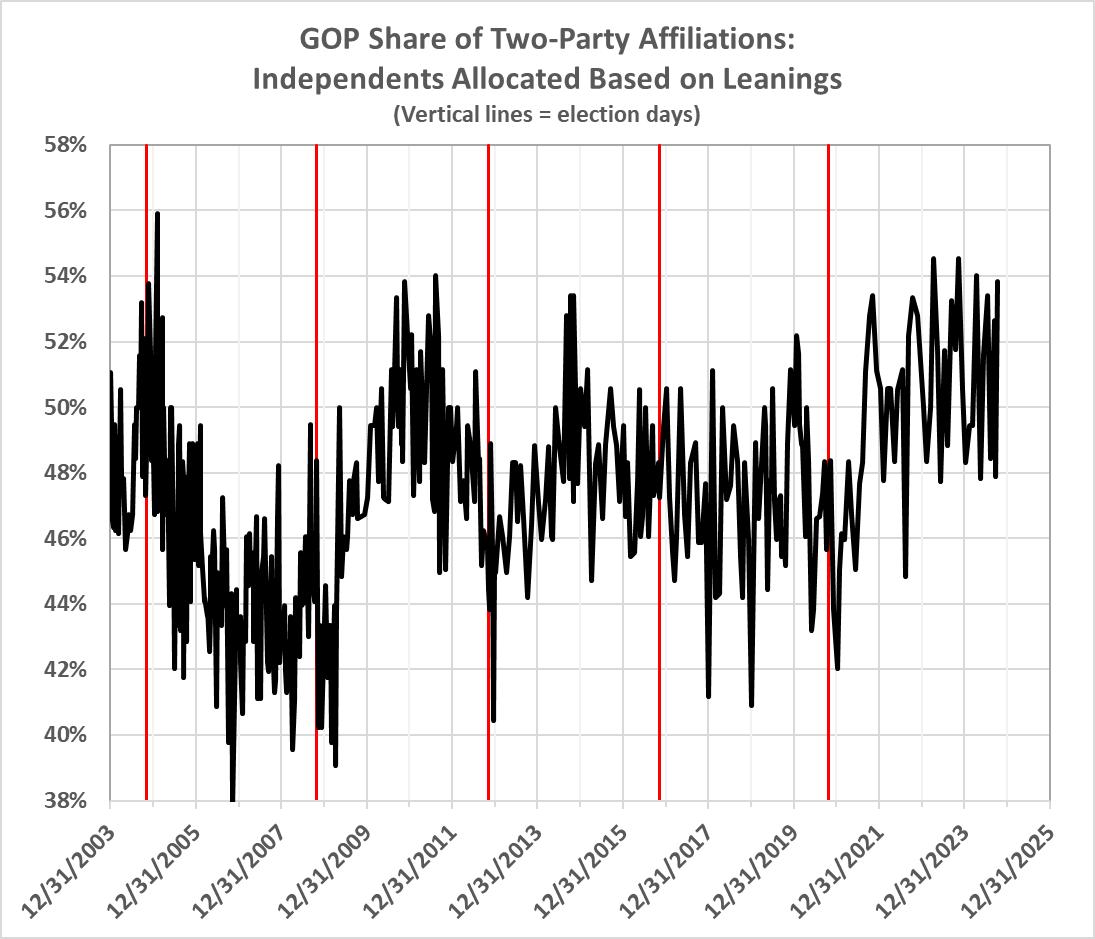
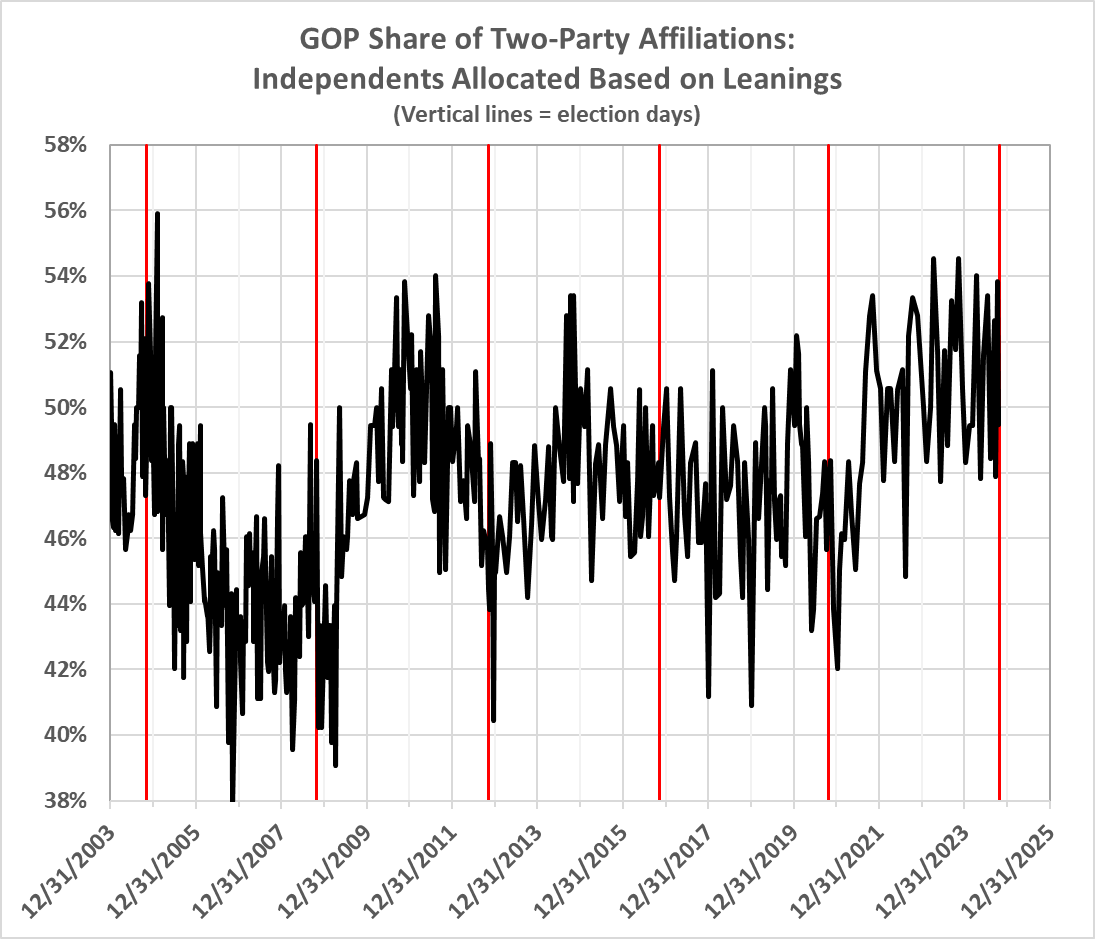
I believe that the polls continue to understate Trump’s support — and by quite a bit. I base my belief on a relationship that I unveiled in “Trump vs. Harris: 4 (More Good News for Trump)“. It is the relationship between party leanings, as estimated by Gallup, and the allocation of the vote between Democrat and Republican candidates in the presidential elections of 2004 through 2020. (Gallup’s party-affiliation numbers can be found here. Gallup has produced other analyses that also portend a shift toward the GOP).

When Gallup allocates independents based on their leanings toward Democrats or Republicans, the two-party split looks like this:

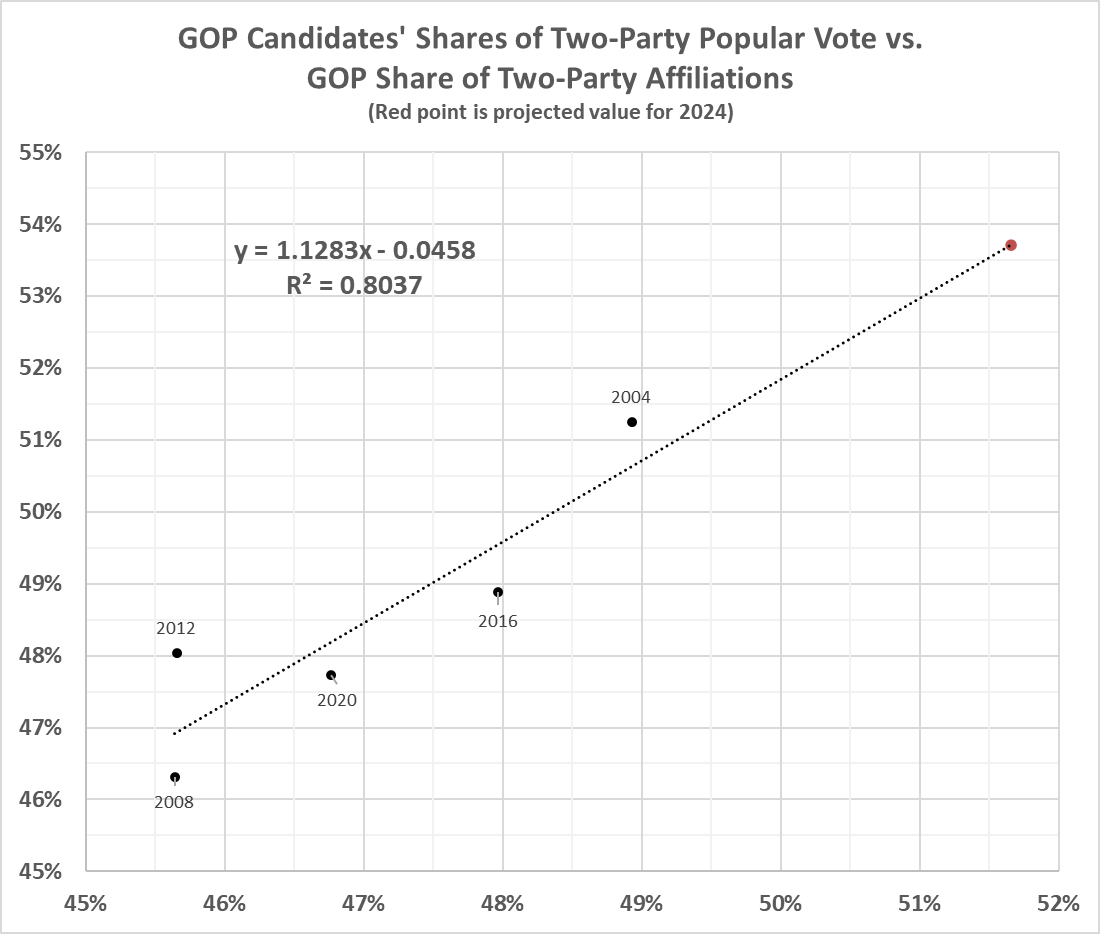
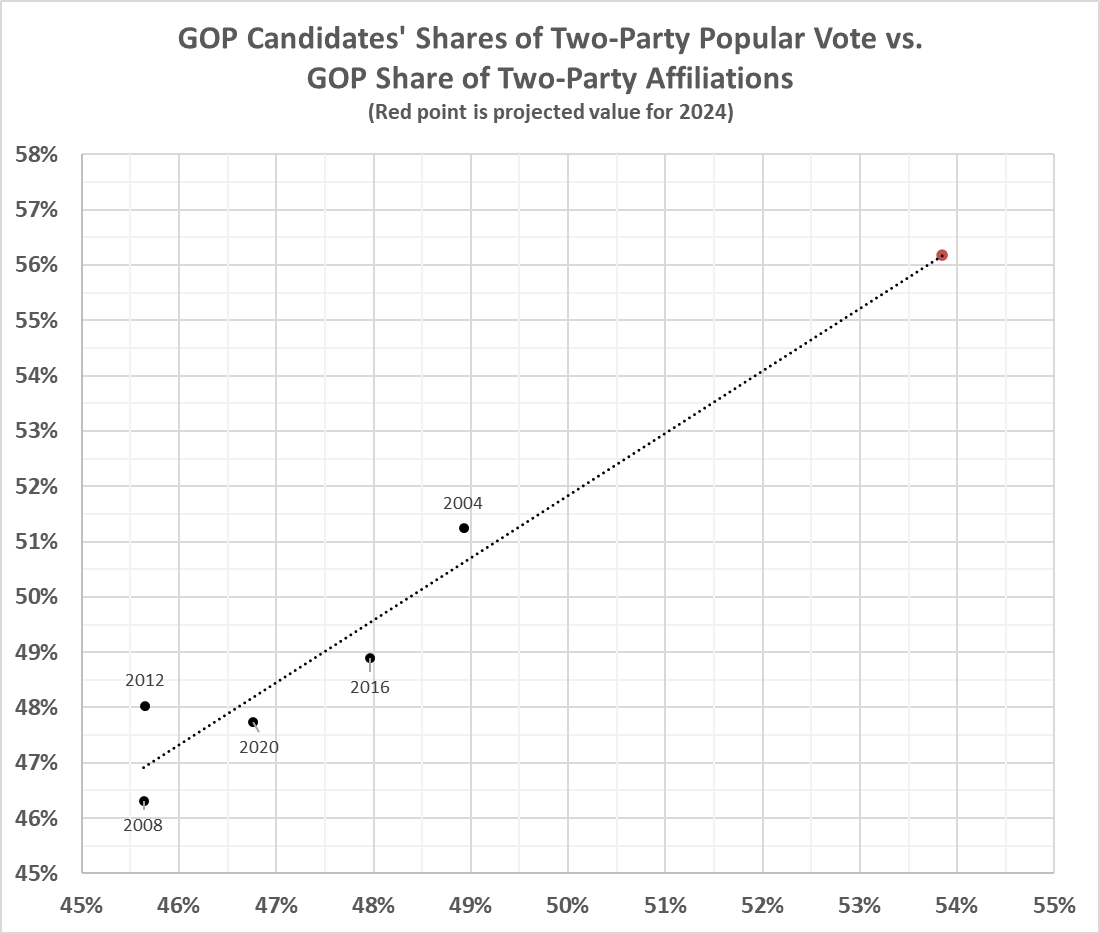
I plotted the average results for the month before the elections of 2004, 2008, 2012, 2016, and 2020 against the GOP candidates’ shares of the two-party vote in those elections. The result is spuriously precise, given the small number of observations. But it supports the view that the recent high level of GOP-leaning adults (52 percent in October 2024) portends a solid popular-vote majority for Trump:

The projection for the 2024 election (red dot) is that Trump will receive more than 53 percent of the nationwide two-party popular vote. With that share, Trump would win a second term handily.

Why? Suppose that Harris were to win 70 million of 150 million votes (about 47 percent), leaving Trump with 80 million votes. That’s a winning margin of 10 million votes, which is amplified by the fact that an outsized fraction of the Democrat candidate’s vote comes from California and New York. In 2020, Biden won those two states by a total of 7 million votes. That’s 7 million more votes than he needed to secure the electoral votes of those two States. Any total higher than a bare majority in any State can be thought of as a wasted vote. Republicans hold a decided edge in that respect: In 2020, there were 15 million wasted Democrat votes to 8 million wasted Republican votes. I don’t expect that ratio to change markedly in 2024 (or thereafter).

What this means is that with 53 percent of the popular vote, Trump would have an effective margin of not 10 million votes but 20 million votes. There would be no razor-thin finishes to secure 270 electoral votes; the razor-thin finishes (e.g., in New Hampshire and Minnesota) would merely determine the size of Trump’s electoral-vote victory.

To underscore the likelihood of a comfortable margin favoring Trump, I offer the following graph (changed slightly from the original post):

It reeks of pro-Trump momentum.

But let’s not get too excited about the prospect of an easy win.  Let’s go back to the polls and accept the premise that there is roughly an even split in the two-party nationwide popular vote. The following graph puts that split in perspective. Harris’s final position, based on the average of polls conducted within seven days of the election is a 50.4-percent share of the two-party vote (down 0.1 percent from the original post).

Can Harris, at 50.4 percent, do what Clinton failed to do with better polling numbers and what Biden barely did with much better polling numbers? Probably not.

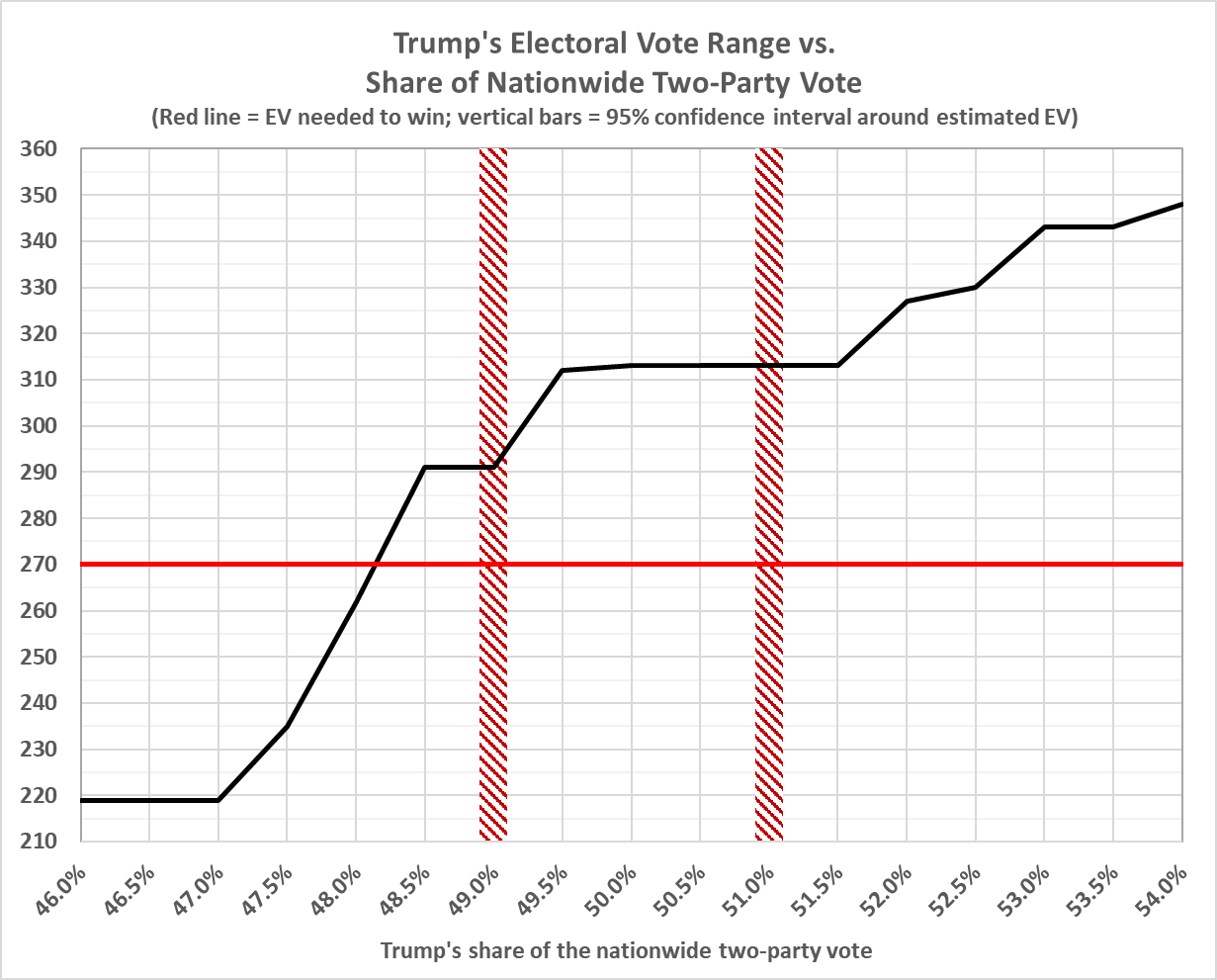
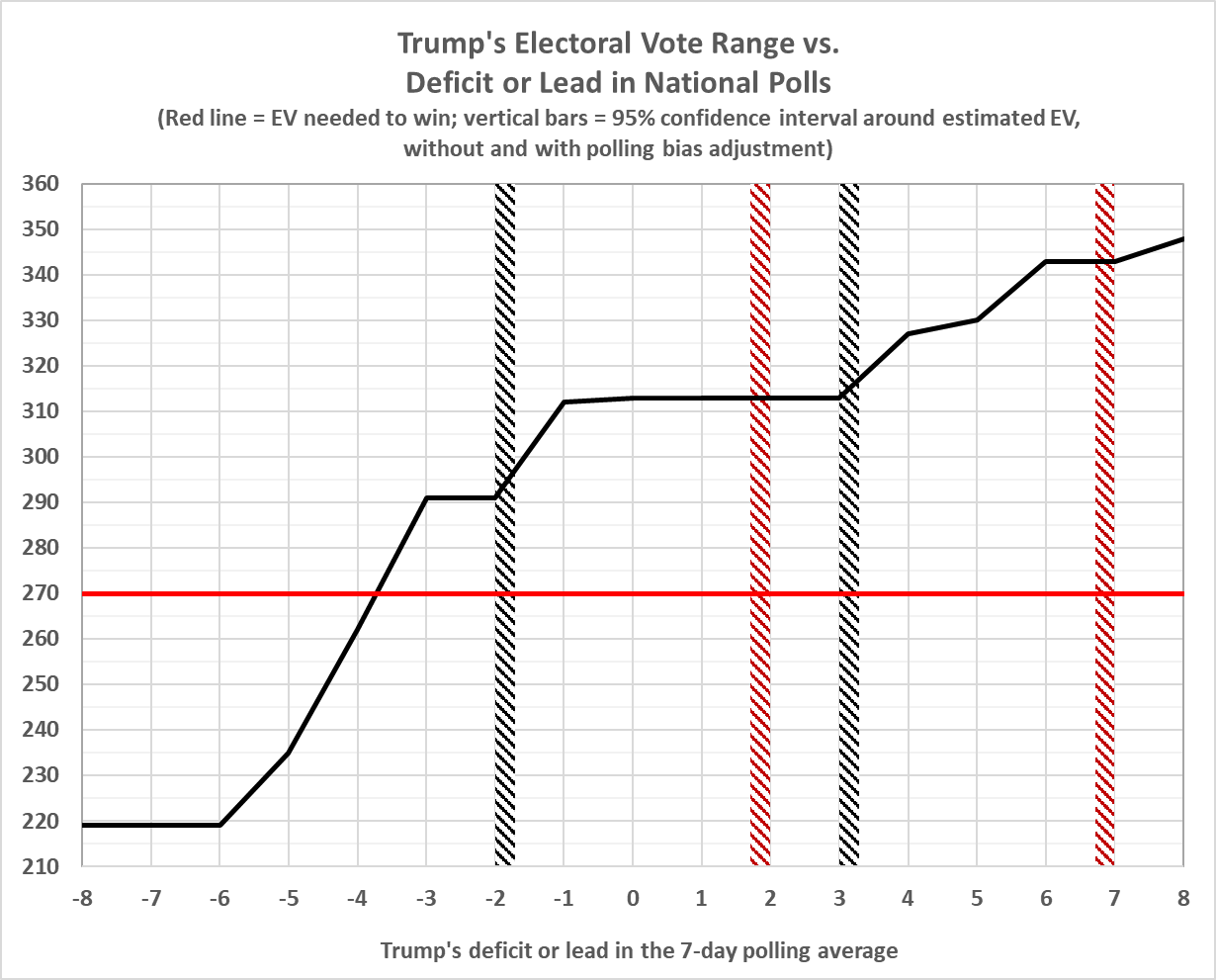
Let’s flip the problem and focus on Trump and stipulate that he will get 49.6 percent of the vote. That number comes with a range of statistical uncertainty (to say nothing of built-in bias). The range is from 48.3 percent to 50.8 percent. How does that range translate into electoral votes? Here’s how, Trump would win 291 to 313 electoral votes:

(See “Trump vs. Biden: 16” for an explanation of the relationship between popular vote/polling margin and electoral votes.)

To get to 291, Trump’s “Red Wall” must hold. (The “Red Wall” comprises the 219 electoral votes that Trump can count on unless there’s an unexpected — and well-concealed — Harris landslide in the offing.) Trump would get to 291 by augmenting the “Red Wall” with wins in Arizona, Georgia, North Carolina, Pennsylvania, and Wisconsin, while losing Michigan and Nevada. Trump could also hold on for a win, with 272 electoral votes, while losing Georgia as well as Michigan and Nevada. Other winning scenarios include losing Pennsylvania and Michigan while winning Arizona, Georgia, Nevada, North Carolina, and Wisconsin (278 electoral votes). There are other possibilities that I will leave as an exercise for the reader.

What’s my take? Looking at State-by-State polls, and (only for the purpose of this exercise) taking them at face value, I would write off Michigan and mark Georgia as uncertain. The loss of Georgia (in addition to Michigan) would cut Trump’s EV total to 281 — still enough for the win.

On the upside, Trump could get to 313 electoral votes by winning all seven of the swing States and Nebraska’s 2nd Congressional District.

Trump vs. Harris: 4 (More Good News for Trump)

I have been working on other posts, but an update on the state of the race for the presidency can’t wait.

Election day is only 16 days away. The polls have been moving in Trump’s direction lately. By my reckoning, Trump has moved into a clear lead in the electoral-vote count. He may stumble in the home stretch, but given the developments discussed below, it will take a huge October (or early November) surprise to trip him.
I begin with updates of material presented in earlier posts. I follow those updates with some new material.

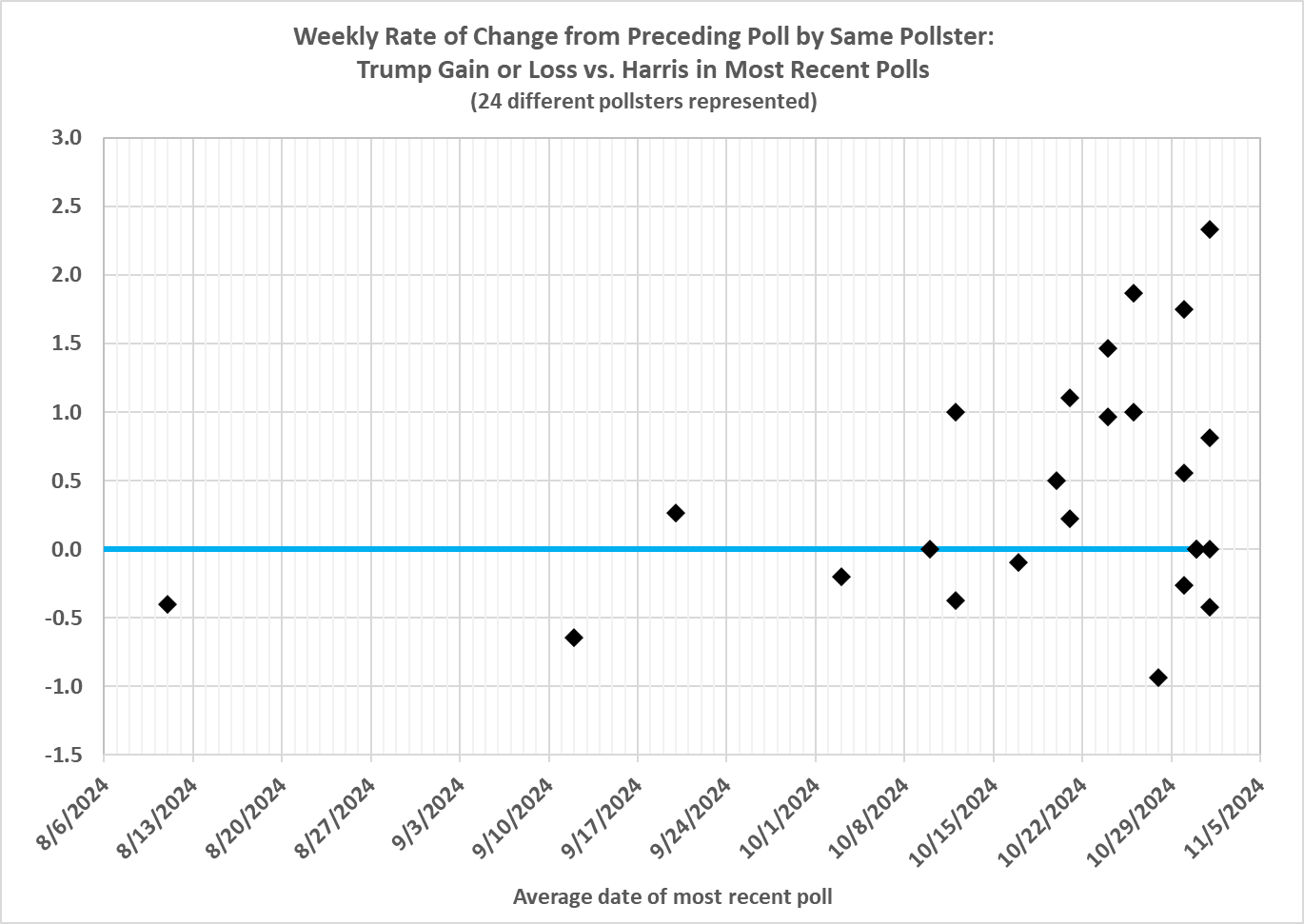
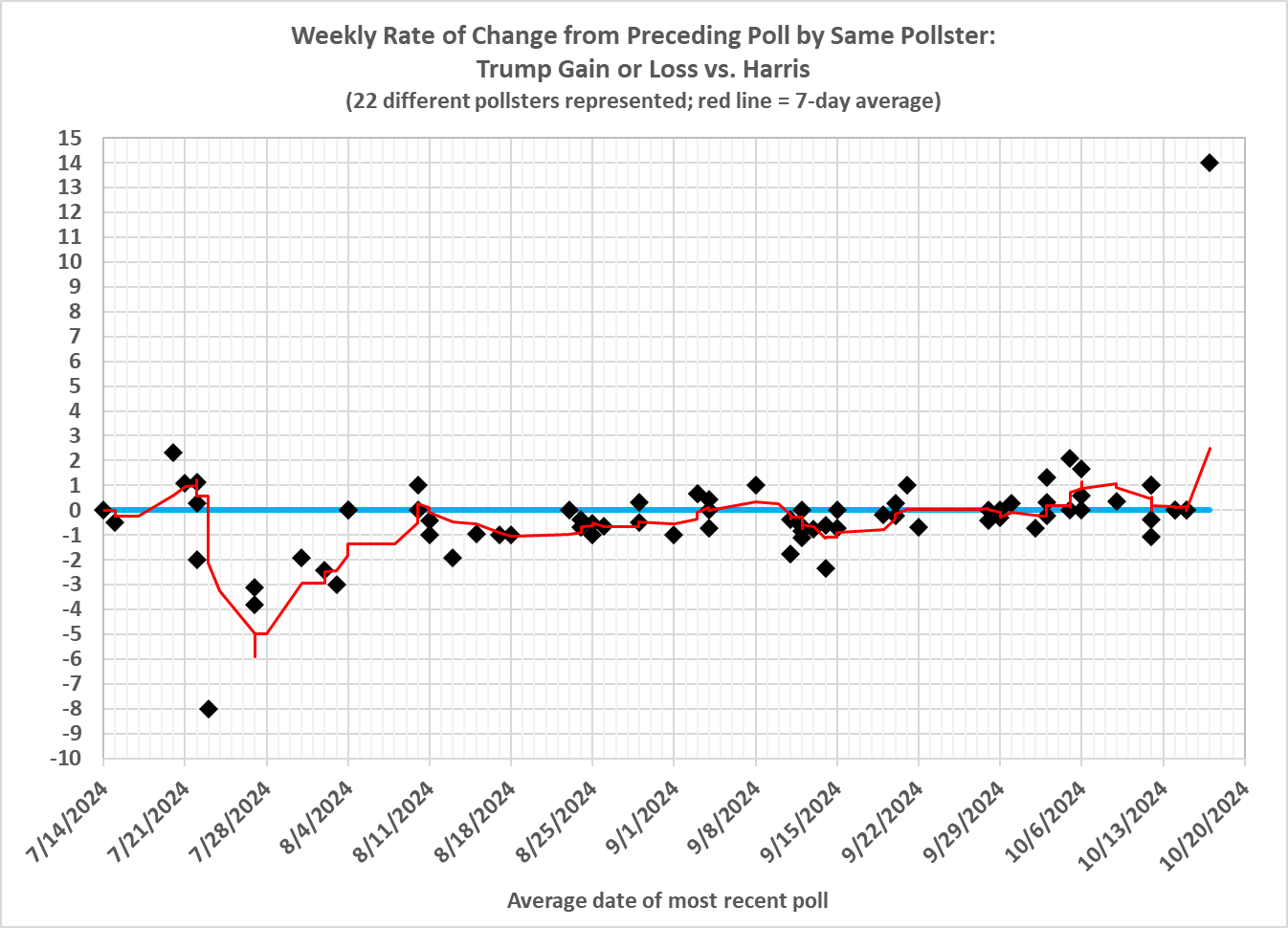
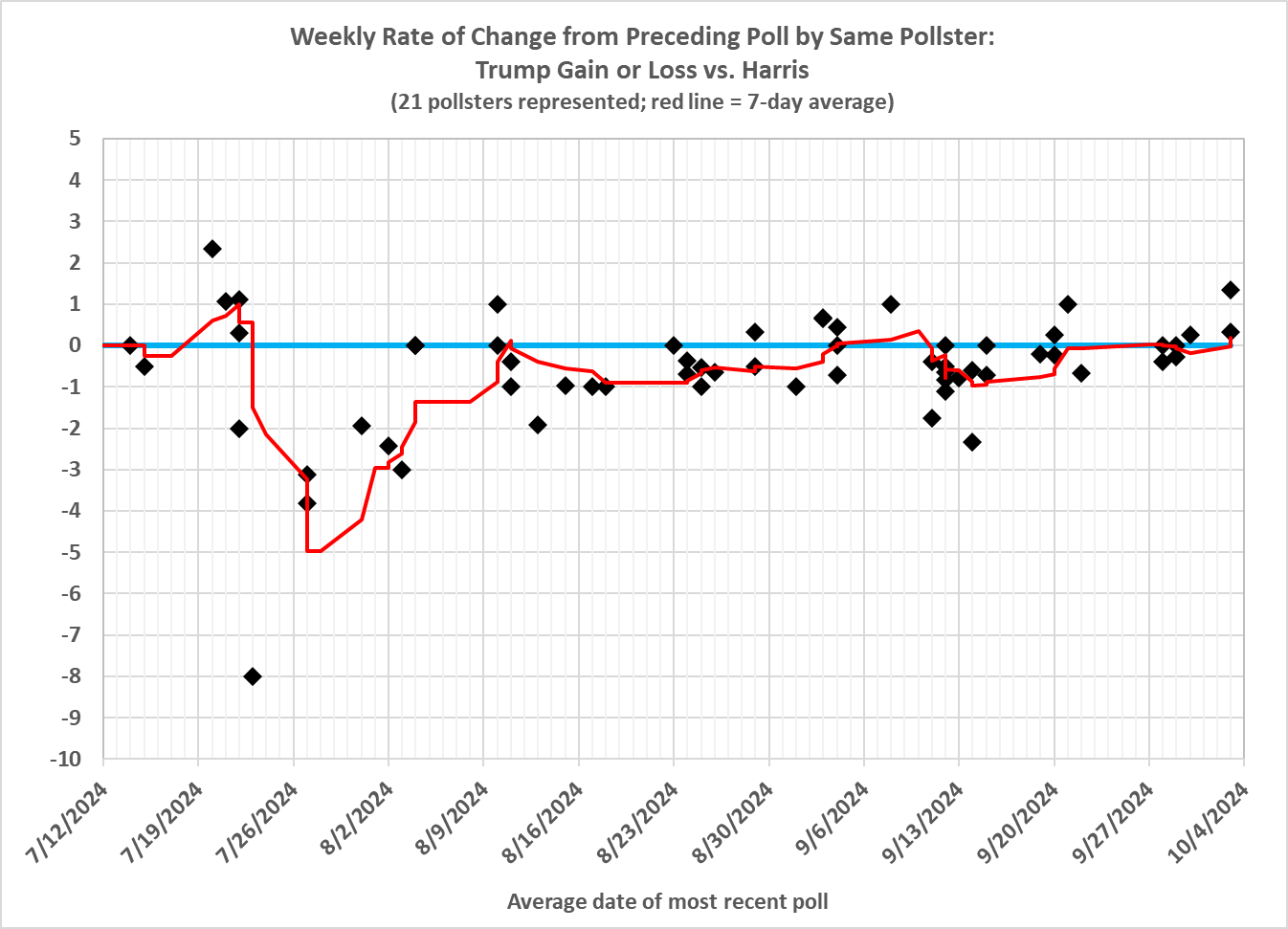
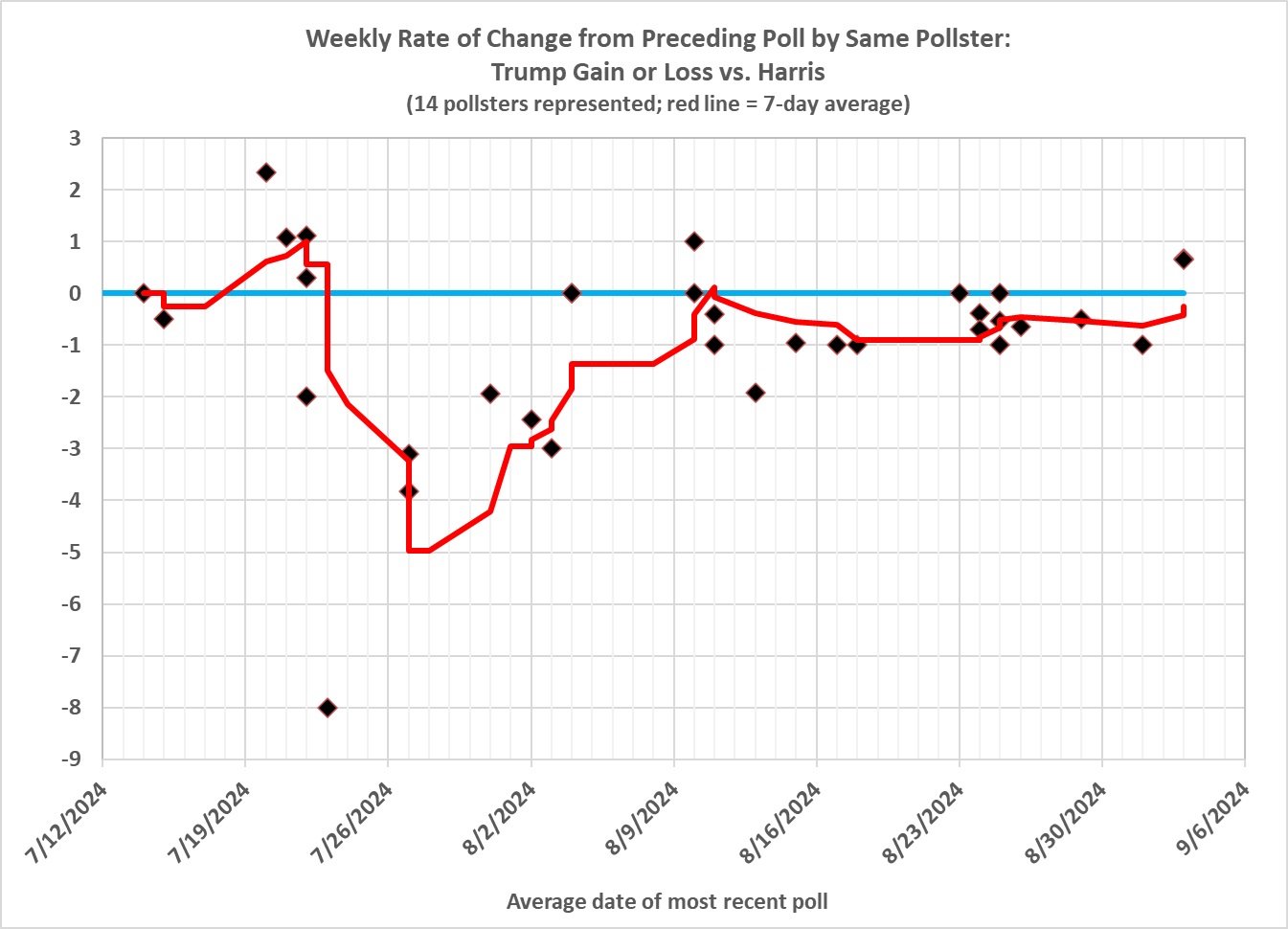
First, drawing on the presidential polling summaries published at Real Clear Politics (RCP). I track each pollster’s poll-to-poll change in Trump’s lead or deficit. Assuming that each pollster’s bias for or against Trump (mostly against) remains about the same, the poll-to-poll changes indicate the direction of momentum. The “Harris Honeymoon” has come to a bitter end:

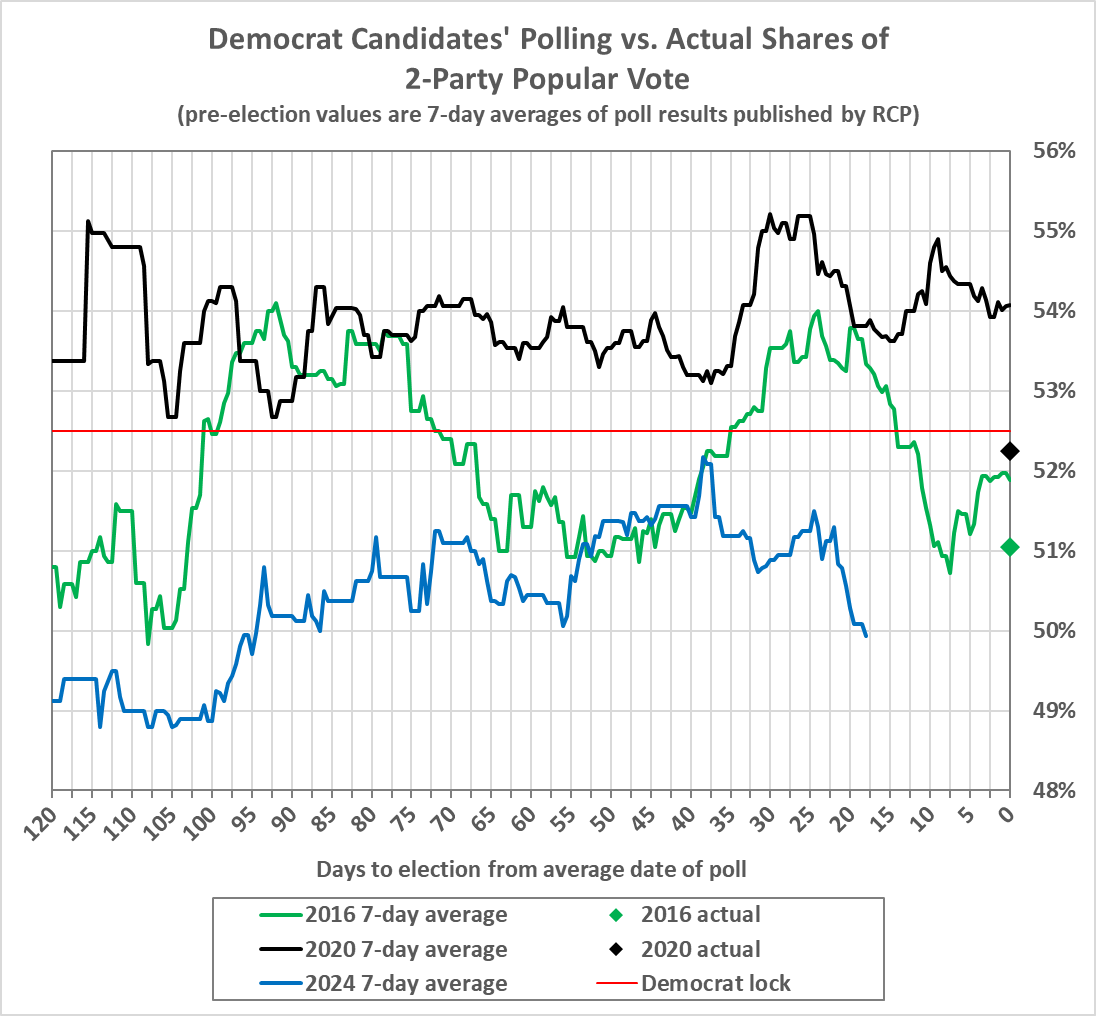
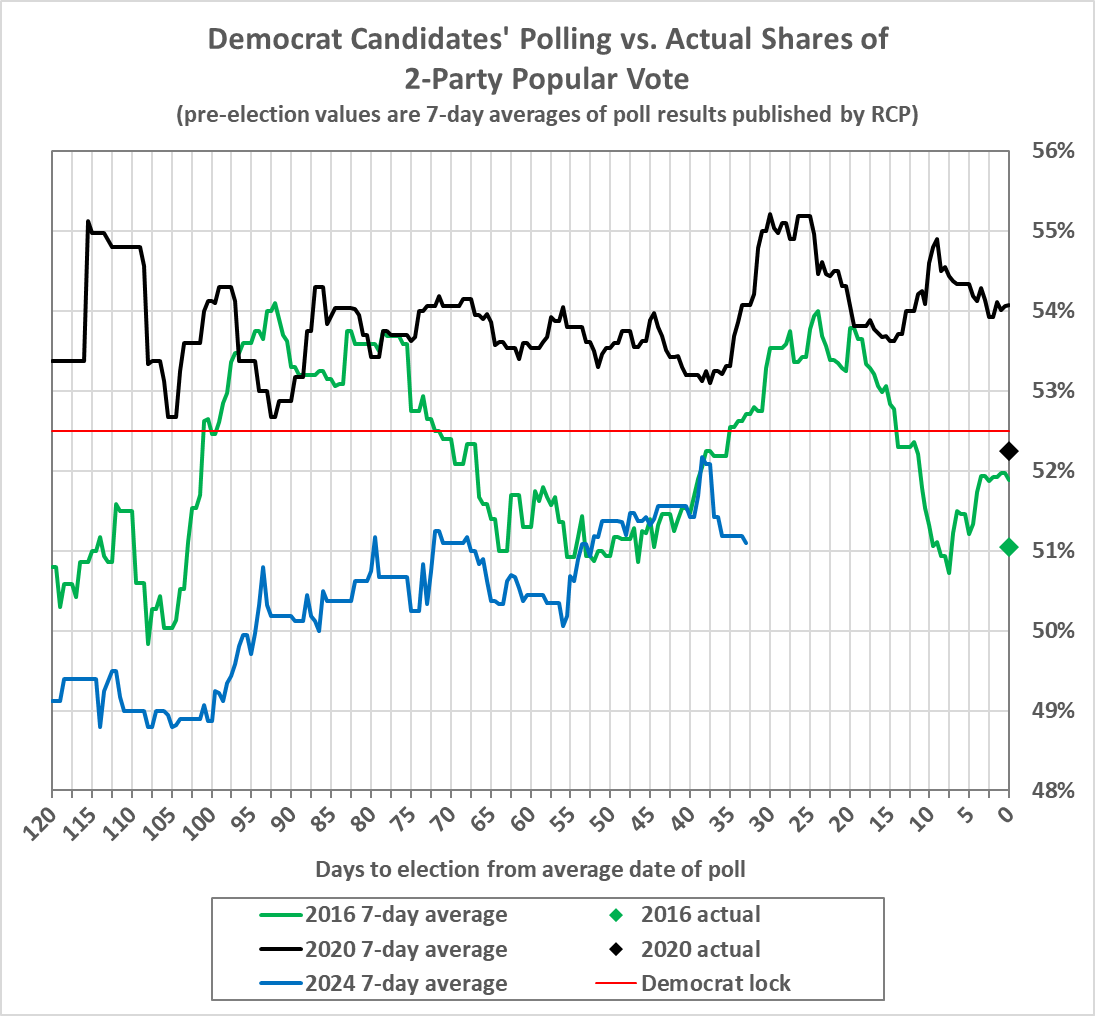
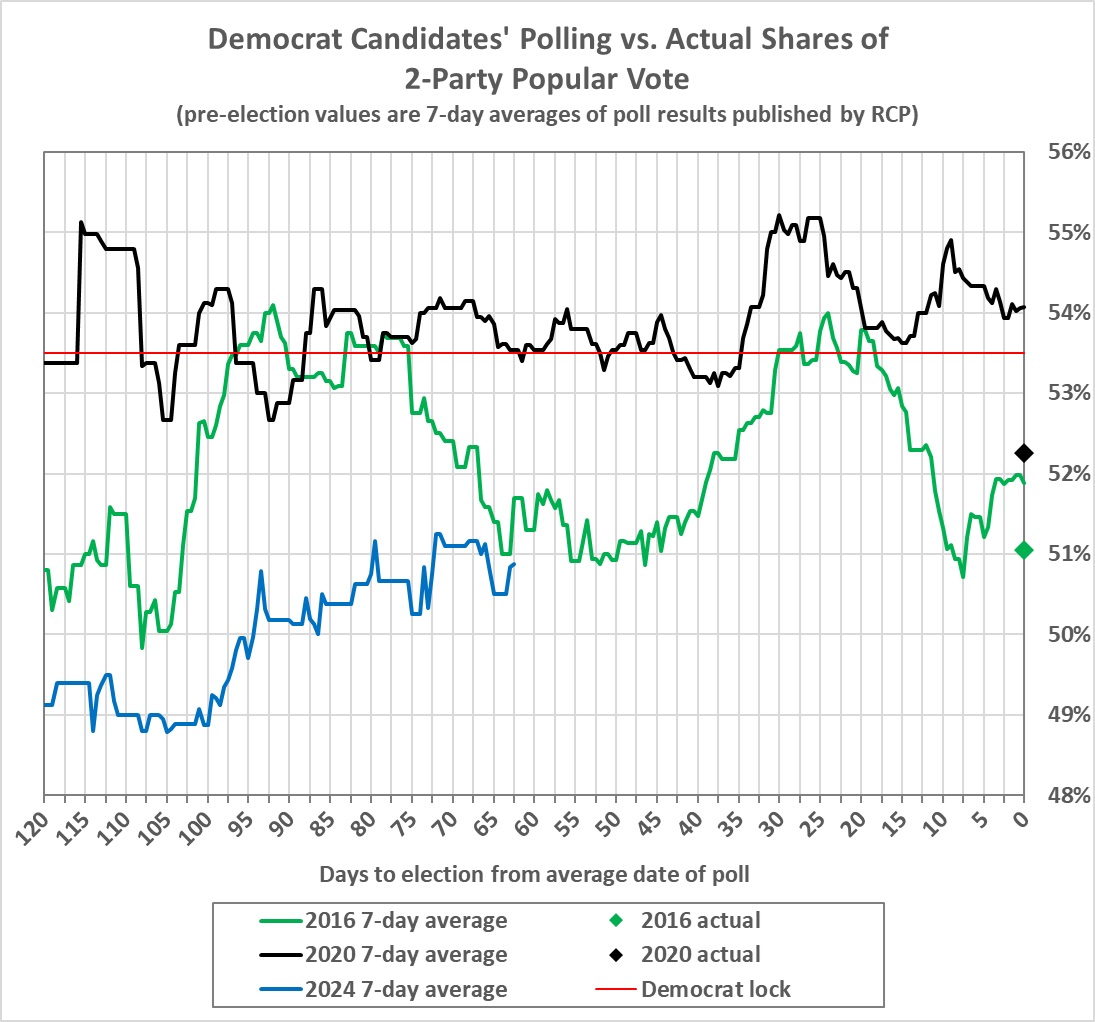
Second, I compare Harris’s performance in the polls with the performances of Clinton in 2016 and Biden in 2020.
Note the pro-Democrat (or anti-Trump biases in 2016 and 2020). The biases are reflected in the differences between the final 7-day polling averages (green and black lines) and the final shares of the nationwide two-party vote (green and black diamonds at 0 days). Clinton lost despite garnering 51.05 percent of the nationwide two-party vote. Biden won narrowly — because of razor-thin victories in several states — even though he got 52.25 percent of the two-party vote. Harris’s performance currently lags Clinton’s, which is a good sign for Trump.

The red line at 52.5 percent is my estimate of what it will take for Harris to register a clear victory over Trump. Harris is moving away from that number, not toward it.

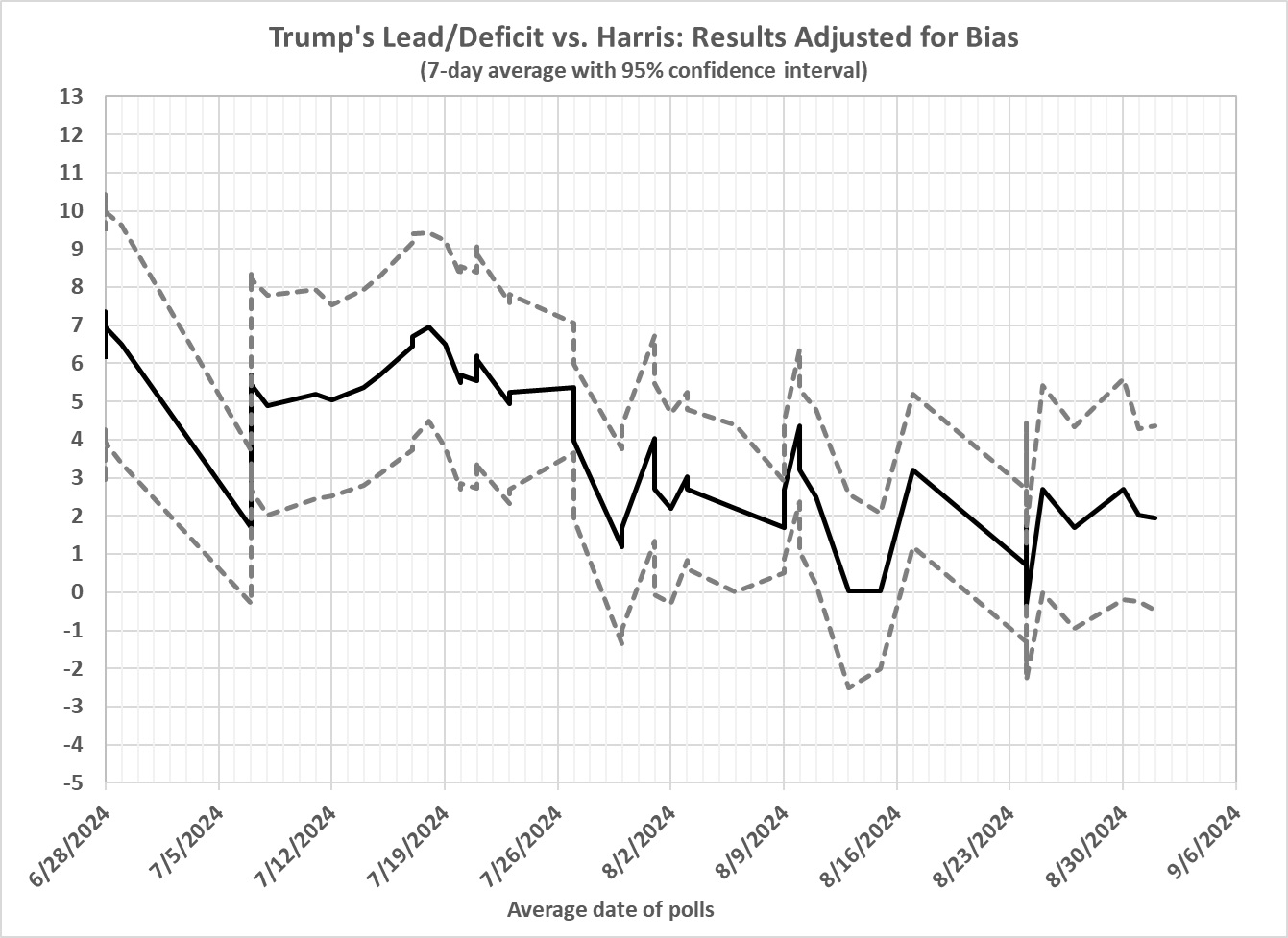
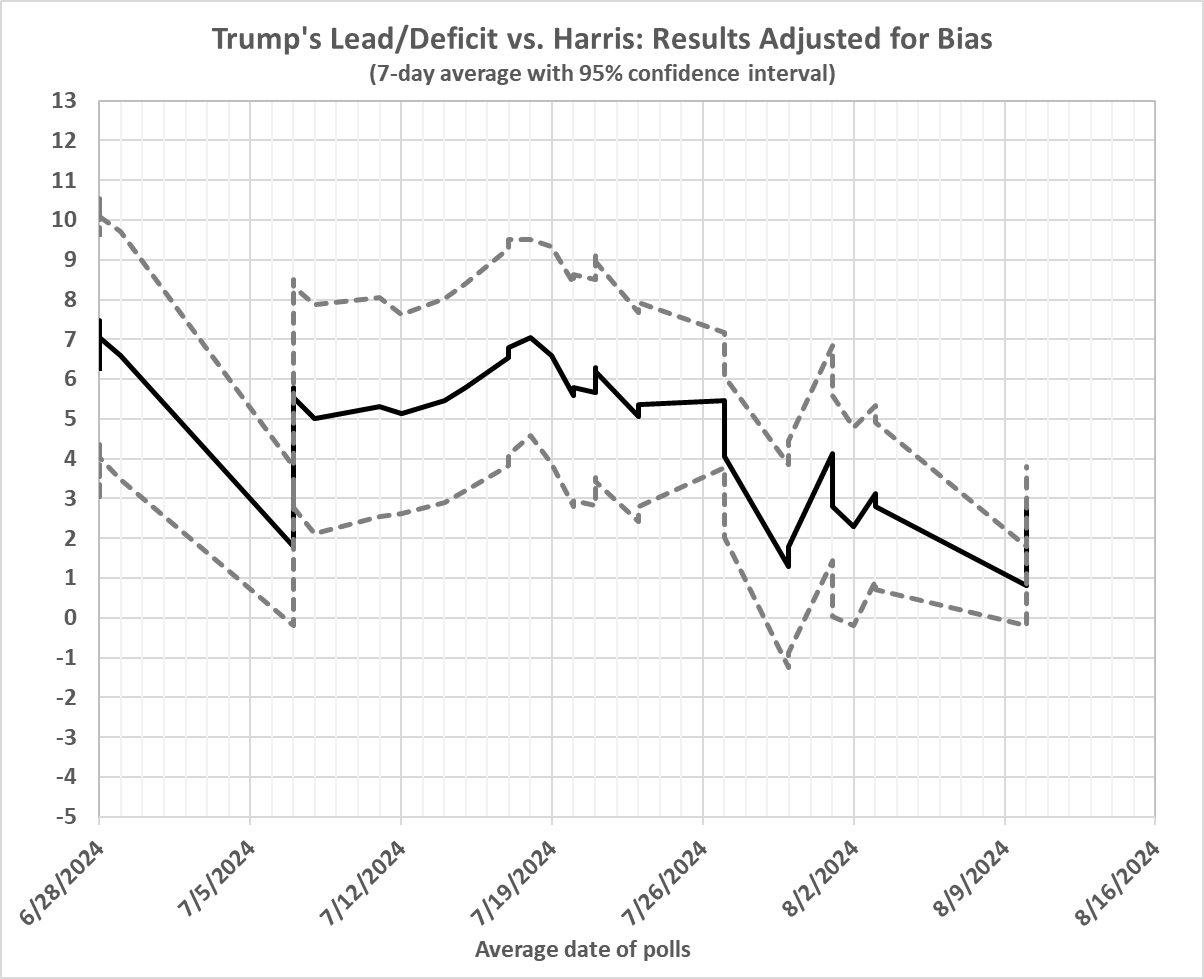
Third, I adjust polling averages for anti-Trump bias. Of the polling organizations surveyed by RCP, 17 released polls in the final week before the 2020 election. Fourteen of the polls overestimated Biden’s popular-vote margin, with overestimates ranging from 0.5 to 7.5 percentage points. Only three pollsters underestimated Biden’s margin, with a range of 0.5 to 3.5 points. The overall average for the 17 pollsters was an overestimate (for Biden) of 3.7 points.

Because Trump is again the GOP nominee, I see no reason to assume that the pro-Democrat bias this year is any smaller than it was in 2020. So I simply add 3.7 points to Trump’s 7-day polling average to get a truer picture of Trump’s electoral appeal. I then compute a 95-percent confidence interval around the current 7-day average. As of today, the range spans a Trump lead of 1 percentage point to a Trump lead of 7 percentage points. I also compute a 95-percent confidence interval around the current 7-day average, unadjusted for bias. As of today, that spans a Trump deficit of 2 percentage points to a Trump lead of 5 percentage points.

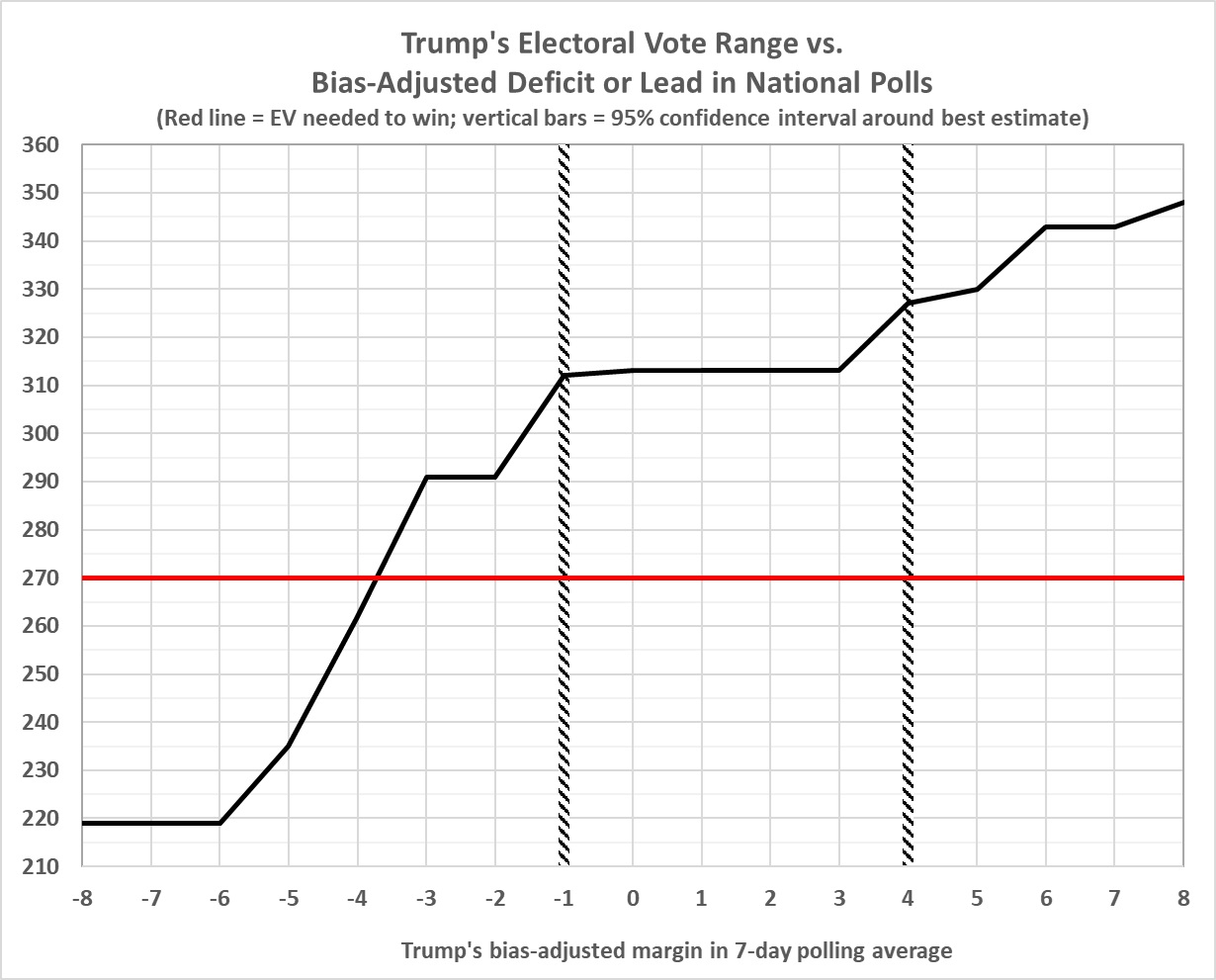
How does that range translate into electoral votes? Here’s how, Trump would win 291 to 343 electoral votes if the election were held today:

(See “Trump vs. Biden: 16” for an explanation of the relationship between popular vote/polling margin and electoral votes.)
The fact that the low end of the range exceeds 270 electoral votes should give Trump supporters cause for optimism about the outcome of the election.
Turning to new material, I begin with a Gallup poll (conducted 415 times since January 2004) that probes adults’ party affiliations. When independents are allocated based on their leanings, the two-party split looks like this:
I plotted the average results for the month before each election (2004, 2008, 2012, 2016, and 2020) against the GOP candidates’ shares of the two-party vote in those elections. The result is spuriously precise, given the small number of observations, as is any projection based on it. But it supports the inference that the recent high level of GOP-leaning adults (54% thus far in October 2024) portends a popular-vote majority for Trump:
(Gallup’s party-affiliation numbers can be found here. Gallup has produced other analyses that also portend a shift toward the GOP).

Finally, I turn to Nate Silver’s Silver Bulletin. Much of his material is accessible only to subscribers, so I will omit the links in the following quotations. Today’s election forecast begins with this:

Last update: 1:45 p.m., Sunday, October 20. The data continues to be pretty negative for Kamala Harris. There are now three recent high-quality national polls that show Donald Trump leading — a difficult circumstance for Harris, given Democrats’ Electoral College disadvantage — and her edge in our national polling average is down to 1.7 points. National polls don’t influence the model that much, and the race remains basically a toss-up, but it’s not hard to think of reasons that Trump could win.

There’s a link in that passage which leads to 24 reasons why Trump could win:

This election remains extremely close, but Donald Trump has been gaining ground. One of my pet peeves is with the idea that this is Kamala Harris’s election to lose. I could articulate some critiques of her campaign, but if you study the factors that have historically determined elections, you’ll see that she’s battling difficult circumstances.

So, today’s newsletter simply aims to provide a laundry list of factors that favor Trump, with many links to evidence in previous Silver Bulletin posts and elsewhere. These are in no particular order.

  1. Harris is the favorite to win the popular vote, but The Electoral College bias favors Republicans by about 2 percentage points. In an era of intense partisanship and close elections, this is inherently difficult for Democrats to overcome.
  2. Inflation hit a peak of 9.1 percentage points in June 2022. It has abated now, but prices remain much higher than when Biden took office, and voters are historically highly sensitive to inflation. Democrats can also plausibly be blamed for it given intensive increases in government spending during COVID recovery efforts.
  3. Though the reasons for this are much debated, voter perceptions about the economy lag substantially behind objective data, and growth in take-home income has been sluggish for many years for the working class amid rising corporate profits.
  4. Incumbent parties worldwide are doing very poorly, and the historical incumbency advantage has diminished to the point where it may now be an incumbency handicap instead amid perpetually negative perceptions about the direction of the country.
  5. Populism is often a highly effective strategy, and many Trump voters are indeed “deplorable” in the Hillary Clinton sense of the term.
  6. Illegal/unauthorized immigration increased substantially during the first few years of the Biden/Harris administration amid a rising global backlash to immigration.
  7. Harris ran far to her left in 2019, adopting many unpopular positions, and doesn’t really have a viable strategy for explaining her changing stances.
  8. The cultural vibes are shifting to the right, and the left continues to pay a price for the excesses of 2020 on COVID, crime, “wokeness,” and other issues.
  9. Voters have nostalgia for the relatively strong economic performance in the first three years of Trump’s term and associate the problems of 2020 with Democrats, even though they weren’t in charge at the time.
  10. Democrats’ dominance among Black voters and other racial and ethnic minority groups is slipping. It may be unfortunate timing: the memory of the Civil Rights Era is fading. Educational polarization, which implies deteriorating Democratic performance among working-class voters of all races, may also be coming to dominate other factors. It’s possible this works out well for Democrats if Harris makes corresponding gains among white voters, who pack more leverage in the Electoral College, but there’s no guarantee.
  11. Many men, especially young men, feel lost amidst declining college enrollment, contributing to a rightward shift and a growing gender gap.
  12. Joe Biden sought to be president until he was 86. Voters had extremely reasonable objections to this, and it neuters what should have been one of Harris’s best issues about Trump’s age and cognitive fitness.
  13. Harris also got a late start to her race, inheriting most of the staff from the poorly-run Biden campaign. She’s proven to be a good candidate in many respects, but it’s always a big leap when the understudy is suddenly thrust into the spotlight.
  14. Harris is seeking to become the first woman president. In the only previous attempt, undecideds broke heavily against Hillary Clinton, and she underperformed her polls.
  15. Trust in media continues to fall to abysmal levels. One can debate how to attribute blame for this between longstanding conservative efforts to discredit the media, a secular decline in trust in institutions, and various overreaching and hypocrisy in the press. But it’s hard for even legitimate Trump critiques to penetrate the mass public. Trump’s conviction on a series of felony charges hardly made any difference, for instance.
  16. Trump has traits of a classic con man, but con artistry is often effective, and Trump is skilled at convincing voters that he’s on their side even if his election would not be in their best interest. Furthermore, Trump presents Democrats with a Three Stooges Syndrome problem: a range of plausible attacks so vast that they tend to cancel one another out.
  17. Democrats’ college-educated consultant class has poor instincts for how to appeal to the mass public, while Trump has done more to cultivate support among “weird” marginal voting groups.
  18. Democrats’ argument that Trump is a critical threat to democracy is valid and important, given January 6 and Trump’s broad disrespect for the rule of law. But it’s a tough sell: ultimately, January 6 was a near-miss — it could very, very easily have been much, much worse — and Democrats hold the White House, the Senate, and many key governorships now. It isn’t intuitive to voters that democracy is threatened and Democrats may have staked too many chips on this line of attack.
  19. Foreign policy might not matter much to voters, but the world has become more unstable under Biden’s tenure. There has been a decline in democracy worldwide and an increase in interstate conflict, crises in the Middle East and Ukraine, deteriorating US-China relations, increasing immigration flows because of global instability, and a pullout from Afghanistan that negatively impacted Biden’s popularity.
  20. The Israel-Hamas war split the Democratic base in a way no comparable issue has split the GOP base.
  21. There are more left-leaning third-party candidates than right-leaning ones, and the former leading third-party candidate (RFK Jr.) endorsed Trump and undermined Harris’s post-convention momentum.
  22. The richest man in the world, Elon Musk, has become a huge Trump stan and is doing everything in his power to tip the election to him. Twitter/X remains an influential platform among journalists but has shifted far to the right. Elon and Silicon Valley have also created a permission structure for other wealthy elites to advocate for Trump explicitly and provided a new base of money and cultural influence.
  23. Trump was very nearly killed in an assassination attempt, and then there was a second one against him. The first attempt was closely correlated with an increase in favorability ratings for Trump, and polling shows he’s considerably more popular and sympathetic than in 2016 or 2020.
  24. Harris has been running on vibes and has failed to articulate a clear vision for the country. It might have been a good strategy if the “fundamentals” favored her, but they don’t.

Trump vs. Harris: 3 (Some Favorable News for Trump)

I follow the presidential polling summaries published at Real Clear Politics (RCP). I analyze the polling results in various ways. Three of those ways are highlighted here.

First, I track each pollster’s poll-to-poll change in Trump’s lead or deficit. Assuming that each pollster’s bias for or against Trump (mostly against) remains about the same, the poll-to-poll changes indicate the direction of momentum. The “Harris Honeymoon” seems to have ended:

Second, I adjust polling averages for anti-Trump bias. Of the polling organizations surveyed by RCP, 17 released polls in the final week before the 2020 election. Fourteen of the polls overestimated Biden’s popular-vote margin, with overestimates ranging from 0.5 to 7.5 percentage points. Only three pollsters underestimated Biden’s margin, with a range of 0.5 to 3.5 points. The overall average for the 17 pollsters was an overestimate (for Biden) of 3.7 points.

Given that Trump is again the GOP nominee, I see no reason to assume that the pro-Democrat bias this year is any smaller than it was in 2020. So I simply add 3.7 points to Trump’s 7-day polling average to get a truer picture of Trump’s electoral appeal. I then compute a 95-percent confidence interval around the current 7-day average. As of now, the range is from a deficit of 1 percentage point to a lead of 6 percentage points.

How does that range translate into electoral votes? Here’s how, Trump would win 312 to 343 electoral votes if the election were held today:

(See “Trump vs. Biden: 16” for an explanation of the relationship between popular vote/polling margin and electoral votes.)

Third, I compare Harris’s performance in the polls (unadjusted) with the performances of Clinton in 2016 and Biden in 2020.

Note the pro-Democrat (or anti-Trump biases in 2016 and 2020). The biases are reflected in the differences between the final 7-day polling averages (green and black lines) and the final shares of the nationwide two-party vote (green and black diamonds at 0 days). Clinton lost despite garnering 51.05 percent of the nationwide two-party vote. Biden won narrowly — because of razor-thin victories in several states — even though he got 52.25 percent of the two-party vote. Harris’s performance currently lags Clinton’s, which is a good sign for Trump.

The red line at 52.5 percent is my estimate of what it will take for Harris to register a clear victory over Trump. Harris is still a long way from that number.

Trump vs. Harris: 2 (Kamala the Sphinx Gains a Bit of Ground)

Trump’s position vis-a-vis Harris is a bit weaker than it was on August 14, when I published “Trump vs. Harris: 1 (It’s Still Trump’s Election to Lose)“:

(For details of the computation, see “Trump vs. Harris: 1”.)

How does the current range — a deficit of 1 point to a lead of 4 points — translate into electoral votes? As on August 14, Trump would win 313 to 327 electoral votes if the election were held today:

(See “Trump vs. Biden: 16” for an explanation of the relationship between popular vote/polling margin and electoral votes.)

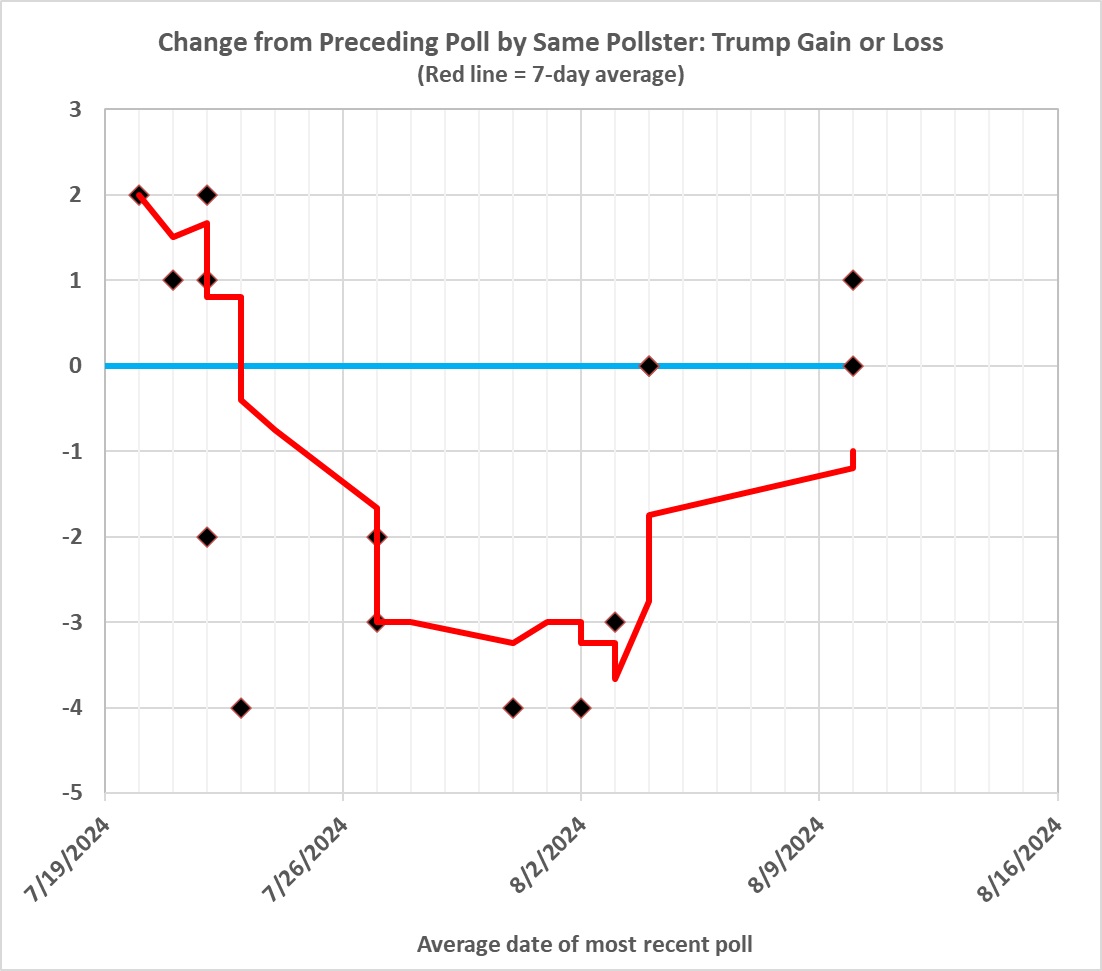
Not only that, but the polls have been swinging back toward Trump, though he isn’t gaining ground:

Translating poll results into shares of the two-party presidential vote yields an interesting comparison between Harris’s performance and those of Clinton and Biden before her:

First of all, note the pro-Democrat (or anti-Trump biases in 2016 and 2020). The biases are reflected in the differences between the final 7-day polling averages (green and black lines) and the final shares of the nationwide two-party vote (green and black diamonds at 0 days). Clinton lost cleanly with 51.05 percent of the two-party vote. Biden won narrowly, requiring close “wins” in several states, even though he got 52.25 percent of the two-party vote. Harris’s performance still lags Clinton’s.

What it the red line at 53.5 percent? That’s my estimate of what it will take for Harris to register a clear victory over Trump — no razor-thing “victory” in any State and no potentially game-changing outcomes that are close enough to warrant recounts or court challenges. Harris is still a long way from that number.

Trump vs. Harris: 1 (It’s Still Trump’s Election to Lose)

Here’s the polling trend since the “debate” on June 27 that ended Biden’s candidacy:

To adjust for bias, I use the 2020 election to estimate the extent to which (most) polling organizations underestimate Trump’s strength among voters. Underestimation is time-dishonored strategem, aimed at dispiriting the opposition and its supporters — the “opposition” being any politician, like Trump, who threatens the power of the deep state and its allies, enablers, and beneficiaries.

I follow the presidential polling summaries published by Real Clear Politics (RCP). Of the polling organizations surveyed by RCP, 17 released polls in the final week before the 2020 election. Fourteen of the polls overestimated Biden’s popular-vote margin, with overestimates ranging from 0.5 to 7.5 percentage points. Only three pollsters underestimated Biden’s margin, with a range of 0.5 to 3.5 points. The overall average for the 17 pollsters was an overestimate (for Biden) of 3.7 points.

Given that Trump is again the GOP nominee, I see no reason to assume that the pro-Democrat bias this year is any smaller than it was in 2020. So I simply add 3.7 points to Trump’s 7-day polling averages to get a truer picture of Trump’s electoral appeal. Thus the values plotted in the preceding graph. (I am being generous to anti-Trump pollsters; the average anti-Trump bias in 2020, according to the American Association for Public Opinion Research, was 4.5 points for all.)

How does the current range — a lead of 1 to 4 points — translate into electoral votes? Here’s how, Trump would win 313 to 327 electoral votes if the election were held today:

(See “Trump vs. Biden: 16” for an explanation of the relationship between popular vote/polling margin and electoral votes.)

Not only that, but the “Harris honeymoon” may be coming to an end. The polls are swinging (modestly) back toward Trump:

All in all, things still look good for Trump. But there are question marks. Will Harris’s momentum continue? Will a “black swan” event upend the election? What about the upcoming sentencing in Trump’s “hush money” case? Will any other anti-Trump trials be completed by election day?

Stay tuned.

Can Barack Obama Become Biden’s VP and Succeed Him as President?

That mouthful of a title is a question that’s been in the air for quite a while. It didn’t just arise when Biden exposed his mental frailty at the non-debate with Trump on June 27. But it has been resurrected (e.g. here and here).

So, what’s the answer? There isn’t a definitive one because no U.S. court has faced the question, let alone ruled on it. If the question ever arose — about Obama or any other former twice-elected president — it would end up at the U.S. Supreme Court. USSC’s decision likely would depend on the political makeup of the Court at the time, and the party affiliation of the former president.

But, political partisanship aside, here’s what I would argue:

1. Section 1 of Amendment XXII says this:

No person shall be elected to the office of the President more than twice, and no person who has held the office of President, or acted as President, for more than two years of a term to which some other person was elected President shall be elected to the office of the President more than once.

2. Some would argue that this bars a former president like Obama from serving as vice president because Amendment XII says this:

[N]o person constitutionally ineligible to the office of President shall be eligible to that of Vice-President of the United States.

3. But when Amendment XII was ratified on June 15, 1804, the only conditions of eligibility for the presidency were these (from Article II, Section 1 of the Constitution):

No Person except a natural born Citizen, or a Citizen of the United States, at the time of the Adoption of this Constitution, shall be eligible to the Office of President; neither shall any Person be eligible to that Office who shall not have attained to the Age of thirty five Years, and been fourteen Years a Resident within the United States.

4. Therefore, the language of Amendment XII quoted above doesn’t apply because Amendment XII didn’t contemplate the adoption of Amendment XXII 147 years later.

In short, barring a USSC ruling to the contrary, BHO could run for VP and succeed JRB Jr. Aargh!

The Biden Plan

Why did Biden decide to debate Trump? Most likely because Biden and those whose advice he takes (or whose direction he follows) believed that he would lose the election and had nothing to lose by debating Trump.

Why would Biden or his advisers believe that he would lose when nationwide polls have put him in a virtual tie with Trump? Because they have done something like the analysis that I’ve done, which suggests a virtual tie in the polls means that Biden is actually running at least 3 percentage points behind Trump nationwide. That deficit portends spells certain defeat given that Biden would run up huge, superfluous margins in deep-Blue states.

In rehearsing for the debate, Biden’s performance must have seemed at least passable. If it hadn’t, a plausible excuse for postponement or cancellation would have been found, and it would have done less damage to Biden’s chances than his actual performance did. But the rehearsals, which included a stand-in for Trump, weren’t the real thing.

Biden’s performance in the actual debate must have come as a shock to himself, to Jill, to those who advised him to debate, and to those who helped him prepare for the debate. Biden’s performance certainly came as huge shock to the millions who planned to vote for him and who saw the real person in action, not the mummy whose condition has been hidden (as much as possible) from public view by aides and compliant corporate media.

Now what? Top Democrats (the Clintons, Obama, major donors, etc.) may have concluded that Trump will win no matter whom he faces. If they have concluded that, they are almost certainly right — barring a shockingly adverse development for Trump between now and when voting starts.

For example, they may be betting that Judge Merchan (of the “hush money” case) will announce a prison sentence or house arrest when he sentences Trump on July 11. First, any sentence will be anti-climactic — voters have long since factored the guilty verdicts into their voting plans. Second, Trump can appeal, and failure at the State level is almost certain to result in a speedy hearing and decision by the U.S. Supreme Court. Third, will any court (other than Judge Merchan’s) want to legitimize DA Bragg’s blatant act of election interference: the prosecution of Trump on charges with a flimsy legal foundation? I think not. Fourth, in any event, a sentence of some kind for Trump might be just the trigger that’s needed to evoke a tidal wave of GOP voters in the fall, swamping not only Biden but Democrats down the ticket — including, more importantly, races for U.S. Senate and House seats.

Given all of that, why would the Democrats in charge want to replace Biden? The result would be to burden a new candidate with a loss, when he or she could run in 2028 as a “fresh face” who hasn’t lost a presidential race.

So, barring a development that I can’t foresee (which might include death or a crippling disability), I expect to see Trump and Biden at the head of their parties’ tickets in November. If Biden isn’t the Democrat nominee, the nod will go to the equally expendable Kamala.

Does History Repeat Itself? Stalin Is Resurrected in the USA

Whether history repeats itself or merely rhymes, human nature can be counted upon to make history seem repetitive or rhythmic.

Stephen Kotkin concludes Stalin: Paradoxes of Power, 1878-1928 with this observation: “History, for better and for worse, is made by those who never give up.”

Stalin never gave up. He had succeeded in subduing his enemies within the USSR by 1928, but he would continue to imprison and execute anyone whose words or actions he deemed threatening to his dictatorship or to the cause that he had embraced.

That cause was state socialism, “collective” control by the Communist Party (acting through the state) of the economy of the nation (in the name of the people, of course). To succeed in that cause, it was necessary to stifle and eradicate any dissent — real, imagined, actual, or potential — from the edicts of the Party (i.e., Stalin).

One of those edicts was collectivization of agriculture, a program that Stalin announced in January 1928 and began to implement in 1929. The rest, as they say, is history — a grim history in which Ukraine figured largely (though not exclusively):

The Ukrainian famine—known as the Holodomor, a combination of the Ukrainian words for “starvation” and “to inflict death”—by one estimate claimed the lives of 3.9 million people, about 13 percent of the population. And, unlike other famines in history caused by blight or drought, this was caused when a dictator wanted both to replace Ukraine’s small farms with state-run collectives and punish independence-minded Ukrainians who posed a threat to his totalitarian authority.

“The Ukrainian famine was a clear case of a man-made famine,” explains Alex de Waal, executive director of the World Peace Foundation at Tufts University and author of the 2018 book, Mass Starvation: The History and Future of Famine. He describes it as “a hybrid…of a famine caused by calamitous social-economic policies and one aimed at a particular population for repression or punishment.”

In those days, Ukraine—a Texas-sized nation along the Black Sea to the west of Russia—was a part of the Soviet Union, then ruled by Stalin. In 1929, as part of his plan to rapidly create a totally communist economy, Stalin had imposed collectivization, which replaced individually owned and operated farms with big state-run collectives. Ukraine’s small, mostly subsistence farmers resisted giving up their land and livelihoods.

In response, the Soviet regime derided the resisters as kulaks—well-to-do peasants, who in Soviet ideology were considered enemies of the state. Soviet officials drove these peasants off their farms by force and Stalin’s secret police further made plans to deport 50,000 Ukrainian farm families to Siberia, historian Anne Applebaum writes in her 2017 book, Red Famine: Stalin’s War on Ukraine.

“Stalin appears to have been motivated by the goal of transforming the Ukrainian nation into his idea of a modern, proletarian, socialist nation, even if this entailed the physical destruction of broad sections of its population,” says Trevor Erlacher, an historian and author specializing in modern Ukraine and an academic advisor at the University of Pittsburgh’s Center for Russian, East European, & Eurasian Studies.

Collectivization in Ukraine didn’t go very well. By the fall of 1932 … it became apparent that Ukraine’s grain harvest was going to miss Soviet planners’ target by 60 percent. There still might have been enough food for Ukrainian peasants to get by, but, as Applebaum writes, Stalin then ordered what little they had be confiscated as punishment for not meeting quotas.

The Ukrainian famine, as catastrophic as it was, was just one thread in the tapestry of death, torture, impoverishment, and virtual enslavement to the state that was woven by leftist dictators like Stalin, Hitler (yes, a leftist), Mao, Tito Pol Pot, Castro, and on and on.

But — smug billionaires, corporate media types, academics and most politicians and bureaucrats will say — it can’t happen here because we have “our democracy” to protect us from the ravages of dictatorship. Spouting such nonsense, if it were a capital offense, would soon rid us of the aforementioned apologists for the dictatorial state that has assumed power in the United States.

“Our democracy” has become nothing more than a vast conspiracy of the same aforementioned apologists for statism. They are alike in their commitment to the attainment of perfection (as they define it) through the power of the state. (In that respect, it is deeply dismaying that six fellow-travelers and cowards who occupy seats on the Supreme Court today decreed that the central government may continue to use Big Tech to propagandize for its statist agenda.)

Evidence of “our democracy” acting in concert to deprive Americans of liberty and prosperity has been accumulating for more than a century. I won’t burden you with a recitation of examples (for that you can start here and here, and then comb through the index of posts). I will merely point to the fact that the central government’s most onerous actions (these days) are lawless. They are being conducted through administrative and executive edicts and sometimes in open defiance of laws enacted in accordance with the Constitution. I have in mind, of course, the effort- to kill off fossil fuels, the failure to enforce immigration laws, discrimination in favor of blacks and mentally ill LGBTQ+ persons.

The irony of it all is that almost every American (though not all) would claim to revile Stalin, whereas about half of them adore the machinations of the central government and the policies represented by the left’s puppet in the White House.

The difference between Joe Stalin and Joe Biden is one of degree, not one of kind. Biden doesn’t overtly kill,impoverish, and enslave people; his policies are having that effect, however.

The Arithmetic of Disunion

In some of my several posts about a national divorce (see thisthisthisthis, this, and this), I have opined that the new union formed by conservative States

could easily afford a robust defense after having shed the many useless departments and agencies — and their policies — that burden taxpayers and the economy.

(Many of the policies, especially those that regulate economic activity, are worse than useless: they are economically destructive; see this and this).

Let’s examine the proposition that the new union could easily afford a robust defense. For this exercise, I assume that the new union, which I have elsewhere dubbed Freedomland, consists of 25 States (listed in order of population): Texas, Florida, Ohio, North Carolina, Tennessee, Indiana, Missouri, South Carolina, Alabama, Louisiana, Kentucky, Oklahoma, Utah, Iowa, Arkansas, Kansas, Mississippi, Nebraska, Idaho, West Virginia, Montana, South Dakoto, North Dakota, Alaska, and Wyoming. (A shift of one or two States in either direction won’t change the thrust of this analysis.)

Those 25 States comprise 43 percent of the population of the United States. But they account for only 38 percent of U.S. GDP. (The discrepancy shouldn’t be surprising given the composition of the list.)

The cost of the federal government in 2022 (the latest year for which estimates are available at bea.gov) was just over $6 trillion, including $725 billion in interest payments on federal debt. The operating cost of the federal government was therefore about $5.3 trillion, including $727 billion for national defense. (It’s telling national defense, a key element of the impetus for the Constitution, accounts for only 12 percent of federal spending and is about the same as the cost of financing the federal debt.) Assuming that the cost of the federal government, less debt service, is shared in proportion to the distribution of GDP, the citizens of Freedomland are pumping more than $2 trillion a year into the federal treasury.

Now, what to do about the federal government? Team Blue, in a spirit of “fairness”, might propose keeping it intact and sharing costs and benefits according to Team Blue’s and Freedomland’s respective shares of GDP. Team Blue would (of course) continue to operate the federal government and would (of course) honestly account for the distribution of costs and benefits. It would be up to Team Blue (of course) to decide the level of costs and benefits.

Freedomland would reject the deal out of hand, not wanting its fiscal future to be hijacked by the cost of an ever-growing and ever-interfering central government. Freedomland’s leaders would make the following calculations:

  • 38 percent of $6 trillion = $2.3 trillion.
  • Freedomland’s share of federal outlays on health benefits and income security is $1.5 trillion a year. In exchange for giving up its share of those outlays, Freedomland will set up its own system of health benefits and income security. (The initial costs will be offset and reduced over time by robust economic growth; the reduction of benefits flowing to able-bodied persons below retirement age; rolling back the expansion of Medicare; denying benefits (direct or indirect) to illegal aliens; raising the retirement age; increasing work requirements; etc.)
  • Freedomland will take responsibility for defense of the 50 States and the District of Columbia. (It would be far more costly to defend Team Blue and Freedomland separately. Team Blue could trust Freedomland to mount a robust defense of the continent. And Freedomland would be assured of border security by doing the job itself.)

Freedomland’s total (initial) cost to defend the nation and ensure the health and income security of its citizens: the same $2.3 trillion a year it now sends to DC. But in the long run, the citizens of Freedomland would be far better off economically and relieved of the oppressive government in DC.

But the citizens of Freedomland should never forget that eternal vigilance is the price of liberty — and prosperity.

Election 2024 in Perspective

The federal government, since the latter part of the 19th century has grown vastly in size, cost, and power. It has done so by blatantly exceeding the limited role for it that is set forth in the Constitution.

The growth of the federal government (which has necessitated and spurred the growth of state and local governments) absorbs resources that (with the exception of national defense) could be put to better use by private companies responding to the needs of consumers.

One aspect of government growth, at all levels, has been the promulgation of an ever-growing number of regulations, ordinances, and codes (they must number in the millions). The net effect of those regulations, ordinances, and codes is to stifle entrepreneurship and innovation. This comes at great cost to American workers and consumers.

The economic effect of government spending and regulation (by its various names) is the loss of well over a trillion dollars a year in economic output. Given the many years in which Americans have lived with big, heavy-handed government, the overall cost of its unconstitutional aggrandizement has been almost unimaginable – it is certainly in the tens of trillions of dollars. The arrogation of legislative, prosecutorial, and judicial functions by regulatory agencies adds the loss of liberty to that massive economic cost.

The heavy burden of regulation has been compounded in recent years by the emphasis on so-called renewable sources of energy. The shift away from fossil fuels – according to the models used and touted by climate “scientists” – will have almost no effect on global temperatures. Yet, the cost in dollars and misery will be huge. As for those models, they are simplistic relative to the many and complex (and little understood) factors that influence climate. And they do a poor job of reconstructing the past, so how can they possibly produce accurate forecasts of the future? Also overlooked in the rush to substitute models for science is the fact that the geological and historical record – despite the efforts of some climate “scientists” to revise and erase it – clearly shows that Earth has been warmer in the past 2000 years than it is now, and that it often warmed more rapidly in the past than it has been warming in the past 40 years.

Another recent development has been the failure to enforce immigration laws, which has resulted in a flood of illegal immigrants. Whatever reasons those immigrants may have for entering the U.S., it is a fact that they are in many places overwhelming various social services (hospitals, public housing, etc.) at a heavy cost to taxpayers. Regardless of the law-abiding nature of most illegal immigrants, the flood has brought with it violent criminals, dangerous drugs, drug dealers, and quite possibly spies and terrorists. It is no secret – though Democrats tend to deny it – that the impetus for untrammeled immigration is to create new voters, by amnesty and other means, most of whom are expected to vote for Democrats. One dire effect of such a development would be even bigger government, even lower economic growth, and even higher taxes.

Then there are the social changes that have been embraced and pushed by Democrats. Same-sex marriage is now a given, so I won’t bother to discuss it (though I could write an essay about the legal persecution of tradespeople who have been penalized for their refusal to “celebrate” it). But I will discuss transgenderism, with its various ill effects: allowing and encouraging impressionable and not-yet-developed children to undergo life-changing medical treatments and surgeries; forcing girls and women to compete with so-called transgender women, who seem not to have lost the superior size and strength that goes with being male; allowing the same “women” to invade the privacy and bodies of girls and women in locker rooms, dormitories, prison cells, etc.

There is also a strong push by government institutions to discriminate in favor of blacks (by means ranging from special loans to easy grading to re-segregation to protect them from feeling “different” or “inferior”). If discrimination solely on the basis of race is wrong, it is wrong when it favors blacks just as much as when it favors whites. Reverse discrimination and special treatment are also condescending toward blacks – which hasn’t gone unnoticed by some of them.

Another development – and a dangerous one for liberty and the advancement of knowledge – is the use of government power (or the implied threat to use that power) to censor views that government officials dislike. This kind of censorship, which is carried out through Big Tech firms and broadcast media, may be meant to protect the public from potentially harmful “misinformation”. But the urge to control information knows no bounds and it can just as easily be used to construct “narratives” that are favorable to the regime in power by suppressing valid information that would discredit the regime. Big Tech and broadcast media already do this to a great extent, though mainly because of the political leanings of the executives in charge of those institutions. But it would take almost no effort on the part of government officials to turn many news and information outlets into a government propaganda machine. (Shades of Hitler, Stalin, Mao, and many other despicable tyrants.)

Finally, China, Russia, and Iran have relentlessly built military capabilities that can be used to blackmail the U.S. government into granting military and economic concessions to those nations. (Russia’s war in Ukraine hasn’t stopped its development of sophisticated weaponry, such as its hypersonic missiles and new space weapon.) There is no indication that our adversaries will settle for “peaceful coexistence”; their aim is dominance. Despite that, the U.S. government has persisted in allowing U.S. armed forces to become relatively weaker than those of its adversaries. (Clinton’s budget-balancing at the cost of defense, and the coddling of the Iranian regime by the Obama-Biden administrations are underreported scandals.)

In sum, beginning in the late years of the 19th century, government in America began to lose its way: imposing huge costs on American citizens through growth in size and power, while also failing to maintain the forces necessary to deter potential enemies.

None of that has changed in the 21st century, but the burden on Americans has redoubled because of a quixotic effort to control the climate, a similarly quixotic effort to erase gender differences, and the possibly successful quest to build a permanent Democrat majority.

It has taken more than a century for America to make the transition to what the proverbial man from Mars would describe as a regulatory-welfare state run by a cabal of power-lusting politicians and bureaucrats and their mentors and enablers in the “education”-media-information complex. Too many Americans, unfortunately, don’t see America for what it has become because it has changed gradually. And at every step along the way, those with a stake in the regulatory-welfare state have declared it to be in the public interest and defended it as the product of “our democracy”. Their version of democracy amounts to this: Do as we say, we know what’s best for you. No side has a monopoly on that kind of thinking, but the regulatory-welfare state enables its realization through the extra-constitutional enactment and enforcement of rules that micromanage the economic and social affairs of Americans. That is the darkness in which democracy dies.

Everything written above represents my long-held views. They predate by two decades the emergence of Donald Trump as a candidate for president in 2015.

Trump is (undeservedly) vain, crude, and inarticulate, and he has a disgraceful sexual history. But despite those things, he is the only president since Ronald Reagan who has tried to stem the tide of government overreach and under preparedness. Trump’s record as president was far from perfect, but he got some things going in the right direction; for example, less regulation, more (real) military spending, and a serious effort to stem illegal immigration. You may dislike his Supreme Court appointments because of the effect they have had on certain issues, but the overall effect of those appointments has been and will be to restrain government power, which has grown far beyond its constitutional bounds.

It is Democrats, for the most part, who favor the policies that I abhor. Because Trump is viewed as a threat to those policies, and to Democrats’ hold on power in DC, there has been since he announced his first run for the presidency a “get Trump” movement. It began in earnest with the false “Steele dossier” that was ordered up by Hillary Clinton’s campaign. It continued with the Mueller investigation, two impeachments, and incessantly negative reporting about Trump’s presidency by pro-Democrat media outlets. It has culminated in what are not coincidental civil and criminal charges against Trump.

In the case of E. Jean Carroll, her suit against Trump was made possible by the passage of law in New York that extended the statute of limitations on Trump’s alleged acts against Carroll — for the obvious purpose of bringing a case against Trump. Would Carroll’s charges, or any of the other charges, been brought against a former president who was a Democrat? I doubt it very much. But to keep Trump out of power, various Democrat officials (in an amazing concert of legal synchronization) have put into practice the Stalinist-era slogan “show me the man and I’ll show you the crime”. Almost anyone can be charged with and found guilty of a crime. It’s just a matter of digging into his record, cherry-picking it for items that can be made to seem sinister, ignoring and suppressing exculpatory evidence, stretching the law to fit the supposedly incriminating facts, and finding a compliant judge and jury. The Carroll case fit that template, as did the “hush money” case, and as do the other legal actions against Trump.

What has happened and is happening to Trump can happen to anyone. It is of a piece with Democrats’ no-holds-barred approach to the Constitution and laws stand in the way of gaining and holding onto power. If Trump is stopped and if Democrats retain power – and reinforce it by importing voters, censoring the opposition, vote-buying (what else is student-debt cancellation?), assuaging blacks, and who knows what else – opposition to the regime itself will become criminalized. You can bet on it because the only thing that has kept America from becoming a despotism isn’t a mythical thing called the “American character”, it has been the rule of law and the willingness of opposing factions to abide by it. That willingness disappeared in the run up to the Civil War. It is disappearing again.

All of that is why, if Trump is on the ballot in November, I will vote for him. As imperfect as he is as a person and political operator, he would nudge America in the right direction. If there were a better GOP candidate than Trump – one who is less obnoxious, more articulate, and with less personal baggage, but who is dedicated to the Constitution, to prosperity and liberty for Americans, and to military preparedness – I would vote for him or her. But there doesn’t seem to be such a candidate on the horizon.

In sum, my preference for Trump has nothing to do with the man and everything to do with restoring prosperity, liberty, and safety from domestic and foreign predators. To put it another way, a vote for Trump is a vote to make America great again. It is also a vote to save democracy — the real kind in which citizens are sovereign.

I have said nothing about Biden because his sins – though many and possibly greater than Trump’s – are beside the point. As a politician, he is no better or worse than any Democrat who might replace him on the ticket or succeed him if he is elected and fails to finish his second term.

My devout wish it to have a Republican (Trump if necessary) occupy the White House and try, with the help of a Republican-controlled Congress, to prevent America from going down the drain. This may be the last chance for America’s reprieve from the dustbin of history.

The Problem of Attributing Causality

I was reminded of the problem of attributing causality by “Did Major League Baseball Really Have a ‘Steroid Era‘”, which throws cold water on the belief that the barrage of home runs for about a decade from the mid-1990s to the mid-2000s was mainly attributable to the use of performance-enhancing drugs (PEDs). I also threw cold water on that hypothesis several years ago in “Steroids in Baseball: A Counterproductive Side show or an Offensive Boom?“.

The attribution of changes in a particular statistic (e.g., home runs) to one or a few causal factors is scientism (see number 2). There is also a tendency to allow preconceptions to dictate the selection of causal factors (see “Climate Change” and “Can America Be Saved?“).

Baseball, like life and many of the phenomena addressed by science, is too complex for simple explanatory models. I was reminded of this when I read Alan Longhurst’s Doubt and Certainty in Climate Science. It is a masterful review of what is known and unknown about the myriad phenomena that influence climate. Uncertainties and lacunae abound, as Longhurst shows in his examination of the findings related to dozens of climate-influencing phenomena. Longhurst’s analysis of the findings (and lack thereof) makes a mockery of the pseudo-precision of temperature forecasts made by global climate models — models that can’t even replicate the past accurately (see “Climate Change” and “Climate Change: A Bibliography“).

In that regard, I must emphasize that modeling is not science. It is, rather, reductionism: the practice of oversimplifying a complex idea or issue (see “The Enlightenment’s Fatal Flaw“).

Scientism and reductionism are nowhere more rampant (and destructive) than in governmental actions authorized by legislation and regulation. A “problem” is perceived, usually as the result of a massive media campaign triggered by an incident, “scientific finding”, or interest-group pressure. The result is a clamor for “somebody” to do “something” about the “problem”. The response that has become habitual since the onset of the Progressive Era is to invoke the power of the central government. (In almost all cases, the power invoked can be found in the Constitution only by contorting it beyond recognition by its Framers.)

Thus are born, nourished, and defended various powers and “rights” that have unforeseen (or willfully ignored) consequences for the general welfare of Americans. Why? Because executives, legislators, regulators, and judges are ignorant of (or don’t care about) the fact the most “problems” have myriad causes — causes that aren’t (and usually can’t be) addressed by executive orders, laws, regulations, or judicial decrees. The usual suspects are also ignorant of (or don’t care about) the ramifications of efforts to fix “problems” through the aforementioned means.

Non-Citizen Voting Is Unconstitutional

I refer you to the Constitution of the United States.

Amendment XV, Section 1:

The right of citizens of the United States to vote shall not be denied or abridged by the United States or by any State on account of race, color, or previous condition of servitude….

Amendment XIX:

The right of citizens of the United States to vote shall not be denied or abridged by the United States or by any State on account of sex.

Amendment XXIV, Section 1:

The right of citizens of the United States to vote in any primary or other election for President or Vice President, for electors for President or Vice President, or for Senator or Representative in Congress, shall not be denied or abridged by the United States or any State by reason of failure to pay any poll tax or other tax.

Amendment XXVI, Section 1:

The right of citizens of the United States, who are eighteen years of age or older, to vote shall not be denied or abridged by the United States or by any State on account of age.

Clearly, the Constitution contemplates that only citizens of the United States may vote. It might be argued that the Constitution applies only to elections for federal office. If that were the case, States and localities would have to require voters to show proof of U.S. citizenship and give them ballots that pertain only to State and local offices and issues.

But I would go further than that. Allowing non-citizens to vote in any election in the United States violates Section 1 of Amendment XIV:

All persons born or naturalized in the United States, and subject to the jurisdiction thereof, are citizens of the United States and of the State wherein they reside. No State shall make or enforce any law which shall abridge the privileges or immunities of citizens of the United States; nor shall any State deprive any person of life, liberty, or property, without due process of law; nor deny to any person within its jurisdiction the equal protection of the laws [emphasis added].

If some localities allow non-citizens to vote, but others in the same State disallow non-citizen voting, citizen-residents of localities in the second category are denied the equal protection of the laws (i.e., the power of their votes is diluted).

Further, the same logic applies across States. Those States that allow non-citizens to vote for federal offices are giving them “privileges” that are denied to citizens of States that allow only citizens to vote.

Trump vs. Biden: 12a (Rethinking the “Battleground” States)

There’s a new spate of articles about Trump’s lead in the polls for so-called battleground States: Arizona, Georgia, Michigan, Nevada, North Carolina, Pennsylvania, and Wisconsin. Yes, Trump is still leading in all seven States, if you take an average of polls reported at RealClearPolitics. Here’s how the five-poll averages look for Trump:

  • Arizona – up by 5.2 points and rising
  • Georgia – up by 5.0 points and rising, but below earlier peak
  • Michigan – up by 0.6 point and falling, well below earlier peak
  • Nevada – up by 5.6 points and rising
  • North Carolina – up by 5.8 points and falling, somewhat below earlier peak
  • Pennsylvania – up by 2.6 points and rising, but below earlier peak
  • Wisconsin – up by 0.6 point and falling, somewhat below earlier peak.

Only the leads in Arizona, Georgia, Nevada, and North Carolina are statistically significant (lower bound of 95-percent confidence interval is greater than zero).

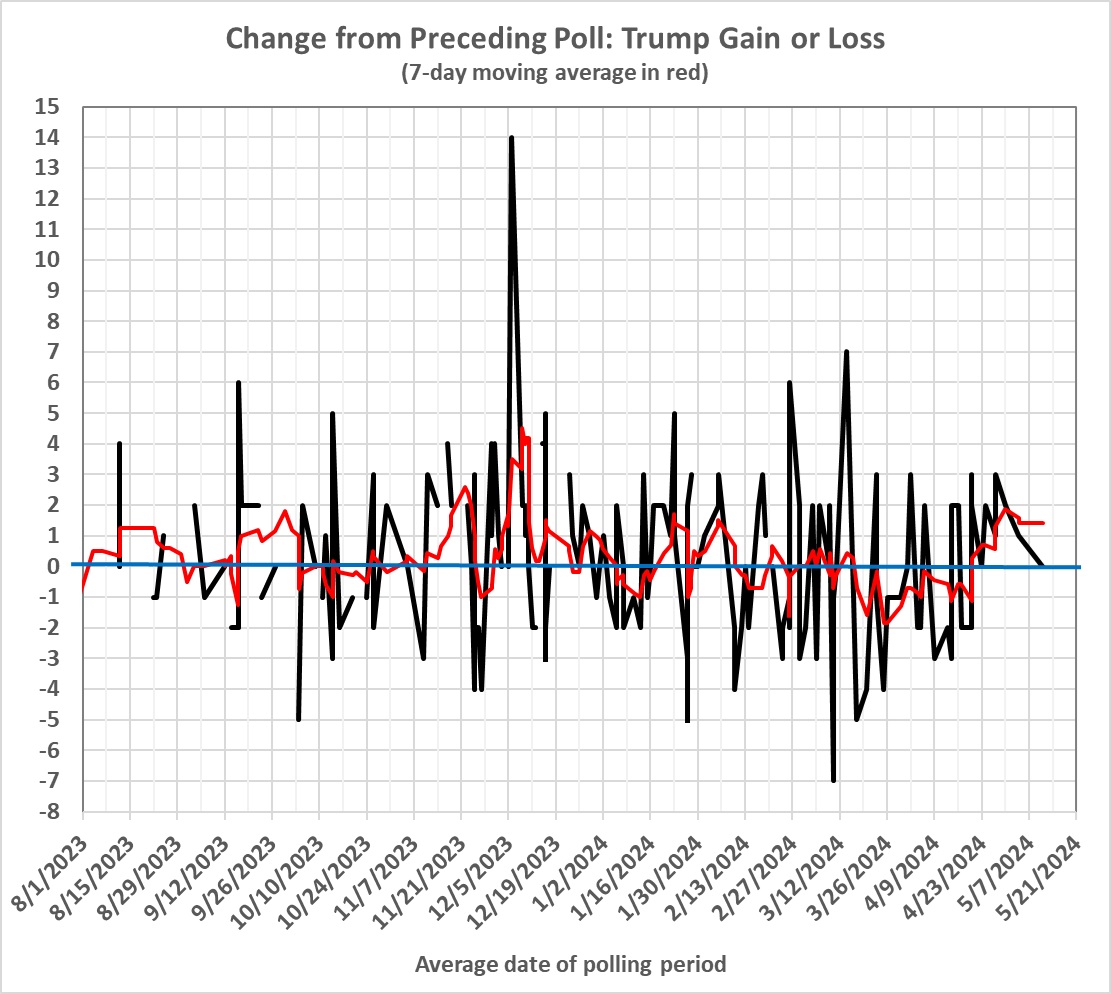
Adjustments for pollsters’ political biases — which I haven’t made — might make things look better for Trump. But the real problem with the “battleground” polls is their paucity. This can be seen by contrasting a metric I devised for nationwide polls with similar metrics for the “battleground” polls.

The metric is the change in each pollster’s results from poll to poll. For example, in the Morning Consult poll that was conducted May 3-May 5, Trump was up by 1 point. He was up by 1 point in the next Morning Consult poll which was conducted May 10-May 12. That counts as zero gain on the average date of the later poll: May 11. The full tally for all polls reported at RealClearPolitics since August 2023 looks like this:

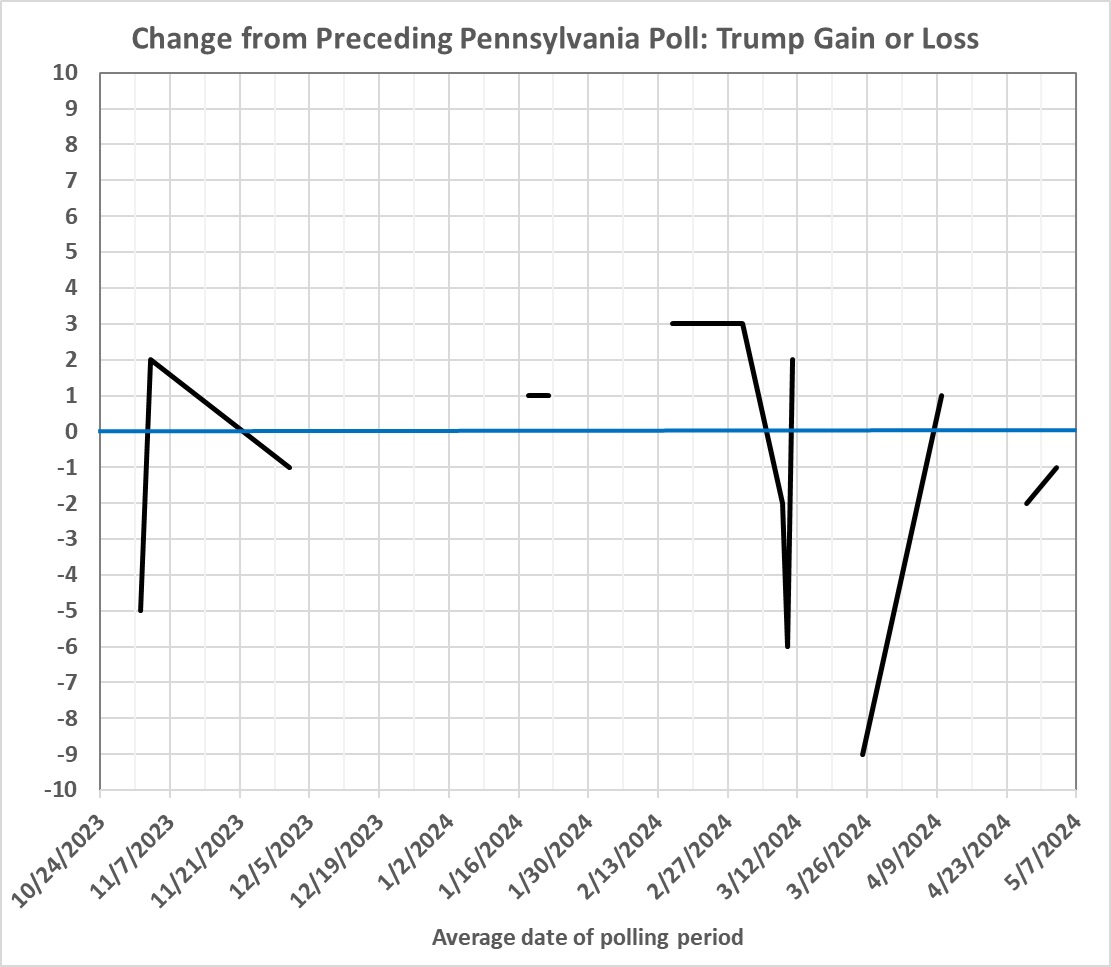
Here’s a similar graph for Pennsylvania, which the most heavily polled of the “battlegrounds”:

That’s not much to go on, is it?

What to do? I’m inclined to ignore the polls for individual States and keep my eye on the nationwide polls. But I will be more demanding of myself when I declare that Trump might win with a small lead or deficit in those polls.

As I say in the updated version of “Trump vs. Biden: 2“,

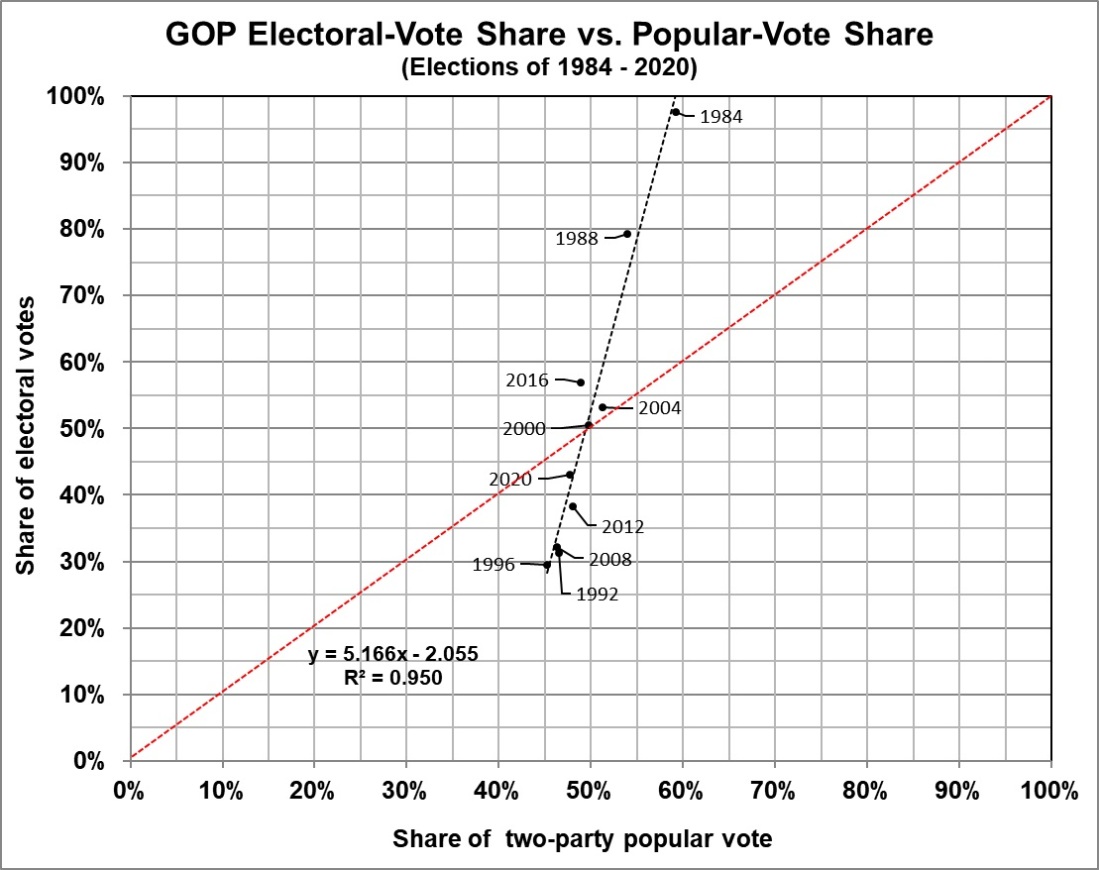
The statistical relationship in the graph [below] is meaningless. What can be meaningful is a narrow margin of victory (or loss) in a few States. This underlines the lesson from “How Good Are the Presidential Polls?“: Even a large lead in nationwide polls doesn’t signify victory in the Electoral College.

Well, the relationship isn’t quite meaningless. Here’s how it looks with a 90-percent confidence interval (which happens to encompass 100 percent of the data because the underlying distribution isn’t normal):

What this means is that I will be confident of a Trump victory (270 or more electoral votes) only if it looks like he will get 53 percent (or more) of the two-party popular vote, nationwide. A tally of at least 54 percent (a margin of at least 8 percentage points) would be convincing. (That’s close to my finger-to-the-wind estimate of 9 percentage points in “How Good Are the Presidential Polls?“, wherein I assessed the accuracy to the nationwide polls for the presidential elections of 2004-2020.)

If Trump doesn’t rack up a big margin, the Dems will be able to manufacture enough votes in key States to steal the election — again.

“The Long Drift Leftward”: Addendum

In “The Long Drift Leftward” I offer statistics about presidential elections to demonstrate the drift. I then attribute that drift to three coinciding factors, one of which is the enfranchisement of women and their steadily increasing propensity to vote.

Along comes a post by David Friedman, “Women Voting, Government Expenditure“. He finds that the relative growth of government spending for 13 Western nations (including the U.S.) is related to the enfranchisement of women. Being a two-handed economist, he hedges on his finding.

But putting his finding together with mine buttresses my conclusion (and his).

Inflating GDP

There are five ways to do it:

  • “Print” money.
  • Make businesses less efficient through regulation.
  • Enlarge government, thus drawing productive resources from private use.
  • Pay people to do nothing.
  • Encourage destructive behavior — rioting, illegal immigration, crime in general — and count remedial spending as part of GDP.

The first four items got liftoff in the 1930s and have been getting bigger and “better” since then. The fifth item has reached critical mass under Biden.

The Growing Age-Based Income Gap

It has been said often that today’s young adults have a harder time of it, economically (and probably in other ways), than the young adults of yesteryear. Is that true? If so, is a new phenomenon?

To shed some light on those questions, I turned to the Census Bureau and found Table P-10. Age–All People (Both Sexes Combined) by Median and Mean Income: 1974 to 2022. I plotted mean income by year for six age groups, with this result:

You can readily see that the rate of income growth for the youngest workers (15 to 24-year-olds) has been slower than that of the older age groups. In fact, the rate of income growth is inversely related to age group. Here are the coefficients of the linear fits to each of the lines in the graph:

  • 15 – 24: 132
  • 25 – 34: 346
  • 35 – 44: 539
  • 45 – 54: 625
  • 55 – 64: 683
  • 65 – 74: 750

Thus, for example, the mean income for the 15 – 24 age group increased, on average, by $132 per year, and so on for each group. (The r2 values are — from the youngest to oldest age group — 0.69, 0.76, 0.88, 0.87, 0.92, 0.95.)

In sum, the incomes of younger workers — on average and most of the time — have lagged further and further behind the incomes of older workers since at least 1974.

I am unsurprised by that. It has often been remarked that those of us who entered the labor force around 1960 had it better than those who followed us. I am certain that the observation would be borne out if there were data going back to 1960 or earlier.

Why is this so? An important reason, but not the only one, is the “law of supply and demand”. Economic growth in the U.S. has long been positive (though at a declining rate in the 20th and 21st centuries). Yes, there have been brief episodes of negative growth during recessions and longer episodes during the Great Recession and Great Depression. But the demand for labor of various kinds has grown over the long haul.

The supply of labor, on the other hand, hasn’t grown consistently (see table here). The population of the U.S. grew by only 7.3 percent from 1930 to 1940, as against 16.2 percent in the preceding decade, 15.0 percent in the decade before that, and much higher percentages before that.

The Great Depression of the 1930s was the main cause of slow population growth in that decade. World War II was the main cause of slow population growth from 1940 to 1950 — only 14.5 percent (slower than all preceding decades but one). Ant the growth in the 1940s came mainly in the latter half of the decade, when the post-war “baby boom” started.

The short of it is that younger persons who entered the labor force during, say, 1955 to 1965 didn’t face as much competition from their peers as did earlier generations. That happenstance served most of them well all the way to retirement.

Younger workers of later years have had it tougher — despite declining population growth since 1960 — because of the sharply declining rate of economic growth after 1970. Each regression line in the graph below reflects the rate of growth for the associated business cycle (the flatter the slope the lower the rate of growth). The 1949-1954 and 1960-1970 cycles generated much higher growth rates than those that followed. Further, the growth rates have generally declined over time; the rate for the 2009-2020 cycle (and beyond) is the lowest of the lot.

Today’s young adults, and those who follow them will be up against a lethargic economy — which will be made even more lethargic by the continued piling-on of regulations and the growth of government. The full amount of damage due to higher energy costs — because of the senseless war on “climate change” — is yet to be felt.

Youngsters should be leading the charge for regime change. But too many of them have been brainwashed in the belief that government (under Democrats) knows best. What it knows best is how to impoverish Americans and make nice to our worst enemies.