Election 2008: Fifth Forecast

My eighth forecast is here.

UPDATED (02/17/08)

The Presidency – Method 1

Intrade posts State-by-State odds odds on the outcome of the presidential election in November. I assign all of a State’s electoral votes to the party whose nominee that is expected to win that State. Where the odds are 50-50, I split the State’s electoral votes between the two parties.

As of today, the odds point to this result:

Democrat — 328 electoral votes (EVs)

Republican — 210 EVs

The Presidency – Method 2

I have devised a “secret formula” for estimating the share of electoral votes cast for the winner of the presidential election. (The formula’s historical accuracy is described in my second forecast.) The formula currently yields these estimates of the outcome of this year’s presidential election:

Democrat nominee — 271 to 304 EVs

Republican nominee — 234 to 267 EVs

U.S. Senate

Democrats will pick up five Senate seats, one each in Colorado, New Hampshire, New Mexico, and Virginia, plus Mississippi or Minnesota. The gain will change the balance from 51 Democrats (including Lieberman and Sanders, both nominally independent) and 49 Republicans to 56 Democrats and 44 Republicans.

My Dilemma

The thought of Hillary Clinton or Barack Obama as president appalls me. Both are “liberal fascists,” but Clinton is a personally despicable one.

So, I chortle (not cackle) every time Obama beats Clinton in a primary. But as Obama racks up those primary wins he becomes the more likely nominee of the Democrat Party.

Obama (so the polls say) is more electable than Clinton. Therefore, my delight in Obama’s success against Clinton may become my dismay if that success leads to an Obama presidency.

I resolve, therefore, to hope that Clinton becomes the Democrat nominee — much as I would enjoy seeing Clinton (and Clinton) rejected by their own party.

An Embarrassment of Ignoramuses

This reminds me of the multitude of lemming-like politicians and celebrities who have joined the “crusade” against global warming. (It would be a lot cooler if they would just close their mouths.)

Will those multitudes be embarrassed a few years from now when the scientific “consensus” turns against them? Not at all. They’ll have by then joined other ill-conceived “crusades” against other imaginary ills, or ones that cannot be cured by government. Why? For the sake of having government tell the rest of us how to live our lives.

And so it goes in the never-never land of the fashionable doom-sayer.

Related posts:
The Worriers” (13 Jun 2004)
More about the Worrying Classes” (17 Jun 2004)
“‘Warmism’: The Myth of Anthropogenic Global Warming” (23 Aug 2007)
Re: Climate ‘Science’” (19 Sep 2007)
More Evidence against Anthropogenic Global Warming” (25 Sep 2007)
Yet More Evidence against Anthropogenic Global Warming” (04 Oct 2007)
Global Warming, Close to Home” (22 Dec 2007)
You Know…” (02 Jan 2008)
Global Warming, Close to Home (II)” (06 Jan 2008)

Election 2008: Fourth Forecast

My eighth forecast is here.

The Presidency – Method 1

Intrade posts State-by-State odds odds on the outcome of the presidential election in November. I assign all of a State’s electoral votes to the party whose nominee that is expected to win that State. Where the odds are 50-50, I split the State’s electoral votes between the two parties.

As of today, the odds point to this result:

Democrat, 300 electoral votes

Republican, 238 electoral votes

The Presidency – Method 2

I have devised a “secret formula” for estimating the share of electoral votes cast for the winner of the presidential election. (The formula’s historical accuracy is described in my second forecast.) The formula currently yields these estimates of the outcome this year’s presidential election [UPDATED 02/09/08 02/11/08]:

Democrat nominee — 261 to 302 EVs 228 to to 269 EVs 261 to 310 EVs

Republican nominee — 236 to 277 EVs 269 to 310 EVs 236 to 277 EVs

* * *

Both methods afford a better outlook for the GOP than the one given in my third forecast on December 12. [Today’s update of method 2, in fact, puts the GOP nominee in the lead.] The gain, I believe, is attributable mainly to John McCain’s success in the race for the GOP nomination; that is, McCain is perceived as the Republican most likely to beat the Democrat nominee. The gain is attributable, also, to the strong (if no longer overwhelming) possibility that Hillary Clinton will be the Democrat nominee. Clinton, in spite of her strength within her party, probably would be a weaker nominee than Obama. The update of 02/11/08 reflects Obama’s strong showing over the past weekend (sweeping four Dem primaries/caucuses) and the expectation that he will do well in tomorrow’s “Potomac primary” (i.e., the primaries in MD, DC, and VA).

I believe that future forecasts will become more favorable to the GOP nominee (i.e., McCain). The current forecast doesn’t take into account the damage that the acrimonious race between Clinton and Obama will do to both. If Obama sweeps tomorrow’s races and soon thereafter becomes the “presumptive” Democrat nominee, Democrats may quickly unite behind him. Moreover, [T]he ugly reality of a[n] Clinton or Obama presidency will should offset the present disaffection for McCain among some conservatives. As conservatives “return to the fold,” McCain’s chances will rise. But Obama is looming as the man to beat in November 2008.

* * *

Congress

UPDATED 02/09/08: Democrats will pick up four Senate seats, one each in Colorado, New Hampshire, New Mexico, and Virginia. The gain will change the balance from 51 Democrats (including Lieberman and Sanders, both nominally independent) and 49 Republicans to 55 Democrats and 45 Republicans.

The House? Later.

* * *
How did I do in 2004? See this and this.

Stay at Home in November?

It has been suggested that conservative voters should stay home in November if John McCain is the Republican nominee.

It’s true that McCain is not a conservative. He is, rather, an idiosyncratic statist who holds conservative and “liberal” views, as his fancy strikes him.

However…inasmuch as McCain would face either Hillary Clinton or Barack Obama — both of whom are abysmally “liberal” — abstention would be akin to self-flagellation. It’s hard to see how McCain, abetted by a Democrat-controlled Congress, could do worse than Clinton or Obama, abetted by the same Congress. I know of no issue on which I prefer Clinton or Obama to McCain. McCain, at least, would not surrender to terrorists, would strive to maintain strong defenses, and would make better (if not ideal) judicial appointments.

It’s easy to say, as some do, that losing would be good for the GOP, because losing might cause the GOP to rethink its course and return to its limited-government philosophy. On the other hand, in its zeal to recapture the White House and Congress, the GOP might just become more “Democrat light” than it already is.

In any event, if McCain heads the Republican ticket, the choice for conservatives will be between a “bad” GOP nominee and a “terrible” Democrat nominee. “Bad” being better than “terrible,” I would hold my nose and vote for McCain.

P.S. Sensible bloggers agree with me.

P.P.S. Another sensible blogger who agrees (with links to others, as well).

P.P.P.S. And another two (make it three).

On the other hand: This is about as wrong-headed as it gets, not only with respect to withholding a vote from McCain but also with respect to the nature of an Obama presidency. Obama in the White House and Democrats in control of Congress: a prescription for economic ruin and defenselessness.

I’m for Romney…I Think

Answer the 10 questions here to compare the views of six presidential candidates (four Republicans and two Democrats) with your views on the issues covered. There are no questions about such issues as McCain-Feingold, judicial appointments, or defense spending in general, as opposed to the war in Iraq.

Given that caveat, here is how the candidates stack up against my views on 10 issues:

1. Ron Paul – 80% agreement
2. Mitt Romney – 80%
3. Mick Huckabee – 70%
4. John McCain – 60%
5. Hillary Clinton – 20%
6. Barack Obama – 10%

I had previously ruled out Ron Paul, who says the right things on most issues, but who also keeps bad company. That leaves me with Romney. I’m surprised.

Politics and Experience

Thomas Sowell deflates Hillary Clinton and John McCain’s claims of “experience”; for example:

Whether in Arkansas or in Washington, Hillary Clinton has spent decades parlaying her husband’s political clout into both money and power. How did that benefit anybody but the Clintons?

For those people whose memories are short, go on the Internet and look up Whitewater, the confidential raw FBI files on hundreds of Republican politicians that somehow — nobody apparently knows how — ended up in the Clinton White House illegally.

Look up the sale of technology to China that can enable them to more accurately hit American cities with nuclear missiles. Then look up the money that found its way to the Clintons through devious channels.

Look up Bill Clinton’s firing of every single U.S. Attorney in the country, which of course included those who were investigating him for corruption as governor of Arkansas.

It would be hard to find two people less trustworthy than the Clintons or with a longer trail of sleaze and slime.

Senator John McCain is also touting his “experience,” both in politics and in the military.

Senator McCain’s political record is full of zig-zags summarized in the word “maverick.” That is another way of saying that you don’t know what he is going to do next, except that it will be in the interests of John McCain.

While you are on the Internet looking up the record of the Clintons, look up John McCain’s record, including the Keating Five, the McCain-Feingold bill, and the McCain-Kennedy immigration bill.

John McCain’s military service was both honorable and heroic. But let’s not confuse that with experience relevant to being President of the United States.

John McCain was a naval aviator, an important and demanding job. But a naval aviator is not like Patton or Eisenhower.

Politics and experience have almost nothing in common these days. We have, on the one hand, professional politicians whose working lives are dedicated to feeding at the public trough for the power, glory, and graft it brings them. We have, on the other hand, a gullible public that mistakes politicians for “real people” and political experience for real experience.

Hillary Clinton was born and raised in comfortable circumstances. Most of her adult life has been spent as a lobbyist, political aide, political appointee (by which I include her partnership in the Rose Law firm), politician’s enabler, and then U.S. Senator.

In John McCain we have a son and grandson of admirals. (There is privilege in that, believe me.) McCain’s 54 years in the Naval Academy, Navy, and Congress was punctuated (almost 30 years ago) by a brief fling in the private sector (courtesy of his second wife’s father).

What “real people” need are politicians with real experience. The experience of having parents who sometimes struggled to make ends meet. The experience of having done the same for at least a few years of one’s adulthood. The experience of having owned and run a business without a public or private subsidy. The experience of having seen, close up, the inner workings of government bureaucracies, in all their cumbersome ineptitude.

Real experience isn’t enough to qualify anyone for political office, but it’s a start. It’s a necessary condition, if not a sufficient one.

The Misunderstood Race Issue

Guest post:

Though the Democrats have tried to put a lid on the race issue in their campaign, it will work itself out again before too long. Obama may have better people skills. He doesn’t have that look of perpetual dyspepsia that Clinton evinces, which is a symptom of her ill-concealed arrogance. But Obama is black after all, and if you think that doesn’t matter to liberal Democrats then you’ve misunderstood the race issue. In fact, it’s been misunderstood for decades.

First lesson: Racialism is not ipso facto synonymous with conservatism. It is not based on principle but on irrational prejudice. If any group is really trying to look beyond the divisive race issue it is conservatives, particularly social conservatives. On the other hand, I’ve met many liberals who were bigots. As it turns out, most of their bigotry is directed at blacks, for unique reasons that seem to have to do with culture and history (see Sowell for more information). As such, Jews as well as other whites can hold prejudiced views against blacks. This point also belies long-standing stereotypes about Jews, race and anti-Semitism.

Second lesson: The mainstream has traditionally equated anti-Jewishness with racialism, yet there are plenty of people, including non-whites, who are anti-Jewish without harboring any other racial views. Hatred of Jews is motivated more by conspiratorial views of society than biological theories, hence the recurring tendency of the Left to indulge in anti-Semitism. By that same token there is a brand of white ethnocentrism which is inclusive towards Jews (e.g., Jared Taylor’s American Renaissance movement). Finally, a serious belief in equality means that blacks, possessing human nature like everyone else, are just as liable to bigotry as whites (see a good commentary on this point from a theologically conservative perspective).

Third lesson: As Liberty Corner has pointed out in the past, left-liberal views on race manifest themselves in the form of socialist paternalism. Maybe it should be called “compassionate racism.” According to this, what are seen as disruptive tendencies on the part of many blacks are deemed inevitable (which they are not) and must be pandered to (which they should not) for to sake of statist welfare policies. This is because what motivates liberal elitists is not concern for blacks, any more than Marxist leaders are concerned for the “plight of the worker.” It’s about the manipulation of people for the sake of political power. So if there is any difference between racists on the left and on the right, it is that the former are sanctimonious hypocrites who preach equality while covertly segregating themselves economically and socially from blacks.

Fourth lesson: But what about racism on the “right”? Does my model still hold? I maintain that it does. Again, racial bigotry is an irrational response to physical or social differences in other people. Ideologically it stems from the nationalism and materialism of the 19th century; views anathema to a traditional Christian outlook. This fact explains how someone like Karl Marx shared the same bigoted racial views as his ultra-nationalist contemporaries. I’ve found that right-wingers who back populist/nativist political movements are often social libertines. They may be against big government, gun-control, immigration, etc. but are to the left on issues like abortion, euthanasia, traditional marriage, and public morality. Their thinking is emotive rather than principled. This may explain why Hitler’s political appeal in 1930s Germany cut across traditional political boundaries, since he catered to the short-sighted, hedonistic sentiments of both socialists and radical nationalists.

In conclusion, it is clear that the race issue in politics has been long misunderstood… perhaps deliberately so.

Hillary Admits Error

Error, in this case, being Democrats’ opposition to deficit spending (when it’s the result of GOP tax cuts) because it’s “fiscally irresponsible.” Now that she’s running (scared) for president, Hillary has changed her tune:

“Stimulus shouldn’t be paid for,” declared Mrs. Clinton on NBC’s “Meet the Press” on Sunday. “The stimulus, by the very nature of the economic problems we’re facing, is going to require an injection of federal funding.”

You will notice, however, that she’s calling for more spending (for the children, I presume), not further tax cuts. How cynical can you get?

Related posts:

Curing Debt Hysteria in One Easy Lesson” (21 Apr 2004)
Debt Hysteria, Revisited” (17 Sep 2005)

The Current Crop of Candidates

If you have read my posts “Presidential Legacies” and “The Modern Presidency: A Tour of American History since 1900” it will not surprise you to know that I find little to admire in the current crop of presidential candidates. The candidate who comes closest to matching my views on a range of issues (seven points of agreement on eleven issues) is Fred Thompson, who has the proverbial “snowball’s chance in hell” of winning anything.

All I can hope for, at this point, is a GOP winner in November. That’s not because I much like any of the GOP candidates (I don’t), but because I would rather have Supreme Court appointments in the hands of a Republican president. From that perspective, even Rudy Giuliani looks good.

UPDATE (01/21/08): A McCainClinton presidential contest seems most likely at this point. A President McCain might very well subject prospective Supreme Court nominees to a McCain-Feingold litmus test. George Will writes:

McCain says he would nominate Supreme Court justices similar to Antonin Scalia, Clarence Thomas, John Roberts and Sam Alito. But how likely is he to nominate jurists who resemble those four: They consider his signature achievement constitutionally dubious.

When the Supreme Court upheld McCain-Feingold 5-4, Scalia and Thomas were in the minority. That was before Alito replaced Sandra Day O’Connor, who was in the majority. Two years later, McCain filed his own brief supporting federal suppression of a right-to-life group’s issue advertisement in Wisconsin because it mentioned a candidate for federal office during the McCain-Feingold blackout period prior to an election. The court ruled 5-4 against McCain’s position, with Alito in the majority.

McCain and Clinton: Not a dime’s worth of difference as far as I can see. Both are statists to the core.

If the LP comes up with a candidate who’s better than Michael Badnarik (the LP’s 2004 nominee), I might just waste my vote on that candidate.

Ron Paul: Anticipating the Smoking Gun

My guest blogger, Postmodern Conservative, was on the right track in these posts (dated 12/13/07 and 12/20/07). James Kirchick of TNR published his “smoking gun” article on 01/08/08.

The Power of a Woman’s Tears

It’s not hard to believe that Hillary Clinton won the Democrat primary in New Hampshire because of the tears she shed (or almost shed) the day before the primary. Her mediagenic emotional moment must have garnered sympathy from many a female voter — perhaps from many of them who hadn’t planned to vote, until the tears welled up.

It’s as if a goodly fraction of the women of New Hampshire rose up and said, “We are woman…we cry.” This is a qualification for office?

It’s Happening in Britain…

…and if it’s happening there, it can happen here. What? The suppression of politically incorrect speech by the state — not just a tax-funded university, but the central government itself.

Wolf Howling has the story. It’s about a British blogger, Lionheart, who lays it on the line here, and links to his “offending” posts.

P.S. A good subtitle for this post is “Cowering before Islam.” Someone who is not cowering before Islam, even though his government would like to is Geert Wilders of the Netherlands. (Thanks, again, to Wolf Howling.)

P.P.S. I should have mentioned Canada, of course. Cases in point, the “human rights” complaints against Ezra Levant and Mark Steyn.

The "Southern Strategy": A Postscript

I conclude “The ‘Southern Strategy’” by saying that

it is plain that the South’s attachment to the GOP since 1964, whatever its racial content, is much weaker than was the South’s attachment to the Democrat Party until 1948, when there was no question that that attachment had a strong (perhaps dominant) racial component.

[Paul] Krugman’s condemnation [in The Conscience of a Liberal] of racial politics in a major political party [the GOP] comes 60 years too late, and it’s aimed at the wrong party.

Case closed.

Bruce Bartlett decisively slams the door on Krugman’s case in “Whitewash: The racist history the Democratic Party wants you to forget“; for example:

[I]f a single mention of states’ rights 27 years ago [by Ronald Reagan] is sufficient to damn the Republican Party for racism ever afterwards, what about the 200-year record of prominent Democrats who didn’t bother with code words? They were openly and explicitly for slavery before the Civil War, supported lynching and “Jim Crow” laws after the war, and regularly defended segregation and white supremacy throughout most of the 20th century.

Bartlett then gives many examples of racist statements by prominent Democrats, beginning with Thomas Jefferson (1787) and ending with Joseph Biden (2007), with several stops in between at the Democrats’ platform and the pronouncements of prominent Democrats, including FDR, Hugo Black, Robert Byrd, Lyndon Johnson, Jimmy Carter, and Chris Dodd.

As I say in my earlier post,

Krugman’s real complaint… is that Republicans have been winning elections far too often to suit him. His case of Republican Derangement Syndrome is so severe that he can only pin the GOP’s success on racism. I will refrain from references to Freud and Pinocchio and note only that Krugman’s anti-GOP bias seems to have grown as his grasp of economics has shrunk.

Amen.

My "Favorite" Candidates

I went here, answered eleven questions, and found the three presidential candidates whose positions on various issues come closest to mine:

Fred Thompson (3 of 3 on Iraq, 1 of 2 on immigration, 1 of 2 on health care, 2 of 4 on other topics; overall, 7 of 11)

Rudy Giuliani (3 of 3 on Iraq, 0 of 2 on immigration, 1 of 2 on health care, 2 of 4 on other topics; overall, 6 of 11)

Ron Paul (0 of 3 on Iraq, 1 of 2 on immigration, 2 of 2 on health care, 2 of 4 on other topics; overall, 5 of 11)

Not a close match in the bunch. I like Thompson and Giuliani on Iraq (stay the course); Paul is right about health care (it’s a matter for markets, not government); and the rest is a mixed bag. The best combination of the three candidates’ positions matches mine on only 8 of 11 issues. It’s not a field of dreams.

Moreover, none of the three seems destined to head the GOP ticket at the rate things are going. Which means that the likely nominee (e.g., Romney or Huckabee) will hold positions even further from mine.

Of course, it could be a lot worse: Hillary Clinton, John Edwards, Dennis Kucinich, or Barack Obama, for example.

The Republican field (as usual) is simply the lesser of two evils, which is why I vote GOP — when I bother to vote. (No, I don’t waste my vote on the Libertarian Party.)

At this point, I’m thinking of staying home on election day 2008. The GOP candidate is almost certain to win Texas without my help.

(Thanks to Bookworm for the tip.)

Ron Paul, Continued

Guest post:

I’ve heard that Ron Paul has publicly distanced himself from his extremist followers, although I’ve yet to see a report about it. Certainly I hope the rumor is true. However, even the ultra-libertarians at Liberal Values make the sensible observation that

After pulling in another six million dollars you would think that Ron Paul could afford to do the right thing and return that $500 contribution from [neo-Nazi] Stormfront founder Don Black. At very least you would think that… he would at least realize that returning such a contribution is what any other candidate would do and what he must also do if he wants to be credible. Failure to do so also fuels the suspicions of racism and anti-Semitism on Paul’s part which has been noted in some of his writings.

In my last post on the topic, I discussed critical coverage from the “neo-cons” at National Review. In all fairness to Paul, I agree with many of his positions, especially on economics, morals and the family. But that leaves some major gaps. The one point that will lose him the broad base of Republic/conservative support is his position on the war. Personally, I don’t mind a little elbow room on policy. Foreign affairs are a prudential matter, unlike abortion, which deals with moral absolutes. I can agree with paleo-cons that Wilsonian interventionism is both unnecessary and risky. But I disagree with their dogmatic isolationism; the idea that there’s a one-size-fits-all pattern to political exigencies.

The libertarian Volokh Conspiracy makes this point with reference to Paul’s views on federal policy and racism. While traditional conservatives would agree that left-wing statist policies have exacerbated the problem, it simply not true that state government is inherently better than the federal level (perhaps that is why the Founders wanted a balance between the two). Volokh points out that “It was, after all, state governments that took the lead in defending slavery, segregation, and other forms of discrimination against blacks and (in the Western states) Asian-Americans.”

Some others have pitched in with their constructive criticism, showing that a cautious view of Paul is hardly the product of neo-con persecution. The most impressive of these is Dave Nalle’s Blogcritics Magazine commentary of December 14. In it, Nalle comes across as very sympathetic. Yet he cautions against the the direction that Paul’s “largely uncontrolled campaign is taking and the people who are infiltrating it and shaping it….” He condemns the more fanatical supporters: “Self-righteous ideologues make terrible politicians, they don’t win elections and they’re dragging Ron Paul down with them.” Yet it is Paul’s campaign, after all, and if he can’t control that then one wonders how well he would control the presidency. However, the latter scenario seems highly unlikely, despite the recent record-breaking intake of campaign money.

Earlier post on Ron Paul.

An Exercise in Futility

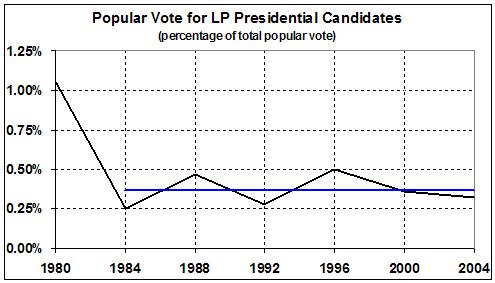
The Libertarian Party’s presidential candidate in 1980, Ed Clark, received about 1.1 percent of the popular votes cast in the presidential election. That election marked the first appearance of the LP candidate on the ballots of 50 States, up from 2 States in 1972 and 32 States in 1976. The LP candidate has been on the ballot of 50 States, or nearly that, in every election since 1980, excepting the election of 1984 (39 States).

The LP’s “breakthrough” in 1980 proved not to be a breakthrough at all. The following graph tells the story. The black line represents the percentage of popular votes received by the LP candidate in each election. The blue line represents the average percentage (0.36) for the elections from 1984 through 2004.

Sources:
http://en.wikipedia.org/wiki/Libertarian_Party_(United_States) http://www.lp.org/organization/history.shtml
http://uselectionatlas.org/

Remember 1980, that year of great disaffection for Jimmy Carter and the boomlet for John Anderson, who wound up with 6.6 percent of the popular vote? The LP was still a novelty, and the LP ballot line was new to many voters. “A libertarian (whatever that is), why not?” Thus the wastage of almost 1 million votes on Ed Clark.

Voters haven’t been as generous to the LP since 1980. Not even in 1992, when Ross Perot capitalized on the disaffection for G.H.W. Bush and drew 19 percent of the popular vote, probably swinging the election to Bill (not-fit-for the Supreme Court) Clinton.

Why does the LP keep wasting its money on presidential candidates, potentially causing the defeat of a Republican: just as the votes cast by Floridians for Ralph Nader in 1980 cost the Democrats that year’s election? Stubborn pride. Too “pure” to play in the same sandbox as Republicans? Who knows?

I’ll vote for a Republican — any Republican, even a Bush-type — before wasting my vote on a Libertarian Party candidate.

P.S. (12/17/07): Ron Paul seems to understand. The erstwhile LP candidate for president (0.47 percent of the popular vote in 1988) has won and held his seat in the U.S. House by running as a Republican. Paul’s candidacy for the GOP nomination makes him visible to the public, and will do far more to inject libertarian ideas into the political mainstream than would another futile run on the Libertarian ticket. If Paul were to run on the LP ticket after losing the GOP nomination, he might do even better than Ed Clark did in 1980, but only because of his (Paul’s) exposure to the public via the GOP race.

P.P.S. (12/17/07): What’s my position on Ron Paul? I like his federalist, limited-government principles. I don’t like his extreme isolationism. And I don’t like his apparent willingness to accept the support of kooks, conspiracy theorists, and racists. UPDATE (12/20/07): On the third point, this doesn’t look good.) One out of three isn’t a good average, in my book. I pass on Paul. UPDATE (12/27/07): The item linked in the previous update has since been updated. Paul probably is not playing footsie with racist whites. That said, I’m still against him because of his extreme isolationism. UPDATE (01/11/08): There are so many smoking guns about Ron Paul in this piece that it is impossible for me to believe that the man is, in any way, a libertarian. For evidence that he is just plain nuts, see this.

Related posts:
I Wish It Were Thus
My Advice to the LP
Great Minds Agree, More or Less
Good Advice for the Libertarian Party

An FDR Reader

Thanks to John Ray for bringing my attention to these items:

How FDR Made the Depression Worse,” by Robert Higgs (Feb 1995)
Tough Questions for Defenders of the New Deal,” by Jim Powell (06 Nov 2003)
The Real Deal,” by Amity Shlaes (25 Jun 2007)

Related posts at Liberty Corner include:

Getting it Perfect” (04 May 2004)
The Economic Consequences of Liberty” and an addendum, “The Destruction of Income and Wealth by the State” (01 Jan 2005)
Calling a Nazi a Nazi” (12 Mar 2006)
Things to Come” (27 Jun 2007)
FDR and Fascism” (30 Sep 2007)
A Political Compass: Locating the United States” (13 Nov 2007)
The Modern Presidency: A Tour of American History since 1900” (01 Dec 2007)

Our descent into statism didn’t begin with FDR. (His cousin Teddy got the ball rolling downhill.) But FDR compounded an economic crisis, then exploited it to put us firmly on the path to the nanny state. The rest, as they say, is history.

Thus we now have a “compassionate conservative” as president, and several “Republican” candidates for president who would have been comfortable as New Deal Democrats. Calvin Coolidge must be spinning in his grave at hypersonic speed.

Ron Paul Roundup

Guest post:

A perusal of NRO commentary puts the Ron Paul campaign in perspective. It’s acknowledged that he is reaching an audience that no else is. The question is, what is that audience?

On May 28, Jim Geraghty observes that “while supporters of the ten non-Ron-Paul GOP candidates tend to like at least some other Republican candidates besides their favorite, Ron Paul supporters only like Ron Paul.” This kind of exclusivism is never a good thing. One senses that fans of Paul are so fixated on a few key points (opposition to the war and some far-reaching free-market views) that they can’t see the forest for the trees.

On October 21, Geraghty says “with some begrudging admiration” that “Ron Paul is, like Howard Dean in 2004, the only candidate who could spawn a movement that will last beyond his candidacy.” It sounds like a replay of Buchanan in 2000. Wouldn’t it be better if Paul and his people were willing to work with other Republicans and push them in the right direction on certain issues? When they insist on being divisive (a tactic that favors the left in the long run) then I have to question their intentions.

On December 10, Jonah Goldberg refers to the militant optimism of Ron Paul supporters. They can’t accept the fact that he won’t win the presidency. It’s a not a question of enthusiasm, it’s a detachment from reality. Paul fans think their candidate’s woes are the fault of a media conspiracy. This overlooks the fact that “Huckabee is much, much more popular than Ron Paul. And he got there with less money and, until recently, arguably less media exposure.”

Finally, there is Mona Charen’s article, “What Paul Is Running For.” Now, unlike her, I admit that Paul’s pro-life credentials (no small item these days) are impressive. Personally, the man appears impeccable. But he lacks political savvy. As Charen says:

Ron Paul is too cozy with kooks and conspiracy theorists. As syndicated radio host Michael Medved has pointed out, Ron Paul’s newspaper column was carried by the American Free Press (a parent publication of the Hitler-praising Barnes Review). Paul may not have been aware of this. But though invited by Medved to disavow any connection, Paul has so far failed to respond.

I’ve heard the same complaint from friends who are staunch social conservatives. When Paul’s campaign received a contribution from notorious racist Don Black, Paul did nothing to distance himself from the fringe element.

Election 2008: Third Forecast

My eighth forecast is here.

The Presidency – Method 1

Intrade posts odds on which party’s nominee will win in each State and, therefore, take each State’s electoral votes. I assign all of a State’s electoral votes to the party that is expected to win that State. Where the odds are 50-50, I split the State’s electoral votes between the two parties.

As of today, the odds point to this result:

Democrat, 306 electoral votes

Republican, 232 electoral votes

(A slight gain for the Dems since the first forecast, 11/16/07, and second forecast, 11/18/07.)

The Presidency – Method 2

I have devised a “secret formula” for estimating the share of electoral votes cast for the winner of the presidential election. I describe the formula’s historical accuracy in my second forecast. The formula currently yields these estimates of the outcome of next year’s presidential election (CORRECTED, 12/13/07):

Democrat nominee — 274 to 313 EVs

Republican nominee — 225 to 264 EVs

This is a much better outlook for the Dems than the one I issued on November 18. It is attributable mainly to the decline of Hillary Clinton’s prospects for her party’s nomination. Clinton, in spite of her strength within the Democrat Party, would be a weaker nominee than Barack Obama. As Obama gains ground on Clinton, a Democrat victory becomes more likely — as of now. Obama could become damaged goods by the time he emerges from a bitterly fought contest for his party’s nomination.

U.S. House and Senate

Later.

* * *
How did I do in 2004? See this and this.