John Warner’s Exit Strategy

Guest post:

John Warner (R-Va.) has never been a favorite with real conservatives (here’s why). Now that he tries to exit the Senate as gracelessly as possible, after thirty misspent years, I doubt they’ll change their minds.

There’s nothing worse than an aging politician, facing the prospect of eternity, who thinks that he’ll ease his conscience by becoming a liberal. Actually, he’s been a liberal on many issues over the years. Now he’s just more consistent.

Having opposed costly and intrusive “greenhouse gas” limits as recently as 2005, he suddenly answered the environmentalist altar call and came down on the side of Al Gore. However, he assures us that this is all in the name of national security, since he lies awake at night worrying that the U.S. military might face new climatic threats!

“Patriotism,” as Johnson said, “is the last refuge of the scoundrel.”

Mike Huckabee and the View from Planet Rockwell

Guest post:

In my Buchananite days I avidly read Lew Rockwell (anarcho-capitalist protégé of the late Murray Rothbard). But one of the things that gradually turned me off was his gratuitous antagonism towards all politicians except those who fit his very narrow, Jansenist-like, political philosophy. Only a few are saved, sola anarchia, while the rest of the unenlightened belong to the massa damnata.

So I’m hardly surprised that Rockwell is gunning for Mike Huckabee, a candidate I’ve increasingly learned to admire and respect. Huckabee is an intelligent communicator and a principled man who will state in his campaign ads that “life begins at conception.” Some give him low marks for his economic views, but considering that we haven’t had a real fiscal conservative president in nearly 80 years (Calvin Coolidge, who was in office from 1923-1929) I’m not going to get too worked up. After all, Ronald Reagan was berated for his “voodoo economics.” But then we learned that there was more to conservatism than just economics. There are also foreign policy and social issues.

But others thought Reagan was “basically a cretin.” Who was that? Some splenetic liberal at The Washington Post or The New York Times? No, it was Murray Rothbard writing about “eight dreary, miserable, mind-numbing years, the years of the Age of Reagan” that were coming to an end in 1989. I guess he was piqued that no one had chosen him to lead the Free World. Rothbard presumably could have told everyone that the fall of the Berlin Wall, and subsequent roll back of Communism, was no big deal because Soviet Russia had never been a threat in the first place. Instead, it was his wisdom that disarmament and isolationism would bring world peace. So now we know where Lew Rockwell is coming from when he complains that Huckabee is no more than a backwoods religious zealot who believes in, of all things, the state-sanctioned death-penalty!

Now I realize that conservatives have many opinions on the viability and quality of the Republican candidates out there. They may not share my enthusiasm for Huckabee. But this example (once again) of anarcho-libertarian contrariety makes me wonder why anyone cares what Rockwell has to say about anything.

History Lessons

The following is adapted from an introduction that I wrote almost three years ago for “The Modern Presidency: A Tour of American History since 1900,” in its original incarnation.

Chief among the lessons of American history since 1900 is the price we have paid for allowing government to become so powerful. Most Americans today take for granted a degree of government involvement in their lives that would have shocked the Americans of 1900. The growth of governmental power has undermined the voluntary social institutions upon which civil society depends for orderly evolution: family, church, club, and community. The results are evident in the incidence of crime, broken homes, and drug use; in the resort to sex, violence, sensationalism, and banality as modes of entertainment; and generally in the social fragmentation and alienation that beset Americans — in spite of their prosperity.

The other edge of the governmental sword is interference in economic affairs through taxation and regulation. Such interference, which has grown exponentially since the early 1900s, has blunted Americans’ incentives to work hard, invent, innovate, and create new businesses. The result is that Americans — as prosperous as they are — are far less prosperous than they would be had they not ceded so much economic power to government.

Because of the growth of governmental power, much of the freedom that attends Americans’ prosperity is largely illusory: Americans actually have less freedom than they used to have — and much less freedom than envisioned by the founding generation that fought for America’s independence and wrote its Constitution. I am referring not to the imagined excesses of the current administration, which is vigorously and constitutionally defending American citizens against foreign predators. I am referring to such real things as:

  • the diminution of free speech in the name of campaign-finance “reform”
  • the denial of property rights, the right to work, and freedom of association for the sake of racial and sexual “equality”
  • the seizure of private property for private use in the name of “economic development”
  • the interference of government in almost every aspect of commerce, from deciding what may and may not be produced to how it must be produced, advertised, and sold — all to ensure that we do not make mistakes from which we can learn and profit
  • exorbitant taxation at every level of government, which denies those persons who have earned money lawfully the right to decide how to use it lawfully and gives that money, instead, to parasites in and out of government.

Those are the kinds of abuses of governmental power that Americans have acquiesced in — and even clamored for. It is those abuses that should outrage politicians and pundits — and the masses who swallow their distortions and their socialistic agenda.

For a detailed analysis, rich with links to supporting posts and articles, see “A Political Compass: Locating the United States.”

The Modern Presidency: A Tour of American History since 1900

This post traces, through America’s presidencies from the first Roosevelt to the second Bush, the main themes of American history since the turn of the twentieth century. This is a companion-piece to “Presidential Legacies.” The didactic style of the present post reflects its original purpose: to give my grandchildren some insights into American history that aren’t found in standard textbooks.

Theodore Roosevelt (1858-1919) was elected Vice President as a Republican in 1900, when William McKinley was elected to a second term as President. Roosevelt became President when McKinley was assassinated in September 1901. Roosevelt was re-elected President in 1904. He served almost two full terms as President, from September 14, 1901, to March 4, 1909. (Before 1937, a President’s term of office began on March 4 of the year following his election to office.)

Roosevelt was an “activist” President. Roosevelt used what he called the “bully pulpit” of the presidency to gain popular support for programs that exceeded the limits set in the Constitution. Roosevelt was especially willing to use the power of government to regulate business and to break up companies that had become successful by offering products that consumers wanted. Roosevelt was typical of politicians who inherited a lot of money and didn’t understand how successful businesses provided jobs and useful products for less-wealthy Americans.

Roosevelt was more like the Democrat Presidents of the Twentieth Century. He did not like the “weak” government envisioned by the authors of the Constitution. The authors of the Constitution designed a government that would allow people to decide how to live their own lives (as long as they didn’t hurt other people) and to run their own businesses as they wished to (as long as they didn’t cheat other people). The authors of the Constitution thought government should exist only to protect people from criminals and foreign enemies.

William Howard Taft (1857-1930), a close friend of Theodore Roosevelt, served as President from March 4, 1909, to March 4, 1913. Taft ran for the presidency as a Republican in 1908 with Roosevelt’s support. But Taft didn’t carry out Roosevelt’s anti-business agenda aggressively enough to suit Roosevelt. So, in 1912, when Taft ran for re-election as a Republican, Roosevelt ran for election as a Progressive (a newly formed political party). Many Republican voters decided to vote for Roosevelt instead of Taft. The result was that a Democrat, Woodrow Wilson, won the most electoral votes. Although Taft was defeated for re-election, he later became Chief Justice of the United States, making him the only person ever to have served as head of the executive and judicial branches of the U.S. Government.

Thomas Woodrow Wilson (1856-1924) served as President from March 4 1913 to March 4, 1921. (Wilson didn’t use his first name, and was known officially as Woodrow Wilson.) Wilson is the only President to have earned the degree of doctor of philosophy. Wilson’s field of study was political science, and he had many ideas about how to make government “better.” But “better” government, to Wilson, was “strong” government of the kind favored by Theodore Roosevelt.

Wilson was re-elected in 1916 because he promised to keep the United States out of World War I, which had begun in 1914. But Wilson changed his mind in 1917 and asked Congress to declare war on Germany. After the war, Wilson tried to get the United States to join the League of Nations, an international organization that was supposed to prevent future wars by having nations assemble to discuss their differences. The U.S. Senate, which must approve America’s membership in international organizations, refused to join the League of Nations. The League did not succeed in preventing future wars because wars are started by leaders who don’t want to discuss their differences with other nations.

Warren Gamaliel Harding (1865-1923), a Republican, was elected in 1920 and inaugurated on March 4, 1921. Harding asked voters to reject the kind of government favored by Democrats, and voters gave Harding what is known as a “landslide” victory; he received 60 percent of the votes cast in the 1920 election for president, one of the highest percentages ever recorded. Harding’s administration was about to become involved in a major scandal when Harding died suddenly on August 3, 1923, while he was on a trip to the West Coast. The exact cause of Harding’s death is unknown, but he may have had a stroke when he learned of the impending scandal, which involved Albert Fall, Secretary of the Interior. Fall had secretly allowed some of his business associates to lease government land for oil-drilling, in return for personal loans.

There were a few other scandals, but Harding probably had nothing to do with any of them. Because of the scandals, most historians say that they consider Harding to have been a poor President. But that isn’t the real reason for their dislike of Harding. Most historians, like most college professors, favor “strong” government. Historians don’t like Harding because he didn’t use the power of government to interfere in the nation’s economy. An important result of Harding’s policy (called laissez-faire, or “hands off”) was high employment and increasing prosperity during the 1920s.

John Calvin Coolidge (1872-1933), who was Harding’s Vice President, became President upon Harding’s death in 1923. (Coolidge didn’t use his first name, and was known as Calvin.) Coolidge was elected President in 1924. He served as President from August 3, 1923, to March 4, 1929. Coolidge continued Harding’s policy of not interfering in the economy, and people continued to become more prosperous as businesses grew and hired more people and paid them higher wages. Coolidge was known as “Silent Cal” because he was a man of few words. He said only what was necessary for him to say, and he meant what he said. That was in keeping with his approach to the presidency. He was not the “activist” that reporters and historians like to see in the presidency; he simply did the job required of him by the Constitution, which was to execute the laws of the United States. He continued Harding’s hands-off policy, and the country prospered as a result. Coolidge chose not run for re-election in 1928, even though he was quite popular.

Herbert Clark Hoover (1874-1964), a Republican who had been Secretary of Commerce under Coolidge, was elected to the presidency in 1928. Hoover won 58 percent of the popular vote, an endorsement of the hands-off policy of Harding and Coolidge. Hoover’s administration is known mostly for the huge drop in the price of stocks (shares of corporations, which are bought and sold in places known as stock exchanges), and for the Great Depression that was caused partly by the “Crash” — as it became known. The rate of unemployment (the percentage of American workers without jobs) rose from 3 percent just before the Crash to 25 percent by 1933, at the depth of the Great Depression.

The Crash had two main causes. First, the prices of shares in businesses (called stocks) began to rise sharply in the late 1920s. That caused many persons to borrow money in order to buy stocks, in the hope that the price of stocks would continue to rise. If the price of stocks continued to rise, buyers could sell their stocks at a profit and repay the money they had borrowed. But when stock prices got very high in the fall of 1929, some buyers began to worry that prices would fall, so they began to sell their stocks. That drove down the price of stocks, and caused more buyers to sell in the hope of getting out of the stock market before prices fell further. But prices went down so quickly that almost everyone who owned stocks lost money. Prices of stocks kept going down. By 1933, many stocks had become worthless and most stocks were selling for only a small fraction of prices that they had sold for before the Crash.

Because so many people had borrowed money to buy stocks, they went broke when stock prices dropped. When they went broke, they were unable to pay their other debts. That had a ripple effect throughout the economy. As people went broke they spent less money and were unable to pay their debts. Banks had less money to lend. Because people were buying less from businesses, and because businesses couldn’t get loans to stay in business, many businesses closed and people lost their jobs. Then the people who lost their jobs had less money to spend, and so more people lost their jobs.

The effects of the Great Depression were felt in other countries because Americans couldn’t afford to buy as much as they used to from other countries. Also, Congress passed a law known as the Smoot-Hawley Tarrif Act, which President Hoover signed. The Smoot-Hawley Act raised tarrifs (taxes) on items imported into the United States, which meant that Americans bought even less from foreign countries. Foreign countries passed similar laws, which meant that foreigners began to buy less from Americans, which put more Americans out of work.

The economy would have recovered quickly, as it had done in the past when stock prices fell and unemployment increased. But the actions of government — raising tarrifs and making loans harder to get — only made things worse. What could have been a brief recession turned into the Great Depression. People were frightened. They blamed President Hoover for their problems, although President Hoover didn’t cause the Crash. Hoover ran for re-election in 1932, but he lost to Franklin Delano Roosevelt, a Democrat.

Franklin Delano Roosevelt (1882-1945), known as FDR, served as President from March 4, 1933 until his death on April 12, 1945, just a month before V-E Day. FDR was elected to the presidency in 1932, 1936, 1940, and 1944 — the only person elected more than twice. Roosevelt was a very popular President because he served during the Depression and World War II, when most Americans — having lost faith in themselves — sought reassurance that “someone was in charge.” FDR was not universally popular; his share of the popular vote rose from 57 percent in 1932 to 61 percent in 1936, but then dropped to 55 percent in 1940 and 54 percent in 1944. Americans were coming to understand what FDR’s opponents knew at the time, and what objective historians have said since:

  • FDR’s efforts to bring America out of the Depression only made it worse.
  • FDR’s leadership during World War II faltered toward the end, when he was gravely ill and allowed the Soviet Union to take over Eastern Europe.

FDR’s program to end the Depression was known as the New Deal. It consisted of welfare programs, which put people to work on government projects instead of making useful things. It also consisted of higher taxes and other restrictions on business, which discouraged people from starting and investing in businesses, which is the cure for unemployment.

Roosevelt did try to face up to the growing threat from Germany and Japan. However, he wasn’t able to do much to prepare America’s defenses because of strong isolationist and anti-war feelings in the country. Those feelings were the result of America’s involvement in World War I. (Similar feelings in Great Britain kept that country from preparing for war with Germany, which encouraged Hitler’s belief that he could easily conquer Europe.)

When America went to war after Japan’s attack on Pearl Harbor, Roosevelt proved to be an able and inspiring commander-in-chief. But toward the end of the war his health was failing and he was influenced by close aides who were pro-communist and sympathetic to the Soviet Union (Union of Soviet Socialist Republics, or USSR). Roosevelt allowed Soviet forces to claim Eastern Europe, including half of Germany. Roosevelt also encouraged the formation of the United Nations, where the Soviet Union (now Russia) has had a strong voice because it was made a permanent member of the Security Council, the policy-making body of the UN. As a member of the Security Council, Russia can obstruct actions proposed by the United States.

Roosevelt’s appeasement of the USSR caused Josef Stalin (the Soviet dictator) to believe that the U.S. had weak leaders who would not challenge the USSR’s efforts to spread Communism. The result was the Cold War, which lasted for 45 years. During the Cold War the USSR developed nuclear weapons, built large military forces, kept a tight rein on countries behind the Iron Curtain (in Eastern Europe), and expanded its influence to other parts of the world.

Stalin’s belief in the weakness of U.S. leaders was largely correct, until Ronald Reagan became President. As I will discuss, Reagan’s policies led to the end of the Cold War.

Harry S. Truman (1884-1972), who was FDR’s Vice President, became President upon FDR’s death. Truman was re-elected in 1948, so he served as President from April 12, 1945 until January 20, 1953 — almost two full terms. Truman made one right decision during his presidency. He approved the dropping of atomic bombs on Japan. Although hundreds of thousands of Japanese were killed by the bombs, the Japanese soon surrendered. If the Japanese hadn’t surrendered then, U.S. forces would have invaded Japan and millions of Americans and Japanese lives would have been lost in the battles that followed the invasion.

Truman ordered drastic reductions in the defense budget because he thought that Stalin was an ally of the United States. (Truman, like FDR, had advisers who were Communists.) Truman changed his mind about defense budgets, and about Stalin, when Communist North Korea attacked South Korea in 1950. The attack on South Korea came after Truman’s Secretary of State (the man responsible for relations with other countries) made a speech about countries that the United States would defend. South Korea was not one of those countries.

When South Korea was invaded, Truman asked General of the Army Douglas MacArthur to lead the defense of South Korea. MacArthur planned and executed the amphibious landing at Inchon, which turned the war in favor of South Korea and its allies. The allied forces then succeeded in pushing the front line far into North Korea. Communist China then entered the war on the side of North Korea. MacArthur wanted to counterattack Communist Chinese bases and supply lines in Manchuria, but Truman wouldn’t allow that. Truman then “fired” MacArthur because MacArthur spoke publicly about his disagreement with Truman’s decision. The Chinese Communists pushed allied forces back and the Korean War ended in a deadlock, just about where it had begun, near the 38th parallel.

In the meantime, Communist spies had stolen the secret plans for making atomic bombs. They were able to do that because Truman refused to hear the truth about Communist spies who were working inside the government. By the time Truman left office the Soviet Union had manufactured nuclear weapons, had strengthened its grip on Eastern Europe, and was beginning to expand its influence into the Third World (the nations of Africa and the Middle East).

Truman was very unpopular by 1952. As a result he chose not to run for re-election, even though he could have done so. (The “Lame Duck” amendment to the Constitution, which bars a person from serving as President for more than six years was adopted while Truman was President, but it didn’t apply to him.)

Dwight David Eisenhower (1890-1969), a Republican, served as President from January 20, 1953 to January 20, 1961. Eisenhower (also known by his nickname, “Ike”) received 55 percent of the popular vote in 1952 and 57 percent in 1956; his Democrat opponent in both elections was Adlai Stevenson. The Republican Party chose Eisenhower as a candidate mainly because he had become famous as a general during World War II. Republican leaders thought that by nominating Eisenhower they could end the Democrats’ twenty-year hold on the presidency. The Republican leaders were right about that, but in choosing Eisenhower as a candidate they rejected the Republican Party’s traditional stand in favor of small government.

Eisenhower was a “moderate” Republican. He was not a “big spender” but he did not try to undo all of the new government programs that had been started by FDR and Truman. Traditional Republicans eventually fought back and, in 1964, nominated a small-government candidate named Barry Goldwater. I will discuss him when I get to President Lyndon B. Johnson.

Eisenhower was a popular President, and he was a good manager, but he gave the impression of being “laid back” and not “in charge” of things. The news media had led Americans to believe that “activist” Presidents are better than laissez-faire Presidents, and so there was by 1960 a lot of talk about “getting the country moving again” — as if it was the job of the President to “run” the country.

John Fitzgerald Kennedy (1917-1963), a Democrat, was elected in 1960 to succeed President Eisenhower. Kennedy, who became known as JFK, served from January 20, 1961, until November 22, 1963, when he was assassinated in Dallas, Texas. JFK was elected narrowly (he received just 50 percent of the popular vote), but one reason that he won was his image of “vigorous youth” (he was 27 years younger than Eisenhower). In fact, JFK had been in bad health for most of his life. He seemed to be healthy only because he used a lot of medications. Those medications probably impaired his judgment and would have caused him to die at a relatively early age if he hadn’t been assassinated.

Late in Eisenhower’s administration a Communist named Fidel Castro had taken over Cuba, which is only 90 miles south of Florida. The Central Intelligence Agency then began to work with anti-Communist exiles from Cuba. The exiles were going to attempt an invasion of Cuba at a place called the Bay of Pigs. In addition to providing the necessary military equipment, the U.S. was also going to provide air support during the invasion.

JFK succeeded Eisenhower before the invasion took place, in April 1961. JFK approved changes in the invasion plan that resulted in the failure of the invasion. The most important change was to discontinue air support for the invading forces. The exiles were defeated, and Castro has remained firmly in control of Cuba.

The failed invasion caused Castro to turn to the USSR for military and economic assistance. In exchange for that assistance, Castro agreed to allow the USSR to install medium-range ballistic missiles in Cuba. That led to the so-called Cuban Missile Crisis in 1962. Many historians give Kennedy credit for resolving the crisis and avoiding a nuclear war with the USSR. The Russians withdrew their missiles from Cuba, but JFK had to agree to withdraw American missiles from bases in Turkey.

The myth that Kennedy had stood up to the Russians made him more popular in the U.S. His major accomplishment, which Democrats today like to ignore, was to initiate tax cuts, which became law after his assassination. The Kennedy tax cuts helped to make America more prosperous during the 1960s by giving people more money to spend, and by encouraging businesses to expand and create jobs.

The assassination of JFK on November 22, 1963, in Dallas was a shocking event. It also led many Americans to believe that JFK would have become a great President if he had lived and been re-elected to a second term. There is little evidence that JFK would have become a great President. His record in Cuba suggests that he would not have done a good job of defending the country.

Lyndon Baines Johnson (1908-1973), also known as LBJ, was Kennedy’s Vice President and became President upon Kennedy’s assassination. LBJ was re-elected in 1964; he served as President from November 22, 1963 to January 20, 1969. LBJ’s Republican opponent in 1964 was Barry Goldwater, who was an old-style Republican conservative, in favor of limited government and a strong defense. LBJ portrayed Goldwater as a threat to America’s prosperity and safety, when it was LBJ who was the real threat. Americans were still in shock about JFK’s assassination, and so they rallied around LBJ, who won 61 percent of the popular vote.

LBJ is known mainly for two things: his “Great Society” program and the war in Vietnam. The Great Society program was an expansion of FDR’s New Deal. It included such things as the creation of Medicare, which is medical care for retired persons that is paid for by taxes. Medicare is an example of a “welfare” program. Welfare programs take money from people who earn it and give money to people who don’t earn it. The Great Society also included many other welfare programs, such as more benefits for persons who are unemployed. The stated purpose of the expansion of welfare programs under the Great Society was to end poverty in America, but that didn’t happen. The reason it didn’t happen is that when people receive welfare they don’t work as hard to take care of themselves and their families, and they don’t save enough money for their retirement. Welfare actually makes people worse off in the long run.

America’s involvement in Vietnam began in the 1950s, when Eisenhower was President. South Vietnam was under attack by Communist guerrillas, who were sponsored by North Vietnam. Small numbers of U.S. forces were sent to South Vietnam to train and advise South Vietnamese forces. More U.S. advisers were sent by JFK, but within a few years after LBJ became President he had turned the war into an American-led defense of South Vietnam against Communist guerrillas and regular North Vietnamese forces. LBJ decided that it was important for the U.S. to defeat a Communist country and stop Communism from spreading in Southeast Asia.

However, LBJ was never willing to commit enough forces in order to win the war. He allowed air attacks on North Vietnam, for example, but he wouldn’t invade North Vietnam because he was afraid that the Chinese Communists might enter the war. In other words, like Truman in Korea, LBJ was unwilling to do what it would take to win the war decisively. Progress was slow and there were a lot of American casualties from the fighting in South Vietnam. American newspapers and TV began to focus attention on the casualties and portray the war as a losing effort. That led a lot of Americans to turn against the war, and college students began to protest the war (because they didn’t want to be drafted). Attention shifted from the war to the protests, giving the world the impression that America had lost its resolve. And it had.

LBJ had become so unpopular because of the war in Vietnam that he decided not to run for President in 1968. Most of the candidates for President campaigned by saying that they would end the war. In effect, the United States had announced to North Vietnam that it would not fight the war to win. The inevitable outcome was the withdrawal of U.S. forces from Vietnam, which finally happened in 1973, under LBJ’s successor, Richard Nixon. South Vietnam was left on its own, and it fell to North Vietnam in 1975.

Richard Milhous Nixon (1913-1994) was a Republican. He won the election of 1968 by beating the Democrat candidate, Hubert H. Humphrey (who had been LBJ’s Vice President), and a third-party candidate, George C. Wallace. Nixon and Humphrey each received 43 percent of the popular vote; Wallace received 14 percent. If Wallace had not been a candidate, most of the votes cast for him probably would have been cast for Nixon.

Even though Nixon received less than half of the popular vote, he won the election because he received a majority of electoral votes. Electoral votes are awarded to the winner of each State’s popular vote. Nixon won a lot more States than Humphrey and Wallace, so Nixon became President.

Nixon won re-election in 1972, with 61 percent of the popular vote, by beating a Democrat (George McGovern) who would have expanded LBJ’s Great Society and cut America’s armed forces even more than they were cut after the Vietnam War ended. Nixon’s victory was more a repudiation of McGovern than it was an endorsement of Nixon. His second term ended in disgrace when he resigned the presidency on August 9, 1974.

Nixon called himself a conservative, but he did nothing during his presidency to curb the power of government. He did not cut back on the Great Society. He spent a lot of time on foreign policy. But Nixon’s diplomatic efforts did nothing to make the USSR and Communist China friendlier to the United States. Nixon had shown that he was essentially a weak President by allowing U.S. forces to withdraw from Vietnam. Dictatorial rulers like do not respect countries that display weakness.

Nixon was the first (and only) President who resigned from office. He resigned because the House of Representatives was ready to impeach him. An impeachment is like a criminal indictment; it is a set of charges against the holder of a public office. If Nixon had been impeached by the House of Representatives, he would have been tried by the Senate. If two-thirds of the Senators had voted to convict him he would have been removed from office. Nixon knew that he would be impeached and convicted, so he resigned.

The main charge against Nixon was that he ordered his staff to cover up his involvement in a crime that happened in 1972, when Nixon was running for re-election. The crime was a break-in at the headquarters of the Democratic Party in Washington, D.C. The purpose of the break-in was to obtain documents that might help Nixon’s re-election effort. The men who participated in the break-in were hired by aides to Nixon, and Nixon himself probably authorized the break-in. Nixon certainly authorized the effort to cover up the involvement of his aides in the break-in. All of the details about the break-in and Nixon’s involvement were revealed as a result of investigations by Congress, which were helped by reporters who were doing their own investigative work. Because the Democratic Party’s headquarters was located in the Watergate Building in Washington, D.C., this episode became known as the Watergate Scandal.

Gerald Rudolph Ford (1913 – ), who was Nixon’s Vice President at the time Nixon resigned, became President on August 9, 1974 and served until January 20, 1977. Ford succeeded Spiro T. Agnew, who had been Nixon’s Vice President until October 10, 1973, when he resigned because he had been taking bribes while he was Governor of Maryland (the job he had before becoming Vice President).

Ford became the first Vice President chosen in accordance with the Twenty-Fifth Amendment to the Constitution. That amendment spells out procedures for filling vacancies in the presidency and vice presidency. When Vice President Agnew resigned, President Nixon nominated Ford as Vice President, and the nomination was approved by a majority vote of the House and Senate. Then, when Ford became President, he nominated Nelson Rockefeller to fill the vice presidency, and Rockefeller was elected Vice President by the House and Senate.

Ford ran for re-election in 1976, but he was defeated by James Earl Carter, mainly because of the Watergate Scandal. Ford was not involved in the scandal, but voters often cast votes for silly reasons. Carter’s election was a rejection of Richard Nixon, who had left office two years earlier, not a vote of confidence in Carter.

James Earl (“Jimmy”) Carter (1924 – ), a Democrat who had been Governor of Georgia, received only 50 percent of the popular vote. He was defeated for re-election in 1980, so he served as President from January 20, 1977 to January 20, 1981.

Carter was an ineffective President who failed at the most important duty of a President, which is to protect Americans from foreign enemies. His failure came late in his term of office, during the Iran Hostage Crisis. The Shah of Iran had ruled the country for 38 years. He was overthrown in 1979 by a group of Muslim clerics (religious men) who disliked the Shah’s pro-American policies. In November 1979 a group of students loyal to the new Muslim government of Iran invaded the American embassy in Tehran (Iran’s capital city) and took 66 hostages. Carter approved rescue efforts, but they were poorly planned. The hostages were still captive by the time of the presidential election in 1980. Carter lost the election largely because of his feeble rescue efforts.

In recent years Carter has become an outspoken critic of America’s foreign policy. Carter is sympathetic to America’s enemies and he opposes strong military action in defense of America.

Ronald Wilson Reagan (1911-2004), a Republican, succeeded Jimmy Carter as President. Reagan won 51 percent of the popular vote in 1980. Reagan would have received more votes, but a former Republican (John Anderson) ran as a third-party candidate and took 7 percent of the popular vote. Reagan was re-elected in 1984 with 59 percent of the popular vote. He served as President from January 20, 1981, until January 20, 1989.

Reagan had two goals as President: to reduce the size of government and to increase America’s military strength. He was unable to reduce the size of government because, for most of his eight years in office, Democrats were in control of Congress. But Reagan was able to get Congress to approve large reductions in income-tax rates. Those reductions led to more spending on consumer goods and more investment in the creation of new businesses. As a result, Americans had more jobs and higher incomes.

Reagan succeeded in rebuilding America’s military strength. He knew that the only way to defeat the USSR, without going to war, was to show the USSR that the United States was stronger. A lot of people in the United States opposed spending more on military forces; they though that it would cause the USSR to spend more. They also thought that a war between the U.S. and USSR would result. Reagan knew better. He knew that the USSR could not afford to keep up with the United States. Reagan was right. Not long after the end of his presidency the countries of Eastern Europe saw that the USSR was really a weak country, and they began to break away from the USSR. Residents of Berlin demolished the Berlin Wall, which the USSR had erected in 1961 to keep East Berliners from crossing over into West Berlin. East Germany was freed from Communist rule, and it reunited with West Germany. The USSR collapsed, and many of the countries that had been part of the USSR became independent. We owe the end of the Soviet Union and its influence President Reagan’s determination to defeat the threat posed by the Soviet Union.

George Herbert Walker Bush (1924 – ), a Republican, was Reagan’s Vice President. He won 54 percent of the popular vote when he defeated his Democrat opponent, Michael Dukakis, in the election of 1988. Bush lost the election of 1992. He served as President from January 20, 1989 to January 20, 1993.

The main event of Bush’s presidency was the Gulf War of 1990-1991. Iraq, whose ruler was Saddam Hussein, invaded the small neighboring country of Kuwait. Kuwait produces and exports a lot of oil. The occupation of Kuwait by Iraq meant that Saddam Hussein might have been able to control the amount of oil shipped to other countries, including Europe and the United States. If Hussein had been allowed to control Kuwait, he might have moved on to Saudi Arabia, which produces much more oil than Kuwait. President Bush asked Congress to approve military action against Iraq. Congress approved the action, although most Democrats voted against giving President Bush authority to defend Kuwait. The war ended in a quick defeat for Iraq’s armed forces. But President Bush decided not to allow U.S. forces to finish the job and end Saddam Hussein’s reign as ruler of Iraq.

Bush’s other major blunder was to raise taxes, which helped to cause a recession. The country was recovering from the recession in 1992, when Bush ran for re-election, but his opponents were able to convince voters that Bush hadn’t done enough to end the recession. In spite of his quick (but incomplete) victory in the Persian Gulf War, Bush lost his bid for re-election because voters were concerned about the state of the economy.

William Jefferson Clinton (1946 – ), a Democrat, defeated George H.W. Bush in the 1992 election by gaining a majority of the electoral vote. But Clinton won only 43 percent of the popular vote. Bush won 37 percent, and 19 percent went to H. Ross Perot. Perot, a third-party candidate, who received many votes that probably would have been cast for Bush.

Clinton’s presidency got off to a bad start when he sent to Congress a proposal that would have put health care under government control. Congress rejected the plan, and a year later (in 1994) voters went to the polls in large number to elect Republican majorities to the House and Senate.

Clinton was able to win re-election in 1996, but he received only 49 percent of the popular vote. He was re-elected mainly because fewer Americans were out of work and incomes were rising. This economic “boom” was a continuation of the recovery that began under President Reagan. Clinton got credit for the “boom” of the 1990s, which occurred in spite of tax increases passed by Congress while it was still controlled by Democrats.

Clinton was perceived as a “moderate” Democrat because he tried to balance the government’s budget; that is, he tried not to spend more money than the government was receiving in taxes. He was eventually able to balance the budget, but only because he cut defense spending. In addition to that, Clinton made several bad decisions about defense issues. In 1993 he withdrew American troops from Somalia, instead of continuing with the military mission there after some troops were captured and killed by natives. In 1994 he signed an agreement with North Korea that was supposed to keep North Korea from developing nuclear weapons, but the North Koreans continued to work on building nuclear weapons because they had fooled Clinton. By 1998 Clinton knew that al Qaeda had become a major threat when terrorists bombed two U.S. embassies in Africa, but Clinton failed to go to war against al Qaeda. Only after terrorists struck a Navy ship, the USS Cole, in 2000 did Clinton declare terrorism to be a major threat. By then, his term of office was almost over.

Clinton was the second President to be impeached. The House of Representatives impeached him in 1998. He was charged with perjury (lying under oath) when he was the defendant (the person being charged with wrong-doing) in a law suit. The Senate didn’t convict Clinton because every Democrat senator refused to vote for conviction, in spite of overwhelming evidence that Clinton was guilty. The day before Clinton left office he acknowledged his guilt by agreeing to a five-year suspension of his law license. A federal judge later found Clinton guilty of contempt of court for his misleading testimony and fined him $90,000.

Clinton was involved in other scandals during his presidency, but he remains popular with many people because he is good at giving the false impression that he is a nice, humble person.

Clinton’s scandals had more effect on his Vice President, Al Gore, who ran for President as the nominee of the Democrat Party in 2000. His main opponent was George W. Bush, a Republican. A third-party candidate named Ralph Nader also received a lot of votes. The election of 2000 was the closest presidential election since 1876. Bush and Gore each won 48 percent of the popular vote; Nader won 3 percent. The winner of the election was decided by outcome of the vote in Florida. That outcome was the subject of legal proceedings for six weeks. It had to be decided by the U.S. Supreme Court.

Initial returns in Florida gave that State’s electoral votes to Bush, which meant that he would become President. But the Supreme Court of Florida decided that election officials should violate Florida’s election laws and keep recounting the ballots in certain counties. Those counties were selected because they had more Democrats than Republicans, and so it was likely that recounts would favor Gore, the Democrat. The case finally went to the U.S. Supreme Court, which decided that the Florida Supreme Court was wrong. The U.S. Supreme Court ordered an end to the recounts, and Bush was declared the winner of Florida’s electoral votes.

George Walker Bush (1946 – ), a Republican, is the second son of a President to become President. (The first was John Quincy Adams, the sixth President, whose father, John Adams, was the second President. Also, Benjamin Harrison, the 23rd President, was the grandson of William Henry Harrison, the ninth President.) Bush won re-election in 2004, with 51 percent of the popular vote. He has served as President since January 20, 2001.

President Bush’s major accomplishment before September 11, 2001, was to get Congress to cut taxes. The tax cuts were necessary because the economy had been in a recession since 2000. The tax cuts gave people more money to spend and encouraged businesses to expand and create new jobs. The economy has improved a lot because of President Bush’s tax cuts.

The terrorist attacks on September 11, 2001, caused President Bush to give most of his time and attention to the War on Terror. The invasion of Afghanistan, late in 2001, was part of a larger campaign to disrupt terrorist activities. Afghanistan was ruled by the Taliban, a group that gave support and shelter to al Qaeda terrorists. The U.S. quickly defeated the Taliban and destroyed al Qaeda bases in Afghanistan.

The invasion of Iraq, which took place in 2003, was also intended to combat al Qaeda, but in a different way. Iraq, under Saddam Hussein, had been an enemy of the U.S. since the Persian Gulf War of 1990-1991. Hussein was trying to acquire deadly weapons to use against the U.S. and its allies. Hussein was also giving money to terrorists and sheltering them in Iraq. The defeat of Hussein, which came quickly after the invasion of Iraq, was intended to establish a stable, friendly government in the Middle East. It would serve as a base from which U.S. forces could operate against Middle Eastern government that shelter terrorists, and it would serve as a model for other Middle Eastern countries, many of which are dictatorships.

The invasion of Iraq has produced some of the intended results, but there is much unrest there because of long-standing animosity between Sunni Muslims and Shi’a Muslims. There is also much defeatist talk about Iraq — especially by Democrats and the media. That defeatist talk helps to encourage those who are creating unrest in Iraq. It gives them hope that the U.S. will abandon Iraq, just as it abandoned Vietnam more than 30 years earlier.

UPDATE (12/02/07): The final three paragraphs about the War in Iraq are slightly dated, though their thrust is correct. For further reading about Saddam’s aims and his ties to Al Qaeda, go to my “Resources” page and scroll to the the heading “War and Peace.”

Regarding defeatist talk by Democrats and the media, I note especially a recent post at Wolf Howling, “Have Our Copperheads Found Their McClellan in Retired LTG Sanchez?” The author writes:

Several commentators have noted the similarity between our modern day Democrats and the Copperheads of the Civil War. The Copperheads were the virulently anti-war wing that took control of the Democratic party in the 1860’s. Their rhetoric of the day reads like a modern press release from our Democratic Party leadership. Their central meme was that the Civil War was unwinnable and should be concluded….

At the[ir] convention [in 1864], the Democrats nominated retired General George B. McClellan for President. Lincoln had chosen McClellan to command the Union Army in 1861 and then assigned him to command the Army of the Potomac. Lincoln subsuqently relieved McClellan of command in 1862 for his less than stellar performance on the battlefield. McClellan became a bitter and vocal opponent of Lincoln, harshly critical of Lincoln’s prosecution of the war. McClellan and the Copperheads maintained that meme even as the facts on the ground changed drastically with victories by General Sherman in Atlanta and General Sheridan in Shenandoah Valley.

Thus it is not hard to see in McClellan many parallels to retired Lt. Gen. Ricardo Sanchez, the one time top commander in Iraq. Sanchez held the top military position in Iraq during the year after the fall of the Hussein regime, when the insurgency took root and the Abu Ghraib scandal came to light. His was not a successful command and his remarks since show a bitter man.

There’s more about contemporary Copperheads in these posts:

Shall We All Hang Separately?
Foxhole Rats
Foxhole Rats, Redux
Know Thine Enemy
The Faces of Appeasement
Whose Liberties Are We Fighting For?
Words for the Unwise
More Foxhole Rats
Moussaoui and “White Guilt”
The New York Times: A Hot-Bed of Post-Americanism
Post-Americans and Their Progeny
“Peace for Our Time”
Anti-Bush or Pro-Treason?
Parsing Peace

The "Southern Strategy"

Paul Krugman claims that

the political successes of the G.O.P. since it was taken over by movement conservatives, …had very little to do with public opposition to taxes, moral values, perceived strength on national security, or any of the other explanations usually offered. To an almost embarrassing extent, they all come down to just five words: southern whites starting voting Republican.

Barry Goldwater, the Republican Party’s “loss leader” in 1964 wasn’t a “movement conservative”? Anyway, Krugman’s charge is answered here (by Matt Yglesias), here (by Edward Glaeser), and here and here (by Ross Douthat). Among many telling points Douthat makes in the last-linked item is this one:

Southern whites were, and are, natural conservatives who happened to find themselves in the more liberal of the two parties; once Democrats associated themselves with the civil-rights movement, there wasn’t anywhere else for white Mississippians and Alabamans to go except the GOP.

There’s much more — in all of the linked items — and all of it is compelling (and not forgiving of GOP race-baiting, to the extent that it occurred).

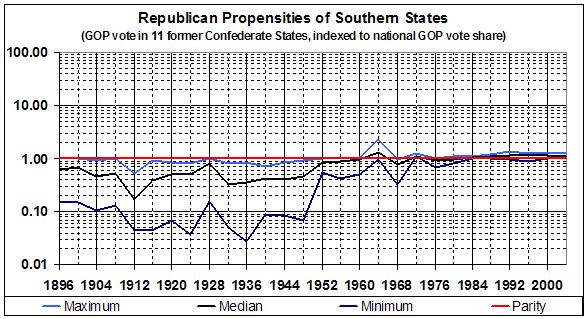
My purpose here isn’t to rehash Yglesias, Glaeser, and Douthat, but to tell the tale of the numbers. Specifically, I look at the share of popular votes garnered by GOP presidential candidates in the 11 States of the former Confederacy, in relation to the GOP candidates’ shares of the national popular vote. For example, the GOP candidate in 1944 (Thomas E. Dewey) garnered 17 percent of the popular vote in Texas; Dewey’s nationwide popular-vote share in that election was 46 percent. The index for the Texas vote for 1944 is therefore 0.37 (17 percent divided by 46 percent).

Here are the maximum, minimum, and median values for the 11 States, from the election of 1896 through the election of 2004:

As Reconstruction ended in the South, Democrats gradually reasserted political control and began to suppress the black vote, which had been heavily Republican. The suppression of the black vote was, by 1904, as complete as it would be, and the median value of 0.46 reflects that. (The dip in 1912 reflects the siphoning of GOP votes by Teddy Roosevelt’s potent third-party candidacy, which relegated the GOP to an ignominious third place in the popular and electoral vote counts.)

The median value remained at or below 50 percent through 1948, with the exception of 1928, when the Democrat candidate was Al Smith, a Roman Catholic. (The pro-GOP spike in 1928 suggests that about half of the South’s Democrats defected because of Smith’s Catholicism.) The noticeable dip from 1932 through 1944 points to the vein of Southern populism that was exploited by Democrats’ anti-capitalist rhetoric. (See, for example, this post about FDR and this Wikipedia entry about Louisiana’s Huey Long.)

Southern voters began to abandon the Democrat Party in 1948, when Strom Thurmond ran under the banner of the “Dixiecrat” Party. That party (formally, the States’ Rights Democratic Party) arose in response to the national party’s adoption of an anti-segregation plank at its convention. Thurmond was on the ballot in 17 States, but most of his support came from the 11 former Confederate States. He garnered only 2.4 percent of the popular vote, nationwide, but carried four Southern States — Louisiana, Mississippi, Alabama, and South Carolina. Thurmond’s victories there, and his good showing in several other Southern States, came at the expense of the Democrat Party’s nominee, Harry Truman, and do not show up as a gain for the GOP in 1948.

Having nowhere else to turn in 1952, many Southern Democrats defected to the GOP, and continued to do so in 1960, when the Democrat Party chose John F. Kennedy (a Catholic in name) as its presidential candidate.

Before you conclude that the GOP is strong in today’s South because of the events of 1948 and 1960, consider these points:

1.What Krugman conveniently ignores in his anti-Republican screed is the South’s long embrace of the Democrat Party, for blatantly racial reasons. Democrats Woodrow Wilson and FDR — who held the presidency for 20 of the first 45 years of the twentieth century — enjoyed strong support in the South and were, therefore, segregationist in their policies. Southern Democrats disproportionately voted for FDR and his New Deal, about which Krugman’s only complaint could be that it wasn’t socialistic (or fascistic) enough.

2. The South’s defection to the GOP peaked in 1964, the year of Barry Goldwater’s inglorious defeat — another “lost cause” for the South. Goldwater, who was anything but a segregationist, simply had strong views about the proper role of the federal government in relation to the States, namely, that it should butt out of the affairs of individuals and businesses. Such views were then more widely embraced in the South than in the North, and had as much to do with the South’s Jeffersonian tradition as with racial segregation.

3. The GOP’s grip on the South has, if anything, weakened since 1964. Whatever Richard Nixon and Ronald Reagan might have done to woo Southern voters did not cause those voters to flock to the Republican Party. Barry Goldwater’s conservatism caused that.

4. What about the sharp drop in Southern support for the GOP in 1968? That drop coincides with George Wallace‘s segregationist, third-party candidacy in 1968. Krugman would say: “Aha! That defection, and the GOP’s recovery from it in 1972 (when Wallace was out of the picture), demonstrates that the GOP depends (or depended) heavily on the Southern racist vote.” Not so fast, Paul: Southern Democrats defected to George Wallace in 1968 at the same rate as Southern Republicans.

5. Why was it legitimate for a super-majority of white Southerners to support the New Deal out of desperation, but illegitimate for many of them (and their children) to turn, years later, to a party more in tune with their conservative inclinations? The South merely has become the North in reverse: strongly Republican (as the North is strongly Democrat) for reasons of ideology, not of race. On that point, here is a harder-to-read but more accurate depiction of the South’s attachment (or lack thereof) to the Republican Party:

In sum, it is plain that the South’s attachment to the GOP since 1964, whatever its racial content, is much weaker than was the South’s attachment to the Democrat Party until 1948, when there was no question that that attachment had a strong (perhaps dominant) racial component.

Krugman’s condemnation of racial politics in a major political party comes 60 years too late, and it’s aimed at the wrong party.

Case closed.

* * *
Krugman’s real complaint, of course, is that Republicans have been winning elections far too often to suit him. His case of Republican Derangement Syndrome is so severe that he can only pin the GOP’s success on racism. I will refrain from references to Freud and Pinocchio and note only that Krugman’s anti-GOP bias seems to have grown as his grasp of economics has shrunk:

Krugman and DeLong: A Prevaricating Pair
Professor Krugman Flunks Economics
Paul Krugman, an Inspiration to Us All
Social Security: Myth and Reality
The Last(?) Word about Income Inequality
Krugman and Monopoly
Rich Voter, Poor Voter: Revisited
Setting the Record Straight about Paul Krugman’s “Who Was Milton Friedman?”
Krugman vs. Krugman

Election 2008: Second Forecast

My eighth forecast is here.

REVISED, 5:05 PM, 11/18/07

The Presidency – Method 1

Intrade posts odds on which party’s nominee will win in each State and, therefore, take each State’s electoral votes. I assign all of a State’s electoral votes to the party that is expected to win that State. Where the odds are 50-50, I split the State’s electoral votes between the two parties.

As of today, the odds point to this result:

Democrat, 302 electoral votes

Republican, 236 electoral votes

(No change since the first forecast, 11/16/07.)

The Presidency – Method 2

I have devised a “secret formula” for estimating the share of electoral votes cast for the winner of the presidential election. (No, it’s not “method 3,” described here.) The formula is based on the 35 presidential elections from 1868 through 2004. The standard error of the estimate is 3.6 percentage points, as against the winner’s average share for the 35 elections, which is 71.7 percent. Here’s how formula-based estimates for the 35 elections compare with the actual results of those elections:

The only “wrong” pick is the one for the election of 1876, which was decided even more crookedly than the 1960 election (see below).

The largest errors (greater than 5 percentage points) occur in these seven instances:

  • McKinley’s re-election in 1900 — EV share underestimated by 8.2 percentage points, that is, by 37 EVs.
  • T. Roosevelt’s election in 1904, after having become president following McKinley’s assassination in 1900 — Share overestimated by 5.3 percentage points, 25 EVs.
  • FDR’s re-election in 1940 — Share underestimated by 5.1 percentage points, 27 EVs.
  • Truman’s election in 1948, after having become president following FDR’s death in 1945 — Share overestimated by 5.7 percentage points, 30 EVs.
  • Kennedy’s election in 1960 — Share underestimated by 5.6 percentage points, 30 EVs. (Illinois, thanks to Chicago’s mayor, Richard Daley, delivered its 27 EVs to Kennedy. Otherwise, the legitimate outcome, 276 EVs for JFK, would have been uncannily close to my estimate of 273 EVs for JFK . I assume, perhaps wrongly, that JFK’s narrow win in Texas, with its 24 EVs was owed to LBJ’s ability to pull in votes as JFK’s running mate, not to LBJ’s ability to rig elections.)
  • Reagan’s initial election in 1980 — Share underestimated by 8.1 percentage points, 44 EVs.
  • G.W. Bush’s re-election in 2004 — Share overestimated by 6.1 percentage points, 33 EVs. (By the way, I chose to use a model that’s wide of the mark in 2004, for the sake of getting a better fit across the board. It bothered me, at first, to show a bad estimate at the right-hand edge of the graph, where it looms so obviously. But a statistical model should be chosen for how well it fits all of the observations on which it’s based, not just the outliers — statistical or graphical.)

My formula currently yields these estimates of the outcome of next year’s presidential election (CORRECTED, 12/13/07):

Democrat nominee — 241 to 280 EVs

Republican nominee — 258 to 297 EVs

In sum, the prospect of a Democrat victory isn’t as clearcut as method 1 suggests.

Will method 1 or method 2 prove to be the more accurate one? The answer is less than a year away. Stay tuned.

U.S. House and Senate

Later.

* * *

How did I do in 2004? See this and this.

Election 2008: First Forecast

My eighth forecast is here.

The Presidency

Intrade posts odds on which party’s nominee will win in each State and, therefore, take each State’s electoral votes. I assign all of a State’s electoral votes to the party that is expected to win that State. Where the odds are 50-50, I split the State’s electoral votes between the two parties.

As of today, the odds point to this result: Democrat, 302 electoral votes; Republican, 236 electoral votes.

U.S. House and Senate

Later.

* * *
How did I do last year? See this and this.

A Political Compass: Locating the United States

This post builds on “A Political Compass” and its predecessor, “The Inevitability of the Communitarian State, or What’s a Libertarian to Do?” I apply the concept of the political compass to assess, harshly but realistically, our present location. Most of the links herein point to supporting posts at Liberty Corner.

Introduction

The left-right, liberal-conservative taxonomies of the political spectrum are inadequate because they are linear and lacking in subtlety. The political spectrum is more usefully thought of as a compass, with anarchy, libertarianism, communitarianism, and statism as its four main directions.

In the history of the United States, the compass’s needle has swung from a point near libertarianism, through communitarianism, and toward statism.

To change the metaphor, the tide of communitarianism — which began to swell around the turn of the twentieth century — rose inexorably to engulf the United States in the aftermath of the Great Depression and World War II. The tide has continued to rise, slowly and silently engulfing us in statism.

But let us begin with anarchy, the point of the compass that, thankfully, we have not visited.

Anarchy

According to anarchists (or anarcho-libertarians, as I call them), an individual’s freedom of action should be limited only by (a) voluntary observance of social norms and (b) contracts (enforced by third parties) that bind the members of a group to observe certain restraints and to pay certain penalties for failing to observe those restraints. Who keeps the third parties honest? Who arbitrates inter-group disputes in cases where the different groups clearly have different norms, interests, or objectives? What happens when a person or faction within a group or a faction outside any group attains superior force and decides to employ that force in the service of its norms, interests, or objectives. (See this and this for more in that vein.)

Anarchy, in other words, boils down to “might makes right,” even though its adherents would like it to be otherwise.

We in the United States have been spared anarchy. Our founding experience, in fact, held the promise of libertarianism.

Libertarianism

Given the inconsistency of anarchy with liberty (for liberty cannot thrive where might makes right), we turn to the only political arrangement that (if it is nurtured) can assure liberty, namely, minarchy.

Rights and liberty, it must be understood, are not Platonic abstractions; they are, rather, social phenomena. They are the best “deal” we can make with those around us — the set of compromises that define acceptable behavior, which is the boundary of liberty. Those compromises are not made by a philosopher-king but through an evolving consensus about harms — a consensus that flows from reason, experience, persuasion, and necessity.

Minarchism is true libertarianism because it provides a minimal state for the protection of the lives, liberty, and property of those who adhere to it; a state that otherwise remains neutral with respect to its adherents’ affairs; a state that does not distort the wisdom embedded in tradition, that is, in voluntarily evolved social norms; a state that is nevertheless sufficiently powerful to protect its willing adherents‘ interests from predators, within and without.

Minarchy, unlike anarchy, is possible, given sufficient luck and vigilance. As I wrote here,

[t]here must…be an overarching, non-market institution which enables markets to operate efficiently, that is, to reach outcomes that are seen as beneficial by all those willingly operate within markets. The necessary supervening institution is the minimal state (a minarchy) that is vested with enough authority to protect market participants from force and fraud, but not so much authority so as to enable its interference with market outcomes.

Only a wise (and rare) élite can establish such a state. The existence of such an élite — and its success in establishing a lasting minarchy — depends on serendipity, determination, and (yes) even force. That we, in the United States, came close (for a time) to having such a minarchy was due to historical accident (luck). We had just about the right élite at just about the right time, and the élite‘s wisdom managed to prevail for a while.

The dichotomy between anarcho-capitalism and minarchy is a false one. The true dichotomy is between minarchy and warlordism (which follows from anarchy).

That we have moved on to something worse than minarchy is not proof of the superiority of anarcho-capitalism. It is, rather, proof that our luck ran out.

For the 100-plus years between the ratification of the Constitution and the rise of the first Roosevelt, we had something close to minarchy here in the United States: a “night watchman” state of limited powers, standing guard over a collection of quasi-independent States. The people of those States (all of them, since the Civil War) were free — in the world of reality that lies beyond the ken of anarchists — to choose the most amenable State and locality in which to make the best possible “deal” for themselves.

We had nothing to fear but…that the minimal state would exceed its charter and descend into

Communitiarianism

Communitarianism is the regulation by the state of private institutions for the purpose of producing certain outcomes desired by controlling élites (e.g., income redistribution, “protection” from learning by our mistakes, “protection” from things deemed harmful by the worrying classes, and “social (or cosmic) justice“). Such outcomes, contrary to their stated purposes, are unwise, inefficient, and harmful to their intended beneficiaries.

Communitarianism is the stage that we passed through as our “luck ran out.” Which is to say, our vigilance faltered and we succumbed to the ruinous despotism of democracy: the voterenabled substitution of state-imposed and state-endorsed behavioral norms for socially evolved ones — always in the name of “liberality” or “progress.”

The communitarian state simply is too seductive. It co-opts its citizens through progressive corruption: more spending and regulation, to curry favor with certain voting blocs, higher taxes to fund more spending and to perpetuate the regulatory mechanisms of the state; still more taxation, spending, and regulation; and so on.

Each voting bloc insists on sustaining its benefits, and increasing them at every opportunity, for one of three reasons. Many voters actually believe that the largesse of the communitarian state is free to them, and some of them are right (but only for the short run). Other voters know better, but they grab what they can get because others will grab it if they don’t. Then there are those voters (and well-heeled political contributors) who exude noblesse oblige toward the “less fortunate” and “oppressed.” Such voters (and contributors), who now are predominant among the very-to-super rich, view the paying of taxes as a sacred duty (even a privilege), and consider the state a massive charitable and social-leveling organization.

Whatever the motivation for the communitarian state, those who vote for it and those who enable it through their political contributions are profoundly irrational. This irrational, communitarian urge began to dominate American politics with the rise of the first Roosevelt. Our descent into full-blown communitarianism was hastened by the Great Depression, a government-made and government-prolonged tragedy, exploited (then and now) by the proponents of communitarianism and statism.

Statism

We were, for decades, poised on the brink of the abyss of statism, which is outright state control of most social and economic institutions (e.g., medicine, notably but far from exclusively). I have concluded that we have gone over the brink and slid, silently and docilely, into the abyss.

Statism may be reached either as an extension of communitarianism or via post-statist anarchy or near-anarchy, as in Stalin’s Russia, Hitler’s Germany, and Mao’s China. We have come to statism via communitarianism, which leads inevitably to statism because the appetite for largesse is insatiable, as is the desire (in certain circles) to foster “social (or cosmic) justice.”

I was once optimistic that our transition to all-out statism would lead, in turn, to overthrow of statism:

[S]tatism is an easier target for reform than communitarianism. The high price of statism becomes obvious to more voters as more facets of economic and personal behavior are controlled by the state. In other words, statism’s inherent weakness is that it creates more enemies than communitarianism.

That weakness becomes libertarians’ opportunity. Persistent, reasoned eloquence in the cause of liberty may, at last, slow the rise of statism and hasten its rollback. And who knows, perhaps libertarianism will gain adherents as the rollback gains momentum.

My optimism has vanished, as I have come to understand that politicians their enablers (voters and contributors) are profoundly irrational. They prefer statism to liberty, regardless of what they say. They (most of them) mean to be benign, but statism is not benign. Statism may seem benign — as it does to Europeans, for example — but it is dehumanizing, impoverishing, and — at bottom — destructive of the social fabric upon which liberty depends.

Conclusion

Our statism is better-disguised than Europe’s, but it is there, in the insidious, voter-supported machinery of government that has caused us to be so heavily regulated and legislated by so many federal, State, and local agencies. Try to think of an aspect of your life — what you can do, what you can buy, what you can afford to buy, the income you earn as an employer or employee, and so on — that is not dictated by government, either directly or through taxation and regulation. As you think about your life, consider these things:

  • how zoning and building codes affect the cost, location, and specifications of your dwelling
  • how licensing and zoning affect the numbers and types of businesses that offer the goods and services you seek
  • the availability (or non-availability) to you of beneficial drugs because of testing mandates that result in more death and illness, not less
  • limitations on the numbers and types of doctors and other health-care providers from which you can choose
  • where you may smoke (even if the venue is private property)
  • whether or not you may own and carry a firearm with which to defend yourself
  • the security of your property from arbitrary seizure by government
  • the provision of myriad government “social services” (e.g, bike trails and nature preserves for yuppies, hippies, and tree-huggers) for which you have no need but for which you are nevertheless taxed because such services have voting constituencies and politicians who benefit from catering to those constituencies
  • relatedly, the provision of so-called federal money to your State and local governments, which money comes from taxes imposed by the federal government, over which you have even less control than you do of your State and local governments
  • the number, location, and characteristics of highways (which often are built as pork-barrel projects), none of which monitor or restrict the of entry or incompetent, drunk, or cell-phone-using drivers (as could be the case with private highways for selective users who are willing to pay the price to be able to drive sanely and safely)
  • the failure of government to defend you adequately against enemies and likely enemies, foreign and domestic, so that it may fund “social services” and cosset criminals
  • the number of public-utility providers who can serve you, and the rates that they may charge you
  • the persons whom you (or your employer) may hire, fire, and promote — almost regardless of their credentials and performance, and certainly regardless of how they affect your performance (or your employer’s ability to continue your employment)
  • the benefits that you (or your employer) must provide employees, regardless of the effect of such mandates on your ability (or that of your employer) to start or stay in business
  • how much you may contribute to a political campaign, and what may be said on the air about an upcoming election
  • the provision of “government” funding to political campaigns
  • the provision of your tax dollars to “scholars” who scoff at your morality and propound schemes to further regulate and impoverish you
  • whether, how, and where your children must be schooled

The list could go on and on. But you get the idea — I hope.

If you believe in the necessity of the things I have listed, and believe that you are better off because of them, you haven’t been paying attention — or you are an enabler of statism.

A bit of taxation here and a bit of regulation there, and before you know it you are living under the thumb of the state.

Political Calculus

Slice it any way you want…

Pct. of tax returns for 2005

No adjusted gross income……………..

1.3106

43.1

89.3

99.8

97.3

$1 under $5,000…………………………..

8.5407

$5,000 under $10,000…………………..

9.0154

$10,000 under $15,000…………………

8.6593

$15,000 under $20,000…………………

8.2804

$20,000 under $25,000…………………

7.2814

$25,000 under $30,000…………………

6.5029

46.2

$30,000 under $40,000…………………

10.3744

$40,000 under $50,000…………………

7.9023

$50,000 under $75,000…………………

13.6568

$75,000 under $100,000……………….

7.7769

$100,000 under $200,000……………..

8.0451

10.5

10.5

$200,000 under $500,000……………..

2.0375

2.6

$500,000 under $1,000,000…………..

0.3903

$1,000,000 under $1,500,000………..

0.0952

0.2

0.2

0.2

$1,500,000 under $2,000,000………..

0.0004

$2,000,000 under $5,000,000………..

0.0626

$5,000,000 under $10,000,000………

0.0019

$10,000,000 or more…………………….

0.0011

…it spells envy at the low end and political perversity at the high end.

(Extracted and derived from this IRS table. More here and here.)

Ahead of His Time

The problem that faces us today … is due to the inherent contradictions of an abnormal state of culture. The natural tendency … is for … society to give itself up passively to the machinery of modern cosmopolitan life. But this is no solution. It leads merely to the breaking down of the old structure of society and the loss of the traditional moral standards without creating anything which can take their place.

As in the decline of the ancient world, the family is steadily losing its form and its social significance, and the state absorbs more and more of the life of its members. The home is no longer a centre of social activity; it has become merely a sleeping place for a number of independent wage-earners. The functions which were formerly fulfilled by the head of the family are now being taken over by the state, which educates the children and takes the responsibility for their maintenance and health.

From Christopher Dawson’s essay, “The Patriarchal Family in History” (1933), collected in The Dynamics of World History (1956). (Paragraph break added: LC.)

Let us hope for an incremental bit of progress on one front: parental choice in the schooling of children. (By progress, of course, I don’t mean the kind of “progress” sought by regressive “progressives,” who would have us and our progeny bow to the almighty state — as long as they control it.)

Wrong

Ross Douthat writes:

Maybe it isn’t a conscious strategy for the Democrats, but it makes a certain sense: Take from the super-rich, who aren’t tax-sensitive, and the pretty-damn-rich, who will probably vote for the GOP no matter what, and give to upper-middle class professionals, a constituency where the Dems have been making inroads for a while now.

Sorry, Ross, but it’s evident that the “inroads” are more like “surrender.” Higher taxes on the super-rich and pretty-damn-rich will affect constituencies that have pretty much gone over to the dark side (the Democrat Party, that is).

Election 2008 Factoid

The presidential election markets at Iowa Electronic Markets are showing a dip in Giuliani’s chances for the GOP nomination and (therefore?) a slight increase in the expected vote share for the Democrats’ nominee.

Where’s the Gipper when we need him?

Rich Voter, Poor Voter: Revisited

REVISED AND EXTENDED, 10/27/07

All manner of good (and bad) stuff has popped up about the relationship between income and political preferences. Tyler Cowen of Marginal Revolution points to this post at Free exchange, which I shamelessly repeat in its entirety (with the addition of some comments and additional links) and then expand upon:

PAUL KRUGMAN, brimming with conscience [a reference to Krugman’s recently published The Conscience of a Liberal: LC], continues to scrounge for evidence [here also: LC] that the monied prefer the Grand Old Party. “There’s a weird myth among the commentariat that rich people vote Democratic,” Mr Krugman sighs.

Well, I suppose it’s weird for the commentariat to believe Pew Research Center reports that find “Democrats pulling even with Republicans among registered voters with annual family incomes in excess of roughly $135,000 per annum.” $135,000 may not sound exactly “rich” to some of us, but it is well into the top decile of the income distribution, which counts as the “upper class” if we’re doing decile-based class analysis. As part of his myth-slaying efforts, Mr Krugman offers a chart from Columbia’s Andrew Gelman from whom we have also learned that the wealthiest American states now lean Democratic (as was noted in this August post on precisely this issue). [I wrote here about an earlier version of the Gelman paper that is linked in the preceding sentence. Krugman links to a recently updated version, which is here: LC] Wealthy localities remains likely to tilt Republican in the South, Gelman finds. But in “media center” states such as New York, California, and the states contiguous to the Imperial Capital, Democrats dominate the country clubs. [See this post by Gelman, especially the x-y plots and the final sentence. See also this list of the 100 Zip Codes with the highest incomes: LC]

Furthermore, the writer and bon vivant Julian Sanchez points us to this Daniel Gross column in Slate wherein we are informed of a poll showing that:

The petit bourgeoisie millionaires were passionately for Bush: Those worth between $1 million and $10 million favored Bush by a 63-37 margin. But the haute millionaires, those worth more than $10 million, favored Kerry 59-41.

Mr Sanchez smartly comments:

You hit a point at which you don’t just have a lot of money; you’ve got “f[—] you” money. … At which point “voting your economic self-interest” ceases to mean much, since your economic interests are covered [by] whoever’s in power. You can afford to stop voting your pocketbook and start voting whatever makes you feel like a mensch. [You can vote your inner adolescent or your irrespsonsible “take that” attitude: LC]…

Ironically, this may be a point in favor of those who appeal to the declining marginal utility of money as an argument for economic redistribution. If this is right, then the efficient place to start imposing really crushing marginal taxes is at the income or wealth level where people start voting heavily Democratic.

Ha! But seriously, the real issue here is whether economic interests are a major determinant of voting patterns at all. If wealthy voters in certain culturally similar states prefer Democrats and those in other culturally similar states prefer Republicans, we might plausibly infer that something other than their wealth is determining wealthy votes. And since individual votes are drops in an ocean, with barely a whisper of causal power, those of us who take economic logic seriously might expect citizens, wealthy or not, to forget about voting their interests and instead cast ballots that will reliably supply utility by, say, expressing their moral values, political identity, or sense of solidarity with an imagined community. As Loren Lomasky and Geoffrey Brennan write in their classic work “Democracy and Decision“:

It would be an error of method to assume whenever electoral behavior is consistent with the self-interest hypothesis that citizens vote in order to further self-interest. And it is an error of logic to assume that rational agents will, purely as a matter of course, vote in a self-interested manner.

I fear that Mr Krugman’s book may turn on at least one of these.

I have no doubt that Krugman’s book is both erroneous of method and logic.

I entirely agree with Julian Sanchez’s point that very rich voters vote mainly to make a statement. As I wrote here,

[t]he “rich” in the rich States — as is obvious from casual reading about limousine liberals and wannabe limousine liberals in New York and California — have by and large bought into the regulatory-welfare state, which is mainly a creation of the Democrat Party. So, the rich-State rich vote their “consciences” or, rather, they tend to vote Democrat because the think they can

  • keep the unwashed masses at bay with the modern equivalent of bread and circuses.
  • salve their (misplaced) guilt about the “good luck” that made them rich….

Why does it work like that? Because where you live has a lot to do with your values. People tend to adapt (“go along and get along”) or migrate.

The same principle applies to academia [e.g., see this]. Conservative and libertarian intellectuals tend to avoid academic careers (call it pre-emptive migration) because they don’t want to adapt their thinking to fit in with the liberal supermajority on most campuses.

Joining Andrew Gelman and the Pew Research Center, I offer this evidence of Krugman’s displacement from reality:

Sources: Kerry’s vote, as a percentage of the total number of popular votes cast in each State, is from RealClearPolitics (here). I derived the percentage of tax returns with an adjusted gross income of $200,000 or more from “Table 2.–Individual Income and Tax Data, by State and Size of Adjusted Gross Income, Tax Year 2005,” which is available through this page at the IRS website.

What could be clearer than that? The more you make, once you have crossed a threshold, the more likely you are to vote Democrat. That threshold, according to the Pew Research Center, is a household income in 2007 of $135,000 — the point at which one joins the top 10 percent.

Let’s take a closer look at the graph. The red dot — at 2.7 percent of tax returns and 48.3 percent of the popular vote — represents the U.S. in the aggregate. The Red-State outliers are represented by the many points that lie to the left of the red dot and well below the regression line, which include Nebraska (1.7, 32.4), Idaho (1.8, 30.3), Utah (2.0, 26.5), and Wyoming (2.2, 29.1) — States that are deeply Republican, far from the effete East and West Coasts, and too small to carry any weight in a national election. Their political opposites are (well above the line) Maine (1.7, 53.0), Vermont (2.0, 59.1) and Rhode Island (2.5, 59.6), and (on the far right, graphically speaking) New York (3.3, 57.8), Virginia (3.4, 45.2 — a high Blue vote for this once deep-Red State), California (3.5, 54.6), Maryland (3.5, 55.4), Massachusetts (3.9, 62.1), New Jersey (4.4, 52.3), D.C. (the Imperial Capital) (4.6, 89.3), and Connecticut (4.9, 54.2). We know all we need to know about the pathological politics of the Northeastern States and California. As for the formerly conservative States of Maryland and Virginia, elections there are increasingly dominated by the affluent and rapidly growing suburbs that border the Imperial Capital.

A geographical breakdown confirms the generalization that the more you make (above the threshold), the more likely you are to vote Blue:

Sources as above. States in each region (from left to right on the x-axis): West — North Dakota, Montana, South Dakota, Nebraska; Southeast — Mississippi, Arkansas, Kentucky, Oklahoma, Alabama, Louisiana, South Carolina, Missouri, Tennessee, North Carolina, Georgia, Texas, Florida, Virginia; North Central — West Virginia, Iowa, Indiana, Ohio, Michigan, Wisconsin, Minnesota, Illinois; West Coast & Far Southwest — New Mexico, Hawaii, Oregon, Arizona, Nevada, Washington, California; Northeast — Maine, Vermont, Pennsylvania, Delaware, Rhode Island, New Hampshire, New York, Maryland, Massachusetts, New Jersey, D.C., Connecticut.

In ascending order of Blueness (or descending order of Redness) we have:

West
Southeast
North Central/West Coast & Far Southwest (about the same)
Northeast

A few observations and explanations: The Southeast isn’t as Red as it was a few elections ago — owing to the rapid urbanization of such States as Georgia, Florida, and Virginia — but most Southeastern States remain on the Red side of the ledger, most of the time. Maryland and D.C., as long-standing denizens of the super-urban Bos-Wash corridor, belong in the Northeast region, just as West Virginia — a unionized, industrial State — belongs in the North Central region with its neighbor, Ohio.

Out of curiosity, I tried moving Maryland and D.C. from the Northeast to the Southeast, with these results: a flat trendline for the Northeast; a more positive slope on the trendline for the Southeast. In other words, the Northeast without Maryland and D.C. displays a constant degree of Blueness (about 55 percent for Kerry), regardless of the proportion of tax returns with AGI of $200,000 or more. Thus, the omission of Maryland and D.C. from the Northeast simply underscores the deep-rooted Blueness of the “old” Northeast. It just is Blue, from its heavily unionized “working stiffs” to its super-affluent “masters of the universe.” But, as I say in the preceding paragraph, Maryland and D.C. merged into the Northeast quite some time ago.

In any event, the positive relationship between income and Blueness holds for each region, even though there are also inter-regional differences. (“Birds of a feather…,” as suggested above.) If Blueness were simply a regional trait, each of the trendlines would be flat — but, in fact, each one slopes upward to the right. Thus (to say it again):

The more you make (above a threshold which is now $135,000), the more likely you are to vote Democrat.

Paul Krugman (no prole he) is living evidence of that statement.

Re: Election 2008

I salivate at the thought of an all-New York — Giuliani-Clinton — race for president. A real New Yorker vs. a carpet-bagger. A prosecutor vs. an almost-prosecutee. (Remember Whitewater, the missing records, the cattle futures, Travel-gate, etc.? I do.)

Perry for Vice President?

Rick Perry, purported conservative and governor of Texas, has endorsed Rudy Giuliani’s bid for the Republican presidential nomination. Giuliani currently leads the GOP race, having opened a comfortable lead over Mitt Romney at Iowa Electronic Markets. (McCain’s spike seems to coincide with Thompson’s slide and the possibility — as I see it — that Thompson will withdraw from the race before long.)

Why has Perry endorsed front-runner Giuliani? Perry’s term as governor runs until January 20, 2011. But why play on the Texas stage — big as it is — when you have a shot at national office? Perry, as a purported conservative and known Texan, would “balance” Giuliani’s watery Republicanism and Noo Yawk accent. Perry’s “clout” as a big-State governor and presumed appeal to Southern and Southwestern conservatives might just garner him the number-two spot on a Giuliani ticket.

P.S. As a Giuliani-Clinton race has become increasingly likely, bettors at Iowa Electronic Markets have begun to see a closer race in November ’08. The odds still favor the Democrat nominee, but the gap is narrow in the vote-share market, where the current betting is 0.516 Democrat to 0.489 Republican.

Rothbard: Sometimes Right

Here, for instance. (See this related post of mine.)

Michigan’s Economic Suicide

See this, then this, then this.

Telling Odds

As of this evening, Iowa Electronic Markets has Hillary Clinton as a better than two-to-one favorite for the Democrat nomination in 2008. Rudy Giuliani, Mitt Romney, and Fred Thompson are in a close race for the Republican nomination; therefore, none is better than a one-in-three favorite.

In spite of the Republican elephant race, and because of Frau Clinton’s dominance of Democrats, the IEM odds on the outcome of the election give only a slight edge to the Democrat nominee: 52-48. And that’s before Republicans unite to attack Clinton and her Soviet-style agenda.

More (of the Same) Reasons to Vote Republican in ’08

I linked to some here. There’s more in that vein here.

The Ruinous Despotism of Democracy

Not long ago, in “‘Liberalism,’ as Seen by Liberals,” I quoted from a review in The Washington Post of Paul Starr’s Freedom’s Power: The True Force of Liberalism. Here is an especially telling paragraph from the review:

By opening up power to progressively broader participation, liberal constitutions have subjected government to scrutiny, criticism and even resistance, and thus have helped to protect citizens against overweening bureaucracies. At the same time, they have made democratic states more legitimate and have enabled them to borrow, tax and, until recently, conscript more and more. Paradoxically, then, constitutionally limited states historically have wielded more power than despotic ones.

I was reminded of that passage by one that I have just came upon in Christopher Dawson’s The Dynamics of World History (a compilation of Dawson’s essays written 1921-55):

Today the common traditions [of religion and culture] have been abandoned by the rulers of the modern [s]tate and the planners of modern society, while at the same time the latter have come to exercise a more complete control over the thought and life of the whole population than the most autocratic and authoritarian powers of the past ever possessed.

Dawson wrote that in 1949. Though he was writing about Britain, he might just as well have been writing about the United States. And matters have only worsened here (as in Britain). Consider the economic realm, for example:


Of course, there’s more to it than that. There are social consequences aplenty (e.g., higher rates of violent crime) arising from the voterenabled substitution of state-imposed and state-endorsed behavioral norms for socially evolved ones — always in the name of “liberality” or “progress.” For example, as I wrote here:

[A]bortion-on-demand and same-sex marriage are not manifestations of liberality, they are manifestations of statism because they are (or would be) state-imposed — which is what “liberals” want.

If abortion-on-demand and same-sex marriage were manifestations of liberality, they would have arisen from voluntarily evolved social norms. That they have not done so means that they are destructive of the social order — of civil society — upon which liberty depends.

If my position makes me out to be a reactionary, I stand with Barry Goldwater:

I would remind you that extremism in the defense of liberty is no vice. And let me remind you also that moderation in the pursuit of justice is no virtue.

To put it more baldly, todays “democratic statism” is antithetical to liberty, justice, and progress. For our sake and the sake of our progeny, it must by replaced by the founding principles of limited-government republicanism.

There’s more — much more — in the following categories:
Affirmative Action – Immigration – Race
Constitution – Courts – Law – Justice
Economics: Principles and Issues
Leftism- Statism – Democracy
Liberty – Libertarianism – Rights
Religion – Science – Pseudoscience
Self-Ownership… – Gender – Etc.
War – Peace – Foreign Affairs