DoJ on Net Neutrality

According to K. Lloyd Billingsley, writing at TCS Daily, the Department of Justice has taken exactly the right stance on “net neutrality”:

Net neutrality means government regulation of the Internet, specifically a prohibition of differential charges for priority traffic. The Department of Justice thinks this is a bad idea, and would harm the development of the Internet.

“Free market competition, unfettered by unnecessary governmental regulatory restraints, is the best way to foster innovation and development of the Internet,” says the DoJ filing [with the FCC on September 6]….

“There is reason to believe that the type of regulatory restraints proposed by some commenters under the mantle of ‘neutrality’ could actually deter and delay investment and innovation, and result in less choice and higher prices to consumers of Internet services,” the Department said.

In the lexicon of net neutrality, differential or priority pricing is called “discrimination,” but the DoJ does not buy this rhetorical effort to seize the moral high ground. “Differentiating service levels and pricing, for example, is a common and often efficient way of allocating scarce resources and meeting consumer preferences,” the filing explains, using the United States Postal Service as an example.

DoJ might have used a better example than USPS. Nor is differential pricing restricted to service. The most expensive items purchased by consumers (houses and cars) are price-differentiated to a fare-thee-well. Imagine the furore if government regulators decreed that all houses and cars had to be the same and sell for the same price.

The bottom line: DoJ has it right about “net neutrality.” As I wrote here:

By the “logic” of net neutrality, everyone would be forced to accept goods and services of the same quality. That quality would be poor because there would be no incentive to produce better goods and services to earn more money in order to buy better goods and services — because they couldn’t be bought. Reminds me of the USSR.

Read the whole thing. It’s on the mark, if I do say so myself.

FDR and Fascism

A blogger (to whom I will not link) once tried to disparage me by referring to my position that (in his words) “Franklin Roosevelt, Adolph Hitler and Joseph Stalin were all essentially dictators.” I suppose that the blogger in question believes Hitler and Stalin to have been dictators. His poorly expressed complaint, therefore, is my lumping of FDR with Hitler and Stalin.

I doubt that the not-to-be-named blogger considers FDR a saint, or even a praiseworthy president. Such a view would be inconsistent with the blogger’s (rather murky) paleo-conservative/libertarian views. The blogger’s apparent aim was not to defend FDR but to discredit me by suggesting that my view of FDR is beyond the pale.*

To the contrary, however, the perception of FDR as a dictator (or dictator manqué) with a fascistic agenda is of long standing and arises from respectable sources. Albert Jay Nock, an early and outspoken opponent of the New Deal — and a paleo-libertarian of the sort admired by the blogger in question — certainly saw Roosevelt’s fascistic agenda for what it was. Many mainstream politicians also attacked Roosevelt’s aims; for example:

While the First New Deal of 1933 had broad support from most sectors, the Second New Deal challenged the business community. Conservative Democrats, led by Al Smith, fought back with the American Liberty League, savagely attacking Roosevelt and equating him with Marx and Lenin.[21]

That Smith and others were unsuccessful in their opposition to FDR’s agenda does not alter the essentially fascistic nature of that agenda.

Now comes David Boaz’s “Hitler, Mussolini, Roosevelt: What FDR had in common with the other charismatic collectivists of the 30s,” a review of Wolfgang Schivelbusch’s Three New Deals: Reflections on Roosevelt’s America, Mussolini’s Italy, and Hitler’s Germany, 1933–1939. Toward the end of the review, Boaz writes:

Why isn’t this book called Four New Deals? Schivelbusch does mention Moscow repeatedly…. But Stalin seized power within an already totalitarian system; he was the victor in a coup. Hitler, Mussolini, and Roosevelt, each in a different way, came to power as strong leaders in a political process. They thus share the “charismatic leadership” that Schivelbusch finds so important.

…B.C. Forbes, the founder of the eponymous magazine, denounced “rampant Fascism” in 1933. In 1935 former President Herbert Hoover was using phrases like “Fascist regimentation” in discussing the New Deal. A decade later, he wrote in his memoirs that “the New Deal introduced to Americans the spectacle of Fascist dictation to business, labor and agriculture,” and that measures such as the Agricultural Adjustment Act, “in their consequences of control of products and markets, set up an uncanny Americanized parallel with the agricultural regime of Mussolini and Hitler.” In 1944, in The Road to Serfdom, the economist F.A. Hayek warned that economic planning could lead to totalitarianism. He cautioned Americans and Britons not to think that there was something uniquely evil about the German soul. National Socialism, he said, drew on collectivist ideas that had permeated the Western world for a generation or more.

In 1973 one of the most distinguished American historians, John A. Garraty of Columbia University, created a stir with his article “The New Deal, National Socialism, and the Great Depression.” Garraty was an admirer of Roosevelt but couldn’t help noticing, for instance, the parallels between the Civilian Conservation Corps and similar programs in Germany. Both, he wrote, “were essentially designed to keep young men out of the labor market. Roosevelt described work camps as a means for getting youth ‘off the city street corners,’ Hitler as a way of keeping them from ‘rotting helplessly in the streets.’ In both countries much was made of the beneficial social results of mixing thousands of young people from different walks of life in the camps. Furthermore, both were organized on semimilitary lines with the subsidiary purposes of improving the physical fitness of potential soldiers and stimulating public commitment to national service in an emergency.”

And in 1976, presidential candidate Ronald Reagan incurred the ire of Sen. Edward Kennedy (D-Mass.), pro-Roosevelt historian Arthur M. Schlesinger Jr., and The New York Times when he told reporters that “fascism was really the basis of the New Deal.”

You get the idea by now, I hope. The correlation of FDR’s regime with those of Hitler and Mussolini (not to mention Stalin’s) is hardly discredited or beyond the pale.

Boaz writes, also, about the ends and means of the New Deal:

On May 7, 1933, just two months after the inauguration of Franklin Delano Roosevelt, the New York Times reporter Anne O’Hare McCormick wrote that the atmosphere in Washington was “strangely reminiscent of Rome in the first weeks after the march of the Blackshirts, of Moscow at the beginning of the Five-Year Plan.…America today literally asks for orders.” The Roosevelt administration, she added, “envisages a federation of industry, labor and government after the fashion of the corporative State as it exists in Italy.”

That article isn’t quoted in Three New Deals, a fascinating study by the German cultural historian Wolfgang Schivelbusch. But it underscores his central argument: that there are surprising similarities between the programs of Roosevelt, Mussolini, and Hitler….

The dream of a planned society infected both right and left. Ernst Jünger, an influential right-wing militarist in Germany, reported his reaction to the Soviet Union: “I told myself: granted, they have no constitution, but they do have a plan. This may be an excellent thing.” As early as 1912, FDR himself praised the Prussian-German model: “They passed beyond the liberty of the individual to do as he pleased with his own property and found it necessary to check this liberty for the benefit of the freedom of the whole people,” he said in an address to the People’s Forum of Troy, New York.

American Progressives studied at German universities, Schivelbusch writes, and “came to appreciate the Hegelian theory of a strong state and Prussian militarism as the most efficient way of organizing modern societies that could no longer be ruled by anarchic liberal principles.” The pragmatist philosopher William James’ influential 1910 essay “The Moral Equivalent of War” stressed the importance of order, discipline, and planning….

In the North American Review in 1934, the progressive writer Roger Shaw described the New Deal as “Fascist means to gain liberal ends.” He wasn’t hallucinating. FDR’s adviser Rexford Tugwell wrote in his diary that Mussolini had done “many of the things which seem to me necessary.” Lorena Hickok, a close confidante of Eleanor Roosevelt who lived in the White House for a spell, wrote approvingly of a local official who had said, “If [President] Roosevelt were actually a dictator, we might get somewhere.” She added that if she were younger, she’d like to lead “the Fascist Movement in the United States.” At the National Recovery Administration (NRA), the cartel-creating agency at the heart of the early New Deal, one report declared forthrightly, “The Fascist Principles are very similar to those we have been evolving here in America.

Roosevelt himself called Mussolini “admirable” and professed that he was “deeply impressed by what he has accomplished.”…

Schivelbusch argues that “Hitler and Roosevelt were both charismatic leaders who held the masses in their sway—and without this sort of leadership, neither National Socialism nor the New Deal would have been possible.” This plebiscitary style established a direct connection between the leader and the masses. Schivelbusch argues that the dictators of the 1930s differed from “old-style despots, whose rule was based largely on the coercive force of their praetorian guards.” Mass rallies, fireside radio chats—and in our own time—television can bring the ruler directly to the people in a way that was never possible before.

To that end, all the new regimes of the ’30s undertook unprecedented propaganda efforts. “Propaganda,” Schivelbusch writes “is the means by which charismatic leadership, circumventing intermediary social and political institutions like parliaments, parties, and interest groups, gains direct hold upon the masses.” The NRA’s Blue Eagle campaign, in which businesses that complied with the agency’s code were allowed to display a “Blue Eagle” symbol, was a way to rally the masses and call on everyone to display a visible symbol of support. NRA head Hugh Johnson made its purpose clear: “Those who are not with us are against us.”…

Program and propaganda merged in the public works of all three systems. The Tennessee Valley Authority, the autobahn, and the reclamation of the Pontine marshes outside Rome were all showcase projects, another aspect of the “architecture of power” that displayed the vigor and vitality of the regime.

If FDR’s aims were fascistic — and clearly they were — why didn’t the U.S. become a police state, in the mold of Germany, Italy, and the Soviet Union? Boaz concludes:

To compare is not to equate, as Schivelbusch says. It’s sobering to note the real parallels among these systems. But it’s even more important to remember that the U.S. did not succumb to dictatorship. Roosevelt may have stretched the Constitution beyond recognition, and he had a taste for planning and power previously unknown in the White House. But he was not a murderous thug. And despite a population that “literally waited for orders,” as McCormick put it, American institutions did not collapse. The Supreme Court declared some New Deal measures unconstitutional. Some business leaders resisted it. Intellectuals on both the right and the left, some of whom ended up in the early libertarian movement, railed against Roosevelt. Republican politicians (those were the days!) tended to oppose both the flow of power to Washington and the shift to executive authority.

Germany had a parliament and political parties and business leaders, and they collapsed in the face of Hitler’s movement. Something was different in the United States. Perhaps it was the fact that the country was formed by people who had left the despots of the Old World to find freedom in the new, and who then made a libertarian revolution. Americans tend to think of themselves as individuals, with equal rights and equal freedom. A nation whose fundamental ideology is, in the words of the recently deceased sociologist Seymour Martin Lipset, “antistatism, laissez-faire, individualism, populism, and egalitarianism” will be far more resistant to illiberal ideologies.

In other words, Americans eluded fascism not because of FDR’s intentions but (in part) because FDR wasn’t “a murderous thug” and (in the main) because of the strength of our “national character.”

Will our character enable us to resist the next FDR? Given the changes in our character since the end of World War II, I very much doubt it.

(For more about FDR’s regime, its objectives, and its destructive consequences, see this, this, and this.)
__________
* That the blogger was trying to discredit me in order to discredit someone related to me is only one bit of evidence of the blogger’s intellectual ineptitude. Further evidence is found in his resort to name calling and logical inconsistency. For example, I am, in one sentence, guilty of “extreme libertarianism” and, in another, an attacker of extreme libertarians, that is, those who “adhere[] to the [non-aggression] principle with deranged fervor” (my words).

As for my so-called extreme libertarianism, if the blogger had bothered to read my blog carefully he would have found plenty of evidence that I am far from being an extreme, individualistic, anti-state libertarian. See, for example, this post and the compilation of posts referenced therein, both of which I published more than a month before the blogger attacked me and my views about FDR.

I could say much more about the blogger’s rabid irrationality, but the main point of this post is FDR’s barely contained fascistic agenda, so I will stop here. Happily for the blogosphere, the blogger-not-to-be-named-here seems to have suspended his blogging operation.

Election 2008

Your best “bet” for forecasting the outcome of election 2008 is to follow the Iowa Electronic Markets, in particular, the IEM odds for the presidential nominations and election. I have placed three important IEM links at the bottom of the sidebar. I go there daily.

Things to Come, Revised

Here.

Irrationality, Suboptimality, and Voting

In “The Rational Voter?” I define rationality as the application of “sound reasoning and pertinent facts to the pursuit of a realistic objective (one that does not contradict the laws of nature or human nature).” I later say that

[m]any (a majority of? most?) voters are guilty of voting irrationally because they believe in such claptrap as peace through diplomacy, “social justice” through high marginal tax rates, or better health care through government regulation. To be perfectly clear, the irrationality lies not in favoring peace, “social justice” (whatever that is), health care, and the like. The irrationality lies in knee-jerk beliefs in such contradictions as peace through unpreparedness for war, “social justice” through soak-the-rich schemes, better health care through complete government control of medicine, etc., etc., etc. Voters whose objectives incorporate such beliefs simply haven’t taken the relatively little time it requires to process what they already know or have experienced about history, human nature, and social and economic realities….

Another way to put it is this: Voters too often are rationally irrational. They make their voting decisions “rationally,” in a formal sense (i.e., [not “wasting” time in order to make correct judgments]). But those decisions are irrational because they are intended to advance perverse objectives (e.g., peace through unpreparedness for war).

Voters of the kind I describe are guilty of suboptimization, which is “optimizing some chosen objective which is an integral part of a broader objective; usually the broad objective and lower-level objective are different.”

I will come back to suboptimal voting. But, first, this about optimization: If you aren’t familiar with the concept, here’s good non-technical definition: “to do things best under the given circumstances.” To optimize, then, is to achieve the best result one can, given a constraint or constraints. On a personal level, for example, a rational person tries to be as happy as he can be, given his present income and prospects for future income. (Note that I do not define happiness as the maximization of wealth.) A person is not rational who allows, say, his alchololism to destroy his happiness (if not also the income that contributes to it). He is suboptimizing on his addiction instead of optimizing on his happiness.

By the same token, a person who votes irrationally also suboptimizes. A vote may “make sense” at the moment (just as another drink “makes sense” to an alcoholic), but it is an irrational vote if the voter does not (a) vote as if he were willing to live by the consequences if his vote were decisive and/or (b) take the time to understand those consequences.

In some cases, a voter’s irrationality is signaled by the voter’s (inner) reason for voting; for example: to feel smug about having voted, to “protest” or to “send a message” (without being able to explain coherently the purpose of the protest or message), or simply to reinforce unexamined biases by voting for someone who seems to share them. More common (I suspect) are the irrational votes that are cast deliberately for candidates who espouse the kinds of perverse objectives that I cite above (e.g., peace without preparedness for war).

Why is voter irrationality important? Does voting really matter? Well, it’s easy to say that an individual’s vote makes very little difference. But that just isn’t true. Consider the presidential election of 2000, for example, where the outcome of the election depended on about five hundred votes out of the almost six million cast in Florida. I recall that Florida was thought to be safely in Bush’s column, until after all the votes had been cast.

If you are certain that your vote won’t make a difference (as in Massachusetts, for example), don’t bother to vote — unless the act of voting, itself, gives you satisfaction. Otherwise, always vote as if your vote will make a difference to you and those about whom you care. Vote as if your vote will be decisive. To vote otherwise is irrational, in and of itself.

The next (necessary) step is to vote correctly. Short-sighted voters (i.e., irrational ones) vastly underestimate the importance of voting correctly. As Glen Whitman points out, there is a tendency to

give[] too little attention to the political dynamics of…a mandate, instead naively assuming that the mandate could be crafted once-and-for-all in a wise and lobbying-resistant fashion.

That is to say, voters (not to mention those who profess to understand voters) overlook the slippery slope effects of voting for those who promise to “deliver” certain benefits. It is true that the benefits, if delivered, would temporarily increase the well-being of certain voters. But if one group of voters reaps benefits, then another group of voters also must reap them. Why? Because votes are not won, nor offices held, by placating a particular class of voter; many other classes of them must be placated as well.

The “benefits” sought by voters (and delivered by politicians) are regulatory as well as monetary. Many voters (especially wealthy, paternalistic ones) are more interested in controlling others than they are in reaping government handouts (though they don’t object to that either). And if one group of voters reaps certain regulatory benefits, it follows (as night from day) that other groups also will seek (and reap) regulatory benefits. (Must one be a trained economist to understand this? Obviously not, because most trained economists don’t seem to understand it.)

And then there is the “peaceat-any-priceone-worldcrowd, which is hard to distinguish from the crowd that demands (and delivers) monetary and regulatory “benefits.”

So, here we are:

  • Many particular benefits are bestowed and many regulations are imposed, to the detriment of investors, entrepreneurs, innovators, inventors, and people who simply are willing to work hard to advance themselves. And it is they who are responsible for the economic growth that bestows (or would bestow) more jobs and higher incomes on everyone, from the poorest to the richest.
  • A generation from now, the average American will “enjoy” about one-fourth the real output that would be his absent the advent of the regulatory-welfare state about a century ago.

Conclusion: Voters who have favored the New Deal, the Square Deal, the Great Society, or almost any Democrat who has run for national office in the past seventy-five years have been supremely irrational. They have voted against their own economic and security interests, and the economic and security interests of their progeny.

This isn’t rocket science or advanced economics or clinical psychology. It’s common sense, a quality that seems to be lacking in too many voters — and in the politicians who prey on them. What else can you expect after seven decades in which creeping socialism and “internationalism” have been inculcated through public “education” and ratified by the courts.

Why Ohio Is Getting Bluer

A post at RealClearPolitics notes that “Ohio Is Looking Blue” for election 2008. That’s not surprising, given that enterprising Ohioans have been fleeing the Buckeye State for decades; for example:

So, Ohio turns Blue, while sun-belt Red States (e.g., Texas and Georgia) turn a deeper shade of Red. Quelle surprise!

P.S. See also.

My Sentiments, Exactly

Here.

Related posts:
Katrina’s Aftermath: Who’s to Blame?
“The Private Sector Isn’t Perfect”
A Modest Proposal for Disaster Preparedness
No Mention of Opportunity Costs
Whose Incompetence Do You Trust?
Enough of Amateur Critics
An Open Letter to Michael Moore

The State of Michigan

When you don’t have anything else going for you, you move your presidential primary to January 15.

The "Jewell Effect" and Larry Craig

UPDATED THRICE, BELOW

Remember Richard Jewell, who died yesterday? Jewell, as The Washington Post‘s headline says, was “wrongly linked to Olympic bombing”:

On July 27, 1996, [Jewell] spotted a crudely made pipe bomb inside a green knapsack near a concert stage [at Atlanta’s Centennial Olympic Park].

At first, he was praised for his decisive handling of the situation. He hurried people away and called for backup. His actions were credited with reducing casualties; one woman died, and 111 people were injured at the scene.

Within three days, Mr. Jewell’s status as a hero was challenged after the Atlanta Journal-Constitution called him “the focus” of the FBI investigation into the bombing. The FBI neither arrested nor formally charged Mr. Jewell, but the scrutiny that descended on him was invasive and crude….

In October 1996, the FBI cleared Mr. Jewell. In a news conference, he called his 88 days under suspicion a nightmare for him and his mother, with whom he lived near the Olympic park.

“In its rush to show the world how quickly it could get its man, the FBI trampled on my rights as a citizen,” he said. “In its rush for the headline that the hero was the bomber, the media cared nothing for my feelings as a human being. In their mad rush to fulfill their own personal agendas, the FBI and the media almost destroyed me and my mother.”

The matter of Larry Craig may seem different (after all, he pled guilty to something), but the rush to judge and punish Craig for something he didn’t plead guilty to (soliciting a homosexual act) is Jewell-like. Rick Moran, writing at The American Thinker Blog, describes the cynical reaction of Craig’s Senate “colleagues”:

The humiliation of Senator Larry Craig continues as party leaders in the Senate have stripped him of his status as ranking Republican on the Veterans Affairs Committee as well as an Appropriations subcommittee.

In addition, several prominent Senators have called on Craig to resign immediately – a sure sign that the party is nervous about holding on to as many seats as they can after next year’s election….

Senator [Norm] Coleman [R-MN] said that Craig was guilty of “conduct unbecoming a Senator” and should resign. Other Republican Senators have privately expressed deep concern that in an election cycle where they must defend 21 seats, Craig’s Idaho constituency – among the most reliably Republican in the country – might opt for a Democrat if the stain of the scandal can’t be wiped away.

I should note, however, that Moran’s reaction is equally cynical:

GOP Senators should probably do an intervention on Craig’s behalf and lay out the facts for him in umistakable terms. His effort to overturn his guilty plea will not change anyone’s mind about him one iota and only keeps the scandal in front of the voters where both the voters and the party will be constantly reminded of it.

Best he resign and just fade away. [More of the same here: ED.]

Thus effectively conceding a fact that he denies, namely, that he is a homosexual. But who cares about that when there are Senate seats at stake?

UPDATE (08/30/07): The newly released audio tape of Craig’s questioning by the cop who arrested him proves absolutely nothing, except that the cop’s interrogation technique is as subtle as toilet seat. (I couldn’t resist using that rather obscure simile, given the subject.) Either Craig is lying through his teeth (to switch from simile to metaphor in mid-stream) or the cop “saw” what he expected, no, hoped to see: signals of solicitation. The cop was involved in a sting operation, after all.

UPDATE (08/31/07): Relevant commentary here.

UPDATE (09/01/07): Well, Senator Craig has resigned. Here’s my take:

Craig has been plagued for decades by accusations that he is homosexual. He chose to plead to disorderly conduct in the hope that the mens’ room incident would “go away.” It didn’t. Now he has chosen to resign his Senate seat in the hope that the furore about his so-called misconduct will go away. The two choices are consistent with what I have seen of Craig (as a public figure): a principled conservative who is articulate about his principles but not combative.

Thus endeth a distinguished career. Let us hope that Craig’s successor (probably Idaho’s lieutenant governor, Jim Risch, is as conservative as Craig.

What a Fine Quandary This Is — for the Left

Real Clear Politics quotes a story at Roll Call. The juicy bits:

Sen. Larry Craig (R-Idaho) was arrested in June at a Minnesota airport by a plainclothes police officer investigating lewd conduct complaints in a men’s public restroom, according to an arrest report obtained by Roll Call Monday afternoon….

A spokesman for Craig described the incident as a “he said/he said misunderstanding,” and said the office would release a fuller statement later Monday afternoon.

After he was arrested, Craig, who is married, was taken to the Airport Police Operations Center to be interviewed about the lewd conduct incident, according to the police report….

Craig was detained for approximately 45 minutes, interviewed, photographed, fingerprinted and released, and police prepared a formal complaint for interference with privacy and disorderly conduct.

Real Clear Politics notes that Craig (official bio here) is up for reelection in 2008.

The Leftosphere is all over this story (e.g., here), in part because rumors that Craig is a homosexual have been flying around the web for quite some time. (A Google search on “Larry Craig” AND “homosexual” yields 19,000 hits, for example.) More importantly, there’s the Republican angle: The only “bad” homosexual (to a Lefty) is a Republican homosexual.

Lefties will claim — with a straight face — that it’s all right to attack Craig because (a) he’s a Republican and (b), if he’s a homosexual, he’s a Republican hypocrite. “Everyone” knows that all Republicans hate homosexuals and want to put all of them in concentration camps, right?

Well, many (probably most) Republicans (along with a lot of Democrats) would deny homosexuals a right to “marry.” And most Republicans (and libertarians) — unlike homosexuals and their Leftist claque — do not support “hate crime” legislation on behalf of any group. Such positions have nothing to do with “hate” and everything to do with the protection of civil society and equal justice for all. Not that Leftists care about such things, mind you.

Of course, Leftists would not countenance the use of rumors of Craig’s homosexuality to harm his reelection bid. I say that sarcastically because Leftists would countenance said use of such rumors. They are world-class hypocrites when it comes to things like

  • homosexuality (Barney Frank is the only homosexual Democrat in Congress, right?)
  • diversity (It’s okay, as long as my kid gets into the college of his choice.)
  • public education (That’s for other people’s children.)
  • capitalism (Hate that “greed,” except for the part about rising stock prices.)

The hypocrisy of attacking someone because he is (rumored to be) a homosexual seems to escape the Left.

UPDATE (08/28/07): Senator Craig’s statement about the matter is here.

UPDATE (08/29/07): Here is a balanced story from the Idaho Statesman.

Less Punishment Means More Crime

From Don Surber, writing at the Charleston Daily Mail:

Norwegian officials estimate that after sentencing, 20 percent of Norway’s criminals don’t bother to show up for prison.

That is because until very recently it was not against the law in Norway to skip out of prison. Norway’s legislature recently changed that law, but prison officials haven’t gotten around to implementing the law….

Not surprisingly, Norway’s crime rate is double that of the United States.

In 2006, Norway had 86.3 crimes reported for every 1,000 people, according to Statistics Norway.

In the United States, reported crimes were 39.8 per 1,000 people, according to the FBI.

The violent crime rates are similar: 5.5 per 1,000 people in Norway, 4.7 per 1,000 people in the United States.

No, for violent crime, one has to head north to Canada, where there are 9.5 violent crimes for every 1,000 people. That figure is down 5 percent from 1996. The numbers are from Statistics Canada.

That’s double the violent crime rate in the United States….

We are told that the United States leads the world in its prison population. This may be true. Roughly 1/2 of 1 percent of Americans are in prison.

The upside is that is nearly 1.4 million robbers, muggers, killers and rapists who are not out robbing, mugging, killing and raping….

The state of West Virginia spends about $100 million on prisons. That is about 2.5 percent of the state’s $4 billion general revenue budget.

The prisons are worth every penny.

Prisons keep more children from being molested. Prisons keep more people from being killed. Prisons keep more drunken drivers off the road.

Some say the nation is becoming a “prison state.” I grew up in a high crime area in Cleveland where no one ventured out after dark.

That’s a prison state.

The choice is this: Either have a high incarceration rate or have a high crime rate. Norway and Canada have made their choice. America has made hers.

Surber’s column reminds me of several of my posts. From this one:

Justice serves civilization and social solidarity. First, of course, it deters and prevents wrong-doing. Second, it meets the deep, common need for catharsis through vengeance, while protecting the innocent (and all of us) by replacing mob rule with due process of law.

Justice — to serve its purposes — must be swift, sure, and hard. That is, it must work and be seen to work, by the just and unjust alike.

And this one:

I…ran many regressions on the violent-crime rate and various combinations of the key variables. Only one regression yields credible results (high R-squared, standard error of estimate among the lowest, intuitively correct signs on all coefficients, and high t-statistics on all coefficients). That regression takes the following form:

Number of violent crimes per 100,000 persons =
– 3723
+ 37058 x number of Blacks as a decimal fraction of the population
– 0.568 x number of persons incarcerated per 100,000 of population

The t-statistics on the intercept and coefficients are -15.854, 17.047, and -5.042, respectively; the adjusted R-squared is 0.936; the standard error of the estimate is 47.0.

The mean value of the dependent variable is 483.1, with a range of 158.1 to 758.2. The corresponding values for proportion of blacks: 0.117, 0.105, 0.125; for incarceration rate: 202.4, 93, 476.

The years represented in the regression are 1960-99 (the last year of data on Blacks as a fraction of the population).

That equation is especially compelling because both explanatory variables are statistically signficant even though they are strongly correlated (R = 0.84). Given that, and the evidence of the plots above — in which the declining crime rate is accompanied by a rising incarceration rate — two things are evident: incarceration is the key to crime reduction, and abortion has no place in the discussion of crime. What happened was that the incarceration rate finally became high enough, around 1991, to offset the countervailing influences on crime.

Incarceration follows from prosecution, which follows from investigation. I therefore stand by my earlier conclusion that “incarceration and spending on the criminal justice system . . . . are the public-policy weapons of choice” when it comes to fighting crime.

UPDATE (01/04/06): None of my regressions (not even the best one) fully accounts for the sharp decline in the violent-crime rate after 1990. That is because I did not try to model the effects of concerted efforts, since the late 1980s, to put violent offenders behind bars and to keep them there longer. The missing variable, of course, is to be found in the effectiveness of federal sentencing guidelines, which were enacted in 1987 and declared constitutional by the U.S. Supreme Court in 1989. Liberal do-gooders and their allies on the bench nevertheless persuaded the Supreme Court last year (in a pair of related cases) to find the guidelines unconstitutional and, therefore, only advisory rather than mandatory.

Given the inevitability of more lenient sentencing in many jurisdictions, I predict that the violent-crime rate will resume its long-term ascent. That ascent will mirror the continuing destruction of civil society at the hands of liberals — and those libertarians who seem unable to grasp the notion that liberty must be defended, at home and abroad.

And this one:

I argue in “More Punishment Means Less Crime” that making federal sentencing guidelines advisory rather than mandatory, as the Supreme Court has done, will lead a resurgence of the violent-crime rate. Eugene Volokh cites a case in point:

Why People Are Skeptical of Judicial Discretion in Sentencing: Here’s the story:

Wednesday [Vermont trial court Judge Edward Cashman] sentenced child rapist Mark Hulett to 60 days in jail. Hulett admitted he raped a little girl countless times when she was between 7 and 10 years old.

Prosecutors said Hulett deserved at least 8 years in prison in part as punishment.

But Judge Cashman said the 60-day sentence guaranteed that Hulett would get into sex offender rehabilitation quickly or face a possible life sentence. He said he had no choice because the Corrections Department classified Hulett as a low risk offender meaning he can’t get treatment until he’s out of jail.

And more importantly the judge announced that after 25 years on the bench, he no longer believes in punishment….

…Mandatory federal sentencing guidelines were a necessary and fairly effective counter-measure to that reign of reverse racism. But the Supreme Court has neutralized that counter-measure.

Government’s sole justification is to fight the enemies of liberty, namely, criminals and terrorists. The Judge Cashmans of this world have sided with those enemies.

Finally:

…Now we have this, from an exchange at Legal Affairs Debate Club between Douglas Berman and Frank O. Bowman III:

Berman: 1/16/06, 09:43 AM
Given the enormous and unexpected shocks to the federal sentencing system over the past three years—Congress’ enactment of the PROTECT Act, then the Supreme Court’s decision in Blakely v. Washington, and finally the Supreme Court’s decision in United States v. Booker—I am wary about making any predictions about what will be the future of federal sentencing. But I am happy to opine about what should be the future of federal sentencing: Congress should allow the advisory guideline system created by the Booker decision to continue to operate while the U.S. Sentencing Commission and others assess its efficacy and fairness….

Bowman: 1/17/06, 09:01 AM
…A year has passed since the Booker decision. The Sentencing Commission has been gathering and promulgating data about post-Booker practice on a nearly monthly basis since April 2005. In consequence, we have a very good idea about how the post-Booker system has worked so far:

…since Booker, the rate of compliance with the Guidelines, by which I mean the percentage of cases sentenced within the guideline range calculated by the sentencing judge, has declined by about 11% nationally—from about 72% to about 61%.

…Virtually the entire country has experienced a decline in compliance with the guidelines. The compliance rate of every circuit has fallen, and compliance fell in more than 90% of all districts.

…the average length of a federal sentence in 2005 stayed the same as it was in 2004. On the other hand, the trend in sentence length (and guidelines compliance) from 2001-2004 was sharply up, the apparent result of conscious efforts by both Congress and the central administration of DOJ to increase guidelines adherence and criminal penalties. In short, the average federal sentence length post-Booker seems to reflect not maintenance of the status quo, but the sudden arrest of what had been a powerful and continuing upward surge.

…the decrease in guidelines compliance after Booker is almost entirely due to judicial action. Judges are using their new authority to reduce sentences below the range in almost 10% of all cases, and it is their exercise of this authority that is driving the decline in overall compliance rate.

I’ll make no comment now on these facts, other than to suggest that the argument for delay in response to Booker cannot much longer be premised on the claim that we don’t know how the new system will work. In fact, we have a very good idea of how it’s working.

Indeed we do. It’s working in favor of criminals. And that will lead to a resurgence of crime.

Stay tuned.

Related posts:
Does Capital Punishment Deter Homicide?
Libertarian Twaddle about the Death Penalty
Crime and Punishment
Abortion and Crime
Saving the Innocent?
Saving the Innocent?: Part II
More on Abortion and Crime
More Punishment Means Less Crime
More About Crime and Punishment
More Punishment Means Less Crime: A Footnote
Clear Thinking about the Death Penalty
Let the Punishment Fit the Crime
Another Argument for the Death Penalty
Crime, Explained

Presidential Legacies

UPDATED, WHERE NOTED

I have written several times about presidents and the presidency. This time I focus on the dual legacy of the presidents: the legacy they brought to the presidency and the legacy they bestowed on it. I begin with a selection of pre-twentieth century presidents, then rip through the Teddy Roosevelt-George W. Bush succession. (I indicate parenthetically the years of each president’s birth and death, and the years in which his presidency began and ended.)

George Washington (1732-99, 1789-97) — a Virginia plantation owner of a “middling” social rank who learned at an early age to take responsibility for large endeavors. Without his fierce determination to succeed, the United States might never have been born. His natural dignity set the standard for all presidents, a standard met by too few (if any) of his successors.

Thomas Jefferson (1743-1826, 1801-09) — born of circumstances similar to those of Washington, but an architect of ideas and a political schemer more than a straightforward man of action. The range of Jefferson’s erudition and intellectual curiosity set the standard for all presidents, a standard that has yet to be met by any of his successors.

Andrew Jackson (1767-1845, 1829-37) — a brawling, backwoods populist. Jackson’s mythical status unfortunately helped to make a virtue of vulgarity, and it set the stage for the “populism” that plagues us still.

Abraham Lincoln (1809-64, 1861-65) — the quintessential American: from humble beginnings to the nation’s highest office. Lincoln’s brilliance as a wartime leader and rhetorician validates his iconic status. Lincoln wavered on the issue of slavery — insofar as allowing slavery to continue in some parts of the nation might have preserved the Union. In the end, Lincoln preserved the Union and led the way to the abolition of slavery. (Lincoln’s current “libertarian” detractors, notably one Thomas DiLorenzo, would have had him sacrifice the Union because — they claim wrongly — slavery would soon have ended out of economic necessity.) UPDATE: A comment by my son stirs me to add that the revealed preference of libertarian extremists is for States’ rights over emancipation, when it comes to a choice between the two. Now, I generally favor States’ rights, but I draw the line at slavery (if not other things). As I wrote here, in a different connection, “an attack on States’ rights isn’t always a vice.”

Ulysses S. Grant (1822-85, 1869-77) — a farmer’s son and career soldier who rose to greatness during the Civil War, when the nation most needed greatness. Grant’s presidency coincided with the upheaval and rancor of Reconstruction, and so he should be remembered as being — with Lincoln — a savior of the Union.

Theodore Roosevelt
(Jr.) (1858-1919, 1901-09) — a busy-body from “old money” with crackpot ideas. Roosevelt’s image as “man of the people” rests on his constitutional inability to stick to the proper business of government, unlike his predecessor but one in the presidency, (Stephen) Grover Cleveland. TR’s trust-busting meddlesomeness put us on the road to the regulatory-welfare state (i.e., socialism).

William Howard Taft (1857-1930, 1909-13) — TR’s temperamental negative in every way but money (if Ohio money can be called “old money”). Taft did not scapegoat business in the way that TR did, but Taft was not a small-government conservative. (He pushed for the Sixteenth Amendment, which authorized the federal income tax, for example.) Taft simply restored some semblance of dignity to the presidency, both during his term of office and, by association, through his later service as Chief Justice of the United States.

(Thomas) Woodrow Wilson (1856-1924, 1913-21) — a preacher’s son whose sense of self-worth was vastly inflated by his acquisition of a Ph.D., a professorship, and the presidency of Princeton University. Wilson won re-election on his promise not to enter the Great War, a promise on which he soon reneged. Wilson — through his championship of the League of Nations — injected into American politics the naive, dangerous, and persistent belief that international strife can be averted and alleviated through super-national organizations.

Warren Gamaliel Harding (1865-1923, 1921-23) — a bourgeois vulgarian who was in over his head. Harding’s perceived weakness — his reliance on unscrupulous cronies — overshadows the fact that, for a time, the nation had a respite from the regulatory activism of Wilson’s regime. Harding, by his death in office, bequeathed us…

(John) Calvin Coolidge (1872-1933, 1923-29) — Harding’s dignified, reticent successor. Had Coolidge chosen to run for re-election in 1928 he probably would have won. And if he had won, his inbred conservatism probably would have kept him from trying to “cure” the recession that began in 1929. Thus, we might not have had the Great Depression, FDR, the New Deal, etc., etc., etc.

Herbert Clark Hoover (1874-1964, 1929-33) — a bright, rich technocrat whose people skills were less than zero. Hoover’s bass-ackward efforts to bring the economy out of recession (e.g., signing the Smoot-Hawley tariff bill) contributed in large part to the onset of the Great Depression. Thus came FDR, the New Deal, etc., etc., etc. UPDATE: My son reminds me that Hoover “was a great anti-Communist and left an important legacy for many later conservatives.” Indeed, he did. That legacy includes the establishment, by Hoover, of the Hoover Institution at Stanford University. The Hoover Institution was for many decades the only conservative American think-tank. It is, to this day, a redoubt for scholars and writers of the conservative-libertarian strain.

Franklin Delano Roosevelt (1882-1945, 1933-45) — a professional pol with old money who fell in with professors and communists and became a more dangerous version of his cousin Teddy. FDR was a “man of the people” only because the people were desperate for a father figure. He was, in fact, a thinly disguised dictator whose New Deal worsened the Depression and established the regulatory-welfare state as a permanent fixture in America. FDR’s imperious style set the tone for presidencies to come. His conciliatory gestures toward Stalin were aped by…

Harry S Truman (1884-1972, 1945-53) — the feisty, “common man” in the White House. Truman’s vaunted folksiness and decisiveness overshadow the flaw he shared with FDR: blindness to the foreign and domestic threat of Communism. Truman’s unwillingness to respond effectively to Communist China’s aggression in Korea emboldened the USSR to tighten its grip on Eastern Europe and test America’s resolve through third-world proxies.

Dwight David Eisenhower (1890-1969, 1953-61) — a popular general whose ready smile and garbled syntax belied his natural dignity, steely determination, and cunning. If Ike had been had been a conservative (in the mold of Robert A. Taft) and not a middle-of-the road Republicrat, he might have deployed his popularity in the service of smaller government. As it was, his main legacies were (a) the vast pork-barrel program known as the Interstate Highway System, (b) a tacit acceptance of the “containment strategy” (e.g., inaction in the face of the Soviet’s brutal suppression of the Hungarian uprising of 1956), and (c) the repudiation of what he called the military-industrial complex. The second and third actions served to encourage the Soviet Union’s imperial aims.

John Fitzgerald Kennedy (1917-63, 1961-63) — a bootlegger’s son whose “charisma” and displays of “vigah” belied his moral sleaziness and poor health. JFK’s good relations with the media led to the creation of the myth that he was somehow acted courageously in resolving the so-called Cuban missile crisis. But Kennedy’s actions actually had dire, long-run consequences for the U.S. As I wrote here:

[T]he Bay of Pigs invasion, which the Kennedy administration botched, would make Castro more popular in Cuba. The botched invasion pushed Castro closer to the USSR, which led to the Cuban missile crisis.

JFK’s inner circle was unwilling to believe that Soviet missile facilities were enroute to Cuba, and therefore unable to act before the facilities were installed. JFK’s subsequent unwillingness to attack the missile facilities made it plain to Kruschev that the the Berlin Wall (erected in 1961) would not fall and that the U.S. would not risk armed confrontation with the USSR (conventional or nuclear) for the sake of the peoples behind the Iron Curtain. Thus the costly and tension-ridden Cold War persisted for almost another three decades.

I should add that Kennedy’s willingness to withdraw missiles from Turkey — a key element of the settlement with the USSR — played into Nikita Krushchev‘s hands, further emboldening the Soviet regime. Some legacy.

Lyndon Baines Johnson (1908-73, 1963-69) — a corrupt, vulgar man of humble beginnings, whose deep-seated feelings of inferiority manifested themselves (as they often do) in power-lust and egomania. It is impossible to say whether LBJ or his successor, Richard Nixon, was the most loathsome person ever to become president. LBJ’s main “gifts” to the nation were (a) the extension and entrenchment of the New Deal, via the Great Society, and (b) a half-hearted commitment to the unnecessary war in Vietnam, from which anti-war (i.e., pro-appeasement-and-surrender) forces in the U.S. have been drawing sustenance for 40 years.

Richard Milhous Nixon (1913-94, 1969-74) — the Republican Party’s LBJ, who – because he was a Republican — garners more loathing than LBJ. Nixon, following Johnson as he did, multiplied the scorn that Americans had begun to develop for the “imperial” presidency. (It was too little, too late, however. Americans would be more free and prosperous today had TR and FDR been subjected to popular scorn for their imperiousness.) More specifically, Nixon failed to bring a timely or honorable end to the war in Vietnam; he imposed price controls in a (misguided) effort to deal with inflation; and he legitimated the brutal regime of China’s dictator, Mao Zedong. Nixon’s singular legacies are (a) the Nixon Halloween mask, (b) the line “I am not a crook,” and (c) the not-so-mysterious mystery of the 18-1/2 minute gap. (For the youngsters among you, that gap was found in a tape of Nixon’s conversation with his henchmen about covering up his role in the Watergate break-in and subsequent effort to cover up the White House’s involvement.)

Gerald Rudolph Ford (born Leslie King Jr.) (1913-2006, 1974-77) — a son of the Middle West, as moderate in politics as he was mild in manner. Ford, whose life’s ambition was to serve as Speaker of the House of Representatives, had to settle for the presidency that devolved upon him when Nixon resigned in disgrace. Had Ford allowed Nixon to be punished for his role in Watergate, Ford might have been elected president in his own right, thus sparing us the regime of…

James Earl Carter (1924-, 1977-81) — a wealthy businessman who exudes false humility and suffers from the “guilt” of being a white, Christian American. He therefore became a white, Christian, anti-American — a trait that has become glaringly obvious in his post-presidential years. Carter’s signal “accomplishments” as president were two. First, he deepened the country’s “malaise” by whining about it. Second, he did too little, too late, in reaction to the seizure of America’s embassy, and the Americans in it, by Iranian thugs. Carter’s ineffectual response to those Iranian thugs encouraged the belief that Americans would accede to terrorists’ demands.

Ronald Wilson Reagan (1911-2004, 1981-89) — a man of innate dignity (belying his career as a second-rate film star) and thoughtful, articulate conservatism (belying the portrayal of him as a “dunce” by his liberal detractors). Reagan was unable to dismantle (or even do much damage to) the welfare-regulatory state that arose from the New Deal and Great Society, but he was able to vanquish the Soviet Union, without firing a shot.

George Herbert Walker Bush (1924-, 1989-93) — born to wealth and verbal ineptitude (a trait inherited by his son George W.). Bush’s presidency was notable mainly for the Gulf War of 1991 and, in particular, Bush’s failure to oust Saddam Hussein when given an opportunity to do so easily and decisively. (I need say no more about that.) Bush’s betrayal of his promise of “no new taxes,” a brief recession that had ended before he left office, and his inability to play the “common man” with any degree of verisimilitude caused him to lose his bid for re-election to…

William Jefferson Clinton (born William Jefferson Blythe) (1946-, 1993-2001) — our trailer trash president, known mainly for sexual predation (if not worse) and an ability to cry on cue. The latter trait caused him to be popular among bleeding-heart types (though he was twice elected with a minority of the popular vote). The former trait was forgiven readily by the same hard-core liberals who would have called for the castration of a Republican with Clinton’s sexual track record. Clinton’s legacy is two-fold: the emasculation (no pun intended) of the armed forces (that’s how he erased the budget deficit) and the elevation of his (oft-betrayed) wife to the status of “serious politician.”

George Walker Bush (1946-, 2001-) — a big-government “conservative” whose track record on fiscal matters is no worse and no better than that of his post-World War II predecessors. As I see it now, Bush will leave us with two main accomplishments. First, his tax cuts will prove to have helped the economy, thus shoring up the case for so-called supply-side economics. Second, he did what his father should have done in 1991: depose Saddam Hussein. Third, and most importantly, unlike Truman, Carter, Reagan (yes, Reagan), and Clinton, he has refused steadfastly to cut and run in the face of inferior but troublesome enemy forces in Iraq. If the situation in Iraq and the Middle East stabilizes — as it could well do — the nation and the world (eventually) will be grateful to G.W. Bush for his resolve in the face of fanatical terrorists, fanatical Leftists (at home and abroad), inconstant conservatives (of the cut-and-run variety), and fickle public opinion.

Related: Presidents of the United States at American History Since 1900

The Psychology of Extremism

Extremists of the Right and Left (same thing) have much in common with extreme libertarians. What is that? A tenacious attachment to a set of values that defies reality.

Extremists of all stripes find their happiness in an inner world of their own making. They interact with the rest of the world mainly for two reasons: (a) to satisfy basic needs (making a living, having sex, etc.) and (b) to manipulate others (to the extent that they can) in furtherance of their world-views.

The extremist personality seems to contain one or more of these traits: Alexithymia, autism spectrum disorder, lack of empathy (arising from autism spectrum disorder), and even psychopathy. Except for the more pronounced variants of autism, these are not crippling disorders.

To the contrary, such disorders enable an extremist to maintain an emotional distance — an inner coldness — and thus to pursue his aims without conscience, even while simulating “normality.” The more intelligent, cunning, and socially adaptable the extremist, the more likely he is to accomplish his aims.

The (Relatively) Rich Get Richer

UPDATED, BELOW

Proof, if more were needed, of the symbiotic relationship between politicians and bureaucrats. From two posts by Cato’s Chris Edwards:

[N]ew data for 2006 show that 1.8 million federal civilian workers earned an average $111,180 in total compensation (wages plus benefits). That is more than double the $55,470 average earned by U.S. workers in the private sector.

Looking just at wages, federal workers earned an average $73,406, which is 60 percent greater than the $45,995 average earned by private sector workers.

* * *

[N]ew data for 2006 show that the nation’s 16 million state and local government workers earned an average $61,727 in total compensation (wages plus benefits). That is 11 percent more than the $55,470 average earned by U.S. private sector workers.

Looking just at wages, state and local workers earned an average $46,937, which is similar to the $45,995 average earned by private sector workers. Thus the primary state and local advantage is the generous fringe benefits.

Whereas, federal workers — with the help of their friends in Congress — enjoy abundant fringe benefits as well as inflated base salaries.

Government compensation is like Social Security and Medicare. Politicians secure the allegiance of “seniors” by bestowing windfall returns on FICA “contributions” (e.g., the prescription drug benefit). Similarly, politicians secure the allegiance of government workers by bestowing on them above-market compensation.

UPDATE (4:45 p.m.): Arnold Kling wonders “if we’ve seen some redistribution of wealth away from the private sector and toward government workers and contractors since 2001.” I have no doubt of it, given the rate at which government workers’ compensation grew in the early 2000s.

According the Chris Edwards (first link above), “Average federal pay has soared in recent years, growing much faster than private sector pay between 2001 and 2005.” So, yes, there was a redistribution of wealth away from the private sector — “thanks” to federal, state, and local legislatures, which took from non-government workers and gave to government workers. Robin Hood in reverse.

I don’t begrudge increases in pay and benefits for members of military and police forces, to the extent that such increases were necessary for effective recruitment and retention efforts. As for other government “workers,” I say “get a job.”

The U.S. Postal "Service": Inaction

The following is actual correspondence between me and USPS.

UPDATED, BELOW

From me to USPS – 07/25/2007 05:36 PM:

On Tuesday, July 17, I handed a hold mail authorization form to a letter carrier as he delivered mail to my address. In that form, I authorized the holding of my mail beginning Thursday, July 19, and the delivery of all held mail on Wednesday, July 25.

[My local post office] failed to comply with my request. A neighbor checked my mail box on Saturday, July 21, and found it full of mail, which she kindly collected and held for me. When I returned late in the day on Tuesday, July 24, I checked my mailbox and found mail in it. All I received today, July 25, when all of my held mail was to be delivered, was three pieces of junk mail.

It is evident that the mail collected by my neighbor on July 21 and by me on July 24 comprised all of the mail that was delivered from July 19 through July 24, when [my local post office] was supposed to be holding my mail.

It is possible, of course, that some of the mail delivered from July 19 through July 24 was stolen. Why? Because [my local post office] failed to hold my mail from July 19 through July 24 as I had requested in writing on July 17.

From USPS to me – 07/26/2007 12:06 AM

Thank you for contacting us regarding your Hold Mail Request.

I apologize your request was not honored, and thank you for taking the time to let us know about your situation.

I will be happy to document this complaint. However, I need some additional information so this can be sent to the correct office and you can be contacted. Please reply to this email with the following information:

– Your home telephone number
– Whether you would like to receive a call regarding this issue (There is no guarantee that further information can be provided via email.)

If I can be of assistance to you in the future, please don’t hesitate to contact me.

Thank you for choosing the United States Postal Service®.

Regards,

Patricia S

(Dig that part about “choosing” USPS.)

From me to USPS – 07/26/2007 8:25 PM

My home telephone number is xxx-xxx-xxxx.

I may be contacted by phone, if necessary.

The purpose of my complaint is not to place blame on anyone, for I do not know precisely where the fault lies. But I would like to know what steps will be taken to prevent a recurrence of the problem. It is unacceptable for mail to be delivered when I have requested a hold. This is not the first such failure. I have not logged previous failures, but I have begun to keep a log, beginning with the events of July 19-24.

From USPS to me – 7/26/2007 08:34 PM

Thank you for responding with the requested information.

I am sending this information to your Post Office™ for immediate attention. You should receive a call by the end of the next business day. If you need to contact me again regarding this issue, please refer to the following confirmation number: xxxxxxxxxx.

If I can be of assistance to you in the future, please don’t hesitate to contact me.

Thank you for choosing the United States Postal Service®.

Regards,

Patricia S

(There’s that “choosing” bit again. Note, also, that “Patricia S” replied to me at 12:06 a.m. and 8:34 p.m. of the same day. “Patty” sure does work long hours — hah! If there is really a “Patricia S,” she probably works the night shift, shoveling the s____ that rains on USPS at the end of each day from the many “satisfied” customers who “chose” USPS.)

From me to USPS – 08/01/07 03:58 PM

Four business days have elapsed since your most recent missive, in which you said that I “should receive a call by the end of the next business day.” As I said in an earlier e-mail, I would like to know what steps will be taken to prevent the delivery of my mail after I have requested a hold. I really would.

From USPS to me – 08/01/07 03:58 PM [How’s that for “responsiveness”?]

Thank you for contacting the United States Postal Service. We have received your inquiry and will be sending a detailed response to you within 1-2 business days.

I’m not holding my breath. Updates may or may not follow.

UPDATE (08/02/07, 3:50 p.m.): I was finally contacted, today, by someone from my local post office. The short of it is this: There is a system (something called “notification cards”) for informing carriers (substitutes as well as regulars) about hold-mail requests. But…surprise, surprise…notification cards aren’t always used or, if used, heeded by all the carriers who might be assigned to cover a route.

What will be done about the problem? “We’ll try to do better in the future and give you the service you deserve,” saith the representative of my local post office.

I bet there’s mail in my mailbox the next time I return from a trip. Anyone want to take that bet?

Naming the Presidents

To see how quickly you can type the last names of all U.S. presidents, go here. The time limit is 10 minutes. I finished with 7:53 remaining; that is, I did it in 2:07.

SPOILERS AHEAD

Entering each of the names Adams (John and John Quincy), Harrison (William Henry and Benjamin), Johnson (Andrew and Lyndon), Roosevelt (Theodore and Franklin Delano), and Bush (George H.W. and George W.) accounts for two presidents. Cleveland, who served two non-consecutive terms, is covered by entering his name once.

The most “neglected” presidents — those who have been named only 49 or 50 percent of the time by more than 88,000 “guessers” (as I post this) — are (chronologically) Fillmore, Pierce, Buchanan, Hayes, Arthur, and Harding. Andrew Johnson probably would be in that group were it not for Lyndon Johnson.

The presidents most often named have been Bush (94 percent), Washington (93 percent), Clinton (90 percent), Lincoln (89 percent), Kennedy (86 percent), and Nixon (85 percent).

It rankles that Clinton is named more often than Lincoln (if only slightly). It is consoling that the Roosevelts (at 84 percent) do not outrank Washington or Lincoln.

That only 93 percent of the entries have named Washington is a testament to the low estate of American education and/or the vast geographical reach of the web.

A Case in Point

I wrote yesterday about the arrogance that underlies the redistributive urge:

It is liberals who empower the state to dictate the redistribution of income, even though redistribution is a violation of the very autonomy that liberals claim to value. Liberals are willing and ready to draw arbitrary lines between those who (in their view) deserve more income and those who deserve less of it. And liberals are more than willing and ready to use the power of the state to enforce their arbitrariness.

By the same token, liberals are unwilling to allow free institutions to determine who fares well and who fares poorly. And their unwillingness to do so undermines the ability of those free institutions to enable the “cold/sick/hungry/stupid/isolated” to better their lot by their own efforts, and to care for those who are unable to do so.

My only regret is the exclusive use of “liberals.” The arrogant attitude that “no one deserves to be so rich” extends beyond liberals. A good case in point is Sen. Chuck Grassley (R-IA). According to an article in the current issue of Newsweek, Grassley

has a profound frustration with superrich businesses and corporations that do not pay their fair share of taxes. Now the senior senator from Iowa is fighting to eliminate what he sees as a giant tax loophole by co-sponsoring legislation that would raise the tax rates (from 15 to 35 percent) on publicly traded partnerships like the private-equity giant Blackstone. To Grassley, the bill would help prevent ultrarich financiers from conspiring with their lawyers to “screw the taxpayer.” To his opponents, it’s a wrong-headed means of stunting economic growth.

Wrong-headed is right. (See below for a sample of the consequences of “soaking” the “super rich.”)

The Newsweek piece about Grassley is a sidebar to another article in the same issue of Newsweek, namely, “Taxing the Super Rich.” From the lede:

In Wall Street’s pecking order the partners in private-equity firms are the true aristocrats…Global in reach, able to marshal billions to buy big companies…Private-equity partners are not just in it for the money (though the successful ones make tons of it), but for the power to reshape whole industries. Unlike corporate CEOs, who are shackled by the short-term focus of shareholders, private-equity managers can swoop in and transform a troubled industry to create efficiency and growth. [Emphasis added: ED]

But that isn’t enough for the class-warfare crowd. Returning to the article:

Ever since the rise of the populists in the late 1800s, lawmakers have periodically threatened to soak the rich. Usually, these movements fizzle, partly because Americans hope that they, too, might one day become rich, and partly because there are good economic arguments against discouraging investment and the accumulation of wealth. But from time to time comes a tipping point. In the early 20th century, the Progressive Movement managed to impose a federal income tax, partly in reaction to the vast fortunes made during the late-19th-century Gilded Age.

Those vast fortunes were made because those who made them were responsible for the rapid economic growth of the late 1800s. Productivity rose so rapidly during that era that prices fell, even as the economy grew.

As for the fruits of the Progressive Movement — which imposed a federal income tax and punitive anti-trust and regulatory policies — read this, in which I point out:

  • Had the economy continued to grow at the rate of 1790-1907 (the era of laissez-faire, more or less), real GDP in 2035 would be $107 trillion (in year 2000 dollars).
  • If the economy continues to grow at the rate of 1970-2005 (the era of entrenched big government), real GDP in 2035 will be $27 trillion (in year 2000 dollars).
  • Thus the average American will “enjoy” about one-fourth the real output that would be his absent big government.

We owe the sharp drop in economic growth after 1907 to the Progressive Movement. The great-grandchildren of last century’s “progressives” haven’t seen enough. In their ignorance and arrogance, the wish to redouble our economic pain by “soaking” the “super rich” whose efforts — as even Newsweek admits — create efficiency and growth.

Related post: More Commandments of Economics (see #13)

Why Vote Republican in 2008?

For one excellent reason, if no other.

Things to Come

Revised, 09/24/07

Arnold Kling observes, in an article in the June 1 edition of TCS Daily, that

[according to The Forgotten Man by Amity Shlaes, Franklin] Roosevelt’s vaunted brain trust was divided as well as misguided. Some shared an outlook that one might trace back to Jefferson and Jackson, of hostility toward Wall Street finance and concentrated economic power. They wanted to break up large businesses and create a level playing field for the common man.

Others, however, were ready to embrace bigness. This group held that a modern economy was characterized by great economies of scale. They viewed laissez-faire capitalism as “horse-and-buggy economics.” They saw a future of collectivization and central planning. For this group, Italy and the Soviet Union represented successful role models.

Roosevelt turned to his populist advisers for campaign rhetoric and for tax proposals that would punish wealthy individuals and large corporations. But most of the New Deal, including the alphabet-soup agencies like the NRA and the TVA, reflected the influence of the collectivist-planners.

In the June 26 edition of TCS Daily, Kling predicts that

[t]he Democratic Party base does not want to see a rerun of President Clinton’s budget-balancing approach. They are looking instead at Franklin Roosevelt [the New Deal] and Lyndon B. Johnson [the Great Society] as models for the next Administration. In addition to socialized medicine, they want major new initiatives and dramatic spending increases in anti-poverty programs, education, and so on. They are not willing to be thwarted by questions about where the money might come from to pay for this….

My prediction is that we will see tax increases on estates, high incomes, and other popular targets….

If the economy remains strong, so that tax revenues are healthy, then the big spenders probably will get a lot of their wish list, such as government day-care programs, more money to throw down the public school drain, and job training programs. The only thing that can stop the next wave of taxpayer-funded feel-goodism would be a recession in 2008-2009.

Kling is right about Roosevelt, the Democrat Party, and the likely outcome of the 2008 election. Moreover, the economy is likely to remain strong — or to seem as if it remains strong — thus opening the way to a further expansion of the New Deal-Great Society. What will go unheeded is the insidious long-term effect of Rooseveltian-Johnsonian policies on the economy. As I wrote here and here,

  • Real GDP (in year 2000 dollars) was about $10.7 trillion in 2004.
  • If government had grown no more meddlesome after 1906 [when the modern regulatory state began, under the first Roosevelt], real GDP might have been $18.7 trillion….
  • That is, real GDP per American would have been about $63,000 (in year 2000 dollars) instead of $36,000.
  • That’s a deadweight loss to the average American of more than 40 percent of the income he or she might have enjoyed, absent the regulatory-welfare state.*
  • That loss is in addition to the 40-50 percent of current output which government drains from the productive sectors of the economy.

A principal result of economic ignorance is an inability to grasp the subtle, corrosive effects of big government on those things that drive economic progress: invention, innovation, entrepreneurship, the saving that funds those activities, and the hard work that makes possible the rest. Americans of today are far better off materially than Americans of a century ago — but very few Americans (and policymakers) understand how much better off they would be had they not clamored for (and delivered) bigger government.

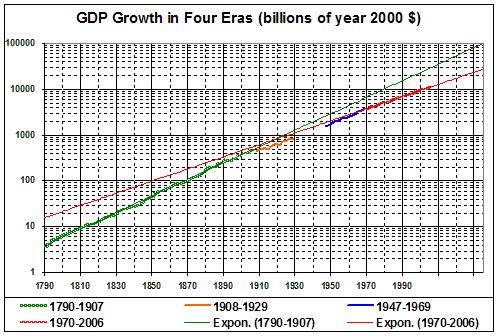
Now, the question is how much worse off Americans will be a generation hence. To answer that question, I revisited the estimates of real GDP that underlie my earlier work. I used the new estimates in the following chart, dividing the data into four eras (described below) and indicating the exponential trends for two eras (1790-1907, 1970-2006).

This graph is based on new estimates of real GDP from Louis D. Johnston and Samuel H. Williamson, “The Annual Real and Nominal GDP for the United States, 1790 – Present.” Economic History Services, URL : http://eh.net/hmit/gdp/. The new estimates cover the period through 2006 (vice 2003 in my earlier work). On re-examining the data, I decided that 1907 (vice 1906) was the last year of the laissez-faire era; that is, the effects of TR’s anti-business policies did not begin to affect GDP growth seriously until 1908.

The four distinct eras and the annual rate of growth in real GDP during each of them:

  • 1790-1907: laissez-faire reigns (more or less) — 4.3% growth
  • 1908-1929: even though the peacetime tax burden remains about 10 percent of GDP, the modern regulatory state emerges — 3.3% growth
  • 1947-1969: post-Depression/post-WWII recovery underwrites the extension of the New Deal to the Great Society, imposing a heavier burden of taxation and regulation — 4.2% growth
  • 1970-2006: New Deal-Great Society policies are entrenched and extended through greater regulatory control of economic activity and an even greater tax burden — 3.1% growth

(I have omitted 1930-1946 because the GDP figures for World War II grossly overstate the value of goods and services available to the civilian population and (falsely) suggest a high rate of growth for era.)

For more about the effects of taxation and regulation on GDP growth, and the failure of the New Deal to bring the country out of the Great Depression, go here and here.

The bottom line (all GDP estimates are in year 2000 dollars):

  • Had the economy continued to grow after 1907 at the 1790-1907 rate, real GDP in 2006 would have been $32 trillion, vice the actual value of $11 trillion.
  • Thus my earlier work, linked above, vastly understates the deadweight loss owed to big government: I had estimated that loss at 40 percent of potential GDP; it was, in fact, about two-thirds of potential GDP.
  • Had the economy continued to grow after 1907 at the 1790-1907 rate, real GDP in 2035 (a generation hence) would be $108 trillion (in year 2000 dollars).
  • If the economy continues to grow at the 1970-2006 rate, real GDP in 2035 will be $30 trillion (in year 2000 dollars).
  • However, growth is very likely to be less than 3.1% annually, given the advent of a new New Deal-Great Society under a new, anti-business, pro-regulation Democrat regime.
  • Thus the average American will “enjoy” (at best) about 28 percent of the income that would be his absent the advent of the regulatory-welfare state.

That — I am sorry to say — is the shape of things to come economically.

I have discussed, in these posts, the shape of things to come socially.

I Told You So

Here.