Never Relent

Despite some appearances to the contrary, the tide of statism in the United States is ebbing. Mr. Trump is turning the power of the state against the forces that have used its power to weaken America economically and to poison it morally and culturally.

The battle for liberty will not end soon, nor ever.

Lovers of liberty — those of us who do not think of the state as a supreme being — should always remember and heed the spirit of these words from Churchill’s speech following the successful evacuation of Dunkirk:

[W]e shall fight on the seas and oceans, we shall fight with growing confidence and growing strength in the air, we shall defend our island, whatever the cost may be. We shall fight on the beaches, we shall fight on the landing grounds, we shall fight in the fields and in the streets, we shall fight in the hills; we shall never surrender….

Trump vs. Harris: 5 — Updated

Here.

Joe Biden’s Mortality

I began this post just before learning of the attempted assassination of Donald Trump. His mortality isn’t at issue here, but Joe Biden’s is.

I am a bit older than Joe Biden. I grew up and graduated from high school in a place that resembles Scranton, Pennsylvania, though it’s not as large.

I have in recent years tracked down all of the members of my high school graduating class, who were born (on average) in 1940. Here’s the mortality curve for the men:

The slope gets slippery 53 years after graduation, that is, in one’s early 70s. Joe (and Donald) are beyond that point. But Joe’s medical condition suggests that he will go first (if assassination is taken off the table) and fairly soon. If his disease doesn’t kill him in a few years, old age will probably do the job.

Trump vs. Biden: 16 (My best estimate yet)

If the election were held today, Trump would win with 313 to 343 electoral votes (as against 270 needed to win):

How did I get to that result? It’s a two-step calculation. The first step is relate electoral votes (EVs) to the two-party popular-vote split. The second step is to relate the two-party popular-vote (PV) split to the results of the most recent national polls. (I use polls with an average date that occurs in the last seven days.)

To estimate EVs as a function of the two-party PV split, I began with the results of the 2020 election. Trump got 232 EVs and Biden got 306 EVs, with a two-party vote split of 47.7 percent for Trump to 52.3 percent for Biden. I adjusted the distribution of EVs by State to reflect the redistribution of EVs following the census of 2020. That changed the EV split to Trump 235 and Biden 303, which I took as a starting point.

Suppose that the national PV split were to change from Trump 47.7 and Biden 52.3 to Trump 48.0  and Biden 52.0 as a result of proportional changes in every State (i.e., Trump’s PV share rises across the board by 0.3 percentage point and Biden’s PV share drops across the board by 0.3 percentage point). That would cause a few States to flip, specifically Arizona (11 EV) and Georgia (16 EV). The EV split would then become Trump 262 to Biden 276.

I ran cases of PV splits ranging from Trump 46-Biden 54 to Trump 55-Biden 45 in 0.5 percentage point increments. Those splits translate to PV margins ranging from -8 for Trump to +10 for Trump. At +6, for example, Trump would pick up Arizona (11), Colorado (10) Georgia (16), Maine (all 4 of its EVs vice 1 in 2020), Michigan (15), Minnesota (10), Nebraska (all 5 of its EVs vice 4 in 2020), Nevada (6), New Hampshire (4), New Mexico (5), Pennsylvania (19), and Virginia (13), and Wisconsin (10). The total gain of 123 EVs would bring Trump’s total to 358.

How do I relate the PV split to polling results? Polls, on average, are biased toward Biden. By how much? I return, once again, to 2020 and the national polls reported by RealClearPolitics (RCP). The final seven-day average had Biden leading Trump by 7.6 percentage points. Biden’s PV margin (including bogus votes) was 4.5 percentage points. So there was a bias of about 3 percentage points in favor of Biden in the polls reported by RCP.* This means, for example, that if Trump’s average 7-day lead is 2 points (which it is as of today), his lead in the PV split is actually 5 points after adjusting for bias (assuming that the pro-Biden bias is at least as great in 2024 as it was in 2020).

There are margins of error around the polling results; the margins of error define the upper and lower bounds of a 95-percent confidence interval around the average. I apply those margins to obtain a range for Trump (a 95-percent confidence interval around his average lead or deficit). As of today, that range is from a 0-point lead to a 4-point lead. The horizontal axis in the graph reflects the 3-point bias adjustment to that range. A tie in the polls — the lower bound of the confidence interval — would mean that Trump is really leading by 3 in the PV split (which would give him 313 EVs); a lead of 4 points in the polls — the upper bound of the confidence interval — would mean that Trump is really leading by 7 in the PV split (which would give him 343 EVs).

As of today, Nate Silver (paywalled) of 538 fame, has Trump ahead in Arizona, Georgia, Michigan, Nevada, Pennsylvania, and Wisconsin. The electoral votes of those States, plus the pickup of 1 EV from Nebraska, would bring Trump’s total to 313, which is the lower bound of my estimate.

Stay tuned.


* Yes, there are margins of error around each pollster’s results, but the best estimate was 7.6 percentage-point margin, on average, and the pollsters missed it by 3.1 points, on average. Another way to adjust Biden’s 2020 showing is to take the difference between his seven-day average margin for that year (7.6 points) and his current seven-day average margin (-1.8 points) and apply the difference (-9.4 points) to his final  2020 PV margin of 3.1 points, which yields an estimated PV margin of -6.3 for 2024 (as of today). But that would introduce a measure of optimism (for Trump) that I don’t want to inject into my estimates, so I’m using the bias estimate of 3.1 points (rounded to 3).

Classic Automobiles

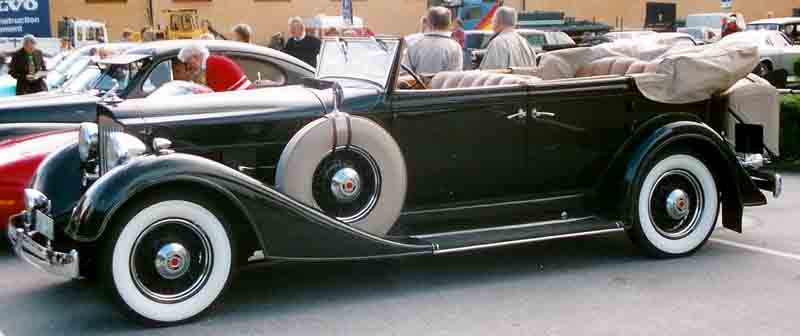
The classic era of American automobile design began in the 1920s and lasted through the late 1930s. Here are some of my favorites:

1927 Kissel 8-75 Speedster

1929 Jordan Speedboy G

1929 Duesenberg J 350 Willoughby

1930 Pierce Arrow Roadster

1932 Cadillac 355B Sport Phaeton

1932 Pierce Arrow Model 54 7-Passenger Touring Car

1934 Packard Eleventh Series Eight 1101 Convertible Sedan

1935 Auburn 8-851 Cabriolet

1937 Cord Model 812C Phaeton

1938 Lincoln Zephyr Convertible Coupe

Many collections of classic-car photos and specs are available online. One that I especially like is the Crawford Collection of the Western Reserve Historical Society.

Trump vs. Biden: 2 (Important Update)

Here.

Management Consutants Deliver … (Updated Link)

Here.

Index of Posts (Updated)

Here.

Holiday Memories

I sometimes take a mental trip into the past — into the golden past of boyhood, where all the days are sunny and summery, or Christmas-y.

I stand on the sidewalk in front of the first house I lived in. There it is, a cream-colored, two-story, clapboard house with a small detached garage to the right. It sits on a corner lot of some size on a tree-lined street. An alley runs behind it. The streets at the front and left side of the house are unpaved, as were many streets in that small city where I was a boy in the 1940s.

The deep, covered porch runs the width of the house. I walk up the steps to the porch and enter the front door, which opens into the living room. With sunlight streaming through the windows, I wander through the living room to the dining room and kitchen. I go out the back door to the enclosed back porch, from which I can see the garage and the back yard.

I return to the house and venture to the basement, with its huge, coal-fired furnace, coal bin, and my father’s work shop. I go back up — and then up again, climbing the stairs to the second story — the stairs with a wrought-iron railing. I reach the upper hallway and visit, in turn, the three sunny bedrooms and the black-and-white tiled bathroom.

Yes, it was a modest house. But it was the first place I thought of as home, and it’s a place that I always think of as sunny.

At other times I remember my grandmother’s house in a small, lakeside village about 90 miles north of where I grew up. Her modest, two-story bungalow sat on a deep lot that backed up to open fields where doves cooed as I awoke on sunny, summer mornings to the smell of bacon frying. My favorite room was the kitchen, with its massive woodstove and huge, round, oak table, around which my grandmother, parents, and various aunts and uncles would sit after a meal, retelling and embellishing tales from the past.

We often visited my grandmother at Christmas, and I like to relive the Christmas eve when we made the 90-mile trip as feathery snow slowly piled deeper on the deserted, lakeside highway we traversed through quiet villages: Lexington, Port Sanilac, Forester, Richmondville, Forestville, White Rock, Harbor Beach, Port Hope, Huron City, and — at last — Port Austin.

Many of those villages were tiny: a scattering of houses, perhaps a church and a gas station — but not a traffic light. The more substantial villages — those that had 1,000 or even 2,000 residents and a traffic light — boasted rows of well-kept and sometimes stately homes on shady streets, along with prosperous brick and white-frame churches, a few blocks of tidy stores, and perhaps a lighthouse:

The lakeside highway (before it straightened and moved inland) rode atop high bluffs overlooking the vastness of Lake Huron:

Many of the stately homes along the way have become inns:


A short detour through the old part of Huron City would yield a view of Seven Gables, the summer home of William Lyon Phelps (1865-1943), a professor of English literature at Yale and a popular lecturer and writer in the early decades of the 20th century:

The village of Port Austin didn’t have a quaint main street (seen here probably in the 1970s), but it was a place where a young boy could wander safely:

The rest of the village had more to offer. An elegant old inn . . .

. . . these sights along the shoreline . . .


. . . and this view of the harbor at sunset:

Golden days, golden nights. Gone forever — but still alive in my reveries.

Trump vs. Biden: 5

Happy Thanksgiving! Trump’s lead over Biden has increased (explanation below):

RealClearPolitics maintains a running tally of presidential election polls (among many others). RCP has also assessed the pro-Democrat or pro-Republican bias of the final presidential-election polls issued by major pollsters in 2016 and 2020. On average, the polls were biased toward the Democrat nominee by 2.3 percentage points.

As the pollsters release their results, I adjust Trump’s lead/deficit for bias. I then construct a moving average of the adjusted results, where the average represents Trump’s adjusted margin for the 10 most recent polls (taking the mid-point of each polling period as the date of each poll).

I then convert that 10-poll average to an estimate of Trump’s share of the two-party popular vote. For example, an average margin of +4 indicates a 52-48 split of the popular vote, that is, Trump gets 52 percent of the popular vote.

Finally, I apply my algorithm for the relationship between the GOP candidate’s share of the electoral vote and his share of two-party popular vote.

The estimates of popular-vote and electoral-vote shares don’t account for the margin of error in pollsters’ findings or the margin of error in my estimate of electoral votes. But the movement of the estimates may be taken as indication of the movement in voters’ preferences between Trump and Biden (or whoever might become their parties’ nominees). It is that movement which I will report from time to time.


Pages

If you are new to this blog, or haven’t visited in a while, check out Pages in the sidebar. There you’ll find links to long, substantial pieces that merit special attention (in my humble opinion).

In Case You Missed It …

This blog has reopened for business after a sojourn at Substack as Loquitur’s Letter. Stay tuned.

The New Dispensation

It’s simple, to a fault.

The new dispensation isn’t “liberty”, “democracy”, “equity”, or any of the other shibboleths mouthed by its Orwellian architects. The new dispensation is to force human events to follow a certain course by gaining control of the apparatus of the state and coercing its subjects to act according to its dictates through censorship and force.

That is the direction in which the United States is headed. Regardless of dire consequence of the policies favored by those in control of the state. Those consequences — in addition to the loss of liberty — include general inflation, soaring energy and food prices, the suppression of science that gets the “wrong” answers, and (above all) the destruction of civil society.

Those consequences are assured as the regime presses on with heavy handed regulation, the weaponization of intelligence and law-enforcement agencies, the empowerment of private actors (e.g., Big Tech) to suppress the regime’s enemies, and the division of Americans into desirable and undesirable identity groups.

There is no learning from experience in this regime. Belief — uninformed and ends-driven — rules all. Every failure is met not with an honest reappraisal of policy failures but with the reassertion and expansion of failed policies.

It is the Sovietization of America: the exercise of power for its own sake, justified by the betterment of the people (or some of them), with the effect of impoverishing the people and setting them against one another.

I Told You So, Virginia

Never underestimate the appeal of the forbidden.

A year ago today, I posted “Don’t Celebrate Yet, Virginia”, wherein I had this to say about the election of Glenn Youngkin, Virginia’s first Republican governor in eight years:

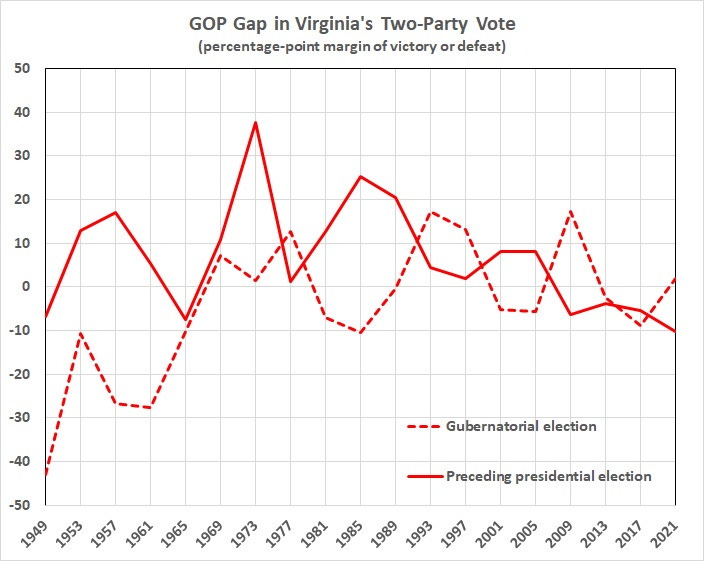
Gratifying as the resurgence of Virginia’s GOP may be, I’m not ready to declare Virginia’s return to Red-ness.  For one thing, there’s an underlying trend toward Blue-ness, which shows up in Virginia’s presidential election results:

Derived from Dave Leip’s Atlas of U.S. Presidential Elections. The series for Virginia begins with the gubernatorial election of 1949,which is the earliest for which Leip as posted popular-vote tallies.

The GOP’s edge in the presidential election peaked in 1968, the year of George Wallace, who (in the South) siphoned votes from the Democrat candidate. If 1968 doesn’t suit as a peak year, because of the Wallace effect, then the peak certainly occurred in 1984, with the re-election of Ronald Reagan. In either case, the GOP candidate’s share of Virginia’s presidential vote has been in decline for decades, and seems unlikely to recover unless there is a nationwide shift away from the Democrat party. Such a shift might occur, given the Dems’ suicide pact with the far-left, but cooler heads may yet prevail among party leaders.

It’s true that the downswing in the GOP’s hold on Virginia’s governorship hasn’t been as pronounced — which supports Tip O’Neill’s observation that all politics are local. But the GOP’s edge in the past has been much greater than the razor-thin victory eked out by Glenn Youngkin in the recent election.

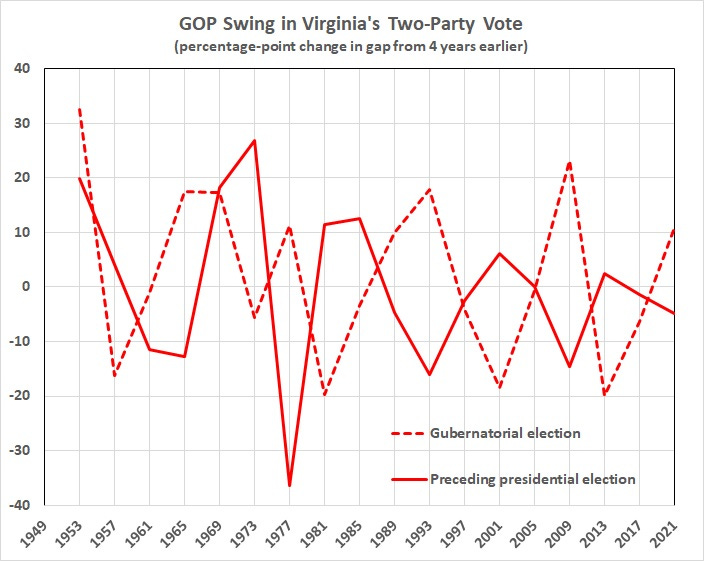
Nor is that victory especially impressive when the swing toward the GOP in 2021 is compared with earlier swings:

Source: Leip’s Atlas.

What probably happened in the 2021 election is what seems to have been happening since the early 1970s. The Virginia gubernatorial election reflects a typical “mid-term” reaction to the previous year’s presidential election. When the GOP presidential candidate racks up a gain relative to the showing of the GOP candidate four years earlier (a positive “swing”), the GOP gubernatorial candidate racks up a loss relative to the showing of the GOP candidate four years earlier (a negative “swing”). And conversely.

The results of the yesterday’s elections in Virginia bear out my pessimism. Governor Youngkin had hoped to flip the Virginia Senate, which Democrats held by 22-18, and hold (or build) the GOP lead in the House of Delegates, which Republicans held by 52-48.

At this moment, it looks like the Democrats will continue to hold the Senate, by 21-19, while reclaiming the House by a margin of 51-49.

The outcome in Virginia reflects America’s descent into depravity.

There was, for example, a close race in Virginia’s 57th House district. The Democrat who made it a close race is none other than Susanna Gibson. It is Gibson who raised funds for her election campaign by performing sex acts with her husband and uploading the videos to a porn site.

The big issue in Virginia was abortion — of course.

The failure of the GOP to retake the Senate had much to do with the campaign in the 16th district, where I live. The Republican incumbent lost to a Democrat in a contest that centered on abortion. Democrats pounded on the issue in mailings and TV ads. Had the Republican won, the Senate would be tied 20-20, with the Republican lieutenant governor determining the outcome of tied votes. But the “right” to abortion carried the day for the Democrat.

The outcome in House races was similarly linked to the issue of abortion. Again, I saw at first hand the emphasis that was placed on abortion by Democrats in the race for the seat in the 58th district, where I live, and in a neighboring district that the GOP incumbent seems to have held by a narrow margin.

Virginia’s — and America’s descent into depravity is confirmed by the likes of The New York Times and The Washington Post, which hail the outcome of yesterday’s elections with headlines like these (in their online feeds):

Abortion Rights Fuel Big Democratic Wins, and Hopes for 2024

Abortion rights advocates win major victories in Ohio, Kentucky, Virginia

This of a piece with the open attacks on and mockery of religion (unless it’s Islam):

Let’s face it, the America that I knew — and which many Americans want to preserve — has been dying since the 1960s and is now dead.

I want my country back.

Trump vs. Biden: 3

A far out forecast.

RealClearPolitics maintains a running tally of presidential election polls (among many others). RCP has also assessed the accuracy of the final presidential-election polls issued by ten major pollsters in 2016 and 2020.

Adjusting the polling results issued by five of the pollsters in October for each pollsters’ average accuracy in 2016-20, I estimated Trump’s and Biden’s shares of the two-party popular vote. I then applied my algorithm for the relationship between share of electoral vote and share of two-party popular vote,

My initial result: If the election had been held last month, Trump would have won 52 percent of the two-party vote and garnered 58 to 62 percent of the electoral vote.

I will continue this exercise until election day 2024. In the interim, more of the ten pollsters will publish results more often and one or both of the principals may be replaced.

Stay tuned.

Trump vs. Biden: 2

EXTENSIVELY REVISED 05/10/24

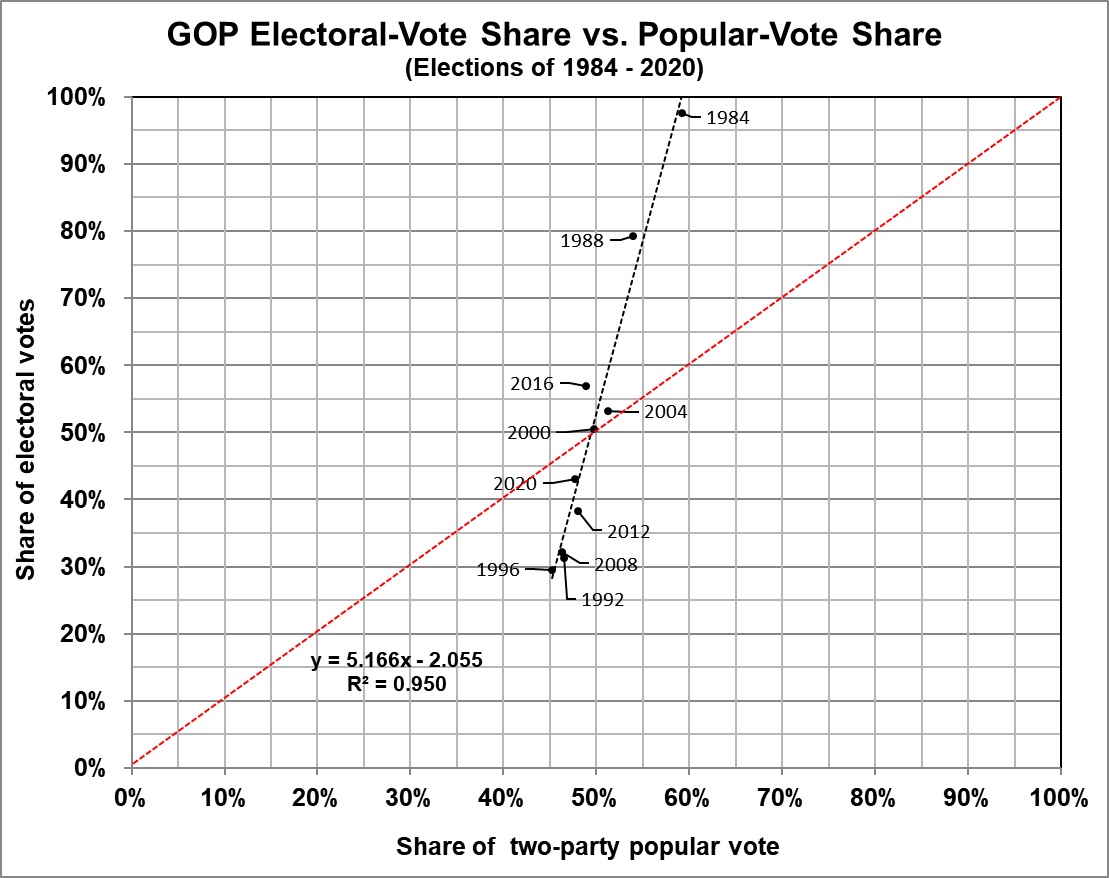
In the original version of this post, I argued that Republicans enjoy a slight edge in the Electoral College. The relevant discussion began with this graph:

I continued with this:

A candidate’s share of the electoral doesn’t change in proportion to his share of the nationwide popular vote. (The dashed red line depicts a proportionate relationship.) That is because all of the States (but two) and D.C. have a winner-take-all method of allotting their electoral votes. In those cases, a candidate wins all of the jurisdiction’s electoral votes whether he wins the popular vote by 0.1 percent or 10 percent. And a slight change in the candidate’s popular vote — from 49.9 percent to 50.1 percent, say — swings the entire block of electoral votes.

Look closely at the regression line in the graph and you will see that it doesn’t cross the dashed red line at the 50-50 mark. Rather, a GOP candidate (on average) can win 52.3 percent of the electoral votes with 49.9 percent of the nationwide popular vote. That’s because the smaller States — a majority of which lean GOP — are disproportionately represented in the electoral college. The upshot is that a candidate who wins the most States has an electoral-college advantage.

The next sentence hits upon the real reason for the statistical artifact:

Throw in some close wins in larger States and you have what looks like a resounding victory; for example, in 2016 Trump won 56.9 percent of the electoral votes with 48.9 percent of the two-party popular vote, nationwide.

Republicans won the electoral vote twice in “modern” times (i.e., from 1920 onward) while garnering less than 50 percent of the two-party popular vote:

  • The first time was in 2000, when G.W. Bush beat Al Gore solely on the basis of a narrow popular-vote victory in Florida. Florida’s 25 electoral votes gave Bush 1 more than he needed for the win.
  • The second time was in 2016, when Trump pulled won Michigan, Pennsylvania, and Wisconsin — each by less than 1 percentage point. The combined 46 electoral votes delivered by those States gave Trump his margin of victory over Clinton.

And that’s it. One need search no further for the reason that a candidate can win the electoral vote with a minority of the two-party popular vote. It could even happen to a Democrat.

In fact, Democrats have won at least three elections since 1920 because of narrow victories in a few States:

  • Truman won in 1948 with 49.55 percent of the nationwide tally of popular votes because he won both Ohio and Illinois by less than 1 percentage point. The 53 electoral votes from those States boosted him to victory, even though he lost a big chunk of the “Solid South” (Alabama, Louisiana, Mississippi, and South Carolina) to Strom Thurmond.
  • In 1960, Kennedy’s slight margin in the nationwide popular-vote tally (49.72 percent to Nixon’s 49.55 percent) was mirrored by margins of less than 1 percentage point in Hawaii, Illinois, and Missouri. Their combined 43 electoral votes gave Kennedy the election.
  • Biden won in 2020 not because he beat Trump in the meaningless nationwide popular-vote tally by 4.45 percentage points, but because he “won” both Georgia and Wisconsin by less than 1 percentage point and Pennsylvania by a little more than 1 percentage point. The 46 electoral votes thus delivered by those three States gave Biden his margin of victory over Trump in the Electoral College. (Turnabout, in this case, is foul play.)

The statistical relationship in the graph is meaningless. What can be meaningful is a narrow margin of victory (or loss) in a few States. This underlines the lesson from “How Good Are the Presidential Polls?“: Even a large lead in nationwide polls doesn’t signify victory in the Electoral College. Keep your eye on “battleground” States and allow for a lot of uncertainty in the polling results for those States.

A More Perfect Constitution: Excerpt 3

A possible cure for what ails America.

Several months ago I published “A More Perfect Constitution”. Its language in many places is directed at abuses that have arisen in America’s governance. Because of its daunting length, I suspect that few readers have digested it whole, and that even fewer reader have been taken notice of the many places in which the document strives to undo the damage that has been done to Americans’ liberties. This series of posts highlights that language in bite-size chunks. Links to all excerpts are given at the end of this post.


V. OBLIGATIONS AND POWERS OF THE GOVERNMENT OF THE UNITED STATES

….

B. Specific Powers of Congress

….

4. Congress may not:

….

b. sustain or make laws that result in the imposition of costs on the government of any State or the governments of all of them;

c. either directly, through the empowerment of a regulatory agency, or as an incidental effect of legislation determine what goods and services are exchanged in intra-State, inter-State, or international commerce (except to regulate the international flow of weapons, military technology, or information that might compromise national security), or determine how such goods and services are produced or priced; or determine how businesses so engaged are operated;

d. levy taxes or duties on exports from or imports to any State, give any preference to one State over another in its regulation of commerce, or determine the routes of commerce between the States; …

f. except pursuant to an authorization of war, appropriate any monies for the use of foreign nations or peoples….

h. make any law whose direct effect is to establish, support, favor, bestow financial benefits on, or restrict the privileges of a particular person or class of persons, business or class of businesses, or other private institution or class of private institutions;

i. make any law whose direct or indirect effect is to provide old-age, survivors’, disability, or medical benefits to any person, except that Congress may by law provide pension and medical benefits for members and former members of the armed forces of the United States, and pension benefits for civilian employees of the government of the United States;

j. sustain for more than ten years after the ratification of this Constitution any extant programs that provide old-age, survivors’, disability, or medical benefits not contemplated in the preceding clause;

j. authorize or allow any agency of the government of the United States effectively to exercise legislative or judicial power on its behalf;

k. authorize any agency to act independently of one of the three branches of government established by this Constitution; or

k. make any law or appropriation or take any other action that contravenes any part of this Constitution.

5. Treaties

a. The Senate must ratify all treaties and agreements with foreign nations and international organizations, except those agreements that the President is by law empowered to execute pursuant to a ratified treaty.

b. The Senate may not ratify any treaty that directly or indirectly places the United States, its territories or possessions, its property, its citizens, or its armed forces under the jurisdiction or control of any foreign power or international organization.

c. The Senate may not ratify any treaty that contravenes any provision of this Constitution or any constitutional law previously enacted by Congress.

7. Acts of Congress may be revised or revoked as provided in Articles VII, VIII, and IX of this Constitution. [Stay tuned.]


Excerpt 1, from Article II: CITIZENSHIP, VOTING, AND RELIGIOUS TESTS FOR OFFICE

Excerpt 2, from Article III: RIGHTS AND PRIVILEGES OF CITIZENS

Change Horses Midstream?

Why not?

“Don’t change horses midstream”, an adage attributed to Abraham Lincoln, means (inter alia) stick with the incumbent president during times of turmoil and conflict.

If the present conflict in Gaza leads to a wider war, with heavy involvement by the U.S. and (possibly) attacks on Americans in their homeland, the pro-Biden (or Harris) chorus will sing rousing renditions of “don’t change horses midstream”.

But why would Americans want to stick with an incumbent (or his eager alto) who got us into the mess in the first place by displaying weakness at every turn: bugging out disgracefully from Afghanistan, failing to protect America’s southern border, playing footsie with China (under the table), shoveling billions at the Taliban, shoveling more billions at Iran, throwing more billions at Ukraine instead of building America’s own defense forces, and weakening America’s economic and industrial base in the Quixotic battle against “climate change”?

Leftists, being anti-American, love those things. Let’s hope that a sizable fraction of American voters see them for what they are: weakness in the face of our enemies.

Changing horses midstream would be just the start of a much-needed reversal of America’s economic and security prospects.

Why the Left Hates Israel (and Related Thoughts)

Victimology on steroids.

I will get around to Israel in due course. But I need to set the stage with an excursion into grade-school arithmetic.

Do you remember learning how to work with fractions? To add, subtract, multiply, or divide fractional numbers with different denominators, it is necessary to convert each number to a common denominator (mentally if not mechanically). A simple example is the addition of 1/8 and 1/4. Because 1/4 = 2/8, the lowest common denominator is an eighth, which is lower than a fourth. So, by the rule of the lowest common denominator (LCD), the addition of 1/8 and 1/4 becomes the addition of 1/8 and 2/8, which yields 3/8.

In the classroom, before AP courses were devised, the pace of teaching was influenced by the pupils who were slower at learning a subject. The practice was known (unofficially) as catering to the LCD. The pace of teaching was tailored to the less-bright students (eighths) instead of brighter students (fourths).

AP courses are under attack (and have been discontinued in some places) because the placement of pupils in them is a form of discrimination — discrimination of the kind that is based on merit, not racial or ethnic prejudice. But because blacks on average are considerably less intelligent than whites (especially Jews) and East Asians, blacks tend to be left behind in educational endeavors. This, of course, is “unfair”, “discriminatory”, and “racist” — and it flies in the face of “equity”.

The attainment of “equity” therefore requires the removal of badges of superiority and occasions in which blacks might feel inferior to whites, etc. So out with AP courses; out with SAT and GRE scores as criteria for admissions to undergraduate and graduate programs: in with blatant pro-black discrimination in admissions; in with segregated housing and black-only events and programs; and out with meaningful grades (pass-fail is an old solution; “A” is becoming the new normal where grades are still used).

“Equity” is a way of catering to the LCD, with a twist. The twist is that “equity” requires not just the same reward for everyone, regardless of ability and effort, but extra-special treatment for “victims” of … of what? A “system” that is obviously inequitable because of “white privilege”, “patriarchy”, and whatever other excuse the less able and their leftist supporters can conjure instead of facing facts about genetic and cultural differences that produce different outcomes — not only between identity groups but also within them.

Thus far I’ve only touched on K-12 and university education indoctrination. The search for “victims” is perpetual on the left.

Take the Palestinians as a salient example. They are “obviously” (to a leftist) “victims” of Israel because they live (mostly) in territories that were or are controlled by Israel: the Gaza Strip and the West Bank. There is also Israel’s controversial nation-state law, which according to an anti-Zionist source

declare[s] that only Jews have the right of self-determination in the country, something members of the Arab minority called racist and verging on apartheid.

The “nation-state” law, backed by the right-wing government, passed by a vote of 62-55 and two abstentions in the 120-member parliament after months of political argument. Some Arab lawmakers shouted and ripped up papers after the vote.

“This is a defining moment in the annals of Zionism and the history of the state of Israel,” Prime Minister Benjamin Netanyahu told the Knesset after the vote.

Largely symbolic [not observed in practice], the law was enacted just after the 70th anniversary of the birth of the state of Israel. It stipulates that “Israel is the historic homeland of the Jewish people and they have an exclusive right to national self-determination in it.”

The usual suspects have declared that the separation of Palestinians (and other Arabs) from Israel and from its governance amount to apartheid., a crime against “international (leftist) law”. From this it follows (to a leftist) that acts of savagery — like those committed by Hamas against Israelis on 10/7 — are justified because Palestinians are “victims”. It further follows (to a leftist) that Israel’s fully justified preventive retaliation is “aggression”.

Let’s take a few minutes to examine those premises.

It’s true enough that the denizens of Gaza are poor and feckless. But what makes them “victims”? They are about on a par with most non-Jewish Semites, except for the relative handful who are members of a professional caste or oil-rich. The basic problem with most such members of humanity —whether in the Middle East or elsewhere — isn’t that they have been put down by anyone (e.g., Israelis) but that they lack the intellectual, cultural, and natural resources to raise themselves up.

A “funny” thing about Israel is that it is of a piece with the surrounding lands occupied by non-Jews, but it has become a relatively prosperous place because Jews have the intellectual and cultural resources that undergird prosperity.

For their success and for the fact that they are Jews, the Jews of Israel are the targets of envious failures (Palestinian and Muslim hot-heads), Jew-haters (in addition to the hot-heads), and leftists who can’t bear to think that Palestinians (like American blacks) mainly have their genes and culture to blame for their failings.

Israel was founded (re-founded, really) in the wake of the Holocaust. It wasn’t meant to be anything but a Jewish state, run by Jews for Jews — a safe haven for a historically oppressed and brutalized people. Israel has been been under attack by Muslims since its modern founding. But Israel has a natural right to self defense and to preserve its Jewish character, just as the American rebels of 1776 had a natural right to declare themselves independent of a despotic King and rapacious Parliament.

So the Gaza Strip and the West Bank become de jure parts of Israel (though the Gaza Strip was foolishly handed over to anti-Israelis) as a matter of the natural right of self-defense. As for Palestinians living in Israel proper, why should they have a voice in the governance of a country that was re-founded for Jews? Well, despite the nation-state law cited above, they do have a voice in the governance of Israel.

So, all of the leftist propaganda to the contrary notwithstanding, Palestinians aren’t “victims”, except of their own genes and culture. But unlike the “liberals” of old, the left nowadays focuses on demonizing the meritorious instead of helping those who need help.

Finally, there is the accusation that Israelis are sometimes brutal in their own defense. Why shouldn’t they be? It’s impossible to defend a country against determined enemies without being brutal toward them — just as it’s impossible to protect law-abiding citizens by disarming them and depriving them of police protection. The left sees Israelis as brutal because the left despises Israeli Jews, not because Israelis are any more brutal than leftists like Hitler, Stalin, Mao, and their many successors unto the present day.

Coda: There was a time when most Americans recognized the need for brutality in the defense of Americans — which included existential threats posed by distant enemies. It is a sad commentary on the state of America that a sizable and influential segment of the populace no longer believes that America is worth defending.

Those pampered idiots somehow consider themselves to be “victims” of a system that allows them to spout such nonsense and to tear down the very laws and traditions that shelter them from the wrath of the rightfully aggrieved victims of their beliefs and policies: hard-working, tax-paying, law-abiding victims of unfettered illegal immigration, unnecessary Covid lockdowns, prosperity-draining regulations and regulatory agencies, unnecessarily high energy costs because of the climate-change hoax, etc., etc., etc.

Supply-Side Economics: Getting Down to Cases

The good, the bad, and the truly ugly.

Economics is about the production, exchange, and use of goods and services. I focus here on production, though production is influenced by exchange and use. Consumers are the end users of goods and services, and consumers’ wants drive production and exchange, or would do so in a sane world. (I’ll come back to that when I discuss the role of government on the production side.)

The production side of the economy encompasses several types of actor, where some persons may play more than one role in the epic. Some of the actors, as you will see, are responsible for the fact that real (inflation-adjusted) GDP grows at a much lower rate than it would absent their “contributions”. The cumulative effect of the lower rate is what I call America’s long-running mega-depression.

THE ACTORS ON THE PRODUCTION SIDE

Workers

They find or make and deliver the goods and services to consumers. Without them — miners, lumberjacks, farmers, truckers, carpenters, electricians, barbers, waiters, store employees, and so on — the economy (and population) would rapidly shrink to a primitive state of small-holding farms, hunting and gathering, and exchange mainly through barter.

Technologists

They devise methods and devices that enable workers to find, make, and deliver more, different, and better goods and services. This type — from the clever tinkerer to the doctorate in physics — has been indispensable to real economic progress.

Facilitators

Some of these (e.g., wholesalers) are hard to distinguish from workers, and could be classified as such. Others (e.g., trainers, accountants, bankers, and employees of stock-trading firms) perform tasks that enable businesses to launch, function more efficiently, and expand more to satisfy more of consumers’ wants.

On the side — not directly involved in business operations, but essential to them — are security operatives. These are supplemented and complemented by legitimate (if not always effective) arms of government: law-enforcement agencies and defense forces. As security fails, economic activity falters (witness rampant theft, looting, and subsequent store closures).

Bureaucrats

This type is of two kinds: essential and counterproductive. Essential bureaucrats are those persons who perform functions that a sensible business owner would want to have performed even if he weren’t required to do so by statute or regulation. A recruiter who seeks, screens, and recommends some job applicants for hiring is a bureaucrat that a large business might find it advantageous to have. An auditor who looks for waste, fraud, and abuse in the spending of the business’s money is another.

On the counterproductive side we find those bureaucrats whose actions make consumers worse off. This is done by perform functions mandated by governments, the brain-children of HR departments, and out-of-touch overseers who are seeking the approval of their peers for being “enlightened”.

The counterproductive side is guided by myriad government mandates which circumscribe what a business may produce; how it may produce it (even if inefficiently); who it may employ to produce it (even if incompetently); how much it must pay its employees (through the minimum wage and enforced unionization); where and how it may offer its products (e.g., through restrictions on operating hours, interstate transportation, and advertising).

Overseers

The owner-operator of a small business is but a worker (cum technologist and facilitator) who has to pay himself. In somewhat larger businesses, overseers often also serve as workers, technologists, and facilitators. My interest here is with the overseers in larger businesses, each of whom has responsibility for a particular function, or who is charged with the success or failure of the entire business. I omit shareholders— who almost never have an effective voice in the management of a larger business — and boards of directors — who rarely do more than rubber-stamp the CEOs’ wishes, unless a business is doing badly (often for reasons that have nothing to do with dispensable and dispensed-with CEOs).

THE VILLAINS OF THE PIECE: BUREAUCRATS AND OVERSEERS

If you have lived as long as I have lived, you don’t need to cite a bunch of statistics to show that bureaucrats and overseers have overrun the work force, in and out of government.

Part of this is due to the growth of government bureaucracies, which are filled with bureaucrats (of course) and headed by overseers (bureaucrats on steroids) who dream up more and more things that bureaucrats can do to impede the real economy — the one that consists of workers and facilitators. The work of government bureaucrats ineluctably leads to the bureaucratization of private companies.

Not only that, but government actions are driven by politicians (super-overseers), most of whom are in thrall to various identity groups. In the service of those identity groups, governments and the private companies whose fortunes they decide are riddled with incompetent workers and saddled with incompetent subcontractors. (See “Affirmative Action: A Modest Proposal”.)

THE CONSEQUENCES, AND MORE

And you wonder why things cost more than ten times as much as they did in the 1950s? Government itself and the things that it does to the private sector are the driving forces behind inflation.

And when super-duper overseers — the idiots at the top like presidents and governors — do really stupid things like forcing businesses to shut down and workers to “work” at home and pupils to “learn” remotely, things really go downhill: prices up, output and quality down.

That’s merely the frosting on the cake, which consists of shoveling money at corrupt foreign regimes (some of them terroristic) and domestic layabouts, and forcing private companies to hire incompetent workers and facilitators.

At the heart of all this, of course is the central government, which pretty much dictates to other governments and the nation at large. If the central government had to compete for your business with companies that actually produce things, it would disappear in a New York minute. But it won’t disappear. It just keeps growing — gobbling up your tax money and the money “printed” by the Fed to support its shiftless schemes.

And that, in a bowl of nutshells, is why things cost more than ten times as much as they did in the 1950s, why the economy produces far less than it could, and why nothing will be done about those things unless a “man on horseback” rides to the rescue.