monthly review of the arts and intellectual life, [which] began as an experiment in critical audacity—a publication devoted to engaging, in Matthew Arnold’s famous phrase, with “the best that has been thought and said.” This also meant engaging with those forces dedicated to traducing genuine cultural and intellectual achievement, whether through obfuscation, politicization, or a commitment to nihilistic absurdity.
TNC gets high marks from me for its thoughtful and penetrating essays on politics and social phenomena. The rest is a mixed bag, though I usually enjoy Jay Nordlinger’s forays into the world of music. But I was lured into an irritating aural experience by Nordlinger’s (paywalled) column in the October 2022 issue of TNC, where he writes about some of the performances at the 2022 Salzburg Festival.
Nordlinger’s comments about the performances of some pieces by Béla Bartók (1881-1945) led me to place hope above experience and try to wring some enjoyment from the works of a composer whose music exemplifies a fundamental change in the sound of classical music in the 20th century: “the breakdown of the diatonic system of harmony that had served composers for the previous two hundred years.” On top of that, there’s dissonance, atonality, bombast (better suited for film scores), noise (there’s no other word for it), lack of noise (which can’t be music), and downright dreariness.
Anyway, I put on my headphones, opened YouTube, and sampled a few pieces by Bartók. Unbearable. Absolutely dreadful. And then I remembered some old posts of mine about what is called classical music, and drew on them to write what follows.
Antonín Dvořák (1841-1904) was one of the last great composers of the golden era of classical music, which began around 1700 and came to an end around 1900. What happened after that? Classical music became — and still is, for the most part — an “inside game” for composers, music critics, and superiority-signaling patrons and sponsors of “modern music”.
So-called serious composers began to treat music as a pure exercise in notational innovation, as a technical challenge to performers, and as a way of “daring” audiences to be “open minded” (i.e., to tolerate nonsense). But the result isn’t music, it’s self-indulgent crap (there’s no other word for it).
Self-indulgent is also a good term for the pseudo-cognoscenti who populate concert audiences and applaud vigorously for the crap that’s on offer. It’s a way of saying, “This is good stuff, no matter what it sounds like, and my vigorous applause signals my asthetic superiority.” Underwriting the crap sends an even stronger signal — or it is meant to. But (to me) it signals “sucker”.
The challenge to be “open minded” (i.e., to tolerate the second-rate and nonsensical) is heard regularly on Composers Datebook, a syndicated feature that runs on some NPR stations. Every Composers Datebook program closes by “reminding you that all music was once new” — as if to lump Arnold Schoenberg and John Cage with Johann Sebastian Bach and Ludwig van Beethoven.
But that’s enough from me (for now). This is from Alex Ross, music critic of The New Yorker:
As a Schoenbergian atonalist,… [Pierre Boulez] found himself dissatisfied with twelve-tone music as it was then practiced. He was bothered by the fact that Schoenberg had radicalized harmony but still treated rhythm and form in traditional, even hackneyed ways. So he began working toward the idea of “serialism,” in which durations, dynamics, and instrumental attacks were organized along the same principles that governed the twelve-tone series. He achieved a mode of writing that was, if nothing else, internally consistent….
Even in the fifties and sixties, as Boulez abandoned strict serialism and began to write in a more fluid, impressionist style, he remained a composer of vibration, activity, unrest. He set the profile of “modern music” as it is popularly conceived and as it is still widely practiced — a rapid sequence of jabbing gestures, like the squigglings of a seismograph.
(Emphasis added by me.)
This is from Miles Hoffman, founder and violist of the American Chamber Players:
The primary proposition in defense of avant-garde music of the relentlessly dissonant and persistently unpopular variety has always been that, through exposure and familiarity, we often come to appreciate, and even love, things that initially confuse or displease us. Here what we might call “the Beethoven Myth” comes into play. “Beethoven was misunderstood in his time,” the argument goes, “but now the whole world recognizes his genius. I am misunderstood in my time, therefore I am like Beethoven.” This reasoning, unfortunately, has been the refuge of countless second- and third-rate talents. Beethoven ate fish, too. If you eat fish, are you like Beethoven? But there’s a much graver flaw in the argument: Beethoven was not misunderstood in his time. Beethoven was without doubt the most famous composer in the world in his time, and the most admired. And if there were those who didn’t “get” his late string quartets, for example, there were plenty of others who did, and who rapidly accepted the quartets as masterpieces….
Have I exaggerated the intensity of the distaste that so much modernist music has aroused? No, sad to say, not if we keep certain factors in mind. One is the strength of the needs, the intensity of the desires, that we fulfill with music. Our expectations of music—expectations of the type nurtured, reinforced, and satisfied for generation upon generation—are enormous, and enormously important to us, and when those expectations are disappointed, we take it very badly indeed….
Inevitably, however, we return to the fact that there’s something basic to human nature in the perception of “pleasing sounds,” and in the strength of the tonal structures that begin and end with those sounds. Blue has remained blue to us over the centuries, and yellow yellow, and salt has never started tasting like sugar. With or without physics, consonances are consonances because to most people they sound good, and we abandon them at great risk. History will say—history says now—that the 12-tone movement was ultimately a dead end, and that the long modernist movement that followed it was a failure. Deeply flawed at their musical and philosophical roots, unloving and oblivious to human limits and human needs, these movements left us with far too many works that are at best unloved, at worst detested. They led modern classical music to crisis, confusion, and, in many quarters, despair, to a sense that we’ve wasted decades, and to a conviction that our only hope for whatever lies ahead starts with first making sure we abandon the path we’ve been on.
From a distance of centuries, knowledgeable observers can usually discern when specific cultural developments within societies or civilizations reached their peaks. The experts may argue over precise dates and details, but the existence of the peaks themselves is rarely in question. In the case of Western music, we don’t have to wait centuries for a verdict. We can say with confidence that the system of tonal harmony that flowered from the 1600s to the mid-1900s represents the broad summit of human accomplishment, and that our subsequent attempts to find successors or substitutes for that system are efforts—more or less noble—along a downhill slope. [But the joy of “serious” music began to diminish around 1900, when many leading composers (e.g., Mahler and R. Strauss, following the lead of Wagner and Bruckner), began to deploy tonality in pretentious, ponderous, and dreary works.]
What lies ahead? Nobody can say, of course. But with the peak behind us, there’s no clear cause for optimism—no rational cause, anyway, to believe that another Beethoven (or Berlioz or Brahms…) is on the way. And even if he were on the way, in what musical language would he write when he got here? The present is totally free but totally uncertain, the immediate past offers little, and the more distant past is . . . past. And yet, irrational creatures that we are, we keeping hoping for the best, and it’s right that we do. We owe it to Music. The good news is that there are many composers today who, despite the uncertain footing, are striving valiantly, and successfully, to write works that are worthy of our admiration and affection. They write in a variety of styles, but the ones who are most successful are those who are finding ways—often by assimilating ethnic idioms and national popular traditions—to invest their music with both rhythmic vitality and lyricism. They’re finding ways to reconnect music to its eternal roots in dance and song.
Rhythmic vitality and lyricism. That’s what it takes, and that’s what’s been missing from most “serious” music for the past 100 years and more.
[Van der Merwe] reckons that by 1939, the year of Rodrigo’s Concierto de Aranjuez, the flow of music that is both genuinely modern and popular had all but dried up. Van der Merwe nods towards Khachaturian, late Strauss and the Britten of Peter Grimes — and, er, that’s it. For the general public, he argues, classical music ceased to exist by 1950.
There will be an interesting argument about when and where the line can be drawn. That it can be drawn somewhere (1940, 1950 or 1960 hardly matters) is, however, beyond serious dispute. At some point in the past half-century, classical music lost touch with its public.
At the start of the 21st century, we can see what went wrong more clearly. What went wrong was western European modernism. Modernism is a huge, varied and complex phenomenon, and it took on different qualities in different national cultures. But an essential feature, especially as Van der Merwe argues it, was to turn music decisively towards theory – often political theory – and away from its popular roots.
The pioneer figure was Arnold Schoenberg, with his theory of the emancipation of dissonance (which, as Van der Merwe cleverly points out, also implied the suppression of consonance). But it was after Schoenberg’s death, in the period 1955-80, that his ideas achieved the status of holy writ.
The upshot was a deliberate renunciation of popularity. The audience that mattered to modernists (even the many who saw themselves as socialists) ceased to be the general public and increasingly became other composers and the intellectual, often university-based, establishment that claimed to validate the new music, not least through its influence over state patronage. Any failure of the music to become popular was ascribed not to the composer’s lack of communication but the public’s lack of understanding.
Not surprisingly, the public looked elsewhere, to what we are right to call, and right to admire for being, popular music. This embrace started in the early 20th century with ragtime and jazz and reached its apex with rock’n’roll, whose great years belong to that same period, 1955-80, when modernism ruled in the academy….
Classical music survived, after a fashion. But it has less to say about today. It endures overwhelmingly on the strength of its back catalogue and performance tradition, not of any new creativity. Having failed to persuade the public to embrace modern music, it has sustained itself only by rediscovering the music of earlier epochs and – though this is arguable – by learning the lessons of the modernist deviation.
I draw the line much earlier than 1950, and I certainly exclude the ponderous pair of Richard Strauss and Benjamin Britten from the list of classical composers who wrote in a popular style. Dvořák was the last classical composer to do that consistently.
Music can be serious, but it needn’t be boring or depressing or just plain unlistenable. But a trip through the list of 20th century composers turns up relatively few who wrote music that’s endurable. Among the many 20th century specialists in boredom, cacophony, and nonsense are John Adams, Béla Bartók, Alban Berg, Pierre Boulez (encore!), John Cage, George Crumb, György Ligeti, Olivier Messiaen, Arnold Schoenberg, Igor Stravinsky, and Anton Webern.
If you want to hear how a true master delivers what might be taken for “modern music”, while keeping the listener enthralled, listen to Ludwig van Beethoven’s Grosse Fugue, op. 133. Beethoven composed the piece in 1825-6. I daresay that in the intervening 196 years no one has come close to matching its dazzling blend of sobriety, inventiveness, and élan.
Is there a cure for what ails classical music? If there is, what might it be?
ArtsJournal.com once published a 10-day blog, “Critical Conversation: Classical Music Critics on the Future of Music”. It “tackled the question what/where/are the Big Ideas in classical music?” The blog “involved 13 prominent American music critics”.
One of the critics, Greg Sandow (then at TheWall Street Journal), offered this:
A new Big Idea would be very welcome, at least to me — a reintroduction of performer freedom, but to what now would be considered a drastic degree. You can find examples of this in old recordings, especially by singers. Look at Ivan Kozlovsky, one of the two star tenors at the Bolshoi Opera during Stalin’s rule. To judge from films and recordings, he’s clearly one of the greatest tenors who ever lived, measured simply by technique, breath control, range (all the way up to an F above high C, with Cs and C sharps thrown out like thrilling candy), phrasing, and expression….
But what makes him most unusual — and, to many people, quite improper — is that he sang at least some of the time like a pop singer, using lots of falsetto, almost crooning at times, and above all taking any liberty he pleased, slowing down and speeding up as the mood suited him. To my ears, he’s mesmerizing when he does that. You can’t (to bastardize an old cliche) take your ears off him. And when he does it in the Duke’s opening solo in the duet with Gilda from Rigoletto, he nails the Duke’s character as no other singer I’ve ever heard could do. You don’t just theorize that the Duke is attractive to women; you feel it, and want to surrender to him yourself. Or, perhaps, run away, which is exactly the kind of dual reaction a man like that would really get….
[Kozlovsky is] in part just a sentimental entertainer. But what sentiment, and what entertainment! And what perfect singing. When he croons “O Mimi tu piu non torni”…, some people might roll their eyes at the way he slows down at the peak of the phrase, but you can’t ignore his genuine feeling, or his perfect control as he slowly dreams his voice into the lightest of pianissimos.
Singing like that would be absolutely forbidden in opera today. No teacher, no coach, and no conductor would let any singer try it. And yet, if someone stepped out on the stage of the Met singing that way, the audience would go insane. The applause wouldn’t end. And opera would come back to life.
And so would classical music come back to life if more composers were to reject self-indulgence and write music for the unfeigned enjoyment of audiences.
But I’m not counting on it. “Serious” music (like other art forms) is dominated by the academy. And the academy — for all its socialist cant — scorns “the masses”. Academicians (and their fellow travelers at the podium and in the loge seats) would find it hard to maintain their air of mysterious superiority if they were to produce works that “the masses” could actually enjoy.
Back in 2017, Nicholas Kristof of The New York Timeslamented readers’ reactions to what he called his “periodic assertions that Trump voters are human, too”. He lamented those reactions because they were of a piece with Hillary Clinton’s characterization of Trump supporters as “a basket of deplorables”. Kristof wondered how progressives would ever reclaim the White House, Congress, a majority of governorships, and a majority of State legislatures — and thereby advance the “progressive” cause (more regulation, more government spending, higher taxes, and “wokeness on steroids) — if they insisted on demonizing a large chunk of the electorate. (Well, they did recapture the White House, but only through massive fraud, and they did recapture Congress, but thanks only to the “election” of a Democrat VP. But they have continued to demonize Trump voters and will soon begin to pay for the privilege.)
One of Kristof’s themes, which is echoed in letters to the editor about his columns, is that Trump supporters vote against self-interest. As evidence, in the usual manner of the media, Kristof cites the unhappiness of a handful of selected Trump voters about Trump’s plans to cut particular programs from which they benefit. As If the testimony of a small number of carefully selected interviewees proves anything other than media bias.
The idea that “low class” people who vote Republican are somehow voting against their self-interest has been around for a while. It stems from the idea that a main purpose of government is to provide handouts to the “less privileged”. If the left’s black and Hispanic “pets” reliably vote Democrat because so many of them want government handouts, why don’t “low class” whites do the same thing?
which explores the rise of populist anti-elitist conservatism in the United States, centering on the experience of Kansas….
According to the book, the political discourse of recent decades has dramatically shifted from social and economic equality to the use of “explosive” cultural issues, such as abortion and gay marriage, which are used to redirect anger toward “liberal elites.”
Against this backdrop, Frank describes the rise of political conservatism in the social and political landscape of Kansas, which he says espouses economic policies that do not benefit the majority of people in the state….
Frank says that the conservative coalition is the dominant coalition in American politics. There are two sides to this coalition, according to the author: Economic conservatives want business tax cuts and deregulation, while social conservatives focus on culture. Frank says that since the coalition formed in the late 1960s, the coalition has been “fantastically rewarding” for the economic conservatives. The policies of the Republicans in power have been exclusively economic, but the coalition has caused the social conservatives to be worse off economically, due to these pro-corporate policies.
If the conservative coalition is the dominant coalition, it comes as a great surprise to me. But Frank’s book was published in 2004, when the GOP controlled the White House and (narrowly) the Senate and House of Representatives. Frank may be excused for not having foreseen the setback in Iraq, the financial crisis, the Great Recession, and the resulting election and re-election of the great black hope.
Anyway, there are three answers to Frank’s thesis:
There is a lot of overlap between “social” and “economic” conservatives, which means that the supposed clash of values is far less dramatic than Frank paints it.
Those “social” conservatives who aren’t also “economic” conservatives obviously place so much weight on social issues that they are unswayed by the (purported) harm to their economic interests.
Many social conservatives understand — viscerally, at least — that their economic interests aren’t served by a regime of handouts and preferences, but by a regime that is “pro-business” and therefore pro=growth and pro-job creation.
Marlo Lewis of the Competitive Enterprise Institute points out that the fuel economy standards promoted by the leftist environmentalists add thousands of dollars to the cost of a new car. He estimates that these “green” policies could mean that 5 million fewer Americans each year can’t afford a new car….
Another green policy that hurts the poor is the anti-fracking crusade of the environmentalists. In my book with Kathleen Hartnett White, Fueling Freedom, we point out that the lower cost of electricity due to cheap shale natural gas has benefited low income households to the tune of well over $4 billion a year….
Social Security is the greatest swindle of the poor ever. A new study by Peter Ferrara for the Committee to Unleash Prosperity shows that the average poor person who works 40 hours a week during his or her working life would retire with a larger monthly benefit and would have $1 million or more in an estate that could be left to a spouse or children at death if they could simply put their payroll tax dollars into a personal 401k retirement account and tap into the power of compound interest….
Occupational licensing laws — in trades like moving companies, realtors, hair dressers, limousine services, beauticians, physical therapy and on and on — stunt small business start-ups, destroy jobs, and raise prices for lower income consumers….
… Professor Boudreaux shows evidence that … licensing requirements reduce service quality by shrinking competition in the industry….
These examples merely scratch the surface of scores of governmental polices that are regressive.
[I]t never ceases to amaze the left that so many of “the people” turn their backs on a leftist (Democrat) candidate in favor of the (perceived) Republican rightist. Why is that? One reason, which became apparent in the recent [2016] presidential election, is that a lot of “the people” don’t believe that the left is their “voice” or that it rules on their behalf.
A lot of “the people” believe, correctly, that the left despises “the people” and is bent on dictating to them. Further, a lot of “the people” also believe, correctly, that the left’s dictatorial methods are not really designed with “the people” in mind. Rather, they are intended to favor certain groups of people — those deemed “victims” by the left — and to advance pet schemes (e.g., urban rail, “green” energy, carbon-emissions reductions, Obamacare) despite the fact that they are unnecessary, inefficient, and economically destructive.
It comes as a great shock to left that so many of “the people” see the left for what it is: doctrinaire, unfair, and dictatorial. Why, they ask, would “the people” vote against their own interest by rejecting Democrats and electing Republicans? The answer is that a lot of “the people” are smart enough to see that the left does not represent them and does not act in their interest.
Some city slickers never learn from experience because they’re too fastidious to acquire it by venturing from “the bubble”.
By “politics”, in this context, I mean the business of acquiring and applying governmental power. This kind of politics involves — among other things — persuading the electorate, either directly or through advertising and the utterances of political allies and friendly “opinion elites” among journalists and academicians.
“Sophistry” is more complex. Its meaning has evolved, as described at Wikipedia:
The Greek word sophos, or sophia, has had the meaning “wise” or “wisdom” since the time of the poet Homer and originally was used to describe anyone with expertise in a specific domain of knowledge or craft. For example, a charioteer, a sculptor or a warrior could be described as sophoi in their occupations. Gradually, however, the word also came to denote general wisdom and especially wisdom about human affairs (in, for example, politics, ethics, or household management)….
In the second half of the 5th century BC, particularly at Athens, “sophist” came to denote a class of mostly itinerant intellectuals who taught courses in various subjects, speculated about the nature of language and culture and employed rhetoric to achieve their purposes, generally to persuade or convince others: “Sophists did, however, have one important thing in common: whatever else they did or did not claim to know, they characteristically had a great understanding of what words would entertain or impress or persuade an audience.”…
Plato is largely responsible for the modern view of the “sophist” as a greedy instructor who uses rhetorical sleight-of-hand and ambiguities of language in order to deceive, or to support fallacious reasoning. In this view, the sophist is not concerned with truth and justice, but instead seeks power.
Here, I am concerned with sophistry in its modern, political sense: the cynical use of language in the pursuit and application of power. In a word, propaganda. Josef Pieper (1903-97), a German Catholic philosopher, has much to say about this in Abuse of Language, Abuse of Power (for which I thank my son). There, Pieper notes that propaganda
can be found wherever a powerful organization, and ideological clique, a special interest, or a pressure group uses the word as their “weapon”…. (p. 32)
A bit later, Pieper says that “the abuse of political power is fundamentally connected with the sophistic abuse of the word”. But this is nothing new under sun, and should come as no surprise to anyone who has even a superficial knowledge of modern history and understanding of politics.
Less evident, I believe, is the tragically corrosive confluence of politics and sophistry in the academy. To push the metaphor, what was a trickle in the middle of the twentieth century has grown to a wide, roaring river of academic dishonesty in the service of political ends.
About the corruption of the academy, Pieper writes:
[T]he term academic expresses something that remained unchanged throughout the centuries, something that can be identified quite accurately. It seems that in the midst of society there is expressly reserved an area of truth, a sheltered space for the autonomous study of reality, where it is possible, without restrictions,to examine, investigate, discuss, and express what is true about any thing — a space, then, explicitly protected against all potential special interests and invading influences, where hidden agendas have no place, be they collective or private, political, economic, or ideological. At this time in history we have been made aware amply, and forcefully as well, what consequences ensue when a society does or does not provide such a “refuge”. Clearly, this is indeed a matter of freedom — not the whole of freedom, to be sure, yet an essential and indispensable dimension of freedom. Limitations and restrictions imposed from the outside are intolerable enough; it is even more depressing for the human spirit when it is made impossible to express and share, that is, to declare publicly, what according to one’s best knowledge and clear conscience is the truth about things….
Such a space of freedom needs not only a guarantee from the outside, from the political power that thus imposes limits on itself. Such a space of freedom also depends on the requirement that freedom be constituted — and defended — within its own domain. By “defended” we mean here not against any threat from the outside but against dangers arising — disturbingly! — within the scholarly domain itself…. (pp. 37-8)
Pieper’s depiction of the academy may seem, at first glance, to be unrealistically romantic. But Pieper is merely setting forth an ideal toward which the academy should strive. If the academy would renew its dedication to the ideal, it would banish and bar the sophists who lurk within and seek to infiltrate it.
Where are the sophists most likely to be found in the academy? In such pseudo-disciplines as “women’s studies,” “black studies,” and the like, of course. But also throughout the liberal arts, humanities, and social sciences, where artistic forms, economics, history, literature, and sociology serve (to name a few) serve as vehicles for those who would destroy the foundations of Western civilization in the name of “liberation,” “equality,” and “social justice.” Even the sciences are not immune, as evidenced by almost-obligatory belief in anthropogenic global warming, and the need to subscribe to that belief or be ostracized.
More generally, there is the selection bias that works against the hiring and promotion of those who come from schools that have a reputation for dissenting from left-wing academic orthodoxy, or who have themselves overtly dissented from the orthodoxy. Especially damning is the fact of dissent based on hard evidence and impeccable logic — especially damning because it is especially threatening to the orthodoxy.
The last word goes to Pieper:
“Academic” must mean “antisophistic” if it is to mean anything at all. This implies also opposition to anything that could destroy or distort the nature of the word as communication and its unbiased openness to reality. In this respect we are well able to pronounce the general principle and at the same time to to be very specific: opposition is required, for instance, against every partisan simplification, every ideological agitation, every blind emotionality; against seduction through well-turned yet empty slogans, against autocratic terminology with no room for dialogue, against personal insult as an element of style … , against the language of evasive appeasement and false assurance …, and not least against the jargon of the revolution, against categorical conformism, and categorical nonconformism…. (pp. 38-9)
What is social justice? It seems to be the attainment of outcomes desired by its proponents. There a many outcomes that would serve the many conceptions of social justice; for example:
Admissions to prestigious high schools, universities, and rigorous post-graduate programs (e.g., medicine, the “hard sciences”) that reflect the racial and ethnic makeup of the populace.
Higher wages than would be paid if employers were free to set offer wages that attract requisite numbers of qualified workers.
Proportionate representation of various racial, ethnic, and “gender” groups in workplaces, in movies, on TV programs, etc.
There are many more conceptions of social justice, but those are enough to set the stage for my modest proposal. Like other conceptions of social justice, they propose outcomes that would not obtain if ability and accomplishment were all that mattered. The result, which proponents of social justice will not acknowledge, is that it yields outcomes like these:
Less-capable students who (a) fail at higher rates than those whom they replace in student bodies and (b) if they do not fail are less qualified (on average) than those whom they replaced.
Higher prices for consumers and unemployment for those workers who cannot get first-rung jobs because employers can’t afford to hire them.
Less-capable workers and therefore higher prices for consumers.
Irritated viewers and prospective customers of sponsored products, who rebel by tuning out and spending their money on other entertainments and products.
In sum, the attainment of social justice, as it is nowadays defined, is inflationary, socially divisive, and — most important — a great burden on those who directly bear its costs. It should be noted that in most cases those who bear the costs of social justice are blameless victims of the efforts to attain it.
If the proponents of social justice were truly committed to it, they wouldn’t pursue goals that mean higher prices for consumers (including the poor); more unemployment for young (mainly black) job-seekers; failure for many members of the groups they seek to advance; or second-rate teachers, accountants, lawyers, doctors, rocket scientists, etc. Or, in the alternative, they would pay for the privilege of seeing social justice enacted.
But inasmuch as the proponents of social justice are unlikely to cease their agitation, it seems only fair (just, if you will) to pay for it by making the proponents put their money where their mouths are. They would compensate the victims of social justice: consumers, taxpayers, employers, co-workers, and others (e.g., rejected applicants, persons passed over for promotions). The compensation would include not only the discounted present value of lost earnings but also hefty payments for loss of socio-economic status.
All subsidies would be computed and extracted by an independent government body. Its agents — in keeping with precedents that have been established in connection with the war on terror, the Trump-Russia connection, and the crackdown on MAGA Republicans — would use all governmental means of surveillance to identify proponents of social justice and the victims thereof. The agency would then — in keeping with the powers that have been ceded to regulatory agencies — levy appropriate taxes (progressive ones, to be sure), collect amounts due, impose fines for late payment and non-payment, and seize property and/or impose prison sentences for gross deliquincies.
What is convergence theory? It was a hot item some decades ago, but it has almost vanished from the web. I was able to find an article about it, taken from The Great Soviet Encyclopedia (1979):
[It is] a modern bourgeois theory according to which the economic, political, and ideological differences between the capitalist and socialist systems are gradually diminishing, leading ultimately to a merger of the two systems…. The convergence theory arose in the 1950’s and 1960’s under the influence of the progressing socialization of capitalist production caused by the scientific and technological revolution, the increasing economic role of the bourgeois state, and the introduction of elements of planning in the capitalist countries….
[J. Kenneth Galbraith] asserts that market relations must give way to planned relations in any society with an advanced technology and a complex organization of production. Moreover, he declares that the systems of planning and organization of production are similar under capitalism and socialism and views this as the basis for the convergence of the two systems….
The convergence theory has gained currency among various intellectual circles in the West. Some of its proponents are socially and politically reactionary, and others are more or less progressive. Therefore, in arguing against the convergence theory, Marxists must use a differentiated approach with respect to different proponents of this theory. Some, like Galbraith and [Jan] Tinbergen, link it up with the idea of peaceful coexistence between the capitalist and socialist countries. They believe that only the convergence of the two systems can save mankind from a thermonuclear war. However, the deduction of peaceful coexistence from the idea of convergence is completely wrong and fundamentally contrary to the Leninist idea of the peaceful coexistence of antagonistic systems that do not merge at all.
From the point of view of its class essence, the convergence theory is a refined form of apology for capitalism. Although it appears to place itself above capitalism and socialism and seems to advocate some undefined “integrated” (“integral”) economic system, it essentially proposes a synthesis of the two systems on a capitalist basis, on the basis of private ownership of the means of production. Since the convergence theory is above all a variant of contemporary bourgeois and reformist ideological doctrines, it also fulfills quite a specific practical function: its advocates attempt to provide the capitalist countries with ways to establish “social peace” and propose that the socialist countries enact measures toward a rapprochement of the socialist and capitalist economies via a so-called market socialism.
In sum, the idea of convergence was attractive to the likes of Galbraith (i.e., limousine liberals “woke” elites), the out-and-out socialists who are always with us, the one-world idealists (ditto), and the better-red-than-dead contingent. But the USSR wasn’t buying it.
The USSR’s disdain for convergence didn’t keep the United States from moving (further) in the direction of Soviet-style governance — collectivization through regulation and income redistribution. It’s in the nature of things. This is from Daniel Klein’s essay in The Independent Review (Summer 2005), “The People’s Romance: Why People Love Government (as Much as They Do)“:
Government creates common, effectively permanent institutions, such as the streets and roads, utility grids, the postal service, and the school system. In doing so, it determines and enforces the setting for an encompassing shared experience—or at least the myth of such experience…. I call the yearning for encompassing coordination of sentiment The People’s Romance (henceforth TPR)….
TPR helps us to understand how authoritarians and totalitarians think. If TPR is a principal value, with each person’s well-being thought to depend on everyone else’s proper participation, then it authorizes a kind of joint, though not necessarily absolute, ownership of everyone by everyone, which means, of course, by the government. One person’s conspicuous opting out of the romance really does damage the others’ interests….
TPR lives off coercion—which not only serves as a means of clamping down on discoordination, but also gives context for the sentiment coordination to be achieved….
[N]ested within the conventional view that government is not a mammoth apparatus of coercion is the tenet that society is an organization to which we belong. Either on the view that we constitute and control the government (“we are the government”) or on the view that by deciding to live in the polity we choose voluntarily to abide by the government’s rules (“no one is forcing you to stay here”), the social democrat holds that taxation and interventions such as a minimum wage law are not coercive. The government-rule structure, as they see it, is a matter of “social contract” persisting through time and binding on the complete collection of citizens. The implication is that the whole of society is a club, a collectively owned property, administered by the government.
But it gets worse. Convergence is happening not in spite of capitalism but because of it it, just as Marx predicted. Joel Kotkin is on the case:
Arguably the most potent, if least understood, authoritarian drive comes not from political populists but from the convergence of dominant corporations and the bureaucratic establishment. Increasingly, the West’s economy looks more like rule by corporate giantism—the giant Japanese zaibatsu, the German prewar cartels, and the big family industrial groups in Mussolini’s time….
Capitalism has increasingly lost the competitive character that shaped its ascendence. Today, its giants often collude even as they fight among themselves—like the daimyo in medieval Japan. What competition remains comes from other giants rather than from plucky upstarts. Microsoft now controls 90 percent of all operating system software. Three tech firms now account for two-thirds of all online advertizing revenues, which now represent the vast majority of all ad sales. Once paragons of entrepreneurial vigor, these firms have morphed into exemplars of “tollbooth capitalism,” and receive revenues on transactions that far exceed anything they lose in failed ventures and acquisitions.
Finance, too, has become markedly more concentrated, with the number of banks in the US down a full third since 2000 while Europe experiences a slower, but similar consolidation. Global investing is now dominated by a handful of companies, the five largest of which control over 45 percent of all assets in the US compared to under 30 percent 20 years ago. The five largest investment banks control roughly one-third of investment funds; the top 10 control an absolute majority. For the most part, these firms hated Donald Trump. This partly owed to understandable revulsion at his character, but it was also due to his hostility to China, his opposition to the cheap labor provided by immigration, and his support for efforts to break up big tech firms. They therefore united to make massive contributions to electoral efforts to remove him, a move later celebrated in Time magazine.
The dominant social media players also clearly wanted Biden in the White House. They had little trouble covering Trump’s numerous lies and misdeeds, but never censored some of the equally absurd anti-Trump conspiracies, as Greenwald pointed out. The quashing of the New York Post’s Hunter Biden laptop story by Twitter and Facebook, not to mention the social media ban imposed on Trump himself, represented a remarkable and frightening exercise of arbitrary power….
In contrast to the confrontations with Trump, the corporate elite and the Biden administration have promised to work harmoniously to control information. At US News, journalist Robert Epstein has argued that Google’s algorithms have made it “the world’s biggest censor,” creating what Jenin Younes, writing in Tablet magazine, has called “a privatized censorship regime.” As Ellie Mae O’Hagan in the Guardian put it: “If ExxonMobil attempted to insert itself into every element of our lives like this, there might be a concerted grassroots movement to curb its influence.”
In the coming years, control of information will be used to shape public attitudes about the “climate emergency,” the mindless dogmatism of which the WSJ’s Helen Raleigh has compared to Mao’s Great Leap Forward. Last year, Google announced a “crackdown” on climate policy skeptics—including well-known scientists—a policy eagerly embraced by the EPA’s director, Gina McCarthy. As environmental activist Michael Shellenberger has pointed out, there’s little appetite to be found at the major media outlets for challenging misleading statements from Biden’s energy and environmental spokespersons, another service to the current White House.
The corporate authoritarians have also started to use their financial power to promote their preferred policies. The current craze among corporate leaders, particularly the big investment banks, for “stakeholder capitalism” means the imposition of environmental race and gender perquisites on investments. This approach has the strong backing of the Administration. At the same time, PayPal now feels free to demonetize the accounts of those with “unacceptable” views on such topics as climate change, gender “fluidity,” and race. [PayPal has backed down, but it will be emboldened to reinstate its policy if the Democrats hold onto Congress in November.]
Ironically, as the most powerful media, corporate, and government officials fret about resurgent fascism, their actions echo the fascist notion of melding corporate power with the state’s objectives. Benito Mussolini wanted the state to become “the moving center of economic life.” He successfully coopted Italian industrialists to build new infrastructure and the military, while stamping out Italy’s historically militant and socialist-oriented unions. Not all big capitalists were devoted fascists, but they were careful to maintain what Mussolini called “formal adherence to the regime.” [“Three Paths to Despotism”, Quilette, October 8, 2022]
And so it goes. And it will continue unless enough Americans come to understand what is happening and go to the polls in numbers massive enough to overthrow the present regime.
I have previously rejected the claim that abortion is or should be legal because of a right to “privacy”. Here I will address pro-abortion arguments rooted in “logic”.
First up is Peter Smith, a British philosopher and proprietor of Logic Matters, who offered some thoughts about abortion. Passages from Smith’s post (in block quotations) are followed by my comments.
As the human zygote/embryo/foetus slowly develops, its death slowly becomes a more serious matter. At the very beginning, its death is of little consequence; as time goes on, its death is a matter it becomes appropriate to be gradually more concerned about.
This statement is presumptuous and, in many cases, wrong. A couple wanting a child can be devastated by the miscarriage of a fetus, even at an early stage of pregnancy.
After all, very few of us are worried by the fact that a very high proportion of conceptions quite spontaneously abort…
Again, very few of us are scandalized if a woman who finds she is pregnant by mistake in a test one week after conception is then mightily pleased when she discovers that the pregnancy has naturally terminated some days later (and even has a drink with a girl friend to celebrate her lucky escape). Compare: we would find it morally very inappropriate, in almost all circumstances, for a woman in comfortable circumstances to celebrate the death of an unwanted young baby.
What do “we” and “worry” have to do with it? The issue is the morality (and therefore the legality) of abortion, not whether many individuals are emotionally involved in the natural termination of a pregnancy.
Suppose a woman finds she is a week or two pregnant, goes horse riding, falls badly at a jump, and as a result spontaneously aborts. That might be regrettable, but we wouldn’t think she’d done something terrible by going riding and running the risk.
Speak for yourself, not “we”. There are many who would condemn the woman who knowingly risked the life of her fetus by jumping a horse or doing something similarly risky.
So: our very widely shared attitudes to the natural or accidental death of the products of conception do suggest that we do in fact regard them as of relatively lowly moral status at the beginning of their lives, and of greater moral standing as time passes. We are all (or nearly all) gradualists in these cases. [Assumptions not granted, but pray continue.]
It is then quite consistent with such a view to take a similar line about unnatural deaths. For example, it would be consistent to think that using the morning-after pill is of no moral significance, while bringing about the death of an eight month foetus is getting on for as serious as killing a neonate, with a gradual increase in the seriousness of the killing in between.
At what point, then, does it become morally significant to kill a fetus? At one week, one month, three months, three months and a day, five months, six months, seven months? If killing a eight-month fetus is “getting on for as serious as killing a neonate,” then killing a seven-month, three-week fetus is as serious as killing an eight-month fetus, and so on.
Some, at any rate, of those of us who are pro (early) choice are moved by this sort of gradualist view. The line of thought in sum is: the killing of an early foetus has a moral weight commensurate with the moral significance of the natural or accidental death of an early foetus. And on a very widely shared view, that’s not very much significance. So from this point of view, early abortion is of not very much significance either. But abortion gradually gets [sic] a more significant matter as time goes on.
Smith’s popularity-contest view of morality aside, this is asinine “logic”. By Smith’s “reasoning,” the murder of a 90-year-old white, male American (who was expected to live for another four years) has less moral weight than the death by heart attack of a seemingly healthy 70-year-old white male American (who was expected to live for another fourteen years. Only a proponent of Britain’s “death panels” would believe such a thing.
You might disagree. But then it seems that you either need (a) an argument for departing from the very widely shared view about the moral significance of the natural or accidental miscarriage of the early products of conception. Or (b) you need to have an argument for the view that while the natural death of a zygote a few days old is of little significance, the unnatural death is of major significance. Neither line is easy to argue. To put it mildly.
Smith’s “logical” sleight-of-hand is revealed. His trick is to treat unintended and intended acts having the same consequences as if they were equivalent. But they are not. The unintended death of a fetus by wholly natural causes is not the same as the intended death of a fetus by abortion. In the first instance, a life ended prematurely but under (presumably) unavoidable circumstances; there is no one to blame for the death of a prenatal human being. In the second instance, a prenatal human being of untold potential is deliberately murdered; blame for that murder can be readily fixed. This is an easy line to argue, to put it vehemently.
Now comes economist Steven Landsburg, who seems to have endorsed Smith’s position. In a (much) later post, Landsburg goes off the deep end with his invocation of “we, as a society”. What that phrase really means, of course, is “the state” — which is decidely not “society”. In any event, “we” is inapt because “we” consists of millions of persons with widely varied preferences that can’t be reconciled. For example, if A punches B in the nose and gains pleasure from doing so, his pleasure doesn’t cancel the pain he inflicts on B. That is to say, there is no such thing as a social-welfare function that sums gains and losses and arrives at “society’s” state of well-being.
In any event, Landsburg begins with this:
Let’s try to make the best possible case for restricting abortion and see how far we get.
To make that case as strong as possible, let’s start from the presumption that we care about the interests of the unborn in just the same way as the interests of the born.
See what I mean? In real life, there are “we” who care about the interests of the unborn and “we” who don’t care. But I will grant Landsburg’s assumption (not presumption) and see where leads.
Where it leads is to the absurdity of taxing women who choose to have an abortion and using the proceeds to subsidize pregnancies carried to term:
[I]f A has an abortion but simultaneously coughs up enough money to induce B to become pregnant and carry a baby to term, … the world as a whole is no worse off than before — and in fact better off, because the pregnancy has been voluntarily transferred from A to B. If A is willing to pay that price, I can’t find any reason to disallow it.
This is utilitarianism at its worst. It is, in Jeremy Bentham’s famous formulation, nonsense upon stilts. If abortion is wrong in principle because it is the same thing a murder, adding a pregnancy to “compensate” for an abortion does nothing to mitigate the immorality of abortion.
The following links lead to news articles, blog posts, and videos about the ways in which the presidential election of 2020 might have been stolen. Included are specific accusations of error and fraud, and statistical analyses that suggest error and fraud. The links are arranged roughly in reverse chronological order, that is, newest links first.
There are some entries that I would delete in light of new evidence or because they are simply bizarre. But the whole is greater than the sum of its parts. Through a combination of information control, partisan management of election processes, outright fraud, ballot harvesting, and failure to apply election laws on the books, the presidential election of 2020 was stolen by a cabal of super-rich elites, crooked politicians, crooked lawyers, and judges who either didn’t want to hear the truth or were blinded to it by partisan considerations. For a systematic treatment of much of the chicanery mentioned in the preceding sentence, see Mollie Ziegler Hemingway’s Rigged: How the Media, Big Tech and the Democrats Seized Our Elections. Regarding outright fraud, see “Last Thoughts on Voter Fraud” (The Adventures of Shylock Holmes, December 11, 2020) for a thorough wrap-up.
232. https://www.deepcapture.com/2022/09/fulton-county-pennsylvania-sues-dominion-voting/ (Fulton County PA not GA; Dominion voting machines were connected to external servers in Canada via the internet; machines produced voting results inconsistent with actual voting results; PA SecState tried to suppress the County; federal EAC conducting an audit that supports the County)
“Rationality” is another word for “rationalization”.
I addressed the left-right divide in “Can Left and Right Be Reconciled?”. This post takes a broader look at the psychology of political leanings.
In two posts (here and here), I claimed that conservatism is first of all a disposition, that is, a temperament or tendency. By contrast, such “isms” as libertarianism, modern (statist) “liberalism”, straight-out socialism (undisguised as “liberalism”), and faux conservatism are ideologies, that is, doctrines or beliefs — though often inchoate and malleable.
An analogous and useful distinction is the one between process and outcome. Temperament is a mental process, a way of approaching politics (among other things). Ideology expresses the desired outcome(s) of the political process. Thus it is that many (most?) “conservatives” in this country are really ideologues who apply the label to themselves, even though they are not conservative by temperament.
In this post I will explore that distinction between temperament and ideology, with respect to politics. But first I must explain what I mean by politics. It is not just the formal politics of elections, law-making, and other governmental acts. Politics, in its broadest sense, is the means by which human beings regulate their behavior, which usually (but unnecessarily) is divided into social and economic components.
The purpose of regulating behavior — whether the regulation is explicit or implicit, imposed or voluntary — is to sustain or change the modes of human interaction, and the outcomes that derive from human interaction. Politics predates government, and it usually operates independently of government, in accordance with evolved social norms. (However, the disease know as “wokeism” is killing interpersonal politics of the old-fashioned kind and replacing it with enforced comformity with “woke” ideology.)
In the rest of this post I will address the types of political disposition and the connection between political disposition and political ideology.
MORAL FOUNDATIONS THEORY
Moral Foundations Theory is a good place to start. The Wikipediaarticle about Moral Foundations (as of September 2017) describes it (accurately, I believe) as
a social psychological theory intended to explain the origins of and variation in human moral reasoning on the basis of innate, modular foundations. It was first proposed by the psychologists Jonathan Haidt and Jesse Graham, building on the work of cultural anthropologist Richard Shweder; and subsequently developed by a diverse group of collaborators, and popularized in Haidt’s book The Righteous Mind.
Further:
Researchers have found that people’s sensitivities to the five moral foundations [Care/Harm, Fairness, Loyalty, Authority, and Purity] correlate with their political ideologies. Using the Moral Foundations Questionnaire, Haidt and Graham found that liberals [i.e., leftists] are most sensitive to the Care and Fairness foundations, while conservatives are equally sensitive to all five foundations.
This does not mean that disposition and ideology are the same thing. It means only that persons of a certain disposition are likely to hold a particular ideology. Further, Haidt and Graham are wrong to characterize conservatism (properly defined) as an ideology. Granted, it has certain policy implications, but it is not an ideology. (See my post, “Political Ideologies”.)
An instrument with five dimensions can yield many different outcomes. Certainly there are persons who are neither fish nor fowl, scoring high on, say, three or four dimensions but not on all five; or scoring low on most or all dispositions.
It’s also certain that many people score high on certain dimensions because they want to give the “right” answers. Do leftists, for example, (a) really “care” or (b) do they respond as they do because (for them) “caring” justifies government intervention? The right answer is probably (b), in most cases.
POLITICAL DISPOSITIONS
I posit three coherent political dispositions: anarchistic, conservative, and authoritarian. Persons of the anarchistic disposition probably score low on all five dimensions, with the possible exception of Purity. Conservatives, as noted above, tend to score high on all five dimensions, while “liberals” score high only on Care/Harm and Fairness.
That leaves the field open for the wide swath of “centrist” Americans whose dispositions are as incoherent as their stance on political issues. They are in company with legions of opportunistic politicians, who either lack a substantive disposition or submerge it for the sake of attaining political power and prestige.
Although the incoherent disposition is dominant, it is uninteresting with respect the the connection between disposition and ideology. I will therefore focus on the anarchistic, conservative, and authoritarian dispositions.
THE THREE DISPOSITIONS AND THEIR IDEOLOGICAL IMPLICATIONS
Anarchistic
The anarchistic disposition rejects authority. This disposition is rarely held, even among persons who proclaim themselves anarchists. Most self-styled anarchists really belong in the authoritarian camp. Theirs is the authoritarianism of violence.
The true anarchist is not only one by disposition but also one by ideology. That is, he believes that there should be no government of any kind. More than that, he believes that rules, including social norms, are oppressive. The true anarchist wouldn’t belong to an organization that promotes anarchy. To do so would contradict his temperament. A true anarchist would live alone, à laUnabomber, fending for himself and avoiding the encumbrances of social intercourse, paid employment, credit cards, etc.
There is nothing more to be said about the anarchistic personality because it is so rare and so withdrawn as to be an insignificant force in matters of governance.
Conservative
The conservative disposition is cautious, but not stuck in the mud. As Michael Oakeshott puts it,
a disposition to be conservative in respect of government would seem to be pre-eminently appropriate to men who have something to do and something to think about on their own account, who have a skill to practise or an intellectual fortune to make, to people whose passions do not need to be inflamed, whose desires do not need to be provoked and whose dreams of a better world need no prompting. Such people know the value of a rule which imposes orderliness without directing enterprise, a rule which concentrates duty so that room is left for delight. [“On Being Conservative” in Rationalism in Politics and Other Essays, New and Expanded Edition]
A conservative (by disposition) will respect — or at least inspect — the views of others. A conservative’s default position is to respect prevailing social norms, taking them as a guide to conduct that will yield productive social and economic collaboration. Conservatism isn’t merely a knee-jerk response to authority. It reflects an understanding, if only an intuitive one, that tradition reflects wisdom that has passed the test of time. It also reflects a preference for changing tradition — where it needs changing — from the inside out, a bit at a time, rather from the outside in. The latter kind of change is uninformed by first-hand experience and therefore likely to be counterproductive, that is, destructive of social and economic cohesion and cooperation.
The essential ingredient in conservative governance is the preservation and reinforcement of the beneficial norms that are cultivated in the voluntary institutions of civil society: family, religion, club, community (where it is close-knit), and commerce. When those institutions are allowed to flourish, much of the work of government is done without the imposition of taxes and regulations, including the enforcement of moral codes and the care of those who unable to care for themselves.
In the conservative view, government would then be limited to making and enforcing the few rules that are required to adjudicate what Oakeshott calls “collisions”. And there are always foreign and domestic predators who are beyond the effective reach of voluntary social institutions and must be dealt with by the kind of superior force wielded by government.
By thus limiting government to the roles of referee and defender of last resort, civil society is allowed to flourish, both economically and socially. Social conservatism is analogous to and consistent with economic liberalism. The price signals that help to organize economic production have their counterpart in the “market” for social behavior. That behavior which is seen to advance a group’s well-being is encouraged; that behavior which is seen to degrade a group’s well-being is discouraged.
If there is an ideology that comports with a conservative disposition, it should be libertarianism. But I reject the label, as do many (perhaps most) persons of conservative disposition. I reject the label because libertarianism and self-styled libertarians are too often dismissive of the wisdom and social cohesion the flows from voluntarily evolved social norms.
I have dealt with the defects of libertarian ideology at length elsewhere, as I have also explained that true libertarianism is to be found in conservatism. (See this post, for example, and follow the links therein.)
If there is an ideology to which I can subscribe, because it suits my conservative disposition, it is a particular branch of libertarianism known as right-minarchism. (See this post for a discussion of right-minarchism in the context of a taxonomy of political philosophies.)
Authoritarian
The authoritarian disposition has no patience for caution. The authoritarian insists on overriding social norms to fulfill his ideology.
What is that ideology? The specifics change with the winds of elite opinion. At bottom, the ideology is a belief that people must be made to behave correctly (whatever that means at the moment). There is no place for trial-and-error. “Reason” and “science” (by which leftists really mean neurotic emotion and magicalthinking) must be made to prevail. Thus force is the preferred instrument of the authoritarian — whether it is the force of mob rule or the force of government.
You will have guessed by now that it is leftists (“liberals“) who are usually authoritarian by temperament. This is no news to anyone who has read about “liberal” fascism. I have written much about it, from many angles. (See this, also.)
Why, then, do leftists score high on Care/Harm and Fairness? I suggested earlier that leftists “care” because “caring” justifies government intervention. By the same token, “fairness” is important to leftists, because once having defined it they can then marshal the power of the state to enforce it.
Even faux libertarians fall back on government to ensure outcomes that they define as “fair”, such as same-sex marriage.
THE LIE THAT WILL NOT DIE
I must end this post by addressing, not for the first time, the myth that conservatives are authoritarian. The source of this canard is psychological projection by leftists. One of the left’s favorite examples of a “conservative” authoritarian is Adolf Hitler. This is a risible example because Hitler was a leftist.
The political views of left and right* should be understood as ideological and psychological phenomena. Left and right aren’t distinguished just by what people think, but more deeply by why people think as they do. Some people just see the world differently than others. And that fundamental difference is reinforced and magnified by identifying with a particular political camp, imbibing the views that issue from it, and seeking out evidence for those views to the exclusion of contrary evidence (confirmation bias).
Why is the key to the irreconcilability of hard leftism and staunch conservatism. What matters, but it is a less definitive discriminator between left and right because what people think is more malleable.
WHAT IS A MOVEABLE FEAST
What people think is influenced heavily by family, friends, neighbors, church, club, co-workers, professional colleagues, and so on. The urge to belong and the need for approval have a lot to do with what one says to others. And the need for cognitive consonance pushes people in the direction of “believing” what they say. Thus it is easy to say that which meets with the approval of one’s key social groups, to move one’s opinions as the opinions of the groups move, to believe that those opinions are correct, to seize on supporting “evidence” (anecdotes, slanted news, etc.), and to reject information that doesn’t support one’s opinions.
An introvert is more likely to seek facts — or what he takes to be facts — than to be swayed by groupthink in forming his views. By the same token, it is probably easier for an introvert to change his views than it is for an extravert to do so. In any event, a person who is open to new ideas, and whose social milieu changes in character, may find that his views evolve with time. He may also be struck by an insight — “mugged by reality”, as it were .
There is also the kind of person who is temperamentally unsuited to the political views that he holds as a matter of social conditioning. That kind of person, unlike the person whose views are matched to his temperament, will be more open to alternative ideas and to insights that may reshape his views.
Overlaid on social influences are signals emitted by authoritative sources. For many persons, the morality of a particular behavior (e.g., divorce, abortion, same-sex “marriage”) depends on how that behavior is depicted in news and entertainment media. For other persons, the edicts of religious authorities may hold sway. There is also the law, but judging by the reaction to Dobbs v. Jackson Women’s Health Organization, it has little influence on positions with respect to deeply contentious matters.
Though a person who is temperamentally predisposed to conservatism or leftism is unlikely to switch sides for any of the reasons discussed thus far, there is what I call the “squishy center” of the electorate that swings many an election — and thus government policy.
For example, every week since the first inauguration of Barack Obama, Rasmussen Reports** has asked 2,500 likely voters whether they see the country as going in the “right direction” or being on the “wrong track”. During Obama’s tenure, the percentage of respondents saying “right direction” ranged from 13 to 43; the percentages for “wrong track” ranged from 51 to 80. If voters were consistent, a majority would have said “right direction” and a minority would have said “wrong track” during Trump’s presidency. But “right direction” has garnered only 21 to 47 percent, while “wrong track” is still almost always in the majority, at 47 to 72 percent. The record since Biden’s inauguration is similar: “right direction” gets 13 to 43 percent; “wrong track” gets 51 to 80 percent.
Here’s my interpretation: Hard leftists say “right direction” when a Democrat is in the White House; staunch conservatives say “right direction” when a Republican is in the White House; and the “squishy center” swings from side to side, depending on passing events.
I don’t mean to minimize the importance of what people think. Bandwagon effects are powerful politically. I am convinced, for example, that Justice Kennedy’s 5-4 majority opinion in favor of same-sex “marriage” (Obergefell v. Hodges) signaled to the squishy center that being on the “right side of history” means siding with the libertines of the left against long-standing social norms.
Obergefell v. Hodges certainly emboldened the hard left. As I put it on the day of Justice Kennedy’s fateful ruling,
for every person who insists on exercising his rights, there will be at least as many (and probably more) who will be cowed, shamed, and forced by the state into silence and compliance with the new dispensation. And the more who are cowed, shamed, and forced into silence and compliance, the fewer who will assert their rights. Thus will the vestiges of liberty vanish.
Just look at the increasingly anti-male, anti-white, anti-conservative, anti-free-speech behavior on the part of Facebook, Google, the other left-dominated social media, and much of academia. It has gone from threatening to frightening in the past few years.
GETTING TO WHY: A PRELIMINARY EXPLANATION
There is something deeper than social conformity at work among the hard left and staunch right. That something rules out reconciliation.
My earlier attempt at pinpointing the essential difference between left and right is here. I say, in part, that
“Liberals” are more neurotic than conservatives. That is, “liberals” have a “tendency to experience unpleasant emotions easily, such as anger, anxiety, depression, and vulnerability.”…
Anxious persons are eager to sacrifice better but less certain outcomes — the fruits of liberty — for “safe” ones. Anxious persons project their anxieties onto others, and put their trust in exploitative politicians who play on their anxieties even if they don’t share them. This combination of anxieties and power-lust yields “social safety net” programs and regulations aimed at reducing risks and deterring risk-taking.. At the same time, American “liberals” — being spoiled children of capitalism — have acquired a paradoxical aversion to the very things that would ensure their security: swift and sure domestic justice, potent and demonstrably ready armed forces.
Conservatives tend towardconscientiousnessmore thanliberals do; that is, they “display self-discipline, act dutifully, and strive for achievement against measures or outside expectations.” (This paper summarizes previous research and arrives at the same conclusion about the positive correlation between conscientiousness and conservatism.) In other words, conservatives (by which I don’t mean yahoos) gather relevant facts, think things through, assess the risks involved in various courses of action, and choose to take risks (or not) accordingly. When conservatives choose to take risks, they do so after providing for the possibility of failure (e.g., through insurance and cash reserves). Confident, self-reliant conservatives are hindered by governmental intrusions imposed at the behest of anxious “liberals.” All that conservatives need from government is protection from domestic and foreign predators. What they get from government is too little protection and too much interference.
In brief, my theory holds that the political Left and Right are best understood as psychological profiles featuring different combinations of ‘moral foundations’ … and cognitive style…. To define ideologies in terms of beliefs, values, etc., is to confuse cause and effect.
Moral foundations are evolved psychological mechanisms of social perception, subconscious intuitive cognition, and conscious reasoning described by Haidt in The Righteous Mind….
Haidt allows that there are probably many moral foundations, but he has focused his efforts on identifying the most powerful. He’s identified six so far, summarized as follows in The Righteous Mind on pages 178-179 unless otherwise noted:
Care/Harm (sensitivity to signs of suffering and need)
Fairness/Cheating (sensitivity to indications that another person is likely to be a good or bad partner for collaboration and reciprocal altruism)
Liberty/Oppression (sensitivity to, and resentment of, attempted domination)
Loyalty/Betrayal (sensitivity to signs that another person is (or is not) a team player)
Authority/Subversion (sensitivity to signs of rank or status, and to signs that other people are (or are not) behaving properly given their position)
Sanctity/Degradation (sensitivity to pathogens, parasites, and other threats that spread by physical tough or proximity)….
He calls the first three foundations the “individualizing” foundations because their main emphasis is on the autonomy and well-being of the individual. The latter three are “binding” foundations because they help individuals form cooperative groups for the mutual benefit of all members….
Cognitive styles … are ways of thinking; operating systems, if you will, like Windows and iOS, that process information received from the social environment. There are two predominant cognitive styles, traced through 2,400 years of human history by Arthur Herman in his book The Cave and the Light: Plato and Aristotle and the Struggle for the Soul of Western Civilization, in which Plato and Aristotle serve as metaphors for each, summarized in the following two short passages:
Despite their differences, Plato and Aristotle agreed on many things. They both stressed the importance of reason as our guide for understanding and shaping the world. Both believed that our physical world is shaped by certain eternal forms that are more real than matter. The difference was that Plato’s forms existed outside matter, whereas Aristotle’s forms were unrealizable without it. (p. 61)
The twentieth century’s greatest ideological conflicts do mark the violent unfolding of a Platonist versus Aristotelian view of what it means to be free and how reason and knowledge ultimately fit into our lives (p.539-540)
Plato thought that everything in the real world is but a pale imitation of its ideal self, and it is the role of the enlightened among us to help us see the ideal and to help steer society toward it. This is the style of thinking behind RFK’s “I dream things that never were and ask ‘Why not?’” John Lennon’s “Imagine,” President Obama’s “Fundamentally Transform,” and even Woodrow Wilson’s progressivism.
Aristotle agreed that we should always strive to improve the human condition, but argued that the real world in which we live sets practical limits on what’s achievable. The human mind is not infinitely capable, nor is human nature infinitely malleable. If we’re not mindful of such limitations, or if we try to ‘fix’ them, our good intentions can end up doing more harm than good and lead us down the proverbial road to hell.
These two cognitive styles can be thought of, respectively, as WEIRD (Western, Educated, Industrialized, Rich, and Democratic) and holistic. In The Righteous Mind, Haidt describes the peculiarities of WEIRD individuals, as follows:
WEIRD people think more analytically (detaching the focal object from its context, assigning it to a category, and then assuming that what’s true about the category is true about the object). (p. 113)
[WEIRD thinkers tend to] see a world full of separate objects rather than relationships. (p. 113)
Putting this all together, it makes sense that WEIRD philosophers since Kant and Mill have mostly generated moral systems that are individualistic, rule-based, and universalist. (p. 113-114)
Worldwide, this kind of thinking is a statistical outlier because most people and cultures think holistically.3 Holistic thinkers tend to see a world full of relationships rather than objects, and they have a stronger tendency toward consilience. As Haidt explains:
When holistic thinkers in a non-WEIRD culture write about morality, we get something more like the Analects of Confucius, a collection of aphorisms and anecdotes that can’t be reduced to a single rule. (p. 114)
WEIRD Platonic rationalism and holistic Aristotelian empiricism can be thought of as the two ends of a spectrum of cognitive styles. Few people are at the extremes; most are somewhere in between.
The psychological profiles of Left and Right differ in the degree to which they tend to favor the cognitive styles and the moral foundations. A series of studies of cognitive styles has found that “liberals think more analytically (more WEIRD) than conservatives”:
[L]iberals think more analytically (an element of WEIRD thought) than moderates and conservatives. Study 3 replicates this finding in the very different political culture of China, although it held only for people in more modernized urban centers. These results suggest that liberals and conservatives in the same country think as if they were from different cultures.4
Haidt’s studies of moral foundations show that liberals tend to employ the individualizing foundations and, of those, mostly the care/harm foundation, whereas conservatives tend to use of all of them equally. There’s no conservative foundation that’s not also a liberal foundation but, for all practical purposes, half of the conservative foundations are unavailable to liberal social cognition. The graphic below comes from Haidt’s TED Talk [link added], and it shows that this pattern holds true in every culture studied on every continent, suggesting it is a human universal.
….
In sum, the liberal psychological profile tends toward the Platonic cognitive style combined with the three-foundation moral matrix. The conservative profile leans toward the Aristotelian cognitive style with the all-foundation moral matrix. The libertarian profile seems to be made up of the Aristotelian style combined with a moral matrix that emphasizes liberty/oppression more than the other foundations. [Ed. note: So-called libertarians are like realists who view the world through a pinhole instead of a picture window.]
As I have argued before, concepts like liberty, equality, justice, and fairness take on different—even mutually exclusive—meanings depending on which psychological profile is interpreting them. The Left’s bias toward outcome-based conceptions of ‘positive’ liberty seems to follow naturally from its profile of Platonic rationalism focused on the moral foundation of care. The Right’s tendency to favor process-based conceptions of ‘negative’ liberty follows from its profile of Aristotelian empiricism in combination with all of the moral foundations.
It’s almost as if Left and Right are speaking different languages, in which each uses the same words but attaches starkly different meanings to them. Both sides agree that liberty is a great thing, but because neither side realizes that their understanding of it is different from that of the other they talk past one another, or worse, assume their opponent is stupid, ignorant, or wicked due to the failure to grasp concepts that in their own minds are self-evident.
The American economist and social theorist Thomas Sowell describes the way these two profiles have played out in the real world since the late 1700s in his book A Conflict of Visions: Ideological Origins of Political Struggles. Liberal psychology is reflected by thinkers like Godwin, Condorcet, Mill, Laski, Voltaire, Paine, Holbach, Saint-Simon, Robert Owen, and G.B. Shaw. The conservative profile is seen in the likes of Smith, Burke, Hamilton, Malthus, Hayek, and Hobbes.
A Cognitive Theory of Politics can help us to improve our understanding historical events. For example, Sowell observes that the liberal ‘vision,’ or psychological profile, can be seen as the engine of the French Revolution. Jonathan Haidt made the same observation in a lecture he gave at the Stanford University Center for Compassion and Altruism Research (CCARE) entitled “When Compassion Leads to Sacrilege.” In contrast, Sowell argues that the American founding was a fundamentally conservative movement. A reading of The Federalist Papers through the lens of the Cognitive Theory of Politics bears him out, and Burke—who supported the American Revolution but opposed the French Revolution—would probably agree….
… The political polarization of America described by Charles Murray in his book Coming Apart is best understood as a self-sorting of the population based primarily on cognitive styles.
SYNTHESIS AND CONCLUSION
Putting it all together, leftists are attached mainly to the moral foundation of harm/care because of their nueroticism. But they pursue security for themselves and those to whom they are neurotically attached — various “victim” groups — by seizing upon idealized solutions. The apotheosis of those idealized solutions is big government, which has the magical power — in the left’s idealization of it — to right all wrongs without a misstep. (Defense is excluded from the magical thinking of the left because the need to defend the nation implies that America is worth defending, but it isn’t — to the leftist — because it falls so far short of his idea of perfection. Defense is also exempted because it draws resources from the things that would make America more perfect in the fascistic mind: socialized medicine, a guaranteed income, free day-care, free college for all, and on and on.)
Staunch conservatives, on the other hand, know that government is flawed because its leaders and minions are fallible human beings. Further, it is impossible for government to possess all of the information required to make better decisions than people can make for themselves through mutually beneficial cooperation. That cooperation occurs in the myriad institutions of civil society, which include but are far from limited to markets for the exchange of products and services. Staunch conservatives — who can also be called right-minarchists or libertarian conservatives — therefore decry the expansion of government power beyond that which is required to protect civil society from domestic and foreign predators.
Messenger, despite those fundamental differences, is hopeful about a reconciliation between left and right:
A Cognitive Theory of Politics offers a new lens through which we can better understand human history and more clearly see ourselves and each other. Using this tool, we can better understand how we got to where we are, what’s happening to us now, and the available paths forward. A more accurate, science-based, universal understanding of the ‘Social Animal’ (humans) by the social animal might break the language barrier between Left and Right and provide a common foundation of knowledge from which productive debate can ensue.
I disagree. Hard leftists and staunch conservatives are “wired” differently, as Haidt has shown, and as Messenger has acknowledged.
The staunch conservative sees civil society as a whole, understands that it is unitary, knows that it is self-correcting because people learn from experience, and accepts its outcomes as the best that can be attained in a real world of real people.
The leftist can’t see the forest for the trees. He sees particular outcomes that displease him, and is willing to use the power of government to rearrange and suppress civil society in an effort to “remedy” those outcomes. He doesn’t understand, or care, that the results will be worse: a weaker economy, fewer jobs for those most in need of them, more racial tension, more broken families, and so on, up to and including an irremediably polarized nation.
Moreover, because leftists are at bottom self-centered, they cannot tolerate dissent. Dissent from a leftist regime is ultimately dealt with by suppression and violence. What we have read and seen on social media, in the streets, and in Biden’s utterances is merely a foretaste of what will happen if the left succeeds in its aim of seizing firm control of America. All else will follow from that.
This leads to an obvious conclusion: Left and right — the hard left and staunch conservatism, in particular — are irreconcilable. They are in fact locked in a death-struggle over the future of America. The squishy center is along for the ride, and will change its tune (what it says) and allegiance opportunistically, in the hope that it will end up on the “right side of history”. __________ * Given the actual stances of those who are usually identified as “left” and “right”, there is absurdity in a conventional characterization of the left-right political spectrum like this:
Generally, the left-wing is characterized by an emphasis on “ideas such as freedom, equality, fraternity, rights, progress, reform and internationalism”, while the right-wing is characterized by an emphasis on “notions such as authority, hierarchy, order, duty, tradition, reaction and nationalism”.
The truth of the matter is almost 180 degrees from the caricature presented above. But Wikipedia is the source, so what do you expect?
I have explained many times (e.g., here) that the left is fascistic, while the right — excluding its yahoo component and some of its so-called libertariancomponent — is liberty-loving. (Liberty is properly defined as an attainable modus vivendi rather than an imaginary nirvana). So the real question of the title should be: Can American fascism and (true) anti-fascism be reconciled?
But I have refrained from using the “f” word, despite its lexical accuracy, and retained “left” and “right” despite the erroneous association of conservatism (i.e., the right) with authoritarianism (i.e., fascism). Just remember that “right” is often used to mean “correct”, and if anything is correct when it comes to striving for liberty, it is conservatism.
** I cite Rasmussen Reports because of its good track record — here and here, for example. Its polls are usually more favorable toward Republicans. Though the polls are generally accurate, they are out of step with the majority of polls, which are biased toward Democrats. This has caused Rasmussen Reports to be labeled “Republican-leaning”, as the other polls weren’t “Democrat-leaning”. There is a parallel with the labeling of Fox News as a “conservative” outlet (though it isn’t always), while the other major TV news outlets laughably claim to be neutral.
I frequently update this bibliography. Please report broken links to me at this email address: the Germanic nickname for Friedrich followed by the surname of the 1974 Nobel laureate in economics followed by the 3rd and 4th digits of his birth year followed by @gmail.com .
David Archibald, “The Modern Warm Period Delimited“, Watts Up With That?, March 10, 2018 (This piece offers further evidence — not put forward as “proof” — of the influence of solar flux on cosmic radiation, which affects cloud formation and thus climate. The time scale analyzed is far longer than the 25-year period in which the coincidence of rising CO2 emissions and temperatures led many climate scientists — and many more non-scientists — to become “global warming”“climate change” “climate catastrophe” hysterics.)
Willis Eschenbach, “Inside the Bayesian Priory“, Watts Up With That?, December 26, 2020 (In which the author exposes the deep flaw in Bayesian probability while debunking yet another forecast of “climate catastrophe”.)
When the gross changes in Global CO2 emissions over the past 30 years are set against the measured of Global CO2 concentration records from Mauna Loa, it can be seen that these major changes in Man-made CO2 emissions have not caused any appreciable inflection in the Keeling CO2 concentration curve [as I have noted here].
But the self-harming actions of the Western Governments in response to Alarmist Green thinking are causing gross risks to Western energy security by the imposition of unreliable and intermittent Weather-Dependent “Renewables”. These policies will result in substantially increased costs for all energy users and in addition they will severely damage the economies of all Western Nations.
The effective elimination of Fracking as a technique for fossil fuel recovery in Western Europe is a self-inflicted harm caused by “Green Virtue Signalling” and it has been to sole the benefit of the energy warfare of Russia and China in the continuation of “a less than covert Cold War”.
Roy W. Spencer, “Lord Monckton Responds to Spencer’s Critique“, Roy Spencer, Ph.D., October 5, 2022 (Science as it should be done: Spencer publishes Monckton’s rebuttal of Spencer’s critique of Monckton’s analysis.)
Willis Eschenbach, “Science Catches Up With WUWT”, Watts Up With That?, December 29, 2022 (In this case, it’s finally acknowledged that the rate at which sea level has been rising hasn’t accelerated.)
Willis Eschenback, “Are Extremes Increasing?”, Watts Up With That?, January 11, 2023 (No, they aren’t. Hysteria about extremes is the province of the innumerate ignoramuses who can’t be bothered with facts. See also my post “Hurricane Hysteria”.)
John K. Dagsvik and Sigmund Moen, “To What Extent Are Temperature Levels Changing Due to Greenhouse Gas Emissions?”, Statistics Norway (government bureau), September 2023. (Abstract: Weather and temperatures vary in ways that are difficult to explain and predict precisely. In this article we review data on temperature variations in the past as well possible reasons for these variations. Subsequently, we review key properties of global climate models and statistical analyses conducted by others on the ability of the global climate models to track historical temperatures. These tests show that standard climate models are rejected by time series data on global temperatures. Finally, we update and extend previous statistical analysis of temperature data (Dagsvik et al., 2020). Using theoretical arguments and statistical tests we find, as in Dagsvik et al. (2020), that the effect of man-made CO2 emissions does not appear to be strong enough to cause systematic changes in the temperature fluctuations during the last 200 years.)
If the “woke” have their way, it will be the final one.
If you pay much attention to the posturings of the left — and how could you not? — you probably have concluded that leftism is a quasi-religious* cult.
Leftism, as we know it today, is quasi-religious because of its strongly moralistic bent, given its readiness to condemn anything that can be associated (by leftists) with white supremacy/white privilege/racism, sexism, homophobia, transphobia, Islamophobia, climate-change denialism, elitism, etc., etc., etc. (Condemnation of elitism, coming from leftist elites, epitomizes irony.)
Leftism of yore was aimed mainly at the realization of a material heaven on Earth through communism, socialism, and various forms of income and wealth redistribution. Today’s leftism, without having abandoned the objective of economic equality (or less inequality), has conjoined that objective to social equality and the conquest of nature (in the guise of natural changes in Earth’s climate).
The left rejects the fact that inequality is due mainly to innate differences that have deep roots in genetic inheritance, as influenced by eons of selection for traits deemed socially and economically desirable. It is possible to have equality under the law (though not when the law is written to favor certain groups), but that is the end of it. Leftists implicitly acknowledge this through their insufferablypaternalistic words and deeds.
The left similarly rejects the fact that hypothesis about climate change, and the models designed to codify those hypotheses, are nothing more than scientific hogwash. (For example, see this, this, this, this, and this.)
So much for the “reality-based community” that loves to invoke “science”.
Leftists nevertheless try to impose economic and social equality and climate perfection because those are their desiderata — their religion-substitutes, if you will. Why is this so? What drives leftists? I refer you to “Leftism in America” for at least some of the answers.
Force is necessarily required to attain equality, which is otherwise unattainable. The force wielded by government is supplemented by the power and influence of oligopolistic institutions controlled by leftists: public schools, universities, the “news” and “entertainment” media, and the information-technology industry. It has never been truer that (ersatz) knowledge is power.
The imposition of social and economic equality and climatic perfection, requires the abasement of those who are deemed superior (elite leftists excluded, of course) or “on the wrong side of history”. Leftism, in other words, embodies an inherently envious, vindictive, and destructive worldview. As a quasi-religion, leftism is in a league with militant Islam. The bombs and guns are at hand in the arsenal of the state, just not deployed on a massive scale — yet.
The rise of militant leftism eerily echoes the First, Second, and Third Great Awakenings, which were Protestant religious revivals. The Wikipedia article about the Third Great Awakening says that it
was marked by religious activism in American history and spans the late 1850s to the early 20th century. It affected pietistic Protestant denominations and had a strong element of social activism. It gathered strength from the postmillennial belief that the Second Coming of Christ would occur after mankind had reformed the entire earth. It was affiliated with the Social Gospel Movement, which applied Christianity to social issues and gained its force from the awakening, as did the worldwide missionary movement. New groupings emerged, such as the Holiness movement and Nazarene movements, and Christian Science.
The era saw the adoption of a number of moral causes, such as the abolition of slavery and prohibition.
The delineation of historical epochs is arbitrary, Movements such as the one described above don’t appear from nowhere, and don’t suddenly or completely end. Born-Again Christianity, which overlaps and parallels the Great Awakenings, has been around for at least 300 years, and was prominent in the U.S. in the latter decades of the twentieth century. It is still going strong.
The same is true of the Progressive movement, which “officially” lasted from the 1880s to the 1920s. That version of Progressivism attracted many religious figures and personages of a strong religious bent. William Jennings Bryan, for example, was not just a politician who held high office and ran thrice for the presidency as a Democrat. He injected his religious fervor into his practice of politics, which set the stage for his late-life role as a Bible-thumping anti-evolutionist. (Movie buffs will remember Fredric March’s portrayal of Bryan as the “villain” of the Scopes trial in Inherit the Wind.)
The Progressive movement, though it seemed to end in the 1920s, never really died. Its agenda, has in fact been adopted wholesale, in law and by a huge swath of the populace. The New Deal had a lot to do with it, but not everything by any means. Politicians before and after FDR rose to power and held onto it by discovering “problems” and promising to “solve” them. These “problems” have ranged from the so-called trusts (monopolies and cartels) of the late 19th century — trusts that in fact made the lives of working Americans easier — to the so-called crisis of “climate change” to the seemingly endless litany of perceived “injustices” due to skin color, gender, place of birth, and so on. (Genetic inheritance and personal responsibility are of no account to a person who has the time and inclination to find injustice everywhere, except among groups that he condescends to see as oppressed.) Those few “progressive” causes that seemed to have failed, such as prohibition and eugenics, merely resurfaced in the anti-tobacco, anti-sex (of the normal kind), and pro-abortion movements.
The zombie-like nature of Progressivism is openly (if unwittingly) acknowledged by leftists. Having rejected “liberal” as a besmirched label, most of them now proudly call themselves “progressives”, albeit uncapitalized ones. So-called progressives are distinguishable from overt socialists only in their wise refusal to embrace all-out socialism, inasmuch as they are mostly from the upper echelons of the income and wealth distributions. But as affluent children of capitalism, they are willing to embrace some amount of income redistribution, just as long as their huge homes, gas-guzzling vehicles, and gross consumerism aren’t jeopardized.
The standard-issue progressive is nevertheless indistinguishable from a socialist in his unextinguishable faith in the power of the state to create heaven on Earth. Thus we have the Fourth Great Awakening.
It is, however, an Awakening with a decidedly anti-theistic ethos, and an especially anti-Christian one. The anti-Christian, neo-Pharisees of the left believe that it is right for the state to impose Christian charity, Christian “love” for one’s neighbor (as long as the neighbor is gender-confused or of another land, race, or ethnicity). Coerced “charity” is not charity, of course, but the contradiction that is lost on “progressives”.
There’s a lot more to “progressivism” than “charity”, of course. But all of its causes have the same thing in common: the worship of Power to attain the nirvana of social and economic equality (as long as the elites remain more equal than the rest). ___________
* I say “quasi-religious” because of my respect for Bill Vallicella’s arguments about the misuse of “religion” as a descriptor of a secular worldview. Vallicella rejects “religion” as a label for a worldview that doesn’t satisfy his seven point definition of religion, which begins with this:
The belief that there is what William James calls an “unseen order.” (Varieties of Religious Exerience, p. 53) This is a realm of absolute reality that lies beyond the perception of the five outer senses and their instrumental extensions. It is also inaccessible to inner sense or introspection. It is also not a realm of mere abstracta or thought-contents.
A religion, in Vallicella’s view, must be founded on a belief in a supernatural being — a being that is, if nothing else, responsible for the creation and design of the sensible (material) order. All else, in Vallicella’s view, flows from that belief; thus:
[T]here is a supreme good for humans and that “our supreme good lies in harmoniously adjusting ourselves” to the “unseen order.” (Varieties, p. 53) …
[W]e are morally deficient, and … this deficiency impedes our adjustment to the unseen order….
[O]ur moral deficiency cannot be made sufficiently good by our own efforts to afford us ready access to the unseen order.
[A]djustment to the unseen order requires moral purification/transformation.
[H]elp from the side of the unseen order is available to bring about this purification and adjustment.
[T]he sensible order … is ontologically and axiologically derivative. It is a manifestation or emanation or creation of the unseen order.
One of my favorite Carter Family songs* is A.P. Carter’s “School House on the Hill”, the third verse of which ends in the evocative phrase “rich October skies”:
Fond memory paints its scenes of other years Bring me their memory still And bright amid those joyous scenes of years The schoolhouse on the hill
Oh, the schoolhouse that stands upon the hill I never, never can forget Dear happy days are gathered ’round me still I never, no never can forget
There hangs the swing upon the maple tree Where you and I once swung There flows the spring, forever flowing free As when we both were young
Oh, the schoolhouse that stands upon the hill I never, never can forget Dear happy days are gathered ’round me still I never, no never can forget
There climbs the vines and there the berries grow Which once would rise so high And there the ripe nuts glistened in the grove Of rich October skies
Oh, the schoolhouse that stands upon the hill I never, never can forget Dear happy days are gathered ’round me still I never, no never can forget
The song was first recorded by Victor on June 17, 1933, in Camden, New Jersey. The performers were the original Carter Family: A.P., Sara, and Maybelle Carter. Here they are (Maybelle is on the left in the photo):
And here is recording made by Jim Watson, Mike Craver, and Tommy Thompson of the original Red Clay Ramblers. The excerpt is from a 1980 album, Meeting in the Air, in which Watson, Craver, and Thompson perform 14 original Carter Family pieces.
If “School House. . .” doesn’t bring a lump to your throat, you’re too young, too citified, or both.
* This website seems to offer a comprehensive collection of lyrics of Carter Family songs.
I was amused by this photo of Jeff Bezos sporting a necktie with a Windsor knot:
(A compensatory device, perhaps?)
When I first learned to tie a necktie, almost 70 years ago, I used what is properly called a Half-Windsor Knot (though it is sometimes called a Windsor Knot). The Half Windsor is neater and more elegant than the Windsor (a.k.a. Full Windsor), which looks like a chin-cushion.
But when I began working in a professional setting, where necktie wearing was then (early 1960s) de rigeur, I adopted the Four-in-Hand knot, which is faster and easier to tie than either of the Windsors. It is alleged that the Four-in-Hand knot is asymmetric. But it isn’t if one is careful about pulling the knot up into the “notch” between collar points. It also helps to wear a straight-collar shirt (which also lends a more professional appearance than a spread collars or button-down).
In fact, a properly tied Four-in-Hand is more elegant than its cumbersome Windsor rivals. For one thing, the knot doesn’t overwhelm the wide part of the tie, which (if one has good taste in ties) is what one wants to show off. In addition, the Four-in-Hand lends itself to a neat dimple, which can be achieved with the Half Windsor but not the Full Windsor.
The neat (centered) dimple says: “I am a fastidious person” — and I am.
Yes, hurricanes are bad things when they kill and injure people, destroy property, and saturate the soil with seawater. But hurricanes are in the category of “stuff happens”.
Contrary to the true believers in catastrophic anthropogenic global warming (CAGW), hurricanes — and more inclusively, tropical cyclones — are not the fault of human beings. Tropical cyclones are not nature’s “retribution” for mankind’s “sinful” ways, such as the use of fossil fuels.
Note: If you wish to skip to the bottom line, scroll down to “Tropical Cyclone Activity — by the Numbers”.
M. de Rougemont’s post addresses accumulated cyclone energy (ACE):
The total energy accumulated each year by tropical storms and hurricanes (ACE) is also showing such a cyclic pattern.
NOAA’s Hurricane Research Division explanations on ACE: “the ACE is calculated by squaring the maximum sustained surface wind in the system every six hours (knots) and summing it up for the season. It is expressed in 104 kt2.” Direct instrumental observations are available as monthly series since 1848. A historic reconstruction since 1851 was done by NOAA (yearly means).
Figure 2 Yearly accumulated cyclone energy (ACE) ACE_7y: centered running average over 7 years
Figure 3 Correlation ACE=f(AMO), using the running averages over 7 years. AMO: yearly means of the Atlantic Multidecadal Oscillations ACE_7y: yearly observed accumulated cyclone energy ACE_calc: calculated ACE by using the indicated formula.
Regression formula:
Thus, a simple, linear relation ties ACE to AMO, in part directly, and in part with an 18 years delay. The correlation coefficient is astonishingly good.
… Anastasios Tsonis, emeritus distinguished professor of atmospheric sciences at the University of Wisconsin-Milwaukee, describes new and cutting-edge research into natural climatic cycles, including the well known El Nino cycle and the less familiar North Atlantic Oscillation and Pacific Decadal Oscillation.
He shows how interactions between these ocean cycles have been shown to drive changes in the global climate on timescales of several decades.
Professor Tsonis says:
We can show that at the start of the 20th century, the North Atlantic Oscillation pushed the global climate into a warming phase, and in 1940 it pushed it back into cooling mode. The famous “pause” in global warming at the start of the 21st century seems to have been instigated by the North Atlantic Oscillation too.
In fact, most of the changes in the global climate over the period of the instrumental record seem to have their origins in the North Atlantic.
Tsonis’ insights have profound implications for the way we view calls for climate alarm.
It may be that another shift in the North Atlantic could bring about another phase shift in the global climate, leading to renewed cooling or warming for several decades to come.
These climatic cycles are entirely natural, and can tell us nothing about the effect of carbon dioxide emissions. But they should inspire caution over the slowing trajectory of global warming we have seen in recent decades.
As Tsonis puts it:
While humans may play a role in climate change, other natural forces may play important roles too.
Most recently, in a (paywalled) article at The Wall Street Journal, James Freeman quotes some federal government experts:
In May of this year, the federal government’s Climate.gov website published an article with the highly relevant title, “Can we detect a change in Atlantic hurricanes today due to human-caused climate change?”
Authors Chris Landsea, head of the tropical analysis and forecast branch at the federal National Hurricane Center in Miami, and Tom Knutson, senior scientist at the government’s Geophysical Fluid Dynamics Laboratory in Princeton, N.J., concluded:
Atlantic hurricanes display distinct busy and quiet periods: Busy hurricane decades occurred in the late 19th century, mid-20th century, and from the mid-1990s onward, but quieter decades in the early 20th century and in the 1970s to early-1990s.
These multi-decadal variations in Atlantic tropical storms and hurricanes have been linked to a phenomenon called the Atlantic Multidecadal Variability, which may be primarily natural internal variability or aerosol-driven.
A detectable greenhouse gas-induced influence on observed Atlantic tropical storm and hurricane behavior to date is difficult to identify because of the 50-80 year variability in hurricane activity.
The bottom-line answer to the question in the title is: No, we cannot confidently detect a trend today in observed Atlantic hurricane activity due to man-made (greenhouse gas-driven) climate change. Some human influence may be present though still below the threshold for confident detection.
As readers can imagine, trying to put such events in appropriate perspective amid a media hysteria can be a challenging task. Climate-obsessed reporters often cast weather events as unprecedented and record-breaking. Last year Mr. Landsea and National Hurricane Center colleague Eric Blake wrote a blog post with the following headline:
Was 2020 a Record-Breaking Hurricane Season? Yes, But. . .
The authors noted:
The 30 named storms in 2020 sets a record going back to the 1870s when the U.S. Signal Service (a predecessor to the National Weather Service) began tracking tropical storms and hurricanes. The only year that comes close is 2005 with 28 named storms. It’s also apparent that a very large increase has occurred in the number of observed named storms from an average of 7 to 10 a year in the late 1800s to an average of 15 to 18 a year in the last decade or so – a doubling in the observed numbers over a century!
They also added some additional useful context:
However, the number of named storms is only one measure of the overall measure of a season’s activity. And indeed, for the 2020 season, other measures of Atlantic tropical storm and hurricane activity were not record breaking. For example, the number of hurricanes (14) was well above average, but fell short of the previous record of 15 hurricanes that occurred in 2005.
For overall monitoring of tropical storm and hurricane activity, tropical meteorologists prefer a metric that combines how strong the peak winds reached in a tropical cyclone, and how long they lasted – called Accumulated Cyclone Energy or ACE. By this measure, 2020 was extremely busy, but not even close to record breaking. In fact, with a total ACE of 180 units, 2020 was only the 13th busiest season on record since 1878 with seasons like 1893, 1933, 1950, and 2005 substantially more active than 2020. One can also see that while there is a long-term increase in recorded ACE since the late 1800s, it’s quite a bit less dramatic than the increase seen with named storms. There also is a pronounced busier/quieter multi-decadal (40- to 60-year) cycle with active conditions in the 1870s to 1890s, late 1920s to 1960s, and again from the mid-1990s onward. Conversely, quiet conditions occurred in the 1900s to early 1920s and 1970s to early 1990s.
Perhaps media outlets should focus on simply reporting what happened, rather than promoting pet theories about why things happen.
THE BELIEF IN CAGW — AND AGW — RESTS ON DEEPLY FLAWED DATA AND METHODS
As it happens, the Tropical Meteorology Project at Colorado State University maintains data sets for tropical cyclone activity in all six ocean basins as far back as 1971. (Some series begin with 1980, but I had archived data for earlier years before its removal.)
Here, courtesy of the Tropical Meteorology Project, is NOAA’s reconstruction of ACE in the North Atlantic basin through the 2021 season, which, if anything, probably understates ACE before the early 1960s:
It’s certainly doubtful that NOAA’s reconstruction of ACE is accurate and consistent as far back as 1851. I hesitate to give credence to a data series that predates the confluence of satellite observations, ocean-buoys, and specially equipped aircraft. The history of weather satellites casts doubt on the completeness of estimates for any period preceding the early 1960s.
The recent spikes in ACE are not unprecedented. And there are many prominent spikes that predate the late-20th-century temperature rise on which “warmism” is predicated. The trend from the late 1800s to the present is essentially flat. And, again, the numbers before the early 1960s must understate ACE.
Moreover, the metric of real interest is global cyclone activity; the North Atlantic basin is just a sideshow. Consider this graph of the annual values of ACE from 1980 through 2021:
Source: This page at the Tropical Meteorology Project at Colorado State University.
Here’s a graph of stacked (cumulative) totals for each of the six ocean basins for 1971 through 2021:
Note: There are slight discrepancies between the summations of ACE across basins and the global totals shown in the preceding graph.
The red line is the sum of ACE for all six basins, including the Northwest Pacific basin; the yellow line in the sum of ACE for the next five basins, including the Northeast Pacific basin; etc.
I have these observations about the numbers represented in the preceding graphs:
If one is a believer in CAGW (remember, the G stands for global), it is a lie (by glaring omission) to focus on random, land-falling hurricanes hitting the U.S. or other parts of the Western Hemisphere
The overall level of activity is practically flat from 1971 through 2021, with the exception of spikes that coincide with strong El Niño events.
There is nothing in the long-term record for the North Atlantic basin, which is probably understated before the early 1960s, to suggest that global activity in recent decades is unusually high.
I am very sorry for the victims of Ian and every weather-related disaster — and every disaster, whether man-made or not. But I am not about to reduce my “carbon footprint” because of the Luddite hysterics who dominate and cling to the quasi-science of climatology. In fact, the continued rise in atmospheric CO2 — which goes on despite dips and pauses in estimated of “global temperature” — seems to have nothing to do with CO2 emissions.
I’ll begin with some samples of loony left-libertarianism (to which I will not link lest I inflame a loon). This one, for example, is simply loaded with misstatements of fact and interpretation, all of which I’ve bolded:
I am appalled to see that some of my fellow Libertarians are supporting accused murderer George Zimmerman, in the wake of the end of his trial for the killing of teenager Trayvon Martin.
As Libertarians we should be advancing the cause of civil rights and standing up against the racists in this country. The last thing we should do is echo the Republicans who are praising Zimmerman.
Facebook and Twitter continue to urge citizens to stand up for Trayvon Martin through protest: Sunday marks the National Blackout Day in angry response to Zimmerman’s freedom, according to Policymic.
Here are some of the demonstrations taking place around the country today, in opposition to the court ruling that freed Zimerman – and made it legal to sta[l]k and accost unarmed teens and shoot them to death[.]
Zimmerman isn’t a racist. Some Republicans may be pleased by the outcome of the trial because Zimmerman was unjustly prosecuted, but they aren’t “praising” Zimmerman for having shot Martin. And just how does acquittal for an obvious act of self-defense make it “legal to stalk and accost unarmed teens and shoot them to death”?
Another left-libertarian is coherent, up to a point, but then:
The fact is far too many black men fail in our country, being raised in dysfunction households, attending dysfunctional schools, and living in dysfunctional communities. Prior to the expansion of the welfare state during the 1960s, blacks had about the same unemployment rate and about the same level of family instability as whites. They just earned less. But, even with regard to earnings, blacks – with hardly any outside help – moved from 30 percent of white earnings at the time of emancipation to 85 percent by the 1960s. Since then, there has been no further progress in narrowing the income gap, and the black family and community, the inner city public schools and the inner city economy have all fallen apart.
What does any of that have to do with the essential facts of the case, which are that Trayvon Martin attacked George Zimmerman, who justifiably felt that his life was in danger? The foregoing sociological recitation might have something to do with Martin’s actions, but it doesn’t contain a glimmer of an excuse for those actions.
The painful fact is that the rampant dysfunctionality among young black men, in black households, and in black communities is the predictable product of black genes, black culture, and government meddling. (For much more, go here, and scroll down to “Affirmative Action, Race, and Immigration”. See also Maverick Philosopher‘s “The Importance of Self-Control”, and item 3 at “A Declaration and Defense of My Prejudices about Governance.”)
Now, I don’t know it, but I seriously doubt Mr Zimmerman needed to shoot Mr Martin, even if Mr Martin did attack him. And I seriously doubt Mr Martin would have been shot if he hadn’t been a black kid. In my heart of hearts, I too think Mr Zimmerman did something terribly wrong, and that this misdeed reflects a number of things that are terribly wrong in our culture.
The only supportable statement in that passage is Wilkinson’s admission that he doesn’t know that Zimmerman didn’t need to shoot Martin. The rest is knee-jerk leftist second-guessing. When Zimmerman’s head was being pounded on concrete and his face was being pummeled, do you suppose that he had a good reason to believe that Martin would relent before his (Zimmerman’s) jaw or skull had been fractured or he had suffered a debilitating concussion, if not worse?
Given the circumstances, the only reason that Martin wouldn’t have been shot if he hadn’t been black (“kid” is a bit of misdirection) is that if he had been white it is less likely that Zimmerman would have been suspicious of his behavior. Therefore, if Martin had been white, Zimmerman would less likely have followed him and been confronted by him. But Martin’s blackness — coupled with his age, dress, and demeanor — would (and should) matter to a bona-fide member of a neighborhood watch patrol, as Zimmerman was, and one with no discernible animus toward blacks. Zimmerman was doing his job, and for his pains was attacked by a violent, drug-ingesting punk who — unsurprisingly — was a young, black male.
Last — and least, in merit — is a performance by Barack Obama, wherein he played not just one race card but a whole deck of them; for example:
There are very few African American men in this country who haven’t had the experience of being followed when they were shopping in a department store. That includes me. There are very few African American men who haven’t had the experience of walking across the street and hearing the locks click on the doors of cars. That happens to me — at least before I was a senator. There are very few African Americans who haven’t had the experience of getting on an elevator and a woman clutching her purse nervously and holding her breath until she had a chance to get off. That happens often.
Well, it’s no wonder, is it? Who’s to blame (if blame is the right word), whites who don’t want to be victims or the dysfunctional, government-abetted, culture of violence that pervades black communities?
Obama almost acknowledged the fact of pervasive violence:
Now, this isn’t to say that the African American community is naïve about the fact that African American young men are disproportionately involved in the criminal justice system; that they’re disproportionately both victims and perpetrators of violence. It’s not to make excuses for that fact — although black folks do interpret the reasons for that in a historical context. They understand that some of the violence that takes place in poor black neighborhoods around the country is born out of a very violent past in this country, and that the poverty and dysfunction that we see in those communities can be traced to a very difficult history.
But guess where he placed the blame for that violence? On long-dead Southern bigots, of course. It’s as if the white-on-black violence of 50 to 250 years ago was somehow imprinted indelibly on blacks. Come again? Why is it that black-on-white violence — now far more common that its opposite — hasn’t caused whites to become more violent?
I am just plain sick and tired of leftists (“libertarian” and otherwise) and black race-baiters (Obama, Holder, Jackson, Sharpton, etc.) who cannot and will not honestly face up to the dysfunctionality of black culture and the role of government in compounding that dysfunctionality. A pox on all of you.
Related reading: Heather Mac Donald, “Obama Strikes Out”, City Journal, July 22, 2013
You know what “hateful discriminatory” speech is. It’s speech that offends a leftist’s precious prejudices. A good example is found in my post, “The IQ of Nations”. The post is based on facts, insofar as they can be ascertained, about the average IQs of the people of 159 countries. But because the post contradicts what leftists want to believe, or profess to believe, about the correlation between race and intelligence, it is — by their definition — “hateful and discriminatory”.
It’s also “hateful and discriminatory” to suggest that transgenderism is, for the most part, a fraud and a fad. Worse than that, it’s a fraud and afad that will leave much harm in its wake while further diminishing the liberty of Americans. I hereby plead guilty, in advance, to the propagation of “hateful and discriminatory” speech facts.
Among the subjects addressed by Drs. Lawrence Mayer and Paul McHugh in “Sexuality and Gender” (The New Atlantis No. 50, Fall 2016) is gender identity. The executive summary of Part Three, which addresses that subject, gives these findings:
● The hypothesis that gender identity is an innate, fixed property of human beings that is independent of biological sex — that a person might be “a man trapped in a woman’s body” or “a woman trapped in a man’s body” — is not supported by scientific evidence.
● According to a recent estimate, about 0.6% of U.S. adults identify as a gender that does not correspond to their biological sex.
● Studies comparing the brain structures of transgender and non-transgender individuals have demonstrated weak correlations between brain structure and cross-gender identification. These correlations do not provide any evidence for a neurobiological basis for cross-gender identification.
● Compared to the general population, adults who have undergone sex-reassignment surgery continue to have a higher risk of experiencing poor mental health outcomes. One study found that, compared to controls, sex-reassigned individuals were about 5 times more likely to attempt suicide and about 19 times more likely to die by suicide.
● Children are a special case when addressing transgender issues. Only a minority of children who experience cross-gender identification will continue to do so into adolescence or adulthood.
● There is little scientific evidence for the therapeutic value of interventions that delay puberty or modify the secondary sex characteristics of adolescents, although some children may have improved psychological well-being if they are encouraged and supported in their cross-gender identification. There is no evidence that all children who express gender-atypical thoughts or behavior should be encouraged to become transgender.
Alfred Kinsey planted the sexual-revolution seed when his book, “Sexual Behavior in the Human Male,” was published in 1948. The book caused quite a stir back then. Although the majority of the men Kinsey surveyed for his study were prison inmates whose sexual proclivities didn’t accurately represent the overall male population, the book gained support and propelled the culture in a decidedly permissive direction.
Then, when the first birth-control pill hit the market in 1960, the sexual revolution hit the fast track. Within a few years, rates of premarital and extramarital sex skyrocketed. “Sex is natural and fun,” people said. “Why confine it to heterosexual sex within marriage?”
In the 1950s, prior to the introduction of contraceptive pills, 60 percent of women were still virgins on their wedding day. By the late ’70s, that figure had dropped to 20 percent. In a matter of a few decades, premarital and extramarital sexual activity went from relatively rare to commonplace.
But extramarital heterosexual sex wasn’t enough for the newly liberated. So the push for homosexual normalization began. Prior to the late ’60s, those who engaged in homosexual activity understood they were on the fringe, recognizing that the vast majority of Americans wouldn’t accept their activities. So they kept their behaviors quiet and hidden.
Then, following the Stonewall rebellion in 1969, homosexuals began to “come out of the closet,” and increasingly pushed for the normalization of their way of life. By 2000, only those viewed as religious zealots held out against the push for legitimization of homosexual practices and homosexual marriage. With that battle won, the sexual libertines moved on to conquer the next sexual frontier: transgenderism.
In the early ’50s, George William Jorgensen Jr., an American man, flew to Denmark, where medical specialists surgically altered him. Jorgensen returned to America as Christine, and when the story hit American news outlets, most Americans were shocked and dismayed.
Aiming to temper the average American’s dismay, physician Harry Benjamin published “The Transsexual Phenomenon” in 1966. Eleven years later, the New York Supreme Court ruled that Renée Richards, a transgender woman who played professional tennis, was eligible to play at the 1977 United States Open as a woman. The normalization of another long-held taboo was by then well underway. By 2002, the Transgender Law Center opened its first office in San Francisco, and there was no turning back.
So here we are, in 2016, looking at our gender-confused children and asking what happened and what can we do.
Transgenderism would refute the natural laws of biology and transmute human nature. The movement’s philosophical foundation qualifies it as a popular delusion similar to the multiple-personality craze, and the widespread “satanic ritual abuse” and “recovered memory” hysterias of the 1980s and ‘90s. These last two involved bizarre accusations of child abuse and resulted in the prosecution and ruined lives of the falsely accused.
Such popular delusions are characterized by a false belief unsupported by any scientific or empirical evidence and have a contagious quality that overrides rational thinking and even common sense. This all-too-human tendency to suspend individual critical judgment and go along with the crowd is greatly facilitated by social media. Most important, however, the cause has received the imprimatur of “experts.” The very people who should know better have bought into the hysteria. Just as “mental health professionals” a generation ago supported the child abuse delusions, and even participated in prosecuting the unjustly accused, so too have they fueled the fire of the transgender delusion.
The transgender movement was greatly energized when The American Psychiatric Association (APA) in its 2013 revised edition of the “Diagnostic and Statistical Manual of Psychiatric Disorders” (DSM-5) delisted “Gender Identity Disorder” as a psychiatric “disorder,” reclassifying it as “Gender Dysphoria.” However, rather than providing a scientific validation of the transgender agenda, the APA’s action was a remarkable abrogation of professional responsibility in the interest of political correctness.
Unlike medical diseases, psychiatric disorders have no diagnostic biologic markers—no physical findings, laboratory tests, or imaging studies. Psychiatric diagnoses consist of symptom checklists determined by committee consensus. It should come as no surprise that the process is exquisitely reactive to prevailing cultural and political winds. Absent biomarkers that define illnesses, there is no end to the mental and emotional conditions that can be called psychiatric disorders. It can be extremely profitable for an activist special-interest movement to succeed in getting its cause legitimized as a mental disorder, not least for a pharmaceutical industry poised to retarget psychotropic drugs to treat any new mental illness….
Only prelogical children and psychotic adults believe in magical thinking, that “wishing can make it so.” Yet “gender dysphoria” is characterized as “gender incongruence:” a feeling of dissatisfaction with one’s “assigned” (birth) gender, and a wish to be otherwise-gendered, makes one a different person. To reclaim one’s true (desired) gender identity may require sex-reassignment surgery, a treatment for the “new diagnostic class” of gender dysphoria sanctioned by the APA. The torturous vocabulary the DSM manufactured to label the possible gender spectrum variations would be laughable were it not so tragic….
Anorexia and “gender dysphoria” are among the many manifestations of psychological conflict that may occur during the “identity crisis” of adolescence, an important developmental milestone in identity formation. It is a time of rapid physical changes and strong sexual urges. Gender confusion—the wish to be the opposite sex, or even to be no sex at all (non-gendered)—can simply be a young person’s temporary pause in resolving the conflict between the safety of secure parental attachments and the compelling but frightening urges of adult sexuality and autonomy….
The success of the transgender rights crusade, based as it is on the cultural delusion of denying biologic difference between the sexes, would suggest there are no limits to the movement’s goal of reshaping American culture and its institutions….
Any religious or moral opposition to the [transgender] movement is reflexively characterized as hateful and discriminatory. Nowhere to be seen are the accounts of disillusionment and depression by those who regret having had surgery….
Along with the media, the political left has warmly embraced the LGBT movement’s apparent goal to reshape the social fabric and cultural traditions of American life and to reconstruct society to suit its demands. There appears to be no limit to efforts to silence dissenters. Religious believers are being demonized, and many fear even freedom of the pulpit is in jeopardy. There is no hesitation in using courts to impose the will of a tiny minority on the general public, even to the extent of changing the bathroom practices of the entire nation….
Historically, contagious popular delusions that deny common sense and fly in the face of reality eventually run their course. This will likely be the fate of the transgender craze. But before it collapses under its own weight, many people will suffer irreparable harm.
Harm will come not only to those who fall prey to the transgender delusion, but also to those who oppose its inevitable manifestations:
mandatory sex mingling in bathrooms, locker rooms, and dorm rooms — an invitation to predators and a further weakening of the norms of propriety that help to instill respect toward other persons
quotas for hiring self-described transgender persons, and for admitting them to universities, and for putting them in the ranks of police and armed forces, etc.
government-imposed penalties for saying “hateful and discriminatory” things about gender, the purpose of which will be to stifle dissent about the preceding matters
government-imposed penalties for attempts to exercise freedom of association, which is an unenumerated right under the Constitution that, properly understood, includes the right to refuse business from anyone at any time and for any reason (including but far from limited to refusing to serve drug-addled drag queens whose presence will repel other customers).
How did America get from the pre-Kinsey view of sex as a private matter, kept that way by long-standing social norms, to the let-it-all-hang-out (literally) mentality being pushed by elites in the media, academy, and government?
I attribute much of it to the capitalist paradox. Capitalism — a misnomer for an economic system that relies mainly on free markets and private-property rights — encourages innovation, entrepreneurship, and economic growth. One result is that a “capitalist” economy eventually produces enough output to support large numbers of persons who don’t understand that living off the system while regulating it heavily will bring it down. Thus the sad story of declining economic growth and its proximate causes: government spending and regulation of the economy. But the unproductive leeches — whose numbers include most academics, pundits, and politicians — don’t understand or don’t care, and so “capitalism” becomes less and less able to support them. Or, rather, it becomes less and less able to reward productivity because such a large fraction of its output is claimed by the leeches. Which is a recipe for a death-spiral into stagnation and negative growth.
The social paradox is analogous to the capitalist paradox. Social relations are enriched and made more productive by the toleration of some new behaviors. But to ensure that a new behavior is enriching and productive, it must be tested in the acid of use.* Shortcuts — activism cloaked in academese, punditry, and political posturing — lead to the breakdown of the processes by which behaviors become accepted because they are enriching and productive.
In sum, the capitalist paradox breeds the very people who are responsible for the social paradox: those who are rich enough to be insulated from the vicissitudes of daily life, where living among and conversing with similar folk reinforces a distorted view of the real world. (Being “rich enough” just means being in the top-10 percent or top-20 percent of America’s income distribution, which allows you to live more luxuriously than almost everyone who has ever lived.) As Fred Reed puts it, in a different but related context, there is a
sharp dividing line between who read the New York Times and those for whom it is the house organ of a class of people they detest. This is the Trumpo-Hillarian Chasm. New York, which controls the country with Washington as its action arm, is not particularly cognizant of what goes on in the rest of the US. The imposition of political correctness prevents New York from hearing anything it doesn’t like, but also prevents it from knowing the extent to which people believe things New York doesn’t want to hear.
New York is merely the ornament atop the radical-chic bubble, which encompasses The Washington Post, most other big-city newspapers, the major TV networks, PBS, and the well-insulated upper crust of most major cities in America.
It is the cossetted beneficiaries of capitalism who lead the way in forcing Americans to accept as “natural” and “of right” behavior that in saner times was rarely engaged in and even more rarely flaunted. That restraint wasn’t just a matter of prudery. It was a matter of two things: respect for others, and the preservation of norms that foster restraint.
How quaint. Avoiding offense to others, and teaching one’s children that normal behavior helps them to gain the acceptance and trust of others. Underlying those understood motivations was a deeper one: Children are susceptible creatures, easily gulled and led astray — led into making mistakes that will haunt them all their lives. There was, in those days, an understanding that “one thing leads to another.”
The relaxation of standards of behavior merely invites more relaxation, as we have seen with a series of Supreme Court decisions that legalized homosexual sodomy, barred the federal government from declaring that marriage is a heterosexual union, and then overruled thousands of years of social tradition by declaring the legality of homosexual “marriage.” The next “logical” steps will be to declare the illegality of sexual identifiers and the prima facie qualification of any person for any job regardless of “its” mental and physical fitness for the job.
Returning to my main point after that satisfying rant, the parents of yesteryear didn’t have to worry about the transgender fad, but they did have to worry about drinking, drug-taking, and sex. Not everyone who “experimented” with those things went on to live a life of dissolution, shame, and regret. But many did. And so, too, will the many young children, adolescents, and young adults who succumb to the fad of transgenderism.
I bear no animus toward those few persons who are truly conflicted about their sexuality. But I have no sympathy for destructive faddishness and the unseemly eradication of privacy in the name of “gender equality”. It’s as if time-honored codes of conduct have somehow become unnecessary and unduly discriminatory. (Where have we heard that before?)
When did it all begin to go wrong? See “1963: The Year Zero”. _________ * I owe “tested in the acid of use” to Philip M. Morse and George E. Kimball, Methods of Operations Research (Washington, D.C.: Operations Evaluation Group, 1946), p. 10.
Bryan Caplan struggles to define tolerance. This seems to be what he’s searching for:
a disposition to allow freedom of choice and behavior
That apt definition has disappeared from thefreedictionary.com, but I’ll use it to address the reasons given by Caplan for practicing tolerance:
1. People’s moral objections to how other people use their own person and property are usually greatly overstated – or simply wrong. Think about how often people sneer at the way others dress, talk, or even walk. Think about how often people twist personality clashes into battles of good versus evil. From a calm, detached point of view, most of these complaints are simply silly.
The link points to a post in which Caplan confesses his own immature silliness. What’s missing are the “complaints” that are not “simply silly”. Take abortion, for example. It’s a practice that’s often defended on pseudo-libertarian grounds: a patently contrived right to privacy, for example. Caplan is cagey about abortion. If he is opposed to it, his reasons seem utilitarian rather than moral. In any event, opposition to abortion is not mere silliness; it is based on a profound moral objection to murder.
Nor should so-called personality clashes be dismissed as silliness. For example, during my 30 years as an analyst and manager at a major defense think-tank, I was a party to five conflicts (lasting months and years) that ignorant bystanders might have called personality clashes (and some bystanders did just that). But all five conflicts involved substantive differences about management methods, business ethics, or contractual performance.
Contra Caplan, I believe that differences about principle or substance give rise to most so-called personality clashes. It’s easy to dislike a person — and hard to disguise dislike — when that person reveals himself as incompetent, venal, manipulative, or corrupt. It seems to me that Caplan’s unfounded characterization of “most” disputes as personality clashes, and his back-handed dismissal of them as “battles of good versus evil”, reflects his own deep-seated taste for conflict avoidance, as an avowed and outspoken pacifist. (Go to https://www.econlib.org/search/ and search on “pacificism”, author “Caplan”.)
Here’s Caplan’s next reason for practicing tolerance:
2. People’s moral objections to how other people use their own person and property often conflate innocent ignorance with willful vice.
I’ll have to compensate for Caplan’s vagueness by offering examples of what he might have in mind.
Al disapproves of Bob’s drunken driving, which caused a serious accident. Bob didn’t know he had been drinking vodka-spiked lemonade. Bob was innocently ignorant of the vodka in the lemonade when he was drinking it. But Bob probably knew that he wasn’t fit to drive if he was impaired enough to have an alcohol-induced accident. It’s therefore reasonable to disapprove of Bob’s drunken driving, even though he didn’t intend to drink alcohol.
Jimmy and Johnny were playing with matches, and started a fire that caused their family’s house to burn to the ground. They escaped safely, but all of their family’s possessions — many of them irreplaceable — were lost. Nor did insurance cover the full cost of rebuilding their house. Jimmy and Johnny may have been innocent, but it’s hard not to disapprove of their parents for lax child-rearing or imprudence (not keeping matches safely hidden from children).
Alison looked carefully before changing lanes, but a car on her right was in her blind spot. She almost hit the car as she began to change lanes, but pulled back into her own lane before hitting it. Jake, the driver of the other car, was enraged by the near collision and honked at Allison. Jake was rightly enraged. He might have been killed. Alison may have looked carefully, but it’s evident that she didn’t look carefully enough.
LaShawn enjoys rap music, especially loud rap music. (Is there any other way to play it?) He has some neighbors who don’t enjoy rap music and don’t want to hear it. The only way to get LaShawn to turn down the volume is to complain to him about the music. It doesn’t occur to LaShawn that the volume is too high and that his neighbors might not care for rap music. This used to be called “lack of consideration,” and it was rightly thought of as a willful vice.
DiDi is a cell-phone addict. She’s on the phone almost everywhere she goes, yakking it up with her friends. DiDi doesn’t seem to care that her overheard conversations — loud and one-sided — are annoying and distracting to many of the persons who are subjected to them. Lack of consideration, again.
Jerry has a fondness for booze. But he stays sober until Friday night, when he goes to his local bar and gets plastered. The more he drinks the louder and more obnoxious he becomes. When Jerry gets drunk, he isn’t in control of himself, in some psychological sense. Thus his behavior might be said, by some, to arise out of innocent ignorance. But Jerry is in control of himself before he gets drunk. He surely knows how he behaves when he’s drunk, and how his behavior affects others. Jerry’s drunken behavior arises from a willful vice.
Ted and Deirdre, a married couple, are highly paid yuppies. They worked hard to earn advanced degrees, and they work hard at their socially valued professions (physician and psychologist). They live in an upscale, gated community, drive $75,000 cars, dine at top-rated restaurants, etc. And yet, despite the obvious connection between their hard work and their incomes (and what those incomes afford them), they are ardent “liberals.” (See the sidebar for my views on modern “liberalism.”) They vote for left-wing candidates, and contribute as much as the law allows to the campaigns of left-wing candidates. They have many friends who are like them in background, accomplishments, and political views. This may seem like a case of innocent ignorance, but it’s not. Ted and Deirdre (and their friends) are intelligent. They understand incentives. They understand (or they would, if they thought about it) that progressive taxation and regulations blunt incentives to work, save, and invest. They therefore understand (or could easily understand) that the plight of the poor and “downtrodden” who are supposed to be helped by progressive taxation and regulations is actually made worse by those things. They certainly understand such things viscerally because they make every effort to reduce their taxes (through legal means, of course); they do not contribute voluntarily to the U.S. Treasury (even though they know that they could); and they dislike regulations that affect them directly. Ted and Deidre (and the legions like them) allow their guilt-driven desire for “equality” to obscure easily grasped facts of life. They ignore or suppress the facts of life in order to preen as “caring” persons. At bottom, their ignorance is willful, and inexcusable in persons of intelligence.
In sum, it’s far from evident to me that “how other people use their own person[s] and property often conflate[s] innocent ignorance with willful vice.” There’s much less innocent ignorance in the world than Caplan would like to believe.
Let’s look at Caplan’s third reason:
3. People’s best-founded moral objections to how other people use their own person and property are usually morally superfluous. Why? Because the Real World already provides ample punishment. Consider laziness. Even from a calm, detached point of view, a life of sloth seems morally objectionable. But there’s no need for you to berate the lazy – even inwardly. Life itself punishes laziness with poverty and unemployment… So even if you accept (as I do) the Rossian principle that a just world links virtue with pleasure and vice with pain, there is no need to add your harsh condemnation to balance the cosmic scales.
On what planet does Caplan live? Governments in the United States — the central government foremost among them — reward and encourage sloth through extended unemployment benefits, bogus disability payments, food stamps, etc., etc. etc. There’s every reason to voice one’s displeasure with such goings on, and to give force to that displeasure by working and voting against the policies and politicians who make it possible for the slothful to live on the earnings of others.
Caplan tries again:
4. The “especially strangers” parenthetical preempts the strongest counter-examples to principled tolerance. There are obvious cases where you should strongly oppose what your spouse, children, or friends do with themselves or their stuff. But strangers? Not really.
Yes, really. See all of my comments above.
He’s not through:
5. Intolerance is bad for the intolerant. As Buddha never said, “Holding onto anger is like drinking poison and expecting the other person to die.” The upshot is that the Real World punishes intolerance along with laziness, drunkenness, and gluttony. Perhaps this is the hidden wisdom of the truism that “Haters gonna hate.“
Here Caplan makes the mistake of identifying intolerance with anger. A person who is intolerant of carelessness, thoughtlessness, and willful vice isn’t angry all the time. He may be angered by careless, thoughtlessness, and willful vice when he sees them, but his anger is righteous, targeted, and controlled. Generally, he’s a happy person because he’s probably conservative.
It’s all well and good to tolerate freedom of choice and behavior, in the abstract. But civilization depends crucially on intolerance of particular choices and behaviors that result in real harm to others — psychic, material, and physical. Tolerance of such choices and behaviors is simply a kind of appeasement, which is what I would expect of Caplan — a man who can safely preach pacifism because he is (or was when he wrote) well-guarded by the police and defense forces of the governments to which he pays taxes.
I have elsewhere (here, here, here, and here) discussed mutual deterrence (popularly, mutually assured deterrence, or MAD). Some of the posts were inspired by correspondence with a former colleague with expert knowledge of Soviet naval forces and strategy. This post, which derives from later exchanges with my correspondent, drills deeper into the “bastion strategy”, which was adopted by the Soviet government and has been retained by the Russian government.
The bastion strategy is the policy of stationing ballistic-missile submarines (SSBNs) in the Sea of Okhotsk and Barents Sea, where they can be defended by air and naval forces. The purpose of the strategy is to maintain a strategic-nuclear reserve consisting of sea-launched ballistic missiles (SLBMs), as “ultimate guarantors” of the Soviet/Russian state.
I posed this question to my correspondent:
I have never been clear about what it means for Soviet/Russian SLBMs to be the “ultimate guarantors” of the state. Does it mean that the SLBMs are held in reserve until it is known that the enemy has depleted his entire strategic-nuclear reserve, so that (despite the vast damage to the USSR/Russia) the nation is assured of survival because there are still SLBMs to deter conquest by what is left of the enemy’s conventional and tactical nuclear forces? To put it another way, it seems that Soviet/Russian leaders were and are willing to countenance vast devastation to their homeland for the sake of maintaining its sovereignty. (The Great Patriotic War with nukes and many times the number of casualties.) More cynically, Soviet/Russian leaders were and are willing to countenance vast devastation to their homeland for the sake of the survival of a functional state apparatus (i.e., most of top leadership and an effective if diminished bureaucracy).
My correspondent replied:
A strategic-nuclear reserve … makes sense only if you think you can fight and win a meaningful victory in a nuclear war in the first place. The Soviets apparently believed that they could for a long time. But then came the Chernobyl disaster in 1986, and the Soviets learned that even small amounts of nuclear radiation could make a large swath of land uninhabitable. This realization was said to have shocked the military leadership and undermined support for the military among the civilian elite. Some say Chernobyl contributed to the growing current of dissatisfaction that brought down the USSR as a whole.
Today, it is obviously senseless to build a reserve of SSBNs/SLBMs if they are to serve a guarantors of a state that you know will be uninhabitable at the time their function is called into play. But the Russians have continued to build them and to defend them in bastions.
But whether the Russians are crazy to ignore this catastrophic contradiction shouldn’t affect U.S. policy: Do not seek to “deny the bastions” [i.e., do not attack them]. It’s an astonishingly bad idea.
Did it really take the Chernobyl disaster to bring enlightenment to Soviet leaders? Haven’t Russian leaders been blessed with the same enlightenment, given the relative weakness of Russian forces vis-a-vis those of the USSR? Assuming that Russian leaders are enlightened about the futility of holding a reserve of SSBNs, why does my correspondent (among others) believe that it is dangerous for the United States to threaten the reserve by peacetime pronouncements that a mission of the U.S. Navy is to conduct antisubmarine warfare operations (strategic ASW) against Russia’s SSBNs?
Soviet leaders must known for a long time before the Chernobyl disaster that a nuclear exchange involving more than few weapons would result in vast destruction, radiation sickness, genetic anomalies, and the poisoning of the land? Further, it was known that those effects (aside from destruction) would spread far from the blast site. There was (at a minimum) the evidence of Hiroshima and Nagasaki, the measurements that must have been made of the effects of above-ground nuclear tests, and theoretical estimates based on the known effects and the laws of physics.
If Soviet leaders understood all of that, what was the point of holding SSBNs in reserve and trying to secure that reserve by adopting the bastion strategy? Was it just to make Soviet leaders feel good, knowing (or believing or hoping) that in the event of a strategic-nuclear war with the U.S. there might be a piece of Soviet military might still standing amid the rubble?
A grim possibility is that Soviet leaders hoped that a strategic-nuclear exchange with the U.S. would end in a standoff. Both homelands would have been devastated, but Soviet leaders (or what was left of them) would still possess a “trump card” — a deterrent against U.S. leaders’ use of the remainder of U.S. strategic forces. Thus the standoff. The result of the standoff would have been the survival of a skeleton crew of the Soviet state apparatus. But that is quite a different thing than the survival of the Soviet state — if by state is meant a mostly intact USSR under the control of a mostly intact state apparatus.
A less cynical view is that Soviet leaders (like U.S. leaders) couldn’t countenance a strategic-nuclear exchange and the resulting devastation. Moves to strengthen and harden strategic-nuclear forces, and to possess the means with which to defend against them and attack them, had one essential purpose, regardless of the ostensible purpose of each move. That essential purpose was deterrence of a strategic-nuclear war between the U.S. and USSR. Neither side wanted the other side to become confident about its ability to “win” by somehow devising a decisive weapon or strategy.
I therefore conclude that the experience of Chernobyl served as a face-saving excuse for the tacit admission by Soviet leaders that the bastion strategy was (and still is) bankrupt. Mutual deterrence is what matters. It remains intact as long as neither side, for an unfathomable reason, unleashes a strategic-nuclear strike on the other side. It is even possible that the targeted power will not answer in kind, preferring to limit the destruction of its homeland to that which has already occurred.
Despite such considerations, my correspondent remains adamant that the U.S. should publicly renounce strategic ASW, to preclude the risk that Russian leaders will preemptively launch SLBMs in the event of armed conflict between the U.S. and Russia? He maintains that a strategic-ASW operation would have been risky but justified during the Cold War when, presumably, Soviet forces would have been winning on the ground. But nowadays, when Russia is relatively weak, a strategic-ASW campaign is riskier and unjustified.
In my view, there is no essential difference between the two situations. Here’s my analysis of the Cold-War scenario:
The Soviets are winning on the ground in Europe.
The U.S. launches a strategic-ASW operation, in that hope that the possible loss of SSBNs will force the Soviets to accept something less than victory on the ground (perhaps a rollback to the status quo ante).
The Soviets consider a preemptive launch of their SLBMs against U.S. cities, but that would result in massive nuclear retaliation against the USSR.
The Soviets therefore do not launch SLBMs (or any other strategic-nuclear weapons), but do continue to move ahead on the ground because they understand that …
The U.S. won’t preemptively launch strategic-nuclear forces in response to the continued Soviet advance because to do so would invite retaliation from the Soviets (but not by Soviet SLBMs). This would cause vast devastation to the U.S., which is not a price that U.S. leaders would (then or now) pay to rescue Western Europe from the Soviets (or Russians).
The Soviets therefore continue their ground offensive and do not launch SLBMs, relying on the stealth of their SSBNs and the effectiveness of their ASW forces to assure the survival of enough SSBNs to maintain a credible strategic reserve.
In sum, there would have been mutual deterrence.
How does the scenario play out today?
There is a serious threat of war in Europe (perhaps sparked by the war in Ukraine), which NATO would probably win if the war remained “conventional” (i.e., nuclear weapons were not deployed).
The U.S. could launch a strategic-ASW operation in the hope that the threat to the Russians’ SLBMs will tie up forces that could be used against NATO sea lines of communication (SLOCs) if the ground war were prolonged. (“Could” because there is good evidence that Russia doesn’t contemplate an anti-SLOC campaign.)
But the U.S. would launch a strategic-ASW operation only if U.S. leaders believed that it wouldn’t cause Putin to order a strategic-nuclear strike on U.S. forces or the U.S. homeland. That is to say, U.S. leaders would launch a strategic-ASW operation because they believe that Putin wouldn’t order a strategic-nuclear strike because he knows that it would result in a vastly destructive retaliatory strike on Russian forces and the Russian homeland.
The Russians consider a preemptive launch of their SLBMs against U.S. cities, but that would result in massive nuclear retaliation against Russia.
The Russians therefore do not launch SLBMs (or any other strategic-nuclear forces).
Faced with the prospect of a loss on the ground, and the loss of at least some SLBMs, the Russians sue for peace and do not launch SLBMs.
Mutual deterrence rides again. Assuming, of course, that Vladimir Putin would rather lose a conventional war than be responsible for the devastation of Russia by having triggered a nuclear war.
My correspondent pins his fears on the persistence of the bastion strategy, which (for him) implies the crucial importance (to the Russians) of preserving the SSBN reserve. But the persistence of the bastion strategy is attributable to political inertia, which is a built-in feature of governments everywhere. It is of a piece with the maintenance of strategic-nuclear forces far in excess of the numbers required for mutual deterrence.
The present situation calls for a different analysis of mutal deterrence. I offer the following:
Putin believes that the U.S. would attempt a strategic-ASW operation regardless of what U.S. leaders say. Putin must believe it because he must know that the U.S. has the wherewithal to conduct such an operation. A declaration by the U.S. that it wouldn’t conduct a strategic-ASW operation wouldn’t be worth the pixels and electons expended in its issuance.
Russia and the U.S. have sufficient strategic-nucleaf forces to ensure massive retaliation if the other party strikes first.
The question then becomes not whether the U.S. should preemptively (and uselessly) declare that it wouldn’t conduct a strategic-ASW operation, but whether Putin would act “rationally” and not unleash a nuclear holocaust by launching a strategic-nuclear attack on the U.S. under any circumstances.
The advantage goes to Putin, who can’t be counted on to act “rationally” given his burning commitment to “greater Russia”.
The advantage also goes to Putin because it is unclear (regardless of political posturing) that the U.S. would retaliate in the even of a first strike by Russia, especially if the first strike caused significant but not devastating damage to the U.S.
Putin’s advantages mean that he can proceed with near-impunity in his project to build a “greater Russia”. NATO will continue to support Ukraine and (attempt) to hamper Russia economically, but mainly for the purpose of waiting out Putin in the hope that he will be replaced by a more “rational” leader.
Forget all the fancy words. Justice, at bottom, can only be retribution. Murder and mayhem cannot be undone or somehow ameliorated. The loss of a life, a limb, or an organ is permanent. Other injuries take time to heal, and may heal imperfectly; the healing time and its attendant costs are lost, in any event. Theft is rarely made whole.
Aside from the inculcation of morality, our surest protection from predators is the promise of swift and sure retribution. When the state fails in its duty to exact retribution, it becomes illegitimate.


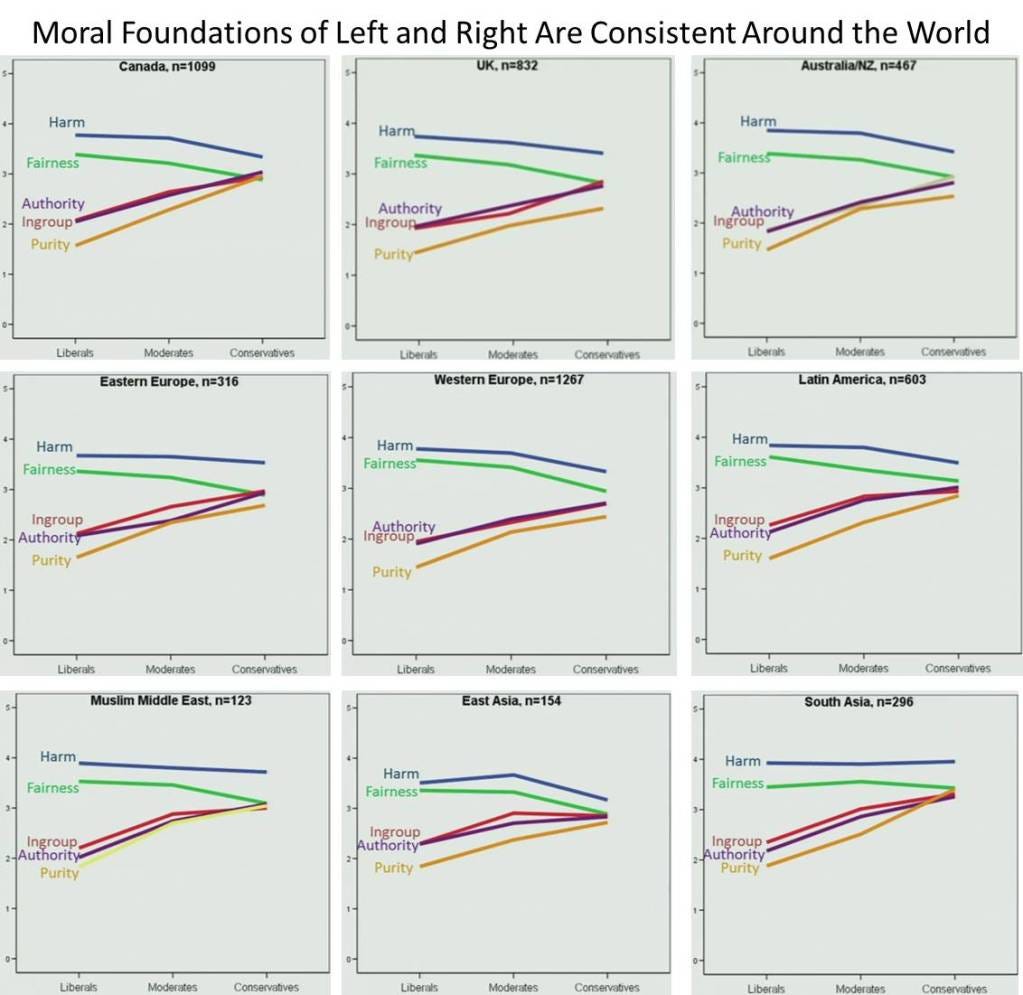
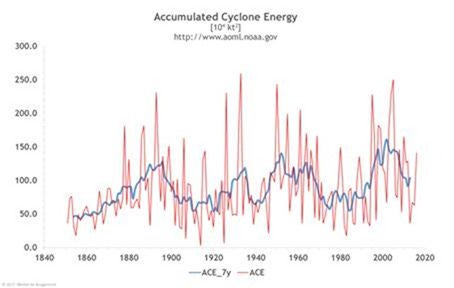


 Politics and Prosperity