Defending the Offensive

Fighting fire with fire.

For a while, I displayed an image of the Battle Flag of the Army of Northern Virginia in the sidebar of my old blog. I did not display the flag to defend it, as one reader suggested. As it said under the image of the flag, I displayed it to symbolize my hope for deliverance from an oppressive national government and to signify my opposition to political correctness of the kind that can’t tolerate the display of the Confederate flag for any purpose.

I certainly did not display the flag to defend the Confederacy’s central cause: the preservation of slavery. (For an alternative view, see this.) But I do defend the legality of secession, as a constitutional right of States. Nor did the display signify racism on my part, because I am not racist (though I am a race realist).

In any event, as I told my reader,

Perhaps there are some visitors to my blog who are turned off by the flag, and who leave without reading my explanation or despite reading my explanation. Frankly, I’m too old to give a damn.

I refuse to cater to the ignorant and easily offended. The ranks of the latter seem to be growing daily. Karen Swallow Prior writes:

[I]t seems political correctness is being replaced by a new trend—one that might be called “empathetic correctness.”

While political correctness seeks to cultivate sensitivity outwardly on behalf of those historically marginalized and oppressed groups, empathetic correctness focuses inwardly toward the protection of individual sensitivities. Now, instead of challenging the status quo by demanding texts that question the comfort of the Western canon, students are demanding the status quo by refusing to read texts that challenge their own personal comfort….

The most jaw-dropping display of empathetic correctness came in a recent New York Times article reporting on the number of campuses proposing that so-called “trigger warnings” be placed on syllabi in courses using texts or films containing material that might “trigger” discomfort for students. Themes seen as needing such warnings range from suicide, abuse, and rape to anti-Semitism, “misogynistic violence,” and “controlling relationships.”…

The purpose of these trigger warnings, according to one Rutgers student calling for them, is to permit students to either plan ahead for “tackling triggering massages” [sic] or to arrange “an alternate reading schedule with their professor.” The student, a sophomore and, surprisingly, an English major (once upon a time, English majors clamored for provocative books) advocates professors warning students as to which passages contain “triggering material” and which are “safer” so that students can read only portions of the book with which “they are fully comfortable.” [“‘Empathetically Correct’ Is the New Politically Correct,” The Atlantic, May 23, 2014]

The empathetically correct mindset is beyond parody. (For more in the same vein, see “The Euphemism Conquers All.”)

A lot of people just want to be offended, and they look for ways of achieving their aim. Take the controversies about the use of “niggardly”. They became controversies for two reasons: (a) some persons who knew the meaning of the word chose to take offense just because it bears a resemblance to a racial slur; (b) some ignoramuses didn’t know the meaning of the word and chose to remain offended even when it was explained to them. (For a recounting of my experience as a user of “niggardly,” go to “Writing: A Guide (Part IV)” and scroll down to “Verboten Words” in B.5.)

Symbols of the Confederacy became as unwelcome as “niggardly”, but on a grander scale. As suddenly and pervasively as the hula-hoop craze of the 1950s — and mainly because of a single act of violence in Charleston — it became de rigeur to condemn persons, places, and things associated with the Confederacy. This is nothing but hysterical nonsense.

Cue Jim Goad:

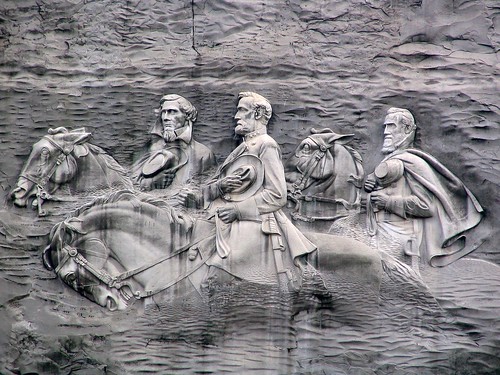
Stone Mountain is a 1,700-foot-tall grey dome rock located about a half-hour due east of downtown Atlanta. On its northern face is the largest bas-relief carving in the world—bigger even than the carving at Mount Rushmore. It depicts Confederate heroes Robert E. Lee, Stonewall Jackson, and Jefferson Davis. The mountain also features a Confederate battle flag at the base of its hiking trail.

Stone Mountain is also where the Ku Klux Klan reinvented itself in 1915 under the direction of William J. Simmons. As legend has it, the Klan would conduct nighttime cross burnings from atop that massive rock to frighten the Atlanta area’s entire black population in one big theatrical stroke of political terror.

Fast-forward a hundred years, and the Klan has clearly lost. The surrounding town of Stone Mountain is now over 75% black and about 18% white. And Atlanta hasn’t had a white mayor since the early 1970s.

Mid-June’s Charleston church shooting—involving a killer who had sullenly posed for selfies hoisting a small Rebel flag—was used as an excuse to launch a full-on cultural purge of all Confederate symbols by those who hate what they insist those symbols represent. And they insist those symbols represent HATE. And they hate that. Those symbols represent intolerance. And they will not tolerate that….

Recently a spokesman for Atlanta’s NAACP demanded that the Confederate carving “be sand-blasted off” Stone Mountain’s side. He also urged authorities to remove the Rebel flag from the mountain’s base.

This raised the hackles and chafed the sunburned necks of Confederate sympathizers across Georgia. Insisting that the flag represented “heritage, not hate,” they arranged for a pro-Confederate rally last Saturday morning at Stone Mountain Park….

[A] young black male was pleading with attendees about how he felt the flag was a provocation, and the attendees kept insisting it had nothing to do with him, especially not with hating him. But he told them that it did. And they kept insisting that it didn’t.

Smirking at an argument that kept going in circles, one peckerwood quipped to me, “That’s one of those deals where ain’t nobody going to get ahead.”

And that pithy quote encapsulated the entire event. It was an argument over what symbols represent—an argument that no one could ever win, because there is no objective answer. In the end, symbols represent whatever someone wants them to represent. One person’s heritage is another person’s hate. And the twain shall never agree. [“Of Heritage and Hate”, Taki’s Magazine, August 3, 2015]

What should and shouldn’t be considered offensive? More to the point, where should the boundaries of state action be drawn? I offer some guidelines in “The Principles of Actionable Harm“:

5. With those exceptions [e.g., defamation, treason, divulging classified information, perjury, incitement to violence, fraud and deception], a mere statement of fact, belief, opinion, or attitude cannot be an actionable harm. Otherwise, those persons who do not care for the facts, beliefs, opinions, or attitudes expressed by other persons would be able to stifle speech they find offensive merely by claiming to be harmed by it. And those persons who claim to be offended by the superior income or wealth of other persons would be entitled to recompense from those other persons….

6. … Nor can it be an actionable harm to commit a private, voluntary act which does nothing more than arouse resentment, envy, or anger in others….

9. Except in the case of punishment for an actionable harm, it is an actionable harm to bar a competent adult from

a. expressing his views, as long as they are not defamatory or meant to incite harm….

10. The proper role of the state is to enforce the preceding principles. In particular,

a. to remain neutral with respect to evolved social norms, except where those norms deny voice or exit, as with the systematic disenfranchisement or enslavement of particular classes of persons; and….

c. to ensure free expression of thought, except where such expression is tantamount to an actionable harm (as in a conspiracy to commit murder or mount a campaign of harassment)….

It would be nice if these principles were observed by politicians, pundits, and various interest groups (both left and right). But it won’t happen for two reasons:

  • People are tribal and love to take stances that identify the particular tribes to which they belong. Arnold Kling puts it this way: “You can take man out of tribal society, but you cannot take tribal society out of man.”

  • Elites and aspiring elites are especially enamored of tribal signaling. As a  commenter at Kling’s blog says: “The main goal of the ascendant educated left-wing white people is to differentiate themselves socially from middle-class white people.” For completeness, I would add lower-class white people, evangelicals and other defenders of traditional morality, the petite bourgeoisie, and anyone who might be suspected of voting Republican.

Clearly, the culture war has entered a new and dangerous phase, reminiscent of China’s Cultural Revolution under Mao. As Boyd Cathey writes,

in the United States today we live in a country characterized by what historian Thomas Fleming has written afflicted this nation in 1860–“a disease in the public mind,” that is, a collective madness, lacking in both reflection and prudential understanding of our history. Too many authors advance willy-nilly down the slippery slope–thus, if we ban the Battle Flag, why not destroy all those monuments to Lee and Jackson. And why stop there? Washington and Jefferson were slave holders, were they not? Obliterate and erase those names from our lexicon, tear down their monuments! Fort Hood, Fort Bragg, Fort Gordon? Change those names, for they remind us of Confederate generals! Nathan Bedford Forest is buried in Memphis? Let’s dig up him up! Amazon sells “Gone with Wind?” Well, to quote a writer at the supposedly “conservative,” Rupert Murdoch-owned New York Post, ban it, too!

It is a slippery slope, but an incline that in fact represents a not-so-hidden agenda, a cultural Marxism, that seeks to take advantage of the genuine horror at what happened in Charleston to advance its own designs which are nothing less than the remaking completely of what remains of the American nation. And, since it is the South that has been most resistant to such impositions and radicalization, it is the South, the historic South, which enters the cross hairs as the most tempting target. And it is the Battle Flag–true, it has been misused on occasion–which is not just the symbol of Southern pride, but becomes the target of a broad, vicious, and zealous attack on Western Christian tradition, itself. Those attacks, then, are only the opening salvo in this renewed cleansing effort, and those who collaborate with them, good intentions or not, collaborate with the destruction of our historic civilization. For that they deserve our scorn and our most vigorous and steadfast opposition. [“‘A Sickness in the Public Mind’: The Battle Flag and the Attack on Western Culture”, Abbeville Institute: The Abbeville Blog, August 4, 2015]

I stand with Dr. Cathey in offering scorn and most vigorous and steadfast opposition to the sheep-like virtue-signalers who believe (mistakenly) that they would have had the courage to stand against the prevailing norms of the past that they now castigate in safety.

We, the Children of the Enlightenment

Are lost in it.

Roger Scruton explains:

…Ferdinand Tönnies … formulated a distinction between two kinds of society — Gemeinschaft and Gesellschaft — the first based in affection, kinship and historic attachment, the second in division of labour, self-interest and free association by contract and exchange. Traditional societies, he argued, are of the first kind, and construe obligations and loyalties in terms of a non-negotiable destiny. Modern societies are of the second kind, and therefore regard all institutions and practices as provisional, to be revised in the light of our changing requirements. The transition from Gemeinschaft to Gesellschaft is part of what happened at the Enlightenment, and one explanation for the vast cultural changes, as people learned to view their obligations in contractual terms, and so envisage a way to escape them.

Max Weber wrote, in the same connection, of a transition from traditional to “legal-rational” forms of authority, the first sanctioned by immemorial usage, the second by impartial law. To these two distinctions can be added yet another, du to Ser Henry Maine, who described the transition from traditional to modern societies as a shift from status to contract — i.e., a shift from inherited social position, to a position conferred by, and earned through, consent.

These sociological ideas are attempts to understand changes whose effect has been so profound that we have not yet come to terms with them. Still less had people come to terms with them in the late eighteenth century, when the French Revolution sent shock waves through the elites of Europe. The social contract seemed to lead of its own accord to a tyranny far darker than any monarchical excess: the contract between each of us became an enslavement of all. Enlightenment and the fear of Enlightenment were henceforth inseparable. Burke’s attack on the [French] Revolution illustrates this new state of mind. His argument is a sustained defence of “prejudice” — by which he meant the inherited store of human wisdom, whose value lasts only so long as we don not question it — against the “reason” of Enlightenment thinking. But people have prejudices only when they see no need to defend them. Only an enlightened person could think as Burke did, and the paradox of his position is now a familiar sub-text of modern culture — the sub-text of conservatism….

It was Marx who developed the most popular explanation of the Enlightenment. The Enlightenment saw itself as the triumph of reason over superstition. But the real triumph, Marx argued, lay not in the sphere of ideas but in the sphere of economics. The aristocratic order had been destroyed, and with it the feudal relations which bound the producers to the land and the consumers to the court. In place of the old order came the “bourgeois” economy, based on the wage contract, the division of labour and private capital. The contractual view of society, the emphasis on individual freedom, the belief in impartial law, the attack on superstition in the name of reason — all these cultural phenomena are part of the “ideology” of the new bourgeois order, contributions to the self-image whereby the capitalist class ratifies its usurpation.

The Marxist theory is a form of economic determinism, distinguished by the belief that fundamental changes in economic relations are invariably revolutionary, involving a violent overthrow of the old order, and a collapse of the political “superstructure” which had been built on it. The theory is almost certainly false: nevertheless, there is something about the Marxian picture which elicits, in enlightened people, the will to believe. By explaining culture as a by-product of material forces, Marx endorses the Enlightenment view, that material forces are the only forces there are. The old culture, with its gods and traditions and authorities, is made to seem like a web of illusions — “the opiate of the people”, which quietens their distress….

…Thanks to Marx, debunking theories of culture have become a part of culture. And these theories have the structure pioneered by Marx: they identify power as the reality, and culture as the mask; they also foretell some future “liberation” from the lies that have been spun by our oppressors.

Debunking theories of culture are popular for two reasons: because they are linked to a political agenda, and because they provide us with an overview. If we are to understand the Enlightenment, then we need such an overview. But ought it to be couched in these external terms? After all, the Enlightenment is part of us; people who have not responded to its appeal are only half awake to their condition. It is not enough to explain the Enlightenment; we must also understand it….

[A]s I noted in discussing Burke, Enlightenment goes hand in hand with the fear of it. From the very beginning hope and doubt have been intertwined. What if men needed those old authorities, needed the habit of obedience and the sense of the sacred? What if, without them, they should jettison all loyalties, and give themselves to a life of godless pleasure?… [T]he very aim for a universal culture, without time or place, brought a new kind of loneliness. Communities depend upon the force of which Burke called prejudice; they are essential local, bound to a place, a history, a language and a common culture. The Enlightened individualist, by forgoing such things, lives increasingly as a stranger among strangers, consumed by a helpless longing for an attachment which his own cold thinking has destroyed.

These conflicts within Enlightenment culture are part of its legacy to us. We too are individualists, believers in the sovereign right of human freedom, living as strangers in a society of strangers. And we too are beset by those ancient and ineradicable yearnings for something else — for a homecoming to our true community…. But … there is no going back, … we must live with our enlightened condition and endure the inner tension to which it condemns us. And it is in terms of this tension, I believe, the we should understand both the splendours and the miseries of modern culture. [An Intelligent Person’s Guide to Modern Culture, pp. 24-9]

Religion, community, and common culture have been displaced by the regulatory-welfare state, anthropogenic global warming, feminism, “choice”, and myriad other totems, beliefs, “movements”, and “leaders”, both religious and secular. Are our minds less troubled, do we sleep better, are we happier in our relationships, is our destiny more secure? Something tells me that the answer to each of those questions is “no”.

The tale was told long ago:

[1] Now the serpent was more subtle than any of the beasts of the earth which the Lord God had made. And he said to the woman: Why hath God commanded you, that you should not eat of every tree of paradise? [2] And the woman answered him, saying: Of the fruit of the trees that are in paradise we do eat: [3] But of the fruit of the tree which is in the midst of paradise, God hath commanded us that we should not eat; and that we should not touch it, lest perhaps we die. [4] And the serpent said to the woman: No, you shall not die the death. [5] For God doth know that in what day soever you shall eat thereof, your eyes shall be opened: and you shall be as Gods, knowing good and evil.

[6] And the woman saw that the tree was good to eat, and fair to the eyes, and delightful to behold: and she took of the fruit thereof, and did eat, and gave to her husband who did eat. [7] And the eyes of them both were opened: and when they perceived themselves to be naked, they sewed together fig leaves, and made themselves aprons. [8] And when they heard the voice of the Lord God walking in paradise at the afternoon air, Adam and his wife hid themselves from the face of the Lord God, amidst the trees of paradise. [9] And the Lord God called Adam, and said to him: Where art thou? [10] And he said: I heard thy voice in paradise; and I was afraid, because I was naked, and I hid myself.

[11] And he said to him: And who hath told thee that thou wast naked, but that thou hast eaten of the tree whereof I commanded thee that thou shouldst not eat? [12] And Adam said: The woman, whom thou gavest me to be my companion, gave me of the tree, and I did eat. [13] And the Lord God said to the woman: Why hast thou done this? And she answered: The serpent deceived me, and I did eat. [14] And the Lord God said to the serpent: Because thou hast done this thing, thou art cursed among all cattle, and beasts of the earth: upon thy breast shalt thou go, and earth shalt thou eat all the days of thy life. [15] I will put enmities between thee and the woman, and thy seed and her seed: she shall crush thy head, and thou shalt lie in wait for her heel.

[16] To the woman also he said: I will multiply thy sorrows, and thy conceptions: in sorrow shalt thou bring forth children, and thou shalt be under thy husband’s power, and he shall have dominion over thee. [17] And to Adam he said: Because thou hast hearkened to the voice of thy wife, and hast eaten of the tree, whereof I commanded thee that thou shouldst not eat, cursed is the earth in thy work; with labour and toil shalt thou eat thereof all the days of thy life. [18] Thorns and thistles shall it bring forth to thee; and thou shalt eat the herbs of the earth. [19] In the sweat of thy face shalt thou eat bread till thou return to the earth, out of which thou wast taken: for dust thou art, and into dust thou shalt return. [20] And Adam called the name of his wife Eve: because she was the mother of all the living.

[21] And the Lord God made for Adam and his wife, garments of skins, and clothed them. [22] And he said: Behold Adam is become as one of us, knowing good and evil: now, therefore, lest perhaps he put forth his hand, and take also of the tree of life, and eat, and live for ever. [23] And the Lord God sent him out of the paradise of pleasure, to till the earth from which he was taken. [24] And he cast out Adam; and placed before the paradise of pleasure Cherubims, and a flaming sword, turning every way, to keep the way of the tree of life. (Book of Genesis, Chapter 3)

A particular feature of the Enlightenment was that its rationalism gave rise to leftism. Thomas Sowell writes about the wages of leftist “intellectualism” in Intellectuals and Society:

One of the things intellectuals have been doing for a long time is loosening the bonds that hold a society together. They have sought to replace the groups into which people have sorted themselves with groupings created and imposed by the intelligentsia. Ties of family, religion, and patriotism, for example, have long been treated as suspect or detrimental by the intelligentsia, and new ties that intellectuals have created, such as class — and more recently “gender” — have been projected as either more real or more important. [p. 303]

In my view, the

left’s essential agenda  is the repudiation of ordered liberty of the kind that arises from evolved social norms, and the replacement of that liberty by sugar-coated oppression. The bread and circuses of imperial Rome have nothing on Social Security, Medicaid, Medicare, Obamacare, and the many other forms of personal and corporate welfare that are draining America of its wealth and élan. All of that “welfare” has been bought at the price of economic and social liberty (which are indivisible).

Freedom from social bonds and social norms is not liberty. Freedom from religion, which seems to be the objective of American courts, is bound to yield less liberty and more crime, which further erodes liberty.

Free Will, Crime, and Punishment

Punishment has two things going for it.

Regarding free will, consider aerial combat (dog-fighting), before the age of air-to-air missiles.

The enemy pilot (Red) comes “out of the sun”, as he is trained to do, and as the friendly pilot (Blue) is trained to anticipate. Blue, upon seeing his adversary, must decide in an instant how to evade Red — if it is not too late to do so. Assume that Blue survives the crucial early moments of his encounter with Red. Blue’s decision about what to do next (probably) will accord with his training; that is, he will choose one of the maneuvers that he was trained in, though he may not execute it in “textbook” style. But the maneuver that he chooses, and how he specifically executes it, will depend on his (very rapid) assessment of the environment (e.g., the enemy’s rate and angle of closure, altitude, presence of clouds, topography), the condition of his aircraft and its armament (e.g., maneuverability, climb rate, ability to withstand the stress of a violent maneuver, accuracy of the machine gun, number of rounds in the magazine, amount of fuel in the tank), and his own confidence in his ability to do what he “should” do, given his necessarily imperfect assessment of the situation, his options, and his ability to exercise each of them.

The key word in all of that is “judgment”. Regardless of Blue’s genetic and behavioral inheritance, he is in a life-or-death situation, and his goal — unless he is suicidal — is to get out of it alive. More than that, he wants to elude Red’s initial onslaught so that he can kill Red. Blue therefore assesses his options with those goals in mind, overriding whatever “instincts” might lead him to panic or choose an inappropriate option, given the specific circumstances of his encounter with Red.

Similarly, but less dramatically, humans make judgments about how they should act so that they can  have enough money to buy a house, be healthy, maintain a stable and happy family life, retire comfortably, and so on.  The judgments — and the behavior that follows from them — may not “come naturally”: saving instead of squandering, drinking moderately instead of heavily, remaining faithful to one’s spouse, and so on.

Thus I have no doubt that I — and most humans — can (and do) act deliberately in ways that are not strictly determined by genetic inheritance, behavioral conditioning, the moon’s cycle, the position of the stars, or any such influence. (It does seem to me that determinism has a lot in common with astrology.) Determinists bear the burden of proving that freely chosen, purposive behavior is an illusion. (It is no more an illusion than is consciousness.)

Some determinists hew to their faith because it allows them to view criminals as automata who are not responsible for their actions and are therefore undeserving of punishment. Illogically, these criminal-coddling determinists usually favor “rehabilitation” over punishment. That position is illogical because:

  • If there is free will, punishment can deter wrong-doing and keep wrong-doers out of circulation (for a while, at least). Rehabilitation will work only in those unusual cases where criminals are able to transform themselves, so that their judgments no longer have anti-social consequences.

  • If free will is lacking (either generally or for persons with certain disorders of the brain), rehabilitation is impossible because criminals are “destined” to commit anti-social acts. But punishment (incarceration or execution) will keep them from committing such acts (temporarily or permanently).


Related reading: “Is Free Will an Illusion?” (a virtual colloquium at The Chronicle of Higher Education)

The Least Evil Option

Failure to act can be the moral equivalent of murder.

Wilson D. Miscamble, writing at Public Discourse in “The Least Evil Option”, defends Harry Truman’s decision to drop the A-bomb on Japan:

[T]he United States eventually could have defeated Japan without the atomic bomb, but all the viable alternate scenarios to secure victory—continued obliteration bombing of Japanese cities and infrastructure, a choking blockade, the likely terrible invasions involving massive firepower—would have meant significantly greater Allied casualties and higher Japanese civilian and military casualties. These casualties would likely have included thousands of Allied prisoners of war whom the Japanese planned to execute. Notably, all of these options also would have indirectly involved some “intentional killing of innocents,” including the naval blockade, which sought to starve the Japanese into submission. Hard as it may be to accept when one sees the visual evidence of the terrible destruction of Hiroshima and Nagasaki, Japanese losses probably would have been substantially greater without the A-bombs….

Bluntly put, the atomic bombs shortened the war, averted the need for a land invasion, saved countless more lives on both sides of the ghastly conflict than they cost, and brought to an end the Japanese brutalization of the conquered peoples of Asia.

(I, too, have defended Truman’s decision. See this post, for example.)

Miscamble’s article is aimed at Christopher O. Tollefson’s critique of  Miscamble’s book, The Most Controversial Decision. Tollefson, according to Miscamble,

largely repeats the fundamental criticism mounted against President Harry Truman by Elizabeth Anscombe over a half-century ago: Violating the moral absolute against the intentional killing of the innocent is always wrong. The atomic bombs involved such killing and so should not have been used––end of story. It is all neat, and clear, and logically consistent.

Is the intentional killing of the innocent always wrong? Consider these situations:

1. A homicidal maniac rushes into a restaurant, grabs a diner and holds her in front of himself as a shield, then begins to shoot other diners. You are seated in the restaurant, in the maniac’s line of vision, and he will soon shoot you if you do nothing. You are carrying a high-powered handgun, and have time to take a shot at the maniac before he aims at you, but your only sure way of stopping the him is to shoot through the innocent diner whom he is using as a shield. It is your life or the innocent person’s. Would you shoot before being shot or wait to see what happens; the maniac might not shoot at you, he might not hit you, he might not hurt you seriously, or you might be able to duck. But you do not know which of these things will happen. Therefore, if you do nothing, you are inviting the worst of them to happen, namely, that the maniac will shoot you and kill you or seriously wound you.

2. Then, there is this classic: You are at a train track and see five people tied to the track ahead. A switch is in front of you which will divert the train, but as you look down you see that a man is tied to that track and will be killed if you flip the switch. Is it permissible to flip the switch and save the five people at the expense of one?

3. And this variation: Now imagine that in order to save the five people, you have to push a stranger in front of the train to stop it. You know for certain that this action would stop the train in time to save the five people tied to the tracks. Is it permissible to push the man and save the five people at the expense of one?

There are three ways to view each situation:

  • through the lens of utilitarianism, which considers one (innocent) life to be the equivalent of another

  • through the lens of in-group solidarity, which places a premium on one’s own life and the lives of those with whom one has a special relationship (kinsfolk, neighbors, countrymen) for reasons of affection and/or mutual dependence

  • through the lens of the Golden Rule, which (in my view) is a social convention that arises from self-interest tempered by empathy.

The utilitarian answers to three problems are as follows:

1. Shoot. Your life is equal to the life of the human shield, and if you are able to kill or seriously wound the thug, you may save the lives of other innocent persons in the restaurant.

2. Flip the switch and save five lives at the cost of one.

3. Overcome your squeamishness about being so directly involved in the death of the stranger; push him in front of the train and save five lives at the cost of one.

These are the “right” answers from the perspective of in-group solidarity:

1. Shoot. The life you save may be your own, and by living you may able to save several other fellow diners with whom you probably have more in common than with the thug who is in the process of killing them.

2. If the potential victims of the train are all strangers to you, you have to flip a coin to decide whether to throw the switch or leave it alone. Otherwise, your action depends on your relationship(s) with any of the potential victims of the oncoming train.

3. If the potential victims are strangers, you have to flip a coin to decide whether to push the man in front of the train or do nothing. Otherwise, your action depends on your relationship(s) with any of the potential victims of the oncoming train.

These are the “right” answers for a person whose adherence to the Golden Rule arises from a combination of self-interest and empathy:

1. Shoot. Unless you are a psychopath like the homicidal maniac, you identify with the other diners and you cringe when he shoots one of them because their pain and death affects you emotionally. The more of your fellow diners you save, the more emotional pain you spare yourself. Further, those whose lives you save may be able to do something similarly heroic for you.

2. Flip the switch, unless you are emotionally closer to the single person on the one track than you are to the fiver persons on the other track. Even if all of the potential victims are strangers to you, it is not utilitarian to suggest that you can have more empathy for five strangers than for one stranger, especially if you take into account the (probably) larger number of persons who would be hurt by the death of five than the death of one.

3. Push the stranger in front of the train, unless you are emotionally closer to the single person on the one track than you are to the fiver persons on the other track. Even if all of the potential victims are strangers to you, it is not utilitarian to suggest that you can have more empathy for five strangers than for one stranger, especially if you take into account the (probably) larger number of persons who would be hurt by the death of five than the death of one.

What does all of this have to do with Truman’s decision to drop the A-bomb? If you are a utilitarian, you might be persuaded that Truman’s decision was the correct one because it resulted in fewer deaths than there would have been in the case of an invasion or blockade. (I dismiss the possibility that the Japanese military would have quit fighting if the U.S. had simply stopped fighting after driving Japanese forces back to their homeland.)

If you place great stock in in-group solidarity, Truman’s move was the correct one because it saved American lives — possibly the lives of friends and family members.

If you are an adherent of the Golden Rule, you come to the same place for two reasons. The first reason is the empathic one just mentioned: the saving of lives of persons for whom you have a natural affinity. The second reason arises from self-interest and has at least two branches:

  • You are glad that Truman put an end to a war that would have proved more costly to you (directly or through your ancestors) had he not decided to drop the bomb.

  • You are glad that Truman, in effect, warned off prospective enemies of the United States who are therefore enemies of your interests. That Truman’s warning was later undermined by his own actions in Korea, America’s withdrawal from Vietnam, and similar actions in later wars couldn’t have been foreseen at the time.

If you still object to Truman’s decision because you believe that it is always wrong to take an innocent life, you are putting yourself in the shoes of an armed diner who decides against shooting a homicidal maniac because that would require the shooting of an innocent person. But do not forget that the diner’s refusal to shoot the maniac probably would lead to the deaths of many innocent persons (the diner included). The refusal to kill an innocent person, under any circumstances, can be the moral equivalent of murder and/or suicide.

To put it baldly, the refusal to kill an innocent person under any circumstances is not a fully considered moral stance.

What are the implications of this analysis for U.S. actions with respect to the war in Ukraine?

1. As a utilitarian matter, the likely costs (human and material) of further intervention (including the possibility of a nuclear exchange) must be weighed against the likely benefits, which for the U.S. and western Europe would be economic (less spent on war materials, less costly energy and foodstuffs). This calculus favors conceding to Russia the parts of Ukraine that it wishes to annex. There are two caveats: Conceding to Russia the portions of Ukraine that it seeks to annex might cause Russia to seek further concessions. It might also lead to more aggressive moves by China, Iran, and North Korea.

2. The in-group viewpoint favors a course that is least damaging — near-term and long-run — to Americans. Assuming that the risk of future aggression is small, the calculus favors a U.S. push for a settlement with Russia that allows it to annex parts of Ukraine. The same caveats apply.

3. The Golden Rule points in the same direction because because empathy and self-interest favor putting our kinsmen, friends, and neighbors before persons who are mainly strangers (Ukrainians). The same caveats apply.

Superiority

If you’ve got it, flaunt it.

You are a superior person (i.e., “woke”) if you hate most of these things:

  • smoking (tobacco)

  • fast food

  • rednecks and other rural types

  • all sports but running, soccer, and cycling

  • fundamentalist Christians (but not fundamentalist Muslims)

  • Israel

  • NASCAR

  • AGW “deniers”

  • fossil fuels (but not the low-cost energy they yield)

  • CO2 (though your “carbon footprint” is probably bigger than that of most Americans and almost everyone else in the world)

  • the Constitution (as written) and those who defend it

  • large families

  • home-schooling and private schools (for others)

  • deregulation

  • war (though WWII turned out okay)

  • police (except when you need them)

  • guns

  • capital punishment (all other forms are also suspect)

  • capitalists (though you may be one and you certainly benefit from capitalism)

  • red-meat eaters (unless they also like sashimi)

  • private-property rights and freedom of association (for others)

  • anyone who likes most of the above

  • people who are opinionated, judgmental, intolerant, and hateful (high irony)

Pattern-Seeking

Patterns are everywhere, but often only in the imagination.

Scientists and analysts are reluctant to accept the “stuff happens” explanation for seemingly related events. The blessing and curse of the scientific-analytic mind is that it always seeks patterns, even where there are none to be found.

The example that leaps readily to mind is “climate change”, the gospel of which is based on the fleeting (25-year) coincidence of rising temperatures and rising CO2 emissions. That, in turn, has led to irrational hysteria about “climate change”.

The true believers in human-caused “global warming” seized on CO2 as the explanation of a minuscule change in the average of recorded temperatures, to the near-exclusion of other factors. How else could the true believers justify their puritanical desire to control the lives of others, or (if not that) their underlying anti-scientific mindset which seeks patterns instead of truths.

It is pattern-seeking that drives scientists to develop explanations that are later discarded and even discredited as wildly wrong. I list a succession of such explanations in my post “The Science Is Settled“.

Political pundits, sports writers, and sports commentators are notorious for making predictions that rely on tenuous historical parallels. I herewith offer an example, drawn from my very own blog.

Here is the complete text of “A Baseball Note: The 2017 Astros vs. the 1951 Dodgers“, which I posted on August 14, 2017:

If you were following baseball in 1951 (as I was), you’ll remember how that season’s Brooklyn Dodgers blew a big lead, wound up tied with the New York Giants at the end of the regular season, and lost a 3-game playoff to the Giants on Bobby Thomson’s “shot heard ’round the world” in the bottom of the 9th inning of the final playoff game.

On August 11, 1951, the Dodgers took a doubleheader from the Boston Braves and gained their largest lead over the Giants — 13 games. The Dodgers at that point had a W-L record of 70-36 (.660), and would top out at .667 two games later. But their W-L record for the rest of the regular season was only .522. So the Giants caught them and went on to win what is arguably the most dramatic playoff in the history of professional sports.

The 2017 Astros peaked earlier than the 1951 Dodgers, attaining a season-high W-L record of .682 on July 5, and leading the second-place team in the AL West by 18 games on July 28. The Astros’ lead has dropped to 12 games, and the team’s W-L record since the July 5 peak is only .438.

The Los Angeles Angels might be this year’s version of the 1951 Giants. The Angels have come from 19 games behind the Astros on July 28, to trail by 12. In that span, the Angels have gone 11-4 (.733).

Hold onto your hats.

What happened? The Astros rallied, the Angels collapsed, and the Astros ended the regular season in 1st place in the AL West, 21 games ahead of the 2nd place Angels.

My “model” of the 2017 contest between the Astros and Angels was on a par with the disastrously wrong models that “prove” the inexorability of catastrophic anthropogenic global warming. The models are disastrously wrong because they are being used to push government policy in counterproductive directions: wasting money on “green energy” while shutting down efficient sources of energy (fossil fuels) at the cost of real jobs and economic growth.

Is Science Self-Correcting?

Only in the way that suicide is self-correcting.

A long-time colleague, in response to a provocative article about the sins of scientists, characterized it as “garbage” and asserted that science is self-correcting.

I should note here that my colleague abhors “extreme” views, and would cross the street to avoid a controversy. As a quondam scientist, he thinks of a challenge to the integrity of science as “extreme”. Which is as an unscientific attitude. (What else would you expect of a “collabo”?)

Science is only self-correcting on a time scale of decades, and even centuries. Wrong-headed theories can persist for a very long time. And it has become worse in the past six decades.

What has changed in the past six decades? Sputnik spurred a (relatively) massive increase in government-funded research. This created a new and compelling incentive: Produce research that comports with the party line. The party line isn’t necessarily the line of the party then in power, but the line favored by the bureaucrats in charge of doling out money.

On top of that, politically incorrect research is generally frowned upon. And when it surfaces it is attacked en masse by academicians who are eager to prove their political correctness.

Thus it is that the mere coincidence of a rise in CO2 emissions and a rise in temperatures in the latter part of the 20th century became the basis for kludgey models which “prove” AGW — preferably of the “catastrophic” kind — while essentially ignoring eons of evidence to the contrary. Skeptics (i.e., scientists doing what scientists should do) are attacked viciously when they aren’t simply ignored. The attackers are, all too often, people who call themselves scientists.

And thus it is that research into the connection between race and intelligence has been discouraged and even suppressed at universities. This despite truckloads of evidence that there is such a connection.

Those two examples don’t represent all of science, to be sure, but they’re a sad commentary on the state of science — in some fields, at least.

There are many more examples in Politicizing Science: The Alchemy of Policy-Making, edited by Michael Gough. I haven’t read the book, but I’m familiar with most of the cases documented by the contributors. The cases are about scientists behaving badly, and about non-scientists misusing science and advocating policies that lack firm scientific backing.

Scientists have been behaved badly since the dawn of science, though — as discussed above — there are now more (or different) incentives to behave badly than there were in the past. But non-scientists (especially politicians) will behave badly regardless of and contrary to scientific knowledge. So I won’t blame science or scientists for that behavior, except to the extent that scientists are actively abetting the bad behavior of non-scientists.

Which brings me to the matter of science being self-correcting. I am an avid (perhaps rabid) anti-reificationist. So I must say here that there is no such thing as “science”. There’s only what scientists “do” and claim to know.

It’s possible, though not certain, that future scientists will correct the errors of their predecessors — whether those errors arose from honest mistakes or bias. But, in the meantime, the errors persist and are used to abet policies that have costly, harmful, and even fatal consequences for multitudes of people. And most of that damage can’t be undone.

So, in this age of weaponized science, I take no solace in the idea that the errors of its practitioners and abusers might, someday, be recognized. The errors of knowledge might be corrected, but the errors of application are (mostly) beyond remedy.

Here’s an analogy: The errors of the builders, owners, captain, and crew of RMS Titanic seem to have been corrected, in that there hasn’t been a repetition of the conditions and events that led to the ship’s sinking. But that doesn’t make up for the loss of 1,514 lives, the physical and emotional suffering of the 710 survivors, the loss of a majestic ship, the loss of much valuable property, or the grief of the families and friends of those who were lost.

In sum, the claim that science is self-correcting amounts to a fatuous excuse for the irreparable damage that is often done in the name of science.


Related reading: Nathan Cofnas, “Science Is Not Always Self-Correcting“, Foundations of Science 21(3):477-492 (2016)

Is Consciousness an Illusion?

A dream within a dream?

Scientists seem to have pinpointed the physical source of consciousness. But the execrable Daniel C. Dennett, for whom science is God, hasn’t read the memo. Dennett argues in From Bacteria to Bach and Back: The Evolution of Minds that consciousness is an illusion.

Another philosopher, Thomas Nagel, weighs in with a dissenting review of Dennett’s book. (Nagel is better than Dennett, but that’s faint praise.) Nagel’s review, “Is Consciousness an Illusion?”, appears in The New York Review of Books (March 9, 2017). Here are some excerpts:

According to the manifest image, Dennett writes, the world is

full of other people, plants, and animals, furniture and houses and cars…and colors and rainbows and sunsets, and voices and haircuts, and home runs and dollars, and problems and opportunities and mistakes, among many other such things. These are the myriad “things” that are easy for us to recognize, point to, love or hate, and, in many cases, manipulate or even create…. It’s the world according to us.

According to the scientific image, on the other hand, the world

is populated with molecules, atoms, electrons, gravity, quarks, and who knows what else (dark energy, strings? branes?)….

In an illuminating metaphor, Dennett asserts that the manifest image that depicts the world in which we live our everyday lives is composed of a set of user-illusions,

like the ingenious user-illusion of click-and-drag icons, little tan folders into which files may be dropped, and the rest of the ever more familiar items on your computer’s desktop. What is actually going on behind the desktop is mind-numbingly complicated, but users don’t need to know about it, so intelligent interface designers have simplified the affordances, making them particularly salient for human eyes, and adding sound effects to help direct attention. Nothing compact and salient inside the computer corresponds to that little tan file-folder on the desktop screen.

He says that the manifest image of each species is “a user-illusion brilliantly designed by evolution to fit the needs of its users.” In spite of the word “illusion” he doesn’t wish simply to deny the reality of the things that compose the manifest image; the things we see and hear and interact with are “not mere fictions but different versions of what actually exists: real patterns.” The underlying reality, however, what exists in itself and not just for us or for other creatures, is accurately represented only by the scientific image—ultimately in the language of physics, chemistry, molecular biology, and neurophysiology….

You may well ask how consciousness can be an illusion, since every illusion is itself a conscious experience—an appearance that doesn’t correspond to reality. So it cannot appear to me that I am conscious though I am not: as Descartes famously observed, the reality of my own consciousness is the one thing I cannot be deluded about….

According to Dennett, however, the reality is that the representations that underlie human behavior are found in neural structures of which we know very little. And the same is true of the similar conception we have of our own minds. That conception does not capture an inner reality, but has arisen as a consequence of our need to communicate to others in rough and graspable fashion our various competencies and dispositions (and also, sometimes, to conceal them)….

The trouble is that Dennett concludes not only that there is much more behind our behavioral competencies than is revealed to the first-person point of view—which is certainly true—but that nothing whatever is revealed to the first-person point of view but a “version” of the neural machinery….

I am reminded of the Marx Brothers line: “Who are you going to believe, me or your lying eyes?” Dennett asks us to turn our backs on what is glaringly obvious—that in consciousness we are immediately aware of real subjective experiences of color, flavor, sound, touch, etc. that cannot be fully described in neural terms even though they have a neural cause (or perhaps have neural as well as experiential aspects). And he asks us to do this because the reality of such phenomena is incompatible with the scientific materialism that in his view sets the outer bounds of reality. He is, in Aristotle’s words, “maintaining a thesis at all costs.”

Nagel’s counterargument would have been more compelling if he had relied on a simple metaphor like this one: Most drivers can’t describe in any detail the process by which an automobile converts the potential energy of gasoline to the kinetic energy that’s produced by the engine and then transmitted eventually to the automobile’s drive wheels. Instead, most drivers simply rely on the knowledge that pushing the start button will start the car. That knowledge may be shallow, but it isn’t illusory. If it were, an automobile would be a useless hulk sitting in the driver’s garage.

Some tough questions are in order, too. If consciousness is an illusion, where does it come from? Dennett is an out-and-out physicalist and strident atheist. It therefore follows that Dennett can’t believe in consciousness (the manifest image) as a free-floating spiritual entity that’s disconnected from physical reality (the scientific image). It must, in fact, be a representation of physical reality, even if a weak and flawed one.

Looked at another way, consciousness is the gateway to the scientific image. It is only through the deliberate, reasoned, fact-based application of consciousness that scientists have been able to roll back the mysteries of the physical world and improve the manifest image so that it more nearly resembles the scientific image. The gap will never be closed, of course. Even the most learned of human beings have only a tenuous grasp of physical reality in all of it myriad aspects. Nor will anyone ever understand what physical reality “really is” — it’s beyond apprehension and description. But that doesn’t negate the symbiosis of physical reality and consciousness.

Political Ideologies

The spectrum is a circle.

Political ideologies proceed in a circle. Beginning arbitrarily with conservatism and moving clockwise, there are roughly the following broad types of ideology: conservatism, anti-statism (libertarianism), and statism. Statism is roughly divided into left-statism and right-statism, which are distinguishable by their goals and constituencies. Statism is just another word for authoritarianism.

By statism, I mean the idea that government should do more than merely defend the people from force and fraud. Because there is broad disagreement as to what those additional “services” should be, statism necessarily uses the power of government to dictate to the citizenry the terms and conditions of their citizenhood — their social and economic arrangements.

Conservatism and libertarianism are both anti-statist, but there is a subtle and crucial difference between them, which I will explain.

Not everyone has a coherent ideology of a kind that I discuss below. There is what I call the squishy center of the electorate which is easily swayed by promises and strongly influenced by bandwagon effects. In general, there is what one writer calls clientelism:

the distribution of resources by political power through an agreement in which politicians – the patrons – make this allocation dependent on the political support of the beneficiaries – their clients. Clientelism emerges at the intersection of political power with social and economic activity.

Politicians themselves are prone to claiming ideological positions to which they don’t adhere, out of moral cowardice and a preference for power over principle. Republicans have been especially noteworthy in this respect. Democrats simply try to do what they promise to do — increase the power of government, albeit at vast but unacknowledged economic and social cost.

In what follows, I will ignore the squishy center and the politics of expediency (except for a brief mention of “establishment” conservatism). I will focus on the various ideologies, the contrasts between them, and the populist allure of left-statism and right-statism. I will start with conservatism and work around the circle to the statisms.

CONSERVATISM

I count three kinds of conservatism, which aren’t necessarily compatible with each other. The first kind is the conservatism of belief (ideological conservatism), which bears a passing resemblance to libertarianism. But that resemblance is only superficial, as is libertarianism.

The second kind of conservatism is the conservatism of temperament or disposition.

There is a third kind of conservatism. It springs from the same source as populism, and is hard to distinguish from it. A populist rightly resents the special privileges that accrue to those in power, those with access to power, or those who reap the benefits of power. It is only natural to want equal privileges, and to try to obtain them through the state.

Opposed to conservatism, in all of its guises, but oddly aligned with libertarianism is the kind of statism known as “liberalism” or “progressivism”. (The “sneer quotes” signify that the terms are badly misapplied; modern “liberalism” isn’t liberal and “progressivism” is just a euphemism for coercive social and economic policies.)

The Conservatism of Belief

Most persons — including most of those who call themselves conservatives — associate conservatism with a bundle of political positions; for example:

  • Small and unintrusive government, where States fully exercise their constitutional powers; Congress exercises only its strictly limited and enumerated powers, and doesn’t delegate them to bureaucrats; and judges apply constitutional laws and do not make new laws by interpreting the Constitution’s “emanations and penumbras”.

  • Strict application of the U.S. Constitution against State and local usurpation of freedom of contract and property rights (including but not limited to the banning of labor unions as contrary to freedom of contract and property rights).

  • Low taxes, just enough to fund the constitutional functions of governments (central, State, and local).

  • Law and order (tough and strictly enforced criminal codes)l

  • Strong national defense, applied only when the immediate interests of Americans are at stake, but applied without limitation once a decision to go to war has been taken.

  • Membership in international organizations limited to the purpose of defending such interests.

  • Limited legal immigration, with strong defenses against illegal immigration and strict naturalization laws (including the end of birth-right citizenship).

  • Freedom of religion, including the freedom to invoke the Deity on government property.

  • Freedom of association, including the right to refuse to do business of any kind with anyone regardless of race, sex, sexual orientation, national origin, etc.

  • School choice, with tax-funded vouchers for private schools (including religious ones).

  • Unrestricted gun ownership (but with restrictions on age, criminal history, and mental ability — but not an easily misused evaluation of mental stability).

  • A rollback of the voting age to 21, and preferably higher and with a property-ownership requirement (“skin in the game”).

All of this is consistent with the understanding that the things government does for people, beyond its legitimate protective functions, are costly. The costs are direct, in the form of taxes and regulations that divert resources from private uses, stultify economic growth, and shape private affairs according to the dictates of lawmakers and regulators. The costs are also indirect and long-lasting, in that governmental largesse undermines self-reliance, initiative, and the voluntary social institutions (including markets) that embed not only the specific knowledge of individual citizens but also the accumulated wisdom of long experience.

The Conservatism of Temperament

The second kind of conservatism isn’t really an ideology, it’s a temperamental (or dispositional) reliance on the accumulated wisdom of long experience, which is embedded in cultural traditions (including religious ones). Change isn’t ruled out, but it must have a practical purpose, be proven in actual use (as opposed to a politician’s or bureaucrat’s master plan), and help rather than harm effective social and economic relationships. (Given the nature of conservatism as a preference for the tried-and-true that emerges from private action, it is conservative to reject government-imposed economic and social arrangements that are contrary to those listed above, and to strive to undo them. I make this point because anti-conservatives sometimes, laughably, try to portray acceptance of long-standing governmental programs and edicts as conservative.)

If a conservative by temperament adopts ideological conservatism, he probably won’t budge from it. He will instinctively embrace it firmly because governmental interference in private affairs, with its arbitrariness and unintended consequences, offends his understanding that change should be tested in the acid of use by those directly affected by it.

LIBERTARIANISM

The discussion thus far may smack of libertarianism, which encompasses anarchism (or anarcho-capitalism) and minarchism (the night-watchman state). Fear not. There is an essential difference between conservatism and libertarianism. Conservatives value voluntary social institutions not just because they embed accumulated wisdom. Conservatives value voluntary social institutions because they bind people in mutual trust and respect, which foster mutual forbearance and breed social comity in the face of provocations. Adherence to long-standing social norms helps to preserve the wisdom embedded in them while also signalling allegiance to the community that gave rise to the norms.

Libertarians, on the other hand, following the lead of their intellectual progenitor, John Stuart Mill, are anxious to throw off what they perceive as social “oppression”. The root of libertarianism is Mill’s “harm principle”, which I have exposed for the fraud that it is.

Rather than repeat myself, I turn to Scott Yenor, writing in “The Problem with the ‘Simple Principle’ of Liberty” (Law & Liberty, March 19, 2018). Yenor begins by quoting the harm principle:

The sole end for which mankind are warranted, individually or collectively, in interfering with the liberty of action of any of their number, is self-protection. . . . The only purpose for which power can be rightfully exercised over any member of a civilized community, against his will, is to prevent harm to others. . . .The only part of the conduct of anyone, for which he is amenable to society, is that which concerns others. In the part that merely concerns himself, his independence is, of right, absolute. Over himself, over his own body and mind, the individual is sovereign.

This is the foundational principle of libertarianism, and it is deeply flawed, as Yenor argues. He ends with this:

[T]he simple principle of [individual] liberty undermines community and compromises character by compromising the family. As common identity and the family are necessary for the survival of liberal society—or any society—I cannot believe that modes of thinking based on the “simple principle” alone suffice for a governing philosophy. The principle works when a country has a moral people, but it doesn’t make a moral people.

Ironically, there are many so-called libertarians who invoke the state in order to override binding social norms in their zeal to enforce the harm principle.

There’s more. Libertarianism, as it is usually explained and presented, lacks an essential ingredient: morality. Yes, libertarians espouse a superficially plausible version of morality — the harm principle, quoted above by Scott Yenor. But the harm principle is empty rhetoric. Harm must be defined, and its definition must arise from social norms. The alternative, which libertarians — and “liberals” — obviously embrace, is that they are uniquely endowed with the knowledge of what is “right”, and therefore should be enforced by the state. Not the least of their sins against social comity is the legalization of abortion and same-sex “marriage” (detailed arguments at the links). For more about the difference between conservatism and libertarianism, see “The Libertarian-Conservative Divide”.

LEFT-STATISM: “LIBERALISM” OR “PROGRESSIVISM”

Liberalism underwent a transition in the late 1800s and early 1900s, and became something entirely different, which I denote as “liberalism”. The name was preserved for a long time, until “liberals” began to call themselves “progressives”, but they’re the same thing.

At any rate, “liberalism” grew out of classical liberalism when the notion of rights was expanded to include positive rights. Those are rights impose burdens on the beneficiaries of those rights; for example, the payment of taxes to subsidize the poor (as the state defines them) and the right to education, which requires that taxpayers subsidize public schools, which teach that taxpayers ought to subsidize many things, that criminals are victims, that the Constitution is an out-dated and cumbersome document, and on into the night. (Positive rights are natural to close-knit groups, but are oppressive when applied to entire geopolitical entities.)

There were no essential differences between the new “liberals” and the American “progressives” of the late 19th century and early 20th century. The term “progressive” eventually dropped out of use, and “liberal” took its place until the late 20th century. The rebirth of a coherent strand of American conservatism, marked by ascendancy of Ronald Reagan, put “liberals” on the defensive. Their coping tactic wasn’t to rethink their ideology but to rename it as “progressivism”, which has become something that “liberals” and “progressives” cannot or will not acknowledge: left-statism.

Nothing is off the table for a left-statist. The state must bring everyone in line with whatever passes for “progressive” thinking at the moment: anti-religionism, same-sex marriage, gender fluidity, “women must be believed” (unless they challenge Democrats), untrammeled immigration, environmental extremism, the end of fossil fuels, socialized medicine, universal basic income, universal day-care, etc., etc., etc. Such things aren’t merely to be enacted, but transgressions against them must be punished by public shaming if not by criminal penalties. And nothing can stand in the way of the furtherance of the left-statist agenda — certainly not the Constitution. If Congress balks, use the courts, regulatory agencies, and left-dominated State and local governments. Above all, use public schools, universities, the media, and Big Tech to overwhelm the opposition by swaying public opinion and indoctrinating the next generation of voters.

If there is a distinction between “liberalism”, “progressivism”, and left-statism, it is one of attitude rather than aims. Many a “liberal” and “progressive” wants things that require oppressive state control, but is loath to admit the truth that oppressive state control is required to have such things. These naifs want to believe the impossible: that the accomplishment of the “progressive” agenda is compatible with the preservation of liberty. The left-statist simply doesn’t care about liberty; the accomplishment of the left-statist agenda is the end that justifies any and all means. Those “liberals” and “progressives” who aren’t left-statists by attitude are merely useful idiots to hard-core, Lenin-like left-statists.

Left-statism, in my vocabulary, resolves into leftism. For much more about it — including its destructiveness and pathology — see “Leftism in America” and “Leftism as Crypto-Fascism”.

THE LEFT-RIGHT DIVIDE

The Importance of Taking Sides

At bottom, that which separates people along political lines isn’t necessarily disposition, temperament, or considered ideological positions. It may be, rather, the taking of sides. And the taking of sides depends greatly on influence and association. Those things, in turn, lead to self-selection: the choice to live in place X, work at place Y, or join group Z because the prevailing views at X, Y, or Z are congruent with one’s own views. It is only later that the joiner will discover that there are uncongenial persons at X, Y, or Z — persons whose conduct (arising out of disposition or temperament) is hard to countenance. Thus the never-ending story of intramural warfare that abounds even in places that often are either mostly conservative or mostly “liberal”: universities, workplaces (especially “high tech” and “low tech” ones), clubs, and churches.

There are many on the left who are there because it is convenient or comfortable to take that side. The same is true on the right.

When I learn that a so-called conservative (e.g., Max Boot) has renounced conservatism and adopted the language of leftism, I wonder how he could have changed so quickly. But the answer is simple: he didn’t change. All that changed were his beliefs of convenience.

Populism

Populism, according to Wikipedia,

refers to a range of approaches which emphasise the role of “the people” and often juxtapose this group against “the elite”….

… Populists typically present “the elite” as comprising the political, economic, cultural, and media establishment, all of which are depicted as a homogenous entity and accused of placing the interests of other groups—such as foreign countries or immigrants—above the interests of “the people”. According to this approach, populism is a thin-ideology which is combined with other, more substantial thick ideologies such as nationalism, liberalism, or socialism. Thus, populists can be found at different locations along the left–right political spectrum and there is both left-wing populism and right-wing populism.

Which is to say that populism is a facet of taking sides. Which side you’re on depends on which side you’re against. Persons who believe themselves to be oppressed in some way will take sides with those who promise to deliver them from their oppressors.

On the left the “oppressed” include persons of color (including illegal immigrants from the south), women, gender-confused persons, die-hard unionists, ethnic (but not Orthodox) Jews (who in America merely imagine themselves to be oppressed), and the poor (regardless of how they came to be poor). Members of those groups are considered traitors if they choose to be on the right. The “thick ideology” with which left-populists identify is “progressivism”, which is to say the use of state power to deliver the privileges that they believe are theirs by right.

Populism, in other words, is just statism for the benefit of non-elites.

The Essential Left-Right Difference and Its Implications

Leftism is destructive of society and the economy, whether purposely or not. This is because the reigning disposition on the left is to hold and exercise power for the “greater good” — as the leftist sees it. The toll is heavy: the destruction of traditional social norms that bind and civilize society; the rejection of free markets because they “fail” to produce outcomes desired by the left; and on and on.

Rightism aims to preserve society and to ensure a robust economy. Perhaps I am being too easy on right-statism because it currently represents no threat to liberty in America. But if it were somehow to arise as a threat (for the first time in America’s history) — and not a fear-fantasy promoted by the left — it would be a puritanically oppressive mirror-image of left-statism. To take one example: Religion might dominate the law, whereas, the law is now used to override religion.

In any event, both left-statism and right-statism are manifestations of authoritarianism. I can’t wholeheartedly endorse this article about the research of some psychologists at Emory University, but it offers some good insights about authoritarianism. Here are some of them:

[Right-wing and left-wing authoritarians] are almost like mirror images of one another that both share a common psychological core, the researchers conclude.

“Authoritarians have a predisposition for liking sameness and opposing differences among people in their environment,” [lead author Thomas] Costello says. “They are submissive to people they perceive as authority figures, they are dominant and aggressive towards people they disagree with, and they are careful to obey what they consider the norms for their respective groups.”…

“It’s a mistake to think of authoritarianism as a right-wing concept, as some researchers have in the past,” he says. “We found that ideology becomes secondary. Psychologically speaking, you’re an authoritarian first, and an ideologue only as it serves the power structure that you support.”

This is a refreshing change of tone from the decades-long proclivity of psychologists to label (wrongly) authoritarianism as a right-wing or conservative phenomenon. (See, for example, this, this, this, and this.)

When leftism has taken a heavy toll on society and the economy, conservatives must strive not only to wrest control from leftists but also to undo their deeds and prevent them from returning to power. “Establishment” conservatism is a weak brand of rightism that cavils at the necessity of expunging leftism from the body politic.

Here, then, are the more potent brands of rightism.

RIGHT-STATISM: FROM RIGHT-POPULISM TO INSTITUTIONAL CONSERVATISM

Right-Populism

The “thick” ideology with which right-populists identify is ideological conservatism. Many of the positions listed under that heading can be seen through the lens of populism as anti-elitist. Which is to say that they are anti-“progressive”, inasmuch as “progressivism” is the reigning ideology among elites.

A right-populist will not embrace conservative ideology because it implies smaller government, or because it fits his disposition. He will embrace conservative ideology as a protest against “progressivism”, while wanting government to do the things for him that government is perceived as doing for the left’s clients, and for the big corporations that are perceived as allied with the left and benefiting from government-granted privileges.

This isn’t to say, by any means, that right-populists are just as wrong-headed as the elitists they scorn. Right-populist instincts, if enacted, would result in much less costly and oppressive governance than elitist programs. There are vast and largely uncounted economic and social costs attached to the schemes hatched and enacted by elitists, which include these:

  • racial and ethnic preferences in college admissions, employment, and housing

  • mandatory accommodations by businesses to “identity” groups (but not working-class, heterosexual ones)

  • the opening of borders, to the detriment of middle-class taxpayers and American workers at the low end of the pay scale

  • the lowering of trade barriers, which benefits authoritarian foreign regimes (e.g., China) and subsidized foreign companies at the expense of American workers

  • futile attempts to eradicate poverty by subsidizing idleness and broken homes

  • futile attempts to educate persons above their innate ability

  • various kinds of environmental extremism that thwart economic progress and impose huge costs, the fight against “climate change” merely being the latest and worst — and which includes programs that favor the relatively affluent (e.g., subsidies for solar panels and electric vehicles, both of which actually require vast amounts of energy to produce, and the latter of which requires vast amount of energy to operated)

  • “credentialism”, which as Arnold Kling says, “artificially inflates the incomes of professors and administrators by raising the demand for higher education”, “artificially inflates the incomes of health care professionals”, and “in government … artificially raises incomes for people who obtain degrees that have no bearing on their ability to perform”.

More than that, right-populist instincts include the preservation of the binding and civilizing social norms that “progressives” seek to subvert. That subversion has been so successful in wide swaths of government, business, the media, the academy, and public “education” that it can only be reversed by a state as powerful as the one that the left has erected.

Institutional Conservatism

Institutional conservatism aligns with right-populism in that it enforces the norms that “progressives” seek to subvert. Instead of allowing the “marketplace of ideas” to legitimate leftism and undermine traditional morality, institutional conservatism (mistakenly called fascism) protects and fosters the institutions that preserve traditional morality: marriage (the union of one man and one woman), the family (nuclear and extended) that flows from marriage, and religion being paramount.

A Sidebar about Fascism

In popular usage, fascism is conflated with totalitarianism. They are not the same thing, though a totalitarian regime may embrace fascism instead of overtly commanding the economy. A good definition of fascism (no longer online) was found in an earlier version of Wikipedia‘s article on the subject:

Fascism is a system in which the government leaves nominal ownership of the means of production in the hands of private individuals but exercises control by means of regulatory legislation and reaps most of the profit by means of heavy taxation. In effect, fascism is simply a more subtle form of government ownership than is socialism.

Institutional conservatism isn’t fascistic when, aside from fostering traditional morality, it is generally laissez-faire with respect to the economy. The regimes of Hitler and Mussolini were fascistic (as well as totalitarian) because the continuance of private enterprise was a sham; corporations were effectively instruments of state power. FDR’s regime was aspirationally fascistic. By contrast, the Pinochet regime in Chile was anti-fascistic in that it fostered economic growth through denationalization of industries and the growth of private enterprise.

THE CIRCLE CAN BE BROKEN

That completes my journey around the political circle, and into its squishy center. The circle isn’t smooth because politics isn’t a mathematical proposition. One’s political leanings depend on disposition, temperament, ideology, life experiences, the company one keeps — and a lot more.

Political polarization is real, but often it is only as deep as the company one keeps. It is nevertheless heartening that there is political polarization. It means that decades of indoctrination by “educators” and the media haven’t yet succeeded in turning Americans into pod people.

The Way Ahead

A prediction comes closer to reality.

Thirteen months ago, at my old blog, I addressed a long-standing theme of my posts in the category War-Peace-Foreign Affairs. Here’s the post in question:

Afghanistan is the latest is a string of American military failures since World War II: Korea, Vietnam, Lebanon, Iraq I (Saddam could have been removed but wasn’t), Somalia, 9/11 (a failure in itself), Iraq II, and Afghanistan. (Have I missed any?)

Why the failures? A combination of impetuousness and lack of resolve. Both go with the U.S. system of governance, which (except for World War II) results in frequent shifts of direction and is unduly beholden to “popular” (i.e., media-driven) opinion.

This will not change. It will only get worse. Unless there arises an immediate, existential threat (as in 1941). It must be a threat that is clearly dangerous enough to stiffen the resolve of U.S. (and Western) leaders and to overcome the anti-war, anti-defense bias of the media. But, even then, a sudden burst of resolve by U.S. (and Western) leaders may not be enough. Given technological advances since 1941, an enemy could probably cripple the West (e.g., see EMP) before U.S. and NATO forces and countermeasures can be mobilized.

In sum, monolithic regimes (e.g., China) can play the long game. The West cannot because of its “democratic” politics. Even a Churchill, if one were to arise, probably couldn’t salvage “democracy”.

But by the time that China (or an alliance of convenience led by China) is ready to bring the West to its knees, an outright attack of some kind won’t be necessary. The cultural and political rot will have burrowed so deeply into the the West’s psyche that World War III will be a walkover. [It will be a] sniveling, hand-wringing affair presaged by Biden’s performance in withdrawing from Afghanistan and blaming others for his own failure.

And it won’t be a walkover for the West.

Now comes this from Francis P. Sempa, writing at The Federalist:

A month before China’s 20th Party Congress is scheduled to meet in Beijing, China’s President Xi Jinping will meet with Russian President Vladimir Putin at the Shanghai Cooperation Organization (SCO) in Uzbekistan on September 15-16. The summit comes on the heels of what ABC News described as “sweeping military drills” by Russian forces, in which Chinese military units participated, and a Sino-Russian agreement to use yuan and rubles instead of dollars to pay for energy supplies.

Western media have speculated that the planned meeting in Uzbekistan will further solidify a growing strategic partnership that both leaders previously characterized as having “no limits.”…

A New York Times article noted that both countries have offered geopolitical support to each other in the current conflict in Ukraine and in ongoing Sino-U.S. disputes in the South China Sea. The Times speculates that the meeting “could offer further symbolism of a Chinese-Russian alliance opposing a Western-led world order.”

A better sense of the importance of the meeting can be gleaned from reading what Russian and Chinese spokespersons and media say about it and the Sino-Russian relationship in general. TASS quoted Kremlin official Yury Ushakov as stating that the meeting “will be very important for obvious reasons.” And Russia’s ambassador to China was quoted referring to Chinese leaders as “our partners.”

Even more revealing, however, was a Global Times piece entitled “China, Russia to strengthen cooperation on the way to a ‘multipolar world.’” This article, which reported on the recently held seventh Eastern Economic Forum in Vladivostok, quoted Putin extensively and favorably. At the forum, Putin said “the West is failing, the future is in Asia,” and “efforts to isolate Russia were in vain amid a pivot toward Asia,” according to the Global Times reporters. The article notes that Putin “said Russia is abandoning the use of the US dollar and British pound” and that both currencies have “lost credibility.” The article boasted that “China is the top investor and biggest trading partner for the Russian Far East” and that both countries are cooperating on the emerging “Arctic shipping route.” The general theme of the article is that the Western-led world order is a thing of the past, and it is being replaced by a multipolar world order led by China and Russia….

Now, look at a map or globe: geographically the SCO occupies a huge swath of the Eurasian landmass, and the organization’s tentacles are spreading to the Middle East and Africa. The territories covered by the SCO also happen to be targets of Beijing’s Belt and Road Initiative (BRI). The Xi–Putin strategic partnership poses a geopolitical danger to Western democracies similar to that posed by the Nazi–Soviet Pact of 1939–41 and the Sino-Soviet bloc of the early Cold War years. The real significance of the upcoming Xi–Putin summit: Who controls Eurasia, as Halford Mackinder warned, commands the world.

(There are some post-meeting doubts about the strength of the Sino-Russian relationship. But it seems to me that there such a partnership is inevitable, given the ambitions of Xi and Putin vis-a-vis the West.)

If there isn’t a de facto surrender by the West — marked by significant concessions on trade, sactions, and the scope of military operations and influence — there will be a World War III.

But I fully expect concessions by weak-kneed Western leaders. The concessions will be sugar-coated for domestic consumption and packaged in the form of measures (rationing, lock-downs) to fight the crises du jour, be they a pandemic, inflation, a depression, or the ever-popular threat of incineration by a temperature rise of a degree or two.

Why the Mar-a-Lago Raid?

This one isn’t for the faint of heart.

The Mar-a-Lago raid is part of a much bigger picture. Here’s the picture as I see it:

There is and has been (for at least six years) a conspiracy to “get” Donald Trump. It began with a hoax (the “Steele dossier”) that was designed to discredit Trump and deny him the presidency. It continued while he was in office, with a coordinated assault by congressional Democrats and media leftists to eject him from the presidency. It has continued since he left office, with the specific aim of preventing him from running or being elected in 2024, and the broader aim of suppressing the GOP and electoral support for GOP candidates.

In addition to the political motivation for the conspiracy — which was and is to protect and preserve the “deep state” — there was and is also the matter of Joe Biden’s complicity in and enrichment by influence-peddling. (More about that below.)

The conspiracy was instigated by the Oval Office and designed by the CIA. A key element of the design was to bring the “dossier” to the attention of the FBI. Key FBI officials may have been in cahoots with the CIA. Other FBI officials who became involved in the affair may have believed in the “dossier” because they wanted to believe in it. Instead of looking for the truth, they took the “dossier” and ran with it, engaging in criminal acts of malfeasance along the way.

At first — in addition to Trump — the conspiracy affected people like Carter Page, who was probably harassed in the hope of flipping him. It resulted in the firing and prosecution of Lt. General Mike Flynn, who was too knowledgeable about intelligence sources for the comfort of the conspirators.

The conspirators have now targeted about 30 Trump associates. And, more broadly, they have intensified their attacks on everyone who doesn’t agree with the left’s agenda (especially “wokeism”). The main target is the “deplorables” attacked by Hillary Clinton, who are now the “semi-fascists” conjured by Joe Biden.

The whole thing is a classic Stalinist operation: scapegoat, shame, suppress, and prosecute the opposition. (The left loves to project its own feelings and methods onto its opponents.)

Where does the raid on Mar-a-Lago fit into all of this? The raid was a fishing expedition to see how much information Trump had acquired about the origins and workings of the conspiracy. The unprecedented nature of the raid, the obviously flimsy pretext for it, and the selective leaks by the FBI all suggest desperation on the part of the conspirators.

In the best case (for the conspirators), Trump would be silenced by a quid-pro-quo (don’t expose us and we won’t prosecute you). In a worse case (for the conspirators), a smear campaign/prosecution would blunt or discredit whatever story Trump tells the public. The worst case would have been a bolt out of the blue: Revelations by Trump about the conspiracy that would be so damning that Democrats in the White House and Congress would be as scarce in the next several decades as they were in the decades following the Civil War.

Here’s the part that explains the conspirators’ desperation: In addition to the possibility of revelations that would cripple (or doom) the Democrat Party, there’s a personal angle for Joe Biden. For the sake of his reputation, ill-gotten fortune, and even his freedom, he must prevent Trump (in particular) and Republicans (in general) from pursuing the investigation and prosecution of the influence-peddling scheme fronted by his son.

Wordplay

Just because it’s Monday.

There is laughter in slaughter, but there ought to be naught.

When rain is naught there is a drought, the thirst from which can be quenched by a draught.

Enough is enough, especially when it’s a cough that comes with a cold caught by sitting in a draught.

When the wind soughs the boughs wave gently.

He bends before her in a deep bow before sloughing his coat and bending his bow to take aim at a bough on a tree that stands in a distant slough.

A daughter’s laughter softens even a rough, tough crofter.

IQ, Political Correctness, and America's Present Condition

It could be worse, but you wouldn’t want to go there.

There was a big kerfuffle on the IQ front several years ago, when Jason Richwine was chased from his job at the Heritage Foundation. The proximate cause of Richwine’s departure from Heritage was the usual kind of witch hunt that accompanies the discovery of anything coming from a conservative source that might offend political correctness. Richwine was “guilty” of having penned a dissertation that contains unremarkable statements about ethnic differences in average IQ, including the IQ difference between Hispanics and non-Hispanic whites.

Here are excerpts of John Derbyshire’s narration of l’affaire Richwine as it unfolded:

… Following the release of a report by the Heritage Foundation arguing that the Rubio-Schumer immigration bill will cost the nation $6.3 trillion, the Slave Power set their dwarf miners to digging.

They soon found gold. One of the co-authors of the study is twentysomething Jason Richwine, a Heritage analyst. Not just an analyst, but a quantitative analyst: “Heritage’s senior policy analyst in empirical studies.” …

After a few days’ digging the Nibelungs turned up Richwine’s Ph.D. thesis from Harvard University, title: “IQ and Immigration Policy.” The mother lode! (You can download it from here.)

The Washington Post ran a gleeful story on the find under the headline “Heritage study co-author opposed letting in immigrants with low IQs.” [By Dylan Matthews, May 8, 2013]. They note that:

Richwine’s dissertation asserts that there are deep-set differentials in intelligence between races.

Eek! A witch! …

Post columnist Jennifer Rubin, on secondment from Conservatism, Inc. to offer some pretense of “balance” at the Post, hastened to join the lynch mob. “It undermines the cause of all immigration opponents to have their prized work authored by such a character,” she wrote, reading Richwine out of respectable society….

She then brings in Jennifer S. Korn for a quote. Ms. Korn was Secretary for Hispandering in the George W. Bush White House….

What does Ms. Korn have to tell us?

Richwine’s comments are bigoted and ignorant. America is a nation of immigrants; to impugn the intelligence of immigrants is to offend each and every American and the foundation of our country….

Even if you take Ms. Korn’s usage of “impugn” to mean Richwine has stated that immigrants have lower mean IQ than natives, she is wrong. Table 2.2 in the thesis (p. 30) gives an average estimated mean IQ of 105.5 for immigrants from Northeast Asia….

And so another “anti-racist” witch hunt commences….

The forces of orthodoxy have identified a heretic. They’re marching on his hut with pitchforks and flaming brands. The cry echoes around the internet: “Burn the witch!”.… [“‘Burn the Witch’: Heritage Foundation Scuttles Away from Jason Richwine–and the Cold, Hard Facts”, VDare.com, May 9, 2013]

The impetus for politically correct witch-hunting comes from the left, of course. This is unsurprising because leftists, on average, are dumber than conservatives and libertarians. (See this and this, for example.) Which would explain their haste to take offense when the subject of IQ is raised.

But facts are facts, and Richwine summarizes them neatly in a recent (post-Heritage) essay; for example:

The American Psychological Association (APA) tried to set the record straight in 1996 with a report written by a committee of experts. Among the specific conclusions drawn by the APA were that IQ tests reliably measure a real human trait, that ethnic differences in average IQ exist, that good tests of IQ are not culturally biased against minority groups, and that IQ is a product of both genetic inheritance and early childhood environment. Another report signed by 52 experts, entitled “Mainstream Science on Intelligence,” stated similar facts and was printed in the Wall Street Journal. [“Why Can’t We Talk about IQ?”, Politico, August 9, 2013]

Richwine continues:

[W]hen Larry Summers, then the president of Harvard University, speculated in 2005 that women might be naturally less gifted in math and science, the intense backlash contributed to his ouster.Two years later, when famed scientist James Watson noted the low average IQ scores of sub-Saharan Africans, he was forced to resign from his lab, taking his Nobel Prize with him.

When a Harvard law student was discovered in 2010 to have suggested in a private email that the black-white IQ gap might have a genetic component, the dean publicly condemned her amid a campus-wide outcry. Only profuse apologies seem to have saved her career.

In none of these cases did an appeal to science tamp down the controversy or help to prevent future ones. My own time in the media crosshairs would be no different.

So what did I write that created such a fuss? In brief, my dissertation shows that recent immigrants score lower than U.S.-born whites on a variety of cognitive tests. Using statistical analysis, it suggests that the test-score differential is due primarily to a real cognitive deficit rather than to culture or language bias. It analyzes how that deficit could affect socioeconomic assimilation, and concludes by exploring how IQ selection might be incorporated, as one factor among many, into immigration policy.

Because a large number of recent immigrants are from Latin America, I reviewed the literature showing that Hispanic IQ scores fall between white and black scores in the United States. This fact isn’t controversial among experts, but citing it seems to have fueled much of the media backlash.

Derbyshire follows up:

Jason, who can hardly be more than thirty, has not yet grasped an important thing about humanity at large: that most of our thinking is magical, superstitious, religious, social, and egotistical. Very little of it is empirical. I myself am as stone-cold an empiricist as you’ll meet in a month of Sundays; yet every day when I walk my dog there is a certain tree I have to pat as we pass it. (It’s on the wrong side of the road. The family joke is that I shall one day be hit by a truck while crossing the road to pat my lucky tree.)

Hence Jason’s puzzlement that 25 years after Snyderman and Rothman, 19 years after The Bell Curve and the follow-up “Mainstream Science on Intelligence” declaration, the public discourse even in quality outlets is dominated by innumerate journo-school graduates parroting half-remembered half-truths from Stephen Jay Gould’s The Mismeasure of Man, the greatest work of Cultural Marxist propaganda yet produced.

That’s how we are. That’s the shape of human nature. Alan Cromer explained it in his 1993 book Uncommon Sense: The Heretical Nature of Science. Not many people can think empirically much of the time. At the aggregate level, where the lowest common denominator takes over and social acceptance is at the front of everyone’s mind, empiricism doesn’t stand a chance unless it delivers some useful technology.

Nor is it quite the case that “emotion trumps reason.” What mostly trumps reason is the yearning for respectability, leading us to conform to ambient dogmas—in the present-day West, the dogmas of Cultural Marxism, which waft around us like a noxious vapor….

This is how we are: jumbles of superstition, emotion, self-deception, and social conformism, with reason and science trotting along behind trying to keep up.

Science insists that there is an external world beyond our emotions and wish-fulfillment fantasies. It claims that we can find out true facts about that world, including facts with no immediate technological application. The human sciences insist even more audaciously that we ourselves are part of that world and can be described as dispassionately as stars, rocks, and microbes. Perhaps one day it will be socially acceptable to believe this. [“Why We Can’t Talk about IQ”, Taki’s Magazine, August 15, 2013]

Much has been made of the “bland” 1950s and the supposed pressure to conform to the Ozzie and Harriett way of life. I was never clear about the preferred alternative, however. On the evidence of the past 60 years, it seems to have been a potent mix of blue language, promiscuous sex, sodomy, broken families, drugs, violence, ear-blasting “music”, “free” stuff, conformity in spades (“cancel culture” and all that), and on into the night.

The true forces of conformity had begun their work many years before Ricky Nelson was a gleam in his father’s eye. There was, of course, the Progressive Era of the late 1800s and early 1900s, from which America was beginning to recover by the late 1920s.. But then came the Great Depression, the New Deal, and the establishment in America of a fifth column dedicated to the suppression of liberty:

As recounted in [KGB: The Inside Story by KGB Colonel Oleg Gordievsky and Cambridge intelligence expert Christopher Andrew]  … Harry Hopkins — FDR’s confidant, advisor, and policy czar, who actually resided in the White House during World War II — was the Big Enchilada among American agents of influence working for the USSR. Gordievsky recounts attending a lecture early in his career by Iskhak Akhmerov, the KGB’s top “illegal” spy in the U.S. during the 1940s (In espionage parlance, “illegals” do not have legal cover if caught). According to Gordievsky, Akhmerov spoke for a long period about Hopkins, calling him the top Soviet asset in the US. Yet, Gordievsky and Andrew tiptoe around this allegation by representing that Hopkins was a naïve devotee who only courted Stalin to ensure victory over Hitler’s Germany.

Although I know Andrew well, and have met Gordievsky twice, I now doubt their characterization of Hopkins…. It does not ring true that Hopkins was an innocent dupe dedicated solely to defeating the Nazis. Hopkins comes over in history as crafty, secretive and no one’s fool, hardly the personality traits of a naïve fellow traveler. And his fingerprints are on the large majority of pro-Soviet policies implemented by the Roosevelt administration. [Diana] West [author of American Betrayal: Secret Assault on Our Nation’s Character] deserves respect for cutting through the dross that obscures the evidence about Hopkins, and for screaming from the rooftops that the U.S. was the victim of a successful Soviet intelligence operation….

West mines Venona, the testimony of “Red spy queen” Elizabeth Bentley — who confessed her work for the communist underground to the FBI in 1945 — and the book Blacklisted by History by M. Stanton Evans, a re-examination of the McCarthy era using Venona and hundreds of other recently declassified documents from the FBI, CIA, and other agencies. And West lambastes the Truman administration for not revealing data from Venona that would have exonerated McCarthy and informed the nation that Soviet agents had indeed infiltrated key departments of the FDR administration….

The Rosenbergs, Alger Hiss, Harry Dexter White, Laurence Duggan, and 397 more American agents have been confirmed and verified as Soviet agents. West claims Harry Hopkins has been outed too in Venona, but Radosh and other scholars say this identification is bogus. But the Soviets also ran important agents of influence with great attention to the security of their identities. In essence, whether or not Hopkins is ever identified in Venona, he remains, as the cops say, a person of interest. [Bernie Reeves, “Reds under the Beds: Diana West Can’t Sleep”, American Thinker, August 10, 2013]

Influence flows downhill. What happened in Washington was repeated in many a city and State because the New Deal had made leftism respectable. By the end of World War II, which made nationalization the norm, the “mainstream” had shifted far to the left of where it had flowed before the Great Depression.

Influence also flows laterally. The growing respectability of leftism emboldened and empowered those institutions that naturally lean left: the media, academia, and the arts and letters. And so they went forth into the wilderness, amplifying the gospel according to Marx.

The most insidious influence has been the indoctrination of students — from pre-kindergarten to graduate school — in the language and ideals of leftism: world government (i.e., anti-Americanism); redistributionism (as long as it hits only the “rich”, of course); favoritism for “minorities” (i.e., everyone but straight, white, conservative males of European descent); cultural diversity (any kind of crap in the arts, music, and literature, as long as it wasn’t produced by dead, white males); and moral relativism (e.g., anti-feminism is bad, unless it’s practiced by Muslims). All of that, and much more, is the stuff of political correctness (now “wokeness”), which is an especially corrosive manifestation of social conformism, as Jason Richwine learned the hard way.

And then came the “pod people”, These are the masses of “ordinary people” who may have been deaf or impervious to indoctrination by teachers and professors, but who in vast numbers were (and continue to be) seduced by into collaboration with the left by years and decades of post-educational exposure to leftist cant. Seduced by slanted opinionators — usually disguised as reporters. Seduced by novelists, screenwriters, playwrights, and other denizens of the world of arts and letters. Seduced by politicians (even “conservative” ones) trading “free” stuff for votes.

It is more than a small wonder that there is such a sizable remnant of true conservatives and non-leftish libertarians (unlike this leftish one). But we are vastly outnumbered by staunch leftists, wishy-washy “moderates,” and “conservatives” whose first instinct is to defend sacred cows (Social Security and Medicare, for example) instead of defending liberty.

I will end with this observation:

If America was ever close to being a nation united and free, it has drifted far from that condition — arguably, almost as far as it had by 1861. And America’s condition will only worsen unless leaders emerge who will set the nation (or a large, independent portion of it) back on course. Barring the emergence of such leaders, America will continue to slide into baseness, divisiveness, and servitude.

The McNamara Legacy: A Personal Perspective

“Gotcha” was the name of his game.

The death some years ago of former secretary of defense Robert S. McNamara caused me to reflect on my brief time as a “whiz kid” in McNamara’s Systems Analysis office. SA was then headed by assistant secretary of defense Alain Enthoven, a quintessential whiz kid who was only 30 when he began his eight-year reign as the Pentagon’s “doubting Thomas”.

My own days as a minor whiz kid ran from July 1967 to March 1969, that is, from late in McNamara’s regime (January 21, 1961 – February 29, 1968), through the interregnum of Clark Clifford (March 1, 1968 – January 20, 1969), and into the early months of Nixon’s appointee, Melvin Laird (January 22, 1969 – January 29, 1973). SA’s influence dwindled sharply upon McNamara’s departure from the Pentagon, but SA had been very powerful until then, for three reasons.

First, of course, SA was a key ingredient of McNamara’s management
“revolution”, which came straight from the playbook of RAND — the Air Force’s influential think-tank. McNamara recruited Charles Hitch from RAND to serve as comptroller of the Department of Defense. Hitch — a leading proponent of the use of planning, programming, and budgeting systems (PPBS) and co-author of the “bible” of systems analysis, The Economics of Defense in the Nuclear Age — brought with him Alain Enthoven, who began as deputy assistant secretary of defense for systems analysis in 1961 and was elevated to assistant secretary of defense for SA in 1965. (For a recounting of McNamara’s love affair with RAND-ites and their techniques, see “Early RAND and the McNamara Revolution”, which begins on p. 4 of the RAND Review, Fall 1998.)

A second, closely related reason for SA’s power was its central position in McNamara’s decision process. SA exercised its power mainly through the so-called draft presidential memorandum (DPM). DPMs, which originated in SA, took the form of lengthy memos from the secretary of defense to the president, none of which — as far as I know — actually went to the president. DPMs were, in fact, vehicles for obtaining and recording McNamara’s decisions on major program issues. Each DPM treated a broad set of issues (e.g., force structure, force mix, manning levels, major procurement programs) in a particular mission area (e.g., strategic forces; tactical air forces, naval forces, and land forces). For each of the dozen or so issues addressed in a DPM (e.g., the number and mix of amphibious ships), the responsible SA analyst(s) would (in about a page) summarize the sponsoring service’s proposed program and the analytical basis for the service’s position; criticize the service’s analysis (usually by focusing on critical but debatable assumptions and the inevitable uncertainty of cost estimates); briefly discuss alternatives (almost always less ambitious and expensive than the service’s proposal); recommend one of them; and give a tabular comparison of the alternatives, using simple figures of merit chosen for the purpose of making the recommended alternative look good. (We called it “tablesmanship.”)

The coup de grace often would be a “clinching” reason for approving SA’s recommended (less-expensive) alternative (e.g., the unlikelihood of another amphibious assault on the scale of the landing at Inchon, given the location of approved planning scenarios). DPMs would be sent to the services and the Joint Chiefs of Staff (JCS) for comment. After some back and forth, decision versions would go up to McNamara, who almost always chose the alternatives recommended by SA.

In sum, we SA civilians played “gotcha”. We did it because we were encouraged to do it, though not in so many words. And we got away with it, not because we were better analysts — most of our work was simplistic stuff — but because we usually had the last word. (Only an impassioned personal intercession by a service chief might persuade McNamara to go against SA — and the key word is “might”.) The irony of the whole process was that McNamara, in effect, substituted “civilian judgment” for oft-scorned “military judgment”. McNamara revealed his preference for “civilian judgment” by elevating Enthoven and SA a level in the hierarchy, 1965, even though (or perhaps because) the services and JCS had been open in their disdain of SA and its snotty young civilians.

A third reason for SA’s power, and its ability to play “gotcha”, was the essential lack of structure in the Department of Defense’s PPBS. For all of the formality and supposed rigor of the system, it lacked an essential ingredient: budget constraints against which the services could submit realistic program proposals. Budget constraints had existed de facto under Eisenhower and were to exist de jure under Nixon. In fact, Melvin Laird introduced a decision process built around fiscal constraints soon after taking office, on the recommendation of a former subordinate of Enthoven’s who stayed on as acting assistant secretary for about a year into Laird’s regime.

In any event, because McNamara didn’t give the services budget targets, the services were effectively encouraged to ask for a lot more than they could get. That incentive was reinforced by the reorientation of the defense program toward “flexible response” in the 1960s. Each service, naturally, sought a piece of the new action, and — lacking fiscal guidance — each of them did the sensible thing by asking for a lot more than it was likely to get. Under such a system, SA was bound to look good, and SA analysts were bound to make the services look bad by playing “gotcha”. It turned out that I didn’t have the stomach for it, which is why I left SA after 20 increasingly depressing months.

And that brings me to the players and their “tone”. What did the SA staff look like?

– There were a lot of youngish civilians, like me, who were bereft of military service and may never have seen a military unit or military equipment, except in a parade. Many of the young civilians had Harvard MBAs, and they were notorious, even within SA, for their brashness and rudeness.

– There was a smaller cadre of lightly less-young civilians, imported from other parts of DoD and the defense industry. Their SA experience lent them a certain cachet that they could trade on for advancement in government and industry.

– There were many junior officers who had deferred their active service to pursue graduate degrees. Because of those degrees, they were snatched up by SA instead of being sent to Vietnam. They were really civilians, at heart, who happened to carry military ranks.

– Most of the major components of SA had one or two “service reps” — senior officers nominated by the services. Some of them were dead-enders with nothing to lose (which worked against their sponsoring services). Others (notably the Navy reps) were rising stars who (a) tried to keep SA “honest” and (b) kept their sponsoring services informed of what SA was up to.

– The higher echelons were populated by “seasoned” civilians, with military analysis experience at places like RAND and the aerospace industry. One such senior civilian exemplified the tone of SA. He wrote a white paper in which he discussed (among other things) the role of amphibious forces in defense strategy. In the course of that discussion, he pointedly and sneeringly referred to amphibious forces as “ambiguous forces”.

In my 20 months at the Pentagon, I came to understand the essential difference between Systems Analysis, as it was in McNamara’s day, and outfits like the Operations Evaluation Group, a Navy-sponsored civilian organization. SA, to put it baldly, existed to work against the services. OEG, by contrast, existed (and exists) to work with a service, to help it make the best use of its forces and systems. There is no doubt in my mind that the contributions of OEG were (and are) far more valuable to the nation’s defense than the “contributions” of SA, which may well have harmed it.

Analysis per se is neither a good thing nor a bad thing. It’s like a loaded gun, in that its goodness or badness depends on who wields it and for what purpose.

Since When?

A minor matter of usage.

Some news sources report that Queen Elizabeth met with every U.S. president since Harry Truman, with the exception of Lyndon Johnson.

Inasmuch as Elizabeth met with Truman, it should be said that she met with every U.S. president since FDR, with the exception of LBJ. That’s because since refers to the period of time after a specified event.

But it takes too much thought on the part of history-challenged Americans to conjure the meaning of the Queen’s having met with every U.S. president since FDR, with the exception of LBJ.

Therefore, one of these correct and computable statements will have to do:

  • The Queen met with every U.S. president since FDR, with the exception of LBJ.

  • The Queen met with Truman and every subsequent president, with the exception of LBJ.

  • The Queen met with 13 U.S. presidents, from Truman to Biden, with the exception of LBJ.

Why didn’t the Queen meet with LBJ? There’s a lot of speculation about that. My guess is that she didn’t especially want to meet the man, and rightly considered Princess Margaret to have been an adequate surrogate.

A Look into the Vanished Past

In “Ghosts of Christmases Past” I recall family gatherings of long ago. “The Passing of Red Brick Schoolhouses and a Way of Life” laments the passing of the schoolhouses of my childhood, along with the innocence that was once a hallmark of non-urban America.

I was reminded of those trips into the past by a post at The Federalist by Nathaniel Blake, “What Good Is Cheaper Stuff If It Comes At The Expense Of Community?”. It prompted me to recall the long-vanished locally-owned businesses that provided groceries, meat, sundries, haircuts, baked goods, hobby supplies, and more. The owners worked in their stores. They knew you, and you knew them. Many of them were neighbors. Their livelihoods depended not only on providing products and services at prices that saved you a trip to the big city — but on their friendliness and reputation for honesty.

Of the many stores of that ilk that I remember from kindergarten until I went to college — 64 to 77 years ago — only one is still in business. It’s even at the same location, though in a new building, and it doesn’t carry the range of hobby supplies (e.g., model kits and collectible stamps) that it did when I shopped there in the 1950s.

Here are the sites as they look now (or looked recently), arrayed roughly in the order in which I first saw them (* indicates original building):

Grocery store and gas station*

Dairy store

Grocery store

Bakery

Grocery store and news stand

Grocery store with ice house in back

Meat market*

Meat market

Grocery store

Barber shop (left)* – Grocery store (right)*

Bakery (and owners’ residence)*

Grocery store (and owners’ residence)*

Grocery store

Hobby store*

Hobby store

Grocery store

Grocery store*

Barber shop – Drugstore (two separate buildings)

Grocery store

Share this:

Monarchs of England

From Cerdic to Charles III

I have updated the post (here) in which I trace the succession of the monarchs of Wessex, England, and the United Kingdom from Cerdic (r. 519-534) to Charles III (r. 2022- ).

The Most Disturbing Thing about Biden's Speech

The masses aren’t revolting.

Biden’s infamous speech on September 1, in which he derided and defamed half of the electorate, was received poorly by Republicans and independents. It was even given bad marks by a significant minority of Democrats. That’s the good news.

The bad news is that Biden’s standing in the Rasmussen Reports Presidential Tracking Poll hasn’t budged since the morning of the day on which Biden spoke. I am unaware of any development that might have offset the reaction to Biden’s speech.

I can only conclude that most voters are really indifferent to the aim of the speech: to endorse and encourage the shaming, shunning, and suppression of anyone who utters any kind of disagreement with leftist wokeism.

Indifference to fascism enables the tightening of its grip on nation.

Saving the Innocent

For the victims of Cleotha Abston and his ilk.

Cleotha Abston, as you must know by now, is the “suspected” murdere of Eliza Fletcher. It is a sign of the times that as I publish this post neither name appears in a search of Wikipedia, that leftist propaganda outlet. Eventually, Wikipedia will publish something about Abston’s abominable record and heinous crimes, but with due reference to his “underprivileged” background, or some such horse***.

Paul Compos, writing at The New Republic some years ago, celebrated “The American Justice System at Its Best“:

[I]t’s reasonable to argue that the acquittal of Casey Anthony … represent[s] … the system working as it should. But accepting that argument requires acknowledging deep imperfections that our legal system must tolerate, even when it does exactly what it’s supposed to do.

The most disturbing of these inevitable imperfections is a product of our supposed commitment to the principle that we prefer a large number—whether it’s 10, 50, or 100, the precise number is never clearly stated—of guilty people going free to the conviction of an innocent defendant. That is the practical significance of requiring the state to prove guilt “beyond a reasonable doubt”—a standard that, interestingly, the system always avoids defining in any but the most general, non-statistical terms….

[In Anthony’s case] The state proved beyond a reasonable doubt that a two-year-old child was murdered, and that her mother was, at the least, a deeply irresponsible parent with a propensity to lie to authorities. The prosecution also demonstrated, in my view, that it is far more likely than not that Anthony committed the crime. But I also believe the jury’s verdict was correct….

The case against Anthony was largely circumstantial, buttressed by arguably—yet only arguably—strong forensic evidence. But the prosecution was hampered by its inability to provide a compelling narrative explaining either how Caylee Anthony was killed or why her mother purportedly murdered her. This failure was not, as far as we know, a product of prosecutorial incompetence. The hard truth is that it is extremely difficult to successfully prosecute a murder under these kinds of circumstances—and the harder truth is that we are supposedly committed to the principle that this is, on the whole, a good thing.

“We”, if you include me and millions of others, are certainly not committed to the principle to which Compos refers. That principle is stated in the dictum of the influential English jurist, William Blackstone:

Better that ten guilty persons escape than that one innocent suffer.

“n” — the number of guilty persons — has increased since the late 1700s, when Blackstone wrote.

Alexander “Sasha” Volokh offers some useful perspective:

Charles Dickens generously endorsed a value of n = “hundreds” for capital cases, and not just “that hundreds of guilty persons should escape,” but that they should escape “scot-free.” 99 Dickens was, in fact, so generous that hundreds of guilty persons escaping scot-free was not only better than one innocent person suffering — it was even better “than that the possibility of any innocent man or woman having been sacrificed, should present itself, with the least appearance of reason, to the minds of any class of men!” 100….

Of course, such blithe invocation could easily lead too far down the road to “inconsiderate folly” and “pestiferous nonsense.” As one author noted, there is “nothing so dangerous as a maxim”: 107

Better that any number of savings-banks be robbed than that one innocent person be condemned as a burglar! Better that any number of innocent men, women, and children should be waylaid, robbed, ravished, and murdered by wicked, wilful, and depraved malefactors, than that one innocent person should be convicted and punished for the perpetration of one of this infinite multitude of crimes, by an intelligent and well-meaning though mistaken court and jury! Better any amount of crime than one mistake in well-meant endeavors to suppress or prevent it! 108….

Jeremy Bentham, founder of utilitarianism, warned against the warm fuzzy feeling that comes from large values of n:

We must be on guard against those sentimental exaggerations which tend to give crime impunity, under the pretext of insuring the safety of innocence. Public applause has been, so to speak, set up to auction. At first it was said to be better to save several guilty men, than to condemn a single innocent man; others, to make the maxim more striking, fix the number ten; a third made this ten a hundred, and a fourth made it a thousand. All these candidates for the prize of humanity have been outstripped by I know not how many writers, who hold, that, in no case, ought an accused person to be condemned, unless evidence amount to mathematical or absolute certainty. According to this maxim, nobody ought to be punished, lest an innocent man be punished. 128 ….

James Fitzjames Stephen suggested that Blackstone’s maxim

resembles a suggestion that soldiers should be armed with bad guns because it is better that they should miss ten enemies than that they should hit one friend. . . . Everything depends on what the guilty men have been doing, and something depends on the way in which the innocent man came to be suspected. 134….

The story is told of a Chinese law professor, who was listening to a British lawyer explain that Britons were so enlightened, they believed it was better that ninety-nine guilty men go free than that one innocent man be executed. The Chinese professor thought for a second and asked, “Better for whom?” 238

That is the question: Better for whom?

It is certainly better for the guilty, who may go on to claim more victims. But it certainly is not better for those new victims.

A pox on Blackstone and his modern descedants.

A Man on Horseback?

Be careful what you wish for.

William Butler Yeats’s “The Second Coming” is quoted often these days, especially the line “Things fall apart; the centre cannot hold”. And with good reason, given the maelstrom of strife and lunacy in which the nation and the world seem to be swirling.

Science and mathematics are in the grip of irrational forces — the academic-media-information technology-corporate élites who have swallowed “wokeness” hook, line, and sinker. The same élites are responsible for the wholesale violation of immigration laws; the advancement of shiftless, violent, and less-intelligent citizens (and non-citizens) at the expense of blameless others; the risible belief that one’s sex is “assigned at birth”, to justify self-destructive and child-destructive gender-shifting; the repudiation of America’s past (the great with the inglorious); the suppression or destruction of the religious, social, and economic freedoms that have served all Americans well; the blatant theft of a presidential election; and much more that is equally distressing to contemplate.

Yeats wrote “The Second Coming” in 1919, in the aftermath of what was then the world’s most destructive war and in the midst of the pandemic known as the Spanish flu, which was far more lethal than the one of recent years that was prolonged and made more destructive by government actors in league with the information-media comples. It was a time of moral and physical exhaustion.

What is most remarkable about Yeats’s poem is its prescient second stanza:

Surely some revelation is at hand;

Surely the Second Coming is at hand.   

The Second Coming! Hardly are those words out   

When a vast image out of Spiritus Mundi

Troubles my sight: somewhere in sands of the desert   

A shape with lion body and the head of a man,   

A gaze blank and pitiless as the sun,   

Is moving its slow thighs, while all about it   

Reel shadows of the indignant desert birds.   

The darkness drops again; but now I know   

That twenty centuries of stony sleep

Were vexed to nightmare by a rocking cradle,   

And what rough beast, its hour come round at last,   

Slouches towards Bethlehem to be born?

And thus did those “rough beasts” Lenin, Hitler, Mussolini, and the Japanese warlords — all “men on horseback” — emerge to take advantage of the moral and physical exhaustion of the time.

No such person is now on the horizon in America, though the élites feared that Trump might be that man. But if the maelstrom continues to swirl, a man on horseback will emerge, either from within or from without. In the latter case, given the feckless leadership in America, the man on horseback is likely to ride out of China, perhaps accompanied by a Russian.

And given a choice between a man or horseback and the élites who have corrupted America and who pamper the rabble, the man on horseback will be welcomed with open arms by those who are suffering at the hands of the élites. And the élites themselves will accept the inevitable, in the vain hope of surviving the whirlwind that they have sown.

All the more reason for a national divorce, to separate at least part of the country from élite control, to give predators within their just desserts, and to raise arms against predators without.