Can Obama Erase the Deficit?

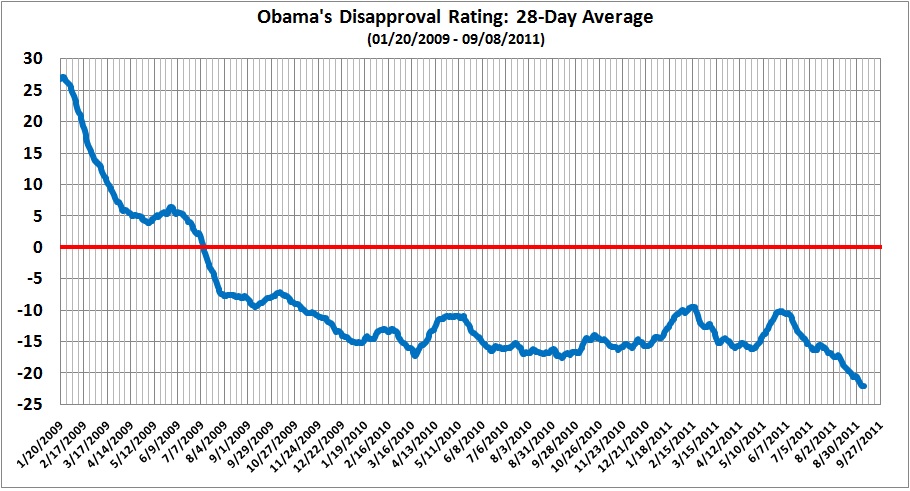
I don’t mean the federal government’s deficit or the jobs deficit. I mean Obama’s popularity deficit, which is s-o-o big:


Derived from Rasmussen Reports, Daily Presidential Tracking Poll.

When it comes to jobs, Don Boudreaux pegs it:

The problem isn’t that consumers aren’t spending; it’s that businesses aren’t investing.  And businesses aren’t investing because Congress and, especially, the administration exhibit a ceaseless fetish for top-down, command-and-control, debt-financed ‘governance’ of the economy – an enterprise-quashing recipe made only more poisonous by Mr. Obama’s soak-the-rich speechifying.

But that won’t keep the O from speechifying about “the rich” and trying to spend and regulate his way out of a recession that he has made worse by enlarging government and its reach, instead of shrinking both.

Related posts:
Taxing the Rich
More about Taxing the Rich
A Keynesian Fantasy Land
The Keynesian Fallacy and Regime Uncertainty
The Great Recession Is Not Over
Why the “Stimulus” Failed to Stimulate

Nature Is Unfair

The Almighty is not a liberal… The Almighty is the driving force for the entire universe and the universe is not a very liberal place. That is what the modern world seems not to understand….

Simon Mawer, The Gospel of Judas

*   *   *

Matt Ridley‘s recent article in The Wall Street Journal, “A Truce in the War Over Smarts and Genes,” is about the heritability of intelligence. The article, which is behind WSJ’s paywall, is available on Ridley’s personal website, The Rational Optimist, under the title “Goldilocks Heritability.” Here are some relevant bits:

Hardly any subject in science has been so politically fraught as the heritability of intelligence. For more than a century, since Francis Galton first started speculating about the similarities of twins, nature-nurture was a war with a stalemated front and intelligence was its Verdun—the most hotly contested and costly battle.

So would it not be rather wonderful if a scientific discovery came along that called a truce and calmed all the fury? I think this is about to happen. Call it the Goldilocks theory of intelligence: not too genetic, not too environmental—and proving that intelligence is impossible to meddle with, genetically.

The immediate cause of this optimism is a recent paper in Molecular Psychiatry, which confirms that genes account for about half of the difference in IQ between any two people in a modern society….

So far, so good. But Ridley goes off the rails with this:

…Some of the more extreme “nurturists,” especially those who dominated the debate in the 1960s to 1980s, might not welcome the new confirmation of the nearly 50% role of genes in determining IQ differences, even though it has been blindingly clear for a long time now.

They should, though. A world in which intelligence is 100% genetic would be horribly unfair….

What does “fairness” have to do with it? Is there a master gene-dispenser in the sky to whom one can complain about not having received a “fair share” of smart genes? I think not.

There would be nothing “unfair” about a world in which intelligence is 100 percent genetic. That’s just the way it would be, and nothing could — or should — be done about it.

But that wouldn’t stop leftists from trying to do something about it. As I say here,

[t]he search for cosmic justice — the rectification of all that is “unfair” in the world — is relentless, knows no bounds, and is built upon the resentment and punishment of success.

“Unfair” is the battle cry of the envious and the rabble-rouser, who derive great satisfaction from apportioning blame where no blame is due. I expect better of Ridley.

Related posts:
Positive Rights and Cosmic Justice
Intelligence, Personality, Politics, and Happiness
Social Justice
Positive Liberty vs. Liberty
More Social Justice
On Self-Ownership and Desert
Luck-Egalitarianism and Moral Luck
Intelligence as a Dirty Word
The Ideal as a False and Dangerous Standard
An Economist’s Special Pleading: Affirmative Action for the Ugly

What Is Libertarianism?

Many definitions of libertarianism are available online. I like this one for its depth:

Although there is much disagreement about the details, libertarians are generally united by a rough agreement on a cluster of normative principles, empirical generalizations, and policy recommendations. Libertarians are committed to the belief that individuals, and not states or groups of any other kind, are both ontologically and normatively primary; that individuals have rights against certain kinds of forcible interference on the part of others; that liberty, understood as non-interference, is the only thing that can be legitimately demanded of others as a matter of legal or political right; that robust property rights and the economic liberty that follows from their consistent recognition are of central importance in respecting individual liberty; that social order is not at odds with but develops out of individual liberty; that the only proper use of coercion is defensive or to rectify an error; that governments are bound by essentially the same moral principles as individuals; and that most existing and historical governments have acted improperly insofar as they have utilized coercion for plunder, aggression, redistribution, and other purposes beyond the protection of individual liberty. (“Libertarianism,” Internet Encyclopedia of Philosophy)

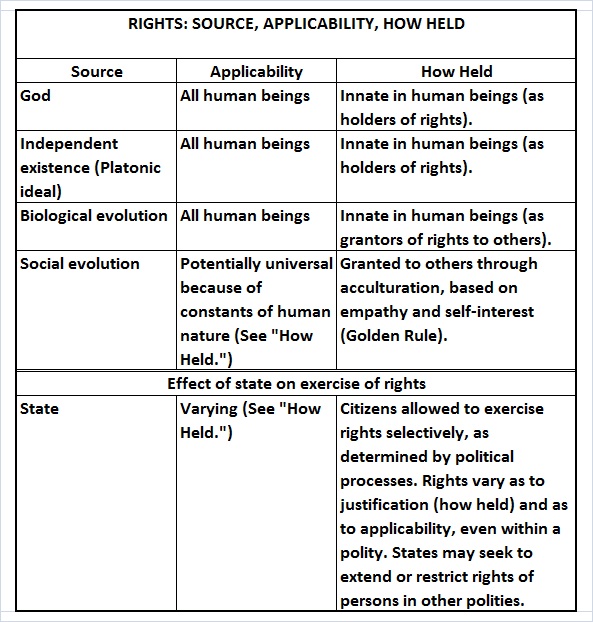
Two aspects of this definition merit closer examination. The first is “that individuals have rights against certain kinds of forcible interference on the part of others.” Whence these rights, and how extensive are they? I say here that

[r]ights, as products of social evolution, are strictures on interpersonal behavior, not “essences” that emanate from individuals. Rights, therefore, are culturally variable in their precise contours, but certain constants of human nature (empathy, self-interest) lead most cultures in the direction of a modus vivendi like the Golden Rule.

Specifically:

There’s a mainstream interpretation of the Golden Rule — one that still holds in many places — which rules out certain kinds of behavior, except in extreme situations, and permits certain other kinds of behavior. There is, in other words, a “core” Golden Rule that comes down to this:

  • Murder is wrong, except in self-defense. (Capital punishment is just that: punishment. It’s also a deterrent to murder. It isn’t “murder,” muddle-headed defenders of baby-murder to the contrary notwithstanding.)
  • Various kinds of unauthorized “taking” are wrong, including theft (outright and through deception). (This explains popular resistance to government “taking,” especially when it’s done on behalf of private parties. The view that it’s all right to borrow money from a bank and not repay it arises from the mistaken beliefs that (a) it’s not tantamount to theft and (b) it harms no one because banks can “afford it.”)
  • Libel and slander are wrong because they are “takings” by word instead of deed.
  • It is wrong to turn spouse against spouse, child against parent, or friend against friend. (And yet, such things are commonly portrayed in books, films, and plays as if they are normal occurrences, often desirable ones. And it seems to me that reality increasingly mimics “art.”)
  • It is right to be pleasant and kind to others, even under provocation, because “a mild answer breaks wrath: but a harsh word stirs up fury” (Proverbs 15:1).
  • Charity is a virtue, but it should begin at home, where the need is most certain and the good deed is most likely to have its intended effect.

Adherence to the Golden Rule is vestigial because in the past century — since the advent of the regulatory-welfare state and the seizure of state power by social “activists” — eons of socially evolved behavioral norms have been distorted and swept aside. Thus the phenomena of broad support for abortion and growing support for same-sex “marriage” — both of which are due to the anti-social combination of “activism” and sponsorship by an anti-religious state.

This leads me to the second aspect of the definition of libertarianism that merits closer attention: “social order is not at odds with but develops out of individual liberty.” The ranks of self-styled libertarians abound with social engineers who would, if they could, override the social order with their own visions of how that order should look. These pseudo-libertarians do not hesitate to prescribe a social order aligned with their effete sensibilities.

To the many examples of pseudo-libertarianism that I have adduced in previous posts (e.g., here and here), I will add two. First comes Charles Johnson, one of the Bleeding Heart Libertarians, points with pride to his article, “The Many Monopolies” (Freeman, September 2011). Regulations, according to Johnson,

fundamentally restructure markets, inventing the class structures of ownership, ratcheted costs, and inhibited competition that produce wage labor, rent, and the corporate economy we face….

A fully freed market means liberating essential command posts in the economy from State control, to be reclaimed for market and social entrepreneurship. The market that would emerge would look profoundly different from anything we have now.

What it would look like — in Johnson’s dreams — is a kind  of leftist Utopia: “Independent contracting, co-ops, and worker-managed shops.” This, of course, is pure guesswork — and wishful thinking — about the effects of abolishing all regulations, whether they superficially favor labor, business, or consumers. (I have more to say about such guesswork in this post.)

The subtitle of Johnson’s analysis should be “Small is beautiful.” It reads like a nostalgic lament for pre-industrial America, as if large corporations are evil per se.

Then there is the reliably leftist libertarian, Will Wilkinson, who says that

there are other legitimate public goods beyond the police protection of property rights. The need to finance the provision of these goods can justifiably limit our property rights, just as a system of property can justifiably limit our right to free movement. The use of official coercion to collect necessary taxes is no more or less problematic than the use of official coercion to enforce claims to legitimate property. Of course, those who suffer most from the absence of adequate public goods are the poor and powerless. (“A Libertarian’s Lament: Why Ron Paul Is an Embarrassment to the Creed,” The New Republic, September 2, 2011)

What are those other “public goods” to which Wilkinson refers? One of them is public schooling. It may seem strange for a so-called libertarian to endorse public schooling, but — in Wilkinson’s view — the cause is just if it benefits “poor kids.” Well, then, why not tax “the rich” to put everyone in the lower half of the income distribution on the dole? Where does one draw the line? Where Wilkinson says to draw the line, I suppose. After all, one mustn’t allow social outcomes that displease Mr. Wilkinson.

The point of these examples is that they illustrate a decided antagonism to a “social order [that] develops out of individual liberty.” They are consistent with “positive liberty,” which — as I have written — is not liberty at all.

Libertarianism — true libertarianism — does not presume to prescribe the outcome of social activity, only its conditions: peaceful and voluntary. It is inevitable and unavoidable that peaceful, voluntary social activity will yield outcomes that are unequal — in terms of income, wealth, and social status — and even distasteful — in terms of inter-group antipathies and discriminatory behavior.  But unequal and distasteful outcomes are rooted in the reality of human nature, which Michael Schermer summarizes quite well in his essay, “Liberty and Science,” at Cato Unbound:

  1. The clear and quantitative physical differences among people in size, strength, speed, agility, coordination, and other physical attributes that translates into some being more successful than others, and that at least half of these differences are inherited.
  2. The clear and quantitative intellectual differences among people in memory, problem solving ability, cognitive speed, mathematical talent, spatial reasoning, verbal skills, emotional intelligence, and other mental attributes that translates into some being more successful than others, and that at least half of these differences are inherited.
  3. The evidence from behavior genetics and twin studies indicating that 40 to 50 percent of the variance among people in temperament, personality, and many political, economic, and social preferences are accounted for by genetics.
  4. The failed communist and socialist experiments around the world throughout the 20th century revealed that top-down draconian controls over economic and political systems do not work.
  5. The failed communes and utopian community experiments tried at various places throughout the world over the past 150 years demonstrated that people by nature do not adhere to the Marxian principle “from each according to his ability, to each according to his need.”
  6. The power of family ties and the depth of connectedness between blood relatives. Communities have tried and failed to break up the family and have children raised by others; these attempts provide counter evidence to the claim that “it takes a village” to raise a child. As well, the continued practice of nepotism further reinforces the practice that “blood is thicker than water.”
  7. The principle of reciprocal altruism—I’ll scratch your back if you’ll scratch mine”—is universal; people do not by nature give generously unless they receive something in return, even if what they receive is social status.
  8. The principle of moralistic punishment—I’ll punish you if you do not scratch my back after I have scratched yours—is universal; people do not long tolerate free riders who continually take but almost never give.
  9. The almost universal nature of hierarchical social structures—egalitarianism only works (barely) among tiny bands of hunter-gatherers in resource-poor environments where there is next to no private property, and when a precious game animal is hunted extensive rituals and religious ceremonies are required to insure equal sharing of the food.
  10. The almost universal nature of aggression, violence, and dominance, particularly on the part of young males seeking resources, women, and especially status, and how status-seeking in particular explains so many heretofore unexplained phenomena, such as high risk taking, costly gifts, excessive generosity beyond one’s means, and especially attention seeking.
  11. The almost universal nature of within-group amity and between-group enmity, wherein the rule-of-thumb heuristic is to trust in-group members until they prove otherwise to be distrustful, and to distrust out-group members until they prove otherwise to be trustful.
  12. The almost universal desire of people to trade with one another, not for the selfless benefit of others or the society, but for the selfish benefit of one’s own kin and kind; it is an unintended consequence that trade establishes trust between strangers and lowers between-group enmity, as well as produces greater wealth for both trading partners and groups.

Efforts to channel human nature in contrary directions — whether those efforts are “liberal” or “libertarian” —  can lead only in one direction: the stifling of liberty:

The recognition of the insuperable limits to his knowledge ought indeed to teach the student of society a lesson of humility which should guard him against becoming an accomplice in men’s fatal striving to control society – a striving which makes him not only a tyrant over his fellows, but which may well make him the destroyer of a civilization which no brain has designed but which has grown from the free efforts of millions of individuals. (Friedrich A. Hayek, “The Pretence of Knowledge,” Nobel Prize lecture, December 11, 1974)

Related posts:
Beware of Libertarian Paternalists
Columnist, Heal Thyself
The Mind of a Paternalist
Accountants of the Soul
Rawls Meets Bentham
Enough of “Social Welfare”
Our Enemy, the State
Pseudo-Libertarian Sophistry vs. True Libertarianism
Positivism, “Natural Rights,” and Libertarianism
What Are “Natural Rights”?
The Golden Rule and the State
Libertarian Conservative or Conservative Libertarian?
Evolution, Human Nature, and “Natural Rights”
More Pseudo-Libertarianism
More about Conservative Governance
The Meaning of Liberty
Positive Liberty vs. Liberty
In Defense of Marriage
Understanding Hayek
We, the Children of the Enlightenment
Why I Am Not an Extreme Libertarian
Facets of Liberty
Burkean Libertarianism
Crimes against Humanity
Rights: Source, Applicability, How Held
The Ideal as a False and Dangerous Standard
The Arrogance of (Some) Economists

Labor Day Reading

Here and here.

Abortion and Logic

Peter Smith, a British philosopher and proprietor of Logic Matters, offers some thoughts about abortion. Passages from Smith’s post (in italics) are followed by my comments (in bold).

As the human zygote/embryo/foetus slowly develops, its death slowly becomes a more serious matter. At the very beginning, its death is of little consequence; as time goes on, its death is a matter it becomes appropriate to be gradually more concerned about.

This statement is presumptuous and, in many cases, wrong. A couple who want to have a child can be devastated by the miscarriage of a fetus, even at an early stage of pregnancy

After all, very few of us are worried by the fact that a very high proportion of conceptions quite spontaneously abort…

Again, very few of us are scandalized if a woman who finds she is pregnant by mistake in a test one week after conception is then mightily pleased when she discovers that the pregnancy has naturally terminated some days later (and even has a drink with a girl friend to celebrate her lucky escape). Compare: we would find it morally very inappropriate, in almost all circumstances, for a woman in comfortable circumstances to celebrate the death of an unwanted young baby.

What do “we” and “worry” have to do with it? The issue is the morality of abortion, not whether many individuals are emotionally involved in the natural termination of a pregnancy.

Suppose a woman finds she is a week or two pregnant, goes horse riding, falls badly at a jump, and as a result spontaneously aborts. That might be regrettable, but we wouldn’t think she’d done something terrible by going riding and running the risk.

Speak for yourself, not “we.” There are many who would condemn the woman who knowingly risked the life of her fetus by jumping a horse or doing something similarly risky.

So: our very widely shared attitudes to the natural or accidental death of the products of conception do suggest that we do in fact regard them as of relatively lowly moral status at the beginning of their lives, and of greater moral standing as time passes. We are all (or nearly all) gradualists in these cases. [Assumptions not granted, but pray continue.]

It is then quite consistent with such a view to take a similar line about unnatural deaths. For example, it would be consistent to think that using the morning-after pill is of no moral significance, while bringing about the death of an eight month foetus is getting on for as serious as killing a neonate, with a gradual increase in the seriousness of the killing in between.

At what point, then, does it become morally significant to kill a fetus? At one week, one month, three months, three months and a day, five months, six months, seven months? If killing a eight-month fetus is “getting on for as serious as killing a neonate,” then killing a seven-month, three-week fetus is as serious as killing an eight-month fetus, and so on.

Some, at any rate, of those of us who are pro (early) choice are moved by this sort of gradualist view. The line of thought in sum is: the killing of an early foetus has a moral weight commensurate with the moral significance of the natural or accidental death of an early foetus. And on a very widely shared view, that’s not very much significance. So from this point of view, early abortion is of not very much significance either. But abortion gradually gets [sic] a more significant matter as time goes on.

The popularity-contest view of morality aside, this is asinine “logic.” By Smith’s “reasoning,” the murder of a 90-year-old white, male American (who was expected to live for another four years) has less moral weight than the death by heart attack of a seemingly healthy 70-year-old white male American (who was expected to live for another fourteen years. Only a proponent of Britain’s “death panels” would believe such a thing.

You might disagree. But then it seems that you either need (a) an argument for departing from the very widely shared view about the moral significance of the natural or accidental miscarriage of the early products of conception. Or (b) you need to have an argument for the view that while the natural death of a zygote a few days old is of little significance, the unnatural death is of major significance. Neither line is easy to argue. To put it mildly.

Smith’s “logical” sleight-of-hand is revealed. His trick is to treat unintended and intended acts having the same consequences as if they were equivalent. But they are not. The unintentional death of a fetus by wholly natural causes is not the same as the intentional death of a fetus by abortion. In the first instance, a life ended prematurely but under (presumably) unavoidable circumstances; there is no one to blame for the death of a prenatal human being. In the second instance, a prenatal human being of untold potential is deliberately murdered; blame for that murder can be readily fixed. This is an easy line to argue, to put it vehemently.

P.S. Steven Landsburg seems to endorse Smith’s position.

Related posts:
Law, Liberty, and Abortion
Substantive Due Process and the Limits of Privacy
Crimes against Humanity

The Arrogance of (Some) Economists

Paul Krugman, former economist, writes:

Think of the government budget as involving tradeoffs similar to those an individual household makes. On one side, there are all kinds of things the government could be doing, from dropping freedom bombs to providing children with dental care; think of each of these things as involving a certain marginal benefit per additional dollar spent, with the marginal benefit declining in the total amount spent on each concern. On the other side, raising revenue has a cost, both the direct cost of the money taken from taxpayers and the possible reduction in incentives from higher tax rates.

What the government should do, in this case, is set all the marginals equal: the marginal benefit of an additional dollar spent on bombs, dental work, national parks, soup kitchens, etc, should all be equal, and this common marginal benefit should equal the marginal cost of raising an additional dollar of revenue.

Krugman must know that the benefits of government programs are unlikely to flow to the persons who bear the costs of those programs. Even if the benefits were to be allocated in such a manner, it would be pure arrogance to assume that income-allocation decisions should be taken from individuals and placed in the hands of government official and bureaucrats. That, of course, is precisely the assumption that underlies government spending. And those who share that assumption, are guilty of the same arrogance. Krugman is so guilty that he should be serving time in a special hell of his own — being forced to listen to the recorded lectures of Milton Friedman, for example.

What is the problem with the kind of cost-benefit analysis prescribed by Krugman? It is this: If you take a dollar from me to make X happier, you have made me less happy, and X’s greater happiness doesn’t compensate for my greater unhappiness. I don’t even have to be a selfish curmudgeon to object to the transfer of my dollar to X. It could be that I wanted to give the dollar to one of my grandchildren, which would have made both me and my grandchild happy. As for X, I couldn’t care less. And it is presumptuous of Krugman (or anyone else) to suggest (even by implication) that it is okay to take a dollar from me just to make X (or a government bureaucrat) happier.

Government, in short, is a tool used by arrogant, self-serving individuals to impose their preferences on others. That is why government should be restricted to a night-watchman role — protecting citizens from predators, foreign and domestic. Anything more than that is social engineering.

Related posts:
Greed, Cosmic Justice, and Social Welfare
Positive Rights and Cosmic Justice
Utilitarianism, “Liberalism,” and Omniscience
Utilitarianism vs. Liberty
The Indivisibility of Economic and Social Liberty
Beware of Libertarian Paternalists
Negative Rights
Negative Rights, Social Norms, and the Constitution
Rights, Liberty, the Golden Rule, and the Legitimate State
The Near-Victory of Communism
Tocqueville’s Prescience
Accountants of the Soul
The Case of the Purblind Economist
Rawls Meets Bentham
The Left
The Divine Right of the Majority
Our Enemy, the State
Government vs. Community
Social Justice
The Left’s Agenda
Positive Liberty vs. Liberty
Taxing the Rich
More about Taxing the Rich
More Social Justice
Luck-Egalitarianism and Moral Luck
The Left and Its Delusions

Why the “Stimulus” Failed to Stimulate

This post examines practical reasons for the failure of “stimulus” to stimulate and the “multiplier” to multiply. The deeper truth is that the Keynesian multiplier is a mathematical fiction, as explained here, and government spending is in fact destructive of economic growth, as discussed here and in some of the posts listed at the end.

I spell out the reasons in “A Keynesian Fantasy Land.” There are six of them, including the timing-targeting problem (number 3).

[In an earlier version of this post, I also mentioned Ricardian equivalence, which is an aspect of reason number 2, the disincentivizing aspects of government borrowing and spending. I referred to a post by Steven Landsburg, which I had read hastily and misinterpreted as a discussion of Ricardian equivalence. When Dr. Landsburg graciously pointed out that I had the wrong end of the stick, I deleted the brief discussion of Ricardian equivalence from this post.]

A key component of the timing-targeting problem is the strong possibility that “stimulus” money will be spent on already-employed resources, thus bidding up their prices but doing little or nothing to stimulate real economic activity. Tyler Cowen recaps two papers that document the misdirection of “stimulus” money:

My colleagues Garett Jones and Daniel Rothschild conducted extensive field research (interviewing 85 organizations receiving stimulus funds, in five regions), asking simple questions such as whether the hired project workers already had had jobs.  There are lots of relevant details in the paper but here is one punchline:

…hiring people from unemployment was more the exception than the rule in our interviews.

In a related paper by the same authors (read them both), here is more:

Hiring isn’t the same as net job creation. In our survey, just 42.1 percent of the workers hired at ARRA-receiving organizations after January 31, 2009, were unemployed at the time they were hired (Appendix C). More were hired directly from other organizations (47.3 percent of post-ARRA workers), while a handful came from school (6.5%) or from outside the labor force (4.1%)(Figure 2).

One major problem with ARRA was not the crowding out of financial capital but rather the crowding out of labor.  In the first paper there is also a discussion of how the stimulus job numbers were generated, how unreliable they are, and how stimulus recipients sometimes had an incentive to claim job creation where none was present.  Many of the created jobs involved hiring people back from retirement.  You can tell a story about how hiring the already employed opened up other jobs for the unemployed, but it’s just that — a story.  I don’t think it is what happened in most cases, rather firms ended up getting by with fewer workers.

There’s also evidence of government funds chasing after the same set of skilled and already busy firms.  For at least a third of the surveyed firms receiving stimulus funds, their experience failed to fit important aspects of the Keynesian model.

The Keynesian model is deeply flawed because it is a simplistic model based on simplistic assumptions about the behavior of human beings and human institutions. I say in “A Keynesian Fantasy Land,” models are supposed to mirror reality, not the other way around. The Keynesian model — or the version embraced by Paul Krugman and his fellow leftists — is a version of the reality that they would prefer: a reality in which government runs the economy.

Related posts:
The Causes of Economic Growth
A Short Course in Economics
Addendum to a Short Course in Economics
The Indivisibility of Economic and Social Liberty
The Price of Government
The Fed and Business Cycles
The Price of Government Redux
The Mega-Depression
Ricardian Equivalence Reconsidered
The Real Burden of Government
Toward a Risk-Free Economy
The Rahn Curve at Work
How the Great Depression Ended
Microeconomics and Macroeconomics
The Illusion of Prosperity and Stability
Experts and the Economy
We’re from the Government and We’re Here to Help You
Estimating the Rahn Curve: Or, How Government Inhibits Economic Growth
Our Enemy, the State
Competition Shouldn’t Be a Dirty Word
The Stagnation Thesis
The Evil That Is Done with Good Intentions
Money, Credit, and Economic Fluctuations
A Keynesian Fantasy Land
“Tax Expenditures” Are Not Expenditures
The Keynesian Fallacy and Regime Uncertainty

An Economist’s Special Pleading: Affirmative Action for the Ugly

It’s hard to tell whether economist Dan Hamermesh is pulling our collective leg, or if he’s serious. In either event, here’s a portion of his proposal to instigate affirmative action for the uglies among us (“Ugly? You May Have a Case,” The New York Times, August 27, 2011):

While extensive research shows that women’s looks have bigger impacts in the market for mates, another large group of studies demonstrates that men’s looks have bigger impacts on the job.

Why this disparate treatment of looks in so many areas of life? It’s a matter of simple prejudice. Most of us, regardless of our professed attitudes, prefer as customers to buy from better-looking salespeople, as jurors to listen to better-looking attorneys, as voters to be led by better-looking politicians, as students to learn from better-looking professors. This is not a matter of evil employers’ refusing to hire the ugly: in our roles as workers, customers and potential lovers we are all responsible for these effects.

How could we remedy this injustice? With all the gains to being good-looking, you would think that more people would get plastic surgery or makeovers to improve their looks. Many of us do all those things, but as studies have shown, such refinements make only small differences in our beauty. All that spending may make us feel better, but it doesn’t help us much in getting a better job or a more desirable mate.

A more radical solution may be needed: why not offer legal protections to the ugly, as we do with racial, ethnic and religious minorities, women and handicapped individuals?

Why would Hamermesh take a special interest in the advancement of ugly persons? It’s probably a case of special pleading:

(I knew Hamermesh when he was in his early 20s. The beard is a cosmetic improvement.)

Hamermesh’s curriculum vitae is fairly impressive, but it is evident that he failed to make the grade in the Ivy League. If Hamermesh blames his looks for his inability to rise higher in his profession, he should not. As economists go — and I’ve known dozens of them — his looks fall in the mid-range.  So, if Hamermesh is disappointed in his professional standing, he should blame it on the inner man, not on his looks.

He should consider, also, that there is a high correlation between looks and intelligence. Good-looking individuals are not more successful, on average, than their less-blessed peers; they are more successful because they generally are smarter than their peers.

But none of this will matter to Hamermesh, if he is serious, or to those who are serious about combating what they call look-ism or beauty-ism. The search for cosmic justice — the rectification of all that is “unfair” in the world — is relentless, knows no bounds, and is built upon the resentment and punishment of success.

Related posts:
The Cost of Affirmative Action
Positive Rights and Cosmic Justice
How to Combat Beauty-ism

The Ideal as a False and Dangerous Standard

This is from my post, “The Folly of Pacifism, Again“:

[T]he case for pacifism … is fundamentally flawed….

[I]t rejects the actuality of human nature for an idealized version that is impossible of realization. It is, in other words, an example of the Nirvana fallacy in operation. In this instance it is based on two assumptions — hopes, really — that run contrary to the actuality of human existence. There is the hope for a world without states, and therefore without the kind of state-sponsored violence known as war. But states are inevitable because statelessness invites warlordism, and if a supposedly stateless people join in self-defense against a warlord they will have created what amounts to a state for the purpose of committing violence — in self-defense. Then there is the hope that people — state or no state — will not band together against the “outside world,” but they will.

Bill Vallicella, Maverick Philosopher, in a typically thoughtful post (“Can What Is Possible to Achieve Be an Ideal For Us?“) says this about  ideals:

Ideals must be realizable if they are to be ideals.  The ideal ‘points’ to a possible realization.  If that be denied then it is being denied that the ideal stands in relation to the real when the ideal has its very sense in contradistinction to the real.  At this point I could bring in analogies, though analogies seldom convince.  The possible is possibly actual.  If you say X is possible but not possibly actual, then I say you don’t understand the notion of possibility.  Or consider dispositions.  If a glass is disposed to shatter if suitably struck, then it must be possible for it to shatter.  Analogously, if such-and-such is an ideal for a person, then it must be possible  — and not just logically or nomologically — for the person to realize that ideal.

I believe this is an important topic because having the wrong ideals is worse than having no ideals at all.  Many think that to be idealistic is good.  But surely it is not good without qualification.  Think of Nazi ideals, Communist ideals, leftist ideals and of their youthful and and earnest and sincere proponents.  Those are wrongheaded ideals, and some of them are wrongheaded because not realizable.  The classless society; the dictatorship of the proletariat; the racially pure society; the society in which everyone is made materially equal by the power of the state.  Ideals like these cannot be achieved, and if the attempt is made terrible evils will be the upshot.  The Commies broke a lot of eggs in the 20th century (100 million by some estimates) but still didn’t achieve their fabulous and impossible omelet.

Pacifists and anarchists, as far as I can tell, hold unrealizable ideals. And yet they insist on judging what is real and achievable against those ideals. The pursuit of peace, in the way that pacifists would pursue it, can lead only to subjection by those who do not want peace, except on their terms. The pursuit of absolute liberty, as anarchists would pursue it, can lead only to subjection by those who despise liberty, except as their personal liberty enables them to trample others.

Pacifism and anarchism, in other words, are delusions no less dangerous than “the classless society; the dictatorship of the proletariat; the racially pure society; the society in which everyone is made materially equal by the power of the state.” All are routes to oppression.

Probability, Existence, and Creation: A Footnote

Mario Livio writes:

[H]umans invent mathematical concepts by way of abstracting elements from the world around them—shapes, lines, sets, groups, and so forth—either for some specific purpose or simply for fun. They then go on to discover the connections among those concepts. Because this process of inventing and discovering is man-made—unlike the kind of discovery to which the Platonists subscribe—our mathematics is ultimately based on our perceptions and the mental pictures we can conjure….

[W]e adopt mathematical tools that apply to our world—a fact that has undoubtedly contributed to the perceived effectiveness of mathematics. Scientists do not choose analytical methods arbitrarily but rather on the basis of how well they predict the results of their experiments….

Not only do scientists cherry-pick solutions, they also tend to select problems that are amenable to mathematical treatment. There exists, however, a whole host of phenomena for which no accurate mathematical predictions are possible, sometimes not even in principle. In economics, for example, many variables—the detailed psychology of the masses, to name one—do not easily lend themselves to quantitative analysis. The predictive value of any theory relies on the constancy of the underlying relations among variables. Our analyses also fail to fully capture systems that develop chaos, in which the tiniest change in the initial conditions may produce entirely different end results, prohibiting any long-term predictions. Mathematicians have developed statistics and probability to deal with such shortcomings, but mathematics itself is limited, as Austrian logician Gödel famously proved….

This careful selection of problems and solutions only partially accounts for mathematics’s success in describing the laws of nature. Such laws must exist in the first place! Luckily for mathematicians and physicists alike, universal laws appear to govern our cosmos: an atom 12 billion light-years away behaves just like an atom on Earth; light in the distant past and light today share the same traits; and the same gravitational forces that shaped the universe’s initial structures hold sway over present-day galaxies. Mathematicians and physicists have invented the concept of symmetry to describe this kind of immunity to change….

I started with two basic, interrelated questions: Is mathematics invented or discovered? And what gives mathematics its explanatory and predictive powers? I believe that we know the answer to the first question. Mathematics is an intricate fusion of inventions and discoveries. Concepts are generally invented, and even though all the correct relations among them existed before their discovery, humans still chose which ones to study. The second question turns out to be even more complex. There is no doubt that the selection of topics we address mathematically has played an important role in math’s perceived effectiveness. But mathematics would not work at all were there no universal features to be discovered. You may now ask: Why are there universal laws of nature at all? Or equivalently: Why is our universe governed by certain symmetries and by locality? I truly do not know the answers, except to note that perhaps in a universe without these properties, complexity and life would have never emerged, and we would not be here to ask the question. (“Why Math Works,” Scientific American, August 2, 2011)

Related posts:
Atheism, Religion, and Science
The Limits of Science
Three Perspectives on Life: A Parable
Beware of Irrational Atheism
The Creation Model
The Thing about Science
Evolution and Religion
Words of Caution for Scientific Dogmatists
Science, Evolution, Religion, and Liberty
The Legality of Teaching Intelligent Design
Science, Logic, and God
Capitalism, Liberty, and Christianity
Is “Nothing” Possible?
Debunking “Scientific Objectivity”
Science’s Anti-Scientific Bent
Science, Axioms, and Economics
The Big Bang and Atheism
The Universe . . . Four Possibilities
Einstein, Science, and God
Atheism, Religion, and Science Redux
Pascal’s Wager, Morality, and the State
Evolution as God?
The Greatest Mystery
What Is Truth?
The Improbability of Us
A Digression about Probability and Existence
More about Probability and Existence
Existence and Creation
Probability, Existence, and Creation

The Folly of Pacificism, Again

I had meant to be done with pacifism after writing “The Folly of Pacifism.” But I cannot ignore the subject because it rears its ugly head again, in Fernando Teson’s “Libertarian Wars” at Bleeding Heart Libertarians.

It is not that Teson is a pacifist, but he neatly summarizes an argument against war that Bryan Caplan — an avowed pacifist (and the main target of my earlier post) — is fond of using; for example:

[D]oesn’t pacifism contradict the libertarian principle that people have a right to use retaliatory force?  No.  I’m all for revenge against individual criminals.  My claim is that in practice, it is nearly impossible to wage war justly, i.e., without trampling on the rights of the innocent.

Why is it “nearly impossible to wage war justly”? In a later post, Caplan puts it this way:

1. The immediate costs of war are clearly awful.  Most wars lead to massive loss of life and wealth on at least one side.  If you use a standard value of life of $5M, every 200,000 deaths is equivalent to a trillion dollars of damage.

2. The long-run benefits of war are highly uncertain.  Some wars – most obviously the Napoleonic Wars and World War II – at least arguably deserve credit for decades of subsequent peace.  But many other wars – like the French Revolution and World War I – just sowed the seeds for new and greater horrors.  You could say, “Fine, let’s only fight wars with big long-run benefits.”  In practice, however, it’s very difficult to predict a war’s long-run consequences.  One of the great lessons of Tetlock’s Expert Political Judgment is that foreign policy experts are much more certain of their predictions than they have any right to be.

3. For a war to be morally justified, its long-run benefits have to be substantially larger than its short-run costs.  I call this “the principle of mild deontology.”  Almost everyone thinks it’s wrong to murder a random person and use his organs to save the lives of five other people.  For a war to be morally justified, then, its (innocent lives saved/innocent lives lost) ratio would have to exceed 5:1.  (I personally think that a much higher ratio is morally required, but I don’t need that assumption to make my case).

It would seem that Caplan is not entirely opposed to war — as long as the ratio of lives saved to lives lost is acceptably high. And Caplan gets to choose the number of persons who may die for the sake of those who may thus live. He wears his God-like omniscience with such modesty.

Teson offers a more rigorous interpretation of the pacifist point of view:

[I]n any war innocents die. They did not initiate violence against us, yet in response to the foreign attack we will be bringing about their deaths. Maybe the morally right thing to do is to surrender to the aggressor, if doing so would prevent us from causing the deaths of innocents. The libertarian who thinks that we cannot permissibly fight even defensive wars is a contingent pacifist. To him, if we could repeal the attack avoiding simultaneously the deaths of bystanders, then we could permissibly do it. But because we cannot avoid those deaths, we may not react against the attack: we must wave the white flag. This reasoning applies to the defense of others as well, because that action, too, will bring about the deaths of innocents. On this view, NATO’s intervention in Libya is wrong, not because it protects persons attacked by Khadaffy, but because it impermissibly kills innocents.

Teson’s formulation strikes me as the one that most pacifists would prefer. But it is as mistaken as Caplan’s more blatantly presumptuous brand of soul-accountancy. Perhaps Caplan is angling to be the Death-Panel Czar.

Seriously — and war is a serious matter — the case for pacifism, as it is made by Caplan and Teson, is fundamentally flawed.

First, it assumes a social-welfare function, wherein A’s unhappiness can cancels B’s happiness. In this instance, the lives of some “innocents” are weighed against the lives of other “innocents” and found unworthy of defense by war. This is a weighing that no human being is qualified to conduct on behalf of others.

Second, this weighing of lives can be done only if one studiously refuses to be counted among those whose lives are saved (or potentially saved) by waging war. In other words, the true pacifist is saying that his life is not worth that of any other person, even an armed enemy. So much for self-defense, which may be rejected readily enough on paper and behind the shield afforded by the defense and police forces of the United States.

Third, it rejects the actuality of human nature for an idealized version that is impossible of realization. It is, in other words, an example of the Nirvana fallacy in operation. In this instance it is based on two assumptions — hopes, really — that run contrary to the actuality of human existence. There is the hope for a world without states, and therefore without the kind of state-sponsored violence known as war. But states are inevitable because statelessness invites warlordism, and if a supposedly stateless people join in self-defense against a warlord they will have created what amounts to a state for the purpose of committing violence — in self-defense. Then there is the hope that people — state or no state — will not band together against the “outside world,” but they will.

I address this second hope in “Inside-Outside,” which is aimed at another of Caplan’s many pacifistic screeds. The whole of my post bears repeating:

Bryan Caplan seems to think that the tendency of geographically proximate groups to band together in self-defense is a kind of psychological defect. He refers to it as “group-serving bias.”

It is nothing of the kind, however. It is a simple case of self-defense. And who better to help you defend yourself than the people with whom you share space, be it a neighborhood, a city-state, a principality, or even a vast nation? As a member of one or the other, you may be targeted for harm by outsiders who wish to seize your land and control your wealth, or who simply dislike your way of life, even if it does them no harm.

The cause of Caplan’s confusion is his adherence to a kind of libertarian idealism. In the anti-war argot of the 1960s, it was expressed as “Why can’t we all just get along?” But hope is not reality, Caplan notwithstanding.

Not getting along, to Caplan, is a moral defect. He therefore considers the differential treatment of insiders and outsiders to be an unmitigated wrong. But group cohesion is a prudential social instinct that no amount of rationalism can obliterate. Differential treatment of insiders and outsiders is an inevitable aspect of that prudential social instinct. It is not, at bottom, a moral issue.

If Caplan were logically consistent, he would focus his moral lens on the animal kingdom. There is plenty of inter-group conflict to condemn there: shark vs. tuna, cheetah vs. antelope, spider vs. fly, and so on. In the case of man vs. cattle (hog, fish, fowl, or other living thing), I wonder if Caplan opts for veganism? It would be the proper choice — for him.

Pacifism is a sophomoric fantasy on a par with anarchism. It is sad to see Caplan’s intelligence wasted on the promulgation and defense of an ideological fantasy.

Related posts:
Libertarians and the Common Defense
Libertarianism and Pre-emptive War: Part I
An Aside about Libertarianism and the War
Right On! For Libertarian Hawks Only
Conservative Criticism of the War on Terror
Why Sovereignty?
Understanding Libertarian Hawks
More about Libertarian Hawks and Doves
Defense, Anarcho-Capitalist Style
War Can Be the Answer
Getting It All Wrong about the Risk of Terrorism
Why We Fight
Getting It Almost Right about Iraq
Philosophical Obtuseness
But Wouldn’t Warlords Take Over?
Sorting Out the Libertarian Hawks and Doves
Now, Let’s Talk About Something Else
Shall We All Hang Separately?
Foxhole Rats
Foxhole Rats, Redux
Know Thine Enemy
September 11: A Remembrance
September 11: A Postscript for “Peace Lovers”
The Faces of Appeasement
Libertarianism and Preemptive War: Part II
Torture and Morality
Give Me Liberty or Give Me Non-Aggression?
We Have Met the Enemy . . .
My View of Warlordism, Seconded
Whose Liberties Are We Fighting For?
The Constitution and Warrantless “Eavesdropping”
NSA “Eavesdropping”: The Last Word (from Me)
Privacy, Security, and Electronic Surveillance
Privacy: Variations on the Theme of Liberty
Words for the Unwise
More Foxhole Rats
The Fatal Naïveté of Anarcho-Libertarianism
Final (?) Words about Preemption and the Constitution
Anarcho-Libertarian “Stretching”
Recommended Reading about NSA’s Surveillance Program
Riots, Culture, and the Final Showdown
A Rant about Torture
More Final (?) Words about Preemption and the Constitution
QandO Saved Me the Trouble
What If We Lose?
A Footnote about “Eavesdropping”
Thomas Woods and War
More than Enough Amateur Critics
Moussaoui and “White Guilt”
Jihad in Canada
In Defense of Ann Coulter
In Which I Reply to the Executive Editor of The New York Times
Post-Americans and Their Progeny
“Peace for Our Time”
Anti-Bush or Pro-Treason?
“Proportionate Response” in Perspective
Parsing Peace
Taking on Torture
Conspiracy Theorists’ Cousins
Not Enough Boots
Defense as the Ultimate Social Service
I Have an Idea
September 11: Five Years On
How to View Defense Spending
Reaching the Limit?
The Best Defense . . .
A Skewed Perspective on Terrorism
Terrorists’ “Rights” and the Military Commissions Act of 2006
More Stupidity from Cato
The Military Commissions Act of 2006
A Critique of Extreme Libertarianism
And Your Point Is?
Anarchistic Balderdash
Not Enough Boots: The Why of It
Blood for Oil

Katie Couric: Post-American
It *Is* the Oil
Here We Go Again
Christmas in Iran: Foreign Affairs According to Planet Rockwell
Torture, Revisited
Waterboarding, Torture, and Defense
9/11 Plotters and the Death Penalty
Cato’s Usual Casuistry on Matters of War and Peace
The Media, the Left, and War
Torture
September 11: A Remembrance
Getting It Wrong and Right about Iran
The “Predator War” and Self-Defense
Accountants of the Soul
The National Psyche and Foreign Wars
Delusions of Preparedness
Inside-Outside
A Moralist’s Moral Blindness
A Grand Strategy for the United States
The Folly of Pacifism
Why We Should (and Should Not) Fight
Rating America’s Wars
Transnationalism and National Defense
The Next 9/11?

Blackmail, Anyone?

Robin Hanson’s latest entry in his series of posts about blackmail, “Blackmail Enforces Law,” contains the kernel of a valid idea:

[L]egalizing blackmail would create an especially cheap and flexible system of private law enforcement. If an associate of a criminal discovered evidence of their crime, this associate could via blackmail extract close to the cash equivalent of the punishment to the criminal. While this might modestly lower the level of punishment of a caught criminal, it should greatly increase the probability of punishment, leading to more expected punishment of crime.

Hanson’s claim is flawed by its detachment from reality. Blackmailing a criminal is not a life-prolonging exercise. But Hanson is onto something, though he may not know it. That “something” is the undoubted fact that — aside from sociopaths and persons who are severely mentally ill or retarded, mentally — human beings strive to earn approval (and even praise) and to avoid disapproval (and even ridicule).

Hanson comes close to acknowledging this crucial point when he says:

One unmentioned possible cost of blackmail is a weakening of the bonds that tie people together. You’ll be less open to people who could blackmail you.

But he continues with his defense of blackmail as a socially valuable practice instead of pausing to reflect about “the bonds that tie people together.” Those bonds, as I suggest above, derive in part from the need to gain approval of others, while avoiding their disapproval.

How often does a person (well, perhaps not an academic of Hanson’s ilk) do or say something — or refrain from doing or saying something — in order to gain approval or avoid disapproval? I daresay that the only a small fraction of the actions influenced by the prospect of disapproval would be deemed worthy of blackmail. And then there are all of the actions that are influenced by the prospect of approval, and which are not contemplated in Hanson’s kind of traditional blackmail.

Hanson, once again, cannot see the forest because he is intent on inspecting a particular tree.

Related posts:
Rationalism, Social Norms, and Same-Sex “Marriage”
Pseudo-Libertarian Sophistry vs. True Libertarianism
“Intellectuals and Society”: A Review
Understanding Hayek
The Golden Rule as Beneficial Learning
Why I Am Not an Extreme Libertarian

The Atheism of the Gaps

Greg Perkins, writing at Noodlefood in 2008 (“Why the New Atheists Can’t Even Beat D’Souza: The Gap in Religious Thought“), criticizes Dinesh D’souza’s article, “Taking Aim at God, and Missing,” wherein D’souza essays a defense of the “God hypothesis.” There is much to criticize about D’souza’s argument, but Perkins — an Objectivist and therefore, I assume, an atheist — should have looked in a mirror before writing this:

…Dinesh D’souza continues his counters to “New Atheists” such as Christopher Hitchens. This time we find him saying that “Thanks to the astounding discoveries of modern science, I think the God hypothesis has a lot more going for it today than it did in the eighteenth century.”…

[H]istory is littered with examples of something “supernatural” being arbitrarily asserted as the explanation, only to be retracted later as our knowledge expanded….

In other words, science will explain all and nothing will be left to God. That is the import of Perkin’s post, at any rate. He does precisely what he accuses D’souza of doing; that is, “not knowing the answer to a puzzle” (the basis of existence) entitles Perkins “to go and make one up.” The gaps in scientific knowledge do not prove the existence of God, but they surely are not proof against God. To assert that there is no God because X, Y, and Z are known about the universe says nothing about the creation of the universe or the source of the “laws” that seem to govern much of its behavior.

If theists of D’souza’s stripe are guilty of assuming the answer they seek, atheists of Perkins’s stripe are equally guilty of the same thing. Both want to generalize from evidence whose limitations cannot be guessed at. “Unknown unknowns” dominate the mystery of existence.

This is my position:

If the world as we know it — our universe — is not the product of chance, what is it? A reasonable answer is found in another post of mine, “Existence and Creation.” Here is the succinct version:

  1. In the material universe, cause precedes effect.
  2. Accordingly, the material universe cannot be self-made. It must have a “starting point,” but the “starting point” cannot be in or of the material universe.
  3. The existence of the universe therefore implies a separate, uncaused cause.

There is no reasonable basis — and certainly no empirical one — on which to prefer atheism to deism or theism. Strident atheists merely practice a “religion” of their own. They have neither logic nor science nor evidence on their side — and eons of belief against them.

Related posts:
Atheism, Religion, and Science
The Limits of Science
Three Perspectives on Life: A Parable
Beware of Irrational Atheism
The Creation Model
The Thing about Science
Evolution and Religion
Words of Caution for Scientific Dogmatists
Science, Evolution, Religion, and Liberty
The Legality of Teaching Intelligent Design
Science, Logic, and God
Capitalism, Liberty, and Christianity
Is “Nothing” Possible?
Debunking “Scientific Objectivity”
Science’s Anti-Scientific Bent
Science, Axioms, and Economics
The Big Bang and Atheism
The Universe . . . Four Possibilities
Einstein, Science, and God
Atheism, Religion, and Science Redux
Pascal’s Wager, Morality, and the State
Evolution as God?
The Greatest Mystery
What Is Truth?
The Improbability of Us
A Digression about Probability and Existence
More about Probability and Existence
Existence and Creation
Probability, Existence, and Creation

Warren Buffet Is an Economic Ignoramus

Warren Buffet is the idiot savant of high finance. Not only would exorbitant taxes on the “super rich” do little to close the deficit or pay down the debt, but it would drive the economy deeper into recession — and perhaps into depression. Why? I will not repeat myself. Read “Taxing the Rich” and “More about Taxing the Rich,” and follow the links at the end of the latter post.

Gestapo Exonerates Hitler

Well, it’s not quite that bad, but it’s analogous:

Federal Investigators Clear Climate Scientist, Again

The Inspector General of the National Science Foundation has closed its investigation into climatologist Michael Mann after failing to find any evidence of misconduct

What an amazing coincidence!

About Democracy

I want to be clear about this: Yesterday’s post was a criticism of the left’s hypocrisy and authoritarianism (and viciousness). It was not a defense of democracy.

I have written many times about the insidious effect of democracy on liberty. This is may be my best effort (from part VI of my series on practical libertarianism):

[Americans] have been following [a] piecemeal route to serfdom — adding link to link and chain to chain — in spite of the Framers’ best intentions and careful drafting. Why? Because the governed — or dominant coalitions of them — have donned willingly the chains that they have implored their governors to forge. Their bondage is voluntary, though certainly not informed. But their bondage is everyone’s bondage…

[B]ecause we have undone the work of the Framers … , we have descended to tyranny by the majority, where the majority is a loose but potent coalition of interest- and belief-groups bent on imposing its aims on everyone.

Unchecked democracy undermines liberty and its blessings. Unchecked democracy imposes on everyone the mistakes and mistaken beliefs of the controlling faction. It defeats learning. It undoes the social fabric that underlies civility. It defeats the sublime rationality of free markets, which enable independent individuals to benefit each other through the pursuit of self-interest. As “anonymous” says, with brutal accuracy, “Democracy is two wolves and a lamb voting on lunch.”

Unchecked democracy has led to what Tocqueville called “soft despotism.”  As I say in “Fascism and the Future of America,”\

Soft despotism is “soft” only in that citizens aren’t dragged from their houses at night and executed for imaginary crimes against the state — though they are hauled into court for not wearing seatbelts, for smoking in bars, and for various other niggling offenses to the sensibilities of nanny-staters.

Despite the absence of arbitrary physical punishment, soft despotism is despotism, period. It can be nothing but despotism when the state holds sway over your paycheck, your retirement plan, your medical care, your choice of associates, and thousands of other details of your life — from the drugs you may not buy to the kind of car you can’t drive, from where you can build a house to the features that your house must include.

“Soft despotism,” in other words, is too soft a term for the regime under which we live. I therefore agree with Tom Smith: “Fascism” is a good descriptor of our present condition, so I’ll continue to use it.

How has America come to its present state, where Americans are hostage to the very regulatory-welfare state that so many expected to bestow liberty and prosperity on the land? I chalk it up to what I call, in “Liberty and Federalism,” the Framers’ fatal error:

The Framers underestimated the will to power that animates office-holders. The Constitution’s wonderful design — horizontal and vertical separation of powers — which worked rather well until the late 1800s, cracked under the strain of populism, as the central government began to impose national economic regulation at the behest of muckrakers and do-gooders. The Framers’ design then broke under the burden of the Great Depression, as the Supreme Court of the 1930s (and since) has enabled the central government to impose its will at will. The Framers’ fundamental error can be found in Madison’s Federalist No. 51. Madison was correct in this:

…It is of great importance in a republic not only to guard the society against the oppression of its rulers, but to guard one part of the society against the injustice of the other part. Different interests necessarily exist in different classes of citizens. If a majority be united by a common interest, the rights of the minority will be insecure….

But Madison then made the error of assuming that, under a central government, liberty is guarded by a diversity of interests:

[One method] of providing against this evil [is] … by comprehending in the society so many separate descriptions of citizens as will render an unjust combination of a majority of the whole very improbable, if not impracticable…. [This] method will be exemplified in the federal republic of the United States. Whilst all authority in it will be derived from and dependent on the society, the society itself will be broken into so many parts, interests, and classes of citizens, that the rights of individuals, or of the minority, will be in little danger from interested combinations of the majority.

In a free government the security for civil rights must be the same as that for religious rights. It consists in the one case in the multiplicity of interests, and in the other in the multiplicity of sects. The degree of security in both cases will depend on the number of interests and sects; and this may be presumed to depend on the extent of country and number of people comprehended under the same government. This view of the subject must particularly recommend a proper federal system to all the sincere and considerate friends of republican government, since it shows that in exact proportion as the territory of the Union may be formed into more circumscribed Confederacies, or States oppressive combinations of a majority will be facilitated: the best security, under the republican forms, for the rights of every class of citizens, will be diminished: and consequently the stability and independence of some member of the government, the only other security, must be proportionately increased….

Madison then went on to contradict what he said in Federalist No. 46 about the States being a bulwark of liberty:

It can be little doubted that if the State of Rhode Island was separated from the Confederacy and left to itself, the insecurity of rights under the popular form of government within such narrow limits would be displayed by such reiterated oppressions of factious majorities that some power altogether independent of the people would soon be called for by the voice of the very factions whose misrule had proved the necessity of it. In the extended republic of the United States, and among the great variety of interests, parties, and sects which it embraces, a coalition of a majority of the whole society could seldom take place on any other principles than those of justice and the general good; whilst there being thus less danger to a minor from the will of a major party, there must be less pretext, also, to provide for the security of the former, by introducing into the government a will not dependent on the latter, or, in other words, a will independent of the society itself. It is no less certain than it is important, notwithstanding the contrary opinions which have been entertained, that the larger the society, provided it lie within a practical sphere, the more duly capable it will be of self-government. And happily for the REPUBLICAN CAUSE, the practicable sphere may be carried to a very great extent, by a judicious modification and mixture of the FEDERAL PRINCIPLE.

Madison understood that a majority can tyrannize a minority. He understood that the States are better able to prevent the rise of tyranny if the powers of the central government are circumscribed. But he then assumed … that the States themselves could not resist tyranny within their own borders. Madison overlooked the importance of exit as the ultimate check on tyranny. He assumed (or asserted) that, in creating a new central government with powers greatly exceeding those of the Confederacy, a majority of States would not tyrannize the minority and that minorities with overlapping interests would not concert to tyrannize the majority. Madison was so anxious to see the Constitution ratified that he oversold himself (possibly) and the States’ ratifying conventions (certainly) on the ability of the central government to hold itself in check. Thus the Constitution was lamentably silent on nullification and secession.

What has been done by presidents, Congresses, and courts will be very hard to undo. Too many interests are vested in the regulatory-welfare state that has usurped the Framers’ noble vision. Democracy (that is, vote-selling) and log-rolling are more powerful than words on paper. Even a Supreme Court majority of “strict constructionists” probably would decline to roll back the New Deal and most of what has come in its wake.

Thus does democracy destroy liberty.

Today’s Revealing Quotation

It comes from Rebecca Traister’s article in today’s NYT, “What Would Hillary Clinton Have Done?“:

There simply was never going to be a liberal messiah whose powers could transcend the limits set by a democracy this packed with regressive obstructionists.

Democracy is good only if everyone agrees with you. That seems to be a common view among leftists.

Related posts:
FDR and Fascism
Fascism with a “Friendly” Face
Democracy and Liberty
Parsing Political Philosophy
Is Statism Inevitable?
Inventing “Liberalism”
Utilitarianism, “Liberalism,” and Omniscience
Utilitarianism vs. Liberty
Are We All Fascists Now?
Fascism and the Future of America
The Indivisibility of Economic and Social Liberty
Beware of Libertarian Paternalists
Tocqueville’s Prescience
The Mind of a Paternalist
Accountants of the Soul
Invoking Hitler
The Psychologist Who Played God
Rawls Meets Bentham
Is Liberty Possible?
The Left
Down with “We”
The Divine Right of the Majority
An Encounter with a Marxist
Our Enemy, the State
The Left’s Agenda
The Left and Its Delusions

What Free-Rider Problem?

Steven Horwitz of The Coordination Problem writes:

This is an absolutely fascinating article by Laura Vanderkam at City Journal … that explores the role of private donations and private management in caring for Central Park and other green spaces in New York City.  Central Park remains public property, but the Central Park Conservancy that manages it relies overwhelmingly on private donations for its revenues.

But perhaps the most amazing thing about Central Park is how little tax money goes into maintaining it. Though it is still ultimately the city’s responsibility, the park has been managed since the 1980s by the nonprofit Central Park Conservancy, and it relies on private donations for most of its budget.

These are, to use a phrase from the article, “privately funded public spaces.”  It’s also worth noting, as the article does, that the condition of the parks has improved tremendously since the private organizations took over managing them.

This is consistent with my objection to the idea that there are “public goods”:

Public goods are thought to exist because certain services benefit “free riders” (persons who enjoy a service without paying for it). It is argued that, because of free riders, services like national defense be provided by government because it would be unprofitable for private firms to offer such services.

But that analysis overlooks the possibility that those who stand to gain the most from the production of a service such as defense may, in fact, value that service so highly that they would be willing to pay a price high enough to bring forth private suppliers, free riders notwithstanding. The free-rider problem isn’t really a problem unless the producer of a “public good” responds to requests for additional services from persons who don’t pay for those services. But private providers would not be obliged to respond to such requests.

Moreover, given the present arrangement of the tax burden, those who have the most to gain from defense and justice (classic examples of “public goods”) already support a lot of free riders and “cheap riders.” Given the value of defense and justice to the orderly operation of the economy, it is likely that affluent Americans and large corporations — if they weren’t already heavily taxed — would willingly form syndicates to provide defense and justice. Most of them, after all, are willing to buy private security services, despite the taxes they already pay.

I conclude that there is no “public good” case for the government provision of services.

With respect to defense, however, I continue with this:

It may nevertheless be desirable to have a state monopoly on police and justice — but only on police and justice, and only because the alternatives are a private monopoly of force, on the one hand, or a clash of warlords, on the other hand. (See this post, for instance, which also links to related posts.)

But I conclude with this:

You may ask: What about environmental protection? Isn’t it a public good that must be provided by government? No. Read this and this. Which leads me to “market failure.”

“Market failure” is another excuse for unnecessary and costly government intervention into private affairs. Go here and scroll to item 16 for more on that subject.

A Balanced-Budget Amendment and the Constitution

This post is in two parts. Part I rebuts a fatuous attack on proposals for a balanced-budget amendment to the U.S. Constitution. Part II offers an amendment that would result not only in a balanced budget (with appropriate exceptions) but also would limit the federal government’s ability to spend for purposes not contemplated by the Framers of the Constitution.

I. REBUTTING A FATUOUS ATTACK ON PROPOSALS FOR A BALANCED-BUDGET AMENDMENT

The blogger known as Patterico points approvingly to Carson Holloway’s “The Balanced Budget Amendment: What Would Hamilton Say?” at Public Discourse. I am less enthusiastic, to say the least, about Holloway’s arguments against a balanced-budget amendment. Here are key quotations (in italics) from Holloway’s article, followed by my comments (in bold):

[T]he Constitution, as it stands and as the Founders crafted it, empowers the Congress to “borrow money on the credit of the United States.” The Founders, evidently, intended that the government be capable of incurring debt.

Holloway begins by framing the problem incorrectly; it is spending, not borrowing. A balanced-budget amendment need not keep the federal government from borrowing, and could easily be framed to allow borrowing under specified conditions and for specified purposes.

It is possible that circumstances have changed and that a balanced budget amendment is now necessary to realize those basic principles, such as limited government, to which the Founders were committed.

It is obviously true that circumstances have changed. Look at the massive future outlays implied in “entitlement” programs, and consider the effects of those outlays on the productive sectors of the economy. A balanced-budget amendment is as necessary today as Amendment XIII (abolishing slavery) was deemed in 1865.

[F]or those who respect the Founding and seek to be guided by it, the fact that such an amendment would take away or restrict a federal power that the Founders thought necessary should be a cause for hesitation and further reflection. Before deciding to support a balanced budget amendment, we ought to ask: why did the Founders empower the government to borrow?

I respect the Founding and am guided by it. Article V of the original Constitution provides for amendments, and does not restrict the character of amendments. (There was one restriction, which lapsed in 1808.) When the citizens of the United States are confronted with crippling economic policies perpetrated by the government of the United States, amending the Constitution to rectify those policies is among the least drastic of means available to the citizenry.

Here we might turn with particular profit to that Founder most associated with the establishment of America’s public finances, the first Secretary of the Treasury, Alexander Hamilton. Upon taking office, Hamilton was confronted with an infant republic, saddled with considerable debt from the revolution and far behind in its repayment obligations. In late 1789, the House of Representatives charged him with devising a plan to put the nation’s finances back on a sound footing, and he responded with his masterly and much-admired Report on Public Credit; Congress subsequently adopted its recommendations. While the Report’s primary purpose was to provide a financial plan, Hamilton, seeking perhaps to educate public opinion and influence the views of legislators, opened the Report with some general reflections on the importance of public credit. It is here that we might gain some insights to enlighten the contemporary debate on the balanced budget amendment.

It is ironic that Holloway should turn to Hamilton, whose  expansive view of the powers of the federal government.has been openly praised and emulated by legislators, executives, and judges. If any one person can be blamed for the runaway spending that threatens Americans’ prosperity, it is Hamilton.

Why, then, do Hamilton’s principles seem to condemn a balanced budget amendment to the Constitution? Though Hamilton claims that public borrowing should be undertaken in response to unforeseeable “exigencies” or “emergencies,” he nevertheless claims that public borrowing is a “necessity.” This is the case because, while the exact nature of such exigencies cannot be known in advance, we can know, with great confidence, that they will arise, in one shape or another, and that they will overtax the ordinary revenues of the government.

Holloway, again, shifts the focus from spending to borrowing. Borrowing is not the problem, nor is borrowing out of the question under a balanced-budget amendment.

[T]he proponents of the balanced budget amendment might respond that it can be crafted in such a way as to allow for public borrowing in cases of war or crisis…. [I]t would surely be foolhardy to write the amendment in such a way as to allow public borrowing only in cases of war, because it does not take too much imagination to summon to mind many potential crises short of war that might be addressed best through public borrowing….

Holloway assumes that “crises” short of war are any of the federal government’s business, and that — if they are — they could not be addressed simply by re-prioritizing the federal budget. The “crisis” of the Great Depression elicited many unconstitutional schemes. Social Security is the most notable of them and, until the advent of Medicare, perhaps the most disastrous.

[A]n inability to borrow would not only hamstring the government in responding to grave public evils; it might also prevent the government from seizing positive opportunities that could produce public benefits for generations. America might, at some point, have a chance to purchase some valuable new territory, perhaps rich in natural resources, that will enhance the nation’s prosperity. Such a purchase, however, might require an immediate transfer of money that would be impossible without the ability to borrow.

Here, Holloway resorts to fantasy and appeals to mercantilism. If there is “some valuable new territory, … rich in natural resources” to be acquired, let it be “exploited” by the most efficient producer (of whatever nationality). Americans will benefit by being able to purchase more, newer, and better things at better prices from the “exploiter.” There is no particular advantage if the “exploiter” is American, for even in that case its products will not be given away to other Americans. If the “exploiter” chooses — for some insane reason — not to offer products to Americans, that would be the exploiter’s loss. If the “exploiter” is a foreign nation with evil designs, a peaceful acquisition is unlikely and the evil designs are best met through federal government’s constitutional authority to provide for the common defense.

One could, of course, try to avoid all of these problems by framing the necessary exception broadly enough in the language of a balanced budget amendment. The amendment might, for example, allow public borrowing not only in cases of war but also in cases of public crisis. But if a narrowly drawn exception accomplishes too much by preventing borrowing when it is really needed, a broadly drawn exception would accomplish too little and would, in fact, make the amendment useless for all practical purposes.

What about an exception that is drawn in a way that accomplishes what is needed? (I’ll come to that.) Holloway’s generalities are uninformative, and clearly designed to support his prejudice against a balanced-budget amendment.

The proponents of a balanced budget amendment might instead try to discipline borrowing by establishing a serious procedural obstacle to incurring debt. For example, the amendment might require a two-thirds majority of each House to authorize borrowing on behalf of the public. Based on the American experience, it is not clear that such a requirement would seriously deter the government from incurring new debt. In the Senate, the filibuster already creates a supermajority requirement (of three-fifths) for increasing the nation’s debt, yet debt-ceiling increases have routinely passed the Senate. Indeed, debt-ceiling increases have been routinely enacted with overwhelming support in both Houses of Congress. In the most recent, and most hotly contested, debt-ceiling debate ever, 62% of the House of Representatives and 74% of the Senate voted to issue more debt. One might try for an even more stringent requirement—calling for, say, a three-fourths vote in each House of Congress—but this would only exacerbate an already serious failing in any supermajority requirement: namely, any supermajority requirement is anti-majoritarian, and the higher the bar is set, the more anti-majoritarian it is. A balanced budget amendment framed in this way thus strikes at one of the vital principles of American republicanism: majority rule. It would be a step backwards in the direction of the Articles of Confederation, which required supermajorities for important actions of the Federal government.

Holloway once again deploys shifty logic and dubious facts in the service of big government. As for the recent debt-ceiling debate, it resulted not only in a higher debt ceiling but also in the reduction of planned spending — a precedent, as far as I know. As for the use of rules that require approval of certain actions by supermajorities, Holloway’s earlier appeal to the Founders (Framers, really*) should put him on the side of such rules. (That he appeals only to one such Framer, big-spending Alexander Hamilton, gives him away.)  For one thing, the Constitution specifically states that “Each House may determine the Rules of its Proceedings” (Article I, Section 5).

More generally, the Constitution was meant to thwart majorities and, therefore, to ensure that the federal government remained limited in its power and scope. The need for supermajorities in certain matters is merely an entirely constitutional effort to restore checks that have been eroded by unconstitutional actions: leglistative, executive, and judicial. Majority rule is not a vital principle of American republicanism, as Holloway asserts. Indeed, for reasons advanced eloquently by James Madison in Federalist No. 10,  majority rule is to be feared and circumscribed. If supermajorities are required for important actions of the federal government, it is only because the federal government has slipped its constitutional bounds.

Holloway would admit such things were he an honest advocate of the Constitution, and not just of Alexander Hamilton’s successful but unconstitutional scheme to enlarge the federal government. But if Holloway were an honest advocate of the Constitution, he would admit, also, that the Constitution has been “amended” by stealth, to allow the federal government to run up huge bills and huge debts, instead of having been amended properly, as provided in Article V.

In summary, contrary to Holloway’s assertion a balanced-budget amendment would not be a step backward. Such an amendment is badly needed to restore the Framers’ original scheme: a government of limited, enumerated scope, as opposed to a government of unlimited scope, financed by the blank check of unlimited borrowing that Holloway seems so devoutly to wish.

II. AMENDMENT TO BALANCE THE FEDERAL BUDGET AND LIMIT THE SCOPE AND SPENDING OF THE FEDERAL GOVERNMENT

Amendment XXVIII

Section 1.

The entire text of Sections 8 and 9 of Article I of the Constitution is replaced by the following:

Section 8.

Congress may, by a majority of three-fifths of the members of each House present, when there is a quorum consisting of three-fourths of the number of persons then holding office in each House:

a. collect revenues in order to pay the debts and expenses of the United States, so long as

• the debts and expenses are incurred through constitutional actions,

• the revenues are not collected through taxes or levies on income or assets,

• all taxes and levies are uniform throughout the united States, and

• there is published a regular statement and account of the receipts and expenditures of all public money;

b. borrow money on the credit of the United States in order to pay its legitimate debts,

(1) so long as the indebtedness of the United States does not increase over any ten-year period, as determined by comparing the amount of indebtedness at the end of the preceding fiscal year with the amount of indebtedness at the end of the tenth preceding fiscal year;

(2) except that, for the purpose of determining the change in indebtedness over any ten-year period. the amount of indebtedness at the end of the preceding fiscal year shall not include the sums spent during the ten-year period for any purpose contemplated in this Constitution, if said expenditures were made pursuant to appropriations approved by at least three-fourths of the members of each House present when there is a quorum of at least three-fourths of the number of persons then holding office in each House;

(3) if the indebtedness of the United States increases, as determined in accordance with the two preceding clauses, then no person who served as a member of Congress or as president or vice president of the United States during the ten-year period in which the amount of indebtedness increased shall thereafter be eligible for election or appointment to Congress or an executive or judicial office of the United States;

(4) further, if indebtedness shall have increased, as determined in accordance with clauses (1) and (2) above, outlays by the government of the United States for all purposes but national defense shall be reduced pro-rata — and without recourse to legislative, executive, or judicial action — in the amounts required to offset the increase in indebtedness within two fiscal years.

[This is adapted from Article V, Section B (Specific Powers of Congress), of “A New, New Constitution.” Go there for a complete listing of Congress’s powers and lack thereof.]

Section 2.

The following article is added to the main text of the Constitution:

Article VIII.

Section 1.

Each word, phrase, clause, sentence, section, and article of this Constitution, as amended, shall be construed in accordance with the meanings of the aforesaid at the time of their ratification.

Section 2.

Where there is ambiguity about the meaning of any portion of this Constitution listed in the foregoing section of this Article VIII, its meaning shall be determined by reference to the speeches and writings of the proponents of the language adopted through ratification.

Section 3.

The meaning of any portion of this Constitution may not be altered to include subjects or powers not specifically contemplated in the language of this Constitution, as determined in accordance with the foregoing sections of this Article VIII.

Section 4.

Despite exigencies, real or proclaimed, the subjects of this Constitution and the powers herein granted or denied may be changed only by amendment, in accordance with Article V.

[This is adapted from Article X, Section C (Construction), of “A New, New Constitution.”]

_________
* “Founders” encompasses the entire founding generation of political leaders who led the Revolution, signed the Declaration of Independence, and crafted the Constitution. “Framers” refers strictly to the makers of the Constitution. Hamilton was one of them, and the assurances that he gave in his numbers of the Federalist about his belief in limited government proved to be deceptive.

See also “The Constitution: Myths and Realities“.

Rights: Source, Applicability, How Held

Rights are behavioral norms that circumscribe the actions that may (or should) be taken with respect to a person, his property, and his pursuits.* Other behavioral norms are customs that an individual may or may not observe, and the non-observance of which may have social repercussions.

The precise scope of an individual’s rights and ability to exercise them depends on

  • whence they derive (source)
  • whether they apply universally or to specific groups of persons (applicability)
  • whether they are held by the persons to whom they apply or are granted by others (how held)
  • the effects of state action of the exercise of rights that would (or would not) be recognized by common consent.

There are certain predictable patters of belief about relationships among the first three attributes of rights: source, applicability, and how held. That is to say, where beliefs about rights are unforced by state action, persons who believe in God-given rights tend to think of them as universal and innate in the persons to whom they apply; persons who believe in rights as “things” with an existence of their own (Platonic ideals) tend to think of them as universal and innate in the persons to whom they apply; and so on, as outlined in the table below. As indicated, the state can (and does) shape and apply rights differently than would be the case if they were described and defined by like-minded persons.

Extreme libertarians — who tend to be both atheists and absolutists — often view rights as Platonic essences. Those who understand that they have subscribed to a supernatural explanation of rights then turn to biological evolution, which is their God-substitute.

For my own part, I take the indefiniteness of rights as evidence that they are the products of social evolution — or would be if it were not for interference by the state. Rights, as products of social evolution, are strictures on interpersonal behavior, not “essences” that emanate from individuals. Rights, therefore, are culturally variable in their precise contours, but certain constants of human nature (empathy, self-interest) lead most cultures in the direction of a modus vivendi like the Golden Rule. These observations apply to socially evolved rights, not to the rights that arise (or are denied) by the intervention of the state and persons or groups (e.g., warlords) with state-like power.
__________
* This definition implies that rights are negative. As I say here,

rights can’t be rights if they can’t be held universally, without cost to others. The right not to be murdered is such a right; the right to live on the public dole is not. We can, in theory, forbear from murdering each other, but we cannot all be on the public dole except (possibly) at different times. And even then we must impose on others (including those who would prefer to be on the public dole at the same time).

All of this is a way of stating  the doctrine of negative rights, which is the basis of libertarianism. But negative rights can’t be applied universally if there are some holdouts who want others to give to them without having to give to others….

Positive rights — the “right” to be on the dole, etc. — are, in this day, state-created rights. Positive rights, under the state, require compulsion.

There can be positive rights by common consent, but that is possible only in relatively small communities. As I say here,

self-governance by mutual consent and mutual restraint — by adherence to the Golden Rule — is possible only for a group of about 25 to 150 persons: the size of a hunter-gatherer band or Hutterite colony. It seems that self-governance breaks down when a group is larger than 150 persons.

Adherence to the Golden Rules implies voluntary aid to others, not only out of love and empathy but also in the self-interested expectation of reciprocal treatment. But the Golden Rule can be a rule of coexistence — rather than a mere admonition — only for relatively small groups.

*   *   *

Related posts:
On Liberty
Greed, Cosmic Justice, and Social Welfare
Positive Rights and Cosmic Justice
Parsing Political Philosophy
Negative Rights
Negative Rights, Social Norms, and the Constitution
Rights, Liberty, the Golden Rule, and the Legitimate State
The Unreality of Objectivism
“Natural Rights” and Consequentialism
More about Consequentialism
Line-Drawing and Liberty
Pseudo-Libertarian Sophistry vs. True Libertarianism
Positivism, “Natural Rights,” and Libertarianism
What Are “Natural Rights”?
The Golden Rule and the State
Libertarian Conservative or Conservative Libertarian?
Liberty, Equality, Fraternity: Part I
Evolution, Human Nature, and “Natural Rights”
Social Justice
More Pseudo-Libertarianism
The Meaning of Liberty
Positive Liberty vs. Liberty
More Social Justice
On Self-Ownership and Desert
Luck-Egalitarianism and Moral Luck
Understanding Hayek
The Left and Its Delusions
The Golden Rule as Beneficial Learning
Facets of Liberty
Burkean Libertarianism
Crimes against Humanity