A Tax Is a Tax Is a Tax

Some people just don’t get it. A closed loophole is a tax increase, not the end of a tax expenditure. See this.

Now, to be clear, I’m not defending the fact that some people benefit from “loopholes.” I would just as soon abolish all tax codes throughout the U.S., and start over from scratch. I would finance federal, State, and local governments entirely with income taxes, and have one tax rate with no exemptions, deductions, etc. There would be a basic federal rate, to which States and localities could add their own rates. Clarity about the effective tax rates of various States and localities would help businesses and individuals make better decisions about where to locate.

Maybe I’ll start a petition for a constitutional amendment that implements my modest proposal.

The Golden Rule as Beneficial Learning

I have argued that cooperative behavior and mutual restraint — the bulwarks of civil society and liberty — arise from observance of the Golden Rule. (See this, this, and this, for example.)  There is some new evidence for the importance of the Golden Rule as a regulatory mechanism:

Despite the fact that cooperation in one-shot interactions is viewed as both biologically maladaptive and economically irrational, it is nonetheless behaviorally widespread in our species. This apparent anomaly has posed a challenge to well-established theories in biology and economics, and it has motivated the development of a diverse array of alternatives—alternatives that seem to either conflict with known selection pressures or sensitively depend on extensive sets of untested assumptions.

These alternatives all assume that one-shot cooperation is an anomaly that cannot be explained by the existence of cooperative architectures that evolved for direct reciprocity. Our main results show that this assumption is false: organisms undergoing nothing but a selective regime for direct reciprocity typically evolved to cooperate even in the presence of strong evidence that they were in one-shot interactions. Indeed, our simulated organisms can form explicit beliefs that their interactions are one-shot and, nonetheless, be very likely to cooperate. By explicitly modeling the informational ecology of cooperation, the decision-making steps involved in operating in this ecology, and selection for efficiently balancing the asymmetric costs of different decision errors, we show that one-shot cooperation is the expected expression of evolutionarily well-engineered decision-making circuitry specialized for effective reciprocity.

This cooperation-elevating effect is strong across broad regions of parameter space. Although it is difficult to precisely map parameters in simplified models to real-world conditions, we suspect that selection producing one-shot generosity is likely
to be especially strong for our species. The human social world—ancestrally and currently—involves an abundance of high-iteration repeat interactions and high-benefit exchanges. Indeed, when repeated interactions are at least moderately long, even modest returns to cooperation seem to select for decision architectures designed to cooperate even when they believe that their interaction will be one-shot. We think that this effect would be even stronger had our model included the effects of forming reputations among third parties. If defection damages one’s reputation among third parties, thereby precluding cooperation with others aside from one’s current partner, defection would be selected against far more strongly (44). Therefore, it is noteworthy that cooperation given a one-shot belief evolves even in the simple case where selection for reputation enhancement cannot help it along. It is also worth noting that a related selection pressure—defecting when you believe your partner will not observe you—should be subject to analogous selection pressures. Uncertainty and error attach to judgments that one’s actions will not be observed, and the asymmetric consequences of false positives and misses should shape the attractiveness of defection in this domain as well.

In short, the conditions that promote the evolution of reciprocity—numerous repeat interactions and high-benefit exchanges—tend to promote one-shot generosity as well. Consequently, one-shot generosity should commonly coevolve with reciprocity. This statement is not a claim that direct reciprocity is the only force shaping human cooperation—only that if reciprocity is selected for (as it obviously was in humans), its existence casts a halo of generosity across a broad
variety of circumstances.

According to this analysis, generosity evolves because, at the ultimate level, it is a high-return cooperative strategy. Yet to implement this strategy at the proximate level, motivational and representational systems may have been selected to cause generosity even in the absence of any apparent potential for gain.Human generosity, far from being a thin veneer of cultural conditioning atop a Machiavellian core, may turn out to be a bedrock feature of human nature. (Andrew W. Delton, Max M. Krasnow, Leda Cosmides, and John Tooby, “Evolution of direct reciprocity under uncertainty can
explain human generosity in one-shot encounters
,” Proceedings of the National Academy of Science, Early Edition, July 25, 2011.)

The authors assume but offer no evidence that one-shot cooperation is an evolutionarily acquired trait. A stronger position  is that one-shot cooperation is a culturally transmitted trait. In any event, the authors’ findings underscore the importance of the Golden Rule to liberty. As I say in ““Evolution, Human Nature, and ‘Natural Rights,”

the Golden Rule represents a social compromise that reconciles the various natural imperatives of human behavior (envy, combativeness, meddlesomeness, etc.). Even though human beings have truly natural proclivities, those proclivities do not dictate the existence of “natural rights.” They certainly do not dictate “natural rights” that are solely the negative rights of libertarian doctrine. To the extent that negative rights prevail, it is as part and parcel of the “bargain” that is embedded in the Golden Rule; that is, they are honored not because of their innateness in humans but because of their beneficial consequences.

Does “Pent Up” Demand Explain the Post-War Recovery?

Russ Roberts wonders about the meaning of “pent up” demand:

The usual way that Keynesians explain the post-[World War II] expansion despite the huge cut in government spending is to say, well of course the economy boomed, there was a lot of pent-up demand. What does that mean? There is always pent-up demand in the sense there is a stuff I wish I could have but can’t. But the standard story is that people couldn’t buy washing machines or cars during the war–they were rationed or simply unavailable or unaffordable. So when the war ended, and rationing and price controls ended, people were eager to buy these things. But the reason these consumer goods were rationed or unavailable is because all the steel went into the tanks and planes during the war. So when the war ended, there was steel available to the private sector. That’s why cutting government activity can stimulate the private sector. Fewer resources are being commandeered by the public sector.

Roberts refers to an earlier post of his, in which he rightly ridicules Keynesians for believing in the magical multiplier:

One of the most mindless aspects of the multiplier is to treat is as a constant, such as 1.52. It can’t be a constant, not in any meaningful way. If the government conscripted half of the US population to dig holes all day and conscripted the other half to fill them back in, and paid each of us a billion dollars a day for the task, and valued holes that were dug and holes that were filled in at a trillion dollars a hole, then GDP would be very very large, unemployment would be zero and there would be no stimulating effect and we would soon be dead from starvation.

Priceless.

I share Roberts’s disdain for the multiplier. (See this and this.)

Nevertheless, the availability of resources for private use after the war ended is only half the story. Consumers and businesses had to demand things — not just want them, but demand them with money in hand. That is where pent-up demand comes into play, as I explain here:

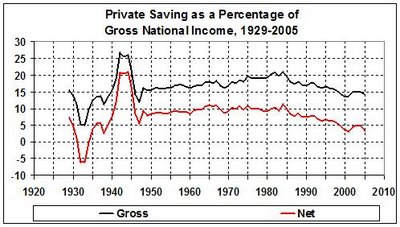
Conventional wisdom has it that the entry of the United States into World War II caused the end of the Great Depression in this country. My variant is that World War II led to a “glut” of private saving because (1) government spending caused full employment, but (2) workers and businesses were forced to save much of their income because the massive shift of output toward the war effort forestalled spending on private consumption and investment goods. The resulting cash “glut” fueled post-war consumption and investment spending.

Robert Higgs, research director of the Independent Institute, has a different theory, which he spells out in “Regime Uncertainty: Why the Great Depression Lasted So Long and Why Prosperity Resumed After the War” (available here), the first chapter his new book, Depression, War, and Cold War. (Thanks to Don Boudreaux of Cafe Hayek for the pointer.) Here, from “Regime Change . . . ” is Higgs’s summary of his thesis:

I shall argue here that the economy remained in the depression as late as 1940 because private investment had never recovered sufficiently after its collapse during the Great Contraction. During the war, private investment fell to much lower levels, and the federal government itself became the chief investor, directing investment into building up the nation’s capacity to produce munitions. After the war ended, private investment, for the first time since the 1920s, rose to and remained at levels sufficient to create a prosperous and normally growing economy.

I shall argue further that the insufficiency of private investment from 1935 through 1940 reflected a pervasive uncertainty among investors about the security of their property rights in their capital and its prospective returns. This uncertainty arose, especially though not exclusively, from the character of federal government actions and the nature of the Roosevelt administration during the so-called Second New Deal from 1935 to 1940. Starting in 1940 the makeup of FDR’s administration changed substantially as probusiness men began to replace dedicated New Dealers in many positions, including most of the offices of high authority in the war-command economy. Congressional changes in the elections from 1938 onward reinforced the movement away from the New Deal, strengthening the so-called Conservative Coalition.

From 1941 through 1945, however, the less hostile character of the administration expressed itself in decisions about how to manage the warcommand economy; therefore, with private investment replaced by direct government investment, the diminished fears of investors could not give rise to a revival of private investment spending. In 1945 the death of Roosevelt and the succession of Harry S Truman and his administration completed the shift from a political regime investors perceived as full of uncertainty to one in which they felt much more confident about the security of their private property rights. Sufficiently sanguine for the first time since 1929, and finally freed from government restraints on private investment for civilian purposes, investors set in motion the postwar investment boom that powered the economy’s return to sustained prosperity notwithstanding the drastic reduction of federal government spending from its extraordinarily elevated wartime levels.

Higgs’s explanation isn’t inconsistent with mine, but it’s incomplete. Higgs overlooks the powerful influence of the large cash balances that individuals and corporations had accumulated during the war years. It’s true that because the war was a massive resource “sink” those cash balances didn’t represent real assets. But the cash was there, nevertheless, waiting to be spent on consumption goods and to be made available for capital investments through purchases of equities and debt.

It helped that the war dampened FDR’s hostility to business, and that FDR’s death ushered in a somewhat less radical regime. Those developments certainly fostered capital investment. But the capital investment couldn’t have taken place (or not nearly as much of it) without the “glut” of private saving during World War II. The relative size of that “glut” can be seen here:

Derived from Bureau of Economic Analysis, National Income and Product Accounts Tables: 5.1, Saving and Investment. Gross private saving is analagous to cash flow; net private saving is analagous to cash flow less an allowance for depreciation. The bulge in gross private saving represents pent-up demand for consumption and investment spending, which was released after the war.

World War II did bring about the end of the Great Depression, not directly by full employment during the war but because that full employment created a “glut” of saving. After the war that “glut” jump-started

  • capital spending by businesses, which — because of FDR’s demise — invested more than they otherwise would have; and
  • private consumption spending, which — because of the privations of the Great Depression and the war years — would have risen sharply regardless of the political climate.

The post continues with an exchange between Higgs and me. The bottom line is the same.

What is the answer to the title question, then? It is that a period of forced, nominal saving can create pent-up demand, which can result in the employment of resources that had theretofore been unavailable. The pent-up demand at the end of World War II was, in great measure, responsible for the post-war recovery.

This rare phenomenon has nothing to do with the multiplier, and probably has nothing to do with the current economic situation. Government has commandeered a large chunk of the American economy, but so gradually that Americans have not acquire a “glut” of nominal savings, as they did in World War II.

Temporal and Spatial Agreement

A headline reads, “Gunman kills self, 5 others, at Texas roller rink.” It can’t be done that way, unless the gunman kills himself and the fiver others are killed later by a mechanism that the gunman had activate. But that’s not what happened. The gunman killed fiver persons, then turned the gun on himself. A headline or sentence should give clear and accurate description of an event by “mapping” the event, temporally or spatially. In this case, the correct temporal mapping is “Gunman kills 5, then self, at Texas roller rink,” which puts events in their correct  order.

A mapping error that I encounter often is the to-from locution, as in “the average price of gasoline rose to $3.88 a gallon from $3.79 a gallon.” That’s backwards. To be clear, a sentence should treat time sequentially; that is, the first thing that happens should precede the second thing that happens, and so on. In this case, clarity is achieved by writing or saying “the price of gasoline rose from $3.79 a gallon to $3.88 a gallon.” Doing it the other way around forces the reader or listener to go to the trouble of mentally unscrambling the statement. This is especially troublesome for a listener, who may then miss what comes next.

The to-from locution also is frequently (mis)applied to spatial relations, as in “X went to Chicago from New York.” If New York is the starting point of a journey, then New York should be mentioned first: “X went from New York to Chicago.” Again, doing it the other way around forces the reader or listener to unscramble the statement.

In sum, temporally and spatially backward statements cause  readers and listeners to do the work that is properly done by writers and speakers — if they care about the clarity and accuracy of what they write and say. It is all too evident that many writers and speakers do not care about being understood; they prefer to deliver verbiage and let the audience sort it.

The Social Security Trust Fund Is Not a “Get Out of Jail Free Card”

UPDATED BELOW

David Friedman, drawing on an op-ed by Thomas Saving, suggests that

Obama may have a $2.7 trillion dollar get out of jail free card, a way of spending that much additional money without exceeding the debt limit.

How does that work? Friedman explains:

Suppose no agreement is reached on raising the debt limit. Obama instructs the relevant people to spend the income from Social Security on the war in Afghanistan, bailouts, whatever he thinks needs money. He then instructs the Social Security system to cash in as many bonds as are required to meet its obligations to Social Security recipients, say $700 billion. He then instructs the treasury, since the national debt is now $700 billion below the debt limit, to borrow $700 billion. The net effect is that he has increased total expenditure, Social Security included, by $700 billion without exceeding the debt limit. The trust fund is currently at about $2.7 trillion, so he can do it for four more years.

Friedman’s scheme would work only if total federal receipts (including Social Security taxes) remain greater than or equal to total federal outlays (including SS benefits), from the point at which federal indebtedness hits the statutory ceiling. But that is not the situation.

Let us say, for the sake of argument, that the ceiling will be reached at the end of FY 2011. The president’s budget for FY 2012 shows total outlays of $3.729 trillion (including SS benefits of $0.761 T) and total revenues of $2.626 T (including SS taxes of $0.660 T). (See tables S-1 and S-3, here.) In other words, if Congress passes the president’s budget exactly as it stands, the debt ceiling must rise by $1.103 T ($3.729 T – $2.626 T) in FY 2012. And the SS trust fund, no matter how large it is, cannot alter the arithmetic.

Here is why. Suppose the feds spend all $0.660 T in SS taxes on things other than SS benefits (as they will, in effect). From an accounting standpoint, that reduces the non-SS deficit for FY 2012 from $1.001 T (non-SS spending less non-SS receipts) to $0.341 T. But the folks at SS are faced with a bill for $0.761 T in SS benefits. To pay the bill without having received a dime in SS taxes, the SS folks must go to the SS trust fund and grab U.S. treasury bonds with a value of $0.761 T, which they must then present to Tim Geithner for payment. Geithner thinks, “Who are these fools? Do they imagine that I’ve got that much unencumbered cash lying around, when I’m over my head in debt and sinking fast?” But being a good Obamanite, Geithner gives the SS folks their $0.761 T, and they go away happy.

If the analysis stops there, Friedman is correct. The treasury has just redeemed $0.761 T in bonds held by the SS trust fund, and the total debt of the federal government has magically dropped by $0.761 T. But the analysis cannot stop there, because the treasury does not have the $0.761 T in unencumbered cash. It must now borrow $0.761 T, to cover the redemption of the SS trust fund bonds, plus another $0.341 T, to cover the amount by which non-SS outlays exceed total receipts (including the SS taxes that it intercepts). With rounding, that comes to $1.103 T, which just happens to be the amount by which total federal outlays exceed total federal receipts.

Under what conditions would Friedman’s fix work? Here is a list (perhaps not an exhaustive one):

  • The debt ceiling will not be reached, given current projections of federal outlays and receipts (including SS benefits and taxes).
  • The debt ceiling has been reached but will not be exceeded, given current projections of federal outlays and receipts (including SS benefits and taxes).
  • The debt ceiling has been reached, but the surplus from non-SS programs will offset the deficit in SS accounts, or vice versa.

What about the SS trust fund? As long as the federal government is in debt by at least the face value of the SS trust fund, the trust fund has no real value. There is one (unlikely) saving condition, which is that the government’s net worth — represented by real assets — is equal to or greater than the face value of the trust fund. Such assets would have to be authorized for sale, by law, and would have to be valued at their quick-sale price on the open market. Given the reluctance with which Congress and federal agencies part with valuable assets (mainly land), it will be a cold day on the Equator before the SS trust fund is more than a valueless collection of accounting entries.

UPDATE (07/25/11)

The crux of my objection to Friedman’s scheme is found in the original post and my reply to his first comment; viz.:

If the analysis stops there, Friedman is correct. The treasury has just redeemed $0.761 T in bonds held by the SS trust fund, and the total debt of the federal government has magically dropped by $0.761 T. But the analysis cannot stop there, because the treasury does not have the $0.761 T in unencumbered cash….

*     *     *

3. This intra-governmental transaction does not affect the revenues that SS and non-SS receive from third parties.

4. Total spending by SS and non-SS must therefore equal their total receipts from third parties.

I ended my reply with this observation:

If you disagree with this analysis, then you and/or I must be making some assumptions (perhaps inadvertently) that remain hidden from view….

As it turns out, Friedman was making a hidden assumption that allows his scheme to work. That hidden assumption is revealed in a note appended to Friedman’s original post. The note was not there when I published this post, and I was unaware of it when I replied to Friedman’s first comment. In fact, I was unaware of it until late yesterday, when I revisited this post and Friedman’s after receiving his second comment. The note reads:

Some readers seem puzzled as to where the Treasury, in my story, is to find the $700 billion that it is to pay to the Social Security Administration, once the debt limit is reached. The answer is straightforward. With or without a debt limit, the federal government is continually collecting money and spending it. In my scenario, the government takes (say) $50 billion that it was supposed to pay as salary to federal employees, pays it to SSA instead. SSA cancels $50 billion in trust fund bonds. The national debt, which includes the debt owed by the federal government to the SSA, is now $50 billion below the limit, so the Treasury borrows $50 billion and pays out salaries to federal employees. Rinse and repeat as many times as necessary.

This is too clever by half. It requires exquisite timing on the part of the Treasury; otherwise, payrolls are not met, vendors are not paid, and existing debt is not serviced. In other words, the federal government would be in constructive default and violation of the debt limit. Moreover, it most certainly would not allow the federal government’s outlays to exceed its revenues over an extended period, which is why Obama seeks a higher debt limit in the first place. I could stop there, but there’s more to say about the scheme.

It resembles check-kiting, and may be just as illegal. But even if it is not illegal, it amounts to a patent evasion of the debt limit, and the evasion soon would be obvious to knowledgeable observers. Among other things, financial markets probably would react as if the federal government were in default — because the scheme could sooner or later result in a default of some kind (especially if outlays are rising as revenues stay flat). It would not take an act of Congress (over Obama’s veto) to put an end to the scheme; financial markets would do the job, as Treasury would be unable to refinance existing debt, except (possibly) at exorbitant interest rates.

In the best case, climbing interest payments would eat up revenues and force the federal government to cut back on the actual operations and programs. The result would be exactly opposite the one desired by Obama and company, which is real expansion of government. In the worst case, the Federal Reserve would pick up the tab, if it could scrape together a voting majority with the stomach for wading into a political firestorm. But that is another deus ex machina — of dubious durability — and not a surefire way of getting around the debt limit.

I am through with this subject. Comments are closed.

UPDATE (06/08/14)

I note, very belatedly, that Friedman later amended his post to add this:

A friend who knows much more law than I do writes:

It turns on, on further research, that Congress anticipated and prevented the very trick you have devised. Public Law 104-121, section 107(a), prohibits redemption of Social Security trust fund securities prior to maturity for any purpose other than the payment of benefits or administrative expenses.So it’s still true that the debt limit cannot block social security payments, at least until the trust fund runs out. But my multi-trillion dollar get out of jail free card has been cancelled.

Curses, foiled again.

Friedman later wrote a post that is properly focused on the ability of the federal government to continue paying SS benefits, regardless of the debt ceiling, as long as the trust fund is sufficiently large. The trustees expect the fund to be exhausted in 2033.

Miss Brooks’s “Grand Bargain”

The idiot known as David Brooks — The New York Times‘s idea of a conservative — is true to form today:

Imagine you’re a member of Congress. You have your own preferred way to reduce debt. If you’re a Democrat, it probably involves protecting Medicare and raising taxes. If you’re a Republican, it probably involves cutting spending, reforming Medicare and keeping taxes low.

Your plan is going nowhere. There just aren’t the votes. Meanwhile, the debt ceiling is fast approaching and a national catastrophe could be just weeks away.

At the last minute, two bipartisan approaches heave into view. In the Senate, the “Gang of Six” produces one Grand Bargain. Meanwhile, President Obama and John Boehner, the House speaker, have been quietly working on another. They suddenly seem close to a deal.

There’s a lot you don’t know about these two Grand Bargains….

You are being asked to support a foggy approach, not a specific plan. You are being asked to do this even though you have no faith in the other party and limited faith in the leadership of your own. You are being asked to risk your political life for an approach that bears little resemblance to what you would ideally prefer.

Do you do this? I think you do….

You do it because while the Grand Bargains won’t solve most of our fiscal problems. They will produce some incremental progress. We won’t fundamentally address the debt until we control health care inflation….

Both Grand Bargains produce real fiscal progress. They aim for $3 trillion or $4 trillion in debt reduction. Boehner and Obama have talked about raising the Medicare eligibility age and reducing Social Security benefit increases. The White House is offering big cuts in exchange for some revenue increases, or small cuts in exchange for few or none. The Gang of Six has a less-compelling blend of cuts, but it would repeal the Class Act, a health care Ponzi scheme. It would force committees across Congress to cut spending, and it would introduce an enforcement mechanism if they don’t. Sure there’s chicanery, but compared with any recent real-life budget, from Republican or Democratic administrations, these approaches are models of fiscal rectitude.

You do it because both bargains would boost growth. The tax code really is a travesty and a drag on the country’s economic dynamism. Any serious effort to simplify the code, strip out tax expenditures and reduce rates would have significant positive effects — even if it raised some tax revenues along the way….

In other words, Republicans should simply give in, on Miss Brooks’s say-so.

But Miss Brooks doesn’t know what he’s talking about.

First, with respect to “health care inflation,” government is the problem, not the solution. There are two key reasons for rising health-care prices, aside from innovation that yields expensive but effective drugs, procedures, and equipment. They are (a) the tax break that enables employers to subsidize employees’ health plans and (b) the subsidization of old folks’ health care via Medicare and (indirectly) SS. Those two interventions result in the overuse of health-care products and services. (There’s a 25-year old but still valid RAND study on the subject.) A far better system — if one insists on government involvement — would be to provide means-tested vouchers that can be redeemed for a  limited menu of vital medical products and services (e.g., critical surgeries, cardiovascular medications, chemotherapy). That’s it — no more Medicare, Medicaid, or their expansion via Obamacare.

Second, with respect to “tax expenditures” — there ain’t no such thing. Any action that results in higher taxes is a tax increase, no matter what Miss Brooks and his fellow Democrats choose to call it. And tax increases are growth inhibitors, not growth stimulators.

So much for the wisdom of The New York Times‘s pet “conservative.”

Related posts:
The Laffer Curve, “Fiscal Responsibility,” and Economic Growth
Our Miss Brooks
Rationing and Health Care
The Perils of Nannyism: The Case of Obamacare
More about the Perils of Obamacare
Health-Care Reform: The Short of It
Toward a Risk-Free Economy
Undermining the Free Society
The Constitution: Original Meaning, Corruption, and Restoration
The Unconstitutionality of the Individual Mandate
Does the Power to Tax Give Congress Unlimited Power?
Does Congress Have the Power to Regulate Inactivity?
“Tax Expenditures” Are Not Expenditures
My Negotiating Position on the Federal Debt

My Negotiating Position on the Federal Debt

Democrats’ insistence on ramming Obamacare through  Congress is a key ingredient of the dire long-term fiscal outlook. The supposed 10-year “savings” from Obamacare are phony — a matter of timing and “cuts” that will never happen.

Therefore, if I were at the negotiating table, I would insist on rescinding the O-bomanation or taking the equivalent in cuts to Medicare, Medicaid, and/or Social Security. My argument would run like this: Obamacare cost Democrats the House and it has yet to kick in, except in small ways. So, if you Democrats agree to rescind Obamacare — or, to save face, agree to cuts of equal magnitude in Medicare, Medicaid, and Social Security — we Republicans will allow you to take credit for averting a default while undoing a politically poisonous act.

With that out of the way, we can talk about the rest of the deficit-reduction package. I am open to changes in the tax code (e.g. elimination of certain deductions and loopholes), as long as long as total tax revenues do not exceed 19 percent of GDP. You Democrats can choose ways to meet that target with cuts in addition to those I’ve already discussed. Defense is off-limits, but everything else is on the table, including farm subsidies and corporate welfare.

Finally, as a bonus, I’m giving you a chance to sign on to a balanced-budge amendment. You don’t have to campaign in support of it when it goes to the States for ratification, but most of you would reap a political dividend by voting for its passage by Congress.

Don’t say I never did you a favor.

The Keynesian Fallacy and Regime Uncertainty

In “A Keynesian Fantasy Land,” I gave six reasons for the failure of “stimulus” spending to stimulate the economy, despite the insistence of leftists and left-wing economists that economic salvation is to be found in bigger government. The reasons, which I elaborate in the earlier post, are these:

1. “leakage” to imports

2. disincentivizing effects of government borrowing and spending (regime uncertainty)

3. timing and targeting problems (spending that is too late and misdirected)

4. reversed causality (lower aggregate demand as symptom, not cause)

5. the negative consequences of bail-outs

6. the unaccounted for complexity of human behavior

An article by Casey B. Mulligan, “Simple Analytics and Empirics of the Government Spending Multiplier and Other ‘Keynesian’ Paradoxes,” underscores the futility of “stimulus” spending. These are among Mulligan’s conclusions:

From a partial equilibrium perspective, it would be surprising if government purchases did not crowd out at least some private consumption, and that a reduction in factor supply did not result in less output. Yet some “New Keynesian” models, not to mention much public policy commentary, claim that today’s economy has turned this partial equilibrium reasoning on its head, even while it might have been historically valid. Among other things, individual firms and the aggregate private sector are alleged to leave their production invariant to changes in factor supply conditions during this recession. This paper shows how the government spending multiplier and the “paradox of toil” are related in theory, and examines evidence from this recession on the output effects of factor supply…

This paper does not contain a numerical estimate of the government purchases multiplier. However, its examination of data exclusively from the 2008-9 recession suggests that sectoral and aggregate employment and output vary with supply conditions in much the same way they did before the recession. The results contradict Keynesian claims that the government purchases multiplier would be significantly greater during the recession than it was before 2008, suggesting instead that historical estimates of the effects of fiscal policies are informative about fiscal policy effects in more recent years. Moreover, the supply incentives created by government spending cannot be ignored merely because 2008 and 2009 were recession years; rather incentives mattered as much as ever. Government purchases likely moved factors away from activities that would have supported private purchases. Unemployment insurance, food stamps, and other expanding means-tested government programs likely reduced employment and output during this recession, in much the same way they did in years past.

Compounding the futility of “stimulus” spending is the general climate of economic fear that Obama’s policies have engendered; for example:

Thanks to Regulatory Burdens, We’ve Got Both A Creditless Recovery and A Jobless Recovery (at Carpe Diem)

Why aren’t we seeing a jobs recovery? Maybe it’s ObamaCare’s fault (at Questions and Observations)

Home Depot Founder: Obama’s Regulations Are Killing Businesses (at Commentary)

As John Steele Gordon points out,

[t]he greatest periods of American economic growth came when taxes were very low—such as in the 19th century—or being lowered and simplified, as in the 1920s, 60s, and 80s. Inescapably, to tax wealth creation is to discourage it. But there is a large and politically potent segment of the population that, because its interests are now aligned with those of the government, seek to promote dependency through entitlements. This segment favors ever higher taxes (although they disguise the fact by demanding that only “the rich” pay their “fair share.”) But, as with regulation, high taxes inevitably produce low growth—and low growth threatens entitlements in the long term. If the United States remains in the doldrums for several more years without hope of a real turnaround, Medicare as it is currently constituted will go bankrupt in 2019. Raising taxes to prevent that will only slow overall growth, and that will actually defeat the purpose of saving Medicare.

So there is really no alternative to pursuing policies that encourage economic growth through private action by liberating the forces of the free market. A presidential candidate who finds a way to ground his economic policies in this core truth—and harnesses the idea to a larger and more optimistic understanding of the United States, both past and future, and resists the take-your-medicine tone that dominates the conservative policy discussion of the present moment—will be able to draw a sharp and effective contrast with the failures of the Obama years. (“Growth: The Only Way out of This Mess,” Commentary, July 2011)

But there is no point in cutting taxes unless government spending is cut — and cut drastically — for government spending, along with regulation, is the real drag on the economy. Only in the left’s magical thinking is government spending a good thing. In reality, it is a destructive force — even during recessions and depressions.

Related posts:
The Causes of Economic Growth
A Short Course in Economics
Addendum to a Short Course in Economics
The Indivisibility of Economic and Social Liberty
The Price of Government
The Fed and Business Cycles
The Price of Government Redux
The Mega-Depression
Ricardian Equivalence Reconsidered
The Real Burden of Government
Toward a Risk-Free Economy
The Rahn Curve at Work
How the Great Depression Ended
Microeconomics and Macroeconomics
The Illusion of Prosperity and Stability
Experts and the Economy
We’re from the Government and We’re Here to Help You
Estimating the Rahn Curve: Or, How Government Inhibits Economic Growth
Our Enemy, the State
Competition Shouldn’t Be a Dirty Word
The Stagnation Thesis
The Evil That Is Done with Good Intentions
Money, Credit, and Economic Fluctuations

Rethinking the Constitution: “Freedom of Speech, and of the Press”

UPDATED 07/21/11

My complete re-thinking of the Constitution is here. This post focuses on the much-abused First Amendment, specifically, “freedom of speech, and of  the press.” Contrary to the current state of constitutional jurisprudence, these “freedoms” do not comprise an absolute license to “express” almost anything, regardless of the effects on the social fabric and national defense.

One example of misguided absolutism is found in Snyder v. Phelps, a case recently and wrongly decided by the U.S. Supreme Court. This is from “The Burkean Justice” (The Weekly Standard, July 18, 2011):

When the Supreme Court convened for oral argument in Snyder v. Phelps, judicial formalities only thinly veiled the intense bitterness smoldering among the parties and their supporters. At one table sat counsel for Albert Snyder, father of the late Marine Lance Corporal Matthew Snyder, who was killed in al Anbar Province, Iraq. At the other sat Margie Phelps, counsel for (and daughter of) Fred Phelps, whose notorious Westboro Baptist Church descended upon Snyder’s Maryland funeral, waving signs bearing such startlingly offensive slogans as “Thank God for IEDs,” “God Hates Fags,” and “Thank God for Dead Soldiers.” A federal jury had awarded Snyder nearly $11 million for the “severe depression” and “exacerbated preexisting health conditions” that Phelps’s protest had caused him.

In the Supreme Court, Phelps argued that the jury’s verdict could not stand because the First Amendment protected Westboro’s right to stage their protest outside the funeral. As the Court heard the case on a gray October morning, Westboro protesters marched outside the courthouse, informing onlookers that God still “Hates Fags” and advising them to “Pray for More Dead Soldiers.”

Amidst that chaos, the Court found not division, but broad agreement. On March 2, 2011, it held that Westboro’s slurs were protected by the First Amendment, and that Snyder would receive no compensation, let alone punitive damages, for the emotional injuries that he had suffered. Chief Justice John Roberts wrote the Court’s opinion, speaking for all of his brethren, conservatives and liberals alike—except one.

Justice Samuel Alito rejected the Court’s analysis and wrote a stirring lone dissent. “The Court now holds that the First Amendment protected respondents’ right to brutalize Mr. Snyder. I cannot agree.” Repeatedly characterizing Westboro’s protest as not merely speech but “verbal assaults” that “brutally attacked” the fallen Snyder and left the father with “wounds that are truly severe and incapable of healing themselves,” Justice Alito concluded that the First Amendment’s text and precedents did not bar Snyder’s lawsuit. “In order to have a society in which public issues can be openly and vigorously debated, it is not necessary to allow the brutalization of innocent victims. .  .  . I therefore respectfully dissent.”

There is more:

Snyder v. Phelps would not be the last time that Alito stood nearly alone in a contentious free speech case this term. Just weeks ago, as the Court issued its final decisions of the term, Alito rejected the Court’s broad argument that California could not ban the distribution of violent video games without parental consent. Although he shared the Court’s bottom-line conclusion that the particular statute at issue was unconstitutional, he criticized the majority’s analysis in Brown v. Entertainment Merchants Association as failing to give states and local communities latitude to promote parental control over children’s video-game habits. The states, he urged, should not be foreclosed from passing better-crafted statutes achieving that legitimate end.

Moreover, Alito’s opinions in those cases followed a solo dissent late in the previous term, in United States v. Stevens, where eight of the nine justices struck down a federal law barring the distribution of disturbing “crush videos” in which, for example, a woman stabs a kitten through the eye with her high heel, all for the gratification of anonymous home audiences….

The source of Alito’s positions:

[T]hose speculating as to the roots of Alito’s jurisprudence need look no further than his own words—in public documents, at his confirmation hearing, and elsewhere. Justice Alito is uniquely attuned to the space that the Constitution preserves for local communities to defend the vulnerable and to protect traditional values. In these three new opinions, more than any others, he has emerged as the Court’s Burkean justice….

A review of Alito’s Snyder, Brown, and Stevens opinions quickly suggests the common theme: Alito, more than any of his colleagues, would not allow broad characterizations of the freedom of speech effectively to immunize unlawful actions. He sharply criticized the Court for making generalized pronouncements on the First Amendment’s reach, when the Court’s reiterations of theory glossed over the difficult factual questions that had given rise to regulation in the first place—whether in grouping brutal verbal attacks with protected political speech; or in equating interactive Duke Nukem games with the text of Grimm’s Fairy Tales; or in extending constitutional protection to the video of women illegally crushing animals. And Alito was particularly sensitive to the Court’s refusal to grant at least a modicum of deference to the local communities and state officials who were attempting to protect their populations against actions that they found so injurious as to require state intervention….

The ability of the press to undermine national defense with impunity was established in World War II and was ratified the Iraq War. Here is  one example, from 2005, courtesy of Winds of Change:

Today’s New York Times provides intimate detail on the charter flights used by the CIA to ferry prisoners across the globe. The names of the charter companies are disclosed. The types of aircraft flown are revealed. The points of departure and destinations of these flights are stated. There is even a picture of one of the charter craft, with the identification number of the aircraft in full display. All of this is extremely valuable to al Qaeda members who may have an interest in rescuing, or if deemed appropriate, conducting a suicide attack against suspected extraction flights. A successful attack resulting from this story can endanger the lives of CIA, security and civilian personnel involved in these missions, as well as deprive the intelligence and military communities of valuable information that can be gained from interrogations….

What exactly is the purpose of the New York Times in reporting on sensitive issues such as these? Do they even care about the consequences of making such information pubic? It appears the editors of the New York Times feel that breaking a titillating story about sensitive CIA operations is much more important than national security and the lives of those fighting in the war. All to our detriment.

Ann Coulter reminds us of other examples:

[I]n 2006 the Times published illegally leaked classified documents concerning a government program following terrorists’ financial transactions; … in 2005 it revealed illegally obtained information about a top-secret government program tracking phone calls connected to numbers found in Khalid Sheikh Mohammed’s cell phone….

If the Times‘s reporting is not “aid and comfort” to the enemy, what is? As I wrote here:

The preservation of life and liberty necessarily requires a willingness to compromise on what — in the comfortable world of abstraction — seem to be inviolable principles. For example:

  • The First Amendment doesn’t grant anyone the right to go on the air to compromise a military operation by American forces…

The NYT article about a CIA operation being conducted in support of an authorized war amounts to the same thing. The right to publish cannot be absolute and should not exempt anyone from a charge of treason.

A general and compelling case against the current reign of absolutism is made by David Lowenthal in No Liberty for License: The Forgotten Logic of the First Amendment. My copy is now in someone else’s hands, so I must rely on Edward J. Erler’s review of the book:


Liberty is lost when the law allows “freedom of speech, and of the press” to undermine the civil and state institutions that enable liberty.

Related posts:
On Liberty
Line-Drawing and Liberty
Intellectuals and Society: A Review
Government vs. Community
Libertarian Conservative or Conservative Libertarian?
Liberty, Equality, Fraternity: Part I
Bounded Liberty: A Thought Experiment
The Meaning of Liberty

See also “The Constitution: Myths and Realities“.

“Intellectuals and Society” in Brief

From Muriel Barbery’s The Elegance of the Hedgehog:

[I]t was one of Papa’s guests, at the dinner party yesterday, who said: “Those who can, do; those who can’t, teach; those who can’t teach teach the teachers; and those who cant’ teach the teachers go into politics.”…

…What his sentence means isn’t that incompetent people have found their place in the sun, but that nothing is harder or more unfair than human reality: humans live in a world where it’s words and not deeds that have power, where the ultimate skill is mastery of language. This is a terrible thing because basically we are primates who’ve been programmed to eat, sleep, reproduce, conquer and make our territory safe, and the ones who are most gifted at that, the most animal types among us, always get screwed by the others, the fine talkers, despite these latter being incapable of defending their own garden or bringing a rabbit home for dinner or procreating properly. Humans live in a world where the weak are dominant. This is a terrible insult to our animal nature, a sort of perversion or a deep contradiction.

“Tax Expenditures” Are Not Expenditures

Greg Mankiw makes a provocative point:

The blue line is total discretionary outlays of the federal government, and the brown line is the sum of tax expenditures.  Both are in constant dollars.  Note that these two categories of spending are about equal in magnitude.  It is just as important to focus on stealth spending implemented through the tax code as on explicit spending.

Source.

Addendum: David Leonhardt has a related article in the Times today.

What are “tax expenditures”? According to Mankiw’s source they are

a measure of the government revenue losses resulting from provisions in the tax code that allow people or businesses to reduce their tax burden by taking certain deductions, exemptions, exclusions, preferential rates, deferrals or credits. By reducing the revenue that would otherwise have been collected by the government, tax expenditures are similar to government spending.

“Tax expenditures” are not “similar to government spending,” nor are they a form of government spending, as “liberals” would have it.

Taxes are governmental claims on economic output. If tax revenues from all sources amount to 20 percent of GDP, given the kinds of “loopholes” listed above, the effective tax rate is 20 percent of GDP. If loopholes are closed and tax revenues rise, government isn’t spending less money, it’s collecting more taxes. If loopholes are closed and, at the same time, nominal tax rates are reduced so that revenues remain constant, government isn’t spending less money, it’s simply redistributing the tax burden.

“Tax expenditures” could be expenditures only if:

  • All output is owned by government.
  • Government “spends” (distributes) output through the provisions of the tax code.
  • Therefore, if government “spends” more on person A (by creating a loophole that favors A) and less on person B (because the loophole doesn’t apply to him), A is the beneficiary of a “tax expenditure.”

Such is left’s the upside-down, Alice-in-Wonderland worldview: Everything is owned by government, and citizens are mere supplicants.

I am surprised by Mankiw’s apparent endorsement of this view.

The Continuing Resurgence of Obamacare

In October I noted a sharp turnaround in likely voters’ views of Obamacare, namely, that is had become markedly less unpopular. Why? I called it bribery (and still do):

Millions of $250 checks have been sent to Medicare beneficiaries in recent weeks — and more will be sent in the four weeks remaining until election day.

There’s more to the bribery than $250 checks. Here are excerpts of the letter that accompanies the checks:

The Affordable Care Act, a new law passed by Congress and signed by President Obama on March 30, 2010, provides a one-time rebate to help with your drug cots. The rebate is sent automatically to most people enrolled in Medicare Part D who reach the Medicare drug plans coverage gap (“doughnut hole”) in 2010….

As part of this new law, starting next year, you will get a 50% discount on covered brand name drugs if you reach the coverage gap. On top of this, Medicare will add even more savings over the next several years until the coverage gap is closed by 2020.

The Affordable Care Act has many other provisions that protect and strengthen your Medicare, reduce your costs, and give you and your familymore control over health care….

It’s the old “something for nothing” trick. In this case, millions of old folks are getting something for nothing, while millions of younger folks will be getting nothing for something — their tax dollars. But the tax bill hasn’t come due yet because the federal government is still able to borrow money from abroad. And so, most of the people have been fooled — for the time being. By the time they understand what’s happening, it will be too late for them to do anything about it.

What has happened since October? Bribery still pays. Obamacare, though still unpopular on balance, has been gaining adherents a bit at a time:


Derived from this article and its predecessors at Rasmussen Reports. Poll results before passage of Obamacare represent strong approval minus strong disapproval. Poll results after passage of Obamacare represent strong approval of repeal minus strong disapproval of repeal.

The steep decline early in 2010 reflects “fashionable” pre-enactment resistance to Obamacare among independents, many of whom quickly changed their mind and became “fashionable” supporters of the fait accompli.

The polynomial fit (curved line) simply highlights the trend to date, and does not necessarily indicate Obamacare’s future popularity. But … if the upward movement continues, Republicans will find it hard going to repeal Obamacare, even if they win the Senate and White House in November 2012.

The present budget crisis could lead to a paring back of Obamacare. But if the crisis is resolved decisively, Obama (if not Democrats generally) will get much of the credit, and it will be more difficult to unseat him — unless job creation and economic growth remain in low gear.

Uncertainty abounds, as always.

A Keynesian Fantasy Land

This post examines practical reasons for the failure of “stimulus” to stimulate and the “multiplier” to multiply. The deeper truth is that the Keynesian multiplier is a mathematical fiction, as explained here, and government spending is in fact destructive of economic growth, as discussed here and in some of the posts listed at the end.

“Liberal” economists and pundits complain incessantly that the recovery from the Great Recession is weak, and in jeopardy, because the federal government hasn’t spent “enough” money. (See this for some examples of the “liberal” view.) How much is “enough” for Paul Krugman et al.? It is always more than the government spends, of course.

Why should that be? The blindingly obvious answer — but not obvious to Krugman and company — is that demand-side fiscal policy (i.e., government “stimulus” spending) is ineffective. If the economy depends on government spending, how does one explain the decades after the Civil War, when government spent less than 10 percent of GDP (vs. today’s 40 percent), while America’s economy grew faster than at any time in its history? It took World War II and regime change (the disruption of the New Deal by the war) to end the Great Depression. Mr. Roosevelt’s adoption of Mr. Keynes’s hole-digging prescription (the Civilian Conservation Corps and similar make-work projects) had nothing to do with it. Mr. Roosevelt may have been an excellent marketeer, but he was a dismal economic engineer.

This is not to reject supply-side fiscal policy: tax-rate reductions. When tax-rate reductions are prospectively permanent — as opposed to one-time tax rebates and “holidays” — they can and do spur economic growth. Christina Romer, former chair of Obama’s Council of Economic Advisers, once proved it — though she developed a convenient case of amnesia when she became a proponent of “stimulus.”

As any reputable economist will tell you, however, the best that one can expect of a temporary increase in government spending is a temporary increase in economic activity; it is a stop-gap until the economy recovers on its own. (And a reputable economist, unlike Krugman, will also tell you that a permanent increase in government spending diverts resources from productive uses — uses that yield economic growth and satisfy actual economic wants — toward less-productive and counter-productive ones, including the creation of paper-shuffling, regulatory bureaucracies.)

Despite the promises of Obama, Romer, and company, the “stimulus” has evidently failed to do much — if anything — to alleviate the Great Recession and its lingering aftermath. (See this, this, and this, for example.) Thus the wailing and gnashing of teeth by Krugman and company — who want to replicate the failure on a grander scale.

WHY THE “STIMULUS” FAILED TO STIMULATE: GENERAL OBSERVATIONS

What went wrong? Anthony de Jasay offers a piece of the explanation:

…In Keynesian parlance there is the multiplier effect and it is greater than 1. As long as there is spare capacity (unemployment) in the economy, the government ought to go on spending more, working through the multiplier, because the extra private saving takes care of the government dissaving and the extra consumption is, so to speak, a welcome windfall gain. Timidly refusing to generate it is criminal waste.

Despite truculent voices to the contrary, the Keynesian logic is faultless in that the conclusions do follow from the assumptions. Why it does not really work and why it singularly failed to work in 2009-2010 and maybe beyond, is that other things do not remain equal. Part of the extra spending stimulus fails to stimulate domestic income because as much as 0.3 of the multiplier might leak out through extra imports. Much of the rest may be offset by industry taking fright of the rising budget deficit and reducing investment, and consumers striving to reduce their indebtedness producing some saving to balance the government’s dissaving. The total effect of higher imports and lower investment might be a multiplier barely higher, or maybe even lower, than 1 and the stimulus stimulating nothing except the national debt. This is not the fault of Keynes but of those whose macro-economics exist in a fantasy land. (Library of Economics and Liberty, “Micro, Macro, and Fantasy Economics,” December 6, 2010)

Generally,

[t]he available empirical evidence does not support the idea that spending multipliers typically exceed one, and thus spending stimulus programs will likely raise GDP by less than the increase in government spending. (Robert J. Barro and Charles J. Redlick, “Stimulus Spending Doesn’t Work,” WSJ Online, October 1, 2009)

(For more on the subject see Barro’s “Government Spending Is No Free Lunch,” WSJ Online, January 22, 2009.)

WHY “STIMULUS” FAILS: SPECIFIC REASONS

Altogether, there are six reasons for the ineffectiveness of Keynsesian “stimulus.”

1. The “leakage” to imports, as indicated by de Jasay.

2. The disincentivizing effects of government borrowing and spending, to which de Jasay alludes.

As de Jasay suggests, industry (and the high-income earners who finance it) are being cautious about the implications of additional government debt. As I say here,

the sophisticat[ed] … institutions and persons who have the greatest interest in government’s actions [are] large corporations and persons in high-income brackets. They will react to government borrowing as if it would affect them and their heirs (corporate and individual).

That is to say, even if additional debt does not crowd out private-sector borrowing to finance business expansion, it will nevertheless inhibit investments in business expansion. This inhibiting effect is compounded by the reasonable expectation that many items in a “stimulus” package will become permanent fixtures in the government’s budget.

3. The timing-targeting problem.

The lag between the initial agitation for “stimulus” and its realization. In the extreme, the lag can be so great as to have no effect other than to divert employed resources from private to government uses. But even where there is a relatively brief lag, “stimulus” spending is essentially wasted if the result is simply to divert already employed resources from private to government uses.

The timing-targeting problem is one that strident Keynesians and their unsophisticated disciples in the media seem not to understand or care about. (They are happy as long as government “does something,” regardless of the cost.) The problem arises from the fundamental flaw in the Keynesian analysis: Economic output is portrayed as a homogeneous commodity, one that can be characterized  in terms of aggregate demand (AD) and aggregate supply (AS). Accordingly, in the Keynesian orthodoxy, all it takes to stimulate AD is to pump in some additional government spending (dG), and the rest takes care of itself.

Arnold Kling calls it “hydraulic” macroeconomics:

Once upon a time, Joe lived in Keynesiana, where he was a representative agent.

Joe worked in a GDP factory, making GDP. Every Monday morning, he went to work, and he worked five days a week. He was paid $1 for every 24-minute segment he worked, and he worked 100 segments (40 hours), so he earned $100 a week. Every Friday afternoon, Joe cashed his paycheck and went to the GDP factory outlet, where he spent it all on GDP.

One day, Joe decided that he needed to accumulate some savings. He made up a rule for himself. Knowing that he needed to consume at least $40 of GDP each week, he decided that his rule would be to save 20 percent of everything he earned over and above that $40. So the first week, that meant saving 20 percent of $60, or $12. So he cashed his $100 paycheck, but that Friday afternoon he only spent $88.

Next Monday, morning, Joe’s boss had some news. “A funny thing happened last week. We sold 12 percent less GDP than usual. So this week, we’re gonna put you on a short week. You work 88 segments, instead of 100.”

Joe was disappointed, because this meant he would only be paid $88 this week. Sticking to his new rule, he resolved to save 20 percent of $48, or $9.60. So that Friday afternoon, he cashed his $88 paycheck and spent $78.40.

Next Monday morning, Joe’s boss said. “Well, golly, it looks like we sold even less GDP last week. I’m afraid we’ll have to cut you back to 78.40 segments this week.” Still following his rule, Joe resolved to save 20 percent of $38.40, or $7.68. So he spent only $70.72 at the GDP factory outlet that Friday.

Seeing where this was going, the country asked Krug Paulman, the famous economist, what to do. He said, “The stupid people are saving too much. We need government to spend what the idiots are not spending.” So the government borrowed $29.28 from Joe and spent it at the GDP factory outlet.

Now, when Joe came to work on Monday morning, his boss said, “Good news, we sold 100 percent of what we used to sell, so you can work 100 segments this week.” Sticking to his rule, Joe saved $12 on Friday afternoon. But the government borrowed the $12 and spent it at the GDP factory outlet. They all lived happily ever after. (Library of Economics and Liberty, “Hydraulic Macro: A Fable,” August 30, 2009)

But in reality, economic activity is far more complex than that. One very important part of that reality the vast variety of goods and services changing hands, in response to constantly shifting tastes, preferences, technologies, and costs. The real economy bears no resemblance to the “hydraulic” one in which the homogeneous “fluid” is units of GDP. For “stimulus” — an increase in government spending (dG) — to generate an real increase GDP significantly greater than dG, several stringent conditions must be met:

a. dG must lead directly to the employment of resources that had been idled by a downturn in economic activity (or newly available resources that otherwise would lay idle), therefore eliciting the production of additional goods for delivery to consumers and businesses.

b. Accordingly, government functionaries must be able to distinguish between unemployment that occurs as a result of normal (and continuous) structural changes in the economy and unemployment that occurs because of a general slowdown in economic activity.

c. To the extent that the preceding conditions are satisfied, dG may be used to restore employment if government functionaries do the following things:

  • Ensure that dG is used to purchase goods and services that would have been produced in the absence of a general slowdown in economic activity.
  • Ensure that dG is used by those persons, businesses, and governmental units that have become unable to buy those goods and services because of a general slowdown in economic activity.
  • Allowing for shifts in tastes, preferences, technologies, etc., adjust the issuance, allocation, and use of dG so that goods and services are produced in accordance with those shifts in taste, etc.
  • Reduce dG as the demand for unemployed resources rises, in order to avoid the distorting and disincentivizing effects of inflation.

To the extent that dG is less than on-time and on-target, there is “leakage,” which causes the multiplier to recede toward a value of 1. It can easily slide below 1 — as Barro has found — because of the “leakage” to imports and the disincentivizing effects of government borrowing and spending.

4. Causality: Inadequate AD as symptom, not cause.

The fourth reason for the failure of the “stimulus” to stimulate is that it is does not address the cause of the drop in AD. A drop in AD usually is caused by an exogenous event, and that exogenous event usually is a credit crisis. Pumping money into the economy — especially when it results in the bidding up the prices of already employed resources — does not reinflate the punctured credit bubble that caused the slowdown.

If a credit crunch arises from a sharp rise in the rate of home-mortgage defaults — as in the case of the Great Recession — the obvious way to “solve” the problem is to prop up the defaulting borrowers and their lenders, and to do so quickly.

But, in practice, the propping up is hit-and-miss, and the misses have drastic consequences. Consider, for example, the decision not to bail out Lehman Brothers and the effects of that decision on financial markets.

Which leads into the fifth reason…

5. Inequity, moral hazard, and their consequences.

Any kind of “stimulus” that targets particular individuals and firms, in an effort to rectify their failures of judgment, has adverse political and economic effects.

Favorable treatment of defaulters and failing companies generates considerable popular resentment, which — in the present instance — has found a vocal and politically potent outlet in the Tea Party movement. Favorable treatment of defaulters and failing companies also creates moral hazard; that is, it encourage unwise risk-taking that can (and probably will) spark future crises, leading the government to assume more obligations and impose more regulations, in a futile effort to change human nature.

All of this adds up to a climate of political contention and financial pessimism — conditions that militate against consumer confidence and business expansion.

6. The human factor.

The preceding five reasons for the ineffectiveness of Keynesian “stimulus” point to a sixth, fundamental reason: the human factor.

Models are supposed to mirror reality, not the other way around. Those who cling to the Keynesian multiplier would like the world to comply with it. But the world does not because it is filled with people, whose behavior is not determined (or described) by a simplistic model but by their responses to incentives, their political predispositions, their informed and reasonable skepticism about the consequences of government intervention in economic matters, and — above all else — their fallibility. And, believe or not, government officials and bureaucrats are no less fallible than the “ordinary” citizens whose lives they would like to organize.

The human factor is an inconvenient truth. But “liberals,” in their usual arrogance and ignorance prefer magical thinking to reality. Belief in the Keynesian multiplier is a prime example of magical thinking.

Related posts:
The Causes of Economic Growth
A Short Course in Economics
Addendum to a Short Course in Economics
The Indivisibility of Economic and Social Liberty
The Price of Government
The Fed and Business Cycles
The Price of Government Redux
The Mega-Depression
Ricardian Equivalence Reconsidered
The Real Burden of Government
Toward a Risk-Free Economy
The Rahn Curve at Work
How the Great Depression Ended
Microeconomics and Macroeconomics
The Illusion of Prosperity and Stability
Experts and the Economy
We’re from the Government and We’re Here to Help You
Estimating the Rahn Curve: Or, How Government Inhibits Economic Growth
Our Enemy, the State
Competition Shouldn’t Be a Dirty Word
The Stagnation Thesis
The Evil That Is Done with Good Intentions
Money, Credit, and Economic Fluctuations

“Intelligence” As a Dirty Word

Once upon a time I read a post, “The Nature of Intelligence”,  at a now-defunct blog named MBTI Truths. Here is the entire text of the post:

A commonly held misconception within the MBTI community is that iNtuitives are smarter than Sensors. They are thought to have higher intelligence, but this belief is misguided. In an assessment of famous people with high IQs, the vast majority of them are iNtuitive. However, IQ tests measure only two types of intelligences: linguistic and logical-mathematical. In addition to these, there are six other types of intelligence: spatial, bodily-kinesthetic, musical, interpersonal, intrapersonal, and naturalistic. Sensors would probably outscore iNtuitives in several of these areas. Perhaps MBTI users should come to see iNtuitives, who make up 25 percent of the population, as having a unique type of intelligence instead of superior intelligence.

The use of “intelligence” with respect to traits other than brain-power is misguided. “Intelligence” has a clear and unambiguous meaning in everyday language; for example:

The capacity to acquire, understand, and use knowledge.

That is the way in which I use “intelligence” in “Intelligence, Personality, Politics, and Happiness”, and it is the way in which the word is commonly understood. The application of “intelligence” to other kinds of ability — musical, interpersonal, etc. — is a fairly recent development that smacks of anti-elitism. It is a way of saying that highly intelligent individuals (where “intelligence” carries its traditional meaning) are not necessarily superior in all respects. No kidding!

As to the merits of the post at MBTI Truths, it is mere hand-waving to say that “Sensors would probably outscore iNtuitives in several of these” other types of ability. And what is naturalistic intelligence, anyway?

Returning to a key point of my post, “Intelligence, Personality, Politics, and Happiness”, the claim that iNtuitives are generally smarter than Sensors is nothing but a claim about the relative capacity of iNtuitives to acquire and apply knowledge. It is quite correct to say that iNtuitives are not necessarily better than Sensors at, say, sports, music, glad-handing, and so one. It is also quite correct to say that iNtuitives generally are more intelligent than Sensors, in the standard meaning of “intelligence”.

Other so-called types of intelligence are not types of intelligence, at all. They are simply other types of ability, each of them is (perhaps) valuable in its own way. But calling them types of intelligence is a transparent effort to denigrate the importance of real intelligence, which is an important determinant of significant life outcomes: learning, job performance, income, health, and criminality (in the negative).

It is a sign of the times that an important human trait is played down in an effort to inflate the egos of persons who are not well endowed with respect to that trait. The attempt to redefine or minimize intelligence is of a piece with the use of genteelisms, which Wilson Follett defines as

soft-spoken expressions that are either unnecessary or too regularly used. The modern world is much given to making up euphemisms that turn into genteelisms. Thus newspapers and politicians shirk speaking of the poor and the crippled. These persons become, respectively, the underprivileged (or disadvantaged) and the handicapped [and now -challenged and -abled: ED]. (Modern American Usage (1966), p. 169)

Finally:

Genteelisms may be of … the old-fashioned sort that will not name common things outright, such as the absurd plural bosoms for breasts, and phrases that try to conceal accidental associations of ideas, such as back of for behind. The advertiser’s genteelisms are too numerous to count. They range from the false comparative (e.g., the better hotels) to the soapy phrase (e.g., gracious living), which is supposed to poeticize and perfume the proffer of bodily comforts. (Ibid., p. 170)

And so it is that such traits as athleticism, musical virtuosity, and garrulousness become kinds of intelligence. Why? Because it is somehow inegalitarian — and therefore unmentionable — that some persons are smarter than others. It would be doubly inegalitarian — but likely true — that smarter persons also have genetic tendencies to greater health and physical attractiveness.

Life just isn’t fair, so get over it.


Related posts:
Intelligence, Personality, Politics, and Happiness
Intelligence and Intuition

Saving the Innocent

Paul Compos, writing at The New Republic, celebrates “The American Justice System at Its Best“:

[I]t’s reasonable to argue that the acquittal of Casey Anthony … represent[s] … the system working as it should. But accepting that argument requires acknowledging deep imperfections that our legal system must tolerate, even when it does exactly what it’s supposed to do.

The most disturbing of these inevitable imperfections is a product of our supposed commitment to the principle that we prefer a large number—whether it’s 10, 50, or 100, the precise number is never clearly stated—of guilty people going free to the conviction of an innocent defendant. That is the practical significance of requiring the state to prove guilt “beyond a reasonable doubt”—a standard that, interestingly, the system always avoids defining in any but the most general, non-statistical terms….

[In Anthony’s case] The state proved beyond a reasonable doubt that a two-year-old child was murdered, and that her mother was, at the least, a deeply irresponsible parent with a propensity to lie to authorities. The prosecution also demonstrated, in my view, that it is far more likely than not that Anthony committed the crime. But I also believe the jury’s verdict was correct….

The case against Anthony was largely circumstantial, buttressed by arguably—yet only arguably—strong forensic evidence. But the prosecution was hampered by its inability to provide a compelling narrative explaining either how Caylee Anthony was killed or why her mother purportedly murdered her. This failure was not, as far as we know, a product of prosecutorial incompetence. The hard truth is that it is extremely difficult to successfully prosecute a murder under these kinds of circumstances—and the harder truth is that we are supposedly committed to the principle that this is, on the whole, a good thing.

Or is it? Compos refers  to the dictum of the noted English jurist, William Blackstone:

Better that ten guilty persons escape than that one innocent suffer.

“n” — the number of guilty persons — has increased since the late 1700s, when Blackstone wrote. Alexander “Sasha” Volokh offers some useful perspective:

Charles Dickens generously endorsed a value of n = “hundreds” for capital cases, and not just “that hundreds of guilty persons should escape,” but that they should escape “scot-free.” 99 Dickens was, in fact, so generous that hundreds of guilty persons escaping scot-free was not only better than one innocent person suffering — it was even better “than that the possibility of any innocent man or woman having been sacrificed, should present itself, with the least appearance of reason, to the minds of any class of men!” 100….

Of course, such blithe invocation could easily lead too far down the road to “inconsiderate folly” and “pestiferous nonsense.” As one author noted, there is “nothing so dangerous as a maxim”: 107

Better that any number of savings-banks be robbed than that one innocent person be condemned as a burglar! Better that any number of innocent men, women, and children should be waylaid, robbed, ravished, and murdered by wicked, wilful, and depraved malefactors, than that one innocent person should be convicted and punished for the perpetration of one of this infinite multitude of crimes, by an intelligent and well-meaning though mistaken court and jury! Better any amount of crime than one mistake in well-meant endeavors to suppress or prevent it! 108….

Jeremy Bentham, founder of utilitarianism, warned against the warm fuzzy feeling that comes from large values of n:

We must be on guard against those sentimental exaggerations which tend to give crime impunity, under the pretext of insuring the safety of innocence. Public applause has been, so to speak, set up to auction. At first it was said to be better to save several guilty men, than to condemn a single innocent man; others, to make the maxim more striking, fix the number ten; a third made this ten a hundred, and a fourth made it a thousand. All these candidates for the prize of humanity have been outstripped by I know not how many writers, who hold, that, in no case, ought an accused person to be condemned, unless evidence amount to mathematical or absolute certainty. According to this maxim, nobody ought to be punished, lest an innocent man be punished. 128 ….

James Fitzjames Stephen suggested that Blackstone’s maxim

resembles a suggestion that soldiers should be armed with bad guns because it is better that they should miss ten enemies than that they should hit one friend. . . . Everything depends on what the guilty men have been doing, and something depends on the way in which the innocent man came to be suspected. 134….

The story is told of a Chinese law professor, who was listening to a British lawyer explain that Britons were so enlightened, they believed it was better that ninety-nine guilty men go free than that one innocent man be executed. The Chinese professor thought for a second and asked, “Better for whom?” 238

That is the question: Better for whom? It is better for the guilty, who may claim more victims, but it certainly is not better for those new victims.

Related posts:
Does Capital Punishment Deter Homicide?
Libertarian Twaddle about the Death Penalty
Crime and Punishment
Abortion and Crime
More on Abortion and Crime
More Punishment Means Less Crime
More About Crime and Punishment
More Punishment Means Less Crime: A Footnote
Let the Punishment Fit the Crime
Another Argument for the Death Penalty
Less Punishment Means More Crime
Crime, Explained
Abortion and Crime (from a different angle than the earlier post of the same name)
Clear Thinking about the Death Penalty

Liberty Is Dead, Just Not Buried Yet

UPDATED 07/13/11

Quoted in “DC Park Police Gestapo Violate First Amendment

“On June 22, 2011, I attended a meeting of the D.C. Taxi Commission for a story I’m currently working on about a proposed medallion system in the district. About half-an-hour into the meeting, I witnessed journalist Pete Tucker snap a still photo of the proceedings on his camera phone. A few minutes later, two police officers arrested Tucker. I filmed Tucker’s arrest and the audience’s subsequent outrage using my iphone.

A few minutes later, as I was attempting to leave the building, I overheard the female officer who had arrested Tucker promise a woman, who I presumed to be an employee of the Taxi Commission, that she would confiscate my phone. Reason intern Kyle Blaine, overheard her say, “Do you want his phone? I can get his phone.” (The woman who was given assurances by the officer that she could have my phone can be seen at the end of the video telling me, “You do not have permission to record this!”)

As I tried to leave, I was told by the same blond female officer to “stay put.” I told her I was leaving and attempted to exit the building. I was then surrounded by officers, and told to remain still or I would be arrested. I didn’t move, but I tried to get the attention of a group of cab drivers who were standing nearby. At this point I was arrested. I spent the remainder of the day in a cell in the basement of the building. I was released at about 4PM.”

Items from “Are We Seeing More Moves to Muzzle Free Speech in America?

  • A woman was kicked off a U.S. Airways flight after being deemed a “security risk,” purportedly because she took a photograph of the name tag of an airline employee she felt was being rude.  (Did the employee or the airline really expect this “muzzling” incident to go away quietly?)
  • Drivers in Tennessee must now be extra cautious about the content of their bumper stickers. According to WKRN in Nashville, “Drivers caught with obscene or patently offensive bumper stickers, window signs or other markings on their vehicle visible to other drivers face an automatic $50 fine.”  And exactly who will be the judge regarding what stupid couplet is “patently offensive”? (And what do the offended do? Tail the tasteless offenders so closely—just so all the words/images are properly catalogued or photographed—that an accident ensues?)
  • One can‘t be completely sure what political camp was more pleased by MSNBC’s decision to indefinitely suspend Time editor Mark Halperin for calling President Obama a nasty name during a broadcast of “Morning Joe”—-left-wingers upset at the insult…or right-wingers upset by the word choice itself. Wherever you stand on that continuum, the incident should stoke free-speech debate and get at the heart of whether or not the cable network is muzzling one of its own, rightly or wrongly.

Quoted in “A Permanent Threat to Religious Freedom“:

Same-sex marriage does not simply include more people in the definition of civil marriage; it labels the natural understanding of marriage as a form of irrational prejudice, ignorance, bigotry, and even hatred. In other words, same-sex-marriage laws teach the public that people who view marriage in the natural way are morally equivalent to racists.

Once this idea is embedded in the law, there will be enormous pressure to take it to its logical conclusion by marginalizing and penalizing people who continue to think marriage is one man and one woman. Some of this pressure will come from state sources and some will come from private sources, but in both cases it will find ways through whatever cracks might exist in protections for religious and moral conscience.

These stories just happened to catch my eye today. I’ve been seeing a lot of stories like theme of late — and with increasing frequency, it seems to me.

What does it all mean? It means that the delicate balance between liberty and order may have tipped decisively in the direction of order. But it is not the voluntary order that arises from civil society’s observance of shared norms. It is the oppressive order that comes when the state usurps the role of civil society, and the minions of the state are licensed to impose their will on the details of our lives.

UPDATE: The readiness of “do gooders” to propose new impositions testifies to the state’s vast power:

As the Western world gets fatter and fatter, the solutions to slimming it down get ever more draconian. In Britain yesterday, the government issued guidelines saying “children under the age of 5, including babies who can’t walk yet, should exercise every day.” Today, in the States, a pair of Harvard scholars writing in the Journal of the American Medical Association advocate stripping away the custody rights of parents of super obese children. They’re for real!

Related posts:
The State of the Union: 2010
The Shape of Things to Come
I Want My Country Back
Society and the State
Undermining the Free Society
The Destruction of Society in the Name of “Society”

What Do Women (Politicians) Want?

The standard femi-nazi line goes like this: Women (in general) are just as capable as men (in general); gender differences are social constructs. This is patently untrue with respect to physical strength and certain types of cognitive ability. (The math-science gender gap is not closing.) Further, it is patently untrue with respect to innate biological differences (e.g., reproductive organs and related bodily functions) that have physiological effects on emotions and cognition.

Some women, recognizing the futility of claiming biological equality with men, now claim that women’s unique traits make them superior political animals. This is from a recent article in The New York Times, “Gillibrand Wants Women Involved in Politics“:

[Sen. Kirsten Gillibrand, D-NY] has begun a campaign, called Off the Sidelines, to mobilize women across the country, in advance of the national elections next year and as evidence emerges that the slow but steady progress made by women in elective politics has begun to stall….

In many ways, Ms. Gillibrand, who is 44, epitomizes the ways in which women are asserting themselves in politics these days.

For decades, women in elective office felt compelled to blur the distinctions between them and men: presenting themselves as tough and able while largely concealing their softer qualities. But like many political women of her generation, Ms. Gillibrand feels no such constraints, regularly talking about the demands she faces as a mother and a wife.

In fact, Ms. Gillibrand goes a step further, arguing that an infusion of women into the political system would go a long way toward changing the tone in Congress, a male-dominated world of fiercely clashing egos.

“We tend to be more results-oriented and less concerned with getting the credit,” Ms. Gillibrand explained. “The female approach is more conciliatory and less combative. We tend to use a more civil tone.”

Beyond that, Ms. Gillibrand contends, it should be a source of concern to women that the issues that are important to them — like workplace discrimination and access to child care — are being decided by lawmakers who are almost exclusively male.

As the last-quoted paragraph suggests, the purpose of seeking political office is to wield power. It is one thing to claim “soft” qualities, but the last place in which one finds “soft” qualities is in the political arena. Such qualities — when displayed — are for show; they are a mask behind which many a politician (male and female) attempts to hide the will to power, the urge to dominate.

So, just as it is true that some women are good mathematicians and scientists, and some women are stronger than most men, there are some women with egos on a par with those of the ego-driven males who dominate politics. Regardless of what those women say, do not expect them to change the tone of politics; when it comes to temperament, those women are the equal of the men whose jobs they seek.

The answer to the question “What do women (politicians) want?” is straightforward: They want power, just like male politicians. And they will pretend to be what they are not for the sake of gaining power, just like male politicians.

Questioning the National Debt

There is a laughable proposition — advanced by Treasury secretary Timothy Geithner, among others — that Congress may not limit the national* debt. This proposition is based on a skewed reading of Section 4 of Amendment XIV to the Constitution. That amendment was approved by Congress in 1866 and ratified in 1868.

Here is Section 4, in full:

The validity of the public debt of the United States, authorized by law, including debts incurred for payment of pensions and bounties for services in suppressing insurrection or rebellion, shall not be questioned. But neither the United States nor any State shall assume or pay any debt or obligation incurred in aid of insurrection or rebellion against the United States, or any claim for the loss or emancipation of any slave; but all such debts, obligations and claims shall be held illegal and void.

The first sentence — the “authority” for Geithner’s proposition — simply means that the government of the United States cannot repudiate indebtedness it has already incurred. The obvious purpose of the first sentence was to prevent future Congresses — which might be controlled by Democrats — from reneging on obligations incurred by the winning (mainly Republican**) side in the Civil War.

Putting a legal limit on the issuance of debt is not the same thing as repudiating debt already incurred. A limit on the amount of debt that the government may issue is the equivalent of stop sign; it means that the government must take steps to prevent the net accumulation of additional debt. It is up to Congress to determine the precise steps — some combination of tax increases and spending reductions — or to “repudiate” the debt ceiling by raising or eliminating it.

A responsible Congress would take steps to ensure against the growth of the debt by reducing commitments to the growth of  “entitlement” programs: Social Security, Medicare, and Medicaid. Those reductions are necessary — for the sake of America’s future — whether or not there is a debt ceiling. One could even argue that the existence of a debt ceiling — one that is always somewhat higher than the current level of debt — has encouraged Congress to make irresponsible spending commitments.

__________
* The so-called national debt is, in fact, the indebtedness of the government of the United States. It arises from the actions of that government, not from the private actions of individuals. It is “national” only in the sense that the taxpayers of the nation are ultimately responsible for repayment of the debt and interest thereon.

** The Civil War was partisan as well as sectional. The 36th Congress, which was in session before the outbreak of the war, was divided as follows: 116 Republicans to 83 Democrats in the House; 26 Republicans to 38 Democrats in the Senate. Because of the war, and losses of seats by seceding States, the Republican Party held a firm grip on Congress in 1866: 136 Republicans to 38 Democrats in the House; 39 Republicans to 11 Democrats in the Senate.

Related reading:
Debt-Limit Silliness, at NRO (follow the links)
We Cannot Pretend the Debt Ceiling Is Unconstitutional, at The NYT (straight talk from a leftist, of all things)

Related posts:
The “Forthcoming Financial Collapse”
We’re from the Government and We’re Here to Help You
Estimating the Rahn Curve: Or, How Government Inhibits Economic Growth
The Deficit Commission’s Deficit of Understanding
The Bowles-Simpson Report
The Bowles-Simpson Band-Aid
America’s Financial Crisis Is Now

A Declaration of Civil Disobedience

I hereby declare to the people of the United States and to the governments thereof that

The ratification of the Constitution of the United States resulted in the establishment a government of the United States (the central government) for the purposes of making, executing, and adjudicating laws. The Constitution and all laws made in accordance with it are the supreme law of the land. However, the legislative, executive, and judicial branches of the central government have abused their powers by making, executing, and upholding laws contrary to the Constitution; for example:

A decennial census is authorized in Article I, Section 2, for the purpose of enumerating the population of each State in order to apportion the membership of the House of Representatives among the States, and for no other purpose.

Article I, Section 1, vests all legislative powers in the Congress, but Congress has authorized and allowed unelected, executive-branch regulators to legislate on myriad matters affecting the liberty and property of Americans.

Article I, Section 8, enumerates the specific powers of Congress, which do not include such things as establishing and operating national welfare and health-care programs; intervening in the education of America’s children; regulating interstate commerce beyond ensuring its free flow; regulating intrastate commerce and private, non-commercial transactions; lending money and guaranteeing loans made by quasi-governmental institutions and other third parties; acquiring the stock and debt of business enterprises; establishing a central bank with the power to do more than issue money; requiring the States and their political subdivisions to adopt uniform laws on matters that lie outside the enumerated powers of Congress and beyond the previously agreed powers of the States and their subdivisions;  and coercing the States and the political subdivisions in the operation of illegitimate national programs by providing and threatening to withhold so-called federal money, which is in fact taxpayers’ money.  (The notion that the “general welfare” and/or “necessary and proper” clauses of Article I, Section 8, authorize such activities was refuted definitively in advance of the ratification of the Constitution by James Madison in No. 41 of the Federalist Papers, wherein the leading proponents of the Constitution stated their understanding of the Constitution’s meaning when they made the case for its ratification.)

One of the provisions of Article I, Section 10, prohibits interference by the States in private contracts; moreover, the Constitution nowhere authorizes the central government to interfere in private contracts. Yet, directly and through the States, the central government has allowed, encouraged, and required interference in private contracts pertaining to employment, property, and financial transactions.

Amendment I of the Constitution provides that “Congress shall make no law . . . abridging the freedom of speech.” But Congress has nevertheless abridged the freedom of political speech — our most precious kind — by passing bills that have been signed into law by presidents of the United States and, in the main, upheld by the Supreme Court of the United States.

Amendment IX of the Constitutions provides that its “enumeration . . . of certain rights, shall not be construed to deny or disparage others retained by the people.” But Congress, in concert with various presidents and Supreme Court majorities, has enacted laws that circumscribe one of our time-honored freedoms: the freedom of association.

As outlined above, the central government routinely and massively violates Amendment X, which states that “The powers not delegated to the United States by the Constitution, nor prohibited by it to the States, are reserved to the States respectively, or to the people.”

Legislative, executive, and judicial acts of the central government have perverted the meaning of Amendments XIII, XIV, and XV — which properly abolished slavery and outlawed racial discrimination by government — to require discrimination on behalf of certain “protected groups” designated by law, to the detriment of groups not thus favored.

These and other abuses of power by the central government are grounds for civil disobedience, at the least, and secession, in the extreme.

With regard to secession, there is a judicial myth — articulated by a majority of the United States Supreme Court in Texas v. White (1868) — that the union of States is perpetual:

The Union of the States never was a purely artificial and arbitrary relation. It began among the Colonies, and grew out of common origin, mutual sympathies, kindred principles, similar interests, and geographical relations. It was confirmed and strengthened by the necessities of war, and received definite form and character and sanction from the Articles of Confederation. By these, the Union was solemnly declared to “be perpetual.” And when these Articles were found to be inadequate to the exigencies of the country, the Constitution was ordained “to form a more perfect Union.” It is difficult to convey the idea of indissoluble unity more clearly than by these words. What can be indissoluble if a perpetual Union, made more perfect, is not?

The Court’s reasoning — if it may be called that — is born of mysticism, not legality. Similar reasoning might have been used — and was used — to proclaim the Colonies inseparable from Great Britain. And yet, some of the people of the Colonies put an end to the union of the Colonies and Great Britain, on the moral principle that no person or people is obliged to remain in an abusive relationship. That moral principle is all the more compelling in the case of the union known as the United States, which — mysticism aside — is nothing more than the creature of the several States and the people thereof.

It was only by the grace of nine States that the Constitution took effect, thereby establishing the central government. Those nine States voluntarily created the central government and, at the same time, voluntarily granted specific, limited powers to it. The people of the States that effected the Constitution were led to understand that the central government would exercise only its specified powers, and then only for the general well-being of the States and their people. Every State subsequently admitted to the union has entered into the same contract with the central government.

But, as outlined above, the central government has breached its trust by exceeding the powers granted to it. In fact, the central government’s abuse of power has been so persistent and egregious that a reasonable remedy on the part of the States — individually or severally — is to declare the union null and void. Each and every State, in other words, has the right to secede from the union and to withdraw from the central government its support and the support of its people.

Three facts militate against secession as a remedy for the central government’s abuse of power. First, many of the States (and political subdivisions thereof), having long subscribed to the unconstitutional acts of the central government and engaged in unconstitutional acts of their own devising, are complicit in the central government’s breach of trust and abuse of power. Second, the States and their people have much to gain by remaining joined in union: mutual defense and the free movement of people, goods, and services among the States. Third, because the central government has acquired overwhelming might, and because that might would no doubt be used to suppress secession, it would be sheer folly to secede — despite the moral and legal rightness of doing so.

The only practical alternative to secession is civil disobedience, which may be practiced by individuals. Accordingly, I do solemnly offer the following declaration of civil disobedience:

I affirm my allegiance to the Constitution of the United States, and hereby pledge to do what I can to preserve, protect, and defend it against all its enemies, foreign and domestic.

The central government of the United States, through prolonged and egregious abuses of its delegated powers, has proved itself an enemy of the Constitution, as have many State and local governments. All such governments — central, State, and local — are enemies of the Constitution, and of the people.

A citizen of the United States owes no allegiance to an enemy, and is bound by conscience to thwart the enemy’s efforts to destroy liberty in the land.

Any citizen may therefore refuse peacefully to comply with the unconstitutional laws, regulations, executive orders, and judicial holdings of government — central, State, or local — at times and places of his choosing.

Done, on this Fourth Day of July, in the Year of Grace 2011.

See “The Constitution: Myths and Realities“.