Further Thoughts about Cyber-War

There’s a deeper “game” in play.

In “Is this How It Ends?” I quote Rebekah Koffler’s Putin’s Playbook: Russia’s Secret Plan to Destroy America:

I [Koffler] am not in a position to write about the scenarios based on actual wargames that I participated in [because of their classification]. All I can say is that my experience is similar to that of RAND Corporation analyst David Ochmanek, who has participated in RAND wargames sponsored by the Pentagon, and former deputy secretary of defense (DEPSECDEF) Robert Work. “In our games, when we fight Russia and China, blue [the U.S. military] gets its ass handed to it,” Ochmanek disclosed to the publication Breaking Defense. Former DEPSECDEF Work echoed Ochmanek’s commentary: “The simulated enemy forces tend to shut down [U.S.] networks so effectively that nothing works.” Worst of all, both former DEPSECDEF and the RAND analyst said, “The [United States] doesn’t just take body blows, it takes a hard hit in the head as well.… Its communications satellites, wireless networks, and other command-and-control systems suffer such heavy hacking and jamming that they are suppressed, if not shattered.” And then, according to Work, when “the red force really destroys our command and control, we stop the exercise, … instead of figuring out how to keep fighting when your command post gives you nothing but blank screens and radio static.” This is exactly what the Russian doctrine envisions and counts on — breaking the U.S. forces’ will to fight by taking away their technological advantages and crutches.

Since then, I have heard from two esteemed correspondents who have, between them, extensive and impressive credentials in the fields of Soviet/Russian studies, war-gaming, and warfare analysis.

This is from the expert in Soviet/Russian studies and war-gaming:

Games are designed for a variety of purposes — to test operational strategies, to attempt to elicit a particular response from an adversary, to probe the capability and fidelity of friends and allies, and on and on.  They are not attempts at determining the effectiveness or vulnerability of weapon systems…. Instead, those [estimates of effectiveness or vulnerability] are built into the game as system constants — or perhaps as variables to be determined by some algorithm (or the throw of the die).  Umpires are not necessarily even handed: often there’s a thumb on the scale (or more) in order that the game not be terminated prematurely…. The games are not played to see who wins–that could never be an objective, nor could it be a coherent outcome.  It’s all about process — move, countermove, and counter-countermove….

[W]e don’t “stop the exercise.”  We make what are called “branches and sequels” to get around it to keep the game going.  The carriers don’t all get sunk because that would end the game and we’d all go home, even though the game was scheduled to last a week…

Nevertheless, games can tease out ideas, tactics, and strategies that nobody ever thought of.  That’s their value — and sometimes (perhaps always) it requires the game to be saved (or resuscitated) to get to the gems…

All of which, as the writer suggested, I already knew. But it is telling that U.S. estimates of Russia’s cyber-war systems and processes seem unfailingly to stymie U.S. forces — according to Robert Work, a former deputy secretary of defense. Why would Work lend credence to a surmise that U.S. military forces would be shut down by Russia’s cyber-war systems? Assuming the harsh truth of the assessment about Russia’s cyber-war prowess, Work could only be pleading for more emphasis (in the form of systems, redundancy, tactical counter-measures, training, etc.) on efforts to blunt Russia’s ability to shut down U.S. combat forces.

Which brings me to the other correspondent, who is expert in electronic warfare. He sent me a copy of a paywalled article that appeared recently in The Economist (“Lessons from Russia’s Cyber-War in Ukraine”, November 30, 2022), with this comment:

It details, open source, some of the actions, reactions, strategies, and tactics on both sides between Russia and Ukraine. Surely there are classified versions among the interested parties, including the US. It is short on opinion and long on documented evidence. Certainly worth reading.

I take that as an endorsement of the article, which includes these passages:

Western officials say that Russia failed to plan and launch highly destructive cyber-attacks on power, energy and transport not because it was unable to do so, but because it assumed it would soon occupy Ukraine and inherit that infrastructure. Why destroy what you will soon need? When the war dragged on instead, it had to adapt. But cyber-weapons are not like physical ones that can simply be wheeled around to point at another target and replenished with ammunition. Rather, they have to be tailored specifically to particular targets….

“Russia is almost certainly capable of cyber-attacks of greater scale and consequence than events in Ukraine would have one believe,” notes Mr Cattler. The war “has not yet involved both sides using top-end offensive cyber-capabilities against each other”, agrees Mr Willett.

If all this is true, those capabilities might yet be unleashed. The sabotage of the Nord Stream 1 and 2 pipelines in September, and missile attacks on Ukraine’s power grid, suggest that the Kremlin’s appetite for risk is growing. There are signs of this in the cyber-domain, too. One British official says that Russia, mindful of the NotPetya incident, was keen at first to confine its attacks to Ukraine, to avoid picking a fight with NATO. But that may be changing. In late September Sandworm launched the first intentional attack on targets in a NATO-country, with “Prestige”, a disruptive piece of malware that was directed at transport and logistics in Poland, a hub for arms supplies to Ukraine.

I am in no position to make technical judgments about such matters, but the thrust of what I have presented here leaves me worried that the U.S. has been deterred from engaging in direct combat with Russia, short of nuclear warfare.

And there, I believe, Russia also holds the edge because Putin (and presumably, his military commanders) is willing to make the first move. (See this, for example.) Putin probably believes — and rightly so — that U.S. “leaders” would not respond to a nuclear attack of any kind by Russia — not even by threatening a limited retaliatory strike. To threaten retaliation, let alone to undertake it, would lead Russia to conduct a massive nuclear strike (but not one that would involve its ultimate deterrent, the Russian fleet of submarines armed with ICBMS). And that would end in devastation that Americans cannot brook. And U.S. “leaders” know it.

As I said recently in another connection: “Woke” is weak, and Putin knows it.

Asymmetrical (Ideological) Warfare

Nothing but left turns.

The rhetoric of leftism has wide appeal because to adopt and echo it is to make oneself feel kind, caring, and generous. It matters not whether the policies that flow from leftist rhetoric actually make others better off. The important things, to a leftist, are how he feels about himself and how others perceive him.

It is easy for a leftist to seem kinder, more caring, and more generous than a conservative because a leftist focuses on intentions rather than consequences. No matter that the consequences of leftist dogma could match their stated intentions only if Santa Claus or the Tooth Fairy ruled the world.

In the leftist’s imagination, of course, government is Santa Claus and the Tooth Fairy. Government, despite the fact that it consists of venal and fallible humans, somehow (in the leftist’s imagination) wields powers that enable it to make “good” things happen with the stroke of a pen and at no cost. Well, at no cost to anyone who matters to a leftist, which rules out most hard-working taxpayers.

It follows that a leftist wants government to dictate (to others) the terms and conditions of human striving — what is made, how it is made, whether it is made, how much of it is made, and to whom it should be distributed. Such dictatorship has failed in many places because it omits economic facts of life: the variety of tastes and preferences, the benefits of competition, the importance of the profit incentive, and the beneficial inventions and innovations that are spurred by the foregoing.

Economic reality is of no consequence to a leftist. For him, human progress is attained by the magical powers of government, which can raise up the impoverished, cure the stricken, and banish strife from the land. It is up to government to do such things because, in the view of a leftist, nothing that happens to anyone who is on the left’s list of favored groups is that person’s fault. It is the fault of “society” or the uncaring, unkind, ungenerous exploiters who (in the left’s imagination) control society. The ultimate irony is that the uncaring, unkind, and ungenerous exploiters are the leftists who strive to write the rules by which mere mortals live.

In sum, the true nature of leftism is a blend of Utopianism and power-lust. Thus, in the left’s view of things, human wants can be met, but only without mussing the face of the Earth; people can live and work wherever they choose, as long as it is in compact cities in which government owns the only means of transportation; people can say what they want and associate with whom they please, as long as they say nothing to offend certain kinds of persons and are forced to associate with them, like it or not. (The list goes on, but that is more than enough to make my point.)

The idea of allowing individuals to make their own way (and sometimes to fail in the process of trying), to become sick and die because of the “lifestyles” they prefer, and to avoid one another (usually for very good reasons) is beyond the ken of the leftist. Imperfection — in the mind of a leftist — is impermissible, as long as the imperfect are favored by the left. Individuals must not be allowed to fail, to become ill, or to harbor ill feelings, except toward the enemies of leftism. The antidote to failure is to arrange our lives and business affairs as the leftist would like to see them arranged. All in the name of kindness, compassion, and generosity, of course.

In addition to their ability to believe and proclaim impossible and contradictory things, leftists have the advantage of being ruthless. They pull no punches; they project their proclivities onto their opponents; they skirt the law — and violate it — to get what they want; they use the law and the media to go after their ideological opponents; and on and on.

Why such ruthlessness? Leftists want to rearrange the world to fit their idea of perfection. They have it all figured out, and dissent from the master plan will not be tolerated. Their models aren’t Madison and Jefferson but Hitler and Stalin.

Conservatives, by contrast, simply want people to figure out for themselves how to arrange their private corner of the world within the roomy confines of traditional morality (don’t cheat, don’t steal, don’t murder, etc.) and with respect for the (moral) beliefs and (morally acquired) earnings and property of others. But that kind of quaint arrangement doesn’t have the public-relations appeal of the left’s never-ending search for “social justice” and its dispensation by Santa Claus and the Tooth Fairy.

It’s easy to see why the left slowly but surely has accrued power, changed the legal and moral landscape, and move “mainstream” thinking leftward: Its rhetoric and (false) promises are more appealing to the gullible and to those who believe in “free lunches” — which is probably a majority of mankind. Add ruthlessness to the mixture and it’s surprising that America didn’t long ago become a clone of the USSR, Cuba, and similar dictatorships.

The fact that America remains relatively free (though losing ground fast) is a testament to the moral courage of some American politicians (whose numbers seem to be dwindling) and the moral character of a large (but shrinking) percentage of Americans.

"Climate Change"

The greatest pseudo-scientific hoax of all time.

Let’s be clear: the work of science has nothing whatever to do with consensus. Consensus is the business of politics. Science, on the contrary, requires only one investigator who happens to be right, which means that he or she has results that are verifiable by reference to the real world. In science consensus is irrelevant. What is relevant is reproducible results. The greatest scientists in history are great precisely because they broke with the consensus.

There is no such thing as consensus science. If it’s consensus, it isn’t science. If it’s science, it isn’t consensus. Period….

And so, in this elastic anything-goes world where science — or non-science — is the hand maiden of questionable public policy, we arrive at last at global warming. It is not my purpose here to rehash the details of this most magnificent of the demons haunting the world. I would just remind you of the now-familiar pattern by which these things are established. Evidentiary uncertainties are glossed over in the unseemly rush for an overarching policy, and for grants to support the policy by delivering findings that are desired by the patron. Next, the isolation of those scientists who won’t get with the program, and the characterization of those scientists as outsiders and “skeptics” in quotation marks-suspect individuals with suspect motives, industry flunkies, reactionaries, or simply anti-environmental nutcases. In short order, debate ends, even though prominent scientists are uncomfortable about how things are being done.

When did “skeptic” become a dirty word in science? When did a skeptic require quotation marks around it?

— Michael Crichton, “Aliens Cause Global Warming

Crichton’s lecture is the first entry in “‘Climate Change’: A Bibliography”. The bibliography is replete with quantitative analyses that support Cricton’s points and put the lie to the hysteria about “climate change” — hysteria that has been translated into economically devastating efforts to suppress the use of fossil fuels. This very long post would become an impossibly long post if I were to quote from the many relevant posts and articles listed in the bibliography, so I will just select from several of them and add some observations of my own.

“CLIMATE CHANGE” IN PERSPECTIVE

I begin with a post by the late Dr. Tim Ball:

Recent discussion about record weather events, such as the warmest year on record, is a totally misleading and scientifically useless exercise. This is especially true when restricted to the instrumental record that covers about 25% of the globe for at most 120 years. The age of the Earth is approximately 4.54 billion years, so the sample size is 0.000002643172%. Discussing the significance of anything in a 120-year record plays directly into the hands of those trying to say that the last 120-years climate is abnormal and all due to human activity. It is done purely for political propaganda, to narrow people’s attention and to generate fear.

The misdirection is based on the false assumption that only a few variables and mechanisms are important in climate change, and they remain constant over the 4.54 billion years. It began with the assumption of the solar constant from the Sun that astronomers define as a medium-sized variable star. The AGW proponents successfully got the world focused on CO2 [emphasis added], which is just 0.04% of the total atmospheric gases and varies considerably spatially and temporally…. [I]t is like determining the character, structure, and behavior of a human by measuring one wart on the left arm. In fact, they are only looking at one cell of that wart….

Two major themes of the AGW claims are that temperature change is greater and more rapid than at any time in the past. This is false, as a cursory look at any longer record demonstrates…. The Antarctic and Greenland ice core records both illustrate the extent of temperature change in short time periods. Figure 1 shows a modified Antarctic ice core record.

clip_image002

Figure 1 (Original Source SPPI.org no longer available)

The total temperature range is approximately 12°C (-9°C to +3°C). The variability is dramatic even though a 70–year smoothing average was applied. The diagram compares the peak temperatures in the current interglacial with those of the four previous interglacials. The horizontal scale on the x-axis is too small to identify even the length of the instrumental record.

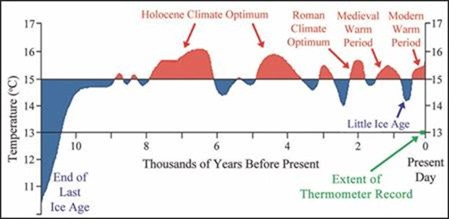
Steve Goreham shows how small a portion it is in this diagram of the last 10,000 years (Figure 2).

clip_image004

Figure 2

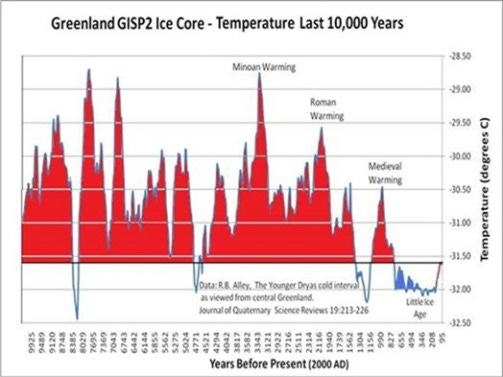
Another graph shows the same period, the Holocene Optimum, in a different form (Figure 3).

clip_image006

Figure 3

Christopher Monckton of Brenchley offers similar observations:

The Medieval Warm Period that [Michael Mann] the denizen of Penn State (or should those two words be transposed?) so ingeniously tried to abolish with his Hokey-Stick cartoon is revealingly present in both records. The Warm Period (I remember it well) was warmer than the year 2000. That was why we were able to build the great cathedrals of Britain and Europe.

Here is another record of global temperature changes, this time stretching back to the year dot. It was as warm in 100 AD as in 2000. 

Again, the peak temperature of the medieval warm period is shown as warmer than the year 2000. Yet the planet somehow survived.

As Lord Monckton observes elsewhere in his post, it is easy to make the (purported) recent rise in temperatures look alarming: Just change the aspect ratio by stretching the vertical axis (temperature) and shrinking the horizontal axis (time). How else is one supposed to alarm the gullible portion of the populace with a story about a (purported) temperature change that is dwarfed by the daily experience of almost everyone on Earth?

With that in mind, let’s look at the federal government’s official temperature records (here), which are produced by NASA’s Goddard Institute for Space Studies (GISS). The GISS database comprises surface thermometer records going back to January 1880. It takes a lot of massaging to construct a monthly time series of “global” temperatures that spans 142 years with spotty coverage of Earth’s surface (even now), and wide variability in site conditions. There’s the further issue of data manipulation, an egregious example of which was the erasure of the pause that had lasted for almost 19 years.

Taking the GISS numbers at face value, for the moment, what do they suggest about changes in Earth’s temperature (whatever that means)? Almost nothing, when viewed in proper perspective. When viewed, that is, in terms of absolute (Kelvin) temperature readings:

If the temperature record were correct — and it isn’t — the trend represented by the red line would suggest a rise of 0.72 degrees Celsius (1.296 degrees Fahrenheit) per century. Inasmuch as 1880 was smack in the middle of the Second Industrial Revolution, it is only reasonable to begin there, rather than in the late 1970s, where alarmists often prefer to begin (while ignoring long pauses in the rise of estimated temperatures since then). In any event, Dr. Ball and Lord Monckton (and many others) have put the recent rise in perspective, so I will say no more about that.

THE INADEQUACY OF THE DATA

The (purported) variation in Earth’s “average temperature” since 1880 been minute. The maximum of 288.52K is only 0.8 percent higher than the minimum of 286.34K. This minuscule difference must be swamped by measurement and estimation errors. It is credible that Earth’s average temperature — had it been somehow defined and then measured consistently over the past 142 years — would have changed less than the GISS record indicates. It is credible that the observed uptrend is an artifact of selective observation and interpretation. It became warmer where I used to live, for example, but the warming was explained entirely by the urban-heat-island effect.

Which brings me to another aspect of “global warming” which hasn’t been properly accounted for. Dr. Roy Spencer addresses the urban-heat-island effect here:

[The following figure] shows the raw temperature trends versus the de-urbanized temperature trends. When stations in each of the 37 states [in the sample] are averaged together, and the state averages are area-weighted, there is a 40% reduction in the average temperature trend for those 37 states.

[T]his might well be an underestimate of the full urbanization effect on eastern U.S. temperature trends.

There is also evidence that warming is exacerbated by the reduction of cloud cover, which is poorly modeled. Charles Blaisdell summarizes:

The key to [Cloud Reduction Global Warming] is water evaporation, transpiration, or run off on land.  When water (rain or snow) falls on the land it can soak into the ground or run off…. [W]hen ground water is not available the relative humidity drops…  [A]ny man-made structure that covers … land prevents water from soaking in and increases [run off], When water is not available for evaporation or transpiration, … relative humidity drops.,,,  Some man-made … sources of relative humidity reduction are:

·      Cities

·      Any man-made structure that covers the natural ground

·      Forest to farm land or pasture land

·      Pumping water from aquifers

·      Forest fire land change.

·      Flood water prevention like dams and levees.

“Global warming”, as shown above, is a minute phenomenon at best. If some fraction of “global warming” is caused by human activity, the use of fossil fuels can only account for a small fraction of the minute phenomenon.

CO2 FAIL

With respect to the role of CO2, I have observed that that there is no connection between CO2 emissions and the amount of CO2 in the atmosphere. This suggests that emissions have little or no effect on the concentration of CO2. A post at Watts Up With That? notes that emissions hit a record high in 2021. What the post doesn’t address is the relationship between emissions and the concentration of CO2 in the atmosphere.

See for yourself. Here’s the WUWT graph of emissions from energy combustion and industrial processes:

Here’s the record of atmospheric CO2:

It’s obvious that CO2 has been rising monotonically, with regular seasonal variations, while emissions have been rising irregularly — even declining and holding steady at times. This relationship (or lack thereof) supports the hypothesis that the rise in atmospheric CO2 is the result of warming, not its cause.

For example, Dr. Roy Spencer, in a post at his blog, writes:

[T]he greatest correlations are found with global (or tropical) surface temperature changes and estimated yearly anthropogenic emissions. Curiously, reversing the direction of causation between surface temperature and CO2 (yearly changes in SST [dSST/dt] being caused by increasing CO2) yields a very low correlation.

That is to say, temperature changes seem to drive CO2 levels, not the other way around (which is the conventional view).

MODELING ISN’T SCIENCE

There is a recent legal brief challenging EPA’s Endangerment Finding about greenhouse gases — and the resulting effort to eliminate the use of fossil fuels in the U.S. The brief offers ample evidence of the inadequacies and errors the reside in climate models. Here are some relevant excerpts of that brief:

EPA uses climate models to “attribute” warming to human greenhouse gas emissions, and to set regulatory policy. EPA uses models for attribution by claiming that observed warming cannot be reproduced by climate models without including the warming effects of human greenhouse gas emissions. EPA reasons that it does not know what else could be causing the warming, so it must be caused by human greenhouse gas emissions. This is not how real science, or even simple logic, actually works….

If a proposition is contradicted or unsupported by valid empirical data, no amount of appeal to authority and consensus and degrees and credentials can change that. That is the position EPA finds itself in with the Endangerment Finding. And it does not take a “scientist” to point out obvious flaws in logic and evidence. Anyone of normal intelligence can see that EPA is blowing smoke….

[O]fficial temperature records relied on by EPA to show warming temperatures in fact use fabricated average surface temperature data for vast regions of the earth’s surface for much of that record. This fact invalidates not only the surface temperature records line of evidence but also the physical understanding and models as well because to be valid themselves they both require valid temperature data.

Second, multiple separate and distinct econometric structural analyses of more than a dozen different credible temperature time series records show that after adjusting for natural factors, there has been no statistically significant trend in temperature in any of these time series.

Third, … the key assumption supporting the global warming claim and the theory in all models, the Hot Spot theory, is invalidated by the fact that there is, in fact, no trend in natural-factor-adjusted temperature data in the tropics.

I urge readers to open the brief and read the evidence regarding the first and second points. Here, I will focus on the third point:

A critical and necessary component of both the “physical understanding” of climate and climate modeling is the Hot Spot. The Hot Spot is explained in U.S. Climate Change Science Program Synthesis and Assessment Product 1.1, Temperature Trends in the Lower Atmosphere – Understanding and Reconciling Differences, Chapter 1, § 1.1, The Thermal Structure of the Atmosphere, p. 17- 19, explicitly relies upon the Hot Spot:

The presence of such greenhouse gases (e.g., carbon dioxide, methane, nitrous oxide, halocarbons) increases the radiative heating of the surface and troposphere. … In general, the lapse rate can be expected to decrease with warming such that temperature changes aloft exceed those at the surface….

In adopting the Endangerment Findings, EPA irrevocably placed primary reliance on the U.S. Synthesis and Assessment Product reports and the Fourth Assessment Report from the Intergovernmental Panel on Climate Change….

The U.S. Synthesis and Assessment Product cited above said that if the Hot Spot were missing, it would be a “potentially serious inconsistency.”… EPA also acknowledged in the Technical Support Document for the Endangerment Finding that if the Hot Spot were missing it would be “an important inconsistency.”

Dr. John Christy, in the previously cited Congressional testimony [link added], presented a comprehensible version of [the relevant figure] from the Fifth Assessment Report, in which the Hot Spot would be visible if it actually existed. Christy’s chart rewards a mere moment’s review, for it makes plain that observations invalidate the predictions of theory and climate modeling. His caption explains the chart:

Figure 5. Simplification of an IPCC20 AR521 Figure 4. The colored lines represent the range of results for the models and observations. The key point displayed is the lack of overlap between the GHG22 model results (red) and the observations (gray). The non-GHG model runs (blue) overlap the observations almost completely.

Dr. Christy explained the significance in his prepared testimony:

What is immediately evident [from Fig. 5] is that the model trends in which extra GHGs are included lie completely outside of the range of the observational trends, indicating again that the models, as hypotheses, failed a simple “scientific-method” test applied to this fundamental, climate-change variable. … Incredibly, what Fig. 5 shows is that the bulk tropical atmospheric temperature change is modeled best when no extra GHGs are included – a direct contradiction to the IPCC conclusion that observed changes could only be modeled if extra GHGs were included.

Which brings me to another scientific finding — also by Dr. Christy. In the same testimony he presented this graph and followed it with his observations:

Here we have climate model results (i.e. “claims” or “hypotheses”) to compare with observational datasets in a test to check whether the model average agrees with the observed data (i.e. the “claim” or “hypothesis”). We test the model average because it represents the consensus of the theoretical models and is used to develop policy which is embodied in policy-related products such as the Social Cost of Carbon, the National Climate Assessment and the EPA Endangerment Finding.

I provided the model and observational information as annual temperature anomalies (both tropical and global) to Dr. Ross McKitrick (University of Guelph) who has published extensively as an applied econometrician on the application of statistical techniques to the testing of climate hypotheses. He applied the Vogelsang-Franses F-Test method to these data as described in McKitrick, Ross R., S. McIntyre and C. Herman (2010) “Panel and Multivariate Methods for Tests of Trend Equivalence in Climate Data Sets”…. This method is particularly suitable for determining whether the trends of two time series are equivalent or significantly different….

What we are really testing here are the rates of warming depicted by the models and the observations for the period 1979-2016. I have simplified a depiction of the test in [the previous figure] so the rate of warming is directly viewed, showing what the test is measuring.

The basic test question is, “Is the red line significantly different from the others?” The results are shown in Table 1 [not reproduced here] recognizing that there is no equivalence between the model average trend and the observational datasets whenever the value of the test is [statistically significant] at the <1% level. As shown, all test values exceed [the requisite value], and thus the mean model trend is highly significantly different from the observations.

In other words, the models are worthless.

CONCLUSION

A proper explanation of the recent and minute variations in Earth’s temperature — if real — would incorporate all of the factors that influence Earth’s temperature, starting from Earth’s core and going out into the far reaches of the universe (e.g., to account for the influence of cosmic radiation). Among many things, a proper explanation would encompass the massive upwelling of CO2 from ocean currents, changes in Earth’s core, movements of tectonic plates (including related volcanic activity), effects of the expansion of the universe, the position and movement of the Milky Way, the position and movement of the Solar System, and the position and movement of Earth within the Solar System, and variations in Earth’s magnetic field.

But global climate models (or GCMs) are limited to superficial factors that are hypothesized to cause those changes — but only those factors that can be measured or estimated by complex and often-dubious methods (e.g., the effects of cloud cover). This is equivalent to searching for one’s car keys under a street lamp because that’s where the light is, even though the car keys were dropped 100 feet away.

The deeper and probably more relevant causes of Earth’s ambient temperature are to be found, I believe, in Earth’s core, magma, plate dynamics, ocean currents and composition, magnetic field, exposure to cosmic radiation, and dozens of other things that — to my knowledge — are ignored by GCMs. Moreover, the complexity of the interactions of such factors, and others that are usually included in GCMs, cannot possibly be modeled.

In sum:

  • Changes in Earth’s temperature are unknown with any degree of confidence.

  • At best, the changes are minute.

  • The causes of the changes are unknown.

  • It is impossible to model Earth’s temperature or changes in it.

It is therefore impossible to say whether and to what extent human activity causes Earth’s temperature to change.

It is further impossible for a group of scientists, legislators, or bloviators to say whether Earth’s warming — if indeed it is warming — is a bad thing. It is a good thing for agriculture — up to some point. It’s a good thing for human comfort (thus the flight of “snowbirds”) — up to some point. But for all the reasons given above (and more), it’s truly unknown whether those points will be reached. But even if they are, human beings will adapt — as they have in the past — unless their ability to adapt is preempted or hampered by the interventions of government that have (and will) wreak economic devastation and foreclose the conduct and implementation of real science.


Related posts:

CO2 Fail

Demystifying Science

The Human Conceit

Hurricane Hysteria

Is Science Self-Correcting?

Modeling Is Not Science

Pattern-Seeking

Understanding Science

The White House Brochures on Climate Change

Words Fail Us

The Apotheosis of Equality

You ain’t seen nothing yet.

You’ve heard that many universities have abandoned the use of standardized tests (i.e., intelligence tests) for the sake of “equity”. You’ve heard about the push for reparations for “climate change”, slavery, and various other things for which non-affluent and blameless masses would be forced to pay non-victims to assuage the consciences of affluent elites. You’ve heard about rapes committed by “girls” and “women” (i.e., boys and men who claim to be women). You’ve heard about “white privilege”, which is supposed to explain all of the woes of blacks. You’ve heard about “patriarchy”, which is supposed to explain the failure of women to dominate the world (though they seem to be making a good show of it anyway). You’ve heard about the “unfairness” of vast differences in wealth and income, though not about the actual reasons for such differences (mainly intelligence and ambition).

If, like me, you’re tired of hearing about such things, I have come up with a simple solution to all of the failings of the “system” that allows for divergent outcomes in life. Here it is:

  • Establish a world government with the power to make and enforce decrees about the distribution of income and wealth. (How to get Russia, China, Saudi Arabia, and several other nations to go along with this is a separate issue.)

  • Monitor and record all transactions and accumulations of wealth.

  • Assign a trans-national monetary value to all transactions and accumulations of wealth.

  • Compute the global values of income and wealth and the per-capita average of each.

  • Assume that interpersonal differences are the result of the kinds of imperfections alluded to in the opening paragraph.

  • Through taxes and subsidies, arrange a new distribution of income and wealth that results in equal incomes and wealth.

Voila: All is for the best in the best of all possible worlds.

I should add, however, that such a glorious result would require the realization of some magical thinking; for example:

  • None of the above would adversely affect incentives to produce goods and services of value to others. (Otherwise, everyone would have equal slices of dramatically smaller income and wealth “pies”.)

  • None of the above would adversely affect social comity or ersatz empathy. (The effete elite would gladly share bathrooms with the homeless.)

  • None of the above would lead to a war that decimates the world’s populace and its productive capacity. (Russia, China, Saudi Arabia, and others would go hand in hand with Western elites down the yellow-brick road.)

Oh, well, maybe it would be easier to let present trends run their course. The results will be about the same.

At the Dawn of Wokeism

Little things mean a lot.

Theodore Dalyrymple nails the woke:

One of the most astonishing things about the woke is their high boredom threshold. They seem to have the same thoughts about the same subjects, expressed in the same language, all their waking lives. They never tire or let their vigilance down. They look at Raphael or Botticelli and see only social injustice. They are terrible bores.

The explanation of their persistence, which resembles that of flies on a corpse, is that truth, which holds no interest for them, is not their object, but power, the cynosure of every ambitious mediocrity’s eyes.

It occurred to me recently that I had a box seat for one of wokeism’s earliest performances: the replacement of “Christmas Party” by “Holiday Party”.

The company where I was a senior manager had laid on an annual Christmas Party for many years. One quipster characterized the refreshments as a box of Ritz crackers, a slab of Velveeta, and jug of cheap, red wine. It wasn’t that bad, but certainly toward that end of the cheap-lavish scale.

Somehow or other a party committee was established, and the parties grew more lavish: fully catered affairs with roast beef, various luscious tidbits spanning hors d’oeuvres to dessert, and a full (free) bar that included a palatable sparkling wine. At the same time, however, the party began to be billed as the Holiday Party.

The culprit, behind the scenes, was the Human Resources Department — which I had grudgingly allowed to be re-christened after decades of existence as the Personnel Department. Well, the real culprit wasn’t a department, which is an insentient abstraction, but the ladies women females cis-females of the department who attended to such matters in the interest of employee morale (or for the sake of their inner bossiness).

Our company was far from the only one to be complicit in the politically correct adoption of euphemistic language, lest anyone by offended. But it was certainly one of the horde of unwitting abettors of the advancement of wokeism at the expense of inoffensive and binding tradition. (Perhaps that’s why it was easy for me to put the kibosh on the Holiday Party several years after it became known as such, during a budget squeeze.)

Our Christmas Parties, before they had been renamed, were gladly attended by atheists, agnostics, Hindus, Muslims, Jews, Christians of various sects, and who knows what else. That the parties became better attended after their renaming had everything to do with their increasing lavishness and nothing to do with what they were called. There had not been, in our company, a complaint about the use of “Christmas Party”. It was just that someone in HR had picked up on a trend that had begun somewhere else — probably in California, at the instigation of an exceptionally sensitive cis-female.

The substitution of “Holiday Party” for “Christmas Party” may seem like an inconsequential matter, but it was not. It was the proverbial camel’s nose. And now, because too many persons (like me) who were in a position to fight political correctness but did not, Americans are living a linguistic nightmare: The use of the wrong word in the wrong place at the wrong time can mean the loss of a job, social ridicule and censure, and financial devastation.

Mea culpa.


See also, “Writing: A Guide — Part IV” (scroll to B.5)

What Do Wokesters Want?

I shudder to think about it.

I am using “wokesters” as a convenient handle for persons who subscribe to a range of closely related movements, which include but are not limited to wokeness, racial justice, equity, gender equality, transgenderism, social justice, cancel culture, environmental justice, and climate-change activism. It is fair to say that the following views, which might be associated with one or another of the movements, are held widely by members of all the movements (despite the truths noted parenthetically):

  • Race is a social construct. (Despite strong scientific evidence to the contrary.)

  • Racism is a foundational and systemic aspect of American history. (Which is a convenient excuse for much of what follows.)

  • Racism explains every bad thing that has befallen people of color in America. (Ditto.)

  • America’s history must be repudiated by eradicating all vestiges of it that glorify straight white males of European descent. (Because wokesters are intolerant of brilliance and success of it comes from straight white males of European descent.)

  • The central government (when it is run by wokesters and their political pawns) should be the sole arbiter of human relations. (Replacing smaller units of government, voluntary contractual arrangements, families, churches, clubs, and other elements of civil society through which essential services are provided, economic wants are satisfied efficiently, and civilizing norms are inculcated and enforced), except for those institutions that are dominated by wokesters or their proteges, of course.)

  • [You name it] is a human right. (Which — unlike true rights, which all can enjoy without cost to others — must be provided at cost to others.)

  • Economics is a zero-sum game; the rich get rich at the expense of the poor. (Though the economic history of the United States — and the Western world — says otherwise. The rich get rich — often rising from poverty and middling circumstances — by dint of effort risk-taking, and in the process produce things of value for others while also enabling them to advance economically.)

  • Profit is a dirty word. (But I — the elite lefty who makes seven figures a year, thank you — deserve every penny of my hard-earned income.)

  • Sex gender is assigned arbitrarily at birth. (Ludicrous).

  • Men can bear children. (Ditto.)

  • Women can have penises. (Ditto.)

  • Children can have two mommies, two daddies, or any combination of parents in any number and any gender. And, no, they won’t grow up anti-social for lack of traditional father (male) and mother (female) parents. (Just ask blacks who are unemployed for lack of education and serving prison time after having been raised without bread-winning fathers.)

  • Blacks, on average, are at the bottom of income and wealth distributions and at the top of the incarceration distribution — despite affirmative action, subsidized housing, welfare payments, etc. — because of racism. (Not because blacks, on average, are at the bottom of the intelligence distribution and have in many black communities adopted and enforced a culture the promotes violence and denigrates education?)

  • Black lives matter. (More than other lives? Despite the facts adduced above?)

  • Police are racist Nazis and ought to be de-funded. (So that law abiding blacks and other Americans can become easier targets for rape, murder, and theft.)

  • Grades, advanced placement courses, aptitude tests, and intelligence tests are racist devices. (Which happen to enable the best and brightest — regardless of race, sex, or socioeconomic class — to lead the country forward scientifically and economically, to the benefit of all.)

  • The warming of the planet by a couple of degrees in the past 150 years (for reasons that aren’t well understood but which are attributed by latter-day Puritans to human activity) is a sign of things to come: Earth will warm to the point that it becomes almost uninhabitable. (Which is a case of undue extrapolation from demonstrably erroneous models and a failure to credit the ability of capitalism — gasp! — to adapt successfully to truly significant climatic changes.)

  • Science is real. (Though we don’t know what science is, and believe things that are labeled scientific if we agree with them. We don’t understand, or care, that science is a process that sometimes yields useful knowledge, or that the “knowledge” is always provisional, always in doubt, and sometimes wrong. We support the movement of recent decades to label some things as scientific that are really driven by a puritanical, anti-humanistic agenda, and which don’t hold up against rigorous, scientific examination, such as the debunked “science” of “climate change”; the essential equality of the races and sexes, despite their scientifically demonstrable differences; and the belief that a man can become a woman, and vice versa.)

  • Illegal immigrants migrants are just seeking a better life and should be allowed free entry into the United States. (Because borders are arbitrary — except when it comes to my property — and it doesn’t matter if the unfettered entry to illegal immigrants burdens tax-paying Americans and brings disruption and crime to communities along and near the southern border.)

  • The United States spends too much on national defense because (a) borders are arbitrary (except when they delineate my property), (b) there’s no real threat to this country (except for cyberattacks and terrorism sponsored by other states, and growing Chinese and Russian aggression that imperils the economic interests of Americans), (c) America is the aggressor (except in World War I, World War II, the Korean War, the Vietnam War, Gulf War I, the terrorist attacks on 9/11, and in the future if America significantly reduces its defense forces), and (d) peace is preferable to war (except that it is preparedness for war that ensures peace, either through deterrence or victory).

What wokesters want is to see that these views, and many others of their ilk, are enforced by the central government. To that end, steps will be taken to ensure that the Democrat Party is permanently in control of the central government and is able to control most State governments. Accordingly, voting laws will be “reformed” to enable everyone, regardless of citizenship status or other qualification (perhaps excepting age, or perhaps not) to receive a mail-in ballot that will be harvested and cast for Democrat candidates; the District of Columbia and Puerto Rico (with their iron-clad Democrat super-majorities) will be added to the Union; the filibuster will be abolished; the Supreme Court and lower courts will be expanded and new seats will be filled by Democrat nominees; and on, and on.

Why do wokesters want what they want? Here’s my take:

  • They reject personal responsibility.

  • They don’t like the sense of real community that is represented in the traditional institutions of civil society.

  • They don’t like the truth if it contradicts their view of what the world should be like.

  • They are devoid of true compassion.

  • They are — in sum — alienated, hate-filled nihilists, the produce of decades of left-wing indoctrination by public schools, universities, and the media.

What will wokesters (and all of us) get?

At best, what they will get is a European Union on steroids, a Kafka-esque existence in a world run by bureaucratic whims from which entrepreneurial initiative and deeply rooted, socially binding cultures have been erased.

Somewhere between best and worst, they will get an impoverished, violent, drug-addled dystopia which is effectively a police state run for the benefit of cosseted political-media-corprate-academic elites.

At worst (as if it could get worse), what they will get is life under the hob-nailed boots of Russia and China; for example:

Russians are building a military focused on killing people and breaking things. We’re apparently building a military focused on being capable of explaining microaggressions and critical race theory to Afghan Tribesmen.

A country whose political leaders oppose the execution of murderers, support riots and looting by BLM, will not back Israel in it’s life-or-death struggle with Islamic terrorists, and use the military to advance “wokeism” isn’t a country that you can count on to face down Russia and China.

Wokesters are nothing but useful idiots to the Russians and Chinese. And if wokesters succeed in weakening the U.S. to the point that it becomes a Sino-Soviet vassal, they will be among the first to learn what life under an all-powerful central government is really like. Though, useful idiots that they are, they won’t survive long enough to savor the bitter fruits of their labors.

Is This How It Ends?

With a whimper.

I recently read Rebekah Koffler’s Putin’s Playbook: Russia’s Secret Plan to Destroy America. Koffler is an American citizen of Russian birth. She came to the U.S. about 30 years ago and worked for the Defense Intelligence Agency (DIA) from 2008 to 2016. Her career there — which involved the analysis of intelligence at the highest levels of classification — ended when she lost her clearance through machinations by higher-ups who disliked her hard-line views on the threat posed by Russia.

Koffler’s book is a riveting and sobering read; for example:

Putin’s new military doctrine is aggressive. It is even more dangerous than the one which the Soviet Union followed during the Cold War…. It is more dangerous because of the special role reserved for nuclear weapons. Unlike during the Cold War, when the Soviets were preparing for a “bolt-out-of-the-blue-sky” nuclear strike from the United States, with the eventual symmetrical goal of Washington’s decapitation and total annihilation, today’s doctrine is more grounded in “reality”— Russian reality, that is. Putin’s doctrine is focused on Russia’s preparedness to fight a limited war — including with nuclear weapons — with the narrow objective of “defending” what Moscow views as its strategic perimeter. In other words, the nuclear option is not a theoretical doctrine….

That’s the aspect of Russia’s military doctrine which seems to have deterred the U.S. and NATO from intervening directly in the Ukraine war. But that isn’t the really scary part of Russia’s military doctrine. This is:

Russian doctrine envisions degrading or disrupting the U.S. forces’ “kill chain” by the targeting the C4ISR (command, control, communications, computers, intelligence, surveillance, and reconnaissance) and space systems on which America’s forces critically depend for its defense intelligence and warfighting operations…. Just like our smartphones, U.S. PGMs, or “smart weapons” are guided to a large extent by GPS satellites, unlike the previous generation’s, which are now called “unguided” or “dumb” bombs. To impede or thwart U.S. military operations, Russia has developed formidable counter-space (anti-satellite) and cyber capabilities to create what the Pentagon calls an anti-access/ area denial (A2AD) environment. Russia’s will use A2AD-type capabilities to deny, or at minimum impede, U.S. forces’ access to the conflict zone, so it can “seize strategic initiative” during the initial period of war, as the doctrine dictates, interdict U.S. forces’ reinforcement, and fight the conflict with the balance of forces favoring Russia. Russia believes that its new doctrine, with weapons to match it, enables Moscow to inflict “unacceptable damage” on the U.S. and/ or the Allied military, economy, and population and end the conflict on terms favorable or at minimum acceptable to the Kremlin….

How would it end? Here’s Koffler’s take:

I am not in a position to write about the scenarios based on actual wargames that I participated in [because of their classification]. All I can say is that my experience is similar to that of RAND Corporation analyst David Ochmanek, who has participated in RAND wargames sponsored by the Pentagon, and former deputy secretary of defense (DEPSECDEF) Robert Work. “In our games, when we fight Russia and China, blue [the U.S. military] gets its ass handed to it,” Ochmanek disclosed to the publication Breaking Defense. Former DEPSECDEF Work echoed Ochmanek’s commentary: “The simulated enemy forces tend to shut down [U.S.] networks so effectively that nothing works.” Worst of all, both former DEPSECDEF and the RAND analyst said, “The [United States] doesn’t just take body blows, it takes a hard hit in the head as well.… Its communications satellites, wireless networks, and other command-and-control systems suffer such heavy hacking and jamming that they are suppressed, if not shattered.” And then, according to Work, when “the red force really destroys our command and control, we stop the exercise, … instead of figuring out how to keep fighting when your command post gives you nothing but blank screens and radio static.” This is exactly what the Russian doctrine envisions and counts on — breaking the U.S. forces’ will to fight by taking away their technological advantages and crutches.


Related posts:

Pay Any Price? (07/13/22)

The Meaning of the War in Ukraine (07/26/22)

The Way Ahead (09/15/22)

Mutual Deterrence and the War in Ukraine (09/27/22)

War with China? (11/19/22)

The Death of a Nation

A nation I remember fondly.

“America is not just a country,” said the rock singer Bono, in Pennsylvania in 2004: “It’s an idea.”

That’s the opening of John O’Sullivan’s essay, “A People, Not Just an Idea” (National Review, November 19, 2015):

I didn’t choose [Bono’s] quotation to suggest that this view of America is a kind of pop opinion. It just happened that in my Google search his name came ahead of many others, from George Will to Irving Kristol to almost every recent presidential candidate, all of whom had described America either as an idea or as a “proposition nation,” to distinguish it from dynastic realms or “blood and soil” ethnicities. This philosophical definition of America is now the conventional wisdom of Left and Right, at least among people who write and talk of such things.

Indeed, we have heard variations on Bono’s formulation so many times that we probably fail to notice how paradoxical it is. But listen to how it sounds when reversed: “America is not just an idea; it is a nation.” Surely that version has much more of the ring of common sense. For a nation is plainly something larger, more complex, and richer than an idea. A nation may include ideas. It may have evolved under the influence of a particular set of ideas. But because it encompasses so many other things — notably the laws, institutions, language of the nation; the loyalties, stories, and songs of the people; and above all Lincoln’s “mystic chords of memory” — the nation becomes more than an idea with every election, every battle, every hero, every heroic tale, every historical moment that millions share.

That is not to deny that the United States was founded on some very explicit political ideas, notably liberty and equality, which Jefferson helpfully wrote down in the Declaration of Independence. To be founded on an idea, however, is not the same thing as to be an idea. A political idea is not a destination or a conclusion but the starting point of an evolution — and, in the case of the U.S., not really a starting point, either. The ideas in the Declaration on which the U.S. was founded were not original to this country but drawn from the Anglo-Scottish tradition of Whiggish liberalism. Not only were these ideas circulating well before the Revolution, but when the revolutionaries won, they succeeded not to a legal and political wasteland but to the institutions, traditions, and practices of colonial America — which they then reformed rather than abolished….

As John Jay pointed out, Americans were fortunate in having the same religion (Protestantism), the same language, and the same institutions from the first. Given the spread of newspapers, railways, and democratic debate, that broad common culture would intensify the sense of a common American identity over time. It was a cultural identity more than an ethnic one, and one heavily qualified by regional loyalties… And the American identity might have become an ethnic one in time if it had not been for successive waves of immigration that brought other ethnicities into the nation.

That early American identity was robust enough to absorb these new arrivals and to transform them into Americans. But it wasn’t an easy or an uncomplicated matter. America’s emerging cultural identity was inevitably stretched by the arrivals of millions of people from different cultures. The U.S. government, private industry, and charitable organizations all set out to “Americanize” them. It was a great historical achievement and helped to create a new America that was nonetheless the old America in all essential respects….

By World War II, … all but the most recent migrants had become culturally American. So when German commandos were wandering behind American lines in U.S. uniforms during the Battle of the Bulge, the G.I.s testing their identity asked not about … the First Amendment but questions designed to expose their knowledge (or ignorance) of American life and popular culture….

Quite a lot flows from this history. Anyone can learn philosophical Americanism in a civics class; for a deeper knowledge and commitment, living in America is a far surer recipe…. Americans are a distinct and recognizable people with their own history, culture, customs, loyalties, and other qualities that are wider and more various than the most virtuous summary of liberal values….

… If Americans are a distinct people, with their own history, traditions, institutions, and common culture, then they can reasonably claim that immigrants should adapt to them and to their society rather than the reverse. For most of the republic’s history, that is what happened. And in current circumstances, it would imply that Muslim immigrants should adapt to American liberty as Catholic immigrants once did.

If America is an idea, however, then Americans are not a particular people but simply individuals or several different peoples living under a liberal constitution.

For a long time the “particular people” were not just Protestants but white Protestants of European descent. As O’Sullivan points out, Catholics (of European descent) eventually joined the ranks of “particular people”.

The United States was built upon the “blood and soil” allegiance of whites whose origins lay in Europe. That allegiance was diluted by blacks, most of whom were alienated from the nation by slavery, Jim Crow, lingering racial prejudice (a two-way street), and the leftist bigotry of low expectations. from thcan never be part of that nation. That allegiance has been further diluted by Hispanics, who (in the first generation, at least) are marked by the differences of color and culture. Blacks and Hispanics belong to the “proposition” nation, not the “blood and soil” nation.

Blacks and Hispanics have been joined by the large numbers of Americans who no longer claim allegiance to the “blood and soil” nation, regardless of their race or ethnicity — leftists, in other words. Since the 1960s, leftists have played an ever-larger, often dominant, role in the governance of America. They have rejected the “history, culture, customs, [and] loyalties” which once bound most Americans. In fact they are working daily — through government, the academy, public schools, the media, Big Tech, and corporate America — to transform America fundamentally by erasing the “history, culture, customs, [and] loyalties” of Americans from the nation’s laws and the people’s consciousness.

Pat Buchanan hits it on the head:

In Federalist No. 2, John Jay writes of them as “one united people . . . descended from the same ancestors, speaking the same language, professing the same religion, attached to the same principles of government, very similar in their manners and customs . . .”

If such are the elements of nationhood and peoplehood, can we still speak of Americans as one nation and one people?

We no longer have the same ancestors. They are of every color and from every country. We do not speak one language, but rather English, Spanish and a host of others. We long ago ceased to profess the same religion. We are Evangelical Christians, mainstream Protestants, Catholics, Jews, Mormons, Muslims, Hindus and Buddhists, agnostics and atheists.

Federalist No. 2 celebrated our unity. Today’s elites proclaim that our diversity is our strength. But is this true or a tenet of trendy ideology?

After the attempted massacre of Republican Congressmen at that ball field in Alexandria, Fareed Zakaria wrote: “The political polarization that is ripping this country apart” is about “identity . . . gender, race, ethnicity, sexual orientation (and) social class.” He might have added — religion, morality, culture and history.

Zakaria seems to be tracing the disintegration of our society to that very diversity that its elites proclaim to be its greatest attribute: “If the core issues are about identity, culture and religion … then compromise seems immoral. American politics is becoming more like Middle Eastern politics, where there is no middle ground between being Sunni or Shiite.”

Among the issues on which we Americans are at war with one another — abortion, homosexuality, same-sex marriage, white cops, black crime, Confederate monuments, LGBT rights, affirmative action.

America is no longer a nation whose inhabitants are bound mainly by “blood and soil”. Worse than that, it is fast becoming a nation governed by the proposition that liberty is only what leftists say it is: the liberty not to contradict the left’s positions on climate, race, intelligence, economics, religion, marriage, the right to life, and government’s intrusive role in all of those things and more.

The resistance to Donald Trump was fierce and unforgiving because his ascendancy threatened what leftists have worked so hard to achieve in the last 60 years: the de-Americanization of America. Expect more of the same Trump (or DeSantis) becomes the GOP nominee in 2024.

The America in which I was born and raised — the America of the 1940s and 1950s — has been beaten down. It is far more likely to die than it is to revive. And even if it revives to some degree, it will never be the same.

I am speaking of America on the whole. Vast parts of it remain more or less true to the old “blood and soil” nation. It will take a national divorce to keep those regions from being frog-marched into serfdom.

The Relative Depth of Recessions Since World War II

You may be surprised.

I define a recession as a span of at least two consecutive quarters in which real (inflation-adjusted) GDP has dropped below its recent peak and remains below that peak.

The relative depth — or economic pain — caused by a recession can be measured roughly by the depth of the drop, measured as a percentage of the pre-recession peak. An alternative measure, and perhaps a better one, is the cumulative percentage drop from the pre-recession peak.

The Great Recession (2008-10) and the Pandemic Recession (2020) stand out by both measures as being more painful than any of the preceding post-war recessions. However, the back-to-back recessions of 1980-83, if combined, would surpass the cumulative percentage drop incurred during the Pandemic Recession.

The recessions, as painful as they have been, pale in comparison to America’s continuing mega-depression, which is largely the product of governmental interventions in the economy.

Names Aren't What They Used to Be

Though some are coming back.

The Social Security Administration publishes a list of the names most commonly given to newborns. Here are last year’s top 20:

And here are the top 20 in my maternal grandmother’s birth year:

Most of the names in the second list are the solid names that were common even unto my generation. The first list includes a lot of names have been dredged up from the 1700s and from romance novels.

You can follow the link to see how popular a particular name was in any year since 1900. Tyler, for example, has ranked as high as #5 among boy names (1993, 1994), and as high as #238 among girl names (1993).

Thinking of Tyler led me to wonder which president’s last names that have been given to famous, infamous, semi-famous, and unknown persons as first names. Here’s what I came up with:

  • Washington Irving, author of “The Legend of Sleepy Hollow” — which engendered the terrible movie starring Johnny Depp and Christina Ricci

  • Jefferson Davis, leader of “The Lost Cause”

  • Madison Kuhn, obscure historian — but not a girl

  • Monroe McKay, judge

  • Van Buren Unknownun Québécois, go figure

  • Jackson Pollock, artist dribbler painter

  • Harrison Ford, car dealer? film actor

  • Tyler Mathisen, CNBC host

  • Taylor Booth, computer scientist

  • Fillmore Unknown — 5, count ‘em, 5 (all boys)

  • Pierce Brosnan, ex-007

  • Lincoln Chafee, RINO

  • Johnson Unknown, but many times among the top 1,000 boy names (quelle surprise)

  • Grant Sharp, retired Rear Admiral, United States Navy (named for his great-grandmother’s sister’s husband, Ulysses S. Grant)

  • Hayes Milam, security guard at the think-tank at which I worked for many years

  • Arthur Godfrey, entertainer/radio-TV host remembered mainly for playing the ukulele, buzzing the control tower at Leesburg, Virginia, airport, and firing singer Julius La Rosa on the air

  • Cleveland Amory, cat lover and writer

  • McKinley Unknown — a semi-popular name for boys and girls in recent decades

  • Roosevelt Grier, immovable object defensive lineman

  • Taft Unknown — semi-popular back in the day when W.H. Taft was “big”

  • Wilson Pickett, R&B and soul singer

  • Harding Unknown — semi-popular when Warren Gamaliel was the big enchilada

  • Coolidge Unknown — ditto

  • Truman Capote, American poof writer

  • Kennedy McMann, American actress — fairly populr name for boys and girls since 1960; #54 among girl names in 2014

  • Nixon Unknown — oddly enough, in the top 1000 boy names 2011-2021

  • Ford Madox Ford, English aesthete writer

  • Carter Stanley, Ralph’s very late brother

  • Reagan Dunn, member of the King County, Washington, council

  • Clinton Eastwood, still life film actor — but you probably don’t think of him as Clinton

By my reckoning, these last names haven’t been used as first names:

  • Adams — not to be confused with Adam; John wasn’t the first “man”

  • Polk — might be mistaken for an invitation

  • Buchanan — pronounce it properly: “buck-an-un”

  • Eisenhower — no parent should do this

  • Bush — don’t go there

  • Obama — why would anyone do that to a child?

  • Trump — double ditto

  • Biden – quadruple ditto

Any takers?

True Libertarianism and Its Enemies

“O brave new world that has such people in’t.” — Shakespeare, The Tempest

This post extends “The Libertarian-Conservative Divide”, which I dashed off when something reminded me of the essential difference between the two political philosophies.

There is true libertarianism and there is pseudo-libertarianism. The former is really a kind of conservatism, which is why I call it Burkean libertarianism. The latter — which is the kind of “libertarianism” much in evidence on the internet — rests on the Nirvana fallacy and posits dangerously false ideals.

True libertarianism requires the general observance of socially evolved norms because those norms evidence and sustain the mutual trust, respect, and forbearance that — taken together — foster willing, peaceful coexistence. That, in turn, fosters beneficially cooperative behavior. (If there is a better description of liberty, I have yet to read it.)

Given the general observance of socially evolved norms, government’s role is the minimal one of protecting the populace from domestic and foreign predators, both actively and through the swift and certain enactment of retribution as a deterrent to future abuses. In this respect, true libertarianism resembles a kind of “libertarianism” known as minarchism, except that minarchists emhasize minimal government and do not acknowledge the need for socially evolved norms.

The core of pseudo-libertarianism is the impossible dream of living without restraints, either those imposed by government or the social norms that must be observed in order to live in peaceful coexistence with other human beings. In that respect, pseudo-libertarians are aligned with leftists, who — intera alia — wish to “cancel” norms that they find offensive.

Human beings, ineluctably tribal creatures that they are, find the basis for mutual trust, respect, and forbearance in a common culture (mores) that evolved by being tested in the acid of use.* This is not to be found in the discord of clashing cultures that pseudo-libertarians promote, sometimes (paradoxically) through state action. The left, of course, resorts reflexively to state action (and private, state-condoned and encouraged action) in its zeal to shatter the common culture and to force its social and economic preferences upon the populace.

Pseudo-libertarians and leftists do not understand (or care) that the long evolution of rules of conduct by human beings who must coexist might just be superior to the rules that they arbitrarily impose (or would if they could). Pseudo-libertarians and leftists obviously believe in the possibility of separating the warp and woof of the social fabric — the common culture — without causing the its disintegration.

When the common culture disintegrates there is an open field for government to dictate the terms on which a people coexist. This necessarily alienates large segments of the populace from one another.

What is worse is that cultural disintegration results in a rising tide of social acrimony and violence. The result is political polarization, something like an epidemic of mass murder, and the coarsening of behavior generally.

Cultural disintegration is the key to what has been happening to America for a long time and in earnest since the early 1960s. Cultural disintegration is a mild term to apply to outrages like these:

  • authorization, by the U.S. Supreme Court, to kill unborn children

  • abandonment of restraint in the use of profanity, violence, and sexualtiy in the various modes of “entertainment”, with subtantial encouragement by the Court

  • wide acceptance and inculcation of the patent myth (patent to anyone who has eyes and ears and half a brain) that the plight of blacks today is entirely the fault of America’s “racist” past

  • vast expansion of the welfare state, to the detriment of self-reliance (and economic vitality)

  • encouragement of murder, mayhem, and lessser crimes by “justice reform” and similar movements

  • encouragement of illegal immigration, which brings crime and disruption to the communities affected directly by it

  • suppression — through censorship, loss of jobs, boycotts, etc. — of persons and businesses who openly resist such outrages.

Thus have long-standing norms been widely rejected and reversed by a cabal whose leaders and members are drawn from politics, the political bureaucracy, the academy, the legal profession, public “education”, corporate management (prominently but not exclusively Big Tech), and the media (including “entertainment”). The result is a deep chasm between Americans who still hew to traditional norms, or would like to, and the “elites” who have rejected many of those norms.

There is no liberty for adherents of traditional norms when they cannot live as they would choose to live and speak as they would choose to speak. The adherents of traditional norms have become strangers in a strange land. They must tread carefully to avoid ostracism, legal and financial sanctions, and verbal and physical assault. Not that the left-aligned media give any attention to the parlous condition of social conservatives, who are (as Russians would say) “the main enemy” of the emerging dystopia.


* I owe “tested in the acid of use” to Philip M. Morse and George E. Kimball’s Methods of Operations Research, at page 10:

Operations research done separately from an administrator in charge of operations becomes an empty exercise. To be valuable it must be toughened by the repeated impact of hard operational facts and pressing day-by-day demands, and its scale of values must be repeatedly tested in the acid of use. Otherwise it may be philosophy, but it is hardly science.

Moral Courage, Moral Standards, and Political Polarization

Who knows what evil lurks in the hearts of men?

Moral courage is speaking or acting to protest or prevent a wrong, despite strong opposition or the threat of sanction or violence. (Hereafter, I will simply use “act” or “acting” to refer to an outward display of moral courage, whether it is verbal or physical.)

An act of opposition to authority isn’t necessarily an act of moral courage, though it may sometimes be one.

To act with moral courage requires deliberate and self-critical thought about the condition that provokes the urge to speak and act. Specifically, one must ask whether there is a wrong to be protested or simply a condition that displeases one for other reasons (e.g., bruised ego, esthetic offense, dislike of an otherwise moral outcome).

Except in rare circumstances (e.g., an intervention to prevent a beating of shooting), impulsive acts are not acts of moral courage. They are usually acts of petulance and ego-stroking. A person who joins a group in an such an act because it’s the “thing to do” is a moral coward. (A current example is going along with a group that protests supposed wrong-doing by committing futile and destructive acts of vandalism.)

Standing up for the “rights” of a particular group is an act of moral courage only to the extent that the group is being deprived of rights that it could enjoy without trampling on the rights of others. The “right” of a self-proclaimed transgender female (i.e., a biological male) to invade the privacy of biological females is a “right” only in the view of those persons for whom traditional social norms are merely litter to be tossed in the nearest trash bin. A self-proclaimed transgender female (or any other person who identifies as LGBTQ+) has all of the rights enjoyed by every other American, but not the privilege of violating long-standing social norms of the kind that, in their observance, foster mutual trust and respect.

What about a transsexual person born male who has undergone extensive surgery, hormone therapy, and various other medical and psychological procedures so as to mimic female-ness convincingly? There is a saying that is sometimes true: What you don’t know can’t hurt you. There is no offense against privacy unless the offense is felt by the person whose privacy is at stake. (Offenses against privacy that result in actual harm, such as identity theft, are of a different kind than the subject of this paragraph.)

Returning to the main theme of this post, it is necessary to ask whether there are agreed moral standards that can be applied against putative acts of moral courage. There’s the rub. The polarization of political views reflects vast disagreement about morality. Although political views are nominally about what government should and should not do, they are really about what people should and should not do. Every governmental edict either discourages or encourages a private act.

Take the Dobbs decision by the U.S. Supreme Court, for example. That decision didn’t “outlaw” abortion in the United States, as hysterical propagandists and ignoramuses are wont to say, but it did reverse earlier decisions which held that abortion (when it met certain criterea), was a constitutional right throughout the United States. Dobbs merely transferred the question of abortion back to the individual States, each of which was thus empowered (as it was before Roe v. Wade) to determine the legal status of abortion in its jurisdiction.

You will now have grasped the absurdity of the situation. How can the morality of an act be determined by whether the act is committed inside or outside a particular State? It can’t be, which is why many persons (notably, leading Democrats) believe that abortion is moral and seek to make it legal throughout the nation. By the same token, many persons believe that abortion is immoral and seek to make it illegal throughout the nation.

Political polarization — and the culture war that it reflects — is about the clash of moral codes. Political polarization therefore reflects a shattering of what was once something close to a national consensus about morality. That near-consensus had been fraying since the Progressive Era of the late 1800s and early 1900s, but it began to unravel in the 1960s. What it came down to, before the fraying and unraveling, was wide observance of Judeo-Christian morality, especially as enunciated in the final six of the Ten Commandments, and a code of personal responsibility relatively uncorrupted by the welfare state and reinforced by a system of justice that is swifter and harsher than today’s.

The clash of moral codes means that moral courage has become not just a matter of acting against wrong-doing, but also a matter of acting against an array of powerful proponents of wrong-doing who believe that it is right-doing; for example:

  • teaching white children that they are racists

  • demanding reparations from persons who are blameless for whatever wrongs supposedly warrant reparations

  • encouraging and manipulating children into undergoing transgender therapies that they will come to regret

  • using force and misusing “science” to make people’s lives miserable (e.g., forbidding the use of efficient and relatively inexpensive fossil fuels, dictating useless — and economically and socially destructive — lockdowns and school closings during the pandemic)

  • killing unborn children

  • “canceling” and smearing anyone one who dares utter such things instead of debating them with facts and logic (a sure sign of wrong-doing).

But there is a difference between speaking out against the proponents of wrong-doing from the safety of a blog, and speaking out against them when they are in a position to ruin one’s reputation, destroy one’s career, and shred one’s ability to obtain credit. Unlike some peformers, executives, professors, and scientists, I am not exercising moral courage by taking the stances that I do in this blog.

I am truly thankful for the morally courageous persons who risk their fortunes and honor to oppose the rampant wrong-doing of leftists.* The tragedy of our time is that the left has gained enough power in this country to be a threat to anyone.

Of all the beasts which the Lord God had made, there was none that could match the serpent in cunning. — Genesis 3:1


* A good example is Rebekah Koffler, author of Putin’s Playbook. Read it and weep for her and for this formerly great nation.

The Great Resignation in Perspective

There’s nothing new under the sun.

Consider this graph:

The index of real unemployment rate (explained here) serves to highlight the Great Recession (2008-2011) and the Pandemic Recession (2020-2021). The indices of quit rates and discharge rated (derived from date available here), complement the index of real unemployment rate and illustrate the following observations.

Discharges (firings and layoffs), as a fraction of the level of employment, peaked during the Great Recession and declined until the Pandemic Recession of 2020. The downtrend continued after the end of the lattere recession. Nothing unexpected there.

Quits, as a fraction of the number of persons employed, began to rise near the bottom of the Great Recession in 2009. The quit rate dropped sharply during the Pandemic Recession, then resumed its rise. That rise can be interpreted as a continuation of the rise that began in 2009. What’s interesting is that quit rate peaked in November 2021 and has generally declined somewhat since then. A straight line plotted through the index from its bottom would come close to the final point on the graph, which represents September 2022.

It is therefore my view that the surge in quits that occurred after the Pandemic Recession is a continuation of the rise that began in 2009. The deeper question, then, is why have quit rates been rising for the past 13 years? I doubt that there’s a good answer to that question.

An analyst at the Bureau of Labor Statistics addressed the question and came up with this:

The historical data examined in the article suggest that recent quit rates, while certainly high for the 21st century, are not the highest historically [emphasis added]. Nonetheless, the pace of resignations seems to have risen more quickly than one would have expected from labor market tightening alone. [But the rate has slackened since this was written.] Future research should assess alternative explanations for this development, taking into account pandemic-related factors such as increased stimulus payments, health concerns, childcare issues, and changing attitudes toward work. Examining which demographic groups have seen their quit rates rise most quickly might provide clues here.23

The footnote leads to this paper, which concludes with this:

Evidence from both recent worker surveys and historical data on quits shows that the “Great Resignation” is not as unusual as one might think. Waves of quits have been common during fast recoveries in the postwar period. In line with this historical evidence, the recent wave reflects the rapid rebound in labor demand for young and less-educated workers, largely driven by the retail, leisure and hospitality, and accommodation and food services sectors.

In sum, quitting a job doesn’t mean leaving the labor force. More likely it means jumping to a better job or doing something that doesn’t count as a job (see below).

The more interesting question is why the real rate of unemployment remains significantly higher than it was in 2000. It is my view that “marginal workers” — young persons without special skills or training — quit returning to the labor market out of a habit that was born during the Great Recession, and which was reinforced ruing the Pandemic Recession. The habit was fed by:

  • Obamacare, which enabled persons under the age of 27 to obtain health insurance through their parents’ policies,

  • extended unemployment benefits,

  • “free money” (stimulus checks),

  • enjoyment of the leisure afforded by the precding, and

  • the expansion of the “gig” economy, wherein work is a sometime thing and it is done not as an employee but as an “independent contractor”.

It’s not all the fault of government, but most of it is.

Stuff ("Liberal" Yuppie) White People Like

Another one from the archives.

The short-lived blog, Stuff White People Like (2008-2010), was fun while it lasted (if taken in small doses). I may be the last person to have found it. But, unlike white-”liberal”-yuppie persons, being au courant isn’t “where I’m at” (to use an expression that’s probably no longer au courant).

There are 136 entries. Here are my suggested additions:

  • Foreign-language films — especially if incomprehensible, even with subtitles, about angst and suffering, and without an ending (the French way).

  • Dressing casually — especially at fine restaurants. It’s a fetish — like wearing shorts regardless of the temperature.

  • Public schools — for other people’s children.

  • Public universities —très gauche, even if you attended one.

  • Cheese — as in “I found this wonderful little cheese store.”

  • Handymen — as in “I found this wonderful little handyman.” Who’s probably not white. But “little” isn’t racist, is it?

  • Charity auctions — for buying ugly stuff and feeling good about it.

  • Celebrities — good if they’re adopting half of China or full of socialist/greenie crap that they don’t practice

  • Europe — such a civilized place, as long as you ignore economic stagnation, unemployment on the dole, rioting Muslims, and the tendency to turn to the U.S. when in danger.

  • Britain — ditto, with smashing accents.

  • Social Security — good for the “little” people.

  • Medicare — ditto, but avoid doctors who accept Medicaid patients.

  • Drug companies — hate ’em. Where are my tranqs, anyway?

  • Brand-name products of a superior kind — très important, as long as they signify good taste, in an understated way, of course.

  • Urban compression — the opposite of “urban sprawl”. Also known as cities: dirty, smelly, crowded, crime-ridden, architecturally chaotic places that, for some reason, “deserve to be saved”. But why, and at whose expense?

War with China?

Trying to read the tea leaves.

I am pessimistic about America’s future because of the threats posed by China and Russia. Russia seems to have bitten off more than it can chew in Ukraine, but that doesn’t make Russia a weak adversary given its ability (and willingness) to engage in no-holds-barred cyber war and nuclear blackmail. What Russia needs is a staunch and powerful ally (or two or three).

Which brings me to China. In “Are We on the Road to Another Pearl Harbor?” (The American Spectator, November 19, 2022), Francis P. Sempa reviewed

The Road to Pearl Harbor: Great Power War in Asia and the Pacific [Naval Institute Press] which is part history and part a warning that history may be about to repeat itself with another great power war in Asia and the Pacific. The book, which is edited by John Maurer of the Naval War College and Erik Goldstein of Boston University, brings together historians and strategists who provide provocative insights into the origins, evolution, and outcome of World War II in Asia and the Pacific and aspects of that war that, in the editors’ view, “illuminate the dangers that currently confront American leaders.”

History, of course, never exactly repeats itself, but it remains the greatest teacher of human behavior….

the jewel in this collection of fine essays is Toshi Yoshihara’s examination of China’s views of a future war in the western Pacific. Yoshihara, who taught strategy at the Naval War College and who currently works at the Center for Strategic and Budgetary Assessments, is perhaps the nation’s foremost expert on the Chinese navy. He has mined open sources for the views of Chinese military strategists, including Chinese naval officers, and warns that the People’s Liberation Army’s (PLA) views on future warfare in the western Pacific are consistent with a Pearl Harbor–like first-strike attack on U.S. naval ships and facilities in the region, especially our “logistical infrastructure” at the Yokosuka naval base in Japan, the home of the U.S. Seventh Fleet.

The PLA, Yoshihara writes, “is predisposed to delivering a decisive first blow against U.S. forward-deployed forces in the western Pacific, particularly those in Japan.” Chinese doctrinal writings, he notes, emphasize surprise attacks and offensive campaigns at the outset of war. Chinese strategists call this part of a “counterintervention strategy” designed to strike American targets that pose the greatest threat to China’s important coastal hubs along the “Beijing-Tianjin, Shanghai-Nanjing, and Guangzhou-Shenzhen corridors.” And the PLA has steadily acquired the precision-strike arsenals (long-range ballistic missiles, cruise missiles), especially the DF-21C, a conventionally armed intermediate-range ballistic missile that, Yoshihara notes, is capable of hitting any target on the entire Japanese archipelago, and the DF-26 missile which can deliver both conventional and nuclear warheads up to 4000 kilometers.

Yoshihara explains that attacks on U.S. naval forces based in Japan would only be “one element of a larger campaign” of strikes that would likely include our airbases at Iwakuni, Yokota, and Misawa in Japan, and Kadena on Okinawa, as well as cyber warfare attacks designed to interrupt our military communications. But like Japan’s attack at Pearl Harbor, even a successful initial Chinese attack on U.S. forces and facilities “could very well prove strategically counterproductive, if not disastrous, for Beijing,” Yoshihara suggests, by drawing in Japan, the world’s third-largest economy with a powerful navy, on the side of the United States, thereby awakening two “sleeping giants” that together could spell doom for the PLA and the communist regime.

For more than a decade, America’s political leaders have talked about a strategic “pivot” to Asia without providing the necessary forces in the region to match the rhetoric. Meanwhile, the current administration in Washington promotes “engagement” with China even as war clouds gather in the western Pacific. Just as in the 1930s, the road to another Pearl Harbor could be paved with good intentions.

On the same day, John Woudhuysen wrote about “The Coming Conflict with China” (spiked):

[W]e can only hope the growing rivalry between the US and China doesn’t boil over anytime soon. But while talks are preferable to conflict, they don’t preclude it….

… America has imposed wide-ranging sanctions on China and, historically, sanctions have formed a significant prelude to conflict. The ban on semiconductor technology certainly seems like a provocative escalation from the Biden administration….

Washington’s determination to continue selling arms to Taipei rankles Beijing. As did this year’s Western naval manoeuvres near Taiwan, and the establishment last year of the Aukus nuclear-powered submarine alliance between Australia, the UK and the US.

Still, there are points at which American and Chinese interests align. Economic worries mean that both share an interest in the Russian war against Ukraine not getting out of hand….

The Kremlin’s humiliating withdrawal from Kherson may have made Xi think twice again about Taiwan. As Biden remarked in Bali, a Chinese invasion does not look imminent; a slow, attritional tightening of Beijing’s screws on the island looks the more likely prospect. But the loss of Taiwan to nationalists in 1949 still weighs heavily on the Chinese psyche. If Xi does not take the island back sometime over the five-year term he has just embarked upon, he will have some explaining to do.

Of course, war on Taiwan would likely turn out disastrously for Beijing, because of the integration of China’s trade, supply chains and foreign direct investment with the West – all of which would be threatened by an invasion. By the same token, this integration is also crucial for the West. This is why many Western leaders are preaching a more cautious path when it comes to relations with China….

As ever, China’s conduct abroad, from Britain to Latin America to Africa and even the Arctic, seems to grow heavier, more cack-handed and more lurid with every passing year. Conversely, another debacle for American imperialism, like the one it suffered last year in Afghanistan, could well embolden Xi to get a whole lot tougher with Taiwan….

… As much as we hope cooler heads will prevail, war is not a rational exercise. Arms build-ups, nautical intrigues, air drills and Chinese infringements on Taiwanese airspace have an inexorable and lethal logic of their own.

China isn’t building a formidable naval force and acquiring bases around the South China Sea (and elsewhere) for the sake of doing nothing. Perhaps, in the spirit of Donald Trump, China means to make itself independent of trade with the West. Having done so, it could then seize control of the South China Sea and the countries that ring it. Western leaders could attribute China’s fait accompli to geopolitical destiny. (Shades of Hong Kong and the rest of the British Empire.)

This would avert a war — for the time being — but it would also allow China to build its military forces and extend its influence to other parts of the globe. Bit, by bit, Western influence and economic dealings with the rest of the world would be subsumed by China. And in league with Russia, Iran, and North Korea, it could use military and economic blackmail to contain the West — and even to dictate its internal political arrangements.

As I said here:

If there isn’t a de facto surrender by the West — marked by significant concessions on trade, sanctions, and the scope of military operations and influence — there will be a World War III.

But I fully expect concessions by weak-kneed Western leaders. The concessions will be sugar-coated for domestic consumption and packaged in the form of measures (rationing, lock-downs) to fight the crises du jour, be they a pandemic, inflation, a depression, or the ever-popular threat of incineration by a temperature rise of a degree or two.

There is, however, a way to avert subjugation and to remain engaged with the rest of the West, if not the wider world outside of the new axis of evil:

Prevent … a concerted economic-military attack on U.S. interests — by possessing more than enough means to end it quickly. Which translates into deterring it in the first place (but ending it quickly if deterrence fails.)

This is neo-isolationism in the sense that it eschews military adventures that aren’t worth the price paid by Americans. But it is not isolationism of the old-fashioned kind. Forces would be deployed forward (in space, on land, and in the oceans) to shorten reaction times and remind our adversaries that we are there, big stick in hand. Americans and American businesses would continue to be engaged with the world, in travel and trade, with the exception that America would become (once again) energy-independent.

But the time to do what it takes — to arm America to the teeth and replace its leftist “leadership” — is running short. And the Chinese (and their potential allies) know it.

The “useful idiots” in the West — the “progressives” who are preoccupied with the transformation of the old order into universal “wokeness” — either don’t understand the situation or don’t care. They probably believe, foolishly, that they will be wined and dined in Beijing and Moscow when the new world order is in place. Good luck with that! Daniel Greenfield sums it up:

A proper Marxist regime has little use for militant minorities, feminism, gay rights, police defunding, transgender bathrooms, pipeline protests, abortion, or any of the other issues the radicals have been using to waste our time. If you doubt that, go look at how many of any of the above you can find in China, Cuba, or North Korea….

After a brief permissive period, the Soviet Union criminalized homosexuality and insisted on traditional marriages and roles for women. Those feminists who resisted were soon shown their place with one of the more notorious free love figures being forcibly married off by Lenin…. [“Obama and the Broken Nation He Made Come Of Age”, Front Page Magazine, June 25, 2021]


Related posts:

World War II in Retrospect

Turning Points in America’s History

How to View Defense Spending

The Way Ahead

A Grand Strategy for the United States

An Addendum to “Grand Strategy”: Neo-Isolationism

xx

The Libertarian-Conservative Divide

It’s deep and irreconcilable.

Libertarians and conservatives are alike in their devotion to liberty. But the resemblance ends there.

Libertarianism is a “thin” ideology that has no special place for human relationships other than the benefits (mainly economic) that derive from voluntary transactions.

Conservatism is a “thick” ideology — or, rather, a disposition — that sees human relationships and the benefits derived from them (love, devotion, honor, trust, respect, mutually beneficial endeavors) as an indivisible whole.

Conservatives believe that liberty exists where there is a modus vivendi — mutual trust, respect, and forbearance — that fosters (among other things) voluntary, cooperative arrangements that are mutually beneficial.

Libertarians see liberty as an abstraction, devoid of human bonds. Conservatives see human bonds as the source of liberty and the good that it yields. (Conservatives, in most cases, do this instinctively because they value human bonds and experience the good that flows from them.)

Libertarians claim that their version of liberty doesn’t preclude the conservative version of liberty. But it does, because it allows — nay, encourages — the destruction of liberty’s foundation: true community.

Libertarians believe that liberty can exist even while social bonds are sundered in the name of economic efficiency (“globalsim”), cultural diversity (“wokeness”), and personal freedom (abortion, gender fluidity, polyamory), which destroy the sense of community upon which liberty depends. Libertarians, in other words, give intellectual cover to the left’s destructive agenda.

Conservatives know that when social bonds are sundered, the norms upon which liberty depends are frayed and destroyed. The creation and enforcement of norms then becomes the province of a government that exists for its own sake and for the sake of particular interest groups, not for the general welfare. Thus the “warre of every man against his neighbor”.

When it comes to the left-right divide, libertarians are on the left, their protestations the contrary notwithstanding.

The Cocoon Age

“Safetyism” run rampant.

I borrowed “safetyism” from Theodore Dalrymple, who writes about the plethora of warning signs on the stairs at the stations along London’s Underground (subway system):

[T]he danger of death from walking up or down [the] stairs was, at the most, 1 in 1,400,000,000 each time….

But the impression given by the warnings was of acute danger and the need to protect the public from itself. They implied also that official badgering of the public was the way to protect it, that an ever-solicitous administration was in loco parentis, as it were….

[T]he signage is a call to the first duty of the citizen: be anxious.  Only if you are truly anxious do you need the protection of our bureaucratic shepherds.

Meanwhile, over here, “Ingenius Americanus” devised and perfected the greatest get-rich-quick scheme since the chain letter and multi-level marketing: When something bad happens to you, sue. Sue someone, anyone, even if your misfortune is plain old bad luck or the result of your own stupidity.

There’s nothing new about this game of buck-passing-buck-grabbing. It became a bigtime sport in the 1970s with the advent of product-liability suits. And it hasn’t let up.

There were some doozies in the ’70s. Item: A small machine-tool company was sued by a workman who lost three fingers while using (or misusing) its product, even though the machine had been rebuilt at least once and had changed hands four times. Item: Another machinery manufacturer lost a case involving its 33-year-old table saw, although the owner of the machine admitted he knew it was dangerous and wouldn’t have used the guard if it had had one.

Then there was the judgment in favor of a woman who burned herself with hot coffee (what did she expect it was?) dispensed by a fast-food chain. Around the same time there was the award of millions (millions!) of dollars to the purchaser of a new BMW who discovered that its paint job was not pristine.

Why not buy an unrestored 1930 Ford and try to keep up with traffic on the Washington Beltway? (If you haven’t tried it, don’t — unless you live for masochistic thrills.) Then, when you have suffered a severe dislocation of your cervical vertebrae (at best) because the 30-ton rig behind you had no place to go but up your tail pipe, sue the Ford Motor Company because its product wasn’t up to mission impossible.

Of more recent vintage are the frivolous law suits against petroleum refiners and others, including governments, seeking damages for the continued rise of atmospheric CO2. The rise, which has almost nothing to do with emissions of CO2, most of which have nothing to do with human activity, continues unabated despite efforts to control CO2 emissions and the natural experiment — engendered by COVID-19 — which caused a drastic reduction in the activities that supposedly result in the accumulation of atmospheric CO2. Given that “climate change” as we know it is a mere blip in Earth’s natural history, it would make more sense to sue Santa Claus for failing to honor your Christmas wish-list.

And so the absurdities roll on in this new age — this “Cocoon Age” — when almost everyone seems to crave cradle-to-grave protection from the merest hint of inconvenience. Even criminals who have been injured while perpetrating crimes have had the gall to sue police departments and victims.

If such nonsense continues its cancerous spread through our legal system, a court somewhere in this land will someday entertain a suit against the Almighty. The complaint? He permitted the serpent to tempt our first ancestors, thus depriving us of the benefits of life in Eden.

Worse, through careful judge-shopping, there will be a summary judgment for the plaintiff because the Defendant did not deign to respond. And that will be the end of that nonsense.

I Hate to Hear Twenty-Somethings Speak

Worse than fingernails on a blackboard, though they don’t know what that is.

My wife and I had a favorite Thai restaurant when we lived in Austin, Texas. It wasn’t the best Thai restaurant in our experience. We’ve dined at much better ones in Washington, D.C., and Yorktown, Virginia. The best one was in Arlington, Virginia.

At any rate, our favorite Thai restaurant in Austin was very good and accordingly popular. And because Thai food is relatively inexpensive, it drew a lot of twenty- (and-thirty-) somethings.

Thus the air was filled (as usual) with “like”, “like”, “like”, “like”, and more “like”, ad nauseum. It made me want to stand up and shout “Shut up, I can’t take it any more.”

One evening, the fellow at the next table not only used “like” in every sentence, but also had a raspy, penetrating vocal fry, which is another irritating speech pattern of twenty-somethings. He was seated so that he was facing in my direction. As a result, I had to turn down my hearing aids to soften the croak that ended his every sentence.

His date (a person of the opposite sex, which is noteworthy in Austin) merely giggled at everything he said. It must have been a getting-to-know you date. The relationship couldn’t have lasted if she was at all fussy about “like” or if he was put off by giggling.

Harumph!

The Myth of Social Welfare: Part II

A more rigorous analysis of the myth, with commentary about the social and political consequences of the quest for “social justice”.

After I posted “The Myth of Social Welfare” (now with “Part I” added), I remembered other material that I had posted on the subject at my old blogs. This post is a consolidated and edited version of the other material. It comes at “social welfare” and its close kin, “social justice”, from several angles. Some repetition is therefore necessary. But I believe that you will profit by reading the whole thing.


There is among many (most?) Americans (even some who claim to be conservative) approval of some degree of income and wealth redistribution by force (i.e., through government action). Redistribution can occur by direct transfers of money (e.g., welfare payments), programs that have the same effect by providing benefits that are subsidized by higher-income taxpayers (e.g., Social Security), and privileges that are accorded to classes of (presumably) “disadvantaged” persons (e.g., affirmative action, preferential treatment in college admissions).

The various justifications for redistribution include “fairness” or “social justice”. Particular justifications — vague as they may be — are encompassed in an even vaguer one: improving “social welfare”, that is, the general well-being of the populace.

There is also an economic justification, based on the fallacy that consumption spending drives GDP. The idea is that the transfer of incomes and wealth from persons with a low propensity to consume (i.e., “the rich”) to persons with a high propensity to consume (i.e., “the poor”), GDP will rise.

I will begin by disposing of that bit of economic hogwash before addressing the other justifications. I will end with some general observations about the quest for “social justice” and the evolution of that quest into a kind of civil war.

REDISTRIBUTION AS A SPUR TO ECONOMIC GROWTH?

GDP (Gross Domestic Product) is an estimate of the aggregate monetary value of the goods and services produced in the United States during a specified period of time (usually a year). Some of that output takes the form of goods and services that are “consumed” (used) immediately upon purchase or soon thereafter. A sudden drop in the rate of consumption (C) would cause GDP to drop because C is a major component of GDP.

But given a rather stable distribution of income and wealth (in the short run), C will not drop suddenly unless something else causes a sudden drop in GDP (a financial shock, for example). The cart (C) is pulled by the horse (GDP), not the other way around. (As for the Keynesian multiplier, which justifies increases in government spending as a remedy for GDP shocks, see “The Keynesian Multiplier: Fiction vs. Fact”.)

The rate of economic growth, and therefore the material well-being of Americans, depends largely on investments in new capital that enable more and better things to be produced by a given number of workers. Such investments are made possible by non-consumption — saving — the rate of which tends to rise with one’s income. Therefore, in terms of GDP, it is counterproductive to take income (and wealth) from high-income persons and give it to low-income persons. The latter will consume most or all of what they receive instead of using it to finance capital investments. Result: A lower rate of economic growth and therefore fewer and less-well-paying jobs for low-income persons.

Redistribution is therefore harmful to the long-term prospects of those persons who are most vulnerable to the vagaries of economic growth.

IS “SOCIAL WELFARE” THE ANSWER?

The Bottom-Up Approach

I learned some years ago, and to my surprise, that David Friedman (son of Milton and Rose Friedman) subscribes to the mistaken notion that the utility (well-being) gained from additional income diminishes as income increases; for example:

Consider a program such as social security which collects money and pays out money. Dollars collected from the richer taxpayer probably cost him less utility than dollars collected from the poorer taxpayer cost him. But dollars paid to the richer taxpayers also provide less utility than dollars paid to the poorer.

Friedman’s mistake is a common one. It is a misapplication of the concept of diminishing marginal utility (DMU): the entirely sensible notion that the enjoyment of a particular good or service declines, at some point, with the quantity consumed during a given period of time.* For example, a second helping of chocolate dessert might be more enjoyable than a first helping, but a third helping might not be as enjoyable as the second one — and so on.

Do not assume (even implicitly, as Friedman does) that as one’s income rises one continues to consume the same goods and services, just at a higher rate. In fact, having more income enables a person to consume goods and services of greater variety and higher quality. Given that, it is possible to increase one’s enjoyment by shifting from a “third helping” of a cheap product to a “first helping” of an expensive one, and to keep on doing so as one’s income rises.

Look around your home and thing of all of the things you could improve with more income — the food you eat, your apparel, TV, PC, phone, tablet, auto, furnishings, cookware, tableware, etc., etc., etc. And think beyond that. For example, If repeated trips to a Florida beach become boring, graduate to the Caribbean, and then to the Riviera. Think about equivalent upgrades in other leisure pursuits: reading material, home-entertainment products, restaurants, clubs, sporting events — the list may not be endless, but it is very long. Then there are durable things to acquire and even amass: flashy cars, boats, yachts, houses, horses — another long list of possibilities.

On top of all that, there’s the accumulation of wealth. It’s obviously the objective of the likes of Jeff Bezos, Warren Buffet, partners in Wall Street investment banks, high-paid lawyers, etc. It’s also an objective that’s shared by almost everyone and for many reasons (e.g., a more comfortable and secure retirement, leaving money to children and grandchildren). I daresay that one’s sense of well-being — though it can’t be measured — actually rises faster than one’s wealth.

Amassing more wealth also allows one to engage in philanthropy on a grander scale than giving a $5 bill to a panhandler. The philanthropist’s sense of well-being is being served by making others happier. And the wealthier they are, the happier they can make others — and themselves.

Is there a point at which one opts for leisure (or other non-work activities) over income? Yes, for most persons, but income and wealth can continue to accumulate even after a person quits working — and even after he quits actively managing his wealth.

So much for diminishing marginal utility.

Here’s the most that can be said without assuming knowledge that is impossible to acquire: Taking money from a person who is in a high-income (or wealth) bracket will not harm that person as much (financially) as would taking the same amount of money from a person who is in a low-income (or wealth) bracket. Why? Because the high-income person would still be able to afford everything that a low-income person can afford (and a lot more, besides), but the low-income person might become ill or die from lack of nutrition, adequate clothing, or shelter.

But when government gets into the act and forces redistribution, it damages the engine of economic growth, which is what really enables low-income persons to better their lot permanently. And by damaging the engine of economic growth, government also makes it harder for persons to make enough to engage in voluntary charity on the scale that would alleviate hunger, inadequate clothing, and lack of shelter.

Am I serious? Yes. Read “America’s Mega-Depression”.

What about the short run? Why not just use governmental power to help those most in need? Governments don’t work that way. The creation of a program for any purpose essentially guarantees perpetual life for that program regardless of its effectiveness. Social Security, to take a leading example, not only offers much larger old-age benefits to many more persons than originally envisaged, but it has been expanded (through Medicare, Medicaid, and Obamacare) to encompass a vast array of medical (and non-medical) expenses for persons of all ages — retired or not. Social Security and its offshoots are a large part of the problem outlined in “America’s Mega-Depression”.

__________
* It is a misconception that demand curves slope downward and to the right because of DMU. They do not, as explained by Bruce R. Beattie and Jeffrey T. LaFrance in “The Law of Demand versus Diminishing Marginal Utility”, which is available here as a PowerPoint presentation.

The Top-Down Approach

The foregoing discussion should obviate the need for what follows, but I will nevertheless plunge ahead.

Some fans of redistribution will argue that there must be — conceptually, at least — a social welfare function (SWF) that will rise if income is redistributed from high-earners to low-earners, and if wealth is redistributed from the wealthier to the less wealthy. To put it simply, it must be the case that “society” will be better off if “the rich” are forced to make “the poor” better off.

This erroneous view rests on four errors.

There is the fallacy of misplaced concreteness, which is found in the notion of utility. Have you ever been able to measure your own state of happiness? I mean measure it, not just say that you’re feeling happier today than you were when your pet dog died. It’s an impossible task, isn’t it? If you can’t measure your own happiness, how can you (or anyone) presume to measure and aggregate the happiness of millions or billions of individual human beings? It can’t be done.

Next is the error of arrogance. Given the impossibility of measuring one person’s happiness, and the consequent impossibility of measuring and comparing the happiness of many persons, it is pure arrogance to insist that “society” would be better off if X amount of income or wealth were transferred from Group A to Group B.

Think of it this way: A tax levied on Group A for the benefit of Group B doesn’t make Group A better off. It may make some smug members of Group A feel superior to other members of Group A, but it doesn’t make all members of Group A better off. In fact, most members of Group A are likely to feel worse off. It takes an arrogant so-and-so to insist that “society” is somehow better off even though a lot of persons (i.e., members of “society”) have been made worse off.

Would the arrogant so-and-so agree that “society” had been made better off if I were to gain a great deal of satisfaction by punching him in the nose? I don’t think so, but that’s the import of his redistributive arrogance. He could claim that my increase in happiness doesn’t cancel his decrease in happiness, and he would be right. But that’s as far as he could go; he couldn’t claim to measure and compare my gain and his loss.

Which leads me to an error that I will call lack of introspection. If you’re like most mere mortals (as I am), your income during your early working years barely covered your bills. If you’re more than a few years into your working career, subsequent pay raises probably made you feel better about your financial state — not just a bit better but a whole lot better. Those raises enabled you to enjoy newer, better things (as discussed above). And if your real income has risen by a factor of two or three or more — and if you haven’t messed up your personal life (which is another matter) — you’re probably incalculably happier than when you were just able to pay your bills. And you’re especially happy if you put aside a good chunk of money for your retirement, the anticipation and enjoyment of which adds a degree of utility (such a prosaic word) that was probably beyond imagining when you were in your twenties, thirties, and forties.

In sum, the idea that one’s marginal utility (an unmeasurable abstraction) diminishes with one’s income or wealth is nothing more than an assumption that simply doesn’t square with my experience. And I’m sure that my experience is far from unique, though I’m not arrogant enough to believe that it’s universal.

A Closer Look at the Social Welfare Function

The validity of the SWF depends on these assumptions:

  • It is possible to make interpersonal utility comparisons (IUCs), that is, to determine whether and when it hurts X less than it benefits Y when the state takes a dollar from X and gives it to Y.

  • Having done that, the proponents of redistribution are able to conclude that the Xs should be forced to give certain amounts of their income to the Ys.

  • Making the Xs worse off doesn’t, in the longer run, also make the Ys worse off than they would have been absent redistribution. (This critical assumption is flat wrong, as discussed above.)

All of this is arrant — and arrogant — moonshine. Yes, one may safely assume that Y will be made happier if you give him more money or the things that money can buy. So what? Almost everyone is happier with more money or the things it can buy. (I except the exceptional: monks and the like.) And those who don’t want the money or the things it can buy can make themselves happier by giving it away.

What one cannot know and can never measure is how much happier more money makes Y and how much less happy less money makes X. Some proponents of IUCs point to the possibility of measuring brain activity, as if such measurement could or should be made — and made in “real time” — and as if such measurements could somehow be quantified. We know that brains differ in systematic ways (as between men and women, for instance), and we know a lot about the ways in which they are different, but we do not know (and cannot know) precisely how much happier or less happy a person is made — or would be made — by a change in his income or wealth. Happiness is a feeling. It varies from person to person, and for a particular person it varies from moment to moment and day to day, even for a given stimulus. (For more about the impossibility of making IUCs, see these posts by Glen Whitman. For more about measuring happiness, see these posts by Arnold Kling.)

In any event, even if individual utilities (states of happiness or well-being) could be measured, X’s and Y’s utilities are not interchangeable. Taking income from X makes X less happy. Giving some of X’s income to Y may make Y happier (in the short run), but it does not make X happier. It is the height of arrogance for anyone — “liberal”, fascist, communist, or whatever — to assert that making X less happy is worth it if it makes Y happier.

WHAT ABOUT “SOCIAL JUSTICE”?

This is from Anthony de Jasay’s essay, “Risk, Value, and Externality“:

Stripped of rhetoric, an act of social justice (a) deliberately increases the relative share . . . of the worse-off in total income, and (b) in achieving (a) it redresses part or all of an injustice. . . . This implies that some people being worse off than others is an injustice and that it must be redressed. However, redress can only be effected at the expense of the better-off; but it is not evident that they have committed the injustice in the first place. Consequently, nor is it clear why the better-off should be under an obligation to redress it….

There is the view, acknowledged by de Jasay, that the better-off are better off merely because of luck. Here is his answer to that assertion:

Nature never stops throwing good luck at some and bad luck at others, no sooner are [social] injustices redressed than some people are again better off than others. An economy of voluntary exchanges is inherently inegalitarian…. Striving for social justice, then, turns out to be a ceaseless combat against luck, a striving for the unattainable, sterilized economy that has built-in mechanisms … for offsetting the misdeeds of Nature.

Further — for reasons that I explain in “War, Slavery, and Reparations” — the cost of delivering “social justice” is borne by persons who derived no benefit from “injustices” that are the works of Nature, the consequences of governmental misfeasance and malfeasance, or of powerful persons who are beyond the reach of justice.

The best that government can do is ensure a level playing field. Every attempt to tilt the playing field in favor of some “victims” simply creates new, innocent ones. Perhaps the most egregious attempt to tilt the playing field has been affirmative action, which is simply an indirect form of redistribution that harms many innocents. All I need say about affirmative action I have said here, here, here, here, and here.

A guaranteed income is not the way to level the playing field. It creates dependency on the state. Dependency on the state creates voters who support its continuance and expansion. The result: more victims of injustice, more discord, and more waste and fraud. These are commodities that the state already produces in abundance (e.g., “crony capitalism”, the gutting of neighborhoods in the name of improvement, race-consciouness, the futile and antis-scientific effort to fight “climate change” by replacing effective and efficent source of energy with inefficient and ineffective ones).

The expansion of state power should not be encouraged by anyone who values equal justice under the law and prosperity for all.

POWER-LUST AND A NEW KIND OF CIVIL WAR

Redistribution is now just a subset of the never-ending quest for “social justice”, which has morphed from an economic imperative with racial overtones to a war on anyone who is “privileged” (excepting affluent “elites” of the left). The enemies of “social justice” are legion but easily defined: every straight, white, male, of European descent, who is law-abiding, not a beneficiary of “social justice” privileges, and an opponent of such privileges.

The quest for “social justice” is therefore a main component of a new kind of class warfare, of which “wokeness” is a salient feature. “Social justice warriors” of high and low rank seek to:

  • exact economic tribute from their foes;

  • acquire and solidify special privileges that they merit because they are members of “victim groups”;

  • “purify” Earth, which has been “victimized” by capitalism and its artifacts (e.g., the efficient generation of energy by fossil fuels); and

  • suppress dissent from this agenda through ostracism, financial blackmail, and outright censorship.

Given the vast economic and social destruction that this new kind of civil war has exacted and will continue to exact, it is necessary to ask who benefits. The short answer: everyone who believes that he can and will accrue power, prestige, or greater prosperity as a result of the war. There is also the not-inconsiderable satifaction of laying waste to one’s opponents.

Is there anyone on the side of “social justice” or “wokeness” who wants to do good? There is undoubtedly, but those of us on the other side cannot afford to credit good intentions when the consequences are so dire. This is war, not a debate conducted by the rules of the Oxford Union.

In a sane world where government had not undone the good that arises from liberty — peaceful, willing coexistence and its concomitant: beneficially cooperative behavior — the quest for “social justice” would be a risible eccentricity.

Robert Nozick puts it this way in Anarchy, State, and Utopia:

We are not in the position of children who have been given portions of pie by someone who now makes last-minute adjustments to rectify careless cutting. There is no central distribution, no person or group entitled to control all the resources, jointly deciding how they are to be doled out. What each person gets, he gets from others who give to him in exchange for something, or as a gift. In a free society, diverse persons control different resources, and new holdings arise out of the voluntary exchanges and actions of persons. [Quoted by Gregory Mankiw in “Fair Taxes? Depends on What You Mean by Fair,” The New York Times, July 15, 2007.]

The Framers of the Constitution bequeathed us a system of government that would have brought us as close as is humanly possible to the realization of liberty. Decades of searching for “social justice” have squandered that bequest, leaving Americans on the path to subjugation by their government and, eventually, by foreign powers.


The Myth of Social Welfare: Part I

Another impossible thing to to believe before breakfast.

The subtitle of this post alludes to a line in Alice in Wonderland, where the Red Queen declares that “sometimes I’ve believed as many as six impossible things before breakfast.”  Social welfare is (at least) the seventh impossible thing.

The notion of social welfare arises from John Stuart Mill’s utilitarianism, which is best captured in the phrase “the greatest good for the greatest number” or, more precisely “the greatest amount of happiness altogether”.

From this facile philosophy (not Mill’s only one) grew the ludicrous idea that it might be possible to determine, by some mystical process, that “society” would be better off if the government were to do such and such.

The pseudo-scientific version of utilitarianism is cost-benefit analysis. Governments often subject proposed projects and regulations (e.g., new highway construction, automobile safety requirements) to cost-benefit analysis. The theory of cost-benefit analysis is simple: If the expected benefits from a government project or regulation are greater than its expected costs, the project or regulation is economically justified.

Here is the problem with cost-benefit analysis — which is the problem with utilitarianism: One person’s benefit cannot be compared with another person’s cost. Suppose, for example, the City of Los Angeles were to conduct a cost-benefit analysis that “proved” the wisdom of constructing yet another freeway through the city in order to reduce the commuting time of workers who drive into the city from the suburbs. In order to construct the freeway, the city must exercise its power of eminent domain and take residential and commercial property, paying “just compensation”, of course. But “just compensation” for a forced taking cannot be “just” — not when property is being wrenched from often-unwilling “sellers” at prices they would not accept voluntarily. Not when those “sellers” (or their lessees) must face the additional financial and psychic costs of relocating their homes and businesses, of losing (in some cases) decades-old connections with friends, neighbors, customers, and suppliers.

How can a supposedly rational economist, politician, pundit, or “liberal” imagine that the benefits accruing to some persons (commuters, welfare recipients, etc.) somehow cancel the losses of other persons (taxpayers, property owners, etc.)? To take a homely example, consider A who derives pleasure from causing great pain to B (a non-masochist) by punching him in the nose. A’s pleasure cannot cancel B’s pain. And I am willing to prove it by punching a “liberal” in the nose.

Yet, that is how utilitarianism works, if not explicitly then implicitly. It is the spirit of utilitarianism (not to mention power-lust, arrogance, and ignorance) that drives politicians and bureaucrats throughout the land to impose their will upon us — to our lasting detriment.


Related posts:

The Myth of Social Welfare: Part II

War, Slavery, and Reparations