Quick Takes

Pejman Yousefzadeh, writing at RedState, quotes Bill Clinton on the estate tax:

They [opponents of the tax] may think I should be able to give Chelsea every nickel, but I don’t.

Hey, Willie, no one’s forcing you to give Chelsea every nickel. But why should those who wish to leave every nickel to their children be denied the right to do so, on your say-so? It’s all about you — as usual — isn’t it?

* * *

Tim Lynch, of Cato-at-Liberty, writes about the power of a president to declare a person an “enemy combatant.” He concludes:

Mr. Bush (and his successors) can now bypass the judiciary by simply issuing an “enemy combatant” order. That means the liberty of every American rests upon nothing more than the grace of the White House (actually lower level bureaucrats). Some may shrug and say “This is war. Captured terrorists don’t belong in fancy hotels. Heck, some harmless drug offenders might be raped or stabbed in a U.S. prison.”

True enough, but isn’t that like saying “Yes, the casualties are mounting in Iraq, but so what. Didn’t ya know the U.S. lost 6,821 Marines at Iwo Jima, a single battle?” My point is that we ought to be careful about how we intend to assess the actions of the government. Let’s strive to keep the government limited and to minimize casualties, mistakes, and injustices.

Reasonable enough, as far as it goes. But it doesn’t go far enough. Lynch — as is the wont of anti-war libertarians — omits from his list of criteria perhaps the most important one: the defense of Americans and their interests. Those are the proper objects of war, against which “keep[ing] the government limited and . . . minimiz[ing] casualties, mistakes, and injustices” must be weighed.

Every president has the power (constitutional or not) to do great harm to the people. In the end, the liberty of the people depends very much upon presidential restraint. That President Bush has declared as enemy combatants only a few American citizens — who demonstrably were enemy combatants — should be reassuring, not alarming.

* * *

The attention-grabbing headline from Reuters:

U.K. army chief says troops should leave Iraq

Buried in the story:

Hours after Dannatt’s [the Army chief’s] interview appeared, he made radio and television appearances to calm the political storm. He said his remarks were taken out of context but he did not deny them.

“It was never my intention to have this hoo ha, which people have thoroughly enjoyed overnight, trying to suggest there is a chasm between myself and the prime minister,” he told BBC radio.

British troops were targets in some places, but were beneficial in others, he said and insisted he was not proposing an immediate withdrawal. “I’m a soldier. We don’t do surrender … We’re going to see this through,” he said.

But he added: “I’ve got an army to look after which is going to be successful in current operations. But I want an army in five years time and 10 years time. Don’t let’s break it on this one. Lets keep an eye on time.”

Britain has launched a large new operation in Afghanistan this year, and commanders have acknowledged that they had hoped they could reduce their force in Iraq faster. Generals have said they now hope to cut their force in Iraq in half by the middle of next year. They have turned over control of two of the four provinces they patrol to Iraqis. “We’re going to complete that process and … the number of troops deployed there will reduce,” Dannatt said.

Contrary to the hype of the anti-war-no-matter-what claque, the general is not a cut-and-run type.

Why So Few Free-Market Economists?

In “Is There a Free Market Economist in the House? The Policy Views of American Economic Association Members,” Daniel B. Klein and Charlotta Stern report:

People often suppose or imply that free-market economists constitute a significant portion of all economists. We surveyed American Economic Association members and asked their views on 18 specific forms of government activism. We find that about 8 percent of AEA members can be considered supporters of free-market principles, and that less than 3 percent may be called strong supporters. [Abstract of the paper]

Klein and Stern, in the text of their paper, say that

[s]upporters of free-market principles, we maintain, would score at least a 4.0 on the 18-question policy index [available here], and strong supporters would score at least a 4.5. By contrast, the mean for the 264 AEA members who completed the survey was 2.64. When we speak of supporting free-market principles, we do not mean being supportive relative to other academics and intellectuals. Rather, we mean supporting free-market principles, which implies opposing contraventions of individual liberty.

My score, which will come as no surprise to readers of this blog, was 4.67. Where did I go “wrong” — why not a perfect score of 5.0? With regard to question 16, which asks about “tighter rather than looser controls on immigration,” I strongly oppose unselective immigration on economic and social grounds, for reasons detailed here. Also, the answer to question 17, which asks about “military aid or presence abroad to promote democracy and the rule of law,” must take into account whether (in particular cases) such actions serve Americans’ long-run interets.

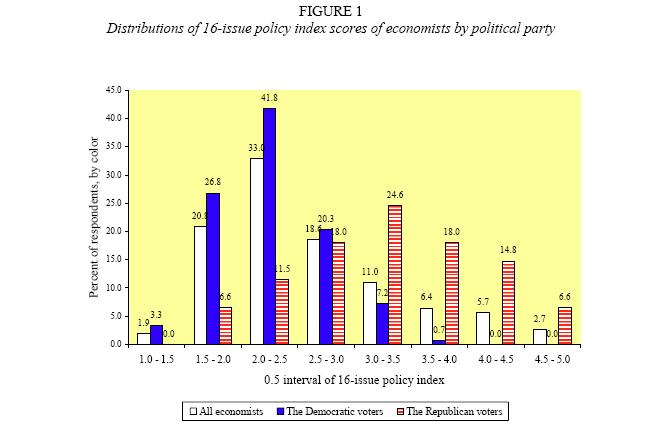
Klein and Stern offer an alternative analysis, in which they drop two questions that seem unrelated to free-market principles: the one about military aid or presence abroad that I discuss above, and one about monetary policy. Dropping those two questions has little effect on the results of the analysis; the average score barely rises, from 2.64 to 2.66. (My score drops from 4.67 to 4.44.) For the 16 issues, the mean score for self-identified Democrats was 2.34, as against 3.30 for self-identified Republicans. Although Republicans are, on average, “middle of the road” (according to Klein and Stern), the distribution of scores highlights the marked difference between Democrat and Republican economists:

Klein and Stern propose several answers to my question — “Why so few free-market economists?” — none of which I find compelling. I offer two answers. First, relatively few academic economists self-indentify as libertarians; the average score of those who did was 4.30. Second, libertarians aside, most persons who garner a Ph.D. in economics (i.e., most members of the AEA) go through a “hazing ritual,” which Arnold Kling describes:

One of the best incumbent-protection rackets going today is for mathematical theorists in economics departments. The top departments will not certify someone as being qualified to have an advanced degree without first subjecting the student to the most rigorous mathematical economic theory. The rationale for this is reminiscent of fraternity hazing. “We went through it, so should they.”

Mathematical hazing persists even though there are signs that the prestige of math is on the decline within the profession. The important Clark Medal, awarded to the most accomplished American economist under the age of 40, has not gone to a mathematical theorist since 1989.

One of the consequences of indoctrination in mathematical economics is that its practitioners come to believe, wrongly, in their understanding of and ability to predict economic phenomona. That leads them to the consequent belief that — if only they or like-minded persons were “in charge” — the economy could be fine-tuned, in the large and in the small. Fine-tuning in the small means, among other things, preventing or correcting so-called market failures, which are those market outcomes of which self-deludely “omniscient” economists disapprove.

Related posts:
About Economic Forecasting
Is Economics a Science?
Economics as Science
Maybe Economics Is a Science
Hemibel Thinking
Physics Envy
Proof That “Smart” Economists Can Be Stupid
Time to Retire the Fair Model
The Thing about Science
What’s Wrong with Game Theory
Debunking “Scientific Objectivity”
Science’s Anti-Scientific Bent
Libertarian Paternalism
A Libertarian Paternalist’s Dream World
The Short Answer to Libertarian Paternalism
Second-Guessing, Paternalism, Parentalism, and Choice
Another Thought about Libertarian Paternalism
Another Voice Against the New Paternalism
Slippery Paternalists
Ten Commandments of Economics
More Commandments of Economics
Science, Axioms, and Economics< Mathematical Economics
Economics, the Dismal (Non) Science

Consent of the Governed, Revisited

In “Consent of the Governed” I say that

one may object to the Constitution, one may refuse to concede its legitimacy, and one may object to being forced by the state to abide by it. But here’s the catch: Such objections and reservations are valid only to the extent that the Constitution actually deprives one of liberty. Inasmuch as it does not do that (except in the fevered minds of anarcho-libertarians), and inasmuch as it fosters liberty, such objections are nothing more than irresponsible tantrums masquerading as a political philosophy.

What I did not know at the time of writing was that Professor Randy Barnett, author of Restoring the Lost Constitution, says much the same thing (in more measured tones) in his reply to a review of his book by J.H. Huebert (Journal of Libertarian Studies, Spring 2005). Specifically, Barnett says:

Among radical libertarians within the modern libertarian intellectual movement, there is a single conception of political legitimacy: consent. This conception has two parts: (a) a legal system that is consented to is legitimate; and (b) a legal system that is not consented to is illegitimate. Because government legal systems lack the consent of the governed, they are necessarily illegitimate. In addition to lacking consent, government legal systems are also illegitimate because they claim a coercive monopoly of power and therefore violate natural rights. So far so good, but here is the problem. Or rather, a symptom indicating an underlying problem: by this theory of legitimacy, all government legal systems are equally illegitimate. Why? Because all government legal systems lack consent; and all modern governments claim a coercive monopoly of power. Because real consent is an all-or- nothing-at-all thing that all government legal systems lack equally, and all governments equally claim a coercive monopoly of power, modern libertarian theory offers no criteria by which to distinguish better from worse governmental legal systems.

But no libertarian really believes that there is no relevant difference on libertarian grounds between the regime of Nazi Germany, the Soviet State, the United States, or (name the country in which you most want to live). Yet their exclusively consent conception of legitimacy, properly understood, offers absolutely no way to conceptually distinguish among these government legal systems. . . .

In response to this challenge, it is not enough for a libertarian to say, as some surely would, that some governments are better than others because they commit more or fewer rights violations. However true this assessment, it misses a crucial issue to which libertarians have paid inadequate attention: the duty to obey the law. This is a complex subject that I address in my book and elsewhere (Barnett 2003), and I simply cannot recreate that analysis here. The conclusion I reach is that there can be a prima facie duty to obey the law if it is made and enforced by procedures that provide sufficient assurance that the laws it imposes on nonconsenting persons are just. In other words, the issue of obedience turns not on whether a particular law is just, but on whether it deserves the benefit of the doubt that it is just. Laws made and enforced the right way are due this deference, unlike laws that are not. So the existence of a prima facie duty to obey the law depends upon the reliability of the procedures in place to assure the justice of laws.

This “gap” between the justice of a law and the prima facie duty to obey a law that is likely to be just because of the way it is made and enforced makes possible a much-needed refinement of basic libertarian theory. In the account of constitutional legitimacy I defend in my book, I continue to insist that consent, if it really exists, can impart legitimacy on a legal system. . . . Instead, I propose that there is a second route to legitimacy besides consent: the degree to which a legal system protects the fundamental natural rights of those upon whom it is nonconsensually imposed. The more effectively a regime protects the rights of those whom it governs, the more legitimate it is.

This move requires that a new distinction be introduced into libertarian theory between “justice” and “legitimacy.” Although I believe that this distinction is implicit in the actual beliefs of libertarians, confusion and error results from its lack of explicit recognition. And regrettably some libertarians try so hard to hew to existing theory based exclusively on consent that they come to believe that all governmental legal systems are equally objectionable.

Huebert concludes a reply to Barnett by saying that

I am not at all opposed to consideration of second-best alternatives to anarcho-capitalism, so I give Professor Barnett credit for searching for realistic means to advance liberty. Unfortunately, because of its support for the centralized state, Mr. Barnett’s system would not give us “second best,” but rather “even worse,” so I must continue to reject it, along with any notion of a duty to obey the state.

Huebert is in thrall to the fiction that anarcho-capitalism is “first best” because it is somehow possible. But it is impossible, for reasons I have given in several posts:
Defense, Anarcho-Capitalist Style
But Wouldn’t Warlords Take Over?
My View of Warlordism, Seconded
The Fatal Naïveté of Anarcho-Libertarianism
Anarcho-Libertarian ‘Stretching’
QandO Saved Me the Trouble
Two Views of Liberty
Utopian Schemes

An essential ingredient of anarcho-libertarianism is the non-aggression principle, which I address here:
Libertarian Nay-Saying on Foreign and Defense Policy
Libertarianism and Preemptive War: Part I
Right On! For Libertarian Hawks Only
Understanding Libertarian Hawks
More about Libertarian Hawks and Doves
Sorting Out the Libertarian Hawks and Doves
Libertarianism and Preemptive War: Part II
Give Me Liberty or Give Me Non-Aggression?
More Final(?) Words about Preemption and the Constitution
“Peace for Our Time”
Idiotarian Libertarians and the Non-Aggression Principle

Also relevant:
Varieties of Libertarianism
What Is the American Constitution?
Who Are the Parties to the Constitutional Contract?

Liberal Claptrap

Hot on the heels of Markos Moulitsas‘s oxymoronical “The Case for the Libertarian Democrat,” comes Geoffrey R. Stone‘s “What It Means to Be a Liberal.” I will say no more about Moulitsas’s emission because it has been thoroughly disassembled and left in ruins by many a thoughtful person (e.g., Arnold Kling, writing at TCS Daily; Megan McArdle (a.k.a. Jane Galt) of Asymmetrical Information; and Ilya Somin of The Volokh Conspiracy).

I will therefore focus on Prof. Stone’s excrescence, which is more than a straightforward exposition of liberalism. It is, rather, a smug display of a typical liberal’s deluded belief that liberals — almost exclusively — actually care about and advance the welfare of their fellow human beings. It is calculated to build up liberalism by tearing down conservativism and libertarianism, which is hardly good salesmanship. But it’s what I expect of Stone, whose views I have encountered and written about before. In “Killing Free Speech in Order to Save It” I wrote:

Stone is a colleague of Cass Sunstein, a fellow traveler on the road to thought control. . . .

[I]n the world of Sunstein and Stone, we can — and must — legislate and regulate our way to a “tolerant society.” Hah! Notice how well it worked when forced busing was used to integrate schools?

Stone, slippery lawyer that he is, doesn’t give a hoot about Klansmen. What he really wants is to make it illegal for employers to fire anyone for saying anything that seems critical of government policy (Republican policy, in particular). When that’s done, he can take up the cudgels for the Dixie Chicks and go after radio stations that refuse to play their songs.

What Sunstein and Stone mean by “free speech” is “forced listening.” Reminds me of the brainwashing scene in the movie 1984. They’ll like the results as long as they get to play Big Brother. . . .

What Stone and his ilk don’t seem to understand (or choose to ignore) is that government involvement (choosing sides) warps the public debate. For every employer who fires a critical employee and for every popular right-wing talk-show host there are legions of protestors and political opponents whose messages the mainstream media amplify, with gusto. That’s the marketplace of ideas in action. Or do Stone and his ilk favor the suppression of the mainstream media? I doubt it very much. They’re just looking for a pseudo-legal justification for the suppression of speech they don’t like. . . .

[I]f you really favor free speech, you favor it for everyone, not just the lefties favored by Stone.

This is the same Stone who, in the essay I am about to skewer, says that “It is liberals who have championed and continue to champion . . . a more vibrant freedom of speech.” Well, yes, as long as it’s speech that liberals favor. (Consider the recent contretemps at Columbia University and the systematic suppression of speech at liberal-dominated universities, which FIRE documents so well.) Hypocrisy, thy name is liberalism.

Now, on to Stone’s essay about liberalism, in which he “tr[ies] to articulate 10 propositions that seem to [him] to define ‘liberal’ today.” I won’t regurgitate the entire essay, or even the fulsome defense Stone makes of each of his ten propositions. (Masochists may read the whole mess by following the link above.) I will simply reproduce the nub of each of Stone’s propositions and then dispatch it quickly, but mercilessly.

1. . . . individuals should doubt their own truths and consider fairly and open-mindedly the truths of others.

Americans should doubt the truth of their commitment to the freedoms of speech, religion, and the press (for example) and consider for more than a moment the “truths” of fascism, communism, and Islamism? What utter, open-minded empty-headed nonsense.

2. . . . individuals should be tolerant and respectful of difference.

What he means, of course, is that (to take just a few examples) free speech, property rights, and freedom of association should be suppressed for the sake of “diversity,” as long as the suppression is directed at conservative-libertarian, straight, white males who don’t teach at or attend universities.

3. . . . individuals have a right and a responsibility to participate in public debate.

See above for my take on Stone’s commitment to free speech.

4. . . . “we the people” are the governors and not the subjects of government, and that government must treat each person with that in mind.

When “we the people” are, in fact, the “governors” they do a very good job of of treating as pariahs and enemies those who oppose the liberal socialistic agenda. Quintessential examples are Teddy and Franklin Roosevelt’s characterizations of the very businessmen who brought prosperity to Americans as “malefactors of great wealth” and “economic royalists,” thus legitimating the class warfare that liberals wage to this very day.

5. . . . government must respect and affirmatively safeguard the liberty, equality and dignity of each individual.

Such thinking leads to the conclusion that “it is better that ten guilty persons escape than that one innocent suffer,” as the saying goes. Balderdash! And more balderdash! As for “respecting” and “affirmatively safeguarding” the liberty, equality, and dignity of each and every individual, see my comments about propositions 2, 3, and 4.

6. . . .
government has a fundamental responsibility to help those who are less fortunate.

Stone means, of course, that government should redistribute income and wealth from those who have earned it to those who have not, to the detriment of all. (See this and this for more.)

7. . . .
government should never act on the basis of sectarian faith.

That is, laws should not be motivated by the moral precepts of religion. Which, of course, rules out laws against murder, theft, rape, and so on. So much for the “dignity of each individual.” But, of course, “it is better that ten guilty persons escape” so that innocent individuals can suffer the consequences.

8. . . . courts have a special responsibility to protect individual liberties.

What Stone means to say is that courts — not legislatures — should make law, as long it is law that advances the liberal agenda.

9. . . . government must protect the safety and security of the people. . . .

Unless, of course, government acts to prevent terrorism. (See this post and follow the links therein.)

10. . . . government must protect the safety and security of the people, without unnecessarily sacrificing constitutional values. violating terrorists’ “rights.”

ADDENDUM: Read “Hard Truths for Soft Liberal Heads,” by John Hawkins; “What Does a Liberal Believe?,” by Johnathan Cohen; and “A Dialogue with a Liberal,” by Arnold Kling. See also these earlier Liberty Corner posts:

Ten-Plus Commandments of Liberalism, er, Progressivism
Libertarian-Conservatives Are from the Earth, Liberals Are from the Moon
Liberals and the Rule of Law
Thoughts That Liberals Should Be Thinking
More Thoughts That Liberals Should Be Thinking
The Liberal Mindset

More Bad News for Global Warming Zealots

From World Climate Report:

[Standard climate] models predict an increase in global precipitation [associated with global warming], and none is observed. The models predict relatively large increases in precipitation in northern mid- to high latitudes and Antarctica in winter, and no increase in these areas is observed. The models do not predict much of an increase in temperature or precipitation in the tropical region of the Pacific and Indian Ocean, but that area shows the largest increase in precipitation anywhere in the world (offset by decreases in precipitation elsewhere).

Read the whole thing.

Meanwhile, at Cato-at-liberty, Jerry Taylor reports:

According to a new study from the Danish National Space Center, cosmic rays created by the explosions of distant stars play an important role in cloud formation in the earth’s lower atmosphere. Those clouds have a cooling effect on the planet. The sun’s magnetic field, however, interferes with this process to some degree, and that field has doubled for some reason in the 20th century.

According to the Space Center’s website:

The resulting reduction in cloudiness, especially of low-altitude clouds, may be a significant factor in the global warming Earth has undergone during the last century.

There’s a lot more in these Liberty Corner posts, which go back to July 16, 2004:

Climatology
Global Warming: Realities and Benefits
Words of Caution for the Cautious
Scientists in a Snit
Another Blow to Climatology?
Bad News for Politically Correct Science
Another Blow to Chicken-Little Science
Bad News for Enviro-nuts
The Hockey Stick Is Broken
Science in Politics, Politics in Science
Global Warming and Life
Words of Caution for Scientific Dogmatists
Hurricanes and Global Warming
Global Warming and the Liberal Agenda
Debunking “Scientific Objectivity”
Hurricanes and Glaciers
Remember the “Little Ice Age”?
Science’s Anti-Scientific Bent
A Possibly Useful Idiot
The Climate Debate: A Postscript
Today’s Climate Report
Consensus and Science Don’t Mix
Global Warming in Perspective
You Bet Your Life
What I Said about Climate Change . . .

Where’s My Nobel?

The Royal Swedish Academy of Sciences has awarded the Sveriges Riksbank Prize in Economic Sciences in Memory of Alfred Nobel for 2006 to Edmund Phelps, “for his analysis of intertemporal tradeoffs in macroeconomic policy.” Specifically,

Phelps formulated the hypothesis of the expectations-augmented Phillips curve, according to which inflation depends on both unemployment and inflation expectations.

As a consequence, the long-run rate of unemployment is not affected by inflation but only determined by the functioning of the labor market. . . . Phelps showed how the possibilities of stabilization policy in the future depend on today’s policy decisions: low inflation today leads to expectations of low inflation also in the future, thereby facilitating future policy making.

Thereby making capital investments more attractive and boosting the rate of economic growth — which is what I established in “The Anti-Phillips Curve.” Where’s my $1.3 million (the approximate dollar value of this year’s prize)?

Positive Rights and Cosmic Justice: Part II

In Part I, I addressed Joe Miller’s defense of positive rights — or positive freedom, to use Joe’s term for what is really a justification for the redistribution of income and wealth. Joe has since posted another defense of positive freedom, which he sums up thusly:

I might even go so far as to hold that positive freedom is more important than theoretical (or, in philosopher-speak, negative) freedom. This is not to say that I don’t value negative freedom; rather, positive freedom entails negative freedom. After all, I can have X as a member of the set of things I can actually do if and only if no one is using a gun (whether figurative or literal) to prevent me from doing X.

Why positive freedom rather than negative? Or rather, why positive freedom rather than only negative? I’m not sure that I’ve anything more than a deep-seated intuition. It strikes me as somehow empty and hollow to walk up to someone wasting away from disease and say, “Hey, you know, you’re free to do anything you’d like.” . . .

As with any sort of fundamental disagreement over basic terms, this one has serious implications. One of those implications is that liberals and libertarians often talk past one another. In academic philosophy, for example, the term “autonomy” is used to refer to positive freedom. Libertarians, however, frequently use the term, “autonomy” as a synonym for negative freedom. Because we use the term in different ways, liberals and libertarians often end up with the frustrating feeling of having beaten their respective heads against the wall when they interact.

When I say, “Of course redistribution is consistent with autonomy,” I mean that it’s consistent with a notion of positive freedom. Forcing you to give your money to someone else is no different from forcing you to stop hitting the person. Failure to provide certain of his basic needs is exactly as wrong as clubbing him over the head. Both violate his autonomy.

To which the libertarian responds, “Redistribution is obviously a violation of autonomy. After all, you’re using a gun to force someone to give up his money. How could that not be a violation of his autonomy.”

The fact is, both claims are right. But they are both right only because the interlocuters are, in effect, equivocating on the word “autonomy”. If the term means positive freedom, then the liberal is right. If autonomy means only negative freedom, then the libertarian is right.

Joe hasn’t really advanced his earlier argument. Rather, he has restated it, but in a way that better exposes its flaws. Here is Joe’s argument, with all of its assumptions made explicit:

1. Autonomy is necessary in order to do as one will toward one’s ends, though one may not do harm to others in the service of those ends.

2. Autonomy is not possible unless one possesses some minimal degree of health, wealth, income, etc. “Minimal” must be defined by someone, of course, and liberals stand ready to do the job.

3. But autonomy is not served by having too much wealth or income — or the things they can buy, such as health. “Too much” must be defined by someone, of course, and liberals stand ready to do that job, as well. (This is how liberals, in general, square their lip service to the harm principle with the actual doing of harm in the name of autonomy — which is done by taking wealth and income from some persons and giving it to others.)

4. Liberals’ arrogant willingness to play at being gods — by defining “minimal” and “too much,” and by ignoring the harm done to some for the benefit of others — rests on these deeper (and usually unacknowledged) assumptions:

  • One person’s well-being can be measured against another person’s well-being through interpersonal comparisons of utility.
  • There is a kind of cosmic justice — or social welfare function — that is advanced by harming some persons for the benefit of other persons. That is, a benefit cancels a harm — at least when the benefit and harm are decided by liberals.
  • Taking wealth and income from those who have “too much” does not, on balance, harm those who have “too little” by dampening economic growth and voluntary charity. (That it does do those things is a point I will address in a later part of this series.)

(The first and second assumptions enable Joe to assert that “positive freedom entails negative freedom.” To Joe, there is one big “welfare pie” in sky, in which we all somehow share — despite the obvious fact that A is made worse off when some of his wealth or income is confiscated and given to B.)

5. Given the foregoing, liberals see it as necessary and desirable to redistribute wealth and income from persons who have “too much” to persons who have “too little” — or “too little” of the things that wealth and income can buy. Otherwise, those who have “too little” wealth or income (or the things they can buy) would enjoy only “theoretical” freedom. But the use of the word “theoretical” is a rhetorical trick, a bit of verbal sleight-of-hand. It implies, without proof, that anyone who does not enjoy a certain “minimal” state of health, wealth, etc. — as “minimal” is defined by a liberal — simply lacks the wherewithal to strive toward ends that he or she values. And that brings us back to point 1.

The liberal argument for redistribution, therefore, is really a circular argument intended to justify liberals’ particular sense of fitting outcomes. Liberalism is paternalism run rampant, with these implications and consequences:

  • Everyone is both a potential beneficiary of and contributor to positive freedom. Whether one becomes a beneficiary or contributor depends on liberals’ arbitrary and capricious criteria for deservingness.
  • Liberal control of the apparatus of the state therefore results in myriad abuses of state power in the name of “compassion” — cheap compassion paid for by taxpayers, to be sure.
  • On the whole and over the long run — the effect of liberalism is to harm rather than help its intended beneficiaries.

I will say more in later parts of this series about the impossibility of cosmic justice and the harm done by liberalism to those whom it patronizes.

Related post: Rights and “Cosmic Justice”

Can Money Buy Excellence in Baseball?

My measure of excellence is the fraction of games won during a regular season.

It is true that every owner, manager, coach, and player would like to win the World Series — and that some owners (especially George Steinbrenner) spend a lot of money toward that end. But the short series at season’s end — League Division Series, League Championship Series, and World Series — prove nothing about which team is better or best. It takes a lot of games to determine a team’s quality, which is why the regular season consists of 162 games.

The significance of post-season play has changed since the first World Series was played in 1903. The main impetus for starting the World Series was a desire to determine which of two league champions — who had not faced each other during the regular season — was the better team, insofar as “better” could be determined by a best-of-nine or best-of-seven series. With the advent of divisions within the two major leagues, and interleague play during the regular season, postseason play has evolved to a series of contests between teams that have faced each other during the regular season. The main impetus for the present playoff format is a desire to fill seats and to sell food, drink, memorabilia, and television rights.

Divisional play and wild-card slots make it possible for less-than-excellent teams to participate in post-season play. Short series make it possible for such teams to garner championships in post-season play. Who believes that Oakland A’s really are better than the Minnesota Twins — even though the A’s swept the Twins in their recent series — when the Twins (with a regular-season winning average of .593) beat the A’s (.574) in six of their ten regular-season games? Who believes that the Detroit Tigers really are a better team than the New York Yankees — even though the Tigers have eliminated the Yankees from postseason play — when the Yankees (.599 in the regular season) beat the Tigers (.586) in five of their seven regular-season games? I dismiss post-season play as an indicator of excellence.

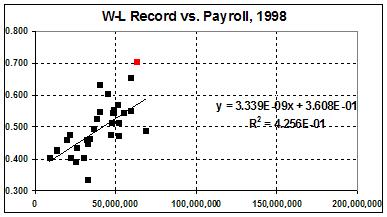
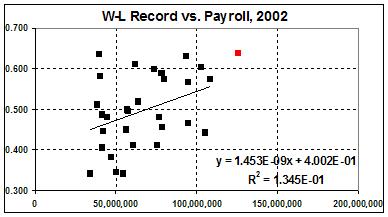
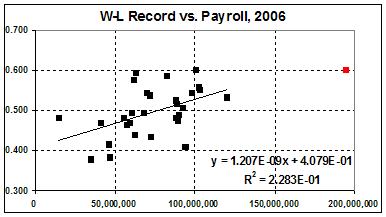
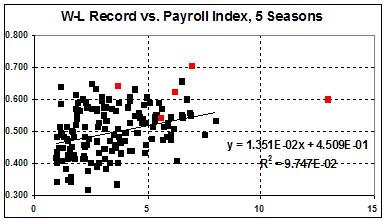
With that out of the way, let’s look at fraction of games won as a function of payroll for the 1998, 2000, 2002, 2004, and 2006 seasons. Fraction of games won is available at Baseball-Reference.com; click on “Leagues” and then, for a particular year, click on the adjacent link (“NL” or “AL”) to get that league’s final, regular-season standings for that year. I obtained team payrolls for 1998, 2000, 2002, and 2004 from this spreadsheet. (Specifically, I used the totals for early April, given in the right-most column.) I used these early April payrolls for 2006. The use of payrolls for the same point in each season imparts some consistency to the analysis, even though payrolls change throughout a season because of trades, waiver claims, callups, and releases.

The following six graphs depict my statistical analysis of the data. The first five graphs treat each of the seasons individually. In the sixth graph I combine all five seasons by constructing, for each season, a payroll index for each team, setting the lowest payroll for that season equal to 1. The red plot points in all six graphs are for the Yankees; the black plot points and the least-squares fits through them are for the other 29 teams.

Several things jump out from these graphs and the underlying data:

Money can — and often does — buy excellence, but the correlation between payroll and excellence declined after 1998. This suggests that bidders for free agents have, in general, become less discriminating about the quality of those players and how much their particular skills will add to the overall performance of the acquiring teams.

The wide dispersion of points around the regression lines indicates the uncertainty involved in selecting players. There are a few teams that have been, for a time, consistently good at it (e.g., the A’s, Braves, Cards, Giants, Mets, Twins, and Yankees) and a few that have been, for a time, consistently bad at it (e.g., Cubs, Devil Rays, Marlins, and Phillies). The Yankees have gone from very good to mediocre, in terms of getting value for their payroll dollars.

The Yankees of 1998 were a “steal,” even though the team had the second-highest payroll for that season. The Yankees have since regressed to the mean, as George Steinbrenner has paid dearly to keep certain of his stars (e.g., Derek Jeter and Jorge Posada) and to acquire big-name players (e.g., Roger Clemens and Alex Rodriguez), not all of whom have delivered their money’s worth. (Yes, A-Rod, that means you.)

Nevertheless, Steinbrenner has been getting his money’s worth — in that his teams have done very well during the regular season. That’s not enough for Steinbrenner, of course, because he spends a lot of money on player salaries in order to win World Series. Six straight years of postseason futility should by now have told Steinbrenner that his main problem isn’t with the talent that he puts on the field but with Joe Torre’s inability to manage that talent effectively in postseason play.

How so? A short series involving teams with good pitchers generally is won by the team that is adept at putting a few runs on the board early by playing “small ball.” That puts the opposing team off stride and forces it to make high-risk moves in an effort to play catch-up ball. Torre’s prevalent management style — which works well over the long haul of a seaon — is not to play “small ball” but to lay back and wait for his big bats to produce runs in bunches. That strategy doesn’t work well in the postseason, when you’re up against baseball’s better teams, because those teams usually have strong pitching staffs.

And so, given another postseason disappointment for the Yankees, I fully expect Mr. Steinbrenner to replace Joe Torre — in addition to doing something about A-Rod, the Yankee bullpen, and half the starting rotation. Torre’s successor should be adept at “small ball,” and should make the Yankees practice it throughout the regular season so that they have mastered it by the time postseason play rolls around in 2007.

More Stupidity from Cato

I read Cato-at-liberty mainly to find good examples of obtuse libertianism. I’m seldom disappointed. Today, for example, I find “The Weakness of Watch-Listing,” by Jim Harper. I won’t take the time to Fisk the post. I’ll just point out two fatal flaws. First, Harper says:

Easy to evade, [watch-listing] provides no protection against people who haven’t yet done anything wrong, who haven’t come to the attention of security officials, or who have adopted an alias.

Harper doesn’t know how easy it is to evade a watch list because he doesn’t know how much information we have about known or suspected terrorists. Neither do the terrorists. A suspected terrorist needn’t have done anything “wrong” to be on a watch list. To evade watch-listing, therefore, terrorists must be extra cautious and forgo some opportunities for terrorism that they would otherwise exploit.

Is watch-listing perfect? Of course not. But it’s part of a defense in depth. No part of a defense in depth is perfect, but all parts — taken together — can prove quite formidable.

Harper goes on to say:

Watch-listing has a deeper flaw, though. It does not fit with our system of law enforcement.

In the U.S., people who have done something wrong are supposed to be arrested, taken to court and charged, then permitted to contest the accusation. If they are found guilty, they pay money or serve time in jail.

Watch-listing follows no similarly familiar pattern. Law enforcement or national security personnel place a person on a list and then, wherever that list is used, treat the person (and other people with the same name) differently, stopping them, interrogating them, searching them, or whatever the case may be. This unilateral process is alien to our legal system.

Rather than watch-listing, people who are genuinely suspected of being criminals or terrorists should be sought, captured, charged, tried, and, if convicted, sentenced.

It’s obvious, again, that the concept of a defense-in-depth eludes Harper, who wants to substitute prosecution for watch-listing, instead of doing both (which involves little or no competition for resources).

The deeper flaw in Harper’s argument, however, is to think of terrorism as crime. It is not crime, it is war. The “unilateral process” of watch-listing is part of a war effort. Success in war demands sacrifices on the part of civilians. Being placed erroneously on a watch list is one of those sacrifices. As an inconvenience it barely registers on the scale of inconveniences suffered by Americans during World War II.

Related posts:
Losing Sight of the Objective
A Skewed Perspective on Terrorism
Terrorists’ “Rights” and the Military Commissions Act of 2006

The Anti-Hall of Fame and Baseball "Immortals"

Baseball’s Hall of Fame is cluttered with pitchers and batters who plainly do not belong there. I hereby present my Anti-Hall of Fame: players who do not belong in the Hall of Fame.

A Hall of Fame pitcher will have

  • at least 300 wins
  • or, at least 250 wins and an ERA+ of 120 or higher. (Go here and scroll down for the definition of ERA+.)
  • or, at least 200 wins and a W-L average of .600 or better and an ERA+ of 120 or higher.
  • or, for relief pitchers, an ERA+ of 120 or higher.

The following pitchers therefore belong in my Anti-Hall of Fame:

Chief Bender
Jim Bunning
Jack Chesbro
Dizzy Dean
Don Drysdale
Dennis Eckersley
Red Faber
Rollie Fingers
Pud Galvin
Lefty Gomez
Burleigh Grimes
Jesse Haines
Waite Hoyt
Catfish Hunter
Fergie Jenkins
Addie Joss
Sandy Koufax
Bob Lemon
Ted Lyons
Rube Marquard
Hal Newhouser
Satchel Paige
Herb Pennock
Eppa Rixey
Robin Roberts
Red Ruffing
Dazzy Vance
Rube Waddell
Ed Walsh
John Ward
Vic Willis

With the removal of those 31 names, 35 pitchers would remain in the Hall of Fame.

The selection of batters for my Anti-Hall of Fame is a somewhat trickier business. Consider Johnny Bench: a lifetime .267 hitter but a great catcher and a leader on the field. Should I place a Bench in my Anti-Hall of Fame? What about Luis Aparicio, a fine shortstop who stole a lot of bases relative to his peers? The list could go on and on. So I decided to construct an anti-Hall of Fame that applies only to batting. Some players in this Anti-Hall of Fame might belong in the Hall of Fame for their other exploits, but they do not belong there for their batting skills. My batting criteria:

  • an OPS+ of at least 150 (Go here and scroll down for the definition of OPS+, which is a measure of offensive prowess that adjusts for a player’s ballpark and the era in which he played.)
  • or, at least 2,800 lifetime hits and a lifetime batting average of at least .300
  • or, an OPS+ of at least 120 and at least 2,000 lifetime base hits or a lifetime batting average of at least .300

My Anti-Hall of Fame for batters:

Luis Aparicio
Luke Appling
Richie Ashburn
Earl Averill
Frank Baker
Dave Bancroft
Lou Boudreau
Lou Brock
Willard Brown
Roy Campanella
Max Carey
Gary Carter
Frank Chance
Jimmy Collins
Joe Cronin
Larry Doby
Bobby Doerr
Johnny Evers
Carlton Fisk
Nellie Fox
Gabbby Hartnett
Billy Herman
Harry Hooper
Monte Irvin
Travis Jackson
Hughie Jennings
George Kell
George Kelly
Ralph Kiner
Tony Lazzeri
Freddie Lindstrom
Rabbit Maranville
Bill Mazeroski
Tommy McCarthy
Bid McPhee
PeeWee Reese
Phil Rizzuto
Brooks Robinson
Ryne Sandberg
Ray Schalk
Red Schoendienst
Joe Sewell
Ozzie Smith
Joe Tinker
Pie Traynor
Bobby Wallace
Lloyd Waner
John Ward
Ross Youngs
Robin Yount

The deletion of those 50 names would leave 91 batters in the Hall of Fame, including . . . Johnny Bench.

You can consult the Hall of Fame listings for pitchers and batters to see who would remain in my Hall of Fame after excluding those listed above.

But which of the 35 pitchers and 91 batters who qualify for my Hall of Fame are true baseball “immortals” who belong in a select inner circle? My criteria for “immortality” are somewhat more stringent than my criteria for membership in the Hall of Fame. An “immortal” pitcher will have at least 250 wins, a winning average of at least .600, and an ERA+ of at least 120. (A reliever qualifies with an ERA+ of at least 120.) An “immortal” batter will have an OPS+ of at least 150 or at least 2,800 hits and a lifetime batting average of at least .300.

Herewith the “immortal” pitchers:

Pete Alexander
John Clarkson
Bob Feller
Lefty Grove
Carl Hubbell
Walter Johnson
Tim Keefe
Christy Mathewson
Kid Nichols
Jim Palmer
Eddie Plank
Charley Radbourn
Tom Seaver
Bruce Sutter
Hoyt Wilhelm
Cy Young

And the “immortal” batters:

Hank Aaron
Cap Anson
Jake Beckley
Wade Boggs
George Brett
Dan Brouthers
Jesse Burkett
Rod Carew
Roberto Clemente
Ty Cobb
Eddie Collins
Roger Connor
Sam Crawford
Ed Delehanty
Joe DiMaggio
Jimmie Foxx
Frankie Frisch
Lou Gehrig
Charlie Gehringer
Hank Greenberg
Rogers Hornsby
Willie Keeler
Nap Lajoie
Mickey Mantle
Willie Mays
Johnny Mize
Paul Molitor
Stan Musial
Mel Ott
Sam Rice
Frank Robinson
Babe Ruth
Al Simmons
George Sisler
Tris Speaker
Honus Wagner
Paul Waner
Zack Wheat
Ted Williams

Thus my Hall of Fame would have an inner circle of “immortals”: 16 of 35 pitchers (vice the present number of 66) and 39 of batters 91 (vice the present number of 141). La crème de la crème.

Terrorists’ "Rights" and the Military Commissions Act of 2006

Cato’s Mark Moller finds that the Military Commissions Act of 2006 “is not patently unconstitutional—but it is hardly on uncontrovertible constitutional footing, either.” That is not a surprising conclusion, coming as it does from a member of the “libertarian” camp that cannot seem to focus on a key purpose of the Constitution: the protection of the liberties of American citizens.

Andrew McCarthy, writing at National Review Online, is well focused — as usual. As McCarthy points out,

Congress has already given al Qaeda detainees the very rights the critics claim have been denied [by the Military Commissions Act of 2006].

Last December, Congress enacted the Detainee Treatment Act (DTA). It requires that the military must grant each detainee a Combatant Status Review Tribunal (CSRT) at which to challenge his detention. Assuming the military’s CSRT process determines he is properly detained, the detainee then has a right to appeal to our civilian-justice system — specifically, to the U.S. Court of Appeals for the D.C. Circuit. And if that appeal is unsuccessful, the terrorist may also seek certiorari review by the Supreme Court.

McCarthy explains that, under the Constitution, terrorists have no habeas corpus rights or treaty rights:

Congress cannot “suspend” habeas corpus by denying it to people who have no right to it in the first place. The right against suspension of habeas corpus is found in the Constitution (art. I, 9). Constitutional rights belong only to Americans — that is, according to the Supreme Court, U.S. citizens and those aliens who, by lawfully weaving themselves into the fabric of our society, have become part of our national community (which is to say, lawful permanent resident aliens). To the contrary, aliens with no immigration status who are captured and held outside the territorial jurisdiction of the United States, and whose only connection to our country is to wage a barbaric war against it, do not have any rights, much less “basic rights,” under our Constitution. . . .

Isn’t habeas corpus necessary so that the terrorists can press the Geneva Convention rights with which the Court most recently vested them in its 2006 Hamdan case? Wrong again.

To begin with, although its reasoning was murky, the Hamdan majority seems technically to have held that Geneva’s Common Article 3 applied to military commissions because of a congressional statute, the Uniform Code of Military Justice. Again, if a right is rooted in a statute, not in the Constitution, Congress is at liberty to withdraw or alter the right simply by enacting a new statute. Such a right is not in any sense “basic.”

If the Supreme Court were to decide that the Military Commissions Act of 2006 is unconstitutional, it would be high time for President Bush to take a Jacksonian stance: “The Supreme Court has made its decision, now let them enforce it.” I would base that stance on an earlier holding by the Court:

The provisions of the Constitution which confer on the Congress and the President powers to enable this country to wage war are as much part of the Constitution as provisions looking to a nation at peace. And we have had recent occasion to quote approvingly the statement of former Chief Justice Hughes that the war power of the Government is “the power to wage war successfully.” . . . Therefore, the validity of action under the war power must be judged wholly in the context of war. That action is not to be stigmatized as lawless because like action in times of peace would be lawless.

— Justice Felix Frankfurter, concurring in Korematsu v. United States (1944)

Apropos Paternalism

Will Wilkinson, in a TCS Daily review of John Cassidy’s New Yorker article about neuronomics, writes:

Paternalism is the use of coercion to force people to do or refrain from something against their will for their own good. Liberals of all stripes generally reject paternalism for reasons most lucidly laid out in J.S. Mill’s masterpiece On Liberty. First, we assume the individual is the best judge of her own good. Second, whether or not the individual is the best judge of her own good, we rightly doubt that another individual (or assembly thereof) has the legitimate moral authority to substitute their judgment for the individual’s by force — especially in light of widespread disagreement about the nature of a good life. Third, truth is hard to come by, and none of us can be fully certain we’ve pinned it down. Allowing people to act on diverse opinions about morality (or rationality) broadens the search for truth about good lives by setting up a decentralized system of social laboratories where experiments in living succeed or fail in plain view. So, unless an action harms somebody else, people should be at liberty to satisfy their preferences, whether saintly or sinful, coolly rational or impulsively emotional.

The conceit of the new paternalism is that the state isn’t going to be in the business of telling us which beliefs and desires we are allowed to act on, but will simply nudge people into doing what we wanted to do anyway, but couldn’t manage by ourselves. The idea is that there are things we want to do, but, due to some foible of mind, we are unable to do it without a little outside help. . . .

Some of the new so-called “soft” paternalistic measures, such as employers helping workers to increase their rate of savings by requiring them to opt out of, rather than opt into, a retirement plan aren’t paternalistic in any sense; that’s a part of a fully voluntary labor contract. [ED: This is not true when government, through tax incentives, encourages the widespread adoption by employers of such practices.] And policies like increasing the taxes on cigarettes or fatty foods in order to discourage potentially harmful consumption choices, are straightforwardly paternalistic in the old sense, requiring a one-size-fits-all value judgment about how much and for what reason we should consume certain goods.

Those kinds of judgments aren’t the proper work of government. In any case, if you really think people make systematic “mistakes” in judgment and choice, there is no reason to believe that democratic voters — who have less at stake when casting their ballots than when choosing what to have for lunch — will be especially good at populating the government with Spock-like rational legislators interested in tweaking cognition through expertly targeted policy rather than with well-coiffed primates interested in hoarding status and power.

As Michael Munger puts it, in an essay at The Library of Economics and Liberty,

The boundary we fight over today divides what is decided collectively for all of us from what is decided by each of us. You might think of it as a property line, dividing what is mine from what is ours. And all along that property line is a contested frontier in a war of ideas and rhetoric.

For political decisions, “good” simply means what most people think is good, and everyone has to accept the same thing. In markets, the good is decided by individuals, and we each get what we choose. This matters more than you might think. I don’t just mean that in markets you need money and in politics you need good hair and an entourage. Rather, the very nature of choices, and who chooses, is different in the two settings. P.J. O’Rourke has a nice illustration of the way that democracies choose.

Imagine if all of life were determined by majority rule. Every meal would be a pizza. Every pair of pants, even those in a Brooks Brothers suit, would be stone-washed denim. Celebrity diets and exercise books would be the only thing on the shelves at the library. And—since women are a majority of the population, we’d all be married to Mel Gibson. (Parliament of Whores, 1991, p. 5).

O’Rourke was writing in 1991. Today, we might all be married to Ashton Kutcher, instead. But you get the idea: Politics makes the middle the master. The average person chooses not just for herself, but for everyone else, too. . . .

The thing to keep in mind is that market processes, working through diverse private choice and individual responsibility, are a social choice process at least as powerful as voting. And markets are often more accurate in delivering not just satisfaction, but safety. We simply don’t recognize the power of the market’s commands on our behalf. As Ludwig von Mises famously said, in Liberty and Property, “The market process is a daily repeated plebiscite, and it ejects inevitably from the ranks of profitable people those who do not employ their property according to the orders given by the public.”

Paternalism — when it is sponsored or enforced by government — deprives us of the ability to think for ourselves, to benefit from our wise decisions, and to learn from our mistakes. It all adds up to regress, not progress.

Related posts:
The Rationality Fallacy
Libertarian Paternalism
A Libertarian Paternalist’s Dream World
The Short Answer to Libertarian Paternalism
Second-Guessing, Paternalism, Parentalism, and Choice
Another Thought about Libertarian Paternalism
Back-Door Paternalism
Another Voice Against the New Paternalism
A Further Note about “Libertarian” Paternalism

The Big Bang and Atheism

From a press release issued yesterday by The Royal Swedish Academy of Sciences:

The [academy] has decided to award the Nobel Prize in Physics for 2006 jointly to John C. Mather NASA Goddard Space Flight Center, Greenbelt, MD, USA, and George F. Smoot University of California, Berkeley, CA, USA “for their discovery of the blackbody form and anisotropy of the cosmic microwave background radiation”. . . .

This year the Physics Prize is awarded for work that looks back into the infancy of the Universe and attempts to gain some understanding of the origin of galaxies and stars. It is based on measurements made with the help of the COBE satellite launched by NASA in 1989.

The COBE results provided increased support for the Big Bang scenario for the origin of the Universe, as this is the only scenario that predicts the kind of cosmic microwave background radiation measured by COBE. These measurements also marked the inception of cosmology as a precise science. . . .

According to the Big Bang scenario, the cosmic microwave background radiation is a relic of the earliest phase of the Universe. Immediately after the big bang itself, the Universe can be compared to a glowing “body emitting radiation in which the distribution across different wavelengths depends solely on its temperature. The shape of the spectrum of this kind of radiation has a special form known as blackbody radiation. When it was emitted the temperature of the Universe was almost 3,000 degrees Centigrade. Since then, according to the Big Bang scenario, the radiation has gradually cooled as the Universe has expanded. The background radiation we can measure today corresponds to a temperature that is barely 2.7 degrees above absolute zero. The Laureates were able to calculate this temperature thanks to the blackbody spectrum revealed by the COBE measurements. . . .

The success of COBE was the outcome of prodigious team work involving more than 1,000 researchers, engineers and other participants. John Mather coordinated the entire process and also had primary responsibility for the experiment that revealed the blackbody form of the microwave background radiation measured by COBE. George Smoot had main responsibility for measuring the small variations in the temperature of the radiation.

According to Wikipedia, “[m]ost cosmologists consider [cosmic microwave background] radiation to be the best evidence for the hot big bang model of the universe.” That model, and the observations which support it, suggest

that the universe has expanded from a state in which all the matter and energy in the universe was at an immense temperature and density. Physicists do not widely agree on what happened before this, although general relativity predicts a gravitational singularity (for reporting on some of the more notable speculation on this issue, see cosmogony).

What preceded and caused the Big Bang? The possibility of a creation by an intelligent force cannot be ruled out. Atheism, therefore, is an unscientific stance because it posits an unfalsifiable hypothesis: the non-existence of an intelligent creator.

Related posts:
Atheism, Religion, and Science
The Limits of Science
Three Perspectives on Life: A Parable
Beware of Irrational Atheism
The Creation Model
Science, Logic, and God

The Dow and the Stock Market

There is much ado today about the Dow Jones Industrial Average, which hit an all-time high. That’s nice, but the Dow is a narrow, price-weighted index of stock prices. It does not include gains from reinvested dividends, and it is not adjusted for inflation.

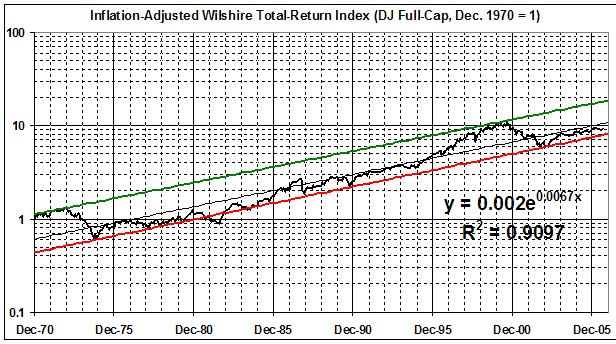
Far better is the Dow Jones Wilshire 5000 Composite Index (better known as the Wilshire 5000), which now tracks about 5,400 U.S. stocks and is weighted by the market capitalization of those stocks. There is a total-return version of the index that includes gains from reinvested dividends, as opposed to price gains only. (I obtain monthly values for the total-return index here.)

When adjusted for inflation, the total-return index gives a good indication of the state of the U.S. stock market as a long-term investment vehicle. (I use the CPI-U, available here, as the measure of inflation.)

The green and red lines trace the “trading channel” around the long-term trend (black line), the equation for which is shown on the chart. The long-term trend represents a real, annual gain of 8.4 percent a year, with dividends reinvested.

It’s evident that the cumulative value of U.S. stocks, in real terms, remains well below the speculative peak of six years ago. That’s just as well. We are seeing steady, restrained growth in the inflation-adjusted cumulative index — much like that of the late ’80s and early ’90s — which is a good sign for the stock market and for the economy.

A Skewed Perspective on Terrorism

When economists think about terrorism their thinking tends to be muddled. Glen Whitman, an associate professor of economics and co-proprietor of Agoraphilia, amply demonstrates muddleheadedness in “Perspective on Terrorism,” where he says this:

At Cato Unbound, in response to a lead essay by John Mueller, Clark Kent Ervin rejects the comparison of the death rate from terrorism to the death rates from bee stings, lightning, drowning, etc. Ervin’s argument is so unpersuasive (to me) that I think it deserves a fisking.

It is undoubtedly true that Americans are far more likely to die from “bee stings, lightning, or accident-causing deer” than terrorism, but so what? … This statistical argument implicitly equates deaths from bee stings, lightning or close encounters with marauding deer with deaths from terrorism.

They should be equated. It doesn’t make sense to spend a billion dollars to prevent one death by terrorism if the same billion dollars could prevent ten or a hundred deaths by other causes. Death is death. It can be sensible to give different treatment to deaths by different causes, but only if there’s some reason to think one cause of death is more easily deterred than another.

Ervin may have made his case badly, but he is right and Whitman is wrong. To see why, let’s go back to Mueller’s statement

Although polls continue to show Americans notably concerned that they or members of their families might die at the hands of terrorists, astronomer Alan Harris has calculated that, at present rates and including the disaster of 9/11 in the consideration, the chances any individual resident of the globe will be killed by an international terrorist over the course of an 80-year lifetime is about 1 in 80,000, about the same likelihood of being killed over the same interval from the impact on the Earth of an especially ill-directed asteroid or comet. At present, Americans are vastly more likely to die from bee stings, lightning, or accident-causing deer than by terrorism within the country. That seems pretty safe.

That seems “pretty safe” only because the United States (and many other countries) have taken affirmative steps to detect and thwart terrorist attacks before they occur. We have seen the enemy’s successes. But we are unaware of many of his failures because it is stupid to give the enemy an inkling of how we have achieved all of our successes.

Comparing the ex post death rate from terrorism with such unpreventable and/or random events as asteroid strikes, bee stings, lightning strikes, or deer-caused accidents is a classic demonstration of academic cluelessness. Those unpreventable and/or random events will occur regardless of terrorism. Terrorism is an additional threat — not an alternative one. The worst mistake we can make is to underestimate that threat.

Now, Whitman would say that we can spend less money on the war on terror and more to prevent asteroid strikes, for example, and that we ought to determine the right balance of spending between the two activities. That’s fine, as far as it goes, but a correct determination of the balance of spending cannot be made by using probabilities of the type cited by Mueller.

Asteroids, bees, lightning, and deer — unlike terrorists — are not sentient enemies. Ignoring those “threats” will not enable them to increase their “attacks” on us; they will do what they will do, according to the “laws of nature.” Ignoring terrorists, on the other hand, certainly would enable them — and encourage them — to increase their attacks on us. The apparently low probability of being killed by a terrorist is low precisely because we have spent a lot of money to make it low.

Moreover, we must continue to spend a lot of money to keep that probability low. If we fail to do so, we will then find out what it is like to be besieged — to live lives that are markedly poorer, filled with anxiety, and isolated from that large part of the world in which Islamism will have triumphed.

Is it possible to eliminate that prospect and avoid a future of perpetual terrorism? I believe that it is, if we put enough money and effort into the war on terror. And if we never relent, even after terrorism is reduced to a “law enforcement” problem. Evil always lurks.

Because civilization depends on continually making the effort, of never giving in. It needs to be cared for by men of goodwill, protected from the dark. These people [the Romans] gave in. They stopped caring. And because they did, this land fell under the darkness of a barbarism which lasted for hundreds of years.

— From Cicero’s “The Dream of Scipio” (Thanks to Verity of Southern Appeal.)

The Best Defense . . .

. . . is a good offense. That’s the lesson of World War I, when the entry of the United States into the war enabled the allies to go on the offensive. That’s the lesson of World War II, when the United States mobilized so massively that

  • we put Japan on the defensive by winning the Battle of Midway in June 1942, only six months after the attack on Pearl Harbor.
  • we sealed Germany’s doom in the spring of 1943 by turning the tide in the Second Battle of the Atlantic, thus ensuring that U.S. forces could mass for an invasion of Europe.

The lesson for World War IV (counting the Cold War as World War III) — which I led up to but did not spell out in “Reaching the Limit?” — is the same: The best defense is a good offense. But we have been mainly on the defensive since 9/11. We need not be on the defensive; we should not be on the defensive. Our ability to prosecute the war on terror should not be judged by what is happening in Afghanistan and Iraq.

Even though there are not enough boots on the ground in those theatres of operation, we nevertheless possess massive amounts of military power — and potential military power — which, if brought into play, would turn the tide of the war abroad and lead to renewed support for it at home and amongst most of our allies.

Yes, there would be vocal opposition to massive, decisive, military action, but the president has the authority for such action in the Authorization for the Use of Military Force of September 18, 2001. And the sooner he exerts that authority, the sooner the silent majority of Americans can rally behind the war effort, the sooner Congress can vote the necessary increases in defense spending, and the sooner the war can be prosecuted as it should be prosecuted.

The war on terror should be guided by three strategic objectives: searching out and destroying or capturing terrorists until they are truly a “law enforcement” problem, neutralizing the state sponsors of terrorism, and securing the oil reserves of the Middle East against terrorism and economic extortion. I believe that those objectives can be met within five to ten years by:

  • mobilizing on a scale at least equal to that of World War II (That level of mobilization would require a doubling of our present level of defense spending, which would consume GDP at a rate only one-sixth that of our defense spending in World War II. See the second figure, here.)
  • vigorous, uninhibited surveillance of electronic communications overseas, between the U.S. and foreign countries, and within the U.S. (Intercepts of the last type of communication should follow guidelines approved by Congress, but those guidelines must not restrict warrantless surveillance to a period following a terrorist attack.)
  • clandestine operations ranging from the infiltration of terrorist cells to close monitoring of financial transactions to small-scale search and destroy (or capture) missions (without geographic limit)
  • military operations against terrorists, their bases, and their sources of supply (Such operations may be encounters of opportunity or sustained campaigns, as circumstances warrant. A corollary is the abandonment of nation-building exercises that tie down significant numbers of military forces.)
  • aggressive interrogation of captured terrorists and enemy combatants, under rules that require approval from higher authority (Approval would be required only to ensure that a particular course of interrogation is commensurate with the information being sought and that the person being interrogated likely has that information.)
  • military retaliation and/or economic sanctions against regimes that overtly or covertly interfere with our surveillance, clandestine operations, and military operations
  • the swift and uncompromising prosecution of persons and organizations that divulge and publish information about war plans and covert programs or operations.

The alternative — if we continue to allow the enemy to take the initiative — is an endless and ultimately futile two-front war. On one front, of course, are terrorists and those who sponsor and support them. On the other front are those of the Left and Right whose counsel, if heeded, would enable terrorists and their state sponsors to slowly grind down our resolve and (even more likely) the resolve of other Western nations. Eventually, we would be held hostage within our own borders — isolated, poorer, and living lives of anxiety.

World opinion might (and probably would) turn strongly against us initially. But as our resolve is met with success, we will capture the hearts and minds of those whose hearts and minds we ought to care about.

We cannot go on as we are. Perhaps the best time of our life as a nation was when we basked in the glow of total victory following World War II. We can bask in that same glow again, if we put our resolve and our resources to it.

Related links:
A Top-Ten List on Jihad That’s Way Too Long and Quite Possibly Too Dour
Who’s Going to Win?
World War IV As Fourth-Generation Warfare
An Antidote to the Western Way of War?
The New Juristocracy
You Have the Right to Remain Silent . . .
Americans Should Not Die for Article 3, Geneva Conventions
The Fallacy of Reciprocity
How the Geneva Convention Protects Western Troops
“For McCain It’s Personal” (in Best of the Web)
Suicidal Hand-Wringing
The Religion of Peace Firebombs & Fatwas
Ahmadinejad’s Apologists
Our Covert Enemies
Know Your Enemy
The Pope and Kissinger Warn the World

Related posts:
9/11 and Pearl Harbor
A Colloquy on War and Terrorism
Vietnam and Iraq as Metaphors
Getting It Wrong: Civil Libertarians and the War on Terror (A Case Study)
Libertarianism and Preemptive War: Part I
Why Sovereignty?
Shall We All Hang Separately?
Foxhole Rats
Treasonous Speech?
Foxhole Rats, Redux
Know Thine Enemy
The Faces of Appeasement
Libertarianism and Preemptive War: Part II
Torture and Morality
Whose Liberties Are We Fighting For?
The Constitution and Warrantless “Eavesdropping”
NSA “Eavesdropping”: The Last Word (from Me)
Privacy, Security, and Electronic Surveillance
Privacy: Variations on the Theme of Liberty
Words for the Unwise
Recommended Reading about NSA’s Surveillance Program
Riots, Culture, and the Final Showdown
A Rant about Torture
More Foxhole Rats
Moussaoui and “White Guilt”
The New York Times: A Hot-Bed of Post-Americanism
Post-Americans and Their Progeny
American Royalty
“Peace for Our Time”
Anti-Bush or Pro-Treason?
Com-Patriotism and Anti-Patriotic Acts
Parsing Peace
The Problem of Good vs. Evil
A Message to Our Domestic Enemies
Taking on Torture
Conspiracy Theorists’ Cousins
Not Enough Boots
Defense as the Ultimate Social Service
I Have an Idea
The Price of Liberty
September 11: Five Years On
How to View Defense Spending
Losing Sight of the Objective
Reaching the Limit?

Median Household Income and Bad Government

Remember this map?


It appeared in the Detroit Free Press on August 30, and it was picked up quickly by the Left-blogosphere because it seems to discredit President Bush’s economic policies. (For example, Kevin Drum (Political Animal) got the map from the Freep, John Campanelli at Daily Kos got it from Drum, and Benj Hellie at Leiter Reports linked to Campanelli’s post.)

In case you missed it, Stuart Buck and Megan McArdle, in a September 14 piece at the DCExaminer, describe the map and discredit it — as have other savvy observers. As Buck and McArdle explain,

the Detroit Free Press published a horrifying map showing huge losses in household income across America. Horrifying and totally wrong, that is.

According to the map, between 1999 and 2005 median household income had fallen in 46 states, sometimes by double digits, plunging by 6 percent in the U.S. as a whole.

We knew incomes had fallen slightly since the peak of the technology bubble. . . . But the declines shown on the map were shocking. The Free Press claimed that nine states, with a total of 75 million citizens, had seen median incomes plummet by roughly 10 percent.

More surprisingly, these figures didn’t match those in the Census Bureau’s Current Population Survey, or CPS, which showed that median household income in the US had fallen only 2.8 percent — and had risen in around 20 states, not four. Where, we wondered, had they gotten their figures?

An e-mail exchange with the journalists gave us the answer: They had taken their 2005 numbers not from the CPS, but from the American Community Survey, a new research product that is scheduled to replace the detailed “long form” census collected every decade. But they hadn’t taken the 1999 figures from the ACS — in fact, the ACS is so new that it didn’t even publish nationwide data for 1999. Instead, the journalists had taken the 1999 income figures from the official 2000 census.

Some statisticians already will be shaking their heads in dismay; different surveys, taken at different times and asking slightly different questions, often produce very different pictures of the economy. If the journalists had checked the helpful section of the Census Bureau Web site called “Using the Data”, they would have discovered this warning: “Users should exercise care when comparing income figures from the American Community Survey with those of Census 2000.”

They might also have found another Census Web page warning that “[E]stimates from any one survey will almost never exactly match the estimates from any other (unless explicitly controlled), because of differences such as in questionnaires, data collection methodology, reference period, and edit procedures.” Or had they Googled “Comparing the ACS and the Census,” they’d have discovered a helpful document on the comparison problems, available from multiple state governments. It calls the two income numbers “not comparable.”

With good reason. A 2003 report by census staff indicated that median incomes from the ACS were much lower than those from the 2000 census: 4.4 percent lower for the United States.

What does this mean? Simple: If you start with income from the 2000 census, and then compare it to income from the 2005 ACS, which we know tends to be much lower because of survey differences — you’ll find a much greater decline than really was the case. Much of the reported 6 percent drop — probably more than half — comes from comparing apples to oranges.

There’s more to be said, however, and I said it on September 5 in a comment on a post at AnalPhilosopher. Here are the key points of my comment, which I have edited to focus on the issues at hand:

The use of the period 1999 to 2005 amounts to cherry-picking the data. (The use of incompatible data sets, of which I was unaware at the time of my comment, merely compounded the cherry-picking.) Specifically, real median household income in the U.S. declined from 1999 — while Bill Clinton was president — through 2004, then rose in 2005, though the 2005 level was below the 1999 level. (To see what I am talking about, open this Census Bureau report and go to Figure 1, which I have reproduced below.)

The 1999-2004 decline is typical of a long-standing pattern, one that the figure below depicts only as far back as 1967. Even in the relatively brief period since 1967 there have been dips in real median household income more severe than that of 1999-2004. There is nothing at all unusual about a temporary dip in real median household income; it is part of the natural cycle of long-term economic growth. (Leftists like to imagine that there’s an alternative to such cycles, which involves the counter-productive fine-tuning of the economy by an omniscient Left-wing government or the even more destructive practice of income redistribution.)

The fact that some States (e.g., Michigan) fared worse than others during the recent downturn can be attributed to Michigan’s particularly benighted economic policies (e.g., high taxation and unionization), which have been impoverishing Michiganders for decades.

The Sick Man of the Midwest: Michigan — a liberal failure,” by Rich Lowry at NRO, confirms my point about Michigan. Lowry reports:

According to the free-market Mackinac Center for Public Policy’s analysis of United Van Lines data, Michigan is now the No. 1 state in the continental United States for outbound traffic. An estimated 65 percent of the moving company’s Michigan interstate traffic is families moving out of the state, headed to more economically open and vital destinations. As an official in Wyoming put it, “Michigan has been very good for us.” . . .

Michael LaFaive of the Mackinac Center calls Michigan “the France of North America.” Economically competitive states might have a personal income tax, or corporate income tax, or sales tax — Michigan has all three. It has long been the only state with a European-style, value-added tax — the Single Business Tax. A company can be in bankruptcy and still have a tax liability, making Michigan a bad state even to lose money in. In a 2002 filing for relief from the tax, General Motors explained that it would operate at a loss, but one of its projects would still create a $7 million-a-year tax liability. . . .

Meanwhile, unions make the state an inhospitable place to do business. A company can be bankrupt in Michigan and still face threats of a strike, as Northwest Airlines and the auto-parts maker Delphi have learned. Michigan’s unionization rate of 21.8 percent is much higher than the national average of 13.5 percent. This accounts for it having the second-highest unit-labor cost in the nation, according to the Mackinac Center. States with right-to-work laws, and consequently less unionization, experience more growth and create more jobs, at the expense of troglodytes like Michigan.

It used to be that unions could force unnaturally high wages and benefits on U.S. manufacturers, and the costs would be passed along to consumers. Those were the days prior to globalization when the U.S. auto industry had a lock on the domestic market and experienced little international competition. It was inevitable that Michigan would find the new competition disruptive, but not that it would react to it so poorly.

The way to thrive in a globalized environment is to create a low-tax economy without the rigidities that come with heavy unionization and regulation. For those who disagree, Michigan beckons.

Addendum: See also this post at The Club for Growth blog.

Here’s the figure from the Census Bureau report:

See also:
Your Labor Day Reading
Status, Spite, Envy, and Income Redistribution

Who Are the Parties to the Constitutional Contract?

A recent post by Tom W. Bell of Agoraphilia and two recent posts by Timothy Sandefur of Positive Liberty sent me back to The Federalist Papers, specifically, to No. 39 by James Madison. There, Madison says that

the Constitution is to be founded on the assent and ratification of the people of America, given by deputies elected for the special purpose; but, on the other, that this assent and ratification is to be given by the people, not as individuals composing one entire nation, but as composing the distinct and independent States to which they respectively belong. It is to be the assent and ratification of the several States, derived from the supreme authority in each State, the authority of the people themselves. The act, therefore, establishing the Constitution, will not be a NATIONAL, but a FEDERAL act.

That it will be a federal and not a national act, as these terms are understood by the objectors; the act of the people, as forming so many independent States, not as forming one aggregate nation, is obvious from this single consideration, that it is to result neither from the decision of a MAJORITY of the people of the Union, nor from that of a MAJORITY of the States. It must result from the UNANIMOUS assent of the several States that are parties to it, differing no otherwise from their ordinary assent than in its being expressed, not by the legislative authority, but by that of the people themselves. Were the people regarded in this transaction as forming one nation, the will of the majority of the whole people of the United States would bind the minority, in the same manner as the majority in each State must bind the minority; and the will of the majority must be determined either by a comparison of the individual votes, or by considering the will of the majority of the States as evidence of the will of a majority of the people of the United States. Neither of these rules have been adopted. Each State, in ratifying the Constitution, is considered as a sovereign body, independent of all others, and only to be bound by its own voluntary act. In this relation, then, the new Constitution will, if established, be a FEDERAL, and not a NATIONAL constitution. . . .

[T]he proposed government cannot be deemed a NATIONAL one; since its jurisdiction extends to certain enumerated objects only, and leaves to the several States a residuary and inviolable sovereignty over all other objects.

The persons who signed the Constitution in 1787 signed it as representatives of the people of their respective States. The persons who then ratified the Constitution in special conventions did so as representatives of the people of their respective States. The Constitution is a contract among the States on behalf of the people of each State. The States retain sovereignty, on behalf of their people, except where the Constitution transfers it to the United States (e.g., the regulation of interstate commerce).

Related posts:
The Erosion of the Constitutional Contract
The Constitution in Exile
The Legitimacy of the Constitution
What Is the Living Constitution?
Liberty and Federalism
A New Constitution: Revised Again
Consent of the Governed
What Is the American Constitution?

Reaching the Limit?

Mark Steyn on 9/11:

In the New York Times, Thomas Friedman wrote: “The failure to prevent Sept. 11 was not a failure of intelligence or coordination. It was a failure of imagination.” That’s not really true. Islamist terrorists had indicated their interest in U.S. landmarks, and were known to have plans to hijack planes to fly into them. But men like John O’Neill could never quite get the full attention of a somnolent federal bureaucracy. The terrorists must have banked on that: After all, they took their pilot-training classes in America, apparently confident that, even if anyone noticed the uptick in Arab enrollments at U.S. flight schools, a squeamish culture of political correctness would ensure nothing was done about it.

Five years on, half America has retreated to the laziest old tropes, filtering the new struggle through the most drearily cobwebbed prisms: All dramatic national events are JFK-type conspiracies, all wars are Vietnam quagmires. Meanwhile, Ramzi Yousef’s successors make their ambitions as plain as he did: They want to acquire nuclear technology in order to kill even more of us. And, given that free societies tend naturally toward a Katrina mentality of doing nothing until it happens, one morning we will wake up to another day like the “day that changed everything.” Sept. 11 was less “a failure of imagination” than an ability to see that America’s enemies were hiding in plain sight.

Michael Liccione picks up the theme:

Americans and Westerners generally do not, as a whole, seem yet to understand what all the conflict within and about the Middle East has in common. This is not a war about “terrorism,” which is only the most obvious weapon wielded by our true enemy. Whether one looks at Iraq, Southern Lebanon, Palestine, Afghanistan, or any place where Islamist terrorism has spilled blood, the enemy is the same: radical Islamic jihadism, whether of the Sunni (Wahhabi) or the Shi’ite variety best represented by Hezbollah and sustained by Iran in Iraq too. The aim of all jihadists is the same: the destruction of Israel and ultimately of the West, making way for the worldwide rule of Islam. . . [T]he trends throughout the Middle East and Southern Asia . . . are toward increasing convergence of jihadist groups. Saddam paid off the families of Palestinian suicide bombers of Israelis and tolerated Iraq’s homegrown jihadist group, Ansar al-Sunna. The hydra-headed monster had been, and has since been getting, more cohesive for quite some time. One might argue that the overthrow of Saddam and the subsequent Iraqi insurgency has only accelerated that process; but if it has, that is not such a bad thing. It helps prevent people from sleeping too long.

Wherever there is Islamist terrorism, one finds jihadists from many different countries joining together. We’re seeing only the earliest stages of what will, in due course, evolve into a true “clash of civilizations.”

At some point those Americans who are playing nicey-nicey — when they are not imitating ostriches — will embolden and enable the enemy to do something that not even a Democrat or a Buchananite will tolerate. Fair warning to the enemy. You ain’t seen nothin’ yet.

Related links:
A Top-Ten List on Jihad That’s Way Too Long and Quite Possibly Too Dour
Who’s Going to Win?
World War IV As Fourth-Generation Warfare
The New Juristocracy
Americans Should Not Die for Article 3, Geneva Conventions
The Fallacy of Reciprocity
“For McCain It’s Personal” (in Best of the Web)
The Religion of Peace Firebombs & Fatwas
Ahmadinejad’s Apologists
Our Covert Enemies
Know Your Enemy

Related posts:
Why Sovereignty?
Shall We All Hang Separately?
Foxhole Rats
Treasonous Speech?
Foxhole Rats, Redux
Know Thine Enemy
The Faces of Appeasement
Whose Liberties Are We Fighting For?
Words for the Unwise
Riots, Culture, and the Final Showdown
More Foxhole Rats
Moussaoui and “White Guilt”
The New York Times: A Hot-Bed of Post-Americanism
Post-Americans and Their Progeny
American Royalty
“Peace for Our Time”
Anti-Bush or Pro-Treason?
Com-Patriotism and Anti-Patriotic Acts
Parsing Peace

The Problem of Good vs. Evil
A Message to Our Domestic Enemies
Taking on Torture
Conspiracy Theorists’ Cousins
Not Enough Boots
Defense as the Ultimate Social Service
I Have an Idea
The Price of Liberty
September 11: Five Years On
How to View Defense Spending
Losing Sight of the Objective

A Democrat House?

Many conservative/libertarian voices are saying that a Democrat-controlled House of Representatives would be a good thing. (See this and this, for example.) It’s the gridlock theory, you see. With a divided Congress, the GOP’s recently found big-spending ways will be stymied. Moreover, voters’ rejection of the GOP will send a message to the GOP: stop your big-spending ways.

I believe none of it. First, if Democrats control the House the bills passed there will be even more profligate than the ones now being passed by a GOP-controlled chamber. Second, the Senate — which is dominated by Democrats and RINOs — will gladly move in the direction of greater profligacy. Third, I don’t expect President Bush to start brandishing the veto pen that he has wielded only once in almost six years.