Those who are so keen to bestow constitutional rights on terrorists have lost sight of a key purpose — perhaps the key purpose — of the Constitution: to provide for the common defense. Of Americans. Against their enemies: foreign and domestic, overt and covert.
Positive Rights and Cosmic Justice: Part I
Negative rights — one’s free enjoyment of life, liberty, and property as long as one does no harm to others — are for all, in a regime that honors and protects such rights. With negative rights there is no involuntary taking from some to give to others, except to underwrite those state functions (justice and defense) that protect negative rights. (As for the necessity and inevitability of the state, read this, this, and the posts linked to therein.)
Postive rights, on the other hand, are assigned selectively by a regime that takes from some and gives to others, not just to provide for justice and defense but also to dispense “social justice” to those who are deemed “deserving” of it. How much the “donees” receive from the “donors” depends only on the dictates of those who are in charge of the regime.
Joe Miller (Bellum et Mores) supports positive rights:
. . . I still hold on to one core insight of liberalism: respect for autonomy means more than just non-interference. I can have all sorts of freedoms from various things, but those freedoms don’t mean a damn thing if I’m too cold/sick/hungry/stupid/isolated to exercise them. And I remain convinced that, at least for right now, the only way to ensure that everyone has the shelter, medicine, food, education, and access needed to enjoy his/her freedom is through some form of redistribution. Insisting that you redistribute part of your wealth is no more a violation of your autonomy than is insisting that you refrain from hitting me in the nose. Both hitting me in the nose and refusing to help those too poor to exercise their freedoms are violations of autonomy.
Joe is far from alone in his views, of course. His co-believers are legion. Consider, for example, George Lakoff (about whom I have written here). Lakoff, too, is a proponent of positive rights, which he propounds in Whose Freedom?: The Battle over America’s Most Important Idea. Anthony Dick, writing at NRO Online, reviews Lakoff’s book:
“Freedom is being able to achieve purposes,” [Lakoff] writes, “either because nothing is stopping you or because you have the requisite capacities, or both.” He elaborates with a barrage of italics: “Freedom is the freedom to go as far as you can in life, to get what you want in life, or to achieve what you can in life.” This, he explains, means that freedom has a significant positive component: “Freedom requires not just the absence of impediments to motion but also the presence of access. . . . Freedom may thus require creating access, which may involve building.” What Lakoff is describing, in other words, is a type of “positive freedom,” in the sense that it requires the provision of certain goods and services to citizens to ensure that they have the capacity to achieve their goals. On this view, you aren’t “free” unless you have been provided with what you need in order to be successful. . . .
Lakoff’s conception of freedom is thus in direct conflict with that of the Founders. When government seeks to provide entitlements for some in the name of “positive freedom,” it must necessarily interfere in the lives of others. This is because all government action is predicated on taxation and coercion, which by definition entail infringements on liberty. The state can’t give a welfare check to one person without taking money from someone else; it can’t fund a Social Security system without forcing people to pay into it.
People who don’t have food or health care or education have not been deprived of freedom. What they lack is not freedom but material goods and services. This is a matter of vocabulary, not ideology. The court of common word usage simply rejects Lakoff’s claim that being free means having the capacity to achieve one’s aims.
Roger Scruton, in the “Philosophical Appendix” of his The Meaning of Conservatism, says this:
What, then, is meant by the ‘freedom of the individual’? I shall distinguish two kinds of liberal answer to this question, which I shall call, respectively, ‘desire based’ and ‘autonomy based’ liberalism. The first argues that people are free to the extent that they can satisfy thier desires. The modality of ths ‘can’ is, of course, a major problem. More importantly, however, such an answer implies nothing about the value of freedom, and to take it as the basis for political theory is to risk the most absurd conclusions. By this criterion the citizens of Huxley’s Brave New World offer a paradigm of freedom: for they live in a world designed expressly for the gratification of their every wish. A desire-based liberalism could justify the most abject slavery — provided only that the slaves are induced, by whatever method, to desire their own condition.
Joe’s formulation could be dismissed simply by noting — as does Anthony Dick — the contradiction inherent in the concept of positive rights. It is simply illogical to say that “Insisting that you redistribute part of your wealth is no . . . violation of your autonomy.” Such insistence, at the behest of the state, can be nothing other than a violation of “your autonomy,” that is, the autonomy of the person whose wealth (or income) is being redistributed. Joe’s formulation also could be dismissed simply by noting — as Roger Scruton suggests — that an agenda of positive rights means that the state can enslave (or at least enthrall) its subjects by dictating the conditions of their existence.
But I will not simply dismiss Joe’s formulation of positive rights with those two observations, acute as they may be. Joe’s formulation demands a more thorough response because it challenges the emotions in its appeal to the “cold/sick/hungry/stupid/isolated.” I will make that more thorough response in Part II, where I will make the connection between positive rights and “cosmic justice,” upon which I have touched here.
A Further Note about "Libertarian" Paternalism
I last discussed “libertarian” (or “soft”) paternalism here (and posted a related note here). Any single instance of government-sponsored (and therefore government-encouraged) paternalism may seem benign. But it is not.
Take the case of default enrollment in 401(k) plans, which the Pension Protection Act of 2006 further encourages. Default enrollment in 401(k) plans — however benign its intention and however easily overcome by the enrollee who wants out — is a small act of paternalism that opens the door to more intrusive ones. What comes after default enrollment? Mandatory enrollment? Mandatory enrollment in certain types of retirement fund (e.g., government bond funds for the feeble-minded)?
Analagous questions can be asked about any government-sponsored paternalistic scheme. And such questions should be asked, because government-sponsored schemes shift decison-making power from individuals to bureaucrats, with their one-size-fits-all rules.
Moreover, as Peter Van Doren, editor of Regulation,* observes in a post at Cato-at-liberty,
government actors appear to be no more rational than economic actors — and it is quite possible that soft paternalism could be more detrimental to public welfare than the private choices studied by behavioral economics. Harvard economics professor Ed Glaeser states this case (pdf) in the summer issue of Regulation.
In a subsequent (and too-optimistic) post, Mark Moller quotes from the conclusion of Stephen Choi and Adam Pritchard’s 2003 article Behavioral Economics and the SEC (Stanford Law Review; working paper version available here):
Regulators are vulnerable to a wide range of behavioral contagion. Regulators may suffer from overconfidence and process information with only bounded rationality. . . .
And in groups the decisionmaking of regulators may decline rather than improve. On the one hand, groups and organizational structures may help alleviate some of the mistakes that derive from individually biased decisions. Studies of group decisionmaking provide evidence that the total can indeed be greater than the sum of individuals in enhancing the accuracy of decisions. But cognitive illusions may grip entire groups. Groupthink may also lead to an uncritical acceptance of regulatory decisions.
Will Wilkinson adds a post in which he observes that
[b]ehavioral economics done right is just good science. The real peril is in the transition over the gap from psychology to policy. Big philosophical and ideological assumptions lurk in the gap.
The biggest assumption is that government can and should steer the lawful behavior of individuals in certain directions, not knowing the specific circumstances that cause individuals to choose particular courses of action.**
We are mired in a tremendously costly regulatory-welfare state that arose from paternalistic concerns. Will we never learn? No, we will not. We will move further and further from realizing our economic potential by depleting individual freedom of choice. The road to dependency on the state is paved with the benign intentions of academics, politiicians, and bureaucrats.
Other related posts:
The Rationality Fallacy
Libertarian Paternalism
A Libertarian Paternalist’s Dream World
The Short Answer to Libertarian Paternalism
Second-Guessing, Paternalism, Parentalism, and Choice
Another Thought about Libertarian Paternalism
Back-Door Paternalism
Another Voice Against the New Paternalism
__________
* Full disclosure: I worked for Peter Van Doren in 1999-2000, when I was the managing editor of Regulation.
** A case in point: I did not enroll in my company’s 403(b) plan (the nonprofit equivalent of a 401(k)) when I was 22, because I needed the money to accrue household capital. But by the time I was 24, I could afford to join, and I did.
I Said It First
Well, I said it before George Will did, anyway. There’s a lot of buzz in the blogosphere about Will’s column of today, in which he defends Wal-Mart. What did I say on September 2? This (among other things):
Wal-Mart provides jobs for low-income families; Wal-Mart offers low prices to low-income families. When politicians hurt Wal-Mart, they hurt low-income families. Get it? Republicans do.
Singer Said It
From an article at LifeSiteNews.com:
In a question and answer article published in the UK’s Independent today, controversial Princeton University Professor Peter Singer repeats his notorious stand on the killing of disabled newborns. Asked, “Would you kill a disabled baby?”, Singer responded, “Yes, if that was in the best interests of the baby and of the family as a whole.” . . .
“Many people find this shocking,” continued Singer, “yet they support a woman’s right to have an abortion.” Concluding his point, Singer said, “One point on which I agree with opponents of abortion is that, from the point of view of ethics rather than the law, there is no sharp distinction between the foetus and the newborn baby.”
Let us be clear: Singer admits that it is the people who don’t support a woman’s “right” to have an abortion who insist that there is no distinction between the fetus and the newborn — or the fetus and an old person whose death might be convenient to others. Given Singer’s endorsement of involuntary infanticide — abortion and the killing of “disabled” newborns (“disabled” as determined how and by whom?) — Singer accepts, by implication, the rightness of involuntary euthanasia.
Related posts:
I’ve Changed My Mind
Next Stop, Legal Genocide?
Here’s Something All Libertarians Can Agree On
It Can Happen Here: Eugenics, Abortion, Euthanasia, and Mental Screening
Creeping Euthanasia
PETA, NARAL, and Roe v. Wade
Flooding the Moral Low Ground
The Beginning of the End?
Taking Exception
Protecting Your Civil Liberties
Where Conservatism and (Sensible) Libertarianism Come Together
Conservatism, Libertarianism, and Public Morality
The Threat of the Anti-Theocracy
The Consequences of Roe v. Wade
The Old Eugenics in a New Guise
The Left, Abortion, and Adolescence
Law, Liberty, and Abortion
Oh, *That* Slippery Slope
Abortion and the Slippery Slope
The Cynics Debate While Babies Die
The Slippery Slope in Holland
The Slippery Slope in England
The Slipperier Slope in England
The Slippery Slope in New Jersey
An Argument Against Abortion
How to View Defense Spending
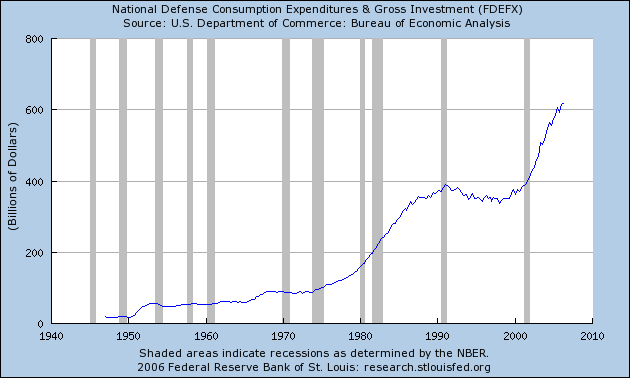
Jeffrey Tucker, one of the inmates of the Mises Economics Blog, posts “Why Libertarians Should Care about Defense.” The entire post consists of this chart:

Because Tucker doesn’t state the point of the chart, I’ll have to read his mind. He’s probably trying to convey a message like this:
- Defense spending was just “right” (i.e., close to zero) in the years immediately after World War II, which might or might not have been a justifiable war for the United States.
- Look at what has happened since then: Defense spending (in inflated dollars) has risen to a very large number.
- Inasmuch as the United States really needs little defense, we’re obviously spending way too much on it.
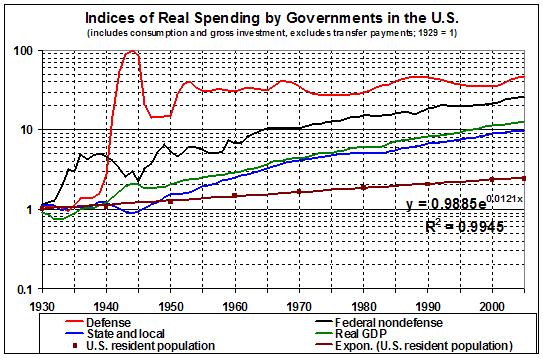
Defense spending, unlike domestic spending is driven by the outside world, by what others could or would do to us, regardless of our delusions about their benignity. It is necessary to spend a lot on defense even when we are not at war, for two reasons: deterrence and preparedness. With that thought in mind, let’s look at three indices of real (inflation-adjusted) government spending: defense, federal nondefense, and state and local — the red, black, and blue lines, respectively:
Sources: Indices of government spending derived from Bureau of Economic Analysis, National Income and Product Accounts, Table 3.9.1: Percent Change From Preceding Period in Real Government Consumption Expenditures and Gross Investment. Real GDP from What Was GDP Then? (Louis D. Johnston and Samuel H. Williamson, “The Annual Real and Nominal GDP for the United States, 1790 – Present.” Economic History Services, April 1, 2006, URL : http://eh.net/hmit/gdp/). Population statistics from U.S. Census Bureau, 2006 Statistical Abstract, Population: National Estimates and Projections, Population and Area: 1790 to 2000 and Resident Population Projections 2005 to 2050.
What does the chart suggest? Several things:
- The benchmark for “necessary” defense spending is World War II. Real defense spending has yet to return to that level.
- But, as a result of our foolish rush to demobilize after World War II, defense spending had to rise in response to Soviet- and Communist Chinese-backed aggression in Korea and the growing military power and aggressiveness of the Soviet Union.
- The partial demobilizations following the Vietnam and Cold Wars necessitated remobilizations to deal with the continuing Soviet miltary buildup and the USSR’s adoption of a forward naval strategy; the likelihood that second-rate powers (e.g., Russia) would strive to counterbalance U.S. power; and our belated understanding of the threat posed by terrorist organizations and their state sponsors.
- Federal nondefense spending and state and local spending have risen generally in step with GDP (green line), and faster than population (purple points and purple regression line). (Note that the chart does not reflect the massively disproportionate growth in spending on transfer-payment programs: Social Security, Medicare, and Medicaid.)
In sum, having becoming locked into the regulatory-welfare state via the New Deal and Great Society, nondefense spending at the federal, state, and local levels has kept pace with what we can “afford” to spend on programs that actually destroy income and wealth. By contrast, defense spending has fluctuated around a high but necessary level, a level that we are much better able to afford now than we were in the days of World War II.
It is customary in democratic countries to deplore expenditures on armaments as conflicting with the requirements of the social services. There is a tendency to forget that the most important social service that a government can do for its people is to keep them alive and free.
— Marshal of the Royal Air Force Sir John Slessor, in Strategy for the West
Related posts:
Not Enough Boots
Defense as the Ultimate Social Service
I Have an Idea
The Price of Liberty
Pornography: A Definition and an Example
The proprietor of Imlac’s Journal observes that
the candid news photograph of a person grieving over a tragedy is as pornographic as a blue movie. It is because the individual has become another object of lurid interest to the voyeur, stripped naked physically or emotionally.
Also pornographic, in my view, is the non-sexual movie that appeals to the “lurid interest” of the rabid partisan. A good example of such a movie is what James Pinkerton calls “that new Bush snuff movie,” Death of a President. Pinkerton continues:
Some might say that “snuff movie” is too strong a term — but how else to describe a movie that clearly revels in the prospect of George W. Bush’s being assassinated?
How else, indeed, except to say that it is pornographic?
What I Said about Climate Change . . .
Don’t Get Your Hopes Up
The good news, via Captain’s Quarters:
Senator Tom Coburn’s office has announced that the Senate has just passed a new bill to replace the language of the original S.2590, which establishes an on-line searchable database for federal spending. This action will expedite the legislative process and may put the bill on President Bush’s desk by tomorrow:
The Senate just passed an amended version of the Coburn-Obama database bill based on our agreement with the House. Following House passage of the bill the measure will go to the president for his signature. Tonight’s action in the Senate means the Senate will not need to revisit the measure as the House will vote on this identical measure tonight or tomorrow.
The Senate, under Bill Frist’s guidance, simply took the modified language under consideration in the House and passed it themselves first, apparently by acclamation. This eliminates the need for a conference committee and avoids any delay after the adoption of the bill in the House. . . .
UPDATE: The bill passed the House tonight, and the bill is on its way to the White House for Bush’s signature already.
The bad news: S. 2590 as I read it, extends only to contracts and not to the operations of the federal government, itself, which will remain shrouded in the arcana of government budgeting. Moreover, the database on contract awards “shall be updated not later than 30 days after the award of any Federal award requiring a posting [emphasis added].” Can you say “barn door closed after horse has left”?
The so-called Federal Funding Accountability and Transparency Act of 2006 falls well short of accountability and “transparency.” The only effective way to make the federal government accountable is to elect members of Congress who make themselves accountable to the Constitution and the limited powers that it bestows on Congress (see Article I, here).
While I’m being an old curmudgeon, I must add that I simply hate the buzz-word “transparency,” which has come into wide use in the past 10-15 years. What is really meant by “transparency” isn’t transparency. Something that is transparent cannot be seen because it can be seen through. What is really meant by “transparency” is visibility: the property of being able to be seen. We want to see what the government is up to (except where it would damage the war effort), and we want to see it before it becomes a fait accompli. I want a government whose operations and budgets are visible to me, not a government whose operations and budgets are invisible because they are transparent.
The Tenth Dimension
Here is a Flash animation that explains the ten dimensions of string theory. (Thanks to Alex Tabarrok of Marginal Revolution for the pointer.) Don’t go away, it’s really worth a few minutes of your time, as a mental exercise, even if you have no interest in physics. To help you through the rough spots, I’ve concocted this summary:
0. The zeroeth dimension is a point, an abstraction of the postion of an object in a system.
1. A line joining two points forms the first dimension. A line has length, but no width or depth.
2. A second line branching off the first adds a second dimension. We now have length and width, but not depth.
3. A third dimension results when the second line is “folded” back on first, enabling movement between the two branches (length and width). Thus we now have length, width, and depth. (Think of a flat piece of paper that is rolled into a tube, so that a point on one edge becomes adjacent to a point that had been on the opposite edge.)
4. As three-dimensional objects change they appear to move along a fourth dimension (time), which extends from, say, the Big Bang to the end of the Universe.
5. The multitude of paths that objects could follow through time (according to quantum mechanics) are branches from the time line. These possible paths constitute the fifth dimension.
6. A sixth dimension results from the folding of the multitude of paths, so that an object can jump from one possible future state (path) to another. The collection of all such possible moves is a point.
7. Each point in the sixth dimension represents all possible outcomes, through all of time, for a given set of initial conditions and physical laws (e.g., the speed of light). The seventh dimension is a line that joins all such possible points, representing all possible initial conditions and physical laws.
8. The eighth dimension is represented by branches from the the seventh-dimensional line. The eighth dimension is analagous to fifth dimension. That is, it represents all the possible “universes” that might result from each of the possible starting points as they move through time.
9. The ninth dimension is analagous to the sixth. That is, it represents the movement from one of the possible “worlds” to another because of the folding of the eighth dimension.
10. The tenth dimension is a single point that encompasses all the possibilities inherent in the ninth dimension. It is the ultimate dimension because, by definition, it encompasses all possible worlds and all of time.
Only the first three dimensions seem “real” to the typical person, who observes the world unaided by scientific instrumentation and theories. Einstein’s special and general theories of relativity account for the interactions of space and time (the first four dimensions). (For an accessible explanation of the special theory, read Lewis Carroll Epstein’s Relativity Visualized.)
Everything from the fifth dimension onward seems to hinge on the controversial “many worlds intepretation” of quantum mechanics. Quantum mechanics lays the foundation for a fifth dimension, but in a tacked-on way. Some 80 years have passed since quantum mechanics became the accepted view of physical behavior at the sub-atomic level, but there still is no generally accepted unifying theory for quantum mechanics and general relativity (see quantum gravity), let alone a “theory of everything,” of which string theory is one example.
In sum, everything from the fifth dimension onward falls in the realm of scientific speculation. Science proceeds from speculation based on observation, but speculation should not be mistaken for scientific knowledge.
In any event, enjoy the animation.
The Nexus of Conservatism and Libertarianism
I wrote about the theoretical and practical aspects of anarcho-capitalism, libertarianism, and conservatism in several recent posts:
What Is the American Constitution?
Utopian Schemes
Is Exit Unrealistic?
The Source of Rights
A Trichotomy of American Conservatism
In response to a reader’s comment about the second of those posts, I said this about anarcho-capitalism:
How can a political philosophy that assumes peaceful cooperation also assume the possibility of violence and non-cooperation? Anarcho-capitalism assumes the possibility of violence and non-cooperation when it allows for private defense agencies. Given that possibility, it then follows that violence and non-cooperation may arise just as readily from within as from without. Not all members of a community can possibly agree about all issues all of the time. Sometimes those disagreements may turn violent. (To assume perfect agreement and non-violence is utopian.) In the end, a majority or super-majority must be prepared to impose peaceful cooperation within a community by empowering an agency for that purpose. That agency — the state — thereby acquires a status independent of the community because it exists to impose the will of the majority of the moment on the renegades of the moment. There is never a consensus, either at a given time or across time.
Anarcho-capitalists typically object to the Constitution of the United States as an imposition on subsequent generations. But how do they then create a stable, cooperative, enduring community? By revisiting the “contract” that binds every member at every moment? That is the only way to true consensus. And it is nonsense.
The real question that faces the friends of liberty is how to contain the power of the state. The Constitution offers the most realistic answer. Friends of liberty should abandon unrealistic schemes, such as anarcho-capitalism, and focus on the restoration of the Constitution.
I am certain to return to the topic of anarcho-capitalism in future posts, mainly because its adherents like to claim, wrongly, that it is “true” libertarianism. It is not even that, however. It is nothing but a pipe dream. Here is John Kekes in “What Is Conservatism?“:
A common ground among conservatives is that the political arrangements that ought to be conserved are discovered by reflection on why, how, and for what reason they have come to hold. The conse~ative yjew is that history is the best guide to understanding the present and planning for the future because it indicates what political arrangements are likely to make lives good or bad.
The significance of this agreement among conservatives is not merely what it asserts, but also what it denies. It denies that the reasons for or against particular political arrangements are to be derived from a contract that fully rational people might make in a hypothetical situation; or from an imagined ideal society; or from what is supposed to be most beneficial for the whole of humanity; or from the prescriptions of some sacred or secular book. Conservatives, in preference to these alternatives, look then to history. Not, however, to history in general, but to their history, which is theirs because it is a repository of formative influences on how they live now and how it is reasonable for them to want to live in the future. Yet their attitude is not one of unexamined prejudice in favour of political arrangements that have become traditional in their society. They certainly aim to conserve some traditional political arrangements, but only those that reflection shows to be conducive to good lives.
In other words, conservatism is a reality-based political philosophy. But what does conservatism have to do with libertarianism? I have in various posts essayed an answer to that question (here, here, here, and here, for example), but now I turn the floor over to Kekes, who toward the end of “What Is Conservatism?” says this:
The traditionalism of conservatives excludes both the view that political arrangements that foster individual autonomy should take precedence over those that foster social authority and the reverse view that favours arrangements that promote social authority at the expense of individual autonomy. Traditionalists acknowledge the importance of both autonomy and authority, but they regard them as inseparable, interdependent, and equally necessary. The legitimate claims of both may be satisfied by the participation of individuals in the various traditions of their society. Good political arrangements protect these traditions and the freedom to participate in them by limiting the government’s authority to interfere with either.
Therein lies true libertarianism — true because it is attainable.
September 11: Five Years On
The time-date stamp of this post is 7:46 a.m. CDT (8:46 a.m. EDT), September 11, 2006 — exactly five years after Mohammed Elamir Awad al-Sayed Atta flew American Airlines Flight 11 into the north tower of the World Trade Center. Atta was an Egyptian-born Muslim who was recruited into al Qaeda in 1998.
Al Qaeda is led by Osama bin Laden and dominated by adherents of Wahabism, a fundamentalist sect of Islam. Al Qaeda is one of dozens of Islamic terrorist organizations, many of which are devoted to Islamism — “a set of political ideologies that hold that Islam is not only a religion, but also a political system that governs the legal, economic and social imperatives of the state according to its interpretation of Islamic Law” — and to jihad in pursuit of Islamism.
Those terrorist organizations that are not devoted to Islamism, as such, are nevertheless motivated by an intolerance for non-Islamic cultures in general, a jealous hatred of Western civilization in particular, and a zeal to eradicate Israel, which is an outpost of Western civilization in the midst of Muslim lands. The attacks of September 11, 2001, underscored what had been true for years — and what remains true today — which is that America and the West are chosen enemies of Islamist jihadists. Those who ignore that truth are doomed either to die at the hands of Islamists or to suffer under their rule.
* * *
When my wife and I turned on our TV set on the morning of September 11, 2001, we learned that a plane had, minutes earlier, struck the north tower of the World Trade Center. Minutes later we watched in horror as a second plane soared through the bright blue sky and struck the south tower. And with that horror came the understanding that America had been attacked. That understanding soon was confirmed when — in the awful silence that had fallen over Arlington, Virginia — we could hear the “whump” as a third plane slammed into the Pentagon.
Our shock and rage were accompanied by fear for our daughter, whom we knew was at work in the adjacent World Financial Center when the planes struck the World Trade Center. (See photos below.) Was her office struck by debris? Had she fled her building only to be struck by or trapped in debris? Had she smothered in the huge cloud of dust that enveloped lower Manhattan as the towers collapsed? Because telephone communications were badly disrupted, we didn’t learn for several hours that she had made it home safely, before the towers collapsed.
Our good fortune was not shared by tens of thousands of other persons: the grandparents, parents, brothers, sisters, husbands, wives, children, grandchildren, lovers, and good friends of the 3,000 who died that day in Manhattan, the Pentagon, and western Pennsylvania.
I was enraged by the events of September 11, 2001, and I remain enraged. I am, of course, enraged at the perpetrators and those like them who remain at large. I am, if anything, even more enraged by those of my fellow citizens who seem unable to grasp the fact that terror is the fault of terrorists, and that the United States must defend itself against those terrorists, even if it means that we are at times inconvenienced and at other times deprived of a smattering of privacy. Those who lament inconvenience and conjure a police state where there is none are rank narcissists and untrustworthy companions in the fight to the finish in which we are engaged.
I have reserved a special place in hell for those politicians, pundits, journalists, celebrities, and bloggers (especially Leftists and anarcho-libertarians) who criticize the war effort simply for the sake of criticizing it, who exude schadenfreude when there is bad news from the front or when the administration suffers a political or judicial setback in its efforts to combat terrorists, and who are able to indulge themselves precisely because they live in a nation that affords them that luxury. It is not a luxury they would enjoy under Leftist or Islamist rule.
A time of war is a time for constructive criticism, for being on the same team and helping that team win by offering ideas about how to win the war. When your country loses a war, you do not win. In fact, you cannot win, unless you choose to join the other side — and the other side chooses to accept you. But, as always, be careful what you wish for.
As for me, I repeat what I have said on every anniversary of September 11, 2001:
Never forgive, never forget, never relent.
* * *
The photos below include views of the building in the World Financial Center in which our daughter was working on the morning of September 11, 2001. (The building is at the right in the first photo, center in the second, and right in the third.) The second photo shows how close her building was to the twin towers of the World Trade Center — the remains of which are partly visible in the foreground. The third photo hints at the substantial damage her building suffered as a result of the collapse of the towers. (The photos are three of many that were taken on September 13, 2001. The entire collection is available here. I am indebted to Keith Burgess-Jackson (AnalPhilosopher) for providing the link to the collection.)
A Trichotomy of American Conservatism
My reading of Roger Scruton’s The Meaning of Conservatism (about which more at a later date) prompts me to dash off this trichotomization of American conservatism. Not all of the following types are truly conservative, by Scruton’s lights, but all usually carry the label “conservative” in American discourse.
True-Blue Traditionalist: This type simply loves and revels in family, community, club, church, alma mater, and the idea of America — which includes American government, with all its faults. If government enacts truly popular policies, those policies are (by and large) legitimate in the eyes of a true-blue. Thus a true-blue may be a Democrat or a Republican, though almost certainly not a libertarian. This type comes closest to Scruton’s view of what constitutes conservatism, even though most Americans would not think of it as conservative.
Libertarian of the Classical Liberal School: This type may (or may not) love and revel in most of the institutions revered by a true-blue traditionalist, but takes a different line when it comes to government. Voluntary institutions are good, but government tends to undermine them. Government’s proper role is to protect the citizenry and the citizenry’s voluntary institutions, not to dictate the terms and conditions of their existence. The classical liberal favors government only when it observes its proper role, and not for its own sake.
Rightist: The rightist differs from the true-blue traditionalist and classical liberal in three key respects. First, he is hostile toward those persons and voluntary institutions that are not in the “American tradition” of white, northern Europeanism. Second, his disdain for things outside the “American tradition” is so great that he is likely to be either an “America firster” or a reincarnation of Curtis “bomb them back to the stone age” LeMay. (That is, he would call the troops home and leave the “heathen masses” to fight it out amongst themselves, or he would simply deal with “those ragheads” by “nuking” them.) Third, he is willing to use the power of government to enforce the observance of those values that he favors, and to do other things that he (arbitrarily) sees as necessary.
I have exaggerated the characteristics of the three types to make them recognizable. Certainly, there are blends of and variations on the three types. There is, for example, the rightist who is isolationist without being racist. And I must add that it is not racist or bigoted to believe with good reason that certain cultures and “movements” contain elements that are destructive of civil society, elements which should therefore be resisted and denied legitimacy.
Profiles in Principle
Apropos the preceding post, here are the names of the U.S. Senators and Representatives who voted against McCain-Feingold (Bipartisan Campaign Reform Act of 2002).
Senators against:*
| Allard (R-CO) Allen (R-VA) Bennett (R-UT) Bond (R-MO) Breaux (D-LA) Brownback (R-KS) Bunning (R-KY) Burns (R-MT) Campbell (R-CO) Craig (R-ID) Crapo (R-ID) DeWine (R-OH) Ensign (R-NV) Enzi (R-WY) |
Frist (R-TN) Gramm (R-TX) Grassley (R-IA) Gregg (R-NH) Hagel (R-NE) Hatch (R-UT) Helms (R-NC) Hutchinson (R-AR) Hutchison (R-TX) Inhofe (R-OK) Kyl (R-AZ) Lott (R-MS) McConnell (R-KY) Murkowski (R-AK) |
Nelson (D-NE) Nickles (R-OK) Roberts (R-KS) Santorum (R-PA) Sessions (R-AL) Shelby (R-AL) Smith (R-NH) Smith (R-OR) Stevens (R-AK) Thomas (R-WY) Thurmond (R-SC) Voinovich (R-OH) |
Representatives against:**
| Aderholt Akin Armey Bachus Baker Ballenger Barcia Barr Bartlett Barton Biggert Bilirakis Blunt Boehner Bonilla Boozman Boucher Brown (SC) Bryant Burr Burton Buyer Callahan Calvert Camp Cannon Cantor Chabot Chambliss Coble Collins Combest Cooksey Cox Crane Crenshaw Culberson Cunningham Davis, Jo Ann Davis, Tom Deal DeLay DeMint Diaz-Balart Doolittle Dreier Duncan Dunn Ehlers Ehrlich Emerson English Everett Flake Fletcher Forbes Fossella Gallegly Gekas Gibbons Gillmor Goode Goodlatte |
Goss Granger Graves Green (WI) Gutknecht Hall (TX) Hansen Hart Hastert Hastings (WA) Hayes Hayworth Herger Hilleary Hilliard Hobson Hoekstra Hostettler Hulshof Hunter Hyde Isakson Issa Istook Jenkins Johnson, Sam Jones (NC) Keller Kelly Kennedy (MN) Kerns King (NY) Kingston Knollenberg Kolbe LaHood Largent Latham Lewis (CA) Lewis (KY) Linder Lipinski Lucas (OK) Manzullo McCrery McInnis McKeon Mica Miller, Dan Miller, Gary Miller, Jeff Mollohan Moran (KS) Murtha Myrick Nethercutt Ney Northup Norwood Nussle Otter Oxley Paul |
Pence Peterson (MN) Peterson (PA) Pickering Pitts Pombo Portman Pryce (OH) Putnam Radanovich Rahall Regula Rehberg Reynolds Rogers (KY) Rogers (MI) Rohrabacher Royce Ryan (WI) Ryun (KS) Saxton Schaffer Schrock Scott Sensenbrenner Sessions Shadegg Shaw Sherwood Shimkus Shows Shuster Simpson Skeen Smith (NJ) Smith (TX) Souder Stearns Stump Sununu Sweeney Tancredo Tauzin Taylor (NC) Terry Thomas Thompson (MS) Thornberry Tiahrt Tiberi Toomey Vitter Walden Watkins (OK) Watts (OK) Weldon (FL) Weller Whitfield Wicker Wilson (NM) Wilson (SC) Young (AK) Young (FL) |
If I had no other information about a person listed above, I would vote for that person if he or she is standing for election to the U.S. House or Senate this fall.
__________
* 38 of 49 Republicans and 2 of 50 Democrats. (Jeffords of VT, a nominal Independent, voted for BCRA.)
** 176 of 217 Republicans (with 5 others not voting), 12 of 210 Democrats (with 1 other not voting), and 1 of 2 Independents.
One Small Blow for Freedom of Speech
First, the bad news:
Andy Roth of The Club for Growth posts a roundup of reactions to McCain-Feingold Iron Curtain Day. As David Keating explains in a followup post,
our free speech rights disappeared at 12:00:01 AM this morning.
It is now illegal for virtually all nonprofit groups to run any radio or TV ad that merely mentions the name of a congressman. Even a 10 second spot that simply had a congressman’s photo and no audio could land you in jail.
David goes on to quote “Former FEC Chairman Brad Smith [who] explains the ‘reform’ today and asks”:
In exchange for surrendering our First Amendment rights, what have we gained? Do you feel Congress is more ethical than before? Less attuned to special interests? Do you feel more empowered, or less empowered, than you did four years ago, when the law passed? Can you name any tangible benefit from these prohibitions?
Absolutely none. Not a one. The only benefit accrues to McCain, Feingold, and the other hypocrites on Capitol Hill who have used their power to immunize themselves from criticism and to perpetuate their incumbency.
Well, I’m mad as hell about it, and I’m going to do something about it.
So, here’s the good news:
This is an open invitation to the supporters of any U.S. House or Senate candidate who has opposed McCain-Feingold, and who is running against an incumbent who voted for it. Send me the links to your candidate’s web site and to his or her statements about McCain-Feingold. If your candidate has indeed opposed McCain-Feingold and his or her opponent did indeed vote for it, I will publicize those facts right here on this blog.
UPDATE (12/09/06): No one has yet taken up my offer. Sad.
Economics: The Dismal (Non) Science
Marton Fridson, writing at TCS Daily, pours some “Rain on the Economic Forecasters’ Parade“:
Investors are keenly interested in the pronouncements of economic forecasters, judging by the massive amounts of ink and airtime allotted to them by the media. It doesn’t necessarily follow, however, that heeding the prognosticators is useful in selecting securities. Whether or not seers have insight into future conditions is a testable proposition. If it turns out that they don’t, governmental attempts to guide the economy also come into question. Such efforts, after all, rely on forecasts generated by the same methodology that private-sector economists utilize.
Statistics compiled by Bloomberg L.P. shed light on the success of prominent forecasters. Each month, the financial information company surveys 60-plus economists from business and academe. The respondents handicap key indicators for the current quarter (which will not be reported until after quarter-end), and for the next four quarters. Among several indicators covered in the survey, I’ll focus on gross domestic product (GDP), the most popular measure of aggregate economic activity. . . .
[The forecasters] overestimated current-quarter GDP 15 times and underestimated it just 6 times, with one bulls-eye. . . .
[D]uring 2001-2006, the year-ahead forecast hardly varied from one year to the next. The median prediction was in the range of 3.1% to 4.0% in every single quarter. Perhaps not coincidentally, the actual quarterly GDP increase over the past 25 years (1981-2005) averaged 3.14%. The forecasters, in aggregate, perennially thought that one year hence, business conditions would be just about average. In reality however, actual GDP gains gyrated between 0.2% and 7.5%. The forecasters’ nearly inert consensus was all but worthless. . . .
As for government policymakers, the message is to forget about trying to control short-run economic performance. Given the lagged impact of fiscal or monetary intervention, deciding whether stimulus or restraint is needed depends on knowing where GDP will be a few quarters down the line. That isn’t something economists have shown they can reliably predict. A more appropriate mission for government policy is to refrain from meddling that ultimately undermines confidence among business and consumers.
Fridson corroborates my similar critique of macroenomic forecasting (first link below). But the failure of economics as a quantitative discipline runs deeper than its inability to model macroeconomic activity with any degreee of reliability.
“Hard science” is far from “hard.” But economics, by comparison, is essentially a pre-scientific, a priori mode of analysis. That’s not to denigrate the valid insights of the likes of Friedrich Hayek and Milton Friedman, but to suggest that the validity of their insights precedes quantification and does not depend on it.
Read on:
About Economic Forecasting
Is Economics a Science?
Economics as Science
Maybe Economics Is a Science
Hemibel Thinking
Physics Envy
Proof That “Smart” Economists Can Be Stupid
Time to Retire the Fair Model
The Thing about Science
What’s Wrong with Game Theory
Debunking “Scientific Objectivity”
Science’s Anti-Scientific Bent
Ten Commandments of Economics
More Commandments of Economics
Science, Axioms, and Economics
Mathematical Economics
Academic Fools
AP story:
Harvard dean defends Khatami invitation
CAMBRIDGE, Mass. – The dean of Harvard University’s John F. Kennedy School of Government defended the decision to invite former Iranian President Mohammad Khatami to speak on the eve of the anniversary of the Sept. 11 terror attacks.
“Do we listen to those that we disagree with, and vigorously challenge them, or do we close our ears completely?” Dean David Ellwood said in an interview published Thursday in The Boston Globe.
This is an excellent example of what passes for rational thought in the academy.
What Dean Ellwood says, in effect, is this: We should listen to an armed thug who is preparing to attack us because if we listen we might learn something. Right! What we’ll “learn” is that the armed thug really isn’t preparing to attack us — just before he does that very thing.
It should come as no surprise to academicians of Ellwood’s ilk (which seems to be most of them) that non-academicians take them for deluded fools, dupes, and Leftists who prefer despotism to freedom. For that is what they are.
The Source of Rights
Stephan Kinsella of Mises Economics Blog, in a pugnacious and meandering post, finally gets around to naming the source of rights, as he sees it. That source is empathy, which is:
1. Identification with and understanding of another’s situation, feelings, and motives. See Synonyms at pity.2. The attribution of one’s own feelings to an object.
Empathy has something to do with it. But my view is that rights arise from self-interest, best expressed as the Golden Rule:
- “Love your neighbor as yourself” – Moses (ca. 1525-1405 BCE) in the Torah, Leviticus
- “What you do not want others to do to you, do not do to others.” – Confucius (ca. 551–479 BCE)
- “What is hateful to you, do not to your fellow man.” – Hillel (ca. 50 BCE-10 CE)
- “Do to others as you would have them do unto to you.” – Jesus (ca. 5 BCE—33 CE) in the Gospels, Luke 6:31; Luke 10:27 (affirming of Moses); Matthew 7:12;
- “Hurt no one so that no one may hurt you” — Muhammad (c. 571 – 632 CE) in The Farewell Sermon.
The Golden Rule implies empathy; that is, the validity of the Golden Rule hinges on the view that others have the same feelings as oneself. But the Golden Rule also encapsulates a lesson learned over the eons of human coexistence. That lesson? If I desist from harming others, they (for the most part) will desist from harming me. (There’s the self-interest.) The exceptions usually are dealt with by codifying the myriad instances of the Golden Rule (e.g., do not steal, do not kill) and then enforcing those instances through communal action (i.e., justice and defense).
The lesson here is three-fold:
- Rights are “natural,” but not in the sense that they are somehow innate in humans. Rather, rights are natural in the sense that they arise from a nearly universal sense of empathy and an experiential belief in the value of mutual forbearance.
- Those “natural rights” have no force or effect unless they are generally recognized and enforced through communal action.
- Rights may therefore vary from place to place and time to time, according to the mores of the community in which they are recognized and enforced.
Related posts:
The Origin and Essence of Rights
More about the Origin of Rights
A Footnote to My Theory of Rights
Rights and the State
The Meaning of Liberty
Those "Dedicated" Public "Educators"
They not only refuse to teach, they also try to prevent others from teaching. What a web of woe we have woven around our children — except for those who are lucky enough to have escaped the public school system.
See also: Detroit Teachers Put Special Interest Politics Ahead of Students (written in anticipation of the Detroit teachers’ strike) and Schools Need Competition Now (John Stossel’s take on the public-school monopoly).
Is Exit Unrealistic?
Joe Miller (Bellum et Mores) writes that “the preferred libertarian solution to political philosophy, namely exit, isn’t a realistic option right now. Voice, however poorly it might work, is an option.” His views seem to parallel mine:
Social norms can and do evolve. Moreover, in a society with voice and exit they will evolve toward greater liberty, rather than less, if exit is not mooted by legislative and judicial imposition of common norms across all segments of society.
Exit remains an option within the United States, because there are significant inter-State differences in tax rates and regulatory burdens, as I discuss here. But it is undeniable that those differences have dwindled as the central government has usurped more and more power from the States and the people.
Which leads to the question whether exit would be a realistic option were the laws of all States to approach oppressive homogeneity. Americans seeking liberty would then have to look elsewhere for it. Exit would then become far less feasible than it is now, given the high emotional and finanical costs of leaving one’s homeland for a foreign land. Consider, for example, the list of nations that rank as high or higher than the United States on the 2006 Index of Economic Freedom:
Hong Kong
Singapore
Ireland
Luxembourg
United Kingdom (?????)
Iceland
Estonia
Denmark
Australia
New Zealand
The looming loss of exit as a realistic option argues for redoubled efforts to resist — and to roll back, as far as possible — the encroaching homogeneity of the laws of the States. It is likely that that homeogeneity will be neither of the “Left” nor of the “Right” (and certainly not libertarian) but a blend of the worst of both possible worlds. There will be no winners under a homogeneously oppressive central government, except those who run it.