Status, Spite, Envy, and Income Redistribution

Andrew Roth of The Club for Growth summarizes the current blogospheric debate about income redistribution. Will Wilkinson (The Fly Bottle) adds what I think is the clincher. Go. Read.

(My views about income inequality and redistribution are captured in the preceding post and the various posts linked to therein.)

Your Labor Day Reading

This, this, and this (summarized here). The poor in the U.S. are less poor than they used to be (and they are not, by and large, the same poor of a generation ago). Moreover, the poor in the U.S. are no poorer than the poor in the socialistic “paradises” of Western Europe and Canada. But the poor in the U.S. can become better off than the denizens of those other nations. And the chances of becoming better off are much greater in the U.S., given its superior economic performance.

Related posts:
Why Class Warfare Is Bad for Everyone
Fighting Myths with Facts
Debunking More Myths of Income Inequality
Ten Commandments of Economics
More Commandments of Economics
Zero-Sum Thinking
On Income Inequality
The Causes of Economic Growth
The Last(?) Word about Income Inequality

Related links:
Now and Then, by Don Boudreaux of Cafe Hayek
More Data on Middle Class Americans, ditto
Half Empty or Half Full, Part I, by Russell Roberts of Cafe Hayek
A Kept Promise, by Greg Mankiw of the eponymous blog
A Primer on the Standard of Living and the Cost of Living, by Russell Roberts of Cafe Hayek
Census and Sensibility, by Jerry Bowyer at TCS Daily
Is the Increased Earnings Inequality among Americans Bad?, by Gary Becker of The Becker-Posner Blog
Why Rising Income Inequality in the United States Should Be a Noninssue, by Richard Posner of ditto

A Haunting Lyric

I think I first heard A.A. MIlne‘s “Disobedience” as a rope-skipping chant. It’s a hanting lyric, the first three lines of which you may never be able to banish from your mind. Here is the first stanza:

James James
Morrison Morrison
Weatherby George Dupree
Took great
Care of his Mother,
Though he was only three.
James James Said to his Mother,
“Mother,” he said, said he;
“You must never go down
to the end of the town,
if you don’t go down with me.”

You Bet Your Life

Most persons who are confronted by an armed mugger will accede to the mugger’s demands for wallet, jewelry, etc. The immediate prospect of being killed or injured generally outweighs the thought of resistance or flight, neither of which is likely to be effective and both of which might simply infuriate the mugger. The instintive logic at work in most persons goes like this: My odds of surviving this incident unharmed are much greater if I accede to the mugger’s demands than if I try to resist or flee. I value my life and limb more than the money and jewelry demanded by the mugger. Therefore, I will accede to the mugger’s demands.

Environmental alarmists react to the very mixed and uncertain evidence about climate change and its causes as if they were facing an armed mugger. Oh, they say (in effect), let’s give in to the “mugger” and forswear our wealth so that we might live to see a cooler, less turbulent day.

The difference, of course, is that the threat posed by the mugger is immediate and obvious. He’s right there in your face. That is not the case with climate change; we see the change (e.g., rising temperatures) but we are very far from certain about its causes, effects, and future course. (In addition to the item linked above, see this, this, and this, and follow the many links in the third item. See also John Ray’s Greenie Watch, which is replete with relevant material.)

Those who counsel environmental “action” in the face of such great uncertainty about the causes, effects, and future course of climate change are not being mugged, nor are they witnesses to a mugging. They are spectators to a scene that is visible to them through a translucent screen. They see something going on and they assume that it is a crime and that they can identify and shoot the criminal without harming the victim. In fact, there may be neither criminal nor victim. To assume that there is a crime and an identifiable criminal runs the risk of harming innocent persons (i.e., everyone) for the sake of nothing.

We are not facing the one-sided certainties of such screen “gems” as The Day After Tomorrow or An Inconvenient Truth. We are peering through a sceen darkly. The only muggers we face, in actuality, are the perpetrators of such propaganda as The Day After and Inconvenient — and those scientists who abet them, wittingly or not.

Do you want to bet your life (or livelihood) on the biased inferences of environmentalist muggers? I don’t. I want a lot more information about what is happening to the climate, why it is happening, whether the consequences for humans are good or ill, and what (if anything) humans can do about it if the consequences are ill.

Related link: Reality-Based Skepticism of Government Action to Reduce Global Warming, by Don Boudreaux of Cafe Hayek

Is the State Necessarily Paternalistic?

Correspondence with a reader about my post, “The Feds and ‘Libertarian Paternalism’,” leads me to this observation:

The state is not paternalistic per se. The state acts paternalistically when it forces or incentivizes its citizens to behave in certain ways. But the state is not acting paternalistically when it shields its citizens and enables them to behave as they will, in accordance with the harm principle as it is properly understood (see below).

Related definitions:

paternalism – the attitude (of a person or a government) that subordinates should be controlled in a fatherly way for their own good

shielding – the act of shielding from harm

Related posts (with links to other related posts):
Another Voice Against the New Paternalism
The Meaning of Liberty
The Harm Principle
Footnotes to “The Harm Principle”
The Harm Principle, Again
Actionable Harm and the Role of the State
Rights and “Cosmic Justice”
Liberty, Human Nature, and the State

Democrats: The Anti-People People

From a story by Jim Kouri at The National Ledger:

The continuous demonizing and vilifying of Wal-Mart Stores by Democrat Party officials is not working to turn Americans against the enormously successful US retailer, according to a recent poll. It may actually be hurting some Democrat politicians who are trying to hide their liberal-left agenda.

Wal-Mart spokeswoman Sarah Clark on Friday released the following statement on a new poll conducted by the Pew Research Center for the People & the Press:

“This poll is the latest proof that politicians will turn off most voters by attacking Wal-Mart and that the attacks themselves are not working. America’s working families want to decide for themselves where to work and where to shop.

“The numbers make it clear that America’s working families value Wal-Mart’s job opportunities, savings, and the benefits we provide the communities we serve. By attacking Wal-Mart, politicians show they are out of touch with working families.

“Working families support Wal-Mart because the company creates tens of thousands of jobs each year, provides health care for as little as $11 per month, and because economic studies verify that Wal-Mart saves American families $2300 a year.”

Here’s the moral, in a nutshell, for those Democrats who are open to reason: Wal-Mart provides jobs for low-income families; Wal-Mart offers low prices to low-income families. When politicians hurt Wal-Mart, they hurt low-income families. Get it? Republicans do.

Related: See this post by Donald Boundreaux, whom I sometimes chide for his radical libertarianism. When sticks to economics he is first rate.

Remembrance of Teachers Past

With the aid of the Social Security Death Index (searched via this tool), I “found” several teachers and school adminstrators from my K-12 days who have passed on. At the end of this post I draw meaning from this trivial exercise. First, the list of “found” educators:

First grade:
Margaret S. Lester, 02/24/1921 – 04/03/1989

Third grade:
Ethel Parsons, 05/27/1895 – 05/xx/1974

Fourth grade:
Lila Nurenberg, 02/07/1905 – 07/xx/1972

Sixth grade:
Esther L. Minnie, 08/05/1909 – 03/xx/1980

Seventh grade (homeroom):
Maurice B. Greene, 10/22/1910 – 06/22/1995

Junior high principal:
Stanley R. Hardman, 09/13/1901 – 03/05/1992

Junior high math:
William L. Laidlaw, 11/12/1904 – 03/xx/1972

Senior high principal:
Omer P. Bartow, 09/15/1902 – 08/22/1992

Senior high math:
Frank B. Yon, 01/04/1920 – 08/11/2001

Senior high Latin:
Thelma Sharritt, 04/07/1900 – 01/xx/1982

Senior high English:
Aharas Kresin, 10/06/1908 – 01/23/2001

Senior high social studies:
Dwight Lange, 08/02/1918 – 01/05/1994

Senior high guidance counselor:
Burman J. Misenar, 07/25/1915 – 08/06/1994

Superintendent of schools:
Howard Crull, 04/09/1898 – 06/xx/1968

Superintendent of schools:
Norris Hanks, 05/06/1900 – 10/xx/1981

Missing are: female teachers who were unmarried when they taught me but went on to marry and use their husbands’ names, teachers with combinations of first names and last names that are common, and teachers whom I knew only by last name. Also missing, of course, are those teachers with uncommon first name-last name combinations who are still among the quick.

I am convinced that the principal of the first school I attended (a Mrs. Forbes) was born soon after (if not during) the Civil War. I exaggerate (a bit), but it is evident that my worldview was influenced strongly by many persons who came of age in the early part of the 20th century, persons who remembered vividly the Great Depression and World War II. Then there was the influence of my maternal grandmother, who came of age in the late 1800s. (See here.)

Think about the persons who were influential in your life when you were a child and adolescent. When were they born? What great events did they live through as adults? Do you, in some ways, see their attitudes reflected in yours?

Eternity Road Takes It Up Several Notches

Francis W. Porretto, proprietor of Eternity Road, takes my humble post of yesterday (“Utopian Schemes“) and builds upon it a towering edifice of erudition and logic. Go there and read the whole thing. I’m still digesting it, and I may — or may not — have more to say on the subject.

Utopian Schemes

In the preceding post I referred to anarcho-capitalism. Anarcho-capitalism rests on the utopian proposition that peace and liberty can reign in a stateless world in which human beings freely contract with each other for all goods and services, including justice and defense. But admitting that justice and defense might be necessary is tantamount to admitting that peace and liberty might not reign, that there are renegades — potentially powerful ones — who are uninterested in peaceful cooperation, free markets, property rights, and all the rest of it. From there it is but a step to imagine that such renegades might prevail. And it is but another step to acknowledge that they have prevailed in many places and at many times, up to and including the present.

Anarcho-capitalism is not the only utopian worldview, of course. Consider this definition of utopian: “The ideals or principles of a[n] . . . idealistic and impractical social theory.” Communism and socialism also fit that definiton. The difference between anarcho-capitalism, on the one hand, and communism and socialism, on the other hand, is that communism and socialism have reigned in some places and at some times. But they have reigned in name only; like anarcho-capitalism, pure communism and pure socialism are idealistic and impractical.

And it is practicality that matters, not imaginary schemes based on implausible assumptions about human nature. Most persons know instinctively that anarcho-capitalism is nothing but a pipe dream, an ideology not worth their time and attention. Anarcho-capitalism (like its close relative, Objectivism) is mainly the refuge of naïfs, cranks, malcontents, and persons under the age of 25 who are still searching for “the meaning of life.” Anarcho-capitalism, in other words, can actually harm the cause of liberty to the extent that it is mistaken for realistic libertarianism.

What is realistic libertarianism? It is Hayekian classical liberalism, which focuses on the maximization of liberty under the aegis of a state that dispenses justice and provides for the common defense. (See this, this, and this, for example.) Our most realistic hope for living in something close to a state of classical liberalism is the realization of the principles of the Constitution of the United States. Those principles more or less held sway for 120 years, until the advent of the “progressive” movement about 100 years ago.

Is the Constitution a perfect statement of libertarian principles? No. Are the principles the Constitution still attainable in practice? Perhaps not entirely. But the Constitution still says what it says — its words cannot be obliterated. It is therefore a realistic and practical project to restore something like constitutional government to the United States. As I suggested in the preceding post, we may be only a Supreme Court justice or two away from beginning to undo the damage of the past 100 years.

What Is the American Constitution?

I recently came across an essay written by Donald J. Boudreaux in 1998: “What Is the American Constitution?Boudreaux — who is now a co-blogger at the excellent Cafe Hayek and its companion, Market Correction, and also serves as chairman of the Department of Economics at George Mason University — wrote the essay when he was president (1997-2001) of the Foundation for Economic Education.

Boudreaux is an idealistic libertarian who, in my reading of him, seems to be an anarcho-capitalist (a.k.a. stateless capitalist). Eerily, “What Is the American Constitution?” parallels the views of Roger Scruton — a conservative, statist, monarchist, skeptic of free markets — as expressed in his The Meaning of Conservatism, which I am now reading. (I won’t say more about Scruton’s book until I’ve finished it.)

Here I comment on several excerpts of Boudreaux’s essay. In the end I offer a much different view of the American constitution than that offered by Boudreaux.

I begin with Boudreaux’s thesis:

The constitution is neither a document nor the collection of words in a document. Instead, the constitution is the dominant ideology within us, an ideology that determines what we permit each other to do, as well as what we permit government to do. No words on parchment, regardless of the pedigree of that parchment or of the men and women who composed those words, will ever override the prevailing belief system of the people who form a polity.

Boudreaux suggests that the constitution is only what “we” allow each other to do. But “we” are, to a large extent, bound by the decrees of government (popular or not) and government’s ability to enforce those decrees. That there is not a one-to-one linkage between the “prevailing belief system” of the people and what the people are allowed to do (or not do) can be seen, for example, in the imposition of integration in the South, the legalization of abortion, and the collection of taxes to support for several years what had become an unpopular war in Vietnam.

Moreover, it is far from clear that there is a “prevailing belief system” that enables “us” to agree about what “we permit each other to do, as well as what we permit government to do.” Can there be such a monolith in a republic whose citizens are so heterogenous in ethnicity, religion, education, economic status, social status, intelligence, and exposure to the arguments for and against free markets (to name only a few aspects of dissimilarity)? I doubt it. There may be general agreement about such matters as the wrongness of murder and theft, but that general agreement does not translate to a national consensus about what constitutes murder or theft, or how (or whether) they should be punished. (Consider, for example, the disparate ways in which murder and theft are parsed in the laws of the States, the equally disparate sentences that may be applied to those various degrees of murder and theft, and the broad latitude exercised by prosecutors and juries in their application of the law.) The meaning of liberty (and how best to secure it) is similarly surrounded in discord. Thus we inevitably fall back on government as the means by which to reach and enforce compromises about what we permit each other to do and what we permit government to do.

Let us return to Boudreaux, as he discusses the disparity between the written Constitution and the de facto constitution:

We have at hand ready proof that the constitution is ideology rather than words in a document. Read the document popularly called “the Constitution” and ask if it accurately describes the law of the land. Your answer will almost certainly be no. That document clearly gives to the national government only very limited powers for example, to coin money, to operate post offices, and to supply national-defense services. Today, however, Washington knows almost no restraints on how deeply its regulatory arms reach into the lives of American citizens. No species of economic regulation is off-limits to the national government. Likewise, Washington routinely and without a whiff of apology exercises governmental powers clearly intended by the framers of the Constitutional document to be reserved to each state.

Of course, the de facto constitution does not and cannot represent a coherent ideology, for the reasons discussed above. Like the written Constitution, the de facto one represents a compromise among varied interests. It has been shaped willy-nilly by generations of elected and appointed government officials, for the benefit of the shifting coalitions of special interests that have enabled those governors to govern. FDR, for example, was not elected because he promised to nationalize the means of production and institute socialistic schemes — but that is what he tried to do after he was elected. A majority (but never a super-majority) of citizens then rallied around FDR out of desperation and in the false belief that his methods were effective.

Boudreaux nevertheless tries to salvage a role for “prevailing ideology”:

Those instances in which the Constitutional document has teeth (such as the First Amendment’s prohibition of government interference with the press) are those instances in which the prevailing ideology of the American people happens to correspond with what’s written in the Constitutional document. But in those many instances when the prevailing ideology runs counter to the text of the Constitutional document, the document is toothless.

The apparent survival of freedom of the press has little to do with prevailing ideology, such as it is, and much to do with political power — not the power of “the people” but the power of special interests. Freedom of the press is fiercely defended by parties with a strong interest in the enforcement of that prohibition (e.g., the press and the liberal elites for whom the press is a mouthpiece), and by courts eager to check executive power. By the same token, a provision of the Constitution that might seem to be of interest to the people — namely the First Amendment’s prohibition of governmental interference with political speech — has been gutted by campaign-finance “reform” in the service of the nation’s most powerful special interest group: members of Congress. (I have just demonstrated public choice theory, which has several proponents and exponents among GMU’s economics faculty.)

Returning to Boudreaux:

In the past, when I got furious at the government for doing things clearly prohibited by the Constitutional document, I would declare “That’s unconstitutional!”

I was wrong. Those innumerable government actions that are at odds with the Constitutional document as well as with the principles of a free society are in fact constitutional. These actions are constitutional because the constitution is the actual legal framework of our society—and the actual legal framework in America today grants to government extraordinarily vast powers for intruding into the lives of peaceful people.

And yet, if President Bush were to appoint one or two more Supreme Court justices in the mold of John Roberts and Samuel Alito, the government might suddely find itself with fewer of those “extraordinarily vast powers.” The successful appointment of another Roberts or Alito would come about not through the osmotic application of a mythical “prevailing belief system” but, rather, through politics as usual (e.g., public relations “blitzes,” horse-trading with Democrat senators, and the enforcement of party discipline among Republican senators.)

Boudreaux proceeds to a hypothetical illustration of the power of “prevailing ideology”:

[A]sk what would happen if Congress enacted legislation banning interstate travel by Americans. Can you imagine Americans today respecting such an odious statute? Of course not despite the fact that the Constitutional document does not explicitly prevent Congress from passing such legislation. To avoid enforcement of this statute we wouldn’t have to wait to throw from office the bums who enacted it. Because of the prevailing American ideology, which is hostile to such legislation, this statute would be a nullity from the moment the President signed it.

Here, Boudreaux conjures another Prohibition. He appeals (if only subconsciously) to the popular but misguided notion that Prohibition didn’t work. In any event, Prohibtion, which lasted for 13 years, resulted from a century-long campaign against the consumption of alcoholic beverages. It wasn’t a sudden, broadly unpopular legislative whim of the type suggested by Boudreaux’s example.

There would have to be strong but far from unanimous support for a ban on interstate travel (e.g., among environmentalists, their allies on the Left, and paternalistic politicians of the McCain-Feingold ilk), which such ban would certainly grant exceptions for certain interest groups (e.g., truckers and bus companies). Lobbying and clever media campaigns could do the rest. In any event, even legislation that is not broadly popular will be honored broadly (if not by everyone) if it is seen to be enforced. (Consider, for example, the integration of Southern schools and the registration of black voters, both of which came to be the rule rather than the exception in spite of broad popular opposition to those measures.)

In any event, Boudreaux’s resort to an extreme and implausible example tells us nothing about the piecemeal subversion of the Constitution, which owes little to a mythical prevailing ideology and much to leadership, opportunism, political alliances, elite opinion, lobbying, media manipulation, interest-group log-rolling, pork-barrel legislation, judicial fiat, and the “followership” tendencies of most Americans.

Boudreaux next exalts the power of ideas:

It follows that ideas matter enormously. Ideas, not words, are the principal ingredient of the American constitution. If ideas change, so does the constitution. And the only way really to change the constitution is to change the ideas accepted by the great swath of citizens.

Yes, it does matter if ideas change. But it especially matters whose ideas change, and whose interests are served by adopting new ideas. I refer you to the final paragraph of the preceding discussion.

Boudreaux closes with this:

Liberty cannot be secured by asking its foe-the state-for more respect. Liberty cannot be secured at ballot boxes or in courtrooms. Liberty must reside in the hearts of people if it is to reign. And the only way that liberty can find its way into the hearts of people is through the promulgation and circulation of the ideas of liberty. In these ideas lies liberty’s only hope.

The promulgation of the right ideas is necessary but far from sufficient. Anti-statist ideas have gained much respectability in America since the advent of Ronald Reagan, but I cannot see that we have gained liberty as a result. Elected and appointed officials who are dedicated to liberty must come to the fore and lead the way. And then we must be lucky enough to avoid, for a very long time, another Great Depression or similar national trauma, so that the idea of liberty can sink deep roots and withstand the attempts of demagogues and power-hungry politicians to diminish liberty by appealing to fear and building coalitions of anti-liberty interests.

What, then, is the American constitution? It is whatever our governors make it out to be, regardless of the written Constitution. The people, by and large, seem willing to acquiesce in almost any unwritten constitution, as long as they retain the illusion that their particular interests are being served. Most Americans harbor that illusion because they focus on the special benefits which with their votes are bought, while failing to grasp the very high price they pay (in money and liberty) for the benefits received by others. Contrary to the proponents of campaign-finance “reform,” the money that corrupts politics flows from the governors to the governed, not the other way around.

It will take more than ideas to reform the unwritten constitution so that it passingly resembles the written one. It will take acts of moral courage and leadership. Those acts must come mainly from generations that have yet to enter the political arena. And those generations must embrace liberty in spite of the misconceptions, propaganda, and outright lies that emanate from the media, the academy, special-interest organizations, the vocal Left, and — most of all — from the governing classes, the elites whose agenda they serve, their entourages, and their constituencies.

In the meantime, the best we can hope for is another good Supreme Court justice, or two.

Remembering Katrina

It is au courant to observe the first anniversary of Hurricane Katrina’s landfall in Louisiana and Mississippi. But there is more to the observance than the recounting of a natural disaster and its attendant human and material cost. Katrina has been translated from a natural phenomenon to a political one. Katrina has become the weapon of choice for those who willingly embrace government as “big brother” (except when it legitimately seeks to defend them against foreign enemies), and those who like to characterize their political opponents as “uncaring” and “bigoted.” (But I repeat myself.)

Well, my way of remembering Katrina is to link to the several posts that the weaponizing of Katrina caused me to write:

Katrina’s Aftermath: Who’s to Blame? (09/01/05)
“The Private Sector Isn’t Perfect” (09/02/05)
A Modest Proposal for Disaster Preparedness (09/07/05)
No Mention of Opportunity Costs (09/08/05)
Whose Incompetence Do You Trust? (09/10/05)
An Open Letter to Michael Moore (09/13/05)
Enough of Amateur Critics (09/13/05)

Conspiracy Theories

Wikipedia offers a thorough discussion of conspiricism and a long, annotated catalog of conspiracy theories that have been popular at one time or another. The final theory in the catalog goes a long way toward explaining the present state of affairs. It also justifies the use of the somewhat controversial term “Islamic fascists.” Here it is:

IslamicFascist Axis

Radio talk show host David Emory claims that Nazi leader Martin Bormann never died and has built a global empire involving, among many others, the Bush family, Hassan al Banna, Grover Norquist, Meyer Lansky, and Michael Chertoff. This may have sprung from the factual World War Two alliance between Nazi Germany and the Grand Mufti of Jerusalem, a religious and political leader of the area then known as Palestine.

There’s a conspiracy theory for you: a Nazi, the Bushes, an Arab-Muslim extremist, an anti-tax conservative, a Jewish gangster, and a Jewish lawyer-prosecutor-cabinet secretary.

I can’t wait for the movie.

P.S. On a serious note, check out this piece about the “9/11 “Truth” movement.

P.P.S. In the same vein, there’s this at RightWingNutHouse.

Don’t Marry a Career Woman

Michael Noer, writing at Forbes.com, says “Don’t Marry a Career Woman.” Here’s a career woman who exemplifies the wisdom of Noer’s advice.

P.S. A related post is here. There’s another one here.

Fire Ward Churchill

PirateBallerina has posted a petition to fire Ward Churchill:

Fire Ward Churchill

We, the undersigned faculty members of US institutions of higher learning, in order to protect and ensure the integrity of academic scholarship, applaud and support the efforts (however belated or inept) of the University of Colorado at Boulder to terminate the employment of Professor Ward Churchill, a documented historical fraud and serial plagiarizer.

The petition may be signed only by academics who teach (or taught) at U.S. institutions of higher learning. Two college professors have had the courage to identify themselves and sign the petition. If you qualify as a signatory, get in on the action. Follow this link for more information.

The Anti-Phillips Curve

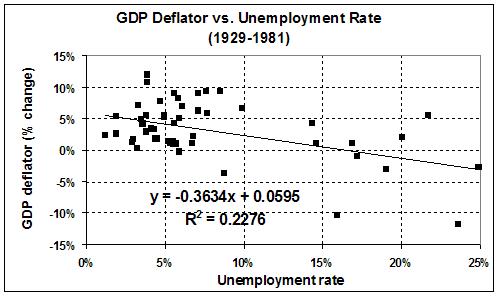
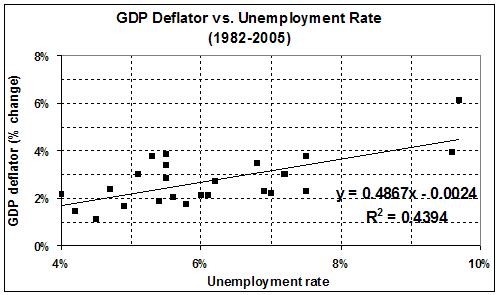
The Phillips Curve, as you probably know, depicts an inverse relationship between inflation and unemployment: Inflation abates as the unemployment rate rises, and vice versa. That inverse relationship, however, holds only in a stagnant or slowly growing economy. In an economy with robust gains in productivity, inflation can abate even as the unemployment rate falls.

As Lawrence Kudlow notes, in a post at Kudlow’s Money Politic$, “over the last 25 years, unemployment and inflation have actually moved in tandem and they have both moved down.” That’s exactly right. From 1929 until the early 1980s, when inflation was brought under control, inflation (as measured by the GDP deflator) tended to move in a direction opposite that of the unemployment rate. Since the early 1980s, both inflation and the unemployment rate have been moving generally downward, that is, in the same direction:

Expectations of higher inflation, ceteris paribus, drive up interest rates and make capital investments less attractive; expectations of lower inflation, by the same token, make capital investments more attractive. Expectations of lower and then consistently low inflation since the early 1980s have encouraged investments that, in themselves, help to contain inflation by making it possible to produce goods and services at lower (real) cost. Those investments also have fueled more rapid (and less volatile) economic growth than that experienced from the end of World War II to the early 1980s. As a result, job creation has tended to outpace the growth of the labor pool; thus the downward trend in the unemployment rate. The postive frame of mind caused by lower inflation, coupled with more robust economic growth, has been reinforced by having had two tax-cutting presidents (Reagan and Bush II) and the Republican-enforced fiscal discipline of the Clinton presidency. It’s all a virtuous cycle.

Thus endeth the Phillips Curve, unless and until our “masters” in Washington decide, once again, to stifle economic growth by raising taxes and reinstituting the regulatory excesses of the Clinton era.

The Price of Liberty

Justin Logan, one of Cato Institute’s nay-sayers, asks: “What Would You Rather Have, The War in Iraq or $1,075?” He notes, “That’s how much you’ve spent on it so far.”

Well, I know his answer: He’d rather have the $1,075. That’s because he’s one of those paleo-libertarians who’d rather wait until he sees the whites of his enemy’s eyes, that is, until it’s too late.

My answer: I’d rather have a successful war in Iraq, even if it costs me a lot more than $1,075. World War II cost the average American more than $20,000 in today’s dollars, not to mention the vastly greater number of casualties inflicted on American forces in that war than in Iraq.

Regardless of what paleo-libertarians and their Leftist allies may think, the war in Iraq is a facet of a larger effort to defeat terrorism, in part by neutralizing its state sponsors. It is not an exercise to slake the blood-lust or power-lust of the Bush-Cheney-Rumsfeld axis.

It is imperative to win in Iraq, just as it is imperative to keep the airways safe, even if that means inconveniencing travelers. Terrorists win when they kill us, not when we thwart them. They certainly do not win when a flight is diverted or canceled, as whiners and scoffers (of all political stripes) would have it.

Related posts:
Not Enough Boots
Defense as the Ultimate Social Service
I Have an Idea

I Have an Idea

Let’s just pack up and go home. That’s what the paleos (conservative, libertarian, and liberal) want us to do. So let’s just do it:

  • Let’s pull all of our armed forces back to the United States and its territorial waters. (Better yet, let’s disband the armed forces: threats to the U.S. are merely illusory.)
  • Let’s leave Western Europe to rot in its own socialistic, Muslim-infested juices.
  • Let’s leave the Turks, Kurds, sheikhs, Jihadists, and others to fight it out over the fate of the Middle East and North Africa and their vast reservoirs of oil. (Though we should ensure that Israel is well-stocked with nuclear weapons before we leave.)
  • Let’s leave Central and South America, with their oil and other natural resources, to Hugo Chavez and his ilk.
  • Let’s leave China, North Korea, South Korea, and Japan to fight it out over the fate of East Asia.
  • Let’s leave India, Pakistan, Iran, and Afghanistan to fight it out over the fate of South and Southwest Asia.
  • Let’s allow the resurgent imperialism of Vladimir Putin to feast on Eastern Europe, the Balkans, the “Stans,” and who knows what else.
  • Let’s just pretend that everything will turn out all right: that someone else will deal with the predators out there; that natural resources won’t be monopolized by despots; and that international trade will flow apace.
  • Let nothing stand between us and the Stalins, Hitlers, and Maos of the 21st Century.

Let’s just do it — and leave this legacy for our descendants:

  • More widespread poverty than at any time since the Great Depression. (Not the “simple but happy” life of the Luddite Left’s imagining.)
  • A garrison state, devoting a large share of a reduced national output to the (perhaps futile) task of keeping predators at bay.

Is that what the paleos want? That’s what they seem to want, given their inability either (a) to find a real threat to our existence or (b) to offer a coherent strategy for dealing with those enemies whose existence they are willing to acknowledge.

Related posts:
Not Enough Boots
Defense as the Ultimate Social Service

The Meaning of Conservatism: A First Reaction

I am reading Roger Scruton’s The Meaning of Conservatism. I have finished the first two chapters. There is, thus far, much with which I agree and that I have said already: here and here, for example.

That is all for now. I will say no more about the book until I get deeper into it. Perhaps not until I finish it and have mulled it thoroughly.

What I Said . . .

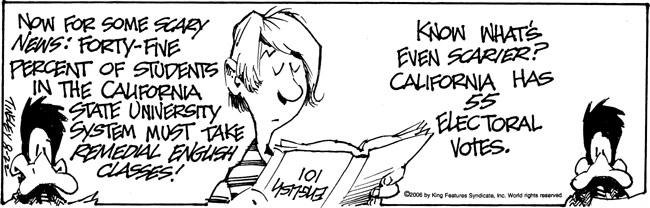
. . . here, Mallard Fillmore underscores:

Excellence

When it comes to athletic events, I do not root for an underdog just for the sake of doing so. An underdog is an underdog for a good reason — he, she, or it has compiled a record that is not as good as that of the athletes or teams he, she, or it is up against. I may root for an underdog because the underdog is (for some other reason) an athlete or a team that I favor. But that’s the end of it.

I prefer enduring excellence. That is why, for example, I enjoy watching Tiger Woods play golf. It will be a sad day for me when his skills diminsh to the point where he is no longer the golfer that he has been for most of the past ten years. I just hope that he is succeeded by another electrifying talent, not by a “committee” of also-rans.