Character Will Out

UPDATED – 10/11/04

A few posts ago I quoted QD at Southern Appeal:

So in spite of the fact that Kerry promises to “kill” the terrorists, it seems much more plausible to think that he’ll instead tack toward the French and German strategy of using intelligence and legal means to disrupt terrorist plans while carefully avoiding acts which might “inflame” potential adversaries. In other words, he’ll revert to a pre-Sept. 11th strategy. What makes the Kerry supporters think I’m wrong here?

My comment:

QD is quite right. Character shows up early in adult life and sticks with you, unless you experience what QD calls a deep psychological crisis. James David Barber’s classic book, Presidential Character: Predicting Performance In The White House, amply documents the persistence of long-held character traits into the White House years of American presidents.

But what about Bush, the erstwhile playboy, alcoholic, and drug-taker? Bush, unlike Kerry, forced a psychological crisis upon himself. He is not the same person he was in his wanton days. He has evolved into a hard-nosed realist who will kill terrorists.

Now, thanks to pointers from all over the blogosphere, I find the following in today’s New York Times:

When I asked Kerry what it would take for Americans to feel safe again, he displayed a much less apocalyptic worldview. “We have to get back to the place we were, where terrorists are not the focus of our lives, but they’re a nuisance,” Kerry said. “As a former law-enforcement person, I know we’re never going to end prostitution. We’re never going to end illegal gambling. But we’re going to reduce it, organized crime, to a level where it isn’t on the rise. It isn’t threatening people’s lives every day, and fundamentally, it’s something that you continue to fight, but it’s not threatening the fabric of your life.”

What a dunce! The only way to get back to where we were — if we can — is to wage an all-out war on terror by constantly disrupting terrorists’ plans and destroying terrorists wherever we can, with every means at our disposal: legal, financial, diplomatic, and military. Suggesting that we might tolerate terrorists as a “nuisance” — like hookers on a street corner or back-room gamblers — is a perfect illustration of Kerry’s legalistic view of the problem.

We’re in a war, dammit — not a fight to reduce the incidence of graffiti. And we’ll be in a war until the terrorist bastards are less than a nuisance.

UPDATE 1:

Lileks, as usual, says it better:

But that’s not the key phrase. This matters: We have to get back to the place we were.

But when we were there we were blind. When we were there we losing. When we were there we died. We have to get back to the place we were. We have to get back to 9/10? We have to get back to the place we were. So we can go through it all again? We have to get back to the place we were. And forget all we’ve learned and done? We have to get back to the place we were. No. I don’t want to go back there. Planes into towers. That changed the terms. I am remarkably disinterested in returning to a place where such things are unimaginable. Where our nighmares are their dreams.

We have to get back to the place we were.

No. We have to go the place where they are.

UPDATE 2:

Filmmaker Alexandra Pelosi (daughter of Big Democrat Nancy Pelosi and a Democrat herself), made a ripple a few years ago with her documentary about Bush’s 2000 campaign. Now she’s back with another campaign documentary and some telling insights about Bush and Kerry (from an AP story, via the Austin American-Statesman, registration required):

…Pelosi’s documentary “Journeys with George,” which made a splash at the 2002 South by Southwest Film Festival, depicted a goofy but endearing George W. Bush in backstage moments during the 2000 presidential campaign.

Fortunately, Pelosi wasn’t looking for the star of a sequel. She went back to the campaign trail more to expose a dysfunctional process than a candidate. The quickly edited film “Diary of a Political Tourist” premieres tonight at 7 on HBO.

The documentary opens nostalgically with Bush holding a barbecue for members of Congress on the White House lawn (Pelosi is the daughter of House Democratic leader Nancy Pelosi) and good-naturedly teasing Alexandra.

“How much money did you make off of me?” the president asks.

“I’m going to be a beneficiary of your tax cut,” she replies.

By contrast, the man who’s looking to replace him exposes virtually nothing in hours of filming. Kerry is always cautious, always conscious of the camera.

Whatever you think of his politics, Bush is a movie star, Pelosi said. Kerry isn’t.

“I don’t think if I spent six more months on his lap was he going to reveal any more than he did,” she said. “He was who he was. I wasn’t going to crack the code of understanding John Kerry.”

It didn’t happen during the depths of Kerry’s campaign — when Pelosi impudently asked, “Are you a dead man walking?” — or its heights, when the filmmaker tried for weeks to land a one-on-one interview with the presumptive nominee.

When an audience was finally granted, Kerry surrounded himself with young aides and derailed the process by grabbing Pelosi’s camera and turning it on her, just like Bush had four years earlier.

“I never thought I saw one honest moment during the entire campaign,” Pelosi said….

Enough said.

It Happens Every Four Years

At least a few pro-Bush bloggers (here and here) are worried because of reports like this:

Surge in voter registration setting records

By Donald Lambro

THE WASHINGTON TIMES

A surge in voter registration that is setting records in the battleground states has led election forecasters to predict the largest increase in turnout in more than a decade.

With a little more than three weeks left before Election Day, election officials nationwide report that new voter registrations are still pouring in, boosting the number of registered voters in many states to levels never seen before.

“We have seen a real rush to become registered by eligible voters all over the country,” said Meredith Imwalle, spokeswoman for the National Association of Secretaries of State, the officials who tabulate and oversee elections and voter registration.

Election officials say that the sharp rise in registration is to a large degree the result of a much more intensive grass-roots canvassing campaign by the Republican and Democratic parties and the campaigns of the two presidential candidates, President Bush and Sen. John Kerry.

“They have been very aggressive, the most aggressive that I’ve seen in my career,” said Curtis Gans, who runs the Committee for the Study of the American Electorate.

The same political intensity that is driving voter registration to new highs likely will boost voter turnout as well, the analysts said.

“I don’t think there has been a more emotionally intense an election since 1968. Turnout will be up,” Mr. Gans said….

Republican National Committee (RNC) officials said they have signed up more than 3 million new Republican voters. Democratic National Committee (DNC) officials said they have exceeded that number, but refused to give any statistics Friday.

“The Democrats have not put out a number. We saw registration as part of our election strategy. It’s an area where the Republicans are playing catch-up,” DNC spokesman Tony Welch said. “They set their goals to create headlines. We’re looking for voters, and by all accounts our registration is far outpacing theirs.”…

It’s all hype and PR. Of course, voter registrations are spiking now; the election is coming and registration deadlines are looming. Of course registrations are at an all-time high; the U.S. is more populous than ever. Of course the Democrats are claiming that the new registrations help them; we hear that every four years because Democrats seem to think that new voters prefer Democrats, though there’s little evidence for that in the results of presidential elections in recent decades. In fact, the “emotionally intense” 1968 election — when new, draft-age voters presumably favored anti-war Humphrey over tricky Dick and George the segregationist — resulted in a trouncing of Humphrey, the only liberal in the field.

More Blasts from the Past

About 50 years ago, my Uncle Joe was the commanding officer at this Coast Guard station:

Lighthouse at the Fort Gratiot (Port Huron, Michigan) Coast Guard station

I think he lived in the brick house to the left of the lighthouse.

Here’s the main street of my home town, as it looks today (better than it looked when I was growing up):
Downtown, Port Huron, Michigan

And here’s the city’s museum, formerly its public library (one of the many endowed by Andrew Carnegie):

Port Huron Museum – Carnegie Center

It’s time to watch a ball game — baseball, that is, the real ball game. Speaking of baseball, it’s too bad the Tigers don’t play here anymore:
Briggs Stadium, Detroit, 1951

Bennett Park, Navin Field, Briggs Stadium, and Tiger Stadium occupied the same piece of real estate at the corner of Michigan and Trumbull from 1901 through 1999. The “modern” ballpark known originally as Navin Field opened for business in 1912. It grew through the years and became Briggs Stadium in 1938. Only the name changed when Briggs Stadium became Tiger Stadium in 1961. The stadium’s upper deck rose directly above the lower deck, unlike the arrangement in newer stadiums, where the upper deck is set back from the playing field. Thus a seat in the upper deck between first and third afforded the best view of a baseball game to be had anywhere — a bird’s eye view of a beautifully maintained playing field, upon which strode the shades of Cobb, Cochrane, Crawford, Gehringer, Greenberg, Heilmann, Kaline, Kell, and Newhouser.

For earlier entries in this nostalgia series, click here, here, and here.

Deconstruct This!

First, the news:

Deconstructionism Founder Derrida Dies

Sat Oct 9, 7:01 PM ET

By ELAINE GANLEY, Associated Press Writer

PARIS – World-renowned thinker Jacques Derrida, a charismatic philosopher who founded the school known as deconstructionism, has died, the French president’s office said Saturday. He was 74….

Deconstructionists like Derrida explored the means of liberating the written word from the structures of language, opening limitless textual interpretations. Not limited to language, Derrida’s philosophy of deconstructionism was then applied to western values….

Then, the underlying “text”:

…What most characterizes deconstruction is its notion of textuality, a view of language as it exists not only in books, but in speech, in history, and in culture. For the deconstructionist, language is everything. The world itself is “text.” Language directs humanity and creates human reality. (A reality that cannot be named or described is illusory, at best.) Yet, upon close examination, words seem to have no connection with reality or with concepts or ideas.

Related to textuality, the notion of intertext refers to the broader cultural background, the context that saturates the text with innumerable and nonverbal conventions, concepts, figurations, and codes. Given the silent and hidden links of a text to its cultural and social intertext, the text’s content and meaning are, essentially, indeterminate. Texts, therefore, are unreadable, and the practice of interpretation may be defined as misreading.

Derrida’s deconstructions of Western thinkers from Plato to Martin Heidegger attack what he calls “logocentrism,” the human habit of assigning truth to logos — to spoken language, the voice of reason, the word of God. Derrida finds that logocentrism generates and depends upon a framework of two-term oppositions that are basic to Western thinking, such as being/nonbeing, thing/word, essence/appearance, presence/absence, reality/image, truth/lie, male/female. In the logocentric epistemological system the first term of each pair is the stronger (TRUTH/lie, MALE/female).

Derrida is critical of these hierarchical polarities, and seeks to take language apart by reversing their order and displacing, and thus transforming, each of the terms — perhaps by putting them in slightly different positions within a word group, or by pursuing their etymology to extreme lengths, or by substituting words in other languages that look and sound alike. Extending the work of Derrida, feminist critics have deconstructed the “phallocentric” pair male/female. Feminists in general see phallocentrism as fundamental to the larger “social text” of Western logocentric society, which, aided by language, has given women secondary sexual, economic, and social roles.

Deconstruction has been regularly attacked as childish philosophical skepticism and linguistic nihilism….

Precisely. Derrida’s philosophy — if you can call it that — is as dead (intellectually) as Derrida. What is, or was, deconstruction? If the preceding explanation seems opaque, that’s because deconstruction is essentially meaningless. It’s merely an arbitrary, open-ended method of attacking any philosophy, ideology, science, writing, or fact of life that runs counter to one’s prejudices. It’s on a par with conspiracy theories and junk science. It’s juvenile psychobabble. Deconstruction should go the way of Derrida.

Getting It Right about Character

QD at Southern Appeal has this to say about Kerry and the war on terror:

Question for Kerry Supporters: I have a question for those of you who are planning to vote for Sen. Kerry….In your view,where in Kerry’s background, temperament, or ideas do you find assurance that he’ll do a good job in fighting the war on terror?

My experience has been that people mostly don’t change their stripes (absent some deep psychological crisis or religious conversion). Kerry’s entire political career has been oriented, it seems to me, around the opposition to the forceful projection of American military power. With respect to Vietnam, the Cold War, Central America, the first Gulf War, and now the war in Iraq….Now, maybe none of that previous history has anything to do with how he would conduct the war on terror, but, as I said, people don’t often change their character….So in spite of the fact that Kerry promises to “kill” the terrorists, it seems much more plausible to think that he’ll instead tack toward the French and German strategy of using intelligence and legal means to disrupt terrorist plans while carefully avoiding acts which might “inflame” potential adversaries. In other words, he’ll revert to a pre-Sept. 11th strategy. What makes the Kerry supporters think I’m wrong here?

QD is quite right. Character shows up early in adult life and sticks with you, unless you experience what QD calls a deep psychological crisis. James David Barber’s classic book, Presidential Character: Predicting Performance In The White House, amply documents the persistence of long-held character traits into the White House years of American presidents.

But what about Bush, the erstwhile playboy, alcoholic, and drug-taker? Bush, unlike Kerry, forced a psychological crisis upon himself. He is not the same person he was in his wanton days. He has evolved into a hard-nosed realist who will kill terrorists.

Thinking Back

Since I’ve been on a nostalgia jag, which autumn always evokes in me, I’ve been musing about technologies that have become prevalent in my lifetime. Here are the things I like most and least (in no particular order):

Most–

Transistors

Pocket calculators

Tubeless tires

Computer languages

Personal computers and their accoutrements

Ethernet, Internet, and WWW

Hypertext

Search engines

Japanese automobiles

High-fidelity stereophonic sound systems

Video replay systems (VCRs and DVD players)

FM radio

Voice messaging

E-mail

Online banking

UPC (bar codes) and all that flows from them

Smart weapons (owned by the U.S.)

Satellite surveillance systems (owned by the U.S.)

Every “wonder” drug since penicillin

Almost every medical technology since x-rays

Fiberoptics, nanotechnology, and all those other neat ways of communicating, seeing, and manipulating things

Velcro

Nuclear power

Post-it notes

ATMs

Least–

TV (except as a medium for playing videotapes and DVDs)

Public radio & TV

Cell phones

SUVs

Electronic musical instruments

Autodialers

Canned music

Digital special effects

Spam

Tracking cookies

Computer viruses

Truck and car bombs

(Thanks to “Twentieth Century Inventions” at About for many of the items on these lists.)

And here, of everything that has become rare if not extinct since my birth, are the things I miss the most:

Weekly radio shows (e.g., Jack Benny, Our Miss Brooks, The Great Gildersleeve, Burns & Allen)

Movie musicals whose stars were truly talented (e.g., Allan Jones, Kathryn Grayson, Fred Astaire & Ginger Rogers)

The corner store (not a 7-11 or its ilk)

Mom & pop bakeries with fresh bread and pastries

Tranquil villages with well-kept homes and stable businesses that were “real” places and not tourist attractions

Tree-lined streets with sidewalks, laid out in a rectangular grid

Neighborhoods

Main street

People who whistled while they worked

Absolute victory.

Hobbesian Libertarianism

I’ve latched onto the term neolibertarian, which was coined at QandO. I think a neolibertarian might also be called a Hobbesian libertarian.

Wikipedia summarizes Hobbes’s views on the state of nature:

The seventeenth century English philosopher, Thomas Hobbes, is famous for presenting a sort of useful fiction in political philosophy, which has come to be called the state of nature. Hobbes himself does not use this term in Leviathan: he describes it as a “warre, as is of every man, against every man” (bellum omnium contra omnes).

The state of nature is presented as the condition humanity would be in if government did not exist….

Hobbes does not base his argument on the historical existence of such a state.

Hobbes believed that human beings in the state of nature would behave “badly” towards one another (“badly” in the sense of the morality that we would commonly apply: but Hobbes argued that people had every right to defend themselves by whatever means, in the absence of order). Famously, he believed that such a state would lead to a “war of every man against every man” and make life “solitary, poor, nasty, brutish, and short.” Hobbes’s negative view of human character was shaped at least in part by the Christian doctrines of original sin and total depravity; the Christian tradition is generally at one with Hobbes in supporting the need for government. However, Hobbes would strongly disagree with the Christian view of the innate, inherent, and inescapable sinfulness of human beings: in Hobbes’s view, these problems are soluble by good government. As he incisively stated in its “De cive. Epistola dedicatoria“, borrowing a well known aphorism from Plautus’s Asinaria: “homo homini lupus” (man is wolf to man).

Hobbes’s view was challenged in the eighteenth century by Jean-Jacques Rousseau, who affirmed instead that people in a state of nature would be born good; their bad habits are the products of civilization, and specifically social hierarchies, property, and markets. Rousseau’s view underlines much of the Romantic period’s political thinking, including the thought of Karl Marx.

John Locke, who is thought to have been a greater influence than Hobbes on Jefferson and the other Founders, was more Rousseauvian in his view of human nature, according to infoplease:

…Contradicting Thomas Hobbes, Locke believed that the original state of nature was happy and characterized by reason and tolerance. In that state all people were equal and independent, and none had a right to harm another’s “life, health, liberty, or possessions.” The state was formed by social contract because in the state of nature each was his own judge, and there was no protection against those who lived outside the law of nature. The state should be guided by natural law.

Rights of property are very important, because each person has a right to the product of his or her labor. Locke forecast the labor theory of value. The policy of governmental checks and balances, as delineated in the Constitution of the United States, was set down by Locke, as was the doctrine that revolution in some circumstances is not only a right but an obligation….

It is evident that the “state of nature” is more like Hobbes’s “warre, as is of every man, against every man” than it is like Locke’s state of “reason and tolerance.” Merge that understanding with Lockean rights (though they flow from experience and not from a Platonic ideal); throw in a Hobbesian government to secure those hard-won rights; stir in Adam Smith, John Stuart Mill, and Friedrich A. Hayek; and you have modern libertarianism — or, better yet, neolibertarianism.

The Pre-Debate Numbers

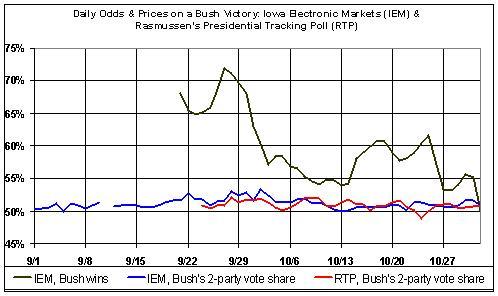
The popular vote share market at Iowa Electronic Markets and Rasumussen’s presidential tracking poll, in my estimation, do the best job of projecting Bush’s share of the two-party popular vote. (Bush’s share of the Rasmussen poll = percent for Bush/(percent for Bush + percent for Kerry.) Here’s how the numbers looked on the eve of the second Bush-Kerry debate:

Bush’s showing in IEM’s popular vote share market yields 337 to 388 electoral votes. His share of the Rasmussen poll yields a slightly lower estimate: 319 to 369 electoral votes. (The conversion of popular vote share to electoral votes is explained here (see method 3).)

The Consequences of Drug Reimportation

What will happen if it becomes U.S. policy to allow the reimportation of drugs from Canada? A recent paper in the Quarterly Journal of Economics, by Daron Acemoglu and Joshua Linn, tells the tale. Here’s the bottom line, according to Alex Tabarrok at Marginal Revolution:

Acemoglu and Linn’s paper is formally about a different issue [than reimportation]; the effect of market size on innovation. What they find is that a 1 percent increase in the potential market size for a drug leads to an approximately 4 percent increase in the growth rate of new drugs in that category. In other words, if you are sick it is better to be sick with a common disease because the larger the potential market the more pharmaceutical firms will be willing to invest in research and development. Misery loves company.

Although they don’t mention it, this finding has implications for price controls. In the pharmaceutical market the major costs are all fixed costs (they don’t vary much with market size) so profit =P*Q-F. Acemoglu and Linn look at changes in Q but a 1% change in P has exactly the same effects on profits, and thus presumably on R&D, as a 1% change in Q.

We can expect, therefore, that a 1% reduction in price will reduce the growth rate of new drug entries by 4% and a 10% reduction in price will reduce new drug entries by 40%. That is a huge effect. I suspect that the authors have overestimated the effect but even if it were one-half the size would you be willing to trade a 10% reduction in price for a 20% reduction in the growth rate of new drugs? No one who understands what these numbers mean would think that is a good deal.

What the numbers mean is that allowing large-scale reimportation of drugs from Canada (where prices are controlled) will cut into drug companies’ profits. Now, before you send up a loud cheer because you’ve been raised to believe that “profit” is a dirty word, consider what will happen after that. The reduction in profits will have a chilling effect on R&D and, therefore, on the introduction of new, life-enhancing drugs.

The logic of the issue is that simple, but it’s probably lost on consumers and politicians, who will focus on what we pay for today’s drugs and ignore the dire, long-term consequences of reimportation.

It’s just another case where consumers will suffer because economic illiteracy leads to wrong-headed government intervention in markets.

Blame It on Bush

Over at TalkLeft:

Weekend Ad Sale

I just dropped the rates for ads on TalkLeft. Check them out, there are some real bargains….

Or maybe it’s Dan Rather’s fault.

That’s It, in a Nutshell

Timothy Sandefur at Freespace has a good post about acting in the face of imperfect information. The summation:

Again, the question is not as much whether, knowing what we know now, Iraq was a good idea. The question is what sort of decisions we should make when we don’t know very much — should we wait, and run the risk of letting a disastrous terrorist attack occur — or should we take the risk of acting on imperfect information? In the case of Iraq, the President made the right decision because, in addition to the imperfect information, we at least knew that we would not be doing a bad thing getting rid of Hussein….The question is not whether war is a good thing or a bad thing. The question is not whether the Vice President is part of an evil capitalist conspiracy to exploit the proletarians in Iraq. The question is not even whether Bush’s domestic policies are good for the country, which they almost invariably are not. The question is what sort of mentality should we have toward undeniably dangerous states in the future. The answer to that, I think, is that we should be willing to attack even on the basis of imperfect information regarding a potential threat.

Not to put words in Sandefur’s mouth, but here’s my take: It’s better to be wrong than dead — even at the risk of being proved dead wrong after the fact.

Racism in Detroit

You know what happens when a racial majority becomes arrogant with power? Of course, it runs roughshod over the racial minority? It’s happening in Detroit, which is more than 80 percent black. Here’s the story from The Washington Times:

Detroit’s plan for ‘African Town’ stirs racial tensions

By Brian DeBose

THE WASHINGTON TIMES

The Detroit City Council, in defiance of Mayor Kwame Kilpatrick, likely will move forward with plans to create an “African Town” in the tradition of Chinatowns and Little Italys nationwide, even though the issue has turned into a racially divisive economic-development proposal.

In July, the council resolved to build up a section of the city devoted to African and black American literature, cuisine and art, which Mr. Kilpatrick endorsed. He vetoed the resolution, however, when it became clear that the council’s plan would allow only black businessmen and investors to use the $38 million earmarked for the project.

Mr. Kilpatrick argued that the resolution is both racist and unconstitutional.

“It’s not the African Town proposal. We like the idea,” said Howard Hughey, spokesman for Mr. Kilpatrick. “But what they are proposing is to create a publicly funded private entity and give one man $40 million to use and distribute to investors, and it is unconstitutional to do that based on race and [the resolution] says very clearly that it would be.”…

Council member Kay Everett, who is black, said the first resolution was “ridiculous” and opposed the African Town resolution for being illegal and divisive.

“It is reverse racism, and you can’t right a wrong with another wrong. It’s reparations with public money,” she said….

Typically, Chinatowns, Little Italys and other locales, such as Spanish Harlem in New York, were created by immigrants in a time when they were not accepted in other areas of the city and forced to build their own businesses and communities centered on their respective cultures….

So, Detroit would use public funds to discriminate against non-blacks in erecting an ethnic district of the kind that other ethnic groups created with their own money and enterprise. At least the mayor and some council members see the plan for what it is: the arrogance of racial power.

I Love It!

Linking to this post, Alan at Occam’s Carbuncle says,

A safe environment for libertarian victorymongers

If you loathe big government, but think freedom is good for foreigners too; if you want bureaucrats out of your life, but would rather see terrorism destroyed in its own back yard than yours; if you feel like a libertarian hawk without a home, Liberty Corner is your rainbow space. Enjoy.

Many thanks, Alan. It’s such a great endorsement of Liberty Corner that I’m placing it right below the banner.

No One Should Be above the Law — Not Even a Reporter

This will invoke a lot of whining about “freedom of the press” and “chilling effects,” but “due process of law” won’t get a mention:

Judge Holds Reporter in Contempt in Leak Probe

WASHINGTON (Reuters) – A federal judge held a New York Times reporter in contempt on Thursday for refusing to testify in the investigation of whether the Bush administration illegally leaked a covert CIA officer’s name to the media….

The emphasis is mine, all mine.

Upside-Down Logic on the Left

TalkLeft links to and quotes a report by Human Rights Watch about the risks to women who vote in Saturday’s Afghan elections. Here’s some of the quoted material:

When a U.S.-led coalition invaded Afghanistan in October 2001, one of the justifications for the war was that it would liberate women from the misogynistic rule of the Taliban. There have been notable improvements for women and girls. More than one million girls are enrolled in school and the new Constitution contains guarantees for women’s equal rights.

However, warlords and the Taliban are undermining Afghan women’s participation in the political process through ongoing threats and attacks. Throughout the country, militarized political factions are using force, threats, and corruption to stifle more legitimate political activity and dominate the election process.

About which TalkLeft says:

We’ll be listening to Bush in the debate closely as he credits his Administration’s achievements for Afghans, particularly women. I hope the mainstream media and bloggers will be fact-checking him.

So there have been “notable improvements for women and girls,” however, “warlords and the Taliban are undermining Afghan women’s participation in the political process through ongoing threats and attacks.” I would say that the notable improvements are to Bush’s credit and the efforts to undermine those accomplishments are to the discredit of the warlords and Taliban.

How is it Bush’s fault if things are better but not perfect in Afghanistan? That’s like saying it’s a cop’s fault if he grabs two muggers and a third one gets away because the cop has only two arms.

Poll-Shopping on the Left

I love it when lefties find a poll that shows Kerry ahead, then make a big deal of it, as Atrios does today at Eschaton.

I guess Atrios doesn’t like to look at realclearpolitics.com, where Bush now leads in 6 of the 10 most recent polls and is tied in 3 others. Rasmussen’s tracking poll, which realclearpolitics.com doesn’t cover, also has Bush ahead. Then there are the truly meaningful “polls” — namely, the betting markets — at Iowa Electronic Markets, TradeSports, and intrade, for example. Guess who’s favored to win, at all three sites? (Hint: It’s not Kerry.)

Give it up Atrios. We’ll let you know if and when Kerry actually pulls ahead of Bush. In the meantime, stick to other subjects about which you’re equally ignorant.

It’s Called Freedom of Speech

But it’s too much for a university professor to handle, accustomed as he must be to the cozy confines of academic speech codes. I’m thinking of the University of Utah’s David Hailey, whose ill-begotten effort to salvage the Rathergate memos was thoroughly debunked by Paul at Wizbang. Paul’s posts triggered an avalanche of ridicule and e-mail abuse aimed at Hailey. Wired carries a somewhat balanced story by Staci D. Kramer about the whole business:

David Hailey says he didn’t know much about blogs before he flipped on his office computer one late September morning and watched hate mail flood into his inbox.

Author of a report (.pdf) claiming that the controversial CBS News Texas Air National Guard memos could have been produced on a typewriter, the Utah State University associate professor of technical communications didn’t know he had become fodder for vigilant political blogs and discussion boards. To liberals, the report was proof that CBS was in the clear — making it another claim for conservatives to debunk.

But the debunking quickly turned into name-calling, with a guest blogger at Wizbang, a conservative political blog, leading his detailed critique with the since-retracted accusation that Hailey was a “liar, fraud and charlatan.” It escalated as Hailey updated what he calls a work in progress and his critics declared a cover-up.

The result was what Howard Rheingold, author of Smart Mobs: The Next Social Revolution, calls “a semi-organized swarming.” It is but one of a spate of recent incidents that underscores the power of a rapidly mobilized group online to accomplish a goal — and the potential for harm when online mobs form [like Democrats beating up Republicans at rallies, destroying lawn signs, and damaging Republican offices — only not as bad.]….

“For political figures, it’s fair game,” said Rheingold. “For people expressing political opinions, it’s scary. If some researcher does something you don’t agree with and you go after him personally, that’s scary.”…

At first, Hailey thought it was funny that his type-matching exercise ticked people off enough for them to write. By the second day, he was far from amused. By the end of the week, the tenured academic literally cried in relief when university officials called him to a meeting to express their support; many of them had received numerous e-mails demanding his dismissal and calling him a liar or a fraud [not surprising, given the sloppiness of Hailey’s work].

“It’s one thing to go to a university and point out that there are these problems,” Hailey said. “It’s another thing to start character assassination.”

Wizbang owner Kevin Aylward says that was never the intention but admits the language used in postings got out of hand.

“People are trying to make this into ‘we’re out to get him,'” Aylward said. “We were out to discredit the report.”

The guest blogger on Wizbang was spurred by a post on another blog suggesting that the Boston Globe was working on a story; the thread is called “Fact Checking the Boston Globe in Advance.”

Aylward apologized for the name-calling, which he retracted from his guest blogger’s post.

“It was a bad idea to use those words, they didn’t further the story. They were opinion, not news.” Still, he asked, “don’t you think when you inject yourself into that debate you’re stepping onto a national stage?”

He points to a Sept. 16 message from Hailey at liberal weblog Take Back the Media linking to the post. Hailey, a Democrat who contributed $250 to Kerry’s campaign, also posted a link at Democrats.com.

Asked if he hoped as a Democrat to redeem the memos, Hailey replied, “I’m a complete person. I’m a liberal. I’m a Democrat. I felt Dan Rather was being totally abused … [so he tried, ineptly, to salvage the forged memos] but mostly it’s like a crossword puzzle.”…

For Aylward, the matter’s already moved to the back burner. He shut the comments down in the main Hailey thread. Guest blogger Paul wrote a coda, expressing dismay about the personal attacks that followed his first post.

“I was admittedly rude with my first post. With the benefit of hindsight, it was not my finest hour,” he wrote. “But some of the things you people are doing is just beyond the pale.”

Utah State Counsel Craig Simper, who has been monitoring Hailey’s situation for the university, was struck by leaps to conspiracy theories and assumptions that a downed server meant Hailey was being fired.

“One of the bloggers claimed it’s not the crime; it’s the cover-up. This conspiratorial mentality is absolutely scary. It’s incredible,” Simper said, adding, “It’s very chilling.” [not like being shot at]…

Hailey credits the questions from Wizbang and others for spurring him to make the report stronger and encouraging him to mark works in progress as drafts. He’s even enthralled by the possibility of blogs.

But he’s still feeling the effects of the last few days.

“It doesn’t matter if you vindicate yourself, you’re stained,” he said. “(The university) can support me and that stain won’t rub off. I can sue the pants off these guys…. That doesn’t change anything because everybody else only sees what is out on the internet.”

If you can’t stand the consequences of true academic freedom, perhaps you shouldn’t be an academic. The Wired story omits two critical facts: Wizbang‘s Paul was absolutely on target in his debunking of Hailey’s work. And that debunking has been underscored by Joseph Newcomer, a professor at Carnegie-Mellon University. Newcomer’s detailed and devastating review of Hailey’s work is here, and Newcomer’s resume is here. Hailey should have sought expert peer review before exposing his half-baked and perhaps politically motivated work to the wonderful world of the web.

With "Friends" Like France…

…who needed Saddam? Actually, it’s been evident for decades that the government and elite classes of France are unfriendly (to say the least) toward the United States. It all began with de Gaulle’s resentment of his exclusion from the inner circle during World War II, a resentment upon which he acted in the 1960s by withdrawing France from NATO’s military arm and kicking U.S. forces out of France. It’s been more of the same since then.

Now The Washington Times confirms what we’ve suspected about France’s position vis-a-vis Iraq, namely, that Saddam encouraged and rewarded the anti-Americanism of French officials and elites:

Saddam paid off French leaders

By Bill Gertz

THE WASHINGTON TIMES

Saddam Hussein used a U.N. humanitarian program to pay $1.78 billion to French government officials, businessmen and journalists in a bid to have sanctions removed and U.S. policies opposed, according to a CIA report made public yesterday.

The cash was part of $10.9 billion secretly skimmed from the U.N. oil-for-food program, which was used by Iraq to buy military goods, according to a 1,000-page report by the CIA-led Iraqi Survey Group.

According to a section of the report on Iraqi weapons procurement, the survey group identified long-standing ties between Saddam and the French government. One 1992 Iraqi intelligence service report revealed that Iraq’s ambassador to France paid $1 million to the French Socialist Party in 1988.

The CIA report stated that the Iraqi ambassador was instructed to “utilize [the $1 million] to remind French Defense Minister Pierre Joxe indirectly about Iraq’s previous positions toward France, in general, and the French Socialist party, in particular.”

In the late 1990s, Iraq also used an oil-purchasing voucher system through the U.N. oil-for-food program, which began in 1996 and ended in 2003, to influence the French to oppose U.S. initiatives at the United Nations and to work to lift sanctions, the report stated.

The Iraqi Intelligence Service paid off French nationals by dispensing vouchers that allowed the holders to make hundreds of thousands of dollars in commissions by selling them to oil buyers.

The payoffs help explain why the French government, along with Russia and China, opposed U.S. efforts in the United Nations in the months leading up to the March 2003 invasion, U.S. officials said.

Iraqi intelligence agents also targeted French President Jacques Chirac, by giving gifts to a spokesman, two of his aides and two French businessmen, the report said.

One Iraqi intelligence report stated that a French politician assured Saddam in a letter that France would use its veto in the U.N. Security Council against any U.S. effort to attack Iraq.

Iraqi intelligence documents recovered in Iraq showed that the French citizens linked to the influence operation were “ministers and politicians, journalists and business people.”

“These influential individuals often had little prior connection to the oil industry and generally engaged European oil companies to lift the oil, but were still in a position to extract a substantial profit for themselves,” the report said.

Former Iraqi Deputy Prime Minister Tariq Aziz told the Survey Group that he personally awarded several Frenchmen “substantial” oil allotments.

“According to Aziz, both parties understood that resale of the oil was to be reciprocated through efforts to lift U.N. sanctions or through opposition to American initiatives within the Security Council,” the report said.

The report named former French Interior Minister Charles Pascua as getting a voucher for 11 million barrels of oil, and Patrick Maugein, who received a voucher for 13 million barrels of oil. The report said Mr. Maugein, the chief executive officer of the SOCO oil company, was a “conduit” to Mr. Chirac.

Michel Grimard, the founder of the French-Iraqi Export Club, received a voucher for 5.5 million barrels, and the Iraqi-French Friendship Society received vouchers for more than 10 million barrels.

French oil companies Total and SOCAP were granted vouchers for 105 million and 93 million barrels of oil, respectively.

But France wasn’t alone:

The report stated that Iraq covertly purchased missiles and other military goods from Russia, Belarus, China, North Korea and South Korea.

According to the report, illegal goods used in making weapons of mass destruction were sold to Iraq by companies in Jordan, India, France, Italy, Romania and Turkey.

Conventional arms also were sold to Iraq by China, Jordan, India, South Korea, Bulgaria, Ukraine, Cyprus, Egypt, Lebanon, Georgia, France, Poland, Syria, Belarus, North Korea, Yugoslavia, Yemen, Russia, Romania and the Republic of China (Taiwan).

Then there’s the U.N.:

The report said Saddam’s regime obtained $1.5 billion from U.N. humanitarian contract kickbacks and $228.5 million in surcharges on U.N.-approved oil sales.

Other oil smuggling provided the regime with $8 billion in cash outside of U.N.-approved oil sales, the CIA report reveals.

Where did a lot of the money go? One guess:

Charles Duelfer, the director of the CIA survey group, told a congressional hearing yesterday that a “sizable portion” of Saddam’s cash obtained from the oil-for-food program were diverted to the military, specifically the government-run Military Industrial Commission.

“The funding for this organization, which had responsibility for many of the past [weapons of mass destruction] programs, went from approximately $7.8 million in 1998 to $350 million in 2001,” Mr. Duelfer told the Senate Armed Services Committee.

Mr. Duelfer said that during the period from 1998 to 2001, “many military programs were carried out — including many involving the willing export to Iraq of military items prohibited by the Security Council.”

Tell me again why we should consult with “allies” like France or defer to the United Nations on any issue.

The Illogic of Knee-Jerk Privacy Advocates

There’s much ado about a bill now before the Senate that would, in the words of Ryan Singel at Wired News,

let government counter-terrorist investigators instantly query a massive system of interconnected commercial and government databases that hold billions of records on Americans.

Some background (from the article):

The proposed network is based on the Markle Foundation Task Force’s December 2003 report, which envisioned a system that would allow FBI and CIA agents, as well as police officers and some companies, to quickly search intelligence, criminal and commercial databases. The proposal is so radical, the bill allocates $50 million just to fund the system’s specifications and privacy policies.

However,

[t]o prevent abuses of the system, the Markle task force recommended anonymized technology, graduated levels of permission-based access and automated auditing software constantly hunting for abuses.

An appendix to the report went so far as to suggest that the system should “identify known associates of the terrorist suspect, within 30 seconds, using shared addressees, records of phone calls to and from the suspect’s phone, e-mails to and from the suspect’s accounts, financial transactions, travel history and reservations, and common memberships in organizations, including (with appropriate safeguards) religious and expressive organizations.”

But task force member James X. Dempsey, director of the Center for Democracy & Technology, says the commercial records involved are more limited public records, such as home ownership data, not information about what mosque someone belongs to.

He said he believes it’s “absurd” to prohibit the FBI from using a commercial database like ChoicePoint to find a suspected terrorist’s home address (though the FBI currently can and does do this). On the other hand, he asked, “Should they be able to go to ChoicePoint and ask for all the subscribers to Gun Owners Monthly? No, I don’t think so.”

The proposed network would not look for patterns in data warehouses to attempt to detect terrorist activities, Dempsey said. Instead, an investigator would start with a name and the system would try to see what information is known about that person.

Seems to me that’s in keeping with the letter and spirit of the Constitution. But

critics say the Senate is moving too fast and the network could infringe on civil liberties. Lawmakers are taking a “boil the ocean” approach, according to Robert Griffin, president of Knowledge Computing. His company runs Coplink, a widely used system for linking law enforcement databases. Despite being a supporter of increased information sharing, Griffin criticized the proposal for trying too much too soon and relying too heavily on commercial data.

“The next Mohammed Atta is not going to be found in commercial databases,” Griffin said, referring to the tactical leader of the 9/11 attacks. “We are going to stop him running a red light somewhere, and we are going to run relationships associations with this guy and we are going to say, gee, you have things in common with guys on watch lists. That’s how you are going to find the guy — not because he has bad credit.”

Civil liberties lawyer Lee Tien of the Electronic Frontier Foundation accused Congress of “institutional laziness” for not holding hearings on the proposal to hear the perspectives of advocates for consumers or battered women. Tien also argued that a widespread lack of privacy and due process protections would make data sharing dangerous.

“If someone transfers your credit report or medical history, you have no way of knowing,” Tien said. “The natural feedback we expect in the physical world just doesn’t work in the area of information. You have to be careful.”

Tien is not alone in his concern. On Monday, more than 40 organizations, ranging from the American Association of Law Libraries to the National Association for the Advancement of Colored People, signed on to an open letter (.pdf) to Congress asking members to include adequate civil liberties safeguards in the pending legislation.

However,

technology professor Dave Farber said that his work on the task force convinced him the task force’s model was a “critical” tool in the fight against terrorists.

“A lot of (task force members) were very uncomfortable about data sharing,” Farber said. “But all of us at the end felt confident that if the recommendations were followed, it was as good as it was going to get relative to privacy protections.”

Let’s get this right, folks. We don’t know how the next Mohammed Atta will be found (if he is) before he commits an atrocity. How in the hell do you know, a priori, how you’re going to find him?

We’re talking about public records, right? If you don’t want to create a public record, don’t drive a car, own a house, open a public library account, borrow money from a regulated financial institution, and on and on. Look, do you think the government is going to slam you in jail because you live in Detroit, read Popular Mechanics, and give money to the Green Party? That’s a big waste of time. What the government needs is a better insight into the goings on of people who might, for other reasons, be suspected of implication in terrorist plots. It’s called “process of elimination”.

Get a grip on yourselves, folks. If 1984 is coming, it’s coming at your local university, where you can’t call say anything that might be construed as offensive to anyone who isn’t a white, Christian male.

Here are my questions for the hysterical, knee-jerk opponents of government data-mining: Are you (a) completely in favor of letting terrorists operate with impunity, (b) completely devoid of concern for the fate of your fellow Americans, (c) completely paranoid, (d) just waiting for a Democrat administration to propose the same legislation, when you’ll be for it, or (e) all of the above?

If you really think the proposal is a threat to your privacy and civil liberties, consider Dave Farber’s credentials. The man is a walking, talking, fire-breathing civil libertarian and Democrat. If he can live with, why can’t the rest of you?


How to Save Social Security: Part I

REVISED AT 4:58 PM (CT) – 10/06/04

The day of reckoning for Social Security — as we know it — can be postponed by converting the trust fund to real assets that generate real income. The question then becomes whether to keep it as we know it, to privatize it, or to do some of both. This post shows how the day of reckoning can be postponed. Future posts will examine the future shape of the program.

In an earlier post I pointed out (1) that the Social Security trust fund is mythical, not real, and (2) that the trust fund could be converted from myth to reality by gradually selling the Treasury securities now held in the fund and replacing them with high-grade corporate bonds and conventional mortgages.

The trust fund would then hold real assets, and those assets would yield a higher rate of return than the putative rate of return on the “special obligation bonds” now held by the trust fund. How much higher? The following graphic compares the interest rates credited on new special obligation bonds issued from 1990 to 2003 with the yield to maturity for AAA corporate bonds, conventional mortgages, and BAA corporate bonds:


(Sources: Average annual interest rates on new trust fund bonds from Nominal Interest Rates on Special Issues at Social Security Online, Actuarial Resources; average annual rates on AAA corporate bonds, conventional mortgages, and BAA corporate bonds from Federal Reserve Statistical Release.)

For the period 1990-2003, the average yield on AAA bonds was 7.43 percent, as opposed to 6.34 percent for trust fund bonds. That’s 17 percent more interest income, on average, for each dollar invested in a AAA bond rather than a trust fund bond. Conventional mortgages and BAA bonds are even better: Conventional mortgages yielded 7.76 percent on average, 22 percent more than trust fund bonds; BAA bonds yielded an average of 8.27 percent, or 30 percent more than trust fund bonds. Somewhere in that mix lies a partial solution to Social Security’s underlying problem.

What is that problem? According to the 2004 report of Social Security’s trustees, it’s this:

[P]program cost will exceed tax revenues starting in 2018….Social Security’s combined trust funds are projected to allow full payment of benefits until they become exhausted in 2042.

What’s the solution? Again, according to the trustees, it’s this:

Over the full 75-year projection period the actuarial deficit estimated for the combined trust funds is 1.89 percent of taxable payroll–slightly lower than the 1.92 percent deficit projected in last year’s report. This deficit indicates that financial adequacy of the program for the next 75 years could be restored if the Social Security payroll tax were immediately and permanently increased from its current level of 12.4 percent (for employees and employers combined) to 14.29 percent. Alternatively, all current and future benefits could be immediately reduced by about 13 percent. Other ways of reducing the deficit include making transfers from general revenues or adopting some combination of approaches.

* If no action were taken until the combined trust funds become exhausted in 2042, much larger changes would be required. For example, payroll taxes could be raised to finance scheduled benefits fully in every year starting in 2042. In this case, the payroll tax would be increased to 16.91 percent at the point of trust fund exhaustion in 2042 and continue rising to 18.31 percent in 2078.

* Similarly, benefits could be reduced to the level that is payable with scheduled tax rates in every year beginning in 2042. Under this scenario, benefits would be reduced 27 percent at the point of trust fund exhaustion in 2042, with reductions reaching 32 percent in 2078.

Changes of this magnitude would eliminate the actuarial deficit over the 75-year period through 2078. However, because of the increasing average age of the population, Social Security’s annual cost will very likely continue to exceed tax revenues after 2078. As a result, ensuring the sustainability of the system beyond 2078 would require even larger changes than those needed to restore actuarial balance for the 75-year period.

The nugget in all of that is this: An immediate tax increase from 12.4 percent to 14.29 percent would eliminate the problem for 75 years. A tax increase of that size — about 15 percent — is equivalent to about $81 billion. (According to this table, Social Security “contributions” for 2003 were $533.5 billion; 15 percent of that is $81 billion.)

Interest on trust fund bonds generated $84.9 billion in 2003. That’s a fictional return of about 5.8 percent on the trust fund’s average assets of $1,454 billion for the year (from end-of-year data for 2002 and 2003 given here). That’s more than the return on new bonds, because the trust fund’s portfolio consists of a mix of bonds issued in various years at various rates. In any event, if the trust fund’s portfolio had been invested equally in AAA bonds, conventional mortgages, and BAA bonds, it would have yielded around 7.1 percent — about 23 percent more.

Let’s say the trust fund were completely converted to real assets by 2015, at which time it would have a current-dollar value of $4.4 trillion and earn about 5.6 percent interest (estimates derived from this table). The accumulation of additional interest earnings in the years after 2015 would prolong the life of the fund by about five years, that is, from 2042 into the late 2040s. Almost everyone who is now collecting Social Security benefits and who will begin collecting benefits in this decade would be assured of complete lifetime coverage. There would be no need to raise tax rates, cut benefits, or raise the retirement age beyond the current maximum of 67 years (for persons born in 1960 or later).

A slight upward adjustment in the retirement age would buy even more time in which to save Social Security without unduly burdening the coming generation of workers and retirees. And time is what it will take.