For Libertarian Hawks

Tim Sandefur at Freespace skewers the (eponymous?) Libertarian Jackass:

The Ass is one of these Doughface Libertarians who believe that the only time the military should engage in anything is when the enemy is marching through the streets of Los Angeles (even then he would most likely accuse America of having instigated the attack by daring to refuel its Air Force planes over the Indian Ocean.)

Read the whole thing.

Who Said That?

The French are arrogant, rude and surly to foreign visitors, according to Bernard Plasait, a member of France’s upper house of parliament (from The Washington Times). The first paragraph of Plasait’s government-commissioned report reads thus:

Our bad image in this area, the arrogance we are accused of, our refusal to speak foreign languages, the sense we give that it’s a great honor to visit us are among the ugly facts of which we should not be proud.

Isn’t self-awareness the first step on the road to recovery from an addiction? It will take a lot more than twelve steps to overcome France’s addiction to its utterly delusional sense of importance.

(Thanks to my son for the tip.)

Novelists for Kerry

Slate interviewed 31 novelists about their preference between Kerry and Bush. In summary:

Thirty-one novelists participated, with four for Bush, 24 for Kerry, and three in a category of their own.

What do you expect from a bunch of fiction writers? Anyway, here’s my take on the gang of 31:

  • I’ve never read anything by 27 of them (and I read a lot of novels).
  • Of the other four, two (Joyce Carol Oates and John Updike) long ago became boring; one (Amy Tan) has always been boring; and one (Jane Smiley) wrote a passably good mystery about 20 years ago.

Joyce Carol Oates’s comment epitomizes the vacuousness of the knee-jerk pro-Kerry literati:

Like virtually everyone I know, I’m voting for Kerry. And probably for exactly the same reasons. To enumerate these reasons, to repeat yet another time the fundamental litany of liberal principles that need to be reclaimed and revitalized, seems to be redundant and unnecessary. Our culture has become politicized to a degree that verges upon hysteria. And since I live in New Jersey, a state in which an “honest politician” is someone who hasn’t yet been arrested, I have come to have modest, that’s to say realistic expectations about public life.

No wonder her stuff has become unreadable. She has become detached from reality and logic. Maybe she should try “magic realism”.

By the way, the four pro-Bush writers are:

  • Orson Scott Card, a pro-war Democrat.
  • Robert Ferrigno, another pro-war type who says “Most novelists live in their imagination, which is a fine place to be until the bad guys come knock knock knocking.”
  • Roger L. Simon, another pro-war Democrat.
  • Thomas Mallon, who is worth quoting at length:

I’ll be voting for President Bush. His response to the 9/11 attacks has been both strong and measured, and he has extended a once-unimaginable degree of freedom (however tentative) to Afghanistan and Iraq. I am unimpressed by the frantic vilification that has come his way from even mainstream elements of the Democratic Party. The rhetorical assault is reminiscent of—though it far exceeds—the overheated opposition to Ronald Reagan’s re-election in 1984. Back then the intellectual establishment told us how repression and apocalypse would be just around the corner if the American “cowboy” were kept in the White House for another four years. Well (as Reagan might say, his head cocked to one side), I remember a rather different result from RR’s second term. And I’m hopeful about another four years under George W. Bush.

Two of the three agnostics have interesting things to say:

  • A.M. Homes:

Richard Nixon, because I found him so fascinating the first time around I’d be curious to see what he could do from the beyond … ?

  • Richard Dooling:

More than any other election in recent memory, this one reminds me of Henry Adams’ observation that politics is the systematic organization of hatreds.

The left-wing political road rage directed at George W. Bush for being dumb and lying about the war reminds me of nothing so much as the right-wing obsessive invective directed at Bill Clinton for being smart and lying about sex. Rush Limbaugh versus Michael Moore, and let the man nursing the most unrequited rage win. The DRAMA and spectacle of the election will be fascinating to watch, but novelists, even more than actors, should be political agnostics.

The same goes for musicians, Richard.

Arab Logic in Detroit

From Reuters via Yahoo! News:

Arab American Voters Drop Support for Bush

Wed Oct 13,11:02 AM ET

By Michael Ellis

DEARBORN, Mich. (Reuters) – Hundreds of Arab Americans danced and celebrated in the streets of this Detroit suburb after the fall of Baghdad last year, and enthusiastically shouted thanks to President Bush.

Now, even some of the most vocal supporters of the president blame him for failing to stop the disorder and death in Iraq. One opinion poll shows Bush trailing Democratic Sen. John Kerry among Arab Americans in four key battleground states including Michigan, where every vote could count in a close Nov. 2 election.

“The butcher (Saddam Hussein) is gone, but the bloodshed is still there,” said Imam Husham Al-Husainy, a Shi’ite cleric who in 1979 fled Iraq and moved to Dearborn, home to many of the estimated 235,000 Arab Americans in Michigan.

“President Bush did a good job to remove the cancer,” said Husainy, who led a rally of more than 100 people in support of the invasion when Bush visited Dearborn two years ago. “But he did not do a good job of strengthening Iraq. Iraq is still like an infected patient in an emergency room,” he said….

Let’s see what we have here. Kerry might or might not have removed Hussein; we still don’t know which, and we never will. Bush removed Hussein and since then a bunch of Arab thugs have committed acts of terror against fellow Arabs. This is a reason to vote for Kerry?

I guess the guys in Detroit would be happier if Bush had simply nuked the place. No terrorists, no one to terrorize, “perfect” outcome by Arab logic.

Your Tax Dollars at Work

From Yahoo! News:

AP: Report Finds Lavish Spending at TSA

By LESLIE MILLER, Associated Press Writer

WASHINGTON – The government agency in charge of airport security spent nearly a half-million dollars on an awards ceremony at a lavish hotel, including $81,000 for plaques and $500 for cheese displays, according to an internal report obtained by The Associated Press….

Par for the course in D.C. The feds do it. And the feds’ contractors do it. And it’s your money. I managed to kill my old (tax-funded) outfit’s lavish annual “holiday” party, but a lot of the Indians and not a few Chiefs were upset about it.

Oh, Canada; Oh, America

Yesterday, Alan at Occam’s Carbuncle noted this Volokh Conspiracy post about the state of free speech in Canada. Today he has more to say about the state of affairs in Canada:

…Clearly, most Canadians do not share my aversion to the Liberal brand of pernicious quasi-socialism, a system of government whereby the state assumes the burden of individual conscience and acts as overweaning bookkeeper to the populace, while maintaining the facade of prosperity, freedom and justice via creaking centrally planned and controlled core institutions like medicare and the Supreme Court. To me, the disadvantages of such a system are immediately evident. They are evident in the grotesquely high taxes I pay, in the minutiae of invasive regulations that pervade our lives, in the institutional rot of our government, in the systematic destruction of our once proud military, in the contempt for the public purse now increasingly coming to light….Reason, patriotism, tempered strength, honesty, love of freedom, a firm grounding in the very best from our history; these are the qualities that will be necessary to stem the socialist tide in this country. Socialism is, at its root, born of a dim, fearful view of life as a never ending series of risks to be averted. We, as libertarians and conservatives, need to help people to wake up to the idea of life as a continuous stream of opportunity.

Substitute “Americans” for “Canadians” and “Democrat” for “Liberal” and what Alan says is wholly applicable to the U.S. We’re just a few strides behind Canada on the road to serfdom.

I agree fully with Alan’s idea that libertarians and conservatives must sell people on the advantages of liberty. It’s necessary, at times, to attack and expose the idiocies of the left. But we must also make it clear that libertarianism and old-fashioned, small-government conservatism are positive philosophies — philosophies based on the principle that people are better off when they rely on themselves instead of “big brother”.

Libertarian Twaddle about the Death Penalty

In the middle of a post about the Supreme Court’s consideration of the death penalty for juveniles, McQ at QandO says:

…I am against the death penalty, have been for years. Yes I know all the arguments for to include the emotional ones. I simply don’t accept them as valid. My objection is based in man’s right to life, and unlike Jon, I feel it is inherent (man qua man) and therefore inviolable by all, to include the state. In essence I believe the state does to the murderer precisely that for which it is punishing the murderer….

By that logic, we shouldn’t have armed forces and use them to kill our enemies. As I have said:

…I don’t care whether or not capital punishment deters homicide. [Though it does, as the post explains.] Capital punishment is the capstone of a system of justice that used to work quite well in this country because it was certain and harsh. There must be a hierarchy of certain penalties for crime, and that hierarchy must culminate in the ultimate penalty if criminals and potential criminals are to believe that crime will be punished. When punishment is made less severe and less certain — as it was for a long time after World War II — crime flourishes and law-abiding citizens become less secure in their lives and property.

The state doesn’t do to the murderer that for which it is punishing the murderer. It does to the murderer that which the murderer shouldn’t have done, as a lesson to other would-be murderers, and as a way of ensuring that that murderer won’t murder again. Similarly, the state deprives other criminals of freedom (but not life) for doing what they shouldn’t have done, and as a way of keeping them away from the rest of us for a while. Or does McQ object to depriving criminals of their freedom? After all, freedom is right up there with the right to life in the pantheon of libertarian values. Oh, and what about abortion?

Related posts:
Does Capital Punishment Deter Homicide?
Crime and Punishment
Abortion and Crime
Saving the Innocent?
Saving the Innocent?: Part II
More on Abortion and Crime
More Punishment Means Less Crime
More About Crime and Punishment
More Punishment Means Less Crime: A Footnote
Clear Thinking about the Death Penalty
Let the Punishment Fit the Crime
Another Argument for the Death Penalty
Less Punishment Means More Crime
Crime, Explained

Remembering an Unsung Hero

Tyler Cowen at Marginal Revolution posts about “The Man Who Killed the Draft“:

The influence of Milton Friedman in ending conscription is well-known. But an economist named William Meckling arguably played a larger role, read the story.

Here’s some of the story, as told in 1999 by David Henderson:

If you are an American male under age 44, take a moment of silence to thank William H. Meckling, who died last year at age 76. Even though you probably haven’t heard of him, he has had a profound effect on your life. What he did was help to end military conscription in the United States.

Between 1948 and 1973, here’s what you knew if you were a healthy male born in the U.S.A.: the government could pluck you out of almost any activity you were pursuing, cut your hair, and send you anywhere in the world….

Bill Meckling didn’t think that was right….He had been drafted into the army in World War II and witnessed the government’s incredibly wasteful use of manpower when it could pay below-market wages. He tucked that lesson away and would use it 25 years later.

Meckling went on to become an economist. In 1962 [sic] he was named the first dean of the University of Rochester’s new business school, where he continued until 1983….

When the [President’s Commission on an All-Volunteer Force] was created, in 1969, the members were not unanimous on ending the draft. In his recent coauthored book, Two Lucky People, Mr. Friedman writes that 5 of the 15 commissioners — including himself, Mr. Greenspan, and Mr. Wallis — were against the draft to begin with. Five members were undecided, and 5 were prodraft. Yet when the commission’s report came out less than a year later and became a paperback book, all 15 members favored ending the draft.

What happened in between? That’s where Bill Meckling comes in.

Meckling was chosen as executive director of the commission. As soon as he started his work, he got a nasty surprise: he had thought that everyone involved was opposed to the draft and that his job would be narrower than it turned out to be. “I thought that I was hired to estimate supply curves,” he joked in a 1979 speech; he neither intended nor desired to get into a debate over conscription. But Meckling quickly adjusted to his new position. He hired some economists (who estimated those supply curves) as well as some historians; members of both groups wrote papers making a strong historical and philosophical case against the draft. The commission’s work was done in less than a year, under budget and ahead of schedule. Three years later, the draft was dead….

…Many of you who have made or are now making your fortunes would not have done so if the draft had been in the way. Consider Bill Gates, who in 1975 dropped out of Harvard to start Microsoft: during the draft years, young men like him who left college risked being certified as prime military meat. Computer programmers and other IT workers, who often do their best work relatively early in life, regularly drop out of college now because high-paying, interesting jobs beckon. If we still had the draft — even a peacetime draft — many wouldn’t have that chance.

People often wonder why today’s 20-somethings have such entrepreneurial spirit. One reason, I believe, is that a whole generation has grown up without the draft looming over its head. For that I thank, among others, Martin Anderson, Milton Friedman, W. Allen Wallis, and William H. Meckling. Bless them all.

When I left graduate school in 1963 and went to work for a defense think-tank in the D.C. area, Bill Meckling headed the division to which I was assigned. Bill didn’t leave the think-tank to become dean of the B-school at Rochester until 1964 or 1965. Anyway, the rest of the story is right about Bill and his role in ending the draft. Some of the economists and historians who worked on the staff of the commission were seconded from the defense think-tank where I worked. In fact, the staff was housed in the same building, though in separate quarters. The intellectual and physical proximity of the commisstion’s staff to the think-tank was no coincidence; the University of Rochester had held the contract to oversee the think-tank since 1968.

In 1983, as Bill was nearing retirement as dean of Rochester’s B-school, the university’s oversight of the think-tank was under fire from then-Secretary of the Navy John Lehman. (That’s another story.) Rochester’s president thought it prudent to review the think-tank’s management practices. Bill was a member of the university’s review team. One of his tasks was to interview me about quality control (I was responsible for reviewing the think-tank’s formal research publications). It was the last time I saw Bill Meckling — an economist who truly advanced the cause of liberty in America.

Arrgh, I Hate Being Right All the Time

Just a month ago I posted this:

Time to Regulate the Blogosphere?

That thought must have crossed the minds of some highly placed Democrat sympathizers in the “mainstream” media when the blogosphere started shredding the threadbare remnants of Dan Rather’s reputation for honest reporting. But the blogosphere is protected by the First Amendment, isn’t it?

There’s stark evidence that the blogosphere can be regulated, if the feds want to do it. Look at the airwaves, which the feds seized long ago, and which the feds censor by intimidation. Look at the ever-tightening federal control of political speech, which has brought us to McCain-Feingold. It’s all in the name of protecting us, of course….

Well, today Vodkapundit points to this AP story at myway:

FEC May Regulate Web Political Activity

Oct 13, 7:55 AM (ET)

By SHARON THEIMER

WASHINGTON (AP) – With political fund raising, campaign advertising and organizing taking place in full swing over the Internet, it may just be a matter of time before the Federal Election Commission joins the action. Well, that time may be now.

A recent federal court ruling says the FEC must extend some of the nation’s new campaign finance and spending limits to political activity on the Internet.

Long reluctant to step into online political activity, the agency is considering whether to appeal.

But vice chairwoman Ellen Weintraub said the Internet may prove to be an unavoidable area for the six-member commission, regardless of what happens with the ruling.

“I don’t think anybody here wants to impede the free flow of information over the Internet,” Weintraub said. “The question then is, where do you draw the line?”…

Hey, Ms. Weintraub, you’ll have to pry my blog out of my cold, dead hands.

Favorite Posts: Academic Freedom and Freedom of Speech

Speaking of Hobbesian Libertarianism…

…as I did in the preceding post, reminds me of an e-mail from a reader who read my post about “Hobbesian Libertarianism” and followed a link in that post to one about “The Origin of Rights and the Essence of Modern Libertarianism.” The reader said:

You use the term, “modern,” to distinguish one version of libertarianism from…what? Is there an antediluvian libertarianism? Is there a

non-Hobbesean [sic] libertarianism that advocates positive rights?…

I don’t mean to nit-pick; I just don’t understand the point you’re making.

To which I replied

Libertarianism as we know it today (i.e., “modern” libertarianism) is the cumulative product of centuries of thought. It didn’t fall out of the sky as “libertarianism.” Yet, Mill, for example, was more or less a libertarian, even though he didn’t use that term. So, I’m using the term “modern” to distinguish the “mature” modern version of libertarianism from its less developed antecedents, which went by other names. That’s all. Nothing deeper.

Cute, But No Cigar

A friend brought this quotation to my attention:

Conservative pundit Andrew Sullivan worries that Bush “is fusing Big Government liberalism with religious right moralism. It’s the nanny state with more cash.”

The quotation is from a piece by Dough Bandow at Salon.com: “Why conservatives must not vote for Bush.”

Actually, I’ve dealt with this before (here):

I wouldn’t make too much of Bandow’s supposed conservatism. In fact, he’s one of the “holier-than-thou” brigade of deluded professional libertarians (a senior fellow at the Cato Institute) who prize ideological purity above all else. He’s too high and mighty to give his endorsement to a mere mortal like Bush. He’s waiting for the libertarian messiah to come in from the desert.

I’ll go further and say that Bandow is a “don’t shoot until you see the whites of their eyes” libertarian. Don’t get me wrong, I love Cato’s brand of economics (with some exceptions), but its view of foreign and defense policy is a mix of pre-World War II isolationism and appeasement.

Me, I’m no conservative either, just a Hobbesian libertarian who’s inclined to vote for the lesser of two evils rather than waste a vote on a nutcase like Michael Badnarik, the Libertarian Party’s candidate for president.

Score One for Justice

While the Supreme Court hears arguments about the death penalty for teen killers, Ohio dispatches one (from AP via Yahoo! News):

A teen killer who told the parole board that he regretted letting eyewitnesses survive was executed Wednesday for a shotgun murder during a $15 robbery.

And good riddance.

Debunking More Myths of Income Inequality

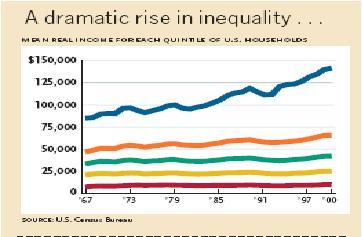
EconoPundit points to a piece that appeared in the Boston Fed’s Regional Review (Q4 2002). The authors, Katharine Bradbury and Jane Katz, try to argue that income inequality is growing and that we should do something about it. Exhibit A is this graph, which shows real income by quintile for 1967-2000:

Looks bad, doesn’t it? If you didn’t know anything about the underlying dynamics, you’d think that the poorest American households made almost no progress in more than 30 years. Bradbury and Katz then try to convince their readers that it really is bad because the patterns of mobility between quintiles have changed little in recent decades:

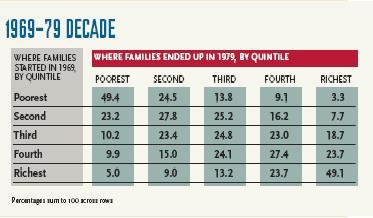
What those “stable” patterns really mean is something quite different than Bradbury and Katz would have us believe. If you do the math correctly, you find that in a stable population only about 25 percent of the households that were in the poorest quintile in the late 1960s were still there a generation (about 30 years) later. Similarly, only about 25 percent of the households that were in the richest quintile in the late 1960s were still there a generation later. A small fraction of households stay in the same quintile; a smaller fraction move out of that quintile and then come back to it; most leave, never to return.

Actually, the percentage of households that remained in the poorest quintile in the last one-third of the 20th century must have been far less than 25 percent. The number of households wasn’t stable during that period (nor will it remain stable). According to the Census Bureau, the number of households increased from about 63 million in 1970 to about 103 million in 2000 (and will continue to grow by more than 1 million a year). What income quintile do you suppose is occupied by most new households, which consist mainly of young couples and immigrants*? The bottom quintile, of course.

So, let’s take population growth into account. The bottom quintile consisted of about 13 million households in 1970 (one-fifth of the total of 63 million). Of those 13 million, only about 3 million (25 percent) remained there in 2000. But by 2000, the bottom quintile consisted of about 21 million households (one-fifth of the total of 103 million). Therefore, at the end of the 20th century, only about 15 percent of the households (3 million of 21 million) then in the bottom quintile had been there for a generation.

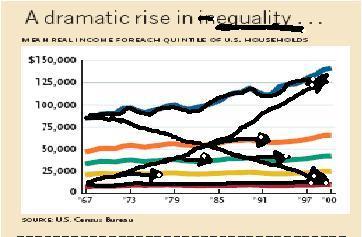
The first graph really should look something like this:

I’ve kept it simple by omitting most of the inter-quintile movement, but you get the idea. The way I’ve drawn it is the way it really happens, according to the numbers kindly provided by Bradbury and Katz.

All Bradbury and Katz have shown us is that new households are generally poorer than more established households. What they haven’t shown us — because it’s untrue — is that households that start at the bottom stay at the bottom. Nor do households that start at the top stay at the top.
__________
* See Robert J. Samuelson’s column, “The Changing Face of Poverty,” in this week’s Newsweek. Here are the key points about immigrants and poverty:

…For 2003, the Census Bureau estimated that 35.9 million Americans had incomes below the poverty line; that was about $12,000 for a two-person household and $19,000 for a four-person household. Since 2000, poverty has risen among most racial and ethnic groups. Again, that’s the recession and its after-math. But over longer periods, Hispanics account for most of the increase in poverty. Compared with 1990, there were actually 700,000 fewer non-Hispanic whites in poverty last year. Among blacks, the drop since 1990 is between 700,000 and 1 million, and the poverty rate—though still appallingly high—has declined from 32 percent to 24 percent. (The poverty rate measures the percentage of a group that is in poverty.) Meanwhile, the number of poor Hispanics is up by 3 million since 1990. The health-insurance story is similar. Last year 13 million Hispanics lacked insurance. They’re 60 percent of the rise since 1990.

To state the obvious: not all Hispanics are immigrants, and not all immigrants are Hispanic. Still, there’s no mystery here. If more poor and unskilled people enter the country—and have children—there will be more poverty. (The Census figures cover both legal and illegal immigrants; estimates of illegals range upward from 7 million.) About 33 percent of all immigrants (not just Hispanics) lack a high-school education. The rate among native-born Americans is about 13 percent. Now, this poverty may or may not be temporary. Some immigrants succeed quickly; others do not….

Spanish Schizophrenia

I guess Spain is still having a hard time deciding whether to be communist or fascist. BBC News reports:

Spain drops US troops from parade

Spain’s annual military parade has taken place in the capital Madrid to celebrate the country’s National Day.

The event has been overshadowed by controversy after the government left US troops out of the parade, and invited French soldiers instead….

Many Spaniards say they are furious about the inclusion of veterans who fought for Spain’s former military dictator, General Franco, alongside the Nazis in World War II….

Just think of the furore on the American left if Spain’s previous, moderate, government had invited fascists to the parade. I guess it’s okay if communists — er, socialists — do it.

The Will to Win

Arthur Chrenkoff reminds us why the will to win is all-important:

I’m currently reading Mark W Woodruff’s “Unheralded Victory: Who won the Vietnam War?”. Highly recommended for history and military buffs, this book makes it painfully clear that the American forces, together with South Vietnamese army and other allies…convincingly won every military engagement of the war,…in the process almost completely destroying Viet Cong and inflicting staggering casualties on the North Vietnamese Army….

…In Vietnam, for over 50 thousand Americans killed in action, 1.1 million North Vietnamese troops perished in fighting, the deadly ratio of some 20:1. This is quite similar to another American defeat, Mogadishu in 1993, where the engagement immortalised in “Black Hawk Down” cost the lives of less than 20 American soldiers but anywhere between 500 and 1,000 Somalis. Military actions in Iraq, both during the major combat operations phase as well as during significant anti-insurgency operations ever since, have resulted in similar ratios of enemy deaths….

When reading Woodruff’s book I was struck by how much the Vietnam War resembles the current conflict in Iraq – not in the way that the left says it is – a military quagmire – but in the way the left wants to make it so. What we have in both cases is a highly successful military operation conducted under restrictive rules of engagement, resulting in serious defeat of enemy forces but portrayed by the media as an inconclusive stalemate at best, while at the same time the public support for the action is being white-anted by a small but influential section of the elite….

…Let’s hope and pray that this time around the rush to disengage from the “quagmire” will not again live an Asian country at the mercy of the enemies of freedom.

It all comes down to November 2.

More Baseball Facts and Opinions

The Houston Astros have advanced to the second round of post-season play by beating the Atlanta Braves. The Astros — an expansion franchise dating from 1962 — will face the St. Louis Cardinals. The Cards are an old-line franchise, as are the N.Y. Yankees and Boston Red Sox — who will face each other in the American League Championship Series.

Since 1995, with the inauguration of two rounds of playoffs before the World Series, at least one of the first-round teams has represented an expansion franchise. And at least one expansion team has advanced to the second round in every year since 1996. In fact, the last three World Series have been won by expansion teams: the Florida Marlins in 2003, the Anaheim Angels in 2002, and the Arizona Diamondbacks in 2001.

What’s worse — for a “purist” like me — is the fact that expansion teams have won nine of the 34 World Series since the advent of pre-World Series playoffs in 1969. The quality of the game would be much higher today if there were still only 16 teams (the number from 1901 through 1960). Then we wouldn’t have to put up with fluke World Series victories by such teams as the wild-card Florida Marlins (1997, 2003) and the New York Mets (1969, 1986) — a team whose fans are easily the most obnoxious of all in baseball.

There should be eight teams in each league, and regular season play should determine the championship of each league. The league champions should meet head-to-head in the World Series. And may the better team win.

Hey, it worked for more than 60 years, and it wasn’t broke. Why did they have to go and “fix” it?

Andrew Sullivan, Nailed

About a month ago I had my say about Andrew Sullivan and his gay-marriage litmus test for politicians, which led him to switch his allegiance from Bush to Kerry. Here’s a sample:

…Like many other bloggers, I long sensed that Sullivan eventually would change his colors because he has been monomaniacal about the recognition of homosexual marriage. He kept harping on it in post after post, day after day, week after week. It got so boring that I took Sullivan’s blog off my blogroll and quit reading it….

He seems to have put his sexual orientation above all else. He’s really a one-issue voter. Sure, he has rationalized his change of mind, but his change of mind can be traced, I think, to his preoccupation with gay marriage as a political litmus test….

Today John Weidner at Random Jottings nails Sullivan to the floor:

…Poor Sullivan’s in knots again. I wish he would just say he supports Kerry because of gay marriage. But no, he has to cover up by trying to actually make a case for Kerry, and against Bush. (He was for him before he was against him.)

If Osama bin Laden was in favor of gay marriage, Sullivan would face an difficult choice: Whether to go the whole enchilada and wear a black-turban, or to fudge a bit with a white one.

Hyperbolic, yes. But Weidner makes my point far more dramatically than I was able to make it.

Straight Thinking About Business Cycles

Economists and common folk have long thought that a recession — a sustained drop in the total output of goods and services — is caused by a failure of markets or government “to do the right thing.” Now, the Nobel prize for economics has been awarded to Finn E. Kydland and Edward C. Prescott, a pair of economists who say otherwise. Here’s the story, according to Alex Tabarrok at Marginal Revolution:

…Recessions have almost always been thought of as a failure of market economies. Different theories point to somewhat different failures, in Keynesian theories it’s a failure of aggregate demand, in Austrian theories a mismatch between investment and consumption demand, in monetarist theories a misallocation of resource due to a confusion of real and nominal price signals. In some of these theories government actions may prompt the problem but the recession itself is still conceptualized as an error, a problem and a waste.

Kydland and Prescott show that a recession may be a purely optimal and in a sense desirable response to natural shocks. The idea is not so counter-intuitive as it may seem. Consider Robinson Crusoe on a desert island….Every day Crusoe ventures out onto the shoals of his island to fish. One day a terrible storm arises and he sits the day out in his hut – Crusoe is unemployed. Another day he wanders out onto the shoals and finds an especially large school of fish so he works especially long hours that day – Crusoe is enjoying a boom economy. Now add into Crusoe’s economy some investment goods, nets for example, that take “time to build.” A shock on day one will now exert an influence on the following days even if the shock itself goes away – Crusoe begins making the nets when it rains but in order to finish them he continues the next day when it shines. Thus, Crusoe’s fish GDP falls for several days in a row – first because of the shock and then because of his choice to build nets, an optimal response to the shock.

An analogy is one thing but K[ydland] and P[rescott] showed that a model built from exactly the same microeconomic forces as in the Crusoe economy could duplicate many of the relevant statistics of the US economy over the past 50 years. This was a real shock to economists! There are no sticky prices in K & P’s model, no systematic errors or confusions over nominal versus real prices and no unexploited profit opportunities. A perfectly competitive economy with no deviations from classical Arrow-Debreau assumptions could/would exhibit behaviour like the US economy.

That’s what I’ve been trying to tell my wife (a Bush-hater), who likes to parrot the Democrats’ line about “all those people who don’t have jobs.” My response: First, right now it’s no worse than usual. The 5.4 percent unemployment rate for September was slightly lower than the average of 5.6 percent for 1948-2003 (computed from BLS data given here). Second, when the unemployment rate was worse it wasn’t Bush’s fault, nor was it Clinton’s (even though the latest recession began on his watch). Recessions happen. They’re inevitable and even desirable in a dynamic economy; they’re fluctuations around an ever-rising trend, albeit a trend that has become less robust since the onset of the regulatory-welfare state about 100 years ago:


Data on real GDP for 1870-2003 are from Louis Johnston and Samuel H. Williamson, “The Annual Real and Nominal GDP for the United States, 1789 – Present.” Economic History Services, March 2004, URL: http://www.eh.net/hmit/gdp/. Real GDP for 2004 estimated by deflating nominal 2004 GDP (source at footnote a) by increase in CPI between 2000 and 2004 (from Bureau of Labor Statistics).

A Left-Winger Grasps at Libertarian Straws, and Misses

Kos is all excited because he stumbled onto a Cato Institute paper that purports to show the advantages of divided government: lower spending and less chance of going to war. I guess it’s the war part that Kos has latched onto. Surely he’s not for less government spending, and surely he favors divided government (Kerry in the White House, Republicans in Congress) only as a way station toward undivided, all-Democrat government.

Be that as it may, I long ago debunked the Cato paper in question, as well as a later, more detailed analysis along the same lines. My take:

There is a very strong — almost perfect — relationship between real nondefense spending and the unemployment rate for the years 1969 through 2001, that is, from the Nixon-Ford administration through the years of Carter, Reagan, Bush I, and Clinton. Using a linear regression with five pairs of observations, one pair for each administration, I find that the percentage change in real nondefense spending is a linear function of the change in the unemployment rate….

[equation here]

In words, the work of the New Deal and Fair Deal had been capped by the enactment of the Great Society in the Kennedy-Johnson era. The war over domestic spending was finished, and the big spenders had won. Real nondefense spending continued to grow, but more systematically than it had from 1933 to 1969. From 1969 through 2001, each administration (abetted or led by Congress, of course) increased real nondefense spending according to an implicit formula that reflects the outcome of political-bureaucratic bargaining. It enabled the beast to grow, but at a rate that wouldn’t invoke images of a new New Deal or Great Society.

Divided government certainly hampered the ability of Republican administrations (Nixon-Ford, Reagan, Bush I) to strangle the beast, had they wanted to. But it’s not clear that they wanted to very badly. Nixon was, above all, a pragmatist. Moreover, he was preoccupied by foreign affairs (including the extrication of the U.S. from Vietnam), and then by Watergate. Ford was only a caretaker president, and too “nice” into the bargain. Reagan talked a good game, but he had to swallow increases in nondefense spending as the price of his defense buildup. Bush I simply lacked the will and the power to strangle the beast.

Bureaucratic politics also enters the picture. It’s hard to strangle a domestic agency once it has been established. Most domestic agencies have vocal and influential constituencies, in Congress and amongst the populace. Then there are the presidential appointees who run the bureaucracies. Even Republican appointees usually come to feel “ownership” of the bureaucracies they’re tapped to lead.

What happened before 1969?

The beast — a creature of the New Deal — grew prodigiously through 1940, when preparations for war, and war itself, brought an end to the Great Depression. Real nondefense spending grew by a factor of 3.6 during 1933-40. If the relationship for 1969-2001 had been in effect then, real nondefense spending would have increased by only 10 percent.

Truman and the Democrats in control of Congress were still under the spell of their Depression-inspired belief in the efficacy of big government and counter-cyclical fiscal policy. The post-war recession helped their cause, because most Americans feared a return of the Great Depression, which was still a vivid memory. Real nondefense spending increased 2.8 times during the Truman years. If the relationship for 1969-2001 had been in effect, real nondefense spending would have increased by only 20 percent.

The excesses of the Truman years caused a backlash against “big government” that the popular Eisenhower was able to exploit, to a degree, in spite of divided government. Even though the unemployment rate more than doubled during Ike’s presidency, real domestic spending went up by only 9 percent. That increase would have been 28 percent if the relationship for 1969-2001 had been in effect. But even Ike couldn’t resist temptation. After four years of real cuts in nondefense spending, he gave us the interstate highway program: another bureaucracy — and one with a nationwide constituency.

The last burst of the New Deal came in the emotional aftermath of Kennedy’s assassination and Lyndon Johnson’s subsequent landslide victory. Real nondefense spending in the Kennedy-Nixon years rose by 56 percent, even though the unemployment rate dropped by 48 percent during those years. The 56 percent increase in real spending would have been only 8 percent if the 1969-2001 relationship had applied.

As for Bush II, through the end of 2003 he was doing a bit better than average, by the standards of 1969-2001 — but not significantly better. He now seems to have become part of the problem instead of being the solution. In any event, the presence of the federal government has become so pervasive, and so important to so many constituencies, that any real effort to strangle the beast would invoke loud cries of “meanie, meanie” — cries that a self-styled “compassionate conservative” couldn’t endure.

Events since 1969 merely illustrate the fact that the nation and its politicians have moved a long way toward symbiosis with big government. The beast that frightened conservatives in the 1930s, 1940s, and 1950s has become a household pet, albeit one with sharp teeth. Hell, we’ve even been trained to increase his rations every year.

Tax cuts won’t starve the beast — Friedman, Becker, and other eminent economists to the contrary. But tax increases, on the other hand, would only stimulate the beast’s appetite.

The lesson of history, in this case, is that only a major war — on the scale of World War II — might cause us to cut the beast’s rations. And who wants that?

Too Gullible for Words

UPDATED

Left and right alike are trying to explain this (from the LA Times, no link because obnoxious registration is required):

WASHINGTON — The Bush administration will delay major assaults on rebel-held cities in Iraq until after U.S. elections in November, say administration officials, mindful that large-scale military offensives could affect the U.S. presidential race.

Although American commanders in Iraq have been buoyed by recent successes in insurgent-held towns such as Samarra and Tall Afar, administration and Pentagon officials say they will not try to retake cities such as Fallujah and Ramadi — where insurgents’ grip is strongest and U.S. military casualties could be the greatest — until after Americans vote in what is likely to be a close election.

“When this election’s over, you’ll see us move very vigorously,” said one senior administration official involved in strategic planning, speaking on condition of anonymity.

“Once you’re past the election, it changes the political ramifications” of a large-scale offensive, the official said. “We’re not on hold right now. We’re just not as aggressive.”

Seems to me we heard something like this just before U.S.-Iraqi forces went into Samarra and seriously kicked butt. It’s called disinformation. I wouldn’t be surprised if that’s what’s at work here.

UPDATE:

I told you so. Here’s the AP story, via Yahoo! News:

U.S. Steps Up Attacks on Iraq Insurgents

By ALEXANDRA ZAVIS, Associated Press Writer

BAGHDAD, Iraq – U.S. forces stepped up operations Tuesday across a wide swath of the Sunni insurgent strongholds northwest of the capital, pounding targets in two cities from the air and supporting Iraqi troops in raids on mosques suspected of harboring insurgents….

And there’s more, in the story and on the ground in Iraq.