A Machiavellian I Have Known

In the popular sense, to be Machiavellian is to becharacterized by expediency, deceit, and cunning”. An objective is hidden behind a facade of friendship, cheerfulness, or cooperation and pursued by obtaining the (usually unwitting) help of persons who might then be betrayed when the objective is attained.

The alternative to deceit is forthrightness. If you want something, you say what it is and you ask for it or work for it, without disguising your objective.

Most human beings, I daresay, are forthright. Forthright persons are easy prey for deceivers. First, the deceiver strives to seem forthright so that he is trusted. Second, the forthright person — usually having no experience of deceptiveness (except when dated a two-timer or bought a used car) — assumes that the deceiver is what he seems to be. Thus a forthright person easily becomes a deceiver’s unwitting accomplice.

The deceiver knows what he is. He also knows that his penchant for deceit might be uncovered, most likely be another deceiver. This results in a kind of paranoia where the deceiver suspects deceit where there is none. He is therefore prone to project his deceiving ways onto forthright persons.

Here’s an example from my working life. An incompetent lawyer who had been promoted over his head several times was dumped into the tax-funded organization where I worked. He had some political connections (thanks to a brother-in-law who was a successful and respected politician). Although he was styled as corporate counsel, he did no legal work for us (we paid a firm of sharp lawyers for that). He was supposed to use his political connections to represent us on Capitol Hill, but he failed at that, too, with the result that we endured some large budget cuts in the early 1990s.

At any rate, early in his tenure at the organization, which lasted (amazingly) more than 20 years, he vied for the job to which I was appointed. He presented himself to me as a wise, experienced adviser, all the while sizing me up and (unbeknownst to me) using his knowledge of me to put himself forward for the job that I got. I didn’t learn of his perfidy until after the fact, but I let it slide off my back. I had the job that I wanted and he was, outwardly, a likeable person.

But as the years rolled by I became aware of his constant sniping and criticism — behind my back — of the way I did my job. Enough became enough and I became outwardly hostile toward him. My break with him became final when I learned about his failure on the Hill.

But over the years before our final break — in ways large and small, overt and implicit — he suggested that it was I who was out to “get” him.

Deceivers deceive themselves as much as they deceive others. They are morally weak persons who cannot accept their shortcomings. Others are to blame for their failures. They can’t see it any other way.

Trump vs. Biden: 14 (Another Way to Read the Polls)

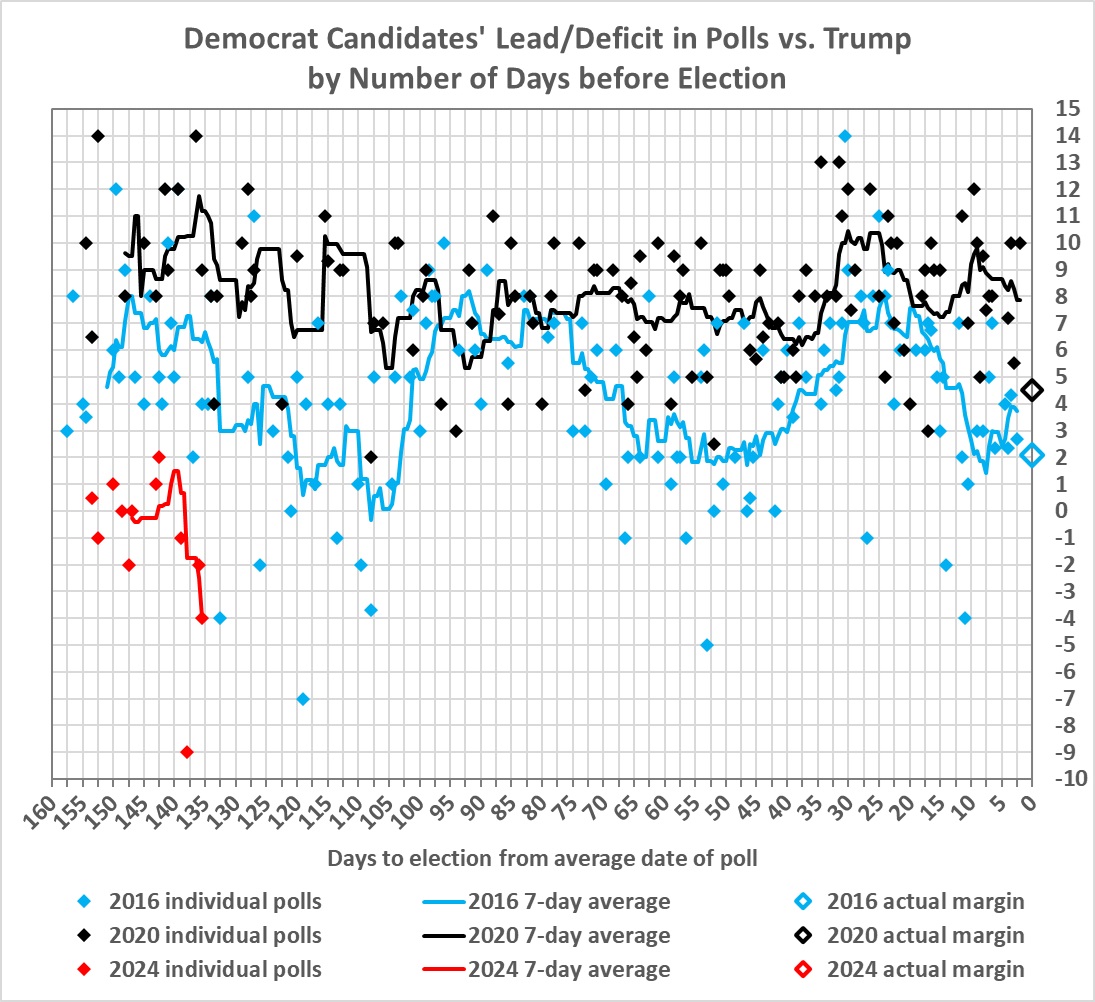
In 2016, Clinton’s lead over Trump in the final seven days of polling averaged 2.5 percentage points (or those polls covered by RealClearPolitics (RCP). Clinton’s edge in the nationwide tally of popular votes was 2.1 percentage points. Despite her (meaningless) nationwide edge, she lost to Trump because he won Michigan, Pennsylvania, and Wisconsin — each by less than 1 percentage point. Those states’ 46 electoral votes gave Trump the win over Clinton.

In 2020, Biden’s lead over Trump in the final seven days of polling averaged 7.9 percentage points for those polls covered by RCP. Biden’s edge in the nationwide tally of popular votes was 4.5 percentage points; that is, slightly below the bottom of the 95-percent confidence interval around the apparent 7.9-point lead. Despite his (meaningless) 4.5-point lead in the popular vote, Biden won the election only because he edged out Trump in both Georgia and Wisconsin by less that 1 percentage point and in Pennsylvania by a little more than 1 percentage point. Those states’ electoral votes gave Biden his win over Trump.

Hypothesis: Clinton and Biden underperformed at the ballot box vs. their poll numbers because the polls (on average) were biased somewhat toward Clinton in 2016 and much more so toward Biden in 2020. This hypothesis is supported by a report issued by the American Association for Public Opinion Research (https://aapor.org/wp-content/uploads/2022/11/AAPOR-Task-Force-on-2020-Pre-Election-Polling_Report-FNL.pdf):

● The 2020 polls featured polling error of an unusual magnitude: It was the highest in 40 years for the national popular vote….

● The polling error was much more likely to favor Biden over Trump. Among polls conducted in the last two weeks before the election, the average signed error on the vote margin was too favorable for Biden by 3.9 percentage points in the national polls and by 4.3 percentage points in statewide presidential polls.

● The polling error for the presidential election was stable throughout the campaign. The average error matched closely for polls conducted in the last two weeks, in the final week, and even in the final three days. The challenges polls faced in 2020 did not diminish as Election Day approached.

● Beyond the margin, the average topline support for Trump in the polls understated Trump’s share in the certified vote by 3.3 percentage points and overstated Biden’s share in the certified vote by 1.0 percentage point. When undecided voters are excluded from the base, the two-candidate support in the polls understated Trump’s certified vote share by 1.4 percentage points and overstated Biden’s vote share by 3.1 percentage points.

The report also concludes that the bias wasn’t due to the massive surge in early voting and mail-in voting in 2020.

The foregoing suggests that if the polls remain strongly biased toward Biden in 2024, and if he polls much worse than he did in 2020, his candidacy is doomed.

With that background, I refer you to the following graph, which compares results of polls reported by RCP for the elections of 2016, 2020, and 2024. The results represent polls conducted between June 1 and election day of each election year. We’re a long way from election day 2024, but the results to date are ominous for Biden; he is running behind Clinton’s losing pace of 2016. Stay tuned.

The Arithmetic of Disunion

In some of my several posts about a national divorce (see thisthisthisthis, this, and this), I have opined that the new union formed by conservative States

could easily afford a robust defense after having shed the many useless departments and agencies — and their policies — that burden taxpayers and the economy.

(Many of the policies, especially those that regulate economic activity, are worse than useless: they are economically destructive; see this and this).

Let’s examine the proposition that the new union could easily afford a robust defense. For this exercise, I assume that the new union, which I have elsewhere dubbed Freedomland, consists of 25 States (listed in order of population): Texas, Florida, Ohio, North Carolina, Tennessee, Indiana, Missouri, South Carolina, Alabama, Louisiana, Kentucky, Oklahoma, Utah, Iowa, Arkansas, Kansas, Mississippi, Nebraska, Idaho, West Virginia, Montana, South Dakoto, North Dakota, Alaska, and Wyoming. (A shift of one or two States in either direction won’t change the thrust of this analysis.)

Those 25 States comprise 43 percent of the population of the United States. But they account for only 38 percent of U.S. GDP. (The discrepancy shouldn’t be surprising given the composition of the list.)

The cost of the federal government in 2022 (the latest year for which estimates are available at bea.gov) was just over $6 trillion, including $725 billion in interest payments on federal debt. The operating cost of the federal government was therefore about $5.3 trillion, including $727 billion for national defense. (It’s telling national defense, a key element of the impetus for the Constitution, accounts for only 12 percent of federal spending and is about the same as the cost of financing the federal debt.) Assuming that the cost of the federal government, less debt service, is shared in proportion to the distribution of GDP, the citizens of Freedomland are pumping more than $2 trillion a year into the federal treasury.

Now, what to do about the federal government? Team Blue, in a spirit of “fairness”, might propose keeping it intact and sharing costs and benefits according to Team Blue’s and Freedomland’s respective shares of GDP. Team Blue would (of course) continue to operate the federal government and would (of course) honestly account for the distribution of costs and benefits. It would be up to Team Blue (of course) to decide the level of costs and benefits.

Freedomland would reject the deal out of hand, not wanting its fiscal future to be hijacked by the cost of an ever-growing and ever-interfering central government. Freedomland’s leaders would make the following calculations:

  • 38 percent of $6 trillion = $2.3 trillion.
  • Freedomland’s share of federal outlays on health benefits and income security is $1.5 trillion a year. In exchange for giving up its share of those outlays, Freedomland will set up its own system of health benefits and income security. (The initial costs will be offset and reduced over time by robust economic growth; the reduction of benefits flowing to able-bodied persons below retirement age; rolling back the expansion of Medicare; denying benefits (direct or indirect) to illegal aliens; raising the retirement age; increasing work requirements; etc.)
  • Freedomland will take responsibility for defense of the 50 States and the District of Columbia. (It would be far more costly to defend Team Blue and Freedomland separately. Team Blue could trust Freedomland to mount a robust defense of the continent. And Freedomland would be assured of border security by doing the job itself.)

Freedomland’s total (initial) cost to defend the nation and ensure the health and income security of its citizens: the same $2.3 trillion a year it now sends to DC. But in the long run, the citizens of Freedomland would be far better off economically and relieved of the oppressive government in DC.

But the citizens of Freedomland should never forget that eternal vigilance is the price of liberty — and prosperity.

Trump vs. Biden: 13 (A Glimmer of Hope)

If you have read “Election 2024: The Bottom Line” or “Election 2024 in Perspective” you will understand why I use “glimmer of hope” to refer to a possible Trump victory in November. The glimmer of hope that I see is Trump’s standing in the polls this time around compared with his standing in the polls at this point in 2016 and 2020. Specific

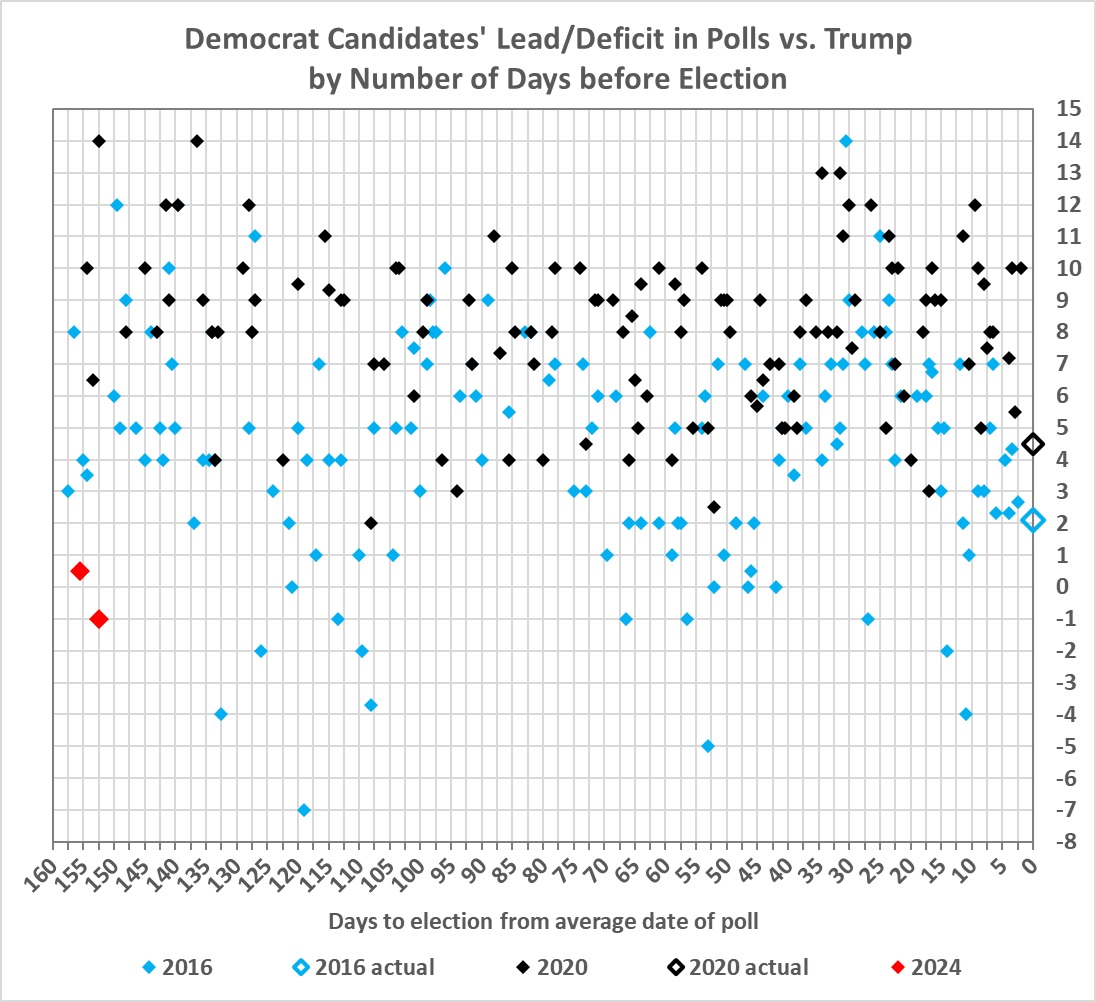
I collected all of the two-way polling results reported at realclearpolitics.com for the elections of 2016 and 2020. I weeded out all of the polls that were conducted before June of each election year and plotted the numbers for the rest: the Democrat candidates’ polling lead or deficit vs. number of days before the election. I have also begun to plot similar numbers for this year’s election. Here are the results as of today:

The plot points represent the Democrat candidates’ lead or deficit vs. Trump. Two polls with the same average date (June 4) gave Biden and average lead of 0.5 point. A third poll with an average date gave Trump a narrow lead of 1 point, which converts to a Biden deficit of 1 point.

Clearly, Trump is doing a lot better in the polls this year than he was doing at this time in 2016 and 2020. But a lot can happen between now and when voting starts. A lot did happen to Clinton (2016) and Biden (2020) — and it wasn’t good for them.

Clinton’s polling was all over the place, but she ended up 2.9 points ahead of Trump for polls conducted in the seven days before the election. She “won” the nationwide popular vote by 2.1 percentage points (plotted on the right axis). But she lost the electoral vote because of Trump’s narrow wins in a few key States.

Biden never relinquished his lead in the polls. He ended up 7.6 points ahead of Trump for polls conducted in the seven days before the election. He “won” the nationwide popular vote by 4.6 percentage points (plotted on the right axis). But he won the electoral vote only because of narrow wins in a few key States.

If there’s a pattern, it’s this: Polls, in the aggregate, overstate Democrats’ shares of the nationwide popular vote — at least when they’re up against Trump. Further, because of the electoral college, it takes a large margin in the final polls to be certain of victory — if you’re a Democrat. The necessary margin is greater than final Biden’s 7.6-point lead in the 2020 polls.

Conclusion: Biden is in deep trouble, as of now. But election day is five months away. Thus: a glimmer of hope.

Living the American Dream

My late father-in-law grew up in a shack like this:

He picked cotton to help his widowed mother care for the five children she was left to raise when his father died young.

He worked his way through two years of college before joining the Army Air Corps aviation cadet program in 1939. He earned his wings and was commissioned a second lieutenant in September 1941. He proposed to my future mother-in-law on December 6, 1941 — the day before the Japanese bombed Pearl Harbor.

After training many Air Corps pilots for combat, he was sent to the Pacific Theater in 1944, where he flew many combat missions. He stayed in the Air Force (as it became) after the war ended and flew many more combat missions in the Korean War.

He rose to the rank of colonel at a relatively early age and ended his 30-year career as commander of an award-winning wing. (He would have made brigadier general, but Lyndon Johnson gave the slot to his Air Force One pilot.) His drive to excel and his leadership skills carried over into a successful and stressful civilian career.

He retired for good at the age of 63 and lived out his life happily and comfortably in his adopted hometown.

He died at the age of 96, loved and mourned by family and friends.

He hated Democrats — he called them demoncrats — not because of what Lyndon Johnson did to him but because of what they were doing to the country.

Now, almost ten years after my father-in-law’s passing, the demoncrats have redoubled their efforts to destroy the American dream. The dream for which he worked and fought — and which he was able to live.

Election 2024 in Perspective

The federal government, since the latter part of the 19th century has grown vastly in size, cost, and power. It has done so by blatantly exceeding the limited role for it that is set forth in the Constitution.

The growth of the federal government (which has necessitated and spurred the growth of state and local governments) absorbs resources that (with the exception of national defense) could be put to better use by private companies responding to the needs of consumers.

One aspect of government growth, at all levels, has been the promulgation of an ever-growing number of regulations, ordinances, and codes (they must number in the millions). The net effect of those regulations, ordinances, and codes is to stifle entrepreneurship and innovation. This comes at great cost to American workers and consumers.

The economic effect of government spending and regulation (by its various names) is the loss of well over a trillion dollars a year in economic output. Given the many years in which Americans have lived with big, heavy-handed government, the overall cost of its unconstitutional aggrandizement has been almost unimaginable – it is certainly in the tens of trillions of dollars. The arrogation of legislative, prosecutorial, and judicial functions by regulatory agencies adds the loss of liberty to that massive economic cost.

The heavy burden of regulation has been compounded in recent years by the emphasis on so-called renewable sources of energy. The shift away from fossil fuels – according to the models used and touted by climate “scientists” – will have almost no effect on global temperatures. Yet, the cost in dollars and misery will be huge. As for those models, they are simplistic relative to the many and complex (and little understood) factors that influence climate. And they do a poor job of reconstructing the past, so how can they possibly produce accurate forecasts of the future? Also overlooked in the rush to substitute models for science is the fact that the geological and historical record – despite the efforts of some climate “scientists” to revise and erase it – clearly shows that Earth has been warmer in the past 2000 years than it is now, and that it often warmed more rapidly in the past than it has been warming in the past 40 years.

Another recent development has been the failure to enforce immigration laws, which has resulted in a flood of illegal immigrants. Whatever reasons those immigrants may have for entering the U.S., it is a fact that they are in many places overwhelming various social services (hospitals, public housing, etc.) at a heavy cost to taxpayers. Regardless of the law-abiding nature of most illegal immigrants, the flood has brought with it violent criminals, dangerous drugs, drug dealers, and quite possibly spies and terrorists. It is no secret – though Democrats tend to deny it – that the impetus for untrammeled immigration is to create new voters, by amnesty and other means, most of whom are expected to vote for Democrats. One dire effect of such a development would be even bigger government, even lower economic growth, and even higher taxes.

Then there are the social changes that have been embraced and pushed by Democrats. Same-sex marriage is now a given, so I won’t bother to discuss it (though I could write an essay about the legal persecution of tradespeople who have been penalized for their refusal to “celebrate” it). But I will discuss transgenderism, with its various ill effects: allowing and encouraging impressionable and not-yet-developed children to undergo life-changing medical treatments and surgeries; forcing girls and women to compete with so-called transgender women, who seem not to have lost the superior size and strength that goes with being male; allowing the same “women” to invade the privacy and bodies of girls and women in locker rooms, dormitories, prison cells, etc.

There is also a strong push by government institutions to discriminate in favor of blacks (by means ranging from special loans to easy grading to re-segregation to protect them from feeling “different” or “inferior”). If discrimination solely on the basis of race is wrong, it is wrong when it favors blacks just as much as when it favors whites. Reverse discrimination and special treatment are also condescending toward blacks – which hasn’t gone unnoticed by some of them.

Another development – and a dangerous one for liberty and the advancement of knowledge – is the use of government power (or the implied threat to use that power) to censor views that government officials dislike. This kind of censorship, which is carried out through Big Tech firms and broadcast media, may be meant to protect the public from potentially harmful “misinformation”. But the urge to control information knows no bounds and it can just as easily be used to construct “narratives” that are favorable to the regime in power by suppressing valid information that would discredit the regime. Big Tech and broadcast media already do this to a great extent, though mainly because of the political leanings of the executives in charge of those institutions. But it would take almost no effort on the part of government officials to turn many news and information outlets into a government propaganda machine. (Shades of Hitler, Stalin, Mao, and many other despicable tyrants.)

Finally, China, Russia, and Iran have relentlessly built military capabilities that can be used to blackmail the U.S. government into granting military and economic concessions to those nations. (Russia’s war in Ukraine hasn’t stopped its development of sophisticated weaponry, such as its hypersonic missiles and new space weapon.) There is no indication that our adversaries will settle for “peaceful coexistence”; their aim is dominance. Despite that, the U.S. government has persisted in allowing U.S. armed forces to become relatively weaker than those of its adversaries. (Clinton’s budget-balancing at the cost of defense, and the coddling of the Iranian regime by the Obama-Biden administrations are underreported scandals.)

In sum, beginning in the late years of the 19th century, government in America began to lose its way: imposing huge costs on American citizens through growth in size and power, while also failing to maintain the forces necessary to deter potential enemies.

None of that has changed in the 21st century, but the burden on Americans has redoubled because of a quixotic effort to control the climate, a similarly quixotic effort to erase gender differences, and the possibly successful quest to build a permanent Democrat majority.

It has taken more than a century for America to make the transition to what the proverbial man from Mars would describe as a regulatory-welfare state run by a cabal of power-lusting politicians and bureaucrats and their mentors and enablers in the “education”-media-information complex. Too many Americans, unfortunately, don’t see America for what it has become because it has changed gradually. And at every step along the way, those with a stake in the regulatory-welfare state have declared it to be in the public interest and defended it as the product of “our democracy”. Their version of democracy amounts to this: Do as we say, we know what’s best for you. No side has a monopoly on that kind of thinking, but the regulatory-welfare state enables its realization through the extra-constitutional enactment and enforcement of rules that micromanage the economic and social affairs of Americans. That is the darkness in which democracy dies.

Everything written above represents my long-held views. They predate by two decades the emergence of Donald Trump as a candidate for president in 2015.

Trump is (undeservedly) vain, crude, and inarticulate, and he has a disgraceful sexual history. But despite those things, he is the only president since Ronald Reagan who has tried to stem the tide of government overreach and under preparedness. Trump’s record as president was far from perfect, but he got some things going in the right direction; for example, less regulation, more (real) military spending, and a serious effort to stem illegal immigration. You may dislike his Supreme Court appointments because of the effect they have had on certain issues, but the overall effect of those appointments has been and will be to restrain government power, which has grown far beyond its constitutional bounds.

It is Democrats, for the most part, who favor the policies that I abhor. Because Trump is viewed as a threat to those policies, and to Democrats’ hold on power in DC, there has been since he announced his first run for the presidency a “get Trump” movement. It began in earnest with the false “Steele dossier” that was ordered up by Hillary Clinton’s campaign. It continued with the Mueller investigation, two impeachments, and incessantly negative reporting about Trump’s presidency by pro-Democrat media outlets. It has culminated in what are not coincidental civil and criminal charges against Trump.

In the case of E. Jean Carroll, her suit against Trump was made possible by the passage of law in New York that extended the statute of limitations on Trump’s alleged acts against Carroll — for the obvious purpose of bringing a case against Trump. Would Carroll’s charges, or any of the other charges, been brought against a former president who was a Democrat? I doubt it very much. But to keep Trump out of power, various Democrat officials (in an amazing concert of legal synchronization) have put into practice the Stalinist-era slogan “show me the man and I’ll show you the crime”. Almost anyone can be charged with and found guilty of a crime. It’s just a matter of digging into his record, cherry-picking it for items that can be made to seem sinister, ignoring and suppressing exculpatory evidence, stretching the law to fit the supposedly incriminating facts, and finding a compliant judge and jury. The Carroll case fit that template, as did the “hush money” case, and as do the other legal actions against Trump.

What has happened and is happening to Trump can happen to anyone. It is of a piece with Democrats’ no-holds-barred approach to the Constitution and laws stand in the way of gaining and holding onto power. If Trump is stopped and if Democrats retain power – and reinforce it by importing voters, censoring the opposition, vote-buying (what else is student-debt cancellation?), assuaging blacks, and who knows what else – opposition to the regime itself will become criminalized. You can bet on it because the only thing that has kept America from becoming a despotism isn’t a mythical thing called the “American character”, it has been the rule of law and the willingness of opposing factions to abide by it. That willingness disappeared in the run up to the Civil War. It is disappearing again.

All of that is why, if Trump is on the ballot in November, I will vote for him. As imperfect as he is as a person and political operator, he would nudge America in the right direction. If there were a better GOP candidate than Trump – one who is less obnoxious, more articulate, and with less personal baggage, but who is dedicated to the Constitution, to prosperity and liberty for Americans, and to military preparedness – I would vote for him or her. But there doesn’t seem to be such a candidate on the horizon.

In sum, my preference for Trump has nothing to do with the man and everything to do with restoring prosperity, liberty, and safety from domestic and foreign predators. To put it another way, a vote for Trump is a vote to make America great again. It is also a vote to save democracy — the real kind in which citizens are sovereign.

I have said nothing about Biden because his sins – though many and possibly greater than Trump’s – are beside the point. As a politician, he is no better or worse than any Democrat who might replace him on the ticket or succeed him if he is elected and fails to finish his second term.

My devout wish it to have a Republican (Trump if necessary) occupy the White House and try, with the help of a Republican-controlled Congress, to prevent America from going down the drain. This may be the last chance for America’s reprieve from the dustbin of history.

About Declaring That the Negro Leagues Were Major Leagues

According to The New York Times (“The MLB-Negro Leagues Stat Change: What Happened, and Why?“, May 29, 2024):

Some will be shocked waking up to the news Wednesday that Hall of Famer and Negro League star Josh Gibson is now the major leagues’ all-time batting leader — 77 years after his death in 1947. Gibson has long been called one of the best hitters in baseball history, but he died three months before Jackie Robinson broke Major League Baseball’s color barrier and his numbers never appeared in MLB’s official record.

Until now.

As more than 2,300 Negro Leaguers’ numbers are added to the league’s official ledger, Gibson is MLB’s new career leader in batting average (.372), slugging percentage (.718) and OPS (1.177), and holds the single-season record in each slash-line category (.466/.564/.974).

Single-season OPS
NAME OPS (SEASON)
Josh Gibson
1.474 (1937)
Josh Gibson
1.435 (1943)
Barry Bonds
1.421 (2004)
Chino Smith
1.421 (1929)
Barry Bonds
1.381 (2002)
Babe Ruth
1.379 (1920)
Barry Bonds
1.378 (2001)
Babe Ruth
1.358 (1921)
Mule Suttles
1.349 (1926)
Babe Ruth
1.309 (1923)

[Note: OPS is a statistic that comes close to the sum of batting average and slugging percentage. I prefer the latter two, which I use below.]

“When you hear Josh Gibson’s name now, it’s not just that he was the greatest player in the Negro Leagues,’’ Gibson’s great-grandson, Sean, told USA TODAY, “but one of the greatest of all-time. These aren’t just Negro League stats. They’re major-league baseball stats.’’

This is of a piece with, though less harmful than, the beatification of George Floyd, Trayvon Martin, and others of their ilk. It’s yet another example of “equity” at work — make blacks equal (or more than equal) to whites and others by fiat.

I sampled the records of 25 black baseball players who went from the Negro leagues to Major League Baseball. The sample isn’t representative because it includes such greats, near-greats, long-tenured MLB players as Jackie Robinson, Larry Doby, Hank Thompson, Roy Campanella, Minnie Minoso, Luke Easter, Sam Jethroe, Jim Gilliam, Elston Howard, Monte Irvin, Harry Simpson, and Willie Mays. Of those players, Robinson, Doby, Campanella, Minoso, Irvin, and Mays were elected to the Baseball Hall of Fame.

I compared the records compiled by the 25 players (as a group) in the Negro leagues with their performance in MLB. Here’s what I found:

Negro leagues
MLB
Batting average 0.317 0.266
Runs/at bat 0.196 0.138
Home runs/at bat 0.023 0.019
Runs batted in/at bat 0.185 0.107
Slugging percentage 0.487 0.386

The big leagues (the real ones) are tough, aren’t they? Let’s just say that the Negro leagues were on a par with minor-league baseball — perhaps class A in the scheme that prevailed back in the day (AAA, AA, A, B, C, and D).

Ty Cobb, Babe Ruth, and other real MLB record-holders can sleep soundly in their graves.

The Problem of Attributing Causality

I was reminded of the problem of attributing causality by “Did Major League Baseball Really Have a ‘Steroid Era‘”, which throws cold water on the belief that the barrage of home runs for about a decade from the mid-1990s to the mid-2000s was mainly attributable to the use of performance-enhancing drugs (PEDs). I also threw cold water on that hypothesis several years ago in “Steroids in Baseball: A Counterproductive Side show or an Offensive Boom?“.

The attribution of changes in a particular statistic (e.g., home runs) to one or a few causal factors is scientism (see number 2). There is also a tendency to allow preconceptions to dictate the selection of causal factors (see “Climate Change” and “Can America Be Saved?“).

Baseball, like life and many of the phenomena addressed by science, is too complex for simple explanatory models. I was reminded of this when I read Alan Longhurst’s Doubt and Certainty in Climate Science. It is a masterful review of what is known and unknown about the myriad phenomena that influence climate. Uncertainties and lacunae abound, as Longhurst shows in his examination of the findings related to dozens of climate-influencing phenomena. Longhurst’s analysis of the findings (and lack thereof) makes a mockery of the pseudo-precision of temperature forecasts made by global climate models — models that can’t even replicate the past accurately (see “Climate Change” and “Climate Change: A Bibliography“).

In that regard, I must emphasize that modeling is not science. It is, rather, reductionism: the practice of oversimplifying a complex idea or issue (see “The Enlightenment’s Fatal Flaw“).

Scientism and reductionism are nowhere more rampant (and destructive) than in governmental actions authorized by legislation and regulation. A “problem” is perceived, usually as the result of a massive media campaign triggered by an incident, “scientific finding”, or interest-group pressure. The result is a clamor for “somebody” to do “something” about the “problem”. The response that has become habitual since the onset of the Progressive Era is to invoke the power of the central government. (In almost all cases, the power invoked can be found in the Constitution only by contorting it beyond recognition by its Framers.)

Thus are born, nourished, and defended various powers and “rights” that have unforeseen (or willfully ignored) consequences for the general welfare of Americans. Why? Because executives, legislators, regulators, and judges are ignorant of (or don’t care about) the fact the most “problems” have myriad causes — causes that aren’t (and usually can’t be) addressed by executive orders, laws, regulations, or judicial decrees. The usual suspects are also ignorant of (or don’t care about) the ramifications of efforts to fix “problems” through the aforementioned means.

Non-Citizen Voting Is Unconstitutional

I refer you to the Constitution of the United States.

Amendment XV, Section 1:

The right of citizens of the United States to vote shall not be denied or abridged by the United States or by any State on account of race, color, or previous condition of servitude….

Amendment XIX:

The right of citizens of the United States to vote shall not be denied or abridged by the United States or by any State on account of sex.

Amendment XXIV, Section 1:

The right of citizens of the United States to vote in any primary or other election for President or Vice President, for electors for President or Vice President, or for Senator or Representative in Congress, shall not be denied or abridged by the United States or any State by reason of failure to pay any poll tax or other tax.

Amendment XXVI, Section 1:

The right of citizens of the United States, who are eighteen years of age or older, to vote shall not be denied or abridged by the United States or by any State on account of age.

Clearly, the Constitution contemplates that only citizens of the United States may vote. It might be argued that the Constitution applies only to elections for federal office. If that were the case, States and localities would have to require voters to show proof of U.S. citizenship and give them ballots that pertain only to State and local offices and issues.

But I would go further than that. Allowing non-citizens to vote in any election in the United States violates Section 1 of Amendment XIV:

All persons born or naturalized in the United States, and subject to the jurisdiction thereof, are citizens of the United States and of the State wherein they reside. No State shall make or enforce any law which shall abridge the privileges or immunities of citizens of the United States; nor shall any State deprive any person of life, liberty, or property, without due process of law; nor deny to any person within its jurisdiction the equal protection of the laws [emphasis added].

If some localities allow non-citizens to vote, but others in the same State disallow non-citizen voting, citizen-residents of localities in the second category are denied the equal protection of the laws (i.e., the power of their votes is diluted).

Further, the same logic applies across States. Those States that allow non-citizens to vote for federal offices are giving them “privileges” that are denied to citizens of States that allow only citizens to vote.

Trump vs. Biden: 12a (Rethinking the “Battleground” States)

There’s a new spate of articles about Trump’s lead in the polls for so-called battleground States: Arizona, Georgia, Michigan, Nevada, North Carolina, Pennsylvania, and Wisconsin. Yes, Trump is still leading in all seven States, if you take an average of polls reported at RealClearPolitics. Here’s how the five-poll averages look for Trump:

  • Arizona – up by 5.2 points and rising
  • Georgia – up by 5.0 points and rising, but below earlier peak
  • Michigan – up by 0.6 point and falling, well below earlier peak
  • Nevada – up by 5.6 points and rising
  • North Carolina – up by 5.8 points and falling, somewhat below earlier peak
  • Pennsylvania – up by 2.6 points and rising, but below earlier peak
  • Wisconsin – up by 0.6 point and falling, somewhat below earlier peak.

Only the leads in Arizona, Georgia, Nevada, and North Carolina are statistically significant (lower bound of 95-percent confidence interval is greater than zero).

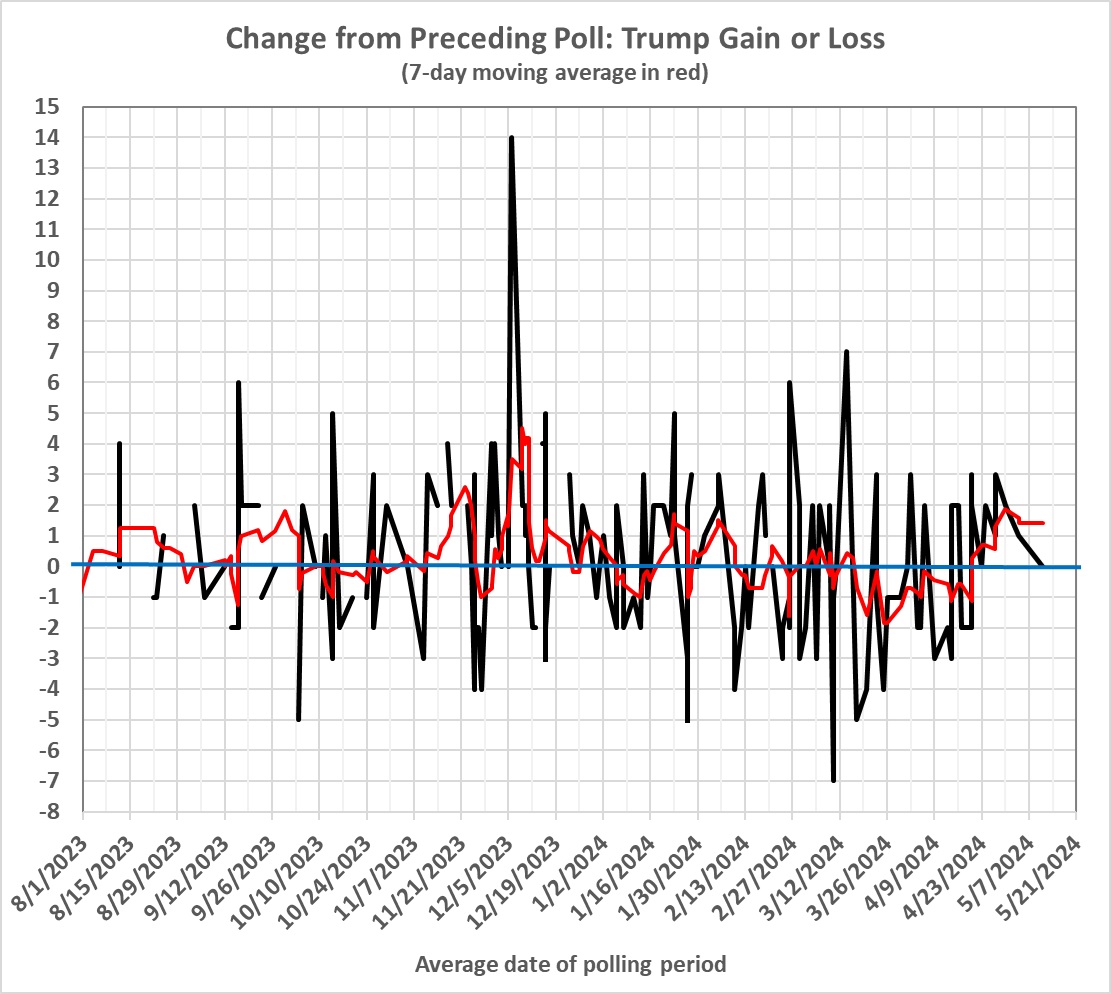
Adjustments for pollsters’ political biases — which I haven’t made — might make things look better for Trump. But the real problem with the “battleground” polls is their paucity. This can be seen by contrasting a metric I devised for nationwide polls with similar metrics for the “battleground” polls.

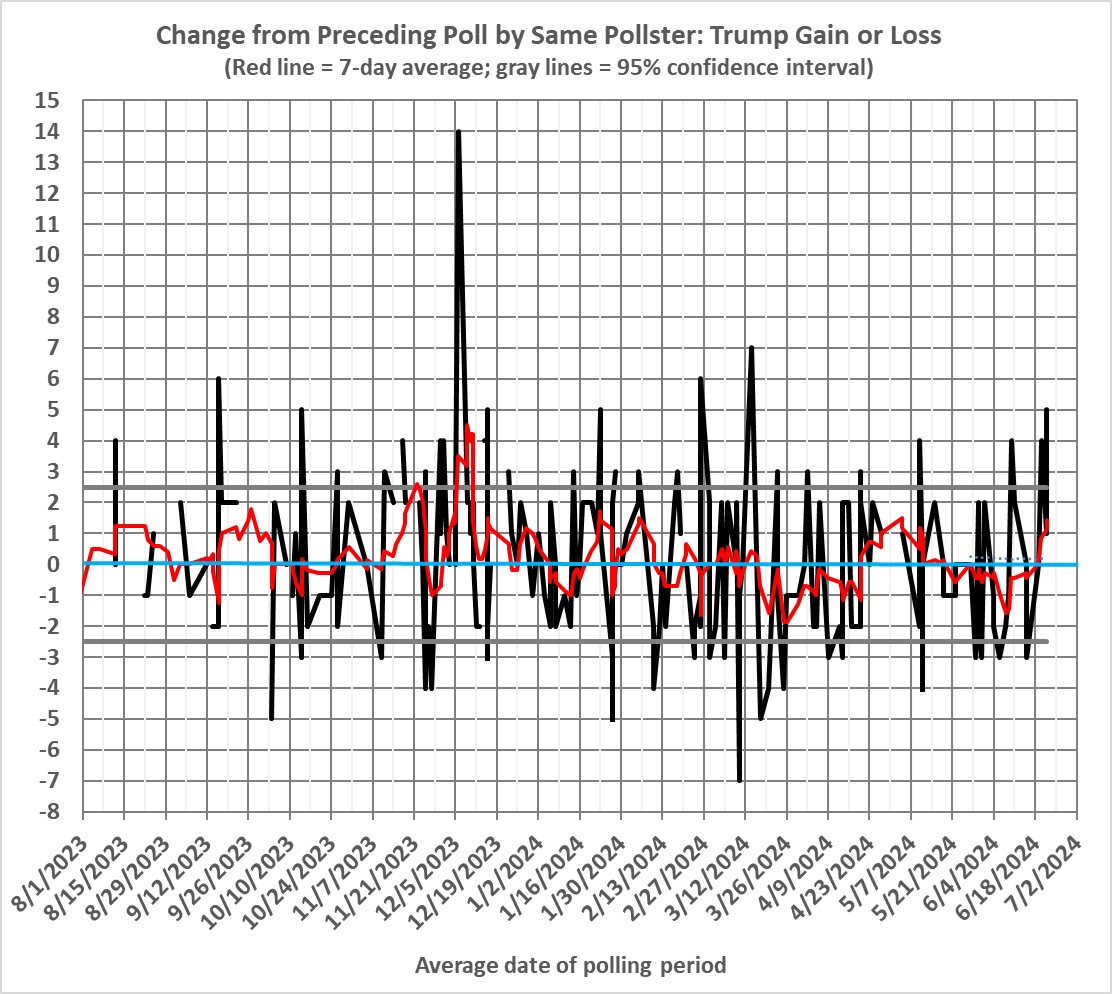
The metric is the change in each pollster’s results from poll to poll. For example, in the Morning Consult poll that was conducted May 3-May 5, Trump was up by 1 point. He was up by 1 point in the next Morning Consult poll which was conducted May 10-May 12. That counts as zero gain on the average date of the later poll: May 11. The full tally for all polls reported at RealClearPolitics since August 2023 looks like this:

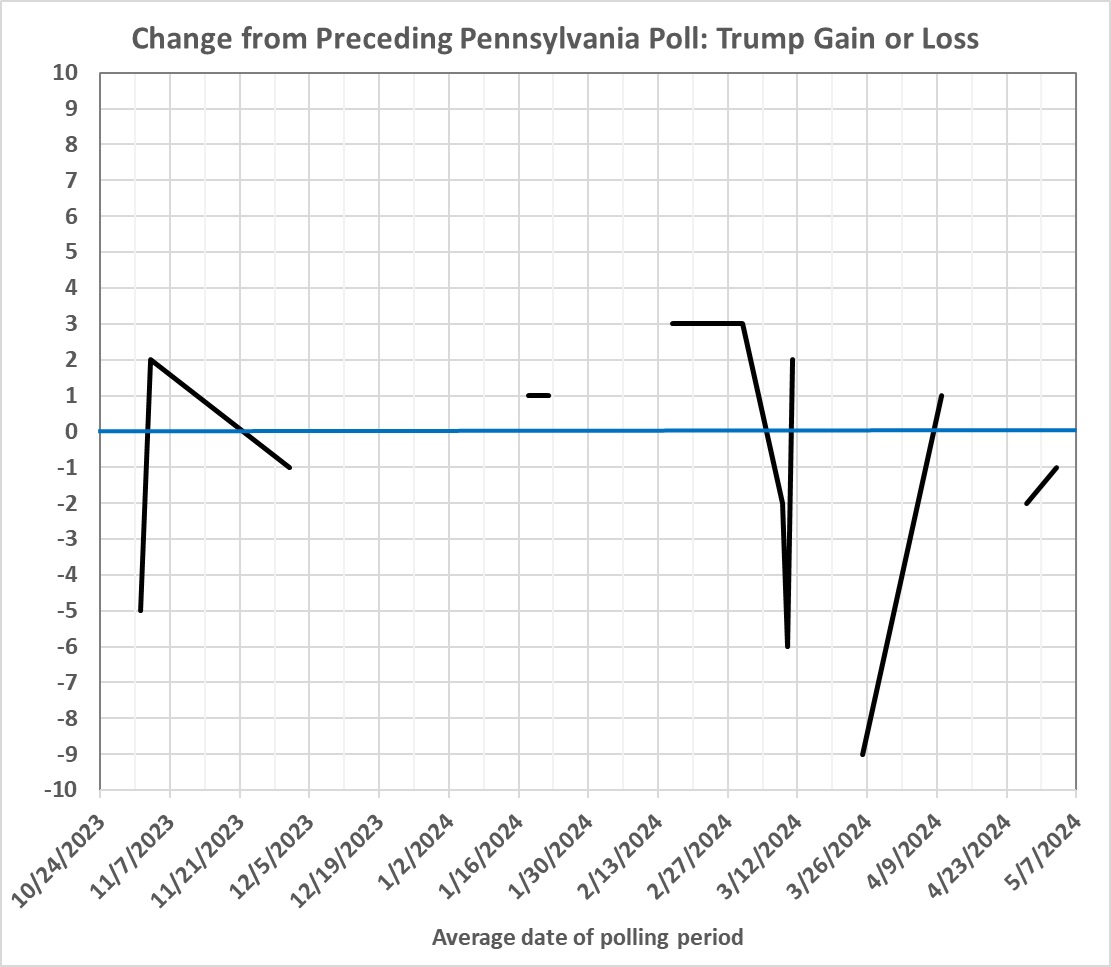
Here’s a similar graph for Pennsylvania, which the most heavily polled of the “battlegrounds”:

That’s not much to go on, is it?

What to do? I’m inclined to ignore the polls for individual States and keep my eye on the nationwide polls. But I will be more demanding of myself when I declare that Trump might win with a small lead or deficit in those polls.

As I say in the updated version of “Trump vs. Biden: 2“,

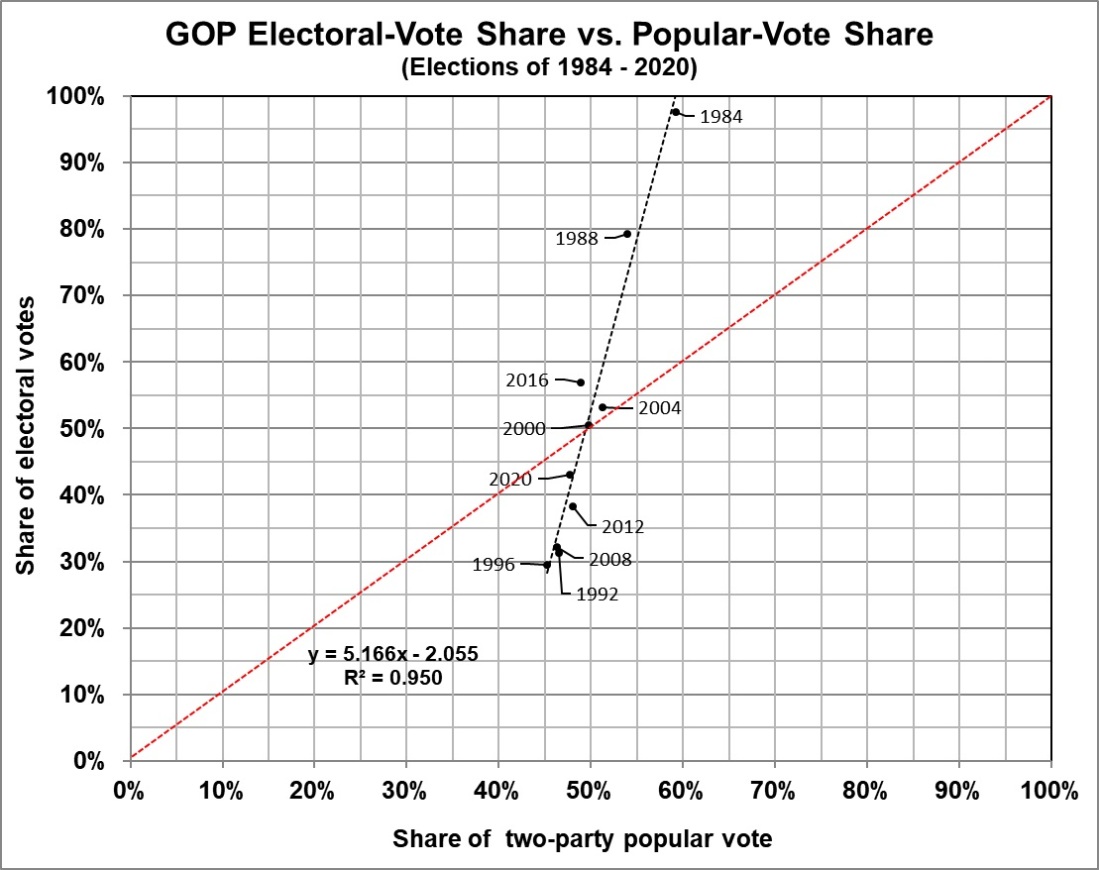
The statistical relationship in the graph [below] is meaningless. What can be meaningful is a narrow margin of victory (or loss) in a few States. This underlines the lesson from “How Good Are the Presidential Polls?“: Even a large lead in nationwide polls doesn’t signify victory in the Electoral College.

Well, the relationship isn’t quite meaningless. Here’s how it looks with a 90-percent confidence interval (which happens to encompass 100 percent of the data because the underlying distribution isn’t normal):

What this means is that I will be confident of a Trump victory (270 or more electoral votes) only if it looks like he will get 53 percent (or more) of the two-party popular vote, nationwide. A tally of at least 54 percent (a margin of at least 8 percentage points) would be convincing. (That’s close to my finger-to-the-wind estimate of 9 percentage points in “How Good Are the Presidential Polls?“, wherein I assessed the accuracy to the nationwide polls for the presidential elections of 2004-2020.)

If Trump doesn’t rack up a big margin, the Dems will be able to manufacture enough votes in key States to steal the election — again.

For Your Viewing Pleasure

Elsewhere I have written at length about feature films and my favorites among them. In the past several years, however, I have (mostly) eschewed feature films for TV series and miniseries. There are several reasons for my revised viewing habit, which I won’t bore you with. Let’s just say I find my new regimen rewarding because when I find a series or miniseries worth watching the enjoyment lasts well beyond a few hours.

The list below consists of my favorite TV series and miniseries of all time, with links to Internet Movie Database entries for each. The earliest entry is The Forsyte Saga (1967); several of my favorites are still running, 57 years later. I have inserted comments about many of the entries. The lack of a comment shouldn’t be taken as a lack of enthusiasm on my part. Every entry earned a high rating (8, 9, or 10) from me.

Many of the series are no longer available, but I’ve listed all that I can remember just in case some of them appeal to you. With luck, you will be able to find some of them on streaming services or DVDs.

There are a few American entries from the 1970s and 1980s — a brief era during which the major networks somehow managed more than schlock. The later American entries, also few (e.g., The Sopranos and Mad Men), were aired by streaming services.

The list is dominated by foreign entries. I have been especially pleased by the quality of Australian, Danish, Swedish, and Italian offerings in the 21st century. British fare figures prominently, of course.

The Adventures of Sherlock Holmes (1984-1985) — The long-running Jeremy Brett version continues with The Return of Sherlock Holmes (1986-1988), The Case-Book of Sherlock Holmes (1993), and The Memoirs of Sherlock Holmes (1994).

All Creatures Great and Small (2020-?) — Better than the original from 1978.

All in the Family (1971–1979) — It’s worth watching for the humiliation of “Meathead” (Rob Reiner).

Any Human Heart (2010)

“The Long Drift Leftward”: Addendum

In “The Long Drift Leftward” I offer statistics about presidential elections to demonstrate the drift. I then attribute that drift to three coinciding factors, one of which is the enfranchisement of women and their steadily increasing propensity to vote.

Along comes a post by David Friedman, “Women Voting, Government Expenditure“. He finds that the relative growth of government spending for 13 Western nations (including the U.S.) is related to the enfranchisement of women. Being a two-handed economist, he hedges on his finding.

But putting his finding together with mine buttresses my conclusion (and his).

What Matters to “Suburban Women”?

You hear a lot about the things that matter to college-educated, middle- and upper-middle-class women.

They don’t seem to be real things like these:

  • Riots, crime, and terrorism
  • Marauding illegal aliens
  • Exorbitantly (and unnecessarily) high energy costs
  • Subsidization of things that don’t matter (recycling, EVs, “sustainable” fuels)
  • Rising tax rates
  • Government censorship
  • Subversion of justice
  • Inability to deter China’s growing military might.

No. They care about a hoax: “Climate change”.

And about a “health issue” that most of them would never face (or contemplate) or are too old to need: Abortion.

That’s the mindset that was created by decades of brainwashing in public schools and universities.

You have to wonder why it was so easy to wash their brains of common sense. I’d say it was a fatal combination of hormones, groupthink, and insulation from the world of real suffering that their grandparents had to endure; for example:

Inflating GDP

There are five ways to do it:

  • “Print” money.
  • Make businesses less efficient through regulation.
  • Enlarge government, thus drawing productive resources from private use.
  • Pay people to do nothing.
  • Encourage destructive behavior — rioting, illegal immigration, crime in general — and count remedial spending as part of GDP.

The first four items got liftoff in the 1930s and have been getting bigger and “better” since then. The fifth item has reached critical mass under Biden.

Trump vs. Biden: 2 (Important Update)

Here.

The Growing Age-Based Income Gap

It has been said often that today’s young adults have a harder time of it, economically (and probably in other ways), than the young adults of yesteryear. Is that true? If so, is a new phenomenon?

To shed some light on those questions, I turned to the Census Bureau and found Table P-10. Age–All People (Both Sexes Combined) by Median and Mean Income: 1974 to 2022. I plotted mean income by year for six age groups, with this result:

You can readily see that the rate of income growth for the youngest workers (15 to 24-year-olds) has been slower than that of the older age groups. In fact, the rate of income growth is inversely related to age group. Here are the coefficients of the linear fits to each of the lines in the graph:

  • 15 – 24: 132
  • 25 – 34: 346
  • 35 – 44: 539
  • 45 – 54: 625
  • 55 – 64: 683
  • 65 – 74: 750

Thus, for example, the mean income for the 15 – 24 age group increased, on average, by $132 per year, and so on for each group. (The r2 values are — from the youngest to oldest age group — 0.69, 0.76, 0.88, 0.87, 0.92, 0.95.)

In sum, the incomes of younger workers — on average and most of the time — have lagged further and further behind the incomes of older workers since at least 1974.

I am unsurprised by that. It has often been remarked that those of us who entered the labor force around 1960 had it better than those who followed us. I am certain that the observation would be borne out if there were data going back to 1960 or earlier.

Why is this so? An important reason, but not the only one, is the “law of supply and demand”. Economic growth in the U.S. has long been positive (though at a declining rate in the 20th and 21st centuries). Yes, there have been brief episodes of negative growth during recessions and longer episodes during the Great Recession and Great Depression. But the demand for labor of various kinds has grown over the long haul.

The supply of labor, on the other hand, hasn’t grown consistently (see table here). The population of the U.S. grew by only 7.3 percent from 1930 to 1940, as against 16.2 percent in the preceding decade, 15.0 percent in the decade before that, and much higher percentages before that.

The Great Depression of the 1930s was the main cause of slow population growth in that decade. World War II was the main cause of slow population growth from 1940 to 1950 — only 14.5 percent (slower than all preceding decades but one). Ant the growth in the 1940s came mainly in the latter half of the decade, when the post-war “baby boom” started.

The short of it is that younger persons who entered the labor force during, say, 1955 to 1965 didn’t face as much competition from their peers as did earlier generations. That happenstance served most of them well all the way to retirement.

Younger workers of later years have had it tougher — despite declining population growth since 1960 — because of the sharply declining rate of economic growth after 1970. Each regression line in the graph below reflects the rate of growth for the associated business cycle (the flatter the slope the lower the rate of growth). The 1949-1954 and 1960-1970 cycles generated much higher growth rates than those that followed. Further, the growth rates have generally declined over time; the rate for the 2009-2020 cycle (and beyond) is the lowest of the lot.

Today’s young adults, and those who follow them will be up against a lethargic economy — which will be made even more lethargic by the continued piling-on of regulations and the growth of government. The full amount of damage due to higher energy costs — because of the senseless war on “climate change” — is yet to be felt.

Youngsters should be leading the charge for regime change. But too many of them have been brainwashed in the belief that government (under Democrats) knows best. What it knows best is how to impoverish Americans and make nice to our worst enemies.

Paradoxes Abound

I have written several posts about political and economic paradoxes in the past 18 years. Here are the highlights (with some commentary).

The paradox of libertarianism:

 Liberty rests on an agreed definition of harm, and on an accompanying agreement to act with mutual restraint and in mutual defense. Given the variety of human wants and preferences, the price of mutual restraint and mutual defense is necessarily some loss of liberty. That is, each person must accept, and abide by, a definition of harm that is not the definition by which he would abide were he able to do so. But, in return for mutual restraint and mutual defense, he must abide by that compromise definition.

That insight carries important implications for the “anything goes” or “do your own thing” school of pseudo-libertarianism. That school consists of those libertarians who believe that harm is in the mind of the doer, or who believe that they can define harm while standing on the outside of society looking in. Thus they proclaim abortion and same-sex “marriage” (among other things) to be harmless — just because they favor abortion and same-sex “marriage” or cannot see the harm in them.

I am therefore a conservative libertarian.

  • Conservative because voluntarily evolved social norms are binding and civilizing, and therefore should not be dismissed out of hand or altered peremptorily.
  • Libertarian in a minarchistic way. The urge to power makes a state inevitable; the best state is therefore the one that only defends its citizens from predators, domestic and foreign.

A non-paradox for libertarians:

What if a society’s transition from a regulatory-welfare regime to a regime of liberty were to result in losers as well as winners? How could one then justify such a transition? Must the justification rest on an intuitive judgment about the superiority of liberty? Might the prospect of creating losers somehow nullify the promise of creating winners?

I argue … that my justification for libertarianism — although it is of the consequentialist-utilitarian variety — rests on a stronger foundation than an intuitive judgment about the superiority of liberty…. The virtue of libertarianism … is not that it must be taken on faith but that, in practice, it yields superior consequences. Superior consequences for whom, you may ask. And I will answer: for all but those who don’t wish to play by the rules of libertarianism; that is, for all but predators and parasites.

By predators, I mean those who would take liberty from others, either directly (e.g., through murder and theft) or through the coercive power of the state (e.g., through smoking bans and licensing laws). By parasites, I mean those who seek to advance their self-interest through the coercive power of the state rather than through their own efforts (e.g., through corporate welfare and regulatory protection)….

[A] transition to liberty might not instantly make everyone better off … but everyone could be better off. That’s simply not the case with the regulatory-welfare state, which robs some for the benefit of others, and ends up making almost everyone poorer than they would be in a state of liberty.

Liberty is a win-win proposition for everyone except those who deserve to lose.

The interest-group paradox:

 Pork-barrel legislation exemplifies the interest-group paradox in action, though the paradox encompasses much more than pork-barrel legislation. There are myriad government programs that — like pork-barrel projects — are intended to favor particular classes of individuals. Here is a minute sample:

    • Social Security, Medicare, and Medicaid, for the benefit of the elderly (including the indigent elderly)
    • Tax credits and deductions, for the benefit of low-income families, charitable and other non-profit institutions, and home buyers (with mortgages)
    • Progressive income-tax rates, for the benefit of persons in the mid-to-low income brackets
    • Subsidies for various kinds of “essential” or “distressed” industries, such as agriculture and automobile manufacturing
    • Import quotas, tariffs, and other restrictions on trade, for the benefit of particular industries and/or labor unions
    • Pro-union laws (in many States), for the benefit of unions and unionized workers
    • Non-smoking ordinances, for the benefit of bar and restaurant employees and non-smoking patrons.

What do each of these examples have in common? Answer: Each comes with costs. There are direct costs (e.g., higher taxes for some persons, higher prices for imported goods), which the intended beneficiaries and their proponents hope to impose on non-beneficiaries. Just as importantly, there are indirect costs of various kinds (e.g., disincentives to work and save, disincentives to make investments that spur economic growth). (Exercise for the reader: Describe the indirect costs of each of the examples listed above.)

You may believe that a particular program is worth what it costs… The problem is millions of your fellow Americans believe the same thing about each of their favorite programs. Because there are thousands of government programs (federal, State, and local), each intended to help a particular class of citizens at the expense of others, the net result is that almost no one in this fair land enjoys a “free lunch.” Even the relatively few persons who might seem to have obtained a “free lunch” — homeless persons taking advantage of a government-provided shelter — often are victims of the “free lunch” syndrome….

The paradox that arises from the “free lunch” syndrome is much … like the paradox of panic, in that there is a crowd of interest groups rushing toward a goal — a “pot of gold” — and (figuratively) crushing each other in the attempt to snatch the pot of gold before another group is able to grasp it. The gold that any group happens to snatch is a kind of fool’s gold: It passes from one fool to another in a game of beggar-thy-neighbor, and as it passes much of it falls into the maw of bureaucracy.

The interest-group paradox has dominated American politics since the advent of “Progressivism” in the late 1800s. Today, most Americans are either “progressives” or victims of “progressivism”. All too often they are both.

The capitalist paradox meets the interest-group paradox:

An insightful post at Imlac’s Journal includes this quotation:

Schumpeter argued the economic systems that encourage entrepreneurship and development will eventually produce enough wealth to support large classes of individuals who have no involvement in the wealth-creation process. This generates apathy or even disgust for market institutions, which leads to the gradual takeover of business by bureaucracy, and eventually to full-blown socialism. [Matt McCaffrey, “Entrepreneurs and Investment: Past, Present, … Future?,” International Business Times, December 9, 2011]

This, of course, is the capitalist paradox, of which the author of Imlac’s Journal writes. He concludes with these observations:

[U]nder statist regimes, people’s choices are limited or predetermined. This may, in theory, obviate certain evils. But as McCaffrey points out, “the regime uncertainty” of onerous and ever changing regulations imposed on entrepreneurs is, ironically, much worse than the uncertainties of the normal market, to which individuals can respond more rapidly and flexibly when unhampered by unnecessary governmental intervention.

The capitalist paradox is made possible by the “comfort factor” invoked by Schumpeter. (See this, for example.) It is of a kind with the foolishness of extreme libertarians who decry defense spending and America’s “too high” rate of incarceration, when it is such things that keep them free to utter their foolishness.

The capitalist paradox also arises from the inability and unwillingness of politicians and voters to see beyond the superficial aspects of legislation and regulation. In Bastiat‘s words,

a law produces not only one effect, but a series of effects. Of these effects, the first alone is immediate; it appears simultaneously with its cause; it is seen. The other effects emerge only subsequently; they are not seen; we are fortunate if we foresee them.

The unseen effects — the theft of Americans’ liberty and prosperity — had been foreseen by some (e.g., Tocqueville and Hayek). But their wise words have been overwhelmed by ignorance and power-lust. The masses and their masters are willfully blind and deaf to the dire consequences of the capitalist paradox because of what I have called the interest-group paradox [see above].

The paradox that is Western civilization:

The main weakness of Western civilization is a propensity to tolerate ideas and actions that would undermine it. The paradox is that the main strength of Western civilization is a propensity to tolerate ideas and actions that would strengthen it. The survival and improvement of Western civilization requires carefully balancing the two propensities. It has long been evident in continental Europe and the British Isles that the balance has swung toward destructive toleration. The United States is rapidly catching up to Europe. At the present rate the intricate network of social relationships and norms that has made America great will be destroyed within a decade. Israel, if it remains staunchly defensive of its heritage, will be the only Western nation still worthy of the name.

I wrote that almost five years ago. America network of social relationships and norms is (sadly) on schedule for destruction — unless there is a sharp and lasting turnaround in the governance of the country.

A paradox for (old-fashioned) liberals:

[A definition of old-fashioned liberalism is] given here by one Zack Beauchamp:

[L]iberalism refers to a school of thought that takes freedom, consent, and autonomy as foundational moral values. Liberals agree that it is generally wrong to coerce people, to seize control of their bodies or force them to act against their will….

Beauchamp, in the next paragraph, highlights the paradox inherent in liberalism:

Given that people will always disagree about politics, liberalism’s core aim is to create a generally acceptable mechanism for settling political disputes without undue coercion — to give everyone a say in government through fair procedures, so that citizens consent to the state’s authority even when they disagree with its decisions.

Which is to say that liberalism does entail coercion [how much is “undue” depends on whose ox is being gored]. Thus the paradox. (What is now called “liberalism” in America is so rife with coercion [link added] that only a person who is ignorant of the meaning of liberalism can call it that with a straight face.)

Socialism, communism, and three paradoxes:

The only substantive difference between socialism and communism, in theory, is that communism somehow manages to do away with the state. This, of course, never happens, except in real communes, most of which were and are tiny, short-lived arrangements. (In what follows, I therefore put communism in “sneer quotes”.)

The common thread of socialism and “communism” is collective ownership of “equity”, that is, assets (including the means of production). But that kind of ownership eliminates an important incentive to invest in the development and acquisition of capital improvements that yield more and better output and therefore raise the general standard of living. The incentive, of course, is the opportunity to reap a substantial reward for taking a substantial risk. Absent that incentive, as has been amply demonstrated by the tragic history of socialist and “communist” regimes, the general standard of living is low and economic growth is practically (if not actually) stagnant.

So here’s the first paradox: Systems that, by magical thinking, are supposed to make people better off do just the opposite: They make people worse off than they would otherwise be.

All of this because of class envy. Misplaced class envy, at that. “Capitalism” (a smear word) is really the voluntary and relatively unfettered exchange of products and services, including labor. Its ascendancy in the West is just a happy accident of the movement toward the kind of liberalism exemplified in the Declaration of Independence and Constitution. People were liberated from traditional economic roles and allowed to put their talents to more productive uses, which included investing their time and money in capital that yielded more and better products and services.

Most “capitalists” in America were and still are workers who make risky investments to start and build businesses. Those businesses employ other workers and offer things of value that consumers can take or leave, as they wish (unlike the typical socialist or “communist” system).

So here’s the second paradox: Socialism and “communism” actually suppress the very workers whom they are meant to benefit, in theory and rhetoric.

The third paradox is that socialist and “communist” regimes like to portray themselves as “democratic”, even though they are quite the opposite: ruled by party bosses who bestow favors on their protegees. Free markets are in fact truly democratic, in that their outcomes are determined directly by the participants in those markets.

The paradoxes and consequences of liberty and prosperity:

The soil in which the seeds of [America’s] decline were to be planted was broken in the Progressive Era of the late 19th and early 20th centuries. The seeds were planted and nourished by “leaders”, “intellectuals”, and “activists” from TR’s time to the present. The poisonous crop burst blossomed brightly in the 1930s and again in the 1960s, but it had not yet engulfed the land. It continued to spread slowly (and often unheeded) for several decades before racing across the land in recent years. Its poisonous vines are now strangling liberty and prosperity.

These are the paradoxes of liberty and prosperity: Without a moral foundation they lead to their own destruction.

If you value liberty, you do not countenance speech and actions that subvert it. If you value prosperity, you must be careful not to let it breed the kind of idleness (of mind and body) that gives rise to speech and actions that subvert liberty — and thus prosperity.

The Founders understood those things. They believed that the Constitution would preserve liberty and foster prosperity because they believed that Americans would remain religious and moral. They did not believe that Americans would undermine liberty by being soft on crime, by feeding masses (and elites) at the public trough (and at the expense of taxpayers), or by accommodating foreign aggression. They did not believe that Americans would countenance such things, nor that political leaders would suborn and join efforts to ostracize, suppress, and oppress those Americans who oppose such things.

The Founders, sadly, were wrong. The did not and could not foresee these events (and many more not mentioned):

    • A goodly fraction of Americans would spurn religion and become morally slack and complacent about the preservation of liberty.
    • Freedom of speech and assembly would be turned against liberty, to foster crime, lack of personal responsibility, and the accommodation of deadly enemies, within and without.
    • Firearms, always omnipresent in America for useful purposes, would become violent, murderous extensions of a growing tendency to toward psychological instability in a morally rootless populace.
    • Governments, political “elites”, and corporations would celebrate and reward (or fail to punish) persons based on the color of their skin (as long as it isn’t white or “yellow”)*, their pro-constitutional political views (which “exonerate” many whites), and their sex (preferably female or confused).
    • Abortion would become legal and support for abortion would be openly and boastfully proclaimed by political leaders and “elites”. Unborn human beings would be disposed of as inconveniences and treated like garbage.
    • Parents would lose control of the upbringing of their children, who might be cajoled into psychologically devastating treatments and surgeries by teachers and others under the rubric of “gender-affirming care”.
    • Women and girls would be forced to room with, shower with, and compete against males who “identify” as females (or “other”).
    • Intelligence and superior (non-athletic) skills would be denounced as unfair and “white supremacist” (with Asians counting as white).
    • Lawlessness and pathological deviancy would be rewarded (or not punished).
    • Leading politicians and “activists” would bay and howl for the confiscation of arms, under the rubric of “gun control”, when the underlying problem isn’t gun ownership by moral and mental depravity.
    • Political “leaders” would enable and allow a virtual invasion of the country, despite its negative consequences for the “little people” whom those “leaders” and other “elites” claim to champion.
    • The national government (and many others) would ignore science and invoke pseudo-science to force Americans into isolation, disrupt the economy, and burden the poorest Americans because of a virus that would have run its course naturally and less destructively than had it been combated scientifically.
    • The national government (and many others) would ignore science and invoke pseudo science to make Americans (especially poor Americans) poorer in an unnecessary and futile quest to “save the planet” from the use of fossil fuels, fertilizers, and other productive substances that the majority of the world’s populace will not refrain from using. (Regarding the state of science, see Maggie Kelly’s, “Professors Publish ‘Controversial’ Paper Defending Merit in Science”, The College Fix, May 2, 2023.)
    • Prosperity — a fruit of liberty — would foster the moral softness and the mental laxity that gives rise to addle-pated schemes such as those outlined above.
    • Vast numbers of Americans — having been indoctrinated in public schools, in left-dominated universities, and by the Democrat-allied media — would believe and subscribe to such schemes, which are made palatable by the application of double-speak labels to them (e.g., “defense of the homeland”, “combating misinformation”, “following the science”).
    • Government officials, including law-enforcement officers, would collude with and encourage the press and other purveyors of “information” to distort and suppress facts about much that is alluded to above, to discredit and hound a president (Trump) who opposed them, and to help elect and protect possibly the most corrupt president in America’s history (Biden) because it is through him that the left’s agenda is being implemented.
    • All of this (and more) would occur because almost-absolute power would accrue to the morally (and sometimes venally) corrupt politicians and their powerful enablers who advance and enforce such schemes.

….

In the best of possible worlds, there would be a voluntary return to something much closer to the America that the Founders envisioned. (Even a return to the post-New Deal 1940s and 1950s would do.) …

I don’t mean something like the turnaround in the House of Representatives following the elections of 1994 and 2010 (GOP gains of 12 and 15 percent). I mean something like the turnaround of 1930-1932 (total Democrat gains of 91 percent). In the wake of that turnaround, Democrats went on to control the House for the next 60 years (except for a post-World War II reaction of two years).

But the mass rejection of the GOP in 1930 and 1932 was a consequence of an economic upheaval, the Great Depression, that hit vast numbers of Americans and hit them suddenly and hard where it hurts: in the pocketbook. The policies that are now engulfing the land, onerous as they may be, are insidious by comparison — and are practically ignored or touted as “good things” by most media (including “entertainment” media).

Moreover, “woke” America is the laughing-stock of its enemies. And too weak [under the present regime] to stare them down. The growing unwillingness and inability of America’s “leaders” to deter and fight enemies really doesn’t matter to those enemies. In the end, the will to resist aggression and to accede to the wishes of aggressors depends on the will of the populace to stand together against aggression. That will, in turn, depends on broad (if not unanimous) allegiance to the survival and success of the nation.

There is no longer such an allegiance. The left hates what America long was and will not relent until that America is destroyed. The right hates what America is rapidly becoming at the hands of the left. A house divided against itself cannot stand.

I used to believe that an event that threatened the lives and livelihoods of all Americans would re-unite them. I no longer believe that.

I now believe that a national divorce — a negotiated partition of the nation — is a dire necessity. (Its precursor, a concerted secession, is legal under the Constitution.) It would allow a large fraction of Americans, perhaps half of them, to break free of the economic and social oppressions that emanate from Washington. It would also allow those same Americans to defend themselves against invaders from the south and overseas enemies instead of wasting their treasure on the left’s destructive agenda.

Absent a national divorce, everyone will go down with a sinking ship. Across the land there will be declining material comfort, rising criminality, rampant social acrimony, the suppression of views that threaten the grip of the ruling class, the oppression of persons who express those views, and a fascistic arrangement between politicians and favored corporations — those that subscribe to the quasi-religion of “climate change” and the “wokeness” that propels schemes that put skin color, sex (or lack of it), and other personal characteristics above truth, above merit, and above the rule of law.

Which leads me to promote “Can America Be Saved?“, if you haven’t yet read it.

Can America Be Saved?

David Ignatius, a columnist at The Washington Post, offers for our adulation a RAND study, “The Sources of Renewed National Dynamism” (a link in that page leads to a free, downloadable version of the study). Here is some of what Ignatius (“breathlessly”) says about it:

Though the report is mostly written in the dry language of sociology, this is explosive stuff [emphasis added]….

What has led to “the relative decline in U.S. standing,” as the report asks? The opening chapter explains America’s problem starkly: “Its competitive position is threatened both from within (in terms of slowing productivity growth, an aging population, a polarized political system, and an increasingly corrupted information environment) and outside (in terms of a rising direct challenge from China and declining deference to U.S. power from dozens of developing nations).”

This decline is “accelerating,” warns the study. “The essential problem is seen in starkly different terms by different segments of society and groups of political leaders.” There’s a right-wing narrative of decline and a left-wing one. Though they agree that something is broken in America, the two sides disagree, often in the extreme, on what to do about it.

Unless Americans can unite to identify and fix these problems, we risk falling into a downward spiral. “Recovery from significant long-term national decline is rare and difficult to detect in the historical record,” the authors note. Think of Rome, or Habsburg Spain, or the Ottoman and Austro-Hungarian empires, or the Soviet Union. “When great powers have slid from a position of preeminence or leadership because of domestic factors, they seldom reversed this trend.”

What causes national decline? The Rand authors cite triggers that are all too familiar in 2024. “Addiction to luxury and decadence,” “failure to keep pace with … technological demands,” “ossified” bureaucracy, “loss of civic virtue,” “military overstretch,” “self-interested and warring elites,” “unsustainable environmental practices.” Does that sound like any country you know?

The challenge is “anticipatory national renewal,” argue the authors — in other words, tackling the problems before they tackle us. Their survey of historical and sociological literature identifies essential tools for renewal, such as recognizing the problem; adopting a problem-solving attitude rather than an ideological one; having good governance structures; and, perhaps most elusive, maintaining “elite commitment to the common good.”

Unfortunately, on this “fix it” checklist, the Rand authors rate U.S. performance in 2024 as “weak,” “threatened” or, at best, “mixed.” If we look honestly in the national mirror, we’re all likely to share that assessment.

So what’s the way out? Rand provides two case studies in which urgent reforms broke through the corruption and disarray that might otherwise have proved catastrophic.

The first example is Britain in the mid-1800s [from which I will not quote]….

A second case study can be found in the United States itself, after the binge of the Gilded Age of the late 19th century. That industrial boom transformed America, but it created poisonous inequalities, social and environmental damage, and gross corruption. Republican Theodore Roosevelt led a “Progressive” movement that reformed politics, business, labor rights, the environment and the political swamp of corruption.

“Progressives had a ‘yearning for rebirth’ and sought to inject ‘some visceral vitality into a modern culture that had seemed brittle and about to collapse,’” note the Rand authors, quoting historian Jackson Lears.

The message of this study is screamingly obvious. America is on a downward slope that could be fatal. What will save us is a broad commitment, starting with elites, to work for the common good and national revival. We have the tools, but we aren’t using them. If we can’t find new leaders and agree on solutions that work for everyone, we’re sunk.

The first thing that you should notice is Ignatius’s persistent use of “we” and the ludicrous metaphor of a “national mirror”. There is no “we” (let alone a “national mirror”). There are many “we’s” in America — about as many as there are American citizens.

There’s certainly nothing remotely resembling a consensus about any of the topics addressed by the RAND study. Even the RAND analysts who concocted the study admit as much. But that’s the sum and substance of my praise for their work.

As a guide to the fate of the nation, the study is uselessly superficial. The fate of a nation is like a system of equations with dozens if not hundreds of variables whose values and interrelations are unknown and mostly unknowable. The authors even admit to the omission of what is probably a key variable:

[T]he wider project identifies many ways in which flourishing markets and grassroots (rather than centrally directed) solutions are essential to national competitiveness and parallel ways in which ossifying centralized bureaucracy can choke off national dynamism [p. 42].

Aside from the obvious fact that there is and is unlikely to be a consensus about how to save America, no study of the kind produced by RAND could be useful. Case studies reflect the biases of those who conduct them.

The authors of the RAND study evidently believe that the Progressive movement was responsible for some kind of national resurgence. But the Progressive movement was largely about the aggrandizement of the central government and the proliferation of regulations, both of which have slowed slightly a few times but have never been seriously reversed. There is statistical evidence that the Progressive movement and its aftermath choked economic dynamism (see “The Bad News about Economic Growth“), though the full effect of efforts to combat “climate change” is yet to be felt.

There is ample (and mounting) evidence in the news of the past few decades that government intervention in social and educational matters (the leftist takeover of public education, same-sex marriage, gender fluidity, anti-religious, racist in the guise of “anti-racism”, etc.) is deeply divisive and therefore an obstacle to any kind of revitalization through consensus.

America’s economic decline and social divisions are paralleled by its military decline at the hands of “liberals” and pseudo-conservatives (e.g., the Bushes). I will say little more here; I treat the subject at length in “Grand Strategy for the United States“. I will only add that military decline is of a piece with economic and social decline because it rests on the naive view of the world that is enshrined in leftism and indulged by pseudo-conservativism. (I address that worldview in “Human Nature and Conflict“.)

In a non-naive view of the world, there are four major signs of America’s decline:

  • deep internal divisions about the role of government (the deepest they have been in my lifetime of more than 80 years)
  • deep internal divisions about permissible behavior and the lax treatment of (what real grown-ups consider) anti-social behavior — from drug use to murder and many heinous things in between
  • the aforementioned loss of economic vitality
  • decline of standing (including but not limited to military predominance) among other nations.

Because of the internal divisions — in particular, the division about the role of government — there is no way for government (or elites who are identified with a particular view about the role of government) to unify the nation. As long as the government is large, intrusive, and dedicated to certain behavioral norms (e.g., rewards and lack of punishment for its favored groups, the demolition of long-standing social norms), stultifying economic policies, and inadequate or even abject defense policies — and as long as government pursues those norms and policies (and imports potential voters to sustain it in power) — the nation will remain deeply divided.

There is a way out, though it is a long shot at this point. If more and more Americans come understand what is happening to the country and come to understand why it is happening, there could be a kind of revolution at the polls. The revolution would consist of such an overwhelming and lasting turn to the right that the vast left-wing conspiracy would not be able to overcome it through chicanery.

A second way out, which is a longer shot, is de facto secession leading to a voluntary partition of the country (a national divorce). The de facto secession would begin subtly, with more and more States refusing to acknowledge the legitimacy of directives from Washington (e.g., Texas enforces the southern border, Florida and others ignore Biden’s Title IX travesty). If the Democrats in Washington prove unwilling to enforce their directives with armed force (as they haven’t thus far in Texas), further disobedience would be encouraged and it would spread to more and more States and a broader array of issues. Finally despairing of keeping the right in check — especially as geographic separation of right and left proceeds apace — the left might agree to (or even suggest) a negotiated partition of the country. (See VI.A and B in “Constitution: Myths and Realities“. See also “The Supreme Court Recognizes the Legality of Secession“.)

There is, of course, the possibility of a civil war. I address it — and its likely failure — in “How Will Civil War II Start?“. The predicate in that post is Donald Trump’s losing the election of 2024, though that now seems less likely to me than it did only a few months ago (see “Trump vs. Biden: 12“). But if Democrats retain control of the central government (a necessary prerequisite),

all hell will break loose. By “all hell”, I mean the full-scale construction of a fascistic state, which will be accomplished by executive fiat and friendly judges even if the GOP somehow controls at least one chamber of Congress….

All hell having broken loose, (solid) Red State governors and legislatures will engage in acts of resistance of the legalistic variety. These will fail because (a) their success would require judicial support, which will be lacking, and (b) the Democrat administration will simply ignore rulings that are unfavorable to its agenda. (The Biden administration’s flouting of immigration law, work-arounds to blunt the effect of Dobbs, and refusal to protect conservative Supreme Court justices’ homes are harbingers of the lawlessness to come.)

Red State hot-heads will then be unable to resist the urge to engage in futile acts of violence against the regime. The effect will be to justify harsh “anti-terroristic” measures that will result in unbridled censorship and jailing of conservatives for the mere “crime” of pointing out the regime’s lawlessness. But that would just be the start of full-scale suppression of dissent.

Red State governments that try to resist the regime will be found to be unconstitutional according to some kind of legalistic argumentation. The central government will then declare them null and void, invoking the Constitution: “The United States shall guarantee to every State in this Union a Republican Form of Government….” (Article IV, Section 4). Armed resistance, where it is attempted, will be squashed by superior force and rewarded with draconian punishments.

So … the answer to the question posed by the title of this post is that Civil War II won’t start. It will be aborted by the pro-abortion party.

That scenario won’t be far-fetched if Biden wins re-election — especially if his win is blatantly fraudulent.

There is, finally, the remote possibility of a military coup against a left-wing regime. Here is my assessment of that (from “A National Divorce“):

Military personnel are disciplined and have access to the tools of power, and many of them are trained in clandestine operations. Therefore, a cadre of properly motivated careerists might possess the wherewithal necessary to seize power.

But … a plot to undertake a coup is easily betrayed. Among other things, significant numbers of high-ranking officers are shills for “wokeism”. A betrayed coup for liberty could easily become a coup for tyranny.

America can be saved and restored, at least in part, to something like the America that I discuss in “What Happened to America?” and “1963: The Year Zero“. But it will happen only if enough voters wake up to what is happening and stage a lasting electoral revolution. And if they do, “we” on the right might enjoy the blessings of a national divorce.

I remain pessimistic but not without hope.

Human Nature and Conflict

The typology of personality is a fascinating but superficial way of looking at human nature and the sources of conflict among human beings. I will begin there before probing more deeply. If you are eager to get to the bottom line of this post, scroll down to “Conflict”.

SOME ASPECTS OF PERSONALITY

Generaloberst Kurt Gebhard Adolf Philipp Freiherr von Hammerstein-Equord (1878-1943) was commendable for at least two reasons. He was outspokenly against the Nazi regime, and he conceived this classification scheme for officers:

I distinguish four types. There are clever, hardworking, stupid, and lazy officers. Usually two characteristics are combined. Some are clever and hardworking; their place is the General Staff. The next ones are stupid and lazy; they make up 90 percent of every army and are suited to routine duties. Anyone who is both clever and lazy is qualified for the highest leadership duties, because he possesses the mental clarity and strength of nerve necessary for difficult decisions. One must beware of anyone who is both stupid and hardworking; he must not be entrusted with any responsibility because he will always only cause damage.

Here is my paraphrase of that scheme:

  • Smart and hard-working (good middle manager)
  • Stupid and lazy (lots of these around, hire for simple, routine tasks and watch closely)
  • Smart and lazy (promote to senior management — delegates routine work and keeps his eye on the main prize)
  • Stupid and hard-working (dangerous to have around, screws up things, should be taken out and shot). (This describes the boss whose “leadership” skills prompted me to retire early.)

Personality analysis and classification has since become an industry. It provides pseudo-scientific insights for the misuse of corporate executives and HR departments. And it offers endless hours of enjoyment (and self-doubt and argument) for casual users.

For my own part, I have taken the Myers-Briggs Type Indicator (MBTI) several times since the late 1980s. It is in ill repute, but I have always found it to be reliable, especially in my own case. I am an INTJ, which is I(ntroverted), (i)N(tuitive), T(hinking), J(udging):

For INTJs the dominant force in their lives is their attention to the inner world of possibilities, symbols, abstractions, images, and thoughts. Insight in conjunction with logical analysis is the essence of their approach to the world; they think systemically. Ideas are the substance of life for INTJs and they have a driving need to understand, to know, and to demonstrate competence in their areas of interest. INTJs inherently trust their insights, and with their task-orientation will work intensely to make their visions into realities. (Source: “The Sixteen Types at a Glance“.)

I first took the “Big 5” personality test in 2009, with this result (details here):

Moral profile-personality inventory results

My scores are in green; the average scores of all other test-takers are in purple. The five traits are defined as follows:

1. Openness to experience: High scorers are described as “Open to new experiences. You have broad interests and are very imaginative.” Low scorers are described as “Down-to-earth, practical, traditional, and pretty much set in your ways.” This is the sub-scale that shows the strongest relationship to politics: liberals generally score high on this trait; they like change and variety, sometimes just for the sake of change and variety. Conservatives generally score lower on this trait. (Just think about the kinds of foods likely to be served at very liberal or very conservative social events.)

2. Conscientiousness: High scorers are described as “conscientious and well organized. They have high standards and always strive to achieve their goals. They sometimes seem uptight. Low scorers are easy going, not very well organized and sometimes rather careless. They prefer not to make plans if they can help it.”

3. Extraversion: High scorers are described as “Extraverted, outgoing, active, and high-spirited. You prefer to be around people most of the time.” Low scorers are described as “Introverted, reserved, and serious. You prefer to be alone or with a few close friends.” Extraverts are, on average, happier than introverts.

4. Agreeableness: High scorers are described as “Compassionate, good-natured, and eager to cooperate and avoid conflict.” Low scorers are described as “Hardheaded, skeptical, proud, and competitive. You tend to express your anger directly.”

5. Neuroticism: High scorers are described as “Sensitive, emotional, and prone to experience feelings that are upsetting.” Low scorers are described as “Secure, hardy, and generally relaxed even under stressful conditions.”

Dozens more such tests (many of which I have taken) are available. Some of them can be found at yourmorals.org (free signup).

Personality differences occasion conflict, of course. For example, decisive persons are often frustrated by and impatient with indecisive ones (and vice versa), and extroverts usually don’t understand introverts and the advantages of introversion (e.g., introspection, thinking more deeply about problems).

HUMAN NATURE WRIT LARGER

But personality tests only scratch the surface of human nature and differences among human beings. Consider the following 35 traits:

You can add to that list, I’m sure. But let’s consider the implications of the 35-trait scale for differentiating among human beings.

If each trait were quantified on a scale from 1 to 10 (though the actual range for most traits is infinite) the number of possible combinations would approach 3 quadrillion. That’s more than 300 times the number of human beings now living on Earth. To say that every human being is unique is a vast understatement.

And yet — despite the unquantifiable complexity of human beings — there is a tendency to love, like, admire, dislike, or detest a person because he or she possesses a particular trait or two — or because one is anxious to be “in” with a person or group who loves, likes, etc., because of a trait or two. Even more ephemerally, love, like, etc., be triggered when a person simply says something that suggests a particular opinion or attitude.

These tendencies seem to have been around for a long time — for as long as there have been human beings, and even longer. Fear and ferocity are easily triggered in many species of animals. This suggests that making snap judgements about other persons is an inbred survival mechanism that evolution and socialization couldn’t eradicate and may have reinforced. (Evolution has somehow become thought of as a kind of progress, but it is nothing more than unplanned change caused by external stimuli and random mutations. The belief that evolution represents progress is akin to the anthropic principle.)

Some of the prominent triggers nowadays (e.g., certain political opinions or positions) may be new. But their newness only suggests that the tendency to form snap judgements has found new outlets in keeping with cultural change. In addition to reacting fiercely to perceived threats to life and limb, humans acquired the trait of reacting vociferously (and sometimes fiercely) to perceived threats to their self-image, of which beliefs constitute an essential part.

That isn’t new, either. Nor is the perception new that the actualization of certain beliefs (or dogmas) about such matters as race, religion, government, economics, justice, sex, and morality would result in misery because they would lead to oppression, aggression, economic disaster, social division, or any combination of those things. The correctness of that perception carries the weight of historical evidence, which matters to those who are swayed by reality and not by fairytales.

Today’s divisions about race, religion, government, economics, justice, sex, and morality are just replays of eons-old conflicts along the same lines. They are replays because human nature is immutable. The only thing that changes are the manifestations of human nature in action.

Those who do not grasp human nature in its fullness — the bad with the good — are doomed to be surprised by the consequences of the actualization of their beliefs. Or they would be surprised if the human capacity for self-delusion didn’t blind them to those consequences.

Leftists and “intellectuals” (nearly identical categories) are especially prone to misjudging the consequences of their beliefs because they have spun themselves delusional fairytales about the rightness of their beliefs. I don’t need to (and won’t) relate the fairytales about race, religion, government, economics, justice, sex, and morality. All of those (and more) are amply addressed in this blog (go here and explore) and in the many other reality-based blogs and journals that abound on the internet.

CONFLICT

Here, I will focus on a fairytale about conflict itself. It is the subject of another long post of mine, from eleven years ago, “The Fallacy of Human Progress“. I won’t reproduce it or quote it at length. I can only urge you to read it.

I will conclude this post with a few of the main points from that one. It was inspired by Steven Pinker’s The Better Angels of Our Nature: Why Violence Has Declined (2011). I can only say the events of the past thirteen years — and especially of the past few years in Ukraine, Israel, and America (to name only a few places) — are proof that Pinker was dead wrong.

The best refutation of Pinker’s thesis that I have read is by John Gray, an English philosopher, in his book The Silence of Animals: On Progress and Other Modern Myths. Gray’s book appeared only eighteen months after Pinker’s and doesn’t mention Pinker or his book. The refutation is therefore only implicit, but just as powerful as if it were aimed directly at Pinker’s book.

Gray’s argument is faithfully recounted in a review of his book by Robert W. Merry at The National Interest:

The noted British historian J. B. Bury (1861–1927) . . . wrote, “This doctrine of the possibility of indefinitely moulding the characters of men by laws and institutions . . . laid a foundation on which the theory of the perfectibility of humanity could be raised. It marked, therefore, an important stage in the development of the doctrine of Progress.”

We must pause here over this doctrine of progress. It may be the most powerful idea ever conceived in Western thought…. It is the thesis that mankind has advanced slowly but inexorably over the centuries from a state of cultural backwardness, blindness and folly to ever more elevated stages of enlightenment and civilization—and that this human progression will continue indefinitely into the future . . . . The U.S. historian Charles A. Beard once wrote that the emergence of the progress idea constituted “a discovery as important as the human mind has ever made, with implications for mankind that almost transcend imagination.” And Bury, who wrote a book on the subject, called it “the great transforming conception, which enables history to define her scope.”

Gray rejects it utterly. In doing so, he rejects all of modern liberal humanism. “The evidence of science and history,” he writes, “is that humans are only ever partly and intermittently rational, but for modern humanists the solution is simple: human beings must in future be more reasonable. These enthusiasts for reason have not noticed that the idea that humans may one day be more rational requires a greater leap of faith than anything in religion.” In an earlier work, Straw Dogs: Thoughts on Humans and Other Animals, he was more blunt: “Outside of science, progress is simply a myth.”

. . . Gray has produced more than twenty books demonstrating an expansive intellectual range, a penchant for controversy, acuity of analysis and a certain political clairvoyance.

He rejected, for example, Francis Fukuyama’s heralded “End of History” thesis—that Western liberal democracy represents the final form of human governance—when it appeared in this magazine in 1989. History, it turned out, lingered long enough to prove Gray right and Fukuyama wrong….

Though for decades his reputation was confined largely to intellectual circles, Gray’s public profile rose significantly with the 2002 publication of Straw Dogs, which sold impressively and brought him much wider acclaim than he had known before. The book was a concerted and extensive assault on the idea of progress and its philosophical offspring, secular humanism. The Silence of Animals is in many ways a sequel, plowing much the same philosophical ground but expanding the cultivation into contiguous territory mostly related to how mankind—and individual humans—might successfully grapple with the loss of both metaphysical religion of yesteryear and today’s secular humanism. The fundamentals of Gray’s critique of progress are firmly established in both books and can be enumerated in summary.

First, the idea of progress is merely a secular religion, and not a particularly meaningful one at that. “Today,” writes Gray in Straw Dogs, “liberal humanism has the pervasive power that was once possessed by revealed religion. Humanists like to think they have a rational view of the world; but their core belief in progress is a superstition, further from the truth about the human animal than any of the world’s religions.”

Second, the underlying problem with this humanist impulse is that it is based upon an entirely false view of human nature—which, contrary to the humanist insistence that it is malleable, is immutable and impervious to environmental forces. Indeed, it is the only constant in politics and history. Of course, progress in scientific inquiry and in resulting human comfort is a fact of life, worth recognition and applause. But it does not change the nature of man, any more than it changes the nature of dogs or birds. “Technical progress,” writes Gray, again in Straw Dogs, “leaves only one problem unsolved: the frailty of human nature. Unfortunately that problem is insoluble.”

That’s because, third, the underlying nature of humans is bred into the species, just as the traits of all other animals are. The most basic trait is the instinct for survival, which is placed on hold when humans are able to live under a veneer of civilization. But it is never far from the surface. In The Silence of Animals, Gray discusses the writings of Curzio Malaparte, a man of letters and action who found himself in Naples in 1944, shortly after the liberation. There he witnessed a struggle for life that was gruesome and searing. “It is a humiliating, horrible thing, a shameful necessity, a fight for life,” wrote Malaparte. “Only for life. Only to save one’s skin.” Gray elaborates:

Observing the struggle for life in the city, Malaparte watched as civilization gave way. The people the inhabitants had imagined themselves to be—shaped, however imperfectly, by ideas of right and wrong—disappeared. What were left were hungry animals, ready to do anything to go on living; but not animals of the kind that innocently kill and die in forests and jungles. Lacking a self-image of the sort humans cherish, other animals are content to be what they are. For human beings the struggle for survival is a struggle against themselves.

When civilization is stripped away, the raw animal emerges. “Darwin showed that humans are like other animals,” writes Gray in Straw Dogs, expressing in this instance only a partial truth. Humans are different in a crucial respect, captured by Gray himself when he notes that Homo sapiens inevitably struggle with themselves when forced to fight for survival. No other species does that, just as no other species has such a range of spirit, from nobility to degradation, or such a need to ponder the moral implications as it fluctuates from one to the other. But, whatever human nature is—with all of its capacity for folly, capriciousness and evil as well as virtue, magnanimity and high-mindedness—it is embedded in the species through evolution and not subject to manipulation by man-made institutions.

Fourth, the power of the progress idea stems in part from the fact that it derives from a fundamental Christian doctrine—the idea of providence, of redemption . . . .

“By creating the expectation of a radical alteration in human affairs,” writes Gray, “Christianity . . . founded the modern world.” But the modern world retained a powerful philosophical outlook from the classical world—the Socratic faith in reason, the idea that truth will make us free; or, as Gray puts it, the “myth that human beings can use their minds to lift themselves out of the natural world.” Thus did a fundamental change emerge in what was hoped of the future. And, as the power of Christian faith ebbed, along with its idea of providence, the idea of progress, tied to the Socratic myth, emerged to fill the gap. “Many transmutations were needed before the Christian story could renew itself as the myth of progress,” Gray explains. “But from being a succession of cycles like the seasons, history came to be seen as a story of redemption and salvation, and in modern times salvation became identified with the increase of knowledge and power.”

Thus, it isn’t surprising that today’s Western man should cling so tenaciously to his faith in progress as a secular version of redemption. As Gray writes, “Among contemporary atheists, disbelief in progress is a type of blasphemy. Pointing to the flaws of the human animal has become an act of sacrilege.” In one of his more brutal passages, he adds:

Humanists believe that humanity improves along with the growth of knowledge, but the belief that the increase of knowledge goes with advances in civilization is an act of faith. They see the realization of human potential as the goal of history, when rational inquiry shows history to have no goal. They exalt nature, while insisting that humankind—an accident of nature—can overcome the natural limits that shape the lives of other animals. Plainly absurd, this nonsense gives meaning to the lives of people who believe they have left all myths behind.

In the Silence of Animals, Gray explores all this through the works of various writers and thinkers. In the process, he employs history and literature to puncture the conceits of those who cling to the progress idea and the humanist view of human nature. Those conceits, it turns out, are easily punctured when subjected to Gray’s withering scrutiny . . . .

And yet the myth of progress is so powerful in part because it gives meaning to modern Westerners struggling, in an irreligious era, to place themselves in a philosophical framework larger than just themselves . . . .

Much of the human folly catalogued by Gray in The Silence of Animals makes a mockery of the earnest idealism of those who later shaped and molded and proselytized humanist thinking into today’s predominant Western civic philosophy.

There was an era of realism, but it was short-lived:

But other Western philosophers, particularly in the realm of Anglo-Saxon thought, viewed the idea of progress in much more limited terms. They rejected the idea that institutions could reshape mankind and usher in a golden era of peace and happiness. As Bury writes, “The general tendency of British thought was to see salvation in the stability of existing institutions, and to regard change with suspicion.” With John Locke, these thinkers restricted the proper role of government to the need to preserve order, protect life and property, and maintain conditions in which men might pursue their own legitimate aims. No zeal here to refashion human nature or remake society.

A leading light in this category of thinking was Edmund Burke (1729–1797), the British statesman and philosopher who, writing in his famous Reflections on the Revolution in France, characterized the bloody events of the Terror as “the sad but instructive monuments of rash and ignorant counsel in time of profound peace.” He saw them, in other words, as reflecting an abstractionist outlook that lacked any true understanding of human nature. The same skepticism toward the French model was shared by many of the Founding Fathers, who believed with Burke that human nature isn’t malleable but rather potentially harmful to society. Hence, it needed to be checked. The central distinction between the American and French revolutions, in the view of conservative writer Russell Kirk, was that the Americans generally held a “biblical view of man and his bent toward sin,” whereas the French opted for “an optimistic doctrine of human goodness.” Thus, the American governing model emerged as a secular covenant “designed to restrain the human tendencies toward violence and fraud . . . [and] place checks upon will and appetite.”

Most of the American Founders rejected the French philosophes in favor of the thought and history of the Roman Republic, where there was no idea of progress akin to the current Western version. “Two thousand years later,” writes Kirk, “the reputation of the Roman constitution remained so high that the framers of the American constitution would emulate the Roman model as best they could.” They divided government powers among men and institutions and created various checks and balances. Even the American presidency was modeled generally on the Roman consular imperium, and the American Senate bears similarities to the Roman version. Thus did the American Founders deviate from the French abstractionists and craft governmental structures to fit humankind as it actually is—capable of great and noble acts, but also of slipping into vice and treachery when unchecked. That ultimately was the genius of the American system.

But, as the American success story unfolded, a new collection of Western intellectuals, theorists and utopians—including many Americans—continued to toy with the idea of progress. And an interesting development occurred. After centuries of intellectual effort aimed at developing the idea of progress as an ongoing chain of improvement with no perceived end into the future, this new breed of “Progress as Power” thinkers began to declare their own visions as the final end point of this long progression.

Gray calls these intellectuals “ichthyophils,” which he defines as “devoted to their species as they think it ought to be, not as it actually is or as it truly wants to be.” He elaborates: “Ichthyophils come in many varieties—the Jacobin, Bolshevik and Maoist, terrorizing humankind in order to remake it on a new model; the neo-conservative, waging perpetual war as a means to universal democracy; liberal crusaders for human rights, who are convinced that all the world longs to become as they imagine themselves to be.” He includes also “the Romantics, who believe human individuality is everywhere repressed.”

Throughout American politics, as indeed throughout Western politics, a large proportion of major controversies ultimately are battles between the ichthyophils and the Burkeans, between the sensibility of the French Revolution and the sensibility of American Revolution, between adherents of the idea of progress and those skeptical of that potent concept. John Gray has provided a major service in probing with such clarity and acuity the impulses, thinking and aims of those on the ichthyophil side of that great divide. As he sums up, “Allowing the majority of humankind to imagine they are flying fish even as they pass their lives under the waves, liberal civilization rests on a dream.”

Amen.


These somewhat related posts may be of interest to you: “Evolution, Human Nature, and ‘Natural Rights’“, “More Thoughts about Evolutionary Teleology“, and “Scientism, Evolution, and the Meaning of Life“.

Trump vs. Biden: 12 (Further Adjustments and Updated Results)

UPDATED 04/30/24

The latest results for the so-called battleground States are positive for Trump. I’ll get to those after I review the national polls. I’ll then remind you how Trump can win the election even if he “loses” the meaningless nationwide tally of popular votes.

NATIONAL POLLS

I introduced a new metric in Trump vs. Biden 11: the change in each pollster’s results from poll to poll. For example, Trump was tied with Biden in the Quinnipiac poll that was conducted on April 18-22, and was down by 3 points in the Quinnipiac poll of March 21-25. That counts as +3 on the average date of the later poll: April 20. The full tally for all polls reported at RealClearPolitics since August 2023 looks like this:

Keep your eye on the red line. It spent a lot of time in negative territory from the middle of March to late April. But it’s now back in positive territory.

Now, for the overall polls. I am dropping the “poll of polls”, which aggregates all national polls reported by RCP, regardless of bias and frequency. It is too easy for polls often-published polls with a strong bias (usually pro-Democrat) to make things look worse for Trump than they actually are. (Demoralization of Trump voters is a main objective of such polls.) From here on out, I’m sticking with two, more selective, bias-adjusted measures of the nationwide balance between Trump and Biden.

First is a collection of all polls report by RCP, with two adjustments. I use only the latest results from each pollster, to avoid overrepresentation. I adjust the results by the average of the anti-GOP bias reported by RCP for 14 nationwide polls. I add that value (3.3 percentage points) to Trump’s 5-poll average. Here are numbers, which include the results of all nationwide polls reported by RCP as of today:


Trump slipped somewhat from the middle of March to early April. The trend since then is positive.

The other collection of nationwide polls that I am keeping tabs on is a smaller set, in which each poll is adjusted for the amount of bias shown by the same pollster in 2020:

In this case, Trump’s rebound is clear and convincing.

“BATTLEGROUND” POLLS

The other bit of good news for Trump is that he is doing better in the “battleground” States than he was when I last wrote about them (here). All of the polls underlying my previous report were conducted in March. There is now a new round of polls, conducted in April. In general, it looks better for Trump:

THE BOTTOM LINE

Can Trump win the election without “winning” the meaningless nationwide tally of popular votes? Of course he can, thanks to the Electoral College. He did it 2016, when he “lost” to Hillary Clinton by 2.1 percentage points. He almost did it in 2020, when he “lost” to Joe Biden by 4.5 percentage points. And he would have won in 2020 except for “election interference” by the Democrats on a massive scale. You can read all about that here. I’ll save you the trouble of wading through more than 200 links. Here’s the punch line:

Through a combination of information control, partisan management of election processes, outright fraud, ballot harvesting, and failure to apply election laws on the books, the presidential election of 2020 was stolen by a cabal of super-rich elites, crooked politicians, crooked lawyers, and judges who either didn’t want to hear the truth or were blinded to it by partisan considerations. For a systematic treatment of much of the chicanery mentioned in the preceding sentence, see Mollie Ziegler Hemingway’s Rigged: How the Media, Big Tech and the Democrats Seized Our Elections. Regarding outright fraud, see “Last Thoughts on Voter Fraud” (The Adventures of Shylock Holmes, December 11, 2020) and “The Most Secure Election in American History?” (Gatestone Institute website) for thorough wrap-ups.

Let’s hope that an army of better-armed poll-watchers and lawyers working for the GOP can keep it from happening again.

In any event, it’s my view that if the average of the final ten (unadjusted) polls gives Trump a lead of 1 or more points, he will win the election.

Stay tuned.