Trump vs. Biden: 5a

REVISED METHODOLOGY AND UPDATED RESULTS

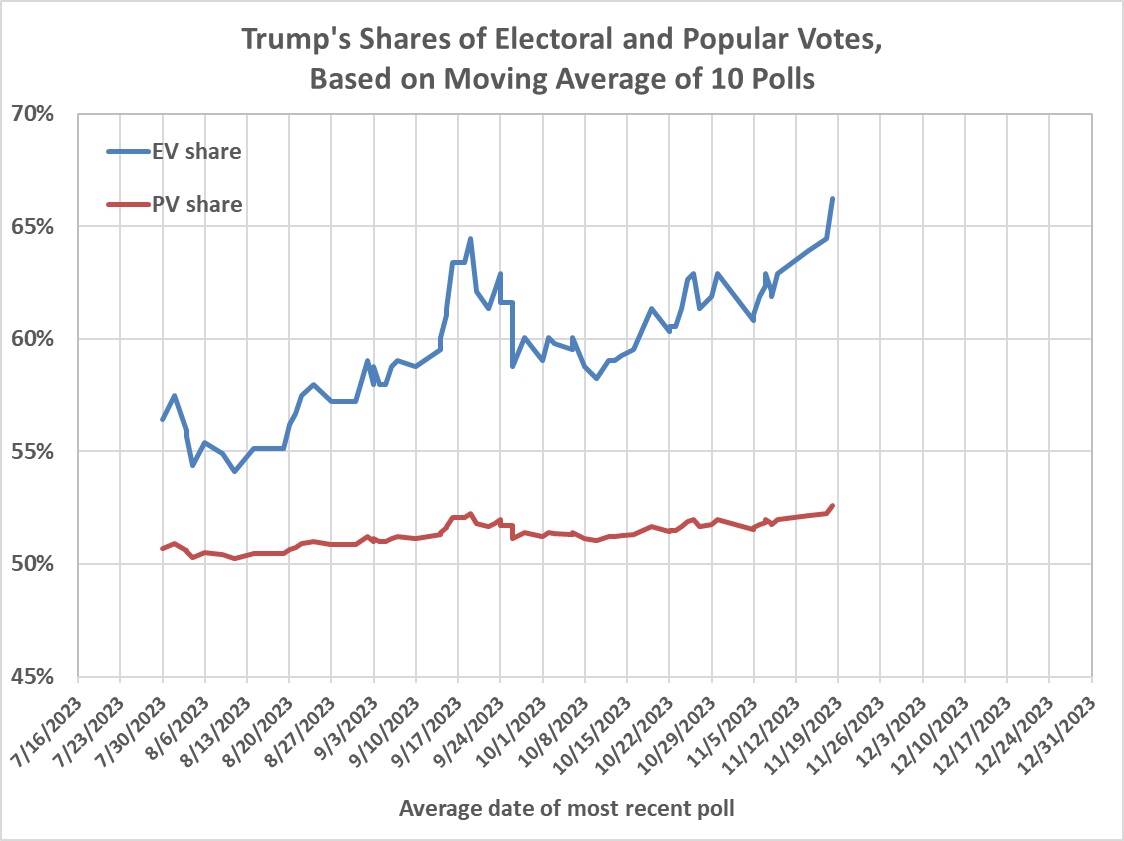
RealClearPolitics maintains a running tally of presidential election polls. I construct a moving average of the results, where the average represents Trump’s adjusted margin for the 10 most recent polls (taking the mid-point of each polling period as the date of each poll).

I then convert that 10-poll average to an estimate of Trump’s share of the two-party popular vote. For example, an average margin of +4 indicates a 52-48 split of the popular vote, that is, Trump gets 52 percent of the popular vote.

Finally, I apply my algorithm for the relationship between the GOP candidate’s share of the electoral vote and his share of two-party popular vote. Here is the trend since July 30, 2023:

These basic estimates of popular-vote and electoral-vote shares don’t account for the margin of error in pollsters’ findings or the margin of error in my estimate of electoral votes. When I apply those margins of error, Trump’s share of the electoral vote ranges from 40 percent to 77 percent for the 10 most-recent polls.

CAVEAT: These are not estimates of the outcome of next year’s election. They simply reflect the stated preferences of voters for Trump or Biden when the polls were conducted.

Toxic Femininity: Some Examples

Lucrezia Borgia:

The Wicked Witch of the West:

Cruella deVil:

The Squad:

'The Squad' wins: AOC, Ilhan Omar, Ayanna Pressley, Rashida Tlaib

And the queen of toxic femininity:

Hillary Clinton says she'll support Sanders if he's nominated by ...

Sweet dreams. Hahahahahah!

Will Israel and Other Issues Split the Dems?

Some cracks are appearing in the Democrat Party. For one, there’s a very public fight between supporters of Israel and supporters of Palestine Hamas. For another, even among Democrats there are questions about Biden’s fitness for office. For a third, there’s Gavin Newsom’s “shadow” candidacy, which underscores Biden’s decrepitude and threatens to blow up into a big fight with Kamala Harris should Biden step aside. For a fourth, there’s illegal immigration, which is beginning to get on the nerves of some Dems. That’s a good enough list to start with.

The cracks in the Dems’ facade of unity are good for the GOP, and might make a difference next year. But the election is almost 12 months away, and the Dems seem to be better the GOP at pulling themselves together. I think it’s the power-lust, which has become stronger among Dems as they party has moved sharply leftward.

Today’s Democrat Party reminds me of the USSR — plenty of infighting, but unity in the face of the enemy.

Holiday Memories

I sometimes take a mental trip into the past — into the golden past of boyhood, where all the days are sunny and summery, or Christmas-y.

I stand on the sidewalk in front of the first house I lived in. There it is, a cream-colored, two-story, clapboard house with a small detached garage to the right. It sits on a corner lot of some size on a tree-lined street. An alley runs behind it. The streets at the front and left side of the house are unpaved, as were many streets in that small city where I was a boy in the 1940s.

The deep, covered porch runs the width of the house. I walk up the steps to the porch and enter the front door, which opens into the living room. With sunlight streaming through the windows, I wander through the living room to the dining room and kitchen. I go out the back door to the enclosed back porch, from which I can see the garage and the back yard.

I return to the house and venture to the basement, with its huge, coal-fired furnace, coal bin, and my father’s work shop. I go back up — and then up again, climbing the stairs to the second story — the stairs with a wrought-iron railing. I reach the upper hallway and visit, in turn, the three sunny bedrooms and the black-and-white tiled bathroom.

Yes, it was a modest house. But it was the first place I thought of as home, and it’s a place that I always think of as sunny.

At other times I remember my grandmother’s house in a small, lakeside village about 90 miles north of where I grew up. Her modest, two-story bungalow sat on a deep lot that backed up to open fields where doves cooed as I awoke on sunny, summer mornings to the smell of bacon frying. My favorite room was the kitchen, with its massive woodstove and huge, round, oak table, around which my grandmother, parents, and various aunts and uncles would sit after a meal, retelling and embellishing tales from the past.

We often visited my grandmother at Christmas, and I like to relive the Christmas eve when we made the 90-mile trip as feathery snow slowly piled deeper on the deserted, lakeside highway we traversed through quiet villages: Lexington, Port Sanilac, Forester, Richmondville, Forestville, White Rock, Harbor Beach, Port Hope, Huron City, and — at last — Port Austin.

Many of those villages were tiny: a scattering of houses, perhaps a church and a gas station — but not a traffic light. The more substantial villages — those that had 1,000 or even 2,000 residents and a traffic light — boasted rows of well-kept and sometimes stately homes on shady streets, along with prosperous brick and white-frame churches, a few blocks of tidy stores, and perhaps a lighthouse:

The lakeside highway (before it straightened and moved inland) rode atop high bluffs overlooking the vastness of Lake Huron:

Many of the stately homes along the way have become inns:


A short detour through the old part of Huron City would yield a view of Seven Gables, the summer home of William Lyon Phelps (1865-1943), a professor of English literature at Yale and a popular lecturer and writer in the early decades of the 20th century:

The village of Port Austin didn’t have a quaint main street (seen here probably in the 1970s), but it was a place where a young boy could wander safely:

The rest of the village had more to offer. An elegant old inn . . .

. . . these sights along the shoreline . . .


. . . and this view of the harbor at sunset:

Golden days, golden nights. Gone forever — but still alive in my reveries.

Trump vs. Biden: 5

Happy Thanksgiving! Trump’s lead over Biden has increased (explanation below):

RealClearPolitics maintains a running tally of presidential election polls (among many others). RCP has also assessed the pro-Democrat or pro-Republican bias of the final presidential-election polls issued by major pollsters in 2016 and 2020. On average, the polls were biased toward the Democrat nominee by 2.3 percentage points.

As the pollsters release their results, I adjust Trump’s lead/deficit for bias. I then construct a moving average of the adjusted results, where the average represents Trump’s adjusted margin for the 10 most recent polls (taking the mid-point of each polling period as the date of each poll).

I then convert that 10-poll average to an estimate of Trump’s share of the two-party popular vote. For example, an average margin of +4 indicates a 52-48 split of the popular vote, that is, Trump gets 52 percent of the popular vote.

Finally, I apply my algorithm for the relationship between the GOP candidate’s share of the electoral vote and his share of two-party popular vote.

The estimates of popular-vote and electoral-vote shares don’t account for the margin of error in pollsters’ findings or the margin of error in my estimate of electoral votes. But the movement of the estimates may be taken as indication of the movement in voters’ preferences between Trump and Biden (or whoever might become their parties’ nominees). It is that movement which I will report from time to time.


The Meaning of “Liberalism” is Beside the Point

Cass Sunstein attempts to define and justify liberalism in “Why I Am a Liberal” (The New York Times, November 20, 2023). Sunstein makes 34 claims about liberalism, most of them complicated and nuanced. The result can be described (charitably) as a dog’s breakfast. Take the first sentence of Sunstein’s first claim:

1. Liberals believe in six things: freedom, human rights, pluralism, security, the rule of law and democracy.

What’s not to like? Well, those six things sound nice, but not when some hard questions are asked about them.

Is freedom unbounded? If not, how and by whom are the bounds to be determined? By bureaucrats whom democratically elected officials have empowered to dictate the minutiae of the citizenry’s existence, including but far from limited to the kinds of products and services they may buy and how those products and services may be made?

If freedom is unbounded, do human rights include the right to kill other persons randomly, including unborn persons? If freedom is bounded, do human rights include the right (for example) to take the income and wealth of some persons and give it to others? Who makes and enforces the rules that allow that to happen? Are they democratically elected officials and their bureaucratic surrogates who make laws for the benefit of their favored constituencies or in the service of an illiberal ideology that looks askance at wealth and property ownership?

Does pluralism contemplate the right of persons to invade another country, commit crimes against the inhabitants of that country, burden the taxpayers of that country by accepting, for example, “free” housing and education, and eventually to be proclaimed citizens of that country in order to perpetuate that kind of pluralism and its consequences (see the preceding and following paragraphs).

Does security include the right to retain the fruits of one’s labor and capital, or are such decisions made to democratically elected officials (and designated bureaucrats) who favor certain constituencies and ideologies? Does security include the right to be safe in one’s own home or while peacefully going about one’s own business when pluralism leads to an influx of criminal non-citizens and to the freeing of dangerous felons because they are considered “victims” of a system that (oddly enough) strives to punish wrongdoing.

My questions suggest that democracy and the rule of law aren’t all they’re cracked up to be. The value of democracy and the rule of law depend very much on who is making and enforcing the laws, and for whose benefit they are making and enforcing those laws.

What matters isn’t whether a people seeks freedom, human rights, pluralism, security, the rule of law and democracy. What matters is whether a people can cohere in voluntary, peaceful, and mutually beneficial coexistence.

Freedom and all of those other nice-sounding things are meaningless shibboleths absent a common culture grounded in traditional morality and shared by a people bound in genetic kinship.


Related posts:

Social Norms and Liberty

On Liberty

Facets of Liberty

Burkean Libertarianism

Genetic Kinship and Society

The Poison of Ideology

How the Constitution Was Lost

Trump vs. Biden: 4

UPDATED 11/21/23

RealClearPolitics maintains a running tally of presidential election polls (among many others). RCP has also assessed the pro-Democrat or pro-Republican bias of the final presidential-election polls issued by major pollsters in 2016 and 2020. On average, the polls were biased toward the Democrat nominee by 2.3 percentage points.

As the pollsters release their results, I adjust Trump’s lead/deficit for bias. I then construct a moving average of the adjusted results, where the average represents Trump’s adjusted margin for the 10 most recent polls (taking the mid-point of each polling period as the date of each poll).

I then convert that 10-poll average to an estimate of Trump’s share of the two-party popular vote. For example, an average margin of +4 indicates a 52-48 split of the popular vote, that is, Trump gets 52 percent of the popular vote.

Finally, I apply my algorithm for the relationship between the GOP candidate’s share of the electoral vote and his share of two-party popular vote.

The estimates of popular-vote and electoral-vote shares don’t account for the margin of error in pollsters’ findings or the margin of error in my estimate of electoral votes. But the movement of the estimates may be taken as indication of the movement in voters’ preferences between Trump and Biden (or whoever might become their parties’ nominees). It is that movement which I will report from time to time.

Here is the first report, which begins with a clutch of polls that were completed in mid-August, when polling season seems to have begun in earnest:

The Sky Is Not Falling

The Economist, via The Washington Post’s Dan Balz, has issued a warning that the sky will fall if Trump wins in 2024. Among the things feared by The Economist and many other pearl-clutchers are these:

  • Retribution against political enemies.
  • The roundup and deportation of illegal aliens.

A sober analyst of Trump’s threats regarding political enemies would understand those threats to be a promise to call his political enemies to account for their flagrant abuse of the justice system in an effort to discredit him and (if their luck holds) to put him in prison. There’s a prime facie case that all of the indictments of and other proceedings against Trump are the result of tacit collusion to take down the biggest threat to Democrat control of the executive branch. Trump, in other words, would seek to punish those who have politicized the justice system, which seems like justice to me.

A sober analyst would also understand Trump’s statements about illegal immigration as a promise to enforce the law. Failure to enforce the law has become a routine exercise for Democrat politicians.

But the usual suspects (which include The Economist, WaPo, and a long list of other such organs) eschew sobriety and paint every threat to the Democrat Party and its favored constituencies (e.g., blacks, illegal immigrants) as a moral outrage.

So, if it comes to pass that Trump is elected and he does what he says he’s going to do, the wailing and gnashing of teeth will resound through the left-o-sphere, but the sky definitely won’t be falling.

Conservatism and Happiness

The most-viewed post in the history of this blog is “Intelligence, Personality, Politics, and Happiness” (January 4, 2011). It ends with this:

If you are very intelligent — with an IQ that puts you in the top 2 percent of the population — you are most likely to be an INTJ, INTP, ENTJ, ENTP, or INFJ, in that order. Your politics will lean heavily toward libertarianism or small-government conservatism. You probably vote Republican most of the time because, even if you are not a card-carrying Republican, you are a staunch anti-Democrat. And you are a happy person because your expectations are not constantly defeated by reality.

If I were of a mind to rewrite the post, I would amend the final sentence to read:

And you are a happy person because your intelligence and personality make you self-confident and self-reliant. You are your own master (even though you pay taxes and obey laws out of prudence), not an emotional slave to the purveyors of political, economic, and scientific lies that are aimed at giving them power over your mind and your votes.

I remembered my old post and devised its new ending after reading Luke Conway’s “The Curious Case of Conservative Happiness” (The American Spectator, November 17, 2023). Sociologists (Conway is one) have found repeatedly that conservatives are happier than “liberals”. But why? Conway explains:

There are two extant theories. The first and more influential theory is that conservatives are comfortable with inequality and unconcerned with societal fairness. This tendency towards “system justifying” attitudes — attitudes that make conservatives insensitive to the needs of groups suffering in society — tends to serve as a buffer against bad stuff in their world. It makes them believe they live in a world where their group is on top of a system that is totally fair and justifies their own ethnic and political biases. As a result of this set of system justification blinders, conservatives believe they are at the top of a good system — and that is why they are happier than the lower-status, accurate, compassionate liberals….

The second theory is that conservatism tends to promote good psychological adjustment. As far back as 2012, social psychology researchers have suggested that conservatives were happier because conservative ideology is associated with personal agency, religiosity, optimismemotional stability, and other variables that in turn are associated with positive psychological adjustment. In the words of Schlenker and colleagues: “Conservatives appear to have qualities that are traditionally associated with positive adjustment and mental health. When we examined established measures of personal agency, positive outlook, and transcendent moral beliefs (i.e., religiosity, moral commitment, tolerance of transgressions), we found ideological differences that accounted for the happiness gap.”…

… Part of the problem with past research is that it tends to conflate nasty-sounding “system justification” beliefs with perfectly healthy beliefs that would lead to good outcomes without any system-justifying component. For example, one of Napier and Jost’s primary measurements of system justifying beliefs was a single item anchored by “hard work doesn’t generally bring success, it’s more a matter of luck” on one end and “in the long run, hard work usually brings a better life” at the other.

Stop reading for one minute and think about that. In their view, believing that hard work usually is associated with success makes you a “system justifier” because that belief inherently blames people for the bad outcomes they get. But I’m not so sure about the immutability of that association. While it is possible that belief in hard work can be system-justifying, it need not be so. “If I work hard to prune this tree, it will be more likely to grow fruit” does not seem especially system justifying, as it doesn’t necessarily involve any social systems. Indeed, the two things are conceptually orthogonal. I might believe that hard work generally leads to good outcomes and yet believe that nonetheless this occurs in spite of admitted societal unfairness….

Thus, while it is certainly possible for someone to hold a belief in hard work to blame others’ failures on their lack of hard work, it need not be so. And there is no denying that believing in hard work also produces agency — the belief that one can make a difference — which is psychologically healthy….

So what happens when we try to separate the psychological adjustment and system justification models? Several years ago, our lab conducted a set of 5 studies to evaluate that question. We pitted the system justification theory against the psychological adjustment theory….

First, we found that direct measurements of a desire for social group inequality — the hallmark of the system justification explanation, a variable called “Social Dominance” — did not explain why conservatives were happy at all….

Second, three variable sets associated with psychological adjustment — religiosity, belief in hard work/achievement, and anti-entitlement attitudes — were good predictors of conservative happiness….

Third, Jost and Napier’s System Justification Scale, which is essentially a measurement of the degree that Americans believe American society is a good place, was in fact one of the better predictors of conservative happiness across our five studies. However, the system justification scale was also related to beliefs generally associated with psychological adjustment (hard work, religiosity). So even though the “system justification” scale explained part of conservative happiness, this is not overwhelmingly good evidence for the nastier implications of the system justification model. At worst for conservatives, it means that they are happier in part because living in a society they like makes them happy….

[R]esearchers often completely miss emphasizing the positive benefits of self-control, religion, hard work, and mental toughness in helping people deal with life’s challenges. In this omission, they do not largely fail conservatives — who are presumably doing those things anyway — they rather fail their liberal constituents by not equipping them with legitimate psychological tools for well-being….

Second, and more insidiously, this perspective simply mis-characterizes conservatives as uncaring people who, like rich autocrats stealing from the poor people they rule, gain their happiness at the expense of their lesser brethren….

For example, a recent four-study article illustrated that conservatives in both the United States and the United Kingdom actually show more empathy to their political enemies than liberals do. In the words of the authors: “conservatives consistently showed more empathy to liberals than liberals showed to conservatives.”

As I said: self-confidence and self-reliance (agency) make for happiness. Conservatives tend to have more of those things than “liberals”, which frees them (conservatives) of financial and regulatory dependence on the state and from psychological dependence on purveyors of lies — including lies about conservatism.


Related posts:

Obama’s Big Lie

That Which Dare Not Be Named

Why Trade Doesn’t Deter Aggression

Opponents of war (and corporate opportunists) like to believe (or claim) that it can be forestalled by trade. The reasoning goes like this:

If nation X and nation Y are trading partners, nation X will not attack nation Y (despite ideological differences) because nation X would lose its remunerative access to nation Y’s buyers of nation X’s products.

But why is X trading with Y? One reason is to fund the growth of X’s armed forces while also improving the health of its populace — including, not least of all, the health of its men of fighting age.

Unlike Y, which views trade only through the lens of economic advantage, X views trade as a means to its ultimate objective: dominance of other nations in order to dictate exploit their economic strengths and to obtain their acquiescence (if not outright submission) to X’s ideology.

There will come a time when the leaders of X believe that they have acquired the military might needed to attain the ultimate objective. When that time comes, X will leverage its might to dictate trade on its terms and cow its trading “partners” into ideological acquiescence, followed by submission. (Acquiescence having already been attained de facto, submission will follow given the venal and amoral character of Y’s leaders.)

Ideological zealots put dominance above all else. (Their true ideology is often the attainment of power for its own sake.) They should not be treated as if they were merely rational trading “partners”. But they are so treated by the avaricious “globalists” whose wealth and influence dazzle and dictate to Y’s leaders.

Pot. Kettle. Black.

Americans, like most people in the world, are besieged by authority. How (many? most?) Americans can still believe that theirs is a land of liberty puzzles me greatly, and has done so for many years.

Take Joe Biden — please! — who yesterday said of China’s Xi: “He is a dictator in the sense that he is a guy who runs a country that is communist,” … adding that the Chinese government “is totally different than ours.” Different? In what way?

Atop of all of the millions of pages of federal, State, and local regulations that specify what Americans may and may not do and how their products and services must be produced (or not) — and atop of all of the chicanery that Democrats (mostly) deploy to acquire and sustain the power to tell Americans how to live — there has arisen in the past decade a vast industry of government lying, spying, censorship, and unequal justice that Xi might have designed. (See, for example, “Obamagate and Beyond“, and consider the latest revelation about the censorship industry.)

Americans, like most Westerners, seem to mistake relative prosperity for liberty. (There’s a good example of that in “Biden’s Popularity and Gasoline Prices“.) But like the proverbial frog in the pot of water, Americans will understand what’s happening to them only when it’s too late to do anything about it. (See “Economics: America’s Mega-Depression” and “Convergence Theory Revisited“.)

You have been warned.

Pages

If you are new to this blog, or haven’t visited in a while, check out Pages in the sidebar. There you’ll find links to long, substantial pieces that merit special attention (in my humble opinion).

In Case You Missed It …

This blog has reopened for business after a sojourn at Substack as Loquitur’s Letter. Stay tuned.

The New Dispensation

It’s simple, to a fault.

The new dispensation isn’t “liberty”, “democracy”, “equity”, or any of the other shibboleths mouthed by its Orwellian architects. The new dispensation is to force human events to follow a certain course by gaining control of the apparatus of the state and coercing its subjects to act according to its dictates through censorship and force.

That is the direction in which the United States is headed. Regardless of dire consequence of the policies favored by those in control of the state. Those consequences — in addition to the loss of liberty — include general inflation, soaring energy and food prices, the suppression of science that gets the “wrong” answers, and (above all) the destruction of civil society.

Those consequences are assured as the regime presses on with heavy handed regulation, the weaponization of intelligence and law-enforcement agencies, the empowerment of private actors (e.g., Big Tech) to suppress the regime’s enemies, and the division of Americans into desirable and undesirable identity groups.

There is no learning from experience in this regime. Belief — uninformed and ends-driven — rules all. Every failure is met not with an honest reappraisal of policy failures but with the reassertion and expansion of failed policies.

It is the Sovietization of America: the exercise of power for its own sake, justified by the betterment of the people (or some of them), with the effect of impoverishing the people and setting them against one another.

I Told You So, Virginia

Never underestimate the appeal of the forbidden.

A year ago today, I posted “Don’t Celebrate Yet, Virginia”, wherein I had this to say about the election of Glenn Youngkin, Virginia’s first Republican governor in eight years:

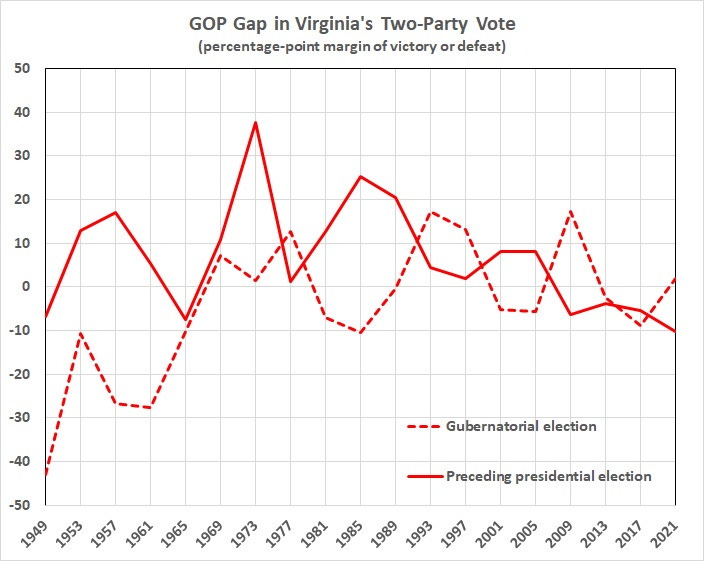
Gratifying as the resurgence of Virginia’s GOP may be, I’m not ready to declare Virginia’s return to Red-ness.  For one thing, there’s an underlying trend toward Blue-ness, which shows up in Virginia’s presidential election results:

Derived from Dave Leip’s Atlas of U.S. Presidential Elections. The series for Virginia begins with the gubernatorial election of 1949,which is the earliest for which Leip as posted popular-vote tallies.

The GOP’s edge in the presidential election peaked in 1968, the year of George Wallace, who (in the South) siphoned votes from the Democrat candidate. If 1968 doesn’t suit as a peak year, because of the Wallace effect, then the peak certainly occurred in 1984, with the re-election of Ronald Reagan. In either case, the GOP candidate’s share of Virginia’s presidential vote has been in decline for decades, and seems unlikely to recover unless there is a nationwide shift away from the Democrat party. Such a shift might occur, given the Dems’ suicide pact with the far-left, but cooler heads may yet prevail among party leaders.

It’s true that the downswing in the GOP’s hold on Virginia’s governorship hasn’t been as pronounced — which supports Tip O’Neill’s observation that all politics are local. But the GOP’s edge in the past has been much greater than the razor-thin victory eked out by Glenn Youngkin in the recent election.

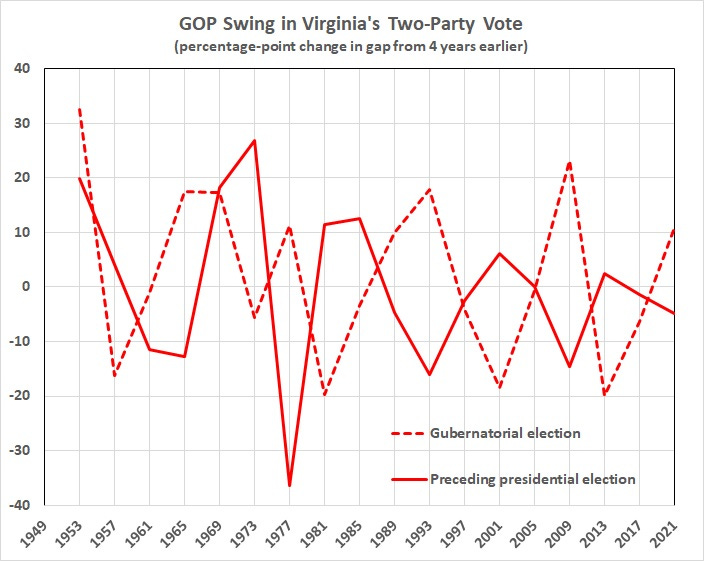
Nor is that victory especially impressive when the swing toward the GOP in 2021 is compared with earlier swings:

Source: Leip’s Atlas.

What probably happened in the 2021 election is what seems to have been happening since the early 1970s. The Virginia gubernatorial election reflects a typical “mid-term” reaction to the previous year’s presidential election. When the GOP presidential candidate racks up a gain relative to the showing of the GOP candidate four years earlier (a positive “swing”), the GOP gubernatorial candidate racks up a loss relative to the showing of the GOP candidate four years earlier (a negative “swing”). And conversely.

The results of the yesterday’s elections in Virginia bear out my pessimism. Governor Youngkin had hoped to flip the Virginia Senate, which Democrats held by 22-18, and hold (or build) the GOP lead in the House of Delegates, which Republicans held by 52-48.

At this moment, it looks like the Democrats will continue to hold the Senate, by 21-19, while reclaiming the House by a margin of 51-49.

The outcome in Virginia reflects America’s descent into depravity.

There was, for example, a close race in Virginia’s 57th House district. The Democrat who made it a close race is none other than Susanna Gibson. It is Gibson who raised funds for her election campaign by performing sex acts with her husband and uploading the videos to a porn site.

The big issue in Virginia was abortion — of course.

The failure of the GOP to retake the Senate had much to do with the campaign in the 16th district, where I live. The Republican incumbent lost to a Democrat in a contest that centered on abortion. Democrats pounded on the issue in mailings and TV ads. Had the Republican won, the Senate would be tied 20-20, with the Republican lieutenant governor determining the outcome of tied votes. But the “right” to abortion carried the day for the Democrat.

The outcome in House races was similarly linked to the issue of abortion. Again, I saw at first hand the emphasis that was placed on abortion by Democrats in the race for the seat in the 58th district, where I live, and in a neighboring district that the GOP incumbent seems to have held by a narrow margin.

Virginia’s — and America’s descent into depravity is confirmed by the likes of The New York Times and The Washington Post, which hail the outcome of yesterday’s elections with headlines like these (in their online feeds):

Abortion Rights Fuel Big Democratic Wins, and Hopes for 2024

Abortion rights advocates win major victories in Ohio, Kentucky, Virginia

This of a piece with the open attacks on and mockery of religion (unless it’s Islam):

Let’s face it, the America that I knew — and which many Americans want to preserve — has been dying since the 1960s and is now dead.

I want my country back.

Trump vs. Biden: 3

A far out forecast.

RealClearPolitics maintains a running tally of presidential election polls (among many others). RCP has also assessed the accuracy of the final presidential-election polls issued by ten major pollsters in 2016 and 2020.

Adjusting the polling results issued by five of the pollsters in October for each pollsters’ average accuracy in 2016-20, I estimated Trump’s and Biden’s shares of the two-party popular vote. I then applied my algorithm for the relationship between share of electoral vote and share of two-party popular vote,

My initial result: If the election had been held last month, Trump would have won 52 percent of the two-party vote and garnered 58 to 62 percent of the electoral vote.

I will continue this exercise until election day 2024. In the interim, more of the ten pollsters will publish results more often and one or both of the principals may be replaced.

Stay tuned.

Trump vs. Biden: 2

EXTENSIVELY REVISED 05/10/24

In the original version of this post, I argued that Republicans enjoy a slight edge in the Electoral College. The relevant discussion began with this graph:

I continued with this:

A candidate’s share of the electoral doesn’t change in proportion to his share of the nationwide popular vote. (The dashed red line depicts a proportionate relationship.) That is because all of the States (but two) and D.C. have a winner-take-all method of allotting their electoral votes. In those cases, a candidate wins all of the jurisdiction’s electoral votes whether he wins the popular vote by 0.1 percent or 10 percent. And a slight change in the candidate’s popular vote — from 49.9 percent to 50.1 percent, say — swings the entire block of electoral votes.

Look closely at the regression line in the graph and you will see that it doesn’t cross the dashed red line at the 50-50 mark. Rather, a GOP candidate (on average) can win 52.3 percent of the electoral votes with 49.9 percent of the nationwide popular vote. That’s because the smaller States — a majority of which lean GOP — are disproportionately represented in the electoral college. The upshot is that a candidate who wins the most States has an electoral-college advantage.

The next sentence hits upon the real reason for the statistical artifact:

Throw in some close wins in larger States and you have what looks like a resounding victory; for example, in 2016 Trump won 56.9 percent of the electoral votes with 48.9 percent of the two-party popular vote, nationwide.

Republicans won the electoral vote twice in “modern” times (i.e., from 1920 onward) while garnering less than 50 percent of the two-party popular vote:

  • The first time was in 2000, when G.W. Bush beat Al Gore solely on the basis of a narrow popular-vote victory in Florida. Florida’s 25 electoral votes gave Bush 1 more than he needed for the win.
  • The second time was in 2016, when Trump pulled won Michigan, Pennsylvania, and Wisconsin — each by less than 1 percentage point. The combined 46 electoral votes delivered by those States gave Trump his margin of victory over Clinton.

And that’s it. One need search no further for the reason that a candidate can win the electoral vote with a minority of the two-party popular vote. It could even happen to a Democrat.

In fact, Democrats have won at least three elections since 1920 because of narrow victories in a few States:

  • Truman won in 1948 with 49.55 percent of the nationwide tally of popular votes because he won both Ohio and Illinois by less than 1 percentage point. The 53 electoral votes from those States boosted him to victory, even though he lost a big chunk of the “Solid South” (Alabama, Louisiana, Mississippi, and South Carolina) to Strom Thurmond.
  • In 1960, Kennedy’s slight margin in the nationwide popular-vote tally (49.72 percent to Nixon’s 49.55 percent) was mirrored by margins of less than 1 percentage point in Hawaii, Illinois, and Missouri. Their combined 43 electoral votes gave Kennedy the election.
  • Biden won in 2020 not because he beat Trump in the meaningless nationwide popular-vote tally by 4.45 percentage points, but because he “won” both Georgia and Wisconsin by less than 1 percentage point and Pennsylvania by a little more than 1 percentage point. The 46 electoral votes thus delivered by those three States gave Biden his margin of victory over Trump in the Electoral College. (Turnabout, in this case, is foul play.)

The statistical relationship in the graph is meaningless. What can be meaningful is a narrow margin of victory (or loss) in a few States. This underlines the lesson from “How Good Are the Presidential Polls?“: Even a large lead in nationwide polls doesn’t signify victory in the Electoral College. Keep your eye on “battleground” States and allow for a lot of uncertainty in the polling results for those States.

A More Perfect Constitution: Excerpt 3

A possible cure for what ails America.

Several months ago I published “A More Perfect Constitution”. Its language in many places is directed at abuses that have arisen in America’s governance. Because of its daunting length, I suspect that few readers have digested it whole, and that even fewer reader have been taken notice of the many places in which the document strives to undo the damage that has been done to Americans’ liberties. This series of posts highlights that language in bite-size chunks. Links to all excerpts are given at the end of this post.


V. OBLIGATIONS AND POWERS OF THE GOVERNMENT OF THE UNITED STATES

….

B. Specific Powers of Congress

….

4. Congress may not:

….

b. sustain or make laws that result in the imposition of costs on the government of any State or the governments of all of them;

c. either directly, through the empowerment of a regulatory agency, or as an incidental effect of legislation determine what goods and services are exchanged in intra-State, inter-State, or international commerce (except to regulate the international flow of weapons, military technology, or information that might compromise national security), or determine how such goods and services are produced or priced; or determine how businesses so engaged are operated;

d. levy taxes or duties on exports from or imports to any State, give any preference to one State over another in its regulation of commerce, or determine the routes of commerce between the States; …

f. except pursuant to an authorization of war, appropriate any monies for the use of foreign nations or peoples….

h. make any law whose direct effect is to establish, support, favor, bestow financial benefits on, or restrict the privileges of a particular person or class of persons, business or class of businesses, or other private institution or class of private institutions;

i. make any law whose direct or indirect effect is to provide old-age, survivors’, disability, or medical benefits to any person, except that Congress may by law provide pension and medical benefits for members and former members of the armed forces of the United States, and pension benefits for civilian employees of the government of the United States;

j. sustain for more than ten years after the ratification of this Constitution any extant programs that provide old-age, survivors’, disability, or medical benefits not contemplated in the preceding clause;

j. authorize or allow any agency of the government of the United States effectively to exercise legislative or judicial power on its behalf;

k. authorize any agency to act independently of one of the three branches of government established by this Constitution; or

k. make any law or appropriation or take any other action that contravenes any part of this Constitution.

5. Treaties

a. The Senate must ratify all treaties and agreements with foreign nations and international organizations, except those agreements that the President is by law empowered to execute pursuant to a ratified treaty.

b. The Senate may not ratify any treaty that directly or indirectly places the United States, its territories or possessions, its property, its citizens, or its armed forces under the jurisdiction or control of any foreign power or international organization.

c. The Senate may not ratify any treaty that contravenes any provision of this Constitution or any constitutional law previously enacted by Congress.

7. Acts of Congress may be revised or revoked as provided in Articles VII, VIII, and IX of this Constitution. [Stay tuned.]


Excerpt 1, from Article II: CITIZENSHIP, VOTING, AND RELIGIOUS TESTS FOR OFFICE

Excerpt 2, from Article III: RIGHTS AND PRIVILEGES OF CITIZENS

Change Horses Midstream?

Why not?

“Don’t change horses midstream”, an adage attributed to Abraham Lincoln, means (inter alia) stick with the incumbent president during times of turmoil and conflict.

If the present conflict in Gaza leads to a wider war, with heavy involvement by the U.S. and (possibly) attacks on Americans in their homeland, the pro-Biden (or Harris) chorus will sing rousing renditions of “don’t change horses midstream”.

But why would Americans want to stick with an incumbent (or his eager alto) who got us into the mess in the first place by displaying weakness at every turn: bugging out disgracefully from Afghanistan, failing to protect America’s southern border, playing footsie with China (under the table), shoveling billions at the Taliban, shoveling more billions at Iran, throwing more billions at Ukraine instead of building America’s own defense forces, and weakening America’s economic and industrial base in the Quixotic battle against “climate change”?

Leftists, being anti-American, love those things. Let’s hope that a sizable fraction of American voters see them for what they are: weakness in the face of our enemies.

Changing horses midstream would be just the start of a much-needed reversal of America’s economic and security prospects.

Why the Left Hates Israel (and Related Thoughts)

Victimology on steroids.

I will get around to Israel in due course. But I need to set the stage with an excursion into grade-school arithmetic.

Do you remember learning how to work with fractions? To add, subtract, multiply, or divide fractional numbers with different denominators, it is necessary to convert each number to a common denominator (mentally if not mechanically). A simple example is the addition of 1/8 and 1/4. Because 1/4 = 2/8, the lowest common denominator is an eighth, which is lower than a fourth. So, by the rule of the lowest common denominator (LCD), the addition of 1/8 and 1/4 becomes the addition of 1/8 and 2/8, which yields 3/8.

In the classroom, before AP courses were devised, the pace of teaching was influenced by the pupils who were slower at learning a subject. The practice was known (unofficially) as catering to the LCD. The pace of teaching was tailored to the less-bright students (eighths) instead of brighter students (fourths).

AP courses are under attack (and have been discontinued in some places) because the placement of pupils in them is a form of discrimination — discrimination of the kind that is based on merit, not racial or ethnic prejudice. But because blacks on average are considerably less intelligent than whites (especially Jews) and East Asians, blacks tend to be left behind in educational endeavors. This, of course, is “unfair”, “discriminatory”, and “racist” — and it flies in the face of “equity”.

The attainment of “equity” therefore requires the removal of badges of superiority and occasions in which blacks might feel inferior to whites, etc. So out with AP courses; out with SAT and GRE scores as criteria for admissions to undergraduate and graduate programs: in with blatant pro-black discrimination in admissions; in with segregated housing and black-only events and programs; and out with meaningful grades (pass-fail is an old solution; “A” is becoming the new normal where grades are still used).

“Equity” is a way of catering to the LCD, with a twist. The twist is that “equity” requires not just the same reward for everyone, regardless of ability and effort, but extra-special treatment for “victims” of … of what? A “system” that is obviously inequitable because of “white privilege”, “patriarchy”, and whatever other excuse the less able and their leftist supporters can conjure instead of facing facts about genetic and cultural differences that produce different outcomes — not only between identity groups but also within them.

Thus far I’ve only touched on K-12 and university education indoctrination. The search for “victims” is perpetual on the left.

Take the Palestinians as a salient example. They are “obviously” (to a leftist) “victims” of Israel because they live (mostly) in territories that were or are controlled by Israel: the Gaza Strip and the West Bank. There is also Israel’s controversial nation-state law, which according to an anti-Zionist source

declare[s] that only Jews have the right of self-determination in the country, something members of the Arab minority called racist and verging on apartheid.

The “nation-state” law, backed by the right-wing government, passed by a vote of 62-55 and two abstentions in the 120-member parliament after months of political argument. Some Arab lawmakers shouted and ripped up papers after the vote.

“This is a defining moment in the annals of Zionism and the history of the state of Israel,” Prime Minister Benjamin Netanyahu told the Knesset after the vote.

Largely symbolic [not observed in practice], the law was enacted just after the 70th anniversary of the birth of the state of Israel. It stipulates that “Israel is the historic homeland of the Jewish people and they have an exclusive right to national self-determination in it.”

The usual suspects have declared that the separation of Palestinians (and other Arabs) from Israel and from its governance amount to apartheid., a crime against “international (leftist) law”. From this it follows (to a leftist) that acts of savagery — like those committed by Hamas against Israelis on 10/7 — are justified because Palestinians are “victims”. It further follows (to a leftist) that Israel’s fully justified preventive retaliation is “aggression”.

Let’s take a few minutes to examine those premises.

It’s true enough that the denizens of Gaza are poor and feckless. But what makes them “victims”? They are about on a par with most non-Jewish Semites, except for the relative handful who are members of a professional caste or oil-rich. The basic problem with most such members of humanity —whether in the Middle East or elsewhere — isn’t that they have been put down by anyone (e.g., Israelis) but that they lack the intellectual, cultural, and natural resources to raise themselves up.

A “funny” thing about Israel is that it is of a piece with the surrounding lands occupied by non-Jews, but it has become a relatively prosperous place because Jews have the intellectual and cultural resources that undergird prosperity.

For their success and for the fact that they are Jews, the Jews of Israel are the targets of envious failures (Palestinian and Muslim hot-heads), Jew-haters (in addition to the hot-heads), and leftists who can’t bear to think that Palestinians (like American blacks) mainly have their genes and culture to blame for their failings.

Israel was founded (re-founded, really) in the wake of the Holocaust. It wasn’t meant to be anything but a Jewish state, run by Jews for Jews — a safe haven for a historically oppressed and brutalized people. Israel has been been under attack by Muslims since its modern founding. But Israel has a natural right to self defense and to preserve its Jewish character, just as the American rebels of 1776 had a natural right to declare themselves independent of a despotic King and rapacious Parliament.

So the Gaza Strip and the West Bank become de jure parts of Israel (though the Gaza Strip was foolishly handed over to anti-Israelis) as a matter of the natural right of self-defense. As for Palestinians living in Israel proper, why should they have a voice in the governance of a country that was re-founded for Jews? Well, despite the nation-state law cited above, they do have a voice in the governance of Israel.

So, all of the leftist propaganda to the contrary notwithstanding, Palestinians aren’t “victims”, except of their own genes and culture. But unlike the “liberals” of old, the left nowadays focuses on demonizing the meritorious instead of helping those who need help.

Finally, there is the accusation that Israelis are sometimes brutal in their own defense. Why shouldn’t they be? It’s impossible to defend a country against determined enemies without being brutal toward them — just as it’s impossible to protect law-abiding citizens by disarming them and depriving them of police protection. The left sees Israelis as brutal because the left despises Israeli Jews, not because Israelis are any more brutal than leftists like Hitler, Stalin, Mao, and their many successors unto the present day.

Coda: There was a time when most Americans recognized the need for brutality in the defense of Americans — which included existential threats posed by distant enemies. It is a sad commentary on the state of America that a sizable and influential segment of the populace no longer believes that America is worth defending.

Those pampered idiots somehow consider themselves to be “victims” of a system that allows them to spout such nonsense and to tear down the very laws and traditions that shelter them from the wrath of the rightfully aggrieved victims of their beliefs and policies: hard-working, tax-paying, law-abiding victims of unfettered illegal immigration, unnecessary Covid lockdowns, prosperity-draining regulations and regulatory agencies, unnecessarily high energy costs because of the climate-change hoax, etc., etc., etc.