Out-Takes from "Obamagate and Beyond"

In case you missed them.

The effort to smear Trump going into the election of 2016, to remove him from office after he won, to make up for that lapse by rigging the election of 2020, and to doggedly pursue him in the courts since he left the presidency is part of the larger conspiracy that I spell out in “Obamagate and Beyond”. Appended to that post is a long list of related reading. Of late, that list has become focused on the Biden family’s influence peddling scheme. Preventing the exposure of that scheme was and is one of the objectives that underlies the persecution of Trump.

Here’s a link to a timeline of events in the Biden family’s influence-peddling operation: House Committee on Oversight: The Bidens’ Influence Peddling Timeline.

Below is a selection of readings specifically related to the Biden scandal. The list ends in August 2023, at the point at which new items about Biden Family corruption began to appear too often to allow me to keep the list up to date. At the same time, some notice began to be paid by the legacy media — initially “spun” to exonerate the president, but increasingly critical of him. Where all of this will lead is anyone’s guess. Mine is here.

Fred Lucas, “House Oversight Panel to Consider Demanding Financial Details of Biden Family Business Deals”, The Daily Signal, September 19, 2022 (The move was quashed by Democrats, of course.)

Republican Staff Report, “FBI Whistleblowers: What Their Disclosures Indicate about the Politicization of the FBI and Justice Department”, Committee on the Judiciary of the U.S. House of Representatives, November 4, 2022

Jordan Boyd, “Despite Biden’s Explicit Denials, New York Times Confirms POTUS Involvement in Family Business”, The Federalist, January 12, 2023

Tyler Durden, “Why Was Hunter Paying Joe Biden $50k Per Month To Rent House Where Classified Documents Found?”, ZeroHedge, January 15, 2023

Margot Cleveland, “House Republicans Are Investigating Damning Evidence Of Corruption, Not Hunter Biden”, The Federalist, January 16, 2023

Tyler Durden, “Hunter Biden $55,000 Offer for Russian Oligarch Falls Under Fresh Scrutiny”, ZeroHedge, February 2, 2023

Rob Smith, “Joe Biden Is Curiously Serving Two Masters, Which Has Me Wondering”, RealClearMarkets, February 2, 2023

Tyler Durden, “‘It’s As Bad As We Thought’: CCP Money Flowed To Biden Family According Bank Records, Documents Obtained By House GOP”, ZeroHedge, March 12, 2023

Tyler Durden, “Biden’s Collapsing Sgt. Schultz Defense: New Evidence Shows The President Played Direct Role In Addressing Hunter’s Business Deals”, ZeroHedge, March 23, 2023

Charlotte Hazard and John Solomon, “Effort to Squash Biden Family Stories Long Predated Hunter Laptop, Newly Released Emails Reveal”, Just the News, March 24, 2023

Fred Lucas, “Watchdog: Biden White House Officials Coordinated With DOJ for Trump Mar-a-Lago Raid”, The Daily Signal, April 11, 2023

Charlotte Hazard, “Bank Releases Records Showing Millions in Transaction between Hunter Biden, China firms, Johnson”, Just the News, April 12, 2023

Bailee Hill, “Ex-Obama Staffer Blows Whistle on Biden ‘Kickback Scheme’ after Hunter Joined Burisma: ‘Malfeasance in Office’“, Fox News, April 13, 2023

John Solomon, “Senior IRS Agent Blows Whistle, Alleging Biden DOJ Thwarting Criminal Prosecution of Hunter Biden”, Just the News, April 19, 2023

Miranda Devine, “The Left Ignores the Real Biden Delaware Drama to Satisfy [Its] Bias”, New York Post, April, 19, 2023

Neo, “The Biden Coverup”, The New Neo, April 20, 2023

Deroy Murdock, “Biden’s Presidency Built Atop an Actual ‘Big Lie’”, The Daily Signal, May 1, 2023

Fred Lucas, “House Oversight: Biden Family Got Over $10 Million From Foreign Entities While He Was VP”, The Daily Signal, May 10, 2023 (As of the morning of publication, similar stories were abundant across the media, except for the left-wing outlets. There’s no mention of the story in The New York Times online, and it isn’t to be found on the main page of The Washington Post online — finding it on WaPo’s site requires a search.)

Jonathan Turley, “America’s State Media: The Blackout on Biden Corruption Is Truly ‘Pulitzer-Level Stuff’”, Res Ipsa Loquitur, May 15, 2023

Ben Whedon, “Biden Was Briefed on Clinton Involvement in Trump-Russia Hoax”, Just the News, May 15, 2023

Jonathan Turley, “Bidens Offer ‘Safe Harbor’ to Hunter as He Flails over Scandalous Reports, New Messages Show”, New York Post, May 29. 2023

Margot Cleveland, “Breadcrumbs From A Buried FBI Source May Lead To A Bigger Biden Scandal”, The Federalist, May 31, 2023

Bonchie, “James Comer Discusses His Meeting With the FBI, Reveals What’s Next for the Biden Bribery Investigation”, RedState, June 5, 2023

Eric Lendrum, “Comer: FBI Has Harbored Biden Bribery Allegations since 2017”, American Greatness, June 7, 2023

John Sexton, “Rep. Greene Describes What Was in That FD-1023 and Bill Barr Contradicts Rep. Raskin”, Hot Air, June 8, 2023

Bonchie, “Biden Bribery Scandal Expands, Comer to be Briefed on Two Additional FD-1023 Forms”, RedState, June 9, 2023

Jerry Dunleavy, “Joe Biden referred to As ‘Big Guy’ in Dealings with Ukraine, FBI Record Reportedly Reveals”, Washington Examiner, June 12, 2023

Ben Whedon, “Grassley: Foreign National Who Allegedly Bribed Joe, Hunter Biden Has Recordings of Them”, Just the News, June 12, 2023

Nick Arama, “FBI Deputy Director’s Disturbing Revelation About ‘Biden Bribery’ Recordings That Should Concern Us All”, RedState, June 14, 2023

Elizabeth Crawford, “FBI Refuses to Release Document Alleging 17 Taped Conversations Between Biden Family and Burisma Official”, The American Spectator, June 14, 2023

Rick Noble, “Republicans Question Murky Origin of $10M on Biden 2017 Tax Return”, RedState, June 14, 2023

Margot Cleveland, “The Bidens ‘Coerced’ Burisma To Pay $10 Million In Bribes, Says Credible FBI Source”, The Federalist, June 15, 2023

Nick Arama, “Top Biden Aide’s Husband Came to Hunter Biden’s ‘Rapid Response’ Rescue When Burisma Controversy Hit”, RedState, June 16, 2023

Eric Lendrum, “Comer: New Bank Records Will Reveal $30M Foreign Payments to Biden Family”, American Greatness, June 16, 2023

Victor Davis Hanson, “The Ukraine-American
Gordian Knot
”, American Greatness, June 18, 2023

Bob Anderson “How Did Biden Really Make His Millions? It’s Time For A Special Counsel To Find Out”, The Federalist, June 19, 2023

Bonchie, “Hunter Biden and a Maltese Bank Account Raise Big Red Flags Amidst the Biden Bribery Scandal”, RedState, June 19, 2023

Margot Cleveland, “Did The FBI Prevent Delaware Agents From Investigating Biden Bribery Allegations?”, The Federalist, June 20, 2023

Bonchie, “Bombshell New Information on Hunter Biden Investigation Says the Fix Was in, Merrick Garland Directly Implicated”, RedState, June 22, 2023

Bonchie, “HUGE: Transcript Shows Joe Biden in the Room While Hunter Biden Threatened Chinese Officials to Pay Them, DOJ Sunk the Investigation Into the Matter”, RedState, June 22, 2023

Jordan Boyd, “IRS Whistleblower Docs Show DOJ Obstructed Hunter Biden Probe To Protect President”, The Federalist, June 22, 2023

Spencer Brown, “Oh, So That’s Why Hunter Biden Got a Sweetheart Plea Deal When He Did”, Townhall, June 22, 2023

Elizabeth Crawford, “Special Counsel Durham Further Unveils Russia Collusion Hoax”, The American Spectator, June 22, 2023

Shawn Fleetwood, “FBI Knew Hunter Biden’s Laptop Was Authentic A Year Before Pressuring Big Tech To Censor It”, The Federalist, June 22, 2023

Eric Lendrum, “Durham: FBI Ignored Hillary Clinton Plot to Tie Trump to Russia”, American Greatness, June 22, 2023

Elle Purnell, “Hunter Biden Threatened ‘My Father’ Could ‘Hold A Grudge’ In Extortive Message To Chinese Associate Revealed By Whistleblower”, The Federalist, June 22, 2023

Jonathan Turley, “All the Crimes that Hunter’s Ridiculous Plea Deal Missed”, New York Post, June 22, 2023

John Solomon, “Bombshell Evidence: Read IRS Whistleblower Documents Released by Congress in Biden Family Probe”, Just the News, June 22, 2023

John Solomon, “IRS Whistleblower Says Search Warrants, Charges for Hunter Biden Blocked, Joe Met Chinese Client”, Just the News, June 22, 2023

Ben Whedon, “Second IRS Whistleblower Backs Up Claims of DOJ Improprieties during Hunter Biden Investigation”, Just the News, June 22, 2023

Evita Duffy-Alfonso, “Whistleblower: FBI Tipped Off ‘People Very Close’ To Joe And Hunter Before IRS Investigative Team’s ‘Day Of Action’”, The Federalist, June 22, 2023

Nicholas Ballasy, “IRS Whistleblowers Challenge AG Garland’s Claim Biden Probe Free of Political Interference”, Just the News, June 22, 2023

Fred Lucas, “9 Allegations About Bidens, DOJ in IRS Whistleblowers’ Testimonies”, The Daily Signal, June 23, 2023

John Solomon, “Feds Built $2.2 Million Tax Case against Hunter Biden Dating to 2014 before Being Thwarted”, Just the News, June 24, 2023

Jonathan Turley, “Who Is Lying, Merrick Garland or the Whistleblowers?”, The Hill, June 24, 2023

John Solomon, “FBI Validated Hunter Biden Laptop Months before Experts Claimed Russian Disinformation”, Just the News, June 25, 2023

Thomas Lifson, “Bombshell Revelation: Hunter Paid for Secret $300/Month ‘Global Phone’ Used by VP Biden While in Office”, American Thinker, June 26, 2023

Margot Cleveland, “IRS Whistleblower Emails Suggest David Weiss Misled Congress In Letter Claiming Charging Authority”, The Federalist, June 26, 2023

John Solomon, “With New Evidence, Congress Unmasks a Multi-Year Government Plot to Protect Biden, Sully Trump”, Just the News, June 26, 2023

Debra Heine, “Hunter Biden to CCP-Linked Business Partner: ‘The Bidens Are the Best I Know at Doing Exactly What the Chairman Wants’”, American Greatness, June 27, 2023

Jonathan Turley, “Was Garland Lying? New York Times Confirms Weiss was Blocked from Bringing Additional Charges”, Res Ipsa Loquitur, June 28, 2023

Debra Heine, “Hunter Biden’s Former Business Partner Was Willing to Testify Before Grand Jury; Delaware U.S. Attorney Didn’t Answer His Calls”, American Greatness, June 29, 2023

John Solomon, “Hunter Biden Prosecutor Refusing to Cooperate with Congress, but Adjusts Earlier Story”, Just the News, July 1, 2023

Nick Arama, “Biden Email Has Smoking Gun Evidence When It Comes to Joe, Hunter, and Call to Poroshenko”, RedState, July 5, 2023

Miranda Devine, “‘Missing’ Biden Corruption Case Witness Dr. Gal Luft Details Allegations against President’s Family in Extraordinary Video”, New York Post, July 5, 2023

Debra Heine, “Whistleblower Gal Luft: ‘I May Have to Live on the Run For the Rest of My Life’ For Informing U.S. Gov. About Biden’s Influence Peddling”, American Greatness, July 6, 2023

Debra Heine, “Grassley: Delaware U.S. Attorney Received October 2020 Briefing on Biden Bribery Allegations; Demands to Know ‘What Steps Were Taken’”, American Greatness, July 10, 2023

Tristan Justice, “Weiss Letter Undermines Facade Of Independent Hunter Biden Investigation”, The Federalist, July 11, 2023

John Solomon, “Hunter Biden Mystery: Why Did Delaware Prosecutor Not Bring Charges His Office Approved?”, Just the News, July 12, 2023

Jonathan Turley, “My Wray or the Hard Way: Twitter Files Contradict FBI Director’s Testimony”, Res Ipsa Loquitur, July 13, 2023

Jennifer Van Laar, “It Sure Looks Like U.S. Attorney David Weiss Has Been Obstructing the Hunter Biden Investigation”, RedState, July 13, 2023

Bonchie, “New Emails Finally Reveal What Hunter Biden Was Doing for Burisma Founder, as More Dots Start to Connect”, RedState, July 14, 2023

Jennifer van Laar, “BREAKING: Former FBI Agent Confirms Key Portions of Whistleblower Testimony in Hunter Biden Probe”, RedState, July 17, 2023

John Solomon, “FBI Tipped Off Biden team, Secret Service about Plan to Interview Hunter, Agent Tells Congress”, Just the News, July 17, 2023

Debra Heine, “FBI Whistleblower: Investigators Were Told to Wait For Hunter’s Okay Before Approaching his House to Interview Him”, American Greatness, July 17, 2023

John Solomon, “Forbidden Questions, Denied Warrants, Witness Tipoffs: Agents Detail Interference in Biden Probe”, Just the News, July 18, 2023

Many links about the prepared statement and testimony of “Whistleblower X”, IRS agent Joseph Ziegler, July 19, 2023: here, here, here, here, here, here, and here.

Many links about the incriminating contents of FBI witness statement, the FBI’s authentication of Hunter’s laptop and subsequent coverup, and other news about the Bidens’ influence-peddling operation, July 20, 2023: here, here, here, here, here, here, here, and here.

Further revelations about Joe Biden’s direct involvement in the influence-peddling business and the FBI’s coverup, July 24, 2033: here, here, here here, and here.

Updates for July 25, 2025: here, here, here, and here.

Nick Arama, “Comer Reveals New Damaging Info About Biden and Offshore Accounts”, RedState, July 27, 2023

Spencer Brown, “Newly Uncovered Emails Don’t Look Good for Hunter Biden”, Townhall, July 27, 2023

Jennifer Van Laar, “Official Court Transcript From Hunter’s Foiled Plea Agreement Hearing Sure Seems to Show Attempted Fraud on the Court”, RedState, July 27, 2023 [Federal prosecutors colluding with Biden’s defense lawyers to conceal the immunity deal from the judge.]

Rebeccah Downs, “Hmm: Multiple Banks Filed Over 170 Suspicious Activity Reports on the Bidens”, Townhall, July 28, 2023

Nick Arama, “Comer Lays out Why Those 170 Biden Suspicious Activity Reports Are So Bad”, RedState, July 28, 2023

Nick Arams, “Hunter Biden Exposes Joe on Big Falsehood About China During Plea Hearing”, RedState, July 28, 2023

Techno Fog, “A Tale of Two Plea Deals”, The Reactionary, July 28, 2023 [In which the writer shows the extraordinarily favorable treatment afforded Hunter Biden by the so-called prosecutors.]

Devon Archer’s testimony (posted in full here on August 3, 2023), following reactions to partial revelations on July 31 and August 1, 2023, here, here, here, here, here, here, here, here, here, and here.

Ben Whedon, “Hunter Biden Associate Visited Obama White House, VP Residence at Least 36 Times”, Just the News, August 7, 2023

Katie Pavlich, “The Biden Family Bank Statements Have Landed”, Townhall, August 9, 2023

David Strom, “Ukrainian Prosecutor General Biden Helped Install Was Tied to Hunter”, Hot Air, August 9, 2023

Paul Sperry, “For Washington Post’s Feared ‘Pinocchio’ Fact Checker, Forthrightness Dies in ‘Updates’ to Biden-Burisma Story”, Real Clear Investigations, August 9, 2023

Jonathan Turley, “Joe Biden ABSOLUTELY Benefited from Hunter’s Foreign Business”, New York Post, August 9, 2023

Matt Vespa, “Guess What Hunter Biden Wanted Removed From Burisma’s Website”, Townhall, August 10, 2023

Jonathan Turley, “Illusion of Influence’: The Media Moves the Goalpost Again on Biden Corruption Coverage”, Res Ipsa Loquitur, August 11, 2023

Andrew C. McCarthy, “Garland’s Special-Counsel Appointment in the Biden Probe Is a Farce”, National Review, August 11, 2023

Tristan Justice, “Garland Appoints Corrupt Special Counsel To Stonewall Congress, Protect Joe Biden”, The Federalist, August 11, 2023

David Harsanyi, “Garland’s Special Counsel Gambit Confirms Hunter Investigation Was Always Shady”, The Federalist, August 12, 2023

Bonchie, “FBI Supervisory Agent Corroborates IRS Whistleblower Testimony, Points to FBI-Involved Cover-Up”, RedState August 14, 2023

Nick Arama, “Revealing 2018 Hunter Biden Text Demolishes Joe Biden’s ‘Arm’s Length’ Defense”, RedState, August 17, 2023

Fred Lucas, “House Oversight Chairman Seeks Shielded Biden VP Records From National Archives”, The Daily Signal, August 17, 2023

Eric Lundrum, “Joe Biden Used False Emails to Share Government Secrets with Hunter”, American Greatness, August 18, 2023

The Bureaucratic Imperative

First, kill all the bureaucrats.

Bureaucracy is like poison ivy. It spreads rapidly, chokes out desirable life forms, and poisons those who come into contact with it.

I know whereof I speak. I ran a bureaucracy of modest size for a dozen years, and saw at first hand the workings of huge government bureaucracies during my 30 years as a denizen of the military-industrial complex. And, like most Americans, I have endured (for more than 60 years) the frustrations of dealing with bureaucrats in government agencies and corporations.

Human nature being what it is, the head of a bureaucratic organization — large or small — often strives to extend its scope of activity and enlarge it. (The second goal is usually justified by efforts to attain the first one.) The bureaucrat sees a “need” to be met and stakes a claim on the resources required to meet it. It is not coincidental the the enlargement of a bureaucracy means that its head rules a larger “empire”, enjoys more prestige, probably enjoys a higher income, and (unless he shoots himself in the foot) enhances his eligibility to lead ever-larger bureaucracies.

The bureaucratic imperative, in other words, is to grow the bureaucracy, if possible, and to justify its existence by pumping out more rules even if growth isn’t possible. The bureaucratic imperative decidedly is not to be efficient for the benefit of taxpayers or shareholders. The more bureaucratic a business, the more it comes to resemble government in its sluggishness and inefficiency.

The only way to eliminate or downsize government bureaucracies is to eliminate or downsize them. Cutting taxes doesn’t work because (at the federal level, at least) government grows despite tax cuts — the Fed finances bureaucratic bloat. And State and local governments, for the most part, have acquired the habit of passing on the cost of bureaucratic bloat to taxpayers.

The only way to make businesses more responsive to consumers and more profitable for shareholders is to ensure that there is vigorous competition. But doesn’t competition reduce profits? Not if the first response to more competition is to cut spending that is simply the result of bureaucratic inertia; and not if the second response it to stay lean and mean in order to maximize profits in the face of continuing competition.

In any event, government programs are responsible for much of the bureaucratic infestation of businesses: EEO compliance, OSHA compliance, EPA compliance, etc., etc., etc. If you believe that such programs are necessary for “fairness”, safety, environmental quality, etc., you have swallowed the Kool-Aid of bureaucratic rationalization.

Competition, not bureaucratic infestation, is the solution to “problems” that politicians and bureaucrats invent in order to satisfy vocal constituencies and achieve the benefits (to themselves) of bureaucratic bloat.

The only way to foster competition is to cut government — to the bone. The cozy relationship between government and squelches competition by erecting regulatory barriers that favor incumbents.

So it comes down to this: Either overthrow Democrat rule of government and eliminate most of the federal bureaucracy or set up a new government for States that want minimal government.

I have found another good reason for a national divorce. But to tame government effectively, the “freedom party” would have to immediately adopt and then strictly abide by a Constitution that crystal clear about the limitations on government — like this one.

A Biological Query

Just wondering.

Wikipedia says:

In biological classification, subspecies is a rank below species, used for populations that live in different areas and vary in size, shape, or other physical characteristics (morphology), but that can successfully interbreed. Not all species have subspecies, but for those that do there must be at least two.

Regarding humans:

Humans (Homo sapiens) are the most common and widespread species of primate [bold emphasis added].

What about subspecies of Homo sapiens? There’s this:

In 1978, Sewall Wright suggested that human populations that have long inhabited separated parts of the world should, in general, be considered different subspecies by the criterion that most individuals of such populations can be allocated correctly by inspection. Wright argued that, “It does not require a trained anthropologist to classify an array of Englishmen, West Africans, and Chinese with 100% accuracy by features, skin color, and type of hair despite so much variability within each of these groups that every individual can easily be distinguished from every other.”

Political correctness (now wokeness) seems to have subdued straightforward observation a long time ago, insofar as the classification of Homo sapiens is concerned. This Wikipedia article exemplifies the attempt to erase what is obvious by dancing around the truth: Humans who evolved in different regions of the world belong to different subspecies, namely, races.

The observation that race is a “social construct” plays a leading role in the denial that racial differences are real and deep. My answer to that bit of verbal chicanery is here.

Other observations that are meant to deflect attention from substantive racial differences are of this type: Despite the differences across races, all humans beings have in common 96 percent of their genes. Well, if I told you that humans and chimpanzees have about the same percentage of their genes in common, would you consider chimpanzees to be nothing more than superficially different human beings who belong to the same species?

The descendants of ancient racial groupings, wherever they live, belong to the same racial grouping unless they are products of interbreeding. If you watch a lot of movies and TV fare, or live in a “cosmopolitan” urban area, you might believe that racial distinctions are on their way out because of the prevalence of interbreeding. But the vast majority of human beings still live in the same geographical areas in which their ancestors evolved, and are therefore necessarily denizens of different subspecies of humanity. Even those who live far from their genetic homelands tend to marry persons of the same race (e.g., some statistics for the U.S.).

Why does it matter that human beings belong to a variety of sub-species? A candid scientific admission of that fact would put an end to the nonsense the “we’re all the same under the skin”. We”re not, and it’s long past time to own up to it, and to quit using the power of the state to strive for a kind of equality that is unattainable.


Related posts by LV:

Critical Race Theory: Where It Really Leads

Intelligence: Selected Readings

IQ, Political Correctness, and America’s Present Condition

Other:

Nicholas Drummond, “The Fault Line of American Politics” (review of Heather Mac Donald’s When Race Trumps Merit), Law & Liberty, June 12, 2023

Why Prescriptivism?

Are rules for fools?

I often turn to Wilson Follett’s Modern American Usage: A Guide, a copy of which I have owned and used for more than 50 years. Follett’s book is an invaluable source of wisdom about how to write well. It is also an antidote to Language Log, whose contributors often (mostly?) deride prescriptivism in language.

I often open Follett’s book at a random page, just for the sheer pleasure of partaking of wisdom that is new to me. Recent explorations led me to these passages:

It is … one of the striking features of the libertarian position [with respect to language] that it preaches an unbuttoned grammar in a prose style that is fashioned with the utmost grammatical rigor. H.L. Mencken’s two thousand pages on the vagaries of the American language are written in the fastidious syntax of a precisian. If we go by what these men do instead of by what they say, we conclude that they all believe in conventional grammar, practice it against their own preaching, and continue to cultivate the elegance they despise in theory….

[T]he artist and the user of language for practical ends share an obligation to preserve against confusion and dissipation the powers that over the centuries the mother tongue has acquired. It is a duty to maintain the continuity of speech that makes the thought of our ancestors easily understood, to conquer Babel every day against the illiterate and the heedless, and to resist the pernicious and lulling dogma that in language … whatever is is right and doing nothing is for the best. [pp. 30-31]

*   *   *

[This book] accept[s] the long-established conventions of prescriptive grammar … on the theory that freedom from confusion is more desirable than freedom from rule…. [p. 243]

Amen.

"That's Not Who We Are"

Speak for yourself, lefty.

I had been thinking about that meaningless phrase when along came Bill Vallicella’s apt post. As BV says, it’s a stock leftist exclamation. I don’t know when or where it originated. But I recall that it was used a lot on The West Wing, about which I say this in “Sorkin’s Left-Wing Propaganda Machine“:

I endured The West Wing for its snappy dialogue and semi-accurate though cartoonish, depictions of inside politics. But by the end of the series, I had tired of the show’s incessant propagandizing for leftist causes….

[The] snappy dialogue and semi-engaging stories unfold in the service of bigger government. And, of course, bigger is better because Aaron Sorkin makes it look that way: a wise president, crammed full of encyclopedic knowledge; staffers whose IQs must qualify them for the Triple Nine Society, and whose wit crackles like lightning in an Oklahoma thunderstorm; evil Republicans whose goal in life is to stand in the way of technocratic progress (national bankruptcy and the loss of individual freedom don’t rate a mention); and a plethora of “worthy” causes that the West-Wingers seek to advance, without regard for national bankruptcy and individual freedom.

The “hero” of The West Wing is President Josiah Bartlet[t], who — as played by Martin Sheen — is an amalgam of Bill Clinton (without the sexual deviancy), Charles Van Doren (without the venality), and Daniel Patrick Moynihan (without the height). Sheen’s fictional ancestor — the real Joshiah Bartlett — might still be spinning in his grave.

Anyway, “That’s not who we are” seems to be evoked by any policy or practice that runs afoul of leftist orthodoxy: executing murderers, expecting people to work for a living, discriminating on the basis of merit, etc.

When you hear “That’s not who we are” you can be sure that whatever it refers to is a legitimate defense of liberty. An honest leftist (oxymoron alert) would say of such defenses: “That’s not who we are.”

A Note to Readers

There’s more than meets the eye.

If you don’t know about “Blog History and Index of Posts”, you should. You can skip the history, which is trivial, and go to the index. It lists, in broad categories, all of the items that I have posted at Loquitur’s Letter.

The Persecution of Trump Will Backfire on Democrats

Just keep on doing what you’re doing, suckers.

Regarding the indictment of Donald Trump for falsification of business records to cover up hush payments to Stormy Daniels, I said that

Trump was indicted not only to “get Trump” — and end in itself for the left — but also to ensure his nomination as the GOP candidate for president in 2024. With a riled-up “base”, Trump is sure to be nominated, even if he is in prison — especially if he is in prison.

Trump will then lose the election because almost no one will vote for him other than his hard-core supporters, who probably comprise one-third of the electorate. I voted for Trump twice because he was the lesser of two evils — by a long shot — but he is now unelectable. Worse than that, his nomination will secure a Democrat victory.

A lot of otherwise GOP-leaning voters will stay home out of disgust with Trump’s crudity and resignation to a Democrat victory. That will leave a solid majority of voters — including NeverTrumpers, independents, and other pearl-clutching types — to join Yellow-Dog Democrats (there ain’t no other kind no more) to deliver a landslide victory to Joe Biden or to his successor after his influence-peddling while VP becomes undeniable or he is declared mentally incompetent, whichever comes first. It is even possible that the Dems will forgo electoral fraud, which the GOP will be better-equipped to detect in 2024, thus “legitimizing” the victory of the Dems’ nominee.

Now, I’m not so sure that Trump will be nominated. And that’s a good thing for the GOP and the country.

Why is it unlikely that Trump will be nominated? My belief (hope) rests on the possibility that a significant fraction of his “base”, as well as most other Republicans, will take stock of Trump’s legal troubles and conclude that he’s just carrying too much baggage to be a viable candidate for the presidency. I believe (hope) that Republicans, in the main, see the big picture: A win in 2024 is absolutely necessary to the preservation of what remains of America’s liberty and prosperity.

Added to the indictment mentioned above, there’s the new indictment of Trump for deliberately mishandling classified documents. And there’s more to come: a likely (if unfounded) indictment for his alleged effort to overturn the 2020 election in Georgia. and a possible (also unfounded) indictment for inciting insurrection on January 6, 2021. Add to those legal proceedings, Trump’s appeal of the verdict in E. Jean Carroll’s suit for battery, sexual harassment, and defamation.

All in all, Mr. Trump will be very busy defending himself between now and November 2024 (and probably beyond that). A lot of Republicans will be turned off by a candidate with so much baggage, as will independents — whose votes will be the deciding ones.

The upshot — if I’m right — will be the nomination and election of a more articulate and competent candidate: Ron DeSantis. If Republicans rally around him and independents continue to recoil from wokeness, DeSantis will have a fighting chance to win the presidency. And if he does, his record as governor of Florida bodes ill for “the swamp”, illegal immigration, and wokeness of all kinds. His record bodes well for the restoration of traditional morality, including one of its central tenets: taking personal responsibility for one’s life and fortune.

What Is Natural?

“Environmentalism” isn’t.

Back-to-nature types, worriers about what “humans are doing to the planet”, and neurotics (leftists) generally take a dim view of the artifacts of human existence. There’s a lot of hypocrisy in that view, of course, mixed with goodly doses of envy and virtue-signaling.

Many of the complaints heard from back-to-nature types, etc., are really esthetic. They just don’t like to envision a pipeline running across some plain that’s far away and well out of their sight. Ditto a distant and relatively small cluster of oil rigs. Such objections would seem to conflict with their preference for ugly, bird-killing, highway straddling, skyline-cluttering wind farms. Chalk it up to scientifically and economically ignorant indoctrination in the “evils” of fossil fuels.

At any rate, what makes a pipeline or an oil rig any less natural than the artifacts constructed by lower animals to promote their survival? The main difference between the artifacts of the lower animals — bird’s nests, bee hives, beaver dams, underground burrows, etc. — and those of human beings is that human artifacts are far more ingenious and complex. Moreover, because humans are far more ingenious than the lower animals, the number of different human artifacts is far greater than the number arising from any other species, or even all of them taken together.

Granted, there are artifacts that aren’t necessary to the survival of human beings (e.g., movies, TV, and electric guitars), but those aren’t the ones that the back-to-nature crowd and its allies find objectionable. No, they object to the artifacts that enable the back-to-earthers (and hypocritical leftists) to live in comfort.

In sum, pipelines and oil rigs are just as natural as bird nests. Remember that the next time you encounter an aging “flower child”. Ask her if a wind farm is more natural than a pipeline, and how she would like it if she had to forage for firewood to stay warm and cook her meals.

Intermission: More Great Hitters

A special for baseball fans.

The last time I published a post about baseball I lost two subscribers. Perhaps they were disappointed that I wasn’t writing about politics, economics, the state of America, or some other weighty subject. I usually write about weighty subjects, but I like to take an occasional break and dip into lighter fare. This post is such an occasion. Don’t worry, the next several ones will be suitably somber.

This is an elaboration of “Baseball’s Greatest Hitters for Average”. At the outset, I must admit that there’s no definitive way to conclude that so-and-so was baseball’s greatest hitter for a season, for a career, or for a given age. Baseball simply has too much “causal density” for such a determination; for example:

  • batter’s experience and physical condition

  • batter’s “handedness” relative to the pitcher’s

  • batter’s place in the batting order

  • batting prowess of the next hitter in the lineup

  • de facto size of the strike zone

  • height of the pitching mound

  • condition of the infield

  • distance to the fences

  • height of the fences

  • background distractions (buildings, lights, scoreboards, etc.)

  • tightness with which the ball is wound

  • cleanliness and resilience of the ball

  • repertoire of pitches (legal and illegal)

  • frequency of pitching changes

  • size and strength of players

  • length and weight of bats

  • size and shape of fielders’ gloves

  • defensive “shift” (of which Ted Williams was a prominent victim)

  • predominance of night games

  • quality of lighting.

  • and on and on and on.

Such things change from day to day, ballpark to ballpark, and year to year. The multiplicative effect of uncertainties about how all of those factors influence a particular hitter’s performance on a given day, at a given age, for a given season, or over a career swamps the differences in estimates of batting prowess between players.

Here, I am content to identify those players who — for a given season — not only hit for a high average but also displayed exceptional offensive prowess. Such hitters not only get on base safely but also accumulated a goodly number of doubles, triples, and home runs — in addition to singles. They may have also frequently walked (drawn a base on balls, or BB) because fearsome batters and batters who are good judges of the strike zone (overlapping categories) often get on base by walking.

In baseball record-keeping, there is a statistic for total bases on hits (TB), which accounts for whether a hit is a single, double, triple, or home run. (A single counts for one base; a double, for two; and so on.) It’s a simple matter to add BB to TB to get a statistic that I call adjusted total bases (TB*). Divide TB* by the number of a player’s plate appearances (PA) and you have TB*/PA, which is a first approximation of offensive prowess. (Regarding some commonly used alternatives, see footnote *.)

I modified the first approximation to take into account the differences between the two major leagues and season-to-season variations in at least some of the many factors listed above. Specifically, I normalized TB*/PA for a given player in a given season by dividing it by TB*/PA for the league in which a player compiled his record for the season. (For example, a player’s TB*/PA of .400 divided by the league’s TB*/PA of .300 gives a normalized TB*/PA of 1.333.) I tweaked the normalization to account for the fact that TB*/PA for the American League was strongly affected by the adoption of the designated hitter (DH) in 1973** (another statistic that adds to the cloud of uncertainty).

I began with 1890 so that I could span the careers of two legends of the game — Nap Lajoie and Honus Wagner — both of whom played from the 1890s to the 1910s. Further, to avoid the contamination of the “steroid era” of major-league baseball, I considered only TB*/PA through 1990, at which time a new set of leading hitters came on the scene, and made a mockery of the game. (Barry Bonds, I’m looking at you as a leading culprit.)

The graph below depicts each season’s leader in normalized, league-adjusted TB*/PA from 1890 through 1890, where each season’s leader compiled at least 400 PA in that season. Forty different players led the major leagues in TB*/PA over the 101-year span. (See footnote *** for a complete list, with links to each player’s page at Baseball-Reference.com, which is the source of the statistics used in this analysis.)

The upward climb to the era of Babe Ruth’s dominance and the subsequent descent are obvious. Ted Williams’s era of dominance is also prominent, though less pronounced.

The table below lists the multi-season leaders in descending order of the number of seasons as leader. (Early players on my list might have recorded more leading seasons had I gone back beyond 1890.)

(Ted Williams’s record deserves an asterisk because he lost most of 5 seasons to military service.)

Astute readers will have noticed that the 80-20 rule has been violated. It took 50 percent of the players (20 of 40) to comprise 80 percent of the single-season leaderships (81 of 101). On the other hand, the 40 players were a tiny fraction of the number of major-leaguers who had at least 400 plate appearances in at least one season during the years 1890-1990.


* Slugging percentage omits walks. On-base-plus-slugging (OPS) amounts to convoluted double counting; on-base percentage and slugging percentage are overlapping metrics. OPS also takes account of sacrifice flies (SF) and hit-by-pitcher (HBP) — events that are relatively rare, not necessarily deliberate (on the batter’s part), and which (in the case of SF) haven’t been recorded consistently over time.

** The DH adjustment is .0085, which is the difference between the changes in the American and National Leagues’ TB*/PA between two spans: 1901-1972 and 1973-2022. The AL average increased by .0375 between 1901-1972 and 1973-2022. The NL average increased by .0289 between those two spans. I attribute the difference of .0085 (rounded value) to the AL’s adoption of the DH. I therefore subtracted .0085 from the AL’s TB*/PA for each year from 1973 through 2022.

*** Here’s the list of leaders, in the order of their appearance in the graph above, with the spans of their major-league seasons given in parentheses. The links lead to their pages at Baseball-Reference.com:

  1. Hugh Duffy (1888-1906)

  2. Billy Hamilton (1888-1901)

  3. Dan Brouthers (1879-1904)

  4. Ed Delahanty (1888-1903)

  5. Honus Wagner (1897-1917)

  6. Nap Lajoie (1896-1916)

  7. Fred Clarke (1894-1915)

  8. Cy Seymour (1896-1913)

  9. George Stone (1903-1910)

  10. Ty Cobb (1905-1928)

  11. Tris Speaker (1907-1928)

  12. Joe Jackson (1908-1920)

  13. Gavvy Cravath (1908-1920)

  14. Babe Ruth (1914-1935)

  15. Rogers Hornsby (1915-1937)

  16. Jimmie Foxx (1925-1945)

  17. Lou Gehrig (1923-1939)

  18. Hank Greenberg (1930-1947)

  19. Johnny Mize (1936-1953)

  20. Ted Williams (1939-1960)

  21. Stan Musial (1941-1963)

  22. Tommy Holmes (1942-1952)

  23. Ralph Kiner (1946-1955)

  24. Al Rosen (1947-1956)

  25. Mickey Mantle (1951-1968)

  26. Henry Aaron (1954-1976)

  27. Willie Mays (1948-1973)

  28. Frank Robinson (1956-1976)

  29. Carl Yastrzemski (1961-1983)

  30. Willie McCovey (1959-1980)

  31. Billy Williams (1959-1976)

  32. Dick Allen (1963-1977)

  33. Joe Morgan (1963-1984)

  34. Mike Schmidt (1972-1989)

  35. Dave Parker (1973-1991)

  36. George Foster (1969-1986)

  37. George Brett (1973-1993)

  38. Jack Clark (1975-1992)

  39. Darryl Strawberry (1983-1999)

  40. Kevin Mitchell (1984-1998)

Deduction, Induction, and Knowledge

Which came first?

Syllogism:

All Greek males are bald.

Herodotus is a Greek male.

Therefore, Herodotus is bald.

The conclusion is false because Herodotus wasn’t bald, at least not as he is portrayed.

Moreover, the conclusion depends on a premise — all Greeks are bald — which can’t be known with certainty. The disproof of the premise by a single observation exemplifies the HumeanPopperian view of the scientific method. A scientific proposition is one that can be falsified  — contradicted by observed facts. If a proposition isn’t amenable to falsification, it is non-scientific (which doesn’t make it untrue).

In the Humean-Popperian view, a general statement such as “all Greek males are bald” can never be proven. (The next Greek male to come into view may have a full head of hair.) In this view, knowledge consists only of the accretion of discrete facts. General statements are merely provisional inferences based on what has been observed, and cannot be taken as definitive statements about what has not been observed.

Is there a way to prove a general statement about a class of things by showing that there is something about such things which necessitates the truth of a general statement about them? That approach begs the question. The “something about such things” can be discovered only by observation of a finite number of such things. The unobserved things are still lurking out of view, and any of them might not possess the “something” that is characteristic of the observed things.

All general statements about things, their characteristics, and their relationships are therefore provisional. This inescapable truth has been dressed up in the guise of inductive probability, which is a fancy way of saying the same thing.

Not all is lost, however. If it weren’t for provisional knowledge about such things as heat and gravity, many more human beings would succumb to the allure of flames and cliffs, and man would never have stood on the Moon. If it weren’t for provisional knowledge about the relationship between matter and energy, nuclear power and nuclear weapons wouldn’t exist. And on and on.

The Humean-Popperian view is properly cautionary, but it doesn’t — and shouldn’t — stand in the way of acting as if we possess knowledge. To do otherwise would result in stasis, or analysis-paralysis.

But — to advert to my favorite example — acting upon the hypothesis that CO2 emitted by human activity is a main cause of “climate change” (which can be shown to be a good thing in many respects) is foolish given the amount of evidence that the hypothesis is fatally flawed.

Look (carefully and skeptically) before you leap into action.

Is Scientific Skepticism Irrational?

Quite the opposite.

A while back I read David Stove‘s Popper and Beyond: Four Modern Irrationalists. There is something “off” about it, which is captured in a review at Amazon:

Stove’s primary target was the idea that there might be a problem about inductive inferences, one dating to Hume who was the first to notice it and try to solve it. His secondary target was Popper, whose solution to Hume’s problem was to develop a deductivist account of scientific rationality (critical rationalism, as an alternative to logical empiricism)–naively attempting to change the philosophy of science to address a problem which, in Stove’s opinion, doesn’t exist. His tertiary targets were “historicist” philosophers of science such as Kuhn and Feyerabend….

One does not learn the actual positions of any of these folks from Stove’s book, unfortunately, much less any of their actual errors or excesses. Stove’s own position seems to be a kind of “naive realism” about scientific change and progress: almost as if there were no questions worth asking on the subject. I’ve encountered secondary literature on Kuhn and Feyerabend before that utterly failed to understand them, but Stove doesn’t even make the attempt.

Here is Stove’s argument, reduced to its essence:

  • Scientific knowledge has progressed.

  • Some philosophers of science hold the view that scientific knowledge is provisional because what is believed to be true can always be falsified by new knowledge.

  • Saying that scientific knowledge is provisional is tantamount to saying that scientific knowledge has not progressed.

  • The philosophers of science who hold that scientific knowledge is provisional are therefore irrational because they effectively deny that scientific knowledge has progressed.

Stove assumes that which he seeks to prove. His reasoning is therefore circular. His book is a waste of ink, paper, and pixels.

Stove nevertheless (unwittingly) poses a question that demands an answer: If scientific knowledge is provisional (as it always is), is it possible to say that scientific knowledge has progressed; that is, more is known about the universe and its contents than was known in the past?

The provisional answer is “yes”. Human knowledge of the universe progresses, in general, but it is never certain knowledge and some of it is false knowledge (error). Witness the not-so-settled science of cosmology, which has been in flux for eons.

There is broad but not universal agreement that the universe (or at least the part of the universe which is observable to human beings) originated in a Big Bang. Expansion followed. But the rate of expansion of the universe and the cause(s) of that expansion remain beyond the ken of science. The knowledge that the universe is expanding — and expanding at an ever-increasing rate — is an advance on prior knowledge (or belief), which held that the universe is contracting or that it is neither contracting nor expanding. But the knowledge of an accelerating expansion must be provisional because new observations may yield a different description of the universe.

That example brings us to the essential dichotomy of science: observation vs. explanation. What is observed is observed with varying degrees of certainty. The variations depend on the limitations of our instruments, sensory organs, and brains (which may be conditioned to misperceive some phenomena). Where things often go awry is in explaining that which is perceived, especially if the perception is wrong.

A classic case of misperception is the once-dominant belief that the Sun circles Earth. It’s easy to see how that misperception arose. But having arisen, it led to erroneous explanations. One erroneous explanation was that the Sun is embedded in a “sky dome” that surrounds Earth at some distance and rotates around it.

A current case of misperception is the deliberately inculcated belief that the general rise in observed temperatures on Earth from the 1970s (or is it the 1850s?) to the present (except for the current pause of almost 9 years) is due almost entirely to an increase in the atmospheric concentration of CO2 caused by human activity. The dominance of that theory — which objective observers know to be incomplete and unsubstantiated — may well lead to the impoverishment and death of vast numbers of persons in North America and Western Europe because the leaders of those countries seem to be virtue-signaling CO2-reduction race to limit and eventually ban the use of fossil fuels.

If David Stove were still with us, he would probably say what I have just said about the current misperception, given his penchant for iconoclasm. But where would that leave his “naïve realism” about scientific progress? He would have to reject it. In fact, knowing (as he undoubtedly did) of the erroneous belief in and explanation a geocentric universe, he should have rejected his “naïve realism” about scientific progress before taking Popper et al. to task for their skepticism about the validity of new scientific knowledge.

Yes, scientific knowledge accrues. It accrues because knowledge (to a scientist) is ineluctably incomplete; there is always a deeper or more detailed explanation of phenomena to be found. The search for the deeper or more detailed explanation usually turns up new facts (or surmises) about physical existence.

But scientific knowledge actually accrues only when new “knowledge” is treated as provisional and tested rigorously. Even then, it may still prove to be wrong. That which isn’t disproved (falsified) adds to the store of (provisional) scientific knowledge. But, as Stove fails to acknowledge, much old “knowledge” hasn’t survived, and some current “knowledge” shouldn’t survive (e.g., the CO2-driven theory of “climate change”).

Here is the argument that Stove should have made:

  • Scientific knowledge has progressed on many fronts, but not to the exclusion of error.

  • Some philosophers of science hold the view that scientific knowledge is provisional because what is believed to be true can always be falsified by new knowledge.

  • Given the track record of science, those philosophers are correct to say that scientific knowledge is provisional.

  • It is possible for scientific knowledge to accrue, and to be provisional at the same time.

Think of all of the ink, paper, and pixels that could been saved if Stove had thought more carefully about science and issued a PowerPoint slide instead of a book.

The Real Tragedy of the End of "Free Speech"

It isn’t quite what you might think.

The real tragedy is that the left got there first.

Freedom of speech is beneficial only if a vast majority of the populace shares certain fundamental values:

  • Free markets produce the best outcomes, especially when people take personal responsibility for their economic situation.

  • Social comity rests on taking personal responsibility for one’s actions, not making excuses or blaming “the system”.

  • The last six of the Ten Commandments are the best guides to proper behavior.

  • Duly enacted laws are to be upheld until they are duly revised or rescinded.

  • Social and economic freedom come down to mutual trust, mutual respect, and mutual forbearance, which describes the state of liberty. Without those things, there is no liberty.

The Framers of the Constitution could not envision a free society in which the foregoing tenets were routinely and gleefully violated. That is because there cannot be a free society where the foregoing tenets are routinely and gleefully violated.

The only remedy for America’s present condition, as I have said many times, is a national divorce that leads to the creation of a (smaller) nation that is dedicated to liberty. That new nation would need a new Constitution (e.g., this one). And that new Constitution would (inter alia) bar creeping leftism; for example:

Congress may … enact laws prohibiting and punishing the utterance or publication of ideas that would circumscribe the economic or social liberties of citizens of the United States, as they are recognized in this Constitution.

If that seems draconian, you haven’t been paying attention. The left is in the process of effecting such a regime, albeit without constitutional authorization. Having been allowed to do so, you can be sure that the left would do it again if given the cover of “free speech”.

America Is Dead

The obituary is overdue.

I wrote this in “Society and Genetic Kinship”:

I define society as an enduring and cooperating social group whose members have developed organized patterns of relationships through interaction with one another.

A society coheres around genetic kinship, and is defined by its common culture, which includes its moral code. The culture is developed, transmitted through, and enforced by the voluntary institutions of society (civil society). The culture is the product of trial and error, where those elements that become part of received culture serve societal coherence and — in the best case — help it to thrive. Coherence and success depend also on the maintenance of mutual respect, trust, and forbearance among society’s members. Those traits arise in part from the sharing of a common culture (which is an artifact of societal interaction) and from genetic kinship, which is indispensable to societal coherence. If the foregoing description is correct, there is one aspect of society — and one only — that a society cannot “manufacture” through its social processes. That aspect is genetic-cultural kinship.

The United States, for a very long time, was a polity whose disparate parts cohered, regionally if not nationally, because the experience of living in the kind of small community sketched above was a common one. Long after the majority of Americans came to live in urban complexes, a large fraction of the residents of those complexes had grown up in small communities.

This was Old America — and it was predominant for almost 200 years after America won its independence from Britain. Old America‘s core constituents, undeniably, were white, and they had much else in common: observance of the Judeo-Christian tradition; roots in the British Isles and continental Europe; hard work and self-reliance as badges of honor; family, church, and club as cultural transmitters, social anchors, and focal points for voluntary mutual aid.

Mutual trust, respect, and forbearance [the foundation of liberty] arise from the emotional force of genetic kinship. They may be mimicked in arrangements of convenience, such as economic ones. But those arrangements last only as long as they are profitable to all parties.

The old ways have largely vanished with the small communities of distant memory. The aggrandizement of government and its usurpation of civil society is largely to blame. Government’s assault on civil society has been magnified by the internet and social media, which spread divisiveness and hate.

None of that is going away. Civil society will continue to dominate the lives of some Americans, but only in isolated pockets where there is deep-seated genetic kinship. Civil society no longer survives on a scale that would nourish Old America.

Welcome to Dystopia.

The Mind Reels

Welcome to the bravest of new worlds.

Dylan Mulvaney, a man who pretends to be a woman (and who sank Bud Light), now claims to prefer women for sex. Does that make him a lesbian or a heterosexual man?

I report, you decide.

My Defense of the A-Bomb

It’s not what you might think.

The dropping of atomic bombs on Hiroshima and Nagasaki resulted in the end of World War II. Like many other commentators, I have defended the decision by President Truman to drop the bombs on utilitarian grounds. That case has been made by many, Richard B. Frank among them:

The critics [of the use of the A-bomb to defeat Japan] share three fundamental premises. The first is that Japan’s situation in 1945 was catastrophically hopeless. The second is that Japan’s leaders recognized that fact and were seeking to surrender in the summer of 1945. The third is that thanks to decoded Japanese diplomatic messages, American leaders knew that Japan was about to surrender when they unleashed needless nuclear devastation. The critics divide over what prompted the decision to drop the bombs in spite of the impending surrender, with the most provocative arguments focusing on Washington’s desire to intimidate the Kremlin. Among an important stratum of American society–and still more perhaps abroad–the critics’ interpretation displaced the traditionalist view….

[I]t is clear [from a review of the evidence now available] that all three of the critics’ central premises are wrong. The Japanese did not see their situation as catastrophically hopeless. They were not seeking to surrender, but pursuing a negotiated end to the war that preserved the old order in Japan, not just a figurehead emperor. Finally, thanks to radio intelligence, American leaders, far from knowing that peace was at hand, understood–as one analytical piece in the “Magic” Far East Summary stated in July 1945, after a review of both the military and diplomatic intercepts–that “until the Japanese leaders realize that an invasion can not be repelled, there is little likelihood that they will accept any peace terms satisfactory to the Allies.” This cannot be improved upon as a succinct and accurate summary of the military and diplomatic realities of the summer of 1945. [“Why Truman Dropped the Bomb,” Washington Examiner, August 8, 2005]

Among the “countless lives” saved were those of Japanese as well as American nationals. I have in the past defended the dropping of the A-bombs because of the saving of “countless lives”. As a convert to the ranks of anti-utilitarianism, I now reject that argument. I cannot, in good conscience, assert with god-like authority that the killing of X people was worth the saving of Y lives, even where Y is vastly greater than X.

But I am nevertheless able to defend the dropping of the A-bombs because doing so very possibly saved certain lives. Six of my mother’s seven brothers served in the Navy and Coast Guard during World War II. (The seventh had been in service several years before the war, and was ineligible for further duty because his skull was fractured in a civilian accident in 1941.) Had the war continued, a long and bloody invasion of Japan would have ensued. One or more of my uncles might have been killed or injured seriously. My maternal grandmother, to whom I was greatly attached, would have suffered great emotional distress, as would have my aunts and many of my cousins. Their emotional distress and sadness would have become my emotional distress and sadness.

Beyond that, many Americans who had fought to defend the United States from the militaristic, authoritarian regimes in Tokyo and Berlin would have died. Their deaths would have affected many of my friends and their families, and would have made America a sadder and poorer place in which to live.

I empathize with the Japanese victims of the bombings of Hiroshima and Nagasaki, and with the Japanese victims of other attacks by U.S. armed forces. I hate the thought of death and suffering — unless they are deserved as punishment for wrong-doing — regardless of the nationality, religion, race, ethnicity, social class, or political views of the victims. But I do not equate the lives of those nearest and dearest to me with the lives of those distant from me. Leftists, “liberals” (if there any left), and left-libertarians like to pretend that they do, but they are either fools or liars when they say such things.

"Inherit the Wind" in Retrospect

Rejecting sophistry.

I enjoyed immensely Inherit the Wind, a 1960 “message” film directed by Stanley Kramer, which I saw in the year of its release. The film starred two sterling actors of Hollywood’s true Golden Age: Spencer Tracy and Fredric March.

I enjoyed the film not only for the acting and literate script, but also because it portrayed Tracy’s character — Clarence Darrow in the guise of “Henry Drummond” — as the hero of the piece who demolishes his opponent at the bar — William Jennings Bryan in the guise of “Matthew Harrison Brady”.

“Drummond” defends “Bertram Cates” (John T. Scopes), who is on trial in 1925 for violating a Tennessee law that forbids the teaching of evolution in Tennessee’s public schools. “Brady” is one of the prosecutors, and the only one who figures prominently in the film.

According to the script of Inherit the Wind, Drummond/Darrow exposes Brady/Bryan as an ignorant religious zealot after putting him on the stand as a witness for the prosecution. Thus my enjoyment of the film, which I saw when I was a “sophisticated” junior in college and a recent convert from Catholicism to agnosticism.

Time passes, and the world seems much different to me now. I utterly reject the hatefulness of anti-religious zealotry, which has morphed into a key component of the vast left-wing conspiracy to suppress all dissent from America’s new totalitarianism. Thus my enjoyment of a piece by Mark Pulliam. Writing at Law & Liberty in “Inheriting the Wind, or Reaping the Whirlwind?“, Pulliam exposes Inherit the Wind as a piece of grossly inaccurate anti-religious propaganda. He ends with this:

In Inherit the Wind, Bryan/Brady is unfairly presented as a ridiculous fool—a pathetic figure. Bryan’s words show that he was thoughtful, decent, and—for his time—wise, albeit uninformed. And he won the case, beating the man regarded as one of the most formidable courtroom advocates of all time. Bryan was not so much an opponent of evolution as he was of Social Darwinism, and the Nietzschean philosophy he felt it represented.

Unfortunately, Bryan’s legacy as a man of faith has been besmirched by Hollywood’s willingness to distort history in the aid of promoting its agenda. The left’s disdain for religion and religious belief has only gained momentum since 1925. From simply mocking piety, the elite intelligentsia has progressed to banning prayer in public schools, forbidding aid to religious schools, removing religious symbols from public property, deeming Judeo-Christian morality to be “irrational,” and persecuting Christian bakers (and other vendors) for honoring their religious consciences.  In 2016, enough American voters—many who are arguably the heirs to the long-ridiculed citizens of Dayton—rose up and pushed back.

The Scopes trial, so badly mischaracterized in Inherit the Wind, better illustrates another Biblical verse, “For they have sown the wind, and they shall reap the whirlwind.”

Amen.

A Thought about Conspiracy Theories

Unfalsifiable hypotheses.

A conspiracy theory (e.g., LBJ was behind the assassination of JFK) is often dismissed because, it is said, no party to the conspiracy has ever admitted that there was such a conspiracy or has left any evidence of it.

Why would a party to a conspiracy talk about it or leave any evidence of it? The darker the conspiracy (e.g., the elimination of a president) the less likely it is that a party to it would say anything about it or leave any evidence of it. What evidence that might be found is readily dismissed as circumstantial or coincidental. A person who might have been privy to a particular aspect of the conspiracy, and who years later admits some knowledge of it, is readily dismissed as delusional, senile, or publicity-seeking.

What about the conspiracy against Trump: to defeat him in 2016, to hamstring his presidency, to deny him re-election in 2020, and to legally harass him and thereby make him unelectable in 2024? I would call it an ad hoc conspiracy; it developed over time as various parties acted to advance particular interests of their. But it wasn’t a conspiracy that was carefully planned at the outset and executed according to that plan.

An effective conspiracy leaves no trace but the outcome of the conspiracy. An effective conspiracy is planned and executed by persons who are committed fully to its success and competent to make it succeed without detection of the conspiracy and its workings. Suspicions may abound, but they are left without sound footing.

Absence of evidence isn’t evidence of absence.

The Interest-Group Paradox

“Free lunches” abound.

Pork-barrel legislation exemplifies the interest-group paradox in action, though the paradox encompasses much more than pork-barrel legislation. There are myriad government programs that — like pork-barrel projects — are intended to favor particular classes of individuals. Here is a minute sample:

  • Social Security, Medicare, and Medicaid, for the benefit of the elderly

  • Tax credits and deductions, for the benefit of low-income families, charitable and other non-profit institutions, and home buyers (with mortgages)

  • Progressive income-tax rates, for the benefit of persons in the mid-to-low income brackets

  • Subsidies for various “essential” industries and products (e.g., solar panels, wind farms, EVs)

  • Import quotas, tariffs, and other restrictions on trade, for the benefit of particular industries and/or labor unions

  • Pro-union laws (in many States), for the benefit of unions and unionized workers

  • Non-smoking ordinances, for the benefit of bar and restaurant employees and non-smoking patrons.

What do these examples have in common? Answer: Each comes with costs. There are direct costs (e.g., higher taxes for some persons, higher prices for imported goods), which the intended beneficiaries and their proponents hope to impose on non-beneficiaries. Just as important, there are hidden costs of various kinds (e.g., disincentives to work and save, disincentives to make investments that spur economic growth).

You may believe that a particular program is worth what it costs — given that you probably have little idea of its direct costs and no idea of its hidden costs. The problem is that millions of your fellow Americans believe the same thing about each of their favorite programs. Because there are thousands of government programs (federal, State, and local), each intended to help a particular class of citizens at the expense of others, the net result is that almost no one in this fair land enjoys a “free lunch”. Even the relatively few persons who might seem to have obtained a “free lunch” — homeless persons taking advantage of a government-provided shelter — often are victims of the “free lunch” syndrome. Some homeless persons may be homeless because they have lost their jobs and can’t afford to own or rent housing. But they may have lost their jobs because of pro-union laws, minimum-wage laws, or progressive tax rates (which caused “the rich” to create fewer jobs through business start-ups and expansions). And they may be homeless because programs meant to aid the homeless encourage more homelessness.

The paradox that arises from the “free lunch” syndrome is like the paradox of panic, in that there is a  crowd of interest groups rushing toward a goal — a “pot of gold” — and (figuratively) crushing each other in the attempt to snatch the pot of gold before another group is able to grasp it. The gold that any group happens to snatch is a kind of fool’s gold: It passes from one fool to another in a game of beggar-thy-neighbor, and as it passes much of it falls into the maw of bureaucracy.

The interest-group paradox has dominated American politics since the advent of “Progressivism” in the late 1800s. Today, most Americans are either “progressives” or victims of “progressivism”. All too often they are both.

Theodore Dalrymple Speaks for Me

Almost none of the news is fit to print.

Here:

Among the proofs that we [humans] were not made for happiness but on the contrary often seek out its opposite is the fact that so many of us follow the news closely, though we know it will make us wretched to do so. We pretend that we have a need to be informed and are shocked when we meet someone who hasn’t the faintest idea of what is going on in the world. How can he bear to be so ignorant, how can he be so indifferent? It is our duty as citizens of a democracy to be informed, or to inform ourselves, even at the cost of our own misery; because, of course, news rarely gives us reasons to rejoice.

Economic news is almost always bad. The currency is too strong or too weak, never just right. The interest rate is too high or too low. Inflation is worryingly slow or fast. Natural resources are running out or no longer needed, and all the equipment to obtain them is redundant. Too much is imported and not enough exported, or vice versa. The minimum wage is too generous or too mean or should not exist at all. Shares are overvalued or undervalued, but however they are valued, the next crash is round the corner—though, of course, no exact date can be put upon it, which somehow makes the anxiety all the greater.

Political news, especially in relation to foreign affairs, is yet worse. The leaders of even the best countries are scoundrels, otherwise they wouldn’t be leaders. They are incompetent in everything except self-advancement and self-preservation. They don’t care a fig for the man in the street (of whom one is one). Whoever replaces them, however, will be even worse. Not for nothing did Gibbon tell us that “History is indeed little more than the register of the crimes, follies and misfortunes of mankind.”

The main point:

For the vast majority of those who follow the news, there is nothing they can do about it. They follow the news not because, by doing so, they might make it better, or because they will base any personal decisions on it, but because they are addicted. Somerset Maugham pointed out that great readers often read because they have the equivalent of withdrawal symptoms (in this case, boredom) if their eyes do not fall on print for any length of time, and they would rather read a railway timetable or the label of the ingredients of a prepared food that they have never eaten than nothing at all. “Of that lamentable company am I,” said Maugham—and so am I.

People are addicted to news that has a deleterious psychological effect on them but that they are impotent to affect [emphasis added].

I live with a news junkie, and abandon the TV room immediately after the local weather forecast so that I am not subjected to NBC Nightly News (a shoutfest of gloom and doom).

In general, I eschew “news” (usually propaganda) about current events for the reason a vampire eschews sunlight: It shrivels my soul.

Baseball's Greatest Hitters for Average

Something to chew on (bubblegum, of course).

I published several posts at my old blogs about the American League’s greatest hitters for average: here, here, here, here, and here. The analysis that underlies the findings in those posts is complex — and unnecessarily so. In the last of the posts, I address and dismiss another writer’s exceedingly complex approach to the question of who was the greatest hitter.

That writer and I are both guilty of having glossed over the statistical uncertainties that arise from complex approaches that try to account for such differences as these (and others):

  • Ballpark advantage/disadvantage (a broad measure that doesn’t reflect individual hitting patterns and adjustments)

  • The (apparent) downward trend in reaction time (a mass phenomenon, if true, but one that may not apply to the best ballplayers of various generations)

  • Age (which must matter, but the effect isn’t uniform).

I am therefore reverting to a simple method that paints a broad picture of relative batting prowess.

I am also including National League hitters. Thus the title of this post.

Here’s my new method:

  1. To be considered, a player must have won at least two batting titles.*

  2. I computed for each player (list below**) a series of centered, three-year batting averages for three-year spans in which the player averaged at least 400 plate appearances a season. I used three-year averages to “smooth” year-to-year ups and downs and weed out one-year wonders.

  3. To normalized the raw batting average, I computed a series of centered, three-year league batting averages for each major league.

  4. I adjusted the AL averages downward (by .0067) for the years 1973 through 2022, to account for the rise in the league batting average with the AL’s adoption of the designated-hitter rule in 1973.***

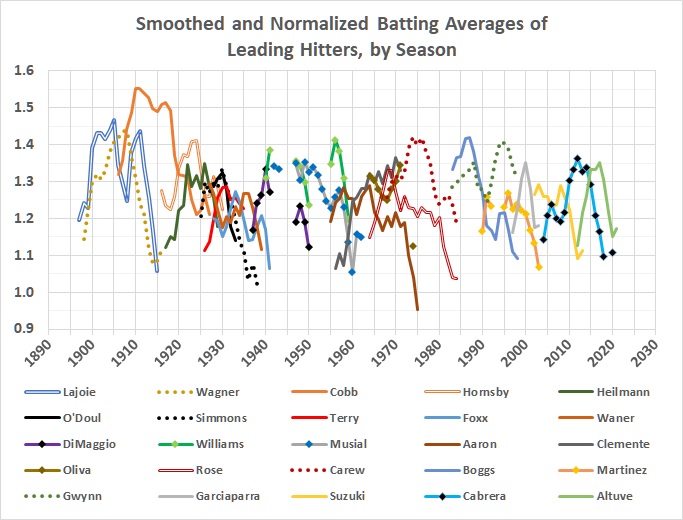
  5. I divided the centered, three-year averages for each player (step 2) by the corresponding centered, adjusted, three-year league averages (steps 3 and 4). The resulting value (e.g., 1.25) indicates how well the player hit for the three years (plotted against the middle year) relative to the league average for the same three years (e.g., 1.25 = 25 percent above the league average).

Figure 1 is a chronological comparison of the adjusted averages for each player who had the highest average at least once. The legend lists the players in the order in which they first attained the highest average.

FIGURE 1

Here’s how many times each player attained top rank:

Altuve’s total — and possibly Cabrera’s — will drop as new names join the list of those eligible for consideration.

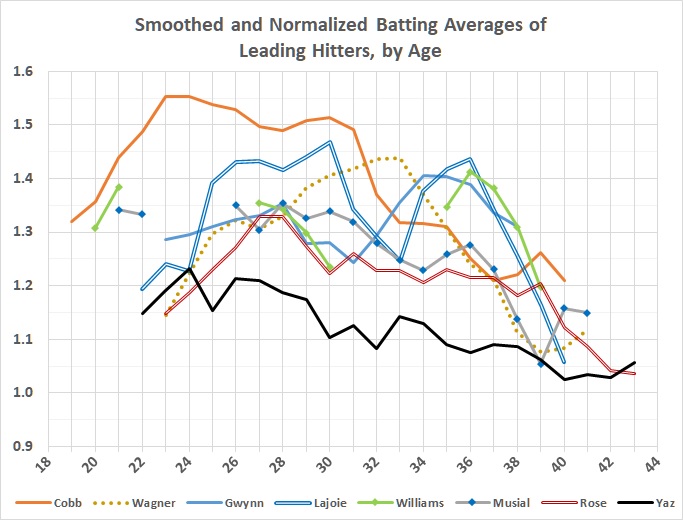
Figure 2 offers an age-based comparison, for what it’s worth. It certainly simplifies matters.

FIGURE 2

Figure 2 highlights Cobb’s dominance. The rest of the players, except for Rose and Yastrzemski are there on merit. Rose and Yaz simply persevered.

Rose, for many reasons, deserves obloquy. I will restrict my remarks here to Rose’s mistakenly praised accomplishment of compiling more hits than Cobb did: 4,256 vs. 4,189. Rose had 14,053 at-bats to Cobb’s 11,440. If Rose had hit .366 (as Cobb did), he would have compiled 5,146 hits, 890 more than his actual total. Here’s another way to look at: If Rose had compiled 4,189 hits in his first 11,440 at-bats (as Cobb did), he would have gone 67 for 2,613 in the rest of his career — a risible average of .026.

A final note: Ted Williams’s record would shine more brightly if he hadn’t missed most of five seasons to military service during World War II and the Korean War. He will come to the fore when I get to all-around hitters — batsmen who hit for high average with power.


* I made exceptions for Babe Ruth and Lou Gehrig, who each won one title but are legends of the game. Nor could Shoeless Joe Jackson be neglected. I also made exceptions for Mickey Mantle and Al Kaline, who each won one title and had long, outstanding careers. I rejected Larry Walker, who derived the unquestionable benefit of playing almost half of his games in Coors Field, where there’s plenty of room to hit the ball where the outfielders aren’t — and into the stands because of Denver’s thin air. I also rejected Barry Bonds and Manny Ramirez of PED infamy. (Though Ramirez had only one batting title, he enjoyed a long, high-average, but tainted career.)

** Here’s the list of batters I considered, with the spans of their major-league seasons in parentheses. The links lead to their pages at Baseball-Reference.com, from which I drew all the statistics used in this analysis:

I began with Lajoie and Wagner because of their prowess and also because their careers substantially overlapped the early years of the American League. Lajoie started in the NL, but ended up playing most of his games in the AL.

*** The DH adjustment is .0067, which is the difference between the changes in the American and National Leagues’ averages between two spans: 1901-1972 and 1973-2022. The AL average increased slightly — by .0003 between 1901-1972 and 1973-2022. But the NL average dropped by .006 between those two spans. I attribute the difference of .0067 to the AL’s adoption of the DH.