Keynesianism: Upside-Down Economics in the Collectivist Cause

A recent post, “Government in Macroeconomic Perspective,” is dauntingly long and replete with equations. The equations are simple ones, but may be off-putting to readers who are allergic to mathematical notation. Herewith is an abridged version of the post. Please refer to the original for details of the argument and references to supporting material.

A nation’s aggregate economic activity usually is measured by its Gross Domestic Product (GDP). I accept GDP as an aggregate, monetary measure of national output. But it is impossible to sum the true value of the myriad economic transactions that GDP is supposed to represent because each transaction means something different to the participants in the transaction; that is, the true value of economic goods is subjective.

GDP, nevertheless, affords a rough measure of the general level of a nation’s material output, that is, the rate at which goods and services are being produced (exclusive of such important things as “household production”). All things being the same, a large fraction of a nation’s citizens — but certainly not all of them — will be better off materially if GDP is growing and worse off if it is shrinking. Governmental activities have led to an economy that produces a small fraction of its potential output. And yet, the true believers in big government seek to make it larger and ever more destructive.

Government spending – beyond a certain level — does not increase GDP, but generally redistributes and decreases it. Government spending is beneficial up to the point where it becomes a drain on GDP; that is, at the point where government exceeds a minimal, protective role and acts in ways that discourage productive effort.

Government spending enables governmental activities of five types:

  1. transfer payments to individuals (e.g., Social Security), which impose costs because the payments transfer income to those who did not earn from those who did;
  2. de facto transfer payments, namely, the compensation of government employees, and the compensation that flows to the employees, shareholders, and creditors of government contractors – all of which must be financed by private-sector entitites;
  3. purchases of consumables and capital that are used directly by government in the provision of government services (e.g., fuel for government vehicles, electricity for government buildings, government vehicles, and government buildings);
  4. the continuation, initiation, modification, and enforcement of tax codes, regulations, administrative procedures, statutes, ordinances, executive orders, and judicial decrees; and
  5. the financing of items 1 – 4.

The net effect of items 1 and 2 is almost certainly a reduction of GDP. Why? The diversion of income to the unproductive (e.g., persons on Social Security) and counterproductive (e.g., government employees who write and enforce regulations) – by whatever means (taxing or borrowing) is bound to disincentivize work, saving, innovation, and investment. That causes GDP to be lower than it otherwise would be, but the effect is multiplicative, not merely a matter of addition or subtraction. (A Keynesian would argue that the actions encompassed in item 1 tend to raise GDP because the recipients of nominal transfer payments probably have higher marginal propensities to consume than do the persons from whom the transfer payments are exacted. This facile claim overlooks the disincentivizing effects of taxation on the more productive components of an economy, and on the resulting reduction in work effort and growth-producing investment.)

Similarly, the diversion of resources to items 3 and 4 cannot be thought of as additions to or subtractions from GDP, but as multiplicative, because of the same kind of disincentivizing leverage. For example, one effect of item 4 is the unobserved but very real burden placed on the private sector by federal regulations. It has been estimated, reliably, that those regulations impose a hidden cost greater than 15 percent of GDP.

Then there is item 5: financing. In the end, it matters not whether governmental activities are financed by borrowing or taxation, and if by borrowing, whether the lenders are domestic or foreign. This is because it is government spending that diverts resources from private uses, and it is government spending that enables destructive governmental activities (e.g., the writing and enforcement of regulations).

Government long ago became larger than necessary to perform its minimal protective functions. Consider what has happened since 1890, when the early legislative “accomplishments” of the Progressive Era – the establishment of the Interstate Commerce Commission in 1887 and the passage of the Sherman Antitrust Act in 1890 – began to weigh on the economy.

Real GDP (in year 2005 dollars) was $319 billion in 1890; it had risen to $13.3 trillion in 2011 — a compound growth rate of about 3.1 percent. But real GDP in 2011 would have been more than $104 trillion had growth continued at an annual rate of 4.9 percent after 1890 (the rate of growth from 1866 through 1890). What happened? The heavy hand of government (at all levels) — especially after 1929 — made itself felt by discouraging work, discouraging the saving that makes investment possible, discouraging innovation, and (even to the extent that innovation persists) discouraging the investments required to bring innovation on line. How? It begins with the diversion of resources to governmental activities, and is compounded by the cumulative disincentivizing effects of taxes, regulations, administrative procedures, statutes, ordinances, executive orders, and judicial decrees.

Defenders of big government will say that the rate of growth could not have been sustained at something like 5 percent. But such an assertion, if it is based on anything other than ignorance, is based on a simple, sub-exponential model of growth, where returns on investment are diminishing. This model overlooks the effects of innovation and recombination (the use of previous innovations in new ways). If the model of ever-diminishing growth were correct, the U.S. economy would not have experienced rising growth in the first 20 to 25 years after the end of World War II. No, the defenders of sub-exponential growth must look to the Great Society — and to the continuous expansion of the regulatory-welfare state — if they wish to understand the artificially low rate at which the economy is growing: currently about 2 percent a year.

Despite what I have said here about the deleterious effects of bigger-than-minimal government, there are true believers who maintain that the greater the scope and scale of government, the better and richer America will be. These true believers evidently have not considered the cumulative effect  of big government on the incomes and wealth of Americans. As the preceding analysis suggests, those relatively few Americans who would not be better off with minimal government would be the beneficiaries of a pool of charitable giving that is vastly greater than the present pool.

That big government might be harmful, even to the “little people” who are its supposed beneficiaries, is of no account to its worshipers – as long as they run it, advise in the running of it, profit by it, or simply enjoy watching it run roughshod over the lives and fortunes of others. Power and the vicarious enjoyment of power are habit-forming drugs.

The ranks of true believers are peopled such left-wing economists as Brad DeLong, James K. Galbraith, and Paul Krugman. They adhere to and popularize two major rationalizations of big government — the Keynesian fallacy and the myth that government is the same as community.

In “A Keynesian Fantasy Land” I discuss six reasons for the ineffectiveness of Keynesian “stimulus”; in summary:

1. The “leakage” to imports

“Part of the extra spending stimulus fails to stimulate domestic income because as much as 0.3 of the multiplier might leak out through extra imports.” (Anthony de Jasay, “Micro, Macro, and Fantasy Economics,” Library of Economics and Liberty, December 6, 2010)

2. The disincentivizing effects of government borrowing and spending

Even if additional debt does not crowd out private-sector borrowing to finance business expansion, it will nevertheless inhibit investments in business expansion. This inhibiting effect is compounded by the reasonable expectation that many items in a “stimulus” package will become permanent fixtures in the government’s budget

3. The timing-targeting problem

The lag between the initial agitation for “stimulus” and its realization. In the extreme, the lag can be so great as to have no effect other than to divert employed resources from private to government uses. But even where there is a relatively brief lag, “stimulus” spending is essentially wasted if the result is simply to divert already employed resources from private to government uses.

4. Inadequate Aggregate Demand (AD) is a symptom, not a cause

A drop in AD usually is caused by an exogenous event, and that exogenous event usually is a credit crisis. Pumping money into the economy — especially when it results in the bidding up the prices of already employed resources — does not reinflate the punctured credit bubble that caused the slowdown.

5. Inequity, moral hazard, and their consequences

Favorable treatment of defaulters and failing companies generates considerable popular resentment, which — in the present instance — has found a vocal and politically potent outlet in the Tea Party movement. Favorable treatment of defaulters and failing companies also creates moral hazard; that is, it encourage unwise risk-taking that can (and probably will) spark future crises, leading the government to assume more obligations and impose more regulations, in a futile effort to change human nature.

6. The human factor

Those who cling to the Keynesian multiplier would like the world to comply with it. But the world does not because it is filled with people, whose behavior is not determined (or described) by a simplistic model but by their responses to incentives, their political predispositions, their informed and reasonable skepticism about the consequences of government intervention in economic matters, and — above all else — their fallibility.

In truth, the Keynesian multiplier is a mathematical fiction, as explained here, and government spending is in fact destructive of economic growth, as discussed here and in some of the posts listed at the end.

“We owe it to ourselves” is a phrase used by Paul Krugman (among others on the left). It is a variant of the stock rationale for socializing gains and losses: “We’re all in this together.” As if the citizens of the United States were members of an extraordinarily large community, with a perpetual town-hall meeting conducted by the government of the United States.

Consider the intellectual dishonesty of Krugman’s claim that “we” owe the debt of the U.S. government to “ourselves.” Who are “we”? If government borrows money and spends it on goodies for Congressman X, Y, and Z’s districts, how do I get my cut? Or does the happiness generated in Congressman X, Y, and Z’s districts simply radiate in waves across the country, eventually reaching me and making me feel better?

If the borrowed money makes (some) people in Congressman X, Y, and Z’s districts better off, why is it that “we” (i.e. the rest of us and/or our descendants) end up repaying the debt that made those others better off? I do not understand how I “owe it to myself” when (a) I didn’t ask to borrow the money and (b) I gained nothing as a result of the borrowing.

You might claim that my personal wishes are of no account because Congress and the president are duly elected by majorities of voters. But that is tantamount to saying that Congress and the president possess a kind of omniscient super-consciousness that somehow overrides the harm, hate, and discontent that flow from their acts.

The left succeeds, in large part, because apologists for big government — from Krugman to Obama — are skillful practitioners of slippery logic. An assumption here, an assumption there, and government spending is made out to be a source of enrichment. The hard truth is that government spending — and the big government that it supports — is the source of America’s impending impoverishment.

Related posts:
Trade Deficit Hysteria
Trade, Government Spending, and Economic Growth
The Causes of Economic Growth
In the Long Run We Are All Poorer
A Short Course in Economics
Addendum to a Short Course in Economics
The Price of Government
Gains from Trade
The Price of Government Redux
The Indivisibility of Economic and Social Liberty
Trade
The Mega-Depression
As Goes Greece
Ricardian Equivalence Reconsidered
The Real Burden of Government
Toward a Risk-Free Economy
Enough of “Social Welfare”
Subjective Value: A Proof by Example
Microeconomics and Macroeconomics
The Illusion of Prosperity and Stability
Society and the State
I Want My Country Back
Estimating the Rahn Curve: Or, How Government Inhibits Economic Growth
Our Enemy, the State
“Intellectuals and Society”: A Review
Subjective Value: A Proof by Example
The Stagnation Thesis
Taxing the Rich
More about Taxing the Rich
Does World War II “Prove” Keynesianism?
Money, Credit, and Economic Fluctuations
A Keynesian Fantasy Land
The Keynesian Fallacy and Regime Uncertainty
Creative Destruction, Reification, and Social Welfare
Why the “Stimulus” Failed to Stimulate
The “Jobs Speech” That Obama Should Have Given
Say’s Law, Government, and Unemployment
Regime Uncertainty and the Great Recession
Regulation as Wishful Thinking
The Real Multiplier
Vulgar Keynesianism and Capitalism
Why Are Interest Rates So Low?
Merit Goods, Positive Rights, and Cosmic Justice
The Commandeered Economy
We Owe It to Ourselves
Estimating the Rahn Curve: A Sequel
The Real Multiplier (II)
Lay My (Regulatory) Burden Down
The Burden of Government
Economic Growth Since World War II
More Evidence for the Rahn Curve
“Big SIS”: A Review
The Capitalist Paradox Meets the Interest-Group Paradox
Progressive Taxation Is Alive and Well in the U.S. of A.
The Obama Effect: Disguised Unemployment
Some Thoughts about Leftist Hypocrisy
The State as Jailer
Where We Are, Economically

Where We Are, Economically

UPDATED (10/26/12)

The advance estimate of GDP for the third quarter of 2012 has been released. Real growth continues to slog along at about 2 percent. I have updated the graph, but the text needs no revision.

*  *   *

It occurred to me that the trend line in the second graph of “The Economy Slogs Along” is misleading. It is linear, when it should be curvilinear. Here is a better version:


Derived from the October 26, 2012 release of GDP estimates by the Bureau of Economic Analysis. (Contrary to the position of the National Bureau of Economic Research, there was no recession in 2000-2001. For my definition of a recession, see “Economic Growth Since World War II.”)

The more descriptive regression line underscores the moral of “Obama’s Economic Record in Perspective,” which is this:

The claims by Obama and his retinue about O’s supposed “rescue” of the economy from the abyss of depression are ludicrous. (See, for example, “A Keynesian Fantasy Land,” “The Keynesian Fallacy and Regime Uncertainty,” “Why the “Stimulus” Failed to Stimulate,” “Regime Uncertainty and the Great Recession,” The Real Multiplier,” “The Real Multiplier (II),”The Economy Slogs Along,” and “The Obama Effect: Disguised Unemployment.”) Nevertheless our flannel-mouthed president his sycophants insist that he has done great things for the country, though the only great thing that he could do is to leave it alone.

Obama is not to blame for the Great Recession, but the sluggish recovery is due to his anti-business rhetoric and policies (including Obamacare, among others). All that Obama can rightly take “credit” for is an acceleration of the downward trend of economic growth.

Related posts:
Are We Mortgaging Our Children’s Future?
In the Long Run We Are All Poorer
Mr. Greenspan Doth Protest Too Much
The Price of Government
Fascism and the Future of America
The Indivisibility of Economic and Social Liberty
Rationing and Health Care
The Fed and Business Cycles
The Commandeered Economy
The Perils of Nannyism: The Case of Obamacare
The Price of Government Redux
As Goes Greece
The State of the Union: 2010
The Shape of Things to Come
Ricardian Equivalence Reconsidered
The Real Burden of Government
Toward a Risk-Free Economy
The Rahn Curve at Work
The Illusion of Prosperity and Stability
More about the Perils of Obamacare
Health Care “Reform”: The Short of It
The Mega-Depression
I Want My Country Back
The “Forthcoming Financial Collapse”
Estimating the Rahn Curve: Or, How Government Inhibits Economic Growth
The Deficit Commission’s Deficit of Understanding
The Bowles-Simpson Report
The Bowles-Simpson Band-Aid
The Stagnation Thesis
America’s Financial Crisis Is Now
Understanding Hayek
Money, Credit, and Economic Fluctuations
A Keynesian Fantasy Land
The Keynesian Fallacy and Regime Uncertainty
Why the “Stimulus” Failed to Stimulate
The “Jobs Speech” That Obama Should Have Given
Say’s Law, Government, and Unemployment
Regime Uncertainty and the Great Recession
Regulation as Wishful Thinking
Vulgar Keynesianism and Capitalism
Why Are Interest Rates So Low?
Don’t Just Stand There, “Do Something”
The Commandeered Economy
Stocks for the Long Run?
We Owe It to Ourselves
Stocks for the Long Run? (Part II)
Bonds for the Long Run?
The Real Multiplier (II)
The Burden of Government
Economic Growth Since World War II
More Evidence for the Rahn Curve
The Economy Slogs Along
The Obama Effect: Disguised Unemployment
Obama’s Economic Record in Perspective

Not-So-Random Thoughts (VI)

Links to the other posts in this occasional series may be found at “Favorite Posts,” just below the list of topics.

Arnold Kling reprises and expands on a point that I have made in “Liberty and Society” (among other posts, linked therein):

My inclination is to approve of organizations that promote group objectives and attempt to limit individual choices, as long as participation in these organizations is voluntary….

I read Adam Smith as approving of social pressure….

In Smith’s psychology, we imagine ourselves being regarded by others, and this imaginative exercise strongly influences our self-regard. Smith seems to me to suggest that this is good for mankind as a whole, because it encourages moral behavior.

Along these lines, there is a tradition within libertarian thought that champions the institutions of civil society as an alternative to statism….

In Hayek’s view, social norms are not the product of one person’s design; rather, they are the outcome of an evolutionary process….

Social norms, like the market, embody knowledge that is beyond the capability of any one individual to possess. I believe that for Hayek, trying to arrive at moral decisions solely on the basis of objective reasoning would be as futile a project as attempting to centrally plan an economy. Either project discards too much useful information to be successful….

I believe that modern research offers support for the views of Smith and Hayek on the nature of human psychology. For example, Jonathan Haidt, in The Righteous Mind, says that we have evolved to care about our status within groups. An important way to achieve status within a group is to adhere to and defend its norms.

One view is that systems of social norms are a necessary ingredient in human progress. For example, Haidt writes,

Moral systems are interlocking sets of values, virtues, norms, practices, identities, institutions, technologies, and evolved psychological mechanisms that work together to suppress or regulate self-interest and make cooperative societies possible.

…[W]e live in a world that demands enormous levels of trust among strangers. We want to be able to use credit cards in remote villages in underdeveloped countries, to be able to buy and sell used goods on eBay, to hire contractors and service workers on Craigslist, and so on. We could not live the way we do if our trust circles were limited to something like a Dunbar number (the 150 or so people we can know well enough personally)….

What I am saying is that we should not become wedded to the view that the world we want is one in which irrational group attachments have been completely eradicated from the human psyche. Yes, this capacity for group attachment is manifest in state-worship that we find troubling. But group norms are a fundamental component of human nature. We probably owe a debt of gratitude to the part of human behavior that becomes irrationally attached to groups and to group norm enforcement.

It may be that the role of libertarians is to point out that political demagogues are exploiting the tribal loyalty instincts of citizens against their better interests, as is typically the case. But it may be neither realistic nor desirable to “educate” people in order that they should lose all sense of group attachment, including attachment to the state. (“Libertarians and Group Norms,” Library of Economics and Liberty)

Kling’s academic even-handedness aside, he is on exactly the right track. Liberty is a social construct, not a Platonic ideal.

*   *   *

Call it selection bias, if you will, but The Hockey Schtick posts a seemingly endless stream of academic papers that refute “warmism” and support natural explanations of the brief period of warming during the final quarter of the 20th century. Go there, and then go to “Anthropogenic Global Warming Is Dead, Just Not Buried Yet, ” and follow the links therein.

*   *   *

Theodore Dalrymple addresses Britain’s National Health Service and rationing:

Traditionally, the NHS has been inexpensive compared with most health-care systems, Britain spending less on its health care per head and as a proportion of GDP than any other developed country. But this reality is changing quickly. The NHS was inexpensive because it rationed care by means of long waiting lists; it also neglected to spend money on new hospitals and equipment. I once had a patient who had been waiting seven years for his hernia operation. The surgery was repeatedly postponed so that a more urgent one might be performed. When he wrote to complain, he was told to wait his turn.

Such rationing has become increasingly unacceptable to the population, aware that it does not occur elsewhere in the developed world. This was the ostensible reason for the Labour government’s doubling of health-care spending between 1997 and 2007. To achieve this end, the government used borrowed money and thereby helped bring about our current economic crisis. Waiting times for operations and other procedures fell, but they will probably rise again as economic necessity forces the government to retrench.

But the principal damage that the NHS inflicts is intangible. Like any centralized health-care system, it spreads the notion of entitlement, a powerful solvent of human solidarity. Moreover, the entitlement mentality has a tendency to spread over the whole of human life, creating a substantial number of disgruntled ingrates.

And while the British government long refrained from interfering too strongly in the affairs of the medical profession, no government can forever resist the temptation to exercise its latent powers. Eventually, it will dictate—because that is what governments and their associated bureaucracies, left to their own devices, and of whatever political complexion, do. The government’s hold over medical practice in Britain is becoming ever firmer; it now dictates conditions of work and employment, the number of hours worked, the drugs and other treatments that may be prescribed, the way in which doctors must be trained, and even what should be contained in applicants’ references for jobs. Doctors are less and less members of a profession; instead, they are production workers under strict bureaucratic control, paid not so much by result as by degree of conformity to directives. (“Universal Mediocrity,” City Journal, Summer 2012)

Rationing? It can’t happen here, right? Wrong. For more, see my “Rationing and Health Care.” “The Perils of Nannyism: The Case of Obamacare,” “More about the Perils of Obamacare.” and “The Rationing Fallacy.”

*   *   *

Cato’s loony libertarians (on matters of defense) once again trot out Herr Doktor Professor John Mueller. He writes:

We have calculated that, for the 12-year period from 1999 through 2010 (which includes 9/11, of course), there was one chance in 22 million that an airplane flight would be hijacked or otherwise attacked by terrorists. (“Serial Innumeracy on Homeland Security,” Cato@Liberty, July 24, 2012)

Mueller’s “calculation” consists of an recitation of known terrorist attacks pre-Benghazi and speculation about the status of Al-Qaeda. Note to Mueller: It is the unknown unknowns that kill you. I refer Herr Doktor Professor to “Riots, Culture, and the Final Showdown” and “Mission Not Accomplished.”

Government in Macroeconomic Perspective

 I. INTRODUCTION

A nation’s aggregate economic activity usually is measured by its Gross Domestic Product (GDP). I accept GDP as an aggregate, monetary measure of national output. But it is impossible to sum the true value of the myriad economic transactions that GDP is supposed to represent because each transaction means something different to the participants in the transaction; that is, the true value of economic goods is subjective. (See, for example, Peter Boettke’s “Austrian School of Economics,” at The Concise Encyclopedia of Economics., and my posts, “Subjective Value: A Proof by Example” and “Microeconomics and Macroeconomics.”)

GDP, nevertheless, affords a rough measure of the general level of a nation’s material well-being. All things being the same, a large fraction of a nation’s citizens — but certainly not all of them — will be better off materially if GDP is growing and worse off if it is shrinking. But no one who is paying attention to the state of the nation should mistake material progress for real progress. (See, for example, “I Want My Country Back.”)

The usual way of representing GDP is called the expenditure method. In simple form, it expresses GDP this way:

GDP = private consumption + gross investment + government spending + (exportsimports), or

GDP = C + I + G + (X – M)

Note: “Gross” means that GDP measures production regardless of the various uses to which that production can be put. Production can be used for immediate consumption, for investment in new fixed assets or inventories, or for replacing depreciated fixed assets. “Domestic” means that GDP measures production that takes place within the country’s borders. In the expenditure-method equation given above, the exports-minus-imports term is necessary in order to null out expenditures on things not produced in the country (imports) and add in things produced but not sold in the country (exports). (Taken from “Gross domestic product” at Wikipedia. See also Mack Ott’s “National Income Accounts” at The Concise Encyclopedia of Economics.)

This equation has become so familiar that its correctness is taken for granted. But a bit of reflection reveals it as a model of inconsistency. The dichotomy between consumption and investment is sensible. But the goods acquired and sold in international trade are of the same two types; there is no reason to segregate them from consumption and investment. This is especially true because the sum of consumption and investment is greater than it would be in the absence of international trade. Government, on the other hand, is a net consumer of economic output, not a net producer of it, as the “+ G” term might suggest.

With that background, I will offer an alternative to the standard expenditure method of describing GDP. The journey is step-wise: from a closed economy without international trade or government to an economy with international trade, but without government, to an economy with both international trade and government. Along the way, I fully acknowledge the importance of government as a contributor to GDP, as long as its role is to foster beneficial exchange by maintaining the rule of law and defending Americans from predators, at home and abroad.

That said, government activities (as reflected in total government spending) have led to an economy that produces a small fraction of its potential output. And yet, the true believers in big government seek to make it larger and ever more destructive. I expand on these points at length in Part II, An Alternative Expenditure Model; Part III, The High Cost of Big Government; and Part IV, The Heart of the Problem: Big-Government Worship and Pseudo-Intellectualism. (Continued below the fold.) Continue reading “Government in Macroeconomic Perspective”

The Name Game

With the Social Security baby-name database, one can find the popularity* of a newborn’s name in any year from 1880 through 2011. Armed with the database, I set out to determine whether the relative popularity of presidential candidates’ names had any bearing on the outcome of the 33 elections of 1880-2008. Here is what I learned from an analysis of the names of the two leading candidates** in each of the 33 elections:

  • The candidate with the more popular name — in the year of the election — won only 15 times out of 33.
  • Ten of the winners with the more popular name were Republicans.
  • Ten of the 18 winners with the less popular name were Democrats.
  • The Democrat had the less popular name in 20 of the 33 elections.

The moral of the story: It is a slight disadvantage to have a popular name. Democrats are more likely than Republicans to have weird names. This latter tendency confers a slight advantage on Democrat candidates.

What about 2012? Willard (Mitt Romney’s first name) has not been in the top 1,000 since 1989, but it was in the top 1,000 in every year before that — ranking as high as 58th in 1915. Barack, needless to say, has never been in the top 1,000. It seems likely that Willard is somewhat more popular than Barack, even now.***

But Mitt — like Grover, Woodrow, and Calvin — is the name in the political arena. And I have no reason to believe that Mitt is any more popular than Barack. If Barack is the less-popular name, that might count as an advantage for Obama. But a less-than-dismal performance in a debate would do him more good than his weird name.

__________
* Restricted to the top 1,000 boys’ names and the top 1,000 girls’ names in each year.

** All of them Republicans and Democrats, except in 1912, when Theodore Roosevelt ran on the Progressive ticket and was the runner-up to Woodrow Wilson.

*** It does not seem that presidents’ first names become more popular during their time in office. The rank of Grover (Cleveland) went from 20 in 1884 (when Cleveland was first elected) to 47 in 1892 (the year of Cleveland’s second victory). Benjamin (Harrison) dropped from 25 in 1888 to 42 in 1892. Woodrow (Wilson) barely budged, going from 192 in 1912 to 190th in 1916. Herbert (Hoover) was 25 in 1928 and 44 in 1932 (another victim of the Great Depression, no doubt). Franklin (Roosevelt) went from 66 to 65 to 87 to 112 (in 1932, 1936, 1940, and 1944, respectively). Dwight (Eisenhower) was 123 in 1952 and 139 in 1956. (And, lest you think that Dwight should have been a Democrat, remember that his opponent was the more weirdly named Adlai — or Adelaide, as some wags called him.) Richard (Nixon) fell from 8 in 1968 to 14 in 1972 (and, unsurprisingly, kept falling steadily thereafter, to 127 in 2010-2011). Ronald (Reagan) went from 58 in 1980 to 67 in 1984. George (Bush I and II) declined from 78 (1988) to 95 (1992) to 130 (2000) to 146 (2004). George has come a long way (down) since Washington was first in the hearts of his countrymen.

The Obama Effect: Disguised Unemployment (Updated)

Here.

Mission Not Accomplished

From Walter Russell Mead’s “Al-Qaeda Is Alive and Well“:

Contrary to exclamations from the Obama administration and the mainstream press, Al-Qaeda is not dead, not gone, and not “on its last legs.” In fact, the regional groups that together make up “Al-Qaeda” have had different fortunes in recent months, as Daveed Gartenstein-Ross reports for Foreign Policy, but its fighters are still out there….

It seems that Al-Qaeda willingly hid from public view, regrouped, explored new areas of operation, trained, and gathered recruits, all before the 9/11/12 attack in Benghazi—and all amid repeated spiking of the football in Washington over the killings of Osama bin Laden and Abu Yahya al-Libi, among others….

Americans have a pattern of prematurely declaring victory in these kinds of long, drawn-out struggles. Think back to Lyndon Johnson’s “light at the end of the tunnel” in Vietnam, the “death throes” of the Iraqi insurgency that Vice President Cheney thought he saw, and the triumphal crowing after bin Laden’s death that Al-Qaeda was on the verge of strategic defeat. We ought to be more careful declaring victory, especially when we aren’t exactly sure to begin with what victory would even look like.

As if to underscore Mead’s warning, here is a tidbit from The Telegraph:

Al-Qaeda has been blamed for a recent series of forest fires across Europe, as the head of Russia’s Federal Security Service claimed they were set by arsonists as part of the group’s low-cost attack strategy.

“One should note that setting fires to forests in the countries of the European Union is a new tendency in al-Qaeda’s strategy of a ‘thousand cuts’,” Alexander Bortnikov said, according to state news agency RIA Novosti, at a meeting of heads of security agencies.

“This method allows (al-Qaeda) to inflict significant economic and moral damage without serious preliminary preparations, technical equipment or significant expenses.”

In linking al-Qaeda to the deadly wildfires, Mr Bortnikov pointed to calls to launch a “forest jihad” by various extremist websites which he said also publish detailed instructions about how and where to best carry out arson.

He said it was very difficult for special services to find and prosecute such arsonists.

Deadly fires have swept through forest land in EU countries such as Portugal and Spain over the past few months, killing scores of people and forcing thousands to evacuate. (“Al-Qaeda blamed for Europe-wide forest fires,” October 4, 2012)

It seems to me that someone ought to be taking seriously the kind of scenario that I laid out in “The Next 9/11?”:

…I challenge the [Obama] administration to tell me that the following has not happened and cannot happen in the United States:

  • A large but dispersed collection of improvised weapons for improvised, mortar-style attacks has been gathered in and around major U.S. cities and transportation and energy nodes.
  • These weapons are positioned so that their activation, on a massive scale would create havoc and panic — and might well disrupt transportation and communication networks. (With a massive salvo, not every weapon must reach its target.)
  • These weapons can be activated remotely — perhaps through signals transmitted from a single point — so that they can be fired in coordinated waves. Each successive wave disrupts and complicates rescue and recovery efforts that ensue from preceding waves, heightens confusion and panic, and lays the groundwork for economic disaster and political repression.

Obama’s political correctness, I fear, goes hand-in-hand with his demonstrated fecklessness in matters of national security. The intelligence and special operations forces of the United States should be capable of detecting and dismantling a threat of the kind outlined above. But will they be given the necessary resources and leeway? I doubt it.

I wrote that more than a year before the murders of the U.S. ambassador to Libya and three other Americans. Murders that underscore Obama’s insouciant incompetence in the face of a determined enemy.

Happy Anniversary to Me

Patience as a Tool of Strategy,” from 10/03/11, with one obvious change:

Today is the 14th 15th anniversary of my retirement from full-time employment. I take special delight in this annual observance because my retirement capped a subtle campaign to arrange the end of my employment on terms very favorable to me. The success of the campaign brought a profitable end to my tense relationship with my boss.

I liken the campaign to fly-fishing: I reeled in a big fish by accurately casting an irresistible lure then playing the fish into my net. I have long wondered if my boss ever grasped what I had done and how I had done it. The key was patience; more than a year passed between my casting of the lure and the netting of the fish (early retirement with a financial sweetener).

Without going into the details of my “fishing expedition,” I can translate them into the elements of success in any major undertaking:

  • strategy — a broad and feasible outline of a campaign to attain a major objective;
  • intelligence — knowledge of the opposition’s objectives, resources, and tactical repertoire, supplemented by timely reporting of his actual moves (especially unanticipated ones);
  • resources — the physical and intellectual wherewithal to accomplish the strategic objective while coping with unforeseen moves by the opposition and strokes of bad luck;
  • tactical flexibility — a willingness and ability to adjust the outline of the campaign, to fill in the outline with maneuvers that take advantage of the opposition’s errors, and to compensate for one’s own mistakes and bad luck;
  • and — as mentioned — a large measure of patience, especially when one is tempted either to quit or escalate blindly.

Patience is not a virtue that accrues to amorphous masses, like nations. It can be found only in individuals or groups of individuals who share the same objectives and are able to work together long enough to attain those objectives. Whether such individuals or groups lead nations — and lead them wisely — is another matter.

Related posts:
A Grand Strategy for the United States
Not-So-Random Thoughts (V) (first entry)

The State as Jailer

A triangle, as you probably know, is a stabilizing element in structures. Civil society is s stabilizing element in the affairs of citizens. Left alone by government (except as protector), the institutions of civil society establish and enforce the “rules of the game” that allow people to engage in voluntary, mutually beneficial behavior. The primary institutions of civil society — its triangular superstructure — are work, community, and family. (Community includes church, club, friendships, and the like; it does not include the kind of government-forced “community” beloved of leftists.). Absent interference by government, there is freedom within the three corners of civil society’s institutions; thus:

What happens when government goes beyond its protective role to encroach on the institutions of civil society? Aside from weakening those institutions and creating dependence on government, the main effect is to restrain freedom of action — contrary to the stated beliefs of the proponents of encroachment; thus:
The diamond-shaped space is attractive because it has been created, over the decades, by promising more freedom but, in fact, delivering less. Despite that failure, the promises are repeated ad nauseam and drummed into the minds gullible citizens, even as their freedom is being stripped away.

Related posts:
Civil Society and Homosexual “Marriage”
Law and Liberty
Rights, Liberty, the Golden Rule, and the Legitimate State
Down with “We”
Our Enemy, the State
Government vs. Community
The Destruction of Society in the Name of “Society”
The Golden Rule as Beneficial Learning
The Myth That Same-Sex “Marriage” Causes No Harm
Liberty and Society
The Eclipse of “Old America”
Genetic Kinship and Society
Liberty as a Social Construct: Moral Relativism?

Some Thoughts about Leftist Hypocrisy

The anti-wealth stance of the left — hypocritical as it is when it emanates (as it often does) from highly paid academics, well-connected politicians, cosseted bureaucrats, and a sparkling array of super-rich entertainers, celebrities, and “moguls” – is of a piece with other leftist displays of Puritanism: anti-smoking, anti-obesity, anti-censoriousness (toward the left’s pets, such as Islam, gays, and selected “minorities”). The anti-wealth stance and other displays of Puritanism are attitudes that mark one as a superior being — a person who is compassionate and deserving of his worldly goods. But where is the left’s compassion for the “little guy” when the “little guy” is a job-holding, beer-drinking, fast-food eating, overweight, married-with-children, possibly church-going, white, wage-laborer?

Given that the rich and famous are often heard to declaim against the “privileges” of the economic class to which they belong, one must suppose that their hypocrisy arises from economic ignorance. This ignorance leads them to believe that they are the beneficiaries of a zero-sum game, thus causing (misplaced) guilt about their wealth. I have noticed that this guilt, though it may cause the rich and famous to contribute to charity, also causes them to press for higher taxes on their ilk, as if higher taxes (which benefit already well-paid politicians and bureaucrats) were somehow better than charity. Charity, at least, can be showered directly on the unfortunate. Taxes are a form of trickle-down charity, where precious little trickles down — as evidenced by the fact that some of the nation’s wealthiest counties surround the District of Columbia.

The call for higher taxes is a misguided admission of guilt, not a sign of compassion. Were wealthy leftists truly compassionate about the plight of the unfortunate, they would give away their worldly goods and spend their lives working with the unfortunate, to lead them by example onto the path of success. Instead, wealthy leftists live among their ilk — and live truly well. If only they would not feel guilty about it.

Dispatches from the Front

I correspond almost daily with a friend of 40 years: B. He initiates a lot of our exchanges by sending links to articles in The New York Times and comments that he has received from others about those articles. In the last few days, B and I have had three exchanges that are worth noting here.

*   *   *

Another correspondent, D, sent this to B:

Obama has been pictured as having many negative qualities by the Right Wing.    Three things are especially repugnant to many on the right.  He’s black, he’s a Socialist or Communist and lately (including this latest one) he is thought to be like Hitler.  Do they see some inconsistency for Obama being thought of as both Fascist and a Communist?

B replied (with copy to me):

You could bend your mind like a pretzel trying to portray Obama as both a Fascist and a Communist.

My response to B:

There is a fairly easy way to reconcile Fascism and Communism. Both are (in practice) forms of statism, wherein the power of the state is marshaled to attain certain ends that are proclaimed to serve the “common interest.”

I think of political ideologies as compass points. Placing anarchism arbitrarily at 0, hard statism (whatever its label) is at 90, “social democracy” (including the U.S. variety) is at 180, and at 270 is libertarianism (the minimal state for defense of life, property, and liberty — close to the spirit of the Constitution).

*   *   *

B forwarded some quotations culled by another friend, marking the 106th anniversary of the birth of Dmitri Shostakovich. Two of the quotations:

The Fifth Symphony of Shostakovich always has been singularly irritating to this  chronicler… Whenever I hear one of his marches, my imagination fastens upon a picture of the parades in Red Square and the banners of Uncle Joe, and my irritation becomes powerful.

– Cyrus Durgin, The Boston Globe (25 October 1952)

The composer apparently does not set himself the task of listening to the desires and expectations of the Soviet public.  He scrambles sounds to make them interesting to formalist elements who have lost all taste…  The power of good music to affect the masses has been sacrificed to a petty-bourgeois, “formalist” attempt to create originality through cheap clowning.  It is a game of clever ingenuity that may end very badly.*

Pravda (on the Shostakovich opera Lady MacBeth of Mtsensk,
“Muddle Instead of Music,” January 1936)

B called out Durgin’s commentary. I replied:

I like Durgin’s statement and share his irritation. In this case, I am also in sync with Pravda, which homes in on the truth about “modern” music: “scrambles sounds to make them interesting to formalist elements who have lost all taste.”

“Modern” music is an “inside” game, played by composers for their own benefit and for the benefit of effete critics and certain audiences who place a high value on being au courant. The latter are the kind of people who applaud Occupy from the safety of their Park Avenue penthouses (radical chic). The practitioners of radical chic are (I suspect) the major source of private funding for the “arts,” which would explain the otherwise inexplicable degree to which modernism permeates not only formal music but also formal dance and the visual arts.

I was a faithful listener of WETA-FM, in the days when it carried classical music in the morning, afternoon, and evening — before the intrusion of “relevant,” consciousness-raising news and blather (e.g., Fresh Air). There was (and probably still is) a 5-minute feature that ran in the afternoon, called Composers Datebook. Every segment closed with “reminding you that all music was once new.” Yes, it was all new (what a blindingly obvious statement) — just as a lot of formal dance and visual art was once new — but was it good?

The foregoing is adapted from a short post of mine: “The Arts: Where Regress Is Progress.”

*   *   *

B often links to something written by David (faux conservative) Brooks. Today, he linked to a piece titled “The Conservative Mind,” wherein Brooks tries to drive a wedge between what he calls economic conservatives (i.e., free-marketeers) and traditional conservatives (i.e., Edmund Burke, Russell Kirk, and — in his later years — Friedrich Hayek):

There are very few willing to use government to actively intervene in chaotic neighborhoods, even when 40 percent of American kids are born out of wedlock.

Another of B’s correspondent’s said, quite sensibly:

I would suggest that it is because of government intervention in the neighborhood that we have 40% of American kids born out of wedlock.  If the government didn’t make it economically affordable and in some cases beneficial to have children out of wedlock, the rate would be much lower.

This was my reaction to Brooks’s muddled attempt to discredit economic conservatives:

The kind of social conservatism that Brooks rightly praises cannot flourish when government distorts social relationships, as it has done through various welfare schemes that created dependencies on government, and through ham-handed egalitarianism (e.g., affirmative action as I have seen it in action, first hand). All such efforts are divisive, not unifying, because they disrupt traditional social relationships and create suspicions, animosities, and rivalries (e.g., who gets to be first in line at the public trough).

Where Brooks goes badly wrong (as I read him) is to place economic and social conservatism in opposition to each other. Economic liberty, where it is allowed, requires and fosters mutual trust and respect. It is, in other words, a unifying instrument of social comity and law-abidingness. Economic liberty requires government, to be sure, but it is a government that is concerned with enforcing the rules of the game (no stealing or cheating), not with enforcing certain outcomes.

A Victory Blog

I hereby designate Politics & Prosperity a victory blog.

Victory over aggressors, oppressors, and collaborators — foreign and domestic, savage and pseudo-compassionate. You are Islamists and Europeanists, terrorists and traitors with printing presses and call letters, appeasers and moral relativists. You are the easily aggrieved and readily offended, the perpetually adolescent rebel and the hypocrite who basks in wealth and power. You prefer criminals to victims, takers to makers, and chaos to social norms. A pox on all of you.

Understanding the Monty Hall Problem

I have extensively revised, expanded, and republished this post as “The Compleat Monty Hall Problem.” Please go there.

I first encountered  the Monty Hall problem a few years ago. My intuitive answer to the problem was wrong, according to the explanation of the problem that I read at the time. I forgot about the problem until a few days ago, when I gave the answer I had given before and read, again, that I had answered incorrectly. With two strikes, I began to focus on the problem, in an effort to understand why my intuitive answer is incorrect, and why the “correct”  answer is indeed correct.

What is the Monty Hall problem? It’s a probability puzzle named for the original host of an old TV game-show, Let’s Make a Deal. The puzzle acquired its name because the setup of the puzzle is similar to one of the challenges faced by contestants who appeared on the show. The puzzle goes like this:

1. There are three doors: 1, 2, and 3.

2. Behind one of the doors is an item of some value, which I denote with $$.

3. Behind each of the other two doors are items of little or no value, which I denote with ε (epsilon, often used in scientific notation to represent an error term).

4. The contestant chooses one of the doors, but the item behind it is not revealed (yet).

5. The host, who knows what is behind each of the doors, opens a door other than the one chosen by the contestant. The host always opens a door to reveal an ε. He is able to do so because no matter which door the contestant chooses, there is at least one other door that conceals an ε.

6. The host then asks the contestant if he wants to stick with the door he has chosen and accept the prize hidden behind it, or if he wants to switch to the other unopened door and accept the prize hidden behind that door. The host asks the question regardless of what is behind the door that the contestant chose originally; the question is not asked for the purpose of enticing the contestant to abandon a choice that would yield $$.

This is where the intuitive answer fails. The intuitive answer is to stick with the door already chosen. Why? It seems that the usual assumption is that there is an equal probability of finding $$ behind any door, so that switching won’t necessarily lead to a better outcome. Nor (if the usual assumption is correct) would switching lead to a worse outcome, so the contestant might as well switch. But there seems to be a psychological preference for standing pat.

Unlike many situations in which snap judgments are necessary and often effective — because they are based on training, practice, and the ability to pick up subtle clues (e.g., the spin on a pitched ball, the moment at which an opponent is vulnerable to counterattack) — the usual snap judgement about the Monty Hall problem is wrong. It is wrong because the assumption about probabilities is wrong. This becomes obvious when the problem is modeled:

The usual intuitive answer focuses on one  possible outcome (A, for instance), to the exclusion of other  possible outcomes (B and C). And the usual intuitive answer would be correct if A were the only possible outcome. But A is not the only possible outcome. The contestant’s choice of Door 1 does not preclude B and C as possible outcomes.

Given that B and C are also possible outcomes, the probability that $$ is behind Door 1 is 1/3. And that probability remains unchanged by the host’s revelation.

Further, given that B and C are also possible outcomes, the contestant’s real choice is between Door 1 (in this example) and whichever door the host does not open — not between Door 1 and Door 2 or Door 1 and Door 3. A look at the figure above tells you that if the contestant chooses whichever door the host does not open (either Door 2 or Door 3), the probability of revealing $$ is 2/3 (two of the three possible outcomes). (See this video for an elegantly simple explanation of the same principle.)

In general: The array of possible outcomes (A, B, and C) is always the same (even if displayed in a different order), so it does not matter whether the contestant’s initial choice is Door 1, Door 2, or Door 3. The probabilities associated with the contestant’s initial and second choices remain unchanged. You can work it out for yourself.

The Monty Hall problem is the kind of problem that warrants careful thought instead of a snap judgment. The Monty Hall problem should be a lesson to anyone who is confronted with a situation in which a snap judgment is unnecessary. The snap judgment can lead you badly astray.

The Stock Market as a Leading Indicator of GDP

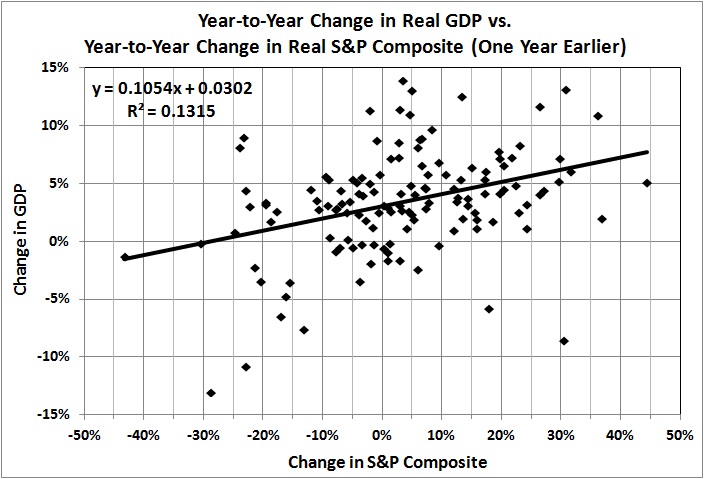
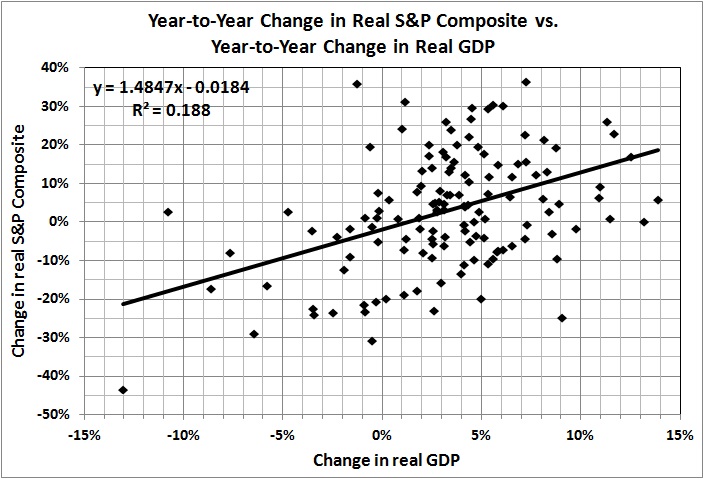
Stock prices are notoriously volatile, even when measured by a broad index like the S&P Composite. You might think that the S&P Composite is sensitive to broad changes in economic activity, as measured by GDP, for instance. But, as it turns out the S&P Composite, despite its volatility, is a leading indicator of GDP.

I begin with this graph:


Sources: The index of real GDP is derived from estimates of real GDP available at MeasuringWorth.com. The index of the value of the S&P Composite index is derived from Robert Shiller’s data set at http://www.econ.yale.edu/~shiller/data/ie_data.xls.

It is not apparent in the preceding graph, but GDP lags the S&P Composite. The correlation between the percentage change in real GDP and the percentage change in the real S&P composite in the same year is 0.43 (r-squared = .19). The correlation between the change in GDP and the change in the S&P a year earlier is 0.36 (r-squared = 0.13). That correlation is considerably stronger than the correlation between the change in GDP and the change in the S&P a year later (-0.10; r-squared = 0.01), which suggests that the S&P index is a leading indicator of GDP, not the the other way around.

In graphs:


Notes: Both correlations are significant at the 0.1-percent level. The years 1941-1946 are omitted because of the abrupt and largely artificial changes in GDP that arose when the U.S. government commandeered the economy and diverted vast resources to the war effort during World War II.

It seems unnecessary to point out that the correlations are not strong enough to derive precise predictions of GDP from changes in the S&P. However, one could do worse than rely on simple correlations, given the poor track record of complex macroeconomic models (e.g., see this).

It is unsurprising that the stock market has been heading downward since 2000 (despite occasional rallies). Investors know that economic growth is sagging under the pressure of government spending and regulation.

Related posts:
The Price of Government
The Price of Government Redux
The Mega-Depression
Ricardian Equivalence Reconsidered
The Real Burden of Government
The Rahn Curve at Work
The “Forthcoming Financial Collapse”
Estimating the Rahn Curve: Or, How Government Inhibits Economic Growth
The Deficit Commission’s Deficit of Understanding
The Bowles-Simpson Report
The Bowles-Simpson Band-Aid
The Stagnation Thesis
America’s Financial Crisis Is Now
Stocks for the Long Run?
Estimating the Rahn Curve: A Sequel
Bonds for the Long Run?
The Real Multiplier (II)
Lay My (Regulatory) Burden Down
Economic Growth Since World War II
More Evidence for the Rahn Curve
Progressive Taxation Is Alive and Well in the U.S. of A.
The Economy Slogs Along
The Obama Effect: Disguised Unemployment

Riots, Culture, and the Final Showdown

I posted “Riots, Culture, and the Final Showdown” at my old blog in February 2006. The post addressed the riots that followed the publication of the drawings of Muhammed by a Danish cartoonist. What I said then applies equally to the deadly and continuing anti-American violence in the Middle East — the excuse for which is the YouTube video, “Innocence of Muslims.” I therefore reproduce the earlier post, with minimal editing. I have included the original links, many of which may now be broken.

Prologue

This is about the broader implications of the riotous reaction of Muslims to cartoons that ran in a Danish newspaper last October. For the full story, with commentary and plenty of relevant links, go to Michelle Malkin’s blog and start with her post of January 30, “Support Denmark: Why the Forbidden Cartoons Matter,” then read on to the present.

My jumping-off point is this kind of news:

Protesters in Pakistan Target West

LAHORE, Pakistan – Thousands of protesters rampaged through two cities Tuesday, storming into a diplomatic district and torching Western businesses and a provincial assembly in Pakistan’s worst violence against the Prophet Muhammad drawings, officials said. At least two people were killed and 11 injured.

Three Killed in Massive Cartoon Protests

PESHAWAR, Pakistan – Gunfire and rioting erupted Wednesday as tens of thousands of people took to the streets in Pakistan’s third straight day of violent protests over the Prophet Muhammad cartoons. Three people were killed, including an 8-year-old boy.

The second story continues with this:

The European Union condemned both the cartoons, first printed in a Danish newspaper in September, and what it called “systematic incitement to violence” against European diplomatic missions by some unidentified governments.

Bruce Bawer has more about European groveling, and isolated acts of courage, here. Michelle Malkin has plenty to say about the groveling of major American media outlets at her blog (e.g., here). A recent story from the zone of political correctness the academy, reports the suspension of the editors of the Daily Illini (the “independent” student newspaper of the University of Illinois) for having reproduced the cartoons.

The reactions on the part of the EU, much of America’s press, and (I safely assert) most of academia are manifestations of a widespread urge to appease fanatical Islam, about which appeasement I will say more later in this post.

I write here without animus toward Islam, as a religion. My attitude toward Islam as a cultural amalgam of the religious and the social is expressed ably by Occam’s Carbuncle:

. . . What little I know of [Islam] isn’t very appealing at all. It’s rather medieval if you ask me. Not that I hate Muslims. . . . I just don’t care. . . . I don’t believe what they believe and I’m not about to start. Ever. More importantly, I will read what I want to read and I will express myself as I see fit, not within the strictures of Sharia [the code of law based on the Koran], but according to my rights as a citizen of a liberal democracy. That means Muslims do not have the right to impose upon me their own views of what is or is not proper, what is or is not sacrilege or blasphemy. . . . They may not damage my property or my person as reprisal for anything I might say or write. They may express themselves as freely as I. They may insult me. They may shun me. They might even consider ignoring me. But they may not threaten me. They may not do harm in furtherance of the precepts of their religion, just as I may not do harm to show my objection to their dogma.

The following concepts are central to my analysis of Islamic culture, as a force in the affairs of the world:

Despair: To be overcome by a sense of futility or defeat.

Paranoia: Extreme, irrational distrust of others.

Now, on with the post.

Executive Summary

A sense of futility or defeat can be inflicted upon a people by its enemies, or it can be self-inflicted by the culture of the people. A mass culture that prizes mysticism at the expense of rationality and industriousness will, if only subconsciously, come to envy cultures that profit from rationality and industriousness. But the people of the mystical culture will disavow their envy, because to do so would be to admit the inferiority of their culture. They will, instead, take the paranoid view that their backwardness is somehow caused by other cultures — cultures that are “out to get them.” This paranoia focuses the despair of the backward culture, so that its emerges in the form of rage against the culture’s supposed enemies.

The paranoid leaders of a paranoid culture pose an especial danger because of their ability to marshal weapons of mass destruction, and to deploy those weapons in a “righteous” war. In the case of Islamic paranoia, the handwriting is on the wall — and writ in blood.

The West can either act to prevent repetitions of 9/11, Madrid, and London — on a larger scale — or it can do nothing and, in doing nothing, invite the conflagration. The choice is nigh. The will to act is in doubt.

Islam: A Culture of Despair and Paranoia

I am struck by the similarity of the Muslim riots — in France last year and in the Middle East this year — to the riots in the “ghettos” of Detroit, Los Angeles, etc. Those riots, like the Muslim ones, were sparked by specific events (e.g., the murder of MLK Jr. and the beating of Rodney King). But those sparks caused explosions because they touched the volatile fuel of desperation.

Whence that fuel? It is created by the chronic illness of the underlying culture. A chronically ill person experiences stress because of his inability to function normally. Prolonged stress can lead to frustration, anger, hopelessness, and, at times, depression. The chronic, self-generated illness of the Muslim culture is similar to that of the black and white “redneck” culture:

There have always been large disparities, even within the native black population of the U.S. Those blacks whose ancestors were “free persons of color” in 1850 have fared far better in income, occupation, and family stability than those blacks whose ancestors were freed in the next decade by Abraham Lincoln.

What is not nearly as widely known is that there were also very large disparities within the white population of the pre-Civil War South and the white population of the Northern states. Although Southern whites were only about one-third of the white population of the U.S., an absolute majority of all the illiterate whites in the country were in the South. . . .

Disparities between Southern whites and Northern whites extended across the board from rates of violence to rates of illegitimacy. American writers from both the antebellum South and the North commented on the great differences between the white people in the two regions. So did famed French visitor Alexis de Tocqueville.

None of these disparities can be attributed to either race or racism. . . . The people who settled in the South came from different regions of Britain than the people who settled in the North–and they differed as radically on the other side of the Atlantic as they did here–that is, before they had ever seen a black slave.

Slavery also cannot explain the difference between American blacks and West Indian blacks living in the United States because the ancestors of both were enslaved. When race, racism, and slavery all fail the empirical test, what is left?

Culture is left.

The culture of the people who were called “rednecks” and “crackers” before they ever got on the boats to cross the Atlantic was a culture that produced far lower levels of intellectual and economic achievement, as well as far higher levels of violence and sexual promiscuity. That culture had its own way of talking, not only in the pronunciation of particular words but also in a loud, dramatic style of oratory with vivid imagery, repetitive phrases and repetitive cadences.

Although that style originated on the other side of the Atlantic in centuries past, it became for generations the style of both religious oratory and political oratory among Southern whites and among Southern blacks–not only in the South but in the Northern ghettos in which Southern blacks settled. . . .

The redneck culture proved to be a major handicap for both whites and blacks who absorbed it. Today, the last remnants of that culture can still be found in the worst of the black ghettos, whether in the North or the South, for the ghettos of the North were settled by blacks from the South. The counterproductive and self-destructive culture of black rednecks in today’s ghettos is regarded by many as the only “authentic” black culture–and, for that reason, something not to be tampered with. Their talk, their attitudes, and their behavior are regarded as sacrosanct. [Thomas Sowell, at OpinionJournal, paraphrasing his essay “Black Rednecks and White Liberals,” from the eponymous book. Sowell’s analysis of the roots of “black redneck” culture may be incomplete, but he rightly emphasizes the key role of a dysfunctional culture in the making of a dysfunctional society.]

Islamic culture, broadly speaking, seems much like redneck culture in its preference for mysticism or ritual over rationality and industriousness — as well as in its attitude toward women. The adherents of an irrational, indolent culture who have any exposure to other cultures must know that their culture holds them back materially, and that they would be better off if they were to adopt the rational and industrious ways of other cultures. (The closely held wealth of the oil sheikhs has nothing to do with Islam; it is a fortuitous artifact of the geology of the Middle East and the industry of the West.) But to adopt the ways of wealthier cultures is to admit the shortcomings of one’s own culture — and to break with one’s family, friends, and authority figures.

Thus the adherents of the backward culture remain mired in their self-inflicted despair and, instead of blaming themselves and their culture for their backwardness, they blame the outsiders whose relative success they envy. And when their despair erupts in rage it is (in the paranoid view) legitimate to attack the blameworthy — “city folk,” “honkies,” Korean and Jewish merchants, “infidels,” and so on — because they are responsible for keeping us down.

Islamic Paranoia Writ Large

Paranoia is bad enough when it motivates (sometimes organized) mobs to kill, plunder, and destroy. Paranoia is far worse when it motivates leaders who command (or seek to command) the technology of mass destruction — leaders such as Hitler, Stalin, bin Laden, and Iran’s Mahmoud Ahmadinejad. Ahmadinejad is perhaps best known to Americans for his “alleged” involvement in the Iran Hostage Crisis of 1979 and for his utterances about the United States and Israel; for example:

The establishment of the occupying regime of Qods [Jerusalem]was a major move by the world oppressor [the United States] against the Islamic world. . . .

The Palestinian nation represents the Islamic nation [Umma] against a system of oppression, and thank God, the Palestinian nation adopted Islamic behavior in an Islamic environment in their struggle and so we have witnessed their progress and success. . . .

Our dear Imam [Ayatollah Khomeini] said that the occupying regime [Israel] must be wiped off the map and this was a very wise statement. We cannot compromise over the issue of Palestine. Is it possible to create a new front in the heart of an old front. This would be a defeat and whoever accepts the legitimacy of this regime [Israel] has in fact, signed the defeat of the Islamic world. Our dear Imam targeted the heart of the world oppressor in his struggle, meaning the occupying regime. I have no doubt that the new wave that has started in Palestine, and we witness it in the Islamic world too, will eliminate this disgraceful stain from the Islamic world. But we must be aware of tricks.

For over 50 years the world oppressor tried to give legitimacy to the occupying regime and it has taken measures in this direction to stabilize it. . . .

Recently they [the Israelis] tried a new trick. They want to show the evacuation from the Gaza strip, which was imposed on them by Palestinians [oh, really?], as a final victory for the Palestinians and end the issue of Palestine. . . .

I warn all leaders of the Islamic world that they should be aware of this trick. Anyone who recognizes this regime [Israel] because of the pressure of the World oppressor, or because of naiveté or selfishness, will be eternally disgraced and will burn in the fury of the Islamic nations. (From a speech given in Tehran, Iran, on October 16, 2005, to an Islamic Student Associations conference on “The World Without Zionism.”)

The Culture Clash and the Final Showdown

Ahmadinejad, like bin Laden, whips despair into rage, a rage that is aimed at the imagined “enemies” of Islam. Bin Laden, of course, has succeeded in turning some of those imagined enemies into real ones by attacking them. Ahmadinejad seems bent on following bin Laden’s lead, but on a larger scale.

It is too late to appease such fanatics — much as some Westerners would like to try appeasement — because The West (the United States, in particular) has “insulted” Islamic fanatics in three fundamental ways: by the creation of Israel, by the “exploitation” of the Middle East’s geology, and by the defense of Israel and those Middle Eastern governments that permit the “exploitation.” Given that history, the only way to appease paranoid Islamists is for Americans to don the raiment of mystical asceticism, which might appeal to a select circle of self-flagellants, but to very few others of us.

What I am saying, really, is that a final showdown with fundamentalist Islam is inevitable. Most Americans did not understand the inevitability of that showdown until September 11, 2001 — and many Americans (including most “intellectuals” and many politicians who should know better) still refuse to acknowledge the significance of that day’s events. The doubters seem to be trapped in 1938, waiting for the UN or a Democrat president to announce “peace in our time,” or in 1939-40, unwilling to believe that America could be the target of a fanatical ideology.

It is futile to hope that hard-core Islam can be deflected through political correctness (e.g., banning speech that might offend Muslims), diplomatic maneuverings, support for dissidents, or other such transparently weak responses to aggression, terrorism, and the accumulation of weapons of mass destruction. In fact, such responses are worse than futile; they encourge what they seek to discourage because they display weakness — just as displays of weakness on the part of the United States from 1979 onward encouraged the events of September 11, 2001.

The next stage of the showdown, if it is allowed to happen, will come when al Qaeda (or one of its ilk) acquires and uses weapons of mass destruction in Europe or the United States. The following stage of the showdown, if it is allowed to come to that, will come when Iran acquires nuclear weapons.

I repeat: The question is not whether those events will happen, but when they will happen if they are not thwarted by intelligence-gathering, clandestine operations, conventional military operations, and massive strikes against hard military targets (including nuclear “power” facilities). Force is the only thing that will stop Islamic fanatics; force is the only response that they will heed — just as the Japanese, fanatical as they were, had no choice in the end but to abandon their fanatical ways.

It Is a Question of Will

We had better get used to that idea that war is the answer, and see to it that adequate force is used, sooner rather than later. Those who would use force against us will heed only force. Whether, in defeat, they will respect us or “merely” fear us is irrelevant. We are not engaged in a popularity contest, we are engaged in a clash of civilizations, which Norman Podhoretz rightly calls World War IV.

On our present political course, however, we will suffer grave losses before we get serious about winning that war. The Left (or the Opposition, as I also call it), seems insensitive to the danger that faces us. The voices of doubt and division are many and loud. They range from librarians, academicians and celebrities (too numerous to link), and hypocrites in the media to former vice president Gore and many current members of Congress (e.g., these), some of whom would prefer to impeach President Bush for defending us through a constitutional surveillance program than face up to the enemy without. Their preferred vision of government — strength at home and weakness in foreign affairs — is precisely opposite the vision of the Framers of the Constitution.

Ben Shapiro goes too far in suggesting “that Congress ought to revivify sedition prosecutions,” but he is right about the likely effect of the Opposition’s outpourings; for example:

Let us consider . . . the probable consequences of Gore’s mea culpa [before a Saudi audience] on behalf of the “majority” of his countrymen. No doubt his words will fuel the massive tide of propaganda spewing forth from Muslim dictatorships around the globe. No doubt his words will be used to bolster the credibility of horrific disinformation like the Turkish-made, Gary-Busey-and-Billy Zane-starring monstrosity “Valley of the Wolves: Iraq,” which accuses American troops of war atrocities and depicts a Jewish-American doctor (Busey) slicing organs out of Arab victims and shipping the body parts off to New York, London and Israel. No doubt Gore’s speech will precipitate additional violence against Americans in Iraq and around the globe.

(Not to mention the media’s constant re-hashing of Abu Ghraib.)

Thomas Sowell, as usual, gets to the heart of the matter:

With Iran advancing step by step toward nuclear weapons, while the Europeans wring their hands and the United Nations engages in leisurely discussion, this squeamishness about tapping terrorists’ phone contacts in the United States is grotesque.

Has anyone been paying attention to the audacity of the terrorists? Some in the media seem mildly amused that Palestinian terrorists are threatening Denmark because of editorial cartoons that they found offensive.

Back in the 1930s, some people were amused by Hitler, whose ideas were indeed ridiculous, but by no means funny.

This was not the first threat against a Western country for exercising their freedom in a way that the Islamic fanatics did not like. Osama bin Laden threatened the United States on the eve of our 2004 elections, if we didn’t vote the way he wanted.

When he has nuclear weapons, such threats cannot be ignored, when the choice is between knuckling under or seeing American cities blasted off the face of the earth.

That is the point of no return — and we are drifting towards it, chattering away about legalisms and politics.

Which leads me to the ultimate question, which James Q. Wilson addresses in “Divided We Stand: Can a Polarized Nation Win a Protracted War?” Wilson concludes:

A final drawback of polarization is more profound. Sharpened debate is arguably helpful with respect to domestic issues, but not for the management of important foreign and military matters. The United States, an unrivaled superpower with unparalleled responsibilities for protecting the peace and defeating terrorists, is now forced to discharge those duties with its own political house in disarray.

We fought World War II as a united nation, even against two enemies (Germany and Italy) that had not attacked us. We began the wars in Korea and Vietnam with some degree of unity, too, although it was eventually whittled away. By the early 1990s, when we expelled Iraq from Kuwait, we had to do so over the objections of congressional critics. In 2003 we toppled Saddam Hussein in the face of catcalls from many domestic leaders and opinion-makers. Now, in stabilizing Iraq and helping that country create a new free government, we have proceeded despite intense and mounting criticism, much of it voiced by politicians who before the war agreed that Saddam Hussein was an evil menace in possession of weapons of mass destruction and that we had to remove him.

Denmark or Luxembourg can afford to exhibit domestic anguish and uncertainty over military policy; the United States cannot. A divided America encourages our enemies, disheartens our allies, and saps our resolve–potentially to fatal effect. What Gen. Giap of North Vietnam once said of us is even truer today: America cannot be defeated on the battlefield, but it can be defeated at home. Polarization is a force that can defeat us.

Let us hope — against hope, I fear — that the Opposition comes to its senses before it is too late.

Six years and seven months later, the Opposition remains firmly attached to its deluded belief that one can reason with and appease our enemies. Or, perhaps, it is simply the case that the Opposition does not see our enemies for what they are. In any event, the Opposition (not Loyal, by any means) is just another enemy of America and the ideals of the Declaration of Independence and the Constitution.

The Sunstein Effect Is Alive and Well in the White House

Although Cass Sunstein, Obama’s erstwhile “czar” for regulatory matters, has returned to academe, his spirit lives on in the White House. Sunstein is infamous for at least two things. One of them is his advocacy of something known as “libertarian paternalism,” which is the antithesis of libertarianism. The other is his advocacy of censorship.

For more about the latter, see (for example) this post, where I say this:

Perhaps the most frightening item on Sunstein’s paternalistic agenda ties into Sen. Rockefeller’s proposal to give the president the power to shut down the internet — which amounts to the power to control the content of the internet. And make no mistake about it, Sunstein would like to control the content of the internet — for our own good, of course. I refer specifically to Sunstein’s “The Future of Free Speech,” in which he advances several policy proposals, including these:

4. . . . [T]he government might impose “must carry” rules on the most popular Websites, designed to ensure more exposure to substantive questions. Under such a program, viewers of especially popular sites would see an icon for sites that deal with substantive issues in a serious way. They would not be required to click on them. But it is reasonable to expect that many viewers would do so, if only to satisfy their curiosity. The result would be to create a kind of Internet sidewalk, promoting some of the purposes of the public forum doctrine. Ideally, those who create Websites might move in this direction on their own. If they do not, government should explore possibilities of imposing requirements of this kind, making sure that no program draws invidious lines in selecting the sites whose icons will be favoured. Perhaps a lottery system of some kind could be used to reduce this risk.

5. The government might impose “must carry” rules on highly partisan Websites, designed to ensure that viewers learn about sites containing opposing views. This policy would be designed to make it less likely for people to simply hear echoes of their own voices. Of course, many people would not click on the icons of sites whose views seem objectionable; but some people would, and in that sense the system would not operate so differently from general interest intermediaries and public forums. Here too the ideal situation would be voluntary action. But if this proves impossible, it is worth considering regulatory alternatives. [Emphasis added.]

There is more in a later post:

Alec Rawls, writing at his blog, Error Theory:

As Congress considers vastly expanding the power of copyright holders to shut down fair use of their intellectual property, this is a good time to remember the other activities that Obama’s “regulatory czar” Cass Sunstein wants to shut down using the tools of copyright protection. For a couple of years now, Sunstein has been advocating that the “notice and take down” model from copyright law should be used against rumors and conspiracy theories, “to achieve the optimal chilling effect.”

Why?

Sunstein seems most intent on suppressing is the accusation, leveled during the 2008 election campaign, that Barack Obama “pals around with terrorists.” (“Look Inside” page 3.) Sunstein fails to note that the “palling around with terrorists” language was introduced by the opposing vice presidential candidate, Governor Sarah Palin (who was implicating Obama’s relationship with domestic terrorist Bill Ayers). Instead Sunstein focuses his ire on “right wing websites” that make “hateful remarks about the alleged relationship between Barack Obama and the former radical Bill Ayers,” singling out Sean Hannity for making hay out of Obama’s “alleged associations” (pages 13-14).

What could possibly be more important than whether a candidate for president does indeed “pal around with terrorists”? Of all the subjects to declare off limits, this one is right up there with whether the anti-CO2 alarmists who are trying to unplug the modern world are telling the truth. And Sunstein’s own bias on the matter could hardly be more blatant. Bill Ayers is a “former” radical? Bill “I don’t regret setting bombs” Ayers? Bill “we didn’t do enough” Ayers?

For the facts of the Obama-Ayers relationship, Sunstein apparently accepts Obama’s campaign dismissal of Ayers as just “a guy who lives in my neighborhood.” In fact their relationship was long and deep. Obama’s political career was launched via a fundraiser in Bill Ayers’ living room; Obama was appointed the first chairman of the Ayers-founded Annenberg Challenge, almost certainly at Ayers’ request; Ayers and Obama served together on the board of the Woods Foundation, distributing money to radical left-wing causes; and it has now been reported by full-access White House biographer Christopher Andersen (and confirmed by Bill Ayers) that Ayers actually ghost wrote Obama’s first book Dreams from My Father.

Whenever free speech is attacked, the real purpose is to cover up the truth. Not that Sunstein himself knows the truth about anything. He just knows what he wants to suppress, which is exactly why government must never have this power.

As Rawls notes, Sunstein also wants to protect “warmists” from their critics, that is, to suppress science in the name of science:

In climate science, there is no avoiding “reference to the machinations of powerful people, who have also managed to conceal their role.” The Team has always been sloppy about concealing its machinations, but that doesn’t stop Sunstein from using climate skepticism as an exemplar of pernicious conspiracy theorizing, and his goal is perfectly obvious: he wants the state to take aggressive action that will make it easier for our powerful government funded scientists to conceal their machinations.

Now, in response to the recent, deadly, and continuing anti-American violence in the Middle East — the excuse for which is “Innocence of Muslims” — we read this of the Obama administration:

Administration officials have asked YouTube to review a controversial video that many blame for spurring a wave of anti-American violence in the Middle East.

The administration flagged the 14-minute “Innocence of Muslims” video and asked that YouTube evaluate it to determine whether it violates the site’s terms of service, officials said Thursday. The video, which has been viewed by nearly 1.7 million users, depicts Muhammad as a child molester, womanizer and murderer — and has been decried as blasphemous and Islamophobic.

“Review” it, or else. When the 500-pound gorilla speaks, you say “yes, sir.”

Way to go, O-blame-a. Do not stand up for Americans. Suppress them instead. It’s the Sunstein way.

Related reading:
Mary Katherine Ham, “The Eight Dumbest Things Said about Free Speech This Week,” Hot Air, September 14, 2012
Eugene Volokh, “Why Punishing Blasphemous Speech That Triggers Murderous Reactions Would Likely Lead to More Deaths,” The Volokh Conspiracy, September 15, 2012

Related posts:
Sunstein at the Volokh Conspiracy
More from Sunstein
Cass Sunstein’s Truly Dangerous Mind
An (Imaginary) Interview with Cass Sunstein
Libertarian Paternalism
Slippery Sunstein
A Libertarian Paternalist’s Dream World
The Short Answer to Libertarian Paternalism
Second-Guessing, Paternalism, Parentalism, and Choice
Another Thought about Libertarian Paternalism
Back-Door Paternalism
Another Voice Against the New Paternalism
Sunstein and Executive Power
The Feds and “Libertarian Paternalism”
A Further Note about “Libertarian” Paternalism
Apropos Paternalism
FDR and Fascism
Fascism
Are We All Fascists Now?
Fascism with a “Friendly” Face
Fascism and the Future of America
Discounting and Libertarian Paternalism
The Mind of a Paternalist
Another Entry in the Sunstein Saga

More about Names

In “The Names, They Are A-Changin‘,” I looked at the popularity of baby names in 1940 (the modal birth year of members of my high-school graduating class) and the popularity of the same names in 2011. For a more sweeping view of the subject, I returned to the Social Security Administration’s baby-name database, which spans the years 1880-2011. and constructed the following table:

On average, the top 20 male names of 1880 dropped at least 220 places from 1880 to 2011; whereas, the top 20 male names of 2011 rose at least 271 places, on average.

Female names are far more volatile: On average, names among the top 20 in 1880 were ranked at least 418 places lower in 2011; whereas, the top 20 in 2011 rose at least 457 places, on average. The greater volatility of females names is also indicated by the number of them that are not in the top 1000 in both 1880 and 2011, namely, twelve. Only four of the male names are not in the top 1000 in both years.

I must admit that, on the whole, I prefer the top 20 names of 2011 to the top 20 names of 1880. The male names reflect a trend toward the Biblical, and only the ersatz Jayden grates on me. (I would prefer Aidan to Aiden because the former is a better transliteration of the Gaelic original.)

The popular female names of 2011 tend to be more euphonious than their counterparts of 1880. I do not miss Minnie, Ida (curt), Bertha, Florence, or Nellie — though I do miss Carrie. On the other hand, we have the ersatz Madison, and unisex-sounding Addison, and two names that once were almost exclusively assigned to males: Avery and Aubrey. I do hope that the trend toward the feminization of male names does not extend to Homer, Humphrey, and Oscar.

LIberty as a Social Construct: Moral Relativism?

This is the fourth installment of a series that explores the true nature of liberty, how liberty depends on society, how society (properly understood) has been eclipsed by statism and its artifacts, and how society — and therefore liberty — might re-emerge in the United States. In this installment, I take up the second of several possible objections to my model of a society’s essence and workings. This series will close with a blueprint for the restoration of society and liberty in America.

If you have not read the first three installments, “Liberty and Society,” “The Eclipse of ‘Old America’,” and “Genetic Kinship and Society,” I recommend that you do so before you continue. This post addresses the following question: Am I Endorsing Moral Relativism?

In “Liberty and Society,” I argue that

liberty — “do what you want, constrained only by the harm to others” — is an empty concept unless it rests on a specific definition of harm. Why? Because harm is not a fixed thing — like the number 1 or your house — it is a vague concept that has meaning only when it refers to specific types of act, which then may be judged as harmful by some and unharmful by others. But until harm is defined and agreed through mutual consent (explicit or implicit), liberty lacks real meaning.

Liberty, in other words, is a social construct, without a fixed meaning. Further, harm is not a single thing; it is many things, each of which is socially defined. Each harm refers to a right; the right not to be killed without (specified) cause, for example. The collection of rights (anti-harms) defines the scope of liberty in a particular society. Liberty is therefore divisible, to some extent; that is, a person might enjoy most of his socially agreed rights, but not all of them, because of this action by government or that action by a compatriot or enemy. (It is wrong, however, to assume that one can divide rights between social and economic categories; what is called economic activity is nothing more than a particular aspect of social activity, and the denial of certain economic rights is also a denial of social rights.)

Before you accuse me of moral relativism, consider the following. I am not endorsing a particular social construct, merely describing reality. The ugly reality is that in some societies there are barbarous acts which are considered to be moral, or to be justified because they are committed to enforce a moral code. One need look no further than certain Islamic sects, which endorse acts of terror against infidels, the stoning to death of adulterous women, and the imprisonment of homosexuals just because they are homosexuals. Are those acts justified by their broad acceptance within the Islamic sects that preach and practice them? Not in my view, certainly. But abhorrence of such acts does not negate the fact that they are accepted as normal within certain societies.

These facts will not dissuade moral absolutists, among whose number are deontological libertarians. Such libertarians like to believe that there is a “correct” moral code, and that it is known to them. This is a rather priestly pretension for a sect whose ranks are populated mainly by atheists. Persons who come to moral absolutism through religious conviction have the advantage of intellectual consistency.

By the deontological account, every human being is endowed with certain inalienable rights — “natural rights.”  What are those rights? One might assume that deontologists agree unanimously about them, inasmuch as deontologists accept the non-aggression principle and self-ownership as axiomatic. But the devil, as always, is in the details. Does the non-aggression principle preclude abortion? Some deontologists say that it does; others, that it does not. Does the non-aggression principle preclude a preemptive strike when it is evident that an enemy is about to attack? Again, it depends on which deontologist answers the question. I could go on, but that should be enough to tell you that deontology is no guarantee of moral certainty. In fact, deontology is nothing more than Mill’s harm principle in fancy dress And it has the same fatal flaw: It is a general statement into which one may pour a variety of specific meanings. (See “Liberty and Society.”) Efforts by deontologists to ground “natural rights” in evolutionary biology are equally fatuous. (See “Evolution, Human Nature, and ‘Natural Rights’,” and “More Thoughts about Evolutionary Teleology.”)

Then there are consequentialist libertarians, who claim that a regime of negative rights is best because it yields the greatest good for the greatest number. But the problem with that stance is its utilitarianism, that is, its presumption that the welfare of one person can be weighed against that of another person. (See “Enough of Social Welfare.”)

What about “progressives,” who are like deontological libertarians in the certainty with which they proclaim “natural rights,” which they (“progressives”) like to call “universal rights” and “human rights.” Unsurprisingly, “progressive” conceptions of rights are unlike those of most libertarians, who recognize only negative rights (“bleeding hearts” excepted). “Progressives” are champions of positive rights, that is, claims against the produce and property of others.

Who is to say that the “progressives” are wrong and hard-core libertarians are right? In other words, if there is a moral high ground, who decides who is standing on it? If a group of “progressives” were to form a cohesive society in which certain positive rights were agreed and accepted by all, without resort to coercion, would that not be a legitimate state of affairs? I have to admit that it would be.

That said, there is among “progressives” broad resistance to a pure share-and-share-alike ethos. In fact, “progressives” adhere to a share-this-much-but-no-more ethos. Though the “sharing” is not true sharing but redistribution by government edict. And the proper amount of “sharing” is always an idiosyncratic product of “progressive” attitudes du jour.

If you seek a good example of moral relativism, you can always find it in “progressivism,” with its ad hoc morality. Consequentialist libertarianism is no better, in principle, though when it comes to policy, consequentialists tend to be indistinguishable from deontologists. The latter, if they are nothing else, are demi-paragons of moral absolutism. If they were paragons, they would all discover the same operational code — one that goes deeper than an invocation of “natural rights.”

But I have wandered from the main point, which is whether variations in moral codes necessarily denote significant differences as to the nature of morality. Moral codes have two types of component: core values and instrumental values. Core values usually are expressed as absolutes: You shall not kill; you shall not steal; and so on. And those values may be held in common by many societies, even though those societies may have markedly different instrumental values.

The Amish, for example, subscribe to the core values that are enunciated in the Ten Commandments. But their instrumental values vary from sect to sect; thus:

Amish lifestyle is dictated by the Ordnung (German, meaning: order), which differs slightly from community to community, and, within a community, from district to district. What is acceptable in one community may not be acceptable in another. No summary of Amish lifestyle and culture can be totally adequate, because there are few generalities that are true for all Amish. Groups may separate over matters such as the width of a hat-brim, the color of buggies, or other issues.

The last sentence of the quotation will cause “sophisticates” to smirk, though secular “sophisticates” are loathe to associate with persons who hold “mistaken” views about abortion, child-rearing, capital punishment, and the proper role of government — to name but a few examples. And yet, those same “sophisticates” will agree with their ideological enemies that murder, theft, and several other acts are wrong. The devil, as I say, is in the details.

Instrumental values may be as trivial (to the non-Amish) as the width of a hat-brim, or as consequential (to a large number of persons on the left and right) as the proper punishment for premeditated murder (i.e., whether it should be incarceration, perhaps with a rehabilitative aim, or execution).

Why are instrumental values so important? And do differences about instrumental values preclude common cause with respect to core values?

A society is much more than its core values, As I have said,

[a] society coheres around genetic kinship, and is defined by its common culture, which includes its moral code. The culture is developed, transmitted through, and enforced by the voluntary institutions of society (civil society). The culture is the product of trial and error, where those elements that become part of received culture serve societal coherence and — in the best case — help it to thrive. Coherence and success depend also on the maintenance of mutual respect, trust, and forbearance among society’s members. Those traits arise in part from the sharing of a common culture (which is an artifact of societal interaction) and from genetic kinship, which is indispensable to societal coherence.

(On the importance of genetic kinship, see Genetic Kinship and Society.”)

But genetic kinship stretches only so far as a bonding material. When a person — even a person of the “right” race and ethnicity — flouts a society’s instrumental values, he signals disrespect for all of that society values, not just disrespect for the instrumental values in question. Take the predominantly white, flag-burning, rampaging, long-haired, bearded war-protestors of the 1960s and early 1970s, for example. Even though the United States is not a society and never has been one, it cohered in Old America because of commonalities among the societies of which it was composed. To be long-haired and bearded in the 1960s and early 1970s was (rightly) taken not just as a sign of one’s anti-war views but as a sign of one’s rejection of the values common to the societies of Old America. And so it was that to wear one’s hair long and to sport a beard (especially if the hair and beard were unkempt) was to risk a beating at the hands of white “good old boys.” (That the “good old boys” later adopted long hair and shaggy beards only underscores the role of signaling in social solidarity.)

It is nevertheless possible for societies that differ in their instrumental values to find common cause — as long as the differences are not too great:

Old America‘s core constituents, undeniably, were white, and they had much else in common: observance of the Judeo-Christian tradition; British and north-central European roots; hard work and self-reliance as badges of honor; family, church, and club as cultural transmitters, social anchors, and focal points for voluntary mutual aid. The inhabitants of Old America were against “entitlements” (charity was real and not accepted lightly); for punishment (as opposed to excuses about poverty, etc.); overtly religious or respectful of religion (and, in either case, generally respectful of the Ten Commandments, especially the last six of them); personally responsible (stuff happens, and it is rarely someone else’s fault); polite, respectful, and helpful to strangers (who are polite and respectful); patriotic (the U.S. was better than other countries and not beholden to international organizations, wars were fought to victory); and anti-statist (even if communitarian in a voluntary way). Living on the dole, weirdness for its own sake, open hostility to religion, habitual criminality, “shacking up,” and homosexuality were disgraceful aberrations, not “lifestyles” to be tolerated, celebrated, or privileged.

Old America was a large and richly diverse nation, united as much as it could be — and as much as it needed to be for mutual self-defense. Much of that unity has been undone by the purveyors of “diversity” (i.e., state-imposed preferences), who are also the purveyors of “equality” (i.e., unearned entitlements). Those same purveyors are moral relativists who cannot bring themselves to keep Americans safe from violent sub-cultures, at home and abroad.

Which brings me to my criteria for judging moral codes:

1. A code must be socially evolved, not imposed by the state. (Though the state may enforce a moral code that reflects social norms.)

2. A code that fosters beneficent behavior must conform to the Ten Commandments, or to the last six of them, at least.

3. Those who dissent from the code must be able to voice their dissent; otherwise, the code ceases to be socially evolved. (Dissent does not encompass treason.)

4. Those who cannot abide the code must be able to exit society’s jurisdiction, without penalty.

There is more, if a society is part of a larger polity.

5. That polity is illegitimate if it overrides the otherwise legitimate moral codes of its constituent societies.

6. That polity is illegitimate if it honors inimical moral codes, either overtly or by making acts of obeisance to them. (A case in point: Obama’s support for uprisings in the Middle East — uprisings led by Muslim extremists, as Obama must surely have known.)

7. That polity is illegitimate if, in overriding those moral codes, it effectively negates voice and exit. (This has happened in America, where we are hostages in our own land.)

In closing, it is true that liberty is a social construct. But that is a realistic position, not a morally relativistic one. I am quite prepared to be judgmental of societies and polities. There is a “best” morality. It was widely practiced in Old America. Though it is still practiced in the remnants of Old America, it is vanishing from the United States, mainly because government has sundered social bonds and usurped the role of  society as the arbiter of morality. The government of the United States and the governments of most of its political subdivisions are illegitimate because their legal impositions are, for the most part, rooted in envy and power-lust — and not in Judeo-Christian morality.

Related posts:
On Liberty
Rights, Liberty, the Golden Rule, and the Legitimate State
What Is Conservatism?
Law and Liberty
Zones of Liberty
Society and the State
I Want My Country Back
The Golden Rule and the State
Government vs. Community
Evolution, Human Nature, and “Natural Rights”
More about Conservative Governance
The Meaning of Liberty
Evolution and the Golden Rule
Understanding Hayek
The Golden Rule as Beneficial Learning
Facets of Liberty
True Libertarianism, One More Time
Human Nature, Liberty, and Rationalism
Why Conservatism Works
Reclaiming Liberty throughout the Land
Rush to Judgment
Secession, Anyone?
Race and Reason: The Achievement Gap — Causes and Implications
Liberty and Society
The Eclipse of “Old America”
Genetic Kinship and Society

How Not to Cope with Government Failure

A member of a Google Group to which I belong has posted an article from the Dayton Daily News of September 9. It says, in part, that

The Air Force Institute of Technology has launched an “acquisition center of excellence” to reduce costs and better manage the test and evaluation of U.S. military weapons and programs from the KC-46 aerial refueling tanker to anti-missile defenses, a program leader said.

The Defense Department initiative will partner with 20 acquisition programs worth more than $150 billion across each branch of the military to outline plans to more rigorously test weapon systems and other programs in development….

Loren B. Thompson, a defense analyst with the Lexington Institute in Arlington, Va., said the addition will be “a definite plus” for the Air Force, which has been plagued with acquisition issues such as the recent cancellation and rebidding of an estimated $350 million program to equip the Afghan air force with 20 light attack turboprop aircraft.

The Air Force also has dealt with hypoxia-related issues to the F- 22 stealth fighter program that temporarily grounded the high-tech fighters and later forced the Pentagon to impose flying restrictions for the safety of pilots.

“This (center) will not help the F-22 situation because that is a … very unusual challenge where normal procedures have not uncovered what the problem is,” Thompson said. “But it will certainly help the Air Force get better at obtaining the performance it wants for a lower price.”…

My reaction?  The establishment of the “acquisition center of excellence” is from the standard repertoire of responses to bureaucratic failure: appoint a “blue ribbon” panel, appoint a “watchdog” agency or “czar,” and/or reorganize. Bureaucratic failure is a systemic problem because bureaucracies are not self-correcting. The particular response to a particular bureaucratic failure might rectify that failure, but it is unlikely to prevent or correct the next bureaucratic failure, which will be of a different kind and will crop up in an entirely different bureaucracy.

Markets “fail,” in that individual firms make mistakes, but free markets are self-correcting. Even if a mistake is not fatal to a particular firm, its customers (almost always) will have the option of getting what they need (or a good substitute) elsewhere. And, unlike government agencies, bad mistakes result in the elimination of the entities that make them — unless those entities are bailed out by government, of course.

In sum, the best way to cope with government failure is to have less government in the first place. There is no other preventative or cure for government failure. At the same time, less government interference in markets is bound to make markets more efficient and effective in providing what people want.

If you disagree with me, I advise you to think of a counter-example other than the financial crisis that sparked the Great Recession. That crisis was deeply rooted in government failure. For chapter and verse, see Arnold Kling’s monograph, Not What They Had in Mind.

The Names, They Are A-Changin’

In the table below, I offer a morsel of cultural history. The table compares the popularity of baby names in 1940 (the modal birth year of members of my high-school graduating class) with the popularity of the same names in 2011.

Also shown are the names that have replaced the names of my classmates in popularity. Michael, for example, is number 6 in 2011, replacing Charles, the number 6 of 1940. Michael, as it happens, was number 18 in 1940.

As might be expected, the turnover among female names is greater than the turnover among male names. For example, 6 of 40 male names dropped out of the top 1000 between 1940 and 2011, as against 20 of 39 female names. And 11 of 40 replacement names for males were not in the top 1000 in 1940, as against 21 of the 39 replacement female names.


Source: This search tool at the website of the Social Security Administration.